




Introduction
Globally, dementia is an urgent public health priority, with an estimated new diagnosis every three seconds (Alzheimer's Disease International 2021). The syndrome, which includes Alzheimer's disease and a variety of other neurodegenerative conditions, affects memory, behaviour and cognition, resulting in significant social, physical and psychological impacts on individuals living with dementia, their carers and wider society (World Health Organization 2017). In the UK alone, around 900 000 people currently live with various forms of dementia (Alzheimer's Society 2021).
Archaeology can provide diverse opportunities for creative engagement, entertainment, education and even exercise for those living with dementia and for their carers. To date, this has included the benefits of dementia-friendly excavations, more accessible heritage site attractions and enhanced museum experiences through initiatives such as dementia toolkits and apps (e.g. Tunbridge Wells Museum 2015; Klug et al. Reference Klug2017; Cutler et al. Reference Cutler, Palma and Innes2019; National Museums Liverpool 2020). Similarly, increasing archaeological interest in care practices and therapeutic landscapes has focused attention on well-being in both the past and present (e.g. Darvill et al. Reference Darvill2019). The recreational and therapeutic benefits of the arts for people with dementia is well established (Camic et al. Reference Camic, Tischler and Pearman2014; Chauhan Reference Chauhan2018; Schneider Reference Schneider2018); examples of practice include the handling of ancient objects in museums and on hospital wards (Noble & Chatterjee Reference Noble, Chatterjee and Chatterjee2008; Camic et al. Reference Camic, Hulbert and Kimmel2019). A related area is the rise of personal memory boxes (Heath et al. Reference Heath, Hughes and Gosney2019), adding to the widespread use of museum reminiscence boxes in care home settings (Phenice & Griffore Reference Phenice and Griffore2013; Thomson & Chatterjee Reference Thomson and Chatterjee2016). In short, much of this current work constitutes diverse forms of heritage engagement for people with dementia, rather than constituting archaeologies of dementia.
The present article seeks to stimulate debate and to contribute to new thinking around anticipatory future archaeologies of dementia. The focus is on material culture and the shifting interpretations of object properties. The article presents a contemporary case study of a lithic assemblage curated by an individual with dementia, exploring aspects such as the enduring personal significance of stone and embodied knowledge practices within assemblages—aspects which bear witness to altered cognitive and sensorial engagements.
Archaeology makes a vital contribution to interdisciplinary research methodologies across the social sciences (e.g. Zimmerman & Welch Reference Zimmerman and Welch2011; Woodward Reference Woodward2016). In particular, it can bring insights to dementia studies through practical methods specifically developed for landscapes and objects, and, most importantly, through well-established theoretical engagements with material culture, sites and memory works. As various forms of dementia progressively inhibit an individual's ability to speak, non-verbal communication and the use of objects can become more significant. Two particular areas of current interest in humanities research on dementia are elaborated here. The first concerns art and embraces the call by Bellass et al. (Reference Bellass2018) to focus on the more mundane forms of ‘little-c’ everyday creativity, such as the arrangement of decorative ornaments by people living with dementia at home. The intention is to better understand the lived experiences of dementia, leading to potential future insights for treatment and arts-based therapy. A focus on creativity also challenges prevailing negative narratives around memory loss (Basting Reference Basting2009). Second, the ‘material turn’ has invigorated research interest around the materialities of care (e.g. Kellehear et al. Reference Kellehear, Pugh and Atter2009; Buse et al. Reference Buse, Martin and Nettleton2018; Cleeve et al. Reference Cleeve2018; Lovatt Reference Lovatt2018). A baby doll, scrunched up paper balls, a comfort blanket and a handbag are examples of specific objects identified as dementia ‘things’ (Stephens et al. Reference Stephens, Cheston and Gleeson2013; Buse & Twigg Reference Buse and Twigg2014a, Reference Buse and Twigg2014b; Kenning & Treadaway Reference Kenning and Treadaway2018; Parker Reference Parker2018).
Recent research in ‘material citizenship’ also highlights the importance of access to personal objects in care homes (Lee Reference Lee2019). More research, however, is required to document the types of meaningful objects and collections created by people living with various dementias, especially at home and in institutional care settings. Dementia has its own sites, temporalities and materialities.
What might an archaeology of dementia therefore look like? To explore and address such issues in practice, I present a case study based on the archaeological analysis of a dementia assemblage, introducing the concept of ‘dementia works’ to describe the outputs of everyday creative acts and, in particular, the assemblages created by people living with dementia. This study draws on sensorial assemblage thinking in archaeology that considers the “commingling and contingent co-presence of diverse temporal moments” (Hamilakis Reference Hamilakis2017: 173). The aim is to elucidate how such dementia works present us with different temporal modalities to explore other associations, ones that “allow us to talk about the condition of the in-between, of the processes that happen, the relationships that are forged and the possibilities that emerge in the midst of things, senses, memories and affects” (Hamilakis Reference Hamilakis2017: 176). This form of assemblage thinking also celebrates methodological experimentation and creativity, and is particularly attentive to touch and sensorial experience.
A case study in dementia archaeology
The salvage of an unusual heritage collection on the Isle of Arran, Scotland, has provided the opportunity to undertake an exploratory archaeology of dementia. Formulated as a contemporary archaeological project using home as a field site, in 2016 the research project Archaeological Housework recovered a large collection of dementia works curated by Fiona Gorman, a female avocational archaeologist. Due to the unique circumstances of the collection, it offers insights into one woman's creative engagement with found objects and the prehistoric past.
Fiona Gorman trained as an artist, graduating from the Glasgow School of Art in the 1950s and subsequently working as a secondary school art teacher. In later life, Gorman experienced dementia, first as a carer and then a person living with dementia herself. At the time of writing, she is living in residential care, with advanced Alzheimer's disease. Married to the Scottish mural artist James Gorman (1931–2005), Fiona Gorman volunteered for 10 years as an archivist at the Isle of Arran Heritage Museum, where she also created a series of original museum displays. The fieldwork at her home, Alt Beag, and a nearby cottage, Burnbank, where she maintained a dedicated archaeological workroom, recovered an extensive documentary archive, along with archaeological and other found objects, and a geological collection. Most of the archive relates to recreational research undertaken with friends during retirement, including extensive, systematic fieldwalking and landscape surveys (Gorman & Murray Reference Gorman and Murray1995; Gorman et al. Reference Gorman, Murray and Lambie1995). Key aspects of this work were undertaken whilst also caring for her mother, who lived with Alzheimer's, shared geological interests with her daughter and maintained her own lithic collection.
During this period as a carer, and after her mother's death, Gorman used an upstairs workroom in Burnbank (Figure 1), with a table for laying out finds and undertaking systematic analyses of prehistoric lithic assemblages recovered from the Mesolithic sites discovered through fieldwalking. Despite being an avocational archaeologist with no formal training, Gorman taught herself how to record lithic artefacts by referring to relevant regional publications and via correspondence with specialists, including the current author. My recording of her abandoned table, with its ordered rows of bagged flint finds and plastic containers containing loose flints sorted by size awaiting classification, along with discrete piles of numbered flint flakes awaiting analysis, is described elsewhere (Finlay Reference Finlay2020). In sum, her archaeological finds practice was as follows: artefacts were washed, then labelled using dip-ink numbers and sorted into various categories comprising cores, flakes, blades and retouched pieces (predominantly microliths and scrapers). These Mesolithic artefacts tend to be made from small, local flint beach pebbles and are generally less than 40mm in length. Gorman subjected these finds to detailed quantification using both standard typologies (e.g. Finlayson et al. Reference Finlayson, Finlay, Mithen and Mithen2000) and her own adapted criteria before bagging them in neatly labelled, standard plastic finds bags. Her handwritten catalogues reveal various descriptive revisions, the re-measuring of the finds and particular interests in tool use (unpublished data).
Location map of the Burnbank archaeological workroom and Alt Beag (top right and middle right), the home of Fiona Gorman and her husband James Gorman (pictured top left), with a view (bottom left) and close-up (bottom right) of the imported flint gravel surface outside (bottom right) (© University of Glasgow).

Burnbank has been described as “a little museum” (B. Murray, filmed interview transcript, 2018), with workroom shelves covered in decorative arrangements of stones. The setting enabled Gorman to concentrate on lithic analysis and became a dedicated space for both recording and storage. In time, this workspace became progressively abandoned, possibly completely so by 2007–2008. In situ work on the table dates back to at least 2001 and is associated with the creation of displays for the Isle of Arran Heritage Museum, which post-dates the Mesolithic assemblage analysis. Gorman's archaeological activity and the creation of an extensive photographic and documentary archive continued at Alt Beag, her home (Figure 1); the last processed archaeological assemblage found there dates to 2010.
This article focuses on a collection of distinctive, creative dementia works and lithic assemblages dating from c. 2013–2015, which Gorman personally curated. These illustrate her personal response to progressive dementia and the continued tactile pleasures of handling and sorting stone. Prior to the initial fieldwork reconnaissance visit in 2015, many of these items had been brought together as part of preparatory work by her legal guardian to organise the collection for specialist evaluation, ahead of formal divestment and house clearance. In 2016, additional containers were recorded in situ in the kitchen at Alt Beag and several more were recovered from a conservatory and other downstairs rooms. This distribution indicates the former widespread, everyday visibility and co-presence of this assemblage on available surfaces and floors. These items were important for their tactile as well as visual properties and they served as spontaneous displays and topics for conversation with visitors.
The progression of dementia resulted in the reconfiguration of Gorman's domestic space and provision for increased assisted living. Concessions were made to the materialities of everyday care and decreasing amount of activity, until eventually she became largely confined to one downstairs room. A cabinet beside an armchair became an inscribed surface for relational graffito and memories, along with scribbled phone numbers, medical appointment times and a reused ‘Quartz and Quartzite’ sticker. A dedicated freezer and microwave were purchased for her and stored in a small study for carers to prepare frozen meals.
Several items illustrate the continued companionship and co-creation with stone and the continuity of sorting practices associated with her earlier processing of prehistoric lithic assemblages. Now, unworked flint gravel replaced the archaeological chipped stone assemblages, resulting in the creation of new types of dementia assemblage works, reflecting an enduring interest in stone as a media.
While increasingly confined to home, Gorman began to collect stones from an adjacent gravel surface (Figure 1). The driveway leading to the, by now, unused Burnbank archaeological workroom was composed of stones of different lithologies, including imported flint gravel chippings. Probably originating from southern England, these flints are widely sold as decorative gravel aggregate for garden paths and borders. The presence of this material is notable in the context of a Scottish lithic landscape devoid of flint, with limited fluvio-glacial and beach pebble resources (Wickham-Jones & Collins Reference Wickham-Jones and Collins1978).
Occasionally, genuine prehistoric artefacts and debitage, including Palaeolithic and later tool forms, can be found in this often heavily rolled and mechanically fractured material, together with naturally flaked, rolled and edge-damaged pieces. These latter items comprise a class of ambiguous pseudo-artefacts and pieces that defy easy categorisation. Unsurprisingly, it was similar but larger gravel flint pieces that were so heavily contested in the nineteenth-century eolith debates (Ellen & Muthana Reference Ellen and Muthana2010).
Drawn to this flint gravel, Gorman began to collect and accumulate pieces, and to gather a small number of other lithologies, which she curated in new ways distinct from her former systematic treatment of archaeological finds. Ranging in size from 13–33mm, the flint gravel contrasts with the local archaeological material in its exterior cortex, condition and colour. The collection is unwashed, and many pieces are dirty, often with a distinctive surface lichen growth, paint splashes from building whitewash and staining not present in the archaeological assemblages. The dimensions of these unmodified stones, however, are comparable to the Mesolithic artefacts that Gorman previously catalogued and there is material continuity, with the majority being of flint.
Along with interesting stones found on beaches or when out on walks, Barbara Murray, a long-time friend, archaeological co-worker and now carer, sometimes gave Gorman individual flints from the gravel path in order to continue conversations around the interpretation of stone artefacts. Some path finds were also given by the son of a neighbour, who knew of Gorman's passion for finding flints (B. Murray pers. comm.). Other geologies are present in this alternative dementia lithic assemblage, including quartz, quartzite, granite and Arran pitchstone; most are rolled and abraded natural pieces.
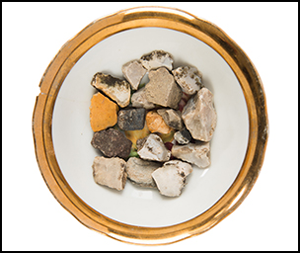
It appears that Gorman's former practice of washing, individually labelling and cataloguing gave way to more simple assemblages of found material arranged in a variety of appropriated domestic containers, including ceramic bowls and plates. This is illustrated by a single Bohemia cherry-motif pattern bowl with gold trim (0.134m diameter), containing 19 stone pieces, 14 of which are flint gravel (Figure 2).
Ceramic bowl containing flints (© The Photographic Unit, University of Glasgow).

Within the assemblage is a particularly notable collection of 15 reused, bi-compartment frozen-meal containers made of aluminium foil (Figure 3; also see the online supplementary material (OSM)), only five of which retain original lids. The contents comprise a mixture of found stones of various types, shells and occasional random household items, such as an elastic band, a length of pink ribbon and a thread reel. Marine shells that were collected by Gorman for use as decorative inclusion in exposed mortar of the kitchen wall are also found alongside the flints. Three of the foil containers also include archaeological lithics in labelled finds bags or film canisters. Some of the containers have sheets of kitchen roll or tissue liners often placed within one of a container's two compartments; one has a liner of white stickers. In most cases, the contents rest directly on the interior foil surface. In many containers, the lithics are spread out, possibly originally in rows, with gaps between the stones; traces of row ordering or material sorting can still be discerned in some containers. Others are full, overflowing with flints, and include both original and reused former archaeological site labels, even though the contents now clearly comprise non-archaeological gravel-path finds.
A selection of the reused aluminium trays containing mixed stone assemblages; 3a) close-up of quartz pebble ‘face’ (© The Photographic Unit, University of Glasgow).

Disposable aluminium foil containers were not previously used for artefact storage in the Burnbank workroom, and thus belong to a discrete temporal horizon. Originally supplied as frozen-meal containers by a local provider, the handwritten dates of the extant lids date from April to July 2013; the earliest dated lid is from February 2013. These lids have been reversed and on some, Gorman has written ‘Flint’ and ‘Flint Tools’ on the inner reflective foil (Figure 3: 7–8). Writing and labelling associated with this dementia assemblage was made using a thick marker pen, which contrasts with the dip-ink pen and fine-line black marker pens used for her earlier, meticulous treatment of the archaeological finds. Gone too are the neatly trimmed stickers common to the Burnbank finds assemblages, with writing now directly on container surfaces. Handwriting also changes to larger capitalisation, with less well-formed lettering, developments also seen on other archive documents, alongside repeated expressions such as ‘very interesting’ appended to several former notes and lists. The latter mirrors preferred earlier vocabulary used in hand-written catalogues (unpublished data).
Attentive to the creativity represented by these dementia works, a decision was made to retain a sample of the containers for future exhibition display and to catalogue them using a modified Minimum Number of Individuals (MNI) method that did not involve the removal of the containers’ contents. Given that collections of loose stones tend to move around when transported, these and other open containers and reused crockery were photographed in the field. Pieces were quantified by blank (e.g. pebble, core, flake), colour, size and condition (after Finlayson et al. Reference Finlayson, Finlay, Mithen and Mithen2000).
Overall, the assemblage is almost exclusively stone, with some archaeological material present mostly within original, smaller containers and bags within the open foil trays. Differential treatment by raw material type or colour can only be seen in one foil container, with the separation of Arran pitchstone into one compartment (Figure 3: 6). This is in direct contrast to Gorman's non-separation of chipped stone by raw material in the other containers and in her treatment of the archaeological assemblages. There is no clear patterning in terms of flint colour, and the selection reflects the range of variation evident in the gravel driveway (Figure 1). The number of pieces varies, with some approximate similarities in numbers between compartments and trays, possibly indicating rudimentary counting.
Identification of ‘tool use’ observed in Gorman's labelling of the foil tray lids reflects her prevailing interest in archaeological classification; many of the gravel flint pieces have edge-damaged or pseudo-retouched features, but the selection criteria—if such features were important at the time of sorting—cannot be readily determined.
Overall, these multi-sensory assemblages offered tactile and audible pleasures, along with frequent opportunities for casual strewing, selecting and handling of stone and its remaking into temporary decorative displays—arrangements that mimic previous forms of lithic assemblage sorting and processing practices. The coolness and smoothness of flint to the touch became an important feature over time (B. Murray pers. comm.): pieces caressed with care and attention, items full of “sensorial intensity and affective weight” (Hamilakis Reference Hamilakis2017: 174). It is the tactile properties of these pieces that now become significant; stone becomes both a comfort and companion as dementia progresses.
The pareidolic properties of things
A feature of the Gorman dementia works that is shared with her earlier archaeological and found stone-object collecting is an evident artistic interest in pareidolia, which is defined as “the tendency to perceive a specific, often meaningful image in a random or ambiguous visual pattern” (Merriam-Webster Reference Merriam-Webstern.d.)—seeing faces or animal forms in the clouds, for example. Encountered primarily in the context of rock-art identification and early cognition (Bednarik Reference Bednarik2017), there is now a wider disciplinary relevance to our treatment of the pareidolic properties of things that is reinvigorated in theory and practice by embracing new materialism. Where previously it has been difficult to consider and assign subjective meaning to natural artefacts due to descriptive biases around human agency, deliberate modification and the emphasis on technological features, new materialisms opens up how we think differently with unmodified matter.
Particularly relevant for Gorman's assemblages is the work of Tilley (Reference Tilley2017), who highlights the neglect of the natural properties of unmodified pebbles within archaeology. His study examines prehistoric cairns and pebble platforms in the Pebblebed heathlands of East Devon, England. The often distinctive and colourful pebbles used there include those with notable quartz inclusions and banding, mottled forms, and other more unusual pieces resembling eyes and even a prawn (Tilley Reference Tilley2017: figs. 5.6 & 5.13), eliciting a range of interpretative possibilities. His classification studies using a modern cohort show that while finding descriptive consensus is challenging, recognising distinctiveness and similarity is an important first step in acknowledging the potential significance of meanings.
Gorman's enduring interest in the form of items can be seen among the myriad found objects within her collection, including axe-head-shaped stones arranged on workroom shelves (Finlay Reference Finlay2020). It is difficult to identify prevailing trends in shape and groupings using conventional criteria for the later flint gravel assemblages in the foil containers, as separation by colour or geology is only seen in one mixed tray, although at least one potentially pareidolic face is apparent (Figure 3a).
Other examples of pareidolia in the Gorman assemblages are more subjective, but one category known to be of interest to Gorman is that of eyes, where the presence of a pointed oval or elongated, shaped piece with a distinctive cavity or natural inclusion resembles a stylised human eye. Two reused, transparent boxes containing multiple gravel-path finds are labelled ‘eyes’ by Gorman; one contains 73 gravel flints. Eyes drawn over photographs in the documentary archive probably date to around this period. This interest in the eye-like pareidolic properties of stone can be seen in a natural pebble found by Gorman at the Balnagore Mesolithic site on Arran (Gorman et al. Reference Gorman, Murray and Lambie1995: 72). The similarity is mentioned in the caption for one of her Isle of Arran Heritage Museum cases designed in 2001. While pareidolic illusions are a feature of many dementias, this may not necessarily be the case here. Earlier artistic interests in pareidolia appear to have been enhanced and magnified with progressive dementia, rather than necessarily being symptomatic of the condition.
Another creative work assembled at home—probably contemporaneous with the dementia assemblages—captures the sensibility and alterity of new stone object engagements. The piece is a small, square-hinged, commercially made glass trinket-box, with a metal trim and floral motif (Figure 4; length and width = 65mm, height = 43mm). A spiral circle (12mm diameter) has been drawn on the outside lid in red permanent-marker pen. The box contains two unmodified pieces of stone: a rectangular piece of grey chert lying over a green phyllite pebble with quartz veins. Both rest on a bed of cotton wool, together forming a heart-shaped outline.
A glass trinket-box containing two stones arranged in a heart shape. Note the red marker-pen circle on the outer lid surface (© The Photographic Unit, University of Glasgow).

The material persistence of previous knowledge practices is highlighted by using sensorial assemblage approaches (Hamilakis Reference Hamilakis2017) to draw particular attention to mnemonic and temporal modalities. Previous practices, common to the treatment of archaeological assemblages, are now brought together in the same temporal moment through this new creative assembling, seen in the substitution of a previous marker of significance: the red dot. The red spiral dot is a motif that reflects continuity from the use of similar small (8mm diameter), circular red stickers used extensively by Gorman to designate finds of special significance in the archaeological collection (as seen in Figure 3: 5–6). In this context, the presence of a small, circular adhesive bandage in one foil food tray may not be wholly coincidental but may represent a deliberate act of inclusion to highlight importance.
Conclusion
Recognising the transformation and creative alterity of these dementia stone arrangements as sensorial assemblages is useful. Fiona Gorman found comfort in stone and in the past being brought indoors and inside. Lithic artefact processing and “doing the archaeological housework” (Gero Reference Gero1985: 344) was a vital expression of her everyday creativity and care, and distinct traces persist of her lithic analysis practices. Interest in the identification of tools is well documented in her archive catalogues and in a set of hafted museum replicas. Another aspect was a fascination for found stone objects, particularly axe-shaped and other curiously shaped items; all help to frame these particular dementia assemblages as something distinct from discussions of conventional dementia transitional objects (e.g. Loboprabhu et al. Reference Loboprabhu, Molinari and Lomax2007; Stephens et al. Reference Stephens, Cheston and Gleeson2013). Attentiveness to composite meanings and assemblage-making also highlights the limitations of applying Winnicott's (Reference Winnicott1953) transitional object theory to those with dementia, as its emphasis on an attachment to a single item overlooks prior personal interests. The present study illustrates the value of a theoretical position that considers personhood across the life course as part of a distinct sensorial assemblage, and identity as a palimpsest. Understanding Gorman's care in the curation of these dementia works can only be understood in light of her previous interests in lithics as a child, an artist and a carer, and in her treatment of archaeological finds.
Stone offered intergenerational and relational connections, memories, and immediate and embodied tactile sensory encounters inherent in these everyday creative entanglements. These dementia works simultaneously capture repetition and the momentary and unstable recursive temporalities to be found in aleatory (dis)assembling (temporary acts of arranging random items). Arguments around aura, affect and the attraction of ancient and ancestral things may equally apply (e.g. Holtorf Reference Holtorf2013; Harries Reference Harries2017). Yet here, ancient authenticity is not the primary or prevailing concern it once was in the identification of genuine prehistoric artefacts. Instead, it is the sensory encounter and the material affordances of flint as media that take precedence. The importance of pareidolia persists in seeing eyes, faces and hearts in unworked stone.
It is hoped that this research prompts new conversations and encourages more disciplinary responses and engagements to develop vital contributions that shape the future archaeologies of dementia. The unique dementia works presented here highlight the potential for appreciating how relational and sensorial assemblage-based archaeological approaches have much to offer current materialities of care research. The co-creation, companionship and the comfort of stone exemplified in this case study reveals shifting behaviours and embodied knowledge practices. It offers an example of how archaeological collection work itself was creatively transformed through dementia; equally, it illustrates how personal interests persist and can be traced by recognising affective actions and their material legacies.
Acknowledgements
Thanks to Barbara Murray for legal consent and practical support, and to John Faithfull and Neil Clarke (Hunterian Museum) for assistance with lithic identifications. Waiving anonymity for Fiona Gorman is a condition of ethics approval at The University of Glasgow, which recognises her as the originator of these creative works.
Funding statement
Fieldwork was supported by the Royal Society of Edinburgh, Archaeology and The School of Humanities, The University of Glasgow.
Supplementary material
To view supplementary material for this article, please visit https://doi.org/10.15184/aqy.2021.186


 Open access

