





Policy Significance Statement
In an era marked by complex global challenges, the intersection of technology, data, and peacebuilding is emerging as a game-changing force. This field holds immense policy significance, offering innovative solutions to some of the world’s most persistent and deeply entrenched conflicts. Computer-aided, algorithmic, and data-driven approaches to peace and peacebuilding can help to identify and target the root causes of conflict, improve the quality of relationships, facilitate mediation and consensus finding during peace negotiations, assist in reconstruction efforts through “peace engineering”, and can also improve the evaluation and monitoring of peacebuilding activities.
1. Introduction
The world’s geopolitical landscape is undergoing seismic shifts, with profound consequences for global peace and security. While Europe is moving toward massive rearmament, and the international community continues to grapple with how to respond to increased conflicts and new geopolitical challenges, there is also growing recognition of the critical role that data and technology can play in fostering peace and preventing future armed conflicts.
To explore this potential in more detail, we launched a call for a special issue titled “Data for Peace: How Novel Data Sources and Technology Can Enhance Peace?.” We invited contributions addressing the many ways in which data, digital tools, and emerging technologies can shape contemporary peacebuilding. The call welcomed work on novel and non-traditional data sources, the conceptualisation of positive peace, and the development of data collaboratives involving researchers, communities, and practitioners. It encouraged methodological innovation in computational approaches to measure peace and relational dynamics, as well as predictive analytics to anticipate and prevent armed conflict. Authors were also invited to explore how peace agreements might be treated as data and to examine the role of business and investment in peace, including new financial mechanisms for sustainable peacebuilding.
The call also emphasised the importance of using data to monitor migration, digital narratives, and human rights violations, while critically engaging with the often ambivalent and ambiguous uses of data in fragile settings. Finally, contributions were encouraged to reflect on the need for ethical governance, global regulation, and minimum legal and normative standards to ensure that data and technology are used in trustworthy and inclusive ways in support of peace.
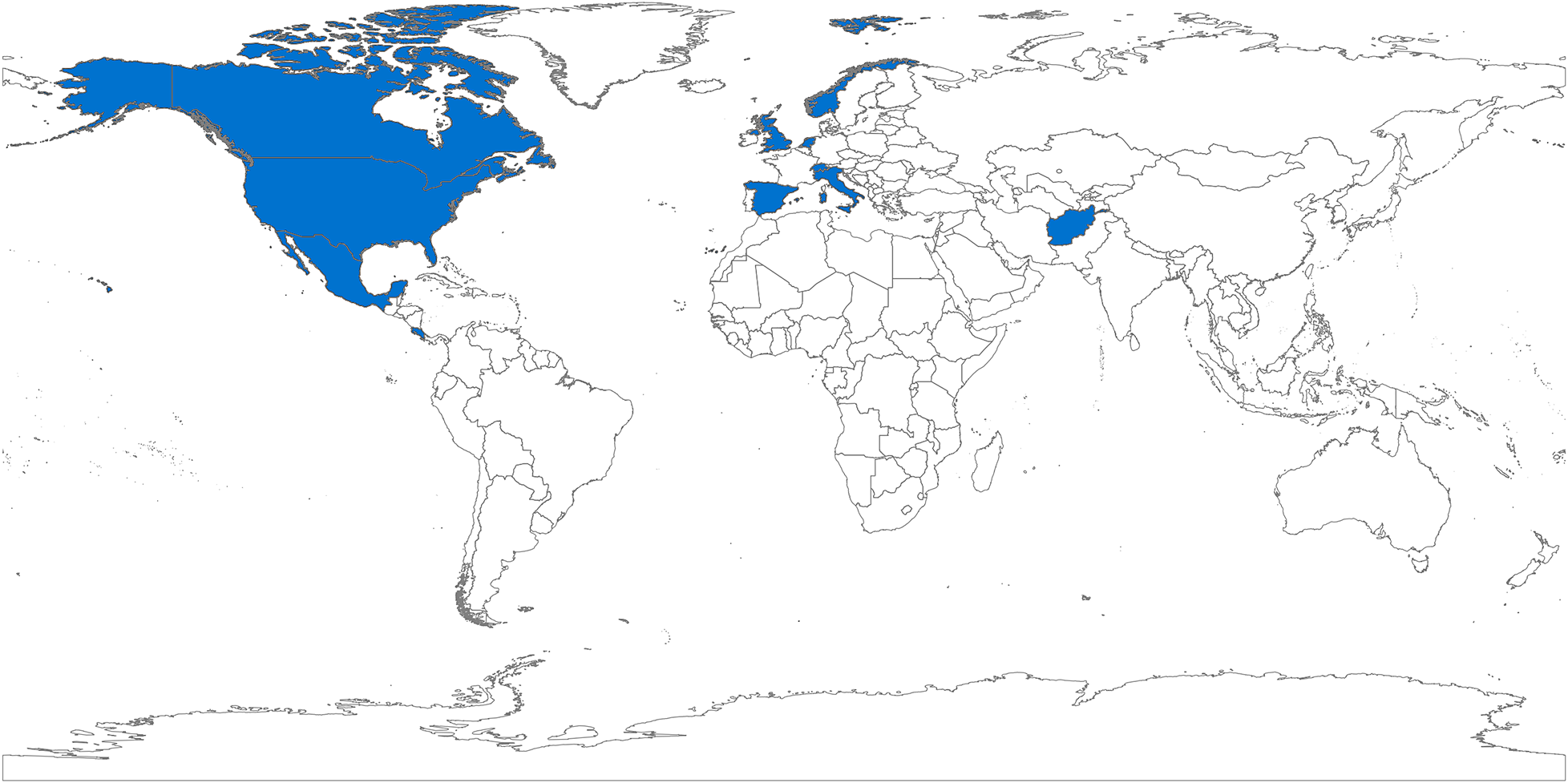
Several responded, and following an extensive peer review, we curated nine papers by 18 researchers from 11 countries, including Afghanistan, Canada, Costa Rica, Italy, Mexico, Netherlands, Norway, Spain, Switzerland, UK, USA see Figure 1).
Geographic coverage of the contributing authors.
In the below, we briefly outline the key insights and contributions from each paper, highlighting how diverse data sources—from satellite imagery to citizen-generated data—and emerging technologies such as AI and digital platforms are leveraged to support conflict prevention, strengthen early warning systems, enable more inclusive peacebuilding processes, and promote accountability in fragile and conflict-affected settings.
2. The papers
Aras and Westlake (Reference Aras and Westlake2025) open this collection by examining augmented intelligence-based prediction models aimed at enhancing early-warning capabilities in conflict settings such as Afghanistan. Operating in limited-data environments, they show that blending human judgment with machine learning increases the accuracy of forecasts of multidimensional vulnerabilities. While these innovations carry promise, the authors draw attention to ongoing technical and ethical concerns, urging the development of robust human oversight procedures to prevent errors and avoid excessive reliance on computational results.
Turning to the broader potential of artificial intelligence (AI) for promoting global peace, Giovanardi (Reference Giovanardi2024) critically examines the dual role of AI in international relations, highlighting its capacity both to intensify violence and to enable conflict prevention. He underscores the need for more rigorous impact assessment, grounded in a clear conceptualisation of peace, and proposes evaluative measures along the negative–positive peace continuum. Furthermore, he advocates for the establishment of robust policy frameworks supported by a structured three-phase investment strategy: systematic mapping of initiatives, empirical evaluation of their effectiveness, and the strategic allocation of resources to the most impactful interventions.
Mueller et al. (Reference Mueller, Rauh and Seimon2024) describe a large-scale data repository and advanced forecasting technique for the onset of armed conflict, structured at both the national and grid-cell levels. Their methodology involves mining global news sources through topic modelling to predict escalations in violence with heightened granularity. Crucially, their findings underscore how more precise risk evaluations can better inform peacebuilding strategies, allowing for more efficient resource allocation and improved outcomes in conflict-affected areas.
In a related yet distinct approach, Luna-Pla (Reference Luna-Pla2024) employs network analysis to expose powerful elites whose activities can derail peace and stability. Drawing on the example of Guatemala’s anti-impunity commission, the paper demonstrates how mapping connections between corrupt or coercive actors reveals structural problems that undermine governance. By pinpointing these networks and their principal beneficiaries, policymakers and activists can design more pragmatic reforms that directly address institutional weaknesses.
Shifting to frameworks for global stewardship, Kirchschlaeger (Reference Kirchschlaeger2024) advocates the creation of an International Data-Based Systems Agency (IDA) under the United Nations. Inspired by the International Atomic Energy Agency’s model, IDA would oversee the responsible use of AI, data analytics, and other emerging digital tools. The proposed body would combine strict regulatory standards with supportive guidance, ensuring transparency, accountability, and respect for human rights in the pursuit of peaceful technological applications.
Mac Ginty and Firchow (Reference Mac Ginty and Firchow2024) examine the “data myth” in peacebuilding: the pervasive assumption that simply amassing and accelerating data collection inherently leads to better policy decisions. The authors argue for a critical evaluation of the origins, ownership, and biases embedded within data, suggesting that relying solely on quantitative metrics can overshadow ethical and contextual nuances. They propose a blend of robust data-gathering with participatory methods to ground policies in both reliable statistics and local voices.
Focusing on machine learning for civil war prediction, Murphy et al. (Reference Murphy, Sharpe and Huang2024) demonstrate that advanced computational tools can illuminate pathways to conflict earlier than conventional approaches allow. Although they caution that such methods often struggle with interpretability, the authors nonetheless see them as valuable for allocating peacekeeping personnel, strengthening diplomatic negotiations, and anticipating where conflict may flare next.
Hawke et al. (Reference Hawke, Puig Larrauri, Sutjahjo and Cerigo2024) describe a collaborative model for generating specialised text classifiers. By drawing on close consultation with peace practitioners, they refine algorithms to detect and categorise harmful content online more accurately. This process, requiring iterative design and context-specific knowledge, points to a compelling strategy for tackling rising digital polarisation and incitement to violence.
Finally, Tauchnitz (Reference Tauchnitz2025) redefines peace as a relational phenomenon and human behaviour, emerging through social connections, interactions, and relationships that can be mapped into networks of peace (and violence). As global connectivity increases and digital networks are gaining influence, the quantity and quality of human interactions also change. She argues that everyday behaviours—both online and offline—can sustain or erode peace, underscoring the need to integrate normative ethics with empirical methods such as social network analysis.
Collectively, these nine contributions illustrate how innovative data-driven strategies, interpreted through ethical frameworks and close collaboration among diverse stakeholders, can strengthen efforts to prevent conflict, address structural injustice, improve relationships, and cultivate sustainable positive peace. They call on both scholars and practitioners to ensure that the introduction of sophisticated technological tools is always guided by principles of accountability, human dignity, respect for privacy and personal freedoms, and practical relevance.
3. Thematic reflections on contributions
Across the papers, several themes emerged, including how the design of AI and data systems can respect human rights, address data asymmetries, and function responsibly across low-tech and high-tech environments. Below, we explore these themes further and identify areas for further exploration.
3.1 Cross-paper themes and topics
Across the papers, common themes emerge around the responsible use of AI and big data in fragile contexts, the integration of local knowledge with global data infrastructures, and the development of ethical, context-sensitive tools to support peacebuilding efforts. More specific:
3.1.1 Novel and non-traditional data sources for peacebuilding and peace
Several papers expand the repertoire of data sources used in peace research. Murphy et al. (Reference Murphy, Sharpe and Huang2024) draw from both structured conflict forecasts and unstructured news narratives, while Aras and Westlake (Reference Aras and Westlake2025) integrate a diverse set of socio-economic and political indicators to assess vulnerability in Afghanistan, many of which are absent from traditional early warning systems. These contributions reflect a maturing field increasingly adept at working across data modalities and tolerating uncertainty in dynamic peacebuilding contexts.
3.1.2 Conceptualisation of positive peace data
Giovanardi (Reference Giovanardi2024) and Tauchnitz (Reference Tauchnitz2025) challenge static and reductionist understandings of peace. Giovanardi introduces a typology of peace paradigms that emphasises justice, inclusion, and resilience, calling for data frameworks aligned with these normative visions. In parallel, Tauchnitz proposes a relational and dynamic model of peace as an ongoing process manifesting through human connections, interactions, and relationships. Together, they advocate for context-sensitive, participatory, and network-based approaches to measuring peace, enriching both empirical inquiry and a human-rights-centred design of AI infrastructures.
3.1.3 Computational methods to measure peace and relations
Several authors explore innovative computational techniques for mapping peace and conflict dynamics. Mueller, Samii, and Szekely (2024) apply social network analysis to trace elite capture in fragile post-conflict settings, revealing how exclusive power networks can undermine inclusivity in peace processes. Their work provides new tools for stakeholder mapping and diagnostics. Luna-Pla (Reference Luna-Pla2024) complements this with computational strategies focused on the relational dimensions of peace, highlighting how digital tools can illuminate hidden dynamics of trust and influence.
3.1.4 Predictive analytics for peace
Murphy et al. (Reference Murphy, Sharpe and Huang2024) explore the capabilities and limitations of machine learning for forecasting intrastate conflict. They point to the political and technical hurdles that can hinder the translation of predictive models into actionable peacebuilding strategies. Murphy et al. (Reference Murphy, Sharpe and Huang2024) add to this by introducing a global dataset that links conflict forecasts with media narratives, enhancing the contextual depth and comparative utility of predictive analytics in anticipatory peacebuilding.
3.1.5 Data collaboratives for peace
Hawke et al. (Reference Hawke, Puig Larrauri, Sutjahjo and Cerigo2024) emphasise the importance of co-design in AI development for peacebuilding. Working closely with peace practitioners, they collaboratively develop text classifiers to analyse narratives of polarisation. This participatory methodology not only improves tool relevance and usability but also fosters trust, local ownership, and end-user alignment in peace technology development. The work exemplifies the value of data collaboratives that bridge technical innovation and practitioner insight.
3.1.6 Tracking and assessing narratives for peace
In addition to tool co-design, Hawke et al. (Reference Hawke, Puig Larrauri, Sutjahjo and Cerigo2024) significantly contribute to the real-time tracking and interpretation of digital narratives. Their classifier, shaped through iterative engagement with peace actors, provides diagnostic insight into discursive shifts linked to polarisation and radicalisation. This sociotechnical approach highlights the importance of monitoring narrative environments as part of broader peace and conflict assessments.
3.1.7 Ethical design of data-driven peace technologies
Tauchnitz (Reference Tauchnitz2025) proposes a relational, interaction-based model of peace that can inform the ethical design of technologies intended to foster peaceful human relationships based on mutual trust, respect, and cooperation. Kirchschlaeger (Reference Kirchschlaeger2024) strengthens the normative foundation by advocating for human rights-based data systems and legal safeguards that uphold dignity, security, and democratic oversight. Their combined insights highlight that peace technologies must not only prevent harm but also actively cultivate positive, inclusive interactions across digital and physical spaces.
3.1.8 Ambivalent uses of data for peace
Mac Ginty and Firchow (Reference Mac Ginty and Firchow2024) critique the “data myth”—the assumption that more data will automatically lead to better peacebuilding outcomes. They advocate for pluralistic, mixed-method approaches that recognise the limitations of quantitative indicators and prioritise ethical, contextual, and participatory forms of knowledge production. Their intervention highlights the risks of technocratic overreach and the continued importance of qualitative insight.
3.1.9 Global governance and regulation of data use for peace
Kirchschlaeger (Reference Kirchschlaeger2024) calls for a UN-based International Data-Based Systems Agency (IDA) to regulate AI and data systems, echoing the model of the IAEA, with human rights at its core. Tauchnitz (Reference Tauchnitz2025) offers a complementary perspective, proposing a relational theory of peace that centres on everyday on- and offline interactions. While one emphasizes global institutional oversight and the other lived human experience, both advocate for an “ethics of human rights” approach to ethically anchor the governance of peace-related data and technologies in the overarching values of human dignity and freedom, which are key for achieving sustainable positive peace.
3.1.10 Investing for peace
Giovanardi (Reference Giovanardi2024) draws attention to the financial underpinnings of peace technology development. He argues for strategic exploration of public–private partnerships, social impact investment mechanisms, and outcome-based metrics to incentivise ethical innovation. By aligning business models with peace objectives, these investments can help shape a more responsible ecosystem for AI in peacebuilding.
3.2 Opportunities for further exploration
Several underexplored yet critical areas were also identified that offer rich opportunities for future research. In particular, the following topics warrant deeper investigation to advance the field of data-driven peacebuilding.
3.2.1 Advancing the concept of positive peace
Emerging debates on peace highlight the need for data to better capture the complexities of positive peace. Building on the work by Tauchnitz (Reference Tauchnitz2025), future research should explore how relational indicators—like trust, respect, inclusion, participation, solidarity, and perceptions of justice—can be integrated into peace metrics. This requires methodological innovation and critical reflection on data ownership, representation, and purpose. Approaches like participatory data practices, digital ethnography, and network analysis can help reveal peace as a dynamic, lived process. Strengthening deliberative practices through digital tools—such as online consultations and deliberative polling—also warrants attention, particularly for fostering inclusive dialogue and citizen engagement in peace processes. As digital technologies and AI shape peacebuilding, it is crucial to examine how they affect what is measured, whose voices are heard, and how knowledge is created, calling for collaboration across peace research, data science, ethics, and human-technology interactions.
3.2.2 Computational crisis computing and real-time analytics
The integration of real-time data analytics, AI and computational modelling into crisis response systems remains an emergent yet highly promising frontier for peace research. Aras and Westlake (Reference Aras and Westlake2025) touch upon this in their hybrid intelligence model for early warning in Afghanistan; however, broader applications—such as rapid detection of displacement, conflict escalation, or human rights violations—remain unexplored in this special issue. The convergence of AI-driven computational crisis computing with humanitarian and peacebuilding efforts could facilitate anticipatory governance, enabling timely and context-sensitive interventions in volatile settings. Further research is needed to understand how such systems can be ethically and operationally embedded into multilateral peace infrastructure.
3.2.3 Data for migration and displacement in peacebuilding
Despite the central role of forced displacement in many contemporary conflicts, the issue of how data systems can support displaced populations is notably absent in this collection. There is a critical research gap in understanding how digital identity systems, ethical migration tracking, and cross-border data sharing can facilitate the integration of migrants and refugees into peacebuilding processes. Future work should explore how data-driven solutions can enhance the protection, agency, and inclusion of displaced communities while also addressing the risks of surveillance and exclusion.
3.2.4 Investing and business for peace
The intersection between economics, investment frameworks, and peacebuilding remains relatively underexamined. There is growing recognition of the potential for market-based mechanisms, public–private partnerships, and social impact investment to support peace-promoting technologies. Future research should investigate how financial instruments, incentives, and governance structures can be aligned with peacebuilding goals. In particular, the role of the private sector as both a stakeholder and a strategic actor in peace efforts merits greater analytical attention.
4. Technological adoption and data asymmetries
Future scholarship should examine the comparative value of “low-tech” and “high-tech” approaches to peacebuilding, particularly in settings marked by data scarcity or infrastructural limitations. Mac Ginty and Firchow (Reference Mac Ginty and Firchow2024) caution against the uncritical privileging of high-tech, data-intensive solutions, arguing that locally appropriate, culturally embedded, and often lower-tech alternatives may be more legitimate and effective in fragile contexts. This theme points to the importance of addressing structural disparities in data access, technical capacity, and digital infrastructure—what might be termed “data asymmetries.” Further research is needed to critically assess how these asymmetries shape peacebuilding outcomes and to design inclusive, context-sensitive technological interventions.
5. Final reflection
Nearly four decades ago, Joseph Nye and Sean Lynn-Jones (Reference Nye and Lynn-Jones1988) highlighted the necessity for scholars in international security to anchor their work in robust theoretical frameworks and historical context, warning against the pitfalls of over-specialisation, faddishness, and the fixation on novel tools at the expense of cumulative insight. Their reflection remains pertinent as we navigate integrating technology and data into peacebuilding efforts. The current enthusiasm for AI and predictive analytics in conflict prevention and resolution could mirror past tendencies to favour immediate, tool-driven solutions over comprehensive, context-aware approaches. In introducing this special issue, we advocate for a balanced perspective that combines innovation with critical reflection, ensuring that advancements in peacebuilding are both effective and grounded in a deep understanding of the complexities involved.
The articles of this special issue collectively demonstrate that emerging technologies—when applied thoughtfully and ethically—can serve as powerful tools to enhance early warning systems, support inclusive policy design, expose structural injustice, generate new human connections, and reframe our very understanding of peace. Yet, they also remind us that technological innovation is not a neutral force. Without critical reflection, participatory engagement, robust governance, and legal frameworks, data and technology risk reproducing the very harms they aim to address.
Looking ahead, the field of data for peace must remain grounded in a holistic, human-centred vision of peace—one that recognises the importance of lived experiences, relational dynamics, and contextual nuances alongside algorithmic predictions and computational power. As the boundaries between local and global, online and offline, and conflict and peace continue to blur, we need adaptive frameworks that can capture complexity, anticipate risks, and harness digital tools to promote human dignity, personal freedom, accountability, and resilience.
Ultimately, the promise of data and technology for peace lies not only in what they can measure or predict but in how they can help societies re-imagine, co-create, and sustain more just and peaceful futures.
Data availability statement
Data availability is not applicable to this article as no new data were created or analyzed.
Author contributions
Writing—original draft: I.L., M.G., S.V.; Writing—review and editing: M.G., I.L., S.V., E.T., K.N., M.W. All authors approved the final draft.
Funding statement
This editorial received no specific grant from any funding agency, commercial or not-for-profit sectors.
Competing interest
Two articles by guest editors were included in the special collection and that were accepted for publication after an independent peer review process.


 Open access


Comments
No Comments have been published for this article.