





Introduction
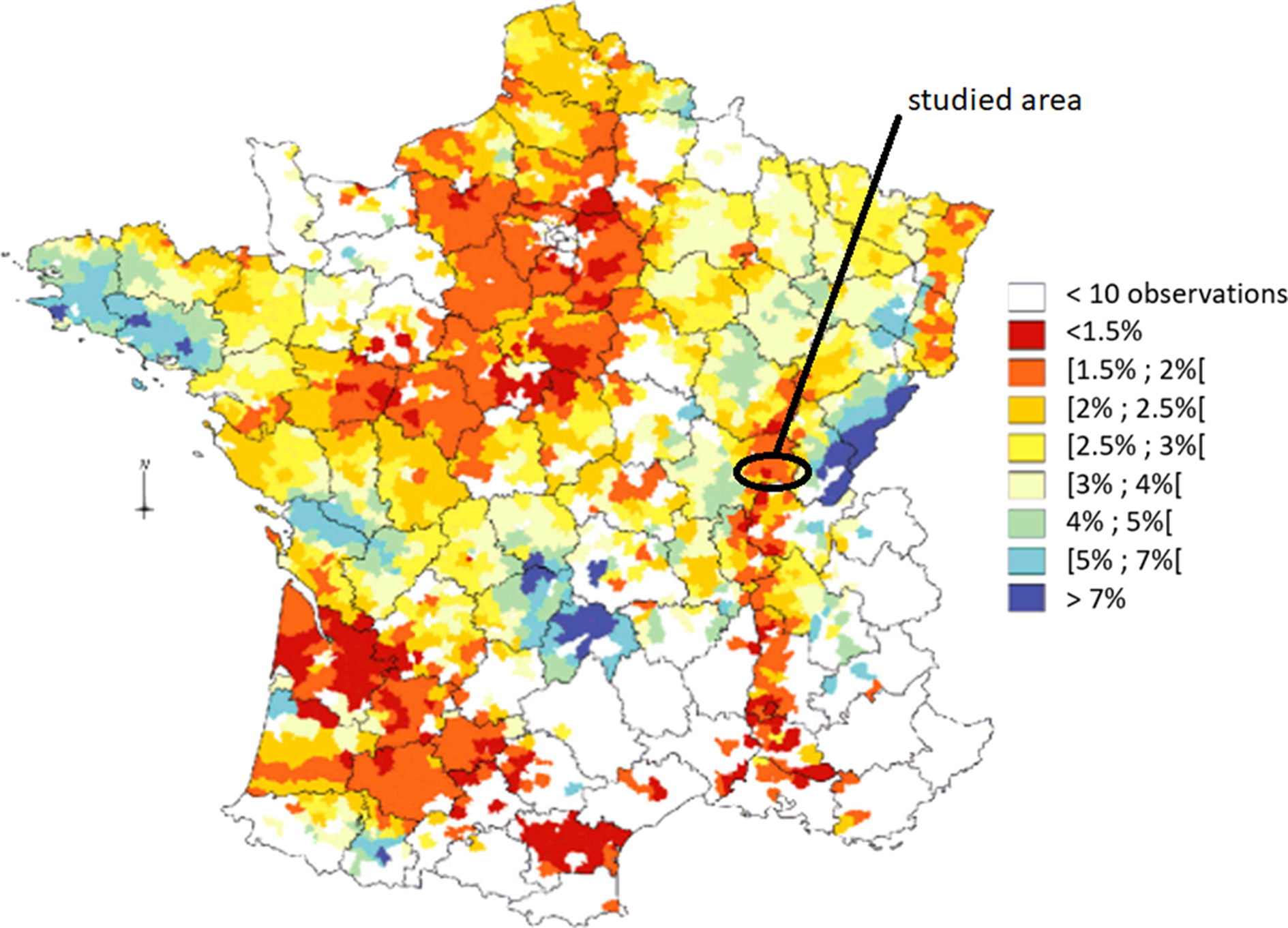
A process of change in agricultural production systems from the mid-twentieth century onward has led to regional specialization in certain agricultural products. Local nutrient cycles (Schröder, Reference Schröder2005), which used to operate in diversified production systems such as mixed farming, have broken down. Specialized crop farmers have shifted to using synthetic fertilizers and simplifying their crop rotations, to the extent that organic matter stocks in cultivated soils have fallen to critical levels (Loveland and Webb, Reference Loveland and Webb2003). Several authors have observed a significant decrease in the stability of soil structure when the proportion of soil organic matter is less than 2% (Loveland and Webb, Reference Loveland and Webb2003). In France, soils with less than 2% organic matter (Fig. 1) are more prevalent in agricultural areas dominated by field crops or vineyards.
Median of soil organic content of cultivated soils at municipality level (Source: Walter et al., Reference Walter2002).
Diacono and Montemurro (Reference Diacono, Montemurro, Lichtfouse, Hamelin, Navarrete and Debaeke2011) showed that degradation of soil structure (a decrease in aggregate stability) can decrease in water holding capacity and increase risk for soil compaction, which together decrease nutrient availability for plants. These degradations can reduce the productive capacity of crops (Hijbeek et al., Reference Hijbeek, Cormont, Hazeu, Bechini, Zavattaro, Janssen, Werner, Schlatter, Guzmán, Bijttebier, Pronk, van Eupen and van Ittersum2017). Kimetu et al. (Reference Kimetu, Lehmann, Ngoze, Mugendi, Kinyangi, Riha, Verchot, Recha and Pell2008) argue that the fear of loss of income should prompt farmers to maintain a certain threshold of organic matter in their soil. One solution could be to return to partially organic fertilization. Regular application of an organic fertilizer such as farmyard manure or green manure can help increase soil organic matter content (Diacono and Montemuro, Reference Diacono, Montemurro, Lichtfouse, Hamelin, Navarrete and Debaeke2011). In France, 310 million tons of gross animal-manure matter are produced each year, and almost half of it is produced indoors and spread on fields (FranceAgriMer, 2020). Twenty percent of utilized agricultural area (UAA) in France is spread with livestock manure (Loyon, Reference Loyon2017). Reintroducing livestock into farms or increasing the share of field crops in livestock production is not always a realistic option, due to factors tied to farm structure, farmer skills and motivations or the agronomic potential of the land. However, several authors posit that nutrient cycling is transposable beyond the farm level (Russelle et al., Reference Russelle, Entz and Franzluebbers2007; Garrett et al., Reference Garrett, Ryschawy, Bell, Cortner, Ferreira, Garik, Gil, Klerkx, Moraine, Peterson, dos Reis and Valentim2020). Operating on the scale of a regional territory makes it possible to consider the interactions and synergies between different farms specialized in crops or livestock (Moraine et al., Reference Moraine, Duru and Therond2017; Regan et al., Reference Regan, Marton, Barrantes, Ruane, Hanegraaf, Berland, Korevaar, Pellerin and Nesme2017; Ryschawy et al., Reference Ryschawy, Martin, Moraine, Duru and Therond2017).
The rationale for livestock farmers to export their manure depends on the regulations in place and on their production systems. Livestock farmers must comply with the EU Nitrates Directive and the European Water Framework Directive to manage manure. They have to draw up a manure management plan, adhere to the limits on doses spread (max. of 115 kg organic N ha−1 yr−1 spread on arable land for the whole rotation, and max. of 230 kg N ha−1 yr−1 on grassland) and the distances to houses and watercourses (Loyon, Reference Loyon2018). Some livestock farmers are located in areas where animal density is high, which generates structural surpluses of minerals at the source of pollution, especially water pollution. This surplus reaches 69 kg N ha−1 in French Brittany (Loyon, Reference Loyon2018) and can exceed 100 kg N ha−1 in the Netherlands (Fraters et al., Reference Fraters, van Leeuwen, Boumans and Reijs2015). In these areas, classified as ‘nitrate-vulnerable’, farmers must not spread more than 170 kg organic N per hectare and per year on average across the whole farm. Many livestock farmers consequently have to either reduce their livestock production or export part of their manure, sometimes a long way from their farm's headquarters. Selling manure is a cost for them, as they have to bear the costs of processing and export (Willems et al., Reference Willems, van Grinsven, Jacobsen, Jensen, Dalgaard, Westhoek and Kristensen2016). In France, several regions that specialize in livestock production (the Massif Central, the Jura, the Alps) are characterized by systems with low animal stocking densities and a diet based on grassland. In these systems, the amount of manure that livestock farmers need to apply is generally below the regulatory limits, and so there are under no regulatory pressure to export their manure outside their farm. In some cases, some of the manure currently spread on the farm could—but does not have to—be exported from livestock operations without agronomic loss. For instance, there is no real benefit to spreading any more than 10 tons of manure per ha on grasslands (which is only roughly a third of the amount allowed by regulation), to ensure that the manure is degraded quickly and efficiently (Gauthier et al., Reference Gaulthier, Hoppenreys, Beynet and Celerier2019). This study focuses on the case where manure export is not mandatory but potentially beneficial to the territory, where there is a need to assess the advantages and disadvantages of exporting or using manure to help develop manure transfers between livestock and crop farmers.
Manure transfers between livestock and crop farmers can take place as part of a straw–manure exchange. In France, 74% of suckler cows and 62% of dairy cows have straw bedding (Loyon, Reference Loyon2018) and most French livestock farmers are not self-sufficient in straw. The straw that would traditionally be used for animal mulching is now in competition with new value streams: increasingly systematic ploughing back into plots by crop farmers, growing demand from neighboring countries, or industrial value streams. The exchange of straw for manure would allow livestock farmers to secure their straw supply and crop farmers to improve the fertility of their soil and reduce their dependence on mineral fertilizers, the price of which depends directly on the price of fuel. The POEETE project brought together researchers and agricultural stakeholders from the Burgundy region (France) who were concerned about the fertility of their soil, to rethink mixed crop–livestock farming at farm and territorial scales. The aim of the project was to encourage farmers to engage in a long-term manure exchange system. Manure exchanges in this area, like in most of France, remain underdeveloped, as most of the time, farmers spread their manure on their own fields (Loyon, Reference Loyon2017). According to the literature, the key factors for successful between-farm manure exchanges are geographical proximity, trust building and fair value sharing (Ryschawy et al., Reference Ryschawy, Moraine, Péquignot and Martin2019). For Asai (Reference Asai2013), exchanges usually develop between people who are already in contact. However, these criteria limit the scope and subsequent adoption of manure/straw exchange practice. Our hypothesis here is that in situations where mineral surpluses do not exceed the regulatory thresholds, livestock and crop farmers will only exchange manure and straw if the transaction is profitable for both parties.
The literature on manure has addressed issues ranging from the effects of manure on greenhouse gas emissions (Külling et al., Reference Külling, Menzi, Sutter, Lischer and Kreuzer2003; Chadwick et al., Reference Chadwick, Sommer, Thorman, Fangueiro, Cardenas, Amon and Misselbrook2011; Gerber et al., Reference Gerber, Hristov, Henderson, Makkar, Oh, Lee, Meinen, Montes, Ott, Firkins, Rotz, Dell, Adesogan, Yang, Tricarico, Kebreab, Waghorn, Dijkstra and Oosting2013) and nitrate leaching (Miller et al., Reference Miller, Waterhouse, Harter, Fadel and Meyer2020) to manure treatments (Loyon, Reference Loyon2017). Other studies have also addressed the agronomic value of manure by analyzing its impact on soil fertility (Curien et al., Reference Curien, Issanchou, Degan, Manneville, Saby and Dupraz2021) and yields (Zavattaro et al., Reference Zavattaro, Bechini, Grignani, van Evert, Mallast, Spiegel, Sandén, Pecio, Giráldez Cervera, Guzmán, Vanderlinden, D'Hose, Ruysschaert and ten Berge2017) or by analyzing the relationship between animal feed and manure composition (Dutreuil et al., Reference Dutreuil, Wattiaux, Hardie and Cabrera2014). The impact of manure application regulations on production systems in prone-to-surplus areas has also been addressed, notably by Klootwijk (Reference Klootwijk, Van Middelaar, Berentsen and de Boer2016), and several analyses have focused on the social conditions needed to allow manure exchange (Asai, Reference Asai2013; Ryschawy et al., Reference Ryschawy, Moraine, Péquignot and Martin2019). However, to the best of our knowledge, there is no research that has sought to estimate the economic value of manure. Manure has no fixed ‘commodity’ market price, but only pricing recommendations issued by certain local technical institutes. In most cases, these recommendations consider the mineral composition of the material and its short- or medium-term bioavailability, but they fail to take into account the longer-term beneficial effects of manure on the soil. The key contribution of this study is that we assess the economic value of manure taking into account the medium- and long-term agronomic effects of manure exchanges.
Based on Asai et al. (Reference Asai, Moraine, Ryschawy, de Wit, Hoshide and Martin2018), we chose to analyze a farm-to-farm exchange as the simplest form of partnership agreement between a crop farmer and a livestock farmer. These exchanges are commercial, since the purpose of this study is to provide stakeholders such as farmers or agricultural extension services with quantified information as a basis for negotiation. The objective of this study was to assess and discuss the ceiling price (the price at which one commodity is purchased as a substitute for another without changing the farmers' income) and floor price (the price at which one commodity is produced and/or sold rather than non-produced or kept as a resource without changing the farmers' income) for manure, assuming that a proportion of the straw produced on the crop farm is sold instead of being ploughed in. Modeling reduces the need for long-term experiments to estimate the effects of manure on soil fertility, crop yields and farmers' incomes, and makes it possible to aggregate different sets of knowledge input on biological, chemical and economic processes across multiple operating systems. Here we use and adapt the bioeconomic ‘Orfee’ model (Mosnier et al., Reference Mosnier, Duclos, Agabriel and Gac2017) to assess the agronomic and economic impacts of straw/manure exchange between a crop farm and a livestock farm in Burgundy, France.
Materials and methods
Description of the study area and modeled farms
The study area is the Saône-et-Loire department, an administrative entity of 8575 km2 located in Burgundy. This department has a mild continental climate. Its agriculture consists of specialized grass-based beef cattle production in the west, vineyards in the center and specialized crop or mixed crop–livestock production in the east (Appendix I). The crop area's silty soil has a low organic matter content, often below 2%, which causes difficulties related to the lack of organic matter in the soil (Fig. 1). Beef cattle farming is relatively extensive, with an average stocking rate of 1.1. The livestock area is not in a nitrate-vulnerable zone. Most of the farmers in this area are not required to export their manure, which is in line with the objective of our study.
We selected one crop farm and one livestock farm that are representative of the study area according to regional statistics and local experts. These farms could exchange straw and manure: the livestock farmer buys straw and produces more manure than the quantity required to maintain soil organic matter, while the crop farm purchases mineral fertilizers and its soil organic matter is below 2%.
The crop farm has 250 ha of UAA with two worker units (two full-time equivalents). We chose to model a rapeseed–wheat–barley crop rotation, which is typical of the region. Straw is systematically ploughed back into the land. The data used to describe the cash crop farm are taken from the published average data for local cash crop farms in the Saône-et-Loire (DRAAF, 2016). The specialized livestock farm is a Charolais cow–calf operation (male calves are sold to feedlot finishers) producing fattened heifers and cull cows (Institut de L'Elevage, 2016). It counts 66 suckler cows, has 105 ha of UAA divided into 11 ha of cropland with a wheat–barley–triticale rotation scheme and 94 ha of grassland. The crops grown are intended to serve as on-farm feed to fatten the farm's females and grow heavier calves. The animals are housed from November to March in a free stall with deep bedding, which is the predominant suckler-cow housing system in France (Loyon, Reference Loyon2018). The bedding is straw that is replenished once or twice a week as the straw becomes soiled. This deep straw bedding gets compacted under the animals, and the manure is not scraped off until the end of the in-stall overwintering period. It is a high-solids farmyard manure (over 20% dry matter) that can be stored in the field. This type of manure is the main type of effluent from this region (Appendix II). This farm can itself be considered an integrated crop–livestock system, but like most farms of this type, it does not have enough cultivated area to be self-sufficient in straw for bedding, and is therefore forced to buy straw from outside the farm. The farmer currently land-applies all the manure produced on the farm (around 700 tons of bovine manure) but can afford to sell off some of his on-farm manure without degrading in-soil organic matter stocks.
Description of the Orfee model
Model overview
The model used for this study is Orfee (‘Optimization of Ruminant Farms for Economic and Environmental assessment’) (Mosnier et al., Reference Mosnier, Duclos, Agabriel and Gac2017). Orfee is a bioeconomic model that optimizes and simulates the management of farms with one or more grazing livestock subsystems (beef cattle, dairy cattle, sheep) and a crop subsystem of cereals, oilseed crops and grasslands, for an average year, with a system in equilibrium. Decisions on livestock, crop production and equipment can be optimized in response to economic risks in order to maximize a mean-variance function of net profit. In this study, the main characteristics of the production systems (crop rotation scheme, herd size, type of animals produced) have been fixed, and we used Orfee to simulate crop and herd operations, fertilization, animal diets, farm inputs and outputs and economic results. The main objectives of the model development process were on the one hand to consider the effects of manure on (i) nutrient supply, (ii) in-soil humus mineralization, (iii) crop yields and (iv) the costs of buying and spreading manure and mineral fertilizers, and on the other hand to estimate the impacts of selling or ploughing-in straw on (i) in-soil humus mineralization, (ii) costs related to harvesting straw and (iii) the revenue generated by straw sales. These aspects are detailed in the following sections. The simulated diet and animal production systems are not affected by the simulated fertilization strategies. The equations and decision-rules applied are described in detail in Mosnier et al. (Reference Mosnier, Duclos, Agabriel and Gac2017), and the simulated values can be found in Appendix III.
Assessment of crop nutrient needs and fertilizer applications
Manure contains a number of key elements, including nitrogen (N), phosphorus (P), potassium (K) and carbon (C). The nutrients present in manure, also known as organic matter, come in simple forms and complex forms. Crops can assimilate the simple forms almost instantly, whereas the complex forms are assimilated over a longer period (10 yr). The type of manure as well as the amount and frequency of application have an impact on the proportion of nutrients available to plants in the short term and also through nutrient mineralization in the long term. The resulting improvement in soil structure allows microbial populations to thrive (Triberti et al., Reference Triberti, Nastri, Giordani, Comellini, Baldoni and Toderi2008) and break down organic matter into mineral elements ready for uptake by crops. According to the literature, manure is only beneficial to soil organic matter stocks if it is applied at regular intervals and in a given amount. Ziegler et al. (Reference Ziegler1991) estimated that the effect of applying manure is negligible when there is an interval of more than 4 yr between two applications. In terms of quantity, proposed amounts range from 7 to 45 tons ha−1 yr−1 over a longer time interval (Sleutel et al., Reference Sleutel, De Neve, Németh, Tóth and Hofman2006). After 10 yr of regular land applications, soil nitrogen availability increases and the need for nitrogen application decreases (COMIFER, 2013). Zavattaro et al. (Reference Zavattaro, Bechini, Grignani, van Evert, Mallast, Spiegel, Sandén, Pecio, Giráldez Cervera, Guzmán, Vanderlinden, D'Hose, Ruysschaert and ten Berge2017) conducted a meta-analysis of 80 European studies comparing long-term use of cattle manure and slurry against the use of mineral fertilizer for both winter and spring crops, and showed that the application of synthetic fertilizer combined with bovine farmyard manure improved yields by an average of 11.3% due to improved soil fertility (water retention, texture). However, as their results also highlighted influences of numerous soil and climate factors on expected increase in yield, we chose here to analyze manure characteristics with and without a 10% increase in crop yield under different scenarios (see later).
Unlike models such as MONICA (Nendel et al., Reference Nendel, Berg, Kersebaum, Mirschel, Specka, Wegehenkel, Wenkel and Wieland2011), STICS (Coucheney et al., Reference Coucheney, Buis, Launay, Constantin, Mary, García de Cortázar-Atauri, Ripoche, Beaudoin, Ruget, Andrianarisoa, Le Bas, Justes and Léonard2015) or PaSim (Calanca et al., Reference Calanca, Vuichard, Campbell, Viovy, Cozic, Fuhrer and Soussana2007) that explicitly represent the interactions between soil and vegetation, the computation run in Orfee requires only a limited number of inputs. Based on the methodological guide for the calculation of nitrogen fertilization (COMIFER, 2013), Orfee estimates the mineral or organic crop requirements for nitrogen (needN) for non-irrigated crops:

where Ri is the initial and Rf is the final amounts of N in the soil, which varies according to region and soil quality, Pi is the initial and Pf is the final quantities of N consumed by the crops, which depends on the proportion of N in the harvested products and the yield of the crop, Mh is the N provided by the net mineralization of humus in the soil, Mr is the additional net mineralization due to residues from the previous crop and Mhg is the additional net mineralization due to ploughing the grassland. L is the amount of N lost by leaching, which has been neglected here as we assume that Ri is measured at the beginning of the growth season.
The values of these parameters were defined according to the data of GREN Bourgogne 2012 (Appendix IV). Two levels for net humus mineralization (Mh) are considered: the first level corresponds to irregular inputs of organic matter through application with regular straw plough-in (33 kg N ha−1 yr−1), while the second level corresponds to regular long-term manure inputs and partial straw export (50 kg N ha−1 yr−1). According to local experts, 24 tons of manure for every 2 yr would be sufficient to reach this level of mineralization of 50 kg N ha−1 yr−1 on field crops and 10 tons on grasslands. The fact that grasslands are not very sensitive to variations in amount of manure applied is explained by the turn-out of livestock to pasture and by microbial life under grasslands (Chabbi and Lemaire, Reference Chabbi and Lemaire2007; Curien et al., Reference Curien, Issanchou, Degan, Manneville, Saby and Dupraz2021). Straw plough-in reduces the amount of N provided by humus mineralization (Mr = −10 kg N ha−1), as in the short term, some of the N is used by microorganisms to degrade the straw. Phosphorus (P) and potassium (K) requirements are estimated from either crop exports or statistical data and are not impacted by the amount of in-soil organic matter.
The fertilizers (ferti) used to meet the crop nutrient needs are either non-organic (with a single mineral) or organic (i.e., cattle manure here). For each crop (c), Orfee optimizes the amount of each fertilizer applied (V_Q_Ferti) (Equation 2), which has to meet the NPK requirements per hectare (need) of each crop multiplied by its area (V_Ha). The fertilizing value of organic fertilizers depends on their NPK content (FertiContent) and their short-term non-organic fertilizer conversion factor (EqMiner) for a given crop (Appendix IV):

A minimum amount of manure must be applied every second year in order to benefit from a higher mineralization rate. As the model is static and represents an average year, the temporal constraint of applying a minimum amount of manure every second year is transformed into a spatial constraint of applying a minimum amount of manure corresponding to at least half of the UAA:

where bin_manurec equals 1 if the amount of manure is greater than 24 tons ha−1 for annual crops or 10 tons ha−1 for grasslands, and 0 otherwise.
Fertilization costs and straw harvest costs: Applying manure and mineral fertilizers or harvesting straw requires machinery, fuel and labor. Several farmer-owned machines can be used for manure application, fertilizer spreading or straw baling, and the size of these machines depends on the size of the farm. The cost of machinery is proportional to its use, but minimum depreciation costs are imposed as long as the machine is owned (Chambre d'Agriculture des Hauts de France, 2016) to reflect the fact that even if the equipment gets little use, it will not last forever (Mosnier et al., Reference Mosnier, Duclos, Agabriel and Gac2017). Consequently, if the machine is used more intensively, its depreciation and maintenance costs per hour of use decrease. The time and machinery needed for manure application depend on the quantity of manure and the capacity of the manure spreader. The time and machinery needed to spread mineral fertilizer depend on the number of applications per hectare and type of spreader. The time and machinery needed to harvest the straw and transport it to the farm depend on quantity of straw and size of the trailer. The duration of the work performed, fuel consumption and maintenance and depreciation costs are all taken from the Chambre d'Agriculture des Hauts de France (2016) database, and are listed in Appendix V.
Input and output costs and net income: Net income corresponds to the total output from crop and livestock production, plus added government subsidies and minus operating costs, farm overheads, employee salaries, depreciation, rent and interest paid. Straw is sold at €60 ton−1.Footnote 1 The price of the straw purchased is made up of 80% of the price of the straw sold and 20% of the price of transport. The prices of the synthetic fertilizers used in the model are taken from French agricultural statistics based on the purchase price of agricultural inputs in France (IPAP), and from data provided by Arvalis (technical institute for crop production). The average price of these items over the 2010–2015 period was €1.045 per kg N for ammonium nitrate with 33.5% nitrogen, €0.834 per kg P for phosphorus chloride with 45% phosphorus and €1.017 per kg K for potassium chloride with 60% potassium. Comparative data between the optimized farming system and the reference system are provided in Appendix III.
Scenarios and sensitivity analysis
Scenarios to estimate ceiling and floor prices
To assess an acceptable price for each farmer, we ran iterative simulations with manure prices varying from €0 to €20 ton−1. The ceiling price (for the purchased price of an input) or the floor price (for the selling price of an output) is the price at which a farmer can buy or sell a new commodity without degrading their net income.
These manure price variations were associated with different scenarios. For the crop farm (see Table 1), we tested three scenarios in addition to a control crop-farm scenario (CC) that assumes that the farmer does not engage in straw/manure exchange and that their straw is systematically ploughed back. The first and second scenarios assume regular application of manure (at least 24 tons every 2 yr) in the short term (ST) and the long term (LT), based on the assumption that long-term accumulation of organic matter enables better mineralization of humus. The third scenario combines the regular application of organic fertilizer over a long period with a 10% increase in crop yields. For the livestock farm, we compared the control livestock farm for which all manure is kept on the farm (CL) against a manure sale scenario (MS) that allows the farmer to sell some of their manure as long as the organic matter content in their soil remains above 2%, and to replace the manure if necessary by synthetic fertilization. We assume that manure application is a long-term practice in both these scenarios, and thus that soil humus mineralization equals 50 kg N ha−1 yr−1.
Scenario description

Sensitivity analysis
Sensitivity analyses were performed on the long-term scenario to test the impacts of parameters that may vary according to the context.
Humus mineralization (Mh) is a function of in-soil organic N stock, mineralization rate and climatic context. In the area studied here, the effect of mineralization rate can induce a variation of between 46 and 58 kg of mineralized N humus ha−1 yr−1 (COMIFER, 2013). We considered that the soil type and yield potential of a given farm do not influence the price difference between the different scenarios.
Manure fertilizing capacity depends on animal species, herd feed, bedding type, manure management and treatments (Webb et al., Reference Webb, Sorensen, Velthof, Amon, Pinto, Rodhe, Salomon, Hutchings, Burczyk and Reid2013). The average value used in the model is 5 kg of N per ton of manure. Following Gueydon (Reference Gueydon1992), we tested a 30% variation in manure N content from 3.5 to 6.5 kg ton−1 of manure.
We tested straw price variations of plus or minus 20% compared to the average price as observed between 2010 and 2015 based on French national agricultural statistics on producer price indices (IPPAP). We also performed a sensitivity analysis on the price of synthetic fertilizers by applying a variation of plus or minus 20% to the price of N, P and K mineral fertilizers, i.e., prices varying from € per kg N 0.84 to 1.25, from € per kg P 0.67 to 1.00 and from € per kg K 0.81 to 1.22, respectively.
Results
Benefits of straw/manure exchanges for the crop farm
Technical and economic results
As shown in Table 2, applying 3000 tons of organic fertilizer on the crop farm reduces synthetic fertilizer applications of N by 5%, P by 57% and K by 58% in the short-term scenario. This reduction is much higher in the long-term scenario for N (21% reduction) due to the higher humus mineralization rate.
Technical/economic results of fertilization practices in the different scenarios

a Manure price at the barn door.
b Mineral and organic fertilization multiplied by the cost of fertilizers for crops and grassland area.
Figure 2 plots farm net income as a function of manure price. In the short term, the farm's net income is equivalent to the control scenario for a manure purchase price close to €10 ton−1. In the long-term strategy, assuming an increase in the rate of organic matter mineralization, the farmer can buy the manure at up to €11 ton−1 and still obtain the same or higher income compared to the control scenario. Assuming that regular application of manure combined with synthetic fertilizers increases crop yields (LT+), the crop farmer can viably purchase manure at up to €17 ton−1.
Crop-farm net income plotted against manure price the different scenarios test: crop-farm control (Cc), short-term effect (ST), long-term effect (LT) and long-term effect with +10% yield variation (LT+).

Sensitivity analyses
The sale of approximately 500 tons of straw gives an increase in gross output of 8.4% relative to the control scenario. The sensitivity analysis to plus or minus 20% of the straw price gives a variation in the price per ton of manure of between €10.78 and €11.35, which is equivalent to 5% of the long-term manure price (Fig. 3). The sensitivity analysis shows that for a humus mineralization rate in the range 46 to 58 kg ha−1 yr−1, the purchase price of 1 ton of manure ranges from €11.01 to €11.25 (which is equivalent to 2% of the long-term manure price). For the change in manure N content between 3.5 and 6.5 kg ton−1, the reduction in mineral N input varies between −9.2 and −21.4% which, as shown in Figure 3, leads to a price variation of €0.13. The sensitivity analysis at plus or minus 20% of the price of mineral fertilizer gives a price range of between €10.90 and €11.67.
Boxplot representation of the variability in ceiling price of manure for the crop farm as a function of variation in humus mineralization rate (Mh), amount of nitrogen per ton of manure (N), price of straw and price of mineral fertilizers.

Benefits of exchanges for the livestock farm
The cattle in the livestock case study produce about 800 tons of manure each year. To remain sustainable in terms of in-soil organic matter storage, the farmer sells 25% (200 tons) of the manure produced. The sale of this manure is compensated by an increase in synthetic fertilizer application of 4 kg N ha−1 and 4 kg P ha−1 (Table 2). The manure is sufficient to meet K requirements.
If manure is sold at a price of €5 ton−1, the increase in gross income (Table 2) offsets the increase in fertilizer cost. As a result, farm net income increases by 5% (Fig. 4). According to the results of this simulation, the sale of manure appears to be economically profitable even when manure prices are very low. The amount of organic manure sold (25% of the total output) is considered to have no significant impact on soil organic matter, and it costs less to spread synthetic fertilizers than manure.
Net income of livestock farm plotted against manure price in the different scenarios test.

The sensitivity analysis showed that the selling price of manure is not impacted by variations in the humus mineralization rate (Mh) or straw prices. Indeed, as we fixed the amount of manure that can be sold by the livestock farmer without degrading the fertility of their own soil, the impact of variations in Mh on the price of manure is nil and the impact of variations in N is minor. The impact of the variation in straw price on manure price is very low because the farmer buys the same amount of straw at the same price even if they do not sell their on-farm manure.
Discussion
Methodological contribution
As a result of this study, the Orfee bioeconomic model has been developed to consider the short- and long-term agronomic benefits of manure as well as overall economic cost. Orfee now evaluates fertilization needs not only according to crop succession and local soil and climate characteristics, but also on the basis of the effects of regular in-field application of farmyard manure. This allows future applications of the model to better consider complementarities between crops and livestock when optimizing farm fertilization and production. However, this improvement requires parameter values on humus mineralization with or without regular manure application for a given soil type and climate that are not available in all regions. In its current state of development, the Orfee tool cannot be used by a broad audience, as its optimization framework, its great flexibility and the large number of parameters and processes modeled make it hard for untrained users to mobilize. Results provided by the model can nevertheless provide benchmarks, and can also help to further develop simpler existing tools, such as the Arvalis calculator (2022) by integrating long-term impacts of manure.
Accuracy and sensitivity of manure price estimates to agronomic and economic parameters
Based on Orfee simulations, we estimated that with regular applications, the ceiling price of manure for a cereal farmer was €11 ton−1 of manure, assuming that the farmer would harvest and sell their straw rather than ploughing it back into the land. This value was calculated for a farmer in Burgundy with a rapeseed–wheat–barley crop rotation and average prices for the period 2010–2015. The ceiling price is sensitive to several parameters. Manure mineralization rate is higher on corn (25% in the year of application) than on cereals (10% in the year of application), and so a crop farmer with corn would therefore have a higher ceiling price. Sensitivity analyses also showed that the ceiling price is not sensitive to crop yield potential, assuming that manure application does not improve yields but the ceiling price is very sensitive to the assumption that manure will increase crop yield (10% increase in yield allowed by regular manure applications increases the ceiling price of manure by 50%). However, Zavattaro et al. (Reference Zavattaro, Bechini, Grignani, van Evert, Mallast, Spiegel, Sandén, Pecio, Giráldez Cervera, Guzmán, Vanderlinden, D'Hose, Ruysschaert and ten Berge2017) point out, there is a lack of long-term experiments to help evaluate the effectiveness of manure under different conditions of use. The yield increase is not only due to the joint effect of mineral and organic fertilization but also to the overall increase in N supply. Zavattaro et al. (Reference Zavattaro, Bechini, Grignani, van Evert, Mallast, Spiegel, Sandén, Pecio, Giráldez Cervera, Guzmán, Vanderlinden, D'Hose, Ruysschaert and ten Berge2017) highlighted this effect with, on average, a 17% lower crop yield per kg of mineral and organic N applied than crop yield per kg of only mineral N applied. This effect, also observed in our study (12% lower), is related to the fact that organic N is less directly available to crops. Note that we did not take into account other beneficial effects of manure application, such as easier tillage, reduced sensitivity to drought and higher carbon storage, that may add further value to manure as an asset. On the other hand, the manure smell, in-manure pathogens and weed seeds contained in manure may have a negative effect on the perceived value of manure.
Sensitivity analyses showed that synthetic N fertilizer prices and straw prices had significant impacts on the ceiling price of manure. In 2022, the price of fertilizers increased by 230% compared to the period 2010–2015 (IPPAP, 2023). In this context, the ceiling price of manure could increase by 50%, but it would be necessary to consider the concomitant increase in the price of fuel oil, which increases the cost of transporting and spreading manure. In this study, we simulated the farmer's income as a function of manure price. This method allows us to estimate the income differential between the manure trading practice and the reference practice for a given manure price. This differential would need to cover costs that were not included here. Although our study takes into account many costs, including input and material prices, it does not take into account the costs of labor for spreading manure and managing the transaction and farm-to-farm transport. Transport is a high expense that limits the distance over which straw and especially manure can be transported.
Supporting manure–straw exchange at the regional level
In a context marked by very high volatility in prices and availability of imported inputs, promoting regional exchanges of straw and manure could help secure farmers' output and income. Several studies have pinpointed trust, geographic proximity and shared ethical values as critical success factors (Moraine et al., Reference Moraine, Duru and Therond2017; Asai et al., Reference Asai, Moraine, Ryschawy, de Wit, Hoshide and Martin2018). Farmers with large volumes of manure to buy or sell often find it difficult to find farms to transact with (Asai, Reference Asai2013) as they have to go through several intermediaries in order to exchange the desired volumes. In this study, there is a large gap between the surplus of manure from the livestock farm (200 tons) and the potential manure needs of the crop farm (3000 tons), and an even larger gap between the amount of straw that the livestock farmer needs to buy (90 tons) and the amount that the crop farmer can sell (500 tons). It is therefore necessary to facilitate connections between farmers and to facilitate negotiations on straw/manure exchanges. As part of our project in the study area, an online platform has been recently setup for this purpose by the regional Young Farmers Union (Jeunes Agricultures de Bourgogne France Comté, 2022). Local farmers can use this platform to post or consult ads for the sale or exchange of forage and manure, and to access simplified standard contracts to frame and formalize exchanges over the long term. Setting up a formalized contract can clarify each party's expectations and create trust. These contracts are designed to guarantee volumes and prices in order to reduce farmers’ exposure to the vagaries of the market and facilitate the long-term exchanges needed for broad improvement of soil quality.
Manure is a bulky material that is difficult and expensive to transport, and several authors have stated that the benefit of using manure is limited to within ‘5 min around the barn’ (Russelle et al., Reference Russelle, Entz and Franzluebbers2007) or 5 km (Asai, Reference Asai2013). This distance may be longer for organic farms (Asai, Reference Asai2013). Effluent treatments (Loyon, Reference Loyon2017) can facilitate transport over longer distances and thus enable better distribution (Asai et al., Reference Asai, Moraine, Ryschawy, de Wit, Hoshide and Martin2018). However, these treatments come at a cost and change the properties of the manure (Malley et al., Reference Malley, McClure, Martin, Buckley and McCaughey2005; COMIFER, 2013). Further analysis is needed to estimate ceiling and floor prices with these different manure treatments.
Conclusion
In this study, we improved the bioeconomic model Orfee to estimate ceiling prices of manure for purchase by a crop farmer and floor prices of manure for sale by a livestock farmer. This exploration of different scenarios offers new avenues for reflection and discussion around the advantages and disadvantages of straw/manure exchanges that can provide much-needed improvement in soil fertility.
In the context of our simulations, the ceiling price for the purchase and use of manure by a crop farmer is €10 ton−1 in the short-term rising up to €18 ton−1 under the assumption that regular application of organic matter increases the availability of mineral nitrogen in the soil and crop yields in the long term. In terms of floor prices for sale, the livestock farmer produces more manure than they need to keep their farm's in-soil organic matter stocks at above 2%, and can therefore sell the excess at a zero price floor (or simply give it away). The crop farmer and the livestock farmer thus have an opportunity to reach an agreement that can cover transaction-related costs including transport, extra labor time and the organization and negotiation of straw/manure exchanges.
Manure/straw exchange and trading is a centuries-old practice, but even today there are still a number of uncertainties surrounding the resulting biological processes that depend on many elements—including weather conditions—and make it difficult to generalize the effect of straw/manure exchange in a quantified way. It is important to equip agricultural advisors and farmers with the information and tools they need to provide farmers with support on using alternatives to synthetic fertilizers. The area studied here encompasses a broad diversity of livestock farms (dairy cattle systems, granivore farm systems) and crop systems. Additional organic inputs may also be necessary in order to satisfy crop farmer demand, such as by introducing plant cover or green manures in rotations (Triberti et al., Reference Triberti, Nastri, Giordani, Comellini, Baldoni and Toderi2008). Needs and resources at local-territory level need to be inventoried in order to establish whether it is possible to reach in-soil organic matter stocks at above 2%, on the whole UAA territory and what contribution manure would make to this target.
Supplementary material
The supplementary material for this article can be found at https://doi.org/10.1017/S1742170523000108.
Acknowledgments
The authors thank the development-project agents: Denis Chapuis, Antoine Villard, Christine Boully and Joris Deville who participated in the collective workshop and proposed their expertise to help validate certain data from the study. We also thank Sylvie Recous, Gwenaelle Lashermes, Sabine Houot and Bernard Nicolardot for their valuable expertise on nitrogen dynamics data and manuring recommendations. We finally thank Geoffrey Phillips for his revision of the English version of this paper.
Financial support
This study was funded by PSDR program (supported by INRA, the European Union and the regions Bourgogne-Franche-Comté and Rhône-Alpes).
Conflict of interest
The authors declare that they have no conflicts of interest to report.


 Open access

