


Introduction
Of the 24 species of crocodilians (Uetz et al., Reference Uetz, Freed and Hošek2016), one species of the family Alligatoridae, the spectacled caiman Caiman crocodilus, and two species of the family Crocodylidae, the American crocodile Crocodylus acutus and Morelet's crocodile Crocodylus moreletii occur in Mexico. On the IUCN Red List C. crocodilus and C. moreletii are categorized as Least Concern and C. acutus as Vulnerable (Cedeño-Vázquez et al., Reference Cedeño-Vázquez, Platt and Thorbjarnarson2012; Ponce-Campos et al., Reference Ponce-Campos, Thorbjarnarson and Velasco2012; Balaguera-Reina & Velasco, 2019), and in Mexico the three species are subject to Special Protection (SEMARNAT, 2010). Populations of C. acutus and C. crocodilus were severely affected by hunting for their skins until this was permanently banned in the 1970s. Since then the populations of the three species have increased, although in some regions of Mexico they are still exploited (INE-SEMARNAP, 1999; Aguilar-Galindo, Reference Aguilar-Galindo2005).
As a result of this recovery of crocodilian populations, and because of land-use change, flooding, human population growth and feeding of crocodiles by people, negative interactions between people and crocodiles have escalated (García-Grajales, Reference García-Grajales2013). Crocodile behaviour, such as territorial and self defence, and nest protection by females, exacerbate these negative interactions (Pooley et al., Reference Pooley, Hines, Shield, Ross and Garnett1989; García-Grajales & Buenrostro-Silva, Reference García-Grajales and Buenrostro Silva2018). In the Americas, C. acutus and C. moreletii have been involved in a number of fatal incidents, with 2.9 and 0.5 cases/year, respectively (Sideleau, Reference Sideleau2015). Such incidents are not, however, always recorded (Aust et al., Reference Aust, Boyle, Fergusson and Coulson2009). Systematic compilation of data on interactions between people and crocodilians is required to identify the potential risks to people from crocodiles, and to avoid retaliatory killings (Caldicott et al., Reference Caldicott, Crozer, Manolis, Webb and Briton2005).
In the state of Chiapas in Mexico negative interactions between crocodiles and people could be expected, as all three species occur there, but in the Worldwide Crocodilian Attack Database (CrocBITE, 2018) only four incidents have been recorded in this state, which is probably an underestimate. Here we examine the following questions: (1) Does the frequency of negative human–crocodilian interactions increase during the nesting season? (2) Does the frequency of incidents increase when there is human habitation within nesting areas? (3) Does the frequency of such interactions increase with crocodile abundance, both nationally in Mexico and locally in El Hueyate estuary in Chiapas? In addition, we examine the relationship of the number of negative incidents and presence records of C. acutus with socio-economic variables.
Methods
Negative interactions with C. acutus in Mexico
Monthly records of negative interactions with C. acutus in Mexico, with geographical coordinates, were compiled from CrocBITE (2018) for 15 August 1993–8 June 2018. From the coordinates we calculated the Euclidean distances to the nearest nesting site (Casas-Andreu, Reference Casas-Andreu2003; Cedillo-Leal et al., Reference Cedillo-Leal, García-Grajales, Martínez-González, Briones-Encinia and Cienfuegos-Rivas2013; Cupul-Magaña et al., Reference Cupul-Magaña, Niz-Villaseñor, Reyes-Juárez and Rubio-Delgado2004; Valtierra-Azotla, Reference Valtierra-Azotla2007; Charruau et al., Reference Charruau, Thorbjarnarson and Hénaut2010; Sigler, Reference Sigler2010; Charruau et al., Reference Charruau, Méndez-de la Cruz and González-Cortés2011; Hernández-Hurtado et al., Reference Hernández-Hurtado, Romero-Villaruel and Hernández-Hurtado2011; González-Desales et al., Reference González-Desales, Monroy-Vilchis, Zarco-González and Charruau2016a; Charruau et al., Reference Charruau, Hernández-Marcial and Méndez-de la Cruz2017) and to the nearest site for which relative abundance data were available (Table 1), using ArcGis 10.2 (Esri, Redlands, USA). The distance of interactions to nesting sites and the distance of interactions to sites where abundance of C. acutus had been evaluated were classified in intervals, based on the Rule of Sturges (Sturges, Reference Sturges1926). Using simple linear regression, we examined the relationships between interaction frequency and proximity to nesting sites, relative abundance of crocodiles, and number of presence records of C. acutus up to 18 June 2018, (the latter from GBIF, 2017). A χ 2 test was used to identify any association between interactions and the nesting season of C. acutus. We describe six socio-economic characteristics of Mexican municipalities (INEGI, 2019) with records of negative interactions and the presence of crocodiles: (1) principal economic activity (as primary: agriculture, livestock, forestry, hunting, fishing; secondary: mining, oil and gas extraction, manufacturing, electricity, water supply, construction; services: transport, government, other), (2) education level of males (mean years of study), (3) human population density (inhabitants/km2), (4) number of males in the population, (5) number of economically active males, and (6) municipality area (ha). We focused only on the characteristics of the male population, as negative interactions occur most frequently with them (García-Grajales & Buenrostro-Silva, Reference García-Grajales and Buenrostro-Silva2019).
Records of the relative abundance index of Crocodylus acutus in Mexico during 1987–2012, from various sources, and in 2014.
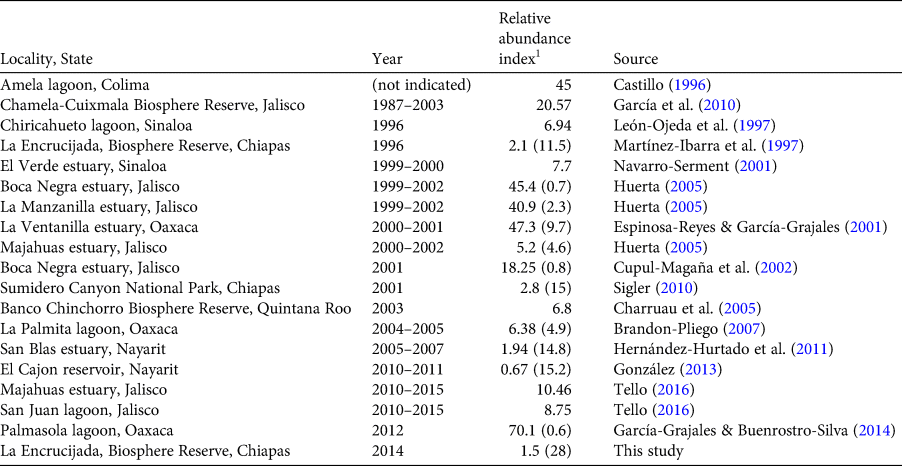
1 Surveyed km, where known, are given in parentheses.
Human–crocodilian interactions in El Hueyate estuary
El Hueyate estuary in the La Encrucijada Biosphere Reserve on the Pacific coast of Chiapas state (Fig. 1) has two core areas (36,216 ha: El Palmarcito and La Encrucijada), and a 108,651 ha buffer zone (INE-SEMARNAP, 1999). Within the Reserve the caiman subspecies C. crocodilus chiapasius and C. acutus occur in both natural and anthropogenic ecosystems (dams, cattle ponds, fishery ponds and pampas; Sigler, Reference Sigler1996). There are 64 human settlements and 26,992 inhabitants in the Reserve, of which 28.5% do not receive school education of any level; the main economic activities are fishing, agriculture and livestock breeding (INE-SEMARNAP, 1999). Reports indicate there are more crocodilians in the core zone than elsewhere (Sigler & Martínez-Ibarra, Reference Sigler and Martínez-Ibarra1998; Peña, Reference Peña2011) and nesting of both species has been recorded (Sigler & Martínez-Ibarra, Reference Sigler and Martínez-Ibarra1998; González-Desales et al., Reference González-Desales, Monroy-Vilchis, Zarco-González and Charruau2016a,Reference González-Desales, Monroy-Vilchis, Charruau and Zarco-Gonzálezb), and therefore we examined human–crocodilian interactions and abundance of crocodilians only in the core zone.
La Encrucijada Biosphere Reserve, with the locations of the six negative interactions (cases) between people and crocodilians recorded during 2005–2018 (Table 2), five with American crocodiles Crocodylus acutus and one (Case 5) with a spectacled caiman Caiman crocodilus chiapasius, and nests recorded in 2014. For details of the six cases, see Table 2.

During October 2013–September 2014 we conducted unstructured interviews in the principal settlements on the margin of the El Hueyate estuary (Aztlán, Brisas del Hueyate and La Ceiba) with 22 people (five women and 17 men; 22–51 years old), who were either involved in incidents, or relatives of those involved. As the total population in these settlements is 543, (CONABIO, 2014), we interviewed 4% of the total population. We focused on obtaining information about the date and location of any interactions, any actions taken against the crocodilians, activities that people were performing at the time of the incidents, and information from people that witnessed the events. From 2014 onwards we have made 2–3 visits per year to monitor reports of any additional negative interactions. We have knowledge of an incident that occurred in March 2017 but we have not yet been able to interview the family members of the affected person.
The abundance of C. acutus and C. crocodilus chiapasius was analysed using the Relative Abundance Index Rsp/travelled distance, where Rsp is the number of records of each species and travelled distance is the total number of km travelled during monitoring (Sigler et al., Reference Sigler, Cedeño-Vázquez, Cupul-Magaña, Sánchez-Herrera, López-Segurajáuregui, García-Naranjo Ortiz de la Huerta and Benítez-Díaz2011). We obtained relative abundance data of both crocodilians from literature (Martínez-Ibarra et al., Reference Martínez-Ibarra, Naranjo and Nelson1997; Sigler & Martínez-Ibarra, Reference Sigler and Martínez-Ibarra1998; Peña, Reference Peña2011) and our fieldwork in 2014. In El Hueyate estuary we conducted 24 surveys during March–October 2014 during the nesting season of C. acutus and C. crocodilus chiapasius. The surveys were performed from a 6 m boat with a 15 HP outboard motor, using a 19 LED white light to search for the brightness of crocodilian eyes by projecting the light beam between the boat and the mangroves (Chabreck, Reference Chabreck1966). When we located eye-shine we decreased speed and slowly headed towards the individual, to identify it (differentiation of the species was by the presence of bony crests and ossified inter-orbital bridge in the case of C. crocodilus, and the absence of these characteristics in C. acutus). The 28 km of the El Hueyate estuary monitored were the same stretch of the estuary surveyed in earlier studies (Martínez-Ibarra et al., Reference Martínez-Ibarra, Naranjo and Nelson1997; Sigler & Martínez-Ibarra, Reference Sigler and Martínez-Ibarra1998; Peña, Reference Peña2011).
Results
Negative interactions with C. acutus in Mexico
CrocBITE (2018) contains 121 records of negative interactions between people and C. acutus in Mexico during 15 August 1993–8 June 2018, and no reports of interactions with C. crocodilus chiapasius. Of the 121 records only 117 included geographical location. There was a significant negative relationship between the frequency of interactions and distance to the nearest nesting site (r = –0.76; P < 0.05); i.e. there were more interactions closer to nesting sites. There was also a significant relationship between the number of negative interactions and presence records of C. acutus (r = 0.92; P < 0.05). There was no significant relationship between the frequency of negative interactions and the relative abundance of C. acutus (r = –0.49, P > 0.05). With respect to the date of incidents, there were significantly more negative interactions during the nesting season than at other times (χ 2 = 22.87, df = 1, P < 0.001; Fig. 2). Regarding the socio-economic characteristics of the 70 municipalities where there were negative interactions or presence records, the economic activity ‘services’ was the most common in municipalities where interactions (24 municipalities) and sightings occurred (34 municipalities), human population density was lower in municipalities with negative interactions (mean 0.9 ± SD 1.1 inhabitants/km2), and in municipalities with negative interactions 57.1% of the adult male population (15–64 years old) had a mean of 7.4 ± SD 1.2 years of education.
Negative interactions by month involving C. acutus in Mexico, showing that the incidents are more frequent in nesting season.

Human–crocodilian interactions in El Hueyate estuary
We obtained data on the relative abundance of C. acutus in El Hueyate estuary for 1997, 1998, 2002 and 2008–2010, with 1.14–7.11 individuals per km, and for C. crocodilus chiapasius for 2002 and 2008–2010, with 0–2.42 individuals per km (Fig. 3a). The relative abundance index calculated for our fieldwork in 2014 was 1.5 C. acutus per km and 2.71 C. crocodilus chiapasius per km.
(a) Relative abundance index (crocodilians observed per km, during 1997–2014) of C. acutus and C. crocodilus chiapasius, and (b) the number of negative human–crocodilian interactions per year (during 2005–2018), in El Hueyate estuary, La Encrucijada Biosphere Reserve, Mexico.

We obtained information on six negative interactions between people and crocodilians in El Hueyate estuary during 2005–2014 (Fig. 3b). Two of the incidents were fatal, two resulted in major injury (limb loss or permanent motor impairment) and two resulted in minor injury. Five of the incidents involved C. acutus and one C. crocodilus chiapasius (Table 2).
Incidents of negative interactions with crocodilians during 2005–2018 in El Hueyate estuary and nearby areas. Case five was with a spectacled caiman Caiman crocodilus chiapasius and the other cases were with American crocodiles Crocodylus acutus.

According to the interviewees, incidents between crocodiles and domestic animals (mainly dogs) and livestock (cattle and pigs) are common in the area. Following negative interactions with crocodiles, 30 adult crocodiles were hunted by the inhabitants of the three settlements during 2011–2012. Five of the six negative interactions recorded occurred close to nesting sites (Table 2), where we observed 34 nests of C. acutus and 19 of C. crocodilus chiapasius in 2014 (Fig. 1; González-Desales et al., Reference González-Desales, Monroy-Vilchis, Zarco-González and Charruau2016a,Reference González-Desales, Monroy-Vilchis, Charruau and Zarco-Gonzálezb).
Discussion
As far as we are aware, this study is the first analysis of the potential causes of the negative interactions between people and C. acutus in Mexico, and the first standardized report of populations trends of C. crocodilus chiapasius and C. acutus in a coastal region of Chiapas. For Crocodylus porosus, in Australia and Sri Lanka, abundance and protection of the nest by females are the main factors that increase the probability of negative interactions with people (Caldicott et al., Reference Caldicott, Crozer, Manolis, Webb and Briton2005; Amarasinghe et al., Reference Amarasinghe, Madawala, Karunarathna, Manolis, De Silva and Sommerlad2015). Our study suggests, however, that the abundance of C. acutus does not influence the frequency of incidents in Mexico.
The survey method used for the calculation of the relative abundance index is potentially subject to biases (García-Grajales et al., Reference García-Grajales, Buenrostro-Silva and Escobedo-Galván2007) and therefore the lower relative abundance we detected in La Encrucijada in 2014 cannot necessarily be attributed to the illegal killing of crocodiles. However, with illegal killings as high as 30 individual crocodiles per incident (according to the people we interviewed), such killings would be expected to affect abundance, especially if any of the crocodiles killed are reproductive females. A similar situation occurs in other regions of Mexico. Hernández-Hurtado et al. (Reference Hernández-Hurtado, García-de Quevedo, Hernández-Hurtado, Jiménez and Espino2006) reported 11 negative incidents during 1993–2004 in the Western Pacific region, following which 155 crocodiles were hunted, injured or captured, of which 40 were hunted in Manzanilla, Jalisco. The illegal killing of crocodiles has been reported elsewhere after negative interactions, such as with C. porosus in Sri Lanka (Amarasinghe et al., Reference Amarasinghe, Madawala, Karunarathna, Manolis, De Silva and Sommerlad2015).
Following negative interactions between C. acutus and people in La Encrucijada, there was an apparent decrease in abundance of the species, to a level similar to that recorded when protection of the species began in this area. Management strategies are now required for this crocodile population, as employed in 1998 and 1999 when eggs were recovered from nesting areas within the estuary, with 123 offspring reared from 126 incubated eggs and then released in the Reserve (Sigler et al., Reference Sigler, López, Muñiz and González-Blanco2000). In other regions of Mexico, habitat protection, nest and clutch care, and long-term monitoring have helped the recovery of C. acutus populations (García et al., Reference García, Valtierra-Azotla, Cuarón and Ceballos2010).
Since 2011, following the incidents with crocodiles, people living along El Hueyate estuary no longer engage in fish harpooning for fear of being attacked; they also destroy crocodile eggs (Sigler & Martínez-Ibarra, Reference Sigler and Martínez-Ibarra1998; Sigler et al., Reference Sigler, López, Muñiz and González-Blanco2000; González-Desales et al., Reference González-Desales, Monroy-Vilchis, Zarco-González and Charruau2016a) and no longer swim or bathe in the estuary. Negative human–crocodilian interactions affect both parties (Table 2; Pooley, Reference Pooley2015). People may suffer fatal incidents, temporary or permanent physical and/or psychological damages, economic expenses and loss of domestic animals. The decline of a crocodile population can affect the local economy directly, and negatively, as a result of an increase in species of mammals, birds and arthropods considered problematic for agriculture (Cott, Reference Cott1961; Fittkau, Reference Fittkau1973), and short-term ecological imbalance (Nifong, Reference Nifong2018).
It is therefore important to collect data systematically, to understand the dynamics of crocodile populations and to document their interactions with people and, subsequently, to recommend actions that facilitate coexistence (Pooley, Reference Pooley2015). Ecotourism and sustainable harvest of crocodilian populations are potential management strategies (Fukuda et al., Reference Fukuda, Manolis and Appel2014). To conserve crocodiles, it is vital to involve all stakeholders, including government agencies, non-governmental organizations, business and tourism sectors, the media, and the public, both rural and urban.
The majority (78.5%) of incidents occurred during February–September, the nesting season of C. acutus, which is similar to Crocodylus palustris in India, where 71.8% of incidents were reported during the breeding season (Vyas & Stevenson, Reference Vyas and Stevenson2017). The main local economic activity is fishing within the estuary, close to nesting sites (Hernández-Hurtado et al., Reference Hernández-Hurtado, García-de Quevedo, Hernández-Hurtado, Jiménez and Espino2006; Das & Jana, Reference Das and Jana2017). Although the inhabitants in the study area suggested that the increase of crocodiles in the estuary is the main cause of negative interactions, our findings suggest otherwise: negative interactions also occurred when crocodile abundance was low, such as in 2014 (Fig. 3). Another important aspect to consider is a crocodile's length (Fukuda et al., Reference Fukuda, Manolis, Saalfeld and Zuur2015): the average size of the crocodiles responsible for negative interactions in Mexico was 2.8 m (range 0.5–4.0 m), and in 36 cases the crocodiles were reported to be > 2 m in length (CrocBITE, 2018). The crocodiles involved in the negative interactions in El Hueyate estuary measured 1.5–3.7 m in length (Table 2), and the dates of the incidents recorded corresponded to the months of courtship, nesting or care of neonates. In other species of crocodilians it has been documented that anthropogenic activities such as swimming, fishing, washing, walking near sources of water, sailing, catching crocodilians, falling into the water, bathing cattle, collecting water or crossing a body of water, are the main circumstances in which negative interactions occur between people and crocodiles (Caldicott et al., Reference Caldicott, Crozer, Manolis, Webb and Briton2005; Langley, Reference Langley2005; Jayson et al., Reference Jayson, Sivaperuman and Padmanbhan2006; Dunham et al., Reference Dunham, Ghiurghi, Cumbi and Urbano2010; Brien et al., Reference Brien, Gienger, Browne, Read, Joyce and Sullivan2017).
Our findings indicate a relationship of negative human–crocodilian interactions with anthropogenic activities and the crocodile reproductive season (nesting and care of hatchlings), and potentially to some socio-economic characteristics of the municipalities where negative incidents occur. This is also the pattern on the Mexican Pacific coast. Abundance of crocodilians does not appear to determine the frequency of negative interactions, but the probability of negative interactions may increase in locations with more crocodile sightings. This should be considered in the safeguarding of tourists and the local population: monitoring of wild populations of C. acutus would help to establish whether there are more negative incidents at sites with greater numbers of crocodiles. Consideration of the socio-economic characterization of municipalities, and locating nesting zones, are the first steps required to identify risk sites and to implement prevention strategies: for example, signage at risk sites such as nesting areas and training of response groups for incidents with crocodiles.
Negative interactions between people and crocodiles are increasing in Mexico (García-Grajales & Buenrostro-Silva, Reference García-Grajales and Buenrostro-Silva2019), and the study of this phenomenon is necessary to support public policies, possibly including the translocation or removal of troublesome individual crocodiles. Conservation strategies need to consider the ecological, socio-economic and cultural aspects of these interactions, to avoid the illegal killing of crocodiles (Carter et al., Reference Carter, López-Bao, Bruskotter, Gore, Chapron and Johnson2017). Public education about crocodiles needs to be improved, to inform people about high risk situations and how to avoid them, but it is also imperative to convey why crocodiles need to be conserved (Pooley, Reference Pooley2015; Cureg et al., Reference Cureg, Bagunu, van Weerd, Balbas, Soler and van der Ploeg2016; Sideleau et al., Reference Sideleau, Edyvane and Britton2017). Conveying this message to the diverse range of stakeholders could include various strategies such as the use of brochures, pamphlets, signage, media coverage, posters, public presentations and tourist guides (Amarasinghe et al., Reference Amarasinghe, Madawala, Karunarathna, Manolis, De Silva and Sommerlad2015).
Finally, we make the following recommendations: (1) monitoring recreational activities near the sites and during the nesting season (depending on the site, February–September) by tourism service providers and institutions responsible for crocodile monitoring and administration of natural areas, (2) dissemination of information on the possible risk of incidents, (3) protection of eggs in incubation pens, and (4) encouraging strategies to meet the social and economic needs of the local human population. We have implemented some of these strategies in El Hueyate estuary, and so far there have not been any reports of further incidents. Signs are erected during the nesting season, and 58 nests were protected during 2013–2016 by local people (García-Grajales et al., Reference García-Grajales, González-Desales, López-Luna, Monroy-Vilchis, Urios and Zarco-González2019). We are continuing these activities.
Acknowledgments
We thank Consejo Nacional de Ciencia y Tecnología and the Universidad Autónoma del Estado de México (Scholarship 360827, Project 3841/2014/CIA) for funding; sponsors of the Student Research Assistance Scheme for financing the fieldwork through the IUCN Crocodile Specialist Group (Project 14/3); B. Sideleau for maintenance of CrocBITE; the people of La Encrucijada Biosphere Reserve for sharing details of their problems with crocodiles; the Island Conception ecotourism project for providing facilities during fieldwork; and Xareni Pacheco for help with the text.
Author contributions
Development of concept and methods: GAG-D, MMZ-G, OM-V; fieldwork: GAG-D, LS; writing: all authors; organization of crocodile monitoring and interviews: MMZ-G, OM-V; financial management: PC, MMZ-G, OM-V; data analysis: GAG-D, AB-S; translation: LS.
Conflicts of Interest
None.
Ethical Standards
The Universidad Autónoma del Estado de México approved this research under its code of ethics, no crocodilians were captured in the course of the fieldwork, people interviewed allowed us to make use of the information obtained, and the research otherwise abided by the Oryx guidelines on ethical standards.


 Open access

