





Introduction
In contemporary agricultural systems, weed management primarily relies on the extensive application of synthetic herbicides, which have considerable adverse effects on environmental health as well as human and animal well-being (Scavo and Mauromicale Reference Scavo and Mauromicale2020). To mitigate these risks, sustainable weed management involves a variety of strategies, including crop rotation, intercropping, competitive planting, and mulching, as well as the use of biological control agents and natural bioherbicides that aim to minimize or eliminate reliance on chemical herbicides. Within this framework, biopesticides derived from plant extracts or essential oils (EOs), pathogenic microorganisms, or microbial phytotoxins (such as mycoherbicides) offer a promising approach for managing weeds. However, EOs typically require significantly higher application rates to achieve herbicidal efficacy compared with synthetic counterparts. While synthetic herbicides are effective at much lower active ingredient rates (often grams per hectare), EO-based treatments generally act as contact desiccants and require higher concentrations, often ranging from 1% to 10% (v/v) in spray solutions (Hasan et al. Reference Hasan, Ahmad-Hamdani, Rosli and Hamdan2021). Furthermore, despite their natural origin, EOs can exert dose-dependent effects on human health; they provide certain therapeutic benefits at low concentrations but may pose risks of irritation or systemic toxicity at higher exposure levels (Osaili et al. Reference Osaili, Dhanasekaran, Zeb, Faris, Naja, Radwan, Cheikh Ismail, Hasan, Hashim and Obaid2023).
Various plant metabolites—including alcohols, fatty acids, phenolics, flavonoids, terpenoids, and steroids—can reduce the reproduction, growth, and development of neighboring vegetation, including weed species (Hasan et al. Reference Hasan, Ahmad-Hamdani, Rosli and Hamdan2021). These phytotoxic substances can influence cellular growth in both aerial and root tissues, thereby inhibiting overall plant development (El Mahdi et al. Reference El Mahdi, Tarraf, Ruta, Piscitelli, Aly and De Mastro2020). For instance, Hazrati et al. (Reference Hazrati, Saharkhiz, Niakousari and Moein2017) reported that nano-emulsions of summer savory (Satureja hortensis L.) EO caused 95% mortality in redroot pigweed (Amaranthus retroflexus L.), and lambsquarters (Chenopodium album L.) at 3,000 and 4,000 µl ml−1, respectively. In that study, complete destruction and 100% inhibition occurred at 4,000 and 5,000 µl ml−1, with stronger inhibition observed in roots than in shoots.
The phytotoxic potential of EOs includes chlorosis, leaf necrosis, reduced plant growth, mitosis inhibition, membrane depolarization, decreased chlorophyll content, reduced cellular respiration, and oxidative damage (Hasan et al. Reference Hasan, Ahmad-Hamdani, Rosli and Hamdan2021). Similarly, the EO of Mediterranean wild thyme (Thymbra capitata Cav.) at 8 and 12 µl ml−1, and water mint (Mentha piperita L.) at 16 and 20 µl ml−1, caused maximum chlorosis and necrosis in A. retroflexus, hogweed (Portulaca oleracea L.), and wild oat (Avena fatua L.) (Jouini et al. Reference Jouini, Verdeguer, Pinton, Araniti, Palazzolo, Badalucco and Laudicina2020). Additionally, research indicates that rosemary EO could be effectively used as a preemergence herbicide to control weeds affecting cucumber (Cucumis sativus L.) and tomato (Solanum lycopersicum L.) (Ibáñez and Blázquez Reference Ibáñez and Blázquez2020).
Saharkhiz et al. (Reference Saharkhiz, Smaeili and Merikhi2010) reported significant reductions in the germination rate, seedling length, and biomass of roots and shoots in Hordeum spontaneum Koch., cereal rye (Secale cereale L.), A. retroflexus, and Cynodon dactylon L. due to thyme EO application. Further supporting this, Uremis et al. (Reference Uremis, Arslan and Sangun2009) suggested that thyme could serve as an alternative to chemical herbicides for suppressing seed germination in rough cocklebur (Xanthium strumarium L.), A. fatua, and Phalaris brachystachys L. in organic farming systems. Moreover, another study found that the germination of both X. strumarium and P. brachystachys was significantly inhibited by the EOs of lavender (Lavandula angustifolia Mill.), fennel (Foeniculum vulgare Mill.), and thyme [Thymus capitatus (L.) Hoffsgg. & Link] (Gitsopoulos et al. Reference Gitsopoulos, Chatzopoulou and Georgoulas2013). This suggests that specific EOs can be tailored for targeted weed management strategies, as these compounds are often biodegradable and less harmful to non-target organisms; however, the requirement for higher application volumes to ensure adequate contact-based efficacy may present logistical challenges in large-scale field operations compared with the low-volume requirements of most synthetic herbicides.
Recently, bioherbicides have gained significance in weed management as complementary alternatives rather than complete replacements for chemical herbicides. They are especially relevant in organic farming, where the goal is to preserve ecological balance and minimize chemical inputs. Natural herbicides generally possess shorter environmental half-lives and lower toxicity levels, offering safer options for human health and the environment (Hasan et al. Reference Hasan, Ahmad-Hamdani, Rosli and Hamdan2021; Miller Reference Miller2007). However, despite these advantages, bioherbicides face adoption barriers due to high production costs, lower efficacy relative to synthetic alternatives, and the complexity of their chemical compositions (Bellache et al. Reference Bellache, Torres-Pagan, Verdeguer, Benfekih, Vicente, Sestras, Sestras and Boscaiu2022). While studies show that single EOs are often less effective than conventional herbicides when used in isolation, combining several natural herbicides within an integrated strategy can improve effectiveness and offer superior weed control.
Research into plant-derived compounds for weed control is ongoing, aiming to develop effective, sustainable alternatives to synthetic herbicides. However, a critical knowledge gap exists regarding the comparative efficacy and specific physiological mechanisms of chemically distinct EOs when applied to problematic weed species. Specifically, there is a need for a comparative analysis between rosemary EO, which is rich in monoterpenes such as 1,8-cineole and camphor, and Shirazi thyme (Zataria multiflora Boiss.) EO, which is dominated by phenolic compounds like carvacrol and thymol. These distinct chemical profiles are expected to elicit different phytotoxic responses, making their comparison highly relevant. The three species selected for this study—A. retroflexus, C. album, and Canada thistle [Cirsium arvense (L.) Scop.]—represent economically significant and challenging weeds with diverse life cycles.
This study examined the growth and physiological responses of A. retroflexus, C. album, and C. arvense seedlings exposed to different concentrations of these two EOs, with the primary objective being to analytically compare their concentration-dependent inhibitory effects on growth and key physiological parameters. Based on the known potency of phenolic compounds, we hypothesized that (1) Shirazi thyme EO would exhibit significantly stronger inhibitory effects on weed growth compared with rosemary EO; and (2) the degree of phytotoxicity would be dose dependent and species specific, with the most severe effects observed at the highest concentrations and against the most susceptible weed species.
Materials and Methods
This study was conducted in three distinct phases: (1) the extraction of EOs from rosemary and Shirazi thyme; (2) the laboratory evaluation of radicle and plumule growth in A. retroflexus, C. album, and C. arvense seeds following EO treatment; and (3) a greenhouse assessment of seedling growth traits for these species under EO exposure.
Aerial parts of rosemary plants were randomly collected during the pre-bloom stage from the Medicinal Plant Farm at Razi University (Campus of Agriculture and Natural Resources) between April and May 2021. Dried Shirazi thyme was obtained and authenticated by the Herbarium of Razi Agricultural and Natural Resources (herbarium code: 2948, HRU). EOs were extracted from the leaves through steam distillation using a Clevenger apparatus for 3 h, following the protocol established by El Mahdi et al. (Reference El Mahdi, Tarraf, Ruta, Piscitelli, Aly and De Mastro2020) at the Pharmacognosy Research Laboratory, Kermanshah University of Medical Sciences. The resulting EOs were dried over anhydrous sodium sulfate and stored in foil-wrapped glass bottles at 4 to 8 C to prevent photodegradation. Chemical composition was subsequently determined via gas chromatography–mass spectrometry (GC-MS) using an Agilent 6890N gas chromatograph coupled with an Agilent 5973N mass spectrometer and an HP5-ms column (Agilent Technologies, Santa Clara, CA, USA) (El Mahdi et al. Reference El Mahdi, Tarraf, Ruta, Piscitelli, Aly and De Mastro2020).
The identification of the EO components was accomplished by comparing their acquired mass spectra with those stored in the NIST/EPA/NIH Mass Spectral Library and by comparing their calculated retention indices (RI) with available literature data. Regarding peak selection criteria, a specific threshold was adopted to differentiate between major/minor components and trace elements. Following El Mahdi et al. (Reference El Mahdi, Tarraf, Ruta, Piscitelli, Aly and De Mastro2020), the 1% threshold was specifically used for chemotype classification and multivariate statistical analysis (cluster analysis). The rationale is that components present at ≥1% act as the primary chemical markers defining the oil’s profile and its biological potential. Conversely, trace components (<1%) are often subject to higher analytical variability and do not significantly influence the overall categorization of the oil; therefore, they were excluded from the subsequent multivariate analyses.
Seeds of C. arvense were collected from July to August, while those of A. retroflexus and C. album were harvested in mid-February from the 300-ha agricultural fields at the Campus of Agriculture and Natural Resources, Razi University (34.3247°N, 47.1072°E). After plant identification was confirmed by a herbarium expert and weed specialists at Razi University, healthy and uniform seeds were selected and stored at a room temperature of 18 ± 2 C until experimentation.
Laboratory Experiment
The experiment was conducted as a factorial arrangement within a completely randomized design, with three replications across two experimental runs. The factors included: (1) the type of EOs (Shirazi thyme and rosemary) and (2) EO concentrations (0.5, 1, 2, 5, 10, and 20 µl ml−1), with 5 ml applied per petri dish (Alipour et al. Reference Alipour, Saharkhiz, Niakousari and Seidi Damyeh2019). Due to the hydrophobic and volatile nature of the EOs, 1% Tween 20 was used as an emulsifier and co-solvent (Edris and Malone Reference Edris and Malone2012; El Mahdi et al. Reference El Mahdi, Tarraf, Ruta, Piscitelli, Aly and De Mastro2020). Three controls were included: distilled water, distilled water with 1% Tween 20, and trifluralin 480 g L−1 EC (Treflan®, Golsam Gorgan Chemicals, Gorgan, Iran) at 960 g ai ha−1. While trifluralin is traditionally a soil-applied preemergence herbicide, it was employed in this assay as a known inhibitor of cell division to serve as a reference for the suppression of radicle and plumule elongation under controlled laboratory conditions. Before the experiment, weed seeds were disinfected by soaking them in 1% sodium hypochlorite for 2 min, followed by thorough rinsing with distilled water.
In this experiment, seeds underwent dormancy breaking via cold stratification (30 d at 4 C for A. retroflexus and C. arvense; 10 d at 5 C for C. album) (Ahmadnia et al. Reference Ahmadnia, Alebrahim, Nabati Souha and MacGregor2024; Alinaghizadeh et al. Reference Alinaghizadeh, Khajeh-Hosseini, Hosseini and Hasan2017; Bochenek et al. Reference Bochenek, Golaszewski, Piotrowicz-Cieslak and Górecki2009). To establish a standardized starting point for all seeds and minimize variability in germination times and initial growth conditions, the seeds were germinated before the application of EO treatments. Specifically, seeds were soaked in 40 ml of distilled water at room temperature in sterilized 20-cm containers until radicle emergence of 2 mm. Subsequently, under a laminar flow hood, 25 seeds were placed in autoclaved 9-cm petri dishes lined with two layers of Whatman filter paper. Each dish received 5 ml of the specified EO concentrations (v/v, µl ml−1) or controls and was sealed with Parafilm®. The dishes were incubated in a growth chamber at 25 C with a 16-h light/8-h dark photoperiod for 14 d (Verdugo-Navarrete et al. Reference Verdugo-Navarrete, Maldonado-Mendoza, Castro-Martínez, Leyva-Madrigal and Martínez-Álvarez2021). Finally, radicle and plumule lengths were measured using JMicrovision image processing software.
Greenhouse Experiment
The greenhouse experiment was designed as a factorial arrangement within a completely randomized framework, with three replications across two experimental runs. The factors included (1) the type of EOs (Shirazi thyme and rosemary) and (2) EO concentrations (5, 10, and 20 µl ml−1). Control treatments consisted of distilled water, distilled water with 1% Tween 20, and glyphosate 41% SL Roundup® (Golsam Gorgan Chemicals, Gorgan, Iran) at the recommended dose of 1,640 g ai ha−1. Seeds were surface-sterilized and cold-stratified to break dormancy before germination. Ten seeds were planted at a depth of 0.5 cm in an 8-cm-diameter plastic pot filled with sterilized soil (silty clay texture; pH 7.4; 1.4% organic matter) collected from an untreated field area at Razi University’s Campus of Agriculture and Natural Resources. Greenhouse conditions were maintained at 25 ± 5 C with ∼65% relative humidity and a 14-h light/10-h dark cycle. After germination, seedlings were thinned to maintain five uniform plants per pot. Treatments were made at the 3-to 5-leaf stage, which was reached at 10, 12, and 15 d after sowing (DAS) for A. retroflexus, C. album, and C. arvense, respectively. The treatments were applied using a 1-L cordless sprayer at 1 bar pressure with a hollow cone nozzle (80° spray angle), delivering 0.5 ml of the specified EO concentrations (v/v, µl ml−1) per pot (Benchaa et al. Reference Benchaa, Hazzit and Abdelkrim2018; El-Mergawi and Al-Humaid Reference El-Mergawi and Al-Humaid2019). Before the experiment, the sprayer flow rate was calibrated and determined to be approximately 100 ml min−1. For each treatment, three replicate pots were transferred to a separate, isolated application area. To prevent cross-contamination, the sprayer was emptied, thoroughly rinsed, and refilled with the corresponding treatment solution before each application. The solution was applied by a brief, calibrated single burst activation of the sprayer trigger, ensuring adherence to the predetermined flow rate. The experiment was performed in two independent runs. Different concentrations of EOs were prepared and applied at a volume of 0.5 ml per pot. Each pot had a diameter of 8 cm, corresponding to a surface area of approximately 50.24 cm2, ensuring uniform coverage of the target area. Based on the ratio of applied volume to pot surface area and extrapolation to 1 ha, this application volume corresponds to an approximate spray rate of 1,000 L ha−1. It was selected to ensure full contact and consistent high coverage, which are necessary for evaluating the maximum phytotoxic potential and bioherbicidal efficacy of EOs under controlled conditions. The EO solutions were prepared immediately before application in the 1-L sprayer by dissolving the required volume of EO in a premixed solution of 1% Tween 20 (serving as the sole surfactant/emulsifier) in distilled water. To ensure homogeneity and stability during the short application window, the EO–Tween 20 emulsion was vigorously hand-shaken for 60 s before being loaded into the sprayer. Furthermore, to counteract potential phase separation or volatility loss, the sprayer was agitated manually every 30 s during the application period.
Two weeks after treatment application (24, 26, and 29 DAS for A. retroflexus, C. album, and C. arvense, respectively), weed shoots and roots were fully harvested from the pots and transported to the laboratory for imaging, The primary root (taproot) and shoot lengths were measured using JMicrovision software (Nicolas Roduit, University of Geneva, Geneva, Switzerland). Images were captured with a 64-megapixel mobile camera and included a millimeter-scale calibration; this ensured the precise conversion of pixel data to real-world measurements, thereby enhancing the reliability of the morphological assessments. During the 2-wk period, the pots were maintained under the aforementioned controlled greenhouse conditions. To ensure optimal growth and prevent water stress, all pots were bottom-watered every 2 d to maintain soil moisture at approximately 70% of field capacity. No supplemental fertilizers were applied during this period to avoid interference with the physiological baseline of the weed species.
To determine biomass, plant tissue samples were oven-dried at 70 C for 48 h to ensure complete moisture removal. Following this, the samples were cooled in a desiccator to prevent moisture reabsorption and weighed using a digital scale with 0.001 g accuracy to provide precise dry weight data for both roots and shoots.
To examine the impact of treatment toxicity on physiological health, relative leaf greenness of plants was measured at 48 h after treatment application using a SPAD chlorophyll meter (model SPAD-502, Konica Minolta, Japan), following the methodology established by Wicharuck et al. (Reference Wicharuck, Suang, Chaichana, Chromkaew, Mawan, Soilueang and Khongdee2024). Additionally, chlorophyll fluorescence measurements were conducted at 48 h posttreatment using a Pocket PEA chlorophyll fluorometer (Hansatech Instruments, King’s Lynn, Norfolk, UK) to measure the maximum quantum yield of photosystem II (PSII) and photosynthetic efficiency, in accordance with the procedures outlined by Zhou et al. (Reference Zhou, Zhou, Wu, Jing, Li, Li, Kong and Zhu2024). Finally, electrolyte leakage was quantified using an electrical conductivity meter, following the protocol described by Lutts et al. (Reference Lutts, Kinet and Bouharmont1996).
The study was analyzed using as a one-way ANOVA to accommodate the comparison of unstructured control groups alongside EO treatments. For the laboratory experiment, 15 treatments were evaluated, including six concentrations (0.5, 1, 2, 5, 10, and 20 µl ml−1) of both rosemary and Shirazi thyme EOs, alongside three control groups. The greenhouse experiment was narrowed to 9 treatments, utilizing three concentrations (5, 10, and 20 µl ml−1) for each EO, plus the three corresponding controls. The experimental unit was defined as an individual petri dish and pot for the laboratory and greenhouse experiments, respectively. Normality of data distribution was verified using the Kolmogorov-Smirnov test. For traits for which the data followed a normal distribution, statistical analysis was conducted using the general linear model procedure in SAS v. 9.1.3 and mean separation was performed using Tukey’s honestly significant difference (HSD) test at a 5% significance level. For variables with a high frequency of zero values where normality could not be achieved through transformation (plumule and radicle length, leaf relative greenness, photosynthetic efficiency, and maximum quantum yield of PSII), the nonparametric Kruskal-Wallis method was utilized. As the experiment was repeated twice (two independent runs), a preliminary ANOVA was conducted with “Run” treated as a random factor. Because the analysis revealed no significant “Run” effect or “Run × Treatment” interaction (P ≥ 0.05) for any of the measured variables, the data from both runs were pooled for the final analysis.
Results and Discussion
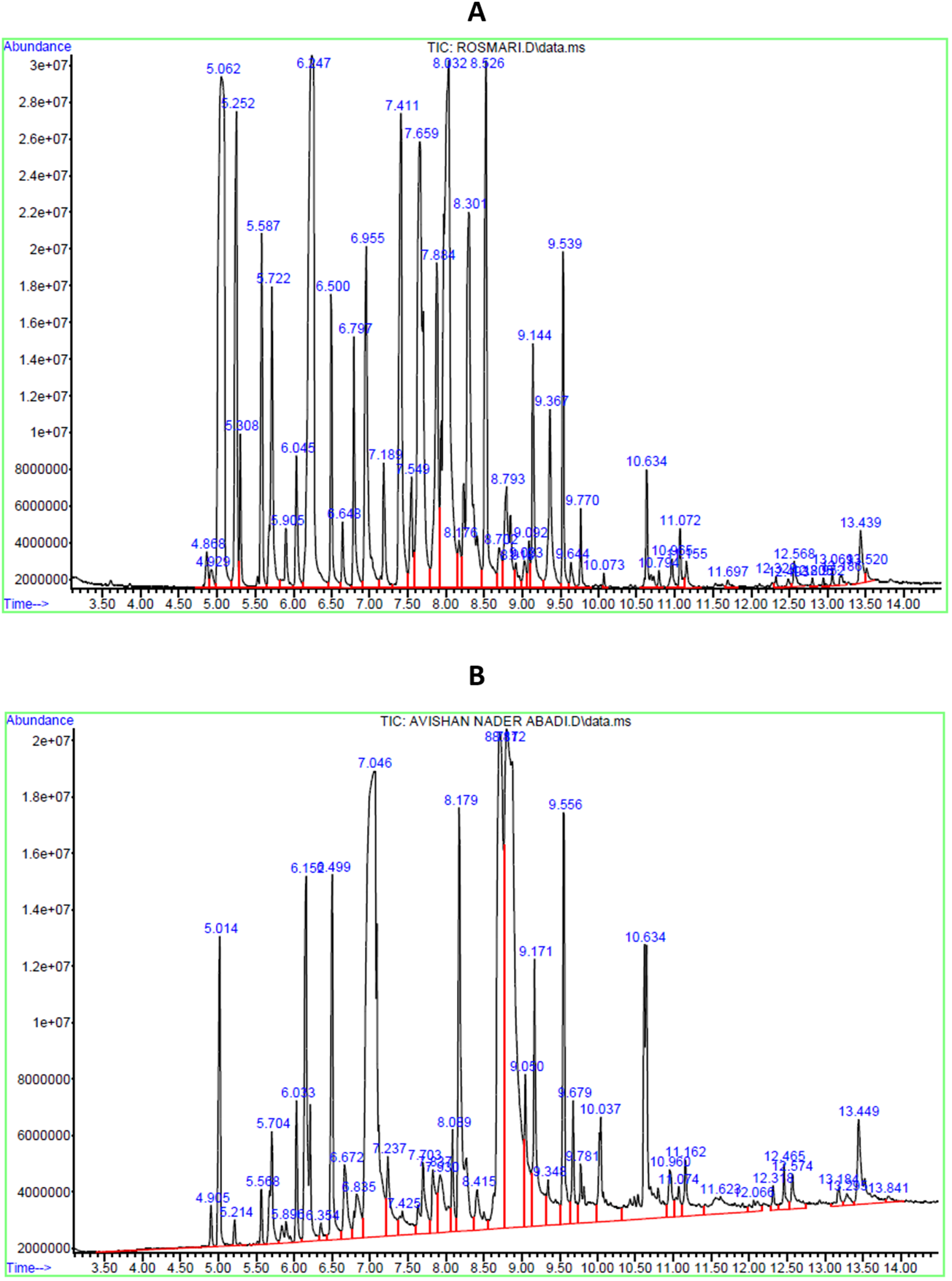
GC-MS analysis identified 15 compounds in rosemary EO, accounting for 75.07% of the total oil content. The major constituents included α-pinene (13.39%), verbenone (12.47%), 1,8-cineole (11.33%), borneol (8.70%), camphor (5.23%), camphene (3.98%), linalool (3.83%), α-terpineol (3.75%), p-cymene (2.46%), methyl eugenol (1.98%), β-caryophyllene (1.97%), α-terpinene (1.89%), geranyl acetate (1.87%), and caryophyllene oxide (1.06%) (Figure 1A).
Total ion chromatograms (TIC) of (A) rosemary (Rosmarinus officinalis) and (B) Shirazi thyme (Zataria multiflora) essential oils obtained via GC-MS using an HP-5ms column. The x-axis represents the retention time (min), while the y-axis indicates the total ion abundance (signal intensity in arbitrary units) detected by the mass spectrometer. Major chemical constituents exceeding the 1% relative abundance threshold are indicated by their retention times (blue numerical labels). In rosemary, the main compounds include α-pinene (5.06), 1,8-cineole (6.25), and verbenone (8.53), whereas the chromatographic profile of Shirazi thyme is dominated by linalool (8.18), thymol (8.79), and carvacrol (8.87).

Figure 1. Long description
Panel A: A chromatogram of rosemary essential oil shows retention time on the x-axis in minutes and total ion abundance on the y-axis in arbitrary units. Major chemical constituents exceeding 1 percent relative abundance are labeled with their retention times in blue. Key compounds include alpha-pinene at 5.06 minutes, 1,8-cineole at 6.25 minutes, and verbenone at 8.53 minutes. Panel B: A chromatogram of Shirazi thyme essential oil displays similar axes with retention time in minutes and total ion abundance in arbitrary units. Major constituents are also labeled in blue, highlighting linalool at 8.18 minutes, thymol at 8.79 minutes, and carvacrol at 8.87 minutes.
Similarly, analysis of Shirazi thyme EO revealed 23 compounds comprising 85.44% of the total oil. The predominant components were carvacrol (19.16%), linalool (17.36%), thymol (10.40%), spathulenol (5.96%), carvacrol methyl ether (5.17%), p-cymene (4.16%), β-caryophyllene (3.23%), carvacrol acetate (3.14%), α-pinene (2.25%), bicyclogermacrene (2.03%), thymol acetate (1.84%), caryophyllene oxide (1.46%), terpinene-4-ol (1.20%), myrcene (1.14%), and cis-linalool oxide (1.10%) (Figure 1B).
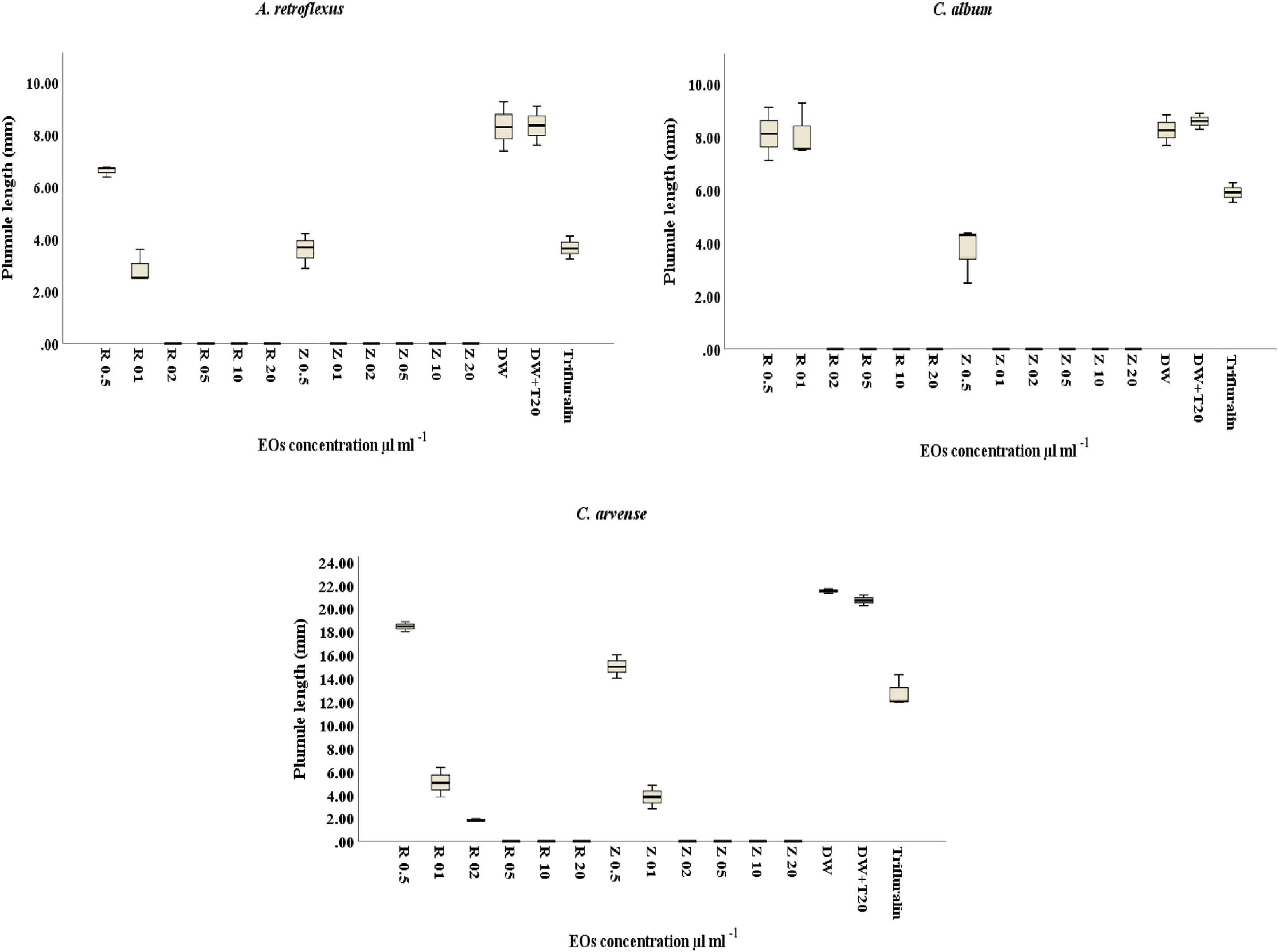
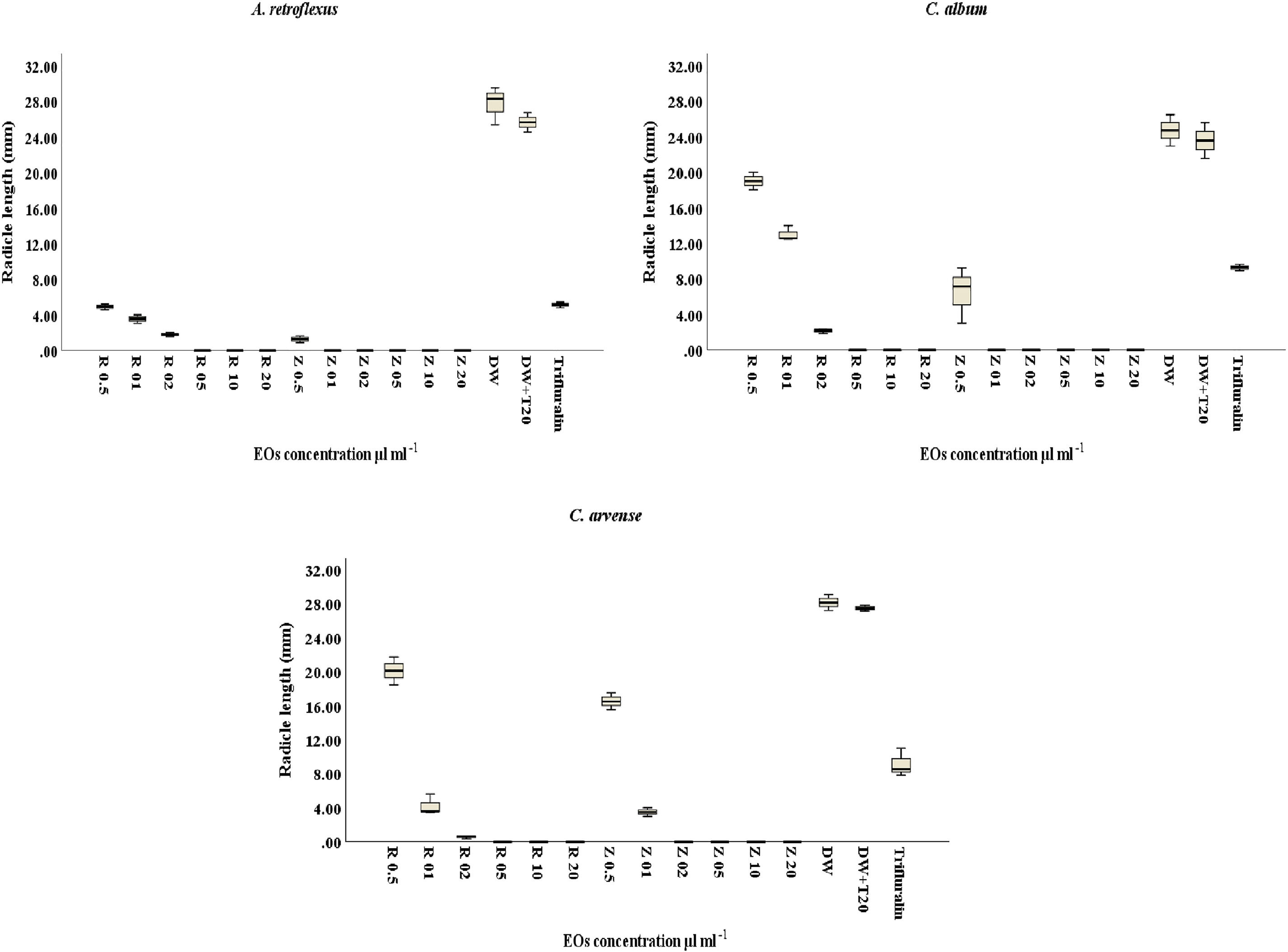
Nonparametric analysis via the Kruskal-Wallis test revealed a highly significant global inhibitory effect of both EO treatments on the plumule and radicle development of all target weed species (P < 0.01). As visualized in the box plots (Figures 2 and 3), both rosemary and Shirazi thyme EOs induced a sharp, dose-dependent reduction in growth, with Shirazi thyme exhibiting a consistently more potent phytotoxic profile at lower concentrations. Statistical comparison of the control distributions confirmed that distilled water and Tween 20 were not significantly different (P > 0.05), indicating the surfactant used for EO solubilization had no independent inhibitory effect on seedling growth.
Comparative effects of essential oil (EO) and herbicide treatments on the plumule length of three weed species: Amaranthus retroflexus, Chenopodium album, and Cirsium arvense. Treatments include rosemary (R) and Shirazi thyme (Z) essential oils at concentrations of 5, 10, and 20 µl ml−1; distilled water (DW); distilled water + 1% Tween 20 (DW+T20); and glyphosate at 1,640 g ai ha−1. Each box plot displays the median (horizontal line), the interquartile range (box), and the minimum/maximum values (whiskers). Significant differences across treatments were determined using the nonparametric Kruskal-Wallis test (P < 0.01). Each treatment was replicated three times (n = 3).

Comparative effects of essential oil (EO) and herbicide treatments on the radicle length of three weed species: Amaranthus retroflexus, Chenopodium album, and Cirsium arvense. Treatments include rosemary (R) and Shirazi thyme (Z) essential oils at concentrations of 5, 10, and 20 µl ml−1; distilled water (DW); distilled water + 1% Tween 20 (DW+T20); and glyphosate at 1,640 g ai ha−1. Each box plot displays the median (horizontal line), the interquartile range (box), and the minimum/maximum values (whiskers). Significant differences across treatments were determined using the nonparametric Kruskal-Wallis test (P < 0.01). Each treatment was replicated three times (n = 3).

Species sensitivity varied significantly; A. retroflexus and C. album were the most susceptible, reaching total plumule inhibition (median = 0 mm) at Shirazi thyme concentrations of 1 µl ml−1 and rosemary concentrations exceeding 2 µl ml−1. Cirsium arvense demonstrated greater resilience, requiring higher thresholds of 2 µl ml−1 (Shirazi thyme) and 5 µl ml−1 (rosemary) to achieve absolute suppression. At these respective threshold concentrations, both EOs outperformed the commercial herbicide trifluralin under the conditions of this assay (Figure 2).
Similar trends were observed for radicle development. For A. retroflexus and C. album, growth was completely suppressed at Shirazi thyme concentrations of 1 µl ml−1 and rosemary concentrations of 5 µl ml−1. Cirsium arvense exhibited slightly higher resilience, with total radicle inhibition achieved at 2 µl ml−1 of Shirazi thyme and 5 µl ml−1 of rosemary EO. Notably, at concentrations above 1 µl ml−1, both EOs induced a more pronounced inhibition of radicle growth across all species than the synthetic herbicide trifluralin under the conditions of this assay (Figure 3).
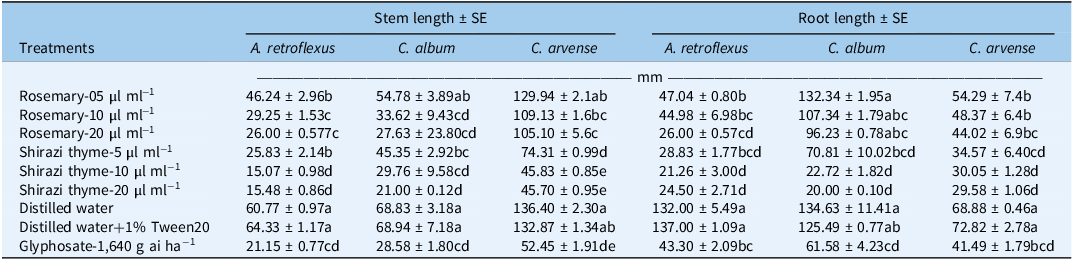
In the greenhouse experiment, stem development in all three species exhibited a clear dose response to the EO treatments (Table 1). For A. retroflexus, glyphosate treatment reduced stem length by 65.2% compared with the water control. While rosemary EO at 20 µl ml−1 achieved a 57.2% reduction, Shirazi thyme EO demonstrated significantly higher efficacy, suppressing stem lengths by 75.2% and 74.5% at 10 and 20 µl ml−1, respectively. Notably, the inhibitory effect of Shirazi thyme at these concentrations was statistically comparable to that of glyphosate. In C. album, the most substantial reductions occurred at the 20 µl ml−1 concentration of Shirazi thyme EO, a level comparable to the glyphosate treatment. The perennial species C. arvense showed the highest resilience; however, Shirazi thyme EO at 10 and 20 µl ml−1 still achieved notable stem length reductions, matching the inhibitory performance of glyphosate. Overall, Shirazi thyme EO at 10 and 20 µl ml−1 reduced stem length more than rosemary EO by 23.3% and 17.3% in A. retroflexus, 5.6% and 9.6% in C. album, and 46.4% and 46.5% in C. arvense, highlighting its superior inhibitory effect across all three species. Comparison of the control groups indicated that distilled water and the Tween 20 aqueous solution were not significantly different across all measured parameters, confirming that the surfactant exerted no independent inhibitory effect on growth.
Phytotoxic effects of varying concentrations of essential oils from rosemary (Rosmarinus officinalis) and Shirazi thyme (Zataria multiflora) on seedling root and shoot length of Amaranthus retroflexus, Chenopodium album, and Cirsium arvense.a

Table 1. Long description
The table presents data on the effects of various treatments on the stem and root lengths of three plant species: A. retroflexus, C. album, and C. arvense. The table has 10 rows and 7 columns. The columns are labeled as Treatments, Stem length ± SE for A. retroflexus, Stem length ± SE for C. album, Stem length ± SE for C. arvense, Root length ± SE for A. retroflexus, Root length ± SE for C. album, and Root length ± SE for C. arvense. The row labels include different treatments such as Rosemary-05 ml l⁻¹, Rosemary-10 ml l⁻¹, Rosemary-20 ml l⁻¹, Shirazi thyme-05 ml l⁻¹, Shirazi thyme-10 ml l⁻¹, Shirazi thyme-20 ml l⁻¹, Distilled water, Distilled water+1% Tween20, and Glyphosate-1,640 g ai ha⁻¹. Each row provides the stem and root lengths in millimeters along with their standard errors for the three species under each treatment. Notable trends include the significant reduction in stem and root lengths with higher concentrations of Shirazi thyme EO, comparable to the effects of glyphosate. The distilled water and Tween 20 treatments show minimal impact on growth, indicating no significant inhibitory effect.
a Values are presented as mean ± SE of three replicates (n = 3). Within each species and for each essential oil, different letters within the same column are significantly different according to a one-way ANOVA followed by Tukey’s honestly significant difference (HSD) (P < 0.05).
The greatest reduction in root length of A. retroflexus under rosemary EO occurred at 20 µl ml−1, with an 80.3% decrease compared with the distilled water control. Shirazi thyme EO at 10, and 20 µl ml−1 caused reductions of 83.9%, and 81.4%, respectively which did not differ significantly from that of rosemary EO at 20 µl ml−1. However, rosemary EO at 10 µl ml−1 produced a significantly lower reduction compared with Shirazi thyme EO at the same concentration. While glyphosate’s effect on A. retroflexus root length was similar to rosemary EO at 5 and 10 µl ml−1, all Shirazi thyme concentrations induced a greater reduction than glyphosate particularly at the 20 µl ml−1 concentration, under the greenhouse conditions tested. For C. album, Shirazi thyme EO at 10 and 20 µl ml−1 resulted in a significant decrease in root length compared with corresponding concentrations of rosemary. Furthermore, at these concentrations, the inhibitory effect of Shirazi thyme EO was statistically comparable to that of glyphosate, demonstrating its high efficacy in suppressing root development. In C. arvense, root length reductions at 20 µl ml−1 rosemary EO and at 5, 10, and 20 µl ml−1 Shirazi thyme EO were not significantly different from glyphosate results, but Shirazi thyme EO at 10, and 20 µl ml−1 caused significantly greater reductions than rosemary EO at 20 µl ml−1. These results demonstrate that Shirazi thyme EO possesses a stronger inhibitory effect on root length than rosemary EO across all three weed species (Table 1).
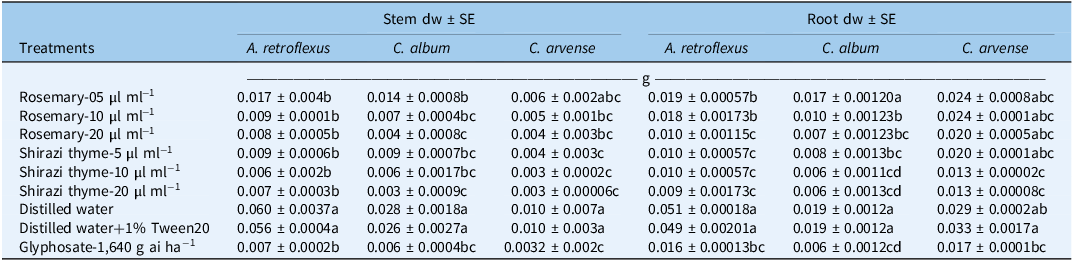
The stem and root dry weight of the tested species was significantly reduced by both EO applications, The data summarized in Table 2 indicate that in A. retroflexus and C. arvense, the suppression of stem dry weight induced by rosemary and Shirazi thyme EOs at 5, 10, and 20 µl ml−1 were statistically comparable to that of glyphosate. This trend was consistent in C. album, with the exception of the 5 µl ml−1 rosemary treatment, which showed lower inhibitory activity. However, despite the shared statistical groupings with the herbicide, the numerical inhibitory effect of Shirazi thyme was consistently higher than the effect of corresponding concentrations of rosemary across all species.
Phytotoxic effects of varying concentrations of essential oils from rosemary (Rosmarinus officinalis) and Shirazi thyme (Zataria multiflora) on seedling root and shoot dry weight (DW) of Amaranthus retroflexus, Chenopodium album, and Cirsium arvense. a
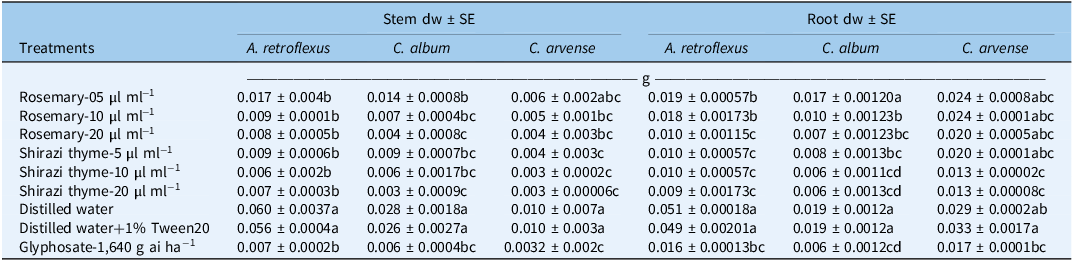
Table 2. Long description
The table presents the effects of various treatments on the stem and root dry weight of Amaranthus retroflexus, Chenopodium album, and Cirsium arvense. It has 10 rows and 7 columns. The columns are labeled as Treatments, Stem dw ± SE for A. retroflexus, C. album, and C. arvense, and Root dw ± SE for A. retroflexus, C. album, and C. arvense. The treatments include different concentrations of rosemary and Shirazi thyme essential oils, distilled water, distilled water with Tween 20, and glyphosate. Each cell contains the dry weight values with standard error for the respective treatments and species. Notable trends include the reduction in dry weight across all species with increasing concentrations of essential oils and the comparative effects of different treatments.
a Values are presented as mean ± SE of three replicates (n = 3). Within each species and for each essential oil, different letters within the same column are significantly different according to a one-way ANOVA followed by Tukey’s honestly significant difference (HSD) (P < 0.05).
The data summarized in Table 2 indicate that rosemary EO at 20 µl ml−1 and all tested concentrations of Shirazi thyme EO (5, 10, and 20 µl ml−1) exhibited an inhibitory effect on the root dry weight of A. retroflexus that was statistically comparable to that of glyphosate. In contrast, the lower concentrations of rosemary EO (5 and 10 µl ml−1) were significantly less effective than the corresponding Shirazi thyme treatments, indicating they were not as strongly differentiated from the control treatments as the Shirazi thyme concentrations. For C. album and C. arvense, root dry weight reductions for both rosemary and Shirazi thyme EOs at the higher tested concentrations were statistically comparable to the glyphosate treatment. However, while the reduction in root dry weight for these species at concentrations of 10 and 20 µl ml−1 of Shirazi thyme did not show a statistical difference from glyphosate, the numerical suppression is worth considering from a biological perspective due to the consistently lower biomass values recorded. These results indicate that Shirazi thyme achieves optimal root biomass suppression at lower application rates than rosemary EO across the tested species.
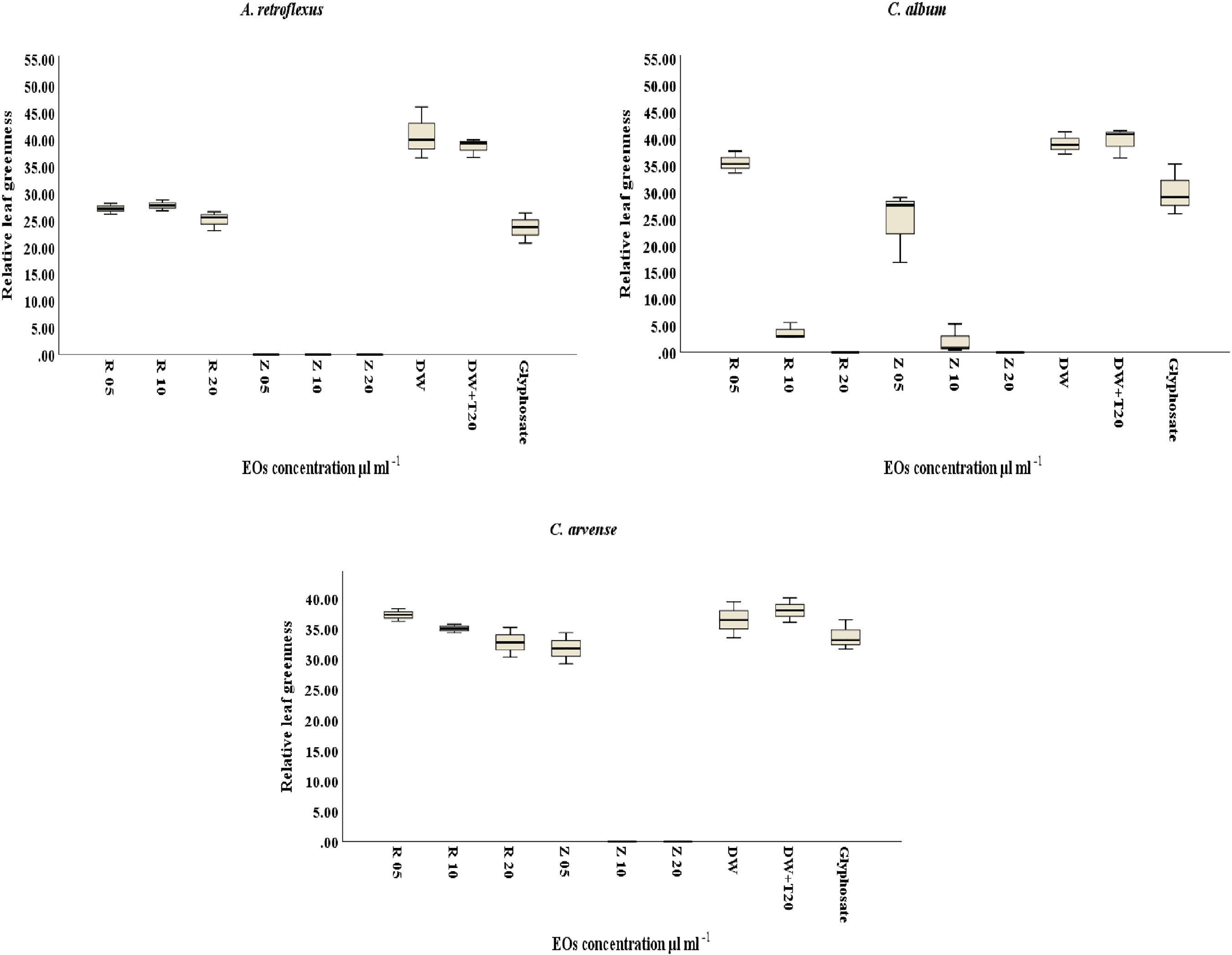
Statistical analysis of relative leaf greenness using the nonparametric Kruskal-Wallis test revealed that EO treatments significantly reduced SPAD values across all three species in a dose-dependent manner. As illustrated in Figure 4, the box plot distributions indicate that while Shirazi thyme EO consistently resulted in the lowest median relative greenness (median = 0) at concentrations of 10 and 20 µl ml−1, rosemary EO also demonstrated potent inhibitory activity at these higher dosages in specific species. Notably, in C. album, concentrations of 10 and 20 µl ml−1 rosemary EO induced significant reductions in relative leaf greenness, reaching near-zero medians that were statistically equivalent to the Shirazi thyme treatments. In A. retroflexus, the inhibitory effect of all tested Shirazi thyme concentrations was markedly more pronounced than that of glyphosate. Similarly, for C. album and C. arvense, median relative leaf greenness under glyphosate treatment remained notably higher (approximately 30.0 and 33.0, respectively) than that observed for Shirazi thyme EO treatments, which caused complete or near-complete loss of leaf greenness.
Comparative effects of essential oil (EO) and herbicide treatments on the relative leaf greenness of three weed species: Amaranthus retroflexus, Chenopodium album, and Cirsium arvense. Treatments include rosemary (R) and Shirazi thyme (Z) essential oils at concentrations of 5, 10, and 20 µl ml−1; distilled water (DW); distilled water + 1% Tween 20 (DW+T20); and glyphosate at 1,640 g ai ha−1. Each box plot displays the median (horizontal line), the interquartile range (box), and the minimum/maximum values (whiskers). Significant differences across treatments were determined using the nonparametric Kruskal-Wallis test (P < 0.01). Each treatment was replicated three times (n = 3).

Figure 4. Long description
The image contains four box plots comparing the effects of essential oil (EO) and herbicide treatments on the relative leaf greenness of three weed species: Amaranthus retroflexus, Chenopodium album, and Cirsium arvense. Each box plot displays the median, interquartile range, and minimum/maximum values. Panel A: Box plot for Amaranthus retroflexus. The x-axis represents different treatments: rosemary (R) and Shirazi thyme (Z) essential oils at concentrations of 0.5, 1, 2, 5, 10, and 20 µl/ml; distilled water (DW); distilled water with 1% Tween 20 (DW+T20); and glyphosate. The y-axis represents relative leaf greenness. Panel B: Box plot for Chenopodium album. The x-axis and y-axis are the same as in Panel A. Panel C: Box plot for Chenopodium album. The x-axis and y-axis are the same as in Panel A. Panel D: Box plot for Cirsium arvense. The x-axis and y-axis are the same as in Panel A. Significant differences across treatments were determined using the nonparametric Kruskal-Wallis test (P < 0.01). Each treatment was replicated three times (n = 3).
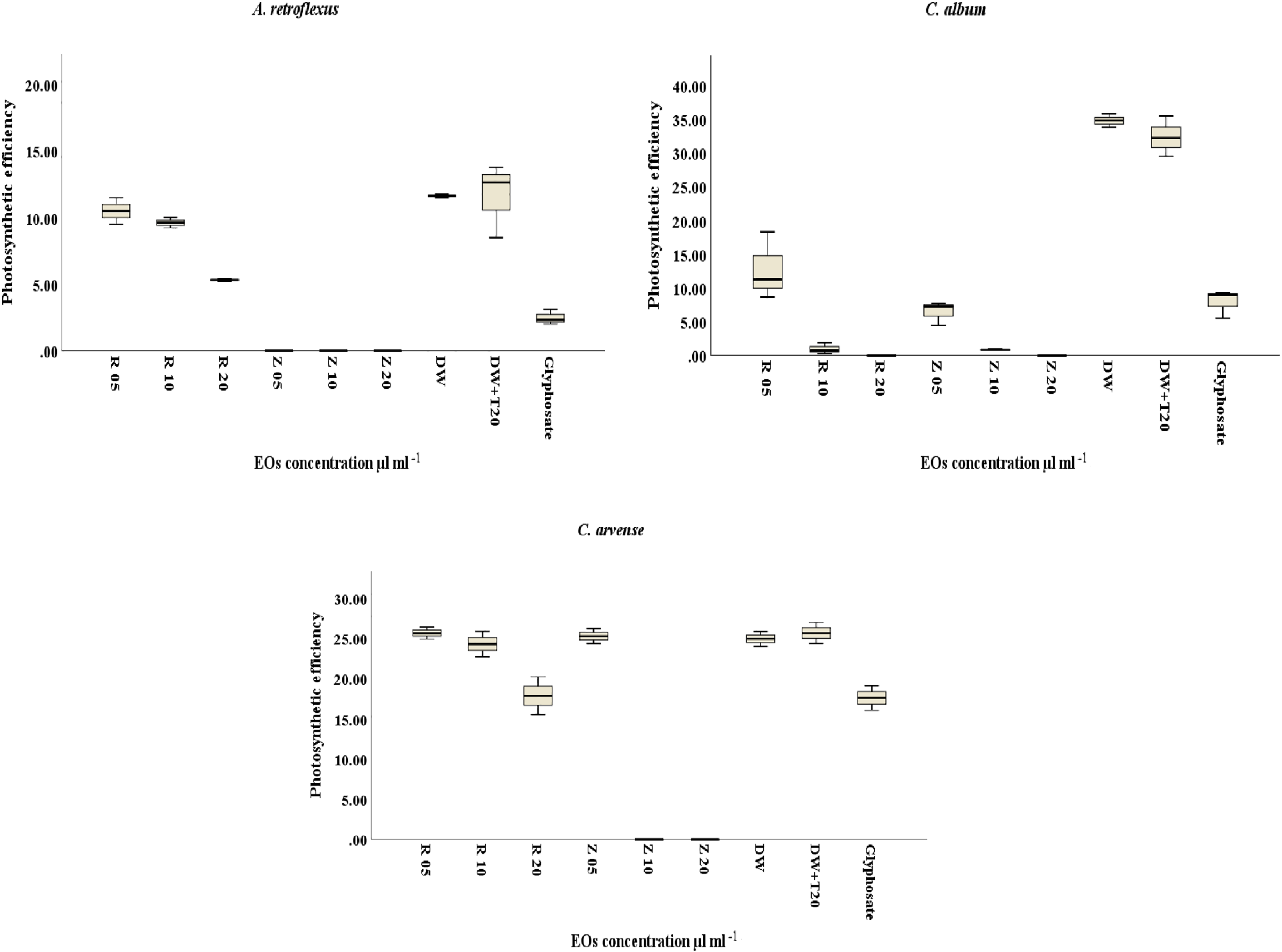
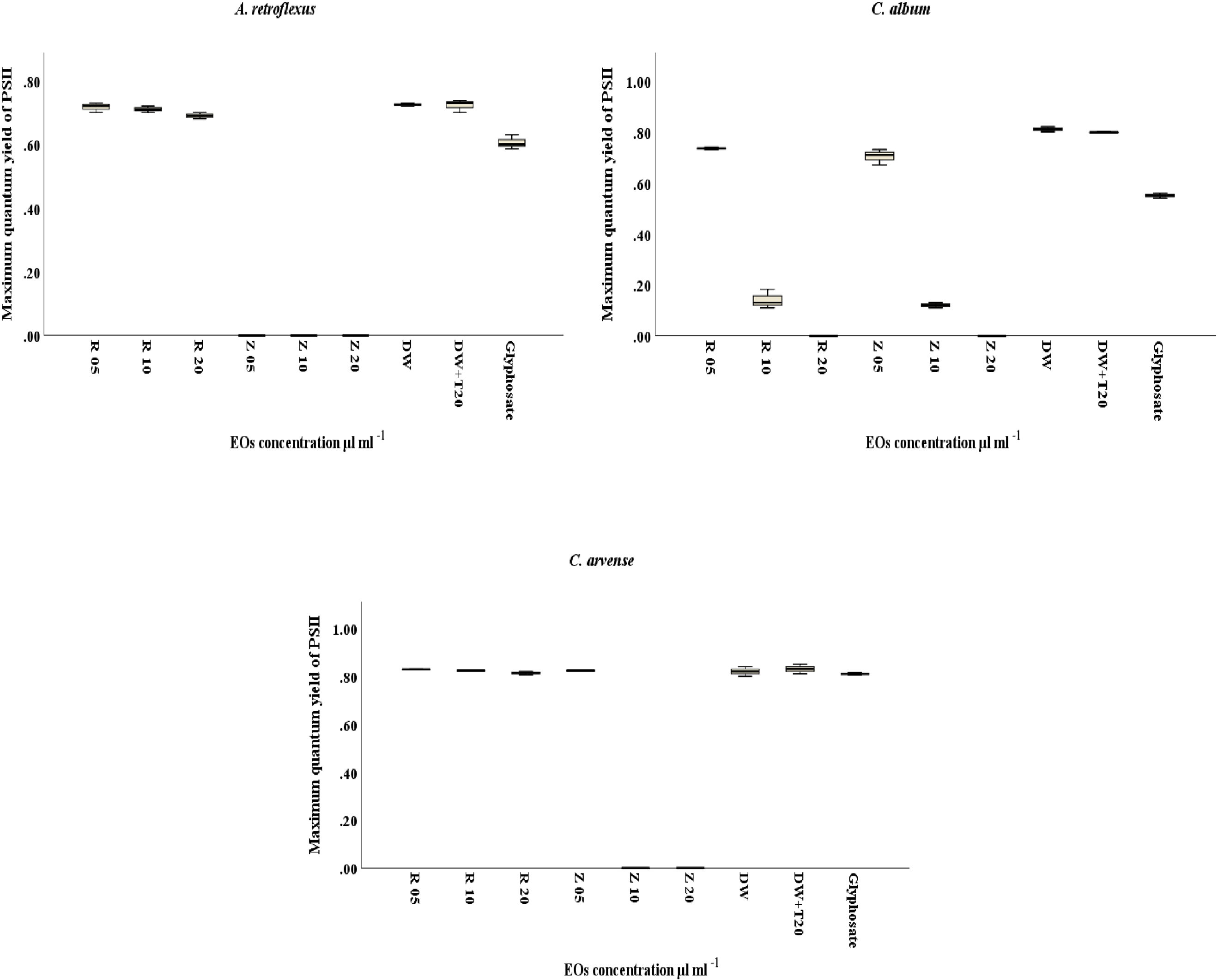
The box plot in Figure 5 reveals that in A. retroflexus, Shirazi thyme EO at all tested concentrations (5, 10, and 20 µl ml−1) caused a greater reduction in photosynthetic efficiency than glyphosate, leading to complete inhibition. Conversely, none of the rosemary EO concentrations surpassed the inhibitory effect of glyphosate in this species. For C. album, both 10 and 20 µl ml−1 concentrations of rosemary and Shirazi thyme EOs exhibited higher levels of inhibition than glyphosate under these conditions. However, Shirazi thyme EOs at 10 and 20 µl ml−1 abolished photosynthetic efficiency, showing a stronger inhibitory effect than the synthetic herbicide. Similarly, the maximum quantum yield of PSII in A. retroflexus and C. arvense was reduced by both EOs, with Shirazi thyme EOs exerting a more intense effect than rosemary EOs, reducing the median yield to zero at higher concentrations. In C. album, the effects of Shirazi thyme and rosemary EO treatments (at 10 and 20 µl ml−1) on the maximum quantum yield of PSII were statistically comparable, as both reached near-zero levels that were more pronounced than the reduction observed with glyphosate (Figure 6).
Comparative effects of essential oil (EO) and herbicide treatments on the photosynthetic efficiency of three weed species: Amaranthus retroflexus, Chenopodium album, and Cirsium arvense. Treatments include rosemary (R) and Shirazi thyme (Z) essential oils at concentrations of 5, 10, and 20 µl ml−1; distilled water (DW); distilled water + 1% Tween 20 (DW+T20); and glyphosate at 1,640 g ai ha−1. Each box plot displays the median (horizontal line), the interquartile range (box), and the minimum/maximum values (whiskers). Significant differences across treatments were determined using the nonparametric Kruskal-Wallis test (P < 0.01). Each treatment was replicated three times (n = 3).

Comparative effects of essential oil (EO) and herbicide treatments on the maximum quantum yield of photosystem II (PSII) of three weed species: Amaranthus retroflexus, Chenopodium album, and Cirsium arvense. Treatments include rosemary (R) and Shirazi thyme (Z) essential oils at concentrations of 5, 10, and 20 µl ml−1; distilled water (DW); distilled water + 1% Tween 20 (DW+T20); and glyphosate at 1,640 g ai ha−1. Each box plot displays the median (horizontal line), the interquartile range (box), and the minimum/maximum values (whiskers). Significant differences across treatments were determined using the nonparametric Kruskal-Wallis test (P < 0.01). Each treatment was replicated three times (n = 3).

Figure 6. Long description
Three separate box plots depict the effects of essential oil and herbicide treatments on the maximum quantum yield of photosystem II in three weed species: Amaranthus retroflexus, Chenopodium album, and Cirsium arvense. Each box plot shows the median, interquartile range, and minimum/maximum values for different treatments. Panel A: The box plot for Amaranthus retroflexus shows the maximum quantum yield of photosystem II across various treatments, including rosemary and Shirazi thyme essential oils at concentrations of 5, 10, and 20 microliters per milliliter, distilled water, distilled water with 1 percent Tween 20, and glyphosate. Panel B: The box plot for Chenopodium album displays similar treatments and their effects on the maximum quantum yield of photosystem II. Panel C: The box plot for Cirsium arvense illustrates the same treatments and their impact on the maximum quantum yield of photosystem II. Significant differences across treatments were determined using the nonparametric Kruskal-Wallis test with a P value of less than 0.01. Each treatment was replicated three times.
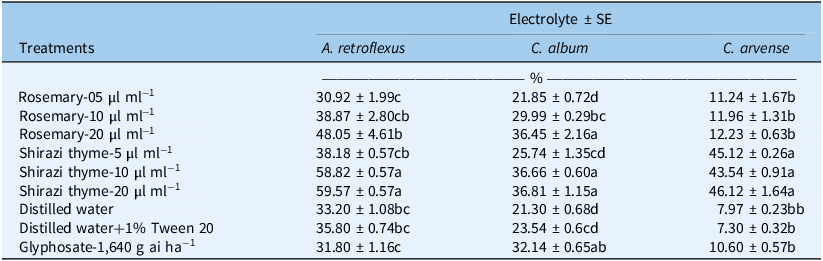
The data in Table 3 indicate that EO treatments significantly increased electrolyte leakage across all species, suggesting a disruption of cell membrane integrity. Consistent with previous growth parameters, Shirazi thyme EO generally induced higher electrolyte leakage than rosemary EO, often exceeding the effects of the synthetic herbicide. At 10 and 20 µl ml−1, Shirazi thyme EO caused the highest electrolyte leakage in A. retroflexus, which was significantly greater compared with both glyphosate and all rosemary concentrations. Rosemary EO at 20 µl ml−1, Shirazi thyme EO at 10 and 20 µl ml−1, and glyphosate reached the highest leakage levels in C. album, showing no significant difference from one another. Notably, C. arvense showed a highly distinct response, in which all concentrations of Shirazi thyme EO (5, 10, and 20 µl ml−1) caused a massive increase in leakage, statistically outperforming rosemary EO and glyphosate. Conversely, rosemary EO at all tested concentrations in C. arvense was statistically comparable to glyphosate (Table 3).
Phytotoxic effects of varying concentrations of essential oils from rosemary (Rosmarinus officinalis) and Shirazi thyme (Zataria multiflora) on electrolyte leakage of Amaranthus retroflexus, Chenopodium album, and Cirsium arvense. a

Table 3. Long description
The table presents data on the phytotoxic effects of varying concentrations of essential oils from rosemary and Shirazi thyme on electrolyte leakage in Amaranthus retroflexus, Chenopodium album, and Cirsium arvense. It has 10 rows and 4 columns. The columns are labeled ‘Treatments’, ‘A. retroflexus’, ‘C. album’, and ‘C. arvense’. The row labels include different treatments such as Rosemary-05 µl ml⁻¹, Rosemary-10 µl ml⁻¹, Rosemary-20 µl ml⁻¹, Shirazi thyme-5 µl ml⁻¹, Shirazi thyme-10 µl ml⁻¹, Shirazi thyme-20 µl ml⁻¹, Distilled water, Distilled water+1% Tween 20, and Glyphosate-1,640 g ai ha⁻¹. Each cell contains values representing electrolyte leakage with standard error. Notable trends include higher electrolyte leakage with increasing concentrations of Shirazi thyme essential oil across all species, often exceeding the effects of the synthetic herbicide glyphosate. Rosemary essential oil also shows increased electrolyte leakage but generally less than Shirazi thyme.
a Values are presented as mean ± SE of three replicates (n = 3). Within each species and for each essential oil, different letters within the same column are significantly different according to a one-way ANOVA followed by Tukey’s honestly significant difference (HSD) (P < 0.05).
The present study demonstrates the significant phytotoxic potential of rosemary and Shirazi thyme EOs against A. retroflexus, C. album, and C. arvense. Our findings revealed a clear dose-dependent inhibition of seedling growth, with Shirazi thyme EO consistently exhibiting a more pronounced inhibitory effect than rosemary EO across both laboratory and greenhouse conditions. Notably, the annual weeds A. retroflexus and C. album showed higher vulnerability, whereas the perennial C. arvense exhibited greater tolerance. This suggests that the efficacy of the EOs is influenced by species-specific traits.
Previous studies indicate that the phytotoxic activity of EOs is strongly influenced by the presence and relative abundance of specific terpenoid constituents. In a systematic review combining phytotoxicity data with chemometric structure–activity relationship analyses, Abd-ElGawad et al. (Reference Abd-ElGawad, El Gendy, Assaeed, Al-Rowaily, Alharthi, Mohamed, Nassar, Dewir and Elshamy2020) identified several monoterpenes, including pinene, 1,8-cineole, linalool, and carvacrol, as key compounds frequently associated with strong phytotoxic effects in plant EOs. In the present study, these compounds were also detected as major constituents of the tested oils. The higher levels of carvacrol, linalool, and α-pinene in Shirazi thyme EO likely account for the stronger inhibition of seedling growth observed in our experiments, in contrast to rosemary EO, which contained lower amounts of α-pinene, 1,8-cineole, and linalool. Accordingly, the more pronounced inhibitory effects of Shirazi thyme EO in both laboratory and greenhouse assays can be mechanistically attributed to its greater abundance of these highly active constituents. In addition, potential synergistic interactions among these compounds within the whole EO may further enhance the overall phytotoxic effect.
Phenolic monoterpenes such as carvacrol are widely reported to exert strong phytotoxic effects due to their ability to disrupt cellular membranes and alter permeability. Carvacrol-induced damage has been reported in sensitive weeds such as P. oleracea, A. retroflexus, asthmaweed [Erigeron bonariensis L.; syn.: Conyza bonariensis (L.) Cronquist], and A. fatua (Muñoz et al. Reference Muñoz, Torres-Pagán, Peiró, Guijarro, Sánchez-Moreiras and Verdeguer2020). Soaking wild mustard (Sinapis arvensis L.) seeds in T. capitata EO (83.86% carvacrol) at 1.5 µl ml−1 resulted in zero germination (Hanana et al. Reference Hanana, Mansour, Algabr, Amri, Gargouri, Romane, Jamoussi and Hamrouni2017), and concentrations as low as 1 µl ml−1 completely inhibited S. arvensis while significantly reducing germination in annual canarygrass (Phalaris canariensis L.) and rigid ryegrass (Lolium rigidum Gaudin) (Chaimovitsh et al. Reference Chaimovitsh, Shachter, Abu-Abied, Rubin, Sadot and Dudai2017). Similarly, Verdeguer et al. (Reference Verdeguer, Torres-Pagan, Muñoz, Jouini, García-Plasencia, Chinchilla, Berbegal, Salamone, Agnello, Carrubba, Cabeiras-Freijanes, Regueira-Marcos, Sánchez-Moreiras and Blázquez2020) reported that carvacrol-dominant T. capitata EO completely inhibited germination of horseweed [Erigeron canadensis L.; syn.: Conyza canadensis (L.) Cronquist], common sowthistle (Sonchus oleraceus L.), and C. album at only 0.125 µl ml−1, whereas more tolerant species such as bristly foxtail [Setaria verticillata (L.) P. Beauv.] and A. fatua required 0.5 µl ml−1, A. retroflexus required 1 µl ml−1, and P. oleracea and barnyardgrass [Echinochloa crus-galli (L.) P. Beauv.] required 2 µl ml−1. Under postemergence greenhouse conditions, foliar applications of 4 to 12 µl ml−1 caused severe inhibition, with complete suppression of P. oleracea and A. fatua at ≥8 µl ml−1 (Verdeguer et al. Reference Verdeguer, Torres-Pagan, Muñoz, Jouini, García-Plasencia, Chinchilla, Berbegal, Salamone, Agnello, Carrubba, Cabeiras-Freijanes, Regueira-Marcos, Sánchez-Moreiras and Blázquez2020). These reported thresholds closely correspond with the effective rate of 10 µl ml−1 used in our greenhouse experiments. This robust efficacy is likely the result of synergistic interactions between primary components; for instance, when carvacrol is present alongside linalool—as identified in our sample and in previous Shirazi thyme ecotypes (Saharkhiz et al. Reference Saharkhiz, Smaeili and Merikhi2010)—the resulting phytotoxicity often exceeds the sum of the individual compounds’ effects. Such chemical synergy mirrors results found in other carvacrol-dominant species such as T. capitata and Syrian oregano (Origanum syriacum L.) (Ibáñez and Blázquez Reference Ibáñez and Blázquez2020).
Oxygenated monoterpenes such as linalool contribute to oxidative stress and metabolic disruption in plant tissues. The role of linalool in enhancing herbicidal activity is well documented, showing significant synergistic effects when combined with compounds such as verbenone to inhibit large crabgrass [Digitaria sanguinalis (L.) Scop.] germination (Pardo-Muras et al. Reference Pardo-Muras, G. Puig and Pedrol2019). Similarly, thymol has been identified as a principal component in oregano (Origanum vulgare L.) EO with notable phytotoxic effects on monocotyledonous species such as wheat (Triticum aestivum L.) and barley (Hordeum vulgare L.) (Gruľová et al. Reference Gruľová, Caputo, Elshafie, Baranová, de Martino, Sedlák, Gogaľová, Poráčová, Camele and de Feo2020). Thymol is recognized for its ability to halt root elongation and reduce seedling dry weight by inducing severe metabolic stress (Coşkun et al. Reference Coşkun, Tutenocakli, Tas, Akcura and Oral2022).
Vasilakoglou et al. (Reference Vasilakoglou, Dhima, Paschalidis and Ritzoulis2013) showed that among 19 EO constituents evaluated on L. rigidum, carvacrol, carvone, thymol, trans-anethole, and linalool exhibited the strongest phytotoxicity, significantly inhibiting germination and root elongation even at relatively low concentrations (0.1 to 1 µl ml−1). Consistently, Hanana et al. (Reference Hanana, Mansour, Algabr, Amri, Gargouri, Romane, Jamoussi and Hamrouni2017) reported complete suppression of root and shoot growth in weeds such as S. arvensis and L. rigidum at 1 µl ml−1, with strong inhibition beginning at ≥0.75 to 1 µl ml−1. These effects were attributed to the presence of oxygenated monoterpenes, including carvacrol, thymol, 1,8-cineole, and menthol. Ibáñez and Blázquez (Reference Ibáñez and Blázquez2019) showed that lavender oil rich in linalool (38.7%) and 1,8-cineole (26.5%) significantly reduced seedling development of tree tobacco (Nicotiana glauca Graham), Italian ryegrass (Lolium multiflorum Lam.), and E. crus-galli at 1 µl ml−1. Oils of myrtle (Myrtus communis L.), dominated by 1,8-cineole (29.20–31.40%) and linalool (15.67–19.13%), also inhibited germination and seedling growth of weeds such as A. retroflexus, C. album, C. arvense, prickly lettuce (Lactuca serriola L.) and curly dock (Rumex crispus L.) at 0.5–2 µl ml−1 (Kordali and Cakir Reference Kordali and Cakir2016). Taken together, these studies demonstrate that higher doses (approximately 4 to 12 µl ml−1) are typically required for effective foliar inhibition under greenhouse conditions. Both 1,8-cineole and α-pinene are highly effective at reducing hypocotyl and root lengths by interfering with cellular mitotic activity (Ibáñez and Blázquez Reference Ibáñez and Blázquez2017). While 1,8-cineole acts as a potent inhibitor of seed germination and seedling growth, α-pinene triggers a cascade of oxidative stress in root tissues. This oxidative stress mechanism explains the significant electrolyte leakage and membrane damage observed in our physiological measurements, supporting previous findings that monoterpenes can induce reactive oxygen species (ROS)-mediated cellular disruption in plant tissues (Li et al. Reference Li, Wu, Feng, Deng, Hou, Che, Liu, Geng, Ni and Wei2020).
The physiological data obtained in our study provide a mechanistic explanation for these growth reductions. The loss of cell membrane integrity, evidenced by significantly elevated electrolyte leakage, confirms that these EOs disrupt the plasma membrane. This damage is likely induced by the interaction of EO constituents with the cell membrane, which triggers the overproduction of ROS in root tissues (Li et al. Reference Li, Wu, Feng, Deng, Hou, Che, Liu, Geng, Ni and Wei2020). This oxidative stress leads to irreversible membrane depolarization and the subsequent leakage of essential ions (Maffei et al. Reference Maffei, Camusso and Sacco2001; Zunino and Zygadlo Reference Zunino and Zygadlo2004), ultimately resulting in the cessation of vital metabolic processes and seedling death.
The reduction in photosynthetic efficiency observed across our treatments further clarifies the impact of these specific monoterpenoids on plant metabolism. Our data confirm that monoterpenes and phenolic monoterpenoids, such as those predominant in our Shirazi thyme and rosemary samples, impair photosynthesis by causing oxidative damage to PSII proteins (Pouresmaeil et al. Reference Pouresmaeil, Nojadeh, Movafeghi and Maggi2020). This dual-target mechanism—disrupting both the physical integrity of the cell membrane and the metabolic capacity of the chloroplasts—underpins the strong phytotoxicity of these EOs and highlights their potential as rapid-contact natural herbicides.
Despite the potent herbicidal activity demonstrated, several limitations of the current study must be acknowledged to provide a balanced interpretation. Our experiments were conducted on early-stage seedlings under controlled laboratory and greenhouse environments, settings that do not account for the rapid volatilization and environmental degradation of EOs in open field conditions. Furthermore, unlike systemic herbicides such as glyphosate, these EOs act primarily as contact agents. This lack of translocation limits their effectiveness against mature perennial weeds like C. arvense, which possess underground regenerative structures.
The connection between the EO composition and biological activity established in this study has significant implications for the future development of natural herbicides. To ensure consistent field performance, future research must address the volatility of bioactive monoterpenoids like carvacrol and 1,8-cineole. The development of advanced formulation technologies, such as nano-encapsulation or controlled-release emulsions, could significantly reduce volatilization and extend the residual activity of these compounds on leaf surfaces.
Additionally, exploring potential synergistic interactions when combining these EOs with reduced doses of synthetic herbicides could offer a promising strategy for integrated weed management. Such combinations might reduce the environmental footprint of weed control while slowing the development of herbicide resistance. Future research should also focus on elucidating the specific molecular signaling pathways by which these oils manifest their effects to optimize their application in sustainable agriculture. By transitioning from a descriptive analysis to a mechanistic interpretation, this study supports the potential use of EOs as viable, ecological alternatives to synthetic chemistry in modern weed management practices.
Overall, the phytotoxic responses observed in this study align closely with the documented activity of key monoterpenes such as carvacrol, thymol, linalool, 1,8-cineole, and α-pinene. The inhibitory effects detected in both laboratory and greenhouse experiments occurred within concentration ranges previously reported to induce phytotoxic responses in susceptible weed species. These findings suggest that the phytotoxic activity observed in this study can be reasonably attributed to the chemical profiles of the tested EOs, as indicated by their GC-MS composition and supported by previously reported phytotoxic effects of their major monoterpenoids. This further highlights the importance of specific bioactive monoterpenes and their synergistic interactions in determining herbicidal efficacy.
Acknowledgments
The authors acknowledge the assistance of artificial intelligence (AI) tools in the preparation of this article, specifically for writing in English. AI was used to aid in the writing process and improve clarity. The AI tool utilized was ChatGPT v. 4, which can be accessed at https://www.openai.com/chatgpt. The AI was used to aid in the writing process and improve clarity. The authors have ensured that all content generated by the AI tool has been reviewed and revised for accuracy and appropriateness.
Funding statement
This research was supported by the Razi University as part of a master’s thesis. No external funding was received for this study.
Competing interests
The authors declare that they have no conflict of interest concerning this publication.

 Open access

