




Snacking is defined in the scientific literature(Reference Blaine, Kachurak and Davison1) and understood by the general public(Reference Chamontin, Pretzer and Booth2) as the practice of eating food outside of normal mealtimes(Reference Ford, Slining and Popkin3–Reference Piernas and Popkin6). While some snack foods can suppress appetite and be a source of energy and micronutrients(Reference Miller, Benelam and Stanner7), the products typically defined as ‘snacks’ (e.g. chocolates, crisps, sweets) are ultra-processed foods (UPF) that are high in fat, salt and sugar (HFSS). UPF are those involving industrial ingredients not found in home kitchens, used to improve shelf-life and palatability such as modified oils, colouring and sweeteners(Reference Monteiro, Cannon and Levy8). Increased consumption of UPF and HFSS snacks is associated with increased appetite(Reference Pagliai, Dinu and Madarena9) and multiple adverse health outcomes including risk of obesity(Reference Hall, Ayuketah and Brychta10), type 2 diabetes, CVD(Reference Almoraie, Saqaan and Alharthi11) and tooth decay(Reference Arora, Singhal and Rasane12).
The global ‘snack foods’ market has increased steadily in the past 50 years, with a growing range of snacks developed by food companies and made widely available in the UK across supermarkets, sports centres, convenience stores, petrol stations(Reference Oddy13) and other aspects of the food environment(14). From 2000 to 2016, an analysis of food sales in eighty countries identified an annual increase in UPF sales, with the UK having the third-highest volume of UPF sales (140⋅7 kg/person)(Reference Vandevijvere, Jaacks and Monteiro15). From 2008 to 2019 there was a significant increase in the UK per capita consumption of snack foods, including breakfast cereals (from 4⋅2 to 4⋅9 % energy share), cookies (from 3⋅2 to 4⋅2 %), pastries, buns and cakes (from 2⋅9 to 3⋅7 %) and packaged salty snacks (from 1⋅9 to 2⋅3 %)(Reference Madruga, Steele and Reynolds16).
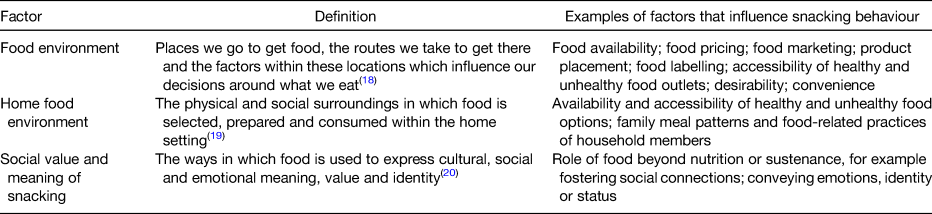
While the health impacts of excessive snacking on UPF and HFSS foods are well-documented amongst adults(Reference Pagliai, Dinu and Madarena9,Reference Almoraie, Saqaan and Alharthi11,Reference Gregori, Foltran and Ghidina17) , there is growing evidence of similar impacts on infant, child and adolescent health. Infancy and childhood are critical periods for the development of taste preferences, while adolescence and early adulthood are key periods for the establishment of dietary habits that can persist into adulthood(Reference Blaine, Kachurak and Davison1,Reference Ford, Slining and Popkin3,Reference Larson and Story5,Reference Piernas and Popkin6,Reference Arora, Singhal and Rasane12) . The food environment(Reference Caspi, Sorensen and Subramanian18), home food environment(Reference Rosenkranz and Dzewaltowski19) and social value and meaning of snacking(Reference Almerico20) have been recognised as important drivers of snacking(Reference Blaine, Kachurak and Davison1,Reference Neumark-Sztainer, French and Hannan21,Reference Twine22) (Table 1). However, they are not commonly considered together and in the context of changing family snacking practices across the life course.
Definition of the food environment, home food environment and social value and meaning of snacking
Research exploring the drivers of snacking has largely used quantitative measures(Reference Blaine, Kachurak and Davison1) and focused on the demographic, cognitive or food environment correlates associated with snacking frequency(Reference Williamson, Dilip and Dillard23). However, these methods fail to capture the subjective meanings of food and the complex social, cultural and environmental contexts in which dietary practices take place. In contrast, qualitative research, often adopting inductive and in-depth methods such as interviews or observation, aims to understand people's subjective perspectives, meanings and motivations surrounding dietary practices and their relation to wider contexts(Reference Díez, Valiente and Ramos24).
In the field of food policy, the term ‘lived experience research’ has emerged to describe food systems research that utilises qualitative methods and gives primary importance to the subjective perspectives of those who directly encounter policies in their daily lives(Reference Turner, Aggarwal and Walls25,Reference Hawkes, Carpenter and Barr26) . This approach has developed to contrast a perceived over-reliance on quantitative measures and expert-knowledge in food policy and has been used to provide insight into the context-bound and often unexpected ways in which food is understood and policy is experienced ‘on-the-ground’(Reference Turner, Aggarwal and Walls25,Reference Neve, Hawkes and Brock27) . Lived experience research prioritises and explores the intricate nuances of personal experiences that influence behaviour (in this case around parental decisions to provide snacks).
For example, while the high availability of junk food around schools is a recognised driver of increased consumption of snack foods, qualitative research with adolescents in the UK found that consumption was also driven by the social value of these spaces, in contrast to school canteens seen as an unappealing environment for socialising and lacking value for money(Reference Moorhouse, Kapetanaki and Wills28,Reference Wills, Danesi and Kapetanaki29) . This lived experience perspective highlights that effective policy action to improve schooltime eating practices requires not only restricting availability of unhealthy food near schools, but also increasing the social appeal of school canteen environments(Reference Caraher, Lloyd and Madelin30). There is a dearth of policy-oriented qualitative research providing in-depth accounts of snacking practices amongst UK families and insights into how and where policy may intervene(Reference Twine22). This is especially pertinent given increasing quantities of ‘snack’ foods sold each year, the growing number of products being developed by food companies and increasing prevalence of obesity amongst children and adults in England(31,32) .
The aim of this review is to outline how the home food environment, wider food environment and social value and meanings about snacking shape parental food practices and provision of snacks to infants, children and adolescents. Findings are based on two lived experience research studies undertaken by the Centre for Food Policy (City, University of London) as part of the National Institute for Health Research funded Obesity Policy Research Unit between 2020 and 2022 exploring factors that influence food practices amongst families of low, middle and high socioeconomic position (SEP) in England. Study 1 recruited sixty parents of nursery, infants(Reference Isaacs, Neve and Hawkes33,Reference Coleman, Neve and Isaacs34) and study 2 recruited sixty-two parents of primary and secondary school aged children, with about one-third of the combined sample from each socioeconomic group(Reference Isaacs, Squires and Hawkes35,Reference Gallagher-Squires, Coleman and Isaacs36) . SEP was measured using a validated measure of socioeconomic advantage which takes account of a range of factors including income, postcode deprivation, car ownership and employment, with low SEP representing the most socioeconomically disadvantaged households and high SEP the most advantaged(Reference Kininmonth, Smith and Llewellyn37).
In both studies, parents engaged in semi-structured interviews three times over 1 year, taking place during various stages of the COVID-19 pandemic (i.e. when social distancing and other public health measures were in place). Further details of the methodology can be found in previous publications and reports(Reference Isaacs, Neve and Hawkes33–Reference Gallagher-Squires, Coleman and Isaacs36,Reference Coleman, Gallahger Squires and Isaacs38) . All quotes included in this review are from these two previous studies. All quotes were provided by primary care givers. This review explores key insights and illustrative quotes relating to the snacking behaviour of infants, children and adolescents, from the perspective of parents and other primary caregivers in these studies.
Snacking behaviour from infancy to adolescence: a parent's perspective
Factors that parents reported as influencing decisions about provision of snacks for infants, children and adolescents are summarised in Fig. 1. These factors, which are explored in terms of the social value and meaning of snacking, home food environment and food environment, are explored in more detail in the following section.
Parental perspectives on factors associated with social value and meaning of snacking; home food environment and food environment hat influence provision of snack foods(Reference Isaacs, Neve and Hawkes33–Reference Gallagher-Squires, Coleman and Isaacs36). HFSS, high in fat, salt and sugar; UPF, ultra-processed foods.

Social value and meaning of snacking
In line with previous research, parents across SEP understood snacking as consuming food outside of formal mealtimes(Reference Blaine, Kachurak and Davison1,Reference Chamontin, Pretzer and Booth2) . This shared definition of ‘snacking’ is an example of how the meanings associated with specific food practices often exists as tacit knowledge, shaped by the social and material world, rather than something which is learnt through processes of individual rational decision making or information processing(Reference Twine22). Indeed, snacking is associated with a number of meanings, most commonly as a pleasure or treat, but also guilt, nostalgia, convenience and indulgence in less healthy foods(Reference Twine22,Reference McGill and Appleton39,Reference Hess, Jonnalagadda and Slavin40) . Snacking is also shaped by the social world in that snacking practices can hold social value as a vehicle to communicate identity, status, emotion or belonging with others(Reference Almerico20). The following outlines some of the common social values and meanings associated with snack provisioning identified in the present paper and our wider research.
During the first 18 months of parenting there appeared to be a conflict between prioritisation of foods as a source of health, such as fruits and vegetables, and enjoyment in seeing how infants react to UPF/HFSS snacks and treats, such as small portions of chocolates and ice cream, as reported by parents in study 1(Reference Isaacs, Neve and Hawkes33,Reference Coleman, Neve and Isaacs34) . Infants' taste for and enjoyment of the latter was often the justification for providing these less nutritious snacks. This is not surprising given that what constitutes a snack is socially defined as foods which provide pleasure(Reference Hess, Jonnalagadda and Slavin40) and UPF/HFSS snacks are formulated to be hyper-palatable. Parents also wanted to communicate the social value and meaning of ‘treats’ as foods that are provided on special occasions, such as birthdays, holidays or when the rest of the family is having a meal out:
Mother of infant 6–12 months, high SEP: ‘The main reason she had them yesterday is because we went for a meal, so she sat at the table with us whilst we were having a meal, just eating her little snack sticks so she felt part of the table as such’.
Parents also had a desire for infants to integrate into existing household food practices(Reference Isaacs, Neve and Hawkes33,Reference Coleman, Neve and Isaacs34) . This typically meant eating at the same time as the rest of the family, liking the same foods as parents and older siblings and consuming the same treats and snacks as other family members:
Mother of infant 16–18 months, high SEP: ‘I just wanted him to fit in with us. I don't really want meal times to be [baby's name] eats and then we have to eat separately and having to cook two meals’.
As children get older, social events such as playdates, birthdays and seasonal celebrations were increasingly associated with expectations about the sharing and receiving of confectionary snacks, as described by parents in study 2(Reference Isaacs, Neve and Hawkes33,Reference Coleman, Neve and Isaacs34) . Getting these public performances of food provision ‘right’ was central to perceptions of what constituted ‘good mothering’(Reference Fielding-Singh and Oleschuk41).
While those across the income spectrum described the social value and meaning of bringing and sharing snacks as social events, those facing financial constraints were more likely to describe efforts to source snack products which offered better financial value. This included low-cost snack products, items that were discounted or part of a multi-buy deal and products that children would definitely eat and not waste. The latter consideration meant that purchasing fruit and vegetables often made less financial sense compared to long shelf-life packaged snacks, especially if children did not have taste preferences for the lower-cost fruit options such as bananas and apples. These cost-saving strategies were utilised to enable participation in social norms about snack sharing and provision, however often led parents towards UPF and HFSS snacks. This interaction between pricing, promotions and the meaning of snacks as an important part of social events demonstrates how social meanings shape peoples' interaction with the food environment.
Mother of 2, low SEP: ‘I've always tried to get more fruit, but I do find fruit being so expensive, whereas you can go and buy biscuits and crisps and that ridiculously cheap, but yet the fruit is always that more expensive, isn't it? They love watermelon but they're all £3 a go, and you think to yourself that's one item for £3. Whereas I could go and buy four packets of biscuits and ten bags of crisps for that £3, do you know what I mean, as much as it's rubbish food, but it's going to go further’.
Home food environment
The home food environment also plays a role in child snacking. This can result from material features of the home food environment (e.g. availability and type of snacks), children following role models (e.g. older siblings and parents), parental feeding styles (e.g. restrictive or permissive) or a combination of these factors(Reference Hanson, Neumark-Sztainer and Eisenberg42,Reference Wang, Beydoun and Li43) .
Over the first 18 months of infancy, parents across SEP in study 1 became increasingly relaxed about provision of snacks, and routinely provide ‘adult’ snacks such as crisps, biscuits, cereals and other UPF and HFSS items. This was most noticeable in households with an older sibling, as older children were more responsive to advertising.
Older siblings had also become familiar with snacks through peers and school, and as a result influenced purchasing of these snacks through ‘pester power’. Once in the home, it became difficult to prevent these products also being shared with younger infants.
Across both studies, fathers were more likely than mothers to provide unhealthy snacks to young infants, and this relationship was most pronounced amongst families of low SEP. Fathers often perceived provision of snacks as a form of bonding and way to demonstrate affection, whereas mothers would often try to limit snacks as a treat or reward. Fathers were also assumed to lack confidence in knowing what food to provide or how to deal with specific dietary demands and would often rely on UPF and HFSS snacks such as chocolates or crisps. This aligns with previous research in the USA which found that both parents and children saw family nutrition as the primary responsibility of mothers, with fathers' more likely to provide unhealthy snacks and have a more casual approach to food provision(Reference Fielding-Singh44).
Mother of infant 16–18 months, low SEP: ‘My partner will only really give [infant] something very easy. He would never look in a recipe book or make him a recipe that would always be what I do’.
For parents with children in nursery (mainly middle and high SEP), there was less pressure to provide a meal in the evening as they have already received a sufficient meal at nursery. Instead, they often report just providing a ‘snack’, both packaged and non-packaged (such as fruit and yoghurt), before bedtime.
In line with previous research(Reference Davison, Blake and Blaine45,Reference Vollmer and Mobley46) – and observed during infancy in the present paper – higher income parents were generally more restrictive about providing children and adolescents with ‘unhealthy foods’ such as packaged snacks, ice cream, chocolates and biscuits. However, these parents were often highly permissive when it came to provision of fruit as snacks, with financial resources being key in enabling this. Participants from high SEP described the constant presence of a well-stocked fruit bowl in the home, and this was referred to when parents were describing efforts to restrict snacking on confectionary food. Having this fruit available meant that parents could still say ‘yes' to children's request for snacks while still enforcing restrictions about unhealthy snacking(Reference Fielding-Singh47).
Mother of 3 children, high SEP: ‘Fruit's available all the time, so if they're twitching for food, they can have fruit. Because sometimes, they say they're hungry when I say bedtime, so I don't want them having chocolate and stuff, but they can have the fruit. Go for it anytime, so I'm encouraging them to have it a little bit’.
However, even with financial resources allowing for children's preferred fruits to be abundantly available in the home, responding to children's request for unhealthy snacks was still a constant struggle that parents felt they were losing. Even when these preferred fruits (e.g. mango, blueberries) were available, the majority of parents in the present paper reported that most of children's snack requests were for UPF and HFSS snacks. This is in line with experimental findings that sugar-sweetened or salty-snacked are chosen by children over fruit more than 90 % of the time when presented with a range of snack options(Reference Beets, Tilley and Kyryliuk48).
Lower-SEP parents also described wanting their children to consume more fruit as snacks, but only a handful of parents in the low-SEP group described the constant presence of a fruit bowl in the home. Instead, descriptions of fruit and vegetables were often about their relative expense compared to packaged snacks, particularly children's ‘preferred fruits’ which often came with an increased price tag. When fresh fruits and vegetables were present in the home, there were concerns about ensuring all this food was eaten, as any food uneaten by children or wasted was seen as a waste of an already limited budget. In this context fruit represented a risky financial expenditure. This illustrates how living in a context of financial constraint influences engagement with the food environment, and subsequently approaches to snack provision in the home.
Mother of 3 children, low SE: ‘I am trying to get the kids to eat a lot more fruit. But if I don't cut it and put it in their plate, no one's going to eat it. And then its like, oh my God we've got all this fruit and then it's just gone off. And then the guilt kills you because it's like, I've just bought this fruit and no one's bloody eating it’.
Food environment
An extensive body of research has investigated the influence of the food environment (e.g. availability, promotions, packaging) on purchasing decisions(Reference Caspi, Sorensen and Subramanian18,Reference Chen and Antonelli49) . The following narrative builds upon this evidence by outlining how the aforementioned social value and meanings associated with specific foods both shape and are shaped by the food environment, and how this evolves over time.
During early stages of infant feeding, parents across SEP received contradictory messaging about snacking from various sources, including friends and families, health professionals, books, websites and branded products. This led to a sense of confusion about practical elements of feeding, such as when to initiate weaning, which snacks are age appropriate and how to prepare and store infant foods. This uncertainty often resulted in parents turning to branded products, and brand ‘ecosystems’ which surround products, for step-by-step guidance on infant feeding practices.
Mother of infant 3–6 months, high SEP: ‘I quite like the Ella's Kitchen … they do so many different flavours. I wasn't put off by the ingredients as such. I find the organic pouches have got lovely ingredients in them. I don't worry. I don't think, oh, there's too much sugar in this or there's an E number or anything like that’.
Over time, this trust in branded products translated into increased purchasing of snacks and treats branded as containing ‘no nasties’, facilitating ‘self-feeding’ and containing ‘no hidden ingredients’. Front-of-pack labelling not only influenced which products parents purchased, but also reassured parents that products were safe and age appropriate. However, previous research has shown front of pack claims do not always reflect what is contained within the product, with about 75 % of UK infant products falsely claiming to provide ‘one of 5-a-day’ for fruit and vegetable intake(Reference García, Morillo-Santander and Parrett50). The trust in branded products reported in the present paper extended to a general trust of products available on infant and baby aisles within supermarkets, with an assumption across SEP that products on the baby aisle must be ‘healthy’, ‘nutritious’ and age appropriate, illustrated below. However, these products often exceed recommend daily intake levels of sugar(Reference Fielding-Singh47,Reference García, Morillo-Santander and Parrett50) .
Mother of infant 10–12 months, low SEP: ‘That's why I like the pouches as well, because he won't eat that much fruit and vegetables that I put in front of him. If I can still give him a pouch every day then he's getting some sort of … fruits and vegetables’.
The present paper indicates that these understandings of certain products as ‘healthy’, appearing to be largely generated by product packaging and messaging, continues to parents' provision of these snacks to older children. This ‘halo’ effect provides parents with a sense that they can still utilise snack provision as a means to communicate reward or treat children, while avoiding the harmful health effects otherwise associated with ‘snack foods’, as described by Selina below.
Mother of 2 children: MSEP: ‘As long as they've got something in a packet that feel like they're having a treat, psychologically. Like those [fruit bars] they're a bit expensive sometimes but they come in strings and things which are meant to be one of your five a day and all that good stuff’.
In the present paper, many parents with the financial resources to do so avoided in-store retail settings completely as a result of what many referred to the ‘lure’ or ‘temptation’ of unhealthy snacks. Partly instigated by the experience of visiting supermarkets less frequently during COVID-19, many made efforts to source food through alternative means such as online delivery, veg boxes and green grocers, where the ‘lure’ of highly processed snacks was viewed as less strong. While a handful of those from a low SEP did experiment with alternative vendors in lockdown, it was mostly those on higher incomes who were able to maintain this long-term due to increased costs associated with delivery fees or a minimum spend.
Discussion
Consumption of UPF and HFSS foods in infancy, childhood and adolescence can have lasting impacts on dietary preferences and health outcomes in later life(Reference Blaine, Kachurak and Davison1,Reference Larson and Story5,Reference Arora, Singhal and Rasane12,Reference Gregori, Foltran and Ghidina17) . Nevertheless, our understanding of the social, cultural and environmental factors that shape snacking practices during these life-stages remains poorly understood. The present paper, which focuses on families from a range of socioeconomic backgrounds England(Reference Isaacs, Squires and Hawkes35), identified the social value and meanings that snacking practices hold in everyday life, as rewards for good behaviour and a fundamental part of family relationships. Within the home and external food environment, we identified key factors which make unhealthy snacks a popular, convenient and appealing means to fulfil these social roles, particularly for lower SEP, including children's requests for unhealthy snacks, their low-cost, inclusion within price promotions and long-shelf life.
An established body of evidence shows that individuals from lower SEP consume less healthy diets than their high-SEP equivalents(Reference Vlismas, Stavrinos and Panagiotakos51). However, research on the relationship between SEP and snacking behaviour has primarily focused on adult and adolescent life stages, relying on retrospective recall of dietary practices and quantitative methodologies(Reference Craigie, Lake and Kelly52–Reference Brunstrom, Mitchell and Baguley55). This approach limits in-depth exploration of what shapes snacking provision and opportunities for policy intervention(Reference Rosenkranz and Dzewaltowski19). In contrast, our longitudinal studies examined the factors that underpin snacking decisions, while revealing how dietary inequalities which first emerge during infancy then accumulate over the life course(Reference Isaacs, Squires and Hawkes35). Specifically, we found that low-SEP parents purchase adult snacks for infants during early infancy as they are lower in cost than infant snacks. However, these adult snacks are also higher in energy and saturated fats and lower in whole grains and fruits that infant snacks(Reference Ghosh-Dastidar, Cohen and Hunter56,Reference Katiforis, Fleming and Haszard57) . In childhood and adolescence, the present paper shows how a combination of financial constraints, children's preference for HFSS snacks and the low-cost and promotion of HFSS products in retail settings mean that low- and middle-SEP parents continue to find ‘unhealthy’ snacks the most appealing and convenient option. Healthier snacks are on average three times more expensive energy for energy (calorie for calorie) than less healthy snacks(58), which makes UPF and HFSS snacks the sensible economic choice for families on low incomes(59). These findings highlight a number of areas where policy may intervene to reduce early dietary disparities. First, maintaining and expanding access to Healthy Start Vouchers can alleviate the financial burden low-SEP families face in purchasing fruits and vegetables and minimise concerns about wasted money if fresh food is left uneaten(Reference Scantlebury, Moody and Oyebode60,Reference McFadden, Green and Williams61) . There is also a need to ensure minimum wages cover the true cost of a healthy diet, whether through guaranteed universal income, subsidising the cost of fresh fruits and vegetables or other fiscal policies(Reference Coleman, Murphy and Nyman62).
The food environment also plays a critical role in shaping family dietary practices, through convenient access to HFSS snacks due to their accessibility, affordability, ubiquitous presence and aggressive marketing by food companies(Reference Coleman, Hanson and Van Rens63–Reference Cobb, Appel and Franco65). However, the present paper – and other emerging studies(Reference Abrams, Evans and Duff66) – show how misleading packaging and marketing, often highly trusted by parents, means parents are mistakenly viewing many HFSS snacks as being healthier than they are. There are increasing numbers of ‘better-for-you’ products being launched by food companies, including those advertised as ‘all natural’ or ‘lows and nos’(67), despite the fact these ‘healthier’ products have similar nutrient profiles to other ‘unhealthy’ HFSS snacks(Reference García, Morillo-Santander and Parrett50,Reference Breen, James and Rangan68) . Yet, the present findings highlight how these misleading front-of-pack health claims may be reshaping meanings associated with packaged snacks, from an occasional ‘indulgence’(Reference Neumark-Sztainer, French and Hannan21), into a more regular and healthy practice. Indeed, many parents in our studies, frequently referring to front-of-pack messaging, view infant and children's branded snacks as a healthy source of fruits, vegetables and key nutrients. The number of snack products marketed for toddlers increased significantly between 1996 and 2020, with the quantities of fat, saturated fat and sugar in these products increasing over time(Reference McCann, Russell and Woods69). This follows a history of transnational food companies marketing products to appeal to increasingly ‘health conscious’ consumers(Reference Nestle70), for example with the ‘Snack Food Association’, representing over 400 snack manufacturers internationally, rebranding itself as ‘Snacking, Nutrition, Convenience’ in 2016(71). Action is urgently needed to ensure that product claims, on the front- and back-of-pack, accurately reflect the health and nutritional status of products, as stipulated in the Codex Alimentarius, a collection of internationally recognised standards, codes of practice and guidelines aimed at protecting consumer health(72). It is also time that regulations recognise the role of product packaging, including use of colour, imagery and branded characters, in creating appeal to children(Reference Hawkes73).
Building on prior research(Reference Fielding-Singh47) we found that children's preferences and requests for UPF and HFSS snacks presented challenges for parents across SEP; however, high-SEP parents had greater resources to shift tastes through the constant availability of preferred fruits in the home. Additionally, the present findings highlight how parents were less able to manage this as children aged and were increasingly exposed to UPF and HFSS snacks in and around school and amongst their peers. Interventions which generate positive associations and tastes for fruit and vegetables amongst children have the potential to support parents struggling to get children to snack on fruit vegetable over HFSS products. This includes policies previously outlined in the UK's ‘National Food Strategy’, such as expanding and leveraging the existing Fruit and Vegetable Scheme to increase appeal and access to fruit and vegetables and introducing sensory education into early years education(74).
There are a number of limitations associated with this research. First, rising levels of obesity have been attributed to a range of factors beyond the scope of snacking practices focused on in the present paper, including but not limited to physical activity levels, physiological predispositions, mealtime consumption practices and side-effects of medication use(Reference Butland, Jebb and Kopelman75). Secondly, the lived experience approach employed in the present paper did not allow for exploration into how exposure to advertising (e.g. TV, online) shaped snacking practices, found to play a significant role in snack preference(Reference Russell, Croker and Viner76), as this often occurs outside of people's awareness.
Further research is needed to explore how the food industry is shaping snacking practices and research in this area. An extensive body of research has identified multiple strategies used by the food industry to shape our understandings of health and nutrition such as by lobbying government and influencing public and academic discourse(Reference Wiist77). In reviewing the literature on snacking practices we came across examples of nutrition research funded by multinational food and drink companies(Reference Miller, Benelam and Stanner7,Reference Wiist77–Reference Potter, Vlassopoulos and Lehmann79) , drawing conclusions which suggest uncertainties about the impact of snacking on health. While researchers accepting corporate funding may intend to conduct independent and rigorous research, funding of research is an established strategy successfully used by food corporations to influence discourse in their favour(Reference Wiist77). In the pursuit of improving human health and reducing health disparities, it is the responsibility of the nutrition and public health community to mitigate and call attention to these attempts.
Conclusions
In conclusion, the present paper highlights how features of the home food environment and wider food environment, as well as the social value and meanings of food, shapes snacking practices in families across SEP in England. The findings reveal that UPF and HFSS snacks are a logical and sensible option for many low-SEP families due to their low cost, convenience and existing role in the home food environment as ‘treats’ and ‘rewards' for good behaviour. These factors first emerge during the earliest stages of infant feeding and persist throughout childhood and into adolescence. To address these disparities, policy interventions are urgently needed to increase access and appeal of healthy foods, such as expanding Healthy Start Vouchers and guaranteeing a living wage that covers the cost of a healthy diet. Additionally, there is a need to regulate misleading front-of-pack health claims, recognise the role of product packaging in creating appeal to children and promote positive associations and tastes for fruits and vegetables through community-based interventions and campaigns. These recommendations broadly align with the UK's National Food Strategy and have the potential to support parents in providing healthy snack options for their children, while meeting social meanings about food and snacks.
Financial Support
The present paper is independent research funded by the National Institute for Health Research (NIHR) Policy Research Programme (Policy Research Unit: Obesity/PR-PRU-0916-21001).
Conflict of Interest
None.
Authorship
All authors have approved the final article. C. G.-S.: conceptualisation, interviews, formal analysis, writing, review and editing. A. I.: conceptualisation, interviews, formal analysis, writing, review and editing. C. R.: writing, review and editing. P. C. C.: formal analysis, writing, review and editing.


 Open access

