




In June 1967, the prime minister of the Soviet Union, Alexei Kosygin, travelled to the small town of Glassboro, New Jersey, for a series of meetings with US President Lyndon B. Johnson. Over the course of three days, Kosygin and Johnson discussed the day’s most pressing geopolitical issues.Footnote 1 Though it did not result in any significant accord between the two Cold War juggernauts, the Glassboro Summit’s cordial atmosphere was striking enough that some in the (US) American press began using the phrase ‘the spirit of Glassboro’ to refer to broad hopes for improved US–Soviet relations.Footnote 2 Kosygin made a strong impression on attentive American citizens. Dozens of Americans wrote the prime minister to express their appreciation for the Soviet leader’s time and optimism for a peaceful future. Claude Dietrich, a self-identified ‘Texan’ writing from Idaho Falls, Idaho, was the author of one such message. Remarking regretfully that he had never been to the Soviet Union, Dietrich made it clear that, as far as he could tell, the socialist and capitalist worlds did not seem so different. ‘I am told’, Dietrich wrote, ‘the Russian [sic] people as a whole are more like us in many ways than any other nation in the world’.Footnote 3 Dietrich was right. Despite the seemingly endless, and very much mutual, posturing about a Manichean conflict between state socialism and capitalism, ‘in many ways’ the Soviet Union and the United States were not so different.Footnote 4
In fact, just weeks before Claude Dietrich typed his letter, Kosygin himself set in motion a series of events that ensured that the Cold War rivals would become even more similar in precisely the spheres – economic management and labour organisation – in which they should have differed most. Building on the logic of the national economic reform he had helped spearhead just eighteen months earlier, in March 1967 the prime minister charged the State Committee on Questions of Labour and Wages (Goskomtrud) with developing and implementing an economic experiment at a nitrogen fertiliser plant. The institutions had a clear mission: ‘to improve production and lower the total number of employed personnel’.Footnote 5 The following month, an anonymous group of bureaucrats from Moscow inquired about the possibility of conducting an experiment at the Shchekino Chemical Combine, a factory in a small town of the same name in the Tula region. Petr Sharov, the enterprise director, agreed.Footnote 6 Between April and August of 1967, Goskomtrud, the All-Union Central Council of Trade Unions and the Ministry of the Chemical Industry worked alongside Sharov and a team of industrial sociologists to develop what would soon be referred to as the ‘Shchekino Experiment’. The Shchekino Experiment entailed, among other things, combining job duties, mechanising production and leaving unchanged – that is, left at the level established for 1967 – the wage fund afforded to the factory by state planners for a period of three years (1968–70). This proposal was noteworthy. As I. Minin, the chairman of the combine’s trade union committee, explained, in a typical Soviet factory the size of the workforce was linked to the wage fund so that any change in the former resulted in a commensurate change in the latter. By decoupling these two variables, industrial authorities allowed the enterprise to accrue a wage fund surplus, thereby incentivising – at least potentially – management to shed redundant labour. The funds economised by releasing personnel were to be used to supplement the wages of those who took on additional responsibilities and to finance regional development.Footnote 7 On 16 August 1967, the experiment officially began.Footnote 8
The Shchekino Experiment produced encouraging results. Sharov reported that within four years, 1,039 of the 6,800 workers at the Shchekino Chemical Combine had been dismissed from employment, labour productivity had risen by 226 per cent and funds from the experiment had been used to build two schools, a hospital and 30,000 square metres of new housing.Footnote 9 The combination of work responsibilities was widespread. N.P. Losev, a supervisor at the combine, reported that just two years after the start of the experiment, a ‘majority’ of the workers at the factory could perform two or three professions and in some cases had mastered as many as six.Footnote 10 Enamoured with its success, in 1969 the Communist Party approved the spread of the Shchekino Experiment to other enterprises and industries in the Soviet Union. By the mid-1980s, it had been applied at over 11,000 enterprises employing more than 21,000,000 workers. Appropriately, it also took on a new, more permanent sounding moniker: ‘the Shchekino Method’.Footnote 11 Scholars such as Simon Clarke and Claudio Morrison have shown that Soviet labour management strategies did not simply vanish along with the Soviet state in 1991.Footnote 12 The constituent elements of the Shchekino Method are a case in point: as this article shows, many survived the dissolution of the Soviet Union and the subsequent onset of capitalism in post-Soviet Russia. But in a drastically different political environment, methods once employed to build state socialism were repurposed to serve the needs of Capital.Footnote 13
Scholars have interrogated the Shchekino Method before. During the Cold War, Jeanne Delamotte, Peter Rutland and Bob Arnot asked whether the Shchekino Method might help solve economic problems in the Soviet Union. All expressed misgivings.Footnote 14 This essay takes a different approach and examines the history of the Shchekino Method from its origins at the Shchekino Chemical Combine in 1967 to its afterlife in post-Soviet Russia to draw broader conclusions about the relationship between Soviet socialism and Western capitalism.Footnote 15 Scholars sometimes see the former as the negation of the latter. For example, in his study of inter-war Magnitogorsk, Stephen Kotkin states plainly that, for Soviet revolutionaries and intellectuals, ‘one achieved socialism by eradicating capitalism’.Footnote 16 From there, Anna Krylova explains, Kotkin extrapolates an entire edifice – what she calls a ‘master narrative of stagnation’ – that at once celebrates the evolution of the West while rejecting a priori the possibility that Soviet society was itself capable of change. In Kotkin’s estimation, Krylova demonstrates, the late twentieth-century Soviet Union was little more than the deteriorating other of a dynamic West.Footnote 17
Recent scholarship on the history of the Soviet and Eastern European state socialist economies rejects this rigid dichotomy.Footnote 18 From the importance of world trade to the vitality of the Soviet economy to the complex economic and political relationship between the European Economic Community and Eastern European socialist states, this scholarship demonstrates that the history of the Soviet Union and Eastern Europe was inextricably linked to the inconstant history of global capitalism.Footnote 19 The article that follows shows that the commonalities between these ostensibly contradictory modes of production included practices of economic management and labour organisation. It does so by placing the history of Soviet managerial strategies into conversation with ongoing debates on the transition from Fordist to flexible production in industrial societies.Footnote 20
I
Named for its primary innovator Henry Ford, Fordism is associated with the combination of economies of scale – that is, the mass production of low-cost commodities – and mass consumption. Drawing on Taylorist ‘scientific’ principles, Fordist production methods utilised advanced technology, such as the assembly line, to integrate disparate, routinised labour processes. As Robert Linhart once wrote, Fordism is simply ‘an application of the Taylor system to mass production’.Footnote 21 In exchange for their labour, workers enjoyed comparatively high wages, effective social services and job security ensured by strong labour unions and a political economy structured by Keynesian regimes with the will to regulate the capitalist economy. Fordism was no monolith; scholars have long been aware of early twentieth-century attempts to develop more flexible systems to transcend its rather unyielding nature. But these efforts were ephemeral or proceeded only in fits and starts.Footnote 22 As such, it is generally accepted that from the 1920s through the 1970s, Fordism was the prevailing production regime in much of the industrialised world, including the Soviet Union.Footnote 23
But at least by the 1970s, the economic engine fuelled by Fordism began to sputter out.Footnote 24 The restructuring of the global economy that ensued left neither capitalist nor state socialist regimes unchanged.Footnote 25 In the West, but especially in the United States, firms gradually moved away from the Fordist system that had once produced abundance in favour of what is often called ‘flexible production’ or, alternatively, ‘flexible specialisation’.Footnote 26 First introduced by Michael Piore and Charles Sabel in The Second Industrial Divide (1984), these terms were initially conceptualised as a way to describe the condition induced by the factory-level replacement of the single-purpose technologies characteristic of Fordist economies of scale with supposedly revolutionary machines capable of producing a wide range of commodities – what economists refer to as ‘economies of scope’ – and the return of artisanal production in auxiliary industries.Footnote 27 But in the empirical work produced by social scientists in the 1980s and beyond, they were also often used to ponder the consequent transformation of labour organisation, the labour process and labour management in the capitalist world.Footnote 28 Thus, already by 1989, Erik Swyngedouw and David Harvey could develop a full taxonomy of flexible production – a combination of multi-task labour, the elimination of clear job demarcations, detailed bonus systems, extensive on-the-job training and the division of the workforce into groups of high and low job security – that centred not on commodities but rather on the atomisation (or at least near-atomisation) of labour.Footnote 29
The Soviet Union’s inability or, perhaps, refusal, to abandon Fordism and develop a response to the challenge of flexible production is cited by some as the central socioeconomic failure of the Soviet system. Unable to compete with powerful liberal economies and unwilling to engage in what would have been an apocalyptic military encounter with them, the Communist Party, this interpretation suggests, gave up the ghost on socialism and thus the Soviet project itself. This literature, however, relies almost entirely on high politics to analyse the totality of the Soviet system.Footnote 30 From this perspective, party decrees and political personalities obfuscate socioeconomic evolution. Focusing instead on the enterprise level, this article demonstrates that, with the implementation of the Shchekino Experiment in 1967, the Communist Party inaugurated its own variation of flexible production.Footnote 31 In doing so, it inadvertently created the conditions of possibility for the transition from state socialism to capitalism on the factory floor. At least at the factory level, then, the relationship between state socialism and capitalism is best understood not as a pair of mutually exclusive negations but as distinct nodes on a wide political spectrum upon which many commonalities and differences existed. Just as scholars now understand the history of Soviet political economy as always already embedded in the evolution of global capitalism, so too must they come to grips with how well its social history fits in a similar framework.
This is not to suggest that the Communist Party established capitalism in the Soviet Union. Soviet intellectuals in fact took great pains to explain precisely why releasing workers and pursuing profit were consistent with the Communist Party’s vision of socialism.Footnote 32 Nor is it to argue that the Shchekino Experiment neatly foreshadowed the production regimes of post-Soviet Russia. For one thing, even in the context of economic experimentation, workers in the Soviet Union were guaranteed work. Together with the factory trade union committee, enterprise management was responsible for finding new positions for those who had lost their job. Moreover, if, in the United States, the transition to flexible production systems in the late twentieth century was accompanied by the gradual return of wealth discrepancies not seen since the Gilded Age, then the socialist experience was quite different indeed. In the Soviet Union, real efforts were made to use the benefits of flexible production to invest in the public good. To account for both differences in and similarities between capitalist and socialist production regimes, this article refers to the Shchekino Method as ‘flexible production with socialist characteristics’.Footnote 33
II
The Shchekino Chemical Combine was a reasonable, if not ideal, location to introduce the sort of economic experiment Kosygin envisioned. Originally a gasification facility founded in 1946, the Shchekino Gas Factory’s method of burning coal to produce gas was already anachronistic by the time production began nine years later. But in the context of the ‘petrochemical revolution’ that gripped much of the industrialised world during the middle of the twentieth century, the factory got a new lease on life.Footnote 34 During the Seven Year Plan (1959–65), the Communist Party pursued what Nikita Khrushchev called the ‘chemicalisation’ of the national economy. In the early 1960s alone, the Soviet state invested over nine billion roubles in the development of the chemical industry, more than double the amount allotted to that industry between 1917 and 1958.Footnote 35 For a state intent on rapidly growing its economy, this was logical enough. As Khrushchev never tired of explaining, by producing fertilisers for agriculture, synthetic fibres for clothing and sturdy plastics for heavy industry, the chemical industry promised to benefit every branch of the Soviet economy.Footnote 36 Even better, as a capital-intensive endeavour, it could do so without tying up precious labour resources.Footnote 37 Conserving labour resources was especially important for the Tula region, where population growth had slowed and underemployed workers were hard to come by.Footnote 38 In Shchekino, ‘chemicalisation’ involved the construction of a new, state-of-the-art chemical enterprise specialising in the production of ammonia fertilisers; the Shchekino Gas Factory would serve as its foundation.Footnote 39 Appropriately, in the summer of 1959, the factory took a new name: the Shchekino Chemical Combine.Footnote 40 The revamped factory did not disappoint. By 1965, the Shchekino Chemical Combine was the sixth-largest producer – out of eighteen factories – of ammonia fertiliser in the Soviet Union.Footnote 41
Six years after it was rechristened, Kosygin introduced a nationwide economic reform that would shape the fate of the Shchekino Chemical Combine for decades to come. The ‘Kosygin Reform’, as the set of policies he described are often called, was the culmination of years of public debate about how to advance the Soviet economy.Footnote 42 Its stated aim was to improve planning, economic management and the provision of material incentives through the pursuit of profit and the growth of labour productivity on the enterprise level.Footnote 43 Early on, the State Planning Committee intended to spread the Kosygin Reform aggressively.Footnote 44 But as it became clear that few enterprises were prepared for such a programme, industrial leaders approached the matter more cautiously.Footnote 45 Still, in the Soviet Union, the Kosygin Reform was treated as a significant innovation in economic management.Footnote 46 Some prominent American social scientists agreed and by the late 1960s so-called convergence theory – the idea that the socialist and capitalist systems were gradually ‘converging’ into a single, mass industrial society – blossomed. Like Claude Dietrich, these observers argued that the socialist and capitalist worlds were, ‘in many ways’, not so different.Footnote 47
The Shchekino Chemical Combine introduced the Kosygin Reform on 1 January 1967.Footnote 48 Logically enough, the experiment began with the reorganisation of labour. This task fell to the Scientific Organisation of Labour (NOT). Inspired by the works of the American engineers Frank and Lillian Gilbreth and Frederick Taylor as well as the business magnate Henry Ford, NOT was a system of ‘scientific management’ designed to rationalise the labour process. It had a rich tradition in the Soviet Union. There, NOT’s influence peaked in the 1920s; in the following decade, it fell out of favour and was essentially replaced by socialist competition campaigns whose emphasis on gross output rather than precision better suited what was then a rather crude workforce.Footnote 49 In the 1960s, NOT was reborn and revised. At the All-Union Meeting on the Organisation of Labour held in Moscow in the summer of 1967, Goskomtrud leader A.P. Volkov made it clear that the Taylorist model of labour organisation – with its focus on repetition of single tasks – had run its course.
In the modern period, technology is increasingly developing in the direction of connecting different types of equipment in single technological complexes, in automatic and production lines, which creates a fundamental change in the division of labor. These conditions require people who can perform several specializations. That is why in a number of sectors of the national economy, the process of combining professions, expanding service areas, and therefore the sphere of human labor activity, training workers of a wide production and technical outlook is increasingly developing.
Under the assumption that inefficiencies concealed ‘huge additional [production] reserves’ throughout Soviet industry, Volkov stressed the need to apply NOT measures to every form of labour in every enterprise in the Soviet Union.Footnote 50
This updated approach to NOT was put into practice by the Shchekino Chemical Combine’s internal NOT department.Footnote 51 The success of NOT depended to a significant degree on assigning ‘norms’ (production quotas) to workers; indeed, some Soviet economists went as far as to refer to norms as the ‘basis of NOT’.Footnote 52 Norms took two forms. The oldest and most widespread – ‘experimental–statistical’ – norms used accounting data and assumptions about production to estimate the amount of time required to complete the totality of a given task. ‘Technically substantiated’ norms, the second type, were based on extensive analysis of the production process as well as the material conditions of work to identify opportunities to rationalise production.Footnote 53 During the inter-war period, efforts to replace the former with the latter fell through in large part due to a combination of bureaucratic in-fighting, the primitive state of industry and the chaos caused by rapid urbanisation.Footnote 54 By the 1960s, the project apparently seemed much more plausible.
The industrial production of chemicals presents challenges to anyone attempting to quantify production per worker. Chemical production is typically continuous, or flow, production, meaning that manufactured materials remain in a state of constant motion throughout the production process. Because setting norms for piece-rate workers in these conditions can be difficult, if not impossible, chemical workers are often paid according to clock time. For example, by 1968, 83.6 per cent of the workers at the Shchekino Chemical Combine were paid time rates, with the remainder paid by the piece.Footnote 55 With such a low ratio of piece–rate workers, it should come as no surprise that management did not prioritise norm setting. According to Sharov, when the Shchekino Experiment first began, only shift supervisors were required to fulfil technical production standards. Several thousand workers were thus labouring according to no norms at all.Footnote 56
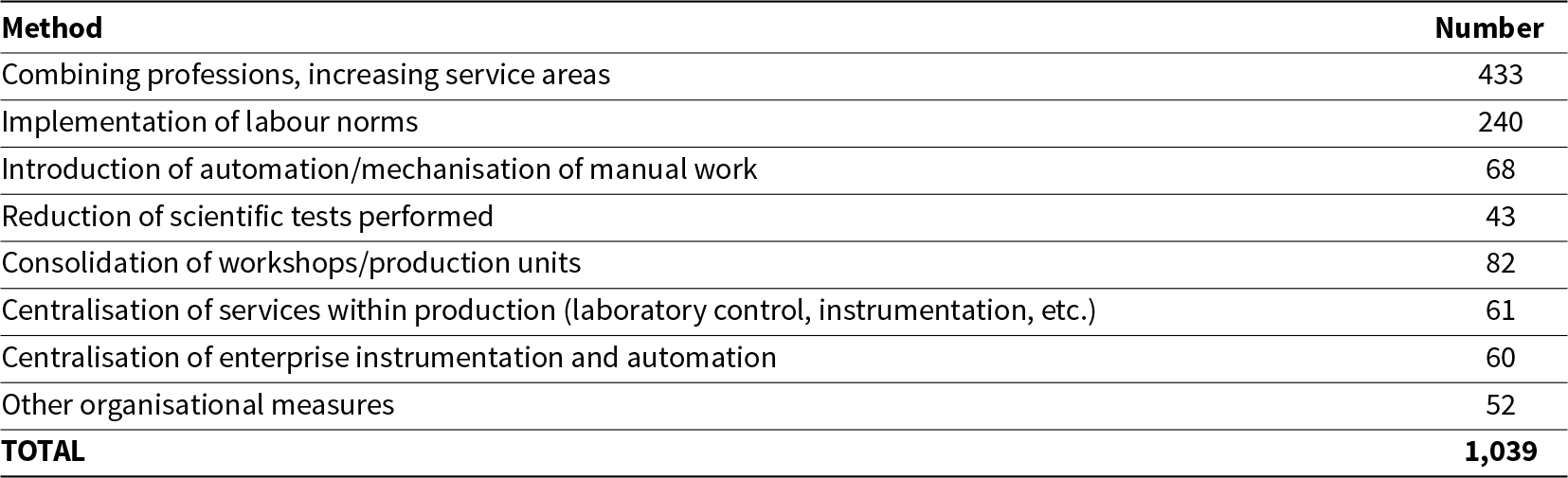
Correcting this problem required input from various institutions. Founded by enterprise chief economist Vera Slepykh in 1964, the combine’s norm laboratory created a strong foundation upon which to build. From late 1966, it began testing and implementing production norms in urea, ammonium sulphate and sulphuric acid production. Once the Shchekino Experiment began, the laboratory contributed to the release of thirty-nine workers.Footnote 57 The Tula Regional Institute of the Monomer Industry developed standards for maintenance work in the caprolactam shop. Together with select workers, specialists collected timekeeping studies, questionnaires and maps that became the raw data for setting the ‘technically substantiated’ norms demanded by industrial leaders. Individual departments carefully clarified job descriptions – especially, but not only, for engineers (ITR) – to make more rational use of workers’ skills and eradicate redundant labour.Footnote 58 As Table 1 shows, steps such as these led directly to the release of 240 workers between 1967 and 1971.
Method of reduction of industrial and production personnel during the first stage of the Shchekino Experiment (August 1967–October 1971)

Source: GATO f. R – 3469, op. 2, d. 777, l. 192 ‘Yearly Report of Enterprise p/ia V-8919 on Basic Activities in 1970’ (undated).
Employing norms had a significant impact on the reorganisation of labour at the Shchekino Chemical Combine. But combining professions was the most common strategy used to weed out redundant workers. As a rule, workers taking on new tasks were asked to perform the duties of related professions. For example, in the water supply shop, electricians also worked as drivers; in ammonia production, gas producers performed the responsibilities of mechanics and operators (apparatchik).Footnote 59 It was not rare for workers to learn even more than two tasks. In 1969 S.P. Volikova, the secretary of the committee of the Komsomol of the Shchekino Chemical Combine, boasted that 917 of that organisation’s 1,318 members had ‘mastered’ multiple related professions. Some had learned four or more.Footnote 60 According to Minin, workers themselves sometimes made the NOT department’s job easier. The chemical industry is distinguished by the fact that the machines in which production occurs – synthesis columns – are located adjacent to, rather than within, primary workshops. Workers monitor synthesis columns from control panels located inside workshops. When circumstances require, operators must leave the workshop to conduct tests or simple repairs while others temporarily observe control panels. In the methanol shop, workers deduced that the crew could be streamlined if everyone in the shop was taught to manage more than one control panel simultaneously, leaving others to work exclusively with the synthesis columns. This manoeuvre allowed the enterprise to release eight workers.Footnote 61
The interchangeability of workers prompted some to rethink their views of the shop floor. During the 1960s and 1970s the best Soviet social scientific literature stressed the ambiguity of the Soviet social structure. In an increasingly mechanised and complex economy, Soviet scholars found that the lines between categories such as intellectual, worker and peasant were becoming blurred.Footnote 62 At the Shchekino Chemical Combine, primary (osnovnyi) and auxiliary (vspomogatel’nyi) workers presented a similar conundrum for industrial leaders. Primary workers – such as operators – were relatively easy to identify because they were responsible for production. But auxiliary workers were notoriously opaque. These workers can best be understood as industrial labourers that performed duties not related to production itself but without which production would be impossible. Responsible for tasks such as soldering and countersinking, the fitter (slesar’) was one example of an auxiliary worker in the chemical industry. Though Soviet industrial leaders had long complained about the number of auxiliary workers employed in the Soviet economy, their presence was evidence that the Soviet economy was evolving.Footnote 63 Chemical production involves thousands of pieces of intricate equipment made of hundreds of thousands of parts operating continuously in a pressurised, high-temperature environment. These conditions test the durability of even the most advanced technology. A substantial staff of inspection and maintenance workers is therefore requisite in any chemical enterprise.Footnote 64 So it was at the Shchekino Chemical Combine, where, in 1970, over half of all workers were auxiliary workers.Footnote 65
In this environment, the division between primary and auxiliary worker was becoming outdated. ‘What does “auxiliary” mean’, Sharov asked rhetorically, ‘if the operation of powerful, high-performance units depends more on a fitter than on the “primary” operator?’ ‘Time’, he continued, ‘changes the usual emphases’. This muddiness had real consequences. Though operators required less technical training than fitters, the former could earn up to 20 per cent more than the latter. As a result, it was not uncommon for fitters to seek work as an operator. This was a double loss: on the one hand, Soviet society was deprived of the potential contributions of a specialised worker, and on the other, the resources invested in training them were essentially wasted. Sharov complained that this irrational situation was the result of an antiquated division of workers – one he compared to the ‘table of ranks’ established by Peter the Great in the eighteenth century to codify military and court positions – into ‘primary’ and ‘auxiliary’ that no longer had any relevance on the shop floor. Though they may never have represented, as in the United States, a ‘visible hand’ capable of steering a national economy, Soviet managers nevertheless demonstrated – time and again – a remarkable capacity for innovation.Footnote 66 Sharov, for example, took advantage of the leeway afforded by the experiment to create what he called a ‘justice mechanism’ to solve the issue independently. Management used funds accrued over the course of the experiment to increase the wages of all 2,217 fitters to equal the income of operators. This manoeuvre, Sharov commented with some pride, bridged the contradictory wage gap between fitters and operators without costing the state as much as one additional kopeck.Footnote 67 The ambiguity between types of work also helps to explain the breakdown of released workers by profession: while primary workers were only about half as likely as auxiliary workers to be released, the operator (141) was nevertheless the most common casualty of the experiment.Footnote 68
As workers took on new responsibilities, the training process slowly evolved. Because the industrial production of chemicals is impossible without complex machinery, an educated workforce is presupposed in that industry. But as the production profile of the Shchekino Chemical Combine expanded, new equipment was introduced and labour was reorganised, workers were trained and retrained with greater urgency. Mid-decade, on-the-job training was non-existent. In 1965, 847 workers at the enterprise improved their skill level; two hundred and sixty-two trained at vocational schools while the remaining 585 studied in classrooms and seminars at the combine itself. Two years later, those totals equalled 592, 257 and 335, respectively.Footnote 69 By 1968, a shift was under way. That year, of the 1,540 workers, ITR and white-collar workers (sluzhaschii) who improved their skills, 172 – or, more than 10 per cent – did so on the job.Footnote 70 Minin explains the reasons for the change. Theoretically it was unnecessary for auxiliary workers, for example, to study to temporarily perform the duties of a primary technological worker. But to work these positions long term, he argued, workers needed substantial training. For enterprise management, lengthy preparation had added benefits. Thanks to it, Minin wrote, ‘we [managers and trade union activists] have at our disposal a mass of highly qualified workers of a wide profile’ that could temporarily fill in for the ill, vacationing workers or those taking technical examinations.Footnote 71 Sharov agreed and stated plainly that, in training 157 auxiliary workers to perform duties that required training in technology, the enterprise had developed a ‘reserve of workers for the main technological jobs’.Footnote 72
III
The Soviet press fawned over the Shchekino Experiment.Footnote 73 By October 1969, it had earned the praise of the highest political body in the Soviet Union. Published in Pravda under the title ‘More Production, Fewer Workers’, a Central Committee edict ordered the experiment’s continuation at the Shchekino Chemical Combine and recommended its application throughout the Soviet economy.Footnote 74 A national seminar on the experiment was held two months later in Tula; the two-day conference was attended by 450 representatives from throughout the Soviet Union and Eastern Europe. There, minister of the chemical industry L.A. Kostandov referred to the Shchekino Experiment as ‘one of the most important methods that has allowed us to make the first significant step … towards greater labor productivity’. S. Novozhilov, the deputy chairman of Goskomtrud, praised the experiment for relying on both improved efficiency and labour productivity to increase wages.Footnote 75
There was good cause for optimism. Between 1966 and 1970, the volume of profit at the Shchekino Chemical Combine increased by almost twenty-seven times.Footnote 76 Table 2 illustrates that labour productivity also improved, dramatically at first before tapering off towards the end of the experiment. The downward slope can be explained by considering the number of workers – shown in Table 3 – released per year during the first four years of the experiment. It is worth noting that none of these dismissed workers were left to fend for themselves: 501 were rehired by the enterprise to work in vacant positions; two hundred and twenty were sent to work at the brand-new synthetic fibres factory located nearby.Footnote 77 There had also been, as Table 4 demonstrates, a veritable revolution in the utilisation of labour time. Whereas in 1966 the enterprise lost an appalling 1,276 hours of labour time per day, by the end of the Shchekino Experiment, that number had plummeted to just 363.
Labour productivity, 1966–70 (in percentage over 1966)

Source: GATO R – 3469, op. 2, d. 777, l. 192 ‘Yearly Report of Enterprise p/ia V-8919 on Basic Activities in 1970’ (undated).
Personnel released, 1967–70

Source: GATO f. R – 3469, op. 2, d. 883, l. 201 ‘Annual Report of the Enterprise on its Main Activities and an Explanatory Note for 1971’.
Labour hours lost per day, 1966–70

Source: GATO f. R – 3469, op. 2, d. 397, l. 286 ‘Annual Report of the Enterprise p/ia v-8918 on Main Activities in 1966’ (undated); GATO f. R – 3469, op. 2, d. 484a, ll. 251–2 ‘Yearly Report of Enterprise p/ia v-8919 on Basic Activities in 1967’ (23 Apr. 1968); GATO f. R – 3469, op. 2, d. 566, l. 223; GATO f. R – 3469, op. 2, d. 666, l. 202–3; GATO R – 3469, op. 2, d. 777, l. 219.
Rationalisation had some positive effects on the lives of the Shchekino Chemical Combine’s workers. In September 1968, the secretary of the factory’s party committee boasted that profits had recently financed a 1,000-tonne granary on an area collective farm, a school with the capability to serve 964 students and a campsite on the coast of the Black Sea. Additionally, the enterprise had commissioned the construction of a kindergarten and a 240-patient capacity hospital in the nearby village of Pervomaisk. These facilities complemented the combine’s new recreational area on the nearby Upa river.Footnote 78 The sports sector of the Komsomol of the Shchekino Chemical Combine provided gym and stadium visitors with the opportunity to ski, box and play hockey.Footnote 79 The Komsomol cultural organisation took members to the circus, the movie theatre, and camping.Footnote 80 In June 1968, the Shchekino city executive committee recognised the combine’s pioneer camp for its preparation for children’s summer activities including games, exercising and civil defence competitions.Footnote 81
Wages grew, but not markedly. Between 1967 and 1970, around 85 per cent of workers’ bonus compensation came in the form of roubles.Footnote 82 Altogether, 3,182 workers and 219 ITR at the Shchekino Chemical Combine received bonuses for taking on additional duties or extending their zones of service – that is, accepting responsibility for operating at least one additional machine – by January 1969.Footnote 83 Sharov wrote that the average bonus totalled around fifteen roubles, though payouts of thirty or more roubles were not rare.Footnote 84 On average, bonus payments represented between 10 and 20 per cent of a worker’s base rate.Footnote 85 These were not large sums; but nor were they irrelevant. In 1970, the cost of a kilogram of beef was one rouble, ninety-seven kopecks.Footnote 86 At the end of the 1960s, an industrial worker and their family spent around 578 roubles per year on clothing and footwear.Footnote 87 Flexible production with socialist characteristics, in other words, had positive, tangible effects on at least some workers’ lives.
IV
Scholars focused on political discourses, national institutions and prominent intellectuals often argue that the Kosygin Reform had few long-term effects on the Soviet economy. Frustrated by directors’ inability to handle enterprise finances responsibly, they assert, by the early 1970s industrial and political leaders brought the reform to an unceremonious, though never official, end. But these conclusions are less a reflection of the fate of the Kosygin Reform than of the curious attempt to measure its relative efficacy through political speeches and party decrees.Footnote 88 After all, the Kosygin Reform was designed, first and foremost, to affect the behaviour of Soviet enterprises; and at that level, it lived on in the form of the Shchekino Method. The relationship between the Kosygin Reform and the Shchekino Method is not difficult to ascertain; as Vera Slepykh put it plainly: ‘the Shchekino [E]xperiment … [is] aimed at improving the [Kosygin] [R]eform’.Footnote 89 That does not mean, however, that the method went unchanged. In ‘More Production, Fewer Workers’, the Central Committee instructed factory management to pursue production efficiency through ‘mechanization and automation, the modernization of equipment, and the improvement of technological processes’.Footnote 90 But as a January 1970 order from Kostandov made clear, this decree was an addendum to, and not a negation of, the programme of 1967.Footnote 91 Sharov welcomed the clarity of the updated focus. The director was well aware of critics who argued that, short of a transition to full automation, the Shchekino Experiment could not serve as the basis of any enduring managerial strategy. Conceding that labour reorganisation is ‘episodic’, Sharov pointed out that other elements of the Shchekino Experiment – most importantly technical progress – are ‘permanent processes’. In bringing these features to the fore, Sharov aimed to turn the Shchekino Experiment into a ‘system’.Footnote 92 Accordingly, the party committee of the Shchekino Chemical Combine referred to the Central Committee’s October decree as the beginning of the experiment’s ‘second stage’.Footnote 93 Subsequently, observers and industrial leaders gradually dropped the ‘experiment’ descriptor – and with it all the uncertainty that term implies – in favour of a name that betrayed a newfound assuredness: the ‘Shchekino Method’.
It is no secret that Soviet political leaders were fascinated by the promises of production technologies.Footnote 94 But in the context of the ninth five year plan (FYP, 1971–5), mechanisation, and technological progress more generally, took on even more meaning.Footnote 95 Throughout the 1960s and 1970s, waves of publications in the academic and popular presses appeared centred on a phenomenon the Communist Party referred to as the scientific–technical revolution (NTR).Footnote 96 Two influential social scientists defined NTR as ‘a revolution in the means and objects of labor, in technology and production organization and in its energy base arising out of scientific discoveries’.Footnote 97
The NTR arrived at the Shchekino Chemical Combine in 1970. That year, the enterprise became one of several hundred Soviet enterprises to install an automated management system (ASU). ASUs were factory-level information systems comprised of computer hardware, software and factory personnel that managed economic and production processes through automated feedback loops. ASUs were not fully systematised networks; workers made final decisions based on their output.Footnote 98 The first ASU installed at the Shchekino Chemical Combine managed the production of formalin. S. Shcheglov, a journalist working in the Tula region, explains how it functioned. From the enterprise, the ASU sent data – including temperature readings and unit air pressure levels – to the Tula branch of the Automation and Experimental Design Bureau (OKBA), which relayed them to the OKBA computer centre in Moscow. There, the information was analysed and directives for technical corrections were returned to the Shchekino Chemical Combine via the Tula branch of OKBA. Back in Shchekino, workers made appropriate adjustments to ensure production quality and worker safety.Footnote 99
Some Soviet cyberneticians envisioned a nationwide network of ASUs that could manage production through the same sort of local–regional–central framework utilised in formalin production at the Shchekino Chemical Combine. Though this multilayered system did not come to pass, ASUs did enjoy some influence in chemical production in the early to mid-1970s.Footnote 100 In 1974, the Shchekino Chemical Combine added a second ASU. Among other things, this ASU network was capable of rapidly analysing raw materials, calculating energy cost per unit of output, and monitoring energy flows throughout the factory. Industrial leaders estimated that this second ASU saved around 125,000 roubles, mostly through the conservation of raw materials, at the Shchekino Chemical Combine in its first year alone.Footnote 101
The implementation of new technologies occasionally led directly to the release of workers. This had always been a part of the plan. As K.A. Falaleev, the primary technologist in the oxidation shop in caprolactam production, wrote: ‘[o]f course we will continue to try [to dismiss workers]’. Mechanisation in Falaleev’s shop led to the termination of one operator by 1972.Footnote 102 Elsewhere, new automated gas analysers eliminated eight positions.Footnote 103 In formalin production, the introduction of new machines resulted in the termination of twenty-five workers.Footnote 104 The number of workers in the ion-exchange membrane shop decreased from 120 to sixty for similar reasons.Footnote 105 Altogether, the combine released 475 workers, ITR and white-collar employees during the second stage of the Shchekino Method.Footnote 106
Some workers benefited from mechanisation, though not in the form of bonuses. Industrial leaders had hoped that introducing new technologies would reduce the proportion of manual labour performed in Soviet enterprises. The record on this topic is mixed. In May 1973, Sharov noted that attempts to automate production had failed to have an appreciable influence on the ratio of manual labourers in primary production or auxiliary shops.Footnote 107 But these aggregate numbers obscured the fact that the structure of labour in some facilities had changed drastically. For example, between 1971 and 1973, the percentage of mechanised labour in urea production increased from 43.7 per cent to 71.4 per cent in primary production and from 33.4 per cent to 45 per cent in auxiliary production.Footnote 108
Advanced technologies also sometimes helped protect the natural environment while improving economic efficiency.Footnote 109 In 1972, the urea shop installed large, air-cooled fans for use in the production of gaseous ammonia. The ventilators replaced water condensers that used up to 250 cubic metres (approximately 66,000 gallons) of water per hour, an arrangement one writer called ‘not economical’.Footnote 110 The following year the regional press praised the reconstruction of two formalin production units for reducing emissions while increasing production capacity.Footnote 111 An engineer celebrated that a new method of producing caprolactam would decrease emissions by over 400 times while reducing cost by forty to fifty roubles per tonne.Footnote 112
But in other cases, the combine attempted to protect the natural environment without considering economics at all. The Shchekino Chemical Combine was built less than six kilometres from Lev Tolstoy’s estate, Iasnaia Poliana. Pollution from the combine had degraded the manor’s natural beauty, in particular its majestic conifers, since production began, and by 1964, the Ministry of Culture of the Russian Republic expressed its intention to protect what had survived.Footnote 113 The combine’s response was slow, but between 1971 and June of 1974, it implemented several dozen measures – including installing a machine for collecting ammonia-laden gases for proper disposal – to protect the air and water at Iasnaia Poliana.Footnote 114 At least some of these steps seemed to work. According to V. Susliak, the second secretary of the Tula regional party committee, by December 1973 the amount of ammonia, sulphur dioxide and nitrogen dioxide released into the atmosphere from the combine had been ‘significantly reduced’.Footnote 115
V
As the Shchekino Experiment’s lifecycle was extended, so too did it spread. More than anything, the October 1969 decree that sanctioned the expansion of the Shchekino Method was a recognition of what was already taking place on the ground. By then, twenty-two enterprises in the Soviet Union had already adopted the Shchekino Method.Footnote 116 Not every application of the method was identical. Some factories implemented the plan wholesale. To take but one example, the combination of professions resulted in the release of 2,302 workers – chiefly through the introduction of NOT measures – at the Novomoskovsk Chemical Combine between 1968 and 1972.Footnote 117 Others modified the schema to better suit their unique circumstances. Beginning in the late 1960s, for example, the Bashkir Petrochemical Association (ob”edinenie) in the Bashkir Autonomous Republic developed a plan that rewarded each of its seven constituent enterprises on a scale according to individual performance. Within a few months, one such factory had released 10.7 per cent of its total workforce.Footnote 118
Between 1970 and 1978 political and industrial authorities issued a series of decrees to promote, but also regulate, the spread of the Shchekino Method. The progression was not seamless and advocates for the system repeatedly had to fend off critics. Still, it endured. Between 1967 and November 1975, over 47,000 workers were released from their positions at more than 400 enterprises as a result of the Shchekino Method. It was most widespread in the chemical, paper and pulp and oil refining and petrochemical industries. Cross-training remained an important part of the experiment. At one petrochemical plant in Angarsk, 1,300 workers mastered a second or a third profession during the ninth FYP alone.Footnote 119 By 1978, some variation of the Shchekino Method was used in fifteen ministries influencing the careers of over 15,500,000 workers in 9,600 production associations and enterprises. Collectively, these facilities increased labour productivity by 5.5 per cent over 1977 against 3.6 per cent in industry overall. In 1978, those facilities that utilised some element of the method released over 180,000 workers; at least 340,000 of their workers took on an additional profession. More than half a million received a minimum of one bonus payment.Footnote 120
But these numbers in fact understate the Shchekino Method’s influence. Beginning with the ninth FYP, ministries were assigned a material incentives fund from which subordinate enterprises and associations derived their own. Ministries were permitted to maintain reserves of credits to ensure the stability of material incentives funds according to conditions of production and total sales made thanks to new production. Using 1970 as a base year, annual increases in the size of enterprises’ material incentives funds were determined through a complicated formula – involving gross output, sales and labour productivity – for the duration of the FYP.Footnote 121 This encroached directly on the territory of the Shchekino Method. Iu. Chubarov from the financial research institute of the Ministry of Finance went as far as to say that the goals and tactics of the ninth FYP and the Shchekino Method ‘duplicate[d]’ one another.Footnote 122
Some contemporaries credited the Shchekino Method with innovating the system of planning. By the 1970s there were two major forms of planning in the Soviet Union. The ‘balancing’ method, the oldest and most common form, entailed negotiating the difference between what the economy demanded and what it could potentially produce. The ‘normative’ method posited that planning could best be accomplished via a series of malleable coefficients based on labour norms and culminating with the yearly plans that comprised the FYPs.Footnote 123 G. Abramov, the deputy minister of the chemical and petroleum engineering industry, saw the Shchekino Method as the forebearer to normative planning in the industry he helped supervise. Beginning in the early 1970s, several dozen factories in the chemical and petroleum engineering industry replaced the stabilised salary fund, the quintessential element of the Shchekino Method, with normative planning. Reasoning that, in simple terms, both the Shchekino Method and normative planning shared a similar goal – reducing the cost per rouble of commodity (gross) production – Abramov referred to the latter as a ‘further development’ of the former.Footnote 124 Goskomtrud described the method’s influence most clearly when it remarked in 1976 that, ‘one of the most important elements of the Shchekino Method – material incentives for work with a smaller headcount – has become an integral part of the [national] system of labor organization and remuneration’.Footnote 125
Goskomtrud was right. I.P. Kazanets, the minister of ferrous metallurgy, suggested that some enterprises had no need for the Shchekino Method precisely because they had adopted a series of measures that, when combined, approximated the Shchekino Method. In these circumstances, there was no reason to refer to the reform by name. ‘[A]t the enterprises of the Ministry of Ferrous Metallurgy’, Kazanets wrote, ‘the Shchekino Method has found wide application, although most [enterprises and production associations] are not considered to have switched to this method’.Footnote 126 The situation was much the same in the Tula region. In 1977, the Tula regional committee of the Communist Party lamented that, since 1973, the Shchekino Method’s dissemination had ‘essentially ceased’. But all the world is not a text, and in fact the strategy continued to spread even in the absence of its signifier.Footnote 127 Many directors in the region had not introduced the Shchekino Method ‘in a comprehensive manner’, not out of disinterest but because they were already permitted to accomplish its primary goals – ‘to stimulate work with a smaller number of workers’ – at their own discretion. The result was that several enterprises had adopted Shchekino-like systems piecemeal.Footnote 128 Flexible production with socialist characteristics had become such an everyday element in economic life in the Soviet Union that some saw no reason to even point it out.
VI
The Shchekino Method’s influence peaked in the early 1980s. By then, it was in operation in roughly 11,000 enterprises in the Soviet Union. The method even found its way into Poland and East Germany.Footnote 129 A few short years later, of course, the Soviet Union ceased to exist. Since then, there has been no shortage of discussion about its demise.Footnote 130 That the most empirically sound explanation of the end of the Soviet period – Steven Solnick’s and Stephen Cohen’s argument that Boris El’tsin and his allies opportunistically dismantled the Soviet Union for their own benefit – has been overshadowed by the simplest – Martin Malia’s and Stephen Kotkin’s shared teleological assertion that the Soviet Union, and above all its planned economy, were destined to fail – is an indication of the field’s inability to evolve beyond its genetic origins as a laboratory of Cold War politicking.Footnote 131 In this latter interpretation, Mikhail Gorbachev’s perestroika and glasnost’ reform campaigns represent the clearest example that the Soviet Union could not change.Footnote 132 This is not the place for a reinterpretation of perestroika. Suffice it to say, however, that Gorbachev’s programmes transformed the Soviet Union – and its economy – to a degree that, by the late 1980s, it was already a profoundly different country than the one presided over by Leonid Brezhnev and Alexei Kosygin just a decade earlier.Footnote 133
But the best analysis rejects the simplistic vision that the Soviet planned economy was destined to ‘collapse’. Indeed, as the economist Philip Hanson once wrote about the relationship between perestroika, the planned economy and the end of the Soviet period: the ‘old Soviet system [of planning]’ did not ‘fail’; it was ‘abandoned’.Footnote 134 Certainly, central planning, state property and the Communist Party were abandoned. But other elements of the Soviet system were simply repurposed. The most prominent features of flexible production – this time without the ‘socialist characteristics’ – seem to have served the nascent capitalist regime quite well. Even into the late 1990s, state officials continued to talk about ‘releasing’ workers for the purposes of reassigning them to another job within the same organisation.Footnote 135 The work attitudes of redundant workers soon to be dismissed remained the subject of scholarly and public interest a full decade after the end of the Soviet period.Footnote 136 The practice of combining professions was so recognisable that it was sometimes satirised, as in a story published in Krasnaia zvezda in 1998 about a man in Orenburg Region who was sentenced to eight years in prison for ‘combining professions’ during his stint as the ringleader of a gang of car thieves.Footnote 137 More to the point, the strategy was common enough that it was regulated in the December 2001 Labour Code of the Russian Federation.Footnote 138 Written by a scholar of labour and social security law, an analysis of this same legislature published the following year described the practice of releasing workers in such a way that it very well could have been authored by Petr Sharov or Vera Slepykh:
… at present, enterprises are widely practicing performing work with a smaller number of employees by combining their professions and expanding service areas, with the establishment of additional payments to employees’ salaries in accordance with the current legislation due to the resulting savings in the wage fund.Footnote 139
All of this occurred in the context of a domestic political economy that even today owes its stability to state policies designed to prevent mass unemployment.Footnote 140
What did change was how profits were used. If, during the Soviet period, profits financed real efforts to improve the lives of workers and their families, then in the post-Soviet period they lined the pockets of the select group of ultra-elites that emerged victorious following the tumultuous, and violent, process of introducing capitalism in Russia.Footnote 141 In 2004, the sociologist V.K. Levashov wrote that in the 1990s Russia was home to ‘one of the cruelest systems of exploitation of hired labor in the industrialised countries’. Indeed, by the late 1990s, average wages dropped by 250 per cent and the ratio of wages to GDP fell to between two and 2.5 times lower than in the West.Footnote 142 Already by 1997, the wealth share of the top 1 per cent of Russians was around 30 per cent, a figure on par with the same group in the United States.Footnote 143 Support for social services and cultural amenities collapsed. Between 1991 and 1998, funding for health care dropped by 33 per cent. The decline in support for education (48 per cent) and culture and the arts (54 per cent) was even more extreme. Predictably, there were serious ramifications. Across the same period, life expectancy declined by two years and the mortality rate in infectious and parasitic diseases grew by 158 per cent. Cases of syphilis increased by almost 33 per cent. Theatre attendance plummeted from around 507 visits per 1,000 people to just 189.Footnote 144At 23, the Soviet Union’s Gini index in the 1970s was the lowest in the industrialized world. Thirty years later, that same number had climbed to 40 in Russia, a mark worse than the 38 it registered in 1890. d.Footnote 145 Capital had arrived.
But how was such a transition even possible? To probe this question, the field has turned to the examination of culture.Footnote 146 In a widely cited work published in 2006, the anthropologist Alexei Yurchak pondered how Soviet citizens, many of whom believed that the Communist Party’s hold on power was ‘forever’, were nonetheless well equipped to deal with the demise of the Soviet system. Yurchak found his answer in a collection of contradictory discursive forms that emerged in, and spread throughout, the Soviet Union during the late twentieth century. By the late 1980s, he concluded, many Soviet citizens had mastered the art of improvisation and developed the capacity to think in ways that party functionaries may have understood to be heretical.Footnote 147 But the Shchekino Method suggests that the discourses Yurchak analysed were preceded – or at least accompanied – structurally by economic and social practices that also would have been useful to those navigating the end of the Soviet period. As this essay has shown, flexible production with socialist characteristics ensured that well before the end of the Soviet period in 1991, millions of Soviet managers and workers were accustomed to labour management strategies – including multi-task labour, the elimination of clear job demarcations, detailed bonus systems, extensive on-the-job training, and the division of the workforce into groups of high and low job security – typically associated with capitalism. It was, ‘in many ways’, a condition Claude Dietrich would have perfectly understood.




 Open access

