





1. Introduction
Core–annular flows are often proposed to reduce frictional losses in industrial pipeline transport processes (e.g. Charles, Govier & Hodgson Reference Charles, Govier and Hodgson1961; Joseph et al. Reference Joseph, Bai, Chen and Renardy1997; Joseph & Renardy Reference Joseph and Renardy2013a , Reference Joseph and Renardyb ). In conventional two-layer flows, a low-viscosity lubricating film is placed around a more viscous core to reduce the drag on the core. This configuration is, however, prone to a wide variety of undesired flow instabilities and regimes, as documented by Joseph et al. (Reference Joseph, Bai, Chen and Renardy1997), McKibben, Gillies & Shook (Reference McKibben, Gillies and Shook2000), Bannwart et al. (Reference Bannwart, Rodriguez, de Carvalho, Wang and Vara2004), Sotgia, Tartarini & Stalio (Reference Sotgia, Tartarini and Stalio2008), Ghosh et al. (Reference Ghosh, Mandal, Das and Das2009), Rodriguez, Bannwart & De Carvalho (Reference Rodriguez, Bannwart and de Carvalho2009), Sun et al. (Reference Sun, Guo, Fu, Jing, Yin, Lu, Ullmann and Brauner2022) and Xie et al. (Reference Xie, Jiang, Lin, Zhang, Gui and Xiang2023). These studies collectively suggest that while friction reduction is achievable in principle, maintaining core–annular flow remains a significant challenge, which perhaps rationalises the lack of a widespread adoption of core–annular fluid lubrication in industrial practices.
A further difficulty with horizontal pipelines is the density difference that is invariably present between the core and the lubricating fluid. With buoyancy, the core migrates vertically under such differences, potentially interrupting the lubrication process. Nevertheless, Ooms and co-workers (Ooms & Beckers Reference Ooms and Beckers1972; Ooms & Poesio Reference Ooms and Poesio2003; Ooms et al. Reference Ooms, Vuik and Poesio2007, Reference Ooms, Pourquie and Beerens2013) have suggested that sufficiently permanent, asymmetrical corrugations or other deformations of the interface between the two fluids can generate hydrodynamic lift forces that may counter gravity.
The issues with conventional two-fluid core–annular flows prompted Frigaard and co-workers to explore three-fluid configurations, in which an inert intermediate layer separates the lubricating film from the core (e.g. Moyers-Gonzalez, Frigaard & Nouar Reference Moyers-Gonzalez, Frigaard and Nouar2004; Huen, Frigaard & Martinez Reference Huen, Frigaard and Martinez2007; Hormozi, Wielage-Burchard & Frigaard Reference Hormozi, Wielage-Burchard and Frigaard2011; Sarmadi et al. Reference Sarmadi, Hormozi and Frigaard2017, Reference Sarmadi, Hormozi and Frigaard2018). This configuration offers the possibility of exploiting the material properties of the intervening fluid to stabilise flow instabilities and help to maintain the separation between core and lubricant. In particular, Frigaard and co-workers have suggested using the yield stress of an intervening viscoplastic fluid layer for the task. Moreover, in combination with the hydrodynamic lift generated by unyielded interfacial corrugations, stable pipelining, where the core and lubricant remain separated, might be feasible even with density differences in a horizontal pipeline (Sarmadi et al. Reference Sarmadi, Hormozi and Frigaard2017, Reference Sarmadi, Hormozi and Frigaard2018). Nevertheless, three-layer core–annular flow with a yield-stress fluid remains relatively novel and largely unexplored.
(a) Sketch of the experimental set-up. (b) Sketch of the model geometry described in § 3. The centroid of the shell relative to the centre of the pipe is given by radial polar coordinates $(d\Delta , \theta _*)$
. In the frame of the shell, the pipe wall moves to the left with speed
$(d\Delta , \theta _*)$
. In the frame of the shell, the pipe wall moves to the left with speed $U_{\!_W}$
.
$U_{\!_W}$
.

The present work aims to address the limitations of two-fluid core–annular flow in a related, but different manner: rather than emplacing a yield-stress fluid between core and lubricant, we consider a three-layer arrangement in which an elastic material acts as the buffer, as sketched in figure 1(b). The emplacement of a cylindrical elastic shell between core fluid and lubricant might seem difficult to achieve in any practical setting. Moreover, one might consider the final removal and disposal of the buffer material to be an excessively costly component in any pipelining process. However, recent work with hydrogels (e.g. sodium alginate) have shown that an elastic shell can be generated and emplaced relatively effectively by in situ chemical reaction with polyvalent ionic solutions as shown in figure 1(a) (MacKenzie et al. Reference MacKenzie, Siren, Daneshi, Melnick, Treskatis, Wachs, Kizhakkedathu and Martinez2022); the gel and its constituent reactants are relatively inexpensive and disposable.
In the current paper, we continue in this vein, and begin by presenting a series of experiments exploring core–annular flows with an elastic buffer (§ 2). We provide evidence for the viability of the configuration for stable pipelining at high Reynolds number, showing that the elastic layer effectively isolates the core fluid, preventing mixing even in the presence of large density contrasts. The shell also maintains the core away from the edge of the pipe, suggesting the presence of some form of Ooms’s hydrodynamic lift effect to offset buoyancy.
Given the success of this experimental effort, we then continue to the main goal of the present paper: the development of a mathematical model of elastically encapsulated core–annular flow. For this task, we resort to some idealisations that are common in the description of core–annular fluid dynamics and elastic shells: as outlined in § 3, we combine lubrication theory for the outer fluid lubricant with the classical theory of cylindrical shells of von Kármán and Donnell (Yamaki Reference Yamaki1984) for the elastic encapsulant. Implicitly, the model assumes that both the lubricant and shell have negligible inertia and are relatively thin, so that the core fluid fills most of the pipe and is largely held at hydrostatic pressure without participating to any significant degree in the detailed dynamics. The model does not therefore match the high Reynolds number of the experiments, a discrepancy to which we return in our conclusions.
In the von Kármán–Donnell theory, the elastic shell is sufficiently stiff to effectively resist stretching, but not bending. Consequently, the problem devolves to a fluid–structure interaction problem involving the interplay between core–annular flow and a cylindrical elastic shell. The shell can be placed under compression by changing the pressures in the core and lubricant, allowing for the possibility of a novel type of buckling in which the redistribution of the fluid lubricant controls the growth rate of instability. Alternatively, when the shell is tethered somewhere along the pipe, the gravitational load on the encapsulated core fluid prompts bending further along. In either case, the stage is set for the sculpting of the shell (bends, buckles or other corrugations) to generate the hydrodynamic lift needed for stable pipelining. Our purpose is then to interrogate the dynamics of this fluid–structure interaction, and gauge the competition between lift and gravity.
Having formulated the model, we therefore explore the dynamics of buckling of the shell under pressure loading from the two fluids, and how the encapsulated core fluid settles under gravity. Both have counterparts in other problems in solid and fluid mechanics. We first provide a general linear stability theory for the buckling of the shell (§ 4). Next, we explore how the shell may fall under gravity and buckle in the simpler situation when there are no axial variations along the pipe (§ 5). We then consider the conspiracy between angular and axial buckling (§ 6), but without gravity. Finally, we explore the lift generated by the elastohydrodynamic lubrication of a falling, but tethered shell (§ 7).
2. Experimental demonstration
To investigate the feasibility of sustained encapsulated core–annular flow, we conduct a series of laboratory experiments in a horizontal, straight, smooth-walled pipe of length 10 m and inner diameter ${R_{\!O}}= 50$
mm. At the inlet, the elastic shell is formed in situ using a custom-designed three-dimensional extrusion-printing manifold, following the procedure outlined by MacKenzie et al. (Reference MacKenzie, Siren, Daneshi, Melnick, Treskatis, Wachs, Kizhakkedathu and Martinez2022); see figure 1(a). This manifold introduces a calcium chloride solution around the outer periphery of the pipe surrounding a 1 % sodium alginate solution. The two fluids then react as they flow into the pipe, generating a stiff, elastic shell. Once the alginate is fully reacted, the remaining calcium chloride solution serves as the outer lubricant. All three layers (the outer lubricating solution, the intervening shell, and the core) are conveyed further down the pipe by an imposed pressure drop.
${R_{\!O}}= 50$
mm. At the inlet, the elastic shell is formed in situ using a custom-designed three-dimensional extrusion-printing manifold, following the procedure outlined by MacKenzie et al. (Reference MacKenzie, Siren, Daneshi, Melnick, Treskatis, Wachs, Kizhakkedathu and Martinez2022); see figure 1(a). This manifold introduces a calcium chloride solution around the outer periphery of the pipe surrounding a 1 % sodium alginate solution. The two fluids then react as they flow into the pipe, generating a stiff, elastic shell. Once the alginate is fully reacted, the remaining calcium chloride solution serves as the outer lubricant. All three layers (the outer lubricating solution, the intervening shell, and the core) are conveyed further down the pipe by an imposed pressure drop.
Independent flow control in the core and annular regions is achieved via variable-frequency-regulated positive-displacement pumps, each drawing fluid from a 500 l feed reservoir. A total volumetric flux of $Q \approx 44$
l min−1 is achieved, as measured using a Rosemount 8711 electromagnetic flowmeter. For water, this flux corresponds to Reynolds number approximately
$Q \approx 44$
l min−1 is achieved, as measured using a Rosemount 8711 electromagnetic flowmeter. For water, this flux corresponds to Reynolds number approximately ${Re} = 2300$
, based on a 6.25 mm annular gap; lower Reynolds number flow was not achievable in this flow set-up.
${Re} = 2300$
, based on a 6.25 mm annular gap; lower Reynolds number flow was not achievable in this flow set-up.
Summary of the fluid densities in the core and lubricant $\rho _c,\rho _l$
, respectively, and the core viscosities
$\rho _c,\rho _l$
, respectively, and the core viscosities $\mu _c$
for the five experiments. For the core fluid, we estimate the viscosity based on the pressure drop measured in the pipe for that fluid alone. The viscosity of the outer fluid is close to that of water (
$\mu _c$
for the five experiments. For the core fluid, we estimate the viscosity based on the pressure drop measured in the pipe for that fluid alone. The viscosity of the outer fluid is close to that of water ( $\mu _l\approx1$
mPa s) for all cases.
$\mu _l\approx1$
mPa s) for all cases.

The pressure drop was measured across a 1 m section of the pipe using a Rosemount 1151DP differential pressure transducer. Five distinct flow configurations were explored, with a variety of density differences between the core fluid and lubricant, ranging from a case with a buoyant core (denoted $A$
), to a neutrally buoyant example (case
$A$
), to a neutrally buoyant example (case $B$
), then to cases with an increasingly denser core (cases
$B$
), then to cases with an increasingly denser core (cases $C$
,
$C$
, $D$
and
$D$
and $E$
). For each test, table 1 summarises the core composition and fluid densities; also provided are estimates of the core fluid viscosity, based on the pressure drop observed when using that fluid alone in the pipe. Note that to achieve higher densities and viscosities for the core fluid, sand and other additives were used for the last two cases. The significance of the implied departure from a central Newtonian fluid is not clear, although the core is not expected to play a decisive role in the dynamics. Post-experiment characterisation of the elastic tube revealed average wall thickness
$E$
). For each test, table 1 summarises the core composition and fluid densities; also provided are estimates of the core fluid viscosity, based on the pressure drop observed when using that fluid alone in the pipe. Note that to achieve higher densities and viscosities for the core fluid, sand and other additives were used for the last two cases. The significance of the implied departure from a central Newtonian fluid is not clear, although the core is not expected to play a decisive role in the dynamics. Post-experiment characterisation of the elastic tube revealed average wall thickness $d \approx {200}\ \unicode{x03BC} \mathrm{m}$
measured by callipers, and Young’s modulus
$d \approx {200}\ \unicode{x03BC} \mathrm{m}$
measured by callipers, and Young’s modulus $E \approx {0.4}\ \mathrm{MPa}$
, determined using ASTM D638 test protocol, the standardised testing method for evaluating tensile properties.
$E \approx {0.4}\ \mathrm{MPa}$
, determined using ASTM D638 test protocol, the standardised testing method for evaluating tensile properties.
Visualisation of the dynamics of the elastic shell was achieved from one-side of the pipe using a 24.2 megapixel Canon EOS Rebel T7i DSLR camera, with illumination provided by a Dantec Dynamics Ray-Power 5000 continuous-wave laser. Images were captured at a rate of approximately 10 Hz, at an oblique angle of $45^\circ$
relative to the streamwise axis and subsequently projected onto the transverse plane for quantitative analysis. The imaging system was located at the midpoint of the pipe, well downstream and upstream of any disturbances created by the inflow and outflow. Post-processing involved denoising, binarisation, and segmentation of the image sequence to extract the shell profile. From this, we determined the temporal evolution of the centroid position and cross-sectional area of the visible half of the shell. Given nominal flow speed 0.4 m s−1, the 10 Hz sampling only resolves axial structure over length scales that exceed approximately a pipe diameter.
$45^\circ$
relative to the streamwise axis and subsequently projected onto the transverse plane for quantitative analysis. The imaging system was located at the midpoint of the pipe, well downstream and upstream of any disturbances created by the inflow and outflow. Post-processing involved denoising, binarisation, and segmentation of the image sequence to extract the shell profile. From this, we determined the temporal evolution of the centroid position and cross-sectional area of the visible half of the shell. Given nominal flow speed 0.4 m s−1, the 10 Hz sampling only resolves axial structure over length scales that exceed approximately a pipe diameter.
Figures 2 and 3 show results from the five tests. In the first of these figures, we display renderings from the snapshots of the outline of the shell, first in three dimensions, then superposed on a cross-section through the pipe. These observations reveal both axial and angular variations. The axial undulations span several pipe diameters. The angular variations persist throughout the period of observation, correspond to relatively low angular wavenumbers, and are more prominent on the wider side of the annulus. Spectral analysis via a Fourier transform relative to the centroid of the shell (assuming symmetry about the midline) indicates power in the range of angular modes $3\leqslant m \leqslant 9$
, where
$3\leqslant m \leqslant 9$
, where $m$
is the angular wavenumber. The angular undulations are suggestive of the presence of compressional buckles. Similarly, the axial variations might be the result of axial buckling. However, both features may also have other origins. The axial variations, for example, could equally well result from transient flow disturbances at the relatively high Reynolds numbers of the experiments.
$m$
is the angular wavenumber. The angular undulations are suggestive of the presence of compressional buckles. Similarly, the axial variations might be the result of axial buckling. However, both features may also have other origins. The axial variations, for example, could equally well result from transient flow disturbances at the relatively high Reynolds numbers of the experiments.
From the outlines of figure 2, we extract measurements of the mean vertical position $\langle \chi \rangle$
of the shell, and a measure of flatness of the shell
$\langle \chi \rangle$
of the shell, and a measure of flatness of the shell $\langle (r_{\textit{max}}-r_{\textit{min}})/(r_{\textit{max}}+r_{\textit{min}})\rangle$
, as well as data characterising the average gap occupied by the lubricant,
$\langle (r_{\textit{max}}-r_{\textit{min}})/(r_{\textit{max}}+r_{\textit{min}})\rangle$
, as well as data characterising the average gap occupied by the lubricant, $\langle \varXi \rangle$
. Averaged over time (which is implied here by the angular brackets), these statistics cluster around well-defined means, as reported in figure 3. It is evident from this figure that when the core is less dense than the surrounding annular fluid, the tube levitates slightly, occupying the upper portion of the pipe cross-section. Conversely, when the core is denser, it settles towards the bottom of the pipe. All the while, a finite gap appears to remain between the core and pipe (for the most part, the measurements of
$\langle \varXi \rangle$
. Averaged over time (which is implied here by the angular brackets), these statistics cluster around well-defined means, as reported in figure 3. It is evident from this figure that when the core is less dense than the surrounding annular fluid, the tube levitates slightly, occupying the upper portion of the pipe cross-section. Conversely, when the core is denser, it settles towards the bottom of the pipe. All the while, a finite gap appears to remain between the core and pipe (for the most part, the measurements of $\langle \varXi _{\textit{min}}\rangle$
are discernibly bounded away from zero), and the lubricated, encapsulated flow is not hindered by any settling of the core onto the pipe wall. The simple monotonic relation between the mean vertical positions and the density difference supports the conclusion that stable pipelining is feasible.
$\langle \varXi _{\textit{min}}\rangle$
are discernibly bounded away from zero), and the lubricated, encapsulated flow is not hindered by any settling of the core onto the pipe wall. The simple monotonic relation between the mean vertical positions and the density difference supports the conclusion that stable pipelining is feasible.
(a–e) Snapshots of the elastic shell for the experiments A–E listed in table 1, respectively, plotted against time $t$
scaled by the outer radius
$t$
scaled by the outer radius $R_{\!O}$
and the flux
$R_{\!O}$
and the flux $Q$
. In each case, we show snapshots at intervals
$Q$
. In each case, we show snapshots at intervals $\mathrm{d}t$
(indicated on the figure), as a three-dimensional rendering on the left, and superposed onto a cross-section through the pipe on the right (colour-coded in time, from blue to red); the time average is shown by the thicker black line. The mean characteristics indicated are plotted as a function of the density difference in figure 3.
$\mathrm{d}t$
(indicated on the figure), as a three-dimensional rendering on the left, and superposed onto a cross-section through the pipe on the right (colour-coded in time, from blue to red); the time average is shown by the thicker black line. The mean characteristics indicated are plotted as a function of the density difference in figure 3.

Mean characteristics extracted from the time series in figure 2. (a) The mean vertical positions of the shell’s centroid, $\langle \chi _{mean} \rangle$
, and upper and lower edges,
$\langle \chi _{mean} \rangle$
, and upper and lower edges, $\langle \chi _{\textit{max}} \rangle$
and
$\langle \chi _{\textit{max}} \rangle$
and $\langle \chi _{\textit{min}} \rangle$
, scaled by the outer radius
$\langle \chi _{\textit{min}} \rangle$
, scaled by the outer radius $R_{\!O}$
. (b) The mean flatness of the shell,
$R_{\!O}$
. (b) The mean flatness of the shell, $\langle ({r_{\textit{max}}-r_{\textit{min}}})/({r_{\textit{max}}+r_{\textit{min}}})\rangle$
, where
$\langle ({r_{\textit{max}}-r_{\textit{min}}})/({r_{\textit{max}}+r_{\textit{min}}})\rangle$
, where $r$
is the local radius with respect to the shell centroid. (c,d) The averages of the maximum, mean and minimum gap thicknesses
$r$
is the local radius with respect to the shell centroid. (c,d) The averages of the maximum, mean and minimum gap thicknesses $\langle \varXi _{max,mean,min} \rangle$
scaled by the outer radius
$\langle \varXi _{max,mean,min} \rangle$
scaled by the outer radius $R_{\!O}$
, and their standard deviations
$R_{\!O}$
, and their standard deviations $\sigma (\varXi _{max,mean,min})$
scaled by the mean gap. In (a,b), the error bars show twice the standard deviations of the data.
$\sigma (\varXi _{max,mean,min})$
scaled by the mean gap. In (a,b), the error bars show twice the standard deviations of the data.

A comparison of the time-averaged pressure drop per unit length observed for the encapsulated core–annular flows with those for the core fluid alone gives further indication of the capacity for drag reduction. For example, for the cases with heavier core fluids, we observe pressure drops of 22 Pa m−1 (case $E$
) and 140 Pa m−1 (case
$E$
) and 140 Pa m−1 (case $D$
). At equivalent total volumetric flow rate, the pressure drops observed for the core fluid alone are 90 Pa m−1 and 803 Pa m−1, respectively. By contrast, when the core is buoyant and comparable in viscosity to the annular fluid (cases A and C), we observe that the pressure drop increases, suggesting drag enhancement. While these findings are peripheral to the central focus of this study, they are included here as a passing observation to highlight possible implications for transport efficiency.
$D$
). At equivalent total volumetric flow rate, the pressure drops observed for the core fluid alone are 90 Pa m−1 and 803 Pa m−1, respectively. By contrast, when the core is buoyant and comparable in viscosity to the annular fluid (cases A and C), we observe that the pressure drop increases, suggesting drag enhancement. While these findings are peripheral to the central focus of this study, they are included here as a passing observation to highlight possible implications for transport efficiency.
To summarise, the experiments demonstrate that the introduction of an elastic shell between core fluid and lubricant may promote stable pipelining; they highlight both the feasibility of the technology and its potential for practical implementation. The novelty of the configuration in the context of core–annular flows then motivates general modelling studies, such as that outlined below.
3. Model formulation
3.1. Set-up
As sketched in figure 1(b), we consider an elastic cylindrical shell containing a viscous fluid within a pipe of radius $R_{\!O}$
; a less viscous fluid lubricant lies between the shell and the inner surface of the pipe. The geometry is described by cylindrical polar coordinates
$R_{\!O}$
; a less viscous fluid lubricant lies between the shell and the inner surface of the pipe. The geometry is described by cylindrical polar coordinates $(r,\theta ,z)$
, with the angle measured relative to the vertical. Both the shell and the lubricating film are relatively thin, so that the core fluid almost fills the pipe. The shell has undeformed thickness
$(r,\theta ,z)$
, with the angle measured relative to the vertical. Both the shell and the lubricating film are relatively thin, so that the core fluid almost fills the pipe. The shell has undeformed thickness $d$
, which we assume to be of the same order as the characteristic thickness
$d$
, which we assume to be of the same order as the characteristic thickness $D$
of the narrow annular gap filled by the lubricant. There is differential motion between shell and pipe: either the shell conveys the core down the pipe with mean speed
$D$
of the narrow annular gap filled by the lubricant. There is differential motion between shell and pipe: either the shell conveys the core down the pipe with mean speed $U_{\!_W}$
, or the shell sits largely in place with the pipe translating at speed
$U_{\!_W}$
, or the shell sits largely in place with the pipe translating at speed $U_{W}$
. We assume that there is no net differential motion between core fluid and shell; when the shell deforms, the pipe geometry limits radial deformations to
$U_{W}$
. We assume that there is no net differential motion between core fluid and shell; when the shell deforms, the pipe geometry limits radial deformations to $O(D)$
. Since the core occupies a much larger area than the lubricant, the viscous stresses and pressure perturbations are much smaller, therefore we neglect perturbations there. Consequently, in the frame of the shell, the core fluid is mostly stationary and held at hydrostatic pressure. The core fluid has viscosity
$O(D)$
. Since the core occupies a much larger area than the lubricant, the viscous stresses and pressure perturbations are much smaller, therefore we neglect perturbations there. Consequently, in the frame of the shell, the core fluid is mostly stationary and held at hydrostatic pressure. The core fluid has viscosity $\mu _c$
and density
$\mu _c$
and density $\rho _c$
; the values for the lubricant are
$\rho _c$
; the values for the lubricant are $\mu _l$
and
$\mu _l$
and $\rho _l$
. The shell has Young’s modulus
$\rho _l$
. The shell has Young’s modulus $E$
, and undeformed radius
$E$
, and undeformed radius $R$
. Gravity
$R$
. Gravity $g$
acts in the vertical direction, and we neglect inertia in both the fluid and the solid.
$g$
acts in the vertical direction, and we neglect inertia in both the fluid and the solid.
The fluid–structure interaction generated by flow, solid stresses or gravitational loading leads to the deformation of the shell within the pipe. The von Kármán–Donnell model (Yamaki Reference Yamaki1984) applies in the bending limit, wherein deformations are mostly in the radial direction and take place at nearly constant thickness $d$
. Radial deflections are
$d$
. Radial deflections are $O(d)$
(or
$O(d)$
(or $O(D)$
), and take place over a much larger characteristic length scale
$O(D)$
), and take place over a much larger characteristic length scale $L$
within the local tangent plane to the shell, where
$L$
within the local tangent plane to the shell, where $L^2=Rd$
. Displacements within the tangent plane (i.e. in the angular and axial directions) are smaller than the radial deflection by order
$L^2=Rd$
. Displacements within the tangent plane (i.e. in the angular and axial directions) are smaller than the radial deflection by order ${\epsilon }=d/L\ll 1$
. Strains in the tangent plane are then
${\epsilon }=d/L\ll 1$
. Strains in the tangent plane are then $O({\epsilon } d / L)=O(d^2/L^2)$
, indicating that lateral forces from the associated in-plane net tensions are order
$O({\epsilon } d / L)=O(d^2/L^2)$
, indicating that lateral forces from the associated in-plane net tensions are order $Ed^3/L^3$
. By contrast, the normal force from the bending stress is order
$Ed^3/L^3$
. By contrast, the normal force from the bending stress is order $Ed^4/L^4$
. That is, in-plane tension forces exceed radial bending forces by
$Ed^4/L^4$
. That is, in-plane tension forces exceed radial bending forces by $O({\epsilon }^{-1})$
.
$O({\epsilon }^{-1})$
.
When flow perturbations in the core remain relatively small, the fluid stresses acting on the surfaces of the shell stem from the two pressures and the viscous stresses in the lubricant. We take the pressures to be comparable, with a characteristic scale $\mathcal{P}$
. The viscous stresses are
$\mathcal{P}$
. The viscous stresses are $O(\mu _l {U_{W}} / D)$
within the lubricant. The usual balances of lubrication theory imply that
$O(\mu _l {U_{W}} / D)$
within the lubricant. The usual balances of lubrication theory imply that $\mu _l {U_{W}} / D^2 = O(\mathcal{P}/R)$
. Hence the viscous shear stress in the lubricant is
$\mu _l {U_{W}} / D^2 = O(\mathcal{P}/R)$
. Hence the viscous shear stress in the lubricant is $O(\mu _l{U_{W}}/D) = O(D\mathcal{P}/R) = O( {\epsilon }^2 \mathcal{P})$
; viscous normal stresses are smaller still. The radial load on the shell is therefore dominated by the two fluid pressures, leading us to take the dimensionless group
$O(\mu _l{U_{W}}/D) = O(D\mathcal{P}/R) = O( {\epsilon }^2 \mathcal{P})$
; viscous normal stresses are smaller still. The radial load on the shell is therefore dominated by the two fluid pressures, leading us to take the dimensionless group
 \begin{equation} \dfrac {L^4\mathcal{P}}{Ed^4} \equiv \dfrac {R^2\mathcal{P}}{Ed^2} \end{equation}
to be order unity. By contrast, the tension forces in the local tangent plane generated by radial or lateral deflections (of $O(Ed^3/L^3)\equiv O(L\mathcal{P}/d) = O({\epsilon }^{-1}\mathcal{P})$
) far outweigh the traction on the shell exerted by the lubricant due to the viscous shear stress (of
$O(Ed^3/L^3)\equiv O(L\mathcal{P}/d) = O({\epsilon }^{-1}\mathcal{P})$
) far outweigh the traction on the shell exerted by the lubricant due to the viscous shear stress (of $O(\mu _l U_W/D) = O({\epsilon }^2 \mathcal{P})$
). The shell is therefore impacted primarily by the radial pressure loading, not the axial or angular viscous tractions (cf. Lighthill Reference Lighthill1969; Skotheim & Mahadevan Reference Skotheim and Mahadevan2004; Kodio, Griffiths & Vella Reference Kodio, Griffiths and Vella2017; Warburton, Hewitt & Neufeld Reference Warburton, Hewitt and Neufeld2020).
$O(\mu _l U_W/D) = O({\epsilon }^2 \mathcal{P})$
). The shell is therefore impacted primarily by the radial pressure loading, not the axial or angular viscous tractions (cf. Lighthill Reference Lighthill1969; Skotheim & Mahadevan Reference Skotheim and Mahadevan2004; Kodio, Griffiths & Vella Reference Kodio, Griffiths and Vella2017; Warburton, Hewitt & Neufeld Reference Warburton, Hewitt and Neufeld2020).
3.2. Cylindrical shell model
We denote the local displacements of the midsection of the shell by $(X,Y,Z)$
, in the coordinate directions
$(X,Y,Z)$
, in the coordinate directions $(r,\theta ,z)$
. In the von Kármán–Donnell shell model (Yamaki Reference Yamaki1984), the local strains are given by
$(r,\theta ,z)$
. In the von Kármán–Donnell shell model (Yamaki Reference Yamaki1984), the local strains are given by
 \begin{equation} {\varepsilon _{1}} = \frac {\partial\! Z}{\partial z}+\frac {1}{2}\left ( \frac {\partial\! X}{\partial z}\right )^2\!, \quad {\varepsilon _{2}} = \frac {\partial\! Y}{\partial y} + \frac {X}{R}+\frac {1}{2}\left (\frac {\partial\! X}{\partial y}\right )^2\!, \quad \gamma = \frac {\partial\! Z}{\partial y} +\frac {\partial\! Y}{\partial z}+\frac {\partial\! X}{\partial y}\frac {\partial\! X}{\partial z} , \end{equation}
and are related to the net tensions by
 \begin{equation} N_{{z}} = \frac {{d}\!E}{1-\nu ^2}({\varepsilon _{1}}+\nu {\varepsilon _{2}}), \quad N_{{y}}= \frac {{d}\!E}{1-\nu ^2}({\varepsilon _{2}}+\nu {\varepsilon _{1}}), \quad N_{\textit{yz}} = \frac {{d}\!E \gamma }{2(1+\nu )} , \end{equation}
where $\nu$
is the Poisson ratio. Here, derivatives with respect to the local Cartesian coordinate
$\nu$
is the Poisson ratio. Here, derivatives with respect to the local Cartesian coordinate $y$
are related to angular ones by
$y$
are related to angular ones by $\partial /\partial y \equiv R^{-1}\, \partial /\partial \theta$
. Since
$\partial /\partial y \equiv R^{-1}\, \partial /\partial \theta$
. Since $X=O(d)$
and
$X=O(d)$
and $(Y,Z)=O(\epsilon d)$
, but
$(Y,Z)=O(\epsilon d)$
, but $(\partial /\partial y,\partial /\partial z)=O(L^{-1})$
and
$(\partial /\partial y,\partial /\partial z)=O(L^{-1})$
and $R^{-1}=O({\epsilon } L^{-1})$
, all terms in the strain components are of comparable size.
$R^{-1}=O({\epsilon } L^{-1})$
, all terms in the strain components are of comparable size.
The equations of net force balance are
 \begin{equation} \frac {\partial\! N_{{z}}}{\partial z} + \frac {\partial\! N_{\textit{yz}}}{\partial y} =0, \quad \frac {\partial\! N_{{y}}}{\partial y} + \frac {\partial\! N_{\textit{yz}}}{\partial z} = 0 , \end{equation}
 \begin{equation} \frac {E d^3\, {\nabla} ^4 X}{12(1-\nu ^2)} - N_{{y}}\frac {\partial ^2 X}{\partial y^2} - 2N_{\textit{yz}} \frac {\partial ^2 X}{\partial y\, \partial z} - N_{{z}}\frac {\partial ^2 X}{\partial z^2} + \frac {N_{{y}}}{R} = q , \end{equation}
where $q$
denotes the radial pressure loading, and we have neglected the axial and angular loading, in line with earlier comments. We have further omitted any gravitational forces on the shell because of its thinness: such forces are of order
$q$
denotes the radial pressure loading, and we have neglected the axial and angular loading, in line with earlier comments. We have further omitted any gravitational forces on the shell because of its thinness: such forces are of order $\rho _s g d$
, whereas hydrostatic pressure differences between the core and lubricant are
$\rho _s g d$
, whereas hydrostatic pressure differences between the core and lubricant are $O((\rho _c-\rho _l) g R)$
. We take the latter to be comparable to
$O((\rho _c-\rho _l) g R)$
. We take the latter to be comparable to $\mathcal{P}$
(and the radial load); the neglected gravity forces are smaller by a factor of
$\mathcal{P}$
(and the radial load); the neglected gravity forces are smaller by a factor of $O(d/R)=O({\epsilon }^2)$
whenever density differences are
$O(d/R)=O({\epsilon }^2)$
whenever density differences are $O(1)$
.
$O(1)$
.
3.3. Fluid flow
Because the shell deforms radially only to $O(d)$
(or
$O(d)$
(or $O(D)$
), and the lateral deflections are even smaller, fluid motions within the core remain small. Consequently, the core fluid is held largely at hydrostatic pressure with
$O(D)$
), and the lateral deflections are even smaller, fluid motions within the core remain small. Consequently, the core fluid is held largely at hydrostatic pressure with
 \begin{equation} p \sim P_c - \rho _c g r \cos \theta , \end{equation}
where $P_c$
is a constant core pressure.
$P_c$
is a constant core pressure.
For the lubricant flow, we appeal to lubrication theory: because radial derivatives are relatively large, the main terms in the force balance equations are
 \begin{equation} \begin{aligned} \frac {\partial p}{\partial r} &\sim 0, \\ \frac {\partial\! p}{\partial \theta } &\sim \mu _lR \frac {\partial ^2 v}{\partial r^2} + \rho _l g R \sin \theta , \\ \frac {\partial\! p}{\partial z} &\sim \mu _l \frac {\partial ^2 w}{\partial r^2} . \end{aligned} \end{equation}
The pressure is therefore almost uniform across the narrow gap, leading us to set
 \begin{equation} p \sim P_l + \varPi (\theta ,z,t) - \rho _l g R \cos \theta , \end{equation}
where $P_l$
denotes a constant, mean lubricant pressure, and
$P_l$
denotes a constant, mean lubricant pressure, and $\varPi$
denotes any varying component due to lubrication flow.
$\varPi$
denotes any varying component due to lubrication flow.
We also have the velocity boundary conditions
 \begin{equation} v({R_{\!I}},\theta ,z,t)\sim v({R_{\!O}},\theta ,z,t)\sim w({R_{\!I}},\theta ,z,t)\sim 0, \quad w({R_{\!O}},\theta ,t) = -{U_{\!_W}}, \end{equation}
where $r={R_{\!I}}$
denotes the inner radius of the gap. The flow along the gap is therefore given by
$r={R_{\!I}}$
denotes the inner radius of the gap. The flow along the gap is therefore given by
 \begin{equation} \begin{aligned} v &\sim - \frac {1}{2\mu _lR} (r-{R_{\!I}})({R_{\!O}}-r) \frac {\partial \varPi }{\partial \theta }, \\ w &\sim -\left (\frac {r-{R_{\!I}}}{{R_{\!O}}-{R_{\!I}}}\right ) {U_{W}} - \frac {{1}}{2\mu _l} (r-{R_{\!I}})({R_{\!O}}-r) \frac {\partial \varPi }{\partial z} .\end{aligned} \end{equation}
Mass conservation applied across the thickness of the gap now provides the Reynolds lubrication equation
 \begin{equation} \frac {\partial \varXi }{\partial t} - {1\over 2} {U_{W}} \frac {\partial \varXi }{\partial z} = \frac {\partial }{\partial \theta }\! \left ( \frac {\varXi ^3 }{12\mu _lR^2} \frac {\partial \varPi }{\partial \theta } \right ) + \frac {\partial }{\partial z}\! \left [ \frac {\varXi ^3 {}}{12\mu _l} \frac {\partial \varPi }{\partial z}\right ]\! , \end{equation}
where $\varXi ={R_{\!O}}-{R_{\!I}}$
is the local thickness of the gap.
$\varXi ={R_{\!O}}-{R_{\!I}}$
is the local thickness of the gap.
3.4. Removing dimensions
In the von Kármán–Donnell shell theory, the angular and axial scale $L$
is necessarily smaller than the shell radius
$L$
is necessarily smaller than the shell radius $R$
. As a consequence, the Cartesian coordinate
$R$
. As a consequence, the Cartesian coordinate $y$
of the local tangent plane becomes divorced from the angular arc length
$y$
of the local tangent plane becomes divorced from the angular arc length $R\theta$
. But the angle
$R\theta$
. But the angle $\theta$
still appears in the model equations independently of
$\theta$
still appears in the model equations independently of $y$
through the gravitational terms and periodic boundary conditions. Thus, in principle, the model contains multiple angular coordinates in the style of a multiple scales theory. We abandon this awkward feature of the model by reconstituting both angular variables into the single coordinate
$y$
through the gravitational terms and periodic boundary conditions. Thus, in principle, the model contains multiple angular coordinates in the style of a multiple scales theory. We abandon this awkward feature of the model by reconstituting both angular variables into the single coordinate $\theta$
. Formally, the approximations inherent in the shell are then strictly only small when bending has angular (and axial) scales that are relatively small.
$\theta$
. Formally, the approximations inherent in the shell are then strictly only small when bending has angular (and axial) scales that are relatively small.
Given this simplification, we remove dimensions by introducing the scalings
 \begin{equation} (r,y,z) = R (\hat r,\hat y,\hat z) , \quad (X,Y,Z) = D (\hat {X},\hat {Y},\hat {Z}), \quad N_{ {y,z,yz}}=\frac {{d}{\!D\!E}}{\!R} \hat {N}_{{y,z,yz}}, \end{equation}
 \begin{equation} (q,\varPi ,P_c,P_l) = \mathcal{P} (\hat q,\hat \varPi ,\hat P_c,\hat P_l), \quad (v,w) = {U_{\!_W}} (\hat v,\hat w), \quad \varXi = D \hat \varXi , \quad t = \frac {12\mu _lR^2 \hat t}{\mathcal{P} D^2} . \end{equation}
Then, after dropping the hats, the shell equations become
 \begin{align} N_{{z}} &= \dfrac {Z_z+{1\over 2} \delta X_z^2+\nu \left(Y_y+X+{1\over 2} \delta X_y^2 \right)}{1-\nu ^2}, \end{align}
 \begin{align} N_{{y}} &= \dfrac {Y_y+X+{1\over 2}\delta X_y^2+\nu \left(Z_z+{1\over 2} \delta X_z^2 \right)}{1-\nu ^2}, \end{align}
 \begin{align} N_{\textit{yz}} &= \dfrac {Z_y+Y_z+ \delta X_yX_z}{2(1+\nu )} \end{align}
and
 \begin{equation} \mathcal{B} {\nabla} ^4 X + N_{{y}} - \delta ( N_{{z}} X_{zz} + 2N_{\textit{yz}} X_{yz} + N_{{y}} X_{yy}) = q , \end{equation}
where
 \begin{equation} \delta = \frac {D}{R}, \quad \mathcal{B} = \dfrac {d^2}{12R^2(1-\nu ^2)}, \end{equation}
and we select the pressure scale so that
 \begin{equation} \mathcal{P} = \dfrac {{d}\!D\!E}{R^2} . \end{equation}
But for the switch in notation, (3.4) remain unchanged. Note that formally, the aspect ratio $\delta$
and dimensionless bending stiffness
$\delta$
and dimensionless bending stiffness $\mathcal{B}$
are small, but the shortness of bending lengths returns all terms in (3.14)–(3.17) to comparable order. Also, we have employed a shorthand notation, using subscripts
$\mathcal{B}$
are small, but the shortness of bending lengths returns all terms in (3.14)–(3.17) to comparable order. Also, we have employed a shorthand notation, using subscripts $z$
,
$z$
, $\theta$
and
$\theta$
and $t$
to denote partial derivatives, except in the case of the net tensions,
$t$
to denote partial derivatives, except in the case of the net tensions, $\{N_{{y}},N_{{z}},N_{\textit{yz}}\}$
.
$\{N_{{y}},N_{{z}},N_{\textit{yz}}\}$
.
For the core, we obtain
 \begin{equation} p = P_c - \dfrac {\rho _c g\! R}{\mathcal{P}} r \cos \theta , \end{equation}
assuming that $\rho _c g = O(\mathcal{P}/R)$
.
$\rho _c g = O(\mathcal{P}/R)$
.
The outer lubrication equation becomes
 \begin{equation} \varXi _t - \mathcal{U} \varXi _z = ( \varXi ^3 \varPi _\theta )_{\theta } + [ \varXi ^3{\varPi _z} ]_z , \end{equation}
where
 \begin{equation} \mathcal{U} = \dfrac {6 \mu _l R{U_{W}}}{D^2 \mathcal{P}} . \end{equation}
To complete the model, we must connect the radial deformation and loading of the shell with the geometry of the lubrication gap and the pressure difference between the two fluids, as well as providing suitable boundary conditions. The local thickness of the gap $\varXi$
is necessarily connected to the shell’s radial deflection
$\varXi$
is necessarily connected to the shell’s radial deflection $X$
because the shell deforms at constant thickness. However, the shell deflection is also defined with respect to the centreline of the shell, and any net offset should not contribute to the implied bending and tension forces. Therefore,
$X$
because the shell deforms at constant thickness. However, the shell deflection is also defined with respect to the centreline of the shell, and any net offset should not contribute to the implied bending and tension forces. Therefore,
 \begin{equation} \varXi = 1 + \Delta \cos (\theta -\theta _*) - (X-X_0), \end{equation}
where $X_0$
denotes any mean radial displacement, and
$X_0$
denotes any mean radial displacement, and $\Delta (t)$
denotes the offset of the centreline of the shell (scaled by thickness
$\Delta (t)$
denotes the offset of the centreline of the shell (scaled by thickness $d$
) in the angular direction
$d$
) in the angular direction $\theta =\theta _*(t)$
.
$\theta =\theta _*(t)$
.
The pressure jump across the shell is given by
 \begin{equation} q = - P - \varPi - \mathcal{G} \cos \theta, \end{equation}
where
 \begin{equation} P = P_l - P_c , \quad \mathcal{G} = (\rho _c - \rho _l) \frac {g\! R}{\mathcal{P}}, \end{equation}
both of which are assumed to be $O(1)$
. Finally, the solutions are
$O(1)$
. Finally, the solutions are $2\unicode{x03C0} \hbox{-}$
periodic in angle
$2\unicode{x03C0} \hbox{-}$
periodic in angle $\theta$
. We further adopt periodic boundary conditions in
$\theta$
. We further adopt periodic boundary conditions in $z$
, taking the axial domain length to be
$z$
, taking the axial domain length to be $\ell$
(so that the dimensional pipe length is
$\ell$
(so that the dimensional pipe length is $\ell R$
).
$\ell R$
).
3.5. Summary of governing equations
We now summarise the model equations after recasting them into a slightly different form. First, if we denote a spatial average over the pipe by
 \begin{equation} \langle \ldots \rangle = \int _0^\ell \int _0^{2\unicode{x03C0} } (\ldots )\, \frac {\textrm {d}\theta }{2\unicode{x03C0} }\, \frac {\textrm {d} z}{\ell } \end{equation}
(rather than the time-average implied in § 2), then the mean tensions are specified to be
 \begin{align} \langle N_{{y}} \rangle &= \dfrac {\left\langle X + {1\over 2} \delta (X_{\theta }^2 + \nu X_z^2) \right\rangle }{1-\nu ^2} , \end{align}
 \begin{align} \langle N_{{z}} \rangle &= \dfrac { \left\langle \nu X + {1\over 2} \delta (\nu X_{\theta }^2 + X_z^2) \right\rangle }{1-\nu ^2} , \end{align}
 \begin{align} \langle N_{\textit{yz}} \rangle &= \dfrac {\langle \delta X_{{\theta }} X_z \rangle }{2(1+\nu )} .\end{align}
We then introduce a stress function $F(\theta ,z,t)$
(Yamaki Reference Yamaki1984) by
$F(\theta ,z,t)$
(Yamaki Reference Yamaki1984) by
 \begin{equation} N_{{y}} = \langle N_{{y}} \rangle + F_{zz}, \quad N_{{z}} = \langle N_{{z}} \rangle + F_{{\theta }{\theta }}, \quad N_{\textit{yz}} = \langle N_{\textit{yz}} \rangle - F_{{\theta } z} , \end{equation}
which automatically takes care of the force balance equations in (3.4). Defined in this way, the stress function has no spatial average, and satisfies a biharmonic equation after the elimination of $Y$
and
$Y$
and $Z$
using (3.30) and (3.14)–(3.16) (which is stated below).
$Z$
using (3.30) and (3.14)–(3.16) (which is stated below).
Our model now reduces to three equations for the thickness and lubrication pressure of the outer layer, $\varXi$
and
$\varXi$
and $\varPi$
, and the stress function
$\varPi$
, and the stress function $F$
:
$F$
:
 \begin{align} \varXi _t + \mathcal{U} \varXi _z - (\varXi ^3\varPi _{\theta })_{{\theta }} - [\varXi ^3{\varPi _z}]_z &= 0 , \end{align}
 \begin{align} \mathcal{B}\, {\nabla} ^4 X + N_{{y}} - \delta (N_{{z}} X_{zz} + 2 N_{\textit{yz}} X_{{\theta } z} + N_{{y}} X_{{\theta }{\theta }}) &= - P - \mathcal{G} \cos \theta - \varPi , \end{align}
 \begin{align} {\nabla} ^4 F - X_{zz} + \delta (X_{{\theta }{\theta }}X_{zz} - X_{{\theta } z}^2 ) &= 0 , \\[8pt] \nonumber \end{align}
Note that an integral of (3.31) over the entire pipe implies that
 \begin{equation} \frac {{\rm d} }{\textrm {d} t} \langle \varXi \rangle = 0, \end{equation}
or $\langle \varXi \rangle = 1$
(and
$\langle \varXi \rangle = 1$
(and $\langle X \rangle = X_0$
). Moreover, the net eccentricity of that layer is entirely due to the shift of the centreline of the shell:
$\langle X \rangle = X_0$
). Moreover, the net eccentricity of that layer is entirely due to the shift of the centreline of the shell:
 \begin{equation} \left \langle \begin{array}{l} \varXi \cos \theta \\ \varXi \sin \theta \end{array} \right \rangle = {1\over 2} \Delta\! \left (\begin{array}{l}\cos \theta _* \\ \sin \theta _*\end{array}\right )\!, \quad \textrm {or} \quad \langle X \cos \theta \rangle = \langle X \sin \theta \rangle = 0. \end{equation}
In fact, the radial force balance in (3.32) can be resolved into the vertical and horizontal directions, then averaged, to arrive at the net force balance conditions
 \begin{align} & \left \langle \left (\mathcal{B}\, {\nabla} ^4 X + N_{{y}} -\delta \left( N_{{z}} X_{zz} +2 N_{\textit{yz}} X_{{\theta } z} + N_{{y}} X_{{\theta }{\theta }} \right) \right ) \begin{pmatrix} \cos \theta \cr -\sin \theta \end{pmatrix} \right \rangle \nonumber \\& = \left \langle ( - P - \mathcal{G} \cos \theta - \varPi ) \begin{pmatrix} \cos \theta \cr -\sin \theta \end{pmatrix} \right \rangle\!.\end{align}
After a little algebra, and introducing (3.35), we find
 \begin{equation} \left \langle N_{{y}} X \begin{pmatrix} \cos \theta \cr -\sin \theta \end{pmatrix} \right \rangle = - \left \langle \varPi \begin{pmatrix} \cos \theta \cr -\sin \theta \end{pmatrix} \right \rangle - \begin{pmatrix} {1\over 2} \mathcal{G} \cr 0 \end{pmatrix}\! . \end{equation}
If the angular tension is constant in space, then the left-hand side vanishes in view of (3.35). Equation (3.37) then demands that the net vertical and horizontal forces on the shell due to the lubricating fluid must vanish. In principle, one should similarly consider the axial net force balance, which ultimately dictates $U_{W}$
when that speed is not set independently. We ignore this detail, however, assuming simply that
$U_{W}$
when that speed is not set independently. We ignore this detail, however, assuming simply that $U_{W}$
has been appropriately chosen and does not change in view of the dynamics.
$U_{W}$
has been appropriately chosen and does not change in view of the dynamics.
We next employ the model system in (3.31)–(3.33) to explore the deformation of the shell under radial compression, and its vertical translation under the force of buoyancy. As part of this exercise, we solve the equations numerically. We perform these computations by first discretising spatial coordinates on a two-dimensional grid. We then use a Fourier spectral method to deal with the spatial derivatives (Trefethen Reference Trefethen2000), solving the resulting coupled ordinary differential equations in time with a standard stiff time integrator (the in-built function ode15s in MATLAB). Henceforth, for brevity, we set the thickness of the shell equal to the initial thickness of the lubricating layer ( $d=D$
), so that
$d=D$
), so that
 \begin{align} \mathcal{B}=\frac {\delta ^2}{12(1-\nu ^2)}. \end{align}
4. Linear buckling instability
When $\mathcal{G}=0$
, the model equations admit circular base states under uniform radial compression with
$\mathcal{G}=0$
, the model equations admit circular base states under uniform radial compression with $\varXi =1$
,
$\varXi =1$
, $X=X_0$
and
$X=X_0$
and $\Delta =Y=\varPi =N_{\textit{yz}}=0$
. In the absence of axial tension,
$\Delta =Y=\varPi =N_{\textit{yz}}=0$
. In the absence of axial tension, $N_{{z}}=0$
, the base state must have azimuthal tension
$N_{{z}}=0$
, the base state must have azimuthal tension
 \begin{equation} N_{{y}} = N_{\mathrm{y_0}}= -P = X_0 , \end{equation}
and the Poisson effect implies an axial strain $Z_z = -\nu N_{{y_0}}$
. Alternatively, if there is no mean axial strain,
$Z_z = -\nu N_{{y_0}}$
. Alternatively, if there is no mean axial strain, $Z=0$
, then the base state must have tensions
$Z=0$
, then the base state must have tensions
 \begin{equation} (N_{{y}},N_{{z}})=(N_{{y_0}},N_{{z_0}}) = -P(1,\nu ) =-\frac {(1,\nu )X_0}{1-\nu ^2}. \end{equation}
To explore the linear stability of this base state, we set
 \begin{equation} (\varXi ,X,\varPi ,F) = (1,X_0,0,0) + ({\tilde {\varXi }},{\tilde {X}},{\tilde {\varPi }},{\tilde {F}})\,{\rm e}^{\lambda t + {\rm i}m{\theta } + {\rm i}kz} , \end{equation}
with growth rate $\lambda$
and wavenumbers
$\lambda$
and wavenumbers $(m,k)$
. The amplitudes (identified by the tildes), satisfy
$(m,k)$
. The amplitudes (identified by the tildes), satisfy
 \begin{equation} \left ( \lambda + {\rm i}k\mathcal{U} \right ) {\tilde {\varXi }} = -(m^2+k^2) {\tilde {\varPi }} ,\\[-18pt] \end{equation}
 \begin{equation} \big [ \mathcal{B}(m^2+k^2)^2 + \delta (k^2 N_{{z_0}} + m^2 N_{{y_0}}) \big ] {\tilde {X}} - k^2 {\tilde {F}} = - {\tilde {\varPi }} ,\\[-18pt] \end{equation}
 \begin{equation} (m^2+k^2)^2 {\tilde {F}} = -k^2 {\tilde {X}} \quad \text{and} \quad {\tilde {\varXi }} = -{\tilde {X}}. \end{equation}
Thus
 \begin{equation} \lambda =- {\rm i}k\mathcal{U} - (m^2+k^2) \left [ \delta (m^2 N_{{y_0}} + k^2 N_{{z_0}}) + \mathcal{B}(m^2+k^2)^2 + \frac {k^4}{(m^2+k^2)^2} \right ]\! . \end{equation}
This linear stability analysis describes the elastic buckling of the shell due to imposed compression, with a time scale set by the surrounding lubrication flow; there are similarities with the plane-layer problems considered by Huang & Suo (Reference Huang and Suo2002) and Kodio et al. (Reference Kodio, Griffiths and Vella2017).
(a) Growth rate against $k$
with fixed
$k$
with fixed $m=2$
and 3, for zero axial stress (solid) and zero axial strain (dashed), for
$m=2$
and 3, for zero axial stress (solid) and zero axial strain (dashed), for $(P,\nu ,\delta ,\mathcal{G})=(1/5,1/2,1/8,0)$
. Stars indicate the most unstable wavenumber
$(P,\nu ,\delta ,\mathcal{G})=(1/5,1/2,1/8,0)$
. Stars indicate the most unstable wavenumber $k$
in each case. (b) Growth rate as a density on the
$k$
in each case. (b) Growth rate as a density on the $(m,k)\hbox{-}$
plane for the case with zero axial stress. The stability boundary is shown by the white, solid curve, whereas the (red and white) dash-dotted curve shows the locus of maximum growth (occurring at
$(m,k)\hbox{-}$
plane for the case with zero axial stress. The stability boundary is shown by the white, solid curve, whereas the (red and white) dash-dotted curve shows the locus of maximum growth (occurring at $k\gt 0$
). The red dotted lines highlight the growth rates for
$k\gt 0$
). The red dotted lines highlight the growth rates for $m=2$
and 3 plotted in (a).
$m=2$
and 3 plotted in (a).

Sample growth rates are shown in figure 4 for the case without axial tension in (4.1). Modes with lower values of angular and axial wavenumbers are unstable, with the windows of unstable wavenumbers widening with increasing $P$
. The fastest growing modes invariably have
$P$
. The fastest growing modes invariably have $k=0$
, although at fixed
$k=0$
, although at fixed $m$
, the most unstable mode possesses finite axial wavenumber once
$m$
, the most unstable mode possesses finite axial wavenumber once $P$
is sufficiently large. For the parameter settings in figure 4, the growth rate of the
$P$
is sufficiently large. For the parameter settings in figure 4, the growth rate of the $m=2$
mode is the only one to develop a maximum at finite
$m=2$
mode is the only one to develop a maximum at finite $k$
, and modes with
$k$
, and modes with $m\gt 3$
remain stable. The results are similar for a base state with zero mean axial strain (4.1), although modes are unstable for somewhat higher axial wavenumbers; see figure 4(a).
$m\gt 3$
remain stable. The results are similar for a base state with zero mean axial strain (4.1), although modes are unstable for somewhat higher axial wavenumbers; see figure 4(a).
Numerical solution to the pure sedimentation problem, $(P,\nu ,\delta ,\mathcal{G})=(0,1/2,1/8,{1}/{32})$
. (a) Snapshots of the shell (with time increasing from blue to red, as shown by the arrow) in the cross-section. The dotted circle is the initial condition. (b) Snapshots of
$(P,\nu ,\delta ,\mathcal{G})=(0,1/2,1/8,{1}/{32})$
. (a) Snapshots of the shell (with time increasing from blue to red, as shown by the arrow) in the cross-section. The dotted circle is the initial condition. (b) Snapshots of $\varXi$
at the same times. (c) The final pressure profile (green) and shell displacement
$\varXi$
at the same times. (c) The final pressure profile (green) and shell displacement $X$
(red). The dashed lines show the final profiles predicted by the analysis in § 5.1. (d,e) Time series of
$X$
(red). The dashed lines show the final profiles predicted by the analysis in § 5.1. (d,e) Time series of $[\varXi (\unicode{x03C0} ,t),\min_\theta (\varXi )]$
and
$[\varXi (\unicode{x03C0} ,t),\min_\theta (\varXi )]$
and $[N_{{y}}(t),\varDelta (t)]$
, respectively. The dashed lines again show the predicted final values in (5.8). The circles in (d) indicate the times of the snapshots in (a,b), and the red dotted line in (e) shows the early-time prediction in (5.6).
$[N_{{y}}(t),\varDelta (t)]$
, respectively. The dashed lines again show the predicted final values in (5.8). The circles in (d) indicate the times of the snapshots in (a,b), and the red dotted line in (e) shows the early-time prediction in (5.6).

5. Angular actuation
Progressing beyond linear theory, we first consider purely angular problems in which the shell has no axial variation (dependence on $z$
). For this situation, we rewrite the model equations (3.31)–(3.32) in the form
$z$
). For this situation, we rewrite the model equations (3.31)–(3.32) in the form
 \begin{align} \varXi _t = (\varPi _{\theta }\varXi ^3 )_{{\theta }}, \quad \varXi = \varXi _0 + \Delta (t)\cos \theta - (X -X_0), \\[-28pt] \nonumber \end{align}
 \begin{align} \varPi = N_{{y}} (\delta X_{{\theta }{\theta }} - 1) - P - \mathcal{G}\cos \theta - \mathcal{B} X_{{\theta }{\theta }{\theta }{\theta }} . \end{align}
Instead of (3.33), we have simply that the angular tension $N_{{y}}$
depends only on time. Hence
$N_{{y}}$
depends only on time. Hence
 \begin{equation} N_{{y}}(t) = Y_{\theta } + X + {1\over 2} \delta X_{\theta }^2 = \left \langle X + {1\over 2} \delta X_{\theta }^2 \right \rangle \!, \end{equation}
after an integral over angle. Multiplying (5.2) by $\cos \theta$
and integrating over angle provides an expression equivalent to net vertical force balance:
$\cos \theta$
and integrating over angle provides an expression equivalent to net vertical force balance:
 \begin{equation} \langle \mathcal{G} \cos \theta + \varPi \cos \theta \rangle = \frac{1}{2} \mathcal{G} - \langle \varPi _{\theta } \sin \theta \rangle = 0 \end{equation}
(given $\langle X \cos \theta \rangle =0$
).
$\langle X \cos \theta \rangle =0$
).
5.1. Pure sedimentation
For pure sedimentation, we set $P=X_0=0$
and consider the fate of the shell as it descends under gravity from an initially centred, circular shape:
$P=X_0=0$
and consider the fate of the shell as it descends under gravity from an initially centred, circular shape: $\varXi (\theta ,0)=1$
and
$\varXi (\theta ,0)=1$
and $X(\theta ,0)=0$
. A numerical solution to this sedimentation problem is shown in figure 5. Initially, the shell sinks under the weight of the core fluid and remains largely circular because lubrication pressures arising from the underlying squeeze flow are not sufficient to induce significant elastic deformation. Consequently,
$X(\theta ,0)=0$
. A numerical solution to this sedimentation problem is shown in figure 5. Initially, the shell sinks under the weight of the core fluid and remains largely circular because lubrication pressures arising from the underlying squeeze flow are not sufficient to induce significant elastic deformation. Consequently, $|X|\ll 1$
and, from (5.1), we have
$|X|\ll 1$
and, from (5.1), we have
 \begin{equation} \dot \Delta \cos \theta = ( {\varPi _{\theta }\varXi ^3} )_{{\theta }}, \quad \textrm {or} \quad \varPi _{\theta } = \frac {\dot \Delta \sin \theta }{ (\varXi _0 + \Delta \cos \theta )^3} . \end{equation}
Hence, using (5.4),
 \begin{equation} {1\over 2} \mathcal{G} = \frac {\dot \Delta }{ 2(\varXi _0-\Delta ^2)^{3/2}} , \quad \textrm {or} \quad \Delta = \frac {\varXi _0^3\mathcal{G} t}{\sqrt {1+(\varXi _0^2\mathcal{G} t)^2}} . \end{equation}
The initial fall is therefore given by $\Delta \sim \varXi _0^3 \mathcal{G} t$
. Moreover, if the shell never deforms, then the gap is predicted to close like
$\Delta \sim \varXi _0^3 \mathcal{G} t$
. Moreover, if the shell never deforms, then the gap is predicted to close like $\varXi _0 - \Delta \sim (1/2) \varXi _0^{-3}(\mathcal{G} t)^{-2}$
, as in other viscous contact problems (Brenner Reference Brenner1961; Cawthorn & Balmforth Reference Cawthorn and Balmforth2010).
$\varXi _0 - \Delta \sim (1/2) \varXi _0^{-3}(\mathcal{G} t)^{-2}$
, as in other viscous contact problems (Brenner Reference Brenner1961; Cawthorn & Balmforth Reference Cawthorn and Balmforth2010).
Eventually, however, the shell descends to positions at which the lower surface closes towards contact with the outer wall, raising the local squeeze-flow pressure. The shell then deforms into a roughly elliptical shape (figure 5
a). In more detail, the high pressures reached underneath the lowest part of the shell prevent closure there. Instead, a small pocket of the lubricant becomes permanently trapped against the bottom of the pipe (figure 5
b). The minimum gap is then no longer located at $\theta =\unicode{x03C0}$
but becomes shifted to two symmetrical locations on either side,
$\theta =\unicode{x03C0}$
but becomes shifted to two symmetrical locations on either side, $\theta =\theta _a$
and
$\theta =\theta _a$
and $\theta =2\unicode{x03C0} -\theta _a$
. That gap continues to thin inexorably (figure 5
c), and the dynamics is similar to that for the sedimentation of a rigid cylinder against a bending beam (Balmforth, Cawthorn & Craster Reference Balmforth, Cawthorn and Craster2010).
$\theta =2\unicode{x03C0} -\theta _a$
. That gap continues to thin inexorably (figure 5
c), and the dynamics is similar to that for the sedimentation of a rigid cylinder against a bending beam (Balmforth, Cawthorn & Craster Reference Balmforth, Cawthorn and Craster2010).
Note that $N_{\theta } \equiv (1/2) \delta \langle X_{\theta }^2 \rangle$
when
$N_{\theta } \equiv (1/2) \delta \langle X_{\theta }^2 \rangle$
when $\langle X\rangle =0$
. Therefore, even though one might imagine that radial displacements with
$\langle X\rangle =0$
. Therefore, even though one might imagine that radial displacements with $X\lt 0$
and
$X\lt 0$
and $|X|\gt( 1/2) \delta X_{\theta }^2$
might be sufficient to induce local compression, the angular strain
$|X|\gt( 1/2) \delta X_{\theta }^2$
might be sufficient to induce local compression, the angular strain $Y_{\theta }$
is always sufficient to ensure that
$Y_{\theta }$
is always sufficient to ensure that $N_{{y}}\gt 0$
, and the shell remains under tension during pure sedimentation (figure 5
d).
$N_{{y}}\gt 0$
, and the shell remains under tension during pure sedimentation (figure 5
d).
The rate at which the off-centre minimum gaps close can be extracted using an analysis similar to that given by Balmforth et al. (Reference Balmforth, Cawthorn and Craster2010): the relatively high pressure maintained in the pocket balances both the weight of the core fluid and the low pressure arising in the remainder of the gap. At asymptotically large times, both these pressures become nearly uniform in $\theta$
, with sharp pressure jumps arising over the minimum gaps. The shape of the shell is then set by solving
$\theta$
, with sharp pressure jumps arising over the minimum gaps. The shape of the shell is then set by solving $\varPi \sim \varPi _a$
over the pocket, and
$\varPi \sim \varPi _a$
over the pocket, and $\varPi \sim \varPi _b$
over the rest of the gap. The constrictions at
$\varPi \sim \varPi _b$
over the rest of the gap. The constrictions at $\theta =\theta _a$
and
$\theta =\theta _a$
and $\theta =2\unicode{x03C0} -\theta _a$
are too narrow to permit sharp changes in the lower angular derivatives of
$\theta =2\unicode{x03C0} -\theta _a$
are too narrow to permit sharp changes in the lower angular derivatives of $X(\theta )$
. Hence
$X(\theta )$
. Hence $\varXi =\varXi '=0$
, whereas
$\varXi =\varXi '=0$
, whereas $X''$
and
$X''$
and $X'''$
are continuous at those points. The limiting shape of the shell is then given by solving the two versions of (5.2) with
$X'''$
are continuous at those points. The limiting shape of the shell is then given by solving the two versions of (5.2) with $\varPi \sim \varPi _a$
or
$\varPi \sim \varPi _a$
or $\varPi \sim \varPi _b$
, subject to these conditions, plus (5.3) and the constraints
$\varPi \sim \varPi _b$
, subject to these conditions, plus (5.3) and the constraints $\langle X \rangle = \langle X \cos \theta \rangle = 0$
and
$\langle X \rangle = \langle X \cos \theta \rangle = 0$
and $X'(0)=X'''(0)=X'(\unicode{x03C0} )=X'''(\unicode{x03C0} )=0$
. Figure 5(b) includes the resulting predictions for
$X'(0)=X'''(0)=X'(\unicode{x03C0} )=X'''(\unicode{x03C0} )=0$
. Figure 5(b) includes the resulting predictions for $\varXi (\theta )$
and
$\varXi (\theta )$
and $\varPi$
.
$\varPi$
.
The constrictions at $\theta =\theta _a$
and
$\theta =\theta _a$
and $\theta =2\unicode{x03C0} -\theta _a$
provide bottlenecks through which the fluid in the pocket leaks out. For the first of these, the gap is locally given by
$\theta =2\unicode{x03C0} -\theta _a$
provide bottlenecks through which the fluid in the pocket leaks out. For the first of these, the gap is locally given by $\varXi \sim (1/2) \varXi ''(\theta _a)(\theta -\theta _a)^2+\varUpsilon$
, where the minimum thickness in angle is
$\varXi \sim (1/2) \varXi ''(\theta _a)(\theta -\theta _a)^2+\varUpsilon$
, where the minimum thickness in angle is $\varUpsilon (t)=O(\theta -\theta _a)^2\ll 1$
(which follows because of (5.2) and the conditions that match the bottlenecks of the pocket to the main gap; see Balmforth et al. Reference Balmforth, Cawthorn and Craster2010). But the flux through the constriction must equal half the rate of decrease of the pocket’s area. Hence
$\varUpsilon (t)=O(\theta -\theta _a)^2\ll 1$
(which follows because of (5.2) and the conditions that match the bottlenecks of the pocket to the main gap; see Balmforth et al. Reference Balmforth, Cawthorn and Craster2010). But the flux through the constriction must equal half the rate of decrease of the pocket’s area. Hence
 \begin{equation} -\varXi ^3\varPi _\theta \sim (\unicode{x03C0} -\theta _a) \dot \varUpsilon , \quad \textrm {or} \quad \varPi _\theta \sim -\frac {(\unicode{x03C0} -\theta _a) \dot \varUpsilon } {\big[\frac 12 \varXi ''(\theta _a)(\theta -\theta _a)^2+\varUpsilon \big]^3}. \end{equation}
Integrating this relation across the constriction gives
 \begin{align} \varPi _a-\varPi _b \sim \frac {3\unicode{x03C0} }{8} (\unicode{x03C0} -\theta _a) \varUpsilon ^{-5/2}\dot \varUpsilon \sqrt {\frac {2}{\varXi ''(\theta _a)}}, \quad \textrm {or} \quad \varUpsilon \sim \left [\frac {\unicode{x03C0} ^2(\unicode{x03C0} -\theta _a)^2} {8(\varPi _a-\varPi _b)^2\varXi ''(\theta _a)}\right ]^{1/3} t^{-2/3}. \end{align}
The predictions above match well with late-time numerical solutions provided that $\mathcal{G}$
remains less than some critical value: with strengthening gravity, the pressurised pocket trapped by the constrictions becomes less effective in supporting the weight of the core fluid. As a result, the roof of the pocket begins to bend downwards once
$\mathcal{G}$
remains less than some critical value: with strengthening gravity, the pressurised pocket trapped by the constrictions becomes less effective in supporting the weight of the core fluid. As a result, the roof of the pocket begins to bend downwards once $\mathcal{G}$
is raised sufficiently, until
$\mathcal{G}$
is raised sufficiently, until $\varXi \to 0$
at
$\varXi \to 0$
at $\theta =\unicode{x03C0}$
for
$\theta =\unicode{x03C0}$
for $\mathcal{G}\approx 0.155$
, with the other parameter settings chosen for figure 5. Beyond this threshold, the steady solutions constructed above cease to exist. Figure 6(a) shows a sequence of the steady solution for values of
$\mathcal{G}\approx 0.155$
, with the other parameter settings chosen for figure 5. Beyond this threshold, the steady solutions constructed above cease to exist. Figure 6(a) shows a sequence of the steady solution for values of $\mathcal{G}$
increasing up to, and then beyond, the threshold. Once the steady solution predicts negative gaps around
$\mathcal{G}$
increasing up to, and then beyond, the threshold. Once the steady solution predicts negative gaps around $\theta =\unicode{x03C0}$
, the solutions to the initial-value problem follow a slightly different evolution: at two new points of constrictions straddling
$\theta =\unicode{x03C0}$
, the solutions to the initial-value problem follow a slightly different evolution: at two new points of constrictions straddling $\theta =\unicode{x03C0}$
, the shell bends down towards contact with the outer pipe. Those constrictions now trap a new pocket inside the original one, possessing a yet higher pressure. The original pocket at that stage splits into two satellites to either side. Figure 6(b) show a late-time solution illustrating the creation of nested pockets for
$\theta =\unicode{x03C0}$
, the shell bends down towards contact with the outer pipe. Those constrictions now trap a new pocket inside the original one, possessing a yet higher pressure. The original pocket at that stage splits into two satellites to either side. Figure 6(b) show a late-time solution illustrating the creation of nested pockets for $\mathcal{G}= 1/4$
. The final steady states could, in principle, be built by generalising the analysis above and adding more contact points.
$\mathcal{G}= 1/4$
. The final steady states could, in principle, be built by generalising the analysis above and adding more contact points.
Steady solutions for pure sedimentation with varying $\mathcal{G}$
, allowing contact at
$\mathcal{G}$
, allowing contact at $\theta =\theta _a$
and
$\theta =\theta _a$
and $2\unicode{x03C0} -\theta _a$
, for
$2\unicode{x03C0} -\theta _a$
, for $(P,\nu ,\delta )=(0, 1/2, 1/8)$
. (a) The local gap
$(P,\nu ,\delta )=(0, 1/2, 1/8)$
. (a) The local gap $\varXi (\theta )$
for
$\varXi (\theta )$
for $\mathcal{G}={1}/16,{3}/{32},{1}/{8},0.15,0.16$
(with
$\mathcal{G}={1}/16,{3}/{32},{1}/{8},0.15,0.16$
(with $\mathcal{G}$
increasing as shown by the arrow); the inset shows a magnification of the shaded region. The section of the solution for the highest value of
$\mathcal{G}$
increasing as shown by the arrow); the inset shows a magnification of the shaded region. The section of the solution for the highest value of $\mathcal{G}$
with
$\mathcal{G}$
with $\varXi \lt 0$
(shown by the blue dotted line) is unphysical. On the right are late-time numerical solutions of the initial-value problem for sedimentation with (b)
$\varXi \lt 0$
(shown by the blue dotted line) is unphysical. On the right are late-time numerical solutions of the initial-value problem for sedimentation with (b) $\mathcal{G}=1/4$
and (c)
$\mathcal{G}=1/4$
and (c) $\mathcal{G}= 3/4$
. Both
$\mathcal{G}= 3/4$
. Both $\varXi$
and the pressure
$\varXi$
and the pressure $\varPi$
are plotted at
$\varPi$
are plotted at $t=4\times 10^5$
.
$t=4\times 10^5$
.

For even higher gravity, the nested pockets again fail to support the core fluid, and the roof of the central pocket again bends down to the outer pipe. The sequence then repeats, more constrictions appearing along with another, higher pressure pocket, now with two satellites on either side. Figure 6(c) shows a third, late-time solution for $\mathcal{G}=3/4$
, in which five pockets emerge in this manner. Although we have not verified this, it seems plausible that a continued increase in
$\mathcal{G}=3/4$
, in which five pockets emerge in this manner. Although we have not verified this, it seems plausible that a continued increase in $\mathcal{G}$
could lead to the generating of an arbitrary number of constrictions and pockets.
$\mathcal{G}$
could lead to the generating of an arbitrary number of constrictions and pockets.
Note that the inexorable sedimentation exposed above can be arrested by adding an angular differential rotation between the shell and the pipe, all the while maintaining the simplicity of the purely angular two-dimensional problem. This inclusion requires an extension of our model formulation, and is discussed in more detail in Appendix A. The discussion acts as a prelude to that in § 7, where we grapple with achieving levitation in the full three-dimensional problem in which the pipe translates relative to the shell in the axial direction.
5.2. Basic buckling
Turning now to buckling without sedimentation, we set $\mathcal{G}=0$
with
$\mathcal{G}=0$
with $P\gt 0$
. The circular base states have
$P\gt 0$
. The circular base states have $N_{{y}}=X=-P$
and
$N_{{y}}=X=-P$
and $\varXi =1$
. Linear perturbations to these states with angular wavenumber
$\varXi =1$
. Linear perturbations to these states with angular wavenumber $m$
have growth rates,
$m$
have growth rates,
 \begin{equation} \lambda = m^4 (\delta P - \mathcal{B} m^2) . \end{equation}
Sample numerical solutions for three values of $P$
are presented in figure 7. In all three cases, the base state is unstable, and the most unstable linear modes with either
$P$
are presented in figure 7. In all three cases, the base state is unstable, and the most unstable linear modes with either $m=2$
or
$m=2$
or $m=3$
take over the initial linear growth phase. The modes subsequently saturate into nonlinear, buckled states. For the case with
$m=3$
take over the initial linear growth phase. The modes subsequently saturate into nonlinear, buckled states. For the case with $P=1/8$
, the
$P=1/8$
, the $m=2$
buckles persist indefinitely. In the second case, with
$m=2$
buckles persist indefinitely. In the second case, with $P= 4/{25}$
, the
$P= 4/{25}$
, the $m=3$
buckles subsequently suffer a secondary instability towards lower wavenumber perturbations. Two of the buckles subsequently merge, leaving an asymmetric
$m=3$
buckles subsequently suffer a secondary instability towards lower wavenumber perturbations. Two of the buckles subsequently merge, leaving an asymmetric $m=2$
state with buckles of unequal amplitude. In the final case,
$m=2$
state with buckles of unequal amplitude. In the final case, $P=1/5$
, the initial
$P=1/5$
, the initial $m=3$
mode again suffers a secondary instability towards
$m=3$
mode again suffers a secondary instability towards $m=2$
. This time, however, the buckle amplitudes grow sufficiently to press the two radial maxima into the outer wall. The minimum gap then continues to thin towards contact. This time, however, thinning looks to follow a steeper power law than the
$m=2$
. This time, however, the buckle amplitudes grow sufficiently to press the two radial maxima into the outer wall. The minimum gap then continues to thin towards contact. This time, however, thinning looks to follow a steeper power law than the $t^{-2/3}$
law seen with sedimentation in (5.8).
$t^{-2/3}$
law seen with sedimentation in (5.8).
Angular buckling solutions for $P= 1/8$
,
$P= 1/8$
, $4/{25}$
and
$4/{25}$
and $ 1/5$
, for
$ 1/5$
, for $(\nu ,\delta ,\mathcal{G})=(1/2,1/8,0)$
. Shown are snapshots of (a) the cross-section and (b)
$(\nu ,\delta ,\mathcal{G})=(1/2,1/8,0)$
. Shown are snapshots of (a) the cross-section and (b) $\varXi ({\theta },t)$
(with
$\varXi ({\theta },t)$
(with $P$
increasing from top to bottom). The black dash-dotted lines in (a,b) plot the initial condition. The thick dashed lines show the prediction in (5.11), as labelled. On the right, we plot the time series of (c)
$P$
increasing from top to bottom). The black dash-dotted lines in (a,b) plot the initial condition. The thick dashed lines show the prediction in (5.11), as labelled. On the right, we plot the time series of (c) $\sqrt {\langle X^2\rangle }$
, (d)
$\sqrt {\langle X^2\rangle }$
, (d) $\min_{\theta }(\varXi )$
, (e)
$\min_{\theta }(\varXi )$
, (e) $N_{ {y}}$
and (f)
$N_{ {y}}$
and (f) $\Delta$
(with
$\Delta$
(with $P=1/8$
in red,
$P=1/8$
in red, $4/25$
in green and
$4/25$
in green and $1/5$
in blue). The dashed lines show the predictions in (5.11) (for
$1/5$
in blue). The dashed lines show the predictions in (5.11) (for $m=2$
at late times, and for
$m=2$
at late times, and for $m=3$
at intermediate times in (c–e)), with
$m=3$
at intermediate times in (c–e)), with $\psi _m$
chosen to align the zeros of
$\psi _m$
chosen to align the zeros of $\varXi -1$
. The dotted lines in (c) show the prediction of linear theory, matching amplitudes at
$\varXi -1$
. The dotted lines in (c) show the prediction of linear theory, matching amplitudes at $\sqrt {\langle X^2\rangle }=0.01$
. The triangle in (d) indicates the power law
$\sqrt {\langle X^2\rangle }=0.01$
. The triangle in (d) indicates the power law $t^{-3/2}$
. In each case, the initial condition consists of a superposition of the first twenty angular modes with random phases and amplitudes (of mean
$t^{-3/2}$
. In each case, the initial condition consists of a superposition of the first twenty angular modes with random phases and amplitudes (of mean $10^{-4}$
).
$10^{-4}$
).

The steady, single-mode nonlinear states necessarily have vanishing lubrication pressures $\varPi =0$
, implying that
$\varPi =0$
, implying that
 \begin{equation} \mathcal{B} X_{{\theta }{\theta }{\theta }{\theta }} = \delta N_{{y}} X_{{\theta }{\theta }}. \end{equation}
Hence
 \begin{equation} X = A_m \cos (m\theta + \psi _m),\quad N_{{y}} = -\frac {m^2\mathcal{B}}{\delta } \quad \textrm {and} \quad A_m = \frac {2}{m} \sqrt {\frac {P+N_{{y}}}{\delta }}, \end{equation}
where the phase $\psi _m$
is selected during the initial-value problem. If the centreline of the shell is never displaced during buckling, then we also find
$\psi _m$
is selected during the initial-value problem. If the centreline of the shell is never displaced during buckling, then we also find $\min_{\theta }(\varXi )=1-A_m$
. As shown in figure 7(b), these predictions align with the numerical solution for
$\min_{\theta }(\varXi )=1-A_m$
. As shown in figure 7(b), these predictions align with the numerical solution for $P=1/8$
.
$P=1/8$
.
When buckling modes interact nonlinearly, as in the second example of figure 7 with $P=4/25$
, the final state is somewhat similar, but differs in one key respect: the nonlinear mode interaction generates a net displacement of the shell’s centreline that cannot be predicted purely from an instantaneous force balance. Indeed, after the initial saturation of the
$P=4/25$
, the final state is somewhat similar, but differs in one key respect: the nonlinear mode interaction generates a net displacement of the shell’s centreline that cannot be predicted purely from an instantaneous force balance. Indeed, after the initial saturation of the $m=3$
unstable mode, but before the onset of secondary instability (
$m=3$
unstable mode, but before the onset of secondary instability ( $t\lesssim 75$
),
$t\lesssim 75$
), $\Delta \approx 0$
and the tension and deflection are given by (5.11) with
$\Delta \approx 0$
and the tension and deflection are given by (5.11) with $m=3$
; see figure 7(c–f). In other words, although the final shell displacement and angular stress are still given by (5.11), the gap thickness
$m=3$
; see figure 7(c–f). In other words, although the final shell displacement and angular stress are still given by (5.11), the gap thickness $\varXi$
picks up an
$\varXi$
picks up an $m=1$
component that is prescribed by the dynamics. The final example of figure 7 with
$m=1$
component that is prescribed by the dynamics. The final example of figure 7 with $P=1/5$
is similar, except that the outer wall limits the growth of the final buckle after the secondary instability, so that
$P=1/5$
is similar, except that the outer wall limits the growth of the final buckle after the secondary instability, so that $\sqrt {\langle X^2\rangle }$
and
$\sqrt {\langle X^2\rangle }$
and $N_{{y}}$
never quite reach the expected values from (5.11).
$N_{{y}}$
never quite reach the expected values from (5.11).
Angular solutions with both buckling and gravity, $(\nu ,\delta )=(1/2,1/8)$
. Shown are the final states (at
$(\nu ,\delta )=(1/2,1/8)$
. Shown are the final states (at $t=333$
) for solutions with the values of
$t=333$
) for solutions with the values of $\mathcal{G}$
indicated. In each image, five cases are plotted with
$\mathcal{G}$
indicated. In each image, five cases are plotted with $P=0,1/10,9/40,9/5,3/4$
(from dashed red to blue).
$P=0,1/10,9/40,9/5,3/4$
(from dashed red to blue).

Final buckled states for more values of $P$
are shown on the left of figure 8. Although these examples show solutions for which the most unstable mode increases from
$P$
are shown on the left of figure 8. Although these examples show solutions for which the most unstable mode increases from $m=2$
to
$m=2$
to $m=5$
, the final states possess only two or three nonlinear buckles as a result of coarsening. In the approach to the final state, these buckles rotate somewhat with respect to one another in order to achieve an angular force balance as they press into the wall of the pipe; otherwise, the patterns have arbitrary orientation. Note that the addition of gravity breaks this angular symmetry, as demonstrated by the three other examples on the right of figure 8, which have
$m=5$
, the final states possess only two or three nonlinear buckles as a result of coarsening. In the approach to the final state, these buckles rotate somewhat with respect to one another in order to achieve an angular force balance as they press into the wall of the pipe; otherwise, the patterns have arbitrary orientation. Note that the addition of gravity breaks this angular symmetry, as demonstrated by the three other examples on the right of figure 8, which have $\mathcal{G}\gt 0$
: the patterns further reorientate in angle to maintain vertical force balance, an effect that typically improves the degree of left–right symmetry. Sedimentation further forces the shell to conform to the lower parts of the pipe wall, reducing buckling over the narrower sections of the gap. At the highest value of
$\mathcal{G}\gt 0$
: the patterns further reorientate in angle to maintain vertical force balance, an effect that typically improves the degree of left–right symmetry. Sedimentation further forces the shell to conform to the lower parts of the pipe wall, reducing buckling over the narrower sections of the gap. At the highest value of $\mathcal{G}$
, the shell adopts the shape of the pipe over more than half of the lower circumference, leaving only a single, inwardly directed buckle at the top.
$\mathcal{G}$
, the shell adopts the shape of the pipe over more than half of the lower circumference, leaving only a single, inwardly directed buckle at the top.
6. Shell buckles
The linear stability theory of § 4 indicates that the most unstable modes invariably have zero axial wavenumber $k=0$
, suggesting that buckling is purely angular, as considered in § 5.2. However, for fixed, lower angular wavenumber
$k=0$
, suggesting that buckling is purely angular, as considered in § 5.2. However, for fixed, lower angular wavenumber $m$
, modes with finite axial wavenumber can be unstable (see figure 4). An important feature of the angular buckling problem is also that higher-wavenumber buckling patterns can coarsen to create stronger, fewer angular buckles. In combination, one therefore wonders whether the nonlinear buckling dynamics might lead to a preference for states with axial as well as angular buckles, via some sort of secondary instability. To explore this further, we solve the full system (3.31)–(3.33) numerically.
$m$
, modes with finite axial wavenumber can be unstable (see figure 4). An important feature of the angular buckling problem is also that higher-wavenumber buckling patterns can coarsen to create stronger, fewer angular buckles. In combination, one therefore wonders whether the nonlinear buckling dynamics might lead to a preference for states with axial as well as angular buckles, via some sort of secondary instability. To explore this further, we solve the full system (3.31)–(3.33) numerically.
Shell buckling solutions for (a) $P=0.07$
, (b)
$P=0.07$
, (b) $0.085$
, (c)
$0.085$
, (c) $0.1$
and (d)
$0.1$
and (d) $0.15$
, for
$0.15$
, for $(\nu ,\delta ,\mathcal{G})=(1/2,1/8,0)$
. For each panel, we plot time series of the average
$(\nu ,\delta ,\mathcal{G})=(1/2,1/8,0)$
. For each panel, we plot time series of the average $\sqrt {\langle (\varXi -1)^2\rangle }$
(red solid lines) and maximum (blue dash-dotted lines) gap thickness in the lower half, and the power
$\sqrt {\langle (\varXi -1)^2\rangle }$
(red solid lines) and maximum (blue dash-dotted lines) gap thickness in the lower half, and the power $|\hat {A}_{mk}|^2$
in the dominant Fourier modes in the upper half. The latter are labelled by their wavenumbers
$|\hat {A}_{mk}|^2$
in the dominant Fourier modes in the upper half. The latter are labelled by their wavenumbers $(m,k)$
. The black dotted line indicates the sum of the powers of all Fourier modes. The black dashed lines indicate the exponential growth of the most unstable linear modes (matching amplitudes at
$(m,k)$
. The black dotted line indicates the sum of the powers of all Fourier modes. The black dashed lines indicate the exponential growth of the most unstable linear modes (matching amplitudes at $\sqrt {\langle (\varXi -1)^2\rangle }=0.01$
). The lighter grey dash-dotted line in the upper half of (a) shows the expected amplitude of the nonlinear pure mode with
$\sqrt {\langle (\varXi -1)^2\rangle }=0.01$
). The lighter grey dash-dotted line in the upper half of (a) shows the expected amplitude of the nonlinear pure mode with $(m,k)=(2,0)$
as given by (5.11). Insets to each panel show contour maps of the buckle pattern in the
$(m,k)=(2,0)$
as given by (5.11). Insets to each panel show contour maps of the buckle pattern in the $(\theta ,z)$
-plane at the times indicated by the stars. For each case, the initial condition is given by the most unstable angular mode of linear theory with amplitude of
$(\theta ,z)$
-plane at the times indicated by the stars. For each case, the initial condition is given by the most unstable angular mode of linear theory with amplitude of $O(10^{-4})$
and random phase.
$O(10^{-4})$
and random phase.

Figure 9 shows sample numerical solutions for four increasing values of $P$
. Plotted are time series of the average and maximum gap thickness, along with the power in the strongest Fourier modes. That is, for the latter and after defining the Fourier series
$P$
. Plotted are time series of the average and maximum gap thickness, along with the power in the strongest Fourier modes. That is, for the latter and after defining the Fourier series
 \begin{equation} X = X_0 + \sum _{k=0}^\infty \sum _{m=0}^\infty \hat {A}_{mk}\,{\rm e}^{{\rm i}(m\theta +kz)} + \text{c.c.}, \end{equation}
we plot $|\hat {A}_{mk}|^2$
for the modes that achieve the highest amplitudes during some phase of the entire evolution captured by the computations (note that
$|\hat {A}_{mk}|^2$
for the modes that achieve the highest amplitudes during some phase of the entire evolution captured by the computations (note that $\hat {A}_{00}=\hat {A}_{10}=0$
in view of our definition of
$\hat {A}_{00}=\hat {A}_{10}=0$
in view of our definition of $X_0$
and (3.35)). For the cases shown in the figure, these modes have wavenumbers
$X_0$
and (3.35)). For the cases shown in the figure, these modes have wavenumbers $(2,0)$
or
$(2,0)$
or $(3,0)$
initially, then a mix of
$(3,0)$
initially, then a mix of $(0,2)$
and
$(0,2)$
and $(2,1)$
at later times for all but the first example. Figure 9 also presents sample buckling patterns on the
$(2,1)$
at later times for all but the first example. Figure 9 also presents sample buckling patterns on the $(z,\theta )\hbox{-}$
plane at certain instants during the evolution where specific patterns emerge.
$(z,\theta )\hbox{-}$
plane at certain instants during the evolution where specific patterns emerge.
Linear theory predicts that the $(m,k)=(2,0)$
mode is most unstable for
$(m,k)=(2,0)$
mode is most unstable for $0.06\lesssim P \lesssim 0.125$
, but is then replaced by the
$0.06\lesssim P \lesssim 0.125$
, but is then replaced by the $(m,k)=(3,0)$
mode when
$(m,k)=(3,0)$
mode when $P$
is raised above
$P$
is raised above $0.125$
. The four computations in figure 9 follow the corresponding linear predictions initially (with
$0.125$
. The four computations in figure 9 follow the corresponding linear predictions initially (with $(m,k)=(2,0)$
emerging in figure 9(a,b,c), and
$(m,k)=(2,0)$
emerging in figure 9(a,b,c), and $(3,0)$
appearing in figure 9(d)). At later times, the growth of the buckles saturates nonlinearly. For the case with
$(3,0)$
appearing in figure 9(d)). At later times, the growth of the buckles saturates nonlinearly. For the case with $P=0.07$
in figure 9(a), the resulting buckle becomes steady and is maintained until the end of the computation (at
$P=0.07$
in figure 9(a), the resulting buckle becomes steady and is maintained until the end of the computation (at $t=2\times 10^3$
). Being uniform in the axial direction, this state is described by (5.11). For all the other cases, however, the nonlinear state reached after the initial saturation does not remain stable, but suffers multiple secondary instabilities.
$t=2\times 10^3$
). Being uniform in the axial direction, this state is described by (5.11). For all the other cases, however, the nonlinear state reached after the initial saturation does not remain stable, but suffers multiple secondary instabilities.
For the examples with $P=0.085$
and
$P=0.085$
and $0.1$
, the nonlinear state with
$0.1$
, the nonlinear state with $(m,k)=(2,0)$
first becomes interrupted by the growth of a mode with
$(m,k)=(2,0)$
first becomes interrupted by the growth of a mode with $(m,k)=(0,2)$
(see the second inset to figure 9
c). The nonlinear state with both modes does not survive, however, due to the growth of another mode with
$(m,k)=(0,2)$
(see the second inset to figure 9
c). The nonlinear state with both modes does not survive, however, due to the growth of another mode with $(m,k)=(2,1)$
. For
$(m,k)=(2,1)$
. For $P=0.085$
and figure 9(b), the result is a state that pulsates in time, with what look to be predator–prey-type oscillations between the
$P=0.085$
and figure 9(b), the result is a state that pulsates in time, with what look to be predator–prey-type oscillations between the $(m,k)=(2,0)$
mode and its interruption by the
$(m,k)=(2,0)$
mode and its interruption by the $(m,k)=(0,2)$
and
$(m,k)=(0,2)$
and $(2,1)$
modes. With
$(2,1)$
modes. With $P=0.1$
(figure 9
c), a new nonlinear steady state emerges in which the
$P=0.1$
(figure 9
c), a new nonlinear steady state emerges in which the $(m,k)=(2,0)$
mode is suppressed. The final pattern then has a chequerboard structure.
$(m,k)=(2,0)$
mode is suppressed. The final pattern then has a chequerboard structure.
For the final example with $P=0.15$
(figure 9
d), the saturated
$P=0.15$
(figure 9
d), the saturated $(m,k)=(3,0)$
mode loses stability to a
$(m,k)=(3,0)$
mode loses stability to a $(m,k)=(2,2)$
mode (with the resulting pattern shown in the second inset); neither survives, however, but they are replaced by the
$(m,k)=(2,2)$
mode (with the resulting pattern shown in the second inset); neither survives, however, but they are replaced by the $(m,k)=(0,2)$
and
$(m,k)=(0,2)$
and $(2,1)$
combination (third inset). Finally,
$(2,1)$
combination (third inset). Finally, $(m,k)=(2,1)$
again appears, suppressing
$(m,k)=(2,1)$
again appears, suppressing $(m,k)=(2,0)$
(fourth inset).
$(m,k)=(2,0)$
(fourth inset).
Altogether, the sequence shown in figure 9 illustrates how angular buckling patterns, though most unstable, are not necessarily those realised, except near the onset of instability. The nonlinear dynamics is evidently rich, with a variety of angular and axial buckling patterns possible. The appearance of time-periodic patterns is perhaps most striking, given the relatively viscous lubrication flow that controls the time scale of the dynamics.
7. Elastohydrodynamic lubrication
An important feature of our model is that if the shell is periodic in $z$
, then one can transform into a frame moving with speed
$z$
, then one can transform into a frame moving with speed $-\mathcal{U}$
to eliminate the advection term in (3.31), i.e. by defining a new axial coordinate
$-\mathcal{U}$
to eliminate the advection term in (3.31), i.e. by defining a new axial coordinate $\zeta =z+\mathcal{U} t$
. In this new frame, the problem is equivalent to that when the pipe is stationary, in which the core always sediments under gravity. One therefore cannot add the motion of the pipe into the problem to generate a lift force to counter gravity. This implies that the buckled states discussed in the last section cannot generate lift if the wall is translated (
$\zeta =z+\mathcal{U} t$
. In this new frame, the problem is equivalent to that when the pipe is stationary, in which the core always sediments under gravity. One therefore cannot add the motion of the pipe into the problem to generate a lift force to counter gravity. This implies that the buckled states discussed in the last section cannot generate lift if the wall is translated ( $\mathcal{U}\gt 0$
). Instead, some other feature is needed to break the symmetry and counter buoyancy.
$\mathcal{U}\gt 0$
). Instead, some other feature is needed to break the symmetry and counter buoyancy.
Here, we employ a simple device for this task within the framework of the current shell model. In the frame of the core (and shell, in which (3.31) is written), we fix the annular gap at the ends of the domain in $z$
. As this is performed practically at the first and last collocation points (which are
$z$
. As this is performed practically at the first and last collocation points (which are $z=0$
and
$z=0$
and $2\unicode{x03C0} (1-N^{-1})$
if
$2\unicode{x03C0} (1-N^{-1})$
if $N$
denotes the number of axial grid points), the device is equivalent to enforcing clamped boundary conditions at the ends, and means that one can no longer jump into a moving frame to eliminate the advection term.
$N$
denotes the number of axial grid points), the device is equivalent to enforcing clamped boundary conditions at the ends, and means that one can no longer jump into a moving frame to eliminate the advection term.
A sedimentation solution with fixed gaps at $x=0$
and
$x=0$
and $\unicode{x03C0}$
, for
$\unicode{x03C0}$
, for $(P,\nu ,\delta ,\mathcal{G})=(0,1/2,1/8,1)$
. Shown are a surface plot of the shell (top), the angular averages
$(P,\nu ,\delta ,\mathcal{G})=(0,1/2,1/8,1)$
. Shown are a surface plot of the shell (top), the angular averages $\{\overline {N_{_Y}},\overline {N_{_Z}},\overline {Z}\}$
(middle) and
$\{\overline {N_{_Y}},\overline {N_{_Z}},\overline {Z}\}$
(middle) and $\varXi (\unicode{x03C0} ,z,t)$
and
$\varXi (\unicode{x03C0} ,z,t)$
and $\min_\theta (\varXi )$
(bottom), for the times and velocities indicated.
$\min_\theta (\varXi )$
(bottom), for the times and velocities indicated.

Details of the gap for sedimentation solutions with fixed shell position at $z=0$
and
$z=0$
and $\unicode{x03C0}$
and varying
$\unicode{x03C0}$
and varying $\mathcal{U}$
, for
$\mathcal{U}$
, for $(P,\nu ,\delta ,\mathcal{G})=(0,1/2,1/8,1)$
. (a) Time series of the minimum of the gap over both angle
$(P,\nu ,\delta ,\mathcal{G})=(0,1/2,1/8,1)$
. (a) Time series of the minimum of the gap over both angle $\theta$
and axial position
$\theta$
and axial position $z$
, for solutions with
$z$
, for solutions with $\mathcal{U} = 0,1/20,1/10,1/5,2/5$
, (from blue to red). The dash-dotted line shows the power law
$\mathcal{U} = 0,1/20,1/10,1/5,2/5$
, (from blue to red). The dash-dotted line shows the power law $t^{-2/3}$
. (b) The minimum of the gap over angle at the final time (
$t^{-2/3}$
. (b) The minimum of the gap over angle at the final time ( $t=100$
) plotted against axial position
$t=100$
) plotted against axial position $z$
for
$z$
for $\mathcal{U}=10^{-3},10^{-2}, 1/20, {1}/{5}$
(increasing
$\mathcal{U}=10^{-3},10^{-2}, 1/20, {1}/{5}$
(increasing $\mathcal{U}$
shown by the arrow). (c) Final minimum gaps over
$\mathcal{U}$
shown by the arrow). (c) Final minimum gaps over $\theta$
and
$\theta$
and $z$
plotted against
$z$
plotted against $\mathcal{U}$
; the dashed line shows the scaling
$\mathcal{U}$
; the dashed line shows the scaling $\mathcal{U}^{3/4}$
. (d) Density plots on the
$\mathcal{U}^{3/4}$
. (d) Density plots on the $(z,\theta )$
-plane showing the shape of the final gap thickness
$(z,\theta )$
-plane showing the shape of the final gap thickness $\varXi (\theta ,z,100)$
for
$\varXi (\theta ,z,100)$
for $\mathcal{U}=0,10^{-3},10^{-2},1/5$
(from left to right). The white lines show contours at
$\mathcal{U}=0,10^{-3},10^{-2},1/5$
(from left to right). The white lines show contours at $\varXi =10^{-j/5}$
for
$\varXi =10^{-j/5}$
for $j=0,1,\ldots ,10$
.
$j=0,1,\ldots ,10$
.

Figures 10 and 11 display numerical solutions to this problem, setting $(P,\nu ,\delta ,\mathcal{G})=(0,1/2,1/8,1)$
. The first of these figures displays two snapshots at different times for solutions with two values of
$(P,\nu ,\delta ,\mathcal{G})=(0,1/2,1/8,1)$
. The first of these figures displays two snapshots at different times for solutions with two values of $\mathcal{U}$
, and shows a three-dimensional rendition of the shell (top row), the angular averages
$\mathcal{U}$
, and shows a three-dimensional rendition of the shell (top row), the angular averages $\{\overline {N_{_Y}},\overline {N_{_Z}},\overline {Z}\}$
, and details of the gap (the minimum of
$\{\overline {N_{_Y}},\overline {N_{_Z}},\overline {Z}\}$
, and details of the gap (the minimum of $\varXi (\theta ,z,t)$
over
$\varXi (\theta ,z,t)$
over $\theta$
and
$\theta$
and $\varXi (\unicode{x03C0} ,z,t)$
). Here,
$\varXi (\unicode{x03C0} ,z,t)$
). Here,
 \begin{equation} \overline {f(\theta )} = \int _0^{2\unicode{x03C0} } f(\theta )\,\frac {\textrm {d} \theta }{2\unicode{x03C0} } , \end{equation}
and $\overline {Z}=\overline {\varXi \cos \theta }$
denotes the vertical position of the centroid of the shell. Figure 11 plots further details of the solutions along with some additional cases with different values of
$\overline {Z}=\overline {\varXi \cos \theta }$
denotes the vertical position of the centroid of the shell. Figure 11 plots further details of the solutions along with some additional cases with different values of $\mathcal{U}$
.
$\mathcal{U}$
.
In the first example of figure 10 for $\mathcal{U}=0$
, the shell sags in the middle of the domain under the action of gravity on the core fluid; the ends are, however, held in place. The extensions generating by sagging induce mean axial and angular tensions, which contribute to opposing the gravitational fall, but are unable to prevent it. The gap below the lowest section of the shell then continues to thin with time. As shown in the times series of figure 11(a), thinning again takes the power-law form
$\mathcal{U}=0$
, the shell sags in the middle of the domain under the action of gravity on the core fluid; the ends are, however, held in place. The extensions generating by sagging induce mean axial and angular tensions, which contribute to opposing the gravitational fall, but are unable to prevent it. The gap below the lowest section of the shell then continues to thin with time. As shown in the times series of figure 11(a), thinning again takes the power-law form $t^{-2/3}$
. The narrowing gap itself develops a complicated spatial pattern involving a number of constrictions and trapped pockets, somewhat similar to the purely angular problem of § 5.1; see the first image of figure 11(d).
$t^{-2/3}$
. The narrowing gap itself develops a complicated spatial pattern involving a number of constrictions and trapped pockets, somewhat similar to the purely angular problem of § 5.1; see the first image of figure 11(d).
As shown by the second example of figure 10, with $\mathcal{U}=1/5$
, the addition of the motion of the pipe (from right to left in
$\mathcal{U}=1/5$
, the addition of the motion of the pipe (from right to left in $z$
) changes this dynamics: as fluid is dragged through the gap underneath the shell, the gap becomes asymmetrical about
$z$
) changes this dynamics: as fluid is dragged through the gap underneath the shell, the gap becomes asymmetrical about $z=\unicode{x03C0}$
(figure 10
c,d) and a lift force is generated. The descent of the shell is then arrested and steady, levitated lubrication is achieved (see figure 11
a). In other words, the relative motion of the shell and outer wall creates the lift needed to prevent contact, a result aligning with those presented by Ooms and others (e.g. Ooms & Beckers Reference Ooms and Beckers1972; Ooms & Poesio Reference Ooms and Poesio2003; Ooms, Vuik & Poesio Reference Ooms, Vuik and Poesio2007). As shown in the last image of figure 11(d), we again see that the narrow gap underneath the shell becomes deformed into a somewhat complicated spatial pattern.
$z=\unicode{x03C0}$
(figure 10
c,d) and a lift force is generated. The descent of the shell is then arrested and steady, levitated lubrication is achieved (see figure 11
a). In other words, the relative motion of the shell and outer wall creates the lift needed to prevent contact, a result aligning with those presented by Ooms and others (e.g. Ooms & Beckers Reference Ooms and Beckers1972; Ooms & Poesio Reference Ooms and Poesio2003; Ooms, Vuik & Poesio Reference Ooms, Vuik and Poesio2007). As shown in the last image of figure 11(d), we again see that the narrow gap underneath the shell becomes deformed into a somewhat complicated spatial pattern.
Solutions with further values of $\mathcal{U}$
are provided in figure 11. In this wider suite of computations, steady levitation is reached over long times whenever there is translation (
$\mathcal{U}$
are provided in figure 11. In this wider suite of computations, steady levitation is reached over long times whenever there is translation ( $\mathcal{U}\gt 0$
). For the final, steady levitated states, the minimum of the gap over angle possesses a profile in
$\mathcal{U}\gt 0$
). For the final, steady levitated states, the minimum of the gap over angle possesses a profile in $z$
that is similar to the gap profile with
$z$
that is similar to the gap profile with $\theta$
seen for axially uniform states in steady angular rotation (see Appendix A and figure 12). In both cases, the gap narrows as fluid is dragged underneath the shell, before widening more abruptly on the downstream side of the constriction. The increasing fine structure that develops over the constriction as
$\theta$
seen for axially uniform states in steady angular rotation (see Appendix A and figure 12). In both cases, the gap narrows as fluid is dragged underneath the shell, before widening more abruptly on the downstream side of the constriction. The increasing fine structure that develops over the constriction as $\mathcal{U}$
decreases is illustrated by two further density maps of the final gap in figure 11(d).
$\mathcal{U}$
decreases is illustrated by two further density maps of the final gap in figure 11(d).
Figure 11(c) displays how the minimum gap over both angle $\theta$
and axial direction
$\theta$
and axial direction $z$
varies with translation speed
$z$
varies with translation speed $\mathcal{U}$
in the steady states. The minimum appears to follow the scaling
$\mathcal{U}$
in the steady states. The minimum appears to follow the scaling $\min_{(\theta ,z)}(\varXi )\propto \mathcal{U}^{3/4}$
for
$\min_{(\theta ,z)}(\varXi )\propto \mathcal{U}^{3/4}$
for $\mathcal{U}\ll 1$
, which mirrors the dependence
$\mathcal{U}\ll 1$
, which mirrors the dependence ${\varOmega }^{3/4}$
found for axially uniform, steadily rotating states with dimensionless rotation rate
${\varOmega }^{3/4}$
found for axially uniform, steadily rotating states with dimensionless rotation rate $\varOmega$
(Appendix A). The latter scaling is analogous to that found for elastohydrodynamic line contacts (e.g. Bissett Reference Bissett1989; Bissett & Spence Reference Bissett and Spence1989; Lugt & Morales-Espejel Reference Lugt and Morales-Espejel2011; Snoeijer, Eggers & Venner Reference Snoeijer, Eggers and Venner2013), and can be understood in a similar fashion by considering the bottlenecks in flow at the ends of the constricted region (see Appendix A). Following Snoeijer et al. (Reference Snoeijer, Eggers and Venner2013), who also considered elastohydrodynamic point contacts, we rationalise the scaling
$\varOmega$
(Appendix A). The latter scaling is analogous to that found for elastohydrodynamic line contacts (e.g. Bissett Reference Bissett1989; Bissett & Spence Reference Bissett and Spence1989; Lugt & Morales-Espejel Reference Lugt and Morales-Espejel2011; Snoeijer, Eggers & Venner Reference Snoeijer, Eggers and Venner2013), and can be understood in a similar fashion by considering the bottlenecks in flow at the ends of the constricted region (see Appendix A). Following Snoeijer et al. (Reference Snoeijer, Eggers and Venner2013), who also considered elastohydrodynamic point contacts, we rationalise the scaling $\mathcal{U}^{3/4}$
observed for the axially varying problem by arguing that it must result because flow through the constriction is almost unidirectional, and therefore equivalent to the problem with angular rotation.
$\mathcal{U}^{3/4}$
observed for the axially varying problem by arguing that it must result because flow through the constriction is almost unidirectional, and therefore equivalent to the problem with angular rotation.
8. Conclusion
In this paper, we have presented exploratory laboratory experiments demonstrating stable pipelining of core–annular flow at high Reynolds number. The critical feature of these experiments is the insertion of an elastic shell between the core and lubricating fluid, which deforms to produce distinctive sculpted patterns during transport. The time-averaged position of the shell is levitated when the core fluid is less dense than the surrounding annular fluid, and descends into a stable, off-centre position when the core is denser. In all configurations examined, a finite gap consistently remains between the core and the pipe wall. These observations lend experimental support to the concept that a three-layer structure in core–annular flows can promote flow stability, an idea originally proposed by Frigaard and collaborators, though they proposed encapsulating the core with a rather different material.
As a complement to these exploratory experiments, we have further presented a reduced model designed to interrogate the dynamics of a cylindrical elastic shell emplaced between the two fluids of a core–annular flow. To construct this reduced model, we introduced a series of simplifying assumptions, taking the lubricating fluid and elastic shell to be thin relative to the pipe radius, and neglecting inertial effects. Although these simplifying assumptions distance the theoretical model from the experiments, several key aspects of the dynamical fluid–structure interaction are captured: buckling under radial compression, sedimentation of the core under density differences, and lift created by elastohydrodynamic effects due to axial translation (or angular rotation).
In the linear stability analysis of buckling under radial compression, we observed that angular wavenumbers are preferred. Our nonlinear computations, however, show that the preferred modes can suffer secondary instabilities in the form of angular buckles that may lead to a coarsening of the angular pattern, or more significantly, the development of axially varying structure. Therefore the model system shows the potential to self-sculpt and form natural axial and angular corrugations. As the shell remains intact, no mixing of the fluids results from this sculpting process, unlike in other core–annular flows.
A sculpted interface is critical for stable transport in horizontal pipelines due to its potential to generate hydrodynamic lift, as noted by Ooms and co-workers. However, the periodic buckled states arising from purely radial compression do not produce lift, as they are symmetric about the horizontal axis. This observation motivated our investigation of configurations in which the ends of the elastic shell are clamped, thereby breaking the left–right symmetry. In this setting, we demonstrate that elastohydrodynamic effects can induce levitation of the core. Further evidence for the role of elastohydrodynamics is provided by our analysis of rotational motion (Appendix A), which also contributes to the generation of lift.
Although some of the physical assumptions in the model are divorced from the original experimental set-up, both theory and experiments build on the proposal that stable pipelining can be achieved by encapsulating the core fluid within an elastic shell. We leave it to future work to extend the model to bring theory closer to experiments. In particular, it remains to incorporate inertia and axial pressure gradients, allow for thicker shells and lubricating layers, and trigger elastohydrodynamic lubrication more realistically than clamping the shell at its ends.
Acknowledgements
We thank the Natural Sciences and Engineering Council of Canada (NSERC) for financial support. T.V.B. gratefully acknowledges support from a Leverhulme Trust Early Career Fellowship (ECF-2022-584). For the purpose of open access, the authors have applied a Creative Commons Attribution (CC BY) licence to any Author Accepted Manuscript version arising from this submission.
Declaration of interests
The authors report no conflict of interest.
Appendix A. Levitation by rotation
In this appendix, we discuss the effect of adding a rotational term to (5.1) that models the effect of allowing the outer pipe to rotate relative to the shell. That evolution equation becomes modified to
 \begin{equation} \varXi _t + \varOmega \varXi _{\theta } = (\varPi _{\theta }\varXi ^3 )_{{\theta }}, \end{equation}
where $\varOmega$
is the dimensionless rotation rate. We include this term to illustrate how the relative motion of the shell and outer cylinder could lead to a lift force that prevents the sedimentation of the shell (cf. Ooms & Beckers Reference Ooms and Beckers1972), whilst retaining the relatively simple two-dimensional geometry of the angular problem. In doing so, however, we set aside an awkward detail related to how that rotation would impose a torque on the shell to force it to rotate as well.
$\varOmega$
is the dimensionless rotation rate. We include this term to illustrate how the relative motion of the shell and outer cylinder could lead to a lift force that prevents the sedimentation of the shell (cf. Ooms & Beckers Reference Ooms and Beckers1972), whilst retaining the relatively simple two-dimensional geometry of the angular problem. In doing so, however, we set aside an awkward detail related to how that rotation would impose a torque on the shell to force it to rotate as well.
A plot similar to figure 5, but showing sedimentation with rotation for $\varOmega =(1/2)\mathcal{G}$
, for
$\varOmega =(1/2)\mathcal{G}$
, for $(P,\nu ,\delta ,\mathcal{G})=(0,1/2,1/8,1/32)$
. Only the time series of
$(P,\nu ,\delta ,\mathcal{G})=(0,1/2,1/8,1/32)$
. Only the time series of $\min_\theta (\varXi )$
is plotted in (c), and the dashed lines in (b,c,d) indicate the final steady state.
$\min_\theta (\varXi )$
is plotted in (c), and the dashed lines in (b,c,d) indicate the final steady state.

Figure 12 shows a sample solution with $\varOmega =1/2$
, for comparison with figure 5. The initial phase of descent is similar to the case without rotation, but when the shell descends close to the outer rotating wall, viscous shear stresses drag the shell up the side. This breaks the left–right symmetry of the pressure distribution (figure 12
b), creating a lift force to counter gravity. Consequently, the descent becomes arrested, and no pressurised pocket is trapped between two constrictions against the lowest part of the cylinder. Instead, the gap remains fully open, and the solution converges to a steady levitated state (figure 12
c).
$\varOmega =1/2$
, for comparison with figure 5. The initial phase of descent is similar to the case without rotation, but when the shell descends close to the outer rotating wall, viscous shear stresses drag the shell up the side. This breaks the left–right symmetry of the pressure distribution (figure 12
b), creating a lift force to counter gravity. Consequently, the descent becomes arrested, and no pressurised pocket is trapped between two constrictions against the lowest part of the cylinder. Instead, the gap remains fully open, and the solution converges to a steady levitated state (figure 12
c).
The steady states can be constructed explicitly by solving
 \begin{equation} Q - \varOmega \varXi = \varXi ^3 \varPi _{\theta } , \end{equation}
along with (5.2), periodic boundary conditions and the constraints $\langle X \rangle = \langle X \cos \theta \rangle = 0$
and (5.3). Here,
$\langle X \rangle = \langle X \cos \theta \rangle = 0$
and (5.3). Here, $Q$
is the net angular flux, which appears as an eigenvalue. A series of steady states constructed in this way with varying rotation rate is shown in figure 13. As
$Q$
is the net angular flux, which appears as an eigenvalue. A series of steady states constructed in this way with varying rotation rate is shown in figure 13. As $\varOmega \to 0$
, the gap closes over a constricted section of the annulus, but the solutions do not converge to the final pure-sedimentation solution with contact from § 5.1. In particular, the limiting solutions with rotation do not trap any pocket. Instead, the constriction has nearly constant radius (see figure 13
c), and the profile resembles an elastic Landau–Levich or Bretherton-bubble-type configuration (Seiwert, Quéré & Clanet Reference Seiwert, Quéré and Clanet2013; Warburton et al. Reference Warburton, Hewitt and Neufeld2020). Although the approach to the flat centre of the constriction is no longer oscillatory, similar features are seen in elastohydrodynamic line contacts (e.g. Bissett Reference Bissett1989; Bissett & Spence Reference Bissett and Spence1989; Lugt & Morales-Espejel Reference Lugt and Morales-Espejel2011; Snoeijer et al. Reference Snoeijer, Eggers and Venner2013).
$\varOmega \to 0$
, the gap closes over a constricted section of the annulus, but the solutions do not converge to the final pure-sedimentation solution with contact from § 5.1. In particular, the limiting solutions with rotation do not trap any pocket. Instead, the constriction has nearly constant radius (see figure 13
c), and the profile resembles an elastic Landau–Levich or Bretherton-bubble-type configuration (Seiwert, Quéré & Clanet Reference Seiwert, Quéré and Clanet2013; Warburton et al. Reference Warburton, Hewitt and Neufeld2020). Although the approach to the flat centre of the constriction is no longer oscillatory, similar features are seen in elastohydrodynamic line contacts (e.g. Bissett Reference Bissett1989; Bissett & Spence Reference Bissett and Spence1989; Lugt & Morales-Espejel Reference Lugt and Morales-Espejel2011; Snoeijer et al. Reference Snoeijer, Eggers and Venner2013).
Steady levitated solutions for varying rotation rate $\varOmega$
, for
$\varOmega$
, for $(P,\nu ,\delta ,\mathcal{G})=(0,1/2,1/8,1/32)$
. (a,b) Plots of
$(P,\nu ,\delta ,\mathcal{G})=(0,1/2,1/8,1/32)$
. (a,b) Plots of $\Delta$
,
$\Delta$
, $N_{ {y}}$
and the minimum gap against
$N_{ {y}}$
and the minimum gap against $\varOmega /\mathcal{G}$
. The triangle in (b) shows the power law
$\varOmega /\mathcal{G}$
. The triangle in (b) shows the power law $\varOmega ^{3/4}$
. (c) Plot of
$\varOmega ^{3/4}$
. (c) Plot of $\varXi ({\theta })$
for the rotation rates shown by the points in (a,b) (with
$\varXi ({\theta })$
for the rotation rates shown by the points in (a,b) (with $\varOmega$
increasing from blue to red). The inset shows a magnification of the solution with
$\varOmega$
increasing from blue to red). The inset shows a magnification of the solution with $\varOmega =10^{-5}\mathcal{G}$
around the minimum gap (solid), along with the long-time pure-sedimentation solution also shown in figure 5 (dashed); also shown by the stars in (a). (d) The corresponding solutions for
$\varOmega =10^{-5}\mathcal{G}$
around the minimum gap (solid), along with the long-time pure-sedimentation solution also shown in figure 5 (dashed); also shown by the stars in (a). (d) The corresponding solutions for $\varPi /\mathcal{G}$
.
$\varPi /\mathcal{G}$
.

The key to the scaling observed in figure 13(b) is that in the limit $\varOmega \to 0$
, the dynamics are controlled by the narrow regions at the ends of the constriction. In particular, the thickness of the constriction
$\varOmega \to 0$
, the dynamics are controlled by the narrow regions at the ends of the constriction. In particular, the thickness of the constriction $H$
becomes controlled by the narrow region at the left-hand end (thinking of
$H$
becomes controlled by the narrow region at the left-hand end (thinking of $\theta$
as a Cartesian coordinate). Here, in view of the relatively small angular scale, (A2) and (5.2) reduce to the Landau–Levich-like equation
$\theta$
as a Cartesian coordinate). Here, in view of the relatively small angular scale, (A2) and (5.2) reduce to the Landau–Levich-like equation
 \begin{equation} -\mathcal{B} \varXi ^3 \varXi ''''' \sim Q - \varOmega \varXi . \end{equation}
The balance of terms here demands that $Q\sim H\varOmega$
and that the angular scale of these regions is
$Q\sim H\varOmega$
and that the angular scale of these regions is $O(H^3\mathcal{B}/\varOmega )^{1/5}$
. The constant thickness in the centre of the constriction follows because the solution to (A3) converges to
$O(H^3\mathcal{B}/\varOmega )^{1/5}$
. The constant thickness in the centre of the constriction follows because the solution to (A3) converges to $\varXi \sim Q/\varOmega$
there. In fact, as we approach the constriction from the left, the far-field solutions to (A3) become exponential; in view of the signs in (A3), two of these exponentials have negative real part, so must be eliminated in order that the solution converges to
$\varXi \sim Q/\varOmega$
there. In fact, as we approach the constriction from the left, the far-field solutions to (A3) become exponential; in view of the signs in (A3), two of these exponentials have negative real part, so must be eliminated in order that the solution converges to $\varXi \sim Q/\varOmega$
. This leaves three boundary conditions to be applied on the left, where the solution to (A3) must be matched to that for the wider gap. This matching demands that the solution grows as a cubic on the left (cf. Warburton et al. Reference Warburton, Hewitt and Neufeld2020). That is,
$\varXi \sim Q/\varOmega$
. This leaves three boundary conditions to be applied on the left, where the solution to (A3) must be matched to that for the wider gap. This matching demands that the solution grows as a cubic on the left (cf. Warburton et al. Reference Warburton, Hewitt and Neufeld2020). That is, $\varXi \sim (\theta -\theta _a)^3$
, where
$\varXi \sim (\theta -\theta _a)^3$
, where $\theta =\theta _a$
again refers to the left-hand edge of the constriction on the original angular scale. But this limiting form demands that the angular scale of the narrow region there must be
$\theta =\theta _a$
again refers to the left-hand edge of the constriction on the original angular scale. But this limiting form demands that the angular scale of the narrow region there must be $O(H^{1/3})$
. Hence
$O(H^{1/3})$
. Hence $O(H^{1/3}) \equiv O(H^3\mathcal{B}/\varOmega )^{1/5}$
, or
$O(H^{1/3}) \equiv O(H^3\mathcal{B}/\varOmega )^{1/5}$
, or $H = O(\varOmega /\mathcal{B})^{3/4}$
.
$H = O(\varOmega /\mathcal{B})^{3/4}$
.


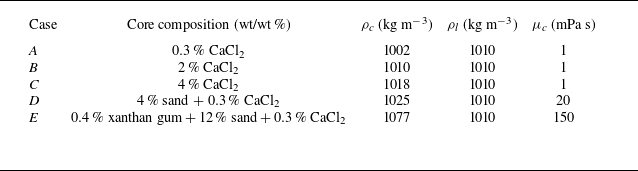


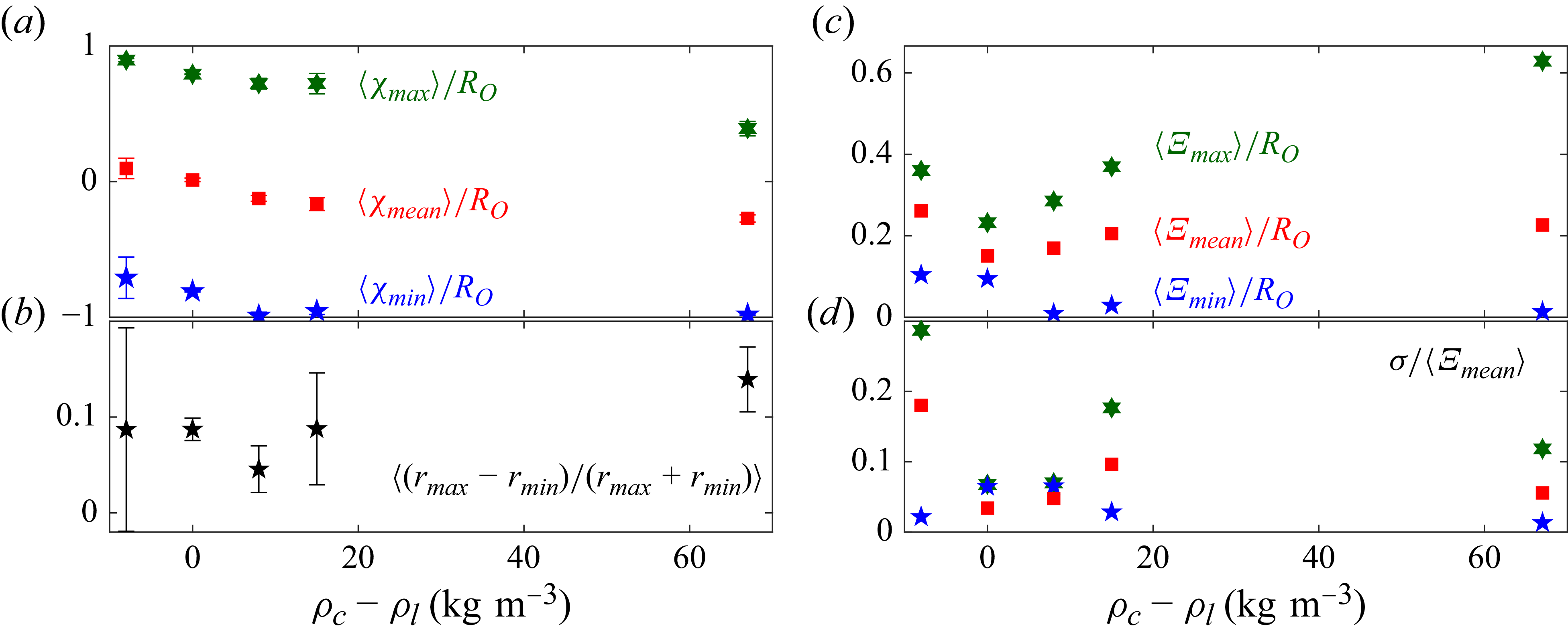


 Open access

