




1. Introduction
Throughout this paper, we denote by (V,Q) a quadratic space over $\mathbb Q$
of signature (n,2) with
$\mathbb Q$
of signature (n,2) with $n\ge 1$
. Associated to V is a Shimura datum
$n\ge 1$
. Associated to V is a Shimura datum $(G,\mathcal{D})$
with reflex field
$(G,\mathcal{D})$
with reflex field $\mathbb Q$
, where the reductive group
$\mathbb Q$
, where the reductive group $G=\mathrm{GSpin}(V)$
of spinor similitudes sits in an exact sequence
$G=\mathrm{GSpin}(V)$
of spinor similitudes sits in an exact sequence
 $$1 \to \mathbb{G}_m \to G \to \mathrm{SO}(V) \to 1.$$
Fixing a $\mathbb Z$
-lattice
$\mathbb Z$
-lattice $L\subset V$
on which the quadratic form takes integral values determines a compact open subgroup
$L\subset V$
on which the quadratic form takes integral values determines a compact open subgroup $K \subset G(\mathbb A_f)$
, and hence a smooth complex orbifold
$K \subset G(\mathbb A_f)$
, and hence a smooth complex orbifold
 $$M (\mathbb C) = G (\mathbb Q) \backslash \mathcal{D} \times G (\mathbb A_f) / K.$$
By the theory of canonical models of Shimura varieties, these are the complex points of a smooth Deligne–Mumford stack $M \to \mathrm{Spec}(\mathbb Q)$
of dimension n.
$M \to \mathrm{Spec}(\mathbb Q)$
of dimension n.
The Shimura variety M carries special cycles of all codimensions, whose arithmetic properties are the subject of a series of conjectures of Kudla [Reference KudlaKud04]. See also [Reference KudlaKud97, Reference Kudla and RapoportKR99, Reference Kudla and RapoportKR00, Reference Kudla, Rapoport and YangKRY06]. The organizing principle of these conjectures is that the special cycles should behave like coefficients of the theta kernel used to lift automorphic forms from a symplectic group to an orthogonal group.
In particular, the special cycles should themselves be, in a suitable sense, the coefficients of a Siegel modular form. This is a now a theorem of Bruinier and Raum, and the goal of this paper is to extend their modularity result to special cycles on the canonical integral model of M.
1.1 Modularity on the generic fiber
For any integer $d\ge 1$
, let
$d\ge 1$
, let $\mathrm{Sym}_d(\mathbb Q)$
be the set of symmetric
$\mathrm{Sym}_d(\mathbb Q)$
be the set of symmetric $d\times d$
matrices with rational coefficients.
$d\times d$
matrices with rational coefficients.
Let $L^\vee \subset V$
be the dual lattice to L under the bilinear form determined by Q. To each
$L^\vee \subset V$
be the dual lattice to L under the bilinear form determined by Q. To each $T \in \mathrm{Sym}_d(\mathbb Q)$
and each tuple of cosets
$T \in \mathrm{Sym}_d(\mathbb Q)$
and each tuple of cosets $\mu=(\mu_1,\ldots,\mu_d) \in (L^\vee / L)^d$
, Kudla associates a special cycle
$\mu=(\mu_1,\ldots,\mu_d) \in (L^\vee / L)^d$
, Kudla associates a special cycle
 $$Z(T,\mu) \to M$$
of pure codimension $\mathrm{rank}(T)$
. The Shimura variety M carries a distinguished line bundle
$\mathrm{rank}(T)$
. The Shimura variety M carries a distinguished line bundle $\omega$
, called the tautological bundle or the line bundle of weight one modular forms, and we follow Kudla in using the intersection pairing in the Chow ring to define the corrected cycle class
$\omega$
, called the tautological bundle or the line bundle of weight one modular forms, and we follow Kudla in using the intersection pairing in the Chow ring to define the corrected cycle class
 \begin{equation}C(T,\mu) = \underbrace{c_1(\omega^{-1}) \cdots c_1(\omega^{-1})}_{d-\mathrm{rank}(T) } \cdot{\kern1.5pt} Z(T,\mu)\in \mathrm{CH}^{d}(M)\end{equation}
in the codimension-d Chow group. Here $c_1(\omega^{-1}) \in \mathrm{CH}^1(M)$
is the first Chern class of
$c_1(\omega^{-1}) \in \mathrm{CH}^1(M)$
is the first Chern class of $\omega^{-1}$
. These Chow groups, like all Chow groups appearing in this paper, are taken with
$\omega^{-1}$
. These Chow groups, like all Chow groups appearing in this paper, are taken with $\mathbb Q$
-coefficients.
$\mathbb Q$
-coefficients.
The metaplectic double cover of $\mathrm{Sp}_{2d}(\mathbb Z)$
acts via the Weil representation
$\mathrm{Sp}_{2d}(\mathbb Z)$
acts via the Weil representation $\omega_{L,d}$
on the finite-dimensional
$\omega_{L,d}$
on the finite-dimensional $\mathbb C$
-vector space
$\mathbb C$
-vector space $S_{L,d}$
of functions
$S_{L,d}$
of functions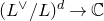 $ (L^\vee / L)^d \to \mathbb C$
. The dual representation has a canonical basis
$ (L^\vee / L)^d \to \mathbb C$
. The dual representation has a canonical basis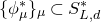 $\{ \phi^*_\mu \}_\mu \subset S_{L,d}^*$
indexed by d-tuples
$\{ \phi^*_\mu \}_\mu \subset S_{L,d}^*$
indexed by d-tuples $\mu$
as above, and so we may form
$\mu$
as above, and so we may form
 $$C(T) = \sum_{ \mu \in (L^\vee / L)^d } C(T,\mu) \otimes \phi^*_\mu \in \mathrm{CH}^{d}(M) \otimes_\mathbb Q S_{L,d}^*.$$
The following conjecture of Kudla was proved by Borcherds [Reference BorcherdsBor99] in the case of codimension $d=1$
(and before that by Gross, Kohnen, and Zagier [Reference Gross, Kohnen and ZagierGKZ87] in the very special case where M is a modular curve). The general case was proved by Bruinier and Raum [Reference Bruinier and Westerholt-RaumBW-R15], using ideas from the thesis of Zhang [Reference ZhangZha09] to reduce to the case
$d=1$
(and before that by Gross, Kohnen, and Zagier [Reference Gross, Kohnen and ZagierGKZ87] in the very special case where M is a modular curve). The general case was proved by Bruinier and Raum [Reference Bruinier and Westerholt-RaumBW-R15], using ideas from the thesis of Zhang [Reference ZhangZha09] to reduce to the case $d=1$
.
$d=1$
.
Theorem A (Bruinier—Raum) The formal generating series
 $$\sum_{ T\in \mathrm{Sym}_d(\mathbb Q) } C(T) \cdot q^T$$
converges to a Siegel modular form of weight ${n}/{2} +1 $
and representation
${n}/{2} +1 $
and representation
 $$\omega_{L,d}^* : \mathrm{Sp}_{2d}(\mathbb Z) \to \mathrm{GL}( S_{L,d}^* ) .$$
Convergence and modularity are understood in the following sense: for any $\mathbb Q$
-linear functional
$\mathbb Q$
-linear functional $\iota : \mathrm{CH}^{d}(M) \to \mathbb C$
, the formal generating series
$\iota : \mathrm{CH}^{d}(M) \to \mathbb C$
, the formal generating series
 $$\sum_{ T\in \mathrm{Sym}_d(\mathbb Q) } \iota( C(T)) \cdot q^T$$
with coefficients in $S_{L,d}^*$
is the q-expansion of a holomorphic Siegel modular form of the stated weight and representation.
$S_{L,d}^*$
is the q-expansion of a holomorphic Siegel modular form of the stated weight and representation.
Strictly speaking, the results of Borcherds and Bruinier–Raum apply to the Chow group of the complex fiber $M(\mathbb C)$
, not the canonical model over
$M(\mathbb C)$
, not the canonical model over $\mathbb Q$
. The proof for the canonical model is the same, using the fact that all Borcherds products on
$\mathbb Q$
. The proof for the canonical model is the same, using the fact that all Borcherds products on $M(\mathbb C)$
are algebraic and defined over the field of rational numbers [Reference Howard and Madapusi PeraHMP20]. In any case, Theorem A in the form stated here is a consequence of our main result, Theorem F.
$M(\mathbb C)$
are algebraic and defined over the field of rational numbers [Reference Howard and Madapusi PeraHMP20]. In any case, Theorem A in the form stated here is a consequence of our main result, Theorem F.
1.2 Modularity on the integral model
Throughout the paper we work with a finite set of primes $\Sigma$
containing all primes p for which the lattice
$\Sigma$
containing all primes p for which the lattice $L_p$
is not maximal (Definition 2.2.1), and abbreviate as follows:
$L_p$
is not maximal (Definition 2.2.1), and abbreviate as follows:
 $$\mathbb Z[\Sigma^{-1}] = \mathbb Z[p^{-1}:\, p\in \Sigma].$$
In [Reference Howard and Madapusi PeraHMP20] one finds the construction of a normal and flat Deligne–Mumford stack
 $$\mathcal{M} \to \mathrm{Spec}( \mathbb Z[\Sigma^{-1}] )$$
with generic fiber M. Soon we will impose stronger assumptions on $\Sigma$
to guarantee that
$\Sigma$
to guarantee that $\mathcal{M}$
is regular.
$\mathcal{M}$
is regular.
For each $T \in \mathrm{Sym}_d(\mathbb Q)$
and
$T \in \mathrm{Sym}_d(\mathbb Q)$
and $\mu \in (L^\vee / L)^d$
we define a naive special cycle
$\mu \in (L^\vee / L)^d$
we define a naive special cycle
 $$\mathcal{Z}(T,\mu) \to \mathcal{M}$$
whose generic fiber agrees with Kudla’s $Z(T,\mu)$
. Our definition of this cycle is via a moduli interpretation. The integral model carries a Kuga–Satake abelian scheme
$Z(T,\mu)$
. Our definition of this cycle is via a moduli interpretation. The integral model carries a Kuga–Satake abelian scheme $\mathcal{A} \to \mathcal{M}$
whose pullback to any
$\mathcal{A} \to \mathcal{M}$
whose pullback to any $\mathcal{M}$
-scheme
$\mathcal{M}$
-scheme $S \to \mathcal{M}$
has a distinguished
$S \to \mathcal{M}$
has a distinguished $\mathbb Z$
-submodule
$\mathbb Z$
-submodule
 $$V(\mathcal{A}_S) \subset \mathrm{End}(\mathcal{A}_S)$$
of special endomorphisms. The space of special endomorphisms is endowed with a positive-definite quadratic form, and the S-points of $\mathcal{Z}(T,\mu)$
are in bijection with d-tuples
$\mathcal{Z}(T,\mu)$
are in bijection with d-tuples $x=(x_1,\ldots, x_d) \in V(\mathcal{A}_S)_\mathbb Q^d$
of special quasi-endomorphisms with moment matrix
$x=(x_1,\ldots, x_d) \in V(\mathcal{A}_S)_\mathbb Q^d$
of special quasi-endomorphisms with moment matrix $Q(x)=T$
, whose denominators are controlled (in a precise sense) by the tuple
$Q(x)=T$
, whose denominators are controlled (in a precise sense) by the tuple $\mu=(\mu_1,\ldots, \mu_d)$
. For example, if
$\mu=(\mu_1,\ldots, \mu_d)$
. For example, if $\mu_i=0$
, then
$\mu_i=0$
, then $x_i \in V(\mathcal{A}_S)$
.
$x_i \in V(\mathcal{A}_S)$
.
We insist on a modular definition of $\mathcal{Z}(T,\mu)$
, as opposed to simply taking the Zariski closure of
$\mathcal{Z}(T,\mu)$
, as opposed to simply taking the Zariski closure of $Z(T,\mu)$
in the integral model, because this is necessary to ensure that the special cycles behave well under intersections and pullbacks to smaller orthogonal Shimura varieties (as in Theorems D and E).
$Z(T,\mu)$
in the integral model, because this is necessary to ensure that the special cycles behave well under intersections and pullbacks to smaller orthogonal Shimura varieties (as in Theorems D and E).
This insistence comes with a high cost: the naive special cycles need not be flat over $\mathbb Z[\Sigma^{-1}]$
, and need not be equidimensional. Although those irreducible components of
$\mathbb Z[\Sigma^{-1}]$
, and need not be equidimensional. Although those irreducible components of $\mathcal{Z}(T,\mu)$
that are flat over
$\mathcal{Z}(T,\mu)$
that are flat over $\mathbb Z[\Sigma^{-1}]$
have codimension
$\mathbb Z[\Sigma^{-1}]$
have codimension $\mathrm{rank}(T)$
in M, there will often be irreducible components of the wrong codimension supported in nonzero characteristics.
$\mathrm{rank}(T)$
in M, there will often be irreducible components of the wrong codimension supported in nonzero characteristics.
The intuition behind this phenomenon is easy to explain. At a characteristic p geometric point $s\to \mathcal{M}$
at which
$s\to \mathcal{M}$
at which $\mathcal{A}_s$
is supersingular, the rank of the space of special endomorphisms
$\mathcal{A}_s$
is supersingular, the rank of the space of special endomorphisms $V(\mathcal{A}_s)$
is as large as it can be (namely,
$V(\mathcal{A}_s)$
is as large as it can be (namely, $n+2$
). This is large enough that if the entries of T are integral and highly divisible, the entire supersingular locus of
$n+2$
). This is large enough that if the entries of T are integral and highly divisible, the entire supersingular locus of $\mathcal{M}_{\mathbb F_p}$
will be contained in
$\mathcal{M}_{\mathbb F_p}$
will be contained in $\mathcal{Z}(T,\mu)$
. It is known [Reference Howard and PappasHP17] that this supersingular locus has dimension roughly
$\mathcal{Z}(T,\mu)$
. It is known [Reference Howard and PappasHP17] that this supersingular locus has dimension roughly $n/2$
, and so the naive cycles
$n/2$
, and so the naive cycles $\mathcal{Z}(T,\mu)$
tend to have vertical irreducible components of dimension
$\mathcal{Z}(T,\mu)$
tend to have vertical irreducible components of dimension $\gt n/2$
, regardless of the rank of T. For this reason, one cannot construct cycle classes on
$\gt n/2$
, regardless of the rank of T. For this reason, one cannot construct cycle classes on $\mathcal{M}$
simply by imitating the construction (1.1).
$\mathcal{M}$
simply by imitating the construction (1.1).
Hypothesis B. For the remainder of the introduction we assume that $\Sigma$
satisfies the hypotheses of Proposition 2.2.4, guaranteeing that
$\Sigma$
satisfies the hypotheses of Proposition 2.2.4, guaranteeing that $\mathcal{M}$
is regular. If, for example, the discriminant of L is odd and squarefree, then
$\mathcal{M}$
is regular. If, for example, the discriminant of L is odd and squarefree, then $\Sigma=\emptyset$
satisfies these hypotheses.
$\Sigma=\emptyset$
satisfies these hypotheses.
We will construct corrected (or perhaps derived) cycle classes
 $$\mathcal{C}(T,\mu) \in \mathrm{CH}^d(\mathcal{M})$$
for all integers $d\ge 1$
, all
$d\ge 1$
, all $T \in \mathrm{Sym}_d(\mathbb Q)$
, and all
$T \in \mathrm{Sym}_d(\mathbb Q)$
, and all $\mu \in (L^\vee / L)^d$
. These cycle classes vanish unless T is positive semi-definite. In § 5.5 we prove the following result, showing that our construction is compatible with the classes already constructed in the generic fiber.
$\mu \in (L^\vee / L)^d$
. These cycle classes vanish unless T is positive semi-definite. In § 5.5 we prove the following result, showing that our construction is compatible with the classes already constructed in the generic fiber.
Theorem C. Restricting $\mathcal{C}(T,\mu)$
to the generic fiber recovers (1.1). Moreover, if the naive cycle
$\mathcal{C}(T,\mu)$
to the generic fiber recovers (1.1). Moreover, if the naive cycle $\mathcal{Z}(T,\mu)$
is equidimensional of codimension
$\mathcal{Z}(T,\mu)$
is equidimensional of codimension $\mathrm{rank}(T)$
in
$\mathrm{rank}(T)$
in $\mathcal{M}$
, then
$\mathcal{M}$
, then
 $$\mathcal{C}(T,\mu) = \underbrace{c_1(\omega^{-1}) \cdots c_1(\omega^{-1})}_{ d-\mathrm{rank}(T) } \cdot{\kern1.5pt} \mathcal{Z}(T,\mu)\in \mathrm{CH}^{d}(\mathcal{M})$$
for a distinguished line bundle $\omega$
on
$\omega$
on $\mathcal{M}$
.
$\mathcal{M}$
.
The next two results show that our corrected cycle classes behave well under intersections and pullbacks to smaller Shimura varieties. Analogous formulas in the generic fiber are proved in [Reference Yuan, Zhang and ZhangYZZ09, Reference KudlaKud21].
The following is stated in the text as Proposition 5.2.1.
Theorem D. For all positive integers d’ and d”, symmetric matrices
 $$T' \in \mathrm{Sym}_{d'}(\mathbb Q) \quad \mbox{and}\quad T'' \in \mathrm{Sym}_{d''}(\mathbb Q),$$
and tuples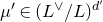 $\mu' \in (L^\vee/L)^{d'}$
and
$\mu' \in (L^\vee/L)^{d'}$
and $\mu'' \in (L^\vee / L)^{d''}$
, we have the intersection formula
$\mu'' \in (L^\vee / L)^{d''}$
, we have the intersection formula
 $$\mathcal{C} (T',\mu') \cdot \mathcal{C} (T'',\mu'')= \sum_{ T = (\begin{smallmatrix} T' & * \\ * & T'' \end{smallmatrix}) } \mathcal{C}(T,\mu)$$
in the codimension $d'+d''$
Chow group of
$d'+d''$
Chow group of $\mathcal{M}$
. On the right-hand side
$\mathcal{M}$
. On the right-hand side $\mu = ( \mu',\mu'')$
is the concatenation of
$\mu = ( \mu',\mu'')$
is the concatenation of $\mu'$
and
$\mu'$
and $\mu''$
.
$\mu''$
.
Now fix a positive-definite self-dual quadratic lattice $\Lambda$
, so that the orthogonal direct sum
$\Lambda$
, so that the orthogonal direct sum
 $$L^\sharp = L \oplus \Lambda$$
has signature $(n+ \mathrm{rank}(\Lambda) , 2)$
. This lattice determines its own Shimura datum, its own regular integral model
$(n+ \mathrm{rank}(\Lambda) , 2)$
. This lattice determines its own Shimura datum, its own regular integral model $\mathcal{M}^\sharp$
over
$\mathcal{M}^\sharp$
over $\mathbb Z[\Sigma^{-1}]$
, and its own family of corrected special cycle classes
$\mathbb Z[\Sigma^{-1}]$
, and its own family of corrected special cycle classes
 $$ \mathcal{C}^\sharp(T^\sharp, \mu^\sharp)\in \mathrm{CH}^d( \mathcal{M}^\sharp)$$
indexed by $T^\sharp \in \mathrm{Sym}_d(\mathbb Q)$
and
$T^\sharp \in \mathrm{Sym}_d(\mathbb Q)$
and $\mu^\sharp \in (L^{\sharp ,\vee} / L^\sharp )^d$
. The isometric embedding
$\mu^\sharp \in (L^{\sharp ,\vee} / L^\sharp )^d$
. The isometric embedding $L \to L^\sharp$
determines a finite and unramified morphism
$L \to L^\sharp$
determines a finite and unramified morphism $f : \mathcal{M} \to \mathcal{M}^\sharp$
, inducing a pullback
$f : \mathcal{M} \to \mathcal{M}^\sharp$
, inducing a pullback
 $$f^* : \mathrm{CH}^d( \mathcal{M}^\sharp) \to \mathrm{CH}^d( \mathcal{M} ).$$
The following theorem is a special case of Proposition 5.6.1.
Theorem E. There is a decomposition
 $$f^* \mathcal{C}^\sharp(T^\sharp, \mu^\sharp) = \sum_{ \substack{ S, T \in \mathrm{Sym}_d(\mathbb Q) \\ S+T = T^\sharp } } R_\Lambda(S) \cdot \mathcal{C} ( T , \mu )$$
of classes in $\mathrm{CH}^d( \mathcal{M})$
, where
$\mathrm{CH}^d( \mathcal{M})$
, where $\mu=\mu^\sharp$
viewed as an element of
$\mu=\mu^\sharp$
viewed as an element of
 $$(L^\vee/L)^d \cong (L^{\sharp,\vee} / L^\sharp)^d,$$
and $R_\Lambda(S)$
is the number of tuples
$R_\Lambda(S)$
is the number of tuples $y\in \Lambda^d$
with moment matrix
$y\in \Lambda^d$
with moment matrix $Q(y)=S$
.
$Q(y)=S$
.
Our main result, stated in the text as Theorem 6.2.1, is an extension of the Bruinier–Raum theorem (née Kudla’s modularity conjecture) to the integral model $\mathcal{M}$
.
$\mathcal{M}$
.
Theorem F. The formal generating series
 $$\sum_{ T\in \mathrm{Sym}_d(\mathbb Q) } \mathcal{C}(T) \cdot q^T$$
with coefficients
 $$\mathcal{C}(T) \stackrel{\mathrm{def}}{=} \sum_{ \mu \in (L^\vee / L)^d } \mathcal{C}(T,\mu) \otimes \phi^*_\mu \in \mathrm{CH}^{d}(\mathcal{M}) \otimes_\mathbb Q S_{L,d}^*$$
converges to a holomorphic Siegel modular form of weight ${n}/{2} +1 $
and representation
${n}/{2} +1 $
and representation $\omega_{L,d}^*$
.
$\omega_{L,d}^*$
.
Using the finite-dimensionality of the space of holomorphic Siegel modular forms of a fixed weight and representation, one immediately obtains the following corollary of Theorem F.
Corollary G. As $ T \in \mathrm{Sym}_d(\mathbb Q)$
and
$ T \in \mathrm{Sym}_d(\mathbb Q)$
and $\mu\in (L^\vee / L)^d$
vary, the cycle classes
$\mu\in (L^\vee / L)^d$
vary, the cycle classes $\mathcal{C}(T,\mu)$
span a finite-dimensional subspace of
$\mathcal{C}(T,\mu)$
span a finite-dimensional subspace of $\mathrm{CH}^{d}(\mathcal{M})$
.
$\mathrm{CH}^{d}(\mathcal{M})$
.
In [Reference MadapusiMad22], the second author used methods from derived algebraic geometry to construct derived cycle classes on essentially every Shimura variety to which Kudla’s conjectures apply, and showed that they satisfy certain anticipated properties, giving an alternative proof of Theorems C, D, and E as special cases. However, the lack of Borcherds products in this generality has so far prevented progress towards any version of the main Theorem F in settings beyond that treated in this paper.
1.3 Outline of the paper
In § 2 we recall the essentials of the theory of integral models of orthogonal Shimura varieties, and the families of special cycles that live on them. Our main reference for this material is [Reference Howard and Madapusi PeraHMP20], although many of the results we cite appeared before that in [Reference Madapusi PeraMP16, Reference Andreatta, Goren, Howard and Madapusi PeraAGH+17, Reference Andreatta, Goren, Howard and Madapusi PeraAGH+18].
The first new results appear in § 3, in which we investigate some of the finer geometric structure of the special cycles $\mathcal{Z}(T,\mu)$
, under the assumption that
$\mathcal{Z}(T,\mu)$
, under the assumption that $\mathrm{rank}(T)$
is small compared with n. We remark that the notion of smallness here depends on the lattice L, not just n, but if L is self-dual, then small means
$\mathrm{rank}(T)$
is small compared with n. We remark that the notion of smallness here depends on the lattice L, not just n, but if L is self-dual, then small means $\mathrm{rank}(T) \le (n-4)/3$
. What we show is that in this situation the special cycle
$\mathrm{rank}(T) \le (n-4)/3$
. What we show is that in this situation the special cycle $\mathcal{Z}(T,\mu)$
is flat over
$\mathcal{Z}(T,\mu)$
is flat over $\mathbb Z[\Sigma^{-1}]$
, and equidimensional of the expected codimension
$\mathbb Z[\Sigma^{-1}]$
, and equidimensional of the expected codimension $\mathrm{rank}(T)$
in
$\mathrm{rank}(T)$
in $\mathcal{M}$
. In particular, when
$\mathcal{M}$
. In particular, when $\mathrm{rank}(T)$
is small one can define a corrected cycle class
$\mathrm{rank}(T)$
is small one can define a corrected cycle class $\mathcal{C}(T,\mu)$
by imitating (1.1).
$\mathcal{C}(T,\mu)$
by imitating (1.1).
The generic fiber $Z(T,\mu)$
is smooth. However, even when
$Z(T,\mu)$
is smooth. However, even when $\mathrm{rank}(T)$
is small the special cycle
$\mathrm{rank}(T)$
is small the special cycle $\mathcal{Z}(T,\mu)$
need not be regular, or even locally integral; it will often have irreducible components that cross in positive characteristic. However, we can say enough about the geometry of its irreducible components to prove in § 3 the injectivity of the restriction map to the generic fiber
$\mathcal{Z}(T,\mu)$
need not be regular, or even locally integral; it will often have irreducible components that cross in positive characteristic. However, we can say enough about the geometry of its irreducible components to prove in § 3 the injectivity of the restriction map to the generic fiber
 $$\mathrm{CH}^1( \mathcal{Z}(T,\mu) ) \to \mathrm{CH}^1( Z(T,\mu) ) .$$
Now suppose that d is small relative to n. Having shown in § 3 that the special cycles $\mathcal{Z}(T,\mu)$
with
$\mathcal{Z}(T,\mu)$
with $T\in \mathrm{Sym}_d(\mathbb Q)$
are well-behaved, we prove in § 4 that the generating series of corrected cycles
$T\in \mathrm{Sym}_d(\mathbb Q)$
are well-behaved, we prove in § 4 that the generating series of corrected cycles $\mathcal{C}(T,\mu)$
is modular. This is done by fixing
$\mathcal{C}(T,\mu)$
is modular. This is done by fixing $T \in \mathrm{Sym}_d(\mathbb Q)$
and
$T \in \mathrm{Sym}_d(\mathbb Q)$
and $\mu \in (L^\vee/L)^d$
, and considering the family of special cycles
$\mu \in (L^\vee/L)^d$
, and considering the family of special cycles $\mathcal{Z}(T',\mu')$
in which
$\mathcal{Z}(T',\mu')$
in which $T'\in \mathrm{Sym}_{d+1}(\mathbb Q)$
has upper left
$T'\in \mathrm{Sym}_{d+1}(\mathbb Q)$
has upper left $d\times d$
block T, and the first d components of
$d\times d$
block T, and the first d components of $\mu'$
are equal to
$\mu'$
are equal to $\mu$
. As
$\mu$
. As $(T',\mu')$
varies, the resulting special cycles can be viewed as divisors
$(T',\mu')$
varies, the resulting special cycles can be viewed as divisors
 $$ \mathcal{Z}(T,'\mu') \to \mathcal{Z}(T,\mu) $$
on the fixed $\mathcal{Z}(T,\mu)$
, and we prove that they form the coefficients of a Jacobi form of index T valued in
$\mathcal{Z}(T,\mu)$
, and we prove that they form the coefficients of a Jacobi form of index T valued in $\mathrm{CH}^1(\mathcal{Z}(T,\,u))$
. The essential point is that, by the preceding paragraph, it suffices to check this in the generic fiber. In the generic fiber it follows, as in [Reference ZhangZha09], by realizing
$\mathrm{CH}^1(\mathcal{Z}(T,\,u))$
. The essential point is that, by the preceding paragraph, it suffices to check this in the generic fiber. In the generic fiber it follows, as in [Reference ZhangZha09], by realizing $Z(T,\mu)$
as a union of orthogonal Shimura varieties and applying the modularity results of Borcherds [Reference BorcherdsBor99]. By the main result of [Reference Bruinier and Westerholt-RaumBW-R15], this Jacobi modularity, for every pair
$Z(T,\mu)$
as a union of orthogonal Shimura varieties and applying the modularity results of Borcherds [Reference BorcherdsBor99]. By the main result of [Reference Bruinier and Westerholt-RaumBW-R15], this Jacobi modularity, for every pair $(T,\mu)$
, implies that Theorem F holds under our assumption that d is small relative to n.
$(T,\mu)$
, implies that Theorem F holds under our assumption that d is small relative to n.
To remove the assumption that d is small, we must first overcome the lack of equidimensionality of $\mathcal{Z}(T,\mu)$
. In § 5 we define the corrected classes
$\mathcal{Z}(T,\mu)$
. In § 5 we define the corrected classes $\mathcal{C}(T,\mu)$
needed even to state Theorem F in full generality. The construction itself is somewhat formal. It relies on the close relations between Chow groups and K-theory proved in [Reference Gillet and SouléGS87] for schemes, and extended to stacks in [Reference GilletGil84] and [Reference GilletGil09].
$\mathcal{C}(T,\mu)$
needed even to state Theorem F in full generality. The construction itself is somewhat formal. It relies on the close relations between Chow groups and K-theory proved in [Reference Gillet and SouléGS87] for schemes, and extended to stacks in [Reference GilletGil84] and [Reference GilletGil09].
Theorem D follows directly from the definition of $\mathcal{C}(T,\mu)$
, but Theorems C and E seem to lie much deeper. If the modularity of Theorem F is to hold, the classes
$\mathcal{C}(T,\mu)$
, but Theorems C and E seem to lie much deeper. If the modularity of Theorem F is to hold, the classes $\mathcal{C}(T)$
of that theorem must satisfy the linear invariance property
$\mathcal{C}(T)$
of that theorem must satisfy the linear invariance property
 $$ \mathcal{C}(T) = \mathcal{C}({}^t A T A) $$
for any $A \in \mathrm{GL}_d(\mathbb Z)$
. While the analogous invariance of the naive special cycles
$A \in \mathrm{GL}_d(\mathbb Z)$
. While the analogous invariance of the naive special cycles $\mathcal{Z}(T,\mu)$
is obvious, the invariance of the corrected cycle classes encodes subtle information about self-intersections. We prove this invariance in Proposition 5.4.1 by globalizing the arguments used in [Reference HowardHow19] to prove the analogous invariance for special cycles on unitary Rapoport–Zink spaces. The linear invariance is then used in an essential way in the proofs of Theorems C and E.
$\mathcal{Z}(T,\mu)$
is obvious, the invariance of the corrected cycle classes encodes subtle information about self-intersections. We prove this invariance in Proposition 5.4.1 by globalizing the arguments used in [Reference HowardHow19] to prove the analogous invariance for special cycles on unitary Rapoport–Zink spaces. The linear invariance is then used in an essential way in the proofs of Theorems C and E.
Finally, in § 6 we prove Theorem F in full generality. The idea here is simple enough to explain in a few sentences. To prove the modularity of the generating series
 $$\phi(\tau) = \sum_T \mathcal{C}(T) q^T$$
with coefficients in $\mathrm{CH}^d(\mathcal{M}) \otimes S_{L,d}^*$
, pick an auxiliary positive definite self-dual lattice
$\mathrm{CH}^d(\mathcal{M}) \otimes S_{L,d}^*$
, pick an auxiliary positive definite self-dual lattice $\Lambda$
. As in Theorem E, we may form the quadratic lattice
$\Lambda$
. As in Theorem E, we may form the quadratic lattice $L^\sharp = L \oplus \Lambda$
of signature
$L^\sharp = L \oplus \Lambda$
of signature $(n^\sharp,2)$
, and the corresponding generating series
$(n^\sharp,2)$
, and the corresponding generating series
 $$\phi^\sharp(\tau) = \sum_T \mathcal{C}^\sharp (T) q^T$$
with coefficients in $\mathrm{CH}^d(\mathcal{M}^\sharp) \otimes S_{L^\sharp,d}^*$
. One can rephrase the pullback formula of Theorem E as a factorization
$\mathrm{CH}^d(\mathcal{M}^\sharp) \otimes S_{L^\sharp,d}^*$
. One can rephrase the pullback formula of Theorem E as a factorization
 $$f^* \phi^\sharp(\tau) = \phi(\tau) \cdot\vartheta_{\Lambda,d}(\tau),$$
where $\vartheta_{\Lambda,d}(\tau)$
is the usual scalar-valued genus d Siegel theta series determined by the lattice
$\vartheta_{\Lambda,d}(\tau)$
is the usual scalar-valued genus d Siegel theta series determined by the lattice $\Lambda$
. If we choose
$\Lambda$
. If we choose $\Lambda$
to have large rank, then d will be much smaller than
$\Lambda$
to have large rank, then d will be much smaller than $n^\sharp$
, and so the modularity of the left-hand side follows from the results of § 3. Combining this with the modularity of
$n^\sharp$
, and so the modularity of the left-hand side follows from the results of § 3. Combining this with the modularity of $\vartheta_{\Lambda,d}(\tau)$
shows that
$\vartheta_{\Lambda,d}(\tau)$
shows that $\phi(\tau)$
is a meromorphic Siegel modular form with poles supported on the vanishing locus of
$\phi(\tau)$
is a meromorphic Siegel modular form with poles supported on the vanishing locus of $\vartheta_{\Lambda,d}(\tau)$
. The lattice
$\vartheta_{\Lambda,d}(\tau)$
. The lattice $\Lambda$
, being an arbitrary and auxiliary choice, can then be varied to show that
$\Lambda$
, being an arbitrary and auxiliary choice, can then be varied to show that $\phi(\tau)$
is actually holomorphic.
$\phi(\tau)$
is actually holomorphic.
2. The Shimura variety and its special cycles
This section contains little in the way of new results. Our goal is to recall from [Reference Howard and Madapusi PeraHMP20] the integral model of the Shimura variety associated to a quadratic space (V,Q) over $\mathbb Q$
of signature (n,2), and the special cycles on that integral model.
$\mathbb Q$
of signature (n,2), and the special cycles on that integral model.
2.1 The Shimura variety
As in the introduction, we denote by $G=\mathrm{GSpin}(V)$
the group of spinor similitudes of V. By construction, G is an algebraic subgroup of the group of units of the Clifford algebra C(V). The bilinear form associated to the quadratic form Q is denoted by
$G=\mathrm{GSpin}(V)$
the group of spinor similitudes of V. By construction, G is an algebraic subgroup of the group of units of the Clifford algebra C(V). The bilinear form associated to the quadratic form Q is denoted by
 \begin{equation} [x,y]=Q(x+y)-Q(x)-Q(y). \end{equation}
If we define a Hermitian symmetric domain
 $$\mathcal{D} = \{ z\in V_\mathbb C : [z,z]=0, [z,\overline{z}] \lt 0 \} / \mathbb C^\times \subset \mathbb{P}(V_\mathbb C),$$
then the pair $(G,\mathcal{D})$
is a Hodge-type Shimura datum with reflex field
$(G,\mathcal{D})$
is a Hodge-type Shimura datum with reflex field $\mathbb Q$
.
$\mathbb Q$
.
Any choice of compact open subgroup in $G(\mathbb A_f)$
determines a Shimura variety, but we shall only consider subgroups of a particular type. Fix a
$G(\mathbb A_f)$
determines a Shimura variety, but we shall only consider subgroups of a particular type. Fix a $\mathbb Z$
-lattice
$\mathbb Z$
-lattice $L\subset V$
satisfying
$L\subset V$
satisfying $Q(L) \subset \mathbb Z$
, and let
$Q(L) \subset \mathbb Z$
, and let $L^\vee$
denote the dual lattice relative to the bilinear form (2.1). For every prime p, abbreviate
$L^\vee$
denote the dual lattice relative to the bilinear form (2.1). For every prime p, abbreviate $L_p=L\otimes \mathbb Z_p$
, and let
$L_p=L\otimes \mathbb Z_p$
, and let $C(L_p) \subset C(V_p)$
be the
$C(L_p) \subset C(V_p)$
be the $\mathbb Z_p$
-subalgebra generated by
$\mathbb Z_p$
-subalgebra generated by $L_p \subset C(V_p)$
. The compact open subgroup
$L_p \subset C(V_p)$
. The compact open subgroup
 \begin{equation}K_p = G(\mathbb Q_p) \cap C(L_p)^\times\end{equation}
of $G(\mathbb Q_p)$
is the largest one that stabilizes the lattice
$G(\mathbb Q_p)$
is the largest one that stabilizes the lattice $L_p$
and acts trivially on the discriminant group
$L_p$
and acts trivially on the discriminant group $L_p^\vee / L_p$
. The compact open subgroup
$L_p^\vee / L_p$
. The compact open subgroup
 \begin{equation}K = \prod_p K_p \subset G (\mathbb A_f)\end{equation}
determines a complex orbifold
 $$M (\mathbb C) = G (\mathbb Q) \backslash \mathcal{D} \times G (\mathbb A_f) / K,$$
whose canonical model $M \to \mathrm{Spec}(\mathbb Q)$
is a smooth Deligne–Mumford stack of dimension n.
$M \to \mathrm{Spec}(\mathbb Q)$
is a smooth Deligne–Mumford stack of dimension n.
Remark 2.1.1. For a given prime p, one can make the compact open subgroup $K_p \subset G(\mathbb Q_p)$
as small as one wants by replacing L by
$K_p \subset G(\mathbb Q_p)$
as small as one wants by replacing L by $p^kL$
for some
$p^kL$
for some $k\gg 0$
. In particular, one is free to assume that K is neat, so that M is a scheme rather than a stack. The penalty for doing so appears in the next subsection, when we form the integral model of M over
$k\gg 0$
. In particular, one is free to assume that K is neat, so that M is a scheme rather than a stack. The penalty for doing so appears in the next subsection, when we form the integral model of M over $\mathbb Z [ \Sigma^{-1}]$
. This smaller choice of L will not be maximal at p, and so p must be included in the finite set of bad primes
$\mathbb Z [ \Sigma^{-1}]$
. This smaller choice of L will not be maximal at p, and so p must be included in the finite set of bad primes $\Sigma$
that we invert.
$\Sigma$
that we invert.
Remark 2.1.2. As the derived subgroup $\mathrm{Spin}(V)\subset G$
is simply connected, we find by [Reference DeligneDel71, (2.7.1)] that the space of connected components of
$\mathrm{Spin}(V)\subset G$
is simply connected, we find by [Reference DeligneDel71, (2.7.1)] that the space of connected components of $M(\mathbb C)$
is a torsor under
$M(\mathbb C)$
is a torsor under
 $$\pi_0(\mathbb A^\times/\mathbb Q^\times\nu(K)\mathbb R_{\gt 0})\cong \mathbb A_f^\times/\mathbb Q_{\gt 0}^\times\nu(K),$$
where $\nu:G\to \mathbb{G}_m$
is the spinor norm. It follows that if
$\nu:G\to \mathbb{G}_m$
is the spinor norm. It follows that if $\nu(K) = \widehat{\mathbb Z}^\times$
, then M is geometrically connected. This holds in particular if L contains isotropic vectors
$\nu(K) = \widehat{\mathbb Z}^\times$
, then M is geometrically connected. This holds in particular if L contains isotropic vectors $\ell,\ell_*\in L$
with
$\ell,\ell_*\in L$
with $[\ell,\ell_*] = 1$
.
$[\ell,\ell_*] = 1$
.
Suppose $V^\sharp$
is a quadratic space of signature
$V^\sharp$
is a quadratic space of signature $(n^\sharp,2)$
, and let
$(n^\sharp,2)$
, and let $(G^\sharp, \mathcal{D}^\sharp)$
be the associated Shimura datum. A
$(G^\sharp, \mathcal{D}^\sharp)$
be the associated Shimura datum. A $\mathbb Z$
-lattice
$\mathbb Z$
-lattice $L^\sharp \subset V^\sharp$
on which the quadratic form is
$L^\sharp \subset V^\sharp$
on which the quadratic form is $\mathbb Z$
-valued determines a compact open subgroup
$\mathbb Z$
-valued determines a compact open subgroup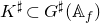 $K^\sharp \subset G^\sharp(\mathbb A_f)$
as in (2.3), and hence a Shimura variety
$K^\sharp \subset G^\sharp(\mathbb A_f)$
as in (2.3), and hence a Shimura variety $M^\sharp$
over
$M^\sharp$
over $\mathbb Q$
.
$\mathbb Q$
.
An isometric embedding $L\hookrightarrow L^\sharp$
determines an injection of Clifford algebras
$L\hookrightarrow L^\sharp$
determines an injection of Clifford algebras $C(V) \to C(V^\sharp)$
, which then induces a closed immersion of algebraic groups
$C(V) \to C(V^\sharp)$
, which then induces a closed immersion of algebraic groups $G \hookrightarrow G^\sharp$
exhibiting G as the pointwise stabilizer of the orthogonal complement of
$G \hookrightarrow G^\sharp$
exhibiting G as the pointwise stabilizer of the orthogonal complement of $V \subset V^\sharp$
. This embedding of groups induces an embedding of Shimura data
$V \subset V^\sharp$
. This embedding of groups induces an embedding of Shimura data
 $$(G , \mathcal{D})\to (G^\sharp ,\mathcal{D}^\sharp).$$
As $K \subset K^\sharp \cap G(\mathbb A_f)$
, the theory of canonical models implies the existence of a finite and unramified morphism
$K \subset K^\sharp \cap G(\mathbb A_f)$
, the theory of canonical models implies the existence of a finite and unramified morphism
 \begin{equation}M \to M^\sharp\end{equation}
of Deligne–Mumford stacks, given on $\mathbb C$
-points by
$\mathbb C$
-points by
 $$G(\mathbb Q) \backslash \mathcal{D} \times G (\mathbb A_f) / K \xrightarrow{ ( z,g) \mapsto (z,g) } G^\sharp (\mathbb Q) \backslash \mathcal{D} ^\sharp \times G^\sharp (\mathbb A_f) / K^\sharp.$$
More generally, for any $g\in G^\sharp (\mathbb A_f)$
we may replace L by the quadratic lattice
$g\in G^\sharp (\mathbb A_f)$
we may replace L by the quadratic lattice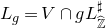 $L_g = V \cap g L^\sharp_{\widehat{\mathbb Z}}$
throughout the previous discussion. The compact open subgroup associated to this lattice is
$L_g = V \cap g L^\sharp_{\widehat{\mathbb Z}}$
throughout the previous discussion. The compact open subgroup associated to this lattice is
 $$K_g = gK^\sharp g^{-1}\cap G(\mathbb A_f),$$
and the associated Shimura variety $M_g$
admits a finite unramified morphism
$M_g$
admits a finite unramified morphism
 \begin{equation}M_g \to M^\sharp\end{equation}
given on $\mathbb C$
-points by
$\mathbb C$
-points by
 $$G(\mathbb Q) \backslash \mathcal{D} \times G (\mathbb A_f) / K_g\xrightarrow{ ( z,h) \mapsto (z,hg) }G^\sharp(\mathbb Q) \backslash \mathcal{D} ^\sharp \times G^\sharp (\mathbb A_f) / K^\sharp.$$
2.2 Integral models and special cycles
We use [Reference Howard and Madapusi PeraHMP20, 6] as our primary reference for the theory of integral models of M. See also [Reference Madapusi PeraKMP16, Reference Andreatta, Goren, Howard and Madapusi PeraAGH+17, Reference Andreatta, Goren, Howard and Madapusi PeraAGH+18].
Definition 2.2.1. For a prime p, we say that $L_p$
is maximal if there is no larger
$L_p$
is maximal if there is no larger $\mathbb Z_p$
-lattice of
$\mathbb Z_p$
-lattice of $V_p$
on which Q is
$V_p$
on which Q is $\mathbb Z_p$
-valued. We say that
$\mathbb Z_p$
-valued. We say that $L_p$
is hyperspecial if either:
$L_p$
is hyperspecial if either:
-
• $L_p$
is self-dual; or
$L_p$
is self-dual; or -
•
$p=2$
,
$\dim_\mathbb Q(V)$
is odd, and
$[ L^\vee_2 : L_2 ]$
is not divisible by 4.


We call L maximal or hyperspecial if $L_p$
has this property for every p.
$L_p$
has this property for every p.
Remark 2.2.2. Note that
 $$ L_p \mbox{ self-dual} \implies L_p \mbox{ hyperspecial} \implies L_p \mbox{ maximal}, $$
and that $ L_p \mbox{ not maximal} \implies p^2 \mbox{ divides } [L^\vee : L].$
Remark 2.2.3. A hyperspecial lattice $L_p$
was called an almost self-dual lattice in [Reference Howard and Madapusi PeraHMP20, Definition 6.1.1]. If
$L_p$
was called an almost self-dual lattice in [Reference Howard and Madapusi PeraHMP20, Definition 6.1.1]. If $L_p$
is hyperspecial, then (2.2) is a hyperspecial subgroup in the usual sense, justifying the terminology. See [Reference Howard and Madapusi PeraHMP20, 6.3].
$L_p$
is hyperspecial, then (2.2) is a hyperspecial subgroup in the usual sense, justifying the terminology. See [Reference Howard and Madapusi PeraHMP20, 6.3].
As in the introduction, $\Sigma$
will always denote a finite set of primes containing all primes p for which
$\Sigma$
will always denote a finite set of primes containing all primes p for which $L_p$
is not maximal. The constructions of [Reference Howard and Madapusi PeraHMP20, 6] provide us with a normal and flat Deligne–Mumford stack
$L_p$
is not maximal. The constructions of [Reference Howard and Madapusi PeraHMP20, 6] provide us with a normal and flat Deligne–Mumford stack
 $$\mathcal{M} \to \mathrm{Spec}(\mathbb Z[\Sigma^{-1}])$$
with generic fiber M. Strictly speaking, [Reference Howard and Madapusi PeraHMP20, 6] constructs an integral model over the localization $\mathbb Z_{(p)}$
for any p at which
$\mathbb Z_{(p)}$
for any p at which $L_p$
is maximal; these can be collated into a model over
$L_p$
is maximal; these can be collated into a model over $\mathbb Z[\Sigma^{-1}]$
as in [Reference Howard and Madapusi PeraHMP20, 9.1].
$\mathbb Z[\Sigma^{-1}]$
as in [Reference Howard and Madapusi PeraHMP20, 9.1].
Proposition 2.2.4. Assume that $\Sigma$
satisfies both:
$\Sigma$
satisfies both:
-
•
$p\in \Sigma$
for all primes p such that
$p^2$
divides
$[ L^\vee : L]$
; -
• if
$L_2$
is not hyperspecial, then
$2\in \Sigma$
.


The stack $\mathcal{M}$
is regular, and for any
$\mathcal{M}$
is regular, and for any $p \not\in \Sigma$
the localization
$p \not\in \Sigma$
the localization $\mathcal{M}_{\mathbb Z_{(p)}}$
is the canonical integral model of M in the sense of [Reference Madapusi PeraMP16, Definition 4.3].
$\mathcal{M}_{\mathbb Z_{(p)}}$
is the canonical integral model of M in the sense of [Reference Madapusi PeraMP16, Definition 4.3].
Proof. If $p\not\in \Sigma$
, then either
$p\not\in \Sigma$
, then either $L_p$
is hyperspecial, or p is odd and
$L_p$
is hyperspecial, or p is odd and $\mathrm{ord}_p( [L^\vee : L]) =1$
. In the former case
$\mathrm{ord}_p( [L^\vee : L]) =1$
. In the former case $\mathcal{M}_{\mathbb Z_{(p)}}$
is the smooth canonical integral model of M over
$\mathcal{M}_{\mathbb Z_{(p)}}$
is the smooth canonical integral model of M over $\mathbb Z_{(p)}$
constructed [Reference KisinKis10, Reference Madapusi PeraKMP16]. In the latter case
$\mathbb Z_{(p)}$
constructed [Reference KisinKis10, Reference Madapusi PeraKMP16]. In the latter case $\mathcal{M}_{\mathbb Z_{(p)}}$
is the regular canonical integral model constructed in [Reference Madapusi PeraMP16, Theorem 7.4].
$\mathcal{M}_{\mathbb Z_{(p)}}$
is the regular canonical integral model constructed in [Reference Madapusi PeraMP16, Theorem 7.4].
Remark 2.2.5. By Proposition 2.2.4, if $[L^\vee : L]$
is odd and squarefree, then
$[L^\vee : L]$
is odd and squarefree, then $\mathcal{M}$
is regular for any choice of
$\mathcal{M}$
is regular for any choice of $\Sigma$
, including
$\Sigma$
, including $\Sigma=\emptyset$
.
$\Sigma=\emptyset$
.
Remark 2.2.6. If $p \not\in \Sigma$
is an odd prime with
$p \not\in \Sigma$
is an odd prime with $\mathrm{ord}_p([L^\vee:L]) = 2$
, the model
$\mathrm{ord}_p([L^\vee:L]) = 2$
, the model $\mathcal{M}_{\mathbb Z_{(p)}}$
is no longer regular. It does admit a regular resolution constructed by Pappas and Zachos [Reference Pappas and ZachosPZ22], which has a certain canonicity property formulated by Pappas [Reference PappasPap23], and now proven by Daniels and Youcis [Reference Daniels and YoucisDY24]. It would be interesting to extend the results of this paper to these regular integral models as well.
$\mathcal{M}_{\mathbb Z_{(p)}}$
is no longer regular. It does admit a regular resolution constructed by Pappas and Zachos [Reference Pappas and ZachosPZ22], which has a certain canonicity property formulated by Pappas [Reference PappasPap23], and now proven by Daniels and Youcis [Reference Daniels and YoucisDY24]. It would be interesting to extend the results of this paper to these regular integral models as well.
The integral model $\mathcal{M}$
comes with a tautological line bundle
$\mathcal{M}$
comes with a tautological line bundle
 \begin{equation}\omega \in \mathrm{Pic}( \mathcal{M} ),\end{equation}
called the line bundle of weight one modular forms in [Reference Howard and Madapusi PeraHMP20, 6.3], whose fiber at a complex point
 $$(z,g) \in G (\mathbb Q) \backslash \mathcal{D} \times G(\mathbb A_f) / K \cong \mathcal{M} (\mathbb C)$$
is identified with the isotropic line $\mathbb C z \subset V_\mathbb C$
.
$\mathbb C z \subset V_\mathbb C$
.
Remark 2.2.7. Recall from (2.4) the morphism $M \to M^\sharp$
of canonical models induced by an isometric embedding
$M \to M^\sharp$
of canonical models induced by an isometric embedding $L \hookrightarrow L^\sharp$
. If
$L \hookrightarrow L^\sharp$
. If $\Sigma$
also contains all primes p for which
$\Sigma$
also contains all primes p for which $L_p^\sharp$
is not maximal, then
$L_p^\sharp$
is not maximal, then $M^\sharp$
has its own flat and normal integral model
$M^\sharp$
has its own flat and normal integral model
 $$\mathcal{M}^\sharp \to \mathrm{Spec}(\mathbb Z[\Sigma^{-1}])$$
and the morphism above extends uniquely to a finite morphism
 $$\mathcal{M} \to \mathcal{M}^\sharp.$$
The tautological bundle on $\omega^\sharp$
on the target pulls back to the tautological bundle
$\omega^\sharp$
on the target pulls back to the tautological bundle $\omega$
on the source. See [Reference Howard and Madapusi PeraHMP20, Proposition 6.6.1].
$\omega$
on the source. See [Reference Howard and Madapusi PeraHMP20, Proposition 6.6.1].
The integral model $\mathcal{M}$
also comes with a Kuga–Satake abelian scheme
$\mathcal{M}$
also comes with a Kuga–Satake abelian scheme $\mathcal{A} \to \mathcal{M}.$
For every scheme
$\mathcal{A} \to \mathcal{M}.$
For every scheme $S\to \mathcal{M}$
there is a canonical (e.g. functorial in S) subspace
$S\to \mathcal{M}$
there is a canonical (e.g. functorial in S) subspace
 $$ V(\mathcal{A}_S)_\mathbb Q\subset \mathrm{End}(\mathcal{A}_S)_{\mathbb Q} $$
of special quasi-endomorphisms, carrying a positive-definite quadratic form defined by $ Q(x) = x\circ x $
as elements of
$ Q(x) = x\circ x $
as elements of $\mathbb Q\subset \mathrm{End}(\mathcal{A}_S)_\mathbb Q$
. More generally, for every coset
$\mathbb Q\subset \mathrm{End}(\mathcal{A}_S)_\mathbb Q$
. More generally, for every coset $\mu\in L^\vee/L$
there is a subset
$\mu\in L^\vee/L$
there is a subset
 $$ V_\mu(\mathcal{A}_S)\subset V(\mathcal{A}_S)_\mathbb Q $$
of special quasi-endomorphisms with denominator $\mu$
. When
$\mu$
. When $\mu=0$
this agrees with
$\mu=0$
this agrees with
 $$ V(\mathcal{A}_S) \stackrel{\mathrm{def}}{=} V(\mathcal{A}_S)_\mathbb Q\cap \mathrm{End}(\mathcal{A}_S) , $$
and the subsets indexed by distinct cosets are disjoint. Again, we refer the reader to [Reference Howard and Madapusi PeraHMP20, 6] for details.
Remark 2.2.8. For any $x\in V_\mu(\mathcal{A}_S)$
, we have
$x\in V_\mu(\mathcal{A}_S)$
, we have
 $$Q(x) \equiv Q(\tilde{\mu})\pmod{\mathbb Z},$$
where $\tilde{\mu}\in L^\vee$
is any lift of
$\tilde{\mu}\in L^\vee$
is any lift of $\mu$
. See [Reference Andreatta, Goren, Howard and Madapusi PeraAGH+18, Proposition 4.5.4].
$\mu$
. See [Reference Andreatta, Goren, Howard and Madapusi PeraAGH+18, Proposition 4.5.4].
Remark 2.2.9. Suppose $s\in \mathcal{M}(\mathbb C)$
is a complex point corresponding to a pair
$s\in \mathcal{M}(\mathbb C)$
is a complex point corresponding to a pair
 $$(z,g) \in G (\mathbb Q) \backslash \mathcal{D} \times G(\mathbb A_f) / K \cong \mathcal{M} (\mathbb C).$$
Recalling that $z\in V_\mathbb C$
is a nonzero isotropic vector, there is a canonical identification
$z\in V_\mathbb C$
is a nonzero isotropic vector, there is a canonical identification
 $$V(\mathcal{A}_s)_\mathbb Q = \{x\in V : \, [x,z] = 0\} ,$$
respecting quadratic forms and satisfying
 $$V_\mu(\mathcal{A}_s) = \{x\in V :\, x\in g \cdot ( \mu + L_{\widehat{\mathbb Z}} ) \} .$$
Here we are regarding $\mu + L_{\widehat{\mathbb Z}} \subset V_{\mathbb A_f}$
.
$\mu + L_{\widehat{\mathbb Z}} \subset V_{\mathbb A_f}$
.
Definition 2.2.10. For $t\in \mathbb Q$
and
$t\in \mathbb Q$
and $\mu \in L^\vee/L$
, the special divisor
$\mu \in L^\vee/L$
, the special divisor
 \begin{equation}\mathcal{Z} (t,\mu) \to \mathcal{M}\end{equation}
is the finite, unramified, and relatively representable $\mathcal{M}$
-stack whose functor of points assigns to any scheme
$\mathcal{M}$
-stack whose functor of points assigns to any scheme $S\to \mathcal{M}$
the set
$S\to \mathcal{M}$
the set
 $$\mathcal{Z}(t,\mu)(S) = \{ x \in V_\mu(\mathcal{A}_S) : Q(x) = t \}.$$
The definition of special divisors can be generalized as follows.
Definition 2.2.11. Given an integer $d \ge 1$
, a matrix
$d \ge 1$
, a matrix $T\in \mathrm{Sym}_d(\mathbb Q)$
, and a tuple of cosets
$T\in \mathrm{Sym}_d(\mathbb Q)$
, and a tuple of cosets $\mu = (\mu_1 ,\ldots, \mu_d) \in (L^\vee / L)^d,$
the special cycle
$\mu = (\mu_1 ,\ldots, \mu_d) \in (L^\vee / L)^d,$
the special cycle
 \begin{equation}\mathcal{Z}(T,\mu) \to \mathcal{M}\end{equation}
is the finite, unramified, and relatively representable $\mathcal{M}$
-stack whose functor of points assigns to a scheme
$\mathcal{M}$
-stack whose functor of points assigns to a scheme $S \to \mathcal{M}$
the set of all tuples
$S \to \mathcal{M}$
the set of all tuples
 $$x=(x_1,\ldots, x_d) \in V_{\mu_1}(\mathcal{A}_S) \times \cdots \times V_{\mu_d}(\mathcal{A}_S),$$
whose moment matrix
 \begin{equation}Q(x) \stackrel{\mathrm{def}}{=} \Big( \frac{[x_i,x_j]}{2} \Big) \in \mathrm{Sym}_d(\mathbb Q)\end{equation}
satisfies $Q(x)=T$
.
$Q(x)=T$
.
Remark 2.2.12. As $V(\mathcal{A}_S)_\mathbb Q$
is a positive-definite quadratic space, the special cycle
$V(\mathcal{A}_S)_\mathbb Q$
is a positive-definite quadratic space, the special cycle $\mathcal{Z}(T,\mu)$
is empty unless T is positive semi-definite.
$\mathcal{Z}(T,\mu)$
is empty unless T is positive semi-definite.
2.3 Special cycles as Shimura varieties
Given a special cycle (2.8), we explain how to write its generic fiber
 $$Z(T,\mu) = \mathcal{Z}(T,\mu)_\mathbb Q$$
as a disjoint union of Shimura varieties. We may assume that $T\in \mathrm{Sym}_d(\mathbb Q)$
is positive semi-definite, as otherwise
$T\in \mathrm{Sym}_d(\mathbb Q)$
is positive semi-definite, as otherwise $Z(T,\mu)=\emptyset$
by Remark 2.2.12.
$Z(T,\mu)=\emptyset$
by Remark 2.2.12.
Endow the space of column vectors $\mathbb Q^{d}$
with the (possibly degenerate) quadratic form
$\mathbb Q^{d}$
with the (possibly degenerate) quadratic form $Q ( w ) = {}^tw T w ,$
let
$Q ( w ) = {}^tw T w ,$
let $\mathrm{rad}(Q) \subset \mathbb Q^d$
be its radical, and define a positive definite quadratic space
$\mathrm{rad}(Q) \subset \mathbb Q^d$
be its radical, and define a positive definite quadratic space
 \begin{equation}W = \mathbb Q^d / \mathrm{rad}(Q)\end{equation}
of dimension $\mathrm{rank}(T)$
. Let
$\mathrm{rank}(T)$
. Let $e_1,\ldots, e_d \in W$
be the images of the standard basis vectors in
$e_1,\ldots, e_d \in W$
be the images of the standard basis vectors in $\mathbb Q^d$
. Using the notation (2.9), the tuple
$\mathbb Q^d$
. Using the notation (2.9), the tuple $e=(e_1,\ldots, e_d)$
has moment matrix
$e=(e_1,\ldots, e_d)$
has moment matrix $Q(e)=T$
.
$Q(e)=T$
.
If S is any scheme, a morphism $S\to \mathcal{Z}(T,\mu)$
determines a tuple
$S\to \mathcal{Z}(T,\mu)$
determines a tuple
 $$x = (x_1,\ldots, x_d) \in V(\mathcal{A}_S)_\mathbb Q^d$$
with $Q(x) = T$
, and hence an isometric embedding
$Q(x) = T$
, and hence an isometric embedding
 \begin{equation}W\xrightarrow{e_i \mapsto x_i} V(\mathcal{A}_S )_\mathbb Q.\end{equation}
Lemma 2.3.1. If $Z(T,\mu)$
is non-empty then there exists an isometric embedding
$Z(T,\mu)$
is non-empty then there exists an isometric embedding $W\hookrightarrow V$
.
$W\hookrightarrow V$
.
Proof. Using Remark 2.2.9, a complex point $s\in Z(T,\mu)(\mathbb C)$
determines an isometric embedding
$s\in Z(T,\mu)(\mathbb C)$
determines an isometric embedding

By Lemma 2.3.1 we may assume there exists an isometric embedding $W \hookrightarrow V$
, which we now fix. Any two embeddings lie in the same
$W \hookrightarrow V$
, which we now fix. Any two embeddings lie in the same $G(\mathbb Q)$
-orbit, so the particular choice is unimportant. Let
$G(\mathbb Q)$
-orbit, so the particular choice is unimportant. Let $V^\flat \subset V$
be the orthogonal complement of W, so that
$V^\flat \subset V$
be the orthogonal complement of W, so that $V^\flat$
has signature
$V^\flat$
has signature $(n^\flat,2)$
with
$(n^\flat,2)$
with $n^\flat = n -\mathrm{rank}(T)$
, and
$n^\flat = n -\mathrm{rank}(T)$
, and
 $$V = V^\flat \oplus W.$$
Applying the constructions of § 2.1 to $V^\flat$
, we obtain a reductive group
$V^\flat$
, we obtain a reductive group $G^\flat = \mathrm{GSpin}(V^\flat)$
and an embedding of Shimura data
$G^\flat = \mathrm{GSpin}(V^\flat)$
and an embedding of Shimura data
 $$(G^\flat,\mathcal{D}^\flat )\hookrightarrow (G,\mathcal{D}).$$
The vectors $e_1,\ldots, e_d \in W \subset V$
determine a subset
$e_1,\ldots, e_d \in W \subset V$
determine a subset
 $$\Xi( T, \mu ) \stackrel{\mathrm{def}}{=} \{ g\in G(\mathbb A_f) : e_i\in g \cdot ( \mu_i + L_{\widehat{\mathbb Z}} ) \mbox{ for all } 1\le i \leq d \} ,$$
in which we regard $\mu + L_{\widehat{\mathbb Z}} \subset V_{\mathbb A_f}$
, and each
$\mu + L_{\widehat{\mathbb Z}} \subset V_{\mathbb A_f}$
, and each $g \in \Xi( T, \mu )$
determines
$g \in \Xi( T, \mu )$
determines $\mathbb Z$
-lattices
$\mathbb Z$
-lattices
 \begin{equation} L_g^\flat = V^\flat \cap g L_{\widehat{\mathbb Z}} ,\quad \Lambda_g = W \cap g L_{\widehat{\mathbb Z}}. \end{equation}
As the quadratic form on $V^\flat$
is
$V^\flat$
is $\mathbb Z$
-valued on
$\mathbb Z$
-valued on $L^\flat_g$
, the constructions of § 2.1 associate to it a Shimura datum
$L^\flat_g$
, the constructions of § 2.1 associate to it a Shimura datum $(G^\flat, \mathcal{D}^\flat)$
, Shimura variety
$(G^\flat, \mathcal{D}^\flat)$
, Shimura variety $M^\flat_g$
over
$M^\flat_g$
over $\mathbb Q$
, and a finite unramified morphism
$\mathbb Q$
, and a finite unramified morphism $M^\flat_g \to M$
as in (2.5).
$M^\flat_g \to M$
as in (2.5).
Proposition 2.3.2. The set $\Xi(T,\mu)$
is stable under left multiplication by
$\Xi(T,\mu)$
is stable under left multiplication by $G^\flat(\mathbb A_f)\subset G(\mathbb A_f)$
and right multiplication by the compact open subgroup
$G^\flat(\mathbb A_f)\subset G(\mathbb A_f)$
and right multiplication by the compact open subgroup $K \subset G(\mathbb A_f)$
of (2.3). The Shimura variety
$K \subset G(\mathbb A_f)$
of (2.3). The Shimura variety $M_g^\flat$
depends only on the double coset
$M_g^\flat$
depends only on the double coset $G^\flat(\mathbb Q) g K$
, and there is an isomorphism of M-stacks
$G^\flat(\mathbb Q) g K$
, and there is an isomorphism of M-stacks
 \begin{equation}\bigsqcup_{ g \in G^\flat(\mathbb Q)\backslash \Xi(T,\mu)/K } M^\flat_g \cong Z(T, \mu).\end{equation}
Proof. Only the decomposition (2.13) is nontrivial. For that we use Remark 2.2.9 to identify points of $Z(T,\mu)(\mathbb C)$
with
$Z(T,\mu)(\mathbb C)$
with
 $$G(\mathbb Q) \big\backslash \left\{ (z,x,g) \in \mathcal{D} \times V^d \times G(\mathbb A_f) :\begin{array}{c} Q(x) = T \\ { [z,x_i] =0, \ \forall\, 1 \le i \le d } \\ { x_i \in g \cdot( \mu_i + L_{\widehat{\mathbb Z}}) , \ \forall\, 1 \le i \le d } \end{array} \right\} \big/ K. $$
The key point is that the group $G(\mathbb Q)$
acts transitively on the set of tuples
$G(\mathbb Q)$
acts transitively on the set of tuples $x\in V^d$
satisfying
$x\in V^d$
satisfying $Q(x)=T$
. Thus, any element of the double quotient above is represented by a triple of the form (z,e,g), where
$Q(x)=T$
. Thus, any element of the double quotient above is represented by a triple of the form (z,e,g), where $e=(e_1,\ldots, e_d) \in W^d \subset V^d$
. As the stabilizer of e is precisely
$e=(e_1,\ldots, e_d) \in W^d \subset V^d$
. As the stabilizer of e is precisely $G^\flat(\mathbb Q) \subset G(\mathbb Q)$
, and the condition
$G^\flat(\mathbb Q) \subset G(\mathbb Q)$
, and the condition $[z,e_i]=0$
for
$[z,e_i]=0$
for $1\le i \le d$
is equivalent to
$1\le i \le d$
is equivalent to $z\in \mathcal{D}^\flat \subset \mathcal{D}$
, we may rewrite the double quotient above as
$z\in \mathcal{D}^\flat \subset \mathcal{D}$
, we may rewrite the double quotient above as
 $$ Z(T,\mu)(\mathbb C) \cong G^\flat(\mathbb Q) \backslash \mathcal{D}^\flat \times \Xi(T,\mu) / K. $$
Over the complex fiber, the decomposition (2.13) follows easily from this. In particular, for every g, we have maps $M_{g,\mathbb C}\to Z(T,\mu)_{\mathbb C}$
of finite unramified stacks over
$M_{g,\mathbb C}\to Z(T,\mu)_{\mathbb C}$
of finite unramified stacks over $M_{\mathbb C}$
. To finish, it is enough to know that these maps descend over
$M_{\mathbb C}$
. To finish, it is enough to know that these maps descend over $\mathbb Q$
: this will give the map underlying the isomorphism (2.13), and that it is an isomorphism can be checked over
$\mathbb Q$
: this will give the map underlying the isomorphism (2.13), and that it is an isomorphism can be checked over $\mathbb C$
. The desired descent to
$\mathbb C$
. The desired descent to $\mathbb Q$
is, in fact, a consequence of the theory of canonical models for Shimura varieties and uses the moduli interpretation of the cycle
$\mathbb Q$
is, in fact, a consequence of the theory of canonical models for Shimura varieties and uses the moduli interpretation of the cycle $Z(T,\mu)$
; see the argument in [Reference Madapusi PeraMP16, Proposition 6.5].
$Z(T,\mu)$
; see the argument in [Reference Madapusi PeraMP16, Proposition 6.5].
2.4 Basic properties of special cycles
First we explain in what sense the morphisms (2.7), which are not closed immersions, deserve to be called special divisors.
Definition 2.4.1. Suppose $D\to X$
is any finite, unramified, and relatively representable morphism of Deligne–Mumford stacks. By [Sta22, Tag 04HG] there is an étale cover
$D\to X$
is any finite, unramified, and relatively representable morphism of Deligne–Mumford stacks. By [Sta22, Tag 04HG] there is an étale cover $U \to X$
by a scheme such that the pullback
$U \to X$
by a scheme such that the pullback $D_U\to U$
is a finite disjoint union
$D_U\to U$
is a finite disjoint union
 $$D_U = \bigsqcup_i D_U^i$$
with each map $D_U^i \to U$
a closed immersion. If each of these closed immersions is an effective Cartier divisor on U in the usual sense (the corresponding ideal sheaves are invertible), then we call
$D_U^i \to U$
a closed immersion. If each of these closed immersions is an effective Cartier divisor on U in the usual sense (the corresponding ideal sheaves are invertible), then we call $D\to X$
a generalized Cartier divisor.
$D\to X$
a generalized Cartier divisor.
Remark 2.4.2. Any generalized Cartier divisor $D\to X$
determines an effective Cartier divisor (in the usual sense) on X. Indeed, if we choose an étale cover
$D\to X$
determines an effective Cartier divisor (in the usual sense) on X. Indeed, if we choose an étale cover $U \to X$
as in Definition 2.4.1, then
$U \to X$
as in Definition 2.4.1, then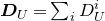 $\boldsymbol{D}_U = \sum_i D_U^i$
is an effective Cartier divisor on U. The descent data for
$\boldsymbol{D}_U = \sum_i D_U^i$
is an effective Cartier divisor on U. The descent data for $D_U$
relative to
$D_U$
relative to $U \to X$
induces descent data for
$U \to X$
induces descent data for $\boldsymbol{D}_U$
, which then determines an effective Cartier divisor
$\boldsymbol{D}_U$
, which then determines an effective Cartier divisor $\boldsymbol{D} \hookrightarrow X$
.
$\boldsymbol{D} \hookrightarrow X$
.
Proposition 2.4.3. Fix $t\in \mathbb Q$
and
$t\in \mathbb Q$
and $\mu \in L^\vee/L$
.
$\mu \in L^\vee/L$
.
-
(1) If
$t \gt 0$
, then
$\mathcal{Z}(t,\mu) \to \mathcal{M} $
is a generalized Cartier divisor. -
(2) If
$t \lt 0$
, then
$\mathcal{Z}(t,\mu) =\emptyset$
. -
(3) If
$t=0$
, then
$$\mathcal{Z}(0,\mu) = \begin{cases}\mathcal{M} & \mbox{if }\mu=0 ,\\\emptyset& \mbox{if }\mu\neq 0.\end{cases}$$




Proof. The first assertion is [Reference Howard and Madapusi PeraHMP20, Proposition 6.5.2], while the second and third follow immediately from the definitions (and Remark 2.2.12).
For future reference, we recall the main ingredient of the proof of condition (1). Suppose the following

is a commutative diagram of stacks in which $S \to \widetilde{S}$
is a closed immersion of schemes defined by an ideal sheaf
$S \to \widetilde{S}$
is a closed immersion of schemes defined by an ideal sheaf $J \subset \mathcal O_{\widetilde{S}}$
with
$J \subset \mathcal O_{\widetilde{S}}$
with $J^2=0$
. The top horizontal arrow corresponds to a special quasi-endomorphism
$J^2=0$
. The top horizontal arrow corresponds to a special quasi-endomorphism $x \in V_\mu(\mathcal{A}_S),$
and we want to know when x lies in the image of the (injective) restriction map
$x \in V_\mu(\mathcal{A}_S),$
and we want to know when x lies in the image of the (injective) restriction map
 \begin{equation}V_\mu(\mathcal{A}_{\widetilde{S}}) \to V_\mu(\mathcal{A}_S).\end{equation}
Equivalently, when there is a (necessarily unique) dotted arrow

making the diagram commute. In this situation, [Reference Howard and Madapusi PeraHMP20, Proposition 6.5.1] provides us with a canonical section
 \begin{equation*}\mathrm{obst}_x \in H^0 ( \widetilde{S} , \omega|^{-1}_{\widetilde{S}} ),\end{equation*}
called the obstruction to deforming x, with the property that x lies in the image of (2.14) if and only if $\mathrm{obst}_x=0$
.
$\mathrm{obst}_x=0$
.
Using this and Nakayama’s lemma, one shows that at any geometric point $z \to \mathcal{Z}(t,\mu)$
, the kernel of the natural surjection
$z \to \mathcal{Z}(t,\mu)$
, the kernel of the natural surjection
 $$ \mathcal O^\mathrm{et}_{\mathcal{M} , z} \to \mathcal O^\mathrm{et}_{\mathcal{Z}(t,\mu) , z}$$
is a principal ideal, and condition (1) follows from this. Again, see [Reference Howard and Madapusi PeraHMP20, Proposition 6.5.2] for details.
Proposition 2.4.4. Fix a special cycle (2.8). Every irreducible component $\mathcal{Z} \subset \mathcal{Z}(T,\mu)$
satisfies
$\mathcal{Z} \subset \mathcal{Z}(T,\mu)$
satisfies
 $$ \mathrm{dim}( \mathcal{Z} ) \ge \mathrm{dim}(\mathcal{M})-\mathrm{rank}(T). $$
If equality holds, then $\mathcal{Z}(T,\mu)$
is a local complete intersection over
$\mathcal{Z}(T,\mu)$
is a local complete intersection over $\mathbb Z[\Sigma^{-1}]$
at every point of
$\mathbb Z[\Sigma^{-1}]$
at every point of $\mathcal{Z}$
.
$\mathcal{Z}$
.
Proof. For any geometric point $z \to \mathcal{Z}(T,\mu)$
, the kernel of the natural surjection
$z \to \mathcal{Z}(T,\mu)$
, the kernel of the natural surjection
 $$ \mathcal O^\mathrm{et}_{\mathcal{M},z} \to \mathcal O^\mathrm{et}_{\mathcal{Z}(T,\mu),z}$$
is generated by $d = \mathrm{rank}(T)$
elements. This follows from Nakayama’s lemma and the deformation theory used in the proof of Proposition 2.4.3; see also [Reference Madapusi PeraMP16, Corollary 5.17]. From this, the asserted inequality is immediate. Moreover, it is clear that
$d = \mathrm{rank}(T)$
elements. This follows from Nakayama’s lemma and the deformation theory used in the proof of Proposition 2.4.3; see also [Reference Madapusi PeraMP16, Corollary 5.17]. From this, the asserted inequality is immediate. Moreover, it is clear that $\mathcal{Z}(T,\mu)$
is a local complete intersection at z whenever
$\mathcal{Z}(T,\mu)$
is a local complete intersection at z whenever
 $$\dim( \mathcal O^\mathrm{et}_{\mathcal{Z}(T,\mu),z} ) = \dim( \mathcal O^\mathrm{et}_{\mathcal{M},z} )- d = \dim(\mathcal{M}) - \mathrm{rank}(T).$$
Proposition 2.4.5. For any special cycle (2.8) and any $A\in \mathrm{GL}_d(\mathbb Z)$
, there is an isomorphism of
$A\in \mathrm{GL}_d(\mathbb Z)$
, there is an isomorphism of $\mathcal{M}$
-stacks
$\mathcal{M}$
-stacks
 $$\mathcal{Z}(T ,\mu ) \cong \mathcal{Z}({}^tA T A , \mu A).$$
Proof. Given a scheme $S \to \mathcal{M}$
, the isomorphism sends a tuple
$S \to \mathcal{M}$
, the isomorphism sends a tuple
 $$(x_1,\ldots, x_d) \in V(\mathcal{A}_S)_\mathbb Q^d$$
to the tuple $(x_1,\ldots, x_d) \cdot A \in V(\mathcal{A}_S)_\mathbb Q^d$
.
$(x_1,\ldots, x_d) \cdot A \in V(\mathcal{A}_S)_\mathbb Q^d$
.
Proposition 2.4.6. Given positive integers d’ and d”, symmetric matrices
 $$T' \in \mathrm{Sym}_{d'}(\mathbb Q) \quad \mbox{and}\quad T'' \in \mathrm{Sym}_{d''}(\mathbb Q),$$
and tuples $\mu' \in (L^\vee/L)^{d'}$
and
$\mu' \in (L^\vee/L)^{d'}$
and $\mu'' \in (L^\vee / L)^{d''}$
, there is a canonical isomorphism of
$\mu'' \in (L^\vee / L)^{d''}$
, there is a canonical isomorphism of $\mathcal{M}$
-stacks
$\mathcal{M}$
-stacks
 $$\mathcal{Z}(T',\mu') \times_{\mathcal{M}} \mathcal{Z}(T'',\mu'') \cong \bigsqcup_{ T = (\begin{smallmatrix} T' & * \\ * & T'' \end{smallmatrix} ) } \mathcal{Z}(T,\mu)$$
where theisjoint union is over all $T\in \mathrm{Sym}_{d'+d''}(\mathbb Q)$
of the indicated form, and
$T\in \mathrm{Sym}_{d'+d''}(\mathbb Q)$
of the indicated form, and $\mu = ( \mu',\mu'') \in (L^\vee/L)^{d'+d''}$
is the concatenation of the tuples
$\mu = ( \mu',\mu'') \in (L^\vee/L)^{d'+d''}$
is the concatenation of the tuples $\mu'$
and
$\mu'$
and $\mu''$
.
$\mu''$
.
Proof. For any $\mathcal{M}$
-scheme S, the S-valued points on both sides can be identified with the set of tuples
$\mathcal{M}$
-scheme S, the S-valued points on both sides can be identified with the set of tuples
 $$(x',x'')\in \prod_{i=1}^{d'} V_{\mu'_i}(\mathcal{A}_S)\times\prod_{j=1}^{d''} V_{\mu''_{j}}(\mathcal{A}_S)$$
such that $Q(x')=T'$
and
$Q(x')=T'$
and $Q(x'') = T''$
.
$Q(x'') = T''$
.
Suppose we have an isometric embedding $L\hookrightarrow L^\sharp$
as in the discussion leading to (2.4). As in Remark 2.2.7, we assume that
$L\hookrightarrow L^\sharp$
as in the discussion leading to (2.4). As in Remark 2.2.7, we assume that $\Sigma$
contains all primes p for which
$\Sigma$
contains all primes p for which $L_p^\sharp$
is not maximal, so that there is a morphism of integral models
$L_p^\sharp$
is not maximal, so that there is a morphism of integral models
 $$ \mathcal{M} \to \mathcal{M} ^\sharp$$
over $\mathbb Z[\Sigma^{-1}]$
. The target of this morphism has its own special cycles
$\mathbb Z[\Sigma^{-1}]$
. The target of this morphism has its own special cycles
 $$\mathcal{Z}^\sharp(T^\sharp,\mu^\sharp) \to \mathcal{M}^\sharp$$
indexed by $T^\sharp \in \mathrm{Sym}_d(\mathbb Q)$
and
$T^\sharp \in \mathrm{Sym}_d(\mathbb Q)$
and $\mu^\sharp \in (L^{\sharp,\vee}/ L^\sharp)^d$
, and we wish to describe their pullbacks to
$\mu^\sharp \in (L^{\sharp,\vee}/ L^\sharp)^d$
, and we wish to describe their pullbacks to $\mathcal{M}$
.
$\mathcal{M}$
.
Denoting by $\Lambda \subset L^\sharp$
the set of vectors orthogonal to L, there are inclusions of lattices
$\Lambda \subset L^\sharp$
the set of vectors orthogonal to L, there are inclusions of lattices
 $$L \oplus \Lambda \subset L^\sharp \subset L^{\sharp,\vee} \subset L^\vee \oplus \Lambda^\vee .$$
Given cosets
 $$\mu \in L^\vee/L ,\quad \nu \in \Lambda^\vee /\Lambda, \quad \mu^\sharp \in L^{\sharp,\vee}/L^\sharp,$$
we write $\mu+ \nu= \mu^\sharp$
to indicate that the natural map
$\mu+ \nu= \mu^\sharp$
to indicate that the natural map
 $$(L^\vee \oplus \Lambda^\vee) / (L \oplus \Lambda) \to (L^\vee \oplus \Lambda^\vee ) / L^\sharp$$
sends
 $$\mu + \nu \mapsto \mu^\sharp \in L^{\sharp,\vee} / L^\sharp \subset ( L^\vee \oplus \Lambda^\vee ) / L^\sharp .$$
Proposition 2.4.7. There is an isomorphism of $\mathcal{M}$
-stacks
$\mathcal{M}$
-stacks
 $$ \mathcal{Z}^\sharp (T^\sharp, \mu^\sharp) \times_{ \mathcal{M}^\sharp} \mathcal{M}\cong \bigsqcup_{ \substack{ T \in \mathrm{Sym}_d(\mathbb Q) \\ \mu\in (L^\vee / L)^d } } \bigsqcup_{ \substack{ \nu \in ( \Lambda^\vee/\Lambda)^d \\ \mu+\nu = \mu^\sharp } } \bigsqcup_{ \substack{ y\in \nu + \Lambda^d \\ T+ Q(y) = T^\sharp } } \mathcal{Z} ( T , \mu ),$$
where $\mu+\nu = \mu^\sharp$
is understood as above, but componentwise (that is,
$\mu+\nu = \mu^\sharp$
is understood as above, but componentwise (that is, $\mu_i +\nu_i = \mu^\sharp_i$
for every
$\mu_i +\nu_i = \mu^\sharp_i$
for every $1\le i \le d$
).
$1\le i \le d$
).
Proof. By [Reference Howard and Madapusi PeraHMP20, Proposition 6.6.2], for any scheme $S \to \mathcal{M}$
there is a canonical isometric embedding
$S \to \mathcal{M}$
there is a canonical isometric embedding
 $$V(\mathcal{A}_S)\oplus \Lambda \hookrightarrow V(\mathcal{A}^\sharp_S).$$
Here $\mathcal{A} \to \mathcal{M}$
and
$\mathcal{A} \to \mathcal{M}$
and $\mathcal{A}^\sharp \to \mathcal{M}^\sharp$
are the Kuga–Satake abelian schemes, and the
$\mathcal{A}^\sharp \to \mathcal{M}^\sharp$
are the Kuga–Satake abelian schemes, and the $\oplus$
on the left is the orthogonal direct sum. This embedding determines a
$\oplus$
on the left is the orthogonal direct sum. This embedding determines a $\mathbb Q$
-linear isometry
$\mathbb Q$
-linear isometry
 $$V(\mathcal{A}^\sharp_S)_\mathbb Q \cong V(\mathcal{A}_S)_\mathbb Q \oplus \Lambda_\mathbb Q ,$$
which restricts to a bijection
 $$V_{\mu^\sharp}(\mathcal{A}^\sharp_S) \cong \bigsqcup_{ \substack{ \mu \in L^\vee /L \\ \nu \in \Lambda^\vee/ \Lambda \\ \mu+\nu = \mu^\sharp } }V_{\mu}(\mathcal{A}_S) \times (\nu+\Lambda)$$
for every $\mu^\sharp\in L^{\sharp, \vee} /L^\sharp$
. The proposition follows easily from this and the definition of special cycles.
$\mu^\sharp\in L^{\sharp, \vee} /L^\sharp$
. The proposition follows easily from this and the definition of special cycles.
3. Special cycles of low codimension
Keep $L\subset V$
and
$L\subset V$
and $\mathcal{M} \to \mathrm{Spec}(\mathbb Z[\Sigma^{-1}])$
as in §§ 2.1 and 2.2. Given a positive-semi-definite
$\mathcal{M} \to \mathrm{Spec}(\mathbb Z[\Sigma^{-1}])$
as in §§ 2.1 and 2.2. Given a positive-semi-definite $T\in \mathrm{Sym}_d(\mathbb Q)$
and a
$T\in \mathrm{Sym}_d(\mathbb Q)$
and a $\mu \in (L^\vee/L)^d$
, our goal is prove that if
$\mu \in (L^\vee/L)^d$
, our goal is prove that if $\mathrm{rank}(T)$
is small relative to
$\mathrm{rank}(T)$
is small relative to $n=\dim(V)$
, then the special cycle
$n=\dim(V)$
, then the special cycle $\mathcal{Z}(T,\mu)$
is equidimensional and flat over
$\mathcal{Z}(T,\mu)$
is equidimensional and flat over $\mathbb Z[\Sigma^{-1}]$
.
$\mathbb Z[\Sigma^{-1}]$
.
We also show that divisor classes on $\mathcal{Z}(T,\mu)$
are determined by their restriction to the generic fiber. In § 4, this property will allow us to deduce modularity results for cycles on
$\mathcal{Z}(T,\mu)$
are determined by their restriction to the generic fiber. In § 4, this property will allow us to deduce modularity results for cycles on $\mathcal{M}$
from known modularity results on its generic fiber.
$\mathcal{M}$
from known modularity results on its generic fiber.
3.1 Connectedness in low codimension
Our notion of smallness of $\mathrm{rank}(T)$
is always relative to the fixed lattice L, and depends on the following integer r(L) associated to it.
$\mathrm{rank}(T)$
is always relative to the fixed lattice L, and depends on the following integer r(L) associated to it.
Definition 3.1.1. Denote by r(L) the smallest integer $r\geq 0$
such that L is isometric to a
$r\geq 0$
such that L is isometric to a $\mathbb Z$
-module direct summand of a self-dual quadratic
$\mathbb Z$
-module direct summand of a self-dual quadratic $\mathbb Z$
-module
$\mathbb Z$
-module $L^\sharp$
of signature
$L^\sharp$
of signature $(n+r,2)$
. The existence of such an
$(n+r,2)$
. The existence of such an $L^\sharp$
follows from Proposition B.2.2.
$L^\sharp$
follows from Proposition B.2.2.
Remark 3.1.2. For any $g\in G(\mathbb A_f)$
we have
$g\in G(\mathbb A_f)$
we have
 $$r(L) = r(L_g),$$
where $L_g = V \cap g L_{\widehat{\mathbb Z}}$
. This is immediate from the fact that if L embeds isometrically as a
$L_g = V \cap g L_{\widehat{\mathbb Z}}$
. This is immediate from the fact that if L embeds isometrically as a $\mathbb Z$
-module direct summand of
$\mathbb Z$
-module direct summand of $L^\sharp$
, then
$L^\sharp$
, then $L_g$
embeds isometrically as a
$L_g$
embeds isometrically as a $\mathbb Z$
-module direct summand of
$\mathbb Z$
-module direct summand of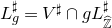 $L^\sharp_g = V^\sharp \cap g{L^\sharp_{\widehat{\mathbb Z}}}$
.
$L^\sharp_g = V^\sharp \cap g{L^\sharp_{\widehat{\mathbb Z}}}$
.
Proposition 3.1.3. Suppose $T\in \mathrm{Sym}_d(\mathbb Q)$
and
$T\in \mathrm{Sym}_d(\mathbb Q)$
and $\mu \in (L^\vee/L)^d$
. If
$\mu \in (L^\vee/L)^d$
. If
 $$ \mathrm{rank}(T) \leq \frac{ n - 2 r(L) -4 }{3} ,$$
then every connected component of the generic fiber $ Z(T,\mu) = \mathcal{Z}(T,\mu)_\mathbb Q $
is geometrically connected.
$ Z(T,\mu) = \mathcal{Z}(T,\mu)_\mathbb Q $
is geometrically connected.
Proof. It suffices to show that each $\mathbb Q$
-stack
$\mathbb Q$
-stack $M_g^\flat$
appearing in (2.13) is geometrically connected. Set
$M_g^\flat$
appearing in (2.13) is geometrically connected. Set $n^\flat = n-\mathrm{rank}(T)$
, and recall from (2.12) the quadratic lattice
$n^\flat = n-\mathrm{rank}(T)$
, and recall from (2.12) the quadratic lattice $L_g^\flat \subset V^\flat$
of signature
$L_g^\flat \subset V^\flat$
of signature $(n^\flat,2)$
used to define
$(n^\flat,2)$
used to define $M_g^\flat$
. Using Remark 2.1.2, we are reduced to proving the existence of isotropic vectors
$M_g^\flat$
. Using Remark 2.1.2, we are reduced to proving the existence of isotropic vectors $ \ell ,\ell_* \in L_g^\flat $
with
$ \ell ,\ell_* \in L_g^\flat $
with $[\ell ,\ell_*]=1$
.
$[\ell ,\ell_*]=1$
.
In general, if N is a quadratic $\mathbb Z$
-module with
$\mathbb Z$
-module with $N_\mathbb Q$
nondegenerate, let
$N_\mathbb Q$
nondegenerate, let $\gamma(N)$
the minimal number of elements needed to generate the finite abelian group
$\gamma(N)$
the minimal number of elements needed to generate the finite abelian group $N^\vee / N$
. This quantity only depends on the
$N^\vee / N$
. This quantity only depends on the $\widehat{\mathbb Z}$
-quadratic space
$\widehat{\mathbb Z}$
-quadratic space $N_{ \widehat{\mathbb Z}}$
. Moreover, if we realize
$N_{ \widehat{\mathbb Z}}$
. Moreover, if we realize $N \subset N^\sharp$
as a
$N \subset N^\sharp$
as a $\mathbb Z$
-module direct summand of a self-dual quadratic
$\mathbb Z$
-module direct summand of a self-dual quadratic $\mathbb Z$
-module as in Definition 3.1.1, there is a canonical surjection
$\mathbb Z$
-module as in Definition 3.1.1, there is a canonical surjection
 $$N^\sharp\cong N^{\sharp,\vee}\to N^\vee$$
whose restriction to N is just the inclusion $N\to N^\vee$
. The induced surjection
$N\to N^\vee$
. The induced surjection $N^\sharp / N \to N^\vee / N$
shows that
$N^\sharp / N \to N^\vee / N$
shows that
 $$\gamma(N) \le \mathrm{rank}_\mathbb Z(N^\sharp) - \mathrm{rank}_\mathbb Z(N).$$
As in Remark 3.1.2, set $L_g = V \cap g L_{\widehat{\mathbb Z}}$
and abbreviate
$L_g = V \cap g L_{\widehat{\mathbb Z}}$
and abbreviate
 $$r=r(L)=r(L_g).$$
Fix an embedding $L_g \to L^\sharp$
as a
$L_g \to L^\sharp$
as a $\mathbb Z$
-module direct summand of a self-dual quadratic lattice of signature
$\mathbb Z$
-module direct summand of a self-dual quadratic lattice of signature $(n+r,2)$
. As the submodule
$(n+r,2)$
. As the submodule $L^\flat_g \subset L_g$
of (2.12) is a
$L^\flat_g \subset L_g$
of (2.12) is a $\mathbb Z$
-module direct summand, the paragraph above implies
$\mathbb Z$
-module direct summand, the paragraph above implies
 $$\gamma(L_g^\flat ) \le \mathrm{rank}_\mathbb Z(L^\sharp) - \mathrm{rank}_\mathbb Z(L_g^\flat)= \mathrm{rank}(T) +r .$$
This implies the first inequality in
 $$2 \cdot \gamma(L_g^\flat) +6 \le 2 \cdot \mathrm{rank}(T) + 2r + 6 \le n - \mathrm{rank}(T) + 2 = \mathrm{rank}_\mathbb Z (L_g^\flat)$$
(the second is by the hypotheses of the proposition), and so Proposition B.1.2 implies the existence of the desired isotropic vectors $\ell,\ell_* \in L_g^\flat$
.
$\ell,\ell_* \in L_g^\flat$
.
3.2 Geometric properties in low codimension: the self-dual case
In this subsection, we assume that L is self-dual. In particular, L is hyperspecial (Definition 2.2.1), and the integral model $\mathcal{M}$
is a smooth
$\mathcal{M}$
is a smooth $\mathbb Z[\Sigma^{-1}]$
-stack by the proof of Proposition 2.2.4.
$\mathbb Z[\Sigma^{-1}]$
-stack by the proof of Proposition 2.2.4.
Let $\Lambda$
be a positive-definite quadratic
$\Lambda$
be a positive-definite quadratic $\mathbb Z$
-module. Set
$\mathbb Z$
-module. Set
 $$\mathsf{L}(\Lambda) = \{ \mathbb Z\mbox{-lattices }\Lambda'\subset \Lambda_\mathbb Q : \;\Lambda\subset \Lambda'\subset(\Lambda')^\vee\subset\Lambda^\vee\},$$
and for each $\Lambda'\in \mathsf{L}(\Lambda)$
, write
$\Lambda'\in \mathsf{L}(\Lambda)$
, write $\mathcal{Z}(\Lambda')$
for the finite unramified stack over
$\mathcal{Z}(\Lambda')$
for the finite unramified stack over $\mathcal{M}$
with functor of points
$\mathcal{M}$
with functor of points
 $$\mathcal{Z}(\Lambda')(S) = \{\mbox{isometric embeddings }\iota:\Lambda'\hookrightarrow V(\mathcal{A}_S)\}$$
for any scheme $S \to \mathcal{M}$
.
$S \to \mathcal{M}$
.
Remark 3.2.1. The above stacks are actually special cycles under a different name. In what follows, we fix a basis $e_1,\ldots, e_d \in \Lambda$
, and let
$e_1,\ldots, e_d \in \Lambda$
, and let $T=Q(e)\in \mathrm{Sym}_d(\mathbb Q)$
be the moment matrix of
$T=Q(e)\in \mathrm{Sym}_d(\mathbb Q)$
be the moment matrix of $e=(e_1,\ldots, e_d)$
. There is a canonical isometry
$e=(e_1,\ldots, e_d)$
. There is a canonical isometry $\Lambda_\mathbb Q \cong W$
, where the right-hand side is the quadratic space (2.10) determined by T, and a canonical isomorphism of
$\Lambda_\mathbb Q \cong W$
, where the right-hand side is the quadratic space (2.10) determined by T, and a canonical isomorphism of $\mathcal{M}$
-stacks
$\mathcal{M}$
-stacks
 $$\mathcal{Z}(\Lambda) \cong \mathcal{Z}(T,0)$$
where $0=(0,\ldots,0) \in (L^\vee/L)^d$
. Indeed, an S-valued point of the left-hand side is an isometric embedding
$0=(0,\ldots,0) \in (L^\vee/L)^d$
. Indeed, an S-valued point of the left-hand side is an isometric embedding $\iota: \Lambda \to V(\mathcal{A}_S)$
, and the tuple
$\iota: \Lambda \to V(\mathcal{A}_S)$
, and the tuple $x= (\iota(e_1) , \ldots, \iota(e_d)) \in V(\mathcal{A}_S),$
defines an S-point of the right-hand side.
$x= (\iota(e_1) , \ldots, \iota(e_d)) \in V(\mathcal{A}_S),$
defines an S-point of the right-hand side.
For each $\Lambda'\in \mathsf{L}(\Lambda)$
, the natural map
$\Lambda'\in \mathsf{L}(\Lambda)$
, the natural map
 $$\mathcal{Z}(\Lambda') \xrightarrow{\iota\mapsto \iota\vert_{\Lambda}}\mathcal{Z}(\Lambda)$$
is a closed immersion. Henceforth, we regard $\mathcal{Z}(\Lambda')$
as a closed substack of
$\mathcal{Z}(\Lambda')$
as a closed substack of $\mathcal{Z}(\Lambda)$
, so that
$\mathcal{Z}(\Lambda)$
, so that $\mathcal{Z}(\Lambda')\subset \mathcal{Z}(\Lambda'')$
whenever
$\mathcal{Z}(\Lambda')\subset \mathcal{Z}(\Lambda'')$
whenever $\Lambda''\subset \Lambda'$
is an inclusion of lattices in
$\Lambda''\subset \Lambda'$
is an inclusion of lattices in $\mathsf{L}(\Lambda)$
. The open substack of
$\mathsf{L}(\Lambda)$
. The open substack of $\mathcal{Z}(\Lambda')$
defined by
$\mathcal{Z}(\Lambda')$
defined by
 $${}^{\circ}\mathcal{Z}(\Lambda') = \mathcal{Z}(\Lambda')\smallsetminus \bigcup_{\Lambda'\subsetneq \Lambda''}\mathcal{Z}(\Lambda'')$$
is then a locally closed substack of $\mathcal{Z}(\Lambda)$
.
$\mathcal{Z}(\Lambda)$
.
By construction, we have the equality of sets
 \begin{equation} \mathcal{Z}(\Lambda)(k) = \bigsqcup_{\Lambda'\in \mathsf{L}(\Lambda)}{}^{\circ}\mathcal{Z}(\Lambda')(k)\end{equation}
for any algebraically closed field k with $\mathrm{char}(k)\not\in \Sigma$
. In fact, given a point
$\mathrm{char}(k)\not\in \Sigma$
. In fact, given a point $s\in \mathcal{Z}(\Lambda)(k)$
corresponding to an isometric embedding
$s\in \mathcal{Z}(\Lambda)(k)$
corresponding to an isometric embedding $\iota: \Lambda\to V(\mathcal{A}_s)$
, we have
$\iota: \Lambda\to V(\mathcal{A}_s)$
, we have $s\in {}^{\circ}\mathcal{Z}(\Lambda')(k)$
if and only if
$s\in {}^{\circ}\mathcal{Z}(\Lambda')(k)$
if and only if
 $$\Lambda' = V(\mathcal{A}_s)\cap \iota(\Lambda)_\mathbb Q .$$
This last equality says simply that $\Lambda' \subset \Lambda_\mathbb Q$
is the largest lattice such that
$\Lambda' \subset \Lambda_\mathbb Q$
is the largest lattice such that $\iota$
extends to
$\iota$
extends to $\iota : \Lambda' \to V(\mathcal{A}_s)$
.
$\iota : \Lambda' \to V(\mathcal{A}_s)$
.
Remark 3.2.2. In the notation of § A.1, the decomposition (3.1) amounts to saying that the topological space $| \mathcal{Z}(\Lambda)|$
is the disjoint union of its locally closed subsets
$| \mathcal{Z}(\Lambda)|$
is the disjoint union of its locally closed subsets $|{}^{\circ}\mathcal{Z}(\Lambda')|$
.
$|{}^{\circ}\mathcal{Z}(\Lambda')|$
.
In the generic fiber we have the following strengthening of (3.1).
Lemma 3.2.3. For every $\Lambda' \in \mathsf{L}(\Lambda)$
the morphism
$\Lambda' \in \mathsf{L}(\Lambda)$
the morphism
 $${}^{\circ} \mathcal{Z}(\Lambda')_\mathbb Q \to \mathcal{Z}(\Lambda)_\mathbb Q$$
is an open and closed immersion, and there is an isomorphism of $\mathbb Q$
-stacks
$\mathbb Q$
-stacks
 $$ \mathcal{Z}(\Lambda)_\mathbb Q \cong \bigsqcup_{\Lambda'\in \mathsf{L}(\Lambda)}{}^{\circ}\mathcal{Z}(\Lambda')_\mathbb Q$$
inducing the bijection (3.1) on geometric points of characteristic 0.
Proof. Proposition 2.3.2 and Remark 3.2.1 give us a decomposition
 $$\mathcal{Z}(\Lambda)_\mathbb Q \cong Z(T,0) \cong \bigsqcup_{g\in G^\flat(\mathbb Q)\backslash \Xi(T,0)/K}M^\flat_g ,$$
which depends on a choiceFootnote
1
of isometric embedding $\Lambda_\mathbb Q \hookrightarrow V.$
Under this bijection, the locally closed substack
$\Lambda_\mathbb Q \hookrightarrow V.$
Under this bijection, the locally closed substack ${}^{\circ} \mathcal{Z}(\Lambda')_\mathbb Q$
is identified with the disjoint union of those
${}^{\circ} \mathcal{Z}(\Lambda')_\mathbb Q$
is identified with the disjoint union of those $M^\flat_g$
for which g satisfies
$M^\flat_g$
for which g satisfies $\Lambda' = \Lambda_\mathbb Q\cap g L_{\widehat{\mathbb Z}}$
. Here the intersection is taken inside
$\Lambda' = \Lambda_\mathbb Q\cap g L_{\widehat{\mathbb Z}}$
. Here the intersection is taken inside $V_{\widehat{\mathbb Z}}$
. The lemma follows immediately.
$V_{\widehat{\mathbb Z}}$
. The lemma follows immediately.
The key geometric result is the following.
Proposition 3.2.4. Fix a $\Lambda' \in \mathsf{L}(\Lambda)$
, and assume
$\Lambda' \in \mathsf{L}(\Lambda)$
, and assume $\mathrm{rank}_\mathbb Z(\Lambda)\leq (n-4)/2.$
-
(1) The
$\mathbb Z[\Sigma^{-1}]$
-stack
${}^{\circ}\mathcal{Z}(\Lambda')$
is normal and flat, and equidimensional of dimension
$$n-\mathrm{rank}_\mathbb Z(\Lambda) + 1 = \dim(\mathcal{M}) - \mathrm{rank}_\mathbb Z(\Lambda).$$
-
(2) For any prime
$p \not\in \Sigma$
, the special fiber
${}^{\circ}\mathcal{Z}(\Lambda')_{\mathbb F_p}$
is geometrically normal and equidimensional of dimension
$n-\mathrm{rank}_\mathbb Z(\Lambda)$
. -
(3) For any prime
$p\not\in \Sigma$
, the natural maps are bijections, where
$$ \pi_0({}^{\circ}\mathcal{Z}(\Lambda')_{\mathbb F_p^\mathrm{alg}}) \rightarrow \pi_0({}^{\circ}\mathcal{Z}(\Lambda')_{ \mathbb Z^\mathrm{alg}_{(p)} }) \leftarrow \pi_0({}^{\circ}\mathcal{Z}(\Lambda')_{ \mathbb Q^\mathrm{alg} }) $$
$\mathbb Z^\mathrm{alg}_{(p)}$
is the integral closure of
$\mathbb Z_{(p)}$
in
$\mathbb Q^\mathrm{alg}$
.





Proof. We use results from [Reference Howard and Madapusi PeraHMP20, 7.1] to which the reader is encouraged to refer for details. The key point is that, under our hypotheses, there exists an open substack (see [Reference Howard and Madapusi PeraHMP20, Proposition 7.1.2])
 $$\mathcal{Z}^{\mathrm{pr}}(\Lambda') \subset {}^{\circ}\mathcal{Z}(\Lambda')$$
with the following properties.
-
(1) It has the same generic fiber as
${}^{\circ}\mathcal{Z}(\Lambda')$
. -
(2) For any prime
$p \not\in \Sigma$
, the special fiber
$\mathcal{Z}^{\mathrm{pr}}(\Lambda')_{\mathbb F_p}$
is smooth outside of a codimension-2 substack.


Moreover, [Reference Howard and Madapusi PeraHMP20, Lemma 7.1.5] shows that the complement of $\mathcal{Z}^{\mathrm{pr}}(\Lambda')_{\mathbb F_p}$
in
$\mathcal{Z}^{\mathrm{pr}}(\Lambda')_{\mathbb F_p}$
in ${}^{\circ}\mathcal{Z}(\Lambda')_{\mathbb F_p}$
has codimension at least 2. The statement there assumes that
${}^{\circ}\mathcal{Z}(\Lambda')_{\mathbb F_p}$
has codimension at least 2. The statement there assumes that $\Lambda$
is maximal, but this is only used to ensure that
$\Lambda$
is maximal, but this is only used to ensure that $\Lambda'$
maps to a direct summand of
$\Lambda'$
maps to a direct summand of $V(\mathcal{A}_s)$
for every geometric point
$V(\mathcal{A}_s)$
for every geometric point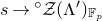 $s \to {}^{\circ}\mathcal{Z}(\Lambda')_{\mathbb F_p}$
. For us, this holds essentially by definition of
$s \to {}^{\circ}\mathcal{Z}(\Lambda')_{\mathbb F_p}$
. For us, this holds essentially by definition of ${}^{\circ}\mathcal{Z}(\Lambda')_{\mathbb F_p}$
; see the comments after (3.1).
${}^{\circ}\mathcal{Z}(\Lambda')_{\mathbb F_p}$
; see the comments after (3.1).
Combining the above with the argument of [Reference Howard and Madapusi PeraHMP20, Proposition 7.1.6] proves assertions (1) and (2). Assertion (3) follows from [Reference MadapusiMad25, Theorem B].
Proposition 3.2.4 has two consequences, which are of fundamental importance to our arguments. The first requires the following technical lemma of commutative algebra.
Lemma 3.2.5 Suppose R is a Cohen–Macaulay local ring over $\mathbb Z[\Sigma^{-1}]$
. The following are equivalent:
$\mathbb Z[\Sigma^{-1}]$
. The following are equivalent:
-
(1) R is flat over
$\mathbb Z[\Sigma^{-1}]$
; -
(2) for every minimal prime
$P\subset R$
,
$R/P$
is flat over
$\mathbb Z[\Sigma^{-1}]$
.


Proof. This is easily deduced from the following two facts. First, a $\mathbb Z[\Sigma^{-1}]$
-algebra S is flat if and only if every prime
$\mathbb Z[\Sigma^{-1}]$
-algebra S is flat if and only if every prime $p\notin\Sigma$
is a nonzero divisor in S. Second, since R is Cohen–Macaulay, its zero-divisors are precisely those contained in some minimal prime of R.
$p\notin\Sigma$
is a nonzero divisor in S. Second, since R is Cohen–Macaulay, its zero-divisors are precisely those contained in some minimal prime of R.
Proposition 3.2.6. If $\mathrm{rank}_\mathbb Z(\Lambda)\leq (n-4)/2,$
then
$\mathrm{rank}_\mathbb Z(\Lambda)\leq (n-4)/2,$
then $\mathcal{Z}(\Lambda)$
is a flat, reduced, local complete intersection over
$\mathcal{Z}(\Lambda)$
is a flat, reduced, local complete intersection over $\mathbb Z[\Sigma^{-1}]$
, and is equidimensional of dimension
$\mathbb Z[\Sigma^{-1}]$
, and is equidimensional of dimension $\dim ( \mathcal{M}) - \mathrm{rank}_\mathbb Z(\Lambda)$
.
$\dim ( \mathcal{M}) - \mathrm{rank}_\mathbb Z(\Lambda)$
.
Proof. Fix an irreducible component
 $$\mathcal{Z}\subset \mathcal{Z}(\Lambda)=\mathcal{Z}(T,0)$$
and a geometric generic point $s \to \mathcal{Z}$
.Footnote
2
$s \to \mathcal{Z}$
.Footnote
2
By (3.1), there is a unique $\Lambda'\in \mathsf{L}(\Lambda)$
such that
$\Lambda'\in \mathsf{L}(\Lambda)$
such that $s\to {}^{\circ}\mathcal{Z}(\Lambda')$
. By claim (1) of Proposition 3.2.4, the stack
$s\to {}^{\circ}\mathcal{Z}(\Lambda')$
. By claim (1) of Proposition 3.2.4, the stack ${}^{\circ}\mathcal{Z}(\Lambda')$
is equidimensional of dimension
${}^{\circ}\mathcal{Z}(\Lambda')$
is equidimensional of dimension $ \dim(\mathcal{M}) - \mathrm{rank}_\mathbb Z(\Lambda),$
and so the same is true of its Zariski closure
$ \dim(\mathcal{M}) - \mathrm{rank}_\mathbb Z(\Lambda),$
and so the same is true of its Zariski closure $ \overline{ {}^{\circ}\mathcal{Z}(\Lambda') } \subset \mathcal{Z}(\Lambda). $
The inclusion
$ \overline{ {}^{\circ}\mathcal{Z}(\Lambda') } \subset \mathcal{Z}(\Lambda). $
The inclusion $ \mathcal{Z} \subset \overline{ {}^{\circ}\mathcal{Z}(\Lambda') } $
therefore implies
$ \mathcal{Z} \subset \overline{ {}^{\circ}\mathcal{Z}(\Lambda') } $
therefore implies
 $$ \dim(\mathcal{Z}) \le \dim(\mathcal{M}) - \mathrm{rank}_\mathbb Z(\Lambda). $$
As the other inequality follows from Proposition 2.4.4, we have proved both that $\mathcal{Z}$
has the expected dimension, and that it is eq2.ual to an irreducible component of
$\mathcal{Z}$
has the expected dimension, and that it is eq2.ual to an irreducible component of $ \overline{ {}^{\circ}\mathcal{Z}(\Lambda') }$
. This latter stack is flat over
$ \overline{ {}^{\circ}\mathcal{Z}(\Lambda') }$
. This latter stack is flat over $\mathbb Z[\Sigma^{-1}]$
by claim (1) of Proposition 3.2.4, and hence so is
$\mathbb Z[\Sigma^{-1}]$
by claim (1) of Proposition 3.2.4, and hence so is $\mathcal{Z}$
.
$\mathcal{Z}$
.
It now follows from Proposition 2.4.4 that $\mathcal{Z}(\Lambda)$
is a local complete intersection over
$\mathcal{Z}(\Lambda)$
is a local complete intersection over $\mathbb Z[\Sigma^{-1}]$
. In particular
$\mathbb Z[\Sigma^{-1}]$
. In particular $\mathcal{Z}(\Lambda)$
is Cohen–Macaulay, and hence flat by Lemma 3.2.5 and the flatness of its irreducible components proved above. To now see that it is reduced, it is enough to know that it is generically smooth, which follows from the complex uniformization in Proposition 2.3.2.
$\mathcal{Z}(\Lambda)$
is Cohen–Macaulay, and hence flat by Lemma 3.2.5 and the flatness of its irreducible components proved above. To now see that it is reduced, it is enough to know that it is generically smooth, which follows from the complex uniformization in Proposition 2.3.2.
Proposition 3.2.7. If $ \mathrm{rank}_\mathbb Z(\Lambda)\leq (n-4)/3,$
then restriction
$ \mathrm{rank}_\mathbb Z(\Lambda)\leq (n-4)/3,$
then restriction
 \begin{align*}\mathrm{CH}^1(\mathcal{Z}(\Lambda)) \to \mathrm{CH}^1( \mathcal{Z}(\Lambda)_\mathbb Q)\end{align*}
to the generic fiber is injective.
Proof. This amounts to proving the triviality of the subspace
 \begin{equation}\mathrm{CH}^1_{\mathrm{vert}}(\mathcal{Z}(\Lambda)) \subset \mathrm{CH}^1(\mathcal{Z}(\Lambda))\end{equation}
spanned by the irreducible components of $\mathcal{Z}(\Lambda)_{\mathbb F_p}$
as
$\mathcal{Z}(\Lambda)_{\mathbb F_p}$
as $p\notin \Sigma$
varies. For this we use the following lemma, which provides a parametrization of those components.
$p\notin \Sigma$
varies. For this we use the following lemma, which provides a parametrization of those components.
Lemma 3.2.8. For a Deligne–Mumford stack $\mathcal{X}$
, denote by
$\mathcal{X}$
, denote by $\pi_{\mathrm{irr}}(\mathcal{X})$
its set of irreducible components. For any prime
$\pi_{\mathrm{irr}}(\mathcal{X})$
its set of irreducible components. For any prime $p\not\in \Sigma$
there are canonical bijections
$p\not\in \Sigma$
there are canonical bijections

characterized as follows.
-
(1) The horizontal arrow takes an irreducible component
${}^{\circ}\mathcal{Z} \subset {}^{\circ} \mathcal{Z}(\Lambda')$
to its reduction
${}^{\circ}\mathcal{Z}_{\mathbb F_p}\subset {}^{\circ} \mathcal{Z}(\Lambda')_{\mathbb F_p}$
. -
(2) The vertical arrow on the left takes an irreducible component of the locally closed substack
${}^{\circ} \mathcal{Z}(\Lambda') \subset \mathcal{Z}(\Lambda)$
to its Zariski closure. -
(3) The vertical arrow on the right takes an irreducible component of the locally closed substack
${}^{\circ} \mathcal{Z}(\Lambda')_{\mathbb F_p} \subset \mathcal{Z}(\Lambda)_{\mathbb F_p}$
to its Zariski closure.




Moreover, given distinct irreducible components
 $${}^{\circ}\mathcal{Z}_1,{}^{\circ} \mathcal{Z}_2 \subset {}^{\circ} \mathcal{Z}(\Lambda') ,$$
the intersection of ${}^{\circ}\mathcal{Z}_1$
with the Zariski closure of
${}^{\circ}\mathcal{Z}_1$
with the Zariski closure of ${}^{\circ} \mathcal{Z}_2$
in
${}^{\circ} \mathcal{Z}_2$
in $\mathcal{Z}(\Lambda)$
is empty.
$\mathcal{Z}(\Lambda)$
is empty.
Proof. We first show that for any $\Lambda'\in \mathsf{L}(\Lambda)$
, all arrows in the following diagram are bijective.
$\Lambda'\in \mathsf{L}(\Lambda)$
, all arrows in the following diagram are bijective.

Claim (3) of Proposition 3.2.4 shows that both horizontal arrows in the top row are bijective. Proposition 3.1.3 and our hypothesis on $\mathrm{rank}(\Lambda)=\mathrm{rank}(T)$
guarantee that every connected component of
$\mathrm{rank}(\Lambda)=\mathrm{rank}(T)$
guarantee that every connected component of $\mathcal{Z}(\Lambda)_\mathbb Q = Z(T,0)$
is geometrically connected (note that
$\mathcal{Z}(\Lambda)_\mathbb Q = Z(T,0)$
is geometrically connected (note that $r(L)=0$
by our assumption that L is self-dual), and so the same is true of
$r(L)=0$
by our assumption that L is self-dual), and so the same is true of ${}^{\circ} \mathcal{Z}(\Lambda')_\mathbb Q$
by Lemma 3.2.3. This shows that the arrow labeled c is bijective. The morphism
${}^{\circ} \mathcal{Z}(\Lambda')_\mathbb Q$
by Lemma 3.2.3. This shows that the arrow labeled c is bijective. The morphism
 $$ {}^{\circ}\mathcal{Z}(\Lambda')_{\mathbb Z_{(p)}} \to \mathrm{Spec}(\mathbb Z_{(p)}) $$
is flat with reduced special fiber by claims (1) and (2) of Proposition 3.2.4, and so [Sta22, Tag 055J] implies that the arrow labeled e is injective. The arrow labeled b is surjective because it is induced by a surjective morphism of stacks. It follows that all arrows in the square on the right are bijections, as is the composition $d\circ a$
. This implies the injectivity of a, and surjectivity follows by the same reasoning as for b. The arrow labeled d is bijective because, at this point, we know the bijectivity of all the other arrows.
$d\circ a$
. This implies the injectivity of a, and surjectivity follows by the same reasoning as for b. The arrow labeled d is bijective because, at this point, we know the bijectivity of all the other arrows.
Now we turn to the diagram (3.3). By Proposition 3.2.4 each ${}^{\circ} \mathcal{Z}(\Lambda')$
is normal and flat over
${}^{\circ} \mathcal{Z}(\Lambda')$
is normal and flat over $\mathbb Z[\Sigma^{-1}]$
, and so there are canonical identifications
$\mathbb Z[\Sigma^{-1}]$
, and so there are canonical identifications
 $$\pi_{\mathrm{irr}} ( {}^{\circ} \mathcal{Z}(\Lambda'))= \pi_{\mathrm{irr}} ( {}^{\circ} \mathcal{Z}(\Lambda')_{\mathbb Z_{(p)}})= \pi_0 ( {}^{\circ} \mathcal{Z}(\Lambda')_{\mathbb Z_{(p)}}).$$
Similarly, the normality of ${}^{\circ} \mathcal{Z}(\Lambda')_{\mathbb F_p}$
implies
${}^{\circ} \mathcal{Z}(\Lambda')_{\mathbb F_p}$
implies
 $$\pi_{\mathrm{irr}} ( {}^{\circ} \mathcal{Z}(\Lambda')_{\mathbb F_p})= \pi_0 ( {}^{\circ} \mathcal{Z}(\Lambda')_{\mathbb F_p }).$$
Combining this with the paragraph above yields the top horizontal bijection in (3.3). The vertical bijections in (3.3) are formal consequences of (3.1) and our dimension calculations; see the proof of Proposition 3.2.6.
The final claim follows from the normality of ${}^{\circ} \mathcal{Z}(\Lambda')$
. Suppose
${}^{\circ} \mathcal{Z}(\Lambda')$
. Suppose $s \to {}^{\circ} \mathcal{Z}_1$
is a geometric point also contained in the Zariski closure of
$s \to {}^{\circ} \mathcal{Z}_1$
is a geometric point also contained in the Zariski closure of ${}^{\circ} \mathcal{Z}_2$
in
${}^{\circ} \mathcal{Z}_2$
in $\mathcal{Z}(\Lambda)$
. This is the same as the Zariski closure of
$\mathcal{Z}(\Lambda)$
. This is the same as the Zariski closure of ${}^{\circ} \mathcal{Z}_2$
in
${}^{\circ} \mathcal{Z}_2$
in $\mathcal{Z}(\Lambda')$
, and hence any open subset of
$\mathcal{Z}(\Lambda')$
, and hence any open subset of $\mathcal{Z}(\Lambda')$
containing s must intersect
$\mathcal{Z}(\Lambda')$
containing s must intersect ${}^{\circ} \mathcal{Z}_2$
. One such open subset is
${}^{\circ} \mathcal{Z}_2$
. One such open subset is ${}^{\circ} \mathcal{Z}_1$
itself, and so
${}^{\circ} \mathcal{Z}_1$
itself, and so ${}^{\circ} \mathcal{Z}_1 \cap {}^{\circ} \mathcal{Z}_2 \neq \emptyset$
. This is impossible, as these are distinct connected components of
${}^{\circ} \mathcal{Z}_1 \cap {}^{\circ} \mathcal{Z}_2 \neq \emptyset$
. This is impossible, as these are distinct connected components of ${}^{\circ}\mathcal{Z}(\Lambda')$
.
${}^{\circ}\mathcal{Z}(\Lambda')$
.
Lemma 3.2.8 determines a canonical bijection
 \begin{equation} \pi_{\mathrm{irr}} ( \mathcal{Z}(\Lambda) ) \to \pi_{\mathrm{irr}} ( \mathcal{Z}(\Lambda)_{\mathbb F_p} ) ,\end{equation}
but this does not send an irreducible component $\mathcal{Z} \subset \mathcal{Z}(\Lambda)$
to its reduction
$\mathcal{Z} \subset \mathcal{Z}(\Lambda)$
to its reduction $\mathcal{Z}_{\mathbb F_p}\subset \mathcal{Z}(\Lambda)_{\mathbb F_p} $
. Indeed, this reduction need not be irreducible (or reduced), and an irreducible component of
$\mathcal{Z}_{\mathbb F_p}\subset \mathcal{Z}(\Lambda)_{\mathbb F_p} $
. Indeed, this reduction need not be irreducible (or reduced), and an irreducible component of $\mathcal{Z}(\Lambda)_{\mathbb F_p}$
may be contained in
$\mathcal{Z}(\Lambda)_{\mathbb F_p}$
may be contained in $\mathcal{Z}_{\mathbb F_p}$
for more than one
$\mathcal{Z}_{\mathbb F_p}$
for more than one $\mathcal{Z}$
. Instead, the bijection sends
$\mathcal{Z}$
. Instead, the bijection sends $\mathcal{Z}$
to a distinguished irreducible component of
$\mathcal{Z}$
to a distinguished irreducible component of $\mathcal{Z}_{\mathbb F_p}$
.
$\mathcal{Z}_{\mathbb F_p}$
.
Remark 3.2.9. Although we will not need to do so, one can show that this distinguished component can be characterized in the following way. If we pull back the Kuga–Satake abelian scheme to a generic geometric point $\eta \to \mathcal{Z}$
, then there is a tautological isometric embedding
$\eta \to \mathcal{Z}$
, then there is a tautological isometric embedding $\Lambda \subset V(\mathcal{A}_\eta)$
, and a largest
$\Lambda \subset V(\mathcal{A}_\eta)$
, and a largest $\Lambda' \subset \Lambda_\mathbb Q$
for which this extends to
$\Lambda' \subset \Lambda_\mathbb Q$
for which this extends to $\Lambda' \subset V(\mathcal{A}_\eta) .$
It follows that if
$\Lambda' \subset V(\mathcal{A}_\eta) .$
It follows that if $s \to \mathcal{Z}_{\mathbb F_p}$
is a geometric generic point of an irreducible component, then also
$s \to \mathcal{Z}_{\mathbb F_p}$
is a geometric generic point of an irreducible component, then also $\Lambda' \subset V(\mathcal{A}_s) $
. The distinguished irreducible component is the unique one for which this last inclusion cannot be extended to any larger lattice in
$\Lambda' \subset V(\mathcal{A}_s) $
. The distinguished irreducible component is the unique one for which this last inclusion cannot be extended to any larger lattice in $\Lambda_\mathbb Q$
.
$\Lambda_\mathbb Q$
.
We now return to the proof of Proposition 3.2.7. Fix a prime $p\not\in \Sigma$
, a
$p\not\in \Sigma$
, a $\Lambda' \in \mathsf{L}(\Lambda)$
, and an irreducible component
$\Lambda' \in \mathsf{L}(\Lambda)$
, and an irreducible component ${}^{\circ}\mathcal{Z} \subset {}^{\circ}\mathcal{Z}(\Lambda')$
. Using Lemma 3.2.8, we see that the Zariski closure of
${}^{\circ}\mathcal{Z} \subset {}^{\circ}\mathcal{Z}(\Lambda')$
. Using Lemma 3.2.8, we see that the Zariski closure of ${}^{\circ}\mathcal{Z}$
in
${}^{\circ}\mathcal{Z}$
in $\mathcal{Z}(\Lambda)$
is an irreducible component
$\mathcal{Z}(\Lambda)$
is an irreducible component
 \begin{equation} I(\Lambda', {}^{\circ}\mathcal{Z}) \in \pi_{\mathrm{irr}} ( \mathcal{Z}(\Lambda) ) , \end{equation}
while the Zariski closure of ${}^{\circ}\mathcal{Z}_{\mathbb F_p}$
in
${}^{\circ}\mathcal{Z}_{\mathbb F_p}$
in $\mathcal{Z}(\Lambda)_{\mathbb F_p}$
is an3. irreducible component
$\mathcal{Z}(\Lambda)_{\mathbb F_p}$
is an3. irreducible component
 $$ I_p(\Lambda', {}^{\circ}\mathcal{Z}) \in \pi_{\mathrm{irr}} ( \mathcal{Z}(\Lambda)_{\mathbb F_p} )$$
contained in (3.5). These two components correspond under the bijection (3.4), and all irreducible components of $\mathcal{Z}(\Lambda)$
and
$\mathcal{Z}(\Lambda)$
and $\mathcal{Z}(\Lambda)_{\mathbb F_p}$
are of this form.
$\mathcal{Z}(\Lambda)_{\mathbb F_p}$
are of this form.
To prove the triviality of the subspace (3.2), we must therefore prove the triviality of all cycle classes
 \begin{equation}I_p (\Lambda', {}^{\circ}\mathcal{Z}) \in \mathrm{CH}^1( \mathcal{Z}(\Lambda)) .\end{equation}
This will be by induction on the size of $\mathsf{L}(\Lambda)$
.
$\mathsf{L}(\Lambda)$
.
The base case is when $\mathsf{L}(\Lambda) = \{\Lambda\}$
, which happens exactly when
$\mathsf{L}(\Lambda) = \{\Lambda\}$
, which happens exactly when $\Lambda$
is maximal. In this case
$\Lambda$
is maximal. In this case ${}^{\circ}\mathcal{Z}(\Lambda) = \mathcal{Z}(\Lambda)$
, and so every irreducible component
${}^{\circ}\mathcal{Z}(\Lambda) = \mathcal{Z}(\Lambda)$
, and so every irreducible component ${}^{\circ} \mathcal{Z}\subset {}^{\circ} \mathcal{Z}(\Lambda)$
is already Zariski closed in
${}^{\circ} \mathcal{Z}\subset {}^{\circ} \mathcal{Z}(\Lambda)$
is already Zariski closed in $\mathcal{Z}(\Lambda)$
. It follows that
$\mathcal{Z}(\Lambda)$
. It follows that
 $$ I_p(\Lambda', {}^{\circ}\mathcal{Z}) = {}^{\circ}\mathcal{Z}_{\mathbb F_p} = I(\Lambda', {}^{\circ}\mathcal{Z})_{\mathbb F_p},$$
which is trivial in $\mathrm{CH}^1(\mathcal{Z}(\Lambda))$
. Indeed, it is the Weil divisor of the rational function on
$\mathrm{CH}^1(\mathcal{Z}(\Lambda))$
. Indeed, it is the Weil divisor of the rational function on $\mathcal{Z}(\Lambda)$
that is p on
$\mathcal{Z}(\Lambda)$
that is p on $I(\Lambda', {}^{\circ}\mathcal{Z})$
and 1 on all other irreducible components.
$I(\Lambda', {}^{\circ}\mathcal{Z})$
and 1 on all other irreducible components.
We now turn to the inductive step. For any $\Lambda' \in \mathsf{L}(\Lambda)$
, the inclusion
$\Lambda' \in \mathsf{L}(\Lambda)$
, the inclusion $\mathcal{Z}(\Lambda') \subset \mathcal{Z}(\Lambda)$
induces a pushforward (Proposition A.1.3)
$\mathcal{Z}(\Lambda') \subset \mathcal{Z}(\Lambda)$
induces a pushforward (Proposition A.1.3)
 $$\mathrm{CH}^1(\mathcal{Z}(\Lambda')) \to \mathrm{CH}^1(\mathcal{Z}(\Lambda)).$$
For an irreducible component ${}^{\circ}\mathcal{Z} \subset {}^{\circ}\mathcal{Z}(\Lambda')$
we have
${}^{\circ}\mathcal{Z} \subset {}^{\circ}\mathcal{Z}(\Lambda')$
we have
 $$I_p(\Lambda', {}^{\circ}\mathcal{Z}) \in \pi_{\mathrm{irr}} ( \mathcal{Z}(\Lambda')_{\mathbb F_p} ) \subset \pi_{\mathrm{irr}} ( \mathcal{Z}(\Lambda)_{\mathbb F_p} )$$
by construction, and (3.6) is the pushforward of the corresponding class
 $$I_p(\Lambda', {}^{\circ}\mathcal{Z}) \in \mathrm{CH}^1(\mathcal{Z}(\Lambda')).$$
If $\Lambda \subsetneq \Lambda'$
, then this last class is trivial by the induction hypothesis, and hence so is (3.6).
$\Lambda \subsetneq \Lambda'$
, then this last class is trivial by the induction hypothesis, and hence so is (3.6).
It now suffices to show that every $I_p(\Lambda,{}^{\circ}\mathcal{Z})$
is rationally equivalent to 0 on
$I_p(\Lambda,{}^{\circ}\mathcal{Z})$
is rationally equivalent to 0 on $\mathcal{Z}(\Lambda)$
. Consider the corresponding irreducible component
$\mathcal{Z}(\Lambda)$
. Consider the corresponding irreducible component $I(\Lambda,{}^{\circ}\mathcal{Z})$
of
$I(\Lambda,{}^{\circ}\mathcal{Z})$
of $\mathcal{Z}(\Lambda)$
. By the parametrization of the irreducible components of
$\mathcal{Z}(\Lambda)$
. By the parametrization of the irreducible components of $\mathcal{Z}(\Lambda)_{\mathbb F_p}$
, there is an equality
$\mathcal{Z}(\Lambda)_{\mathbb F_p}$
, there is an equality
 \begin{equation} I(\Lambda,{}^{\circ}\mathcal{Z})_{\mathbb F_p}= \sum_{\substack{ \Lambda' \in \mathsf{L}(\Lambda) \\ {}^{\circ}\mathcal{Z}' \in \pi_{\mathrm{irr}}( {}^{\circ} \mathcal{Z}(\Lambda'))} } m(\Lambda',{}^{\circ} \mathcal{Z}') \cdot I_p(\Lambda' , {}^{\circ}\mathcal{Z}') \in \mathscr{Z}^1(\mathcal{Z}(\Lambda))\end{equation}
for some multiplicities $ m(\Lambda',{}^{\circ} \mathcal{Z}') \in \mathbb Z$
. More precisely,
$ m(\Lambda',{}^{\circ} \mathcal{Z}') \in \mathbb Z$
. More precisely, $I(\Lambda,{}^{\circ}\mathcal{Z})_{\mathbb F_p}$
is an effective Cartier divisor on
$I(\Lambda,{}^{\circ}\mathcal{Z})_{\mathbb F_p}$
is an effective Cartier divisor on $\mathcal{Z}(\Lambda)$
, and the multiplicities are given by the length of its étale local rings at each of its generic points, each of which of course is the generic point of an irreducible component in
$\mathcal{Z}(\Lambda)$
, and the multiplicities are given by the length of its étale local rings at each of its generic points, each of which of course is the generic point of an irreducible component in $\pi_{\mathrm{irr}}(\mathcal{Z}(\Lambda)_{\mathbb F_p})$
. Note, in particular, that this means that the multiplicity
$\pi_{\mathrm{irr}}(\mathcal{Z}(\Lambda)_{\mathbb F_p})$
. Note, in particular, that this means that the multiplicity $m(\Lambda,{}^{\circ}\mathcal{Z})$
is nonzero.
$m(\Lambda,{}^{\circ}\mathcal{Z})$
is nonzero.
First we consider those terms on the right-hand side for which $\Lambda'=\Lambda$
.
$\Lambda'=\Lambda$
.
Lemma 3.2.10. For any $ {}^{\circ}\mathcal{Z}' \in \pi_{\mathrm{irr}}( {}^{\circ} \mathcal{Z}(\Lambda)) $
we have
$ {}^{\circ}\mathcal{Z}' \in \pi_{\mathrm{irr}}( {}^{\circ} \mathcal{Z}(\Lambda)) $
we have
 $$ m(\Lambda,{}^{\circ} \mathcal{Z}') \neq 0 \iff \mathcal{Z}'=\mathcal{Z}.$$
Proof. By construction, we have
 $$ I_p(\Lambda, {}^{\circ}\mathcal{Z}) \subset I(\Lambda, {}^{\circ}\mathcal{Z})_{\mathbb F_p} ,$$
and so $ m(\Lambda ,{}^{\circ} \mathcal{Z}) \neq 0. $
Conversely, if
$ m(\Lambda ,{}^{\circ} \mathcal{Z}) \neq 0. $
Conversely, if $ m(\Lambda ,{}^{\circ} \mathcal{Z}') \neq 0$
, then
$ m(\Lambda ,{}^{\circ} \mathcal{Z}') \neq 0$
, then
 $$ I_p (\Lambda ,{}^{\circ} \mathcal{Z}') \subset I (\Lambda ,{}^{\circ} \mathcal{Z})_{\mathbb F_p}, $$
and, hence, $ {}^{\circ} \mathcal{Z}'_{\mathbb F_p} \subset I (\Lambda ,{}^{\circ} \mathcal{Z})_{\mathbb F_p}. $
In particular,
$ {}^{\circ} \mathcal{Z}'_{\mathbb F_p} \subset I (\Lambda ,{}^{\circ} \mathcal{Z})_{\mathbb F_p}. $
In particular, ${}^{\circ} \mathcal{Z}'$
intersects the closure of
${}^{\circ} \mathcal{Z}'$
intersects the closure of ${}^{\circ} \mathcal{Z}$
in
${}^{\circ} \mathcal{Z}$
in $\mathcal{Z}(\Lambda)$
, and so
$\mathcal{Z}(\Lambda)$
, and so $ {}^{\circ} \mathcal{Z}' ={}^{\circ} \mathcal{Z}$
by the final claim of Lemma 3.2.8.
$ {}^{\circ} \mathcal{Z}' ={}^{\circ} \mathcal{Z}$
by the final claim of Lemma 3.2.8.
If we take the image of (3.7) in $\mathrm{CH}^1(\mathcal{Z}(\Lambda))$
, the left-hand side vanishes because it the Weil divisor of the rational function on
$\mathrm{CH}^1(\mathcal{Z}(\Lambda))$
, the left-hand side vanishes because it the Weil divisor of the rational function on $\mathcal{Z}(\Lambda)$
that is p on
$\mathcal{Z}(\Lambda)$
that is p on $I(\Lambda , {}^{\circ}\mathcal{Z})$
and 1 on all other irreducible components. On the right-hand side we have proven the vanishing of every term with
$I(\Lambda , {}^{\circ}\mathcal{Z})$
and 1 on all other irreducible components. On the right-hand side we have proven the vanishing of every term with $\Lambda \subsetneq \Lambda'$
, and of every term with
$\Lambda \subsetneq \Lambda'$
, and of every term with $\Lambda'=\Lambda$
and
$\Lambda'=\Lambda$
and ${}^{\circ}\mathcal{Z}' \neq {}^{\circ} \mathcal{Z}$
. Thus,
${}^{\circ}\mathcal{Z}' \neq {}^{\circ} \mathcal{Z}$
. Thus,
 $$0 = m(\Lambda,{}^{\circ} \mathcal{Z}) \cdot I_p(\Lambda , {}^{\circ}\mathcal{Z})$$
in the Chow group. As our Chow groups have rational coefficients, it follows that $ I_p(\Lambda , {}^{\circ}\mathcal{Z}) =0$
, completing the proof of Proposition 3.2.7.
$ I_p(\Lambda , {}^{\circ}\mathcal{Z}) =0$
, completing the proof of Proposition 3.2.7.
3.3 Geometric properties in low codimension: the general case
We now return to the consideration of the general case where L is not necessarily self-dual.
Let $r=r(L)$
and
$r=r(L)$
and $L \hookrightarrow L^\sharp$
be as in Definition 3.1.1. Thus,
$L \hookrightarrow L^\sharp$
be as in Definition 3.1.1. Thus, $L^\sharp$
is a self-dual quadratic
$L^\sharp$
is a self-dual quadratic $\mathbb Z$
-module of signature
$\mathbb Z$
-module of signature $(n+r,2)$
, containing L as a
$(n+r,2)$
, containing L as a $\mathbb Z$
-module direct summand. As in Remark 2.2.7, there is an induced finite morphism
$\mathbb Z$
-module direct summand. As in Remark 2.2.7, there is an induced finite morphism
 $$\mathcal{M}\to \mathcal{M}^\sharp$$
of normal integral models over $\mathbb Z[\Sigma^{-1}]$
. The target comes with its own Kuga–Satake abelian scheme
$\mathbb Z[\Sigma^{-1}]$
. The target comes with its own Kuga–Satake abelian scheme $\mathcal{A}^\sharp \to \mathcal{M}^\sharp$
, and its own family of special cycles
$\mathcal{A}^\sharp \to \mathcal{M}^\sharp$
, and its own family of special cycles
 $$ \mathcal{Z}^\sharp( T^\sharp,\mu^\sharp )\to \mathcal{M}^\sharp. $$
Of course, we must have $\mu^\sharp =0$
, by the self-duality of
$\mu^\sharp =0$
, by the self-duality of $L^\sharp$
, so we abbreviate
$L^\sharp$
, so we abbreviate
 $$ \mathcal{Z}^\sharp( T^\sharp)= \mathcal{Z}^\sharp( T^\sharp, 0). $$
Finally, we arrive at the main result of § 3.
Proposition 3.3.1. Fix $T \in \mathrm{Sym}_d(\mathbb Q)$
and
$T \in \mathrm{Sym}_d(\mathbb Q)$
and $\mu \in (L^\vee/L)^d$
, and suppose
$\mu \in (L^\vee/L)^d$
, and suppose
 $$\mathrm{rank}(T) \leq \frac{n-2r-4}{3}.$$
The special cycle $\mathcal{Z}(T,\mu)$
is a flat, reduced, local complete intersection over
$\mathcal{Z}(T,\mu)$
is a flat, reduced, local complete intersection over $\mathbb Z[\Sigma^{-1}]$
, and is equidimensional of codimension
$\mathbb Z[\Sigma^{-1}]$
, and is equidimensional of codimension $\mathrm{rank}(T)$
in
$\mathrm{rank}(T)$
in $\mathcal{M}$
. Moreover, restriction to the generic fiber
$\mathcal{M}$
. Moreover, restriction to the generic fiber
 $$\mathrm{CH}^1(\mathcal{Z}(T,\mu) ) \to \mathrm{CH}^1( Z(T,\mu))$$
is injective.
Proof. If we set $n^\sharp = n + r$
, then every
$n^\sharp = n + r$
, then every $T^\sharp\in \mathsf{S}$
in Lemma 3.3.2 satisfies
$T^\sharp\in \mathsf{S}$
in Lemma 3.3.2 satisfies
 $$\mathrm{rank}(T^\sharp) = \mathrm{rank}(T) +r \le \frac{n^\sharp -4}{3} .$$
Let $W^\sharp$
be the positive-definite quadratic space of rank
$W^\sharp$
be the positive-definite quadratic space of rank $\mathrm{rank}(T^\sharp)$
associated to
$\mathrm{rank}(T^\sharp)$
associated to $T^\sharp$
as in (2.10), and let
$T^\sharp$
as in (2.10), and let $\Lambda^\sharp \subset W^\sharp$
be the
$\Lambda^\sharp \subset W^\sharp$
be the $\mathbb Z$
-lattice spanned by the distinguished generators
$\mathbb Z$
-lattice spanned by the distinguished generators $e_1,\ldots, e_{n+r} \in W^\sharp.$
As in § 3.2, there is an associated Deligne–Mumford stack
$e_1,\ldots, e_{n+r} \in W^\sharp.$
As in § 3.2, there is an associated Deligne–Mumford stack
 $$\mathcal{Z}^\sharp (\Lambda^\sharp) \to \mathcal{M}^{\sharp}$$
parametrizing isometric embeddings of $\Lambda^\sharp$
into
$\Lambda^\sharp$
into $V(\mathcal{A}^\sharp)$
.
$V(\mathcal{A}^\sharp)$
.
As the tuple $e^\sharp =(e_1,\ldots, e_{n+r})$
has moment matrix
$e^\sharp =(e_1,\ldots, e_{n+r})$
has moment matrix $T^\sharp = Q(e^\sharp)$
by construction, Remark 3.2.1 provides us with a canonical isomorphism of
$T^\sharp = Q(e^\sharp)$
by construction, Remark 3.2.1 provides us with a canonical isomorphism of $\mathcal{M}^\sharp$
-stacks
$\mathcal{M}^\sharp$
-stacks $\mathcal{Z}^\sharp (\Lambda^\sharp) \cong \mathcal{Z}^\sharp(T^\sharp) .$
We now need the following lemma.
Lemma 3.3.2. There exists a finite subset
 $$\mathsf{S} \subset \mathrm{Sym}_{r +d}(\mathbb Q)$$
of positive-semi-definite matrices of rank $r+\mathrm{rank}(T)$
such that there is an open and closed immersion of
$r+\mathrm{rank}(T)$
such that there is an open and closed immersion of $\mathcal{M}^\sharp$
-stacks
$\mathcal{M}^\sharp$
-stacks
 $$\mathcal{Z}(T,\mu)\hookrightarrow \bigsqcup_{T^\sharp\in \mathsf{S}}\mathcal{Z}^\sharp(T^\sharp) .$$
Proof. Let $\Lambda \subset L^\sharp$
be the orthogonal to
$\Lambda \subset L^\sharp$
be the orthogonal to $L \subset L^\sharp$
. By the self-duality of
$L \subset L^\sharp$
. By the self-duality of $L^\sharp$
there are canonical bijections
$L^\sharp$
there are canonical bijections
 $$L^\vee/L \leftarrow L^\sharp/(L\oplus \Lambda)\rightarrow \Lambda^\vee/\Lambda.$$
It follows that there is a (unique) $\nu\in (\Lambda^\vee/\Lambda)^d$
such that
$\nu\in (\Lambda^\vee/\Lambda)^d$
such that $\mu+\nu = 0$
as elements of
$\mu+\nu = 0$
as elements of $ L^\sharp/(L\oplus \Lambda)$
. If we fix a lift
$ L^\sharp/(L\oplus \Lambda)$
. If we fix a lift $ \tilde{\nu}\in (\Lambda^\vee)^d$
and set
$ \tilde{\nu}\in (\Lambda^\vee)^d$
and set
 $$T_1 = T+Q(\tilde{\nu}) \in \mathrm{Sym}_d(\mathbb Q),$$
then Proposition 2.4.7 implies that there is an open and closed immersion
 \begin{equation} \mathcal{Z}(T,\mu) \hookrightarrow \mathcal{Z}^\sharp( T_1 )\times_{\mathcal{M}^\sharp}\mathcal{M}.\end{equation}
As in the proof of Proposition 2.4.7, for any scheme $S \to \mathcal{M}$
there is a canonical isometric embedding
$S \to \mathcal{M}$
there is a canonical isometric embedding
 $$V(\mathcal{A}_S)\oplus \Lambda \hookrightarrow V(\mathcal{A}^\sharp_S)$$
for any scheme $S \to \mathcal{M}$
, extending
$S \to \mathcal{M}$
, extending $\mathbb Q$
-linearly to an isomorphism
$\mathbb Q$
-linearly to an isomorphism
 $$V(\mathcal{A}_S)_\mathbb Q \oplus \Lambda_\mathbb Q \cong V(\mathcal{A}^\sharp_S)_\mathbb Q.$$
In particular, we have a canonical embedding $\Lambda \to V(\mathcal{A}^\sharp_{\mathcal{M}})$
. A choice of basis
$\Lambda \to V(\mathcal{A}^\sharp_{\mathcal{M}})$
. A choice of basis $y_1,\ldots, y_r \in \Lambda$
therefore determines a morphism
$y_1,\ldots, y_r \in \Lambda$
therefore determines a morphism
 \begin{equation}\mathcal{M}\to \mathcal{Z}^\sharp(T_2) \end{equation}
of $\mathcal{M}^\sharp$
-stacks, where
$\mathcal{M}^\sharp$
-stacks, where $T_2=Q(y)$
is the moment matrix of the tuple
$T_2=Q(y)$
is the moment matrix of the tuple
 $$y=(y_1,\ldots, y_r) \in \Lambda^r \subset V(\mathcal{A}^\sharp_\mathcal{M})^r.$$
This map is, in fact, an open and closed immersion. Since it is known to be finite, it is enough to know that it is an open immersion. For this, note that both source and target are normal Deligne–Mumford stacks, flat over $\mathbb Z_{(p)}$
: for
$\mathbb Z_{(p)}$
: for $\mathcal{Z}^\sharp(T_2)$
, this follows from our numerical hypotheses and Proposition 3.2.6. By [Reference MadapusiMad25, Lemma 5.1.12], it now suffices to check that the map is generically an open immersion. This can be checked using the argument in [Reference Madapusi PeraMP16, Lemma 7.1].
$\mathcal{Z}^\sharp(T_2)$
, this follows from our numerical hypotheses and Proposition 3.2.6. By [Reference MadapusiMad25, Lemma 5.1.12], it now suffices to check that the map is generically an open immersion. This can be checked using the argument in [Reference Madapusi PeraMP16, Lemma 7.1].
Combining (3.8) and (3.9) yields an open and closed immersion
 $$\mathcal{Z}(T,\mu) \to \mathcal{Z}^\sharp( T_1 )\times_{\mathcal{M}^\sharp}\mathcal{Z}^\sharp(T_2)\cong \bigsqcup_{T^\sharp = (\begin{smallmatrix}T_1 &*\\*& T_2\end{smallmatrix}{\kern-1pt})}\mathcal{Z}^\sharp(T^\sharp),$$
where we have used the product formula from Proposition 2.4.6. Explicitly, for any scheme $S\to \mathcal{M}$
, a point of
$S\to \mathcal{M}$
, a point of $\mathcal{Z}(T,\mu)(S)$
is given by a tuple
$\mathcal{Z}(T,\mu)(S)$
is given by a tuple $x\in \prod_{i=1}^d V_{\mu_i}(\mathcal{A}_S)$
satisfying
$x\in \prod_{i=1}^d V_{\mu_i}(\mathcal{A}_S)$
satisfying $Q(x) = T$
. The immersion sends x to the tuple
$Q(x) = T$
. The immersion sends x to the tuple
 $$x^\sharp = (x+\tilde{\nu},y)\in V(\mathcal{A}^\sharp_{S})^d \times V(\mathcal{A}^\sharp_S)^{r}= V(\mathcal{A}^\sharp_S)^{d+r}$$
in the factor indexed by $T^\sharp = Q(x^\sharp)$
.
$T^\sharp = Q(x^\sharp)$
.
It remains to show that $\mathcal{Z}(T,\mu)$
only meets those
$\mathcal{Z}(T,\mu)$
only meets those $\mathcal{Z}^\sharp(T^\sharp)$
with
$\mathcal{Z}^\sharp(T^\sharp)$
with $T^\sharp$
positive semi-definite and
$T^\sharp$
positive semi-definite and
 $$\mathrm{rank}(T^\sharp) = \mathrm{rank}(T) + r = \mathrm{rank}(T) + \mathrm{rank}_\mathbb Z(\Lambda).$$
This follows from Remark 2.2.12 and the observation (noting that every component of $\tilde{\nu}\in \Lambda_\mathbb Q^d$
is a
$\tilde{\nu}\in \Lambda_\mathbb Q^d$
is a $\mathbb Q$
-linear combination of
$\mathbb Q$
-linear combination of $y_1,\ldots, y_r\in \Lambda$
) that the components of
$y_1,\ldots, y_r\in \Lambda$
) that the components of $x^\sharp$
and the components of (x,y) generate the same subspace of
$x^\sharp$
and the components of (x,y) generate the same subspace of $V(\mathcal{A}^\sharp_S)_\mathbb Q = V(\mathcal{A}_S)_\mathbb Q\oplus\Lambda_\mathbb Q$
.
$V(\mathcal{A}^\sharp_S)_\mathbb Q = V(\mathcal{A}_S)_\mathbb Q\oplus\Lambda_\mathbb Q$
.
Using Lemma 3.3.2, the desired properties of $\mathcal{Z}(T,\mu)$
follow immediately from the corresponding properties of
$\mathcal{Z}(T,\mu)$
follow immediately from the corresponding properties of $\mathcal{Z}^\sharp (\Lambda^\sharp)$
proved in Propositions 3.2.6 and 3.2.7.
$\mathcal{Z}^\sharp (\Lambda^\sharp)$
proved in Propositions 3.2.6 and 3.2.7.
4. Modularity in low codimension
Keep the quadratic lattice $L\subset V$
and the integral model
$L\subset V$
and the integral model $\mathcal{M}$
over
$\mathcal{M}$
over $\mathbb Z[\Sigma^{-1}]$
as in §§ 2.1 and 2.2. We consider the family of special cycles
$\mathbb Z[\Sigma^{-1}]$
as in §§ 2.1 and 2.2. We consider the family of special cycles $ \mathcal{Z}(T',\mu')$
on
$ \mathcal{Z}(T',\mu')$
on $\mathcal{M}$
indexed by those
$\mathcal{M}$
indexed by those $T' \in \mathrm{Sym}_{d+1}(\mathbb Q)$
whose upper left
$T' \in \mathrm{Sym}_{d+1}(\mathbb Q)$
whose upper left $d\times d$
block is a fixed
$d\times d$
block is a fixed $T\in \mathrm{Sym}_d(\mathbb Q)$
. Roughly speaking, our goal is show that if d is small, then these special cycles are the Fourier coefficients of a Jacobi form of index T, valued in the codimension-
$T\in \mathrm{Sym}_d(\mathbb Q)$
. Roughly speaking, our goal is show that if d is small, then these special cycles are the Fourier coefficients of a Jacobi form of index T, valued in the codimension- $d+1$
Chow group of
$d+1$
Chow group of $\mathcal{M}$
.
$\mathcal{M}$
.
Such a result was proved in the generic fiber (without restriction on d) in the thesis of Zhang [Reference ZhangZha09], by reducing it to a modularity result of Borcherds for generating series of divisors. It is the crucial Proposition 3.3.1 that will allow us to deduce the analogous result on the integral model from the results of Borcherds in the generic fiber.
4.1 Jacobi forms
We recall just enough of the theory of Jacobi forms to fix our conventions, as these differ slightly from [Reference ZhangZha09] and [Reference Bruinier and Westerholt-RaumBW-R15].
Fix an integer $g\ge 1$
. The Siegel modular group
$g\ge 1$
. The Siegel modular group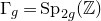 $\Gamma_g=\mathrm{Sp}_{2g}(\mathbb Z)$
acts on the Siegel half-space
$\Gamma_g=\mathrm{Sp}_{2g}(\mathbb Z)$
acts on the Siegel half-space $\mathcal{H}_g \subset \mathrm{Sym}_g(\mathbb C)$
via the usual formula
$\mathcal{H}_g \subset \mathrm{Sym}_g(\mathbb C)$
via the usual formula
 $$\gamma \cdot \tau = (A\tau+B)(C\tau+D)^{-1},$$
where we have written
 $$\gamma= \Big(\begin{matrix}A\quad &B\\C\quad &D \end{matrix} \Big) \in \Gamma_g.$$
Let $\Gamma_1=\mathrm{SL}_2(\mathbb Z)$
act on the space of matrices
$\Gamma_1=\mathrm{SL}_2(\mathbb Z)$
act on the space of matrices $M_{2,g-1}(\mathbb Z)$
by left multiplication. Following [Reference Bruinier and Westerholt-RaumBW-R15], we regard the Jacobi group
$M_{2,g-1}(\mathbb Z)$
by left multiplication. Following [Reference Bruinier and Westerholt-RaumBW-R15], we regard the Jacobi group
 $$J_g \stackrel{\mathrm{def}}{=} \Gamma_1 \ltimes M_{2,g-1}(\mathbb Z)$$
as a subset of $\Gamma_g$
using the injective function (not a group homomorphism)
$\Gamma_g$
using the injective function (not a group homomorphism)
 \begin{equation}\Big( \Big(\begin{array}{c@{\quad }c}a& b\\c&d \end{array}\Big), \Big(\begin{matrix} {}^tx \\ {}^ty \end{matrix}\Big) \Big)\mapsto\left(\begin{array}{c@{\quad }c | c@{\quad }c}1_{g-1} & - y & 0_{g-1} & x \\0 & a & a\, {}^tx+b\, {}^ty & b \\ \hline0_{g-1} & 0 & 1_{g-1} & 0 \\0 & c & c \, {}^t x + d\, {}^ty & d\end{array}\right)\end{equation}
for column vectors $x,y\in \mathbb Z^{g-1}$
. Note that the restriction of this injective map to the subgroup
$x,y\in \mathbb Z^{g-1}$
. Note that the restriction of this injective map to the subgroup $\Gamma_1\subset J_g$
is actually a group homomorphism.
$\Gamma_1\subset J_g$
is actually a group homomorphism.
Remark 4.1.1. As in [Reference Westerholt-RaumWR15, 4], there is an extended Jacobi group $J_g^{ \mathrm{ext} }$
, which can be realized both as a subgroup of
$J_g^{ \mathrm{ext} }$
, which can be realized both as a subgroup of $\Gamma_g$
, and as a central extension
$\Gamma_g$
, and as a central extension
 $$1 \to \mathbb Z \to J_g^{ \mathrm{ext} } \to J_g \to 1$$
with the property that the surjection to $J_g$
admits a set-theoretic section whose image generates
$J_g$
admits a set-theoretic section whose image generates $J_g^{\mathrm{ext}}$
. The use of the function (4.1) is a convenient way of hiding the presence of the larger extended Jacobi group, as the subset
$J_g^{\mathrm{ext}}$
. The use of the function (4.1) is a convenient way of hiding the presence of the larger extended Jacobi group, as the subset $J_g \subset \Gamma_g$
generates a subgroup isomorphic to
$J_g \subset \Gamma_g$
generates a subgroup isomorphic to $J_g^{ \mathrm{ext} }$
.
$J_g^{ \mathrm{ext} }$
.
The metaplectic double cover of the Siegel modular group is denoted by $\widetilde{\Gamma}_g.$
Its elements are pairs
$\widetilde{\Gamma}_g.$
Its elements are pairs
 \begin{equation}\tilde{\gamma} = ( \gamma , j_\gamma ) \in \widetilde{\Gamma}_g,\end{equation}
consisting of a $\gamma \in \Gamma_g$
and a holomorphic function
$\gamma \in \Gamma_g$
and a holomorphic function $j_\gamma(\tau)$
on
$j_\gamma(\tau)$
on $\mathcal{H}_g$
whose square is
$\mathcal{H}_g$
whose square is $\det(C\tau+D)$
. As in [Reference Bruinier and Westerholt-RaumBW-R15, (5)], the metaplectic Jacobi group
$\det(C\tau+D)$
. As in [Reference Bruinier and Westerholt-RaumBW-R15, (5)], the metaplectic Jacobi group
 $$\widetilde{J}_g \stackrel{\mathrm{def}}{=} \widetilde{\Gamma}_1 \ltimes M_{2,g-1}(\mathbb Z)$$
can be identified with a subset of $\widetilde{\Gamma}_g$
, using an injection lifting (4.1). Moreover, the restriction of this embedding to
$\widetilde{\Gamma}_g$
, using an injection lifting (4.1). Moreover, the restriction of this embedding to $\widetilde{\Gamma}_1$
is also a group homomorphism. In this way, we can view
$\widetilde{\Gamma}_1$
is also a group homomorphism. In this way, we can view $\widetilde{\Gamma}_1$
as a subgroup of
$\widetilde{\Gamma}_1$
as a subgroup of $\widetilde{\Gamma}_g$
.
$\widetilde{\Gamma}_g$
.
In the following definition, taken from [Reference Bruinier and Westerholt-RaumBW-R15, 2.2], we write elements of the Siegel half-space as
 $$\tau = \Big(\begin{array}{c@{\quad }c}\tau'' & z \\{}^t z & \tau' \end{array}\Big) \in \mathcal{H}_g\quad \mbox{with} \ \tau' \in \mathcal{H}_1, \ \tau'' \in \mathcal{H}_{g-1},$$
and $z\in \mathbb C^{g-1}$
a column vector.
$z\in \mathbb C^{g-1}$
a column vector.
Definition 4.1.2. Suppose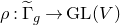 $ \rho : \widetilde{\Gamma}_g \to \mathrm{GL}(V)$
is a finite-dimensional representation with finite kernel. A holomorphic function
$ \rho : \widetilde{\Gamma}_g \to \mathrm{GL}(V)$
is a finite-dimensional representation with finite kernel. A holomorphic function
 $$\phi_T : \mathcal{H}_1 \times \mathbb C^{g-1} \to V$$
is a Jacobi form of half-integral weight k, index $T\in \mathrm{Sym}_{g-1}(\mathbb Q)$
, and representation
$T\in \mathrm{Sym}_{g-1}(\mathbb Q)$
, and representation $ \rho$
if the function
$ \rho$
if the function
 \begin{equation}\Phi_T(\tau) \stackrel{\mathrm{def}}{=} \phi_T(\tau',z)\cdot e^{2\pi i \mathrm{Tr}( T\cdot \tau'')}\end{equation}
on $\mathcal{H}_g$
satisfies the transformation law
$\mathcal{H}_g$
satisfies the transformation law
 $$\Phi_T(\gamma \cdot \tau) = j_\gamma (\tau)^{2k} \rho( \tilde{ \gamma} ) \cdot \Phi_T(\tau)$$
for all elements (4.2) in the subset $\widetilde{J}_g \subset \widetilde{\Gamma}_g$
, and if for all
$\widetilde{J}_g \subset \widetilde{\Gamma}_g$
, and if for all $\alpha,\beta \in \mathbb Q^{g-1}$
the function
$\alpha,\beta \in \mathbb Q^{g-1}$
the function $\phi_T( \tau' , \tau' \alpha +\beta)$
of
$\phi_T( \tau' , \tau' \alpha +\beta)$
of $\tau' \in \mathcal{H}_1$
is holomorphic at
$\tau' \in \mathcal{H}_1$
is holomorphic at $\in fty$
.
$\in fty$
.
Any Jacobi form of representation $\rho$
has a Fourier expansion
$\rho$
has a Fourier expansion
 $$ \phi_T( \tau' , z ) = \sum_{ \substack{ m \in \mathbb Q \\ \alpha \in \mathbb Q^{g-1} } } c(m,\alpha) \cdot q^m \xi_1^{\alpha_1} \cdots \xi_{g-1}^{\alpha_{g-1} }, $$
where we have set $q^m = e^{2\pi i m \tau'}$
and
$q^m = e^{2\pi i m \tau'}$
and $\xi_i^{\alpha_i} = e^{2\pi i \alpha_i z_i}$
.
$\xi_i^{\alpha_i} = e^{2\pi i \alpha_i z_i}$
.
Remark 4.1.3. Suppose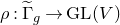 $ \rho : \widetilde{\Gamma}_g \to \mathrm{GL}(V)$
is a finite-dimensional representation with finite kernel. Given a holomorphic Siegel modular form
$ \rho : \widetilde{\Gamma}_g \to \mathrm{GL}(V)$
is a finite-dimensional representation with finite kernel. Given a holomorphic Siegel modular form $\phi : \mathcal{H}_g \to V$
of half-integer weight k and representation
$\phi : \mathcal{H}_g \to V$
of half-integer weight k and representation $\rho$
, there is a Fourier–Jacobi expansion
$\rho$
, there is a Fourier–Jacobi expansion
 $$\phi(\tau ) = \sum_{ T \in \mathrm{Sym}_{g-1} (\mathbb Q)} \phi_T( \tau', z ) \cdot e^{2\pi i \mathrm{Tr}(T\cdot \tau'')}$$
in which each coefficient $\phi_T$
is a Jacobi form of the weight k, index T, and representation
$\phi_T$
is a Jacobi form of the weight k, index T, and representation $\rho$
.
$\rho$
.
In practice, the representation $\rho$
will always be a form of the Weil representation. Let N be a free
$\rho$
will always be a form of the Weil representation. Let N be a free $\mathbb Z$
-module of finite rank endowed with a (nondegenerate) quadratic form Q. Denote by
$\mathbb Z$
-module of finite rank endowed with a (nondegenerate) quadratic form Q. Denote by
 $$S_{N,g} = \mathbb C [ ( N^\vee / N)^g ] \cong \mathbb C[ N^\vee/N]^{\otimes g}$$
the finite-dimensional vector space of $\mathbb C$
-valued functions on
$\mathbb C$
-valued functions on $(N^\vee/N)^g$
, and by
$(N^\vee/N)^g$
, and by $S_{N,g}^*$
its
$S_{N,g}^*$
its $\mathbb C$
-linear dual. For any
$\mathbb C$
-linear dual. For any $\mu \in (N^\vee / N)^g$
we denote by
$\mu \in (N^\vee / N)^g$
we denote by $\phi_\mu \in S_{N, g}$
the characteristic function of
$\phi_\mu \in S_{N, g}$
the characteristic function of $\mu$
. As
$\mu$
. As $\mu$
varies these form a basis of
$\mu$
varies these form a basis of $S_{N,g}$
, and we denote by
$S_{N,g}$
, and we denote by $\phi^*_\mu \in S^*_{N, g}$
the dual basis vectors.
$\phi^*_\mu \in S^*_{N, g}$
the dual basis vectors.
Denote by
 \begin{equation}\omega_{N,g} : \widetilde{\Gamma}_g \to \mathrm{GL}( S_{N,g} )\quad \mbox{and}\quad \omega^*_{N,g} : \widetilde{\Gamma}_g \to \mathrm{GL}( S^*_{N,g})\end{equation}
the Weil representation and its contragredient. To resolve some confusion in the literature, we now pin down the precise normalization of (4.4). Suppose N has signature (p,q), and $\tilde{\gamma}=(\gamma, j_\gamma)$
is as in (4.2).
$\tilde{\gamma}=(\gamma, j_\gamma)$
is as in (4.2).
-
(1) If
$\gamma = (\!\begin{smallmatrix}A & 0 \\0 & D\end{smallmatrix}\!)$
, then, noting that
$j_\gamma$
is a constant function (in fact, a square root of
$\det(A)=\det(D)=\pm 1$
),
$$\omega_{N,g}( \tilde{\gamma} ) \cdot \phi_\mu = j_\gamma^{p-q} \cdot\phi_{\mu \cdot A^{-1}} .$$
-
(2) If
$ \gamma = (\!\begin{smallmatrix}I & B \\0 & I\end{smallmatrix}\!)$
and
$j_\gamma =1$
, then where
$$\omega_{N,g}( \tilde{\gamma} ) \cdot \phi_\mu = e^{-2\pi i \mathrm{Tr}( Q( \tilde{\mu} ) B)} \cdot \phi_{\mu} ,$$
$Q( \tilde{\mu})\in \mathrm{Sym}_g(\mathbb Q)$
is the moment matrix of any lift
$\tilde{\mu} \in (N^\vee)^g$
.
-
(3) If
$ \gamma = (\!\begin{smallmatrix}0 & -I \\I & 0\end{smallmatrix}\!)$
and the square root
$j_\gamma(\tau) = \sqrt{\det(\tau)}$
is the standard branch determined by
$j_\gamma( i I_g ) = e^{ g \pi i /4} ,$
then
$$\omega_{N,g}( \tilde{\gamma}) \cdot \phi_\mu = \frac{e^{ \pi i g(p-q)/4}}{ [ N^\vee : N]^{g/2} }\sum_{ \nu \in (N^\vee/N)^g } e^{2\pi i [ \mu,\nu] } \cdot \phi_{\nu} .$$











These relations determine $\omega_{N,g}$
uniquely. The normalization is such that if N is positive definite of rank n, then the theta series
$\omega_{N,g}$
uniquely. The normalization is such that if N is positive definite of rank n, then the theta series
 $$\vartheta_{N,g}(\tau) = \sum_{ \mu \in (N^\vee/N)^g }\bigg( \sum_{ x\in \mu+ N^g} e^{ 2\pi i \mathrm{Tr}(\tau Q(x)) } \bigg)\phi^*_\mu$$
is a Siegel modular form of weight $n/2$
and representation
$n/2$
and representation $\omega^*_{N,g}$
.
$\omega^*_{N,g}$
.
Remark 4.1.4. Our Weil representation does not agree with the Weil representation $\rho_{N,g}$
of [Reference ZhangZha09, Definition 2.2]. Instead, the isomorphism
$\rho_{N,g}$
of [Reference ZhangZha09, Definition 2.2]. Instead, the isomorphism
 $$ S_{N,g} \xrightarrow{\phi_\mu \mapsto \phi_\mu^* } S_{N,g}^{*} $$
identifies $\rho_{N,g}$
with
$\rho_{N,g}$
with $\omega_{N,g}^*$
. Alternatively, our
$\omega_{N,g}^*$
. Alternatively, our $\omega_{N,g}$
agrees with Zhang’s
$\omega_{N,g}$
agrees with Zhang’s $\rho_{-N,g}$
, where
$\rho_{-N,g}$
, where $-N$
has the same underlying
$-N$
has the same underlying $\mathbb Z$
-module as N, but is endowed with the signature (q,p) quadratic form
$\mathbb Z$
-module as N, but is endowed with the signature (q,p) quadratic form $-Q$
.
$-Q$
.
Remark 4.1.5. There is a recurring error in [Reference ZhangZha09], originating in the proof of [Reference ZhangZha09, Theorem 2.9]. That proof claims that a certain generating series of Borcherds is a modular form of representation $ \rho_{L,1}^*$
, where L is a quadratic lattice of signature (n,2). In fact, this modular form has representation
$ \rho_{L,1}^*$
, where L is a quadratic lattice of signature (n,2). In fact, this modular form has representation $ \omega_{L,1}^*$
; see the proof of Proposition 4.3.3. The point is that Borcherds works with a lattice L of signature (2,n), and to reformulate the theorem for signature (n,2) one must replace the quadratic form by its negative. This does not change the space
$ \omega_{L,1}^*$
; see the proof of Proposition 4.3.3. The point is that Borcherds works with a lattice L of signature (2,n), and to reformulate the theorem for signature (n,2) one must replace the quadratic form by its negative. This does not change the space $S_{L,1}$
, but it does change the Weil representation (see the previous remark).
$S_{L,1}$
, but it does change the Weil representation (see the previous remark).
Remark 4.1.6. When $g=1$
we omit it from the notation, so that
$g=1$
we omit it from the notation, so that
 $$\widetilde{\Gamma} = \widetilde{\Gamma}_1\quad \mbox{and}\quad \mathcal{H}=\mathcal{H}_1,$$
and the Weil representation and its contragredient are
 $$\omega_{N} : \widetilde{\Gamma} \to \mathrm{GL}( S_{N} )\quad \mbox{and}\quad \omega^*_{N} : \widetilde{\Gamma} \to \mathrm{GL}( S^*_{N} ).$$
4.2 Statement of modularity in low codimension
Throughout the remainder of § 4 we impose the following two hypotheses.
Hypothesis 4.2.1. The integral model $\mathcal{M}$
over
$\mathcal{M}$
over $\mathbb Z[\Sigma^{-1}]$
is regular. See Proposition 2.2.4 for conditions on
$\mathbb Z[\Sigma^{-1}]$
is regular. See Proposition 2.2.4 for conditions on $\Sigma$
that guarantee this.
$\Sigma$
that guarantee this.
Hypothesis 4.2.2. Recalling the integer $r(L) \ge 0$
of Definition 3.1.1, we assume that d is a positive integer satisfying
$r(L) \ge 0$
of Definition 3.1.1, we assume that d is a positive integer satisfying
 $$d+1 \leq \frac{n-2r(L)-4}{3} .$$
The first hypothesis is neededFootnote
3
to make sense of (4.5), which requires a well-defined intersection product on the rational Chow groups of $\mathcal{M}$
. This is available to us if
$\mathcal{M}$
. This is available to us if $\mathcal{M}$
is regular, as explained in § A.2. The second hypothesis is imposed so that we may make use of Proposition 3.3.1.
$\mathcal{M}$
is regular, as explained in § A.2. The second hypothesis is imposed so that we may make use of Proposition 3.3.1.
Suppose $T' \in \mathrm{Sym}_{d+1}(\mathbb Q)$
and
$T' \in \mathrm{Sym}_{d+1}(\mathbb Q)$
and $\mu' \in (L^\vee/L)^{d+1}$
. Hypothesis 4.2.2 and Proposition 3.3.1 imply that the special cycle
$\mu' \in (L^\vee/L)^{d+1}$
. Hypothesis 4.2.2 and Proposition 3.3.1 imply that the special cycle
 $$\mathcal{Z}(T',\mu') \to \mathcal{M}$$
is flat over $\mathbb Z[\Sigma^{-1}]$
, and equidimensional of codimension
$\mathbb Z[\Sigma^{-1}]$
, and equidimensional of codimension $\mathrm{rank}(T')$
in
$\mathrm{rank}(T')$
in $\mathcal{M}$
. By Definition 1.4, there is an associated naive cycle class
$\mathcal{M}$
. By Definition 1.4, there is an associated naive cycle class
 \begin{equation*}[\mathcal{Z}(T',\mu')] \in \mathrm{CH}^{\mathrm{rank}(T')}( \mathcal{M} ).\end{equation*}
Define the corrected cycle class
 \begin{equation} \mathcal{C}(T',\mu') \stackrel{\mathrm{def}}{=} \underbrace{c_1(\omega^{-1}) \cdots c_1(\omega^{-1})}_{d+1-\mathrm{rank}(T') } \cdot{\kern1.5pt} [\mathcal{Z}(T',\mu')] \in \mathrm{CH}^{d+1} (\mathcal{M}) , \end{equation}
where $c_1(\omega^{-1})$
is the image of the inverse tautological line bundle (2.6) under the first Chern class map of Definition A.3.1. Abbreviate
$c_1(\omega^{-1})$
is the image of the inverse tautological line bundle (2.6) under the first Chern class map of Definition A.3.1. Abbreviate
 $$\mathcal{C}(T') = \sum_{\mu'\in (L^\vee/L)^{d+1}}\mathcal{C}(T',\mu') \otimes \phi^*_{\mu'}\in \mathrm{CH}^{d+1}(\mathcal{M})\otimes S^*_{L,{d+1}}.$$
The remainder of § 4 is devoted to the proof of the following result.
Proposition 4.2.3. For any fixed $T\in \mathrm{Sym}_d(\mathbb Q)$
, the formal generating series
$T\in \mathrm{Sym}_d(\mathbb Q)$
, the formal generating series
 $$ \sum_{ \substack{ m\in \mathbb Q \\ \alpha\in \mathbb Q^d } }\mathcal{C} \Big(\begin{array}{c@{\quad }c}T & \tfrac{\alpha}{2} \\\frac{{}^t \alpha}{2} & m \end{array}\Big) \cdot q^m \xi_1^{\alpha_1}\cdots \xi_d^{\alpha_d}$$
with coefficients in $\mathrm{CH}^{d+1}( \mathcal{M} ) \otimes S^*_{L,d+1}$
is a Jacobi form of index T, weight
$\mathrm{CH}^{d+1}( \mathcal{M} ) \otimes S^*_{L,d+1}$
is a Jacobi form of index T, weight $1+({n}/{2})$
, and representation
$1+({n}/{2})$
, and representation
 $$\omega^*_{L,d+1}: \widetilde{\Gamma}_{d+1} \to \mathrm{GL}(S_{L,d+1}^*) .$$
Here Jacobi modularity is understood, as in Theorem A, after applying any $\mathbb Q$
-linear functional
$\mathbb Q$
-linear functional $\mathrm{CH}^{d+1}( \mathcal{M} ) \to \mathbb C$
.
$\mathrm{CH}^{d+1}( \mathcal{M} ) \to \mathbb C$
.
Proposition 4.2.3, when combined with the main result of [Reference Bruinier and Westerholt-RaumBW-R15], is already enough to show that
 $$ \sum_{ T' \in \mathrm{Sym}_{d+1} (\mathbb Q) } \mathcal{C}(T') \cdot q^{T'}$$
is the q-expansion of a Siegel modular form of representation $\omega^*_{L,d+1} $
. See Theorem 6.2.1 and its proof for details.
$\omega^*_{L,d+1} $
. See Theorem 6.2.1 and its proof for details.
4.3 Auxiliary cycle classes
In this subsection we work with a fixed positive-semi-definite $T\in \mathrm{Sym}_d(\mathbb Q)$
and
$T\in \mathrm{Sym}_d(\mathbb Q)$
and $\mu=(\mu_1,\ldots, \mu_d) \in (L^\vee/L)^d .$
Given a $T'\in \mathrm{Sym}_{d+1}(\mathbb Q)$
with upper left
$T'\in \mathrm{Sym}_{d+1}(\mathbb Q)$
with upper left $d\times d$
block T, and a
$d\times d$
block T, and a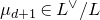 $ \mu_{d+1} \in L^\vee/L $
, there is a morphism
$ \mu_{d+1} \in L^\vee/L $
, there is a morphism
 \begin{equation}\mathcal{Z} ( T' , \mu' ) \to \mathcal{Z} (T, \mu)\end{equation}
of special cycles on $\mathcal{M}$
, where
$\mathcal{M}$
, where $\mu'=( \mu_1,\ldots,\mu_{d+1})$
. This morphism sends an S-valued point
$\mu'=( \mu_1,\ldots,\mu_{d+1})$
. This morphism sends an S-valued point
 $$(x_1,\ldots, x_{d+1}) \in V_{\mu_1}(\mathcal{A}_S) \times \cdots \times V_{\mu_{d+1}}(\mathcal{A}_S)$$
of the source to its truncation
 $$(x_1,\ldots, x_d) \in V_{\mu_1}(\mathcal{A}_S) \times \cdots \times V_{\mu_d}(\mathcal{A}_S) .$$
The morphism (4.6) is finite and unramified, by the same argument as in the proof of [Reference Andreatta, Goren, Howard and Madapusi PeraAGH+17, Proposition 2.7.2].
Recall from (2.10) that T determines a positive-definite quadratic space W of dimension $\mathrm{rank}(T)$
, together with distinguished generators
$\mathrm{rank}(T)$
, together with distinguished generators $e_1,\ldots, e_d \in W$
. As in (2.11), a functorial point
$e_1,\ldots, e_d \in W$
. As in (2.11), a functorial point $S\to \mathcal{Z}(T,\mu)$
determines an isometric embedding
$S\to \mathcal{Z}(T,\mu)$
determines an isometric embedding
 \begin{equation}W\xrightarrow{e_i \mapsto x_i} V(\mathcal{A}_S )_\mathbb Q.\end{equation}
This allows us to define a family of finite unramified stacks
 \begin{equation}\mathcal{Y} (m,\mu_{d+1},w)\to \mathcal{Z}(T,\mu)\end{equation}
indexed by $m\in \mathbb Q$
,
$m\in \mathbb Q$
,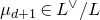 $\mu_{d+1}\in L^\vee/L$
, and
$\mu_{d+1}\in L^\vee/L$
, and $w\in W$
, with functor of points
$w\in W$
, with functor of points
 $$\mathcal{Y}(m,\mu_{d+1},w) (S)= \Big\{x_{d+1}\in V_{\mu_{d+1}}(\mathcal{A}_S): \begin{array}{c} Q(x_{d+1}-w) = m \\{ [x_{d+1},e_i] = [w,e_i] \ \forall 1\le i \le d } \end{array} \Big\}.$$
Note that the conditions $[ x_{d+1} , e_i] = [w,e_i]$
are equivalent to w being the orthogonal projection of
$[ x_{d+1} , e_i] = [w,e_i]$
are equivalent to w being the orthogonal projection of $x_{d+1}$
to
$x_{d+1}$
to $W \subset V(\mathcal{A}_S)_\mathbb Q$
.
$W \subset V(\mathcal{A}_S)_\mathbb Q$
.
The following Proposition shows that the new stacks (4.8) are not really new at all. They are special cycles we already know, but indexed in a different way.
Proposition 4.3.1. There is an isomorphism of $\mathcal{Z}(T,\mu)$
-stacks
$\mathcal{Z}(T,\mu)$
-stacks
 \begin{equation} \mathcal{Y}(m,\mu_{d+1},w) \cong \mathcal{Z} (T' , \mu' ),\end{equation}
where $\mu'=(\mu_1,\ldots, \mu_{d+1})$
, and
$\mu'=(\mu_1,\ldots, \mu_{d+1})$
, and
 $$T' = \begin{pmatrix}T&\tfrac{\alpha}{2}\\\frac{{}^t \alpha}{2}\quad & m + Q(w)\end{pmatrix} \!,$$
for the column vector $\alpha\in \mathbb Q^d$
with components
$\alpha\in \mathbb Q^d$
with components $\alpha_i = [w,e_i]$
. Moreover,
$\alpha_i = [w,e_i]$
. Moreover,
 $$m\ne 0 \iff \mathrm{rank}(T') = \mathrm{rank}(T)+1,$$
and when these conditions hold both (4.6) and (4.8) are generalized Cartier divisors (Definition 2.4.1).
Proof. Let W’ be the quadratic space of dimension $\mathrm{rank}(T')$
determined by T’, exactly as the space W of (2.10) was determined by T. As we do not assume that T’ is positive semi-definite, the quadratic space W’ need not be positive definite, but it is nondegenerate (by construction). There are distinguished vectors
$\mathrm{rank}(T')$
determined by T’, exactly as the space W of (2.10) was determined by T. As we do not assume that T’ is positive semi-definite, the quadratic space W’ need not be positive definite, but it is nondegenerate (by construction). There are distinguished vectors $e_1,\ldots, e_{d+1}$
that span W’, the vectors
$e_1,\ldots, e_{d+1}$
that span W’, the vectors $e_1,\ldots, e_d$
span a positive-definite subspace
$e_1,\ldots, e_d$
span a positive-definite subspace $W\subset W'$
isometric to (2.10), and the tuples
$W\subset W'$
isometric to (2.10), and the tuples
 $$e =(e_1,\ldots, e_d) \in W^d\quad \mbox{and}\quad e' =(e_1,\ldots, e_{d+1}) \in (W')^{d+1}$$
satisfy $Q(e)=T$
and
$Q(e)=T$
and $Q(e') = T'$
. Using the relation between T’ and w, one checks first that w is the orthogonal projection of
$Q(e') = T'$
. Using the relation between T’ and w, one checks first that w is the orthogonal projection of $e_{d+1}$
to W, and then that
$e_{d+1}$
to W, and then that
 $$0 = [ e_{d+1}-w,w] = Q(e_{d+1}) -Q( e_{d+1}-w) - Q(w) .$$
In particular,
 \begin{equation}Q( e_{d+1}-w) =m.\end{equation}
Now we construct the isomorphism (4.9). Fix an $\mathcal{M}$
-scheme S and a tuple
$\mathcal{M}$
-scheme S and a tuple
 $$x=(x_1,\ldots, x_d) \in V_{\mu_1}(\mathcal{A}_S) \times \cdots \times V_{\mu_d}(\mathcal{A}_S).$$
with moment matrix $Q(x)=T$
. This determines a point
$Q(x)=T$
. This determines a point $x\in \mathcal{Z}(T,\mu)(S)$
, and an isometric embedding
$x\in \mathcal{Z}(T,\mu)(S)$
, and an isometric embedding $W \to V(\mathcal{A}_S)_\mathbb Q$
by (4.7).
$W \to V(\mathcal{A}_S)_\mathbb Q$
by (4.7).
A lift of x to $\mathcal{Z}(T',\mu')(S)$
determines a special quasi-endomorphism
$\mathcal{Z}(T',\mu')(S)$
determines a special quasi-endomorphism
 $$x_{d+1} \in V_{\mu_{d+1}} (\mathcal{A}_S),$$
which then determines an extension of $W \to V(\mathcal{A}_S)_\mathbb Q$
to
$W \to V(\mathcal{A}_S)_\mathbb Q$
to
 $$W' \xrightarrow{e_i \mapsto x_i} V(\mathcal{A}_S)_\mathbb Q.$$
The calculation (4.10) shows that $Q(x_{d+1}-w)=m$
, and combining this with
$Q(x_{d+1}-w)=m$
, and combining this with $[x_{d+1} , e_i] = [x_{d+1},x_i] = \alpha_i$
shows that
$[x_{d+1} , e_i] = [x_{d+1},x_i] = \alpha_i$
shows that $x_{d+1}$
defines a lift of x to
$x_{d+1}$
defines a lift of x to $\mathcal{Y}(m,\mu_{d+1},w)(S)$
.
$\mathcal{Y}(m,\mu_{d+1},w)(S)$
.
Conversely, any lift of x to $\mathcal{Y}(m,\mu_{d+1},w)(S)$
corresponds to an
$\mathcal{Y}(m,\mu_{d+1},w)(S)$
corresponds to an $x_{d+1} \in V_{\mu_{d+1}} (\mathcal{A}_S)$
with the property that
$x_{d+1} \in V_{\mu_{d+1}} (\mathcal{A}_S)$
with the property that $Q(x_{d+1}-w)=m$
, and the orthogonal projection of
$Q(x_{d+1}-w)=m$
, and the orthogonal projection of $x_{d+1}$
to
$x_{d+1}$
to $W \subset V(\mathcal{A}_S)_\mathbb Q$
is w. An elementary linear algebra argument shows that
$W \subset V(\mathcal{A}_S)_\mathbb Q$
is w. An elementary linear algebra argument shows that $x'=(x_1,\ldots, x_{d+1})$
has moment matrix T’, so determines a lift of x to
$x'=(x_1,\ldots, x_{d+1})$
has moment matrix T’, so determines a lift of x to $\mathcal{Z}(T',\mu' )(S)$
. This establishes the isomorphism (4.9).
$\mathcal{Z}(T',\mu' )(S)$
. This establishes the isomorphism (4.9).
If $m=0$
, then (4.10) implies that
$m=0$
, then (4.10) implies that $e_{d+1}-w$
is an isotropic vector orthogonal to W, which is therefore contained in the radical of the quadratic form on W’. As this radical is trivial,
$e_{d+1}-w$
is an isotropic vector orthogonal to W, which is therefore contained in the radical of the quadratic form on W’. As this radical is trivial, $e_{d+1}=w\in W$
. It follows that
$e_{d+1}=w\in W$
. It follows that $W'=W$
, and
$W'=W$
, and $\mathrm{rank}(T') = \mathrm{rank}(T)$
.
$\mathrm{rank}(T') = \mathrm{rank}(T)$
.
Now suppose $m\neq 0$
. It follows from (4.10) that
$m\neq 0$
. It follows from (4.10) that $e_{d+1}\neq w$
, hence
$e_{d+1}\neq w$
, hence $e_{d+1} \neq W$
and
$e_{d+1} \neq W$
and
 $$\mathrm{rank}(T') = \dim(W') = \dim(W)+1=\mathrm{rank}(T)+1.$$
It remains to show that (4.8) is a generalized Cartier divisor. In light of the isomorphism (4.9), it suffices to show the same for (4.6).
By Remark 2.2.12 we may assume that T’ is positive semi-definite, as otherwise $\mathcal{Z}(T',\mu') = \emptyset$
and the claim is vacuous. This assumption implies that W’ is a positive-definite quadratic space, and so (4.10) implies
$\mathcal{Z}(T',\mu') = \emptyset$
and the claim is vacuous. This assumption implies that W’ is a positive-definite quadratic space, and so (4.10) implies $m \gt 0$
. In particular,
$m \gt 0$
. In particular, $m+Q(w) \gt 0$
. By Proposition 2.4.3, the right vertical arrow in the following diagram
$m+Q(w) \gt 0$
. By Proposition 2.4.3, the right vertical arrow in the following diagram

is a generalized Cartier divisor. Proposition 2.4.6 allows us to realize $\mathcal{Z}(T',\mu')$
as an open and closed substack of the upper left corner, and so there exists an étale cover
$\mathcal{Z}(T',\mu')$
as an open and closed substack of the upper left corner, and so there exists an étale cover $U\to \mathcal{Z}(T,\mu)$
such that
$U\to \mathcal{Z}(T,\mu)$
such that $ \mathcal{Z}(T',\mu')_U \to U$
is a disjoint union of closed immersions
$ \mathcal{Z}(T',\mu')_U \to U$
is a disjoint union of closed immersions $Z_i\to U$
, each of which is locally defined by the vanishing of a section of
$Z_i\to U$
, each of which is locally defined by the vanishing of a section of $\mathcal O_U$
. To see that
$\mathcal O_U$
. To see that $Z_i$
is an effective Cartier divisor on U, we must show that this section is not a zero divisor. This relies on the following lemma of commutative algebra.
$Z_i$
is an effective Cartier divisor on U, we must show that this section is not a zero divisor. This relies on the following lemma of commutative algebra.
Lemma 4.3.2. Suppose that S is a Cohen–Macaulay local Noetherian ring with maximal ideal $\mathfrak{m}$
; then an element
$\mathfrak{m}$
; then an element $a\in \mathfrak{m}$
is a nonzero divisor if and only if
$a\in \mathfrak{m}$
is a nonzero divisor if and only if $\dim S/(a) = \dim S - 1$
.
$\dim S/(a) = \dim S - 1$
.
Proof. By Krull’s Hauptidealsatz [Sta22, Tag 00KV], we have
 $$\dim ( S/(a) ) \ge \dim (S) - 1,$$
with equality holding exactly when a is not contained in any minimal prime of S. On the other hand, saying that a is a nonzero divisor is equivalent to saying that a is not contained in any associated prime of S. Since S is Cohen–Macaulay, its associated primes are precisely its minimal ones, and so the lemma follows.
Recall that Hypothesis (4.2.2) guarantees that $\mathcal{Z}(T',\mu')$
has dimension
$\mathcal{Z}(T',\mu')$
has dimension
 $$\dim( \mathcal{M} ) - \mathrm{rank}(T') = \dim (\mathcal{M} )- \mathrm{rank}(T) - 1 = \dim( \mathcal{Z}(T,\mu) ) - 1.$$
As $\mathcal{Z}(T,\mu)$
is Cohen–Macaulay by Proposition 3.3.1, the desired conclusion now follows from Lemma 4.3.2.
$\mathcal{Z}(T,\mu)$
is Cohen–Macaulay by Proposition 3.3.1, the desired conclusion now follows from Lemma 4.3.2.
If $m\neq 0$
, Proposition 4.3.1 allows us to define, using Remark 2.4.2,
$m\neq 0$
, Proposition 4.3.1 allows us to define, using Remark 2.4.2,
 \begin{equation}[ \mathcal{Y}(m,\mu_{d+1},w) ] \in \mathrm{CH}^1 (\mathcal{Z}(T,\mu))\end{equation}
as the cycle class associated to the generalized Cartier divisor (4.8). More precisely, it is the first Chern class (Definition A.3.1) of the associated line bundle.
We next extend the definition to $m=0$
. In this case the condition
$m=0$
. In this case the condition $Q(x_{d+1}-w) =0$
imposed in the definition of the domain of (4.8) can be satisfied by at most the vector
$Q(x_{d+1}-w) =0$
imposed in the definition of the domain of (4.8) can be satisfied by at most the vector $x_{d+1}=w$
, and so
$x_{d+1}=w$
, and so
 $$\mathcal{Y}(0,\mu_{d+1},w) (S)= \begin{cases}\mathcal{Z}(T,\mu)(S) & \mbox{if } w \in V_{ \mu_{d+1} } ( \mathcal{A}_S ) \\\emptyset & \mbox{otherwise.}\end{cases}$$
This implies that the morphism (4.8) is a closed immersion. On the other hand, Proposition 4.3.1 tells us that there is a distinguished choice of $(T',\mu')$
for which
$(T',\mu')$
for which $\mathrm{rank}(T) = \mathrm{rank}(T')$
and
$\mathrm{rank}(T) = \mathrm{rank}(T')$
and
 $$ \mathcal{Y}(0,\mu_{d+1},w) \cong \mathcal{Z}(T',\mu'). $$
We deduce that for this choice of $(T',\mu')$
the morphism (4.6) is a closed immersion between stacks of the same dimension. Now form the first Chern class
$(T',\mu')$
the morphism (4.6) is a closed immersion between stacks of the same dimension. Now form the first Chern class
 $$c_1(\omega^{-1}|_{\mathcal{Z}(T',\mu')})\in \mathrm{CH}^1(\mathcal{Z}(T',\mu')),$$
where $\omega \in \mathrm{Pic}(\mathcal{M})$
is the tautological bundle, and define
$\omega \in \mathrm{Pic}(\mathcal{M})$
is the tautological bundle, and define
 \begin{equation}[ \mathcal{Y}(0,\mu_{d+1},w) ] \in \mathrm{CH}^1(\mathcal{Z}(T,\mu))\end{equation}
to be its pushforward via (4.6).
Let $Y (m,\mu_{d+1},w)$
be the generic fiber of (4.8), and let
$Y (m,\mu_{d+1},w)$
be the generic fiber of (4.8), and let
 \begin{equation}[ Y (m,\mu_{d+1},w) ] \in \mathrm{CH}^1 ( Z(T ,\mu ) )\end{equation}
be the restriction of (4.11) and (4.12) to the generic fiber of $\mathcal{Z}(T,\mu)$
. The following proposition is our version of [Reference ZhangZha09, Proposition 2.6]. One should regard it as a corollary of a theorem of Borcherds [Reference BorcherdsBor99].
$\mathcal{Z}(T,\mu)$
. The following proposition is our version of [Reference ZhangZha09, Proposition 2.6]. One should regard it as a corollary of a theorem of Borcherds [Reference BorcherdsBor99].
Proposition 4.3.3. The formal generating series
 $$\sum_{ \substack{ m \in \mathbb Q \\w \in W \\ \mu_{d+1} \in L^\vee/L } } [ Y ( m , \mu_{d+1} , w ) ] \otimes \phi^*_ {\mu_{d+1}}\cdot q^{ m+ Q(w) } \xi_1^{ [ w , e_1] } \cdots \xi_{d}^{ [ w , e_d]}$$
convergesFootnote 4 to a holomorphic function
 $$\phi_T(\tau', z) : \mathcal{H} \times \mathbb C^d \to \mathrm{CH}^1(Z(T,\mu)) \otimes S_L^*.$$
The corresponding function (4.3) on $\mathcal{H}_{d+1}$
satisfies
$\mathcal{H}_{d+1}$
satisfies
 $$\Phi_T(\gamma \cdot \tau) = j_\gamma (\tau)^{2+n} \omega_{L}^*( \tilde{ \gamma} ) \cdot \Phi_T(\tau)$$
for all elements $( \gamma , j_\gamma) \in \widetilde{\Gamma} \subset \widetilde{\Gamma}_{d+1}$
as in (4.2).
$( \gamma , j_\gamma) \in \widetilde{\Gamma} \subset \widetilde{\Gamma}_{d+1}$
as in (4.2).
Proof. The claim is vacuously true if $Z(T,\mu)$
is empty. Hence, as in § 2.3, we may fix an orthogonal decomposition
$Z(T,\mu)$
is empty. Hence, as in § 2.3, we may fix an orthogonal decomposition $V = V^\flat \oplus W$
and use this to express
$V = V^\flat \oplus W$
and use this to express
 \begin{equation} Z(T, \mu) =\bigsqcup_{ g \in G^\flat(\mathbb Q)\backslash \Xi(T,\mu)/K } M^\flat_g .\end{equation}
as a disjoint union of smaller Shimura varieties. As in (2.12), each $g\in \Xi(T,\mu)$
determines lattices
$g\in \Xi(T,\mu)$
determines lattices $L_g^\flat \subset V^\flat$
and
$L_g^\flat \subset V^\flat$
and $\Lambda_g \subset W$
.
$\Lambda_g \subset W$
.
The Shimura variety $M^\flat_g$
has its own tautological line bundle
$M^\flat_g$
has its own tautological line bundle $\omega^\flat_g$
, its own Kuga–Satake abelian scheme
$\omega^\flat_g$
, its own Kuga–Satake abelian scheme $A^\flat_g \to M^\flat_g$
, and its own family of special cycles
$A^\flat_g \to M^\flat_g$
, and its own family of special cycles
 $$ Z^\flat_g(m,\nu) \to M^\flat_g $$
indexed by $m\in \mathbb Q$
and
$m\in \mathbb Q$
and $\nu \in L_g^{\flat,\vee} / L^\flat_g$
. When
$\nu \in L_g^{\flat,\vee} / L^\flat_g$
. When $m\neq 0$
there is an associated class
$m\neq 0$
there is an associated class
 $$ [ Z^\flat_g(m,\nu)] \in \mathrm{CH}^1(M^\flat_g) $$
by Remark 2.4.2 and Proposition 2.4.3. When $m=0$
we define
$m=0$
we define
 $$ [ Z^\flat_g(0,\nu)] = \begin{cases} c_1( \omega^{\flat,-1}_g) & \mbox{if }\nu =0, \\ 0 & \mbox{otherwise}. \end{cases}$$
Remark 4.3.4. At a prime $p\not\in \Sigma$
the lattice
$p\not\in \Sigma$
the lattice $L_g^\flat$
may be far from maximal. Fortunately, we have no need for any integral model of
$L_g^\flat$
may be far from maximal. Fortunately, we have no need for any integral model of $M_g^\flat$
over
$M_g^\flat$
over $\mathbb Z[\Sigma^{-1}]$
. All constructions and proofs from §§ 2.2 and 2.4 can be carried out (usually with less effort) directly on the canonical model over
$\mathbb Z[\Sigma^{-1}]$
. All constructions and proofs from §§ 2.2 and 2.4 can be carried out (usually with less effort) directly on the canonical model over $\mathbb Q$
.
$\mathbb Q$
.
Lemma 4.3.5. For every $g\in \Xi(T,\mu)$
there is a canonical isomorphism of
$g\in \Xi(T,\mu)$
there is a canonical isomorphism of $M_g^\flat$
-stacks
$M_g^\flat$
-stacks
 \begin{equation}Y(m,\mu_{d+1},w) \times_{Z(T,\mu)} M^\flat_g \cong \bigsqcup_{\substack{ \nu \in L_g^{\flat,\vee} / L^\flat_g \\ \nu+w \in g \cdot( \mu_{d+1} +L_{\widehat{\mathbb Z}}) } } Z^\flat_g(m,\nu) .\end{equation}
Here we regard $\mu_{d+1} +L_{\widehat{\mathbb Z}} \subset V_{\mathbb A_f}$
. Moreover,
$\mu_{d+1} +L_{\widehat{\mathbb Z}} \subset V_{\mathbb A_f}$
. Moreover,
 \begin{equation}[Y(m,\mu_{d+1},w)] \vert_{M^\flat_g} = \sum_{\substack{ \nu \in L_g^{\flat,\vee} / L^\flat_g \\ \nu+w \in g \cdot( \mu_{d+1} +L_{\widehat{\mathbb Z}}) } }[ Z^\flat_g(m,\nu) ] \in \mathrm{CH}^1(M^\flat_g)\end{equation}
where the left-hand side is the projection of (4.13) to the g-summand in
 $$ \mathrm{CH}^1 ( Z(T ,\mu ) ) \cong \bigoplus_{g \in G^\flat(\mathbb Q)\backslash \Xi(T,\mu)/K }\mathrm{CH}^1(M_g^\flat).$$
Proof. Applying the proof of Proposition 2.4.7 to the morphism $M^\flat_g \to M$
of Remark 2.5, we see that for any
$M^\flat_g \to M$
of Remark 2.5, we see that for any $M^\flat_g$
-scheme S there is a canonical isometry
$M^\flat_g$
-scheme S there is a canonical isometry
 $$V(A_S)_\mathbb Q = V(A^\flat_{g,S})_\mathbb Q \oplus W,$$
which restricts to a bijection
 \begin{align} V_{\mu_{d+1}}( A_S) = \bigsqcup_{ \substack{ {\nu\in L_g^{\flat,\vee}/L_g^\flat } \\ { \lambda\in \Lambda_g^\vee/\Lambda_g} \\ { \nu+\lambda \in g \cdot ( \mu_{d+1} + L_{\widehat{\mathbb Z}} ) } }} V_\nu(A^\flat_{g,S})\times (\lambda + \Lambda_g). \end{align}
This isometric embedding $W \to V(A_S)_\mathbb Q$
agrees with that of (4.7).
$W \to V(A_S)_\mathbb Q$
agrees with that of (4.7).
An S-point of the left-hand side of (4.15) is an S-point of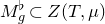 $M_g^\flat \subset Z(T,\mu)$
, together with a special quasi-endomorphism
$M_g^\flat \subset Z(T,\mu)$
, together with a special quasi-endomorphism
 $$ x_{d+1}\in V_{\mu_{d+1}}(A_S) $$
whose orthogonal projection to W is w, and such that $Q(x_{d+1}-w) = m$
. Using (4.17), we find that there is a unique pair of cosets
$Q(x_{d+1}-w) = m$
. Using (4.17), we find that there is a unique pair of cosets
 $$ \nu\in L_g^{\flat,\vee}/L_g^\flat \quad \mbox{and}\quad \lambda\in \Lambda_g^\vee/\Lambda_g $$
such that $\nu +\lambda \in g\cdot (\mu_{d_1}+L_{\widehat{\mathbb Z}})$
, and such that
$\nu +\lambda \in g\cdot (\mu_{d_1}+L_{\widehat{\mathbb Z}})$
, and such that
 $$ x_{d+1}-w \in V_\nu(A^\flat_{g,S}) \quad \mbox{and}\quad w\in \lambda + \Lambda_g.$$
In particular, $x_{d+1}-w$
determines an S-point of
$x_{d+1}-w$
determines an S-point of $Z_g^\flat(m,\nu)$
.
$Z_g^\flat(m,\nu)$
.
This construction establishes the isomorphism (4.15), from which (4.16) follows directly. We note that when $m=0$
both sides of (4.16) are equal to
$m=0$
both sides of (4.16) are equal to
 $$ \begin{cases} c_1(\omega^{-1}_{M^\flat_g}) & \mbox{if }w \in g \cdot (\mu_{d+1} + L_{\widehat{\mathbb Z}} ), \\ 0 & \mbox{otherwise.} \end{cases} $$
Dualizing the tautological map $S_{\Lambda_g} \otimes S^*_{\Lambda_g} \to \mathbb C$
yields a homomorphism
$S_{\Lambda_g} \otimes S^*_{\Lambda_g} \to \mathbb C$
yields a homomorphism
 \begin{equation}\mathbb C \to S^*_{\Lambda_g} \otimes S_{\Lambda_g}\end{equation}
sending $1\mapsto \sum_{ w\in \Lambda_g^\vee / \Lambda_g } \phi^*_w \otimes \phi_w$
. On the other hand, if we abbreviate
$1\mapsto \sum_{ w\in \Lambda_g^\vee / \Lambda_g } \phi^*_w \otimes \phi_w$
. On the other hand, if we abbreviate
 $$L_g = V \cap g L_{\widehat{\mathbb Z}},$$
we may use the inclusions
 \begin{equation*}L^\flat_g \oplus \Lambda_g \subset L_g \subset L_g^\vee \subset L_g^{\flat,\vee} \oplus \Lambda_g^\vee\end{equation*}
to define a homomorphism $ S^*_{L^\flat_g} \otimes S^*_{\Lambda_g} \to S_{L_g}^*$
by
$ S^*_{L^\flat_g} \otimes S^*_{\Lambda_g} \to S_{L_g}^*$
by
 $$\phi^*_\nu \otimes \phi^*_w \mapsto \begin{cases}\phi^*_{ \nu + w } & \mbox{if } \nu+w \in L_g^\vee,\\0 & \mbox{otherwise}\end{cases}$$
for all $\nu \in L_g^{\flat,\vee}/L^\flat_g$
and
$\nu \in L_g^{\flat,\vee}/L^\flat_g$
and $w\in \Lambda_g^\vee/\Lambda_g$
. This defines the second arrow in the
$w\in \Lambda_g^\vee/\Lambda_g$
. This defines the second arrow in the $\widetilde{\Gamma}_1$
-equivariant composition
$\widetilde{\Gamma}_1$
-equivariant composition

The third arrow is defined using the isomorphism $S^*_{L_g} \cong S^*_L $
induced by
$S^*_{L_g} \cong S^*_L $
induced by $g^{-1} : L^\vee_g/L_g \to L^\vee/L$
.
$g^{-1} : L^\vee_g/L_g \to L^\vee/L$
.
It is a theorem of Borcherds [Reference BorcherdsBor99] that the formal generating series
 $$ \sum_{ \substack{ m \ge 0 \\ \nu \in L_g^{\flat,\vee} / L^\flat_g } } [ Z^\flat_g(m,\nu) ] \otimes \phi^*_\nu \cdot q^m$$
with coefficients in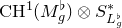 $ \mathrm{CH}^1( M^\flat_g) \otimes S^*_{ L^\flat_g}$
is a modular form on
$ \mathrm{CH}^1( M^\flat_g) \otimes S^*_{ L^\flat_g}$
is a modular form on $\mathcal{H}$
of weight
$\mathcal{H}$
of weight $1+{n^\flat}/{2}$
and representation
$1+{n^\flat}/{2}$
and representation
 $$ \omega^*_{L^\flat_g} : \widetilde{\Gamma} \to \mathrm{GL}( S^*_{L^\flat_g} ) . $$
More precisely, as Borcherds works only in the complex fiber, one should use [Reference Howard and Madapusi PeraHMP20, Theorem B] for the corresponding modularity statement on the canonical model.
Applying (4.19) to this last generating series coefficient-by-coefficient yields the formal generating series
 \begin{equation} \sum_{ \substack{ m \ge 0 \\ \nu \in L_g^{\flat,\vee} / L^\flat_g } } \sum_{ \substack{ \mu_{d+1} \in L^\vee/L \\ w \in \Lambda^\vee_g/\Lambda_g \\ \nu+w \in g\cdot( \mu_{d+1} + L_{\widehat{\mathbb Z}}) } }[ Z^\flat_g ( m , \nu ) ] \otimes \phi^*_{\mu_{d+1}} \otimes \phi_ w \cdot q^m\end{equation}
with coefficients in $\mathrm{CH}^1(M^\flat_g) \otimes S^*_L \otimes S_{ \Lambda_g }$
, which is therefore a modular form on
$\mathrm{CH}^1(M^\flat_g) \otimes S^*_L \otimes S_{ \Lambda_g }$
, which is therefore a modular form on $\mathcal{H}$
of weight
$\mathcal{H}$
of weight $1+{n^\flat}/{2}$
and representation
$1+{n^\flat}/{2}$
and representation
 $$ \omega^*_{L} \otimes \omega_{ \Lambda_g } : \widetilde{\Gamma} \to \mathrm{GL}( S^*_{L} \otimes S_{ \Lambda_g } ) . $$
Consider the theta function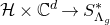 $ \mathcal{H} \times \mathbb C^d \to S_{\Lambda_g}^*$
defined by
$ \mathcal{H} \times \mathbb C^d \to S_{\Lambda_g}^*$
defined by
 \begin{equation}\vartheta_w (\tau',z) = \sum_{ w \in \Lambda_g^\vee } \phi^*_w \cdot q^{Q(w) } \xi_1^{ [ w , e_1] } \cdots \xi_d^{ [ w , e_d] } .\end{equation}
If, as in Definition 4.1.2, we define a function on $\mathcal{H}_{d+1}$
by
$\mathcal{H}_{d+1}$
by
 $$\Theta_w( \tau) = \vartheta_w (\tau',z)\cdot e^{2\pi i \mathrm{Tr}( T\cdot \tau'' ) },$$
then [Reference ZhangZha09, Lemma 2.8] implies the equality
 $$ \Theta_w( \gamma \cdot \tau) = j_\gamma(\tau)^{n-n^\flat} \omega^*_{\Lambda_g}( \tilde{\gamma}) \cdot \Theta_w (\tau) $$
for all (4.2) in the subgroup $\widetilde{\Gamma} \subset \widetilde{\Gamma}_{d+1}$
.
$\widetilde{\Gamma} \subset \widetilde{\Gamma}_{d+1}$
.
Now use the tautological pairing $S_{\Lambda_g} \otimes S_{\Lambda_g}^* \to \mathbb C$
to multiply (4.20) with (4.21). Lemma 4.3.5 implies that the resulting generating series is
$S_{\Lambda_g} \otimes S_{\Lambda_g}^* \to \mathbb C$
to multiply (4.20) with (4.21). Lemma 4.3.5 implies that the resulting generating series is
 $$ \sum_{ \substack{ m \in \mathbb Q \\ w \in W \\ \mu_{d+1} \in L^\vee/L } }[ Y ( m , \mu_{d+1} , w ) ]\rvert_{M^\flat_g} \otimes \phi^*_ {\mu_{d+1}}\cdot q^{ m+ Q(w) } \xi_1^{ [ w , e_1] } \cdots \xi_d^{ [ w , e_d] } ,$$
which therefore satisfies the transformation law stated in Proposition 4.3.3. Varying g and using (4.14) completes the proof of that proposition.
Corollary 4.3.6. The generating series
 $$\sum_{ \substack{ m \in \mathbb Q \\ w \in W \\ \mu_{d+1} \in L^\vee/L } }[ \mathcal{Y} ( m , \mu_{d+1} , w ) ] \otimes \phi^*_ {\mu_{d+1}}\cdot q^{ m+ Q(w) } \xi_1^{ [ w , e_1] } \cdots \xi_{d}^{ [ w , e_d]}$$
defines a holomorphic function
 $$\mathcal{H} \times \mathbb C^d \to \mathrm{CH}^1(\mathcal{Z}(T,\mu)) \otimes S_L^*$$
satisfying the same transformation law under $\widetilde{\Gamma} \subset \widetilde{\Gamma}_{d+1}$
as the generating series of Proposition 4.3.3.
$\widetilde{\Gamma} \subset \widetilde{\Gamma}_{d+1}$
as the generating series of Proposition 4.3.3.

4.4 Proof of Proposition 4.2.3
Proposition 4.2.3 is vacuously true if $T\in \mathrm{Sym}_d(\mathbb Q)$
is not positive semi-definite. Indeed, in this case
$T\in \mathrm{Sym}_d(\mathbb Q)$
is not positive semi-definite. Indeed, in this case $\mathcal{Z}(T,\mu)= \emptyset$
by Remark 2.2.12, and it follows from (4.5) and (4.6) that the generating series of Proposition 4.2.3 vanishes coefficient-by-coefficient. Thus we may assume, as in § 4.3 that
$\mathcal{Z}(T,\mu)= \emptyset$
by Remark 2.2.12, and it follows from (4.5) and (4.6) that the generating series of Proposition 4.2.3 vanishes coefficient-by-coefficient. Thus we may assume, as in § 4.3 that $T\in \mathrm{Sym}_d(\mathbb Q)$
is positive semi-definite, and let
$T\in \mathrm{Sym}_d(\mathbb Q)$
is positive semi-definite, and let $e_1,\ldots, e_d \in W$
be as in (2.10).
$e_1,\ldots, e_d \in W$
be as in (2.10).
By Hypothesis 4.2.2 and Proposition 3.3.1, for any $\mu=(\mu_1,\ldots, \mu_d) \in (L^\vee/L)^d$
the canonical finite unramified map
$\mu=(\mu_1,\ldots, \mu_d) \in (L^\vee/L)^d$
the canonical finite unramified map
 $$f^{(T,\mu)} : \mathcal{Z}(T,\mu) \to \mathcal{M}$$
has equidimensional image of codimension $\mathrm{rank}(T)$
, and so induces (Proposition A.1.3) a pushforward
$\mathrm{rank}(T)$
, and so induces (Proposition A.1.3) a pushforward
 $$f^{(T,\mu)}_*: \mathrm{CH}^1 (\mathcal{Z}(T ,\mu)) \to \mathrm{CH}^{ \mathrm{rank}(T) + 1 } (\mathcal{M}).$$
The following lemma relates the images of the cycle classes (4.11) and 4.12 under this map to the coefficients appearing in Proposition 4.2.3.
Lemma 4.4.1 For any $m\in \mathbb Q$
,
$m\in \mathbb Q$
, $w \in W$
, and
$w \in W$
, and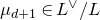 $\mu_{d+1} \in L^\vee/L$
we have the equality
$\mu_{d+1} \in L^\vee/L$
we have the equality
 $$\underbrace{ c_1(\omega^{-1}) \cdots c_1(\omega^{-1}) }_{ d - \mathrm{rank}(T ) } \cdot{\kern1.5pt}f^{(T,\mu)}_* [ \mathcal{Y}(m,\mu_{d+1},w) ]= \mathcal{C}( T' , \mu')$$
in $ \mathrm{CH}^{d+1}(\mathcal{M})$
. On the right-hand side,
$ \mathrm{CH}^{d+1}(\mathcal{M})$
. On the right-hand side, $T' \in \mathrm{Sym}_{d+1}(\mathbb Q)$
and
$T' \in \mathrm{Sym}_{d+1}(\mathbb Q)$
and $\mu' \in ( L^\vee/ L )^{d+1}$
have the same meaning as in Proposition 4.3.1.
$\mu' \in ( L^\vee/ L )^{d+1}$
have the same meaning as in Proposition 4.3.1.
Proof. First suppose $m\neq 0$
, so that
$m\neq 0$
, so that $\mathrm{rank}(T') = \mathrm{rank}(T)+1$
by Proposition 4.3.1. It follows directly from the definitions and the commutative diagram
$\mathrm{rank}(T') = \mathrm{rank}(T)+1$
by Proposition 4.3.1. It follows directly from the definitions and the commutative diagram

that
 $$f^{(T,\mu)}_* [ \mathcal{Y}(m,\mu_{d+1},w)]= [\mathcal{Z}(T',\mu') ]$$
in the codimension- $\mathrm{rank}(T)+1$
Chow group of
$\mathrm{rank}(T)+1$
Chow group of $\mathcal{M}$
, and intersecting both sides with
$\mathcal{M}$
, and intersecting both sides with $d-\mathrm{rank}(T)$
copies of
$d-\mathrm{rank}(T)$
copies of $c_1(\omega^{-1})$
proves the claim.
$c_1(\omega^{-1})$
proves the claim.
Suppose now that $m=0$
, so that
$m=0$
, so that $\mathrm{rank}(T') = \mathrm{rank}(T)$
by Proposition 4.3.1. In this case
$\mathrm{rank}(T') = \mathrm{rank}(T)$
by Proposition 4.3.1. In this case
 $$f^{(T,\mu)}_* [ \mathcal{Y}(0,\mu_{d+1},w) ]=f^{(T',\mu')}_* ( \omega^{-1}|_{\mathcal{Z}(T' , \mu' )} ) = c_1(\omega^{-1})\cdot [ \mathcal{Z}(T' ,\mu' )],$$
holds in the codimension- $\mathrm{rank}(T)+1$
Chow group, where the first equality is by the definition of (4.12), and the second is by Proposition A.3.3. Once again, the claim follows.
$\mathrm{rank}(T)+1$
Chow group, where the first equality is by the definition of (4.12), and the second is by Proposition A.3.3. Once again, the claim follows.
Lemma 4.4.2. Suppose $m\in \mathbb Q$
and
$m\in \mathbb Q$
and $\alpha\in \mathbb Q^d$
. If
$\alpha\in \mathbb Q^d$
. If
 $$\mathcal{C} \bigg(\begin{matrix} T\quad & \tfrac{\alpha}{2} \\\frac{{}^t \alpha}{2}\quad & m\end{matrix}\bigg) \neq 0,$$
then there exists a unique $w\in W$
such that
$w\in W$
such that $\alpha_i = [w,e_i]$
for all
$\alpha_i = [w,e_i]$
for all $i=1,\ldots,d$
.
$i=1,\ldots,d$
.
Proof. Our assumption implies that there is some $\mu' \in (L^\vee/L)^{d+1}$
for which
$\mu' \in (L^\vee/L)^{d+1}$
for which
 $$\mathcal{Z}\bigg(\bigg(\begin{matrix} T\quad & \tfrac{\alpha}{2} \\\frac{{}^t \alpha}{2}\quad & m\end{matrix}\bigg),\mu ' \bigg) \neq \emptyset.$$
Any non-empty scheme S mapping to it determines special quasi-endomorphisms
 $$ x_1,\ldots,x_{d+1} \in V(\mathcal{A}_S)_\mathbb Q.$$
The first d-coordinates $x=(x_1,\ldots, x_d)$
satisfy
$x=(x_1,\ldots, x_d)$
satisfy $Q(x)=T$
, and so determine an isometric embedding
$Q(x)=T$
, and so determine an isometric embedding
 $$ W\xrightarrow{e_i\mapsto x_i}V(\mathcal{A}_S)_\mathbb Q . $$
Using the relation $[x_{d+1},x_i] = \alpha_i$
for
$[x_{d+1},x_i] = \alpha_i$
for $i=1,\ldots,d$
, we see that the orthogonal projection of
$i=1,\ldots,d$
, we see that the orthogonal projection of $x_{d+1}$
to
$x_{d+1}$
to $W \subset V(\mathcal{A}_S)_\mathbb Q$
is a vector
$W \subset V(\mathcal{A}_S)_\mathbb Q$
is a vector $w\in W$
with the desired properties. The uniqueness is clear, as
$w\in W$
with the desired properties. The uniqueness is clear, as $e_1,\ldots, e_d$
span the positive definite quadratic space W.
$e_1,\ldots, e_d$
span the positive definite quadratic space W.
Lemma 4.4.3. For any $m\in \mathbb Q$
and column vectors
$m\in \mathbb Q$
and column vectors $\alpha \in \mathbb Q^d$
and
$\alpha \in \mathbb Q^d$
and $x,y \in \mathbb Z^d$
we have
$x,y \in \mathbb Z^d$
we have
 $$\omega_{L,d+1}^*(\tilde{\gamma}) \cdot \mathcal{C} \bigg(\begin{matrix} T\quad &\tfrac{\alpha}{2} \\ \frac{{}^t \alpha}{2}\quad & m \end{matrix}\bigg) = e^{2\pi i \, {}^tx \alpha } \cdot \mathcal{C} \bigg(\begin{matrix} T\quad & T y + \tfrac{\alpha}{2} \\ {}^ty \, {}^tT + \frac{{}^t \alpha}{2}\quad & {}^ty \,T \, y + {}^t y\,\alpha + m \end{matrix}\bigg) ,$$
where
 \begin{equation}\tilde{\gamma} = \bigg( \mathrm{id}_{ \widetilde{\Gamma}} ,\begin{pmatrix} {}^tx \\ {}^ty \end{pmatrix}\!\! \bigg)\in \widetilde{\Gamma} \ltimes M_{2,d}(\mathbb Z) = \widetilde{J}_{d+1} .\end{equation}
Proof. By the explicit formulas for (4.4), if we set
 $$A= \begin{pmatrix}I_d\quad & y \\0\quad & 1 \end{pmatrix} \in \mathrm{GL}_{d+1}(\mathbb Z),$$
then $\tilde{\gamma}$
acts on
$\tilde{\gamma}$
acts on $S^*_{L,d+1}$
as
$S^*_{L,d+1}$
as
 $$\omega_{L,d+1}^*(\tilde{\gamma}) \cdot \phi_{\mu' }^*= e^{2\pi i x_1 [ \mu_1 , \mu_{d+1} ] } \cdots e^{2\pi i x_d [ \mu_d , \mu_{d+1} ] } \cdot \phi_{ \mu' A }^*$$
for any $\mu' \in (L^\vee / L)^{d+1}$
. It follows that
$\mu' \in (L^\vee / L)^{d+1}$
. It follows that
 $$ \mathcal{C} \bigg(\!\! \begin{pmatrix} T\quad &\tfrac{\alpha}{2} \\ \frac{{}^t \alpha}{2}\quad & m \end{pmatrix} \!, \mu' \bigg) \otimes ( \omega_{L,d+1}^*(\tilde{\gamma}) \cdot \phi^*_{\mu'} ) = e^{2\pi i \, {}^tx \alpha } \mathcal{C} \bigg(\!\! \begin{pmatrix} T\quad &\tfrac{\alpha}{2} \\ \frac{{}^t \alpha}{2}\quad & m \end{pmatrix}\!, \mu' \bigg) \otimes\phi^*_{\mu' A}.$$
Indeed, the essential point here is that
 $$ \mathcal{C} \bigg(\!\! \begin{pmatrix}T\quad &\tfrac{\alpha}{2}\\\frac{{}^t \alpha}{2}\quad & m\end{pmatrix} \!, \mu' \bigg) \neq 0 \implies \mathcal{Z} \bigg(\!\! \begin{pmatrix}T\quad &\tfrac{\alpha}{2}\\\frac{{}^t \alpha}{2}\quad & m\end{pmatrix} \!,\mu' \bigg) \neq \emptyset,$$
which implies, using Remark 2.2.8, that $[ \mu_i , \mu_{d+1} ] \equiv \alpha_i \pmod{\mathbb Z} $
.
$[ \mu_i , \mu_{d+1} ] \equiv \alpha_i \pmod{\mathbb Z} $
.
The preceding paragraph allows us to compute
 \begin{align*}\omega_{L,d+1}^*(\tilde{\gamma}) \cdot \mathcal{C} \begin{pmatrix} T\quad &\tfrac{\alpha}{2} \\ \frac{{}^t \alpha}{2}\quad & m \end{pmatrix} & = e^{2\pi i \, {}^tx \alpha } \sum_{ \mu' \in (L^\vee/L)^{d+1}} \mathcal{C} \bigg(\!\!\begin{pmatrix} T\quad &\tfrac{\alpha}{2} \\ \frac{{}^t \alpha}{2}\quad & m \end{pmatrix}\!, \mu' \bigg) \otimes\phi^*_{\mu' A} \\ & = e^{2\pi i \, {}^tx \alpha } \sum_{ \mu' \in (L^\vee/L)^{d+1}} \mathcal{C} \bigg(\!\! \begin{pmatrix} T\quad &\tfrac{\alpha}{2} \\ \frac{{}^t \alpha}{2}\quad & m \end{pmatrix}\!, \mu' A^{-1} \bigg) \otimes\phi^*_{\mu' } \\ & = e^{2\pi i \, {}^tx \alpha } \sum_{ \mu' \in (L^\vee/L)^{d+1}} \mathcal{C} \bigg( {}^tA \begin{pmatrix} T\quad &\tfrac{\alpha}{2} \\ \frac{{}^t \alpha}{2}\quad & m \end{pmatrix} A , \mu' \bigg) \otimes\phi^*_{\mu' } \\ & = e^{2\pi i \, {}^tx \alpha } \cdot \mathcal{C} \bigg( {}^tA \begin{pmatrix} T\quad &\tfrac{\alpha}{2} \\ \frac{{}^t \alpha}{2}\quad & m \end{pmatrix} A \bigg) .\end{align*}
In the third equality we have used the linear invariance of special cycles proved in Proposition 2.4.5, which implies the same invariance for the corrected cycle classes (4.5).
Proof of Proposition 4.2.3. For a fixed $\mu \in (L^\vee/L)^d$
, consider the generating series
$\mu \in (L^\vee/L)^d$
, consider the generating series
 $$ \sum_{ \substack{ m \in \mathbb Q \\ w \in W \\ \mu_{d+1} \in L^\vee/L } }f^{(T,\mu)}_* [ \mathcal{Y}( m , \mu_{d+1} , w ) ] \otimes \phi^*_ {\mu_{d+1}}\cdot q^{ m+ Q(w) } \xi_1^{ [ w , e_1] } \cdots \xi_d^{ [ w , e_d] } .$$
This agrees with the pushforward via $\mathcal{Z}(T,\mu) \to \mathcal{M}$
of the generating series of Corollary 4.3.6, and so converges to a holomorphic function
$\mathcal{Z}(T,\mu) \to \mathcal{M}$
of the generating series of Corollary 4.3.6, and so converges to a holomorphic function
 $$\mathcal{H} \times \mathbb C^d \to \mathrm{CH}^{\mathrm{rank}(T) +1}(\mathcal{M}) \otimes S_L^*$$
transforming under $\widetilde{\Gamma} \subset \widetilde{J}_{d+1}$
as in Proposition 4.3.3.
$\widetilde{\Gamma} \subset \widetilde{J}_{d+1}$
as in Proposition 4.3.3.
The linear map $S_L^* \to S^*_{L,d} \otimes S^*_{L} \cong S^*_{L,d+1}$
sending
$S_L^* \to S^*_{L,d} \otimes S^*_{L} \cong S^*_{L,d+1}$
sending
 $$\phi^*_{\mu_{d+1}} \mapsto\phi^*_{\mu} \otimes\phi^*_{\mu_{d+1}}$$
is $\widetilde{\Gamma}$
-equivariant, where the action on the source is via
$\widetilde{\Gamma}$
-equivariant, where the action on the source is via $\omega^*_L$
, and the action on the target is via the restriction of
$\omega^*_L$
, and the action on the target is via the restriction of $\omega^*_{L,d+1}$
to
$\omega^*_{L,d+1}$
to $\widetilde{\Gamma} \subset \widetilde{\Gamma}_{d+1}$
. Applying this map to the above generating series, summing over
$\widetilde{\Gamma} \subset \widetilde{\Gamma}_{d+1}$
. Applying this map to the above generating series, summing over $\mu$
, and using Lemma 4.4.1, we find that
$\mu$
, and using Lemma 4.4.1, we find that
 \begin{equation} \sum_{ \substack{ m \in \mathbb Q \\ w \in W } } \mathcal{C} \begin{pmatrix}T\quad &\tfrac{\alpha}{2}\\\frac{{}^t \alpha}{2}\quad & m + Q(w)\end{pmatrix}\cdot q^{ m+ Q(w) } \xi_1^{ \alpha_1 } \cdots \xi_d^{ \alpha_d }\end{equation}
(inside the sum, $\alpha\in \mathbb Q^d$
has components
$\alpha\in \mathbb Q^d$
has components $\alpha_i = [ w,e_i]$
) defines a holomorphic function
$\alpha_i = [ w,e_i]$
) defines a holomorphic function
 $$ \mathcal{H} \times \mathbb C^d \to \mathrm{CH}^{d+1}(\mathcal{M}) \otimes S_{L,d+1}^* $$
transforming under the subgroup $\widetilde{\Gamma} \subset \widetilde{\Gamma}_{d+1}$
in the same way as a Jacobi form of index T, weight
$\widetilde{\Gamma} \subset \widetilde{\Gamma}_{d+1}$
in the same way as a Jacobi form of index T, weight $1+{n}/{2}$
, and representation
$1+{n}/{2}$
, and representation
 $$ \omega^*_{L,d+1}:\widetilde{\Gamma}_{d+1} \to \mathrm{GL}(S_{L,d+1}^*).$$
Using the change of variables $m\mapsto m - Q(w)$
and Lemma 4.4.2, we may rewrite (4.23) as
$m\mapsto m - Q(w)$
and Lemma 4.4.2, we may rewrite (4.23) as
 $$ \phi_T(\tau',z) \stackrel{\mathrm{def}}{=} \sum_{ \substack{ m \in \mathbb Q \\ \alpha\in \mathbb Q^d } } \mathcal{C} \begin{pmatrix}T\quad &\tfrac{\alpha}{2}\\\frac{{}^t \alpha}{2}\quad & m\end{pmatrix}\cdot q^{ m } \xi_1^{ \alpha_1 } \cdots \xi_d^{ \alpha_d } ,$$
which therefore transforms under $\widetilde{\Gamma} \subset \widetilde{\Gamma}_{d+1}$
in the same way.
$\widetilde{\Gamma} \subset \widetilde{\Gamma}_{d+1}$
in the same way.
To complete the proof, it only remains to check that this function also transforms correctly under any $\tilde{\gamma} \in M_{2,d}(\mathbb Z) \subset \widetilde{J}_{d+1}$
, which we write in the form (4.22). Using Lemma 4.4.3, an elementary manipulation of the sum defining
$\tilde{\gamma} \in M_{2,d}(\mathbb Z) \subset \widetilde{J}_{d+1}$
, which we write in the form (4.22). Using Lemma 4.4.3, an elementary manipulation of the sum defining $\phi_T$
shows that
$\phi_T$
shows that
 $$ \omega_{L,d+1}^*(\tilde{\gamma}) \cdot \phi_T(\tau',z) = e^{ 2\pi i \tau' ( {}^t yT y ) } e^{ -4 \pi i ( {}^t z + {}^tx ) T y } \cdot \phi_T( \tau' , z - y \tau' + x ) .$$
Unpacking Definition 4.1.2 shows that this is precisely the transformation law satisfied by a Jacobi form of the desired index, weight, and representation.
5. Corrected cycle classes
Keep the quadratic lattice $L\subset V$
and the integral model
$L\subset V$
and the integral model $\mathcal{M}$
over
$\mathcal{M}$
over $\mathbb Z[\Sigma^{-1}]$
as in §§ 2.1 and 2.2. In this subsection, we construct from the naive special cycles
$\mathbb Z[\Sigma^{-1}]$
as in §§ 2.1 and 2.2. In this subsection, we construct from the naive special cycles $\mathcal{Z}(T,\mu)$
, which need not be equidimensional, canonical cycle classes
$\mathcal{Z}(T,\mu)$
, which need not be equidimensional, canonical cycle classes $\mathcal{C}(T,\mu)$
in the Chow group of
$\mathcal{C}(T,\mu)$
in the Chow group of $\mathcal{M}$
.
$\mathcal{M}$
.
5.1 Construction of the classes
We will make essential use of Theorems A.2.6 and A.2.7, as well as Proposition A.4.4. For this reason we assume, throughout the entirety of § 5, that $\mathcal{M}$
is regular (see Proposition 2.2.4).
$\mathcal{M}$
is regular (see Proposition 2.2.4).
Suppose $\mathcal{Z}$
is a Deligne–Mumford stack equipped with a finite morphism
$\mathcal{Z}$
is a Deligne–Mumford stack equipped with a finite morphism $\pi: \mathcal{Z}\to \mathcal{M}$
. In § A.2 we associate to this data a
$\pi: \mathcal{Z}\to \mathcal{M}$
. In § A.2 we associate to this data a $\mathbb Q$
-vector space
$\mathbb Q$
-vector space $G_0(\mathcal{Z})_\mathbb Q$
, with the descending filtration
$G_0(\mathcal{Z})_\mathbb Q$
, with the descending filtration
 $$F^d G_0( \mathcal{Z} )_\mathbb Q = \bigcup_{ \substack{ \mathrm{closed\ substacks\ } \mathcal{Y} \subset \mathcal{Z} \\ \mathrm{codim}_\mathcal{M}( \pi(\mathcal{Y}) ) \ge d } } \mathrm{Image}( G_0(\mathcal{Y})_\mathbb Q \to G_0( \mathcal{Z} )_\mathbb Q )$$
from (A13). By Remark A.2.3, any coherent $\mathcal O_\mathcal{Z}$
-module
$\mathcal O_\mathcal{Z}$
-module $\mathcal{F}$
determines an
$\mathcal{F}$
determines an
 $$[\mathcal{F}] \in G_0(\mathcal{Z})_\mathbb Q.$$
Fix a $T\in \mathrm{Sym}_d(\mathbb Q)$
with
$T\in \mathrm{Sym}_d(\mathbb Q)$
with $d\ge 1$
, and a tuple of cosets
$d\ge 1$
, and a tuple of cosets $\mu=(\mu_1,\ldots,\mu_d) \in (L^\vee/L)^d.$
We have defined in (2.8) a finite and unramified morphism
$\mu=(\mu_1,\ldots,\mu_d) \in (L^\vee/L)^d.$
We have defined in (2.8) a finite and unramified morphism
 $$\mathcal{Z}(T,\mu) \to \mathcal{M}.$$
If we denote by $t_1,\ldots, t_d \in \mathbb Q$
the diagonal entries of T, there are forgetful morphisms
$t_1,\ldots, t_d \in \mathbb Q$
the diagonal entries of T, there are forgetful morphisms $\mathcal{Z}(T,\mu) \to \mathcal{Z}(t_i,\mu_i),$
sending an S-point
$\mathcal{Z}(T,\mu) \to \mathcal{Z}(t_i,\mu_i),$
sending an S-point
 $$x=(x_1,\ldots, x_d) \in V_{\mu_1}(\mathcal{A}_S) \times \cdots \times V_{\mu_d}(\mathcal{A}_S)$$
to its $i\textrm{th}$
coordinate
$i\textrm{th}$
coordinate $x_i\in V_{\mu_i}(\mathcal{A}_S)$
. The product of these maps defines a morphism of
$x_i\in V_{\mu_i}(\mathcal{A}_S)$
. The product of these maps defines a morphism of $\mathcal{M}$
-stacks
$\mathcal{M}$
-stacks
 \begin{equation}\mathcal{Z}(T,\mu) \to \mathcal{Z}(t_1,\mu_1) \times_\mathcal{M} \cdots\times_\mathcal{M} \mathcal{Z}(t_d,\mu_d),\end{equation}
which presents $\mathcal{Z}(T,\mu)(S)$
as the locus of S-points of the codomain for which the moment matrix Q(x) of
$\mathcal{Z}(T,\mu)(S)$
as the locus of S-points of the codomain for which the moment matrix Q(x) of $x=(x_1,\ldots,x_d)\in \prod_i V_{\mu_i}(\mathcal{A}_S)$
is equal to T. The moment matrix Q(x) is locally constant on S, and hence (5.1) is an open and closed immersion, by the rigidity lemma for endomorphisms of abelian schemes: if an endomorphism of
$x=(x_1,\ldots,x_d)\in \prod_i V_{\mu_i}(\mathcal{A}_S)$
is equal to T. The moment matrix Q(x) is locally constant on S, and hence (5.1) is an open and closed immersion, by the rigidity lemma for endomorphisms of abelian schemes: if an endomorphism of $\mathcal{A}_S$
is 0 at some point of S, then it is 0 on the entire connected component of S containing that point [Reference Mumford, Fogarty and KirwanMFK94, Corollary 6.2].
$\mathcal{A}_S$
is 0 at some point of S, then it is 0 on the entire connected component of S containing that point [Reference Mumford, Fogarty and KirwanMFK94, Corollary 6.2].
By iterating the pairing of Proposition A.4.4, we obtain a multilinear map

where the second arrow is restriction via (5.1).
The multilinear map just defined has a distinguished input $z_1\otimes \cdots \otimes z_d$
. If
$z_1\otimes \cdots \otimes z_d$
. If $(t_i,\mu_i) \neq (0,0)$
, we define
$(t_i,\mu_i) \neq (0,0)$
, we define
 $$z_i = [ \mathcal O_{\mathcal{Z}(t_i,\mu_i)} ] \in G_0 ( \mathcal{Z}(t_i,\mu_i) )_\mathbb Q.$$
If $(t_i,\mu_i) = (0,0)$
, then
$(t_i,\mu_i) = (0,0)$
, then $\mathcal{Z}(0,0)=\mathcal{M}$
by Proposition 2.4.3, and we define
$\mathcal{Z}(0,0)=\mathcal{M}$
by Proposition 2.4.3, and we define
 $$z_i = [ \mathcal O_{\mathcal{M}} ] - [\omega ] \in G_0 ( \mathcal{M} )_\mathbb Q,$$
where $\omega$
is the tautological bundle (2.6).
$\omega$
is the tautological bundle (2.6).
Lemma 5.1.1. For all $1\le i \le d$
we have
$1\le i \le d$
we have $z_i \in F^1 G_0 ( \mathcal{Z}(t_i,\mu_i) )_\mathbb Q.$
Proof. If $(t_i,\mu_i) \neq (0,0)$
, then Proposition 2.4.3 implies that the image of
$(t_i,\mu_i) \neq (0,0)$
, then Proposition 2.4.3 implies that the image of $\mathcal{Z}(t_i , \mu_i ) \to \mathcal{M}$
is either empty or of codimension 1. Hence,
$\mathcal{Z}(t_i , \mu_i ) \to \mathcal{M}$
is either empty or of codimension 1. Hence,
 $$F^1 G_0 ( \mathcal{Z}(t_i,\mu_i) )_\mathbb Q = G_0 ( \mathcal{Z}(t_i,\mu_i) )_\mathbb Q,$$
and the claim is vacuously true. If $(t_i,\mu_i) = (0,0)$
, the claim follows from the proof of Lemma A.3.2, especially the relation (A12).
$(t_i,\mu_i) = (0,0)$
, the claim follows from the proof of Lemma A.3.2, especially the relation (A12).
Remark 5.1.2. The motivation for the definition of $z_i$
in the case
$z_i$
in the case $(t_i,\mu_i) = (0,0)$
comes from Lemma A.3.2, which implies that the image of
$(t_i,\mu_i) = (0,0)$
comes from Lemma A.3.2, which implies that the image of $[ \mathcal O_{\mathcal{M}} ] - [\omega ]$
under
$[ \mathcal O_{\mathcal{M}} ] - [\omega ]$
under

is the first Chern class $c_1(\omega^{-1})$
.
$c_1(\omega^{-1})$
.
Definition 5.1.3. The derived fundamental class
 $$[ \mathcal O^{\mathrm{derived}}_{ \mathcal{Z}(T,\mu)} ] \in F^d G_0 ( \mathcal{Z}(T,\mu) )_\mathbb Q$$
is the image of $z_1\otimes \cdots \otimes z_d$
under (5.2). The corrected cycle class
$z_1\otimes \cdots \otimes z_d$
under (5.2). The corrected cycle class
 $$ \mathcal{C}(T,\mu) \in \mathrm{CH}^d_{ \mathcal{Z}(T,\mu) }( \mathcal{M} ) $$
is the image of the derived fundamental class under the composition

Remark 5.1.4. A somewhat fancier way to understand this construction is to calculate the fiber product
 $$\mathcal{Z}(t_1,\mu_1)\times_{\mathcal{M}}\times\cdots \times_{\mathcal{M}}\mathcal{Z}(t_d,\mu_d)$$
in a derived sense, and hence as a derived stack over $\mathcal{M}$
.
$\mathcal{M}$
.
When forming this derived fiber product, one should interpret any factor of the form $\mathcal{Z}(t_i,\mu_i)=\mathcal{Z}(0,0)$
as itself being a derived stack. More precisely, inside the total space of the cotautological line bundle on
$\mathcal{Z}(t_i,\mu_i)=\mathcal{Z}(0,0)$
as itself being a derived stack. More precisely, inside the total space of the cotautological line bundle on $\mathcal{M}$
, one can construct the derived self-intersection of the zero section. The result is a derived stack whose underlying classical stack is canonically identified with
$\mathcal{M}$
, one can construct the derived self-intersection of the zero section. The result is a derived stack whose underlying classical stack is canonically identified with $\mathcal{M}$
, but with virtual dimension
$\mathcal{M}$
, but with virtual dimension $\dim(\mathcal{M})-1$
. Every instance of
$\dim(\mathcal{M})-1$
. Every instance of $\mathcal{Z}(0,0)$
in the above fiber product should be replaced by this derived stack.
$\mathcal{Z}(0,0)$
in the above fiber product should be replaced by this derived stack.
The underlying classical stack of this derived fiber product is of course just the classical fiber product, and the open and closed substack $\mathcal{Z}(T,\mu)$
of this classical stack lifts canonically to an open and closed substack of the derived fiber product, which we denote by
$\mathcal{Z}(T,\mu)$
of this classical stack lifts canonically to an open and closed substack of the derived fiber product, which we denote by $\mathcal{Z}^{\mathrm{der}}(T,\mu)$
.
$\mathcal{Z}^{\mathrm{der}}(T,\mu)$
.
By construction, $\mathcal{Z}^{\mathrm{der}}(T,\mu)$
is quasi-smooth over
$\mathcal{Z}^{\mathrm{der}}(T,\mu)$
is quasi-smooth over $\mathcal{M}$
of virtual codimension d: this is just the derived analogue of a local complete intersection of codimension d. A general result of Khan [Reference KhanKha22, 6], a derived generalization of results found in [Reference GrothendieckGro71] for local complete intersections, now shows that the structure sheaf of
$\mathcal{M}$
of virtual codimension d: this is just the derived analogue of a local complete intersection of codimension d. A general result of Khan [Reference KhanKha22, 6], a derived generalization of results found in [Reference GrothendieckGro71] for local complete intersections, now shows that the structure sheaf of $\mathcal{Z}^{\mathrm{der}}(T,\mu)$
defines a class in
$\mathcal{Z}^{\mathrm{der}}(T,\mu)$
defines a class in $F^dK_0(\mathcal{M})_\mathbb Q$
, whose image recovers the corrected class
$F^dK_0(\mathcal{M})_\mathbb Q$
, whose image recovers the corrected class $\mathcal{C}(T,\mu)$
defined above.
$\mathcal{C}(T,\mu)$
defined above.
Note that the derived interpretation as explained here does not (yet) shed any light on why Theorems C, D, and E from the introduction are true.
We will not need this perspective in this paper, but these ideas are explored further in [Reference MadapusiMad22], where it is shown that the derived stack $\mathcal{Z}^{\mathrm{der}}(T,\mu)$
admits a moduli interpretation, which leads to alternate proofs of Theorems C, D, and E.
$\mathcal{Z}^{\mathrm{der}}(T,\mu)$
admits a moduli interpretation, which leads to alternate proofs of Theorems C, D, and E.
The remainder of § 5 is devoted to studying the properties of $\mathcal{C}(T,\mu)$
.
$\mathcal{C}(T,\mu)$
.
5.2 Intersections of cycle classes
We first explain how our corrected cycle classes behave under the intersection pairing in the Chow ring, as this is one of the few properties that follow directly from the definition.
Fix positive integers d’ and d”, symmetric matrices
 $$T' \in \mathrm{Sym}_{d'}(\mathbb Q) \quad \mbox{and} \quad T'' \in \mathrm{Sym}_{d''}(\mathbb Q),$$
and tuples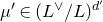 $\mu' \in (L^\vee/L)^{d'}$
and
$\mu' \in (L^\vee/L)^{d'}$
and $\mu'' \in (L^\vee / L)^{d''}$
.
$\mu'' \in (L^\vee / L)^{d''}$
.
Proposition 5.2.1. The corrected cycle classes
 $$\mathcal{C}(T',\mu') \in \mathrm{CH}^{d'}_{ \mathcal{Z}(T',\mu')}(\mathcal{M})\quad \mbox{and}\quad \mathcal{C}(T'',\mu'') \in \mathrm{CH}^{d''}_{ \mathcal{Z}(T'',\mu'')}(\mathcal{M})$$
of Definition 5.1.3 satisfy the intersection formula
 $$\mathcal{C} (T',\mu') \cdot \mathcal{C} (T'',\mu'')= \sum_{ T = (\begin{smallmatrix} T' & * \\ * & T''\end{smallmatrix} \!) } \mathcal{C}(T,\mu),$$
where $\mu=(\mu',\mu'')$
is the concatenation of
$\mu=(\mu',\mu'')$
is the concatenation of $\mu'$
and
$\mu'$
and $\mu''$
, and the product
$\mu''$
, and the product
 $$\mathrm{CH}^{d'} _{\mathcal{Z}(T',\mu') } ( \mathcal{M} ) \otimes \mathrm{CH}^{d''} _{\mathcal{Z}(T'',\mu'') } ( \mathcal{M} )\to \mathrm{CH}^{d' + d''} _{ \mathcal{Z}(T',\mu') \times_\mathcal{M} \mathcal{Z}(T'',\mu'') } ( \mathcal{M} )$$
on the left-hand side is the intersection pairing of § A.2.
Proof. Let $t_1',\ldots, t'_{d'}$
and
$t_1',\ldots, t'_{d'}$
and $t_1'',\ldots, t''_{d''}$
be the diagonal entries of T’ and T”. If we abbreviate
$t_1'',\ldots, t''_{d''}$
be the diagonal entries of T’ and T”. If we abbreviate
 $$\mathcal{Z}_i' = \mathcal{Z}(t_i ' , \mu_i') \quad \mbox{and}\quad \mathcal{Z}_i'' = \mathcal{Z}(t_i '' , \mu_i''),$$
there is a commutative diagram

in which the vertical $=$
is the canonical isomorphism of Proposition 2.4.6, and both diagonal arrows are open and closed immersions. Here and in what follows, all fiber products are over
$=$
is the canonical isomorphism of Proposition 2.4.6, and both diagonal arrows are open and closed immersions. Here and in what follows, all fiber products are over $\mathcal{M}$
.
$\mathcal{M}$
.
Using the pairing (A18), the constructions of § 5.1 provide us with a class
 $$z_1'\cap \cdots \cap z'_{d'} \cap z_1'' \cap\cdots \cap z_{d''}'' \in F^{d'+d''} G_0 ( \mathcal{Z}_1' \times \cdots \times \mathcal{Z}_{d'}' \times \mathcal{Z}''_1 \times \cdots \times \mathcal{Z}''_{d''} )_\mathbb Q$$
whose restriction along the top diagonal arrow is
 $$[ \mathcal O^\mathrm{derived}_{\mathcal{Z}(T',\mu')} ] \cap [ \mathcal O^\mathrm{derived}_{\mathcal{Z}(T'',\mu'') }] \in G_0 ( Z(T',\mu') \times Z(T'',\mu'') )_\mathbb Q ,$$
and whose restriction along the bottom diagonal arrow is
 $$\sum_T [ \mathcal O^\mathrm{derived} _{\mathcal{Z}(T,\mu)} ]\in \bigoplus_T G_0( \mathcal{Z}(T,\mu) )_\mathbb Q = G_0 \Big( \bigsqcup_T \mathcal{Z}(T,\mu) \Big)_\mathbb Q .$$
In particular, the vertical $=$
in the above diagram identifies
$=$
in the above diagram identifies
 $$[ \mathcal O^\mathrm{derived}_{\mathcal{Z}(T',\mu')} ] \cap [ \mathcal O^\mathrm{derived}_{\mathcal{Z}(T'',\mu'') }]=\sum_T [ \mathcal O^\mathrm{derived} _{\mathcal{Z}(T,\mu)} ] .$$
The proposition follows by applying the composition

to both sides of this last equality.
5.3 An alternate construction
In this subsection we give a different characterization of the derived fundamental classes of Definition 5.1.3. This will be used in the proof of Proposition 5.4.1.
Consider again the situation of § 5.1, where we have fixed $\mu\in (L^\vee/L)^d$
and
$\mu\in (L^\vee/L)^d$
and $t_1,\ldots, t_d \in \mathbb Q$
are the diagonal entries of
$t_1,\ldots, t_d \in \mathbb Q$
are the diagonal entries of $T\in \mathrm{Sym}_d(\mathbb Q)$
.
$T\in \mathrm{Sym}_d(\mathbb Q)$
.
Fix an étale surjection $U \to \mathcal{M}$
with U scheme. The special divisors
$U \to \mathcal{M}$
with U scheme. The special divisors
 $$ \mathcal{Z}(t_i,\mu_i) \to \mathcal{M}$$
are finite and unramified, and so, as in Definition 2.4.1, we may assume that U is chosen so that the natural map $Z_i \to U$
is a closed immersion of schemes for every
$Z_i \to U$
is a closed immersion of schemes for every $1\le i \le d$
and every connected component
$1\le i \le d$
and every connected component
 $$Z_i \subset \mathcal{Z}(t_i,\mu_i)_U .$$
Fix a tuple $(Z_1,\ldots, Z_d)$
with each
$(Z_1,\ldots, Z_d)$
with each $Z_i \subset \mathcal{Z}(t_i,\mu_i)_U$
a connected component. If
$Z_i \subset \mathcal{Z}(t_i,\mu_i)_U$
a connected component. If $(t_i,\mu_i) \neq (0,0)$
, then
$(t_i,\mu_i) \neq (0,0)$
, then $Z_i \subset U$
is an effective Cartier divisor (Proposition 2.4.3), and its ideal sheaf
$Z_i \subset U$
is an effective Cartier divisor (Proposition 2.4.3), and its ideal sheaf $I_{Z_i} \subset \mathcal O_U$
determines a chain complex of locally free
$I_{Z_i} \subset \mathcal O_U$
determines a chain complex of locally free $\mathcal O_U$
-modules
$\mathcal O_U$
-modules
 $$C_{Z_i} = ( \cdots \to 0 \to I_{Z_i} \to \mathcal O_U \to 0 \to \cdots )$$
supported in degrees 1 and 0. If $(t_i,\mu_i) = (0,0)$
, so that
$(t_i,\mu_i) = (0,0)$
, so that $Z_i = U$
, we instead define
$Z_i = U$
, we instead define
 $$C_{Z_i} = ( \cdots \to 0 \to \omega|_U \xrightarrow{0} \mathcal O_U \to 0 \to \cdots ).$$
The tensor product $C_{Z_1} \otimes_{\mathcal O_U} \cdots \otimes_{\mathcal O_U} C_{Z_d}$
is a complex of locally free
$C_{Z_1} \otimes_{\mathcal O_U} \cdots \otimes_{\mathcal O_U} C_{Z_d}$
is a complex of locally free $\mathcal O_U$
-modules, whose
$\mathcal O_U$
-modules, whose $\ell\mathrm{th}$
homology
$\ell\mathrm{th}$
homology
 \begin{equation}H_\ell( C_{Z_1} \otimes_{\mathcal O_U} \cdots \otimes_{\mathcal O_U} C_{Z_d} )\end{equation}
is a coherent sheaf on U annihilated by the ideal sheaf of the closed subscheme $Z_1 \times_U \cdots \times_U Z_d \subset U$
. We may therefore view this sheaf as a coherent sheaf on this closed subscheme.
$Z_1 \times_U \cdots \times_U Z_d \subset U$
. We may therefore view this sheaf as a coherent sheaf on this closed subscheme.
By varying the tuple $(Z_1,\ldots, Z_d)$
, we obtain from (5.3) a coherent sheaf
$(Z_1,\ldots, Z_d)$
, we obtain from (5.3) a coherent sheaf
 \begin{equation}H_\ell ( C_{\mathcal{Z}(t_1,\mu_1)_U} \otimes_{\mathcal O_U} \cdots \otimes_{\mathcal O_U} C_{\mathcal{Z}(t_d,\mu_d)_U})\end{equation}
(this is just notation; no complex $C_{\mathcal{Z}(t_i,\mu_i)_U}$
of
$C_{\mathcal{Z}(t_i,\mu_i)_U}$
of $\mathcal O_U$
-modules will be defined) on the disjoint union
$\mathcal O_U$
-modules will be defined) on the disjoint union
 $$ \mathcal{Z}(t_1,\mu_1)_U \times_U \cdots \times_U \mathcal{Z}(t_d,\mu_d)_U = \bigsqcup_{ (Z_1, \ldots, Z_d) } Z_1 \times_U \cdots \times_U Z_d , $$
which admits a canonical descent to a coherent sheaf
 \begin{equation} H_\ell ( C_{\mathcal{Z}(t_1,\mu_1)} \otimes_{\mathcal O_\mathcal{M}} \cdots \otimes_{\mathcal O_\mathcal{M}} \mathcal O_{\mathcal{Z}(t_d,\mu_d)}) \end{equation}
(again, no complex $C_{\mathcal{Z}(t_i,\mu_i)}$
of
$C_{\mathcal{Z}(t_i,\mu_i)}$
of $\mathcal O_\mathcal{M}$
-modules will be defined) on
$\mathcal O_\mathcal{M}$
-modules will be defined) on
 $$ \mathcal{Z}(t_1,\mu_1) \times_\mathcal{M} \cdots \times_\mathcal{M} \mathcal{Z}(t_d,\mu_d). $$
This last sheaf may be restricted to the open and closed substack (5.1).
Proposition 5.3.1. The derived fundamental class of Definition 5.1.3 is equal to
 $$ [ \mathcal O^{\mathrm{derived}}_{ \mathcal{Z}(T,\mu)} ] = \sum_{\ell\ge 0} (-1)^\ell \cdot [ H_\ell ( C_{\mathcal{Z}(t_1,\mu_1)} \otimes_{\mathcal O_\mathcal{M}} \cdots \otimes_{C_\mathcal{M}} \mathcal O_{\mathcal{Z}(t_d,\mu_d)} )|_{ \mathcal{Z}(T,\mu) } ] . $$
Proof. An elementary but tedious exercise in homological algebra shows that
 $$ z_1\cap \cdots \cap z_d = \sum_{\ell\ge 0} (-1)^\ell \cdot [ H_\ell ( \mathcal O_{\mathcal{Z}(t_1,\mu_1)} \otimes_{\mathcal O_\mathcal{M}} \cdots \otimes_{\mathcal O_\mathcal{M}} \mathcal O_{\mathcal{Z}(t_d,\mu_d)})] $$
as elements of
 $$ G_0 ( \mathcal{Z}(t_1,\mu_1) \times_{\mathcal{M}} \cdots \times_{\mathcal{M}} \mathcal{Z}(t_d,\mu_d) )_\mathbb Q, $$
where each $z_i \in G_0 ( \mathcal{Z}(t_i,\mu_i) ) $
is as in § 5.1, and the intersection on the left-hand side is obtained by iterating the pairing of Lemma A.4.1. The claim follows immediately from this.
$z_i \in G_0 ( \mathcal{Z}(t_i,\mu_i) ) $
is as in § 5.1, and the intersection on the left-hand side is obtained by iterating the pairing of Lemma A.4.1. The claim follows immediately from this.
We point out that verifying the equality above does not require unpacking the use of derived algebraic geometry or the sheaf of spectra $\mathbf{G}_{Z_1 \times_M Z_2}$
in the proof of Lemma A.4.1. One need only verify the same equality in the naive Grothendieck group
$\mathbf{G}_{Z_1 \times_M Z_2}$
in the proof of Lemma A.4.1. One need only verify the same equality in the naive Grothendieck group $G_0^\mathrm{naive}$
of Remark A.2.1, with the
$G_0^\mathrm{naive}$
of Remark A.2.1, with the $\cap$
on the left defined by (A17), and use the commutativity of the diagram in Lemma A.4.1.
$\cap$
on the left defined by (A17), and use the commutativity of the diagram in Lemma A.4.1.
Remark 5.3.2. The slightly complicated constructions above are done solely to account for the failure of the special divisors $\mathcal{Z}(t_i,\mu_i) \to \mathcal{M}$
to be closed immersions. If they were closed immersions, we would simply have defined complexes of locally free
$\mathcal{Z}(t_i,\mu_i) \to \mathcal{M}$
to be closed immersions. If they were closed immersions, we would simply have defined complexes of locally free $\mathcal O_\mathcal{M}$
-modules
$\mathcal O_\mathcal{M}$
-modules
 $$C_{\mathcal{Z}(t_i,\mu_i) } =\begin{cases} ( \cdots \to 0 \to I_{\mathcal{Z}(t_i,\mu_i)} \to \mathcal O_\mathcal{M} \to 0 \to \cdots ) & \mbox{if } (t_i,\mu_i) \neq (0,0) ,\\( \cdots \to 0 \to \omega \xrightarrow{0} \mathcal O_\mathcal{M} \to 0 \to \cdots ) & \mbox{if } (t_i,\mu_i) = (0,0) .\end{cases}$$
The sheaf (5.5) would then be understood in the literal sense, as the $\ell\textrm{th}$
homology of the tensor product of complexes.
$\ell\textrm{th}$
homology of the tensor product of complexes.
5.4 Linear invariance
Suppose X is any abelian group. Given a d-tuple $x \in X^d$
and an
$x \in X^d$
and an $A \in \mathrm{GL}_d(\mathbb Z)$
, we define
$A \in \mathrm{GL}_d(\mathbb Z)$
, we define $xA\in X^d$
using the habitual rule for multiplication of a row vector by a matrix.
$xA\in X^d$
using the habitual rule for multiplication of a row vector by a matrix.
Fix a matrix $T\in \mathrm{Sym}_d(\mathbb Q)$
and a tuple
$T\in \mathrm{Sym}_d(\mathbb Q)$
and a tuple $\mu \in (L^\vee/L)^d$
. Fix also a matrix
$\mu \in (L^\vee/L)^d$
. Fix also a matrix $A \in \mathrm{GL}_d(\mathbb Z)$
, and set
$A \in \mathrm{GL}_d(\mathbb Z)$
, and set
 $$( T' ,\mu' ) = ( {}^t A T A , \mu A ) .$$
By Proposition 2.4.5 there is an isomorphism of $\mathcal{M}$
-stacks
$\mathcal{M}$
-stacks
 \begin{equation}\mathcal{Z}(T,\mu) \cong \mathcal{Z}(T',\mu'),\end{equation}
-1sending an S-point $x\in V(\mathcal{A}_S)_\mathbb Q^d$
of the left-hand side to the S-point
$x\in V(\mathcal{A}_S)_\mathbb Q^d$
of the left-hand side to the S-point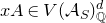 $xA \in V(\mathcal{A}_S)^d_\mathbb Q$
of the right-hand side. Hence, the special cycles in (5.6) have the same images in
$xA \in V(\mathcal{A}_S)^d_\mathbb Q$
of the right-hand side. Hence, the special cycles in (5.6) have the same images in $\mathcal{M}$
, and there is an equality
$\mathcal{M}$
, and there is an equality
 \begin{equation}\mathrm{CH}^d_{ \mathcal{Z} (T,\mu) }( \mathcal{M} ) = \mathrm{CH}^d_{ \mathcal{Z} (T',\mu') }(\mathcal{M})\end{equation}
of Chow groups with support.
Proposition 5.4.1. The isomorphism (5.6) identifies the derived fundamental classes
 $$[ \mathcal O^{\mathrm{derived}}_{ \mathcal{Z}(T,\mu)} ] \in G_0(\mathcal{Z}(T,\mu) )\quad \mbox{and}\quad [ \mathcal O^{\mathrm{derived}}_{ \mathcal{Z}(T',\mu')} ] \in G_0(\mathcal{Z}(T',\mu') ).$$
In particular, the equality $\mathcal{C}(T,\mu) = \mathcal{C}(T',\mu')$
holds in (5.7).
$\mathcal{C}(T,\mu) = \mathcal{C}(T',\mu')$
holds in (5.7).
Proof. Using the alternate construction of Proposition 5.3.1, we are reduced to proving the existence, for every $\ell \ge 0$
, of an isomorphism
$\ell \ge 0$
, of an isomorphism

of coherent sheaves on (5.6). Here $t_1,\ldots, t_d$
and
$t_1,\ldots, t_d$
and $t_1',\ldots, t_d'$
are the diagonal entries of T and T’.
$t_1',\ldots, t_d'$
are the diagonal entries of T and T’.
Moreover, it suffices to treat the case in which $d\ge 2$
and
$d\ge 2$
and
 \begin{equation}A = \Bigg( \begin{matrix} 1\quad & 0 \\ 1\quad & 1 \\ & & \quad I_{d-2} \end{matrix} \Bigg).\end{equation}
Indeed, the group $\mathrm{GL}_d(\mathbb Z)$
is generated by A, the permutation matrices, and the diagonal matrices, and the claim is easily proved in the latter two cases.
$\mathrm{GL}_d(\mathbb Z)$
is generated by A, the permutation matrices, and the diagonal matrices, and the claim is easily proved in the latter two cases.
As in the constructions of § 5.3, choose an étale surjection $U\to \mathcal{M}$
fine enough that the morphisms
$U\to \mathcal{M}$
fine enough that the morphisms
 $$\mathcal{Z}(t_i,\mu_i)_U \to U \quad \mbox{and} \quad \mathcal{Z}(t'_i,\mu'_i)_U \to U,$$
for all $1\le i \le d$
, restrict to closed immersions on all connected components
$1\le i \le d$
, restrict to closed immersions on all connected components
 $$Z_i \subset \mathcal{Z}(t_i,\mu_i)_U \quad \mbox{and} \quad Z'_i \subset \mathcal{Z}(t'_i,\mu'_i)_U .$$
To simplify notation, we abbreviate $\mathcal{Z}$
for the
$\mathcal{Z}$
for the $\mathcal{M}$
-stack (5.6). Fix a geometric point z of
$\mathcal{M}$
-stack (5.6). Fix a geometric point z of $\mathcal{Z}$
. The finite étale z-scheme
$\mathcal{Z}$
. The finite étale z-scheme $z_U$
defined by the cartesian diagram
$z_U$
defined by the cartesian diagram

decomposes as a finite disjoint union of points $z_U = \bigsqcup y$
.
$z_U = \bigsqcup y$
.
Fix one connected component $y \subset z_U$
. Its image in
$y \subset z_U$
. Its image in $\mathcal{Z}_U$
lands on some connected component
$\mathcal{Z}_U$
lands on some connected component $Z \subset \mathcal{Z}_U$
, whose images under the two maps
$Z \subset \mathcal{Z}_U$
, whose images under the two maps

are then contained in unique connected components
 $$Z_i \subset \mathcal{Z}(t_i,\mu_i)_U \quad \mbox{and}\quad Z'_i \subset \mathcal{Z}(t'_i,\mu'_i)_U .$$
The natural map $Z \to U$
is a closed immersion, realizing Z as a connected component of both intersections
$Z \to U$
is a closed immersion, realizing Z as a connected component of both intersections
 $$Z_1\times_U \cdots \times_U Z_d \quad \mbox{and}\quad Z'_1\times_U \cdots \times_U Z'_d .$$
The construction (5.3) gives us coherent sheaves
 $$H_\ell( C_{Z_1} \otimes_{\mathcal O_U} \cdots \otimes_{\mathcal O_U} C_{Z_d} ) \quad \mbox{and}\quad H_\ell( C_{Z'_1} \otimes_{\mathcal O_U} \cdots \otimes_{\mathcal O_U} C_{Z'_d} )$$
on these two intersections, and we will construct a Zariski open neighborhood $y \in V_y \subset Z$
together with a canonical isomorphism
$y \in V_y \subset Z$
together with a canonical isomorphism
 \begin{equation}H_\ell( C_{Z_1} \otimes_{\mathcal O_U} \cdots \otimes_{\mathcal O_U} C_{Z_d} )|_{V_y} \cong H_\ell( C_{Z'_1} \otimes_{\mathcal O_U} \cdots \otimes_{\mathcal O_U} C_{Z'_d} )|_{V_y}\end{equation}
of coherent sheaves on $V_y$
.
$V_y$
.
Before we construct (5.10), we explain how it implies the existence of the desired isomorphism (5.8), and hence completes the proof of Proposition 5.4.1. Recalling from (5.1) that $\mathcal{Z}_U$
is an open and closed subscheme of both
$\mathcal{Z}_U$
is an open and closed subscheme of both
 $$\mathcal{Z}(t_1,\mu_1)_U \times_U \cdots \times_U \mathcal{Z}(t_d,\mu_d)_U$$
and
 $$\mathcal{Z}(t'_1,\mu'_1)_U \times_U \cdots \times_U \mathcal{Z}(t'_d,\mu'_d)_U ,$$
varying the connected component $y \in \pi_0(z_U)$
in (5.10) defines an isomorphism
$y \in \pi_0(z_U)$
in (5.10) defines an isomorphism

between the sheaves of (5.4), after restriction to the Zariski open neighborhood
 $$V_z \stackrel{\mathrm{def}}{=} \bigsqcup_{ y\in \pi_0(z_U)} V_y \subset \mathcal{Z}_U$$
of the image of $z_U \to \mathcal{Z}_U$
. Varying the geometric point z and gluing over the resulting Zariski open cover
$z_U \to \mathcal{Z}_U$
. Varying the geometric point z and gluing over the resulting Zariski open cover $\{ V_z\}_z$
of
$\{ V_z\}_z$
of $\mathcal{Z}_U$
defines an isomorphism
$\mathcal{Z}_U$
defines an isomorphism

and finally étale descent via $\mathcal{Z}_U \to \mathcal{Z}$
defines the desired isomorphism (5.8).
$\mathcal{Z}_U \to \mathcal{Z}$
defines the desired isomorphism (5.8).
We now turn to the construction of (5.10). Consider the first-order infinitesimal neighborhood
 $$Z \subset \widetilde{Z} \subset U$$
of the closed subscheme $Z\subset U$
. In other words, if
$Z\subset U$
. In other words, if $I_Z\subset \mathcal O_U$
is the ideal sheaf defining Z, then
$I_Z\subset \mathcal O_U$
is the ideal sheaf defining Z, then $\widetilde{Z}$
is defined by the ideal sheaf
$\widetilde{Z}$
is defined by the ideal sheaf $I_Z^2$
. Similarly, denote by
$I_Z^2$
. Similarly, denote by
 $$Z_i \subset \widetilde{Z}_i \subset U,\quad Z'_i \subset \widetilde{Z}'_i \subset U$$
the first-order infinitesimal neighborhoods of $Z_i$
and
$Z_i$
and $Z_i'$
. Clearly
$Z_i'$
. Clearly $\widetilde{Z}$
is contained in both
$\widetilde{Z}$
is contained in both $\widetilde{Z}_i$
and
$\widetilde{Z}_i$
and $\widetilde{Z}'_i$
.
$\widetilde{Z}'_i$
.
The following is the analogue of [Reference HowardHow19, Theorem 5.1].
Lemma 5.4.2. For every $1\le i \le d$
there are canonical sections
$1\le i \le d$
there are canonical sections
 $$s_i \in H^0 (\widetilde{Z}_i , \omega|^{-1}_{\widetilde{Z}_i } ) \quad \mbox{and}\quad s'_i \in H^0 (\widetilde{Z}'_i , \omega|^{-1}_{\widetilde{Z}'_i })$$
with scheme-theoretic zero loci $Z_i \subset \widetilde{Z}_i$
and
$Z_i \subset \widetilde{Z}_i$
and $Z'_i \subset \widetilde{Z}'_i$
, respectively. After restriction to
$Z'_i \subset \widetilde{Z}'_i$
, respectively. After restriction to $\widetilde{Z}$
, these sections are related by
$\widetilde{Z}$
, these sections are related by $s'_1 = s_1 + s_2$
, and
$s'_1 = s_1 + s_2$
, and $s_i'=s_i$
when
$s_i'=s_i$
when $i \gt 1$
.
$i \gt 1$
.
Proof. By virtue of the moduli problem defining $\mathcal{Z}(t_i,\mu_i)$
, there is a canonical special endomorphism
$\mathcal{Z}(t_i,\mu_i)$
, there is a canonical special endomorphism $x_i \in V_{\mu_i}(\mathcal{A}_{Z_i})$
. The desired section
$x_i \in V_{\mu_i}(\mathcal{A}_{Z_i})$
. The desired section
 $$s_i = \mathrm{obst}_{x_i}\in H^0 ( \widetilde{Z}_i , \omega|^{-1}_{\widetilde{Z}_i } )$$
is the obstruction to deforming $x_i$
, as in the proof of Proposition 2.4.3 (if
$x_i$
, as in the proof of Proposition 2.4.3 (if $x_i=0$
, we understand
$x_i=0$
, we understand $\mathrm{obst}_{x_i}=0$
, because there is no obstruction to deforming the 0 endomorphism). The section
$\mathrm{obst}_{x_i}=0$
, because there is no obstruction to deforming the 0 endomorphism). The section $s_i'$
is defined similarly.
$s_i'$
is defined similarly.
Because of the particular choice of matrix (5.9), after restriction to Z the special quasi-endomorphisms $x_i$
and
$x_i$
and $x_i'$
are related by
$x_i'$
are related by $x_1' = x_1+x_2$
, and
$x_1' = x_1+x_2$
, and $x_i'=x_i$
if
$x_i'=x_i$
if $i\gt 1$
. This leads to similar relations between
$i\gt 1$
. This leads to similar relations between $s_i$
and
$s_i$
and $s_i'$
.
$s_i'$
.
Lemma 5.4.3. Around every point of Z one can find a Zariski open affine neighborhood $V \subset U$
over which
$V \subset U$
over which $\omega|_V \cong \mathcal O_V$
, and sections
$\omega|_V \cong \mathcal O_V$
, and sections
 $$\sigma_1, \sigma_2 \in H^0( V, \omega|_V^{-1}) \quad \mbox{and}\quad \alpha \in H^0(V,\mathcal O_V)$$
such that:
-
(i)
$\sigma_1$
has zero locus
$Z_1 \cap V$
and agrees with
$s_1$
on
$\widetilde{Z}_1 \cap V $
; -
(ii)
$\sigma_2$
has zero locus
$Z_2 \cap V$
and agrees with
$s_2 $
on
$\widetilde{Z}_2\cap V $
; -
(iii)
$\alpha$
restricts to the constant function 1 on
$Z_2\cap V$
; -
(iv) the section
has zero locus
$$\sigma'_1 \stackrel{\mathrm{def}}{=} \sigma_1 + \alpha \sigma_2$$
$Z'_1\cap V$
and agrees with
$s'_1$
on the closed formal subscheme, lying between
$Z'_1\cap V$
and
$\widetilde{Z}'_1 \cap V$
, defined by the ideal sheaf
$$I_{Z'_1\cap V} \cdot ( I_{ Z'_1\cap V } + I_{ Z_2\cap V} ) \subset \mathcal O_V.$$


Proof. The proof is identical to that of [Reference HowardHow19, Lemma 5.2], and makes crucial use of the fact that $\mathcal{M}$
is regular and Noetherian.
$\mathcal{M}$
is regular and Noetherian.
Choose a Zariski open $V\subset U$
as in Lemma 5.4.3 containing the image of the geometric point
$V\subset U$
as in Lemma 5.4.3 containing the image of the geometric point $y \to Z \subset U$
. The sections of Lemma 5.4.3 determine chain complexes of locally free
$y \to Z \subset U$
. The sections of Lemma 5.4.3 determine chain complexes of locally free $\mathcal O_V$
-modules
$\mathcal O_V$
-modules
 \begin{align*}D_{Z_1} & = ( \cdots \to 0 \to \omega|_V \xrightarrow{ \sigma_1 } \mathcal O_V \to 0 ),\\D_{Z_2} & = ( \cdots \to 0 \to \omega|_V \xrightarrow{ \sigma_2 } \mathcal O_V\to 0 ) ,\\D_{Z'_1} & = ( \cdots \to 0 \to \omega|_V \xrightarrow{ \sigma'_1 } \mathcal O_V\to 0 ),\end{align*}
and there are canonical isomorphisms
 $$ D_{Z_1} \cong C_{Z_1} |_V ,\quad D_{Z_2} \cong C_{Z_2} |_V ,\quad D_{Z'_1} \cong C _{Z'_1} |_V.$$
Indeed, if $t_1\neq 0$
, so that
$t_1\neq 0$
, so that $Z_1 \subset U$
is a Cartier divisor and
$Z_1 \subset U$
is a Cartier divisor and $\sigma_1\neq 0$
, the first isomorphism is as follows.
$\sigma_1\neq 0$
, the first isomorphism is as follows.

If $t_1=0$
, so that
$t_1=0$
, so that $Z_1=U$
and
$Z_1=U$
and $\sigma_1=0$
, then
$\sigma_1=0$
, then $D_{Z_1}=C_{Z_1} |_V$
by definition. The other isomorphisms are entirely similar.
$D_{Z_1}=C_{Z_1} |_V$
by definition. The other isomorphisms are entirely similar.
Using the relation $\sigma'_1 = \sigma_1 + \alpha \sigma_2$
, we see that the diagram
$\sigma'_1 = \sigma_1 + \alpha \sigma_2$
, we see that the diagram

determined by $g_1( \eta_1,\eta_2) = ( \eta_1 , \eta_2 - \alpha \eta_1 )$
and
$g_1( \eta_1,\eta_2) = ( \eta_1 , \eta_2 - \alpha \eta_1 )$
and
 \begin{align*} \partial_1 (\eta_1,\eta_2) & = \sigma_1(\eta_1) + \sigma_2 (\eta_2) \\ \partial^*_1 (\eta_1,\eta_2) & = \sigma'_1(\eta_1) + \sigma_2 (\eta_2) \\ \partial_2 ( \eta_1 \otimes \eta_2 ) &= ( \sigma_2 (-\eta_2) \eta_1 , \sigma_1 (\eta_1 )\eta_2 ) \\ \partial^*_2 ( \eta_1 \otimes \eta_2 ) &= ( \sigma_2 (-\eta_2) \eta_1 , \sigma'_1 (\eta_1 )\eta_2 ) \end{align*}
commutes, and defines the middle isomorphism in
 $$C_{Z_1} |_V \otimes C_{Z_2} |_V \cong D_{Z_1} \otimes D_{Z_2} \cong D_{Z'_1} \otimes D_{Z_2} \cong C_{Z'_1} |_V \otimes C_{Z_2} |_V.$$
As our choice of (5.9) implies $Z_i=Z_i'$
and
$Z_i=Z_i'$
and $C_{Z_i} = C_{Z_i'}$
for all
$C_{Z_i} = C_{Z_i'}$
for all $i \gt 1$
, we obtain an isomorphism
$i \gt 1$
, we obtain an isomorphism
 \begin{equation*}( C_{Z_1} \otimes\cdots \otimes C_{Z_d} ) |_V \cong ( C_{Z'_1} \otimes \cdots \otimes C_{Z'_d} ) |_V ,\end{equation*}
of complexes of locally free $\mathcal O_V$
-modules. This isomorphism depends on the choices of sections in Lemma 5.4.3, which are not unique. However, exactly as in the proof of [Reference HowardHow19, Lemma 5.2], the conditions of that lemma imply that different choices yield homotopic isomorphisms, and so the induced isomorphism
$\mathcal O_V$
-modules. This isomorphism depends on the choices of sections in Lemma 5.4.3, which are not unique. However, exactly as in the proof of [Reference HowardHow19, Lemma 5.2], the conditions of that lemma imply that different choices yield homotopic isomorphisms, and so the induced isomorphism
 $$ H_\ell ( C_{Z_1} \otimes\cdots \otimes C_{Z_d}) |_V \cong H_\ell ( C_{Z'_1} \otimes\cdots \otimes C_{Z_d'} ) |_V $$
is independent of the choices.
In this last isomorphism both sides are coherent sheaves on V annihilated by the ideal sheaf of the closed subscheme
 $$ V_y \stackrel{\mathrm{def}}{=} V\cap Z, $$
yielding the desired isomorphism (5.10).
5.5 Comparison with the naive cycle
The following result shows that the corrected cycle class $\mathcal{C}(T,\mu)$
agrees with the class obtained by imitating the construction of (1.1), whenever that construction makes sense. We remark that the proof uses the linear invariance property of Proposition 5.4.1 in an essential way.
$\mathcal{C}(T,\mu)$
agrees with the class obtained by imitating the construction of (1.1), whenever that construction makes sense. We remark that the proof uses the linear invariance property of Proposition 5.4.1 in an essential way.
Proposition 5.5.1. Fix $T\in \mathrm{Sym}_d(\mathbb Q)$
and
$T\in \mathrm{Sym}_d(\mathbb Q)$
and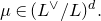 $\mu \in (L^\vee/L)^d.$
If the naive special cycle
$\mu \in (L^\vee/L)^d.$
If the naive special cycle $\mathcal{Z}(T,\mu)$
is equidimensional with
$\mathcal{Z}(T,\mu)$
is equidimensional with
 $$ \mathrm{dim}( \mathcal{Z}(T,\mu) ) = \mathrm{dim}(\mathcal{M})-\mathrm{rank}(T), $$
so that the naive cycle class
 $$[\mathcal{Z}(T,\mu)]\in \mathrm{CH}^{\mathrm{rank}(T)}_{\mathcal{Z}(T,\mu)}(\mathcal{M})$$
is defined (Definition A.1.4), then
 $$\mathcal{C}(T,\mu) = \underbrace{c_1(\omega^{-1})\cdots c_1(\omega^{-1})}_{ d - \mathrm{rank}(T)}\cdot{\kern1.5pt} [\mathcal{Z}(T,\mu)]\in \mathrm{CH}_{ \mathcal{Z}(T,\mu) }^d(\mathcal{M}) .$$
Proof. We may assume that T is positive semi-definite, as otherwise the Chow group with support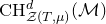 $ \mathrm{CH}_{ \mathcal{Z}(T,\mu) }^d(\mathcal{M})$
is trivial by Remark 2.2.12.
$ \mathrm{CH}_{ \mathcal{Z}(T,\mu) }^d(\mathcal{M})$
is trivial by Remark 2.2.12.
First suppose $\mathrm{rank}(T)=d$
. In particular, T is positive definite, so has all diagonal entries nonzero. Recalling the open and closed immersion (5.1), consider a closed geometric point
$\mathrm{rank}(T)=d$
. In particular, T is positive definite, so has all diagonal entries nonzero. Recalling the open and closed immersion (5.1), consider a closed geometric point
 $$s\to \mathcal{Z}(T,\mu) \subset \mathcal{Z}(t_1,\mu_1) \times_{\mathcal{M}} \cdots \times_{\mathcal{M}} \mathcal{Z}(t_d,\mu_d) .$$
For every $1\le i \le d$
, Proposition 2.4.3 implies that the natural map
$1\le i \le d$
, Proposition 2.4.3 implies that the natural map
 $$\mathcal O_{\mathcal{M},s} ^\mathrm{et} \to \mathcal O^\mathrm{et} _{ \mathcal{Z}(t_i,\mu_i) , s},$$
on étale local rings is surjective with kernel generated by a single element $f_i$
. As
$f_i$
. As
 $$\mathcal O_{ \mathcal{Z}(T,\mu) ,s}^\mathrm{et} \cong \mathcal O_{\mathcal{M},s} ^\mathrm{et} / ( f_1,\ldots, f_d) ,$$
our assumptions imply that $f_1,\ldots, f_d \in \mathcal O_{\mathcal{M},s} ^\mathrm{et} $
is a regular sequence.
$f_1,\ldots, f_d \in \mathcal O_{\mathcal{M},s} ^\mathrm{et} $
is a regular sequence.
For every $1\le e\le d$
the étale local ring at s of
$1\le e\le d$
the étale local ring at s of
 $$\mathcal{Y}_e = \mathcal{Z}(t_1,\mu_1) \times_{\mathcal{M}}\cdots\times_{\mathcal{M}} \mathcal{Z}(t_e,\mu_e)$$
is therefore Cohen–Macaulay of dimension $\mathrm{dim}(\mathcal{M}) - e$
, and a result of Serre [Reference SerreSer00, Section V.B.6] implies that
$\mathrm{dim}(\mathcal{M}) - e$
, and a result of Serre [Reference SerreSer00, Section V.B.6] implies that
 $$\mathrm{Tor}^{\mathcal O^\mathrm{et}_{ \mathcal{M},s}}_\ell ( \mathcal O_{ \mathcal{Y}_e,s }^\mathrm{et} , \mathcal O_{ \mathcal{Z}(t_{e+1},\mu_{e+1}) ,s }^\mathrm{et} ) =0$$
for all $\ell \gt 0$
. Using (A17) and the commutative diagram of Lemma A.4.1, one sees by induction on e that the intersection
$\ell \gt 0$
. Using (A17) and the commutative diagram of Lemma A.4.1, one sees by induction on e that the intersection
 \begin{equation*}[ \mathcal O_{\mathcal{Z}(t_1,\mu_1)} ]\cap \cdots \cap [ \mathcal O_{\mathcal{Z}(t_e,\mu_e)} ] \in F^e G_0 ( \mathcal{Y}_e )_\mathbb Q ,\end{equation*}
has the form
 $$[ \mathcal O_{\mathcal{Z}(t_1,\mu_1)} ]\cap \cdots \cap [ \mathcal O_{\mathcal{Z}(t_e,\mu_e)} ] = [ \mathcal O_{ \mathcal{Y}_e } ] + [ \mathcal{F}_e ] - [\mathcal{G}_e]$$
for coherent sheaves $\mathcal{F}_e$
and
$\mathcal{F}_e$
and $\mathcal{G}_e$
on
$\mathcal{G}_e$
on $\mathcal{Y}_e$
with trivial stalks at any closed geometric point
$\mathcal{Y}_e$
with trivial stalks at any closed geometric point $s \to \mathcal{Z}(T,\mu) \to \mathcal{Y}_e .$
Taking $d=e$
shows that
$d=e$
shows that
 $$ [ \mathcal O^\mathrm{derived}_{ \mathcal{Z}(T,\mu) }] = [ \mathcal O_{ \mathcal{Z}(T,\mu) }] \in F^d G_0( \mathcal{Z}(T,\mu)),$$
as both are equal to the image of the class
 $$ [ \mathcal O_{\mathcal{Z}(t_1,\mu_1)} ]\cap \cdots \cap [ \mathcal O_{\mathcal{Z}(t_d,\mu_d)} ] \in F^d G_0 ( \mathcal{Z}(t_1,\mu_1) \times_{\mathcal{M}} \cdots \times_{\mathcal{M}} \mathcal{Z}(t_d,\mu_d) ) _\mathbb Q$$
under the second arrow in (5.2). The equality of cycle classes
 $$\mathcal{C}(T,\mu) = [ \mathcal{Z}(T,\mu)]$$
now follows from Theorem A.2.7.
Now consider the other extreme, in which $T=0_d$
has rank 0. In this case
$T=0_d$
has rank 0. In this case
 $$\mathcal{Z}(0_d ,\mu) =\begin{cases}\mathcal{M} & \mbox{if }\mu=0 ,\\\emptyset & \mbox{if }\mu \neq 0.\end{cases}$$
If $\mu \neq 0$
, then the proposition is vacuously true, as the Chow group with support vanishes. On the other hand, by construction
$\mu \neq 0$
, then the proposition is vacuously true, as the Chow group with support vanishes. On the other hand, by construction $\mathcal{C}(0_d ,0)$
is the image of
$\mathcal{C}(0_d ,0)$
is the image of
 $$ \underbrace{ ( [\mathcal O_\mathcal{M}] - [\omega] ) \cap \cdots \cap ( [\mathcal O_\mathcal{M}] - [\omega] ) }_{ d } \in F^d G_0( \mathcal{M})_\mathbb Q$$
under

. It follows from Lemma A.3.2 that this image is
 $$\mathcal{C}(0_d , 0 ) = \underbrace{c_1(\omega^{-1})\cdots c_1(\omega^{-1})}_{ d }\in \mathrm{CH} ^d(\mathcal{M}) ,$$
as desired.
For the general case, let $r=\mathrm{rank}(T)$
. As the cycle classes
$r=\mathrm{rank}(T)$
. As the cycle classes $[ \mathcal{Z}(T,\mu)]$
and
$[ \mathcal{Z}(T,\mu)]$
and $\mathcal{C}(T,\mu)$
satisfy the same linear invariance property (Propositions 2.4.5 and 5.4.1), we may reduce to the case in which
$\mathcal{C}(T,\mu)$
satisfy the same linear invariance property (Propositions 2.4.5 and 5.4.1), we may reduce to the case in which
 $$T = \Big( \begin{matrix} T'\quad & 0 \\ 0\quad & 0_{d-r} \end{matrix}\Big)$$
for a positive-definite $ r \times r$
-matrix T’. We may further assume that
$ r \times r$
-matrix T’. We may further assume that
 $$ \mu_{r+1}=\cdots=\mu_d=0. $$
Indeed, if some $\mu_i\neq 0$
with
$\mu_i\neq 0$
with $r <i\le d$
then
$r <i\le d$
then $\mathcal{Z}(0,\mu_i)=\emptyset$
by Proposition 2.4.3, and so
$\mathcal{Z}(0,\mu_i)=\emptyset$
by Proposition 2.4.3, and so $\mathcal{Z}(T,\mu)=\emptyset$
by (5.1).
$\mathcal{Z}(T,\mu)=\emptyset$
by (5.1).
Set $\mu'=(\mu_1,\ldots, \mu_r)$
. Directly from the moduli interpretation we see
$\mu'=(\mu_1,\ldots, \mu_r)$
. Directly from the moduli interpretation we see
 $$\mathcal{Z}(T,\mu) \cong \mathcal{Z}(T',\mu')$$
as $\mathcal{M}$
-stacks. Combining this with the positive-definite and rank-0 cases already proved yields the first equality in
$\mathcal{M}$
-stacks. Combining this with the positive-definite and rank-0 cases already proved yields the first equality in
 \begin{align*} [\mathcal{Z}(T,\mu)] \cdot\underbrace{c_1(\omega^{-1})\cdots c_1(\omega^{-1})}_{ d - r}&=\mathcal{C}(T',\mu') \cdot \mathcal{C}( 0_{ d-r } , 0 ) \\& =\sum_S \mathcal{C}(S,\mu).\end{align*}
The second equality is by the intersection formula of Proposition 5.2.1, and the sum runs over all matrices of the form
 $$S = \begin{pmatrix} T'\quad & * \\ * &\quad 0_{ d-r} \end{pmatrix} \in \mathrm{Sym}_d(\mathbb Q).$$
The only nonzero terms come from positive-semi-definite S, and the only such S is $S=T$
. This completes the proof of Proposition 5.5.1.
$S=T$
. This completes the proof of Proposition 5.5.1.
Corollary 5.5.2. For any $T\in \mathrm{Sym}_d(\mathbb Q)$
and
$T\in \mathrm{Sym}_d(\mathbb Q)$
and $\mu \in (L^\vee/L)^d$
, restriction to the generic fiber
$\mu \in (L^\vee/L)^d$
, restriction to the generic fiber
 $$\mathrm{CH}^d_{\mathcal{Z}(T,\mu) } ( \mathcal{M}) \to \mathrm{CH}^d_{Z(T,\mu) } (M)$$
sends the corrected cycle class $\mathcal{C}(T,\mu)$
to the class
$\mathcal{C}(T,\mu)$
to the class $C(T,\mu)$
of (1.1).
$C(T,\mu)$
of (1.1).
Proof. For a fixed pair $(T,\mu)$
, it suffices to prove the claim after enlarging the finite set of primes
$(T,\mu)$
, it suffices to prove the claim after enlarging the finite set of primes $\Sigma$
that we have inverted on the base. By adding to
$\Sigma$
that we have inverted on the base. By adding to $\Sigma$
all primes p for which
$\Sigma$
all primes p for which $\mathcal{Z}(T,\mu)$
has an irreducible component supported in characteristic p, we may assume that no such primes exist.
$\mathcal{Z}(T,\mu)$
has an irreducible component supported in characteristic p, we may assume that no such primes exist.
As the generic fiber $Z(T,\mu)$
is equidimensional of codimension
$Z(T,\mu)$
is equidimensional of codimension $\mathrm{rank}(T)$
in the generic fiber M, for example by Proposition 2.3.2, also
$\mathrm{rank}(T)$
in the generic fiber M, for example by Proposition 2.3.2, also $\mathcal{Z}(T,\mu)$
is equidimensional of codimension
$\mathcal{Z}(T,\mu)$
is equidimensional of codimension $\mathrm{rank}(T)$
in
$\mathrm{rank}(T)$
in $\mathcal{M}$
. The claim now follows from Proposition 5.5.1.
$\mathcal{M}$
. The claim now follows from Proposition 5.5.1.
5.6 Pullbacks of cycle classes
We now consider the setup of (2.4), so that we have an isometric embedding $L \to L^\sharp$
of quadratic lattices inducing a morphism
$L \to L^\sharp$
of quadratic lattices inducing a morphism $M\to M^\sharp$
of canonical models of Shimura varieties. Assume our finite set of primes
$M\to M^\sharp$
of canonical models of Shimura varieties. Assume our finite set of primes $\Sigma$
is chosen so that both
$\Sigma$
is chosen so that both $L_p$
and
$L_p$
and $L_p^\sharp$
are maximal at all
$L_p^\sharp$
are maximal at all $p\not\in \Sigma$
, so that the above morphism of canonical models extends to a finite morphism
$p\not\in \Sigma$
, so that the above morphism of canonical models extends to a finite morphism
 $$f : \mathcal{M} \to \mathcal{M}^\sharp$$
of integral models over $\mathbb Z[\Sigma^{-1}]$
as in Remark (2.2.7). Assume further that both integral models
$\mathbb Z[\Sigma^{-1}]$
as in Remark (2.2.7). Assume further that both integral models $\mathcal{M}$
and
$\mathcal{M}$
and $\mathcal{M}^\sharp$
are regular, so that the corrected cycle classes of Definition 5.1.3 are defined for both integral models.
$\mathcal{M}^\sharp$
are regular, so that the corrected cycle classes of Definition 5.1.3 are defined for both integral models.
The results of § A.2 provide us with a pullback
 $$f^* : \mathrm{CH}^d_{Z^\sharp}( \mathcal{M}^\sharp ) \to \mathrm{CH}^d_{Z^\sharp \times_{\mathcal{M}^\sharp} \mathcal{M} } (\mathcal{M})$$
for any finite morphism $\mathcal{Z}^\sharp \to \mathcal{M}^\sharp$
. Given a pair
$\mathcal{Z}^\sharp \to \mathcal{M}^\sharp$
. Given a pair $(T^\sharp,\mu^\sharp)$
with
$(T^\sharp,\mu^\sharp)$
with $T^\sharp \in \mathrm{Sym}_d(\mathbb Q)$
and
$T^\sharp \in \mathrm{Sym}_d(\mathbb Q)$
and $\mu^\sharp \in ( L^{\sharp,\vee} / L^\sharp)^d$
, we can form the corrected cycle class
$\mu^\sharp \in ( L^{\sharp,\vee} / L^\sharp)^d$
, we can form the corrected cycle class
 $$\mathcal{C}^\sharp(T^\sharp,\mu^\sharp) \in \mathrm{CH}^d_{ \mathcal{Z}^\sharp(T^\sharp,\mu^\sharp) } ( \mathcal{M}^\sharp ) ,$$
and ask how its pullback is related to the corrected cycle classes on $\mathcal{M}$
.
$\mathcal{M}$
.
The answer to this equation is exactly what one would expect given the decomposition
 \begin{equation} \mathcal{Z}^\sharp (T^\sharp, \mu^\sharp) \times_{ \mathcal{M}^\sharp} \mathcal{M}\cong \bigsqcup_{ \substack{ T \in \mathrm{Sym}_d(\mathbb Q) \\ \mu\in (L^\vee / L)^d } } \bigsqcup_{ \substack{ \nu \in ( \Lambda^\vee/\Lambda)^d \\ \mu+\nu = \mu^\sharp } } \bigsqcup_{ \substack{ y\in \nu + \Lambda^d \\ T+ Q(y) = T^\sharp } } \mathcal{Z} ( T , \mu )\end{equation}
of Proposition 2.4.7. Recall that here $\Lambda \subset L^\sharp$
is the positive-definite quadratic lattice of vectors orthogonal to
$\Lambda \subset L^\sharp$
is the positive-definite quadratic lattice of vectors orthogonal to $L \subset L^\sharp$
, and the relation
$L \subset L^\sharp$
, and the relation $\mu+\nu = \mu^\sharp$
means that the natural map
$\mu+\nu = \mu^\sharp$
means that the natural map
 $$(L^\vee \oplus \Lambda^\vee) / (L \oplus \Lambda) \to (L^\vee \oplus \Lambda^\vee ) / L^{\sharp}$$
sends
 $$\mu + \nu \mapsto \mu^\sharp \in L^{\sharp,\vee} / L^\sharp \subset ( L^\vee \oplus \Lambda^\vee ) / L^\sharp .$$
Proposition 5.6.1. The equality of cycle classes
 $$f^* \mathcal{C}^\sharp(T^\sharp, \mu^\sharp) =\sum_{ \substack{ T \in \mathrm{Sym}_d(\mathbb Q) \\ \mu\in (L^\vee / L)^d } } \sum_{ \substack{ \nu \in ( \Lambda^\vee/\Lambda)^d \\ \mu+\nu = \mu^\sharp } } \sum_{ \substack{ y\in \nu + \Lambda^d \\ T+ Q(y) = T^\sharp } } \mathcal{C} ( T , \mu )$$
holds in $\mathrm{CH}^d_{ \mathcal{Z}^\sharp(T^\sharp, \mu^\sharp) \times_{ \mathcal{M}^\sharp} \mathcal{M}}( \mathcal{M})$
.
$\mathrm{CH}^d_{ \mathcal{Z}^\sharp(T^\sharp, \mu^\sharp) \times_{ \mathcal{M}^\sharp} \mathcal{M}}( \mathcal{M})$
.
Proof. Fix one $\mathcal{Z} ( T , \mu )$
appearing in the right-hand side of (5.11), in the part of the decomposition indexed by some
$\mathcal{Z} ( T , \mu )$
appearing in the right-hand side of (5.11), in the part of the decomposition indexed by some $\nu \in (\Lambda^\vee/\Lambda)^d$
and
$\nu \in (\Lambda^\vee/\Lambda)^d$
and $y\in \nu+\Lambda^d$
. Let
$y\in \nu+\Lambda^d$
. Let $t_1,\ldots, t_d$
be the diagonal entries of T, let
$t_1,\ldots, t_d$
be the diagonal entries of T, let $t_1^\sharp, \ldots, t_d^\sharp$
be the diagonal entries of
$t_1^\sharp, \ldots, t_d^\sharp$
be the diagonal entries of $T^\sharp$
, and abbreviate
$T^\sharp$
, and abbreviate
 $$\mathcal{Z}_i = \mathcal{Z}(t_i,\mu_i)\quad \mbox{and} \quad \mathcal{Z}_i^\sharp= \mathcal{Z}^\sharp(t^\sharp_i,\mu^\sharp_i)$$
for the associated special divisors. We must have T positive semi-definite (as otherwise $\mathcal{C}(T,\mu)=0$
), and hence all
$\mathcal{C}(T,\mu)=0$
), and hence all $t_i \ge 0$
.For every
$t_i \ge 0$
.For every $1\le i \le d$
, the codimension one case of Proposition 2.4.7 provides us with a commutative diagram
$1\le i \le d$
, the codimension one case of Proposition 2.4.7 provides us with a commutative diagram

which defines an open and closed immersion
 $$ j : \mathcal{Z}_i \hookrightarrow \mathcal{Z}_i^\sharp \times_{\mathcal{M}^\sharp } \mathcal{M}. $$
On moduli, this sends a special quasi-endomorphism $x_i \in V_{\mu_i}(\mathcal{A}_S)$
to
$x_i \in V_{\mu_i}(\mathcal{A}_S)$
to
 \begin{equation}x_i^\sharp = x_i + y_i \in V_{\mu^\sharp_i}(\mathcal{A}^\sharp_S).\end{equation}
In particular, there is a homomorphism
 \begin{equation}G_0 ( \mathcal{Z}_i^\sharp )_\mathbb Q \xrightarrow{ \cap [\mathcal O_\mathcal{M} ] } G_0( \mathcal{Z}_i^\sharp \times_{\mathcal{M}^\sharp} \mathcal{M} )_\mathbb Q \xrightarrow{j^*} G_0 ( \mathcal{Z}_i)_\mathbb Q\end{equation}
obtained by composing the intersection pairing
 $$G_0 ( \mathcal{Z}_i^\sharp )_\mathbb Q \otimes G_0 ( \mathcal{M} )_\mathbb Q\xrightarrow{\cap} G_0( \mathcal{Z}_i^\sharp \times_{\mathcal{M}^\sharp} \mathcal{M} )_\mathbb Q$$
of Lemma A.4.1 with restriction along j.
Lemma 5.6.2. Recall from § 5.1 the distinguished classes
 $$z_i^\sharp\in G_0(\mathcal{Z}_i^\sharp) \quad \mbox{and} \quad z_i\in G_0(\mathcal{Z}_i).$$
The homomorphism (5.14) sends $z_i^\sharp \mapsto z_i$
.
$z_i^\sharp \mapsto z_i$
.
Proof. First suppose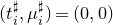 $(t^\sharp_i,\mu^\sharp_i) = (0,0)$
. As
$(t^\sharp_i,\mu^\sharp_i) = (0,0)$
. As
 $$0 = t_i^\sharp = t_i+ Q(y_i),$$
both $t_i=0$
and
$t_i=0$
and $y_i=0$
, and the latter implies
$y_i=0$
, and the latter implies $\nu_i=0$
. Thus,
$\nu_i=0$
. Thus, $\mathcal{Z}_i^\sharp = \mathcal{M}^\sharp$
and
$\mathcal{Z}_i^\sharp = \mathcal{M}^\sharp$
and $\mathcal{Z}_i=\mathcal{M}$
, and we have
$\mathcal{Z}_i=\mathcal{M}$
, and we have
 $$z_i^\sharp = [\mathcal O_{\mathcal{M}^\sharp}] - [\omega^{\sharp}]\quad \mbox{and} \quad z_i = [\mathcal O_{\mathcal{M}}] - [\omega] .$$
Using (A17) and the fact that the tautological bundle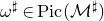 $\omega^\sharp \in \mathrm{Pic}(\mathcal{M}^\sharp)$
pulls back to the tautological bundle
$\omega^\sharp \in \mathrm{Pic}(\mathcal{M}^\sharp)$
pulls back to the tautological bundle $\omega \in \mathrm{Pic}(\mathcal{M})$
, we see that (5.14) sends
$\omega \in \mathrm{Pic}(\mathcal{M})$
, we see that (5.14) sends
 $$[ \mathcal O_{\mathcal{M}^\sharp} ] \mapsto [ \mathcal O_\mathcal{M} ]\quad \mbox{and}\quad [ \omega^\sharp ] \mapsto [ \omega ] .$$
The lemma follows immediately from this.
Next assume that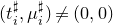 $(t^\sharp_i,\mu^\sharp_i) \neq (0,0)$
and
$(t^\sharp_i,\mu^\sharp_i) \neq (0,0)$
and $(t_i,\mu_i) \neq (0,0)$
. Fix a geometric point
$(t_i,\mu_i) \neq (0,0)$
. Fix a geometric point $y\to \mathcal{Z}_i$
, which we can also view as a point on
$y\to \mathcal{Z}_i$
, which we can also view as a point on $\mathcal{M},\mathcal{M}^\sharp$
and
$\mathcal{M},\mathcal{M}^\sharp$
and $\mathcal{Z}_i^\sharp$
. As both
$\mathcal{Z}_i^\sharp$
. As both
 $$\mathcal{Z}_i \to \mathcal{M} \quad \mbox{and}\quad \mathcal{Z}^\sharp_i \to \mathcal{M}^{\sharp},$$
are generalized Cartier divisors (Proposition 2.4.3), we can write
 $$\mathcal O^\mathrm{et}_{\mathcal{Z}_i^\sharp,y} \cong \mathcal O^\mathrm{et}_{\mathcal{M}^\sharp,y}/(g)$$
for a nonzero $g\in \mathcal O^\mathrm{et}_{\mathcal{M}^\sharp,y}$
whose image in
$g\in \mathcal O^\mathrm{et}_{\mathcal{M}^\sharp,y}$
whose image in $\mathcal O^\mathrm{et}_{\mathcal{M}, y}$
satisfies
$\mathcal O^\mathrm{et}_{\mathcal{M}, y}$
satisfies
 $$\mathcal O^\mathrm{et}_{\mathcal{Z}_i,y} \cong \mathcal O^\mathrm{et}_{\mathcal{M},y}/(g).$$
It follows that
 $$\mathrm{Tor}^{\mathcal O^\mathrm{et}_{\mathcal{M}^\sharp,y}}_\ell( \mathcal O^\mathrm{et}_{\mathcal{Z}_i^\sharp,y} , \mathcal O^\mathrm{et}_{\mathcal{M},y}) \cong \begin{cases}\mathcal O^\mathrm{et}_{\mathcal{Z}_i,y}&\mbox{if $\ell = 0$},\\0&\mbox{if $\ell \gt 0$}.\end{cases}$$
Allowing y to vary shows that
 $$\underline{\mathrm{Tor}}^{\mathcal O_{\mathcal{M}^\sharp}}_\ell(\mathcal O_{\mathcal{Z}_i^\sharp},\mathcal O_{\mathcal{M}})\vert_{\mathcal{Z}_i} \cong \begin{cases}\mathcal O_{\mathcal{Z}_i}&\mbox{if $\ell = 0$},\\0&\mbox{if $\ell \gt 0$},\end{cases}$$
and hence (5.14) sends $z_i^\sharp = [ \mathcal O_{\mathcal{Z}_i^\sharp} ]$
to
$z_i^\sharp = [ \mathcal O_{\mathcal{Z}_i^\sharp} ]$
to $z_i= [ \mathcal O_{\mathcal{Z}_i} ]$
, as desired.
$z_i= [ \mathcal O_{\mathcal{Z}_i} ]$
, as desired.
Finally, we treat the subtle case in which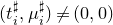 $(t^\sharp_i,\mu^\sharp_i) \neq (0,0)$
and
$(t^\sharp_i,\mu^\sharp_i) \neq (0,0)$
and $(t_i,\mu_i) = (0,0)$
. This is the case that accounts for improper intersection between the images of
$(t_i,\mu_i) = (0,0)$
. This is the case that accounts for improper intersection between the images of $\mathcal{M} \to \mathcal{M}^\sharp$
and
$\mathcal{M} \to \mathcal{M}^\sharp$
and $\mathcal{Z}^\sharp(T^\sharp,\mu^\sharp) \to \mathcal{M}^\sharp$
. The left vertical arrow in (5.12) is an isomorphism
$\mathcal{Z}^\sharp(T^\sharp,\mu^\sharp) \to \mathcal{M}^\sharp$
. The left vertical arrow in (5.12) is an isomorphism
 $$ \mathcal{Z}_i \cong \mathcal{M} ,$$
and the top horizontal arrow is identified with the closed immersion
 $$i : \mathcal{M} \to \mathcal{Z}_i^{\sharp}$$
sending a functorial point $S \to \mathcal{M}$
to the point
$S \to \mathcal{M}$
to the point $S\to \mathcal{Z}_i^\sharp$
determined by the special quasi-endomorphism
$S\to \mathcal{Z}_i^\sharp$
determined by the special quasi-endomorphism $y_i \in V_{\mu_i^\sharp}(\mathcal{A}_S^\sharp)$
of (5.13). This induces the open and closed immersion
$y_i \in V_{\mu_i^\sharp}(\mathcal{A}_S^\sharp)$
of (5.13). This induces the open and closed immersion
 $$j : \mathcal{M} \cong \mathcal{Z}_i \hookrightarrow \mathcal{Z}_i^\sharp \times_{\mathcal{M}^\sharp} \mathcal{M},$$
and the composition (5.14) factors as follows.

Here $\Delta : \mathcal{Z}_i^\sharp \to \mathcal{Z}_i^\sharp\times_{\mathcal{M}^\sharp}\mathcal{Z}_i^\sharp$
is the diagonal morphism, which is both an open and closed immersion, and the bottom horizontal arrow is the derived pullback
$\Delta : \mathcal{Z}_i^\sharp \to \mathcal{Z}_i^\sharp\times_{\mathcal{M}^\sharp}\mathcal{Z}_i^\sharp$
is the diagonal morphism, which is both an open and closed immersion, and the bottom horizontal arrow is the derived pullback
 \begin{equation}[ \mathcal{F} ] \mapsto \sum_{\ell \ge 0} (-1)^\ell \cdot [ \underline{\mathrm{Tor}}_\ell^{ \mathcal O_{\mathcal{Z}^\sharp_i} } ( \mathcal{F} , i_*\mathcal O_\mathcal{M} )]\end{equation}
along the closed immersion i.
Abbreviating
 $$(S_0,\eta_0) =\bigg( \bigg(\begin{matrix}t_i^\sharp\quad &0\\0\quad &0\end{matrix}\bigg),(\mu_i^\sharp,0)\bigg )\quad \mbox{and} \quad (S_0',\eta_0') =\bigg( \bigg(\begin{matrix}t_i^\sharp\quad &t_i^\sharp\\t_i^\sharp\quad &t_i^\sharp\end{matrix}\bigg),(\mu_i^\sharp,\mu_i^\sharp)\bigg) ,$$
there are canonical isomorphisms
 $$ \mathcal{Z}^\sharp (S_0,\eta_0) \cong \mathcal{Z}_i^\sharp \cong \mathcal{Z}^\sharp (S_0',\eta_0') .$$
Under the moduli interpretations, a special quasi-endomorphism x of $\mathcal{A}^\sharp$
representing a point of the stack in the middle is sent to (x,0) on the left and (x,x) on the right. Proposition 2.4.6 realizes
$\mathcal{A}^\sharp$
representing a point of the stack in the middle is sent to (x,0) on the left and (x,x) on the right. Proposition 2.4.6 realizes
 $$\mathcal{Z}_i^\sharp \cong \mathcal{Z}^\sharp (S_0',\eta_0') \subset \mathcal{Z}_i^\sharp \times_{\mathcal{M}}\mathcal{Z}_i^\sharp$$
as an open and closed substack, and this agrees with the diagonal embedding denoted $\Delta$
above.
$\Delta$
above.
The linear invariance proved in Proposition 5.4.1 implies the equality of derived fundamental classes
 $$[ \mathcal O^\mathrm{derived}_{ \mathcal{Z}^\sharp (S_0,\eta_0) } ] = [ \mathcal O^\mathrm{derived}_{ \mathcal{Z}^\sharp (S,\eta) } ] \in G_0( \mathcal{Z}_i^\sharp )_\mathbb Q.$$
Unpacking their definitions shows that the composition of the left vertical arrows in (5.15) sends
 $$[\mathcal O_{\mathcal{Z}^\sharp_i}] \mapsto[ \mathcal O^\mathrm{derived}_{ \mathcal{Z}^\sharp (S_0',\eta_0') } ] =[ \mathcal O^\mathrm{derived}_{ \mathcal{Z}^\sharp (S_0,\eta_0) } ] =[ \mathcal O_{\mathcal{Z}^\sharp_i} ] - [ \omega^\sharp |_{ \mathcal O_{\mathcal{Z}^\sharp_i} } ] .$$
The bottom horizontal arrow (5.16), which simplifies to $[\mathcal{F}] \mapsto [ i^* \mathcal{F}]$
when
$[\mathcal{F}] \mapsto [ i^* \mathcal{F}]$
when $\mathcal{F}$
is a vector bundle on
$\mathcal{F}$
is a vector bundle on $\mathcal{Z}_i^\sharp$
, then sends
$\mathcal{Z}_i^\sharp$
, then sends
 $$[ \mathcal O_{\mathcal{Z}^\sharp_i} ] - [ \omega^\sharp |_{ \mathcal O_{\mathcal{Z}^\sharp_i} } ] \mapsto [ \mathcal O_\mathcal{M} ] - [ \omega] .$$
Combining these calculations with the commutativity of the diagram shows that (5.14) sends $z_i^\sharp = [\mathcal O_{\mathcal{Z}^\sharp_i}]$
to
$z_i^\sharp = [\mathcal O_{\mathcal{Z}^\sharp_i}]$
to $z_i = [ \mathcal O_\mathcal{M} ] - [ \omega]$
, as desired.
$z_i = [ \mathcal O_\mathcal{M} ] - [ \omega]$
, as desired.
Now consider the following commutative diagram.

The upper vertical arrows are open and closed immersions. The middle horizontal arrow identifies
 $$ \mathcal{Z}_1 \times_\mathcal{M} \cdots \times_\mathcal{M} \mathcal{Z}_d \subset ( \mathcal{Z}_1^\sharp \times_{\mathcal{M}^\sharp} \cdots \times_{\mathcal{M}^\sharp} \mathcal{Z}_d^\sharp) \times_{ \mathcal{M}^\sharp } \mathcal{M}$$
as an open and closed substack, and induces a morphism
 \begin{align*}G_0( \mathcal{Z}_1^\sharp \times_{\mathcal{M}^\sharp} \cdots \times_{\mathcal{M}^\sharp} \mathcal{Z}_d^\sharp )\to G_0( \mathcal{Z}_1 \times_\mathcal{M} \cdots \times_\mathcal{M} \mathcal{Z}_d)\end{align*}
exactly as in (5.14). It follows from Lemma 5.6.2 that this morphism sends
 $$z_1^\sharp \cap \cdots \cap z_d^\sharp \mapsto z_1 \cap \cdots\cap z_d,$$
and so the commutativity of the diagram

implies that the bottom horizontal arrow sends
 $$[ \mathcal O^\mathrm{derived}_{ \mathcal{Z}^\sharp(T^\sharp,\mu^\sharp) } ] \mapsto [ \mathcal O^\mathrm{derived}_{ \mathcal{Z}(T,\mu) }] . $$
Allowing $\mathcal{Z}(T,\mu)$
to vary over the right-hand side of (5.11), we see that in the commutative diagram
$\mathcal{Z}(T,\mu)$
to vary over the right-hand side of (5.11), we see that in the commutative diagram

the top horizontal arrow sends

Proposition 5.6.1 follows immediately from this and the following diagram which commutes by the very definition of the bottom horizontal arrow.

6. Modularity in all codimensions
In this section we prove our main result. We remind the reader that V is a quadratic space of signature (n,2) with $n\ge 1$
,
$n\ge 1$
, $L\subset V$
is a lattice on which the quadratic form is
$L\subset V$
is a lattice on which the quadratic form is $\mathbb Z$
-valued,
$\mathbb Z$
-valued, $\Sigma$
is a finite set of primes containing all primes for which
$\Sigma$
is a finite set of primes containing all primes for which $L_p$
is not maximal (an assumption that will be strengthened below), and
$L_p$
is not maximal (an assumption that will be strengthened below), and
 $$\mathcal{M} \to \mathrm{Spec}(\mathbb Z[\Sigma^{-1}])$$
is the integral model of dimension $n+1$
from § 2.2.
$n+1$
from § 2.2.
6.1 Siegel theta series
Let $(\Lambda,Q)$
be a positive-definite quadratic space over
$(\Lambda,Q)$
be a positive-definite quadratic space over $\mathbb Z$
, satisfying
$\mathbb Z$
, satisfying $\Lambda^\vee =\Lambda$
. The self-duality condition implies that the rank of
$\Lambda^\vee =\Lambda$
. The self-duality condition implies that the rank of $\Lambda$
is even, say
$\Lambda$
is even, say
 $$\mathrm{rank}(\Lambda)=2k.$$
For any positive integer d, the genus d Siegel theta series
 \begin{equation}\vartheta_{\Lambda,d} (\tau) = \sum_{ y \in \Lambda^d } q^{Q(y)}\end{equation}
is Siegel modular form of genus d and weight k. Here $\tau \in \mathcal{H}_d \subset\mathrm{Sym}_d(\mathbb C)$
is the variable on the Siegel half-space of genus d,
$\tau \in \mathcal{H}_d \subset\mathrm{Sym}_d(\mathbb C)$
is the variable on the Siegel half-space of genus d, $Q(y) \in \mathrm{Sym}_d(\mathbb Q)$
is the moment matrix as in (2.9), and
$Q(y) \in \mathrm{Sym}_d(\mathbb Q)$
is the moment matrix as in (2.9), and $q^{Q(y)} = e^{2\pi i \mathrm{Tr}(\tau Q(y))}$
.
$q^{Q(y)} = e^{2\pi i \mathrm{Tr}(\tau Q(y))}$
.
Theorem 6.1.1 (Bocherer [Reference BöchererBöc89]). If $4\mid k$
and
$4\mid k$
and $k \gt 2d$
, the space of
$k \gt 2d$
, the space of $\mathbb C$
-valued Siegel modular forms of genus d and weight k is spanned by the genus d Siegel theta series (6.1) as
$\mathbb C$
-valued Siegel modular forms of genus d and weight k is spanned by the genus d Siegel theta series (6.1) as $\Lambda$
varies over all self-dual positive-definite
$\Lambda$
varies over all self-dual positive-definite $\mathbb Z$
-quadratic spaces of rank 2k.
$\mathbb Z$
-quadratic spaces of rank 2k.
6.2 The main result
We now extend the modularity of generating series proved in [Reference Bruinier and Westerholt-RaumBW-R15] from complex Shimura varieties to their integral models.
Assume throughout that $\Sigma$
contains:
$\Sigma$
contains:
-
– all odd primes p such that
$p^2$
divides
$[ L^\vee : L]$
; and -
–
$p=2$
, if
$L_2$
is not hyperspecial.


In particular, $\mathcal{M}$
is regular by Proposition 2.2.4, allowing us to define the derived cycle classes
$\mathcal{M}$
is regular by Proposition 2.2.4, allowing us to define the derived cycle classes
 $$ \mathcal{C}(T,\mu) \in \mathrm{CH}^d ( \mathcal{M})$$
of Definition 5.1.3. By Proposition 5.5.1, these are given by the elementary formula
 \begin{equation} \mathcal{C}(T,\mu) = \underbrace{c_1(\omega^{-1}) \cdots c_1(\omega^{-1})}_{d-\mathrm{rank}(T) } \cdot{\kern1.5pt} [\mathcal{Z}(T,\mu)] \in \mathrm{CH}^{d} (\mathcal{M}) \end{equation}
whenever the naive special cycle $\mathcal{Z}(T,\mu) \to \mathcal{M}$
is equidimensional of codimension
$\mathcal{Z}(T,\mu) \to \mathcal{M}$
is equidimensional of codimension $\mathrm{rank}(T)$
. Using the notation of § 4.1, abbreviate
$\mathrm{rank}(T)$
. Using the notation of § 4.1, abbreviate
 $$ \mathcal{C}(T) = \sum_{\mu\in (L^\vee/L)^d} \mathcal{C}(T,\mu) \otimes \phi_{\mu}^* \in \mathrm{CH}^d ( \mathcal{M} ) \otimes S^*_{L,d}. $$
Theorem 6.2.1. For every integer $1\le d \le n+1$
, the formal generating series
$1\le d \le n+1$
, the formal generating series
 \begin{equation} \phi(\tau) = \sum_{ T\in \mathrm{Sym}_d(\mathbb Q) } \mathcal{C}(T) \cdot q^T\end{equation}
valued in $ \mathrm{CH}^d( \mathcal{M} ) \otimes S^*_{L,d}$
converges to a Siegel modular form of weight
$ \mathrm{CH}^d( \mathcal{M} ) \otimes S^*_{L,d}$
converges to a Siegel modular form of weight $1+({n}/{2})$
and representation
$1+({n}/{2})$
and representation
 \begin{equation}\omega^*_{L,d} : \widetilde{\Gamma}_d \to \mathrm{GL}( S^*_{L,d}).\end{equation}
The convergence and modularity are understood in the sense of Theorem A: they hold after applying any $\mathbb Q$
-linear functional
$\mathbb Q$
-linear functional $\mathrm{CH}^d(\mathcal{M}) \to \mathbb C$
.
$\mathrm{CH}^d(\mathcal{M}) \to \mathbb C$
.
Proof. When $d=1$
the desired modularity is [Reference Howard and Madapusi PeraHMP20, Theorem B]. We remark that the isomorphism
$d=1$
the desired modularity is [Reference Howard and Madapusi PeraHMP20, Theorem B]. We remark that the isomorphism $S_L \cong S_L^*$
sending
$S_L \cong S_L^*$
sending $\phi_\mu \mapsto \phi_\mu^*$
identifies the representation
$\phi_\mu \mapsto \phi_\mu^*$
identifies the representation $\rho_{L}$
in the statement of [Reference Howard and Madapusi PeraHMP20, Theorem B] with the representation
$\rho_{L}$
in the statement of [Reference Howard and Madapusi PeraHMP20, Theorem B] with the representation $\omega_L^*$
defined in § 4.1. Henceforth, we assume
$\omega_L^*$
defined in § 4.1. Henceforth, we assume $d\ge 2$
.
$d\ge 2$
.
It is a theorem of Bruinier and Westerholt-Raum [Reference Bruinier and Westerholt-RaumBW-R15] that (6.3) is modular of the stated weight and representation if and only if two conditions are satisfied.
-
(1) For every
$T\in \mathrm{Sym}_d(\mathbb Q)$
and
$A \in \mathrm{GL}_d(\mathbb Z)$
, the coefficients satisfy the linear invariance relation
$$\mathcal{C} (T) = \mathcal{C} ({}^t A T A).$$
-
(2) For every
$T_0\in \mathrm{Sym}_{d-1}(\mathbb Q)$
, the generating series with coefficients in
$$ \sum_{ \substack{ m\in \mathbb Q \\ \alpha\in \mathbb Q^{d-1} } }\mathcal{C} \Big(\begin{matrix} T_0\quad & \tfrac{\alpha}{2} \\ \frac{ {}^t \alpha }{2} \quad & m \end{matrix}\Big) \cdot q^m \xi_1^{\alpha_1}\cdots \xi_{d-1}^{\alpha_{d-1}}$$
$\mathrm{CH}^d(\mathcal{M})\otimes S_{L,d}^*$
is a Jacobi form of weight
$1+({n}/{2})$
, index
$T_0$
, and representation (6.4).







Let r(L) be the integer of Definition 3.1.1. If we assume that
 $$ n \ge 3d+ 2r(L) +4, $$
then the special cycles $\mathcal{Z}(T,\mu) \to \mathcal{M}$
indexed by
$\mathcal{Z}(T,\mu) \to \mathcal{M}$
indexed by $T\in \mathrm{Sym}_d(\mathbb Q)$
are equidimensional of codimension
$T\in \mathrm{Sym}_d(\mathbb Q)$
are equidimensional of codimension $\mathrm{rank}(T)$
by Proposition 3.3.1, and so the equality (6.2) holds. The linear invariance of condition (1) is Proposition 5.4.1 The Jacobi modularity of condition (2) is (up to a change of notation) Proposition 4.2.3. Note that we are using (6.2) to compare the cycle classes of Definition 5.1.3 with the cycle classes (4.5) used throughout § 4. This proves the theorem when
$\mathrm{rank}(T)$
by Proposition 3.3.1, and so the equality (6.2) holds. The linear invariance of condition (1) is Proposition 5.4.1 The Jacobi modularity of condition (2) is (up to a change of notation) Proposition 4.2.3. Note that we are using (6.2) to compare the cycle classes of Definition 5.1.3 with the cycle classes (4.5) used throughout § 4. This proves the theorem when $ n \ge 3d+ 2r(L) +4$
.
$ n \ge 3d+ 2r(L) +4$
.
To treat the general case, let $\Lambda$
be any positive-definite self-dual quadratic lattice over
$\Lambda$
be any positive-definite self-dual quadratic lattice over $\mathbb Z$
, chosen so that
$\mathbb Z$
, chosen so that
 $$ \mathrm{rank}(\Lambda) \ge 3d+ 2r(L) +4. $$
The $\mathbb Z$
-quadratic space
$\mathbb Z$
-quadratic space $L^\sharp = L\oplus \Lambda$
has signature
$L^\sharp = L\oplus \Lambda$
has signature $(n^\sharp,2)$
with
$(n^\sharp,2)$
with
 $$n^\sharp \ge \mathrm{rank}(\Lambda) \ge 3d + 2r(L^\sharp) +4 ,$$
where we have used $r(L^\sharp) \leq r(L)$
. The quadratic lattice
$r(L^\sharp) \leq r(L)$
. The quadratic lattice $L^\sharp$
determines its own integral model
$L^\sharp$
determines its own integral model $\mathcal{M}^\sharp$
over
$\mathcal{M}^\sharp$
over $\mathbb Z[\Sigma^{-1}]$
, with its own corrected special cycles
$\mathbb Z[\Sigma^{-1}]$
, with its own corrected special cycles
 $$\mathcal{C}^\sharp(T,\mu) \in \mathrm{CH}^d(\mathcal{M}^\sharp).$$
As in Remark 2.2.7, there is a finite morphism $f : \mathcal{M} \to \mathcal{M}^\sharp$
of regular stacks over
$f : \mathcal{M} \to \mathcal{M}^\sharp$
of regular stacks over $\mathbb Z[\Sigma^{-1}]$
. The self-duality of
$\mathbb Z[\Sigma^{-1}]$
. The self-duality of $\Lambda$
implies that
$\Lambda$
implies that $S_{L^\sharp,d} \cong S_{L,d}$
, so there is a pullback (§ A.2)
$S_{L^\sharp,d} \cong S_{L,d}$
, so there is a pullback (§ A.2)
 $$f^* : \mathrm{CH}^d(\mathcal{M}^\sharp) \otimes S^*_{L^\sharp,d} \to \mathrm{CH}^d(\mathcal{M}) \otimes S^*_{L,d} .$$
By the special case proved above, the generating series
 $$\phi^\sharp (\tau) = \sum_{ T\in \mathrm{Sym}_d(\mathbb Q) } \mathcal{C}^\sharp(T) \cdot q^T$$
valued in $\mathrm{CH}^d(\mathcal{M}^\sharp) \otimes S^*_{ L^\sharp,d}$
is a Siegel modular form of genus d, weight
$\mathrm{CH}^d(\mathcal{M}^\sharp) \otimes S^*_{ L^\sharp,d}$
is a Siegel modular form of genus d, weight $1+{n^\sharp}/{2}$
, and representation
$1+{n^\sharp}/{2}$
, and representation $\omega^*_{L^\sharp,d}$
. On the other hand, Proposition 6.1 (more precisely, the special case stated in the introduction as Theorem E) implies the factorization of generating series
$\omega^*_{L^\sharp,d}$
. On the other hand, Proposition 6.1 (more precisely, the special case stated in the introduction as Theorem E) implies the factorization of generating series
 $$f^* \phi^\sharp (\tau) = \phi (\tau) \cdot \vartheta_{\Lambda,d} (\tau),$$
where the second factor on the right is the Siegel theta series (6.1). It follows that $\phi(\tau)$
is a meromorphic Siegel modular form of weight
$\phi(\tau)$
is a meromorphic Siegel modular form of weight
 $$1 + \frac{n^\sharp}{2} - \frac{ \mathrm{rank}(\Lambda) }{2} =1 + \tfrac{n}{2}$$
with poles supported on the zero locus of $\vartheta_{\Lambda,d}(\tau)$
.
$\vartheta_{\Lambda,d}(\tau)$
.
It remains to verify that $\phi(\tau)$
is holomorphic, which we do by allowing
$\phi(\tau)$
is holomorphic, which we do by allowing $\Lambda$
to vary. Fix a point
$\Lambda$
to vary. Fix a point $\tau_0\in \mathcal{H}_d$
in the genus d Siegel half-space. As in the arguments of [Reference BailyBai58], it follows from the construction of Poincaré series found in [Reference CartanCar58] that there exists a Siegel modular form of genus d and some weight k that does not vanish at
$\tau_0\in \mathcal{H}_d$
in the genus d Siegel half-space. As in the arguments of [Reference BailyBai58], it follows from the construction of Poincaré series found in [Reference CartanCar58] that there exists a Siegel modular form of genus d and some weight k that does not vanish at $\tau_0$
. Moreover, we may choose this form in such a way that its weight satisfies
$\tau_0$
. Moreover, we may choose this form in such a way that its weight satisfies $4\mid k$
and
$4\mid k$
and $2k \ge 3d + 2r(L)+4$
. By Theorem 6.1.1, there exists a self-dual
$2k \ge 3d + 2r(L)+4$
. By Theorem 6.1.1, there exists a self-dual $\Lambda$
as above with
$\Lambda$
as above with
 $$ \mathrm{rank}(\Lambda)=2k\ge 3d + 2r(L)+4 , $$
whose associated genus d Siegel theta series $\vartheta_{\Lambda,d}$
does not vanish at
$\vartheta_{\Lambda,d}$
does not vanish at $\tau_0$
. The existence of such a
$\tau_0$
. The existence of such a $\Lambda$
implies that
$\Lambda$
implies that $\phi(\tau)$
is holomorphic near
$\phi(\tau)$
is holomorphic near $\tau_0$
.Footnote
5
$\tau_0$
.Footnote
5
Appendix A. Chow groups
We need a working theory of Chow groups (always with $\mathbb Q$
-coefficients) for Deligne–Mumford stacks M, and in greater generality than is usually found in the literature. For example, §§ 3 and 4 make systematic use of Chow groups of stacks that are not locally integral.
$\mathbb Q$
-coefficients) for Deligne–Mumford stacks M, and in greater generality than is usually found in the literature. For example, §§ 3 and 4 make systematic use of Chow groups of stacks that are not locally integral.
Throughout this appendix we fix a ring S that is either a field or an excellent Dedekind domain (for example, $S=\mathbb Z$
). The term stack will mean an equidimensional and separated Deligne–Mumford stack of finite type over S.
$S=\mathbb Z$
). The term stack will mean an equidimensional and separated Deligne–Mumford stack of finite type over S.
A.1 Chow groups of Deligne–Mumford stacks
Our goal in this subappendix is to define Chow groups of stacks, and show that it is covariant with respect to finite morphisms. Most of what we need can be deduced directly from the results of [Reference GilletGil84].
As in [Reference GilletGil84, Definition 3.2] a stack M has an underlying topological space $|M|$
, whose points are the integral closed substacks
$|M|$
, whose points are the integral closed substacks $Z\subset M$
. Each open substack
$Z\subset M$
. Each open substack $U \subset M$
determines an open set
$U \subset M$
determines an open set $|U| \subset |M|$
, whose points are those integral closed substacks
$|U| \subset |M|$
, whose points are those integral closed substacks $Z\subset M$
for which
$Z\subset M$
for which $Z \cap U \neq \emptyset$
. Any morphism of stacks
$Z \cap U \neq \emptyset$
. Any morphism of stacks $M' \to M$
induces a continuous map
$M' \to M$
induces a continuous map
 \begin{equation}|M'| \to |M|\end{equation}
by [Reference GilletGil84, Corollary 3.4].
We write $M^{(d)}$
for the subset of
$M^{(d)}$
for the subset of $|M|$
consisting of the those integral substacks of codimension d.
$|M|$
consisting of the those integral substacks of codimension d.
Remark A.1.1. A field-valued point $x\in M(k) $
determines a map of topological spaces
$x\in M(k) $
determines a map of topological spaces $|\mathrm{Spec}(k)| \to |M|$
whose image is a single point. This point, the Zariski closure of x, is an integral closed substack denoted
$|\mathrm{Spec}(k)| \to |M|$
whose image is a single point. This point, the Zariski closure of x, is an integral closed substack denoted $ \overline{\{x\}} \subset M$
. Taking Zariski closures of field-valued points establishes a bijection between the topological space
$ \overline{\{x\}} \subset M$
. Taking Zariski closures of field-valued points establishes a bijection between the topological space $|M|$
as defined above, and the more common definition in terms of equivalence classes of field-valued points [Sta22, Tag 04XE].
$|M|$
as defined above, and the more common definition in terms of equivalence classes of field-valued points [Sta22, Tag 04XE].
Recall from [Reference GilletGil84, 3] that a stack $\xi$
is punctual if it is reduced and
$\xi$
is punctual if it is reduced and $|\xi|$
is a single point. The ring of global functions
$|\xi|$
is a single point. The ring of global functions
 $$k(\xi) = H^0(\xi,\mathcal O_{\xi})$$
of such a $\xi$
is a field. Moreover, if
$\xi$
is a field. Moreover, if $U\to \xi$
is an étale chart, then
$U\to \xi$
is an étale chart, then $U = \mathrm{Spec}(E)$
where E is a separable
$U = \mathrm{Spec}(E)$
where E is a separable $k(\xi)$
-algebra. If we write
$k(\xi)$
-algebra. If we write $U\times_{\xi}U = \mathrm{Spec}(E') $
, then E’ is a free E-module (for either of the two natural maps
$U\times_{\xi}U = \mathrm{Spec}(E') $
, then E’ is a free E-module (for either of the two natural maps $E\to E'$
), and we define the ramification index of
$E\to E'$
), and we define the ramification index of $\xi$
to be
$\xi$
to be
 $$ e(\xi) = \frac{\mathrm{rank}_E(E')}{\dim_{k(\xi)}(E)}. $$
This is independent of the choice of chart.
According to [Sta22, Tag 0H22], one can associate to any $Z\in |M|$
a distinguished punctual stack
$Z\in |M|$
a distinguished punctual stack $\xi$
together with a map
$\xi$
together with a map $\xi \to M$
such that the image of
$\xi \to M$
such that the image of $|\xi| \to |M|$
is Z. This
$|\xi| \to |M|$
is Z. This $\xi$
is known as the residual gerb at Z, but we will refer to it below simply as the generic point of Z. We usually conflate
$\xi$
is known as the residual gerb at Z, but we will refer to it below simply as the generic point of Z. We usually conflate $Z\in M^{(d)}$
with its generic point, for example by writing
$Z\in M^{(d)}$
with its generic point, for example by writing $\xi\in M^{(d)}$
and referring to
$\xi\in M^{(d)}$
and referring to $\xi$
as a codimension-d point of M.
$\xi$
as a codimension-d point of M.
If $\xi$
is the generic point of an integral stack M, then we call
$\xi$
is the generic point of an integral stack M, then we call $k(\xi)$
the field of rational functions of M, and also denote it by k(M). If we write
$k(\xi)$
the field of rational functions of M, and also denote it by k(M). If we write $\mathrm{Et}(M)$
for the category of étale maps
$\mathrm{Et}(M)$
for the category of étale maps $U\to M$
with U a scheme, then
$U\to M$
with U a scheme, then
 \begin{align}k(M) = \varprojlim_{(U\to M)\in \mathrm{Et}(M)}k(U).\end{align}
For an integer $d\geq 0$
, define the vector space of d-cycles
$d\geq 0$
, define the vector space of d-cycles $\mathscr{Z}^d(M)$
as the free
$\mathscr{Z}^d(M)$
as the free $\mathbb Q$
-vector space on the set
$\mathbb Q$
-vector space on the set $M^{(d)}$
of codimension-d integral closed substacks. In particular, each point
$M^{(d)}$
of codimension-d integral closed substacks. In particular, each point $\xi\in M^{(d)}$
gives us a basis vector
$\xi\in M^{(d)}$
gives us a basis vector $[\xi]\in \mathscr{Z}^d(M)$
. By [Reference GilletGil84, Lemma 4.3], we have
$[\xi]\in \mathscr{Z}^d(M)$
. By [Reference GilletGil84, Lemma 4.3], we have
 \begin{align}\mathscr{Z}^d(M) = \varprojlim_{(U\to M)\in \mathrm{Et}(M)}\mathscr{Z}^d(U).\end{align}
When M is an integral scheme there is a divisor map $\mathrm{div}:k(M)\to \mathscr{Z}^1(M)$
defined by
$\mathrm{div}:k(M)\to \mathscr{Z}^1(M)$
defined by
 $$\mathrm{div}(f) = \sum_{\xi\in M^{(1)}}\mathrm{ord}_{\xi}(f)[\xi] .$$
Here
 $$\mathrm{ord}_\xi(f) = \mathrm{length}(R/(g)) - \mathrm{length}(R/(h)),$$
where $R=\mathcal O_{M,\xi}$
is the local ring of M at
$R=\mathcal O_{M,\xi}$
is the local ring of M at $\xi$
, and we have written
$\xi$
, and we have written $f=g/h$
in its field of fractions. Combining this construction with (A2) and (A3) allows us to extend the definition of the divisor map
$f=g/h$
in its field of fractions. Combining this construction with (A2) and (A3) allows us to extend the definition of the divisor map $\mathrm{div}:k(M)\to \mathscr{Z}^1(M)$
to any integral stack M.
$\mathrm{div}:k(M)\to \mathscr{Z}^1(M)$
to any integral stack M.
For any finite morphism $\pi:M'\to M$
of stacks with
$\pi:M'\to M$
of stacks with $\dim(M') = \dim(M) - r$
, there is a pushforward
$\dim(M') = \dim(M) - r$
, there is a pushforward
 \begin{align}\pi_*:\mathscr{Z}^{d-r}(M')\to \mathscr{Z}^d(M).\end{align}
Indeed, given a codimension- $d-r$
point
$d-r$
point $\xi' \in |M'|$
, its image under (A1) is a codimension d point
$\xi' \in |M'|$
, its image under (A1) is a codimension d point $\xi \in |M|$
, and there is a canonical finite morphism of punctual stacks
$\xi \in |M|$
, and there is a canonical finite morphism of punctual stacks $\xi'\to \xi$
. This allows us to define
$\xi'\to \xi$
. This allows us to define
 $$\pi_*[\xi'] = \frac{e(\xi)}{e(\xi')} \cdot \deg( k(\xi')/ k(\xi)) \cdot [ \xi],$$
where the degree is the usual degree of a field extension.
In particular, if $\xi\in M^{(d-1)}$
is the generic point of an integral closed substack
$\xi\in M^{(d-1)}$
is the generic point of an integral closed substack $W\subset M$
there is a divisor map
$W\subset M$
there is a divisor map
 $$\mathrm{div}_{\xi}:k(\xi)^\times = k(W)^\times \xrightarrow{\mathrm{div}} \mathscr{Z}^1(W) \to \mathscr{Z}^{d}(M),$$
where the final arrow is the pushforward along the inclusion $W\hookrightarrow M$
.
$W\hookrightarrow M$
.
Definition A.1.2. Setting
 $$\mathscr{R}^d(M) = \bigoplus_{\xi\in M^{(d-1)}}k(\xi)^\times_{\mathbb Q},$$
define the ( $\mathbb Q$
-coefficient) codimension d Chow group of a stack M by
$\mathbb Q$
-coefficient) codimension d Chow group of a stack M by
 $$\mathrm{CH}^d(M) = \mathrm{coker}(\mathscr{R}^d(M) \xrightarrow{\sum_\xi\mathrm{div}_\xi}\mathscr{Z}^d(M)).$$
As usual, cycles in the kernel of the natural map $\mathscr{Z}^d(M)\to \mathrm{CH}^d(M)$
are said to be rationally equivalent to 0.
$\mathscr{Z}^d(M)\to \mathrm{CH}^d(M)$
are said to be rationally equivalent to 0.
Proposition A.1.3. Suppose $\pi:M'\to M$
is a finite morphism of stacks with
$\pi:M'\to M$
is a finite morphism of stacks with $\dim(M') = \dim(M) - r$
. The pushforward on cycles (A4) descends to
$\dim(M') = \dim(M) - r$
. The pushforward on cycles (A4) descends to
 $$\pi_*:\mathrm{CH}^{d-r}(M')\to \mathrm{CH}^d(M).$$
Proof. Given a codimension- $d-r+1$
point
$d-r+1$
point $\xi' \in |M'| $
with image
$\xi' \in |M'| $
with image $\xi \in |M|$
, and an
$\xi \in |M|$
, and an $f\in k(\xi' )^\times$
, we need to check that
$f\in k(\xi' )^\times$
, we need to check that $\pi_*\mathrm{div}_{\xi'}(f)\in \mathscr{Z}^d(M)$
is rationally equivalent to 0. This follows from the fact that
$\pi_*\mathrm{div}_{\xi'}(f)\in \mathscr{Z}^d(M)$
is rationally equivalent to 0. This follows from the fact that $k(\xi')$
is a finite field extension of
$k(\xi')$
is a finite field extension of $k(\xi)$
satisfying
$k(\xi)$
satisfying
 $$\pi_*\mathrm{div}_{\xi'}(f) = \mathrm{div}_{\xi} (\mathrm{Nm}_{k(\xi')/k(\xi)}(f) ).$$
We need the notion of Chow groups with support from [Reference SouléSou92, I.2]. For any finite map $\pi:Z\to M$
as in Definition A.1.4, set
$\pi:Z\to M$
as in Definition A.1.4, set
 $$\mathrm{CH}^d_Z(M) = \mathrm{CH}^{d-r}(\pi(Z)),$$
where $\pi(Z)\subset M$
is the stack theoretic image of
$\pi(Z)\subset M$
is the stack theoretic image of $\pi$
: the reduced closed substack characterized by the property that for every étale map
$\pi$
: the reduced closed substack characterized by the property that for every étale map $U\to M$
with U a scheme, the closed subscheme
$U\to M$
with U a scheme, the closed subscheme $U\times_M \pi(Z) \subset U$
is equal to the image of the finite morphism
$U\times_M \pi(Z) \subset U$
is equal to the image of the finite morphism $U\times_MZ\to U$
.
$U\times_MZ\to U$
.
Definition A.1.4. Suppose $\pi:Z \to M$
is a finite morphism of stacks with Z equidimensional of dimension
$\pi:Z \to M$
is a finite morphism of stacks with Z equidimensional of dimension $\dim(Z) = \dim(M) - r$
. Define
$\dim(Z) = \dim(M) - r$
. Define
 $$[Z] = \sum_{i=1}^n m_i \cdot \pi_*[\xi_i]\in \mathrm{CH}_Z^r(M),$$
where $\xi_1,\ldots,\xi_n\in Z^{(0)}$
are the generic points of the irreducible components of Z, and
$\xi_1,\ldots,\xi_n\in Z^{(0)}$
are the generic points of the irreducible components of Z, and $m_i$
is the length of the étale local ring
$m_i$
is the length of the étale local ring $\mathcal O^\mathrm{et}_{Z,\xi_i}$
,
$\mathcal O^\mathrm{et}_{Z,\xi_i}$
,
A.2 Chow groups and Grothendieck groups
The Chow groups defined above are contravariant with respect to morphisms between regular stacks, and also admit a bilinear intersection pairing. The key to these properties are the results of [Reference Gillet and SouléGS87, 8], [Reference SouléSou92, Ch. I], and [Reference GilletGil09], relating Chow groups to Grothendieck groups of locally free sheaves.
For a scheme M, let $K_0(M)$
be the quotient of the free abelian group generated by symbols
$K_0(M)$
be the quotient of the free abelian group generated by symbols $[\mathcal{Q}_\bullet]$
, where
$[\mathcal{Q}_\bullet]$
, where $\mathcal{Q}_\bullet$
runs over finite complexes of vector bundles on M, by the relations:
$\mathcal{Q}_\bullet$
runs over finite complexes of vector bundles on M, by the relations:
-
•
$[\mathcal{Q}_\bullet] = [ \mathcal{R}_\bullet]$
whenever
$\mathcal{Q}_\bullet$
and
$\mathcal{R}_\bullet$
are quasi-isomorphic; -
•
$[\mathcal{Q}_\bullet] = [ \mathcal{P}_\bullet ] + [ \mathcal{R}_\bullet ]$
whenever there is a short exact sequence
$$0 \to \mathcal{P}_\bullet \to \mathcal{Q}_\bullet \to \mathcal{R}_\bullet \to 0.$$




If $\pi:Z\to M$
is a finite morphism, the group
$\pi:Z\to M$
is a finite morphism, the group $K_0^Z(M)$
is defined in exactly the same way, except that we only consider complexes that become exact after restriction to the open subscheme
$K_0^Z(M)$
is defined in exactly the same way, except that we only consider complexes that become exact after restriction to the open subscheme $M \smallsetminus \pi(Z)$
.
$M \smallsetminus \pi(Z)$
.
Still assuming that M is a scheme, we similarly write $G_0(M)$
for the Grothendieck group of the category of coherent
$G_0(M)$
for the Grothendieck group of the category of coherent $\mathcal O_M$
-modules. Thus,
$\mathcal O_M$
-modules. Thus, $G_0(M)$
is the abelian group generated by symbols
$G_0(M)$
is the abelian group generated by symbols $[\mathcal{Q}]$
with
$[\mathcal{Q}]$
with $\mathcal{Q}$
is a coherent sheaf on M, subject to the relations
$\mathcal{Q}$
is a coherent sheaf on M, subject to the relations $[\mathcal{Q}] = [ \mathcal{P} ] + [ \mathcal{R} ]$
whenever there is a short exact sequence
$[\mathcal{Q}] = [ \mathcal{P} ] + [ \mathcal{R} ]$
whenever there is a short exact sequence
 $$0 \to \mathcal{P} \to \mathcal{Q}\to \mathcal{R} \to 0.$$
Our $G_0(M)$
is the group denoted
$G_0(M)$
is the group denoted $K_0'(M)$
in [Reference SouléSou92].
$K_0'(M)$
in [Reference SouléSou92].
Remark A.2.1. One can naively imitate these definitions when M is a stack. For example, we define $G_0^{\mathrm{naive}}(M)$
to be the free group generated by symbols
$G_0^{\mathrm{naive}}(M)$
to be the free group generated by symbols $[\mathcal{Q}]$
where
$[\mathcal{Q}]$
where $\mathcal{Q}$
is a coherent sheaf on M, modulo the relations
$\mathcal{Q}$
is a coherent sheaf on M, modulo the relations $[\mathcal{Q}] = [ \mathcal{P} ] + [ \mathcal{R} ]$
whenever there is a short exact sequence as above. While
$[\mathcal{Q}] = [ \mathcal{P} ] + [ \mathcal{R} ]$
whenever there is a short exact sequence as above. While $G_0^{\mathrm{naive}}(M)$
will be of use to us, the analogous naive extensions of
$G_0^{\mathrm{naive}}(M)$
will be of use to us, the analogous naive extensions of $K_0^Z(M)$
and
$K_0^Z(M)$
and $K_0(M)$
will not. For example, Theorem A.2.7 is false if one uses these naive definitions.
$K_0(M)$
will not. For example, Theorem A.2.7 is false if one uses these naive definitions.
In light of the previous remark, we associate $\mathbb Q$
-vector spaces
$\mathbb Q$
-vector spaces $K_0(M)_\mathbb Q$
and
$K_0(M)_\mathbb Q$
and $G_0(M)_\mathbb Q$
to a stack M following the more sophisticated constructions of [Reference GilletGil09, 2]. This requires the machinery of K-theory and G-theory spectra as laid out in [Reference Thomason and TrobaughTT90, 3]. Recall that
$G_0(M)_\mathbb Q$
to a stack M following the more sophisticated constructions of [Reference GilletGil09, 2]. This requires the machinery of K-theory and G-theory spectra as laid out in [Reference Thomason and TrobaughTT90, 3]. Recall that $\mathrm{Et}(M)$
is the étale site of M, whose objects are schemes U equipped with an étale morphism
$\mathrm{Et}(M)$
is the étale site of M, whose objects are schemes U equipped with an étale morphism $U \to M$
.
$U \to M$
.
Quillen K-theory defines a presheaf
 $$\mathbf{K}_M (U\to M)\stackrel{\mathrm{def}}{=} K(U)_{\mathbb Q}$$
on $\mathrm{Et}(M)$
valued in spectra over the Eilenberg–MacLane spectrum
$\mathrm{Et}(M)$
valued in spectra over the Eilenberg–MacLane spectrum $H\mathbb{Q}$
(we will call this a rational spectrum for concision), or, more prosaically, in the derived category of bounded below chain complexes of
$H\mathbb{Q}$
(we will call this a rational spectrum for concision), or, more prosaically, in the derived category of bounded below chain complexes of $\mathbb Q$
-vector spaces; see [Reference TakedaTak04, 2.1] for an elementary and explicit representation as a chain complex. By a result of Thomason, this presheaf is in fact a sheaf, and one now defines the rational K-theory
$\mathbb Q$
-vector spaces; see [Reference TakedaTak04, 2.1] for an elementary and explicit representation as a chain complex. By a result of Thomason, this presheaf is in fact a sheaf, and one now defines the rational K-theory $K(M)_{\mathbb Q}$
to be its global sections. The vector space
$K(M)_{\mathbb Q}$
to be its global sections. The vector space $K_0(M)_\mathbb Q$
is defined as the
$K_0(M)_\mathbb Q$
is defined as the $0^\mathrm{th}$
homology of
$0^\mathrm{th}$
homology of $K(M)_{\mathbb Q}$
.
$K(M)_{\mathbb Q}$
.
A completely analogous construction, using the rational spectrum associated with the exact category of coherent sheaves, gives us a sheaf of spectra
 $$\mathbf{G}_M(U\to M)\stackrel{\mathrm{def}}{=} G(U)_{\mathbb Q}$$
on $\mathrm{Et}(M)$
. Taking global sections defines the rational G-theory space
$\mathrm{Et}(M)$
. Taking global sections defines the rational G-theory space $G(M)_{\mathbb Q}$
, and the vector space
$G(M)_{\mathbb Q}$
, and the vector space $G_0(M)_{\mathbb Q}$
is defined as its
$G_0(M)_{\mathbb Q}$
is defined as its $0^\mathrm{th}$
homology.
$0^\mathrm{th}$
homology.
To get $K_0$
-groups with support along a finite map
$K_0$
-groups with support along a finite map $Z\to M$
, one now repeats the construction using the presheaf
$Z\to M$
, one now repeats the construction using the presheaf
 $$\mathbf{K}^Z_M(U\to M)\mapsto K^{Z\times_M U}(U)_{\mathbb Q}$$
associating to U the rational spectrum associated with the exact category of bounded complexes of vector bundles on U with cohomology sheaves supported on the image of $Z\times_M U \to U$
. Taking the zeroth homology group of the global sections of this presheaf (which is, once again, actually a sheaf) defines the vector space
$Z\times_M U \to U$
. Taking the zeroth homology group of the global sections of this presheaf (which is, once again, actually a sheaf) defines the vector space $K^Z_0(M)_\mathbb Q$
.
$K^Z_0(M)_\mathbb Q$
.
Still assuming that $Z\to M$
is a finite morphism of stacks, fix a morphism
$Z\to M$
is a finite morphism of stacks, fix a morphism
 $$f:M'\to M$$
and set $Z' = Z\times_M M' $
. Given an étale morphism
$Z' = Z\times_M M' $
. Given an étale morphism $(U \to M) \in \mathrm{Et}(M)$
, if we set
$(U \to M) \in \mathrm{Et}(M)$
, if we set $U' = U\times_M M'$
then pullback via
$U' = U\times_M M'$
then pullback via $U'\to U$
takes bounded complexes of vector bundles on U, acyclic outside the image of
$U'\to U$
takes bounded complexes of vector bundles on U, acyclic outside the image of $Z\times_M U \to U$
, to bounded complexes of vector bundles on U’, acyclic outside the image of
$Z\times_M U \to U$
, to bounded complexes of vector bundles on U’, acyclic outside the image of $Z'\times_{M'} U' \to U'$
. This induces a pullback map on the corresponding sheaves of spectra, and hence a map
$Z'\times_{M'} U' \to U'$
. This induces a pullback map on the corresponding sheaves of spectra, and hence a map
 \begin{align}f^*: K_0^Z(M)_\mathbb Q\to K_0^{Z'}(M')_\mathbb Q.\end{align}
Now suppose we have finite morphisms of stacks $Z_1\to M$
and
$Z_1\to M$
and $Z_2\to M$
. For any
$Z_2\to M$
. For any $(U\to M) \in \mathrm{Et}(M)$
the tensor product of bounded complexes of vector bundles determines a map of rational spectra
$(U\to M) \in \mathrm{Et}(M)$
the tensor product of bounded complexes of vector bundles determines a map of rational spectra
 $$K^{Z_1\times_M U}(U)_\mathbb Q\otimes K^{Z_2\times_M U}(U)_\mathbb Q \to K^{Z_1\times_MZ_2\times_M U}(U)_\mathbb Q,$$
which, in turn, gives rise to a canonical pairing
 \begin{equation}K^{Z_1}_0(M)_\mathbb Q\otimes K^{Z_2}_0(M)_\mathbb Q \to K^{Z_1\times_MZ_2}_0(M)_\mathbb Q.\end{equation}
By construction, this pairing is compatible (in the obvious sense) with the pullback (A5).
The above vector spaces $K_0(M)_\mathbb Q$
,
$K_0(M)_\mathbb Q$
, $K_0^Z(M)_\mathbb Q$
, and
$K_0^Z(M)_\mathbb Q$
, and $G_0(M)_\mathbb Q$
agree with those defined at the beginning of this subappendix when M is a scheme, and the operations (A5) and (A6) are the obvious ones defined by pullbacks and tensor products of complexes of sheaves. For general stacks M these vector spaces do not admit obvious descriptions in terms of coherent sheaves on M.
$G_0(M)_\mathbb Q$
agree with those defined at the beginning of this subappendix when M is a scheme, and the operations (A5) and (A6) are the obvious ones defined by pullbacks and tensor products of complexes of sheaves. For general stacks M these vector spaces do not admit obvious descriptions in terms of coherent sheaves on M.
Remark A.2.2 When $\xi$
is a punctual stack, the rank map
$\xi$
is a punctual stack, the rank map $K_0(\xi)_\mathbb Q\to \mathbb Q$
is an isomorphism. To see this one reduces to the case where
$K_0(\xi)_\mathbb Q\to \mathbb Q$
is an isomorphism. To see this one reduces to the case where $\xi$
admits a finite étale cover
$\xi$
admits a finite étale cover $\mathrm{Spec} (L) \to \xi$
by a field L, and then uses [Reference GilletGil09, Corollary 2.7], which shows that
$\mathrm{Spec} (L) \to \xi$
by a field L, and then uses [Reference GilletGil09, Corollary 2.7], which shows that $K_0(\xi)_\mathbb Q \to K(\mathrm{Spec} (L) )_\mathbb Q\cong \mathbb Q$
is an isomorphism.
$K_0(\xi)_\mathbb Q \to K(\mathrm{Spec} (L) )_\mathbb Q\cong \mathbb Q$
is an isomorphism.
Remark A.2.3 Every coherent sheaf $\mathcal{F}$
on M gives rise toFootnote
6
a map of sheaves of spectra
$\mathcal{F}$
on M gives rise toFootnote
6
a map of sheaves of spectra $\underline{H\mathbb Q}\to \mathbf{G}_M$
, which evaluates on global sections to a canonical class
$\underline{H\mathbb Q}\to \mathbf{G}_M$
, which evaluates on global sections to a canonical class
 $$[\mathcal{F}]\in G_0(M)_{\mathbb Q} .$$
Here $\underline{H\mathbb Q}$
is the locally constant sheaf of spectra assigning to every connected
$\underline{H\mathbb Q}$
is the locally constant sheaf of spectra assigning to every connected $(U\to M) \in \mathrm{Et}(M)$
the constant spectrum
$(U\to M) \in \mathrm{Et}(M)$
the constant spectrum $H\mathbb Q$
(equivalently, the object
$H\mathbb Q$
(equivalently, the object $\mathbb Q[0]$
in the derived category of bounded below complexes of
$\mathbb Q[0]$
in the derived category of bounded below complexes of $\mathbb Q$
-vector spaces). Recalling the notation of Remark A.2.1, this construction defines a homomorphism of vector spaces
$\mathbb Q$
-vector spaces). Recalling the notation of Remark A.2.1, this construction defines a homomorphism of vector spaces
 \begin{equation}G_0^{\mathrm{naive}}(M)_{\mathbb Q} \to G_0(M)_{\mathbb Q},\end{equation}
which is surjective by [Reference GilletGil09, Lemma 2.5].
Remark A.2.4. The homomorphism (A7) need not be an isomorphism. Consider the punctual stack
 $$M = [\mathrm{Spec}(\mathbb C)/H]$$
determined by a finite group H acting trivially on $\mathbb C$
. In this case
$\mathbb C$
. In this case $G_0^{\mathrm{naive}}(M)_{\mathbb Q}$
is the free
$G_0^{\mathrm{naive}}(M)_{\mathbb Q}$
is the free $\mathbb Q$
-module on the finite set of isomorphism classes of irreducible representations of H, while
$\mathbb Q$
-module on the finite set of isomorphism classes of irreducible representations of H, while $G_0(M)_{\mathbb Q} \cong \mathbb Q$
by Remark A.2.2. The map (A7) sends an irreducible representation to its dimension.
$G_0(M)_{\mathbb Q} \cong \mathbb Q$
by Remark A.2.2. The map (A7) sends an irreducible representation to its dimension.
Proposition A.2.5. Assume M is regular. Any finite morphism of stacks $\pi : Z \to M$
induces a pushforward homomorphism
$\pi : Z \to M$
induces a pushforward homomorphism
 \begin{equation}\pi_* : G_0( Z )_\mathbb Q \to K_0^Z( M )_\mathbb Q.\end{equation}
It is an isomorphism if M is a scheme and $\pi:Z\to M$
is a closed immersion.
$\pi:Z\to M$
is a closed immersion.
Proof. In the case where M is a scheme, this is [Reference SouléSou92, I.3.1 Lemma 4]. The pushforward homomorphism sends the class of a coherent sheaf $[\mathcal{F}] \in G_0( Z )$
to any finite resolution of
$[\mathcal{F}] \in G_0( Z )$
to any finite resolution of $\pi_*\mathcal{F}$
by vector bundles on M.
$\pi_*\mathcal{F}$
by vector bundles on M.
In general, for every $(M'\to M) \in \mathrm{Et}(M)$
we have a map
$(M'\to M) \in \mathrm{Et}(M)$
we have a map
 $$\pi'_*:G(Z')_{\mathbb Q} \to K^{Z'}(M')_\mathbb Q$$
of spectra arising from a functor of exact categories. The right-hand side can be identified with the rational spectrum associated with the category of perfect complexes on M’ that are acyclic outside of Z’ (see the argument in [Reference Thomason and TrobaughTT90, Theorem 3.21], and the left-hand side is associated with the exact category of bounded complexes of coherent sheaves on $Z' = Z\times_MM'$
. The functor is now induced by pushforward along
$Z' = Z\times_MM'$
. The functor is now induced by pushforward along $\pi':Z'\to M'$
.
$\pi':Z'\to M'$
.
Any finite morphisms of stacks $Y\to Z\to M$
induce maps
$Y\to Z\to M$
induce maps
 $$K_0^Y(M)_\mathbb Q \to K_0^Z(M)_\mathbb Q.$$
Define the coniveau filtration on $K_0^{Z}(M)_\mathbb Q$
by
$K_0^{Z}(M)_\mathbb Q$
by
 \begin{equation}F^d K_0^Z(M)_\mathbb Q =\bigcup_{ \substack{ \mathrm{closed\ substacks\ } Y \subset Z \\ \mathrm{codim}_M(Y) \ge d } } \mathrm{Image} ( K_0^Y(M)_\mathbb Q \to K_0^Z(M)_\mathbb Q) ,\end{equation}
and denote by
 $$\mathrm{Gr}^d_{\gamma}K_0^Z(M)_\mathbb Q \stackrel{\mathrm{def}}{=} F^dK_0^Z(M)_\mathbb Q/F^{d+1}K_0^Z(M)_\mathbb Q$$
the graded pieces of the filtration. For schemes, the following theorems of Gillet and Soulé are proved in [Reference Gillet and SouléGS87] and [Reference SouléSou92]. The extensions to stacks are addressed in [Reference GilletGil09, 2.4].
Theorem A.2.6 (Gillet—Soulé). Suppose M is a regular stack.
-
(1) Given finite morphisms
$Z_1\to M$
and
$Z_2\to M$
, the pairing (A6) restricts to a bilinear pairing
$$F^{d_1} K_0^{Z_1}(M)_\mathbb Q \otimes F^{d_2} K_0^{Z_2}(M)_\mathbb Q\to F^{d_1+d_2} K_0^{Z_1 \times_M Z_2}(M)_\mathbb Q.$$
-
(2) Given a morphism
$f : M' \to M$
with M’ another regular stack, and a finite morphism
$Z \to M$
, the pullback (A5) restricts to
$$f^* : F^d K_0^{Z }(M)_\mathbb Q \to F^d K_0^{Z \times_{M} M' }(M')_\mathbb Q .$$


Theorem A.2.7 (Gillet—Soulé) Let M be a regular stack. For any finite morphism
 $$\pi:Z \to M$$
with $\dim(Z) = \dim(M) - r$
, there is a canonical isomorphism
$\dim(Z) = \dim(M) - r$
, there is a canonical isomorphism
 \begin{equation}\mathrm{CH}^d_{Z}(M) \cong \mathrm{Gr}^d_{\gamma} K_0^{Z}(M)_\mathbb Q\end{equation}
carrying the class $[Z]\in \mathrm{CH}^r_Z(M)$
of Definition A.1.4 to the image of
$[Z]\in \mathrm{CH}^r_Z(M)$
of Definition A.1.4 to the image of $[\mathcal O_Z]$
under
$[\mathcal O_Z]$
under

Proof. In the case of schemes, the existence of this isomorphism is [Reference Gillet and SouléGS87, Theorem 8.2], and this argument is generalized to stacks in [Reference GilletGil09, Theorem 2.8]. For the convenience of the reader, we recall some key inputs into these proofs. This will also help us justify the last assertion about the relationship between the cycle class [Z] and the G-theory class $[\mathcal O_Z]$
, since this is not made completely explicit in the references cited.
$[\mathcal O_Z]$
, since this is not made completely explicit in the references cited.
The starting point is the Brown–Gersten–Quillen spectral sequence with first page
 $$E_1^{p,q} = \bigoplus_{\xi\in M^{(p)}\cap \pi(Z)}K_{-p-q}(\xi)_\mathbb Q,$$
converging to the (higher) K-groups with support $K_{-p-q}^Z(M)_\mathbb Q$
. This converges to the coniveau filtration on
$K_{-p-q}^Z(M)_\mathbb Q$
. This converges to the coniveau filtration on $K_0^Z(M)_\mathbb Q$
. See [Reference SouléSou92, Theorem 6] or [Reference GilletGil09, Theorem 2.8].
$K_0^Z(M)_\mathbb Q$
. See [Reference SouléSou92, Theorem 6] or [Reference GilletGil09, Theorem 2.8].
Next, we have Bloch’s formula (due to Quillen), which shows that, on the second page, we have $E_2^{p,p} \cong \mathrm{CH}^p_Z(M)$
. More precisely, we obtain the composition
$E_2^{p,p} \cong \mathrm{CH}^p_Z(M)$
. More precisely, we obtain the composition
 \begin{align*}\bigoplus_{\xi\in M^{(p-1)}\cap \pi(Z)} k(\xi)^\times_{\mathbb Q} \cong \bigoplus_{\xi\in M^{(p-1)}\cap \pi(Z)}K_1(\xi)_\mathbb Q &= E_1^{p-1,p}\to E_1^{p,p} \\&=\bigoplus_{\eta\in M^{(p)}\cap \pi(Z)}K_0(\eta)_\mathbb Q \cong \mathscr{Z}^p_Z(M).\end{align*}
The arrow in the middle is the differential in the spectral sequence, and Quillen shows that this is exactly the divisor map whose cokernel is $\mathrm{CH}^p_Z(M)$
(for the case of stacks, we also need the observation from Remark A.2.2).
$\mathrm{CH}^p_Z(M)$
(for the case of stacks, we also need the observation from Remark A.2.2).
Finally, the interaction between this spectral sequence and Adams operations is used to show that the spectral sequence stabilizes on the second page (see [Reference SouléSou92, 6.4], [Reference Gillet and SouléGS87, Theorem 8.2], and [Reference GilletGil09, 2.4]), which establishes the isomorphisms
 $$\mathrm{CH}^p_Z(M) \cong E_2^{p,p}\cong \mathrm{Gr}^p_{\gamma}K_0^Z(M)_\mathbb Q.$$
Here, for $\xi\in M^{(p)}\cap \pi(Z)$
, the associated map
$\xi\in M^{(p)}\cap \pi(Z)$
, the associated map
 \begin{equation}K_0(\xi)_\mathbb Q \to \mathrm{Gr}^p_{\gamma}K_0^Z(M)_\mathbb Q\end{equation}
can be described as follows. Let $Y\subset M$
be the integral substack with generic point
$Y\subset M$
be the integral substack with generic point $\xi$
. Then we have
$\xi$
. Then we have $F^pK_0^Y(M)_\mathbb Q = K_0^Y(M)_\mathbb Q$
, as well as an exact sequence
$F^pK_0^Y(M)_\mathbb Q = K_0^Y(M)_\mathbb Q$
, as well as an exact sequence
 $$F^{p+1}K_0^Y(M)_\mathbb Q \to K_0^Y(M)_\mathbb Q\to K_0(\xi)_\mathbb Q\to 0,$$
where the second map is just the map $K_0^Y(M) \to K_0(\xi)$
obtained by restriction to the generic point. This arises from the localization sequence for K-theory spectra [Reference Thomason and TrobaughTT90, Theorems 6.8, 7.4, and 7.6], which shows that, for every closed substack
$K_0^Y(M) \to K_0(\xi)$
obtained by restriction to the generic point. This arises from the localization sequence for K-theory spectra [Reference Thomason and TrobaughTT90, Theorems 6.8, 7.4, and 7.6], which shows that, for every closed substack $Z\subset Y$
, we have a fiber sequence of sheaves of spectra
$Z\subset Y$
, we have a fiber sequence of sheaves of spectra
 $$\mathbf{K}_M^Z\to \mathbf{K}_M^Y\to \mathbf{K}_{M\smallsetminus Z}^{Y\smallsetminus Z}.$$
Taking global sections and then looking at $H_0$
gives us an exact sequence
$H_0$
gives us an exact sequence
 $$K_0^Z(M)_\mathbb Q \to K_0^Y(M)_\mathbb Q \to K_0^{Y\smallsetminus Z}(M\smallsetminus Z)_\mathbb Q\to 0.$$
To finish, we need to observe that
 $$\mathrm{colim}_{\underset{Z\neq Y}{Z\subset Y}}K_0^{Y\smallsetminus Z}(M\smallsetminus Z)_\mathbb Q \cong K_0(\xi)_\mathbb Q,$$
which can be checked on the level of the corresponding sheaves of spectra.
This gives us an isomorphism
 $$K_0(\xi)_\mathbb Q \cong \mathrm{Gr}^p_{\gamma}K_0^Y(M)_\mathbb Q,$$
and composing it with the natural map
 $$ \mathrm{Gr}^p_{\gamma}K_0^Y(M)_\mathbb Q\to \mathrm{Gr}^p_{\gamma}K_0^Z(M)_\mathbb Q$$
now yields (A11).
It still remains to verify the assertion about the class [Z]. That $[\pi_*\mathcal O_Z]\in F^rK^Z_0(M)_\mathbb Q$
is immediate from the definitions. That its image in
$[\pi_*\mathcal O_Z]\in F^rK^Z_0(M)_\mathbb Q$
is immediate from the definitions. That its image in
 $$\mathrm{Gr}^r_{\gamma}K^Z_0(M)_\mathbb Q \cong \mathrm{CH}^r_Z(M)$$
is [Z] comes down to the fact that for any generic point $\zeta\in Z^{(0)}$
with image
$\zeta\in Z^{(0)}$
with image $\xi\in M^{(r)}\cap \pi(Z)$
, the image of
$\xi\in M^{(r)}\cap \pi(Z)$
, the image of $\mathcal O_\zeta$
in
$\mathcal O_\zeta$
in $K_0(\xi)_\mathbb Q \cong \mathbb Q$
is
$K_0(\xi)_\mathbb Q \cong \mathbb Q$
is
 $$\frac{e(\xi)}{e(\zeta)} \cdot \deg( k(\zeta)/ k(\xi)).$$
Combining Theorems A.2.6 and A.2.7 yields intersection pairings and pullbacks on Chow groups of regular stacks. If M is a regular stack and $Z_1,Z_2 \to M$
are finite morphisms, there is a canonical bilinear intersection pairing
$Z_1,Z_2 \to M$
are finite morphisms, there is a canonical bilinear intersection pairing
 $$\mathrm{CH}^{d_1}_{Z_1}(M) \otimes \mathrm{CH}^{d_2}_{Z_2}(M)\to \mathrm{CH}^{d_1+d_2}_{Z_1 \times_M Z_2 }(M).$$
For any morphism $M' \to M$
between regular stacks and any finite morphism
$M' \to M$
between regular stacks and any finite morphism $Z \to M$
, there is a pullback
$Z \to M$
, there is a pullback
 $$\mathrm{CH}^d_{Z}(M) \to \mathrm{CH}^d_{Z'}(M') ,$$
where $Z' = Z \times_{M}M'$
.
$Z' = Z \times_{M}M'$
.
A.3 Line bundles and divisor classes
Suppose $\mathcal{L}$
is a line bundle on an integral scheme M. A rational trivialization s of
$\mathcal{L}$
is a line bundle on an integral scheme M. A rational trivialization s of $\mathcal{L}$
is an equivalence class of pairs
$\mathcal{L}$
is an equivalence class of pairs $(U,\xi)$
, where
$(U,\xi)$
, where $U\subset M$
is a dense open subscheme, and
$U\subset M$
is a dense open subscheme, and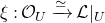 $\xi:\mathcal O_U\xrightarrow{\simeq}\mathcal{L}\vert_U$
is a trivialization; two such pairs
$\xi:\mathcal O_U\xrightarrow{\simeq}\mathcal{L}\vert_U$
is a trivialization; two such pairs $(U_1,\xi_1)$
and
$(U_1,\xi_1)$
and $(U_2,\xi_2)$
are equivalent if the trivializations
$(U_2,\xi_2)$
are equivalent if the trivializations $\xi_1,\xi_2$
agree on the intersection
$\xi_1,\xi_2$
agree on the intersection $U_1\cap U_2$
. Write
$U_1\cap U_2$
. Write $k(\mathcal{L})^\times$
for the set of such rational trivializations.
$k(\mathcal{L})^\times$
for the set of such rational trivializations.
The divisor of $s\in k(\mathcal{L})^\times$
is the cycle
$s\in k(\mathcal{L})^\times$
is the cycle
 $$\mathrm{div}(s) \stackrel{\mathrm{def}}{=} \sum_{\xi\in M^{(1)}}\mathrm{ord}_\xi(s)[\xi]\in \mathscr{Z}^1(M),$$
where the integer $\mathrm{ord}_\xi(s)$
is defined as follows. Let
$\mathrm{ord}_\xi(s)$
is defined as follows. Let $R = \mathcal O_{M,\xi}$
, and choose an isomorphism
$R = \mathcal O_{M,\xi}$
, and choose an isomorphism $\mathcal{L}\vert_{\mathrm{Spec}(R)} \cong \mathcal O_{\mathrm{Spec} (R)}$
. Via this isomorphism s corresponds to a rational function
$\mathcal{L}\vert_{\mathrm{Spec}(R)} \cong \mathcal O_{\mathrm{Spec} (R)}$
. Via this isomorphism s corresponds to a rational function $f/g$
in the fraction field of R, and
$f/g$
in the fraction field of R, and
 $$\mathrm{ord}_\xi(s) = \mathrm{length}(R/(f)) - \mathrm{length}(R/(g)).$$
More generally, for a line bundle $\mathcal{L}$
on an integral stack M define
$\mathcal{L}$
on an integral stack M define
 $$k(\mathcal{L})^\times \stackrel{\mathrm{def}}{=} \varprojlim_{(U\to M)\in \mathrm{Et}(M)} k(\mathcal{L}\vert_U)^\times.$$
From the case of schemes discussed above, we obtain a map
 $$\mathrm{div}:k(\mathcal{L})^\times \cong \varprojlim_{(U\to M)\in \mathrm{Et}(M)} k(\mathcal{L}\vert_U)^\times \to \varprojlim_{(U\to M)\in \mathrm{Et}(M)}\mathscr{Z}^1(U)\cong \mathscr{Z}^1(M).$$
Note that $k(\mathcal O_M )^\times = k(M)^\times$
is the set of nonzero elements in (A2).
$k(\mathcal O_M )^\times = k(M)^\times$
is the set of nonzero elements in (A2).
If M is any (not necessarily integral) stack, let $Z_1,\ldots,Z_r$
be its irreducible components. Viewing these as integral stacks, we define
$Z_1,\ldots,Z_r$
be its irreducible components. Viewing these as integral stacks, we define
 $$k(\mathcal{L})^\times = \prod_{i=1}^r k(\mathcal{L}\vert_{Z_i})^\times$$
and
 $$\mathrm{div}(s) = \sum_i\mathrm{div}(s_i)\in \mathscr{Z}^1(M)$$
for any $s = (s_1,\ldots,s_r) \in k(\mathcal{L})^\times$
. It is easy to see that the class of
$s = (s_1,\ldots,s_r) \in k(\mathcal{L})^\times$
. It is easy to see that the class of $\mathrm{div}(s)$
in
$\mathrm{div}(s)$
in $\mathrm{CH}^1(M)$
depends only on the isomorphism class of
$\mathrm{CH}^1(M)$
depends only on the isomorphism class of $\mathcal{L}$
, and not on the particular choice of s. This allows us to make the following definition.
$\mathcal{L}$
, and not on the particular choice of s. This allows us to make the following definition.
Definition A.3.1. The first Chern class map
 $$c_1:\mathrm{Pic}(M) \to \mathrm{CH}^1(M)$$
sends a line bundle $\mathcal{L}$
to the cycle class
$\mathcal{L}$
to the cycle class $[\mathrm{div}(s)]$
for any
$[\mathrm{div}(s)]$
for any $s\in k(\mathcal{L})^\times$
.
$s\in k(\mathcal{L})^\times$
.
Suppose that $D\subset M$
is an effective Cartier divisor. In other words, D a closed substack whose ideal sheaf
$D\subset M$
is an effective Cartier divisor. In other words, D a closed substack whose ideal sheaf $\mathcal{I}_D\subset \mathcal O_M$
is a line bundle. We have two ways of associating to D a class in
$\mathcal{I}_D\subset \mathcal O_M$
is a line bundle. We have two ways of associating to D a class in $\mathrm{CH}^1(M)$
. First, we can take the class [D] as in Definition A.1.4. Second, we can take the first Chern class of the line bundle
$\mathrm{CH}^1(M)$
. First, we can take the class [D] as in Definition A.1.4. Second, we can take the first Chern class of the line bundle
 $$ \mathcal{L}(D) \stackrel{\mathrm{def}}{=} \mathcal{I}_D^{-1} . $$
These two constructions agree, as the canonical section $\mathcal O_M\to \mathcal{L}(D)$
determines an
$\mathcal O_M\to \mathcal{L}(D)$
determines an $s\in k(\mathcal{L})^\times$
with
$s\in k(\mathcal{L})^\times$
with
 $$c_1(\mathcal{L}(D)) = [\mathrm{div}(s)] = [D].$$
Lemma A.3.2. If M is regular, the composition

sends $\mathcal{L} \mapsto [\mathcal O_M]-[\mathcal{L}^{-1}]$
. By slight abuse of notation, we are here identifying
$\mathcal{L} \mapsto [\mathcal O_M]-[\mathcal{L}^{-1}]$
. By slight abuse of notation, we are here identifying $[\mathcal O_M]$
and
$[\mathcal O_M]$
and $[\mathcal{L}^{-1}]$
with their images under
$[\mathcal{L}^{-1}]$
with their images under

Proof. If we write $\mathcal{L}^{-1} \cong \mathcal{I}_D \otimes \mathcal{I}_E^{-1}$
for effective Cartier divisors
$\mathcal{L}^{-1} \cong \mathcal{I}_D \otimes \mathcal{I}_E^{-1}$
for effective Cartier divisors $D, E \subset M$
with
$D, E \subset M$
with $D\cap E \subset M$
of codimension
$D\cap E \subset M$
of codimension $\ge 2$
, then
$\ge 2$
, then $c_1(\mathcal{L}) \in \mathrm{CH}^1(M)$
is represented by the class of the associated Weil divisor
$c_1(\mathcal{L}) \in \mathrm{CH}^1(M)$
is represented by the class of the associated Weil divisor $D-E$
.
$D-E$
.
Tensoring the short exact sequence
 $$0 \to \mathcal O_M \to \mathcal{I}_E^{-1} \to \mathcal{I}_E^{-1} / \mathcal O_M \to 0$$
with $I_D$
shows that
$I_D$
shows that
 $$[ \mathcal{L}^{-1} ] = [ \mathcal{I}_D ] + [ \mathcal{I}_D \otimes ( \mathcal{I}_E^{-1} / \mathcal O_M ) ]$$
holds in $G_0^\mathrm{naive}(M)$
, which we rewrite as
$G_0^\mathrm{naive}(M)$
, which we rewrite as
 $$ [ \mathcal O_M] - [ \mathcal{L}^{-1} ] = [ \mathcal O_M/ \mathcal{I}_D ] - [ \mathcal{I}_D \otimes ( \mathcal{I}_E^{-1} / \mathcal O_M ) ].$$
Using the assumption that $D\cap E$
has codimension
$D\cap E$
has codimension $\ge 2$
, and the fact that
$\ge 2$
, and the fact that $\mathcal{I}_E$
is locally principal, one can check that the equalities
$\mathcal{I}_E$
is locally principal, one can check that the equalities
 $$[ \mathcal{I}_D \otimes ( \mathcal{I}_E^{-1} / \mathcal O_M ) ] = [ \mathcal{I}_E^{-1} / \mathcal O_M ] = [ \mathcal O_M / \mathcal{I}_E]$$
hold in $G_0^\mathrm{naive}(M)$
, up to a linear combination of classes
$G_0^\mathrm{naive}(M)$
, up to a linear combination of classes $[\mathcal{F}]$
with
$[\mathcal{F}]$
with $\mathcal{F}$
the pushforward to M of a coherent sheaf on a codimension-two closed substack (contained in E). Hence,
$\mathcal{F}$
the pushforward to M of a coherent sheaf on a codimension-two closed substack (contained in E). Hence,
 \begin{equation} [ \mathcal O_M] - [ \mathcal{L}^{-1} ] = [ \mathcal O_M/ \mathcal{I}_D ] - [ \mathcal O_M/ \mathcal{I}_E ] = [\mathcal O_D] - [\mathcal O_E]\end{equation}
holds in $G_0^\mathrm{naive}(M)$
up to the same ambiguity. Using the final claim of Theorem A.2.7, we find that the image of
$G_0^\mathrm{naive}(M)$
up to the same ambiguity. Using the final claim of Theorem A.2.7, we find that the image of $c_1(\mathcal{L})= D-E$
under (A10) is equal to
$c_1(\mathcal{L})= D-E$
under (A10) is equal to $ [ \mathcal O_M] - [ \mathcal{L}^{-1} ]$
.
$ [ \mathcal O_M] - [ \mathcal{L}^{-1} ]$
.
Proposition A.3.3. As in Proposition A.1.3, let $\pi:M'\to M$
be a finite morphism of stacks with image of codimension r. Suppose, in addition, that M is a regular stack over
$\pi:M'\to M$
be a finite morphism of stacks with image of codimension r. Suppose, in addition, that M is a regular stack over $\mathbb Z$
, and that for every prime p, there exists a quasi-projective scheme X over
$\mathbb Z$
, and that for every prime p, there exists a quasi-projective scheme X over $\mathbb Z[1/p]$
equipped with the action of a finite group G such that
$\mathbb Z[1/p]$
equipped with the action of a finite group G such that
 $$[X/G]\cong M_{\mathbb Z[1/p]}.$$
For any line bundle $\mathcal{L} \in \mathrm{Pic}(M)$
we have
$\mathcal{L} \in \mathrm{Pic}(M)$
we have
 $$\pi_*c_1( \pi^*\mathcal{L} ) = c_1(\mathcal{L})\cdot [M']\in \mathrm{CH}^{r+1}(M).$$
Proof. We claim first that for any finite subset $T\subset |M|$
, there exists an
$T\subset |M|$
, there exists an $r \in \mathbb Z^+$
and a section
$r \in \mathbb Z^+$
and a section $s\in H^0(M,\mathcal{L}^{\otimes r})$
whose vanishing locus is disjoint from T. For this, choose a prime p that does not divide the characteristics of
$s\in H^0(M,\mathcal{L}^{\otimes r})$
whose vanishing locus is disjoint from T. For this, choose a prime p that does not divide the characteristics of $k(\xi)$
for any
$k(\xi)$
for any $\xi\in T$
, and fix
$\xi\in T$
, and fix $[X/G]\cong M_{\mathbb Z[1/p]}$
as in the statement of the proposition. By [Reference LiuLiu02, Proposition 9.1.11] there is a section
$[X/G]\cong M_{\mathbb Z[1/p]}$
as in the statement of the proposition. By [Reference LiuLiu02, Proposition 9.1.11] there is a section $ \sigma \in H^0(X,\mathcal{L}\vert_X)$
whose vanishing locus is disjoint from the pre-image of T in X. If we write
$ \sigma \in H^0(X,\mathcal{L}\vert_X)$
whose vanishing locus is disjoint from the pre-image of T in X. If we write $G = \{g_1,\ldots,g_r\}$
, then
$G = \{g_1,\ldots,g_r\}$
, then
 $$g_1 \sigma \otimes \cdots \otimes g_r \sigma \in H^0(X,\mathcal{L}^{\otimes r} \vert_X)^G = H^0(M_{\mathbb Z[1/p]} ,\mathcal{L}^{\otimes r})$$
is a section whose vanishing locus in $M_{\mathbb Z[1/p]}$
is disjoint from T. Multiplying this section by a sufficiently large power of p provides us with the desired section
$M_{\mathbb Z[1/p]}$
is disjoint from T. Multiplying this section by a sufficiently large power of p provides us with the desired section $s\in H^0(M,\mathcal{L}^{\otimes r})$
.
$s\in H^0(M,\mathcal{L}^{\otimes r})$
.
We apply the paragraph above with T equal to the image under $\pi$
of the set of associated pointsFootnote
7
of M’. The Cartier divisor D of the resulting section
$\pi$
of the set of associated pointsFootnote
7
of M’. The Cartier divisor D of the resulting section $s \in H^0( M , \mathcal{L}^{\otimes r})$
then has the property that
$s \in H^0( M , \mathcal{L}^{\otimes r})$
then has the property that
 $$D' \stackrel{\mathrm{def}}{=} D\times_M M'$$
is an effective Cartier divisor on M’, and $\mathcal{L}^{\otimes r} \cong \mathcal{I}_D^{-1}$
. Recalling that the Chow group
$\mathcal{L}^{\otimes r} \cong \mathcal{I}_D^{-1}$
. Recalling that the Chow group $ \mathrm{CH}^{r+1}(M)$
has rational coefficients, it suffices to prove the stated equality after replacing
$ \mathrm{CH}^{r+1}(M)$
has rational coefficients, it suffices to prove the stated equality after replacing $\mathcal{L}$
by
$\mathcal{L}$
by $\mathcal{L}^{\otimes r}$
. Thus, we may ease notation by assuming
$\mathcal{L}^{\otimes r}$
. Thus, we may ease notation by assuming $r=1$
.
$r=1$
.
The left-hand side of the desired equality is now just the cycle class [D’] associated to the finite map $D' \to M$
by Definition A.1.4, so is represented in
$D' \to M$
by Definition A.1.4, so is represented in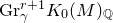 $\mathrm{Gr}^{r+1}_{\gamma}K_0(M)_\mathbb Q$
by the class
$\mathrm{Gr}^{r+1}_{\gamma}K_0(M)_\mathbb Q$
by the class $[\pi_*\mathcal O_{D'}]$
.
$[\pi_*\mathcal O_{D'}]$
.
On the other hand, the right-hand side is represented by
 $$[ \mathcal O_D \otimes^{\mathbb{L}}_{\mathcal O_M} \pi_*\mathcal O_{M'} ]= \sum_{i\ge 0} (-1)^i \cdot [\underline{\mathrm{Tor}}_i^{\mathcal O_M}(\mathcal O_D, \pi_*\mathcal O_{M'})].$$
Using the resolution
 $$0\to \mathcal{I}_D \to \mathcal O_M \to \mathcal O_D\to 0$$
of $\mathcal O_D$
by vector bundles on M, the Tor sheaves in the sum can be computed by taking the homology of the complex
$\mathcal O_D$
by vector bundles on M, the Tor sheaves in the sum can be computed by taking the homology of the complex
 $$\cdots \to 0 \to \mathcal{I}_{D} \otimes_{\mathcal O_M} \pi_*\mathcal O_{M'} \xrightarrow{f} \pi_*\mathcal O_{M'} \to 0,$$
where $f(a\otimes b) = ab$
is the multiplication map. Our assumption that D’ is an effective Cartier divisor on M’ guarantees that f is injective with image
$f(a\otimes b) = ab$
is the multiplication map. Our assumption that D’ is an effective Cartier divisor on M’ guarantees that f is injective with image $\pi_* \mathcal{I}_{D'} \subset \pi_*\mathcal O_{M'}$
. It follows that the
$\pi_* \mathcal{I}_{D'} \subset \pi_*\mathcal O_{M'}$
. It follows that the $i=0$
term in the sum is
$i=0$
term in the sum is $[\pi_*\mathcal O_{D'}]$
, while all terms with
$[\pi_*\mathcal O_{D'}]$
, while all terms with $i \gt 0$
vanish.
$i \gt 0$
vanish.
A.4 A generalized intersection pairing
Throughout this subappendix we assume that M is a regular stack. Our goal is to construct a refinement of the intersection pairing of Theorem A.2.6.
Analogously to the coniveau filtration (A9) on $K^Z( M )_\mathbb Q$
, for a finite morphism
$K^Z( M )_\mathbb Q$
, for a finite morphism $Z \to M$
we define
$Z \to M$
we define
 \begin{equation}F^d G_0( Z)_\mathbb Q = \bigcup_{ \substack{ Y \subset Z \\ \mathrm{codim}_M(Y) \ge d} } \mathrm{Image}( G_0(Y)_\mathbb Q \to G_0( Z)_\mathbb Q ),\end{equation}
where the union is over all closed substacks $Y\subset Z$
whose image
$Y\subset Z$
whose image $\pi(Y) \subset M$
has codimension
$\pi(Y) \subset M$
has codimension $\ge d$
. This defines the coniveau-in-M filtration on
$\ge d$
. This defines the coniveau-in-M filtration on $G_0( Z)_\mathbb Q$
. Of course the filtration depends on the morphism
$G_0( Z)_\mathbb Q$
. Of course the filtration depends on the morphism $\pi: Z \to M$
, but we suppress this from the notation as it will always be clear from context. It is clear that (A8) restricts to a morphism
$\pi: Z \to M$
, but we suppress this from the notation as it will always be clear from context. It is clear that (A8) restricts to a morphism
 \begin{equation}F^d G_0( Z)_\mathbb Q \to F^d K^Z_0( M)_\mathbb Q.\end{equation}
Suppose we are given finite morphisms as follows.

The natural map $\pi : Z_1\times_M Z_2 \to M$
is also finite, hence affine, and so
$\pi : Z_1\times_M Z_2 \to M$
is also finite, hence affine, and so
 \begin{equation}Z_1 \times_M Z_2 \cong \underline{\mathrm{Spec}}_{\mathcal O_M} ( \pi_* \mathcal O_{ Z_1\times_M Z_2 } ).\end{equation}
Given coherent sheaves $\mathcal{F}_1$
and
$\mathcal{F}_1$
and $\mathcal{F}_2$
on
$\mathcal{F}_2$
on $Z_1$
and
$Z_1$
and $Z_2$
, respectively, we can form, for every
$Z_2$
, respectively, we can form, for every $\ell\ge 0$
, the coherent sheaf
$\ell\ge 0$
, the coherent sheaf
 \begin{equation}{}\underline{\mathrm{Tor}}_\ell^{\mathcal O_M} (\pi_{1*}\mathcal{F}_1 , \pi_{2*}\mathcal{F}_2)\end{equation}
on M. As the formation of Tor is functorial in both variables, (A16) carries an action of the $\mathcal O_M$
-algebra
$\mathcal O_M$
-algebra
 $$\pi_* \mathcal O_{Z_1\times_M Z_2} \cong \pi_{1*}\mathcal O_{Z_1} \otimes_{\mathcal O_M} \pi_{2*}\mathcal O_{Z_2} ,$$
which determines a lift of (A16) to a coherent sheaf on (A15). This lift then determines a class
 $$[ \underline{\mathrm{Tor}}_\ell^{\mathcal O_M} (\pi_{1*}\mathcal{F}_1 , \pi_{2*}\mathcal{F}_2) ] \in G^\mathrm{naive}_0( Z_1 \times_M Z_2 )_\mathbb Q$$
in the naive G-theory group of Remark A.2.1. In this way we obtain a bilinear pairing
 $$G^\mathrm{naive}_0( Z_1 )_\mathbb Q \otimes G^\mathrm{naive}_0( Z_2 )_\mathbb Q \xrightarrow{\cap} G^\mathrm{naive}_0( Z_1 \times_M Z_2 )_\mathbb Q$$
defined by
 \begin{equation}[ \mathcal{F}_1 ] \cap [\mathcal{F}_2 ]= \sum_{\ell \ge 0}(-1)^\ell \cdot [ \underline{\mathrm{Tor}}_\ell^{\mathcal O_M} (\pi_{1*}\mathcal{F}_1 , \pi_{2*}\mathcal{F}_2) ].\end{equation}
Note that the sum on the right-hand side is finite as M, being assumed regular, has finite Tor dimension.
Lemma A.4.1. There is a unique bilinear pairing
 \begin{equation} G_0( Z_1 )_\mathbb Q \otimes G_0( Z_2 )_\mathbb Q \xrightarrow{\cap} G_0( Z_1 \times_M Z_2 )_\mathbb Q \end{equation}
making the diagram

commute, where the top vertical arrows are the surjections of Remark A.2.3, and the bottom vertical arrows are those of Proposition A.2.5.
Proof. In the case of schemes, so that $G_0=G_0^\mathrm{naive}$
, this is clear from the definitions.
$G_0=G_0^\mathrm{naive}$
, this is clear from the definitions.
For the stack case, recall that (A7) is surjective. In particular, $G_0( Z_1 )_\mathbb Q \otimes G_0( Z_2 )_\mathbb Q$
is generated by elements of the form
$G_0( Z_1 )_\mathbb Q \otimes G_0( Z_2 )_\mathbb Q$
is generated by elements of the form $[\mathcal{F}_1]\otimes [\mathcal{F}_2]$
for coherent sheaves
$[\mathcal{F}_1]\otimes [\mathcal{F}_2]$
for coherent sheaves $\mathcal{F}_i$
on
$\mathcal{F}_i$
on $Z_i$
, so there can be at most one pairing (A18) making the top square of the diagram commute.
$Z_i$
, so there can be at most one pairing (A18) making the top square of the diagram commute.
The cleanest way to the prove existence of (A18) involves a little bit of derived algebraic geometry. Namely, the derived tensor product $\pi_{1*}\mathcal{F}_1\otimes^{\mathbb{L}}_{\mathcal O_M}\pi_{2*}\mathcal{F}_2$
gives a coherent sheaf on the derived affine scheme over M with underlying structure sheaf
$\pi_{1*}\mathcal{F}_1\otimes^{\mathbb{L}}_{\mathcal O_M}\pi_{2*}\mathcal{F}_2$
gives a coherent sheaf on the derived affine scheme over M with underlying structure sheaf $\pi_{1*}\mathcal O_{Z_1}\otimes^{\mathbb{L}}_{\mathcal O_M}\pi_{2*}\mathcal O_{Z_2}$
. The underlying classical scheme here is just
$\pi_{1*}\mathcal O_{Z_1}\otimes^{\mathbb{L}}_{\mathcal O_M}\pi_{2*}\mathcal O_{Z_2}$
. The underlying classical scheme here is just $Z_1\times_MZ_2$
. Therefore, using [Reference KhanKha22, Corollary 3.4], this actually gives a global section of the sheaf
$Z_1\times_MZ_2$
. Therefore, using [Reference KhanKha22, Corollary 3.4], this actually gives a global section of the sheaf $\mathbf{G}_{Z_1\times_MZ_2}$
, which can be identified explicitly with the right-hand side of (A17).
$\mathbf{G}_{Z_1\times_MZ_2}$
, which can be identified explicitly with the right-hand side of (A17).
Remark A.4.2. It is natural to expect that (A18) restricts to
 \begin{equation}F^{d_1} G_0( Z_1 )_\mathbb Q \otimes F^{d_2} G_0( Z_2 )_\mathbb Q \xrightarrow{?} F^{d_1+d_2} G_0( Z_1\times_M Z_2)_\mathbb Q.\end{equation}
If $\pi_1$
and
$\pi_1$
and $\pi_2$
are closed immersions of schemes this is clear from Theorem A.2.6 and the final claim of Proposition A.2.5. In general, even if one assume that
$\pi_2$
are closed immersions of schemes this is clear from Theorem A.2.6 and the final claim of Proposition A.2.5. In general, even if one assume that $\pi_1$
and
$\pi_1$
and $\pi_2$
are finite morphisms of schemes, we are unable to provide a proof. If one attempts to imitate the proof of the analogous claim in Theorem A.2.6, one is immediately obstructed by the lack of Adams operators in this context.
$\pi_2$
are finite morphisms of schemes, we are unable to provide a proof. If one attempts to imitate the proof of the analogous claim in Theorem A.2.6, one is immediately obstructed by the lack of Adams operators in this context.
To give a concrete sense of why finite maps are more difficult to deal with than closed immersions, let $C_1,\ldots, C_r$
be the connected components of
$C_1,\ldots, C_r$
be the connected components of $ Z_1\times_M Z_2 $
. Given a class
$ Z_1\times_M Z_2 $
. Given a class
 $$[\mathcal{F}_1] \otimes [\mathcal{F}_2] \in F^{d_1} G_0( Z_1 )_\mathbb Q \otimes F^{d_2} G_0( Z_2 )_\mathbb Q,$$
we may decompose
 $$[\mathcal{F}_1] \cap [\mathcal{F}_2] = c_1+ \cdots + c_r \in \bigoplus_{j=1}^r G_0(C_j)_\mathbb Q = G_0( Z_1\times_M Z_2 )_\mathbb Q.$$
The image of the sum $c_1+ \cdots + c_r$
in
$c_1+ \cdots + c_r$
in $K_0^{ Z_1\times_M Z_2 }(M)_\mathbb Q$
lies in the
$K_0^{ Z_1\times_M Z_2 }(M)_\mathbb Q$
lies in the $d_1+d_2$
part of the coniveau filtration by Theorem A.2.6 and the commutativity of the diagram in Lemma A.4.1, but if (A19) holds, then the image of each individual
$d_1+d_2$
part of the coniveau filtration by Theorem A.2.6 and the commutativity of the diagram in Lemma A.4.1, but if (A19) holds, then the image of each individual $c_j$
in
$c_j$
in $K_0^{ Z_1\times_M Z_2 }(M)_\mathbb Q$
must also lie in the
$K_0^{ Z_1\times_M Z_2 }(M)_\mathbb Q$
must also lie in the $d_1+d_2$
part of the coniveau filtration. Even this weaker property seems quite subtle. (Note that the images of
$d_1+d_2$
part of the coniveau filtration. Even this weaker property seems quite subtle. (Note that the images of $C_1,\ldots, C_r$
in M may no longer be disjoint, leading to cancelation among the terms in
$C_1,\ldots, C_r$
in M may no longer be disjoint, leading to cancelation among the terms in $c_1+ \cdots + c_r$
after pushforward to M.)
$c_1+ \cdots + c_r$
after pushforward to M.)
Remark A.4.3. One can define a coniveau-in-M filtration on $G_0^\mathrm{naive}(Z)_\mathbb Q$
in exactly the same way as (A13), but it is dubious that one should expect the analogue of (A19) to hold with this naive definition.
$G_0^\mathrm{naive}(Z)_\mathbb Q$
in exactly the same way as (A13), but it is dubious that one should expect the analogue of (A19) to hold with this naive definition.
The following weaker version of (A19) is enough for our applications.
Proposition A.4.4. Suppose $Z_1\to M$
and
$Z_1\to M$
and $Z_2\to M$
are finite and unramified. For any
$Z_2\to M$
are finite and unramified. For any $d\ge 0$
, the pairing (A18) restricts to
$d\ge 0$
, the pairing (A18) restricts to
 $$F^d G_0(Z_1)_\mathbb Q \otimes F^1 G_0(Z_2)_\mathbb Q \xrightarrow{\cap} F^{d+1}G_0(Z_1\times_M Z_2)_\mathbb Q .$$
Proof. Assume first that
 \begin{equation}\mathrm{codim}_M(Z_1) \ge d,\quad \mathrm{codim}_M(Z_2) \ge 1.\end{equation}
If $\mathrm{codim}_M(Z_1\times_M Z_2) \ge d+1$
, then
$\mathrm{codim}_M(Z_1\times_M Z_2) \ge d+1$
, then
 $$F^{d+1} G_0(Z_1\times_M Z_2) = G_0(Z_1\times_M Z_2),$$
and there is nothing to prove. Thus, we assume further that
 $$ d = \mathrm{codim}_M(Z_1) = \mathrm{codim}_M(Z_1\times_M Z_2) . $$
Lemma A.4.5. Suppose $C\subset Z_1\times_M Z_2$
is an irreducible component with
$C\subset Z_1\times_M Z_2$
is an irreducible component with $\mathrm{codim}_M(C)=d$
, and with generic point
$\mathrm{codim}_M(C)=d$
, and with generic point $\eta$
. For any pair of classes
$\eta$
. For any pair of classes $(z_1,z_2)\in G_0(Z_1)_\mathbb Q\times G_0(Z_2)_\mathbb Q$
, there is a Zariski open substack
$(z_1,z_2)\in G_0(Z_1)_\mathbb Q\times G_0(Z_2)_\mathbb Q$
, there is a Zariski open substack $U\subset Z_1\times_M Z_2$
containing
$U\subset Z_1\times_M Z_2$
containing $\eta$
for which
$\eta$
for which
 $$ z_1\cap z_2 \in \mathrm{ker} ( G_0 ( Z_1 \times_M Z_2) \to G_0 (U) ). $$
Proof. Let $\bar{\eta} \to Z_1\times_M Z_2$
be a geometric point above
$\bar{\eta} \to Z_1\times_M Z_2$
be a geometric point above $\eta$
, and consider the following commutative diagram of étale local rings at
$\eta$
, and consider the following commutative diagram of étale local rings at $\bar{\eta}$
.
$\bar{\eta}$
.

As both $Z_1\to M$
and
$Z_1\to M$
and $Z_2\to M$
are finite and unramified, all of the morphisms in (A21) are surjective. For any one of these local rings R, we abbreviate
$Z_2\to M$
are finite and unramified, all of the morphisms in (A21) are surjective. For any one of these local rings R, we abbreviate $G_0(R) = G_0(\mathrm{Spec}(R))$
for the Grothendieck group of finitely generated R-modules. If
$G_0(R) = G_0(\mathrm{Spec}(R))$
for the Grothendieck group of finitely generated R-modules. If $R\to S$
is any one of the four arrows in the above diagram, we similarly abbreviate
$R\to S$
is any one of the four arrows in the above diagram, we similarly abbreviate
 $$K_0^S(R) = K_0^{\mathrm{Spec}(S) } ( \mathrm{Spec}(R) ).$$
When $R = \mathcal O^{\mathrm{et}}_{M,\bar{\eta}}$
, Proposition A.2.5 provides a canonical isomorphism
$R = \mathcal O^{\mathrm{et}}_{M,\bar{\eta}}$
, Proposition A.2.5 provides a canonical isomorphism
 $$G_0(S)_\mathbb Q \cong K_0^S(R)_\mathbb Q.$$
Consider the commutative diagram

in which the middle arrow is defined in exactly the same way as the top pairing, and the bottom pairing is that of Theorem A.2.6.
The bottom pairing is multiplicative with respect to the coniveau filtration, but
 \begin{align*}F^d K_0^{ \mathcal O^\mathrm{et}_{Z_1 ,\bar{\eta}} } ( \mathcal O^\mathrm{et}_{M,\bar{\eta}} )_\mathbb Q & = K_0^{ \mathcal O^\mathrm{et}_{Z_1 ,\bar{\eta}} } ( \mathcal O^\mathrm{et}_{M,\bar{\eta}} )_\mathbb Q \\F^1 K_0^{ \mathcal O^\mathrm{et}_{Z_2 ,\bar{\eta}} } ( \mathcal O^\mathrm{et}_{M,\bar{\eta}} )_\mathbb Q & = K_0^{ \mathcal O^\mathrm{et}_{Z_2 ,\bar{\eta}} } ( \mathcal O^\mathrm{et}_{M,\bar{\eta}} )_\mathbb Q\end{align*}
and, as $\mathrm{dim}( \mathcal O^\mathrm{et}_{M,\bar{\eta}} ) =d$
by hypothesis,
$\mathrm{dim}( \mathcal O^\mathrm{et}_{M,\bar{\eta}} ) =d$
by hypothesis,
 $$F^{d+1} K_0^{ \mathcal O^\mathrm{et}_{ Z_1\times_M Z_2 ,\bar{\eta}} } ( \mathcal O^\mathrm{et}_{M,\bar{\eta}} )_\mathbb Q = 0.$$
Thus, the bottom horizontal arrow is trivial, and hence so is the composition
 $$G_0 (Z_1)_\mathbb Q \otimes G_0 (Z_2)_\mathbb Q \xrightarrow{\cap} G_0 ( Z_1 \times_M Z_2)_\mathbb Q \to K_0(\mathcal O^\mathrm{et}_{Z_1\times_MZ_2,\bar\eta})_\mathbb Q.$$
As $\mathcal O^\mathrm{et}_{Z_1\times_MZ_2,\bar\eta}$
is anrtinian local ring, by dévissage (see [Reference GilletGil84, Lemma 7.3]) and Remark A.2.2, we have
$\mathcal O^\mathrm{et}_{Z_1\times_MZ_2,\bar\eta}$
is anrtinian local ring, by dévissage (see [Reference GilletGil84, Lemma 7.3]) and Remark A.2.2, we have
 $$K_0(\mathcal O^\mathrm{et}_{Z_1\times_MZ_2,\bar\eta})_\mathbb Q \cong K_0(k(\bar\eta))_\mathbb Q \cong K_0(\eta)_\mathbb Q .$$
Therefore, the composition
 $$G_0 (Z_1)_\mathbb Q \otimes G_0 (Z_2)_\mathbb Q \xrightarrow{\cap}G_0 ( Z_1 \times_M Z_2)_\mathbb Q \to G_0( \eta )_\mathbb Q \cong K_0( \eta )_\mathbb Q$$
is also trivial.
To finish, we only need to observe that
 $$\mathrm{colim}_{\eta\in U} G_0 ( U )_\mathbb Q \cong G_0( \eta )_\mathbb Q,$$
where on the left-hand side the colimit is over pullbacks of inclusions of open neighborhoods of $\eta$
in
$\eta$
in $Z_1\times_MZ_2$
. This once again be checked on the level of sheaves of rational spectra, where it comes down to the fact that the exact category of coherent sheaves over a point of a scheme is equivalent to the colimit of the exact categories of coherent sheaves over a system of affine neighborhoods of the point; see, for instance, [Reference GrothendieckGro66, 8.5].
$Z_1\times_MZ_2$
. This once again be checked on the level of sheaves of rational spectra, where it comes down to the fact that the exact category of coherent sheaves over a point of a scheme is equivalent to the colimit of the exact categories of coherent sheaves over a system of affine neighborhoods of the point; see, for instance, [Reference GrothendieckGro66, 8.5].
We can now complete the proof of Proposition A.4.4 under the assumption (A20). By Lemma A.4.5 there exists a Zariski open substack $U \subset Z_1\times_M Z_2$
such that
$U \subset Z_1\times_M Z_2$
such that
 $$\mathrm{codim}_M ( (Z_1\times_M Z_2) \smallsetminus U)\ge d+1,$$
and such that $z_1\cap z_2$
lies in the kernel of the second arrow in
$z_1\cap z_2$
lies in the kernel of the second arrow in
 $$G_0( ( Z_1 \times_M Z_2) \smallsetminus U )_\mathbb Q \to G_0 ( Z_1 \times_M Z_2)_\mathbb Q \to G_0 ( U )_\mathbb Q .$$
This sequence is exact [Reference GilletGil84, Lemma 7.4], and so
 \begin{align*}z_1\cap z_2 &\in \mathrm{Image} ( G_0( ( Z_1 \times_M Z_2) \smallsetminus U )_\mathbb Q \to G_0 ( Z_1 \times_M Z_2)_\mathbb Q ) \\& \subset F^{d+1} G_0 ( Z_1 \times_M Z_2 )_\mathbb Q.\end{align*}
We now reduce the general case to the case just proved. Suppose we are given classes
 $$z_1 \in F^d G_0(Z_1)_\mathbb Q ,\quad z_2 \in F^1 G_0(Z_2)_\mathbb Q.$$
By definition of the coniveau-in-M filtration, there are closed substacks $Y_1 \subset Z_1$
and
$Y_1 \subset Z_1$
and $Y_2\subset Z_2$
such that
$Y_2\subset Z_2$
such that
 $$\mathrm{codim}_M(Y_1) \ge d ,\quad \mathrm{codim}_M(Y_2) \ge 1,$$
and $z_1 \otimes z_2$
lies in the image of the left vertical arrow in the following commutative diagram.
$z_1 \otimes z_2$
lies in the image of the left vertical arrow in the following commutative diagram.

The special case of the proposition proved above shows that the top horizontal arrow takes values in $F^{d+1}G_0(Y_1\times_M Y_2)_\mathbb Q$
, and Proposition A.4.4 follows immediately.
$F^{d+1}G_0(Y_1\times_M Y_2)_\mathbb Q$
, and Proposition A.4.4 follows immediately.
Appendix B. Quadratic lattices
This appendix contains some technical results on the existence of isometric embeddings of quadratic lattices.
B.1 Embeddings of hyperbolic planes
Let L be a quadratic lattice over $\mathbb Z$
. That is, a free
$\mathbb Z$
. That is, a free $\mathbb Z$
-module of finite rank endowed with a
$\mathbb Z$
-module of finite rank endowed with a $\mathbb Z$
-valued quadratic form such that
$\mathbb Z$
-valued quadratic form such that $L\otimes \mathbb Q$
is nondegenerate.
$L\otimes \mathbb Q$
is nondegenerate.
Lemma B.1.1. Suppose $L^\sharp$
is an indefinite quadratic lattice such that:
$L^\sharp$
is an indefinite quadratic lattice such that:
-
(1) for every prime p there exists an isometric embedding
$$\alpha_p : L\otimes\mathbb Z_p \to L^\sharp \otimes \mathbb Z_p;$$
-
(2)
$ \mathrm{rank}_\mathbb Z(L^\sharp) \ge \mathrm{rank}_\mathbb Z(L)+4$
.


If there exists an isometric embedding $a : L \otimes \mathbb Q \to L^\sharp \otimes \mathbb Q$
such that
$a : L \otimes \mathbb Q \to L^\sharp \otimes \mathbb Q$
such that
 \begin{equation}a(L\otimes \mathbb Z_p) = \alpha_p(L\otimes \mathbb Z_p)\end{equation}
for all but finitely many primes p, then a can be chosen so that (B1) holds for every prime p.
Proof. As all embeddings $L \otimes \mathbb Q_p \to L^\sharp \otimes \mathbb Q_p$
lie in a single
$L \otimes \mathbb Q_p \to L^\sharp \otimes \mathbb Q_p$
lie in a single $\mathrm{SO}( L^\sharp \otimes \mathbb Q_p)$
-orbit, there exists a
$\mathrm{SO}( L^\sharp \otimes \mathbb Q_p)$
-orbit, there exists a $g \in \mathrm{SO}( L^\sharp \otimes \mathbb A_f)$
such that
$g \in \mathrm{SO}( L^\sharp \otimes \mathbb A_f)$
such that
 \begin{equation}g_p \cdot a (L\otimes \mathbb Z_p ) =\alpha_p (L^\sharp \otimes\mathbb Z_p ) .\end{equation}
By assumption, the orthogonal complement
 $$W \stackrel{\mathrm{def}}{=} a(L\otimes \mathbb Q)^\perp \subset L^\sharp \otimes \mathbb Q$$
has dimension $\ge 4$
. As a quadratic space over
$\ge 4$
. As a quadratic space over $\mathbb Q_p$
of dimension
$\mathbb Q_p$
of dimension $\ge 4$
represents every element of
$\ge 4$
represents every element of $\mathbb Q_p^\times$
, the spinor norm
$\mathbb Q_p^\times$
, the spinor norm
 $$\mathrm{SO}(W\otimes \mathbb Q_p) \to \mathbb Q_p^\times / (\mathbb Q_p^\times)^2$$
is surjective. Multiplying g by a suitable element of $\mathrm{SO}(W\otimes \mathbb A_f ) \subset \mathrm{SO}( L^\sharp \otimes \mathbb A_f)$
, which does not change the relation (B2), we may assume that g has trivial spinor norm and fix a lift to
$\mathrm{SO}(W\otimes \mathbb A_f ) \subset \mathrm{SO}( L^\sharp \otimes \mathbb A_f)$
, which does not change the relation (B2), we may assume that g has trivial spinor norm and fix a lift to $g \in \mathrm{Spin}( L^\sharp \otimes \mathbb A_f).$
Using strong approximation for the (simply connected) spin group we may replace this lift by a $g \in \mathrm{Spin}( L^\sharp \otimes \mathbb Q)$
in such a way that (B2) still holds, and the resulting embedding
$g \in \mathrm{Spin}( L^\sharp \otimes \mathbb Q)$
in such a way that (B2) still holds, and the resulting embedding $g a : L\otimes\mathbb Q \to L^\sharp \otimes \mathbb Q$
has the desired properties.
$g a : L\otimes\mathbb Q \to L^\sharp \otimes \mathbb Q$
has the desired properties.
Let H be the hyperbolic plane over $\mathbb Z$
. In other words,
$\mathbb Z$
. In other words, $H=\mathbb Z \ell \oplus \mathbb Z \ell_*$
where
$H=\mathbb Z \ell \oplus \mathbb Z \ell_*$
where $\ell$
and
$\ell$
and $\ell_*$
are isotropic vectors with
$\ell_*$
are isotropic vectors with $[\ell ,\ell_*]=1$
. The following result was used in the proof of Proposition 3.1.3.
$[\ell ,\ell_*]=1$
. The following result was used in the proof of Proposition 3.1.3.
Proposition B.1.2. Let $\gamma \ge 0$
be the minimal number of elements needed to generate the finite abelian group
$\gamma \ge 0$
be the minimal number of elements needed to generate the finite abelian group $L^\vee/L$
. If L is indefinite with
$L^\vee/L$
. If L is indefinite with
 $$\mathrm{rank}_\mathbb Z(L) \ge 2\gamma +6,$$
then there exists an isometric embedding $H \to L$
.
$H \to L$
.
Proof. Using Lemma B.1.1 and the Hasse–Minkowski theorem, we are reduced to proving the existence of an isometric embedding $H\otimes\mathbb Z_p \to L \otimes\mathbb Z_p$
for every prime p.
$H\otimes\mathbb Z_p \to L \otimes\mathbb Z_p$
for every prime p.
Using the classification of quadratic lattices over $\mathbb Z_p$
, one can find an orthogonal decomposition
$\mathbb Z_p$
, one can find an orthogonal decomposition
 $$L \otimes\mathbb Z_p \cong J_1\oplus \cdots \oplus J_t$$
in such a way that each $J_i$
has
$J_i$
has $\mathbb Z_p$
-rank either 1 or 2. Each summand satisfies
$\mathbb Z_p$
-rank either 1 or 2. Each summand satisfies $J_i \subset J_i^\vee$
, and we collect together into one self-dual
$J_i \subset J_i^\vee$
, and we collect together into one self-dual $\mathbb Z_p$
-quadratic space K those summands for which equality holds. This gives a decomposition
$\mathbb Z_p$
-quadratic space K those summands for which equality holds. This gives a decomposition
 $$L \otimes\mathbb Z_p \cong J_1\oplus \cdots \oplus J_s \oplus K$$
in such a way that $J_i \subsetneq J_i^\vee$
and
$J_i \subsetneq J_i^\vee$
and $K=K^\vee$
.
$K=K^\vee$
.
Equating the $\mathbb Z_p$
-ranks of both sides shows that
$\mathbb Z_p$
-ranks of both sides shows that
 $$\mathrm{rank}_{\mathbb Z}(L) =\mathrm{rank}_{\mathbb Z_p}(J_1\oplus \cdots\oplus J_s)+\mathrm{rank}_{\mathbb Z_p}(K) \le 2 s+\mathrm{rank}_{\mathbb Z_p}(K) .$$
On the other hand, the definition of $\gamma$
implies the existence of a surjective
$\gamma$
implies the existence of a surjective $\mathbb Z_p$
-module map
$\mathbb Z_p$
-module map
 $$\mathbb Z_p^\gamma \to ( L^\vee / L ) \otimes\mathbb Z_p \cong \bigoplus_{i=1}^s J_i^\vee / J_i,$$
which in turn implies $s\le \gamma$
. Combining these gives the second inequality in
$s\le \gamma$
. Combining these gives the second inequality in
 $$2\gamma+6\le \mathrm{rank}_\mathbb Z(L) \le 2\gamma +\mathrm{rank}_{\mathbb Z_p}(K),$$
and so $\mathrm{rank}_{\mathbb Z_p}(K) \ge 6$
.
$\mathrm{rank}_{\mathbb Z_p}(K) \ge 6$
.
As every quadratic space over $\mathbb Q_p$
of dimension at least 5 contains an isotropic vector, there exists an isometric embedding
$\mathbb Q_p$
of dimension at least 5 contains an isotropic vector, there exists an isometric embedding
 $$H \otimes \mathbb Q_p \to K\otimes\mathbb Q_p.$$
Certainly the image of $H\otimes\mathbb Z_p$
is contained in some maximal lattice (in the sense of Definition 2.2.1) in
$H\otimes\mathbb Z_p$
is contained in some maximal lattice (in the sense of Definition 2.2.1) in $K\otimes \mathbb Q_p$
, and it is a theorem of Eichler that all maximal lattices in
$K\otimes \mathbb Q_p$
, and it is a theorem of Eichler that all maximal lattices in $K\otimes\mathbb Q_p$
are isometric. Thus,
$K\otimes\mathbb Q_p$
are isometric. Thus, $H \otimes \mathbb Z_p$
can be embedded isometrically into any maximal lattice in
$H \otimes \mathbb Z_p$
can be embedded isometrically into any maximal lattice in $K\otimes \mathbb Q_p$
, including K itself (which is self-dual, hence maximal). In particular,
$K\otimes \mathbb Q_p$
, including K itself (which is self-dual, hence maximal). In particular, $H \otimes \mathbb Z_p$
embeds isometrically into
$H \otimes \mathbb Z_p$
embeds isometrically into $L\otimes \mathbb Z_p$
.
$L\otimes \mathbb Z_p$
.
B.2 Embeddings into self-dual lattices
As above, let H be the hyperbolic plane over $\mathbb Z$
.
$\mathbb Z$
.
Lemma B.2.1 If $r,s \in \mathbb Z_{\ge 0}$
satisfy
$r,s \in \mathbb Z_{\ge 0}$
satisfy $r\equiv s\pmod{8}$
, then there exists a quadratic space V over
$r\equiv s\pmod{8}$
, then there exists a quadratic space V over $\mathbb Q$
of signature (r,s) such that
$\mathbb Q$
of signature (r,s) such that
 $$ V\otimes\mathbb Q_p\cong (H\otimes\mathbb Q_p)^{ \frac{r+s}{2}} $$
for every prime p.
Proof. This is anpplication of the classification of quadratic forms over $\mathbb Q$
, as found in [Reference ShimuraShi10, Theorem 28.9].
$\mathbb Q$
, as found in [Reference ShimuraShi10, Theorem 28.9].
The following result is needed to make sense of Definition 3.1.1.
Proposition B.2.2. Let L be a quadratic lattice over $\mathbb Z$
of signature (n,m), with
$\mathbb Z$
of signature (n,m), with $m \gt 0$
. There exist an integer
$m \gt 0$
. There exist an integer $r\geq 1$
, a self-dual quadratic lattice
$r\geq 1$
, a self-dual quadratic lattice $L^\sharp$
of signature
$L^\sharp$
of signature $(n+r,m)$
, and an isometric embedding
$(n+r,m)$
, and an isometric embedding $L \to L^\sharp$
identifying L with a
$L \to L^\sharp$
identifying L with a $\mathbb Z$
-module direct summand of
$\mathbb Z$
-module direct summand of $L^\sharp$
.
$L^\sharp$
.
Proof. First, we claim that for every prime p and every quadratic lattice J over $\mathbb Z_p$
there is an isometric embedding
$\mathbb Z_p$
there is an isometric embedding
 $$J \to (H \otimes \mathbb Z_p)^{\mathrm{rank}_{\mathbb Z_p}(J)}$$
realizing the source as a $\mathbb Z_p$
-module direct summand of the target. As in the proof of Proposition B.1.2, one can write J as an orthogonal direct sum of quadratic lattices of rank
$\mathbb Z_p$
-module direct summand of the target. As in the proof of Proposition B.1.2, one can write J as an orthogonal direct sum of quadratic lattices of rank $\le 2$
, so we may assume that
$\le 2$
, so we may assume that $\mathrm{rank}_{\mathbb Z_p}(J)\le 2$
. For rank-1 lattices, this just amounts to the fact that, for every
$\mathrm{rank}_{\mathbb Z_p}(J)\le 2$
. For rank-1 lattices, this just amounts to the fact that, for every $m\in \mathbb Z_p$
, there exists a basis
$m\in \mathbb Z_p$
, there exists a basis $v,w \in H\otimes\mathbb Z_p$
with
$v,w \in H\otimes\mathbb Z_p$
with $Q(v) = m$
. If
$Q(v) = m$
. If $\mathrm{rank}_{\mathbb Z+p}(J)=2$
and J is diagonalizable (which is always the case if
$\mathrm{rank}_{\mathbb Z+p}(J)=2$
and J is diagonalizable (which is always the case if $p \gt 2$
), we are immediately reduced to the rank-1 case. This leaves us with the case where
$p \gt 2$
), we are immediately reduced to the rank-1 case. This leaves us with the case where $p=2$
and J is non-diagonalizable of rank 2. In this case there is a basis
$p=2$
and J is non-diagonalizable of rank 2. In this case there is a basis $v,w \in J$
such that
$v,w \in J$
such that
 $$Q(v) = 2^ka, \quad Q(w) = 2^kb, \quad [v,w] = 2^kc$$
for some $a,b,c\in \mathbb Z_2^\times$
and
$a,b,c\in \mathbb Z_2^\times$
and $k\geq 0$
. Suppose that
$k\geq 0$
. Suppose that $e_1,f_1,e_2,f_2$
is a standard hyperbolic basis for
$e_1,f_1,e_2,f_2$
is a standard hyperbolic basis for $(H\otimes\mathbb Z_2)^2$
, and set
$(H\otimes\mathbb Z_2)^2$
, and set
 $$v' = e_1 + 2^kaf_1 \quad \mbox{and} \quad w' = a^{-1}ce_1 + e_2+2^kbf_2.$$
One can easily check that $v\mapsto v'$
and
$v\mapsto v'$
and $w\mapsto w'$
defines an isometric embedding
$w\mapsto w'$
defines an isometric embedding $J \to (H\otimes \mathbb Z_2)^2$
onto a direct summand.
$J \to (H\otimes \mathbb Z_2)^2$
onto a direct summand.
By the paragraph above, for every prime p and every $r\ge 0$
, there exists an isometric embedding
$r\ge 0$
, there exists an isometric embedding
 \begin{equation} L\otimes \mathbb Z_p \to (H\otimes \mathbb Z_p)^{m+n+r}\end{equation}
realizing the source as a $\mathbb Z_p$
-module direct summand of the target. Choosing
$\mathbb Z_p$
-module direct summand of the target. Choosing $r\ge 4$
so that
$r\ge 4$
so that $n+r \equiv m \pmod{8}$
, Lemma B.2.1 allows us to choose a quadratic space
$n+r \equiv m \pmod{8}$
, Lemma B.2.1 allows us to choose a quadratic space $V^\sharp$
over
$V^\sharp$
over $\mathbb Q$
of signature
$\mathbb Q$
of signature $(n+r,m)$
such that
$(n+r,m)$
such that
 $$V^\sharp \otimes \mathbb Q_p \cong (H\otimes \mathbb Q_p)^{m+n+r}$$
for every prime p. By the Hasse–Minkowski theorem, there exists an isometric embedding $a : L \otimes \mathbb Q \to V^\sharp.$
Let $L^\sharp \subset V^\sharp$
be any maximal lattice containing a(L). By Eichler’s theorem that all maximal lattices in a
$L^\sharp \subset V^\sharp$
be any maximal lattice containing a(L). By Eichler’s theorem that all maximal lattices in a $\mathbb Q_p$
-quadratic space are isometric,
$\mathbb Q_p$
-quadratic space are isometric,
 $$ L^\sharp \otimes \mathbb Z_p \cong (H\otimes \mathbb Z_p)^{m+n+r} $$
for every prime p. In particular, $L^\sharp$
is self-dual. For all but finitely many primes p, the embedding
$L^\sharp$
is self-dual. For all but finitely many primes p, the embedding
 $$ \alpha_p : L \otimes \mathbb Z_p \to L^\sharp \otimes \mathbb Z_p $$
induced by a realizes the source as a $\mathbb Z_p$
-module direct summand of the target. For the remaining primes, we take
$\mathbb Z_p$
-module direct summand of the target. For the remaining primes, we take $\alpha_p$
to be the composition
$\alpha_p$
to be the composition

By Lemma B.1.1, there exists an isometric embedding $b:L \to L^\sharp$
such that
$b:L \to L^\sharp$
such that $b(L\otimes \mathbb Z_p) = \alpha_p( L \otimes \mathbb Z_p)$
for all p, from which it follows that b(L) is a
$b(L\otimes \mathbb Z_p) = \alpha_p( L \otimes \mathbb Z_p)$
for all p, from which it follows that b(L) is a $\mathbb Z$
-module direct summand of
$\mathbb Z$
-module direct summand of $L^\sharp$
.
$L^\sharp$
.
Acknowledgements
The authors thank Andreas Mihatsch for alerting us to a misstatement in an earlier version of this paper, Steve Kudla for pointing out a subtlety in our use of the embedding trick, and the anonymous referee for helpful comments and suggestions.
Conflicts of interest
None.
Financial support
BH was supported in part by NSF grants DMS-2101636 and DMS-1801905. KM was supported in part by NSF grants DMS-220804 and DMS-1802169.
Journal information
Compositio Mathematica is owned by the Foundation Compositio Mathematica and published by the London Mathematical Society in partnership with Cambridge University Press. All surplus income from the publication of Compositio Mathematica is returned to mathematics and higher education through the charitable activities of the Foundation, the London Mathematical Society and Cambridge University Press.





 Open access

