




This article examines poet, playwright and courtier, William Habington’s third edition of his lyric poems, Castara (1640).Footnote 2 The first edition of Castara was published anonymously in 1634 and celebrated Habington’s courtship of Lucy Herbert, daughter of William Herbert, first Baron Powis and granddaughter of Henry Percy, eighth Earl of Northumberland.Footnote 3 The enlarged second edition, published a year later, with Habington’s name, includes a series of elegies on the death of Habington’s close friend, George Talbot, brother of the tenth Earl of Shrewsbury.Footnote 4 The popularity of Castara both inside and outside Catholic circles is suggested by the publication of three editions in six years. Habington’s poems repeatedly emphasise chaste married love which would particularly have appealed to King Charles and Queen Henrietta Maria. For, as ‘To CASTARA, Vpon the mutuall love of their Majesties’ makes clear, ‘loyall subjects, must true lovers be’.Footnote 5
Focusing on the third edition, published in 1640, this article explores the transformation of Castara by a new final section which consists of a short prose reflection, ‘A Holy Man’, and twenty-two devotional poems. William Habington was a member of a staunchly recusant family and this article will examine how his 1640 edition of Castara offers a discerning glimpse into, and understanding of, English Catholicism at the volatile political moment prior to the outbreak of the English Civil War—a time of renewed anxiety for the early modern Catholic community within the wider religio-political landscape of Caroline England.Footnote 6 As Brad S. Gregory reminds us, early modern English Catholicism (over the tortuous journey from the break with Rome in 1534 to the Emancipation Act of 1791) was repeatedly ‘forced’ to ‘redefine what it meant to be Catholic’.Footnote 7 Habington’s definition of English Catholicism offers an important insight at a renewed moment of struggle for English Catholics. Additionally, this focus on the 1640 edition of Castara engages with current debates voiced by Susannah Brietz Monta about the importance of recovering Catholic devotional lyric and of creating a ‘richer account of the many interconnections between religious change and literary history’.Footnote 8
William Habington’s religio-political milieu
From a brief review of the documented evidence William Habington’s Catholic lineage is unquestionable.Footnote 9 Rather fittingly, Habington was born on the very eve of the Gunpowder Plot (4 November 1605) into a steadfastly recusant family at Hindlip Hall near Worcester. His uncle, Edward Habington, had been executed in 1586 for his involvement in the Babington Plot, whilst his father, Thomas Habington, twice narrowly escaped execution for his recusant beliefs.Footnote 10 Indeed, in the aftermath of the Gunpowder Plot, his father provided refuge at Hindlip Hall to the fleeing Jesuit priests, Edward Oldcorne and Henry Garnet. According to tradition, it was Habington’s mother, Mary, who alerted her brother, Lord Monteagle, to the plot through a secret letter.Footnote 11 Even Hindlip Hall itself was the epitome of an English recusant’s home. As Charles Knight recalled, with some astonishment, the home into which Habington was born had been built as a Catholic stronghold by the master builder, Nicholas Owen: ‘that house was full of secret apartments, which had been constructed by Thomas Abington [Habington], a devoted recusant. There were staircases concealed in the walls, hiding places in chimneys, trapdoors, double wainscots’.Footnote 12 Thus, from the moment of his birth, with his father facing death for harbouring Jesuit traitors, Habington was plunged into the problematic and dangerous realm of English Catholicism. In his youth, William Habington continued in the typical trajectory for the son of a recusant gentleman, being sent to St. Omer in France to receive his education. Maurice Whitehead reminds us of the ‘strong emphasis on public speaking, debating, drama and literary studies’ at St. Omer.Footnote 13 The overarching aim of the Ratio Studiorum as documented in ‘The Customs Book of St. Omers, 1617-c.1655’ and noted by Janet Graffius was for boys ‘to see a right path themselves and lead the way for others’.Footnote 14 As Liesbeth Corens argues, sending English Catholic children abroad had a dual purpose, with these schools serving as ‘both a safe haven and a seedbed’ which strengthened ‘the children for combat’ once they returned to England (either through becoming parents themselves and continuing the faith or acting as teachers and missionaries).Footnote 15 According to a rather sensational account by James Wadsworth, Habington was apparently ‘handpicked’ by St. Ignatius himself for the Jesuit order:
Father Francis Wallis … seeing [Habington] passe by his window went after him, … saying unto him that a little before hee had heard a divine revelation from St Ignatius Loiola, that the first Student hee saw going by his doore, he should declare unto him he had chosen him to be one of his Apostles; … All which the young Gentleman attentively hears … but before he would be entered a Iesuite, hee craved the space of a moneth to take farewell of his friends in England, … with a promise of a speedy returne.Footnote 16
Habington clearly had no intention of returning to St. Omer. Instead, during the 1620s and 1630s, he deftly situated himself within the burgeoning Catholic court circle of Queen Henrietta Maria.Footnote 17 Crucially, the Queen’s open practice of her faith could not be limited to the confines of her court. As early as 1632, her Capuchin priests had become prominent visual figures in the city. Father Cyprien of Gamache, with some obvious bias, recounted how:
The Catholics looked with joy upon the Capuchins as men sent by Heaven to show, in the profession of their life, the truth of the faith which they had received from their ancestors … They could not turn their eyes from that dress, in which they contemplated the poverty of Jesus Christ … and thanked God for having kept them in that religion.Footnote 18
The arrival of the Papal Agent, George Conn in 1635, with ‘permission to profess’ his religion ‘publicly’ was a further symbol of overt Catholicism, as were occasions such as the Queen’s solemn consecration of her purpose-built, Catholic chapel at Somerset House on 8 December 1635. Hostile Protestant commentators articulated their disdain: ‘Ceremonies lasted three days, massing, preaching, singing of the litanies, and such a glorious scene built over their altar, the Glory of Heaven, Inigo Jones never presented a more curious piece in any of the masques at Whitehall: with this our ignorant papists are mightily taken.’Footnote 19 Buoyed by such success, by the later 1630s, as Peter Fitton remarked to the French ambassador, Henrietta Maria was increasingly perceived as the leader of her English Catholic subjects:
The wishes of the Queen are to be preferred to those of other English Catholics for two particular reasons. The first is because she is the chief of all the English Catholics, and as the Mother of all the community she is not particularly attached in affection to any individual … The second reason is that she knows very well the sentiments of the King in this affair, and his understanding, so that consequently, she can judge better than anyone those things which will best serve Catholic needs.Footnote 20
Habington is particularly fascinating as he acted as a bridging figure between the English Catholic laity who had suffered persecution for their faith, as is evident from Habington’s own recusant lineage, and the increasingly powerful French brand of Counter-Reformation Catholicism flourishing at court under the auspices of Queen Henrietta Maria.Footnote 21 For instance, on Habington’s return to England, his continued links with long-standing Catholic families are evident from a scattering of occasional poems in earlier editions of Castara addressed to known recusants.Footnote 22 In the 1634 edition, for instance, Habington addressed Robert Brudenell, grandson of Sir Thomas Tresham of Coughton, Warwickshire.Footnote 23 Habington also dedicated poems to Anne, the Countess of Argyll, and second wife of the seventh Earl of Argyll, and to John Talbot, tenth Earl of Shrewsbury.Footnote 24 In the 1635 edition, Habington extended and deepened this Catholic network, writing a poem on the death of George Talbot, ninth Earl of Shrewsbury (1566-1630), and dedicating poems to Archibald, seventh Earl of Argyll (1575-1638), together with an elegy on the death of Argyll’s son, Henry Campbell.Footnote 25 The main focus of this nexus of dedications to known Catholics was a series of funeral elegies which Habington wrote on the death of his close friend (and younger brother of the tenth Earl of Shrewsbury), George Talbot, to whom Habington also addressed the prose piece, ‘A Friend’ which closed the second edition of Castara.Footnote 26 Simultaneously, Habington’s willingness to locate himself within the queen’s orbit is strongly suggested by his position as one of the leading, if ultimately unsuccessful, contenders in the mid-1630s for the role of Papal Agent.Footnote 27 The qualifications essential for this key post were as Kenneth Allott notes: ‘good birth, appearance and education, exemplary Catholic life, and, if possible, some private means’.Footnote 28 In 1636, there were two main candidates for this position: Sir William Hamilton, brother of the Earl of Abercorn, whom Henrietta Maria preferred and was ultimately chosen, and William Habington, who had the support of his Puritan kinsman, Lord Pembroke, and was described by Cardinal Panzani as ‘a young, noble Englishman, with a creative/sharp mind’.Footnote 29
Most likely, it was Habington’s intimate knowledge of the well-rehearsed contradictions and hardships of recusant daily life, together with his familiarity with the queen’s court circle, that made him a prime candidate to assist Henrietta Maria in her controversial scheme to raise Catholic financial aid for Charles I during the Bishops’ Wars of 1639 to 1640. In 1639, in a desperate attempt to consolidate the astonishing gains achieved by Catholics under her leadership, Henrietta Maria urged English Catholics to show their support for the King’s campaign ‘by some considerable summe of money, freely and cheerefully presented’.Footnote 30 Sir Kenelm Digby swiftly organised this levy, requesting recusants in each county to nominate ‘such persons as shall in your opinions be agreed of for the ablest and best disposed in every severall County, not onely to sollicite, but to collect such voluntary contributions, as every bodies conscience and duty shall proffer’.Footnote 31 Henrietta Maria had two representatives in Worcester, one of whom is recorded as ‘Mr. William Abingdon’ (a common spelling of Habington’s name).Footnote 32 As a designated collector for Worcestershire, answering the direct call of the queen, Habington was urged to ‘sollicite’ all those Catholics ‘that you have relation unto, as powerfully as you can, to contribute cheerefully and bountifully upon this occasion’ in order to ‘really demonstrate your selves as good Subjects, as God and nature requires of you’.Footnote 33 Such active engagement in a specifically recusant endeavour that was the brainchild of the queen brilliantly illuminates the nuances of Habington’s religio-political affiliations.
Remarkably, the Catholic collection to assist Charles I financially in the Bishops’ Wars amounted to some £10,000. As John Dauncey recorded, ‘almost as great a sum was gathered from them, as from the more numerous Protestants, many of them proportioning their affections beyond their abilities’.Footnote 34 Evidently, a key ambition of this collection was to prove Catholic loyalty. As has been well documented, Henrietta Maria persistently figured in the Protestant imagination as an overly powerful Catholic consort whose self-adopted, Counter-Reformation mission menaced the well-being of the nation.Footnote 35 Protestant anxiety was exacerbated by the rise of the Laudian reform movement and the real fear (albeit unfounded) that Charles I might turn to the fold of Rome under the influence of his wife. Even a moderate figure like Sir Edmund Verney, bearer of the King’s standard, remarked in 1639 how ‘the catholiks’ use ‘all the means and ways they can to sett uss by the ears, and I thinck they will not faile of theyr plot’.Footnote 36 Sensational pamphlets like The Black Box of Rome threw down a more lurid gauntlet: ‘let every true patriot and lover of his Country not end ure to see the bowels of his deare Mother Country to be gnawne out by these Vipers, but as much as in him lyeth, discover, and oppose all such traitor-hearted adversaries’.Footnote 37 It is striking that in 1640, at this moment of acute instability for the nation and in particular for the Catholic community—described by Habington in a rare extant letter to his mother as ‘ye many tumults’—that Habington published his third edition of Castara which contained a short prose reflection ‘A Holy Man’ and twenty two devotional lyrics.Footnote 38 It is especially noteworthy that Habington published what was effectively a reflection on English Catholicism within his popular volume of love poetry, a volume which had previously circulated as a-political and largely non-denominational (apart from several occasional poems to known Catholics such as the Talbot and Argyll families).Footnote 39
‘A Holy Man is onely happie’Footnote 40
In exploring the significance of the new section of the third edition of Castara, a focus on the opening prose character sketch allows for a delineation of what Habington considered to be ‘A Holy Man’. The characteristics that form the bed-rock of Habington’s ‘Holy Man’ are the essential, cross-confessional tenets of Christianity. For instance, ‘Pride he disdaines, when he findes it swelling in himselfe; but easily forgiveth it in another’.Footnote 41 Similarly, ‘when he lookes on others vices, he values not himselfe vertuous by comparison, but examines his owne defects, and finds matter enough at home for reprehension’.Footnote 42 Likewise, we find this beautiful insight into early modern prayer:
In prayer he is frequent not apparent: yet as he labours not the opinion, so he feares not the scandall of being thought good. He every day travailes his meditations up to heaven, and never findes himself wearied with the journey; but when the necessities of nature returne him downe to earth, he esteemes it a place, hee is condemned to.Footnote 43
However, that this ‘Holy Man’ is an unapologetic English Catholic is apparent from the very opening paragraph of the prose reflection. Habington announces that the ‘Catholique faith is the foundation on which he erects Religion; knowing it a ruinous madnesse to build in the ayre of a private spirit, or on the sands of any new schisme’.Footnote 44 More definitively, a truly ‘Holy Man’ can only be ‘happie’ if he eschews church papism.Footnote 45 As Habington states in no uncertain terms ‘it were the basest cowardize, by dissimulation of religion, to preserve temporall respects’.Footnote 46 He continues that a ‘Holy Man’ should remain cheerful through the tyranny of poverty which was particularly pertinent for those Catholics (like himself) who had endured financial loss for their faith:
Poverty he neither feares nor covets, but cheerefully entertaines: imagining it the fire which tries vertue. Nor how tyrannically soever it usurpe on him, doth he pay to it a sigh or wrinckle: for he who suffers want without reluctancie, may be poore not miserable.Footnote 47
Most crucially and bearing in mind Habington’s own recusant family history, it is notable that he insists that rebellion is to be avoided at all costs: ‘His obedience moves still by direction of the Magistrate: And should conscience informe him that the command is unjust; he judgeth it neverthelesse high treason by rebellion to make good his tenets’.Footnote 48 This directive against rebellion is by no means empty rhetoric. Habington repeats this injunction in other writings such as his Observations Upon Historie (London: 1641) and in his only stage play, The Queene of Arragon which was performed at court and published in 1640.Footnote 49 Finally, like all good Christians, ‘A Holy Man’ is sanguine in the face of death which ‘how deformed soever an aspect it weares, he is not frighted with: since it not annihilates, but uncloudes the soule. He therefore stands every moment prepared to dye’.Footnote 50 But, again, this directive has a specifically Catholic inflection. Habington’s holy man ‘freely yeelds up himselfe, when age or sickenesse sommon him, yet he with more alacritie puts off his earth, when the profession of faith crownes him a martyr’.Footnote 51 Perhaps, what is equally interesting is what is absent from this reflection. There is no explicit mention of papal authority with the recurring vexed question of resistance or compromise. However, the emphasis in the final line, that the best death is that of being crowned a martyr, does suggest the overhanging shadow of this debate and implies an uneasy tension between this ‘Holy Man’s’ undying obedience to the Magistrate and his ‘alacritie’ to face martyrdom for his ‘profession’ of the Catholic faith.Footnote 52
‘Open my lippes, great God’Footnote 53: new poems from Castara (1640)
In the new final section of Castara, the reader dwells on Habington’s prose sketch of a ‘A Holy Man’ through a series of twenty-two poems which employ as a motif key biblical lines. The engagement is largely from the Book of Psalms, although the Book of Job and parts of the New Testament also feature.Footnote 54 Just as with Habington’s depiction of ‘A Holy Man’ so these poems are both cross-confessional yet imbued with Catholic inflections. The Book of Psalms was fundamental to the literature and culture of early modern England, as is emphasised by the fact that in the Reformed Liturgy the whole of the Book of Psalms had to be read every month.Footnote 55 A key component of the compelling nature of the psalms was their capacity to be at once, as Ramie Targoff puts it, both ‘individual and representative, human and divine’.Footnote 56 In translating the psalms, Habington joined an array of poets and musicians ranging from Thomas Wyatt, Philip and Mary Sidney to John Donne, George Herbert and Richard Verstegan. For as Puritan bishop, Richard Bernard, remarked in his preface to David’s Musicke: ‘There is no condition of any in prosperity or adversity, peace or wars, health or sickness, inward or outward distresse, with many particular causes in all these kinds, but he shall find some Psalms, which he may think almost to have been composed upon his own occasion’.Footnote 57
There is a markedly different tone in the new section of Habington’s 1640 edition from the love poetry which had made the earlier editions of Castara so popular. As Heather Dubrow points out, in the early modern lyric collection, the introductory poem acts as a ‘headnote, situating both the reader and other texts’.Footnote 58 This is undoubtedly the case in the opening poem to this final section of Castara (1640), ‘Domine labia mea aperies’ [‘Thou O Lord will open my lips’], where the ‘humble flight of carnall love’ is deliberately set aside.Footnote 59 The speaker, a Davidic figure, focuses on line 15 from Psalm 51 and beseeches God to ‘Open my lippes’ to ‘soare above’ and ‘trace no path of vulgar men’.Footnote 60 It is notable that Habington chooses to open this section by engaging with one of the seven Penitential Psalms which were largely seen as individual psalms of lament and mourning. Cross-confessionally, these Penitential Psalms were understood as an aid to penance, but for Catholics the Penitential Psalms were also a specific means of praying for the souls of the dead.Footnote 61 Indeed, Habington returns to psalm 51 in ‘Quid gloriaris in malicia’ [‘Why do you glory in malice’] halfway through the collection, intensifying the focus on this psalm.Footnote 62 In ‘Domine labia mea aperies’ [‘Thou O Lord will open my lips’], the speaker repeatedly repudiates worldly concerns as in stanzas six and seven where he ponders:
This conceit of alienation from worldly pleasure—of what Hannibal Hamlin terms a ‘broken and contrite heart’—was a powerful cross-confessional image from psalm 51 in sixteenth and seventeenth century England.Footnote 64 As is well established, the emblem of the heart itself was influential with both emblematists and poets at this time and so it would seem to be no accident that this final edition of Castara (1640) is accompanied by a frontispiece depicting a cherub setting alight a veritable blaze from a tiny heart in the centre of the image (Figure 1). In ‘Domine labia mea aperies’ [‘Thou O Lord will open my lips’], Habington’s opening and most anthologised poem, the speaker urges the reader to focus on eternal rewards rather than the temporary illusions of earthly pleasure:
William Habington, Castara (1640), frontispiece. Courtesy of the British Library.
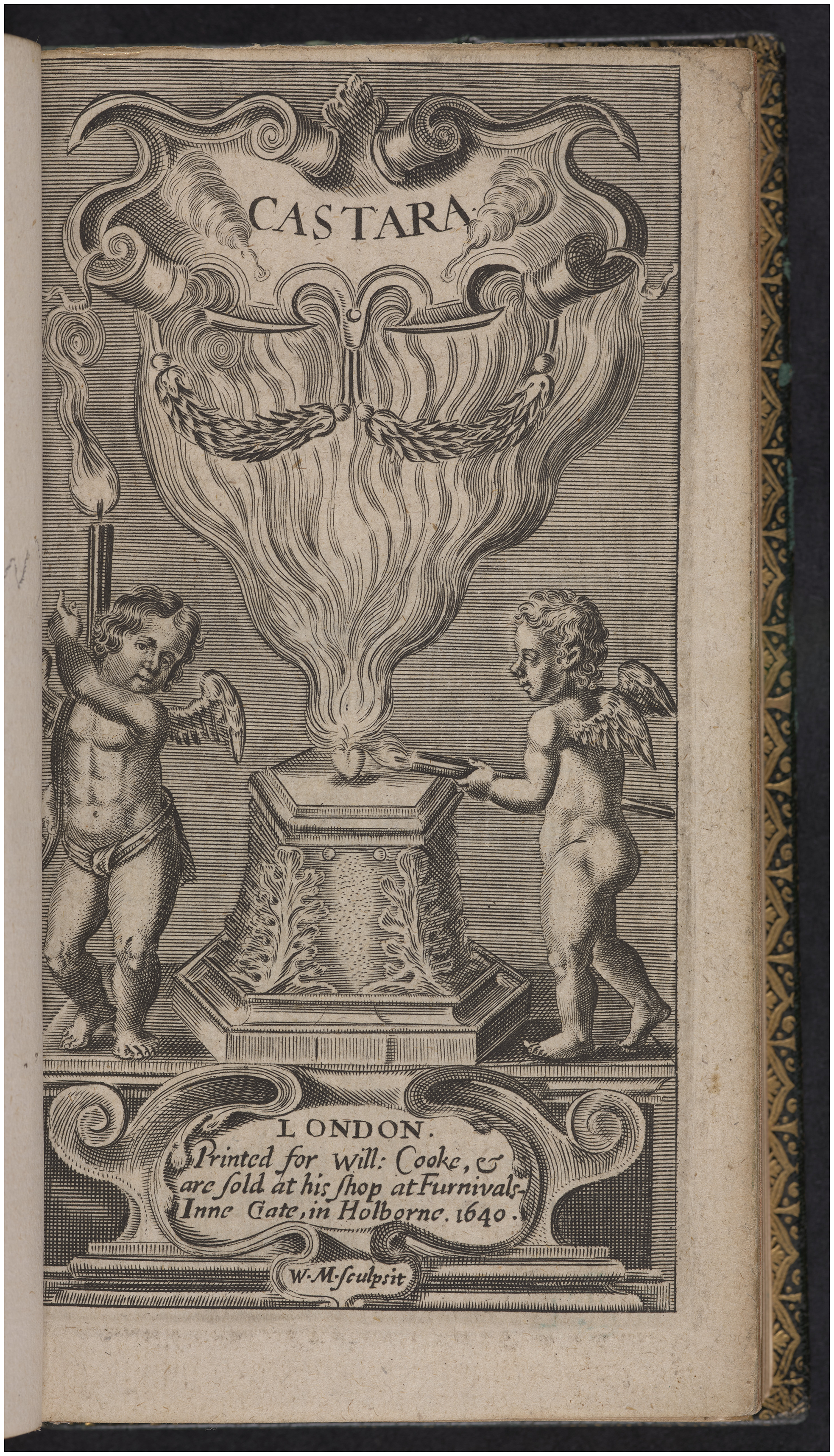
Figure 1 Long description
The frontispiece of William Habington's Castara from 1640 features two cherubs, each holding a torch, tending to a flame that rises above a decorative chest. The scene is framed by intricate, swirling designs and the title 'CASTARA' is prominently displayed at the top. Below the illustration, the text reads 'LONDON Printed for Will: Cooke, & are sold at his shop at Furnival Inne Gate in Holborne, 1640'. The engraving is signed 'W.M. Sculpsit' at the bottom.
Thus, Habington in his opening poem of this final section of Castara shifts the focus from earthly love to spiritual reward employing cross-confessional tenets which would appeal to a wider audience yet with specific Catholic nuances—much like his prose sketch of ‘A Holy Man is onely happie’.Footnote 66
Habington’s poems have a distinctive simplicity and clarity—a ‘plain style’— that St. Augustine believed to be at the heart of all good writing.Footnote 67 Yet, it is important to note how Habington also draws on his religious lyric forerunners, from Catholic martyr St. Robert Southwell to John Donne and George Herbert. Alison Shell has argued how ‘Southwell’s significance as a precursor’ to the seventeenth-century religious lyric is ‘a commonplace’.Footnote 68 Indeed, Habington engages with Southwell’s exploration of chaste love throughout Castara, consistently advocating for ‘a heart where no impure/Disorder’d passions rage’.Footnote 69 Habington’s paraphrase of Psalm 102, ‘Non nobis Domine’ [‘Not to us, Lord’] even reimagines for a Caroline reader Southwell’s own recasting of this psalm in ‘Davids Peccavi’.Footnote 70 But the influence of John Donne and George Herbert is also evident in Habington’s poems not only from the immediacy of Habington’s language and his use of colloquialism but through his employment of paradox. For instance, the curious vision Habington’s speaker creates in ‘Domine labia mea aperies’ [‘Thou O Lord will open my lips’] of a ‘holy death/that murders sence’ chimes with Donne’s advocacy for rhetoric that ‘troubles the understanding, to displace, and to discompose’.Footnote 71 In this third edition of Castara, Habington can be seen to engage with noted writers across the confessional divide; this refashions the devotional lyric for a 1640s readership and deepens our understanding of the interconnections between religious lyrics.
A key reason the Psalms were such a popular genre in the early modern period was that as St. Athanasius observed everyone ‘may see and perceive the notions and affections of his heart and soul’.Footnote 72 As already discussed, the Psalms were seen as both individual and collectively representative. Drawing on this model, Susannah Brietz Monta writes compellingly about how John Austin in his Devotions (1688) gives ‘an insistent present’ to his verse—what she terms ‘the liturgical now’—through the collective praying of Austin’s hymn lyrics.Footnote 73 Through this paradigm, Monta enters the debate about the lyric ‘I’ and the vexed territory in the lyric of subjectivity and the speaking voice.Footnote 74 Northrop Frye defined the lyric as an ‘utterance that is overheard, [so there is a] tendency to read these poems as implied dramatic monologues’.Footnote 75 However, Monta argues that Austin’s Devotions, rather than offering a lyric ‘I’ or an expression of self, instead assert the value of what she terms ‘the artful lyric’: ‘language into which the self may step, by which the self may be shaped’.Footnote 76 A similar process can be seen in Habington’s devotional poems (written over forty years before Austin’s Devotions) as, for example, in ‘Et alta a longè congnoscit’ [‘And the proud he knows from afar’].Footnote 77 Based on Psalm 138, line 6, the Davidic speaker focuses on the mutability of life to highlight the all-encompassing omnipotence of God:
When read through the lens of the ‘artful lyric’, and considering the volatility of 1640, Habington can be seen to create in his devotional lyrics a ‘liturgical now’ for his Catholic and wider readership.
As this examination of Habington’s poems has suggested, many of the tenets of Habington’s devotional lyrics are cross-confessional which, as with Southwell’s poetry, would have appealed to a general readership and encouraged ecumenism. However, as with Habington’s reflection, ‘A Holy Man’, there are both nuanced and explicit inflections of Catholicism which make Habington’s poems specifically relevant to Catholic readers. Anthony D. Cousins was the first to point out how Habington’s poems are rooted in the meditative style of St. Francis de Sales whom Louis Martz deemed to offer a ‘gentler method of meditation’ than St. Ignatius Loyola, who was a great influence on Southwell.Footnote 79 Accordingly, in poems such as ‘Qui quasi flos egreditur’ [‘He cometh forth like a flower’] we can see the influence of Henrietta Maria’s court.Footnote 80 This poem demonstrates how Habington’s lyrics bridged the worlds of English and French Catholicism. The ideal of Catholic femininity emerging from contemporary French devotional works at this time was one of gentle passivity. Francis de Sales advocated the need for his reader to be cordial to all: ‘to gentlie and sweetly follow on their way’.Footnote 81 De Sales promoted the ideal of the ‘honnȇte femme’ which, as Erica Veevers first argued, particularly appealed to Henrietta Maria; the feminine qualities of piety, chastity and compassion were celebrated as a valuable means of converting unbelieving spouses.Footnote 82 Nicolas Caussin in The Holy Court (which is dedicated to Henrietta Maria) even suggested a new model for the Queen in the figure of Clotilda, the first Catholic Queen of France, who converted her husband Clodeus rather by ‘the example of a good life, & her humble prayers presented on Aultars, then by any other way’.Footnote 83 The speaker in ‘Qui quasi flos egreditur’, which takes as its inspiration verse 14 of the Book of Job, ‘He cometh forth like a flower’, first meditates on the rose as a symbol of man’s pride:
These lines resonate with Robert Herrick’s ‘To the Virgins, to Make Much of Time’ (first published in 1648). However, whereas Herrick focuses on virgins seizing the day and gathering ‘ye Rose-buds while ye may’, Habington dedicates his poem to a young daughter of the Catholic, tenth Earl of Shrewsbury, Lady Catherine Talbot, who lives ‘as th’ Angels in one perfect state …/By vertues great preservative’.Footnote 85 In ‘Qui quasi flos egreditur’, Habington creates a vision of womanhood that would be particularly appealing to Queen Henrietta Maria and her circle through the arresting final image with its sharp focus on chastity, which was openly celebrated as the cornerstone of Henrietta Maria’s own marriage:
This image of Lady Catherine warming ‘fraile love to pietie’ also resonates with the fretwork of Catholic dedications contained within the first two secular editions of Castara (1634, 1635), such as to Anne, Countess of Argyll, whose own faith was so influential in the conversion to Catholicism of her Presbyterian husband, the seventh Earl of Argyll.Footnote 87 Indeed, considering the 1640 volume as a whole has the effect of reframing our understanding of the impact of the scattering of occasional poems to recusant individuals: from the Countess of Argyll who unites ‘Honour with sweetenesse, vertue with delight’ to Habington’s elegy for his great friend, George Talbot whose ‘vertue did appeare’ in ‘this darke mist of error with a cleare/Vnspotted light’.Footnote 88 Like the prose reflection on ‘A Holy Man’, repeatedly we see a panoply of men and women shining forth who are steadfast in cross-confessional virtues yet ultimately rooted in their Catholic faith.
This Catholic tone deepens in the 1640 volume’s final poem as Habington chooses to complete the collection on a specifically recusant note, the purifying of the soul in purgatory.Footnote 89 Based on the New Testament letter of St. Paul to the Philippians, the speaker of ‘Cupio dissolvi’ [‘I wish to be dissolved’] reminds the reader of what is of true importance for the English Catholic:
Thus, this significant addition to the third edition of Castara, consisting of ‘A Holy Man’ together with twenty-two devotional poems, transforms a volume of courtly love into a timely engagement with the ‘liturgical now’ and offers a key insight to the twenty-first century reader into the ongoing redefinition of what it meant to be an early modern Catholic at a critical religio-political junction both for the nation and the recusant community.Footnote 91
Conclusion: ‘books penetrate where priests and religious cannot enter and serve as precursors to undeceive many’.Footnote 92
Heather Dubrow in her significant book on the early modern lyric highlights the importance of the audience: remarking we ‘should ask who are or will be or might be its audiences whether addressed or not’.Footnote 93 Habington’s third edition of Castara, like Southwell before him, had audiences across the confessional divide. Indeed, the cross-confessionalism inherent to Habington’s poems would have been reassuring to Protestant readers—Habington notably writes of the dangers of pride and ambition rather than offering litanies to the Blessed Virgin Mary. However, his poems’ rootedness in the meditative framework of St. Francis de Sales, together with his model of Catholic womanhood’s engagement with the writings of Nicholas Caussin, would have been appreciated by Francophile readers of Henrietta Maria’s circle. The specific English Catholic inflections—such as the celebration of English recusants through occasional poems—would have been invaluable for English Catholics struggling with what Habington termed the ‘many tumults’ of 1640.Footnote 94 This points towards the crucial question: what might be the larger purpose of Habington’s revised edition of Castara?. 1640 was a moment of astonishing reversal of fortune for English Catholics in the long journey of Catholic negotiation with the establishment. In the 1630s, with events such as the erection of the Queen’s Catholic chapel and open (if idle) talk of the King’s imminent conversion, toleration at the very least seemed within the Catholic community’s grasp. Yet, by Autumn 1640, Guistinian, the Venetian ambassador to the Doge recorded alarm within English Catholic circles. He noted that some were: ‘hurriedly settling their goods with the intention of going to live quietly in some other country until the present ill feeling has softened and the troubled state of this kingdom has altered’.Footnote 95 Habington, documented as one of the ablest Catholics of his generation, offered encouragement in the midst of such uncertainty, gravely reminding his reader, through the figure of ‘A Holy Man’, how: ‘In prosperity he gratefully admires the bounty of the Almighty giver … But in adversity hee remaines unshaken, and like some eminent mountaine hath his head above the clouds’.Footnote 96 These ‘clouds’ of English Catholic anxiety were well-founded. By 1642, the treacherous spectre of the Catholic community as a malevolent nemesis of the godly Englishman seemed to be re-entrenching itself within the Protestant imagination. The early 1640s were marked by a rash of alarmist tracts exposing multiple, alleged and apparently hare-brained, popish conspiracies.Footnote 97 Strikingly, if we turn to new works emanating from the Catholic press at this time, there is a marked note of resolution in the face of adversity. Lawrence Anderton, for instance, in his 1640 Miscellenia urged his reader to remain steadfast to the Catholic faith. Although, like Habington he emphasised that this should not be in any ‘tumultuous or vndutifull manner’ as we should ‘beare all reuerence to the State, and Loyalty to his Maiesty … who is full of commiseration & pitty’.Footnote 98 Likewise, John Wilson’s 1608 volume, English Martyrologe was reprinted in 1642 and ‘much augmented’ as a timely ‘comfort and consolation’ for Catholics who ‘daily suffer so great and many Pressures’.Footnote 99 For as the Carmelite, Father Gervasius, privately observed in July 1641: ‘with the persecution against Catholics … making headway … many Catholics take the oath acknowledging the Royal supremacy and conform to the Protestant Church in order to avoid punishment’.Footnote 100
Thus, Habington’s revised and final edition of Castara can be seen as a deliberate intervention, by a leading English Catholic, to encourage fellow Catholics to maintain their faith at a moment of acute pressure. Habington’s measured depiction of a Catholic ‘Holy Man’ challenged the more lurid spectre of popery which was prevalent in the popular press. Habington’s twenty-two devotional poems were influenced by his lyric forerunners, Southwell, Donne and Herbert, and engaged with French, Counter-Reformation Catholic ideals emanating from Henrietta Maria’s court, such as those of Caussin and St. Francis de Sales. Acting as a bridging text between Catholic communities, these poems which mostly engaged with the Book of Psalms, serve as both a personal and communal form of prayer, that is crucial for our understanding of both the importance and development of Catholic devotional lyrics. With the psalms seen as ‘points on a journey’, once more, at the heart of the English Catholic dilemma was the perennial question of loyalty and allegiance.Footnote 101 Habington’s own conduct in the 1640s offers insight into how one English Catholic managed his loyalties at such a testing time. Habington remained faithful to his King, fighting under the royal standard of Charles I during the Civil War.Footnote 102 Yet, he maintained his allegiance to the ‘old faith’ – fined along with his wife and parents for recusant beliefs at the Quarter Sessions held in Worcester on 19 April 1642.Footnote 103 Thus, Habington proved the truth of his own claim in Castara that for ‘A Holy Man’ — an English Catholic —‘Vertue though rugged, is the safest way’.Footnote 104

 Open access

