





1. Introduction
Despite the inherent difficulties in acquiring a language, children develop a surprisingly large vocabulary in just a few years, from the first 50 words attained around 18 to 24 months to an estimated average of 40,000 words at 10 years for English-speaking children (cf. Bloom, Reference Bloom2002; Hoff, Reference Hoff2013). This is why the existence of a mechanism that permits children to rapidly guess the meaning of a novel word has been proposed (Carey, Reference Carey, Halle, Bresnan and Miller1978) and investigated (Behrend et al., Reference Behrend, Scofield and Kleinknecht2001; Heibeck & Markman, Reference Heibeck and Markman1987). This mechanism, which constitutes one of the first steps in the acquisition of new meanings (before retention and generalisation), is most often called fast mapping, that is, the rapid mapping of a form (e.g., a sound) onto a referent.
Anecdotal evidence suggests that infants may at first have difficulties generalising the meaning of a new word to different situations. The first words that children use seem to occur only in the particular context in which the word was first produced, at least for the first occurrences of that word: Bloom (Reference Bloom2002) gives an example of a child only saying the word “car” when watching cars from the window, while Barrett (Reference Barrett1986)’s child begins using the word “duck” in contexts other than the one where the word was first produced (bathing) only 2 weeks later. These words – for which the children seem to have inferred a particularly narrow meaning – are used by the caregivers in a variety of contexts (Hoff, Reference Hoff2013). Therefore, the fact that children’s first words are context-bound is not entirely linked to the input they receive (the most frequent context in which the caregiver uses the word is generally the one where the child will say it as well, cf. Harris et al., Reference Harris, Barrett, Jones and Brookes1988) but seems to be a characteristic of early word learning. Like adults (Dautriche & Chemla, Reference Dautriche and Chemla2014), infants seem to encode the situation in which they hear a word, but that context is at first too strongly associated with the word for it to be used in another situation.
The role of visual context on word learning has also been explored in experimental settings. In Axelsson & Horst (Reference Axelsson and Horst2014)’s experiment, three-year-old children were presented with names for novel objects in two different conditions. In the first condition, the children would see the novel object three times, always accompanied by the same two other (known) objects. In the second condition, the children would be exposed to the novel object three times as well but accompanied by different pairs of objects each time. Children were better at learning the name of the target object in condition 1 than in condition 2. In Vlach & Sandhofer (Reference Vlach and Sandhofer2011)’s study, the experimenters used a similar word-learning paradigm, but the two conditions differed in that the novel object was either presented on the same background (a coloured cloth) or on different backgrounds (different coloured cloths) during learning. Again, stable context during learning seemed to help young children (two-and-a-half- to three-year-olds), although older children (three- to four-year-olds) performed better when context changed. However, these results contrast with those of Goldenberg & Sandhofer (Reference Goldenberg and Sandhofer2013), whose two-year-old subjects were unable to learn new words either in a context change condition (objects on different coloured cloths) or in an unchanging context condition. Only when the two contexts were interleaved (a few presentations of the novel object on the same background, a few on novel ones) did the children perform above chance.
The above studies present us with contradictory results, with some suggesting that invariance of visual context helps word-learning in young children, while varying contexts could help slightly older children, and the last one suggesting that a combination of variance and invariance could be the best learning aid. Furthermore, data concerning younger children are lacking, especially since it has been shown that changing context could help retention in three-month-olds (Rovee-Collier & Dufault, Reference Rovee-Collier and Dufault1991). The methods used in those studies, while designed to maximise children’s performance, diverge considerably from a day-to-day learning situation, where background information might be more complex, for example. While this is typical in fast mapping studies (e.g., eye-tracking experiments presenting objects on a grey background as in Schafer & Plunkett, Reference Schafer and Plunkett1998), recent research emphasises the importance for a more ecological approach (e.g., Roy, Reference Roy2009).
In the present study, we seek to remedy these limitations and find out if fast mapping is still possible when learning the meaning of a new word in a more ecological setting, using pictures of real objects presented on a naturalistic background, to approach a real-life word-learning situation. Our experiment was designed to assess the influence of visual context in word learning in very young children (thus filling the age gap in the literature), from 14 months of age, in the beginnings of production, to 19 months of age, when children are just entering the vocabulary spurt phase (Bloom, Reference Bloom2002). We use eye-tracking to explore whether these children need as few visual changes as possible when learning a new word or whether, on the contrary, their ability to learn is enhanced when context changes during learning. We also examine the fast mapping process in further detail by comparing performance after three (a minimal number for word learning, see Kan & Windsor, Reference Kan and Windsor2010) and six exposures to the novel sound-object associations. We expect our infants to perform better in the unchanging context condition, as they are closer in age to Vlach & Sandhofer (Reference Vlach and Sandhofer2011)’s younger children, and that our oldest group might outperform the youngest one in the changing context condition. Since increasing the number of exposures to a novel association should reduce the difficulty in learning and retaining that association, we also expect that our subjects will show stronger learning effects after six exposures than after three.
2. Method
2.1. Participants
We tested 41 French-learning infants, a total sample size deemed suitable based on the mean number of participants in the eye-tracking datasets on young children’s word recognition present in the peekbank database (Zettersten et al., Reference Zettersten, Yurovsky, Xu, Uner, Tsui, Schneider, Saleh, Meylan, Marchman, Mankewitz, MacDonald, Long, Lewis, Kachergis, Handa, deMayo, Carstensen, Braginsky, Boyce and Frank2023), and on a power analysis on the median effect size observed in cross-situational word learning research found in MetaLab (Bergmann et al., Reference Bergmann, Tsuji, Piccinini, Lewis, Braginsky, Frank and Cristia2018).Footnote 1 The mean age of the whole sample was 1;4.3 (SD = 77 days). Our younger age group’s mean age was 1;2.10 (range = 1;1.27–1;3.0, SD = 9 days, 27 subjects, 13 F), while our older age group’s mean age was 1;7.16 (range = 1;6.29–1;8.16, SD = 12 days, 14 subjects, 3 F). We asked that participants present no developmental delay, hearing or visual impairments, or other strong disabilities, and we checked that they were born full-term. As per our selection criteria, participants were reported to have at least 50% exposure to French (N = 12 plurilinguals and N = 29 monolinguals) so that they would be familiar enough with the speech variety in which the experimental stimuli were presented. Data collection occurred in Switzerland where data on ethnicity are not usually collected due to cultural norms. Nine additional infants were tested but excluded from the analyses because they did not complete at least three blocks of the experiment (8) or because of data loss due to a computer crash (1).
The participants were recruited via advertisement on social networks and university mailing lists. A consent form was filled by their caregivers before the beginning of the study.
2.2. Stimuli
We used a total of eight different yoked pairs of pictures and eight different yoked pairs of (pseudo)words.
Pictures were photos of objects (exotic fruits) on four different naturalistic backgrounds (sand, leaves, rock, and grass). Exotic fruits were chosen so as to be unfamiliar to the children and interesting enough. At the end of the experiment, caregivers were asked if their child produced the real name of one or more fruit. None of our subjects did, confirming the novelty of the chosen objects. For each pair, fruits were chosen to be maximally different in size, colour, and shape. An example of a pair of objects with the four different backgrounds can be seen in Figure 1 (for the full set of objects, see the Supplementary Materials).
One pair of objects in all possible contexts.

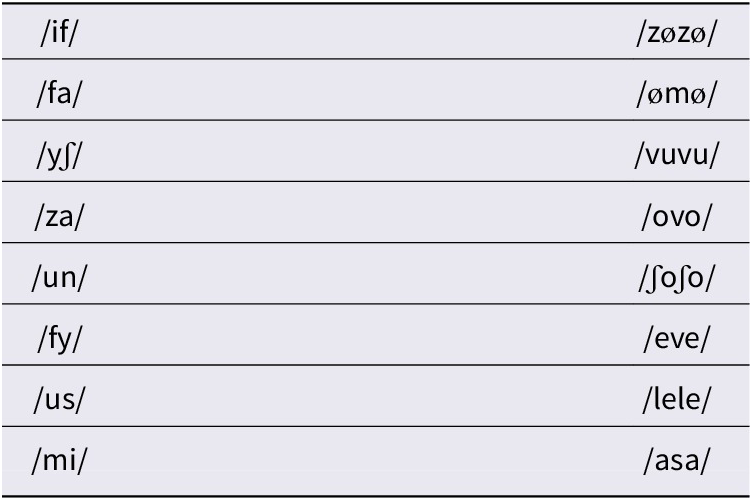
The sound stimuli were maximally different CV/CVCV (pseudo)words following French phonotactic rules, produced by a native speaker (a different token of the same sound was used for each of the four instances of labelling in a trial). For each pair, each word was different in the number of syllables and as phonetically distant as possible from the other. See Table 1 for a list of all paired (pseudo)words.
Pairs of (pseudo)words used in the experiment

Table 1. Long description
The table consists of two columns and eight rows of phonetic transcriptions.
Row 1 (Header): forward slash i f forward slash and forward slash z o-slash z o-slash forward slash.
Row 2: forward slash f a forward slash and forward slash o-slash m o-slash forward slash.
Row 3: forward slash y esh forward slash and forward slash v u v u forward slash.
Row 4: forward slash z a forward slash and forward slash o v o forward slash.
Row 5: forward slash u n forward slash and forward slash esh o esh o forward slash.
Row 6: forward slash f y forward slash and forward slash e v e forward slash.
Row 7: forward slash u s forward slash and forward slash l e l e forward slash.
Row 8: forward slash m i forward slash and forward slash a s a forward slash.
The order of presentation of the stimuli and their sound/image associations was pseudo-randomised in four randomisation groups.
2.3. Procedure and apparatus
Our subjects were tested in their caregivers’ presence at our Babylab in Neuchâtel. Infants sat on their caregiver’s lap in a sound-attenuated, dimly lit room. In front of them, at a distance of approximately 60 cm, a monitor (24″, 1920 × 1080 pixels) displayed the experiment. The audio stimuli were presented via two loudspeakers (Fostex PM0.5n, 70 W amplifier) hidden under the table supporting the monitor. The experimenter monitored the progress of the study from outside the booth via video feedback. The experiment could be paused or terminated in case of discomfort from the child. Under the monitor, a Tobii eye-tracker (Tobii Pro X3-120, 120-Hz sampling rate) recorded the eye movements of the participants. To ensure that the gaze measured was that of the infants and not of their caregivers’, the latter were asked to close their eyes or look at a fixation cross in a corner of the booth during the experiment. This, combined with worn headphones emitting a constant stream of background conversation, reduced the amount of unconscious influence that the caregiver could have on the child.
Once the participant was in place, a manually validated 5-point calibration with pulsating dots was carried out. During the experiment, we presented infants with eight blocks of two novel object- (pseudo)word associations in the following two conditions:
-
1. Context-change condition: in both the learning phase and the test phase, the target object is presented at a different angle and on a different background (see Figure 1) – four blocks
-
2. Invariant condition: no background or angle change – four blocks
One block consisted of a learning phase, a test phase, another learning phase, and a final test phase. During the first learning phase (the top part of Figure 2), each object was presented three times with its label (500 ms after image onset, without a carrier sentence). During the following test phase (the bottom part of Figure 2), the two novel objects appeared side-by-side with one (pseudo)word in two trials. Learning and test phase were then repeated with a change in the order of the stimuli so that infants got up to six exposures to the novel associations per block (there were two test trials for each test phase, and four test trials total for each pair of objects). In a test trial, two phases of interest were defined: the pre-naming phase (duration: 2500 ms), before labelling, and the post-naming phase (2500 ms as well) after onset of the label. Between the two phases, an abstract geometrical figure appeared in the middle of the screen for 500 ms to recentre participants’ attention. Figure 2 recapitulates this procedure schematically for half of a block of the context-change condition.
Procedure of a context-change trial for three exposures: one half of a block.

Figure 2. Long description
The flowchart is organized into two rows.
Top row:
* Learning phase 1: Three sequential photos show a cacao pod on different backgrounds (rock, leaves, sand). Each photo is labeled with a speech bubble containing the pseudoword mi and a duration of 2000 milliseconds. An arrow points to a sun icon labeled A G (attention getter).
* Learning phase 2: Three sequential photos show a ground cherry on different backgrounds (rock, leaves, sand). Each photo is labeled with a speech bubble containing the pseudoword asa and a duration of 2000 milliseconds. An arrow curves from this phase down to the second row.
Bottom row:
* Test 1: Divided into two sub-sections. The Pre-naming phase shows two side-by-side photos of the pod and the ground cherry on grass for 2500 milliseconds, followed by a 500 milliseconds interval with a sun icon (attention getter). The Post-naming phase shows the same side-by-side photos for 2500 milliseconds with a speech bubble containing mi. An arrow points to a sun icon labeled A G (attention getter).
* Test 2: Follows the same structure as Test 1. The Pre-naming phase shows the pod and ground cherry on grass for 2500 milliseconds, then a 500 milliseconds interval. The Post-naming phase shows the side-by-side photos for 2500 milliseconds with a speech bubble containing the pseudoword as a.
The order of the blocks was pseudo-randomised between the four randomisation groups so that each subject got no more than two blocks back to back in the same condition. With those four groups, each object and each (pseudo)word were used in both conditions. The experiment, if completed in one go, lasted approximately 10 minutes.
The script running the experiment was coded on Matlab version 2019b (The Math Works, Inc., 2019) using the Psychtoolbox (Brainard & Vision, Reference Brainard and Vision1997; Kleiner et al., Reference Kleiner, Brainard, Pelli, Ingling, Murray and Broussard2007; Pelli, Reference Pelli1997) and the Titta toolbox (Niehorster et al., Reference Niehorster, Andersson and Nyström2020) for implementing the stimulus presentation.
3. Results
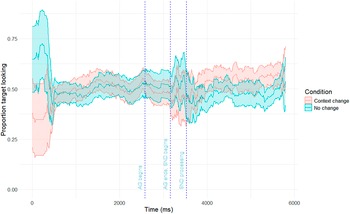
A Matlab script was used to transform raw data into files providing gaze hits in our two areas of interest, the left and right images in the test, every 8 ms. Short tracking losses (no hit <88 ms) and blinks (no hit between 88 ms and 304 ms) were considered continuous gaze, whereas longer absences (no hit >304 ms) were considered an absence of gaze (Hollander & Huette, Reference Hollander and Huette2022). Trials with post-naming phase looking times deemed too low to be informative were filtered: we excluded trials where looking time towards the screen was less than 800 ms or where looking time towards both objects was less than 600 ms. We then controlled for any already established baseline preference by excluding trials where children looked more than 90% towards one or the other object during pre-naming (as was done in Piot et al., Reference Piot, Chen, Picaud, Dos Santos, Granjon, Luo, To, Lai, Cheung and Nazzi2024). In the end, a total of 214 trials were excluded from the analyses (18.5% of the initial 1154 trials). For pre- and post-naming phases, we computed the mean proportion of target looking (PTL) for each remaining trial. Figure 3 shows the mean PTL during a whole test trial for each condition.
Mean proportion of target looks over the whole test trial in both conditions (±SE). The first vertical line represents the end of the pre-naming phase, and the second line indicates the end of the attention getter. The post-naming phase begins after this second line. The third line indicates the duration of 367 ms, which is necessary for infants and toddlers to programme eye movements after hearing the target label (Swingley & Aslin, Reference Swingley and Aslin2000). Abbreviations: AG, attention getter; SND, sound/target label.

Figure 3. Long description
The x-axis is Time in milliseconds ranging from 0 to 6000. The y-axis is Proportion target looking ranging from 0.00 to 0.75. A legend on the right identifies two conditions: Context change in red and No change in teal. Both conditions are plotted as mean lines with shaded error bands representing standard error .
Three vertical dashed blue lines divide the timeline:
1. The first line at approximately 2600 milliseconds is labeled A G begins.
2. The second line at approximately 3200 milliseconds is labeled A G ends, S N D begins.
3. The third line at approximately 3567 milliseconds is labeled S N D processing.
Data trends:
* From 0 to 2600 m s: The No change condition starts with a high peak near 0.85 before dropping to stabilize around 0.50. The Context change condition starts lower near 0.25 and rises to stabilize around 0.50. Both lines converge and fluctuate near the 0.50 mark leading up to the first vertical line.
* From 2600 to 3200 m s (attention getter phase): Both conditions remain relatively stable and overlapping near 0.50.
* From 3200 to 3567 m s (target onset): Both conditions show increased volatility with sharp peaks and troughs. The No change condition shows a notable peak reaching 0.70 just before the third line.
* From 3567 to 6000 m s (Post-naming): The Context change condition shows a gradual upward trend, ending near 0.65. The No change condition fluctuates but generally stays lower, ending near 0.50.
Data were analysed in R Studio (running R version 4.2.2). They were not normally distributed (Shapiro–Wilk test: W = .9373, p < .001) and followed a zero–one inflated beta distribution. After slight shrinkage (zeros were transformed to 0.0001 and ones to 0.9999) of the data, a generalised linear mixed model for beta distributions with a logit link was built using the glmmTMB package (Brooks et al., Reference Brooks, Kristensen, Van Benthem, Magnusson, Berg, Nielsen, Skaug, Machler and Bolker2017). The model had PTL as the dependant variable, the variable subject as random effect, condition as a fixed effect, and naming (pre- vs. post-) as a nested fixed effect within condition. The factor condition was sum-contrasted. The equation for the model was

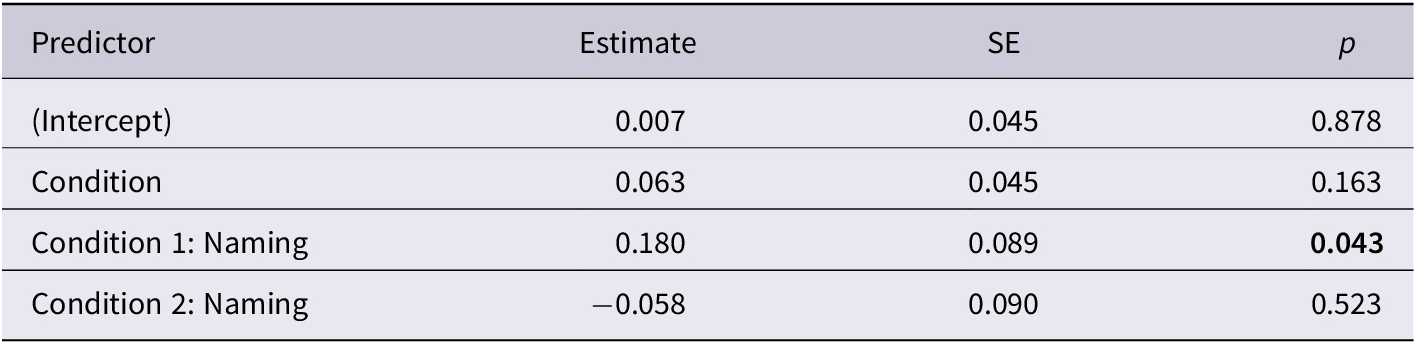
If our participants had learned to associate target (pseudo)word to target object, we expected to observe an increase in PTL in the post-naming phase compared to the pre-naming phase (i.e., a naming effect). If learning was easier in one condition, we would expect this naming effect to be stronger in that condition, yielding an interaction between condition and naming. The results are presented in Table 2 and indicate a significant main effect of naming (β = .180, SE = .089, p = .043) in the context-change condition only.
Results of the model looking into the presence of a naming-effect in the two conditions. Abbreviation: SE, standard error; condition 1 = context-change, condition 2 = invariant, significance indicated in bold text

Table 2. Long description
The table consists of four columns: Predictor, Estimate, S E, and p.
* The first row for the Intercept shows an Estimate of 0.007, an S E of 0.045, and a p-value of 0.878.
* The second row for Condition shows an Estimate of 0.063, an S E of 0.045, and a p-value of 0.163.
* The third row for Condition 1 Naming shows an Estimate of 0.180, an S E of 0.089, and a statistically significant p-value of 0.043.
* The fourth row for Condition 2 Naming shows an Estimate of negative 0.058, an S E of 0.090, and a p-value of 0.523.
Adding age group (fourteen- vs. nineteen-month-olds) and number of exposures (3 vs. 6) as fixed effects in interaction with naming did not improve the model.Footnote 2 We performed post hoc one-tailed Wilcoxon signed-rank tests for paired data with a Holm–Bonferroni correction for multiple testing (to avoid type I errors) on pre- and post-naming PTL, averaged by subject. We found a significant (p = .003, moderate effect size r = .45) increase in PTL in post-naming corresponding to a naming effect in the context-change condition but not in the invariant condition (p = .418). We also compared PTL in post-naming to chance (0.5) in both conditions and found the same results via one-sample Wilcoxon signed-rank tests (context-change condition: p = .003, r = .45, invariant condition: p = .984). A graphical overview of the data (with PTL averaged by subject) showing comparisons between pre- and post-naming phases of both conditions can be found in Figure 4.
Gaze proportions in pre- and post-naming phases in the context-change condition (a) and invariant condition (b). The significance holds in (a) even without the data from the participant looking 100% towards the target during post-naming.

Figure 4. Long description
Two side-by-side box plots labeled a and b. Both plots share a Y axis labeled P T L ranging from 0 to 1 and an X axis labeled Test Phase with categories pre-naming and post-naming.
Panel a, context-change condition. The pre-naming phase shows a cluster of red data points centered around a median P T L of approximately 0.48. The post-naming phase shows a cluster of teal data points with a higher median of approximately 0.55. Dashed lines connect individual data points between the two phases, showing a general upward trend. A bracket above the boxes is marked with an asterisk, indicating a significant difference.
Panel b, invariant condition. The pre-naming phase shows red data points with a median near 0.48. The post-naming phase shows teal data points with a similar median near 0.50. The dashed connection lines show more horizontal or mixed trajectories compared to panel a. A bracket above the boxes is marked N S, indicating no significant difference.
4. Discussion
The present findings confirm that fast mapping is possible in an experimental setting with complex stimuli approaching real-life variability. However, unlike traditional word-learning paradigms (e.g. Schafer & Plunkett, Reference Schafer and Plunkett1998), our study seems to have been particularly difficult for children, as they showed a significant learning effect only in one condition. In any case, our toddlers’ being able to learn the new words after three exposures heightens the robustness of these results, as this is a relatively low number (Kan & Windsor, Reference Kan and Windsor2010). Like the older group in Vlach & Sandhofer (Reference Vlach and Sandhofer2011), our infants benefited from the change in context during learning and could generalise to another context at the time of testing. However, their participants were older than ours (three- to four-year-olds vs. fourteen- to nineteen-month-olds) and the group closest in age to ours (two-and-a-half- to three-year-olds) actually performed better in a stable context. The type of variability and the methods could explain these diverging results. Our study used an indirect method (eye-tracking), while theirs used a direct one (forced choice task). Moreover, there was some kind of variability in their “stable” condition as well, as the colour of the object changed in between presentations. Interestingly, in young adults, variability in the visual input during learning facilitates the generalisation and acquisition of novel concepts (Bourgoyne & Alt, Reference Bourgoyne and Alt2017).
In fact, and in line with our results, in many cognitive domains and tasks, variability is important for learning and generalisation: number of different speakers, affective variation, and semantic variability, to cite a few, all improve learning (Raviv et al., Reference Raviv, Lupyan and Green2022). Thus, it is possible that in our experiment, the variability in the visual input improves the learning of novel words (at least in young children), through increased attention, helping highlight the similar features of the target across examples and disregard irrelevant ones.
Indeed, a possible explanation for the positive effect of context change on learning could be that this condition is better at maintaining toddlers’ attention throughout the task. While we found no difference between the conditions when comparing total looking time towards the screen during either the pre-naming (Wilcoxon rank sum test, p = .436) or the post-naming (p = .745) phases of the test phase, there was a significant difference in total looking time towards the screen in the learning phase (p < .001, r = .19), with infants looking more during the context-change condition (with a median percentage of looking time towards the screen of 100%). Bearing in mind the rather small effect size and overall high looking proportion during the learning phase of the invariant condition (Mdn = 90.9%), it is possible that this difference indicates that infants paid more attention during the learning part of the context-change condition, with more interest inducing better learning. A related explanation could be that our context-change condition, unlike the invariant condition, resembles word learning tasks with object manipulations (even though the toddler cannot touch the novel object, they can see it under multiple angles) and thus is more akin to a real word learning situation. It is closer to what a child could experience during a self-produced action and could activate the same neural sensory-motor pathways. This more embodied attention might be beneficial (Yu & Smith, Reference Yu and Smith2012).
The fact that our participants could not fast map labels to objects in the invariant condition is somewhat surprising. However, several factors could explain this. First, our study was particularly difficult as the words were presented without a carrier sentence or interjections to help get the child’s attention. The toddlers, already familiar with the syntactic structure of their native language, could thus not extract syntactic cues to infer that the target sound was a noun for example. Second, our stimuli, even though they were chosen to be maximally different from one another, all pertained to the same semantic category (fruits). Toddlers are capable of encoding the visual similarity of novel words (and thus a facet of the semantic relationship between them, see Wojcik & Saffran, Reference Wojcik and Saffran2013), and it is possible that learning new names for 16 semantically related objects in such a short time might have posed a difficulty for our participants. Even when objects belong to different categories, learning and retaining multiple associations is a difficult task (Axelsson & Horst, Reference Axelsson and Horst2014). Our infants had to learn and retain new labels for two novel objects before being tested on them. Moreover, Goldenberg & Sandhofer (Reference Goldenberg and Sandhofer2013)’s children were also unable to learn new words in an invariant condition. Their study showed that presenting children with objects both in a changing and unchanging context was the best learning aid. A follow-up study could investigate if this remains true for our age range as well, using our paradigm. Finally, a problem present in many fast mapping eye-tracking studies is that they are blind to the interactive component of language learning. Indeed, joint attention with a caregiver has a positive influence on the number of words learned by infants (Tomasello & Farrar, Reference Tomasello and Farrar1986). Even though our infants were seated with their caregiver in the booth, they could not interact with them (this was discouraged before the start of the experiment, so as not to bias results), and the caregiver did not share the child’s attention (being blind to the images and sounds being presented). Despite this, many of our participants tried to get their caregiver’s attention during testing and failed to establish lasting contact. This, in turn, increased the difficulty of the task.
Nevertheless, our study confirms that visual context plays a crucial role during the fast mapping process of early word learning. We suggest that further studies delve deeper into the subject, particularly with toddlers between one and three years of age, and with varied methods, to verify that variance during learning is beneficial to children. Particular attention should be paid to the type of context change used during learning. In our study, we chose to maximise the variability by changing object orientation and background. It would be interesting to see if only changing the orientation of the object (thus mimicking object manipulation word-learning paradigms) while keeping the same background would be enough of a change to elicit the facilitating effect on word learning. Our study shows that using naturalistic methods is important in acquisition research. While our method only approached real-life situations of learning, the use of other methods like head-mounted paradigms to study the role of visual context might prove fruitful.
Abbreviation
- PTL
-
proportion of target looks
Supplementary material
The supplementary material for this article can be found at http://doi.org/10.1017/S0305000926100725.
Acknowledgements
We thank all of our participants and their families for taking the time to participate in this study. Special thanks go to Simone Marty for the recordings and to Erik Ringen for the statistical advice. Many thanks to the students from the “TP recherche en logopédie” for their help with the pilot experiment and to Katia Damache and Mathilde Wenger for their help with the recruitment. This research was made possible by funding from the Institute of Speech and Language Therapy and the University of Neuchâtel.
Competing interests
The authors declare none.
Ethical standard
The research was evaluated as unobjectionable by the local ethics committee on research involving humans (CER-VD, Commission cantonale d’éthique de la recherche sur l’être humain du canton de Vaud, Req-2020-00065).




 Open access

