




In late July 1915, police and hired gunmen attacked striking workers at the Rockefeller-owned Standard Oil refinery in Constable Hook, Bayonne, New Jersey. Fifteen months later, in October 1916, Standard Oil smashed another refinery workers’ strike in Bayonne. Altogether fourteen people died, and dozens more were injured, in Standard Oil’s anti-worker violence in Bayonne in 1915–1916.Footnote 1
To many, this bloodshed recalled the recent “Colorado Coalfield War” from September 1913 to December 1914, when more than fifty people died during a coal strike, including against the Rockefeller-controlled Colorado Fuel & Iron (CF&I) Company. Still fresh in contemporary consciousness was the memory of 20 April 1914, when company thugs and National Guardsmen fought a pitched battle with striking CF&I miners. In what became known as the Ludlow Massacre, more than twenty people were killed, including eleven children and two women who suffocated as they sought refuge from armed men burning down the strikers’ tent colony. The Ludlow Massacre became inextricably tied to the Rockefeller family and remains one of the most infamous attacks in United States labor history. The Commission on Industrial Relations, created by Congress and led by Frank P. Walsh, subpoenaed John D. Rockefeller Jr. and harshly questioned him. Socialist writer Upton Sinclair led pickets outside the Rockefellers’ office in Lower Manhattan and their home in Tarrytown, New York. In response to the massacre, the Rockefellers sought to soften their image; they hired publicist Ivy Lee to counter hostile press coverage, and William Lyon Mackenzie King, a future Canadian prime minister, to study CF&I’s labor relations. King developed the “Rockefeller Plan”, a paternalist attempt to undercut the United Mine Workers through establishing a company union and eliminating the company’s worst excesses. The younger Rockefeller told the Walsh Committee in early 1915 that, after the massacre, “I determined that in so far as lay within my power, I would seek means of avoiding the possibility of similar conflicts arising […] in the future”.Footnote 2
In 1946, liberal writer Stuart Chase gave Standard “a pretty clean bill of health for the way they’ve handled their labor relations since the bloody strikes in Bayonne in 1916”, asserting that the “basic factor seems to be that top management has a fixed policy of regarding workers as human beings rather than commodities”.Footnote 3 The Rockefellers survived the Colorado miners’ and Bayonne refinery workers’ strikes and thrived afterwards, just as the capitalist class as a whole in the United States survived the massive turmoil of 1910–1920 and thrived in the 1920s.
This article examines the Bayonne refinery strikes of 1915–1916 in the context of Progressive Era politics and industrial relations, to analyze how these strikes, on top of the accumulated bad publicity and public anger from the Ludlow Massacre, prompted the Rockefellers and Standard Oil to institute welfare capitalism and thereby successfully undercut further labor militancy and public outrage. Their efforts helped convince other companies to adopt similar measures and gave a unique coloration to welfare capitalism in the United States. Furthermore, Standard Oil’s welfare programs proved durable and successful, even amid the Great Depression, when other companies’ programs collapsed. Standard Oil’s success in the aftermath of the Bayonne strikes illuminates how capitalists in the United States adapted to and survived intense class conflict in the early twentieth century through reform rather than mere repression. The Rockefellers’ version of welfare capitalism, developed in reaction to the Bayonne strikes, contributed to a distinctive anti-union vision, embracing company unions and corporate paternalism, that distinguished it from its European counterparts that sought to institutionalize class collaborationism through incorporating unions into welfare capitalism. Standard Oil’s success in stabilizing labor relations after the strikes and staving off unions even as they surged elsewhere suggests that welfare capitalism could be more durable than many scholars, who emphasize the failure of welfare capitalism in the Depression, have recognized.Footnote 4
This article is based primarily upon contemporary newspaper coverage, including from Bayonne, elsewhere in Northern New Jersey, and New York City, as well as the Socialist New York Call, the Russian-language Novyi Mir, and the Italian-language Progresso Italo-Americano. These journalistic accounts are supplemented with reports from the New Jersey Department of Labor, corporate records, and the papers of key figures such as William Lyon Mackenzie King and Stuart Chase. To trace the long-term impact of the strikes on welfare capitalism, the article draws on company publications, labor relations studies from the 1920s–1950s, and secondary literature on welfare capitalism’s development. This combination of sources allows us to reconstruct both the immediate dynamics of the strikes and their significance for the evolution of United States labor relations in an international context. This article is part of a broader project, examining the political strategies and failures of left-wing organizations during the Bayonne strikes and, more broadly, the early twentieth century.
Although there have been competent scholarly treatments of the Bayonne strikes, their importance to New Jersey and national labor relations has been eclipsed by the more famous Paterson silk strikes.Footnote 5 Few historians have attempted to fit the strikes into a broader history of welfare capitalism or the Rockefeller approach to labor relations. Most studies of the Colorado coal strike, the Ludlow Massacre, or the Rockefellers do not discuss the Bayonne strikes.Footnote 6 However, this article argues, it is impossible to fully understand the Rockefellers’ reaction to Ludlow without taking the Bayonne strikes into account, since the refinery strikes prompted the family to make changes in how they ran their core industry and not just a distant subsidiary.
Standard Oil and Bayonne
John D. Rockefeller Sr. entered the oil business in Cleveland, Ohio, in the 1860s, and formed Standard Oil of Ohio the next decade. By 1892, the company had “achieved full vertical integration”, including refining and storage with auxiliary industries like barrel-making. In the 1890s, the Standard Oil Trust was dissolved and replaced by Standard Oil Company (New Jersey), a holding company chartered in the Garden State but headquartered in Manhattan. In 1911, when the company controlled about two-thirds of petroleum refining and marketing in the United States and a larger percentage of the country’s pipelines, the United States Supreme Court ruled that Standard violated the Sherman Anti-Trust Act and forced Standard Oil to split into more than thirty different companies. Jersey Standard remained one of the world’s largest petroleum companies.Footnote 7
Bayonne (on the Bergen Neck peninsula between Newark Bay, Kill Van Kull, and New York Bay) in the early twentieth century was dominated by Standard Oil. At the start of the twentieth century Bayonne changed from an agricultural area to an industrial city and its population nearly quadrupled between 1880 and 1905, reaching 64,461 people in 1915.Footnote 8 In 1877, Standard Oil bought and expanded a refinery that had been opened five years earlier, and by the early 1880s Standard Oil’s Bayonne refinery was the world’s largest, refining up to 374,000 gallons of crude oil daily.Footnote 9 Several oil-related companies had plants in Bayonne, though Standard set the tone for the industry on Constable Hook: Bergen Point Chemical Company was a subsidiary of Jersey Standard; Vacuum Oil Company spun off of Standard in 1911; and Tidewater Oil, although independent, was dependent on Standard.Footnote 10 At least 5,400 people worked in the Standard refinery and another 1,500 at Tidewater.Footnote 11 In 1920, the city’s population was 70,000 and Standard Oil and affiliates paid 47 per cent of the city’s property taxes.Footnote 12 Standard Oil dominated Bayonne’s politics, coopting traditional political elites and creating what DeBrizzi called “a political machine-Standard Oil alliance”. The clearest expression of this was Pierre Garven, a three-term mayor of Bayonne and attorney for Standard Oil.Footnote 13
Labor Relations at Jersey Standard
Since the industry began in the 1850s, there had been almost no unions for refinery workers in the United States and the Bayonne government and business leaders sought to keep out unions.Footnote 14 In 1893, 300 coopers at the refinery struck against the introduction of a piece-rate system; the company refused attempts by the State of New Jersey to arbitrate the strike, and hired scabs. After two weeks, Standard Oil agreed to allow strikers to return to work, and the strike collapsed. In 1903, boilermakers struck for union recognition; Standard broke the strike by hiring scabs, protected by Bayonne and Hudson County police.Footnote 15 In 1909, Pearl L. Bergoff, a notorious strikebreaker, moved to Bayonne and became prominent in the city, dabbling in real estate as well as strikebreaking.Footnote 16
The Rockefellers (like most contemporary industrialists) opposed unionization and sought control over work conditions. In practice, this left foremen and plant managers with immense power.Footnote 17 One study refers to Standard Oil’s “benevolent autocracy toward its employees”, but notes the company’s “policy of unilateral determination” of labor and working conditions. Herbert Gutman’s study of Standard Oil barrel workers in Cleveland, Ohio, in the late nineteenth century underlines Standard’s anti-union attitude and the company’s ability to wield its size against unions.Footnote 18 Refinery work was particularly bad, with supervision “not only frequently inept, but often vicious”.Footnote 19
By the summer of 1915, some 9,000 men worked at the Bayonne refinery. To undercut solidarity, Standard Oil hired workers from different national backgrounds, mainly Polish, with significant numbers of Italian, Russian (including Jewish), Irish, and Czech workers; thirty per cent of workers were illiterate in English, and many were unable to speak it.Footnote 20 Some English-speaking workers disliked Polish workers for supposedly accepting low wages and submissively following management.Footnote 21 The New Jersey Department of Labor reported after the 1915 strike that workers complained they
suffered much verbal abuse and ill treatment from certain sub-foremen, who had themselves risen from the ranks, and that to gratify personal grudges, these foremen frequently kept men in the hot stills, with the temperature often over 250 degrees Fahrenheit, until they were at the point of exhaustion before permitting them to leave.
Most of these foremen were of Irish descent.Footnote 22 Standard Oil opted out of the voluntary workmen’s compensation program in New Jersey, and did not pay workers injured at work.Footnote 23
European war intensified conditions, especially after the British Navy switched from coal to oil powered ships, leading to surging petroleum exports. The Bayonne refinery’s earnings increased from $3.5 million in 1914 to $6.5 million in 1915.Footnote 24 Wages were low and conditions poor; reformer Amos Pinchot described the “poverty and squalor” that low-paid refinery workers faced in their “steady struggle against want”, adding that “a school teacher who seemed to know what he was talking about said that from six to ten families often live in a two or three story frame house”.Footnote 25 Conditions were especially poor for the mainly Polish “still men”, coopers who cleaned tanks before oil was barreled. Workers earned between $2.17 and $2.40 daily, down from previous daily wages of $5 and $6. They labored for eighty-four hours weekly, in ten-hour shifts for day workers and fourteen-hour shifts for night workers. A letter from a striker published in the New York Times in July described the plant before the strike:
The “still cleaners,” who were the first to strike, have to enter a still in a temperature anywhere from 135 to 200 degrees, with iron boots on to protect their feet and gas masks to keep from suffocating, and I have several times seen them carrying out one of their comrades overcome […]. The barrel factory department was the next to strike, and their grievances are of a like nature […]. The men have to work with hot barrels, (so hot, in fact, that they wear leather hand pads so as not to burn their hands) so you can get a slight idea of the heat that prevails there. They only get one serving of ice for their water barrels, and that is usually gone before 10 A.M. After that they have to drink warm water, unless they manage to supply their own ice in some way.Footnote 26
The Start of the 1915 Strike
In early July, workers at the International Nickel Company in Bayonne obtained a ten per cent wage increase, assisted by Paul C. Supinski, a local Polish-born attorney. Still cleaners at Standard Oil then asked Supinski to draw up a demand for higher wages and the firing of a hated foreman. The superintendent of the refinery refused to hear a committee composed of six still cleaners and Supinski, fired the workers, and railed against “outside agitators”.Footnote 27
On 15 July, coopers and still cleaners went on strike, demanding a fifteen per cent pay increase, and were joined by firemen, boilermakers, pipe fitters, yardmen, and laborers.Footnote 28 The strike reduced Standard Oil’s refining capacity by more than a third.Footnote 29 Mayor Garven advised the company to hire scabs and gunmen from Bergoff’s agency and promised police protection.Footnote 30 “Get me two hundred and fifty husky men who can swing clubs”, the general manager of the Standard refinery told Bergoff. “I want them to march up East Twenty-second Street through the guts of the Polacks.”Footnote 31 Standard Oil’s attempt to bring in two vans of scabs, under police protection, enraged strikers. Standard Oil hired armed guards from New York City, and, according to the state labor report, “these men were promised $3.00 per day with board, and as fast as enrolled were taken on steam tugs to the oil plants in Constable Hook”.Footnote 32 Much of the local population, including women and children, supported the strikers and, according to the state report, “were active in displaying sympathy for the strikers”.Footnote 33
Violence in the First Strike
On 19 July, the New York Tribune reported “several small riots, in which fifteen of the striking still-men have been arrested and during which blackjacks have been used”. The paper’s headline, “Strike Holds Up Oil for Allies”, hinted at the military significance of the strike, which took place at the same time as a strike at a Remington Arms factory in Bridgeport, Connecticut.Footnote 34 The New Jersey labor report insinuated that “paralyzing” petroleum exports from the refinery to Britain and France – rather than labor issues – motivated the work stoppage.Footnote 35
On 21 July, amid a clash between 100 police and 1,500 strikers, police fired into a crowd of strikers, killing a nineteen-year-old striker, John Sterancsak.Footnote 36 Mayor Garven requested that the New Jersey government send state militia troops to Bayonne, but Governor James Fielder refused to act without the request of Hudson County Sheriff Eugene F. Kinkead (Figure 1).Footnote 37 Garven was a Republican, while Fielder and Kinkead (a United States Congressman from 1909 until 1915) were Jersey City Democrats and supporters of New Jersey’s former governor Woodrow Wilson. A Democratic governor calling in troops to smash a strike would have hurt President Wilson’s attempt to garner labor support in the upcoming election. President Wilson and his Secretary of Labor, former mineworkers’ union official William B. Wilson, wanted to resolve the Bayonne strikes without replaying the Ludlow Massacre in the president’s old stomping grounds.Footnote 38
Sheriff Eugene F. Kinkead.

Figure 1 Long description
A vertically framed portrait photograph with a rectangular border. A torso in formal clothing is shown, including a jacket, collared shirt and tie. Text reads: EUGENE F. KINKEAD, Sheriff.
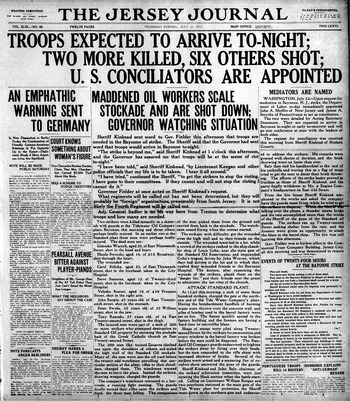
By this time, the strike had garnered wider attention. Three organizers from the more conservative American Federation of Labor (AFL) arrived in Bayonne, as did Frank Tannenbaum, an organizer for the radical Industrial Workers of the World (IWW) from New York.Footnote 39 Trying to defuse a broader conflict, Sheriff Kinkead wanted to end the strike peacefully. The sheriff and attorney Supinski met Standard Oil representatives and workers’ representatives, including Jeremiah J. Baly, a Socialist Party member and machinist at the Singer Sewing Machine plant in Elizabeth.Footnote 40 Standard refused to negotiate until strikers returned to work.Footnote 41 The next day, 22 July, fires broke out at the Standard and Tidewater plants, allegedly caused by strikers.Footnote 42 Gunmen for the oil companies shot into a crowd of strikers, killing two of them (as well as a twelve-year-old girl and fifteen-year-old boy) and injuring twenty-five others (Figure 2). The Chamber of Commerce demanded the governor send troops.Footnote 43 Kinkead requested state troops and swore in 250 additional deputies; Standard hired detectives.Footnote 44
Front page of Jersey Journal, 22 July 1915.

Figure 2 Long description
Document Type: Scanned newspaper front page. Date: 22 July 1915. Key Headlines: 'TROOPS EXPECTED TO ARRIVE TO-NIGHT; TWO MORE KILLED, SIX OTHERS SHOT; U. S. CONCILIATORS ARE APPOINTED', 'AN EMPHATIC WARNING SENT TO GERMANY'. Summary: The front page reports on the expected arrival of troops in response to strike violence in Bayonne, where two strikers were killed and six others shot. It also mentions a warning sent to Germany regarding submarine warfare and the appointment of U.S. conciliators to address the industrial dispute. The layout includes a large masthead at the top, a prominent multi-line headline across the page and multiple narrow columns beneath. Headlines are in bold and all-caps for emphasis.
Governor Fielder continued to refuse to send troops. He accused the Republican-controlled Bayonne government and police of refusing to enforce “law and order” and of attempting to shift responsibility to the Democratic-controlled state government.Footnote 45 When Sheriff Kinkead and five deputies were attacked by “a hail of bricks and bullets” (Figure 3), he called the governor from a telephone booth to request troops, but Fielder only promised to mobilize police from neighboring towns.Footnote 46
Standard Oil strikers throwing bricks at Bayonne police, 1915.

Figure 3 Long description
A large group of men is gathered on a cobblestone street, engaged in a confrontation. Some men are actively involved in physical altercations, while others stand nearby observing. The men are dressed in early 20th-century attire, including suits and hats. In the background, several buildings are visible, including a two-story structure and smaller wooden buildings. The scene appears to be taking place in an urban area, with tram tracks running along the street. The atmosphere is tense, with many individuals focused on the central action.
The company refused to negotiate, even after federal mediators convinced strikers to return to work in exchange for mediation.Footnote 47 Standard’s stance alienated Governor Fielder, who telephoned Alfred C. Bedford, Vice-President of Standard Oil, told him the strikers’ demands were fair, and warned him not to expect assistance from the state government; in response, Bedford promised to “settle our labor troubles ourselves”, and emphasized he would refuse to deal with the U.S. Secretary of Labor himself.Footnote 48 Nonetheless, the strike attracted attention from outside New Jersey: Progressive reformer Amos Pinchot and Edith Claire Cram, a liberal activist (and wife of former New York Public Service Commission head John Sergeant Cram), distributed $200 to strikers.Footnote 49 The New York Times anxiously reported rumors of the strike spreading to a Standard plant in Long Island City, Queens.Footnote 50
Sheriff Kinkead told a mass meeting of strikers that the Bayonne police, and not Hudson County sheriff deputies, had attacked workers. This did not convince the workers; when the sheriff asked strikers to promise to remain peaceful, they responded by stoning him. Only the intercession of three Catholic priests allowed the sheriff to escape.Footnote 51 Kinkead sought to break the strikers’ interethnic solidarity and convince them to return to work before negotiations.Footnote 52 To maintain the facade of evenhandedness, on 25 July, Kinkead arrested the superintendent of the Tidewater plant, along with Pearl Bergoff and thirty company gunmen on charges of shooting from the plants at strikers. He arrested seven saloon keepers for defying his order to shut down during the strike.Footnote 53 Some skilled workers were now talking about returning to work.Footnote 54
The next day, 26 July, Kinkead sought to decapitate the strike by targeting leaders who opposed returning to work, especially Tannenbaum and Baly.Footnote 55 The sheriff was considerably rougher on these militants than he was on Bergoff and his armed strikebreakers. The New York Times described his efforts:
By nightfall Kinkead had punched and arrested Jeremiah J. Baly, formerly Chairman of the strikers’ committee, and had discredited him as a strike leader, showing that he never even had been an employee of Standard Oil; he had punched and arrested as an agitator the I.W.W. orator Frank Tannenbaum; he had stolen a strikers’ meeting, and he had forced a vote on a proposal to return to work with the implied promise of higher wages which he himself had won from Standard Oil officials. When the strikers had voted him down, his influence caused the strike committee to resign, and he persuaded 1,500 of the leaderless men to accept him as leader and return to work today.Footnote 56
In the Socialist New York Call, Baly described how Kinkead
came up to me, called me a coward, liar and cursed me […] Then he began to strike me from the side, hitting me first on the jaw, then on the mouth, in the back of the head and different places. He struck me about five times. He knocked me down with the fifth blow, which hit me on the side of the head.Footnote 57
With such brutality, Kinkead removed leftists like Baly and Tannenbaum from Bayonne, prevented local police and hired thugs from escalating repression, and inserted himself into the strike as the rational solution to industrial troubles. Kinkead ejected three Socialists from the meeting (including a reporter from the New York Call), displayed a large American flag, and appealed to workers’ patriotism. This undermined workers’ solidarity by pitting English-speaking “American” workers against their foreign comrades.Footnote 58 Faced with the decapitation of their leadership, the strikers capitulated and returned to work with no agreement.Footnote 59
Kinkead broke the strike, but because he postured as less brutal and bloodthirsty than Standard Oil and local officials, many contemporary and later commentators credited him with what the historians of Standard Oil describe as “a fine impartiality”.Footnote 60 This praise was not unanimous: the Socialist New York Call described the sheriff as “the Kaiser of Bayonne, the Czar of Hudson County”, and the social work journal The Survey described Kinkead as breaking the strike.Footnote 61 Nonetheless, favorable coverage helped convince Kinkead to stand for his old Congressional seat in 1916 (although he lost in the general election).Footnote 62
Aftermath of the 1915 Strike
After driving Tannenbaum and Baly out of Bayonne, Kinkead arrested 131 guards at the Tidewater plant – “every gunman and assassin” – for inciting a riot and arrested the Bayonne Director of Streets and Public Improvements on the same charge.Footnote 63 The next day, Kinkead went on holiday to his house on the Jersey Shore as 121 guards were released from jail.Footnote 64 Eventually, a grand jury declined to indict anybody for deaths during the strike, despite testimony against hired gunmen.Footnote 65 The New York Call reported that Kinkead and the company agreed that Standard would fire strike leaders; the oil company then blacklisted the strike committee and other militants.Footnote 66
In August 1915, a report by the United States Commission on Industrial Relations (headed by Frank P. Walsh) blamed Standard for the strike and concluded, “The Standard Oil Company of New Jersey, although conducting an enormously profitable enterprise, pays wages too low to maintain a family on a comfortable, healthy basis.” The report excoriated the gunmen hired by the company, and criticized Kinkead for breaking the strike and attacking Baly. Noting that the company’s wage increases were less than demanded by the strikers, the report concluded, “The outcome of the strike constitutes a complete victory for the Standard Oil Company as to its vital policies: that is, its refusal to recognize or permit collective action or to make any concession to the men except of its own free will and accord.”Footnote 67
In the months after the strike, Standard and Tidewater increased wages, and Standard instituted a forty-eight-hour, six-day week, reducing the workday from nine to eight hours.Footnote 68 Anger among refinery workers smoldered. In late August 1915, workers threatened to strike if wages were not raised, hours cut, and strikebreakers fired.Footnote 69 On 31 August, IWW leaders Elizabeth Gurley Flynn and Carlo Tresca drew 1,500 people when they tried to speak in Bayonne; police refused to let them speak and forced them to leave town.Footnote 70
The 1916 Strike
On 11 April 1916, Standard’s boilermakers, laborers, and still cleaners – 460 workers in total – demanded higher wages, prompting speculation that Tidewater workers would follow suit. Standard granted higher wages to all workers at the Bayonne refinery. Thirty Tidewater employees went on strike, but returned after a police detective “lined up the disgruntled ones in his office and gave them a talking to”.Footnote 71 In late August, workers at Bergen Point Chemical Company, a Standard Oil subsidiary in Bayonne, struck. A local newspaper reported that the company responded by “hir[ing] a passenger steamboat for conveying strikebreakers and housing them at night”. After the strike was settled, Standard Oil kept the boat for future strikebreaking use.Footnote 72
Under the headline, “Standard Oil Is Well Armed”, the Bayonne Evening Times of 5 October 1916 described how “there is a small room in the yards which is completely filled with ammunition and rifles” for use against any strike.Footnote 73 The same day, the company’s worth grew by $32 million, and John D. Rockefeller’s personal fortune increased more than $8 million, including more than $3 million alone from the Jersey Standard.Footnote 74
Less publicized was that, on 3 October, thirty-six pressers in the Bayonne refinery’s paraffin division struck, demanding a wage increase from $3.20 to $3.50 per eight-hour day.Footnote 75 The strike began when fifty pressers sent a three-worker delegation – one Irish, one Polish, and one Lithuanian – to meet the refinery’s superintendent and demand higher wages, better conditions, and shorter hours. The superintendent appealed to the Irish worker against “those foreigners”, and when the Irishman refused to break ranks, fired him the next day, leading other pressmen to walk out.Footnote 76 A state report estimated that the seventeen-day strike in 1916, with shorter strikes in Elizabeth and Jersey City, cost $150,000 in lost wages.Footnote 77 Police killed nine people – eight strikers and a newlywed bride watching the strike from her window.Footnote 78
Standard Oil’s strategy of using violence, refusing to negotiate, and dividing workers by ethnicity and skill succeeded this time.Footnote 79 Many native-born, English-speaking workers opposed the strike, while foreign-born non-English-speakers supported striking.Footnote 80 The Socialist New York Call highlighted how foreign workers “were compelled to work alongside of Americanized men, doing the same work, for a third less money”.Footnote 81 On 6 October, three days after the pressmen struck, foreign-born and English-speaking workers held dueling meetings. Some 800 foreign-born workers threatened a general strike if pressers’ demands were not met, while 1,200 English-speaking workers condemned a strike and claimed there was no ground for dissatisfaction. Pro-strike workers claimed their opponents were larded with foremen and skilled workers, while anti-strike workers claimed that many in favor of a strike did not actually work at Standard.Footnote 82
On 9 October, the superintendent rejected workers’ demands for higher wages, an eight-hour day, and better treatment. He shut the refinery the next day, leaving 4,600 men idle (including English-speaking workers).Footnote 83 Soon 12,000 workers were on strike, with the strike spreading from Standard Oil to nearby plants of Tidewater Oil, International Nickel, General Chemical, and Pacific Coast Borax.Footnote 84 Early in the strike the Socialist New York Call noted that “the strike demonstrates a remarkable loyalty among the half dozen mixed races and dozen mixed trades employed at the Standard Oil plant and others”.Footnote 85 Support for the strike extended to 3,000 Standard workers in Elizabeth and Jersey City, who quit work in solidarity and formed a joint strike committee.Footnote 86 Nevertheless, strikers were unable to sustain this solidarity, and eventually, skilled, English-speaking workers returned to work and broke the strike.
George Melcher, a strike leader, presided over a strike meeting on 16 October with James H. Dougherty, an attorney representing the strikers.Footnote 87 After the first strike, Dougherty had successfully defended a striker charged with throwing bricks at a policeman. Dougherty was an ambitious attorney with connections to the local Democratic Party. (In 1918, he was named city attorney of Bayonne, a position he held when he died, at age forty-five, in 1920.)Footnote 88 At the meeting, Dougherty and former Recorder Hyman Lazarus (representing city government) reported that Standard had agreed to negotiate with a committee of workers, so long as the strikers agreed to follow whatever the company and the committee decided. According to the New York Call, “Dougherty further suggested that it might prove expedient for the men to return to work at once, for a thirty-day truce, and leave the arbitration in the hands of the committee”. Melcher warned against this. “The workers must watch their representatives”, Melcher argued. “They shall not be sold out”. When Frank Trakimas, a local photographer and strike leader, made similar points (in Polish), police arrested him for inciting a riot.Footnote 89 Melcher stressed two non-negotiable demands: reemploying strikers without discrimination, and not firing any worker for organizing a union.Footnote 90
By 17 October, many workers at other plants had returned to work, and Standard Oil’s superintendent rejected the demand for higher pay and refused to speak to Melcher, the head of the strike committee. “The only thing we can do is give you your jobs back”, the superintendent told the workers, according to an article by Melcher in Novyi Mir, adding that arrested strikers would not be taken back. Melcher insisted that strikers not return to work without wage increases.Footnote 91 On 20 October, as police escorted 2,500 mainly American-born workers to the refinery, two Department of Labor mediators tried to convince a mass meeting of foreign-born strikers to return to work. Police refused to allow Melcher to attend the rally, even though Polish workers wanted him to translate. As in the first strike, facing violence and with their left-wing leadership removed, the foreign-born workers voted (after a split vote) to return to work on the promise that the refinery’s general superintendent would discuss workers’ grievances with a committee of workers.Footnote 92 When this committee of workers visited the refinery’s superintendent, he refused to raise wages.Footnote 93 Novyi Mir reported that mediators from the federal Department of Labor “promised [the workers] that although the company officially only agreed to take them all back to work, they would nevertheless quickly unofficially raise their pay upon their return to work”.Footnote 94 This underlines the fact that for the Rockefellers, maintaining control of labor relations and keeping unions out of the refinery was more important than wage issues.
The Bayonne Strikes, the Rockefeller Plan, and Welfare Capitalism
The Bayonne strikes’ biggest legacy was prompting the Rockefellers, the most important capitalist family in the United States, to adopt welfare capitalism to defuse the possibility of intensified class struggle. As one history of Standard put it, “These terrible difficulties shocked the directors into new action and called forth the enunciations of a Jersey Standard labor policy”.Footnote 95 After the Ludlow Massacre and the bad publicity it brought, the Rockefellers hired Ivy Lee as a publicist, and former Canadian Minister of Labour (and future Prime Minister) William Lyon Mackenzie King as an industrial relations consultant, who in turn enlisted Clarence J. Hicks.Footnote 96 King combined an awareness of the need for industrial reforms with a hostility to strikes or militant unions, which served the Rockefellers’ interests while changing tack from the elder Rockefeller’s approach.Footnote 97 In 1916, John D. Rockefeller Jr. outlined his vision of labor-capital cooperation, which was the centerpiece of what became known as the “Rockefeller Plan”.
With Labor and Capital as partners, wealth is created and ever greater productivity made possible […]. To say that there is no way out except through constant warfare between Labor and Capital is an unthinkable counsel of despair; to say that progress lies in eventual surrender of everything by one factor or another, is contrary, not only to the teachings of economic history, but also our knowledge of human labor.Footnote 98
After the Bayonne strikes, Rockefeller tried to hire King to advise Standard, but King returned to Canada to help the war effort.Footnote 99 Standard Oil instead brought Hicks from Colorado to reform labor relations. Hicks sought to centralize management, lessen the powers of foremen, improve conditions, and provide workers a real, if limited, avenue of dissent through employee representation schemes.Footnote 100 As Hicks put it, the plan “is based on coöperation, not antagonism” and “its operation makes perfectly clear to both management and to employees that their interests are identical”.Footnote 101 The Bayonne strikes underlined to Rockefeller the necessity of such a plan for Standard, despite opposition from Standard management (Figure 4). The Bayonne strikes, King noted in his diary, combined with a change in upper management, allowed Rockefeller to turn Jersey Standard into “the ‘most loved’ instead of ‘the most hated’ of the [Rockefeller] industries”.Footnote 102
“The Battle of Bayonne”, cover of International Socialist Review, September 1915.

Figure 4 Long description
The cover of the International Socialist Review from September 1915 is illustrated with a dramatic scene. An oil worker, depicted as a large, muscular figure, holds a bag labeled 'dollar increase' and 'oil worker.' He is towering over a smaller, frail-looking man labeled 'Rockefeller,' who is reaching out with open hands. The oil worker is saying, 'I meant to give it to you all the time!' The title 'The Battle of Bayonne' is prominently displayed at the bottom. The price is marked as 'Price ten cents.' The illustration conveys a sense of conflict and power dynamics between labor and industry during the Bayonne strikes.
Standard Oil implemented what historian Irving Bernstein calls “the most ambitious and enduring monument of the welfare capitalism of the twenties”.Footnote 103 Standard replaced the Bayonne refinery’s management with professionalized management and foremen; increased wages; instituted insurance for sickness, accidents, and death along with fringe benefits and a formal grievance procedure; reformed work rules; and created a company union. These measures attempted to rationalize and modernize corporate practice and undercut unionization through concessions to workers.Footnote 104 Other reforms sought to defuse frustration and remold the workforce. Furthermore, although Bayonne was not a typical company town, Standard dominated the city and sought to retrofit it to welfare capitalism. In 1918, Jersey Standard built housing for workers in Bayonne and helped organize the Bayonne Housing Corporation.Footnote 105 Standard Oil and International Nickel Company sponsored civics and English-language courses to help “Americanize” immigrants in Bayonne, and the local Democratic Party and Catholic Church sought to incorporate Polish immigrants into mainstream politics.Footnote 106
After the strikes, Standard Oil presented itself as a model employer, ushering in what Stuart Chase hailed as “A Generation of Industrial Peace” with “no violence, and only a few local work stoppages” throughout Standard Oil’s facilities.Footnote 107 This confirms DeBrizzi’s observation that the strikes “marked the transition from one stage of industrial relations to another”.Footnote 108 Had these reforms been limited to CF&I, their impact would have been less. The Colorado strike compelled Rockefeller and King to expound a new approach to labor relations, but the Bayonne strikes prompted Rockefeller to extend this to one of the largest companies in the country. Other large corporations adopted key aspects of the Rockefeller Plan, such as company unions and employee welfare programs.Footnote 109 Hicks chaired the Special Conference Committee, which included representatives from leading companies in the country and formed, in Jacoby’s words, “welfare capitalism’s corporate core in the 1920s”.Footnote 110 By convincing Rockefeller to change his approach to labor relations, the Bayonne strike played a key role in the spread of welfare capitalism in the United States.
The Rockefellers and American Welfare Capitalism in an International Context
At an international level, welfare capitalism was a reaction to the problems created by industrial capitalism in the early twentieth century.Footnote 111 In much of Northern Europe, capitalists sought to incorporate the labor movement and the left into welfare capitalism to institutionalize class collaboration and ensure economic and social stability. For example, Paul Johnsen and Pat Joynt, in a survey of industrial relations in Norway, underline that “there has always been a close interface between the legislative bodies, the unions and employers’ confederations during the whole industrial era”.Footnote 112 Just as the Rockefellers represented a distinctive American form of industrial capitalism, they pioneered an American form of welfare capitalism that sought to avoid unions and emphasize individualism and free enterprise instead of European capitalists’ incorporation of collective bargaining and government welfare programs. Welfare capitalism in the United States had the same fundamental goal of eliminating class conflict as its European counterparts, but sought to accomplish this through excluding the labor movement and the left rather than incorporating them.Footnote 113
Intensified by the pressures of World War I to maintain production, these reforms were the corporate reflection of the Progressive Era emphasis on “industrial democracy”, mixed with the open shop. Corporate welfare plans in the United States reflected the post-World War I emphasis on rationalizing production and giving workers a voice while excluding unions.Footnote 114 As one writer put it, “The company was able to hold steadily to its established policies and, at the same time, to delude the workers into thinking they had some say in how things were run”.Footnote 115 That workers were deluded does not mean that they did not perceive benefits from the Rockefeller Plan.Footnote 116
In Colorado, the Rockefeller Plan sought to give workers some say at work while keeping out labor unions. In Bayonne, Standard’s plan was so popular that Tidewater workers soon demanded the company adopt a similar program. According to one scholar, representatives under Standard Oil’s plan asserted that “the quickest way to start a strike in a refinery […] would be to abolish the plan of representation”.Footnote 117 Most major refining companies adopted Rockefeller-style plans by the early 1920s.Footnote 118
This came amid the growing specter of oil worker unionization, including several strikes by refinery workers in Texas and Louisiana (1916, 1919, 1920), oil-field workers in California and the Gulf Coast (1917), and the brief rise of the AFL’s International Association of Oil Field, Gas Well, and Refinery Workers of America, which was founded in 1917 and attracted as many as 25,000 members before collapsing in 1921.Footnote 119 In Bayonne, the employee representation plan helped keep unions out, prevent strikes, and maintain company control over wages. In April 1924, some 800 workers at the Vacuum Oil Company in Bayonne struck for three days for higher wages, but the strike did not spread to better-paid Standard workers.Footnote 120 In March 1926, one hundred workers at Standard’s Bayonne refinery walked out for higher wages, but the company convinced strikers to return to work and follow the “representation” process. After the company refused to increase wages, workers walked out again, but returned when Standard threatened to fire them. In short, after the Bayonne strikes, Standard management enacted a system that prevented worker discontent from exploding again.Footnote 121 In Canada, Imperial Oil (a majority-owned affiliate of Jersey Standard) refused to improve conditions after the Bayonne strikes, but in the face of pro-union sentiment during and after the First World War, instituted a similar plan to stave off unions.Footnote 122
David Brody has emphasized that welfare capitalism might have continued had it not been for the Depression.Footnote 123 Lizabeth Cohen’s study of Chicago likewise shows how the Depression ended welfare capitalism in big firms there, and Erik de Gier observes that the onset of the Depression “heralded a steep and rapid decline in American welfare capitalism”.Footnote 124 In a sense, the New Deal was a reflection in the United States of European attempts to consolidate the class collaboration of welfare capitalism, such as the 1938 Saltsjöbaden agreement in Sweden.
The experience of Standard Oil demonstrates the weakness of this social-democratic perspective in the United States. For Standard Oil, the Depression did not kill off welfare capitalism and the company still battled labor unions. When the Wagner Act (1935) outlawed company unions, Standard established a formally independent union that “closely resembled their predecessors and were almost totally subservient to management’s wishes”.Footnote 125 In 1936, Humble Oil (owned by Jersey Standard) used the company union, combined with racial and craft divisions, to defeat a CIO-organizing drive at a refinery in Baytown, Texas.Footnote 126 In 1939, Standard (and other large oil companies) provoked a strike by tanker workers and nearly destroyed the National Maritime Union to ward off a closed shop.Footnote 127
In November 1945, Humble shut its refinery in Ingleside, Texas, after workers rejected the independent union in favor of the Oil Workers International Union-CIO.Footnote 128 In 1946, J. Raymond Walsh, a former Harvard economist and director of education and research for the CIO, observed that the Rockefeller Plan “has made it extremely difficult” for the CIO oil workers union to organize Standard workers, whom the union saw as “the hardest nut there is to crack”.Footnote 129 One scholar observed in 1949, “It is very significant that almost alone of the larger petroleum corporations, the Jersey Company has successfully resisted the efforts of outside unions to organize its workers”, and “has been able to resist every effort on the part of ‘outside’ labor groups to organize its workers”.Footnote 130
The power, wealth, and determination of Standard allowed it to resist unionization longer than other industries, such as meatpacking and steel.Footnote 131 Even in the 1930s, Standard’s anti-union version of welfare capitalism remained in use in other companies, for example in the shoe industry, at least until the 1940s.Footnote 132 The experience of Jersey Standard seems to support Sanford Jacoby’s conclusion that under the right conditions – ownership and management dedicated to welfare capitalism, economic resources, and continued profitability, and a non-union workforce – welfare capitalism remained viable even in the 1930s and companies “stood a better chance of delaying unionism or of acceding to it on their own terms”.Footnote 133 In the early 1950s, a Standard Oil pamphlet bragged about low employee turnover and noted that, “since collective bargaining was introduced at Bayonne more than 30 years ago, there has never been a work stoppage due to policy disagreement” because “both company and workers set a high value on the two-way basis of human understanding which has permitted this continuous period of harmonious operation”. Another company pamphlet emphasized that by 1956 “included in our ranks is a number of men with more than 40 years service”.Footnote 134 In Canada, with different labor laws, Rockefeller-style plans remained common in the petroleum industry for decades. These plans did not prevent strikes altogether, but reduced labor conflict compared to other companies.Footnote 135 The aftermath of the Bayonne strikes demonstrates how some companies at the commanding heights of capitalism in the United States proved remarkably successful at re-stabilizing capitalism and deflecting worker militancy through making concessions to workers.
The Rockefeller Plan influenced other companies to adopt similar policies, and by the 1920s the apparent goodwill of capitalists like Rockefeller, and not working-class struggle, seemed to bring better working and living conditions. This suggests that further attention by historians to welfare capitalism would be fruitful. Welfare capitalism alone did not halt the forward march of labor, but it exemplifies capitalists’ ability to regain momentum and go on the offensive against the working class through undermining militant unionism and emphasizing industrial cooperation instead of class struggle. Jersey Standard’s Bayonne refinery after the strikes became the model of this approach.
Acknowledgements
I dedicate this article to the memory of John A. DeBrizzi, former Professor of Sociology and former President of the American Federation of Teachers Local 1839 at New Jersey City University, whose pioneering research inspired me to begin this paper, and to the more than one hundred coworkers at NJCU who lost their jobs due to the dismantling of the university by the state of New Jersey. I wish to thank former NJCU history professor Carmela Karnoutsos for sharing her knowledge of Bayonne, all my students who put up with my jokes about Bayonne, and Sophia Burns for her research into the industrial history of Bayonne. Like all mental or manual work, this article is a product of collective effort, and I am grateful to the staff at the New York Public Library, the Bayonne Public Library, Jersey City Free Public Library, Guarini Library at New Jersey City University, and the Prometheus Research Library. I am grateful to Caroline Sheets for research and translation assistance, without which it would not have been possible to consult the Russian-language Novyi Mir. Finally, I wish to thank the peer reviewers and editors who helped me refine the arguments in this article.



 Open access

