


Introduction
Britain's nuclear power status has long influenced its relations with key allies. Close collaboration on nuclear arms and related technologies has long been a mainstay of Britain's ‘special relationship’ with the US and has deepened and widened in the post-Cold War period.Footnote 1 Britain's nuclear power status has been argued to underpin its outsized global role and influence, allowing it to ‘punch above its weight’ internationally. As Nick Ritchie has observed, the nuclear deterrent ‘reaffirms and in part constitutes the collective identity of Britain as an interventionist, pivotal world power’.Footnote 2 Such consideration of national attributes on the world stage are politically salient given that the Brexit referendum vote in 2016 engendered reassessment of Britain's external priorities and relationships, including the means of projecting hard and soft power capabilities. Leading politicians in Britain and Europe – such as the German defence minister Annegret Kramp-Karrenbauer – have called for retaining close UK-EU military and security links in the post-Brexit era.Footnote 3 Relations with the EU featured in the integrated review of security, defence, development, and foreign policy the UK government published in March 2021, in order to identify the range of external threats and the capabilities needed to meet them.Footnote 4 As one of only two nuclear powers in Europe, this has security implications for the whole continent.
Despite the UK's nuclear deterrent being a key part of wider debates concerning national and continental security policy, there has been little in-depth scholarly analysis of contemporary public opinion towards nuclear weapons. Larry M. Bartels has observed that it is important for scholars to study the nature and extent of public support for the ‘cost of defence’ in two key respects: in terms of defence spending and the use of conventional military force.Footnote 5 This article extends this focus to a third facet, only applicable to a small subset of nuclear states. While there has been considerable focus in recent years on British public opinion towards the actual or prospective use of conventional military forces overseas,Footnote 6 and towards defence expenditure,Footnote 7 there has been comparatively little focus on nuclear weapons, despite it being a key and longstanding aspect of British security and defence policy. Recent studies that have provided analysis of public opinion towards Britain's nuclear weapons have either focused on the top-line results from polling of the British public,Footnote 8 looked at continuity and change in views across demographic subgroups,Footnote 9 or provided a general overview of views of the general public relative to those of British security elites.Footnote 10 A recent study that looked at nuclear-related issues (both in terms of security, ballistic missiles, and energy) focused specifically on belief structures within the foreign policy attitudes of US and British public.Footnote 11 Another study provided comparative analysis of overall attitudes towards nuclear weapons across European nations.Footnote 12 None, however, have provided an integrated, in-depth assessment of whether (and to what extent) key factors that shape contemporary attitudes on states’ use of conventional military force actually affect public opinion towards Britain's nuclear deterrent.Footnote 13
To redress this gap in scholarly knowledge, this article makes an important and distinctive contribution to research on public opinion on contemporary nuclear policy. It does this in two respects. First, it uses a new and unrivalled study of British public opinion on contemporary security issues – the UK Security Survey.Footnote 14 The UK Security Survey includes key variables identified as playing a role in influencing security policy preferences, enabling a direct comparison of the effects of a wide range of factors on public opinion towards the retention of the nuclear deterrent. Second, we systematically analyse the explanatory contribution of theoretical perspectives situated within the broader literature on public opinion and the use of military force to the nuclear arena. These are the role of the elite cue theory relating to party attachments,Footnote 15 foreign policy predispositions,Footnote 16 and a ‘gender gap’, where men have generally been more supportive of the actual or prospective use of military force.Footnote 17 By examining the relative impact of these theoretical perspectives on a nationally representative sample of British citizens, this article contributes to building an empirical foundation for future work investigating attitudes towards nuclear weapons in nuclear powers other that of the US. We find that support of retaining Britain's nuclear deterrent is associated with supporting the Conservative Party, favouring Brexit, endorsing keeping superior military power worldwide as an important foreign policy goal, wanting to protect the ‘special relationship’ with the US, and with being male.
The article is structured as follows. First, it examines the theoretical perspective of elite cues and its relevance for studying public opinion towards nuclear weapons in Britain given key features of the issues’ party-political context. Second, it discusses the role of foreign policy predispositions as factors that could shape public opinion on the nuclear weapons debate. Third, the relevance of the ‘gender gap’ perspective on the use of conventional military force is discussed. For each of these theoretical perspectives, testable hypotheses are specified. The fourth section reviews existing data on attitudes towards Britain's nuclear deterrent, to establish the key characteristics of aggregate public opinion over time. The fifth section sets out the distinctive features of the UK Security Survey and describes the variables employed in the analyses. The sixth section presents the results and discusses the main findings. We conclude by discussing the implications of these findings for the wider field of study, including identifying pertinent areas for further research.
Domestic political preferences and attitudes towards states' use of military force
A wealth of recent research has shown how attitudes rooted in domestic politics can shape the views of citizens on the issues of military force. As one study noted: ‘In the realm of public opinion about important government policies, political parties and their leaders often serve as key cue-givers, and citizens are prone to rely on them when asked to consider topics remote from their daily experiences.’Footnote 18 This is particularly the case for foreign and defence policy issues, which are, relative to domestic policy concerns, less salient for the British public, both generally and for electoral competition.Footnote 19 Party attachments have been important factors in shaping public opinion on recent security policy issues, particularly in post 9/11 British military interventions. Jason Reifler et al. find that Liberal Democrat supporters were more likely to oppose the use of military force, favouring international co-operation and the advancement of humanistic concerns,Footnote 20 another study found that, for the Iraq and Afghanistan interventions, Conservative and Labour supporters were more favourable towards military action than were backers of the Liberal Democrats.Footnote 21 Recent research has also shown that party supporters vary in their views on particular policy issues, concerning the exercise of ‘soft power’ and ‘hard power’.Footnote 22
We apply insights from elite cue theory – which focuses on the nature of partisan conflict at the level of parties and their leaders and assumes ‘that members of the public will look to prominent political actors as guides for their positions’ on military forceFootnote 23 – and extend these from policy debates concerning the actual or potential use of conventional military forces to the debate over possession of nuclear weapons. This theory can be particularly useful in contexts where there tends to be unified elite support for a military or defence stance, as such elite consensus ‘can signal that an intervention is wise because all partisan political actors are able to set aside their differences to pursue a common goal’.Footnote 24
A broad party-political consensus on Britain's possession of nuclear weapons has generally been evident since the early postwar period, reflected in Labour and Conservative governments consistently maintaining a nuclear deterrent. This bipartisan agreement fractured on two occasions, in the late 1950s to early 1960s and during the 1980s,Footnote 25 leading to clear divergences between the Labour and Conservative parties’ positions at these times. During these periods of fracture, the Labour Party suffered from significant internal divisions,Footnote 26 encompassed within more general factionalism between the left and right of the party. The Conservative Party has generally been more cohesive and united on the issue of the nuclear deterrent and, more widely, on the use of military force.Footnote 27 Recent governments have upheld this bipartisan consensus, backing renewal of the Trident system on a broadly ‘like-for-like’ basis. This policy objective was supported by the New Labour governments between 1997–2010, and by the Conservative Party, the major partner in a coalition administration with the Liberal Democrats between 2010–15, and then governing by itself from 2015 onwards. Recent general election manifestos have restated the two main parties’ support for renewal of the nuclear deterrent.Footnote 28
The Conservative Party and its leaders have, therefore, over time provided clear and consistent cues to their party identifiers: maintaining a strongly cohesive posture supportive of the nuclear deterrent, absent major internal disagreement. But the same cannot be said for the Labour Party. Recently, also, the elite cues on this issue to Labour supporters have not been clear or consistent. While Labour as a party maintained its official policy of supporting Trident renewal in recent election manifestos (2015, 2017, and 2019), reflecting the stance taken under the last Labour government, the leader of the party in opposition from September 2015 to April 2020, Jeremy Corbyn, came to the role with long-established views opposed to nuclear weapons. Corbyn was the most left-wing Labour leader since Michael Foot in the early 1980s and had close links with the Campaign for Nuclear Disarmament (CND). Indeed, disarmament has been a popular cause on the left of the Labour Party – as Paul Byrne has noted, ‘CND has [had] an inextricable relationship with Labour.’Footnote 29 The party's internal fault lines over the nuclear deterrent, unsurprisingly, resurfaced under Corbun's leadership.Footnote 30 In two parliamentary votes on Trident, whether as backbencher or as leader, Corbyn – and a significant proportion of Labour MPs – voted against renewal, putting him at odds with many members of his shadow ministerial team in the latter vote.Footnote 31
Based on insights from Berinsky's elite cue theory and given the recent positioning of party-political elites on the issue, we expect that Conservative Party supporters would hold views most supportive of Trident renewal relative to those who affiliate with parties with stances strongly opposed to nuclear weapons (such as the SNP and the Greens) or those who identify with the Labour Party, which has communicated divergent preferences between the official stance and the leader's views. We examine whether, on the issue of nuclear weapons, ‘prominent cue-givers can provide structure’ for the security policy opinions of the British public.Footnote 32 The following proposition is tested:
H1: Conservative Party supporters are more likely to be in favour of Britain keeping its nuclear weapons relative to supporters of parties with anti-nuclear platforms.
Another domestic political preference that could affect public opinion on nuclear weapons concerns the predominant issue in recent British politics: the 2016 referendum on EU membership. Since the referendum, scholars have highlighted how referendum vote choice has become as important as, or even more pivotal than, partisanship in predicting a wide range of policy choices. The crystallised views of ‘leavers’ and ‘remainers’ may be consequential for attitudes on other political issues, both domestic and overseas.Footnote 33 There is some descriptive evidence supporting the notion that individuals who voted to leave the EU tend to be more in favour of Britain keeping its nuclear weapons compared to those who voted to remain in the EU.Footnote 34 The following proposition is examined:
H2: Individuals who voted to leave the EU are more likely than those who voted to remain in the EU to support Britain keeping its nuclear weapons.
Foreign policy predispositions and attitudes towards states’ use of military force
The second theoretical strand examined in this study is the role of foreign policy predispositions. Prior research has demonstrated that foreign policy attitudes are consequential for views on specific defence and security issues.Footnote 35 Reifler et al.'s study showed that the foreign policy views of the British public were structured along two key dimensions, which they labelled ‘Liberal internationalism’ and ‘British militarism’, largely akin to the core dimensions (cooperative internationalism and militant internationalism) generally found to be structuring the US public's foreign policy attitudes.Footnote 36 As well as showing that the British public hold ‘multidimensional preferences about how a state should navigate and respond to challenges in the international arena’, these preferences were also found to be ‘relevant for domestic political competition’ – that is, views of parties and their leaders.Footnote 37
Here we examine the effects of three foreign policy attitudes on British citizens’ willingness to support the retention of nuclear capabilities. Specifically, we assess the roles of militarism, whether the national orientation should favour maintaining close security alliances with Europe and protecting the special relationaship with the US. These are all core elements of postwar British foreign policy, so-called ‘pillars’ of the postwar consensus laid down by the 1945–51 Labour government and continued by their successors.Footnote 38 We expect that those with more militaristic attitudes will be more likely to agree with Britain's continued possession of nuclear weapons, in order to remain a member of the small subset of states that comprise the ‘nuclear club’.
H3: Individuals who consider that maintaining a superior military power worldwide should be an important foreign policy goal are more likely to support Britain keeping its nuclear weapons relative to individuals who do not.
Britain has a long history of aligning with Europe and the US on security issues, both within and outside the broader umbrella of NATO. Previous research into the structure of foreign policy attitudes within the British public found that support for a flagship policy of European integration – joining the single currency – was negatively related to a British militarism dimension, which ‘taps concerns about British sovereignty and prestige’.Footnote 39 Based on this feature of British public attitudes, we expect that those who value a strong British-European security alliance will be less likely to support the country's retention of nuclear weapons. Conversely, given that sustained collaboration on nuclear weapons and defence technologies has been a key strand of the transatlantic ‘special relationship’ with the US,Footnote 40 we expect that those who value most strongly a security alliance with the US will be more likely to endorse Britain's continued possession of nuclear weapons. We test the following hypotheses:
H4: Individuals who consider that the security alliance with Europe need to remain strong are less likely to support Britain keeping its nuclear weapons than those who do not.
H5: Individuals who consider that the ‘special relationship’ with the US should be protected are more likely to support Britain keeping its nuclear weapons relative to individuals who do not.
The ‘gender gap’ and attitudes towards states’ use of military force
The presence of a ‘gender gap’ in relation to attitudes towards states’ use military force is well-established in the broader literature.Footnote 41 Indeed, Richard C. Eichenberg and Richard J. Stoll note ‘that it is rare to find scholarship in which gender differences on the question of using military force are not present’.Footnote 42 In Britain, studies of public opinion towards different cases of overseas military interventions, both in the Cold War and post-Cold War periods, have shown differences between men and women in support for the use of force.Footnote 43 Different theoretical perspectives have been used to explain presence of this ‘gender gap’ on military force,Footnote 44 but it is argued that women ‘are less supportive of the use of violence to resolve social conflicts and far more sensitive to the humanitarian and human costs of war’.Footnote 45 Cross-national research has also demonstrated the presence of a ‘gender gap’ in views towards defence spending.Footnote 46 Footnote 47 In Britain, in the 1980s, research showed that women were less likely than men to support increased defence spending.Footnote 48
Earlier research into gender and support for nuclear weapons in Britain, when the issue was politically salient during the 1980s, produced mixed findings on whether the views of men and women differed substantially.Footnote 49 More recent evidence on the Trident debate has shown that men have been somewhat more supportive of like-for-like renewal or the maintenance of the independent deterrent.Footnote 50 Research from the US has to some extent shown differences in men and women's policy attitudes on nuclear weapons,Footnote 51 as was also the case for gender and views on nuclear and disarmament in CanadaFootnote 52 Based on this existing research, the following proposition is tested:
H6: Men are more likely than women to support Britain keeping its nuclear weapons.
Public opinion in Britain towards the possession of the nuclear deterrent: A review of previous surveys
To get a clearer sense of where our work fits within the broader field of public opinion and nuclear policy in the UK, this section reviews aggregate public opinion on the matter in the past decades. The analysis makes use of evidence from a plurality of sources, both long-running academic surveys and commercial opinion polls.
To gauge the balance of opinion in the early stages of the UK's development and possession of the nuclear deterrent, data from Gallup polling sheds light on the public's views between 1962–7 (given the different wordings and sets of response options used, this information and the distributions of opinion are collated in Table 1).Footnote 53 The questions can be broadly split into whether they asked about the making of Britain's nuclear weapons (1952–63) or about Britain giving up its nuclear weapons (1961–7). Polls in the 1950s examining views on the building of a British nuclear weapons programme all registered majority or plurality support for this development. Questions asked between 1960–3, allowing the British public to select between an independent approach to building nuclear weapons or using a pooled strategy (via NATO or Europe, or reliance on the US), showed that – combining support for these two approaches – there was also majority backing for nuclear weapons. The smaller subset of questions in the early 1960s asking whether Britain should renounce its nuclear deterrent or not found a broadly similar pattern of opinion. In response to each question, a majority of the public expressed support for the status quo – that is, disapproving of Britain giving up nuclear weapons – irrespective of the specific framing of the question. Across these two sets of questions, support for Britain giving up nuclear weapons on a unilateral basis was always a minority viewpoint in the 1950s and 1960s, albeit the specific level of support fluctuated.
Public opinion towards Britain's nuclear deterrent (1952–67).

Source: Compiled from George H. Gallup, The Gallup International Polls: Great Britain, 1937–75, Vol. 1: 1937–1964 (New York, NY: Random House, 1976); George H. Gallup, The Gallup International Polls: Great Britain, 1937–75, Vol. 2: 1965–1975 (New York, NY: Random House, 1976).
Over a longer period of time, a question was included in some of the British Election Study surveys since 1964: ‘Do you think Britain should keep her own nuclear weapons, independent of other countries?’Footnote 54 Figure 1 shows the proportions of the British public that either supported the retention of the country's nuclear weapons (either independently or within a West European defence system) or did not want Britain to have anything to do with them. Over time, very sizeable majorities supported retention in some form – highest in the 1960s – while favouring the abolition of Britain's nuclear weapons was always a minority view. Support for abolition was highest in 1997, at 26 per cent, when still around three-quarters wanted Britain to keep its nuclear weapons (74 per cent), which was in the range of 83–90 per cent in the earlier decades.
Public opinion towards Britain keeping nuclear weapons (1964–97).
Note: ‘Retain nuclear weapons’ combines the percentage stating ‘Britain should keep her own nuclear weapons’ and the percentage stating ‘Britain should have nuclear weapons only in a West European defence system’.
Source: Compiled from the British Election Studies Information System, available at: {http://www.besis.org/Home}.

Figure 2 shows data from a question asked on several occasions by Ipsos MORI during the 1980s and then repeated in 2016: ‘Do you think Britain should keep her own nuclear weapons, independent of other countries?’Footnote 55 Clear majorities of the British backed the retention of the nuclear deterrent in the 1980s and again more recently (with the level of support ranging between 63–72 per cent). Opposition to retention was usually around a quarter (23–4 per cent), but somewhat higher in 1986 (31 per cent) and the proportion of those who were unsure was less than one in ten.
Public opinion towards Britain getting rid of its nuclear weapons, even if other countries keep theirs (1981–2016).
Source: Compiled from the Ipsos MORI website: {https://www.ipsos.com/ipsos-mori/en-uk}. Question: ‘Do you think Britain should keep her own nuclear weapons, independent of other countries?’

The British Social Attitudes (BSA) surveys, between 1983 and 1989 – during a period of heightened salience for the nuclear disarmament debate – asked the public specifically about their preferences regarding multilateral or unilateral disarmament: ‘About British nuclear policy. Which comes closest to your own opinion … Britain should rid itself of nuclear weapons while persuading others to do the same OR Britain should keep its nuclear weapons until we persuade others to reduce theirs?’Footnote 56 In keeping with attitudes in earlier decades, the cause of unilateral disarmament achieved only minority support, ranging between 19–28 per cent. The majority view backed multilateral disarmament, with support for this option ranging from 68–78 per cent. Very small proportions did not back either policy or were unsure. Asked the same question in the 1994 BSA survey, 23 per cent of the public backed unilateral disarmament, with a majority again endorsing a multilateral solution (60 per cent). A small proportion (15 per cent) opted for an additional option of always keeping nuclear weapons and just 1 per cent were unsure. Another question in the BSA asked: ‘Do you think that having its own independent nuclear missiles makes Britain a safer or less safe place to live?’. Generally, majorities affirmed that the nuclear deterrent made the country more secure. Between 1983–91, the proportion with this view ranged between 52–61 per cent, though it had declined to 46 per cent in 1994, the last time it was asked. The opposite viewpoint, always a minority stance, was held by 29–37 per cent of the British public during this time period.
Overall, when asked to take a view on the country's nuclear deterrent over the decades, the public has tended to show much more support for its retention than for its abolition (unless on a multilateral basis). The views of the British public towards Trident renewal have been gauged more recently. YouGov asked the following question, covering the period 2013–21: ‘Britain's current system of submarine launched nuclear weapons, known as Trident, is coming to the end of its useful life and will soon have to be scrapped or replaced. What do you think Britain should do when Trident reaches the end of its useful life?’Footnote 57 As shown in Figure 3, there has been consistent majority support for some form of renewal (and thus retention) of the Trident nuclear deterrent. Between 54–66 per cent have backed renewal, combining those favouring a broadly like-for-like replacement and those preferring a less powerful and costly one. In recent years, minorities of the public have endorsed giving up the country's nuclear deterrent, ranging between 18–25 per cent. The levels of support for disarmament are, therefore, broadly similar to those seen in the attitudinal data from earlier decades.
Public opinion towards the renewal of Trident (2013–21).
Note: The ‘Retain nuclear deterrent’ category combines the percentage choosing ‘Britain should replace Trident with an equally powerful nuclear missile system’ and the percentage choosing ‘Britain should retain a nuclear missile system, but it should be less powerful and cost less than replacing Trident’.
Source: Compiled from YouGov polling data, available at: {https://yougov.co.uk/}.

Additional evidence bearing on public attitudes towards Trident renewal comes from the British Election Study's (BES) 2014–23 Internet Panel.Footnote 58 An identical question was asked on three waves between 2015–17: ‘How much do you agree or disagree with the following statement? Britain should keep its submarines with nuclear weapons’. The data here are presented based on cross-sectional analysis of each wave. Figure 4 shows that the preponderant view has been to agree that the country should retain its submarine-based nuclear defence system (54–8 per cent), with around a fifth disagreeing (17–19 per cent). The remainder either opted for a neutral position (14–16 per cent) or were unsure (10–14 per cent). The balance of opinion in the contemporary Trident debate supports an earlier characterisation of the British public as a ‘conservative electorate’ on this issue.Footnote 59 That is, as in previous decades, public opinion has tended to favour the status quo and been resistant to major changes in nuclear defence.
Public opinion towards Britain keeping submarines with nuclear weapon (2015–17).
Source: Compiled from waves 4, 7, and 12 of the British Election Study Internet Panel (2014–23), available at: {https://www.britishelectionstudy.com/}.

The UK security survey
To understand more about what influences support for maintaining a British nuclear deterrent, we conducted the first national British survey to focus on foreign policy attitudes and security policy preferences of security experts as well as members of the general public. Here we focus on the public opinion component of the survey. The survey has several key features which, taken together, make it a rich resource for examining the basis of contemporary public opinion in Britain towards nuclear weapons. First, given this focus, the survey offers an unrivalled coverage of foreign policy and security issues, aspects of political debate that usually only received limited coverage in long-running academic single-country surveys such as British Social Attitudes and British Election Studies, which have a more in-depth focus on domestic politics and societal change. This is also the case for cross-national series which feature British samples in their survey waves, such as the European Social Survey and the European Values Study, which have featured a limited coverage of foreign policy issues. Second, given this coverage of debates relating to Britain's overseas role and security concerns, it allows multivariate analyses to incorporate an assessment of whether and how broader foreign policy attitudes are associated with views on the specific issue of nuclear weapons, again something that would not be possible by using existing survey series. Thirdly, the survey is timely, as it was fielded some months after the second main vote on Trident had taken place in July 2016, when the party-political contours of the issue would have been delineated more clearly to the public.
The survey was fielded by YouGov between 1– 25 April 2017 (before the official announcement of the snap general election), with a representative sample of 2,002 GB adults. Data were statistically weighted by YouGov to match the national profile of all adults (including people without Internet access). The data are weighed by age, gender, social class, region, level of education, how respondents voted at the previous election, how respondents voted at the EU referendum, and their general level of political interest. Targets for the weighted data are derived from four sources: the census; large-scale random probability surveys, such as the Labour Force Survey, The National Readership survey, and the British Election Study; the results of the 2015 general election; and official ONS population estimates.
Dependent variable
The dependent variable was measured by asking, ‘How much do you agree or disagree with the following statement? Britain should keep its nuclear weapons.’ Responses were captured with a standard five-point Likert scale and included a ‘Don't know’ category. Overall, 31 per cent strongly agreed with retaining nuclear weapons and a further 30 per cent agreed. Sixteen per cent took a neutral position on the issue and 6 per cent stated they were unsure of their view. Similar proportions said they disagreed (10 per cent) or strongly disagreed (7 per cent). Among those who had an opinion on the issue, we created a binary version of the main dependent variable, which directly distinguishes between those who support keeping nuclear weapons (who either agree strongly or otherwise) and those who don't support keeping such weapons (because they disagree or remain neutral). Based on that measure we can find that 65 per cent of the British public agrees with keeping nuclear weapons, while 35 per cent don't agree with this view. The balance of opinion – showing preponderant support for retention of nuclear weapons – clearly fits with the weight of the evidence from the review of British public attitudes over time.
Independent variables
The extensive range of independent variables that can be utilised from the UK Security Survey allows us to operationalise key factors from the theoretical perspectives discussed above, as well as other socio-demographic variables that could potentially be associated with support or opposition for Britain's nuclear deterrent. The balance of findings from prior research indicates that it is important to control for the impact of age,Footnote 60 social grade,Footnote 61 and educational attainment.Footnote 62
Party identification is measured as a series of dummy variables (Conservative, Labour, Liberal Democrat, SNP, UKIP, Green Party, Plaid Cymru, BNP, not affiliated with a political party, or don't know). Vote choice in the 2016 EU referendum was also operationalised as a dummy variable: those who voted to remain in the EU were scored as 1, whereas those who voted to leave the EU were coded as 0.
Our measure of militaristic foreign policy attitudes was gauged by asking whether ‘maintaining superior military power worldwide’ should be very important foreign policy goal for the country, a somewhat important foreign policy goal, or not a very important goal at all.Footnote 63 Overall, 28 per cent of respondents considered that this should be a very important foreign policy goal, 52 per cent considered it as a somewhat important goal, while 20 per cent said it should not be important at all. In order to facilitate a direct comparison of the magnitude of the effects of our independent variables on preferences towards keeping nuclear weapons, we also created a binary version of this variable (with 80 per cent considering maintaining superior military power worldwide as an important goal, and 20 per cent deeming it not an important foreign policy goal).
The first national orientation item asked: ‘In these uncertain times, our security alliances with Europe need to remain strong.’ Response categories were measured using a five-point Likert scale. Thirty-one per cent of the public strongly agreed, 45 per cent agreed, 14 per cent neither agreed nor disagreed, 3 per cent disagreed, 1 per cent strongly disagreed, while 5 per cent claimed they did not know. Among those who had a defined opinion, the binary version of the variable suggests that 81 per cent consider security alliances with Europe should remain strong, whereas 19 per cent would prefer them not to. The second item in this category asked: ‘It is essential to protect the “special relationship” with the United States?’ A Likert scale was used. Overall, 13 per cent of respondents strongly agreed, 36 per cent agreed, 26 per cent neither agreed or disagreed, 14 per cent disagreed, 5 per cent strongly disagreed, and 5 per cent stated they did not know. Among those who had a view on the matter, the binary version shows that 52 per cent classified the ‘special relationship’ with the US as essential to protect, compared to 48 per cent who did not.Footnote 64
Gender is measured as a dummy variable, scored as 1 for men and 0 for women, whereas age is measured as a continuous variable (ranging from 18 to 90; mean was 47 years). Three measures of socioeconomic status are used as control variables: education, social grade, and personal income. Education is measured as a dummy variable scored as 1 if an individual has a degree-level (or higher degree) qualification and 0 if an individual has a lower-level qualification or none. A standard social grade measure is used, distinguishing among upper- and lower middle-class occupations, skilled and unskilled workers, as well as pensioners and casual workers.Footnote 65 Personal income is measured using an ordinal scale ranging from 1 (under £5,000 per year) to 15 (£100,000 and over per year). In addition to these standard control measures, we also asked about defence spending preferences to include as a robustness check in our analyses.Footnote 66
Results and discussion
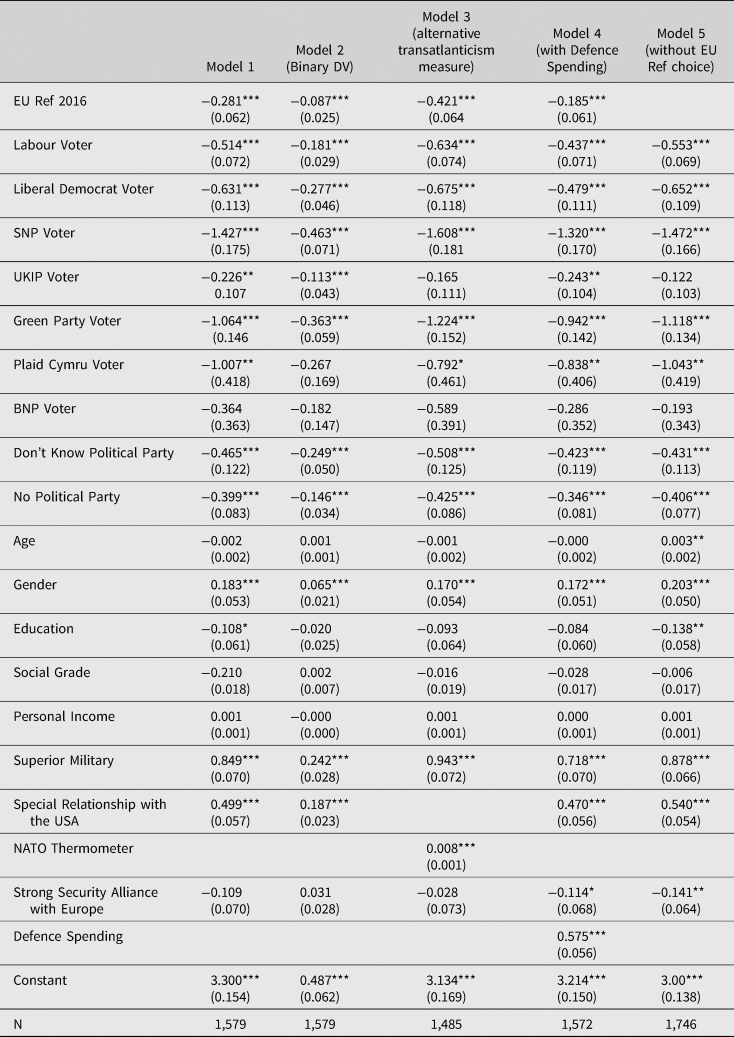
To assess whether our independent variables affect preferences for keeping Britain's nuclear weapons, we estimated five ordinary least squares (OLS) regression models (full results are reported in the Appendix). We focus mainly on the results from Model 1 (our main model), with the additional model results provided as robustness checks. Figure 5 summarises the results from Model 1. The circles represent the estimates of the effects of each independent variable listed to the left of the figure on the dependent variable (attitudes towards keeping nuclear weapons). The whiskers on either end of these circles represent the 95 per cent confidence intervals for each estimate. When these intervals include 0, we can conclude that there is not a statistically significant relationship between that independent variable and preferences for keeping nuclear weapons. Estimates whose confidence intervals lay to the left of the 0 line have a statistically significant negative effect on support for keeping nuclear weapons; estimates with confidence intervals to the right of this line have a statistically significant positive effect.
Effects of political preferences, foreign policy attitudes, and ‘gender gap’ on attitudes toward keeping nuclear weapons.
Note. Coefficient estimates. Figure created using the STATA coeplot package (Jann 2014). Complete estimates are reported in Model 1 in the Appendix.

Figure 5 shows that most of the independent variables have a negative effect on the likelihood of preferring to keep nuclear weapons. The first row suggests that those who voted ‘remain’ in the EU referendum are less likely to support keeping nuclear weapons relative to those who voted to leave the EU. The rows below indicate that supporters of Labour, the Liberal Democrats, the SNP, UKIP, the Green Party, and Plaid Cymru are less likely to support keeping nuclear weapons relative to Conservative Party supporters (who are the omitted reference category, as we want to compare other parties to them, in order to test H1). The same is true of individuals who did not know their political affiliation or stated they did not support any political party. Knowing that a person supports the British National Party (BNP), on the other hand, does not tell us much about that individual's likelihood of supporting the retention of nuclear weapons relative to a Conservative supporter.Footnote 67
We therefore find that political preferences have a significant role to play in affecting people's likelihood of supporting of Britain retaining its nuclear weapons. Identifying with political parties with a clear nuclear stance is generally significant in affecting people's views on the UK nuclear programme, lending support for H1 and the role of elite cues in structuring citizens’ positions on the debate.Footnote 68 Our data suggest that supporters of parties that do not take an anti-nuclear stance, such as the Liberal Democrats or UKIP, are also less likely to support keeping nuclear weapons relative to Conservative supporters. In line with our expectation for H2, those who voted for Britain to remain in the EU are less likely to agree with the statement that the UK should keep its nuclear weapons, relative to those who voted to leave, net of the impacts for party identification. This provides further evidence of the potency of views on the Brexit debate for other issues in the post-referendum political landscape, concerning both domestic and external policy.
As well as political preferences being rooted in domestic politics, we find that views on nuclear weapons are also clearly underpinned by attitudes towards core foreign policy debates relating to Britain's international role and relationships. Views on whether maintaining superior military power worldwide (this variable is labelled ‘Military’ in Figure 5) should be an important foreign policy goal have a statistically significant positive impact: those who consider it is important for Britain to maintain a superior military power worldwide are more likely to agree that the country should retain its nuclear weapons compared to those who do not hold these views. This confirms the expectation set out in H3, suggesting that both conventional and unconventional force capabilities are thought to be crucial for the country being able to maintain such a posture. In terms of Britain's key relationships and alliances in the postwar era, individuals who think that is it most important to protect the transatlantic special relationship (labelled as ‘USA’ in Figure 5) are more likely to agree that Britain should keep its nuclear weapons, confirming H5.Footnote 69 This suggests that some individuals may perceive the nuclear dimension of US-UK bilateral relations to be particularly important to the overall stability of the broader ‘special relationship’ and to be particularly beneficial for Britain's defence capabilities. We find no support for H4, however: views on the importance of maintaining close security alliances with Europe do not affect preferences on the retention of nuclear weapons. This may be because so few countries in Europe possess nuclear weapons (just Britain and France), so such capabilities are seen as less relevant or even undesirable for those who support security cooperation with the continent. Moreover, the EU as an international actor is often perceived to focus on a soft, rather than a hard, power role. We note that the impact of this variable is affected by the inclusion of the Brexit position variable in the models.Footnote 70
The findings support the well-established ‘gender gap’ on views towards the actual or potential use of the military which has been found for the use of conventional force.Footnote 71 In relation to unconventional weapons, men (labelled as ‘male’ in Figure 5) are more likely than women to agree with the statement that Britain should keep nuclear arms. This supports H6 and underlines and extends research that has found recurrent differences in view between men and women toward the actual or prospective use of conventional military force. There are a number of key theoretical perspectives that have been developed to account for gender differences on issue of military force and related issues, which could be used to undertake more in-depth analysis of the reasons that underpin women's greater opposition to the retention of Britain's nuclear deterrent. Mary-Kate Lizotte underlines that when such weapons were being developed in the Cold War, women were ‘less supportive of the development and existence of nuclear armaments’.Footnote 72 Lizotte claims that women espouse empathetic pro-social values, such that, when they ‘think about the international use of force, they may think about innocent civilians being killed or suffering as the result of the destruction that occurs during war’.Footnote 73 In the nuclear realm, it is possible that such concerns are magnified given the destructive potential involved. Clearly, this is an area where more research is needed, linking security policy preferences more directly to measures of pro-social values, such as egalitarianism and universalism.
Other socio-demographic variables have no significant impact on contemporary views of nuclear weapons. Education does not have a statistically significant effect – in other words, net of other explanatory factors, those educated to degree level or higher do not differ in their views from those with lower-level or no formal qualifications – and neither does social grade or income. Socioeconomic factors, taken together, do little to differentiate contemporary attitudes towards Britain's possession of nuclear weapons. Age also did not differentiate contemporary views on nuclear weapons, based on the evidence presented here. Finally, auxiliary statistical analyses (Model 4 in the Appendix) suggest that individuals who are in favour of increasing defence spending are more likely to support retaining Britain's nuclear weapons compared to those who wish to maintain current spending levels or reduce them.
Conclusion
This article has used an important new survey of the public's views on security policies to identify the sources of support or opposition to Britain's continued possession of nuclear weapons. This is currently a live issue in relation to the onging debate over renewing the Trident nuclear-based missile system and the recently announced shift in policy, resulting from the government's integrated review of Britain's role in the world, whereby the self-imposed cap on the country's weapons stockpile was raised from 180 to 260 warheads.Footnote 74 It extended the empirical study of Bartels's 1994 conceptualisation of public support for the ‘cost of defence’, extending this focus to a third facet – unconventional forces – that of having a nuclear deterrent, a key component of security policy in the postwar period. The article showcased new empirical findings for scholarly research into public opinion and foreign policy, integrating theories of elite cues, foreign policy predispositions and the ‘gender gap’ on the use of military force, and applying them to the nuclear arena. The article makes a distinctive contribution to the rapidly growing subfield of public opinion and foreign policy, contributing to the under-researched study of such dynamics in nuclear states other than the US.
We find that factors from each of three theoretical perspectives contributed to the underpinnings of contemporary attitudes towards nuclear weapons. In terms of domestic political attitudes, support for the retention of Britain's nuclear deterrent was more likely among Conservative Party supporters and individuals favouring Brexit. Based on foreign policy predispositions, backing for the deterrent was related to endorsing superior military power worldwide as an important foreign policy goal and support for the transatlantic relationship. Clearly, the recurring ‘gender gap’ found on state use of conventional military force extends to Britain's nuclear force capabilities, with men more in favour of retaining the nuclear deterrent than women.
While this study has redressed some significant limitations in scholarly knowledge of British public opinion on the nuclear deterrent debate, it should also invigorate and encourage further work in this important arena. Two areas are particularly noteworthy. First, both quantitative and qualitative studies could investigate the British public's views on nuclear strategy and doctrine, complementing this study's focus on attitudes towards the possession of such weapons. What are the British public's preferences regarding under what circumstances should use of nuclear weapons be permissible or not? Second, further work is needed to probe in more depth the underlying reasons why citizens in Britain support or oppose Trident renewal and – given the recent shift in policy noted above, which seems to go against long-standing support for working towards multilateral disarmament in the post-Cold War era – to gauge the extent of popular endorsement for augmenting the country's stock of nuclear weapons. It would be instructive to examine to what extent (and among which types of societal groups), are some common objections to the nuclear deterrent based on: moral or ethical considerations relating to the nature of such weapons and their impacts if used; issues relating to the burdens to public finances of funding the development and maintenance of nuclear weapons and the spending foregone for other areas of government expenditure; or their (in)appropriateness for Britain's national security and defence capabilities given its international role and commitments.
Acknowledgements
Catarina P. Thomson acknowledges support from the UK Economic and Social Research Council grant ES/L010879/1 and the University of Exeter's SSIS Strategic Discretionary Research Fund. We would like to thank the anonymous reviewers and the journal editors for their suggestions.
Declaration of conflicting interests
None
Ben Clements is an Associate Professor in the School of History, Politics and International Relations at the University of Leicester. His research interests include British public opinion towards foreign and defence policy in the postwar period, including nuclear weapons, European integration, and UK-US relations. He has published several articles on British public opinion towards military intervention. His most recent book is British Public Opinion on Foreign and Defence Policy: 1945–2017 (Routledge, 2018).
Catarina P. Thomson is Senior Lecturer of Security and Strategic Studies in the Politics Department at the University of Exeter. Her work incorporates political psychology and domestic factors to understand the strategic behaviour of actors in times of international conflict. She is unreasonably proud to be the latest winner of her campus's ‘Whose Lecture is it Anyway’ Comedy Improv trophy.
Appendix
Effects of political preferences, foreign policy attitudes, and ‘gender gap’ on attitudes towards keeping nuclear weapons.


 Open access

