


1. Introduction
Two prominent features of the climate of the Last Glacial Maximum (LGM) 18 000 years ago are the great ice sheets of North America and the cold temperatures of the northern North Atlantic Ocean. As shown in Figure 1, the CLIMAP (1976) reconstruction of the LGM climate indicates that ice sheets covered most of northern North America, and North Atlantic sea-surface temperatures were up to 12 K cooler than the present day.
Many investigations of the LGM and the subsequent deglaciation explore possible connections between the North American continental ice and the cold Atlantic. Information about the presence of the ice sheets can be communicated to the ocean through the hydrological cycle (salinity controls) and through atmospheric thermodynamic processes, including temperature and winds. This paper concentrates on the thermodynamic response of the atmosphere to the ice sheets, and how this response may have influenced temperatures at low levels over the North Atlantic Ocean. The influence of changes in the low-level winds on ocean surface currents is not considered, and we also do not include the effects of atmospheric changes on ice-sheet growth.
Continental ice extent and North Atlantic Ocean sea-surface temperatures for the present-day (top) and at the height of the last ice age (bottom) from CLIMAP.

Computer models provide a way of studying the ice-age atmosphere. Large topographic features are one characteristic of the Earth’s surface that can be related to the presence of waves in the time-mean atmospheric circulation. These waves are called stationary waves, and they can be simulated with some accuracy in atmospheric models. They are large-scale features which communicate the presence of topography over horizontal scales of thousands of kilometers. The influence of the ice sheets on the ice-age atmosphere will be addressed by considering stationary waves in the atmosphere generated over the North American ice sheets during winter, when the largest signal appears due to large surface wind velocities.
The following section includes a discussion of how studying stationary waves may contribute to our under-standing of ice-age climates, along with an introduction to stationary-wave dynamics. Results from modeling LGM stationary waves are presented in section 3, and section 4 discusses the North Atlantic cooling associated with these waves and possible implications for glaciations and deglaciations.
2. Topography and the Atmosphere: Back-Ground
We know from observations of the atmosphere and results from climate models that the topography of the Earth’s surface has an impact on the time-mean state of the atmosphere. Prominent waves are associated with the distribution of continents and oceans and large topographic features. Three mechanisms force these waves. In today’s climate, topographic forcing leads to significant structure in the vicinity — and thousands of km east — of the Tibetan Plateau and the Rocky Mountains. European topography is less influential on the planetary scale, and the location of the Antarctic topography makes it less relevant in this context. Another source of stationary waves is diabatic heating of the atmosphere by the absorption of latent, sensible and radiative energy. The distribution of diabatic heating through the atmosphere is related to many factors, prominent among which is the distribution of the continents. A third source of stationary waves is zonal asymmetries in heat and momentum transport by time-dependent atmospheric motion. The net effects of transient disturbances in the atmosphere can have significant effects on the time-mean flow. These forcing functions are not necessarily independent. Based on the linear model results presented in the following section, we are justified in focusing on topographic forcing as the main source of differences between the present-day and ice-age stationary waves near the Laurentide ice sheet.
The ability of topography to induce waves depends on the size of the feature and also the nature of the incident, or “unperturbed”, flow. Significant stationary waves occur in the northern hemisphere middle latitudes both because of the topography and the presence of strong westerly winds near the surface. Understanding these waves is necessary for understanding regional climate and its relationship to determinants of the climate state such as surface characteristics and atmospheric composition.
Although there are uncertainties concerning the height of the North American ice sheets of the LGM, their volume was certainly comparable to, if not larger than, the Tibetan Plateau. They were embedded in the mid-latitude westerlies and undoubtedly generated sizeable stationary waves. With the northern North Atlantic “downstream,” it is reasonable to assume, and the models support the notion, that the atmospheric response to the ice sheets is relevant for understanding why the North Atlantic was so cold during the ice age and how changes in the ice sheets may have influenced North Atlantic Ocean temperatures.
The stationary waves discussed here are “orographically-induced Rossby waves”. Generation of Rossby waves derives from conservation of angular momentum. Dynamic meteorology traditionally expressed this principle in terms of the vorticity of an air parcel, defined as the curl of the velocity. Rossby waves can be understood in a simplified system by considering only the two horizontal dimensions, so that the absolute angular momentum of a parcel about the vertical axis must be conserved. In terms of vorticity, the absolute vertical vorticity of a parcel must be conserved, so:

Here f is the Coriolis parameter (2ωsinθ), with θ latitude and ω the Earth’s rotation rate, and represents the vorticity imparted by the Earth’s rotation; ζ is the vorticity of the parcel relative to the Earth–s rotating frame of reference. When a parcel moves northward, Equation (1) requires that ζ decreases, and when the parcel moves southward ζ must increase. Rossby waves occur in the atmosphere and the ocean, and will appear on any rotating planet because the Coriolis force varies with latitude.
To explore the characteristics of these waves, adopt a flat coordinate system which retains the variation of f with latitude. If the “x” coordinate is positive eastward and “y” is positive northward, then:

and
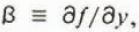
where u and v are the eastward and northward wind velocities, respectively. Since the total derivative in the simple coordinate system is:

and

Equation (1) becomes:

Consider a basic east-west flow, u = u0 = constant, with wave-like perturbations, v = Asin[k(x − ct)], where A represents wave amplitude, k the wave number, and c is the phase speed. Substituting into Equation (6) results in the Rossby wave formula:

If u 0 > 0 (westerly zonal mean flow), then waves with a certain wavelength:

will be stationary.
For the real atmosphere, of course, the generation of Rossby waves is more complicated than the preceding treatment. Among other factors, east-west perturbations of the basic flow are important in addition to north-south perturbations, and the vertical structure of the atmosphere must also be taken into account. Held (Reference Held1983) surveys current research efforts to improve our understanding of these waves and their connections to the surface and atmospheric conditions.
3. Stationary Waves of the LGM
The CLIMAP reconstruction of the LGM provided climate modelers with an unprecedented set of boundary conditions for simulating a climate state different from the present-day climate. These boundary conditions include the height and extent of the continental ice sheets, snow-free land albedos, and sea-surface temperatures. Ice-core sampling added the fact that CO2, concentrations were approximately one-third lower than today’s value. A number of GCM modeling groups took advantage of these data, including Gates (Reference Gates1976), Manabe and Hahn (Reference Manabe and Hahn1977), Kutzbach and Guetter (Reference Kutzbach and Guetter1986), Hansen and others (Reference Hansen1984), and Rind (Reference Rind1987), providing insights into the behavior of the atmosphere during an ice age and a check on the consistency of the reconstruction.
When sea-surface temperatures are prescribed in an LGM simulation, the results are not useful for addressing questions about how the ice sheets influenced North Atlantic Ocean temperatures, because any low-level atmospheric cooling due to the continental ice as well as the net effect of changes in the ocean circulation are predetermined in the model, with cause and effect blurred. LGM simulations in a GCM with a simple model of the ocean that responds to changes in the atmosphere are reported by Manabe and Broccoli (1984, 1985a,b) and Broccoli and Manabe (Reference Broccoli and Manabe1987). The Broccoli and Manabe (Reference Broccoli and Manabe1987) results, hereafter BM, are discussed here and used to guide experiments with a simpler model.
In the BM experiments, the ocean is represented as an isothermal layer of water with a uniform depth of 50 m. This mixed layer ocean does not include an ocean circulation, but the temperature can change in response to the surface heat balance which involves the fluxes of latent, sensible and radiative heat and conduction through sea ice. Thus, the sea-surface temperature in this model is sensitive to the atmosphere conditions and the connection between the continental ice and the North Atlantic can be studied.
BM repeated integrations with this model to assess the individual effects of the ice-age boundary conditions on the equilibrium climate. The “control” case is a simulation of the present-day climate. A second integration has “full LGM” boundary conditions, including the CLIMAP continental ice distribution and continental outlines, snow-free albedos, and reduced atmospheric CO2 (200 ppmv as opposed to 300 ppmv). Additional integrations show the contributions of the snow-free land albedos, reduced CO2, and the changed continental ice and outlines.
Results from BM’s experiments show that the continental ice is the ice-age boundary condition most responsible for differences between the present-day and ice-age climates in the northern hemisphere, although the CO, reduction amplifies high-latitude changes. In the southern hemisphere, most of the changes are associated with reduced CO2. The model is not as sensitive to changes in the snow-free land albedos of the magnitude suggested by CLIMAP.
A striking example of the profound influence that the Laurentide ice sheet has on the atmospheric dynamics in the GCM is a splitting of the mid-latitude tropospheric jet as discussed in Manabe and Broccoli (1984, Reference Manabe and Broccoli1985a) and Kutzbach and Guetter (Reference Kutzbach and Guetter1986). The northern branch is weaker, with wind velocity maxima of 15 ms−1 at 5l5mbar north of Hudson Bay. The southern jet is stronger than the present-day jet, with maximum velocities over 35 ms−1. This two-jet structure is a stationary eddy feature of the changed climate in the sense of the derivation of the previous section. Other features of the ice-age climate, such as the increased stability of the mid-latitude atmosphere, are evident in the zonal mean fields.
In the following discussion of the stationary eddies in modeled ice-age climates, the eddy geopotential, ϕ*, at 300 mbar is used to illustrate stationary waves in the model atmospheres. The total geopotential at 300 mbar is the height of the 300 mbar surface multiplied by g, the acceleration due to gravity. For mid-latitude flows, where wind velocity is largely determined by balances between Coriolis and pressure gradient forces, lines of constant geopotential are essentially also streamlines. Since stationary waves generally have their maximum amplitudes in the upper troposphere, the 300 mbar pressure surface was chosen. “Eddy” refers to the deviation from the zonal mean and is denoted by (*).
Figures 2a-c are the 300 mbar eddy geopotential fields in the northern hemisphere for the present-day, full LGM, and ice-sheet only GCM simulations of BM. In each figure there are two planetary-scale stationary-wave trains; one in the eastern hemisphere associated with the Tibetan Plateau, and one in the western hemisphere. The western hemisphere wave is very weak in the present-day simulation, and the waves in the two ice-age GCM simulations are very similar. Differences between Figures 2b and c are largely related to the effects of the modified CO2 forcing. The presence of the ice sheet is thus seen to be the major determinant of the stationary-wave signal in the GCM.
Cook and Held (Reference Cook Held and Held1988), hereafter CH, further analyse these GCM results by using a simpler, linear model as a diagnostic tool. Linear models solve dynamical and thermo-dynamical equations for zonally-asymmetric parts of fields by neglecting terms involving products of deviations from the zonal means, which are assumed to be small compared to the zonal mean quantities. These models have proved useful for studying topographic forcing of stationary waves (e.g. Reference Hoskins and KarolyHoskins and Karoly, 1981; Reference Chen and TrenberthChen and Trenberth, 1988; Reference Nigam, Held and LyonsNigam and others, 1988). CH's model is the steady-state model developed by Nigam (Reference Nigam1983) to be compatible with the GCM. It has nine vertical levels and zonal dependence is expressed with a Fourier series of 15 waves as in the GCM. Unlike the GCM, the linear model uses finite differencing in the north-south direction, but this does not degrade the comparison between the two models.
200 mbar eddy geopotential (see text) from BM’s GCM wintertime climatologies for (a) present-day, (b) full LGM, and (c) ice-sheet only boundary conditions. Contours are 40 geopotential meters (gpm) and negative perturbations are shaded.

In order to use a linear model, zonal mean wind and temperatures at each layer in the model atmosphere and forcing functions must be specified. The forcing can include the effects of topography as well as diabatic heating distributions and the effects of heat and momentum transport by time-dependent eddies. Difficulties arise when observations are used since the derivation of the forcing due to diabatic heating and transient eddy-flux distributions from observations is inaccurate, so that one cannot be sure to what extent discrepancies between the linear model and the observed stationary waves are due to non-linearities or errors in the prescribed forcing. Using the linear model with a GCM avoids this problem since zonal mean fields and forcing functions can be specified accurately from the GCM output. A disadvantage of this technique is that the linear model analysis is one step removed from the real atmosphere, and is hampered by any deficiencies in the GCM simulation. But the LGM atmospheric dynamics could not be investigated at all in this way without GCM simulations, and they serve as a reasonable surrogate climate.
The purpose of the CH linear model experiments is to explore the physical mechanisms responsible for the GCM’s ice-sheet induced stationary-wave pattern and to test the sensitivity of that pattern to the ice-age boundary conditions. Prerequisite for such a study is a demonstration that the linear model is an appropriate tool for diagnosing the GCM results. Figure 3 shows the 300 mbar eddy geopotential from the linear model for the present-day and LGM climates. To generate these distributions, the model is linearized about the present day or LGM zonal mean fields from the GCM. Zonal asymmetries are forced by GCM topography, diabatic heating, and transient eddies. These patterns can be compared with the GCM stationary waves of Figure 2 to assess the reliability of the linear model simulation. With respect to the present-day case, the linear model is successful in the eastern hemisphere, with the eddies generated over the Tibetan Plateau similar in position and magnitude to the GCM eddies. In the western hemisphere, however, there is a discrepancy between the models. The linear model generates a low over northern Canada and Greenland, but the western hemisphere signal in the GCM is very weak. This is a curious situation because the linear simulation, which is dependent on the GCM simulation, is actually better than the GCM simulation itself; observations show a wintertime low centered over the Hudson Bay. It is possible that some non-linear process included in the GCM but not in the linear model damps the western hemisphere wave.
300 mbar eddy geopotential from the linear model with zonal mean fields and forcing from the (a) present-day and (b) full LGM GCM climatologies. Contours are 40 gpm with negative values shaded.

For the LGM simulation, the linear model and the GCM are in good agreement in both hemispheres. The linear stationary wave generated over Tibet is slightly stronger than the GCM perturbation. Near the Laurentide ice sheet the locations and magnitudes of the high and low are similar in the two models. Downstream, the path of the linear wave train is more zonally directed, so that the feature analogous to the GCM’s subtropical Atlantic high is centered over western Europe and northern Africa. Despite these differences, the linear model simulation of the GCM’s stationary waves can be judged generally successful, and the model should be useful diagnostically.
Repeated linear simulations with different forcings and forcing combinations show that topographic forcing alone accounts for most of the stationary-wave response to the ice sheet. Contributions from transient eddies and diabatic heating that are associated with the glacial climate are significant over the mid-latitude and subtropical North Atlantic Ocean, but they tend to cancel. This result supports BM’s conclusion that the continental ice is the major determinant of the ice-age stationary response, and it also allows us to be more specific about the physical mechanism responsible for these waves.
In the GCM, an ice sheet is not only a topographic feature, but also represents extensive whitening of the surface and a surface type that has different attributes in the surface heat-balance calculation than snow-free land. The GCM ice sheet must also be accompanied by the full non-linear dynamical response of the atmosphere, which feeds back to the forcing functions through modifications of the diabatic heating fields and time-dependent flow. The basic formulation of the linear model, on the other hand, assumes that responses to the forcing mechanisms are separable. The linear model is a purely atmospheric model with no hydrological cycle or surface considered. In the linear model, then, “topographic forcing” refers only to the perturbation of the flow by the presence of an obstacle, in this case the Laurentide ice sheet. Therefore, the success of the linear model simulation with only topographic forcing suggests that the ice sheets affect the atmosphere and generate stationary waves mainly through the mechanical lifting and adiabatic cooling of air on the upslope of the ice mountain and diabatic warming on the downslope.
The weakening of the Tibetan stationary wave for the ice-age simulations is a clue that changes in the zonal mean climate may play a role in establishing the stationary-wave pattern. The CH linear model experiments show that the success of the linear simulations depends on a correct specification of the ice-age mean fields. Changes in the zonal mean temperature are especially relevent. Figure 4 shows differences in the northern hemisphere zonal mean temperature in the GCM (ice age minus present day) as a function of latitude and σ level, where σ is the model’s vertical coordinate (σ= p/p0, where p0 is surface pressure). General tropospheric cooling is evident, with maximum cooling at high latitudes near the surface. At 60°N, the latitude of the maximum Laurentide ice sheet height, the zonal mean temperature is up to 15 K cooler for the ice-age case. Directly south of the ice-sheet a close packing of the difference isotherms indicates the large change in the zonal mean meridional temperature gradient, which doubles near the surface between about 40° and 55°N.
Differences in the northern hemisphere zonal mean temperature due to ice-age boundary conditions in the GCM. Contours are 1 K with cooling indicated by stippling.

In order to understand the role of the zonal mean meridional temperature gradient in the stationary-wave response to the continental ice, the low-level thermodynamics is discussed in the following section.
4. Cooling Over the North Atlantic
Cooling of the North Atlantic Ocean occurs in the GCM as cold air flows off the ice sheet. Figure 5 is the difference in the surface air temperature between the ice-sheet only and control experiments in the GCM. The largest differences are directly over the Laurentide and Fenno-Scandian ice sheets, but the colder air extends downstream with wave-like variations clearly visible. BM relate this result to the cooling of the northern arm of the jet. This cooling of the surface air may not be translated into a cooling of the ocean mixed layer when sea ice insulates the ocean surface from the atmosphere. Comparing Figures 4 and 5 indicates that much of the cooling around 50°N occurs in the zonal mean, but the linear model can be used to examine the regional structure of the atmospheric cooling at low levels over the northern North Atlantic Ocean.
Figure 6 shows the eddy temperature (T* at 940 mbar over the ice-age North Atlantic from the linear model simulation with topographic forcing only. The cold North Atlantic temperatures are associated with negative T* values up to 10 K. The distribution is similar to the GCM’s with ice sheets alone, but the pattern is shifted farther northward in the GCM with the positive perturbation maximum near 35°N in the center of the Atlantic. T* is about one-third larger in this region for the GCM with Tuli ice-age forcing due to the CO2 reduction.
As described in the previous section, CH found that the magnitude of the stationary-wave response to the ice sheet and, therefore, the magnitude of the North Atlantic cooling, is sensitive to the zonal mean meridional temperature gradient near the surface. Insight into how this occurs comes from considering the linearized, steady-state, thermodynamic equation in the lowest model layer. With topographic forcing alone, and in the absence of significant zonal mean meridional and vertical motion:
Differences in the annually-averaged surface air temperature between the full LGM and present-day GCM simulations from BM. Contours are 2 K, and regions of temperature increase are stippled.

940 mbar eddy temperatures over the North Atlantic Ocean from the linear model. Contour intervals are 2K, and negative perturbations are stippled.


where λ and θ are longitude and latitude, ϴ is potential temperature, and w* is the eddy vertical wind velocity. Overbars indicate zonal mean quantities and asterisks deviations from the zonal mean such that u = ū + u*. Topographic forcing enters the system of equations solved in the linear model through the thermodynamic equation as a source of vertical velocity given by:

and Equation (9) becomes

where h represents the height of the topography.
Numerical analysis confirms that the balance expressed by Equation (11) is valid for both the GCM and linear model simulations. For the present-day case, both terms on the left-hand-side are important in establishing the modeled stationary waves. The first term expresses the role of the vertical temperature structure; for a given topography, if the atmosphere is more stable to vertical perturbations (

In contrast to the present-day simulations, the second term on the left-hand side of Equation (11) dominates in the vicinity of the Laurentide ice sheet and, especially, over the North Atlantic Ocean. Therefore:

Three characteristics of the ice-age zonal mean climate are potentially important according to this balance — the zonal wind, the vertical temperature structure, and the meridional temperature gradient. Experiments with the linear model indicate that the most important of these is the meridional temperature gradient (

According to the GCM results, the magnitude of the zonal mean meridional temperature gradient during the last ice age was twice as large as the present-day gradient at the latitudes of the Laurentide ice sheet. Physically, the increased meridional temperature gradient means that cold polar air extends much farther south in the ice-age climate. The cool air is easily advected into the region of adiabatic heating on the downslope of the Laurentide ice sheet by small (perturbation) meridional velocities consistent with the assumptions of linear theory. This result confirms BM’s analysis that the atmospheric cooling that occurs as the northern arm of the jet flows around the ice sheet is important for the simulated North Atlantic cooling, but it also highlights the role of the changed mean meridional temperature gradient. If the Laurentide ice sheet is used to force topographic waves in the linear model without changing the temperature gradient from the present-day to the ice-age values, the ice sheet generates stationary waves with amplitudes twice that of the GCM ice-age stationary waves. This sensitivity to the zonal mean meridional temperature has two possible interpretations. One is that linear theory is not valid for a feature as large as the Laurentide ice sheet despite the apparent success of the linear model and, in the real world, the Laurentide stationary waves were determined by mechanisms (non-linearities) not included in the model. The second possibility is that the stationary waves generated over the LGM continental ice really were damped by the proximity of the cold polar air. If this was a factor, it has interesting implications for periods of glaciations and deglaciations.
A successful linear model simulation of the GCM’s stationary waves without information about the altered temperature gradient would point to a smooth evolution of the stationary waves with ice-sheet volume. Insofar as the northern North Atlantic cooling can be associated with the ice sheet’s stationary wave, this implies smooth glacial/inter-glacial transitions with time-scales set by reaction times consistent with significant changes in the volume of the continental ice. But temperature data from this region, for both the glaciation and the deglaciation, indicate temperature changes on time-scales that may well be faster than the response times possible for large changes of the continental ice.
If the sensitivity to the temperature gradient is real, it suggests another mechanism for rapid changes over the North Atlantic Ocean. The low-level meridional temperature gradient might be more closely related to the ice-sheet extent through the surface albedo than to the ice-sheet volume. The ice-age temperature gradient could then be maintained during a thinning of the ice. sheets. The “sudden” retreat of a thinned ice layer could then cause a rapid relaxation of the gradient and a changed stationary wave response, impacting low-level temperatures downstream.
5. Summary
Stationary Rossby waves are planetary-scale features of the time-mean atmospheric circulation. One source of these waves is large topography such as the Tibetan Plateau, the Rocky Mountains and, presumably, the continental ice sheets of the LGM. Studying ice-age stationary waves can add to our understanding of the ice-age climate.
In a series of experiments with an atmospheric GCM coupled to an ocean mixed-layer model, Broccoli and Manabe (Reference Broccoli and Manabe1987) found that including CLIMAP ice sheets results in cooler North Atlantic temperatures. They relate this result to the splitting of the jet stream around the Laurentide ice sheet.
Cook and Held (Reference Cook Held and Held1988) used a linear model to study the stationary waves in the Broccoli and Manabe GCM simulations. When this model is linearized about the zonal mean fields from the GCM and forced with topographic forcing alone, stationary waves similar to the GCM’s result. This implies that the major forcing of the ice-age stationary waves is due to the mechanical effects of the ice sheets on the flow, and not to transient eddies or diabatic heating such as those associated with changes in the surface albedo.
The success of the linear simulation depends on a correct specification of the zonal mean meridional temperature gradient which, according to the GCM simulations, is twice as large at mid-latitudes for the ice-age case. The response of the linear model to the ice-age continental ice is much larger than the GCM’s response if the linear model does not “know” about the doubling of the mean meridional temperature gradient. The stationary waves generated over the Laurentide ice sheet in the models are effectively damped since the proximity of cold polar air allows the down-slope adiabatic heating to be balanced by advection due to small meridional winds. If the cold polar air retreats northward, represented when the present-day meridional temperature gradient is used in the linear model, the atmospheric motion required to balance the adiabatic heating on the down-slope of the Laurentide ice sheet is much larger, i.e., the stationary wave is much larger.
These results suggest a mechanism for relatively rapid changes in the stationary waves downstream of the ice sheet over the North Atlantic Ocean. The meridional temperature gradient may be more closely related to the surface albedo than the ice-sheet volume, so that the melting of a thin layer of ice can lead to large changes in the temperature gradient, the stationary waves, and the low-level atmospheric temperature.
Since this investigation does not take into account the entire climate system, particularly the roles of sea ice and ocean circulation, the results should not be taken to imply that the cooling of the North Atlantic was necessarily caused by the response of the atmosphere to the continental ice. These results strongly suggest, however, that the atmosphere’s response to the continental ice sheets was significant and understanding the related thermodynamics adds to our understanding the North Atlantic Ocean sea-surface temperature signal.
Acknowledgements
I thank S. Manabe for useful discussions and comments on this paper, and I. Held and A.J. Broccoli for their thoughtful reviews of the manuscript.



