

Introduction
Multiple sclerosis (MS) is a chronic immune-mediated disease of the central nervous system, characterized by multifocal areas of inflammatory demyelination within both white matter and gray matter, neurodegeneration, and axonal injury (Lassmann, Reference Lassmann2018). In patients with MS (pwMS) cognitive impairment is common, and it can occur from the very early stages of the disease (Amato et al., Reference Amato, Portaccio, Goretti, Zipoli, Hakiki, Giannini, Pastò and Razzolini2010), also in subtle form (Pitteri et al., Reference Pitteri, Ziccardi, Dapor, Guandalini and Calabrese2019). Even though underestimated in research reports, several studies have shown that executive functioning (EF) can be one of the main and earliest impaired cognitive domains in pwMS (e.g., Migliore et al., Reference Migliore, Curcio, Couyoumdjian, Ghazaryan, Landi, Moffa, Quintiliani, Squitieri, Palmieri, Filippi and Vernieri2018). “Executive functions” is an umbrella term for a range of general-purpose control mechanisms (e.g., planning, reasoning, abstraction, automatic response inhibition, set shifting, etc.), which are thought to modulate and coordinate more rudimentary cognitive subprocesses to achieve effective behavior (e.g., Stuss & Levine, Reference Stuss and Levine2002). Studies on the neural bases of EF have shown the involvement of multiple neural networks (see Witt et al, Reference Witt, van Ettinger-Veenstra, Salo, Riedel and Laird2021 for an image-based meta-analysis) in which cortico-cortical and cortico-subcortical brain circuits are involved. Within this complex architecture, a prominent role is undoubtedly played by frontal lobes (e.g., Robinson et al., Reference Robinson, Shallice, Bozzali and Cipolotti2012).
Among various measures to test EF, verbal fluency tests have been found to be more sensitive to impairment in pwMS relative to other measures (Henry & Beatty, Reference Henry and Beatty2006).
Verbal fluency tasks have several advantages, like being short and easy to administer and minimally affected by motor and visual impairments, often reported in pwMS. However, these tasks are not process-pure measures of a single cognitive process, and conceptual and methodological issues recently raised should be considered.
First, of special interest for research and clinical practice in MS, fluency tasks incorporate an information processing speed (IPS) component, which can impact on EF tasks (Leavitt et al., Reference Leavitt, Wylie, Krch, Chiaravalloti, DeLuca and Sumowski2014). Since pwMS frequently report slowing in IPS (for a review, see Costa et al., Reference Costa, Genova, DeLuca and Chiaravalloti2017), this raised questions about the pertinence of using fluency tests to assess EF in pwMS (Henry & Beatty, Reference Henry and Beatty2006).
Second, neuropsychological and neuroimaging studies with healthy participants have shown that the impact of EF on verbal fluency tasks may change depending on the task used, e.g. phonemic (letter) versus semantic (category) fluency. This might be related to the complex mechanisms underlying verbal fluency performance as recently pointed out by Delgado-Álvarez, Matias-Guiu, et al. (Reference Delgado-Alvarez, Matias-Guiu, Delgado-Alonso, Hernández-Lorenzo, Cortés-Martínez, Vidorreta, Montero-Escribano, Pytel and Matias-Guiu2021). The authors reported that both phonemic and semantic fluency tasks share different mental processes, including “sustained attention, design of a search strategy, selection of words, inhibition of competing words, working memory, and language production” (p.2). However, a closer examination of the two verbal fluency tasks also reveals differences, with a greater involvement of memory on semantic fluency tasks, and a stronger impact of executive processing on phonemic fluency tasks (e.g., Delgado-Álvarez, Matias-Guiu, et al., Reference Delgado-Alvarez, Matias-Guiu, Delgado-Alonso, Hernández-Lorenzo, Cortés-Martínez, Vidorreta, Montero-Escribano, Pytel and Matias-Guiu2021).
Research on verbal fluency in pwMS also provided evidence for the distinction between phonemic and semantic fluency, showing several patterns of impairment and different neural bases (e.g., Matías-Guiu et al. Reference Matías-Guiu, Cortés-Martínez, Montero, Pytel, Moreno-Ramos, Jorquera, Yus, Arrazola and Matías-Guiu2018). For instance, phonemic verbal fluency was more impaired than semantic verbal fluency in relapsing-remitting MS phenotype (e.g., Brissart et al., Reference Brissart, Morele, Baumann, Perf, Leininger, Taillemite, Dillier, Pittion, Spitz and Debouverie2013), whereas both fluency tasks were found to be impaired in pwMS with primary and secondary progressive phenotypes who suffer from more global cognitive impairment (e.g., Huijbregts et al., Reference Huijbregts, Kalkers, de Sonneville, de Groot, Reuling and Polman2004).
Third, the scoring method used can also affect the interpretation of verbal fluency performance. Verbal fluency tasks have been traditionally scored considering the number of correct words produced during a fixed time of execution (1 or 2 minutes). However, recently, qualitative analysis and alternative quantitative scoring methods (e.g., measuring performance over time as in Stuss & Alexander, Reference Stuss and Alexander2007; Cipolotti et al., Reference Cipolotti, Molenberghs, Dominguez, Smith, Smirni, Xu, Shallice and Chan2020) have been introduced and successfully used to unravel the different cognitive processes underlying performance on fluency tasks.
On a theoretical level, an important contribution in stimulating the identification of alternative scoring methods of the fluency tasks has come from the dynamical two-factor model developed by Fernaeus and Almkvist (Fernaeus & Almkvist, Reference Fernaeus and Almkvist1998). According to this model, verbal fluency would reflect two separate components, contributing differently across time during performance. In the initial phase (i.e., first 15/20 seconds), word production would involve the access and retrieval of a pool of readily available frequently used words and would occur in a “semiautomatic mode with little mental effort” (p. 141). As the time elapses (i.e., late phase: from 15/20 to 60 seconds), this cluster of words would be exhausted, and word production would require more effortful and strategic search of new words, with a consequent greater involvement of executive control (for a theoretical framework, see the tripartite model of EF and the role of energization on fluency tasks in Stuss & Alexander, Reference Stuss and Alexander2007).
In the present study, we further investigated the role of EF on fluency tasks in a group of pwMS, by considering the conceptual and methodological issues discussed above. Specifically, we analyzed the word generation process considering (i) the global performance on phonemic and semantic fluency tasks and (ii) the specific performance as a function of timeframe, distinguishing and comparing the number of words generated during the initial (15 sec) versus later phases (remaining 45 sec) on fluency tasks (for the same procedure, see Stuss & Alexander, Reference Stuss and Alexander2007).
Notably, pwMS are frequently impaired in IPS, which might be responsible for the performance on fluency tasks. Thus, to rule out the effect of IPS, we recruited a group of pwMS without impairment on the Symbol Digit Modalities Test (SDMT), that is, the most used measure of IPS in the MS literature. Performance of pwMS was compared with that of a group of neurologically healthy controls (HC) that did not differ in age, gender, education, and performance on the SDMT from the pwMS group.
We hypothesized that pwMS would perform significantly worse than HC on the phonemic fluency task in the later phase, in which word production requires greater involvement of executive control. On the contrary, we did not expect a significant difference between pwMS and HC in the initial phase, in which word production requires less involvement of executive control. No significant differences between the two groups were expected in both phases (early and late) on the semantic fluency task, in which minimal recruitment of EF is implied.
Method
Study population
Forty-three pwMS (32 females; mean age: 35.9 years, SD= 9.5 years; mean years of education: 15.6 years; SD= 2.6 years) who underwent neurologic and neuropsychologic examination at the MS Center of Verona University Hospital (Verona, Italy) were retrospectively recruited. Inclusion criteria were a diagnosis of relapsing-remitting MS (Thompson et al., Reference Thompson, Banwell, Barkhof, Carroll, Coetzee, Comi and Cohen2018), no impairment on the SDMT, no concomitant neurologic disorders other than MS, no psychiatric or other pathologic health conditions, no substance abuse, and no relapses in the six months before neuropsychological testing.
At the time of neuropsychological assessment, 22 pwMS were untreated, whereas 8 were treated with dimethyl fumarate, 5 with fingolimod, 3 with ocrelizumab, 2 with natalizumab, 2 with interferon beta-1a, and 1 with cladribine.
A group of 32 HC (20 females; mean age: 36.9 years, SD = 11.3 years; mean education: 16.8 years, SD = 2.5 years) was also tested as a control group, which did not differ from the pwMS group for age (p = .91), education (p = .07), gender (p = .27), and performance on the SDMT (p = .57).
Demographic information, clinical details, and statistical results of the comparisons between pwMS and HC groups are reported in Table 1.
Demographic, clinical, and cognitive characteristics of pwMS and HC
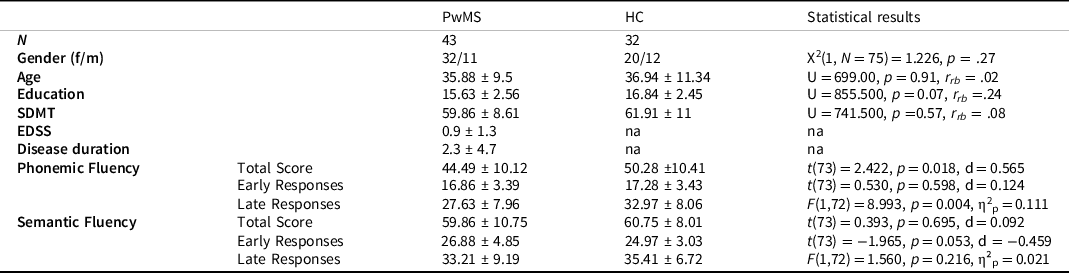
Note. EDSS = Expanded Disability Status Scale; F = female; HC = Healthy Controls; M = male; MS = Multiple Sclerosis; na = not applicable; pwMS = people with multiple sclerosis; SDMT = Symbol Digit Modalities Test. Mean ± Standard Deviation (M ± SD) was reported for all variables. For EDSS, the median was 0 (range: 0–6).
The study was approved by the Ethic Committee of Verona University and was completed in accordance with the Helsinki Declaration. Written informed consent was obtained from all participants.
Neuropsychological measures
The Phonemic and Semantic Fluency Tests were available as part of a more comprehensive battery of neuropsychological tests, which comprised the Rao’s Brief Repeatable Battery, the Stroop Test, and the Verbal Fluency Test (see Supplementary Material for tests’ references).
Phonemic and Semantic Fluency Tests
On the Phonemic Fluency Test, participants were asked to generate as many words as possible beginning with a given letter (i.e., A, F, and S) during three consecutive trials, one for each letter, lasting 60 seconds each (total duration of the task: about 3 mins). The final score was the total number of correct words provided on the three trials. On the Semantic Fluency Test, participants were asked to generate as many words as possible belonging to three semantic categories (i.e., colors, animals, and fruits) during three consecutive trials, one for each category, lasting 60 seconds each (total duration of the task: about 3 mins). The final score was the total number of correct words provided on the three trials. The order of presentation was fixed: the Phonemic Fluency Test was administered first, and the Semantic Fluency Test was administered afterward.
To distinguish between semi-automatic and controlled processing, we scored the number of words generated in two consecutive time intervals on both fluency tasks: (i) early responses (i.e., words generated in the first 15 sec), and (ii) late responses (i.e., words generated from 15 to 60 sec).
Statistical analyses
Group differences on demographic characteristics were evaluated with Mann–Whitney tests (age and education) and the Chi-square test (gender). Similarly, Mann–Whitney test was used to assess whether there was any difference between HC and pwMS in processing speed, assessed with the SDMT. Independent-sample t-tests were performed to examine Group differences (HC vs. pwMS) in the total number of words generated on the Phonemic and Semantic Fluency Tests, and in the number of words generated in the early time interval (i.e., 0-15 seconds). To control for decreasing effect of task performance from the early to late time intervals, we ran two ANCOVAs, one for the Phonemic Fluency Test and one for the Semantic Fluency Test, with late responses as the dependent variable, Group (HC vs. pwMS) as the between-subject factor, and early responses as covariate. Conventional significance levels were used (p < 0.05). All the statistical analyses were performed with JASP (Version 0.13.1; JASP Team, 2020).
Results
There was a significant difference between the two groups (HC: 50.28 ± 10.41; pwMS: 44.49 ± 10.12; p = .018) on the total number of words generated on the Phonemic Fluency Test (see Table 1).
Interestingly, we found no significant differences between the two groups in the number of words generated in the first 15 seconds (HC: 17.28 ± 3.43; pwMS: 16.86 ± 3.39; p = .598). By contrast, the ANCOVA revealed that the two groups significantly differed in the number of words generated in the late time interval, with pwMS reporting significantly fewer words compared to HC (HC: 32.97 ± 8.06; pwMS: 27.63 ± 7.96; p = .004; see Figure 1a and Table 1).
Performance of HC and pwMS on the Phonemic Fluency Test (1a) and on the Semantic Fluency Test (1b), considering separately the two time intervals (i.e., early vs. late responses). Early responses refer to the number of words generated during the first 15 seconds, whereas late responses refer to the number of words generated from 16 to 60 seconds. Note. HC = healthy controls; pwMS = people with Multiple Sclerosis. ** p < .01.

There was no significant difference between the two groups (HC: 60.75 ± 8.01; pwMS: 59.86 ± 10.75; p = .70) on the total number of words generated on the Semantic Fluency Test. Thus, HC and pwMS did not differ significantly in the number of words generated in the first time interval (HC: 24.97 ± 3.03; pwMS: 26.88 ± 4.85; p = .053). Similarly, there was no significant difference between the two groups on the number of words generated in the late time interval (HC: 35.41 ± 6.72; pwMS: 33.21 ± 9.19; p = .22; see Figure 1b and Table 1).
Discussion
Alterations in EF might early occur in the disease course of MS (Migliore et al., Reference Migliore, Curcio, Couyoumdjian, Ghazaryan, Landi, Moffa, Quintiliani, Squitieri, Palmieri, Filippi and Vernieri2018; Pitteri et al., Reference Pitteri, Ziccardi, Dapor, Guandalini and Calabrese2019 ) and it has been reported that verbal fluency tests are more efficient in detecting subtle impairments than other tasks (e.g., Henry & Beatty, Reference Henry and Beatty2006). However, it is still not clear the different contribution of EF and IPS on fluency tasks in pwMS, since pwMS are frequently impaired in IPS, which might be responsible for behavioral performance on fluency tasks. The present results showed an overall significant reduced performance of pwMS compared to HC on the Phonemic Fluency Test, but not on the Semantic Fluency Test, after having ruled out the effect of IPS. Crucially, on the Phonemic Fluency Test the difference between pwMS and HC was significant in the late performance only, which is linked to a more effortful processing in word finding. By contrast, no significant differences emerged in the initial performance, which seems to depend on the effectiveness of a semi-automatic processing. No significant differences between the two groups were found on the Semantic Fluency Test, either in the early or late time interval.
Taken together, these results corroborate previous findings that suggested a prominent role of EF impairment in pwMS and a particular sensitivity of the Phonemic Fluency Test in assessing such impairment in this population (Henry & Beatty, Reference Henry and Beatty2006). Additionally, the present findings extend previous results by showing that the reduced performance of pwMS on the Phonemic Fluency Test seem to occur during controlled and effortful retrieval of words only, speaking in favor of EF inefficiency (see also Cipolotti et al., Reference Cipolotti, Xu, Harry, Mole, Lakey, Shallice, Chan and Nachev2021).
One could argue that performance on the Phonemic Fluency Test might be affected by language dysfunction and fatigue. In fact, although language in pwMS is largely preserved, language difficulties were recently reported in pwMS, especially in time-dependent tasks (e.g., Brandstadter et al., Reference Brandstadter, Fabian, Leavitt, Krieger, Yeshokumar, Katz, Klineova, Riley, Lewis, Pelle, Lublin, Miller and Sumowski2020) and fatigue is one of the most common symptoms in pwMS, which might interfere with cognitive processes (e.g., Calabrese & Pitteri, Reference Calabrese, Pitteri, DeLuca and Sandroff2018).
Regarding language, in a recent study by Lebkuecher et al., (Reference Lebkuecher, Chiaravalloti and Strober2021) on verbal fluency in pwMS, vocabulary and processing speed predicted phonemic fluency, while only vocabulary predicted semantic fluency. Although these results “suggest the need to deepen in the interpretation of cognitive tests results in patients with MS” (Delgado-Alvarez, Delgado-Alonso, et al., Reference Delgado-Alvarez, Delgado-Alonso, Matias-Guiu and Matias-Guiu2021, p. 2), given the heterogeneity of MS population and the complexity of the fluency tasks, our results are unlikely to be explained by effects related to language dysfunction. We did not find, indeed, significant differences between pwMS and HC on the semantic fluency task, either in early or late responses. Moreover, all pwMS included in the present study performed in the normal range (i.e., above the cutoff) on both Phonemic and Semantic Fluency Tests, showing that their performance on both fluency tasks, in which language is involved, was preserved in terms of words production.
As for a potential effect of fatigue, although we cannot completely exclude an effect of fatigue or “fatiguability”, which can be detected also in early pwMS (Pitteri et al., Reference Pitteri, Dapor, DeLuca, Chiaravalloti, Marastoni and Calabrese2022), our results are unlikely to be explained by this variable. Indeed, the order of presentation of the two fluency tests was fixed (with the Phonemic Fluency Test administered first, and the Semantic Fluency Test afterward) but we found a significant difference between pwMS and HC in the late responses on the Phonemic Fluency Test only. If pwMS would have suffered from fatigue, an effect on the late phase of word production should have been also observed on the Semantic Fluency Test.
The present study is not without limitations. First, we ruled out the presence of IPS deficit in pwMS by means of the SDMT; however, it has been recently argued that it is not appropriate to consider the SDMT as a pure measure of IPS (Sandry et al., Reference Sandry, Simonet, Brandstadter, Krieger, Katz Sand, Graney, Buchanan, Lall and Sumowski2021). Thus, we acknowledge that there are some limitations in this approach that should be addressed in future studies by using different IPS measures. Second, we tested a high functioning, selected group of pwMS, which is not a representative sample of the MS population. Future studies with a larger number and different phenotypes of pwMS are needed to generalize these results to a more heterogeneous MS population. Third, in the present study we did not include other executive measures, besides the fluency tests. Having such measures might be useful to further corroborate and validate the late phonemic fluency performance as relying on EF compared to the early phonemic fluency performance.
In conclusion, different patterns of performance were found for semi-automatic and controlled processing on the Phonemic Fluency Test in a group of pwMS without IPS impairment, suggesting that executive dysfunction, like in other neurological disorders, is a core element in this test also in pwMS, and it deserves attention in both research and clinical practice.
Supplementary material
The supplementary material for this article can be found at https://doi.org/10.1017/S1355617723000139
Data availability statement
The data that support the findings of this study are available from the corresponding author, Massimiliano Calabrese, upon reasonable request.
Funding statement
None.
Conflict of interests
Massimiliano Calabrese has served on scientific advisory boards and has received funding for travel or honoraria for speaking from Biogen, Merck-Serono, Roche, Novartis, and Sanofi Genzyme. Damiano Marastoni received research support and/or honoraria for speaking and funds for travel from Roche, Sanofi-Genzyme, Merck-Serono, Biogen Idec, and Novartis. All the other authors declare no conflict of interests.


 Open access

