




1 Introduction
Cellular automata (CAs) are a class of discrete dynamical systems consisting of an infinite line (or, more generally, a multidimensional grid) of ‘cells’, each of which holds one of finitely many states. Each cell evolves by an identical rule, and its next state is determined by the current state of itself and some finite set of neighbouring cells. The 256 elementary cellular automata (ECAs) [Reference Wolfram11] are those with only two states and neighbourhood ${N = \{-1,0,1\}}$
, meaning that each cell can communicate only with its nearest neighbours. They are arguably the simplest CAs that exhibit complex dynamics.
${N = \{-1,0,1\}}$
, meaning that each cell can communicate only with its nearest neighbours. They are arguably the simplest CAs that exhibit complex dynamics.
We focus on the dynamics of elementary CA number 18. It has been studied as a model of mutually annihilating particles with random movement as early as 1983 [Reference Grassberger3] and by several authors since [Reference Jen5, Reference Kůrka6]. Grassberger [Reference Grassberger3] and Lind [Reference Lind8] conjectured that if the CA is initialized from a uniformly random configuration, then the density of particles almost surely decreases to zero with the same speed as mutually annihilating independent random walks. Progress towards the conjecture has been slow. Kůrka claimed in [Reference Kůrka6] that the density indeed approaches zero, but we show that the presented proof is faulty (see the discussion after Proposition 4.5).
The long-term fate of a dynamical system can be studied via its limit set, or eventual image. The limit set of a CA often contains transient phenomena, so several variants have been proposed to better capture the intuitive notion of ‘what typically happens after a long time’. These include the $\mu $
-limit set [Reference Kůrka and Maass7] and the generic limit set, introduced by Milnor in [Reference Milnor9] and studied first in the context of CAs in [Reference Djenaoui and Guillon2]. As our main results, we characterize the words with at most two particles that occur in the generic limit set of rule 18 and show that the three limit sets are all distinct. We also show that determining the generic limit set of rule 18 is a viable strategy towards (partially) resolving the conjecture of Grassberger and Lind.
$\mu $
-limit set [Reference Kůrka and Maass7] and the generic limit set, introduced by Milnor in [Reference Milnor9] and studied first in the context of CAs in [Reference Djenaoui and Guillon2]. As our main results, we characterize the words with at most two particles that occur in the generic limit set of rule 18 and show that the three limit sets are all distinct. We also show that determining the generic limit set of rule 18 is a viable strategy towards (partially) resolving the conjecture of Grassberger and Lind.
2 Definitions
Let A be a finite alphabet. The set of finite words over A is denoted by $A^*$
and concatenation of words
$A^*$
and concatenation of words $v, w \in A^*$
is denoted by either
$v, w \in A^*$
is denoted by either $v w$
or
$v w$
or $v \cdot w$
. This notation is extended to infinite words: if
$v \cdot w$
. This notation is extended to infinite words: if $v \in A^*$
and
$v \in A^*$
and $x \in A^{\mathbb {N}}$
is a right-infinite word, then
$x \in A^{\mathbb {N}}$
is a right-infinite word, then $v x \in A^{\mathbb {N}}$
; if
$v x \in A^{\mathbb {N}}$
; if $y \in A^{-\mathbb {N}}$
is a left-infinite word, then
$y \in A^{-\mathbb {N}}$
is a left-infinite word, then $y v \in A^{-\mathbb {N}}$
; and
$y v \in A^{-\mathbb {N}}$
; and $y x \in A^{\mathbb {Z}}$
is a bi-infinite word. The full shift is the set
$y x \in A^{\mathbb {Z}}$
is a bi-infinite word. The full shift is the set $A^{\mathbb {Z}}$
of all bi-infinite sequences over A, equipped with the prodiscrete topology, which is generated by the cylinder sets
$A^{\mathbb {Z}}$
of all bi-infinite sequences over A, equipped with the prodiscrete topology, which is generated by the cylinder sets $[w]_i = \{x \in A^{\mathbb {Z}} \mid x_{[i, i+|w|-1]} = w\}$
for
$[w]_i = \{x \in A^{\mathbb {Z}} \mid x_{[i, i+|w|-1]} = w\}$
for $w \in A^*$
and
$w \in A^*$
and $i \in \mathbb {Z}$
. The shift map
$i \in \mathbb {Z}$
. The shift map $\sigma : A^{\mathbb {Z}} \to A^{\mathbb {Z}}$
is defined by
$\sigma : A^{\mathbb {Z}} \to A^{\mathbb {Z}}$
is defined by $\sigma (x)_i = x_{i+1}$
. A subshift is a topologically closed set
$\sigma (x)_i = x_{i+1}$
. A subshift is a topologically closed set $X \subseteq A^{\mathbb {Z}}$
that is shift-invariant:
$X \subseteq A^{\mathbb {Z}}$
that is shift-invariant: $\sigma (X) = X$
. A word
$\sigma (X) = X$
. A word $w \in A^*$
occurs in X if
$w \in A^*$
occurs in X if $X \cap [w]_0 \neq \emptyset $
. The language of X is the set of words occurring in it; a subshift is defined by its language.
$X \cap [w]_0 \neq \emptyset $
. The language of X is the set of words occurring in it; a subshift is defined by its language.
A CA is a continuous function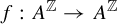 $f : A^{\mathbb {Z}} \to A^{\mathbb {Z}}$
that commutes with the shift:
$f : A^{\mathbb {Z}} \to A^{\mathbb {Z}}$
that commutes with the shift: ${f \circ \sigma = \sigma \circ f}$
. By the Curtis–Hedlund–Lyndon theorem [Reference Hedlund4], every CA has a finite radius
${f \circ \sigma = \sigma \circ f}$
. By the Curtis–Hedlund–Lyndon theorem [Reference Hedlund4], every CA has a finite radius $r \geq 0$
and a local rule
$r \geq 0$
and a local rule $F : A^{2r+1} \to A$
such that
$F : A^{2r+1} \to A$
such that $f(x)_i = F(\sigma ^i(x)|_{[-r,r]})$
for all
$f(x)_i = F(\sigma ^i(x)|_{[-r,r]})$
for all $x \in A^{\mathbb {Z}}$
and
$x \in A^{\mathbb {Z}}$
and $i \in \mathbb {Z}$
. Once r is fixed, we can apply the CA to words
$i \in \mathbb {Z}$
. Once r is fixed, we can apply the CA to words $w \in A^n$
as well as configurations:
$w \in A^n$
as well as configurations: $f(w) = F(w_{[0,2r]} w_{[1,2r+1]} \cdots w_{[n-2r-1,n-1]})$
. Note that each application of f shortens the word by
$f(w) = F(w_{[0,2r]} w_{[1,2r+1]} \cdots w_{[n-2r-1,n-1]})$
. Note that each application of f shortens the word by $2r$
symbols.
$2r$
symbols.
The ECAs, defined in [Reference Wolfram11], are those with alphabet $A = \{0,1\}$
and radius
$A = \{0,1\}$
and radius $1$
. They are numbered from 0 to 255: the local rule F of ECA n maps
$1$
. They are numbered from 0 to 255: the local rule F of ECA n maps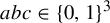 $a b c \in \{0,1\}^3$
to bit number
$a b c \in \{0,1\}^3$
to bit number $4a + 2b + c$
in the binary representation of n (extended to three digits by prepending zeros if necessary).
$4a + 2b + c$
in the binary representation of n (extended to three digits by prepending zeros if necessary).
A topological dynamical system is a pair $(X, T)$
, where X is a compact metric space and
$(X, T)$
, where X is a compact metric space and $T : X \to X$
is a continuous function. CAs are examples of such systems.
$T : X \to X$
is a continuous function. CAs are examples of such systems.
A Borel probability measure on a topological space X is a function $\mu : \mathcal {B}(X) \to [0,1]$
, where
$\mu : \mathcal {B}(X) \to [0,1]$
, where $\mathcal {B}(X)$
is the class of Borel subsets of X, satisfying
$\mathcal {B}(X)$
is the class of Borel subsets of X, satisfying $\mu (X) = 1$
,
$\mu (X) = 1$
, $\mu (\emptyset ) = 0$
and
$\mu (\emptyset ) = 0$
and $\mu (\bigcup _{n \in \mathbb {N}} X_n) = \sum _{n \in \mathbb {N}} \mu (X_n)$
whenever the sets
$\mu (\bigcup _{n \in \mathbb {N}} X_n) = \sum _{n \in \mathbb {N}} \mu (X_n)$
whenever the sets $X_n$
are pairwise disjoint. The set of Borel probability measures of X is denoted
$X_n$
are pairwise disjoint. The set of Borel probability measures of X is denoted $\mathcal {M}(X)$
. The support of
$\mathcal {M}(X)$
. The support of $\mu \in \mathcal {M}(X)$
is the smallest closed subset
$\mu \in \mathcal {M}(X)$
is the smallest closed subset  with measure $1$
. If
$1$
. If $(X,T)$
is a dynamical system, the dynamics T can be extended to a function
$(X,T)$
is a dynamical system, the dynamics T can be extended to a function $T : \mathcal {M}(X) \to \mathcal {M}(X)$
by
$T : \mathcal {M}(X) \to \mathcal {M}(X)$
by $(T \mu )(K) = \mu (T^{-1}(K))$
. We denote by
$(T \mu )(K) = \mu (T^{-1}(K))$
. We denote by $\mathcal {M}_T(X)$
the subset of measures that are T-invariant, meaning
$\mathcal {M}_T(X)$
the subset of measures that are T-invariant, meaning $T \mu = \mu $
. A measure
$T \mu = \mu $
. A measure $\mu \in \mathcal {M}_T(X)$
is T-ergodic if
$\mu \in \mathcal {M}_T(X)$
is T-ergodic if $T(A) = A$
for a Borel set
$T(A) = A$
for a Borel set $A \subseteq X$
implies
$A \subseteq X$
implies ${\mu (A) \in \{0,1\}}$
.
${\mu (A) \in \{0,1\}}$
.
We are mostly interested in shift-invariant measures on $A^{\mathbb {Z}}$
, which are characterized by their values on cylinders of the form
$A^{\mathbb {Z}}$
, which are characterized by their values on cylinders of the form $[w]_0$
. For convenience, we denote
$[w]_0$
. For convenience, we denote $\mu (w) = \mu ([w]_0)$
. The uniform Bernoulli measure is given by
$\mu (w) = \mu ([w]_0)$
. The uniform Bernoulli measure is given by $\mu (w) = |A|^{-|w|}$
for all
$\mu (w) = |A|^{-|w|}$
for all $w \in A^*$
and it is shift-ergodic. It corresponds to the random process where every symbol of an infinite configuration is chosen independently and uniformly at random. The set
$w \in A^*$
and it is shift-ergodic. It corresponds to the random process where every symbol of an infinite configuration is chosen independently and uniformly at random. The set $\mathcal {M}(X)$
can be endowed with several topologies; we use the weak topology, which for the full shift is equivalent to convergence on cylinder sets:
$\mathcal {M}(X)$
can be endowed with several topologies; we use the weak topology, which for the full shift is equivalent to convergence on cylinder sets: $(\mu _n)$
weakly converges to
$(\mu _n)$
weakly converges to $\mu $
if and only if
$\mu $
if and only if $\mu _n([w]_i) \to \mu ([w]_i)$
for all cylinders
$\mu _n([w]_i) \to \mu ([w]_i)$
for all cylinders $[w]_i$
.
$[w]_i$
.
3 Limit sets and variants
We now define the limit sets of a dynamical system that will be used in this paper.
Definition 3.1. [Reference Kůrka and Maass7, Reference Milnor9]
Let $(X, T)$
be a topological dynamical system.
$(X, T)$
be a topological dynamical system.
-
• The limit set of T is $\Omega (T) = \bigcap _{n \in \mathbb {N}} T^n(X)$
.
$\Omega (T) = \bigcap _{n \in \mathbb {N}} T^n(X)$
. -
• The realm of attraction of a subset
$K \subset X$
is the set
$$ \begin{align*} D_{T}(K) = \{ x \in X \mid \text{ all limit points of } (T^{n}(x))_{n \in \mathbb{N}} \text{ are in } K \}. \end{align*} $$
The generic limit set of T is the intersection of all closed subsets
$K \subset X$
such that
$D_T(K)$
is comeager. -
• Let
$\mu $
be a Borel probability measure on X. The
$\mu $
-limit set of T is the set , where
$\nu $
ranges over the weak limit points of the sequence
$(T^n \mu )_{n \in \mathbb {N}}$
.



 , where

The limit set can also be called the eventual image and it is purely set-theoretic. The generic limit set is its topological refinement that aims to capture the asymptotic dynamics of the system from a generic (in a topological sense) initial condition. The $\mu $
-limit set captures those phenomena whose probability of occurrence does not vanish in the limit.
$\mu $
-limit set captures those phenomena whose probability of occurrence does not vanish in the limit.
If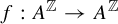 $f : A^{\mathbb {Z}} \to A^{\mathbb {Z}}$
is a CA and
$f : A^{\mathbb {Z}} \to A^{\mathbb {Z}}$
is a CA and $\mu $
is a shift-invariant measure on
$\mu $
is a shift-invariant measure on $A^{\mathbb {Z}}$
, then a given word w occurs in the
$A^{\mathbb {Z}}$
, then a given word w occurs in the $\mu $
-limit set
$\mu $
-limit set $\Omega _\mu (f)$
if and only if
$\Omega _\mu (f)$
if and only if $\mu (f^{-n}(w))$
does not converge to zero as n grows. In particular, if
$\mu (f^{-n}(w))$
does not converge to zero as n grows. In particular, if $\mu $
is the uniform Bernoulli measure, then w occurs in
$\mu $
is the uniform Bernoulli measure, then w occurs in $\Omega _\mu (f)$
if and only if
$\Omega _\mu (f)$
if and only if $\limsup _n |f^{-n}(w)| / |A|^{|w|+2nr}> 0$
. Generic limit sets of CAs have a combinatorial characterization as well.
$\limsup _n |f^{-n}(w)| / |A|^{|w|+2nr}> 0$
. Generic limit sets of CAs have a combinatorial characterization as well.
Lemma 3.1. [Reference Törmä10]
Let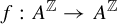 $f : A^{\mathbb {Z}} \to A^{\mathbb {Z}}$
be a CA and
$f : A^{\mathbb {Z}} \to A^{\mathbb {Z}}$
be a CA and $w \in A^*$
. Then, w occurs in the generic limit set
$w \in A^*$
. Then, w occurs in the generic limit set  if and only if there exists a ‘seed’ word $s \in A^*$
and a position
$s \in A^*$
and a position $i \in \mathbb {Z}$
such that for all
$i \in \mathbb {Z}$
such that for all $u, v \in A^*$
, there are infinitely many
$u, v \in A^*$
, there are infinitely many $n \in \mathbb {N}$
with
$n \in \mathbb {N}$
with $f^n([u s v]_{i - |u|}) \cap [w]_0 \neq \emptyset $
.
$f^n([u s v]_{i - |u|}) \cap [w]_0 \neq \emptyset $
.
All three limit sets are non-empty subshifts of $A^{\mathbb {Z}}$
. The limit set contains the other two, but in general, neither of the generic limit set or the
$A^{\mathbb {Z}}$
. The limit set contains the other two, but in general, neither of the generic limit set or the $\mu $
-limit set contains the other.
$\mu $
-limit set contains the other.
Lemma 3.2. [Reference Kůrka and Maass7, Reference Milnor9]
Let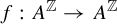 $f : A^{\mathbb {Z}} \to A^{\mathbb {Z}}$
be a CA. Then,
$f : A^{\mathbb {Z}} \to A^{\mathbb {Z}}$
be a CA. Then,  and
and $\Omega _\mu (f) \subseteq \Omega (f)$
.
$\Omega _\mu (f) \subseteq \Omega (f)$
.
4 Defect dynamics of rule 18
The local rule of ECA 18 is given in Table 1: the patterns 001 and 100 produce a 1 and all other patterns produce a 0. In the remainder of this paper, we denote this CA by $f_{18}$
, or just f when there is no danger of confusion. Figure 1 depicts a sample spacetime configuration of f. In this figure and in the following, time advances downward, a black square represents a 1 and a white square represent a 0. Hatched squares are undetermined symbols.
$f_{18}$
, or just f when there is no danger of confusion. Figure 1 depicts a sample spacetime configuration of f. In this figure and in the following, time advances downward, a black square represents a 1 and a white square represent a 0. Hatched squares are undetermined symbols.
The local rule of ECA 18.

An example run of rule 18. The centre of each kink is marked with a circle.

The dynamics of ECA rule 18 are a combination of several interacting processes. On regions where the gaps between 1-symbols have odd length, the dynamics is linear and well understood. A single gap of even length, called a kink, is persistent. Its movements are influenced by the linear part of the dynamics, but not vice versa: the linear dynamics commutes with a local operation that erases the kink. However, when two kinks collide, both are destroyed and the linear dynamics is perturbed.
Definition 4.1. Words of the form $1 0^{2n} 1$
with
$1 0^{2n} 1$
with $n \in \mathbb {N}$
are called kinks. The left border of the kink is its leftmost
$n \in \mathbb {N}$
are called kinks. The left border of the kink is its leftmost $1$
-symbol.
$1$
-symbol.
Let $x \in \{0,1\}^{\mathbb {Z}}$
. We denote
$x \in \{0,1\}^{\mathbb {Z}}$
. We denote $g_x(n) = \#\{-n \leq i \leq n \mid \text { there exists } k \in \mathbb {N}, x_{[i, i+2k+2]} = 1 0^{2k} 1\}$
. If
$g_x(n) = \#\{-n \leq i \leq n \mid \text { there exists } k \in \mathbb {N}, x_{[i, i+2k+2]} = 1 0^{2k} 1\}$
. If $\lim _{n \rightarrow \infty } g_x(n) = m < \infty $
, then we call m the number of kinks in x.
$\lim _{n \rightarrow \infty } g_x(n) = m < \infty $
, then we call m the number of kinks in x.
We call $\Sigma \subseteq \{0,1\}^*$
the set of words without kinks and
$\Sigma \subseteq \{0,1\}^*$
the set of words without kinks and  the set of configurations without kinks.
Proposition 4.1. [Reference Jen5]
Let $f_{90}$
be the function associated with ECA rule
$f_{90}$
be the function associated with ECA rule $90$
:
$90$
: $f_{90}(abc) = a \oplus c$
for all
$f_{90}(abc) = a \oplus c$
for all $abc \in \{0,1\}^3$
, where
$abc \in \{0,1\}^3$
, where ${\oplus }$
is addition modulo 2, or the xor function. Then, for all kinkless words
${\oplus }$
is addition modulo 2, or the xor function. Then, for all kinkless words $w \in \Sigma $
, we have
$w \in \Sigma $
, we have $f_{18}(w) = f_{90}(w)$
and for all kinkless configurations
$f_{18}(w) = f_{90}(w)$
and for all kinkless configurations  , we have $f_{18}(x) = f_{90}(x)$
.
$f_{18}(x) = f_{90}(x)$
.
We now investigate the dynamics of kinks under rule 18. When n is even, the following lemma characterizes the preimages of kinks. See Figure 2 for an illustration with $n = 13$
and
$n = 13$
and $n = 14$
.
$n = 14$
.
Lemma 4.2. Let $u \in \{0,1\}^*$
be a word such that
$u \in \{0,1\}^*$
be a word such that $f(u) = 1 0^n 1$
with
$f(u) = 1 0^n 1$
with $n \in \mathbb {N}$
. Then, either
$n \in \mathbb {N}$
. Then, either $u = 1 0^{n+2} 1$
or
$u = 1 0^{n+2} 1$
or $u = 00v00$
for a word
$u = 00v00$
for a word $v \in \{0,1\}^*$
that begins and ends in
$v \in \{0,1\}^*$
that begins and ends in $1$
, does not contain occurrences of
$1$
, does not contain occurrences of $00$
, and contains m occurrences of
$00$
, and contains m occurrences of $11$
with
$11$
with $m \not \equiv n \bmod 2$
.
$m \not \equiv n \bmod 2$
.
The word $u_1$
above contains an even number of kinks; hence,
$u_1$
above contains an even number of kinks; hence, $f(u_1)$
is not a kink. The word
$f(u_1)$
is not a kink. The word $u_2$
below contains an odd number of kinks; hence,
$u_2$
below contains an odd number of kinks; hence, $f(u_2)$
is a kink.
$f(u_2)$
is a kink.

Proof. The word u both begins and ends with $001$
or
$001$
or $100$
, a priori independently of each other. If u begins with
$100$
, a priori independently of each other. If u begins with $100$
, then it must contain
$100$
, then it must contain $000$
at positions
$000$
at positions $1, 2, 3, \ldots $
to avoid producing a
$1, 2, 3, \ldots $
to avoid producing a $1$
in
$1$
in $f(u)$
and, finally, it ends with
$f(u)$
and, finally, it ends with $001$
. Hence,
$001$
. Hence, $u = 1 0^{n+2} 1$
.
$u = 1 0^{n+2} 1$
.
Suppose then that u begins with $001$
. We necessarily have
$001$
. We necessarily have $n \geq 1$
. Consider the smallest
$n \geq 1$
. Consider the smallest $1 \leq i \leq n+2$
such that u contains
$1 \leq i \leq n+2$
such that u contains $00$
at position i; such an i exists since u ends with
$00$
at position i; such an i exists since u ends with $100$
or
$100$
or $001$
. Then, u contains
$001$
. Then, u contains $100$
at
$100$
at $i-1$
, which means
$i-1$
, which means $i = n+2$
and u ends with
$i = n+2$
and u ends with $100$
. Hence,
$100$
. Hence, $u = 001 w 100$
, with
$u = 001 w 100$
, with $w \in \{0,1\}^{n-2}$
not containing occurrences of
$w \in \{0,1\}^{n-2}$
not containing occurrences of $00$
.
$00$
.
Consider the word $1 w 1$
as a concatenation of
$1 w 1$
as a concatenation of $1$
s and
$1$
s and $01$
s, starting with a single
$01$
s, starting with a single $1$
. Each subsequent
$1$
. Each subsequent $1$
changes the parity of the length and adds a kink, while each
$1$
changes the parity of the length and adds a kink, while each $01$
keeps the parity of the length and adds no kinks. Hence, the number m of kinks in u satisfies
$01$
keeps the parity of the length and adds no kinks. Hence, the number m of kinks in u satisfies ${m \not \equiv |1w1| = n \bmod 2}$
.
${m \not \equiv |1w1| = n \bmod 2}$
.
In particular, Lemma 4.2 implies that new kinks cannot be created by rule 18.
Consider a kink $K = 1 0^{2n} 1$
occurring in an infinite configuration
$K = 1 0^{2n} 1$
occurring in an infinite configuration $x \in \{0,1\}^{\mathbb {Z}}$
. In
$x \in \{0,1\}^{\mathbb {Z}}$
. In $f(x)$
, K becomes
$f(x)$
, K becomes $1 0^{2n-2} 1$
if
$1 0^{2n-2} 1$
if $n \geq 1$
. If
$n \geq 1$
. If $n = 0$
(so that
$n = 0$
(so that $K = 11$
) and x is ‘typical’, K is contained in a subword of the form
$K = 11$
) and x is ‘typical’, K is contained in a subword of the form $u = 0 0 1 w 1 0 0$
, where w does not contain
$u = 0 0 1 w 1 0 0$
, where w does not contain $00$
as a subword. Then,
$00$
as a subword. Then, $f_{18}(u) = 1 0^{|w|+2} 1$
and by Lemma 4.2, this word is a kink if and only if the number of kinks in u is odd. Conversely, if the number of kinks in u is even, they are all destroyed. Hence, in ‘typical’ conditions, kinks can only be destroyed in pairs of
$f_{18}(u) = 1 0^{|w|+2} 1$
and by Lemma 4.2, this word is a kink if and only if the number of kinks in u is odd. Conversely, if the number of kinks in u is even, they are all destroyed. Hence, in ‘typical’ conditions, kinks can only be destroyed in pairs of $11$
s.
$11$
s.
As an ‘atypical’ limiting case, consider a configuration $x \in \{0,1\}^{\mathbb {Z}}$
such that some infinite tail
$x \in \{0,1\}^{\mathbb {Z}}$
such that some infinite tail $x_{[i, \infty )}$
contains no occurrences of
$x_{[i, \infty )}$
contains no occurrences of $00$
. Then,
$00$
. Then, $f(x)$
contains the same number of kinks as
$f(x)$
contains the same number of kinks as $f(y)$
, where y is obtained from x by replacing the infinite tail by one of
$f(y)$
, where y is obtained from x by replacing the infinite tail by one of $(01)^\infty $
or
$(01)^\infty $
or $(10)^\infty $
in a way that does not introduce a new
$(10)^\infty $
in a way that does not introduce a new $00$
. Similarly, when
$00$
. Similarly, when $f_{18}$
is applied to finite words, their length decreases, so it is inevitable that all kinks are eventually destroyed as described above, or ‘fall off the edge of the word’ as in
$f_{18}$
is applied to finite words, their length decreases, so it is inevitable that all kinks are eventually destroyed as described above, or ‘fall off the edge of the word’ as in ${f(1100) = 01}$
. The notion of stable words introduced in the following allows us to control this phenomenon.
${f(1100) = 01}$
. The notion of stable words introduced in the following allows us to control this phenomenon.
The following definitions are inspired by [Reference Kůrka6].
Definition 4.2. Let $w \in \{0,1\}^*$
be a word that contains
$w \in \{0,1\}^*$
be a word that contains $m \in \mathbb {N}$
kinks. The finite kinkless extension
$m \in \mathbb {N}$
kinks. The finite kinkless extension $\Sigma (w) \subseteq \{0,1\}^*$
of w is the set of those words that contains w as a subword and contain exactly m kinks. The kinkless extension of w at position
$\Sigma (w) \subseteq \{0,1\}^*$
of w is the set of those words that contains w as a subword and contain exactly m kinks. The kinkless extension of w at position $p \in \mathbb {Z}$
is
$p \in \mathbb {Z}$
is  .
.
Definition 4.3. The (regular) language of left unstable words is $(\epsilon + 0) (10)^* 11 (0+1)^*$
and the language of right unstable words is
$(\epsilon + 0) (10)^* 11 (0+1)^*$
and the language of right unstable words is $(0+1)^* 11 (01)^* (\epsilon + 0)$
. A word is unstable if it is left or right unstable. If a word is not unstable, it is stable. We denote by S the set of stable words.
$(0+1)^* 11 (01)^* (\epsilon + 0)$
. A word is unstable if it is left or right unstable. If a word is not unstable, it is stable. We denote by S the set of stable words.
In other words, a word is stable if it does not have a prefix of the form $0 (10)^n 11$
or
$0 (10)^n 11$
or $(10)^n 11$
or, symmetrically, a suffix of the form
$(10)^n 11$
or, symmetrically, a suffix of the form $11 (01)^n 0$
or
$11 (01)^n 0$
or $11 (01)^n$
for any
$11 (01)^n$
for any $n \geq 0$
. For example,
$n \geq 0$
. For example, $1010110001$
is a left unstable word, while
$1010110001$
is a left unstable word, while $001010110001$
is a stable word.
$001010110001$
is a stable word.
Intuitively, a word u is unstable if it contains an occurrence of the kink $11$
and can be extended into a word v such that the
$11$
and can be extended into a word v such that the $11$
evolves into a kink K in
$11$
evolves into a kink K in $f(v)$
, but
$f(v)$
, but $f(u)$
does not fully contain K. For example,
$f(u)$
does not fully contain K. For example, $u = 1010110001$
can be extended into
$u = 1010110001$
can be extended into ${v = 00u = 001010110001}$
. The word
${v = 00u = 001010110001}$
. The word $f(v) = 1000000101$
contains the kink
$f(v) = 1000000101$
contains the kink ${K = 10000001}$
, but
${K = 10000001}$
, but $f(u) = 00000101$
is kinkless. We imagine the kink
$f(u) = 00000101$
is kinkless. We imagine the kink $11$
‘falling off the edge’ as u evolves into
$11$
‘falling off the edge’ as u evolves into $f(u)$
.
$f(u)$
.
Kinkless extensions of stable words are also stable.
Proposition 4.3. Let $v \in S$
be a stable word. Then,
$v \in S$
be a stable word. Then, $\Sigma (v) \subseteq S$
.
$\Sigma (v) \subseteq S$
.
Proof. Let $u v w \in \Sigma (v)$
be a kinkless extension of v. Suppose for a contradiction that
$u v w \in \Sigma (v)$
be a kinkless extension of v. Suppose for a contradiction that $u v w$
is left unstable (the right unstable case being symmetric), so it has
$u v w$
is left unstable (the right unstable case being symmetric), so it has $(10)^n11$
or
$(10)^n11$
or $0(10)^n11$
as a prefix for some
$0(10)^n11$
as a prefix for some $n \geq 0$
. The kink
$n \geq 0$
. The kink $11$
occurs in v, so u is a prefix of
$11$
occurs in v, so u is a prefix of $(10)^n$
or
$(10)^n$
or $0(10)^n$
. Hence, v has a prefix of the form
$0(10)^n$
. Hence, v has a prefix of the form $0(10)^k 11$
or
$0(10)^k 11$
or $(10)^k 11$
for some
$(10)^k 11$
for some $k \geq 0$
, that is, it is left unstable.
$k \geq 0$
, that is, it is left unstable.
In stable words, kinks are necessarily erased in pairs. This is depicted in Figure 2. From this and the discussion preceding Definition 4.2, we infer the following proposition.
Proposition 4.4. Let $w \in \{0,1\}^*$
be a word that contains
$w \in \{0,1\}^*$
be a word that contains $n \in \mathbb {N}$
kinks. Then,
$n \in \mathbb {N}$
kinks. Then, $f(w)$
contains
$f(w)$
contains $m \leq n$
kinks. If
$m \leq n$
kinks. If $w \in S$
, then
$w \in S$
, then $m \equiv n \bmod 2$
.
$m \equiv n \bmod 2$
.
Proof. We first match every kink in $f(w)$
to an odd number of kinks in w so that no kink of w is matched to two kinks of
$f(w)$
to an odd number of kinks in w so that no kink of w is matched to two kinks of $f(w)$
. Namely, suppose
$f(w)$
. Namely, suppose $f(w)$
contains a kink
$f(w)$
contains a kink $K = 1 0^{2k} 1$
whose left border is at position i and right border at position
$K = 1 0^{2k} 1$
whose left border is at position i and right border at position $i+2k+1$
. By Lemma 4.2, the subword
$i+2k+1$
. By Lemma 4.2, the subword $w_{[i-1, i+2k+2]}$
contains an odd number of kinks, which we match with K. The first claim follows from this matching.
$w_{[i-1, i+2k+2]}$
contains an odd number of kinks, which we match with K. The first claim follows from this matching.
Suppose then that w is stable. We prove the second claim by showing that in the above matching, the number of kinks of w not matched to a kink of $f(w)$
is even. Suppose w contains a kink
$f(w)$
is even. Suppose w contains a kink $K = 10^{2k}1$
at position i. If
$K = 10^{2k}1$
at position i. If $k \geq 1$
, then
$k \geq 1$
, then $f(w)$
contains
$f(w)$
contains $10^{2(k-1)}1$
at position i, which is matched to K.
$10^{2(k-1)}1$
at position i, which is matched to K.
Suppose thus $k = 0$
, so that
$k = 0$
, so that $K = 11$
. Since w is stable, to the left of K, we must have an occurrence of
$K = 11$
. Since w is stable, to the left of K, we must have an occurrence of $00$
; let the rightmost one of those be at position
$00$
; let the rightmost one of those be at position $i - p$
. Then,
$i - p$
. Then, $p \geq 2$
and w contains
$p \geq 2$
and w contains $001$
at position
$001$
at position $i-p$
. Similarly, to the right of w, we find the leftmost occurrence of
$i-p$
. Similarly, to the right of w, we find the leftmost occurrence of $00$
at
$00$
at $i+q$
for some
$i+q$
for some $q \geq 2$
and then
$q \geq 2$
and then $100$
occurs at
$100$
occurs at $i+q-1$
. Thus, w contains
$i+q-1$
. Thus, w contains $001 u 100$
at position
$001 u 100$
at position $i-p$
, where
$i-p$
, where $u \in \{0,1\}^{q+p-4}$
has no occurrences of
$u \in \{0,1\}^{q+p-4}$
has no occurrences of $00$
. Then,
$00$
. Then, $f(w)$
contains
$f(w)$
contains $L = 10^{q+p-2}1$
at
$L = 10^{q+p-2}1$
at $i-p$
.
$i-p$
.
If $q+p-2$
is even, then L is a kink that is matched with K. If it is odd, then the length of u is also odd, so
$q+p-2$
is even, then L is a kink that is matched with K. If it is odd, then the length of u is also odd, so $1u1$
contains an even number of occurrences of the kink
$1u1$
contains an even number of occurrences of the kink $11$
that are not matched to any kink of
$11$
that are not matched to any kink of $f(w)$
. One of these is K and since K was arbitrary, it follows that every unmatched kink of w is part of such an even-sized collection.
$f(w)$
. One of these is K and since K was arbitrary, it follows that every unmatched kink of w is part of such an even-sized collection.
The most important property of stable words is that they behave nicely with respect to kinkless extensions.
Proposition 4.5. Let $w \in S$
be a stable word. Then,
$w \in S$
be a stable word. Then, $f(\Sigma (w)) \subseteq \Sigma (f(w))$
and
$f(\Sigma (w)) \subseteq \Sigma (f(w))$
and  for all $p \in \mathbb {Z}$
. If w is not of the form
$p \in \mathbb {Z}$
. If w is not of the form $0^{\alpha } (10)^{n} 1^{\beta }$
with
$0^{\alpha } (10)^{n} 1^{\beta }$
with $\alpha , \beta \in \{0,1\}$
and
$\alpha , \beta \in \{0,1\}$
and $n \in \mathbb {N}$
, then both inclusions are equalities.
$n \in \mathbb {N}$
, then both inclusions are equalities.
In the case where w is of the form $0^{\alpha } (10)^{n} 1^{\beta }$
, the result holds ‘up to parity’: for each
$0^{\alpha } (10)^{n} 1^{\beta }$
, the result holds ‘up to parity’: for each ${u = a f(w) b \in \Sigma (f(w))}$
with
${u = a f(w) b \in \Sigma (f(w))}$
with $u_i = 0$
, whenever
$u_i = 0$
, whenever $i \not \equiv |a| + \alpha \bmod 2$
, we have
$i \not \equiv |a| + \alpha \bmod 2$
, we have ${u \in f(\Sigma (w))}$
.
${u \in f(\Sigma (w))}$
.
We also explain here the error in [Reference Kůrka6]. Page 15 of the article contains the claim that rule 18 is $\Sigma _p$
-permuting, which in our notation means
$\Sigma _p$
-permuting, which in our notation means $f(\Sigma (w)) \subseteq \Sigma (f(w))$
for every word
$f(\Sigma (w)) \subseteq \Sigma (f(w))$
for every word $w \in \{0,1\}^*$
of length at least three. This may be false if w is not stable. For example, take
$w \in \{0,1\}^*$
of length at least three. This may be false if w is not stable. For example, take $w = 0011$
, for which
$w = 0011$
, for which $f(w) = 10$
, and consider
$f(w) = 10$
, and consider $101 \in \Sigma (f(w))$
.
$101 \in \Sigma (f(w))$
.
Proof. Let $a w b \in \Sigma (w)$
. We claim that
$a w b \in \Sigma (w)$
. We claim that $f(a w b) \in \Sigma (f(w))$
, that is, all kinks of
$f(a w b) \in \Sigma (f(w))$
, that is, all kinks of $f(a w b)$
are contained in
$f(a w b)$
are contained in $f(w)$
. Consider any subword u of
$f(w)$
. Consider any subword u of $a w b$
such that
$a w b$
such that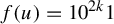 $f(u) = 1 0^{2k} 1$
is a kink. By Lemma 4.2, there are two possibilities.
$f(u) = 1 0^{2k} 1$
is a kink. By Lemma 4.2, there are two possibilities.
-
(1)
$u = 1 0^{2k+2} 1$
is itself a kink and wider than
$f(u)$
. If
$f(u)$
is not contained in
$f(w)$
, then u is not contained in w, which contradicts
$a w b \in \Sigma (w)$
. -
(2)
$u = 0 0 v 0 0$
for some word v that begins and ends with
$1$
, does not contain an occurrence of
$0 0$
, and contains at least one occurrence of
$1 1$
(which must be within w). If
$f(u)$
is not contained in
$f(w)$
, then u is not contained in w, which contradicts the stability of w.



Suppose then that w is not of the form $0^{\alpha } (10)^{n} 1^{\beta }$
and let
$0^{\alpha } (10)^{n} 1^{\beta }$
and let $a f(w) b \in \Sigma (f(w))$
. We claim that some
$a f(w) b \in \Sigma (f(w))$
. We claim that some $c w d \in \Sigma (w)$
satisfies
$c w d \in \Sigma (w)$
satisfies $f(c w d) = a f(w) b$
. It suffices to consider
$f(c w d) = a f(w) b$
. It suffices to consider $|a| = 1$
and
$|a| = 1$
and $|b| = 0$
; the general result follows by iteration and symmetry. There are a few cases.
$|b| = 0$
; the general result follows by iteration and symmetry. There are a few cases.
-
(1) If
$a = 0$
and w does not begin with
$0 1$
, we can choose
$c = 0$
. -
(2) If
$a = 0$
and w begins with
$0 1$
, we can choose
$c = 1$
. -
(3) If
$a = 1$
and w begins with
$0 0$
, then the assumption
$a f(w) b \in \Sigma (f(w))$
implies that either
$w = 0^{|w|}$
or w begins with
$0^{2n+1} 1$
for some
$n \geq 1$
. We can then choose
$c = 1$
. -
(4) If
$a = 1$
and w begins with
$0 1$
, we can choose
$c = 0$
. -
(5) Suppose
$a = 1$
and w begins with
$1$
. By stability and the assumption that w is not of the form
$0^{\alpha } (10)^{n} 1^{\beta }$
, it must begin with
$1 (0 1)^n 0 0$
for some
$n \in \mathbb {N}$
. However, then,
$a f(w)$
begins with
$1 0^{2n} 1$
, which contradicts
$a f(w) b \in \Sigma (f(w))$
. Hence, this case is impossible.





The claims about  follow easily.
From this and Proposition 4.1, we get the following corollary.
Corollary 4.6. Let $w \in S$
be a stable word of length at least 2 and not of the form
$w \in S$
be a stable word of length at least 2 and not of the form $0^\alpha (10)^n 1^\beta $
for
$0^\alpha (10)^n 1^\beta $
for $\alpha , \beta \in \{0,1\}$
. For each
$\alpha , \beta \in \{0,1\}$
. For each $u = a f(w) b \in \Sigma (f(w))$
, there exist unique
$u = a f(w) b \in \Sigma (f(w))$
, there exist unique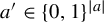 ${a' \in \{0,1\}^{|a|}}$
and
${a' \in \{0,1\}^{|a|}}$
and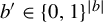 $b' \in \{0,1\}^{|b|}$
with
$b' \in \{0,1\}^{|b|}$
with $f(a' w b') = u$
.
$f(a' w b') = u$
.
Corollary 4.7. We have $f(\Sigma ) = \Sigma $
and
$f(\Sigma ) = \Sigma $
and  .
.
Finally, we make use of the following result to bring down the number of kinks in an initial configuration.
Theorem 4.8. [Reference Jen5, Proposition 5]
Let $x \in \{0,1\}^{\mathbb {Z}}$
be a configuration with a finite number of
$x \in \{0,1\}^{\mathbb {Z}}$
be a configuration with a finite number of $1$
-symbols. Then, for all large enough
$1$
-symbols. Then, for all large enough $n \in \mathbb {N}$
, the configuration
$n \in \mathbb {N}$
, the configuration $f^n(x)$
contains at most one kink. Moreover, this
$f^n(x)$
contains at most one kink. Moreover, this $f^n(x)$
is kinkless if and only if x has an even number of kinks.
$f^n(x)$
is kinkless if and only if x has an even number of kinks.
Corollary 4.9. Let $w \in \{0,1\}^*$
be a word with an even number of kinks. Then, there exists
$w \in \{0,1\}^*$
be a word with an even number of kinks. Then, there exists $n \in \mathbb {N}$
such that
$n \in \mathbb {N}$
such that $f^n(\Sigma (0^n \cdot w \cdot 0^n)) \subseteq \Sigma $
and
$f^n(\Sigma (0^n \cdot w \cdot 0^n)) \subseteq \Sigma $
and  for all ${p \in \mathbb {Z}}$
.
${p \in \mathbb {Z}}$
.
Proof. Let $x \in \{0,1\}^{\mathbb {Z}}$
be the configuration with w at position zero and
$x \in \{0,1\}^{\mathbb {Z}}$
be the configuration with w at position zero and $0$
-symbols everywhere else. By Theorem 4.8, for some
$0$
-symbols everywhere else. By Theorem 4.8, for some $n \geq 2$
, the configuration
$n \geq 2$
, the configuration $f^n(x)$
is kinkless. The word
$f^n(x)$
is kinkless. The word $u = f^n(0^n \cdot w \cdot 0^n) \in \Sigma $
occurs in
$u = f^n(0^n \cdot w \cdot 0^n) \in \Sigma $
occurs in $f^n(x)$
at position zero. Since
$f^n(x)$
at position zero. Since $0^n \cdot w \cdot 0^n$
is stable, by Proposition 4.5, we have
$0^n \cdot w \cdot 0^n$
is stable, by Proposition 4.5, we have $f^n(\Sigma (0^n \cdot w \cdot 0^n)) \subseteq \Sigma (f^n(0^n \cdot w \cdot 0^n)) = \Sigma (u) \subseteq \Sigma $
. The second claim is similar.
$f^n(\Sigma (0^n \cdot w \cdot 0^n)) \subseteq \Sigma (f^n(0^n \cdot w \cdot 0^n)) = \Sigma (u) \subseteq \Sigma $
. The second claim is similar.
5 The generic limit set of rule 18
In this section, we characterize the set of words with at most two kinks that occur in the generic limit set of rule 18. In principle, the cases of zero or one kink (Theorems 5.1 and 5.5) are subsumed by the case of two kinks (Theorem 5.9), since all words of at most one kink occur as subwords of two-kink words in the generic limit set. We present proofs for these cases as well to showcase our techniques in a simpler context. In the case of zero kinks, the idea is simple: use Theorem 4.8 to erase all existing kinks, then use the permutivity of $f_{18}$
on kinkless configurations to produce an arbitrary kinkless word.
$f_{18}$
on kinkless configurations to produce an arbitrary kinkless word.
5.1 Kinkless words
We begin with the easiest case of kinkless words.
Theorem 5.1. Every word with no kinks occurs in  .
.
Proof. Let $w \in \Sigma $
be a kinkless word. We consider the seed
$w \in \Sigma $
be a kinkless word. We consider the seed $\epsilon $
at position
$\epsilon $
at position $i = 0$
. Let
$i = 0$
. Let $q_1, q_2 \in \{0,1\}^*$
be arbitrary words. Our goal is to show that
$q_1, q_2 \in \{0,1\}^*$
be arbitrary words. Our goal is to show that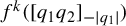 $f^k([q_1 q_2]_{-|q_1|})$
intersects
$f^k([q_1 q_2]_{-|q_1|})$
intersects $[w]_0$
for infinitely many k.
$[w]_0$
for infinitely many k.
There exists a word $r \in \{0,1\}^*$
such that
$r \in \{0,1\}^*$
such that $q_1 q_2 r$
contains an even number of kinks. According to Corollary 4.9, there exists
$q_1 q_2 r$
contains an even number of kinks. According to Corollary 4.9, there exists $n_0 \in \mathbb {N}$
such that for all
$n_0 \in \mathbb {N}$
such that for all $n \geq n_0$
and all configurations
$n \geq n_0$
and all configurations  , the image $f^n(x)$
contains no kinks. In the following, we call
$f^n(x)$
contains no kinks. In the following, we call $u = 0^{2n+2} \cdot q_1 q_2 r \cdot 0^{2n+2}$
.
$u = 0^{2n+2} \cdot q_1 q_2 r \cdot 0^{2n+2}$
.
For each $m \leq n$
, the word
$m \leq n$
, the word $f^m(u)$
begins and ends in
$f^m(u)$
begins and ends in $0 0$
, so it is stable and not of the form
$0 0$
, so it is stable and not of the form $0^\alpha (1 0)^k 1^\beta $
for
$0^\alpha (1 0)^k 1^\beta $
for $\alpha , \beta \in \{0,1\}$
and
$\alpha , \beta \in \{0,1\}$
and $k \in \mathbb {N}$
. By iterating Proposition 4.5, we have
$k \in \mathbb {N}$
. By iterating Proposition 4.5, we have

The word $f^n(u)$
and, hence, each configuration in
$f^n(u)$
and, hence, each configuration in  contain no kinks. Suppose that $|q_1|, |q_2 r|$
are both even, and all
$|q_1|, |q_2 r|$
are both even, and all $1$
-symbols in
$1$
-symbols in $f^n(u)$
and w occur in even positions (the other cases are handled similarly). Then, all
$f^n(u)$
and w occur in even positions (the other cases are handled similarly). Then, all $1$
-symbols in
$1$
-symbols in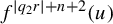 $f^{|q_2r|+n+2}(u)$
also occur at even positions, so
$f^{|q_2r|+n+2}(u)$
also occur at even positions, so $f^{|q_2r|+n+2}(u) w$
contains no kinks:
$f^{|q_2r|+n+2}(u) w$
contains no kinks: $f^{|q_2r|+n+2}(u) w \in \Sigma (f^{|q_2r|+n+2}(u))$
. Again by iterating Proposition 4.5 (and the remark following it), we obtain
$f^{|q_2r|+n+2}(u) w \in \Sigma (f^{|q_2r|+n+2}(u))$
. Again by iterating Proposition 4.5 (and the remark following it), we obtain  . Hence, as long as $q_1$
and
$q_1$
and $q_2$
are long enough (as we can choose them to be), there exists a word v of length
$q_2$
are long enough (as we can choose them to be), there exists a word v of length $|w|$
such that
$|w|$
such that $f^n(u) v$
contains no kinks and
$f^n(u) v$
contains no kinks and $f^{|q_2 r|+n+2}(f^n(u) v)$
ends in w. In total, we have
$f^{|q_2 r|+n+2}(f^n(u) v)$
ends in w. In total, we have

which shows that $[w]_0$
intersects
$[w]_0$
intersects $f^k([q_1 q_2]_{-|q_1|})$
for some
$f^k([q_1 q_2]_{-|q_1|})$
for some $k \geq n$
. Since n can be arbitrarily large, Lemma 3.1 gives that w occurs in
$k \geq n$
. Since n can be arbitrarily large, Lemma 3.1 gives that w occurs in  .
.
5.2 Words with one kink
In this section, we show that all words with exactly one kink occur in the generic limit set of rule 18. The idea is to again erase all existing kinks except one, then direct it to a specific position and use permutivity to control the kinkless region around it.
Lemma 5.2. Let w be a one-kink word. Then, there exists $n \in \mathbb {N}$
such that
$n \in \mathbb {N}$
such that $f^n(w)$
is a left unstable or right unstable word.
$f^n(w)$
is a left unstable or right unstable word.
Proof. We proceed by induction on $|w|$
. If
$|w|$
. If $|w| = 2$
or
$|w| = 2$
or $|w| = 3$
, then w must contain
$|w| = 3$
, then w must contain $11$
as a prefix or suffix, so it is already unstable. Otherwise, if w is stable, it is easy to see that
$11$
as a prefix or suffix, so it is already unstable. Otherwise, if w is stable, it is easy to see that $f(w)$
is also a one-kink word. By the induction hypothesis, there exists some
$f(w)$
is also a one-kink word. By the induction hypothesis, there exists some $n'$
such that
$n'$
such that $f^{n'}(f(w))$
is left or right unstable. Hence, the property is true for
$f^{n'}(f(w))$
is left or right unstable. Hence, the property is true for $n = n'+1$
.
$n = n'+1$
.
Definition 5.1. A left kink word is a finite word that begins with a kink and contains no other kinks. The set of left kink words is denoted $L \subset \{0,1\}^*$
.
$L \subset \{0,1\}^*$
.
The following lemma tells us that $11$
can be produced from any word in L. As any one-kink word can be produced in one step from
$11$
can be produced from any word in L. As any one-kink word can be produced in one step from $11$
, it follows from this lemma that any one-kink word can be produced from any word of L.
$11$
, it follows from this lemma that any one-kink word can be produced from any word of L.
Lemma 5.3. For all left kink words $w \in L$
, there exists
$w \in L$
, there exists $n \in \mathbb {N}$
such that
$n \in \mathbb {N}$
such that $\Sigma (11) \subseteq f^n(\Sigma (w))$
.
$\Sigma (11) \subseteq f^n(\Sigma (w))$
.
Proof. We prove the result by induction on the size of w. There are a few cases.
-
(1) If
$|w| = 2$
, then
$w = 11$
and the result is immediate. Otherwise,
$|w| \geq 3$
and we suppose that the property holds for all shorter words. -
(2) If w begins with
$10^{2k}1$
for some
$k> 0$
, then
$f(w) \in L$
and
$|f(w)| < |w|$
. Then,
$\Sigma (11) \subseteq f^n(\Sigma (f(w)))$
for some
$n \in \mathbb {N}$
by the induction hypothesis and since
${w \in S}$
, Proposition 4.5 gives
$f^n(\Sigma (f(w))) \subseteq f^{n+1}(\Sigma (w))$
. -
(3) If w is of the form
$11 (01)^k 0$
for some
$k \in \mathbb {N}$
, then we consider
$w' = 00 w 0 \in \Sigma (w)$
. We have
$f^{k+2}(w') = 11$
and
$\Sigma (f^{k+2}(w')) = f^{k+2}(\Sigma (w'))$
by Proposition 4.5, and we can choose
$n = k+2$
. -
(4) If w is of the form
$11 (01)^k$
with
$k \geq 1$
, then we consider
$w' = 00 w 00 \in \Sigma (w)$
and conclude as in the previous case. -
(5) If w is of the form
$11 (01)^k 00 u$
for some word u and
$k \in \mathbb {N}$
, then we consider
${w' = 00 w}$
. We have
$f(w') = 1 0^{2(k+1)} 1 v$
for some word v. Then, we treat
$f(w')$
as in case (2) and conclude.







These cases are exhaustive. Namely, we know w begins with $10^{2k}1$
. If
$10^{2k}1$
. If $k \geq 1$
, we are in case (2). If not, then either
$k \geq 1$
, we are in case (2). If not, then either $w = 11$
(case (1)) or w continues with alternating
$w = 11$
(case (1)) or w continues with alternating $0$
s and
$0$
s and $1$
s until the first occurrence of
$1$
s until the first occurrence of $00$
(case (5)), if any, as it does not contain another
$00$
(case (5)), if any, as it does not contain another $11$
. Cases (3) and (4) correspond to w containing no
$11$
. Cases (3) and (4) correspond to w containing no $00$
, so the alternating
$00$
, so the alternating $0$
s and
$0$
s and $1$
s continue until the end of w.
$1$
s continue until the end of w.
The following lemma is a direct consequence of the previous one; it shows that any one-kink word can be produced at any position from any other one-kink word at position zero.
Lemma 5.4. Let w and $w'$
be two words containing one kink. Then, for all
$w'$
be two words containing one kink. Then, for all $i \in \mathbb {Z}$
, there exists
$i \in \mathbb {Z}$
, there exists $n \in \mathbb {N}$
such that
$n \in \mathbb {N}$
such that  .
.
The idea is to let the kink of w evolve into a $11$
whose context we can freely choose. Then, we can easily produce another
$11$
whose context we can freely choose. Then, we can easily produce another $11$
at any desired position at a later time step. This
$11$
at any desired position at a later time step. This $11$
can then be transformed into
$11$
can then be transformed into $w'$
in a single step.
$w'$
in a single step.
Proof. Let $k \in \mathbb {N}$
be the smallest number for which
$k \in \mathbb {N}$
be the smallest number for which $f^k(w)$
is unstable. We may assume that it is left unstable. By Proposition 4.4,
$f^k(w)$
is unstable. We may assume that it is left unstable. By Proposition 4.4, $f^k(w)$
contains one kink, which must be
$f^k(w)$
contains one kink, which must be $11$
. Then,
$11$
. Then, $f(00 \cdot f^k(w))$
is a left kink word.
$f(00 \cdot f^k(w))$
is a left kink word.
According to Lemma 5.3, there exists $m \in \mathbb {N}$
such that
$m \in \mathbb {N}$
such that $\Sigma (11) \subseteq f^m(\Sigma (f(00\cdot f^k(w))))$
and Proposition 4.5 gives
$\Sigma (11) \subseteq f^m(\Sigma (f(00\cdot f^k(w))))$
and Proposition 4.5 gives $f^m(\Sigma (f(00\cdot f^k(w)))) \subseteq f^{k + m+1}(\Sigma (w))$
. We can deduce that there exists a position
$f^m(\Sigma (f(00\cdot f^k(w)))) \subseteq f^{k + m+1}(\Sigma (w))$
. We can deduce that there exists a position $p \in \mathbb {Z}$
such that
$p \in \mathbb {Z}$
such that  .
.
Since $w'$
is a one-kink word, it has the form
$w'$
is a one-kink word, it has the form $a 1 0^{2\ell } 1 b$
for some
$a 1 0^{2\ell } 1 b$
for some $a, b \in \{0,1\}^*$
and
$a, b \in \{0,1\}^*$
and $\ell \in \mathbb {N}$
. Suppose that
$\ell \in \mathbb {N}$
. Suppose that $p \leq |a|$
, the other case being similar. Consider
$p \leq |a|$
, the other case being similar. Consider $w_0 = 0011 (01)^{|a|-p+1}00$
. We have
$w_0 = 0011 (01)^{|a|-p+1}00$
. We have $f^{|a|-p + 3}(w_0) = 11$
and all the intermediate steps are stable; hence, Proposition 4.5 gives
$f^{|a|-p + 3}(w_0) = 11$
and all the intermediate steps are stable; hence, Proposition 4.5 gives  .
.
The word $u = 0011 (01)^{\ell } 00$
is stable and
$u = 0011 (01)^{\ell } 00$
is stable and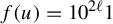 $f(u) = 1 0^{2\ell } 1$
, so we obtain
$f(u) = 1 0^{2\ell } 1$
, so we obtain  by Proposition 4.5. Putting everything together, we have
  , as claimed.
Theorem 5.5. Every one-kink word occurs in  .
.
Proof. Let $w \in \{0,1\}^*$
be a one-kink word. We consider the seed
$w \in \{0,1\}^*$
be a one-kink word. We consider the seed $\epsilon $
. Let
$\epsilon $
. Let $q_1, q_2 \in \{0,1\}^*$
be words, and choose
$q_1, q_2 \in \{0,1\}^*$
be words, and choose $r \in \{0,1\}^*$
and
$r \in \{0,1\}^*$
and $n_0 \leq n \in \mathbb {N}$
as in the proof of Theorem 5.1, except that
$n_0 \leq n \in \mathbb {N}$
as in the proof of Theorem 5.1, except that $q_1 \cdot q_2 \cdot r$
should contain an odd number of kinks and every configuration in
$q_1 \cdot q_2 \cdot r$
should contain an odd number of kinks and every configuration in  should contain a single kink. Call $u = 0^{2n+2} \cdot q_1 \cdot \epsilon \cdot q_2 \cdot r \cdot 0^{2n+2}$
.
$u = 0^{2n+2} \cdot q_1 \cdot \epsilon \cdot q_2 \cdot r \cdot 0^{2n+2}$
.
For all $m \leq n$
,
$m \leq n$
, $f^m(u)$
is a stable one-kink word, so that
$f^m(u)$
is a stable one-kink word, so that  . According to Lemma 5.4, there exists $k \in \mathbb {N}$
such that
$k \in \mathbb {N}$
such that  . This means that $[w]$
intersects
$[w]$
intersects $f^{n+k}([q_1 q_2]_{-|q_1|})$
. Since n can be arbitrarily large, Lemma 3.1 implies that w occurs in
$f^{n+k}([q_1 q_2]_{-|q_1|})$
. Since n can be arbitrarily large, Lemma 3.1 implies that w occurs in  .
.
5.3 Words with two kinks
In this section, we determine the set P of words with exactly two kinks that appear in the generic limit set of rule $18$
. The idea is to erase all existing kinks except two, then bring the two kinks close to each other to produce the word
$18$
. The idea is to erase all existing kinks except two, then bring the two kinks close to each other to produce the word $1101001$
and then to show that all words of P can be produced from a two-kink configuration that contains
$1101001$
and then to show that all words of P can be produced from a two-kink configuration that contains $1101001$
at any position.
$1101001$
at any position.
Denote the reversal of a word $w \in \{0,1\}^*$
by
$w \in \{0,1\}^*$
by $w^R$
. For a set
$w^R$
. For a set $L \subseteq \{0,1\}^*$
, we denote
$L \subseteq \{0,1\}^*$
, we denote $L^R = \{w^R \mid w \in L\}$
.
$L^R = \{w^R \mid w \in L\}$
.
Definition 5.2. We call $B \subset \{0,1\}^*$
the set of two-kink words that begin with
$B \subset \{0,1\}^*$
the set of two-kink words that begin with $11$
, end with a kink (which can overlap with the prefix
$11$
, end with a kink (which can overlap with the prefix $11$
) and are not of the form
$11$
) and are not of the form $11 \cdot (01)^k \cdot 1$
for
$11 \cdot (01)^k \cdot 1$
for $k \in \mathbb {N}$
.
$k \in \mathbb {N}$
.
This definition is useful as B is a set of words containing two kinks that we can prevent from colliding. The following lemma states that we can direct the two kinks of a word of B so that they can be brought close and produce the word $1101001$
.
$1101001$
.
Lemma 5.6. Let $w \in B \cup B^R$
be a word. Then, there exists
$w \in B \cup B^R$
be a word. Then, there exists $n \in \mathbb {N}$
such that
$n \in \mathbb {N}$
such that $\Sigma (1101001) \subseteq f^n(\Sigma (w))$
.
$\Sigma (1101001) \subseteq f^n(\Sigma (w))$
.
The proof of this lemma contains many different cases; however, the cases are quite natural and the proof of each case is easy. The main idea of the proof is that by forbidding the kinks to move away from each other, it is possible to bring them eventually closer. When the two kinks are on the verge of colliding, it is possible to avoid the collision and to instead make them closer to each other as illustrated in Figure 3.
Proof. First, we show that it suffices to prove the result for $w \in B$
. Namely, then for
$w \in B$
. Namely, then for $w \in B^R$
, we have
$w \in B^R$
, we have $\Sigma (1001011) \subseteq f^n(\Sigma (w))$
for some
$\Sigma (1001011) \subseteq f^n(\Sigma (w))$
for some $n \in \mathbb {N}$
by symmetry and a direct computation shows that
$n \in \mathbb {N}$
by symmetry and a direct computation shows that $f^3(10 \cdot 1001011 \cdot 0100) = 1101001$
, so that
$f^3(10 \cdot 1001011 \cdot 0100) = 1101001$
, so that $\Sigma (1101001) \subseteq f^{n+3}(\Sigma (w))$
.
$\Sigma (1101001) \subseteq f^{n+3}(\Sigma (w))$
.
Two kinks collide and annihilate each other, but it is possible to avoid collision by making the leftmost kink longer.

Let then $w \in B$
be arbitrary. We proceed by induction on the length of w.
$w \in B$
be arbitrary. We proceed by induction on the length of w.
Case 0: $|w| \leq 7$
. There are only a few possibilities for w. If
$|w| \leq 7$
. There are only a few possibilities for w. If $w = 1101001$
, the result is immediate. If
$w = 1101001$
, the result is immediate. If $w = 11001$
, then
$w = 11001$
, then $\Sigma (1001011) \subseteq f^3(\Sigma (w))$
as shown in Figure 4 and
$\Sigma (1001011) \subseteq f^3(\Sigma (w))$
as shown in Figure 4 and $\Sigma (1101001) \subseteq f^3(\Sigma (1001011))$
as shown in Figure 5; hence,
$\Sigma (1101001) \subseteq f^3(\Sigma (1001011))$
as shown in Figure 5; hence, $\Sigma (1101001) \subseteq f^6(\Sigma (w))$
. If
$\Sigma (1101001) \subseteq f^6(\Sigma (w))$
. If $w = 1100001$
, then
$w = 1100001$
, then $\Sigma (1101001) \subseteq f^2(\Sigma (1001011)) \subseteq f^5(\Sigma (w))$
as shown in Figure 6. If
$\Sigma (1101001) \subseteq f^2(\Sigma (1001011)) \subseteq f^5(\Sigma (w))$
as shown in Figure 6. If $w = 1100011$
, then
$w = 1100011$
, then $\Sigma (1101001) \subseteq f^8(\Sigma (000010 \cdot w \cdot 0101000100)) \subseteq f^8(\Sigma (w))$
as shown in Figure 7.
$\Sigma (1101001) \subseteq f^8(\Sigma (000010 \cdot w \cdot 0101000100)) \subseteq f^8(\Sigma (w))$
as shown in Figure 7.
We can see here that $w = 0010101100101$
is stable,
$w = 0010101100101$
is stable, $f(w)$
and
$f(w)$
and $f^2(w)$
are stable, and
$f^2(w)$
are stable, and $f^3(w) = 1001011$
. We can deduce that
$f^3(w) = 1001011$
. We can deduce that $\Sigma (1001011) = f^3(\Sigma (w)) \subseteq f^3(\Sigma (1001011))$
.
$\Sigma (1001011) = f^3(\Sigma (w)) \subseteq f^3(\Sigma (1001011))$
.

We can see here that $w = 1010010110100$
is stable,
$w = 1010010110100$
is stable, $f(w)$
and
$f(w)$
and $f^2(w)$
are stable, and
$f^2(w)$
are stable, and $f^3(w) = 1101001$
. We can deduce that
$f^3(w) = 1101001$
. We can deduce that $\Sigma (1101001) = f^3(\Sigma (w)) \subseteq f^3(\Sigma (1001011))$
.
$\Sigma (1101001) = f^3(\Sigma (w)) \subseteq f^3(\Sigma (1001011))$
.

We can see here that $w = 00101100001$
is stable,
$w = 00101100001$
is stable, $f(w)$
is stable and
$f(w)$
is stable and $f^2(w) = 1001011$
. We can deduce that
$f^2(w) = 1001011$
. We can deduce that $\Sigma (1101001) \subseteq f^2(\Sigma (1001011)) = f^5(\Sigma (w)) \subseteq f^5(\Sigma (1100001))$
.
$\Sigma (1101001) \subseteq f^2(\Sigma (1001011)) = f^5(\Sigma (w)) \subseteq f^5(\Sigma (1100001))$
.

We can see here that $w = 00001011000110101000100$
is stable,
$w = 00001011000110101000100$
is stable, $f(w), f^2(w), \ldots , f^7(w)$
are stable and
$f(w), f^2(w), \ldots , f^7(w)$
are stable and $f^8(w) = 1101001$
. We can deduce that
$f^8(w) = 1101001$
. We can deduce that $\Sigma (1101001) = f^8(\Sigma (w)) \subseteq f^8(\Sigma (1100011))$
.
$\Sigma (1101001) = f^8(\Sigma (w)) \subseteq f^8(\Sigma (1100011))$
.

For the rest of the proof, we suppose $|w|> 7$
and all shorter words of
$|w|> 7$
and all shorter words of $B \cup B^R$
satisfy the claim.
$B \cup B^R$
satisfy the claim.
Case 1: $w = 11 0^{2k} 1$
for some
$w = 11 0^{2k} 1$
for some $k \in \mathbb {N}$
. Then,
$k \in \mathbb {N}$
. Then, $k \geq 3$
. We consider
$k \geq 3$
. We consider $w_0 = 00 \cdot w$
. Then,
$w_0 = 00 \cdot w$
. Then, $f^2(w_0) = 1101 0^{2(k-2)} 1$
. Evidently,
$f^2(w_0) = 1101 0^{2(k-2)} 1$
. Evidently, $f^2(w_0) \in B$
,
$f^2(w_0) \in B$
, $|f^2(w_0)| < |w|$
and
$|f^2(w_0)| < |w|$
and $\Sigma (f^2(w_0)) \subseteq f^2(\Sigma (w))$
, so we can conclude by induction.
$\Sigma (f^2(w_0)) \subseteq f^2(\Sigma (w))$
, so we can conclude by induction.
Case 2: $w = 1101 0^{2k} 1$
for some
$w = 1101 0^{2k} 1$
for some $k \in \mathbb {N}$
. Then,
$k \in \mathbb {N}$
. Then, $k \geq 2$
. We consider
$k \geq 2$
. We consider $w_0 = 00 \cdot w$
. If
$w_0 = 00 \cdot w$
. If $k = 2$
, then
$k = 2$
, then $f^2(w_0) = 1001011$
, which we treated in Case 0. If
$f^2(w_0) = 1001011$
, which we treated in Case 0. If $k = 3$
, then
$k = 3$
, then $f^3(w_0) = 1100011$
, which we already treated as well. If
$f^3(w_0) = 1100011$
, which we already treated as well. If $k \geq 4$
, then
$k \geq 4$
, then $f^3(w_0) = 110001 0^{2(k-3)} 1 \in B$
and
$f^3(w_0) = 110001 0^{2(k-3)} 1 \in B$
and $|f^3(w_0)| < |w|$
. We can then conclude by induction.
$|f^3(w_0)| < |w|$
. We can then conclude by induction.
Case 3: $w = 11 (01)^k 0^{2\ell } 1$
for some
$w = 11 (01)^k 0^{2\ell } 1$
for some $k, \ell \geq 1$
. We consider
$k, \ell \geq 1$
. We consider $w_0 = 00 \cdot w$
. Then,
$w_0 = 00 \cdot w$
. Then, $f(w_0) = 1 0^{2(k+1)} 1 0^{2(\ell -1)} 1$
, so that for
$f(w_0) = 1 0^{2(k+1)} 1 0^{2(\ell -1)} 1$
, so that for $m = \min (k+1, \ell -1)$
, the word
$m = \min (k+1, \ell -1)$
, the word $w' = f^{m+1}(w_0)$
begins and/or ends with
$w' = f^{m+1}(w_0)$
begins and/or ends with $11$
. If
$11$
. If $\ell = 1$
, then
$\ell = 1$
, then $|w'| = |w|$
and we can handle
$|w'| = |w|$
and we can handle $w'$
as in Case 1. Otherwise,
$w'$
as in Case 1. Otherwise, $|w'| < |w|$
. If
$|w'| < |w|$
. If $w' \in B \cup B^R$
, then we can conclude by induction. If
$w' \in B \cup B^R$
, then we can conclude by induction. If $w' \notin B \cup B^R$
, then
$w' \notin B \cup B^R$
, then $\ell = k+2$
and
$\ell = k+2$
and $w' = 11 (01)^{2(k+1)} 1$
. Then, we instead consider
$w' = 11 (01)^{2(k+1)} 1$
. Then, we instead consider $w_1 = 0010 \cdot w$
, for which
$w_1 = 0010 \cdot w$
, for which $f^{k+1}(w_1) = 1001 \cdot u \cdot 11$
for some word u of length
$f^{k+1}(w_1) = 1001 \cdot u \cdot 11$
for some word u of length $2(k+1)$
. This word is in
$2(k+1)$
. This word is in $B^R$
and is shorter than w, so we conclude by induction.
$B^R$
and is shorter than w, so we conclude by induction.
If we are not in the above cases, then the gap between the two kinks is longer than one cell and contains an occurrence of $00$
. Considering the leftmost occurrence of
$00$
. Considering the leftmost occurrence of $00$
, we see that there exist
$00$
, we see that there exist $k, \ell \in \mathbb {N}$
and a word u such that
$k, \ell \in \mathbb {N}$
and a word u such that $w = 11 (01)^k 00 \cdot u \cdot 1 0^{2\ell } 1$
. The remaining cases constrain the values of k and
$w = 11 (01)^k 00 \cdot u \cdot 1 0^{2\ell } 1$
. The remaining cases constrain the values of k and $\ell $
.
$\ell $
.
Case 4: $\ell \geq 2$
. We again consider
$\ell \geq 2$
. We again consider $w_0 = 00 \cdot w$
and split into subcases depending on the value of k. If
$w_0 = 00 \cdot w$
and split into subcases depending on the value of k. If $k = 0$
, we consider
$k = 0$
, we consider $w_0' = f^2(w_0)$
, which begins with
$w_0' = f^2(w_0)$
, which begins with $11$
and ends with
$11$
and ends with $10^{2(\ell -2)}1$
. If
$10^{2(\ell -2)}1$
. If $w_0' \in B$
, we can conclude by induction as
$w_0' \in B$
, we can conclude by induction as $|w_0'| < |w|$
. Otherwise,
$|w_0'| < |w|$
. Otherwise, $\ell = 2$
and
$\ell = 2$
and $w_0' = 11 (01)^{(|w|-6)/2} 011$
. Then, we instead consider
$w_0' = 11 (01)^{(|w|-6)/2} 011$
. Then, we instead consider $v_0 = 0010 \cdot w \cdot 00$
, which satisfies
$v_0 = 0010 \cdot w \cdot 00$
, which satisfies $f^3(v_0) = 11 (00)^{(|w|-3)/6} \cdot 1$
. We can now conclude using Case 1, as
$f^3(v_0) = 11 (00)^{(|w|-3)/6} \cdot 1$
. We can now conclude using Case 1, as $|f^3(v_0)| = |w|$
.
$|f^3(v_0)| = |w|$
.
If $0 < k < \ell -2$
, then
$0 < k < \ell -2$
, then $f^{k+2}(w_0) \in B$
and
$f^{k+2}(w_0) \in B$
and $|w_0| < |w|$
, so we can conclude using induction.
$|w_0| < |w|$
, so we can conclude using induction.
If $k = \ell -2$
, then consider
$k = \ell -2$
, then consider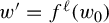 $w' = f^\ell (w_0)$
. If
$w' = f^\ell (w_0)$
. If $w' \in B$
, we have
$w' \in B$
, we have $|w'| < |w|$
and we conclude by induction. If
$|w'| < |w|$
and we conclude by induction. If $w' \notin B$
, we instead consider
$w' \notin B$
, we instead consider $w_1 = 0010 \cdot w$
. Then,
$w_1 = 0010 \cdot w$
. Then, $f^{\ell +1}(w_1) \in B^R$
and
$f^{\ell +1}(w_1) \in B^R$
and $|f^{\ell +1}(w_1)| < |w|$
, so we conclude using induction.
$|f^{\ell +1}(w_1)| < |w|$
, so we conclude using induction.
If $k> \ell -2$
, then
$k> \ell -2$
, then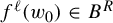 $f^\ell (w_0) \in B^R$
and
$f^\ell (w_0) \in B^R$
and $|f^\ell (w_0)| < |w|$
. We conclude by induction.
$|f^\ell (w_0)| < |w|$
. We conclude by induction.
Case 5: $\ell \leq 1$
and
$\ell \leq 1$
and $k \geq 1$
. If
$k \geq 1$
. If $\ell = 0$
, then we consider
$\ell = 0$
, then we consider $w_0 = 00 \cdot w \cdot 00$
. Now,
$w_0 = 00 \cdot w \cdot 00$
. Now, $f(w_0)$
begins with
$f(w_0)$
begins with $1 0^{2(k+2)} 1$
and ends with
$1 0^{2(k+2)} 1$
and ends with $1 0^{2 m} 1$
for some
$1 0^{2 m} 1$
for some $m \geq 1$
. We proceed as in Case 3, using
$m \geq 1$
. We proceed as in Case 3, using $w_1 = 0010 \cdot w \cdot 00$
instead of
$w_1 = 0010 \cdot w \cdot 00$
instead of $w_0$
as needed. If
$w_0$
as needed. If $\ell = 1$
, then
$\ell = 1$
, then $f(w_0)$
is in
$f(w_0)$
is in $B^R$
, has the same length as w and belongs to Case 3, which we already solved.
$B^R$
, has the same length as w and belongs to Case 3, which we already solved.
Case 6: $\ell = 1$
and
$\ell = 1$
and $k = 0$
. We consider
$k = 0$
. We consider $w_0 = 00 \cdot w$
and denote
$w_0 = 00 \cdot w$
and denote $w_0' = f(w_0)^R$
, which begins with
$w_0' = f(w_0)^R$
, which begins with $11$
and ends with
$11$
and ends with $1 001$
. If
$1 001$
. If $w_0'$
belongs to one of the already solved Cases 0–5, then we are done. Otherwise,
$w_0'$
belongs to one of the already solved Cases 0–5, then we are done. Otherwise, $w_0' \in B$
belongs to Case 6. Then, we repeat this process: for each
$w_0' \in B$
belongs to Case 6. Then, we repeat this process: for each $i \in \mathbb {N}$
, as long as
$i \in \mathbb {N}$
, as long as $w_i'$
belongs to Case 6, define
$w_i'$
belongs to Case 6, define $w_{i+1} = 00 \cdot w_i'$
and
$w_{i+1} = 00 \cdot w_i'$
and $w_{i+1}' = f(w_{i+1})^R = 11 \cdot u_{i+1} \cdot 1001$
. Suppose that we reach
$w_{i+1}' = f(w_{i+1})^R = 11 \cdot u_{i+1} \cdot 1001$
. Suppose that we reach $w_{|w|}$
this way. We can now go backward in time as shown in Figure 8: for each
$w_{|w|}$
this way. We can now go backward in time as shown in Figure 8: for each $j \geq 0$
, the length-j prefix and suffix of
$j \geq 0$
, the length-j prefix and suffix of $u_{|w|-j}$
are determined locally. In the end, we determine that
$u_{|w|-j}$
are determined locally. In the end, we determine that $w = 1 \cdot (100010)^{(|w| - 5)/6} \cdot 1001$
.
$w = 1 \cdot (100010)^{(|w| - 5)/6} \cdot 1001$
.
At each step of the backward computation, we force the four left and four right symbols to be either $0110$
or
$0110$
or $1001$
, this in turn fixes the neighbours symbols to some value. After enough steps, the whole word is forced.
$1001$
, this in turn fixes the neighbours symbols to some value. After enough steps, the whole word is forced.

We now consider $v_0 = 0010 \cdot w \cdot 01$
instead of
$v_0 = 0010 \cdot w \cdot 01$
instead of $w_0$
. Then,
$w_0$
. Then, $v_0' = f^3(v_0) = 110 \cdot (101000)^{(|w|-5)/6} \cdot 11$
and
$v_0' = f^3(v_0) = 110 \cdot (101000)^{(|w|-5)/6} \cdot 11$
and $v_1' = f^4(00 \cdot v_0' \cdot 0001)$
verifies
$v_1' = f^4(00 \cdot v_0' \cdot 0001)$
verifies $v_1' \in B$
and
$v_1' \in B$
and $|v_1'| < |w|$
. We can then conclude using induction.
$|v_1'| < |w|$
. We can then conclude using induction.
Case 7: $\ell = k = 0$
. We consider
$\ell = k = 0$
. We consider $w_0 = 00 \cdot w \cdot 00$
and
$w_0 = 00 \cdot w \cdot 00$
and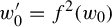 $w_0' = f^2(w_0)$
. If
$w_0' = f^2(w_0)$
. If $w_0'$
belongs to one of the already solved cases, then since
$w_0'$
belongs to one of the already solved cases, then since $|w_0'| = |w|$
, we are done. If
$|w_0'| = |w|$
, we are done. If $w_0'$
belongs to Case 7, we again repeat the process: for each
$w_0'$
belongs to Case 7, we again repeat the process: for each $i \in \mathbb {N}$
, as long as
$i \in \mathbb {N}$
, as long as $w_i'$
belongs to Case 7, define
$w_i'$
belongs to Case 7, define $w_{i+1} = 00 \cdot w_i' \cdot 00$
and
$w_{i+1} = 00 \cdot w_i' \cdot 00$
and $w_{i+1}' = f^2(w_{i+1}) = 11 \cdot u_{i+1} \cdot 11$
. In the same way as in Case 6, if we reach
$w_{i+1}' = f^2(w_{i+1}) = 11 \cdot u_{i+1} \cdot 11$
. In the same way as in Case 6, if we reach $w_{|w|}$
in this way, we go backward in time as shown in Figure 9 to fully determine that
$w_{|w|}$
in this way, we go backward in time as shown in Figure 9 to fully determine that $w = 11000 \cdot (101000)^{(|w| - 7)/6} \cdot 11$
.
$w = 11000 \cdot (101000)^{(|w| - 7)/6} \cdot 11$
.
In the same way as in Figure 8, after enough steps of backward computation, the whole word is forced.

We now consider $v_0 \kern1.5pt{=}\kern1.5pt 0010 \cdot w \cdot 0001$
. Then,
$v_0 \kern1.5pt{=}\kern1.5pt 0010 \cdot w \cdot 0001$
. Then, $v_0' \kern1.5pt{=}\kern1.5pt f^3(v_0) \kern1.5pt{=}\kern1.5pt 110101 \cdot (000101)^{(|w|-7)/6} \cdot 001$
and
$v_0' \kern1.5pt{=}\kern1.5pt f^3(v_0) \kern1.5pt{=}\kern1.5pt 110101 \cdot (000101)^{(|w|-7)/6} \cdot 001$
and $v_1' = f^4(00 \cdot v_0' \cdot 0100) = 1100 \cdot (000101)^{(|w|-7)/6} \cdot 001$
. We are now in Case 6, which was already solved, with
$v_1' = f^4(00 \cdot v_0' \cdot 0100) = 1100 \cdot (000101)^{(|w|-7)/6} \cdot 001$
. We are now in Case 6, which was already solved, with $|w| = |v_1'|$
.
$|w| = |v_1'|$
.
Finally, we explain why the cases are exhaustive. Since $w \in B$
, it begins with
$w \in B$
, it begins with $11$
, ends with a kink
$11$
, ends with a kink $1 0^{2\ell } 1$
and contains no other kinks. If the two kinks overlap, we are in Case 1. If they are separated by a single
$1 0^{2\ell } 1$
and contains no other kinks. If the two kinks overlap, we are in Case 1. If they are separated by a single $0$
, we are in Case 2. If they are separated by a longer alternating sequence of
$0$
, we are in Case 2. If they are separated by a longer alternating sequence of $0$
s and
$0$
s and $1$
s, then by the definition of B, we must have
$1$
s, then by the definition of B, we must have $\ell \geq 1$
, so we are in Case 3. Otherwise, as explained after Case 3, we have
$\ell \geq 1$
, so we are in Case 3. Otherwise, as explained after Case 3, we have $w = 11(01)^k00 \cdot u \cdot 10^{2\ell }1$
for some word u, and Cases 4–7 cover all values of k and
$w = 11(01)^k00 \cdot u \cdot 10^{2\ell }1$
for some word u, and Cases 4–7 cover all values of k and $\ell $
. This finishes the proof.
$\ell $
. This finishes the proof.
Lemma 5.7. Let $i, j \in \mathbb {Z}^2$
be two positions, then there exists
$i, j \in \mathbb {Z}^2$
be two positions, then there exists $n \in \mathbb {N}$
such that
$n \in \mathbb {N}$
such that  .
.
Proof. We proceed by induction on $|i-j|$
. If
$|i-j|$
. If $i = j$
, we can choose
$i = j$
, we can choose $n = 0$
. If
$n = 0$
. If $i < j$
, then
$i < j$
, then  as shown in Figure 10 and we can conclude using induction. If $i> j$
, then
$i> j$
, then  as shown in Figure 11 and we can conclude using induction.
Moving a $1101001$
one step to the left.
$1101001$
one step to the left.

Moving a $1101001$
one step to the right.
$1101001$
one step to the right.

The following definition provides us with a set P of words that can be produced from $1101001$
and, as we show later, these words constitute exactly the words of the generic limit set that have two kinks.
$1101001$
and, as we show later, these words constitute exactly the words of the generic limit set that have two kinks.
Definition 5.3. Let w be a word that contains exactly two kinks. We call $b(w)$
the smallest subword of w that contains two kinks. If
$b(w)$
the smallest subword of w that contains two kinks. If $b(w) = 1 0^{2k} 1 \cdot u \cdot 1 0^{2\ell } 1$
for some
$b(w) = 1 0^{2k} 1 \cdot u \cdot 1 0^{2\ell } 1$
for some $k, \ell \in \mathbb {N}$
and
$k, \ell \in \mathbb {N}$
and $u \in \{0,1\}^*$
, then we call
$u \in \{0,1\}^*$
, then we call $\delta (w) = u$
. If
$\delta (w) = u$
. If $b(w)$
is of the form
$b(w)$
is of the form $10^{2k} 1 0^{2\ell } 1$
, then we call
$10^{2k} 1 0^{2\ell } 1$
, then we call $\delta (w) = \epsilon $
.
$\delta (w) = \epsilon $
.
Definition 5.4. We define $P \subset \{0,1\}^*$
as the set of those two-kink words w that satisfy all of the following:
$P \subset \{0,1\}^*$
as the set of those two-kink words w that satisfy all of the following:
-
•
$b(w) \neq 111$
; -
• if
$b(w) = 11 v 11$
, then v contains an even number of
$1$
s; -
• for all
$k \in \mathbb {N}$
,
$b(w) \neq 1 (100010)^k 1001$
and
$b(w) \neq 1001 (010001)^k 1$
.






Our goal is to prove that P coincides with the set of two-kink words of the generic limit set of f. The first two conditions are necessary, since the words $111$
and
$111$
and $11v11$
with v containing an odd number of
$11v11$
with v containing an odd number of $1$
s have no preimages under f. Namely, the only preimage of
$1$
s have no preimages under f. Namely, the only preimage of $11$
is
$11$
is $1001$
, which already forbids
$1001$
, which already forbids $111$
. However, one can prove by induction on the length of w that if w contains an even number of
$111$
. However, one can prove by induction on the length of w that if w contains an even number of $1$
s, then all preimages of
$1$
s, then all preimages of $11w$
end in
$11w$
end in $01$
,
$01$
, $10$
or
$10$
or $11$
and, otherwise, they all end in
$11$
and, otherwise, they all end in $00$
. Then,
$00$
. Then, $11v11$
has no preimage, as it would have to end in both
$11v11$
has no preimage, as it would have to end in both $1001$
and
$1001$
and $00ab$
for some
$00ab$
for some $a, b \in \{0,1\}$
. Similarly, every two-kink word
$a, b \in \{0,1\}$
. Similarly, every two-kink word $11w11$
where w contains an even number of
$11w11$
where w contains an even number of $1$
s has a unique two-kink preimage (and possibly other preimages with more kinks): if
$1$
s has a unique two-kink preimage (and possibly other preimages with more kinks): if $w = 0^{2n_0-1} 1 0^{2n_1-1} 1 \cdots 1 0^{2n_{2k}-1}$
, that preimage is
$w = 0^{2n_0-1} 1 0^{2n_1-1} 1 \cdots 1 0^{2n_{2k}-1}$
, that preimage is $100 (10)^{n_0} 0^{2n_1} (10)^{n_2} 0^{2n_3} \cdots (10)^{n_{2k}} 01$
.
$100 (10)^{n_0} 0^{2n_1} (10)^{n_2} 0^{2n_3} \cdots (10)^{n_{2k}} 01$
.
We now proceed backwards in time and try to find for every word in P a parent that contains $1101001$
. Just as in Lemma 5.6, the proof is a combination of an induction and a case analysis. There are quite a few cases, but none of them is very difficult. The main idea is that we are first trying to close the gap between the two kinks in the word and then shorten the kinks.
$1101001$
. Just as in Lemma 5.6, the proof is a combination of an induction and a case analysis. There are quite a few cases, but none of them is very difficult. The main idea is that we are first trying to close the gap between the two kinks in the word and then shorten the kinks.
Lemma 5.8. Let $w \in P$
. Then, there exists
$w \in P$
. Then, there exists $n \in \mathbb {N}$
and a position
$n \in \mathbb {N}$
and a position $p \in \mathbb {Z}$
such that
$p \in \mathbb {Z}$
such that  .
.
Proof. We first handle the ‘trivial’ cases.
Case 0: w contains $1101001$
or its reversal. If
$1101001$
or its reversal. If $1101001$
is a subword of w, then the property is verified with
$1101001$
is a subword of w, then the property is verified with $n = 0$
. If
$n = 0$
. If $1001011$
is a subword of w, then
$1001011$
is a subword of w, then $\Sigma (1001011) \subseteq f^3(\Sigma (1101001))$
, as shown in Figure 5. Hence, there exists a position p such that
$\Sigma (1001011) \subseteq f^3(\Sigma (1101001))$
, as shown in Figure 5. Hence, there exists a position p such that  .
.
We proceed by induction on the length of $\delta (w)$
. Let w be a word such that
$\delta (w)$
. Let w be a word such that $|\delta (w)| = 0$
. Then, there exist some words
$|\delta (w)| = 0$
. Then, there exist some words $\alpha , \beta $
and some integers
$\alpha , \beta $
and some integers $k, \ell $
such that
$k, \ell $
such that $w = \alpha 1 0^{2k} 1 0^{2\ell } 1 \beta $
.
$w = \alpha 1 0^{2k} 1 0^{2\ell } 1 \beta $
.
Case 1: $k = 0$
or
$k = 0$
or $\ell = 0$
. If
$\ell = 0$
. If $k = 0$
(the case
$k = 0$
(the case $\ell = 0$
is symmetrical), then
$\ell = 0$
is symmetrical), then $w \in P$
implies
$w \in P$
implies $\ell \geq 2$
. According to Corollary 4.6, there exists a unique word
$\ell \geq 2$
. According to Corollary 4.6, there exists a unique word $\alpha '$
and a unique word
$\alpha '$
and a unique word $\beta '$
such that
$\beta '$
such that $w' = \alpha ' \cdot 1001011 (01)^{\ell -2} 00 \cdot \beta '$
contains two kinks and
$w' = \alpha ' \cdot 1001011 (01)^{\ell -2} 00 \cdot \beta '$
contains two kinks and $f(w') = w$
. Since
$f(w') = w$
. Since $w' \in \Sigma (1001011)$
and
$w' \in \Sigma (1001011)$
and $w'$
is stable, we have
$w'$
is stable, we have  . The word $w'$
belongs to Case 0, so
$w'$
belongs to Case 0, so  for some $p \in \mathbb {Z}$
. Then,
$p \in \mathbb {Z}$
. Then,  by Proposition 4.5. In the remainder of the proof, we implicitly apply this argument whenever we fall to an earlier case or use the induction hypothesis.
Case 2: $k \geq 1$
and
$k \geq 1$
and $\ell \geq 1$
. Now, there exist unique words
$\ell \geq 1$
. Now, there exist unique words $\alpha '$
and
$\alpha '$
and $\beta '$
such that
$\beta '$
such that ${w' = \alpha ' \cdot 1 0^{2(k+1)} 11 (01)^{\ell -1} 00\cdot \beta '}$
contains two kinks and
${w' = \alpha ' \cdot 1 0^{2(k+1)} 11 (01)^{\ell -1} 00\cdot \beta '}$
contains two kinks and $f(w') = w$
. Since
$f(w') = w$
. Since $w'$
is stable, we have
$w'$
is stable, we have $\Sigma (w) = f(\Sigma (w'))$
. Hence, we can conclude by Case 1.
$\Sigma (w) = f(\Sigma (w'))$
. Hence, we can conclude by Case 1.
In the following, let $w \in P$
be a word with
$w \in P$
be a word with $|\delta (w)|> 0$
. We now suppose the property holds for all words
$|\delta (w)|> 0$
. We now suppose the property holds for all words $w' \in P$
with
$w' \in P$
with $|\delta (w')| < |\delta (w)|$
. Let
$|\delta (w')| < |\delta (w)|$
. Let $\alpha $
and
$\alpha $
and $\beta $
be words, and
$\beta $
be words, and $k, \ell $
be integers such that
$k, \ell $
be integers such that $w = \alpha \cdot 1 0^{2k} 1 \cdot \delta (w) \cdot 1 0^{2\ell } 1 \cdot \beta $
. Because of Case 0, we may assume
$w = \alpha \cdot 1 0^{2k} 1 \cdot \delta (w) \cdot 1 0^{2\ell } 1 \cdot \beta $
. Because of Case 0, we may assume $k \leq \ell $
.
$k \leq \ell $
.
Case 3: $|\delta (w)| = 1$
. Then, we must have
$|\delta (w)| = 1$
. Then, we must have $\delta (w) = 0$
. There exist unique words
$\delta (w) = 0$
. There exist unique words $\alpha '$
and
$\alpha '$
and $\beta '$
such that
$\beta '$
such that $w' = \alpha ' \cdot 10^{2(k+1)}10^{2(l+1)}1 \cdot \beta '$
contains two kinks and
$w' = \alpha ' \cdot 10^{2(k+1)}10^{2(l+1)}1 \cdot \beta '$
contains two kinks and $f(w') = w$
. As
$f(w') = w$
. As $w'$
is stable, we can conclude using Case 2.
$w'$
is stable, we can conclude using Case 2.
Case 4: $|\delta (w)| \geq 3$
,
$|\delta (w)| \geq 3$
, $k= 0$
and
$k= 0$
and $\ell =0$
. As
$\ell =0$
. As $w \in P$
, the word
$w \in P$
, the word $\delta (w)$
between the two kinks necessarily contains an even number of
$\delta (w)$
between the two kinks necessarily contains an even number of $1$
s. According to the discussion following Definition 5.4, there exists a word of the form
$1$
s. According to the discussion following Definition 5.4, there exists a word of the form $w' = 1001 \delta 1001$
with two kinks such that
$w' = 1001 \delta 1001$
with two kinks such that $f(w') = w$
. Now,
$f(w') = w$
. Now, $w' \in P$
and
$w' \in P$
and $\delta (w') = \delta $
verifies
$\delta (w') = \delta $
verifies $|\delta (w')| < |\delta (w)|$
, so we can conclude by the induction hypothesis.
$|\delta (w')| < |\delta (w)|$
, so we can conclude by the induction hypothesis.
Case 5: $k = 0$
and
$k = 0$
and $\ell = 1$
. Now, there exists a unique word
$\ell = 1$
. Now, there exists a unique word $u'$
such that
$u'$
such that $1001 \cdot u'$
contains one kink and
$1001 \cdot u'$
contains one kink and $f(1001 \cdot u') = 11 \cdot \delta (w)$
.
$f(1001 \cdot u') = 11 \cdot \delta (w)$
.
If $u'$
is of the form
$u'$
is of the form $v' \cdot 10$
for some word
$v' \cdot 10$
for some word $v'$
, then there exist unique words
$v'$
, then there exist unique words $\alpha '$
and
$\alpha '$
and $\beta '$
such that
$\beta '$
such that $w' = \alpha ' \cdot 1001 \cdot v' \cdot 100001 \cdot \beta '$
contains two kinks and
$w' = \alpha ' \cdot 1001 \cdot v' \cdot 100001 \cdot \beta '$
contains two kinks and $f(w') = w$
. Now,
$f(w') = w$
. Now, $\delta (w') = v'$
; hence,
$\delta (w') = v'$
; hence, $|\delta (w')| < |\delta (w)|$
and we can conclude by induction.
$|\delta (w')| < |\delta (w)|$
and we can conclude by induction.
Otherwise, $u'$
is of the form
$u'$
is of the form $v' \cdot 00$
. There exists a word
$v' \cdot 00$
. There exists a word $u"$
such that
$u"$
such that $1001 \cdot u"$
contains one kink and
$1001 \cdot u"$
contains one kink and $f(1001 \cdot u")^R = u' \cdot 11$
. We now consider
$f(1001 \cdot u")^R = u' \cdot 11$
. We now consider $u"$
: if it ends in
$u"$
: if it ends in $10$
, we conclude as above, otherwise, we continue.
$10$
, we conclude as above, otherwise, we continue.
We suppose that we are able to repeat the process an infinite number of times: we can define words $\alpha ^{(k)}$
,
$\alpha ^{(k)}$
, $\beta ^{(k)}$
,
$\beta ^{(k)}$
, $u^{(k)}$
for all
$u^{(k)}$
for all $k \in \mathbb {N}$
such that the word
$k \in \mathbb {N}$
such that the word $w^{(k)} = \alpha ^{(k)} \cdot 1001 \cdot u^{(k+1)} \cdot 11 \cdot \beta ^{(k)}$
contains two kinks,
$w^{(k)} = \alpha ^{(k)} \cdot 1001 \cdot u^{(k+1)} \cdot 11 \cdot \beta ^{(k)}$
contains two kinks, $w^{(0)} = w$
and
$w^{(0)} = w$
and $f(w^{(k+1)})^R = w^{(k)}$
. As in the proof of Case 6 of Lemma 5.6 and in Figure 8, we can go backwards in time to deduce prefixes and suffixes of the
$f(w^{(k+1)})^R = w^{(k)}$
. As in the proof of Case 6 of Lemma 5.6 and in Figure 8, we can go backwards in time to deduce prefixes and suffixes of the $u^{(k)}$
, and eventually determine that
$u^{(k)}$
, and eventually determine that $w^{(|w|)} = 1 \cdot (100010)^{(|w| - 4)/6} \cdot 1001$
. Then, by direct computation, we have
$w^{(|w|)} = 1 \cdot (100010)^{(|w| - 4)/6} \cdot 1001$
. Then, by direct computation, we have $w = 1 \cdot (100010)^{(|w| - 4)/6} \cdot 1001$
as well. We then proved that
$w = 1 \cdot (100010)^{(|w| - 4)/6} \cdot 1001$
as well. We then proved that $w \notin P$
, which is a contradiction.
$w \notin P$
, which is a contradiction.
Case 6: $k = 0$
and
$k = 0$
and $\ell>1$
. Again, there exists a unique word
$\ell>1$
. Again, there exists a unique word $u'$
such that
$u'$
such that $1001 \cdot u'$
contains one kink and
$1001 \cdot u'$
contains one kink and $f(1001 \cdot u') = 11 \cdot \delta (w)$
.
$f(1001 \cdot u') = 11 \cdot \delta (w)$
.
If $u'$
is of the form
$u'$
is of the form $v' \cdot 10$
for some word
$v' \cdot 10$
for some word $v'$
, then there exist unique words
$v'$
, then there exist unique words $\alpha '$
and
$\alpha '$
and $\beta '$
such that
$\beta '$
such that $w' = \alpha ' \cdot 1 00 1 \cdot v' \cdot 1 0^{2(\ell +1)}1 \cdot \beta '$
contains two kinks and
$w' = \alpha ' \cdot 1 00 1 \cdot v' \cdot 1 0^{2(\ell +1)}1 \cdot \beta '$
contains two kinks and $f(w') = w$
. Now,
$f(w') = w$
. Now, $w' \in P$
and
$w' \in P$
and $\delta (w') = v'$
implying
$\delta (w') = v'$
implying $|\delta (w')| < |\delta (w)|$
, so we conclude by induction.
$|\delta (w')| < |\delta (w)|$
, so we conclude by induction.
Otherwise, $u'$
ends in
$u'$
ends in $00$
. There exist unique words
$00$
. There exist unique words $\alpha '$
and
$\alpha '$
and $\beta '$
such that
$\beta '$
such that $w' = \alpha ' \cdot 1001 \cdot u' \cdot 11 (01)^{\ell -1} 00 \cdot \beta '$
contains two kinks and
$w' = \alpha ' \cdot 1001 \cdot u' \cdot 11 (01)^{\ell -1} 00 \cdot \beta '$
contains two kinks and $f(w') = w$
. If
$f(w') = w$
. If $w' \in P$
, then it is in Case 5 with
$w' \in P$
, then it is in Case 5 with $|\delta (w')| = |\delta (w)|$
and we can conclude.
$|\delta (w')| = |\delta (w)|$
and we can conclude.
Otherwise, $w' \notin P$
, that is, there exists
$w' \notin P$
, that is, there exists $m \in \mathbb {N}$
such that
$m \in \mathbb {N}$
such that $u' \cdot 1 = (010001)^m$
. This implies
$u' \cdot 1 = (010001)^m$
. This implies $w = \alpha \cdot 1 (100010)^m 10^{2\ell }1 \cdot \beta $
and we call it the difficult subcase. We define
$w = \alpha \cdot 1 (100010)^m 10^{2\ell }1 \cdot \beta $
and we call it the difficult subcase. We define
 $$ \begin{align*} u" = \begin{cases} 001011 (000000010101)^{m/2} 00001 & \text{if }m\text{ is even,} \\1000000(101010000000)^{(m-1)/2} 1010100001 & \text{if }m\text{ is odd.} \end{cases} \end{align*} $$
In both cases, it can be checked by a direct computation that $f^2(u") = 1001 \cdot u' \cdot 1011$
. Then, there are unique words
$f^2(u") = 1001 \cdot u' \cdot 1011$
. Then, there are unique words $\alpha "$
and
$\alpha "$
and $\beta "$
such that
$\beta "$
such that $w" = \alpha " \cdot u" \cdot \beta "$
has two kinks and satisfies
$w" = \alpha " \cdot u" \cdot \beta "$
has two kinks and satisfies $f^3(w") = w$
. If m is even, then
$f^3(w") = w$
. If m is even, then $|\delta (w")| = |\delta (w)|$
and
$|\delta (w")| = |\delta (w)|$
and $w"$
belongs to Case 6, and by its form, it cannot be in the difficult subcase. If m is odd, then
$w"$
belongs to Case 6, and by its form, it cannot be in the difficult subcase. If m is odd, then $|\delta (w")| < |\delta (w)|$
. Hence, we can conclude.
$|\delta (w")| < |\delta (w)|$
. Hence, we can conclude.
Case 7: $k \geq 1$
and
$k \geq 1$
and $\ell \geq 1$
. Again, there exists a unique word
$\ell \geq 1$
. Again, there exists a unique word $u'$
such that
$u'$
such that $1 0^{2(k+1)} 1 \cdot u'$
contains one kink and
$1 0^{2(k+1)} 1 \cdot u'$
contains one kink and $f(10^{2(k+1)}1 \cdot u') = 10^{2k}1 \cdot \delta (w)$
.
$f(10^{2(k+1)}1 \cdot u') = 10^{2k}1 \cdot \delta (w)$
.
If $u'$
is of the form
$u'$
is of the form $v' \cdot 10$
for some word
$v' \cdot 10$
for some word $v'$
, then there exist unique words
$v'$
, then there exist unique words $\alpha '$
and
$\alpha '$
and $\beta '$
such that
$\beta '$
such that $w' = \alpha ' \cdot 10^{2(k+1)}1 \cdot v' \cdot 10^{2(l+1)}1 \cdot \beta '$
contains two kinks and
$w' = \alpha ' \cdot 10^{2(k+1)}1 \cdot v' \cdot 10^{2(l+1)}1 \cdot \beta '$
contains two kinks and $f(w') = w$
. We have
$f(w') = w$
. We have $\delta (w') = v'$
; hence,
$\delta (w') = v'$
; hence, $|\delta (w')| < |\delta (w)|$
and we conclude by induction.
$|\delta (w')| < |\delta (w)|$
and we conclude by induction.
Otherwise, $u'$
ends in
$u'$
ends in $00$
. Then, there exist unique words
$00$
. Then, there exist unique words $\alpha '$
and
$\alpha '$
and $\beta '$
with
$\beta '$
with ${w' = \alpha ' \cdot 10^{2(k+1)} 1 \cdot u' \cdot 11 (01)^{\ell -1} \cdot \beta '}$
and
${w' = \alpha ' \cdot 10^{2(k+1)} 1 \cdot u' \cdot 11 (01)^{\ell -1} \cdot \beta '}$
and $f(w') = w$
. We have
$f(w') = w$
. We have $w' \in P$
and
$w' \in P$
and $|\delta (w')| = |\delta (w)|$
. Moreover,
$|\delta (w')| = |\delta (w)|$
. Moreover, $w'$
belongs to the already handled Case 6.
$w'$
belongs to the already handled Case 6.
Finally, we explain why the cases are exhaustive. Since $w \in P$
, it contains exactly two kinks; let them be
$w \in P$
, it contains exactly two kinks; let them be $1 0^{2k} 1$
and
$1 0^{2k} 1$
and $1 0^{2\ell } 1$
in this order. Cases 1 and 2 cover the cases where the kinks overlap. The kinks cannot be directly adjacent, and Cases 0 and 3 cover the cases where they are separated by a single symbol, which must be a
$1 0^{2\ell } 1$
in this order. Cases 1 and 2 cover the cases where the kinks overlap. The kinks cannot be directly adjacent, and Cases 0 and 3 cover the cases where they are separated by a single symbol, which must be a $0$
. Otherwise, the kinks are separated by a word
$0$
. Otherwise, the kinks are separated by a word $\delta (w)$
of length at least three. Cases 4–6 cover the subcases where
$\delta (w)$
of length at least three. Cases 4–6 cover the subcases where $k = 0$
. Case 7 covers the case where
$k = 0$
. Case 7 covers the case where $k, \ell \geq 1$
. The remaining cases, where
$k, \ell \geq 1$
. The remaining cases, where $k \geq 1$
and
$k \geq 1$
and $\ell = 0$
, are handled by symmetry: the word
$\ell = 0$
, are handled by symmetry: the word $w^R \in P$
falls into one of the above cases, so
$w^R \in P$
falls into one of the above cases, so  for some n and p, and reflecting around position $4$
, we get
$4$
, we get  . This concludes the proof.
Theorem 5.9. Let $w \in \{0,1\}^*$
be a word that contains two kinks. Then, w occurs in
$w \in \{0,1\}^*$
be a word that contains two kinks. Then, w occurs in  if and only if $w \in P$
.
$w \in P$
.
Proof. First, let $w \notin P$
be a word with two kinks. If w has a subword
$w \notin P$
be a word with two kinks. If w has a subword $111$
or a subword of the form
$111$
or a subword of the form $11 u 11$
with u containing an odd number of
$11 u 11$
with u containing an odd number of $1$
s, then w has no parent and, hence, it does not occur in
$1$
s, then w has no parent and, hence, it does not occur in  .
.
Suppose then that w has a subword of the form $u = 1 (100010)^k 1001$
for some
$u = 1 (100010)^k 1001$
for some $k \in \mathbb {N}$
. We call
$k \in \mathbb {N}$
. We call $u' = 1001 (010001)^k 1$
. These have the property that
$u' = 1001 (010001)^k 1$
. These have the property that $f^{-1}([u]_0) \cap f(\{0,1\}^*) \subseteq [u']_{-1}$
and
$f^{-1}([u]_0) \cap f(\{0,1\}^*) \subseteq [u']_{-1}$
and $f^{-1}([u']_{-1}) \cap f(\{0,1\}^*) \subseteq [u]_0$
. We suppose for a contradiction that
$f^{-1}([u']_{-1}) \cap f(\{0,1\}^*) \subseteq [u]_0$
. We suppose for a contradiction that  . Then, there exist a seed $s \in \{0,1\}^*$
and a position
$s \in \{0,1\}^*$
and a position $p \in \mathbb {Z}$
such that for all
$p \in \mathbb {Z}$
such that for all $a, b \in \{0,1\}^*$
, there are infinitely many
$a, b \in \{0,1\}^*$
, there are infinitely many $n \in \mathbb {N}$
such that
$n \in \mathbb {N}$
such that $f^n([asb]_{i-|a|}) \cap [w]_0 \neq \emptyset $
. We may assume that
$f^n([asb]_{i-|a|}) \cap [w]_0 \neq \emptyset $
. We may assume that $p \leq 0$
and
$p \leq 0$
and $|s|-p \geq |w|$
.
$|s|-p \geq |w|$
.
There exists a word q such that $s q$
contains an even number of kinks. By Corollary 4.9, there exists
$s q$
contains an even number of kinks. By Corollary 4.9, there exists $\ell \in \mathbb {N}$
such that
$\ell \in \mathbb {N}$
such that $f^\ell (0^\ell s q 0^\ell )$
is kinkless. Then, we have
$f^\ell (0^\ell s q 0^\ell )$
is kinkless. Then, we have $f^\ell (x)_{[0, |w|-1]} \in \Sigma $
for all
$f^\ell (x)_{[0, |w|-1]} \in \Sigma $
for all $x \in [0^\ell s q 0^\ell ]_{p-\ell }$
. However, there should exist
$x \in [0^\ell s q 0^\ell ]_{p-\ell }$
. However, there should exist $n \geq \ell $
and
$n \geq \ell $
and $x \in [0^\ell s q 0^\ell ]_{p-\ell }$
with
$x \in [0^\ell s q 0^\ell ]_{p-\ell }$
with $f^n(x) \in [w]_0$
. This implies
$f^n(x) \in [w]_0$
. This implies $f^n(x) \in [u]_j$
for some
$f^n(x) \in [u]_j$
for some $0 \leq j < |w|-|u|$
. Then, for all
$0 \leq j < |w|-|u|$
. Then, for all $m \leq n$
, we have
$m \leq n$
, we have $f^{n-m}(x) \in [u]_j$
if m is even and
$f^{n-m}(x) \in [u]_j$
if m is even and $f^{n-m}(x) \in [u']_{j-1}$
if m is odd. When
$f^{n-m}(x) \in [u']_{j-1}$
if m is odd. When $m = n-\ell $
, we obtain a contradiction with
$m = n-\ell $
, we obtain a contradiction with $f^\ell (x)_{[0, |w|-1]} \in \Sigma $
, since u and
$f^\ell (x)_{[0, |w|-1]} \in \Sigma $
, since u and $u'$
are two-kink words. Hence, w does not occur in the generic limit set.
$u'$
are two-kink words. Hence, w does not occur in the generic limit set.
We now prove the other side of the implication. Let $w \in P$
be a word. We consider the seed
$w \in P$
be a word. We consider the seed $\epsilon $
at position
$\epsilon $
at position $i = 0$
. Let
$i = 0$
. Let $q_1, q_2 \in \{0,1\}^*$
be words. There exists a word
$q_1, q_2 \in \{0,1\}^*$
be words. There exists a word $r \in \{0,1\}^*$
such that
$r \in \{0,1\}^*$
such that $q_1 \cdot q_2 \cdot r$
contains an even number of kinks. According to Corollary 4.9, for all large enough
$q_1 \cdot q_2 \cdot r$
contains an even number of kinks. According to Corollary 4.9, for all large enough $n \in \mathbb {N}$
, all words in
$n \in \mathbb {N}$
, all words in $f^n(\Sigma (0^n \cdot q_1 q_2 r \cdot 0^n, -|q_1|-n))$
are kinkless. In the following, we call
$f^n(\Sigma (0^n \cdot q_1 q_2 r \cdot 0^n, -|q_1|-n))$
are kinkless. In the following, we call $s = 1 0^{2n} 1 0^{3n} \cdot q_1 q_2 r \cdot 0^{3n} 1 0^{2n} 1$
.
$s = 1 0^{2n} 1 0^{3n} \cdot q_1 q_2 r \cdot 0^{3n} 1 0^{2n} 1$
.
We have $f^n(\Sigma (s)) = \Sigma (f^n(s))$
by Proposition 4.5. Also,
$f^n(\Sigma (s)) = \Sigma (f^n(s))$
by Proposition 4.5. Also, $f^n(s)$
is a two-kink word of the form
$f^n(s)$
is a two-kink word of the form $11 \cdot v \cdot 11$
, where
$11 \cdot v \cdot 11$
, where $v \neq (01)^{\lfloor v/2 \rfloor } 0$
, so that
$v \neq (01)^{\lfloor v/2 \rfloor } 0$
, so that $f^n(s) \in B$
. According to Lemma 5.6, there exists
$f^n(s) \in B$
. According to Lemma 5.6, there exists $n_0 \in \mathbb {N}$
such that
$n_0 \in \mathbb {N}$
such that $\Sigma (1101001) \subseteq f^{n_0}(\Sigma (f^n(s))) = f^{n+n_0}(\Sigma (s))$
. Hence, there exists a position
$\Sigma (1101001) \subseteq f^{n_0}(\Sigma (f^n(s))) = f^{n+n_0}(\Sigma (s))$
. Hence, there exists a position $j \in \mathbb {Z}$
such that
$j \in \mathbb {Z}$
such that  .
.
According to Lemma 5.8, there exists $n_1 \in \mathbb {N}$
and a position
$n_1 \in \mathbb {N}$
and a position $p \in \mathbb {Z}$
such that
$p \in \mathbb {Z}$
such that  . According to Lemma 5.7, there exists $n_2 \in \mathbb {N}$
such that
$n_2 \in \mathbb {N}$
such that  . Hence,
  . Combining all of this, we obtain

As n can be chosen arbitrarily large, this shows that w occurs in  .
.
6 Separation of limit sets
In this section, we show that the limit set, generic limit set and $\mu $
-limit set of
$\mu $
-limit set of $f_{18}$
are distinct for any shift-invariant probability measure
$f_{18}$
are distinct for any shift-invariant probability measure $\mu $
. In fact, there is a single word that occurs in
$\mu $
. In fact, there is a single word that occurs in  but does not occur in any $\Omega _\mu (f_{18})$
.
$\Omega _\mu (f_{18})$
.
Theorem 6.1. Rule 18 satisfies  and
and  .
.
Proof. We first prove that  is properly contained in the limit set. The word $10011$
occurs in the latter, since the spatially periodic point
$10011$
occurs in the latter, since the spatially periodic point $x = {}^\infty (1001)^\infty $
satisfies
$x = {}^\infty (1001)^\infty $
satisfies $f_{18}^2(x) = x$
. By Theorem 5.9, it does not occur in
$f_{18}^2(x) = x$
. By Theorem 5.9, it does not occur in  .
.
For the other claim, take any shift-invariant measure $\mu $
and for
$\mu $
and for $n \in \mathbb {N}$
, denote by
$n \in \mathbb {N}$
, denote by
 $$ \begin{align*} d_n = \sum_{k \in \mathbb{N}} (f_{18}^n \mu)(1 0^{2k} 1) \end{align*} $$
the probability of having the left border of a kink at a given coordinate after n iterations of $f_{18}$
. By Proposition 4.4,
$f_{18}$
. By Proposition 4.4, $f_{18}$
cannot create new kinks and by shift-invariance of
$f_{18}$
cannot create new kinks and by shift-invariance of $\mu $
, we then have
$\mu $
, we then have $d_{n+1} \leq d_n$
. The probability of seeing the left border of a kink that will be destroyed at the next step is exactly
$d_{n+1} \leq d_n$
. The probability of seeing the left border of a kink that will be destroyed at the next step is exactly $d_n - d_{n+1}$
.
$d_n - d_{n+1}$
.
Consider the word $w = 001101100$
. Since
$w = 001101100$
. Since $f_{18}(w) = 1000001$
results in the destruction of two kinks, we have
$f_{18}(w) = 1000001$
results in the destruction of two kinks, we have $\sum _{n \in \mathbb {N}} (f_{18}^n \mu )(w) \leq \sum _{n \in \mathbb {N}} d_n - d_{n+1} = \lim _{n \to \infty } d_0 - d_n \leq 1$
. Hence,
$\sum _{n \in \mathbb {N}} (f_{18}^n \mu )(w) \leq \sum _{n \in \mathbb {N}} d_n - d_{n+1} = \lim _{n \to \infty } d_0 - d_n \leq 1$
. Hence, $\lim _{n \to \infty } (f_{18}^n \mu )(w) = 0$
, so w does not occur in
$\lim _{n \to \infty } (f_{18}^n \mu )(w) = 0$
, so w does not occur in $\Omega _\mu (f_{18})$
. By Theorem 5.9, it occurs in
$\Omega _\mu (f_{18})$
. By Theorem 5.9, it occurs in  .
.
While our analysis of the generic limit set is enough to obtain this separation result, we are not able to fully characterize its language. Doing so would be interesting for the following reason. Let $\mu $
be the uniform Bernoulli measure. In [Reference Lind8, Conjecture 3], Lind conjectures that the density
$\mu $
be the uniform Bernoulli measure. In [Reference Lind8, Conjecture 3], Lind conjectures that the density $d_n$
of kinks in an
$d_n$
of kinks in an $f_{18}^n \mu $
-random configuration is approximately
$f_{18}^n \mu $
-random configuration is approximately $(8 \pi D n)^{-1/2}$
, where the ‘diffusion coefficient’
$(8 \pi D n)^{-1/2}$
, where the ‘diffusion coefficient’ $D \approx 1/2$
.
$D \approx 1/2$
.
The weaker (but still open) claim that $d_n \to 0$
is equivalent to the condition that no kinks occur in the
$d_n \to 0$
is equivalent to the condition that no kinks occur in the $\mu $
-limit set
$\mu $
-limit set $\Omega _\mu (f_{18})$
. By [Reference Boyer, Delacourt, Sablik and Kari1, Proposition 2.10], the
$\Omega _\mu (f_{18})$
. By [Reference Boyer, Delacourt, Sablik and Kari1, Proposition 2.10], the $\mu $
-limit set of every CA g is shift-recurrent, meaning that if w occurs in
$\mu $
-limit set of every CA g is shift-recurrent, meaning that if w occurs in $\Omega _\mu (g)$
, then there exists a word u such that
$\Omega _\mu (g)$
, then there exists a word u such that $wuw$
occurs in
$wuw$
occurs in $\Omega _\mu (g)$
as well. Hence, for the weaker claim, it would be enough to prove that
$\Omega _\mu (g)$
as well. Hence, for the weaker claim, it would be enough to prove that  and that for some $k \in \mathbb {N}$
, no word with k kinks occurs in the generic limit set
$k \in \mathbb {N}$
, no word with k kinks occurs in the generic limit set  . We have shown that the latter claim is false for $k \leq 2$
.
$k \leq 2$
.
Open problem 6.2. Characterize the language of the generic limit set  .
.
Open problem 6.3. Do we have  for the uniform Bernoulli measure $\mu $
?
$\mu $
?
Acknowledgement
I.A.T. was supported by the Academy of Finland under grant 346566.


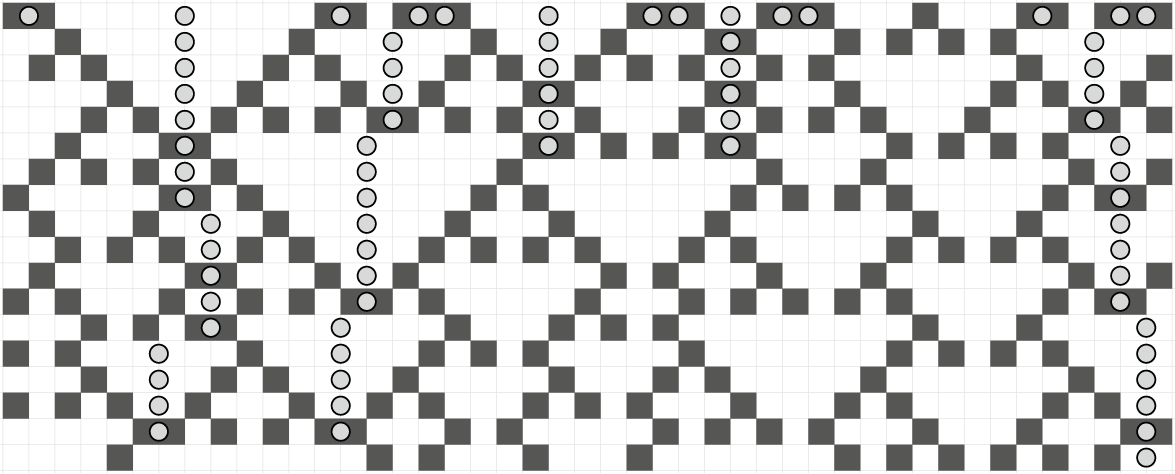
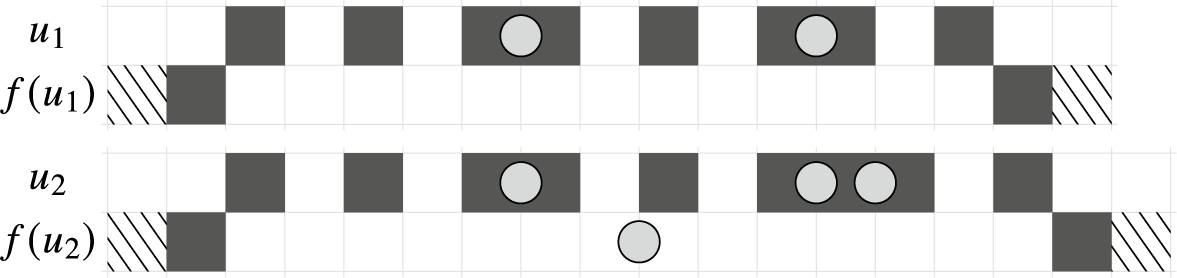


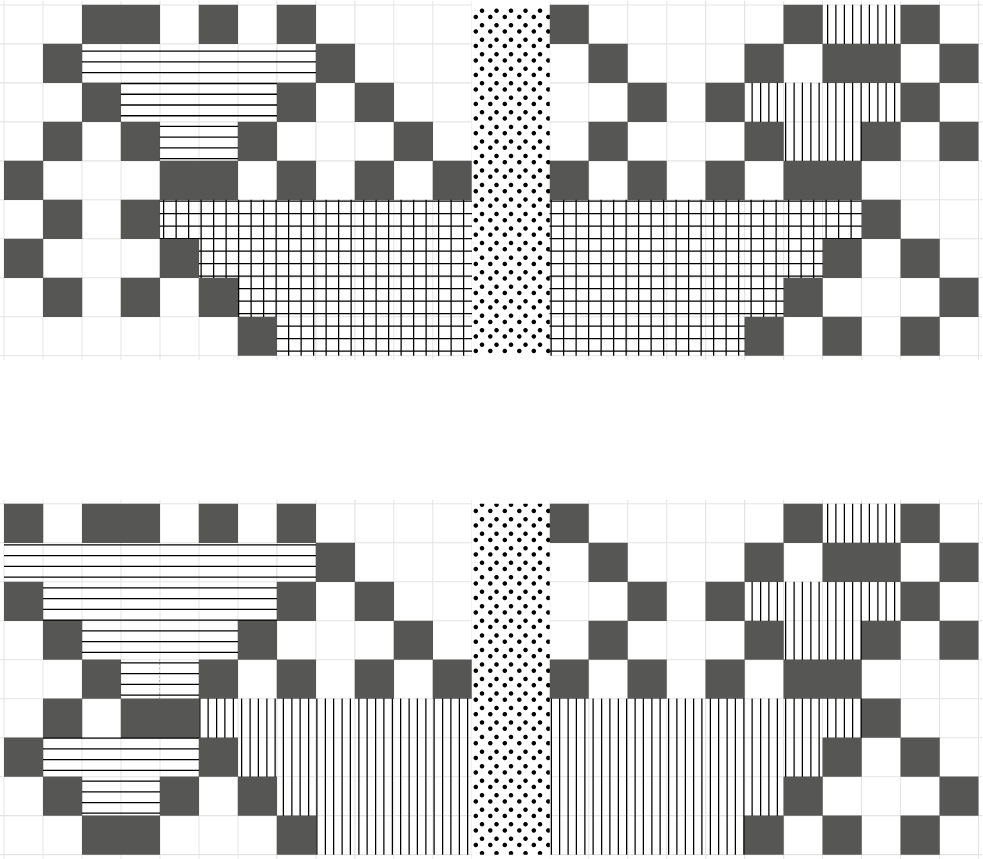
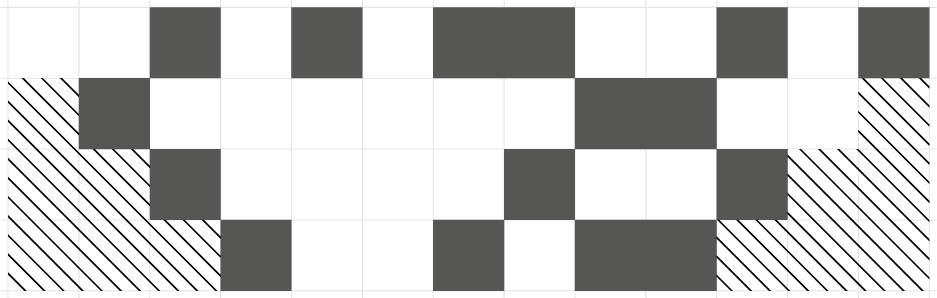


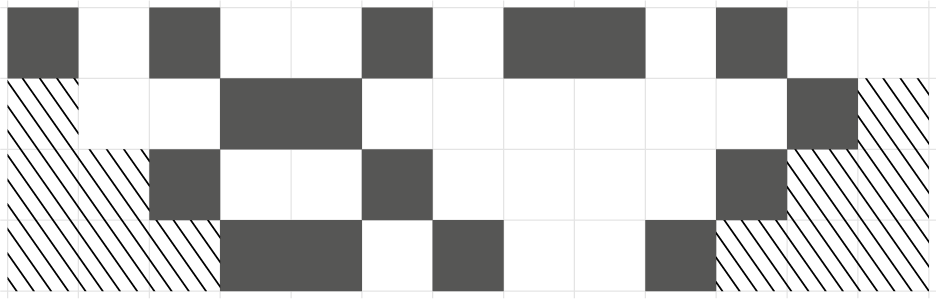


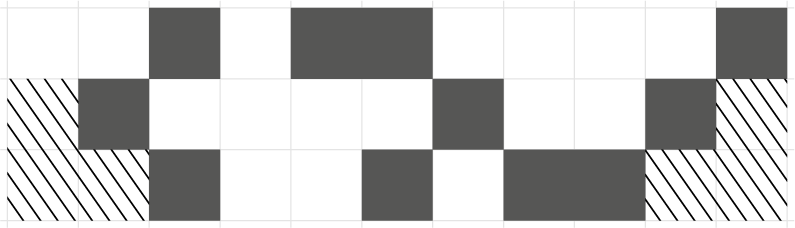


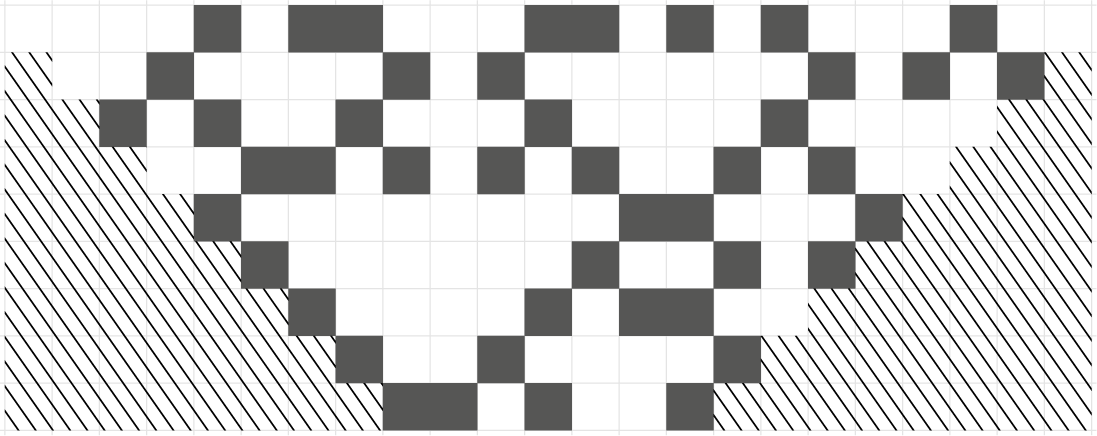


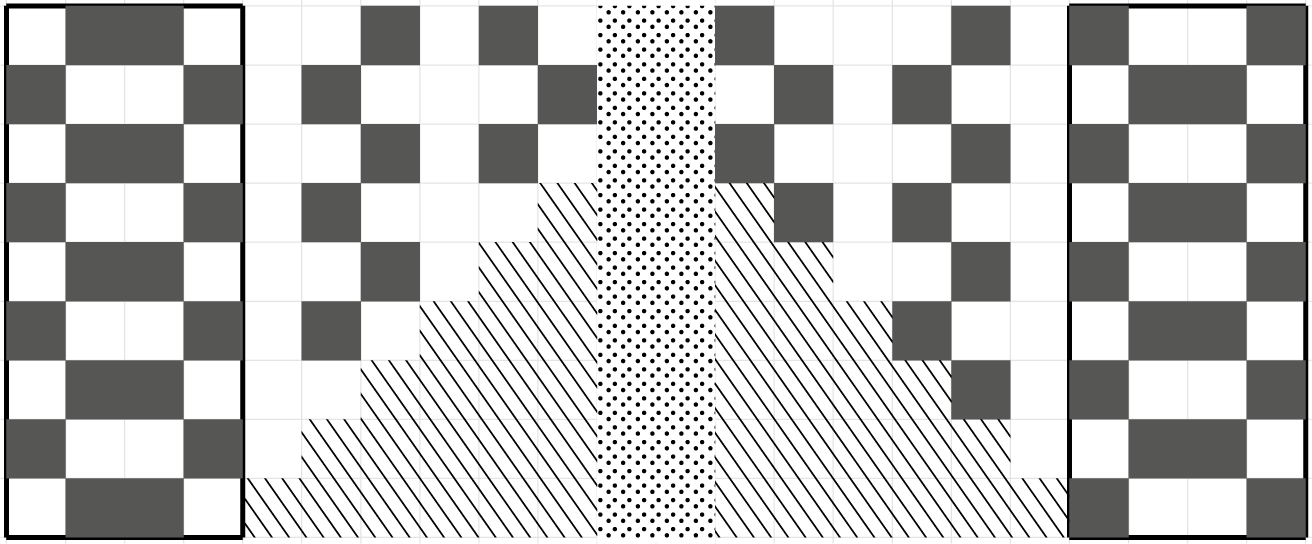


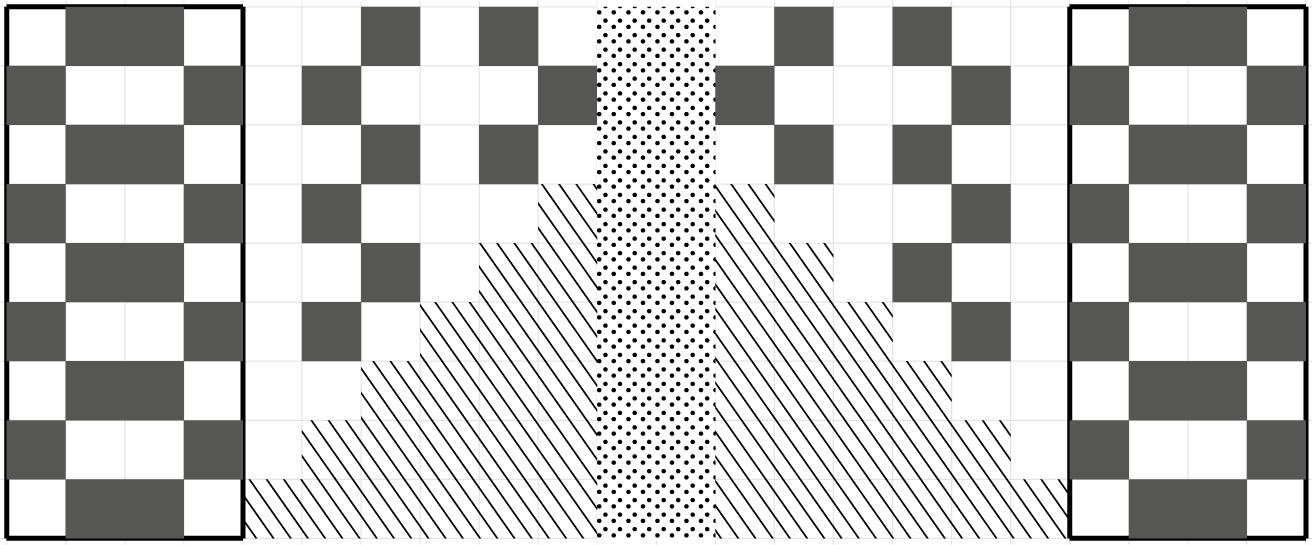
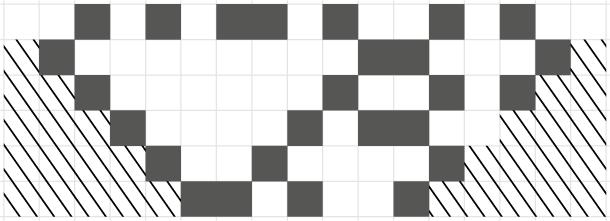

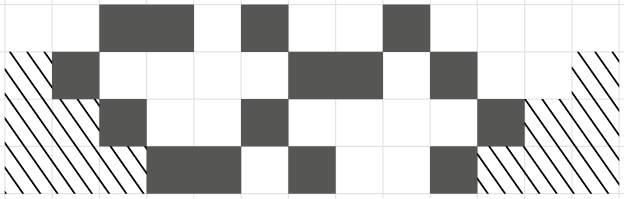


 Open access

