

Introduction
In recent decades, Europe has witnessed both a rise of “far-right street politics” and grassroots mobilizations (Castelli Gattinara and Pirro Reference Castelli Gattinara and Andrea2019, 448; Castelli Gattinara, Froio, and Pirro Reference Gattinara, Pietro and Andrea2021; Mudde Reference Mudde2016), and at the same time a development of femonationalism (Farris Reference Farris2017), understood as the use of feminist rhetoric for fostering nationalism and racial exclusion. Yet research in social and political science has exercised “very little empirical and theoretical effort for understanding the non-electoral articulations of far-right politics” (Caiani, della Porta, and Wagemann Reference Caiani, della Porta and Wagemann2012; Castelli Gattinara and Pirro Reference Castelli Gattinara and Andrea2019, 449). In this process, femonationalism has often been analyzed through the lens of far-right party politics, mainly through their representatives’ discourse and electoral politics, but not as a social movement practice emerging from grassroots activists.
Unlike the hierarchical and rigid organizational structure of radical right-wing political parties, grassroots-level social movements of the far right display greater heterogeneity both in terms of their organizational practices and ideologies (Castelli Gattinara and Pirro Reference Castelli Gattinara and Andrea2019; Castelli Gattinara, Froio, and Pirro Reference Gattinara, Pietro and Andrea2021; Toscano Reference Toscano2019). On the rise, far-right social movements have sometimes developed in novel forms, particularly regarding gender dimensions and the growing presence of women in their ranks (Della Sudda Reference Della Sudda2022; Ebner and Davey Reference Ebner and Davey2019; Blee Reference Blee2020; Goetz Reference Goetz2022), which contrast from the often male-dominated nature of radical right-wing populist parties. While they have long been identified as unlikely far-right activists and supporters (Klandermans and Mayer Reference Klandermans and Mayer2005; Mudde Reference Mudde2007; Spierings and Zaslove Reference Spierings and Zaslove2017), the growing role of women in far-right social movements, along with the incorporation of feminist rhetoric within their political agendas, is a central tenet of the mainstreaming of the contemporary far right in Western Europe. Exploring how women grassroots activists appropriate and relate to feminism in their mobilization is crucial to understand how femonationalism develops at the far right. This paper, therefore, proposes to shift the focus of femonationalism from the realm of the political elite and representatives, and instead investigate how grassroots female activists enact it in their campaigns.
How do far-right women grassroots activists appropriate feminism on the ground? Feminism, broadly defined, encompasses a diverse range of movements and ideas that promote gender equality and challenge social structures perpetuating gender-based disparities. In stark opposition, far-right actors, driven by nationalist and conservative agendas, are traditionally opposed to feminism (Köttig, Bitzan, and Petö Reference Köttig, Bitzan and Petö2017) and actively engage in anti-feminist and anti-gender campaigns (Goetz and Mayer Reference Goetz and Mayer2023; Paternotte and Kuhar Reference Paternotte and Kuhar2018). This paper dives into femonationalist politics through a French case of far-right female activists organized as a women-only collective and who self-identify as “identitarian feminists” (féministes identitaires). Despite this uncommon label, these activists centrally display anti-feminist discourse, opposing and rejecting key aspects of feminist movements and claims against structural gender inequalities. Yet, they do not reject all feminist principles; instead, they selectively embrace certain elements — like the fight against gender-based violence — while invoking postfeminist claims that goals of gender equality have already been achieved. The paper thus addresses how these far-right activists articulate anti-feminist frames while also appropriating selective aspects of feminism.
To answer this question, the paper explores the collective action frames constructed by the collective’s activists — that is, the “action-oriented sets of beliefs and meanings that inspire and legitimate the activities and campaigns of a social movement organization” (Benford and Snow Reference Benford and Snow2000, 614). I particularly investigate the collective’s frames relating to feminism, both as a movement and a concept. This involves closely examining how the activists make sense of the collective’s “identitarian feminist” label, and how they articulate anti-feminist discourse with the appropriation of feminist fights. Through their framing efforts, activists also work “to promote a particular problem definition, causal interpretation, moral evaluation and/or treatment recommendation for the item described” (Entman Reference Entman1993, 52). Framing operations are thus crucial in that they also “define problems” — that is, “determine what a causal agent is doing with what costs; diagnose causes–identifies the forces creating the problem; make moral judgments–evaluate causal agents and their effects; and suggest remedies–offer and justifies treatments for the problems and predict their likely effects” (Entman Reference Entman1993, 52). My analysis also pays central attention to how these activists reframe and reshape the feminist issues that they appropriate — here specifically, street harassment — to make it fit with a far-right identitarian political agenda. In doing so, the paper focuses on the supply-side factors of far-right movements’ success (Mudde Reference Mudde2007, Reference Mudde2010; Norris Reference Norris2005) — that is, on movements’ strategies to increase their appeal, here in terms of their framing efforts. To this aim, the analysis draws on threefold empirical data; long-term digital observation of the collective’s social media platforms and website, a critical analysis of the documents produced by the collective, and semi-structured interviews with some of its central members.
The article argues that this far-right women’s mobilization diverges from traditional forms of anti-feminism and situates it as a femonationalist appropriation of feminism. Moving beyond the notion of instrumentalization, I propose the concept of appropriation to describe how these activists engage with and seek to redefine feminism within far-right ideological frameworks. The appropriation process involves adopting and transforming initially feminist causes to align them with a nationalist far-right agenda, ultimately tied to a project to advance a far-right feminism. I identify three main collective action frames through which they do so: an opposition to what they perceive as intersectional feminism, the use of postfeminist frames, and a frame that racializes sexism through the fight against street harassment. These frames are interconnected; they constitute the collective action frames through which they legitimate their mobilization and seek new adherents. Concretely, this materializes through their selective embrace of specific aspects of feminism while rejecting contemporary intersectional feminism. Rather than opposing feminism as a concept, these activists oppose segments of contemporary feminist movements. They attempt redefine the concept of feminism according to their nationalist and identitarian ideology, thus enacting femonationalism by appropriating feminism to the far right. To do this, they use postfeminist frames according to which equality between men and women is already achieved in the West. From this perspective, patriarchal and sexist threats emanate from the outside and the Other, as exemplified in their focus on street harassment, which they essentially racialize and attribute to migrants and racialized men. The article thus identifies femonationalism as a novel form of anti-feminism characterized by the appropriation of selective aspects of feminism, which are adapted to far-right political agendas and primarily rely on the racialization of sexism. Such findings provide a more complex understanding of the use of gender equality rhetoric at the far right, beyond the thesis of instrumentalization, and offer insights into how the fight against street harassment can constitute a pathway for young women into far-right activism.
Studying the Complex Entanglements of Gender and Radical Right Politics: From Instrumentalization to Appropriation
While academic research in social sciences has increasingly explored the complex intricacies of gender and radical right politics, little attention has been paid to the appropriation of feminist themes by far-right grassroots activists. The case of female grassroots activists who appropriate feminism at the far right offers an opportunity to advance a more complex analysis of far-right gender politics, one that moves beyond the dominant theses of instrumentalization and anti-feminism. Rather than rejecting these frameworks, this analysis seeks to highlight additional, more insidious dynamics at play — specifically, how contemporary segments of the far right aim to appropriate feminism by redefining, transforming, and absorbing it within their political agendas.
In a European context of de-democratization (Lombardo, Kantola, and Rubio-Marin Reference Lombardo, Kantola and Rubio-Marin2021), the rise of conservative and radical right-wing populist parties (RRPPs) often goes hand in hand with opposition to gender equality and feminist politics (Graff and Korolczuk Reference Graff and Korolczuk2021; Korolczuk Reference Korolczuk2020; Verloo Reference Verloo2018; Verloo and Paternotte Reference Verloo and Paternotte2018). Political scientists have extensively analyzed anti-gender and anti-feminist campaigns, importantly documenting the central role of radical and far-right parties and networks in this phenomenon (Kovats, Poim, and Peto Reference Kovats, Poim and Peto2015; Paternotte and Kuhar Reference Paternotte and Kuhar2018). On the other hand, the deployment of femonationalism suggests that women’s rights and gender equality rhetoric have spread to the far right, where they were not expected by feminist activists, nor by far-right male activists (Colella Reference Colella2021; Farris Reference Farris2017; Scrinzi Reference Scrinzi, Köttig, Bitzan and Petö2017a, Reference Scrinzi2024). This tension between the rise of anti-feminism on the one hand, and the use of feminist discourse at the radical and far-right on the other, has not been extensively analyzed at the level of grassroots mobilizations.
Further studies have paid attention to the odd use of LGBTQ+ rights and feminist themes in far-right politics to foster nationalism or racial exclusion, which the concepts of homonationalism (Puar Reference Puar2007, Reference Puar2017; Spierings Reference Spierings2021) and femonationalism (Farris Reference Farris2017) respectively aim to capture. Sara R. Farris coined the concept of femonationalism to refer to the increasing use of women’s rights rhetoric for the promotion of racial exclusion and nationalism in Europe. The concept specifically outlines the convergence of various actors with traditionally opposed political agendas — far-right parties, neoliberal governments, and some prominent feminist figures. She analyzes this unexpected encounter around the promotion of nationalism in the name of women’s rights, thereby stressing the complex intertwining of gender equality and feminist rhetoric with nationalist and far-right politics. Drawing on this concept, scholars have used different case studies to highlight the ways in which femonationalism is deployed in European contexts, both in discourse and public policies (Bader and Mottier Reference Bader and Mottier2020; Calderaro Reference Calderaro, Angeliki Sifaki and Loncarevic2022, Reference Calderaro2023; Farris Reference Farris2017; Mulinari Reference Mulinari2018; Rahbari Reference Rahbari2021; Sager and Mulinari Reference Sager and Mulinari2018; Sifaki, Loncarevic, and Quinan Reference Sifaki, Loncarevic and Quinan2022;). Yet, the paradoxical appropriation of feminist rhetoric by far-right grassroots activists has not been centrally analyzed, despite the fact that the term femonationalism is often used to describe these unusual appropriations of feminism by conservative and nationalist actors.
Studying these appropriations at the grassroots level may offer novel insights for two main reasons. First, because of their formal and hierarchical organizational structure, political parties do not allow for alternative organizational practices that characterize extra-parliamentary grassroots movements. The latter tend to be more fluid and decentralized, and “their flexibility allows them to adapt to changes in their environment, to combine the actions of broad ranges of actors, and to force political leaders to deal with new issues” (Tarrow Reference Tarrow2011, 98). In particular, RRPPs are not only highly hierarchical, but also male-dominated (Erikson and Josefsson Reference Erikson and Josefsson2024; Mudde and Kaltwasser Reference Mudde and Kaltwasser2015), although women have become prominent leaders of key European RRPPs over the last decade (Dietze and Roth Reference Dietze and Roth2020; Giorgi, Cavalieri, and Feo Reference Giorgi, Cavalieri and Feo2023; Scrinzi Reference Scrinzi2024; Snipes and Mudde Reference Snipes and Mudde2020). In contrast, grassroots movements have lower barriers to entry, and participation is further encouraged by the strong online presence of far-right groups (Froio Reference Froio2018; Klein and Muis Reference Klein and Muis2019; Veugelers and Menard Reference Veugelers, Menard and Rydgren2018). The case studied in this article particularly stands out for its non-mixity in terms of gender: it is a women-only collective which does not depend on another male-dominated party or movement. As such, the collective organizes based on an identity of “women” and uses the label of “feminist” while being rooted at the far right, also leveraging participants’ experiences of gender-based violence in the public space. These peculiarities may introduce new dynamics in how young far-right women engage with feminism.
Second, while political parties’ strategies are guided by electoral gains, where the promotion of women’s rights remains limited to media discourse and communication, this collective placed (selective) issues of gender-based violence at the core of its mobilization. This does not imply that these activists are void of strategic motivations — as they also aim to recruit new members and build visibility — but rather that their use of feminist rhetoric and label as a women-only collective influenced by identitarian ideologies may involve different dynamics. In particular, they incorporate women’s personal narratives of gender-based violence with an ideological reconfiguration of feminist fights, not only to advance a far-right agenda, but also to transform and redefine the contours of feminism. As such, their appropriation of feminism is tied to a project of “far-righting” feminism, ultimately directed toward the emergence of a far-right feminism rooted in both far-right ideological agendas and movements.
Additionally, although party and extra-parliamentary segments of the far-right overlap and their members circulate between the two interconnected spheres, important grassroots non-party segments distinguish themselves by their focus on the struggle of ideas and culture (Veugelers and Menard Reference Veugelers, Menard and Rydgren2018). This particularly applies for the identitarian segment of the far right, which is importantly shaped by the heritage of the French New Right (Nouvelle Droite) born in the late 1960s (Bar-On Reference Bar-On2012; Goetz Reference Goetz2022; Jacquet-Vaillant Reference Jacquet-Vaillant2021; Minkenberg Reference Minkenberg, Merkl and Weinberg1997). Founded by Alain de Benoist, the intellectual leader of the Groupement de Recherche et d’Études pour la Civilisation Européenne (GRECE), the French Nouvelle Droite distinguished itself by situating their fight on the terrain of ideas rather than exclusively on the political electoral struggle. By appropriating the Gramscian concepts of metapolitics and hegemony, the New Right promoted a “right-wing Gramscism” (de Benoist Reference de Benoist1992), as involving a wider strategy to gain cultural hegemony. In practice, such a strategy consisted of diffusing their ideas through the media, the editorial field, and cultural productions, as well as through language and categories of thought. Because it also aimed at making the far-right respectable again after the Second World War, notably by distancing itself from biological racism (Bar-On Reference Bar-On2012; Rueda Reference Rueda2021), the French New Right developed ethno-differentialism, which highlights the essential difference between ethnic and cultural groups while promoting their strict separation. This became the dominant philosophical and political framework of the identitarian movement, which allows them to “fend off accusations of racism” (Jacquet-Vaillant Reference Jacquet-Vaillant2021, 9). As such, the case of identitarian activists mobilizing upon the identity of “women” and borrowing the feminist label in an ethno-differentialist perspective constitutes a laboratory for studying how the far right mainstreams itself through the growing appropriation of feminist and gender issues.
In an attempt to analyze the atypical use of feminist rhetoric by radical right-wing populist parties, scholars have provided useful insights into the paradoxical character of right-wing sexual politics in the European context (Dickey, Spierings, and van Klingeren Reference Dickey, Spierings and van Klingeren2022; Dietze and Roth Reference Dietze and Roth2020; Möser, Ramme, and Takács Reference Möser, Ramme and Takács2022). They have analyzed the incorporation of gender equality ideas within the European far right as a “symbolic glue” (Kovats, Poim, and Peto Reference Kovats, Poim and Peto2015, 34; Colella Reference Colella2021), emphasizing the strategic and instrumental use of selected themes from feminist discourse to fuel a far-right nationalist agenda (Graff, Kapur, and Walters Reference Graff, Kapur and Walters2019). While these analyses provide valuable insights into the co-optation of women’s rights arguments by nationalist political leaders, I contend that relying solely on the instrumentalization thesis — by emphasizing motives over mechanisms — risks obscuring the processes and tensions that underlie these appropriations of feminism. This focus also tends to reduce the analysis to a one-dimensional explanation, failing to capture the varied mechanisms, logic, and strategies through which the contemporary far right engages with gender and feminism.
Another body of literature which focuses on the presence of women as activists or supporters of the far right has provided key insights into their relationship with feminism and gender issues. In her seminal work on women of the Ku Klux Klan in the 1920s United States, Blee (Reference Blee1991, Reference Blee1996) highlighted how these far-right white American women combined racist and nativist frames with demands on women’s rights, including claims for women’s legal and political rights, such as women’s suffrage. Her work signals that such articulations are not novel. Back in 1991, Blee already pointed out what she depicts as a “disturbing” pattern, stating that “some Klanswomen had a facile ability to fold bitter racial and religious bigotry into progressive politics” (Blee Reference Blee1991, 6). She also documented how these female activists associated the sexual threat faced by white women to immigrant and Black men. The analysis of this mobilization from the 1920s resonates with more recent forms of racialization of sexism and enables us to resituate nationalist women’s political engagement within a broader historical perspective. While the American and European far right may differ on many levels, scholars noted that the growing presence of women within the far right is a common trait (Blee Reference Blee, Köttig, Bitzan and Petö2017; Köttig, Bitzan, and Petö Reference Köttig, Bitzan and Petö2017). Recent research has highlighted the complexity of women’s engagement at the European far right, either as grassroots activists (Della Sudda Reference Della Sudda2022; Goetz Reference Goetz2022), party members (Scrinzi Reference Scrinzi2017b, Reference Scrinzi2024), or voters (Mayer Reference Mayer2022; Off Reference Off2023). In her study of eastern German radical right voters, Off stressed that despite the use of instrumental arguments, “interviewees also express support for certain feminist politics […], emphasiz[ing] the importance of equal rights, defining gender equality as a legal matter” (2023, 16). While one could expect that, unlike voters, women far-right activists would maintain more distance with feminist rhetoric, Della Sudda (Reference Della Sudda2022) observes how some of these women’s groups borrow themes from feminist movements while also opposing the latter. In analyzing French radical right-wing women’s movements throughout the last decade, she highlighted how the norm of equality has marked these generations of women activists, complexifying the usual thesis of the instrumentalization of women’s rights for the advancement of a nationalist agenda. Building on her key insights, this paper focuses specifically on the most recent emergence of the collective Némésis, which contrasts with other far-right women’s movements in that it claims the label of “feminists.” This paper further explores the tension between anti-feminism and the paradoxical appropriation of feminist themes through the case of far-right female grassroots activists. In exploring these issues, it answers Blee’s call to “further adjust how we assess the extent to which women are participating in and leading such [anti-feminist and anti-gender] movements, networks and parties” (Reference Blee2020; Reference Blee2021, 316), while at the same time taking seriously the growing appropriation of feminist claims by far-right actors.
Methodology
Investigating Far-Right Female Activists Organized as a Grassroots Collective: The Case Study
The case study here relates to the emergence of a political collective of young far-right women identifying themselves as “identitarian feminists” (féministes identitaires). The collective Némésis Footnote 1 was founded in October 2019 in France and became more prominent in 2021 as it picked up members and received wider media attention. They have become very visible since 2021 on several media platforms: not only have they reached high numbers of followers on social media — with almost 40, 000 followers on Twitter — but some of their leaders would regularly appear on TV shows, be interviewed by journalists in the press, or be the subject of journalistic investigations. Organized into regional chapters in France, it has also developed chapters in French-speaking parts of Switzerland. Its members are white womenFootnote 2 in their twenties, mainly from upper-class backgrounds, and most are university students or hold university degrees. The president and cofounder of the collective is also a young woman in her twenties and a rising figure in the French far-right identitarian activist sphere. Like many far-right groupings and mobilizations, they launched their initiative online through social media platforms, and recruit members almost entirely through this medium. The fight against street harassment is at the center of their mobilization, as will be seen throughout the paper. In line with the broader Identitarian movement (Jacquet-Vaillant Reference Jacquet-Vaillant2021; Nissen Reference Nissen2022) to which they identify, they advocate a strict end to immigration and promote anti-Islam discourse in order to promote nationalist values attached to a European civilizational identity. However, in contrast with other identitarian activists, their primary focus in promoting these values lies in advocating for the end of violence against women in the public space.
This case offers an original opportunity to study radical right women’s appropriation of feminist themes. First, because it is an all-female grassroots and youth-led movement reaching high visibility in the media, it may facilitate young women’s entry into the far-right landscape and political parties. The collective’s members indeed often share a socialization within nationalist and radical right networks, nationally and/or locally, and are well-connected to online far-right and neofascist networks. As such, the collective may serve as an entry point to radical right parties for young women. Second, young women are rather unlikely far-right activists as research has shown (Goodwin Reference Goodwin2011; Klandermans and Mayer Reference Klandermans and Mayer2005; Mudde Reference Mudde2007; Spierings and Zaslove Reference Spierings and Zaslove2017). Yet, in this case, they founded a far-right identitarian women’s collective and claim it as a female-only collective. While conservative and far-right women organized in women-only movements in the 20th century (Benowitz Reference Benowitz2009; Blee Reference Blee1991; Della Sudda Reference Della Sudda2012; Dumons Reference Dumons2002; Nielsen Reference Nielsen2001), they have since mobilized in male-dominated movements and political parties (Klandermans and Mayer Reference Klandermans and Mayer2005; Ralph-Morrow Reference Ralph-Morrow2022). In this regard, both the identitarian roots of the movement and the French context make it an interesting case to explore. The identitarian segments of the European far right are more hospitable to women, including in prominent roles (Della Sudda Reference Della Sudda2022; Goetz Reference Goetz2022), in comparison with other, more extreme, segments. Additionally, France stands out as a rare case where the radical right gender gap has closed, partly due to the normalization strategies of radical right parties (Amengay, Durovic, and Mayer Reference Amengay, Durovic and Mayer2017; Mayer Reference Mayer2015, Reference Mayer2022), thus presenting an already existing femonationalist dynamic. Finally, despite their political stance at the far right and within the Identitarian movement, generally opposed to feminist demands, these activists claim the label of “identitarian feminists” and promote particular feminist claims. For these reasons, this case presents an unlikely group that can deepen our understanding of how femonationalism develops at the far right.
Long-Term Digital Observation, Critical Document Analysis, and Semi-Structured Interviews
The data collected here is threefold, combining long-term digital observation, critical document analysis, and semi-structured interviews conducted with key actors of the collective.
First, the strong presence of far-right networks online and on various social media platforms (Froio and Ganesh Reference Froio and Ganesh2019; Urman and Katz Reference Urman and Katz2022) allowed me to conduct a digital observation of the collective. I regularly observed its online activity and posts on platforms such as Instagram — which serves as their primary medium for promoting actions and recruiting members — and Twitter. Throughout the period of February 2021 to January 2023, I consistently followed their online interventions through social media postings, website updates, written and spoken reactions to political developments, social media postings, website updates, written and spoken reactions to political developments and videos of their political actions. I systematically collected screenshots of social media postings that referred to feminism, street harassment, or gender-based violence and stored them thematically with fieldwork notes (n = 311 image documents), along with video and audio posted on Instagram and YouTube (n = 39 video and audio documents). This online observation provided me with the collective’s main discourse and frame on feminism and gender-based violence, including in the public space. Finally, social media platforms, and in particular Instagram, constituted the channel through which I could reach out to them for the interviews.
I further observed the collective Némésis through the media echo they generated. I was able to follow their discourse and frames through interviews of their president and cofounders with journalists, TV interviews, and press articles reporting on their mobilization (n = 59 items). These media documents were selected based on two main criteria: first, I retained only articles where members of the collective were interviewed and shared their discourse; second, I selected the items published between January 2021 and June 2023, a timeframe characterized by the collective’s heightened media visibility during which the activists fixed their collective action frames. I critically analyzed these documents collected online and in the media, paying attention to recurring themes in order to identify the frames that the collective aims to diffuse. In the analysis of these secondary sources, I paid particular attention to selecting the frames used by the collective and not the analysis from journalists that might distort the collective’s discourse or interpret it through the newspaper’s orientation lens. This involved prioritizing the activists’ direct quotes and focusing on their discourse, independently of media coverage.
Finally, I conducted 10 semi-structured interviews with key members of the collective: one with the cofounder of the collective, and 9 with leaders and former leaders and former leaders of local chapters (eight in France, and two in French-speaking Switzerland).Footnote 3 The interviewees were all young white women, ranging in age from 16 to 26, with an average age of 20. The interviews, conducted between June 2021 and June 2023, lasted between 55 minutes and two hours. They were supplemented by written exchanges with the interviewees before and especially after the interview, to clarify and expand some of the points.
Although far-right activists, particularly at the grassroots-level, constitute a hard-to-reach population for qualitative research (Damhuis and de Jonge Reference Damhuis and de Jonge2022; Ellinas Reference Ellinas2023), interviewing these far-right women proved easier than I initially expected. Despite some declines, mainly due to individuals’ decision to keep their activism entirely undercover, some factors may have contributed to this fieldwork access. First, our proximity in age and my status as a PhD student at the time of the research may have played a positive role, as the student image is more associated with innocence and naivety, prompting more trustfulness, contrary to higher-up positions in academia which may spark wariness (Damhuis and de Jonge Reference Damhuis and de Jonge2022; White Reference White2011). Second, as already stressed by scholars, being identified as white is a key factor in accessing interviews with the far-right (Faury Reference Faury2023; Ramalingam Reference Ramalingam, Ashe, Busher, Macklin and Winter2020). On top of these two factors, a third element considerably facilitated these interviews: the young activists I was studying were seeking visibility and, consequently, were eager to be interviewed by journalists and researchers. As such, unlike the case described by Klandermans and Mayer (Reference Klandermans and Mayer2005) where far-right activists were more willing to participate when assured that their information would not appear in a newspaper, the participants in my research were sometimes disappointed that their views and information would not be more widely disseminated.
The interview grid revolved around four main themes: (1) their motivation to found or join the collective; (2) their relation to feminism (both the concept and the movement) and their self-identification as feminists; (3) their political claims and their relations to other political collectives or organizations, including their past political experiences; and (4) the internal working of the collective, its recruitment strategies and activities. With the participants’ consent, I recorded the interviews and then proceeded to their analysis. I used MaxQDA software to code the transcriptions of the interviews. During a first coding phase, I created a coding schema informed by the research questions and focused on the appropriation of the label of “feminist.” The second phase consisted in updating the schema with open coding to capture new and context-related issues emerging in the interviews or in the digital observation, such as the rejection of intersectional feminism, the use of postfeminist arguments, and the focus on the fight against street harassment.
Conducting these interviews with the activists enabled me to supplement the data collected online and in the media: it allowed me to grasp their discourses, frames, and representations in greater depth and less polished ways. It also facilitated a deeper understanding of the sociological and political trajectories of their key leaders, shedding light on their motivation to engage in this mobilization and the meaning they attach to it. As Blee and Taylor note (2002, 92–3), semi-structured interviews are a useful tool for better understanding social movement mobilization as they “provide greater breadth and depth of information, the opportunity to discover the respondent’s experience and interpretation of reality, and access to people’s ideas, thoughts, and memories in their own words rather than in the words of the researcher.” The interviews also allowed me to gather informational data on the inner workings of their formation, internal organization, activities, and recruitment strategies, all of which were less available in publicly accessible documents. In this regard, the interviews conducted for this study can also be characterized as “key informant” interviews, which involves selecting well-placed individuals who can provide descriptive information from an insider point of view (Blee and Taylor Reference Blee, Taylor, Klandermans and Staggenborg2002), but also accessing the key frames used by the collective to justify their collective action.
Far-Right Anti-Feminism, or “Far-Righting” Feminism? The Rejection of Intersectional Feminism
First, the fact that these young women self-identify as “identitarian feminists,” and therefore claim the label of feminist while being rooted in the far-right ethno-nationalist movement, appears both surprising and unusual. In its manifesto, the collective introduces itself as a “feminist, identitarian and anti-conformist collective,” and states that they are “the island where the castaways of feminism can take refuge”.Footnote 4 This conveys both a self-identification as feminist and a critique of feminism. In order to further explore these apparent contradictions, I asked the young activists if they identified as feminists during our interviews. Most do, but they are specific about the type of feminism that they endorse, as reflected in the words of Justine, a regional chapter leader:
Well, yes, I recognize myself in the word feminist because otherwise I wouldn’t be in Némésis, you see. But in fact, it depends on what you put behind feminism and today, in any case the word feminism today, as it is practiced by the media, well no, it doesn’t correspond to me. It’s not this feminism that I adhere to and that I want to relay. Feminism for me, the fight for women’s rights and above all the fight against violence against women, it’s all that that should not be forgotten as a fight and I think it’s a pity that… the so-called feminist associations wage war on us because we don’t adhere to their political line. (Interview with Justine, regional chapter leader, 2021)
This use of the feminist label while rejecting some forms of contemporary feminism shows their endeavour of redefining the content of feminism as a concept. There is a rejection of contemporary feminist movements as they exist in the public sphere (“as it is practiced by the media”) that is articulated as a project of far-righting feminism. This involves developing a seemingly feminist ideological project that aligns with far-right political claims and agendas, relying on both a selective appropriation of feminist themes, and a racialization of sexism, as I will show. Laura, the cofounder of the collective, also relates how she conditionally identifies as a feminist:
Yes, I totally identify as a feminist. However, I have never thought about joining any other feminist struggle, apart from Némésis. Because I think they have… I’m not going to blame them because I sincerely think they do a lot for women. (…) But in fact, most of their fights, what they display in their images, are a bit, for me… useless and they do not serve women. Everything like “We’re going to stick sanitary towels in the metro to stop making menstruation invisible, we’re going to let ourselves grow hair because women are free to let themselves grow hair,” well yes, good for them if they don’t want to wax. But does that mean we should post pictures on Instagram of our grown hairs under the armpits and so on? I find that it discredits the fight (…) I’ve never joined these fights, because, to tell you the truth, I thought it was ridiculous. I thought, there are such serious things going on that I don’t understand that their communication is based on clitorises and hairs. (Interview with Laura, cofounder of the collective, 2021)
After this critique of the feminist body-positive movement on social media, which she ridicules, she concludes:
And then, yes, of course, I claim to be a feminist, but I think anybody can appropriate that word already. The proof is that we all have an idea of feminism. When I first hear the word feminism, I think of those struggles I told you, you know. But in fact… well, feminists have been that way for a few years now, but it hasn’t always been that way! And so yes, we want another form of feminism than what we see everywhere and what most people see. But yes, for me, Némésis is feminism. And I am a feminist, obviously! (Ibid.)
This rejection of the contemporary feminist content shared on social media, especially about the body, is further reflected in online materials shared by the collective. This includes images ridiculing blue-haired women, and videos contrasting activists labeled as “neofeminists” with the collective’s members, young white women conforming to normative beauty standards. This often goes with their claim that “another feminism exists” (Collectif Némésis, 2021), and serves as part of their recruitment strategy to attract women who will better identify with heteronormative and gendered social norms. For the collective’s activists, these feminist claims around the body are associated to intersectional feminism, as illustrated by Camille’s words:
Many of the girls that are interested in joining us reject intersectional feminism, so when they find the same term here, “feminist,” it can repel them, they can think “there’s a problem, maybe they’re all crazy blue-haired women screaming!” (Interview with Camille, 2022)
The primary anti-feminist frame employed by the collective indeed stands in opposition to what the activists perceive as “intersectional feminism.” When I asked Clara, the president of a French chapter of Némésis, if she identifies as a feminist, she developed her attachment to some aspects of feminism and her rejection of other elements from feminist movements:
Your question is very relevant because the feminism I was seeing in the media and even in high school with women who were very much into pathos and guilt, especially of the white man, whereas I thought it was not necessarily the biggest problem in our society… I didn’t see myself in it, so I said I wasn’t a feminist. Even to my friends, when they asked me if I was a feminist, I said no, because for me, the definition of feminism today does not correspond to me. And if tomorrow I am asked if I am a feminist and I am told the criteria of intersectional feminism, I will always answer that no, I am not a feminist. I am for feminism as it was previously and not as it has become. And so, it’s true that it was through a movement like Némésis that I said to myself that yes, in fact, I am a feminist! It’s just that I don’t fit the criteria of modern feminism. (Interview with Clara, regional chapter leader, 2022)
Intersectional feminism, often understood by these activists as going hand in hand with a convergence of social justice struggles, is described by the collective’s members as a form of “contradiction” or “hypocrisy” on the part of feminists. This is combined with the idea that contemporary intersectional feminists have been corrupted by a leftist ideology, as suggested by the following extract from a social media post from the collective to recruit members: “Don’t let feminists corrupted by the extreme-left speak for you. You also have your part to play!” (Collectif Némésis, 2022). When I asked Carole, another activist of the collective, if she identifies as a feminist, she replied to me:
Um… so I’d say no, not at all, but for me, the term feminism doesn’t have the same meaning today. If it’s the term feminism of 50 years ago, then yes, but if it’s the term feminism of today, no. For me, it doesn’t mean anything anymore… those feminists today, they mix up everything, and what bothers me most about it is their intersectional approach, as they call it. (Interview with Carole, collective activist, 2023)
Like Clara, Carole emphasizes a distinction between the “pre-” and the “post-” in her self-identification as feminist: she values the feminism “of 50 years ago” but rejects “the feminism of today,” that she associates with “intersectional feminism.” This critique of intersectional feminism is thoroughly shared amongst its members and is a claim made visible by the collective through its communications. On its social media account, the collective shared the following statement defining what they understand as intersectional feminism:
Intersectional feminism is men preventing women from speaking out because they say that a man cannot be a woman. It’s groups of “racialized” feminists who don’t allow other women to speak because they’re white. It’s people who dissuade women victims from reporting crimes because their attacker is from an ethnic minority and that all cops are “bastards” anyway and that prison for rapists is not the solution. (Collectif Némésis, 2022)
They thus use the notion of “intersectional feminism” to refer to fourth-wave left-wing feminists who have embraced intersectional values, a relatively recent phenomenon in a French context that has long been hostile to its adoption (Calderaro and Lépinard Reference Calderaro and Lépinard2021). However, they also use it as an umbrella term to encompass a wide range of tendencies, including anti-racist feminism, queer feminism, and anti-carceral feminism. In this perspective, the concept of “intersectional feminism” operates as an “empty signifier,” a term used by Mayer and Sauer to characterize the notion of “gender ideology” (Reference Mayer, Sauer, Kuhar and Paternotte2018). It serves as a vague concept to unify activists around the rejection of an opposed social movement. Whether referring to “crazy blue-haired women” or to “the convergence of social justice struggles,” particularly of feminism with LGBTQ+ rights or anti-racism, Némésis activists wield the notion of “intersectional feminism” as the main adversary to oppose. In turn, by identifying “intersectional feminists” as the main enemy — instead of “feminists” in general — they develop a new form of feminist identification at the far right, thus attempting to far-right feminism.
In addition, the collective organizes internal training limited to carefully selected members and is not shared through social media. One of these trainings centered on “the pitfalls of intersectional feminism,” and another on “the problem of transsexual people in sport” (Written exchanges with Mary, 2022). These internal trainings highlight the collective’s “conscious strategic efforts (…) to fashion shared understandings of the world and of themselves that legitimate and motivate collective action” (McAdam, McCarthy, and Zald Reference McAdam, McCarthy and Zald1996, 6).
This paradoxical appropriation of the feminist label therefore relies on an anti-intersectional feminism frame, combined with strong anti-gender and anti-trans dimensions (which cannot be fully explored here). It thus echoes what Goetz has termed “neo-antifeminism” in her analysis of the German Identitarian movement (2022, 406), in the sense that it endorses women’s rights rhetoric but still focuses on more traditional gender dualism. However, despite being articulated with a strong anti-feminist dimension, this appropriation of feminism still illustrates a shift in some female extreme right-wing cultures that calls for a more complex understanding of their relationship to feminism. Novel forms of “feminist” identifications at the far-right have emerged. While anti-feminism was traditionally the norm within the far right, these activists chose to endorse the label of “feminists” to “reappropriate feminism” in their own way and adapt it to their far-right political agenda. Justine, the president of a regional chapter, stressed that while she had first considered herself an anti-feminist, the presence of the collective has prompted her to finally identify as “identitarian feminist”:
In fact, for a while, I called myself an anti-feminist. Because feminism was attached to the image of the anti-patriarchal feminist who denounces the white man as the creator of all the world’s ills. It’s the blue-haired feminist who talks about hairs, all this. That’s why I called myself feminine, instead of feminist. And that’s when… I discovered identitarian feminism. In fact, it’s a way of reappropriating feminism. In the right-wing milieu… with ideas oriented to the right, we’ll say, even if we don’t claim to be directly right wing, as we’re apolitical. (Interview with Justine, regional chapter leader, 2021)
The project of representing an alternative to contemporary feminisms is also expressed by Laura:
I said to myself that if [intersectional feminists] are so little open to debate and if we have a self-righteous doctrine which is such that no one who has a different opinion can express themselves, we must have something else, we must have an alternative. And I think that Némésis can be an alternative to this feminism. (Interview with Laura, cofounder of the collective, 2021)
Despite the use of anti-intersectional feminist frames, the contrasts with more typical forms of anti-feminism lie, I suggest, in their claim against sexist and sexual violence, which they endorse with a determination to redefine feminism. For instance, in contrast to the widely accepted — including among far-right networks — idea that feminism is a leftist term, these women also claim the label as they stand against violence against women in their ranks. The president of the collective was herself victim of a well-known far-right activist who reacted violently toward her over a controversy around feminism and anti-feminism. This was followed by an online dispute between different segments and groups within the far-right nationalist and identitarian networks over the use of the adjective “feminist.” Marie, another member of the collective, referred to the tension of claiming to be a feminist while rooted in the far-right:
Even people on the right don’t necessarily understand that [calling oneself a feminist], and that’s also what I liked about Némésis, is that they dare to be feminists while being on the right. That’s often a criticism we get in the milieu because they don’t understand how you can be a feminist and be right-wing, it’s antithetical to them. (…) That’s another reason why I don’t mind saying that I’m a feminist, I don’t really give a damn, because in the end that’s what we are: we defend all women, whatever happens! (Interview with Marie, collective member, June 2023)
Here the interviewee illustrates how the tension lying between claiming the label of feminist and being a radical right activist triggers negative reactions within their own political camp. This also highlights how, even though these activists are rooted in the far-right and not in feminist movements, the self-identification as “feminists” is a central tenet of their collective identity. The latter is built against contemporary intersectional feminist movements, but also, to a lesser extent, against the gender blindness prevalent within male-dominated far-right movements. This, in turn, seems to have paved the way for a “feminist” self-identification while maintaining roots in the radical right, thus making this discursive (and political) opportunity available for young women who do not align with contemporary feminist movements, but who share identitarian views and display sensitivity to issues of gender-based violence.
The frames opposing intersectional feminist values used by these activists thus seems to suggest more a “far-righting” of feminism — or at least working toward that — rather than a typical form of anti-feminism, in the sense that they attempt to redefine and relocate the feminist project within far-right ideological spaces. Although firmly rooted in the far-right, these women activists incorporate the feminist label into their collective identity, which is built both on the rejection of intersectional feminist movements and on the appropriation of the concept of feminism at the radical right.
The Use of Postfeminist Frames: The Struggle for Equality as Belonging to the Past
Second, these activists’ appropriation of feminism is also marked by the use of postfeminist frames, according to which equality between men and women has been legally and socially achieved. While the notion of postfeminism has often been used in the field of cultural and media studies to refer to everyday depoliticized uses of feminist codes and ideas (Genz Reference Genz2006; Gill Reference Gill2016; Hall and Rodriguez Reference Hall and Rodriguez2003), I propose to borrow it here to articulate an analysis of these recent femonationalist mobilizations. The idea that feminism is outdated and that Western European women have already achieved equality is well established in the collective. This generation of young female activists grew up in a context where the idea of equality between men and women is enshrined in national and supranational law and conventions, and where a set of social achievements in terms of gender equality have been made (Della Sudda Reference Della Sudda2022; Durovic Reference Durovic2017). They have therefore been socialized, to some extent, into the principle of gender equality (in a binary sense), and their identitarian mobilization is also marked by some of these aspects. The activists are however primarily socialized into far-right movements from a young age, which fosters a strong rejection of left-wing and social justice movements. This opposition is particularly pronounced toward the relatively recent incorporation of diverse minoritized groups’ needs within French feminist movements’ agendas, as exemplified by their strong rejection of intersectionality. These elements result in a selective approach to feminism: while they are attached to women’s civil rights and the fight against sexist and sexual violence, they consider many issues raised by contemporary feminists as either irrelevant — those tied to intersectionality — or already solved and belonging to the past — such as the fight against patriarchy. This underscores how their collective action frames are tightly interconnected and directed toward furthering racism through the racialization of sexism, a point I will further develop.
The use of postfeminist frames is reflected in Lucie’s words during our interview. She began our exchange by saying she had joined the collective because “no [other] collective really talks about street harassment, it’s always about struggles against patriarchy and all that, but it doesn’t affect us directly!” and then referred to her support for the far-right candidate in the French presidential elections, Éric Zemmour. According to the young activist, “Zemmour is the one who would help us against street harassment the most, because the fact that the police are armed, that the police take back some authority, that would help us enormously” (Interview with Lucie, regional chapter leader, 2021). It is noteworthy that although the collective asserts its independence from political parties, some of its members are individually involved in far and radical right political parties (such as Rassemblement National, led by Marine Le Pen, and Reconquête, led by Éric Zemmour), as well as in other organizations such as student unions or local far-right groups. When I asked if she thought Zemmour would be able to advance women’s rights, she answered:
For me, women’s rights are already something different, because today, I think that between a man and a woman, there isn’t really much difference. It’s written in the declaration of human rights with a capital H, of the rights of men and women, that we are equal, we do have equal rights. So for me, this equality is already achieved, that’s why I said that “patriarchy” and all that, we don’t care, even if there is perhaps a patriarchy, all that doesn’t really impact on us. (Interview with Lucie, regional chapter leader, 2021)
This view that “equality is already achieved” and that the patriarchy is not a problem anymore directly echoes postfeminist ideas. It assumes that the fight for equality between men and women belongs to the past, and that structural gender inequalities no longer exist. Lucie concluded by expounding what, according to her, directly affects women nowadays:
Today, what really affects us is not being able to go out in the street wearing dresses that are too short, or wearing tight-fitting things, or not going out after a certain time… We’re afraid when our friends come home alone and really everyday things. And so that’s part of the insecurity. And Zemmour and Marine Le Pen are the only two candidates whose main campaign theme is around this. (Ibid.)
From this perspective, the idea of persisting structural gender inequalities is rejected and the focus is shifted to gender-based violence in the public arena. This both results in the association of sexist violence on the streets as a problem tied to deviance, but also minimizes the problem of gender-based violence in the domestic sphere. Just as it locates sexist and sexual violence outside the home, it simultaneously locates it outside national values and culture, as will be seen later.
This is also reflected in the words of the collective’s cofounder Laura, who even refers to a “regression” in women’s rights due to gender-based violence in the public sphere — and, implicitly — to the mass migration and “multiculturalism” she had mentioned earlier in our interview. According to her, the threat to women today is linked to a so-called threat against the “Western way of life,” due to immigration. This also echoes the “Great Replacement” conspiracy theory, that spread internationally in neo-fascist movements (Obaidi et al. Reference Obaidi, Kunst, Ozer and Kimel2022), according to which “the gradual decline of Western societies is perceived to be orchestrated from the inside” (Ekman Reference Ekman2022, 1131). Another activist argues that Western women’s rights are in decline:
I think it’s a fundamental setback for women’s rights, at least for the rights of… our Western way of life. That is to say that… I mean, we did fight, our grandmothers, for the right to wear mini-skirts, for a whole bunch of freedoms that we now have, that is to say the Western way of life. That is to say women are rather free. I’m not saying that everything is perfect, but there you go. And in fact, it’s… apart from the aggressions, the violence we suffer, I think that psychologically there is also something that is being reversed. Women no longer dare to go out in skirts, women no longer dare to go out at all. And so, there is a real regression. I think that the impact is really a social regression on women’s rights and it’s very, very vast. I mean, it goes through a lot of things, not only aggressions, the way of dressing, the way of behaving, the fact of going out, etc. (Interview with Marie, collective activist, 2023)
She also referred earlier to the West as the “cradle of women’s liberty and rights.” This rhetoric resonates with a form of restitutionism characteristic of these new right-wing women’s mobilizations, as highlighted by Della Sudda (Reference Della Sudda2022), and which values past social practices, norms, and political systems. This attachment to the past is also, in some ways, expressed in their relationship to feminist movements: they reject contemporary movements, but value earlier feminist waves that led to the acquisition of civil rights for women, as shown by this extract from an article by the collective:
Even if not everything in this [fourth] wave is to be discarded, it’s from the third one that we started to drink the cup: on the whole, we don’t recognize ourselves in this movement which has ridiculed the original struggle of feminism. Disappointed that the movements that were supposed to represent us were not talking about the dramatic problems linked to mass immigration, we decided to reclaim this word that has been tarnished for a long time. (Collectif Némésis, 2020)
While there seems to be a tension between the pre- and the post- in their relationship to feminism, these activists use postfeminist frames to invalidate contemporary feminist claims, while valorizing earlier feminist movements (through which all the battles have already been won for Western women). This attachment to earlier waves of feminism is a central trait of their collective identity. Mary, a regional chapter leader, told me they “really want to keep what was good about the last century, what made French women live for decades” (Interview with Marie, 2023). Throughout this combination of postfeminist frames and nationalist conceptions, there is an assertion that the sexist threat facing Western women is located outside — outside both the home and national borders. This is materialized in the fight against street harassment and, more widely, sexist and sexual violence in the public sphere, as will be addressed next.
Locating the Threat on the Outside: The Fight Against Street Harassment and the Racialization of Sexism
Third, the frames developed so far — that is, the opposition to intersectional feminism and the use of postfeminist frames — are articulated to a frame that racializes sexism. This last frame materializes in the fight against street harassment, through which they denounce the “impacts of mass migration”Footnote 5 and reaffirm national and European civilizational identity. Their focus on sexist violence occurring in public spaces is also a result of their postfeminist conceptions, which posit that the violence faced by women in Europe is due not to structural gender inequalities in Western European contexts, but to a cause external to Europe, namely migrants from non-Western cultures, or French citizens from an immigrant and racialized background.
First, the collective defines itself as the “Cologne generation,” a reference to the sexual aggressions in Cologne on New Year’s Eve, 2015. The migrant and refugee background of the assailants was highlighted through widespread media coverage, triggering strong anti-migrant and nationalist reactions (Boulila and Carri Reference Boulila and Carri2017; Schuster Reference Schuster2020; Wigger, Yendell, and Herbert Reference Wigger, Yendell and Herbert2022). Through this identification, the collective strongly conveys anti-immigrant and nationalist stands, while highlighting their focus on gender-based violence in the public space. The fight against street harassment indeed plays a central role in their mobilization. Laura, the collective’s cofounder, told me that “it really all started with street harassment,” and mentions how the early discussions between the activists quickly focused on this issue:
Then, the subject quickly came up. In particular, the subjects that concerned us as women, and we realized that we all had more or less the same experiences and vision of street harassment. It really all started with street harassment, street harassment and more generally the sexual assaults that were committed against women in general, on public transport and in the street, by people they met outside. (Interview with Laura, cofounder of the collective, 2021)
Shortly after mentioning the centrality of the fight in their mobilization, Laura referred to the profile of street harassers, which was a central subject of discussion between the young women who founded the collective:
And we all came to a fairly unanimous conclusion, saying like, “it’s true that we’re always being annoyed by the same type of people and nobody denounces it.” In any case, in the movements that claim to be feminist today, there was a huge silence on this issue and we said to ourselves that it’s a shame to put anti-racism before feminism. We thought, “what about if we open our mouths?!” You see, that’s what it was. So we created Némésis and we said to ourselves… not that it would never work, but that it would remain a bit of a barroom discussion between us. And then we decided to create a logo, to find a name, and finally, we intervened in the “Nous Toutes” marchFootnote 6 and that’s when we started to emerge. And so, that’s how I joined the girls. So, at the beginning, really, it started from a desire to meet each other, to know girls in Paris. (…) And then we all had the same observations. (Ibid)
In this description, street harassment, defined as a racialized problem, appears as a core element in the emergence of the collective. It seems to play a key role in their project to redefine feminism on their terms, as far-right nationalist women. The experience of street harassment is presented as one of their main motives to join the collective, built as a common experience shared by members of the group. Lucie, the president of a regional chapter of the collective, also said that “street harassment was the first thing that motivated [her] to join the collective”:
I think it’s important to denounce it for every woman who has problems, whether it’s inside the home or outside. Except that today… I think that street harassment was the first thing that motivated me to join the collective, because I don’t know… but before Némésis, I didn’t know any collective that talked about it, honestly. I mean, we heard things (…), but I was wondering when are we really going to say that it’s in everyday life; when you take the train, it doesn’t matter what you wear, you get remarks, so I was really waiting for someone to say it, and for me, they were the first ones to say it and to denounce it, and that’s really the main theme. That’s what we were all scared about, finally. (Interview with Lucie, regional chapter leader, 2021)
Their focus on street harassment is articulated as the critique they formulate of feminism, which they accuse of “staying silent” on the profiles of street harassers and of not denouncing the “real problem behind it.” Lucie mentions their reference to the Cologne generation, highlighting what they consider the main oppression of women today:
So for me, the Cologne generation, we are really the generation of women who are, in quotes, really oppressed, not by the white patriarchy and all that, but we are oppressed by what happens in the street, by insecurity. (Ibid)
As in the interviews, street harassment and wider violence against women in public spaces also have a particular place in their social media communications and actions. The struggle against sexist and sexual violence in public spaces is a pivotal cause in their femonationalist mobilization. It relies heavily on the racialization of sexism: the activists systematically insist on the profile of street harassers, stressing their ethnic or immigrant background. On social media, the activists often launch a call for testimonies of victims of street harassment, explicitly asking women to “detail the profile of the harasser” and to “film in hidden camera” (Collectif Némésis, 2022). One of their calls reads as follows:
Girls, send me by message your testimonies of assaults, whatever you want to tell me. I’m going to launch a new format. Be specific about what happened to you, the profile of the guy, the relationship you had with him (unknown or close). I need quite a lot of details. (Collectif Némésis, 2023)
Subsequent to the call, the collective’s president shared an account she received from a follower, highlighting it as an exemplary statement. It specifically emphasized the harasser’s ethnic profile, a “young man of North African type” (Collectif Némésis, 2023), thus well serving the collective’s narrative. On the other hand, the collective would systematically downplay these forms of sexist violence when they come from white upper-class men. For example, when expanding on the profile of street harassers, Laura counterposed the “guy in a suit” to the immigrant or racialized man:
We know very well that it’s not going to be the guy who comes home from work in a suit who’s going to whistle at us or stare at us. Besides, it happens that we do get approached by men like that, most of the time, it’s a rather nice remark, even if it can be disturbing, sometimes it pisses me off… But it’s more of an “excuse me miss, I find you charming, would you like to have a drink together,” but um it’s not threatening looks, there’s no hostility in this kind of contact, at least with these men. But on the other hand, we notice that each time that there is really hostility, that each time we are afraid, each time it’s men who are a bit violent, well it’s always the same profile. That is to say, most of them are immigrants, of non-European origin, and often they are either North Africans or Africans. (Interview with Laura, cofounder of the collective, 2021)
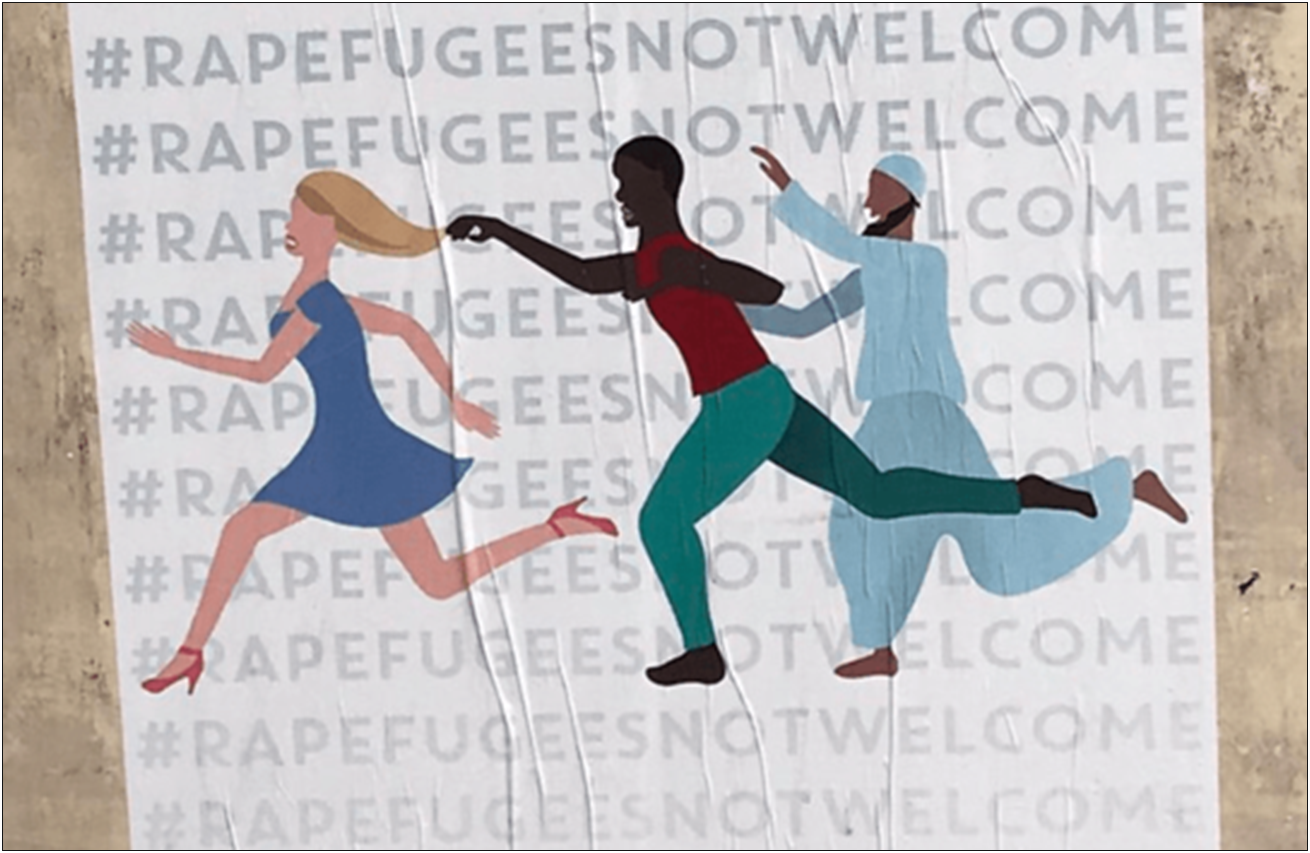
Like her, the other activists of Némésis systematically point out the migrant background of the perpetrators, who are always considered in a racialized way. This is also strongly conveyed in the iconography produced by the collective, as exemplified in Figure 1 below.
Sticker “RapeFugees Not Welcome” produced by the collective Némésis.
Notes: This sticker, representing a Black man and a visibly Muslim man chasing a white, blonde woman in the street, was produced and circulated by the collective Némésis in 2019. It is accompanied by the hashtag #RapeFugeesNotWelcome, an expression originally diffused by the German far-right party Pegida in the wake of the Cologne sexual assault of 2016.

The activists often oppose this Othered figure to the figure of the French White Man who “would never harass women in the streets” (interview with Clara, regional chapter leader, 2022), as Clara elaborates:
So that’s why I wanted to do this survey [on the profile of street harassers] on my Instagram and why I felt so strongly about it, because I think that we’re actually trying to talk about street harassment, we raise awareness or we make people react, but on the other hand, we don’t look at the causes and we don’t look at what’s behind it. Because the feminist stigmatization of the white heterosexual, cisgender man, whatever, it’s all very nice, but the reality, in fact, I’m sorry, but I’ve been harassed very little by…, well… it’s not necessarily Jean Michel from the 16th arrondissement of Paris, who wears Richelieus [smart shoes], and who comes out of work who harasses you in the street. You see, it’s always people who say, “Hey girl!” and who have a rather uh… well, I’m sorry, I don’t want to be racial profiling or anything, but it’s something that is a reality and it’s too important not to talk about it. And straightaway they class me as a racist. (Interview with Clara, regional chapter leader, 2022)
This is in line with the logic of the racialization of sexism, which consists of “blaming culture for bad behavior” (Volpp Reference Volpp2000), or in seeing “the sexism of the Other” as an “intrinsic characteristic of the immigrants’ cultures” (Gianettoni and Roux Reference Gianettoni and Roux2010, 374), while at the same time underestimating and understating the sexism of the majority group (Stolcke Reference Stolcke1995) — here, white upper-class men. In this view, street harassers are divided into two categories: on the one hand, “old libidinous men” (Interview with Clara, regional chapter leader, 2022), implicitly white and often supposedly affected by mental disorders, and, on the other, migrants and Black and North African men with sexist attitudes due to an intrinsically patriarchal culture. This is also echoed in Lucie’s words:
So…. ethnic statistics are forbidden in France. When I look at foreign statistics, you can really see that the majority of people from Africa come back often, well really. And even, in my everyday life, if I got involved, it was because Némésis was the only collective that denounced this. That is to say that, today, yes, it’s very good, we talk about “patriarchy” in all the feminist stuff, but it doesn’t affect us. Jean-Louis, a white, cisgender male, straight for 50 years, he’s never bothered me. So today, for me, it’s people who are, I think, without being prejudiced, from an immigrant background or people who have a very poor command of French. (Interview with Lucie, regional chapter leader, 2021)
This racialized diagnosis of the problem of street harassment occurred in all the interviews without exception, and in the majority of the collective’s social media and online content referring to street harassment. The racialization of sexism, materialized in the fight against street harassment, is one of their main collective action frames. Their appropriation of feminism centrally thus relies on the selective capture of a strictly delimited feminist cause — the fight against street harassment — which they transformed and adapted to their far-right identitarian political agenda.
Conclusion
While femonationalism has often been analyzed through the lens of conservative and far-right political parties’ representatives, this paper has shifted the focus to explore femonationalism “on the ground,” as enacted by grassroots female far-right activists. Relying on an empirical case study of the French collective Némésis, it has analyzed their collective action frames to explore how they appropriate feminism throughout their mobilization. I have identified three main frames through which these activists appropriate feminism. First, their paradoxical appropriation of feminism relies on a strong opposition to segments of contemporary feminist movements that they perceive as “intersectional feminism.” Their rejection of these particular movements, while retaining the concept of feminism, diverges from conventional forms of anti-feminism, which outright denies feminist principles. Rather, these activists articulate a goal of far-righting feminism, an ideological reconfiguration of feminism aimed at recasting it within far-right agendas and movements. Second, the femonationalist dimension of their mobilization involves the use of postfeminist frames according to which equality between men and women is already achieved in the West, and thus the threat facing white Western women comes from outside. In line with this conception, street harassment and sexist and sexual violence in the public arena is considered the main problem of Western women’s oppression today. Third, these frames are therefore crystallized in the fight against street harassment, which plays a pivotal role in how they frame and legitimize their mobilization. Through an omnipresent racialization of street harassment, they promote a nationalist and anti-immigration agenda to claim women’s safety in the streets, while downplaying other forms of gender-based violence.
While far-right actors’ engagement with feminism have often been analyzed through the lenses of instrumentalization or anti-feminism, the case studied here has warranted more complexity. Without overlooking the instrumental and anti-feminist dimensions of this far-right women’s mobilization, I have focused on the mechanisms through which they appropriate feminism. I have situated their mobilization as a femonationalist appropriation of feminism, which includes anti-feminist dimensions, but also involves a selective adoption and ideological reconfiguration of feminist causes, stretched to fit into the identitarian agenda. Unlike RRPPs, whose use of women’s rights rhetoric remains largely limited to discursive and communication efforts, these activists engage in a more thorough appropriation of feminism. They adopt its label and center selected feminist fights — presenting them as the raison d’être of their mobilization — reshaping and articulating them to an ethno-differentialist ideology. Their mode of organization, characterized by the women-only composition and based upon the specific identity of “women,” diverges with the party-centered femonationalism documented so far. Additionally, their strong online presence and low barrier to entry — which characterizes many far-right grassroots movements today — may appeal to young women who face street harassment, but have not been socialized to feminist movements. By appropriating feminism at the far-right, these activists carve out a space for self-identification as both “feminists” and far-right activists, signaling a more insidious phenomenon which holds the potential to draw young women into far-right movements.
Moving beyond a singular focus on strategic instrumentalization, this analysis has highlighted how contemporary far-right women appropriate feminism in ways that blur the boundaries between purely strategic rhetoric and deeper ideological reconfiguration. It thus underscores the more insidious ways in which contemporary segments of the far-right engage with gender and feminism, calling for further analyses of the mechanisms through which these processes unfold. By examining how contemporary far-right women adopt, claim, and reframe feminist causes, this article also contributes to a broader understanding of how the far-right normalizes itself. It thus connects with research on the normalization and mainstreaming of the far right (Akkerman, de Lange, and Rooduijn Reference Akkerman, de Lange and Rooduijn2016; Brown, Mondon, and Winter Reference Brown, Mondon and Winter2023; Mondon and Winter Reference Mondon, Winter, Ashe, Busher, Macklin and Winter2020), which relies upon the growing incorporation of liberal values into its political agendas. Discourse on gender and feminism lies at the heart of these processes, functioning both as a strategic tool to advance exclusionary agendas, and as a vehicle to reconfigure far-right ideologies through the incorporation of identitarian women’s perspectives, themselves shaped by ethno-differentialist views.
While these findings stem from specific case study of a collective rooted in the identitarian current and situated within the French context, they may also extend to other emerging women-only far-right collectives, especially those influenced by the transnational Identitarian movement. The analysis may, however, not apply to other segments of far-right mobilizations, as some maintain explicit anti-feminist positions. It nonetheless advances our understanding of far-right women’s diverse engagements with feminism: while some openly adopt overtly anti-feminist stances, others more insidiously blend opposition to contemporary feminist movements and ideological reframing of select feminist fights. In a Western context of a rising far right, these variations stress the pressing need for further comparative research to investigate the varied and evolving ways reactionary actors engage with gender and feminist ideas.
Acknowledgments
I would like to thank Magali Della Sudda, Éléonore Lépinard, Gefjon Off, and François Schoenberger for their invaluable feedback on former versions of this article. Their insights have been instrumental in improving the manuscript.

 Open access

