




The portrait of a physician in his studio, dated around 1668, by Amsterdam painter Michiel van Musscher (1645–1705), offers a rare look into the workspace of a Dutch seventeenth-century physician (Figure 1). The physician, half-sitting in his chair behind a table, still dressed for making house calls, is examining a urine sample in order to judge the condition of a patient. The picture's main theme of looking at urine in a flask against the light is common enough, but the picture is rare in the attention it draws to the entire observational practice of uroscopy.Footnote 1 The physician has his pen, ink and paper ready to record his findings, while holding the urine flask in his left hand, and a large folio book lies on the reading lectern farther to his right. This layout is exemplary of what Gianna Pomata and Nancy Siraisi have called early modern ‘learned empiricism’; that is, the ‘capacity for switching nimbly back and forth between book and direct observation’.Footnote 2 Showing texts as physical objects with all the other things in the physician's study, Van Musscher made visible a part of the scientific practice that has long remained unexplored, but has recently come into clearer focus. Paperwork prepared in the study brought reading, experiencing and reasoning about nature together.Footnote 3 The objects that surround Van Musscher's physician imply that observational practices around diseases and the human body developed in close proximity to practices involved in observing the natural world more widely.
The painting Arts in zijn studeervertrek or Doctor in His Study (Amsterdam, 1668), by Michiel van Musscher (1645–1705), depicts a Dutch physician surrounded by equipment for observing disease, medicines and the natural world more widely, including a lot of paperwork. Image with permission from the Rijksbureau voor Kunsthistorische Documentatie.

During the sixteenth and seventeenth centuries, the study developed from a space of book learning and contemplation into one in which naturalists all over Europe brought plants, different kinds of animals, naturalia, materia medica and the equipment to study and collect them as preserved specimens and on paper.Footnote 4 This development is reflected in Van Musscher's painting. We find a mortar and an opened glass jar in the foreground, and on the table by the window a scale, flasks, folded pieces of paper called huyskens in which apothecaries packaged their goods, and a jar containing an eye remedy. A round bentwood band box on the table is suggestive of the physician's natural-historical activities. It is the kind of lightweight box in which people collected small animals and plants from gardens, wooded areas, marches, rivers, fields, ditches and roadside hedges, to take home, keep and inspect. Next to the box is a stack of papers, loosely bound together between two thicker pieces of paper or board, demonstrating the paperwork involved in observation. There are quite a few stacks of loose papers, as well as books and bound manuscripts spread throughout the workspace.
But despite the equipment for doing natural history having been gathered, there was still no prescription for how to proceed. This can be illustrated by a look into the studies of two Amsterdam physicians, Jan Swammerdam (1637–80) and Steven Blankaart (1650–1705). While some seventeenth-century scholars, most prominently Francis Bacon (1561–1626), promoted natural history as the basis of natural philosophy, they continued to disagree about how it should be written, about what and by whom, and about how to mitigate its insufficiencies.Footnote 5 Swammerdam and Blankaart are two of the many scholars across Europe who contributed to these debates by practising natural history. Both were educated as physicians, collected insects to examine them in their rooms, produced their own images and used magnifying glasses. Despite these similarities, the two approached natural history very differently, with different objectives, and relying on different traditions of handling specimens and organizing knowledge on paper. Emphasizing these aspects of their practices will help embed them in the wider history of natural history and view them as individual expressions of more long-term and international trends.Footnote 6
Swammerdam arranged his life around investigating the generation of animals: how different kinds of animals produced offspring, offspring that grew and changed shape to produce their own offspring.Footnote 7 Celebrated for his discoveries regarding the reproduction of insects, slugs and frogs, and for his skills in dissecting and preserving insects, he experienced a crisis of faith in his thirties from which he never recovered fully, leaving his final opus, Bybel der Natuure, to be published posthumously.Footnote 8 Swammerdam's efforts have been considered part of the histories of generation and entomology, comparative anatomy, the growing appreciation for empiricism in science and the search for divine law in nature.Footnote 9 However, these takes on Swammerdam's research leave his observational practice and especially its underlying principles unexplored. By considering the paperwork involved in his practice, a more comprehensive view of Swammerdam's project will emerge.
In 1975, historian F.J. Cole characterized animal anatomy between William Harvey (1578–1657) and John Hunter (1728–1793) as a period in which ‘a vast reserve of facts which were one day to be pieced together’ were accumulated, without ‘any instructed attempt being made to collate the results so obtained’. Cole discussed Swammerdam as a representative of this period, treating his main work on insects, General History of Insects or General Treatise of Bloodless Animals (1669), as a loose collection of dissections of various kinds of small animals, including the honeybee, mayfly, louse and frog.Footnote 10 The work of later historians has suggested that this characterization of Swammerdam's work as one of accumulation rather than collation missed the mark.Footnote 11 Indeed, as I will argue below, Swammerdam's observational practice integrated a tradition of collating individual dissections into histories, and writing general and particular histories of plants and animals, with new ways of thinking on inductive reasoning, in his words optelling or inductie. He thus identified the essential changes that insects underwent during their life cycle and described four orders of insects with these ‘general characteristics’. Using induction he placed insects he had not examined ‘specifically’ in one of these orders and reasoned by analogy from bigger insects to smaller ones. He presented his findings in his collection of specimens, in series of images, in a comparative table and in specific histories that exemplified the ‘general rule’ of each order.
Swammerdam's efforts show that natural history was very much a project in the making by the second half of the seventeenth century. Swammerdam borrowed from predecessors and contemporaries to develop his own observational practices and write ‘true histories’ of insects. Comparing his practices with those of a near contemporary, the lesser known Blankaart, will make evident that others were shaping natural history along different lines in the same period. In contrast to Swammerdam, Blankaart is only a minor figure in histories of entomology, primarily mentioned to confirm the popularity of the study of insects in the Dutch Republic, as well as for some of his original observations.Footnote 12 As a practising physician, Blankaart accepted Swammerdam's stance on where insects came from and how they developed, but did not adopt his observational practice. Rather, he looked to the collective observations of amateurs on the lives and behavior of insects, loosely gathered as individual accounts, to support his reputation as a well-connected and observant man of medicine. This was not supposed to lead to any kind of generalization or systematization as Swammerdam's paperwork did: indeed, rather the opposite. Thus an analysis of the contrasts between the work of these two men brings to light the variety of observational practices in seventeenth-century natural history, as well as the different aims natural historians intended these practices to serve.
Collating dissections into histories
In 1667, after studying in Leiden and Paris for two years and graduating as a medical doctor, Swammerdam moved to the attic room of his father's apothecary shop in Amsterdam.Footnote 13 He had decided not to practice medicine, but to commit himself to anatomical research in general and the study of insects in particular. He had already developed an international reputation in this well-populated field.Footnote 14 Philosophers and physicians had studied the development of animals from eggs into adults, but it was not until 1651 that William Harvey dedicated a treatise to the subject. His Exercitationes de generatione animalium inspired further work by Swammerdam and some of his contemporaries.Footnote 15 Harvey's teacher Hieronymus Fabricius (1533–1619) had included images of bird eggs from two days up to twenty-four days after fertilization in his De formatione ovi et pulli, showing different phases in the dissection process of each egg.Footnote 16 However, the text that these images accompanied was structured around the earlier writings of Aristotle and Galen on generation. Fabricius pointed to his own experiences, but also to his close reading of these authors to agree or disagree with them on certain points, arguing, for example, that many more animals developed from eggs than Aristotle had suggested.Footnote 17 In contrast, Harvey put ‘anatomical inquiry’, the dissections of eggs on consecutive days after fertilization, at the core of his treatise. He expressly presented this ‘method of investigation’ as new and less likely to lead to error.Footnote 18 He explained that ‘because somethings – are much otherwise than hath been yet delivered, I shall declare to you what dayly progress is made in the egge, and which parts are altered’.Footnote 19 Several times he pointed out that these changes corresponded with the images in De formatione ovi et pulli. In addition, he discussed his own observations of the reproductive organs of cocks and hens, intermingled with those of other reputable anatomists, reflecting on their functions in producing the egg, followed by ‘certain deductions’ about the function of the egg's parts in the development of the chick.
Harvey recounted what changes he had observed on days one to six, and day ten and fourteen of the chick's development, describing both the egg and the chick as if the same individual were being continuously observed during this period. Occasionally, these descriptions were interpolated by his own judgements and opinions. One such interjection made particularly clear that he had dissected many eggs on different days of their development, under different circumstances. He commented that ‘the season of the year, the place where the fertilization is carried on, the sedulousness with which it is performed, and other accidents, have undoubtedly great influence on this diversity of result’.Footnote 20 Much like his teacher Fabricius had done, Harvey acknowledged all of the variation in the eggs that he had encountered.Footnote 21 In contrast to Fabricius's account, though, this ‘history of the egg’, the product ‘of such painstaking, of such careful observation’, formed the basis of Harvey's ‘theorems’ about the ‘generation of all other animals’.Footnote 22 As historian Bertoloni Meli has pointed out, such generalization in anatomical investigations depended on a belief in fundamental uniformity in the operation of nature. In his words, an anatomist like Marcello Malpighi (1628–94) saw every variation that he observed as a subtle modulation on a fundamentally homogeneous pattern.Footnote 23 Swammerdam would express his belief in the uniformity of nature too, writing, for example, that ‘all of God's works are based on the same rules’, even while acknowledging the enormous variety that existed in nature.Footnote 24
Swammerdam's good friend and one-time collaborator Nicolas Steno (1638–86) partly followed Harvey's example, by making dissection of chicken eggs the core of one of his treatises, In ovo & pullo observationes. Steno clearly did not attempt to write a history the way Harvey had, however. As if the reader was watching over his shoulder, Steno described in detail how he had opened eggs, at different ends, in different stages of development over the course of twenty days. On each consecutive day, he recorded different details regarding these eggs and the embryos inside. He collated his observations into a chronological account of the development of an egg into a chick, speaking mostly in the first person singular, occasionally in first person plural, and about individual eggs.Footnote 25 Swammerdam adapted precedents such as these to his own purposes.
Swammerdam's position in the ongoing discussions about generation in General History and the elaborated version, the posthumously published Bible of Nature, has received special attention from historians. Contrary to what Aristotle had suggested, insects did not appear spontaneously from decaying matter; instead, said Swammerdam, they came from eggs. Similarly and more controversially, adult butterflies did not appear spontaneously from the decay of the caterpillar either. Instead, the adult was already present in the caterpillar in rudimentary form and with all its parts present, and slowly developed from this form. Since insects did not substantially change during this process, metamorphosis was a misnomer, according to Swammerdam. Rather they underwent ‘natural changes’.Footnote 26 His writing suggested that the incremental changes described would always occur in every individual specimen of a particular kind of insect. Throughout his writings, he consistently distinguished between recounting the variation he had observed and the key changes that he believed all similar animals underwent.Footnote 27
Swammerdam claimed that all bloodless animals reproduced and developed in four main ways or orders. As a consequence, he ordered together some unexpected creatures. In the first order, for example, we find ‘spiders, mites, lice, fleas, woodlice, worms, scorpions, leeches, centipedes and snails’, since they all hatched from an egg ‘in a form that closely resembled the adult’ except for its size. Animals in the second order underwent several moults. Those in the third group came from an egg as a caterpillar, which developed into a pupa (chrysalis) when its adult limbs had grown under the skin. From the chrysalis it emerged without this skin, with the ability to procreate. This third order he subdivided into two ‘ways’ or ‘kinds’. Animals in the fourth group underwent the same changes as animals in the third order, without forming a chrysalis.Footnote 28 Swammerdam thus defined the ‘general characteristics’ of each order through comparison, outlining the stages where each order was similar to or different from the others. Swammerdam then further subdivided the animals that he collected into smaller groups and described some of their physical characteristics under the order he had placed them in by enumerating them ‘in general’.Footnote 29
Finally, in Bybel he added detailed descriptions of typical species belonging to each order, such as the louse, snail and water flea belonging to the first order; the stonefly and dragonfly to the second; the ant, night-butterfly, bee and a type of carabus beetle and day-butterfly to the third order; and the fly and gadfly for the fourth.Footnote 30 These descriptions, which he called ‘specific’ or ‘particular’ ‘examples’ or ‘histories’, served as examples for the development of all the animals belonging to that order.Footnote 31 He trusted that these histories could count as a ‘general rule’ by which all changes in insects could be checked and examined. By providing the same number of images to his accounts of the louse, stonefly, day-butterfly and fly, and describing them by the same ‘fixed rule’, the orders to which they belonged could be compared.Footnote 32 It was primarily in these series of images that the successive changes could be traced, throughout the development of these animals.Footnote 33 Like the collated dissections of Harvey and Steno, these histories and images left the impression that an individual animal underwent a continuous development, as Swammerdam believed it did, identical to others of its kind. However, despite appearances, these specific histories were necessarily constructed from series of dissections of many different individual animals.
Swammerdam studied generation by performing series of dissections, just as his predecessors had done. He did this systematically, as can be seen from a specific history prepared for publication in Bible of Nature.Footnote 34 On 15 August, he identified a group of caterpillars, which he determined to be of an animal whose appearance Dutch fine painter Johannes Goedaert (1617–68) had described, but that he himself had not encountered previously. Swammerdam studied the development of its pupae by intermittently opening one up, thereby killing it, while letting the others develop further towards maturity. He studied the development of these in the same way over seventeen days. On the basis of this examination he sorted this ‘common and coloured day-butterfly’ into the third of his four orders.Footnote 35 From this exercise it is clear that Swammerdam already knew what to look for to place the insect in the correct order. In defining his four orders he had apparently decided which characteristics of the insect were significant to tracing its development. It was far from self-evident how such characteristics should be identified, however, as will become clear in the next sections. While relying on the observational practices of anatomists like Fabricius, Harvey and Steno to study the uniformity of nature, Swammerdam engaged in broader strategies for ordering the great variety found in nature. These issues became more pressing as more and more kinds of plants and animals were investigated.Footnote 36
Accidental and essential characteristics
Because of his interest in dividing insects into distinct orders, Swammerdam's work has been characterized as part of seventeenth-century efforts to classify insects.Footnote 37 His ordering of insects through comparing their features and writing histories also indicates the tradition of taxonomy. One debate that had received particular attention during the previous century concerned the possibility of defining and identifying a plant or animal by describing its morphological features. Very simply put, some argued that such features were only accidental – that is, changeable, independently of the substance of something – and not essential – that is, inherent to its substance. Therefore they were not suited to defining or identifying a plant or animal. Importantly, others developed the notion of ‘inseparable’ or ‘native’ accidents to argue that, indeed, plants could legitimately be identified by describing some of their accidents, like their colour and the shape of their parts.Footnote 38 While varieties of plants and animals could be organized through a listing of accidental properties, the question still remained which accidents should be included to properly describe and organize them. Naturalist Conrad Gessner (1516–65) had dealt with this issue in Historiae animalium (1558) inter alia by occasionally including descriptions of animals in genere, besides descriptions of particular animals in that group, privatim or speciatim. These ‘general’ descriptions included the characteristics that a group of different species or varieties had in common, whereas ‘particular’ descriptions included those features typical of a species or variety. This meant that varieties of animals could be grouped depending on their similarities and differences, while saving space on the page.Footnote 39 Ulisse Aldrovandi (1522–1605) had distinguished between descriptions in genere and in particulari with the same purpose in his works on birds.Footnote 40 This distinction between general and specific descriptions helped Swammerdam to order the insects he had observed and was aware of, within the limitations of a book, albeit a very large one, and it also helped him to limit the number of observations that he needed to make.
There has been some doubt as to the aptness of the title of Swammerdam's first book on insects, Historia insectorum generalis.Footnote 41 Indeed, it hardly contains the names or descriptions of all insects that where known to exist by the last quarter of the seventeenth century, only those that he had examined and collected as specimens in various boxes.Footnote 42 In what sense, then, was it a ‘general’ history? Actually, remarkably few general histories about the natural world had been published by 1669.Footnote 43 Earlier general histories concerning plants help us to better understand the title of Swammerdam's book and the distinction between specific and general histories that apparently helped him to classify insects. One such Historia generalis plantarum (Lyon, 1586), by physician and botanist Jacques Dalechamps (1513–88) had the encyclopedic aim of covering nearly all plants mentioned by Greek, Latin and Arabic classical authors and exhibiting those newly discovered in the East and West, in twenty-eight books. The ‘general’ in the title appears to refer to this all-encompassing aim, only permitted by the impressive size of the publication.Footnote 44
In creating his large, one-volume herbal, The Herbal or General History of Plants (1597), surgeon and botanist John Gerard had problems fitting in all the varieties of plants that he was aware of. As he expressed it, ‘to write of Peares and Apples in particular, woulde require a particular volume: the stocke or kindred of Peares are not to be numbred’. His solution for these two cases was to
set downe the figures of some fewe with their severall titles, as well in Latine and English, and one generall description for that, that might be saide of many, which to describe apart, were to send an Owle to Athens, or to number those things that are without number.Footnote 45
This also meant that ‘sorts’ of plants of which no images existed and which could not be discussed in detail could still be known sufficiently from a general description of the genus and its common uses.Footnote 46 All known plants could thus be included ‘in general’, without describing all of them ‘apart’.Footnote 47 This formulation of general descriptions of a genus, before discussing that genus's different varieties or ‘kinds’, comes close to the sense in which Swammerdam's general history should be understood. Whereas Gerard's general histories provided ‘generall descriptions’ of species of plants, Swammerdam described ‘the general characteristics of each’ of the four orders of animals that he differentiated.Footnote 48 Focusing on orders rather than species or genera further limited the number of animals that Swammerdam described specifically and expanded the number of animals captured under the general descriptions.
With the changes that Thomas Johnson made to the 1633 and 1636 editions of Gerard's herbal, it became especially clear that providing ‘general’ descriptions of genera, rather than separate descriptions of varieties, like the apple or pear in the herbal, solved issues of order and construction. After mentioning that there are ‘some twenty foure or more varieties’ of the iris in Gerard's account of the plant, the editor Thomas Johnson added that
it is a thing no more pertinent to a generall historie of Plants, to insist upon these accidentall nicities, than for him that writes a historie of Beasts to describe all the colours, and their mixtures, in Horses, dogs, and the like.Footnote 49
In other words, the generality of this history of plants meant that not all the ‘accidental’ characteristics of irises needed to be included. Indeed not all varieties of irises, tulips or fox-stones known at the time needed to be described in the herbal. For these many other varieties, Johnson referred to other publications.Footnote 50 Swammerdam's general history could justifiably be called general in this sense. His differentiation between general and specific histories developed from an endeavour, as Stolberg has described the efforts of some sixteenth-century naturalists, ‘to assemble the countless new empirical observations of natural particulars in a certain field such as zoology and botany’. Importantly, Swammerdam did not arrive at general histories from assembling a large amount of ‘individual observations’ or histories and working out on paper how to generalize from them.Footnote 51
Swammerdam was exceptionally concerned with deciding what changes in the animals were, toevallig or totvallig – that is, as with Johnson, accidental – and which were wesentlijk, essentieel, or reëel – that is, essential. It was important to get this right because this would form ‘the ground and certainty on which the entire building of all the different changes of bloodless animals’ depended.Footnote 52 How could these essential changes be identified? To Swammerdam this was primarily a cognitive, embodied process, supported by his exceptional dissection skills and experience. This answer was in tune with contemporary philosophy and partly explains why there is only limited evidence of this part of his observational practice. René Descartes (1596–1650) has been viewed as providing the inspiration behind Swammerdam's search for ‘rules and theorems’, or even divine law, in insect generation.Footnote 53 However, Swammerdam's endeavour to arrange dissections into histories that sorted insects into different orders, together with his belief in the fundamental uniformity of nature, and his distinction between accidental and essential changes, tied him to the work of classifiers and anatomists, such as Gessner, Aldrovandi, Gerard, Fabricius, Harvey and Malpighi, rather than to the mechanics of Descartes.
When Swammerdam did express his appreciation for Descartes, it was by drawing on the empirical side of the philosopher's work.Footnote 54 Swammerdam mentioned in his Historia generalis that the great Descartes ‘appreciated more the reasons drawn from the experiences of regular workmen, than the reflections of scholars that have no effects’.Footnote 55 Without referring to Descartes, he later reminded his readers that reasoning was useless without practical experience of nature: ‘See so one strays, if one takes the mind and reason as his teacher, and sitting and speculating in his study room, one neglects the glory of God's works, that are the true teachers of our ignorance!’Footnote 56 In these references to experience, and to the type of experiences that would be most useful to gather, Swammerdam most evidently showed his debt to Descartes. In his use of induction, too, he appears indebted to Descartes, as well as to other seventeenth-century philosophers and physicians.
Induction according to physicians and philosophers
As part of his inquiry into generation, Swammerdam famously built a large collection of dried and embalmed animals at various stages of their development. By the late 1670s, it consisted of around 1,200 pieces. These dried and embalmed animals showed their true shape, Swammerdam wrote, in a way the images and descriptions could not. Kept in boxes, this collection would provide ‘visible proof’ of what he wrote.Footnote 57 Some of these animals he had investigated ‘particularly’, yet not all had been examined in this way. Instead, they were placed in one of the four orders through, in Dutch, optelling or inductie, translated as enumeratio, recensio, inductio or analogia in Latin.Footnote 58 While he argued that his work was supported by ‘our own experiences, as on an unshakable ground’ and that ‘certain conclusions, stable positions and regular Orders’ were taken from them, optelling der deelen or ‘induction of parts’ came into play where these experiences fell short.Footnote 59 Induction had been a much-discussed topic in the work of philosophers and physicians earlier in the seventeenth century. While Swammerdam does not explicitly mention the source of his ideas on the topic, these earlier discussions did provide him with a context and justification for how he studied insects.
Harvey had presented induction as a new method of investigation, but he also grounded it in Aristotelian and Platonic philosophy. Referring to Aristotle's Physics and Analytics, he argued that it was ‘advisable from singulars to pass to universals’, because what was derived from induction was more ‘perspicuous’ than what was known through syllogism. This passing from singulars to universals was a faculty of the human mind, which Harvey called ‘the understanding’, ‘imagination’, ‘the internal sensorium’ or ‘the fancy’. Harvey explained that ‘the comprehension of universals by the understanding is based upon the perception of individual things by the senses’. When an external sensory ‘impression comes to be made an abstraction, and to be judged of and understood by the internal sensorium, it is a universal’. Referring to Platonic philosophy, he argued that immediately after the perceived object was removed, ideas, types or forma informans were formed in a person's imagination or memory, and the object was no longer ‘apprehended as a particular’. Though this idea was ‘a real entity’, ‘without the due admonition of the senses, without frequent observation and reiterated experiment our mind goes astray after phantoms and appearances’. Harvey then advised his readers ‘to strive after personal experience, not to rely on the experience of others’. Generation could only be fully understood ‘by repeated dissection’. Otherwise, ‘we shall but come to empty and unstable opinions; solid and true science will escape us altogether’.Footnote 60
Like others writing about induction, Swammerdam was not much concerned with ‘the mental process of induction’.Footnote 61 But rather than regarding the imagination as the function of the mind that produced universals, Swammerdam instead warned his readers about imagination's power to deceive. ‘If experiences are lacking, the further knowledge drawn from our reasoning or induction, arise not from Nature, but from our imagination.’Footnote 62 According to Swammerdam, Goedaert had been a victim of his own imagination regularly, since he had portrayed several animals incompletely or incorrectly and his description of some insects read more like a novel than a ‘true history’.Footnote 63 Even the ‘most diligent investigators of nature’ who preceded Swammerdam in studying insects, such as the Italian Ulisse Aldrovandi (1522–1605), the English Thomas Moffet (1553–1604) and the German Andreas Libavius (d. 1616), had been led astray by prejudice to reject what experience had shown them regarding generation.Footnote 64 For Swammerdam, reason based on extensive experience, not the imagination, allowed for induction. Thus while Swammerdam and Harvey attributed contrary roles to the imagination in the process of induction, they both emphasized its reliance on repeated, personal experience of nature to counteract the mind's tendency to stray. Induction had allowed Harvey to present his ‘history of the egg’ as a basis for ‘theorems’ about all eggs in his Exertationes.Footnote 65 Swammerdam extended this use of induction to define four orders of generation from a limited number of observations and to justify his use of specific histories to exemplify the development of all animals belonging to each of those orders.
Swammerdam needed to decide which amongst the countless possible observations and dissections that could be performed on insects would be most useful to understanding generation. In some animals it was more difficult to see their different parts than in others, either because they stuck together, or because the animals were especially small.Footnote 66 He addressed these issues in a key passage. He argued that though there were still
innumerable miracles of nature surrounding the changes of these animals to be experienced, it would be much more useful to have naturally described one single change of a caterpillar, as example for all other caterpillars, than to depict all the changes of caterpillars, with their colours.Footnote 67
Swammerdam's suggestion that in such cases a description of one single change of a caterpillar could be used as an example for all other caterpillars comes strikingly close to Descartes's discussion of enumerative induction. In his early work Regulae ad directionem ingenii (1628), not published until 1684, the philosopher outlined rules for attaining knowledge and included a discussion of what, according to him, can be called ‘enumeration or induction’. One example of enumeratio that he provided is as follows:
To give one last example, say I wish to show by enumeration that the area of a circle is greater than the area of any other geometrical figure whose perimeter is the same length as the circle's. I need not review every geometrical figure. If I can demonstrate that this fact holds for some particular figures, I shall be entitled to conclude by induction that the same holds true in all the other cases as well.Footnote 68
A few years after Descartes, the Dutch philosopher Henricus Renerius (1593–1639) had written about this kind of reasoning through analogy as well. In his 1635 disputation De natura et constitutione physicae, Renerius had described what he thought scientific knowledge was and how to build it. The first step in the scientific process was to collect observations in a natural history, which should be a collective effort. Things that were too far away or too small to be seen with the naked eye could be observed by means of a telescope or a microscope. Anatomical section and chemistry could help to uncover things hidden from view. Importantly for Swammerdam's problem, Renerius stated that reason could be used to derive conclusions from the analogous effects and associated phenomena that were better visible.Footnote 69
To these later philosophers, the process of induction was not as immediate and natural as Harvey had described. Another author with whom Swammerdam was familiar had discussed induction ten years after Harvey published his exercises. Swammerdam referred to the work of Henricus Regius (1598–1679), professor of theoretical medicine, botany and anatomy at the University of Utrecht, who was an admirer of Descartes and adapted his ideas. Regius had included a discussion of the way in which spiders move from tree to tree in his very popular Philosophia naturalis (1661).Footnote 70 In this book and its earlier edition of 1654, Regius provided an overview of nature from the principles that constituted it, through to the human body. At the end of the section on animals, Regius included a short chapter entitled ‘Of beasts’, which grouped insects under reptiles.Footnote 71 In the 1661 version of this chapter, the section on reptiles was expanded by a discussion of the way some caterpillars develop from eggs into adult moths and butterflies.Footnote 72 It seems that in this short section, Swammerdam had his work cut out for him. Regius had included insects in his grand scheme of natural philosophy, but he still could not say much more about their development than previous authors.
As Delphine Bellis has shown, Regius also wrote about induction. He explained that universal notions about things
can be inferred from the collection of a few particulars observed by us. For those notions, which have been collected and acquired through induction from the observation of some particulars, are universal insofar as we judge them to agree with all other similar particulars because of a similarity that we believe they have with all the other particulars that have not been perceived by us.Footnote 73
In other words, collecting particulars and finding similarities between them was a basic part of induction. Though this retained induction as a natural function through which the mind produced universals, it qualified Harvey's ideas about repeated experience to some extent, indicating that it required a conscious search for similarities. Like Descartes and Renerius, Regius allowed for making statements about what had not been ‘reviewed’ or ‘perceived’ by induction.Footnote 74 Swammerdam offered the same solution. Using induction, he was justified in classifying animals that he had not investigated ‘particularly’ and in taking his description of a caterpillar's transformation as an example for all other caterpillars. As he wrote, ‘And having all the science that we can have of the fabric of animals, we find nothing else to do but an induction of parts, which we had seen previously in bigger animals.’Footnote 75 When using the word inductie in Bybel, Swammerdam clarified that he had not actually seen that a body part existed in other animals, but that he judged them to be present in a similar shape and situation by induction.Footnote 76
Renerius's biographer, Robin Buning, has pointed out that Renerius's induction ‘comes down to simple enumeration’.Footnote 77 In his Novum Organum Scientiarum of 1620, Bacon dismissed this type of induction as immature and a potential path to error. Instead, he outlined a complex procedure of setting up a succession of tables (tables of presence, of absence in approximation, of degrees, and of exclusion or rejection of natures) to be interpreted through induction by exclusion.Footnote 78 Though scholars in the Dutch Republic generally received Bacon's work, particularly Silva Silvarum, enthusiastically, its reception was mixed and its impact remains difficult to estimate.Footnote 79 No paperwork as part of the induction process, such as described by Bacon, appears in what remains of Swammerdam's work. This would accord with his thinking of induction principally as an embodied process, founded on extensive experience in dissecting animals. Still, there are aspects of Swammerdam's work that demonstrate a similarly critical attitude towards simple enumerative induction. For example, he noted the importance of acknowledging counterinstances. While he admitted he had not studied every single insect that he had collected ‘particularly’, he was confident that all insects developed according to one of the four orders he defined. In the introductory text, he wrote that the only thing that would make him doubt this was if there were tegenstrijdige bevindingen or ‘contradictory findings’. One would be wrong, for example, if ‘from the induction of an infinite number of animals that one had found to be either male or female, one would conclude that male and female could never be found together’. Swammerdam himself had provided a counterexample to this conclusion by discovering that snails were hermaphrodites. He promised his readers that if he still found anything that spoke against his positions, he would impart it to his readers.Footnote 80
Swammerdam's critical attitude towards simple enumerative induction is also evident in his distinction between accidental and essential changes. Comparing animals to find both similarities and differences between them was central to Swammerdam's practice of observation and induction, as for other taxonomists and anatomists. Characteristics he considered essential to the development of various insects formed the basis of his four orders.Footnote 81 As we saw in the quote above, he thought it ‘useful’ to leave some of the changes that a caterpillar underwent out of his description. This included characteristics such as colour, which were significant to other students of these animals. These, Swammerdam apparently had decided, were only accidental properties in his investigation of generation. The centrality of comparison and the identification of essential changes is also reflected in the title of the ‘special treatise on frogs’, ‘comparison of the changes or, as I say, transformation of the limbs in the nymphs of frogs with those of the insects’.Footnote 82 In addition, Swammerdam expressed the results of his enumerations in a table of ‘general comparison and similarity of the changes or accretion, in parts and limbs’. It displayed the points of comparison between the animals and incorporated innumerable observations of individual animals, as did the self-produced images in his publications and the collected specimens in his study.Footnote 83 Swammerdam's induction did not consist in collecting similar or different instances or cases, but rather in identifying the essential characteristics of each order of change and claiming that those orders existed beyond what he had seen.
Although, clearly, Swammerdam could rely on recent developments in the philosophy of induction, he combined these with the observational practices of taxonomists and anatomists to present his findings as ‘on an unshakable ground’ of ‘our own experiences’. While the rules and guidelines outlined by Bacon, Descartes and Regius were directed at finding the causes of natural things, Swammerdam made it clear that the true causes or the real origin of God's works remained completely impenetrable to him.Footnote 84 His reliance on thorough and thoroughly personal experience, rather than on a collective effort to discover order and regularity in nature, further distinguished Swammerdam's observational practice from that proposed by Bacon and Renerius. It made sharing the task of observation of only limited use and sidelined the activities of many others in Dutch society who were interested in insects. By 1669 several Dutchmen possessed elaborate collections of insects, especially of butterflies and moths. The collectors had organized the animals according to various principles, from their size to their colour. At least one is known to have used Goedaert's publications as a template for the organization of his collection.Footnote 85 With his use of induction, collating dissections into histories and distinguishing accidental and essential characteristics, Swammerdam rejected this more haphazard approach to observing and categorizing insects, while Blankaart embraced it.
Paperwork and Blankaart's Theatre of Caterpillars
The notebook next to the wooden box in Van Musscher's painting appears similar in function to the original notes of Dutch physician–naturalist Steven Blankaart that remain in the Zeeland provincial archives. Quite badly damaged by water, these notes are some of the few that survive of those originally assembled by seventeenth-century Dutch naturalists. It consists of a few dozen quires loosely stacked together and held in a paper cover. Each quire is only pinned together, ensuring that more sheets can easily be added when desired. All notes and the images pertaining to one particular series of observations remained together in each gathering, which could easily be taken out of the stack and rearranged.Footnote 86
Blankaart's manuscript consists of a few dozen quires loosely stacked together and held in a paper cover. Each quire is only pinned together, ensuring that more sheets could easily be added when desired. The images are pinned to each quire, so that they could be detached to be engraved for publication or transferred to a neat copy. Image by the author with permission from the Collectie van het Koninklijk Zeeuwsch Genootschap der Wetenschappen (KZGW).
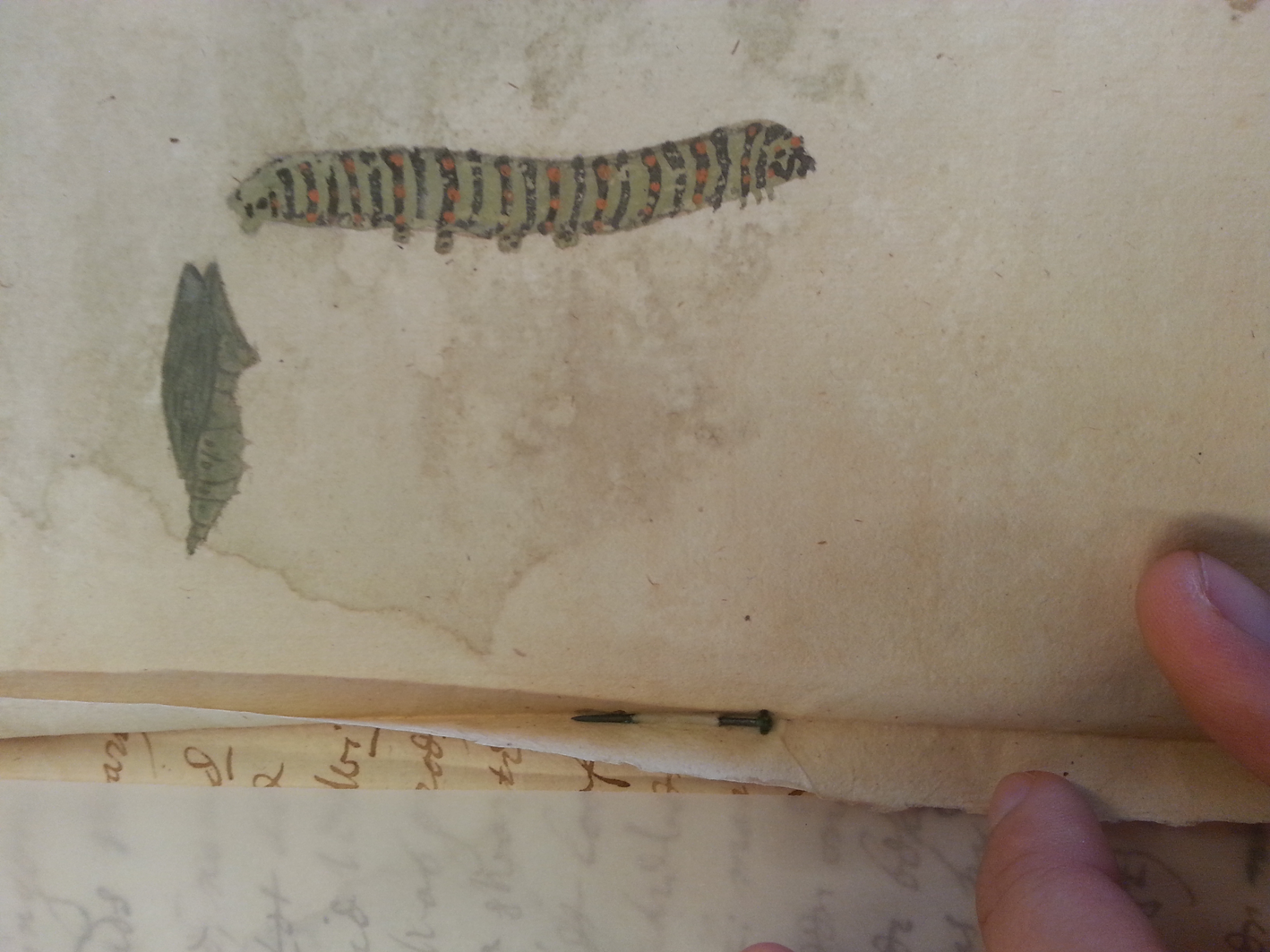
At first sight the resulting accounts of insects might appear similar to the histories constructed by Swammerdam and his fellow anatomists. After all, they are chronologically arranged accounts of an insect's development. Closer inspection, however, shows that they originated from very different kinds of observational practice. No sophisticated ideas on induction were involved in their composition. Blankaart noted down in detail where and when he had encountered the insects, how they behaved, how he had kept them and fed them, and how they had developed. Each time something notable happened to the insects in his study, or every time Blankaart made a follow-up observation, remembered an earlier encounter with such an insect or conducted some little experiment, he wrote it down following the other notes, within the same gathering, numbering consecutive entries with roman numerals.Footnote 87 He dedicated a few chapters to animals he had only read about and consequently had made no images and observations of at a particular time or place.
Blankaart modelled his way of studying the development of insects on that of Goedaert, whom he knew from his youth in the Zeeland city of Middelburg.Footnote 88 Goedaert investigated insects over thirty years at his home, without dissecting them, before he was persuaded to publish his findings in three parts from 1660. His Metamorphosis Naturalis or Historical Descriptions, and the Origin, Characteristics and Strange Changes of Worms, Caterpillars, Maggots, Flies, Butterflies, Bees, Moths and more such Animals, in which he described the development of these animals in shape, colour and behaviour over time, made him internationally renowned. Scholar Johannes de Mey (1617–78) had added learned commentaries or annotations to Goedaert's accounts and translated his works into Latin. Though an admirer of the Dutchman's work, Martin Lister (1639–1712) disapproved of the lack of any order to the arrangement of Goedaert's ‘historical descriptions’, rearranging them into a systematic organization of his own.Footnote 89
Swammerdam had pointed out the differences between his practices and those of Goedaert. While in Swammerdam's practice many animals died at some point during their development, in Goedaert's and Blankaart's the animals were supposed to live into adulthood and so required care and feeding throughout their lifespan. Swammerdam thought this produced unnecessary labour for researchers.Footnote 90 While he paid plenty of attention to the particularities of the species he described, such as the different ways in which water fleas propelled themselves, or the changing colour of the louse's eyes, he clearly distinguished these from the ‘general rules’ in the development of insects that he had discovered.Footnote 91 Goedaert and Blankaart found all details of an individual animal's behaviour or appearance of equal interest.
The ultimate organization of Blankaart's observations greatly differed from that of Swammerdam's as well. The gatherings that Blankaart assembled were designed to stand on their own as chapters in a publication. After two years, Blankaart printed a selection of forty-nine such bundles, as Theatre of Caterpillars, Worms, Maggots and the Flying Animals that come forth from Them (Amsterdam, 1688). While we can discern a loose order into butterflies, moths, spiders and lice in Theatre, this is not consistent. Another deciding factor for the organization of the book appears to have been the way Blankaart's painted images fitted together on the engraved plates. The size of the images was not adjusted to the size of the sheets they were printed on. The randomness that this introduced into the order of the insects included in the book emphasized the uniquely individual characteristics of each encounter.Footnote 92 It is reminiscent of the collections of drawings of plants and animals of the previous century, but also of the drawings by some contemporary amateur naturalists such as Jan Velten.Footnote 93 As an insect collection on paper, Blankaart's book could easily fit alongside any collection of specimens, no matter the organizing scheme the collector had imposed on it.
The organization of the book is representative of the way the scholarly, amateurish and commercial coexisted in Theatre. After studying medicine in the northern city of Franeker, Blankaart began practising medicine in Amsterdam around 1674. One historian has called him ‘a lover of the new’ and in his publications he shared this love with an audience of liefhebbers or amateurs.Footnote 94 Starting in 1678, he began what would be an enduring business partnership with publisher and bookseller Johannes Claesz. ten Hoorn (1639–1714). Sometime during 1685, the two conceived the plan to publish a book on insects. Blankaart presented his practices as imitable by telling his readers much about his habits of observation, experimentation and collection, such as the places where insects could be found, and by repurposing regular household objects. From 1686, Blankaart renewed his childhood activity, collecting insects in and around his home, in his garden, inside and outside the gates of Amsterdam, and after visiting patients further afield. He then brought them inside to ‘paint them off’, examine them with his magnifying glass, keeping them with a crystal cup put over them, in porcelain bowls, in sealed bottles, in wooden boxes such as we saw in Van Musscher's painting, or reburied in earth.Footnote 95 Blankaart occasionally mentioned the various rooms where he kept these animals – for example, when telling of the time he dried a dead parrot in his attic and brought it to his room to examine what kind of ‘small animals’ were in it, or when a moth that had recently emerged from its pupa flew into his ‘book-room’, or when a visitor to this book room had let a spider out of the bottle where Blankaart had been keeping it.Footnote 96
The frontispiece of Blankaart's Schouburg der rupsen, wormen, maden en vliegende dierkens daar uit voortkomende or Theatre of Caterpillars, Worms, Maggots and the Flying Animals that come forth from Them (Amsterdam, 1688), engraved by Jan Luyken (1649–1712), emphasized personal experience of nature as a source of knowledge and wonder. Image with permission from the Amsterdam Museum.

The pleasure derived from handling these small animals, rather than a particular philosophical question, appears to have guided Blankaart's work. His love for the new, but also wonder at nature, is reflected in Theatre's frontispiece. The image very much emphasized personal experience of nature as a source of knowledge, to the exclusion of book learning and contemplation. In the frontispiece, the action has moved from the study in Van Musscher's painting to a space half inside, half outside. One person at the table is wearing typical indoor clothing of the time. He is directing his visitor's gaze to the caterpillar on the table and the visitor appears amazed. There are magnifying glasses on the table and an enlarged caterpillar in the foreground seems to be crawling off a rectangular plane, suggestive of a piece of paper. In the background, two men are admiring a landscape. We also see many of the boxes from Van Musscher's painting in the frontispiece, where they are now used to exhibit a collection of butterflies on pins. Blankaart explains how to prepare insects in this way in the last chapter of Theatre, emphasizing that the collector had to take special care to preserve the animals’ exterior as well as possible, even if this meant damaging or even completely removing its insides.Footnote 97
In Theatre, Blankaart promised that if the current publication proved successful, he had much more such material ready to be printed.Footnote 98 Although proposed, a second volume was never published. Taking into account Ten Hoorn's business acumen, we can only assume that the first volume had not been particularly commercially successful. Still, Blankaart's papers kept in the Dutch Royal Library include a bound first and second volume of Theatre. These demonstrate that for Blankaart himself, Theatre had a secondary function as a neater, more permanent version of his original notes.Footnote 99 Blankaart's copy of Theatre consisted of the pages of the printed book glued into a blank-page notebook together with the original images that Blankaart had made, instead of the book's engravings. The second volume of Theatre is a manuscript, the individual gatherings of chapters copied out in a blank book, also with the illustrations glued to the pages. Blankaart had apparently resigned himself to the fact that the second volume would not be published, otherwise he would not have permanently fixed his original images to the pages of the manuscript. A neatly written, bound manuscript was the next best thing to a printed text. The two volumes of Theatre thus remained in this form as part of Blankaart's library, as a neat copy of his notes, while he continued to accumulate new observations. He added to the second volume either by filling pages initially left blank, or by fixing additional pages into it. His own books and notes became part of his library and Blankaart would later refer to them in the notes now in the Zeeland archives, as he would to other authors such as Goedaert, Swammerdam, Moffet, Lister and Francesco Redi (1626–97). Comparing the animal he had in front of him with images and written descriptions, including his own, the circle of learned empiricism was complete.
Contemporaries of Blankaart, like naturalists Lister and James Petiver (1668–1718), also used pins and glue to attach images to paper, as well as insects to ‘boxes’ more or less permanently and to provide a (provisional) organization to their notes and specimen collections. Though this indicates the common historical roots and geographical spread of such practices, it likewise illustrates the extent to which such practices had been advanced in the hands of some, while those of Blankaart remained relatively unsophisticated.Footnote 100 As I will continue to explore in the final part of this paper, these practices seem to have served his purposes, however.
Insects and the art of medicine
Publishing his observations on insects appears to have supported Blankaart's reputation as a physician–naturalist. In Theatre and his remaining notes, he appears as the grateful recipient of both animals and letters from acquaintances, amongst whom there were many physicians, surgeons and apothecaries. By publishing some of these letters, discussing these gifts and sources, Blankaart publicly showed himself as a well-connected and respected man, a contributor of knowledge and a central person in amateur networks.Footnote 101 In Theatre and his notes, Blankaart found other occasions to exhibit aspects of his medical occupation, such as his knowledge of plants, visits to patients and the fact that he prepared and distributed his own remedies.Footnote 102 Indeed, on the title page of the publication, Blankaart announced himself as ‘P. & M.Dr. Practitioner in Amsterdam’. In his ‘address to the reader’ Blankaart made an allusion that sheds more light on how his work on insects related to medicine.
Blankaart started his ‘address to the reader’ in Theatre by assuming that the subject of the book might be unexpected of him, since ‘it appeared to be entirely outside of my art’; that is, the art of medicine. By 1688 the reading public would have been familiar with Blankaart as a translator and commentator of Latin medical works and author of compendia on human anatomy and chemical medicine.Footnote 103 Indeed, Theatre's subject would be outside his art, Blankaart wrote, had he not, since childhood, endeavoured to discover ‘all that is hidden in the human body’.Footnote 104 These efforts had apparently helped prepare him for writing this book in some way. Blankaart's half-formed sentences do not do much to explain how the investigation of the human body was connected to the study of insects. Despite presenting Theatre as an extension of his youthful interest in discovering ‘all that is hidden in the human body’, Blankaart did not mention dissecting any animals himself, a practice that was central to Swammerdam's investigations. He does mention some of the anatomical curiosities he had seen in Middelburg in his other works, and had likely witnessed dissections performed in the anatomical theatre of that city. But unlike Swammerdam at Leiden, Blankaart's medical studies at Franeker did not equip him to dissect insects.Footnote 105 For Blankaart, the study of the human body and that of insects were not connected through the practice of dissection. Nor was understanding generation the principal point of his study of insects. Still, Blankaart's reference to investigating the human body appears to be an attempt to make a tenuous connection between studying insects and his ‘art’.
While a rectangular plane is the only trace of paper in the frontispiece, Blankaart mentions on Theatre's first page that in accordance with this interest in the human body, he had kept accurate aanteikeninge or notes, as his readers could judge by leafing through the book. In her 2004 article ‘Taking note(s)’, Lorraine Daston pointed out that ‘taking notes entails taking note – that is, riveting the attention on this or that particular’. While Daston relates this to the central role of reading practices in ‘doing science’, these reading practices involved writing as well. It seems that Blankaart evoked the parallel between taking notes and taking note, in referring to his ‘accurate notes’. The accuracy of his notes showed his ability both to notice things and to record them properly on paper. It was his note-taking skills, in this double sense, that connected the study of the human body to the study of insects. Cook has argued that seventeenth-century physicians practised natural history as an alternative to ‘philosophical disputations’ as the ‘foundations of medical learning’.Footnote 106 The tentative link that Blankaart established between discovering the insides of human bodies and studying insects points in this direction. In judging the accuracy of Blankaart's notes on insects, readers could also evaluate his skills in observing nature in general and the human body in particular. This becomes all the more evident when we compare the organization of Theatre to the genre of Observationes. Nance has argued that physicians increasingly adopted this new genre to defend themselves against vernacular critics.Footnote 107 Blankaart promoted his own Collectanea Medico-Physica as a gathering of ‘accurate observations’ that would provide an improved basis for medical practice, as well as bestow appropriate esteem on physicians.
By the 1680s a tradition of recording medical observationes was well established and thriving in the Dutch Republic. Like their foreign colleagues, Dutch physicians and surgeons recorded these medical case histories, and physical and anatomical observationes, in notebooks and on loose sheets of paper, as diaries, adversaria, animadversione, collectanea medico and other such titles. Sixteenth-century physicians tended to attach scholia to their observations and often arranged them into groups, for example, according to the parts of the body that had been affected in the cases. As the genre developed the scholia and organization became more uncommon. In their form as chronological descriptions of events and actions and especially in their stand-alone character, Blankaart's notes on insects are similar to the observationes traditionally recorded, exchanged and published by physicians.Footnote 108 In 1680 Blankaart reported that he had collected ‘a fair number’ of his ‘own observations’, which included one on cheese mites. To these he had added observations on surgical and medical cases, chemical experiments and natural occurrences from books and other publications, and imparted to him by patients, physicians, surgeons, aldermen and other interested citizens. Over the next six years he published these annually as Collectanea Medico-Physica or Hollandisch year-register of medicine and physics: Observations from entire Europe (Amsterdam, 1680–6).
Blankaart mentioned foreign publications as models for his own.Footnote 109 Indeed, as the seventeenth century progressed, individual medical and physical observationes began to be collected and published communally. Though they also tended to focus on extraordinary and rare cases, there was a crucial difference between Blankaart's publications and the French, English and German journals to which he referred. The latter were the collective product of academies and societies. The distinguished members of these societies worked to develop editorial points of view, assessing contributions, adding learned commentaries and directing the efforts of amateurs and virtuosi towards particular ends, even into more standardized forms.Footnote 110 Blankaart, however, published Collectanea under his own name and did not outline or apply any qualifications for contributions.
As in Theatre, Blankaart invited liefhebbers or amateurs to ‘make common’ their own observations. Then, he claimed, the republic – het gemeene beste – would enjoy the fruits of these shared experiences. He positioned these experiences as a nostrum against ‘the systems of medicine that had long kept people blindfolded, being supported by few and idle speculation’. Physicians most of all should add their observations of anything rare and unusual to ‘certify the knowledge to heal’ and show the caution, prudence and wisdom of physicians in contrast with apothecaries.Footnote 111 Stolberg has proposed that early modern physicians collected observations in order to arrive at ‘valid generalizations’ that would improve their success as medical practitioners. In Blankaart's case, compiling individual observations was not supposed to lead to either generalization or systemization. Instead, it was important for physicians to accurately note the detailed peculiarities of each case, and to be free from any constraining organizational scheme in so doing. This was what Blankaart invited them to do in both Theatre and Collectanea. He argued that making these observations commonly known, by itself, would improve the practice of physicians and would facilitate the reconstitution of medical knowledge on the basis of empirical observation, as opposed to ‘idle speculation’.
Blankaart was not the only practising physician in Amsterdam espousing this position. A few years earlier, Justus Schrader (1646–1720) had assembled observations and histories from anatomists such as William Harvey, as well as the most prominent anatomists working in the republic, including Swammerdam. The long introduction that Schrader included is echoed in Blankaart's talk against systems and plea for gathering observations. In medicine and natural philosophy there were two distinct ways of pursuing knowledge, Schrader claimed, that of systems and that of historiae, observationes and experimenta. He argued that there was no real middle ground between these two approaches, and for the superiority of the latter. In line with this manifesto, Schrader excerpted the things that Harvey had seen himself from his Exercitationes de generatione animalium and rearranged them under different headings. This meant leaving out any mention of induction and reducing Harvey's ‘history of the egg’ to a series of inspections of the egg. Schrader's dedication of the book to his friend Swammerdam and the inclusion of some of his dissections of corpses in it demonstrate their shared preoccupation with observing nature, but also bring home where their practices and views on observation and natural history diverged.Footnote 112
Conclusion
Despite having much in common, Swammerdam and Blankaart's practices of observation differed to a great extent. Swammerdam not only observed and dissected more and smaller animals than any of his contemporaries. He actually integrated the practices of anatomists, such as Fabricius, Harvey and Steno, who collated individual dissections into histories of development, and of taxonomists such as Gessner, Aldrovandi and Gerard, who wrote general and particular histories of plants and animals, with new thinking on inductive reasoning propounded by Bacon, Renerius, Harvey, Descartes and Regius, into his observational practice. It produced a practice of natural history by which he purposefully dissected a great many animals to identify the essential changes that insects underwent during their life cycle and described four orders of insects based on these ‘general characteristics’. Moreover, he dissected animals to present his findings in a collection of specimens, series of images and a comparative table, and to write specific histories that exemplified the ‘general rule’ of each order. His extensive experience in dissection justified his use of induction to place insects he had not examined ‘specifically’ in one of these orders and to reason by analogy from bigger insects to smaller ones.
The individual, extraordinary characteristics of the insects he studied, rather than their essential similarities and differences, were the main object of Blankaart's interest. He recalled being taught how to observe the lives and behavior of insects in his youth by Dutch fine painter Johannes Goedaert and picking up the habit as a practising physician and medical author in Amsterdam. It suited his occupation since it did not require a great commitment of time and effort, but publishing on the subject also offered him an opportunity to show himself as a seller of his own remedies, a sought-after medical practitioner, a well-connected and respected man of medicine, and above all an accurate note taker.
By loosely gathering his observations on insects, medical cases and anatomy, and not including the kind of scholia that had traditionally accompanied such observations, he also emerged as an opponent of ‘systems of medicine’. As for at least one other physician in the republic, there seemed no middle ground between such systems and the recording and compilation of individual observations. It appears that only a while later, by physicians such as François Boissier de Sauvages de Lacroix (1731–72) drawing from botany, did the collecting of individual case histories become instrumental in generalizing from particulars and classifying diseases.Footnote 113 Additional research could provide more insight into ways that organizing knowledge on paper enabled generalization from medical observations before the eighteenth century and moved between the observational practices of natural history, medicine and natural philosophy.
Swammerdam and Blankaart's practices of observation illustrate the fundamental discussions about natural history they were aware of and contributed to. If we only pay attention to their insistence on observation as the proper basis of science, we overlook the different contentions that existed amongst practitioners of natural history about its aims and means. By the second half of the seventeenth century, there was little consensus over what natural history was and how one should practise it.Footnote 114 Swammerdam and Blankaart's works alert us to the variety of observational practices and traditions that were available to natural historians, and with what purposes they made these their own.


 Open access

