




Sociolinguists have long been interested in the actuation problem: why some linguistic varieties undergo specific structural change while others do not (Weinreich, Labov, & Herzog, Reference Weinreich, Labov, Herzog, Lehmann and Malkiel1968:112). Here, we engage with this question by examining constructed dialogue, the reproduction of speech, thought, gesture, and sound effects (Tannen, Reference Tannen and Coulmas1986) in a longitudinal corpus of Australian Aboriginal English (AE) spoken in Perth, Western Australia. AE is a post-invasion contact variety, or group of varieties, “spoken by the majority of Aboriginal people throughout Australia” (Eades, Reference Eades, Koch and Nordlinger2014:417). These varieties differ in terms of their placement on a continuum ranging from acrolectal to basilectal features (Rodríguez Louro & Collard, Reference Rodríguez Louro and Collard2021a). Acrolectal AE varieties are relatively close to standardized Australian English (AusE); basilectal AE varieties are closer to Kriol, an English-lexified creole spoken in Northern Australia (Schultze-Berndt, Meakins, & Angelo, Reference Schultze-Berndt, Meakins, Angelo, Michaelis, Maurer, Haspelmath and Huber2013). Here, we consider “standardized AusE” to be the codified variety used in mainstream institutions, including schools and courtrooms. A longstanding question has been whether AE should be viewed as a single ethnolect or whether one should speak of “Aboriginal Englishes” (Dickson, Reference Dickson, Willoughby and Manns2020:136). We focus on an acrolectal variety of AE spoken in Perth, Nyungar country, Southwest Western Australia. We use the label “AE” to refer to “one major variety of Aboriginal English, which embraces a number of regional varieties” (Malcolm, Reference Malcolm2018:124).Footnote 1
A pressing issue for L1 speakers of AE is that of contact with standardized AusE. The AE speakers in our corpus have all worked, lived, and/or attended school alongside speakers of AusE. They have had “more than superficial contact” with AusE speakers, with increased “potential for transfer on all levels of linguistic structure” (Meyerhoff, Reference Meyerhoff2009:298). Additionally, First Nations youth are avid social media and digital technology users (Rice, Haynes, Royce, & Thompson, Reference Rice, Haynes, Royce and Thompson2016:3). While specific linguistic material (such as be like) may not have spread in this way (Tagliamonte, Reference Tagliamonte2014), these media are likely to impose a normative influence that is not necessarily ethnolect-specific.
The potential for linguistic transfer is heightened in global cities such as Perth. Globalization has recently been linked to the ingress of linguistic variants readily taken up by metropolitan youth in mainstream communities. Quotative be like is one such variant, and the quotative system of “settler colonial Englishes” (Denis & D'Arcy, Reference Denis and D'Arcy2018; we adopt the term throughout) has changed drastically since its emergence. For example, in standardized AusE, be like has ousted say as the most widely used quotative frame and it has been documented among speakers born as early as 1967 (Rodríguez Louro, Reference Rodríguez Louro2013). Additionally, the expansion of be like in settler colonial Englishes has been linked to the rise of psychological drama in narrative, with speakers encoding their thought as monologic performances that, starting in the late 1960s, led to the rise of reporting first-person inner dialogues, “the very niche of be like” (Tagliamonte, D'Arcy, & Rodríguez Louro, Reference Tagliamonte, D'Arcy and Rodríguez Louro2016:839-840). In fact, D'Arcy (Reference D'Arcy, Grund and Walker2020) has argued that the very reason be like became so widespread in settler colonial Englishes is that the entire quotative system was already in flux before be like's emergence. Globalization may have helped be like diffuse across settler colonial communities (Buchstaller & D'Arcy, Reference Buchstaller and D'Arcy2009; Tagliamonte et al., Reference Tagliamonte, D'Arcy and Rodríguez Louro2016), but storytelling in those communities already favored thought and attitude reporting in narrative. Be like arrived to fill an existing functional niche and subsequently spread to other kinds of constructed dialogue reporting (see Gardner, Denis, Brook, & Tagliamonte, Reference Gardner, Denis, Brook and Tagliamonte2021).
This scenario offers an ideal testing ground. Storytelling “is an essential element of Aboriginal cultural life” (Malcolm, Reference Malcolm2018:10), and quotation occupies a premium place in the complicating action of a narrative (Rodríguez Louro & Ritz, Reference Rodríguez Louro and Ritz2014:560). Given sustained contact between AE and AusE, has the quotative system of AE speakers in Nyungar country changed in line with the global shifts in settler colonial Englishes, including AusE? What do any similarities/differences tell us about what is systematic and unique in AE? Additionally, in the quotative system of earlier and contemporary AE, which patterns indicate continuity, and which ones signal change?
Variationist research into First Nations languages (including contact varieties like AE) is still emergent vis-à-vis variationist studies elsewhere (Stanford, Reference Stanford2016). Apart from Dickson and Durantin (Reference Dickson and Durantin2019), Dixon (Reference Dixon2017), Mailhammer (Reference Mailhammer2021:149–156), and Clews, Rodríguez Louro, and Collard (Reference Clews, Rodríguez Louro and Collard2021), English-lexified postcontact varieties in Australia have received no attention from the variationist literature. Drawing on Rodríguez Louro and Collard's (Reference Rodríguez Louro and Collard2021b) decolonial variationist fieldwork methods, this paper offers a variationist analysis of longitudinal AE as used in Nyungar country. Our study is important because it shows how a global change may enter an indigenized variety, and because research generalizations are much improved with the participation of diverse populations.
This paper is organized as follows. We first review research into English quotation. We then introduce the data and methods used in our study, followed by our distributional results and statistical models. We finally present our findings vis-à-vis existing trends in the extant literature, underscoring the entrenched practice of direct speech encoding in AE.
Background
In Australia, using First Nations languages is key to signaling connection to one's country, and First Nations storytellers have been known to show association to their country—ancestral land, oceans, waterways, and skies—by switching the language used to fit with where in First Nations country the characters are located (Rumsey, Reference Rumsey, Walsh and Yallop1993). Importantly, constructed dialogue in spoken language—the reproduction of speech, thought, gesture, and sound effects—has traditionally been used in First Nations Australia to establish connection to country (Moll, Reference Moll, Alber and Rüdiger2011:247).
In English, constructed dialogue is achieved syntactically through quotative frames—quotative verbs such as say, think, go, be like, etc., as well as the null form (Ø) or “zero” quotative (Mathis & Yule, Reference Mathis and Yule1994)—that allow narrators to “take on the voices of characters by shifts of pitch, amplitude, voice quality, prosody, and pacing” (Tannen, Reference Tannen and Coulmas1986:320). Here, we analyze these frames in main clauses extracted from our corpus.
(1) I said, “Uncle's ere not far, I know them smells.” (TB/m/82/1908)Footnote 2
(2) They coming toward me and I’m thinking, “Oh well I've got to get up and get in this trailer.” (VB/w/57/1962)
(3) And the people were, oh you know, they’re going, “What's the good of it, what's the good of it?” (NH/m/74/1926)
(4) This lady crying, crying crying like old Aboriginal, Ø “Ngaa, ngaa, ngaa [Nyungar crying sound].” (SC/w/88/1932)
(5) And she’s like, “I didn't want to go in the car with them, Auntie.” (JMC/w/34/1985)
Although quotative system changes have operated since at least the mid-eighteenth century (D'Arcy, Reference D'Arcy2017), the overall distribution of quotative frames in settler colonial Englishes has changed significantly since the 1970s, characterized by the rapid uptake of quotative be like, which allows the speaker to suggest that the quoted content is merely “a kind of thing” the person was saying or thinking (Tannen, Reference Tannen and Coulmas1986:321). Synchronic research on this change is prolific (Ferrara & Bell, Reference Ferrara and Bell1995; Gardner et al., Reference Gardner, Denis, Brook and Tagliamonte2021; Rodríguez Louro, Reference Rodríguez Louro2013; Tagliamonte et al., Reference Tagliamonte, D'Arcy and Rodríguez Louro2016; Tagliamonte & Hudson, Reference Tagliamonte and Hudson1999; Winter, Reference Winter2002). Studies have also focused on how constructed dialogue patterns across discourse types or genres (Rodríguez Louro, Richard, & Bharadwaj, Reference Rodríguez Louro, Richard and Bharadwaj2020) and on diachronic trends in settler colonial Englishes (Buchstaller, Reference Buchstaller2011; D'Arcy, Reference D'Arcy2012, Reference D'Arcy2018; Rodríguez Louro, Reference Rodríguez Louro and Pichler2016).
The rise of be like has been observed in ethnolectal varieties of American English, where its high frequency and correlation with reported thought were strikingly similar between white and racialized speakers (Bayley & Santa Ana, Reference Bayley, Santa Ana, B, K, R, E and C2004; Cukor-Avila, Reference Cukor-Avila2012; Fought, Reference Fought2003; Hansen-Thomas, Reference Hansen-Thomas2008; Kohn, Reference Kohn2008; Sánchez & Charity, Reference Sánchez and Charity1999). Comparatively little is known about quotation patterns in postcontact English varieties beyond African American Language. For Trinidadian English, Deuber, Canan Hänsel, and Westphal (Reference Deuber, Canan Hänsel and Westphal2021:450) found that 30% of the quotative verbs extracted from their corpus of conversational interactions were instances of quotative be like, which is favored by young women, in line with global trends. Similarly, Höhn (Reference Höhn, Hundt and Gut2012:288) concluded that be like “has successfully spread to Jamaican English.”
The literature is scant regarding how quotation is used in indigenized English-lexified varieties in the southern hemisphere. A notable exception is D'Arcy's (Reference D'Arcy2010) study of quotation in Māori English. D'Arcy (Reference D'Arcy2010) found that “zero” is frequent and that it encodes mimetic speech (speech that includes gesture, facial expressions, and sound effects), patterning in opposition to mainstream New Zealand English.
In her discussion of the system-internal rise of be like in settler Englishes, D'Arcy (Reference D'Arcy, Grund and Walker2020) has recently established a distinction between the rise of be like as a system-internal change (from below) as opposed to an imposition from an external system (a change from above). D'Arcy argued that, longitudinally, the rise of be like as an encoder of first-person-marked thought and attitude is less salient than underlying and socioculturally relevant systemic shifts in how narrative is formed, including the “lionization of self-revelation” (Ferrara & Bell, Reference Ferrara and Bell1995:283) characteristic of American English. In sum, D'Arcy's argument established that the reason be like has become so widespread is due to a change in the way that stories are told. While erstwhile stories included mostly direct speech in the third person, modern storytelling is replete with first person-marked thought and attitude. What remains to be established is whether this shift in how stories are told applies across cultures, and in post-contact indigenized varieties. Here, we explore whether some of these changes hold in AE.
Our investigation includes rigorous statistical analysis as well as questions about the deep-seated nature of reported speech or thought, its purpose in discourse, and the cultural forces that shape and drive it.
Data and methods
We merge synchronic and diachronic datasets to offer a broad longitudinal view of AE direct quotation. Our corpus consists of two sources of acrolectal AE data collected in metropolitan Perth: (1) a synchronic corpus compiled in 2019/2020; and (2) oral histories recorded between 1977 and 2013 (Clews, Reference Clews2020), including a collection of first-hand narratives told by Nyungar Elder Tom Bennell, recorded in 1988 and compiled in the collection titled Kura (Collard, Reference Collard1993). These materials amount to 758,556 words of unscripted speech data from twenty-eight women and twenty men born between 1907-2005 who speak AE as their L1. It is likely that some of the speakers in our corpus also speak standardized AusE, and most do not speak Nyungar. However, we did not seek out this information during our data collection in 2019/2020, nor was it available for the oral histories. Tom Bennell, whom Collard recorded in 1988 for Kura, spoke Nyungar and AE but did not speak standardized AusE. Our data represent an authentic speaking act (yarning) that can be viewed as typical of AE. The details of our sample are shown in Table 1.Footnote 3
Longitudinal corpus of Australian Aboriginal English (AE) used in this study

While the diachronic corpus was sourced from oral histories and first-hand narratives compiled in Kura (Collard, Reference Collard1993), our synchronic corpus was secured under First Nations leadership, using yarning sessions led by Collard in 2019/2020 (see Rodríguez Louro & Collard, Reference Rodríguez Louro and Collard2021b). Yarning is a First Nations cultural form of storytelling and conversation. It has been described by Terszak (Reference Terszak2008:90) as “a process of […] passing on history and knowledge.” The diachronic and synchronic materials have in common the presence of casual dialogic data, including storytelling.
To ensure comparability with the extant literature, our data extraction and coding protocols draw on existing practice. For example, in line with variationist studies of English quotation (e.g., Buchstaller & D'Arcy, Reference Buchstaller and D'Arcy2009; Gardner et al., Reference Gardner, Denis, Brook and Tagliamonte2021; Rodríguez Louro, Reference Rodríguez Louro2013; Tagliamonte et al., Reference Tagliamonte, D'Arcy and Rodríguez Louro2016), the envelope of variation was functionally circumscribed to include all uses of direct quotation, internal thought and nonlexicalized sounds and gestures by self or others. All instances aligning with this criterion were extracted, including those introduced by an overt verb of quotation (e.g., say, think, go, be like), and those prefaced by “zero.”
Each quotative token was coded for speaker year of birth, corpus/time of interview, and speaker gender (woman/man). The linguistic factors considered include grammatical person of the quotative verb's subject, tense/temporal reference and aspect of the quotative verb, and content of the quotation.
Speaker gender has been shown to have variable influence in the use of direct quotation, with significant effects noted for quotative be like. However, these findings are inconsistent across varieties. For example, while standardized American English-speaking women favor be like (Blyth, Recktenwald, & Wang, Reference Blyth, Recktenwald and Wang1990), this is not the case in other settler colonial Englishes (Buchstaller, Reference Buchstaller2014:109).
Speaker year of birth and time of interview were included to assess diachronic change. Previous research on settler colonial Englishes has established that people born in the 1960s constitute the first generation of be like users (Tagliamonte et al., Reference Tagliamonte, D'Arcy and Rodríguez Louro2016:838). Across studies, be like is increasingly favored by those born in the 1980s and later at the expense of more established quotative frames such as say and think (Denis, Gardner, Brook, & Tagliamonte, Reference Denis, Gardner, Brook and Tagliamonte2019; Rodríguez Louro, Reference Rodríguez Louro2013), suggesting a change in progress. Real-time studies have verified this change and shown be like's dramatic rising over the last sixty years (Gardner et al., Reference Gardner, Denis, Brook and Tagliamonte2021; Labov, Reference Labov2018).
Regarding grammatical person, while say and go correlate with third-person subjects across English varieties (Blyth et al., Reference Blyth, Recktenwald and Wang1990; Tagliamonte & Hudson, Reference Tagliamonte and Hudson1999) as in (6), be like tends to co-occur with first-person subjects (e.g., Romaine & Lange, Reference Romaine and Lange1991) as in (7).
(6) And Didi, she says, “Oh, I've got to tell you something.” (SDC/w/58/1961)
(7) We were like, “No, stuff it, we'll walk back home.” (AC/m/16/2003)
Across Englishes, and in AusE, quotative be like has been shown to correlate strongly with quoted thought and attitudes (Rodríguez Louro, Reference Rodríguez Louro2013:53). Be like has been argued to begin as a thought-introducer or as a form allowing the speaker to remain uncommitted regarding whether what is being encoded is speech or thought (Schourup, Reference Schourup1983:35). The use of quotative frames, especially be like, to encode thought has been linked to the rise of a narrative style characterized by psychological drama and first-person monologic performance (e.g., Tagliamonte et al., Reference Tagliamonte, D'Arcy and Rodríguez Louro2016:839–840). Say is usually strongly correlated with third-person speech (Blyth et al., Reference Blyth, Recktenwald and Wang1990; Tagliamonte & D'Arcy, Reference Tagliamonte and D'Arcy2007), and quotative go is generally favored with third-person subjects and nonlexicalized sounds (nonvocal sounds such as hand clapping without the person also uttering the word ‘clap clap’) (Blyth et al., Reference Blyth, Recktenwald and Wang1990).
For this analysis, quotative verbs including “zero” were coded as clearly introducing speech (8) or thought (9), where the speaker describes their own thought process in the first person, as being indeterminate between introducing speech or thought (10), or as introducing mimicked speech and/or sound effects (as in postposed go in [11], which—as Clews et al. (Reference Clews, Rodríguez Louro and Collard2021) found—is common in AE). Physical gesture was not considered as we lacked video recordings of the diachronic materials. The “indeterminate” category has generally not been used in the extant research, but we deem it important to identify instances that clearly encode speech or thought from those that may ambiguously encode either of these.
(8) They was like, “That means ‘fuck’.” (CAMJ/w/18/2001)
(9) I was like, “You've got to be joking.” (GC/w/60/1958)
(10) I turned on the lights and I was like, “What the fuck?” (MJW/w/19/2000)
(11) Anyway you just listen, then “Phoo” the wind it went. (SCC/w/87/1932)
The present tense is a persistent structural constraint on be like (Blyth et al., Reference Blyth, Recktenwald and Wang1990). Following D'Arcy (Reference D'Arcy2004:331), recent research has refined definitions, establishing a distinction between surface morphology and temporal reference (Tagliamonte & D'Arcy, Reference Tagliamonte and D'Arcy2007). The pertinent contrast is between forms that are morphologically and referentially present and forms that are morphologically present but refer to a past situation (i.e., the historical present). We coded each quotative token for one of the following categories: present, present temporal reference with present tense morphology, as in (12); past, past temporal reference with past tense morphology, as in (13); historical present, past temporal reference with present tense morphology, (14); and other, which included future, as in (15), or modals, present perfect, and cases where tense morphology is unexpressed, as in (16).
(12) Many times, I just say, “Look I'm from Perth.” I say, “Look, I don't go out to the country. I only go there for funerals and that. That's all.” (CC/m/36/1983)
(13) He said, “Anyone know what a yongka [Nyungar for ‘kangaroo’] is?” (HH/m/59/1960)
(14) And then I looked back and I think, “Ooh, they are really gone.” (SDC/w/58/1961)
(15) Being two Nyungars and like you've got a darker parent than the other, you know, men, because they have that real issue of when the kids are born, they're born fair and they’ll say, “That's not my kid.” (VB/w/62/1957)
(16) And her dad just say, “Go away, girl. Go away. You don't want to drink this here.” (JC/w/74/1945)
Aspect/mood conveys the nature of quoted content's placement within its temporal frame—its duration, whether spoken or thought utterances are once-off or, instead, represent ongoing, repeated, habitual action or a fixed state of mind or being. Aspect/mood has been observed in mainstream English quotation to have shifted over time from relatively simple forms (e.g., past tense with perfective aspect) to increasingly complex constructions. D'Arcy (Reference D'Arcy2012:354), for example, noted a complete absence of any nonperfective aspect in the quotation of the earliest-born speakers of New Zealand English, with subsequent generations starting to use “a range of habitual collocations (would say, used to say, used to go around saying)” (see also Gardner et al., Reference Gardner, Denis, Brook and Tagliamonte2021). Given the distribution of simple and complex constructions in our data, we coded aspect as either progressive (17) or nonprogressive (12-16) above.
(17) The teacher asked me what my name was, and I kept saying, “Koori, Koori.” (CB/m/75/1932)
We now examine these sociolinguistic predictors to address whether the shift in how stories are told in settler colonial Englishes is also apparent in AE.
Results
The longue durée of AE quotation
Our findings offer a continuous link between present-day AE quotation and the early twentieth century. We begin by considering the overall distribution of the most frequently used quotative verbs in our two corpora, shown in Table 2.
Overall distribution of quotative verbs in the Diachronic Corpus of Australian Aboriginal English (DCAE) and Synchronic Corpus of Australian Aboriginal English (SCAE)
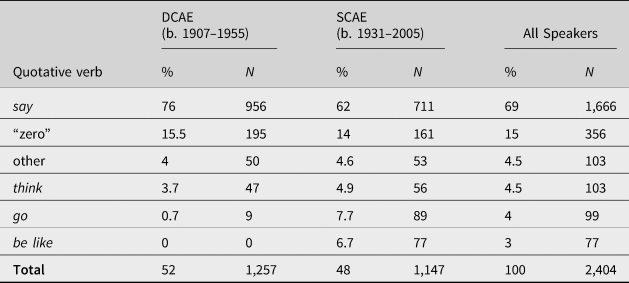
Overall, 69% of direct quotation is expressed through say. “Zero” follows at 15%, while the remaining 16% of the quotative verbs in the sample include “other”Footnote 4 quotatives such as tell, ask, and sing out, as well as think, go, and be like. Be like is only attested in the SCAE, where it occurs in 6.7% of the data. As Figure 1 shows, this is because, aside from one notable exception,Footnote 5 be like is only used among speakers born after 1980 and only the SCAE includes speakers born this recently. As Table 2 shows, the use of both be like and go in the SCAE corresponds with a decline in say; additionally, the relative incidence of think, “zero,” and other quotatives is consistent across both corpora. In the remainder of our analysis, we merge real and apparent time and consider the DCAE and SCAE as a single longitudinal corpus.
Relative frequency of quotative verbs over time in our Australian Aboriginal English (AE) longitudinal corpus (speakers born 1907–2005).

The distribution of individual quotative frames, including “zero,” across speaker decade of birth is shown in Figure 1. Not only is say the favored quotative verb across time, importantly, it also does not show the systematic “trajectory […] of decline” (D'Arcy, Reference D'Arcy, Grund and Walker2020:81) attested in mainstream Englishes, including standardized AusE (Rodríguez Louro, Reference Rodríguez Louro2013:60). The trajectory of say in AE is wave-like, recurrently declining and increasing as other more semantically rich, “other” quotatives (though not be like) are used (e.g., among speakers born in the 1940s and especially the 1970s). Equally notable is the rise and fall of the “zero” form in conjunction with the rise and fall of say among those born in the 1930s, 1940s, and 1970s: When say recedes, the “zero” quotative expands in use. Nonetheless, say remains the majority quotative verb across the generations and is still used about 52% of the time among the youngest speakers (born 1980–2005). Conversely, Rodríguez Louro's (Reference Rodríguez Louro and Pichler2016:147) analysis of mainstream AusE quotatives attested a decline in the use of say from 70% (speakers born 1920–1930) to a mere 11% among young speakers (born 1985–2000).
Aside from one notable outlier (see note 5), quotative be like is only attested in our data among the youngest speakers (born 1980–2005, right of the vertical line, Figure 1), and it is the second most widely used form (after say) among speakers born after 2000 (36%). Tokens of be like stem from interactions with a variety of interlocutors, from community elders to peers. Though not explored here, how diverse audiences impact the frequency of be like use in AE is an intended stream of future inquiry. Importantly, though the well attested cross-over between say and be like (D'Arcy, Reference D'Arcy, Grund and Walker2020:82; Tagliamonte et al., Reference Tagliamonte, D'Arcy and Rodríguez Louro2016:832-834) is absent in our AE data, the resolute upward trend in Figure 1 suggests a change in progress, and that, all things being equal, be like will eventually overtake say.
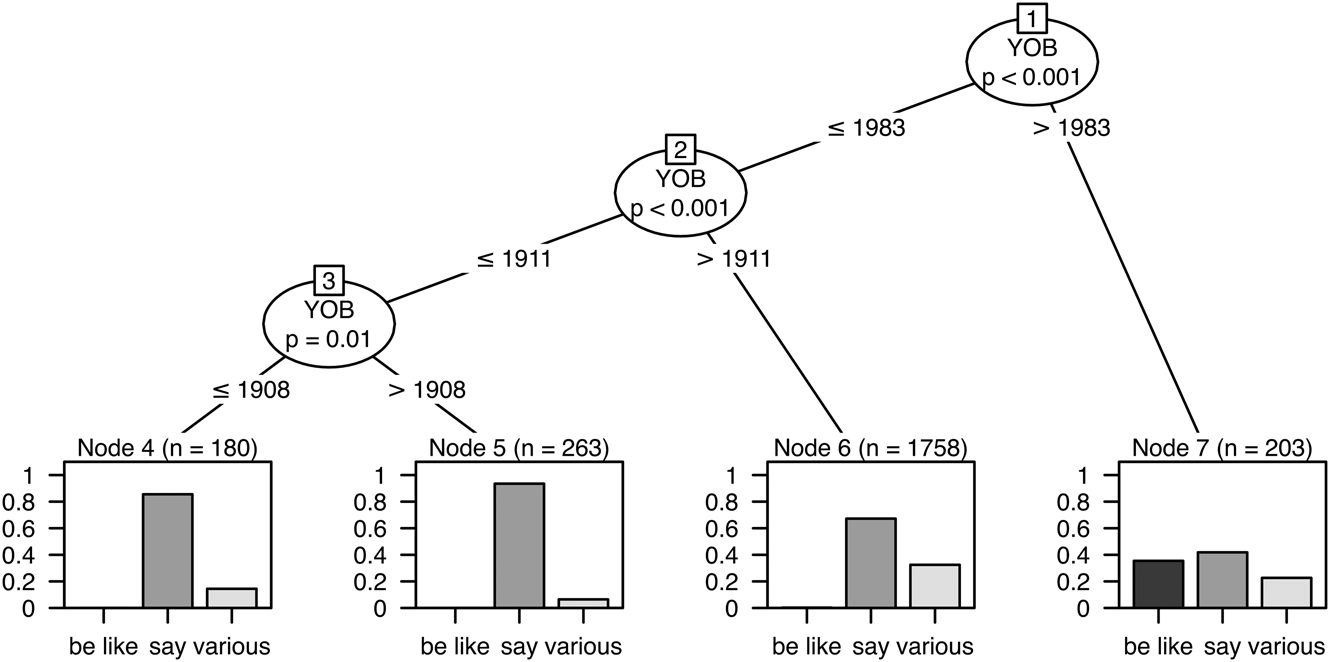
To further investigate diachronic trends in our data, we employ a Conditional Inference Tree (CIT) analysis, which can “expose the quantitative structure of a data set, pinpointing fine-grained distinctions among predictors” (Tagliamonte et al., Reference Tagliamonte, D'Arcy and Rodríguez Louro2016:832).Footnote 6 The data are partitioned into sections “based on which data points are most different from each other” (Schnell & Barth, Reference Schnell and Barth2018:64). The partitioned trees indicate where there are statistically significant differences between predictor levels if all other input predictors are simultaneously considered (Hothorn, Hornik, & Zeileis, Reference Hothorn, Hornik and Zeileis2006; Schweinberger, Reference Schweinberger2022). To enhance Figure 2's readability, say and be like are plotted individually while “zero,” go, think, and “other” quotatives (Table 2) are grouped together and labeled “various.” Input predictors are speaker year of birth (YOB) and gender (woman, man). While speaker gender is nonexplanatory, speaker year of birth is highly predictive of quotative verb selection. A CIT that additionally included corpus (DCAE versus SCAE) as a predictor did not produce an informatively different tree. The first significant partition in Figure 2 is between those born in 1983 and earlier, and those born post-1983 (p < 0.001). These two groups are selected as different because speakers born after 1983 use be like, while their predecessors do not (though see note 5). The second significant partition is among those born in 1911 and before, and those born after 1911. Speakers born before 1911 show a remarkable preference for say. Those born after 1911 continue to prefer say, but this use declines considerably, and direct reported material is encoded via “various” quotative verbs, including “zero,” quotative go, and a host of other minority forms such as ask, sing out, and yell. This CIT analysis confirms that birth year 1983 marks a critical diachronic boundary in our data.
Conditional inference recursive partitioning tree for the realization of different quotative verbs with Year of Birth and Gender as input predictors (n = 2404).
Multivariate analysis
So far we have shown that, although fluctuating, AE does not show the overall decline that has led to the recent shrinking of say's usage frequency in mainstream varieties. We have also established that our AE sample is significantly partitioned in two: those born in or before 1983 and those born after 1983. We now report the results on mixed-effects logistic regression modeling of the linguistic predictors of Grammatical Person of the Subject, Content of the Quotation, Tense/Temporal Reference, and Aspect on quotative choice. Some pruning of the data was in order. Quotative be like clauses featuring nonreferential subjects (e.g., It’s like, “What are you following me for?” JMC/w/34/1985), where it does not encode an individual or an entity, were excluded from the statistical analysis (n = 5) (see Tagliamonte & D'Arcy, Reference Tagliamonte and D'Arcy2004, Reference Tagliamonte and D'Arcy2007). Additionally, as the following regression analyses examine the potential effects of tense/temporal reference and subject grammatical person on quotative choice, quotative frames with no overt quotative verb were removed from the data. Further, for speakers born in and before 1983, the five be like tokens produced by the outlier mentioned in note 5 were excluded.
Table 3 presents the mixed-effects regression model of say among speakers born in and before 1983.Footnote 7 There are 1,860 quotative tokens from this cohort, of which 85% are say. The Akaike Information Criterion (AIC) is an estimator of the prediction error of this model. A lower AIC is a better fit (more explanatory) than a higher AIC. The AIC of a model built with just the random effect Speaker is 1,478, which is significantly higher (less explanatory) than that of the model presented (χ 2 = 659, df = 9, p < 0.001). The marginal and conditional R 2 values show the proportion of the data explained by the fixed effects predictors (Gender, Person, Content, Tense/Temporal Reference, and Aspect) and the fixed effects predictors plus the random effect (Speaker) respectively. For this model, the fixed effect predictors are assumed to have a constant relationship with the response variable (choice of say) across all observations. But by setting Speaker as a random effect, we allow for that fixed relationship to vary from person to person (accounting for individuals having a differing overall likelihood of using say). The mean rate of say use per speaker is 82% (±17%). The Condition Number (κ) and Variance Inflation Factor (VIF) both assess (multi)collinearity in the data (that the differences in say choice explained by Gender, for instance, may be influenced by differences in Person). The Condition Number here is less than six, indicating no collinearity (Baayen, Reference Baayen2008:182). Likewise, the VIFs—the proportion of variance of one fixed effect associated with another fixed effect—is ≤1.28 for all predictors, below the conservative tolerance of four and indicating little to no collinearity (e.g., O'Brien, Reference O'Brien2007). In Table 3 the model is built with treatment contrast coding whereby the coefficient of the Intercept represents the likelihood (expressed in log-odds) of say when each of the fixed-effect predictors (factor group) are set to a reference value (factor): here, Gender = men, Person = second, Content = direct speech, Tense/Temporal Reference = simple past, and Aspect = non-progressive. These reference values each have the highest frequency of say (shown by the Observations columns distributions), though their choice is arbitrary. The coefficients for each nonreference value represent the change in likelihood of say if that parameter is switched. Positive coefficients indicate an increased likelihood of say, while negative coefficients indicate a decreased likelihood of say. Based on the standard error (SE) and z-score, whether this difference in likelihood is significant is calculated and represented by asterisks. While women use less say than men, this difference is not significant. Likewise, while say is used more frequently with second-person subjects, compared to third- or first-person subjects, neither difference is significant. A simultaneous test of the General Linear Hypothesis indicates that the difference between third- and first-person subjects is also nonsignificant. In other words, for the use of say, there is neither a significant Gender nor Person effect. The difference between direct speech and other quotation content types and between direct speech and thought is, however, significant. So too is the difference between other quotation content types and thought. Of the one hundred tokens of quoted thought, only one occurred with say. There is a significant difference between simple past and all remaining Tense/Temporal Reference categories, but not a significant difference among the remaining Tense/Temporal Reference categories. Finally, say is significantly more likely in nonprogressive contexts. To summarize, say is favored when the simple past is used, when using nonprogressive aspect, and/or when quoting direct speech, while other quotative verbs are favored elsewhere.
Mixed-effects logistic regression testing the fixed effects of Gender, Grammatical Person of the Subject, Content of the Quotation, Tense/Temporal Reference, and Aspect, and a random intercept of Speaker on the realization of quotative say in Australian Aboriginal English (AE) among speakers born in and before 1983

Treatment contrast coding. Model fit by maximum likelihood (Laplace Approximation). Model converges with BOBYQA optimizer with <20,000 iterations. Coefficients reported in log-odds.
Significance level: ∗ p < 0.05; ∗∗ p < 0.01; ∗∗∗ p < 0.001
† Simultaneous tests for General Linear Hypothesis
first versus third = 0: Coef. 0.19, SE 0.27, z 0.71, Sig. Level
thought versus other = 0: Coef. −4.77, SE 1.22, z −3.88, Sig. Level ∗∗
other versus simple present = 0: Coef. −0.29, SE 0.35, z −0.82, Sig. Level
historical present versus simple present = 0: Coef. −0.67, SE 0.37, z −1.79, Sig. Level
historical present versus other = 0: Coef. −0.39, SE 0.28, z −1.38, Sig. Level
†† mean by speaker = 82%, SD = 17%
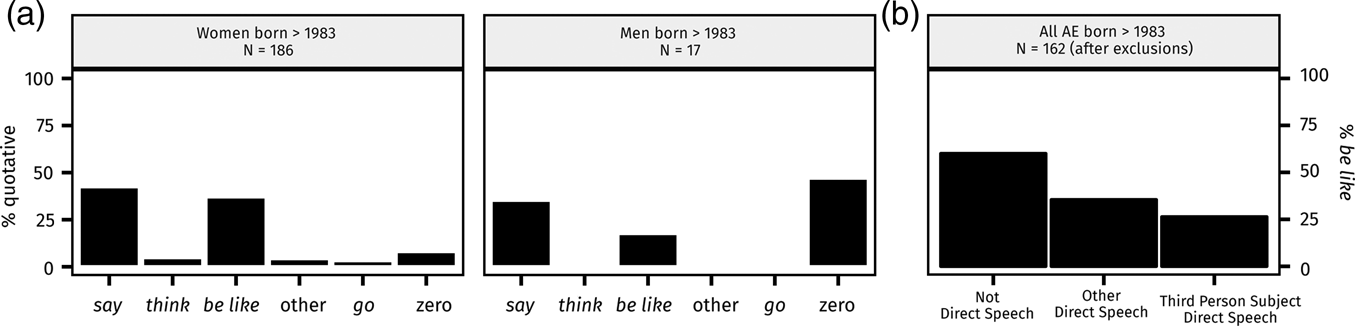
As Figure 3a shows, the seven speakers born after 1983 (two men, five women) have a variable quotative system dominated by say (women) and “zero” (men). However, be like is making inroads, especially among young women in line with the general sociolinguistic observation that young women lead in the use of innovative variants (Labov, Reference Labov2001; though see Denis et al., Reference Denis, Gardner, Brook and Tagliamonte2019). For this group, we attempted to construct an identical model as Table 3 with be like as the application value. For this analysis, the frame it's like must be excluded as it is singular to be like, and “zero” tokens must be excluded as they have no subjects and cannot be marked for tense/aspect. Given this, there were only 162 remaining quotative tokens from this cohort. The complex model, as in Table 3, did not converge with so few tokens (the model did not predict the variation in the data well). Further, there is moderate collinearity (regression models assume little to no collinearity) as there are combinations of Gender, Person, Content, Tense/Temporal Reference, and Aspect with few or no tokens, or categoricity. For this reason, we simplified our analysis and categorized our data from younger speakers into three broad categories: tokens that are direct speech with third-person subjects, all other direct speech tokens, and all nondirect speech tokens. The frequency of be like within these three categories is shown in Figure 3b. Notably, be like's frequency is lowest for tokens of direct speech with third-person subjects, exactly the combination of content type and grammatical person found to resist be like in other communities, including mainstream AusE (Rodríguez Louro, Reference Rodríguez Louro2013). Unfortunately, even a regression model built on the >1983 data using this three-way distinction (AIC = 235) as the only fixed effect and Speaker as a random effect does not explain the variability any better than a model that just includes the random effect of Speaker (AIC = 236; χ 2 = 5.72, p = 0.057). So, while the rate of be like for these three broad categories is on-trend for the spread and rise of be like worldwide, we cannot validate it statistically with the current dataset.
Frequency of different quotatives in Australian Aboriginal English (AE). Panel (a) shows the frequency of quotatives among AE speaking women and men born after 1983. Panel (b) shows the frequency of be like across three broad categories of tokens among all AE speakers born after 1983.
What's going on with go?
There are only twelve speakers of forty-six who employ go. However, they include speakers born in 1911 (n = 2/256, 0.78%) and in nearly every decade in the data, including speakers born in 2001 (n = 6/103, 6%), though speakers born in the 1950s employ the form the most frequently (n = 75/406, 18%). Below we model the use of go relative to other overt quotative frames. Note that pruning away “zero” contexts results in forty-three rather than forty-six speakers. The model here is significantly better at explaining the variation in the data than the null model with just the random effect of Speaker (AIC = 630; χ 2 = 242, df = 9, p < 0.001). The Condition Number (κ) here is 24 indicating medium, though not harmful, multicollinearity (Baayen, Reference Baayen2008:182), which is corroborated by the max VIF of 1.76.
The model indicates that Gender and Person are not significant predictors of go. Go is significantly favored with quotation that is neither direct speech nor thought (though the difference between thought and direct speech is not significant), which includes nonlexicalized sounds and gestures. Given say's strong association with reporting direct speech (n = 1657/1887, 88%) and think's strong association with expressing internal thought (n = 101/114, 89%), both be like and go find their niche expressing other types of quotation.
Zeroing in on “zero”
As shown in Figure 1, there is robust “zero” in the overall dataset (n = 356/2404, 15%). This motivated an analysis of “zero” versus overt quotation. Figure 4, a CIT built with Gender, Year of Birth, and Content as predictors, reveals that men use significantly more “zero” quotative frames than women, and that, among both groups, “zero” quotative frames are more likely for content that is not thought (the domain of think) or direct speech (the domain of say), such as nonlexical sounds (18), similar to go.
(18) So he made this sound all the night, Ø “Mm, mm, mm, mm, mm, mm,” and he stopped. (RB/m/77/1930)
Conditional inference recursive partitioning tree for “zero” versus realized quotative verbs with Year of Birth, Gender, and Content of the Quotation as input predictors (n = 2404).

These trends are verified by a mixed-effects regression analysis, presented in Table 5. Tense/Temporal Reference, Person, and Aspect were not included as fixed effects in our analysis, as “zero” quotatives neither carry tense/aspect marking nor have overt grammatical subjects. While the regression model is not a great fit to the data (it only accounts for a fifth of the variation, Conditional R 2 = 0.20), it performs significantly better than the null model with only the random effect of Speaker (AIC = 1,898; χ 2 = 34, df = 3, p < 0.001).
Mixed-effects logistic regression testing the fixed effects of Gender, Grammatical Person of the Subject, Content of the Quotation, Tense/Temporal Reference, and Aspect, and a random intercept of Speaker on the realization of quotative go in Australian Aboriginal English (AE)
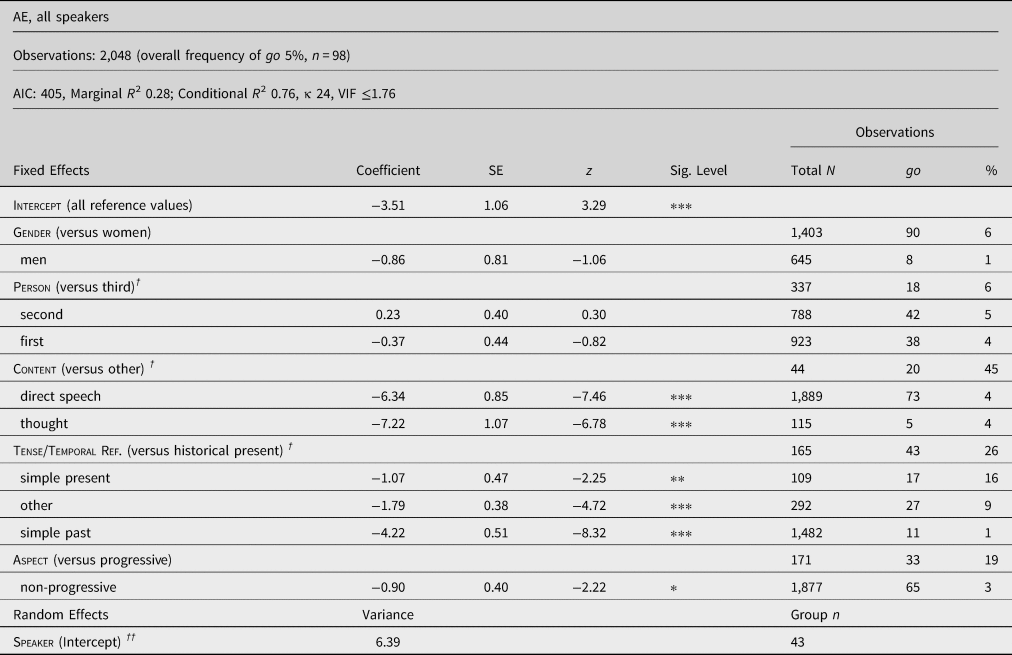
Treatment contrast coding. Model fit by maximum likelihood (Laplace Approximation). Model converges with BOBYQA optimizer with <20,000 iterations. Coefficients reported in log-odds.
Significance level: ∗ p < 0.05; ∗∗ p < 0.01; ∗∗∗ p < 0.001
†Simultaneous tests for General Linear Hypothesis
first versus second = 0: Coef. −0.60, SE 0.37, z −1.62, Sig. Level
direct speech versus thought = 0: Coef. 0.88, SE 0.64, z 1.38, Sig. Level
other versus simple present = 0: Coef. −0.72, SE 0.48, z −1.49, Sig. Level
simple past versus simple present = 0: Coef. −3.15, SE 0.59, z −5.37, Sig. Level ∗∗∗
simple past versus other = 0: Coef. −2.43, SE 0.54, z −4.52, Sig. Level ∗∗∗
††mean by speaker = 2.8%, SD = 14%
Mixed-Effects logistic regression testing the fixed effects of Gender, Content of the quotation, and a random intercept of Speaker on the realization of a null quotative in Australian Aboriginal English (AE)

Treatment contrast coding. Model fit by maximum likelihood (Laplace Approximation). Model converges with BOBYQA optimizer with <20,000 iterations. Coefficients reported in log-odds.
Significance level: ∗ p < 0.05; ∗∗ p < 0.01; ∗∗∗ p < 0.001
† Simultaneous tests for General Linear Hypothesis
direct speech versus thought = 0: Coef. −0.56, SE 0.33, z −1.71, Sig. Level
†† mean by speaker = 2.2%, SD = 13%
Our analysis does not explore in depth the role of mimesis and sound effects on the use of specific quotative frames, including “zero.” However, the favoring effect of “zero” quotatives to introduce nonlexicalized sounds in AE is in line with D'Arcy's (Reference D'Arcy2010) findings for Māori English, where “zero” quotatives encoded mimetic speech, patterning in opposition to mainstream New Zealand English.
Our results motivate the question of how quotatives may have been employed in Nyungar, the traditional First Nations language of Southwest Western Australia. The question arises as to whether traditional ways of telling stories may have contributed to the patterns noted above. A modern grammar of Nyungar does not currently exist (though see Douglas, Reference Douglas1976), but an examination of narrative texts in the stories Mamamg ‘Whale’ (Scott, Reference Scott2011a), Noongar Mambara Baktij ‘Man Fights Spirit’ (Scott, Reference Scott2011b), and Noorn ‘Snake’ (Scott, Reference Scott2011c), provides insights into what quotation was like in Nyungar. These stories constitute approximately 12,300 words of Nyungar. They contain eighteen quotative frames, eight instances of the verb wangk ‘say,’ as shown in (19), and ten instances of quotation introduced without an overt quotative verb, that is, a “zero” quotative, as in (20). All eighteen quotative frames introduce speech. No quotative-introduced thought encoding is recorded in the stories. The translations into English, and the glosses, were provided by the author in the original publications. We have bolded items and added “Ø” in the gloss to represent “zero.” In (20) the “stranger” sees the snake in the presence of other people who warn him to “look out.”
(19) Balaap wangk, ‘Nidja demangka birt nyoondok koorliny.
They say this old-people track you going
‘Hey, they said, “Old people come this way, but not for a long time.”’ (Scott, Reference Scott2011b:6)
(20) Waam baal weyarn. Ø ‘Aliwa!’
Stranger he frightened. Ø ‘Look out!’
‘The stranger was frightened when he saw the snake.’ (Scott, Reference Scott2011c:28)
The Nyungar data depicted in (19) and (20), although limited, align with our finding that, in AE as spoken in Nyungar country, the encoding of speech in storytelling (rather than thought) remains strong.
Discussion
Based on the individual analysis of say, be like, go, think, and the “zero” quotatives in our dataset, we argue that there is functional partitioning: different quotatives are marshalled for specific quotative jobs. Say is the default choice for expressing direct speech and occurs most often with past tense morphology. Think, on the other hand, is specific to expressing internal thought. Other quotative frames, especially go and “zero,” are selected when what is being quoted is a nonlexical sound. Go is especially likely when speakers use the nonpast or progressive aspect for narrating events. While a robust statistical analysis of be like was not possible, we have shown that be like is incipient for both nonlexical quoting as well as nonthird-person subjects. Be like is finding its niche in AE in the exact contexts where say and think do not dominate, while aligning with the global tendency to use be like to quote one's own words and thoughts (Tagliamonte et al., Reference Tagliamonte, D'Arcy and Rodríguez Louro2016).
The longitudinal perspective adopted here also offers a glimpse of the AE quotative system before be like. The literature has established that the quotative system of settler colonial Englishes was already in flux before be like emerged. Specifically, D'Arcy (Reference D'Arcy, Grund and Walker2020) argued that the rise of internal thought reporting in narrative is independent of the rise of be like per se and that the quotative system had already reconfigured before be like's appearance, facilitating its selection as the preferred introducer of a speaker's thoughts and attitudes. In settler colonial Englishes, the drift toward be like is now understood as related to the increased expression of internal dialogue in narrative (see D'Arcy, Reference D'Arcy2012; Rodríguez Louro, Reference Rodríguez Louro and Pichler2016).
In our Results section, we determined that say dominates across generations of AE speakers where it does not show the steady decline noted in settler colonial Englishes, including mainstream AusE (Rodríguez Louro, Reference Rodríguez Louro2013:60). This trajectory is also evident when considering the overall proportion of quoted direct speech and thought. Viewed longitudinally, the AE quotative system shows conservativism, encoding direct speech to near categorical levels over time, as shown in Figure 5.
Overall proportion of quoted speech and thought in the Australian Aboriginal English (AE) corpus by speaker decade of birth.

While settler colonial English varieties such as mainstream Australian, New Zealand, and Canadian English display “gradual and longitudinal” changes whereby the overall usage frequency of internal dialogue/thought represented as quotation rises “regularly and monotonically” (D'Arcy, Reference D'Arcy, Grund and Walker2020:88), AE shows stability across the generations, with quotative frames favored in the expression of direct speech rather than internal thought. The quintessential function of quotation in acrolectal AE as used in Nyungar country is that of direct speech encoding.Footnote 8
The conservative patterns illustrated in Figure 5 show that the “longitudinal, systemic change” that preceded be like “by at least a full century” (D'Arcy, Reference D'Arcy, Grund and Walker2020:90) in settler colonial Englishes is not attested in AE. AE speakers have historically used quotative frames to introduce direct speech. The increase of internal thought and attitude reporting in narrative, which paved the way for be like's encroachment in various settler colonial Englishes, has been absent in AE. Not only is AE's be like a change from above (external to the system), the changes motivating its rise (internal thought and attitude reporting in the first person) have not been systemic in AE. The result of these processes is a quotative (be like) that, while on the rise, has started off on different footing in AE.
Conclusion
We have shown that, in synchrony, AE quotation is characterized by functional partitioning such that different quotative frames, including say, be like, go, think, and “zero,” correspond to different pragmatic functions. We have also established, through the analysis of a longitudinal corpus of AE, that AE characteristically utilizes quotative devices to introduce direct speech. Crucially, this trajectory does not entirely diminish with the passing of time.
These findings indicate that AE has adopted the linguistic changes attested in mainstream Englishes (i.e., the use of be like as a quotative verb), but the longitudinal trajectory of this development is not entirely akin to that of mainstream Englishes, including AusE. We leave it to future research to determine whether, in the context of direct quotation in yarning, be like might herald deep-seated cultural change.
Acknowledgments
The research is supported through an Australian Research Council DECRA fellowship to Rodríguez Louro (DE170100493). A version of this paper was presented at Language Variation and Change, Australia 4 and at the 2020 Forum on Englishes in Australia. We thank the audiences for their valuable feedback. We also thank three anonymous reviewers for their in-depth feedback. Any errors remain our own responsibility. We also wish to thank the members of the Nyungar community in Southwest Western Australia who generously contributed to this study, as well as Prof. Alan Dench, Dr. John Henderson, Dr. Maïa Ponsonnet, Dr. Denise Scott, Dr. Gerald Roche, Prof. Anna Haebich, and the librarians at Freshwater Bay Museum for their intellectual input and assistance with ethical access to the data. The University of Western Australia, where the first, second, and third authors are based, is situated in unceded Nyungar country, and all authors acknowledge that the Nyungar people remain the spiritual and cultural custodians of this country in which they continue to practice their values, languages, beliefs, and knowledge.
Competing interests
The author declares none.


 Open access

