




1. Introduction
It is a well-known cross-linguistic fact that volition lexemes can evolve into grammaticalised markers, as shown, e.g., by the diachronic development of the future construction (see Kuteva et al. Reference Kuteva, Heine, Hong, Long, Narrog and Rhee2019: 453–454 and references therein), necessive modality (see Kuteva et al. Reference Kuteva, Heine, Hong, Long, Narrog and Rhee2019: 454–455 and references therein) and free-choice markers (e.g., Haspelmath Reference Haspelmath1997). Other developments are less known, either because they have been less thoroughly investigated or their study has remained confined to a single language (see, e.g., Dell’Oro Reference Dell’Oro2025a). A case in point is the reportative use of Latin volo ‘to want’, as illustrated in example (1). Such reportative use may be contrasted with the volitional use of example (2). Unless otherwise indicated, the translations of Latin passages are taken from the Loeb Classical Library database. Glosses and translations from other languages are the author’s own, unless otherwise specified. Where relevant, examples may be preceded or followed by contextual material translated into English. To distinguish the concept of volition from the English verb to want, I use small capitals (want).Footnote 1 The abbreviations used in the glosses follow the Leipzig Glossing Rules.Footnote 2


The reportative uses of Latin volo remain largely underrecognised. Notably, in their discussion of the evidential uses of French vouloir ‘to want’, Landvogt and Goldschmitt (Reference Goldschmitt, Landvogt, Durand, Habert and Laks2008: 255) assert that Latin lacks a reportative (‘citationnel’) use of volo. Footnote 3 Contrary to their claim, the main aim of this paper is to demonstrate both the presence and the emergence of the reportative use of volo in Latin.
By contrast, the reportative use of German wollen is well studied. Compare example (3) with example (4).
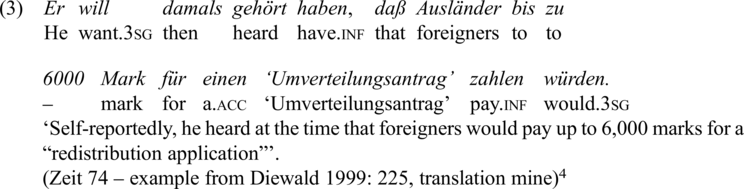

The historical development of the evidential uses of German wollen has received limited attention beyond the domain of Germanic studies. As this investigation will show, the study of the two verbs, Latin volo and German wollen, can offer valuable mutual insights.
The more extensive synchronic investigation into the evidential uses of German wollen enables two clarifications that are also pertinent to Latin volo. First, it should be emphasised that evidential wollen does not function as a verb of saying. As demonstrated by Remberger (Reference Remberger, Casartelli, Cruschina, Posio and Spronck2023: 54–59), the saying event associated with reportative wollen is neither at-issue nor eventive. Rendering evidential wollen with the adverb ‘self-reportedly’ can help to avoid ambiguity, an approach that will also be applied to Latin (see example 1). Second, while ‘to claim’ is a possible translation of evidential wollen, it is not always appropriate. The dissociation of the speaker at time 0 from the speaker at time 1, whose statement is being reported, does not form part of the semantics of evidential wollen, but may emerge as a pragmatic inference (Remberger Reference Remberger, Casartelli, Cruschina, Posio and Spronck2023: 48–50). As we shall see in Section 3.1.3, reportative volo exhibits similar behaviour, although it is not possible to rely on native speakers’ judgements. To circumvent this issue, I draw upon contextual and cotextual evidence. On the side of the differences, it is worth noting that Latin reportative volo displays specific constructions not attested for Present-Day German reportative wollen. Most notably, as illustrated by example (1), reportative volo does not require coreferentiality between its subject and that of the complement clause.
The second aim of this paper concerns the suggested role of a doxastic component in the pathway from volition to evidentiality. According to a hypothesis recently reformulated by Remberger (Reference Remberger, Casartelli, Cruschina, Posio and Spronck2023, see also Remberger Reference Remberger, Peterson and Sauerland2010, Reference Remberger2011, as well as Heim Reference Heim1992 and von Fintel Reference von Fintel1999 for the original formulation in relation to English to want), the evolution of German wollen from volition to evidentiality is made possible by the presence of a doxastic component in its semantics:
[…] the intermediate step between the bouletic conversational background (volitional modality) and the reportative conversational background (evidentiality) is the doxastic conversational background (of belief or thought) already present in the root interpretation of want (all of them anchored to the subject xsubj). (Remberger Reference Remberger, Casartelli, Cruschina, Posio and Spronck2023: 64)
I argue that the case of Latin volo provides a valuable contribution to this hypothesis from outside the German family. In fact, all the Latin reportative examples are clearly doxastic, as they convey the opinion of the reportative source. In addition to providing an interlinguistic foundation to the presence of a doxastic component in verbs of volition, it contributes complex diachronic evidence that points to a less linear developmental path (see Section 3.2).
The paper is structured as follows: Section 2 outlines the methodology and addresses certain terminological issues; Section 3 presents the analysis of Latin volo across pre-Classical, Classical and early Late Latin; Section 4 offers a tentative comparison with the German data, alongside some preliminary observations on French, for which new data is also introduced; Section 5 presents the conclusions and outlines a series of desiderata.
2. Methodology and terminological issues
With respect to Latin volo, no previous investigation of the reportative uses was available (see, however, Dell’Oro Reference Dell’Oro2025b). Accordingly, the investigation began with an examination of dictionary entries. Unfortunately, the Thesaurus linguae Latinae – the most complete reference lexicon for Latin – has not yet produced the relevant lemma. Therefore, for a first overview, I relied on the Oxford Latin Dictionary (henceforth OLD). I have adopted a corpus-based approach, focussing on present forms, as they are the most common ones for the reportative use according to the examples collected in the OLD.Footnote 5 As a corpus, I have used all the texts of the section Antiquitas of the Library of Latin texts. This section comprises texts predating the year 200 CE that are attested through the manuscript tradition. Note that this valuable tool does not allow the user to find concordances by lemma, but only by words. I have queried the corpus with respect to the present indicative forms vult with the variant volt ‘(he/she/it) wants’ (3rd person singular) and volunt ‘(they) want’ (3rd person plural). I have also considered the negative forms nevult ‘(s)he does not want’ (3rd person singular) and nolunt ‘(they) do not want’ (3rd person plural). The queries returned 531 passages for vult, 230 passages for volt, 521 for volunt, one passage for nevult, and 61 passages for nolunt.
Before turning to the analysis of the Latin passages, it is necessary to clarify the use of certain terms in this paper.
First, the term ‘reportative’ is preferred over ‘quotative’. It must be acknowledged that terminological consensus on these terms is lacking in the field of evidentiality. As Vanderbiesen (Reference Vanderbiesen2014: 170) notes: ‘[t]raditionally, this opposition is defined in terms of whether the author is explicitly construed: whereas quotatives mention the exact author, reportives do not (cf. e.g. Mushin Reference Mushin2001: 71; Plungian Reference Plungian2001: 352; Aikhenvald Reference Aikhenvald2004: 64, 177)’.Footnote 6 However, ‘[u]sually, a quotative is defined as marking a verbatim (i.e. direct) quotation of another speaker, and indeed this is the sense in which the word “quote” is generally understood’ (Vanderbiesen Reference Vanderbiesen2014: 170).Footnote 7 In the passages analysed here, the evidential source is consistently present. Nevertheless, it cannot be assumed that the content is reproduced verbatim, especially in instances where the boundary between reported speech and reported thought is indistinct. To avoid the potentially misleading implications of the term ‘quotative’, which may evoke the notion of direct quotation, the term ‘reportative’ is used.Footnote 8
Second, the term ‘reportative’ encompasses here both reported speech and reported thought. From a cognitive perspective, the distinction between the two may be inherently blurred, as reported thought represents a form of verbalised cognition. Conversely, content presented as reported speech reflects, at least to some extent, the mental verbalisation of its source. Furthermore, from an interlinguistic standpoint, Casartelli (Reference Casartelli2023) has demonstrated that some languages employ the same markers for reported speech and reported thought, thereby pointing to a degree of contiguity between the two domains and their respective grammatical encoding.Footnote 9
Having clarified the use of the term ‘reportative’, it is now necessary to outline how the participants related to the reported event are identified and referred to. To prevent confusion regarding the speaker (or writer or thinker) involved when a verb of volition functions reportatively, the individual who reports a propositional content attributed to someone else will be referred to as the ‘speaker/writer/thinker at T0’, where T0 (with T = time) represents the time of the enunciative act. This figure is to be distinguished from the ‘speaker/writer/thinker at T1’, namely, the referent of the syntactic subject of the volitional verb in the languages under analysis.
In the (mostly literary) texts from which the attestations of volo are drawn, it is not always possible to clearly differentiate between speaker, writer, and thinker. Therefore, unless the distinction is possible and necessary, ‘speaker’ will be used as a cover term encompassing all three figures.
I now turn to the semantic classification of the reported content, with particular attention to how modality is construed. I adopt here a restrictive use of the term ‘modality’, referring to the use of markers of necessity, possibility, and volition to qualify a state of affairs as neither positively nor negatively factual. This approach aligns with the definition of modality proposed by van der Auwera and Plungian (Reference van der Auwera and Plungian1998, though volition is not considered in their account), Narrog (Reference Narrog2012), and Nuyts (Reference Nuyts, Nuyts and van der Auwera2016). This choice carries two important implications. First, there is no need to derive volition from possibility nor necessity, as is required by alternative frameworks such as the Kratzerian model (cf. Remberger Reference Remberger, Casartelli, Cruschina, Posio and Spronck2023: 48–49). Second, evidentiality is excluded from the definition of core modality adopted here, although it is acknowledged as a closely related and partially overlapping domain. Consequently, the evidential developments investigated in this study are situated within the domain of post-modality (in the sense of van der Auwera and Plungian Reference van der Auwera and Plungian1998). A post-modal meaning or function is one that evolves from a modal meaning, with the original modal meaning potentially persisting to varying degrees or becoming entirely bleached.Footnote 10
Finally, it is important to clarify that, within the formal approach to modality, the term ‘epistemic’ pertains strictly to knowledge, whereas, in the functional-typological framework adopted here, ‘epistemic’ refers to the speaker’s stance regarding the likelihood of an event occurring (e.g., Nuyts Reference Nuyts, Nuyts and van der Auwera2016). Such assessments of probability are grounded in knowledge, evidence, and belief, which render these concepts and their associated uses closely interwoven. However, to enhance clarity, I use the term ‘doxastic’ (from Ancient Greek dóxa ‘opinion’) to denote meanings specifically related to thought, opinion, or belief.Footnote 11
3. Latin volo: analysis and results
This section presents an analysis and discussion of the reportative construction with volo, examined from both synchronic (3.1) and diachronic (3.2) perspectives.
3.1. Synchronic results
The main features of the reportative construction with volo are outlined here, drawing on the reference dictionary mentioned in Section 2, as well as on corpus analysis. The discussion is structured around four principal areas: non-discreteness (3.1.1); frequency and diaphasic distribution (3.1.2); semantics and pragmatics (3.1.3); and morphological and syntactic features (3.1.4).
3.1.1. Non-discreteness
The distinction between volitional meaning and reportative function is not discrete for Latin volo. This point can be illustrated using the following passage:

Here, Varro discusses the viewpoint of those who maintain that anomaly exists in the Latin language. Volunt in example (5) conveys volition and is not, strictly speaking, reportative. Accordingly, it is not included among the relevant passages of the corpus. Nevertheless, the propositional content introduced by ut and anticipated by the pronoun quod ‘this’ conveys the opinion of those individuals, albeit in the form of a wish. Thus, volunt retains its volitional meaning while serving to introduce the opinion of those individuals corresponding to the syntactic subject of volunt. This opinion is presented by Varro as a wish – that is, how these individuals would like matters to be (‘that Anomaly would exist in the Latin language’) – a point of view that Varro himself does not share (for the semantics and pragmatics of reportative volo, see Section 3.1.3). It should be stressed that most examples discussed here involve two distinct subjects, whereas cases of coreferential subjects will be addressed in Section 3.1.4.
This example demonstrates that in Latin volo there is no absolute separation between volitional meaning and reportative function, as both appear to be simultaneously present in example (5). This raises the question of whether, in other cases, a clearer distinction between volitional and reportative meanings can be drawn – bearing in mind that the reported propositional content reflects how the speaker or thinker at T1, as the original source, wishes others to perceive the world. This issue is developed in Section 3.2, where a diachronic outline is proposed.
While it is important to recognise that a volitional meaning may still be present when volo is used with a reportative function, the following test may help to assess whether volo in the third person tends towards a volitional meaning or a reportative function. The test is based on a yes/no answer to the question: ‘Is the volitional entity, who is the syntactic subject of the volitional verb, able to bring about the desired event or state of affairs?’ If the answer is affirmative, as in example (2) – which is repeated here as (6) – there is a volitional source and volo functions as a volitional verb. If the answer is negative, volo may be used with a reportative function. Moreover, if volo introduces a propositional content that can be paraphrased as a statement, then it has a reportative function.

As described in (6), an individual who wishes a bee swarm to settle in a certain place can influence the animals’ behaviour to achieve this goal. In the case of a reportative use, however, the source of the propositional content is unable to act to bring about the event, regardless of how much they wish it to be true. In (7), whether or not there is a significant difference between the sense of seeing and that of hearing is primarily a matter of opinion.Footnote 12

A similar line of reasoning can be applied to example (1), which concerns the opinion as to whether god is immaterial. At most the only aspect upon which the volitional entity can act is the opinion of other individuals. I develop this hypothesis in Section 3.2. The non-coreferentiality between the subject of volo and that of the verb in the complement clause plays an important role, as the wishing entity is not necessarily involved in the event described in the complement clause, as illustrated by examples (1) and (2) = (6). Conversely, co-referentiality may give rise to ambiguity, as shown in Section 3.1.3.
It is important to emphasise that the distinction between the two uses correlates to the presence or absence of control on the part of the volitional entity. The differentiation between the volitional meaning and the reportative use of Latin volo is also closely linked to the nature of the event described in terms of lexical aspect. As discussed in Sections 3.1.2 and 3.1.3, a notable pattern emerges whereby reportative uses of volo predominantly occur with stative predicates – that is, those denoting situations in which a state of affairs simply holds or does not. In such cases, opting between alternatives reflects an evaluative stance or belief rather than an exercise of agency by the volitional entity. No instances involving prototypical actions nor prototypical accomplishments have been identified in the data consulted thus far. However, verbs denoting achievements – in Vendlerian terms (Vendler Reference Vendler1957) – or close to this event type (see Dowty Reference Dowty1979) are not entirely excluded from reportative constructions with volo. I have identified in the corpus examples (8)–(11) reported below, to which examples (16) and (17) may be added. The syntactic subject of the complement clause is inanimate (the sea) or lacks specificity (the universe), thereby reducing the degree of agency and volitionality.


Although further investigation is warranted, a tentative hypothesis may be advanced: the reportative function appears to correlate with the absence of control and, to a lesser extent, goal-orientedness. Stative predicates lack both features, while accomplishments embody both. Activities typically entail control without goal-orientedness, and achievements display the reverse configuration. For further discussion of the semantic features of reported events, see Section 3.1.3.
3.1.2. Frequency of reportative uses and diaphasic distribution
Within the Antiquitas section, the reportative use is very rare. The figures vary according to the authors and the genres they practise. Cicero (106–43 BCE) is the first author to employ reportative volo with any notable frequency. He is also the sole author within the Antiquitas section whose works span genres as diverse as speeches (i.e., the written – and reworked – versions of the speeches delivered in court), (real, non-fictive) letters (i.e., a more informal type of written production), and rhetorical and philosophical treatises. Among these three genres (namely speeches, letters, and treatises), the use of reportative volo appears clearly associated with the scientific discourse of the treatises, as shown in Table 1. Ambiguous passages have also been taken into account. Out of 355 occurrences of the selected forms vult, volt, volunt, and nolunt, the presence of reportative uses is significant only in the treatises.Footnote 14 This result casts doubt on whether the reportative uses of volo are less well attested before Cicero due to the nature of the textual sources available to us.
Reportative uses of vult, volt, volunt, and nolunt in Cicero’s works, by genre

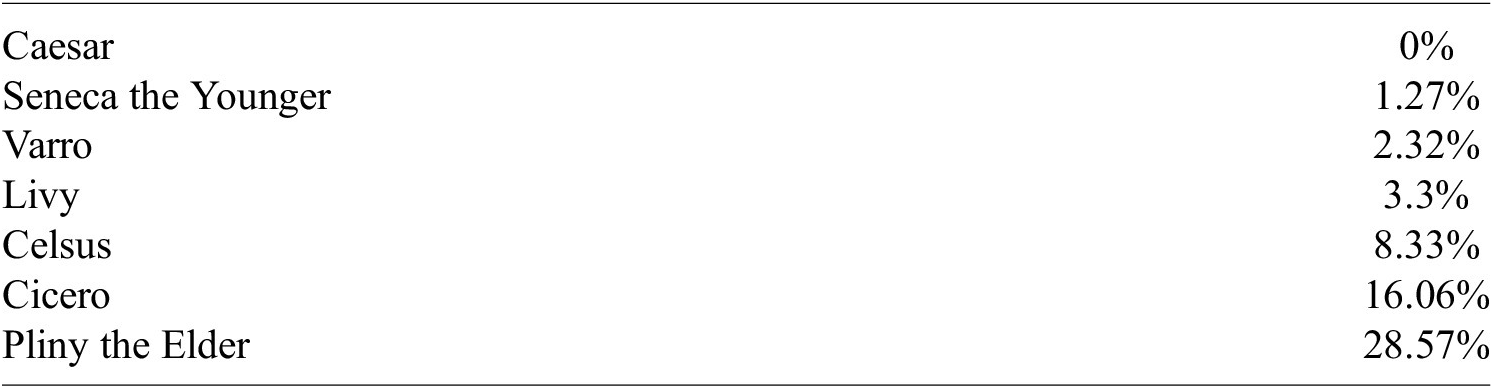
Reportative uses are limited to 57 occurrences (i.e., 16.06% of the total occurrences) in Cicero’s works. Among the genres, they appear predominantly in the treatises (92.98%) and only rarely in the speeches (5.26%) or letters (1.75%). Reportative uses are thus clearly associated with the genre of treatise in Cicero’s works. If we consider other authors, we rarely find reportative uses, with the notable exception of Pliny the Elder, who also practises the genre of treatise. However, in the case of Seneca the Younger, who authored a considerable number of treatises, only two occurrences of reportative uses are attested, both in treatises. Therefore, the use of volo to report the spoken or thought content of other individuals is also a matter of personal and stylistic preference. The figures in Table 2 illustrate the frequency of reportative uses among a selection of authors.
Frequency of reportative uses in selected authors

3.1.3. Semantics and pragmatics of reportative volo
As outlined in Section 3.1.1, there is no clear-cut distinction in Latin between volo conveying volition and volo marking reported content. A similar ambiguity arises in the distinction between reported thought and reported speech. In fact, even the surrounding cotext is often insufficient to disambiguate between a verb of propositional attitude and a verb of saying. For instance, the following passage (12) – presented above as example (9) – is reproduced here with its preceding cotext. Both types of verbs are represented: dixit ‘he said’ occurs twice, while censet ‘he thinks’ appears once.

It must be also specified that in a predicative construction (small clause) – namely, when volo is used with a passive perfect participle (henceforth PPP) in the construction ‘vult/volunt + PPP’ – volo appears more akin to a verb of thinking than to a verb of saying, as shown by example (13). For the constructions shared by volitional volo and dico ‘I say’, see Section 3.1.4. Small clauses likely contributed to the development of the reportative function, as illustrated in Section 3.2.

The semantics of reportative volo is neutral. For instance, in the passage presented as example (12), the verbs dico, volo, and censeo are used to introduce opinions that are not entirely compatible. The speaker at T0 does not display greater disbelief towards the content introduced by volo than towards that introduced by the other two verbs. However, since the propositional content is not endorsed by the speaker at T0, a conversational implicature may arise, resulting in a pragmatic effect of non-commitment on the part of the speaker with regard to the propositional content. It is worth noting that I have not found volo used in the first person to express the speaker’s point of view, whereas this is possible with dico and censeo. As explained in 3.2, the dissociation of the speaker at T0 from the propositional content of the speaker at T1 also underpins the diachronic development of the reportative construction. It should be noted that co-referentiality between the subject of volo and that of the verb of the complement clause is more likely to entail a dissociation of the speaker at T0 from the reported content, as outlined in Section 3.1.4.
Another notable semantic feature of the Latin reportative construction with volo is the atemporal or tenseless reading of the reported content, when the verb in the complement clause is in the present. The validity of the proposition is not anchored to any specific point in time – past, present, or future. For instance, in example (1), the incorporeal nature of the divinity holds true independently of temporal reference. This interpretive pattern is not restricted to esse ‘to be’: in example (12), the idea that all things originate from numbers and the first principles of the mathematicians is presented as a timeless truth, equally valid in the past, present, and future. See also the aspectual properties of the reported event outlined in Section 3.1.1. This configuration renders the reportative volo construction particularly well-suited to the genre of philosophical and scientific treatises, as it enables the author to present different views. Moreover, this semantic property of reportative volo is at odds with the intrinsic non-anteriority requirement (e.g., Remberger Reference Remberger, Peterson and Sauerland2010: 169, Reference Remberger2011: 22) of verbs of volition. In fact, these verbs typically introduce alternative worlds located in the future, and possibly in the present. An exception, however, is discussed in Section 3.1.4: when the verb in the complement clause is in a past tense, the reference may be to the past.
3.1.4. Morphology and syntax of the reportative construction with volo
While the corpus investigation in this paper is confined to the present tense, it is important to emphasise that past tenses are also compatible with the reportative use, as illustrated by the following examples in the imperfect (14) and the perfect (15):


Reportative volo in the present tense combines almost exclusively with present infinitives, as already shown by examples (1), (7)–(12). However, perfect infinitives are occasionally attested and so compatible with reportative volo, as shown by examples (16) and (17). It is worth noting that, in both passages, perfect infinitives in the active form alternate with perfect infinitives without esse in the passive form, thus formally reducing the infinitival structure to a small clause. These passive forms can convey passive voice, as in the case of repertas, or reflect the deponent nature of the verb, as in the case of usum. For the importance of small clauses in the development of the reportative function, see Section 3.2. It is also worth emphasising that the volitional component is damped by the presence of perfect infinitives. As mentioned in Section 3.1.2, want-verbs, when used in their basic volitional sense, exhibit an intrinsic non-anteriority requirement. The use of volo with a perfect infinitive precludes a volitional interpretation.


It is worth noting that in example (17), the compound verb malo ‘to prefer’ – from magis + volo – is used to report the perspective of Aristoteles.
In the investigated corpus, reportative volo never governs a complement clause in the subjunctive, i.e., a conjugated verb. This marks a notable difference with volitional volo, which can govern either an infinitive or a subjunctive. Specifically, volo with a volitional meaning may take an infinitive (with a coreferential subject), an accusative-and-infinitive construction, or a subjunctive clause.Footnote 16 I suggest connecting this behaviour of reportative volo with the declarative function of the reportative uses. A verb such as Latin dico ‘I say’ can govern a subordinate clause in the subjunctive (introduced by ut or ne, cf. OLD: s.v. dico). However, it is most often used with the infinitive with or without the subject of the subordinate clause in the accusative (Cuzzolin Reference Cuzzolin2013: 23).Footnote 17 Reportative volo behaves in a similar way. It is worth recalling contexts such as that in example (5) where the ut-clause in the subjunctive has an expletive function with respect to the pronoun quod, and volo retains a volitional meaning.
Reportative volo can fall within the scope of negation, though this use is extremely rare. I have found only one clear occurrence, i.e., example (18).Footnote 18

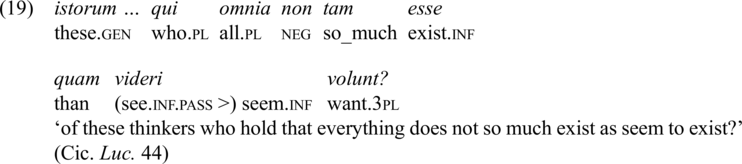
Cf. also example (19), in which volunt governs a comparative construction whose first member has negative polarity (non tam esse), while the second has positive polarity (quam videri).
The incidental construction ‘ut + reportative volo’ (cf. examples 20 and 21) is rarely attested in the investigated corpus. I provide here a couple of examples:


In most cases, reportative volo has a subject distinct from that of the infinitive in the accusative-and-infinitive clause, as seen in all the preceding examples of reportative volo. However, the reportative use is also compatible with a coreferential subject. As mentioned in Section 3.1.1, such coreferential constructions are highly ambiguous between a volitional interpretation and a reportative function, as illustrated by example (22). See also the discussion of the diachronic perspective in Section 3.2.

The use of ferebat ‘raised’ together with insigne laude ‘through outstanding praise’ hints at the verbal action of praising. In keeping with this, volo can be interpreted here as having a reportative function. It is worth noting that there is probably an added nuance of boasting.
In cases of coreferentiality, the volitional meaning is not absent – likely because the referent encoded as the syntactic subject may still be perceived as exerting a degree of control over the event introduced by volo. This volitional component contributes to presenting the propositional content as valid for the speaker at T1 (who desires it to be true, cf. the discussion in Section 3.1.1), but in some cases as invalid from the perspective of the speaker at T0 (who does not agree).
Example (23), which contains a small clause, can be interpreted either with a volitional meaning – ‘those who want themselves (to be) populares’ – or with a reportative function ‘those who are self-reportedly populares’. Cicero adopts a negative attitude towards such individuals, whom he does not regard as genuine friends of the people, as is evident from the remainder of the passage, the English translation of which is provided below the glossed example. Accordingly, the translation of volo with ‘claim’ is particularly fitting here.

The text continues as follows: ‘(and who for that reason either attempt to have agrarian laws passed, in order that the occupants may be driven out of their homes, or propose that money loaned should be remitted to the borrowers, are undermining the foundations of the commonwealth: first of all, they are destroying harmony, which cannot exist when money is taken away from one party and bestowed upon another; and second, they do away with equity, which is utterly subverted, if the rights of property are not respected.)’
The following section explores the emergence of the reportative function of volo from a diachronic perspective.
3.2. The diachronic view from volition to opinion
The corpus analysis reveals that the forms vult/volunt, when conveying volitional meaning, may sometimes express a desire concerning how one wishes to be perceived by others (cf. examples 24, 25, 26, and 27), as well as how one desires things to be perceived by others (cf. examples 28, 29, 30, and 31).



From a morphosyntactic perspective, the first construction involves coreferentiality between the subjects of vult/volunt and the infinitive, whereas the second construction features an accusative-with-infinitive clause and lacks coreferentiality. In the first construction, the infinitive is invariably passive, which is also usually the case in the second. The passive infinitive is typically videri ‘(to be seen >) to seem’. I have identified 37 instances of videri with volunt (7.05%) and 24 instances with vult/volt (5.04%). Other passive infinitives such as haberi ‘to be considered’, adnumerari ‘to be classified’ and existimari ‘to be judged’ may also occasionally occur (cf. examples 24, 27 and 31, respectively). In the second construction, only a few rare cases involve an active infinitive (e.g., putare in example 30).
For the semantics, compare example (24), where volo unambiguously conveys volitional meaning, with example (23), in which the volo-construction is ambiguous between a volitional and a reportative interpretation. More generally, see also example (19), where volunt has a reportative function and the construction illustrates an interesting contrast between being and appearing in the subordinate clauses.
A very early instance of this construction, expressing the desire to (not) be perceived in a certain way, is attested in Plautus. In the comedy Rudens, volitional volo combines with the passive construction nobiles fieri ‘to be made known, famous’, as shown by example (32):

Terence offers another very early example of volo associated with others’ perception, as illustrated in example (33). This instance is particularly noteworthy, as it reveals a dissociation between the desires of certain individuals and the opinion of the speaker at T0. The last clause, nec sunt, underscores the contrast between how these individuals wish to be perceived and the speaker’s divergent view. Although more indirect and nuanced, this example also points to an early underlying association between volition and opinion.

Passages combining volitional volo and a verb of opinion are not particularly numerous in the corpus, as noted earlier in this section. However, it is worth emphasising that doxastic and reportative uses of volo are themselves rare, as illustrated in Section 3.1.2. More significantly, such instances of volitional volo in conjunction with a verb of opinion tend to emerge during the same period as the emergence of the reportative construction, that is, in the 1st century BCE. These uses of volitional volo may have contributed to the formation of a strong conceptual link between volition and opinion, with the volitional verb expressing an individual’s genuine desire and the verb of opinion indicating how matters are perceived by the (syntactic) subject of volo. Small clauses may have facilitated the emergence of ambiguity between volitional volo and volo functioning in a sense akin to a verb of opinion (see Pinkster 2015: 190–191).Footnote 19 The diachronic semantic and syntactic development may have unfolded in four steps, as suggested here:
1. x wishes to be seen as z, cf. example (24) reported here as (34):

2. x wishes x z (and believes to be z), cf. example (23) reported here as (35):

3. x wishes/believes y z, cf. example (13) reported here as (36):

4. x believes/affirms that y is z, cf. example (19) reported here as (37):
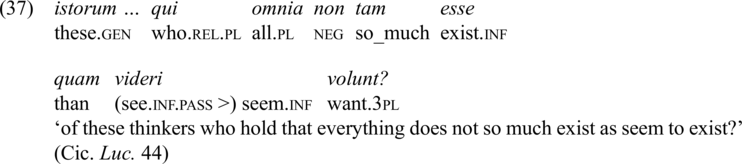
Coreferentiality (stages 1 and 2) and the small-clause structure (stages 2 and 3) likely played a crucial role in the diachronic development. In small clauses with coreferentiality (stage 2, e.g., se populares volunt), the accusative (se) simultaneously refers to the experiencer of the desire (i.e., the referent coded as the syntactic subject of volo) and the theme to whom the desired state (to be/to be seen as populares) applies. Semantically, this small clause is inherently ambiguous between the meaning ‘to be populares’ (copular construction) and the meaning ‘to be seen as populares’ (passive construction), thereby blurring the boundary between one’s own volition and opinion and the opinion of others. Subsequently, when coreferentiality is absent (stage 3), the subject of volo can be interpreted as both the experiencer of volition and the source of opinion. In other words, the source of opinion on the experiencer of volition shifts from being external – expressed by a dedicated opinion verb in the passive – to being internal and encoded by the volitional verb itself. In fact, in step 3, the verb volo functions as an opinion or reportative verb. In stage 4, the reportative function no longer requires either coreferentiality or a small-clause structure to emerge.
This diachronic hypothesis is not incompatible with the view that want-verbs may encompass both a bouletic and a doxastic conversational background (see Section 1). Indeed, this very feature may have facilitated the semantic development of volo from an implicit doxastic component to an explicit one. The key point for the diachronic account is that the doxastic component anchored to the subject of volo becomes explicit in certain constructions, such as those of stage 3, while it was still implicit in stages 1 and 2.
With regards to the presence of a doxastic component – though further research on this point is needed – it is worth noting that there are also instances of volo in which the verb conveys doxastic meaning, resembling a verb of thinking, without fulfilling any reportative function. Cf. the following example:

Before drawing the conclusions of this investigation, it is worth noting that deontic constructions such as that featured in example (39) may also have contributed to the development of explicitly doxastic and reportative uses of volo. However, such constructions are rare in the dataset. This may be attributable to the methodology, as this investigation was restricted to third-person singular and plural forms. See, for instance, example (40) which features volo in the first person. The use of volo in deontic contexts may have been significant, inasmuch as it involves propositional content as in example (39). The issue warrants further investigation.Footnote 20


In the next section, I summarise the main findings concerning the reportative uses of volo, before offering some reflections on the well-studied German verb wollen and a few brief remarks on the much less examined French verb vouloir.
3.3. Synthesis of findings on Latin volo
The analysis of volo in Latin shows that its reportative use is semantically ambiguous (Section 3.1.1), rare and genre-dependent (Section 3.1.2). There is no sharp separation between volitional and reportative meanings: volo often retains a volitional nuance even when reporting others’ opinions. This blending reflects an underlying doxastic background, as has been hypothesised for want-verbs in other languages. Genre matters significantly: reportative uses concentrate in treatises (e.g., those by Cicero and Pliny the Elder).
Semantically (Section 3.1.3), reportative volo introduces others’ beliefs or views neutrally, without implying endorsement on the part of the speaker at T0. Ambiguity is stronger when there is coreference between the subject of volo and the governed infinitive.
Morphosyntactically (Section 3.1.4), reportative volo governs almost exclusively infinitives (mainly present, more rarely perfect); does not govern subjunctive clauses, unlike volitional volo; sometimes appears in small-clause structures (with an adjective or a PPP, e.g., liberatos volunt in example 14); allows negation, although negative reportative uses are extremely rare; occurs mainly in present tense, but perfect and imperfect forms are also compatible with the reportative function.
Diachronically (Section 3.2), the reportative construction likely evolved from expressions of self-presentation (‘want themselves to be seen as X’) using passive infinitives (videri, haberi) or small-clause structures (‘want themselves X’) to the attribution of opinion (‘hold that X is true’). The explicit source of opinion shifts from being external (videri, haberi) to being explicitly anchored to the subject of volo. Overall, reportative volo illustrates how verbs of volition may shift towards expressing doxastic and then evidential functions, offering a valuable point of comparison with the developments observed for German wollen.
4. Latin volo vis-à-vis German wollen (with some notes on French vouloir)
Latin volo, German wollen, and French vouloir share a common origin from the Proto-Indo-European root *u̯elh1- ‘to choose’ (LIV: s.v. *u̯elh1-). Their ancient common origin does not imply that they had to follow the same development in their historical evolution. However, possible relationships still need to be explored. First, the relationship between the reportative uses of volo and those of vouloir has not yet been addressed. It is logical to think that Latin uses could have been continued by French vouloir, but this hypothesis has not yet been tested. Though this paper is not directly concerned with this point, investigating the emergence and functioning of reportative volo constitutes a necessary step towards a detailed account of the use of reportative want in the Romance languages. Second, the earliest constructions attested for German are similar to those attested for Latin, a point that has been overlooked in the previous research on the subject, which has been mainly speculative in its diachronic reconstruction. Third, it is worth trying to understand whether the emergence of the reportative uses can be traced back to some shared elements of the semantics of volition, i.e., elements that could also be relevant in a cross-linguistic perspective.
To advance research on the aforementioned points – though they do not constitute the focus of this paper – Section 4.1 outlines the state of the art regarding the reportative uses of German wollen and French vouloir, adding some new data for the latter. In fact, it should be emphasised that the data and findings available from previous research, particularly in relation to French vouloir, remain far from exhaustive. My objective is not to address these gaps directly, but rather to provide a brief overview of the findings and associated issues.
4.1. Previous research on reportative German wollen and French vouloir, with some desiderata
To my knowledge, after Diewald (Reference Diewald1999: in particular, 424–428), the most detailed diachronic account of the evolution of German wollen from volitional to reportative marker remains that of Fritz (Reference Fritz, Schuster, Riecke and Richter2000: 274–278, cf. also Woźnicka Reference Woźnicka and Lewandowska-Tomaszczyk2020). It is worth stressing that Fritz (Reference Fritz, Schuster, Riecke and Richter2000) specifies that a new investigation based on a larger corpus is necessary.
According to Fritz (Reference Fritz, Schuster, Riecke and Richter2000), the earliest attestations of the use of German wollen with a reportative function are to be found in Notker’s writings (i.e., in Old High German). See example (41). However, the construction is different with respect to that usual nowadays which is illustrated in example (3), in which the subject of wollen is the same as the subject of the past infinitive gehört haben ‘to have heard’. In example (41) wollen features a syntactic subject – viele (‘genuoge’) – which is different from the subject in the subordinate clause introduced by daß (‘daz’) ‘that’ – the toponym ‘taneos’ (i.e., Tanis). In this respect, Old High German wollen more closely resembles Latin volo than it does its modern continuation.

The translation relies on the working hypothesis – also adopted for Latin – that the reportative component is neither at-issue nor eventive. As with Latin volo (see Sections 1 and 3.1.3), it is not possible to draw a clear distinction between speech, writing, and thought.
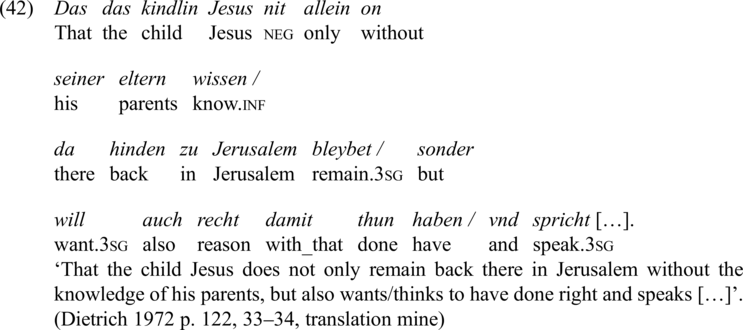
The diachrony of the later phases has not yet been clearly reconstructed for German wollen. With reference to example (42), which is dated to the 16th century and displays subject coreferentiality, Diewald (Reference Diewald1999: 427) acknowledges that the reportative reading of wollen is still contextually supported (see spricht ‘says’), but she already attributes the reportative component to the semantics of the verb.Footnote 22 This issue remains unresolved and further investigation is required to trace the earliest emergence of the coreferential use of reportative wollen. Footnote 23 However, as the non-anteriority requirement (cf. Section 3.1.3) is not met in this example, it does not represent a prototypical volitional use.
With respect to semantics, Diewald (Reference Diewald1999: 424, 427) offers a compelling hypothesis – namely, that the reportative function derives from the volitional meaning of the verb, understood in terms of factuality. The reportative reading is triggered when the speaker at T0 conveys that the speaker at T1 wants their proposition to be factual. This interpretation which remains speculative for German wollen find a parallel in the Latin data, as we have seen in Sections 3.1.3 and 3.2. Indeed, Diewald’s hypothesis is also compatible with the presence of a doxastic component. If a speaker wants their proposition to be accepted as factual, they also believe (or wish to appear to believe) in the truth of its propositional content (see von Fintel Reference von Fintel1999).
It is also important to note that in Present-Day German, when the infinitive governed by wollen is in the present tense, a high degree of ambiguity arises. See example (43). Out of context, the meaning of (coreferential) wollen in this instance is markedly ambiguous. A parallel may be drawn with Latin volo, which similarly tends to occur with the present tense. As shown in Sections 3.1.3 and 3.2, volo likewise tends to be ambiguous in contexts involving subject coreferentiality.

An unsettled issue in the history of German wollen is whether the reportative value can be the result of a semantic calque from Latin volo. See Fritz (Reference Fritz, Schuster, Riecke and Richter2000: 275) and, for an earlier comparison of German and Latin data, von Monsterberg-Münckenau (Reference Monsterberg-Münckenau1886: 11).
Diewald (Reference Diewald1999: 228 fn. 54) reports that no instances of reportative wollen were attested in the corpus she used. Both Diewald (Reference Diewald1999: 228) and Vanderbiesen (Reference Vanderbiesen2014: 173) associate the reportative uses of German wollen with specific diaphasic contexts, such as judicial and journalistic discourse. This may suggest another possible parallel with Latin volo (see Section 3.1.2). However, precise statistical corpus data are currently lacking for German wollen.
The reportative uses of French vouloir have been discussed by Gougenheim (Reference Gougenheim1971: 256–257), Goldschmitt (Reference Goldschmitt2007: 257–258, 275–278) and Goldschmitt and Landvogt (Reference Goldschmitt, Landvogt, Durand, Habert and Laks2008). The meaning ‘to assert, claim, peremptorily support (something)’ is provided in the Trésor de la langue Française informatisé (henceforth TLFi), s.v. vouloir.
Gougenheim (Reference Gougenheim1971) employs the concept of ‘pretension’ to account for uses such as that illustrated in example (44). This instance, which dates back to the 14th century, may represent the earliest attestation of the reportative use of vouloir in French. It is worth noting that there is coreferentiality between the subject of vouloir and that of the infinitive, and that vouloir appears in the past tense.

I have found some later examples (cf. examples 45 and 46) of the construction by querying the corpus FRANTEXT.

(…la Roine avoyt faict nourrir ses enfans à la mamelle… ‘the Queen had her children breast-fed…’) (FRANTEXT S245 | René de Lucinge – Dialogue du François et du Savoysien, 1593)
Example (46) shows a certain degree of ambiguity between volitional meaning and reportative function:

Given the current state of research on French vouloir, it is not yet possible to establish any precise parallel with Latin volo. Further investigation is required to clarify the evolution from Latin to French, as well as the subsequent diachronic development of French vouloir. By contrast, it has been possible to draw some parallels between reportative volo and reportative German wollen, while also delineating the limits of such a comparison. Reportative German wollen has become a highly grammaticalised verb, permitting only specific constructions (coreferentiality, past infinitives), whereas Latin volo did not reach the same degree of grammaticalisation.
Conclusions
In this paper I have presented a corpus-based analysis of the hitherto unexamined reportative uses of Latin volo. This has involved a discussion of the inherent non-discreteness between its volitional meaning and its reportative function; its distribution within the corpus and across genres (Section 3.1.2); its semantic and pragmatic values (Section 3.1.3); and its morphosyntactic behaviour (Section 3.1.4). I have also proposed a diachronic hypothesis for Latin volo, according to which a doxastic source shifted from being explicitly external (i.e., attributed to the others) to being explicitly internal, located within the volitional entity that would later become the source of reported speech or thought. Furthermore, I have reviewed the current state of research on other reportative (volitional) verbs – particularly German wollen, and to a lesser extent French vouloir – highlighting the need for further diachronic and comparative investigation.
Research funding
While I mainly worked on this paper as an affiliate of the University of Bologna, the origins of this research can be traced back to two projects founded by the Swiss National Science Foundation: WoPoss. A World of Possibilities. Modal pathways over an extra-long period of time: the diachrony of modality in the Latin language (PP00P1_176778) and Modality mapping onto clause types: comparing modality in a parallel corpus of early New Testament translations (PP00P1_214102).
Acknowledgements
I would like to offer my sincere thanks to the editors of this special issue. I am also deeply indebted to the three peer reviewers of this paper for their critiques and comments. Though sometimes at odds with one another, they have contributed significantly to the development of my line of research on volition and evidentiality. I am also thankful to Elvira Glaser for her help with Old High German.



 Open access

