




Introduction
Arctic ground squirrel (Urocitellus parryii Richardson) nests and caches (middens) from Pleistocene deposits are important palaeoenvironmental archives in Beringia. Early observations of fossil burrows and nesting sites were reported from Siberia, Alaska, and the Yukon (Porsild et al., Reference Porsild, Harington and Mulligan1967; Kaplina et al., Reference Kaplina, Giterman, Lakhtina, Abrashov, Kiselev and Sher1978; Pirozynski et al., Reference Pirozynski, Carter and Day1984; Harington, Reference Harington1984, Reference Harington2003; Guthrie, Reference Guthrie1990; Gubin and Khasanov, Reference Gubin and Khasanov1996), but their palaeoecological value remained largely undetermined until recently. Systematic research on middens and caches intensified in the early 2000s. Zazula et al. (Reference Zazula, Froese, Westgate, La Farge and Mathewes2005, Reference Zazula, Froese, Elias, Kuzmina and Mathewes2007, Reference Zazula, Froese, Elias, Kuzmina and Mathewes2011), working in the Klondike region of Yukon Territory, conducted detailed analyses of more than 100 fossil middens associated with dated tephra deposits, primarily from Marine Isotope Stage (MIS) 4 (∼80 ka) and early MIS 2 (∼30,000–24,000 14C yr BP). These studies revealed that the middens contain well-preserved remains of plants, insects, arvicoline rodents, and even mummified Arctic ground squirrels that detail the ecology of full-glacial ecosystems from the region.
There is a consensus on the regional geography (spanning western Europe to Yukon Territory), timing (125–15 ka; Guthrie Reference Guthrie2001), and zonal ecology of the mammoth steppe biome (as a cold, arid grassland-forb ecosystem). However, there are considerably fewer data from plant and invertebrate macrofossil records, which currently limits our understanding of local-scale ecosystems across Beringia. These middens provide palaeoenvironmental records with strong taxonomic resolution of local-scale ecosystems during cold stages of the Pleistocene.
Our study focuses on the record of latest Pleistocene environments preserved in Arctic ground squirrel middens. We report palaeoecological data from five middens dating from ∼17,500 to 13,500 cal. yr BP, from near the height of the last glacial maximum (LGM) through the amelioration of the late glacial. These middens are ∼10,000 yr younger than the youngest analysed nests and middens in Zazula et al. (Reference Zazula, Froese, Elias, Kuzmina and Mathewes2007), and ∼4000 yr younger than those in Gaglioti et al. (Reference Gaglioti, Barnes, Zazula, Beaudoin and Wooller2011). These middens present the last records of Pleistocene Beringia through the lens of Arctic ground squirrels.
Study area
We collected five middens from three sites in the Klondike goldfields of central Yukon Territory and on the traditional territories of the Tr’ondëk Hwëchin First Nation (Fig. 1). This region has remained ice-free during periods of continental glaciation and was the easternmost portion of a widespread steppe-tundra ecosystem that covered an area of land from western Eurasia to northwest North America. This steppe-tundra ecosystem was dominated by herbaceous vegetation, had a cold and arid climate, and deep permafrost active layers (Guthrie Reference Guthrie2001). Comparatively, the Klondike goldfields are now characterised by shallow permafrost active layers covered in black spruce (Picea mariana), ericaceous shrubs, and mosses and are not presently inhabited by Arctic ground squirrels. All three study sites fall within the extensive discontinuous permafrost zone (Heginbottom et al., Reference Heginbottom, Dubreuil and Harker1995) and the Northern Cordilleran High Boreal ecoclimatic region (Strong Reference Strong2013). Our sites are located on active placer gold mines with ice-rich loess deposits on east- and/or north-facing exposures. The Hunker Creek site (64.015°N, 139.15°W) is located ∼14.5 km east-southeast of Dawson City, the Mint Gulch site (63.56°N, 139.542°W) is ∼29 km southeast of Dawson City, and the Lucky Lady II site (63.729°N, 139.121°W) is located ∼46 km south-southeast of Dawson City (Fig. 1).
Map of Klondike goldfields with the Hunker Creek, Mint Gulch, and Lucky Lady II study sites indicated.

Prior studies of Arctic ground squirrels across Pleistocene Beringia
Arctic ground squirrel middens are a rich source of plant (Lopatina and Zanina Reference Lopatina and Zanina2006; Gaglioti et al., Reference Gaglioti, Barnes, Zazula, Beaudoin and Wooller2011; Zanina et al., Reference Zanina, Gubin, Kuzmina, Maximovich and Lopatina2011; Langeveld et al., Reference Langeveld, Mol, Zazula, Gravendeel, Eurlings, McMichael and Groenenberg2018), small mammal (Cocker et al., Reference Cocker, Zazula, Hall, Jass, Storer and Froese2024), and invertebrate remains (Zazula et al., Reference Zazula, Froese, Elias, Kuzmina and Mathewes2007; Cocker et al., Reference Cocker, Canning and McKnight2025a, Reference Cocker, Proctor, Galloway, Miskelly, Jensen and Froese2025b). They are composed of leaves and stems of graminoids (grass-like material including grasses, sedges, and rushes) that were used as nesting material, along with caches of seeds and fruits that are found in between the nest and the hibernaculum wall. Some middens are almost entirely composed of seeds and fruits and probably represent separate food caches without associated nests. Caches commonly contain thousands or tens of thousands of individual fruits and seeds from a variety of plants. Ancient midden plant assemblages contain graminoids (Poa, Elymus, Festuca, Carex, and Carex myosuroides), forbs (e.g., Bistorta vivipara, Artemisia frigida, Ranunculus spp., Phlox hoodii), dwarf shrubs (e.g., Salix cf. arctica, S. cf. polaris), and rare tree remains (Picea spp.), indicating the squirrels foraged within a local mosaic ecosystem dominated by steppe-tundra (Zazula et al., Reference Zazula, Froese, Elias, Kuzmina and Mathewes2007). Other middens contain invertebrate remains that are dominated by common Pleistocene steppe-tundra taxa such as the weevils Lepidophorus lineaticollis and Connatichela artemisiae that support the palaeoecological interpretations based on plant macrofossils.
Arctic ground squirrel middens have also been recovered from permafrost deposits in Siberia. Gubin et al. (Reference Guthrie2001, Reference Gubin, Zanina, Maksimovich, Kuzmina and Zazhigin2003) and Lopatina and Zanina (Reference Lopatina and Zanina2006) examined the composition and palaeoecological significance of fossil rodent burrows in late Pleistocene ice-rich deposits. Middens from west Beringia (Siberia) contain graminoid-rich nests, seed/fruit caches, fertile plants capable of regeneration, insects, and the mummified remains of Arctic ground squirrels (e.g., Gubin et al., Reference Gubin, Maximovich and Zanina2001; Lopatina and Zanina, Reference Lopatina and Zanina2006; Zanina et al., Reference Zanina, Gubin, Kuzmina, Maximovich and Lopatina2011; Yashina et al., Reference Yashina, Gubin, Maksimovich, Yashina, Gakhova and Gilichinsky2012; Faerman et al., Reference Faerman, Bar-Gal, Boaretto, Boeskorov, Dokuchaev, Ermakov and Golenishchev2017). These middens, primarily from northeast Siberia, record late Pleistocene environments during the MIS 3-2 transitional period. Middens dating to MIS 3 cryopedoliths provide a unique insight into the local environment due to the syngenetic nature of permafrost preservation. Plant macrofossil records from these middens indicate a vegetation mosaic of open larch woodlands with steppe-tundra meadows. In addition to larch (Larix cajanderi) seeds, an open woodland environment is inferred by the shrub birch (Betula fruticosa; syn. B. divaricata), procumbent shrubs (e.g., Arctous alpina), and alpine tundra grasses (e.g., Poa pratensis subsp. alpigena; syn. Poa alpigena). Steppe environments are also preserved by the presence of taxa like Silene stenophylla, S. orientalimongolica (syn. Lychnis sibirica), and Poa attenuata (Lopatina and Zanina Reference Lopatina and Zanina2006; Zanina et al., Reference Zanina, Gubin, Kuzmina, Maximovich and Lopatina2011). Zanina et al. (Reference Zanina, Gubin, Kuzmina, Maximovich and Lopatina2011) also reports subfossil beetles from the middens that are dominated by dung beetles (Aphodius sp.), but also yield specimens of steppe-tundra taxa such as pill beetles (Morychus viridis) and weevils (Stephanocleonus eruditus) in addition to tundra species of ground beetles (e.g., Dicheirotrichus mannerheimi) and leaf beetles (e.g., Chrysolina septentrionalis).
Arctic ground squirrels can provide insight into changes in underlying permafrost conditions in the region (Buck and Barnes, Reference Buck and Barnes1999; Zazula et al., Reference Zazula, Froese, Westgate, La Farge and Mathewes2005, Reference Zazula, Froese, Elias, Kuzmina and Mathewes2007, Reference Zazula, Froese, Elias, Kuzmina and Mathewes2011). Permafrost active-layer depths can vary in response to several factors, including vegetation cover, air temperature, aspect, and snow cover (e.g., Zhang et al., Reference Zhang, Osterkamp and Stamnes1997; Fisher et al., Reference Fisher, Estop‐Aragonés, Thierry, Charman, Wolfe, Hartley, Murton, Williams and Phoenix2016). The widespread steppe-tundra vegetation of Pleistocene Beringia, dominated by graminoids and forbs, likely promoted deeper active layers through increased summer insolation and winter heat loss (Guthrie, Reference Guthrie2001; Zazula et al., Reference Zazula, Froese, Westgate, La Farge and Mathewes2005). Modern Arctic ground squirrels require active layers at least 1 m deep or absence of permafrost for burrowing and hibernation (Buck and Barnes, Reference Buck and Barnes1999). In Yukon Territory, their current distribution reflects these requirements, occurring in open meadows, north-facing slopes, and alpine areas (Hik et al., Reference Hik, McColl and Boonstra2001; Gillis et al., Reference Gillis, Hik, Boonstra, Karels and Krebs2005a, Reference Gillis, Morrison, Zazula and Hik2005b; McLean, Reference McLean2018). Arctic ground squirrels are now regionally extinct (extirpated) from the Klondike goldfields due to poorly drained soils with shallow active layers that prevent burrow construction (Zazula et al., Reference Zazula, Froese, Westgate, La Farge and Mathewes2005, Reference Zazula, Froese, Elias, Kuzmina and Mathewes2007).
Although there are rich records of middens from MIS 4 and MIS 3/2 deposits, only two middens from Alaska have been analysed (Gaglioti et al., Reference Gaglioti, Barnes, Zazula, Beaudoin and Wooller2011) from MIS 2 sensu stricto, at the height of the LGM, when global sea levels and Northern Hemisphere temperatures were at a minimum (Clark et al., Reference Clark, Dyke, Shakun, Carlson, Clark, Wohlfarth, Mitrovica, Hostetler and McCabe2009; Porter et al., Reference Porter, Froese, Feakins, Bindeman, Mahony, Pautler, Reichart, Sanborn, Simpson and Weijers2016; Farmer et al., Reference Farmer, Pico, Underwood, Cleveland Stout, Granger, Cronin, Fripiat, Martínez-García, Haug and Sigman2023). Additionally, no middens or their contents have been reported from post-LGM sites in Beringia.
Latest Pleistocene shrub expansion in eastern Beringia
The transition from steppe-tundra to shrub tundra in east Beringia initiated around 15,000 cal yr BP. A regional expansion of mesic taxa occurred in response to rising sea levels, reduced sea-ice cover, and enhanced precipitation in response to a shift in atmospheric circulation. The emergent shrub tundra was characterized predominantly by woody shrubs, particularly willow (Salix) and birch (Betula), which are indicative of increased moisture availability (Monteath et al., Reference Monteath, Gaglioti, Edwards and Froese2021). These woody shrubs would have been accompanied by a diverse understory of herbaceous taxa. The establishment of shrub tundra reflects a fundamental reorganisation and extinction of the mammoth steppe ecosystem, marking a shift towards a more structurally complex and thermophilous vegetation community. Even though we understand the nature of this transition, establishing reliable chronologies for latest Pleistocene palaeoenvironmental records remains the most consistent barrier to detailed reconstructions of steppe-tundra collapse and the expansion of shrubs. Monteath et al. (Reference Monteath, Gaglioti, Edwards and Froese2021) reanalysed 15 lacustrine sediment records from eastern Beringia that were deemed to have chronologies reliable enough to constrain the timing of late Pleistocene shrub expansion. The study concluded that by 14,000 cal yr BP, shrub birch (Betula) had expanded across and covered most of Alaska except for a delayed arrival at higher-elevation sites and the eastern regions more proximal to the continental glaciers in Yukon Territory (Murchie et al., Reference Murchie, Monteath, Mahony, Long, Cocker, Sadoway and Karpinski2021b; Monteath et al., Reference Monteath, Kuzmina, Mahony, Calmels, Porter, Mathewes and Sanborn2023).
In interior Alaska, shrub expansion is expected to have occurred by at least 14,000 cal yr BP. Clarke et al. (Reference Clarke, Heintzman, Lammers, Monteath, Bigelow, Reuther, Potter, Hughes, Alsos and Edwards2024) report a sedaDNA (sedimentary ancient DNA) analysis of plants from Chisholm Lake (also known as Lost Lake), which demonstrates that birch shrub tundra had arrived by 14,500 cal yr BP, about 500 yr earlier than what was suggested by the lacustrine records based on pollen and plant macrofossils. They argue that this early arrival of birch was likely in response to an increase in effective moisture, with the greatest floral turnover at ∼11,000 cal yr BP with the expansion of poplar (Populus) and the arrival of additional shrub taxa. The study reveals that between 14,500 and 11,000 cal yr BP, graminoids were in decline, but open-ground forb taxa persisted despite changes to regional moisture regimes. Palynological records from this site reported by Tinner et al. (Reference Tinner, Hu, Beer, Kaltenrieder, Scheurer and Krähenbühl2006) correspond with the shifts in floral composition reported by Clarke et al. (Reference Clarke, Heintzman, Lammers, Monteath, Bigelow, Reuther, Potter, Hughes, Alsos and Edwards2024) but vary slightly in the timing. Pollen data suggest an expansion of birch approximately 1000 yr later (ca. 13,500 cal yr BP) than reported by sedaDNA data, but this difference might best be attributed to difficulties in establishing robust chronologies at Chisholm Lake. These temporal mismatches highlight the difficult task of developing chronologies from lacustrine sedimentary records.
Permafrost deposits are playing an increasingly important role in reconstructing Pleistocene environments of Beringia, thanks to the combination of an increasing number of sedaDNA records and strong chronological control (Froese et al., Reference Froese, Zazula, Westgate, Preece, Sanborn, Reyes and Pearce2009; Haile et al., Reference Haile, Froese, MacPhee, Roberts, Arnold, Reyes and Rasmussen2009; Murchie et al., Reference Murchie, Kuch, Duggan, Ledger, Roche, Klunk and Karpinski2021a, Reference Murchie, Monteath, Mahony, Long, Cocker, Sadoway and Karpinski2021b, Reference Murchie, Karpinski, Eaton, Duggan, Baleka, Zazula, MacPhee, Froese and Poinar2022; Wang et al., Reference Wang, Pedersen, Alsos, De Sanctis, Racimo, Prohaska and Coissac2021). Murchie et al. (Reference Murchie, Monteath, Mahony, Long, Cocker, Sadoway and Karpinski2021b) provided the most regional reconstruction of latest Pleistocene shrub expansion/steppe-tundra collapse from permafrost in central Yukon Territory using sedaDNA spanning the last ca. 30,000 yr. The study highlights the decline of megafaunal grazing mammals and the appearance of woody shrubs and boreal taxa to replace the forb- and graminoid-dominated mammoth steppe across the Pleistocene–Holocene boundary between 13,500 and 10,000 cal yr BP. A subsequent study by Monteath et al. (Reference Monteath, Kuzmina, Mahony, Calmels, Porter, Mathewes and Sanborn2023) based on the Lucky Lady site, provides the most comprehensive insight into local-scale ecosystem dynamics during the latest Pleistocene in central Yukon Territory by combining sedaDNA data with pollen, plant macrofossils, invertebrates, and pore-ice stable isotopes. This multiproxy record reveals rapid changes in faunal and floral communities across the Pleistocene–Holocene transition. The site preserves a prominent palaeosol at ca. 13,480 cal yr BP that demonstrates the slowing of loess accumulation, increased landscape stability, and the subsequent expansion of shrubs. Before this environmental transition, the invertebrate fauna around ca. 16,500 cal yr BP is dominated by the cold-adapted, steppe-tundra indicator, and Beringian endemic weevil C. artemisiae (∼88% of the assemblage). A slight shift in habitat is recorded by the dominance of a dry tundra weevil species, L. lineaticollis (74% of the assemblage), sampled directly within the palaeosol (ca. 13,480 cal yr BP). Samples collected above the palaeosol indicate a rapid shift to mesic-dominated taxa (e.g., the ground beetle Pterostichus brevicornis) and the appearance of aquatic and riparian taxa (e.g., the rove beetle Olophrum latum) by 13,200 cal yr BP. In addition to the invertebrates, plant and animal sedaDNA (from Murchie et al., Reference Murchie, Monteath, Mahony, Long, Cocker, Sadoway and Karpinski2021b) from Lucky Lady generally agrees with the interpretation of steppe-tundra conditions before formation of the prominent palaeosol through the dominance of herbs and graminoids and grazing species such as mammoth and horse. Like the invertebrate fauna, a biotic shift occurs in samples taken directly from the palaeosol and is reflected by sedaDNA records recording a transition in the plant community from herbs and graminoids to shrubs and, simultaneously, the appearance of ground-nesting birds, like willow ptarmigan (Lagopus), that generally inhabit thickets of shrubs (Wilson and Martin Reference Wilson and Martin2008). These studies illustrate the importance of establishing robust chronologies to accurately record the timing of latest Pleistocene shrub expansion in east Beringia.
Materials and methods
We collected samples from permafrost exposures associated with placer gold mining at Hunker Creek in 2009 (n = 1); Lucky Lady II in 2011, 2012, and 2013 (n = 3); and Mint Gulch in 2018 (n = 1) (Fig. 1). All specimens have associated field numbers and have been assigned Yukon Government accession numbers (Table 1). All material has been deposited in the Yukon Palaeontology collections in Whitehorse, Yukon Territory.
Chronology for Arctic ground squirrel (Urocitellus parryii) middens analysed in this study.a

a All calibrated age ranges are reported at 2σ uncertainty.
b YG no., Yukon Government accession number.
c UCIAMS, – University of California Irvine Accelerated Mass Spectrometer.
YG# - Yukon Government accession number
Macrofossil preparation and identification
We processed the middens at the Permafrost Archives Science Laboratory at the University of Alberta. Middens were washed through 500 and 150 μm sieves, and the resulting fractions were examined individually. To standardise processing for botanical remains, midden fractions were hand sorted until the sample was exhausted or 3 hours had passed, whichever came first, similar to what has been done with fossil packrat middens (Latorre et al., Reference Latorre, Betancourt, Rylander and Quade2002). For the invertebrate remains, we collected many of the specimens during the standardised method described; however, given the sparse nature of invertebrates compared with botanical remains, all samples were analysed to exhaustion to account for all invertebrate fossils present in the sample.
Plant identifications were made with reference to keys (Cody, Reference Cody2000; Kershaw and Allen, Reference Kershaw and Allen2020; Flora of North America Editorial Committee, 1993+), to reference collections housed in the Quaternary Environments and Botany programs at the Royal Alberta Museum, and to collections in the ALTA Vascular Plant Herbarium at the University of Alberta. Plant macrofossils were quantified using a relative abundance index (RAI) (e.g., Spaulding et al., Reference Spaulding, Betancourt, Croft, Cole, Betancourt, Van Devender and Martin1990; Latorre et al., Reference Latorre, Betancourt, Rylander and Quade2002; Zazula et al., Reference Zazula, Froese, Elias, Kuzmina and Mathewes2007). RAI categories reflect an estimated abundance and are bound by the following limits: 0 = absence, 1 ≤ 1%, 2 = 1–5%, 3 = 6–25%, 4 = 26–50%, 5 = 51–75% and 6 ≥ 75%. Invertebrate specimens were identified using fossil collections (curated by SK) and modern specimens from the E.H. Strickland Entomological Museum at the University of Alberta. Invertebrate data are presented as the minimum number of individuals (MNI). Nomenclature for vascular plants is based on the Database of Vascular Plants of Canada online database (Brouillet et al., Reference Brouillet, Desmet, Coursol, Meades, Favreau, Anions, Bélisle, Gendreau and Shorthouse2010) and various resources (see Table 3) for invertebrates.
Radiocarbon dating
Five samples of midden plant material were pretreated at the University of Alberta using a standard acid–base–acid methodology (e.g., Reyes et al., Reference Reyes, Jensen, Zazula, Ager, Kuzmina, La Farge and Froese2010). Samples were then frozen, freeze-dried, overnight, and stored in airtight sterilised vials. CO2 production, graphitisation, and measurement of radiocarbon abundance of all samples were completed at the Keck-Carbon Cycle AMS facility (UCIAMS). Radiocarbon ages (14C) in Table 1 were calibrated using OxCal v. 4.4 (Bronk Ramsey, Reference Bronk Ramsey2009) and the IntCal20 calibration curve (Reimer et al., Reference Reimer, Austin, Bard, Bayliss, Blackwell, Ramsey and Butzin2020). All calibrated ages are presented at 2σ uncertainty.
Results
Plant macrofossils
Identified plant macrofossils represent at least 24 taxa from 12 families (Table 2; Fig. 2A). The assemblage is dominated by forbs (18 taxa) and includes at least one species of dwarf shrub (Salix cf. arctica), three members of Poaceae (Deschampsia sp., Elymus sp., and Anthoxanthum hirtum [syn. Hierochloë hirta]), at least one species of Cyperaceae (Carex cf. myosauroides [syn. Kobresia myosauroides]), and one species of Selaginellaceae (Selaginella cf. sibirica; Fig. 3, no. 8). The forbs are dominated, in terms of species diversity, by members of Brassicaceae and Asteraceae, although taxon abundance between middens varies. Of abundance from midden DF09-HC-29 (Hunker Creek) are remains of Draba sp. (RAI = 3), of which many specimens preserve their inflorescence (Fig. 3, no. 2), and the cypselae of Taraxacum cf. ceratophorum (RAI = 3) (Fig. 4, no. 23). This midden is dominated by a singular member of Plantago cf. canescens (RAI = 4), and several specimens preserve capsule inflorescence (Fig. 4, no. 11a) and delicate floral calyx structures (Fig. 4, no. 11b and c). Present in three middens, Phlox cf. hoodi (Polemoniaceae) is the dominant taxon from BJ11-LLII-63 (RAI = 5) (Lucky Lady II) and preserves both capsules and seeds (Fig. 3, no. 1a–c). At the Mint Gulch site, midden DF18-37 is dominated by Potentilla cf. glaucophylla and Artemisia sp. (RAI = 4) and, in lesser abundance, Penstemon cf. gormanii, Solidago sp., and cf. Lepidium sp. (RAI = 3). From various middens and present in lesser abundance are taxa such as marsh yellowcress (Rorippa cf. palustris) (Fig. 3, no. 6a-c, DF09-HC-29, ∼17,170 cal yr BP, Hunker Creek), Anemone sp. (BJ11-LLII-63; ∼16,510 cal yr BP, Lucky Lady II), Silene cf. involucrate subsp. tenella (syn. Silene taimyrensis) (Fig. 3, no. 4, DF13-05, ∼13,710 cal yr BP, Lucky Lady II), and S. cf. sibirica (Fig. 3, no. 8, BJ11-LLII-63, ∼16,510 cal yr BP, Lucky Lady II). All middens are dominated (RAI = 6) by indeterminate graminoid vegetation that represents nesting material.
Heat map showing plant (A) and invertebrate (B) records from the five middens analysed in this study. Plant data (A) are represented by their assigned relative abundance index (RAI) value and invertebrate data (B) are presented as minimum number of individuals (MNI).

Vascular plant remains. (1) Phlox cf. hoodi capsules; (2) Draba sp. fruits; (3) Carex sp. achenes; (4) Silene cf. involucrate subsp. tenella (syn. Silene taimyrensis) capsule; (5) Artemisia cf. frigida leaves and stem; (6) Rorippa cf. palustris silicle; (7) Dryas cf. integrifolia leaf apex; (8) Selaginella cf. sibirica leaves and stem; (9) Indet. Poaceae floret; (10) Salix (a) twig and (b) capsule. Scale bars: 1 mm.

Vascular plant remains. (11) Plantago cf. canascens (a) capsule inflorescence, (b) capsule, and (c) separated capsule revealing dark seeds inside; (12) Lappula sp. nutlet; (13) Artemisia sp. achene; (14) Potentilla cf. glaucophylla achene; (15) Oxytropis-Astragalus type degraded seed; (16) Oxytropis-Astragalus type seed; (17) cf. Lepidium sp. seed; (18)Penstemon cf. gormanii seed; (19) Solidago cf. missouriensis achene; (20) Carex sp. achene; (21) Carex cf. myosuroides achene; (22) Elymus sp. floret with exposed caryopsis; (23) Taraxacum cf. ceratophorum cypsela; (24) Rorippa cf. palustris seed; (25) Plantago cf. canascens seed. Scale bars: 1 mm.

Plant macrofossils from five middens recovered from the Klondike goldfields.a

a Data are presented using relative abundance index (RAI) values. RAI categories reflect an estimated abundance and are bound by the following limits: 0 = absence; 1 ≤ 1%; 2 = 1–5%; 3 = 6–25%; 4 = 26–50%; 5 = 51–75%; and 6 ≥ 75%.
b Bennett (Reference Bennett2017); Klinkenberg (Reference Klinkenberg2023).
Invertebrate macrofossils
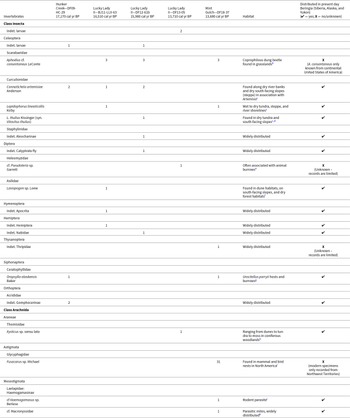
Invertebrate macrofossils were recovered from all five middens and include 20 taxa (Table 3; Fig 2B). Specimens are presented as MNI. The most numerous taxa recovered was the mite Fusacarus sp. represented by 31 individuals from midden DF18-37 (13,680 cal yr BP). Coleoptera (beetles) were represented by three families: Scarabaeidae (Fig. 5, no. 4a–c), Curculionidae (Fig. 5, nos. 6a and b and 10), and Staphylinidae (Fig. 5, no. 3). Individuals of the dung beetle Aphodius cf. consentaneus (Scarabaeidae; MNI = 9) (Fig. 5, no. 4a–c) are the most numerous beetles, followed by the weevil Connatichela artemisiae (Curculionidae; MNI = 5), both of which are present in three of the five middens analysed. Of additional interest is the preservation and identification of taxa that are typically unrepresented in publications of Pleistocene invertebrates. Our study includes individual invertebrates of flies (Diptera) (Fig. 5, no. 1, 2, and 5), true bugs (Hemiptera), thrips (Thysanoptera), fleas (Siphonaptera) (Fig. 5, no. 9), grasshoppers (Orthoptera), spiders (Araneae) (Fig. 5, no. 11), and mites (Astigmata and Mesostigmata). A single specimen of a robber fly (Lasiopogon sp.) from midden BJ11-LLII-63 has been studied in more detail in Cocker et al. (Reference Cocker, Canning and McKnight2025a). Specimens of thrips, fleas, grasshoppers, and mites are subjects of a more in-depth study by Cocker et al. (Reference Cocker, Proctor, Galloway, Miskelly, Jensen and Froese2025b).
Invertebrate remains. (1) Lasiopogon sp.; (2) Indet. Calyptrate fly; (3) Indet. Aleocharinae; (4) Aphodius cf. consentaneus (a) head, (b) prothorax, and (c) left elytra; (5) Heleomyzidae, cf. Pseudoleria sp.; (6) Lepidophorus lineaticollis (a) head and (b) right elytra; (7) Indet. Nabidae (a) leg and (b) head; (8) Indet. Apocrita; (9) Oropsylla alaskensis; (10) Lepidophorusthulius; (11) Xysticus sp. sensu lato. Scale bars: 1 mm.

Invertebrate macrofossils from five middens recovered from the Klondike goldfields.a

a Data are presented as minimum number of individuals (MNI).
b Krell (Reference Krell2024).
c Anderson (Reference Anderson, Danks and Downes1997).
d Bright and Bouchard (Reference Bright and Bouchard2008).
e Gill (Reference Gill1962).
f Cannings (Reference Cannings, Danks and Downes1997).
g Nadler and Hoffmann (Reference Nadler and Hoffmann1977).
h Dondale et al. (Reference Dondale, Redner, Marusik, Danks and Downes1997).
I Halliday and Walter (Reference Halliday and Walter2006).
j Whitaker and Wilson (Reference Whitaker and Wilson1974).
Discussion
Evidence for the persistence of steppe-tundra in easternmost Beringia
The occurrence of late Pleistocene Arctic ground squirrel middens and associated macrofossil records at sites like Mint Gulch and Lucky Lady II suggests the persistence of steppe-tundra environments in easternmost Beringia for several hundred years longer than in interior Alaska. In comparison to lacustrine pollen records and/or permafrost pore-ice isotopes that typically provide more regional reconstructions of the environment and climate (e.g., Demske et al., Reference Demske, Heumann, Granoszewski, Nita, Mamakowa, Tarasov and Oberhänsli2005; Porter et al., Reference Porter, Froese, Feakins, Bindeman, Mahony, Pautler, Reichart, Sanborn, Simpson and Weijers2016; Bandara et al., Reference Bandara, Froese, Porter and Calmels2020), analyses of Arctic ground squirrel middens present an opportunity to reconstruct local-scale environments. These middens aid in our understanding of fundamental questions in Beringian palaeoecology. As previously discussed, one of the major barriers to understanding the timing of latest Pleistocene shrub expansion and/or the collapse of steppe-tundra environments in eastern Beringia is the uncertainty that surrounds the chronology of published palaeoecological data.
Monteath et al. (Reference Monteath, Gaglioti, Edwards and Froese2021) concluded that shrub tundra expansion in east Beringia occurred around 14,000 cal yr BP in response to bottom-up processes that follow a climate-driven expansion rather than a top-down process that favours the keystone role of grazing megafauna. From Yukon Territory, the last-appearance dates of steppe tundra taxa like mammoth (Mammuthus) occur by ∼13,800 cal yr BP and by ∼15,400 cal yr BP for horses (Equus); and first-appearance dates of shrub tundra–associated browsers like moose (Alces) occur by ∼13,450 cal yr BP and by ∼14,800 cal yr BP for elk (Cervus). We agree that a bottom-up model is the best explanation to account for the loss of steppe-tundra; however, we think that there is still ambiguity surrounding the timing of subregional records of change across the eastern Beringian geographic gradient from western Alaska to central Yukon Territory.
Considering a regional shift in climate and vegetation by 14,000 cal yr BP reported by Monteath et al. (Reference Monteath, Gaglioti, Edwards and Froese2021), our data indicate that Arctic ground squirrels are present in easternmost Beringia for at least another 300 yr based on the presence of our youngest nest, DF18-37 from Mint Gulch, that dates to 13,680 cal yr BP. These data indicate that the regional signal of change is not fully representative of local-scale ecosystem response and does not account for the local persistence of steppe-tundra. An additional consideration for the persistence of steppe-tundra is the proximity of these sites to the limit of the Cordilleran–Laurentide ice sheet complex. Monteath et al. (Reference Monteath, Kuzmina, Mahony, Calmels, Porter, Mathewes and Sanborn2023) discuss this in the context of the Lucky Lady II site, suggesting the potential influence on atmospheric dynamics, precipitation, and precipitation seasonality. Given the location of Mint Gulch, we may therefore consider the influence of the Cordilleran–Laurentide ice sheet complex when interpreting data that support the persistence of steppe-tundra.
Even when considering selective caching biases, plant, and invertebrate macrofossil records from the two youngest nests, DF18-37 (∼13,680 cal yr BP) and DF13-05 (∼13,700 cal yr BP), our results are still consistent with an interpretation of a steppe-tundra environment and do not immediately indicate the local presence of shrubs. DF13-05, from the Lucky Lady II site, contained the capsules of S. cf. involucrate subsp. tenella. This taxon has an amphiberingian distribution and has been recorded from sandy and rocky open slopes and cliffs in Yukon Territory (Cody Reference Cody2000). Zazula et al. (Reference Zazula, Froese, Elias, Kuzmina and Mathewes2007, Reference Zazula, Froese, Elias, Kuzmina and Mathewes2011) record this taxon in several Arctic ground squirrel middens from sites dating to MIS 2 and MIS 4. Of additional importance is P. cf. gormanii from DF18-37 from the Mint Gulch site, which has been previously discussed in the context of its ecological significance to both recognising steppe environments and its continued presence around modern Arctic ground squirrel habitats.
For the invertebrate record, one notable omission from the youngest nests is the characteristic steppe-tundra weevil, C. artemisiae, a species that is commonly found on host plants of A. frigida and is endemic to Yukon Territory (Anderson, Reference Anderson1984). It is difficult to identify whether the lack of this species represents its decreased presence on the landscape, or whether taphonomic factors have played a role in its lack of preservation. The Lucky Lady II data show a significant decline in the presence of C. artemisiae, likely a response to the arrival of shrubs and decline of steppe taxa such as Artemisia (Monteath et al., Reference Monteath, Kuzmina, Mahony, Calmels, Porter, Mathewes and Sanborn2023). A decline in Artemisia would have impacted populations of C. artemisiae, as their larvae feed on the roots of Artemisia and adults have been observed copulating on this plant, typically A. frigida (Anderson, Reference Anderson1984).
Small Arctic willow species, likely Salix arctica, are present within three of the five middens. This taxon is recorded by Cody (Reference Cody2000) from a variety of habitats, including sedge meadows, heath, and dry sandy tundra. The occurrence of this species in the middens could be interpreted as evidence for the expansion of shrubs into the region; however, S. arctica is a prostrate to somewhat erect subshrub not exceeding about 25 cm in height (Flora of North America Editorial Committee, 1993+) and therefore is not considered as contributing to the canopy-forming willow species that have been reported to expand under a warming climate (e.g., Myers-Smith et al., Reference Myers-Smith, Hik, Kennedy, Cooley, Johnstone, Kenney and Krebs2011). This subshrub occupies the subalpine and subarctic, within open-canopy graminoid–forb-dominated ecosystems such as tundra. Zazula et al. (Reference Zazula, Froese, Elias, Kuzmina and Mathewes2007, Reference Zazula, Froese, Elias, Kuzmina and Mathewes2011) record S. arctica, from ∼30,000-yr-old middens and a buried vegetation surface (Zazula et al., Reference Zazula, Froese, Elias, Kuzmina, La Farge, Reyes and Sanborn2006a) and S. polaris from both ∼30,000-and ∼80,000-yr-old middens. Salix polaris, snow-bed willow, has a low-lying growth form similar to S. arctica, and so both taxa are presumably evidence for the occurrence of subshrub species within steppe-tundra environments rather than evidence for the expansion of shrubs towards the end of the Pleistocene. Overall, the preferred ecological interpretation of these midden assemblages indicates that steppe-tundra environments persist until at least 13,680 cal yr BP, or at a minimum that no significant shrub expansion has occurred in the central Yukon at this time. Macrofossils from shrub species, including Betula spp. and Alnus spp., can be preserved in sediments (e.g., Kaltenrieder et al., Reference Kaltenrieder, Tinner, Lee and Hu2011) and have been recovered from older Arctic ground squirrel middens (e.g., Gaglioti et al., Reference Gaglioti, Barnes, Zazula, Beaudoin and Wooller2011). The omission of shrub taxa from our samples likely reflects the selective foraging behaviours of Arctic ground squirrels. Subsequently, the absence of shrub macrofossils in our study cannot simply be interpreted as a lack of these species on the landscape.
Plants of special interest
Although all the identified plant taxa provide habitat information to aid in palaeoecological interpretations, we highlight a selection of taxa that are of special interest.
The record from Hunker Creek, midden DF09-HC-29, represents the earliest known specimen of Rorippa cf. palustris from Yukon Territory and could play a considerable role in our understanding of Rorippa sp. biogeography. Rorippa palustris is a species of flowering plant that typically occurs in mesic sites (Flora of North America Editorial Committee, 1993+), including shorelines, meadows, wetlands, and disturbance sites in the Yukon (Cody, Reference Cody2000) and has a circumpolar distribution (Klimešová et al., Reference Klimešová, Martínková and Kočvarová2004). From the Hengduan Mountains of China, Han et al. (Reference Han, Hu, Du, Zheng, Liu, Mitchell-Olds and Xing2022) report on the genetic history of R. palustris, suggesting Pleistocene glaciations played a significant role in the phylogeographic history of this taxon as it migrated north during interglacial periods and south during glacial periods. Kultti et al. (Reference Kultti, Väliranta, Sarmaja‐Korjonen, Solovieva, Virtanen, Kauppila and Eronen2003) report the presence of R. cf. palustris seeds in Early Holocene lake sediments in northeastern European Russia. Additional records have reported Rorippa spp. from the middle Pleistocene of Poland (Stachowicz-Rybka Reference Stachowicz-Rybka2015), the mid-Wisconsin of the eastern Great Plains (Baker et al., Reference Baker, Bettis, Mandel, Dorale and Fredlund2009) and from late Pleistocene sites in the United Kingdom (e.g., Holyoak and Preece Reference Holyoak and Preece1985). In northern Canada, records of R. palustris are limited. Ovenden (Reference Ovenden1982) reports the presence of seeds, similar to Rorippa sp. (cf. Rorippa), from a polygonal peatland in northern Yukon Territory. However, due to the uncertainty in identification, it is difficult to confidently use this site as a locality for the presence of Rorippa from the latest Pleistocene of Yukon Territory (ca. 11,800 cal yr BP). An additional species of Rorippa was reported by Dallimore et al. (Reference Dallimore, Wolfe, Matthews and Vincent1997) from mid-Wisconsin deposits of the Tuktoyaktuk Coastlands (Northwest Territories) and was conservatively identified by the authors as R. islandica type. However, R. islandica is not present in northern Canada and has previously been revised as misidentifications of R. palustris and/or R. barbareifolia. Additionally, the study does not report whether the taxon was identified using seeds and/or pods, so we can only speculate on which species it may represent. We do not contend the designation of genus and recognise this record as a valid representation of this taxon in the mid-Wisconsin of northern Canada. Of particular interest in our study is the quality of preservation of R. cf. palustris. All the Pleistocene records cited earlier only report this taxon as individual seeds (similar to Fig. 4, no. 24), but here we have the preservation of the fruit (silicles) and seed (Fig. 3, no. 6a–c).
Penstemon gormanii is a perennial herb with a distribution restricted to Yukon Territory, Northwest Territories, British Columbia, and Alaska (Flora of North America Editorial Committee, 1993+), where it inhabits dry and often disturbed sites, including azonal steppe communities (Laxton et al., Reference Laxton, Burn and Smith1996) gravels, riverbanks, and terraces (Cody, Reference Cody2000), and are restricted to areas with open canopy between 400 m to 1200 m asl (Flora of North America Editorial Committee, 1993+). This taxon has previously been reported from ∼30,000-yr-old Arctic ground squirrel middens by Zazula et al. (Reference Zazula, Froese, Elias, Kuzmina and Mathewes2007), but has not been recorded from studies of older middens (∼80,000 yr old) (Zazula et al., Reference Zazula, Froese, Elias, Kuzmina and Mathewes2011). A relationship between P. gormanii and Arctic ground squirrels continues with modern populations from Yukon Territory, where it is regularly present on disturbed soils surrounding burrow entrances (Vetter, Reference Vetter2000) and remains an important cache resource (Zazula et al., Reference Zazula, Mathewes and Harestad2006b).
Dryas integrifolia is a prostrate subshrub not exceeding 14 cm in height (Flora of North America Editorial Committee, 1993+) that is known to hybridise within the genus (Cody, Reference Cody2000). In the Yukon, D. integrifolia is reported to occur in gravel sites and less commonly in tundra or heathlands and on calcareous soils (Cody, Reference Cody2000). This species is regularly recorded from Yukon’s arctic and alpine tundra communities (Scudder, Reference Scudder, Danks and Downes1997). On the Alaskan North Slope, D. integrifolia is most common on rocky slopes and on sandy or gravelly ridges and not in the dense vegetation of the flat tundra (Wiggins and Thomas, Reference Wiggins and Thomas1962). Dryas integrifolia has not been previously reported from Pleistocene middens from Yukon Territory (Zazula et al., Reference Zazula, Froese, Elias, Kuzmina and Mathewes2007, Reference Zazula, Froese, Elias, Kuzmina and Mathewes2011) or interior Alaska (Gaglioti et al., Reference Gaglioti, Barnes, Zazula, Beaudoin and Wooller2011). However, Gaglioti et al. (Reference Gaglioti, Barnes, Zazula, Beaudoin and Wooller2011) record the presence of D. octapetala from a singular midden in interior Alaska, but the study does not record D. integrifolia, despite its growing in the surrounding study area.
Considering all of the middens, the recovered plant macrofossils indicate that the vegetation community spanned two distinct local habitat types: wet with freshwater sources, including shorelines, wetlands, and meadows; and dry with well-drained and open habitats, including rocky slopes, gravels, sandy sites, tundra, and alpine areas. Further, the taxa that can be identified to the species level mostly occur today in open to mostly open canopy sites without canopy-forming shrubs or trees present (Table 2). The three recovered grass taxa are typical of mesic to dry sites and are probably species inhabiting the late Pleistocene Beringia fine-grained lowland soils (Swanson, Reference Swanson2006). Strong (Reference Strong2021) divided eastern Beringian flora into two distinct groupings, with arctic/alpine taxa occurring in drier conditions, and subarctic taxa occurring in more mesic conditions. There does not appear to be a significant trend from dry to wet or wet to dry conditions throughout the samples. However, in all of our samples, there are more taxa present that inhabit dry habitats today for which the majority are still present in western Beringia (Siberia) and eastern Beringia (Alaska–Yukon Territory) (Table 2).
Invertebrates of particular interest
Beetles (Coleoptera) are routinely the most abundant invertebrate remains recovered from rodent middens: for example, packrats (e.g., Elias Reference Elias1990; Elias et al., Reference Elias, Mead and Agenbroad1992) and Arctic ground squirrel (Zazula et al., Reference Zazula, Froese, Westgate, La Farge and Mathewes2005, Reference Zazula, Froese, Elias, Kuzmina and Mathewes2007, Reference Zazula, Froese, Elias, Kuzmina and Mathewes2011). Our middens are no exception and preserve the remains of beetles previously reported from Arctic ground squirrel middens from the region (Zazula et al., Reference Zazula, Froese, Westgate, La Farge and Mathewes2005, Reference Zazula, Froese, Elias, Kuzmina and Mathewes2007, Reference Zazula, Froese, Elias, Kuzmina and Mathewes2011). The abundance of aphodiine burrow dung beetles remains (A. cf. consentaneus) (MNI = 9) is not surprising given the presence of faecal pellet latrines within ground squirrel burrow complexes. The recovery of the Beringian endemic weevil, C. artemisiae, indicates the local presence of dry steppe-tundra habitats with the prairie sage A. frigida (Anderson, Reference Anderson1984; Zazula et al., Reference Zazula, Froese, Elias, Kuzmina and Mathewes2007, Reference Zazula, Froese, Elias, Kuzmina and Mathewes2011). Interestingly, the fossil record indicates that C. artemisiae was considerably more abundant and widespread during the Pleistocene and that the retraction of Artemisia to small, often south-facing meadows of azonal steppe vegetation was likely a driver for this range contraction (Matthews, Reference Matthews, Hopkins, Matthews, Schweger and Young1982; Anderson, Reference Anderson1984). Of additional interest is the presence of a single pronotum of the weevil Lepidophorus thulius from midden DF12-61b (Lucky Lady II). This taxon is typically reported from dry tundra and southern steppe habitats (Anderson, Reference Anderson, Danks and Downes1997) and has been recorded from Pliocene (Matthews, Reference Matthews1977), Early Pleistocene (Matthews, Reference Matthews1974), late Pleistocene (Kuzmina et al., Reference Kuzmina, Froese, Jensen, Hall and Zazula2014), and Holocene (Morgan et al., Reference Morgan, Morgan, Ashworth, Matthews and Porter1983) deposits. Unlike, C. artemisiae, which is relatively common on present-day azonal steppe localities in Yukon Territory, L. thulius has remained a much rarer member of the present-day fauna (Matthews, Reference Matthews1975; Ashworth, Reference Ashworth1980).
The remains of flies (Diptera) from Pleistocene deposits in eastern Beringia are typically reported as indeterminate Diptera puparia due to a lack of diagnostic features required for identification or simply their limited presence, likely a function of preservation (e.g., Kuzmina et al., Reference Kuzmina, Froese, Jensen, Hall and Zazula2014). The most common dipteran subfossils are fly puparia and Tipulidae larvae heads. There is one exception, the non-biting midges (Chironomidae), that are commonly recovered from lake sediments (e.g., Bunbury and Gajewski, Reference Bunbury and Gajewski2009; Kurek et al., Reference Kurek, Cwynar and Vermaire2009). Here we present two dipteran taxa that are unreported from Pleistocene deposits in east Beringia.
Midden BJ11-LLII-63 (16,510 cal yr BP; Lucky Lady II) preserves a single head of an asilid fly, Lasiopogon sp., studied in detail by Cocker et al. (Reference Cocker, Canning and McKnight2025a) (Fig. 5, no. 1). There are five known species of robber flies from Yukon Territory, of which at least three taxa are considered Beringian species: Lasiopogon canus, L. prima, and L. hinei. Additionally, L. yukonensis, is recorded from central and southern Yukon and therefore is eastern Beringian based on distribution alone (Cannings, Reference Cannings, Danks and Downes1997, Reference Cannings2014). Both L. yukonensis and L. canus are species that have had recent radiations in North America despite belonging to a basal clade originating in the Palearctic (McKnight and Cannings, Reference McKnight and Cannings2020). Subsequently, the biogeographic history of these species is more complex than initially considered. All four taxa are present on Yukon’s south-facing azonal steppe slopes, although not exclusively (Cannings, Reference Cannings2014). These relict azonal steppe habitats are particularly important when considering Pleistocene assemblages, as they are still home to Beringian endemic species, such as the weevil C. artemisiae (Anderson, Reference Anderson1984).
Midden DF13-05 (13,710 cal yr BP; Lucky Lady II) preserves a single head of a Heleomyzid fly, cf. Pseudoleria sp. (Fig. 5, no. 5). Heleomyzidae are a heterogeneous family that are considered to be paraphyletic (Roháček et al., Reference Roháček, Marshall, Norrbom, Buck, Quiros and Smith2001) and are represented by numerous species that are predominantly saproxylic. Although the specimen is not identified with certainty to the genus Pseudoleria, because of missing identifiable features, the ecology of several species in this genus would support this tentative identification. Larvae of this genus have been previously recorded to feed on rodent faeces, and adults have been recovered from the burrows of various rodents (e.g., Gill, Reference Gill1962).
Members of the true bugs (Heteroptera) are common in Pleistocene deposits across Beringia and can often be identified to taxonomic family (e.g., Saldidae, Corixidae, and Pentatomidae). From Quaternary deposits in Yukon Territory, true bugs are predominantly represented by members of the family Saldidae, although a few others are present (see Matthews and Telka, Reference Matthews, Telka, Danks and Downes1997). Here we present what appears to be the first individual of a damsel bug (Heteroptera: Nabidae) (Fig. 5, no. 7a and b). In the present-day Yukon fauna, damsel bugs consist of one genus, Nabis (syn.: Nabicula), and five species: N. americolimbata, N. nigrovittata nearctica, N. flavomarginata, N. americoferus, and N. inscriptus. Apart from N. americoferus, all these species also have known distributions in Alaska (Scudder, Reference Scudder, Danks and Downes1997; Maw et al., Reference Maw2000). Habitat tolerances within this genus vary from humid grasslands, to mixed conifer forests, to dry and often sandy fields of grass (Larivière, Reference Larivière1994).
The presence of unique and previously unreported invertebrate taxa demonstrates the optimal taphonomic conditions provided by Arctic ground squirrel middens. In many cases, these records represent the earliest known occurrences of individual taxa and can aid in our understanding of invertebrate biogeographic histories across eastern Beringia.
Fossil midden biases
Arctic ground squirrel middens may reflect biases due to cache selectivity (Gillis et al., Reference Gillis, Morrison, Zazula and Hik2005b; Zazula et al., Reference Zazula, Mathewes and Harestad2006b). From modern Arctic ground squirrel populations in alpine meadows in southwest Yukon, Gillis et al. (Reference Gillis, Morrison, Zazula and Hik2005b) report evidence for selective caching behaviours by recording cheek-pouch contents from both male and female individuals. Female Arctic ground squirrels do not cache seeds and fruits and were less likely to be carrying food when trapped in comparison to males. For those that did have cheek-pouch contents, female individuals were more likely to be transporting materials for nest building, including mosses and lichens. In contrast, males with cheek-pouch contents were almost always carrying seeds or fruits. Gillis et al. (Reference Gillis, Morrison, Zazula and Hik2005b) identified the most abundant taxa recovered as Bistorta vivipara (syn. Polygonum viviparum), which grew at sites with a density similar to another species, B. officinalis (syn. P. bistorta), that was recovered from none of the males. This disparity is evidence of clear selective caching. As an important food source in northern ecosystems, due to high starch content in their roots, B. vivipara is preferentially consumed by other alpine herbivores (e.g., tundra vole [Microtus oeconomus], willow grouse [Lagopus lagopus], and snow geese [Anser caerulescens]). However, it is not clear why B. officinalis, which was growing at a similar density and forms a larger root mass, was not present in the cheek pouches. Bistorta vivipara primarily reproduces vegetatively through the production of bulbils (Diggle et al., Reference Diggle, Meixner, Carroll and Aschwanden2002; Law et al., Reference Law, Cook and Manlove1983) of varying morphotypes (Dormann et al., Reference Dormann, Albon and Woodin2002) and is commonly recovered from Pleistocene-aged fossil middens from central Yukon territory (Zazula et al., Reference Zazula, Froese, Elias, Kuzmina and Mathewes2007).
Although selective caching can introduce biases, Arctic ground squirrel middens have been shown to be resources of rare taxa on present-day landscapes. Zazula et al. (Reference Zazula, Mathewes and Harestad2006b) report on foraging behaviours by comparing the contents of present-day midden caches to the surrounding vegetation from steppe meadows in open boreal forests of southwest Yukon. From two study sites, the most commonly cached taxa reported were fruits from Rosa acicularis (prickly rose shrubs) and Geocaulon lividum (northern comandra) despite both taxa representing a small fraction of the vegetation community in the study area. This study demonstrates that the two most commonly cached taxa are not found directly on the steppe meadows where Arctic ground squirrels burrow, but rather on the edge or within the forest, indicating that the squirrels must therefore have increased their foraging distances to source them.
All palaeoecological records reflect the influence of biases, mostly driven by taphonomic processes (Behrensmeyer et al., Reference Behrensmeyer, Kidwell and Gastaldo2000), secondarily by sampling (e.g., Carrasco, Reference Carrasco2013), with a possible third source of bias due to ecological processes (e.g., Gillis et al., Reference Gillis, Morrison, Zazula and Hik2005b; Zazula et al., Reference Zazula, Mathewes and Harestad2006b). Here we discussed the possible biases introduced by Arctic ground squirrel selective caching behaviours and their implications for interpreting our Pleistocene-aged middens. However, we contend that this does not detract from the palaeoecological value of middens as records of past environments and argue that because of cache selectivity, middens can provide valuable records of rare taxa on Pleistocene landscapes.
Conclusion
The analysis of the youngest cache-bearing Arctic ground squirrel middens from Yukon Territory provides evidence for the persistence of steppe-tundra in easternmost Beringia for several hundred yr longer than in interior Alaska. This study examined five middens dating from approximately 17,500 to 13,500 cal yr BP, spanning the LGM through the period of climatic warming of the latest Pleistocene. The plant and invertebrate macrofossil assemblages preserved in these middens offer a unique and well-dated perspective on the persistence of steppe-tundra environments in easternmost Beringia.
The middens preserve macrofossils that capture local-scale habitats in easternmost Beringia due to excellent preservation and high taxonomic resolution that is rarely replicated in lacustrine records of similar age. We present the earliest known records of several taxa from east Beringia (e.g., R. cf. palustris), which demonstrate the unique taphonomic setting provided by permafrost-preserved middens. The invertebrate assemblages are similarly diverse, with beetles dominating in both abundance and diversity. The preservation of taxa such as robber flies, grasshoppers, parasitic mites, fleas, and damsel bugs can further contribute to our understanding of invertebrate biogeographic histories in the region.
The complex interplay between regional vegetation shifts and local ecosystems in late Pleistocene Beringia reveals nuanced insights into megafaunal decline and climate change responses. Regional pollen records from Alaska suggest a shift towards shrub-tundra by 14,000 cal yr BP, marking the widespread expansion of shrubs and the decline of the mammoth steppe ecosystem. In contrast, the record of Arctic ground squirrel middens from the Lucky Lady II and Mint Gulch sites farther east in central Yukon provide evidence for the local persistence of steppe tundra for at least an additional several hundred years. In the context of shrub expansion and the loss of steppe-tundra, these data can provide additional insight into the role of vegetation change in the decline of megafauna by providing chronologically well-constrained evidence for the local persistence of steppe-tundra in easternmost Beringia. Whether such sites could have provided a late-persisting refugium for grazing megafauna before their extinction is unknown, but the premise that all steppe-tundra was lost in east Beringia by 14,000 cal yr BP is too generalised. These findings underscore the importance of local-scale records in understanding the spatial and temporal variability of ecosystem responses to climate change. While acknowledging potential biases introduced by selective caching behaviours, this study demonstrates the value of Arctic ground squirrel middens as archives of past biodiversity and environmental conditions. The persistence of steppe-tundra habitats in easternmost Beringia beyond the regional signal of vegetation change highlights the complex nature of ecosystem transitions and emphasises the need for high-resolution, local-scale studies to complement broader regional reconstructions.
Acknowledgments
The authors thank the Tr’ondëk Hwëchin First Nation for allowing us to conduct this research on their traditional territories and to the Klondike placer gold mining community for their cooperation during sample collection. We also thank Rob Cannings, Bennett Grappone, Heather Proctor, Terry Galloway, Yuri Marusic, Jocelyn Hall, Donna Cherniawsky, Lysandra Pyle, Brittney Miller, and Richard Caners for their aid in identifying our flies (Rob and Bennett), mites (Heather), flea (Terry), spider (Yuri), vascular plants (Jocelyn and Lysandra) and our bryophytes (Brittney, Donna, and Richard). We thank Britta Jensen for collecting midden sample BJ11-LLII-63. We also thank Elizabeth Hall and Susan Hewitson from the Yukon Palaeontology Program for assistance with fieldwork and collections.
Funding statement
This research was funded by an NSERC Discovery Grant and a Northern Research Supplement to D.G. Froese and by University of Alberta Northern Research Award Grants to S.L. Cocker.



 Open access

