


Lifestyles and food consumption patterns are changing globally. The consumption of fast foods and convenience or ready-prepared foods has been increasing in industrialised societies(Reference Jabs and Devine1). Individuals tend to eat out more often, at cafeterias, canteens, fast food outlets, bars and restaurants. A number of studies have highlighted the increased nutritional importance of out-of-home eating in Europe and the USA(Reference Ribas-Barba, Serra-Majem and Salvador2–Reference Orfanos, Naska and Trichopoulos6). In Belgium the household food expenditure on out-of-home eating increased from 14 % to 23 % in 2000, compared with 20 years earlier(Reference Jacobs and Scholliers7).
The increase in out-of-home eating is potentially worrying, since studies have documented that frequent out-of-home consumption contributes to higher energy intakes, overweight and obesity(Reference Ayala, Rogers and Arredondov8, Reference Lachat, Roberfroid and Huybregts9). Apart from Ireland, however, studies with national representative data from European countries are currently absent(Reference Burke, McCarthy and O'Neill10, Reference O'Dwyer, Gibney and Burke11). It consequently remains unclear what the nutritional importance is of out-of-home eating and how substantial out-of-home (SOH) eaters are characterised. On a European level, projects aiming to improve the quality of out-of-home eating(12) and ready-to-eat meals(13) are underway.
Belgium has recently launched its National Plan on Nutrition and Health and conducted the first Belgian National Food Consumption Survey in 2004. One of the aims of the survey was to evaluate the adequacy of nutrient and food intakes within the Belgian population. The gap between food-based dietary guidelines (FBDG) and usual food intakes, as well as differences in food intakes between different subgroups of the population, have been described elsewhere(Reference Vandevijvere, De Vriese and Huybrechts14). In the present paper, the survey data were analysed with the objective to describe individuals defined as SOH eaters and to investigate the association of out-of-home eating with the dietary habits of the Belgian population. Further, the nutritional quality of meals consumed at home and outside the home are compared and policy implications and nutrition strategies are discussed.
Design and methods
Study design
Data for the present study were obtained from The Belgian Food Consumption Survey of 2004. For this survey a representative sample (n 3245) of the Belgian population of 15 years and older was randomly selected from the National Register. The sampling method followed a multi-stage stratified procedure. The strata were categorised by four age groups (15–18 years, 19–59 years, 60–74 years and older than 75 years) and both sexes. Belgium was divided into three regions and eleven provincial strata and the probability of selecting participants was proportionate to size. The survey was approved by the ethical committee of the Scientific Institute of Public Health. An in-depth description of the study design, ethical aspects and the methodology used has been reported by De Vriese et al. (Reference De Vriese, De Backer and De Henauw15).
Participants were invited to take part in the study using a letter and leaflet. They were visited twice by a trained dietitian. During the first visit the participants completed a face-to-face questionnaire on non-dietary variables such as education level, smoking behaviour and physical activity. Physical activity was assessed using the International Physical Activity Questionnaire (IPAQ)(16).
A 24 h recall assessed the previous day's dietary intake. During the second visit, 2–8 weeks later, a second 24 h recall was performed. The interviews were distributed equally over all seasons and days of the week. During the 24 h recall the participants reported the types and quantities of all foods and beverages consumed during the preceding day. To obtain standardised 24 h recall interviews, the validated software package EPIC-SOFT was used(Reference Slimani and Valsta17). The software enables detailed descriptions, quantities of foods, supplements consumed and recipes used to be obtained in a standardised way. The food consumed was quantified by a picture book containing photographs of foods in different portion sizes.
Food items were classified into food groups according to the FBDG as expressed in the Flemish food triangle(18). These guidelines are similar as the ones expressed in the Walloon food pyramid(Reference Absolonne, Sirjacobs and Guggenbühl19) and can consequently be used to evaluate Belgian food intake data. All foods and ingredients reported were assigned to the corresponding triangle group and the quantity of all food groups consumed was expressed in g/d. The portion size of some reported foods was converted into an equivalent of another food using conversion factors proposed in the food guide(18).
Dietary diversity was defined as the number of food groups consumed by the respondent during the preceding day. Food groups used in the present study were the following: (1) water including coffee, tea and broth; (2) potatoes, pasta and rice; (3) bread and breakfast cereals; (4) vegetables; (5) fruits; (6) dairy, Ca-enriched soya products and cheese; (7) meat, fish, eggs, legumes, nuts and meat substitutes; (8) spreadable fats; (9) low-nutritious, energy-dense foods. The group of low-nutritious, energy-dense foods comprises alcohol, sugared drinks, sweet and salty snacks, sauces, cakes, sugar and confectionery. The average dietary diversity score was calculated as the mean diversity score of the two interview days. Two different dietary diversity scores are used in the present study. A first score considers all above-mentioned food groups whereas low-nutritious, energy-dense foods are not included in the second score because their consumption is not necessary in a healthy diet.
Energy density was calculated as total energy consumed divided by the total quantity of food consumed, expressed in kJ/g. Both the energy density of usual daily food intake as well as the mean energy density of a meal by eating location were calculated. Similarly, we calculated Na density (g/g) and (saturated) fat density (g/g) of the meals.
Level of education was classified into four categories: (1) no education or up to grade 9; (2) vocational or technical education; (3) education up to grade 12; (4) education higher than grade 12.
Smoking behaviour was classified into three categories: (1) no or former smoker; (2) occasional smoker (including respondents smoking on 1 to 4 d per week and respondents smoking almost every day but less than twenty-three cigarettes per d); (3) regular smoker. Following the International Physical Activity Questionnaire (IPAQ) criteria, respondents were classified according to three categories of physical acitivity: (1) inactive; (2) minimally active; (3) active enough to experience health-enhancing effects(16). Body weight and height were collected during the dietary assessment and were self-reported. BMI was calculated as weight (kg) divided by the square of height (m2). Participants were classified into four categories according to WHO(20) for adults and Cole et al. (Reference Cole, Bellizzi and Flegal21) for adolescents: (1) underweight (BMI < 18·5 kg/m2); (2) normal weight (BMI ≥ 18·5 to < 25 kg/m2); (3) overweight (BMI ≥ 25 to < 30 kg/m2); (4) obese (BMI ≥ 30 kg/m2).
Definition of out-of-home eating
For the purpose of the study, out-of-home eating was defined as the consumption of foods and beverages out of home. For each eating or drinking occasion mentioned during the 24 h recall, the place of consumption was reported. Locations other than home included: (1) work (including work canteens); (2) schools (including school canteens); (3) cafeterias; (4) bars; (5) restaurants; (6) fast-food restaurants; (7) street; (8) transport means; (9) friends' houses; (10) other out-of-home places. We grouped work with schools, and cafeterias, bars and restaurants with fast food restaurants in the tables to explore differences between public and private catering. Out-of-home eating included consumption of all foods and beverages at any of the aforementioned locations, irrespective of the place of purchase or preparation. This definition is the same as the one used in the European Prospective Investigation into Cancer and Nutrition (EPIC) study(Reference Orfanos, Naska and Trichopoulos6) and has been used previously(Reference Kearney, Hulshof and Gibney22). Similar to Orfanos et al. (Reference Orfanos, Naska and Trichopoulos6) SOH eaters are defined as individuals who consume on average at least 25 % of their daily energy outside the home. The average percentage of energy consumed out of home was calculated on the basis of two interview days.
Statistical analysis
Statistical analyses were performed using the statistical package SAS version 9.1 (SAS Institute, Inc., Cary, NC, USA) and STATA version 9.0 (StataCorp LP, College Station, TX, USA) was used for logistic regression tests. All analyses took into account the sampling design and were carried out with a precision of 95 %. All tests were two-sided. Only respondents having completed two 24 h recall interviews were included in the analyses.
The odds of being a SOH eater were estimated through multiple logistic regression while controlling for sex, age group, education level, BMI, physical activity level, smoking behaviour and total mean energy intake.
Because of day-to-day variations in individual food intakes, a large number of days of intake data are typically needed to determine usual food intakes. The Nusser method(Reference Nusser, Carriquiry and Dodd23), which is recommended by the Institute of Medicine(24), was used to account for the within-individual variation in food intakes. With this method the total variance is adjusted for the intra-individual variances of day-to-day variability and usual intake distributions are estimated(Reference Nusser, Carriquiry and Dodd23, Reference Guenther, Kott and Carriquiry25). The Nusser method was applied using Software for Intake Distribution Estimation (C-SIDE; Center for Survey Statistics and Methodology, Iowa State University, Ames, IA, USA)(26). The reported food intakes, the energy intake and the energy density for SOH eaters and non-SOH eaters were weighted and adjusted for interview day and season and for the age and sex distribution of the Belgian population.
Results
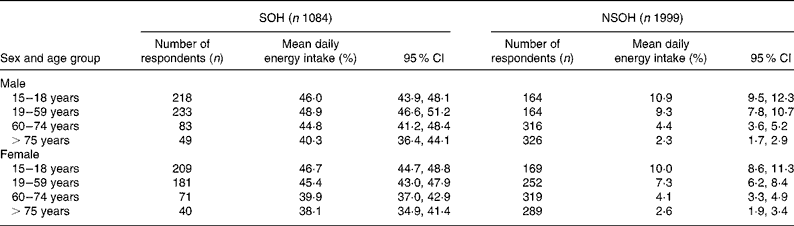
On average 35·2 % of the Belgian population was defined as a SOH eater. The mean percentage of daily energy consumed out of home was 23·5 (95 % CI 22·7, 24·2) % for the total population. The mean percentage of daily energy consumed out of home decreased with age for both SOH eaters and non-SOH eaters, except for male SOH eaters in the second age group.
The mean percentage of energy consumed out of home was higher for men than for women, except for SOH eaters in the youngest age group and non-SOH eaters in the oldest age group (Table 1). A higher percentage of men (37·5 %) were classified as SOH eaters compared with women (32·7 %).
Percentage daily energy intake, consumed out of home, by age group and by sex, for substantial out-of-home (SOH) eaters and non-SOH eaters (NSOH) (Belgian National Food Consumption Survey 2004) (Mean values and 95 % confidence intervals)
Characteristics of substantial out-of-home eaters
Table 2 shows, separately for men and women, the OR for being a SOH eater by different predictor variables. Out-of-home eating decreased with age for both men and women (Table 2). The association between education level and out-of-home eating was not clear. No association was found between self-reported BMI, physical activity and smoking behaviour and frequency of SOH eating. For men, a higher mean total daily energy intake was associated with a higher frequency of SOH eating (P = 0·01).
Association between different predictor variables* and substantial out-of-home eating (Belgian National Food Consumption Survey 2004) (Sex-specific odds ratios and 95 % confidence intervals)
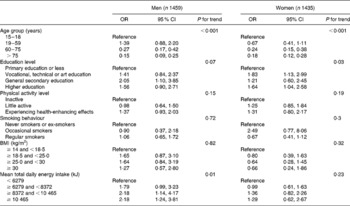
* Variables are mutually adjusted. Ninety-four men and ninety-five women were excluded because of missing values for education level (n 100), physical activity (n 45), BMI (n 6) or smoking behaviour (n 39). One of these participants had two missing values.
Daily energy intake and energy density of daily intake
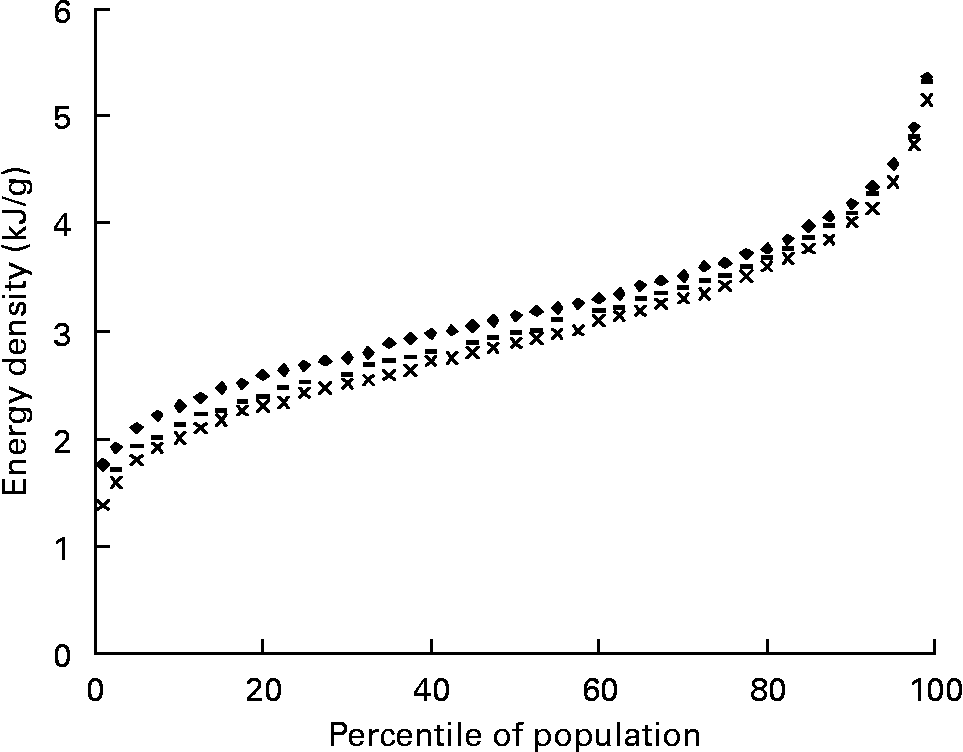
Daily energy intake (data not shown), energy density of the total daily diet and the consumption of energy from energy-dense foods (data not shown) were significantly higher among SOH eaters than among non-SOH eaters (Fig. 1).
Energy density of usual daily intake (kJ/g) for substantial out-of-home (SOH) eaters (n 1084; ♦), non-SOH eaters (n 1999; × ) and for the total population (–), corrected for the age and sex distribution of the Belgian population (Belgian National Food Consumption Survey 2004).
Intake and number of servings of different food groups and dietary diversity
Table 3 shows the usual daily food intakes for SOH eaters and non-SOH eaters, stratified by sex. SOH eaters consumed a higher daily quantity of food and thus ate more of most food groups compared with non-SOH eaters (Table 3). In particular, SOH eaters consumed substantially more low-nutritious, energy-dense foods, such as snacks, soft drinks and alcohol, compared with non-SOH eaters. The usual daily intake of fruits and vegetables was substantially lower among the SOH eaters, even when including juices and soups.
(Mean values and 95 % confidence intervals and percentages)

* Food intake values are corrected for season, day of the week and for the age distribution of the Belgian population.
† Could not be estimated using Nusser methodology because semi-parametric transformation to normality was not possible (too few women consumed potatoes, pasta or rice during both interview days).
Male SOH eaters consumed substantially more animal products, compared with non-SOH eaters, except for cheese.
Male SOH eaters complied better with the FBDG for water, bread and breakfast cereals, cheese, dairy products and spreadable fats and worse with those for vegetables, meat, fish, eggs and substitutes and low-nutritious, energy-dense foods, compared with non-SOH eaters (Table 3). Female SOH eaters complied better with the FBDG for water and spreadable fats and worse with those for fruits, vegetables and animal products.
The two dietary diversity scores were lower for SOH eaters except for the youngest age groups (Table 4). The dietary diversity scores increased with age for both SOH eaters and non-SOH eaters but the trend was not significant (P trend score 1 = 0·32; P trend score 2 = 0·46).
(Mean values and 95 % confidence intervals)
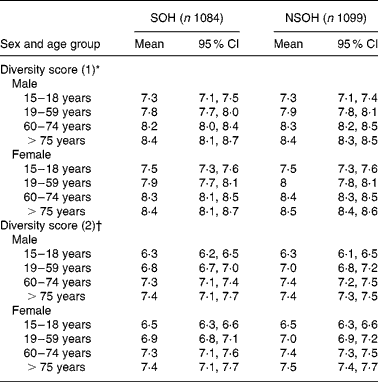
* The number of food groups consumed by the respondent during the preceding day (mean of two interview days) out of the following: (1) water including tea, coffee and broth, (2) potatoes, pasta and rice, (3) bread and breakfast cereals, (4) vegetables, (5) fruits, (6) dairy, Ca-enriched soya products and cheese, (7) meat, fish, eggs, legumes, nuts and meat substitutes, (8) spreadable fats and (9) low-nutritious, energy-dense foods.
† The number of food groups as included in the first diversity score without the low-nutritious, energy-dense foods.
Foods most frequently consumed out of home
Most (76·4 %) of the eating occasions occurred at home. Out-of-home consumption most frequently took place at work (9·1 %), at friends' houses (5·1 %) and in restaurants, bars or cafeterias (5·4 %). Fast food outlets and school accounted for only 0·7 and 1·0 % of the meal occasions respectively (data not shown).
The food groups most frequently consumed out of home were energy-dense foods such as soft drinks (34·4 %), alcohol (34·2 %), cakes (34·0 %), sauces (33·5 %), salty snacks (28·8 %) and fish and fish products (35·0 %) (data not shown).
The food groups contributing most to the total energy consumed out of home were bread and breakfast cereals (17·5 %), meat (11·3 %), alcohol (11·1 %), cakes (9·9 %), dairy products (8·7 %), non-alcoholic beverages (including soft drinks) (7·3 %), sauces (5·8 %), and sugar and confectionery (5·5 %) (data not shown).
Meal characteristics at different out-of-home settings
The total portion size of a meal was largest when consumed at friends' houses and in restaurants, bars and cafeterias. The total portion size of a meal consumed at home, at work and at school was significantly lower (Table 5).
(Mean values with their standard errors)
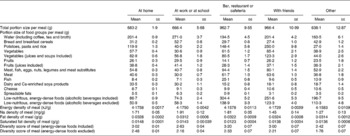
The portion size of vegetables was highest when the meal was consumed at friends' houses, at home and in restaurants, bars and cafeterias. The portion size of vegetables consumed at work and at school was significantly lower, compared with other places where food was consumed (Table 5). The frequency of vegetable consumption was lowest at school and at work and highest in restaurants, bars and cafeterias (Table 6). The reverse was true for fruits: the portion size of fruits consumed at school and at work was higher than at other places.
(Mean values with their standard errors)

The portion size of fruits consumed was lowest in restaurants, bars and cafeterias (Table 5). The frequency of fruit consumption was highest at home (Table 6). The portion size and frequency of consuming potatoes, rice and pasta were significantly lower at work and at school than at other places, while the consumption of bread and breakfast cereals was significantly higher. The portion size and frequency of consumption of fish and meat were lowest at work and at school but highest when the meal was consumed at friends' houses or in restaurants, cafeterias and bars (Tables 5 and 6). The same applied for the consumption of low-nutritious, energy-dense foods: at work, at school and at home portion size and frequency of consumption were lowest, while highest when consumed at friends' houses, at bars, restaurants and cafeterias, with or without alcohol included. The reverse was true for dairy and Ca-enriched soya products and spreadable fats (Tables 5 and 6).
There was no substantial difference in energy density between the meals consumed at different places, although the energy density was somewhat higher at home, at work, at school and at friends' houses. The Na density of the meal was highest at work, at school and in restaurants, bars and cafeterias.
The density of fat and saturated fat was highest at home. The density of fat was lowest at work and at school while the density of saturated fat was quite high (Table 6).
The dietary diversity of a meal was highest in restaurants, bars and cafeterias when energy-dense, low-nutritious foods were included and highest at home when energy-dense, low-nutritious foods were excluded. In both cases, the diversity of the meal was lowest at work and at school (Table 5).
Discussion
SOH eaters are defined as individuals who consume on average at least 25 % of their daily energy out of home. The percentage of SOH eaters in Belgium is considerable and the fact that on average 23·5 % of the daily energy intake is consumed out of home justifies a more detailed investigation of out-of-home eating in Belgium. Out-of-home eating is associated with a more adverse dietary profile: both daily energy intake and energy density of daily food consumption are higher for SOH eaters than for non-SOH eaters. Additionally, the consumption of vegetables and fruits is significantly lower among SOH eaters compared with non-SOH eaters. This finding corresponds with other observations in cohorts from different European countries(Reference Orfanos, Naska and Trichopoulos6, Reference O'Dwyer, Gibney and Burke11). Some authors argue that energy density is a key determinant of energy intake(Reference Prentice and Jebb27, Reference Stubbs, Ferres and Horgan28). At population level, the nutritional profile of the diet of SOH eaters as documented here is believed to be an important driver of diet-related chronic diseases such as obesity(29) and different cancers(Reference Riboli30).
Various observations are attributable to the food habits and cultural practices of the Belgians. Individuals especially tend to eat more when they are invited with friends or when they go to restaurants, bars and cafeterias. The big difference between the portion size of a meal consumed at home and a meal consumed at friends' houses was remarkable. When individuals invite friends, large amounts of food are prepared to be sure that everyone feels satisfied. Typically, these meals are energy dense.
The fact that at work and at school the portion size of vegetables, meat, fish and potatoes, rice and pasta is lower, while the portion size of bread products is higher, is likely to be related to the habit of Belgians to bring their lunch from home or to buy a prepared sandwich instead of taking a hot meal at work or at school.
In the USA, away-from-home foods are generally higher in fat, saturated fat and Na than home foods(Reference Lin and Frazao4). In the present study the results are not so straightforward. The nutritional quality of meals consumed at work or at school is worst compared with meals consumed at home with regard to Na and SFA content.
The strength of the present study is the national representative character of the data. To our knowledge, apart from Ireland(Reference Burke, McCarthy and O'Neill10, Reference O'Dwyer, Gibney and Burke11), no other country has investigated the importance of out-of-home eating using such food intake data. There are, however, some important methodological considerations that should be taken into account when interpreting the findings. First, the information on food consumption at school is insufficient. Consumption at school occurred in only 1 % of the cases because the survey comprises mainly adults. Second, we were only able to analyse out-of-home eating on the basis of where the food was consumed. From a policy perspective, however, the place of purchase or preparation of foods and beverages is potentially more informative. The place of purchase or preparation is currently not collected during national food intake studies in Belgium. In the absence of an accepted definition of out-of-home eating, we resorted to a pragmatic definition and were only able to interpret our findings in terms of where the foods and beverages were consumed. This may have important implications for the development of policy strategies on out-of-home eating in Belgium. More in-depth information is needed, however, to fully understand the nutritional significance of the place of consumption and source or place of preparation of the food in Belgium. A further methodological limitation is the low response rate of the survey (41 %), which was discussed previously(Reference Vandevijvere, De Vriese and Huybrechts14). Additionally the use and consumption of table salt and salt added during recipe preparations might have been underestimated in the survey.
The public health importance of out-of-home eating in Belgium and the potential adverse effect of substantially eating outside the home call for specific strategies in the national nutrition policy in Belgium.
The heterogeneity of eating places and lack of detailed information on the source of the foods and beverages consumed make it difficult to develop general policy strategies.
There are some important contextual differences between schools and work canteens and restaurants, bars and cafeterias. In schools and work canteens, the supply of food is commonly subjected to external regulations while in restaurants, bars and cafeterias the nutritional characteristics of foods and beverages supplied is market-driven and largely determined by the demand of the customers. The portion size of vegetables and overall dietary diversity are important action areas for work and school canteens. To reduce the portion sizes of meals and unhealthy foods in restaurants, bars and cafeterias, some creative solutions might be necessary. Further, when developing policy strategies, younger age groups, higher-educated individuals and males are of particular concern and need specific attention.
National governments should incorporate mechanisms to monitor what is offered and what is consumed out of home on a regular basis. Our findings provide evidence to incorporate energy density and total energy content as evaluation criteria in such a system. SOH eaters generally consume a higher quantity of foods and more energy-dense foods than non-SOH eaters on a daily basis. Many foods and beverages offered and consumed out of home, however, currently do not provide nutritional information. Consumers are consequently subjected to what is offered. Labels and nutrition profiling systems are currently being developed and are potentially interesting as instruments for monitoring the nutritional profile of food offered and purchased(Reference Lobstein and Davies31).
In conclusion, eating outside the home is an important nutritional issue in Belgium and therefore cannot be neglected in national nutrition policy. Individuals tend to eat larger portion sizes and more energy when eating out, and less of vegetables and fruits.
Due to the heterogeneity of different places of consumption, the formulation of general policy strategies is difficult. However, the issue should be taken into account when designing and evaluating nutrition policies.
Acknowledgements
The authors acknowledge the work of the field work team of the Food Consumption Survey: Stéphanie De Vriese, Michel Moreau and Inge Huybrechts and the dietary support from Mia Bellemans, Mieke De Maeyer, Khadija El Moumni and Davy Van Steenkiste. Special thanks go to the respondents and the dietitians during the field work.
The survey was funded by the Federal Ministry of Health, Food Chain and Environment.
S. V. and C. L. did the analyses and drafted the manuscript. H. V. O. was the general coordinator of the survey. P. K. and H. V. O. critically revised the written manuscript. All authors read and approved the final version of the manuscript.
The authors declare not having any conflicts of interest.



