


INTRODUCTION: ABORTION IN GLOBAL POLITICS
Many countries in the world have witnessed new restrictions on abortion rights in recent years. In the United States, the anti-abortion movement seized a monumental victory when the Supreme Court overturned Roe v. Wade in June 2022’s Dobbs v. Jackson Women’s Health Organization decision. The US movement has inspired similar movements in other countries, as evidenced by Australia’s opponents to abortion drawing inspiration from the Dobbs decision (Penovic Reference Penovic2022). Prior to the US Supreme Court decision, the European Union, long regarded as a beacon of liberalism, saw several of its member states limit abortion rights (Tanginelli Reference Tanginelli2022). Hungary’s Victor Orban grabbed media headlines when he imposed a raft of bureaucratic limits on abortion access, most recently, for example, requiring patients to listen to a fetus’s heartbeat prior to undergoing abortion (Strzyżyńska Reference Strzyżyńska2022). In 2020, Poland emerged as another worrying example of regression, when the country’s Supreme Court ruled that even congenital deformities would not permit an abortion to go forward, reifying the country’s near-total ban (Cursino Reference Cursino2022).
Scholars emphasize that abortion protections are rooted in international human rights law (Rebouché Reference Rebouché2016; UN 2022). Abortion rollbacks raise alarms of ripple effects across a broader spectrum of rights. On this note, in responding to the Dobbs decision, critics claimed that the decision “strapped a ticking time bomb onto other fundamental human rights” (Vasquez Reference Vasquez2022). Human rights practitioners have worried that the decision would disproportionately affect individuals from lower socioeconomic backgrounds, creating a vicious spiral of marginalization and reinforcing existing inequalities (GJC 2023). Describing the decision as a “human rights disaster,” the Global Justice Center, a human rights non-governmental organization, drew attention to the “the disproportionate impact on marginalized populations” caused by Dobbs (GJC 2023, 1). The UN High Commissioner for Human Rights at the time, Michelle Bachelet, sounded a similar note: “This decision strips such autonomy from millions of women in the US, in particular those with low incomes and those belonging to racial and ethnic minorities” (UN 2022). The overriding fear in the wake of the Dobbs decision has been that abortion access represents the first domino to fall among a range of other rights in the US (Vasquez Reference Vasquez2022). To that effect, the executive director of another civil rights non-profit recently remarked: “We are on a slippery slope at this point, and the reverberations may be felt for generations to come in ways that are unimaginable” (as quoted in Jumaa Reference Jumaa2022).
The slippery slope argument implies expanding repression, as governments emboldened by curbs on reproductive freedoms crack down on other human rights. Equally disquietingly, rollbacks signal the degrading of democratic orders as regimes that claw back abortion rights turn increasingly authoritarian. The same governments that have targeted abortion access have also passed an array of measures that muzzle the independent media, imperil the independence of the judiciary, and undermine civil society and, sometimes, democratic institutions. Poland’s Law and Justice Party, Brazil’s Bolsonaro, and Hungary’s Orban are prominent examples that illustrate that abortion access is the tip of the iceberg of overall liberal (and democratic) regression (Kozlowska Reference Kozlowska2022). As Kumar, the head of Ipas, a pro-choice non-profit remarked, “We don’t necessarily always include reproductive freedom in that package of democracy…But we should, because this is a place where authoritarian regimes often go, if not first, then pretty quickly afterward” (as quoted in Kozlowska Reference Kozlowska2022).
To date, the handful of empirical studies of abortion rights have tied abortion liberalization to women’s empowerment (Asal, Brown, and Figueroa Reference Asal, Brown and Figueroa2008), labor market participation (Hildebrandt Reference Hildebrandt2015), and accession to human rights treaties, most prominently the Convention on the Elimination of All Forms of Discrimination against Women (CEDAW) (Hunt Reference Hunt2021). Abortion rights are a crucial component of reproductive rights, women’s empowerment, and gender equality (Forman-Rabinovici and Sommer Reference Forman-Rabinovici and Sommer2018b; Rebouché Reference Rebouché2016). Access to abortion is buttressed by foundational international law pertaining to women’s rights and/or human rights (Bloomer, Pierson, and Estrada Reference Bloomer, Pierson and Estrada2018; Hunt Reference Hunt2021). While existing work has made headway in identifying the motivators of abortion liberalization, it has neglected the consequences of abortion restrictions. Given contemporary concerns linking abortion curbs to limits on other human rights, this is an important omission.
We address this lacuna by asking: do countries’ abortion restrictions precipitate the deterioration of human rights protections? More specifically, we probe how abortion backsliding affects protections for Physical Integrity Rights (PIR). We focus on this class of human rights for several reasons.Footnote 1 First, conceptually, reproductive rights and PIR are interdependent. As feminist scholars have elucidated, reproductive freedoms share the common denominator of bodily autonomy, physical security, and independent agency, as do physical integrity rights (Heidari Reference Heidari2015). Second, PIR are the most widely studied by human rights scholars, as they are core, indispensable rights that encompass the “life and inviolability of the human person” and require “absolute protection, even when other liberties are temporarily suspended” (Thoms and Ron Reference Thoms and Ron2007, 685). Third, the victims of physical integrity violations are not necessarily political opponents; nor do these violations always entail life-threatening violence (Haschke Reference Haschke2017). This comports with our theoretical argument that curbs on abortion rights herald human rights violations that can affect anyone, regardless of whether reproductive freedoms directly affect these individuals. Finally, coercion and control by the regime underlie abuses of both types of rights. Davenport and Armstrong (Reference Davenport and Armstrong2004, 539) stress that physical integrity violations represent coercion by “political authorities” within their “territorial jurisdiction for the expressed purpose of controlling behavior and attitudes.” Similarly, commentators have cast abortion bans, such as those imposed by states in the US in the wake of Dobbs, as “state-sanctioned violence to target, coerce and control significant segments of the population” (Penovic Reference Penovic2022).
We assert that abortion restrictions are associated with the curtailment of PIR. The inherent vulnerability of abortion rights converts them into testing ground for governments, which then emboldens them to widen repression to other rights. Insofar as abortion rights are gendered and rest on conflicting narratives (Boyle, Kim, and Longhofer Reference Boyle, Kim and Longhofer2015), they are particularly susceptible to violations, especially when reproductive policies become wedded to nationalist agendas and serve top-down policies of modernization (Yuval-Davis Reference Yuval-Davis1997). In some cases, such as in Ireland, abortion restrictions are a vehicle through which states aspire to reassert a nostalgic national ideal (Smyth Reference Smyth2005) and thereby alleviate the negative emotive responses to globalization. In other cases, abortion politics comprise one component of broader biopolitics, that is, nativist policies designed to maintain a politically desirable population (Millar Reference Millar2015). Examples of biopolitical discourse run the gamut from Putin’s reviving the “Mother Heroine” award to Russian women to the Chinese government’s “one-child policy” and reversal to the “three-child policy” as of 2016 (Suliman Reference Suliman2022; Tharoor Reference Tharoor2021). Seen in this light, abortion curbs represent a “gendered backlash with patriarchal underpinnings” (Moghadam and Kaftan Reference Moghadam and Kaftan2019, 2). When states exploit abortion politics to reassert the homogeneous nationalist ideal (Smyth Reference Smyth2005) or scapegoat abortion activism as promulgating a progressive (or “woke”) agenda, it can undermine trust in the regime and sap respect for the equal rights of social groupings.
Using a global time-series cross-sectional sample of countries from 1993 to 2016, we show that abortion restrictions significantly correlate with restrictions on PIR. We deploy the Comparative Abortion Index (CAI), an ordered scale that tracks the permissiveness of abortion policies worldwide and over time (Forman-Rabinovici and Sommer Reference Forman-Rabinovici and Sommer2018a). Two conclusions emerge. First, we find that permissive abortion policies correspond to greater improvements in PIR. Conversely, countries that impose abortion restrictions see either no improvements in PIR over time or, for acute cases of abortion backsliding, witness instead a deterioration of PIR. Second, abortion restrictions impose both direct and indirect effects on PIR, whereby effects are mediated through increased social group inequality. Abortion backsliding not only reduces respect for PIR but also attenuates the protection of rights of all social groupings, thereby driving a wedge between various segments of society and the state.
We contribute to the cross-disciplinary research in several ways. While the corpus of literature has argued that reproductive rights should be core to human rights, the empirical implications of this view heretofore have remained untested. We redress this deficiency by showing the implications of abortion restrictions for other human rights. We also go beyond existing work that connects gender equality to liberalism and, conversely, structural inequality to patriarchal and sometimes militant nationalism (Caprioli Reference Caprioli2005; Caprioli and Boyer Reference Caprioli and Boyer2001). We contribute to work that has connected gender equality to respect for PIR (Melander Reference Melander2005) by explicating how abortion rights facilitate and fuel repression and undermine equal respect for the rights of all social groupings. In doing so, we draw on critical feminist literature, which ties abortion restrictions to population control strategies by the state (Millar Reference Millar2015), and similar arguments that link nationalist-populism to patriarchal notions that ascribe roles to women of solely reproducers and socializers of ideal citizens (Moghadam and Kaftan Reference Moghadam and Kaftan2019; Yuval-Davis Reference Yuval-Davis1997).
By sharpening the focus to abortion access, we shift attention to sexual and reproductive health as it relates to human rights environments. This shift is important because limited reproductive rights can signify women’s disempowerment in both private and public spheres, and thus represent a critical, yet often overlooked component of women’s empowerment (Cueva Beteta Reference Cueva Beteta2006). Indeed, countries that do well on some classic and seemingly objective indicators of gender empowerment may lag on other protections, such as ensuring women’s control over their bodies and sexuality; and, in more extreme cases, economic and political empowerment may conceal pervasive misogyny and horrific abuses such as gender-based violence (Cueva Beteta Reference Cueva Beteta2006). Moreover, while abortion rights are framed as women’s rights, they affect the rights of other “birthing people,” such as non-binary and transgender individuals (Powell Reference Powell2022). The inherently gendered nature of abortion rights has stoked fears in the LGBTQIA+ community that other rights would be stripped away from them (Jumaa Reference Jumaa2022).
Our results show evident interdependence between reproductive rights and PIR. On a sanguine note, countries that maintain access or progress on abortion rights see improvements in physical integrity protections. Our findings carry wider relevance for other legal protections, particularly progressive rights such as gender-affirming care and same-sex marriage. As these protections are guided by similar value systems, such as respect for autonomy and agency, and tolerance for societal heterogeneity, the unraveling of abortion access may presage erosion of other legal gender protections.
GLOBAL ABORTION RIGHTS
While women’s rights have improved worldwide, they have done so at discrepant rates even as countries have progressed on expanding other rights (Inglehart and Norris Reference Inglehart and Norris2003a; Reference Inglehart and Norris2003b). Specifically, in many countries, the legal right to abortion is still severely restricted or outright outlawed, while in others, it has been legalized and expanded (Asal, Brown, and Figueroa Reference Asal, Brown and Figueroa2008; Hunt and Gruszczynski Reference Hunt and Gruszczynski2019). Despite considerable cross-national heterogeneity, there is a general academic consensus that the worldwide trend is characterized by liberalization (Asal, Brown, and Figueroa Reference Asal, Brown and Figueroa2008; Pillai and Wang Reference Pillai and Wang1999; Ramirez and McEneaney Reference Ramirez and McEneaney1997). Many more countries have expanded access in the past few decades, despite the small subset of countries, like Poland and the United States, where recent movement has been in the opposite direction (CRR 2022).
The Abortion Debate: Competing Frames
There are multiple frames to understand abortion rights. The women’s rights frame has animated liberalization efforts by holding abortion rights as cardinal to women’s empowerment and overall gender equality (Boyle, Kim, and Longhofer Reference Boyle, Kim and Longhofer2015, 885; Forman-Rabinovici and Sommer Reference Forman-Rabinovici and Sommer2019). This frame stresses that “a woman’s ability to exercise her rights to control her body, to self-determination, and to health depends in part, on her right to determine whether to carry a pregnancy to term” (Boyle, Kim, and Longhofer Reference Boyle, Kim and Longhofer2015, 885). In this view, abortion access empowers women by safeguarding their autonomy and agency over their reproductive choices and produces desirable gender practices (Cook and Dickens Reference Cook and Dickens2003, 2–3). Conversely, abortion restrictions are inimical to gender equality insofar as unplanned and unwanted pregnancies foreclose further skill and career development and uphold patriarchal or, in some cases, misogynistic beliefs that consign women to the roles of homemaker, child-bearer, and caregiver (Sommer and Forman-Rabinovici Reference Sommer and Forman-Rabinovici2019).
The campaign for women’s human rights advanced the liberalization of abortion laws by catapulting reproductive health to center stage in international conversations about population or the right to health (Charlesworth, Chinkin, and Wright Reference Charlesworth, Chinkin and Wright1991; Rebouché Reference Rebouché2016). CEDAW codified the principle of “women’s rights as human rights” in 1979, signaling the UN’s commitment to this principle (Reanda Reference Reanda1981). Two landmark events, the 1994 United Nations International Conference on Population and Development (ICPD) and the 1995 UN Fourth World Conference on Women, further solidified the link between women’s reproductive rights and human rights (Eager Reference Eager2017). Today, members of several important international organizations, including the Council of Europe and the EU, demand a commitment to women’s rights as human rights (CRR 2022; Vida Reference Vida2019). Domestic courts refer to international statutes and bodies, such as the Human Rights Committee (HRC) or CEDAW, to espouse protections for women’s reproductive rights (Cook and Dickens Reference Cook and Dickens2003; Rebouché Reference Rebouché2016).
The public health frame, championed by the World Health Organization, has also supported liberalization by casting abortion rights as the legal obligation of the state to protect health. In a study of Sierra Leone and Northern Ireland, Erdman (Reference Erdman2016, 47) documents how the public health narrative altered the penal code by steering attention away from “entrenched political conflict over criminal abortion and toward unsafe abortion as a cause of suffering and death.”
Despite trends toward liberalization of abortion access, multiple moral perspectives debate the permissibility of abortion (Al-Hadrawi Reference Al-Hadrawi2016). Abortion debates are polarized because they involve core values (Brysk and Yang Reference Brysk and Yang2023), and collective identities (Adamczyk, Kim, and Dillon Reference Adamczyk, Kim and Dillon2020). Consequently, attitudes on both sides of the debate calcify into hard absolutes, with little room for compromise.
Dueling narratives of women’s rights versus fetal rights highlight the ethical contestation surrounding abortion rights. The fetal rights movement asserts that fetuses are entitled to a right to life at the expense of women’s rights (Copelon et al. Reference Copelon, Zampas, Brusie and deVore2005). Representing this perspective, the American Convention on Human Rights stipulates in Article 4 that the right to life begins at conception. In sharp contrast, international and regional treaties dating back to the Universal Declaration on Human Rights have intentionally utilized the word “born” to exclude the fetus or any antenatal application of human rights (CEDAW 2018, 18). UN committees have proclaimed that the criminalization of abortion is a breach of the right to life, a form of torture, cruel, and inhumane and degrading treatment, and a form of gender-based violence (Copelon et al. Reference Copelon, Zampas, Brusie and deVore2005). For example, in a 2018 report concerning access to abortion in the United Kingdom, the Committee on the Elimination of Discrimination against Women stated that “[u]nder international law, analyses of major international human rights treaties on the right to life confirm that it does not extend to fetuses” (CEDAW 2018, 18).
The preceding discussion suggests that there are competing normative frames for abortion rights (Al-Hadrawi Reference Al-Hadrawi2016), revolving around core values (Brysk and Yang Reference Brysk and Yang2023), and collective identities (Adamczyk, Kim, and Dillon Reference Adamczyk, Kim and Dillon2020). Nonetheless, the survey of the empirical literature in the next section stresses that PIR and abortion access are interdependent and, thus, restrictions on both are driven by common drivers such as authoritarianism and exclusionary nationalism.
Drivers of Abortion Outcomes
Social scientists have made strides in understanding the correlates of abortion policies, globally (Asal, Brown, and Figueroa Reference Asal, Brown and Figueroa2008; Erdman Reference Erdman2016; Pillai and Wang Reference Pillai and Wang1999; Ramirez and McEneaney Reference Ramirez and McEneaney1997) as well as in specific regions or countries (Cioffi et al. Reference Cioffi, Cecannecchia, Cioffi, Bolino and Rinaldi2022; Tucak and Blagojević Reference Tucak and Blagojević2021). Within this body of literature, scholars have outlined the complex and multifaceted linkages between religion and religiosity and abortion laws (Hildebrandt Reference Hildebrandt2015; Sommer and Forman-Rabinovici Reference Sommer and Forman-Rabinovici2019). One conclusion from these works is that Catholicism and the size of religious populations correlate with policy stringency (Asal, Brown, and Figueroa Reference Asal, Brown and Figueroa2008; Boyle, Kim, and Longhofer Reference Boyle, Kim and Longhofer2015; Sommer and Forman-Rabinovici Reference Sommer and Forman-Rabinovici2019). Contrarily, secular legacies cohere with policy liberalization, as witnessed in post-communist societies (Hildebrandt Reference Hildebrandt2015; Htun and Weldon Reference Htun and Weldon2018).
Scholars have also observed that women’s empowerment, in the political arena and workforce, accords with more lenient policies (Asal, Brown, and Figueroa Reference Asal, Brown and Figueroa2008; Hildebrandt Reference Hildebrandt2015). Greater political representation translates to stronger advocacy, lobby-formation, and agenda-setting on behalf of women’s rights. Particularly, where women’s advocacy has espoused greater democratic representation, pro-choice lobbies, such as Planned Parenthood and NARAL, can influence policy toward permissiveness, and reframe public agendas to champion women’s reproductive rights (Sommer and Forman-Rabinovici Reference Sommer and Forman-Rabinovici2019).
International advocacy networks, such as non-governmental organizations championing women’s rights, and international treaties, in particular CEDAW, can reshape domestic norms, and orient policies toward the liberal end of the spectrum, allowing local coalitions to organize around egalitarian reforms (Copelon et al. Reference Copelon, Zampas, Brusie and deVore2005; Htun and Weldon Reference Htun and Weldon2018; Hunt and Gruszczynski Reference Hunt and Gruszczynski2019; Sommer and Forman-Rabinovici Reference Sommer and Forman-Rabinovici2019). Other processes, including the spread of liberal individualism, social modernization, and levels of urbanization, are advanced as correlates of liberalization and pro-choice attitudes (Asal, Brown, and Figueroa Reference Asal, Brown and Figueroa2008; Boyle, Kim, and Longhofer Reference Boyle, Kim and Longhofer2015; Brysk and Yang Reference Brysk and Yang2023).
A second strain of literature, mostly within critical feminism, lends important insights on the ideational frameworks and processes that promote restrictionist trends in some countries. To reiterate, societal codes with strong roots in Catholicism have wielded the fetal rights frame as a buffer against the advancement of individualist human rights norms. The notion of fetal personhood has effectively stigmatized abortion, portraying those who seek the procedure as failing the feminine ideal (Millar Reference Millar2020; Norris et al. Reference Norris, Bessett, Steinberg, Kavanaugh, De Zordo and Becker2011). Where doctrinal politics holds sway, it allows little room for compromise. The liberalization of abortion undermines the “claim of religious and cultural communities to govern the terms of kinship and reproduction” (Htun and Weldon Reference Htun and Weldon2018, 3).
Where abortion politics become enmeshed in projects of nation-making, restrictions have followed, particularly when gender and race have overlapped in promulgating nation-building. Racialized schemas that seek to preserve ethnic homogeneity or racial purity have reimposed on women their roles as child-bearers and socializers, as well as guardians of the nation’s culture and values (Yuval-Davis Reference Yuval-Davis1997). Nationalist governments ban abortion and limit contraception to augment the dominant group and repress minorities. Australia was a case in point where “the aborting women” came to be seen as a threat to “the white hetero-family” as a national ideal, a perspective with origins in white vulnerability (Millar Reference Millar2015, 83). Closely related, by conceptualizing abortion as a biopolitics issue, some countries have tied abortion policies to racial demographics and discussions of population control or growth (Millar Reference Millar2015). In this way, the health of the population, and, more generally, the needs of the collective supersede the rights of the individual (Woliver Reference Woliver2010). Abortion restrictions often go hand in hand with populist agendas, which corrode democratic norms and practices and respect for minority rights. US politics provides a contemporary illustration: as Ziegler (Reference Ziegler2022) elucidates, the far-right populist wing of the Republican party owes its ascendance in part to the anti-abortion movement, which pushed to alter campaign finance rules, damaging established democratic norms and spreading anti-minority sentiments in the process.
Baird and Millar (Reference Baird and Millar2020, 3) write that “the fusion between race, reproduction and nation in relation to abortion politics” allows states to create and reaffirm borders, at least symbolically, by reasserting the country’s national identity and setting the country apart from others. As an example of how governments pitch abortion curbs as a bulwark against international influence, Ireland embarked on a quest to set the moral character right, and safeguard traditional values, soon after it joined the European Economic Community in 1973 (Smyth Reference Smyth2005). Through the fusion of nationalism, pro-natalism, and pro-life principles, elites can move even less religious and gender-liberal individuals “against the grain” and toward hostility to abortion access (Brysk and Yang Reference Brysk and Yang2023, 545).
THEORIZING THE EFFECTS OF ABORTION BACKSLIDING ON HUMAN RIGHTS
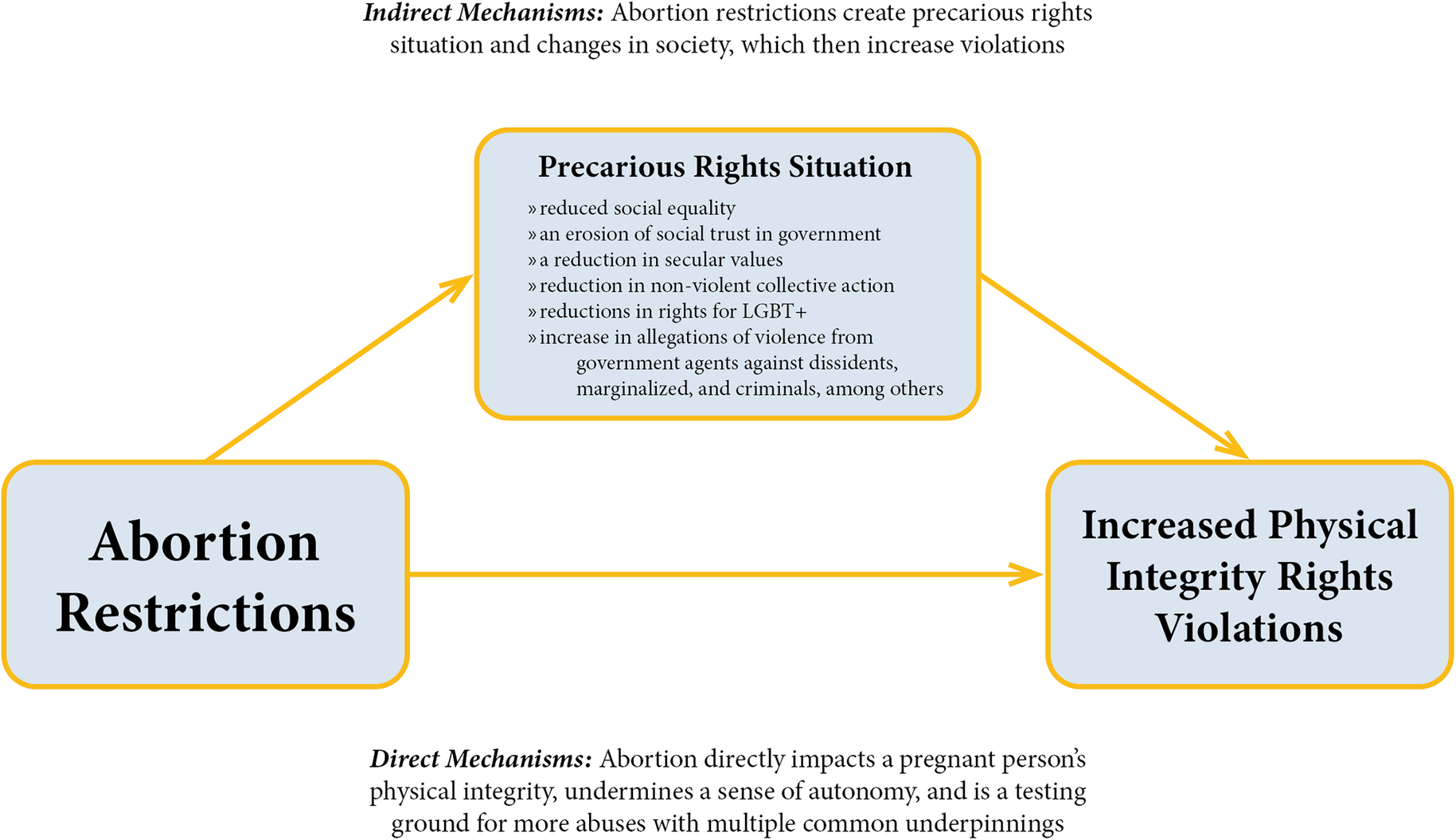
We posit that abortion curbs portend subsequent physical integrity infractions by constituting a slippery slope to wider repression and through intermediary mechanisms that engender precarious rights situations, in turn leading to PIR abuses.
Abortion restrictions come under fire first and thus serve as a testing ground for human rights crackdowns for several reasons. First, in contrast to PIR, abortion rights have not come about by the transferal of already extant rights to women, but rather through direct advocacy, women’s empowerment in the workforce, and greater political representation. The inherently gendered nature of abortion rights (Asal, Brown, and Figueroa Reference Asal, Brown and Figueroa2008, 280), the competing frames surrounding these rights, and their value-laden nature (Brysk and Yang Reference Brysk and Yang2023) place them on relatively precarious footing, prone to erosion or instrumentalization as a “displacement activity” (Baird Reference Baird2006, 214) to counter external influence, or the challenges of globalization and internationalization. Second and related, abortion rights are an easy scapegoat for illiberal regimes who view them as one component of the (Western) liberal agenda and stake their ground on sexual liberalization as the “most basic cultural fault line” (Inglehart and Norris Reference Inglehart and Norris2002, 235). The United Nations Development Programme and UN-Women have frequently drawn vitriol for their efforts to transform domestic attitudes and laws in favor of women’s rights, on similar grounds, namely that these coalitions introduce foreign norms and undermine traditional, local mores (Sherwood, Sherlaw, and Franklin Reference Sherwood, Sherlaw and Franklin2015).
Arguably, common underpinning factors may drive the erosion of both abortion access and PIR. A common set of norms surrounding autonomy, self-ownership, self-determination, and bodily freedom safeguard both PIR and abortion rights. Consequently, the erosion of these norms underpins and drives the deterioration of both sets of rights, given the interdependence between these sets of rights (Nickel Reference Nickel2008). As another common denominator, increasing authoritarianism and illiberalism undergird the fraying of both sets of rights, as repressive regimes attack these rights to wrest back control over the population, and sometimes as backlash against the expansion of global human rights and gender rights.
Importantly, however, once in place, abortion limits precipitate the weakening of PIR protections. Abortion restrictions constitute a testing ground for regimes inclined toward expanding crackdowns, forging a direct pathway to PIR violations. In these contexts, restrictions may serve as a signal that a regime is not open to advocacy related to other seemingly liberal ideas, like other components of the global human rights regime. The signal may make collective action for many types of human rights seem bleak, ultimately lessening the civil society spotlight which could protect against further abuses and encourage further socialization around global human rights norms.
Admittedly, the direct pathway may more readily apply to a subset of countries, particularly those that are, by virtue of their democratic backsliding and governance modalities, more inclined to regress on physical integrity protections. This harkens back to Melander’s (Reference Melander2005) proposed correlation between democracy and gender equality, whereby democracies with better female representation in politics are likely to see fewer abuses of PIR. Similarly, Hudson, Bowen, and Nielsen (Reference Hudson, Bowen and Nielsen2015) argue that clan governance, which can materialize in democracies and non-democracies, necessitates and operates through the subordination of women, whereby the reproduction of clan exclusivity hinges on “control over female interests in sex, marriage, and reproduction” (540). That is, some regime types and governance modalities leave social and racial minorities with more limited access to political opportunity structures, ultimately creating an environment with more contentious violence, both from and to the state.
In sum, in the direct pathway, abortion restrictions serve as a convenient vehicle of reasserting control and allow some regimes to flex their muscle over the population. In these circumstances, leaders thus strategically exploit abortion policies to advance their own aims (Ziegler Reference Ziegler2022), reify borders and authenticity (Smyth Reference Smyth2005), or pursue ethnonationalist agendas (Millar Reference Millar2015; Yuval-Davis Reference Yuval-Davis1997).
Beyond this set of circumstances, and more generally, abortion restrictions operate through an indirect pathway, damaging respect for diversity, increasing inequality, and creating an imbalance in the extent to which the state respects the rights of different social groupings. In this pathway, the criminalization of worldviews, lifestyles, and behaviors of the marginalized places these communities at greater risk of political imprisonment and state violence, thus cowing them into silence. This has a chilling effect on society writ large as the public is discouraged from collective action. That is, even though abortion restrictions may presage targeted abuses—against women and minorities, for example—they reverberate through the broader society. By imposing an executive, unitary vision of national morality, abortion restrictions disregard differing worldviews on the roles and responsibilities of women, the family, sexuality, and religion, among other cognate concepts. These mechanisms create a vicious cycle that snowballs into further breakdown of PIR.
Finally, normative alignment trickles down to and finds expression in public attitudes as well. A prodigious literature has delineated how views on gender more broadly, and reproductive access more specifically, cohere with attitudes toward nationalism and religiosity in discernible ways (Adamczyk, Kim, and Dillon Reference Adamczyk, Kim and Dillon2020; Brysk and Yang Reference Brysk and Yang2023). These empirical associations suggest that “the lens of gender” lends information not just about women’s roles in society, but about “attitudes towards civic tolerance and governance more broadly” (Jacobson Reference Jacobson2013, 198). Anti-abortion views go hand in hand with growing exclusionism and dogmatic worldviews (Htun and Weldon Reference Htun and Weldon2018). As such, draconian attitudes about reproductive freedoms presage intolerance for alternative lifestyles, feeding back into and legitimizing the criminalization of behaviors of the perceived out-group. Increased intolerance saps societal trust, feeding animosity between segments of society, which serves as a gateway for crackdowns on PIR violations.
The preceding discussion suggests that states that adhere to liberal abortion policies maintain better human rights records. Conversely, restrictions on abortion access may serve as a bellwether for deteriorating social equality and physical integrity protections. Our argument thus suggests both a direct and an indirect path through which abortion restrictions are associated with reductions in PIR, as summarized in Figure 1, and leads to the following empirical implications:
Hypothesis 1 (abortion backtracking): Abortion restrictions are associated with a decline in PIR.
Hypothesis 2 (mediating dynamics): The negative impact of abortion restrictions on PIR is mediated by decreases in social equality.
Theoretical Pathways from Abortion Restrictions to PIR Violations

RESEARCH DESIGN
We test our abortion backtracking hypothesis using a dynamic time-series cross-sectional (TSCS) approach and then illustrate the process our theory suggests with an exploratory causal mediation model. For both approaches, our unit of analysis is the country-year. Due to data availability on our key dependent and independent variables, our final sample covers 1993 to 2016 and roughly 145 countries per year (see Avdan, Murdie, and Asal Reference Avdan, Murdie and Asal2024).
Dependent Variable
To test Hypothesis 1, we use Fariss’s (Reference Fariss2014) human rights protection score. This estimated human rights score is based on a model that incorporates various measures of PIR abuses, including the CIRI Human Rights Project’s PIR index and the Political Terror Scale (Cingranelli, Richards, and Clay Reference Cingranelli, Richards and Clay2014; Gibney et al. Reference Gibney, Cornett, Wood, Haschke, Arnon, Pisanò and Barrett2022). Fariss’s (Reference Fariss2014) measure uses a Bayesian latent variable approach to account for the changing standard of accountability in human rights over time. Greater values mean better PIR performance.Footnote 2
To test Hypothesis 2 and explore our suggested theoretical story more, we also examine an alternative dependent variable that we think could serve as an intermediary step in the process by which abortion rights restrictions lead to more PIR abuses. We use the Varieties of Democracy (V-Dem) indicator for social group equality in respect for civil liberties (“v2clsocgrp”). A higher score on this indicator means that “members of all salient social groups enjoy the same level of civil liberties,” while a lower score indicates that groups enjoy “fewer civil liberties than the general population” (Coppedge et al. Reference Coppedge, Gerring, Knutsen, Lindberg, Teorell, Altman and Bernhard2022, 180–1). Importantly, this indicator does not capture gender- or sex-related social groups, instead looking at groups “distinguished by language, ethnicity, religion, race, or caste” (180). The measure is correlated at 0.57 with Fariss’s (Reference Fariss2014) human rights protection score.
Independent Variable and Modeling Approach
We use indices from the Comparative Abortion Index (CAI) Project of Forman-Rabinovici and Sommer (Reference Forman-Rabinovici and Sommer2018a; Reference Forman-Rabinovici and Sommer2018b) to measure abortion rights and restrictions.Footnote 3 These indices are coded based on seven criteria for which abortion may be allowed within a country: “saving a woman’s life, preserving a woman’s physical health, preserving a woman’s mental health, in case of rape or incest, in case of fetal impairment, for social or economic reasons and on request” (Teorell et al. Reference Teorell, Sundström, Holmberg, Rothstein, Pachon and Dalli2022, 162). The first index, CAI #1, scores all countries from 0, indicating abortion is not allowed for any of the seven criteria, to 7, where abortion is allowed for any reason on request. For the second index, CAI #2, the scores from CAI #1 are weighted for each criterion based on the percentage of other countries that accept that criterion. This weighting thus accounts for the “different degrees of acceptance that each criterion represents” (Teorell et al. Reference Teorell, Sundström, Holmberg, Rothstein, Pachon and Dalli2022, 162). CAI #2 varies from 0, indicating no abortions allowed for any reason, to 1, indicating full abortion access.
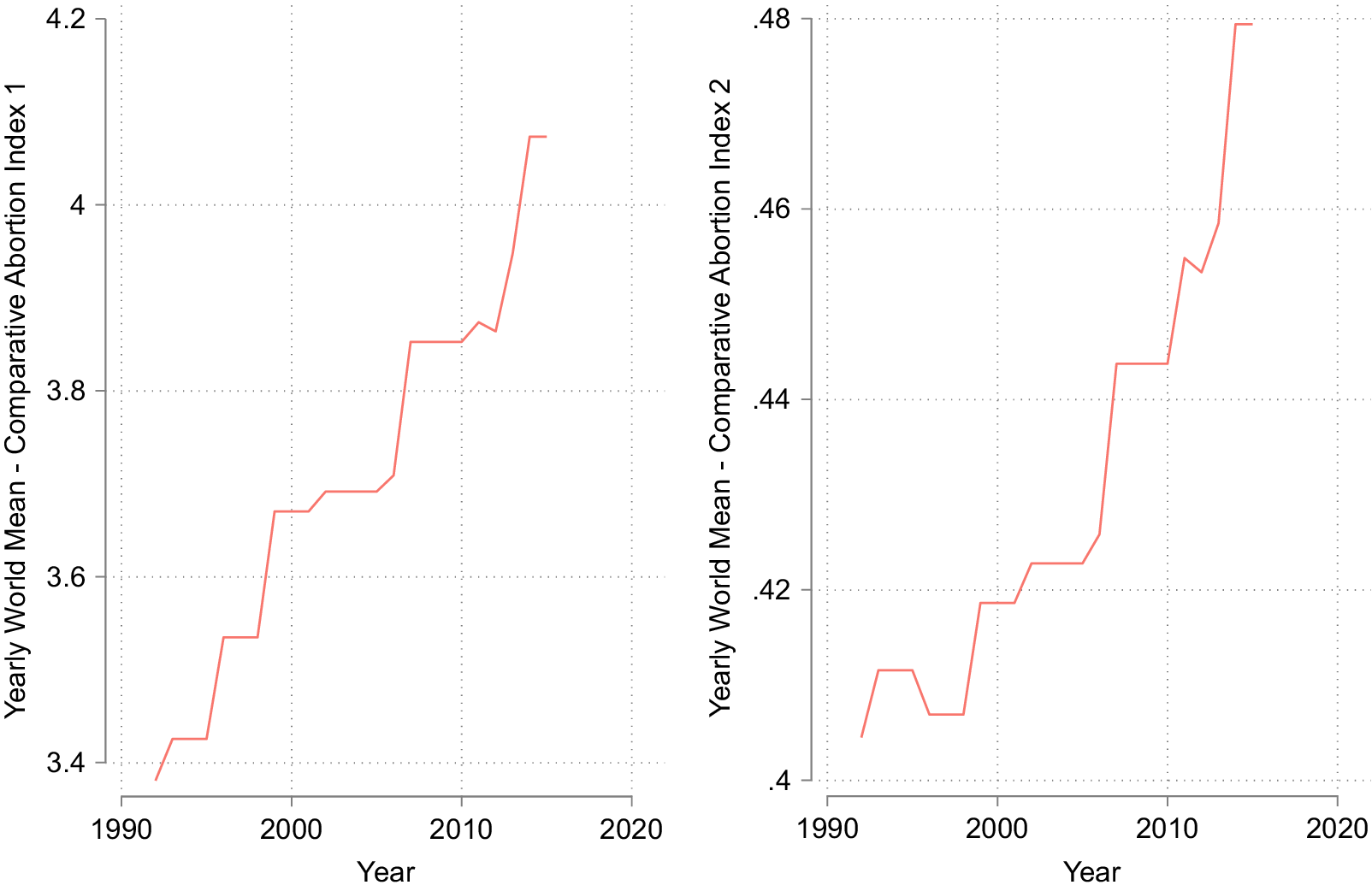
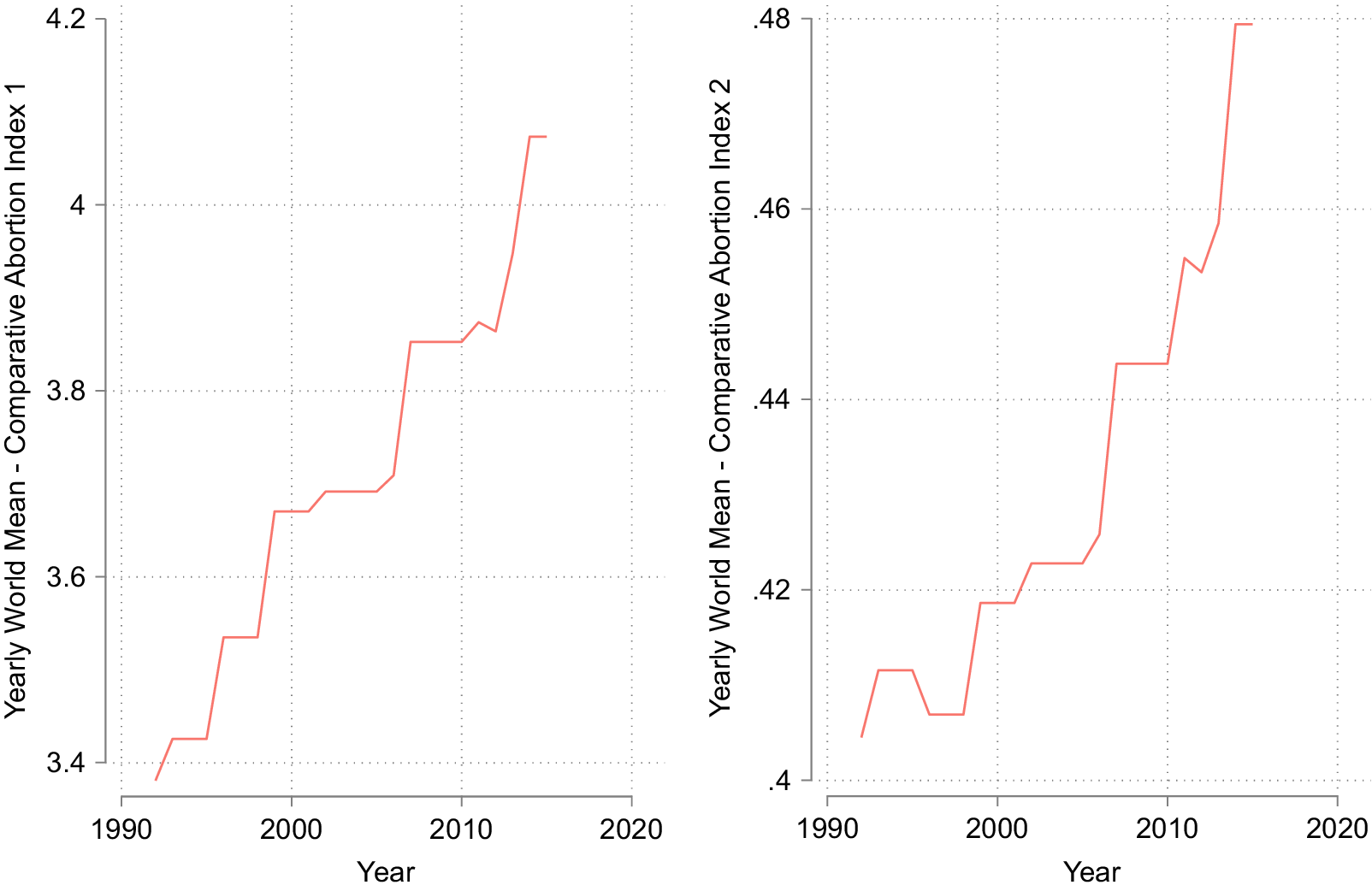
As mentioned above, generally, abortion rights are increasing worldwide. Figure 2 shows the yearly world mean of CAI #1 and CAI #2 over time, showing a strong upward trend in abortion rights provision in the past two decades. These gains typically come from fewer restrictions on abortion to preserve a woman’s mental health, in case of rape or incest, or due to fetal impairment. Despite these global gains, over 60% of countries did not have full access to abortion when the CAI indices end in 2015. Figure 3 shows a heat map of a country’s mean CAI#2 index score for the years where the dataset exists (1992 to 2015). While some countries in Western Europe and former Soviet states have widespread abortion rights protections, many countries throughout the world have far less respect for abortion rights.
Abortion Access Over Time, World Mean Comparative Abortion Index
Note: Data on abortion rights comes from the Comparative Abortion Index (CAI) Project of Forman-Rabinovici and Sommer (Reference Forman-Rabinovici and Sommer2018a; Reference Forman-Rabinovici and Sommer2018b). A higher score indicates more respect for abortion rights.
Heat Map of Abortion Rights, as Measured by the CAI #2 Index, Over Time
Note: Data on abortion rights comes from the Comparative Abortion Index (CAI) Project of Forman-Rabinovici and Sommer (Reference Forman-Rabinovici and Sommer2018a; Reference Forman-Rabinovici and Sommer2018b). A higher score indicates more respect for abortion rights.

Countries that restrict abortion rights, especially after rights have already been in place, are of special interest to our theoretical argument. Additional documentation on our Dataverse provides a list of countries where there was abortion “backsliding” from time t-1 to t. Although only happening in about 8% of cases according to the CAI#2 index and only 1% of cases according to the CAI #1 index, when it does happen, the losses tend to be among those countries already at or below the global mean and is often across multiple criteria, with the most frequent criteria reversed being abortion in the case of rape or incest. Additionally, there are many repeat offenders, with losses in terms of abortion rights happening multiple times over our study time period. Figure 4 illustrates these dynamics with reference to the CAI#2 index; backsliding here would also represent countries where abortion access laws do not keep up with world acceptance.
Heat Map of Abortion “Backsliding” Cases, as Measured by Drops in the CAI #2 Index
Note: Data on abortion rights comes from the Comparative Abortion Index (CAI) Project of Forman-Rabinovici and Sommer (Reference Forman-Rabinovici and Sommer2018a; Reference Forman-Rabinovici and Sommer2018b).

Abortion rights appear to be distinct from other commonly used women’s rights indicators. Additional documentation on Dataverse shows the relatively low pairwise correlations between the abortion indices (CAI #1 and CAI #2) and women’s political rights from CIRIGHTS (Cingranelli, Filippov, and Mark Reference Cingranelli, Filippov and Mark2021) (around 0.27), the Women, Business, and Law index of the World Bank (2023) (around 0.51), and the Social Institutions and Gender Index (SIGI) of the OECD Development Centre (2023) (around −0.28). We see this as further indication that restrictions on abortion rights send a fundamentally different message to the overall population than deterioration of other women and gender rights within a country.
We use a dynamic modeling approach to test our hypotheses (Keele and Kelly Reference Keele and Kelly2006; Wilkins Reference Wilkins2018; Williams and Whitten Reference Williams and Whitten2012). We include a lagged dependent variable as an additional independent variable on the right-hand side of our analyses. The inclusion of the lagged dependent variable is theoretical, reflecting the idea that PIR abuses in time t are a function of similar abuses in time t-1 and modified by any new situation with respect to abortion rights, which we argue serves as a type of testing ground for future policies and behaviors that harm PIR. After running our baseline models, we use Williams and Whitten’s (Reference Williams and Whitten2012) dynamic simulations approach to investigate how moving from a condition of more to less respect for abortion rights harms both PIR and social group equality in the long term.
We test Hypothesis 2 and further explore our theoretical mechanisms using a causal mediation approach. This approach is more illustrative than our baseline hypothesis test but is intended to help show a process through which restrictions to abortion rights expand to restrictions on other social groups, ultimately expanding to more physical integrity abuses within the country. We first follow Baron and Kenny’s (Reference Baron and Kenny1986) classic approach to causal mediation, running: (a) a model where the key independent variable is abortion rights and the dependent variable is PIR, (b) a model where the key independent variable is abortion rights and the dependent variable is social group equality, and then (c) a model where both the abortion rights variable and social group equality are included as independent variables and the dependent variable is PIR.
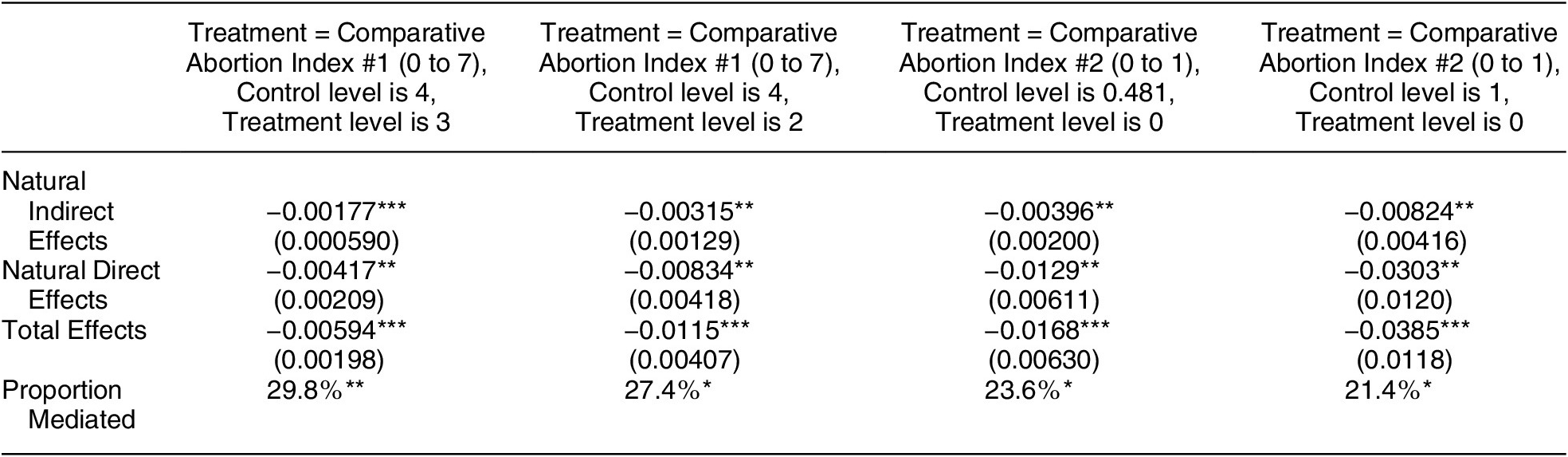
We also use a more formal causal mediation model with a continuous treatment (the CAI #1 or CAI #2 index), a continuous mediator (social group equality in respect for civil liberties), and a continuous outcome (human rights protection score), accounting for a possible interaction between the treatment and mediator (Imai, Keele, and Tingley Reference Imai, Keele and Tingley2010; Nguyen, Schmid, and Stuart Reference Nguyen, Schmid and Stuart2020). For the “control” level of the treatment, we use the median level of the CAI #1 indicator, 4 out of 7, and the mean level of the CAI #2 indicator, 0.481 out of 1. We also run models where the “control” level of CAI #2 is 1. For the “treatment,” we use a drop in CAI #1 of either one or two points. When using the CAI#2 indicator, we set the “treatment” to a drop to 0. Although exploratory, this approach provides us information about the natural direct and indirect effects of reductions in abortion rights on PIR and allows us to access the proportion of the effect that is mediated through changes in social group equality, as suggested by our theoretical story.
Control Variables
We include several control variables that have been found to be important for PIR performance and could also be correlated with abortion rights (Fariss Reference Fariss2014; Forman-Rabinovici and Sommer Reference Forman-Rabinovici and Sommer2018a; Reference Forman-Rabinovici and Sommer2018b; Hill and Jones Reference Hill and Jones2014; Poe and Tate Reference Poe and Tate1994). First, we include the 21-point regime type indicator from Marshall and Gurr’s (Reference Marshall and Gurr2020) Polity 5 project. A higher value on this indicator means that a country is more of a consolidated democracy while a lower value indicates that the country is more of a consolidated authoritarian regime. A consolidated democracy has been found to better protect human rights and abortion rights (Fariss Reference Fariss2014; Forman-Rabinovici and Sommer Reference Forman-Rabinovici and Sommer2018b; Hill and Jones Reference Hill and Jones2014; Poe and Tate Reference Poe and Tate1994).
Next, we include the natural log of population size and GDP per capita (constant 2010 US dollars) to account for how size and wealth in a country could influence rights protection. We also include dichotomous indicators for whether a civil or international conflict occurred involving the country, using the UCDP/PRIO Armed Conflict Dataset Version 22.1 (Davies, Pettersson, and Öberg Reference Davies, Pettersson and Öberg2022; Gleditsch et al. Reference Gleditsch, Wallensteen, Eriksson, Sollenberg and Strand2002). These variables are often considered the “baseline model” in the study of PIR (Hill and Jones Reference Hill and Jones2014, 674).
We include several indicators that have been found to be important to abortion rights (Forman-Rabinovici and Sommer Reference Forman-Rabinovici and Sommer2018a; Reference Forman-Rabinovici and Sommer2018b) and, in some past research and specifications, to PIR (Hill and Jones Reference Hill and Jones2014; Poe and Tate Reference Poe and Tate1994). First, we include V-Dem’s indicator for the percentage of the lower chamber that is female; a larger proportion of female legislators has been found previously to have a small influence on respect for abortion rights (Forman-Rabinovici and Sommer Reference Forman-Rabinovici and Sommer2018b). Next, we include indicators for the percent of the population that are adherents to Islam or Roman Catholic, respectively (Maoz and Henderson Reference Maoz and Henderson2013).Footnote 4 These two religious traditions have been previously linked to reductions in abortion rights (Forman-Rabinovici and Sommer Reference Forman-Rabinovici and Sommer2018a). Finally, we include a dichotomous indicator for whether the country is post-Soviet (Raciborski Reference Raciborski2008). There is some evidence that leftist and communist regimes have diminished PIR (Poe and Tate Reference Poe and Tate1994), but that Soviet states had unique abortion policies that have ramifications on abortion rights and opinions today (Denisov and Sakevich Reference Denisov, Sakevich and Cocq2023). To account for temporal sequencing, we lag all of our independent and control variables by one year.Footnote 5 Our models are not multicollinear; mean variance inflation factors were below 1.5, with no variable’s variance inflation factor above 2.Footnote 6
EMPIRICAL FINDINGS
Main Results
The dynamic time-series cross-sectional results are provided in Table 1. Column 1 and 2 show results where the key independent variable is abortion rights (CAI #1 and CAI#2) and the dependent variable is the human rights protection score (Fariss Reference Fariss2014). Columns 3 and 4 show similar models where the dependent variable is V-Dem’s measure for social group equality in respect for civil liberties (Coppedge et al. Reference Coppedge, Gerring, Knutsen, Lindberg, Teorell, Altman and Bernhard2022). Columns 5 and 6 show models where the dependent variable is the human rights protection score, again, but now both abortion rights and social group equality are included as key independent variables, consistent with Baron and Kenny’s (Reference Baron and Kenny1986) classic approach to causal mediation. Across the specifications, we find strong evidence that more permissive abortion policies are associated with improved PIR (Hypothesis 1) and better social group equality in respect for civil liberties (Hypothesis 2). Additionally, both abortion rights and social group equality matter for PIR. Our control variables, when significant, are in the expected directions. As we know from previous scholarship, democracies, smaller countries, and countries with more wealth typically have better respect for PIR. Post-Soviet countries have lower PIR on average.
Abortion Rights and Dynamic Changes in PIR and Social Group Equality in Respect for Civil Liberties, 1993 to 2016

Note: Dynamic time-series cross-sectional regression with robust standard errors in parentheses; unit of analysis is the country-year. The results indicate that on average greater respect for abortion rights is associated with better respect for PIR and the civil liberties of social groups in the next year, even when accounting for the pre-existing levels of these rights in each country. Also, social group rights are associated with better PIR in the next year. *** p < 0.01; ** p < 0.05; * p < 0.1.
Figure 5 illustrates various dynamic scenarios using the models from Columns 1–2 of Table 1 (Williams and Whitten Reference Williams and Whitten2012). Remember again that Fariss (Reference Fariss2014) shows that global PIR are generally improving over time. As such, looking over time at Figure 5, Panel A, a “typical” country with the median abortion rights score of 4 on the CAI #1 index in year t is expected to see PIR increase almost 0.18 points on the human rights protection scale in the next eight years (increase from 0.467 to 0.645).Footnote 7 If that typical country were to experience abortion backsliding of just one or two points on the CAI #1 scale, as is common in cases of backsliding, their anticipated gains in human rights protection would drop precipitously over time, gaining 0.136 or 0.093 instead over the same time period. While this numerical shift might seem small, the drop in human rights performance would indicate far more widespread abuses within the country over time. The negative consequences of restrictions on abortion rights are even more striking when we focus on Panel B of Figure 5, which is based on the different scenarios of abortion backsliding using the full CAI #2 scale. Limits to abortion rights have long-term, reinforcing consequences for PIR. In no uncertain terms, everyday people, even those that might not directly care about abortion rights, could find their PIR impacted after new restrictions on abortion are enacted.
Dynamic Simulations of Worsening Abortion Rights on Human Rights Protection Score
Note: The figure shows a dynamic scenario based on the model results from Columns 1–2 of Table 1 (Williams and Whitten Reference Williams and Whitten2012). Panel A shows that a country with the median respect for abortion rights (a score of 4 on the CAI #1 measure) is expected to have a greater increase in respect for PIR over time country with lower respect for abortion rights. Panel B shows similar but more striking findings when we use the CAI #2 measure.

Figure 6 shows similar dynamic scenarios when focusing on what we would consider the mediation stage in the theoretical story, the relationship between abortion rights and social group equality with respect to civil liberties. As shown in Panel A, if CAI #1 is set at the median score of 4, social group equality increases over time. If abortion backsliding were to reduce the score to 3 at the start of the time period, however, the country would have almost no gains in social group equality. The scenario is even more dire if backsliding in time t were to reduce the CAI#1 from 4 to 2. In that case, the general trend is reversed, with social group equality worsening to a greater and greater predicted degree over time. Panel B shows similar dynamics when focusing on changes in the CAI #2. Reducing abortion rights harms social group equality in civil liberties.
Dynamic Simulations of Worsening Abortion Rights on Social Group Equality in Respect for Civil Liberties
Note: The figure shows a dynamic scenario based on the model results from Columns 3–4 of Table 1 (Williams and Whitten Reference Williams and Whitten2012). Panel A shows that a country with the median respect for abortion rights (a score of 4 on the CAI #1 measure) is expected to increase their respect for social group equality in civil liberties over time while countries with lower respect of abortion rights are either supposed to stay relatively constant (the score of 3 on the CAI #1 measure) or diminish their respect for social group equality over time. Panel B shows similar but more striking findings when we use the CAI #2 measure.

Exploring the Causal Process and Extensions
While our approach is not experimental, the causal mediation models presented in Table 2 allow us to explore the process suggested by our theoretical argument. Table 2 shows the natural indirect, direct, and total effects of different “control” and “treatment” scenarios of the CAI #1 and CAI #2 indices. Full model results are presented in the Supplementary Appendix. The full effect of reductions in abortion rights is felt both directly, perhaps through emboldening country leaders or reducing collective action, and indirectly through our suggested mediator, social group equality. These two pathways combine to amplify the total effect reductions in abortion rights have on human rights protection scores. Across the various specifications, around 21–30% of the total effect of abortion rights on PIR is mediated through our suggested causal pathway.
Causal Mediation Models, Outcome Is Human Rights Protection Scores, Mediator Is Social Group Equality in Respect for Civil Liberties, Treatment Is Abortion Rights Backsliding, 1993–2016

Note: Outcome equation includes treatment–mediator interaction, Robust standard errors in parentheses, Full table of results in Supplementary Appendix. 3,413 observations. *** p < 0.01; ** p < 0.05; * p < 0.1.
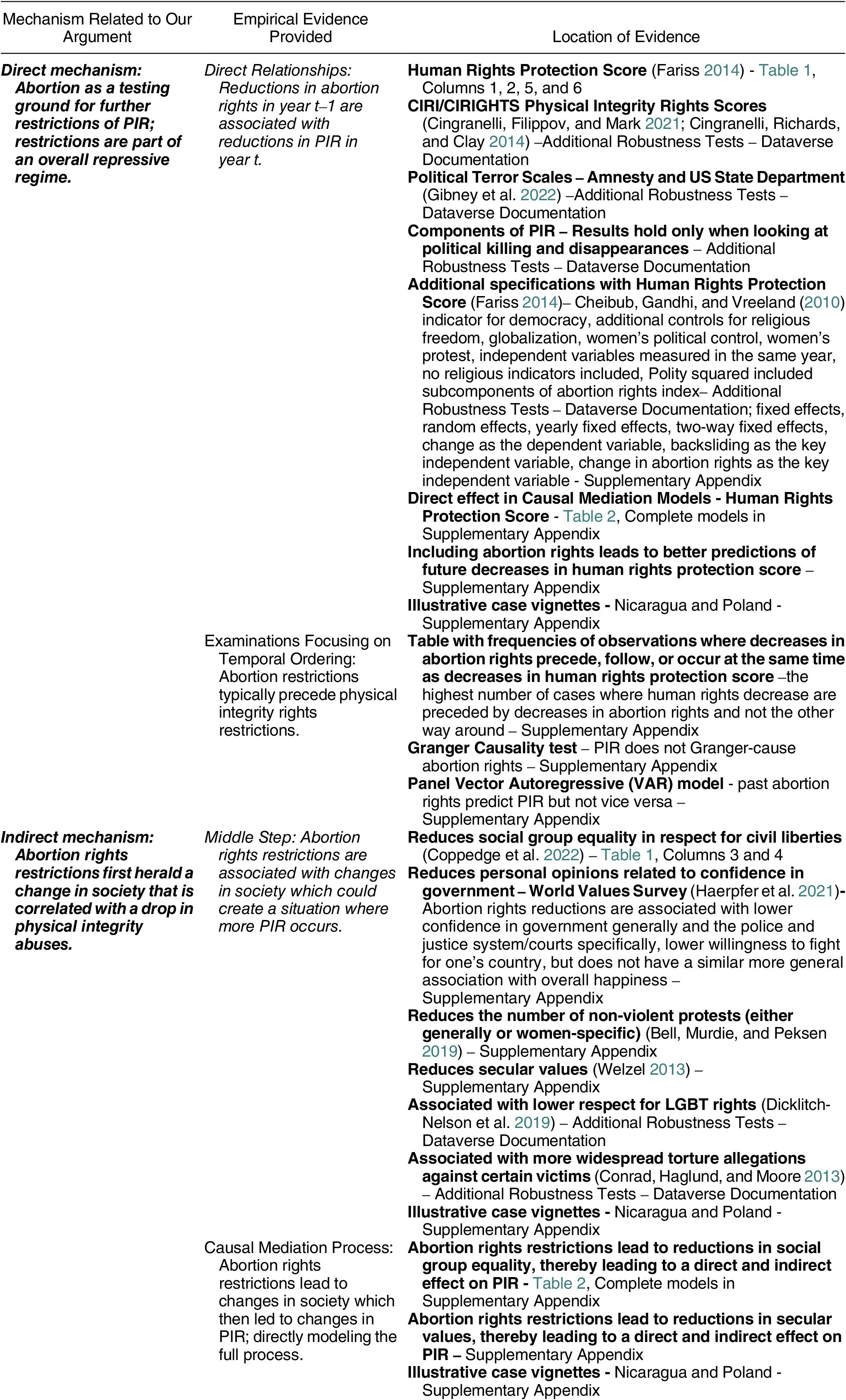
In addition to these empirical results, we have conducted several auxiliary and robustness tests. Table 3 provides an overview of the evidence we have found. First, our key results are consistent across many specifications and alternative measures. Second, we find that abortion rights restrictions are more robustly associated with the PIR subcomponents of political killings and disappearances than with political imprisonments or torture, perhaps indicating that abortion backsliding changes the behavior of both regime principals and agents (Mitchell Reference Mitchell2004). Third, the inclusion of abortion rights in a model of PIR leads to better predictions of future decreases in PIR than a similar model when abortion rights is not included as an independent variable. (O’Brien Reference O’Brien2010). Fourth, we find evidence consistent with our story concerning temporal ordering and the direction of the relationship between abortion rights and PIR.
Overview of Evidence Provided

Finally, we find much auxiliary evidence concerning the indirect mechanism or middle step in our theoretical logic. Abortion rights restrictions limit citizen trust in government (Haerpfer et al. Reference Haerpfer, Inglehart, Moreno, Welzel, Kizilova, Diez-Medrano and Lagos2021) and reduce non-violent protest (Bell, Murdie, and Peksen Reference Bell, Murdie and Peksen2019) in ways that could embolden repressive leaders. Restrictions are associated with lower respect for LGBT rights (Dicklitch-Nelson et al. Reference Dicklitch-Nelson, Buckland, Yost and Draguljić2019) and more widespread torture against certain victims, including dissidents and marginalized groups (Conrad, Haglund, and Moore Reference Conrad, Haglund and Moore2013). We also find evidence that secular values diminish when abortion rights are restricted, and reductions in secular values are associated with worse PIR (Welzel Reference Welzel2013). These findings are not definitive but generally support our theoretical argument. We hope future research can help better dissect the various mechanisms through which restrictions on abortion rights could alter state-society relations in ways that ultimately lead to broader and other human rights abuses.
Our Supplementary Appendix includes two illustrative case vignettes of countries that have suffered abortion limits and concomitant or subsequent erosion of PIR protections. We pair these vignettes with graphs that chart CAI scores, the human rights protection score, and V-Dem’s social equality in civil liberties score. Nicaragua presents a typical case for our theoretical framework, whereby regression on both CAI measures precedes drops in both scores. Poland is a good example of how normative alignment can cement restrictionism and lock restrictive policies in place. A change in electoral fortunes, where a populist leader (Kaczyński) is replaced by a centrist one (Tusk) does not immediately bring liberalization. These cases further buttress our proposed arguments, that abortion rights may be the first domino to fall, or, in other cases, restrictions put in motion other pernicious processes that generate precarious PIR environments.
CONCLUSION
Abortion access retrenchment contributes to a deteriorating environment for PIR, both directly and indirectly. The increased politicization and fractionalization of abortion, as witnessed in the US, Poland, and Brazil, motivated our paper. These trends are not wholly new; rather, leaders borrow from similar scripts and crack down on abortion to assert the nationalist ideal and preserve authentic norms or amass political power (Smyth Reference Smyth2005). Yet, the marriage of convenience between a new brand of populism and abortion politics became ascendant circa 2016 to 2018. While our analysis does not extend beyond 2016, due to the CAI index’s temporal scope, the mounting polemics of abortion rights render our findings more pertinent.
Each of our proposed mechanisms embodies lessons for the policy community. As a testing ground, abortion curbs can be a harbinger for the breakdown of other protections, as restrictions can cascade out to other rights, affect other segments of the populace, and dissuade the citizenry from collective dissent. We have postulated the inherent gendered nature feature of abortion rights to be one of the mechanisms that render them the weak link in a country’s overall human rights regime. However, if our findings are taken to heart by the policy community, this means that the citizenry must be vigilant in guarding abortion rights if they expect to maintain guardrails against the decaying of social group equality and PIR.
We have also stressed that democratic backsliding figures into the story, whereby creeping authoritarianism activates and accentuates the testing ground logic. Our argument is indicative of a backlash, whereby, ironically perhaps, the improvement of global human rights, and specifically PIR and abortion access protections, is met by blowback from repressive governments. Some governments gamble to reassert control over the population and do so by attacking abortion, as a gendered and fraught set of rights, and thus already vulnerable to regression. Alternatively, as well, governments may well react to the process of democratization itself. Perversely, as democratic rights and civil liberties are expanded, reproductive rights may see withering or, at least be swept under the rug, where democratization does not always go hand in hand with liberalization of abortion rights in countries where near or universal bans already exist.
Related, illiberal leaders may instrumentalize abortion politics and use abortion access as a scapegoat. This argument highlights that reproductive rights, in general, are rendered more vulnerable under populist leaders, who can cash in on the polemics to curry favor with specific constituencies (Ziegler Reference Ziegler2022), cast aspersions on foreign actors, and pursue specific agendas. In other words, domestic agendas fuel attacks on abortion rights, in turn, setting in motion processes that create precarious rights situations. While illiberal leaders accrue praise, they may (inadvertently) activate deleterious processes with far-reaching consequences.
We have stressed that abortion limits are indicative of deeper processes, namely, normative reconfiguration, around not just autonomy and agency but also social intolerance and exclusionism. Disquietingly, if normative corrosion drives abortion restrictions, then the same corrosion can give rise to regressive worldviews, guiding hostility, for example, to diversity and equity, migrants’ rights, and indigenous rights. Equally worryingly, the normative realignment we write about may invite dogmatic views, whereby regressive values brook no dissent, lodging them further in the country’s psyche.
A similar concept we have pointed to is that of socialization. Just as views on religion can become entrenched during formative years (Adamczyk, Kim, and Dillon Reference Adamczyk, Kim and Dillon2020), a citizenry socialized in an iron-fisted and unforgiving normative environment will likely perpetuate the illiberal normative environment. Crucially, our findings challenge the notion of a progressive, and uni-directional values-shift, from “pro-fertility norms” (emphasizing traditional gender roles and stigmatizing any sexual behavior not linked with reproduction) to “individual-choice norms” (supporting gender equality and tolerance of nontraditional behavior such as homosexuality) (Inglehart, Ponarin, and Inglehart Reference Inglehart, Ponarin and Inglehart2017, 1314). Clearly, these norms are not as cemented as would seem based on this wisdom. Just as there may be a tipping point where progressive values are held to be socially dominant, with intergenerational shift (Inglehart, Ponarin, and Inglehart Reference Inglehart, Ponarin and Inglehart2017), there can be a reverse tipping point, with enduring regression from individualistic to traditional mores, with pernicious consequences for nonconformist lifestyles.
Our study suggests several fruitful avenues for research. First, we have discussed abortion rights as one component of women’s rights. As such, a direct follow up study would examine how other forms of women’s rights, such as access to contraception, post-partum care, in-vitro fertilization (IVF) treatments, and family planning, influence PIR. Certainly, while reproductive rights are important to women’s life experiences (Htun and Weldon Reference Htun and Weldon2012), women’s rights are complex, and it would be foolhardy to expect identical mechanisms to be at play when we broaden the focus to other types of rights.
Second, we have drawn a direct empirical link between abortion rights and PIR, which form one component of a state’s human rights environment. Another promising avenue would be to analyze how abortion rights relate to women’s physical security, encompassing protections from sexual violence as well as women’s daily experiences navigating society, a concept that has gained traction in recent work (Cohen and Karim Reference Cohen and Karim2022; Karim and Hill Reference Karim and Daniel2018). This perspective would take a more granular approach, and probe how societies that guarantee reproductive freedom protect women from possible sexual violence, within the domestic sphere, and in the microcosms in which women operate.
Finally, our empirical models demonstrate several intermediary mechanisms that link abortion curbs to regression on PIR. Possibly, there are other cognate mechanisms. For example, our supplementary results show a decline in secularism. Extrapolating this further, the rise of dogmatic views, exclusionism, and societal intolerance may be other plausible links. Thus, one avenue forward would be to probe alternative causal links. Another path would be to build on our supplementary models, for example, showing targeted regression of gay rights or targeted torture, and pursue a causal identification approach to pinpoint the conditions under which these mechanisms come into play.
At the same time, our paper also provides some cause for optimism. Take the case of the Philippines, for example, where, prior to his election, President Marcos Jr. called for the legalization of abortion in certain situations (Garcia Reference Garcia2022; Manabat Reference Manabat2022; see also CRR 2023). Given our findings that countries that maintain access to or liberalize abortion rights see improvements in physical integrity protections, these changes, if enacted, may herald greater protections related to physical integrity.
We invite future studies to take on the challenges of broadening this promising research agenda, taking abortion access seriously as a public policy that shapes human rights regimes in multifaceted ways.
SUPPLEMENTARY MATERIAL
To view supplementary material for this article, please visit http://doi.org/10.1017/S0003055424000960.
DATA AVAILABILITY STATEMENT
Research documentation and data that support the findings of this study are openly available at the American Political Science Review Dataverse: https://doi.org/10.7910/DVN/BS3DF7.
ACKNOWLEDGMENTS
The authors would like to thank Avery Murdie, the participants of panels at ISA and SERN, and the many helpful reviewers and editors of APSR.
CONFLICT OF INTEREST
The authors declare no ethical issues or conflicts of interest in this research.
ETHICAL STANDARDS
The authors affirm that this research did not involve human participants.




 Open access


Comments
No Comments have been published for this article.