In recent years the sustainable use of wildlife has become a mainstream conservation strategy (Webb, Reference Webb2002). For many people the use of wild living resources remains essential for their livelihoods, and therefore use that is biologically sustainable and with the potential to provide incentives for conservation seems a clear goal for which to strive (Hutton & Leader-Williams, Reference Hutton and Leader-Williams2003). Sustainable use is exemplified in Papua New Guinea by the ranching and trading of butterflies and other insects to international collectors. Butterfly collectors are prevalent worldwide and the value of the global insect trade is high. Melisch (Reference Melisch2000) gives an example of a pair of birdwing butterflies Ornithoptera meridionalis selling in Germany for USD 3,400, and worldwide retail sales of butterflies may be as high as USD 100 million per annum (Parsons, Reference Parsons1992, in Slone et al., Reference Slone, Orsak and Malver1997). As most insect collectors live in Europe, Japan or the USA it is hard for them to collect tropical insects personally and therefore many middlemen have established themselves in the trade.
When Papua New Guinea gained independence in 1975 policy makers recognized that there was a need for a flexible conservation strategy in a country with a mostly rural population and a subsistence economy dependent on forest resources (Pyle & Hughes, Reference Pyle and Hughes1978). One approach to this is to set up self-sustaining wildlife breeding farms for certain wildlife species (Liam et al., Reference Liam, Kwapena and Raga1976) and sustainable use initiatives were envisioned for a range of wildlife including crocodiles, cassowaries and butterflies. The late 1970s saw an increasing international demand for Papua New Guinean insects, and the Division of Wildlife became concerned about the sustainability, equity and legality of insect ranching and collecting. Insect ranchers harvest CITES listed butterfly pupa from habitats enriched with host vines, and insect collectors collect non-CITES listed butterflies and other insects from the wild. The Division of Wildlife’s concerns and its sustainable use policy combined in 1978 in the establishment of the Insect Farming and Trading Agency (IFTA). IFTA was set up in Morobe province and is still operational there. Its founding purpose is to facilitate the link between overseas buyers and indigenous ranchers, ensure fixed and reasonable prices are paid to ranchers, and offer research, training and quality control (Mercer & Clark, Reference Mercer, Clark, Bourke and Kesavan1989).
The butterfly ranching that was refined by IFTA involved the planting of larval food plants (typically Aristolochia and Adenia vines) within village gardens or in secondary forest. It was anticipated that butterflies would lay eggs on species-specific vines and that subsequently larvae would use the vine as a food source until they began to pupate. The resultant pupae could then be sold to IFTA. In theory this system requires low financial input, and wild stocks of butterflies should not be depleted as long as the rancher only removes 50% of the pupae. However, as it is difficult for a butterfly rancher to know how many pupae are present, and thus how many he should collect, it is impossible to ensure that wild stocks are not depleted. Parsons (Reference Parsons1998) noted that ’this is a very inexact approach to conservation’.
The Agency has been widely mooted as a success story. Comments have included: ‘Insect [ranching] has proven to be a sound, economically viable rural industry in PNG’ (Wambi, Reference Wambi1996), ‘In Papua New Guinea, butterfly [ranchers] make as much as 60 times that nation’s per capita income’ (Hanscom, Reference Hanscom1993), and ‘[IFTA is] a near perfect model of a sustainable development initiative for local people’ (Burrows, Reference Burrows2003). However, despite these comments, there has been no analysis of the benefits that IFTA is supposed to have given to insect ranchers and collectors, or of the link between its work and conservation.
Since the establishment of IFTA annual records have been kept of all the Agency’s purchases of insects from collectors and ranchers. These records detail each seller’s name and location, the date, and the amount paid. I examined records from 1995 to 2002 to analyse the scale, longevity and earnings from the insect trade in Papua New Guinea. This period was chosen to provide a continuous time series for analysis and because (in mid 2004) the records for 2003 were incomplete as IFTA had not fulfilled all its payments for that year. For logistical reasons it was not feasible to examine records earlier than 1995. The purchasing records also include income earned from non-CITES II specimens that were wild-caught.
In the 8-year period individuals in 19 of Papua New Guinea’s 20 provinces earned some income from insect ranching or collecting. In total there were 11,688 purchases from 4,691 ranchers or collectors. The total expenditure by IFTA was USD 340,577. The average income per rancher or collector over this period was USD 72.60 per annum. There has not been a significant decline in the number of villages taking part in this activity, with 126 villages in 1995, 130 villages in 1998, and 123 villages in 2001. However, there was a sharp decline in the number of provinces that have been supplying insects to IFTA, from 19 provinces in 1995 to only nine provinces 8 years later. Overall there has been a decrease in payments. Income levels were highest in Morobe province, IFTA’s immediate catchment area, but even there annual income levels began to decline significantly between 2000 and 2002, more than halving from USD 21,619 to 10,652.
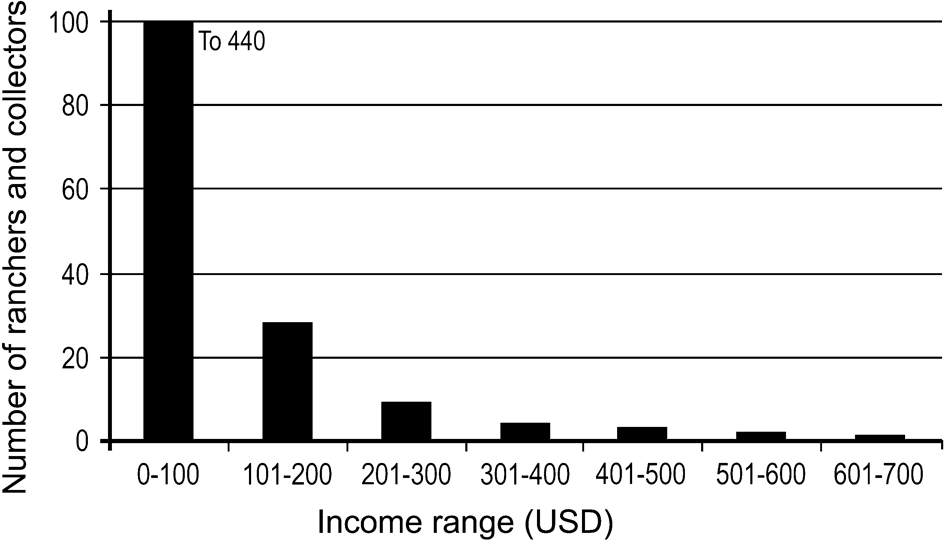
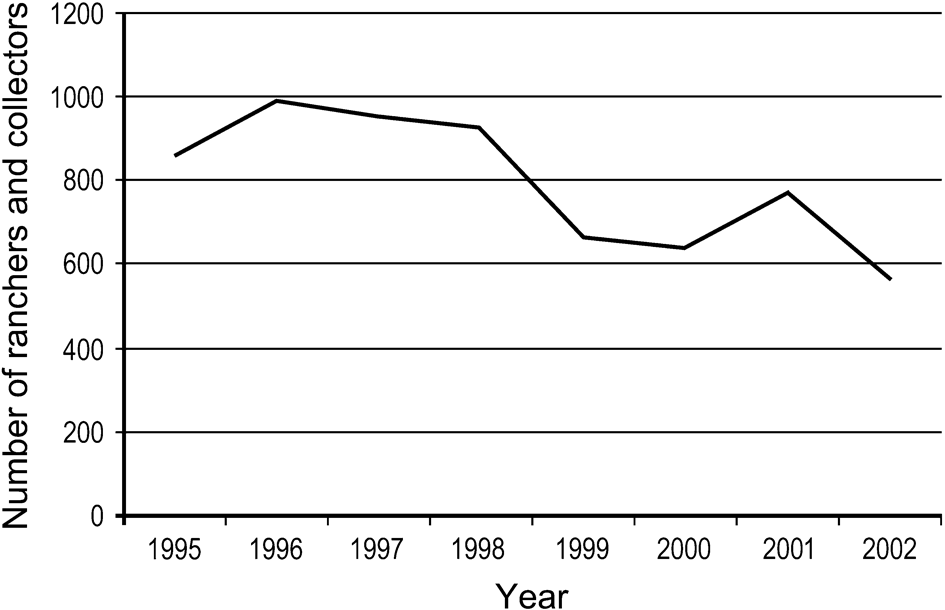
Provincial income levels were highly variable. Twelve of the provinces had incomes that averaged below USD 500 per annum during the 8 years. Six of the provinces had average earnings of USD 500–5,000. Only Morobe province had an annual income that was always above USD 5,000, averaging USD 29,210 per annum. The wide range of incomes achieved through this activity per insect rancher/collector is shown in Fig. 1 for 2002. The range for 2002 was USD 0–619.8, with a mean income of USD 42.5. Fig. 2 shows that there has been an almost continual decline in the number of individuals working as insect ranchers or collectors. Out of the total of 4,691 ranchers who sold insects to IFTA from 1999 to 2002, only 14 did so throughout the 8-year period.
The income range of insect rancher and collector incomes in 2002 for the whole of Papua New Guinea.
The number of individuals ranching and collecting insects between 1995 and 2002.
Ranching and collecting of insects occurred in all but one of Papua New Guinea’s provinces between 1995 and 2002. However, the locations of insect ranchers and collectors are clustered in most provinces. These clusters occurred in the locations where training by IFTA staff has been conducted. This suggests that ranchers and collectors have an informal support network that allows the sharing of skills and techniques, thus sustaining an interest in this income-generating activity. From their addresses it is clear that most ranchers and collectors live close to main roads. Originally it was hoped that collectors and ranchers would also be able to operate in rural areas only accessible by air, as insects are a low weight to high value commodity, but this has not proved to be the case.
The longevity of individuals as ranchers or collectors is low, and only one of the 14 people who earned an income every year from 1995 to 2002 lived outside Morobe province. For most people insect ranching and collecting appears to be attractive for a relatively short period of time. This could be due to a number of factors: (1) ranchers and collectors could have begun other income generating activities, such as vanilla farming in the Sepik region in northern Papua New Guinea, which was yielding up to USD 200 per kilo in 2002; (2) ranchers and collectors may not receive sufficient advice or support from IFTA; (3) ranchers and collectors could be selling to the Wau Ecology Institute (an NGO that began buying insects in 1996) or to illegal traders. In addition, postage costs increased sharply from 1995 to 2002, limiting the ability of insect ranchers and collectors to cover the costs of mailing their insects to IFTA.
The contraction in geographic spread of collecting and ranching indicates that IFTA now lacks the capacity to maintain regions that are remote from its office in Morobe province. The only outlying province that did not see an income decline was the North Solomons. This was in part due to the limitation of other income options caused by a secessionist crisis in the province that lasted from 1990 until a peace agreement was signed in 2001. All other remote regions such as Sandaun, New Ireland, New Britain, Gulf, Western and Manus, which have no road link with Morobe, had ceased insect collecting or ranching by 2002.
The implications that insect ranching and collecting has for conservation are not clear. The same species have been provided to IFTA from the same places since the Agency’s inception in 1978 until 2004 (C. Aisi, IFTA Manager, pers. comm., June 2004). This suggests that so far the IFTA project has not damaged the integrity of targeted insect populations. The enormous reproductive capacity of most insects, and the logistical problems of physically removing a large percentage of individuals from a population, means that over-collecting has seldom posed a genuine threat to butterflies (Pyle & Hughes, Reference Pyle and Hughes1978, in Parsons, Reference Parsons1992). However, there are no data to show whether or not ranching and collecting have eroded the integrity of insect populations. Until such data are available there can be no conclusive evidence for the biological sustainability of insect ranching. In reality it is difficult to collect such data as the butterfly ranchers are located in remote areas of Papua New Guinea. Monitoring in these areas is impractical as rural roads often become impassable by vehicle due to floods, landslides and lack of maintenance.
The image of insect ranching as a perfect way of supplementing rural incomes in Papua New Guinea (Burrows, Reference Burrows2003) is unfounded due to shortcomings within the structure and administration of IFTA. A reassessment of insect ranching and collecting is required, especially at the village level. To gain a better overall understanding of the financial and environmental impacts of insect ranching and collecting the Wau Ecology Institute will need to be included in this reassessment. Purchasing data, including species names and quantities, which was previously thought to have been destroyed, has been found recently at IFTA and at the Wau Ecology Institute. I am currently compiling these records. The analysis of these data will facilitate an insight into the collecting and ranching pressure on insect populations over the past decade. Research is also needed into the dynamics of IFTA as an institution. After initial dynamism in the 1970s and 1980s, IFTA appears to have been stagnant, and lacking efficient, consistent management. The under-performance of the organization has manifested itself in its lack of capacity to conduct regular training and inability to pay ranchers and collectors regularly and on time.
The Insect Farming and Trading Agency offers an income earning opportunity for the rural poor of Papua New Guinea but the biological sustainability of this activity has not been demonstrated. However, for researchers and for the Papua New Guinea Department of Environment and Conservation, IFTA also offers a relatively transparent window on the trade of butterflies and other insects. The trade of insects in Papua New Guinea does have a future but currently it appears to be a precarious one.
Acknowledgements
I would like to thank all the staff, past and present, of the Insect Farming and Trading Agency for their support and permission to access purchasing records. This research was funded by the Rufford Small Grants for Nature Conservation and the Royal Geographical Society.