





Introduction
Let G be a simply connected simple algebraic group over an algebraically closed field $\Bbbk $
of characteristic
$\Bbbk $
of characteristic $p>0$
. The category
$p>0$
. The category $\mathrm {Rep}(G)$
of finite-dimensional rational G-modules is a non-semisimple tensor category, and the composition multiplicities and submodule structure of tensor products of simple G-modules are a priori very hard to understand. In this article, we propose to gain a better understanding of tensor products in
$\mathrm {Rep}(G)$
of finite-dimensional rational G-modules is a non-semisimple tensor category, and the composition multiplicities and submodule structure of tensor products of simple G-modules are a priori very hard to understand. In this article, we propose to gain a better understanding of tensor products in $\mathrm {Rep}(G)$
by classifying the pairs of simple modules for which the composition multiplicities or the submodule structure of the tensor product are as elementary as possible. More concretely, we ask when the tensor product of two simple G-modules is multiplicity free (i.e., all composition multiplicities are bounded by
$\mathrm {Rep}(G)$
by classifying the pairs of simple modules for which the composition multiplicities or the submodule structure of the tensor product are as elementary as possible. More concretely, we ask when the tensor product of two simple G-modules is multiplicity free (i.e., all composition multiplicities are bounded by $1$
) or completely reducible (i.e., a direct sum of simple G-modules). These questions are closely related to one another: If the tensor product of two simple G-modules is multiplicity free then it is also completely reducible by [Reference GruberGru21, Lemma 4.12], and the converse is true under additional assumptions (e.g., if all weight spaces of one of the simple G-modules are at most one-dimensional), as we observe in Subsection 3.4. We establish a number of new tools and techniques to decide whether a tensor product of simple G-modules is completely reducible or multiplicity free, and we show that these questions are intimately linked with the alcove geometry which governs the decomposition of
$1$
) or completely reducible (i.e., a direct sum of simple G-modules). These questions are closely related to one another: If the tensor product of two simple G-modules is multiplicity free then it is also completely reducible by [Reference GruberGru21, Lemma 4.12], and the converse is true under additional assumptions (e.g., if all weight spaces of one of the simple G-modules are at most one-dimensional), as we observe in Subsection 3.4. We establish a number of new tools and techniques to decide whether a tensor product of simple G-modules is completely reducible or multiplicity free, and we show that these questions are intimately linked with the alcove geometry which governs the decomposition of $\mathrm {Rep}(G)$
into blocks. Using these tools, we achieve a complete classification of all pairs of simple G-modules whose tensor product is completely reducible or multiplicity free, for the groups
$\mathrm {Rep}(G)$
into blocks. Using these tools, we achieve a complete classification of all pairs of simple G-modules whose tensor product is completely reducible or multiplicity free, for the groups $G=\mathrm {SL}_3(\Bbbk )$
and
$G=\mathrm {SL}_3(\Bbbk )$
and $G = \mathrm {Sp}_4(\Bbbk )$
. In order to formulate our results more precisely, we next introduce some more notation.
$G = \mathrm {Sp}_4(\Bbbk )$
. In order to formulate our results more precisely, we next introduce some more notation.
The group G is equipped with a root system $\Phi $
, and the isomorphism classes of simple G-modules in
$\Phi $
, and the isomorphism classes of simple G-modules in $\mathrm {Rep}(G)$
are parametrized by the set
$\mathrm {Rep}(G)$
are parametrized by the set $X^+$
of dominant weights in the weight lattice X of
$X^+$
of dominant weights in the weight lattice X of $\Phi $
, with respect to a fixed choice of simple roots
$\Phi $
, with respect to a fixed choice of simple roots $\Pi \subseteq \Phi $
. The unique (up to isomorphism) simple G-module of highest weight
$\Pi \subseteq \Phi $
. The unique (up to isomorphism) simple G-module of highest weight $\lambda \in X^+$
is denoted by
$\lambda \in X^+$
is denoted by $L(\lambda )$
. We write
$L(\lambda )$
. We write $W_{\mathrm {fin}}$
for the Weyl group of
$W_{\mathrm {fin}}$
for the Weyl group of $\Phi $
and
$\Phi $
and $W_{\mathrm {aff}} = W_{\mathrm {fin}} \rtimes \mathbb {Z}\Phi $
for the affine Weyl group. Both
$W_{\mathrm {aff}} = W_{\mathrm {fin}} \rtimes \mathbb {Z}\Phi $
for the affine Weyl group. Both $W_{\mathrm {fin}}$
and
$W_{\mathrm {fin}}$
and $W_{\mathrm {aff}}$
are Coxeter groups, with simple reflections
$W_{\mathrm {aff}}$
are Coxeter groups, with simple reflections $S_{\mathrm {fin}}$
and
$S_{\mathrm {fin}}$
and $S_{\mathrm {aff}} = S_{\mathrm {fin}} \sqcup \{ s_0 \}$
, respectively, where
$S_{\mathrm {aff}} = S_{\mathrm {fin}} \sqcup \{ s_0 \}$
, respectively, where $s_0$
denotes the affine simple reflection (see Subsection 1.3 for more details). Furthermore,
$s_0$
denotes the affine simple reflection (see Subsection 1.3 for more details). Furthermore, $W_{\mathrm {aff}}$
acts on X via the so-called (p-dilated) dot action
$W_{\mathrm {aff}}$
acts on X via the so-called (p-dilated) dot action $(x,\lambda ) \mapsto x \boldsymbol {\cdot } \lambda $
, and two simple G-modules
$(x,\lambda ) \mapsto x \boldsymbol {\cdot } \lambda $
, and two simple G-modules $L(\lambda )$
and
$L(\lambda )$
and $L(\mu )$
belong to the same block of
$L(\mu )$
belong to the same block of $\mathrm {Rep}(G)$
only if their highest weights
$\mathrm {Rep}(G)$
only if their highest weights $\lambda $
and
$\lambda $
and $\mu $
belong to the same
$\mu $
belong to the same $W_{\mathrm {aff}}$
-orbit.
$W_{\mathrm {aff}}$
-orbit.
The fixed points of a reflection in $s \in W_{\mathrm {aff}}$
under the dot action form an affine hyperplane
$s \in W_{\mathrm {aff}}$
under the dot action form an affine hyperplane $H_s$
in the Euclidean space
$H_s$
in the Euclidean space $X_{\mathbb {R}} = X \otimes _{\mathbb {Z}} \mathbb {R}$
, and the connected components of
$X_{\mathbb {R}} = X \otimes _{\mathbb {Z}} \mathbb {R}$
, and the connected components of $X_{\mathbb {R}} \setminus \bigcup _s H_s$
are called alcoves. The closure of any alcove is a fundamental domain for the dot action of
$X_{\mathbb {R}} \setminus \bigcup _s H_s$
are called alcoves. The closure of any alcove is a fundamental domain for the dot action of $W_{\mathrm {aff}}$
on
$W_{\mathrm {aff}}$
on $X_{\mathbb {R}}$
, and every point
$X_{\mathbb {R}}$
, and every point $x \in X_{\mathbb {R}}$
belongs to the ‘upper closure’ of a unique alcove. We say that a reflection hyperplane
$x \in X_{\mathbb {R}}$
belongs to the ‘upper closure’ of a unique alcove. We say that a reflection hyperplane $H = H_s$
is a wall of an alcove
$H = H_s$
is a wall of an alcove $C \subseteq X_{\mathbb {R}}$
if H is the unique reflection hyperplane separating the alcoves C and
$C \subseteq X_{\mathbb {R}}$
if H is the unique reflection hyperplane separating the alcoves C and $s \boldsymbol {\cdot } C$
. With these conventions in place, we can define our key alcove geometric criterion for the complete reducibility of tensor products.
$s \boldsymbol {\cdot } C$
. With these conventions in place, we can define our key alcove geometric criterion for the complete reducibility of tensor products.
Definition. Let $\lambda , \mu \in X^+$
and let
$\lambda , \mu \in X^+$
and let $C \subseteq X_{\mathbb {R}}$
be the unique alcove whose upper closure contains
$C \subseteq X_{\mathbb {R}}$
be the unique alcove whose upper closure contains $\lambda $
. We call
$\lambda $
. We call $\mu $
reflection small with respect to
$\mu $
reflection small with respect to $\lambda $
if, for every reflection
$\lambda $
if, for every reflection $s \in W_{\mathrm {aff}}$
such that
$s \in W_{\mathrm {aff}}$
such that $H_s$
is a wall of C and
$H_s$
is a wall of C and $\lambda \leq s \boldsymbol {\cdot } \lambda $
, we have
$\lambda \leq s \boldsymbol {\cdot } \lambda $
, we have $\lambda +w(\mu ) \leq s\boldsymbol {\cdot }(\lambda + w(\mu ))$
for all
$\lambda +w(\mu ) \leq s\boldsymbol {\cdot }(\lambda + w(\mu ))$
for all $w \in W_{\mathrm {fin}}$
.
$w \in W_{\mathrm {fin}}$
.
This seemingly technical condition is in fact easy to verify in any given example: One only needs to check that all weights of the form $\lambda + w(\mu )$
lie below certain reflection hyperplanes determined by
$\lambda + w(\mu )$
lie below certain reflection hyperplanes determined by $\lambda $
, and this amounts to a simple system of linear inequalities (see Examples 4.1 and 5.1). Our motivation for introducing the notion of reflection small weights is the following result; see Theorem 2.14 below.
$\lambda $
, and this amounts to a simple system of linear inequalities (see Examples 4.1 and 5.1). Our motivation for introducing the notion of reflection small weights is the following result; see Theorem 2.14 below.
Theorem A. Let $\lambda ,\mu \in X^+$
such that
$\lambda ,\mu \in X^+$
such that $\mu $
is reflection small with respect to
$\mu $
is reflection small with respect to $\lambda $
. Then
$\lambda $
. Then $L(\lambda ) \otimes L(\mu )$
is completely reducible.
$L(\lambda ) \otimes L(\mu )$
is completely reducible.
If $\mu \in X^+$
is reflection small with respect to
$\mu \in X^+$
is reflection small with respect to $\lambda \in X^+$
, we further show in Theorem 2.14 that all composition factors of
$\lambda \in X^+$
, we further show in Theorem 2.14 that all composition factors of $L(\lambda ) \otimes L(\mu )$
have highest weights in the upper closure of the unique alcove whose upper closure contains
$L(\lambda ) \otimes L(\mu )$
have highest weights in the upper closure of the unique alcove whose upper closure contains $\lambda $
, and we give explicit formulas for the composition multiplicities of the simple G-modules with highest weight in the upper closure of this alcove, in terms of dimensions of weight spaces in
$\lambda $
, and we give explicit formulas for the composition multiplicities of the simple G-modules with highest weight in the upper closure of this alcove, in terms of dimensions of weight spaces in $L(\mu )$
. These formulas are a useful tool for determining the pairs of simple G-modules whose tensor product is multiplicity free, among the pairs of simple G-modules whose tensor product is completely reducible.
$L(\mu )$
. These formulas are a useful tool for determining the pairs of simple G-modules whose tensor product is multiplicity free, among the pairs of simple G-modules whose tensor product is completely reducible.
Another key component of our strategy for studying complete reducibility and multiplicity freeness of tensor products is a reduction to pairs of simple modules with p-restricted highest weights, based on results from [Reference GruberGru21]. A weight $\lambda \in X^+$
is called p-restricted if
$\lambda \in X^+$
is called p-restricted if $(\lambda ,\alpha ^\vee ) < p$
for all simple roots
$(\lambda ,\alpha ^\vee ) < p$
for all simple roots $\alpha \in \Pi $
, and we write
$\alpha \in \Pi $
, and we write $X_1 \subseteq X^+$
for the set of p-restricted weights. Every weight
$X_1 \subseteq X^+$
for the set of p-restricted weights. Every weight $\mu \in X^+$
admits an expansion
$\mu \in X^+$
admits an expansion $\mu = \mu _0 + p \mu _1 + \cdots + p^m \mu _m$
with
$\mu = \mu _0 + p \mu _1 + \cdots + p^m \mu _m$
with $\mu _i \in X_1$
for
$\mu _i \in X_1$
for $i = 0 , \ldots , m$
, and Steinberg’s tensor product theorem gives a tensor product decomposition
$i = 0 , \ldots , m$
, and Steinberg’s tensor product theorem gives a tensor product decomposition
 $$\begin{align*}L(\mu) \cong L(\mu_0)^{[0]} \otimes L(\mu_1)^{[1]} \otimes \cdots \otimes L(\mu_m)^{[m]} , \end{align*}$$
where $M \mapsto M^{[r]}$
denotes the r-th Frobenius twist functor on
$M \mapsto M^{[r]}$
denotes the r-th Frobenius twist functor on $\mathrm {Rep}(G)$
. Now for weights
$\mathrm {Rep}(G)$
. Now for weights $\lambda ,\mu \in X^+$
with expansions
$\lambda ,\mu \in X^+$
with expansions $\lambda = \lambda _0 + \cdots + p^m \lambda _m$
and
$\lambda = \lambda _0 + \cdots + p^m \lambda _m$
and $\mu = \mu _0 + \cdots + p^m \mu _m$
such that
$\mu = \mu _0 + \cdots + p^m \mu _m$
such that $\lambda _i,\mu _i \in X_1$
for
$\lambda _i,\mu _i \in X_1$
for $i = 0 , \ldots , m$
, it is shown in [Reference GruberGru21, Theorem C] that the tensor product
$i = 0 , \ldots , m$
, it is shown in [Reference GruberGru21, Theorem C] that the tensor product $L(\lambda ) \otimes L(\mu )$
is completely reducible if and only if the tensor products
$L(\lambda ) \otimes L(\mu )$
is completely reducible if and only if the tensor products $L(\lambda _i) \otimes L(\mu _i)$
are completely reducible for
$L(\lambda _i) \otimes L(\mu _i)$
are completely reducible for $i = 0 , \ldots , m$
. Using this result, and the fact that multiplicity freeness implies complete reducibility, we show in Subsection 3.1 that an analogous reduction result holds for multiplicity freeness: The tensor product
$i = 0 , \ldots , m$
. Using this result, and the fact that multiplicity freeness implies complete reducibility, we show in Subsection 3.1 that an analogous reduction result holds for multiplicity freeness: The tensor product $L(\lambda ) \otimes L(\mu )$
is multiplicity free if and only if
$L(\lambda ) \otimes L(\mu )$
is multiplicity free if and only if $L(\lambda _i) \otimes L(\mu _i)$
is multiplicity free for
$L(\lambda _i) \otimes L(\mu _i)$
is multiplicity free for $i = 0 , \ldots , m$
. Therefore, in order to obtain a complete classification of the pairs of weights
$i = 0 , \ldots , m$
. Therefore, in order to obtain a complete classification of the pairs of weights $\lambda ,\mu \in X^+$
such that
$\lambda ,\mu \in X^+$
such that $L(\lambda ) \otimes L(\mu )$
is completely reducible (or multiplicity free), it suffices to classify the pairs of p-restricted weights
$L(\lambda ) \otimes L(\mu )$
is completely reducible (or multiplicity free), it suffices to classify the pairs of p-restricted weights $\lambda ^\prime ,\mu ^\prime \in X_1$
such that
$\lambda ^\prime ,\mu ^\prime \in X_1$
such that $L(\lambda ^\prime ) \otimes L(\mu ^\prime )$
is completely reducible (or multiplicity free). This is the task that we accomplish for the groups
$L(\lambda ^\prime ) \otimes L(\mu ^\prime )$
is completely reducible (or multiplicity free). This is the task that we accomplish for the groups $G = \mathrm {SL}_3(\Bbbk )$
and
$G = \mathrm {SL}_3(\Bbbk )$
and $G = \mathrm {Sp}_4(\Bbbk )$
.
$G = \mathrm {Sp}_4(\Bbbk )$
.
To conclude the introduction, we state our classification results for the group $G = \mathrm {SL}_3(\Bbbk )$
. (The results for
$G = \mathrm {SL}_3(\Bbbk )$
. (The results for $G = \mathrm {Sp}_4(\Bbbk )$
are stated in Theorems 5.4 and 5.6.) The weight lattice X of
$G = \mathrm {Sp}_4(\Bbbk )$
are stated in Theorems 5.4 and 5.6.) The weight lattice X of $G = \mathrm {SL}_3(\Bbbk )$
is spanned by the fundamental dominant weights
$G = \mathrm {SL}_3(\Bbbk )$
is spanned by the fundamental dominant weights $\varpi _1$
,
$\varpi _1$
, $\varpi _2$
, and every p-restricted weight
$\varpi _2$
, and every p-restricted weight $\lambda \in X_1$
can be written uniquely as
$\lambda \in X_1$
can be written uniquely as $\lambda =a\varpi _1+b\varpi _2$
, with
$\lambda =a\varpi _1+b\varpi _2$
, with $0 \leq a,b < p$
. Furthermore, there are precisely two alcoves
$0 \leq a,b < p$
. Furthermore, there are precisely two alcoves $C_0$
and
$C_0$
and $C_1$
whose upper closure contains p-restricted weights.
$C_1$
whose upper closure contains p-restricted weights.
Theorem B. Let $G = \mathrm {SL}_3(\Bbbk )$
and let
$G = \mathrm {SL}_3(\Bbbk )$
and let $\lambda ,\mu \in X_1$
be p-restricted weights.
$\lambda ,\mu \in X_1$
be p-restricted weights.
-
(1) The tensor product $L(\lambda ) \otimes L(\mu )$
is completely reducible if and only if
$\lambda $
and
$\mu $
satisfy one of the conditions 1–4 or 1*–3* in Table 1, up to interchanging
$\lambda $
and
$\mu $
.
$L(\lambda ) \otimes L(\mu )$
is completely reducible if and only if
$\lambda $
and
$\mu $
satisfy one of the conditions 1–4 or 1*–3* in Table 1, up to interchanging
$\lambda $
and
$\mu $
. -
(2) The tensor product
$L(\lambda ) \otimes L(\mu )$
is multiplicity free if and only if
$\lambda $
and
$\mu $
satisfy one of the conditions 1–3, 1*–3*, or 4a, 4a*, or 4b in Table 1, up to interchanging
$\lambda $
and
$\mu $
.


We observe that in Theorem B, the tensor product $L(\lambda ) \otimes L(\mu )$
is completely reducible if and only if either
$L(\lambda ) \otimes L(\mu )$
is completely reducible if and only if either $L(\lambda ) \otimes L(\mu )$
is multiplicity free or
$L(\lambda ) \otimes L(\mu )$
is multiplicity free or $\mu $
is reflection small with respect to
$\mu $
is reflection small with respect to $\lambda $
, and the same observation can be made in our results for
$\lambda $
, and the same observation can be made in our results for $G = \mathrm {Sp}_4(\Bbbk )$
(see Section 5). This, in our view, underlines both the importance of the reflection smallness condition for the study of complete reducibility of tensor products, and the fact that complete reducibility and multiplicity freeness of tensor products are closely related phenomena.
$G = \mathrm {Sp}_4(\Bbbk )$
(see Section 5). This, in our view, underlines both the importance of the reflection smallness condition for the study of complete reducibility of tensor products, and the fact that complete reducibility and multiplicity freeness of tensor products are closely related phenomena.
Table 1 Weights $\lambda ,\mu \in X_1 \setminus \{ 0 \}$
such that
$\lambda ,\mu \in X_1 \setminus \{ 0 \}$
such that $L(\lambda ) \otimes L(\mu )$
is c.r. or m.f., for
$L(\lambda ) \otimes L(\mu )$
is c.r. or m.f., for $G = \mathrm {SL}_3(\Bbbk )$

The article is organized as follows: Section 1 contains definitions and preliminary results about representations of algebraic groups and the associated alcove geometry. In Section 2, we establish the relation between the reflection smallness condition and complete reducibility of tensor products, and we give the proof of Theorem A (see Theorem 2.14). Section 3 introduces further tools and criteria for deciding whether a tensor product of simple G-modules is completely reducible or multiplicity free. For instance, we prove the results that enable us to reduce these questions to pairs of simple G-modules with p-restricted highest weights (Subsection 3.1), and we establish complete reducibility and multiplicity freeness criteria using the notion of good filtration dimension from [Reference Friedlander and ParshallFP86] (Subsection 3.2) and the tensor ideal of singular G-modules from [Reference GruberGru24] (Subsection 3.3). The two final Sections 4 and 5 are devoted to our classification results for the groups $G = \mathrm {SL}_3(\Bbbk )$
and
$G = \mathrm {SL}_3(\Bbbk )$
and $G = \mathrm {Sp}_4(\Bbbk )$
, respectively. See Theorems 4.2 and 4.3 for the classification of completely reducible and multiplicity free tensor products of simple G-modules for
$G = \mathrm {Sp}_4(\Bbbk )$
, respectively. See Theorems 4.2 and 4.3 for the classification of completely reducible and multiplicity free tensor products of simple G-modules for $G = \mathrm {SL}_3(\Bbbk )$
(as stated in Theorem B), and Theorems 5.4 and 5.6 for the analogous results for
$G = \mathrm {SL}_3(\Bbbk )$
(as stated in Theorem B), and Theorems 5.4 and 5.6 for the analogous results for $G = \mathrm {Sp}_4(\Bbbk )$
.
$G = \mathrm {Sp}_4(\Bbbk )$
.
1 Preliminaries
1.1 Roots and weights
Let $\Phi $
be a simple root system in a Euclidean space
$\Phi $
be a simple root system in a Euclidean space $X_{\mathbb {R}}$
with scalar product
$X_{\mathbb {R}}$
with scalar product $(-\,,-)$
. Let
$(-\,,-)$
. Let $\Phi ^+ \subseteq \Phi $
be a positive system, corresponding to a base
$\Phi ^+ \subseteq \Phi $
be a positive system, corresponding to a base $\Pi = \{ \alpha _1, \ldots ,\alpha _n \}$
of
$\Pi = \{ \alpha _1, \ldots ,\alpha _n \}$
of $\Phi $
, and write
$\Phi $
, and write $\alpha _{\mathrm {hs}}$
and
$\alpha _{\mathrm {hs}}$
and $\alpha _{\mathrm {h}}$
for the highest short root and the highest root in
$\alpha _{\mathrm {h}}$
for the highest short root and the highest root in $\Phi $
, respectively (with the convention that
$\Phi $
, respectively (with the convention that $\alpha _{\mathrm {hs}} = \alpha _{\mathrm {h}}$
if
$\alpha _{\mathrm {hs}} = \alpha _{\mathrm {h}}$
if $\Phi $
is simply laced). For
$\Phi $
is simply laced). For $\alpha \in \Phi $
, let
$\alpha \in \Phi $
, let $\alpha ^\vee = 2\alpha /(\alpha ,\alpha )$
be the coroot of
$\alpha ^\vee = 2\alpha /(\alpha ,\alpha )$
be the coroot of $\alpha $
, and let
$\alpha $
, and let $s_\alpha $
be the reflection corresponding to
$s_\alpha $
be the reflection corresponding to $\alpha $
, with
$\alpha $
, with $s_\alpha (x) = x - (x,\alpha ^\vee ) \cdot \alpha $
for
$s_\alpha (x) = x - (x,\alpha ^\vee ) \cdot \alpha $
for $x \in X_{\mathbb {R}}$
. We write
$x \in X_{\mathbb {R}}$
. We write
 $$\begin{align*}X = \{ \lambda \in X_{\mathbb{R}} \mid (\lambda,\alpha^\vee) \in \mathbb{Z} \text{ for all } \alpha \in \Phi \} \end{align*}$$
for the weight lattice and $W_{\mathrm {fin}} = \langle s_\alpha \mid \alpha \in \Phi \rangle $
for the (finite) Weyl group of
$W_{\mathrm {fin}} = \langle s_\alpha \mid \alpha \in \Phi \rangle $
for the (finite) Weyl group of $\Phi $
, with simple reflections
$\Phi $
, with simple reflections $S_{\mathrm {fin}} = \{ s_\alpha \mid \alpha \in \Pi \}$
and length function
$S_{\mathrm {fin}} = \{ s_\alpha \mid \alpha \in \Pi \}$
and length function $\ell \colon W_{\mathrm {fin}} \to \mathbb {Z}_{\geq 0}$
. Furthermore, we write
$\ell \colon W_{\mathrm {fin}} \to \mathbb {Z}_{\geq 0}$
. Furthermore, we write $\rho = \frac 12 \cdot \sum _{\alpha \in \Phi ^+} \alpha $
and denote by
$\rho = \frac 12 \cdot \sum _{\alpha \in \Phi ^+} \alpha $
and denote by $h = (\rho ,\alpha _{\mathrm {hs}}^\vee )+1$
the Coxeter number of
$h = (\rho ,\alpha _{\mathrm {hs}}^\vee )+1$
the Coxeter number of $\Phi $
. The set of dominant weights is
$\Phi $
. The set of dominant weights is
 $$\begin{align*}X^+ = \{ \lambda \in X \mid (\lambda,\alpha^\vee) \geq 0 \text{ for all } \alpha \in \Phi^+ \} , \end{align*}$$
and the fundamental dominant weights $\{ \varpi _1 , \ldots , \varpi _n \}$
are defined by
$\{ \varpi _1 , \ldots , \varpi _n \}$
are defined by $(\varpi _i,\alpha _j^\vee ) = \delta _{ij}$
for
$(\varpi _i,\alpha _j^\vee ) = \delta _{ij}$
for $1 \leq i,j \leq n$
. We consider the partial order
$1 \leq i,j \leq n$
. We consider the partial order $\leq $
on X such that
$\leq $
on X such that $\lambda \leq \mu $
if and only if
$\lambda \leq \mu $
if and only if $\mu - \lambda \in \sum _{\alpha \in \Pi } \mathbb {Z}_{\geq 0} \cdot \alpha $
.
$\mu - \lambda \in \sum _{\alpha \in \Pi } \mathbb {Z}_{\geq 0} \cdot \alpha $
.
1.2 Representations and characters
Let $\Bbbk $
be an algebraically closed field of characteristic
$\Bbbk $
be an algebraically closed field of characteristic $p>0$
and let G be the unique (up to isomorphism) simply connected simple algebraic group over
$p>0$
and let G be the unique (up to isomorphism) simply connected simple algebraic group over $\Bbbk $
with root system
$\Bbbk $
with root system $\Phi $
. We identify X with the character lattice of a fixed maximal torus of G and write
$\Phi $
. We identify X with the character lattice of a fixed maximal torus of G and write $\mathrm {Rep}(G)$
for the category of finite-dimensional rational G-modules. In the following, we will simply refer to the objects of
$\mathrm {Rep}(G)$
for the category of finite-dimensional rational G-modules. In the following, we will simply refer to the objects of $\mathrm {Rep}(G)$
as G-modules (omitting the mention of rationality and finite-dimensionality).
$\mathrm {Rep}(G)$
as G-modules (omitting the mention of rationality and finite-dimensionality).
Every G-module M admits a weight space decomposition $M = \bigoplus _{\mu \in X} M_\mu $
, and the character of M is defined as
$M = \bigoplus _{\mu \in X} M_\mu $
, and the character of M is defined as $\operatorname {\mathrm {ch}} M = \sum _\mu \dim M_\mu \cdot e^\mu \in \mathbb {Z}[X]$
. The simple G-modules are determined up to isomorphism by their highest weight in
$\operatorname {\mathrm {ch}} M = \sum _\mu \dim M_\mu \cdot e^\mu \in \mathbb {Z}[X]$
. The simple G-modules are determined up to isomorphism by their highest weight in $X^+$
, and we write
$X^+$
, and we write $L(\lambda )$
for the simple G-module of highest weight
$L(\lambda )$
for the simple G-module of highest weight $\lambda $
. Every G-module M has a finite composition series, and we write
$\lambda $
. Every G-module M has a finite composition series, and we write $[M:L(\lambda )]$
for the multiplicity of the simple G-module
$[M:L(\lambda )]$
for the multiplicity of the simple G-module $L(\lambda )$
in a composition series of M. We also denote by
$L(\lambda )$
in a composition series of M. We also denote by $\nabla (\lambda )$
and
$\nabla (\lambda )$
and $\Delta (\lambda )$
the induced module and the Weyl module of highest weight
$\Delta (\lambda )$
the induced module and the Weyl module of highest weight $\lambda \in X^+$
(see Subsections II.2.1–2 and II.2.13 in [Reference JantzenJan03]), so that
$\lambda \in X^+$
(see Subsections II.2.1–2 and II.2.13 in [Reference JantzenJan03]), so that $L(\lambda )$
is the unique simple submodule of
$L(\lambda )$
is the unique simple submodule of $\nabla (\lambda )$
and the unique simple quotient of
$\nabla (\lambda )$
and the unique simple quotient of $\Delta (\lambda )$
. Writing
$\Delta (\lambda )$
. Writing $M^*$
for the dual of a G-module M, we have
$M^*$
for the dual of a G-module M, we have $L(\lambda )^* \cong L(-w_0\lambda )$
and
$L(\lambda )^* \cong L(-w_0\lambda )$
and $\nabla (\lambda )^* \cong \Delta (-w_0\lambda )$
for all
$\nabla (\lambda )^* \cong \Delta (-w_0\lambda )$
for all $\lambda \in X^+$
, where
$\lambda \in X^+$
, where $w_0 \in W_{\mathrm {fin}}$
denotes the longest element.
$w_0 \in W_{\mathrm {fin}}$
denotes the longest element.
The characters of both $\nabla (\lambda )$
and
$\nabla (\lambda )$
and $\Delta (\lambda )$
are given by the well-known Weyl character formula, cf. Subsections II.5.10–11 in [Reference JantzenJan03]. We write
$\Delta (\lambda )$
are given by the well-known Weyl character formula, cf. Subsections II.5.10–11 in [Reference JantzenJan03]. We write $\chi (\lambda ) = \operatorname {\mathrm {ch}} \nabla (\lambda ) = \operatorname {\mathrm {ch}} \Delta (\lambda )$
and extend the definition of
$\chi (\lambda ) = \operatorname {\mathrm {ch}} \nabla (\lambda ) = \operatorname {\mathrm {ch}} \Delta (\lambda )$
and extend the definition of $\chi (\lambda )$
to all
$\chi (\lambda )$
to all $\lambda \in X$
(possibly nondominant) by requiring that
$\lambda \in X$
(possibly nondominant) by requiring that $\chi (w \boldsymbol {\cdot } \mu ) = (-1)^{\ell (w)} \cdot \chi (\mu )$
for
$\chi (w \boldsymbol {\cdot } \mu ) = (-1)^{\ell (w)} \cdot \chi (\mu )$
for $\mu \in X$
and
$\mu \in X$
and $w \in W_{\mathrm {fin}}$
, and
$w \in W_{\mathrm {fin}}$
, and $\chi (\mu )=0$
if
$\chi (\mu )=0$
if $(\mu ,\alpha ^\vee ) = -1$
for some
$(\mu ,\alpha ^\vee ) = -1$
for some $\alpha \in \Pi $
. The characters
$\alpha \in \Pi $
. The characters $\chi (\lambda )$
with
$\chi (\lambda )$
with $\lambda \in X^+$
form a basis of the ring
$\lambda \in X^+$
form a basis of the ring $\mathbb {Z}[X]^{W_{\mathrm {fin}}}$
of
$\mathbb {Z}[X]^{W_{\mathrm {fin}}}$
of $W_{\mathrm {fin}}$
-invariants in
$W_{\mathrm {fin}}$
-invariants in $\mathbb {Z}[X]$
, and so do the characters
$\mathbb {Z}[X]$
, and so do the characters $\operatorname {\mathrm {ch}} L(\lambda )$
of the simple G-modules, by Section II.5.8 in [Reference JantzenJan03]. We write
$\operatorname {\mathrm {ch}} L(\lambda )$
of the simple G-modules, by Section II.5.8 in [Reference JantzenJan03]. We write
 $$\begin{align*}\Lambda(\lambda) = \{ \mu \in X \mid \Delta(\lambda)_\mu \neq 0 \} \end{align*}$$
for the set of weights of $\Delta (\lambda )$
and note that
$\Delta (\lambda )$
and note that $\Lambda (\lambda ) = \mathrm {conv}( W_{\mathrm {fin}} \lambda ) \cap ( \lambda + \mathbb {Z}\Phi )$
by [Reference Fulton and HarrisFH91, Theorem 14.18], where
$\Lambda (\lambda ) = \mathrm {conv}( W_{\mathrm {fin}} \lambda ) \cap ( \lambda + \mathbb {Z}\Phi )$
by [Reference Fulton and HarrisFH91, Theorem 14.18], where $\mathrm {conv}(-)$
denotes the convex hull of a subset of
$\mathrm {conv}(-)$
denotes the convex hull of a subset of $X_{\mathbb {R}}$
.
$X_{\mathbb {R}}$
.
A good filtration of a G-module M is a filtration
 $$\begin{align*}0 = M_0 \subseteq \cdots \subseteq M_r = M \end{align*}$$
such that $M_i / M_{i-1} \cong \nabla (\lambda _i)$
for some
$M_i / M_{i-1} \cong \nabla (\lambda _i)$
for some $\lambda _i \in X^+$
for
$\lambda _i \in X^+$
for $i=1,\ldots ,r$
, and a Weyl filtration of a G-module N is a filtration
$i=1,\ldots ,r$
, and a Weyl filtration of a G-module N is a filtration
 $$\begin{align*}0 = N_0 \subseteq \cdots \subseteq N_s = N \end{align*}$$
such that $N_i / N_{i-1} \cong \Delta (\mu _i)$
for some
$N_i / N_{i-1} \cong \Delta (\mu _i)$
for some $\mu _i \in X^+$
for
$\mu _i \in X^+$
for $i=1,\ldots ,s$
. For a G-module M that admits a good filtration (as above), the multiplicity of
$i=1,\ldots ,s$
. For a G-module M that admits a good filtration (as above), the multiplicity of $\nabla (\lambda )$
in any good filtration of M is defined by
$\nabla (\lambda )$
in any good filtration of M is defined by

for all $\lambda \in X^+$
(see Proposition II.4.16 in [Reference JantzenJan03]), and for a G-module N that admits a Weyl filtration, the multiplicity
$\lambda \in X^+$
(see Proposition II.4.16 in [Reference JantzenJan03]), and for a G-module N that admits a Weyl filtration, the multiplicity $[N : \Delta (\lambda )]_\Delta $
of
$[N : \Delta (\lambda )]_\Delta $
of $\Delta (\lambda )$
in a Weyl filtration of N is defined analogously. A G-module M is called a tilting module if it admits both a good filtration and a Weyl filtration. For all
$\Delta (\lambda )$
in a Weyl filtration of N is defined analogously. A G-module M is called a tilting module if it admits both a good filtration and a Weyl filtration. For all $\lambda \in X^+$
, there is a unique indecomposable tilting module
$\lambda \in X^+$
, there is a unique indecomposable tilting module $T(\lambda )$
of highest weight
$T(\lambda )$
of highest weight $\lambda $
, and every tilting module can be written as a finite direct sum of these indecomposable tilting modules [Reference RingelRin91, Reference DonkinDon93]. Furthermore, the class of G-modules admitting a good filtration is closed under tensor products [Reference WangWan82, Reference DonkinDon85, Reference MathieuMat90], and hence so are the class of all G-modules admitting a Weyl filtration and the full subcategory
$\lambda $
, and every tilting module can be written as a finite direct sum of these indecomposable tilting modules [Reference RingelRin91, Reference DonkinDon93]. Furthermore, the class of G-modules admitting a good filtration is closed under tensor products [Reference WangWan82, Reference DonkinDon85, Reference MathieuMat90], and hence so are the class of all G-modules admitting a Weyl filtration and the full subcategory $\mathrm {Tilt}(G)$
of tilting modules in
$\mathrm {Tilt}(G)$
of tilting modules in $\mathrm {Rep}(G)$
.
$\mathrm {Rep}(G)$
.
1.3 Alcove geometry
Let $W_{\mathrm {aff}} = \mathbb {Z}\Phi \rtimes W_{\mathrm {fin}}$
be the affine Weyl group of G. We write
$W_{\mathrm {aff}} = \mathbb {Z}\Phi \rtimes W_{\mathrm {fin}}$
be the affine Weyl group of G. We write $\gamma \mapsto t_\gamma $
for the canonical embedding of
$\gamma \mapsto t_\gamma $
for the canonical embedding of $\mathbb {Z}\Phi $
into
$\mathbb {Z}\Phi $
into $\mathbb {Z}\Phi \rtimes W_{\mathrm {fin}} = W_{\mathrm {aff}}$
. The (p-dilated) dot action of
$\mathbb {Z}\Phi \rtimes W_{\mathrm {fin}} = W_{\mathrm {aff}}$
. The (p-dilated) dot action of $W_{\mathrm {aff}}$
on
$W_{\mathrm {aff}}$
on $X_{\mathbb {R}}$
is defined by
$X_{\mathbb {R}}$
is defined by
 $$\begin{align*}t_\gamma w \boldsymbol{\cdot} x = w( x + \rho ) - \rho + p \gamma \end{align*}$$
for $\gamma \in \mathbb {Z}\Phi $
,
$\gamma \in \mathbb {Z}\Phi $
, $w \in W_{\mathrm {fin}}$
and
$w \in W_{\mathrm {fin}}$
and $x \in X_{\mathbb {R}}$
. In the following, we recall some results about the alcove geometry associated with the dot action of
$x \in X_{\mathbb {R}}$
. In the following, we recall some results about the alcove geometry associated with the dot action of $W_{\mathrm {aff}}$
on
$W_{\mathrm {aff}}$
on $X_{\mathbb {R}}$
; we refer the reader to Subsections II.6.1–5 in [Reference JantzenJan03] for more details and additional references.
$X_{\mathbb {R}}$
; we refer the reader to Subsections II.6.1–5 in [Reference JantzenJan03] for more details and additional references.
The affine Weyl group is generated by the affine reflections $s_{\alpha ,r} = t_{r\alpha } s_\alpha $
, for
$s_{\alpha ,r} = t_{r\alpha } s_\alpha $
, for $\alpha \in \Phi ^+$
and
$\alpha \in \Phi ^+$
and $r \in \mathbb {Z}$
, and the fixed points of
$r \in \mathbb {Z}$
, and the fixed points of $s_{\alpha ,r}$
with respect to the p-dilated dot action form the affine hyperplane
$s_{\alpha ,r}$
with respect to the p-dilated dot action form the affine hyperplane
 $$\begin{align*}H_{\alpha,r} = \{ x \in X_{\mathbb{R}} \mid (x+\rho,\alpha^\vee) = pr \}. \end{align*}$$
The connected components of $X_{\mathbb {R}} \setminus \big ( \bigcup _{\alpha ,r} H_{\alpha ,r} \big )$
are called alcoves, so an alcove is any nonempty set of the form
$X_{\mathbb {R}} \setminus \big ( \bigcup _{\alpha ,r} H_{\alpha ,r} \big )$
are called alcoves, so an alcove is any nonempty set of the form
 $$\begin{align*}C = \{ x \in X_{\mathbb{R}} \mid p n_\alpha < (x+\rho,\alpha^\vee) < p \cdot (n_\alpha + 1) \text{ for all } \alpha \in \Phi^+ \} , \end{align*}$$
for some collection of integers $n_\alpha \in \mathbb {Z}$
with
$n_\alpha \in \mathbb {Z}$
with $\alpha \in \Phi ^+$
. The upper closure of the alcove C is defined by
$\alpha \in \Phi ^+$
. The upper closure of the alcove C is defined by
 $$\begin{align*}\widehat C = \{ x \in X_{\mathbb{R}} \mid p n_\alpha < (x+\rho,\alpha^\vee) \leq p \cdot (n_\alpha + 1) \text{ for all } \alpha \in \Phi^+ \}. \end{align*}$$
For every element $x \in X_{\mathbb {R}}$
, there is a unique alcove C with
$x \in X_{\mathbb {R}}$
, there is a unique alcove C with $x \in \widehat {C}$
. We call
$x \in \widehat {C}$
. We call
 $$ \begin{align*} C_0 & = \{ x \in X_{\mathbb{R}} \mid 0 < (x+\rho,\alpha^\vee) < p \text{ for all } \alpha \in \Phi^+ \} \\ & = \{ x \in X_{\mathbb{R}} \mid 0 < (x+\rho,\alpha^\vee) \text{ for all } \alpha \in \Pi \text{ and } (x+\rho,\alpha_{\mathrm{hs}}^\vee) < p \} \end{align*} $$
the fundamental alcove. The affine Weyl group acts simply transitively on the set of alcoves and the closure of every alcove is a fundamental domain. In particular, $W_{\mathrm {aff}}$
is in bijection with the set of alcoves via
$W_{\mathrm {aff}}$
is in bijection with the set of alcoves via $w \mapsto w \boldsymbol {\cdot } C_0$
. A weight
$w \mapsto w \boldsymbol {\cdot } C_0$
. A weight $\lambda \in X$
is called p-regular if it belongs to an alcove and p-singular if it belongs to one of the reflection hyperplanes
$\lambda \in X$
is called p-regular if it belongs to an alcove and p-singular if it belongs to one of the reflection hyperplanes $H_{\alpha ,r}$
with
$H_{\alpha ,r}$
with $\alpha \in \Phi ^+$
and
$\alpha \in \Phi ^+$
and $r \in \mathbb {Z}$
.
$r \in \mathbb {Z}$
.
The affine Weyl group is a Coxeter group with simple reflections $S_{\mathrm {aff}} = S_{\mathrm {fin}} \sqcup \{ s_0 \}$
, where
$S_{\mathrm {aff}} = S_{\mathrm {fin}} \sqcup \{ s_0 \}$
, where  , and we write $\ell \colon W_{\mathrm {aff}} \to \mathbb {Z}_{\geq 0}$
for the length function. For all
$\ell \colon W_{\mathrm {aff}} \to \mathbb {Z}_{\geq 0}$
for the length function. For all $x \in W_{\mathrm {aff}}$
, the coset
$x \in W_{\mathrm {aff}}$
, the coset $W_{\mathrm {fin}} x$
contains a unique element of minimal length, and we define
$W_{\mathrm {fin}} x$
contains a unique element of minimal length, and we define
 $$\begin{align*}W_{\mathrm{aff}}^+ = \{ x \in W_{\mathrm{aff}} \mid x \text{ has minimal length in } W_{\mathrm{fin}} x \}. \end{align*}$$
If $p \geq h$
then we also have
$p \geq h$
then we also have $W_{\mathrm {aff}}^+ = \{ x \in W_{\mathrm {aff}} \mid x\boldsymbol {\cdot }0 \in X^+ \}$
. An alcove
$W_{\mathrm {aff}}^+ = \{ x \in W_{\mathrm {aff}} \mid x\boldsymbol {\cdot }0 \in X^+ \}$
. An alcove $C = w \boldsymbol {\cdot } C_0$
is called dominant if
$C = w \boldsymbol {\cdot } C_0$
is called dominant if $w \in W_{\mathrm {aff}}^+$
. We say that a reflection hyperplane
$w \in W_{\mathrm {aff}}^+$
. We say that a reflection hyperplane $H = H_{\alpha ,r}$
separates two points
$H = H_{\alpha ,r}$
separates two points $x,y \in X_{\mathbb {R}}$
if either
$x,y \in X_{\mathbb {R}}$
if either
 $$\begin{align*}(x+\rho,\alpha^\vee) < pr < (y+\rho,\alpha^\vee) \qquad \text{or} \qquad (y+\rho,\alpha^\vee) < pr < (x+\rho,\alpha^\vee). \end{align*}$$
Similarly, H separates two alcoves $C , C^\prime \subseteq X_{\mathbb {R}}$
if there exist points
$C , C^\prime \subseteq X_{\mathbb {R}}$
if there exist points $x \in C$
and
$x \in C$
and $y \in C^\prime $
such that H separates x and y. (Equivalently, H separates x and y for all
$y \in C^\prime $
such that H separates x and y. (Equivalently, H separates x and y for all $x \in C$
and
$x \in C$
and $y \in C^\prime $
.) The alcoves C and
$y \in C^\prime $
.) The alcoves C and $C^\prime $
are called adjacent if there is a unique reflection hyperplane
$C^\prime $
are called adjacent if there is a unique reflection hyperplane $H = H_{\alpha ,r}$
separating C and
$H = H_{\alpha ,r}$
separating C and $C^\prime $
, and in that case, we have
$C^\prime $
, and in that case, we have $C^\prime = s_{\alpha ,r} \boldsymbol {\cdot } C$
and
$C^\prime = s_{\alpha ,r} \boldsymbol {\cdot } C$
and $H_{\alpha ,r}$
is called a wall of C and
$H_{\alpha ,r}$
is called a wall of C and $C^\prime $
. For every wall
$C^\prime $
. For every wall $H = H_{\alpha ,r}$
of C, we have either
$H = H_{\alpha ,r}$
of C, we have either $(x+\rho ,\alpha ^\vee ) < pr$
for all
$(x+\rho ,\alpha ^\vee ) < pr$
for all $x \in C$
or
$x \in C$
or $(x+\rho ,\alpha ^\vee )> pr$
for all
$(x+\rho ,\alpha ^\vee )> pr$
for all $x \in C$
, and accordingly, we say that H belongs to the upper closure or to the lower closure of C, respectively. For an alcove
$x \in C$
, and accordingly, we say that H belongs to the upper closure or to the lower closure of C, respectively. For an alcove $C \subseteq X_{\mathbb {R}}$
and a reflection
$C \subseteq X_{\mathbb {R}}$
and a reflection $s = s_{\alpha ,r}$
such that
$s = s_{\alpha ,r}$
such that $(x+\rho ,\alpha ^\vee ) < pr$
for all
$(x+\rho ,\alpha ^\vee ) < pr$
for all $x \in C$
, we write
$x \in C$
, we write $C \uparrow s \boldsymbol {\cdot } C$
, and we define the linkage partial order
$C \uparrow s \boldsymbol {\cdot } C$
, and we define the linkage partial order $\uparrow $
on the set of alcoves as the reflexive and transitive closure of this relation; see Subsection II.6.5 in [Reference JantzenJan03].
$\uparrow $
on the set of alcoves as the reflexive and transitive closure of this relation; see Subsection II.6.5 in [Reference JantzenJan03].
1.4 Linkage principle and translation functors
The linkage principle asserts that two simple G-modules $L(\lambda )$
and
$L(\lambda )$
and $L(\mu )$
belong to the same block of
$L(\mu )$
belong to the same block of $\mathrm {Rep}(G)$
only if the highest weights
$\mathrm {Rep}(G)$
only if the highest weights $\lambda ,\mu \in X^+$
belong to the same
$\lambda ,\mu \in X^+$
belong to the same $W_{\mathrm {aff}}$
-orbit with respect to the p-dilated dot action; see Subsections II.7.1–3 in [Reference JantzenJan03]. For
$W_{\mathrm {aff}}$
-orbit with respect to the p-dilated dot action; see Subsections II.7.1–3 in [Reference JantzenJan03]. For $\lambda \in \overline {C}_0 \cap X$
, we let
$\lambda \in \overline {C}_0 \cap X$
, we let $\mathrm {Rep}_\lambda (G)$
be the full subcategory of
$\mathrm {Rep}_\lambda (G)$
be the full subcategory of $\mathrm {Rep}(G)$
whose objects are the G-modules all of whose composition factors have highest weight in
$\mathrm {Rep}(G)$
whose objects are the G-modules all of whose composition factors have highest weight in $W_{\mathrm {aff}} \boldsymbol {\cdot } \lambda $
(i.e., the Serre subcategory generated by the simple G-modules
$W_{\mathrm {aff}} \boldsymbol {\cdot } \lambda $
(i.e., the Serre subcategory generated by the simple G-modules $L(w \boldsymbol {\cdot } \lambda )$
, for
$L(w \boldsymbol {\cdot } \lambda )$
, for $w \in W_{\mathrm {aff}}$
such that
$w \in W_{\mathrm {aff}}$
such that $w\boldsymbol {\cdot }\lambda \in X^+$
), and we call
$w\boldsymbol {\cdot }\lambda \in X^+$
), and we call $\mathrm {Rep}_\lambda (G)$
the linkage class of
$\mathrm {Rep}_\lambda (G)$
the linkage class of $\lambda $
. Then by the linkage principle, there is a canonical projection functor
$\lambda $
. Then by the linkage principle, there is a canonical projection functor
 $$\begin{align*}\mathrm{pr}_\lambda \colon \mathrm{Rep}(G) \longrightarrow \mathrm{Rep}_\lambda(G) \end{align*}$$
which sends a G-module M to its largest submodule $\mathrm {pr}_\lambda M$
that belongs to
$\mathrm {pr}_\lambda M$
that belongs to $\mathrm {Rep}_\lambda (G)$
, and there is a direct sum decomposition
$\mathrm {Rep}_\lambda (G)$
, and there is a direct sum decomposition $M = \bigoplus _{\lambda \in \overline {C}_0 \cap X} \mathrm {pr}_\lambda M$
. If the weight
$M = \bigoplus _{\lambda \in \overline {C}_0 \cap X} \mathrm {pr}_\lambda M$
. If the weight $\lambda \in \overline {C}_0 \cap X$
is dominant then
$\lambda \in \overline {C}_0 \cap X$
is dominant then
 $$\begin{align*}L(\lambda) \cong \Delta(\lambda) \cong \nabla(\lambda) \cong T(\lambda); \end{align*}$$
see Corollary II.5.6 and Section II.E.1 in [Reference JantzenJan03].
For $\lambda ,\mu \in \overline {C}_0 \cap X$
, let
$\lambda ,\mu \in \overline {C}_0 \cap X$
, let $\nu \in X^+$
be the unique dominant weight in the
$\nu \in X^+$
be the unique dominant weight in the $W_{\mathrm {fin}}$
-orbit of
$W_{\mathrm {fin}}$
-orbit of $\mu -\lambda $
, and consider the translation functor
$\mu -\lambda $
, and consider the translation functor
 $$\begin{align*}T_\lambda^\mu = \mathrm{pr}_\mu\big( L(\nu) \otimes - \big) \colon \quad \mathrm{Rep}_\lambda(G) \longrightarrow \mathrm{Rep}_\mu(G). \end{align*}$$
In the definition of $T_\lambda ^\mu $
, we can replace the simple G-module
$T_\lambda ^\mu $
, we can replace the simple G-module $L(\nu )$
by
$L(\nu )$
by $\nabla (\nu )$
,
$\nabla (\nu )$
, $\Delta (\nu )$
or
$\Delta (\nu )$
or $T(\nu )$
without changing the functor, up to a natural isomorphism (see Remark 1 in Subsection II.7.6 in [Reference JantzenJan03]), and in particular, translation functors preserve the class of G-modules with Weyl filtrations and the class of tilting modules. For p-regular weights
$T(\nu )$
without changing the functor, up to a natural isomorphism (see Remark 1 in Subsection II.7.6 in [Reference JantzenJan03]), and in particular, translation functors preserve the class of G-modules with Weyl filtrations and the class of tilting modules. For p-regular weights $\lambda ,\mu \in C_0$
, the translation functor
$\lambda ,\mu \in C_0$
, the translation functor $T_\lambda ^\mu $
is an equivalence with quasi-inverse
$T_\lambda ^\mu $
is an equivalence with quasi-inverse $T_\mu ^\lambda $
by [Reference JantzenJan03, Proposition II.7.9], and for
$T_\mu ^\lambda $
by [Reference JantzenJan03, Proposition II.7.9], and for $w \in W_{\mathrm {aff}}^+$
, we have
$w \in W_{\mathrm {aff}}^+$
, we have
 $$\begin{align*}T_\lambda^\mu L(w\boldsymbol{\cdot}\lambda) \cong L(w\boldsymbol{\cdot}\mu) , \qquad T_\lambda^\mu \Delta(w\boldsymbol{\cdot}\lambda) \cong \Delta(w\boldsymbol{\cdot}\mu) , \qquad T_\lambda^\mu T(w\boldsymbol{\cdot}\lambda) \cong T(w\boldsymbol{\cdot}\mu). \end{align*}$$
Furthermore, if $\lambda \in C_0$
and
$\lambda \in C_0$
and $\mu \in \overline {C}_0$
then we have
$\mu \in \overline {C}_0$
then we have
 $$ \begin{align} T_\lambda^\mu \Delta(w\boldsymbol{\cdot}\lambda) \cong \begin{cases} \Delta(w\boldsymbol{\cdot}\mu) & \text{if } w\boldsymbol{\cdot}\mu \in X^+ , \\ 0 & \text{otherwise} , \end{cases} \qquad T_\lambda^\mu L(w\boldsymbol{\cdot}\lambda) \cong \begin{cases} L(w\boldsymbol{\cdot}\mu) & \text{if } w\boldsymbol{\cdot}\mu \in \widehat{ w \boldsymbol{\cdot} C_0 } , \\ 0 & \text{otherwise} , \end{cases} \end{align} $$
by Subsections II.7.11 and II.7.15 in [Reference JantzenJan03].
2 Alcove geometry and complete reducibility
Our goal in this section is to establish a condition on a pair of weights $\lambda ,\mu \in X^+$
that guarantees the complete reducibility of the tensor product
$\lambda ,\mu \in X^+$
that guarantees the complete reducibility of the tensor product $L(\lambda ) \otimes L(\mu )$
. Loosely speaking, we require that the weight
$L(\lambda ) \otimes L(\mu )$
. Loosely speaking, we require that the weight $\mu $
is sufficiently small with respect to the position of
$\mu $
is sufficiently small with respect to the position of $\lambda $
within the unique alcove whose upper closure contains
$\lambda $
within the unique alcove whose upper closure contains $\lambda $
. More specifically, we make the following definition:
$\lambda $
. More specifically, we make the following definition:
Definition 2.1. Let $\lambda ,\mu \in X^+$
and let C be the unique alcove whose upper closure contains
$\lambda ,\mu \in X^+$
and let C be the unique alcove whose upper closure contains $\lambda $
. We say that
$\lambda $
. We say that $\mu $
is reflection small with respect to
$\mu $
is reflection small with respect to $\lambda $
if
$\lambda $
if
 $$\begin{align*}\lambda + w(\mu) \leq s \boldsymbol{\cdot} (\lambda + w(\mu)) \end{align*}$$
for all $w \in W_{\mathrm {fin}}$
and all reflections s in walls of C such that
$w \in W_{\mathrm {fin}}$
and all reflections s in walls of C such that $\lambda \leq s \boldsymbol {\cdot } \lambda $
.
$\lambda \leq s \boldsymbol {\cdot } \lambda $
.
Some particular cases where this condition is made more explicit can be found in Examples 4.1 and 5.1 below. We will show in Theorem 2.14 that for all pairs of weights $\lambda ,\mu \in X^+$
such that
$\lambda ,\mu \in X^+$
such that $\mu $
is reflection small with respect to
$\mu $
is reflection small with respect to $\lambda $
, the tensor product
$\lambda $
, the tensor product $L(\lambda ) \otimes L(\mu )$
is completely reducible. Furthermore, we will derive an explicit formula for the composition multiplicities in the tensor product in terms of weight space dimensions in
$L(\lambda ) \otimes L(\mu )$
is completely reducible. Furthermore, we will derive an explicit formula for the composition multiplicities in the tensor product in terms of weight space dimensions in $L(\mu )$
. We first need to establish some additional facts about reflection smallness.
$L(\mu )$
. We first need to establish some additional facts about reflection smallness.
Remark 2.2. Let $\lambda ,\mu \in X^+$
such that
$\lambda ,\mu \in X^+$
such that $\mu $
is reflection small with respect to
$\mu $
is reflection small with respect to $\lambda $
. We claim that either
$\lambda $
. We claim that either $\lambda $
is p-regular or
$\lambda $
is p-regular or $\mu = 0$
. Indeed, suppose that
$\mu = 0$
. Indeed, suppose that $\mu \neq 0$
and let C be the unique alcove whose upper closure contains
$\mu \neq 0$
and let C be the unique alcove whose upper closure contains $\lambda $
. If
$\lambda $
. If $\lambda $
is p-singular then there is a wall
$\lambda $
is p-singular then there is a wall $H = H_{\beta ,r}$
of C such that
$H = H_{\beta ,r}$
of C such that $\lambda \in H$
, and for the corresponding reflection
$\lambda \in H$
, and for the corresponding reflection $s = s_{\beta ,r}$
, we have
$s = s_{\beta ,r}$
, we have $s\boldsymbol {\cdot }\lambda = \lambda $
. We can further choose an element
$s\boldsymbol {\cdot }\lambda = \lambda $
. We can further choose an element $w \in W_{\mathrm {fin}}$
such that
$w \in W_{\mathrm {fin}}$
such that $w^{-1}(\beta ) \in \{ \alpha _{\mathrm {h}} , \alpha _{\mathrm {hs}} \}$
is either the highest root or the highest short root in
$w^{-1}(\beta ) \in \{ \alpha _{\mathrm {h}} , \alpha _{\mathrm {hs}} \}$
is either the highest root or the highest short root in $\Phi $
, and it follows that
$\Phi $
, and it follows that
 $$\begin{align*}\big( w(\mu) , \beta^\vee \big) = \big( \mu , w^{-1}(\beta^\vee) \big)> 0. \end{align*}$$
This implies that $\big ( \lambda +w(\mu )+\rho , \beta ^\vee \big )>pr$
and
$\big ( \lambda +w(\mu )+\rho , \beta ^\vee \big )>pr$
and
 $$\begin{align*}s\boldsymbol{\cdot} \big( \lambda+w(\mu) \big) = \lambda+w(\mu) - \big( \big( \lambda+w(\mu)+\rho , \beta^\vee \big) - pr \big) \cdot \beta < \lambda+w(\mu) , \end{align*}$$
contradicting the assumption that $\mu $
is reflection small with respect to
$\mu $
is reflection small with respect to $\lambda $
.
$\lambda $
.
In particular, the existence of a pair of weights $\lambda ,\mu \in X^+$
such that
$\lambda ,\mu \in X^+$
such that $\mu $
is reflection small with respect to
$\mu $
is reflection small with respect to $\lambda $
and
$\lambda $
and $\mu \neq 0$
implies that
$\mu \neq 0$
implies that $p \geq h$
.
$p \geq h$
.
Recall that for $\mu \in X^+$
, we write
$\mu \in X^+$
, we write $\Lambda (\mu ) = \mathrm {conv}(W_{\mathrm {fin}} \mu ) \cap ( \mu + \mathbb {Z}\Phi )$
for the set of weights of
$\Lambda (\mu ) = \mathrm {conv}(W_{\mathrm {fin}} \mu ) \cap ( \mu + \mathbb {Z}\Phi )$
for the set of weights of $\Delta (\mu )$
.
$\Delta (\mu )$
.
Lemma 2.3. Let $\lambda ,\mu \in X^+$
such that
$\lambda ,\mu \in X^+$
such that $\mu $
is reflection small with respect to
$\mu $
is reflection small with respect to $\lambda $
, and let C be the unique alcove whose upper closure contains
$\lambda $
, and let C be the unique alcove whose upper closure contains $\lambda $
. For all
$\lambda $
. For all $\nu \in \Lambda (\mu )$
and every reflection s in a wall of C such that
$\nu \in \Lambda (\mu )$
and every reflection s in a wall of C such that $\lambda \leq s \boldsymbol {\cdot } \lambda $
, we have
$\lambda \leq s \boldsymbol {\cdot } \lambda $
, we have $\lambda + \nu \leq s \boldsymbol {\cdot } (\lambda + \nu )$
.
$\lambda + \nu \leq s \boldsymbol {\cdot } (\lambda + \nu )$
.
Proof. Let $\alpha \in \Phi ^+$
and
$\alpha \in \Phi ^+$
and $r \in \mathbb {Z}$
such that
$r \in \mathbb {Z}$
such that $s = s_{\alpha ,r}$
, and observe that
$s = s_{\alpha ,r}$
, and observe that $( \lambda + w(\mu ) + \rho , \alpha ^\vee ) \leq pr$
for all
$( \lambda + w(\mu ) + \rho , \alpha ^\vee ) \leq pr$
for all $w \in W_{\mathrm {fin}}$
because
$w \in W_{\mathrm {fin}}$
because $\mu $
is reflection small with respect to
$\mu $
is reflection small with respect to $\lambda $
. As
$\lambda $
. As $\nu $
belongs to the convex hull of
$\nu $
belongs to the convex hull of $W_{\mathrm {fin}} \mu $
, we have
$W_{\mathrm {fin}} \mu $
, we have $(\nu ,\alpha ^\vee ) \leq ( w(\mu ) , \alpha ^\vee )$
for some
$(\nu ,\alpha ^\vee ) \leq ( w(\mu ) , \alpha ^\vee )$
for some $w \in W_{\mathrm {fin}}$
, and it follows that
$w \in W_{\mathrm {fin}}$
, and it follows that
 $$\begin{align*}( \lambda + \nu + \rho , \alpha^\vee ) \leq ( \lambda + w(\mu) + \rho , \alpha^\vee ) \leq pr , \end{align*}$$
whence $\lambda +\nu \leq \lambda +\nu - \big ( ( \lambda + \nu + \rho , \alpha ^\vee ) - pr \big ) \cdot \alpha = s \boldsymbol {\cdot } (\lambda +\nu )$
, as required.
$\lambda +\nu \leq \lambda +\nu - \big ( ( \lambda + \nu + \rho , \alpha ^\vee ) - pr \big ) \cdot \alpha = s \boldsymbol {\cdot } (\lambda +\nu )$
, as required.
Motivated by Lemma 2.3, we next prove a general result on sets of the form $\lambda + \Lambda (\mu )$
and the action of
$\lambda + \Lambda (\mu )$
and the action of $W_{\mathrm {aff}}$
, for
$W_{\mathrm {aff}}$
, for $\lambda ,\mu \in X^+$
. We will apply this to the case where
$\lambda ,\mu \in X^+$
. We will apply this to the case where $\mu $
is reflection small with respect to
$\mu $
is reflection small with respect to $\lambda $
in Corollaries 2.6 and 2.7 below.
$\lambda $
in Corollaries 2.6 and 2.7 below.
Proposition 2.4. Let $\lambda ,\mu \in X^+$
and let
$\lambda ,\mu \in X^+$
and let $C \subseteq X_{\mathbb {R}}$
be an alcove with
$C \subseteq X_{\mathbb {R}}$
be an alcove with $\lambda \in \overline {C}$
. For all
$\lambda \in \overline {C}$
. For all $\nu \in \Lambda (\mu )$
, there is a sequence of weights
$\nu \in \Lambda (\mu )$
, there is a sequence of weights $\nu _1,\ldots ,\nu _m \in \Lambda (\mu )$
and reflections
$\nu _1,\ldots ,\nu _m \in \Lambda (\mu )$
and reflections $s_1,\ldots ,s_m$
in walls of C such that
$s_1,\ldots ,s_m$
in walls of C such that
 $$\begin{align*}s_i s_{i-1} \cdots s_1\boldsymbol{\cdot} (\lambda+\nu) = \lambda + \nu_i \end{align*}$$
for $1 \leq i \leq m$
and
$1 \leq i \leq m$
and $\lambda + \nu _m \in \overline {C}$
.
$\lambda + \nu _m \in \overline {C}$
.
Proof. If $\lambda + \nu \in \overline {C}$
then there is nothing to show, so assume that
$\lambda + \nu \in \overline {C}$
then there is nothing to show, so assume that $\lambda + \nu \notin \overline {C}$
, and let
$\lambda + \nu \notin \overline {C}$
, and let $C^\prime \subseteq X_{\mathbb {R}}$
be an alcove with
$C^\prime \subseteq X_{\mathbb {R}}$
be an alcove with $\lambda +\nu \in \overline {C^\prime }$
, such that the number of reflection hyperplanes separating C and
$\lambda +\nu \in \overline {C^\prime }$
, such that the number of reflection hyperplanes separating C and $C^\prime $
is minimal. Let
$C^\prime $
is minimal. Let $H = H_{\alpha ,r}$
be a wall of C that separates
$H = H_{\alpha ,r}$
be a wall of C that separates $C^\prime $
from C, and define
$C^\prime $
from C, and define $s_1 = s_{\alpha ,r}$
and
$s_1 = s_{\alpha ,r}$
and $\nu _1 = s_1 \boldsymbol {\cdot } (\lambda +\nu ) - \lambda $
. As H separates C and
$\nu _1 = s_1 \boldsymbol {\cdot } (\lambda +\nu ) - \lambda $
. As H separates C and $C^\prime $
, we have either
$C^\prime $
, we have either
 $$\begin{align*}(\lambda+\rho,\alpha^\vee) \leq pr < (\lambda+\nu+\rho,\alpha^\vee) \qquad \text{or} \qquad (\lambda+\nu+\rho,\alpha^\vee) < pr \leq (\lambda+\rho,\alpha^\vee) , \end{align*}$$
according to whether H belongs to the upper closure or to the lower closure of C, and the weight
 $$\begin{align*}\nu_1 = s_1 \boldsymbol{\cdot} (\lambda+\nu) - \lambda = \nu + \big( pr - (\lambda+\nu+\rho,\alpha^\vee) \big) \cdot \alpha = s_\alpha(\nu) + \big( pr - (\lambda+\rho,\alpha^\vee) \big) \cdot \alpha \end{align*}$$
lies on the $\alpha $
-string between
$\alpha $
-string between $\nu $
and
$\nu $
and $s_\alpha (\nu )$
because we have either
$s_\alpha (\nu )$
because we have either
 $$\begin{align*}pr - (\lambda+\nu+\rho,\alpha^\vee)> 0 \geq pr - (\lambda+\rho,\alpha^\vee) \qquad \text{or} \qquad pr - (\lambda+\nu+\rho,\alpha^\vee) < 0 \leq pr - (\lambda+\rho,\alpha^\vee). \end{align*}$$
This implies that $\nu _1 \in \Lambda (\mu )$
and
$\nu _1 \in \Lambda (\mu )$
and $s_1 \boldsymbol {\cdot } (\lambda +\nu ) = \lambda + \nu _1$
, as required. Now we have
$s_1 \boldsymbol {\cdot } (\lambda +\nu ) = \lambda + \nu _1$
, as required. Now we have $\lambda +\nu _1 \in s_1 \boldsymbol {\cdot } \overline {C^\prime }$
, and the alcoves C and
$\lambda +\nu _1 \in s_1 \boldsymbol {\cdot } \overline {C^\prime }$
, and the alcoves C and $s_1\boldsymbol {\cdot } C^\prime $
are separated by one reflection hyperplane less than C and
$s_1\boldsymbol {\cdot } C^\prime $
are separated by one reflection hyperplane less than C and $C^\prime $
(since H is a wall of C that separates C and
$C^\prime $
(since H is a wall of C that separates C and $C^\prime $
), so the claim follows by induction.
$C^\prime $
), so the claim follows by induction.
Corollary 2.5. Let $\lambda ,\mu \in X^+$
and let
$\lambda ,\mu \in X^+$
and let $C \subseteq X_{\mathbb {R}}$
be an alcove with
$C \subseteq X_{\mathbb {R}}$
be an alcove with $\lambda \in \overline {C}$
. For all
$\lambda \in \overline {C}$
. For all $\nu \in \Lambda (\mu )$
, there is an element
$\nu \in \Lambda (\mu )$
, there is an element $x \in W_{\mathrm {aff}}$
such that
$x \in W_{\mathrm {aff}}$
such that $x\boldsymbol {\cdot }(\lambda +\nu ) \in \overline {C}$
and
$x\boldsymbol {\cdot }(\lambda +\nu ) \in \overline {C}$
and $x\boldsymbol {\cdot }(\lambda +\nu )-\lambda \in \Lambda (\mu )$
.
$x\boldsymbol {\cdot }(\lambda +\nu )-\lambda \in \Lambda (\mu )$
.
Proof. In the notation of Proposition 2.4, we set $x = s_m s_{m-1} \cdots s_1$
, so that
$x = s_m s_{m-1} \cdots s_1$
, so that $x \boldsymbol {\cdot } ( \lambda + \nu ) = \lambda +\nu _m \in \overline {C}$
, where
$x \boldsymbol {\cdot } ( \lambda + \nu ) = \lambda +\nu _m \in \overline {C}$
, where $\nu _m \in \Lambda (\mu )$
, as required.
$\nu _m \in \Lambda (\mu )$
, as required.
Corollary 2.6. Let $\lambda ,\mu \in X^+$
such that
$\lambda ,\mu \in X^+$
such that $\mu $
is reflection small with respect to
$\mu $
is reflection small with respect to $\lambda $
, and let C be the unique alcove whose upper closure contains
$\lambda $
, and let C be the unique alcove whose upper closure contains $\lambda $
. For every weight
$\lambda $
. For every weight $\nu \in \Lambda (\mu )$
, there is a sequence of weights
$\nu \in \Lambda (\mu )$
, there is a sequence of weights $\nu _1,\ldots ,\nu _m \in \Lambda (\mu )$
and reflections
$\nu _1,\ldots ,\nu _m \in \Lambda (\mu )$
and reflections $s_1,\ldots ,s_m$
in walls of C with
$s_1,\ldots ,s_m$
in walls of C with $s_i \boldsymbol {\cdot } \lambda < \lambda $
for
$s_i \boldsymbol {\cdot } \lambda < \lambda $
for $1 \leq i \leq m$
, such that
$1 \leq i \leq m$
, such that $s_i s_{i-1} \cdots s_1\boldsymbol {\cdot } (\lambda +\nu ) = \lambda + \nu _i$
for
$s_i s_{i-1} \cdots s_1\boldsymbol {\cdot } (\lambda +\nu ) = \lambda + \nu _i$
for $1 \leq i \leq m$
and
$1 \leq i \leq m$
and $\lambda + \nu _m \in \overline {C}$
.
$\lambda + \nu _m \in \overline {C}$
.
Proof. By Proposition 2.4, there is a sequence of weights $\nu _1,\ldots ,\nu _m \in \Lambda (\mu )$
and reflections
$\nu _1,\ldots ,\nu _m \in \Lambda (\mu )$
and reflections $s_1,\ldots ,s_m$
in walls of C such that
$s_1,\ldots ,s_m$
in walls of C such that $s_i s_{i-1} \cdots s_1\boldsymbol {\cdot } (\lambda +\nu ) = \lambda + \nu _i$
for
$s_i s_{i-1} \cdots s_1\boldsymbol {\cdot } (\lambda +\nu ) = \lambda + \nu _i$
for $1 \leq i \leq m$
and
$1 \leq i \leq m$
and $\lambda + \nu _m \in \overline {C}$
. By the proof of Proposition 2.4, we may further assume that we have either
$\lambda + \nu _m \in \overline {C}$
. By the proof of Proposition 2.4, we may further assume that we have either
 $$\begin{align*}(\lambda+\rho,\beta_i^\vee) \leq pr_i < (\lambda+\nu_i+\rho,\beta_i^\vee) \qquad \text{or} \qquad (\lambda+\nu_i+\rho,\beta_i^\vee) < pr_i \leq (\lambda+\rho,\beta_i^\vee) \end{align*}$$
for $1 \leq i \leq m$
, where
$1 \leq i \leq m$
, where $s_i = s_{\beta _i,r_i}$
with
$s_i = s_{\beta _i,r_i}$
with $\beta _i \in \Phi ^+$
and
$\beta _i \in \Phi ^+$
and $r_i \in \mathbb {Z}$
, according to whether
$r_i \in \mathbb {Z}$
, according to whether $H_{\beta _i,r_i}$
belongs to the upper closure or to the lower closure of C. Since
$H_{\beta _i,r_i}$
belongs to the upper closure or to the lower closure of C. Since $\lambda $
belongs to the upper closure of C, we can strengthen the second chain of inequalities to
$\lambda $
belongs to the upper closure of C, we can strengthen the second chain of inequalities to $(\lambda +\nu _i+\rho ,\beta _i^\vee ) < pr_i < (\lambda +\rho ,\beta _i^\vee )$
. The first chain of inequalities contradicts Lemma 2.3 because
$(\lambda +\nu _i+\rho ,\beta _i^\vee ) < pr_i < (\lambda +\rho ,\beta _i^\vee )$
. The first chain of inequalities contradicts Lemma 2.3 because $\mu $
is reflection small with respect to
$\mu $
is reflection small with respect to $\lambda $
, so we conclude that
$\lambda $
, so we conclude that $(\lambda +\rho ,\beta _i^\vee )> p r_i$
and
$(\lambda +\rho ,\beta _i^\vee )> p r_i$
and $s_i \boldsymbol {\cdot } \lambda < \lambda $
for
$s_i \boldsymbol {\cdot } \lambda < \lambda $
for $1 \leq i \leq m$
.
$1 \leq i \leq m$
.
For an alcove $C \subseteq X_{\mathbb {R}}$
, let us write
$C \subseteq X_{\mathbb {R}}$
, let us write $S_C$
for the set of reflections in the walls of C. Note that we have
$S_C$
for the set of reflections in the walls of C. Note that we have $S_{\mathrm {aff}} = S_{C_0}$
, and if
$S_{\mathrm {aff}} = S_{C_0}$
, and if $x \in W_{\mathrm {aff}}$
such that
$x \in W_{\mathrm {aff}}$
such that $C = x \boldsymbol {\cdot } C_0$
then
$C = x \boldsymbol {\cdot } C_0$
then $S_C = x S_{\mathrm {aff}} x^{-1}$
.
$S_C = x S_{\mathrm {aff}} x^{-1}$
.
Corollary 2.7. Let $\lambda ,\mu \in X^+$
such that
$\lambda ,\mu \in X^+$
such that $\mu $
is reflection small with respect to
$\mu $
is reflection small with respect to $\lambda $
and let C be the unique alcove whose upper closure contains
$\lambda $
and let C be the unique alcove whose upper closure contains $\lambda $
. For all
$\lambda $
. For all $\nu \in \Lambda (\mu )$
, there is an element
$\nu \in \Lambda (\mu )$
, there is an element $x \in \langle s \in S_C \mid s \boldsymbol {\cdot } C \uparrow C \rangle $
such that
$x \in \langle s \in S_C \mid s \boldsymbol {\cdot } C \uparrow C \rangle $
such that $x \boldsymbol {\cdot } (\lambda +\nu ) \in \overline {C}$
and
$x \boldsymbol {\cdot } (\lambda +\nu ) \in \overline {C}$
and $x \boldsymbol {\cdot } ( \lambda + \nu ) - \lambda \in \Lambda (\mu )$
.
$x \boldsymbol {\cdot } ( \lambda + \nu ) - \lambda \in \Lambda (\mu )$
.
Proof. Since $\lambda $
belongs to the upper closure of C, we have
$\lambda $
belongs to the upper closure of C, we have $s \boldsymbol {\cdot } \lambda < \lambda $
if and only if
$s \boldsymbol {\cdot } \lambda < \lambda $
if and only if $s \boldsymbol {\cdot } C \uparrow C$
, for every reflection s in a wall of C. The claim follows from Corollary 2.6 with
$s \boldsymbol {\cdot } C \uparrow C$
, for every reflection s in a wall of C. The claim follows from Corollary 2.6 with $x = s_m s_{m-1} \cdots s_1$
.
$x = s_m s_{m-1} \cdots s_1$
.
In view of Corollaries 2.6 and 2.7, the subgroups $W_C$
of
$W_C$
of $W_{\mathrm {aff}}$
in the following definition control the set of weights
$W_{\mathrm {aff}}$
in the following definition control the set of weights $\lambda + \Lambda (\mu )$
if
$\lambda + \Lambda (\mu )$
if $\mu \in X^+$
is reflection small with respect to
$\mu \in X^+$
is reflection small with respect to $\lambda \in X^+$
.
$\lambda \in X^+$
.
Definition 2.8. For an alcove $C \subseteq X_{\mathbb {R}}$
, let
$C \subseteq X_{\mathbb {R}}$
, let $W_C = \langle s \in S_C \mid s \boldsymbol {\cdot } C \uparrow C \rangle $
.
$W_C = \langle s \in S_C \mid s \boldsymbol {\cdot } C \uparrow C \rangle $
.
Remark 2.9. Observe that for an alcove $C \subseteq X_{\mathbb {R}}$
, the subgroup
$C \subseteq X_{\mathbb {R}}$
, the subgroup $W_C$
of
$W_C$
of $W_{\mathrm {aff}}$
is generated by a conjugate of a proper subset
$W_{\mathrm {aff}}$
is generated by a conjugate of a proper subset $S' \subsetneq S_{\mathrm {aff}}$
. It is straightforward to check that the intersection of the reflection hyperplanes
$S' \subsetneq S_{\mathrm {aff}}$
. It is straightforward to check that the intersection of the reflection hyperplanes $H_s$
with
$H_s$
with $s \in S'$
is nonempty, and so
$s \in S'$
is nonempty, and so $W_C$
is finite by Proposition 4 in [Reference BourbakiBou02, Section V.3.6]. Furthermore, if
$W_C$
is finite by Proposition 4 in [Reference BourbakiBou02, Section V.3.6]. Furthermore, if $\lambda \in X^+$
belongs to the upper closure of C then
$\lambda \in X^+$
belongs to the upper closure of C then $s \boldsymbol {\cdot } \lambda < \lambda $
for all
$s \boldsymbol {\cdot } \lambda < \lambda $
for all $s \in S_C$
with
$s \in S_C$
with $s \boldsymbol {\cdot } C \uparrow C$
, hence the stabilizer of
$s \boldsymbol {\cdot } C \uparrow C$
, hence the stabilizer of $\lambda $
in
$\lambda $
in $W_C$
is trivial (cf. Section II.6.3 in [Reference JantzenJan03]).
$W_C$
is trivial (cf. Section II.6.3 in [Reference JantzenJan03]).
In preparation for proving our complete reducibility criterion (Theorem 2.14), we will establish below some identities for characters of simple G-modules that are “shifted” by an element of $W_C$
(see Proposition 2.13). We will often assume that
$W_C$
(see Proposition 2.13). We will often assume that $p \geq h$
, the Coxeter number of G; this is no serious restriction for our application to reflection smallness in view of Remark 2.2.
$p \geq h$
, the Coxeter number of G; this is no serious restriction for our application to reflection smallness in view of Remark 2.2.
Proposition 2.10. Suppose that $p \geq h$
and let
$p \geq h$
and let $w \in W_{\mathrm {aff}}^+$
and
$w \in W_{\mathrm {aff}}^+$
and $s \in S_{\mathrm {aff}}$
such that
$s \in S_{\mathrm {aff}}$
such that $ws \boldsymbol {\cdot } C_0 \uparrow w \boldsymbol {\cdot } C_0$
. Further define integers
$ws \boldsymbol {\cdot } C_0 \uparrow w \boldsymbol {\cdot } C_0$
. Further define integers $a_x \in \mathbb {Z}$
, for
$a_x \in \mathbb {Z}$
, for $x \in W_{\mathrm {aff}}^+$
, via
$x \in W_{\mathrm {aff}}^+$
, via
 $$\begin{align*}\operatorname{\mathrm{ch}} L(w\boldsymbol{\cdot}0) = \sum_{x \in W_{\mathrm{aff}}^+} a_x \cdot \chi(x\boldsymbol{\cdot}0). \end{align*}$$
Then for all $x \in W_{\mathrm {aff}}^+$
with
$x \in W_{\mathrm {aff}}^+$
with $xs \in W_{\mathrm {aff}}^+$
, we have
$xs \in W_{\mathrm {aff}}^+$
, we have $a_{xs} = - a_x$
.
$a_{xs} = - a_x$
.
Proof. First observe that by Section II.6.21 in [Reference JantzenJan03], we have
 $$\begin{align*}a_x = \sum_{i \geq 0} (-1)^i \cdot \dim \mathrm{Ext}_G^i\big( L(w\boldsymbol{\cdot}0) , \nabla(x\boldsymbol{\cdot}0) \big) , \qquad a_{xs} = \sum_{i \geq 0} (-1)^i \cdot \dim \mathrm{Ext}_G^i\big( L(w\boldsymbol{\cdot}0) , \nabla(xs\boldsymbol{\cdot}0) \big). \end{align*}$$
By [Reference JantzenJan03, Section II.6.3(1)], we can choose a weight $\mu \in \overline {C}_0 \cap X$
such that s is the unique simple reflection in
$\mu \in \overline {C}_0 \cap X$
such that s is the unique simple reflection in $W_{\mathrm {aff}}$
with
$W_{\mathrm {aff}}$
with $s \boldsymbol {\cdot } \mu = \mu $
, and as
$s \boldsymbol {\cdot } \mu = \mu $
, and as $\mathrm {Stab}_{W_{\mathrm {aff}}}(\mu )$
is generated by
$\mathrm {Stab}_{W_{\mathrm {aff}}}(\mu )$
is generated by $\mathrm {Stab}_{W_{\mathrm {aff}}}(\mu ) \cap S_{\mathrm {aff}}$
(again by [Reference JantzenJan03, Section II.6.3]), this implies that
$\mathrm {Stab}_{W_{\mathrm {aff}}}(\mu ) \cap S_{\mathrm {aff}}$
(again by [Reference JantzenJan03, Section II.6.3]), this implies that $\mathrm {Stab}_{W_{\mathrm {aff}}}(\mu ) = \{ e , s \}$
. Now since
$\mathrm {Stab}_{W_{\mathrm {aff}}}(\mu ) = \{ e , s \}$
. Now since $ws \boldsymbol {\cdot } C_0 \uparrow w \boldsymbol {\cdot } C_0$
, the weight
$ws \boldsymbol {\cdot } C_0 \uparrow w \boldsymbol {\cdot } C_0$
, the weight $w \boldsymbol {\cdot } \mu $
does not belong to the upper closure of
$w \boldsymbol {\cdot } \mu $
does not belong to the upper closure of $w \boldsymbol {\cdot } C_0$
, and (1.1) implies that
$w \boldsymbol {\cdot } C_0$
, and (1.1) implies that $T_0^\mu L(w\boldsymbol {\cdot }0) = 0$
. We may assume that
$T_0^\mu L(w\boldsymbol {\cdot }0) = 0$
. We may assume that $x \boldsymbol {\cdot } 0 < xs \boldsymbol {\cdot } 0$
(possibly after replacing x by
$x \boldsymbol {\cdot } 0 < xs \boldsymbol {\cdot } 0$
(possibly after replacing x by $xs$
), and Proposition II.7.19(b) in [Reference JantzenJan03] yields
$xs$
), and Proposition II.7.19(b) in [Reference JantzenJan03] yields
 $$\begin{align*}\mathrm{Ext}_G^i\big( L(w\boldsymbol{\cdot}0) , \nabla(x\boldsymbol{\cdot}0) \big) \cong \mathrm{Ext}_G^{i-1}\big( L(w\boldsymbol{\cdot}0) , \nabla(xs\boldsymbol{\cdot}0) \big) \end{align*}$$
for all $i>0$
. The proof of Proposition II.7.19 in [Reference JantzenJan03] also implies that
$i>0$
. The proof of Proposition II.7.19 in [Reference JantzenJan03] also implies that $\mathrm {Hom}_G\big ( L(w\boldsymbol {\cdot }0) , \nabla (x\boldsymbol {\cdot }0) \big ) = 0$
, and we conclude that
$\mathrm {Hom}_G\big ( L(w\boldsymbol {\cdot }0) , \nabla (x\boldsymbol {\cdot }0) \big ) = 0$
, and we conclude that $a_{xs} = -a_x$
, as required.
$a_{xs} = -a_x$
, as required.
In order to prove the next results about characters, we will need the following elementary lemma about the set $W_{\mathrm {aff}}^+$
of minimal length
$W_{\mathrm {aff}}^+$
of minimal length $W_{\mathrm {fin}}$
-coset representatives in
$W_{\mathrm {fin}}$
-coset representatives in $W_{\mathrm {aff}}$
.
$W_{\mathrm {aff}}$
.
Lemma 2.11. Fix an element $y \in W_{\mathrm {aff}}$
. For all
$y \in W_{\mathrm {aff}}$
. For all $x \in W_{\mathrm {aff}}^+$
, there is a unique element
$x \in W_{\mathrm {aff}}^+$
, there is a unique element $w = w(x,y) \in W_{\mathrm {fin}}$
such that
$w = w(x,y) \in W_{\mathrm {fin}}$
such that $wxy \in W_{\mathrm {aff}}^+$
. Furthermore, the map
$wxy \in W_{\mathrm {aff}}^+$
. Furthermore, the map $x \mapsto w(x,y) x y$
is a permutation of
$x \mapsto w(x,y) x y$
is a permutation of $W_{\mathrm {aff}}^+$
.
$W_{\mathrm {aff}}^+$
.
Proof. By Proposition 2.4.4 in [Reference Björner and BrentiBB05], the multiplication in $W_{\mathrm {aff}}$
induces a bijection
$W_{\mathrm {aff}}$
induces a bijection
 $$ \begin{align} W_{\mathrm{fin}} \times W_{\mathrm{aff}}^+ \xrightarrow{~1:1~} W_{\mathrm{aff}} , \qquad (w,x) \longmapsto wx. \end{align} $$
Thus, for all $x \in W_{\mathrm {aff}}$
, there is a unique pair of elements
$x \in W_{\mathrm {aff}}$
, there is a unique pair of elements $u \in W_{\mathrm {fin}}$
and
$u \in W_{\mathrm {fin}}$
and $z \in W_{\mathrm {aff}}^+$
with
$z \in W_{\mathrm {aff}}^+$
with $u z = x y$
, and the first claim follows with
$u z = x y$
, and the first claim follows with $w = u^{-1}$
. The second claim is immediate from the fact that the multiplication map (2.1) is a bijection.
$w = u^{-1}$
. The second claim is immediate from the fact that the multiplication map (2.1) is a bijection.
Recall that $\{ \chi (\lambda ) \mid \lambda \in X^+ \}$
is a basis of
$\{ \chi (\lambda ) \mid \lambda \in X^+ \}$
is a basis of $\mathbb {Z}[X]^{W_{\mathrm {fin}}}$
. For
$\mathbb {Z}[X]^{W_{\mathrm {fin}}}$
. For $\lambda \in \overline {C}_0 \cap X$
, we write
$\lambda \in \overline {C}_0 \cap X$
, we write $\mathbb {Z}[X]^{W_{\mathrm {fin}}}_\lambda $
for the
$\mathbb {Z}[X]^{W_{\mathrm {fin}}}_\lambda $
for the $\mathbb {Z}$
-submodule of
$\mathbb {Z}$
-submodule of $\mathbb {Z}[X]^{W_{\mathrm {fin}}}$
that is spanned by
$\mathbb {Z}[X]^{W_{\mathrm {fin}}}$
that is spanned by $\{ \chi (w\boldsymbol {\cdot }\lambda ) \mid w \in W_{\mathrm {aff}} \text { such that } w \boldsymbol {\cdot }\lambda \in X^+\}$
. Then the characters of all G-modules in the linkage class
$\{ \chi (w\boldsymbol {\cdot }\lambda ) \mid w \in W_{\mathrm {aff}} \text { such that } w \boldsymbol {\cdot }\lambda \in X^+\}$
. Then the characters of all G-modules in the linkage class $\mathrm {Rep}_\lambda (G)$
belong to
$\mathrm {Rep}_\lambda (G)$
belong to $\mathbb {Z}[X]^{W_{\mathrm {fin}}}_\lambda $
.
$\mathbb {Z}[X]^{W_{\mathrm {fin}}}_\lambda $
.
Lemma 2.12. Suppose that $p \geq h$
, and for
$p \geq h$
, and for $\lambda \in \overline {C}_0 \cap X$
, consider the
$\lambda \in \overline {C}_0 \cap X$
, consider the $\mathbb {Z}$
-linear map
$\mathbb {Z}$
-linear map
 $$\begin{align*}\mathrm{tr}_\lambda \colon \mathbb{Z}[X]^{W_{\mathrm{fin}}}_0 \longrightarrow \mathbb{Z}[X]^{W_{\mathrm{fin}}}_\lambda \qquad \text{with} \quad \chi(x\boldsymbol{\cdot}0) \mapsto \chi(x\boldsymbol{\cdot}\lambda) \quad \text{for } x \in W_{\mathrm{aff}}^+. \end{align*}$$
-
(1) For every G-module M in
$\mathrm {Rep}_0(G)$
, we have
$\mathrm {tr}_\lambda (\operatorname {\mathrm {ch}} M) = \operatorname {\mathrm {ch}}(T_0^\lambda M)$
. -
(2) For all
$y \in W_{\mathrm {aff}}$
, we have
$\mathrm {tr}_\lambda \chi (y\boldsymbol {\cdot }0) = \chi (y\boldsymbol {\cdot }\lambda )$
.


Proof. The first claim follows from Proposition II.7.8 in [Reference JantzenJan03]. For $y \in W_{\mathrm {aff}}$
, there is a unique element
$y \in W_{\mathrm {aff}}$
, there is a unique element $w \in W_{\mathrm {fin}}$
such that
$w \in W_{\mathrm {fin}}$
such that $wy \in W_{\mathrm {aff}}^+$
, and so
$wy \in W_{\mathrm {aff}}^+$
, and so $wy \boldsymbol {\cdot } 0 \in X^+$
and
$wy \boldsymbol {\cdot } 0 \in X^+$
and $\chi (y\boldsymbol {\cdot }0) = (-1)^{\ell (w)} \cdot \chi (wy \boldsymbol {\cdot }0)$
. We conclude that
$\chi (y\boldsymbol {\cdot }0) = (-1)^{\ell (w)} \cdot \chi (wy \boldsymbol {\cdot }0)$
. We conclude that
 $$\begin{align*}\mathrm{tr}_\lambda \chi(y\boldsymbol{\cdot}0) = (-1)^{\ell(w)} \cdot \mathrm{tr}_\lambda \chi(wy\boldsymbol{\cdot}0) = (-1)^{\ell(w)} \cdot \chi(wy\boldsymbol{\cdot}\lambda) = \chi(y\boldsymbol{\cdot}\lambda) , \end{align*}$$
as required.
The key technical result that we will need in order to prove Theorem 2.14 is the following proposition.
Proposition 2.13. Suppose that $p \geq h$
, let
$p \geq h$
, let $w \in W_{\mathrm {aff}}^+$
and write
$w \in W_{\mathrm {aff}}^+$
and write $C = w \boldsymbol {\cdot } C_0$
and
$C = w \boldsymbol {\cdot } C_0$
and
 $$\begin{align*}\operatorname{\mathrm{ch}} L(w\boldsymbol{\cdot}0) = \sum_{x \in W_{\mathrm{aff}}^+} a_x \cdot \chi(x\boldsymbol{\cdot}0) , \end{align*}$$
with $a_x \in \mathbb {Z}$
for all
$a_x \in \mathbb {Z}$
for all $x \in W_{\mathrm {aff}}^+$
. For all
$x \in W_{\mathrm {aff}}^+$
. For all $u \in \langle s \in S_{\mathrm {aff}} \mid ws \boldsymbol {\cdot } C_0 \uparrow w \boldsymbol {\cdot } C_0 \rangle $
and
$u \in \langle s \in S_{\mathrm {aff}} \mid ws \boldsymbol {\cdot } C_0 \uparrow w \boldsymbol {\cdot } C_0 \rangle $
and $\lambda \in \overline {C}_0 \cap X$
, we have
$\lambda \in \overline {C}_0 \cap X$
, we have
 $$\begin{align*}\sum_{x \in W_{\mathrm{aff}}^+} a_x \cdot \chi(xu\boldsymbol{\cdot}\lambda) = \begin{cases} (-1)^{\ell(u)} \cdot \operatorname{\mathrm{ch}} L(w\boldsymbol{\cdot}\lambda) & \text{if } w \boldsymbol{\cdot} \lambda \in \widehat{C} \\ 0 & \text{otherwise}. \end{cases} \end{align*}$$
Proof. We first prove the claim for $\lambda = 0$
. Using the notation from Lemma 2.11, we can write
$\lambda = 0$
. Using the notation from Lemma 2.11, we can write
 $$\begin{align*}\operatorname{\mathrm{ch}} L(w\boldsymbol{\cdot}0) = \sum_{x \in W_{\mathrm{aff}}^+} a_x \cdot \chi(x\boldsymbol{\cdot}0) = \sum_{x \in W_{\mathrm{aff}}^+} a_{w(x,u) x u} \cdot \chi\big( w(x,u) x u \boldsymbol{\cdot} 0 \big) , \end{align*}$$
and we also have
 $$\begin{align*}\sum_{x \in W_{\mathrm{aff}}^+} a_x \cdot \chi(xu\boldsymbol{\cdot}0) = \sum_{x \in W_{\mathrm{aff}}^+} (-1)^{\ell(w(x,u))} \cdot a_x \cdot \chi\big( w(x,u) x u \boldsymbol{\cdot} 0 \big). \end{align*}$$
Therefore, the claim will follow (for $\lambda = 0$
) if we prove the equality
$\lambda = 0$
) if we prove the equality
 $$ \begin{align} a_{w(x,u) x u} = (-1)^{\ell(u) + \ell(w(x,u))} \cdot a_x \end{align} $$
for all $u \in \langle s \in S_{\mathrm {aff}} \mid ws \boldsymbol {\cdot } C_0 \uparrow w \boldsymbol {\cdot } C_0 \rangle $
and
$u \in \langle s \in S_{\mathrm {aff}} \mid ws \boldsymbol {\cdot } C_0 \uparrow w \boldsymbol {\cdot } C_0 \rangle $
and $x \in W_{\mathrm {aff}}^+$
.
$x \in W_{\mathrm {aff}}^+$
.
We prove (2.2) by induction on $\ell (u)$
. If
$\ell (u)$
. If $\ell (u) = 0$
then
$\ell (u) = 0$
then $u = e$
and
$u = e$
and $w(x,u) = e$
, and the equation is trivially satisfied. Now suppose that we have
$w(x,u) = e$
, and the equation is trivially satisfied. Now suppose that we have $u \in \langle s \in S_{\mathrm {aff}} \mid ws \boldsymbol {\cdot } C_0 \uparrow w \boldsymbol {\cdot } C_0 \rangle $
such that (2.2) holds, and let
$u \in \langle s \in S_{\mathrm {aff}} \mid ws \boldsymbol {\cdot } C_0 \uparrow w \boldsymbol {\cdot } C_0 \rangle $
such that (2.2) holds, and let $s \in S_{\mathrm {aff}}$
such that
$s \in S_{\mathrm {aff}}$
such that $ws \boldsymbol {\cdot } C_0 \uparrow w \boldsymbol {\cdot } C_0$
and
$ws \boldsymbol {\cdot } C_0 \uparrow w \boldsymbol {\cdot } C_0$
and $\ell (u)<\ell (us)$
. If
$\ell (u)<\ell (us)$
. If $w(x,u) x u s \in W_{\mathrm {aff}}^+$
then
$w(x,u) x u s \in W_{\mathrm {aff}}^+$
then $w(x,us) = w(x,u)$
, and as
$w(x,us) = w(x,u)$
, and as $a_{w(x,u)xus} = - a_{w(x,u)xu}$
by Proposition 2.10, it follows that
$a_{w(x,u)xus} = - a_{w(x,u)xu}$
by Proposition 2.10, it follows that
 $$\begin{align*}a_{w(x,us)xus} = a_{w(x,u)xus} = - a_{w(x,u)xu} = - (-1)^{\ell(u) + \ell(w(x,u))} \cdot a_x = (-1)^{\ell(us) + \ell(w(x,us))} \cdot a_x. \end{align*}$$
Now suppose that $w(x,u)xus \notin W_{\mathrm {aff}}^+$
. As the dominant alcove
$w(x,u)xus \notin W_{\mathrm {aff}}^+$
. As the dominant alcove $C = w(x,u)xu \boldsymbol {\cdot } C_0$
and the nondominant alcove
$C = w(x,u)xu \boldsymbol {\cdot } C_0$
and the nondominant alcove $C^\prime = w(x,u)xus \boldsymbol {\cdot } C_0$
are adjacent, the reflection
$C^\prime = w(x,u)xus \boldsymbol {\cdot } C_0$
are adjacent, the reflection  belongs to $W_{\mathrm {fin}}$
, and as
$W_{\mathrm {fin}}$
, and as $\tilde s w(x,u) x u s = w(x,u) x u \in W_{\mathrm {aff}}^+$
, we conclude that
$\tilde s w(x,u) x u s = w(x,u) x u \in W_{\mathrm {aff}}^+$
, we conclude that $w(x,us) = \tilde s w(x,u)$
. In particular, we have
$w(x,us) = \tilde s w(x,u)$
. In particular, we have $(-1)^{\ell (w(x,us))} = - (-1)^{\ell (w(x,u))}$
and therefore
$(-1)^{\ell (w(x,us))} = - (-1)^{\ell (w(x,u))}$
and therefore
 $$\begin{align*}a_{w(x,us)xus} = a_{w(x,u)xu} = (-1)^{\ell(u) + \ell(w(x,u))} \cdot a_x = (-1)^{\ell(us) + \ell(w(x,us))} \cdot a_x , \end{align*}$$
as required. This completes the proof of (2.2), and so the claim follows for $\lambda = 0$
.
$\lambda = 0$
.
For an arbitrary weight $\lambda \in \overline {C}_0 \cap X$
, let
$\lambda \in \overline {C}_0 \cap X$
, let $\mathrm {tr}_\lambda \colon \mathbb {Z}[X]^{W_{\mathrm {fin}}}_0 \to \mathbb {Z}[X]^{W_{\mathrm {fin}}}_\lambda $
be the
$\mathrm {tr}_\lambda \colon \mathbb {Z}[X]^{W_{\mathrm {fin}}}_0 \to \mathbb {Z}[X]^{W_{\mathrm {fin}}}_\lambda $
be the $\mathbb {Z}$
-linear map from Lemma 2.12, with
$\mathbb {Z}$
-linear map from Lemma 2.12, with $\chi (x\boldsymbol {\cdot }0) \mapsto \chi (x\boldsymbol {\cdot }\lambda )$
for all
$\chi (x\boldsymbol {\cdot }0) \mapsto \chi (x\boldsymbol {\cdot }\lambda )$
for all $x \in W_{\mathrm {aff}}^+$
. Using Lemma 2.12 and the validity of the claim for
$x \in W_{\mathrm {aff}}^+$
. Using Lemma 2.12 and the validity of the claim for $\lambda = 0$
, we obtain
$\lambda = 0$
, we obtain
 $$\begin{align*}\sum\nolimits_x a_x \cdot \chi(xu\boldsymbol{\cdot}\lambda) = \mathrm{tr}_\lambda\Big( \sum\nolimits_x a_x \cdot \chi(xu\boldsymbol{\cdot}0) \Big) = (-1)^{\ell(u)} \cdot \mathrm{tr}_\lambda\big( \operatorname{\mathrm{ch}} L(w\boldsymbol{\cdot}0) \big) = (-1)^{\ell(u)} \cdot \operatorname{\mathrm{ch}} T_0^\lambda L(w\boldsymbol{\cdot}0). \end{align*}$$
By (1.1), we have
 $$\begin{align*}T_0^\lambda L(w\boldsymbol{\cdot}0) \cong \begin{cases} L(w\boldsymbol{\cdot}\lambda) & \text{if } w \boldsymbol{\cdot} \lambda \in \widehat{C} , \\ 0 & \text{otherwise} , \end{cases} \end{align*}$$
and the claim is immediate from the two last equations.
Now we are ready to prove the main theorem of this section. Recall that for an alcove $C \subseteq X_{\mathbb {R}}$
, we write
$C \subseteq X_{\mathbb {R}}$
, we write $S_C$
for the set of reflections in the walls of C and
$S_C$
for the set of reflections in the walls of C and $W_C = \langle s \in S_C \mid s \boldsymbol {\cdot } C \uparrow C \rangle $
.
$W_C = \langle s \in S_C \mid s \boldsymbol {\cdot } C \uparrow C \rangle $
.
Theorem 2.14. Let $\lambda ,\mu \in X^+$
such that
$\lambda ,\mu \in X^+$
such that $\mu $
is reflection small with respect to
$\mu $
is reflection small with respect to $\lambda $
.
$\lambda $
.
-
(1) The tensor product
$L(\lambda ) \otimes L(\mu )$
is completely reducible. -
(2) Let C be the unique alcove whose upper closure contains
$\lambda $
and let
$\nu \in X^+$
such that
$L(\nu )$
is a composition functor of
$L(\lambda ) \otimes L(\mu )$
. Then
$\nu $
belongs to the upper closure of C. -
(3) Let
$\nu \in X^+$
be a weight in the upper closure of C. Then the composition multiplicity of
$L(\nu )$
in
$L(\lambda ) \otimes L(\mu )$
is given by
$$\begin{align*}\big[ L(\lambda) \otimes L(\mu) : L( \nu ) \big] = \sum_{u \in W_C} (-1)^{\ell(u)} \cdot \dim L(\mu)_{u\boldsymbol{\cdot}\nu-\lambda}. \end{align*}$$


Proof. If $\mu = 0$
then all three claims are trivially satisfied, so we assume that
$\mu = 0$
then all three claims are trivially satisfied, so we assume that $\mu \neq 0$
, and Remark 2.2 yields that
$\mu \neq 0$
, and Remark 2.2 yields that $p \geq h$
and
$p \geq h$
and $\lambda $
is p-regular. Let
$\lambda $
is p-regular. Let $\lambda ^\prime \in C_0$
and
$\lambda ^\prime \in C_0$
and $w \in W_{\mathrm {aff}}^+$
such that
$w \in W_{\mathrm {aff}}^+$
such that $\lambda = w \boldsymbol {\cdot } \lambda ^\prime $
, and write
$\lambda = w \boldsymbol {\cdot } \lambda ^\prime $
, and write
 $$\begin{align*}\operatorname{\mathrm{ch}} L(w\boldsymbol{\cdot}0) = \sum_{x \in W_{\mathrm{aff}}^+} a_x \cdot \chi(x\boldsymbol{\cdot}0). \end{align*}$$
with $a_x \in \mathbb {Z}$
for
$a_x \in \mathbb {Z}$
for $x \in W_{\mathrm {aff}}^+$
. By Lemma 2.12, we have
$x \in W_{\mathrm {aff}}^+$
. By Lemma 2.12, we have
 $$\begin{align*}\operatorname{\mathrm{ch}} L(\lambda) = \operatorname{\mathrm{ch}} T_0^{\lambda'} L(w\boldsymbol{\cdot}0) = \sum_{x \in W_{\mathrm{aff}}^+} a_x \cdot \chi(x\boldsymbol{\cdot}\lambda^\prime) , \end{align*}$$
and the last displayed equation in Section II.7.5 in [Reference JantzenJan03] yields
 $$\begin{align*}\operatorname{\mathrm{ch}}\big( L(\lambda) \otimes L(\mu) \big) = \sum_{\delta \in \Lambda(\mu)} \dim L(\mu)_\delta \cdot \sum_{x \in W_{\mathrm{aff}}^+} a_x \cdot \chi\big( x\boldsymbol{\cdot} (\lambda^\prime + \delta) \big). \end{align*}$$
Fix a weight $\delta \in \Lambda (\mu )$
and write
$\delta \in \Lambda (\mu )$
and write $w = t_\gamma \tilde w$
with
$w = t_\gamma \tilde w$
with $\gamma \in \mathbb {Z}\Phi $
and
$\gamma \in \mathbb {Z}\Phi $
and $\tilde w \in W_{\mathrm {fin}}$
. By Corollary 2.7 (applied to the weights
$\tilde w \in W_{\mathrm {fin}}$
. By Corollary 2.7 (applied to the weights $\lambda $
and
$\lambda $
and $\tilde w \delta \in \Lambda (\mu )$
), we can choose an element
$\tilde w \delta \in \Lambda (\mu )$
), we can choose an element $u_\delta \in W_C$
such that
$u_\delta \in W_C$
such that

and it follows that $\lambda + \tilde w \delta = u_\delta \boldsymbol {\cdot } \nu _\delta = u_\delta \boldsymbol {\cdot } (\lambda + \mu _\delta )$
and
$\lambda + \tilde w \delta = u_\delta \boldsymbol {\cdot } \nu _\delta = u_\delta \boldsymbol {\cdot } (\lambda + \mu _\delta )$
and

Observe that $w^{-1} u_\delta w \in w^{-1} W_C w = \langle s \in W_{\mathrm {aff}} \mid ws \boldsymbol {\cdot } C_0 \uparrow w \boldsymbol {\cdot } C_0 \rangle $
, so Proposition 2.13 implies that
$w^{-1} u_\delta w \in w^{-1} W_C w = \langle s \in W_{\mathrm {aff}} \mid ws \boldsymbol {\cdot } C_0 \uparrow w \boldsymbol {\cdot } C_0 \rangle $
, so Proposition 2.13 implies that
 $$\begin{align*}\sum_{x \in W_{\mathrm{aff}}^+} a_x \cdot \chi( x\boldsymbol{\cdot} (\lambda^\prime + \delta) ) = \sum_{x \in W_{\mathrm{aff}}^+} a_x \cdot \chi( x w^{-1} u_\delta w \boldsymbol{\cdot} \nu_\delta^\prime ) = \begin{cases} (-1)^{\ell(u_\delta)} \cdot \operatorname{\mathrm{ch}} L(\nu_\delta) & \text{if } \nu_\delta \in \widehat{C} , \\ 0 & \text{otherwise} , \end{cases} \end{align*}$$
and we obtain
 $$ \begin{align*} \operatorname{\mathrm{ch}}\big( L(\lambda) \otimes L(\mu) \big) & = \sum_{\delta \in \Lambda(\mu)} \dim L(\mu)_\delta \cdot \sum_{x \in W_{\mathrm{aff}}^+} a_x \cdot \chi( x\boldsymbol{\cdot} (\lambda^\prime + \delta) ) \\ & = \sum_{\delta \in \Lambda(\mu) \, : \, \nu_\delta \in \widehat C} \dim L(\mu)_\delta \cdot (-1)^{\ell(u_\delta)} \cdot \operatorname{\mathrm{ch}} L(\nu_\delta). \end{align*} $$
Further note that $\tilde w(\delta ) = u_\delta \boldsymbol {\cdot } \nu _\delta - \lambda $
, so
$\tilde w(\delta ) = u_\delta \boldsymbol {\cdot } \nu _\delta - \lambda $
, so
 $$\begin{align*}\dim L(\mu)_\delta = \dim L(\mu)_{\tilde w(\delta)} = \dim L(\mu)_{u_\delta \boldsymbol{\cdot} \nu_\delta - \lambda} , \end{align*}$$
and recall from Remark 2.9 that the $W_C$
-orbit of
$W_C$
-orbit of $\nu _\delta $
is regular if
$\nu _\delta $
is regular if $\nu _\delta \in \widehat C$
. Thus, for any given weight
$\nu _\delta \in \widehat C$
. Thus, for any given weight $\nu \in \widehat {C}$
, we have
$\nu \in \widehat {C}$
, we have
 $$\begin{align*}\sum_{\delta \in \Lambda(\mu) \, : \, \nu_\delta = \nu} (-1)^{\ell(u_\delta)} \cdot \dim L(\mu)_\delta = \sum_{u \in W_C} (-1)^{\ell(u)} \cdot \dim L(\mu)_{u\boldsymbol{\cdot}\nu-\lambda} , \end{align*}$$
and we conclude that
 $$ \begin{align*} \operatorname{\mathrm{ch}}\big( L(\lambda) \otimes L(\mu) \big) & = \sum_{\delta \in \Lambda(\mu) \, : \, \nu_\delta \in \widehat C} \dim L(\mu)_\delta \cdot (-1)^{\ell(u_\delta)} \cdot \operatorname{\mathrm{ch}} L(\nu_\delta) \\ & = \sum_{\nu \in \widehat{C}} \Big( \sum_{u \in W_C} \dim L(\mu)_{u\boldsymbol{\cdot}\nu-\lambda} \cdot (-1)^{\ell(u)} \Big) \cdot \operatorname{\mathrm{ch}} L(\nu). \end{align*} $$
Parts (2) and (3) of the theorem are immediate from this character formula. Part (1) follows from part (2) together with the observation that there cannot be any nonsplit extensions between simple G-modules with highest weights in $\overline {C}$
, by the linkage principle, and the fact that simple G-modules have no nontrivial self-extensions (see Section II.2.12 in [Reference JantzenJan03]).
$\overline {C}$
, by the linkage principle, and the fact that simple G-modules have no nontrivial self-extensions (see Section II.2.12 in [Reference JantzenJan03]).
3 Further criteria for complete reducibility and multiplicity freeness
In this section, we establish further tools and criteria to decide whether a tensor product of two simple G-modules is completely reducible or multiplicity free, based on Steinberg’s tensor product theorem (Subsection 3.1), the notion of good filtration dimension (Subsection 3.2) and the tensor ideal of singular G-modules (Subsection 3.3). We also discuss how composition multiplicities in tensor products can sometimes be bounded by dimensions of weight spaces (Subsection 3.4) or by multiplicities arising from tensor product decompositions in characteristic zero (Subsection 3.5).
3.1 Reduction to p-restricted weights
Recall that we write
 $$\begin{align*}X_1 = \{ \lambda \in X^+ \mid (\lambda,\alpha^\vee) < p \text{ for all } \alpha \in \Pi \} \end{align*}$$
for the set of p-restricted weights in $X^+$
. Since we assume that G is simply connected, every dominant weight
$X^+$
. Since we assume that G is simply connected, every dominant weight $\lambda \in X^+$
can be written uniquely as
$\lambda \in X^+$
can be written uniquely as $\lambda = \lambda _0 + p \lambda _1 + \cdots + p^m \lambda _m$
with
$\lambda = \lambda _0 + p \lambda _1 + \cdots + p^m \lambda _m$
with $\lambda _1,\ldots ,\lambda _m \in X_1$
, and Steinberg’s tensor product theorem states that the simple G-module
$\lambda _1,\ldots ,\lambda _m \in X_1$
, and Steinberg’s tensor product theorem states that the simple G-module $L(\lambda )$
admits a tensor product decomposition
$L(\lambda )$
admits a tensor product decomposition
 $$\begin{align*}L(\lambda) \cong L(\lambda_0) \otimes L(\lambda_1)^{[1]} \otimes \cdots \otimes L(\lambda_m)^{[m]} , \end{align*}$$
where $M \mapsto M^{[r]}$
denotes the r-th Frobenius twist functor on
$M \mapsto M^{[r]}$
denotes the r-th Frobenius twist functor on $\mathrm {Rep}(G)$
. See Subsections II.3.16–17 in [Reference JantzenJan03] for more details. Using Steinberg’s tensor product theorem, the problem of classifying pairs of simple modules whose tensor product is completely reducible can be reduced to pairs of simple modules with p-restricted highest weights; see Corollary 9.3 in [Reference GruberGru21].
$\mathrm {Rep}(G)$
. See Subsections II.3.16–17 in [Reference JantzenJan03] for more details. Using Steinberg’s tensor product theorem, the problem of classifying pairs of simple modules whose tensor product is completely reducible can be reduced to pairs of simple modules with p-restricted highest weights; see Corollary 9.3 in [Reference GruberGru21].
Theorem 3.1. Let $\lambda ,\mu \in X^+$
and write
$\lambda ,\mu \in X^+$
and write $\lambda = \lambda _0 + \cdots + p^m \lambda _m$
and
$\lambda = \lambda _0 + \cdots + p^m \lambda _m$
and $\mu = \mu _0 + \cdots + p^m \mu _m$
, with
$\mu = \mu _0 + \cdots + p^m \mu _m$
, with $\lambda _i,\mu _i \in X_1$
for all
$\lambda _i,\mu _i \in X_1$
for all $i = 0 , \ldots , m$
. Then
$i = 0 , \ldots , m$
. Then $L(\lambda ) \otimes L(\mu )$
is completely reducible if and only if
$L(\lambda ) \otimes L(\mu )$
is completely reducible if and only if $L(\lambda _i) \otimes L(\mu _i)$
is completely reducible for
$L(\lambda _i) \otimes L(\mu _i)$
is completely reducible for $i=0,\ldots ,m$
.
$i=0,\ldots ,m$
.
In order to obtain an analogous reduction to p-restricted weights for classifying pairs of simple modules whose tensor product is multiplicity free, we will use the following result from Lemma 4.12 in [Reference GruberGru21], which relates multiplicity freeness and complete reducibility.
Lemma 3.2. Let $\lambda ,\mu \in X^+$
. If
$\lambda ,\mu \in X^+$
. If $L(\lambda )\otimes L(\mu )$
is multiplicity free then
$L(\lambda )\otimes L(\mu )$
is multiplicity free then $L(\lambda )\otimes L(\mu )$
is completely reducible.
$L(\lambda )\otimes L(\mu )$
is completely reducible.
Lemma 3.3. Let $\lambda ,\mu \in X^+$
and write
$\lambda ,\mu \in X^+$
and write $\lambda = \lambda _0 + \cdots + p^m \lambda _m$
and
$\lambda = \lambda _0 + \cdots + p^m \lambda _m$
and $\mu = \mu _0 + \cdots + p^m \mu _m$
, with
$\mu = \mu _0 + \cdots + p^m \mu _m$
, with $\lambda _i,\mu _i \in X_1$
for all
$\lambda _i,\mu _i \in X_1$
for all $i = 0 , \ldots , m$
. Then
$i = 0 , \ldots , m$
. Then $L(\lambda ) \otimes L(\mu )$
is multiplicity free if and only if
$L(\lambda ) \otimes L(\mu )$
is multiplicity free if and only if $L(\lambda _i) \otimes L(\mu _i)$
is multiplicity free for
$L(\lambda _i) \otimes L(\mu _i)$
is multiplicity free for $i=0,\ldots ,m$
.
$i=0,\ldots ,m$
.
Proof. First observe that by Steinberg’s tensor product theorem, we have
 $$\begin{align*}L(\lambda) \otimes L(\mu) \cong \big( L(\lambda_0) \otimes L(\mu_0) \big) \otimes \big( L(\lambda_1) \otimes L(\mu_1) \big)^{[1]} \otimes \cdots \otimes \big( L(\lambda_m) \otimes L(\mu_m) \big)^{[m]}. \end{align*}$$
Thus, if $L(\lambda _i) \otimes L(\mu _i)$
is not multiplicity free for some
$L(\lambda _i) \otimes L(\mu _i)$
is not multiplicity free for some $i \in \{0,\ldots ,m\}$
then neither is
$i \in \{0,\ldots ,m\}$
then neither is $L(\lambda ) \otimes L(\mu )$
. Now suppose that
$L(\lambda ) \otimes L(\mu )$
. Now suppose that $L(\lambda _i) \otimes L(\mu _i)$
is multiplicity free for
$L(\lambda _i) \otimes L(\mu _i)$
is multiplicity free for $i=0,\ldots ,m$
. Then
$i=0,\ldots ,m$
. Then $L(\lambda _i) \otimes L(\mu _i)$
is completely reducible by Lemma 3.2, and furthermore, all composition factors of
$L(\lambda _i) \otimes L(\mu _i)$
is completely reducible by Lemma 3.2, and furthermore, all composition factors of $L(\lambda _i) \otimes L(\mu _i)$
have p-restricted highest weights by Theorem A in [Reference GruberGru21], for
$L(\lambda _i) \otimes L(\mu _i)$
have p-restricted highest weights by Theorem A in [Reference GruberGru21], for $i=0,\ldots ,m$
. Let us write
$i=0,\ldots ,m$
. Let us write
 $$\begin{align*}L(\lambda_i) \otimes L(\mu_i) = L(\nu_{i,1}) \oplus L(\nu_{i,2}) \oplus \cdots \oplus L(\nu_{i,m_i}) , \end{align*}$$
where the weights $\nu _{i,1},\nu _{i,2},\ldots ,\nu _{i,m_i} \in X_1$
are p-restricted and pairwise distinct. Then we have
$\nu _{i,1},\nu _{i,2},\ldots ,\nu _{i,m_i} \in X_1$
are p-restricted and pairwise distinct. Then we have
 $$ \begin{align*} L(\lambda) \otimes L(\mu) & \cong \big( L(\lambda_0) \otimes L(\mu_0) \big) \otimes \big( L(\lambda_1) \otimes L(\mu_1) \big)^{[1]} \otimes \cdots \otimes \big( L(\lambda_m) \otimes L(\mu_m) \big)^{[m]} \\ & \cong \bigotimes_{i=0}^m \big( L(\nu_{i,1}) \oplus L(\nu_{i,2}) \oplus \cdots \oplus L(\nu_{i,m_i}) \big)^{[i]} \\ & \cong \bigoplus_{\mathbf{j} = (j_0,\ldots,j_m)} L(\nu_{0,j_0}) \otimes L(\nu_{1,j_1})^{[1]} \otimes \cdots \otimes L(\nu_{m,j_m})^{[m]} \\ & \cong \bigoplus_{\mathbf{j} = (j_0,\ldots,j_m)} L(\nu_{0,j_0} + p\nu_{1,j_1} + \cdots + p^m \nu_{m,j_m}) , \end{align*} $$
where $\mathbf {j} = (j_0,\ldots ,j_m)$
runs over the tuples with
$\mathbf {j} = (j_0,\ldots ,j_m)$
runs over the tuples with $1 \leq j_i \leq m_i$
for
$1 \leq j_i \leq m_i$
for $i=0,\ldots ,m$
. Now it is straightforward to see that the highest weights
$i=0,\ldots ,m$
. Now it is straightforward to see that the highest weights $\nu _{\mathbf {j}} = \nu _{0,j_0} + p\nu _{1,j_1} + \cdots + p^m \nu _{m,j_m}$
of the composition factors of
$\nu _{\mathbf {j}} = \nu _{0,j_0} + p\nu _{1,j_1} + \cdots + p^m \nu _{m,j_m}$
of the composition factors of $L(\lambda ) \otimes L(\mu )$
are pairwise distinct, and so
$L(\lambda ) \otimes L(\mu )$
are pairwise distinct, and so $L(\lambda ) \otimes L(\mu )$
is multiplicity free, as required.
$L(\lambda ) \otimes L(\mu )$
is multiplicity free, as required.
3.2 Good filtration dimension
Following [Reference Friedlander and ParshallFP86, Section 3], we define the good filtration dimension of a nonzero G-module M as
 $$\begin{align*}\mathrm{gfd}\, M = \max\big\{ d>0 \mathrel{\big|} \mathrm{Ext}_G^d( \Delta(\lambda) , M ) \neq 0 \text{ for some } \lambda \in X^+ \big\}. \end{align*}$$
Note that $\mathrm {gfd}\, M = 0$
if and only if M admits a good filtration, by Proposition II.4.16 in [Reference JantzenJan03]. The following lemma shows that the good filtration dimension is well-behaved with respect to tensor products and direct sums of G-modules.
$\mathrm {gfd}\, M = 0$
if and only if M admits a good filtration, by Proposition II.4.16 in [Reference JantzenJan03]. The following lemma shows that the good filtration dimension is well-behaved with respect to tensor products and direct sums of G-modules.
Lemma 3.4. For G-modules M and N, we have
 $$\begin{align*}\mathrm{gfd}(M \otimes N) \leq \mathrm{gfd}(M) + \mathrm{gfd}(N) \qquad \text{and} \qquad \mathrm{gfd}(M \oplus N) = \max\{ \mathrm{gfd}(M) , \mathrm{gfd}(N) \}. \end{align*}$$
Proof. The first claim is proven in part (c) of [Reference Friedlander and ParshallFP86, Proposition 3.4]. The second claim is immediate from the definition of the good filtration dimension.
The good filtration dimension of simple G-modules with p-regular highest weights was determined by A. Parker in [Reference ParkerPar03, Corollary 4.5].
Lemma 3.5. For $\lambda \in C_0 \cap X$
and
$\lambda \in C_0 \cap X$
and $x \in W_{\mathrm {aff}}^+$
, we have
$x \in W_{\mathrm {aff}}^+$
, we have $\mathrm {gfd} \, L(x\boldsymbol {\cdot }\lambda ) = \ell (x)$
.
$\mathrm {gfd} \, L(x\boldsymbol {\cdot }\lambda ) = \ell (x)$
.
Using the two preceding lemmas, we obtain a new necessary condition for the complete reducibility of tensor products of simple G-modules with p-regular highest weights.
Corollary 3.6. Let $\lambda ,\mu ,\nu \in C_0 \cap X$
and
$\lambda ,\mu ,\nu \in C_0 \cap X$
and $x,y,z \in W_{\mathrm {aff}}^+$
, and suppose that
$x,y,z \in W_{\mathrm {aff}}^+$
, and suppose that $L(z\boldsymbol {\cdot }\nu )$
is a composition factor of
$L(z\boldsymbol {\cdot }\nu )$
is a composition factor of $L(x\boldsymbol {\cdot }\lambda ) \otimes L(y\boldsymbol {\cdot }\lambda )$
. If
$L(x\boldsymbol {\cdot }\lambda ) \otimes L(y\boldsymbol {\cdot }\lambda )$
. If $L(x\boldsymbol {\cdot }\lambda ) \otimes L(y\boldsymbol {\cdot }\lambda )$
is completely reducible then
$L(x\boldsymbol {\cdot }\lambda ) \otimes L(y\boldsymbol {\cdot }\lambda )$
is completely reducible then $\ell (z) \leq \ell (x) + \ell (y)$
.
$\ell (z) \leq \ell (x) + \ell (y)$
.
Proof. If $L(x\boldsymbol {\cdot }\lambda ) \otimes L(y\boldsymbol {\cdot }\mu )$
is completely reducible then
$L(x\boldsymbol {\cdot }\lambda ) \otimes L(y\boldsymbol {\cdot }\mu )$
is completely reducible then $L(z\boldsymbol {\cdot }\nu )$
is a direct summand of
$L(z\boldsymbol {\cdot }\nu )$
is a direct summand of $L(x\boldsymbol {\cdot }\lambda ) \otimes L(y\boldsymbol {\cdot }\mu )$
, and using Lemmas 3.4 and 3.5, we obtain
$L(x\boldsymbol {\cdot }\lambda ) \otimes L(y\boldsymbol {\cdot }\mu )$
, and using Lemmas 3.4 and 3.5, we obtain
 $$\begin{align*}\ell(z) = \mathrm{gfd} \, L(z\boldsymbol{\cdot}\nu) \leq \mathrm{gfd}\big( L(x\boldsymbol{\cdot}\lambda) \otimes L(y\boldsymbol{\cdot}\mu) \big) \leq \mathrm{gfd} \, L(x\boldsymbol{\cdot}\lambda) + \mathrm{gfd} \, L(y\boldsymbol{\cdot}\mu) = \ell(x) + \ell(y) , \end{align*}$$
as claimed.
3.3 Singular and regular modules
A tilting module $T = \bigoplus _{\mu \in X^+} T(\mu )^{\oplus m_\mu }$
is called negligible if we have
$T = \bigoplus _{\mu \in X^+} T(\mu )^{\oplus m_\mu }$
is called negligible if we have $m_\mu = 0$
for all
$m_\mu = 0$
for all $\mu \in C_0$
. Following Section 2 in [Reference GruberGru24], we call a G-module M singular if there exists a bounded complex
$\mu \in C_0$
. Following Section 2 in [Reference GruberGru24], we call a G-module M singular if there exists a bounded complex
 $$\begin{align*}C = ( \cdots \to T_{-1} \to T_0 \to T_1 \to \cdots ) \end{align*}$$
of negligible tilting modules such that $H^0(C) \cong M$
and
$H^0(C) \cong M$
and $H^i(C) = 0$
for
$H^i(C) = 0$
for $i \neq 0$
, and we say that M is regular if M is not singular. The singular G-modules form a thick tensor ideal in
$i \neq 0$
, and we say that M is regular if M is not singular. The singular G-modules form a thick tensor ideal in $\mathrm {Rep}(G)$
, that is, for G-modules M and N, we have
$\mathrm {Rep}(G)$
, that is, for G-modules M and N, we have
-
(1) if M is singular then
$M \otimes N$
is singular; -
(2)
$M \oplus N$
is singular if and only if both M and N are singular.


Furthermore, for $\lambda \in X^+$
, the simple G-module
$\lambda \in X^+$
, the simple G-module $L(\lambda )$
is singular if and only if the weight
$L(\lambda )$
is singular if and only if the weight $\lambda $
is p-singular, see Lemma 3.3 in [Reference GruberGru24]. This observation gives rise to the following necessary condition for complete reducibility of tensor products of simple G-modules.
$\lambda $
is p-singular, see Lemma 3.3 in [Reference GruberGru24]. This observation gives rise to the following necessary condition for complete reducibility of tensor products of simple G-modules.
Lemma 3.7. Let $\lambda ,\mu ,\nu \in X^+$
such that
$\lambda ,\mu ,\nu \in X^+$
such that $L(\nu )$
is a composition factor of
$L(\nu )$
is a composition factor of $L(\lambda ) \otimes L(\mu )$
. If
$L(\lambda ) \otimes L(\mu )$
. If $\lambda $
is p-singular and
$\lambda $
is p-singular and $\nu $
is p-regular then
$\nu $
is p-regular then $L(\lambda ) \otimes L(\mu )$
is not completely reducible.
$L(\lambda ) \otimes L(\mu )$
is not completely reducible.
Proof. If $\lambda $
is p-singular then
$\lambda $
is p-singular then $L(\lambda )$
is singular, and as the singular G-modules form a tensor ideal, it follows that all indecomposable direct summands of
$L(\lambda )$
is singular, and as the singular G-modules form a tensor ideal, it follows that all indecomposable direct summands of $L(\lambda ) \otimes L(\mu )$
are singular. In particular, the regular G-module
$L(\lambda ) \otimes L(\mu )$
are singular. In particular, the regular G-module $L(\nu )$
cannot be a direct summand of
$L(\nu )$
cannot be a direct summand of $L(\lambda ) \otimes L(\mu )$
, and as
$L(\lambda ) \otimes L(\mu )$
, and as $L(\nu )$
is a composition factor of
$L(\nu )$
is a composition factor of $L(\lambda ) \otimes L(\mu )$
, it follows that
$L(\lambda ) \otimes L(\mu )$
, it follows that $L(\lambda ) \otimes L(\mu )$
is not completely reducible.
$L(\lambda ) \otimes L(\mu )$
is not completely reducible.
For every G-module M, we can write
 $$\begin{align*}M = M_{\mathrm{sing}} \oplus M_{\mathrm{reg}} , \end{align*}$$
where $M_{\mathrm {sing}}$
is the direct sum of all singular indecomposable direct summands of M and
$M_{\mathrm {sing}}$
is the direct sum of all singular indecomposable direct summands of M and $M_{\mathrm {reg}}$
is the direct sum of all regular indecomposable direct summands of M, for a fixed Krull–Schmidt decomposition of M. This direct sum decomposition into a singular part and a regular part has been used in [Reference GruberGru24] to describe how tensor products of G-modules interact with the decomposition of G into linkage classes and with translation functors, on the level of regular parts. In order to state these results, we define the Verlinde coefficient
$M_{\mathrm {reg}}$
is the direct sum of all regular indecomposable direct summands of M, for a fixed Krull–Schmidt decomposition of M. This direct sum decomposition into a singular part and a regular part has been used in [Reference GruberGru24] to describe how tensor products of G-modules interact with the decomposition of G into linkage classes and with translation functors, on the level of regular parts. In order to state these results, we define the Verlinde coefficient $c_{\lambda ,\mu }^\nu $
, for
$c_{\lambda ,\mu }^\nu $
, for $\lambda ,\mu ,\nu \in C_0 \cap X$
, as the multiplicity
$\lambda ,\mu ,\nu \in C_0 \cap X$
, as the multiplicity
 $$\begin{align*}c_{\lambda,\mu}^\nu = \big[ T(\lambda) \otimes T(\mu) : T(\nu) \big]_\oplus \end{align*}$$
of $T(\nu )$
in a Krull–Schmidt decomposition of
$T(\nu )$
in a Krull–Schmidt decomposition of $T(\lambda ) \otimes T(\mu )$
. We have the following linkage principle and translation principle for tensor products; see Lemma 3.12 and Theorem 3.14 in [Reference GruberGru24].
$T(\lambda ) \otimes T(\mu )$
. We have the following linkage principle and translation principle for tensor products; see Lemma 3.12 and Theorem 3.14 in [Reference GruberGru24].
Theorem 3.8. Let M and N be G-modules in the principal block $\mathrm {Rep}_0(G)$
of G.
$\mathrm {Rep}_0(G)$
of G.
-
(1) The regular part
$(M \otimes N)_{\mathrm {reg}}$
belongs to
$\mathrm {Rep}_0(G)$
. -
(2) For
$\lambda ,\mu \in C_0 \cap X$
, we have
$$\begin{align*}\big( T_0^\lambda M \otimes T_0^\mu N \big)_{\mathrm{reg}} \cong \bigoplus_{\nu \in C_0 \cap X} T_0^\nu (M \otimes N)_{\mathrm{reg}}^{\oplus c_{\lambda,\mu}^\nu}. \end{align*}$$


The coefficients $c_{\lambda ,\mu }^\nu $
are the structure coefficients of the so called Verlinde category
$c_{\lambda ,\mu }^\nu $
are the structure coefficients of the so called Verlinde category $\mathrm {Ver}(G)$
of G, that is, the quotient of the subcategory
$\mathrm {Ver}(G)$
of G, that is, the quotient of the subcategory $\mathrm {Tilt}(G)$
of tilting G-modules by the thick tensor ideal of negligible tilting modules [Reference Georgiev and MathieuGM94, Reference Andersen and ParadowskiAP95, Reference Etingof and OstrikEO22]. The category
$\mathrm {Tilt}(G)$
of tilting G-modules by the thick tensor ideal of negligible tilting modules [Reference Georgiev and MathieuGM94, Reference Andersen and ParadowskiAP95, Reference Etingof and OstrikEO22]. The category $\mathrm {Ver}(G)$
is semisimple, with simple objects
$\mathrm {Ver}(G)$
is semisimple, with simple objects $T(\delta )$
for
$T(\delta )$
for $\delta \in C_0 \cap X$
. We next recall two elementary results that will be useful for computing Verlinde coefficients in concrete examples. Let us write
$\delta \in C_0 \cap X$
. We next recall two elementary results that will be useful for computing Verlinde coefficients in concrete examples. Let us write $W_{\mathrm {ext}} = X \rtimes W_{\mathrm {fin}}$
for the extended affine Weyl group and
$W_{\mathrm {ext}} = X \rtimes W_{\mathrm {fin}}$
for the extended affine Weyl group and $\Omega = \mathrm {Stab}_{W_{\mathrm {ext}}}(C_0)$
, so that
$\Omega = \mathrm {Stab}_{W_{\mathrm {ext}}}(C_0)$
, so that
 $$\begin{align*}\Omega \cong W_{\mathrm{ext}} / W_{\mathrm{aff}} \cong X / \mathbb{Z}\Phi. \end{align*}$$
The Verlinde coefficients are invariant under the action of $\Omega $
on
$\Omega $
on $C_0$
by Lemma 1.1 in [Reference GruberGru24].
$C_0$
by Lemma 1.1 in [Reference GruberGru24].
Lemma 3.9. For $\lambda ,\mu ,\nu \in C_0 \cap X$
and
$\lambda ,\mu ,\nu \in C_0 \cap X$
and $\omega \in \Omega $
, we have
$\omega \in \Omega $
, we have
 $$\begin{align*}c_{\omega \boldsymbol{\cdot} \lambda , \mu}^{\omega\boldsymbol{\cdot}\nu} = c_{\lambda , \omega \boldsymbol{\cdot} \mu}^{\omega\boldsymbol{\cdot}\nu} = c_{\lambda,\mu}^\nu. \end{align*}$$
Recall that we write $w_0$
for the longest element in
$w_0$
for the longest element in $W_{\mathrm {fin}}$
. The Verlinde coefficients also have the following exchange property:
$W_{\mathrm {fin}}$
. The Verlinde coefficients also have the following exchange property:
Lemma 3.10. Let $\lambda ,\mu ,\nu \in C_0 \cap X$
. Then we have
$\lambda ,\mu ,\nu \in C_0 \cap X$
. Then we have $c_{\lambda ,\mu }^\nu = c_{\nu ,-w_0(\mu )}^\lambda $
Proof. The dual of $T(\mu )$
is
$T(\mu )$
is $T(\mu )^* \cong T(-w_0(\mu ))$
, and as the Verlinde category is semisimple with simple objects
$T(\mu )^* \cong T(-w_0(\mu ))$
, and as the Verlinde category is semisimple with simple objects $T(\delta )$
for
$T(\delta )$
for $\delta \in C_0 \cap X$
, we have
$\delta \in C_0 \cap X$
, we have
 $$\begin{align*}c_{\lambda,\mu}^\nu = \dim \mathrm{Hom}_{\mathrm{Ver}(G)}\big( T(\lambda) \otimes T(\mu) , T(\nu) \big) = \dim \mathrm{Hom}_{\mathrm{Ver}(G)}\big( T(\lambda) , T( - w_0(\mu) ) \otimes T(\nu) \big) = c_{\nu,-w_0(\mu)}^\lambda , \end{align*}$$
as claimed.
The following lemma relates the Verlinde coefficients to multiplicity freeness of tensor products of simple G-modules.
Lemma 3.11. For $\lambda ,\mu ,\nu \in C_0 \cap X$
and
$\lambda ,\mu ,\nu \in C_0 \cap X$
and $x \in W_{\mathrm {aff}}^+$
, the multiplicity of
$x \in W_{\mathrm {aff}}^+$
, the multiplicity of $L(x\boldsymbol {\cdot }\nu )$
in a Krull–Schmidt decomposition of
$L(x\boldsymbol {\cdot }\nu )$
in a Krull–Schmidt decomposition of $L(x\boldsymbol {\cdot }\lambda ) \otimes L(\mu )$
is given by
$L(x\boldsymbol {\cdot }\lambda ) \otimes L(\mu )$
is given by
 $$\begin{align*}\big[ L(x\boldsymbol{\cdot}\lambda) \otimes L(\mu) : L(x\boldsymbol{\cdot}\nu) \big]_\oplus = c_{\lambda,\mu}^\nu. \end{align*}$$
In particular, if $L(x\boldsymbol {\cdot }\lambda ) \otimes L(\mu )$
is multiplicity free then
$L(x\boldsymbol {\cdot }\lambda ) \otimes L(\mu )$
is multiplicity free then $c_{\lambda ,\mu }^\nu \leq 1$
for all
$c_{\lambda ,\mu }^\nu \leq 1$
for all $\nu \in C_0 \cap X$
.
$\nu \in C_0 \cap X$
.
Proof. We clearly have $\big ( L(x\boldsymbol {\cdot }0) \otimes L(0) \big )_{\mathrm {reg}} \cong L(x\boldsymbol {\cdot }0)$
, and so Theorem 3.8 yields
$\big ( L(x\boldsymbol {\cdot }0) \otimes L(0) \big )_{\mathrm {reg}} \cong L(x\boldsymbol {\cdot }0)$
, and so Theorem 3.8 yields
 $$\begin{align*}\big( L(x\boldsymbol{\cdot}\lambda) \otimes L(\mu) \big)_{\mathrm{reg}} \cong \bigoplus_{\nu \in C_0 \cap X} T_0^\nu \big( L(x\boldsymbol{\cdot}0) \otimes L(0) \big)_{\mathrm{reg}}^{\oplus c_{\lambda,\mu}^\nu} \cong \bigoplus_{\nu \in C_0 \cap X} T_0^\nu L(x\boldsymbol{\cdot}0)^{\oplus c_{\lambda,\mu}^\nu} \cong \bigoplus_{\nu \in C_0 \cap X} L(x\boldsymbol{\cdot}\nu)^{\oplus c_{\lambda,\mu}^\nu}. \end{align*}$$
As $L(x\boldsymbol {\cdot }\nu )$
is regular, the multiplicity of
$L(x\boldsymbol {\cdot }\nu )$
is regular, the multiplicity of $L(x\boldsymbol {\cdot }\nu )$
in a Krull–Schmidt decomposition of
$L(x\boldsymbol {\cdot }\nu )$
in a Krull–Schmidt decomposition of $L(x\boldsymbol {\cdot }\lambda ) \otimes L(\mu )$
coincides with the multiplicity of
$L(x\boldsymbol {\cdot }\lambda ) \otimes L(\mu )$
coincides with the multiplicity of $L(x\boldsymbol {\cdot }\nu )$
in a Krull–Schmidt decomposition of
$L(x\boldsymbol {\cdot }\nu )$
in a Krull–Schmidt decomposition of $\big ( L(x\boldsymbol {\cdot }\lambda ) \otimes L(\mu ) \big )_{\mathrm {reg}}$
, and the claim follows.
$\big ( L(x\boldsymbol {\cdot }\lambda ) \otimes L(\mu ) \big )_{\mathrm {reg}}$
, and the claim follows.
3.4 Tensor products and weight space dimensions
In this subsection, we prove some results that relate multiplicities in tensor products to dimensions of weight spaces. This will be useful later on to establish the multiplicity freeness of certain tensor products of simple G-modules.
Lemma 3.12. Let M be a G-module and $\lambda \in X^+$
such that
$\lambda \in X^+$
such that $L(\lambda )\otimes M$
is completely reducible. For all weights
$L(\lambda )\otimes M$
is completely reducible. For all weights $\mu \in X^+$
, we have
$\mu \in X^+$
, we have
 $$\begin{align*}[ L(\lambda) \otimes M : L(\mu) ] \leq \dim M_{\mu-\lambda}. \end{align*}$$
Proof. Since $L(\lambda ) \otimes M$
is completely reducible, we have
$L(\lambda ) \otimes M$
is completely reducible, we have
 $$ \begin{align*} [ L(\lambda) \otimes M : L(\mu) ] & = \dim \mathrm{Hom}_G\big( L(\mu) , L(\lambda) \otimes M \big) \\ & \leq \dim \mathrm{Hom}_G\big( \Delta(\mu) , \nabla(\lambda) \otimes M \big) \\ & \leq \dim M_{\mu-\lambda} , \end{align*} $$
where the second inequality follows from Theorem 2.5 in [Reference Brundan and KleshchevBK99].
Corollary 3.13. Let $\lambda \in X^+$
and let M be a G-module such that all weight spaces of M are at most one-dimensional. If
$\lambda \in X^+$
and let M be a G-module such that all weight spaces of M are at most one-dimensional. If $L(\lambda ) \otimes M$
is completely reducible then
$L(\lambda ) \otimes M$
is completely reducible then $L(\lambda ) \otimes M$
is multiplicity free.
$L(\lambda ) \otimes M$
is multiplicity free.
Proof. This is immediate from Lemma 3.12.
Recall that a weight $\varpi \in X^+$
is called minuscule if all weights of
$\varpi \in X^+$
is called minuscule if all weights of $\nabla (\varpi )$
belong to the same
$\nabla (\varpi )$
belong to the same $W_{\mathrm {fin}}$
-orbit, and that
$W_{\mathrm {fin}}$
-orbit, and that $L(\varpi ) = \nabla (\varpi )$
if
$L(\varpi ) = \nabla (\varpi )$
if $\varpi \in X^+$
is minuscule (see Section II.2.15 in [Reference JantzenJan03]). The following two results describe tensor products where one factor is simple with minuscule highest weight.
$\varpi \in X^+$
is minuscule (see Section II.2.15 in [Reference JantzenJan03]). The following two results describe tensor products where one factor is simple with minuscule highest weight.
Lemma 3.14. Let $\lambda \in \overline {C}_0 \cap X$
and let
$\lambda \in \overline {C}_0 \cap X$
and let $\varpi \in X^+$
be minuscule. Then for every G-module M in the linkage class
$\varpi \in X^+$
be minuscule. Then for every G-module M in the linkage class $\mathrm {Rep}_\lambda (G)$
, we have
$\mathrm {Rep}_\lambda (G)$
, we have
 $$\begin{align*}L(\varpi) \otimes M \cong \bigoplus_{\varpi^\prime} T_\lambda^{\lambda+\varpi^\prime} M , \end{align*}$$
where $\varpi ^\prime $
runs over the weights in
$\varpi ^\prime $
runs over the weights in $W_{\mathrm {fin}} \varpi $
such that
$W_{\mathrm {fin}} \varpi $
such that $\lambda +\varpi ^\prime \in \overline {C}_0$
.
$\lambda +\varpi ^\prime \in \overline {C}_0$
.
Proof. By the linkage principle, we have
 $$\begin{align*}L(\varpi) \otimes M \cong \bigoplus_{\nu \in \overline{C}_0 \cap X} \mathrm{pr}_\nu\big( L(\varpi) \otimes M \big). \end{align*}$$
For a weight $\nu \in \overline {C}_0 \cap X$
such that
$\nu \in \overline {C}_0 \cap X$
such that $\mathrm {pr}_\nu \big ( L(\varpi ) \otimes M \big ) \neq 0$
, there exists
$\mathrm {pr}_\nu \big ( L(\varpi ) \otimes M \big ) \neq 0$
, there exists $x \in W_{\mathrm {aff}}$
such that
$x \in W_{\mathrm {aff}}$
such that $x \boldsymbol {\cdot }\nu -\lambda $
is a weight of
$x \boldsymbol {\cdot }\nu -\lambda $
is a weight of $L(\varpi )$
by Lemma II.7.5 in [Reference JantzenJan03], and by Corollary 2.5, there further exists
$L(\varpi )$
by Lemma II.7.5 in [Reference JantzenJan03], and by Corollary 2.5, there further exists $y \in W_{\mathrm {aff}}$
such that
$y \in W_{\mathrm {aff}}$
such that $yx\boldsymbol {\cdot }\nu -\lambda $
is a weight of
$yx\boldsymbol {\cdot }\nu -\lambda $
is a weight of $L(\varpi )$
and
$L(\varpi )$
and $yx\boldsymbol {\cdot }\nu \in \overline {C}_0$
. This forces
$yx\boldsymbol {\cdot }\nu \in \overline {C}_0$
. This forces $yx\boldsymbol {\cdot }\nu = \nu $
because
$yx\boldsymbol {\cdot }\nu = \nu $
because $\overline {C}_0$
is a fundamental domain for the p-dilated dot action of
$\overline {C}_0$
is a fundamental domain for the p-dilated dot action of $W_{\mathrm {aff}}$
on
$W_{\mathrm {aff}}$
on $X_{\mathbb {R}}$
, and we conclude that
$X_{\mathbb {R}}$
, and we conclude that $\mathrm {pr}_\nu \big ( L(\varpi ) \otimes M \big ) \neq 0$
only if
$\mathrm {pr}_\nu \big ( L(\varpi ) \otimes M \big ) \neq 0$
only if $\nu -\lambda $
is a weight of
$\nu -\lambda $
is a weight of $L(\varpi )$
. For a weight
$L(\varpi )$
. For a weight $\varpi ^\prime $
of
$\varpi ^\prime $
of $L(\varpi )$
such that
$L(\varpi )$
such that $\lambda + \varpi ^\prime \in \overline {C}_0$
, we have
$\lambda + \varpi ^\prime \in \overline {C}_0$
, we have $\mathrm {pr}_\nu \big ( L(\varpi ) \otimes M \big ) \cong T_\lambda ^{\lambda +\varpi ^\prime } M$
because
$\mathrm {pr}_\nu \big ( L(\varpi ) \otimes M \big ) \cong T_\lambda ^{\lambda +\varpi ^\prime } M$
because $\varpi $
is the unique dominant weight in the
$\varpi $
is the unique dominant weight in the $W_{\mathrm {fin}}$
-orbit of
$W_{\mathrm {fin}}$
-orbit of $\varpi ^\prime $
, and the claim follows.
$\varpi ^\prime $
, and the claim follows.
Corollary 3.15. Let $\lambda \in X^+$
be a p-regular weight and let C be the unique alcove containing
$\lambda \in X^+$
be a p-regular weight and let C be the unique alcove containing $\lambda $
. For a minuscule weight
$\lambda $
. For a minuscule weight $\varpi \in X^+$
, we have
$\varpi \in X^+$
, we have
 $$\begin{align*}L(\lambda) \otimes L(\varpi) \cong \bigoplus_{\varpi^\prime} L(\lambda+\varpi^\prime) , \end{align*}$$
where $\varpi ^\prime $
runs over the weights in
$\varpi ^\prime $
runs over the weights in $W_{\mathrm {fin}} \varpi $
such that
$W_{\mathrm {fin}} \varpi $
such that $\lambda +\varpi ^\prime \in \widehat {C}$
.
$\lambda +\varpi ^\prime \in \widehat {C}$
.
Proof. Let $x \in W_{\mathrm {aff}}$
such that
$x \in W_{\mathrm {aff}}$
such that $x \boldsymbol {\cdot } C_0 = C$
and set
$x \boldsymbol {\cdot } C_0 = C$
and set $\lambda _0 = x^{-1} \boldsymbol {\cdot } \lambda \in C_0$
. By Lemma 3.14, we have
$\lambda _0 = x^{-1} \boldsymbol {\cdot } \lambda \in C_0$
. By Lemma 3.14, we have
 $$\begin{align*}L(\lambda) \otimes L(\varpi) = L(x\boldsymbol{\cdot}\lambda_0) \otimes L(\varpi) \cong \bigoplus_{\varpi^\prime} T_{\lambda_0}^{\lambda_0+\varpi^\prime} L(x\boldsymbol{\cdot}\lambda_0) , \end{align*}$$
where $\varpi ^\prime $
runs over the weights in
$\varpi ^\prime $
runs over the weights in $W_{\mathrm {fin}} \varpi $
such that
$W_{\mathrm {fin}} \varpi $
such that $\lambda _0+\varpi ^\prime \in \overline {C}_0$
. Further let
$\lambda _0+\varpi ^\prime \in \overline {C}_0$
. Further let $w \in W_{\mathrm {fin}}$
and
$w \in W_{\mathrm {fin}}$
and $\gamma \in \mathbb {Z}\Phi $
such that
$\gamma \in \mathbb {Z}\Phi $
such that $x = t_\gamma w$
, and observe that
$x = t_\gamma w$
, and observe that $x \boldsymbol {\cdot } (\lambda _0+\varpi ^\prime ) = x\boldsymbol {\cdot }\lambda _0 + w(\varpi ^\prime ) = \lambda + w(\varpi ^\prime )$
. We have
$x \boldsymbol {\cdot } (\lambda _0+\varpi ^\prime ) = x\boldsymbol {\cdot }\lambda _0 + w(\varpi ^\prime ) = \lambda + w(\varpi ^\prime )$
. We have
 $$\begin{align*}T_{\lambda_0}^{\lambda_0+\varpi^\prime} L(x\boldsymbol{\cdot}\lambda_0) \cong \begin{cases} L( \lambda + w(\varpi^\prime) ) & \text{if } \lambda + w(\varpi^\prime) \in \widehat{C} \\ 0 & \text{otherwise} \end{cases} \end{align*}$$
by (1.1), and the claim follows because w permutes the weight in $W_{\mathrm {fin}} \varpi $
.
$W_{\mathrm {fin}} \varpi $
.
In Section 5 below, we will need to explicitly compute the characters of certain tensor products of the form $\Delta (\lambda ) \otimes \Delta (\mu )$
, with
$\Delta (\lambda ) \otimes \Delta (\mu )$
, with $\lambda ,\mu \in X^+$
. We will use the following formula in terms of weight space dimensions; see Lemma II.5.8 in [Reference JantzenJan03].
$\lambda ,\mu \in X^+$
. We will use the following formula in terms of weight space dimensions; see Lemma II.5.8 in [Reference JantzenJan03].
Proposition 3.16. For every G-module M and all $\lambda \in X^+$
, we have
$\lambda \in X^+$
, we have
 $$\begin{align*}\operatorname{\mathrm{ch}} M \cdot \chi(\lambda) = \sum_{\nu\in X} \dim M_\nu \cdot \chi(\lambda+\nu). \end{align*}$$
3.5 Comparison with characteristic zero
Let us write $G_{\mathbb {C}}$
for the unique simply connected simple algebraic group over the complex numbers
$G_{\mathbb {C}}$
for the unique simply connected simple algebraic group over the complex numbers $\mathbb {C}$
with root system
$\mathbb {C}$
with root system $\Phi $
. In this subsection, we explain how the composition multiplicities in tensor products of simple
$\Phi $
. In this subsection, we explain how the composition multiplicities in tensor products of simple $G_{\mathbb {C}}$
-modules can be used to study multiplicity freeness of tensor products of simple G-modules. For
$G_{\mathbb {C}}$
-modules can be used to study multiplicity freeness of tensor products of simple G-modules. For $\lambda \in X^+$
, denote by
$\lambda \in X^+$
, denote by $L_{\mathbb {C}}(\lambda )$
the simple
$L_{\mathbb {C}}(\lambda )$
the simple $G_{\mathbb {C}}$
-module of highest weight
$G_{\mathbb {C}}$
-module of highest weight $\lambda $
, and note that the character
$\lambda $
, and note that the character $\operatorname {\mathrm {ch}} L_{\mathbb {C}}(\lambda ) = \chi (\lambda ) = \operatorname {\mathrm {ch}} \nabla (\lambda )$
is given by Weyl’s character formula. Therefore, we can write
$\operatorname {\mathrm {ch}} L_{\mathbb {C}}(\lambda ) = \chi (\lambda ) = \operatorname {\mathrm {ch}} \nabla (\lambda )$
is given by Weyl’s character formula. Therefore, we can write
 $$\begin{align*}\sum_{\nu \in X^+} \big[ L_{\mathbb{C}}(\lambda) \otimes L_{\mathbb{C}}(\mu) : L_{\mathbb{C}}(\nu) \big] \cdot \chi(\nu) = \chi(\lambda) \cdot \chi(\mu) = \sum_{\nu \in X^+} \big[ \nabla(\lambda) \otimes \nabla(\mu) : \nabla(\nu) \big]_\nabla \cdot \chi(\nu) , \end{align*}$$
and it follows that
 $$\begin{align*}\big[ L_{\mathbb{C}}(\lambda) \otimes L_{\mathbb{C}}(\mu) : L_{\mathbb{C}}(\nu) \big] = \big[ \nabla(\lambda) \otimes \nabla(\mu) : \nabla(\nu) \big]_\nabla = \dim \mathrm{Hom}_G\big( \Delta(\nu) , \nabla(\lambda) \otimes \nabla(\mu) \big) \end{align*}$$
for all $\lambda ,\mu ,\nu \in X^+$
. This observation is crucial for the proofs of the two following results.
$\lambda ,\mu ,\nu \in X^+$
. This observation is crucial for the proofs of the two following results.
Lemma 3.17. For all $\lambda ,\mu ,\nu \in C_0 \cap X$
, we have
$\lambda ,\mu ,\nu \in C_0 \cap X$
, we have $c_{\lambda ,\mu }^\nu \leq [L_{\mathbb {C}}(\lambda )\otimes L_{\mathbb {C}}(\mu ):L_{\mathbb {C}}(\nu )]$
. In particular, if the tensor product
$c_{\lambda ,\mu }^\nu \leq [L_{\mathbb {C}}(\lambda )\otimes L_{\mathbb {C}}(\mu ):L_{\mathbb {C}}(\nu )]$
. In particular, if the tensor product $L_{\mathbb {C}}(\lambda )\otimes L_{\mathbb {C}}(\mu )$
is multiplicity free then
$L_{\mathbb {C}}(\lambda )\otimes L_{\mathbb {C}}(\mu )$
is multiplicity free then $c_{\lambda ,\mu }^\nu \leq 1$
for all
$c_{\lambda ,\mu }^\nu \leq 1$
for all $\nu \in C_0 \cap X$
.
$\nu \in C_0 \cap X$
.
Proof. For all $\nu \in C_0 \cap X$
, we have
$\nu \in C_0 \cap X$
, we have
 $$ \begin{align*} c_{\lambda,\mu}^\nu = [ T(\lambda) \otimes T(\mu) : T(\nu) ]_\oplus &\leq [ T(\lambda) \otimes T(\mu) : \nabla(\nu) ]_\nabla \\ & =[ \nabla(\lambda) \otimes \nabla(\mu) : \nabla(\nu) ]_\nabla = [L_{\mathbb{C}}(\lambda)\otimes L_{\mathbb{C}}(\mu):L_{\mathbb{C}}(\nu)]. \qquad \end{align*} $$
Thus if $[L_{\mathbb {C}}(\lambda )\otimes L_{\mathbb {C}}(\mu ):L_{\mathbb {C}}(\nu )]\leq 1$
for all
$[L_{\mathbb {C}}(\lambda )\otimes L_{\mathbb {C}}(\mu ):L_{\mathbb {C}}(\nu )]\leq 1$
for all $\nu \in C_0 \cap X$
, we conclude that
$\nu \in C_0 \cap X$
, we conclude that $c_{\lambda ,\mu }^\nu \leq 1$
for all
$c_{\lambda ,\mu }^\nu \leq 1$
for all $\nu \in C_0 \cap X$
.
$\nu \in C_0 \cap X$
.
Proposition 3.18. Let $\lambda ,\mu \in X^+$
and suppose that
$\lambda ,\mu \in X^+$
and suppose that $L(\lambda ) \otimes L(\mu )$
is completely reducible. If the tensor product
$L(\lambda ) \otimes L(\mu )$
is completely reducible. If the tensor product $L_{\mathbb {C}}(\lambda ) \otimes L_{\mathbb {C}}(\mu )$
of simple
$L_{\mathbb {C}}(\lambda ) \otimes L_{\mathbb {C}}(\mu )$
of simple $G_{\mathbb {C}}$
-modules is multiplicity free then so is
$G_{\mathbb {C}}$
-modules is multiplicity free then so is $L(\lambda ) \otimes L(\mu )$
.
$L(\lambda ) \otimes L(\mu )$
.
Proof. If $L(\lambda ) \otimes L(\mu )$
is completely reducible then we have
$L(\lambda ) \otimes L(\mu )$
is completely reducible then we have
 $$ \begin{align*} [ L(\lambda) \otimes L(\mu) : L(\nu) ] & = \dim \mathrm{Hom}_G\big( L(\nu) , L(\lambda) \otimes L(\mu) \big) \\ & \quad \leq \dim \mathrm{Hom}_G\big( \Delta(\nu) , \nabla(\lambda) \otimes \nabla(\mu) \big) = [ L_{\mathbb{C}}(\lambda) \otimes L_{\mathbb{C}}(\mu) : L_{\mathbb{C}}(\nu) ] \end{align*} $$
for all $\nu \in X^+$
, and the claim is immediate.
$\nu \in X^+$
, and the claim is immediate.
The comparison with multiplicities in characteristic zero also allows us to observe the following monotonicity property for good filtration multiplicities in tensor products of induced modules and Weyl filtration multiplicities in tensor products of Weyl modules.
Lemma 3.19. For $\lambda ,\mu ,\nu ,\delta \in X^+$
, we have
$\lambda ,\mu ,\nu ,\delta \in X^+$
, we have
 $$ \begin{align*} \big[ \nabla(\lambda+\delta) \otimes \nabla(\mu) : \nabla(\nu+\delta) \big]_\nabla & \geq \big[ \nabla(\lambda) \otimes \nabla(\mu) : \nabla(\nu) \big]_\nabla , \\[3pt] \big[ \Delta(\lambda+\delta) \otimes \Delta(\mu) : \Delta(\nu+\delta) \big]_\Delta & \geq \big[ \Delta(\lambda) \otimes \Delta(\mu) : \Delta(\nu) \big]_\Delta. \end{align*} $$
Proof. As observed at the beginning of the subsection, we have
 $$\begin{align*}\big[ L_{\mathbb{C}}(\lambda) \otimes L_{\mathbb{C}}(\mu) : L_{\mathbb{C}}(\nu) \big] = \big[ \nabla(\lambda) \otimes \nabla(\mu) : \nabla(\nu) \big]_\nabla \end{align*}$$
for all $\lambda ,\mu ,\nu \in X^+$
, and the first inequality follows from Proposition 2.9 in [Reference StembridgeSte03]. The second inequality follows by taking duals.
$\lambda ,\mu ,\nu \in X^+$
, and the first inequality follows from Proposition 2.9 in [Reference StembridgeSte03]. The second inequality follows by taking duals.
4 Type
$\mathrm {A}_2$

In this section, we consider the group $G = \mathrm {SL}_3(\Bbbk )$
and give a complete classification of the pairs of simple G-modules whose tensor product is completely reducible or multiplicity free. We start by setting up our notation for the affine Weyl group and alcove geometry for G in Subsection 4.1, then we state the main results in Subsection 4.2. In Subsection 4.3, we recall some well-known results about the submodule structure of certain Weyl modules and tilting modules, and the proofs of the main theorems from Subsection 4.2 are given in Subsections 4.4 and 4.5.
$G = \mathrm {SL}_3(\Bbbk )$
and give a complete classification of the pairs of simple G-modules whose tensor product is completely reducible or multiplicity free. We start by setting up our notation for the affine Weyl group and alcove geometry for G in Subsection 4.1, then we state the main results in Subsection 4.2. In Subsection 4.3, we recall some well-known results about the submodule structure of certain Weyl modules and tilting modules, and the proofs of the main theorems from Subsection 4.2 are given in Subsections 4.4 and 4.5.
4.1 Setup
The positive roots for $G = \mathrm {SL}_3(\Bbbk )$
can be written as
$G = \mathrm {SL}_3(\Bbbk )$
can be written as $\Phi ^+ = \{ \alpha _1 , \alpha _2 , \alpha _{\mathrm {h}} \}$
, where
$\Phi ^+ = \{ \alpha _1 , \alpha _2 , \alpha _{\mathrm {h}} \}$
, where $\alpha _1$
and
$\alpha _1$
and $\alpha _2$
are the simple roots and
$\alpha _2$
are the simple roots and $\alpha _{\mathrm {h}} = \alpha _1 + \alpha _2$
is the highest root. The weight lattice X is spanned by the fundamental dominant weights
$\alpha _{\mathrm {h}} = \alpha _1 + \alpha _2$
is the highest root. The weight lattice X is spanned by the fundamental dominant weights $\varpi _1$
and
$\varpi _1$
and $\varpi _2$
. The weights
$\varpi _2$
. The weights $\varpi _1$
and
$\varpi _1$
and $\varpi _2$
are minuscule, and we have
$\varpi _2$
are minuscule, and we have
 $$\begin{align*}\alpha_1 = 2 \varpi_1 - \varpi_2 , \qquad \alpha_2 = - \varpi_1 + 2 \varpi_2 , \qquad \alpha_{\mathrm{h}} = \varpi_1 + \varpi_2 = \rho. \end{align*}$$
We write $S_{\mathrm {fin}} = \{t,u\}$
for the set of simple reflections in
$S_{\mathrm {fin}} = \{t,u\}$
for the set of simple reflections in $W_{\mathrm {fin}}$
, with
$W_{\mathrm {fin}}$
, with $t = s_{\alpha _1}$
and
$t = s_{\alpha _1}$
and $u = s_{\alpha _2}$
. The affine simple reflection is denoted by
$u = s_{\alpha _2}$
. The affine simple reflection is denoted by $s = s_0 = t_{\alpha _{\mathrm {h}}} s_{\alpha _{\mathrm {h}}}$
, so that
$s = s_0 = t_{\alpha _{\mathrm {h}}} s_{\alpha _{\mathrm {h}}}$
, so that $S_{\mathrm {aff}} = \{ s,t,u \}$
is the set of simple reflections in
$S_{\mathrm {aff}} = \{ s,t,u \}$
is the set of simple reflections in $W_{\mathrm {aff}}$
. We fix labelings for certain alcoves as in the figure below, so that
$W_{\mathrm {aff}}$
. We fix labelings for certain alcoves as in the figure below, so that
 $$\begin{align*}C_1 = s \boldsymbol{\cdot} C_0 , \qquad C_{2a} = su \boldsymbol{\cdot} C_0 , \qquad C_{2b} = st \boldsymbol{\cdot} C_0. \end{align*}$$

Alternatively, the labeled alcoves can be described as follows:
 $$ \begin{align*} C_0 & = \{ a \varpi_1 + b \varpi_2 \mid a> -1 , ~ b > -1 , ~ a+b < p-2 \} , \\ C_1 & = \{ a \varpi_1 + b \varpi_2 \mid a+b> p-2 , ~ a < p-1 , ~ b < p-1 \} , \\ C_{2a} & = \{ a \varpi_1 + b \varpi_2 \mid a> p-1 , ~ b > -1 , ~ a+b < 2p-2 \} , \\ C_{2b} & = \{ a \varpi_1 + b \varpi_2 \mid a> -1 , ~ b > p-1 , ~ a+b < 2p-2 \}. \end{align*} $$
Observe that all p-restricted weights belong to the upper closure of one of the alcoves $C_0$
and
$C_0$
and $C_1$
. The wall separating two alcoves
$C_1$
. The wall separating two alcoves $C_x$
and
$C_x$
and $C_y$
will be denoted by
$C_y$
will be denoted by $F_{x,y} = F_{y,x}$
, for
$F_{x,y} = F_{y,x}$
, for $x,y \in \{0,1,2a,2b\}$
. In the following, we give a concrete example of what the reflection smallness condition from Section 2 means for a weight in one of the alcoves
$x,y \in \{0,1,2a,2b\}$
. In the following, we give a concrete example of what the reflection smallness condition from Section 2 means for a weight in one of the alcoves $C_0$
and
$C_0$
and $C_1$
.
$C_1$
.
Example 4.1. Let $\lambda ,\mu \in X^+$
and write
$\lambda ,\mu \in X^+$
and write $\lambda = a \varpi _1 + b \varpi _2$
and
$\lambda = a \varpi _1 + b \varpi _2$
and $\mu = a^\prime \varpi _1 + b^\prime \varpi _2$
. Then we have
$\mu = a^\prime \varpi _1 + b^\prime \varpi _2$
. Then we have
 $$\begin{align*}W_{\mathrm{fin}} \mu = \big\{ c \varpi_1 + d \varpi_2 \mathrel{\big|} \pm (c,d) \in \{ (a^\prime,b^\prime) , (a^\prime+b^\prime,-b^\prime) , (-a^\prime,a^\prime+b^\prime) \} \big \}. \end{align*}$$
The alcove $C_0$
has a unique wall
$C_0$
has a unique wall $F_{0,1} = H_{\alpha _{\mathrm {h}},1}$
that belongs to its upper closure, and so if
$F_{0,1} = H_{\alpha _{\mathrm {h}},1}$
that belongs to its upper closure, and so if $\lambda \in \widehat {C}_0$
then
$\lambda \in \widehat {C}_0$
then $\mu $
is reflection small with respect to
$\mu $
is reflection small with respect to $\lambda $
if and only if
$\lambda $
if and only if $\lambda +w\mu \leq s_{\alpha _{\mathrm {h}},1} \boldsymbol {\cdot } (\lambda +w\mu )$
for all
$\lambda +w\mu \leq s_{\alpha _{\mathrm {h}},1} \boldsymbol {\cdot } (\lambda +w\mu )$
for all $w \in W_{\mathrm {fin}}$
, or equivalently,
$w \in W_{\mathrm {fin}}$
, or equivalently, $(\lambda +w\mu +\rho ,\alpha _{\mathrm {h}}^\vee ) \leq p$
for all
$(\lambda +w\mu +\rho ,\alpha _{\mathrm {h}}^\vee ) \leq p$
for all $w \in W_{\mathrm {fin}}$
. As
$w \in W_{\mathrm {fin}}$
. As $(\lambda +\rho ,\alpha _{\mathrm {h}}^\vee ) = a+b+2$
and
$(\lambda +\rho ,\alpha _{\mathrm {h}}^\vee ) = a+b+2$
and $(w\mu ,\alpha _{\mathrm {h}}^\vee ) \in \{ \pm (a'+b') , \pm a' , \pm b' \}$
, we conclude that
$(w\mu ,\alpha _{\mathrm {h}}^\vee ) \in \{ \pm (a'+b') , \pm a' , \pm b' \}$
, we conclude that $\mu $
is reflection small with respect to
$\mu $
is reflection small with respect to $\lambda $
if and only if
$\lambda $
if and only if
 $$\begin{align*}a + b + a^\prime + b^\prime \leq p-2. \end{align*}$$
Similarly, the walls that belong to the upper closure of $C_1$
are precisely
$C_1$
are precisely $F_{1,2a} = H_{\alpha _1,1}$
and
$F_{1,2a} = H_{\alpha _1,1}$
and $F_{1,2b} = H_{\alpha _2,1}$
, and so if
$F_{1,2b} = H_{\alpha _2,1}$
, and so if $\lambda \in \widehat {C}_1$
then
$\lambda \in \widehat {C}_1$
then $\mu $
is reflection small with respect to
$\mu $
is reflection small with respect to $\lambda $
if and only if
$\lambda $
if and only if $(\lambda +w\mu +\rho ,\alpha _1^\vee ) \leq p$
and
$(\lambda +w\mu +\rho ,\alpha _1^\vee ) \leq p$
and $(\lambda +w\mu +\rho ,\alpha _2^\vee ) \leq p$
for all
$(\lambda +w\mu +\rho ,\alpha _2^\vee ) \leq p$
for all $w \in W_{\mathrm {fin}}$
. This is easily seen to be equivalent to the conditions
$w \in W_{\mathrm {fin}}$
. This is easily seen to be equivalent to the conditions
 $$\begin{align*}a+a^\prime+b^\prime \leq p-1 \qquad \text{and} \qquad b+a^\prime+b^\prime \leq p-1. \end{align*}$$
4.2 Main results
We are now ready to state our main results about complete reducibility and multiplicity freeness of tensor products of simple modules for $G = \mathrm {SL}_3(\Bbbk )$
. The proofs will be given at the end of Subsections 4.4 and 4.5, respectively. Recall from Subsection 3.1 that it suffices to consider pairs of simple G-modules with p-restricted highest weights.
$G = \mathrm {SL}_3(\Bbbk )$
. The proofs will be given at the end of Subsections 4.4 and 4.5, respectively. Recall from Subsection 3.1 that it suffices to consider pairs of simple G-modules with p-restricted highest weights.
Theorem 4.2. For $\lambda , \mu \in X_1 \setminus \{0\}$
, the tensor product
$\lambda , \mu \in X_1 \setminus \{0\}$
, the tensor product $L(\lambda ) \otimes L(\mu )$
is completely reducible if and only if
$L(\lambda ) \otimes L(\mu )$
is completely reducible if and only if $\lambda $
and
$\lambda $
and $\mu $
satisfy one of the conditions in Table 2, up to interchanging
$\mu $
satisfy one of the conditions in Table 2, up to interchanging $\lambda $
and
$\lambda $
and $\mu $
.
$\mu $
.
Table 2 Weights $\lambda ,\mu \in X_1 \setminus \{ 0 \}$
such that
$\lambda ,\mu \in X_1 \setminus \{ 0 \}$
such that $L(\lambda ) \otimes L(\mu )$
is completely reducible, for G of type
$L(\lambda ) \otimes L(\mu )$
is completely reducible, for G of type $\mathrm {A}_2$
.
$\mathrm {A}_2$
.

Theorem 4.3. For $\lambda , \mu \in X_1 \setminus \{0\}$
, the tensor product
$\lambda , \mu \in X_1 \setminus \{0\}$
, the tensor product $L(\lambda ) \otimes L(\mu )$
is multiplicity free if and only if
$L(\lambda ) \otimes L(\mu )$
is multiplicity free if and only if $\lambda $
and
$\lambda $
and $\mu $
satisfy one of the conditions in Table 3, up to interchanging
$\mu $
satisfy one of the conditions in Table 3, up to interchanging $\lambda $
and
$\lambda $
and $\mu $
.
$\mu $
.
Table 3 Weights $\lambda ,\mu \in X_1 \setminus \{ 0 \}$
such that
$\lambda ,\mu \in X_1 \setminus \{ 0 \}$
such that $L(\lambda ) \otimes L(\mu )$
is multiplicity free, for G of type
$L(\lambda ) \otimes L(\mu )$
is multiplicity free, for G of type $\mathrm {A}_2$
.
$\mathrm {A}_2$
.

4.3 Structure of Weyl modules and tilting modules
In order to prove our main results, we will need some information about the submodule structure of certain Weyl modules and indecomposable tilting modules for $G = \mathrm {SL}_3(\Bbbk )$
. The structure of these modules has been computed by Bowman, Doty, and Martin in [Reference Bowman, Doty and MartinBDM11, Reference Bowman, Doty and MartinBDM15]. We recall some of their results below.
$G = \mathrm {SL}_3(\Bbbk )$
. The structure of these modules has been computed by Bowman, Doty, and Martin in [Reference Bowman, Doty and MartinBDM11, Reference Bowman, Doty and MartinBDM15]. We recall some of their results below.
Proposition 4.4. For $\lambda \in C_0 \cap X$
, the Weyl modules
$\lambda \in C_0 \cap X$
, the Weyl modules $\Delta (w \boldsymbol {\cdot } \lambda )$
with
$\Delta (w \boldsymbol {\cdot } \lambda )$
with $w \in \{ e , s , st , su \}$
are all uniserialFootnote
1
, with respective composition series given by
$w \in \{ e , s , st , su \}$
are all uniserialFootnote
1
, with respective composition series given by $\Delta (\lambda ) = [ L(\lambda ) ]$
and
$\Delta (\lambda ) = [ L(\lambda ) ]$
and
 $$\begin{align*}\Delta(s\boldsymbol{\cdot}\lambda) = [ L(s\boldsymbol{\cdot}\lambda) , L(\lambda) ] , \qquad\!\! \Delta(st \boldsymbol{\cdot} \lambda) = [ L(st \boldsymbol{\cdot}\lambda) , L(s \boldsymbol{\cdot}\lambda) ] , \qquad\!\! \Delta(su\boldsymbol{\cdot}\lambda) = [ L(su \boldsymbol{\cdot}\lambda) , L(s \boldsymbol{\cdot}\lambda) ]. \end{align*}$$
The Weyl modules with p-singular p-restricted highest weights are all simple.
Proof. This follows from the results in [Reference Bowman, Doty and MartinBDM11, Sections 3.1 and 4.1] for $p \leq 3$
and from the results in [Reference Bowman, Doty and MartinBDM15, Section 4] for
$p \leq 3$
and from the results in [Reference Bowman, Doty and MartinBDM15, Section 4] for $p \geq 5$
.
$p \geq 5$
.
Proposition 4.5. For $\lambda \in C_0 \cap X$
, we have
$\lambda \in C_0 \cap X$
, we have $T(\lambda ) = \Delta (\lambda ) = L(\lambda )$
and
$T(\lambda ) = \Delta (\lambda ) = L(\lambda )$
and $T(s\boldsymbol {\cdot }\lambda )$
is uniserial with composition series
$T(s\boldsymbol {\cdot }\lambda )$
is uniserial with composition series $T(s\boldsymbol {\cdot }\lambda ) = [ L(\lambda ) , L(s\boldsymbol {\cdot }\lambda ) , L(\lambda ) ]$
. The structure of
$T(s\boldsymbol {\cdot }\lambda ) = [ L(\lambda ) , L(s\boldsymbol {\cdot }\lambda ) , L(\lambda ) ]$
. The structure of $T(st\boldsymbol {\cdot }\lambda )$
and
$T(st\boldsymbol {\cdot }\lambda )$
and $T(su\boldsymbol {\cdot }\lambda )$
is displayed in the following diagrams, where we replace a simple G-module
$T(su\boldsymbol {\cdot }\lambda )$
is displayed in the following diagrams, where we replace a simple G-module $L(w\boldsymbol {\cdot }\lambda )$
by the label
$L(w\boldsymbol {\cdot }\lambda )$
by the label $w \in W_{\mathrm {aff}}^+$
:
$w \in W_{\mathrm {aff}}^+$
:

The indecomposable tilting modules with p-singular p-restricted highest weights are all simple.
Proof. This follows from the results in [Reference Bowman, Doty and MartinBDM11, Sections 3.2 and 4.2] for $p \leq 3$
and from [Reference Bowman, Doty and MartinBDM15, Theorem B] for
$p \leq 3$
and from [Reference Bowman, Doty and MartinBDM15, Theorem B] for $p \geq 5$
.
$p \geq 5$
.
4.4 Proofs: complete reducibility
In this subsection, we establish all the necessary preliminary results for proving Theorem 4.2. The proof of the theorem is given at the end of the subsection (see page 25).
Remark 4.6. Let $\lambda ,\mu \in X_1$
and write
$\lambda ,\mu \in X_1$
and write $\lambda = a\varpi _1 + b\varpi _2$
and
$\lambda = a\varpi _1 + b\varpi _2$
and $\mu = a^\prime \varpi _1 + b^\prime \varpi _2$
, with
$\mu = a^\prime \varpi _1 + b^\prime \varpi _2$
, with $0 \leq a,b,a^\prime ,b^\prime < p$
. Suppose that
$0 \leq a,b,a^\prime ,b^\prime < p$
. Suppose that $L(\lambda ) \otimes L(\mu )$
is completely reducible. Then all composition factors of
$L(\lambda ) \otimes L(\mu )$
is completely reducible. Then all composition factors of $L(\lambda ) \otimes L(\mu )$
have p-restricted highest weights by Theorem A in [Reference GruberGru21]. By truncation to the two Levi subgroups of type
$L(\lambda ) \otimes L(\mu )$
have p-restricted highest weights by Theorem A in [Reference GruberGru21]. By truncation to the two Levi subgroups of type $\mathrm {A}_1$
corresponding to the simple roots
$\mathrm {A}_1$
corresponding to the simple roots $\alpha _1$
and
$\alpha _1$
and $\alpha _2$
respectively, we see that
$\alpha _2$
respectively, we see that $L(\lambda +\mu - c\alpha _1)$
and
$L(\lambda +\mu - c\alpha _1)$
and $L(\lambda +\mu -d\alpha _2)$
are composition factors of
$L(\lambda +\mu -d\alpha _2)$
are composition factors of $L(\lambda ) \otimes L(\mu )$
for all
$L(\lambda ) \otimes L(\mu )$
for all $0 \leq c \leq \min \{b,b^\prime \}$
and
$0 \leq c \leq \min \{b,b^\prime \}$
and $0 \leq d \leq \min \{a,a^\prime \}$
, each appearing with composition multiplicity one (cf. Remark 4.13 in [Reference GruberGru21]). In particular, the weights
$0 \leq d \leq \min \{a,a^\prime \}$
, each appearing with composition multiplicity one (cf. Remark 4.13 in [Reference GruberGru21]). In particular, the weights $\lambda +\mu - c \alpha _1$
and
$\lambda +\mu - c \alpha _1$
and $\lambda +\mu - d \alpha _2$
are p-restricted, and it follows that
$\lambda +\mu - d \alpha _2$
are p-restricted, and it follows that
 $$ \begin{align*} a + a^\prime + \min\{ b , b^\prime \} & \leq p-1 , \\ b + b^\prime + \min\{ a , a^\prime \} & \leq p-1. \end{align*} $$
We next compute two explicit direct sum decompositions of tensor products. These will be used in Lemma 4.8 below to establish the complete reducibility of tensor products of simple G-modules that satisfy the condition 1 in Table 2
Lemma 4.7. We have the following direct sum decompositions of tensor products:
-
(1)
$L( (p-1) \cdot \varpi _2 ) \otimes L(\varpi _1) \cong L( \varpi _1 + (p-1) \cdot \varpi _2 ) \oplus L( (p-2) \cdot \varpi _2 )$
; -
(2) If
$p \geq 3$
then
$L( (p-2) \cdot \varpi _1 ) \otimes L(\varpi _1) \cong L( (p-1) \cdot \varpi _1 ) \oplus L( (p-3) \cdot \varpi _1 + \varpi _2 )$
.


Proof. By Subsection 4.3, we have $L( (p-1) \cdot \varpi _2 ) \cong \Delta ( (p-1) \cdot \varpi _2 )$
, and using Lemma 3.14 and Proposition II.7.13 in [Reference JantzenJan03], it follows that
$L( (p-1) \cdot \varpi _2 ) \cong \Delta ( (p-1) \cdot \varpi _2 )$
, and using Lemma 3.14 and Proposition II.7.13 in [Reference JantzenJan03], it follows that
 $$\begin{align*}L( (p-1) \cdot \varpi_2 ) \otimes L(\varpi_1) \cong \Delta( (p-1) \cdot \varpi_1 + \varpi_2 ) \oplus \Delta( (p-2) \cdot \varpi_2 ). \end{align*}$$
Now the first claim follows because
 $$\begin{align*}\Delta( (p-1) \cdot \varpi_1 + \varpi_2 ) = L( (p-1) \cdot \varpi_1 + \varpi_2 ) , \qquad \Delta( (p-2) \cdot \varpi_2 ) = L( (p-2) \cdot \varpi_2 ) , \end{align*}$$
again by Subsection 4.3. The proof of (2) is analogous.
Lemma 4.8. Let $0 \leq a \leq p-1$
and
$0 \leq a \leq p-1$
and $a^\prime = p-1-a$
. Then
$a^\prime = p-1-a$
. Then $L(a\varpi _1) \otimes L(a^\prime \varpi _1)$
is completely reducible.
$L(a\varpi _1) \otimes L(a^\prime \varpi _1)$
is completely reducible.
Proof. If $a=0$
or
$a=0$
or $a=p-1$
then the claim is trivially satisfied. Now suppose that
$a=p-1$
then the claim is trivially satisfied. Now suppose that $0<a<p-1$
, and observe that
$0<a<p-1$
, and observe that $L(a\varpi _1)$
is a direct summand of
$L(a\varpi _1)$
is a direct summand of $L((a-1)\cdot \varpi _1) \otimes L(\varpi _1)$
by Corollary 3.15. Let M be an indecomposable direct summand of
$L((a-1)\cdot \varpi _1) \otimes L(\varpi _1)$
by Corollary 3.15. Let M be an indecomposable direct summand of $L(a\varpi _1) \otimes L(a^\prime \varpi _1)$
; then M is also a direct summand of the tensor product
$L(a\varpi _1) \otimes L(a^\prime \varpi _1)$
; then M is also a direct summand of the tensor product $L((a-1)\cdot \varpi _1) \otimes L(a^\prime \varpi _1) \otimes L(\varpi _1)$
. The weight
$L((a-1)\cdot \varpi _1) \otimes L(a^\prime \varpi _1) \otimes L(\varpi _1)$
. The weight $(a-1) \cdot \varpi _1$
is reflection small with respect to
$(a-1) \cdot \varpi _1$
is reflection small with respect to $a^\prime \varpi _1$
by Example 4.1, so
$a^\prime \varpi _1$
by Example 4.1, so $L((a-1)\cdot \varpi _1) \otimes L(a^\prime \varpi _1)$
is a direct sum of simple G-modules with highest weights in
$L((a-1)\cdot \varpi _1) \otimes L(a^\prime \varpi _1)$
is a direct sum of simple G-modules with highest weights in $\widehat {C}_0$
by Theorem 2.14. It is straightforward to see by weight considerations that the only simple direct summand of
$\widehat {C}_0$
by Theorem 2.14. It is straightforward to see by weight considerations that the only simple direct summand of $L((a-1)\cdot \varpi _1) \otimes L(a^\prime \varpi _1)$
with highest weight in
$L((a-1)\cdot \varpi _1) \otimes L(a^\prime \varpi _1)$
with highest weight in $\widehat {C}_0 \setminus C_0$
is
$\widehat {C}_0 \setminus C_0$
is $L((p-2)\cdot \varpi _1)$
, and therefore M is a direct summand of
$L((p-2)\cdot \varpi _1)$
, and therefore M is a direct summand of $L(\nu ) \otimes L(\varpi _1)$
for some
$L(\nu ) \otimes L(\varpi _1)$
for some $\nu \in C_0 \cup \{(p-2) \cdot \varpi _1\}$
. Now
$\nu \in C_0 \cup \{(p-2) \cdot \varpi _1\}$
. Now $L(\nu ) \otimes L(\varpi _1)$
is completely reducible by Corollary 3.15 (for
$L(\nu ) \otimes L(\varpi _1)$
is completely reducible by Corollary 3.15 (for $\nu \in C_0$
) and Lemma 4.7 (for
$\nu \in C_0$
) and Lemma 4.7 (for $\nu = (p-2) \cdot \varpi _1$
), so M is simple and
$\nu = (p-2) \cdot \varpi _1$
), so M is simple and $L(\lambda ) \otimes L(\mu )$
is completely reducible, as claimed.
$L(\lambda ) \otimes L(\mu )$
is completely reducible, as claimed.
Our next goal is to prove that a tensor product $L(\lambda ) \otimes L(\mu )$
with
$L(\lambda ) \otimes L(\mu )$
with $\lambda \in \widehat {C}_1$
and
$\lambda \in \widehat {C}_1$
and $\mu \in X_1$
is completely reducible if and only if one of the conditions 2–4 or 2*–3* from Table 2 are satisfied. This will follow from Lemma 4.9 and Proposition 4.11 below.
$\mu \in X_1$
is completely reducible if and only if one of the conditions 2–4 or 2*–3* from Table 2 are satisfied. This will follow from Lemma 4.9 and Proposition 4.11 below.
Lemma 4.9. Let $\lambda = a\varpi _1 + b\varpi _2 \in \widehat {C}_1 \cap X$
and
$\lambda = a\varpi _1 + b\varpi _2 \in \widehat {C}_1 \cap X$
and $\mu = a^\prime \varpi _1 + b^\prime \varpi _2 \in X_1 \setminus \{0\}$
such that
$\mu = a^\prime \varpi _1 + b^\prime \varpi _2 \in X_1 \setminus \{0\}$
such that $L(\lambda ) \otimes L(\mu )$
is completely reducible. Then one of the following holds:
$L(\lambda ) \otimes L(\mu )$
is completely reducible. Then one of the following holds:
-
(1)
$\mu $
is reflection small with respect to
$\lambda $
; -
(2)
$a+b = p-1$
and
$a^\prime =0$
and
$b < b^\prime \leq a$
; -
(3)
$a+b = p-1$
and
$b^\prime =0$
and
$a < a^\prime \leq b$
.


Proof. If $a^\prime \leq a$
and
$a^\prime \leq a$
and $b^\prime \leq b$
then
$b^\prime \leq b$
then $a + a^\prime + b^\prime \leq p-1$
and
$a + a^\prime + b^\prime \leq p-1$
and $b + a^\prime + b^\prime \leq p-1$
by Remark 4.6, and so
$b + a^\prime + b^\prime \leq p-1$
by Remark 4.6, and so $\mu $
is reflection small with respect to
$\mu $
is reflection small with respect to $\lambda $
(see Example 4.1). If
$\lambda $
(see Example 4.1). If $b^\prime>b$
then Remark 4.6 and the fact that
$b^\prime>b$
then Remark 4.6 and the fact that $\lambda $
belongs to the upper closure of
$\lambda $
belongs to the upper closure of $C_1$
imply that
$C_1$
imply that
 $$\begin{align*}p-1 \leq a+b \leq a+b+a^\prime \leq p-1 , \end{align*}$$
and so $a^\prime = 0$
and
$a^\prime = 0$
and $a+b = p-1$
. The inequality
$a+b = p-1$
. The inequality $b^\prime \leq p-1-b = a$
also follows from Remark 4.6, and the case
$b^\prime \leq p-1-b = a$
also follows from Remark 4.6, and the case $a^\prime>a$
is analogous.
$a^\prime>a$
is analogous.
Proposition 4.10. Let $\lambda \in C_1 \cap X$
and let T be a tilting module. If M is an indecomposable direct summand of
$\lambda \in C_1 \cap X$
and let T be a tilting module. If M is an indecomposable direct summand of $L(\lambda ) \otimes T$
then either M is a negligible tilting module or
$L(\lambda ) \otimes T$
then either M is a negligible tilting module or $M \cong L(\mu )$
for some
$M \cong L(\mu )$
for some $\mu \in C_1$
.
$\mu \in C_1$
.
Proof. We may assume without loss of generality that $T = T(\nu )$
for some
$T = T(\nu )$
for some $\nu = a \varpi _1 + b \varpi _2 \in X^+$
, and we prove the claim by induction on
$\nu = a \varpi _1 + b \varpi _2 \in X^+$
, and we prove the claim by induction on $a+b$
. The case
$a+b$
. The case $a+b=0$
is trivial since
$a+b=0$
is trivial since $L(\lambda ) \otimes T(0) \cong L(\lambda )$
. Now suppose that
$L(\lambda ) \otimes T(0) \cong L(\lambda )$
. Now suppose that $a+b \neq 0$
. By symmetry, we may further assume that
$a+b \neq 0$
. By symmetry, we may further assume that $a \neq 0$
, whence
$a \neq 0$
, whence $T(\nu )$
is a direct summand of
$T(\nu )$
is a direct summand of $T(\nu -\varpi _1) \otimes T(\varpi _1)$
, and every indecomposable direct summand M of
$T(\nu -\varpi _1) \otimes T(\varpi _1)$
, and every indecomposable direct summand M of $T(\nu ) \otimes L(\lambda )$
is a direct summand of
$T(\nu ) \otimes L(\lambda )$
is a direct summand of $N \otimes T(\varpi _1)$
, for some indecomposable direct summand N of
$N \otimes T(\varpi _1)$
, for some indecomposable direct summand N of $T(\nu -\varpi _1) \otimes L(\lambda )$
. By induction, we know that either N is a negligible tilting module or
$T(\nu -\varpi _1) \otimes L(\lambda )$
. By induction, we know that either N is a negligible tilting module or $N \cong L(\mu )$
for some
$N \cong L(\mu )$
for some $\mu \in C_1$
. If N is a negligible tilting module then so is M because the negligible tilting modules form a thick tensor ideal in
$\mu \in C_1$
. If N is a negligible tilting module then so is M because the negligible tilting modules form a thick tensor ideal in $\mathrm {Tilt}(G)$
(cf. Subsection 3.3). If
$\mathrm {Tilt}(G)$
(cf. Subsection 3.3). If $N \cong L(\mu )$
for some
$N \cong L(\mu )$
for some $\mu \in C_1$
then
$\mu \in C_1$
then $T(\varpi _1) \otimes N \cong L(\varpi _1) \otimes L(\mu )$
is a direct sum of simple G-modules with highest weights in the upper closure of
$T(\varpi _1) \otimes N \cong L(\varpi _1) \otimes L(\mu )$
is a direct sum of simple G-modules with highest weights in the upper closure of $C_1$
by Corollary 3.15, and so
$C_1$
by Corollary 3.15, and so $M \cong L(\mu ^\prime )$
for some weight
$M \cong L(\mu ^\prime )$
for some weight $\mu ^\prime \in \widehat {C}_1$
. Now it only remains to observe that for
$\mu ^\prime \in \widehat {C}_1$
. Now it only remains to observe that for $\mu \in \widehat {C}_1 \setminus C_1$
, the simple G-module
$\mu \in \widehat {C}_1 \setminus C_1$
, the simple G-module $L(\mu ) = T(\mu )$
is a negligible tilting module; see Subsection 4.3.
$L(\mu ) = T(\mu )$
is a negligible tilting module; see Subsection 4.3.
Proposition 4.11. Let $\lambda = a \varpi _1 + b\varpi _2 \in \widehat {C}_1 \cap X$
and
$\lambda = a \varpi _1 + b\varpi _2 \in \widehat {C}_1 \cap X$
and $\mu = b^\prime \varpi _2$
with
$\mu = b^\prime \varpi _2$
with $a+b = p-1$
and
$a+b = p-1$
and $b < b' \leq a$
. Then the tensor product
$b < b' \leq a$
. Then the tensor product $L(\lambda ) \otimes L(\mu )$
is completely reducible if and only if
$L(\lambda ) \otimes L(\mu )$
is completely reducible if and only if $b^\prime = b+1$
.
$b^\prime = b+1$
.
Proof. First suppose that $b^\prime> b+1$
and consider the weight
$b^\prime> b+1$
and consider the weight $\nu = (p-1-b^\prime +b) \cdot \varpi _1 \in C_0$
. By the results in Subsection 4.3, we have
$\nu = (p-1-b^\prime +b) \cdot \varpi _1 \in C_0$
. By the results in Subsection 4.3, we have $L(\mu ) = T(\mu )$
and
$L(\mu ) = T(\mu )$
and $L(\nu ) = T(\nu )$
, and it is straightforward to see using weight considerations that the indecomposable tilting module of highest weight
$L(\nu ) = T(\nu )$
, and it is straightforward to see using weight considerations that the indecomposable tilting module of highest weight
 $$\begin{align*}-w_0(\mu)+\nu = (p-1+b) \cdot \varpi_1 = sus \boldsymbol{\cdot} \lambda \in C_{2a} \end{align*}$$
is a direct summand of $L(\mu )^* \otimes L(\nu )$
. Since
$L(\mu )^* \otimes L(\nu )$
. Since $L(\lambda )$
is a submodule of
$L(\lambda )$
is a submodule of $T(sus\boldsymbol {\cdot }\lambda )$
by Subsection 4.3, we conclude that
$T(sus\boldsymbol {\cdot }\lambda )$
by Subsection 4.3, we conclude that
 $$\begin{align*}0 \neq \mathrm{Hom}_G\big( L(\lambda) , L(\mu)^* \otimes L(\nu) \big) \cong \mathrm{Hom}_G\big( L(\lambda) \otimes L(\mu) , L(\nu) \big). \end{align*}$$
The non-negligible tilting module $T(\nu ) \cong L(\nu )$
cannot be a direct summand of
$T(\nu ) \cong L(\nu )$
cannot be a direct summand of $L(\lambda ) \otimes L(\mu )$
by Proposition 4.10, and we conclude that
$L(\lambda ) \otimes L(\mu )$
by Proposition 4.10, and we conclude that $L(\lambda ) \otimes L(\mu )$
is not completely reducible.
$L(\lambda ) \otimes L(\mu )$
is not completely reducible.
It remains to show that $L(\lambda ) \otimes L(\mu )$
is completely reducible if
$L(\lambda ) \otimes L(\mu )$
is completely reducible if $b^\prime =b+1$
. To that end, observe that
$b^\prime =b+1$
. To that end, observe that $L(\mu ) = L( (b+1) \cdot \varpi _2 )$
is a direct summand of
$L(\mu ) = L( (b+1) \cdot \varpi _2 )$
is a direct summand of $L(b\varpi _2) \otimes L(\varpi _2)$
, so every indecomposable direct summand M of
$L(b\varpi _2) \otimes L(\varpi _2)$
, so every indecomposable direct summand M of $L(\lambda ) \otimes L(\mu )$
is also a direct summand of
$L(\lambda ) \otimes L(\mu )$
is also a direct summand of $L(\lambda ) \otimes L(b\varpi _2) \otimes L(\varpi _2)$
. Now
$L(\lambda ) \otimes L(b\varpi _2) \otimes L(\varpi _2)$
. Now $b \varpi _2$
is reflection small with respect to
$b \varpi _2$
is reflection small with respect to $\lambda $
, so
$\lambda $
, so $L(\lambda ) \otimes L(b\varpi _2)$
is a direct sum of simple G-modules with highest weights in
$L(\lambda ) \otimes L(b\varpi _2)$
is a direct sum of simple G-modules with highest weights in $\widehat {C}_1$
by Theorem 2.14, and by weight considerations, it is straightforward to see that the only simple direct summand of
$\widehat {C}_1$
by Theorem 2.14, and by weight considerations, it is straightforward to see that the only simple direct summand of $L(\lambda ) \otimes L(b\varpi _2)$
with highest weight in
$L(\lambda ) \otimes L(b\varpi _2)$
with highest weight in $\widehat {C}_1 \setminus C_1$
is
$\widehat {C}_1 \setminus C_1$
is $L((p-1)\cdot \varpi _1)$
. We conclude that M is a direct summand of
$L((p-1)\cdot \varpi _1)$
. We conclude that M is a direct summand of $L(\nu ) \otimes L(\varpi _1)$
for some weight
$L(\nu ) \otimes L(\varpi _1)$
for some weight $\nu \in C_1 \cup \{ (p-1) \cdot \varpi _1 \}$
. Now
$\nu \in C_1 \cup \{ (p-1) \cdot \varpi _1 \}$
. Now $L(\nu ) \otimes L(\varpi _1)$
is completely reducible by Corollary 3.15 (for
$L(\nu ) \otimes L(\varpi _1)$
is completely reducible by Corollary 3.15 (for $\nu \in C_1$
) and Lemma 4.7 (for
$\nu \in C_1$
) and Lemma 4.7 (for $\nu = (p-1) \cdot \varpi _2$
), so M is simple and
$\nu = (p-1) \cdot \varpi _2$
), so M is simple and $L(\lambda ) \otimes L(\mu )$
is completely reducible, as required.
$L(\lambda ) \otimes L(\mu )$
is completely reducible, as required.
Before we can give the proof of Theorem 4.2, it remains to consider tensor products of simple G-modules with highest weights in the upper closure of $C_0$
.
$C_0$
.
Proposition 4.12. Let $\lambda ,\mu \in \widehat {C}_0 \cap X$
and suppose that the tensor product
$\lambda ,\mu \in \widehat {C}_0 \cap X$
and suppose that the tensor product $L(\lambda ) \otimes L(\mu )$
is completely reducible. Then one of the following holds:
$L(\lambda ) \otimes L(\mu )$
is completely reducible. Then one of the following holds:
-
(1)
$\lambda +\mu \in \widehat {C}_0$
(i.e.,
$\mu $
is reflection small with respect to
$\lambda $
); -
(2)
$\lambda = a \varpi _1$
and
$\mu = a^\prime \varpi _1$
, where
$a+a^\prime = p-1$
; -
(3)
$\lambda = b \varpi _2$
and
$\mu = b^\prime \varpi _2$
, where
$b+b^\prime = p-1$
.


Proof. As $\lambda ,\mu \in \widehat {C}_0$
, we have
$\lambda ,\mu \in \widehat {C}_0$
, we have $L(\lambda ) \cong T(\lambda )$
and
$L(\lambda ) \cong T(\lambda )$
and $L(\mu ) \cong T(\mu )$
, and it follows that
$L(\mu ) \cong T(\mu )$
, and it follows that $T(\lambda +\mu )$
is a direct summand of
$T(\lambda +\mu )$
is a direct summand of $L(\lambda ) \otimes L(\mu ) \cong T(\lambda ) \otimes T(\mu )$
. As the indecomposable tilting modules with highest weights in
$L(\lambda ) \otimes L(\mu ) \cong T(\lambda ) \otimes T(\mu )$
. As the indecomposable tilting modules with highest weights in $C_1$
are nonsimple (see Subsection 4.3) and as all composition factors of
$C_1$
are nonsimple (see Subsection 4.3) and as all composition factors of $L(\lambda ) \otimes L(\mu )$
have p-restricted highest weights (see Remark 4.6), this implies that either
$L(\lambda ) \otimes L(\mu )$
have p-restricted highest weights (see Remark 4.6), this implies that either $\lambda +\mu $
belongs to the upper closure of
$\lambda +\mu $
belongs to the upper closure of $C_0$
or
$C_0$
or $\lambda +\mu $
belongs to one of the walls
$\lambda +\mu $
belongs to one of the walls $F_{1,2a}$
and
$F_{1,2a}$
and $F_{1,2b}$
of
$F_{1,2b}$
of $C_1$
. Observe that the first condition is equivalent to
$C_1$
. Observe that the first condition is equivalent to $\mu $
being reflection small with respect to
$\mu $
being reflection small with respect to $\lambda $
by Example 4.1.
$\lambda $
by Example 4.1.
Now assume without loss of generality that $\lambda + \mu \in F_{1,2a}$
(the case
$\lambda + \mu \in F_{1,2a}$
(the case $\lambda +\mu \in F_{1,2b}$
being analogous). If we write
$\lambda +\mu \in F_{1,2b}$
being analogous). If we write $\lambda = a \varpi _1 + b \varpi _2$
and
$\lambda = a \varpi _1 + b \varpi _2$
and $\mu = a^\prime \varpi _1 + b^\prime \varpi _2$
then this means that
$\mu = a^\prime \varpi _1 + b^\prime \varpi _2$
then this means that $a+a^\prime = p-1$
. Since we assume that
$a+a^\prime = p-1$
. Since we assume that $\lambda $
and
$\lambda $
and $\mu $
belong to the upper closure of
$\mu $
belong to the upper closure of $C_0$
, we further have
$C_0$
, we further have $a+b \leq p-2$
and
$a+b \leq p-2$
and $a^\prime +b^\prime \leq p-2$
, and it follows that
$a^\prime +b^\prime \leq p-2$
, and it follows that $a,a^\prime \neq 0$
and
$a,a^\prime \neq 0$
and
 $$\begin{align*}b + b^\prime \leq 2p-4 - (a+a^\prime) = p-3. \end{align*}$$
By Remark 4.6, the tensor product $L(\lambda ) \otimes L(\mu )$
has a composition factor of highest weight
$L(\lambda ) \otimes L(\mu )$
has a composition factor of highest weight
 $$\begin{align*}\nu = \lambda+\mu - \alpha_1 = (p-3) \cdot \varpi_1 + (b+b^\prime+1) \cdot \varpi_2 , \end{align*}$$
and by weight considerations, this implies that $T(\nu )$
is a direct summand of
$T(\nu )$
is a direct summand of $L(\lambda ) \otimes L(\mu )$
. If
$L(\lambda ) \otimes L(\mu )$
. If $b+b^\prime \neq 0$
then we have
$b+b^\prime \neq 0$
then we have $\nu \in C_1$
and
$\nu \in C_1$
and $T(\nu )$
is nonsimple, contradicting the complete reducibility of
$T(\nu )$
is nonsimple, contradicting the complete reducibility of $L(\lambda ) \otimes L(\mu )$
. We conclude that
$L(\lambda ) \otimes L(\mu )$
. We conclude that $b+b^\prime = 0$
, and
$b+b^\prime = 0$
, and $\lambda = a \varpi _1$
and
$\lambda = a \varpi _1$
and $\mu = a^\prime \varpi _1$
with
$\mu = a^\prime \varpi _1$
with $a+a^\prime = p-1$
, as required.
$a+a^\prime = p-1$
, as required.
Now we are ready to give the proof of our classification of pairs of simple G-modules whose tensor product is completely reducible, for $G = \mathrm {SL}_3(\Bbbk )$
.
$G = \mathrm {SL}_3(\Bbbk )$
.
Proof of Theorem 4.2
Let $\lambda ,\mu \in X_1 \setminus \{0\}$
. If
$\lambda ,\mu \in X_1 \setminus \{0\}$
. If $\lambda $
and
$\lambda $
and $\mu $
satisfy one of the conditions in Table 2 then the tensor product
$\mu $
satisfy one of the conditions in Table 2 then the tensor product $L(\lambda ) \otimes L(\mu )$
is completely reducible by the following results.
$L(\lambda ) \otimes L(\mu )$
is completely reducible by the following results.
-
○ Condition 1:
$L(\lambda ) \otimes L(\mu )$
is completely reducible by Lemma 4.8. -
○ Condition 2:
$L(\lambda ) \otimes L(\mu )$
is completely reducible by Lemma 4.7. -
○ Condition 3:
$L(\lambda ) \otimes L(\mu )$
is completely reducible by Proposition 4.11. -
○ Condition 4:
$L(\lambda ) \otimes L(\mu )$
is completely reducible by Theorem 2.14.


For the remaining cases 1*–3* in Table 2, the complete reducibility of $L(\lambda ) \otimes L(\mu )$
follows from the cases 1–3 by taking duals.
$L(\lambda ) \otimes L(\mu )$
follows from the cases 1–3 by taking duals.
Now suppose that $L(\lambda ) \otimes L(\mu )$
is completely reducible, and recall that all p-restricted weights belong to the upper closure of one of the alcoves
$L(\lambda ) \otimes L(\mu )$
is completely reducible, and recall that all p-restricted weights belong to the upper closure of one of the alcoves $C_0$
and
$C_0$
and $C_1$
. If
$C_1$
. If $\lambda $
belongs to the upper closure of
$\lambda $
belongs to the upper closure of $C_1$
then either
$C_1$
then either $\lambda \in C_1$
and
$\lambda \in C_1$
and $\mu $
is reflection small with respect to
$\mu $
is reflection small with respect to $\lambda $
(so we are in case 4 of Table 2) or we are in one of the cases 2, 2*, 3 or 3* of Table 2, by Lemma 4.9 and Proposition 4.11. If
$\lambda $
(so we are in case 4 of Table 2) or we are in one of the cases 2, 2*, 3 or 3* of Table 2, by Lemma 4.9 and Proposition 4.11. If $\lambda $
belongs to the upper closure of
$\lambda $
belongs to the upper closure of $C_0$
then we may further assume that
$C_0$
then we may further assume that $\mu $
belongs to the upper closure of
$\mu $
belongs to the upper closure of $C_0$
(by the preceding case), and Proposition 4.12 implies that we are in one of the cases 1, 1* or 4 of Table 2.
$C_0$
(by the preceding case), and Proposition 4.12 implies that we are in one of the cases 1, 1* or 4 of Table 2.
4.5 Proofs: multiplicity freeness
In this subsection, we give the proof of Theorem 4.3; see page 27. We start with preliminary results about weight space dimensions and Verlinde coefficients.
Lemma 4.13. Let $\lambda = a\varpi _1 + b \varpi _2 \in X_1$
. Then all weight spaces of the simple G-module
$\lambda = a\varpi _1 + b \varpi _2 \in X_1$
. Then all weight spaces of the simple G-module $L(\lambda )$
are at most one-dimensional if and only if
$L(\lambda )$
are at most one-dimensional if and only if $a=0$
or
$a=0$
or $b=0$
or
$b=0$
or $a+b=p-1$
.
$a+b=p-1$
.
Proof. If all weight spaces of $L(\lambda )$
are at most one-dimensional then
$L(\lambda )$
are at most one-dimensional then $a=0$
or
$a=0$
or $b=0$
or
$b=0$
or $a+b=p-1$
by Section 6.1 in [Reference SeitzSei87]. The converse is established in the proof of Proposition 1.2 in [Reference Zalesskiĭ and SuprunenkoZS90]. Alternatively, the converse follows from the fact that all weight spaces of the Weyl modules
$a+b=p-1$
by Section 6.1 in [Reference SeitzSei87]. The converse is established in the proof of Proposition 1.2 in [Reference Zalesskiĭ and SuprunenkoZS90]. Alternatively, the converse follows from the fact that all weight spaces of the Weyl modules $\Delta (c\varpi _i)$
are at most one-dimensional, for
$\Delta (c\varpi _i)$
are at most one-dimensional, for $c \in \mathbb {Z}_{\geq 0}$
and
$c \in \mathbb {Z}_{\geq 0}$
and $i=1,2$
. If
$i=1,2$
. If $a=0$
or
$a=0$
or $b=0$
then
$b=0$
then $L(\lambda )$
is a quotient of one of these Weyl modules, and if
$L(\lambda )$
is a quotient of one of these Weyl modules, and if $a+b = p-1$
then
$a+b = p-1$
then $L(\lambda )$
is a submodule of
$L(\lambda )$
is a submodule of $\Delta ((p-1+b)\cdot \varpi _1)$
(cf. Subsection 4.3).
$\Delta ((p-1+b)\cdot \varpi _1)$
(cf. Subsection 4.3).
Lemma 4.14. Let $\lambda = a\varpi _1 + b\varpi _2 \in C_0 \cap X$
and
$\lambda = a\varpi _1 + b\varpi _2 \in C_0 \cap X$
and $\mu = a^\prime \varpi _1 + b^\prime \varpi _2 \in C_0 \cap X$
such that
$\mu = a^\prime \varpi _1 + b^\prime \varpi _2 \in C_0 \cap X$
such that $\lambda +\mu \in \widehat {C}_0$
, and further suppose that
$\lambda +\mu \in \widehat {C}_0$
, and further suppose that $a,a^\prime ,b,b^\prime \geq 1$
. Then we have
$a,a^\prime ,b,b^\prime \geq 1$
. Then we have $c_{\lambda ,\mu }^{\lambda +\mu -\alpha _{\mathrm {h}}} \geq 2$
.
$c_{\lambda ,\mu }^{\lambda +\mu -\alpha _{\mathrm {h}}} \geq 2$
.
Proof. As $\lambda ,\mu \in C_0$
and
$\lambda ,\mu \in C_0$
and $\lambda + \mu \in \widehat {C}_0$
, we have
$\lambda + \mu \in \widehat {C}_0$
, we have $T(\lambda ) = \nabla (\lambda )$
and
$T(\lambda ) = \nabla (\lambda )$
and $T(\mu ) = \nabla (\mu )$
, and
$T(\mu ) = \nabla (\mu )$
, and $T(\lambda ) \otimes T(\mu )$
is a direct sum of tilting modules
$T(\lambda ) \otimes T(\mu )$
is a direct sum of tilting modules $T(\nu ) = \nabla (\nu )$
with highest weights
$T(\nu ) = \nabla (\nu )$
with highest weights $\nu $
in the upper closure of
$\nu $
in the upper closure of $C_0$
. This implies that
$C_0$
. This implies that
 $$\begin{align*}c_{\lambda,\mu}^\nu = [ T(\lambda) \otimes T(\mu) : T(\nu) ]_\oplus = [ \nabla(\lambda) \otimes \nabla(\mu) : \nabla(\nu) ]_\nabla \end{align*}$$
for all $\nu \in C_0 \cap X$
. A straightforward computation at the level of characters shows that
$\nu \in C_0 \cap X$
. A straightforward computation at the level of characters shows that
 $$\begin{align*}[ \nabla(\varpi_1+\varpi_2) \otimes \nabla(\varpi_1+\varpi_2) : \nabla(\varpi_1+\varpi_2) ]_\nabla = 2 , \end{align*}$$
and since $a,a^\prime ,b,b^\prime \geq 1$
, Lemma 3.19 yields
$a,a^\prime ,b,b^\prime \geq 1$
, Lemma 3.19 yields
 $$\begin{align*}c_{\lambda,\mu}^{\lambda+\mu-\alpha_{\mathrm{h}}} = [ \nabla(\lambda) \otimes \nabla(\mu) : \nabla(\lambda+\mu-\alpha_{\mathrm{h}}) ]_\nabla \geq [ \nabla(\varpi_1+\varpi_2) \otimes \nabla(\varpi_1+\varpi_2) : \nabla(\varpi_1+\varpi_2) ]_\nabla = 2 , \end{align*}$$
as claimed.
Before giving the proof of Theorem 4.3, we record two corollaries of Lemma 4.14.
Corollary 4.15. Let $\lambda = a\varpi _1+b\varpi _2 \in X^+$
and
$\lambda = a\varpi _1+b\varpi _2 \in X^+$
and $\mu = a^\prime \varpi _1+b^\prime \varpi _2 \in X^+$
such that
$\mu = a^\prime \varpi _1+b^\prime \varpi _2 \in X^+$
such that $\lambda +\mu \in \widehat {C}_0$
. If the tensor product
$\lambda +\mu \in \widehat {C}_0$
. If the tensor product $L(\lambda ) \otimes L(\mu )$
is multiplicity free then
$L(\lambda ) \otimes L(\mu )$
is multiplicity free then $0 \in \{a,b,a^\prime ,b^\prime \}$
.
$0 \in \{a,b,a^\prime ,b^\prime \}$
.
Proof. If $\lambda =0$
or
$\lambda =0$
or $\mu =0$
then the claim is trivially satisfied. Now suppose that
$\mu =0$
then the claim is trivially satisfied. Now suppose that $\lambda \neq 0$
and
$\lambda \neq 0$
and $\mu \neq 0$
, and observe that
$\mu \neq 0$
, and observe that $\lambda + \mu \in \widehat {C}_0$
implies that
$\lambda + \mu \in \widehat {C}_0$
implies that $\lambda \in C_0$
and
$\lambda \in C_0$
and $\mu \in C_0$
, in particular
$\mu \in C_0$
, in particular $L(\lambda ) = T(\lambda )$
and
$L(\lambda ) = T(\lambda )$
and $L(\mu ) = T(\mu )$
. If
$L(\mu ) = T(\mu )$
. If $a,a^\prime ,b,b^\prime \geq 1$
then
$a,a^\prime ,b,b^\prime \geq 1$
then
 $$\begin{align*}[ L(\lambda) \otimes L(\mu) : L(\lambda+\mu-\alpha_{\mathrm{h}}) ] \geq [ T(\lambda) \otimes T(\mu) : T(\lambda+\mu-\alpha_{\mathrm{h}}) ]_\oplus = c_{\lambda,\mu}^{\lambda+\mu-\alpha_{\mathrm{h}}} \geq 2 \end{align*}$$
by Lemma 4.14, and we conclude that $L(\lambda ) \otimes L(\mu )$
is multiplicity free only if
$L(\lambda ) \otimes L(\mu )$
is multiplicity free only if $0 \in \{a,b,a^\prime ,b^\prime \}$
.
$0 \in \{a,b,a^\prime ,b^\prime \}$
.
Corollary 4.16. Let $\lambda = a\varpi _1+b\varpi _2 \in C_1 \cap X$
and
$\lambda = a\varpi _1+b\varpi _2 \in C_1 \cap X$
and $\mu = a^\prime \varpi _1+b^\prime \varpi _2 \in X^+$
such that
$\mu = a^\prime \varpi _1+b^\prime \varpi _2 \in X^+$
such that $\mu $
is reflection small with respect to
$\mu $
is reflection small with respect to $\lambda $
. If
$\lambda $
. If $L(\lambda ) \otimes L(\mu )$
is multiplicity free then
$L(\lambda ) \otimes L(\mu )$
is multiplicity free then $a^\prime =0$
or
$a^\prime =0$
or $b^\prime =0$
or
$b^\prime =0$
or $a+b=p-1$
.
$a+b=p-1$
.
Proof. We assume that $a^\prime ,b^\prime \geq 1$
and show that
$a^\prime ,b^\prime \geq 1$
and show that $L(\lambda ) \otimes L(\mu )$
is multiplicity free only if
$L(\lambda ) \otimes L(\mu )$
is multiplicity free only if $a+b=p-1$
. Since
$a+b=p-1$
. Since $\mu $
is reflection small with respect to
$\mu $
is reflection small with respect to $\lambda $
, we have
$\lambda $
, we have $a+a'+b' \leq p-1$
and
$a+a'+b' \leq p-1$
and $b+a'+b' \leq p-1$
by Example 4.1 and
$b+a'+b' \leq p-1$
by Example 4.1 and $\lambda +\mu \in \widehat {C}_1$
. The assumption that
$\lambda +\mu \in \widehat {C}_1$
. The assumption that $a^\prime ,b^\prime \geq 1$
further implies that
$a^\prime ,b^\prime \geq 1$
further implies that $\lambda +\mu -\alpha _{\mathrm {h}} \in C_1$
and
$\lambda +\mu -\alpha _{\mathrm {h}} \in C_1$
and
 $$ \begin{align*} a'+b' \leq 2 \cdot (a'+b') - 2 \leq 2 \cdot (a'&+b') - 2 + (a+b) - (p-1) \\ & = (a+a'+b') + (b+a'+b') - (p+1) \leq p-3 , \qquad \end{align*} $$
whence $\mu \in C_0$
. Consider the weights
$\mu \in C_0$
. Consider the weights $\lambda _0 = s\boldsymbol {\cdot }\lambda \in C_0$
and
$\lambda _0 = s\boldsymbol {\cdot }\lambda \in C_0$
and $\nu = s \boldsymbol {\cdot } (\lambda + \mu - \alpha _{\mathrm {h}}) = \lambda _0 + w_0(\mu ) + \alpha _{\mathrm {h}} \in C_0$
(note that
$\nu = s \boldsymbol {\cdot } (\lambda + \mu - \alpha _{\mathrm {h}}) = \lambda _0 + w_0(\mu ) + \alpha _{\mathrm {h}} \in C_0$
(note that $w_0 = s_{\alpha _{\mathrm {h}}}$
), and observe that
$w_0 = s_{\alpha _{\mathrm {h}}}$
), and observe that
 $$\begin{align*}\lambda_0 = (p-2-b) \cdot \varpi_1 + (p-2-a) \cdot \varpi_2 , \qquad \nu = (p-1-b-b^\prime) \cdot \varpi_1 + (p-1-a-a^\prime) \cdot \varpi_2 , \end{align*}$$
where $a+a^\prime < p-1$
and
$a+a^\prime < p-1$
and $b+b^\prime <p-1$
because
$b+b^\prime <p-1$
because $\mu $
is reflection small with respect to
$\mu $
is reflection small with respect to $\lambda $
. If
$\lambda $
. If $a+b>p-1$
then we have
$a+b>p-1$
then we have $\lambda _0+\alpha _{\mathrm {h}} \in \widehat {C}_0$
, and using Lemmas 3.10 and 4.14, we compute
$\lambda _0+\alpha _{\mathrm {h}} \in \widehat {C}_0$
, and using Lemmas 3.10 and 4.14, we compute
 $$\begin{align*}c_{\lambda_0,\mu}^\nu = c_{\nu,-w_0(\mu)}^{\lambda_0} \geq 2 \end{align*}$$
because $\lambda _0 = \nu - w_0(\mu ) - \alpha _{\mathrm {h}}$
. Now Lemma 3.11 implies that
$\lambda _0 = \nu - w_0(\mu ) - \alpha _{\mathrm {h}}$
. Now Lemma 3.11 implies that $L(\lambda ) \otimes L(\mu ) = L(s\boldsymbol {\cdot }\lambda _0) \otimes L(\mu )$
is not multiplicity free, and we conclude that
$L(\lambda ) \otimes L(\mu ) = L(s\boldsymbol {\cdot }\lambda _0) \otimes L(\mu )$
is not multiplicity free, and we conclude that $L(\lambda ) \otimes L(\mu )$
is multiplicity free only if
$L(\lambda ) \otimes L(\mu )$
is multiplicity free only if $a+b=p-1$
.
$a+b=p-1$
.
Now we are ready to give the proof of our classification of pairs of simple G-modules whose tensor product is multiplicity free, for $G = \mathrm {SL}_3(\Bbbk )$
.
$G = \mathrm {SL}_3(\Bbbk )$
.
Proof of Theorem 4.3
Let $\lambda ,\mu \in X_1 \setminus \{0\}$
. If
$\lambda ,\mu \in X_1 \setminus \{0\}$
. If $\lambda $
and
$\lambda $
and $\mu $
satisfy one of the conditions in Table 3 then the tensor product
$\mu $
satisfy one of the conditions in Table 3 then the tensor product $L(\lambda ) \otimes L(\mu )$
is completely reducible by Theorem 4.2. Furthermore, the conditions imply all weight spaces are at most one-dimensional for one of the simple G-modules
$L(\lambda ) \otimes L(\mu )$
is completely reducible by Theorem 4.2. Furthermore, the conditions imply all weight spaces are at most one-dimensional for one of the simple G-modules $L(\lambda )$
and
$L(\lambda )$
and $L(\mu )$
by Lemma 4.13, and so
$L(\mu )$
by Lemma 4.13, and so $L(\lambda ) \otimes L(\mu )$
is multiplicity free by Corollary 3.13.
$L(\lambda ) \otimes L(\mu )$
is multiplicity free by Corollary 3.13.
Now suppose that $L(\lambda ) \otimes L(\mu )$
is multiplicity free. Then
$L(\lambda ) \otimes L(\mu )$
is multiplicity free. Then $L(\lambda ) \otimes L(\mu )$
is completely reducible by Lemma 3.2, and so
$L(\lambda ) \otimes L(\mu )$
is completely reducible by Lemma 3.2, and so $\lambda $
and
$\lambda $
and $\mu $
satisfy one of the conditions in Table 2 by Theorem 4.2. As the cases 1–3 and 1*–3* in Table 2 match the cases 1–3 and 1*–3* in Table 3, it remains to consider the weights
$\mu $
satisfy one of the conditions in Table 2 by Theorem 4.2. As the cases 1–3 and 1*–3* in Table 2 match the cases 1–3 and 1*–3* in Table 3, it remains to consider the weights $\lambda $
and
$\lambda $
and $\mu $
such that
$\mu $
such that $\lambda \in C_0 \cup C_1$
and
$\lambda \in C_0 \cup C_1$
and $\mu $
is reflection small with respect to
$\mu $
is reflection small with respect to $\lambda $
(i.e., case 4 in Table 2).
$\lambda $
(i.e., case 4 in Table 2).
If $\lambda \in C_0$
and
$\lambda \in C_0$
and $\mu $
is reflection small with respect to
$\mu $
is reflection small with respect to $\lambda $
then
$\lambda $
then $\lambda + \mu \in \widehat {C}_0$
, and by Corollary 4.15, we are in one of the cases 4a or 4a* in Table 3. If
$\lambda + \mu \in \widehat {C}_0$
, and by Corollary 4.15, we are in one of the cases 4a or 4a* in Table 3. If $\lambda \in C_1$
and
$\lambda \in C_1$
and $\mu $
is reflection small with respect to
$\mu $
is reflection small with respect to $\lambda $
then we are in one of the cases 4a, 4a* or 4b in Table 3, by Corollary 4.16.
$\lambda $
then we are in one of the cases 4a, 4a* or 4b in Table 3, by Corollary 4.16.
5 Type
$\mathrm {B}_2$

In this section, we consider the group $G = \mathrm {Sp}_4(\Bbbk )$
and give a complete classification of the pairs of simple G-modules whose tensor product is completely reducible or multiplicity free. We start by setting up our notation for the affine Weyl group and alcove geometry for G in Subsection 5.1, then we state the main results in Subsection 5.2. In Subsection 5.3, we recall some well-known results about the submodule structure of certain Weyl modules and tilting modules. The proofs of the main theorems are split into sufficient and necessary conditions for complete reducibility (in Subsections 5.4 and 5.5) and multiplicity freeness (in Subsections 5.6 and 5.7) of tensor products of simple G-modules.
$G = \mathrm {Sp}_4(\Bbbk )$
and give a complete classification of the pairs of simple G-modules whose tensor product is completely reducible or multiplicity free. We start by setting up our notation for the affine Weyl group and alcove geometry for G in Subsection 5.1, then we state the main results in Subsection 5.2. In Subsection 5.3, we recall some well-known results about the submodule structure of certain Weyl modules and tilting modules. The proofs of the main theorems are split into sufficient and necessary conditions for complete reducibility (in Subsections 5.4 and 5.5) and multiplicity freeness (in Subsections 5.6 and 5.7) of tensor products of simple G-modules.
5.1 Setup
The positive roots for $G = \mathrm {Sp}_4(\Bbbk )$
can be written as
$G = \mathrm {Sp}_4(\Bbbk )$
can be written as $\Phi ^+ = \{ \alpha _1 , \alpha _2 , \alpha _{\mathrm {hs}} , \alpha _{\mathrm {h}} \}$
, where
$\Phi ^+ = \{ \alpha _1 , \alpha _2 , \alpha _{\mathrm {hs}} , \alpha _{\mathrm {h}} \}$
, where $\alpha _1$
is the long simple root,
$\alpha _1$
is the long simple root, $\alpha _2$
is the short simple root,
$\alpha _2$
is the short simple root, $\alpha _{\mathrm {hs}} = \alpha _1 + \alpha _2$
is the highest short root and
$\alpha _{\mathrm {hs}} = \alpha _1 + \alpha _2$
is the highest short root and $\alpha _{\mathrm {h}} = \alpha _1 + 2 \alpha _2$
is the highest root. The weight lattice X is spanned by the fundamental dominant weights
$\alpha _{\mathrm {h}} = \alpha _1 + 2 \alpha _2$
is the highest root. The weight lattice X is spanned by the fundamental dominant weights $\varpi _1$
and
$\varpi _1$
and $\varpi _2$
. The weight
$\varpi _2$
. The weight $\varpi _2$
is minuscule, and we have
$\varpi _2$
is minuscule, and we have
 $$\begin{align*}\alpha_1 = 2 \varpi_1 - 2 \varpi_2 , \qquad \alpha_2 = - \varpi_1 + 2 \varpi_2 , \qquad \alpha_{\mathrm{hs}} = \varpi_1 , \qquad \alpha_{\mathrm{h}} = 2 \varpi_2. \end{align*}$$
We write $S_{\mathrm {fin}} = \{t,u\}$
for the set of simple reflections in
$S_{\mathrm {fin}} = \{t,u\}$
for the set of simple reflections in $W_{\mathrm {fin}}$
, with
$W_{\mathrm {fin}}$
, with $t = s_{\alpha _1}$
and
$t = s_{\alpha _1}$
and $u = s_{\alpha _2}$
. The affine simple reflection is denoted by
$u = s_{\alpha _2}$
. The affine simple reflection is denoted by $s = s_0 = t_{\alpha _{\mathrm {hs}}} s_{\alpha _{\mathrm {hs}}}$
, so that
$s = s_0 = t_{\alpha _{\mathrm {hs}}} s_{\alpha _{\mathrm {hs}}}$
, so that $S_{\mathrm {aff}} = \{ s,t,u \}$
is the set of simple reflections in
$S_{\mathrm {aff}} = \{ s,t,u \}$
is the set of simple reflections in $W_{\mathrm {aff}}$
. We fix labelings for certain alcoves as in the figure below, so that
$W_{\mathrm {aff}}$
. We fix labelings for certain alcoves as in the figure below, so that
 $$ \begin{gather*} C_1 = s \boldsymbol{\cdot} C_0 , \qquad C_2 = st \boldsymbol{\cdot} C_0 , \qquad C_3 = stu \boldsymbol{\cdot} C_0 , \\ C_{3a} = sts \boldsymbol{\cdot} C_0 , \qquad C_{4a} = stut \boldsymbol{\cdot} C_0 , \qquad C_{4b} = stus \boldsymbol{\cdot} C_0. \end{gather*} $$

Note that all p-restricted weights belong to the upper closure of one of the alcoves $C_0$
,
$C_0$
, $C_1$
,
$C_1$
, $C_2$
and
$C_2$
and $C_3$
. Alternatively, these alcoves can be described as follows:
$C_3$
. Alternatively, these alcoves can be described as follows:
 $$ \begin{align*} C_0 & = \{ a \varpi_1 + b \varpi_2 \mid a> -1 , ~ b > -1 , ~ 2a+b < p-3 \} , \\ C_1 & = \{ a \varpi_1 + b \varpi_2 \mid b> -1 , ~ 2a+b > p-3 , ~ a+b < p-2 \} , \\ C_2 & = \{ a \varpi_1 + b \varpi_2 \mid a+b> p-2 , ~ b < p-1 , ~ 2a+b < 2p-3 \} , \\ C_3 & = \{ a \varpi_1 + b \varpi_2 \mid 2a+b> 2p-3 , ~ a < p-1 , ~ b < p-1 \}. \end{align*} $$
The wall separating two alcoves $C_x$
and
$C_x$
and $C_y$
is denoted by
$C_y$
is denoted by $F_{x,y} = F_{y,x}$
, for
$F_{x,y} = F_{y,x}$
, for $x,y \in \{0,1,2,3,3a,4a,4b\}$
. In the following, we give a concrete example of what the reflection smallness condition from Section 2 means for a weight in one of the alcoves
$x,y \in \{0,1,2,3,3a,4a,4b\}$
. In the following, we give a concrete example of what the reflection smallness condition from Section 2 means for a weight in one of the alcoves $C_0$
,
$C_0$
, $C_1$
,
$C_1$
, $C_2$
and
$C_2$
and $C_3$
.
$C_3$
.
Example 5.1. Let $\lambda ,\mu \in X^+$
and write
$\lambda ,\mu \in X^+$
and write $\lambda = a \varpi _1 + b \varpi _2$
and
$\lambda = a \varpi _1 + b \varpi _2$
and $\mu = a^\prime \varpi _1 + b^\prime \varpi _2$
. Then we have
$\mu = a^\prime \varpi _1 + b^\prime \varpi _2$
. Then we have
 $$\begin{align*}W_{\mathrm{fin}} \mu = \big\{ c \varpi_1 + d \varpi_2 \mathrel{\big|} \pm (c,d) \in \{ (a^\prime,b^\prime) , (a^\prime+b^\prime,-b^\prime) , (-a^\prime,2a^\prime+b^\prime) , (-a^\prime-b^\prime,2a^\prime+b^\prime) \} \big \}. \end{align*}$$
The alcove $C_0$
has a unique wall
$C_0$
has a unique wall $F_{0,1} = H_{\alpha _{\mathrm {hs}},1}$
that belongs to its upper closure, and so if
$F_{0,1} = H_{\alpha _{\mathrm {hs}},1}$
that belongs to its upper closure, and so if $\lambda \in \widehat {C}_0$
then
$\lambda \in \widehat {C}_0$
then $\mu $
is reflection small with respect to
$\mu $
is reflection small with respect to $\lambda $
if and only if
$\lambda $
if and only if $(\lambda +w\mu ,\alpha _{\mathrm {hs}}^\vee ) \leq p-3$
for all
$(\lambda +w\mu ,\alpha _{\mathrm {hs}}^\vee ) \leq p-3$
for all $w \in W_{\mathrm {fin}}$
. Using the description of
$w \in W_{\mathrm {fin}}$
. Using the description of $W_{\mathrm {fin}}\mu $
above, one easily verifies that this is equivalent to the condition
$W_{\mathrm {fin}}\mu $
above, one easily verifies that this is equivalent to the condition
 $$\begin{align*}2a + b + 2a^\prime + b^\prime \leq p-3. \end{align*}$$
Similarly, the alcove $C_1$
has a unique wall
$C_1$
has a unique wall $F_{1,2} = H_{\alpha _{\mathrm {h}},1}$
that belongs to its upper closure, and so if
$F_{1,2} = H_{\alpha _{\mathrm {h}},1}$
that belongs to its upper closure, and so if $\lambda \in \widehat {C}_1$
then
$\lambda \in \widehat {C}_1$
then $\mu $
is reflection small with respect to
$\mu $
is reflection small with respect to $\lambda $
if and only if
$\lambda $
if and only if $(\lambda +w\mu ,\alpha _{\mathrm {h}}^\vee ) \leq p-2$
for all
$(\lambda +w\mu ,\alpha _{\mathrm {h}}^\vee ) \leq p-2$
for all $w \in W_{\mathrm {fin}}$
. This is easily seen to be equivalent to the condition
$w \in W_{\mathrm {fin}}$
. This is easily seen to be equivalent to the condition
 $$\begin{align*}a+b+a^\prime+b^\prime \leq p-2. \end{align*}$$
The alcove $C_2$
has two walls
$C_2$
has two walls $F_{2,3} = H_{\alpha _{\mathrm {hs}},2}$
and
$F_{2,3} = H_{\alpha _{\mathrm {hs}},2}$
and $F_{2,3a} = H_{\alpha _2,1}$
that belong to its upper closure, and so for
$F_{2,3a} = H_{\alpha _2,1}$
that belong to its upper closure, and so for $\lambda \in \widehat {C}_2$
, the weight
$\lambda \in \widehat {C}_2$
, the weight $\mu $
is reflection small with respect to
$\mu $
is reflection small with respect to $\lambda $
if and only if
$\lambda $
if and only if
 $$\begin{align*}2a + b + 2a^\prime + b^\prime \leq 2p-3 \qquad \text{and} \qquad b + 2a^\prime + b^\prime \leq p-1. \end{align*}$$
Finally, for $\lambda \in \widehat {C}_3$
, the weight
$\lambda \in \widehat {C}_3$
, the weight $\mu $
is reflection small with respect to
$\mu $
is reflection small with respect to $\lambda $
if and only if
$\lambda $
if and only if
 $$\begin{align*}a + a^\prime + b^\prime \leq p-1 \qquad \text{and} \qquad b + 2a^\prime + b^\prime \leq p-1. \end{align*}$$
Remark 5.2. The stabilizer  is cyclic of order $2$
, and it is generated by the affine reflection
$2$
, and it is generated by the affine reflection  . For
. For $\lambda \in X$
and
$\lambda \in X$
and $a,b \in \mathbb {Z}$
such that
$a,b \in \mathbb {Z}$
such that $\lambda = a\varpi _1+b\varpi _2$
, we have
$\lambda = a\varpi _1+b\varpi _2$
, we have
 $$\begin{align*}\omega\boldsymbol{\cdot}\lambda = a \varpi_1 + (p - 2a - b - 4) \cdot \varpi_2. \end{align*}$$
Remark 5.3. Since $\varpi _2$
is minuscule, we have
$\varpi _2$
is minuscule, we have $L(\varpi _2) = \Delta (\varpi _2)$
, and so
$L(\varpi _2) = \Delta (\varpi _2)$
, and so $\dim L(\varpi _2)=4$
and the nonzero weight spaces of
$\dim L(\varpi _2)=4$
and the nonzero weight spaces of $L(\varpi _2)$
correspond to the weights
$L(\varpi _2)$
correspond to the weights $\{\varpi _2, \varpi _1-\varpi _2,-\varpi _1+\varpi _2,-\varpi _2\}$
by Weyl’s character formula. If
$\{\varpi _2, \varpi _1-\varpi _2,-\varpi _1+\varpi _2,-\varpi _2\}$
by Weyl’s character formula. If $p\geq 3$
then we further have
$p\geq 3$
then we further have $L(\varpi _1) = \Delta (\varpi _1)$
, whence
$L(\varpi _1) = \Delta (\varpi _1)$
, whence $\dim L(\varpi _1)=5$
and the non zero weight spaces of
$\dim L(\varpi _1)=5$
and the non zero weight spaces of $L(\varpi _1)$
correspond to the weights
$L(\varpi _1)$
correspond to the weights $\{\varpi _1, -\varpi _1+2\varpi _2,0,\varpi _1-2\varpi _2, -\varpi _1\}$
.
$\{\varpi _1, -\varpi _1+2\varpi _2,0,\varpi _1-2\varpi _2, -\varpi _1\}$
.
5.2 Main results
We are now ready to state our main results about complete reducibility and multiplicity freeness of tensor products for $G = \mathrm {Sp}_4(\Bbbk )$
. The proofs will be split into necessary conditions and sufficient conditions; see Subsections 5.4 and 5.5 for the proofs of the complete reducibility theorem and Subsection 5.6 and 5.7 for the proofs of the multiplicity freeness theorem. Also recall from Subsection 3.1 that it suffices to consider pairs of simple G-modules with p-restricted highest weights.
$G = \mathrm {Sp}_4(\Bbbk )$
. The proofs will be split into necessary conditions and sufficient conditions; see Subsections 5.4 and 5.5 for the proofs of the complete reducibility theorem and Subsection 5.6 and 5.7 for the proofs of the multiplicity freeness theorem. Also recall from Subsection 3.1 that it suffices to consider pairs of simple G-modules with p-restricted highest weights.
Theorem 5.4. For $\lambda , \mu \in X_1 \setminus \{0\}$
, the tensor product
$\lambda , \mu \in X_1 \setminus \{0\}$
, the tensor product $L(\lambda ) \otimes L(\mu )$
is completely reducible if and only if
$L(\lambda ) \otimes L(\mu )$
is completely reducible if and only if $\lambda $
and
$\lambda $
and $\mu $
satisfy one of the conditions in Table 4, up to interchanging
$\mu $
satisfy one of the conditions in Table 4, up to interchanging $\lambda $
and
$\lambda $
and $\mu $
.
$\mu $
.
Table 4 Weights $\lambda ,\mu \in X_1 \setminus \{ 0 \}$
such that
$\lambda ,\mu \in X_1 \setminus \{ 0 \}$
such that $L(\lambda ) \otimes L(\mu )$
is completely reducible, for G of type
$L(\lambda ) \otimes L(\mu )$
is completely reducible, for G of type $\mathrm {B}_2$
.
$\mathrm {B}_2$
.

Recall from Proposition 3.18 that for $\lambda ,\mu \in X^+$
such that
$\lambda ,\mu \in X^+$
such that $L(\lambda ) \otimes L(\mu )$
is completely reducible and the
$L(\lambda ) \otimes L(\mu )$
is completely reducible and the $G_{\mathbb {C}}$
-module
$G_{\mathbb {C}}$
-module $L_{\mathbb {C}}(\lambda ) \otimes L_{\mathbb {C}}(\mu )$
is multiplicity free, the tensor product
$L_{\mathbb {C}}(\lambda ) \otimes L_{\mathbb {C}}(\mu )$
is multiplicity free, the tensor product $L(\lambda ) \otimes L(\mu )$
is also multiplicity free. In order to state and prove our multiplicity freeness theorem, we will make recourse to the classification of pairs of simple
$L(\lambda ) \otimes L(\mu )$
is also multiplicity free. In order to state and prove our multiplicity freeness theorem, we will make recourse to the classification of pairs of simple $G_{\mathbb {C}}$
modules whose tensor product is multiplicity free, due to J. Stembridge; see Theorem 1.1B in [Reference StembridgeSte03]. In fact, J. Stembridge has classified the pairs of simple modules whose tensor product is multiplicity free for all complex simple algebraic groups. We will only need his results for the group
$G_{\mathbb {C}}$
modules whose tensor product is multiplicity free, due to J. Stembridge; see Theorem 1.1B in [Reference StembridgeSte03]. In fact, J. Stembridge has classified the pairs of simple modules whose tensor product is multiplicity free for all complex simple algebraic groups. We will only need his results for the group $G = \mathrm {Sp}_4(\Bbbk )$
, and these can be summarized as follows:
$G = \mathrm {Sp}_4(\Bbbk )$
, and these can be summarized as follows:
Theorem 5.5. For $\lambda , \mu \in X^+ \setminus \{0\}$
, the tensor product
$\lambda , \mu \in X^+ \setminus \{0\}$
, the tensor product $L_{\mathbb {C}}(\lambda ) \otimes L_{\mathbb {C}}(\mu )$
is multiplicity free if and only if
$L_{\mathbb {C}}(\lambda ) \otimes L_{\mathbb {C}}(\mu )$
is multiplicity free if and only if $\lambda $
and
$\lambda $
and $\mu $
satisfy one of the conditions in Table 5, up to interchanging
$\mu $
satisfy one of the conditions in Table 5, up to interchanging $\lambda $
and
$\lambda $
and $\mu $
.
$\mu $
.
Table 5 Weights $\lambda ,\mu \in X_1 \setminus \{ 0 \}$
such that
$\lambda ,\mu \in X_1 \setminus \{ 0 \}$
such that $L_{\mathbb {C}}(\lambda ) \otimes L_{\mathbb {C}}(\mu )$
is multiplicity free, for G of type
$L_{\mathbb {C}}(\lambda ) \otimes L_{\mathbb {C}}(\mu )$
is multiplicity free, for G of type $\mathrm {B}_2$
.
$\mathrm {B}_2$
.

Now we can state our multiplicity freeness theorem for $G = \mathrm {Sp}_4(\Bbbk )$
.
$G = \mathrm {Sp}_4(\Bbbk )$
.
Theorem 5.6. For $\lambda , \mu \in X_1 \setminus \{0\}$
, the tensor product
$\lambda , \mu \in X_1 \setminus \{0\}$
, the tensor product $L(\lambda ) \otimes L(\mu )$
is multiplicity free if and only if
$L(\lambda ) \otimes L(\mu )$
is multiplicity free if and only if $\lambda $
and
$\lambda $
and $\mu $
satisfy one of the conditions in Table 6, up to interchanging
$\mu $
satisfy one of the conditions in Table 6, up to interchanging $\lambda $
and
$\lambda $
and $\mu $
.
$\mu $
.
Table 6 Weights $\lambda ,\mu \in X_1 \setminus \{ 0 \}$
such that
$\lambda ,\mu \in X_1 \setminus \{ 0 \}$
such that $L(\lambda ) \otimes L(\mu )$
is multiplicity free, for G of type
$L(\lambda ) \otimes L(\mu )$
is multiplicity free, for G of type $\mathrm {B}_2$
.
$\mathrm {B}_2$
.

5.3 Structure of Weyl modules and tilting modules
In order to prove our main results, we will need some information about the submodule structure of certain Weyl modules and indecomposable tilting modules for $G = \mathrm {Sp}_4(\Bbbk )$
. The structure of the Weyl modules with p-restricted highest weights has been determined by J.C. Jantzen in [Reference JantzenJan77, Section 7]. We recall these results below.
$G = \mathrm {Sp}_4(\Bbbk )$
. The structure of the Weyl modules with p-restricted highest weights has been determined by J.C. Jantzen in [Reference JantzenJan77, Section 7]. We recall these results below.
Proposition 5.7.
-
(1) For
$\lambda \in C_0 \cap X$
and
$w \in \{ e , s , st , stu \}$
, the Weyl module
$\Delta (w \boldsymbol {\cdot } \lambda )$
is uniserial with composition series given by
$\Delta (\lambda ) = [ L(\lambda ) ]$
and
$$\begin{align*}\Delta(s\boldsymbol{\cdot}\lambda) = [ L(s\boldsymbol{\cdot}\lambda) , L(\lambda) ] , \qquad \Delta(st \boldsymbol{\cdot} \lambda) = [ L(st \boldsymbol{\cdot}\lambda) , L(s \boldsymbol{\cdot}\lambda) ] , \qquad \Delta(stu\boldsymbol{\cdot}\lambda) = [ L(stu \boldsymbol{\cdot}\lambda) , L(st \boldsymbol{\cdot}\lambda) ]. \end{align*}$$
-
(2) If
$p \geq 5$
and
$\mu \in X_1$
is p-singular then
$\Delta (\mu ) = L(\mu )$
unless
$\mu \in \widehat {C}_3 \setminus (C_3 \cup F_{3,4a}) \subseteq F_{3,4b}$
. If
$\mu \in \widehat {C}_3 \setminus (C_3 \cup F_{3,4a})$
then
$\mu = stu \boldsymbol {\cdot } \nu $
for some
$\nu \in \overline {C}_0 \cap X$
with
$\mathrm {Stab}_{W_{\mathrm {aff}}}(\mu ) = \{e,s\}$
, and the Weyl module
$\Delta (\mu )$
is uniserial with composition series
$$\begin{align*}\Delta(stu\boldsymbol{\cdot}\nu) = [ L(stu\boldsymbol{\cdot}\nu) , L(st\boldsymbol{\cdot}\nu) ]. \end{align*}$$
-
(3) If
$p=3$
and
$\lambda \in X_1 \setminus \{ \varpi _1 + 2\varpi _2 \}$
then
$\Delta (\lambda ) = L(\lambda )$
. The Weyl module
$\Delta (\varpi _1+2\varpi _2)$
is uniserial with composition series
$$\begin{align*}\Delta(\varpi_1+2\varpi_2) = [ L(\varpi_1+2\varpi_2) , L(2\varpi_2) ]. \end{align*}$$
-
(4) If
$p=2$
and
$\lambda \in X_1 \setminus \{ \varpi _1 \}$
then
$\Delta (\lambda ) = L(\lambda )$
. The Weyl module
$\Delta (\varpi _1)$
is uniserial with composition series
$$\begin{align*}\Delta(\varpi_1) = [ L(\varpi_1) , L(0) ]. \end{align*}$$


Proof. This follows from [Reference JantzenJan77, Section 7].
Using the above description of the structure of Weyl modules, we can also describe the structure of the indecomposable tilting modules with p-regular and p-restricted highest weights.
Proposition 5.8. For $\lambda \in C_0 \cap X$
, we have
$\lambda \in C_0 \cap X$
, we have $T(\lambda ) = \Delta (\lambda ) = L(\lambda )$
and
$T(\lambda ) = \Delta (\lambda ) = L(\lambda )$
and $T(s\boldsymbol {\cdot }\lambda )$
is uniserial with composition series
$T(s\boldsymbol {\cdot }\lambda )$
is uniserial with composition series $T(s\boldsymbol {\cdot }\lambda ) = [ L(\lambda ) , L(s\boldsymbol {\cdot }\lambda ) , L(\lambda ) ]$
. The structure of
$T(s\boldsymbol {\cdot }\lambda ) = [ L(\lambda ) , L(s\boldsymbol {\cdot }\lambda ) , L(\lambda ) ]$
. The structure of $T(st\boldsymbol {\cdot }\lambda )$
and
$T(st\boldsymbol {\cdot }\lambda )$
and $T(stu\boldsymbol {\cdot }\lambda )$
is displayed in the following diagrams, where we replace a simple G-module
$T(stu\boldsymbol {\cdot }\lambda )$
is displayed in the following diagrams, where we replace a simple G-module $L(w\boldsymbol {\cdot }\lambda )$
by the label
$L(w\boldsymbol {\cdot }\lambda )$
by the label $w \in W_{\mathrm {aff}}^+$
:
$w \in W_{\mathrm {aff}}^+$
:

Proof. The equality $T(\lambda ) = \Delta (\lambda )$
is immediate from
$T(\lambda ) = \Delta (\lambda )$
is immediate from $\Delta (\lambda ) = L(\lambda )$
. Now fix a weight
$\Delta (\lambda ) = L(\lambda )$
. Now fix a weight $\nu \in \overline {C}_0 \cap X$
such that
$\nu \in \overline {C}_0 \cap X$
such that $\mathrm {Stab}_{W_{\mathrm {aff}}}(\mu ) = \{ e , u \}$
, and observe that
$\mathrm {Stab}_{W_{\mathrm {aff}}}(\mu ) = \{ e , u \}$
, and observe that
 $$\begin{align*}T(stu\boldsymbol{\cdot}\lambda) \cong T_\nu^\lambda T(st\boldsymbol{\cdot}\nu) \end{align*}$$
by [Reference JantzenJan03, Section II.E.11], where $T(st\boldsymbol {\cdot }\nu ) = \Delta (st\boldsymbol {\cdot }\nu ) = \nabla (st\boldsymbol {\cdot }\nu )$
because
$T(st\boldsymbol {\cdot }\nu ) = \Delta (st\boldsymbol {\cdot }\nu ) = \nabla (st\boldsymbol {\cdot }\nu )$
because $\Delta (st\boldsymbol {\cdot }\nu ) = L(st\boldsymbol {\cdot }\nu )$
by Proposition 5.7. By [Reference JantzenJan03, Section II.7.19], there are nonsplit short exact sequences
$\Delta (st\boldsymbol {\cdot }\nu ) = L(st\boldsymbol {\cdot }\nu )$
by Proposition 5.7. By [Reference JantzenJan03, Section II.7.19], there are nonsplit short exact sequences
 $$ \begin{gather*} 0 \to \Delta(stu\boldsymbol{\cdot}\lambda) \to T(stu\boldsymbol{\cdot}\lambda) \to \Delta(st\boldsymbol{\cdot}\lambda) \to 0 , \\ 0 \to \nabla(st\boldsymbol{\cdot}\lambda) \to T(stu\boldsymbol{\cdot}\lambda) \to \nabla(stu\boldsymbol{\cdot}\lambda) \to 0 , \end{gather*} $$
and using the description of the structure of $\Delta (stu\boldsymbol {\cdot }\lambda )$
and
$\Delta (stu\boldsymbol {\cdot }\lambda )$
and $\Delta (st\boldsymbol {\cdot }\lambda )$
given in Proposition 5.7, we conclude that the structure of
$\Delta (st\boldsymbol {\cdot }\lambda )$
given in Proposition 5.7, we conclude that the structure of $T(stu\boldsymbol {\cdot }\lambda )$
is as claimed. The structure of
$T(stu\boldsymbol {\cdot }\lambda )$
is as claimed. The structure of $T(s\boldsymbol {\cdot }\lambda )$
and
$T(s\boldsymbol {\cdot }\lambda )$
and $T(st\boldsymbol {\cdot }\lambda )$
can be determined analogously.
$T(st\boldsymbol {\cdot }\lambda )$
can be determined analogously.
5.4 Proofs: complete reducibility, sufficient conditions
In this subsection, we show that the tensor product $L(\lambda ) \otimes L(\mu )$
is completely reducible for all pairs of weights
$L(\lambda ) \otimes L(\mu )$
is completely reducible for all pairs of weights $\lambda , \mu \in X_1$
that satisfy one of the conditions from Table 4. We consider the different conditions in turn and summarize the proof at the end of the subsection (see page 37).
$\lambda , \mu \in X_1$
that satisfy one of the conditions from Table 4. We consider the different conditions in turn and summarize the proof at the end of the subsection (see page 37).
We first establish that the tensor product $L(\lambda ) \otimes L(\mu )$
is completely reducible for all
$L(\lambda ) \otimes L(\mu )$
is completely reducible for all $\lambda ,\mu \in X_1$
that satisfy one of the conditions 2–7 in Table 4, in the six propositions below. In all of these cases, we can explicitly write the character of
$\lambda ,\mu \in X_1$
that satisfy one of the conditions 2–7 in Table 4, in the six propositions below. In all of these cases, we can explicitly write the character of $L(\lambda ) \otimes L(\mu )$
as a sum of characters of pairwise nonisomorphic simple G-modules using Proposition 3.16 and the results in Subsection 5.3, so
$L(\lambda ) \otimes L(\mu )$
as a sum of characters of pairwise nonisomorphic simple G-modules using Proposition 3.16 and the results in Subsection 5.3, so $L(\lambda ) \otimes L(\mu )$
is multiplicity free, and also completely reducible by Lemma 3.2. We only give a detailed proof for Proposition 5.9 below (i.e., condition 2 in Table 4), since the proofs for the conditions 3–7 are completely analogous.
$L(\lambda ) \otimes L(\mu )$
is multiplicity free, and also completely reducible by Lemma 3.2. We only give a detailed proof for Proposition 5.9 below (i.e., condition 2 in Table 4), since the proofs for the conditions 3–7 are completely analogous.
Proposition 5.9. Let $\lambda =(p-1) \cdot \varpi _1$
and
$\lambda =(p-1) \cdot \varpi _1$
and $\mu =\varpi _2$
. Then
$\mu =\varpi _2$
. Then $L(\lambda )\otimes L(\mu )$
is completely reducible and multiplicity free. More precisely, if
$L(\lambda )\otimes L(\mu )$
is completely reducible and multiplicity free. More precisely, if $p = 2$
then we have
$p = 2$
then we have $L(\lambda ) \otimes L(\mu ) \cong L(\varpi _1+\varpi _2)$
, and if
$L(\lambda ) \otimes L(\mu ) \cong L(\varpi _1+\varpi _2)$
, and if $p \geq 3$
then we have
$p \geq 3$
then we have
 $$\begin{align*}L(\lambda) \otimes L(\mu) = L\big( (p-1) \cdot \varpi_1 + \varpi_2 \big) \oplus L\big( (p-2) \cdot \varpi_1 + \varpi_2 \big). \end{align*}$$
Proof. For $p=2$
, we have
$p=2$
, we have $\lambda = \varpi _1$
, and using Proposition 3.16 and the results in Subsection 5.3, we compute that
$\lambda = \varpi _1$
, and using Proposition 3.16 and the results in Subsection 5.3, we compute that
 $$\begin{align*}\operatorname{\mathrm{ch}}\big( L(\varpi_1) \otimes L(\varpi_2) \big) = \big( \chi(\varpi_1) - \chi(0) \big) \cdot \chi(\varpi_2) = \chi(\varpi_1 + \varpi_2) = \operatorname{\mathrm{ch}} L(\varpi_1+\varpi_2) , \end{align*}$$
so $L(\varpi _1) \otimes L(\varpi _2)$
is simple. For
$L(\varpi _1) \otimes L(\varpi _2)$
is simple. For $p \geq 3$
, we have
$p \geq 3$
, we have $L(\lambda ) = \Delta (\lambda )$
and
$L(\lambda ) = \Delta (\lambda )$
and $L(\mu ) = \Delta (\mu )$
by Subsection 5.3, and using Proposition 3.16 and Remark 5.3, we compute that
$L(\mu ) = \Delta (\mu )$
by Subsection 5.3, and using Proposition 3.16 and Remark 5.3, we compute that
 $$ \begin{align*} \operatorname{\mathrm{ch}}\big( L(\lambda) \otimes L(\mu) \big) & = \chi\big( (p-1) \cdot \varpi_1 \big) \cdot \chi(\varpi_2) \\ & \hspace{-1.5cm} = \chi\big( (p-1) \cdot \varpi_1 + \varpi_2 \big) + \chi( p \varpi_1 - \varpi_2 ) + \chi\big( (p-2) \cdot \varpi_1 + \varpi_2 \big) + \chi\big( (p-1) \cdot \varpi_1 - \varpi_2 \big) \\ & \hspace{-1.5cm} = \chi\big( (p-1) \cdot \varpi_1 + \varpi_2 \big) + \chi\big( (p-2) \cdot \varpi_1 + \varpi_2 \big). \end{align*} $$
The Weyl modules with highest weights $(p-1) \cdot \varpi _1 + \varpi _2 \in F_{3,4a}$
and
$(p-1) \cdot \varpi _1 + \varpi _2 \in F_{3,4a}$
and $(p-2) \cdot \varpi _1 + \varpi _2 \in F_{2,3}$
are simple, again by Subsection 5.3, and it follows that
$(p-2) \cdot \varpi _1 + \varpi _2 \in F_{2,3}$
are simple, again by Subsection 5.3, and it follows that
 $$\begin{align*}\operatorname{\mathrm{ch}}\big( L(\lambda) \otimes L(\mu) \big) = \operatorname{\mathrm{ch}} L\big( (p-1) \cdot \varpi_1 + \varpi_2 \big) + \operatorname{\mathrm{ch}} L\big( (p-2) \cdot \varpi_1 + \varpi_2 \big). \end{align*}$$
In particular, $L(\lambda ) \otimes L(\mu )$
is multiplicity free, and also completely reducible by Lemma 3.2.
$L(\lambda ) \otimes L(\mu )$
is multiplicity free, and also completely reducible by Lemma 3.2.
Proposition 5.10. Let $\lambda = (p-1) \cdot \varpi _2$
and
$\lambda = (p-1) \cdot \varpi _2$
and $\mu = \varpi _1$
. Then
$\mu = \varpi _1$
. Then $L(\lambda )\otimes L(\mu )$
is completely reducible and multiplicity free. More precisely, if
$L(\lambda )\otimes L(\mu )$
is completely reducible and multiplicity free. More precisely, if $p = 2$
then we have
$p = 2$
then we have $L(\lambda ) \otimes L(\mu ) \cong L(\varpi _1+\varpi _2)$
, and if
$L(\lambda ) \otimes L(\mu ) \cong L(\varpi _1+\varpi _2)$
, and if $p \geq 3$
then we have
$p \geq 3$
then we have
 $$\begin{align*}L(\lambda) \otimes L(\mu) \cong L\big( \varpi_1+(p-1) \cdot \varpi_2 \big) \oplus L\big( (p-1) \cdot \varpi_2 \big) \oplus L\big( \varpi_1 + (p-3) \cdot \varpi_2 \big). \end{align*}$$
Proposition 5.11. Let $p \neq 3$
and
$p \neq 3$
and $\lambda = (p-2) \cdot \varpi _1 + \varpi _2$
and
$\lambda = (p-2) \cdot \varpi _1 + \varpi _2$
and $\mu =\varpi _1$
. Then
$\mu =\varpi _1$
. Then $L(\lambda )\otimes L(\mu )$
is completely reducible and multiplicity free. More precisely, if
$L(\lambda )\otimes L(\mu )$
is completely reducible and multiplicity free. More precisely, if $p=2$
then we have
$p=2$
then we have $L(\lambda ) \otimes L(\mu ) \cong L(\varpi _1+\varpi _2)$
, and if
$L(\lambda ) \otimes L(\mu ) \cong L(\varpi _1+\varpi _2)$
, and if $p \geq 5$
then we have
$p \geq 5$
then we have
 $$\begin{align*}L(\lambda) \otimes L(\mu) \cong L\big( (p-1) \cdot \varpi_1 + \varpi_2 \big) \oplus L\big( (p-3) \cdot \varpi_1 + 3 \varpi_2 \big) \oplus L\big( (p-2) \cdot \varpi_1 + \varpi_2 \big) \oplus L\big( (p-2) \varpi_1 \big). \end{align*}$$
Proposition 5.12. Let $p \geq 3$
and
$p \geq 3$
and $\lambda = (p-2) \varpi _2$
and
$\lambda = (p-2) \varpi _2$
and $\mu =\varpi _2$
. Then
$\mu =\varpi _2$
. Then $L(\lambda )\otimes L(\mu )$
is completely reducible and multiplicity free. More precisely, we have
$L(\lambda )\otimes L(\mu )$
is completely reducible and multiplicity free. More precisely, we have
 $$\begin{align*}L(\lambda)\otimes L(\mu)\cong L\big((p-1)\varpi_2\big)\oplus L\big(\varpi_1+(p-3)\varpi_2\big)\oplus L\big((p-3)\varpi_2\big).\end{align*}$$
Proposition 5.13. Let $p \geq 3$
and
$p \geq 3$
and $\lambda = (p-2) \cdot \varpi _1$
and
$\lambda = (p-2) \cdot \varpi _1$
and $\mu =\varpi _2$
. Then
$\mu =\varpi _2$
. Then $L(\lambda )\otimes L(\mu )$
is completely reducible and multiplicity free. More precisely, we have
$L(\lambda )\otimes L(\mu )$
is completely reducible and multiplicity free. More precisely, we have
 $$\begin{align*}L(\lambda) \otimes L(\mu) \cong L\big( (p-2) \cdot \varpi_1 + \varpi_2 \big) \oplus L\big( (p-3) \cdot \varpi_1 + \varpi_2 \big). \end{align*}$$
Proposition 5.14. Let $p \geq 5$
and
$p \geq 5$
and $\lambda =(p-3) \cdot \varpi _2$
and
$\lambda =(p-3) \cdot \varpi _2$
and $\mu =\varpi _1$
. Then
$\mu =\varpi _1$
. Then $L(\lambda )\otimes L(\mu )$
is completely reducible and multiplicity free. More precisely, we have
$L(\lambda )\otimes L(\mu )$
is completely reducible and multiplicity free. More precisely, we have
 $$\begin{align*}L(\lambda) \otimes L(\mu) \cong L\big( \varpi_1 + (p-3) \cdot \varpi_2 \big) \oplus L\big( (p-3) \cdot \varpi_2 \big) \oplus L\big( \varpi_1 + (p-5) \cdot \varpi_2 \big). \end{align*}$$
In order to show that $L(\lambda ) \otimes L(\mu )$
is completely reducible for
$L(\lambda ) \otimes L(\mu )$
is completely reducible for $p \geq 3$
and
$p \geq 3$
and $\lambda ,\mu \in \{ \frac {p-1}{2} \cdot \varpi _1 , \frac {p-3}{2} \cdot \varpi _1 + \varpi _2 \}$
(as in case 1 in Table 4), we need to establish some preliminary results about the dimensions of weight spaces in
$\lambda ,\mu \in \{ \frac {p-1}{2} \cdot \varpi _1 , \frac {p-3}{2} \cdot \varpi _1 + \varpi _2 \}$
(as in case 1 in Table 4), we need to establish some preliminary results about the dimensions of weight spaces in $L(\lambda )$
and
$L(\lambda )$
and $L(\mu )$
.
$L(\mu )$
.
Lemma 5.15. Let $a \in \mathbb {Z}_{\geq 0}$
and
$a \in \mathbb {Z}_{\geq 0}$
and $\lambda = a \varpi _1$
. For all
$\lambda = a \varpi _1$
. For all $\mu \in X^+$
with
$\mu \in X^+$
with $\mu \leq \lambda $
, we have
$\mu \leq \lambda $
, we have $\mu = \lambda - d \varpi _1 - e \alpha _1$
for some
$\mu = \lambda - d \varpi _1 - e \alpha _1$
for some $d,e \geq 0$
with
$d,e \geq 0$
with $d \leq a$
and
$d \leq a$
and $2e \leq a-d$
. Furthermore, we have
$2e \leq a-d$
. Furthermore, we have $\dim \Delta (\lambda )_\mu = \lfloor \frac {d}{2} \rfloor + 1$
.
$\dim \Delta (\lambda )_\mu = \lfloor \frac {d}{2} \rfloor + 1$
.
Proof. Let $c,d \geq 0$
such that
$c,d \geq 0$
such that $\mu = \lambda - c \alpha _1 - d \alpha _2$
, and note that
$\mu = \lambda - c \alpha _1 - d \alpha _2$
, and note that $\mu = \lambda - c \alpha _1 - d \alpha _2 = \lambda - d \varpi _1 - (c-d) \cdot \alpha _1$
. As
$\mu = \lambda - c \alpha _1 - d \alpha _2 = \lambda - d \varpi _1 - (c-d) \cdot \alpha _1$
. As $\mu $
is dominant, we have
$\mu $
is dominant, we have $a - d - 2 \cdot (c-d) \geq 0$
and
$a - d - 2 \cdot (c-d) \geq 0$
and $2 \cdot (c-d) \geq 0$
, and with
$2 \cdot (c-d) \geq 0$
, and with  , it follows that $e \geq 0$
,
$e \geq 0$
, $d \leq a$
and
$d \leq a$
and $2e \leq a-d$
, as claimed. For the claim about dimensions of weight spaces, see Exercise 16.11 in [Reference Fulton and HarrisFH91] or Theorem 4.1 in [Reference Cagliero and TiraoCT04].
$2e \leq a-d$
, as claimed. For the claim about dimensions of weight spaces, see Exercise 16.11 in [Reference Fulton and HarrisFH91] or Theorem 4.1 in [Reference Cagliero and TiraoCT04].
Lemma 5.16. Let $a \in \mathbb {Z}_{\geq 0}$
and
$a \in \mathbb {Z}_{\geq 0}$
and $\lambda = a \varpi _1 + \varpi _2$
. For all
$\lambda = a \varpi _1 + \varpi _2$
. For all $\mu \in X^+$
with
$\mu \in X^+$
with $\mu \leq \lambda $
, we have
$\mu \leq \lambda $
, we have $\mu = \lambda - d \varpi _1 - e \alpha _1$
for some
$\mu = \lambda - d \varpi _1 - e \alpha _1$
for some $d,e \geq 0$
with
$d,e \geq 0$
with $d \leq a$
and
$d \leq a$
and $2e \leq a-d$
. Furthermore, we have
$2e \leq a-d$
. Furthermore, we have $\dim \Delta (\lambda )_\mu = d$
.
$\dim \Delta (\lambda )_\mu = d$
.
Proof. Let $c,d \geq 0$
such that
$c,d \geq 0$
such that $\mu = \lambda - c \alpha _1 - d \alpha _2$
, and note that
$\mu = \lambda - c \alpha _1 - d \alpha _2$
, and note that $\mu = \lambda - c \alpha _1 - d \alpha _2 = \lambda - d \varpi _1 - (c-d) \cdot \alpha _1$
. As
$\mu = \lambda - c \alpha _1 - d \alpha _2 = \lambda - d \varpi _1 - (c-d) \cdot \alpha _1$
. As $\mu $
is dominant, we have
$\mu $
is dominant, we have $a - d - 2 \cdot (c-d) \geq 0$
and
$a - d - 2 \cdot (c-d) \geq 0$
and $1 + 2 \cdot (c-d) \geq 0$
, and with
$1 + 2 \cdot (c-d) \geq 0$
, and with  , it follows that $e \geq 0$
,
$e \geq 0$
, $d \leq a$
and
$d \leq a$
and $2e \leq a-d$
, as claimed. Using Proposition 3.16, one further checks that
$2e \leq a-d$
, as claimed. Using Proposition 3.16, one further checks that
 $$\begin{align*}\chi(a\varpi_1) \cdot \chi(\varpi_2) = \chi(\lambda) + \chi\big( (a-1) \varpi_1 + \varpi_2 \big) , \end{align*}$$
and the claim about dimensions of weight spaces easily follows from Lemma 5.15 by induction on a. Alternatively, the claim also follows from Theorem 4.1 in [Reference Cagliero and TiraoCT04].
The following result is due to I. Suprunenko and A. Zalesskiı̆ [Reference Zalesskiĭ and SuprunenkoZS87] (for symplectic groups of arbitrary rank). Since their article is only available in Russian, we provide a proof here for $G = \mathrm {Sp}_4(\Bbbk )$
.
$G = \mathrm {Sp}_4(\Bbbk )$
.
Corollary 5.17. Suppose that $p \geq 3$
. Then all weight spaces of
$p \geq 3$
. Then all weight spaces of $L\big (\frac {p-1}{2}\varpi _1\big )$
and of
$L\big (\frac {p-1}{2}\varpi _1\big )$
and of $L\big (\frac {p-3}{2}\varpi _1+\varpi _2\big )$
are at most one-dimensional.
$L\big (\frac {p-3}{2}\varpi _1+\varpi _2\big )$
are at most one-dimensional.
Proof. For $p=3$
, we have
$p=3$
, we have $L(\varpi _1) = \Delta (\varpi _1)$
and
$L(\varpi _1) = \Delta (\varpi _1)$
and $L(\varpi _2) = \Delta (\varpi _2)$
by Subsection 5.3, and the claim is easily verified using Weyl’s character formula. For
$L(\varpi _2) = \Delta (\varpi _2)$
by Subsection 5.3, and the claim is easily verified using Weyl’s character formula. For $p \geq 5$
, we have
$p \geq 5$
, we have
 $$\begin{align*}\operatorname{\mathrm{ch}} L\big( \tfrac{p-1}{2}\varpi_1 \big) = \chi\big( \tfrac{p-1}{2}\varpi_1\big) - \chi\big( \tfrac{p-5}{2}\varpi_1 \big) , \qquad \operatorname{\mathrm{ch}} L\big( \tfrac{p-3}{2}\varpi_1 + \varpi_2 \big) = \chi\big( \tfrac{p-3}{2}\varpi_1 + \varpi_2 \big) - \chi\big( \tfrac{p-5}{2} \varpi_1 + \varpi_2 \big) \end{align*}$$
by Subsection 5.3, and the claim follows from Lemmas 5.15 and 5.16.
Remark 5.18. From the proofs of Lemma 5.15 and Corollary 5.17, it is straightforward to see that the character of the simple G-module of highest weight $\lambda = \frac {p-1}{2} \varpi _1$
is given by
$\lambda = \frac {p-1}{2} \varpi _1$
is given by
 $$\begin{align*}\operatorname{\mathrm{ch}} L(\lambda) = \sum_{ \substack{c,d \in \mathbb{Z} \\ |c| + |d| \leq \frac{p-1}{2} } } e^{c \varpi_1 + d \alpha_2}. \end{align*}$$
Now we are ready to show that $L(\lambda ) \otimes L(\mu )$
is completely reducible for all weights
$L(\lambda ) \otimes L(\mu )$
is completely reducible for all weights $\lambda ,\mu \in X_1$
that satisfy condition 1 in Table 4.
$\lambda ,\mu \in X_1$
that satisfy condition 1 in Table 4.
Proposition 5.19. Suppose that $p \geq 3$
and let
$p \geq 3$
and let $\lambda ,\mu \in \{ \frac {p-1}{2} \cdot \varpi _1 , \frac {p-3}{2} \cdot \varpi _1 + \varpi _2 \}$
. Then the tensor product
$\lambda ,\mu \in \{ \frac {p-1}{2} \cdot \varpi _1 , \frac {p-3}{2} \cdot \varpi _1 + \varpi _2 \}$
. Then the tensor product $L(\lambda ) \otimes L(\mu )$
is multiplicity free and completely reducible.
$L(\lambda ) \otimes L(\mu )$
is multiplicity free and completely reducible.
Proof. First suppose that $p = 3$
, so that
$p = 3$
, so that $\lambda ,\mu \in \{ \varpi _1 , \varpi _2 \}$
. If at least one of
$\lambda ,\mu \in \{ \varpi _1 , \varpi _2 \}$
. If at least one of $\lambda $
and
$\lambda $
and $\mu $
is equal to
$\mu $
is equal to $\varpi _2$
then the claim follows from Propositions 5.12 and 5.13. For
$\varpi _2$
then the claim follows from Propositions 5.12 and 5.13. For $\lambda = \mu = \varpi _1$
, one easily computes (using Proposition 3.16 and the results from Subsection 5.3) that
$\lambda = \mu = \varpi _1$
, one easily computes (using Proposition 3.16 and the results from Subsection 5.3) that
 $$\begin{align*}\operatorname{\mathrm{ch}}\big( L(\varpi_1) \otimes L(\varpi_1) \big) = \chi(\varpi_1) \cdot \chi(\varpi_1) = \chi(2 \varpi_1) + \chi(2 \varpi_2) + \chi(0) = \operatorname{\mathrm{ch}} L(2 \varpi_1) + \operatorname{\mathrm{ch}} L(2 \varpi_2) + \operatorname{\mathrm{ch}} L(0). \end{align*}$$
In particular, the tensor product $L(\varpi _1) \otimes L(\varpi _1)$
is multiplicity free, and also completely reducible by Lemma 3.2. Now suppose that
$L(\varpi _1) \otimes L(\varpi _1)$
is multiplicity free, and also completely reducible by Lemma 3.2. Now suppose that $p \geq 5$
and let
$p \geq 5$
and let

We first show that the tensor product $L(\lambda ) \otimes L(\mu )$
is multiplicity free, by explicitly writing the character of
$L(\lambda ) \otimes L(\mu )$
is multiplicity free, by explicitly writing the character of $L(\lambda ) \otimes L(\mu )$
as a sum of characters of pairwise nonisomorphic simple G-modules. (Then the complete reducibility of
$L(\lambda ) \otimes L(\mu )$
as a sum of characters of pairwise nonisomorphic simple G-modules. (Then the complete reducibility of $L(\lambda ) \otimes L(\mu )$
will follow from Lemma 3.2.) To that end, recall from Subsection 5.3 that we have
$L(\lambda ) \otimes L(\mu )$
will follow from Lemma 3.2.) To that end, recall from Subsection 5.3 that we have
 $$\begin{align*}\operatorname{\mathrm{ch}} L(\mu) = \chi(\mu) - \chi(s\boldsymbol{\cdot}\mu) = \chi\big( \tfrac{p-3}{2} \varpi_1 + \varpi_2 \big) - \chi\big( \tfrac{p-5}{2} \varpi_1 + \varpi_2 \big). \end{align*}$$
By Proposition 3.16 and Remark 5.18, we further have
 $$\begin{align*}\operatorname{\mathrm{ch}} L(\lambda) \cdot \chi(\mu) = \sum_{|c| + |d| \leq \frac{p-1}{2}} \chi(\mu + c \varpi_1 + d \alpha_2). \end{align*}$$
Recall from Subsection 1.2 that $\chi (w\boldsymbol {\cdot }\nu ) = (-1)^{\ell (w)} \cdot \chi (\nu )$
for all
$\chi (w\boldsymbol {\cdot }\nu ) = (-1)^{\ell (w)} \cdot \chi (\nu )$
for all $w \in W_{\mathrm {fin}}$
and
$w \in W_{\mathrm {fin}}$
and $\nu \in X$
, and
$\nu \in X$
, and $\chi (\nu ) = 0$
if
$\chi (\nu ) = 0$
if $(\nu ,\alpha ^\vee ) = -1$
for some
$(\nu ,\alpha ^\vee ) = -1$
for some $\alpha \in \Pi $
. For
$\alpha \in \Pi $
. For $c,d \in \mathbb {Z}$
with
$c,d \in \mathbb {Z}$
with $|c| + |d| \leq \frac {p-1}{2}$
and
$|c| + |d| \leq \frac {p-1}{2}$
and $d<-1$
, we have
$d<-1$
, we have
 $$ \begin{align*} \mu + c \varpi_1 + d \alpha_2 & = ( \tfrac{p-3}{2} +c ) \cdot \varpi_1 + \varpi_2 + d \alpha_2 \\ & = u \boldsymbol{\cdot} \big( ( \tfrac{p-3}{2} +c ) \cdot \varpi_1 + \varpi_2 + (-d-2) \cdot \alpha_2 \big) \\ & = u \boldsymbol{\cdot} \big( \mu + c \varpi_1 + (-d-2) \cdot \alpha_2 \big) \end{align*} $$
and therefore
 $$\begin{align*}\chi( \mu + c \varpi_1 + d \alpha_2 ) = - \chi\big( \mu + c \varpi_1 + (-d-2) \cdot \alpha_2 \big) , \end{align*}$$
where $|c| + |-d-2| \leq \frac {p-5}{2}$
and
$|c| + |-d-2| \leq \frac {p-5}{2}$
and $-d-2 \geq 0$
. Furthermore, for
$-d-2 \geq 0$
. Furthermore, for $c,d \in \mathbb {Z}$
with
$c,d \in \mathbb {Z}$
with $|c| + |d| \leq \frac {p-1}{2}$
and
$|c| + |d| \leq \frac {p-1}{2}$
and $d = -1$
, we have
$d = -1$
, we have $( \mu + c \varpi _1 + d \alpha _2 , \alpha _2^\vee ) = -1$
and therefore
$( \mu + c \varpi _1 + d \alpha _2 , \alpha _2^\vee ) = -1$
and therefore $\chi (\mu + c \varpi _1 + d \alpha _2) = 0$
, and we conclude that
$\chi (\mu + c \varpi _1 + d \alpha _2) = 0$
, and we conclude that
 $$ \begin{align*} \operatorname{\mathrm{ch}} L(\lambda) \cdot \chi(\mu) & = \sum_{ \substack{ |c| + |d| = \frac{p-1}{2} \\ d \geq 0 } } \chi(\mu + c \varpi_1 + d \alpha_2) + \sum_{ \substack{ |c| + |d| = \frac{p-3}{2} \\ d \geq 0 } } \chi(\mu + c \varpi_1 + d \alpha_2). \end{align*} $$
This character formula can be rewritten as
 $$ \begin{align*} \operatorname{\mathrm{ch}} L(\lambda) \cdot \chi(\mu) & = \sum_{ 0 \leq d \leq \frac{p-3}{2} } \chi\big( (p-2) \cdot \varpi_1 + \varpi_2 - d \alpha_1 \big) + \sum_{ 0 \leq d \leq \frac{p-1}{2} } \chi\big( -\varpi_1 + (2d+1) \cdot \varpi_2 \big) \\ & \hspace{2.4cm} + \sum_{ 0 \leq d \leq \frac{p-5}{2} } \chi\big( (p-3) \cdot \varpi_1 + \varpi_2 - d \alpha_1 \big) + \sum_{ 0 \leq d \leq \frac{p-3}{2} } \chi\big( (2d+1) \cdot \varpi_2 \big) , \end{align*} $$
and an analogous computation shows that
 $$ \begin{align*} \operatorname{\mathrm{ch}} L(\lambda) \cdot \chi(s\boldsymbol{\cdot}\mu) & = \sum_{ 0 \leq d \leq \frac{p-3}{2} } \chi\big( (p-3) \cdot \varpi_1 + \varpi_2 - d \alpha_1 \big) + \sum_{ 0 \leq d \leq \frac{p-1}{2} } \chi\big( -2\varpi_1 + (2d+1) \cdot \varpi_2 \big) \\ & \hspace{.75cm} + \sum_{ 0 \leq d \leq \frac{p-5}{2} } \chi\big( (p-4) \cdot \varpi_1 + \varpi_2 - d \alpha_1 \big) + \sum_{ 0 \leq d \leq \frac{p-3}{2} } \chi\big( - \varpi_1 + (2d+1) \cdot \varpi_2 \big). \end{align*} $$
Next observe that we have $\chi (-\varpi _1+a\varpi _2) = 0$
and
$\chi (-\varpi _1+a\varpi _2) = 0$
and $\chi (-2\varpi _1+a\varpi _2) = - \chi \big ( (a-2) \cdot \varpi _2 \big )$
for all
$\chi (-2\varpi _1+a\varpi _2) = - \chi \big ( (a-2) \cdot \varpi _2 \big )$
for all $a \in \mathbb {Z}$
, and in particular
$a \in \mathbb {Z}$
, and in particular $\chi (-2\varpi _1+\varpi _2)=\chi (-\varpi _2)=0$
. Thus, we can further rewrite the character formulas above as follows:
$\chi (-2\varpi _1+\varpi _2)=\chi (-\varpi _2)=0$
. Thus, we can further rewrite the character formulas above as follows:
 $$ \begin{align*} \operatorname{\mathrm{ch}} L(\lambda) \cdot \chi(\mu) & = \sum_{ 0 \leq d \leq \frac{p-3}{2} } \chi\big( (p-2) \cdot \varpi_1 + \varpi_2 - d \alpha_1 \big) \\ & \hspace{2.4cm} + \sum_{ 0 \leq d \leq \frac{p-5}{2} } \chi\big( (p-3) \cdot \varpi_1 + \varpi_2 - d \alpha_1 \big) + \sum_{ 0 \leq d \leq \frac{p-3}{2} } \chi\big( (2d+1) \cdot \varpi_2 \big)\\\operatorname{\mathrm{ch}} L(\lambda) \cdot \chi(s\boldsymbol{\cdot}\mu) & = \sum_{ 0 \leq d \leq \frac{p-3}{2} } \chi\big( (p-3) \cdot \varpi_1 + \varpi_2 - d \alpha_1 \big) - \sum_{ 0 \leq d \leq \frac{p-3}{2} } \chi\big( (2d+1) \cdot \varpi_2 \big) \\ & \hspace{2.4cm} + \sum_{ 0 \leq d \leq \frac{p-5}{2} } \chi\big( (p-4) \cdot \varpi_1 + \varpi_2 - d \alpha_1 \big) \end{align*} $$
By combining the two character formulas, we obtain
 $$ \begin{align*} \operatorname{\mathrm{ch}}\big( L(\lambda) \otimes L(\mu) \big) & = \operatorname{\mathrm{ch}} L(\lambda) \cdot \chi(\mu) - \operatorname{\mathrm{ch}} L(\lambda) \cdot \chi(s\boldsymbol{\cdot}\mu) \\ & = \sum_{ 0 \leq d \leq \frac{p-3}{2} } \chi\big( (p-2) \cdot \varpi_1 + \varpi_2 - d \alpha_1 \big) + \chi\big( (p-2) \cdot \varpi_2 \big) - \chi\big( (p-2) \cdot \varpi_2 \big) \\ & \hspace{1.5cm} + 2 \cdot \sum_{ 0 \leq d \leq \frac{p-3}{2} } \chi\big( (2d+1) \cdot \varpi_2 \big) - \sum_{ 0 \leq d \leq \frac{p-5}{2} } \chi\big( (p-4) \cdot \varpi_1 + \varpi_2 - d \alpha_1 \big) \\ & = \chi\big( (p-2) \cdot \varpi_1 + \varpi_2 \big) + \sum_{ 0 \leq d \leq \frac{p-3}{2} } \chi\big( (2d+1) \cdot \varpi_2 \big) + R , \end{align*} $$
where

By Subsection 5.3, we have $\operatorname {\mathrm {ch}} L(st\boldsymbol {\cdot }\nu ) = \chi (st\boldsymbol {\cdot }\nu ) - \chi (s\boldsymbol {\cdot }\nu ) + \chi (\nu )$
for all weights
$\operatorname {\mathrm {ch}} L(st\boldsymbol {\cdot }\nu ) = \chi (st\boldsymbol {\cdot }\nu ) - \chi (s\boldsymbol {\cdot }\nu ) + \chi (\nu )$
for all weights $\nu \in C_0 \cap X$
, and it follows that
$\nu \in C_0 \cap X$
, and it follows that
 $$\begin{align*}R = \sum_{0 \leq d \leq \frac{p-5}{2}} \operatorname{\mathrm{ch}} L\big( (p-1) \cdot \varpi_1 + \varpi_2 - (d+1) \cdot \alpha_1 \big). \end{align*}$$
Furthermore, we have $\chi \big ( (p-2) \cdot \varpi _1 + \varpi _2 \big ) = \operatorname {\mathrm {ch}} L\big ( (p-2) \cdot \varpi _1 + \varpi _2 \big )$
and
$\chi \big ( (p-2) \cdot \varpi _1 + \varpi _2 \big ) = \operatorname {\mathrm {ch}} L\big ( (p-2) \cdot \varpi _1 + \varpi _2 \big )$
and $\chi (b \varpi _2) = \operatorname {\mathrm {ch}} L(b \varpi _2)$
for
$\chi (b \varpi _2) = \operatorname {\mathrm {ch}} L(b \varpi _2)$
for $0 \leq b \leq p-1$
, again by Subsection 5.3, and we conclude that
$0 \leq b \leq p-1$
, again by Subsection 5.3, and we conclude that
 $$\begin{align*}\operatorname{\mathrm{ch}}\big( L(\lambda) \otimes L(\mu) \big) = \sum_{0 \leq d \leq \frac{p-3}{2}} \operatorname{\mathrm{ch}} L\big( (p-2) \cdot \varpi_1 + \varpi_2 - d \alpha_1 \big) + \sum_{0 \leq d \leq \frac{p-3}{2}} \operatorname{\mathrm{ch}} L\big( (2d+1) \cdot \varpi_2 \big). \end{align*}$$
In particular, the tensor product $L(\lambda ) \otimes L(\mu )$
is multiplicity free, and also completely reducible by Lemma 3.2, as claimed. For later use, we note that all simple direct summands of
$L(\lambda ) \otimes L(\mu )$
is multiplicity free, and also completely reducible by Lemma 3.2, as claimed. For later use, we note that all simple direct summands of $L(\lambda ) \otimes L(\mu )$
have highest weights in
$L(\lambda ) \otimes L(\mu )$
have highest weights in $C_0 \cup C_2 \cup \{ (p-2) \cdot \varpi _1 + \varpi _2 , (p-2) \cdot \varpi _2 \}$
.
$C_0 \cup C_2 \cup \{ (p-2) \cdot \varpi _1 + \varpi _2 , (p-2) \cdot \varpi _2 \}$
.
Now it remains to show that the tensor squares $L(\lambda ) \otimes L(\lambda )$
and
$L(\lambda ) \otimes L(\lambda )$
and $L(\mu ) \otimes L(\mu )$
are multiplicity free and completely reducible. To that end, observe that we have
$L(\mu ) \otimes L(\mu )$
are multiplicity free and completely reducible. To that end, observe that we have
 $$\begin{align*}L(\mu) \cong T_{s \boldsymbol{\cdot} \lambda}^{s \boldsymbol{\cdot} \mu} L(\lambda) = \mathrm{pr}_{s \boldsymbol{\cdot} \mu}\big( L(\varpi_2) \otimes L(\lambda) \big) , \qquad L(\lambda) \cong T_{s \boldsymbol{\cdot} \mu}^{s \boldsymbol{\cdot} \lambda} L(\mu) = \mathrm{pr}_{s \boldsymbol{\cdot} \lambda}\big( L(\varpi_2) \otimes L(\mu) \big) , \end{align*}$$
whence $L(\mu )$
is a direct summand of
$L(\mu )$
is a direct summand of $L(\varpi _2) \otimes L(\lambda )$
and
$L(\varpi _2) \otimes L(\lambda )$
and $L(\lambda )$
is a direct summand of
$L(\lambda )$
is a direct summand of $L(\varpi _2) \otimes L(\mu )$
. Thus, if M is an indecomposable direct summand of one of the tensor squares
$L(\varpi _2) \otimes L(\mu )$
. Thus, if M is an indecomposable direct summand of one of the tensor squares $L(\mu ) \otimes L(\mu )$
or
$L(\mu ) \otimes L(\mu )$
or $L(\lambda ) \otimes L(\lambda )$
then M is also a direct summand of
$L(\lambda ) \otimes L(\lambda )$
then M is also a direct summand of $L(\varpi _2) \otimes L(\lambda ) \otimes L(\mu )$
, and it follows that M is a direct summand of
$L(\varpi _2) \otimes L(\lambda ) \otimes L(\mu )$
, and it follows that M is a direct summand of $L(\varpi _2) \otimes L(\nu )$
for some weight
$L(\varpi _2) \otimes L(\nu )$
for some weight $\nu \in X^+$
such that
$\nu \in X^+$
such that $L(\nu )$
is a direct summand of
$L(\nu )$
is a direct summand of $L(\lambda ) \otimes L(\mu )$
. We consider the different possibilities for
$L(\lambda ) \otimes L(\mu )$
. We consider the different possibilities for $\nu $
in turn.
$\nu $
in turn.
-
(1) If
$\nu \in C_0 \cup C_2$
then
$L(\varpi _2) \otimes L(\nu )$
is completely reducible by Corollary 3.15, and it follows that M is simple. -
(2) If
$\nu = (p-2) \cdot \varpi _2$
then
$L(\varpi _2) \otimes L(\nu )$
is completely reducible by Proposition 5.12, and it follows that M is simple. -
(3) If
$\nu = (p-2) \cdot \varpi _1 + \varpi _2$
then
$L(\nu ) = \Delta (\nu ) = T(\nu )$
by Subsection 5.3, and using Lemma 3.14 and standard properties of translation functors, we obtain As
$$\begin{align*}L(\varpi_2) \otimes L(\nu) \cong T\big( (p-2) \cdot \varpi_1 + 2 \varpi_2 \big) \oplus L\big( (p-1) \cdot \varpi_1 \big) \oplus L\big( (p-2) \cdot \varpi_1 \big). \end{align*}$$
$(p-2) \cdot \varpi _1 + 2 \varpi _2 = 2 \mu + \alpha _{\mathrm {hs}} = 2 \lambda + \alpha _2$
, the tilting module
$T\big ( (p-2) \cdot \varpi _1 + 2 \varpi _2 \big )$
cannot be a direct summand of
$L(\mu ) \otimes L(\mu )$
or
$L(\lambda ) \otimes L(\lambda )$
, and we conclude that M is simple.


In all cases, the indecomposable direct summand M of $L(\mu ) \otimes L(\mu )$
or of
$L(\mu ) \otimes L(\mu )$
or of $L(\lambda ) \otimes L(\lambda )$
is simple. In particular, the tensor squares
$L(\lambda ) \otimes L(\lambda )$
is simple. In particular, the tensor squares $L(\mu ) \otimes L(\mu )$
and
$L(\mu ) \otimes L(\mu )$
and $L(\lambda ) \otimes L(\lambda )$
are completely reducible. As all weight spaces of
$L(\lambda ) \otimes L(\lambda )$
are completely reducible. As all weight spaces of $L(\mu )$
and
$L(\mu )$
and $L(\lambda )$
are at most one-dimensional by Corollary 5.17, the tensor squares
$L(\lambda )$
are at most one-dimensional by Corollary 5.17, the tensor squares $L(\mu ) \otimes L(\mu )$
and
$L(\mu ) \otimes L(\mu )$
and $L(\lambda ) \otimes L(\lambda )$
are also multiplicity free by Corollary 3.13.
$L(\lambda ) \otimes L(\lambda )$
are also multiplicity free by Corollary 3.13.
Using the preceding proposition, we can classify the indecomposable direct summands of $L(\lambda ) \otimes L(\mu )$
, for weights
$L(\lambda ) \otimes L(\mu )$
, for weights $\lambda ,\mu \in C_1 \cap X$
. We will use this result in the next subsection to establish necessary conditions for the complete reducibility of
$\lambda ,\mu \in C_1 \cap X$
. We will use this result in the next subsection to establish necessary conditions for the complete reducibility of $L(\lambda ) \otimes L(\mu )$
.
$L(\lambda ) \otimes L(\mu )$
.
Proposition 5.20. Let $\lambda ,\mu \in C_1 \cap X$
and let M be an indecomposable direct summand of
$\lambda ,\mu \in C_1 \cap X$
and let M be an indecomposable direct summand of $L(\lambda ) \otimes L(\mu )$
. Then either M is a tilting module or
$L(\lambda ) \otimes L(\mu )$
. Then either M is a tilting module or $M \cong L(\delta )$
for some
$M \cong L(\delta )$
for some $\delta \in C_2 \cap X$
.
$\delta \in C_2 \cap X$
.
Proof. Recall that the assumption that $C_1 \cap X$
is nonempty implies that
$C_1 \cap X$
is nonempty implies that $p \geq 5$
, and consider the weights
$p \geq 5$
, and consider the weights $\nu = \frac {p-1}{2} \cdot \varpi _1 \in C_1$
and
$\nu = \frac {p-1}{2} \cdot \varpi _1 \in C_1$
and $\nu ' = \frac {p-3}{2} \cdot \varpi _1 + \varpi _2 \in C_1$
. Then by (1.1), we have
$\nu ' = \frac {p-3}{2} \cdot \varpi _1 + \varpi _2 \in C_1$
. Then by (1.1), we have
 $$\begin{align*}L(\lambda) \cong T_{s\boldsymbol{\cdot}\nu}^{s\boldsymbol{\cdot}\lambda} L(\nu) \cong \mathrm{pr}_{s\boldsymbol{\cdot}\lambda}\big( T(\eta) \otimes L(\nu) \big) \qquad \text{and} \qquad L(\mu) \cong T_{s\boldsymbol{\cdot}\nu'}^{s\boldsymbol{\cdot}\mu} L(\nu') \cong \mathrm{pr}_{s\boldsymbol{\cdot}\lambda'}\big( T(\eta') \otimes L(\nu') \big) , \end{align*}$$
where $\eta $
and
$\eta $
and $\eta '$
are the unique dominant weights in the
$\eta '$
are the unique dominant weights in the $W_{\mathrm {fin}}$
-orbits of
$W_{\mathrm {fin}}$
-orbits of $s\boldsymbol {\cdot }\lambda -s\boldsymbol {\cdot }\nu $
and
$s\boldsymbol {\cdot }\lambda -s\boldsymbol {\cdot }\nu $
and $s\boldsymbol {\cdot }\lambda '-s\boldsymbol {\cdot }\nu '$
, respectively. In particular,
$s\boldsymbol {\cdot }\lambda '-s\boldsymbol {\cdot }\nu '$
, respectively. In particular, $L(\lambda ) \otimes L(\mu )$
admits a split embedding into
$L(\lambda ) \otimes L(\mu )$
admits a split embedding into $L(\nu ) \otimes L(\nu ') \otimes T(\eta ) \otimes T(\eta ')$
, and every indecomposable direct summand of
$L(\nu ) \otimes L(\nu ') \otimes T(\eta ) \otimes T(\eta ')$
, and every indecomposable direct summand of $L(\lambda ) \otimes L(\mu )$
also appears as a direct summand in
$L(\lambda ) \otimes L(\mu )$
also appears as a direct summand in $L(\nu ) \otimes L(\nu ') \otimes T(\gamma )$
for some
$L(\nu ) \otimes L(\nu ') \otimes T(\gamma )$
for some $\gamma \in X^+$
such that
$\gamma \in X^+$
such that $T(\gamma )$
is a direct summand of
$T(\gamma )$
is a direct summand of $T(\eta ) \otimes T(\eta ')$
. Next observe that for
$T(\eta ) \otimes T(\eta ')$
. Next observe that for $a,b \geq 0$
such that
$a,b \geq 0$
such that $\gamma = a \varpi _1 + b \varpi _2$
, the tilting module
$\gamma = a \varpi _1 + b \varpi _2$
, the tilting module $T(\gamma )$
is a direct summand of
$T(\gamma )$
is a direct summand of $T(\varpi _1)^{\otimes a} \otimes T(\varpi _2)^{\otimes b}$
, and since
$T(\varpi _1)^{\otimes a} \otimes T(\varpi _2)^{\otimes b}$
, and since
 $$\begin{align*}T(\varpi_2) \otimes T(\varpi_2) \cong T(2\varpi_2) \oplus T(\varpi_1) \oplus T(0) , \end{align*}$$
we conclude that $T(\gamma )$
is also a direct summand of
$T(\gamma )$
is also a direct summand of $T(\varpi _2)^{\otimes (2a+b)}$
. Thus, every indecomposable direct summand of
$T(\varpi _2)^{\otimes (2a+b)}$
. Thus, every indecomposable direct summand of $L(\lambda ) \otimes L(\mu )$
appears as a direct summand in
$L(\lambda ) \otimes L(\mu )$
appears as a direct summand in $L(\nu ) \otimes L(\nu ') \otimes T(\varpi _2)^{\otimes c}$
for some
$L(\nu ) \otimes L(\nu ') \otimes T(\varpi _2)^{\otimes c}$
for some $c \geq 0$
, and it suffices to prove that every indecomposable direct summand N of
$c \geq 0$
, and it suffices to prove that every indecomposable direct summand N of $L(\nu ) \otimes L(\nu ') \otimes T(\varpi _2)^{\otimes c}$
is either a tilting module or a simple G-module with highest weight in
$L(\nu ) \otimes L(\nu ') \otimes T(\varpi _2)^{\otimes c}$
is either a tilting module or a simple G-module with highest weight in $C_2 \cap X$
.
$C_2 \cap X$
.
If $c=0$
then N is a direct summand of
$c=0$
then N is a direct summand of $L(\nu ) \otimes L(\nu ')$
, and
$L(\nu ) \otimes L(\nu ')$
, and $L(\nu ) \otimes L(\nu ')$
is a direct sum of simple G-module with highest weights in
$L(\nu ) \otimes L(\nu ')$
is a direct sum of simple G-module with highest weights in $C_0 \cup C_2 \cup \{ (p-2) \cdot \varpi _1 + \varpi _2 , (p-2) \cdot \varpi _2 \}$
, as observed in the proof of Proposition 5.19. As the simple G-modules with highest weights in
$C_0 \cup C_2 \cup \{ (p-2) \cdot \varpi _1 + \varpi _2 , (p-2) \cdot \varpi _2 \}$
, as observed in the proof of Proposition 5.19. As the simple G-modules with highest weights in $C_0 \cup \{ (p-2) \cdot \varpi _1 + \varpi _2 , (p-2) \cdot \varpi _2 \}$
are tilting modules by Subsection 5.3, we conclude that either N is a tilting module or
$C_0 \cup \{ (p-2) \cdot \varpi _1 + \varpi _2 , (p-2) \cdot \varpi _2 \}$
are tilting modules by Subsection 5.3, we conclude that either N is a tilting module or $N \cong L(\delta )$
for some
$N \cong L(\delta )$
for some $\delta \in C_2 \cap X$
. Now suppose that
$\delta \in C_2 \cap X$
. Now suppose that $c>0$
. Then N is a direct summand of
$c>0$
. Then N is a direct summand of $N' \otimes T(\varpi _2)$
, for some indecomposable direct summand
$N' \otimes T(\varpi _2)$
, for some indecomposable direct summand $N'$
of
$N'$
of $L(\nu ) \otimes L(\nu ') \otimes T(\varpi _2)^{\otimes (c-1)}$
, and by induction, we may assume that either
$L(\nu ) \otimes L(\nu ') \otimes T(\varpi _2)^{\otimes (c-1)}$
, and by induction, we may assume that either $N'$
is a tilting module or
$N'$
is a tilting module or $N' \cong L(\delta ')$
for some
$N' \cong L(\delta ')$
for some $\delta ' \in C_2 \cap X$
. If
$\delta ' \in C_2 \cap X$
. If $N'$
is a tilting module then so is the direct summand N of
$N'$
is a tilting module then so is the direct summand N of $N' \otimes T(\varpi _2)$
. If
$N' \otimes T(\varpi _2)$
. If $N' \cong L(\delta ')$
for some
$N' \cong L(\delta ')$
for some $\delta ' \in C_2 \cap X$
then
$\delta ' \in C_2 \cap X$
then $N' \otimes T(\varpi _2)$
is a direct sum of simple G-modules with highest weights in the upper closure of
$N' \otimes T(\varpi _2)$
is a direct sum of simple G-modules with highest weights in the upper closure of $C_2$
by Corollary 3.15, and since the simple G-modules with highest weights in
$C_2$
by Corollary 3.15, and since the simple G-modules with highest weights in $\widehat {C}_2 \setminus C_2$
are tilting modules by Subsection 5.3, we conclude that either N is a tilting module or
$\widehat {C}_2 \setminus C_2$
are tilting modules by Subsection 5.3, we conclude that either N is a tilting module or $N \cong L(\delta )$
for some
$N \cong L(\delta )$
for some $\delta \in C_2$
, as required.
$\delta \in C_2$
, as required.
Now we are ready to establish the sufficient conditions in Theorem 5.4, that is, we prove that for weights $\lambda ,\mu \in X_1 \setminus \{ 0 \}$
that satisfy one of the conditions from Table 4, the tensor product
$\lambda ,\mu \in X_1 \setminus \{ 0 \}$
that satisfy one of the conditions from Table 4, the tensor product $L(\lambda ) \otimes L(\mu )$
is completely reducible.
$L(\lambda ) \otimes L(\mu )$
is completely reducible.
Proof of Theorem 5.4, sufficient conditions
Let $\lambda ,\mu \in X_1 \setminus \{0\}$
and suppose that
$\lambda ,\mu \in X_1 \setminus \{0\}$
and suppose that $\lambda $
and
$\lambda $
and $\mu $
satisfy one of the conditions from Table 4. We consider the different conditions in turn.
$\mu $
satisfy one of the conditions from Table 4. We consider the different conditions in turn.
-
○ Condition 1:
$L(\lambda ) \otimes L(\mu )$
is completely reducible by Proposition 5.19. -
○ Condition 2:
$L(\lambda ) \otimes L(\mu )$
is completely reducible by Proposition 5.9. -
○ Condition 3:
$L(\lambda ) \otimes L(\mu )$
is completely reducible by Proposition 5.10. -
○ Condition 4:
$L(\lambda ) \otimes L(\mu )$
is completely reducible by Proposition 5.11. -
○ Condition 5:
$L(\lambda ) \otimes L(\mu )$
is completely reducible by Proposition 5.12. -
○ Condition 6:
$L(\lambda ) \otimes L(\mu )$
is completely reducible by Proposition 5.13. -
○ Condition 7:
$L(\lambda ) \otimes L(\mu )$
is completely reducible by Proposition 5.14. -
○ Condition 8:
$L(\lambda ) \otimes L(\mu )$
is completely reducible by Theorem 2.14.


Thus, if $\lambda $
and
$\lambda $
and $\mu $
satisfy one of the conditions from Table 4 then
$\mu $
satisfy one of the conditions from Table 4 then $L(\lambda ) \otimes L(\mu )$
is completely reducible.
$L(\lambda ) \otimes L(\mu )$
is completely reducible.
5.5 Proofs: complete reduciblity, necessary conditions
In this subsection, we show that for all $\lambda ,\mu \in X_1 \setminus \{0\}$
such that the tensor product
$\lambda ,\mu \in X_1 \setminus \{0\}$
such that the tensor product $L(\lambda ) \otimes L(\mu )$
is completely reducible, the weights
$L(\lambda ) \otimes L(\mu )$
is completely reducible, the weights $\lambda $
and
$\lambda $
and $\mu $
must satisfy one of the conditions from Table 4, up to interchanging
$\mu $
must satisfy one of the conditions from Table 4, up to interchanging $\lambda $
and
$\lambda $
and $\mu $
. The proof, which is a case-by-case analysis based on which alcoves or walls the weights
$\mu $
. The proof, which is a case-by-case analysis based on which alcoves or walls the weights $\lambda $
and
$\lambda $
and $\mu $
belong to, will be given at the end of the subsection (see page 47). We will repeatedly use the following elementary observation:
$\mu $
belong to, will be given at the end of the subsection (see page 47). We will repeatedly use the following elementary observation:
Remark 5.21. Let $\lambda ,\mu \in X_1$
and write
$\lambda ,\mu \in X_1$
and write $\lambda = a\varpi _1 + b\varpi _2$
and
$\lambda = a\varpi _1 + b\varpi _2$
and $\mu = a^\prime \varpi _1 + b^\prime \varpi _2$
, with
$\mu = a^\prime \varpi _1 + b^\prime \varpi _2$
, with $0 \leq a,b,a^\prime ,b^\prime < p$
. Suppose that
$0 \leq a,b,a^\prime ,b^\prime < p$
. Suppose that $L(\lambda ) \otimes L(\mu )$
is completely reducible. Then all composition factors of
$L(\lambda ) \otimes L(\mu )$
is completely reducible. Then all composition factors of $L(\lambda ) \otimes L(\mu )$
have p-restricted highest weights by Theorem A in [Reference GruberGru21]. By truncation to the two Levi subgroups of type
$L(\lambda ) \otimes L(\mu )$
have p-restricted highest weights by Theorem A in [Reference GruberGru21]. By truncation to the two Levi subgroups of type $\mathrm {A}_1$
corresponding to the simple roots
$\mathrm {A}_1$
corresponding to the simple roots $\alpha _1$
and
$\alpha _1$
and $\alpha _2$
respectively, we see that
$\alpha _2$
respectively, we see that $L(\lambda +\mu - c\alpha _1)$
and
$L(\lambda +\mu - c\alpha _1)$
and $L(\lambda +\mu -d\alpha _2)$
are composition factors of
$L(\lambda +\mu -d\alpha _2)$
are composition factors of $L(\lambda ) \otimes L(\mu )$
for all
$L(\lambda ) \otimes L(\mu )$
for all $0 \leq c \leq \min \{a,a^\prime \}$
and
$0 \leq c \leq \min \{a,a^\prime \}$
and $0 \leq d \leq \min \{b,b^\prime \}$
, each appearing with composition multiplicity one (cf. Remark 4.13 in [Reference GruberGru21]). In particular, the weights
$0 \leq d \leq \min \{b,b^\prime \}$
, each appearing with composition multiplicity one (cf. Remark 4.13 in [Reference GruberGru21]). In particular, the weights $\lambda +\mu - c \alpha _1$
and
$\lambda +\mu - c \alpha _1$
and $\lambda +\mu - d \alpha _2$
are p-restricted, and it follows that
$\lambda +\mu - d \alpha _2$
are p-restricted, and it follows that
 $$ \begin{align*} a + a^\prime + \min\{ b , b^\prime \} & \leq p-1 , \\ b + b^\prime + 2 \cdot \min\{ a , a^\prime \} & \leq p-1. \end{align*} $$
In the five propositions below, we consider tensor products $L(\lambda ) \otimes L(\mu )$
where
$L(\lambda ) \otimes L(\mu )$
where $\lambda ,\mu \in X_1 \setminus \{0\}$
and
$\lambda ,\mu \in X_1 \setminus \{0\}$
and $\lambda $
is p-singular. We consider the different walls of the p-restricted alcoves in turn and show that
$\lambda $
is p-singular. We consider the different walls of the p-restricted alcoves in turn and show that $L(\lambda ) \otimes L(\mu )$
is completely reducible only if
$L(\lambda ) \otimes L(\mu )$
is completely reducible only if $\lambda $
and
$\lambda $
and $\mu $
satisfy one of the conditions 2–7 in Table 4.
$\mu $
satisfy one of the conditions 2–7 in Table 4.
Proposition 5.22. Let $\lambda \in F_{3,4a}\cap X_1$
and
$\lambda \in F_{3,4a}\cap X_1$
and $\mu \in X_1\setminus \{0\}$
such that
$\mu \in X_1\setminus \{0\}$
such that $L(\lambda )\otimes L(\mu )$
is completely reducible. Then
$L(\lambda )\otimes L(\mu )$
is completely reducible. Then $\lambda =(p-1)\varpi _1$
and
$\lambda =(p-1)\varpi _1$
and $\mu =\varpi _2$
.
$\mu =\varpi _2$
.
Proof. Write $\lambda =(p-1)\varpi _1+b\varpi _2$
and
$\lambda =(p-1)\varpi _1+b\varpi _2$
and $\mu =a'\varpi _1+b'\varpi _2$
. By Remark 5.21 we have
$\mu =a'\varpi _1+b'\varpi _2$
. By Remark 5.21 we have
 $$\begin{align*}(p-1) + a' + \min\{b,b'\} \leq p-1 , \end{align*}$$
and it follows that $a'=0$
and
$a'=0$
and $\min \{b,b'\}=0$
. Since
$\min \{b,b'\}=0$
. Since $\mu \neq 0$
, we must have
$\mu \neq 0$
, we must have $b=0$
, and it remains to prove that
$b=0$
, and it remains to prove that $b'=1$
.
$b'=1$
.
Suppose for contradiction that $b'\geq 2$
, and let
$b'\geq 2$
, and let  . By Lemma 3.19, we have
 $$\begin{align*}[ \Delta(\lambda) \otimes \Delta(\mu) : \Delta(\nu) ]_\Delta \geq [ \Delta(\varpi_1) \otimes \Delta(\varpi_2) : \Delta(\varpi_2) ]_\Delta = 1. \end{align*}$$
Now using the results from Subsection 5.3, we see that $L(\lambda ) = \Delta (\lambda )$
and
$L(\lambda ) = \Delta (\lambda )$
and $L(\mu ) = \Delta (\mu )$
, whereas the Weyl module
$L(\mu ) = \Delta (\mu )$
, whereas the Weyl module $\Delta (\nu )$
is nonsimple. Hence the nonsimple Weyl module
$\Delta (\nu )$
is nonsimple. Hence the nonsimple Weyl module $\Delta (\nu )$
appears in a Weyl filtration of
$\Delta (\nu )$
appears in a Weyl filtration of $L(\lambda ) \otimes L(\mu )$
, contradicting the assumption that
$L(\lambda ) \otimes L(\mu )$
, contradicting the assumption that $L(\lambda ) \otimes L(\mu )$
is completely reducible.
$L(\lambda ) \otimes L(\mu )$
is completely reducible.
Proposition 5.23. Let $\lambda \in F_{2,3a} \cap X_1 = F_{3,4b} \cap X_1$
and
$\lambda \in F_{2,3a} \cap X_1 = F_{3,4b} \cap X_1$
and $\mu \in X_1 \setminus \{ 0 \}$
such that
$\mu \in X_1 \setminus \{ 0 \}$
such that $L(\lambda ) \otimes L(\mu )$
is completely reducible. Then
$L(\lambda ) \otimes L(\mu )$
is completely reducible. Then $\lambda =(p-1)\varpi _2$
and
$\lambda =(p-1)\varpi _2$
and $\mu =\varpi _1$
.
$\mu =\varpi _1$
.
Proof. Write $\lambda =a\varpi _1+(p-1)\varpi _2$
and
$\lambda =a\varpi _1+(p-1)\varpi _2$
and $\mu =a'\varpi _1+b'\varpi _2$
. By Remark 5.21, we have
$\mu =a'\varpi _1+b'\varpi _2$
. By Remark 5.21, we have
 $$\begin{align*}(p-1) + b' + 2 \min\{a,a'\} \leq p-1 , \end{align*}$$
and it follows that $b'=0$
and
$b'=0$
and $\min \{a,a'\}=0$
. As
$\min \{a,a'\}=0$
. As $\mu \neq 0$
, we conclude that
$\mu \neq 0$
, we conclude that $a=0$
, and it remains to show that
$a=0$
, and it remains to show that $a'=1$
.
$a'=1$
.
Suppose for contradiction that $a'\geq 2$
. If
$a'\geq 2$
. If $a'=p-1$
then
$a'=p-1$
then $\mu \in F_{3,4a}$
, and Proposition 5.22 implies that
$\mu \in F_{3,4a}$
, and Proposition 5.22 implies that $p=2$
with
$p=2$
with $\lambda = \varpi _2$
and
$\lambda = \varpi _2$
and $\mu = \varpi _1$
, as claimed. For
$\mu = \varpi _1$
, as claimed. For $2\leq a'\leq p-2$
, we claim that
$2\leq a'\leq p-2$
, we claim that $L(\lambda )\otimes L(\mu )$
has a composition factor of highest weight
$L(\lambda )\otimes L(\mu )$
has a composition factor of highest weight  . Indeed, the weight $\mu $
belongs to the closure of one of the alcoves
$\mu $
belongs to the closure of one of the alcoves $C_0$
and
$C_0$
and $C_1$
, and by Subsection 5.3, we have
$C_1$
, and by Subsection 5.3, we have $L(\lambda ) = \Delta (\lambda )$
and either
$L(\lambda ) = \Delta (\lambda )$
and either $L(\mu ) = \Delta (\mu )$
(for
$L(\mu ) = \Delta (\mu )$
(for $\mu \in \overline {C}_0 \cup F_{1,2}$
) or
$\mu \in \overline {C}_0 \cup F_{1,2}$
) or $\Delta (\mu )$
is uniserial with composition series
$\Delta (\mu )$
is uniserial with composition series $[ L(\mu ) , L(s\boldsymbol {\cdot }\mu ) ]$
(for
$[ L(\mu ) , L(s\boldsymbol {\cdot }\mu ) ]$
(for $\mu \in C_1$
). If
$\mu \in C_1$
). If $\mu \in C_1$
then we further have
$\mu \in C_1$
then we further have $\lambda + s\boldsymbol {\cdot }\mu \leq \lambda \mu - 2 \varpi _1 \nleq \nu $
, whence
$\lambda + s\boldsymbol {\cdot }\mu \leq \lambda \mu - 2 \varpi _1 \nleq \nu $
, whence $[ L(\lambda ) \otimes L(s\boldsymbol {\cdot }\mu ) : L(\nu ) ] = 0$
, and in either case, we conclude using Lemma 3.19 that
$[ L(\lambda ) \otimes L(s\boldsymbol {\cdot }\mu ) : L(\nu ) ] = 0$
, and in either case, we conclude using Lemma 3.19 that
 $$ \begin{align*} \qquad [ L(\lambda) \otimes L(\mu) : L(\nu) ] & = [ \Delta(\lambda) \otimes \Delta(\mu) : L(\nu) ] \\ & \geq [ \Delta(\lambda) \otimes \Delta(\mu) : \Delta(\nu) ]_\Delta \geq [ \Delta(2\varpi_2) \otimes \Delta(\varpi_1) : \Delta(\varpi_1) ]_\Delta = 1 , \qquad \end{align*} $$
as claimed. Now the weight $\nu $
is p-regular for
$\nu $
is p-regular for $2 \leq a' \leq p-2$
, contradicting the complete reducibility of
$2 \leq a' \leq p-2$
, contradicting the complete reducibility of $L(\lambda ) \otimes L(\mu )$
by Lemma 3.7.
$L(\lambda ) \otimes L(\mu )$
by Lemma 3.7.
Proposition 5.24. Let $\lambda \in F_{2,3}\cap X_1$
and
$\lambda \in F_{2,3}\cap X_1$
and $\mu \in X_1\setminus \{0\}$
such that
$\mu \in X_1\setminus \{0\}$
such that $L(\lambda )\otimes L(\mu )$
is completely reducible. Then
$L(\lambda )\otimes L(\mu )$
is completely reducible. Then $p \neq 3$
and
$p \neq 3$
and $\lambda =(p-2)\varpi _1+\varpi _2$
and
$\lambda =(p-2)\varpi _1+\varpi _2$
and $\mu =\varpi _1$
.
$\mu =\varpi _1$
.
Proof. If $p=2$
then
$p=2$
then $F_{2,3} \cap X_1 = \{ \varpi _2 \}$
, so
$F_{2,3} \cap X_1 = \{ \varpi _2 \}$
, so $\lambda = \varpi _2$
, and Remark 5.21 forces
$\lambda = \varpi _2$
, and Remark 5.21 forces $\mu = \varpi _1$
. Now suppose that
$\mu = \varpi _1$
. Now suppose that $p>2$
and write
$p>2$
and write $\lambda =a\varpi _1+b\varpi _2$
and
$\lambda =a\varpi _1+b\varpi _2$
and $\mu =a'\varpi _1+b'\varpi _2$
. As
$\mu =a'\varpi _1+b'\varpi _2$
. As $\lambda \in F_{2,3} \cap X_1$
, we have
$\lambda \in F_{2,3} \cap X_1$
, we have $2a+b=2p-3$
and
$2a+b=2p-3$
and $b \leq p-1$
, and it follows that b is odd and
$b \leq p-1$
, and it follows that b is odd and $a \neq 0$
. The weight
$a \neq 0$
. The weight $\lambda +\mu $
is p-restricted by Remark 5.21 and p-singular by Lemma 3.7, and it follows that
$\lambda +\mu $
is p-restricted by Remark 5.21 and p-singular by Lemma 3.7, and it follows that
 $$\begin{align*}\lambda+\mu \in \widehat{C}_3 \setminus C_3 \subseteq F_{3,4a} \cup F_{3,4b}. \end{align*}$$
First suppose for a contradiction that $\lambda +\mu \in F_{3,4b} \setminus F_{3,4a}$
, so
$\lambda +\mu \in F_{3,4b} \setminus F_{3,4a}$
, so $b+b'=p-1$
, and as b is odd, it follows that
$b+b'=p-1$
, and as b is odd, it follows that $b'$
is also odd. Using Remark 5.21 again, we obtain
$b'$
is also odd. Using Remark 5.21 again, we obtain $b+b'+ 2 \min \{a,a'\}\leq p-1=b+b'$
, and as
$b+b'+ 2 \min \{a,a'\}\leq p-1=b+b'$
, and as $a>0$
, it follows that
$a>0$
, it follows that $0=\min \{a,a'\}=a'$
and
$0=\min \{a,a'\}=a'$
and $\mu =b'\varpi _2$
. By Subsection 5.3, we have
$\mu =b'\varpi _2$
. By Subsection 5.3, we have $L(\lambda ) = \Delta (\lambda )$
and
$L(\lambda ) = \Delta (\lambda )$
and $L(\mu ) = \Delta (\mu )$
, whereas the Weyl module
$L(\mu ) = \Delta (\mu )$
, whereas the Weyl module $\Delta (\lambda +\mu )$
is nonsimple. As
$\Delta (\lambda +\mu )$
is nonsimple. As $\Delta (\lambda +\mu )$
appears with multiplicity one in a Weyl filtration of
$\Delta (\lambda +\mu )$
appears with multiplicity one in a Weyl filtration of $L(\lambda ) \otimes L(\mu )$
, this contradicts the complete reducibility of
$L(\lambda ) \otimes L(\mu )$
, this contradicts the complete reducibility of $L(\lambda ) \otimes L(\mu )$
.
$L(\lambda ) \otimes L(\mu )$
.
Now suppose that $\lambda +\mu \in F_{3,4a}$
, so
$\lambda +\mu \in F_{3,4a}$
, so $a+a'=(p-1)$
. By Remark 5.21, we have
$a+a'=(p-1)$
. By Remark 5.21, we have
 $$\begin{align*}a+a'+\min\{b,b'\} \leq p-1 = a+a' , \end{align*}$$
and as $b> 0$
, it follows that
$b> 0$
, it follows that $0 = \min \{b,b'\} = b'$
and
$0 = \min \{b,b'\} = b'$
and $\mu = a' \varpi _1$
, with
$\mu = a' \varpi _1$
, with $a'> 0$
. Again by Remark 5.21, the simple G-module
$a'> 0$
. Again by Remark 5.21, the simple G-module $L(\lambda +\mu -\alpha _1)$
is a composition factor of
$L(\lambda +\mu -\alpha _1)$
is a composition factor of $L(\lambda ) \otimes L(\mu )$
. If
$L(\lambda ) \otimes L(\mu )$
. If $b = p-2$
then the weight
$b = p-2$
then the weight $\lambda +\mu -\alpha _1$
is non-p-restricted, contradicting Remark 5.21, and if
$\lambda +\mu -\alpha _1$
is non-p-restricted, contradicting Remark 5.21, and if $1 < b < p-3$
then
$1 < b < p-3$
then $\lambda +\mu -\alpha _1 \in C_3$
is p-regular, contradicting Lemma 3.7. As b is odd, we conclude that
$\lambda +\mu -\alpha _1 \in C_3$
is p-regular, contradicting Lemma 3.7. As b is odd, we conclude that $1 = b \neq p-2$
, and it follows that
$1 = b \neq p-2$
, and it follows that $p \neq 3$
and
$p \neq 3$
and $\lambda = (p-2) \varpi _1 + \varpi _2$
and
$\lambda = (p-2) \varpi _1 + \varpi _2$
and $\mu = \varpi _1$
, as claimed.
$\mu = \varpi _1$
, as claimed.
Proposition 5.25. Let $\lambda \in F_{1,2}\cap ( X_1 \setminus \{0\} )$
and
$\lambda \in F_{1,2}\cap ( X_1 \setminus \{0\} )$
and $\mu \in X_1\setminus \{0\}$
such that
$\mu \in X_1\setminus \{0\}$
such that $L(\lambda )\otimes L(\mu )$
is completely reducible. Then one of the following holds:
$L(\lambda )\otimes L(\mu )$
is completely reducible. Then one of the following holds:
-
(1)
$p \geq 3$
and
$\lambda \in \{(p-2)\varpi _1,(p-2)\varpi _2\}$
and
$\mu =\varpi _2$
; -
(2)
$p=3$
and
$\lambda = \varpi _2$
and
$\mu = \varpi _1$
; -
(3)
$p=3$
and
$\lambda = \varpi _2$
and
$\mu = 2 \varpi _1$
; -
(4)
$p=3$
and
$\lambda = \varpi _1$
and
$\mu = 2 \varpi _2$
; -
(5)
$p=3$
and
$\lambda = \mu = \varpi _1$
.


Proof. First observe that the set $F_{1,2} \cap ( X_1 \setminus \{0\} )$
is empty for
$F_{1,2} \cap ( X_1 \setminus \{0\} )$
is empty for $p=2$
, so we may assume that
$p=2$
, so we may assume that $p \geq 3$
. As
$p \geq 3$
. As $\lambda $
is p-singular and
$\lambda $
is p-singular and $L(\lambda ) \otimes L(\mu )$
is completely reducible, Lemma 3.7 implies that
$L(\lambda ) \otimes L(\mu )$
is completely reducible, Lemma 3.7 implies that
 $$ \begin{align} \text{the tensor product } L(\lambda) \otimes L(\mu) \text{ has no composition factors with }p\text{-regular highest weight} .& \end{align} $$
Write $\lambda =a\varpi _1+b\varpi _2$
and
$\lambda =a\varpi _1+b\varpi _2$
and $\mu =a'\varpi _1+b'\varpi _2$
, and note that
$\mu =a'\varpi _1+b'\varpi _2$
, and note that $a+b = p-2$
because
$a+b = p-2$
because $\lambda \in F_{1,2}$
. The weight
$\lambda \in F_{1,2}$
. The weight $\lambda +\mu $
is p-restricted by Remark 5.21 and p-singular by (◇), and it follows that
$\lambda +\mu $
is p-restricted by Remark 5.21 and p-singular by (◇), and it follows that $\lambda +\mu $
belongs to one of the walls
$\lambda +\mu $
belongs to one of the walls $F_{2,3}$
,
$F_{2,3}$
, $F_{3,4a}$
or
$F_{3,4a}$
or $F_{2,3a} = F_{3,4b}$
. We consider the three walls in turn.
$F_{2,3a} = F_{3,4b}$
. We consider the three walls in turn.
-
○ First suppose that
$\lambda +\mu \in F_{2,3a} = F_{3,4b}$
, so
$b+b'=p-1$
and
$b'>0$
because
$a+b=p-2$
. If
$b=0$
then
$b'=p-1$
and
$\mu \in F_{2,3a}$
, and Proposition 5.23 forces that
$\lambda = \varpi _1$
,
$p=3$
and
$\mu = 2 \varpi _2$
, as in case (4) above. Now additionally suppose that
$b>0$
. Then Remark 5.21 implies that
$L(\lambda +\mu -\alpha _2)$
is a composition factor of
$L(\lambda )\otimes L(\mu )$
. The weight
$\lambda +\mu -\alpha _2$
is p-regular for
$1 \leq a + a' \leq p-3$
and non-p-restricted for
$a+a'=p-1$
, and so by (◇) and Remark 5.21, we must have
$a+a' \in \{0,p-2\}$
. Again by Remark 5.21, we have and
$$\begin{align*}b+b'+2\min\{a,a'\}\leq p-1 = b + b' \end{align*}$$
$\min \{a,a'\}=0$
. As
$a+b=p-2$
and
$b>0$
, we conclude that
$a=0$
and
$a' \in \{ 0 , p-2 \}$
, whence
$\lambda = (p-2) \varpi _2$
and
$b'=1$
. Now Proposition 5.24 implies that
$\mu \notin F_{2,3}$
(because
$\lambda \neq \varpi _1$
) and so
$a' \neq p-2$
. We conclude that
$a'=0$
and
$\mu =\varpi _2$
, as in case (1) above.
-
○ Next suppose that
$\lambda +\mu \in F_{3,4a}$
, so
$a+a'=p-1$
. Using Remark 5.21, it follows that and so
$$\begin{align*}a + a' + \min\{b,b'\} \leq p-1 = a + a' \end{align*}$$
$\min \{b,b'\}=0$
. First assume that
$b=0$
, so
$\lambda =(p-2) \varpi _1$
and
$\mu =\varpi _1 + b'\varpi _2$
. Again by Remark 5.21, the simple G-module
$L(\lambda +\mu -\alpha _1)$
is a composition factor of
$L(\lambda ) \otimes L(\mu )$
, and we have whence
$$\begin{align*}b' + 2 \min\{a,a'\} = b'+ 2 \leq p-1 , \end{align*}$$
$b' \leq p-3$
. If
$1<b'<p-3$
then
$\lambda +\mu -\alpha _1 \in C_3$
is p-regular, and so (◇) implies that we have
$b' \in \{0,1,p-3\}$
. For
$b'=0$
and
$p \geq 5$
, the weight
$\lambda +\mu -\alpha _1 \in C_2$
is again p-regular, so (◇) implies that we have
$p=3$
and
$\mu = \varpi _1$
, as in case (5) above. If
$b'=1$
then we must have
$p \geq 5$
and
$\mu =\varpi _1+\varpi _2$
, and we claim that
$L(\lambda ) \otimes L(\mu )$
has a composition factor of highest weight . Indeed, if
$p \geq 7$
then
$L(\lambda ) = \Delta (\lambda )$
and
$L(\mu ) = \Delta (\mu )$
by Subsection 5.3, and using Lemma 3.19, we obtain as claimed. For
$$\begin{align*}[ L(\lambda) \otimes L(\mu) : L(\nu) ] \geq [ \Delta(\lambda) \otimes \Delta(\mu) : \Delta(\nu) ]_\Delta \geq [ \Delta(2\varpi_1) \otimes \Delta(\varpi_1+\varpi_2) : \Delta(3\varpi_2) ]_\Delta = 1 , \end{align*}$$
$p=5$
, the claim can be verified by a direct character computation using the results from Subsection 5.3. For all
$p \geq 5$
, the weight
$\nu = (p-4) \varpi _1 + 3 \varpi _2$
is p-regular, contradicting (◇). If
$b'=p-3$
then we have
$\mu = \varpi _1+(p-3)\varpi _2 \in F_{1,2}$
, and we claim that
$L(\lambda ) \otimes L(\mu )$
has a composition factor of highest weight . Indeed, we have
$L(\mu ) = \Delta (\mu )$
by Subsection 5.3, and using Lemma 3.19 twice, we obtain as claimed. If
$$ \begin{align*} [ L(\lambda) \otimes L(\mu) : L(\nu) ] & = [ \Delta(\lambda) \otimes \Delta(\mu) : L(\nu) ] \geq [ \Delta(\lambda) \otimes \Delta(\mu) : \Delta(\nu) ]_\Delta \\ & \geq [ \Delta(\varpi_1) \otimes \Delta(\mu) : \Delta(\mu) ]_\Delta \geq [ \Delta(\varpi_1) \otimes \Delta(\varpi_2) : \Delta(\varpi_2) ]_\Delta = 1 , \end{align*} $$
$p \geq 5$
then the weight
$\nu $
is p-regular, contradicting (◇), and if
$p=3$
then
$\mu = \varpi _1$
, as in case (1) above.
Next assume that
$b>0$
and
$b'=0$
, so
$\mu = a' \varpi _1$
. If
$a=0$
then
$\mu =(p-1)\varpi _1 \in F_{3,4a}$
and
$\lambda =(p-2)\varpi _2$
, so Proposition 5.22 forces that
$p=3$
and we are in case (3) above. Now additionally assume that
$a>0$
. Then
$L(\lambda +\mu -\alpha _1)$
is a composition factor of
$L(\lambda )\otimes L(\mu )$
by Remark 5.21, and as before, the condition (◇) implies that we have
$b \in \{1,p-3\}$
. If
$b=p-3$
then
$\lambda =\varpi _1+(p-3)\varpi _2$
and
$\mu =(p-2)\varpi _1 \in F_{1,2}$
, and this case has already been considered before (with the roles of
$\lambda $
and
$\mu $
interchanged). If
$b=1$
then we have
$a=p-3$
and
$a'=2$
, and so
$L(\lambda +\mu -2\alpha _1)$
is a composition factor of
$L(\lambda )\otimes L(\mu )$
for
$p \geq 5$
by Remark 5.21. As the weight
$\lambda +\mu -2\alpha _1$
is p-regular for
$p \geq 5$
, condition (◇) implies that
$p=3$
and we are in case (3) above. -
○ Finally suppose that
$\lambda +\mu \in F_{2,3}$
, so
$2 (a+a') + (b+b') = 2p - 3$
. If
$a> 0$
and
$a'> 0$
then we must have
$p>3$
, and the simple G-module
$L(\lambda +\mu -\alpha _1)$
is a composition factor of
$L(\lambda )\otimes L(\mu )$
by Remark 5.21. The weight
$\lambda +\mu -\alpha _1$
is p-regular for
$p \geq 5$
, contradicting (◇), and we conclude that either
$a=0$
or
$a'=0$
.If
$a=0$
then we have
$\lambda =(p-2)\varpi _2$
and
$\mu =\frac {p-1}{2}\varpi _1$
. For
$p = 3$
, we are in case (2) above, and for
$p \geq 5$
, we claim that
$L(\lambda )\otimes L(\mu )$
has a composition factor of highest weight . Indeed, by Subsection 5.3, we have
$L(\lambda ) = \Delta (\lambda )$
, and the Weyl module
$\Delta (\mu )$
is uniserial with composition series
$[ L(\mu ), L(s\boldsymbol {\cdot }\mu )]$
because
$\mu \in C_1$
. Further observe that
$s\boldsymbol {\cdot }\mu =\mu -2\varpi _1$
, whence
$[ L(\lambda ) \otimes L(s\boldsymbol {\cdot } \mu ) : L(\nu ) ]=0$
, and using Lemma 3.19, it follows that as claimed. The weight
$$ \begin{align*} [ L(\lambda) \otimes L(\mu) : L(\nu) ] & = [ \Delta(\lambda) \otimes \Delta(\mu) : L(\nu) ] \geq [ \Delta(\lambda) \otimes \Delta(\mu) : \Delta(\nu) ]_\Delta \\ &\geq [ \Delta(\varpi_2) \otimes \Delta(\varpi_1) : \Delta(\varpi_2) ]_\Delta = 1 , \end{align*} $$
$\nu $
is p-regular, contradicting (◇).
Now assume that
$a>0$
and
$a'=0$
, so
$\mu =b'\varpi _2$
. If
$p=3$
then
$\lambda = \varpi _1$
and
$\mu = \varpi _2$
, as in case (1) above. For
$p \geq 5$
, we claim that
$L(\lambda ) \otimes L(\mu )$
has a composition factor of highest weight
$\nu = \lambda +\mu -\varpi _1$
. Indeed, by Subsection 5.3, we have
$L(\lambda ) = \Delta (\lambda )$
and
$L(\mu ) = \Delta (\mu )$
, and using Lemma 3.19 twice, we obtain as claimed. The weight
$$ \begin{align*} [ L(\lambda) \otimes L(\mu) : L(\nu) ] & = [ \Delta(\lambda) \otimes \Delta(\mu) : L(\nu) ] \geq [ \Delta(\lambda) \otimes \Delta(\mu) : \Delta(\nu) ]_\Delta \\ & \geq [\Delta(\varpi_1)\otimes \Delta(\mu) : \Delta(\mu) ]_\Delta \geq [\Delta(\varpi_1) \otimes \Delta(\varpi_2) : \Delta(\varpi_2) ]_\Delta = 1 , \end{align*} $$
$\nu $
is p-regular unless
$b+b'=1$
, so (◇) implies that
$b+b'=1$
. Since we assume that
$\mu \neq 0$
, it follows that
$\mu = \varpi _2$
and
$\lambda = (p-2) \varpi _1$
, as in case (1) above.





 . Indeed, if


 . Indeed, we have


 . Indeed, by Subsection


Proposition 5.26. Let $\lambda \in F_{0,1} \cap (X_1 \setminus \{0\} )$
and
$\lambda \in F_{0,1} \cap (X_1 \setminus \{0\} )$
and $\mu \in X_1\setminus \{0\}$
such that
$\mu \in X_1\setminus \{0\}$
such that $L(\lambda )\otimes L(\mu )$
is completely reducible. Then one of the following holds:
$L(\lambda )\otimes L(\mu )$
is completely reducible. Then one of the following holds:
-
(1)
$p \geq 5$
and
$\lambda =(p-3)\varpi _2$
and
$\mu =\varpi _1$
; -
(2)
$\mu \in C_1$
and
$\lambda $
is reflection small with respect to
$\mu $
; -
(3)
$p=5$
and
$\{ \lambda , \mu \} = \{ \varpi _1 , 2 \varpi _2 \}$
; -
(4)
$p=5$
and
$\lambda = \varpi _1$
and
$\mu = 4 \varpi _2$
.


Proof. First observe that the set $F_{0,1} \cap (X_1 \setminus \{0\} )$
is empty for
$F_{0,1} \cap (X_1 \setminus \{0\} )$
is empty for $p \leq 3$
, so we may assume that
$p \leq 3$
, so we may assume that $p \geq 5$
. As
$p \geq 5$
. As $\lambda $
is p-singular and
$\lambda $
is p-singular and $L(\lambda ) \otimes L(\mu )$
is completely reducible, Lemma 3.7 implies that
$L(\lambda ) \otimes L(\mu )$
is completely reducible, Lemma 3.7 implies that
 $$\begin{align} \text{the tensor product } L(\lambda) \otimes L(\mu) \text{ has no composition factors with } p\text{-regular highest weight}. \end{align} $$
Write $\lambda = a \varpi _1 + b \varpi _2$
and
$\lambda = a \varpi _1 + b \varpi _2$
and $\mu =a'\varpi _1+b'\varpi _2$
, and note that
$\mu =a'\varpi _1+b'\varpi _2$
, and note that $2a+b=p-3$
because
$2a+b=p-3$
because $\lambda \in F_{1.2}$
. The weight
$\lambda \in F_{1.2}$
. The weight $\lambda +\mu $
is p-restricted by Remark 5.21 and p-singular by (*), and it follows that
$\lambda +\mu $
is p-restricted by Remark 5.21 and p-singular by (*), and it follows that $\lambda +\mu $
belongs to one of the walls
$\lambda +\mu $
belongs to one of the walls $F_{1,2}$
,
$F_{1,2}$
, $F_{2,3}$
,
$F_{2,3}$
, $F_{3,4a}$
or
$F_{3,4a}$
or $F_{2,3a} = F_{3,4b}$
. We consider each of the four walls in turn.
$F_{2,3a} = F_{3,4b}$
. We consider each of the four walls in turn.
-
○ First suppose that
$\lambda +\mu \in F_{2,3a} = F_{3,4b}$
, so
$b+b'=p-1$
, and Remark 5.21 implies that and
$$\begin{align*}b + b' + 2 \min\{a,a'\} \leq p-1 = b + b' \end{align*}$$
$\min \{a,a'\}=0$
. If
$a=0$
then
$\lambda =(p-3)\varpi _2$
and
$b'=2$
, and again by Remark 5.21, the simple G-modules
$L(\lambda +\mu -\alpha _2)$
and
$L(\lambda +\mu -2\alpha _2)$
are composition factors of
$L(\lambda )\otimes L(\mu )$
. If
$1\leq a'\leq p-3$
then
$\lambda +\mu -\alpha _2$
is p-regular, contradicting (*), and if
$a' \geq p-2$
then
$a'+\min \{b,b'\} \geq p$
, contradicting the complete reducibility of
$L(\lambda ) \otimes L(\mu )$
by Remark 5.21. If
$a = a' = 0$
then
$\lambda +\mu - 2 \alpha _2 = 2 \varpi _1 + (p-5) \varpi _2$
is p-regular, again contradicting (*). Thus we must have
$a>0$
and
$a' = 0$
, whence
$\mu = b' \varpi _2$
. If
$b=0$
then
$b' = p-1$
and
$\mu = (p-1) \varpi _2 \in F_{3,4b}$
, and Proposition 5.23 implies that we must have
$\lambda = \varpi _1$
and
$p=5$
, as in case (4) above. If
$b>0$
then
$L(\lambda +\mu -\alpha _2)$
is a composition factor of
$L(\lambda )\otimes L(\mu )$
by Remark 5.21. As
$2a+b=p-3$
, we further have
$a \leq \frac {p-5}{2}$
, and so
$\lambda +\mu - \alpha _2 \in C_3$
is p-regular, contradicting (*).
-
○ Next suppose that
$\lambda +\mu \in F_{3,4a}$
, so
$a+a'=p-1$
, and by Remark 5.21, we have and
$$\begin{align*}a +a'+\min\{b,b'\}\leq p-1=a+a' \end{align*}$$
$\min \{b,b'\}=0$
. First assume that
$b=0$
, so
$\lambda =\frac {p-3}{2}\varpi _1$
and
$\mu =\frac {p+1}{2}\varpi _1+b'\varpi _2$
. By Remark 5.21, the simple G-module
$L(\lambda +\mu -i\alpha _1)$
is a composition factor of
$L(\lambda )\otimes L(\mu )$
for
$1\leq i\leq \frac {p-3}{2}$
, and we further have whence
$$\begin{align*}b'+2\min\{a,a'\}=b'+p-3\leq p-1 , \end{align*}$$
$b'\leq 2$
. If
$b'\neq 1$
then
$\lambda +\mu -\alpha _1$
is p-regular, contradicting (*). If
$b'=1$
then either
$p=5$
and
$\mu = 3 \varpi _1 + \varpi _2 \in F_{2,3}$
, contradicting the complete reducibility of
$L(\lambda ) \otimes L(\mu )$
by Proposition 5.24, or
$p \geq 7$
and the simple G-module
$L(\lambda +\mu - 2\alpha _2)$
is a composition factor with p-regular highest weight in
$L(\lambda ) \otimes L(\mu )$
, contradicting (*).
Hence we must have
$b>0$
and
$b'=0$
. If
$a>0$
then Remark 5.21 implies that
$L(\lambda +\mu - \alpha _1)$
is a composition factor of
$L(\lambda ) \otimes L(\mu )$
, and as
$b = p - 3 - 2a$
is even, we have
$2 \leq b \leq p-5$
and
$\lambda +\mu -\alpha _1$
is p-regular, contradicting (*). Thus we further have
$a=0$
and
$\mu = (p-1) \varpi _1 \in F_{3,4a}$
, contradicting the complete reducibility of
$L(\lambda ) \otimes L(\mu )$
by Proposition 5.22. -
○ Next suppose that
$\lambda +\mu \in F_{2,3}$
, so that
$2(a+a')+(b+b')=2p-3$
. As
$2a+b = p-3$
, we further have
$2a'+b'= p$
, and it follows that
$a'>0$
and
$b'$
is odd. If
$a> 0$
then Remark 5.21 implies that
$L(\lambda +\mu -\alpha _1)$
is a composition factor of
$L(\lambda )\otimes L(\mu )$
, but
$\lambda +\mu -\alpha _1 \in C_2 \cup C_{3a}$
is p-regular (note that
$\lambda +\mu - \alpha _1$
cannot belong to the wall
$F_{2,3a}$
because
$b+b'$
is odd), contradicting (*). Thus we have
$a=0$
and
$\lambda =(p-3)\varpi _2$
, and as
$b'$
is odd, it follows that
$b'=1$
(otherwise
$\lambda +\mu $
is not p-restricted) and
$\mu =\frac {p-1}{2}\varpi _1+\varpi _2$
. We claim that the tensor product
$L(\lambda )\otimes L(\mu )$
has a composition factor of highest weight . Indeed, as
$\mu \in C_1$
, the Weyl module
$\Delta (\mu )$
is uniserial with composition series
$[L(\mu ),L(s\boldsymbol {\cdot }\mu )]$
by Subsection 5.3, and so we have Now
$$\begin{align*}[ L(\lambda) \otimes L(\mu) : L(\nu) ] = [ L(\lambda) \otimes \Delta(\mu) : L(\nu) ] - [ L(\lambda) \otimes L(s\boldsymbol{\cdot}\mu) : L(\nu) ]. \end{align*}$$
$s\boldsymbol {\cdot }\mu =\mu -3\varpi _1$
and therefore
$\nu = \lambda +\mu -\varpi _1 \nleq \lambda +s\boldsymbol {\cdot }\mu $
and
$[ L(\lambda ) \otimes L(s\boldsymbol {\cdot }\mu ) : L(\nu ) ] = 0$
. Again by Subsection 5.3, we have
$\Delta (\lambda ) = L(\lambda )$
, and using Lemma 3.19 in the second inequality, we obtain as claimed. The weight
$$ \begin{align*} [ L(\lambda) \otimes L(\mu) : L(\nu) ] & = [ \Delta(\lambda) \otimes \Delta(\mu) : L(\nu) ] \geq [ \Delta(\lambda) \otimes \Delta(\mu) : L(\nu) ] \\ & \geq [ \Delta(\varpi_2) \otimes \Delta(\varpi_1) :\Delta(\varpi_2) ]_\Delta = 1 , \end{align*} $$
$\nu $
is p-regular, contradicting (*).
-
○ Finally, suppose that
$\lambda +\mu \in F_{1,2}$
, so that
$a+b+a'+b'=p-2$
. If
$b> 0$
and
$b'> 0$
then
$L(\lambda +\mu -\alpha _2)$
is a composition factor of
$L(\lambda )\otimes L(\mu )$
by Remark 5.21, but
$\lambda +\mu -\alpha _2$
is p-regular, contradicting (*). Thus, we must have
$b=0$
or
$b'=0$
.First assume that
$b=0$
, whence
$\lambda = \frac {p-3}{2} \varpi _1$
and
$a' = \frac {p-1}{2}-b'$
. For
$b' \leq 1$
, we have and
$$\begin{align*}\mu \in \big\{ \tfrac{p-1}{2} \varpi_1 , \tfrac{p-3}{2} \varpi_1 + \varpi_2 \big\} \end{align*}$$
$\lambda $
is reflection small with respect to
$\mu $
, as in case (2) above. For
$b' \geq 2$
, we claim that the simple G-module of highest weight
$\nu = \lambda +\mu - \varpi _1$
is a composition factor of
$L(\lambda ) \otimes L(\mu )$
. Indeed, we have
$\Delta (\mu ) = L(\mu )$
because
$2a'+b' \leq p-1-b' \leq p-3$
(so
$\mu $
belongs to the upper closure of
$C_0$
), and using Lemma 3.19, we obtain as claimed. The weight
$$\begin{align*}[ L(\lambda) \otimes L(\mu) : L(\nu) ] \geq [ \Delta(\lambda) \otimes \Delta(\mu) : \Delta(\nu) ]_\Delta \geq [ \Delta(\varpi_1) \otimes \Delta(\varpi_2) : \Delta(\varpi_2) ]_\Delta = 1 , \end{align*}$$
$\nu $
is p-regular if
$p \geq 7$
, contradicting (*), and if
$p=5$
then we have
$\lambda = \varpi _1$
and
$\mu = 2\varpi _2$
as in case (3) above.
Next assume that
$b>0$
and
$b' = 0$
. Then we have
$a \leq \frac {p-5}{2}$
and whence
$$\begin{align*}a' = (p-2)- (a+b) = (p-3) - (2a+b) + (a+1) = a+1 \leq \tfrac{p-3}{2} , \end{align*}$$
$\mu = a' \varpi _1$
belongs to the upper closure of
$C_0$
. As before, the simple G-module with highest weigh is a composition factor of
$L(\lambda ) \otimes L(\mu )$
because If
$$\begin{align*}[ L(\lambda) \otimes L(\mu) : L(\nu) ] \geq [ \Delta(\lambda) \otimes \Delta(\mu) : \Delta(\nu) ]_\Delta \geq [ \Delta(\varpi_1) \otimes \Delta(\varpi_2) : \Delta(\varpi_2) ]_\Delta = 1. \end{align*}$$
$a> 0$
then
$\nu $
is p-regular, contradicting (*). We conclude that
$a=0$
, so
$\lambda = (p-3) \varpi _2$
and
$\mu = \varpi _1$
, as in case (1) above.


 . Indeed, as


 is a composition factor of


Now we consider tensor products $L(\lambda ) \otimes L(\mu )$
where
$L(\lambda ) \otimes L(\mu )$
where $\lambda ,\mu \in X_1 \setminus \{0\}$
are p-regular. Our first goal is to prove that for
$\lambda ,\mu \in X_1 \setminus \{0\}$
are p-regular. Our first goal is to prove that for $\lambda ,\mu \in C_1 \cap X$
such that
$\lambda ,\mu \in C_1 \cap X$
such that $L(\lambda ) \otimes L(\mu )$
is completely reducible, the weights
$L(\lambda ) \otimes L(\mu )$
is completely reducible, the weights $\lambda $
and
$\lambda $
and $\mu $
must satisfy condition 1 in Table 4. This will follow from the lemma and proposition below.
$\mu $
must satisfy condition 1 in Table 4. This will follow from the lemma and proposition below.
Lemma 5.27. Let $\lambda ,\mu \in C_1 \cap X$
and write
$\lambda ,\mu \in C_1 \cap X$
and write $\lambda = a\varpi _1 + b\varpi _2$
and
$\lambda = a\varpi _1 + b\varpi _2$
and $\mu = a^\prime \varpi _1 + b^\prime \varpi _2$
, with
$\mu = a^\prime \varpi _1 + b^\prime \varpi _2$
, with $a,b,a^\prime ,b^\prime \geq 0$
. Suppose that tensor product
$a,b,a^\prime ,b^\prime \geq 0$
. Suppose that tensor product $L(\lambda ) \otimes L(\mu )$
is completely reducible. Then up to interchanging
$L(\lambda ) \otimes L(\mu )$
is completely reducible. Then up to interchanging $\lambda $
and
$\lambda $
and $\mu $
, one of the following holds:
$\mu $
, one of the following holds:
-
(1)
$2a+b = 2a^\prime + b^\prime = p-2$
, -
(2)
$2a+b = p-1$
and
$2a^\prime +b^\prime = p-2$
, -
(3)
$a = a^\prime = \frac {p-1}{2}$
and
$b = b^\prime = 0$
.


Proof. First note that $L(\lambda ) \otimes L(\mu )$
cannot have any composition factors of the form
$L(\lambda ) \otimes L(\mu )$
cannot have any composition factors of the form $L(\nu )$
with
$L(\nu )$
with $\nu \in C_3$
by Corollary 3.6; in particular
$\nu \in C_3$
by Corollary 3.6; in particular $\lambda +\mu \notin C_3$
. Since
$\lambda +\mu \notin C_3$
. Since $\lambda +\mu $
must also be p-restricted, we have
$\lambda +\mu $
must also be p-restricted, we have
 $$\begin{align*}a+a^\prime = p-1 \qquad \text{or} \qquad b+b^\prime = p-1 \qquad \text{or} \qquad 2 \cdot (a+a^\prime) + (b+b^\prime) \leq 2p-3. \end{align*}$$
As $\lambda ,\mu \in C_1$
, we also have
$\lambda ,\mu \in C_1$
, we also have $2a+b \geq p-2$
and
$2a+b \geq p-2$
and $2a^\prime + b^\prime \geq p-2$
, and so the third condition would imply that either (1) or (2) holds. Next suppose that
$2a^\prime + b^\prime \geq p-2$
, and so the third condition would imply that either (1) or (2) holds. Next suppose that $b+b^\prime = p-1$
. By Remark 5.21, we may assume without loss of generality that
$b+b^\prime = p-1$
. By Remark 5.21, we may assume without loss of generality that $a = 0$
, but then
$a = 0$
, but then $\lambda = b \varpi _2$
, contradicting the assumption that
$\lambda = b \varpi _2$
, contradicting the assumption that $\lambda \in C_1$
.
$\lambda \in C_1$
.
Finally, suppose that $a+a^\prime = p-1$
. As
$a+a^\prime = p-1$
. As $\lambda ,\mu \in C_1$
, we have
$\lambda ,\mu \in C_1$
, we have $a+b \leq p-3$
and
$a+b \leq p-3$
and $a'+b' \leq p-3$
, and it follows that
$a'+b' \leq p-3$
, and it follows that $a \geq 2$
and
$a \geq 2$
and $a' \geq 2$
. By Remark 5.21, we have
$a' \geq 2$
. By Remark 5.21, we have $b+b' \leq p-5$
and
$b+b' \leq p-5$
and $L(\lambda +\mu -\alpha _1)$
is a composition factor of
$L(\lambda +\mu -\alpha _1)$
is a composition factor of $L(\lambda ) \otimes L(\mu )$
, and as
$L(\lambda ) \otimes L(\mu )$
, and as $\lambda +\mu - \alpha _1 \in C_3$
for
$\lambda +\mu - \alpha _1 \in C_3$
for $2 \leq b+b' \leq p-4$
, we conclude that
$2 \leq b+b' \leq p-4$
, we conclude that $b+b' \in \{ 0,1 \}$
(using again Corollary 3.6). Suppose for a contradiction that
$b+b' \in \{ 0,1 \}$
(using again Corollary 3.6). Suppose for a contradiction that $b+b' = 1$
, and without loss of generality, let
$b+b' = 1$
, and without loss of generality, let $b=0$
and
$b=0$
and $b'=1$
. Then we have
$b'=1$
. Then we have $a \geq \frac {p-1}{2}$
and
$a \geq \frac {p-1}{2}$
and $a' \geq \frac {p-3}{2}$
, and Remark 5.21 forces that
$a' \geq \frac {p-3}{2}$
, and Remark 5.21 forces that $a' = \frac {p-3}{2}$
and
$a' = \frac {p-3}{2}$
and $p-3 \geq a = \frac {p+1}{2}$
, so
$p-3 \geq a = \frac {p+1}{2}$
, so $\lambda = \frac {p+1}{2} \cdot \varpi _1$
and
$\lambda = \frac {p+1}{2} \cdot \varpi _1$
and $\mu = \frac {p-3}{2} \cdot \varpi _1 + \varpi _2$
and
$\mu = \frac {p-3}{2} \cdot \varpi _1 + \varpi _2$
and $p \geq 7$
. Consider the weight
$p \geq 7$
. Consider the weight  , and observe that the tensor product $L(\mu ) \otimes L(\nu )$
has a composition factor of highest weight
$L(\mu ) \otimes L(\nu )$
has a composition factor of highest weight
 $$\begin{align*}\mu + \nu - \alpha_2 = \tfrac{p+1}{2} \cdot \varpi_1 + (p-5) \cdot \varpi_2 =sts \boldsymbol{\cdot} \lambda \in C_2 \end{align*}$$
by Remark 5.21. Further consider the weights
 $$\begin{align*}\lambda_0 = s \boldsymbol{\cdot} \lambda = \tfrac{p-7}{2} \cdot \varpi_1 \in C_0 , \qquad \mu_0 = s \boldsymbol{\cdot} \mu = \tfrac{p-5}{2} \cdot \varpi_1 + \varpi_2 , \qquad \nu_0 = s \boldsymbol{\cdot} \nu = (p-4) \cdot \varpi_2 \in C_0 , \end{align*}$$
and note that $\nu _0 = \omega \boldsymbol {\cdot } 0$
; cf. Remark 5.2. As
$\nu _0 = \omega \boldsymbol {\cdot } 0$
; cf. Remark 5.2. As $\omega \boldsymbol {\cdot } \mu _0 = \frac {p-5}{2} \cdot \varpi _1 \neq \lambda _0$
, we have
$\omega \boldsymbol {\cdot } \mu _0 = \frac {p-5}{2} \cdot \varpi _1 \neq \lambda _0$
, we have
 $$\begin{align*}c_{\mu_0,\nu_0}^{\lambda_0} = c_{\mu_0,\omega\boldsymbol{\cdot}0}^{\lambda_0} = c_{\mu_0,0}^{\omega\boldsymbol{\cdot}\lambda_0} = c_{\omega\boldsymbol{\cdot}\mu_0,0}^{\lambda_0} = \big[ T(\omega\boldsymbol{\cdot}\mu_0) \otimes T(0) : T(\lambda_0) \big]_\oplus = 0 \end{align*}$$
by Lemma 3.9, and so the regular simple G-module $L(\mu +\nu -\alpha _2) = L(st\boldsymbol {\cdot }\lambda _0)$
cannot be a direct summand of
$L(\mu +\nu -\alpha _2) = L(st\boldsymbol {\cdot }\lambda _0)$
cannot be a direct summand of $L(\mu ) \otimes L(\nu ) = L(s\boldsymbol {\cdot }\mu _0) \otimes L(s\boldsymbol {\cdot }\nu _0)$
by Theorem 3.8. Using Proposition 5.20 and weight considerations, it follows that the tilting module
$L(\mu ) \otimes L(\nu ) = L(s\boldsymbol {\cdot }\mu _0) \otimes L(s\boldsymbol {\cdot }\nu _0)$
by Theorem 3.8. Using Proposition 5.20 and weight considerations, it follows that the tilting module $T(st\boldsymbol {\cdot }\lambda _0)$
is a direct summand of
$T(st\boldsymbol {\cdot }\lambda _0)$
is a direct summand of $L(\mu ) \otimes L(\nu )$
, and as
$L(\mu ) \otimes L(\nu )$
, and as $T(st\boldsymbol {\cdot }\lambda _0)$
has simple socle isomorphic to
$T(st\boldsymbol {\cdot }\lambda _0)$
has simple socle isomorphic to $L(s\boldsymbol {\cdot }\lambda _0) = L(\lambda )$
by Subsection 5.3, we obtain
$L(s\boldsymbol {\cdot }\lambda _0) = L(\lambda )$
by Subsection 5.3, we obtain
 $$\begin{align*}0 \neq \mathrm{Hom}_G\big( L(\lambda) , L(\mu) \otimes L(\nu) \big) \cong \mathrm{Hom}_G\big( L(\lambda) \otimes L(\mu) , L(\nu) \big). \end{align*}$$
As $L(\lambda ) \otimes L(\mu )$
is completely reducible, it follows that
$L(\lambda ) \otimes L(\mu )$
is completely reducible, it follows that $L(\lambda ) \otimes L(\mu )$
has a simple direct summand of highest weight
$L(\lambda ) \otimes L(\mu )$
has a simple direct summand of highest weight $\nu \in C_1$
, contradicting Proposition 5.20 (because
$\nu \in C_1$
, contradicting Proposition 5.20 (because $L(\nu )$
is not a tilting module by Subsection 5.3). We conclude that
$L(\nu )$
is not a tilting module by Subsection 5.3). We conclude that $b+b'=0$
and it follows that
$b+b'=0$
and it follows that $a=a'=\frac {p-1}{2}$
, as in case (3) above.
$a=a'=\frac {p-1}{2}$
, as in case (3) above.
Proposition 5.28. Let $\lambda , \mu \in C_1 \cap X$
such that
$\lambda , \mu \in C_1 \cap X$
such that $L(\lambda ) \otimes L(\mu )$
is completely reducible. Then we have
$L(\lambda ) \otimes L(\mu )$
is completely reducible. Then we have
 $$\begin{align*}\lambda,\mu \in \{ \tfrac{p-1}{2} \cdot \varpi_1 , \tfrac{p-3}{2} \cdot \varpi_1 + \varpi_2 \}. \end{align*}$$
Proof. Let us write $\lambda = a\varpi _1 + b\varpi _2$
and
$\lambda = a\varpi _1 + b\varpi _2$
and $\mu = a^\prime \varpi _1 + b^\prime \varpi _2$
, with
$\mu = a^\prime \varpi _1 + b^\prime \varpi _2$
, with $a,b,a^\prime ,b^\prime \geq 0$
. By Lemma 5.27, we may assume that up to reordering of
$a,b,a^\prime ,b^\prime \geq 0$
. By Lemma 5.27, we may assume that up to reordering of $\lambda $
and
$\lambda $
and $\mu $
, one of the following holds:
$\mu $
, one of the following holds:
-
(1)
$2a+b = 2a^\prime + b^\prime = p-2$
, -
(2)
$2a+b = p-1$
and
$2a^\prime +b^\prime = p-2$
, -
(3)
$a = a^\prime = \frac {p-1}{2}$
and
$b = b^\prime = 0$
.


In case (3), we have $\lambda = \mu = \tfrac {p-1}{2} \cdot \varpi _1$
, as required.
$\lambda = \mu = \tfrac {p-1}{2} \cdot \varpi _1$
, as required.
Now suppose that $2a+b = p-1$
and
$2a+b = p-1$
and $2a^\prime +b^\prime = p-2$
as in (2). Then Remark 5.21 yields
$2a^\prime +b^\prime = p-2$
as in (2). Then Remark 5.21 yields
 $$\begin{align*}p-1 \geq (p-1-2a) + (p-2-2a^\prime) + 2 \cdot \min\{ a , a^\prime \} = 2p - 3 - 2 \cdot \max\{ a , a^\prime \} , \end{align*}$$
or equivalently $p-2 \leq 2 \cdot \max \{ a , a^\prime \}$
. As p is odd, it follows that
$p-2 \leq 2 \cdot \max \{ a , a^\prime \}$
. As p is odd, it follows that $\frac {p-1}{2} \leq \max \{ a , a^\prime \}$
, and this forces that
$\frac {p-1}{2} \leq \max \{ a , a^\prime \}$
, and this forces that $a = \frac {p-1}{2}$
and
$a = \frac {p-1}{2}$
and $b=0$
. Now suppose for a contradiction that
$b=0$
. Now suppose for a contradiction that $b^\prime = p-2-2a^\prime> 1$
and
$b^\prime = p-2-2a^\prime> 1$
and $2a^\prime < p-3$
, note that we have
$2a^\prime < p-3$
, note that we have $\mu = a^\prime \cdot \varpi _1 + (p-2-2a^\prime ) \cdot \varpi _2$
, and consider the weights
$\mu = a^\prime \cdot \varpi _1 + (p-2-2a^\prime ) \cdot \varpi _2$
, and consider the weights
 $$ \begin{align*} \nu & = (\tfrac{p-3}{2}-a^\prime) \cdot \varpi_1 + (2a^\prime+1) \cdot \varpi_2 \in C_1 , \\ \nu_0 & = s \boldsymbol{\cdot} \nu = \nu - \varpi_1 = (\tfrac{p-5}{2}-a^\prime) \cdot \varpi_1 + (2a^\prime+1) \cdot \varpi_2 \in C_0 , \\ \mu_0 & = s \boldsymbol{\cdot} \mu = \mu - \varpi_1 = ( a^\prime - 1 ) \cdot \varpi_1 + ( p-2-2a^\prime ) \cdot \varpi_2 \in C_0 \\ \lambda_0 & = s\boldsymbol{\cdot}\lambda = \lambda - 2 \cdot \varpi_1 = \tfrac{p-5}{2} \cdot \varpi_1 \in C_0 , \\ \lambda_2 & = sts \boldsymbol{\cdot} \lambda = st \boldsymbol{\cdot} \lambda_0 = \tfrac{p-1}{2} \cdot \varpi_1 + (p-3) \cdot \varpi_2 \in C_2 \end{align*} $$
Also observe that $\omega \boldsymbol {\cdot }\mu _0 = (a^\prime -1) \cdot \varpi _1$
and
$\omega \boldsymbol {\cdot }\mu _0 = (a^\prime -1) \cdot \varpi _1$
and $\omega \boldsymbol {\cdot }\nu _0 = ( \tfrac {p-5}{2} - a^\prime ) \cdot \varpi _1$
by Remark 5.2. Using Lemma 3.9, we compute
$\omega \boldsymbol {\cdot }\nu _0 = ( \tfrac {p-5}{2} - a^\prime ) \cdot \varpi _1$
by Remark 5.2. Using Lemma 3.9, we compute
 $$\begin{align*}c_{\mu_0,\nu_0}^{\lambda_0} = c_{\omega\boldsymbol{\cdot}\mu_0,\nu_0}^{\omega\boldsymbol{\cdot}\lambda_0} = c_{\omega\boldsymbol{\cdot}\mu_0,\omega\boldsymbol{\cdot}\nu_0}^{\lambda_0} = \big[ T\big( (a^\prime-1) \cdot \varpi_1 \big) \otimes T\big( ( \tfrac{p-5}{2} - a^\prime ) \cdot \varpi_1 \big) : T\big( \tfrac{p-5}{2} \cdot \varpi_1 \big) \big]_\oplus = 0 , \end{align*}$$
so Theorem 3.8 implies that the tensor product $L(\mu ) \otimes L(\nu ) = L(s\boldsymbol {\cdot }\mu _0) \otimes L(s\boldsymbol {\cdot }\nu _0)$
has no regular indecomposable direct summands which belong to the linkage class of
$L(\mu ) \otimes L(\nu ) = L(s\boldsymbol {\cdot }\mu _0) \otimes L(s\boldsymbol {\cdot }\nu _0)$
has no regular indecomposable direct summands which belong to the linkage class of $\lambda _0$
. On the other hand, it is straightforward to see that
$\lambda _0$
. On the other hand, it is straightforward to see that $L(\lambda _2) = L(st\boldsymbol {\cdot }\lambda _0) = L(\mu +\nu -\alpha _2)$
is a composition factor of
$L(\lambda _2) = L(st\boldsymbol {\cdot }\lambda _0) = L(\mu +\nu -\alpha _2)$
is a composition factor of $L(\mu ) \otimes L(\nu )$
, and since
$L(\mu ) \otimes L(\nu )$
, and since $L(\lambda _2)$
is regular, Proposition 5.20 implies that there is a tilting module
$L(\lambda _2)$
is regular, Proposition 5.20 implies that there is a tilting module $T(\delta )$
, with
$T(\delta )$
, with $\delta \in X^+$
, such that
$\delta \in X^+$
, such that $T(\delta )$
is a direct summand of
$T(\delta )$
is a direct summand of $L(\mu ) \otimes L(\nu )$
and
$L(\mu ) \otimes L(\nu )$
and $L(\lambda _2)$
is a composition factor of
$L(\lambda _2)$
is a composition factor of $T(\delta )$
. Now it is straightforward to see using weight considerations that we must have
$T(\delta )$
. Now it is straightforward to see using weight considerations that we must have $\delta = \lambda _2$
. Since
$\delta = \lambda _2$
. Since $T(\lambda _2)$
has socle isomorphic to
$T(\lambda _2)$
has socle isomorphic to $L(\lambda )$
(see Subsection 5.3) and
$L(\lambda )$
(see Subsection 5.3) and $T(\lambda _2)$
is a direct summand of
$T(\lambda _2)$
is a direct summand of $L(\mu ) \otimes L(\nu )$
, it follows that
$L(\mu ) \otimes L(\nu )$
, it follows that
 $$\begin{align*}0 \neq \mathrm{Hom}_G\big( L(\lambda) , L(\mu) \otimes L(\nu) \big) \cong \mathrm{Hom}_G\big( L(\nu) , L(\lambda) \otimes L(\mu) \big) , \end{align*}$$
and $L(\nu )$
cannot be a direct summand of
$L(\nu )$
cannot be a direct summand of $L(\lambda ) \otimes L(\mu )$
by Proposition 5.20. This contradicts the complete reducibility of
$L(\lambda ) \otimes L(\mu )$
by Proposition 5.20. This contradicts the complete reducibility of $L(\lambda ) \otimes L(\mu )$
, and we conclude that
$L(\lambda ) \otimes L(\mu )$
, and we conclude that $b^\prime = 1$
and
$b^\prime = 1$
and $\mu = \frac {p-3}{2} \cdot \varpi _1 + \varpi _2$
.
$\mu = \frac {p-3}{2} \cdot \varpi _1 + \varpi _2$
.
Now suppose that $2a+b = 2a^\prime +b^\prime = p-2$
as in (1), and note that
$2a+b = 2a^\prime +b^\prime = p-2$
as in (1), and note that $b> 0$
and
$b> 0$
and $b^\prime> 0$
as p is odd. We may assume without loss of generality that
$b^\prime> 0$
as p is odd. We may assume without loss of generality that $a^\prime \leq a$
, so Remark 5.21 yields
$a^\prime \leq a$
, so Remark 5.21 yields $p-2 = 2a^\prime +b^\prime \leq 2a^\prime + b^\prime + b \leq p-1$
, and we conclude that
$p-2 = 2a^\prime +b^\prime \leq 2a^\prime + b^\prime + b \leq p-1$
, and we conclude that $b = 1$
and
$b = 1$
and $a = \frac {p-3}{2}$
. Suppose for a contradiction that
$a = \frac {p-3}{2}$
. Suppose for a contradiction that $b^\prime> 1$
, let
$b^\prime> 1$
, let $c = \frac {p-3}{2}-a^\prime $
so that
$c = \frac {p-3}{2}-a^\prime $
so that $\mu = ( \frac {p-3}{2} - c ) \cdot \varpi + (2c+1) \cdot \varpi _2$
, and consider the weights
$\mu = ( \frac {p-3}{2} - c ) \cdot \varpi + (2c+1) \cdot \varpi _2$
, and consider the weights
 $$ \begin{align*} \nu & = (p-2-c) \cdot \varpi_1 \in C_1 , \\ \nu_0 & = s \boldsymbol{\cdot} \nu = \nu - (p-1-2c) \cdot \varpi_1 = (c-1) \cdot \varpi_1 \in C_0 , \\ \nu_2 & = sts \boldsymbol{\cdot} \nu = st \boldsymbol{\cdot} \nu_0 = (p-2-c) \cdot \varpi_1 + 2c \cdot \varpi_2 \in C_2 , \\ \lambda_0 & = s \boldsymbol{\cdot} \lambda = \lambda - \varpi_1 = \tfrac{p-5}{2} \cdot \varpi_1 + \varpi_2 \in C_0 , \\ \mu_0 & = s \boldsymbol{\cdot} \mu = \mu - \varpi_1 = ( \tfrac{p-5}{2} - c ) \cdot \varpi + (2c+1) \cdot \varpi_2 \in C_0. \end{align*} $$
We further have $\omega \boldsymbol {\cdot }\lambda _0 = \frac {p-5}{2} \cdot \varpi _1$
and
$\omega \boldsymbol {\cdot }\lambda _0 = \frac {p-5}{2} \cdot \varpi _1$
and $\omega \boldsymbol {\cdot }\mu _0 = ( \tfrac {p-5}{2} - c ) \cdot \varpi _1$
by Remark 5.2, and using Lemmas 3.9 and 3.10, we compute that
$\omega \boldsymbol {\cdot }\mu _0 = ( \tfrac {p-5}{2} - c ) \cdot \varpi _1$
by Remark 5.2, and using Lemmas 3.9 and 3.10, we compute that
 $$\begin{align*}c_{\lambda_0,\mu_0}^{\nu_0} = c_{\omega\boldsymbol{\cdot}\lambda_0,\omega\boldsymbol{\cdot}\mu_0}^{\nu_0} = c_{\omega\boldsymbol{\cdot}\mu_0,\nu_0}^{\omega\boldsymbol{\cdot}\lambda_0} = \big[ T\big( (\tfrac{p-5}{2}-c) \cdot \varpi_1 \big) \otimes T\big( (c-1) \cdot \varpi_1 \big) : T\big( \tfrac{p-5}{2} \cdot \varpi_1 \big) \big]_\oplus = 0. \end{align*}$$
As before, this implies that the regular G-module $L(\nu _2) = L(st\boldsymbol {\cdot }\nu _0)$
cannot be a direct summand of the tensor product
$L(\nu _2) = L(st\boldsymbol {\cdot }\nu _0)$
cannot be a direct summand of the tensor product $L(\lambda ) \otimes L(\mu ) = L(s\boldsymbol {\cdot }\lambda _0) \otimes L(s\boldsymbol {\cdot }\mu _0)$
(using Theorem 3.8). On the other hand, it is straightforward to see that
$L(\lambda ) \otimes L(\mu ) = L(s\boldsymbol {\cdot }\lambda _0) \otimes L(s\boldsymbol {\cdot }\mu _0)$
(using Theorem 3.8). On the other hand, it is straightforward to see that $L(\lambda ) \otimes L(\mu )$
has a composition factor of highest weight
$L(\lambda ) \otimes L(\mu )$
has a composition factor of highest weight $\nu _2 = \lambda +\mu - \alpha _2$
. This contradicts the complete reducibility of
$\nu _2 = \lambda +\mu - \alpha _2$
. This contradicts the complete reducibility of $L(\lambda ) \otimes L(\mu )$
, and we conclude that
$L(\lambda ) \otimes L(\mu )$
, and we conclude that $b^\prime = 1$
and
$b^\prime = 1$
and $\mu = \frac {p-3}{2} \cdot \varpi _1 + \varpi _2$
, as required.
$\mu = \frac {p-3}{2} \cdot \varpi _1 + \varpi _2$
, as required.
Next we want to show that for $\lambda , \mu \in X_1 \setminus \{ 0 \}$
such that
$\lambda , \mu \in X_1 \setminus \{ 0 \}$
such that $\lambda \in C_2 \cup C_3$
and
$\lambda \in C_2 \cup C_3$
and $L(\lambda ) \otimes L(\mu )$
is completely reducible, the weight
$L(\lambda ) \otimes L(\mu )$
is completely reducible, the weight $\mu $
must be reflection small with respect to
$\mu $
must be reflection small with respect to $\lambda $
(i.e., we are in case 8 of Table 4). This is a consequence of the three following lemmas.
$\lambda $
(i.e., we are in case 8 of Table 4). This is a consequence of the three following lemmas.
Lemma 5.29. Let $\lambda \in ( \widehat {C}_2 \cup \widehat {C}_3 ) \cap X$
and
$\lambda \in ( \widehat {C}_2 \cup \widehat {C}_3 ) \cap X$
and $\mu \in X_1 \setminus \{0\}$
such that
$\mu \in X_1 \setminus \{0\}$
such that $L(\lambda )\otimes L(\mu )$
is completely reducible. Then one of the following holds:
$L(\lambda )\otimes L(\mu )$
is completely reducible. Then one of the following holds:
-
(1)
$\mu \in \widehat {C}_0$
; -
(2)
$p \leq 3$
and
$\lambda = (p-1) \varpi _2$
and
$\mu = \varpi _1$
; -
(3)
$p \leq 3$
and
$\lambda = (p-1) \varpi _1$
and
$\mu = \varpi _2$
;


Proof. Write $\lambda =a\varpi _1+b\varpi _2$
and
$\lambda =a\varpi _1+b\varpi _2$
and $\mu =a'\varpi _1+b'\varpi _2$
, and observe that
$\mu =a'\varpi _1+b'\varpi _2$
, and observe that $a+b \geq p-1$
by our assumption on
$a+b \geq p-1$
by our assumption on $\lambda $
. By Remark 5.21, we further have
$\lambda $
. By Remark 5.21, we further have
 $$\begin{align*}a + a' + \min\{ b , b' \} \leq p-1 , \qquad b + b' + 2\min\{ a , a' \} \leq p-1 , \end{align*}$$
and it follows that $b' + 2 \min \{ a , a' \} \leq a$
, so either
$b' + 2 \min \{ a , a' \} \leq a$
, so either $a = b' = 0$
or
$a = b' = 0$
or $a' < a$
.
$a' < a$
.
If $a=b'=0$
then
$a=b'=0$
then $\lambda = (p-1) \varpi _2 \in F_{2,3a}$
, and Proposition 5.23 implies that
$\lambda = (p-1) \varpi _2 \in F_{2,3a}$
, and Proposition 5.23 implies that $\mu = \varpi _1$
. Note that we have
$\mu = \varpi _1$
. Note that we have $\varpi _1 \in \overline {C}_0$
for
$\varpi _1 \in \overline {C}_0$
for $p \geq 5$
, so we are in one of the cases (1) or (2) above, as claimed.
$p \geq 5$
, so we are in one of the cases (1) or (2) above, as claimed.
Now suppose that $a' < a$
, and therefore
$a' < a$
, and therefore $2a' + b' \leq a \leq p-1$
. We consider three cases.
$2a' + b' \leq a \leq p-1$
. We consider three cases.
-
○ If
$2a'+b' \leq p-3$
then
$\mu \in \overline {C}_0$
, and we are in case (1) above. -
○ If
$a = p-1$
then
$\lambda \in F_{3,4a}$
, and by Proposition 5.22, we have
$\lambda = (p-1) \varpi _1$
and
$\mu = \varpi _2$
. Note that
$\varpi _2 \in C_0$
for
$p \geq 5$
, so we are in one of the cases (1) or (3) above. -
○ If
$2a' + b' = a = p-2$
then we have For
$$\begin{align*}a' + \min\{ b , b' \} \leq p-1-a = 1 , \qquad b \geq p-1-a = 1 \end{align*}$$
$a' = 1$
, it follows that
$0 = \min \{ b , b' \} = b'$
and therefore
$p-2 = 2a' = 2$
, a contradiction. For
$a' = 0$
, we further have
$b' = p-2$
and
$b \leq p-1-b' = 1$
, and we conclude that
$b=1$
. Then
$\lambda = (p-2) \cdot \varpi _1 + \varpi _2 \in F_{2,3}$
, and Proposition 5.24 implies that
$\mu = \varpi _1$
, contradicting the assumption that
$a'=0$
.


We conclude that the weights $\lambda $
and
$\lambda $
and $\mu $
satisfy one of the conditions (1)–(3) above, as claimed.
$\mu $
satisfy one of the conditions (1)–(3) above, as claimed.
Lemma 5.30. Let $\lambda \in C_3 \cap X$
and
$\lambda \in C_3 \cap X$
and $\mu \in \widehat {C}_0 \cap X$
such that
$\mu \in \widehat {C}_0 \cap X$
such that $L(\lambda )\otimes L(\mu )$
is completely reducible. Then
$L(\lambda )\otimes L(\mu )$
is completely reducible. Then $\mu $
is reflection small with respect to
$\mu $
is reflection small with respect to $\lambda $
.
$\lambda $
.
Proof. Write $\lambda =a\varpi _1+b\varpi _2$
and
$\lambda =a\varpi _1+b\varpi _2$
and $\mu =a'\varpi _1+b'\varpi _2$
, and recall from Example 5.1 that it suffices to prove that
$\mu =a'\varpi _1+b'\varpi _2$
, and recall from Example 5.1 that it suffices to prove that $a+a'+b'\leq p-1$
and
$a+a'+b'\leq p-1$
and $b+b'+2a'\leq p-1$
. By Remark 5.21, we have
$b+b'+2a'\leq p-1$
. By Remark 5.21, we have
 $$\begin{align*}a + a' + \min\{ b , b' \} \leq p-1 , \qquad b + b' + 2 \min\{ a , a' \} \leq p-1. \end{align*}$$
As $\lambda \in C_3$
and
$\lambda \in C_3$
and $\mu \in \overline {C}_0$
, we further have
$\mu \in \overline {C}_0$
, we further have $a \geq \frac {2p-2-b}{2} \geq \frac {p-1}{2}> a'$
, and it follows that
$a \geq \frac {2p-2-b}{2} \geq \frac {p-1}{2}> a'$
, and it follows that $b + b' + 2a' \leq p-1$
, as required. Again using the fact that
$b + b' + 2a' \leq p-1$
, as required. Again using the fact that $\lambda \in C_3$
, we have
$\lambda \in C_3$
, we have $a+b \geq p-1$
and therefore
$a+b \geq p-1$
and therefore
 $$\begin{align*}b \geq p-1-a \geq p-1 - (a+a') \geq \min\{ b , b' \} , \end{align*}$$
and we conclude that $b' \leq b$
and
$b' \leq b$
and $a + a' + b' \leq p-1$
, as required.
$a + a' + b' \leq p-1$
, as required.
Lemma 5.31. Let $\lambda \in C_2 \cap X$
and
$\lambda \in C_2 \cap X$
and $\mu \in C_0 \cap X$
such that
$\mu \in C_0 \cap X$
such that $L(\lambda ) \otimes L(\mu )$
is completely reducible. Then
$L(\lambda ) \otimes L(\mu )$
is completely reducible. Then $\mu $
is reflection small with respect to
$\mu $
is reflection small with respect to $\lambda $
.
$\lambda $
.
Proof. Write $\lambda =a\varpi _1+b\varpi _2$
and
$\lambda =a\varpi _1+b\varpi _2$
and $\mu =a'\varpi _1+b'\varpi _2$
, and recall from Example 5.1 that it suffices to prove that
$\mu =a'\varpi _1+b'\varpi _2$
, and recall from Example 5.1 that it suffices to prove that $2(a+a')+(b+b')\leq 2p-3$
and
$2(a+a')+(b+b')\leq 2p-3$
and $b+b'+2a'\leq p-1$
. By Remark 5.21, we have
$b+b'+2a'\leq p-1$
. By Remark 5.21, we have
 $$\begin{align*}a + a' + \min\{ b , b' \} \leq p-1 , \qquad b + b' + 2 \min\{ a , a' \} \leq p-1 , \end{align*}$$
and as $\lambda \in C_2$
, we further have
$\lambda \in C_2$
, we further have $a+b \geq p-1$
and
$a+b \geq p-1$
and $a>0$
. This implies that
$a>0$
. This implies that
 $$\begin{align*}b + b' + 2 \min\{ a , a' \} \leq p-1 \leq a+b , \end{align*}$$
and as $a>0$
, we conclude that
$a>0$
, we conclude that $a' \leq a$
and
$a' \leq a$
and $b + b' + 2a' \leq p-1$
, as required. Next observe that
$b + b' + 2a' \leq p-1$
, as required. Next observe that
 $$ \begin{align} L(\lambda) \otimes L(\mu) \text{ has no composition factors with highest weights in } C_3 & \end{align} $$
by Corollary 3.6. As $\lambda +\mu $
is p-restricted by Remark 5.21, it follows that
$\lambda +\mu $
is p-restricted by Remark 5.21, it follows that $\lambda +\mu \in \overline {C}_2 \cup F_{3,4a} \cup F_{3,4b}$
.
$\lambda +\mu \in \overline {C}_2 \cup F_{3,4a} \cup F_{3,4b}$
.
First suppose for a contradiction that $\lambda +\mu \in F_{3,4a}$
, so
$\lambda +\mu \in F_{3,4a}$
, so $a + a' = p-1$
and
$a + a' = p-1$
and $\min \{b,b'\} = 0$
. As
$\min \{b,b'\} = 0$
. As $\lambda \in C_2$
, we have
$\lambda \in C_2$
, we have $ 1 \leq a \leq p-3$
and
$ 1 \leq a \leq p-3$
and $2 \leq b < p-1$
, and it follows that
$2 \leq b < p-1$
, and it follows that $a' \geq 2$
and
$a' \geq 2$
and $b' = 0$
. Further note that we have
$b' = 0$
. Further note that we have $b \leq p-1 - 2 \min \{ a , a' \} \leq p-3$
. By Remark 5.21, the tensor product
$b \leq p-1 - 2 \min \{ a , a' \} \leq p-3$
. By Remark 5.21, the tensor product $L(\lambda ) \otimes L(\mu )$
has a composition factor of highest weight
$L(\lambda ) \otimes L(\mu )$
has a composition factor of highest weight $\lambda + \mu - \alpha _1$
, and for
$\lambda + \mu - \alpha _1$
, and for $2 \leq b < p-3$
, we have
$2 \leq b < p-3$
, we have $\lambda + \mu - \alpha _1 \in C_3$
, contradicting (△). For
$\lambda + \mu - \alpha _1 \in C_3$
, contradicting (△). For $b = p-3$
, we have
$b = p-3$
, we have $a \leq \frac {p-1}{2}$
because
$a \leq \frac {p-1}{2}$
because $\lambda \in C_2$
, and it follows that
$\lambda \in C_2$
, and it follows that $a' \geq \frac {p-1}{2}$
, contradicting the assumption that
$a' \geq \frac {p-1}{2}$
, contradicting the assumption that $\mu \in C_0$
.
$\mu \in C_0$
.
Now suppose that $\lambda +\mu \in F_{3,4a} = F_{2,3a}$
, so
$\lambda +\mu \in F_{3,4a} = F_{2,3a}$
, so $b+b' = p-1$
and
$b+b' = p-1$
and $\min \{ a , a' \}= 0$
. As before, we must have
$\min \{ a , a' \}= 0$
. As before, we must have $1 \leq a \leq p-3$
and
$1 \leq a \leq p-3$
and $2 \leq b$
because
$2 \leq b$
because $\lambda \in C_2$
, and it follows that
$\lambda \in C_2$
, and it follows that $a'=0$
and
$a'=0$
and $b'>0$
(because
$b'>0$
(because $\mu \neq 0$
). By Remark 5.21, the simple G-module
$\mu \neq 0$
). By Remark 5.21, the simple G-module $L(\lambda +\mu -\alpha _2)$
is a composition factor of
$L(\lambda +\mu -\alpha _2)$
is a composition factor of $L(\lambda )\otimes L(\mu )$
, and as we have
$L(\lambda )\otimes L(\mu )$
, and as we have $\lambda +\mu -\alpha _2 \in C_3$
for
$\lambda +\mu -\alpha _2 \in C_3$
for $\frac {p-1}{2} \leq a \leq p-3$
, the condition (△) implies that
$\frac {p-1}{2} \leq a \leq p-3$
, the condition (△) implies that $a \leq \frac {p-3}{2}$
and
$a \leq \frac {p-3}{2}$
and
 $$\begin{align*}2a + b + b' \leq (p-3) + (p-1) < 2p-3 , \end{align*}$$
as required. Finally, if $\lambda +\mu \in \overline {C}_3$
then we also have
$\lambda +\mu \in \overline {C}_3$
then we also have $2 ( a + a' ) + (b + b') \leq 2p-3$
, as required.
$2 ( a + a' ) + (b + b') \leq 2p-3$
, as required.
In order to complete the proof of the necessary conditions for complete reducibility in the case where $\lambda $
and
$\lambda $
and $\mu $
are p-regular, it now remains to consider pairs of weights
$\mu $
are p-regular, it now remains to consider pairs of weights $\lambda , \mu \in X_1$
such that
$\lambda , \mu \in X_1$
such that $\lambda \in C_0 \cup C_1$
and
$\lambda \in C_0 \cup C_1$
and $\mu \in C_0$
.
$\mu \in C_0$
.
Proposition 5.32. Let $\lambda \in C_1 \cap X$
and
$\lambda \in C_1 \cap X$
and $\mu \in C_0 \cap X$
such that
$\mu \in C_0 \cap X$
such that $L(\lambda ) \otimes L(\mu )$
is completely reducible. Then
$L(\lambda ) \otimes L(\mu )$
is completely reducible. Then $\mu $
is reflection small with respect to
$\mu $
is reflection small with respect to $\lambda $
.
$\lambda $
.
Proof. Write $\lambda =a\varpi _1+b\varpi _2$
and
$\lambda =a\varpi _1+b\varpi _2$
and $\mu =a'\varpi _1+b'\varpi _2$
. All composition factors of
$\mu =a'\varpi _1+b'\varpi _2$
. All composition factors of $L(\lambda ) \otimes L(\mu )$
have p-restricted highest weights by Remark 5.21, and Corollary 3.6 implies that
$L(\lambda ) \otimes L(\mu )$
have p-restricted highest weights by Remark 5.21, and Corollary 3.6 implies that
 $$ \begin{align} L(\lambda) \otimes L(\mu) \text{ has no composition factors with highest weights in } C_2 \cup C_3. && \end{align} $$
In particular, we have $\lambda +\mu \in \overline {C}_1 \cup F_{2,3} \cup F_{3,4a} \cup F_{2,3a}$
. (Recall that
$\lambda +\mu \in \overline {C}_1 \cup F_{2,3} \cup F_{3,4a} \cup F_{2,3a}$
. (Recall that $F_{2,3a} = F_{3,4b}$
.)
$F_{2,3a} = F_{3,4b}$
.)
First suppose for a contradiction that $\lambda +\mu \in F_{2,3a} = F_{3,4b}$
. Then we must have
$\lambda +\mu \in F_{2,3a} = F_{3,4b}$
. Then we must have $b\geq 1$
and
$b\geq 1$
and $b'\geq 1$
, and the simple G-module
$b'\geq 1$
, and the simple G-module $L(\lambda +\mu -\alpha _2)$
is a composition factor of
$L(\lambda +\mu -\alpha _2)$
is a composition factor of $L(\lambda )\otimes L(\mu )$
by Remark 5.21. However, we also have
$L(\lambda )\otimes L(\mu )$
by Remark 5.21. However, we also have $\lambda +\mu -\alpha _2 \in C_2 \cup C_3$
, contradicting (⋆).
$\lambda +\mu -\alpha _2 \in C_2 \cup C_3$
, contradicting (⋆).
Next suppose for a contradiction that $\lambda +\mu \in F_{3,4a}$
. Then we must have
$\lambda +\mu \in F_{3,4a}$
. Then we must have $a\geq 2$
and
$a\geq 2$
and $a'\geq 2$
, whence the simple G-modules
$a'\geq 2$
, whence the simple G-modules $L(\lambda +\mu -\alpha _1)$
and
$L(\lambda +\mu -\alpha _1)$
and $L(\lambda +\mu -2\alpha _1)$
are composition factors of
$L(\lambda +\mu -2\alpha _1)$
are composition factors of $L(\lambda )\otimes L(\mu )$
by Remark 5.21. If
$L(\lambda )\otimes L(\mu )$
by Remark 5.21. If $b+b'> 1$
then
$b+b'> 1$
then $\lambda + \mu - \alpha _1 \in C_3$
, contradicting (⋆). If
$\lambda + \mu - \alpha _1 \in C_3$
, contradicting (⋆). If $b+b'=1$
then
$b+b'=1$
then $\lambda +\mu -2\alpha _1\in C_2$
and if
$\lambda +\mu -2\alpha _1\in C_2$
and if $b+b' = 0$
then
$b+b' = 0$
then $\lambda + \mu - \alpha _1 \in C_2$
, again contradicting (⋆).
$\lambda + \mu - \alpha _1 \in C_2$
, again contradicting (⋆).
Finally suppose for a contradiction that $\lambda + \mu \in F_{2,3}$
, and note that
$\lambda + \mu \in F_{2,3}$
, and note that $a \geq 1$
because
$a \geq 1$
because $\lambda \in C_1$
. If we further have
$\lambda \in C_1$
. If we further have $a'\geq 1$
then
$a'\geq 1$
then $p-1 \geq b + b' + 2 \min \{a,a'\} \geq b + b'+ 2$
and
$p-1 \geq b + b' + 2 \min \{a,a'\} \geq b + b'+ 2$
and $L(\lambda )\otimes L(\mu )$
has a composition factor of highest weight
$L(\lambda )\otimes L(\mu )$
has a composition factor of highest weight $\lambda + \mu - \alpha _1 \in C_2$
by Remark 5.21, contradicting (⋆). For
$\lambda + \mu - \alpha _1 \in C_2$
by Remark 5.21, contradicting (⋆). For $a'=0$
, we claim that
$a'=0$
, we claim that $L(\lambda )\otimes L(\mu )$
has a composition factor of highest weight
$L(\lambda )\otimes L(\mu )$
has a composition factor of highest weight  . Indeed, we have $L(\lambda ) = \Delta (\lambda )$
and the Weyl module
$L(\lambda ) = \Delta (\lambda )$
and the Weyl module $\Delta (\mu )$
is uniserial with composition series
$\Delta (\mu )$
is uniserial with composition series $[ L(\mu ) , L(s\boldsymbol {\cdot }\mu ) ]$
by Subsection 5.3. As
$[ L(\mu ) , L(s\boldsymbol {\cdot }\mu ) ]$
by Subsection 5.3. As $\lambda +\mu \in F_{2,3}$
and
$\lambda +\mu \in F_{2,3}$
and $\mu \in C_0$
, we have
$\mu \in C_0$
, we have
 $$\begin{align*}2(a+a')+(b+b')=2p-3 , \qquad 2a'+b'\leq p-4 , \end{align*}$$
whence $2a+b \geq p+1$
and
$2a+b \geq p+1$
and $s\boldsymbol {\cdot }\mu \leq \mu - 4 \varpi _1$
. This implies that
$s\boldsymbol {\cdot }\mu \leq \mu - 4 \varpi _1$
. This implies that $[ L(\lambda ) \otimes L(s\boldsymbol {\cdot }\mu ) : L(\nu ) ] = 0$
, and using Lemma 3.19, we obtain
$[ L(\lambda ) \otimes L(s\boldsymbol {\cdot }\mu ) : L(\nu ) ] = 0$
, and using Lemma 3.19, we obtain
 $$ \begin{align*} [ L(\lambda) \otimes L(\mu) : L(\nu) ] &= [ \Delta(\lambda) \otimes \Delta(\mu) : L(\nu) ] \\&\quad\geq [ \Delta(\lambda) \otimes \Delta(\mu) : \Delta(\nu) ]_\Delta \geq [ \Delta(\varpi_1) \otimes \Delta(\varpi_2) : \Delta(\varpi_2) ]_\Delta = 1 , \end{align*} $$
as claimed. Now we have $\nu \in C_2$
, contradicting (⋆), and we conclude that
$\nu \in C_2$
, contradicting (⋆), and we conclude that $\lambda + \mu \in \overline {C}_1$
. In particular, the weight
$\lambda + \mu \in \overline {C}_1$
. In particular, the weight $\mu $
is reflection small with respect to
$\mu $
is reflection small with respect to $\lambda $
by Example 5.1, as claimed.
$\lambda $
by Example 5.1, as claimed.
Proposition 5.33. Let $\lambda ,\mu \in ( C_0 \cap X ) \setminus \{0\}$
such that
$\lambda ,\mu \in ( C_0 \cap X ) \setminus \{0\}$
such that $L(\lambda )\otimes L(\mu )$
is completely reducible. Then
$L(\lambda )\otimes L(\mu )$
is completely reducible. Then $\mu $
is reflection small with respect to
$\mu $
is reflection small with respect to $\lambda $
.
$\lambda $
.
Proof. Write $\lambda =a\varpi _1+b\varpi _2$
and
$\lambda =a\varpi _1+b\varpi _2$
and $\mu =a'\varpi _1+b'\varpi _2$
, and let
$\mu =a'\varpi _1+b'\varpi _2$
, and let $\nu \in X^+$
such that
$\nu \in X^+$
such that $L(\nu )$
is a composition factor of
$L(\nu )$
is a composition factor of $L(\lambda ) \otimes L(\mu )$
. As
$L(\lambda ) \otimes L(\mu )$
. As $\lambda ,\mu \in C_0$
, we have
$\lambda ,\mu \in C_0$
, we have $2 \cdot (a+a')+(b+b')\leq 2(p-4)=2p-8$
, and it follows that
$2 \cdot (a+a')+(b+b')\leq 2(p-4)=2p-8$
, and it follows that $\nu \in \overline {C}_0 \cup \overline {C}_1 \cup C_2 \cup F_{2,3a}$
. By Corollary 3.6, we further have
$\nu \in \overline {C}_0 \cup \overline {C}_1 \cup C_2 \cup F_{2,3a}$
. By Corollary 3.6, we further have $\nu \notin C_1\cup C_2$
, and we conclude that
$\nu \notin C_1\cup C_2$
, and we conclude that
 $$ \begin{align} \text{all composition factors of } L(\lambda) \otimes L(\mu) \text{ have highest weights in } \overline{C}_0 \cup F_{1,2} \cup F_{2,3a} .& \end{align} $$
In particular, we have $\lambda +\mu \in \overline {C}_0 \cup F_{1,2} \cup F_{2,3a}$
.
$\lambda +\mu \in \overline {C}_0 \cup F_{1,2} \cup F_{2,3a}$
.
First suppose for a contradiction that $\lambda +\mu \in F_{2,3a}$
. Then we have
$\lambda +\mu \in F_{2,3a}$
. Then we have $b + b' = p-1$
, and as
$b + b' = p-1$
, and as $2a+b \leq p-4$
, it follows that
$2a+b \leq p-4$
, it follows that $b' \geq 3$
and analogously
$b' \geq 3$
and analogously $b \geq 3$
. By Remark 5.21, the simple G-modules
$b \geq 3$
. By Remark 5.21, the simple G-modules $L(\lambda +\mu -\alpha _2)$
and
$L(\lambda +\mu -\alpha _2)$
and $L(\lambda +\mu -2\alpha _2)$
are composition factors of
$L(\lambda +\mu -2\alpha _2)$
are composition factors of $L(\lambda )\otimes L(\mu )$
, but if
$L(\lambda )\otimes L(\mu )$
, but if $a + a'> 0$
then
$a + a'> 0$
then $\lambda +\mu -\alpha _2\in C_2$
, contradicting (†), and if
$\lambda +\mu -\alpha _2\in C_2$
, contradicting (†), and if $a+a'=0$
then
$a+a'=0$
then $\lambda +\mu -2\alpha _2\in C_1$
, contradicting (†). Next suppose for a contradiction that
$\lambda +\mu -2\alpha _2\in C_1$
, contradicting (†). Next suppose for a contradiction that $\lambda +\mu \in F_{1,2}$
. If
$\lambda +\mu \in F_{1,2}$
. If $b> 0$
and
$b> 0$
and $b'> 0$
then
$b'> 0$
then $L(\lambda +\mu -\alpha _2)$
is a composition factor of
$L(\lambda +\mu -\alpha _2)$
is a composition factor of $L(\lambda )\otimes L(\mu )$
by Remark 5.21, and as before, we have
$L(\lambda )\otimes L(\mu )$
by Remark 5.21, and as before, we have $\lambda +\mu -\alpha _2 \in C_1$
, contradicting (†). Therefore, we may assume without loss of generality that
$\lambda +\mu -\alpha _2 \in C_1$
, contradicting (†). Therefore, we may assume without loss of generality that $b'=0$
, and as
$b'=0$
, and as $\mu \neq 0$
and
$\mu \neq 0$
and $\lambda +\mu \in F_{1,2}$
, we further have
$\lambda +\mu \in F_{1,2}$
, we further have $a'>0$
and
$a'>0$
and $b>0$
. Let
$b>0$
. Let  , and observe that by Lemma 3.19, we have
 $$ \begin{align*} [ L(\lambda) \otimes L(\mu) : L(\nu) ] & = [ \Delta(\lambda) \otimes \Delta(\mu) : L(\nu) ] \geq [ \Delta(\lambda) \otimes \Delta(\mu) : \Delta(\nu) ]_\Delta \\ & \geq [ \Delta(\varpi_2) \otimes \Delta(\varpi_1) : \Delta(\varpi_2) ]_\Delta = 1. \end{align*} $$
As before, we have $\nu \in C_1$
, contradicting (†). We conclude that
$\nu \in C_1$
, contradicting (†). We conclude that $\lambda +\mu \in \overline {C}_0$
, whence
$\lambda +\mu \in \overline {C}_0$
, whence $\mu $
is reflection small with respect to
$\mu $
is reflection small with respect to $\lambda $
, as claimed.
$\lambda $
, as claimed.
Now we are ready to establish the necessary conditions in Theorem 5.4, that is, we prove that for weights $\lambda ,\mu \in X_1 \setminus \{ 0 \}$
such that the tensor product
$\lambda ,\mu \in X_1 \setminus \{ 0 \}$
such that the tensor product $L(\lambda ) \otimes L(\mu )$
is completely reducible, the weights
$L(\lambda ) \otimes L(\mu )$
is completely reducible, the weights $\lambda $
and
$\lambda $
and $\mu $
must satisfy one of the conditions from Table 4, up to interchanging
$\mu $
must satisfy one of the conditions from Table 4, up to interchanging $\lambda $
and
$\lambda $
and $\mu $
.
$\mu $
.
Proof of Theorem 5.4, necessary conditions
Let $\lambda ,\mu \in X_1 \setminus \{0\}$
be such that
$\lambda ,\mu \in X_1 \setminus \{0\}$
be such that $L(\lambda ) \otimes L(\mu )$
is completely reducible. Suppose first that the weights
$L(\lambda ) \otimes L(\mu )$
is completely reducible. Suppose first that the weights $\lambda $
and
$\lambda $
and $\mu $
are p-regular, and choose indices
$\mu $
are p-regular, and choose indices $i,j \in \{ 0 , 1 , 2 , 3 \}$
such that
$i,j \in \{ 0 , 1 , 2 , 3 \}$
such that $\lambda \in C_i$
and
$\lambda \in C_i$
and $\mu \in C_j$
. We may assume without loss of generality that
$\mu \in C_j$
. We may assume without loss of generality that $i \geq j$
, and we consider the different possibilities for i and j in turn.
$i \geq j$
, and we consider the different possibilities for i and j in turn.
-
○ If
$\lambda \in C_3$
then
$\mu \in C_0$
by Lemma 5.29, and we are in case 8 of Table 4 by Lemma 5.30. -
○ If
$\lambda \in C_2$
then
$\mu \in C_0$
by Lemma 5.29, and we are in case 8 of Table 4 by Lemma 5.31. -
○ If
$\lambda ,\mu \in C_1$
then we are in case 1 of Table 4 by Proposition 5.28. -
○ If
$\lambda \in C_1$
and
$\mu \in C_0$
then we are in case 8 of Table 4 by Proposition 5.32 -
○ If
$\lambda ,\mu \in C_0$
then we are in case 8 of Table 4 by Proposition 5.33


Now suppose that $\lambda $
is p-singular. Then
$\lambda $
is p-singular. Then $\lambda $
belongs to a wall of one of the alcoves
$\lambda $
belongs to a wall of one of the alcoves $C_0$
,
$C_0$
, $C_1$
,
$C_1$
, $C_2$
and
$C_2$
and $C_3$
, and we consider the different walls in turn.
$C_3$
, and we consider the different walls in turn.
-
○ If
$\lambda \in F_{3,4a}$
then we are in case 2 of Table 4 by Proposition 5.22. -
○ If
$\lambda \in F_{2,3a} = F_{3,4b}$
then we are in case 3 of Table 4 by Proposition 5.23. -
○ If
$\lambda \in F_{2,3}$
then we are in case 4 of Table 4 by Proposition 5.24. -
○ If
$\lambda \in F_{1,2}$
then we are in cases 5–6 of Table 4 for
$p \neq 3$
and in cases 1–3 or 5–6 of Table 4 for
$p = 3$
by Proposition 5.25. -
○ If
$\lambda \in F_{0,1}$
then we are in cases 7–8 of Table 4 for
$p \neq 5$
and in cases 3 or 7–8 of Table 4 for
$p = 5$
by Proposition 5.26.


In all cases, $\lambda $
and
$\lambda $
and $\mu $
satisfy one of the conditions from Table 4, up to interchanging
$\mu $
satisfy one of the conditions from Table 4, up to interchanging $\lambda $
and
$\lambda $
and $\mu $
.
$\mu $
.
5.6 Proofs: multiplicity freeness, sufficient conditions
In this subsection, we prove that for all pairs of weights $\lambda ,\mu \in X_1$
that satisfy one of the conditions from Table 6, the tensor product
$\lambda ,\mu \in X_1$
that satisfy one of the conditions from Table 6, the tensor product $L(\lambda ) \otimes L(\mu )$
is multiplicity free (see page 51). Many cases are in fact already covered by results that were proven in Subsection 5.4; it remains to consider the conditions 8a–8k and 8c
$L(\lambda ) \otimes L(\mu )$
is multiplicity free (see page 51). Many cases are in fact already covered by results that were proven in Subsection 5.4; it remains to consider the conditions 8a–8k and 8c ${}^\omega $
–8f
${}^\omega $
–8f ${}^\omega $
. We first consider the conditions 8a, 8b and 8c.
${}^\omega $
. We first consider the conditions 8a, 8b and 8c.
Proposition 5.34. Let $\lambda \in \overline {C}_0 \cap X$
and
$\lambda \in \overline {C}_0 \cap X$
and $\mu \in X^+$
such that
$\mu \in X^+$
such that $\mu $
is reflection small with respect to
$\mu $
is reflection small with respect to $\lambda $
. Then the tensor product
$\lambda $
. Then the tensor product $L(\lambda )\otimes L(\mu )$
is multiplicity free if and only if the tensor product
$L(\lambda )\otimes L(\mu )$
is multiplicity free if and only if the tensor product $L_{\mathbb {C}}(\lambda )\otimes L_{\mathbb {C}}(\mu )$
of simple
$L_{\mathbb {C}}(\lambda )\otimes L_{\mathbb {C}}(\mu )$
of simple $G_{\mathbb {C}}$
-modules is multiplicity free.
$G_{\mathbb {C}}$
-modules is multiplicity free.
Proof. Since $\mu $
is reflection small with respect to
$\mu $
is reflection small with respect to $\lambda $
, we have
$\lambda $
, we have $\lambda +\mu \in \overline {C}_0$
, and it follows that
$\lambda +\mu \in \overline {C}_0$
, and it follows that $\mu \in \overline {C}_0$
and
$\mu \in \overline {C}_0$
and $\nu \in \overline {C}_0$
for all
$\nu \in \overline {C}_0$
for all $\nu \in X^+$
with
$\nu \in X^+$
with $\nu \leq \lambda +\mu $
. This implies that
$\nu \leq \lambda +\mu $
. This implies that $L(\nu ) = \nabla (\nu )$
for all
$L(\nu ) = \nabla (\nu )$
for all $\nu \in X^+$
such that the simple G-module
$\nu \in X^+$
such that the simple G-module $L(\nu )$
is a composition factor of
$L(\nu )$
is a composition factor of $L(\lambda ) \otimes L(\mu )$
. As we further have
$L(\lambda ) \otimes L(\mu )$
. As we further have $L(\lambda ) = \nabla (\lambda )$
and
$L(\lambda ) = \nabla (\lambda )$
and $L(\mu ) = \nabla (\mu )$
, it follows that
$L(\mu ) = \nabla (\mu )$
, it follows that $L(\lambda ) \otimes L(\mu )$
has a good filtration with
$L(\lambda ) \otimes L(\mu )$
has a good filtration with
 $$\begin{align*}\big[ L(\lambda) \otimes L(\mu) : L(\nu) \big] = \big[ \nabla(\lambda) \otimes \nabla(\mu) : \nabla(\nu) \big]_\nabla = \big[ L_{\mathbb{C}}(\lambda) \otimes L_{\mathbb{C}}(\mu) : L_{\mathbb{C}}(\nu) \big] \end{align*}$$
for all $\nu \in X^+$
; cf. Subsection 3.5. The claim is immediate from this equality.
$\nu \in X^+$
; cf. Subsection 3.5. The claim is immediate from this equality.
Remark 5.35. Let $\lambda \in \overline {C}_0 \cap X$
and
$\lambda \in \overline {C}_0 \cap X$
and $\mu \in X^+$
such that
$\mu \in X^+$
such that $\mu $
is reflection small with respect to
$\mu $
is reflection small with respect to $\lambda $
. As in the proof of Proposition 5.34, we see that
$\lambda $
. As in the proof of Proposition 5.34, we see that $\mu \in \overline {C}_0$
and that all composition factors of
$\mu \in \overline {C}_0$
and that all composition factors of $L(\lambda ) \otimes L(\mu )$
have highest weights in
$L(\lambda ) \otimes L(\mu )$
have highest weights in $\overline {C}_0 \cap X$
. In particular, we have
$\overline {C}_0 \cap X$
. In particular, we have $L(\lambda ) \otimes L(\mu ) \cong T(\lambda ) \otimes T(\mu )$
and
$L(\lambda ) \otimes L(\mu ) \cong T(\lambda ) \otimes T(\mu )$
and
 $$\begin{align*}\big[ L(\lambda) \otimes L(\mu) : L(\nu) \big] = \big[ L_{\mathbb{C}}(\lambda) \otimes L_{\mathbb{C}}(\mu) : L_{\mathbb{C}}(\nu) \big] = \big[ T(\lambda) \otimes T(\mu) : T(\nu) \big]_\oplus \end{align*}$$
for all $\nu \in X^+$
.
$\nu \in X^+$
.
Proposition 5.36. Let $\lambda \in ( C_1 \cup C_2 \cup C_3 ) \cap X$
and
$\lambda \in ( C_1 \cup C_2 \cup C_3 ) \cap X$
and $\mu \in \{\varpi _1,\varpi _2\}$
such that
$\mu \in \{\varpi _1,\varpi _2\}$
such that $\mu $
is reflection small with respect to
$\mu $
is reflection small with respect to $\lambda $
. Then the tensor product
$\lambda $
. Then the tensor product $L(\lambda )\otimes L(\mu )$
is multiplicity free.
$L(\lambda )\otimes L(\mu )$
is multiplicity free.
Proof. The tensor product $L(\lambda )\otimes L(\mu )$
is completely reducible and the tensor product
$L(\lambda )\otimes L(\mu )$
is completely reducible and the tensor product $L_{\mathbb {C}}(\lambda )\otimes L_{\mathbb {C}}(\mu )$
is multiplicity free, by Theorems 2.14 and 5.5. Now the claim follows from Proposition 3.18.
$L_{\mathbb {C}}(\lambda )\otimes L_{\mathbb {C}}(\mu )$
is multiplicity free, by Theorems 2.14 and 5.5. Now the claim follows from Proposition 3.18.
Proposition 5.37. Let $\lambda =a\varpi _1+\varpi _2\in C_1 \cap X$
and
$\lambda =a\varpi _1+\varpi _2\in C_1 \cap X$
and $\mu =a^\prime \varpi _1 \in X^+$
such that
$\mu =a^\prime \varpi _1 \in X^+$
such that $\mu $
is reflection small with respect to
$\mu $
is reflection small with respect to $\lambda $
. Then the tensor product
$\lambda $
. Then the tensor product $L(\lambda )\otimes L(\mu )$
is multiplicity free.
$L(\lambda )\otimes L(\mu )$
is multiplicity free.
Proof. The tensor product $L(\lambda )\otimes L(\mu )$
is completely reducible and the tensor product
$L(\lambda )\otimes L(\mu )$
is completely reducible and the tensor product $L_{\mathbb {C}}(\lambda )\otimes L_{\mathbb {C}}(\mu )$
is multiplicity free, by Theorems 2.14 and 5.5. Now the claim follows from Proposition 3.18.
$L_{\mathbb {C}}(\lambda )\otimes L_{\mathbb {C}}(\mu )$
is multiplicity free, by Theorems 2.14 and 5.5. Now the claim follows from Proposition 3.18.
In order to check that the tensor product $L(\lambda ) \otimes L(\mu )$
is multiplicity free for all weights
$L(\lambda ) \otimes L(\mu )$
is multiplicity free for all weights $\lambda ,\mu \in X_1$
that satisfy the condition 8c
$\lambda ,\mu \in X_1$
that satisfy the condition 8c ${}^\omega $
from Table 6, we need the following preliminary lemma. Recall from Remark 5.2 that we write
${}^\omega $
from Table 6, we need the following preliminary lemma. Recall from Remark 5.2 that we write $\Omega = \mathrm {Stab}_{W_{\mathrm {ext}}}(C_0) = \{ e , \omega \}$
.
$\Omega = \mathrm {Stab}_{W_{\mathrm {ext}}}(C_0) = \{ e , \omega \}$
.
Lemma 5.38. Let $\lambda \in C_0 \cap X$
and let
$\lambda \in C_0 \cap X$
and let $\mu \in X^+$
. Then
$\mu \in X^+$
. Then $\mu $
is reflection small with respect to
$\mu $
is reflection small with respect to $s \boldsymbol {\cdot } \lambda $
if and only if
$s \boldsymbol {\cdot } \lambda $
if and only if $\mu $
is reflection small with respect to
$\mu $
is reflection small with respect to $s\omega \boldsymbol {\cdot } \lambda $
.
$s\omega \boldsymbol {\cdot } \lambda $
.
Proof. Observe that $F_{1,2} = H_{\alpha _{\mathrm {h}},1}$
is the unique wall that belongs to the upper closure of
$F_{1,2} = H_{\alpha _{\mathrm {h}},1}$
is the unique wall that belongs to the upper closure of $C_1 = s \boldsymbol {\cdot } C_0$
. A straightforward computation shows that
$C_1 = s \boldsymbol {\cdot } C_0$
. A straightforward computation shows that $( s \boldsymbol {\cdot } \lambda , \alpha _{\mathrm {h}}^\vee ) = ( s \omega \boldsymbol {\cdot } \lambda , \alpha _{\mathrm {h}}^\vee )$
and therefore
$( s \boldsymbol {\cdot } \lambda , \alpha _{\mathrm {h}}^\vee ) = ( s \omega \boldsymbol {\cdot } \lambda , \alpha _{\mathrm {h}}^\vee )$
and therefore
 $$\begin{align*}( s \boldsymbol{\cdot} \lambda + w(\mu) , \alpha_{\mathrm{h}}^\vee ) = ( s \omega \boldsymbol{\cdot} \lambda + w(\mu) , \alpha_{\mathrm{h}}^\vee ) \end{align*}$$
for all $w \in W_{\mathrm {fin}}$
. In particular,
$w \in W_{\mathrm {fin}}$
. In particular, $\mu $
is reflection small with respect to
$\mu $
is reflection small with respect to $s\boldsymbol {\cdot }\lambda $
if and only if
$s\boldsymbol {\cdot }\lambda $
if and only if $\mu $
is reflection small with respect to
$\mu $
is reflection small with respect to $s\omega \boldsymbol {\cdot }\lambda $
.
$s\omega \boldsymbol {\cdot }\lambda $
.
Lemma 5.39. Let $\lambda = a \varpi _1 + b \varpi _2 \in X^+$
and
$\lambda = a \varpi _1 + b \varpi _2 \in X^+$
and $\nu = a' \varpi _1 + b' \varpi _2 \in X$
. If either
$\nu = a' \varpi _1 + b' \varpi _2 \in X$
. If either $b'=2a+b$
or
$b'=2a+b$
or $a'=a+b$
then
$a'=a+b$
then $\dim L(\lambda )_\nu \leq 1$
.
$\dim L(\lambda )_\nu \leq 1$
.
Proof. If $b'=2a+b$
then we have
$b'=2a+b$
then we have
 $$\begin{align*}t(\nu) = \nu - a' \cdot \alpha_1 = - a' \cdot \varpi_1 + (2a'+b') \cdot \varpi_2 = a \varpi_1 + b \varpi_2 + (a+a') \cdot (-\varpi_1+2\varpi_2) = \lambda + (a+a') \cdot \alpha_2 , \end{align*}$$
and it follows that $\dim L(\lambda )_\nu = \dim L(\lambda )_{t(\nu )} \leq 1$
. Similarly, if
$\dim L(\lambda )_\nu = \dim L(\lambda )_{t(\nu )} \leq 1$
. Similarly, if $a' = a+b$
then
$a' = a+b$
then
 $$\begin{align*}u(\nu) = \nu - b' \cdot \alpha_2 = (a'+b') \cdot \varpi_1 - b' \cdot \varpi_2 = a \varpi_1 + b \varpi_2 + (b+b') \cdot (\varpi_1-\varpi_2) = \lambda + \tfrac{b+b'}{2} \cdot \alpha_1 , \end{align*}$$
and therefore $\dim L(\lambda )_\nu = \dim L(\lambda )_{u(\nu )} \leq 1$
, as claimed.
$\dim L(\lambda )_\nu = \dim L(\lambda )_{u(\nu )} \leq 1$
, as claimed.
Proposition 5.40. Let $\lambda =a\varpi _1+b\varpi _2\in C_1 \cap X$
with
$\lambda =a\varpi _1+b\varpi _2\in C_1 \cap X$
with $2a+b=p-1$
and
$2a+b=p-1$
and $\mu =a^\prime \varpi _1 \in X^+$
such that
$\mu =a^\prime \varpi _1 \in X^+$
such that $\mu $
is reflection small with respect to
$\mu $
is reflection small with respect to $\lambda $
. Then the tensor product
$\lambda $
. Then the tensor product $L(\lambda )\otimes L(\mu )$
is multiplicity free.
$L(\lambda )\otimes L(\mu )$
is multiplicity free.
Proof. First observe that the tensor product $L(\lambda ) \otimes L(\mu )$
is completely reducible by Theorem 2.14. Since
$L(\lambda ) \otimes L(\mu )$
is completely reducible by Theorem 2.14. Since $\mu $
is reflection small with respect to
$\mu $
is reflection small with respect to $\lambda $
, we have
$\lambda $
, we have $a+b+a^\prime \leq p-2$
(cf. Example 5.1), and using the assumption that
$a+b+a^\prime \leq p-2$
(cf. Example 5.1), and using the assumption that $2a+b = p-1$
, it follows that
$2a+b = p-1$
, it follows that $a^\prime \leq a-1 \leq \frac {p-3}{2}$
. If
$a^\prime \leq a-1 \leq \frac {p-3}{2}$
. If $a^\prime = \frac {p-3}{2}$
then
$a^\prime = \frac {p-3}{2}$
then $a = \frac {p-1}{2}$
and
$a = \frac {p-1}{2}$
and $b=0$
, so all weight spaces of
$b=0$
, so all weight spaces of $L(\lambda )$
are at most one-dimensional by Corollary 5.17, and
$L(\lambda )$
are at most one-dimensional by Corollary 5.17, and $L(\lambda ) \otimes L(\mu )$
is multiplicity free by Corollary 3.13. Now assume that
$L(\lambda ) \otimes L(\mu )$
is multiplicity free by Corollary 3.13. Now assume that $a^\prime < \frac {p-3}{2}$
, so that
$a^\prime < \frac {p-3}{2}$
, so that $\mu \in C_0$
, and consider the weights
$\mu \in C_0$
, and consider the weights
 $$\begin{align*}\lambda_0 = s\boldsymbol{\cdot}\lambda \in C_0 \qquad \lambda' = s\omega \boldsymbol{\cdot} \lambda_0 = (a+b-1) \cdot \varpi_1 + \varpi_2 \in C_1; \end{align*}$$
cf. Remark 5.2. As in the proof of Lemma 3.11, we have
 $$\begin{align*}\big( L(\lambda)\otimes L(\mu) \big)_{\mathrm{reg}} \cong \bigoplus_{\nu\in C_0 \cap X} L(s\boldsymbol{\cdot} \nu)^{\oplus c_{\lambda_0,\mu}^{\nu}} , \end{align*}$$
and we claim that $c_{\lambda _0,\mu }^\nu \leq 1$
for all
$c_{\lambda _0,\mu }^\nu \leq 1$
for all $\nu \in C_0 \cap X$
. Indeed, the weight
$\nu \in C_0 \cap X$
. Indeed, the weight $\mu $
is reflection small with respect to
$\mu $
is reflection small with respect to $\lambda '$
by Lemma 5.38, so
$\lambda '$
by Lemma 5.38, so $L(\lambda ') \otimes L(\mu )$
is multiplicity free by Proposition 5.37, and
$L(\lambda ') \otimes L(\mu )$
is multiplicity free by Proposition 5.37, and $c_{\lambda _0,\mu }^\nu = c_{\omega \boldsymbol {\cdot }\lambda _0,\mu }^{\omega \boldsymbol {\cdot }\nu } \leq 1$
by Lemmas 3.9 and 3.11. As
$c_{\lambda _0,\mu }^\nu = c_{\omega \boldsymbol {\cdot }\lambda _0,\mu }^{\omega \boldsymbol {\cdot }\nu } \leq 1$
by Lemmas 3.9 and 3.11. As $L(\lambda ) \otimes L(\mu )$
is completely reducible, and as all simple G-modules with p-regular highest weights are regular, it follows that
$L(\lambda ) \otimes L(\mu )$
is completely reducible, and as all simple G-modules with p-regular highest weights are regular, it follows that $[ L(\lambda ) \otimes L(\mu ) : L(\nu ) ] \leq 1$
for all weights
$[ L(\lambda ) \otimes L(\mu ) : L(\nu ) ] \leq 1$
for all weights $\nu \in X^+$
that are p-regular. Now let
$\nu \in X^+$
that are p-regular. Now let $\delta \in X^+$
be a p-singular weight and suppose that
$\delta \in X^+$
be a p-singular weight and suppose that $L(\delta )$
is a composition factor of
$L(\delta )$
is a composition factor of $L(\lambda ) \otimes L(\mu )$
. Again by Theorem 2.14, we have
$L(\lambda ) \otimes L(\mu )$
. Again by Theorem 2.14, we have $\delta \in F_{1,2}$
, and this forces that
$\delta \in F_{1,2}$
, and this forces that $\lambda +\mu \in F_{1,2}$
and
$\lambda +\mu \in F_{1,2}$
and $\delta = \lambda + \mu - c\alpha _1$
for some
$\delta = \lambda + \mu - c\alpha _1$
for some $c \geq 0$
. Then Remark 5.21 shows that
$c \geq 0$
. Then Remark 5.21 shows that $[ L(\lambda ) \otimes L(\mu ) : L(\nu ) ] = 1$
, and we conclude that
$[ L(\lambda ) \otimes L(\mu ) : L(\nu ) ] = 1$
, and we conclude that $L(\lambda ) \otimes L(\mu )$
is multiplicity free.
$L(\lambda ) \otimes L(\mu )$
is multiplicity free.
Next we consider the conditions 8d, 8d ${}^\omega $
, 8e and 8e
${}^\omega $
, 8e and 8e ${}^\omega $
from Table 6.
${}^\omega $
from Table 6.
Proposition 5.41. Let $\lambda =a\varpi _1+b\varpi _2\in C_1 \cap X$
with
$\lambda =a\varpi _1+b\varpi _2\in C_1 \cap X$
with $b=0$
or
$b=0$
or $2a+b=p-2$
, and let
$2a+b=p-2$
, and let $\mu =a'\varpi _1+b'\varpi _2 \in X^+$
such that
$\mu =a'\varpi _1+b'\varpi _2 \in X^+$
such that $\mu $
is reflection small with respect to
$\mu $
is reflection small with respect to $\lambda $
. If
$\lambda $
. If $b'\in \{0,1\}$
or
$b'\in \{0,1\}$
or $a'=0$
then the tensor product
$a'=0$
then the tensor product $L(\lambda )\otimes L(\mu )$
is multiplicity free.
$L(\lambda )\otimes L(\mu )$
is multiplicity free.
Proof. If $b=0$
then we can argue as in the proof of Proposition 5.37. If
$b=0$
then we can argue as in the proof of Proposition 5.37. If $2a+b=p-2$
then we can argue as in the proof of Proposition 5.40.
$2a+b=p-2$
then we can argue as in the proof of Proposition 5.40.
The next proposition shows that $L(\lambda ) \otimes L(\mu )$
is multiplicity free for all
$L(\lambda ) \otimes L(\mu )$
is multiplicity free for all $\lambda ,\mu \in X_1$
that satisfy one of the conditions 8f or 8f
$\lambda ,\mu \in X_1$
that satisfy one of the conditions 8f or 8f ${}^\omega $
from Table 6.
${}^\omega $
from Table 6.
Proposition 5.42. Let $\lambda \in \{\frac {p-1}{2}\varpi _1,\frac {p-3}{2}\varpi _1+\varpi _2\}$
and
$\lambda \in \{\frac {p-1}{2}\varpi _1,\frac {p-3}{2}\varpi _1+\varpi _2\}$
and $\mu \in X^+$
such that
$\mu \in X^+$
such that $\mu $
is reflection small with respect to
$\mu $
is reflection small with respect to $\lambda $
. Then the tensor product
$\lambda $
. Then the tensor product $L(\lambda )\otimes L(\mu )$
is multiplicity free.
$L(\lambda )\otimes L(\mu )$
is multiplicity free.
Proof. The tensor product $L(\lambda )\otimes L(\mu )$
is completely reducible by Theorem 2.14, and all weight spaces of
$L(\lambda )\otimes L(\mu )$
is completely reducible by Theorem 2.14, and all weight spaces of $L(\lambda )$
are at most one-dimensional by Corollary 5.17. Now the claim follows from Corollary 3.13.
$L(\lambda )$
are at most one-dimensional by Corollary 5.17. Now the claim follows from Corollary 3.13.
Finally, it remains to consider the conditions 8g–8k from Table 6.
Proposition 5.43. Let $\lambda =a\varpi _1+b\varpi _2\in C_2 \cap X$
with
$\lambda =a\varpi _1+b\varpi _2\in C_2 \cap X$
with $a+b=p-1$
and
$a+b=p-1$
and $\mu =a'\varpi _1+b'\varpi _2 \in X^+$
such that
$\mu =a'\varpi _1+b'\varpi _2 \in X^+$
such that $\mu $
is reflection small with respect to
$\mu $
is reflection small with respect to $\lambda $
. If
$\lambda $
. If $a'=0$
or
$a'=0$
or $b'=0$
then the tensor product
$b'=0$
then the tensor product $L(\lambda )\otimes L(\mu )$
is multiplicity free.
$L(\lambda )\otimes L(\mu )$
is multiplicity free.
Proof. The tensor product $L(\lambda ) \otimes L(\mu )$
is completely reducible by Theorem 2.14, and with
$L(\lambda ) \otimes L(\mu )$
is completely reducible by Theorem 2.14, and with
 $$\begin{align*}\lambda_0 = ts \boldsymbol{\cdot} \lambda = (b-2) \cdot \varpi_1 \in C_0 , \end{align*}$$
the tensor product $L_{\mathbb {C}}(\lambda _0) \otimes L_{\mathbb {C}}(\mu )$
is multiplicity free by Theorem 5.5. This implies that
$L_{\mathbb {C}}(\lambda _0) \otimes L_{\mathbb {C}}(\mu )$
is multiplicity free by Theorem 5.5. This implies that $c_{\lambda _0,\mu }^\nu \leq 1$
for all
$c_{\lambda _0,\mu }^\nu \leq 1$
for all $\nu \in C_0 \cap X$
by Lemma 3.11, and as in the proof of Proposition 5.40, it follows that
$\nu \in C_0 \cap X$
by Lemma 3.11, and as in the proof of Proposition 5.40, it follows that
 $$\begin{align*}[L(\lambda) \otimes L(\mu) : L(\nu)] \leq 1 \end{align*}$$
for all weights $\nu \in X^+$
that are p-regular. Now let
$\nu \in X^+$
that are p-regular. Now let $\delta \in X^+$
be a p-singular weight and suppose that
$\delta \in X^+$
be a p-singular weight and suppose that $L(\delta )$
is a composition factor of
$L(\delta )$
is a composition factor of $L(\lambda ) \otimes L(\mu )$
. Again by Theorem 2.14, the weight
$L(\lambda ) \otimes L(\mu )$
. Again by Theorem 2.14, the weight $\delta $
must belong to one of the walls
$\delta $
must belong to one of the walls $F_{2,3}$
and
$F_{2,3}$
and $F_{2,3a}$
of
$F_{2,3a}$
of $C_2$
. If
$C_2$
. If $\delta \in F_{2,3}$
then
$\delta \in F_{2,3}$
then $\lambda +\mu \in F_{2,3}$
and
$\lambda +\mu \in F_{2,3}$
and $\delta = \lambda +\mu - c \alpha _1$
for some
$\delta = \lambda +\mu - c \alpha _1$
for some $c \geq 0$
because
$c \geq 0$
because $\mu $
is reflection small with respect to
$\mu $
is reflection small with respect to $\lambda $
, and Remark 5.21 implies that
$\lambda $
, and Remark 5.21 implies that $[ L(\lambda ) \otimes L(\mu ) : L(\delta ) ] = 1$
. Now suppose that
$[ L(\lambda ) \otimes L(\mu ) : L(\delta ) ] = 1$
. Now suppose that $\delta \in F_{2,3a}$
, and observe that
$\delta \in F_{2,3a}$
, and observe that
 $$\begin{align*}1 \leq [L(\lambda)\otimes L(\mu):L(\delta)] \leq \dim L(\mu)_{\delta-\lambda} \end{align*}$$
by Lemma 3.12. Since $\mu $
is reflection small with respect to
$\mu $
is reflection small with respect to $\lambda $
, we have
$\lambda $
, we have
 $$\begin{align*}b+2a'+b' \leq p-1 = (\delta,\alpha_2^\vee) = b + (\delta-\lambda,\alpha_2^\vee) , \end{align*}$$
and as $\delta -\lambda $
is a weight of
$\delta -\lambda $
is a weight of $L(\mu )$
, it follows that
$L(\mu )$
, it follows that $(\delta -\lambda ,\alpha _2^\vee ) = 2a'+b'$
. Now Lemmas 3.12 and 5.39 imply that
$(\delta -\lambda ,\alpha _2^\vee ) = 2a'+b'$
. Now Lemmas 3.12 and 5.39 imply that
 $$\begin{align*}[ L(\lambda) \otimes L(\mu) : L(\delta) ] \leq \dim L(\mu)_{\delta-\lambda} \leq 1 , \end{align*}$$
and we conclude that $L(\lambda ) \otimes L(\mu )$
is multiplicity free.
$L(\lambda ) \otimes L(\mu )$
is multiplicity free.
Proposition 5.44. Let $\lambda =a\varpi _1+b\varpi _2\in C_3 \cap X$
with
$\lambda =a\varpi _1+b\varpi _2\in C_3 \cap X$
with $2a+b=2p-2$
and
$2a+b=2p-2$
and $\mu =a'\varpi _1+b'\varpi _2 \in X^+$
such that
$\mu =a'\varpi _1+b'\varpi _2 \in X^+$
such that $\mu $
is reflection small with respect to
$\mu $
is reflection small with respect to $\lambda $
. If
$\lambda $
. If $b'\in \{0,1\}$
or
$b'\in \{0,1\}$
or $a'=0$
then the tensor product
$a'=0$
then the tensor product $L(\lambda )\otimes L(\mu )$
is multiplicity free.
$L(\lambda )\otimes L(\mu )$
is multiplicity free.
Proof. The tensor product $L(\lambda ) \otimes L(\mu )$
is completely reducible by Theorem 2.14, and with
$L(\lambda ) \otimes L(\mu )$
is completely reducible by Theorem 2.14, and with
 $$\begin{align*}\lambda_0 = uts \boldsymbol{\cdot} \lambda = (p-2-a) \cdot \varpi_1 \in C_0 , \end{align*}$$
the tensor product $L_{\mathbb {C}}(\lambda _0) \otimes L_{\mathbb {C}}(\mu )$
is multiplicity free by Theorem 5.5. This implies that
$L_{\mathbb {C}}(\lambda _0) \otimes L_{\mathbb {C}}(\mu )$
is multiplicity free by Theorem 5.5. This implies that $c_{\lambda _0,\mu }^\nu \leq 1$
for all
$c_{\lambda _0,\mu }^\nu \leq 1$
for all $\nu \in C_0 \cap X$
by Lemma 3.11, and as in the proof of Proposition 5.40, we conclude that
$\nu \in C_0 \cap X$
by Lemma 3.11, and as in the proof of Proposition 5.40, we conclude that
 $$\begin{align*}[ L(\lambda) \otimes L(\mu) : L(\nu) ] \leq 1 \end{align*}$$
for all weights $\nu \in X^+$
that are p-regular. Now suppose that
$\nu \in X^+$
that are p-regular. Now suppose that $\delta \in X^+$
is a p-singular weight such that
$\delta \in X^+$
is a p-singular weight such that $L(\delta )$
is a composition factor of
$L(\delta )$
is a composition factor of $L(\lambda ) \otimes L(\mu )$
, and note that
$L(\lambda ) \otimes L(\mu )$
, and note that $\delta $
belongs to one of the walls
$\delta $
belongs to one of the walls $F_{3,4a}$
and
$F_{3,4a}$
and $F_{3,4b}$
of
$F_{3,4b}$
of $C_3$
by Theorem 2.14. In either case, we can argue as in the proof of Proposition 5.43, using Lemmas 3.12 and 5.39 to show that
$C_3$
by Theorem 2.14. In either case, we can argue as in the proof of Proposition 5.43, using Lemmas 3.12 and 5.39 to show that
 $$\begin{align*}[ L(\lambda) \otimes L(\mu) : L(\delta) ] \leq \dim L(\mu)_{\delta-\lambda} \leq 1 , \end{align*}$$
and it follows that $L(\lambda ) \otimes L(\mu )$
is multiplicity free.
$L(\lambda ) \otimes L(\mu )$
is multiplicity free.
Proposition 5.45. Let $\lambda =a\varpi _1+b\varpi _2\in C_3 \cap X$
with
$\lambda =a\varpi _1+b\varpi _2\in C_3 \cap X$
with $2a+b = 2p-1$
and
$2a+b = 2p-1$
and $\mu = a'\varpi _1 \in X^+$
such that
$\mu = a'\varpi _1 \in X^+$
such that $\mu $
is reflection small with respect to
$\mu $
is reflection small with respect to $\lambda $
. Then the tensor product
$\lambda $
. Then the tensor product $L(\lambda )\otimes L(\mu )$
is multiplicity free.
$L(\lambda )\otimes L(\mu )$
is multiplicity free.
Proof. The tensor product $L(\lambda ) \otimes L(\mu )$
is completely reducible by Theorem 2.14, and with
$L(\lambda ) \otimes L(\mu )$
is completely reducible by Theorem 2.14, and with
 $$\begin{align*}\lambda_0 = uts \boldsymbol{\cdot} \lambda = \tfrac{b-3}{2} \cdot \varpi_1 + \varpi_2 \in C_0 , \end{align*}$$
the tensor product $L_{\mathbb {C}}(\lambda _0) \otimes L_{\mathbb {C}}(\mu )$
is multiplicity free by Theorem 5.5. This implies that
$L_{\mathbb {C}}(\lambda _0) \otimes L_{\mathbb {C}}(\mu )$
is multiplicity free by Theorem 5.5. This implies that $c_{\lambda _0,\mu }^\nu \leq 1$
for all
$c_{\lambda _0,\mu }^\nu \leq 1$
for all $\nu \in C_0 \cap X$
by Lemma 3.11, and as in the proof of Proposition 5.40, we conclude that
$\nu \in C_0 \cap X$
by Lemma 3.11, and as in the proof of Proposition 5.40, we conclude that
 $$\begin{align*}[ L(\lambda) \otimes L(\mu) : L(\nu) ] \leq 1 \end{align*}$$
for all weights $\nu \in X^+$
that are p-regular. Now suppose that
$\nu \in X^+$
that are p-regular. Now suppose that $\delta \in X^+$
is a p-singular weight such that
$\delta \in X^+$
is a p-singular weight such that $L(\delta )$
is a composition factor of
$L(\delta )$
is a composition factor of $L(\lambda ) \otimes L(\mu )$
, and note that
$L(\lambda ) \otimes L(\mu )$
, and note that $\delta $
belongs to one of the walls
$\delta $
belongs to one of the walls $F_{3,4a}$
and
$F_{3,4a}$
and $F_{3,4b}$
of
$F_{3,4b}$
of $C_3$
by Theorem 2.14. In either case, we can argue as in the proof of Proposition 5.43, using Lemmas 3.12 and 5.39 to show that
$C_3$
by Theorem 2.14. In either case, we can argue as in the proof of Proposition 5.43, using Lemmas 3.12 and 5.39 to show that
 $$\begin{align*}[ L(\lambda) \otimes L(\mu) : L(\delta) ] \leq \dim L(\mu)_{\delta-\lambda} \leq 1 , \end{align*}$$
and it follows that $L(\lambda ) \otimes L(\mu )$
is multiplicity free.
$L(\lambda ) \otimes L(\mu )$
is multiplicity free.
Now we are ready to establish the sufficient conditions in Theorem 5.6, that is, we prove that for weights $\lambda ,\mu \in X_1 \setminus \{ 0 \}$
that satisfy one of the conditions from Table 6, the tensor product
$\lambda ,\mu \in X_1 \setminus \{ 0 \}$
that satisfy one of the conditions from Table 6, the tensor product $L(\lambda ) \otimes L(\mu )$
is multiplicity free.
$L(\lambda ) \otimes L(\mu )$
is multiplicity free.
Proof of Theorem 5.6, sufficient conditions
Let $\lambda ,\mu \in X_1 \setminus \{0\}$
and suppose that
$\lambda ,\mu \in X_1 \setminus \{0\}$
and suppose that $\lambda $
and
$\lambda $
and $\mu $
satisfy one of the conditions from Table 6. We consider the different conditions in turn.
$\mu $
satisfy one of the conditions from Table 6. We consider the different conditions in turn.
-
○ Condition 1:
$L(\lambda ) \otimes L(\mu )$
is multiplicity free by Proposition 5.19. -
○ Condition 2:
$L(\lambda ) \otimes L(\mu )$
is multiplicity free by Proposition 5.9. -
○ Condition 3:
$L(\lambda ) \otimes L(\mu )$
is multiplicity free by Proposition 5.10. -
○ Condition 4:
$L(\lambda ) \otimes L(\mu )$
is multiplicity free by Proposition 5.11. -
○ Condition 5:
$L(\lambda ) \otimes L(\mu )$
is multiplicity free by Proposition 5.12. -
○ Condition 6:
$L(\lambda ) \otimes L(\mu )$
is multiplicity free by Proposition 5.13. -
○ Condition 7:
$L(\lambda ) \otimes L(\mu )$
is multiplicity free by Proposition 5.14. -
○ Condition 8a:
$L(\lambda ) \otimes L(\mu )$
is multiplicity free by Proposition 5.34. -
○ Condition 8b:
$L(\lambda ) \otimes L(\mu )$
is multiplicity free by Proposition 5.36. -
○ Condition 8c:
$L(\lambda ) \otimes L(\mu )$
is multiplicity free by Proposition 5.37. -
○ Condition 8c
${}^\omega $
:
$L(\lambda ) \otimes L(\mu )$
is multiplicity free by Proposition 5.40. -
○ Conditions 8d, 8d
${}^\omega $
, 8e or 8e
${}^\omega $
:
$L(\lambda ) \otimes L(\mu )$
is multiplicity free by Proposition 5.41. -
○ Conditions 8f or 8f
${}^\omega $
:
$L(\lambda ) \otimes L(\mu )$
is multiplicity free by Proposition 5.42. -
○ Conditions 8g or 8h:
$L(\lambda ) \otimes L(\mu )$
is multiplicity free by Proposition 5.43. -
○ Conditions 8i or 8j:
$L(\lambda ) \otimes L(\mu )$
is multiplicity free by Proposition 5.44. -
○ Condition 8k:
$L(\lambda ) \otimes L(\mu )$
is multiplicity free by Proposition 5.45.


Thus, if $\lambda $
and
$\lambda $
and $\mu $
satisfy one of the conditions from Table 6 then
$\mu $
satisfy one of the conditions from Table 6 then $L(\lambda ) \otimes L(\mu )$
is multiplicity free.
$L(\lambda ) \otimes L(\mu )$
is multiplicity free.
5.7 Proofs: multiplicity freeness, necessary conditions
In this subsection, we prove that for all $\lambda ,\mu \in X_1 \setminus \{0\}$
such that the tensor product
$\lambda ,\mu \in X_1 \setminus \{0\}$
such that the tensor product $L(\lambda ) \otimes L(\mu )$
is multiplicity free, the weights
$L(\lambda ) \otimes L(\mu )$
is multiplicity free, the weights $\lambda $
and
$\lambda $
and $\mu $
satisfy one of the conditions from Table 6, up to interchanging
$\mu $
satisfy one of the conditions from Table 6, up to interchanging $\lambda $
and
$\lambda $
and $\mu $
(see page 58). Recall from Lemma 3.2 that
$\mu $
(see page 58). Recall from Lemma 3.2 that $L(\lambda ) \otimes L(\mu )$
is multiplicity free only if
$L(\lambda ) \otimes L(\mu )$
is multiplicity free only if $L(\lambda ) \otimes L(\mu )$
is completely reducible. By Theorem 4.2, we may then assume that
$L(\lambda ) \otimes L(\mu )$
is completely reducible. By Theorem 4.2, we may then assume that $\lambda $
and
$\lambda $
and $\mu $
satisfy one of the conditions from Table 4, and as the conditions 1–7 in Table 4 match the conditions 1–7 in Table 6, it remains to consider pairs of weights
$\mu $
satisfy one of the conditions from Table 4, and as the conditions 1–7 in Table 4 match the conditions 1–7 in Table 6, it remains to consider pairs of weights $\lambda $
and
$\lambda $
and $\mu $
such that
$\mu $
such that $\lambda \in C_0 \cup C_1 \cup C_2 \cup C_3$
and
$\lambda \in C_0 \cup C_1 \cup C_2 \cup C_3$
and $\mu $
is reflection small with respect to
$\mu $
is reflection small with respect to $\lambda $
(cf. condition 8 in Table 4). The case
$\lambda $
(cf. condition 8 in Table 4). The case $\lambda \in C_0$
has already been considered in Proposition 5.34, and we consider the alcoves
$\lambda \in C_0$
has already been considered in Proposition 5.34, and we consider the alcoves $C_1,C_2,C_3$
in turn, starting with
$C_1,C_2,C_3$
in turn, starting with $C_1$
. We will need the following preliminary results.
$C_1$
. We will need the following preliminary results.
Lemma 5.46. Let $\lambda \in C_1 \cap X$
and
$\lambda \in C_1 \cap X$
and $\mu \in X_1$
such that
$\mu \in X_1$
such that $\mu $
is reflection small with respect to
$\mu $
is reflection small with respect to $\lambda $
. Then we have
$\lambda $
. Then we have $\mu \in \overline {C}_0$
and
$\mu \in \overline {C}_0$
and $L(\mu ) = \Delta (\mu )$
.
$L(\mu ) = \Delta (\mu )$
.
Proof. Write $\lambda = a \varpi _1 + b \varpi _2$
and
$\lambda = a \varpi _1 + b \varpi _2$
and $\mu = a' \varpi _1 + b' \varpi _2$
. The assumption that
$\mu = a' \varpi _1 + b' \varpi _2$
. The assumption that $\lambda \in C_1 \cap X$
implies that
$\lambda \in C_1 \cap X$
implies that $p \geq 5$
and
$p \geq 5$
and $2a+b \geq p-2$
, and as
$2a+b \geq p-2$
, and as $\mu $
is reflection small with respect to
$\mu $
is reflection small with respect to $\lambda $
, we have
$\lambda $
, we have $a + b + a' + b' \leq p-2$
. As p is odd, we must have
$a + b + a' + b' \leq p-2$
. As p is odd, we must have $b \geq 1$
or
$b \geq 1$
or $2a \geq p-1$
, and in either case, it follows that
$2a \geq p-1$
, and in either case, it follows that $2a + 2b \geq p-1$
. We conclude that
$2a + 2b \geq p-1$
. We conclude that $a'+b' \leq p-2 - (a+b) \leq p-2 - \tfrac {p-1}{2} = \tfrac {p-3}{2}$
and
$a'+b' \leq p-2 - (a+b) \leq p-2 - \tfrac {p-1}{2} = \tfrac {p-3}{2}$
and $2a'+b' \leq 2a'+2b' \leq p-3$
. In particular, we have
$2a'+b' \leq 2a'+2b' \leq p-3$
. In particular, we have $\mu \in \overline {C}_0$
and
$\mu \in \overline {C}_0$
and $L(\mu ) = \Delta (\mu )$
(see Subsection 5.3), as claimed.
$L(\mu ) = \Delta (\mu )$
(see Subsection 5.3), as claimed.
For $\lambda \in C_1 \cap X$
and
$\lambda \in C_1 \cap X$
and $\mu \in X_1$
such that
$\mu \in X_1$
such that $\mu $
is reflection small with respect to
$\mu $
is reflection small with respect to $\lambda $
, the composition multiplicities in
$\lambda $
, the composition multiplicities in $L(\lambda ) \otimes L(\mu )$
are alternating sums of dimensions of weight spaces in
$L(\lambda ) \otimes L(\mu )$
are alternating sums of dimensions of weight spaces in $L(\mu ) = \Delta (\mu )$
(see the preceding lemma) by Theorem 2.14. The task of computing the dimensions of these weight spaces in
$L(\mu ) = \Delta (\mu )$
(see the preceding lemma) by Theorem 2.14. The task of computing the dimensions of these weight spaces in $\Delta (\mu )$
can be reduced to a computation in a Weyl module with an explicit highest weight (which can easily be done using Weyl’s character formula or a computer), using a result of M. Cavallin which we recall below in the special case
$\Delta (\mu )$
can be reduced to a computation in a Weyl module with an explicit highest weight (which can easily be done using Weyl’s character formula or a computer), using a result of M. Cavallin which we recall below in the special case $G = \mathrm {Sp}_4(\Bbbk )$
.
$G = \mathrm {Sp}_4(\Bbbk )$
.
Remark 5.47. Let $\mu = a' \varpi _1 + b' \varpi _2 \in X^+$
and
$\mu = a' \varpi _1 + b' \varpi _2 \in X^+$
and $\nu = \mu - c \alpha _1 - d \alpha _2$
for some
$\nu = \mu - c \alpha _1 - d \alpha _2$
for some $c,d \geq 0$
, so that
$c,d \geq 0$
, so that $\nu \leq \mu $
. Further let
$\nu \leq \mu $
. Further let $\tilde a = \min \{ a' , c \}$
and
$\tilde a = \min \{ a' , c \}$
and $\tilde b = \min \{ b' , d \}$
, and define
$\tilde b = \min \{ b' , d \}$
, and define $\tilde \mu = \tilde a \varpi _1 + \tilde b \varpi _2$
and
$\tilde \mu = \tilde a \varpi _1 + \tilde b \varpi _2$
and $\tilde \nu = \nu - (\mu - \tilde \mu )$
. Then we have
$\tilde \nu = \nu - (\mu - \tilde \mu )$
. Then we have $\dim \Delta (\mu )_\nu = \dim \Delta (\tilde \mu )_{\tilde \nu }$
by Proposition A in [Reference CavallinCav17].
$\dim \Delta (\mu )_\nu = \dim \Delta (\tilde \mu )_{\tilde \nu }$
by Proposition A in [Reference CavallinCav17].
The five following propositions establish that for $\lambda \in C_1$
and
$\lambda \in C_1$
and $\mu \in X^+$
such that
$\mu \in X^+$
such that $\mu $
is reflection small with respect to
$\mu $
is reflection small with respect to $\lambda $
, the tensor product
$\lambda $
, the tensor product $L(\lambda ) \otimes L(\mu )$
is multiplicity free only if the weights
$L(\lambda ) \otimes L(\mu )$
is multiplicity free only if the weights $\lambda $
and
$\lambda $
and $\mu $
satisfy one of the conditions 8b–8f or 8c*–8f* in Table 6 (see Corollary 5.54). We say that a G-module has multiplicity if it is not multiplicity free.
$\mu $
satisfy one of the conditions 8b–8f or 8c*–8f* in Table 6 (see Corollary 5.54). We say that a G-module has multiplicity if it is not multiplicity free.
Proposition 5.48. Let $\lambda =a\varpi _1+b\varpi _2\in C_1 \cap X$
with
$\lambda =a\varpi _1+b\varpi _2\in C_1 \cap X$
with $2a+b\geq p-1$
,
$2a+b\geq p-1$
, $b\geq 1$
, and
$b\geq 1$
, and $\mu =a^\prime \varpi _1+b^\prime \varpi _2\in X^+$
such that
$\mu =a^\prime \varpi _1+b^\prime \varpi _2\in X^+$
such that $\mu $
is reflection small with respect to
$\mu $
is reflection small with respect to $\lambda $
. If
$\lambda $
. If $a^\prime \geq 1$
and
$a^\prime \geq 1$
and $b^\prime \geq 1$
then
$b^\prime \geq 1$
then $L(\lambda )\otimes L(\mu )$
has multiplicity.
$L(\lambda )\otimes L(\mu )$
has multiplicity.
Proof. Consider the weight $\nu =\lambda +\mu -\varpi _1 = (a+a'-1)\varpi _1+(b+b')\varpi _2$
, and observe that
$\nu =\lambda +\mu -\varpi _1 = (a+a'-1)\varpi _1+(b+b')\varpi _2$
, and observe that $\nu \in C_1$
because
$\nu \in C_1$
because $\mu $
is reflection small with respect to
$\mu $
is reflection small with respect to $\lambda $
and
$\lambda $
and $2(a+a'-1)+(b+b')>2a+b>p-3$
. We claim that
$2(a+a'-1)+(b+b')>2a+b>p-3$
. We claim that $[L(\lambda )\otimes L(\mu ):L(\nu )]\geq 2$
. Indeed, by Theorem 2.14, we have
$[L(\lambda )\otimes L(\mu ):L(\nu )]\geq 2$
. Indeed, by Theorem 2.14, we have
 $$ \begin{align*} [ L(\lambda) \otimes L(\mu) : L(\nu) ] & = \sum_{w \in W_{C_1}} (-1)^{\ell(w)} \cdot \dim L(\mu)_{w\boldsymbol{\cdot}\nu-\lambda} \\ & = \dim L(\mu)_{\nu-\lambda} - \dim L(\mu)_{s\boldsymbol{\cdot}\nu - \lambda} - \dim L(\mu)_{u\boldsymbol{\cdot}\nu - \lambda} + \dim L(\mu)_{su\boldsymbol{\cdot}\nu - \lambda} \\ &\geq \dim L(\mu)_{\nu-\lambda} - \dim L(\mu)_{s\boldsymbol{\cdot}\nu - \lambda} - \dim L(\mu)_{u\boldsymbol{\cdot}\nu - \lambda}. \end{align*} $$
The weights in this formula are given by
 $$ \begin{align*} \nu -\lambda & = \mu-\varpi_1 , \\ s\boldsymbol{\cdot}\nu - \lambda & = \nu - \big( 2(a+a'-1) + (b+b') - (p-3) \big) \cdot \varpi_1 - \lambda = (p-2-b-b'-2a-a')\varpi_1+b'\varpi_2 , \\ u\boldsymbol{\cdot}\nu - \lambda & = \nu - (b+b'+1) \cdot \alpha_2 - \lambda = (a'+b'+b)\varpi_1+(-2b-b'-2)\varpi_2. \end{align*} $$
We observe that
 $$\begin{align*}s_{\alpha_2}(u\boldsymbol{\cdot}\nu - \lambda)= (a'-b-2) \varpi_1 + (2b+b'+2) \varpi_2 = \mu + b \alpha_2 - \alpha_1 \nleq \mu \end{align*}$$
because $b \geq 1$
, and
$b \geq 1$
, and
 $$\begin{align*}s_{\alpha_1+\alpha_2}( \delta - \lambda ) = (a'+2a+b+2-p) \varpi_1 + b' \varpi_2 = \mu + (2a+b-(p-2)) (\alpha_1+\alpha_2) \nleq \mu \end{align*}$$
because $2a+b\geq p-1$
, and therefore
$2a+b\geq p-1$
, and therefore $L(\mu )_{s\boldsymbol {\cdot }\nu -\lambda } = 0 $
and
$L(\mu )_{s\boldsymbol {\cdot }\nu -\lambda } = 0 $
and $L(\mu )_{u\boldsymbol {\cdot }\nu -\lambda }=0$
. By Lemma 5.46, we further have
$L(\mu )_{u\boldsymbol {\cdot }\nu -\lambda }=0$
. By Lemma 5.46, we further have $L(\mu ) = \Delta (\mu )$
, and as
$L(\mu ) = \Delta (\mu )$
, and as $\varpi _1 = \alpha _1+\alpha _2$
, we can use Remark 5.47 to obtain
$\varpi _1 = \alpha _1+\alpha _2$
, we can use Remark 5.47 to obtain
 $$\begin{align*}[ L(\lambda) \otimes L(\mu) : L(\nu) ] \geq \dim \Delta(\mu)_{\mu-\varpi_1} = \dim \Delta(\varpi_1+\varpi_2)_{\varpi_2} = 2 , \end{align*}$$
as claimed.
Proposition 5.49. Let $\lambda =a\varpi _1+b\varpi _2\in C_1 \cap X$
with
$\lambda =a\varpi _1+b\varpi _2\in C_1 \cap X$
with $2a+b\geq p-1$
,
$2a+b\geq p-1$
, $b\geq 1$
, and
$b\geq 1$
, and $\mu =b^\prime \varpi _2\in X^+$
such that
$\mu =b^\prime \varpi _2\in X^+$
such that $\mu $
is reflection small with respect to
$\mu $
is reflection small with respect to $\lambda $
. If
$\lambda $
. If $b^\prime \geq 2$
then
$b^\prime \geq 2$
then $L(\lambda ) \otimes L(\mu )$
has multiplicity.
$L(\lambda ) \otimes L(\mu )$
has multiplicity.
Proof. Consider the weight $\nu = \lambda + \mu - 2\varpi _2 = a \varpi _1 + (b+b'-2) \varpi _2$
, and observe that
$\nu = \lambda + \mu - 2\varpi _2 = a \varpi _1 + (b+b'-2) \varpi _2$
, and observe that $\nu \in C_1$
because
$\nu \in C_1$
because $\mu $
is reflection small with respect to
$\mu $
is reflection small with respect to $\lambda $
and
$\lambda $
and $2a+(b+b'-2)\geq 2a+b>p-3$
. We claim that
$2a+(b+b'-2)\geq 2a+b>p-3$
. We claim that $[L(\lambda )\otimes L(\mu ):L(\nu )]\geq 2$
. Indeed, as in the proof of Proposition 5.48, we have
$[L(\lambda )\otimes L(\mu ):L(\nu )]\geq 2$
. Indeed, as in the proof of Proposition 5.48, we have
 $$\begin{align*}[ L(\lambda) \otimes L(\mu) : L(\nu) ] \geq \dim L(\mu)_{\nu-\lambda} - \dim L(\mu)_{s\boldsymbol{\cdot}\nu - \lambda} - \dim L(\mu)_{u\boldsymbol{\cdot}\nu - \lambda} , \end{align*}$$
and the weights on the right hand side are given by
 $$ \begin{align*} \nu -\lambda & = \mu- 2\varpi_2 , \\ s\boldsymbol{\cdot}\nu - \lambda & = \nu - \big( 2a + (b+b'-2) - (p-3) \big) \cdot \varpi_1 - \lambda = ( p-1 - 2a - b- b' ) \varpi_1 + (b'-2) \varpi_2 , \\ u\boldsymbol{\cdot}\nu - \lambda & = \nu - (b+b'-1) \cdot \alpha_2 - \lambda = ( b + b' - 1) \varpi_1 + (-2b-b')\varpi_2. \end{align*} $$
We observe that
 $$\begin{align*}s_{\alpha_2}( u\boldsymbol{\cdot}\nu - \lambda ) = (a'-b-1) \varpi_1 + (2b+b') \varpi_2 = \mu + (b-1) \alpha_2 - \alpha_1 , \end{align*}$$
and thus $s_{\alpha _2}(su\boldsymbol {\cdot }\delta -\lambda )\nleq \mu $
if
$s_{\alpha _2}(su\boldsymbol {\cdot }\delta -\lambda )\nleq \mu $
if $b\geq 2$
. If
$b\geq 2$
. If $b=1$
then
$b=1$
then $s_{\alpha _2}(su\boldsymbol {\cdot }\delta -\lambda )=\mu -\alpha _1$
is not a weight of
$s_{\alpha _2}(su\boldsymbol {\cdot }\delta -\lambda )=\mu -\alpha _1$
is not a weight of $\Delta (b'\varpi _2)$
, and in either case, we conclude that
$\Delta (b'\varpi _2)$
, and in either case, we conclude that $\dim L(\mu )_{u\boldsymbol {\cdot }\nu - \lambda }=0$
. Further observe that
$\dim L(\mu )_{u\boldsymbol {\cdot }\nu - \lambda }=0$
. Further observe that
 $$\begin{align*}s_{\alpha_1+\alpha_2}(s\boldsymbol{\cdot}\nu-\lambda) &= (2a+b+3-p) \varpi_1 + (b'-2) \varpi_2 \\&= \mu + (2a+b-(p-2))\alpha_1+(2a+b-(p-2)-1)\alpha_2\nleq \mu\end{align*}$$
because $2a+b\geq p-1$
, and therefore
$2a+b\geq p-1$
, and therefore $\dim L(\mu )_{s\boldsymbol {\cdot }\nu - \lambda }=0$
. By Lemma 5.46, we further have
$\dim L(\mu )_{s\boldsymbol {\cdot }\nu - \lambda }=0$
. By Lemma 5.46, we further have $L(\mu ) = \Delta (\mu )$
, and as
$L(\mu ) = \Delta (\mu )$
, and as $2 \varpi _2 = \alpha _1 + 2 \varpi _2$
, we can use Remark 5.47 to obtain
$2 \varpi _2 = \alpha _1 + 2 \varpi _2$
, we can use Remark 5.47 to obtain
 $$\begin{align*}[ L(\lambda) \otimes L(\mu) : L(\nu) ] \geq \dim \Delta(\mu)_{\mu - 2 \varpi_2} = \dim \Delta(2\varpi_2)_0 = 2 , \end{align*}$$
as claimed.
Proposition 5.50. Let $\lambda =a\varpi _1+b\varpi _2\in C_1 \cap X$
with
$\lambda =a\varpi _1+b\varpi _2\in C_1 \cap X$
with $2a+b\geq p$
,
$2a+b\geq p$
, $b\geq 2$
, and
$b\geq 2$
, and $\mu =a^\prime \varpi _1\in X^+$
such that
$\mu =a^\prime \varpi _1\in X^+$
such that $\mu $
is reflection small with respect to
$\mu $
is reflection small with respect to $\lambda $
. If
$\lambda $
. If $a^\prime \geq 2$
then
$a^\prime \geq 2$
then $L(\lambda )\otimes L(\mu )$
has multiplicity.
$L(\lambda )\otimes L(\mu )$
has multiplicity.
Proof. Consider the weight $\nu =\lambda +\mu -2\varpi _1 = (a+a'-2) \varpi _1+b\varpi _2$
, and observe that
$\nu =\lambda +\mu -2\varpi _1 = (a+a'-2) \varpi _1+b\varpi _2$
, and observe that $\nu \in C_1$
because
$\nu \in C_1$
because $\mu $
is reflection small with respect to
$\mu $
is reflection small with respect to $\lambda $
and
$\lambda $
and $2(a+a'-2)+b\geq 2a+b>p-3$
. We claim that
$2(a+a'-2)+b\geq 2a+b>p-3$
. We claim that $[L(\lambda )\otimes L(\mu ):L(\nu )]\geq 2$
. Indeed, as in the proof of Proposition 5.48, we have
$[L(\lambda )\otimes L(\mu ):L(\nu )]\geq 2$
. Indeed, as in the proof of Proposition 5.48, we have
 $$\begin{align*}[ L(\lambda) \otimes L(\mu) : L(\nu) ] \geq \dim L(\mu)_{\nu-\lambda} - \dim L(\mu)_{s\boldsymbol{\cdot}\nu - \lambda} - \dim L(\mu)_{u\boldsymbol{\cdot}\nu - \lambda} , \end{align*}$$
and the weights on the right hand side are given by
 $$ \begin{align*} \nu -\lambda & = \mu - 2\varpi_1 , \\ s\boldsymbol{\cdot}\nu - \lambda & = \nu - \big( 2 (a+a'-2) + b - (p-3) \big) \cdot \varpi_1 - \lambda = ( p-1 - 2a - a' - b ) \varpi_1 , \\ u\boldsymbol{\cdot}\nu - \lambda & = \nu - (b+1) \cdot \alpha_2 - \lambda = ( a' + b - 1 ) \varpi_1 + ( - 2b - 2 ) \varpi_2. \end{align*} $$
We observe that
 $$\begin{align*}s_{\alpha_2}(u\boldsymbol{\cdot}\nu - \lambda ) = (a'-b-3)\varpi_1+(2b+2)\varpi_2=\mu+(b-1)\alpha_2-2\alpha_1\nleq \mu\end{align*}$$
because $b\geq 2$
and
$b\geq 2$
and
 $$\begin{align*}s_{\alpha_1+\alpha_2}(\delta-\lambda)=(2a+b+a'+1-p)\varpi_1=\mu+(2a+b-(p-1))(\alpha_1+\alpha_2)\nleq \mu\end{align*}$$
because $2a+b\geq p$
, and therefore
$2a+b\geq p$
, and therefore $L(\mu )_{s\boldsymbol {\cdot }\nu -\lambda } = 0 $
and
$L(\mu )_{s\boldsymbol {\cdot }\nu -\lambda } = 0 $
and $L(\mu )_{u\boldsymbol {\cdot }\nu -\lambda }=0$
. By Lemma 5.46, we further have
$L(\mu )_{u\boldsymbol {\cdot }\nu -\lambda }=0$
. By Lemma 5.46, we further have $L(\mu ) = \Delta (\mu )$
, and as
$L(\mu ) = \Delta (\mu )$
, and as $2 \varpi _1 = 2 \alpha _1 + 2 \alpha _2$
, we can use Remark 5.47 to obtain
$2 \varpi _1 = 2 \alpha _1 + 2 \alpha _2$
, we can use Remark 5.47 to obtain
 $$\begin{align*}[ L(\lambda) \otimes L(\mu) : L(\nu) ] \geq \dim \Delta(\mu)_{\mu - 2 \varpi_1} = \dim \Delta(2\varpi_1)_0 = 2 , \end{align*}$$
as claimed.
Proposition 5.51. Let $\lambda =a\varpi _1+b\varpi _2\in C_1 \cap X$
with
$\lambda =a\varpi _1+b\varpi _2\in C_1 \cap X$
with $2a+b=p-2$
,
$2a+b=p-2$
, $b\neq 1$
, and
$b\neq 1$
, and $\mu =a^\prime \varpi _1+b^\prime \varpi _2 \in X^+$
such that
$\mu =a^\prime \varpi _1+b^\prime \varpi _2 \in X^+$
such that $\mu $
is reflection small with respect to
$\mu $
is reflection small with respect to $\lambda $
. If
$\lambda $
. If $b^\prime \geq 2$
and
$b^\prime \geq 2$
and $a^\prime \geq 1$
then
$a^\prime \geq 1$
then $L(\lambda ) \otimes L(\mu )$
has multiplicity.
$L(\lambda ) \otimes L(\mu )$
has multiplicity.
Proof. Consider the weight $\nu =\lambda +\mu -2\varpi _2 = (a+a') \varpi _1 + (b+b'-2) \varpi _2$
, and observe that
$\nu =\lambda +\mu -2\varpi _2 = (a+a') \varpi _1 + (b+b'-2) \varpi _2$
, and observe that $\nu \in C_1$
because
$\nu \in C_1$
because $\mu $
is reflection small with respect to
$\mu $
is reflection small with respect to $\lambda $
and
$\lambda $
and $2(a+a')+(b+b'-2)>2a+b>p-3$
. We claim that
$2(a+a')+(b+b'-2)>2a+b>p-3$
. We claim that $[L(\lambda )\otimes L(\mu ):L(\nu )]\geq 2$
. Indeed, as in the proof of Proposition 5.48, we have
$[L(\lambda )\otimes L(\mu ):L(\nu )]\geq 2$
. Indeed, as in the proof of Proposition 5.48, we have
 $$\begin{align*}[ L(\lambda) \otimes L(\mu) : L(\nu) ] \geq \dim L(\mu)_{\nu-\lambda} - \dim L(\mu)_{s\boldsymbol{\cdot}\nu - \lambda} - \dim L(\mu)_{u\boldsymbol{\cdot}\nu - \lambda} , \end{align*}$$
and the weights on the right hand side are given by
 $$ \begin{align*} \nu -\lambda & = \mu - 2\varpi_2 , \\ s\boldsymbol{\cdot}\nu - \lambda & = \nu - \big( 2 (a+a') + (b+b'-2) - (p-3) \big) \cdot \varpi_1 - \lambda = ( 1 - a' - b' ) \varpi_1 + ( b' - 2 ) \varpi_2 , \\ u\boldsymbol{\cdot}\nu - \lambda & = \nu - (b+1) \cdot \alpha_2 - \lambda = ( a' + b + b' - 1 ) \varpi_1 + ( - 2b - b' ) \varpi_2. \end{align*} $$
We observe that
 $$\begin{align*}s_{\alpha_2}(u\boldsymbol{\cdot}\nu-\lambda) = (a'-b-1) \varpi_1 + (2b+b') \varpi_2 = \mu + (b-1) \alpha_2 - \alpha_1 \nleq \mu \end{align*}$$
because $b\geq 2$
and
$b\geq 2$
and
 $$\begin{align*}s_{\alpha_1+\alpha_2}(s\boldsymbol{\cdot}\nu-\lambda) = (a'+1) \varpi_1 + (b'-2) \varpi_2 = \mu - \alpha_2 , \end{align*}$$
and as $L(\mu ) = \Delta (\mu )$
by Lemma 5.46, it follows that
$L(\mu ) = \Delta (\mu )$
by Lemma 5.46, it follows that $\dim L(\mu )_{u\boldsymbol {\cdot }\nu -\lambda } = 0$
and
$\dim L(\mu )_{u\boldsymbol {\cdot }\nu -\lambda } = 0$
and
 $$\begin{align*}\dim L(\mu)_{s\boldsymbol{\cdot}\nu-\lambda} = \dim L(\mu)_{\mu - \alpha_2} = \dim \Delta(\mu)_{\mu - \alpha_2} = 1. \end{align*}$$
As $2 \varpi _2 = \alpha _1 + 2 \alpha _2$
, we can further use Remark 5.47 to obtain
$2 \varpi _2 = \alpha _1 + 2 \alpha _2$
, we can further use Remark 5.47 to obtain
 $$\begin{align*}\dim L(\mu)_{\nu - \lambda} = \dim \Delta(\mu)_{\mu-2\varpi_2} = \dim \Delta(\varpi_1+2\varpi_2)_{\varpi_1} = 3 , \end{align*}$$
and we conclude that $[ L(\lambda ) \otimes L(\mu ) : L(\nu ) ] \geq 3 - 1 = 2$
, as claimed.
$[ L(\lambda ) \otimes L(\mu ) : L(\nu ) ] \geq 3 - 1 = 2$
, as claimed.
Corollary 5.52. Let $\lambda =a\varpi _1+b\varpi _2\in C_1 \cap X$
with
$\lambda =a\varpi _1+b\varpi _2\in C_1 \cap X$
with $2a+b=p-2$
,
$2a+b=p-2$
, $b\neq 1$
, and
$b\neq 1$
, and $\mu =a^\prime \varpi _1+b^\prime \varpi _2 \in X^+$
such that
$\mu =a^\prime \varpi _1+b^\prime \varpi _2 \in X^+$
such that $\mu $
is reflection small with respect to
$\mu $
is reflection small with respect to $\lambda $
. If
$\lambda $
. If $b^\prime \geq 2$
and
$b^\prime \geq 2$
and $a^\prime \geq 1$
then
$a^\prime \geq 1$
then $\mu \in C_0$
and there is a weight
$\mu \in C_0$
and there is a weight $\nu \in C_0 \cap X$
such that
$\nu \in C_0 \cap X$
such that $c_{s\boldsymbol {\cdot }\lambda ,\mu }^\nu \geq 2$
.
$c_{s\boldsymbol {\cdot }\lambda ,\mu }^\nu \geq 2$
.
Proof. The tensor product $L(\lambda ) \otimes L(\mu )$
is completely reducible by Theorem 2.14, and by the proof of Proposition 5.51, there is a p-regular weight
$L(\lambda ) \otimes L(\mu )$
is completely reducible by Theorem 2.14, and by the proof of Proposition 5.51, there is a p-regular weight $\nu \in C_0$
such that
$\nu \in C_0$
such that $[ L(\lambda ) \otimes L(\mu ) : L(s\boldsymbol {\cdot }\nu ) ] \geq 2$
. This implies that
$[ L(\lambda ) \otimes L(\mu ) : L(s\boldsymbol {\cdot }\nu ) ] \geq 2$
. This implies that $\mu $
is p-regular by Lemma 3.7, and as
$\mu $
is p-regular by Lemma 3.7, and as $\mu \in \overline {C}_0$
by Lemma 5.46, we conclude that
$\mu \in \overline {C}_0$
by Lemma 5.46, we conclude that $\mu \in C_0$
. Now Lemma 3.11 yields
$\mu \in C_0$
. Now Lemma 3.11 yields $c_{s\boldsymbol {\cdot }\lambda ,\mu }^\nu = [ L(\lambda ) \otimes L(\mu ) : L(s\boldsymbol {\cdot }\nu ) ] \geq 2$
, as claimed.
$c_{s\boldsymbol {\cdot }\lambda ,\mu }^\nu = [ L(\lambda ) \otimes L(\mu ) : L(s\boldsymbol {\cdot }\nu ) ] \geq 2$
, as claimed.
Proposition 5.53. Let $\lambda =a\varpi _1\in C_1 \cap X$
with
$\lambda =a\varpi _1\in C_1 \cap X$
with $a\neq \frac {p-1}2$
and
$a\neq \frac {p-1}2$
and $\mu =a^\prime \varpi _1+b^\prime \varpi _2\in X^+$
such that
$\mu =a^\prime \varpi _1+b^\prime \varpi _2\in X^+$
such that $\mu $
is reflection small with respect to
$\mu $
is reflection small with respect to $\lambda $
. If
$\lambda $
. If $b^\prime \geq 2$
and
$b^\prime \geq 2$
and $a^\prime \neq 0$
then
$a^\prime \neq 0$
then $L(\lambda )\otimes L(\mu )$
has multiplicity.
$L(\lambda )\otimes L(\mu )$
has multiplicity.
Proof. Let $\lambda _0 = s \boldsymbol {\cdot } \lambda = (p-3-a) \cdot \varpi _1 \in C_0$
, and observe that
$\lambda _0 = s \boldsymbol {\cdot } \lambda = (p-3-a) \cdot \varpi _1 \in C_0$
, and observe that $\mu $
is reflection small with respect to the weight
$\mu $
is reflection small with respect to the weight $s \omega \boldsymbol {\cdot } \lambda _0 \in C_1$
by Lemma 5.38. Using Remark 5.2, we compute
$s \omega \boldsymbol {\cdot } \lambda _0 \in C_1$
by Lemma 5.38. Using Remark 5.2, we compute
 $$\begin{align*}\omega \boldsymbol{\cdot} \lambda_0 = (p-3-a) \cdot \varpi_1 + (2a-p+2) \cdot \varpi_2 , \qquad s \omega \boldsymbol{\cdot} \lambda_0 = (p-2-a) \cdot \varpi_1 + (2a-p+2) \cdot \varpi_2 , \end{align*}$$
where $2 \cdot (p-2-a) + (2a-p+2) = p-2$
and
$2 \cdot (p-2-a) + (2a-p+2) = p-2$
and $2a-p+2 \neq 1$
. Now Corollary 5.52 implies that
$2a-p+2 \neq 1$
. Now Corollary 5.52 implies that $\mu \in C_0$
and there is a weight
$\mu \in C_0$
and there is a weight $\nu \in C_0 \cap X$
such that
$\nu \in C_0 \cap X$
such that $c_{\omega \boldsymbol {\cdot }\lambda _0,\mu }^\nu \geq 2$
. Using Lemmas 3.11 and 3.9, we conclude that
$c_{\omega \boldsymbol {\cdot }\lambda _0,\mu }^\nu \geq 2$
. Using Lemmas 3.11 and 3.9, we conclude that
 $$\begin{align*}[ L(\lambda) \otimes L(\mu) : L(s\omega\boldsymbol{\cdot}\nu) ] \geq c_{\lambda_0,\mu}^{\omega\boldsymbol{\cdot}\nu} = c_{\omega\boldsymbol{\cdot}\lambda_0,\mu}^\nu \geq 2 , \end{align*}$$
as required.
Corollary 5.54. Let $\lambda \in C_1 \cap X$
and
$\lambda \in C_1 \cap X$
and $\mu \in X^+$
such that
$\mu \in X^+$
such that $\mu $
is reflection small with respect to
$\mu $
is reflection small with respect to $\lambda $
. If the tensor product
$\lambda $
. If the tensor product $L(\lambda ) \otimes L(\mu )$
is multiplicity free then the weights
$L(\lambda ) \otimes L(\mu )$
is multiplicity free then the weights $\lambda $
and
$\lambda $
and $\mu $
satisfy one of the conditions 8b–8f or 8b
$\mu $
satisfy one of the conditions 8b–8f or 8b ${}^\omega $
–8f
${}^\omega $
–8f ${}^\omega $
in Table 6.
${}^\omega $
in Table 6.
Proof. Let us write $\lambda = a\varpi _1 + b\varpi _2$
and
$\lambda = a\varpi _1 + b\varpi _2$
and $\mu = a^\prime \varpi _1 + b^\prime \varpi _2$
, with
$\mu = a^\prime \varpi _1 + b^\prime \varpi _2$
, with $a,b,a^\prime ,b^\prime \in \mathbb {Z}_{\geq 0}$
. The multiplicity freeness of
$a,b,a^\prime ,b^\prime \in \mathbb {Z}_{\geq 0}$
. The multiplicity freeness of $L(\lambda ) \otimes L(\mu )$
imposes the following conditions on
$L(\lambda ) \otimes L(\mu )$
imposes the following conditions on $\lambda $
and
$\lambda $
and $\mu $
:
$\mu $
:
-
(1) If
$2a+b \geq p-1$
and
$b \geq 1$
then
$a^\prime = 0$
or
$b^\prime = 0$
by Proposition 5.48; -
(2) If
$2a+b \geq p-1$
and
$b \geq 1$
then
$b^\prime \leq 1$
by Proposition 5.49; -
(3) If
$2a+b \geq p$
and
$b \geq 2$
then
$a^\prime \leq 1$
by Proposition 5.50; -
(4) If
$2a+b = p-2$
and
$b \neq 1$
then either
$b^\prime \leq 1$
or
$a^\prime = 0$
by Proposition 5.51; -
(5) If
$b=0$
and
$a \neq \frac {p-1}{2}$
then either
$b^\prime \leq 1$
or
$a^\prime = 0$
by Proposition 5.53.


We consider the different values of $2a+b$
and of b in turn.
$2a+b$
and of b in turn.
-
○ Suppose that
$2a+b=p-2$
. If
$b = 1$
then we are in case 8f
${}^\omega $
of Table 6, and if
$b \neq 1$
then we are in one of the cases 8d
${}^\omega $
or 8e
${}^\omega $
of Table 6 by (4). -
○ Suppose that
$b=0$
. If
$2a = p-1$
then we are in case 8f of Table 6. If
$2a \neq p-1$
then either
$b^\prime \leq 1$
or
$a^\prime = 0$
by (5), so we are in one of the cases 8d or 8e of Table 6. -
○ Suppose that
$2a+b \geq p-1$
and
$b \geq 1$
. Then by (1) and (2), we have either
$b^\prime =0$
or
$(a^\prime ,b^\prime ) = (0,1)$
. If
$(a^\prime ,b^\prime ) = (0,1)$
then we are in case 8b of Table 6, so now assume that
$b^\prime = 0$
. If
$b=1$
or
$2a+b=p-1$
then it follows that we are in one of the cases 8c or 8c
${}^\omega $
of Table 6. If
$b \geq 2$
and
$2a+b \geq p$
then
$a^\prime \leq 1$
by (3), so we are again in case 8b of Table 6.


In all of the three cases above, one of the conditions 8b–8f or 8c ${}^\omega $
–8f
${}^\omega $
–8f ${}^\omega $
is satisfied, as claimed.
${}^\omega $
is satisfied, as claimed.
Our next goal is to prove that for $\lambda \in C_2 \cap X$
and
$\lambda \in C_2 \cap X$
and $\mu \in X^+$
such that
$\mu \in X^+$
such that $\mu $
is reflection small with respect to
$\mu $
is reflection small with respect to $\lambda $
, the tensor product
$\lambda $
, the tensor product $L(\lambda ) \otimes L(\mu )$
is multiplicity free only if one of the conditions 8b, 8g or 8h from Table 6 is satisfied. This will follow from Propositions 5.58 and 5.59 below (see also Corollary 5.60), which will be proven after some preliminary lemmas.
$L(\lambda ) \otimes L(\mu )$
is multiplicity free only if one of the conditions 8b, 8g or 8h from Table 6 is satisfied. This will follow from Propositions 5.58 and 5.59 below (see also Corollary 5.60), which will be proven after some preliminary lemmas.
Lemma 5.55. Let $\lambda \in ( C_2\cup C_3 ) \cap X$
and
$\lambda \in ( C_2\cup C_3 ) \cap X$
and $\mu \in X^+$
such that
$\mu \in X^+$
such that $\mu $
is reflection small with respect to
$\mu $
is reflection small with respect to $\lambda $
. Further let
$\lambda $
. Further let $\lambda _0 \in X^+$
be the unique weight with
$\lambda _0 \in X^+$
be the unique weight with $\lambda _0 \in C_0 \cap W_{\mathrm {aff}} \boldsymbol {\cdot } \lambda $
. Then
$\lambda _0 \in C_0 \cap W_{\mathrm {aff}} \boldsymbol {\cdot } \lambda $
. Then $\mu $
is reflection small with respect to
$\mu $
is reflection small with respect to $\lambda _0$
.
$\lambda _0$
.
Proof. Using the labeling of the walls from Subsection 5.1, the walls that belong to the upper closure of the alcove $C_2 = st \boldsymbol {\cdot } C_0$
are precisely
$C_2 = st \boldsymbol {\cdot } C_0$
are precisely $F_{2,3} = H_{\alpha _{\mathrm {hs},2}}$
and
$F_{2,3} = H_{\alpha _{\mathrm {hs},2}}$
and $F_{2,3a} = H_{\alpha _2,1} = st \boldsymbol {\cdot } F_{0,1}$
, where
$F_{2,3a} = H_{\alpha _2,1} = st \boldsymbol {\cdot } F_{0,1}$
, where $F_{0,1} = H_{\alpha _{\mathrm {hs}},1}$
is the unique wall that belongs to the upper closure of
$F_{0,1} = H_{\alpha _{\mathrm {hs}},1}$
is the unique wall that belongs to the upper closure of $C_0$
. This implies that for
$C_0$
. This implies that for $x \in X_{\mathbb {R}}$
, we have
$x \in X_{\mathbb {R}}$
, we have $(x+\rho ,\alpha _{\mathrm {hs}}^\vee ) \leq p$
if and only if
$(x+\rho ,\alpha _{\mathrm {hs}}^\vee ) \leq p$
if and only if $( st \boldsymbol {\cdot } x + \rho , \alpha _2^\vee ) \leq p$
. Since
$( st \boldsymbol {\cdot } x + \rho , \alpha _2^\vee ) \leq p$
. Since $st\boldsymbol {\cdot } \big ( \lambda _0 + W_{\mathrm {fin}}(\mu ) \big ) = st \boldsymbol {\cdot } \lambda _0 + W_{\mathrm {fin}}(\mu )$
for all
$st\boldsymbol {\cdot } \big ( \lambda _0 + W_{\mathrm {fin}}(\mu ) \big ) = st \boldsymbol {\cdot } \lambda _0 + W_{\mathrm {fin}}(\mu )$
for all $\mu \in X^+$
, we conclude that
$\mu \in X^+$
, we conclude that $\mu $
is reflection small with respect to
$\mu $
is reflection small with respect to $\lambda _0$
only if
$\lambda _0$
only if $\mu $
is reflection small with respect to
$\mu $
is reflection small with respect to $st\boldsymbol {\cdot }\lambda _0$
. Analogously, we see that
$st\boldsymbol {\cdot }\lambda _0$
. Analogously, we see that $\lambda _0$
is reflection small with respect to
$\lambda _0$
is reflection small with respect to $\mu $
only if
$\mu $
only if $\mu $
is reflection small with respect to
$\mu $
is reflection small with respect to $stu\boldsymbol {\cdot }\lambda _0$
, and the claim follows because we have
$stu\boldsymbol {\cdot }\lambda _0$
, and the claim follows because we have $\lambda \in \{ st \boldsymbol {\cdot } \lambda _0 , stu \boldsymbol {\cdot } \lambda _0 \}$
by assumption.
$\lambda \in \{ st \boldsymbol {\cdot } \lambda _0 , stu \boldsymbol {\cdot } \lambda _0 \}$
by assumption.
Lemma 5.56. Let $\lambda \in C_0 \cap X$
and
$\lambda \in C_0 \cap X$
and $\mu \in X^+$
such that
$\mu \in X^+$
such that $\mu $
is reflection small with respect to
$\mu $
is reflection small with respect to $\lambda $
. If the tensor product
$\lambda $
. If the tensor product $L_{\mathbb {C}}(\lambda ) \otimes L_{\mathbb {C}}(\mu )$
of simple
$L_{\mathbb {C}}(\lambda ) \otimes L_{\mathbb {C}}(\mu )$
of simple $G_{\mathbb {C}}$
-modules has multiplicity then we have
$G_{\mathbb {C}}$
-modules has multiplicity then we have $\mu \in C_0$
and there is a weight
$\mu \in C_0$
and there is a weight $\nu \in C_0 \cap X$
such that
$\nu \in C_0 \cap X$
such that $c_{\lambda ,\mu }^\nu \geq 2$
.
$c_{\lambda ,\mu }^\nu \geq 2$
.
Proof. Suppose that $L_{\mathbb {C}}(\lambda ) \otimes L_{\mathbb {C}}(\mu )$
has multiplicity. As
$L_{\mathbb {C}}(\lambda ) \otimes L_{\mathbb {C}}(\mu )$
has multiplicity. As $\mu $
is reflection small with respect to
$\mu $
is reflection small with respect to $\lambda $
, we have
$\lambda $
, we have $\lambda + \mu \in \overline {C}_0$
and
$\lambda + \mu \in \overline {C}_0$
and $\mu \in \overline {C}_0$
, and by Remark 5.35, there exists a weight
$\mu \in \overline {C}_0$
, and by Remark 5.35, there exists a weight $\nu \in \overline {C}_0 \cap X$
such that
$\nu \in \overline {C}_0 \cap X$
such that
 $$\begin{align*}2 \leq [ L_{\mathbb{C}}(\lambda) \otimes L_{\mathbb{C}}(\mu) : L_{\mathbb{C}}(\nu) ] = \big[ T(\lambda) \otimes T(\mu) : T(\nu) \big]_\oplus. \end{align*}$$
This implies that $\lambda \neq 0$
and
$\lambda \neq 0$
and $\mu \in C_0$
, and we claim that
$\mu \in C_0$
, and we claim that $\nu \in C_0$
. Indeed, all weights
$\nu \in C_0$
. Indeed, all weights $\delta \in (\overline {C}_0 \setminus C_0) \cap X^+$
belong to the wall
$\delta \in (\overline {C}_0 \setminus C_0) \cap X^+$
belong to the wall $F_{0,1}$
of
$F_{0,1}$
of $C_0$
, so
$C_0$
, so $\delta = \lambda +\mu -c\alpha _2$
for some
$\delta = \lambda +\mu -c\alpha _2$
for some $c \geq 0$
and
$c \geq 0$
and
 $$\begin{align*}[ L_{\mathbb{C}}(\lambda) \otimes L_{\mathbb{C}}(\mu) : L_{\mathbb{C}}(\delta) ] \leq 1. \end{align*}$$
In particular, we have $\delta \neq \nu $
and so
$\delta \neq \nu $
and so $\nu \in C_0$
and
$\nu \in C_0$
and $c_{\lambda ,\mu }^\nu \geq 2$
.
$c_{\lambda ,\mu }^\nu \geq 2$
.
Lemma 5.57. Let $\lambda \in ( C_2\cup C_3 ) \cap X$
and
$\lambda \in ( C_2\cup C_3 ) \cap X$
and $\mu \in X^+$
such that
$\mu \in X^+$
such that $\mu $
is reflection small with respect to
$\mu $
is reflection small with respect to $\lambda $
. Let
$\lambda $
. Let $\lambda _0 \in X^+$
be the unique weight in
$\lambda _0 \in X^+$
be the unique weight in $C_0\cap W_{\mathrm {aff}}\boldsymbol {\cdot } \lambda $
. If
$C_0\cap W_{\mathrm {aff}}\boldsymbol {\cdot } \lambda $
. If $L_{\mathbb {C}}(\lambda _0)\otimes L_{\mathbb {C}}(\mu )$
has multiplicity then
$L_{\mathbb {C}}(\lambda _0)\otimes L_{\mathbb {C}}(\mu )$
has multiplicity then $L(\lambda )\otimes L(\mu )$
has multiplicity.
$L(\lambda )\otimes L(\mu )$
has multiplicity.
Proof. Suppose that $L_{\mathbb {C}}(\lambda _0)\otimes L_{\mathbb {C}}(\mu )$
has multiplicity. By Lemma 5.55, the weight
$L_{\mathbb {C}}(\lambda _0)\otimes L_{\mathbb {C}}(\mu )$
has multiplicity. By Lemma 5.55, the weight $\mu $
is reflection small with respect to
$\mu $
is reflection small with respect to $\lambda _0$
, and Lemma 5.56 implies that there exists a weight
$\lambda _0$
, and Lemma 5.56 implies that there exists a weight $\nu \in C_0 \cap X$
such that
$\nu \in C_0 \cap X$
such that $c_{\lambda _0,\mu }^\nu \geq 2$
. Then
$c_{\lambda _0,\mu }^\nu \geq 2$
. Then $L(\lambda ) \otimes L(\mu )$
has multiplicity by Lemma 3.11.
$L(\lambda ) \otimes L(\mu )$
has multiplicity by Lemma 3.11.
Proposition 5.58. Let $\lambda =a\varpi _1+b\varpi _2\in C_2 \cap X$
with
$\lambda =a\varpi _1+b\varpi _2\in C_2 \cap X$
with $a+b=p-1$
and
$a+b=p-1$
and $\mu =a^\prime \varpi _1+b^\prime \varpi _2 \in X^+$
such that
$\mu =a^\prime \varpi _1+b^\prime \varpi _2 \in X^+$
such that $\mu $
is reflection small with respect to
$\mu $
is reflection small with respect to $\lambda $
. If
$\lambda $
. If $a'\neq 0$
and
$a'\neq 0$
and $b'\neq 0$
then
$b'\neq 0$
then $L(\lambda )\otimes L(\mu )$
has multiplicity.
$L(\lambda )\otimes L(\mu )$
has multiplicity.
Proof. Let $\lambda _0 \in X^+$
be the unique weight with
$\lambda _0 \in X^+$
be the unique weight with $\lambda _0 \in C_0\cap W_{\mathrm {aff}}\boldsymbol {\cdot } \lambda $
. By Lemma 5.57, it suffices to show that
$\lambda _0 \in C_0\cap W_{\mathrm {aff}}\boldsymbol {\cdot } \lambda $
. By Lemma 5.57, it suffices to show that $L_{\mathbb {C}}(\lambda _0)\otimes L_{\mathbb {C}}(\mu )$
has multiplicity. Observe that
$L_{\mathbb {C}}(\lambda _0)\otimes L_{\mathbb {C}}(\mu )$
has multiplicity. Observe that
 $$\begin{align*}\lambda_0=(a+b-p+1)\varpi_1+(2p-4-2a-b)\varpi_2=(p-3-a)\varpi_2.\end{align*}$$
Since $\mu $
is reflection small with respect to
$\mu $
is reflection small with respect to $\lambda $
, we have
$\lambda $
, we have
 $$\begin{align*}2p-3 \geq 2 (a+a^\prime) + (b+b^\prime) = (a+b) + (a+2a^\prime+b) \geq (p-1) + (a+3) , \end{align*}$$
so $p-3-a\geq 2$
, and the claim follows from Theorem 5.5.
$p-3-a\geq 2$
, and the claim follows from Theorem 5.5.
Proposition 5.59. Let $\lambda =a\varpi _1+b\varpi _2\in C_2 \cap X$
with
$\lambda =a\varpi _1+b\varpi _2\in C_2 \cap X$
with $a+b>p-1$
and
$a+b>p-1$
and $\mu =a'\varpi _1+b'\varpi _2 \in X^+$
such that
$\mu =a'\varpi _1+b'\varpi _2 \in X^+$
such that $\mu $
is reflection small with respect to
$\mu $
is reflection small with respect to $\lambda $
. If
$\lambda $
. If $\mu \notin \{\varpi _1,\varpi _2\}$
then
$\mu \notin \{\varpi _1,\varpi _2\}$
then $L(\lambda )\otimes L(\mu )$
has multiplicity.
$L(\lambda )\otimes L(\mu )$
has multiplicity.
Proof. Let $\lambda _0 \in X^+$
be the unique weight with
$\lambda _0 \in X^+$
be the unique weight with $\lambda _0 \in C_0\cap W_{\mathrm {aff}}\boldsymbol {\cdot } \lambda $
. By Lemma 5.57, it suffices to show that
$\lambda _0 \in C_0\cap W_{\mathrm {aff}}\boldsymbol {\cdot } \lambda $
. By Lemma 5.57, it suffices to show that $L_{\mathbb {C}}(\lambda _0)\otimes L_{\mathbb {C}}(\mu )$
has multiplicity. Observe that
$L_{\mathbb {C}}(\lambda _0)\otimes L_{\mathbb {C}}(\mu )$
has multiplicity. Observe that
 $$\begin{align*}\lambda_0=(a+b-p+1)\varpi_1+(2p-4-2a-b)\varpi_2=:c\varpi_1+d\varpi_2 , \end{align*}$$
with $c=a+b-p+1\geq 1$
and
$c=a+b-p+1\geq 1$
and $d=2p-4-2a-b$
. If
$d=2p-4-2a-b$
. If $d\geq 2$
then the claim follows from Theorem 5.5 because
$d\geq 2$
then the claim follows from Theorem 5.5 because $\mu \notin \{\varpi _1,\varpi _2\}$
, so now assume that
$\mu \notin \{\varpi _1,\varpi _2\}$
, so now assume that $d \leq 1$
. Then
$d \leq 1$
. Then $2a+b\geq 2p-5$
, and since
$2a+b\geq 2p-5$
, and since $\mu $
is reflection small with respect to
$\mu $
is reflection small with respect to $\lambda $
, we further have
$\lambda $
, we further have $2(a+a')+(b+b')\leq 2p-3$
. Combining the two inequalities, it follows that
$2(a+a')+(b+b')\leq 2p-3$
. Combining the two inequalities, it follows that $2a^\prime +b^\prime \leq 2$
, and since
$2a^\prime +b^\prime \leq 2$
, and since $\mu \notin \{\varpi _1,\varpi _2\}$
, this forces that
$\mu \notin \{\varpi _1,\varpi _2\}$
, this forces that $\mu =2\varpi _2$
and
$\mu =2\varpi _2$
and $d=1$
. As before, Theorem 5.5 shows that
$d=1$
. As before, Theorem 5.5 shows that $L_{\mathbb {C}}(\lambda _0)\otimes L_{\mathbb {C}}(\mu )$
has multiplicity.
$L_{\mathbb {C}}(\lambda _0)\otimes L_{\mathbb {C}}(\mu )$
has multiplicity.
Corollary 5.60. Let $\lambda \in C_2 \cap X$
and
$\lambda \in C_2 \cap X$
and $\mu \in X^+$
such that
$\mu \in X^+$
such that $\mu $
is reflection small with respect to
$\mu $
is reflection small with respect to $\lambda $
. If the tensor product
$\lambda $
. If the tensor product $L(\lambda ) \otimes L(\mu )$
is multiplicity free then the weights
$L(\lambda ) \otimes L(\mu )$
is multiplicity free then the weights $\lambda $
and
$\lambda $
and $\mu $
satisfy one of the conditions 8b, 8g or 8h in Table 6.
$\mu $
satisfy one of the conditions 8b, 8g or 8h in Table 6.
Proof. Let us write $\lambda = a\varpi _1 + b\varpi _2$
and
$\lambda = a\varpi _1 + b\varpi _2$
and $\mu = a^\prime \varpi _1 + b^\prime \varpi _2$
, with
$\mu = a^\prime \varpi _1 + b^\prime \varpi _2$
, with $a,b,a^\prime ,b^\prime \in \mathbb {Z}_{\geq 0}$
. If
$a,b,a^\prime ,b^\prime \in \mathbb {Z}_{\geq 0}$
. If $a+b = p-1$
then we have either
$a+b = p-1$
then we have either $a^\prime = 0$
or
$a^\prime = 0$
or $b^\prime = 0$
by Proposition 5.58, so we are in one of the cases 8g or 8h of Table 6. If
$b^\prime = 0$
by Proposition 5.58, so we are in one of the cases 8g or 8h of Table 6. If $a+b> p-1$
then
$a+b> p-1$
then $\mu \in \{ \varpi _1 , \varpi _2 \}$
by Proposition 5.59, and we are in case 8b of Table 6.
$\mu \in \{ \varpi _1 , \varpi _2 \}$
by Proposition 5.59, and we are in case 8b of Table 6.
Now it remains to show that for $\lambda \in C_3 \cap X$
and
$\lambda \in C_3 \cap X$
and $\mu \in X^+$
such that
$\mu \in X^+$
such that $\mu $
is reflection small with respect to
$\mu $
is reflection small with respect to $\lambda $
, the tensor product
$\lambda $
, the tensor product $L(\lambda ) \otimes L(\mu )$
is multiplicity free only if one of the conditions 8b, 8i, 8j or 8k from Table 6 is satisfied. This will be proven in the three propositions below; see also Corollary 5.64.
$L(\lambda ) \otimes L(\mu )$
is multiplicity free only if one of the conditions 8b, 8i, 8j or 8k from Table 6 is satisfied. This will be proven in the three propositions below; see also Corollary 5.64.
Proposition 5.61. Let $\lambda =a\varpi _1+b\varpi _2\in C_3 \cap X$
with
$\lambda =a\varpi _1+b\varpi _2\in C_3 \cap X$
with $2a+b=2p-2$
and
$2a+b=2p-2$
and $\mu =a^\prime \varpi _1+b^\prime \varpi _2 \in X^+$
such that
$\mu =a^\prime \varpi _1+b^\prime \varpi _2 \in X^+$
such that $\mu $
is reflection small with respect to
$\mu $
is reflection small with respect to $\lambda $
. If
$\lambda $
. If $b^\prime \geq 2$
and
$b^\prime \geq 2$
and $a^\prime \neq 0$
then
$a^\prime \neq 0$
then $L(\lambda ) \otimes L(\mu )$
has multiplicity.
$L(\lambda ) \otimes L(\mu )$
has multiplicity.
Proof. Let $\lambda _0 \in X^+$
be the unique weight with
$\lambda _0 \in X^+$
be the unique weight with $\lambda _0 \in C_0\cap W_{\mathrm {aff}}\boldsymbol {\cdot } \lambda $
. Observe that
$\lambda _0 \in C_0\cap W_{\mathrm {aff}}\boldsymbol {\cdot } \lambda $
. Observe that
 $$\begin{align*}\lambda_0=(p-2-a)\varpi_1+(2a+b-2p+2)\varpi_2=(p-2-a)\varpi_1. \end{align*}$$
Since $\mu $
is reflection small with respect to
$\mu $
is reflection small with respect to $\lambda $
, we have
$\lambda $
, we have $p-1 \geq a+a^\prime +b^\prime \geq a + 3$
, and it follows that
$p-1 \geq a+a^\prime +b^\prime \geq a + 3$
, and it follows that $p-a-2 \geq 2$
. Now Theorem 5.5 shows that
$p-a-2 \geq 2$
. Now Theorem 5.5 shows that $L_{\mathbb {C}}(\lambda _0)\otimes L_{\mathbb {C}}(\mu )$
has multiplicity, and the claim follows from Lemma 5.57.
$L_{\mathbb {C}}(\lambda _0)\otimes L_{\mathbb {C}}(\mu )$
has multiplicity, and the claim follows from Lemma 5.57.
Proposition 5.62. Let $\lambda =a\varpi _1+b\varpi _2\in C_3 \cap X$
with
$\lambda =a\varpi _1+b\varpi _2\in C_3 \cap X$
with $2a+b=2p-1$
and
$2a+b=2p-1$
and $\mu =a^\prime \varpi _1+b^\prime \varpi _2 \in X^+$
such that
$\mu =a^\prime \varpi _1+b^\prime \varpi _2 \in X^+$
such that $\mu $
is reflection small with respect to
$\mu $
is reflection small with respect to $\lambda $
. If
$\lambda $
. If $b^\prime \neq 0$
and
$b^\prime \neq 0$
and $\mu \neq \varpi _2$
then
$\mu \neq \varpi _2$
then $L(\lambda )\otimes L(\mu )$
has multiplicity.
$L(\lambda )\otimes L(\mu )$
has multiplicity.
Proof. Let $\lambda _0 \in X^+$
be the unique weight with
$\lambda _0 \in X^+$
be the unique weight with $\lambda _0 \in C_0\cap W_{\mathrm {aff}}\boldsymbol {\cdot } \lambda $
. Observe that
$\lambda _0 \in C_0\cap W_{\mathrm {aff}}\boldsymbol {\cdot } \lambda $
. Observe that
 $$\begin{align*}\lambda_0 = (p-2-a)\varpi_1+(2a+b-2p+2)\varpi_2 = (p-2-a)\varpi_1+\varpi_2. \end{align*}$$
Since $\mu $
is reflection small with respect to
$\mu $
is reflection small with respect to $\lambda $
, we have
$\lambda $
, we have $p-1 \geq a+a^\prime +b^\prime $
, and the assumptions that
$p-1 \geq a+a^\prime +b^\prime $
, and the assumptions that $b^\prime \neq 0$
and
$b^\prime \neq 0$
and $\mu \neq \varpi _2$
imply that
$\mu \neq \varpi _2$
imply that $a < p-2$
and
$a < p-2$
and $p-2-a> 0$
. Now Theorem 5.5 shows that
$p-2-a> 0$
. Now Theorem 5.5 shows that $L_{\mathbb {C}}(\lambda _0)\otimes L_{\mathbb {C}}(\mu )$
has multiplicity, and the claim follows from Lemma 5.57.
$L_{\mathbb {C}}(\lambda _0)\otimes L_{\mathbb {C}}(\mu )$
has multiplicity, and the claim follows from Lemma 5.57.
Proposition 5.63. Let $\lambda =a\varpi _1+b\varpi _2\in C_3 \cap X$
with
$\lambda =a\varpi _1+b\varpi _2\in C_3 \cap X$
with $2a+b\geq 2p$
and
$2a+b\geq 2p$
and $\mu =a^\prime \varpi _1+b^\prime \varpi _2 \in X^+$
such that
$\mu =a^\prime \varpi _1+b^\prime \varpi _2 \in X^+$
such that $\mu $
is reflection small with respect to
$\mu $
is reflection small with respect to $\lambda $
. If
$\lambda $
. If $\mu \notin \{\varpi _1,\varpi _2\}$
then
$\mu \notin \{\varpi _1,\varpi _2\}$
then $L(\lambda )\otimes L(\mu )$
has multiplicity.
$L(\lambda )\otimes L(\mu )$
has multiplicity.
Proof. Let $\lambda _0 \in X^+$
be the unique weight with
$\lambda _0 \in X^+$
be the unique weight with $\lambda _0 \in C_0\cap W_{\mathrm {aff}}\boldsymbol {\cdot } \lambda $
. Observe that
$\lambda _0 \in C_0\cap W_{\mathrm {aff}}\boldsymbol {\cdot } \lambda $
. Observe that
 $$\begin{align*}\lambda_0 = (p-2-a)\varpi_1+(2a+b-2p+2)\varpi_2 = c\varpi_1+d\varpi_2 , \end{align*}$$
where $c = p-2-a$
and
$c = p-2-a$
and $d = 2a+b-2p+2 \geq 2$
. As
$d = 2a+b-2p+2 \geq 2$
. As $\mu $
is reflection small with respect to
$\mu $
is reflection small with respect to $\lambda $
, we have
$\lambda $
, we have $p-1 \geq a + a^\prime + b^\prime $
, and the assumption that
$p-1 \geq a + a^\prime + b^\prime $
, and the assumption that $\mu \notin \{ \varpi _1 , \varpi _2 \}$
implies that
$\mu \notin \{ \varpi _1 , \varpi _2 \}$
implies that $a < p-2$
and
$a < p-2$
and $c> 0$
. Now Theorem 5.5 shows that
$c> 0$
. Now Theorem 5.5 shows that $L_{\mathbb {C}}(\lambda _0)\otimes L_{\mathbb {C}}(\mu )$
has multiplicity, and the claim follows from Lemma 5.57.
$L_{\mathbb {C}}(\lambda _0)\otimes L_{\mathbb {C}}(\mu )$
has multiplicity, and the claim follows from Lemma 5.57.
Corollary 5.64. Let $\lambda \in C_3 \cap X$
and
$\lambda \in C_3 \cap X$
and $\mu \in X^+$
such that
$\mu \in X^+$
such that $\mu $
is reflection small with respect to
$\mu $
is reflection small with respect to $\lambda $
. If the tensor product
$\lambda $
. If the tensor product $L(\lambda ) \otimes L(\mu )$
is multiplicity free then the weights
$L(\lambda ) \otimes L(\mu )$
is multiplicity free then the weights $\lambda $
and
$\lambda $
and $\mu $
satisfy one of the conditions 8b, 8i, 8j or 8k in Table 6.
$\mu $
satisfy one of the conditions 8b, 8i, 8j or 8k in Table 6.
Proof. Let us write $\lambda = a\varpi _1 + b\varpi _2$
and
$\lambda = a\varpi _1 + b\varpi _2$
and $\mu = a^\prime \varpi _1 + b^\prime \varpi _2$
, with
$\mu = a^\prime \varpi _1 + b^\prime \varpi _2$
, with $a,b,a^\prime ,b^\prime \in \mathbb {Z}_{\geq 0}$
. If
$a,b,a^\prime ,b^\prime \in \mathbb {Z}_{\geq 0}$
. If $2a+b = 2p-2$
then either
$2a+b = 2p-2$
then either $a^\prime =0$
or
$a^\prime =0$
or $b^\prime \leq 1$
by Proposition 5.61, and it follows that we are in one of the cases 8i or 8j of Table 6. If
$b^\prime \leq 1$
by Proposition 5.61, and it follows that we are in one of the cases 8i or 8j of Table 6. If $2a+b = 2p-1$
then either
$2a+b = 2p-1$
then either $\mu = \varpi _2$
or
$\mu = \varpi _2$
or $b^\prime = 0$
by Proposition 5.59, so we are in one of the cases 8b or 8k of Table 6. Finally, if
$b^\prime = 0$
by Proposition 5.59, so we are in one of the cases 8b or 8k of Table 6. Finally, if $2a+b \geq 2p$
then
$2a+b \geq 2p$
then $\mu \in \{ \varpi _1 , \varpi _2 \}$
by 5.63, and we are again in case 8b of Table 6.
$\mu \in \{ \varpi _1 , \varpi _2 \}$
by 5.63, and we are again in case 8b of Table 6.
Now we are ready to establish the necessary conditions in Theorem 5.6, that is, we prove that for weights $\lambda ,\mu \in X_1 \setminus \{ 0 \}$
such that the tensor product
$\lambda ,\mu \in X_1 \setminus \{ 0 \}$
such that the tensor product $L(\lambda ) \otimes L(\mu )$
is multiplicity free, the weights
$L(\lambda ) \otimes L(\mu )$
is multiplicity free, the weights $\lambda $
and
$\lambda $
and $\mu $
must satisfy one of the conditions from Table 6, up to interchanging
$\mu $
must satisfy one of the conditions from Table 6, up to interchanging $\lambda $
and
$\lambda $
and $\mu $
.
$\mu $
.
Proof of Theorem 5.6, necessary conditions
Let $\lambda ,\mu \in X_1 \setminus \{ 0 \}$
and suppose that the tensor product
$\lambda ,\mu \in X_1 \setminus \{ 0 \}$
and suppose that the tensor product $L(\lambda ) \otimes L(\mu )$
is multiplicity free. Then
$L(\lambda ) \otimes L(\mu )$
is multiplicity free. Then $L(\lambda ) \otimes L(\mu )$
is completely reducible by Lemma 3.2, and so
$L(\lambda ) \otimes L(\mu )$
is completely reducible by Lemma 3.2, and so $\lambda $
and
$\lambda $
and $\mu $
satisfy one of the conditions in Table 4 by Theorem 5.4 (up to interchanging
$\mu $
satisfy one of the conditions in Table 4 by Theorem 5.4 (up to interchanging $\lambda $
and
$\lambda $
and $\mu $
). As the cases 1–7 in Table 4 match the cases 1–7 in Table 6, it remains to consider the pairs of weights
$\mu $
). As the cases 1–7 in Table 4 match the cases 1–7 in Table 6, it remains to consider the pairs of weights $\lambda $
and
$\lambda $
and $\mu $
such that
$\mu $
such that $\lambda \in C_0 \cup C_1\cup C_2\cup C_3$
and
$\lambda \in C_0 \cup C_1\cup C_2\cup C_3$
and $\mu $
is reflection small with respect to
$\mu $
is reflection small with respect to $\lambda $
(i.e., case 8 in Table 4). We consider the alcoves
$\lambda $
(i.e., case 8 in Table 4). We consider the alcoves $C_0,C_1,C_2,C_3$
in turn.
$C_0,C_1,C_2,C_3$
in turn.
-
○ If
$\lambda \in C_0$
then we are in case 8a of Table 6 by Proposition 5.34. -
○ If
$\lambda \in C_1$
then we are in one of the cases 8b–8f or 8c
${}^\omega $
–8f
${}^\omega $
of Table 6 by Corollary 5.54. -
○ If
$\lambda \in C_2$
then we are in one of the cases 8b, 8g or 8h of Table 6 by Corollary 5.60. -
○ If
$\lambda \in C_3$
then we are in one of the cases 8b, 8i, 8j or 8k of Table 6 by Corollary 5.64.


In all cases, the weights $\lambda $
and
$\lambda $
and $\mu $
satisfy one of the conditions from Table 6, as claimed.
$\mu $
satisfy one of the conditions from Table 6, as claimed.
Acknowledgments
This project has originated from the master’s thesis of G.M. [Reference ManciniMan24], which contains a classification of the pairs of simple G-modules whose tensor product is multiplicity free for $G = \mathrm {SL}_3(\Bbbk )$
and partial results for
$G = \mathrm {SL}_3(\Bbbk )$
and partial results for $G = \mathrm {Sp}_4(\Bbbk )$
, using different methods than the present article. The thesis was written under the direction of Donna Testerman, and we would like to express our deepest gratitude for her valuable advice and for encouraging our collaboration.
$G = \mathrm {Sp}_4(\Bbbk )$
, using different methods than the present article. The thesis was written under the direction of Donna Testerman, and we would like to express our deepest gratitude for her valuable advice and for encouraging our collaboration.
Competing interest
The authors have no competing interests to declare.
Financial support
This research was supported by the Swiss National Science Foundation via the grants FNS 200020_207730 and P500PT_206751.


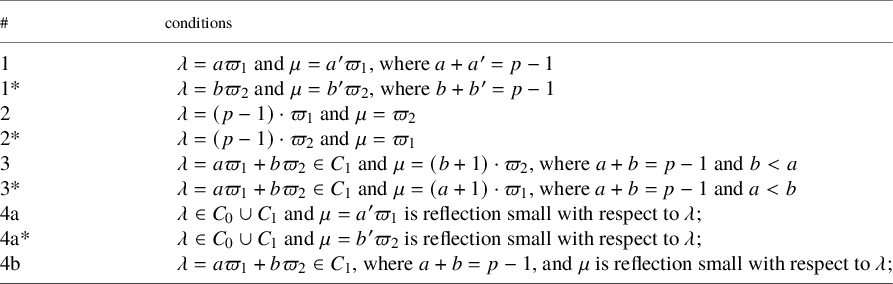


 Open access

