





Introduction
To date, the viviparous parasites of Gyrodactylus von Nordmann, 1832 (Gyrodactylidae van Beneden et Hesse, 1832) encompass over 600 valid species known to parasitize a wide range of teleost fish worldwide (Harris et al., Reference Harris, Shinn, Cable and Bakke2004; Bakke et al., Reference Bakke, Cable and Harris2007; Pugachev et al., Reference Pugachev, Gerasev, Gussev, Ergens and Khotenowsky2010). Previous surveys focused on the parasite fauna of North African cyprinid fish have revealed high species diversity in terms of Dactylogyrus (Dactylogyridae), with 17 species of the genus recorded in the region thus far (Řehulková et al., Reference Řehulková, Rahmouni, Pariselle and Šimková2021). In contrast, among the 43 Gyrodactylus species reported in African freshwater ichthyofauna (Řehulková et al., Reference Řehulková, Seifertová, Přikrylová, Francová, Scholz, Vanhove, Smit, Jayasundera and Gelnar2018; Přikrylová et al., Reference Přikrylová, Barson and Shinn2021, Reference Přikrylová, Truter, Luus-Powell, Chakona and Smit2024), a single northwest African gyrodactylid species, Gyrodactylus nyingiae Shigoley, Rahmouni, Louizi, Pariselle and Vanhove, 2023, was described from Luciobarbus pallaryi (Pellegrin, 1919) and was also reported on Luciobarbus ksibi (Boulenger, 1905) (Shigoley et al., Reference Shigoley, Rahmouni, Louizi, Pariselle and Vanhove2023). Subsequently, Rahmouni et al. (Reference Rahmouni, Seifertová, Benovics and Simková2023a) investigated ectoparasitic flatworms from native cyprinid hosts occurring in northwest Africa (Morocco) and Iberia (Portugal and Spain), providing formal descriptions of 3 Gyrodactylus species found on a range of endemic West Mediterranean cyprinids. These include Gyrodactylus gibraltarensis Rahmouni, 2023, from the Iberian Luciobarbus graellsii (Steindachner, 1866); Gyrodactylus moroccensis Rahmouni, 2023, from various northwest African Luciobarbus species (Luciobarbus rabatensis Doadrio, Perea and Yahyaoui, 2015 (type-host); Luciobarbus yahyaouii Doadrio, Casal-Lopez and Perea, 2016; Luciobarbus maghrebensis Doadrio, Perea and Yahyaoui, 2015; Luciobarbus zayanensis Doadrio, Casal-Lopez and Yahyaoui, 2016; and Luciobarbus rifensis Doadrio, Casal-Lopez and Yahyaoui, 2015); and Gyrodactylus pseudomoroccensis Rahmouni, 2023, from Luciobarbus ksibi (Boulenger, 1905). Notably, these species exhibited a distinct morphotype of haptoralsclerotized structures, characterized by an atypical T-shaped dorsal bar, a feature observed for the first time in Gyrodactylus species and seemingly restricted to the West Mediterranean region. Additionally, their haptoral morphology, along with that of 12 previously undescribed northwest African and Iberian Gyrodactylus species presented in Rahmouni et al. (Reference Rahmouni, Seifertová, Benovics and Simková2023a), resembled that of their European and Middle Eastern congeners, supporting historical dispersal trajectories of cyprinids from the Middle East, the centre of speciation for freshwater fauna to the West Mediterranean (Por, Reference Por1989). Molecular data further supported the relatedness between Eurasian and West Mediterranean Gyrodactylus lineages (Rahmouni et al., Reference Rahmouni, Seifertová, Benovics and Simková2023a).
In this paper, we describe 9 Gyrodactylus species collected from endemic cyprinid hosts in Morocco. This study provides the first parasitological data on gyrodactylids hosted by 3 Moroccan cyprinids, Carasobarbus fritschii (Günther, 1874), Luciobarbus massaensis (Pellegrin, 1922) and Pterocapoeta maroccana (Günther, 1902) which had not been previously examined. Shigoley et al. (Reference Shigoley, Rahmouni, Louizi, Pariselle and Vanhove2023) previously reported the presence of Gyrodactylus species on P. maroccana, C. fritschii and L. massaensis; however, formal descriptions were not provided due to the limited number of monogenean specimens collected. We also discuss the taxonomic status of G. nyingiae, recently described from L. ksibi and L. pallaryi sampled from disparate locations across Morocco. Rahmouni et al. (Reference Rahmouni, Seifertová, Benovics and Simková2023a) already highlighted the possible misidentification of specimens collected from L. ksibi, referred to as G. nyingiae, as their haptoral sclerites notably differed from those collected from L. pallaryi. Additionally, the noticeable and unusual range in the size of the haptoral sclerites of G. nyingiae from L. pallaryi reported by Shigoley et al. (Reference Shigoley, Rahmouni, Louizi, Pariselle and Vanhove2023) is uncommon among Gyrodactylus specimens parasitizing a single fish population. Finally, we retrieved the phylogenetic tree previously published in Rahmouni et al. (Reference Rahmouni, Seifertová, Benovics and Simková2023a) to construct a mapping of the geographical distribution to explore the origin and pattern of host switching within the West Mediterranean Gyrodactylus lineage.
Material and methods
Fish and parasite sampling and identification
The parasitological survey, conducted in 2015, involved the collection of a total of 128 fish specimens comprising 9 cyprinid species from various Moroccan watersheds. Fish specimens were identified on-site by local collaborators (listed in the acknowledgements). Upon transporting the fish to the laboratory, the external body surfaces, fins and gills of cyprinid hosts were examined for the presence of Gyrodactylus using an MST130 stereoscopic microscope. Specimens were carefully extracted from skin and gills using surgical needles. A selected number was entirely fixed and mounted on slides with a mixture of glycerine and ammonium picrate (GAP), following the method described by Malmberg (Reference Malmberg1957). Another selected number was bisected, with the haptoral part mounted on slides and the anterior part preserved in ethanol for genetic studies, as detailed in Rahmouni et al. (Reference Rahmouni, Seifertová, Benovics and Simková2023a). The terminology for haptoral sclerites and the method of measurement followed the guidelines provided by Malmberg (Reference Malmberg1970) and Pugachev et al. (Reference Pugachev, Gerasev, Gussev, Ergens and Khotenowsky2010). Measurements of specimens were obtained using an Olympus BX51 phase-contrast microscope and Olympus Stream Image Analysis software version 1.9.3 (Olympus, Tokyo, Japan) and are reported in micrometres as the mean followed by the range and the number of specimens measured (n) in parentheses. Illustrations of the haptoral sclerotized parts were produced from flattened specimens using an Olympus BX51 microscope equipped with a drawing tube and subsequently edited using Adobe Illustrator CS6 version 16.0.0 and Adobe Photoshop version 13.0 (Adobe Systems Inc., San Jose, CA, USA). Infection indices (prevalence (P) and intensity of infection (I)) were calculated following Bush et al. (Reference Bush, Lafferty, Lotz and Shostak1997). The type-material (in GAP) was deposited in the Helminthological Collection of the Institute of Parasitology, Biology Centre of the Academy of Sciences of the Czech Republic, in České Budějovice (IPCAS) under the accession numbers (M–804-12). Prior to this research, we genetically confirmed the conspecificity of the collected Gyrodactylus specimens from Morocco by amplifying and sequencing the 18S rDNA and the ITS regions (detailed protocols for the genetic part can be found in our previous publication in Rahmouni et al. Reference Rahmouni, Seifertová, Benovics and Simková2023a). We then performed phylogenetic analyses that included sequences from the northwest African Gyrodactylus communities, along with a range of Gyrodactylus congeners from around the world (see Rahmouni et al. Reference Rahmouni, Seifertová, Benovics and Simková2023a).
Mapping of the geographical origin of West Mediterranean Gyrodactylus
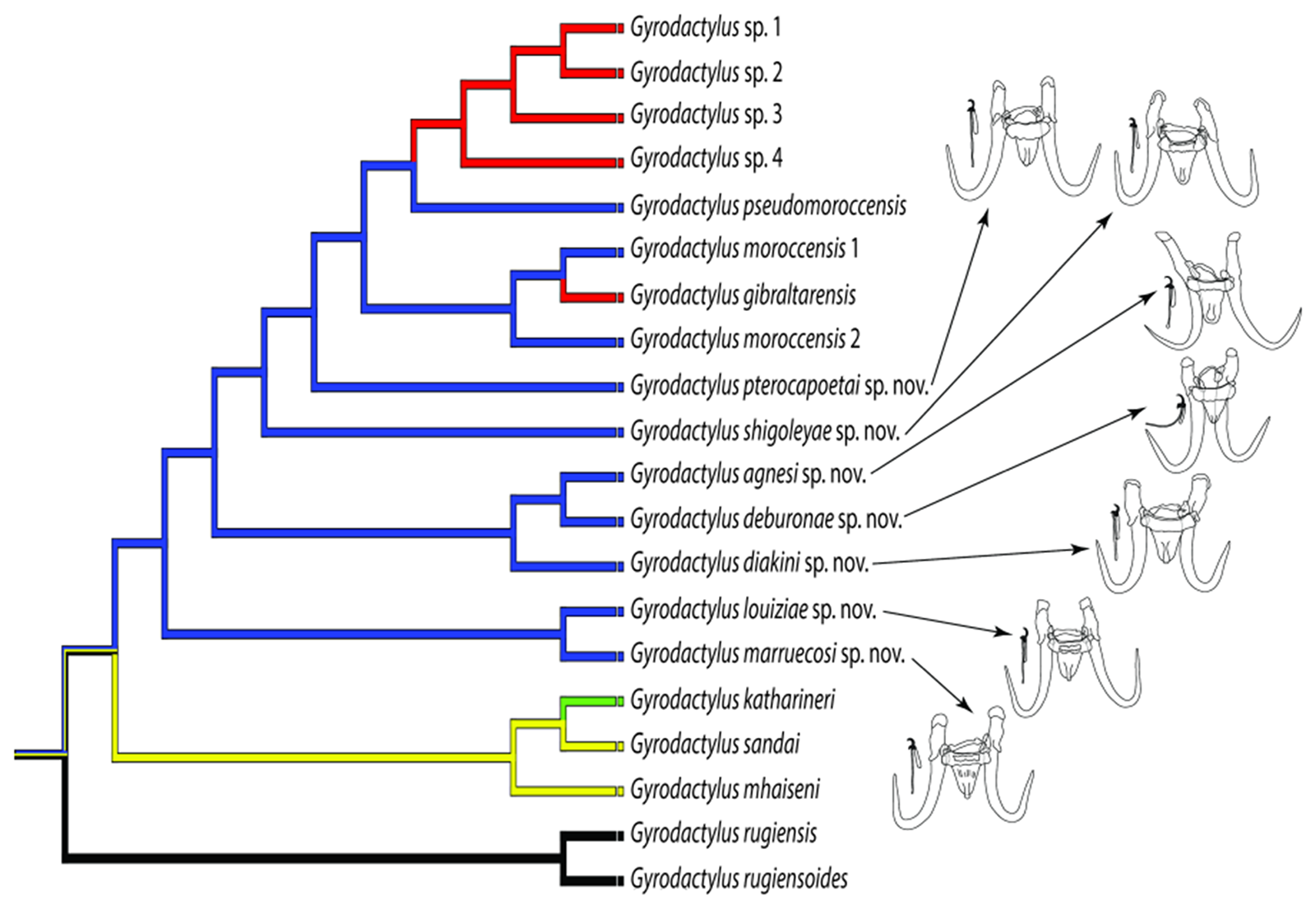
To explore the geographical origin of Gyrodactylus lineage, particularly focusing on the West Mediterranean region, we utilized the phylogenetic tree generated in our previous study (Rahmouni et al., Reference Rahmouni, Seifertová, Benovics and Simková2023a) using Maximum Likelihood (ML) and Bayesian Inference (BI) methods. Combined ML and BI trees were pruned using TreeGraph v. 2.15 (Müller and Müller, Reference Müller and Müller2004) to select Clade A, which comprised Gyrodactylus species parasitizing cyprinid fish found across the Strait of Gibraltar, particularly in northwest Africa and Iberia, and 2 Middle Eastern Gyrodactylus species and 1 European Gyrodactylus species. Clade A encompassed 18 species in total, including the species that were unknown at that time (Gyrodactylus sp. 5–11) and which we describe below, while Clade B, retained as the most basal clade to Clade A, contained 2 European species. The mapping of geographical distribution onto the pruned phylogenetic tree was carried out using Mesquite v3.61 (Maddison and Maddison, Reference Maddison and Maddison2019, http://mesquiteproject.org). This process involved annotating each species with its corresponding geographical distribution (Iberia, northwestern Africa and Eurasia), which was mapped onto the phylogenetic tree. The final tree was manually edited using Photoshop v13.0.
Results
The Life Science Identifier (LSID) for this publication is: urn: lsid:zoobank.org:pub:4836137B-4F95-47D1-BD24-B42CFD4E8A B4.
Gyrodactylus agnesei sp. nov. (Figure 1A)
Zoobank registration: urn:lsid:zoobank.org:act:53A95698-FF15-4AED-BF12-A3F932CEDB6F
Synonym: Gyrodactylus sp. 7 sensu Rahmouni et al. (Reference Rahmouni, Seifertová, Benovics and Simková2023a) (18S: OR807830, ITS: OR807841)
Type–host: Luciobarbus rabatensis Doadrio, Perea and Yahyaoui, 2015 (Cyprinidae)
Type–locality: Maleh River (33°31’58.00” N, 06°37’39.06” W), Morocco
Additional locality: Grou River, Morocco
Type–material: 1 holotype and 2 paratypes (IPCAS, M–812)
Site on the host: Gill filaments
Infection indices: 11 specimens studied, P = 27%, I = 1–17 parasite specimens per infected host.
Etymology: The specific epithet ‘agnesei’ of the type-species is derived from the name of Dr Jean-François Agnèse, in recognition of his significant contributions to the field of fish parasitology in the African continent, during his tenure at Montpellier University (Montpellier, France).
Description
Based on 7 coverslip-flattened specimens. Haptor distinct fromrest of the body. Slender hamuli with well-developed, narrow, and outwardly curved inner roots. Tips of inner roots with hat-like cover, and folds typically observed in posterior part of base appear absent. Hamuli total length 69.4 (68.3–71.1), inner root length 26.1 (23.9–28.5), shaft length 49.5 (47.7–50.8) and point length 25.3 (24.1–26.4). Ventral bar 27 (25.9–28.4) long, 23.9 (22.5–25.2) wide, median width 5.4 (5–6), with blunt, short bilateral processes that extend outward from bar 2.3 (1.8–2.6) long, distance between lateral processes 23.9 (21–26.1) long, shield-shaped membrane approximately one-third length of hamuli shaft, blunt posteriorly with median ridge, 18.8 (15.8–21.5) long, 15.4 (13.4–16.5) wide. Dorsal bar irregular, attenuated extremities inserted into terminal plates, 23.4 (20.4–26.6) long, 2.2 (1.6–3.6) wide at midpoint. Marginal hooks total length 29.4 (27.6–31.1), handle length 22.9 (21.7–24.7), filament loop length 11.3 (8.7–13.1), sickle length to shaft attachment 6.7 (6.5–7.3), shaft length of sickle 5 (2.2–6.8), sickle distal width 6.6 (5.9–7.2), sickle proximal width 4.7 (4.3–5), point length of sickle 3 (2.1–3.6). Sickle foot with inconspicuous shelf and rounded heel. Sickle proper convex, gradually curved forward from base int straight, far-reaching point positioned above edge of prominent finger-like sickle toe. Male copulatory organ (MCO) spherical, 14.5 (13.3–16.3) in length and 14.4 (13.9–15.3) in width, armed with single apical spine and row of 8 spinelets, with bilateral pair of larger-sized spinelets.
Remarks
Gyrodactylus agnesei sp. nov. (Figure 1A) is the second gyrodactylid species identified to parasitize L. rabatensis, an endemic cyprinid of northwest Africa. It is differentiated from its congener G. moroccensis, previously described from the same host, by the absence of the accessory anterior portion of the hamuli and dorsal bar with a common shape (not T-shaped), features which are lacking in G. moroccensis, in addition to the T-shaped dorsal bar observed in G. moroccensis (Rahmouni et al., Reference Rahmouni, Seifertová, Benovics and Simková2023a). Gyrodactylus agnesei sp. nov. exhibits similarities with G. nyingiae from L. pallaryi, another inhabitant of the same area, particularly in terms of the haptoral morphotype, characterized by slender hamuli and a ventral bar with short bilateral processes. It is worth noting that measurements of G. nyingiae were conducted using conserved specimens in ethanol, which were subsequently fixed in Hoyer’s medium, whereas our specimens were freshly fixed in situ in GAP. Fankoua et al. (Reference Fankoua, Bitja Nyom, Bahanak, Bilong Bilong and Pariselle2017) previously highlighted variability in the size of the haptoral sclerites of monogeneans associated with these 2 mounting procedures, with Hoyer’s medium resulting in significantly larger structures. In comparison to G. nyingiae, the new species G. agnesei sp. nov. exhibits shorter marginal hooks (27.6–31.1 μm in G. agnesei sp. nov. vs. 31.7–42.1 μm in G. nyingiae) and associated structures, namely, a shorter handle (21.7–24.7 μm in G. agnesei sp. nov. vs. 26.1–33.4 μm in G. nyingiae) and a longer filament (8.7–13.1 μm in G. agnesei sp. nov. vs. 5–5.9 μm in G. nyingiae) (the terms ‘shaft’ and ‘aperture’ were used for the handle and filament loop, respectively, in Shigoley et al. Reference Shigoley, Rahmouni, Louizi, Pariselle and Vanhove2023). Additionally, the median ridge observed in the posterior edge of the ventral bar in G. agnesei sp. nov., as well as in all previously described species from Morocco (as discussed below), was not mentioned for G. nyingiae. This feature appears visible in the micrographs embedded by Shigoley et al. (Reference Shigoley, Rahmouni, Louizi, Pariselle and Vanhove2023), leading us to believe that the authors may have overlooked it (see the drawing of the ventral bar of G. nyingiae). Nonetheless, the most distinctive feature separating these 2 species is the shape of the hamuli. In G. agnesei sp. nov., this structure is slender, with well-developed, narrow and outwardly curved inner roots. In contrast, the hamuli of G. nyingiae exhibit either twisted extremities or robust and shorter inner roots.
Illustrations of the sclerotized parts of (A) Gyrodactylus agnesei sp. Nov. From Luciobarbus rabatensis Doadrio, Perea and Yahyaoui, 2015 and (B) Gyrodactylus benhoussai sp. nov. from Luciobarbus rabatensis Doadrio, Perea and Yahyaoui, 2015. Abbreviations: DB, dorsal bar; H, hamuli; MCO, male copulatory organ; MH, marginal hooks; VB, ventral bar.

Gyrodactylus benhoussai sp. nov. (Figure 1B)
Zoobank registration: urn:lsid:zoobank.org:act:B143338B-BE72-4684-8A61-DD49B08 F49EE
Type–host: Luciobarbus rabatensis Doadrio, Perea and Yahyaoui, 2015 (Cyprinidae)
Additional host: Carasobarbus fritschii (Günther, 1874) (Cyprinidae) from the same locality
Type–locality: Maleh River (33°31’58.00” N, 06°37’39.06” W) for both hosts, Morocco
Type–material: 1 holotype and 2 paratypes (IPCAS, M–809)
Site on the host: Gill filaments for both hosts
Infection indices: 11 specimens of L. rabatensis and 41 specimens of C. fritschii were studied, P = 9.09%, I = 1–2 for L. rabatensis; P = 9.75%, I = 1–2 for C. fritschii.
Etymology: The epithet ‘benhoussai’ of the type-species is dedicated to Prof. Abdelaziz Benhoussa from Mohamed V University (Rabat, Morocco), acknowledging his significant contributions to fish parasitology research. Prof. Benhoussa generously facilitated field trips and fish sampling in 2015, demonstrating his commitment to advancing scientific knowledge in this field.
Description
Based on 5 coverslip-flattened specimens from L. rabatensis, and 2 specimens from C. fritschii. Haptor distinct from rest of the body. Slender hamuli, with well-developed, narrow and inwardly curved inner roots. Tips of inner roots with hat-like cover, with folds present in posterior part of base. Hamuli total length 61.4 (59.1–66), inner root length 19.5 (17.6–22.5), shaft length 44.8 (43–48.1) and point length 30.4 (27.9–32.1). Ventral bar 27 (25–29.5) long, 27.3 (24.6–29.7) wide, median width 7.4 (6.2–8.2), with blunt and short bilateral processes that extend outward from bar 2.8 (2–3.6) long, distance between lateral processes 27.4 (24.7–29.3) long, shield-shaped membrane, blunt posteriorly with median ridge, 16.1 (15.4–17) long, 15.1 (14.3–16.6) wide. Dorsal bar simple and straight with attenuated extremities inserted into terminal plates, 27.6 (26.4–31.8) long, 2.4 (1.5–2.9) wide at midpoint. Marginal hooks total length 29.7 (27.1–33.5), handle length 23.7 (21.7–27.2), filament loop length 10.4 (9.1–11.8), sickle length to shaft attachment 5.7 (5.2–6.4), shaft length of sickle 4.4 (3.7–5), sickle distal width 4.8 (4.2–5.5), sickle proximal width 3.7 (2.8–4.5), point length of sickle 1.9 (1.6–2.5). Sickle foot with conspicuous shelf and flat, slightly rounded heel. Sickle proper convex and gradually curved forward from base into downward point positioned above edge of prominent finger-like sickle toe. MCO spherical, 14.8 (11.2–18.4) in length and 13.8 (12.3–15.2) in width, armed with single apical spine and row of 10 spinelets, with bilateral pair of larger-sized spinelets.
Remarks
Thus far, L. rabatensis has only been reported as a host for a few gyrodactylid specimens (Rahmouni et al., Reference Rahmouni, Seifertová, Benovics and Simková2023a and this study), with one of them also found on C. fritschii sampled from the same watershed. At the host species level, no intraspecific variation in the sclerotized structures of G. benhoussai sp. nov. was observed. Gyrodactylus benhoussai sp. nov. (Figure 1B) can be readily distinguished from G. moroccensis, recently described from the same host (Rahmouni et al., Reference Rahmouni, Seifertová, Benovics and Simková2023a), by the absence of the T-shaped dorsal bar and the accessory membranous structure associated with the hamuli, which are present in G. moroccensis. When compared to G. agnesei sp. nov., also found on L. rabatensis, G. benhoussai sp. nov. exhibits different characteristics of its hamuli, notably: (i) slightly shorter inner roots (17.6–22.5 μm in G. benhoussai sp. nov. vs. 23.9–28.5 μm in G. agnesei sp. nov.) with a cover-like structure that diminishes posteriorly, (ii) more sturdy shafts, (iii) longer points (27.9–32.1 μm in G. benhoussai sp. nov. vs. 24.1–26.4 μm in G. agnesei sp. nov.).
Gyrodactylus deburonae sp. nov. (Figure 2A)
Zoobank registration: urn:lsid:zoobank.org:act:53590D5E-3A1E -4156-9537-1059EB484A02
Synonym: Gyrodactylus sp. 8 sensu Rahmouni et al. (Reference Rahmouni, Seifertová, Benovics and Simková2023a) (18S: OR807831, ITS: OR807842)
Type–host: Luciobarbus massaensis (Pellegrin, 1922) (Cyprinidae)
Type–locality: Tamrhakht (30°31’33.06” N, 09°38’53.06” W), Morocco
Type–material: 1 holotype and 2 paratypes (IPCAS, M–805)
Site on the host: Fins
Infection indices: 11 specimens studied, P = 75%, I = 1–2 parasite specimens per infected host.
Etymology: The specific epithet ‘deburonae’ of the type-species is dedicated to Prof. Isaure de Buron from the College of Charleston (Charleston, USA), in acknowledgement of her substantial contributions to the fields of ecology and evolutionary fish parasitology through her extensive research efforts.
Description
Based on 3 coverslip-flattened specimens. Haptor distinct from rest of the body. Slender hamuli with well-developed and inwardly curved inner roots. Tips have hat-like cover, with folds present in posterior part of base. Hamuli total length 46.6 (46.4–46.8), inner root length 14.1 (10.8–16), shaft length 36.4 (36.2–36.7) and point length 20.9 (20.7–21.2). Ventral bar 17.1 (15.5–18.4) long, 16.6 (16.2–17.3) wide, median width 4.5 (3.9–4.9), with blunt and short bilateral processes that extend outward from bar 1.9 (1.6–2.2) long, distance between lateral processes 16.3 (15.8–16.7) long, shield-shaped membrane, blunt posteriorly with median ridge, 8.6 (7.9–10) long, 10.3 (9.3–11.4) wide. Dorsal bar simple and curved with attenuated extremities inserted into terminal plates, 17.2 (15.9–18.7) long, 1.9 (1.4–2.7) wide at midpoint. Marginal hooks total length 22.8 (21.9–23.5), handle length 18.3 (16.4–19.4), filament loop length 10.1 (9.1–11.2), sickle length to shaft attachment 7.1 (5.1–8.9), shaft length of sickle 4.5 (5.2–4.9), sickle distal width 5 (4.7–5.1), sickle proximal width 3.4 (3.2–3.6), point length of sickle 1.4 (1.3–1.4). Sickle foot with conspicuous shelf and rounded heel. Sickle proper convex and gradually curved forward from base into straight point positioned above edge of prominent finger-like sickle toe. MCO not observed.
Remarks
This represents the second recorded instance of a gyrodactylid species on northwest African L. massaensis. Previously, Shigoley et al. (Reference Shigoley, Rahmouni, Louizi, Pariselle and Vanhove2023) encountered a single specimen, which unfortunately did not allow for a formal description or measurement of the hard parts. Thus, the morphology of the sclerotized structures and meristic data of a gyrodactylid from L. massaensis are presented herein for the first time. In light of the previous study by Rahmouni et al. (Reference Rahmouni, Seifertová, Benovics and Simková2023a), the newly described G. deburonae sp. nov. (Figure 2A) is primarily differentiated from its genetically closely related congener G. agnesei sp. nov., as described above, by having (i) shorter hamuli (46.4–46.8 μm in G. deburonae sp. nov. vs. 68.3–71.1 μm in G. agnesei sp. nov.), with inner roots curved in opposite directions, (ii) shorter ventral bars (15.5–18.4 μm in G. deburonae sp. nov. vs. 25.9–28.4 μm in G. agnesei sp. nov.) and (iii) shorter dorsal bars (15.9–18.7 μm in G. deburonae sp. nov. vs. 20.4–26.6 μm in G. agnesei sp. nov.).
Illustrations of the sclerotized parts of (A) Gyrodactylus deburonae sp. nov. from Luciobarbus massaensis (Pellegrin, 1922) and (B) Gyrodactylus diakini sp. nov. from Luciobarbus rifensis Doadrio, Casal-lópez and Perea 2015.

Gyrodactylus diakini sp. nov. (Figure 2B)
Zoobank registration: urn:lsid:zoobank.org:act:CD85451C-49B0 -4EE6-A3A7-E9522B359CF7
Synonym: Gyrodactylus sp. 9 sensu Rahmouni et al. (Reference Rahmouni, Seifertová, Benovics and Simková2023a) (18S: OR807832, ITS: OR807843)
Type–host: Luciobarbus rifensis Doadrio, Casal-Lopez and Yahyaoui, 2015 (Cyprinidae)
Type–locality: Tributary of Loukkos (34°54’57.02” N, 05°32’17.02” W), Morocco
Type–material: 1 holotype and 2 paratypes (IPCAS, M–811)
Site on the host: Fins
Infection indices: 10 specimens studied, P = 50%, I = 1–2 parasite specimens per infected host.
Etymology: The epithet ‘diakini’ of the type-species is given to honour the memory of Dr Andrei Diakin, a colleague from Masaryk University (Brno, Czech Republic), who conducted research on parasitic protozoans.
Description
Based on 6 coverslip-flattened specimens. Haptor distinct from rest of the body. Stout hamuli, with well-developed and straight inner roots. Tips have hat-like cover, with folds present in posterior part of base. Hamuli total length 62.9 (61.3–65.9), inner root length 21 (20.4–21.7), shaft length 45 (43.4–46.2) and point length 29.5 (27.9–31.9). Ventral bar 28.5 (27.5–29) long, 26.4 (25.4–27.1) wide, median 7.4 (6.8–8), with blunt and short bilateral processes that extend outward from bar 2.3 (2.1–2.5) long, distance between lateral processes 25.9 (24.7–26.5) long, shield-shaped membrane, blunt posteriorly with median ridge, 8.6 (7.9–10) long, 10.3 (9.3–11.4) wide. Dorsal bar curved at midpoint, with posterior projections near attenuated extremities inserted into terminal plates, 27.8 (26.8–28.4) long, 2.3 (1.9–2.6) wide at midpoint. Marginal hooks total length 28.6 (27.6–29.8), handle length 23 (22.3–23.8), filament loop length 10.5 (9.1–11.7), sickle length to shaft attachment 5.4 (5.1–5.6), shaft length of sickle 4.7 (4.2–5), sickle distal width 5.1 (4.7–5.4), sickle proximal width 3.5 (3.4–3.6), point length of sickle 1.6 (1–1.8). Sickle foot with conspicuous shelf and globous heel. Sickle proper curved distally, point straight exceeding edge of downward finger-like sickle toe. MCO oval, 14.8 (11.2–18.4) in length and 13.8 (12.3–15.2) in width, armed with single apical spine and row of 8 spinelets, with bilateral pair of larger-sized spinelets.
Remarks
Gyrodactylus diakini sp. nov. (Figure 2B) is the second species identified on L. rifensis from northwest Africa (Morocco) (Rahmouni et al., Reference Rahmouni, Seifertová, Benovics and Simková2023a). It can be easily distinguished from G. moroccensis, found on the same host, by its typical haptoral structures, unlike G. moroccensis, known for its characteristic accessories of the hamuli and T-shaped dorsal bar. According to Rahmouni et al. (Reference Rahmouni, Seifertová, Benovics and Simková2023a), G. diakini sp. nov. is genetically closely related to G. agnesei sp. nov. and G. deburonae sp. nov., with a divergence exceeding the limit value (5% and 7.4%, respectively) (Ziȩtara and Lumme, Reference Ziȩtara and Lumme2003; Huyse et al., Reference Huyse, Malmberg and Volckaert2004; Rahmouni et al., Reference Rahmouni, Seifertová and Simková2023b). Morphologically, G. diakini sp. nov. possesses larger haptoral structures compared to those of G. deburonae sp. nov. The main differences lie in (i) the longer hamuli (61.3–65.9 μm in G. diakini sp. nov. vs. 46.4–46.8 μm in G. deburonae sp. nov.), (ii) the longer ventral bar (27.5–29 μm in G. diakini sp. nov. vs. 15.5–18.4 μm in G. deburonae sp. nov.) and finally (iii) the longer dorsal bar (26.8–28.4 μm in G. diakini sp. nov. vs. 15.9–18.7 μm in G. deburonae sp. nov.). Gyrodactylus diakini sp. nov. exhibits smaller hamuli than those of G. agnesei sp. nov. (61.3–65.9 μm in G. diakini sp. nov. vs. 68.3–71.1 μm in G. agnesei sp. nov.). It should be noted that the apical spine and the single row of spinelets of the MCO of G. diakini sp. nov. that were visualized may not be in their natural position due to the fixation procedure, which most likely shifted the spines.
Gyrodactylus louiziae sp. nov. (Figure 3A)
Zoobank registration: urn:lsid:zoobank.org:act:7CB55CBB-075B -40B9-B950-B99FB0EB2A8F
Synonym: Gyrodactylus sp. 10 sensu Rahmouni et al. (Reference Rahmouni, Seifertová, Benovics and Simková2023a) (18S: OR807833, ITS: OR807844)
Type–host: Luciobarbus yahyaouii Doadrio, Casal-Lopez and Perea, 2016 (Pellegrin, 1924) (Cyprinidae)
Type–locality: Meloulou River (34°10’51.07” N, 03°31’59.06” W), Morocco
Type–material: 1 holotype and 2 paratypes (IPCAS, M–808)
Site on the host: Fins
Infection indices: 14 specimens studied, P = 60%, I = 1–2 parasite specimens per infected host.
Etymology: The specific epithet ‘louiziae’ of the type-species is named in honour of Dr Halima Louizi from Mohamed V University (Rabat, Morocco), in recognition of her significant contributions to North African fish parasitology.
Description
Based on 4 coverslip-flattened specimens. Haptor distinct from the rest of the body. Stout hamuli with well-developed and inwardly curved inner roots. Tips have hat-like cover, with folds present in posterior part of base. Hamuli total length 61.8 (59.4–63.4), inner root length 18.8 (18.3–19.7), shaft length 46.7 (44.6–48.6) and point length 29.1 (28.3–30.7). Ventral bar 25.8 (24.4–27.1) long, 25.6 (24.8–26.4) wide, median 6.8 (5.7–7.6), with blunt and short bilateral processes that extend outward from bar 2.5 (2.3–2.7) long, distance between lateral processes 25.2 (23.5–27.3) long, shield-shaped membrane, blunt posteriorly with median ridge, 14.5 (14.1–15.1) long, 15.1 (14.1–16.5) wide. Dorsal bar straight, with posterior projections near attenuated extremities inserted into terminal plates, 27.7 (25.3–29.7) long, 2.2 (1.7–3) wide at midpoint. Marginal hooks total length 27.2 (25.1–28.6), handle length 20.8 (18.2–22.7), filament loop length 10.7 (10.2–11.4), sickle length to shaft attachment 5.8 (5.4–6.3), shaft length of sickle 4.3 (3.7–4.6), sickle distal width 5.2 (4.7–5.6), sickle proximal width 3.6 (2.4–4), point length of sickle 1.9 (1.4–2.8). Sickle foot with inconspicuous shelf and globous downward heel. Sickle proper curved distally with far-reaching point almost above edge of downward finger-like sickle toe. MCO oval, 14.8 (11.2–18.4) in length and 13.8 (12.3–15.2) in width, armed with single apical spine and row of 6 spinelets, with bilateral pair of larger-sized spinelets.
Remarks
Gyrodactylus louiziae sp. nov. (Figure 3A) is the second species recognized on its host L. yahyaouii after the morphologically distinctive G. moroccensis (Rahmouni et al., Reference Rahmouni, Seifertová, Benovics and Simková2023a). Meristic data of G. louiziae sp. nov. from L. yahyaouii and G. diakini sp. nov. from L. rifensis overlap significantly, and the morphotype of their haptoral sclerites are similar. However, these 2 species were previously discriminated genetically (Rahmouni et al., Reference Rahmouni, Seifertová, Benovics and Simková2023a). Morphologically, G. louiziae sp. nov. and G. diakini sp. nov. can be distinguished from each other based on their (i) hamuli roots (curved inward in G. louiziae sp. nov. while straight in G. diakini sp. nov.). It should be noted that the apical spine and single row of spinelets of the MCO of G. louiziae sp. nov. that could be visualized were not in their natural position due to the fixation procedure, which likely shifted the garniture (spines) of the MCO.
Illustrations of the sclerotized parts of (A) Gyrodactylus louiziae sp. nov. from Luciobarbus yahyaouii Doadrio, Casal-lopez and Perea, 2016 and (B) Gyrodactylus marruecosi sp. nov. from Luciobarbus massaensis (Pellegrin, 1922).

Gyrodactylus marruecosi sp. nov. (Figure 3B)
Zoobank registration: urn:lsid:zoobank.org:act:6B810A64-6E86-4324-BDC9-BA635D4960A5
Synonym: Gyrodactylus sp. 11 sensu Rahmouni et al. (Reference Rahmouni, Seifertová, Benovics and Simková2023a) (18S: OR807834, ITS: OR807845)
Type–host: Luciobarbus massaensis (Pellegrin, 1922) (Cyprinidae)
Type–locality: Tamrhakht (30°31’33.06” N, 09°38’53.06” W), Morocco
Type–material: 1 holotype and 2 paratypes (IPCAS, M–806)
Site on the host: Fins
Infection indices: 11 specimens studied, P = 45%, I = 1–2 parasite specimens per infected host.
Etymology: The specific epithet ‘marruecosi’ of the type-species is derived from Marruecos, the old Spanish name for Morocco, the country of origin of the species.
Description
Based on 3 coverslip-flattened specimens. Haptor distinct from the rest of the body. Stout hamuli with well-developed and straight inner roots. Tips have hat-like cover, with folds present in posterior part of base. Hamuli total length 63.5 (62.7–64.4), inner root length 19.1 (17.8–20.5), shaft length 46.7 (45.3–48.2) and point length 29.1 (27.2–30.5). Ventral bar 26.5 (25.1–28.6) long, 26.4 (26.1–26.7) wide, median 6.5 (5.9–7), with blunt and short bilateral processes that extend outward from bar 2.2 (1.5–2.7) long, distance between lateral processes 25 (24.2–26) long, shield-shaped membrane, blunt posteriorly with median ridge, 17.7 (16.9–18.7) long, 15.6 (15.2–16.2) wide. Dorsal bar straight, with posterior projections near attenuated extremities inserted into terminal plates, 27.7 (26.7–28.7) long, 2.6 (2.4–3) wide at midpoint. Marginal hooks total length 28 (27.8–28.1), handle length 21.1 (20.8–21.6), filament loop length 9.2 (8.6–9.7), sickle length to shaft attachment 5.2 (4.3–5.8), shaft length of sickle 4.5 (4.4–4.5), sickle distal width 4.6 (4.2–5.1), sickle proximal width 3.9 (3.5–4.1), point length of sickle 1.9 (1.2–2.3). Sickle foot with conspicuous shelf and globous downward heel. Sickle proper curved distally with straight point positioned above edge of downward finger-like sickle toe. MCO not observed.
Remarks
Gyrodactylus marruecosi sp. nov. (Figure 3B) is the second species recognized on L. massaensis after G. deburonae sp. nov. In addition to the genetic divergence above the limit value (Ziȩtara and Lumme, Reference Ziȩtara and Lumme2003; Huyse et al., Reference Huyse, Malmberg and Volckaert2004; Rahmouni et al., Reference Rahmouni, Seifertová and Simková2023b) previously recovered between these 2 species (10.3%, see Rahmouni et al. Reference Rahmouni, Seifertová, Benovics and Simková2023a), they are easily distinguishable from each other by G. marruecosi sp. nov. having (i) longer hamuli (62.7–64.4 μm in G. marruecosi sp. nov. vs. 46.4–46.8 μm in G. deburonae sp. nov.), (ii) longer ventral bars (25.1–28.6 μm in G. marruecosi sp. nov. vs. 15.5–18.4 μm in G. deburonae sp. nov.), (iii) longer dorsal bars (26.7–28.7 μm in G. marruecosi sp. nov. vs. 15.9–18.7 μm in G. deburonae sp. nov.) and finally (iv) longer marginal hooks (27.8–28.1 μm in G. marruecosi sp. nov. vs. 21.9–23.5 μm in G. deburonae sp. nov.). Genetically, G. louiziae sp. nov. found on L. yahyaouii was the closest relative to G. marruecosi sp. nov. described herein from L. massaensis (Rahmouni et al., Reference Rahmouni, Seifertová, Benovics and Simková2023a). Despite the overlap in their meristic data, these species are morphologically discriminated by having (i) differently shaped dorsal bars (those of G. marruecosi sp. nov. exhibiting prominent posterior projections, unlike those of G. louiziae sp. nov.), and (ii) differently shaped marginal hooks (G. marruecosi sp. nov. exhibiting a sickle proper that is comparatively point heading downward and well-curved, while that of G. louiziae sp. nov. appears thin with a far-reaching point).
Gyrodactylus pterocapoetai sp. nov. (Figure 4A)
Zoobank registration: urn:lsid:zoobank.org:act:B28791B3-507D-4895-BF1C-676C0B979E30
Synonym: Gyrodactylus sp. 5 sensu Rahmouni et al. (Reference Rahmouni, Seifertová, Benovics and Simková2023a) (18S: OR807828, ITS: OR807839)
Type–host: Pterocapoeta maroccana (Günther, 1902) (Cyprinidae)
Type–locality: Oum Er-Rbia River near El Borj (33°00”58.07” N, 05°37”48.06” W), Morocco
Type–material: 1 holotype and 2 paratypes (IPCAS, M–810)
Site on the host: Gill filaments
Infection indices: 3 specimens studied, P = 33%, I = 1–6 parasite specimens per infected host.
Etymology: The specific epithet ‘pterocapoetai’ of the type-species refers to the type-host P. maroccana found only in Morocco.
Description
Based on 8 coverslip-flattened specimens. Haptor distinct from the rest of the body. Stout hamuli with well-developed and straight inner roots. Tips have hat-like cover, with folds present in posterior part of base. Hamuli total length 61.3 (58.1–63.1), inner root length 19.6 (18.9–20.8), shaft length 45.3 (43.9–46.9) and point length 28.4 (26.1–30.4). Ventral bar 23.3 (21.9–24.4) long, 23.3 (22.6–24) wide, median 7.3 (6.6–8.1), with blunt and short bilateral processes that extend outward from bar 2.9 (1.7–3.5) long, distance between lateral processes 23.3 (22.4–24.1) long, shield-shaped membrane, blunt posteriorly with median ridge, 13 (10.9–15.6) long, 13.4 (11.6–14.1) wide. Dorsal bar curved, posterior projections near attenuated extremities show bifurcations, 27 (25.7–28.6) long, 2.1 (1.8–2.5) wide at midpoint. Marginal hooks total length 32.1 (31.5–32.8), handle length 27.2 (26.4–27.8), filament loop length 11.4 (10.5–12), sickle length to shaft attachment 5.3 (5–5.8), shaft length of sickle 4.5 (4.3–4.7), sickle distal width 4.7 (4.3–5.1), sickle proximal width 3.6 (3.2–4.3), point length of sickle 1.6 (1.2–1.9). Sickle foot with conspicuous shelf and globous downward heel. Sickle proper curved distally with straight point positioned above sickle toe. MCO oval, 14.8 (11.2–18.4) in length and 13.8 (12.3–15.2) in width, armed with single apical spine and row of at least 7 spinelets; bilateral pair seems larger.
Remarks
The present study reports the first gyrodactylid species from P. maroccana exclusively occurring in Morocco. Gyrodactylus pterocapoetai sp. nov. (Figure 4A) is morphologically highly reminiscent of Gyrodactylus sp. 6 sensu Rahmouni et al. (Reference Rahmouni, Seifertová, Benovics and Simková2023a), described below as G. shigoleyae sp. nov. Nevertheless, Rahmouni et al. (Reference Rahmouni, Seifertová, Benovics and Simková2023a) successfully discriminated these 2 species on account of significant genetic divergence (Ziȩtara and Lumme, Reference Ziȩtara and Lumme2003; Huyse et al., Reference Huyse, Malmberg and Volckaert2004; Rahmouni et al., Reference Rahmouni, Seifertová and Simková2023b). The most relevant morphological feature that makes G. pterocapoetai sp. nov. distinguishable from its northwest African counterparts is the posterior bifurcation in the dorsal bar reported for the first time in northwest African Gyrodactylus (Rahmouni et al., Reference Rahmouni, Seifertová, Benovics and Simková2023a).
Illustrations of the sclerotized parts of (A) Gyrodactylus pterocapoetai sp. nov. from Pterocapoeta maroccana Günther, 1902 and (B) Gyrodactylus qninbai sp. nov. from Luciobarbus ksibi (Boulenger, 1905).

Gyrodactylus qninbai sp. nov. (Figure 4B)
Zoobank registration: urn:lsid:zoobank.org:act:22336938-6A71-4C47-8926-F003B11CEED3
Type–host: Luciobarbus ksibi (Boulenger, 1905) (Cyprinidae)
Type–locality: Oum Er-Rbia near Chabouka (32°51’32.09” N, 05°37’18.09” W), Morocco
Additional locality: Ksob River, Morocco
Type–material: 1 holotype and 1 paratype (IPCAS, M–804)
Site on the host: Fins
Infection indices: 15 specimens studied, P = 26.6%, I = 1–2 parasite specimens per infected host.
Etymology: The specific epithet ‘qninbai’ of the type-species honours the ichthyologist Prof. Abdeljebbar Qninba from Mohamed V University (Rabat, Morocco) in recognition of his contribution to fish parasitology research in Morocco.
Description
Based on 4 coverslip-flattened specimens. Haptor distinct from the rest of the body. Stout hamuli with well-developed and straight inner roots. Tips have a hat-like cover, with folds present in posterior part of base. Hamuli total length 65 (63.2–67.7), inner root length 18.6 (17.3–19.7), shaft length 48.4 (46.5–50.5) and point length 30 (28.9–31.3). Ventral bar 29 (24.2–32.7) long, 28.3 (26.7–30.2) wide, median 7 (6.3–8.1), with blunt and short bilateral processes that extend outward from bar 3.5 (2.5–6) long, distance between lateral processes 28.6 (27.1–32.3) long, shield-shaped membrane, blunt posteriorly with median ridge, 16.9 (14.2–18.1) long, 16 (14.7–17.5) wide. Dorsal bar straight, with posterior projections near attenuated extremities inserted into terminal plates, 28.8 (27.4–30.8) long, 2.3 (2–2.5) wide at midpoint. Marginal hooks total length 29.3 (27–31), handle length 23.6 (22.5–24.6), filament loop length 11.1 (10.1–12.4), sickle length to shaft attachment 5.8 (5.5–6.6), shaft length of sickle 4.6 (3.9–5.1), sickle distal width 5.1 (4.5–5.5), sickle proximal width 3.7 (3.3–4.1), point length of sickle 1.7 (1.3–2). Sickle foot with conspicuous shelf and globous downward heel. Sickle proper curved distally with straight point positioned above sickle toe. MCO not observed.
Remarks
Among the gyrodactylid species studied herein, G. qninbai sp. nov. appears morphologically similar to almost all the newly described species, with overlapping measurements of haptoral sclerites. However, G. qninbai sp. nov. can be distinguished from G. agnesei sp. nov., parasitizing the same cyprinid host, by (i) its slightly shorter hamuli (61–61.4 μm in G. qninbai sp. nov. vs. 68.3–71.1 μm in G. agnesei sp. nov.), and significantly shorter inner roots (17.1–18.3 μm in G. qninbai sp. nov. vs. 23.9–28.5 μm in G. agnesei sp. nov.), (ii) the longer bilateral processes of its ventral bar (3.2–6.4 μm in G. qninbai sp. nov. vs. 1.8–2.6 μm in G. agnesei sp. nov.) and (iii) the absence in G. qninbai sp. nov. of the far-reaching point of the marginal hooks sickle observed in G. agnesei sp. nov. Gyrodactylus qninbai sp. nov. is differentiated from G. diakini sp. nov. from L. rifensis by its (i) longer bilateral processes of the ventral bar (3.2–6.4 μm in G. qninbai sp. nov. vs. 2.1–2.5 μm in G. diakini sp. nov.), and (ii) its differently shaped dorsal bar (relatively straight in G. qninbai sp. nov. vs. irregular with posterior projections in G. diakini sp. nov.). Gyrodactylus qninbai sp. nov. also differs from G. marruecosi sp. nov. from L. massaensis by possessing (i) slightly longer bilateral processes of the ventral bar (3.2–6.4 μm in G. qninbai sp. nov. vs. 1.5–2.7 μm in G. marruecosi sp. nov.) and (ii) a differently shaped dorsal bar (lacking posterior projections in G. qninbai sp. nov., unlike that in G. marruecosi sp. nov.).
Shigoley et al. (Reference Shigoley, Rahmouni, Louizi, Pariselle and Vanhove2023) collected a single Gyrodactylus specimen from L. ksibi and several from L. pallaryi, identifying them as G. nyingiae. These specimens were fixed in GAP or Hoyer’s medium, but measurements were only taken from those fixed in Hoyer’s medium, which is known to significantly enlarge sclerotized structures (Fankoua et al., Reference Fankoua, Bitja Nyom, Bahanak, Bilong Bilong and Pariselle2017). The L. ksibi sample was from the Ksob River in western Morocco, while L. pallaryi specimens originated from the Guir River in eastern Morocco. Morphometric data from Shigoley et al. (Reference Shigoley, Rahmouni, Louizi, Pariselle and Vanhove2023) revealed significant variability in hamuli size within the L. pallaryi population. Additionally, their drawings and micrographs showed that Gyrodactylus from L. ksibi had twisted inner roots, unlike the relatively straight inner roots in L. pallaryi. The marginal hooks also differed, with L. ksibi specimens exhibiting more pronounced, downward, finger-like toes and curved, thin sickle shafts, compared to the blunt, shelf-less hooks and straight, thicker sickle shafts of L. pallaryi specimens.
In our study, we collected Gyrodactylus from L. ksibi in the Ksob River, fixed in GAP, and found that these specimens resemble those from L. pallaryi rather than those from L. ksibi reported by Shigoley et al. (Reference Shigoley, Rahmouni, Louizi, Pariselle and Vanhove2023). Notably, as highlighted by Rahmouni et al. (Reference Rahmouni, Seifertová, Benovics and Simková2023a), the hamuli of Shigoley’s L. ksibi specimen closely resemble those of G. moroccensis from various northwest African cyprinids, except L. ksibi, which hosts G. pseudomoroccensis. This suggests that Shigoley et al. (Reference Shigoley, Rahmouni, Louizi, Pariselle and Vanhove2023) may have misidentified their L. ksibi specimen as G. nyingiae. Consequently, we describe a new species, G. qninbai sp. nov., from L. ksibi, distinguished by straight inner roots and different marginal hooks. The absence of detailed dorsal and ventral bar structures in Shigoley et al. (Reference Shigoley, Rahmouni, Louizi, Pariselle and Vanhove2023) prevents confirmation of their specimen’s identity, which might be G. moroccensis or an undescribed species. Additionally, the incomplete ventral bar drawings from L. pallaryi highlight the need for redescribing Gyrodactylus from this host. Currently, genetic data are unavailable for Gyrodactylus specimens from L. pallaryi and L. ksibi, except for G. pseudomoroccensis (Rahmouni et al., Reference Rahmouni, Seifertová, Benovics and Simková2023a).
Gyrodactylus shigoleyae sp. nov. (Figure 5A)
Zoobank registration: urn:lsid:zoobank.org:act:2519405D-5B00-4C78-BCDE-CCABF5D200C2
Synonym: Gyrodactylus sp. 6 sensu Rahmouni et al. (Reference Rahmouni, Seifertová, Benovics and Simková2023a) (18S: OR807829, ITS: OR807840)
Type–host: Luciobarbus zayanensis Doadrio, Casal-Lopez and Yahyaoui, 2016 (Cyprinidae)
Type–locality: Oum Er-Rbia River near El Borj (33°00”58.07” N, 05°37”48.06” W), Morocco
Additional locality: Oum Er-Rbia River at Dar Oul Zidouh (32°18’54.00” N, 06°54’28.07” W), Morocco
Type–material: 1 holotype and 1 paratype (IPCAS, M–807)
Site on the host: Fins
Infection indices: 15 specimens studied, P = 50%, I = 1–2 parasite specimens per infected host.
Etymology: The specific epithet ‘shigoleyae’ of the type-species honours the young researcher Miriam Shigoley from Hasselt University (Belgium), who conducted the first description of Gyrodactylus from endemic cyprinids of Morocco.
Description
Based on 3 coverslip-flattened specimens. Haptor distinct from the rest of body. Stout hamuli with well-developed and slightly curved inward inner roots. Tips have hat-like cover, with folds present in the posterior part of base. Hamuli total length 72.8 (70.5–74.4), inner root length 21.8 (20.5–23.3), shaft length 53.8 (52–55.9) and point length 32.6 (32.6–32.7). Ventral bar 33.1 (29.5–35.9) long, 31.2 (30.7–32.3) wide, median 9.6 (8.6–11.1), with blunt and short bilateral processes that extend outward from bar 4.3 (3.2–4.8) long, distance between lateral processes 32 (31.1–32.5) long, shield-shaped membrane, blunt posteriorly with median ridge, 19.3 (17.6–21) long, 19.5 (17.9–20.9) wide. Dorsal bar straight, possibly with posterior projections near attenuated extremities inserted into terminal plates, 34 (33.2–34.6) long, 3 (2.6–3.2) wide at midpoint. Marginal hooks total length 34.3 (34–34.5), handle length 28.5 (28.4–28.6), filament loop length 12.4 (11.6–12.9), sickle length to shaft attachment 5.7 (5.5–5.8), shaft length of sickle 4.5 (4.4–4.6), sickle distal width 4.7 (4–5.2), sickle proximal width 4.4 (3.7–4.8), point length of sickle 2.2 (2.1–2.3). Sickle foot with conspicuous shelf and rounded heel. Sickle proper with relatively thick shaft that rises forward from the base and curves gradually. MCO oval, 29.3 (29–30.6) in length and 23.9 (22.4–25.4) in width, armed with single apical spine and row of at least 10 spinelets; bilateral pair seems larger.
Remarks
Gyrodactylus shigoleyae sp. nov. (Figure 5A) represents the second gyrodactylid species described on L. zayanensis from Morocco following G. moroccensis (Rahmouni et al., Reference Rahmouni, Seifertová, Benovics and Simková2023a). Similarly to its congeners, G. shigoleyae sp. nov. possesses a distinct haptoral morphology, enabling its differentiation from G. moroccensis. While G. shigoleyae sp. nov. and its genetically closely related species, G. pterocapoetai sp. nov. from P. maroccana (Rahmouni et al., Reference Rahmouni, Seifertová, Benovics and Simková2023a), share a similar haptoral morphotype with bifurcated dorsal bar endings, they can be distinguished from each other by the different sizes of the haptoral sclerites, mainly by (i) the longer hamuli in G. shigoleyae sp. nov. (70.5–74.4 μm vs. 58.1–63.1 μm in G. pterocapoetai sp. nov.), (ii) the longer ventral bar in G. shigoleyae sp. nov. (29.5–35.9 μm vs. 21.9–24.4 μm in G. pterocapoetai sp. nov.) and (iii) the longer dorsal bar in G. shigoleyae sp. nov. (33.2–34.6 μm vs. 25.7–28.6 μm in G. pterocapoetai sp. nov.). Moreover, G. shigoleyae sp. nov. and G. nyingiae belong to the same morpho-group, regardless of the median ridge feature of the ventral bar, yet they are differentiated by G. shigoleyae sp. nov. having (i) a longer ventral bar (29.5–35.9 μm in G. shigoleyae sp. nov. vs. 18.6–20.5 μm in G. nyingiae), and (ii) a longer membrane (17.6–21 μm in G. shigoleyae sp. nov. vs. 12.7–14.5 μm in G. nyingiae). It is important to note that the apical spine and the single row of spinelets of the MCO of G. shigoleyae sp. nov. that could be visualized were not in their natural position due to the fixation procedure, which likely shifted the garniture (spines) of the MCO.
Illustrations of the sclerotized parts of (A) Gyrodactylus shigoleyae sp. nov. from Luciobarbus zayanensis Doadrio, Casal-lopez and Yahyaoui, 2016 and (B) Gyrodactylus sp. 1 ‘L. massaensis’ from Luciobarbus massaensis (Pellegrin, 1922).

Gyrodactylus sp. ‘L. massaensis’ (Figure 5B)
Type–host: Luciobarbus massaensis (Pellegrin, 1922) (Cyprinidae)
Number of hosts studied: 11 specimens
Type–locality: Tamrhakht (30°31’33.06” N, 09°38’53.06” W), Morocco
Site on the host: Fins
Infection indices: 1 specimen found, P = 9.1%.
Morphological characterization
Based on a single coverslip-flattened specimens. Haptor distinct from rest of the body. Stout hamuli with well-developed and straight inner roots. Tips may have fleshy hat-like cover, with folds present in posterior part of base. Hamuli total length 72.2, inner root length 26.5, shaft length 54.8 and point length 34.7. Ventral bar 36.4 long, 36.8 wide, median part 10.5, with blunt and short bilateral processes that extend outward from bar, 4.1 long, distance between lateral processes 35.2 long, shield-shaped membrane, blunt posteriorly with median ridge, 19.5 long, 17.6 wide. Dorsal bar slightly curved, with posterior projections near attenuated extremities inserted into terminal plates, 34.6 long, 3.7 wide at midpoint. Marginal hooks total length 35.8, handle length 29.5, filament loop length 13.5, sickle length to shaft attachment 6.3, shaft length of sickle 5.3, sickle distal width 5.2, sickle proximal width 3.6, point length of sickle 2.3. Sickle foot prominent, with conspicuous shelf and rounded downward heel. Sickle proper has relatively thick, short shaft rising forward from the base and curved gradually. MCO not observed.
Remarks
This represents the third gyrodactylid species parasitizing northwest African L. massaensis, and this study is the second to report a Gyrodactylus species on this host after that of Shigoley et al. (Reference Shigoley, Rahmouni, Louizi, Pariselle and Vanhove2023). Like the latter, insufficient material (n = 1) did not allow for a formal description of the species. Since Shigoley et al. (Reference Shigoley, Rahmouni, Louizi, Pariselle and Vanhove2023) did not provide any meristic data or drawings of the haptoral sclerites, it is hard to determine whether the unidentified specimen we collected is identical to the one they recorded. Nevertheless, we successfully drew the hard parts and made them available for further investigation. The specimen which we collected showed a similar morphotype to all its above-described congeners. Compared to G. deburonae sp. nov. from the same host, the single specimen representing Gyrodactylus sp. ‘L. massaensis’ (Figure 5B) is differentiated by possessing (i) longer hamuli (78.2 μm in Gyrodactylus sp. ‘L. massaensis’ vs. 46.4–46.8 μm in G. deburonae sp. nov.), (ii) a longer ventral bar (36.4 μm in Gyrodactylus sp. ‘L. massaensis’ vs. 15.5–18.4 μm in G. deburonae sp. nov.) with (iii) a longer membrane (19.5 μm in Gyrodactylus sp. ‘L. massaensis’ vs. 7.9–10 μm in G. deburonae sp. nov.), (iv) a longer dorsal bar (34.6 μm in Gyrodactylus sp. ‘L. massaensis’ vs. 15.9–18.7 μm in G. deburonae sp. nov.) and finally (v) longer marginal hooks (35.8 μm in Gyrodactylus sp. ‘L. massaensis’ vs. 21.9–23.5 μm in G. deburonae sp. nov.).
Mapping geographical distribution onto parasite phylogeny
The geographical mapping of Gyrodactylus species distribution within Clade A (Figure 6) included a total of 18 species, of which 10 species were from northwest Africa, together with G. mhaiseni, G. sandai Rahmouni, 2023 from the Middle East, and the European G. katharineri Malmberg, 1964. The 2 species basal to clade A formed clade B in Rahmouni et al. (Reference Rahmouni, Seifertová, Benovics and Simková2023a), which clusters Gyrodactylus spp. from European gobids. Gyrodactylus species from cyprinid fish distributed on each side of the Strait of Gibraltar were polyphyletic, whereas the whole group of Gyrodactylus species from cyprinids distributed in northwest Africa and Iberia exhibited a monophyletic origin. Mapping of the geographical distribution onto parasite phylogeny revealed that the Gyrodactylus lineage parasitizing northwest African and Iberian cyprinids is of Middle East origin and demonstrated Gyrodactylus host-switching from northwest African to Iberian cyprinids, one of these host switching events associated with Gyrodactylus diversification in Luciobarbus species living in the Iberian Peninsula (Gyrodactylus sp. 1–4).
Phylogenetic tree and geographical mapping of the Gyrodactylus lineage across the Strait of Gibraltar. The phylogenetic tree presented here was adapted from the one previously generated by Rahmouni et al. (Reference Rahmouni, Seifertová, Benovics and Simková2023a) utilizing Maximum Likelihood and Bayesian methods and included clades A and B only. Geographical regions are indicated as follows: red: Iberia; blue: northwest Africa; yellow: Middle East; green: Europe; black: basal clade B.

Discussion
In the present study, we described 9 new Gyrodactylus species collected from a range of endemic cyprinids in northwest Africa (Morocco). Most of these species were previously genetically characterized using sequences of the ITS regions, which allowed to reconstruct the phylogeny to reveal their relationships to congeners worldwide (Rahmouni et al., Reference Rahmouni, Seifertová, Benovics and Simková2023a). In the previous study of Rahmouni et al. (Reference Rahmouni, Seifertová, Benovics and Simková2023a), 3 morphologically specific Gyrodactylus species were described from a range of West Mediterranean cyprinids, of which 2 species, namely G. moroccensis parasitizing L. maghrebensis, L. rabatensis, L. rifensis, L. yahyaouii and L. zayanensis, and G. pseudomoroccensis from L. ksibi, contrasted with a single species, G. gibraltarensis found on Iberian L. graellsii (Spain). Prior to our study, Rahmouni et al. (Reference Rahmouni, Seifertová, Benovics and Simková2023a) and Shigoley et al. (Reference Shigoley, Rahmouni, Louizi, Pariselle and Vanhove2023) provided the first morphological data on Gyrodactylus specimens collected from a set of endemic cyprinids in Morocco, and successfully described a single species, G. nyingiae, from L. pallaryi and L. ksibi, distributed in the 2 different watersheds in central Morocco. The current study revealing 9 new species brings the total number of Gyrodactylus species to 13 in Morocco and to 55 species on the entire African continent. This includes 16 Gyrodactylus species limited to cyprinid hosts (Přikrylová et al., Reference Přikrylová, Barson and Shinn2021, Reference Přikrylová, Truter, Luus-Powell, Chakona and Smit2024; Shigoley et al., Reference Shigoley, Rahmouni, Louizi, Pariselle and Vanhove2023). Even though Shigoley et al. (Reference Shigoley, Rahmouni, Louizi, Pariselle and Vanhove2023) previously checked for the presence of gyrodactylids on a high number of Luciobarbus species in Morocco, as well as on P. maroccana, only a relatively low number of parasite specimens were reported, which delayed the formal description of monogenean species. In this study, and to the best of our knowledge, we successfully described the first Gyrodactylus species from C. fritschii, L. massaensis and P. maroccana.
Morphologically, all species described in this study exhibit conservative structures with subtle size variations, accompanied by the characteristic median ridge in the membrane of the ventral bar, a trait previously documented in Gyrodactylus species in Eurasia and the West Mediterranean (Pugachev et al., Reference Pugachev, Gerasev, Gussev, Ergens and Khotenowsky2010; Rahmouni et al., Reference Rahmouni, Seifertová, Benovics and Simková2023a). Our previous study Rahmouni et al. (Reference Rahmouni, Seifertová, Benovics and Simková2023a) showed that across the Strait of Gibraltar, several Gyrodactylus species have developed a new morphotype during their speciation in the West Mediterranean basins, while also preserving their Eurasian ancestral sclerite features of the haptor. However, the absence of the median ridge in the description of G. nyingiae, the first species described from endemic Moroccan cyprinids (Shigoley et al., Reference Shigoley, Rahmouni, Louizi, Pariselle and Vanhove2023), may be attributed to oversight or its invisibility during specimen examination.
Among the Gyrodactylus species described in our study, G. benhoussai sp. nov. was the only species identified on 2 cyprinid species, L. rabatensis and C. fritschii, sampled from nearby and connected watersheds in central Morocco, which may have facilitated host-switching between cyprinids living in overlapping habitats. Indeed, Gyrodactylus species are known for their remarkable ability to switch hosts, thanks to viviparity, which results in the release of fully developed worms actively seeking suitable hosts (Bakke et al., Reference Bakke, Cable and Harris2007; Boeger et al., Reference Boeger, Kritsky, Patella and Bueno-Silva2021). This makes them ideal candidates for investigating historical continental affinities rather than studying inter-host relationships (Boeger et al., Reference Boeger, Kritsky and Pie2003). Morphologically, no interspecific variation was observed among specimens of Gyrodactylus benhoussai sp. nov. from L. rabatensis and C. fritschii, with genetic data only available for those from L. rabatensis. Further investigations are needed to obtain DNA sequences for G. benhoussai sp. nov. associated with C. fritschii in order to determine whether there are any genetic differences at host species level. Interestingly, we previously observed genetic divergence in sequences of both the 18S rDNA and ITS regions of G. moroccensis from L. rabatensis and L. rifensis, a result attributed to ongoing speciation (Rahmouni et al., Reference Rahmouni, Seifertová, Benovics and Simková2023a).
Data on Gyrodactylus parasites from P. maroccana are provided for the first time in this study, as only a small number of unidentified Gyrodactylus specimens were collected in the previous study (Shigoley et al., Reference Shigoley, Rahmouni, Louizi, Pariselle and Vanhove2023). Gyrodactylus pterocapoetai sp. nov. described from P. maroccana and G. shigoleyae sp. nov. from L. zayanensis both exhibit a similarly bifurcated dorsal bar, consistent with their genetic relatedness (Rahmouni et al., Reference Rahmouni, Seifertová, Benovics and Simková2023a). Notably, P. maroccana naturally inhabits the drainage systems of the Oum Er-Rbia River (type-locality) (Vreven et al., Reference Vreven, Musschoot, Snoeks and Schliewen2016), where our specimens of L. zayanensis were collected. Morocco has been colonized in 2 independent freshwater fish waves: the first represented by P. maroccana, a potential relic of the Miocene African fauna with a sub-Saharan origin, and the second originating in the Middle East, resulting in a few currently endemic cyprinids like C. fritschii (Borkenhagen, Reference Borkenhagen2017). Endemic to the Ksab River system (Froese and Pauly, Reference Froese and Pauly2024), L. zayanensis may occur in sympatry with P. maroccana, potentially favouring the sympatric speciation of gyrodactylids. However, genetic data are still lacking to support this hypothesis. So far, narrow host specificity is observed in G. pterocapoetai sp. nov. associated with Northwest African P. maroccana, whereas G. moroccensis, for instance, parasitizes 5 cyprinid species (Rahmouni et al., Reference Rahmouni, Seifertová, Benovics and Simková2023a). Sympatric speciation associated with narrow host specificity has been previously demonstrated in Gyrodactylus, particularly in Neotropical freshwater fish (Bueno-Silva et al., Reference Bueno-Silva, Boeger and Pie2011). Additionally, mitochondrial DNA sequences have revealed that 2 cyprinids – Labeobarbus bynni occidentalis (Boulenger, 1911) and Labeobarbus habereri (Steindachner, 1912) from the sub-Saharan region – are closely related to P. maroccana (Tsigenopoulos et al., Reference Tsigenopoulos, Kasapidis and Berrebi2010; Yang et al., Reference Yang, Sado, Vincent Hirt, Pasco-Viel, Arunachalam, Li, Wang, Freyhof, Saitoh, Simons, Miya, He and Mayden2015). From a parasitological perspective, it would be intriguing to study Gyrodactylus species on the closest relatives of P. maroccana to determine the extent of morphological similarities among Gyrodactylus parasitizing closely related barbel species across the African continent. In terms of host specificity, Rahmouni et al. (Reference Rahmouni, Seifertová, Benovics and Simková2023a) and the current survey have identified species with 2 different levels of host specificity. As defined by Šimková et al. (Reference Šimková, Verneau, Gelnar and Morand2006), G. moroccensis, which parasitizes a range of Luciobarbus species, and G. benhoussai sp. nov. found on L. rabatensis and C. fritschii can be recognized as intermediate specialists or intermediate generalists, respectively, due to their ability to parasitize congeneric host species or taxonomically and phylogenetically closely related species. Conversely, all other Gyrodactylus species described so far from the West Mediterranean, such as G. pterocapoetai sp. nov. from northwest Africa and G. gibraltarensis from Iberia, are strict specialists, likely able to survive only on a single host species.
This study also describes a new Gyrodactylus species, G. qninbai sp. nov., collected from L. ksibi in the Ksob River, western Morocco. Previously, a single Gyrodactylus specimen was reported by Shigoley et al. (Reference Shigoley, Rahmouni, Louizi, Pariselle and Vanhove2023) from the same host and nearby location, initially identified as G. nyingiae, along with specimens from L. pallaryi from eastern Morocco. Our detailed morphological analysis of Gyrodactylus specimens from both L. pallaryi and L. ksibi suggests the potential presence of multiple Gyrodactylus species on L. pallaryi due to the significant variation in hamuli size. The single specimen from L. ksibi mentioned by Shigoley et al. (Reference Shigoley, Rahmouni, Louizi, Pariselle and Vanhove2023) was likely misidentified as G. nyingiae, as its hamuli structure differed notably from those of L. pallaryi specimens. Interestingly, the Gyrodactylus specimen from L. ksibi displayed inner roots with a twisted tip, similarly to G. moroccensis found on various Luciobarbus species, except L. ksibi, which hosts G. pseudomoroccensis with straight inner root tips. We cannot conclusively confirm whether the specimen from L. ksibi represents G. moroccensis, as crucial structural information, such as the dorsal bar, was not provided by Shigoley et al. (Reference Shigoley, Rahmouni, Louizi, Pariselle and Vanhove2023). However, considering the broad host range of G. moroccensis across Moroccan freshwater systems, its occurrence on L. ksibi in western Morocco remains plausible. Further investigation is necessary to reassess Gyrodactylus parasites on L. pallaryi in eastern Moroccan watersheds, and a larger sample size of L. ksibi specimens is needed to verify the presence of G. nyingiae on this host.
The distributional range of West Mediterranean cyprinid hosts (Froese and Pauly, Reference Froese and Pauly2024), their phylogeny (Tsigenopoulos et al., Reference Tsigenopoulos, Durand, Unlu and Berrebi2003), and the phylogenetic proximity of their Gyrodactylus species revealed in our former study (Rahmouni et al., Reference Rahmouni, Seifertová, Benovics and Simková2023a) as well as the mapping of geographical distribution onto the phylogeny of these Gyrodactylus in the present study can be explained by 2 scenarios: the inheritance of gyrodactylid species from common ancestors associated to speciation and host-switching. On the one hand, the former scenario appears plausible given the close phylogenetic relationship among northwest African cyprinids and the high morphological similarity and phylogenetic relatedness observed among their gyrodactylids. Moreover, hybridization is common in freshwater cyprinids, particularly between congeners living in sympatry. For instance, hexaploid Torinae, including Carasobarbus Karaman, 1971 and Pterocapoeta Gunther, 1902, are hypothesized to have originated from hybridization between Indomalayan tetraploid Torinae and diploid Cyprinion-like cyprinids during the westward range extension of the Torinae from the Middle East (Yang et al., Reference Yang, Sado, Vincent Hirt, Pasco-Viel, Arunachalam, Li, Wang, Freyhof, Saitoh, Simons, Miya, He and Mayden2015; Borkenhagen, Reference Borkenhagen2017). Therefore, our parasitological data provide additional evidence of a shared evolutionary history of cyprinids across continents, particularly in the northwest African region. On the other hand, hybridization between phylogenetically closely related host species may promote host-switching, leading to richer parasite communities, especially concerning monogenean parasites (Šimková et al., Reference Šimková, Serbielle, Pariselle, Vanhove and Morand2013; Krasnovyd et al., Reference Krasnovyd, Vetešník, Gettová, Civáňová and Šimková2017). Our previous phylogenetic reconstruction (Rahmouni et al., Reference Rahmouni, Seifertová, Benovics and Simková2023a) and the mapping of the geographical distribution of west Mediterranean Gyrodactylus species onto the phylogeny performed in this study revealed 2 host-switches from northwest African to Iberian hosts, one of them associated with specific haptor morphology (Rahmouni et al., Reference Rahmouni, Seifertová, Benovics and Simková2023a), the other followed by the diversification of Gyrodactylus species in Luciobarbus of the Iberian Peninsula. This finding implies that Iberian Gyrodactylus species may have originated from northwest Africa, and aligns with the geological history of the region; the closure of the Strait of Gibraltar has occurred multiple times due to tectonic movements and changes in sea level, resulting in the formation of a continental bridge connecting Europe and Africa during periods of tectonic uplift or when global sea levels were lower in the late Miocene, 5–6 Ma (Krijgsman et al., Reference Krijgsman, Hilgen, Raffi, Sierro and Wilson1999). The resulting land corridors allowed biotic interchanges between southern Europe and the northern part of Africa. The current fauna, contrariwise, has been influenced by the reopening of the Strait at the start of the Pliocene, about 5 Ma, which acted as a geographical barrier for gene flow and, thus, vicariance in the Mediterranean lineages (Rosenbaum et al., Reference Rosenbaum, Lister and Duboz2001).
Conclusions
This study contributes to the current understanding of Gyrodactylus diversity in the northwest Africa (Morocco) by formally describing 9 new species parasitizing a range of endemic barbels. These descriptions, combined with previous genetic characterizations, enhance our knowledge of the phylogenetics, distributions and origins of Gyrodactylus species. Our findings suggest potential host switches from northwest African to Iberian hosts, supported by the geological history of the region and the intermittent closure of the Strait of Gibraltar. This study also highlights the need for further investigations, particularly regarding genetic differentiation among Gyrodactylus species associated with different cyprinid hosts. Future research should focus on obtaining DNA sequences for Gyrodactylus species associated with various cyprinid hosts in northwest Africa to better understand their evolutionary relationships and host specificity. Finally, our findings contribute to elucidating the complex evolutionary history and diversification of Gyrodactylus lineages in the West Mediterranean, shedding light on the processes driving their distribution and host-parasite associations in this region.
Data availability statement
The data supporting the conclusions of this paper are included within the article. The type-materials of the new species described in this study were deposited in the Helminthological collection of the Institute of Parasitology, Biology Centre of Academy of Sciences of the Czech Republic, České Budějovice (IPCAS) under the accession numbers (M–804-12). The genetic sequence data were already deposited in the GenBank database (see the study by Rahmouni et al. Reference Rahmouni, Seifertová, Benovics and Simková2023a).
Acknowledgements
The authors express their gratitude to colleagues from Mohamed V University (Rabat, Morocco) who participated in the field trip and generously assisted in sample collection. Special thanks are extended to Antoine Pariselle, Ouafae Berrada Rkhami, Abdelaziz Benhoussa, and Imane Rahmouni from the parasitology group at Mohamed V University for their valuable contributions. Additionally, the authors acknowledge Jasna Vukic from Charles University (Prague, Czech Republic) for her expertise in identifying the cyprinid fish, and Maria Lujza Červenka Kičinja, Eva Řehulková, and Tomáš Pakosta from Masaryk University (Brno, Czech Republic) for their assistance with fish dissection, parasite isolation, and fixation.
Author contributions
AŠ supervised this study, co-organized the field trip, organized parasite collection and fixation, and provided scientific background in the field of monogenean fauna of North African cyprinid fish. CR designed the study, performed microscopical observations, identified the new species, drew the hard parts, and performed the phylogenetic analyses. CR wrote the manuscript. AŠ, CR and MS discussed the results and revised the manuscript. All authors read and approved the final version of the manuscript.
Financial support
This study was funded by the Czech Science Foundation, projects n. 15-19382S (realization of field trips) and n. 20-13539S (DNA sequencing and data analyses).
Competing interests
The authors declare that they have no competing interests.
Ethical standards
Field sampling was approved by the Haut Commissairiat aux Eaux et Forêts et à la Lutte contre la Désertification (Ministèr de l’Agriculture, de la Pêche Maritime, du Développement Rural et des Eaux et Forêts, Royaume du Maroc) (N° 62 HCEFLCD/DLCDPN/CPC/PPC). People holding the permission are listed in the Acknowledgments.


 Open access

