


Introduction
How does military doctrine function as a tool of change? Doctrine is the subcomponent of grand strategy that deals with military means, specifically the concepts and principles for how to organise and use military forces.Footnote 1 These publications can be used as tools of change by articulating a vision of the future force. For example, tasked with how to stop a Soviet advance across Europe, the United States (US) Army developed the 1982 AirLand Battle doctrine, which contributed to changing not only the US Army but also the US Air Force (USAF) and the North Atlantic Treaty Organization (NATO).Footnote 2 Doctrine was also used to implement counter-insurgency (COIN) practices during the operations in Afghanistan and Iraq.Footnote 3 The authoritative character of doctrine, hierarchical nature of armed forces, and cases of doctrinal change such as these have led researchers to posit that militaries are likely to use doctrine as a tool of change when facing a capability gap.Footnote 4 However, some argue that armed forces seldom do what their doctrines prescribe, raising concerns about the effectiveness of doctrine as a tool of change.Footnote 5 Others claim that doctrine is often written post-hoc to reflect changes already made.Footnote 6
In this study I examine how doctrine was used to transform the Royal Norwegian Air Force (RNoAF) 1999–2011 using theory-testing process-tracing. After being perceived as irrelevant during Operation Allied Force (OAF) in 1999, the RNoAF made a radical shift from defensive to offensive operational behaviour. This became evident in Operation Unified Protector (OUP) in 2011, where Norway was one of the most offensive participants. Based on prevailing theoretical frameworks, the RNoAF should be a typical case for having used doctrine as a tool of change.
However, doctrine was not used to transform the RNoAF, and my main argument is twofold. First, whether doctrine is used as a tool of change or not seems to be dependent upon organisational traditions. In the Norwegian case, an inarticulate practice of using doctrines as textbooks rather than prescriptive documents had developed. Despite stating that doctrine was to be used as a tool of change, it only had limited direct impact on the transformation of the RNoAF. Second, even when doctrine is not used as a tool of change, it may still generate internal debate, which in turn can influence military transformation. In the Norwegian case, debating doctrine led to change indirectly by shaping concepts, force employment, organisation, and equipment.
By showing why doctrine failed to function as theory predicts even under ‘ideal’ circumstances, the case challenges prevailing assumptions about the utility of doctrine as a tool of change. The findings build upon and extend contemporary discussions in the military transformation literature by highlighting how doctrine can play an indirect role in shaping debates and conceptual developments, rather than serve as a prescriptive tool for change. These insights extend beyond Norway and contribute to research on small- and medium state military transformation by illustrating how militaries with limited resources, high dependence, and changing operational requirements grapple with reform.Footnote 7 On an empirical level, the article offers insight into the relationship between doctrine and operational behaviour in the understudied case of Norway. The study relies upon novel primary data in the form of semi-structured elite interviews conducted during 2023 with key actors in both doctrine and transformation of the RNoAF, as well as archival data.
The article proceeds in five sections. The first section reviews previous research on doctrine as a tool of change. The second presents the theoretical framework on how doctrine is expected to contribute to transformation. The third elaborates on methodology. The fourth is the analysis, in which transformation of the RNoAF 1999–2011 is explored. The fifth is conclusions with suggestions for future research.
Previous research
This study defines military doctrine as authoritative and prescriptive documents containing warfighting concepts or principles that are to be applied with judgement. The utility of doctrine lies broadly in standardising how officers organise and apply military power.Footnote 8 Previous research has traditionally treated doctrine as a manifestation of strategy and focused on explaining why doctrines take on the different shapes that they do.Footnote 9 However, the effects of doctrine, such as how it can serve as a force multiplier or as a tool to educate or command military forces, but also cause dogmatism, is increasingly studied.Footnote 10
Militaries transform for a variety of reasons, ranging from political directives to self-initiated adaptation, and doctrine has been identified as a tool of change that can be used to translate innovative concepts into actionable directives.Footnote 11 Previous research has primarily focused on how doctrine has been used to transform the US Army.Footnote 12 A lesser body of research has examined British use of doctrine as a tool of change.Footnote 13 There are also studies on smaller cases.Footnote 14 These studies share the notion that militaries faced with a need to change are likely to use doctrine, since it allows them to communicate new concepts through an authoritative and accessible document. They do, however, note that other factors, such as operational experience, technology, and institutional mavericks, contribute to change as well.
There are two primary gaps when it comes to our understanding of how doctrine influences change. First, previous research has not clearly articulated the causal mechanisms or scope conditions through which doctrine is expected to function as a tool of change. To illustrate, while Benjamin Jensen examined how US Army doctrine evolved, his focus was on the creation of doctrine rather than on the effects it had on changing the Army.Footnote 15 Similarly, Aimee Fox’s study on change in the British Army focused on how doctrine was created, rather than its effects.Footnote 16 The second drawback is case selection, as most studies focus on the American or British armies. This raises questions about the extent to which the results are representative of the other services, as well as the broader universe of armed forces. My contribution lies in building upon previous research by making explicit the assumptions that underpin the use of doctrine as a tool of change in a theoretical framework and then testing this framework on an understudied case.
Theoretical framework
In this section, I clarify the causal mechanism that underpins the utility of doctrine as a tool of change by formulating the cause, the three parts that constitute the mechanism, and the outcome. I rely foremost on theory formulated by Harald Høiback but supplement it with other studies to make it more precise.Footnote 17 I use the 1982 US Army AirLand Battle doctrine to illustrate, as it is the most studied case of doctrinal change.
Previous research suggests that the use of doctrine as a tool of change is most likely to occur when a series of preconditions is met. First, military disasters, paradigmatic shifts in the conduct of warfare, and other shocks should increase the likelihood of writing new doctrine to change the organisation’s approach to warfare.Footnote 18 Second, due to breaking with the old ways of organising and operating, doctrines fashioned as tools of change are more likely to be developed and implemented when they have the support of, or are even initiated by, a high-ranking sponsor.Footnote 19 Third is a tradition of writing doctrine, as an organisation accustomed to doctrine is more likely to use it as a tool of change.Footnote 20
The cause for using doctrine as a tool of change is a capability gap – a discrepancy between capabilities available and those needed for current or future operations.Footnote 21 It is necessary that the military leadership acknowledge the gap so that they can formulate a new theory of victory that is then codified in doctrine.Footnote 22 To illustrate, US Army leadership came to acknowledge a capability gap between NATO and the Warsaw Pact (WP) in the 1970s because of several factors. One was due to force projections that Soviet military capability would outpace that of the United States and NATO.Footnote 23 Another factor was personal – General Donn Starry, who was responsible for AirLand Battle, believed that the old doctrine of Active Defense would be ineffective in stopping an attack based on his previous experiences.Footnote 24
The first part of the causal mechanism is the formulation of a new theory of victory: the framework that connects ends, ways, and means through a concept.Footnote 25 This is often done through a mix of creative officers, incubators, and advocacy networks and with the help of programmatic actors.Footnote 26 The formulation of a theory of victory is seldom done by a single person, and rather by networks of actors that contribute with, or refine, ideas about how to organise and operate. These networks sometimes expand beyond the military organisation.Footnote 27 The development of a novel theory of victory is expected to occur in harmony with policy and other strategic directives, making it a top-down process, even though a lot of the work might be done at the service level. To illustrate, AirLand Battle was developed primarily within the US Army. Ideas for how to achieve the army’s given task of defending Europe were then circulated using advocacy networks across the Army, as well as the wider defence establishment, which generated additional input from external actors.Footnote 28 In the end, the formulation of AirLand Battle was a joint venture that spanned the US Army’s Training and Doctrine Command (TRADOC), its branches, the USAF, the RAND corporation, the United States Department of Defense (DoD), and more.Footnote 29 The result was a translation of strategic, top-down directives into a forward-looking concept for how to organise and employ the US Army.
The second part of the causal mechanism is the revision of doctrine to accommodate the new theory of victory, which is often initiated by a senior military leader.Footnote 30 This high-ranking officer commonly participates in the writing, either directly or through input on drafts. The writing team tends to be staffed primarily by officers but can include academics or participants external to the armed forces. Similarly, some military organisations write doctrine themselves, while others delegate the task to a war college.Footnote 31 During the writing procedure, the theory of victory developed previously is pinned down in text by a writing team. Writing is often a multi-step process, involving several rounds of remittances and gradual development of the doctrine.Footnote 32 There are historical examples of both low and high degrees of freedom for those writing doctrine. For example, development of the US Army’s 1976 Active Defense doctrine was thoroughly controlled by General Willaim DePuy as head of TRADOC, while the latter AirLand Battle doctrine was written by a broader crowd with less top-down control.Footnote 33
The third part of the causal mechanism is implementation of the doctrine, during which it is distributed and applied by the organisation. Some doctrines are simply printed, and implementation is expected to occur on the organisation’s own initiative. Others are published together with presentation materials and marketing and are used in schools, training, and more.Footnote 34 The most common way of implementing doctrine seems to be through its use in professional military education and training.Footnote 35 Implementation also includes evaluation and refinement. Formal evaluation of the doctrine occurs through exercises or even military operations. Through such activities, experts draw conclusions as to whether the doctrine is satisfactory or if further revisions are required. If evaluation is positive, the doctrine is kept until a new capability gap is identified. But if the doctrine is seen as unsatisfactory, revisions to either the doctrine, or even the underlying theory of victory, are initiated.Footnote 36 AirLand Battle was distributed across the Army and taught at the General Command and Staff College as well as directly to units by TRADOC. It was used in training and exercises, with units even having their operational behaviour assessed at the National Training Center based on how it corresponded to doctrine.Footnote 37
The outcome of these steps is a change in military behaviour. It consists primarily of force employment, the way in which the military organisation operates in exercises or operations, but includes organisation and equipment as well.Footnote 38 The theoretical expectation is that it is doctrine that has caused the military to change the ways in which it organises and operates.Footnote 39 To illustrate, AirLand Battle led to significant changes in the US Army’s operational behaviour, with some of the most major indicators being a shift from static defences to deep operations, increased coordination with the USAF and the introduction of more advanced weapons systems. Those changes were observable during both peacetime exercises and Operation Desert Storm (ODS) in 1991.Footnote 40
Methods
To test the causal mechanism linking an identified capability gap (cause) to a change in military behaviour (outcome), I employ theory-testing process-tracing.Footnote 41 The parts constituting the causal mechanism are a) the formulation of a new theory of victory, b) the writing of new doctrine, and c) implementation. Given a situation where a capability gap is acknowledged and the preconditions in the form of a shock, a sponsor, and a tradition of writing doctrine are present, armed forces should be likely to use doctrine as a tool of change based on our theoretical expectations.
To test this, I use a typical case, where the theorised cause, preconditions, and outcome are known.Footnote 42 The case chosen is the RNoAF 1999–2011, as a capability gap had been made apparent after Operation Enduring Freedom (OEF) in 1999.Footnote 43 The three theoretical preconditions are also present. First, critique from NATO had been a shock and made a big impact on both the political and military elites, who acknowledged that change was needed.Footnote 44 Second, there were sponsors for using doctrine to change, such as the Chief of Defense (ChoD) and Inspector General of the Air Force (IGAF), who both pushed for revision to Norwegian doctrine in light of OAF and other factors.Footnote 45 Third, the RNoAF had a tradition of formal doctrine dating back to at least the 1960s.Footnote 46 The outcome is also clear, as the RNoAF had shifted from defensive to offensive operational behaviour. This is seen in how the Norwegian contribution to OUP in 2011 was amongst the most offensive, with the RNoAF dropping amongst the most bombs per capita and willing to strike targets that others declined.Footnote 47
If doctrine functioned as a tool of change as expected, there should be observable implications left by the operation of the causal mechanism.Footnote 48 First, the RNoAF leadership should have formulated or endorsed a new theory of victory. This should be observable in strategies, concept papers, speeches, or other written artefacts. Second, after having settled on a new theory of victory, the RNoAF leadership should have initiated writing of new doctrine. This should have engaged at least parts of the air force leadership to ensure that the novel doctrine aligned with the new theory of victory. Finding proof that new doctrine was written to accommodate a new theory of victory and that RNoAF leadership participated in the process would demonstrate the second part of the causal mechanism. Third, to go from prescriptions to practice, the RNoAF leadership would have ensured implementation of new doctrine. There should be traces of some form of top-down directive for how to implement doctrine within the RNoAF. Evidence of implementation should also be observable in activities, such as having made doctrine mandatory reading or having used it in education or in training. These operationalisations are presented in Table 1.
Causal mechanism (doctrine as a tool of change).

Source: Personal illustration. Inspired by Derek Beach and Rasmus Brun Pedersen, Process-Tracing Methods: Foundations and Guidelines (University of Michigan Press, 2019), and Maria Giulia Amadio Viceré, ‘Externalizing EU crisis management: EU orchestration of the OSCE during the Ukrainian conflict’, Contemporary Security Policy, 42:4 (2021), pp. 498–529.
The study uses three kinds of data. Secondary sources are used for overview, while archival data and interviews are used for causal inference. The archival data consists of doctrines, concept papers, notes, texts written by officers, and transcripts from seminars. This data was collected through archival research or provided by the interviewees. Twenty-two in-depth interviews were conducted during 2023 through a maximum variation sample.Footnote 49 The interviewees consist of individuals that participated in, or have insight into, the transformation of the RNoAF. They consist of detachment commanders, Air Staff and Defense Staff officers, academics, officials at the Norwegian Ministry of Defense, and generals. Interviewees were identified through previous research or through interviews. A project description, including ethics and data management, was distributed, and informed consent was given prior to interviews being conducted. The interviews were generally an hour long, conducted in English or Swedish/Norwegian, and used a semi-structured format. Transcriptions and translations were done by the author. Claims were triangulated towards other sources.
Doctrine and change in the RNoAF
Empirical background
The RNoAF came out of the Second World War focused on achieving control of the air, preferably through offensive operations.Footnote 50 This was either to be done through Offensive Counter Air (OCA), which primarily meant destroying the enemy’s air forces on the ground, or through Defensive Counter Air (DCA) – shooting down the enemy’s airplanes in the air. This was formalised in the 1964 Norwegian air operations doctrine.Footnote 51 The primacy on OCA remained throughout the first half of the Cold War and was reiterated in the 1969 air operations doctrine: ‘An air force is by nature offensive. Offensive action is in line with RNoAF traditions; it shall mark our attitude and be held up on every occasion.’Footnote 52 There was even the theoretical use of NATO nuclear weapons dropped from Norwegian airplanes.Footnote 53
However, as Norway sought to modernise its air force in the 1970s, a study known as the combat aircraft analysis would lead to not only the purchase of the F-16 fighter aircraft but also an informal airpower doctrine. The study concluded that Norway would most likely be attacked by WP forces in the north and that the RNoAF would best contribute by intercepting enemy aircraft and seaborne transports to buy time for NATO reinforcements. This concept became known as ‘holding time’.Footnote 54 It resulted in OCA and other tasks being scrapped in favour of DCA and anti-shipping.Footnote 55 The 1969 doctrine was never formally dissolved but was rather gradually forgotten.Footnote 56 These new practices fit Norway’s strategy during the latter half of the Cold War, which was defensive and focused on wearing down the attacker until NATO reinforcements could arrive.Footnote 57
By the mid-1990s, a capability gap had emerged as Norwegian forces were increasingly participating in international operations but still organised for national defence. This gap was acknowledged by neither the military nor political leaderships, who continued to prioritise DCA. A new doctrine for air operations was published in 1995.Footnote 58 Writers were influenced by US doctrine, ODS, John Warden’s theories on airpower, discussions within the RNoAF, and more.Footnote 59 Yet, Norwegian use of offensive airpower was a sensitive topic, and despite lengthy discussions about the balance between offence and defence, as well as whether the doctrine should be prescriptive or descriptive, it was decided to write a rather general and descriptive doctrine about airpower to be used primarily in education at the Royal Norwegian Air Force Academy (RNAFA), rather than a doctrine containing a new theory of victory. It did, however, reintroduce OCA as a concept, and although its immediate effects seem to have been limited, several interviewees stated that the doctrine contributed to changing the RNoAF indirectly through its use in education at the RNAFA and the debates it sparked in the air force.Footnote 60 While incremental steps were taken during the 1990s towards changing Norwegian airpower, most of these came from below, and the RNoAF still had a theory of victory focused on denying the enemy control of the air.Footnote 61
The cause
Due to increasing pressure to participate in international operations, Norway sent its Immediate Reaction Force (IRF) to Grazzanise Air Base as the situation in the Balkans deteriorated in 1998. OAF was initiated on 25 March 1999, with six Norwegian F-16s participating. The RNoAF’s role became to protect the flanks by flying Combat Air Patrol (CAP) over the Adriatic Sea, rather than participating in air-to-ground operations.Footnote 62 Morten Klever, who was the deputy national representative, argued that:
We got to take part in the planning and quickly saw that Norway was irrelevant here. After all, we had no capacity to contribute with over Kosovo. So, we ended up in a defensive position over the Adriatic, where we flew in circles.Footnote 63
Despite flying over 350 sorties, Norwegian fighters did not engage in any combat, and the saying within the RNoAF was that they had done little more than ‘fly holes in the sky’.Footnote 64 Even harsher were the words of the Commander of Allied Air Forces, who stated that Norway had been part of the ‘B-team’.Footnote 65 According to him, the real contributors had been those that were flexible enough to conduct both air-to-air and air-to-ground missions, around the clock, in all weather. While the rhetoric for Norway not dropping bombs in 1999 was based on humanitarian and political motives, the reality was that the RNoAF lacked the doctrine, training, and equipment for offensive operations.Footnote 66 This claim is supported by the interviewees, who stressed that the force sent to OAF was trained and equipped exclusively for DCA.Footnote 67 Finn Kristian Hannestad, who commanded the Norwegian F-16 force in OAF and would later become IGAF, stated that it became apparent in 1999 that the RNoAF had not prepared for air-to-ground operations in terms of doctrine or mindset.Footnote 68 This sentiment is echoed by other officers that participated in the operation as well.Footnote 69
OAF became a strange experience for the RNoAF. On one hand, they had performed the task for which they had trained during the latter half of the Cold War, and they had done it well.Footnote 70 On the other hand, they had brought a set of capabilities to the operation that were not coveted by the alliance, and it has been argued in secondary sources that this experience made a big impact on the RNoAF.Footnote 71 This understanding is reflected in the interviews as well, where several respondents argued that OAF became a wake-up call.Footnote 72 Then-IGAF Per-Oscar Jacobsen noted: ‘The main experience from Kosovo was that we needed to fix this, all of NATO expected us to be able to participate in air-to-ground operations.’Footnote 73
The capability gap was also identified outside of the RNoAF. In 2000, the Norwegian defence committee published their recommendations,Footnote 74 and the Norwegian Armed Forces (NAF) published a controversial defence study the same year.Footnote 75 Both of these documents were the first of their kind to acknowledge that the NAF was in a deep structural crisis, with an imbalance between resources and tasks.Footnote 76 They essentially argued that it was no longer possible to both retain a national defence and simultaneously participate in international operations, suggesting that the latter should be prioritised. Sverre Diesen, who headed the defence study and would later become ChoD, stressed the development of the RNoAF, if necessary at the cost of the other services.Footnote 77 All three observable implications of the cause are possible to identify in the case: failure to perform during OAF, external criticism from both NATO and the politicians, and a will to change as expressed by the IGAF.
A new theory of victory
While the fallout from OAF became an abrupt wake-up call for the RNoAF, discussions on a new theory of victory had been waged by smaller circles of mostly junior officers since the 1990s at the RNAFA, in professional journals, at the Air Staff, and across squadrons. But the climate for conceptual discussions pre-OAF had been close to dogmatic, with DCA so firmly entrenched in the RNoAF that questioning it was almost considered heretical. Per Erik Solli summarised the state of conceptual thinking within the RNoAF in an article he wrote in 1996: ‘It’s just the way it is and always has been’.Footnote 78 Inge Kampenes recalled his experience as a young pilot in the mid-1990s:
It was an airpower seminar, I recall it so clearly, because over there sat the generals, and we, we were captains and majors, and we were discussing air-to-ground. And I remember the resistance from the senior leadership towards changing the ways in which we did things and how we were organised.Footnote 79
But in February 2001, the Norwegian Parliament approved white paper 45 on reorganisation of the armed forces.Footnote 80 The white paper adopted the recommendations from the defence committee and defence study; international operations became the NAF’s primary task and the RNoAF was to develop its air-to-ground capabilities.Footnote 81 Tomas Colin Archer, IGAF 2000–4, argued that it was the perfect time for a change: Kosovo had shown that the air force needed to change, his predecessor had petitioned the Norwegian Parliament that the gap between requirements and budget within the RNoAF was so large that the service was practically bankrupt, and a recent tactical evaluation of the RNoAF’s IRF squadron by NATO had been negative, meaning that NATO was not pleased with the state of the RNoAF.Footnote 82 Arnvid Brage Løvbukten, who served at the Defense Staff at this time, observed:
There was a great need to talk air-to-ground through after Kosovo. We felt that we were completely out of step, quite simply, the way the air force operated was totally unmodern. We didn’t use airpower as it should be used.Footnote 83
The 1995 doctrine had come under criticism during the late 1990s for its failure to prescribe a relevant theory of victory, which only increased following Kosovo. This critique was expressed internally within the RNoAF, as well as to a wider audience through debates at airpower seminars and through articles written by officers.Footnote 84 In tandem, a lot of practical work was put into expanding the RNoAF’s air-to-ground capabilities, and it was internally identified that new equipment was needed, and efforts to acquire targeting pods and precision guided munitions (PGM) were intensified.Footnote 85 The RNoAF practiced air-to-ground as best they could with what they had, but most of it had to be done ad hoc since the RNoAF lacked most of the equipment.Footnote 86 However, the RNoAF made rapid progress and went to the Red Flag exercise in the United States in the spring of 2000, participating in a swing role for the first time, shifting between air-to-air and air-to-ground operations in flight. This was seen as a practical manifestation of the new theory of victory that was evolving in the RNoAF.Footnote 87
As the task to establish a NATO IRF was given to Ørland Air Station in the 1990s, they had come up with a modular concept based around containers, which was used during the deployment to OAF and then further developed during the early 2000s. This rather practical bottom-up development was eventually fused with a conceptual development that was driven top-down by the Air Staff, a strategic concept called Mobile, Modular, and Networked (M2N) Air Operations.Footnote 88 M2N was influenced by not only operational experiences from international operations but also the doctrinal debates being waged within the RNoAF.Footnote 89 Changing practices, new operational concepts, and doctrinal debates all coalesced into a new theory of victory revolving around the need for a flexible, multi-role RNoAF that could conduct a wider variety of missions both in proximity to Norway and in international operations as expressed in M2N.Footnote 90
Following the September 11 attacks, there was significant pressure from the United States to contribute forces to OEF.Footnote 91 However, Norway’s participation with fighter aircraft was far from certain.Footnote 92 Then-IGAF Archer said:
So, the politicians asked if we [the RNoAF] could participate in air-to-ground operations, but almost the entire air force thought no – we can’t. But I said: we can’t say no. We haven’t dropped a single bomb, even in anger, since the 1940s and now the politicians come for the first and perhaps last time and ask if we can participate and we say no? No, that won’t work. So, I said yes and then had to persuade the air force leadership.Footnote 93
Archer’s quote conveys that a new theory of victory was starting to cement itself across the political and top military leadership, although there were still detractors within the RNoAF. In December 2001, Stortinget decided to contribute with special forces and fighter aircraft to OEF, the latter of which would be deployed 2002–3.Footnote 94 Prior to the deployment, air-to-ground training was intensified, but the RNoAF still lacked some critical equipment, and pilots had only dropped a handful of PGMs before their deployment. This was, however, seen as good enough for a limited operational capability and measures were put in place to ensure that pilots could decline dropping munitions in uncertain situations.Footnote 95
The RNoAF contribution to OEF consisted of one F-16 unit with six fighters, which was deployed to Kirgizstan from the fall of 2002 and into the spring of 2003 in a contingent together with six F-16s from Denmark and six from the Netherlands. In contrast to the old F-16s that had participated in OAF in 1999, the F-16s that were sent to Afghanistan were upgraded and could operate at night and in bad weather and had the capacity to drop PGMs.Footnote 96 However, the RNoAF still lacked some vital equipment for air-to-ground operations, such as targeting pods, which had to be pooled within the contingent.Footnote 97 The Norwegian F-16s flew 488 sorties, expending munitions three times and dropping a total of seven bombs in the assistance of OEF forces.Footnote 98 In comparison, the Danish flew 743 sorties and dropped nineteen bombs, while the Dutch flew 804 sorties and expended weapons on five different occasions, although the exact number of bombs dropped has not been possible to determine.Footnote 99 The deployment to Afghanistan showed that the RNoAF had the basic skills required for air-to-ground operations but were lacking in training, procedures, and equipment.Footnote 100 This can partly explain the lower sortie rate despite having the same number of deployed aircraft. Beyond borrowing equipment, the RNoAF drew heavily on especially the Dutch for how to operate in the air-to-ground role as the latter had experience from OAF, such as on how to conduct a targeting cycle. This led to on-site training for both pilots and other personnel.Footnote 101
Both observable implications of the first part of the mechanism are identified: the RNoAF formulated a new theory of victory built around a flexible, multi-role air force that could be used for both national and international operations. This theory was officially sanctioned, through documents like M2N but also in the IGAF’s rhetoric.
A new doctrine
That that doctrine was intended to be used as a tool of change is evident in the publication of the 2000 Norwegian Joint Operational Doctrine (NJOD), which was NAF’s first doctrine for the post–Cold War era.Footnote 102 It had its roots in a 1995 document containing the ChoD’s outlook on the development and use of Norwegian military forces during peace, crisis, and war.Footnote 103 NJOD was heavily influenced by ODS and doctrinal developments within the United States, as well as Norway’s increased focus on international operations.Footnote 104 It was to provide a coherent, operational framework and instruct the subordinate tactical doctrines across the Norwegian Army, Navy, and Air Force in top-down fashion. It was explicit about the existence of a Norwegian doctrinal hierarchy: ‘The armed forces joint operational doctrine is placed at the top of the national doctrine and the hierarchy of doctrinal documents and shall be indicative of the development of other national doctrines.’Footnote 105
Yet, while the document was intended to aid the NAF in transforming into a more deployable and interoperable force, it contained no novel theory of victory and the NJOD made no discussions about Norwegian use of offensive airpower.Footnote 106 Løvbukten, who worked with the NJOD at the Defense Staff, argued that it was hard to alter the doctrine’s discussion of airpower because DCA was so heavily entrenched within not just the air force but also the entire NAF, even though a new theory of victory was evolving within the RNoAF.Footnote 107
Simultaneously, work on a new airpower doctrine was nearing completion. It had been in development since the late 1990s, with an interim edition in 1999 and remittances in 2001 before being published in 2002.Footnote 108 IGAF Archer was positive towards the doctrine but stated that his personal involvement had been limited and that he saw it more as an academic product rather than a prescriptive tool of change. He exercised command over RNoAF transformation more directly and had experts write the doctrine.Footnote 109
The 2002 doctrine had not yet been influenced by the operations in Afghanistan but drew on the 1995 doctrine, experiences from Kosovo, and the debates within the RNoAF as to what a proper doctrine should contain.Footnote 110 In the foreword to the 2002 doctrine, the ChoD stated that the purpose of the doctrine was to provide guidance for the RNoAF during the many changes they would have to undergo.Footnote 111 However, the doctrine did not contain an explicit theory of victory. Instead, it discussed airpower in general, raising both defensive and offensive aspects of it. Its text on air operations was mainly devoted to counter-air operations, which received twenty-four pages, as opposed to ‘anti-surface force air operations’, which spanned four pages. The doctrine did however signal an increasing emphasis on offensive use of airpower compared to previous doctrines, as well as introducing Norwegian air-to-ground operations. Furthermore, writing doctrine became a process through which discussions were waged on how the RNoAF should develop, and both leadership and doctrinal writers argued that these discussions contributed to the transformation of the RNoAF, even though they were not codified in doctrine.Footnote 112
Attempts to change using doctrine continued as the NAF published a new NJOD in 2007, which introduced Network Centric Warfare (NCW), Effects-Based Operations (EBO), and other concepts.Footnote 113 Sverre Diesen, who was now ChoD, had commissioned the doctrine and argued that its primary purpose was to help transform the armed forces and create a shared vocabulary about joint operations.Footnote 114 While Diesen stressed the use of doctrine in education, he also claimed that it was part of his repertoire to implement new concepts and terms, such NCW and EBO, which were seen as critical if the NAF was to remain a relevant force in the twenty-first century. Yet, it is unclear what effect it had on the RNoAF, as the interviewees only had vague recollections of the doctrine and its prescriptions. No revisions to the 2002 airpower doctrine were initiated, and there is no other data suggesting that the 2007 NJOD had any major impact on RNoAF behaviour. Instead, it seems that changes in the RNoAF were informed by operations, participation in exercises and training, and conceptual debates within the RNoAF, rather than any directives introduced from the top.Footnote 115
The evidence shows that the RNoAF, as well as the wider NAF, started using doctrine as a tool of change in the early 2000s, at least formally. All doctrines contained discussions in the introductory chapters of their purpose to guide the NAF/RNoAF as they transformed, yet apart from the 2007 NJOD, the doctrines lacked any clear theories of victory. As for observable implications, the IGAF chose not to become too involved with the airpower doctrine, seeing that he had greater possibility of changing the RNoAF through his leadership than through doctrine. The 2002 airpower doctrine only differed slightly from the 1995 edition, meaning that the RNoAF only partially carried out part two of the causal mechanism – writing new but in many aspects similar doctrine to what they already had, and with limited participation from its highest leadership. Neither did they produce a new doctrine to accommodate the new theories of victory presented in the 2007 NJOD.
Implementation
The 2002 airpower doctrine was used in education at the RNAFA, meaning that all Norwegian officers passing through the school were exposed to it. However, respondents stated that the doctrine had a lukewarm reception and was perceived as a textbook on military theory rather than a prescriptive doctrine about how operate.Footnote 116 Traces of this scepticism towards the doctrine can also be found in seminars held at the RNAFA, which culminated in a critique of the emerging airpower doctrine written by staff at the school.Footnote 117 The text criticised the doctrine for failing to translate the manoeuverist approach into a comprehensive airpower theory suited for Norway. The doctrine spurred debates within the RNoAF about the purpose of doctrine and what a Norwegian doctrine ought to look like.Footnote 118 This resonates with the effects of the earlier 1995 doctrine as well, as several interviewees stated that the 1995 doctrine had contributed indirectly to changes in the RNoAF through its use in education at the RNAFA and the debates it sparked in the air force.Footnote 119 While neither doctrine was prescriptive on how Norway should use airpower in practice, they both contained descriptions of airpower, which served to inspire officers to think more broadly about its application. Reflecting on the topic, Løvbukten argued that the RNoAF didn’t really have a tradition or culture of using doctrine to prescribe changes. Rather, the purpose of doctrine lay in informing about the current state of airpower:
Doctrine came after practice changes. […] We [the RNoAF] start by gathering experience and then write doctrine afterwards. I think it’s clever to write doctrine afterwards as we avoid being too dependent on rules that could hinder flexibility. In war you must be flexible, so I think quite simply that it is an advantage that we are not so bound by doctrine. That would put too much responsibility on the generals and too little on the individual practitioners.Footnote 120
This view of doctrine purposed as a textbook rather than prescriptive document is echoed in other interviews as well.Footnote 121 Rather than being influenced by doctrine in how to operate, practical work, especially the lessons learned over Afghanistan, was a major influence in changing the behaviour of the RNoAF, as they now received ‘real’ feedback on their practices.Footnote 122 Jarle Nergård noted that the fact that skill in providing Close Air Support (CAS) could mean the difference between life and death for their countrymen on the ground impacted the willingness to train.Footnote 123 Beyond the experiences from Afghanistan, the RNoAF developed procedures for air-to-ground cooperatively with their allies through several activities. Training manuals and doctrines of allies were used to develop the RNoAF curriculum for air-to-ground operations.Footnote 124 Participation in the Fighter Weapons Instructor Training, through which Norwegian pilots were exposed to partners’ air-to-ground procedures, made a big impact on RNoAF tactics. The same went for exercises with partners, such as Red Flag.Footnote 125 Hannestad noted that the Dutch Air Force was seen as a role model and inspiration, due to both their skill in air-to-ground and their close ties to the RNoAF, and Danes were also considered to be somewhat ahead of the RNoAF.Footnote 126 There were also ongoing officer exchanges, in which Norwegian officers were sent to allies, learned their tactics, and then brought them home to Norway. Ultimately, the RNoAF developed their air-to-ground tactics using a mix of domestic development and emulating their allies and partners.
Between Afghanistan and Libya, much training was devoted to CAS, which was perceived as the most likely form of operation to be used in near future conflicts.Footnote 127 The training tempo in the RNoAF was high and the F-16 was constantly being upgraded with new software suites and weapons.Footnote 128 Kampenes commented on the period after Afghanistan:
The road to Libya is largely an extension of Afghanistan. We took what worked in Afghanistan and what the needs were in NATO and changed training programs accordingly so that they would reflect what we thought NATO wanted. Arms procurement also reflected this.Footnote 129
There is mixed evidence to support the fact that the 2002 doctrine was implemented as suggested by the third part of the causal mechanism. The doctrine was mandatory reading for officers in the RNoAF, and it was used in education at the RNAFA, meaning that a large body of air force officers was exposed to the doctrine. However, it does not seem to have been used in training. Instead, the evolution of air-to-ground practices in the RNoAF was driven by emulating allies, as well as through practical experimentation in training and exercises, rather than top-down through doctrine. Furthermore, the interviewees stated the perception of the doctrine as abstract and as a textbook on military theory, rather than a prescriptive framework for how to operate, made it into something to reflect upon rather than implement. At the same time, the doctrine was debated and contributed to conceptual discussions within the RNoAF.
The outcome
On 23 March 2011, Norway decided to contribute six F-16 aircraft to enforce United Nation resolutions 1970 and 1973 over Libya. The political rationales for OUP have been covered extensively in other sources, and I will focus on the conduct of the RNoAF during the operation.Footnote 130 Bård Solheim, who served as the first commander of the F-16 force sent to Libya, recalled the speed with which the decision to deploy forces was made:
It was a Thursday that the UN adopted the resolution. I got a phone call on Friday morning, I was on holiday in Gran Canaria at the time, so I went home. We got the formal order on Saturday, and we sent our first people on Sunday and the planes on Monday. So, it went fast. We weren’t an IRF or anything like that – we had no readiness, but we were on our way within 48 hours, even less, of receiving the order.Footnote 131
While there was no doctrine stressing the rapidness with which to deploy, interviewees argued that the hasty deployment to Libya was a natural extension of how Norwegian operational behaviour had developed since Kosovo and that there was an understanding within at least the RNoAF of going ‘out of area or out of businesses’.Footnote 132 The RNoAF flew two 820 sorties, dropping a total of 588 bombs.Footnote 133 Norway was one of the most offensive actors in the operation and was willing to strike targets that others declined, ranging from Gadhafi’s fielded forces to politically sensitive targets in built-up areas.Footnote 134 The RNoAF dropped close to 15 per cent of all the bombs during the initial phases of the operations and together with Denmark destroyed as many targets as the United Kingdom.Footnote 135 Looking back at the operation, the then-IGAF, as well as the two contingent commanders, felt that Libya represented a complete turnabout from where the RNoAF had been during the 1990s.Footnote 136 The force deployed to Libya had the training, equipment, and mandate to conduct offensive air-to-ground operations but also the mindset to take on risky missions and was a far cry from the RNoAF during the 1990s.
Yet, the direct effects of doctrine on this radical change in operational behaviour seem to be limited. No new airpower doctrine had been written since 2002, and it largely reflected thinking from the late 1990s. It did not address the type of offensive airpower that Norway was now applying. A new RNoAF airpower doctrine was however published in 2018, incorporating many of the changes that the RNoAF had undergone between 1999 and 2011, as well as several future-looking concepts, but this lies beyond the scope of this study.Footnote 137 According to the writers of the 2018 doctrine, it was shaped by a perceived need to have more prescriptive doctrine.Footnote 138
Conclusions
During this transformative era, the RNoAF and the wider NAF attempted, at least formally, to use doctrine as a tool of change as expected by doctrinal research. The need for change had been recognised by some during the 1990s, but a capability gap was not widely acknowledged until after OAF in 1999. The first part of the theorised causal mechanism, formulation of a new theory of victory, was observable in the new concepts developed by the RNoAF for how to operate in the post–Cold War era. The second part of the mechanism, writing new doctrine, was partly observable as the RNoAF wrote new doctrine. However, they did not incorporate their new theory of victory and instead wrote generally about airpower. The third part of the mechanism, implementation, was also only partially observable as the RNoAF seems to have used doctrine in education but not to shape training or operations.
Returning to the research question of how doctrine functions as a tool of change, the findings indicate that doctrine only had a limited direct influence on the RNoAF’s transformation. Despite its stated ambition to be both prescriptive and forward-looking, Norwegian doctrines conformed to a tradition of serving as textbooks on military theory. Instead of doctrine shaping operational behaviour, experiences from operations exerted greater influence on doctrine, which was written to reflect current practices rather than to change them. Similarly, joint doctrine did not exercise the expected top-down function of coordinating and focusing airpower doctrine, as the 2000 NJOD was vague, and the 2007 NJOD did not lead to any revisions to airpower doctrine.
However, while doctrine did not have the expected direct transformational effect, it played a role as a tool for debate. Once new doctrine had been written (cause), it was first distributed and then made mandatory reading and used in education. This led to the second stage, debates, in which the new doctrine was criticised across professional journals, in seminars, and through informal discussions with staffs and units. Third, from these debates, novel ideas about how to organise and operate evolved. These were observable across professional journals, in the form of new operational concepts or strategies, and in experiments and training. These activities contributed to transformation of the RNoAF (outcome). These steps are used to formulate the causal mechanism of an alternative utility of doctrine: its use as a tool for debate, shown in Table 2.
Causal mechanism (doctrine as a tool for debate).
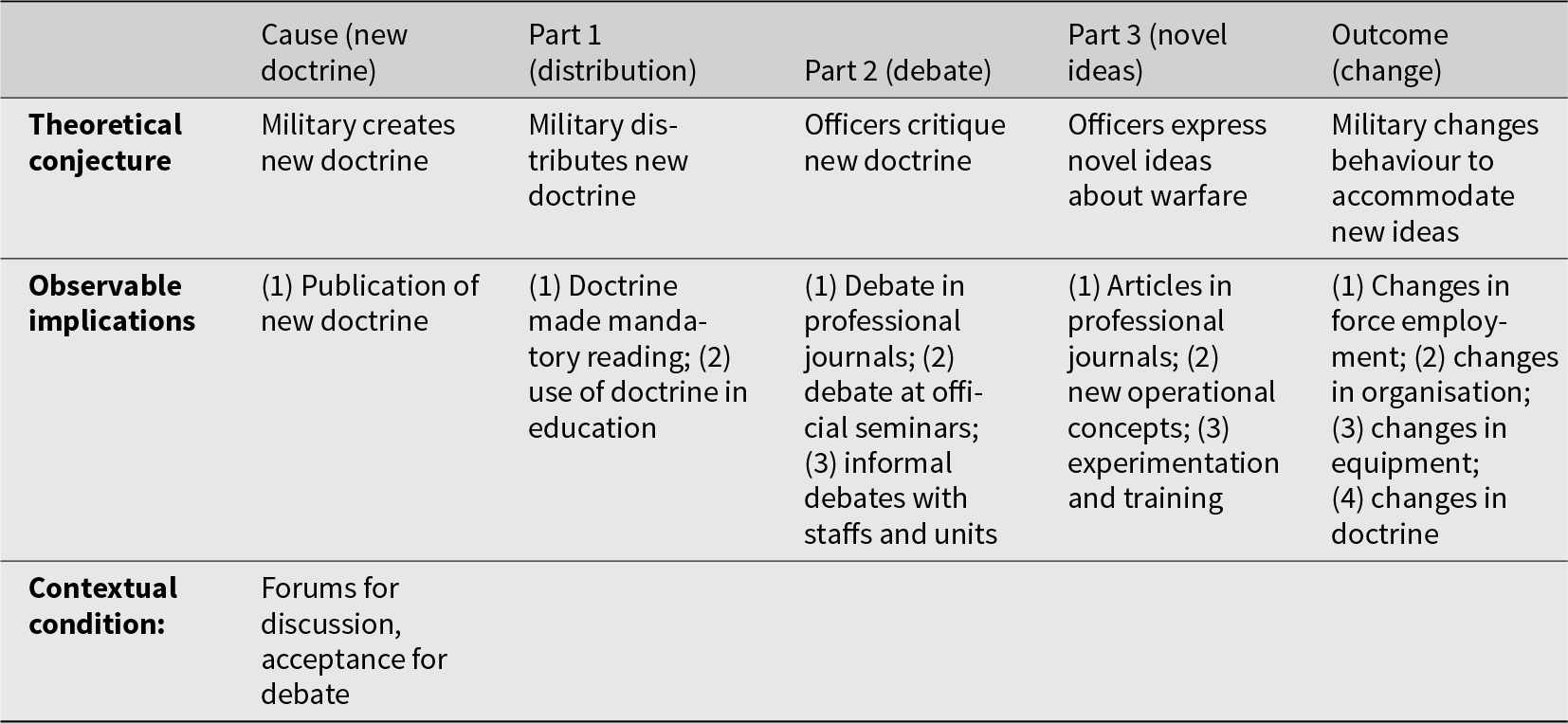
Source: Personal illustration.
These findings contribute to the broader discussions about military transformation. Although doctrine has been used as a tool of change in some cases, such as with AirLand Battle during the 1980s, this case study demonstrates that armed forces might neglect doctrine despite having all three preconditions – a shock, a sponsor, and a tradition of writing doctrine – for using doctrine as a tool of change. Doctrinal cultures, not just whether one writes doctrine but also what position and purpose doctrine holds in the organisation, shape if and how doctrine is used. This suggests that a previously unknown scope condition for the theory on doctrine as a tool of change is that the organisation has a tradition of using doctrine prescriptively. This finding aligns with the broader literature that cautions against equating doctrine with operational behaviour.Footnote 139
While small compared to the US Armed Forces, the case is representative of several European militaries in terms of limited resources, membership in NATO, and need to continuously adapt to changing operational demands. While previous research on the United States has stressed the importance of doctrine in coordinating large military organisations, the findings from this study suggest that smaller organisations have less need of prescriptive doctrine. This suggests that contemporary military buildup in Europe, such as the development of tactics for the F-35, may be driven less by doctrine and more by a consequence of organisational traditions, policy, and material cooperation.
The findings also carry practical implications. Seeing as doctrine is an official position on how to organise and operate, policymakers should hold their armed forces accountable for the content of their doctrines. The results challenge the assumption that forward-looking doctrines, such as those currently being developed by the United States and NATO, will drive transformation.Footnote 140 There is a risk that such doctrines, despite their promises of multi-domain dominance, will have limited practical impact. Military organisations would also do well to capitalise on doctrinal debates by providing relevant forums for discussion and by summarising and incorporating parts of the debate into conceptual developments.
Although doctrine is often assumed to provide a guiding framework for how to operate, empirical evidence of its actual effects is still limited. Questions remain about the extent to which doctrine constrains or enables decision-making, its impact on tactics, and how its application varies across services as well as national and operational contexts. Future studies should continue to systematically uncover the specific mechanisms through which doctrine influences operational behaviour and, by extension, military power. Specifically, scholars should continue to study under what conditions doctrines are used as tools of change or expand into the use of doctrine as a tool of education or command.Footnote 141 Examining other cases beyond the American and British armies, preferably through cross-case designs or even large-n studies, would give us a better understanding of how and why the relationship between doctrine and operational behaviour varies.
Additionally, this study highlights that the causal relationship between doctrine and operational behaviour does not always flow in the theorised direction. Rather than doctrine prescribing concepts, doctrine is often shaped by the organisation’s developing practices. While this is no empirical novelty, there is still a lack of theory and systematic studies as to how doctrine and behaviour shape each other, as well as why doctrine sometimes precedes behaviour but other times reflects it. Similarly, there is a notion in both research and written doctrine that doctrine tends to be created in top-down processes to ensure that it aligns with policy, strategy, or operational concepts. As done by others, this study has illustrated how doctrine is sometimes created from the bottom-up, and future research should isolate under which circumstances doctrine is developed top-down and bottom-up to further develop theory on the vertical (top-down) and horizontal (doctrine to behaviour) dimensions of doctrine.
Ackowledgments
I am thankful to Professor Dag Henriksen for introducing me to the RNoAF at an early stage of the research. I am also thankful to the reviewers and editors, who have helped me improve the quality of the manuscript.
John Nisser is an active-duty officer at the Strategy Division at the Swedish Armed Forces Headquarters. He has a PhD in War Studies and is a guest researcher at the Swedish Defence University. His research focuses on military doctrines, joint operations, and command and control.
Annex A: Interviews
Archer, Tomas Colin (2023). Interviewed over Teams 26 September 2023. Archer is a retired lieutenant general in the RNoAF. He served as Inspector General of the RNoAF 2000–4 and then as commander of the Norwegian Joint Forces Command.
Diesen, Sverre (2023). Interviewed over Teams 10 October 2023. Diesen is a retired general in the Norwegian Army. He was the principal architect behind Defense Study 2000 and served as Chief of Defense 2005–9.
Efjestad, Svein (2023). Interviewed over Teams 3 October 2023. Efjestad served as Policy Director for security policy at the Norwegian Ministry of Defense 1995–2013, as well as several positions within NATO and Norwegian security policy.
Gulseth, Erik Arff (2023). Interviewed over Zoom 1 September 2023. Gulseth is a retired colonel in the RNoAF. He was central in the writing of RNoAF doctrine during the 1990s and was the National Contingent Commander for the Norwegian F-16 force deployed to OEF 2002–3.
Haga, Lars Peder (2023). Interviewed over Zoom 15 June 2023. Haga is a teacher at the RNAFA and was one of the primary authors of the RNoAF 2018 air operations doctrine.
Hannestad, Finn Kristian (2023). Interviewed over Zoom 28 August 2023. Hannestad is a retired major general in the RNoAF. He was the first commander of the F-16 squadron in OAF in 1999 and served as Inspector General of the RNoAF 2010–14.
Heier, Tormod (2023). Interviewed over Zoom 11 June 2023. Heier is a retired lieutenant colonel in the Norwegian Army and a professor at the Norwegian Defence University College. He has written several works on the NAF and Norwegian security policy.
Henriksen, Dag (2023). Interviewed over telephone 24 February 2023. Henriksen is a lieutenant colonel in the RNoAF and professor at the RNAFA. He has written several works on the RNoAF, especially the Libya operations.
Jacobsen, Per-Oscar (2023). Interviewed over Zoom 3 October 2023. Jacobsen is a retired major general in the RNoAF. He served on the Air Staff, in NATO, and more before serving as Inspector General of the RNoAF 1997–2000.
Kampenes, Inge (2023). Interviewed over Teams 5 September 2023. Kampenes is a retired major general in the RNoAF. He served in Operations Allied Force and Enduring Freedom and held multiple commands within the Air Staff relating to procurement and competence management.
Klever, Morten (2023). Interviewed over Zoom 5 September 2023. Klever is a retired major general in the RNoAF. He served with both the United Nations and NATO in the Balkans and was the deputy wing commander in OEF. He advised or directed multiple reform processes in the RNoAF 2007–20.
Knutsen, Tom Henry (2023). Interviewed over Zoom 25 September 2023. Knutsen is a retired major general in the RNoAF. He was part of the writing team of the 1995 doctrine and later worked with doctrine and concepts at various strategy and policy positions.
Løvbukten, Arnvid Brage (2023). Interviewed over Zoom 26 September 2023. Løvbukten is a retired major general in the RNoAF. He advised or directed multiple reform processes in the RNoAF at various commands across the RNoAF, amongst them NJOD 2000 at the Defense Staff. He retired as head of the Defense Staff in 2008.
Maaø, Ole Jørgen (2023). Interviewed over Zoom 11 June 2023. Maaø is a teacher at the Royal Norwegian Air Force Academy and was one of the primary authors of the RNoAF 2018 air operations doctrine.
Nergård, Jarle (2023). Interviewed over Teams 5 October 2023. Nergård is an active-duty brigadier general in the RNoAF. He commanded the F-16 force sent to the International Security and Assistance Force in 2006 and was a red-card holder during the Libya operations in 2011.
Nodeland, Stein Erik (2023). Interviewed over Teams 27 September 2023. Nodeland is a retired major general in the RNoAF. He held various commands in the RNoAF and served as Inspector General 2004–10 and then as programme director for the F-35 programme.
Østby, Jan (2023). Interviewed over Zoom 9 June 2023. Østby retired as a lieutenant colonel in the RNoAF. He wrote the implementation strategy for air-to-ground and commanded the second F-16 deployment in OAF.
Sanderød, Steinar (2023). Interviewed in Stockholm 7 March 2023. Sanderød is a major in the RNoAF and teacher at the RNAFA. He has written multiple works on the history of the RNoAF.
Sandnes, Hans Ole (2023). Interviewed over Zoom 25 August 2023. Sandnes is a brigadier general in the RNoAF. He was the second commander of the F-16 force in Libya. He has also published a study on the 1974 combat aircraft analysis.
Smedsvig, Einar Kristian (2023). Interviewed over Zoom 31 August 2023. Smedsvig is a retired lieutenant general in the RNoAF. He served as Inspector General of the Air Force 1991–7 and retired as the commander of forces in northern Norway.
Solheim, Bård (2023). Interviewed over Teams 9 October 2023. Solheim is a retired colonel in the RNoAF. He held various commands and staff positions in the RNoAF and served as the first commander of the F-16 force sent to Libya.
Solli, Per-Erik (2023). Interviewed over Zoom 14 June 2023. Solli retired as a colonel in the RNoAF. He was later responsible for project 7518 to implement air-to-ground capabilities in the RNoAF during the 1990s. He was also a subject matter expert on Defense Study 2000 and has written multiple works on the RNoAF.


 Open access

