





Non-technical Summary
Pelmatozoans are a diverse group of echinoderms, which are marine animals that include starfish, sea urchins, and many other fossil and living groups. Pelmatozoans possess a main body, a stalk that raises the animal off the seafloor, and filter-feeding appendages that project from the body to capture food particles from the surrounding water currents. Many groups of pelmatozoans co-existed during the early Paleozoic, but most of these lineages were short-lived and/or species-poor. One exception was the crinoids, which were far more abundant, species-rich, and ultimately persisted from the Ordovician Period (approximately 485 million years ago) to the present day as the only living representatives of Pelmatozoa. It has been suggested that these differences in pelmatozoan diversity and persistence through time might have resulted from crinoids outcompeting other groups for food, given their similar ecological strategies for filter feeding. In this study, we tested this hypothesis by compiling ecological data for multiple pelmatozoan groups, including crinoids, paracrinoids, and rhombiferans, from the Late Ordovician (approximately 455 million years old) Bromide Formation of Oklahoma, USA. We used these ecological data to evaluate the ecological strategies and resource use of different pelmatozoan groups. We found that crinoids and other pelmatozoans do not overlap ecologically, which suggests that competition between them would have been unlikely. Although these results indicate that competition was not likely responsible for the different patterns of persistence and abundance across pelmatozoans, the ability of crinoids to use a wider range of ecological strategies might have helped them become more successful over time compared to other pelmatozoans.
Introduction
The Great Ordovician Biodiversification Event (GOBE) was the largest taxonomic radiation in the history of life (Webby et al., Reference Webby, Paris, Droser and Percival2004). In addition to establishing the Paleozoic Evolutionary Fauna and driving significant increases in taxonomic diversity (Sepkoski, Reference Sepkoski1981), the GOBE also resulted in major increases in both ecological and morphological diversity within many groups of marine invertebrates (Bambach, Reference Bambach, Tevesz and McCall1983; Sepkoski and Sheehan, Reference Sepkoski, Sheehan, Tevesz and McCall1983; Servais et al., Reference Servais, Owen, Harper, Kröger and Munnecke2010; Stigall et al., Reference Stigall, Bauer, Lam and Wright2017; Deline, 2020). Phylum Echinodermata was one such group that experienced major changes during the GOBE. From their origins dating back to at least the early Cambrian Period (Smith, Reference Smith1985; Zamora et al., Reference Zamora, Lefebvre, Álvaro, Clausen, Elicki, Harper and Servais2013; Rahman and Zamora, Reference Rahman and Zamora2024), echinoderm diversity during the GOBE expanded from nine to 21 classes between the late Cambrian and Late Ordovician, in addition to undergoing dramatic increases in both morphological and ecological disparity (Sprinkle and Guensburg, Reference Sprinkle, Guensburg, Webby, Paris, Droser and Percival2004; Sumrall and Wray, Reference Sumrall and Wray2007; Deline et al., Reference Deline, Thompson, Smith, Zamora, Rahman, Sheffield, Ausich, Kammer and Sumrall2020; Novack-Gottshall et al., Reference Novack-Gottshall, Sultan, Smith, Purcell and Hanson2022, Reference Novack‐Gottshall, Purcell, Sultan, Ranjha, Deline and Sumrall2024). During this radiation, notable ecological convergence occurred within the pelmatozoan echinoderms, which have typically been treated as an informal grouping of echinoderms that possess a theca, an erect stalk, and feeding appendages used for suspension filter feeding. Pelmatozoans can be divided into class Crinoidea, which are the only extant representatives of the group, and some members of ‘Blastozoa,’ which excludes crinoids but encompasses most other pelmatozoans, such as paracrinoids, rhombiferans, diploporans, eocrinoids, and blastoids (Sprinkle, Reference Sprinkle1973; Sheffield et al., Reference Sheffield, Limbeck, Bauer, Hill and Nohejlová2023). Blastozoa also includes additional echinoderms that lack the pelmatozoan body plan, such as cinctans, ctenocystoids, and solutes, although there have been several different hypotheses regarding which groups belong to Blastozoa and their phylogenetic relationships (see reviews by Sumrall and Waters, Reference Sumrall and Waters2012; Nanglu et al., Reference Nanglu, Cole, Wright and Souto2023; Rahman and Zamora, Reference Rahman and Zamora2024). Despite similarities in their overall bodyplans and ecological strategies, the taxonomic and ecologic diversification of crinoids was much more pronounced than that of blastozoans during the GOBE (Sprinkle and Guensburg, Reference Sprinkle, Guensburg, Webby, Paris, Droser and Percival2004; Wright and Toom, Reference Wright and Toom2017; Novack-Gottshall et al., Reference Novack-Gottshall, Sultan, Smith, Purcell and Hanson2022, Reference Novack‐Gottshall, Purcell, Sultan, Ranjha, Deline and Sumrall2024) and they developed ecologically complex communities (Cole et al., Reference Cole, Wright, Ausich and Koniecki2020). Similarly, following the Ordovician, crinoids continued to diversify and maintained their status as major constituents of Paleozoic marine faunas while the overall diversity of stalked blastozoans declined, with many groups being short-lived and/or remaining relatively minor components of ecological communities (Paul, Reference Paul and Hallam1977a; Foote, Reference Foote1992; Nardin and Lefebvre, Reference Nardin and Lefebvre2010; Limbeck et al., Reference Limbeck, Bauer, Deline and Sumrall2024), although there are notable exceptions, such as the Blastoidea (Waters, Reference Waters1990; Bauer, Reference Bauer2020).
Although the driving mechanisms responsible for these dramatically different diversification histories in crinoids versus blastozoans have long remained elusive, two nonexclusive hypotheses have been proposed to explain these patterns. The first hypothesis posits that crinoids and blastozoans were in direct competition with each other due to their similar ecologies as suspension filter feeders, and that crinoids outcompeted stalked blastozoans due to their more complex and efficient feeding structures (Paul, Reference Paul and Hallam1977a). Alternatively, the oxygen needs of crinoids versus blastozoans have been invoked as a potential driver, in which crinoids with higher oxygen needs became increasingly dominant as oxygen levels increased during the early Paleozoic (Paul, Reference Paul1977b). To date, neither of these hypotheses have been critically evaluated. The latter is difficult to test without detailed modeling of the oxygen needs of pelmatozoans, including the wholly-extinct blastozoan groups, which remain largely unexplored (but see Brower, Reference Brower1999). However, the hypothesis that crinoids and blastozoans competed for food can be readily tested by quantifying niche occupation and resource use using multivariate analysis of ecomorphological traits, following methods developed for crinoid feeding ecology (Ausich, Reference Ausich1980; Cole et al., Reference Cole, Wright and Ausich2019). Although competition implies the existence of one or more limiting resources, which are notoriously difficult to establish in the fossil record, the methods employed here evaluate potential overlap in resource use between species, so a limiting resource need not be identified to recognize the potential for competition or its long-term outcomes.
This study seeks to test the hypothesis that crinoids and blastozoans were in competition with each other for food due to their overlapping ecological strategies as filter feeders. A method previously developed to capture feeding ecology, niche differentiation, and ecomorphospace occupation within crinoids (Cole et al., Reference Cole, Wright and Ausich2019) was here modified and expanded to make it suitable for application to suspension filter-feeding blastozoans and used to characterize their feeding ecology. Specifically, we focused on blastozoans from the Late Ordovician (Sandiban) Bromide Formation fauna of Oklahoma, a diverse echinoderm assemblage that contains many co-occurring pelmatozoan taxa and represents peak establishment of diverse ecological communities that developed during the GOBE (Sprinkle, Reference Sprinkle1982c). Further, to compare the feeding ecology of stalked blastozoans from the Bromide fauna to that of co-occurring crinoids, blastozoan ecomorphological data were combined with an existing crinoid ecomorphological dataset that was assembled in a previous study on the feeding ecology of crinoids from the Bromide fauna (Cole and Wright, Reference Cole and Wright2022). Through multivariate analysis of these ecomorphological datasets for pelmatozoans from the Bromide fauna, this study aims to (1) characterize niche occupation and resource use in multiple pelmatozoan groups, and (2) evaluate whether stalked blastozoans and crinoids were in competition with each other. In addition to assessing whether competition could have served as a driver of different diversification dynamics in crinoids versus stalked blastozoans, the results of this study further shed light on community-level dynamics, including niche differentiation, species interactions, and community structure, in some of the first truly complex ecological communities that arose during the Late Ordovician.
Pelmatozoan feeding ecology
Anatomy of pelmatozoan feeding structures
With few exceptions (such as the derived pleurocystitid rhombiferans), pelmatozoan echinoderms are epifaunally tiered, passive suspension filter feeders that use food-gathering appendages to capture food particles from water currents. The feeding structures of most crinoids and blastozoans exhibit substantial differences, and these features have traditionally been used as one major line of separation between the two groups (Sprinkle, Reference Sprinkle1973, Reference Sprinkle1976; Clausen et al., Reference Clausen, Jell, Legrain and Smith2009). Food-gathering appendages are termed ‘arms’ in crinoids (Fig. 1), which possess a central coelomic canal that extends from the calyx through the structure, and ‘brachioles’ in blastozoans (Fig. 2) (Sprinkle, Reference Sprinkle1976; Clausen et al., Reference Clausen, Jell, Legrain and Smith2009). Generally, crinoid and blastozoan feeding structures have been considered nonhomologous, although there is strong evidence that the feeding structures of the diploporan, Eumorphocystis Branson and Peck, Reference Branson and Peck1940, might be homologous to the arms of crinoids (Sheffield and Sumrall, Reference Sheffield and Sumrall2019). Regardless of their homology, pelmatozoan feeding structures have similar ecological functions in crinoids and blastozoans and can thus be treated as ecologically analogous when investigating feeding ecology across pelmatozoans. One potential caveat relates to the presence of tube feet in blastozoans. All living echinoderms, including crinoids, possess tube feet, terminal extensions of the water vascular system that are used for a variety of functions including feeding, respiration, and locomotion. In crinoids, the tube feet play essential roles in both feeding and respiration (Meyer, Reference Meyer1979, Reference Meyer, Jangoux and Lawrence1982). Sprinkle (Reference Sprinkle1973) proposed that blastozoans might have lacked tube feet because blastozoan brachioles are much smaller than the arms of crinoids. To date, tube feet have never been found preserved in fossil blastozoans, although such preservation is expected to be extremely rare (e.g., Ausich et al., Reference Ausich, Bartels and Kammer2013). Other authors have argued that tube feet were likely present in blastozoans given the positional continuity of brachioles and associated ambulacral structures as well as the seemingly essential role of tube feet in successful food capture within a filtration fan (Paul and Smith, Reference Paul and Smith1984; Rozhnov, Reference Rozhnov2002). Thus, it is most conservative to assume tube feet were present in blastozoans until more definitive evidence of their absence is established.
Representative crinoids from the Bromide Formation exhibiting variation in feeding structures. (1) Penicillicrinus parvus Warn, 1952, OU 9054, a pentacrinoid (Disparida) with five branched, apinnulate arms; (2) Hybocrinus nitidus Sinclair, Reference Sinclair1945, OU 9574, a pentacrinoid (Hybocrinida) with five unbranched, apinnulate arms composed of thick brachials; (3) Reteocrinus depressus Kolata, Reference Kolata and Sprinkle1982, OU 8913, a stem eucamerate with 10 apinnulate, extensively branched arms; (4) Anthracocrinus primitivus Strimple and Watkins, Reference Strimple and Watkins1955, OU 8889, a camerate (Diplobathrida) with 15 unbranched, pinnulate arms; (5) Apodasmocrinus daubei Warn and Strimple, Reference Warn and Strimple1977, OU 9052, a pentacrinoid (Disparida) with five apinnulate arms that each branch once; (6) Carabocrinus treadwelli Sinclair, Reference Sinclair1945, OU 9131, a pentacrinoid (Porocrinida) with five apinnulate arms that branch multiple times, giving rise to numerous ramules; (7) Porocrinus bromidensis Sprinkle, Reference Sprinkle and Sprinkle1982e, OU 9105, a pentacrinoid (Porocrinida) with five unbranched, apinnulate arms; (8) Cremacrinus ramifer (Brower, Reference Brower1977), OU 8450, a pentacrinoid (Disparida) with four apinnulate arms and branched ramules; (9) Pararchaeocrinus decoratus Strimple and Watkins, Reference Strimple and Watkins1955, OU 9448, a camerate (Diplobathrida) with 10 branched, densely pinnulate arms and very thin, biserial brachials. Scale bars = 5 mm unless otherwise noted.

Representative blastozoans from the Bromide Formation exhibiting variation in thecal size and shape, feeding appendages, and ambulacra. (1–3) Platycystities levatus Bassler, Reference Bassler1943 (paracrinoid): (1) USNM PAL 804196, lateral view of specimen with partially articulated brachioles positioned along the recumbent arms; (2, 3) OU 221526: (2) oblique detail of oral area showing brachiole facets positioned along the recumbent arms; (3) oral view showing the position of the recumbent arms and the lateral compression of the theca that is typical of the species; (4, 7) Oklahomacystis tribrachiatus (Bassler, Reference Bassler1943), OU 283366 (paracrinoid): (4) lateral view of thecal showing curved, recumbent arms; (7) oral view showing the division of the ambulacra into three recumbent arms; note brachiole facets positioned along recumbent ambulacra; (5, 6) Sinclairocystis praedicta Bassler, Reference Bassler1950, OU 238367 (paracrinoid): (5) lateral view, note curved distal end of recumbent arm on the right side of the specimen; (6) oral view showing division of two recumbent arms and adjacent brachiole facets; (8) Glyptocystella loeblichi (Bassler, Reference Bassler1943), OU 9071 (rhombiferan), lateral view showing ambulacral areas with brachiole facets; (9) Pirocystella strimplei Sprinkle, Reference Sprinkle and Sprinkle1982b, OU 9000 (rhombiferan), lateral view of specimen with well-preserved brachioles; (10, 11) Hesperocystis deckeri Sinclair, Reference Sinclair1945, TX 1113.016 (rhombiferan): (10) oral view showing brachiole facets along ambulacra; (11) lateral view; (12) Eumorphocystis multiporata Branson and Peck, Reference Branson and Peck1940, TX 1109.01 (diploporan), lateral view of specimen preserving proximal pinnulate arms; (13, 14) Bromidocystis bassleri Sprinkle, Reference Sprinkle and Sprinkle1982f, (eocrinoid): (13) OU 9552, lateral view of complete theca preserving one of two proximal erect brachioles; (14) TX 1279.145, lateral view of incomplete theca preserving recumbent brachioles positioned along the side of the theca; (15, 16) Bistomiacystis globosa Sprinkle and Parsley, Reference Parsley and Sprinkle1982, OU 8853 (paracrinoid): (15) oral view of globular theca; (16) detail of oral area showing short ambulacrum and periproct. Scale bars = 5 mm.

Pelmatozoan feeding structures are centered around the ambulacra, canals used for nutrient transport that diverge from the mouth. Ambulacra are typically present on the oral surface (although they are commonly covered by the tegmen in groups like the camerate crinoids) in addition to extending from the theca along erect food-gathering appendages. Ambulacra can also extend a considerable distance along the sides of the theca, which are commonly referred to as recumbent arms or recumbent ambulacra (Kesling, Reference Kesling and Moore1967a, Reference Kesling and Mooreb; Parsley and Mintz, Reference Parsley and Mintz1975). In crinoids, ambulacra extend from the oral region along the adoral side of the arms and associated feeding structures, i.e., ramules and pinnules, where present (Fig. 1). The ambulacra are flanked by tube feet that are used to capture food particles and aid in transporting food along the ambulacra to the central or subcentral mouth, in addition to serving other functions like respiration (Meyer, Reference Meyer1979). The arms of crinoids are typically positioned around the edges of the calyx and are relatively large, heavily plated, endothecal structures, meaning that they are direct evaginations of the calyx wall. Although the brachioles of blastozoans are also erect, plated feeding appendages with an adoral ambulacral groove, they are relatively small and simple compared to the arms of most crinoids and are exothecal in nature, meaning that they are not continuations of the thecal wall. Instead, blastozoan brachioles are positioned along the edges of ambulacral areas on the theca and attach to brachiole facets that are either directly on the surface of the theca or on support plates, such as the thickened recumbent arm ossicles of some paracrinoids (Fig. 2.2, 2.3). Ambulacra and their associated brachioles can be restricted to the oral surface or they can extend a considerable distance down the side of the theca if recumbent arms are present (e.g., Fig. 2.1, 2.4, 2.5). In blastozoans, recumbent arms and ambulacra can exhibit considerable variation in their number, arrangement, and branching pattern, which has a corresponding effect on the position and total number of brachioles present. By contrast, recumbent arms are uncommon within Crinoidea, although there are exceptions within the order Hybocrinida, where some taxa reduced the number of erect arms and replaced them with recumbent ambulacra (Sprinkle and Moore, Reference Sprinkle, Moore, Moore and Teichert1978). Where present in crinoids, recumbent ambulacra are simple, unbranched structures.
In addition to differences in the structure of crinoid arms versus blastozoan brachioles, pelmatozoan feeding appendages vary substantially in their construction, complexity, and overall number, although crinoid arms are typically more morphologically complex than blastozoan brachioles. Feeding appendages in both crinoids and blastozoans are composed of individual plates (called brachials in crinoids and brachiolars in blastozoans) that can be arranged in a uniserial or biserial configuration. In crinoids, the number of arm openings is nearly always in multiples of five because of their integration with the calyx and its five-fold symmetry. Arms most commonly range in number from five to 20, although there are many notable exceptions in which taxa have fewer arms (e.g., hybocrinids commonly have three) or far more (e.g., Cleiocrinus Billings, Reference Billings1857 has up to 80 arm openings and catillocrinids have numerous, unbranched armlets arising from multifaceted radials). By contrast, the number of blastozoan brachioles is dictated by the extent of the ambulacral areas and is thus more variable, ranging from as few as two in some eocrinoids to > 100 in blastoids and some paracrinoids. Crinoids also exhibit considerable variation in the branching structure of their arms from atomous, unbranched appendages to those that are complexly branched (Fig. 1), whereas blastozoan appendages are almost invariably unbranched (Fig. 2). Further, many groups of crinoids have secondary (and sometimes tertiary) structures like pinnules and ramules on the arms (e.g., Fig. 1.4, 1.6, 1.9), but brachioles typically lack such secondary structures (although Caryocrinities ornatus Say, Reference Say1825 is a rare exception [Sprinkle, Reference Sprinkle1975]).
Pelmatozoan ecomorphology: prior studies and challenges
Ecomorphological traits are morphological traits that correlate with ecological functions. When analyzed using ordination approaches, these types of traits are particularly useful for quantitatively characterizing niche occupation and differentiation by evaluating the positions of species within multivariate ecospace (Ricklefs and Miles, Reference Ricklefs, Miles, Wainwright and Reilly1994). The use of ecomorphological traits to investigate community structure and functional ecology has been applied to numerous extant and extinct groups, including crinoids (Cole et al., Reference Cole, Wright and Ausich2019), lizards (Pianka et al., Reference Pianka, Vitt, Pelegrin, Fitzgerald and Winemiller2017), large herbivorous dinosaurs (Wyenberg-Henzler et al., Reference Wyenberg-Henzler, Patterson and Mallon2022), cervids (Curran, Reference Curran2012), and ants (Weiser and Kaspari, Reference Weiser and Kaspari2006), among many others (Van Valkenburgh, Reference Van Valkenburg, Wainwright and Reilly1994).
The first step when investigating ecomorphology is to establish a framework of functional traits that capture the ecological information of interest. In wholly-extinct systems like blastozoans, this can prove particularly difficult without access to living representatives or modern analogues. To date, pelmatozoan feeding ecology has been most extensively studied within Crinoidea, because this clade includes extant representatives whose ecology can be directly observed or experimentally tested (e.g., Meyer and Ausich, Reference Meyer, Ausich, Tevesz and McCall1983; Kitazawa et al., Reference Kitazawa, Oji and Sunamura2007; Messing et al., Reference Messing, Ausich and Meyer2021). Based on these investigations, a framework for quantifying major aspects of crinoid niche occupation using ecomorphological traits has been developed that emphasizes crinoid feeding ecology (Ausich, Reference Ausich1980; Cole, Reference Cole2019; Cole et al., Reference Cole, Wright and Ausich2019; Cole and Wright, Reference Cole and Wright2022). This work has established that aspects of skeletal morphology relating to the arms, secondary feeding structures, and ambulacra are relevant for capturing information on crinoid feeding ecology, in addition to other traits like body size (Ausich, Reference Ausich1980; Cole et al., Reference Cole, Wright and Ausich2019; Cole and Wright, Reference Cole and Wright2022). Some of the most significant axes of niche differentiation that have been identified in crinoids relate to the size of the food particles that are captured, which is dictated by the width of the ambulacra and is highly selective in crinoids (Rutman and Fishelson, Reference Rutman and Fishelson1969; Ausich, Reference Ausich1980; La Touche and West, Reference La Touche and West1980); the density of the filtration fan (i.e., the spacing of feeding structures), which is controlled by the number of arms, arm branching, and secondary structures and has an effect on filtration fan efficiency (Ausich, Reference Ausich1980; Kammer, Reference Kammer1985; Kammer and Ausich, Reference Kammer and Ausich1987; Brower, Reference Brower2007; Wright, Reference Wright2017); and body size, which has many ecological implications, such as energetic and nutritional needs given the size of the calyx relative to the surface area available for feeding (Peters, Reference Peters1983; Brower, Reference Brower2007). Differences in these ecomorphological traits create extensive variation in feeding strategies but often result in tradeoffs. For example, pinnulate crinoids have denser, higher-efficiency filtration fans compared to the more open filtration fans of apinnulate crinoids, but their smaller terminal feeding structures restrict food capture to smaller particles and can require specific environmental conditions, leading to a high degree of specialization (Baumiller, Reference Baumiller1993; Holterhoff, Reference Holterhoff1997a, Reference Holterhoffb; Wright, Reference Wright2017).
Because crinoids (and other pelmatozoans) are epifaunally tiered organisms, stem length also plays a significant role in niche differentiation (Ausich, Reference Ausich1980). Differences in stem length can allow individuals to access food particles carried by different water currents and has been shown to affect the type of food particles captured in living crinoids (e.g., Kitazawa et al., Reference Kitazawa, Oji and Sunamura2007). For more detailed reviews of crinoid feeding ecology and inference of ecomorphological traits, see Cole et al. (Reference Cole, Wright and Ausich2019) and Messing et al. (Reference Messing, Ausich and Meyer2021).
In contrast to crinoids, comparatively little work has been conducted on the feeding ecology of blastozoans. Ecological studies to date include the nature of stem attachments of paracrinoids and rhombiferans (Brett, Reference Brett1981; Thomka and Brett, Reference Thomka and Brett2015; Guensburg, Reference Guensburg1991), food size selectivity (Brower, Reference Brower2011, Reference Brower2013; each study included one paracrinoid and one rhombiferan), comparative morphology of paracrinoids (Parsley, Reference Parsley1978; Rozhnov, Reference Rozhnov2017), aspects of paracrinoid life mode and orientation (Ouellette et al., Reference Ouellette, Rahman, Limbeck and Deline2020; Guensburg, Reference Guensburg1991), and computation fluid dynamics surrounding feeding strategies of two diploporans (Hill, Reference Hill2022) and blastoid hydrospires (Waters et al., Reference Waters, White, Sumrall and Nguyen2017). However, given that both crinoids and stalked blastozoans are passive suspension feeders that primarily use erect food-gathering appendages to capture food particles, it is reasonable to use morphological traits in blastozoans that are analogous to those of crinoids (e.g., those relating to the brachioles, ambulacra, thecal size, etc.) and assume that these structures reflect similar ecological functions in both crinoids and blastozoans.
Taphonomy presents a major challenge when studying the feeding ecology of pelmatozoans, although the issue is more pronounced for blastozoans. Like all echinoderms, pelmatozoans are composed of individual skeletal plates made from high-magnesium calcite that range in number from a just a few elements to thousands of plates, which tend to be very prone to disarticulation. To some degree, the rapid disarticulation of echinoderms can be useful: assemblages can only preserve complete skeletons if little to no time-averaging has occurred, so the presence of multiple, well-preserved specimens can be taken to represent ecological snapshots of communities (Kidwell, Reference Kidwell1997; Ausich, Reference Ausich, Allmon and Yacobucci2016, Reference Ausich2021). However, other challenges emerge because of echinoderm taphonomy. Most notably, some taxa and/or certain regions of the skeleton are more susceptible to disarticulation than others depending on the degree of cementation between plates (Brett et al., Reference Brett, Moffat and Taylor1997). For example, blastozoan and crinoid columns begin to separate from thecae very quickly, and although isolated pluricolumnals are typically common, complete columns are rarely preserved attached to the thecae of fossil pelmatozoans. As a result, stem length is impractical to include in most ecomorphological studies of pelmatozoans despite its ecological importance, and has only rarely been investigated (e.g., Ausich, Reference Ausich1980; Brower, Reference Brower2011). Feeding appendages of all types are also especially susceptible to disarticulation, with arms and brachioles expected to separate from the calyx or theca and break down into individual skeletal elements in a matter of days to weeks (Brett et al., Reference Brett, Moffat and Taylor1997). Although crinoids with complete arms are comparatively rare, the plating is often robust and many crinoids have arms that are partially integrated with the calyx, allowing at least the proximal arms to preserve more frequently, which still capture significant ecological information (see Cole and Wright, Reference Cole and Wright2022, supplemental materials). By contrast, the less robust plating of brachioles and their weak integration with the theca via attachment by brachiole facets makes the preservation of brachioles particularly uncommon, thus making it challenging to comprehensively study blastozoan feeding structures (Brett et al., Reference Brett, Moffat and Taylor1997; Sprinkle and Guensburg, Reference Sprinkle, Guensburg, Webby, Paris, Droser and Percival2004).
Despite these taphonomic limitations, a wealth of ecological data are available from the pelmatozoan fossil record, although to date, only two significant paleoecological studies on feeding have been conducted that include both crinoids and blastozoans. Brower (Reference Brower2011, Reference Brower2013) examined the paleoecology of the Upper Ordovician Rust Formation of New York and Dunleith Formation of Iowa and Minnesota, focusing on the maximum size of food particles that could have been ingested by co-existing suspension-feeding organisms. These studies each included multiple crinoid taxa, one paracrinoid (Amygdalocystities Billings, Reference Billings1854 in both faunas), and one rhombiferan (Cheirocystis Paul, Reference Paul1972 in the Rust Formation and Tanaocystis Sprinkle, Reference Sprinkle and Sprinkle1982b in the Dunleith Formation), in addition to other filter feeders like bryozoans and brachiopods. The studies demonstrated that crinoids were capable of feeding on the largest range of food particle sizes (~0.1−2 mm) and that the blastozoans displayed overlap with crinoids in terms of the size of food particles that could be captured, with Amygdalocystites ingesting food particles ~0.4–0.8 mm in size, and the rhombiferans ingesting food particles ~0.3–0.6 mm in size (Brower, Reference Brower2011). Notably, these results indicate that the paracrinoids and rhombiferans ingested food particles of a size similar to those of certain crinoids (e.g., Cheirocystis Paul, Reference Paul1972 and Calceocrinus Hall, Reference Hall1852; Amygdalocystities, Iocrinus Hall, Reference Hall1866, and Dendrocrinus Hall, Reference Hall1852). Given that these taxa also have similar tiering heights, this suggests they might have been in competition with each other, at least with respect to food particles of a certain size fraction (Brower, Reference Brower2011, Reference Brower2013).
Although Brower’s (Reference Brower2011, Reference Brower2013) work is informative for understanding possible overlap in food-size selectivity across pelmatozoans, the potential implications of the study are limited due to inclusion of only two stalked blastozoan taxa in each fauna. Further, niches are complex, multidimensional concepts that reflect multiple ecological factors rather than one or two individual traits (Hutchinson, Reference Hutchinson1978). As a result, a thorough investigation of pelmatozoan feeding ecology, niche occupation, and potential competition will ideally (1) evaluate multiple ecological factors that can affect the ecological niches of these taxa, and (2) include a broad sampling of blastozoan and crinoid taxa to capture potential variation within groups. To this end, we expanded an existing model for quantifying crinoid feeding ecology and niche differentiation (Cole et al., Reference Cole, Wright and Ausich2019; Cole and Wright, Reference Cole and Wright2022) so that it can also be applied to stalked, filter-feeding blastozoans. This allowed us to investigate similarities or differences in niche occupation of major pelmatozoan groups, including potential niche overlap and competition across a wide spectrum of ecological traits. This model was applied to pelmatozoans of the Bromide Formation as a case study.
Geologic setting
Faunal diversity and taphonomy
The Upper Ordovician (Sandbian) Bromide Formation of south-central Oklahoma preserves a diverse Ordovician fauna that represents the culmination of the GOBE, including echinoderms, brachiopods, cephalopods, bryozoans, and trilobites (Sprinkle, Reference Sprinkle1982c; Karim and Westrop, Reference Karim and Westrop2002; Carlucci and Westrop, Reference Carlucci and Westrop2015; Trubovitz and Stigall, Reference Trubovitz and Stigall2016). However, the Bromide is best known for its rich echinoderm fauna that is represented by > 60 genera across at least a dozen classes (Sprinkle, Reference Sprinkle1982c). Almost every major group of Ordovician echinoderms is represented in the Bromide, including crinoids, paracrinoids, rhombiferans, diploporans, eocrinoids, asteroids, edrioasteroids (including edrioblastoids), cyclocystoids, echinoids, stylophorans, and solutes (Sprinkle, Reference Sprinkle1982c) as well as isolated sclerites that could represent holothuroids or ophiocystioids (Reso and Wegner, Reference Reso and Wegner1964; Kolata, Reference Kolata1975; Haude and Langenstrassen, Reference Haude and Langenstrassen1976). In fact, no other assemblage known from the geologic record contains echinoderms that span so many classes. The sheer abundance of echinoderm specimens in the Bromide Formation is also notable; the landmark monograph that summarized the Bromide echinoderm fauna stated that, at the time of publication, > 11,000 echinoderm fossils had been collected (Sprinkle, Reference Sprinkle1982c). A substantial number of these specimens are blastozoans, with a particularly notable abundance of the paracrinoids Oklahomacystis Parsley and Mintz, Reference Parsley and Mintz1975 and Platycystites Miller, Reference Miller1889, which number in the thousands. The Bromide Formation also contains the most diverse assemblage of Ordovician crinoids known (Cole and Wright, Reference Cole and Wright2022). A total of 38 valid crinoid species has been recognized from the Bromide Formation, although undescribed and/or fragmentary material indicates the true diversity of crinoids is at least 50 species (Sprinkle, Reference Sprinkle1982c; Sprinkle et al., Reference Sprinkle, Theisen and McKinzie2015, Reference Sprinkle, Guensburg, Rushlau, McCall, Theisen, McKinzie and Vanlandingham2018; Cole and Wright, Reference Cole and Wright2022).
Echinoderms from the Bromide Formation exhibit moderately good preservation, although taphonomic grades vary between horizons within the formation and are highly dependent on the taphonomic resilience of different taxa. Robust crinoid calyces and blastozoan thecae that fall within the ‘Type 3’ taphonomic grade of Brett et al. (Reference Brett, Moffat and Taylor1997) are very commonly preserved in the Bromide fauna. More delicate features like crinoid arms are moderately common, but structures like the brachioles of stalked blastozoans are only rarely preserved. As a result, it is serendipitous that large sample sizes are available for many of the Bromide echinoderm taxa, especially blastozoans, which increases the likelihood of sampling specimens that preserve important ecological features like brachioles.
Stratigraphy and fossil distribution
The Bromide Formation is the uppermost unit of the Simpson Group and consists of > 100 m of sandstones, shales, and limestones that are exposed in the Arbuckle Mountains of southern Oklahoma (Sprinkle, Reference Sprinkle and Sprinkle1982d, figs. 13–15). The succession was deposited along a distally steepened ramp that descended into the Southern Oklahoma Aulacogen and consists of facies that span tidal flats, lagoons, shoals, shoreface environments, and shallow to deep shelf environments (Longman, Reference Longman and Sprinkle1982a, Reference Longman and Sprinkleb; Carlucci et al., Reference Carlucci, Westrop, Brett and Burkhalter2014). The Bromide Formation consists of four members, which in stratigraphic order are the Pontotoc Member, Mountain Lake Member, Pooleville Member, and Corbin Ranch Member. The Pontotoc Member contains minimal fossils and is made up of packages of cross-bedded sandstone overlain by thin-bedded siltstone or fine-grained sandstone (Carlucci et al., Reference Carlucci, Westrop, Brett and Burkhalter2014). The Corbin Ranch Member, which is composed of alternating units of fenestral lime mudstones with rubbly shale and wackestone and interpreted as a supratidal environment, is also unfossiliferous (Carlucci et al., Reference Carlucci, Westrop, Brett and Burkhalter2014). By contrast, the Mountain Lake and Pooleville members are highly fossiliferous, and the overwhelming majority of fossils from the Bromide Formation have come from these members (Sprinkle, Reference Sprinkle and Sprinkle1982d, fig. 4). The Mountain Lake Member is a transgressive sequence made up of limestone and shale, and the Pooleville Member is a regressive sequence made up of biomicrite, with the majority of fossil horizons interpreted as shallow shelf to deep shelf environments (Fay and Graffham, Reference Fay, Graffham and Sprinkle1982; Longman, Reference Longman and Sprinkle1982a, Reference Longman and Sprinkleb).
Although many horizons within the Mountain Lake and Pooleville members contain fossils, two particularly rich layers have been recognized that are dominated by echinoderm fossils, which are termed the Lower Echinoderm Zone and Upper Echinoderm Zone (Longman, Reference Longman and Sprinkle1982a). The Lower Echinoderm Zone occurs in the middle of the Mountain Lake Member, and echinoderms make up ~30% of the total fauna within this horizon (Sprinkle, Reference Sprinkle and Sprinkle1982d). The most common taxon that occurs in the Lower Echinoderm Zone is the inadunate crinoid Hybocrinus Billings, Reference Billings1857 (Fig. 1.2), which makes up a total of 51% of the echinoderm material with > 3,000 complete specimens recovered, along with abundant Platycystities (Fig. 2.1−2.3) and various crinoid and rhombiferan taxa (Sprinkle, Reference Sprinkle and Sprinkle1982d). The Upper Echinoderm Zone occurs near the top of the Mountain Lake Member and is dominated by the paracrinoid Oklahomacystis (Fig. 2.4, 2.7), which makes up 92% of the echinoderm fauna with > 3,300 complete specimens (Sprinkle, Reference Sprinkle and Sprinkle1982d). The next most common taxa within the Upper Echinoderm Zone are the paracrinoids Sinclairocystis Bassler, Reference Bassler1950 (Fig. 2.5, 2.6) and Platycystites, followed by less abundant hybocrinids and other crinoid and rhombiferan taxa.
The exceptional diversity and abundance of crinoid and blastozoan echinoderms in the Bromide Formation provides a rare opportunity to investigate the feeding ecology of pelmatozoans. Because it is relatively uncommon for crinoids and blastozoans to co-occur with such high species richness, this assemblage is ideal for investigating community structure and dynamics across multiple pelmatozoan groups. Further, because the fragile feeding structures of blastozoans like paracrinoids are very rarely preserved, the extremely high abundance of blastozoan specimens provides large sample sizes that increase the likelihood of finding these structures preserved for study. As a result, the Bromide fauna presents a rare opportunity to study feeding ecology and potential competition in Upper Ordovician pelmatozoans.
Materials and methods
An expanded model for pelmatozoan niche differentiation
The ecology of pelmatozoans has been most extensively explored within crinoids (see reviews by Meyer and Ausich, Reference Meyer, Ausich, Tevesz and McCall1983; Baumiller, Reference Baumiller2008; Cole et al., Reference Cole, Wright and Ausich2019; Messing et al., Reference Messing, Ausich and Meyer2021). Building on studies that aimed to identify and quantify key aspects of crinoid niche differentiation and feeding ecology (e.g., Ausich, Reference Ausich1980; Cole, Reference Cole2019), a more comprehensive framework was developed to characterize crinoid feeding ecology using a broad suite of ecomorphological traits (Cole et al., Reference Cole, Wright and Ausich2019). Although stalked blastozoans and crinoids share many similarities in their constructional morphology and ecology, not all traits used in this framework for crinoid feeding ecology are applicable to blastozoans, and blastozoans also possess additional traits that are relevant to their feeding ecology but are not present in crinoids. As a result, the first objective of this study was to expand the existing model for quantifying crinoid niche differentiation (Cole et al., Reference Cole, Wright and Ausich2019) to make it applicable to stalked blastozoans as well.
The Cole et al. (Reference Cole, Wright and Ausich2019) model for crinoid niche differentiation includes 10 ecomorphological traits that are recorded as continuous measurements, as well as three characters that are calculated from measured traits. The first two measured characters, calyx height and width, reflect the body size of the organism and can be used to calculate calyx volume. Equivalent traits can be readily captured in blastozoans through measurements of thecal height and width and calculation of thecal volume. Other traits measured for crinoid arms can be readily applied to blastozoan brachioles, including arm length (brachiole length in blastozoans), number of arm openings (number of brachiole openings or brachiole facets in blastozoans), and brachial height and width (brachiolar height and width in blastozoans). Arm branching in crinoids (measured as the total number of in-line bifurcations within a single ray) is highly variable and affects the total number and/or spacing of feeding structures. Because none of the blastozoans from the Bromide fauna exhibit branching of the brachioles, this trait was coded as ‘0’ for all blastozoans, which is the same approach used for crinoids with atomous arms. The total number of feeding appendages also varies extensively in crinoids; this trait reflects how many individual feeding structures (arms, pinnules, and/or ramules) are present, which affects the density of the filtration fan and reflects the surface area available for food capture. Because all blastozoans in this study have unbranched arms and are apinnulate, this value for this trait is always the same as the number of brachiole openings, which is also how data are collected for apinnulate crinoids. Likewise, crinoid traits relating to pinnule or ramule density (spacing along the arms) and width do not apply for blastozoans and were thus coded as ‘0’ following the same treatment used for apinnulate crinoids.
Calculations for filtration fan area and density (i.e., feeding appendages per area, or the total number of feeding appendages divided by the area of the filtration fan) are part of the crinoid feeding ecology model, but cannot be easily adapted for blastozoans (Ausich, Reference Ausich1980; Cole et al., Reference Cole, Wright and Ausich2019). This is because many of the blastozoan taxa included in this study lack a circular filtration fan and instead have their feeding appendages arrayed in a single plane (e.g., Platycystities) or even recumbent along the theca (e.g., Bromidocystis Sprinkle, Reference Sprinkle and Sprinkle1982f). Others lack sufficient preservational quality to identify the total area covered by the feeding structures. As a result, these two traits were excluded from the study. Although filtration fan density has been identified as a key axis of niche differentiation in crinoids, it has also been shown that ecological differentiation can still be captured and confidently reconstructed even when complete feeding structures are not preserved (Cole and Wright, Reference Cole and Wright2022, fig. S1). Because both crinoid and blastozoan feeding appendages are composed of either one row of plates (uniserial) or two (biserial), this trait was added to the model to further capture differences in feeding structures. Finally, recumbent arms and ambulacra represent an important component of blastozoan feeding ecology that is not captured by the crinoid model, so two additional traits were added for the pelmatozoan model that reflect the number and width of the recumbent ambulacra. Because none of the crinoids in the study possessed recumbent ambulacra, these traits were coded as ‘0’ for all crinoids.
Sampling approach
This study focused on blastozoan and crinoid taxa from the Bromide Formation. Stalked blastozoans were represented by 22 species described from the Bromide Formation, distributed across Paracrinoidea, Rhombifera, Diploporita, and Eocrinoidea. Two species of pleurocystitid rhombiferans were excluded from the study because members of this group are interpreted to have been bottom detritus feeders, and thus the model for feeding ecology of erect suspension feeders cannot be applied directly to these taxa. Several other blastozoans in the Bromide Formation that were poorly preserved were also excluded because they did not preserve a sufficient number of ecological characters. Although rare solutes exhibit some similarities to the pelmatozoan body plan (e.g., possess an erect feeding appendage and/or attachment to the substratum as juveniles or adults), Myeinocystites natus Strimple, Reference Strimple1953a, the only known solute from the Bromide, lacks these features so was not included in the study (Parsley, Reference Parsley1972; Daley, Reference Daley1995, Reference Daley1996; Rozhnov, Reference Rozhnov2022). In total, 14 blastozoan species were included in this study, spanning six paracrinoids, six rhombiferans, one eocrinoid, and one diploporan. Table 1 summarizes all blastozoan species currently known from the Bromide Formation and those that were sampled for this study. The fossil crinoid dataset from Cole and Wright (Reference Cole and Wright2022) samples 37 of the 38 crinoid species described from the Bromide fauna, with one species (Cleiocrinus ornatus Kolata, Reference Kolata and Sprinkle1982) excluded due to poor preservation.
Summary of all stalked blastozoan taxa described from the Bromide Formation and those sampled for this study

The majority of specimens examined for this study are from the type and biological collections at the Sam Noble Oklahoma Museum of Natural History, which houses one of the largest collections of material from the Bromide Formation. Because ecological features like brachioles are rarely preserved for many stalked blastozoans, especially paracrinoids, a comprehensive inventory of the Sam Noble Museum collections was conducted to identify specimens that preserved ecomorphological features necessary to characterize feeding ecology. This survey of the Sam Noble Museum type and biological collections included a total of 4,414 paracrinoid specimens and 432 rhombiferans. Of the surveyed specimens, 222 had relevant ecological features preserved and were subsequently used for collection of ecomporphological data. Additional ecomorphological data were collected from specimens housed at the Smithsonian National Museum of Natural History and the University of Texas at Austin, as well as from published literature (e.g., Sprinkle, Reference Sprinkle1982c).
Data collection
Twelve ecomorphological traits were measured for all blastozoan specimens. These included: (1) thecal width, (2) thecal height, (3) complete brachiole length, (4) brachiolar width, (5) brachiolar height, (6) number of brachiole openings, (7) total number of terminal feeding appendages, (8) number of recumbent ambulacra, (9) recumbent ambulacral width, (10) whether brachioles are biserial or uniserial in their construction, (11) pinnule density, and (12) branching of feeding appendages (Fig. 3). As described above, traits 11 and 12 were recorded as ‘0’ for all blastozoans sampled because they have unbranched, apinnulate brachioles.
Examples of ecomorphological traits measured on stalked blastozoans from the Bromide Formation: (1, 2) Platycystites levatus Bassler, Reference Bassler1943: (1) OU 238301; (2) OU 221526, with detail showing ambulacra and brachiole facets; (3, 4) Oklahomacystis tribrachiatus (Bassler, Reference Bassler1943), OU 238269; (5, 6) Glyptocystella loeblichi (Bassler, Reference Bassler1943): (5) OU 238368, with detail showing brachiole structure and measurements; (6) OU 9071, with detail showing brachiole facets and their positioning along the ambulacral areas. AL = recumbent ambulacral length; AW = ambulacral width; BH = brachiolar height; BL = brachiole length; BW = brachiole width; TD = thecal depth; TH = thecal height; TW = thecal width. Scale bars = 5 mm.

Thecal volume was calculated for all specimens using the standard equation for an ellipse
 $$ V=\frac{4}{3}\pi hwd $$
where h, w, and d are, respectively, the semiaxes of the ellipse for height, width, and depth. Because the majority of blastozoans and crinoids are conical to subconical in shape, thecal depth is equivalent to thecal width, which simplifies the calculation of thecal volume to the equation for a cone. However, Platycystites is laterally compressed, so that thecal depth is typically approximately one-half that of thecal width. As a result, thecal depth was also measured for all Platycystites specimens to calculate more accurate values for thecal volume.
When possible, all traits were measured directly from specimens. However, because most of the blastozoan specimens observed did not preserve all brachioles, we calculated the approximate number of brachioles that would have been present. This was particularly necessary for paracrinoids like Platycystites, Oklahomacystis, and Sinclairocystis, which only rarely preserve brachioles. For these taxa, each recumbent arm ossicle plate (positioned alongside the recumbent ambulacra) has a brachiole facet that corresponds to a single brachiole (e.g., Fig. 2.2, 2.7, 2.6). For some paracrinoids, all ossicles of the recumbent arms were preserved and could be counted to determine the number of corresponding brachioles that would have been present. In most specimens, however, the recumbent arms were visible as faint ridges (called calluses) on the theca, but had lost most of the associated recumbent arm ossicles (Parsley and Mintz, Reference Parsley and Mintz1975; Frest et al., Reference Frest, Strimple and Coney1979). For these specimens, we measured the total length of the recumbent arm calluses and divided them by the length of an individual recumbent arm ossicle to estimate the total number of brachioles that would have been present on each specimen. Rhombiferan brachioles are preserved much more commonly than in paracrinoids, although it is still relatively rare for all brachioles to preserve. However, the brachiole facets of rhombiferans are commonly visible around the margins of the ambulacra (e.g., Fig. 2.10), so we counted the number of facets to determine the total number of brachioles that would have been present in instances in which they were not preserved.
In the process of collecting ecomorphological data, five specimens identified as Platycystites levatus Bassler, Reference Bassler1943 that had relatively high thecal volume were discovered to have an unusually large number of brachioles. The recumbent arm ossicles of these specimens were atypically narrow compared to those of other Platycystites levatus specimens, resulting in a total of 72−125 brachioles per specimen. This is substantially greater than the other Platycystites levatus specimens studied (N = 82) that had a mean of ~23 brachioles each (SD = 6.37). Interestingly, this substantial difference in brachiole count cannot be attributed to a size-related bias alone, because there are also numerous Platycystites levatus specimens that are of a similar large size but still retain the ‘typical’ number of brachioles. Given these notable differences in morphology, there is a possibility that these five unusual specimens might represent an unrecognized species, although further investigation of species delineation in Platycystities is beyond the scope of this study. However, because these five Platycystites levatus specimens showed notable deviation from the typical number of feeding structures in Platycystites levatus (morphotype A), we included them as a separate morphotype (morphotype B) for the ecomorphospace analyses.
Because juveniles, subadults, and/or unusually large individuals can skew means, excluding outliers can be beneficial for statistical analysis. Juvenile or subadult crinoids can be identified based on certain morphological traits (e.g., the relative dimensions of brachial plates), and the crinoid dataset of Cole and Wright (Reference Cole and Wright2022) explicitly excluded these specimens. Although some blastozoans examined for this study exhibited considerable size variation, no outliers or clear breaks in size were identified from plots of thecal volume, with the exception of Platycystities levatus specimens belonging to morphotype A. The thecal volume of Platycystites levatus (morphotype A) spans two orders of magnitude from ~107 mm3 in the smallest individual to > 17,380 mm3 in the largest. However, there is a clear break in this size distribution with no individuals sampled with a body size between ~1,030 mm3 and 1,767 mm3. Twenty specimens, or approximately one-third of the specimens for which thecal volume could be calculated, fall below this break in size distribution. Based on these observations, subsequent analyses were conducted both with and without these smaller specimens.
The new blastozoan dataset was merged with the pre-existing crinoid trait data from Cole and Wright (Reference Cole and Wright2022). Traits that were included in the crinoid ecological model but not the blastozoan model were excluded (e.g., filtration fan area, filtration fan density), traits relating to recumbent ambulacra were coded as ‘0’ for all crinoids, and additional data were collected for crinoids on uniserial versus biserial construction of the arms. The final merged dataset included measurements from 37 crinoid species, 14 stalked blastozoan species, and one blastozoan morphotype across 346 specimens, of which 95 were from crinoids and 251 were from blastozoans (Appendix 1).
Ecomorphospace occupation analyses
Mean values for all ecomorphological traits were calculated for each species prior to analysis (Appendix 1). All 12 measured traits in the pelmatozoan feeding model were included in the analyses, but thecal volume was excluded to avoid redundancy with measurements for thecal height and width. To examine the ecomorphospace occupation of blastozoans and compare their feeding ecology to that of crinoids within the Bromide Formation, a dissimilarity matrix was calculated for the merged crinoid and blastozoan dataset using Gower’s coefficient. A principal coordinates analysis (PCO) was then performed on the resulting dissimilarity matrix. To evaluate the effect of including possible subadult or juvenile Platycystities levatus specimens in the analysis, we ran two alternate analyses, one that included and one that excluded these smaller specimens.
To identify the primary traits that contributed to each of the major PCO axes, which reflect major axes of niche differentiation, we conducted Spearman’s rank correlation tests to evaluate the relationships between ecomorphological traits and the PCO scores for each major axis. Correlation tests were conducted across the first three PCO axes for thecal volume (log-transformed, due to variation across several orders of magnitude) and all measured ecomorphological traits, excluding thecal width and height, because these are captured more effectively in the combined trait of thecal volume (Appendix 2).
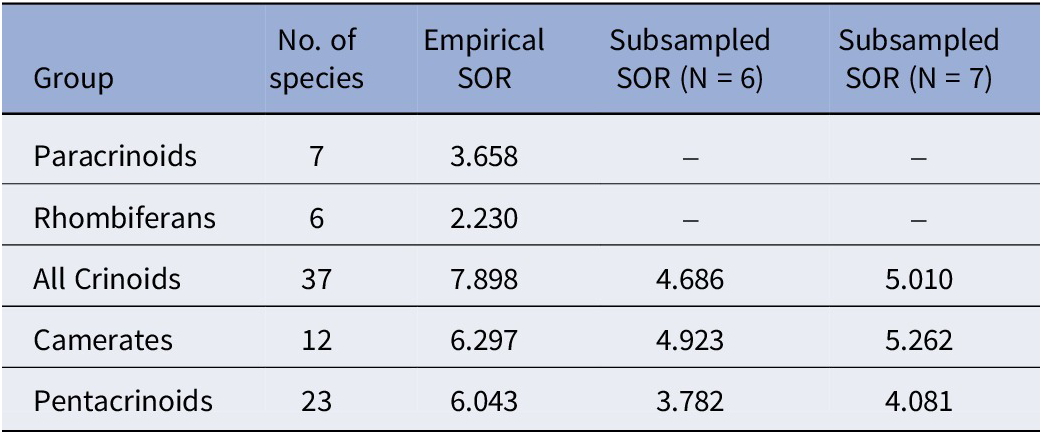
To quantify niche space occupation of pelmatozoans from the Bromide fauna, sum of ranges (SOR) was calculated for all major groups included in the study. Sum of ranges is a measure of disparity that captures the total amount of ordination space occupied across all axes, which makes it an effective method for evaluating the overall breadth of ecological strategies employed by each group (Wills, Reference Wills, Adrain, Edgecombe and Lieberman2001). SOR was calculated from the results of the PCO analysis for rhombiferans, paracrinoids, camerates, pentacrinoids, and all crinoids combined. Niche space occupation was not calculated for diploporans and eocrinoids because each of these groups were only represented by a single species. Because species richness is highly variable across pelmatozoan groups, with crinoid species richness far exceeding that of paracrinoids and rhombiferans, it is possible that differences in SOR could primarily be the result of sample size differences. To more directly compare SOR values across pelmatozoan groups, we also calculated SOR for crinoid groups subsampled to have equivalent richness to rhombiferans (N = 6) and paracrinoids (N = 7). Subsampling was repeated twice using sample sizes of six species and seven species. Species were sampled at random 1,000 times, SOR was calculated for each random subsample, and the resulting values were used to calculate mean niche space occupation for camerates, pentacrinoids, and all crinoids.
All analyses were conducted in R version 4.3.1 (R Core Team, 2023) using base R and the package ‘cluster’ (Maechler et al., Reference Maechler, Rousseeuw, Struyf, Hubert and Hornik2024).
Repositories and institutional abbreviations
Specimens figured and examined in this study are deposited in: Sam Noble Oklahoma Museum of Natural History (OU), Norman, OK; Smithsonian National Museum of Natural History (USNM), Washington, D.C., and the University of Texas at Austin (TX), Austin, TX.
Results
Of the 4,414 paracrinoids and 432 rhombiferans examined from the OU collections, only 222 were identified as having relevant ecological characters preserved. Out of this subset preserving ecological characters, a total of 17 paracrinoids (0.38%) and 39 rhombiferans (9.03%) preserved at least some portion of their brachioles. The rarity of brachiole preservation in blastozoans, particularly paracrinoids, highlights the necessity of large sample sizes to investigate the ecology of these organisms in faunas that exhibit typical taphonomic grades like the Bromide fauna (e.g., those that are not considered Lagerstätte; Brett et al., Reference Brett, Moffat and Taylor1997).
Excluding small Platycystites levatus specimens from analyses had a negligible effect on the resulting ordinations and the amount of variation represented by each axis (Appendix 3.1). Because the inclusion of small Platycystites levatus specimens had a minimal effect on the resulting ordination plots, the subsequent discussion focuses only on the ordination results that include all Platycystites levatus specimens regardless of size.
The first three axes of the PCO account for 25.21%, 18.71%, and 14.03% of the variation, respectively, for a total of 57.95% of the variance within the dataset explained by these axes. The results of Spearman’s rank correlation tests recovered the height of brachial/brachiole plates and whether arms/brachioles are biserial or uniserial as significant correlates of the first three axes (Appendix 2). In addition, the first PCO axis (PCO1) was significantly correlated with the number and width of recumbent ambulacra, the total number of feeding tips, and pinnule density. The second PCO axis (PCO2) was also significantly correlated with traits relating to recumbent ambulacra, in addition to thecal size, the number of arm/brachiole openings, and arm branching. The third PCO axis (PCO3) was significantly correlated with thecal volume, the length and width of the arms/brachioles, and arm branching.
Along PCO1 and PCO2, pelmatozoans from the Bromide fauna roughly clustered into four regions of ecomorphospace that correspond to the major groups included in the study (Fig. 4). Paracrinoids occupied a unique region of ecomorphospace that was strongly separated from both crinoids and rhombiferans along PCO1, although they overlapped extensively with rhombiferans along PCO2. Bromidocystis, the sole eocrinoid in the study, was most closely positioned to the paracrinoid region of ecomorphospace but was slightly separated along PCO1. Rhombiferans occupied a very distinct, relatively compact region of ecomorphospace that overlapped completely with paracrinoids along PCO2. Along PCO1, rhombiferans overlapped with crinoids as a whole, but fell roughly between the two separate regions that are occupied by crinoids. Crinoids occupied a much larger region of ecomorphospace compared to rhombiferans and paracrinoids, with a particularly wide spread along PCO1. With the exception of a single camerate, crinoids did not overlap with rhombiferans or paracrinoids along PCO2. Crinoids were further divided into two major groups that correspond to the subclasses Camerata and Pentacrinoidea (Ausich et al., Reference Ausich, Kammer, Rhenberg and Wright2015; Wright et al., Reference Wright, Ausich, Cole, Peter and Rhenberg2017), which were primarily separated along PCO1 with minimal overlap. Eumorphocystis, the sole diploporan from the Bromide, plotted within the crinoid region of ecomorphospace where the two subclasses overlap, although it was most closely positioned to other pentacrinoid taxa.
Ecomorphospace occupation of pelmatozoans from the Bromide fauna along the first two PCO axes. Convex hulls are shown for groups that are represented by multiple species in the fauna.

The ordination plot of PCO1 and PCO3 showed similar patterns of ecomorphospace occupation for the major pelmatozoan groups (Appendix 3.2). Crinoids still separated into two major regions of ecomorphospace that reflect camerates and pentacrinoids, although they showed greater overlap along PCO3 than PCO2. Paracrinoids and rhombiferans still occupied distinct regions of ecomorphospace, although both had more overlap with crinoids along PCO3. Rhombiferans showed greater overlap with camerates along PCO3 compared to PCO2, and paracrinoids overlapped entirely with both camerate and pentacrinoid regions of ecomorphospace along PCO3. The separation between Bromidocystis and paracrinoids increased along PCO3, whereas Eumorphocystis continued to fall most closely to the region occupied by pentacrinoids.
Measures of niche space occupation using SOR revealed that rhombiferans occupied the smallest amount of niche space, followed by paracrinoids (Table 2). By contrast, crinoids occupied more than double the niche space of both blastozoan groups, and even individually the camerate and pentacrinoid subclasses occupied much larger regions of niche space compared to the blastozoans. When crinoid SOR was subsampled to include six or seven crinoid species, thereby making sample sizes more comparable to those of paracrinoids and rhombiferans, SOR values for crinoids still exceeded those of blastozoan groups for crinoids as a whole and for the camerate and pentacrinoid subclasses (Table 2).
Total amount of niche space occupied by pelmatozoan groups, measured using sum of ranges (SOR). Empirical SOR measures are based on all species sampled for the analysis; subsampled SOR values for crinoids are means of 1,000 random subsamples of six and seven species, respectively
Discussion
Pelmatozoan niche occupation and differentiation in the Bromide fauna
Identifying traits that correlate with niche separation is paramount for investigating the parameters that control niche partitioning. The first three PCO axes all correlated significantly with the height of brachial/brachiolar plates and whether feeding structures are uniserial or biserial, indicating that these traits play a particularly important role in niche partitioning. Both of these traits reflect fundamental aspects of the construction of pelmatozoan feeding structures, especially the spacing of tube feet and/or pinnules. PCO1 further correlated with traits that reflect the spacing and total number of feeding structures, including the number and width of recumbent ambulacra, the total number of feeding tips, and pinnule density (Appendix 2). Although filtration fan density was not included because it cannot be readily captured for most stalked blastozoans in this study, some of the traits that significantly correlated with PCO1 are also ones that contributed to fan density in crinoids, which has been consistently recovered as the primary axis of niche differentiation in Ordovician and Mississippian crinoid communities (Ausich, Reference Ausich1980; Cole et al., Reference Cole, Wright and Ausich2019; Cole and Wright, Reference Cole and Wright2022). Thus, despite significant differences in taxon sampling and the traits included, this study recovered a primary axis of niche differentiation that is similar to prior studies that included only crinoids. The traits correlated with PCO2 primarily revolve around body size and the number of primary feeding structures, including the number of arm/brachiole openings and the number of times the arms branch. Thus, PCO2 captured more details of the primary feeding structures in pelmatozoans, as opposed to traits correlated with PCO1 that reflect secondary structures and the density of the filtration fan as a whole. PCO3 correlated with several traits overlapping with PCO1 and/or PCO2, but notably, it was the only major axis that is significantly related to the length of arms/brachioles, which reflects the total size of the filtration fan, and brachial/brachiolar width, which corresponds to food size selectivity. Interestingly, prior work on crinoid faunas also recovered body size, fan area, and food size as major axes of niche differentiation. Thus, key axes of niche differentiation for Ordovician pelmatozoan communities are largely consistent regardless of whether or not blastozoans are included.
Although paracrinoids, rhombiferans, and crinoids overlapped to some degree along one or more PCO axes, each of these groups occupied a distinct region of niche space (Fig. 4). The strong separation of paracrinoids from both rhombiferans and crinoids along PCO1 most likely reflects the fact that most paracrinoids possess numerous recumbent arms compared to crinoids and rhombiferans. By contrast, rhombiferans and paracrinoids overlapped almost entirely along PCO2, due to their similarities in the number of brachiole openings (20 or more) compared to crinoids (15 or fewer in most taxa), as well as their lack of branching compared to crinoids. Likewise, the overlap between rhombiferans and some crinoids along PCO1 is consistent with the interpretation of the traits contributing to this axis because these groups both lack recumbent arms and tend to have greater number of feeding tips than paracrinoids. The interpretation of PCO3 being strongly controlled by the width of brachioles/arms explains the patterns of niche occupation observed along this axis. The range of variation in paracrinoids along PCO3 is entirely within the range occupied by crinoids, especially pentacrinoids; this reflects similarities in the size of feeding structures of pentacrinoids and paracrinoids, which are relatively large compared to that of most camerate crinoids. By contrast, the overlap of rhombiferans with a few camerates along PCO3 can be explained by these taxa having some of the smallest feeding structures in the fauna. The separation of the two crinoid subclasses into two minimally-overlapping regions of niche space is consistent with prior studies, which recognized fan density as the primary axis of niche differentiation between camerates and pentacrinoids, with the presence or absence of pinnules and their spacing when present being the most important contributing factors (Cole et al., Reference Cole, Wright and Ausich2019; Cole and Wright, Reference Cole and Wright2022). Although the regions of niche space occupied by camerates versus pentacrinoids were slightly less distinct compared to analyses of crinoid data alone (i.e., Cole and Wright, Reference Cole and Wright2022, fig. 4), this was to be expected given that this study added traits that are important for blastozoan ecology and excluded some traits that are specific to crinoids.
Because eocrinoids and diploporans are each represented by a single species in this study, caution must be taken not to overinterpret their positions in niche space given that these taxa comprise a very small portion of the dataset. Further, the morphology of the feeding structures of Bromidocystis is highly atypical compared to most eocrinoids. Whereas most eocrinoids possess only erect feeding structures, all but two of the brachioles of Bromidocystis are recumbent structures that are weakly attached to the thecal wall (Sprinkle, Reference Sprinkle and Sprinkle1982f). As a result, it is unsurprising that Bromidocystis was recovered in the ordination plots as being most ecologically similar to paracrinoids given that they also possess multiple recumbent arms. The diploporan, Eumorphocystis, shares ecological affinities with crinoids, particularly the pentacrinoids Dendrocrinus villosus Brower and Veinus, Reference Brower, Veinus and Sprinkle1982 and Carabocrinus treadwelli Sinclair, Reference Sinclair1945 (see Appendix 4 for a niche space plot with species labeled). This relationship reflects the substantial similarities among the feeding structures of Eumorphocystis and those of many crinoids, including the arms arising from five openings, the presence of secondary feeding structures (although Dendrocrinus lacks pinnules or ramules), and the overall height and width of the brachioles that make up the feeding structures. The arm morphology of Eumorphocystis is somewhat unique among diploporans, and phylogenetic analysis has recovered Eumorphocystis as being closely related to crinoids, largely based on characters relating to its feeding structures (Sheffield and Sumrall, Reference Sheffield and Sumrall2019). However, it is unclear whether this intriguing ecological similarity between the feeding structures of Eumorphocystis and some crinoids can be generalized to all diploporans, especially because most diploporan taxa lack well-preserved feeding structures with rare exceptions (e.g., Triamara Tillman, Reference Tillman1967). Prior work on diploporans has also shown that Eumorphocystis differs from other diploporans in both its feeding mode and morphology of its feeding structures (Sheffield and Sumrall, Reference Sheffield and Sumrall2019; Hill, Reference Hill2022).
Competition between crinoids and stalked blastozoans: a rejected hypothesis
Patterns of niche occupation can be highly informative for identifying competition, or the lack thereof, between taxa. If two taxa occupy the same or very similar regions of ecomorphospace, they will be in direct competition with each other with respect to the niche axes considered. By contrast, if taxa occupy different regions of ecomorphospace, this indicates that they employ different ecological strategies and are thus unlikely to be in competition (Hutchinson, Reference Hutchinson1978; Pianka et al., Reference Pianka, Vitt, Pelegrin, Fitzgerald and Winemiller2017). In this study, we aimed to test the existing hypothesis that crinoids were in competition with stalked blastozoans, and that the more efficient feeding strategies of crinoids might have played a role in the decline of some blastozoan groups during the early to mid-Paleozoic (Paul, Reference Paul and Hallam1977a, b). However, we found that crinoids, rhombiferans, and paracrinoids from the Bromide fauna occupy nonoverlapping regions of niche space and that all three groups are ecologically distinct from one another. As a result, the hypothesis that crinoids and stalked blastozoans would have been in direct competition with each other based on aspects of their feeding ecology was not supported by our results. The diploporan, Eumorphocystis, is one potential exception to this conclusion. However, diploporans are considered to be a polyphyletic group (Sheffield and Sumrall, Reference Sheffield and Sumrall2019), so broader sampling of these taxa is needed to confidently evaluate their ecological similarity to crinoids, and the feeding ecology of Eumorphocystis has been recognized as being unusual compared to other diploporans (Hill, Reference Hill2022).
Future directions
Although competition between pelmatozoan groups was not substantiated by the results of this study, recovered patterns of niche occupation suggest the possibility that other ecological factors could have played a role in the diversification and decline of some blastozoan groups. Notably, the total amount of niche space occupied by paracrinoids and rhombiferans is very small compared to that of crinoids, with species restricted to tightly compacted regions. By contrast, crinoids (as a whole and for each subclass) occupy a much larger region of niche space (Fig. 4, Table 2). Despite significant differences in the underlying data analyzed, this result is consistent with the findings of Novack-Gottshall et al. (Reference Novack‐Gottshall, Purcell, Sultan, Ranjha, Deline and Sumrall2024), who found that crinoids had much greater ecological richness compared to that of other pelmatozoan groups during the Ordovician. Although crinoid subclasses in the Bromide have higher species diversity than rhombiferans and paracrinoids, and thus would be expected to have greater niche space occupation, crinoids still occupied a larger region of niche space than blastozoan groups when they are subsampled to have equivalent species richness to paracrinoids (N = 7) or rhombiferans (N = 6) (Table 2). Thus, differences in species richness alone cannot explain these discrepancies in the total amount of niche space occupied. These results indicate that both paracrinoids and rhombiferans have much narrower niche breadth compared to crinoids. The ability to generate increased phenotypic variation within a taxonomic group can promote speciation and/or allow taxa to adapt to changing environmental or ecological pressures (Jablonski, Reference Jablonski2022; Love et al., Reference Love, Grabowski, Houle, Liow, Porto, Tsuboi, Voje and Hunt2022). As a result, the limited ecological variation and narrower niche breadth of paracrinoids and rhombiferans might have made them specialist taxa and restricted their ability to diversify or respond to novel environments with the same success as crinoids. Although this study did not seek to evaluate alternative ecological drivers of diversification dynamics in blastozoans, it presents a promising area of future investigation that could shed light on why crinoids became the dominant pelmatozoans of the Paleozoic Era while other blastozoan groups (e.g., paracrinoids) failed to persist or remained substantially less species-rich (e.g., rhombiferans).
Conclusions
The first truly complex ecological communities developed during the Ordovician as a product of the GOBE, in which greater species richness helped to promote increased species interactions like competition and predation. Combined with its high species richness and abundance, the Bromide assemblage is an ideal study system for evaluating ecological similarity and potential species interactions across multiple filter-feeding pelmatozoan taxa, which might have been in competition with each other. Here, we modified an existing model developed for crinoid feeding ecology and applied it to multiple pelmatozoan groups to evaluate their patterns of niche occupation, differentiation, and competition. We found that each of the major groups investigated—crinoids, paracrinoids, and rhombiferans—occupied distinct regions of niche space and would not have been in competition with each other. Although the results of this study indicate that competition was not a likely a driver of differential diversification dynamics in early Paleozoic pelmatozoans, they do suggest future avenues of investigation into other ecological mechanisms that might have affected the evolutionary trajectories of stalked blastozoans.
Acknowledgments
We thank S. Vanlandingham (University of Oklahoma, Sam Noble Museum) for collecting and donating specimens used in this project and for assisting with specimen identification. We also thank L. Farrar (Sam Noble Museum), L. Appleton (University of Texas at Austin), and G. Hunt (Smithsonian National Museum of Natural History) for providing access to museum specimens. We thank B. Deline and P. Novack-Gottshall for providing reviews and P. Gorzelak and S. Zamora for editorial assistance that improved this manuscript. D.F. Wright also provided comments that improved an earlier version of this manuscript. This research was supported in part by student research grants awarded to C. Higdon from the Paleontological Society and the University of Oklahoma’s Mewbourne College of Earth and Energy.
Competing interests
The authors declare none.
Appendix 1
Ecomorphological dataset containing mean ecomorphological trait values used for ordination analyses of blastozoan and crinoid species from the Bromide Formation. Mean values given for Platycystites_levatus_morphA include all specimens of the typical morphotype regardless of size; Platycystites_levatus_morphA_small_excl is the mean values for specimens of the typical morphotype with small specimens excluded; and Platycystites_levatus_morphB is the mean values for large specimens exhibiting a different brachiole morphotype. NA = missing data.

Appendix 2
Summary statistics for Spearman’s rank correlations between the first three principal coordinates and the ecomorphological variables used to interpret principal coordinates analyses (PCOs). Bold p-values indicate correlations that are statistically significant.

Appendix 3
(1) Ecomorphospace plot of PCO1 and PCO2 resulting from a principal coordinates analysis (PCO) of the Bromide pelmatozoan dataset with small specimens of Platycystites levatus Bassler, Reference Bassler1943 excluded. Ordination results exhibit minimal differences from the analysis including all Platycystites levatus specimens regardless of thecal size. (2) Ecomorphospace plot of PCO1 and PCO3 resulting from a PCO of the Bromide pelmatozoan dataset with all Platycystities levatus specimens included regardless of thecal size.
Appendix 4
Ecomorphospace plot of PCO1 and PCO2 with individual species labeled. Species not otherwise mentioned in the text are: Abludoglyptocrinus laticostatus Kolata, Reference Kolata and Sprinkle1982; Acolocrinus arbucklensis Sprinkle, Reference Sprinkle and Sprinkle1982a; Acolocrinus crinerensis Sprinkle, Reference Sprinkle and Sprinkle1982a; Archaeocrinus conicus Kolata, Reference Kolata and Sprinkle1982; Archaeocrinus subovalis Strimple, Reference Strimple1953b; Bromidocrinus nodosus Kolata, Reference Kolata and Sprinkle1982; Calceocrinus longifrons Brower, Reference Brower1977; Cleiocrinus bromidensis Kolta, 1982; Colpodecrinus quadrifidus Sprinkle and Kolata, Reference Sprinkle, Kolata and Sprinkle1982; Columbicrinus sulphurensis Frest, Strimple, and McGinnis, Reference Frest, Strimple and McGinnis1979; Crinerocrinus parvicostatus Kolata, Reference Kolata and Sprinkle1982; Dendrocrinus bibrachialis Brower and Veinus, Reference Brower, Veinus and Sprinkle1982; Dendrocrinus glabellus (Brower and Veinus, Reference Brower, Veinus and Sprinkle1982); Diabolocrinus arbucklensis Kolata, Reference Kolata and Sprinkle1982; Diabolocrinus constrictus Kolata, Reference Kolata and Sprinkle1982; Diabolocrinus oklahomensis Kolata, Reference Kolata and Sprinkle1982; Diabolocrinus poolevillensis Kolata, Reference Kolata and Sprinkle1982; Doliocrinus pustulatus Warn, Reference Warn and Sprinkle1982; Eopinnacrinus pinnulatus Brower and Veinus, Reference Brower, Veinus and Sprinkle1982; Hybocrinus crinerensis Strimple and Watkins, Reference Strimple and Watkins1949; Hybocrinus pyxidatus Sinclair, Reference Sinclair1945; Merocrinus impressus Brower and Veinus, Reference Brower, Veinus and Sprinkle1982; Palaeocrinus hudsoni Sinclair, Reference Sinclair1945; Paracremacrinus laticardinalis Brower, Reference Brower1977; Paradiabolocrinus stellatus Brower, Reference Brower1977; and Peltacrinus sculptatus Warn, Reference Warn and Sprinkle1982.
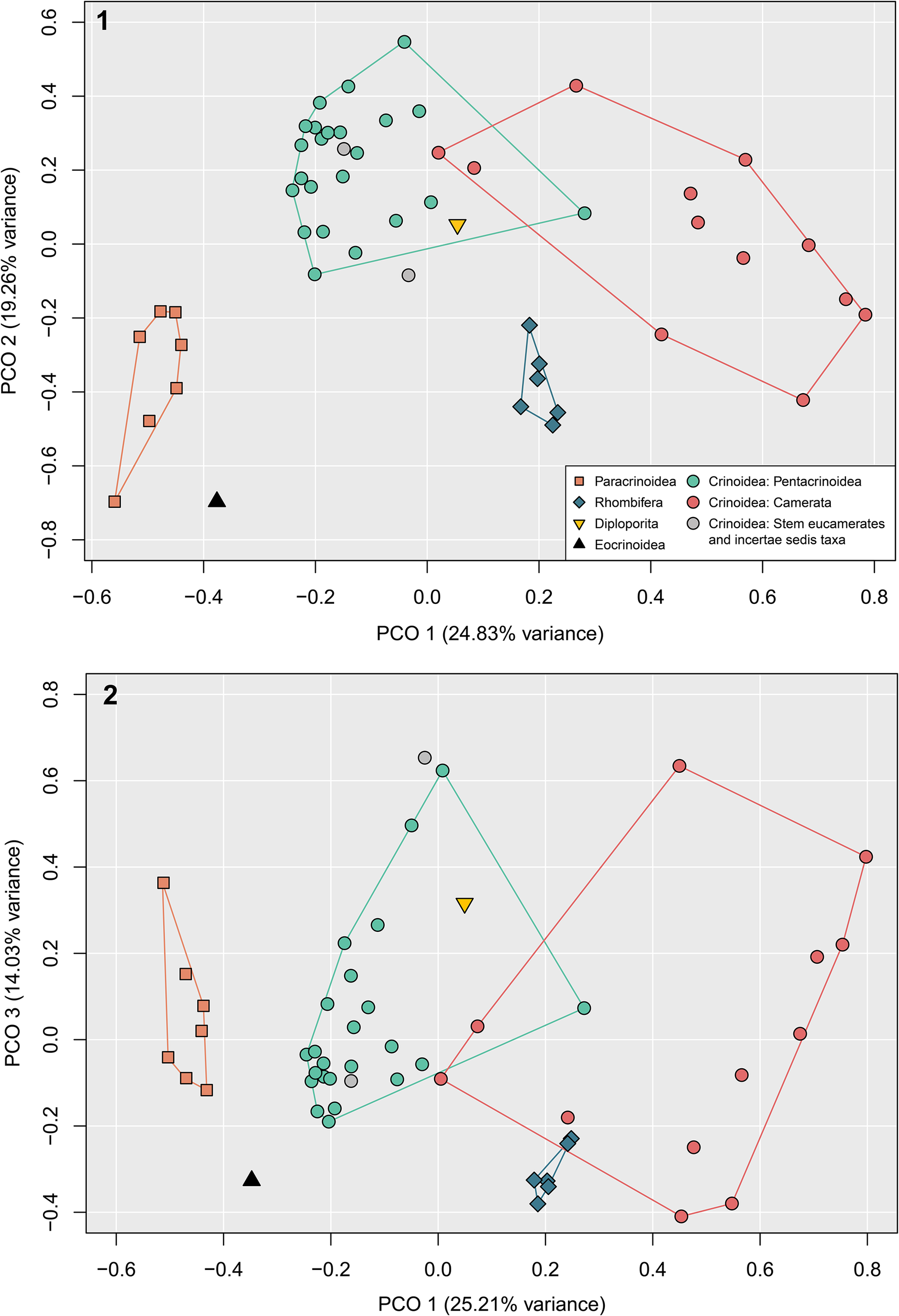


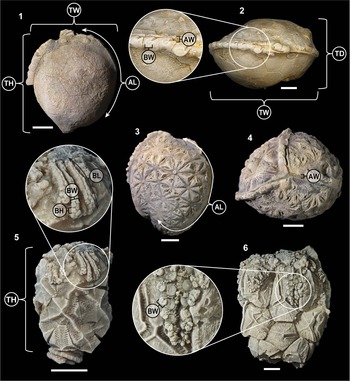

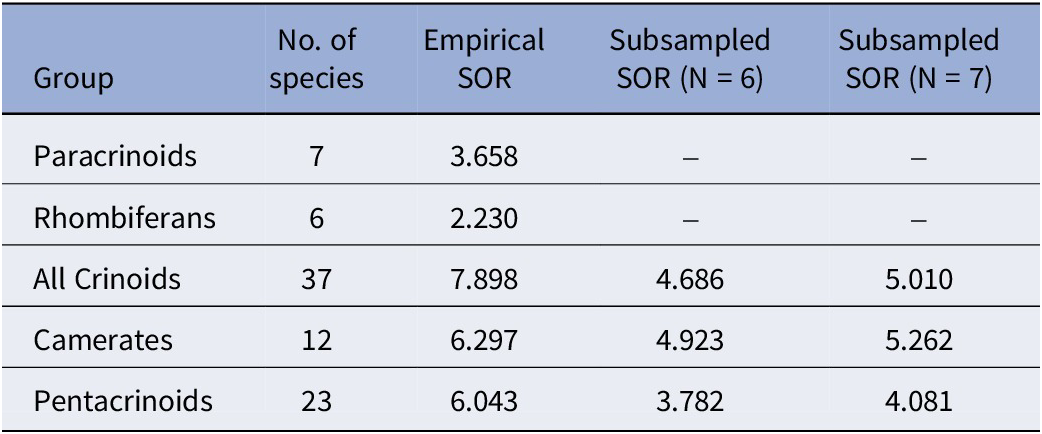

 Open access

