


Introduction
The Paulasteriidae Mah et al. Reference Mah, Linse, Copley, Marsh, Rogers, Clague and Foltz2015, the most recently described family of Asteroidea, are the only Asteroid clade known to be solely associated with hydrothermal vent ecosystems. An exclusively deep-sea clade, no verified specimens have been reported in depths shallower than 1200 m, and most records exceed 2000 m (Mah et al. Reference Mah, Linse, Copley, Marsh, Rogers, Clague and Foltz2015; Sun et al. Reference Sun, Xiao and Sha2022). Members of the clade share a small disc and between 6 and 8 arms, composed of a weakly reticulate skeleton covered in dense spinelets or fleshy body wall tissue. The adoral carinae are weakly developed or absent and tube feet are typically biserial distally, in some instances becoming quadraserial towards the mouth. The two described species share a form of crossed pedicellaria characterized by jagged teeth along the edges. However, this morphological diagnosis is currently not adequate to separate the Paulasteriidae from other Forcipulatacean clades, and the family was primarily erected on molecular evidence (Mah et al. Reference Mah, Linse, Copley, Marsh, Rogers, Clague and Foltz2015). In particular, it is morphologically difficult to separate members of the ‘Pedicellasteridae’, a likely polyphyletic family (Mah and Foltz Reference Mah and Foltz2011) of primarily deep-sea 5–6-armed species, from the Paulasteriidae.
Only two species and a single genus are currently recognized, Paulasterias tyleri Mah et al. Reference Mah, Linse, Copley, Marsh, Rogers, Clague and Foltz2015 and P. mcclaini Mah et al. Reference Mah, Linse, Copley, Marsh, Rogers, Clague and Foltz2015. Paulasterias tyleri, with fleshy arms and a dense, compact body has been recorded near vent sites in the Southern Ocean (Figure 1) and has been observed apparently predating vent crabs (Kiwa sp.) and barnacles (Vulcanolpeas scotiaensis Buckeridge et al. Reference Buckeridge, Linse and Jackson2013), leading it to being referred to as a “vent macroconsumer” (Buckeridge et al. Reference Buckeridge, Linse and Jackson2013; Marsh et al. Reference Marsh, Copley, Huvenne, Linse, Reid, Rogers, Sweeting and Tyler2012). Paulasterias mcclaini is superficially very distinct from P. tyleri, with a reduced body wall and slender arms. It has not been observed predating on motile taxa and is instead hypothesized to feed on microbial mats coating sulphide rubble (Mah et al. Reference Mah, Linse, Copley, Marsh, Rogers, Clague and Foltz2015). Paulasterias mcclaini has so far only definitively been identified from inactive sulphides in the north-east Pacific.
Global distribution of Paulasteriidae species. Points include all published records of species in the family Paulasteriidae. Filled shapes indicate specimens that were collected, with empty circles showing visually identified records without an associated collection. Stars represent specimens that have available genetic data. The black square indicates the location of the newly collected specimen at the Semenov hydrothermal field on the mid-atlantic ridge.

Aside from the original description, individuals provisionally identified as Paulasterias sp. have been recorded in photographs and on ROV dives from several sites in the Pacific (NOAA Ocean Exploration 2024), and the mitogenome of an individual collected in the western Pacific near the Federated States of Micronesia has been sequenced (Sun et al. Reference Sun, Xiao and Sha2022). None of these individuals have been identified below genus level, and there remain uncertainties for those identified only from images given the morphological similarity of Paulasterias spp. with other forcipulataceans discussed above.
In this paper, we extend the known global distribution of the Paulasteriidae into the Atlantic Ocean. We provide morphological and molecular data from a specimen identified as Paulasterias mcclaini from the Semenov hydrothermal field on the Mid-Atlantic Ridge (MAR), in addition to an updated phylogeny of available sequence data from the family and a collation of available records.
Materials and methods
Specimen collection
The Semenov hydrothermal field is located along the western flank of the MAR at a latitude of 13°30′ N, where a large Oceanic Core Complex hosts at least five known ultramafic-hosted seafloor massive sulphide sites, known as Semenov 1–5. This area was surveyed by the RRS James Cook from 26 October 2023 to 29 November 2023 as part of the ULTRA project. The specimen presented here was collected on Dive 421 using the slurp gun of the Remote Operated Vehicle (ROV) ISIS at 13.5115 N 44.8956 W and 2784 m depth while surveying Semenov-4 (Figure 1). Upon retrieval on deck, the specimen was photographed and preserved in 90% non-denatured ethanol. The newly collected specimen is accessioned at the Natural History Museum, London (NHMUK) under the accession number NHMUK 2025.188.
Morphological observation
Morphological observations were primarily made using a stereo dissecting binocular microscope. Scanning-electron microscopy (SEM) of gold-coated, denuded pedicellaria was carried out on a JEOL JSM-IT500 in the imaging suite at the NHMUK.
DNA amplification and phylogenetics
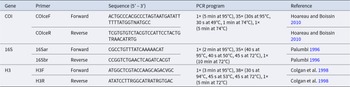
DNA was extracted from tube-feet of the newly collected specimen, and from a paratype of Paulasterias tyleri (NHMUK 2014.11) using the DNeasy Blood and Tissue Kit (Qiagen), following manufacturer guidelines. Regions of 16S rRNA (16S), cytochrome oxidase subunit I (COI), and early-stage histone 3 (H3) were amplified with published primer sets (Colgan et al. Reference Colgan, McLauchlan, Wilson, Livingston, Edgecombe, Macaranas, Cassis and Gray1998; Hoareau and Boissin Reference Hoareau and Boissin2010; Palumbi Reference Palumbi1996). Only COI was amplified for the P. tyleri paratype. The PCR mix for each reaction contained 10.5 µl of Red Taq DNA Polymerase 1.1X MasterMix (VWR), 0.5 µl of each primer (10 µM), and 1 µl of DNA template. PCR primer details and thermocycling conditions can be found in Table 1.
Primers and PCR programs used for DNA amplification

PCR products were purified using a Millipore Multiscreen 96-well PCR Purification System and sequenced using the same primers as used for amplification, using an ABI 3730XL DNA Analyzer (Applied Biosystems) at the Natural History Museum Sequencing Facilities. For each gene fragment, contigs were assembled by aligning both forward and reverse sequences, chromatograms were visually inspected, and ambiguous base calls were corrected manually, using Geneious 7.0.6 (Kearse et al., Reference Kearse, Moir, Wilson, Stones-Havas, Cheung, Sturrock, Buxton, Cooper, Markowitz, Duran and Thierer2012). Newly generated sequences are available on GenBank under the accession numbers: PV574136 and PV574137 (COI), PV577080 (16S), and PV587909 (H3).
Phylogenetic reconstruction of the superorder Forcipulatacea Blake Reference Blake1987 was conducted using a concatenated dataset of COI, 16S, 12S, and H3 genetic sequences, as these markers had the highest taxonomic coverage available. Newly obtained sequences were added to a dataset of sequences from species across the Forcipulatacea available on GenBank (Supplementary Table 1). Patiria miniata (Brandt Reference Brandt1835) was selected as an outgroup taxon. COI and H3 sequences were aligned using MUSCLE (Edgar 2004) in Geneious 7.0.6; with nucleotides translated into amino acids to identify pseudogenes based on the presence of stop codons. Sequences for 16S and 28S were aligned using MAFFT v.7 (Katoh and Standley Reference Katoh and Standley2013) with the iterative refinement method FFT-NS-i. Ambiguously aligned regions were filtered using the Gblocks server (Dereeper et al. Reference Dereeper, Guignon, Blanc, Audic, Buffet, Chevenet, Dufayard, Guindon, Lefort, Lescot, Claverie and Gascuel2008), allowing gap positions in final blocks and less strict flanking positions. The final sequence alignment used for analyses was 1664 bp in length. The optimal substitution model for each gene was determined using IQTREE ModelFinder (Kalyaanamoorthy et al. Reference Kalyaanamoorthy, Minh, Wong, von Haeseler A and Jermiin2017). This was identified as TIM2 + F + I + G4 for COI, TVM + F + I + G4 for 16S, TIM2 + F + G4 for 12S, and K3P + G4 for H3.
Phylogenetic trees were estimated using both Bayesian inference (BEAST v2.4.7; Bouckaert et al. Reference Bouckaert, Heled, Kühnert, Vaughan, Wu, Xie, Suchard, Rambaut and Drummond2014) and a maximum-likelihood approach implemented with IQ-–TREE v.2.2.6. (Minh et al. Reference Minh, Schmidt, Chernomor, Schrempf, Woodhams, von Haeseler A and Lanfear2020). Node support in IQ–TREE was estimated using 1000 ultrafast bootstraps (Hoang et al. Reference Hoang, Chernomor, von Haeseler, Minh and Vinh2018). BEAST analyses were performed with tree and clock models linked, a Yule tree model, and a relaxed clock log normal. Two independent runs of a maximum of 30 million steps were combined after discarding 10% as burn-in. Runs were checked for convergence (ESS > 200) and a median consensus tree was estimated from the combined post-burn-in samples. Genetic similarity between sequences was determined using alignments in Geneious.
Results
Morphological observations
Description of specimen, NHMUK 2025.188:
Six arms, slender, R/r = 6.86. Colour in life white to light orange, darker towards the centre of the disc (Figure 2.a,b). Tube feet biserial along extent of arm. Body covered almost entirely in small spinelets and pedicellariae, predominantly wrapped in fleshy sheaves when wet. Body wall very thin, only persisting as a thin membrane when dried. Madreporite prominent, raised above the level of the disc and surrounded by spines.
Paulasterias mcclaini individual collected from the semenov hydrothermal field on the mid-atlantic ridge in November 2023. (A) In situ image; (B) aboral surface of fresh specimen; (C–D) scanning electron microscope image of (C) entire (articulated) straight Pedicellaria, with basal piece and valves; and (D) disarticulated valves of a crossed Pedicellaria.

Abactinal skeleton of arm with overlapping, quadlobate, cruciform carinal plates running down the mid-axis, most bearing a short, round tipped spine at the centre. Primary abactinals loosely reticulate, with irregular elongate ossicles in contact with carinal plates to form weakly transverse ribs. Proximally these are more loosely spaced, with wide plate openings. Towards the mid- and distal arm regions these are more tightly packed, becoming partially imbricated towards the arm margin below the first row of sub-carinal ossicles. Superomarginals irregular, but generally roughly cruciform, proximally somewhat indistinct, becoming more prominently differentiated from the primary abactinals distally. Inferomarginals larger, generally with a prominent spine and a single large, straight pedicellaria, although these are absent on some plates. No clear intermarginals identified. In gross morphology, the mid-arm skeleton most closely resembles that of typical members of the Asteriidae (Fau & Villier, Reference Fau and Villier2020), but is much more widely spaced proximally. Adambulacral plates each with two spines in perpendicular series to the arm axis, excepting the most basal two or three which bear only a single spine. Oral plates simple with two spines, the more oral angled out from the mouth and away from the body, the more distal oriented flat against the plate and directed distally.
Three kinds of pedicellaria present: large straight pedicellariae, lacking or with very reduced stalks, and with 3–5 prominent interlocking teeth on the outer edge of each valve, are present across the disk and at the proximal end of each arm (Figure 2.c.); small, abundant crossed pedicellariae with three rows of small teeth on the distal edge of each valve roof and larger teeth on the central portion of each valve roof, are present in an almost continuous layer on the abactinal arm surface and across the disc, largely obscured by soft tissue in wet specimens (Figure 2.d.); small straight pedicellariae at the base of each adambulacral spine pair, morphologically similar to the larger abactinal pedicellariae, but lacking the prominent teeth on the outer edges.
Phylogenetics and sequence divergence
Both Bayesian and maximum likelihood phylogenetic analyses recovered the Paulasteriidae as a well-supported monophyletic clade (Figure 3), sister to the Heliasteridae. Neither the Bayesian nor maximum-likelihood methods were able to confidently resolve the relationships between families at higher levels. Within the Paulasteriidae both Paulasterias mcclaini and P. tyleri formed monophyletic clades with high posterior probabilities and bootstrap support. Minimal genetic difference was found between P. tyleri specimens from the East-Scotia Ridge and the Australian-Antarctic Ridge. The newly sequenced P. mcclaini specimen from the MAR branched separately to the closely clustered specimens from the north-east Pacific; however, sequence divergence between the two populations was low – 16S and H3 sequences from the MAR specimen showed 96.9–97.7% and 99.1–99.7% similarity to specimens from the Pacific respectively.
Bayesian ultrametric tree of hypothesized relationships between species across the Forcipulatacea, based on a concatenated dataset of COI, 16S, 12S, and H3 sequence data. Bayesian posterior probability values (before /) and maximum–likelihood bootstrap values (after /) are shown on branch nodes. family identity is denoted on the right. location of Paulasterias sp. specimen collection is found in brackets: MAR = mid-Atlantic ridge; NE Pacific = north-east Pacific Ocean; AAR = Australian–Antarctic ridge; ESR = East Scotia ridge.

A specimen identified as Asteroidea sp. was recorded from the Vonn Damm vent on the Mid-Cayman spreading centre in 2015, before the description of the Paulasteriidae (Plouviez et al. Reference Plouviez, Jacobson, Wu and Van Dover2015). Based on the published 16S sequence data for this specimen (GenBank accession number: KM979550) we suggest its likely identity as Paulasterias mcclaini, further extending the distribution of the species into the Caribbean Sea (Figure 1). This specimen shows a closer genetic affinity to P. mcclaini from the MAR (99.7% 16S similarity), than to the population found in the north-east Pacific (96.7–97.8% 16S similarity).
Discussion
This study provides the first definitive record of the family Paulasteriidae from the Atlantic Ocean and represents a dramatic range extension for Paulasterias mcclaini, a species previously only known from the north-east Pacific Ocean. The presence of P. mcclaini in the Atlantic had been cautiously suggested based on observations of general body profile from dive imagery (Mah et al. Reference Mah, Linse, Copley, Marsh, Rogers, Clague and Foltz2015); however, this could not be verified without specimen collection and dive images are not available for comparison. Although the type description lacks details of certain taxonomic features including the shape of the oral plates, and descriptions of other features such as portions of the abactinal skeletal are unclear, our specimen appears to be a close morphological match with P. mcclaini, including almost identical valves of the crossed pedicellariae (Mah et al. Reference Mah, Linse, Copley, Marsh, Rogers, Clague and Foltz2015), despite the geographic distance between populations.
Reduced morphological variation across wide geographic extents has been noted in many deep-sea asteroid groups and has led to several taxa being historically listed as having very wide or even cosmopolitan geographic ranges: e.g. Zoroaster fulgens Wyville Thomson Reference Wyville Thomson, Carpenter, J. Gwyn Jeffreys and Wyville Thomson1873 (Clark and Downey Reference Clark and Downey1992), Porcellanaster ceruleus Wyville Thomson Reference Wyville Thomson1878 (Zhang et al. Reference Zhang, Wang, Zhou, Lu and Wang2018). The increased availability of genetic data has suggested that some of these species are in fact cryptic complexes and that their extreme range sizes may be overstated (Howell et al. Reference Howell, Rogers, Tyler and Billett2004; Mironov et al. Reference Mironov, Dilman, Petrov and Vladychenskaya2023). We, however, do not show major genetic differentiation between our Atlantic specimen and the type material from the north-east Pacific based on 16S and H3 barcode data. All specimens form a well-supported monophyletic clade, and while P. mcclaini from the MAR does branch separately from the north-Pacific-type specimens, this phylogenetic distance is likely exaggerated by mismatches between available sequences in the concatenated dataset (COI, 16S, and H3 being available from the Atlantic, and 16S, 12S, and H3 being available from the Pacific). Interestingly there appears to be a closer genetic affinity between specimens from the Caribbean Sea and the mid-Atlantic than to the north-east Pacific, albeit based only on limited 16S data. Should greater numbers of samples become available, molecular studies using fast-evolving nuclear markers may be able to test if P. mcclaini populations in separate ocean basins are demographically independent or experience high levels of gene flow. Phylogenetically, our results suggest that the Paulasteriidae form a clade with the Heliasteridae, Pedicellasteridae, and Stichasteridae sister to the Asteriidae, somewhat different to morphology-based phylogenies which find the Asteriidae nestled within a clade containing these families (Fau and Villier, Reference Fau and Villier2020), although both find the Brisingida and Zoroasteridae to be basal to the rest of the clade.
In addition to the morphological and genetic similarity, the newly reported specimen of Paulasterias mcclaini was found inhabiting the same inactive sulphide habitat as the type specimens. Much work has been conducted characterizing the biota associated with active hydrothermal vents along the northern MAR, with the presence of endemic fauna having led to this region being identified as its own biogeographic province (Bachraty et al. Reference Bachraty, Legendre and Desbruyères2009). However, there has been comparatively little work examining the fauna associated with inactive sulphides, despite these communities being known to be substantially dissimilar in terms of species composition and abundance (Boschen et al. Reference Boschen, Rowden, Clark, Pallentin and Gardner2016). Continued exploration of inactive sulphides across the Atlantic and global oceans will likely further extend the known range of the Paulasteriidae, potentially as one of the first characteristic inhabitants obligate to these environments. This in turn will advance our understanding of the biogeography of deep-sea chemosynthetic environments and the adaptations that support these assemblages.
Supplementary material
The supplementary material for this article can be found at https://doi.org/10.1017/S0025315425100398
Supplementary Table 1: GenBank accession numbers of comparative sequences used in phylogenetic analyses.
Acknowledgements
We would like to thank the masters, crew, technical staff, and ROV ISIS team aboard the RRS James Cook for their outstanding support, with particular thanks to the chief scientist aboard JC254 Dr Isobel Yeo (National Oceanography Centre), and Professor Bramley Murton (National Oceanography Centre).
Author contributions
E.C.D.S.: Conceptualization, Methodology, Investigation, Formal Analysis, Resources, Visualization, Writing – Original Draft, Writing – Review and Editing.
H.F.C.: Investigation, Data Curation, Visualization, Validation, Writing – Original Draft, Writing – Review and Editing.
Funding
E.C.D.S. was supported through funding from NERC [grant number NE/S007210/1], and the Global Centre on Biodiversity for Climate (GCBC), a UK Government Defra-funded project, through the project DEEPEND: Deep Ocean Resources and Biodiscovery led by the Natural History Museum, UK. The expedition JC254 was funded through NERC for the project ULTRA [NE/S004068/1].
Competing interest
The authors declare no conflicts of interest.
Data availability
Genetic data are available on GenBank under the accession numbers: PV574136 and PV574137 (COI), PV577080 (16S), and PV587909 (H3). The specimen is accessioned at the Natural History Museum, London under the accession number NHMUK 2025.188.



 Open access

