


Introduction
We live in a demographically ageing society (Majmundar and Hayward 2018), with a rising number of individuals ageing into or with disability (Guzman-Castillo et al. Reference Guzman-Castillo, Ahmadi-Abhari, Bandosz, Capewell, Steptoe, Singh-Manoux, Kivimaki, Shipley, Brunner and M2017) who will require assistance in self-care, mobility, or daily living activities in the coming decades. Most societies assume spouses, children, extended kin, or other social network members (typically called ‘informal’ or unpaid caregivers or care partners) will shoulder most of the care required for those ageing into and with disability (Feinberg and Spillman Reference Feinberg and Spillman2019). And yet around the world, structural, cultural, and social factors are leading to a growing, understudied population of older adults without access to this type of support (Fredriksen Goldsen et al. Reference Fredriksen Goldsen, Kim, Teri, Jones-Cobb, La Fazia, Petros, Berridge, Prasad, Oswald and Emlet2025; Freedman et al. Reference Freedman, Agree, Seltzer, Birditt, Fingerman, Friedman, Lin, Margolis, Park, Patterson, Polenick, Reczek, Reyes, Truskinovsky, Wiemers, Wu, Wolf, Wolff and Zarit2024) whom we call older adults without care partners. Based on existing literature (Blackburn et al. Reference Blackburn, Albright, Haley, Howard, Roth, Safford and Kilgore2018; Shah et al. Reference Shah, Fang, Wannier, Steinman and Covinsky2022) we define this population as lacking an available person to provide support or assistance if they are not fully able to meet their self-care, mobility, or daily living activity needs, now or in the future. To date, there is little scholarship specifically related to this population.
We used the Health Equity Promotion Model (HEPM) (Fredriksen-Goldsen et al. Reference Fredriksen-Goldsen, Simoni, Kim, Lehavot, Walters, Yang, Hoy-Ellis and Muraco2014), a life course, health equity model, as a guiding framework to explore the current state of knowledge, and any gaps in that knowledge, of older adults without care partners. Originally developed to address the health and well-being of underserved communities, particularly sexual and gender minorities, the HEPM situates these issues within a life course developmental perspective. It considers both social position and environmental/structural factors as determinants of health and well-being along with individual-level psychological, social, behavioral, and biological risks and resiliencies. This framework is valuable for exploring the multidimensional and intersecting influences on the health and well-being of health-disparate populations (Fredriksen-Goldsen and Kim Reference Fredriksen-Goldsen and Kim2017). We applied the HEPM in our review of the literature, looking for risks, insecurities, and vulnerabilities (precarities) that may affect older adults without care partners’ outcomes across the model’s constructs: environmental/structural context, social location, and psychological, social, behavioral, and biological processes. Additionally, we sought literature regarding any known health and well-being outcomes for this population and any peer-reviewed interventions addressing the populations’ precarities and outcomes.
Background
Public health systems rely on uncompensated family and non-family care partners for vital care support (Roth et al. Reference Roth, Fredman and Haley2015). For example, among older adults with dementia in the United States (U.S.), 83 percent of help comes from family members, friends, and other unpaid care partners (Friedman et al. Reference Friedman, Shih, Langa and Hurd2015), whose labor is valued at $339.5 billion annually (Alzheimer’s Association 2023). These care partners help with self-care (bathing, dressing, toileting, etc.), activities of daily living (medication management, transportation, paying bills, shopping, etc.), and also do the difficult work of coordinating care from complex health systems and advocating for the needs of those who require care (Reinhard et al. Reference Reinhard, Caldera, Houser and Choula2023).
Their care support not only reduces the overall cost of care nationally for public health (Pitkala et al. Reference Pitkala, Laakkonen, Kallio, Kautiainen, Raivio, Tilvis, Strandberg and Ohman2021) but may mitigate precarities and adverse outcomes for those in need of care. Scholars have examined the outcomes of individuals whose social structure or living arrangement may put them at risk of having no care partner. They identified a higher risk of mortality for those with no partner or children (Patterson et al. Reference Patterson, Margolis and Verdery2020), and for those living alone (Renwick et al. Reference Renwick, Sanmartin, Dasgupta, Berrang-Ford and Ross2020). Living alone and kinlessness (having no living partner, spouse, or children) have also been associated with elevated risks of loneliness and decreased social activity (Patterson and Margolis Reference Patterson and Margolis2023), mental health distress (Margolis et al. Reference Margolis, Chai, Verdery and Newmyer2021), and institutionalization (Pimouguet et al. Reference Pimouguet, Rizzuto, Lagergren, Fratiglioni and Xu2017; Plick et al. Reference Plick, Ankuda, Mair, Husain and Ornstein2021).
The presumption of, and reliance on, the availability of care partners is problematic because future demographic changes will likely reduce the typical network of individuals to fill these roles, even as the number of older adults ageing into and with disability continues to rise. Around the world, changing rates of living alone (Esteve et al. Reference Esteve, Reher, Treviño, Zueras and Turu2020; Reher and Requena Reference Reher and Requena2019) and kinlessness (Margolis and Verdery Reference Margolis and Verdery2017; Verdery et al. Reference Verdery, Margolis, Zhou, Chai and Rittirong2019) are leaving more older adults without the conventional network of individuals relied on for care support (Friedman et al. Reference Friedman, Shih, Langa and Hurd2015; Roth et al. Reference Roth, Fredman and Haley2015). Kinlessness, an imperfect proxy for lacking a care partner, has been studied worldwide (Verdery et al. Reference Verdery, Margolis, Zhou, Chai and Rittirong2019), and projected to increase substantially over the next 50 years in nearly all regions of the world, with differences by country income-level and demographic trends (Mair and Anderson Reference Mair and Anderson2024; Verdery et al. Reference Verdery, Margolis, Zhou, Chai and Rittirong2019). In some countries and contexts, migration of younger generations away from their families for economic opportunity (Amurwon Reference Amurwon2019; Cojocari and Cupcea Reference Cojocari and Cupcea2018) and declines in norms around filial piety and caregiving (Okah et al. Reference Okah, Okwor, Aghedo, Iyiani, Onalu, Abonyi and Chukwu2023) are also contributing to changing access to care networks. Depending upon the sample and conceptualization of the population, the resulting gap between the need for care and availability of care from these changes is anywhere from 2.62 percent (Roofeh et al. Reference Roofeh, Smith and Clouston2020) to much higher estimates, including 30 percent (Abrahamson et al. Reference Abrahamson, Hass and Sands2017), 38 percent (Shah et al. Reference Shah, Fang, Wannier, Steinman and Covinsky2022), and 41.8 percent (Burchardt et al. Reference Burchardt, Jones and Obolenskaya2018) of the older adult population.
As the number of older adults without care partners continues to grow, they are more likely to rely on paid or publicly provided care to meet their needs (Stafford and Kuh Reference Stafford and Kuh2018). However, waning, underdeveloped, or insufficient publicly funded care from government institutions and a care workforce shortage (OECD 2024; Spillman et al. Reference Spillman, Allen and Favreault2020) put those without a care partner in an uncertain position, with limited access to both paid/publicly funded care and care partner support (Polivka and Baozhen Reference Polivka, Baozhen, Grenier, Phillipson and Settersten2020). In addition, older adults from marginalized populations without a care partner may be reluctant to seek paid/publicly funded healthcare and supportive services due to experiences of discrimination (Hamed et al. Reference Hamed, Bradby, Ahlberg and Thapar-Björkert2022; Romanelli and Hudson Reference Romanelli and Hudson2017).
Guided by the HEPM, we must also consider how social location affects the likelihood of having care partner support and any associated health equity outcomes of not having this support. Members of racially minoritized groups (Odlum et al. Reference Odlum, Moise, Kronish, Broadwell, Alcántara, Davis, Cheung, Perotte and Yoon2020) and sexual and gender diverse (SGD) older adults (Fredriksen-Goldsen et al. Reference Fredriksen-Goldsen, Kim, Shui and Bryan2017) are more likely to live with multiple chronic conditions and disability, and yet are at greater risk of not having access to care. SGD older adults, for example, who have historically not had access to legal marriage, are less likely to be married or have children (Croghan et al. Reference Croghan, Moone and Olson2014), and more likely to live alone (Fredriksen-Goldsen et al. Reference Fredriksen-Goldsen, Kim, Barkan, Muraco and Hoy-Ellis2013). There are also projected demographic disparities by race. Among Black older adults in the U.S., the percentage of those with no living partner, children, parents, or siblings is projected to triple by 2060, compared to whites, for whom it will double (Verdery and Margolis Reference Verdery and Margolis2017). Marginalized communities may therefore be more likely to need care and less likely to receive it, putting them at even greater risk for adverse outcomes.
Current knowledge
The literature to date on older adults without a care partner has been semantically complicated (Brenner et al. Reference Brenner, Cole, Towsley and Farrell2023; Montayre et al. Reference Montayre, Thaggard and Carney2020). Scholars frequently reference the definition of the population provided by Carney et al. (Reference Carney, Fujiwara, Emmert, Liberman and Paris2016): ‘Aged, community-dwelling individuals who are socially and/or physically isolated, without an available known family member or designated surrogate or caregiver’ (p.1). However, there is a lack of consensus on terminology—the population has been called elder orphans, solo agers, kinless, unattached older adults, and older adults without advocates (Brenner et al. Reference Brenner, Cole, Towsley and Farrell2023; Kervin et al. Reference Kervin, Chamberlain, Wister and Cosco2022). Furthermore, research has variably conceptualized the population by relying on different proxies for the absence of a care partner, such as living alone, lack of immediate kin, having no legal surrogate, and physical and social isolation (Kervin et al. Reference Kervin, Chamberlain, Wister and Cosco2022). Narrowing in on the population of older adults without care partners is an important step in understanding the independent adverse risks and outcomes among older adults and for developing targeted interventions.
Living alone or lacking family/kin does not necessarily mean one does not have access to care (Perissinotto and Covinsky Reference Perissinotto and Covinsky2014), as evidenced in the care configurations of SGD older adults, who are more likely to rely on friends, neighbors, ex-partners, and extended kin for care support (Shiu et al. Reference Shiu, Muraco and Fredriksen-Goldsen2016). Previous scholarship demonstrated some older adults living alone are actually well supported, meaning differentiating between those who live alone and those who live alone without support is important for understanding the population’s risks (Renwick et al. Reference Renwick, Sanmartin, Dasgupta, Berrang-Ford and Ross2020). Similarly, kinless older adults in contexts where nontraditional family forms are increasing report having more diverse networks and may actually score higher on measures of social connectedness (Mair Reference Mair2019). It is also not just the existence of kin that matters to the availability of care partners, but also the quality of the relationship that must be considered. Many older adults may have living kin, but are disconnected from them (Patterson and Margolis Reference Patterson and Margolis2023).
There have been a few previous efforts to map the literature related to this population. Earlier work focused largely on grey literature, and was either informal (Carney et al. Reference Carney, Fujiwara, Emmert, Liberman and Paris2016) or an ‘integrative’ review (Montayre et al. Reference Montayre, Montayre and Thaggard2019). More recently, Roofeh, Smith et al. (Roofeh et al. Reference Roofeh, Smith, Hale and Clouston2022b) published an umbrella review exclusively focused on physical health outcomes where they combined key words for social and physical isolation with one of the following four terms: ‘lack of caregiver,’ ‘lack of surrogate,’ ‘kinless,’ or ‘unbefriended.’ They struggled to find any literature directly focused on older adults without care partners, and changed their methodology from an umbrella review to a scoping review mid-analysis, with a result of only five included studies. Kervin et al. (Reference Kervin, Riadi, Chamberlain, Teo, Churchill, Beleno, Hung and Cosco2023) also conducted a scoping review related to this population (which they called older adults without advocates). This review utilized more search terms to get at the population and specifically focused on barriers and facilitating factors in health and social care access.
Given the potential consequences of insufficient caregiving support for the growing population of older adults who will require such assistance in the future, a vital next step is expanding our knowledge specific to those older adults without care partners. This knowledge needs to be distinct from other characteristics such as social isolation, living alone, or kinlessness. We must understand the risks, vulnerabilities, and insecurities (precarities) that older adults without care partners face, and the outcomes they may encounter. With this grounding in the literature, we can then more efficiently and effectively design and implement interventions that respond to their experiences and care needs.
Methods
We utilized a scoping review to map the literature related to this population. For an emerging area of interest without an established evidence base, a scoping review is useful to those seeking to understand how research has been conducted, knowledge gaps in the field, and next best steps (Lely et al. Reference Lely, Morris, Sasson, Camarillo, Livinski, Butera and Wickstrom2023; Levac et al. Reference Levac, Colquhoun and O’Brien2010). Our review was guided by the most recent methodological guidelines outlined by the Joanna Briggs Institute (JBI) Manual for Evidence Synthesis (Khalil et al. Reference Khalil, Peters, Tricco, Pollock, Alexander, McInerney, Godfrey and Munn2021; Peters et al. Reference Peters, Godfrey, McInerney, Munn, Tricco, Khalil, Aromataris, Lockwood, Porritt, Pilla and Jordan2020a, Reference Peters, Marnie, Tricco, Pollock, Munn, Alexander, McInerney, Godfrey and Khalil2020b; Pollock et al. Reference Pollock, Peters, Khalil, McInerney, Alexander, Tricco, Evans, de Moraes, Godfrey, Pieper, Saran, Stern and Munn2023). We registered the review with the Open Science Framework (https://osf.io/v6453/?view_only=b97ebd35cc3843e59d2265e945495988) and complied with the PRISMA extension for scoping reviews (Tricco et al. Reference Tricco, Lillie, Zarin, KK, Colquhoun, Levac, Moher, Peters, Horsley, Weeks, Hempel, Akl, Chang, McGowan, Stewart, Hartling, Aldcroft, Wilson, Garritty, Lewin, Godfrey, Macdonald, Langlois, Soares-Weiser, Moriarty, Clifford, Tuncalp and Straus2018). See Supplementary file 1 PRISMA Checklist.
Review questions
1. What precarities (risks, insecurities, vulnerabilities) do older adults without care partners face related to environmental/structural context, social location, and psychological, social, behavioral, and biological processes?
2. What health and well-being outcomes do they experience?
3. What is known about available interventions for older adults with no care partner?
Inclusion/exclusion criteria
We utilized the ‘PCC’ mnemonic (population, concept, and context) to clearly identify the focus and context of our review (Peters et al. Reference Peters, Marnie, Tricco, Pollock, Munn, Alexander, McInerney, Godfrey and Khalil2020b).
Population
Given the semantic and conceptual ambiguity around the population without care partners, we revisited our population inclusion/exclusion criteria throughout the review process to refine our focus on literature most relevant to these individuals. Early in the process, we decided our primary population inclusion/exclusion criteria was whether an article described part of their population as not having a care partner. We allowed for various conceptualizations of this, meaning authors may have simply inquired ‘do you have a care partner?’ Or, they might have asked a more detailed question such as, ‘If you had a serious illness or became disabled, do you have someone who would be able to provide care for you on an on-going basis?’ (Blackburn et al. Reference Blackburn, Albright, Haley, Howard, Roth, Safford and Kilgore2018). We did not incorporate social and physical isolation in our criteria, despite its inclusion in the widely cited definition by Carney et al. (Reference Carney, Fujiwara, Emmert, Liberman and Paris2016). By focusing on care partner status, we allowed for individuals who are socially connected, have living kin, or live with others, but still lack network members who can provide caregiving. This approach allowed us to narrow in on the unique vulnerabilities and outcomes associated with the absence of care partner support. We felt this was important as previous research with populations who are isolated, kinless, or live alone has found some of these individuals are well supported (e.g. Mair Reference Mair2019; Renwick et al. Reference Renwick, Sanmartin, Dasgupta, Berrang-Ford and Ross2020). Furthermore, this choice is aligned with Freedman et al.’s (Reference Freedman, Agree, Seltzer, Birditt, Fingerman, Friedman, Lin, Margolis, Park, Patterson, Polenick, Reczek, Reyes, Truskinovsky, Wiemers, Wu, Wolf, Wolff and Zarit2024) recent research agenda aimed at understanding late-life care networks, which argues for a focus on understanding older adults’ available and actual care networks, and the implications of these networks.
Among the population without care partners, we excluded articles focused on older adults without decisional capacity, those often termed ‘unbefriended,’ a choice consistent with other literature on the population (e.g. Farrell et al. Reference Farrell, Catlin, Chodos, Naik, Widera and Moye2021; Kervin et al. Reference Kervin, Riadi, Chamberlain, Teo, Churchill, Beleno, Hung and Cosco2023). We revised our original inclusion criteria of adults 65 or older to allow for studies where the mean age was 65. This shift allowed for the fact that older adulthood does not begin at a set chronological age. Rather, ageing may begin earlier for those who experience social adversity, discrimination (Mutambudzi et al. Reference Mutambudzi, Brown and Chen2024), or psychosocial stress (Simons et al. Reference Simons, Lei, Klopack, Beach, Gibbons and Philibert2021). We included articles whose samples comprised at least some older adults who did not have an available care partner if they provided separate analyses for those without care partners.
Concept
Guided by the HEPM, we looked for three concepts in the literature that provided us a broad picture of the health and well-being of this population. First, we included literature related to precarity. The term precarity has been used in ageing scholarship to refer to a sense of insecurity and uncertainty due to systemic and cumulative disadvantage and lack of resources (Grenier and Phillipson Reference Grenier and Phillipson2018). Based on gerontological literature (e.g. Grenier and Phillipson Reference Grenier and Phillipson2018; Grenier et al. Reference Grenier, Phillipson, Laliberte Rudman, Hatzifilalithis, Kobayashi and Marier2017; Portacolone Reference Portacolone, Grenier, Phillipson and Settersten2020) we operationalized precarity to mean risks, insecurities, or vulnerabilities that may impede an older adults’ ability to age as they desire. We examined precarities within the framework of the HEPM—looking for risks, insecurities or vulnerabilities related to environmental/structural context, social location, and psychological, social, behavioral, and biological processes.
We also examined health or well-being outcomes experienced by the population. Aligned with HEPM framework, we operationalized health outcomes as any morbidity, mortality, or hospitalization/institutionalization-related outcome, and well-being as any outcome related to psychological well-being, meaning and purpose, or quality of life/life satisfaction.
For our third concept we searched within the identified literature related to these first two concepts (precarities and outcomes) for articles that specifically tested interventions for this population or reported results of an intervention for at least a sub-sample of the overall sample that met our population criteria. We operationalized interventions broadly, inclusive of any strategy or treatment designed to influence a particular outcome for older adults with no care partner. We did not limit the type of intervention or intervention study (e.g. qualitative, quantitative, clinical trial, etc.) as we hoped to understand the current state of the field related to interventions for this population.
Context
We limited our review to articles focused on community-dwelling older adults, aligned with the conceptualization of the population in previous scholarship (Carney et al. Reference Carney, Fujiwara, Emmert, Liberman and Paris2016; Roofeh et al. Reference Roofeh, Clouston and Smith2022a). Older adults without care partners living in residential settings may face different challenges and generally have access to more professional care supports compared to their community-dwelling counterparts. By focusing exclusively on community-dwelling individuals, we were also able to explore potential differences in outcomes related to transitions to residential or institutional care for older adults with versus without care partners.
Types of evidence sources
We only included articles published in English, in peer-reviewed journals. Grey literature sources and sources that did not report the results of a primary or secondary quantitative, qualitative, or mixed-methods study were excluded. As part of our pre-specified strategy, we searched the references of all published literature reviews related to older adults without care partners during the search and study selection process. This decision aligned with our aim to ensure our review was as comprehensive as possible, a recommendation of JBI guidance (Peters et al. Reference Peters, Marnie, Tricco, Pollock, Munn, Alexander, McInerney, Godfrey and Khalil2020b).
Search strategy
We worked in close consultation with an expert systematic and scoping review librarian to design our search strategy. Using an iterative process of testing and refinement, we developed a search string based on our PCC format and inclusion/exclusion criteria to produce the most sensitive and specific results. Our priority was to ensure the search returned all relevant articles related to the population and research questions. We searched PubMed, Embase, CINAHL, PsycInfo, Social Work Abstracts, Social Service Abstracts, Global Index Medicus, WOS, and SciELO with no start date and an end-date of 18 December 2023. We did not update our search given our short timeline for conducting the review process. The full search strategy is provided for each database in Supplementary file 2.
Study selection
We uploaded search results into Covidence, a web-based collaboration software platform that streamlines the production of systematic and other literature reviews (Covidence systematic review software Reference Innovationn.d.). After removal of duplicates, three independent reviewers conducted title and abstract screening. Each reviewer pilot tested screening based on the inclusion/exclusion criteria with an initial 20 and then a subsequent 100 titles/abstracts. We compared results and further refined our understanding of inclusion/exclusion criteria. An inter-rater reliability (IRR) score of 80 percent was required to proceed beyond pilot testing (Belur et al. Reference Belur, Tompson, Thornton and Simon2021). IRR is automatically tracked by Covidence. Articles where we recorded uncertain eligibility were carried forward to full-text review. Following title/abstract screening, all full texts were reviewed by at least two of the three reviewers, with weekly meetings to further clarify the screening process and discuss disagreements until consensus was reached. The first author searched the reference lists of included articles and all recent published literature reviews related to the population to identify further relevant articles. In addition, the first author maintained notes and an audit trail throughout the screening process.
Data extraction
The first author pilot tested data extraction using a predetermined extraction table based on recommendations from JBI (Peters et al. Reference Peters, Marnie, Tricco, Pollock, Munn, Alexander, McInerney, Godfrey and Khalil2020b; Pollock et al. Reference Pollock, Peters, Khalil, McInerney, Alexander, Tricco, Evans, de Moraes, Godfrey, Pieper, Saran, Stern and Munn2023) and further refined the table in consensus meetings with a second reviewer to ensure it reflected the research questions, and alignment with the HEPM framework. The first author read all included articles and extracted data with a second person reviewing a random selection (determined using a web-based randomization tool) of 10 percent of included articles to ensure data extraction was accurate and complete (Peters et al. Reference Peters, Godfrey, McInerney, Munn, Tricco, Khalil, Aromataris, Lockwood, Porritt, Pilla and Jordan2020a).
Data analysis
According to the most updated JBI guidance on analyzing and reporting results (Peters et al. Reference Peters, Marnie, Tricco, Pollock, Munn, Alexander, McInerney, Godfrey and Khalil2020b; Pollock et al. Reference Pollock, Peters, Khalil, McInerney, Alexander, Tricco, Evans, de Moraes, Godfrey, Pieper, Saran, Stern and Munn2023), scoping reviews ‘should not involve anything more than basic descriptive analysis’ (Peters et al. Reference Peters, Marnie, Tricco, Pollock, Munn, Alexander, McInerney, Godfrey and Khalil2020b). Per this guidance, for each of our three research questions (precarity, outcomes, and interventions), we utilized deductive content analysis according to our pre-specified HEPM framework. We stayed purposefully ‘data near,’ without an attempt to discern deeper meaning in the findings (Sandelowski Reference Sandelowski2010). The first author deductively open coded the extracted data and allocated concepts and characteristics of the studies into categories (Pollock et al. Reference Pollock, Peters, Khalil, McInerney, Alexander, Tricco, Evans, de Moraes, Godfrey, Pieper, Saran, Stern and Munn2023) aligned with the HEPM (environmental/structural context; social location; psychological, social, behavioral, and biological processes; or health and well-being outcomes) (Fredriksen-Goldsen et al. Reference Fredriksen-Goldsen, Simoni, Kim, Lehavot, Walters, Yang, Hoy-Ellis and Muraco2014). For qualitative studies, we coded at the level of the primary themes presented by researchers in their findings to avoid further interpretive analysis (Pollock et al. Reference Pollock, Peters, Khalil, McInerney, Alexander, Tricco, Evans, de Moraes, Godfrey, Pieper, Saran, Stern and Munn2023). The first author then summarized the results and reviewed and refined them in consultation with the second and third reviewers.
Results
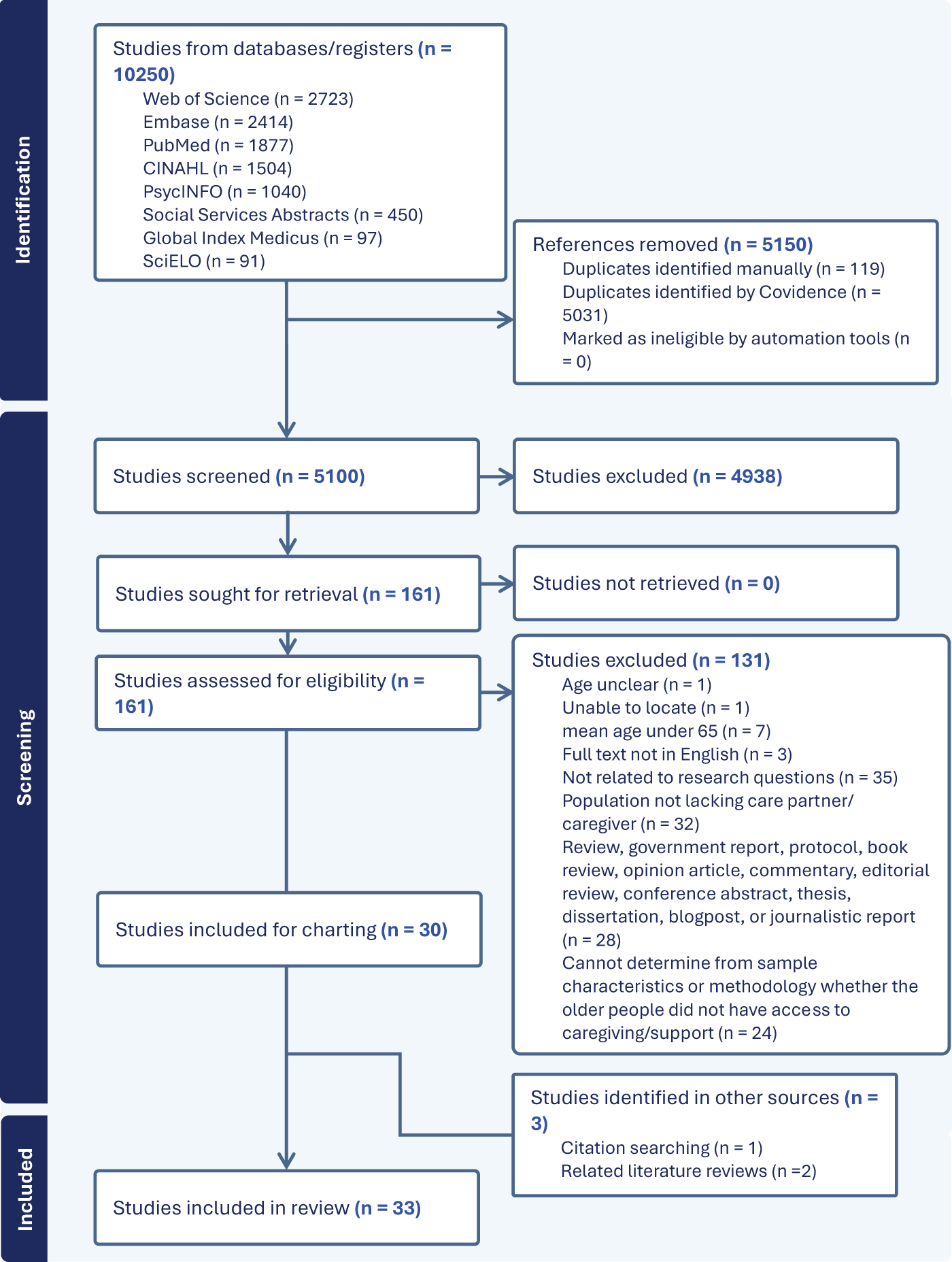
Our thorough search strategy captured 10,250 articles. After removal of duplicates, we screened 5,100 titles/abstracts. Thirty-three met inclusion criteria after our full-text review and citation and related review search. Figure 1 displays the PRISMA flow diagram of the search strategy and selection process. The details of the included articles and their extracted data are summarized below and presented in Supplementary file 3: Study Characteristics. See Table 1 for a summary of the findings outlined by research question and HEPM construct.
PRISMA flow diagram.
Summary of studies by research question and HEPM construct
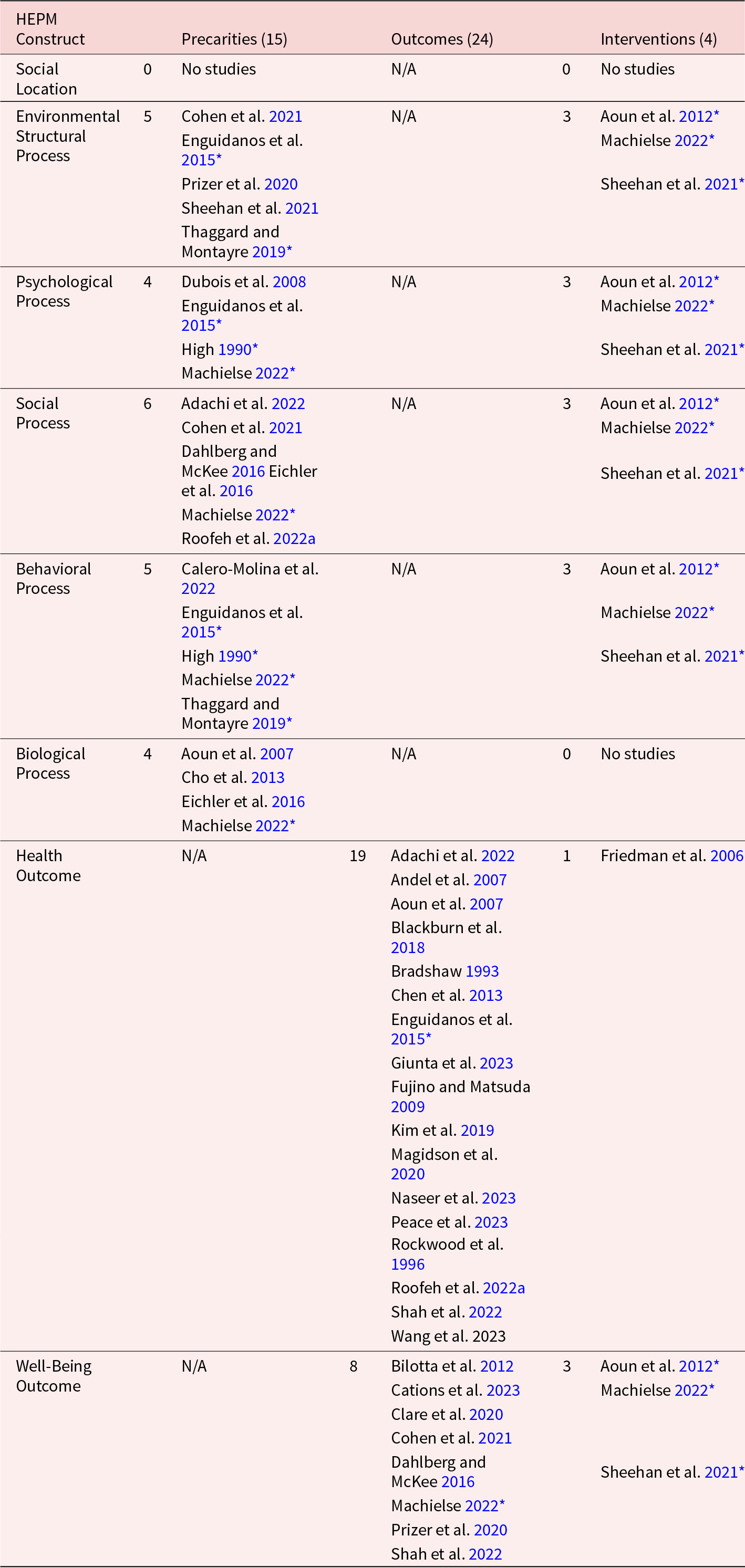
* Indicates the study was qualitative.
Study characteristics
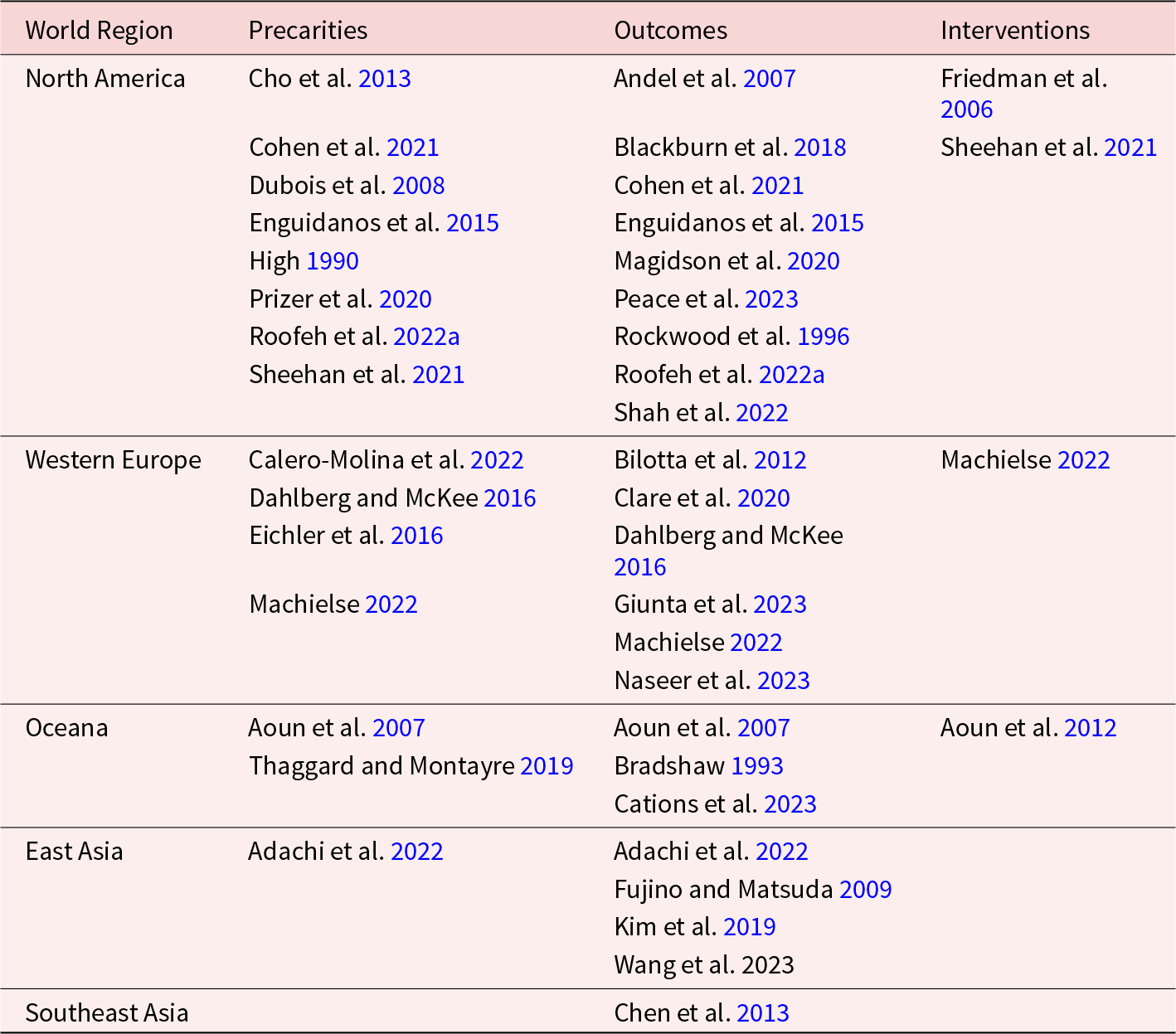
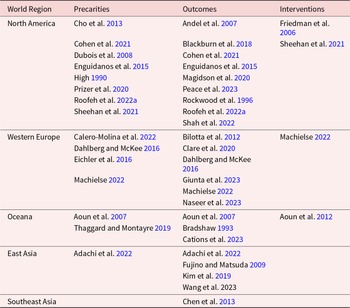
Twenty-six studies used quantitative methodology, six qualitative, and one mixed-methods. Most studies were conducted with samples in North America (U.S.: 13; Canada: 2), followed by Western Europe (Italy: 2; Germany: 1; Netherlands: 1; Spain: 1; Sweden: 1; United Kingdom: 2), Oceana (Australia: 4; New Zealand: 1), East Asia (China: 1; Japan: 2; South Korea: 1), and Southeast Asia (Singapore: 1). See Table 2 for regional differences in study findings by research question. Three studies were population-based, two from the U.S. (Roofeh et al. Reference Roofeh, Clouston and Smith2022a; Shah et al. Reference Shah, Fang, Wannier, Steinman and Covinsky2022), and one from China (Wang et al. Reference Wang, Yang and Wu2023). Only 14 studies reported the race and/or ethnicity of participants, and only eight reported an indicator of income or poverty. Most studies (19) were samples with 55 percent or more women. Fourteen studies’ samples were less than 90 percent white and/or not from a high-income/Western country. No studies reported sexual orientation or gender identity outside the woman/man binary.
Regional differences in study findings by research question
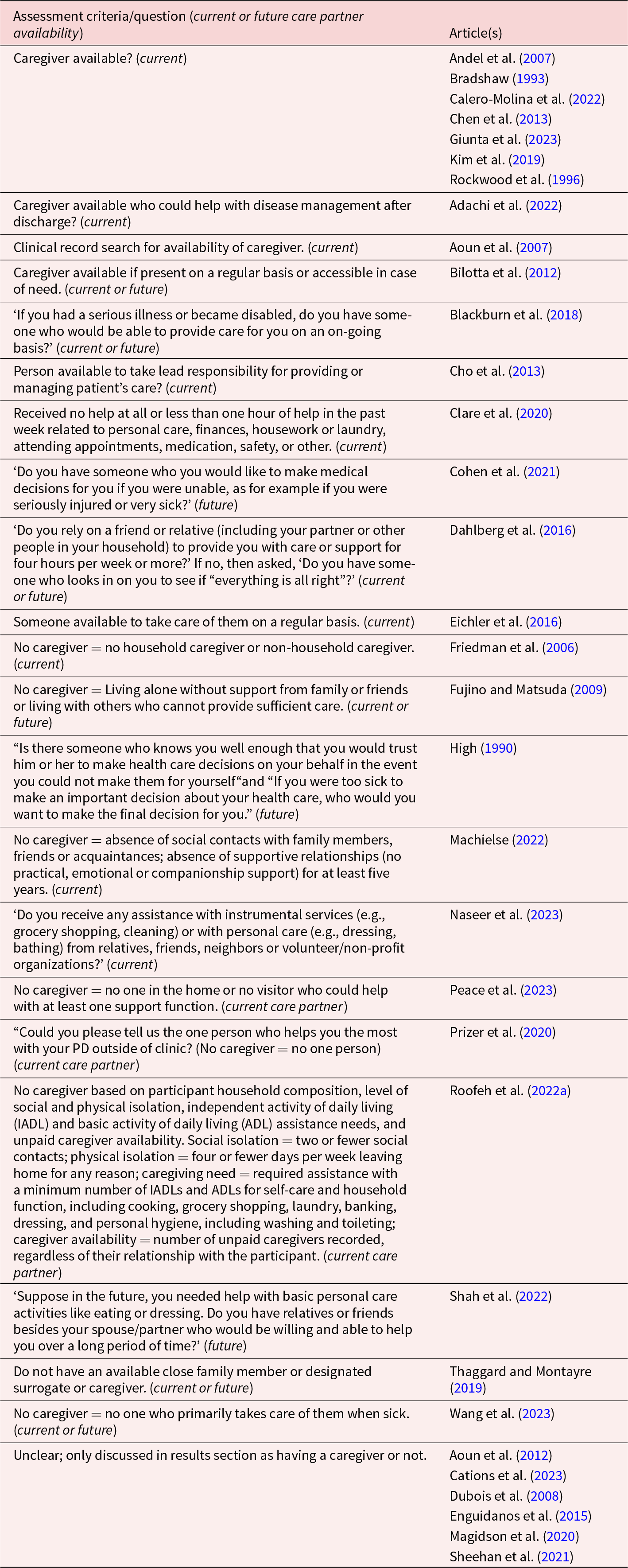
Studies variably operationalized their population’s lack of a care partner and need for a care partner. Ten studies asked about the presence of a care partner with a yes/no outcome, 17 inquired (in various ways) about the presence of someone who was available now or in the future to respond to care needs, and six had unclear operationalization (see Table 3). Most studies (18) asked whether participants had someone providing care now, six asked about care availability now or in the future, three asked about care in the future, and for six, this was not clearly specified.
Operationalization of care partner availability
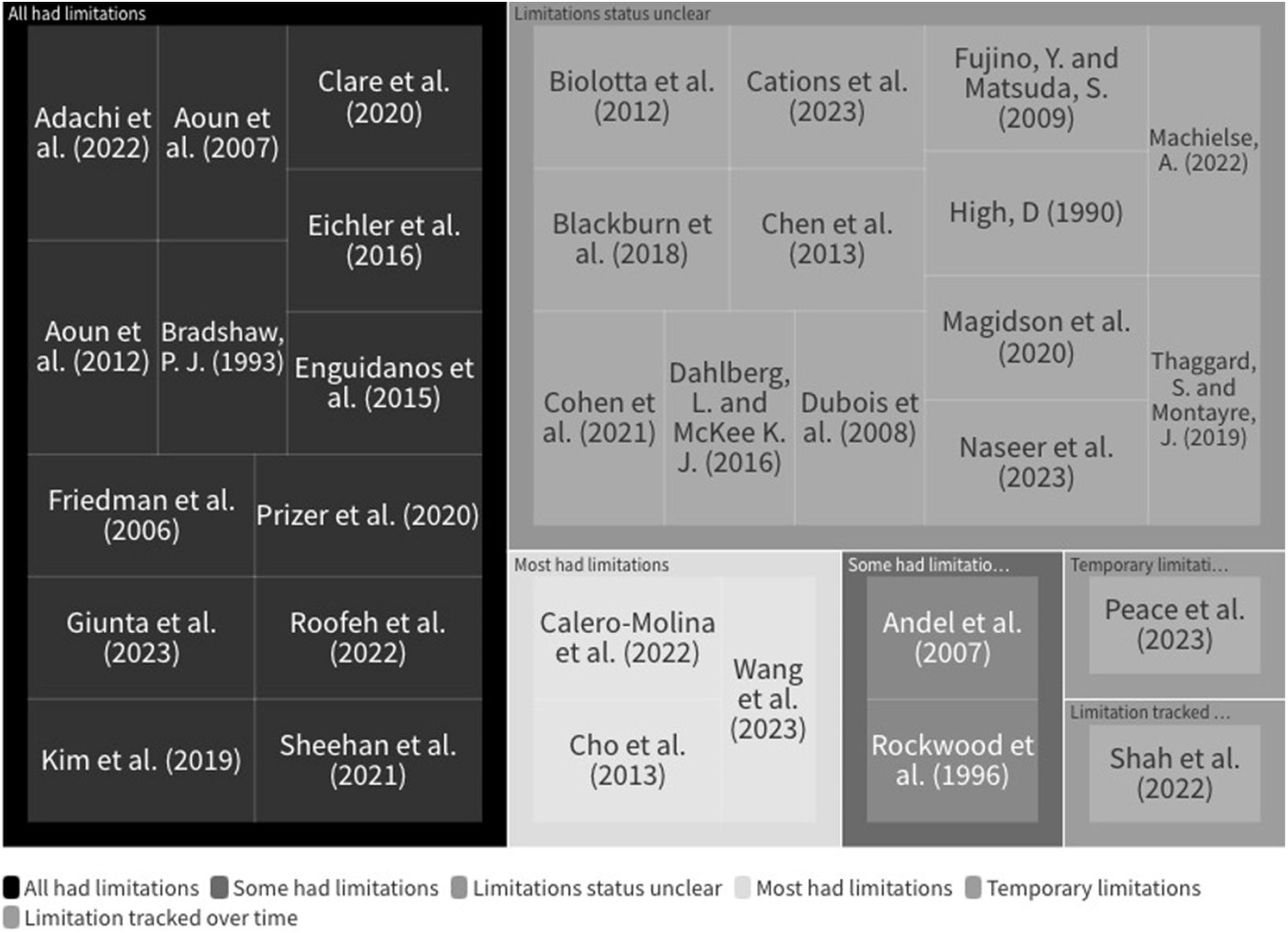
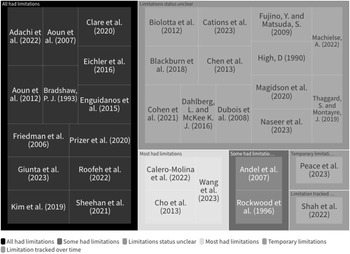
In most studies (22), there was no indication of whether participants received paid or publicly funded care support. The need for care among participants was also inconsistently reported. In thirteen the entire sample had a demonstrated need for care (they had ADL/IADL limitations or a chronic condition likely requiring care such as dementia, terminal illness, cancer, etc.), and another 13 provided no clear indication of demonstrated need for care. (See Fig. 2).
Demonstrated need for care among study participants.
Precarity
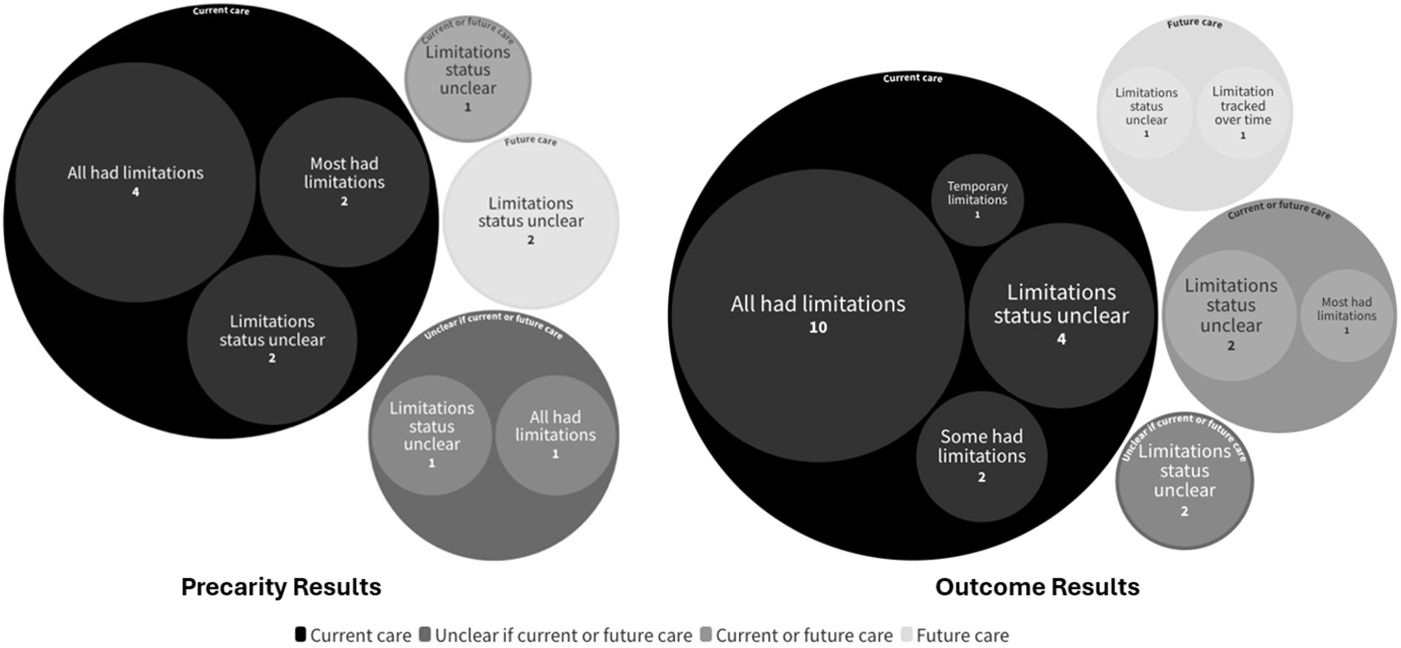
Fifteen of the included studies reported outcomes related to the precarities research question. Eight of these studies reported whether participants had current care partners, two future care partners, one current or future, and in two, this was not clearly specified. In five of these 15 studies all participants had a demonstrated need for care (they had ADL/IADL limitations or a limiting disease), in two more than 50 percent had a demonstrated need for care, and in six this was not clearly indicated or was not assessed. See Fig. 3 for a visualization of the number of studies by care partner status (current, future, etc.) and need for care status. Within the HEPM framework, the included studies reported precarities related to environmental/structural context, and psychological, social, behavioral, and biological processes. (See Table 1).
Environmental/structural (five studies)
We identified environment/structural precarities for older adults without care partners in five studies related to travel to appointments, access to information and services, and socioeconomic disadvantage. In qualitative findings, participants without care partners reported being unable to get to medical appointments without assistance (Sheehan et al. Reference Sheehan, Blinka and Roth2021). They found themselves reliant on informal networks, including the ‘kindness of strangers’ such as bus drivers, bank tellers, and other members of the public to get what they needed (Thaggard and Montayre Reference Thaggard and Montayre2019). Older, seriously ill veterans reported lack of access to care including information, medications, and medical care were reasons for hospital readmission (Enguidanos et al. Reference Enguidanos, Coulourides Kogan, Schreibeis‐Baum, Lendon and Lorenz2015). In cross-sectional quantitative studies in the U.S., those without care partners compared to those with care partners were also more likely to be socioeconomically disadvantaged and therefore less able to access paid care in the absence of a care partner (Cohen et al. Reference Cohen, Costello, JR and Fried2021; Prizer et al. Reference Prizer, Kluger, Sillau, Katz, Galifianakis and Miyasaki2020).
Psychological (four studies)
We found psychological precarities for older adults without care partners in four studies related to sense of agency and fears about future dependence/institutionalization. Qualitatively, older adults without care partners in the U.S. described feeling as if they had no motivation to care for themselves (Enguidanos et al. Reference Enguidanos, Coulourides Kogan, Schreibeis‐Baum, Lendon and Lorenz2015) and were resigned ‘to their destinies as old, alone, and without families’ (High Reference High1990, p. 287). In interviews with Machielse (Reference Machielse2022), this population reported a desire to remain healthy, but described fearing sickness and dependence (Machielse Reference Machielse2022). And in a Canadian cross-sectional sample, not having a care partner was independently associated with the perceived need for institutionalization (Dubois et al. Reference Dubois, Dubuc, Raîche, Caron and Hébert2008).
Social (six studies)
Across six studies, we identified older adults without care partners had social precarities related to social isolation, social integration, social engagement, social support, and social network composition. In a cross-sectional sample in England, Dahlberg and McKee (Reference Dahlberg and McKee2016) found older adults without care partners who needed care assistance had significantly lower contact with family, friends, and neighbors; lower social engagement; and lower levels of perceived community integration, trust, and security compared to those with care partners and compared to those without care partners without care needs. In a cross-sectional sample living alone in Germany, older adults without versus with a care partner were significantly less likely to have someone they could call on in case of emergency and had significantly lower self-perceived social support (Eichler et al. Reference Eichler, Hoffmann, Hertel, Richter, Wucherer, Michalowsky, Dreier and Thyrian2016). In a retrospective cohort study in Japan, Adachi et al. (Reference Adachi, Tsunekawa and Tanimura2022) found 80 percent of those without a care partner had ‘social frailty,’ or were at risk of ‘losing or having lost sufficient social support, activities, or resources’ (p. 82). In a cross-sectional U.S. sample, participants without versus with a desired surrogate had smaller social networks and lower network density, community engagement, and socialization (Cohen et al. Reference Cohen, Costello, JR and Fried2021). Roofeh and colleagues (Roofeh et al. Reference Roofeh, Clouston and Smith2022a), in a nationally representative study, used assessed social or physical isolation as an indicator for whether people were in the population of ‘elder orphans.’ Finally, Machielse (Reference Machielse2022) reported many participants in their qualitative sample had no need for social contact, either due to deliberate choice or resignation to the absence of social contact.
Behavioral (five studies)
We identified older adults without care partners experienced behavioral precarities including in self-care, perception of future risks, and future planning across five studies. Two studies reported self-care behavioral precarities. Participants from a qualitative sample in Kentucky had impaired ability to perceive their needs—they denied future potential risk to themselves (High Reference High1990). A group of seriously ill older male veterans in the U.S. discussed difficulty caring for themselves (Enguidanos et al. Reference Enguidanos, Coulourides Kogan, Schreibeis‐Baum, Lendon and Lorenz2015). In a prospective cohort study in Spain, one of the strongest determinants of impairment in overall self-care was lack of a care partner, controlling for age, sex, and other psycho-social variables (Calero-Molina et al. Reference Calero-Molina, Moliner, Hidalgo, Rosenfeld, Verdú-Rotellar, Verdú-Soriano, Yun, Garay, Alcoberro, Jiménez-Marrero, Jose, Calvo, Ruiz, Garcimartin, Alcaide-Aldeano, Delso, Alcober, Enjuanes and Comin-Colet2022). This was also the case across three domains of self-care: autonomy-based adherence (e.g. daily self-care and preventative behaviors like medication management), consulting behavior (e.g. making healthcare appointments when needed), and provider-based adherence (e.g. compliance with healthcare professionals’ advice).
We found a dearth of future planning reported in three qualitative studies. Machielse (Reference Machielse2022), in the Netherlands, reported many participants preferred not to think about or arrange for the future. Few participants in a Kentucky sample reported either formal or informal planning for the future (High Reference High1990) and few participants in a New Zealand sample reported having advance plans or directives for their healthcare or finances (Thaggard and Montayre Reference Thaggard and Montayre2019). This same sample had divided views regarding the right time to engage in future planning, and whether future planning was even necessary or desired (Thaggard and Montayre Reference Thaggard and Montayre2019).
Biological (five studies)
Across five studies, we found older adults without care partners experienced biological precarities related to increased need for professional healthcare support services and functional dependence. Among a cross-sectional sample of Australian palliative service users with no care partner, health professionals reported they spent more time per home-visit on things like symptom control, medications, mobility, transport, social support, care needs, housekeeping, and emotional support, compared with users who had a care partner (Aoun et al. Reference Aoun, Kristjanson, Currow, Skett, Oldham and Yates2007). After discharge from the hospital and receipt of 60 days of home health care, participants with no care partner in a cross-sectional U.S. sample showed greater functional dependence compared to those with care partners, even when controlling for confounders (Cho et al. Reference Cho, Kim and Lee2013). This population also utilized professional services more often than those with care partners, as evident in the findings from Eichler et al. (Reference Eichler, Hoffmann, Hertel, Richter, Wucherer, Michalowsky, Dreier and Thyrian2016) and Machielse (Reference Machielse2022).
Outcomes
Among the included studies in this review, 24 discussed health (19) and well-being (eight) outcomes for older adults without care partners (see Table 1), all of which were adverse in nature. Within these, 17 reported whether participants had current care partners, two future, three current or future, and in two, this was not clearly specified. In terms of demonstrated need for care—all participants had demonstrated need for care (they had ADL/IADL limitations or a limiting disease) in 10 studies, less than 50 percent of participants in two studies, more than 50 percent in one study, only temporary need for care in one study, and in nine studies this was not clearly indicated or was not assessed (see Fig. 3).
Precarity and outcome results by care partner status and demonstrated need for care.
Health outcomes (19 studies)
We found mixed results in 19 studies related to adverse health outcomes including in health and functioning and hospitalization. However, we identified 11 studies that consistently reported older adults without care partners are at increased risk of institutionalization. Five studies reported mixed evidence regarding physical health outcomes. A nationally representative study from the U.S. reported older adults who lived alone and had no care partner more often reported their health as fair or poor and had worse health and function compared to those with a care partner (Shah et al. Reference Shah, Fang, Wannier, Steinman and Covinsky2022). However, that same study found those without a care partner were not more likely to develop a new ADL dependency over time. Qualitatively, seriously ill older veterans without care partners reported their lack of support directly contributed to decline and readmission to the hospital (Enguidanos et al. Reference Enguidanos, Coulourides Kogan, Schreibeis‐Baum, Lendon and Lorenz2015). An increased risk of unplanned hospitalization was found in a retrospective cohort study in Japan among those without care partners and cardiovascular disease (Adachi et al. Reference Adachi, Tsunekawa and Tanimura2022). However, two studies, one prospective cohort design in Sweden (Naseer et al. Reference Naseer, Dahlberg, Ehrenberg, Schon and Calderon-Larranaga2023) and another survival analysis based in the U.S. (Magidson et al. Reference Magidson, Huang, Levitan, Westfall, Sheehan and Roth2020), found no association between increased rates of emergency room visits and lacking a care partner. Both studies listed limitations that may have confounded their results, including limited statistical power due to the small sample size of those without a care partner, and the sample characteristics of those without a care partner (older age and more complicated medical conditions).
Four studies reported mixed outcomes related to mortality. Evidence from Japan showed higher risk of all-cause mortality after discharge from the hospital for a cross-sectional sample with cardiovascular disease and no care partner support (versus having a care partner) (Adachi et al. Reference Adachi, Tsunekawa and Tanimura2022), and a higher mortality over a five-year period for older men without versus with caregiving support (Fujino and Matsuda Reference Fujino and Matsuda2009). This increased mortality was heightened in men with less mobility and was not found in those living alone who had support (Fujino and Matsuda Reference Fujino and Matsuda2009). In contrast, Shah et al. (Reference Shah, Fang, Wannier, Steinman and Covinsky2022) found those living alone without care support were not more likely to die compared to those with care support in their population-based study. Giunta et al.’s prospective observational trial (Giunta et al. Reference Giunta, De Padova, Anpalakhan, De Giorgi, Maruzzo, Rebuzzi, Cinausero, Fratino, Lipari, Gamba, Bimbatti, Dri, Ermacora, Vignani, Basso, Buti, Gandini, Cremante, Fornarini, Rescigno and Banna2023) found those with cancer in Italy without a care partner had longer survival than those with a care partner. However, they cautioned this finding could be explained by the older age and higher frailty of the study sample group who had a care partner.
Across all 11 studies that examined institutionalization as an outcome, not having a care partner was associated with higher likelihood of institutionalization. Specifically, those without versus with care partners being discharged from the hospital were more likely to discharge to a nursing home in cross sectional samples (Chen et al. Reference Chen, Naidoo, Er, Cheong, Fong, Tay, Chan, Tan, Menon, Ee, Lee, Ng, Teo and Koh2013; Peace et al. Reference Peace, Srivastava, Willson, Telehowski, Wodarek and Atkinson2023). In fact, it was the strongest predictor of nursing home discharge in one study (Chen et al. Reference Chen, Naidoo, Er, Cheong, Fong, Tay, Chan, Tan, Menon, Ee, Lee, Ng, Teo and Koh2013). Older adults living alone without versus with care support in a population-based sample in the U.S. were also more likely to have a prolonged nursing home stay in the next two years (Shah et al. Reference Shah, Fang, Wannier, Steinman and Covinsky2022). For those at the end of life, not having a care partner was associated with being referred to inpatient hospice (Bradshaw Reference Bradshaw1993) or dying in hospital/in-patient hospice (Aoun et al. Reference Aoun, Kristjanson, Currow, Skett, Oldham and Yates2007) in cross-sectional samples. Notably, not having a care partner was related to higher risk of nursing home placement over time in the U.S. (Andel et al. Reference Andel, Hyer and Slack2007; Blackburn et al. Reference Blackburn, Albright, Haley, Howard, Roth, Safford and Kilgore2018; Roofeh et al. Reference Roofeh, Clouston and Smith2022a), South Korea (Kim et al. Reference Kim, Chun, Lee, Lee and Park2019), China (YC Wang et al. 2023), and Canada (Rockwood et al. Reference Rockwood, Stolee and McDowell1996), including in two population-based studies (Roofeh et al. Reference Roofeh, Clouston and Smith2022a; Wang et al. 2023). Blackburn et al. (Reference Blackburn, Albright, Haley, Howard, Roth, Safford and Kilgore2018), in their nested cohort study, found lacking a care partner was a stronger predictor of nursing home placement than marital status, living alone, or not having relatives or close friends.
Well-being outcomes (eight studies)
Across eight studies, we identified older adults without care partners experienced increased loneliness, depression, and suicide risk and lower quality of life and satisfaction with life. In a cross-sectional sample in England (Dahlberg and McKee Reference Dahlberg and McKee2016), a unit increase in loneliness corresponded with a 1.39 increased likelihood of being an older adult who needed help, but did not have a care partner. An increased likelihood of loneliness was also found in cross-sectional samples in Spain (Bilotta et al. Reference Bilotta, Bowling, Nicolini, Case and Vergani2012) and the U.S. (Cohen et al. Reference Cohen, Costello, JR and Fried2021) of older adults who had no care partner. In their qualitative interviews, Machielse (Reference Machielse2022) reported high levels of emotional loneliness and a desire for someone with whom to share one’s deepest wishes. In the United Kingdom, Clare et al. (Reference Clare, Martyr, Henderson, Gamble, Matthews, Quinn, Nelis, Rusted, Thom, Knapp, Hart and Victor2020) reported a cross-sectional population of older adults living alone without care support versus with care support had significantly lower satisfaction with life. And Prizer et al. (Reference Prizer, Kluger, Sillau, Katz, Galifianakis and Miyasaki2020) found older adults in their cross-sectional sample in the U.S. with Parkinson’s disease and no care partner, compared to those with a care partner, had lower quality of life and more spiritual distress. In addition, older adults living alone who could not identify a care partner, compared with those who could, were significantly more likely to be depressed in a nationally representative cohort study in the U.S. (Shah et al. Reference Shah, Fang, Wannier, Steinman and Covinsky2022). There was also evidence older adults without a care partner in a cross-sectional Australian sample had higher odds of suicide mortality (Cations et al. Reference Cations, Lang, Draper, Caughey, Evans, Wesselingh, Crotty, Whitehead and Inacio2023).
Intervention
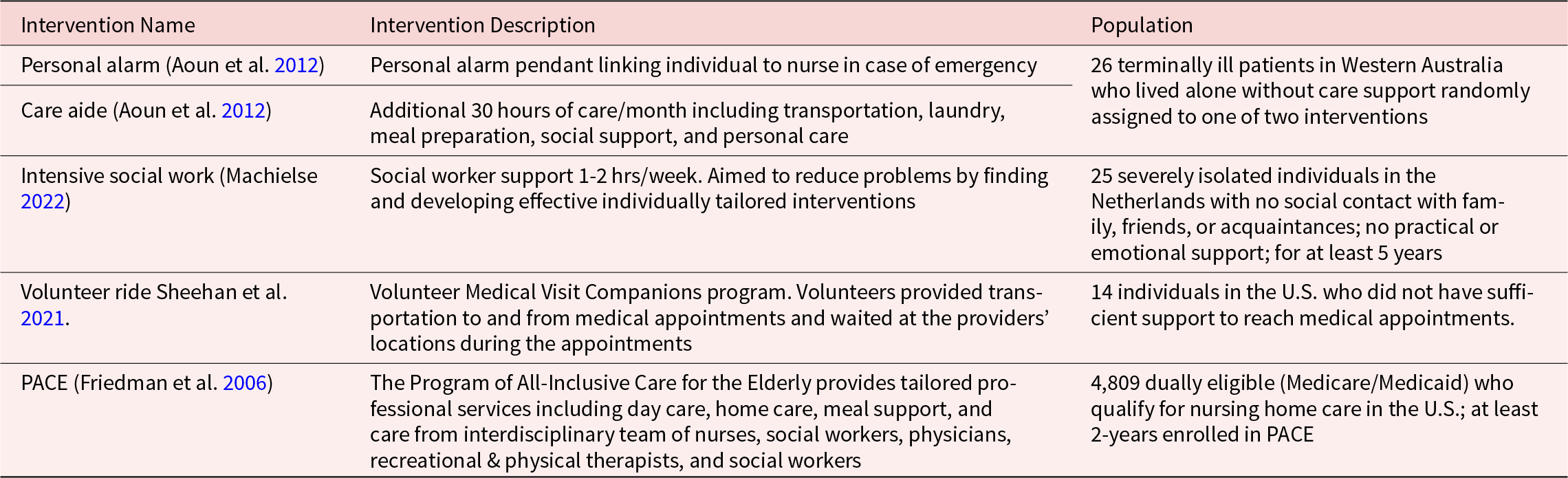
Only four of the included articles discussed intervention findings. Three (Aoun et al. Reference Aoun, O’Connor, Skett, Deas and Smith2012; Machielse Reference Machielse2022; Sheehan et al. Reference Sheehan, Blinka and Roth2021) reported qualitative findings that we collated into environmental/structural, social, and behavioral processes, according to the HEPM. Those same three studies also reported well-being outcomes. Health outcomes were reported by the single quantitative study, Friedman et al. (Reference Friedman, Steinwachs, Temkin-Greener and Mukamel2006). Two studies reported whether participants had current care partners, and for two this was not clearly indicated. In three studies, all participants had a demonstrated need for care, and for one this was not clearly indicated or not assessed. See Table 4 for intervention descriptions.
Tested interventions
Environmental/structural processes (three studies)
We identified environment/structural processes in the three qualitative intervention studies related to transportation access, problem solving support, and ability to remain in one’s home longer. Participants in a volunteer ride intervention reported greater access to medical care because of the intervention—whereas prior to the intervention some would skip appointments because they did not have transportation (Sheehan et al. Reference Sheehan, Blinka and Roth2021). They also avoided fees associated with missed appointments and the long waits for mobility transportation services. Machielse (Reference Machielse2022) reported social worker intervention participants felt this support helped them navigate acute problems they may not have been able to solve for themselves. And finally, terminally ill participants in a care-aide intervention felt they could remain in their home environment longer with this intervention (Aoun et al. Reference Aoun, O’Connor, Skett, Deas and Smith2012).
Social processes (three studies)
We found social processes in three intervention studies related to isolation, access to socialization, and relational attunement. Both a 30-hour care aide and personal alarm intervention reduced participants’ sense of isolation by increasing their security in leaving the home (alarm intervention) or giving them greater access to engage with their social networks with aide support (Aoun et al. Reference Aoun, O’Connor, Skett, Deas and Smith2012). Some participants in a volunteer ride intervention saw their rides as social outings and looked forward to socializing with their volunteer (Sheehan et al. Reference Sheehan, Blinka and Roth2021). In contrast, a small number of participants in the intensive social worker intervention did not experience positive results, largely because they did not get along with their social worker and reported lack of relational attunement (Machielse Reference Machielse2022).
Behavioral processes (three studies)
We identified behavioral processes in three intervention studies related to health promotion, help with everyday tasks, and coordinated decision-making. Aoun et al. (Reference Aoun, O’Connor, Skett, Deas and Smith2012) reported participants in their 30-hour care aide intervention experienced a health promoting influence on everyday routines, in particular the presence of the care aid helped them eat more regularly. Many of the participants who received volunteer rides were also helped to engage in tasks that supported their well-being including help with paperwork, and the ability to accomplish tasks like going to the grocery store with their volunteer companion (Sheehan et al. Reference Sheehan, Blinka and Roth2021). Finally, participants in the social worker intervention reported it was particularly important that coordinated decision making occurred around problem solving and accomplishing tasks—nothing happened if the older adult did not want it to happen (Machielse Reference Machielse2022).
Well-being outcomes (three studies)
We found well-being outcomes in three intervention studies related to enhanced sense of security, well-being, quality of life, and dignity/respect. Participants without a care partner in the personal alarm (Aoun et al. Reference Aoun, O’Connor, Skett, Deas and Smith2012) and intensive social worker interventions (Machielse Reference Machielse2022) reported an increased sense of security and peace of mind with the greater access to emergency (personal alarm) and problem-solving support (social worker). Similarly, a volunteer medical ride intervention relieved anxiety for participants without a care partner, giving them a sense of security about their ability to access medical care (Sheehan et al. Reference Sheehan, Blinka and Roth2021). And, a 30-hour care aid intervention (Aoun et al. Reference Aoun, O’Connor, Skett, Deas and Smith2012) helped ease the burden of everyday living for terminally ill participants and allowed them to retain a degree of control over their lives. It also supported participants’ well-being, enhanced quality of life, and helped preserve a sense of dignity (Aoun et al. Reference Aoun, O’Connor, Skett, Deas and Smith2012). Machielse (Reference Machielse2022) reported most participants with social worker support felt acknowledged, seen, and respected.
Biological outcomes (one study)
In their Program for All-Inclusive Care for the Elderly (PACE) Friedman et al. (Reference Friedman, Steinwachs, Temkin-Greener and Mukamel2006) found the availability of a care partner did not predict time to nursing home admission in their survival analysis, adjusting for multiple measures of frailty and disability. The authors hypothesized PACE’s tailored professional services ‘compensate for the presence or absence of informal care’ (p.462).
Discussion
The primary goal of this scoping review was to identify the state of peer-reviewed scholarship related to older adults without care partners, and current knowledge gaps related to precarities, outcomes, and interventions as framed through the HEPM. Of the 33 included studies, three reported intervention findings related to environmental/structural, social, and behavioral processes, and well-being outcomes; one intervention study reported a health outcome. Fifteen of the included studies had findings related to precarities with environmental/structural forces, and psychological, social, behavioral, and biological processes identified across a similar number of studies. Twenty-four studies related to health and well-being outcomes (all adverse in nature) with more focus on health (19) versus well-being outcomes (8). Remarkably, nearly a third of all included studies reported an increased likelihood of institutionalization for older adults without care partners.
The included studies lacked a shared conceptualization for having no care partner (Table 3). Rather, definitions ranged from unclear/unspecified, to simple yes/no ‘do you have a care partner?’ inquiries, to more detailed assessments about the availability of someone either providing care now, or available to provide care in the future. This absence of semantic clarity is noteworthy given that in some cultural contexts family members may assume responsibility for care activities without necessarily considering themselves ‘caregivers’ because of filial piety norms (Wang et al. 2023). In such situations assessing care partner status with simple yes/no questions regarding care partner availability may inaccurately represent an individual’s access to care support. There were also inconsistencies in whether the sample populations had a demonstrated need for care support. Only 13 studies had an entire sample population with limitations or a chronic condition (e.g. dementia, terminal illness, etc.) that required care. In addition, most studies (22) did not report assessing whether those without a care partner were receiving paid or publicly funded care support. Based on the above findings, we outline proposed future directions for research, guided by gaps we observed across the multilevel dimensions identified using the HEPM framework.
Future research directions
Despite our comprehensive search strategy for identifying studies focused on older adults without care partners, only 13 of our 33 included studies set out to specifically study this population. And, in some of these 13 studies, participants without a care partner were a subgroup compared with a group who had a care partner. In 19 of the 24 studies describing health and well-being outcomes, not having a care partner was only one of several covariates examined related to the outcome of interest. Clare et al. (Reference Clare, Martyr, Henderson, Gamble, Matthews, Quinn, Nelis, Rusted, Thom, Knapp, Hart and Victor2020), Naseer et al. (Reference Naseer, Dahlberg, Ehrenberg, Schon and Calderon-Larranaga2023), and Prizer et al. (Reference Prizer, Kluger, Sillau, Katz, Galifianakis and Miyasaki2020) named the lack of specific focus on this population as a limitation in their findings, stating the small sub-sample among their participants without a care partner limited their statistical power. Furthermore, it is evident from the studies included in this review that lacking a care partner is a distinct risk factor, above and beyond proxies such as living alone or not having kin. To address this gap, future research must be clear about how they define ‘no care partner’ to both identify the population being studied and to clarify the mechanisms that account for their precarities and outcomes. Future research needs to operationalize care partner status with attention to whether the population requires care due to limitations/disabilities, whether the focus is on current or future care, if paid or publicly funded care support is available, and how cultural context may impact whether someone sees themselves as a care partner.
More foundational, basic science research (Onken et al. Reference Onken, Carroll, Shoham, Cuthbert and Riddle2014) that explicitly focuses on this population is also needed. We found mixed results in hospitalization and mortality outcomes in our studies, however in each of these cases the authors point to potential confounders, including lack of power due to the small sample size of those without care partners (Naseer et al. Reference Naseer, Dahlberg, Ehrenberg, Schon and Calderon-Larranaga2023) and age and frailty differences between those with and without care partners (Giunta et al. Reference Giunta, De Padova, Anpalakhan, De Giorgi, Maruzzo, Rebuzzi, Cinausero, Fratino, Lipari, Gamba, Bimbatti, Dri, Ermacora, Vignani, Basso, Buti, Gandini, Cremante, Fornarini, Rescigno and Banna2023; Magidson et al. Reference Magidson, Huang, Levitan, Westfall, Sheehan and Roth2020). This highlights the need for more rigorous studies controlling for group differences and utilizing larger sample sizes. Population-based studies are also warranted as the majority (30) of the included studies’ findings cannot be generalized beyond their sample. To understand the culturally-specific experience of older adults without care partners, population-based studies are needed across countries/cultural contexts—the experiences of the population will likely vary as countries and cultures differ in their demographic trends, attitudes towards older adults, and in the provision of publicly funded services and supports. In addition, clearly identifying and testing mechanistic pathways from precarities to outcomes for this population, guided by a multidimensional framework such as the HEPM, would help identify future intervention targets (Nielsen et al. Reference Nielsen, Riddle, King, Aklin, Chen, Clark, Collier, Czajkowski, Esposito, Ferrer, Green, Hunter, Kehl, King, Onken, Simmons, Stoeckel, Stoney, Tully and Weber2018; Onken et al. Reference Onken, Carroll, Shoham, Cuthbert and Riddle2014). For example, empirically testing whether greater physical need for assistance (a biological precarity identified in our review), when modified through increased access to paid or publicly funded care, changes adverse outcomes for older adults without care partners.
Further research is needed related to environmental/structural precarities for older adults without care partners. Examples include service eligibility criteria, service accessibility and awareness, and local/national policies related to public benefits that increase the vulnerability and uncertainty facing this population (Portacolone Reference Portacolone, Grenier, Phillipson and Settersten2020). Access factors such as lack of transportation, digital literacy, and awareness of services are known barriers among isolated, vulnerable older adult populations (Kervin et al. Reference Kervin, Riadi, Chamberlain, Teo, Churchill, Beleno, Hung and Cosco2023). Racially minoritized and SGD older adults face discrimination when accessing services and may therefore avoid seeking help (Hamed et al. Reference Hamed, Bradby, Ahlberg and Thapar-Björkert2022; Romanelli and Hudson Reference Romanelli and Hudson2017) or receive subpar support when they do seek it. For those without a care partner to help navigate these issues, coordinating their care and getting the support they need may be unfeasible.
Environmental/structural precarities should also be examined within heterogenous local/national contexts as the generosity of public benefits and services for older adults varies by country—for example, less than 10% of home care costs are covered in the U.S., but in Northern Europe and Canada, public systems cover nearly the full cost of in-home care (OECD 2024). Furthermore, in countries that have traditionally relied on familial care support due to norms around filial piety, long-term services and supports for older adults are still in development (Wang et al. 2023). Older adults without care partners who do not qualify for publicly funded in-home support, live in local or national contexts where such public supports are limited (Chen et al. Reference Chen, Su, Chen and Chen2022), and/or cannot afford to pay for the rising cost of private care (Spillman et al. Reference Spillman, Allen and Favreault2020), are in a challenging environmental and structural context, without access to either paid, publicly funded, or care partner support.
There is also a clear gap in the research related to older adults without care partners from minoritized and marginalized social locations. No studies focused on these populations met our inclusion/exclusion criteria, and none of our included studies reported differences in precarities, outcomes, or interventions by sub-groups for these populations. In addition, the current evidence base, as represented by our included studies, does not adequately report demographics. Nineteen of our 33 studies did not report the race or ethnicity of their sample, only eight reported the sample’s income, and none reported sexual orientation or diverse gender identities. This is highly concerning as evidence from our included studies indicates these populations are more likely to lack care partner support. In the U.S. context, Peace et al. (Reference Peace, Srivastava, Willson, Telehowski, Wodarek and Atkinson2023) reported Black participants in their sample were more likely than white to report not having a care partner. Cohen et al. (Reference Cohen, Costello, JR and Fried2021) found non-white participants were more likely than white to report they did not have a desired surrogate. Beyond our included studies, we know from qualitative (King and Dabelko-Schoeny Reference King and Dabelko-Schoeny2009) and quantitative (Croghan et al. Reference Croghan, Moone and Olson2014; Fredriksen-Goldsen et al. Reference Fredriksen-Goldsen, Kim, Emlet, Muraco, Erosheva, Hoy-Ellis, Goldsen and Petry2011) evidence SGD populations are likely to lack care partner support in older adulthood. Additional research is needed with these under-researched populations who also lack a care partner to discern how they may experience disparate precarities and outcomes and to further the development of culturally responsive interventions.
Future research directions: interventions
This scoping review highlights gaps in the peer-reviewed research related to interventions for older adults without care partners. Two of the four intervention studies in our review (Friedman et al. Reference Friedman, Steinwachs, Temkin-Greener and Mukamel2006; Sheehan et al. Reference Sheehan, Blinka and Roth2021) were not designed specifically for individuals without care partners, but rather a segment of the intervention participants identified as part of that population. We found no randomized controlled trials or other clinical trials in our review. Future qualitative and quantitative intervention research for this population should aim to understand the perspective of older adults themselves regarding their intervention needs, empirically test the efficacy of interventions for both the broader population and for marginalized populations, and build on existing community-based work (Fredriksen Goldsen et al. Reference Fredriksen Goldsen, Kim, Teri, Jones-Cobb, La Fazia, Petros, Berridge, Prasad, Oswald and Emlet2025). Current on-the-ground interventions via social service agencies and older adults themselves such as grassroots co-housing communities (Durrett Reference Durrett2023), mutual-aid ‘Villages’ (Scharlach et al. Reference Scharlach, Graham and Lehning2012), and ‘Backup Plan’ groups focused on advanced planning and development of social capital (Camp Reference Camp2023) are ripe for efficacy and implementation testing.
Future intervention research would benefit from focusing on practical instrumental and care support, as demonstrated in the interventions in this review. Even among included studies that did not specifically study interventions, authors made recommendations for the population related to tangible support. Clare et al. (Reference Clare, Martyr, Henderson, Gamble, Matthews, Quinn, Nelis, Rusted, Thom, Knapp, Hart and Victor2020), Eichler et al. (Reference Eichler, Hoffmann, Hertel, Richter, Wucherer, Michalowsky, Dreier and Thyrian2016), and Enguidanos et al. (Reference Enguidanos, Coulourides Kogan, Schreibeis‐Baum, Lendon and Lorenz2015) emphasized the importance of increasing targeted, comprehensive health and social care services and Cho et al. (Reference Cho, Kim and Lee2013) recommended more publicly funded home-based care. These recommendations are aligned with work by Machielse and Duyndam (Reference Machielse and Duyndam2021) who found interventions focused on enhancing social participation (as most social isolation-related interventions typically do (Holt-Lunstad et al. Reference Holt-Lunstad, Layton, Barton and Smith2020)) are not realistic for some isolated older adults and solving practical problems is more urgently needed. In the future, research should focus on the impact of publicly funded and subsidized instrumental and care services for older adults without care partners. Such studies could help clarify the importance of different types of funded care support within each country’s context, including medical care, personal care, instrumental supports, and assistive devices (Blackburn et al. Reference Blackburn, Albright, Haley, Howard, Roth, Safford and Kilgore2018).
Finally, research is needed concerning how to support non-kin care configurations. SGD individuals have long relied on chosen family for support given differences in their social networks including decreased likelihood of available biological family, spouse, or children (Breder and Bockting Reference Breder and Bockting2022; Muraco and Fredriksen-Goldsen Reference Muraco and Fredriksen-Goldsen2011). Among the broader population who will be more likely to lack ‘traditional’ care partners in the future (i.e. kinless older adults), there is some evidence of a shift towards more heterogeneous networks, including friends and neighbors (Lowers et al. Reference Lowers, Zhao, Bollens-Lund, Kavalieratos and Ornstein2022; Wu et al. Reference Wu, Margolis, Sheftel and Verdery2023). However, many older adults may not access these potential sources of support due to feelings of embarrassment or worries of being a burden (Allen and Wiles Reference Allen and Wiles2014). Researchers and policy makers need to investigate how policies and programs that materially support care partners can recognize the diversity of potential care partners and ease the burden for care partners and the older adults needing assistance (Lowers et al. Reference Lowers, Zhao, Bollens-Lund, Kavalieratos and Ornstein2022; Wu et al. Reference Wu, Margolis, Sheftel and Verdery2023).
Limitations
Our search was complicated by the lack of semantic clarity regarding this population. For example, we excluded Francis (Reference Francis2022), who examined the relationship between Facebook use and loneliness and perceived mattering among what they called ‘elder orphans.’ However, their population was comprised of unmarried individuals without children who lived alone, with no indication of individuals’ access to care partner support. We had difficulty distinguishing between the conceptualization of social support in some studies and the availability of a care partner. Berglund et al. (Reference Berglund, Lytsy and Westerling2019), another excluded study, asked participants about ‘perceived instrumental social support’ by asking if they could get help from someone if they had practical problems or were ill. This approach did not distinguish between those who had no care partner on the one hand, and those who perhaps had a care partner yet perceived a lack of social support on the other. In addition, in our examination of the recent literature reviews related to this population (Carney et al. Reference Carney, Fujiwara, Emmert, Liberman and Paris2016; Kervin et al. Reference Kervin, Riadi, Chamberlain, Teo, Churchill, Beleno, Hung and Cosco2023; Montayre et al. Reference Montayre, Montayre and Thaggard2019; Roofeh et al. Reference Roofeh, Smith, Hale and Clouston2022b), we retained only three of the studies these other publications included. While this was largely due to our exclusion of grey-literature and different research questions, we found some of the studies these authors chose to include did not clearly identify if the population had a care partner. They may have focused on kinlessness, social isolation, or an aspect of care, but we could not determine from the methods or results if the population had care partner support.
Our choice of method and inclusion/exclusion criteria may have also limited our findings. By choosing to focus on peer-reviewed literature and exclude grey literature we likely missed some of the more recent, community-driven work related to interventions for this population. Other countries around the world are also facing an increase in older adults at risk of having no care partner (e.g. Bao et al. Reference Bao, Zhou, Liu, Tang, Lu, Cheng, Jin and Bai2022; Verdery et al. Reference Verdery, Margolis, Zhou, Chai and Rittirong2019) and may be publishing relevant literature addressing this population’s precarities, outcomes, and interventions that we missed due to our limitation to English publications. Some literature relevant to marginalized populations may also have been missed due to our age exclusion criteria, as disability and physical limitations may surface at younger ages for these groups. While we attempted to allow for different ageing trajectories by using a mean of 65 years rather than a hard cut-off, it could be this did not capture the diverse ageing process of some groups. Because we did not constrain our results to a particular geographic region, we caution against interpreting our findings for any one country/context. For example, the social and political context of the U.S. is very different from the Netherlands, or China. Finally, scoping reviews are not designed to appraise or synthesize results, therefore we cannot speak to the quality of current research or make conclusive statements about findings in the literature (Munn et al. Reference Munn, Peters, Stern, Tufanaru, McArthur and Aromataris2018).
Conclusion
Despite considerable gaps in the research, this scoping review highlights the precarity and adverse outcomes facing older adults without care partners through the framework of the HEPM and points to promising directions for intervention development. However, much work is needed to support this growing population. A recently published research agenda related to the changing demography of late-life caregiving (Freedman et al. (Reference Freedman, Agree, Seltzer, Birditt, Fingerman, Friedman, Lin, Margolis, Park, Patterson, Polenick, Reczek, Reyes, Truskinovsky, Wiemers, Wu, Wolf, Wolff and Zarit2024)), argued, as we do, that typical proxies for lack of a care partner—such as the absence of kin or living alone—are insufficient for assessing the adequacy of an individual’s care network. Both this agenda and our review emphasize the need for future research to specifically identify those without access to care. Identifying these individuals, along with their precarities and outcomes, is crucial for developing and implementing effective interventions.
Supplementary material
The supplementary material for this article can be found at https://doi.org/10.1017/S0144686X25100317.
Acknowledgements
We would like to thank Teresa Jewell, systematic review and research services librarian, for her considerable expertise and support in helping craft our search strategy.
Financial support
No funding was provided for this review.
Competing interests
The author(s) declare none.
Ethical standards
Not required.





 Open access

