

Introduction: Dance as Disfiguring Sculpture
Nawa Kōhei’s gallery shows mounted under the title Vessel (2016-19) used techniques of bodily distortion to explore what Nawa called “the idea of ‘liquefying’ and ‘dissolving’” the human body as “represented by the distinctive ‘headless’ pose”—or what the Surrealist Georges Bataille christened in 1936 “the acéphale” (Nawa et al. Arario; Jalet et al. Reference Jalet2019; Woo-hyun Reference Woo-hyun2019). Christine Chiu’s review of the gallery exhibition described how:
twenty life-sized sculptures of human figures in seemingly impossible, contorted poses were arranged in a single row, their faces hidden or missing. The perfectly contoured black bodies are coated with shimmery silicon carbide powder, and were dimly lit by faint spotlights … These strategically arranged androgynous figures are not single entities but parts of a sum, jumbles of body parts that are assembled into a larger puzzle. Together, they prime viewers to contemplate notions of identification and anonymity, gender and sexuality (Chiu Reference Chiu2018).Footnote 1
Nawa is a Japanese sculptor and intermedia artist, working in digital media, 3-D printing, and other forms, who is influenced by Japanese religious beliefs. The Vessel series arose out of his long-term collaboration with choreographer Damien Jalet, beginning with a live stage production also called Vessel (2016), and for which Nawa contributed the design as well as working with Jalet on the concept and dramaturgy. The gallery show of Vessel reproduced in sculptural form the positions dancers took in the live stage show. Nawa and Jalet worked on two subsequent productions, Planet [Wanderer] (2021) and Mist (2022), the latter being principally presented through digital media due to Covid. The trilogy was brought together in the large format photobook Vessel / Mist / Planet [Wanderer] (2022).
Jalet is a Franco-Belgian dancer and choreographer. Several of his shorter pieces employed illusionistic techniques to render the head and face blank or unseen.Footnote 2 Jalet has an interest in art history, choreographing a group of dances which were performed in the Louvre. One of these pieces served as the basis for Jalet’s choreography for the film Suspiria (Reference Jalet and Kōhei2018), which was set in a postwar German dance school and which drew heavily on the work of Mary Wigman, in combination with elements of Balinese trance dance (Lim Reference Lim2023; Stamelman Reference Stamelman2018; Hawlin Reference Hawlin2018).Footnote 3
Like the sculptures, the video accompanying Nawa’s gallery display of Vessel featured sequences replicated from the live performance. Filmed upon a slick, black void like that used in the live staging, the dancers “slump forward, folding arms and placing their necks in between” such that their heads are obscured and “The hollows created by shoulder blades … form shadows that look like eyes … and thus, the whole of the back a long face” (Nawa Kohei, et al. Reference NawaUndated / ongoing. Kohei Nawa; Nawa Kohei, et al. Reference NawaUndated / ongoing. Arario Gallery; Ozaki Reference Ozaki2016; Fig. 1). Choreography in all of these instances involved bodies in stacked or interwoven symmetrical configurations, sometimes located on a central, vulval-like volcano of white goo. Jalet stated that in these dream-like, corporeal images, “each dancer” reveals a posthuman “hidden mask that is part of their anatomy” (TNdB 2019).Footnote 4
Vessel. Photograph: Inoue Yoshikazu; © Damien Jalet and Nawa Kōhei. Courtesy Perth Festival of the Arts.

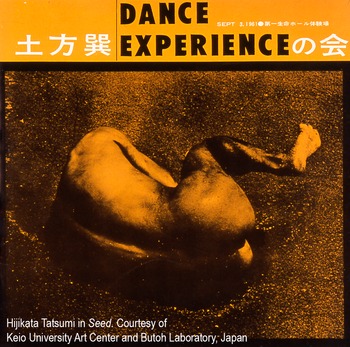
The founder of Japanese butoh dance, Hijikata Tatsumi, had championed similar choreographic deformations to those Jalet created, or what Hijikata described as his “dance of the back,” producing what Katja Centonze has since called an act of choreographic “de‐figuration” (Reference Centonze2018, 17) and which is documented in the many publications, photobooks, films and sculptures produced by Hijikata in collaboration with photographer Hosoe Eikoh (Hijikata 1960/Reference Hijikata2000, 39-41; Hijikata 1961/Reference Hijikata2000, 45; Hosoe et al. 1960-61/Reference Hosoe2012 & 1969/Reference Hosoe2009; Marshall Reference Marshall, Baird and Candelario2018, 158-70), film-maker Iimura Takahiko, and other artists, all of which prefigured the outputs produced by Nawa and Jalet (Nawa and Koyama Reference Nawa and Taisuke2017; Ozaki et al. Reference Tesuya2018; Delmas Reference Delmas2016; Jalet and Nawa Reference Jalet and Kōhei2018a & Reference Jalet and Kōhei2018b; Jalet Reference Jaletundated; Nawa et al. Reference Nawaundated). The cover of the program for Hijikata’s gallery performance DANCE EXPERIENCE #2 (Fig. 2), for example, featured a print by Hosoe of an apparently headless, pained curve of flesh, coiled in on itself, resting upon a bleak, rough texture of sand found at one of Tokyo’s beaches. Echoing such acts of defiguration, the video for Nawa’s gallery exhibition concluded with a briefly recognizably human figure (Moriyama Mirai), his head and face dimly visible under a film of the white ooze—a pose also seen in the on-stage version. This ooze was katakuriko potato starch, a “dilutant fluid,” meaning that if it is manipulated, it moves from being liquid, to a thick workable paste (Jalet and Nawa Reference Jalet and Kōhei2022, 160), which the dancers kneaded, molded, and smeared on themselves and each other, before finally being absorbed within it. This concluding figure leant slowly from side to side, eyes closed, before his whole body, head and all, disappeared into the central orifice (Fig. 3).
Cover of DANCE EXPERIENCE #2 (1961) by Hosoe Eikoh featuring Hijikata Tatsumi. Courtesy of Hijikata Tatsumi Archive, Keio University Art Center and the Hosoe estate.

Vessel. Photograph: Inoue Yoshikazu; © Damien Jalet and Nawa Kōhei. Courtesy Perth Festival of the Arts.

While resolutely contemporary in the use of digital sculpting and the high level of polish, the production of Vessel (in all its forms) developed a dialogue with the modernist avant-garde as epitomized by Bataille, whilst also engaging with precedents established within Japanese butoh.Footnote 5 Following Gabrielle Brandstetter (Reference Brandstetter2015) and Aby Warburg (Reference Warburg and Britt1999), my analysis is both conceptual and iconological, tracing “survivals (Nachleben),” or the return of corporeal images, forms and ideas across diverse instantiations (see also Marshall Reference Marshall2008). Expanding on Warburg’s interdisciplinary approach to art history, Brandstetter argues that the Euro-American avant-garde staged a revival of corporeal forms found in the ancient Dionysian sculptures of Greek maenads, of Nike, as well as African, Indian, Oceanic, and even Japanese sources (see below), producing what Warburg called artistic “survivals (Nachleben),” which were developed, transformed, and then disappeared, into new gestures, movements and forms (Brandstetter Reference Brandstetter2015). In this way, the “plastic arts” of photography, painting and sculpture were “operative in mediating encounters between dance” and its materializations in different bodies throughout space and time—or as Susan Manning observes, in the work of Mary Wigman and her peers, “Modern dance arose from the fusion of theatrical and extratheatrical resources” (Reference Manning1988, 36), including what Brandstetter constructs as an essentially historiographic-anthropological approach to visual documentation akin to that which Warburg (a contemporary of Wigman) himself employed. I return to Brandstetter’s thesis in more detail below as it pertains to history and memory.
If one builds from Brandstetter to read Nawa’s and Jalet’s Vessel with an eye to comparable “survivals” from the history of dance and the arts in this case found in butoh, the work of Bataille, Surrealism, and Japanese cultural myth, then Nawa’s and Jalet’s Vessel can be seen as arising out of a series of convergences which confuse past and present, the proleptic and the historic, Europe and Japan. My contention is that by focusing on the figure of the “acéphale” as developed by the European Surrealists, together with butoh and its heritage, these crisscrossing interconnections reveal a previously unrecognized intermedial butoh subtext present within choreography after modernism. Such intermedial butoh practices do not prioritize the human figure as human within dance or art. Vessel (in all its forms) provides an exemplary model of this approach to the body, which one might see as essentially seeded into the past as antecedents for butoh’s own intermediality (Marshall Reference Marshall2013). This essay then is an attempt to read dance staged by artists with little by way of a direct genealogical linkage to butoh as if they were a form of butoh, and as such, demonstrate the utility of drawing on the intermedial forms of butoh, Bataille and Surrealism as tools for understanding dance and its pasts today.
In the configurations staged by Jalet, Nawa, Hijikata and Bataille, the head, face, reasoning brain, identity and subjectivity, all become either irrelevant, or are invoked as principally active through the dialectic play of their own dissolution. This is however not a new phenomenon in arts practice or performance, as demonstrated by both the invocation of Bataille by Jalet and Nawa in published statements from the pair, and the close aesthetic affinity between Vessel and its intermedial butoh precursors. The combination of European interwar thought with Japanese cultural materials, histories and myth, draws a link between diverse realizations of posthuman intermediality, photomedial and sculptural realizations of dance, and Japanese butoh.
The braided influences and histories underpinning Vessel contravene in this sense simplistic, linear geographies of descent for contemporary dance after modernism. The pattern of choreographic, corporeal and mnemonic affinities which emerges from out of the Vessel’s constitutive elements renders the concept of a single origin from which historically antecedent developments arose in a linear fashion problematic at best, if not untenable.Footnote 6 This is moreover the principal theme of Vessel’s own narrative, positioning existence as an opaque experience of both remembrance and dissolution—a topoi also found in butoh. Such a reading offers other sites—namely Japan’s central urban regions and its northern rural prefecturesFootnote 7—upon which to base the foundations of critical praxis around those dance forms which emerged in the wake of the modernist avant-garde across the globe. My line of reasoning echoes the more explicitly postcolonial argument of Hanna Järvinen (Reference Järvinen and Curtin2023, 290) and her peers, who “posit the plural modernisms” and histories of the avant-garde “not as belated reactions to the Euro-American hegemony”—as French commentators like Patrice Pavis and Catherine Diverrès have implied of butohFootnote 8—“but as hybrid returns,” where other starting points and concepts may be seen as circulating within and across contemporary dance and its lineages, such that the “narrative of modernism is flipped” or rerouted, rendering Japan and other regions as alternative centres for braided multidirectional histories.Footnote 9
Soluble Prehistories of the Future: Vessel as the Return of a Materialist Butoh Past
Nawa’s sculptures for the gallery exhibition materialized Jalet’s pre-existing choreography for the live performance. Yet both the live performance and the gallery displays work to problematize the stability of these materializations, invoking a condition in which all materializations and corporealizations—and hence all of the histories which they embody—turn into formless liquid. “Formlessness” is a term developed by Bataille and which has been argued by Yve-Allain Bois and Rosalind Krauss (Reference Bois and Krauss1997) as representing a dominant trend within the modernist avant-garde. Bataille’s journal Documents offered what the Surrealist described as an avant-garde “dictionary” wherein he defined “formlessness” as that which “serves to bring things down in the world, generally requiring that each thing have its form. What it [formlessness] designates has no rights [to formal distinctions] in any sense and gets itself squashed everywhere, like a spider or an earthworm” (Bataille Reference Bataille1929, 382, [1985] Reference Bataille and Stoekl1927-39, 31 & 1957/Reference Bataille and Dalwood1986, 31; Krauss et al. Reference Krauss1985, 64-70).
Hijikata had cited Bataille in the programs for his own gallery performances, quoting in the essay “To Prison” Bataille’s contention that: “Nakedness offers a contrast to self-possession, to discontinuous existence … revealing a quest for a possible continuance of being beyond the confines of the self” (Bataille 1957/Reference Bataille and Dalwood1986, 17; Hijikata 1961/Reference Hijikata2000, 45). Hijikata then added in his own words that “the naked body and death are inseparably joined.” In these accounts, the human subject putatively at the center of dance and art becomes just so much more naked stuff to shape and mold. Echoing Chiu’s characterization of Nawa’s sculpted figures not as “single entities but … body parts that are assembled into a larger puzzle” (Reference Chiu2018; Fig. 4), Patrice Pavis has described the butoh body as manipulated “according to an absolute materialism” (Reference Pavis1998, 215), offering a “raw corporality” in which “the face is often disfigured, [and] the body … frequently deformed,” coming to resemble nothing more than “a quarter of meat,” palpitating with ambiguous vitality. Nawa uses much the same language, stating that the human forms depicted in Vessel are “transformed into meaty organic objects … no longer people” (in Ozaki Reference Tesuya2018, 55).
Vessel. Photograph: Inoue Yoshikazu; © Damien Jalet and Nawa Kōhei. Courtesy Perth Festival of the Arts.

Pavis reads this sometimes brutal “disappearance” of the body within the butoh performances staged in France during the 1980s as a kind of “intrusion of modernity” into the present, restaging and extending an apparently Western form of “radical avant-garde art based on negation and contestation” (Reference Pavis1998, 217). Diverrès went so far as to claim that in meeting Hijikata’s peer and collaborator Ohno Kazuo, it was as if she had been able “to travel backwards” in time and space to meet those deceased European modernists whose choreography Ohno often paid homage to (Harald Kreutzberg, Antonia Merce) (Diverrès Reference Diverrès2013, 114-16). Read against the work of French commentators such as Pavis and Diverrès, Jalet’s and Nawa’s work would be seen as an ultimately derivative return of Europe’s own avant-garde traditions.
But could we invert the trajectory sketched by Pavis and Diverrès to read Hijikata, Ohno, Jalet and Nawa not so much as derivative but as antecedent, to invert history and discover an intermedial Japanese butoh subtext within practices arising out Europe and elsewhere? Mist, also devised by Jalet in collaboration with Nawa, featured a soundtrack of distorted radio waves such that the space was populated by “remnants of things that once existed [radio signals sent from far away] belonging to a distant past, as well as signs of a world to come” (in Jalet and Nawa Reference Jalet and Kōhei2022, 152). Works such as those by Jalet, Nawa, Hijikata and Bataille are therefore explicitly multitemporal, transcending conventional time and space.
Brandstetter notes that through choreographic and aesthetic allusions to various non-Western and superficially similar folk, premodern or ancient Western precedents documented in the visual arts and other sources, avant-garde dance produced an “exotic model” of images derived from “various encounters with foreign cultures, as well as with the Other in one’s own culture” (Brandstetter Reference Brandstetter2015, 3, 28). Euro-American modernists became “dedicated” to what Ruth Phillips calls “the appropriation of new ancestors” (Reference Phillips2015, 6), be these from Europe’s own historical backwaters—the fringes of the Mediterranean, or the wildernesses of Eurasia (Brandstetter Reference Brandstetter2015, 1-5, 114-64; Innes Reference Innes1993, 47)—or as far away as Africa, Oceania, India and Japan. These influences became what might, in Elazar Barkan’s and Ronald Bush’s evocative phrase (Reference Barkan and Bush1995), be considered “prehistories of the future.” The setting of Vaslav Nijinsky’s Le sacre du printemps (1913) in prehistoric Russia provides a particularly potent example of this locating of an ancient and mysterious primal space at the genesis of European dance and art. Other examples included Ruth St Denis’ interest in representations of Indian nautch dancers, Mary Wigman’s use of concepts inspired by Japanese noh (the mask) and Indonesian ritual performance, both of which influenced her 1926 performance of Hexentanz (Scheyer Reference Scheyer1970, 20), while representations of bacchic dancing were all but ubiquitous as touchstones in the work of Wigman, Isadora Duncan, and other early twentieth century Euro-American dancers. Modern avant garde dance thereby dramatized the “theme of memoria” across history “as an art of remembrance with its power of metamorphosis as contained in the memory of an image of the body: its production and its disappearance” (2-3). As Stefan Tanaka (Reference Tanaka1993) has pointed out, even for the Japanese, the underdeveloped northern region of Tōhoku served as modern Japan’s “own Orient,” becoming a key mnemonic reference point for Hijikata and others.
Vessel’s Bodies as Formless Media
Vessel moved from being a mainstage performance to other instantiations almost immediately, including the gallery displays described above, moving image works, publications like Vessel / Mist / Planet [Wanderer] (2022), and other outputs. As previously noted, Nawa’s design for the stage version of Vessel consisted of a pair of concentric white mounds rising out of a black, mirrored surface covered with a thin film of water (Fig. 1). Ozaki (Reference Ozaki2016) likened the structure to “a small, flat island; the crater of a volcano; or female genitalia” which “appears to have foam coming out” of a central depression. If the structure recalled a vagina, the white starchy sludge emanating from it recalled sperm. The live choreography moved through approximately six main scenarios. The first tableau revealed dancers in three entwined pairs, which were initially:
as motionless as sculptures themselves in the water, reflected in its still surface; then they begin to move, disturbing and splashing it … one of them separates and emerges from a clump as if born. The second tableau sees all seven fully separated, standing upright but bent forwards with their heads tucked under their arms, and making more lively synchronized movements … The third tableau sees them form clumps again, limbs pressed together, opening and closing slowly … In the final tableau one of them separates again and crawls up onto the island. (Bower Reference Bower2018)
In these live and reproduced tableaux, bodies were arrayed symmetrically, either in two pairs flanking a central trio, or interlaced together in spreading, linear patterns, with the limbs sketching complicated crisscrossing configurations (Figs. 5-6). As Nawa explains:
Damien was particularly involved in symmetrical posing with strong frontality. A figure transforms in front of your eyes as the performers coalesce—one, two, three, five, seven dancers—while constantly retaining left‐right symmetry. (in Ozaki et al. Reference Tesuya2018)
Left: Vessel. Photograph: Inoue Yoshikazu; © Damien Jalet and Nawa Kōhei. Courtesy Perth Festival of the Arts. Right: Ernst Haeckel, Art Forms in Nature (Reference Haeckel1899). Photograph by author.

The positions are not only doubled choreographically left and right, but virtually up and down, due to the mirror effect created by the film of water lying across the stage, enacting what one critic described as “a kind of optical mitosis” akin to what happens when cells divide (Jalet and Nawa Reference Jalet and Kōhei2022, 156). Vessel’s choreography might be likened here to the prints reproduced in evolutionary theorist Ernst Haeckel’s famous publication Kunstformen der Natur [Art Forms in Nature] (Reference Haeckel1899), whose wandering lines and organic symmetries influenced Art Nouveau, the founder of modern dance Isadora Duncan, and the Surrealists (Fig. 6; Brandstetter Reference Brandstetter2015, 47, 169, 263-64).Footnote 10 The dramaturgy of Vessel is one of organic reflections, transformations and multiplications followed by subsequent contractions, fusions and reductions, whereby clearly defined states of corporeal singularity and points of origin swim into view before dissolving.
Jalet states that “I ask the dancers to be complex and difficult,” as in Haeckel’s illustrations, because “I want them to go to the trance state that has overcome fatigue. We are looking for a transition from a physical state to a poetic state from one world to another” (in Jalet and Nawa Reference Jalet and Kōhei2022, 156). Butoh performance also often approaches trance, and Hijikata’s sometime pupil and former collaborator Tanaka Min has likened his own practice to the altered states experienced by “itako,” or female mediums from Tōhoku, who enact possession rituals to make contact with the dead and put souls to rest (in Fuller Reference Fuller2017, 269). Linking himself to such premodern shamanic practices, Tanaka claims to be the “legitimate child of dance initiated in ancient time” (in Snow Reference Snow2002, 80). Jalet’s dancers also function like shamans, falling into a trancelike state outside of the normative conditions of life and consciousness, thereby facilitating transformation into transhistorical posthuman beings.Footnote 11
Both Hijikata and Jalet acknowledged their debt to Bataille, but Jalet’s link to butoh itself is less direct. In a public forum held in Perth (March 2, 2018), Jalet claimed he was unfamiliar with the famous photobook Kamaitachi which Hijikata and Hosoe had shot in Tōhoku in 1965 (Hosoe et al. 1969/Reference Hosoe2005 & 1969/Reference Hosoe2009; Marshall Reference Marshall, Baird and Candelario2018). This was a photographic chronicle of sorts, depicting Hijikata travelling from the fringes of old Tokyo (the Sugamo neighborhood), before fleeing north to the dark mountain pathways and muddy fields of Tōhoku (principally the township Tashiro; Fujiwara Reference Fujiwara2016).Footnote 12 The experience proved crucial for Hijikata, the dancer later observing that “There is Tōhoku in England” (in Baird Reference Baird2022, 201), and so not only the Japanese could draw upon such a landscape of “eternal repetition” (Sas Reference Sas2011, 192‐93) which allowed access to a “space of performance that recirculates the potent presence of something not quite knowable” (Eckersall Reference Eckersall2016, 18). As Brandstetter observes of the European avant-gardists, the “journey” to those geographic sites which constitute the cradle “of antiquity” and the past “thus reveals itself to be a journey into archaic zones of the self” which the artist is then able to evoke on stage (2015, 77). Hijikata’s landmark performance of Hijikata Tatsumi to nihonjin: Nikutai no Hanran [Hijikata Tatsumi and the Japanese People: Rebellion of the Body] (1969) was offered to the public in the same year as Kamaitachi was published, and Nikutai no Hanran opened with a reprise of one of the scenes staged in the photobook, specifically Hijikata’s elevation on a catafalque as the sadistic Roman emperor Heliogabalus—who had been the topic of a novel by Bataille’s peer, the theatre-maker and author Antonin Artaud (Héliogabale, ou, l’Anarchiste couronné, 1934/Reference Artaud and Lykiard2003; Baird Reference Baird2022, 124). Many of the concepts underpinning Hijikata’s oeuvre came out of his musings on Tōhoku, and isolated images from the Kamaitachi series have been widely published—most notably in the pioneering book by Franco-Israeli photographer Nourit Masson-Sékiné, Butoh: Shades of Darkness (Baird Reference Baird2022, 105-11; Masson-Sékiné,Viala et al. Reference Masson-Sékiné and Viala1988; Marshall Reference Marshall, Baird and Candelario2018). One can therefore be fairly certain that Jalet would have encountered one or another of these images at some time.
Nawa’s link to butoh is more direct. He sees the origin of his approach to the body as derived from his experience as a student volunteering at the Hakushu Art Camps run by Tanaka. Because the Art Camps functioned, much like Hijikata’s early collaborations, as a means of exchange between dancers and artists, Nawa felt that Tanaka’s movement functioned “not so much … a genre” of butoh dance, but as a:
medium related to all kinds of things … as a sculptor, I came to view materials and mediums as extensions of the body …
I went … back to university and made a carving that looked like Min’s body … in water-based clay … coated … with … resin, forming a membrane to seal in moisture. The human body is made up of nutrients and water, and really is like foam [or moist clay]. These foamy lumps being eaten, excreted, and being materially replaced is the state of being alive … If we view the body like this … I think sculpture and dance … come to be related. (in Ozaki et al. Reference Ozaki2015; also Jalet and Nawa Reference Jalet and Kōhei2022, 154)Footnote 13
Tanaka himself even likened shamans such as the itako to a kind of formless “media, or emptiness … one of the most talented [dancers] … Ancestor of the dancer” (in Fuller Reference Fuller2017, 269).
Tanaka and Nawa here all but paraphrase the influential pronouncements of another of Hijikata’s collaborators, namely filmmaker Iimura Takahiko. Iimura promoted the concept of intermedia art in Japan (Ross Reference Ross2014, 44-53 Iimura Takahiko 1966/Reference Iimura and Smith2015), deriving the term from US Fluxus artist Dick Higgins (1965/Reference Higgins2001). Higgins used the phrase to describe work—like Vessel or Bataille’s publications—which “falls between [those] media” particular to photography, literature, painting, sculpture or the theatre. It was however Iimura who constructed intermedial arts as both primal and modern, arguing that a furious, almost “Dionysian celebration” is “triggered when one medium”—in this case, the photochemical filmstrip deployed by Iimura himself—“violates another,” such as in the “cine-dance” works he staged and filmed with Hijikata as performances (Iimura 1963-66/Reference Iimura and Smith2015).Footnote 14 For Iimura, Hijikata and Hosoe, intermedial art generates a kind of violence or erosion of materials and identities. In the final analysis the human body is, in Iimura’s words, but “one kind of media” (Iimura Reference Iimura2007, translated in Eckersall Reference Eckersall2013, 55), interchangeable with others, no more elevated or rarefied than celluloid or other materializations.
Mythic Origins and Deathly Aesthetics
Acéphale (Reference Bataille1936-39) was one of a number of intermedial journals published by Bataille and the Surrealists which featured poetry, fiction and essays, in dialogue with photographs and illustrations. These publications burlesqued popular illustrated scientific periodicals such as La Nature: Revue des sciences et leurs applications aux arts et à l’industrie [Nature: Review of the Sciences & Their Applications in the Arts & Industry] (Tissandier et al, eds Reference Tissander1873-1905). Other similar Surrealist journals included Documents (1929-31; edited by Bataille) and Minotaure (1933-39).
Acéphale took its title from the ancient Greek word for “headless,” the phrase often applied to the so-called Blemmyae (Fig. 8), and which were depicted in early modern encyclopedias, bestiaries, and wonder books which inspired the Surrealists and their butoh peers. The fin de siècle medical and scientific publications drawn upon by the Surrealists often featured images of similarly monstrous “teratologies,” or abnormal medical conditions—including not only Haeckel’s twisting, nonhuman forms, but paralyzed, spasming hysterics as described by the Surrealists Louis Aragon and Andre Breton which were “the greatest poetic discovery” of the age (Reference Aragon and Breton1928; Charcot Reference Charcot1872; Bourneville et al. 1875-Reference Bourneville1880), and a range of pathological deformations such as squat, still-birthed figures diagnosed with “anencéphalie,” which had an oversized head and face dropped partially below the shoulders, whilst much of the brain, skull, and scalp was missing (Montméja and Bourneville Reference Montméja and Bourneville1870, 31-33). The resulting corporeal ensemble was likened by the physicians to that of a toad. Pliny the Elder had indeed claimed that the akephaloi and “Blemmyae” were close to “half beasts” and that “by report, [they] have no Heads, but their Mouth and Eyes fixed in their Breast” (Plinius 1601/Reference Plinius and Holland1848, 5.58). André Masson however interpreted the concept more literally for the illustration he made for the cover of Acéphale, Masson depicting a militant decapitated figure without any head at all. The print depicted a paradoxically heroic image, a dagger in the acéphale’s left hand, the burning heart taken from its chest in its right, a strongly demarcated, radiating skull at its genital region, and its coiled viscera rising into its chest (Fig. 7). According to Bataille the acéphale “is not a man. [but] He is not a God either” (Bataille Reference Bataille1936)—a phrase directly quoted by Jalet in media releases and interviews (Jalet et al. Reference Jalet2019; Woo-hyun Reference Woo-hyun2019). This was because, as Bataille had it, the acéphale has “escaped from his head like the condemned man from his prison.” Having left behind the rationalist subjectivity encased in its skull, this being could turn its attention away from philosophy and non-material concepts, rendering the acéphale’s intensely material and debased “gut [as] … the labyrinth in which he himself goes astray,” rejecting such normalizing corporeal structures as would otherwise define the human (Bataille Reference Bataille1936). The acéphale thereby becomes “free to resemble all that is not him in the universe” (Bataille Reference Bataille1936), including nonhuman entities.
Cover of the first edition of Acéphale (1936), edited by Georges Bataille, illustrated by André Masson. Photograph by the author.

Blemmyae, from Hartmann Schedel’s Liber Chronicarum (1493); Wikimedia Commons.

The equivalent image evoked by Hijikata was what he called a “wind daruma.” Describing the effects of the numbingly cold zephyrs which assaulted the peasants living alongside him in Tōhoku during his childhood, Hijikata claimed that:
a Tōhoku person can get wrapped in the wind that blows from the … rice paddies to my front door and, garbed in the wind, become a wind daruma standing at the entrance. The wind daruma goes into the parlor, and that already is butoh. (1985/Reference Hijikata2000, 71-72)
Daruma are anthropomorphic Japanese charm dolls, painted red, with a giant face in the center of a rounded form, which will roll back upright if pushed, and hence signify resilience as well as phallic erection (Schumacher Reference Schumacher2019). Daruma are modelled after the red robed priest of the same name who, after cutting off his eyelids to keep from falling asleep during meditation, remained still so long that his arms and legs atrophied and fell off. Many viewers of Vessel have claimed to see in the dancers something close to a such a reduced, posthuman body, one author describing “a chorus line of what might have been fat frogs bobbing up and down” (Clarke Reference Clarke2018; Fig. 1).
Jalet endorsed Bataille’s contention that the headless being was both “condemned” and liberated by the faceless “anonymity” (Bataille Reference Bataille1936) produced out of a choreographic “Re‐questioning [of] the shape of the human body” (Jalet in Noisette Reference Noisette2019). Vessel evokes in this sense not only deformations of the human itself, but a transition into nonhuman, animal and plant-like configurations. Artaud claimed to see something similar in Balinese temple dance, where he characterized the performance as evoking “giant insects covered with lines and segments made to unite them with unknown natural perspectives of which they appear as nothing more than its untangented geometry” (1938/Reference Artaud and Richards1958, 46-47). Audiences to Vessel have reported configurations suggestive of “anemones with tendrils opening and shrinking in symmetry” (Appleby Reference Appleby2018), transforming into “a giant, vertically symmetrical insect,” bodies which move “Utilizing solely the elasticity of abdominals, spinal column and legs … in the manner of a newly hatched snake or leech” (Ozaki Reference Ozaki2016), daruma-like amphibians, or even assemblages “opening and closing like enlarged mouths or genitalia” (Bower Reference Bower2018).
The strongest human drive for Bataille involves an “assenting to life up to the point of death” (1957/Reference Bataille and Dalwood1986, 11), such that—in Jalet’s and Nawa’s words—bodies all but “liquify” in abject disintegration (Jalet and Nawa Reference Jalet and Kōhei2022, 152). As Nawa states, within his collaboration with Jalet, “the impulse for life or sex and the impulse for death coexisted” (in Ozaki et al. Reference Tesuya2018). Reading butoh itself through Bataille’s philosophy, Centonze argues that butoh expresses a “death aesthetics … which catches the tension between being dead and alive, between presence and absence” producing a posthuman “theatre of eroticism” (Reference Centonze, de Antoni and Raveri2017, 20). Butoh shared this concern with German interwar dance, Kate Elswit (Reference Elswit2009, 75-79) arguing that, in the work of Valeska Gert, Anita Berber, Kurt Joos and others, “the onstage portrayal of death” acted as a “powerful topos of authenticity” in which “(stinking) mortality—the materiality of the dancing body’s enactment” served “as a means to convey something deemed an essential human truth.”Footnote 15 Jalet described his own choreography for Suspiria, which was inspired by the work of Mary Wigman, as “an Eros/Thanatos pas de deux” (Stamelman Reference Stamelman2018). In Vessel itself, as in butoh, there is what Bataille calls “a breaking down of … separate individuals” akin to what happens when couples fuse during intercourse (1957/Reference Bataille and Dalwood1986, 11, 18; Fig. 6). Jalet, Nawa, Hijikata and Hosoe stage acephalic poses and spasms to evoke a posthumanist, butoh creature which limins death and in doing so, pulses with ambiguous vitality and eroticism.
Anthropology and Mythic History in Vessel
Jalet identified the first stirrings of his ideas for Vessel to his 2013 tour as a performer in Japan, where he encountered Nawa’s installation Foam (Ozaki et al. Reference Ozaki2015). This was a largescale installation work made from detergent, glycerin and water, which spectators walked amongst as it bubbled and shifted around them. Nawa likened the piece to “the landscape of a primordial planet” (in Frearson Reference Frearson2014).
Jalet shared the interest of Bataille and the Surrealists—as revealed in the subtitle of Documents: Doctrines, archéologie, beaux-arts, ethnographie—in non-Western cultures and rituals (Clifford Reference Clifford1981; Krauss Reference Krauss1985). As a young man, Jalet studied anthropology and ethnomusicology (Westle Reference Westle2018; Ulzen Reference Ulzen2018). Jalet has stated he has a particular interest in rituals performed at volcanic sites and islands like Japan and Bali, because these landscapes once transformed from a foamy liquid (lava) into rock and soil (TNdB 2019; Ulzen Reference Ulzen2018). Jalet visited Japan and Bali, claiming to have been especially “fascinated” by the ascetic devotions conducted by those in “the mountains of Tōhoku … In Japan, mountains have always been considered like gods … the mountain is like a mother” (in Westle Reference Westle2018). Jalet was influenced here by Artaud’s famous essay on Balinese temple dance (1938/Reference Artaud and Richards1958). Jalet enlisted a group of Balinese temple dancers who had recently toured Paris four years before in a stage show billed as a night of Balinese dance in “tribute to Artaud” (Une nuit balinaise: En hommage à A. Artaud) (Biennale de Lyon 2012). Members of the troupe then performed in Jalet’s 2016 filmic collaboration with director Gilles Delmas entitled The Ferryman (Le passeur des lieux). The film includes several sections from both the live and the video manifestations of Vessel, new scenes shot in Bali and Japan, as well as a new staging of Jalet’s acephalic dancers on Japan’s Yakushima island, crouched upon primordial looking, moss-covered tree trunks, or along the foreshore.Footnote 16
Itako are active at several mountainous volcanic sites in Japan and Tōhoku, including Mount Osore (Sasamori Reference Sasamori1997; Eckersall Reference Eckersall2016). The site was well known to butoh artists, in 1969 butoh dancer Iishi Mitsutaka being captured as part of a photographic series by Hanaga Mitsutoshi in and around the mountain’s temple complex (Masson-Sékiné and Viala Reference Masson-Sékiné and Viala1988, 155-57). Osorezan lies on a sulfurous volcanic lake said to provide access to the Land of Darkness (Yomi) and the deceased souls located therein. Bereaved parents often erect rock cairns along the sulfur encrusted rivulets for their departed children as the latter are said to be condemned to build these structures before they may leave hell and move on.
It was Nawa who introduced Jalet to the seventh century Japanese texts Kojiki (Record of Ancient Matters) and Nihon Shoki (Chronicles of Japan), which record the mythological origins of the universe and Yomi (Laurie Reference Laurie2018). Kojiki chronicles a mise en scène very like the structures Nawa conceived for Vessel and those found at Osorezan. In the beginning, when the “land was young” it resembled “floating oil and drifting like a jellyfish” from which there “sprouted” the first beings or kami (gods) (Various Reference Philippi1969, 47; Jalet and Nawa Reference Jalet and Kōhei2022, 160; Figs. 1 and 4). Nawa relates the dramaturgy of Vessel directly to these beliefs, noting that:
The performance begins with a scene like the Sai no Kawara from Japanese mythology, a dry riverbed in a Limbo‐like realm … The dancers commence at … Yomi, the realm of the dead, positioned on the basin [in the set] that marks the boundary between our world and the other world. The souls that roam around in this realm transform from cairns of stones on the kawara riverbed [like those at Osorezan] to shapes such as a bird, flora, insect, totem, lion, and spider, and eventually sink into the liquid in the center of the vessel. That takes them down to the lower realm where Earth is located, signifying the potential to leave the realm of the dead and be reborn. (Nawa in Ozaki Reference Tesuya2018)
After this, the rebirthed creatures are free to die again and begin the process anew. Prefiguring one of the positions which the dancers enacted in Vessel, resting on their shoulders with their feet pointed upward like fronds, Hijikata reflected that:
I grew up with my head and the soles of my feet turned upside down. If you don’t do anything else … you’ll turn into mud … I am distinctly aware that I was born of mud and that my movements now have all been built on that. (1985/Reference Hijikata2000, 74)
The formless subject of butoh and Japanese mythology is, as described by Hijikata, made of mud, foam, flesh, and slime, and this image of the body inverted, head hidden, and feet palm upwards, recurs in live and photomedial versions of Vessel.
Jalet has also likened the dramaturgy of Vessel to Dante’s Inferno, and it was on a tour for a production of Samuel Beckett’s L’image, parts of which draw on the Inferno, that Jalet met Nawa. Jalet has likened Japanese belief in the stages leading from hell to enlightenment as described in Kojiki to those which Dante related in Inferno, noting that (unlike in Beckett) the esoteric Japanese rituals practiced in Tōhoku associated with death, mourning and rebirth are “very sexual” (Jalet in Ozaki Reference Ozaki2015; TNdB 2019). Certainly Dante’s afterworld shares some characteristics with that of Osorezan and Vessel. One of Dante’s characters explains that “underneath the water” of hell there “dwells a multitude” of souls, “whose sighs, Into these bubbles make the surface heave … Fix’d,” as these damned soul are, eternally “in the slime” of the afterlife (Dante Reference Dante2001). Vessel’s central pit (Figs. 1 and 4) recalls therefore the bubbling expanse of slime described in Kojiki, the Inferno, and the mud of Hijikata’s homeland.
Iconological References and the Posthuman
The pulsing, curiously arranged figures of the live version of Vessel bring to mind many iconological precedents developed by Bataille, the Surrealists, Hijikata, and others. Jalet’s most direct iconological borrowing—apart from the acéphale itself and the image of Hijikata, his head buried in the mud as his feet rose above him—was of the pose depicted in a famous photograph by Man Ray, published above the table of contents in the Surrealist journal Minotaure (Skira and Tériade Reference Skira and Tériade1935). Ray’s image featured a female model, nude from the waist up, neck bent backwards so as to make it seem that the breasts were eyes, and the arms horns. Jalet had dancer Mitoh Ruri embody this form in Vessel, twisting across the stage as a paradoxically headless minotaur.
Because of these and other similarities to art historical precedents, critics have gone so far as to characterize Jalet’s work as a veritable “mise en abyme” of referents from art, dance and nature, summoning up bodily configurations akin to those of butoh, Surrealism, Haeckel, the ancient Jōmon statues found in Tōhoku, bestiaries, Tibetan Buddhist art, Théodore Géricault’s Raft of the Medusa (1819), Hieronymus Bosch’s Garden of Earthly Delights (c.1490) and other sources (Bower Reference Bower2018; Bromilow Reference Bromilow2018; Jalet and Nawa Reference Jalet and Kōhei2022, 153-57; TNdB 2019; Ozaki et al. Reference Tesuya2018). The field of possibilities which posthuman intermedial performance evokes is therefore broad, moving beyond the human form itself to generate diverse affinities and references in space, time, mythology, and the varied forms found in nature. Denied a stable configuration, the acephalic dancer disappears and reappears within a labyrinth of historical and corporeal possibilities, stretching across wide range of globalized mythologies, images, and cultural histories, an art of memoria, survivals, and of their dissolution.
Conclusion: Global Choreographies Lost in the Labyrinth of Formless Flesh
These allusions and images of mythological descent and rebirth, of corporeal transformation, and of material dissolution in Vessel—of a body that “becomes itself through disappearance,” as Peggy Phelan once described it (Reference Phelan1993, 146)—problematize cartographies of influence, bounded subjectivity, and distinctions between media, all at once. How can a headless being who dissolves into the primal ooze of transnational mythology and organic possibilities, moving through a realm described by Kojiki, the Inferno, and Hijikata’s biography in Tōhoku, properly be said to have a single origin? The acephalic dancer materialized by Hijikata and Jalet should perhaps be read as a figure which causes formal lineages themselves to become lost in the labyrinth of the body’s entrails. My argument then is that Jalet’s and Nawa’s work should not be seen as simply derivative of, or influenced by, trends in butoh and its photomedia. Vessel rather exemplifies trends scattered across the field of choreographic and corporeal possibilities within which butoh’s intermedial posthuman forms proliferate. The acéphale represents a model whereby the body and the subject might escape their own humanity through diverse media and choreographic realizations. Seen in this light, dance might be viewed as a practice which exists beyond distinctions of media or of the human body itself.



 Open access

