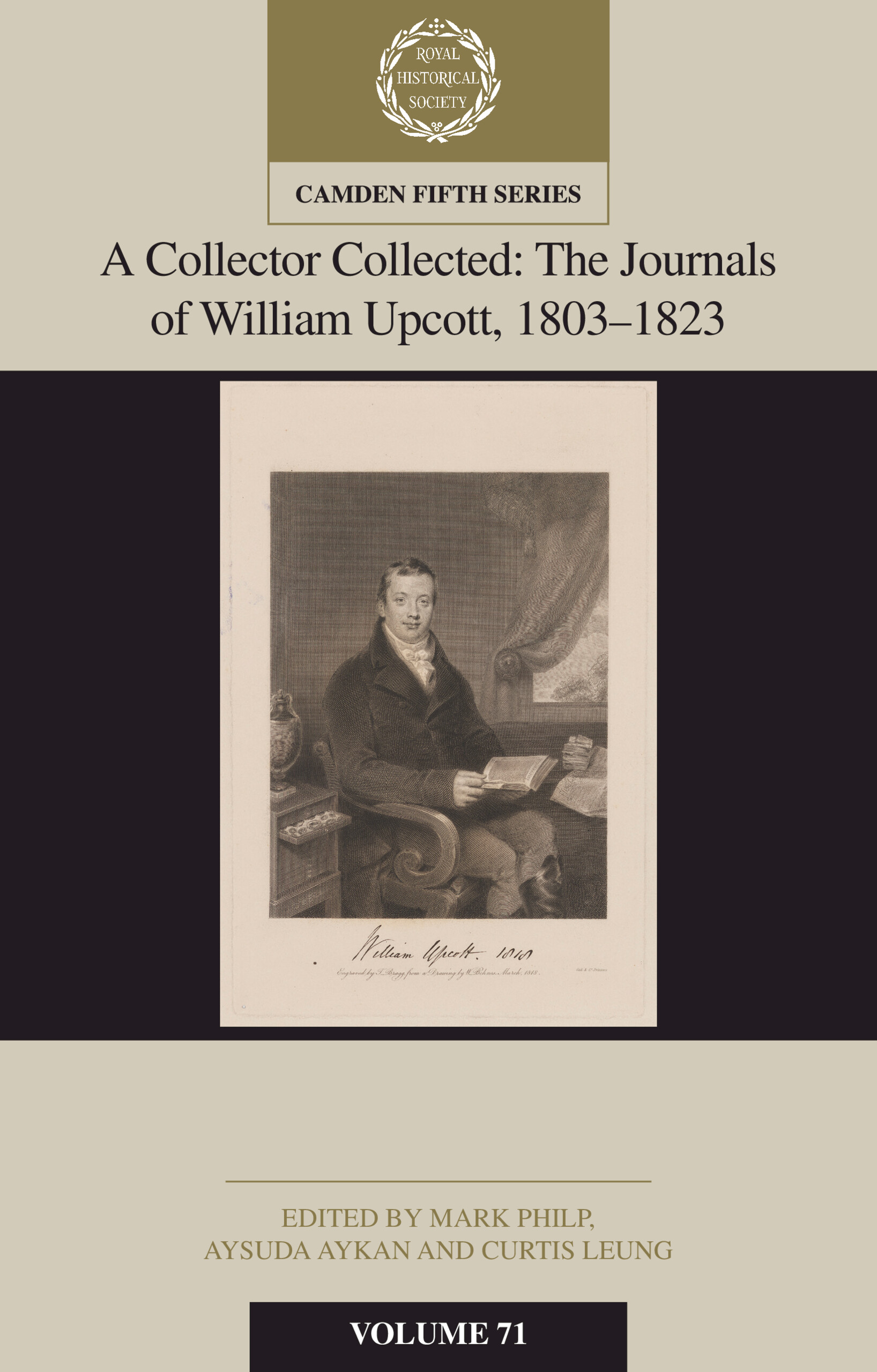


William Upcott (1779–1845) was born in London on 15 June 1779. He was the son of a liaison between Delly (Delia) Wickens (d.1786), the daughter of an Oxford shopkeeper, and Ozias Humphry (1742–1810), a successful portrait painter and miniaturist.Footnote 2 Although baptized William Upcott Humphry, the last name was never used and when Humphry and his son developed a relationship, they referred to it as one of Godfather and Godson.Footnote 3 We do not know exactly what Upcott knew about his parentage and at what stage but it seems likely that there was an agreement to maintain the fiction.
In September 1779, Delly Wickens moved back to Oxford with her son to live with her mother. Humphry remained in London, and in that year was made an associate member of the Royal Society of Arts. It is unclear how much contact he retained with Upcott’s mother. We know that on two occasions she wrote to him thanking him for his letter and a gift – in one case a coat, and in another £10 – and she says in the later letter (1784) that she writes to him ‘every quarter’, but it is clear that he was not a similarly regular or frequent correspondent. In her letters she certainly encouraged Humphry’s interest in his son, describing him as asking about his father (at the age of four or five) and as a very able boy who was outshining his peers: ‘he is a fine boy you would say so if you was to see him + he is a very sensible child but he is not like his Mother and he have the praise at his school for the best to learn his book he takes every thing so quick I never saw his fellow in everything + its my delight to keep him the right way + to instruct him all as I can + I lets him not go with no children to learn him any that is not becoming to another’.Footnote 4 Humphry did respond, at least in part, since Upcott went to stay with him for a week when he was ten or eleven, suggesting that some relationship existed. It is possible that Humphry might have paid for or contributed to Upcott’s schooling, but there is not much evidence of active involvement.Footnote 5 In 1785, sensing a decline in his career, Humphry left Britain for India, returning two years later. His fortunes had revived briefly, but he faced increasing challenges as his eyesight, which had been damaged in a riding accident in 1772, deteriorated further. By 1797, when Upcott moved permanently to London, Humphry was troubled by his failing sight and, while this might not be the sole or even main element in their relationship, there is no doubt that his son became useful to him, not least as someone who would read to him from newspapers and a variety of other sources, and as an amanuensis for his account of his life.Footnote 6
In March 1784 Delly Wickens married a John Peck and went to live in the Parish of ‘Ensham’ – (Eynsham) – just to the west of Oxford. It is not clear whether Upcott lived with the couple immediately following their marriage. It seems most likely that he did not and that he was raised mainly by his grandmother (Upcott refers to his ‘poor mother’ but is more outspokenly affectionate in his memories of his grandmother).Footnote 7 His mother subsequently had at least one further child, Elizabeth Peck (b. 28 April 1785). There were two other children (John and Simon) in the household. It is possible that they were also the children of that union but Upcott does not refer to John Peck (let alone to Simon) with anything like the kind of interest and sense of relation displayed when he discusses his half-sister Elizabeth – his ‘E.P.’ Nor, when Simon and his step-father John are very ill, is there any refence to ‘my’ brother, only to ‘her brother’.Footnote 8 Nonetheless, he attended the funeral of Simon Peck (who died at the age of seventeen) in London in September 1803.Footnote 9 It seems likely that Simon was a late child of that union, born only shortly before Upcott’s mother died. She was interred in the Protestant Dissenting Burial Ground in Abingdon, just south of Oxford, in December 1786. Upcott’s exact relation with ‘J.P.’ (John Peck) is still less clear – he refers to him also as E.P.’s brother, but not as his own, and he appears to be older than E.P., which suggests that he was born only just in wedlock, if that. In this case, their relationship, although initially poor, did improve over time, and Upcott’s respect for him grew.
Upcott’s education was a chequered one. He recalls a number of teachers: Mrs Hewlett in St Ebbs, Oxford; a Mrs Madegon; and then a Mr Mitchell in Penny Farthing Street, Oxford, of whom he gives a rather scathing account.Footnote 10 He was with Mitchell when his mother died, after which he was sent to attend Mr Seely’s school and boarded in Witney. He was moved to a school in Bicester under the guidance of Jethro Inwood and his wife when he was about twelve; two years later he was sent to Reading under a Mr Young. Young’s school was not a success, not least because Upcott and his fellows were inadequately nourished. He lasted only six months before being moved to a school in Uxbridge in 1791, where he stayed about a year and a half until, his health ‘growing so bad’ that his ‘life was despaired of’, he returned to Oxford and to being tutored in Holywell.Footnote 11 He was not impressed with his education, nor with his acquirements – nor, indeed, with the city of Oxford (about which he is consistently scathing).
At the age of eighteen, William Upcott was most definitely not the finished article. He arrived in London in March 1797, and by June was apprenticed to the publisher John Wright at 169 Piccadilly, opposite Bond Street, for a term of three and a quarter years, so as to take him to his twenty-first birthday.Footnote 12 Wright was a government loyalist and became the publisher of the Anti-Jacobin newspaper, instigated by George Canning (1770–1827), but then placed under the editorship of William Gifford (1756–1826), who knew and retained an affection for the young apprentice until his death. A room for the contributors was set aside in an adjoining house and Upcott reports that he had there ‘seen assembled the brightest geniuses of the Age’.Footnote 13 On Upcott’s own account he was ambitious to develop his abilities and while at Wright’s arranged to learn French from an emigrant priest who taught him from 4 a.m. to 7 a.m. for six months, at 10 pence per lesson.Footnote 14
At the end of his apprenticeship with Wright, he secured a more agreeable situation with the bookseller Robert Harding Evans of 26 Pall Mall, for whom he worked for nearly six years.Footnote 15 Evans, in marked contrast to Wright, was a Whig in politics, which broadened both Upcott’s acquaintances and his views. Evans also did more to induct him into the publishing business and, by delegating tasks such as assembling catalogues of people’s libraries and organizing their collections, introduced him into a more elevated sphere than he had hitherto been accustomed. One consequence of these apprenticeships is that Upcott’s politics are hardly a model of consistency: with pretensions to loyalism and support of the government, complemented by considerable respect for the leader of the opposition Whigs, Charles James Fox (1749–1806), and for the radical leader, Sir Francis Burdett (1770–1844). While Upcott was not fond of Evans, perhaps the most trying aspect of his situation was living with the family, about whose members he had little good to say. It was with very considerable relief that he secured a post in 1806 at the newly established London Institution, and took lodgings of his own, becoming, in his own eyes, at the age of twenty-seven, an independent young man.
In the background, his father, Ozias Humphry, clearly worked to advance his career. He probably brokered the apprenticeship to Wright and may have done the same with Evans. Humphry encouraged friends and acquaintances, such as Gifford, to look out for Upcott; and he marshalled support for his application to the London Institution. He also clearly played a major part in shaping his aspirations in the art, literary, and collecting worlds. Once Upcott was in town, they saw each other regularly and Upcott speaks of his gratitude to Humphry. It was Humphry who came to Upcott’s rescue when the threat of being drafted into the militia in 1803 could be allayed only by finding the money required to equip him as a member of the local volunteer force. This was an experience that he endured with few gripes since it essentially allowed him to continue in his accustomed way of life with least disruption from the scares of invasion, which he regarded as wildly overblown.
Upcott’s autobiographical statement sets out his education in broad terms. It was written to his half-sister Elizabeth Peck, just before she went to stay with him in London in 1808. There is a second, written nearly fifteen years later, which adds further details on his collecting, but the core autobiographical narrative remains.Footnote 16
This volume includes the two extant sections of Upcott’s journal, or ‘Memorandum’. The first was begun in January 1803. It was not kept on a daily basis, although it started that way. There were periods in which Upcott simply failed to keep any record of his activities – until he knuckled down again to the task. After a reasonably intensive first six months, he gave up the journal, only to resume it three years later (from fo. 45v), when he reports having filled in some of the details of the intervening years from notes and ‘Memorandum books’ he had kept at the time.Footnote 17 The UCL Ogden Notebook seems largely written in real time; as does the 1823 Tour of the Peak journal.
The initial diary covers from 1 January 1803 to the beginning of August 1807. This manuscript is in the British Library, along with a variety of other papers either collected by Upcott or pertaining to his activities. The second section of his journal is in a document headed ‘Memorandum Book for 1809’, held in Special Collections at UCL. This is substantially shorter than the BL manuscript and details activities from 1 January 1809 to the beginning of August that year.
It is possible that further sections of ‘memoranda’ exist, but we have been unable to identify any in the known repositories of his papers. Following his death, the failure to sell the papers as a job lot (as Upcott had hoped) resulted in their dispersion to collections across the world, reaching as far as the Huntington Library in California. The final component of this collection, also from UCL’s Special Collections, is a journal that Upcott kept in July and August 1823 of ‘A tour from London to the Peak in Derbyshire’. While presented as a journal, it also follows many of the conventions of contemporary travel narratives and is a carefully crafted piece of writing.
***
What is the interest in the scribblings of a young man over a period of little more than four years, at the beginning of the nineteenth century? We have other diaries and journals from the period, perhaps especially covering literary and artistic circles, from William Godwin, Henry Crabbe Robinson, John (and Eliza) Soane, and Joseph Farington.Footnote 18 But these are (largely) by men centrally involved in the cultural life of London and, even where they have humble origins, their journals rarely cover that period of their lives. When Upcott wrote these ‘memoranda’ he was unknown: he was a humble (in status if not in attitude) bookseller’s assistant with some abilities, who could be hired for various literary, editing, and cataloguing jobs, and who was thought of as able and willing, rather than as in any strong sense a coming man. To a much greater extent than these other diaries, the writings here give us an often extremely detailed insight into the life and opinions of a relatively obscure young man in London and its wider environs. The journal begins with a serious toothache and with a general sense of disgruntlement at his position in Evans’s bookshop. Especially when unwell, Upcott was quick to take offence, prickly about social niceties, and keen to impress himself and potential readers with his literary knowledge. He thought that many people were fools, and he was not exactly tolerant of them, but over time these rough edges gradually wore down. He found a more settled voice, and he opened up more about his life and his feelings towards family, friends, and acquaintances. There is more assurance still in the 1809 journal; and a great deal more fourteen years later when he sets out on his tour of the Peak District. In a real sense, through these sections of the journals, we watch him mature and grow in confidence.
It was Upcott’s appointment to the London Institution that brought him out into the world. The Institution was a subscription library established for the elite and professional men, where they could read books, periodicals, and papers, and which gave them a meeting place in town. The seriousness with which he undertook his responsibilities, his easy manner, his desire to serve, and his own growing and increasingly extensive knowledge, especially across the worlds of collecting, topography, and antiquarianism, made him a very useful contact for those wishing to build their libraries, to develop their collections, and to have them ordered and catalogued – something Upcott seems to have done a good deal of. He was himself a collector, of coins and tokens, of books and manuscripts, of prints and pictures, and ultimately of autographs (for which he became renowned as he grew older). He even dabbled in chinaware. In his later years, having left the London Institution under something of a cloud in June 1834, he lived in a rambling house in Islington, stuffed with manuscripts, books, papers, cuttings, and material of all sorts. During his time at the Institution, he developed a range of new interests – for example, becoming the author of the three-volume Bibliographical Account of the Principal Works Relating to English Topography (1818). When the work was republished in 1978, one reviewer commented that ‘Upcott’s work has been succeeded by other bibliographies, but in his loving attention to detail (not least on the views and maps which are now so important to us as sources) he has not been surpassed … one might perhaps say that, although he was sometimes wrong, his hope was for these pages to convey a passion for books – and for his subject’.Footnote 19
While some of his early passions were not actively pursued in later life, as with his tokens collection, this did not mean that he was willing wholly to let them go. And his interests were in areas that could be extremely expensive – as with books, manuscripts, prints, and paintings. When Humphry died in 1810, he bequeathed Upcott all his paintings, drawings, prints, books, and all his professional property as a Royal Academician. Moreover, he sought to ensure that any financial burden arising from his estate would be dealt with by his brother, who inherited the remaining property, rather than falling on his ‘godson’s’ shoulders.Footnote 20 Upcott clearly valued his inheritance of Humphry’s own pictures and prints (which he preserved together) but, as an adept and active collector and dealer in his own right he may well have made much of the money required to further his interests from material he inherited that was less personally connected to Humphry.Footnote 21
From his Tour of the Peak journal in 1823, it is evident that his collector’s eye, his reputation in topography, and his own voracious appetite for what others might show him, were major calling cards, securing him invitations from subscribers to the Institution and an extensive acquaintance. Anyone who wanted their sense of achievement flattered by the attention paid to their collection would have found Upcott irresistible (although he could be scathing about collections in his journals, his account suggests that he was not so in person). What he lacked in social status and cachet, he made up for in knowledge, enthusiasm, shared obsessions, and good manners. He came to thrive on what was, in effect, the egalitarianism of the community of collectors. He traded material, sent duplicates to acquaintances, and was undoubtedly a major networker in the antiquarian and collecting world.
Upcott’s first major experience of entering a more elite world of collecting and cataloguing came in April 1803 when he was sent by Evans to catalogue the library at Shugborough, the family home of the Anson family in Staffordshire.Footnote 22 For Upcott, this was a journey into the unknown. Once the coach left Oxford he was in uncharted territory, and he very much saw it as a great adventure. He loved the house, and was touched by his inclusion by the more senior staff there: the housekeeper, the head gardener, the architect, the governess, and others. He established a plan of work and acquitted himself well (many of the books were subsequently sold owing to the debts of a later Lord Anson, but there has been some reconstruction of the Library and the order remains Upcott’s).Footnote 23 He was invited back for a holiday the following year, and he visited the family – very likely its professional staff more than Lord Anson himself – when they came to town.
The earlier parts of the diaries give us a voice that is sensitive about his status, finds little of interest in many of the tasks that Evans sets him, grumbles at the treatment meted out to him in the house and about its inconveniences, but speaks eloquently of perambulating through town, exploring Westminster Abbey and other parts of London with his friends, calling on relations in Uxbridge (his maternal Uncle James Wickens, a maltster, and his wife Hannah and three children), Eynsham (his maternal Aunt Hannah Stanley, her husband William, and their six daughters), Bugbrooke (his maternal Aunt Sarah), and, more reluctantly – because of its associations – Oxford (his Uncle Joseph and daughter Mary). He generally felt very much fêted by his less educated country relations. In the city he reveals himself as an explorer and commentator, seeking out the treasures of the city with both entertainment and self-cultivation in mind. He professes himself keen to improve himself, and the first journal, in particular, contains elements of a certain pretension to commune with the literary greats, hymning Burns and Chesterton, or quoting from romantic descriptions of ancient buildings, which clearly fuelled his later obsession with local history, old buildings, and literary manuscripts. At the same time, he consistently berates himself for wasting his time and failing to cultivate his taste and improve his mind as fully as he thinks he should.
Part of that failure arose from Upcott’s encounters with London and its entertainments, going to theatres and churches, attending the launch of ships, reporting on disasters,Footnote 24 visiting market days and fairs, perambulating across London to call on friends and relatives, and occasionally detailing encounters on the street – as with a black beggar in the pouring rain to whom he extends what he can. He is quick to judge, impatient at mistreatment, but also quickly forgiving – and is increasingly reconciled with parts of his extended family and is able to register his gratitude to those who were kind to him when he was a child. Perhaps most strikingly, the diary is also a record of affectionate and often flirtatious sociability: he meets lots of young women, both in the country and in the town. He does so, not with James Boswell’s voracious lasciviousness,Footnote 25 but with an openness to being charmed by those he meets, to rattle on in conversation with them (that makes him worried that he has said more than he should), and to become attached to them.
Upcott’s relationships with these young women were at once open, affectionate, and doomed. He elicited their interest and he reciprocated it; and he fell for them, and they for him; and then he had to end things. He did not intend to mislead them; he was convinced that he could not marry; and they had to accept that this was the case. He must not marry, not because he was incapable of affection, but because he could not see himself living in a garret, with hungry children, and a wife turned drudge. He could not marry in a way that would bring him wealth, because he lacked the birth and family necessary to withstand the interrogations of a girl’s family about his past and his prospects. And so he, and they, liked and loved in vain: sometimes painfully so, for he was not without feeling, and he clearly inspired it. He knew that he ought to avoid entanglements, and he meant to do so, but then he would meet someone and before he knew it, it had happened again. The diary has nothing about groping or stealing kisses or the kinds of predatory masculinity that was commonplace in his day. He appreciated an attractive young woman, someone with intelligence and conversation, who was willing to take his arm, to be walked out with and entertained by his stories, and with whom he felt warmed to and admired (but about whom the journal is often very discrete, since most remained unnamed and few were even given initials). He did not want to go beyond friendship and affection into courtship, but such lines were hard to draw and difficult to sustain.
This gives the modern reader an important perspective on the courtships of the lower-middling orders that offers a valuable counterbalance to the highly disciplined engagements of the elite in the Regency period that we find in novels of the time. Upcott’s female friendships were easily formed, there was a good deal of freedom of movement and a great deal of trust. He went out of his way to help his female friends – in one case, when he was in Staffordshire, calling on a young woman to wake her in the middle of the night to enable her to take an early-morning stagecoach to London to seek medical advice for a lump on her breast. A little later, he walked up and down the streets of London on tenterhooks while she underwent surgery to remove the lump, having in the preceding weeks accompanied her through the sights and entertainments of London to cheer her and distract her from forthcoming ordeal. In another case, a chance encounter at his lodgings led to a pantomime trip – and then to correspondence with a ‘lass’ from Kingston, whom he walked 20 miles to meet, merely to spend a few hours chatting and strolling by the river. He visited her again with still more anticipation and excitement – only for this to signal to him that it must not go further. In many respects he expected this kind of open sociability with young women, that invariably bordered on romance. Indeed, he was offended when people were less affable than he thought they should be. When he met an old friend in the country, whose wife had two female acquaintances visiting, he found their hauteur (and their refusal to take an arm on a country walk) ridiculous. He thought he was good company – and that is what many of the young women with whom he mixed in London were pleased to let him be.
It remains unclear how far Upcott continued in this vein. His determination not to marry clearly held. But it is striking that a Miss A.B. (Anne Berry) accompanied him on the trip to the Peak District in 1823 – and was very much a close companion.Footnote 26 Reports of his break with the London Institution refer to him apologizing for ‘the annoyances caused by my Household to others’ and the ‘general ill Effect of their Conduct upon the Character of the Establishment. I have however, promptly obeyed an intimation of your wishes, and shall never cease to regret that their Expulsion should have been required.’Footnote 27 No further details are given, although it suggests that there were other people in his life whose conduct compromised him. (Or as Munby’s rather hostile account suggests: ‘we can only surmise in what ways Upcott’s disorderly personal ménage had been bringing the Institution into disrepute’Footnote 28 ). His household seems to have been managed for many years by different female cousins, with whom he had very unclear financial arrangements, which came back to haunt his executor after his death.Footnote 29
His personal and social anxieties gradually wore smooth. The journey to the Peak District in 1823, which started with an extended stay with James Watt Jr at Aston Hall in Birmingham, shows no sign of the social discomfort that marks the earlier years. This is partly because of his emergence as a major contributor to topographical and literary studies. In finding his métier, he clearly also won people’s respect and gained a sense of assurance. Across all three journals we can see this confidence growing in his daily encounters with people and in his travels through the country, which are often richly detailed.
Upcott’s religious convictions are not very precise. We know that his stepfather was a Baptist, and that there are other ties to Dissenting circles, and through his aunt Sarah’s first husband, Lamb Ashby, to the Quaker community. Although he attended divine service in London he is curiously coy about which churches he attends (referring to them by initials – or even by ‘XXX’). It is possible that some were meeting houses, and some Wesleyan, and he often went to hear particular preachers. But he was also very interested in music and singing, which suggest he probably also attended high Anglican services. He resisted visiting churches for his antiquarian interests when a service was going on, and he was irritated by people who clattered in late, or out early in their pattens. He berates himself for not attending more frequently, vowing to attend a service every Sunday, confessing that on many Sundays he had often not seen the inside of a chapel ‘or even a Church’ ‘which is acting contrary to the Laws of Man, much more, to the laws of my Creator’, and suggesting he ought to be going to at least two services on the Lord’s day.Footnote 30 But he does not seem to have done much about this. As in other cases, he feels he ought to reform, but the flesh is weak. On 30 January 1803 he did attend three services: one that ended at 1 p.m.; followed by 3.30 p.m.; and a third at 6 p.m. But this sudden excess of piety certainly did not stop him using the service for other purposes – at the second church he was expecting to see ‘XXXXXX’ (‘a profound secret which shall not be mentioned here’.Footnote 31 ) but was disappointed. The third service was at the Queen’s Street Chapel, a Wesleyan chapel, where he went to hear a funeral oration by Mr Joseph Benson (1749–1821), editor of the Methodist Magazine, who had a considerable reputation as a speaker, and he was pleased by what he could hear. This might have been a funeral oration for the Wesleyan minister, Mr John Edwards (d.17 January 1803). Few Sundays were as full of church, although he spent parts of some Sundays (and occasionally other days) reading the Bible.
A great many of those mentioned in the diaries were part of Upcott’s extended family. Not all of them are spoken of with enthusiasm. His mother’s brothers and sisters seem to have done well by him, taking an interest in him when he was younger, looking after him or having him to stay, and he retained a strong affection for his Eynsham relatives (the Stanley family), for his mother’s brother and his family in Uxbridge, and for his Bugbrooke aunt. His half-sister Elizabeth Peck elicited both more interest and more annoyance than any other relative, because of the extent to which she was under the influence of an aunt on the Peck side who discouraged her relationship with Upcott. When things did go well between them, other factors arose to disturb the relationship. Upcott tended to treat his country cousins with a good deal of condescension in his writing, but that is somewhat belied by his evident enjoyment of their company, and in the rather bucolic accounts he gives of time spent at Eynsham and also at Bugbrooke, Northamptonshire, and its environs, sitting in the sunshine, watching the harvesters at work, sketching in his notebook, and rambling around the countryside with friends and acquaintances or being transported in rustic carts.Footnote 32 His satisfaction when he is greeted and embraced with open arms, offered food and drink and a bed (sometimes to share), is palpable. He clearly felt that he was an essentially urban creature – but he retained a feel for the country, tied to his half-remembered youth, that was a substantial source of pleasure.
Among Upcott’s acquaintances registered in the diaries were major figures in the publishing world, including the young Henry Colburn, who established the English and Foreign Circulating Library and became a major London publisher (probably with some assistance from his ‘godfather’).Footnote 33 Upcott was closely involved in collecting materials and editing for some of Colburn’s later publications, as in the Memoirs of John Evelyn (1818), The Miscellaneous Writings of John Evelyn (1825), and The Literary Remains of John Evelyn (1835). He and Colburn were alike in some respects: illegitimate, in need of support, yet ambitious and fascinated by the literary world. They helped each other out – Colburn providing a situation for one of Upcott’s young relatives, Gershom Shepherd,Footnote 34 and Upcott working with him on editions of literary material.
Upcott’s time with Wright and Evans brought him into contact with figures of political importance as part of his trade – loyalists and contributors to the Anti-Jacobin at Wrights, but Whigs at Evans’s. He liked many of them, including Fox, to whose funeral procession he went to pay his respects – ‘I knew the man while living very well. – He had been often at our house [i.e., Evans’s bookshop], and I always viewed so shining a Character with surprise.’Footnote 35 While his diary sounds strongly loyalist at the start, his perspective widens and at the Middlesex election of 1804, ‘I [was] again full of commendations for the radical politician Sir Francis Burdett. – I was all anxiety to know the result, I bought Songs & Caricatures to send into Staffordshire, – and was almost daily writing an account of his success. – He lost it, & I became lame and crestfallen’ (fo. 48r). It might be said that he knew that politics was not his sphere (he says that he finds talk of it boring), and while he occasionally noticed it, he did so rarely and it did not often disturb or excite him. He liked Gifford, less because of his politics and more because Gifford was kind to him, interested in him, and supported him.Footnote 36
Upcott’s interests lay in people, places, and things (perhaps in reverse order, especially in his earlier years – since we sense that things were for him, in many respects, more reliable and collectable and that people could often let him down). He aspired to be active in a world with some refinement, comfort, affection and entertainment. He was interested in a substantive sociability, in which relationships carried obligations, and in which books, manuscripts, pictures, prints, coins and tokens, china, and so on, were ends in themselves, vehicles for building networks, and media of exchange within a wider community of adepts. In that community women featured only rarely – and Upcott was sometimes dismissive of their collections (as he was in relation to the writer Catherine Hutton when he visited her in Birmingham in 1823). But Upcott found his métier here because he was accorded distinction and status, and he was able to exploit that to his advantage, in part ‘financially’ as a collector and dealer, but also in terms of expanding his social networks (and his collections).
We remain in the dark about a good deal concerning Upcott’s later life. Any money he made from material or money that he inherited from his father was insufficient for him to want to leave his employment. It is likely that most of his resources were poured into collecting and to supporting an establishment that could hold his caches of material. It is clear that he was not always scrupulous in terms of the property rights of other collectors. He catalogued the library of Mary, Lady Evelyn, the descendant of John Evelyn (1620–1706), but as a result a dispute arose with the estate of Lady Evelyn over documents that Upcott had appropriated but to which he had no real right. He protested his innocence in this case, but it subsequently became clear that she had asked for the manuscripts back on several occasions, writing to him directly to request their return in 1815, but without effect. At the same time, it is clear that he could be an adept builder of relationships, and in 1844 and 1845 he conducted a charm offensive on Lady Evelyn’s successor Mrs Evelyn with letters, ‘stupid verses’, and by entertaining her at his Islington home, ‘Autograph Cottage’, which was very successful in delaying their return, although she made a claim on the papers after his death.Footnote 37 Munby argues that Hiscock produces ‘incontrovertible evidence to prove that Upcott grossly abused his position at Wotton, Surrey (Evelyn’s home), even if he did no worse than to take advantage of an unguarded invitation by a lady who was in fact life tenant and not the owner of Wotton and who had no disposing power over its contents’.Footnote 38 The posthumous case resulted in the documents’ return but how culpably Upcott had erred remains unclear: his first biographer, Frederick Boyle, in his Memoirs of Thomas Dodd, William Upcott, and George Studds RA (Liverpool, 1879) sought to exonerate him entirely; while Hiscock and Munby regarded him as a very much guilty party.Footnote 39
If the collecting obsession could sometimes lead him into trouble, this certainly did not deter many others who sought him out in Islington to peruse his collection.Footnote 40 Charles Dickens apparently visited him, leaving him a signed copy of Pickwick Papers and being delighted by his collections (raising questions about whether the visit might, rather mischievously, have informed his depiction of Krook in Bleak House), and he was just one of many such visitors.Footnote 41 More disturbing is the following account by S.J. Nicholl from Upcott’s later years:
I met Mr. Upcott some two or three years before his death at the house of Mr. E. Spencer, also a collector then living in Islington. The conversation, I remember, was on executions of malefactors, and Mr. Upcott told us of some he had witnessed, and gave me for inspection his pocket-book, covered with the skin of either Burke or Hare. He had, I understood, a collection of the ropes used at executions. I never saw his house, but was told that his papers were principally sorted into old hats, with which his room was covered.Footnote 42
While we need not doubt that this is what Upcott told Nicholl, we ought also to bear in mind that Upcott very much liked his ‘jokes’ and it is certainly possible that this was another case of that predilection. Certainly, no inventory of his collection included such materials. His failure to attend the execution of Holloway and Haggerty on account of the weather also rather counts against the story.Footnote 43 The accounts we have of him as a person add weight to the side of ‘jest’:
in Mr Upcott’s countenance, air, figure, good-nature spoke out involuntarily. If you walked behind him, and looked at his broad back, and round shoulders, you would say he was a very benevolent fellow. He was less than the middle size, and more than thick; his face was broad; and his homely features were incessantly distended with a merry laugh … He never could look the gentleman; but he had always a touch about him above the common herd of men. He walked like a sensible man.
As to his house:
From the garret to the ground-floor the house was filled – it was stuffed with autographs and old newspapers. There was not a room that was not lined with the epistles of the great departed, – that was not furnished by the expressions of their will, by the outpourings of their sorrows, or by the effusions of their joys. The more precious of these documents were locked up in cases; many, however, were simply laid upon shelves. The house was old fashioned, and full of small comfortable rooms, in every one of which a fire was always lighted, in order to preserve the documents from damp. The autographs amounted to many thousands: the largest collection in Europe … How good Mr. Upcott acquired this mass of papers I never knew, – how he first betook himself to the task of collecting, I know not, – it was, I suppose his destiny – certainly his delight.Footnote 44
Although he retained many individual items, one of Upcott’s major interests (even before autographs) was in taking some published text, dismantling it, and interleaving in its pages, related portraits, manuscripts, letters, etc. It was a method first used by James Granger in the 1760s – who gave his name to the process: ‘Grangerizing’. Upcott was a worthy disciple.Footnote 45 The resulting texts were often very valuable and allowed him to make a substantial additional income.Footnote 46 But the method did not endear him to subsequent collectors. Sir Frederick Madden of the British Museum wrote:
It is greatly to be lamented, that not one of the Collections of papers in his hands remain in a genuine state, but have been picked: some sold, others inserted as Autographs of different classes of persons, &c. thus destroying the integrity of the papers for the sake of that quackery of Autograph Collectors, who only value the documents as writing, and who, when they have stuck in an engraved portrait or two, think that the value is increased, instead of being diminished. I feel great contempt for this spirit both of collecting and of illustrating.Footnote 47
Certainly, the obsession with autographs was a destructive passion: ‘If Upcott had found Shakespeare’s will, he would have preyed like a vulture on the signature, disgorging all the rest – for so he treated a number of Elizabethan legal documents.’Footnote 48 Nonetheless, his obsession was not unprofitable; his ‘Oxfordshire: Graphic Illustrations of Oxfordshire, comprised in a most extensive collection of original drawings and engravings of churches, old houses and antiquities; topographical views, portraits of natives, and of nobility and clergy of the county, collected or executed by Mr Upcott’, that is said to have taken him twenty-four years to compile, and included 842 drawings and 1,215 prints sold for £235, a not inconsiderable sum.Footnote 49
Upcott had been reducing his collection for some years before his death, and his coin/token collection was lost in a burglary. Nonetheless, by the time of his death in 1845, he still had 32,000 letters, 3,000 portraits, and 1,397 lots of printed material most of which had ‘illustrations’. His will requested that his collection of bound and unbound manuscripts should be offered to the superintendents of the City Library in Guildhall for the sum of £5,000 or, if rejected, that they also be offered to the British Museum, but not to be placed in any form in the London Institution and to be kept, if possible, together as a single collection.Footnote 50 In the event of the libraries not being able to afford this sum, the materials could be offered to them for whatever sum would be necessary to pay off any unpaid debts on the estate and to ensure that the estate was able to pay £3,000 to Anne Berry (who, when he made his will in 1834, was residing in Paris), to be laid out in a life annuity. Anne was also bequeathed all his furniture but asked to pass material she did not want to Hannah Cobian or her sister Eliza Harper (two of the Eynsham cousins once removed, the latter of whom also became his housekeeper). He left them both (and their sister Anne) a legacy and established an annuity for his first cousin and former housekeeper Mary Peckover (their Aunt) and her daughter Clarissa. Particular items were also gifted to special friends.
These bequests give us a characteristic picture of Upcott – a puzzling and unclear relationship with Anne Berry;Footnote 51 a concern that his collection be kept together and contribute to a wider world of knowledge, but with some lasting resentment to the London Institution; and a desire to do something for his cousins in Eynsham with whom he retained close links throughout his life, keeping at least one foot in a world far removed from his antiquarian and urban obsessions. But characteristic also in his overestimation of the value of his collections, which neither institution accepted and when sold realized less than he had hoped for. Characteristic perhaps also in that, while appearing generous and open-handed, the reality was rather different. Anne Berry was bequeathed considerable trouble: there were substantial outstanding debts, including a claim on the estate made by the children of Elizabeth Peck for the £500 annuity and interest that Upcott had agreed to establish (the capital being paid to him by John Peck) but had somehow failed to invest,Footnote 52 and a claim was made by Eliza Harper for wages for ten years that Upcott had agreed to pay to her but had not, probably influencing her refusal to allow anyone to remove any property from the house at 102 Upper Street, Islington Green, so that Anne Berry was ultimately forced to bring the police in to assert her rights. Because of Upcott’s illegitimacy (since the Crown could claim any property of an illegitimate deceased that was not formally the subject of a willFootnote 53 ), Berry became embroiled in a Chancery case that dragged on, costing her money she did not have to settle the estate. A friend of Catherine Hutton’s, Mrs Harriet Knight from St Albans, reported in a letter to her that ‘our lamented friend, Mr Upcott’s effects … that he attached so much value to, when brought to the hammer, will not produce above £1,200’.Footnote 54 That proved pessimistic: the sale of his material lasted over fourteen daysFootnote 55 and the receipts amounted to £3,316 18s 11d, but Court and sale administration costs, if not quite of Bleak House proportions, did consume a significant part of the capital. The final outcome for Anne Berry was a substantially reduced settlement in which she was entitled to only £547 16s 7d.
Upcott’s collections were bid for, divided up, and much material disappeared into private collections and has not subsequently seen the light of day. There are holdings in many public collections, including the Huntington, California, The Morgan Library in New York, Harvard University’s Houghton Library, London’s Royal Society of Arts, Oxford University’s Bodleian Library, Trinity College’s Library in Cambridge, Edinburgh University, Yale University, The National Archive in Kew, as well as in the British Museum and University College London, that give us some idea of the material collected. This also includes a fair amount of personal correspondence that he had left for Anne Berry to decide whether or not it was to be kept or destroyed (although it seems he assumed it would mostly be destroyed). Certainly, the incompatible aims of maintaining a sharp separation between personal material and collector’s items, and of keeping the collection together were not realized.
Upcott’s significance as a collector is noted in the otherwise rather critical account by Munby:
At the outset of his collecting career his competitors could have been numbered on the fingers of one hand. Twenty years later they ran into the hundreds, some of them serious collectors, the majority blind followers, of what had become a fashionable pursuit. For this change in public taste Upcott himself was in part responsible. His infectious enthusiasm had communicated itself at the London Institution to scores of members and visitors, and his post there brought him into contact with very large numbers of the new mercantile class.Footnote 56
The conclusion that one might draw is that Upcott’s ‘enthusiasms’, while certainly grounded in objects of value and significance, had a tendency to exaggerate both; and that his attention to detail in some areas, was overset by his rather cavalier attitude to other dimensions of his life. At the same time, his enthusiasm for people and places, and for the collections, property, and houses of others remains engaging. As a young man he aspired to a more cultivated life and, perhaps in a rather narrow way, he clearly achieved that and doing so brought him an extensive acquaintance and still more opportunities to indulge his interests. He was a lively correspondent – jocular and open with friends – and he was clearly well-liked by many he met and gossiped with. For the modern reader, the accounts of his daily life offer an informal and often unusually candid and extensive perspective on ordinary life in London during the Napoleonic Wars, even if the brutal realities of the conflict barely seems to have been noticed by him.


