


In 1983, adults in Western Australia (WA) consumed on average approximately one serving of fruit and three of vegetables per day(1). This was consistent with a national recommendation promoted since the 1950s to consume a minimum of four servings of fruit and/or vegetables per day to prevent diseases caused by vitamin deficiency(Reference Truswell2). However, by 1989 the Department of Health in WA (DoHWA) determined that adults should be consuming at least two servings of fruit and five of vegetables per day on the basis of: traditional serving sizes; current consumption levels; the nutritional value of common types of fruit and vegetables sold in WA; and emerging international epidemiological evidence about diets high in fruit and vegetables that protect against many chronic diseases(Reference Miller, Pollard and Coli3). Within 5 years these recommendations had been endorsed nationally(4, Reference Smith, Kellett and Schmerlaib5). In Australia, one serving is considered equivalent to 150 g of fruit and 75 g of vegetables(Reference Pollard, Daly and Binns6, Reference Smith, Kellett and Schmerlaib7). However, standard serving sizes for fresh fruit and vegetables and the recommended minimum amounts vary from country to country, from 400 to 750 g (four to twelve 80 g servings/d)(Reference Agudo8–Reference Reedy and Krebs-Smith10).
Social marketing
To promote their newly developed recommendation, DoHWA launched a multifaceted health promotion campaign with the slogan ‘Fruit 'n' Veg with Every Meal’ in 1990(11). The first campaign evaluation suggested that approximately 80 % of consumers were aware of the campaign and could correctly identify the advertisement message to eat more fruit and vegetables, but very few were prompted to action(Reference Miller, Pollard and Paterson12). This indicated that a more explicit message specifying an optimal intake was preferable to one of just ‘eating more’, and in response the campaign was modified from 1991 onwards to the message ‘2 Fruit 'n' 5 Veg Every Day’(Reference Miller, Pollard and Paterson12). By 1995, WA adults were consuming almost two servings of fruit per day, but vegetable consumption remained at around three servings, as it had in 1983(Reference Pollard, Miller and Woodman13). A hiatus ensued for the next 7 years with DoHWA shifting its focus onto children, with no specific serving recommendations. By 2002, DoHWA re-focused its attention onto household food shoppers, with particular emphasis on increasing vegetable consumption that still remained below three servings per day(Reference Pollard, Miller and Daly14). The Go for 2&5® campaign was launched in March 2002 with the single-minded advertising proposition that ‘Getting an extra serve of veggies is easy’(Reference Pollard, Miller and Daly14). Campaign tracking data revealed high campaign awareness but no action to consume more vegetables. This led to the decision to provoke a more realistic self-assessment as the main message from the next series of advertisements in 2003 and 2004 that delivered the more provocative sub-messages of ‘How many serves of veggies did you really eat today?’ and ‘Did you have your five serves of veggies today? ’(15). Annual surveys by the Western Australia Health and Wellbeing Surveillance System suggested that these advertisements resulted in some success, with a modest increase in vegetable consumption of approximately half a serving per day by 2005 (see Fig. 1). The mass media campaign ended at this time and vegetable consumption dropped slightly, but still remained above 2001 levels(Reference Wood, Smith and Stevens16). The most recent data suggest that, although average fruit consumption meets the recommended level, increasing the average daily vegetable consumption past three servings remains difficult(Reference Wood, Smith and Stevens16).
Trends in mean fruit ( ) and vegetable (
 ) consumption of Western Australian adults from 2001 to 2007 (source: Western Australia Health and Wellbeing Surveillance System)

The difference in message acceptance between fruit and vegetables is evident. Baseline data collected by DoHWA in 1990 indicated that the recommendation to consume two servings of fruit per day was readily accepted by 73 % of adults, but only 16 % accepted that they should consume five servings of vegetables per day(1). Many years of social marketing have resulted in an improvement in the proportion of the population accepting each recommendation, with a 2006 survey suggesting that 91 % accepted the ‘two fruit’ message and 47 % the ‘five veg’ message(Reference Pollard, Miller and Woodman13). Although the proportion accepting the vegetable recommendation has nearly trebled, it is clear that room for improvement remains.
Surveys in 1995, 1998 and 2001 consistently suggested that, by far, the largest barrier to increasing vegetable consumption in WA adults was the perception of around two-thirds (64–68 %) that ‘I already eat enough vegetables’, even though this was three servings per day on average(Reference Pollard, Miller and Woodman13). By 2004, this proportion had begun to drop for the first time (to 59·3 %), suggesting that the more provocative strategy of the revised Go for 2&5® campaign had made some in-roads(Reference Pollard, Miller and Woodman13). However, the message to consume five servings of vegetables per day still remains unaccepted by a proportion of WA adults, and has yet to translate into meaningful behavioural improvements. Therefore, the aim of our research was to identify why the majority of WA adults still do not accept the recommendation to consume five servings of vegetables per day.
Method
Participants
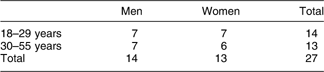
Focus group discussions were conducted with WA adults aged 18–54 years. Participants were recruited via telephone using household telephone numbers randomly selected from the 2007–2008 Perth Residential White Pages. Recruitment quotas were set by sex, age group and socio-economic status to maximise homogeneity of participants within each focus group. Groups were stratified by sex and age (18–29 and 30–54 years). Recruiters invited people to discussion groups about ‘health issues’, with remuneration offered for travel expenses and time. The facilitators deemed saturation of themes to have been achieved by the fourth focus group; hence, no more groups were formed after this point. The final number of participants recruited for each of the groups is detailed in Table 1.
Focus group participant composition (age and sex)
Procedure
The facilitator introduced himself as ‘a researcher from the Faculty of Health Sciences at Curtin University’. Participants were advised that their responses would be recorded but de-identified. The focus groups commenced by asking participants to complete a questionnaire to estimate their average daily fruit and vegetable consumption, and the number of servings they believed necessary to maintain a healthy diet. Questionnaire responses served as the ‘springboard’ to further discussion. Each focus group discussion was of approximately 75 min duration. At the conclusion of the discussion, participants were debriefed and paid. After each group discussion, the audiotapes were reviewed and a thematic analysis undertaken using the method recommended by Owen(Reference Owen17).
Results
Questionnaire responses
There were twenty-seven participants. They consumed a daily average of 1·6 (range: 0–4) servings of fruit and 2·6 (range: 0–5) servings of vegetables. On an average, participants suggested that 2·6 (range: 2–5) servings of fruit and 4·2 (range: 2–5) of vegetables would be required to maintain a ‘healthy diet’.
Familiarity with the Go for 2&5® message
When participants were asked to discuss how many servings of fruit and vegetables per day they thought were necessary to maintain a healthy diet, many specifically credited their response to the DoHWA fruit and vegetable campaign, e.g. ‘the 2&5 ads’ and ‘Go for 2&5®’. Once the 2&5 message was mentioned, most other participants who had not mentioned the campaign previously recognised it: ‘you've jogged my memory – I do remember it now’.
This was consistent within all four groups, suggesting near-universal penetration of the message. When asked where they had seen the 2&5 message, participants generally stated that they had seen it ‘everywhere’, including on television (TV), billboards, at supermarkets and at their children's schools, or even at school as students themselves: ‘it's been on TV for years’; ‘I've seen it at supermarkets too’; ‘we learnt it at school’; and ‘my kids at school really get it hammered into them’.
Most participants who were aware of the campaign unprompted had also suggested on their questionnaires that consumption of two servings of fruit and five of vegetables was necessary for a healthy diet. There were also participants who were prompted-aware of the message but who had been unable to accurately recall it: ‘I couldn't remember what it was supposed to be – I put five [fruit] and five [vegetables]’. Some who could accurately recall the message did not agree with it: ‘I put three veg – I know it's supposed to be five but I thought I'd put something realistic’; ‘I'm aware of the campaign but question whether or not it's actually necessary to eat 2&5’; and ‘I've heard that 2&5 message for quite a while now but don't specifically follow it because I have a reasonably balanced diet’.
Serving sizes
All participants said that they understood that the 2&5 message was trying to encourage people to consume two servings of fruit and five of vegetables per day and could accurately describe what would constitute a serving of fruit: ‘two pieces of fruit is easy to conjure up in your mind’; ‘one apple, one banana, a couple of plums – it's easy’; ‘it's pretty self-evident what a serving of fruit is’. However, there was confusion about what would constitute five servings of vegetables: ‘it's pretty self-evident what a serving of fruit is but five veggies … I don't know’; ‘is one cup of vegetables equivalent to one serving? I don't know…’; ‘doesn't one serving of fruit equate to the same size of veg?’; and ‘a salad sandwich probably equates to one serving – [response from 2nd participant] – I thought it would be more like a quarter’.
Some participants were not sure if ‘five servings of vegetables’ was meant to be taken literally: ‘I assumed it just meant that veggies should form a large proportion of your meal – not specific servings’. Others were unclear whether the 2&5 message meant that people should consume five servings of one or more types of vegetables, or if five different types of vegetables needed to be consumed every day: ‘I thought it meant have five different veggies’; ‘the idea of the five is to go for variety so that you're getting different nutrients’; ‘the important message is to eat five different types of veggies per day’.
Some participants overestimated what constituted one serving of vegetables. For instance, one participant thought a serving equated to one cup of cooked vegetables (twice as much): ‘five cups of cooked veg is an awful lot – then you multiply that by, say, four people in your family – all of a sudden you have to come up with twenty cups!’. Others could correctly describe a single serving of vegetables as half a cup of cooked vegetables or one cup of salad, but still overestimated what such would constitute: ‘a cup full of salad is quite a lot – you wouldn't fit that into a sandwich’.
The confusion and possible overestimation of what constitutes five servings of vegetables appeared to directly impact on participants’ beliefs about whether consuming five servings of vegetables was even achievable: ‘I think the five veg puts me off – I don't think it's achievable’; ‘five veg is quite a lot – too much’; ‘I think five [vegetables] is fairly unrealistic’; and ‘it's an awful lot of vegetables to be trying to keep track of’. Not all participants were dismissive; some were comfortable with the concept of consuming the five servings of vegetables per day: ‘it's a little bit more effort – but nothing out of proportion’; ‘I don't think that five veggies is unrealistic at all’; ‘I think it's a good message as it makes you aware of what you should be aiming for’. Moreover, once it was clearly explained what constitutes a serving of vegetables, many formerly dubious participants were won over: ‘I thought it meant having to eat a big plate of vegetables five times a day – now that you explain it, I think it's quite achievable’.
Participants were even more receptive to consuming five servings of vegetables per day when they realised that it could be spread out over several meals: ‘when you think about it, five is really easy if you're having a salad sandwich for lunch and then veggies with dinner’; ‘if I just relied on dinner then I wouldn't achieve the five veggies – but could with lunch as well’.
Perishability
Some participants identified the perishable nature of fresh produce as a barrier to consuming more fruit and vegetables because it constrained them from purchasing large quantities: ‘I'm always throwing out fruit – it gets me really aggravated’; and ‘I get sick of throwing veggies in the bin’. However, when this issue was further explored, most participants disagreed that it was a major problem. Most acknowledged that it could be a problem at times, but rather than disposing of spoiling vegetables, many suggested ageing fruit and vegetables in refrigerators served as a prompt to consume them: ‘if we have a whole lot of veggies in the fridge getting old, they all go into a big pot and we make beautiful vegetable soup’; ‘overripe bananas make the best smoothies and banana cakes’; and ‘if I've had some veggies in the fridge for a while and they're starting to get old, I'll make sure that they're included in the meal for that night’. Some participants also suggested that frozen vegetables were a convenient option for vegetables that made spoiling far less of an issue: ‘frozen veggies are actually better at retaining their goodness’.
Convenience
Overall, complaints about the inconvenience associated with vegetable consumption were not widespread. Younger participants still living with their parents rarely mentioned ‘inconvenience’ as a barrier, largely because they were less likely to prepare their own evening meals. Younger participants who had moved out of home tended to consider preparing any meal as somewhat ‘inconvenient’ and acknowledged their fruit and vegetable consumption suffered – but no more than the rest of their nutritional needs – because of a generally poor diet. However, most younger participants assumed that when they ‘settled down’ in their own established home they would be far more conscious of consuming vegetables frequently: ‘my diet's pretty poor at the moment because I'm hardly ever at home. When I settle down and have kids and stuff I reckon I'll be much more conscious of eating fruit and veggies every day’. This tended to be borne out by comments from the older participants who viewed the preparation of vegetables as being very much a part of the normal routine of meal preparation: ‘we have veggies with pretty much every meal’.
In comparison with vegetable consumption, fruit was generally considered more convenient. Some participants described fruit as a ‘convenient snack’ between main meals: ‘I'll usually have a piece of fruit for morning and afternoon tea’; ‘we usually have fruit after dinner once the kids have gone to bed’; and ‘my wife leaves a bowl of cut up fruit in the fridge so when you open the fridge looking for something to eat, the fruit is right there’.
The convenient snacking quality of fruit was viewed by participants as being a great facilitator to its consumption. In contrast, participants’ usual association with vegetables was as a side dish to the evening meal: ‘I plan my meals around a protein source and a carbohydrate, and then fill it in with some veggies’. However, those participants who said they ate five servings of vegetables per day were somewhat more likely to consume vegetables as a snack: ‘quite often I'll have a veggie for a snack’; and ‘sometimes as a snack I'll have a carrot – but not every day’.
Cost
Few participants said that the cost of fruit and vegetables was a major barrier to consumption. In the 18–29-year age groups, many did not see cost as a major barrier because they still lived with their parents: ‘I eat whatever Mum gives me, pretty much’. Again, younger participants living independently acknowledged that lack of experience in food shopping and preparation of meals meant that their diets, including but not restricted to fruit and vegetable consumption, were ‘less than ideal’; however, this was not an issue specific to cost. Older participants dismissed the suggestion that cost was particularly relevant to consumption. Many spoke of eating ‘seasonally’ in order to avoid high costs, and there was consensus in all the groups that consuming fruit and vegetables was still in fact cheaper than living on prepackaged and fast foods: ‘people complain that fruit and veggies are too expensive and that junk food is all they can afford – I reckon they're just lazy and making excuses’.
Necessity
Nearly all participants agreed that regular consumption of fruit and vegetables is an essential component of a healthy diet and that consuming two servings of fruit and five of vegetables per day would be excellent for health: ‘I don't love the taste of veggies but just know you've got to eat them to get all your vitamins and minerals’; ‘I would have thought the more fruit and veggies you eat the healthier you'd be’; ‘well it can't be bad for you!’; and ‘it's definitely not bad!’. Some participants also reasoned that consuming 2&5 would give benefits beyond sheer vitamin and mineral intake as it would displace consumption of more energy-dense foods – an important consideration with population rates of overweight and obesity on the rise: ‘I think if you're eating that much veg then you're eating a lot less other junk’.
Despite widespread acknowledgement that vegetable consumption is an important component of a healthy diet, the predominant barrier to increasing vegetable consumption was the firm belief that five servings of vegetables per day is simply unnecessary: ‘I don't believe that 2&5 is necessary for a healthy diet’; ‘I'm not necessarily eating five servings of veggies day-in, day-out, but I don't think it's really a problem’; ‘I don't think it's needed as part of a healthy diet – I think you can get away with less and still be healthy’; and ‘I don't think I'd personally be any better health-wise if I did that – I just try to make sure I have a balanced diet and have bits of everything all the time’.
Most participants viewed the 2&5 recommendation as more of a ‘rough guideline’ to encourage people to eat more fruit and vegetables, rather than it being intended as a specific target: ‘it's more of a guide than anything’; ‘as long as you're eating at least some vegetables every day’; ‘you don't have to do it every day’; ‘you aim for it but don't beat yourself up if you don't get there’.
When participants suggested that the 2&5 message was not necessarily intended to be taken literally, a general consensus was sought from each group as to what might be the possible intention behind the wording of the message. All four groups opined that ‘health authorities’ were simply keen for people to consume more fruit and vegetables and so set a somewhat difficult goal in the hope that most people's consumption would increase while striving for, but not necessarily achieving, that target: ‘2&5 is not essential – it's aspirational – it's nice if you achieve it but if you get somewhere near it, that's good enough’; ‘I think it's good if you can eat 2&5 – I think you should aim to – but if you don't it doesn't really matter’; ‘maybe 2&5 is something to aim for but they're actually hoping everyone will do at least 1 [serving of fruit] and 3 [of vegetables]’; and ‘I think that 2&5 is aimed at the small margin who do need 2&5 … like people with diabetes or something’.
Although participants were happy to acknowledge the fact that consuming 2&5 would be very good for their health, they were clearly sceptical as to the necessity that five servings of vegetables per day was necessary: ‘you're not going to die if you don't get your 2&5’; ‘nothing drastic is going to happen – you're not going to die’; and ‘what's going to happen if you only have three veggies per day instead of five? You're not going to die!’.
Some scepticism about the 2&5 message may have stemmed from participants’ ignorance of the rationale behind the recommendation: ‘we're not told why – we're just told’ and ‘how do we know that 2&5 is the best anyway?’. Scepticism may also have stemmed from the carry-over of superseded recommendations, as specifically referred to by older participants: ‘the old message “meat and three veg” – there's probably not much wrong with that’; ‘I still think that “meat, potato and two veg” is quite reasonable’; and ‘we always grew up being told you should eat one meat, one potato and two veg for every meal – I still reckon that's just about right’. Indeed, participants held the persistent belief that consumption of one serving of fruit and three of vegetables per day (1&3) was amply sufficient to maintain a healthy diet: ‘I think that 1&3 would be fine for a healthy diet – definitely’; ‘1&3 isn't a bad effort – it's certainly better than none!’; and ‘I think you could eat only 1&3 your whole life and still be healthy ’. Participants were convinced of this fact to such an extent that, when consensus was sought from each group, all four groups indicated that, if all other factors were held equal, the person who consumed 2&5 would be no more healthy than the person who only consumed 1&3.
Yet, adherence to this belief seemed far more than simple carry-over from the ‘old message’. The 2&5 message appeared to conflict with participants’ intuitive sense of what constitutes a healthy diet; uppermost in participants’ minds was achieving a ‘balanced’ diet through a wide variety of foods in order to maintain good health, with fruit and vegetables playing but part of that role: ‘there's a lot more to a healthy diet than just fruit and veg ’; ‘so long as you're eating a reasonably balanced diet you should be okay’; ‘I'm not so hung up on the 2&5 – I eat as wide a variety of foods as possible and think I eat pretty healthily ’; ‘if you're feeling healthy and eating a majority of healthy things and have got lots of energy, it's not a big issue’.
Discussion
Our focus group participants had consumption levels similar to the population average and a high recall of the Go for 2&5® message, suggesting that they were a well-suited sample to investigate the aim of our study. Perhaps the ease of conceptualisation of what constitutes a serving of fruit, coupled with consumption close to the recommended level, contributed to its acceptability as a reasonable and realistic recommendation. Conversely, suboptimal vegetable consumption mirrored suboptimal understanding of what constitutes a serving; participants had great difficulty estimating how many servings they consumed. Overestimations of the standard vegetable serving size may result in attitudes that five servings per day is unrealistic and thereby worthy of disregard. However, once educated as to what a serving of vegetables was, most participants agreed that consuming five servings per day is achievable. This result highlights the importance of continuing efforts to educate the public about what constitutes a serving of vegetables so that they can better gauge their current consumption and plausibility of achieving five. From a methodological viewpoint, it also emphasises the importance of carefully describing serving sizes of vegetables when interviewing participants for nutrition surveys.
Consistent with previous quantitative research, convenience, cost and perishability were all identified by our participants as minor barriers to greater vegetable consumption. By far the major barrier was their belief that they were already consuming sufficient quantities for good health. Participants appeared to intuitively grasp, and indeed agree with, the intention underlying the 2&5 message about the need to regularly eat a wide variety of fruit and vegetables in order to maintain sufficient vitamin and mineral intakes. The problem appears to be their perception of the number of servings required to achieve this. Although consuming five servings of vegetables per day was widely acknowledged as being excellent for good health, it was considered unnecessary – a strong belief persisted that three servings of vegetables per day was ample to maintain sufficient intakes of vitamins and minerals. Work undertaken to develop nutrition messages in the USA also found that consumers appreciated that fruit and vegetables were good for them but lacked the specific knowledge to implement the recommendations(Reference Maclellan, Gottschall-Pass and Larsen18, Reference Britten, Haven and Davis19). Scepticism about the need to consume more than three servings of vegetables per day appears to be a persistent belief and is consistent with research from other countries(Reference Pollard, Miller and Woodman13, Reference Basiotis, Lino and Dinkins20).
The present study suggests that a convincing case for why participants should consume five servings of vegetables per day instead of the three that they are currently eating is required to increase consumption. Participants had little appreciation of how the 2&5 recommendation was originally derived, and incorrectly assumed that it is purposely exaggerated simply to encourage greater consumption. Education is required about the rationale underpinning the 2&5 message, emphasising that it is a minimum rather than aspirational recommendation. A limitation of our research is that the data are qualitative in nature and provide little insight into the prevalence of such beliefs. Although the sample was small, the consistency of responses between our groups, coupled with the independently derived but highly complementary findings of our study with previous population surveys, embolden us to predict that our findings would generalise well to the WA population. Further research is recommended to quantitatively confirm our findings and test additional messages emphasising the rationale underpinning the Go for 2&5® message.
Acknowledgements
The Department of Health in Western Australia (DoHWA) developed and owns the Intellectual Property for the Go for 2&5® campaign. Cancer Council WA has received funding from the DoHWA to develop, implement and evaluate the Go for 2&5® campaign since 2006. The Centre for Behavioural Research in Cancer Control at Curtin University is supported by funding from the Cancer Council WA. The position of O.B.J.C. is supported by a research fellowship from the Western Australian Health Promotion Foundation (Healthway). C.M.P. is currently employed by DoHWA and Curtin University. J.F.P.A. and I.S.P. work for Cancer Council WA. J.M.M. worked for Cancer Council WA until March 2010. O.B.J.C. facilitated the focus groups, analysed the transcripts and wrote the first draft of the manuscript; C.M.P. worked for DoHWA who funded the Go for 2&5® campaign and monitoring surveys and was responsible for managing the development, implementation and evaluation of the campaign from its inception until 2005; C.M.P. and J.F.P.A. provided knowledge on the historical context of the campaign and provided substantial feedback on all drafts of the paper; J.F.P.A. and J.M.M. came up with the idea of the study, designed the methodology, participated in data collection and provided feedback on the paper. I.S.P. provided nutrition advice to the study and provided feedback on the paper.



