




Introduction: Ottoman–Habsburg rivalry in Central Europe during the sixteenth and seventeenth centuries
The Ottoman victory at Mohács (1526) precipitated a long Habsburg–Ottoman rivalry that reshaped Central Europe and, crucially for this study, turned Istanbul into a theatre where asymmetry and parity were negotiated in public view. Rather than rehearse the entire military chronology, this article focuses on how that rivalry materialized in space from the 1530s to the Treaty of Zsitvatorok (1606), when tribute-bearing embassies and resident ambassadors made the capital a stage of diplomatic ceremony. In this period, audiences at the Imperial Palace, processions along Divanyolu and the controlled housing of foreign envoys produced repeatable scripts through which power was seen, ranked and felt.Footnote 1 Mohács split Hungary into Ottoman Hungary, Habsburg Royal Hungary and Ottoman-dependent Transylvania, anchored by a dense arc of frontier fortresses.Footnote 2 As James D. Tracy notes, this was less a ‘clash of civilizations’ than a struggle between unequal political systems: a decree-driven Ottoman state with strong mobilization facing a composite Habsburg monarchy constrained by estates.Footnote 3 Raiding warfare (kleinkrieg) persisted through truces until frontier reforms in 1577–78 rationalized about 130 fortresses and produced a more durable stalemate.Footnote 4 Diplomatically, the Ottomans framed relations as temporary emân, not permanent peace, and mismatched treaty texts remained a constant irritant.Footnote 5 Money was central from the outset: Ferdinand agreed in 1547 to remit 30,000 ducats annually to offset Ottoman claims in Hungary, a payment abolished only by the Treaty of Zsitvatorok (1606), which replaced it with a lump sum and acknowledged the Austrian ruler as çasar (Roman emperor) and therefore of equal status with the Ottoman sultan.Footnote 6
Placing Istanbul within a wider diplomatic economy matters for an urban history of the rivalry. In the Mediterranean and across Europe, multiple polities calibrated their stance toward the Ottoman Sublime Porte in relation to Habsburg power: Venice balanced commerce and containment, France cultivated an anti-Habsburg friendship with the Ottomans and Protestant coalitions manoeuvred through Istanbul during the Thirty Years’ War – evidence that European geopolitics were projected into the city’s embassy quarter.Footnote 7 The land frontier fed into this metropolitan hub: governors of Buda corresponded continuously with Vienna, arranged prisoner exchanges and financed extraordinary envoys, while even non-Habsburg missions (e.g. a Swedish envoy in 1629) passed through Buda, tying the Ottoman–Habsburg march to a continental traffic of statecraft.Footnote 8
Ottoman perspectives reinforce the same macro-picture. Sixteenth-century policy aimed at containment: preserve a Hungarian buffer, limit escalation to localized actions and justify peace-making as mercy to the re‘âyâ (local subjects) – a vocabulary that also styled the 30,000-ducat transfer as something sent ‘in accordance with friendship’.Footnote 9 Conceptually, then, the early modern ‘international order’ at the Ottoman–Habsburg hinge was neither a Westphalian equality nor a simple hierarchy: it oscillated between claims for parity (following the Treaty of Zsitvatorok) and ingrained asymmetries in protocol and gifts – precisely the contradictions that played out in Istanbul’s ceremonial spaces.Footnote 10
Set against other Mediterranean diplomatic capitals, Istanbul’s model looks distinctive. In Venice, diplomacy ran through the bailo regime and a civic ‘street-view’ of political communication – think chiovere and other regulated micro-venues – whereas at the Porte the Ottoman government tightly supervised the Venetian bailo and folded all resident missions into its own hierarchical scripts.Footnote 11 In Habsburg Madrid, by contrast, mentideros functioned as ‘resonating boxes’ for rumours and news; Istanbul had analogous vernacular arenas – ports, mosques, baths, bazaars and coffeehouses – but these interacted with a surveillance-rich embassy quarter in Galata/Pera where missions monitored one another and precedence disputes became part of the performance.Footnote 12
Against this geopolitical backdrop, the article analyses three primary venues of encounter – first, the Imperial Palace (Topkapı), second, the ceremonial corridor commonly called Divanyolu (including the Hippodrome nexus) and third the preliminary Habsburg lodging called Elçi Hanı – as interlocking stages where hierarchy was enacted and negotiated. I treat these as sites of performative control – the choreographing of bodies, movement and objects to assert authority – and as spatial manifestations of power, where built form and route design communicate rank and ideology. Specifically, the article asks:
-
1. How did architectural sequencing (gates, courts, corridors) script what ambassadors could see, do and signify?
-
2. Which urban settings – palace courts, the Hippodrome, mosque routes and embassy lodgings – functioned as the city’s diplomatic theatres, and how did their scripts evolve?
-
3. In what ways did these spaces stabilize – or contest – diplomatic hierarchies in encounters with Habsburg envoys until the beginning of the seventeenth century?
Methodologically, the article models how to reconstruct ceremonial systems from heterogeneous sources – protocol registers, travel narratives, visual albums – and to map them onto the city’s built environment. Substantively, it reframes Ottoman–Habsburg relations as practices in space: an ensemble of repeatable routes and rooms where power relations were enacted, watched and occasionally contested. This spatial reading helps explain why Istanbul could convert fear into orderly spectacle and fascination into disciplined looking – an enduring logic of imperial capital cities, but one that took a distinctly Ottoman form in the sixteenth and seventeenth centuries.
Within Ottoman studies, the ‘spatial turn’ has decisively shaped how scholars read Istanbul’s urban and architectural fabric as an active medium of power, rather than a neutral backdrop. Gülru Necipoğlu’s analysis of Topkapı Palace remains foundational: she shows how Mehmed II’s post-conquest building programme codified a sequenced regime of access – courts and gates choreographing movement from public to private – and, crucially, how the creation of the Chamber of Petitions and the curtained royal window shifted ambassadorial audiences from semi-public spectacle to screened encounter. Necipoğlu thus links architecture to ceremonial protocol.Footnote 13
Beyond palace walls, recent work has reframed the city itself as a ceremonial stage. Çiğdem Kafescioğlu’s influential study, Constantinopolis/Istanbul, examines how Ottoman rulers strategically repurposed Byzantine spatial legacies to assert political legitimacy.Footnote 14 Kafescioğlu also demonstrates a late sixteenth-century pivot in court imagery toward a civic visuality centred on the Atmeydanı (Hippodrome): the Sūrnāme-i Hümāyūn restaged nearly every scene in the square, where reciprocal lines of sight circulated among sultan, performers and crowds.Footnote 15 Kaya Şahin’s reading of the 1530 circumcision festivities similarly treats the Hippodrome as ‘premier public theatre’, emphasizing ritualization as the mechanism that turned routine into imperial signification.Footnote 16 N. Zeynep Yelçe then situates these practices in a citywide dramaturgy: processions linking Topkapı and the Hippodrome, greetings by viziers and guild parades made sovereignty legible through repeated staging in public space.Footnote 17 Maurice Cerasi’s work on Divanyolu clarifies how the imperial axis functioned as a ‘ceremonial system’, not a single designed boulevard: magnitudes were expressed through retinues, banners and processional choreography within a lived corridor of markets, barracks and the imperial mosques on the ceremonial route.Footnote 18 Yelçe’s overview and the Divanyolu scholarship together underscore durable, repeatable venues – Topkapı’s Second Court, the Hippodrome, Friday mosque routes, ceremonies of sword-girding in the holy shrine at Eyüp district – whose scripts evolved yet retained legible hierarchies over time.Footnote 19
Diplomatic space was managed just as carefully. Suna Suner traces a longue durée of Habsburg residences from the Elçi Hanı – purpose-built (1510–12) beside Divanyolu and explicitly valued for keeping delegations ‘under control’, as Ogier Ghiselin de Busbecq observed – to a seventeenth-century pivot toward Pera/Galata and, later, formal embassy properties.Footnote 20 This spatial regime complemented Ottoman practice in which temporary envoys and resident ambassadors worked across a diplomatic marketplace where embassies monitored one another and precedence quarrels were staged in Istanbul.Footnote 21
Material and visual media tied ceremony to diplomacy. Emine Fetvacı shows how portable arts projected sovereignty into urban space: textiles framed processions on Divanyolu while foreign observers – including a Safavid embassy – were deliberately shown viewing these scenes.Footnote 22 Christoph Würflinger, reading Schmid’s 1650–51 mission, decodes clocks, silverware and kaftans as a language of parity and hierarchy – ‘precedents with legal quality’ restaged at border, entry and audience,Footnote 23 while Talitha Maria G. Schepers reinterprets Pieter Coecke van Aelst’s 1533 woodcuts as diplomatic pedagogy: Friday processions, Topkapı audiences and Pera vantage points taught European elites the ceremonial geography of the Ottoman capital.Footnote 24 Although falling beyond the chronological boundaries of this article, Olga Nefedova’s reconstruction of Kuefstein’s 1628–29 embassy, with its on-site gouaches and ranked gift lists (notably tower clocks and silver service) shows how images and objects co-produced diplomacy and stabilized etiquette in space.Footnote 25 Similarly, strategic diplomatic gift exchanges, especially luxury objects designed to convey subtle messages of status and reciprocity, continued to shape diplomatic encounters.Footnote 26 As Natalie Rothman has shown, the Venetian bailo’s residence operated as a site where Ottoman and European representational practices converged, producing hybrid visual and textual artefacts that framed the city as a ‘space of encounter’.Footnote 27
Taken together, this literature positions Istanbul’s palatial thresholds, streets, squares and embassy lodgings as a single, interlocking stage on which sovereignty and diplomacy were made visible – through movement, vantage and things – over decades of repetition and adjustment.Footnote 28
Habsburg envoys and their activities in Istanbul
By the mid-sixteenth century, Istanbul had become a true diplomatic capital: after the Italian city-states pioneered resident representation, the Porte hosted a cascade of missions – Venice (1454), France (1535), the Habsburgs (1547), England (1583) and the Dutch (1612) – alongside periodic Muslim embassies such as the Safavids.Footnote 29 Within this ecology, Habsburg delegations appeared with striking regularity from the early 1530s until the Great Turkish War (1683–99), punctuated chiefly by wartime breaks during the Long Turkish War (1593–1606). In principle, the rulers of the Holy Roman Empire were prohibited from maintaining a permanent diplomatic presence in Istanbul until 1547, conducting correspondence instead through temporary envoys. Yet, their strategy of rotating envoys effectively established a quasi-permanent representation,Footnote 30 even before formal recognition. Their remit fused high politics with urban routine: to hold the peace if possible, map elite networks and report continuously to Vienna.Footnote 31 Pressure at the Porte accelerated a mid-sixteenth-century shift toward professional profiles on the part of the envoys. Bart Severi shows how a Low Countries cohort – Cornelis de Schepper, Gerard Veltwijck, Ogier Ghiselin de Busbecq, Albert de Wijs, Charles Rijm and Philibert of Brussels – pushed the monarchy to standardize envoy ‘types’ (who were generally around 35 years old, unmarried, multilingual humanists with hard negotiating experience) and to seize control of translation by recruiting Levantine interpreters and training language youths (giovani di lingua). This ‘translation turn’ curbed notorious problems with wilfully slanted Porte renderings and allowed Habsburg delegations to bring their own language brokers into audiences. Scarcity of staff, however, was chronic: terms stretched, veterans were recalled and frontier actors shaped choices.Footnote 32 After 1606, Habsburg practice distinguished grand embassies, resident envoys and intermediaries, but this article focuses on the sixteenth-century missions that preceded these forms.
Envoys also embodied a financial grammar of ‘friendship’. Following negotiations in the 1540s, a yearly payment of 30,000 ducats became the price of amity.Footnote 33 The two courts even disagreed on what to name the annual payment. Ottoman registers described it as haraç – a vassal’s tribute to a superior – while in Vienna it appeared as Ehrengeschenk or munus honorarium, an ‘honorary gift’ meant to preserve imperial equality. This terminological dispute itself symbolized the power imbalance that diplomacy tried to mask.Footnote 34 This payment was not limited to precious treasures presented to the sultan in the royal palace; it also included gifts distributed to influential military and administrative figures in Istanbul. The Zsitvatorok settlement famously ended the yearly obligation, substituting a one-time transfer (200,000 talers/kuruş) even as differences in language persisted over whether this was ‘gifts once and for all’ or exactly 200,000 in cash and items.
Like many early modern polities, the Ottomans treated foreign envoys as state guests. Allowances, provisioning (tayinât) and escort janissaries framed hospitality as sovereignty and surveillance.Footnote 35 Practice blended cash with in-kind support and permissions (notably for wine), which were administered through the Divan and Galata officials – a logic still visible in other European embassies in Pera.Footnote 36 Missions nonetheless supplemented with their own supplies and local purchases; Ottoman managers aimed less at pampering than at ordering movement, expenditure and access.
Before 1606, the Porte’s legal-ceremonial frame placed European monarchs – Habsburgs included – below the sultan, often equivalent to the grand vizier. For instance, in the sixteenth century official letters sent from the court of Selim II, the Habsburg ruler Maximilian II was addressed not as a sovereign equal to the Ottoman sultan but as a regional king (Beç/Nemçe kralı/ ‘king of Vienna’ or ‘king of Austria’). This reflects the Ottoman refusal to recognize the Habsburg imperial title. In these letters, Maximilian is praised in florid, formulaic language – but crucially as a Christian king, not a universal emperor.Footnote 37 Later, the Treaty of Zsitvatorok acknowledged the Roman Emperor in titulo, but textual asymmetries and protocol hierarchies persisted.Footnote 38 Post-1606, the sides exchanged ratifications via grand embassies and raised the rank of Ottoman envoys to Vienna; frequency increased without creating Ottoman resident embassies.Footnote 39
Finally, embassy labour in the capital was entangled with ‘vernacular diplomacy’ along the marches. Border lords on both sides co-regulated raiding, prisoner exchange and taxation, creating a functional ‘single frontier community’ even as imperial rhetoric clashed.Footnote 40 By the 1570s to 1580s, Hungarian had become the practical language for routine Buda–Vienna exchanges, while Vienna’s frontier offices systematized the drafting and consultation of reports, petitions and prisoner lists – documents that required joint verification by Habsburg and Ottoman officials. These administrative routines created a stable bureaucratic infrastructure through which local negotiations fed back into metropolitan diplomacy.Footnote 41
On spaces and mechanisms of control in Istanbul: Divanyolu, Elçi Hanı and the royal palace
Given this tense political environment, the Ottoman court considered the constant surveillance of Habsburg envoys in Istanbul a necessary precaution. The solution was to keep the envoys under strict supervision throughout their stay in the city. From their entrance into Ottoman territories until their arrival in Istanbul, they were escorted by Ottoman local commanders to ensure minimal contact with the local population, limiting their interactions and reinforcing the perception of them as potential threats to the empire. The Ottomans sought to keep the regularly arriving Habsburg ambassadors and their entourages under control through a range of performative strategies. Many Habsburg envoys left their published diaries and travel books behind that contain details of physical isolation and restricted movement inside the city.Footnote 42
This section shifts from geopolitical context to the spatial mechanics of diplomacy. I treat three interlocking venues – the Divanyolu ceremonial corridor, the Elçi Hanı (German House), and Topkapı – less as isolated sites than as a single choreography of routes, thresholds and vantage points through which the Ottoman–Habsburg rivalry was staged for urban publics and foreign eyes alike. The key claim is simple: protocol did not just occur in space; it made space meaningful and governable.
Divanyolu as a ceremonial throughfare: spectacle of events between fear and fascination
Conceived by Constantine the Great as a ‘New Rome’, Istanbul was designed as a world metropolis – a role the Ottomans embraced and redefined after the conquest of 1453 (Figure 1).Footnote 43 Ottoman protocol routed arriving embassies along paths that threaded the city’s ancient and newly monumentalized landmarks, a choreographed display intended to impress upon foreign envoys the continuity of imperial grandeur. This symbolism carried particular weight when ambassadors of the Habsburg monarchs – whose claim to the title ‘Roman Emperor’ the Ottomans declined to recognize – entered the city. From Mehmed II’s reign onward, the Ottomans cast themselves as the rightful heirs of Rome,Footnote 44 and successive sultans rebuilt and reimagined Istanbul through that imperial lens.Footnote 45
Key ceremonial places in Istanbul mentioned in this article.
Legend: a: Topkapı Palace; b: Hagia Sophia; c: Sultanahmet Mosque and Atmeydanı (Hippodrome); d: Elçi Hanı near the Column of Constantine; e: Beyazıd Mosque; f: Suleymaniye Mosque; g: Fatih Mosque; h: Pera district; i: Edirnekapı on the land walls.
Note: The dashed line indicates the hypothetical course of Divanyolu from Atmeydanı to Edirnekapı. As Cerasi emphasizes, in the sixteenth and seventeenth centuries this was not a single continuous avenue but rather a network of parallel streets running east–west across the city.
Source: SALT Research Archive, Fr. Kauffer Collection, Plan de la ville de Constantinople et de ses faubourgs tant en Europe qu’en Asie levé géométriquement en 1776 par Fr. Kauffer vérifié et augmenté en 1786, 1786, map. The drawing has been edited and indexed by the author.

Traditionally, ambassadors arriving overland from Europe lodged first at Silivri, one day away from Istanbul, where they were received by the resident ambassador, if present, and janissary sergeants. During this initial reception, customary exchanges of gifts took place. Proceeding to Küçükçekmece (Ponte Piccolo), the envoys typically spent two additional days there, marking the final staging point a few hours’ journey from the city. At this location, official messengers informed them of the appointed date for their ceremonial entrance. On the designated day, ambassadors entered Istanbul accompanied by a large janissary escort, marching to the music of the janissary band in a calculated display intended to evoke awe and submission. Crowds of inhabitants lined both sides of the road from the city gates to the envoys’ lodgings. Although the precise route within the city is not definitively documented, it is likely that envoys proceeded along the main ceremonial axis known as Divanyolu. Footnote 46
Divanyolu began at the city’s ceremonial core, near Hagia Sophia and the Hippodrome, continuing through the Forum of Constantine and the Forum of Theodosius, before splitting into two branches leading toward the land walls. The thoroughfare, originally more than 20 metres wide and flanked by colonnades, had served as the monumental spine of the Byzantine capital, connecting forums and gates. By the time of the Ottoman conquest, much of its physical fabric had decayed, yet its symbolic role was redefined. As the very name Divanyolu (‘Road to the Imperial Council’) suggests, the Ottomans appropriated its imperial memory, transforming it into a processional corridor linking the heart of the city to the seat of government.Footnote 47 As Cerasi cautions, continuity lay primarily in direction (Hagia Sophia–Hippodrome toward the western gates), while form and urban language diverged – finite, arcaded Roman spaces versus Ottoman, sinuous, multi-channel streets. The lived ‘Divan axis’ thus extended beyond the straight segment modern maps label Divanyolu, functioning as a flexible ceremonial corridor whose meaning derived from processions, markets and mosques rather than from continuous architecture.Footnote 48
Eyewitnesses underline the impact of these orchestrated entries. Busbecq, describing his sixteenth-century procession, remarked on the order of the janissaries, whose motionless ranks and silence projected a discipline ‘remarkable for their own appearance’.Footnote 49 Reinhold Lubenau, present in 1582, vividly recalled ‘an endless procession of soldiers and guilds’ with every vantage point crowded by onlookers during the royal circumcision ceremony.Footnote 50 The Lambert Wyts album visually confirmed these impressions, depicting the embassy flanked by janissaries and musicians as it moved through the ceremonial spine to the Imperial Palace (Figure 2). Through this carefully staged sequence – from Silivri to Küçükçekmece to Divanyolu – the Ottomans choreographed an unbroken chain of receptions that fused hospitality with hierarchy. Each step impressed upon envoys not only the continuity of imperial grandeur but also the Ottoman mastery of the city as a ceremonial stage.
Habsburg envoy (1573) approaching to the gate of Topkapı Palace from Lambert Wyts’ album.
Source: Österreichische Nationalbibliothek (ÖNB), Itinera in Hispaniam, Viennam et Constantinopolim, manuscript by Lambert Wyts (1573), Vienna edition, ÖNB-digital MS 1000AE52.

Divanyolu was an essential ceremonial thoroughfare, frequently used for imperial processions that reinforced Ottoman magnificence in the eyes of both local subjects and foreign envoys. Above all, it functioned as the primary route for the sultan’s weekly ceremonial journeys to Friday prayers, occasions that foreign diplomats were expected to witness as part of protocol and as staged demonstrations of imperial power.Footnote 51 The avenue’s ceremonial force derived not simply from its architecture but from the recurrent ceremonial practices enacted along it: Friday mosque processions, campaign departures, triumphal returns and sword-girding ceremonies. These were stitched into the everyday fabric of the city through its markets, mosques and other public complexes. Importantly, these ceremonial events transformed ordinary urban spaces into extraordinary spectacles – often the only occasions when Istanbul’s inhabitants could witness the sultan in public.Footnote 52 These events were not only observed by foreign envoys but were also memorialized in chronicles and richly illustrated manuscripts, attesting to their importance in the ceremonial imagination of the empire.Footnote 53 As will be discussed further below, until the seventeenth century Habsburg ambassadors were subject to compulsory residence in the Elçi Hanı, where they had a recurring opportunity to view Ottoman ceremonial splendour in the weekly Friday procession along Divanyolu from their windows.
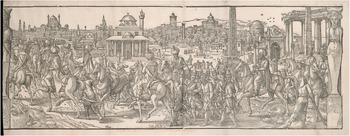
One of the most striking early modern accounts comes from 1533, when Pieter Coecke van Aelst, the Flemish artist accompanying a Habsburg embassy, observed Sultan Süleyman’s procession through the Hippodrome to Friday prayers. Coecke’s woodcuts – later published in Antwerp – translate the ceremonial into a didactic sequence for European audiences, showing the carefully ordered ranks of janissaries, court officials and the sultan himself under the imperial baldachin.Footnote 54 His images capture not only the grandeur of the event but also the way in which Ottoman ceremonial appropriated the Hippodrome’s imperial memory as a premier stage of sovereignty (Figure 3).Footnote 55
A procession of Sultan Süleyman through the Hippodrome to Friday prayers.
Source: The Metropolitan Museum of Art, Prints and Drawings Collection, Ces moeurs et fachons de faire de Turcz (Customs and Fashions of the Turks) by Pieter Coecke van Aelst, object ID 336313.

In this sense, Coecke’s work exemplifies how foreign observers became mediators of Ottoman urban ceremony, transforming personal experience into widely circulated visual texts. For European elites who never travelled to Istanbul, such representations shaped perceptions of the Ottoman court, embedding Istanbul within a broader Mediterranean network of ritual geographies and cross-cultural spectatorship. A striking description comes from Antun Vrančić, writing in 1554, who witnessed a compulsory, city-wide celebration of an Ottoman victory over the Safavids. For three days and nights, he reported, ‘the whole city looked as if it were burning’, illuminated by thousands of lanterns, with citizens erecting improvised platforms draped in silk and gold-threaded textiles, dining publicly under the glow of suspended lights. Merchants displayed their finest goods in the bazaars, transforming janissary commercial architecture into ceremonial scenery. The celebration, he observed, was mandatory, and patrols ensured order ‘in almost all city passages’, preventing disorder despite the crowds.Footnote 56 As Cerasi underscores, grandeur was expressed through retinues, banners, music and the choreography of movement rather than through Rome-style monumental scenography.Footnote 57
Upon arrival in Istanbul, ambassadors and their entourages faced varying degrees of restriction on their movement, with the level of control closely tied to the prevailing political climate. During stable periods, envoys enjoyed limited mobility, and were allowed to make short excursions and to receive visitors. In times of heightened tension, however, surveillance intensified and confinement could become severe, with some ambassadors even transferred from the Elçi Hanı to prison. The extent of their contact with the city was determined less by their own initiative than by restrictions imposed by the Ottoman court. At times, they were permitted visits to the Greek Orthodox Patriarch or brief explorations of public spaces, but more commonly their urban experience was confined to the view from windows – watching the city’s rhythms unfold without participating directly.Footnote 58
Contemporary accounts vividly convey this atmosphere. According to Reinhold Lubenau, German captives taken in war were paraded through the streets – often adorned with battered armour, banners and drums drawn from imperial storage – before being presented to the sultan at Topkapı.Footnote 59 The intention was not simply punitive but performative: mocking the enemy while projecting Ottoman triumph along the city’s main thoroughfares, including Divanyolu. Stephan Gerlach’s memoirs offer another perspective on the street’s spectacles. He described the passage of Nurbanu Sultan, wife of the sultan, in an entourage of 20 horse-drawn carriages draped in red cloth and escorted by janissaries in yellow caps and African eunuchs riding atop the vehicles – a striking display of dynastic power and wealth. On other occasions, he recorded the embassy watching a distant Maghrebi wedding or being treated to the sultan’s musicians parading during Eid, who distributed food in exchange for gratuities.Footnote 60
The ceremonial arrival of the Habsburg ambassadors in the Elçi Hanı on Divanyolu and the subsequent formal processions to Topkapı Palace further reinforced the centrality of this axis as the primary stage of diplomatic ritual.
In sum, Divanyolu functioned as Istanbul’s principal political optic: a flexible corridor where diplomatic entry, weekly piety, military parades, funerary memory and controlled hospitality converged. More than a fixed architectural set-piece, it operated as a repeatable script in motion – a spatial grammar through which the Ottoman state staged orchestrated distance, projected sovereignty and tested the limits of reciprocity under the gaze of both subjects and foreign envoys.
Captivity and surveillance in the han
Ottoman spatial policy should be situated within a broader global context. As Harriet Rudolph observes, in medieval Europe – and in some regions well into the early modern era – it was customary for host rulers to assign lodgings to visiting envoys. While framed as an act of hospitality, such arrangements also served as mechanisms of political oversight, particularly in times of heightened tension or potential conflict. In practice, this system left diplomats with little autonomy in choosing their residences or furnishing their quarters. Over time, however, as the institution of permanent diplomatic representation spread across Europe, and as anxieties about conflicts of interest, divided loyalties and corruption intensified, the practice of rulers providing and controlling envoys’ accommodations came to be regarded as increasingly inappropriate.Footnote 61
An important spatial dimension of Ottoman–Habsburg diplomacy in early modern Istanbul was the Elçi Hanı, initially designated to house annually visiting temporary ambassadors and later repurposed as a residence for permanent envoys. The building was unique in both function and symbolism: no comparable protocol applied to other European ambassadors in Istanbul at the time, nor did a purpose-built structure of this kind exist elsewhere in Europe.
Known in Ottoman sources as the Elçi Hanı (literally envoy’s khan) and referred to by Habsburg diplomats as the ‘German House’, the structure stood in the heart of Istanbul’s historic peninsula, directly opposite the Column of Constantine, on the site of the ancient Forum of Constantine.Footnote 62 Constructed in the early sixteenth century – likely around 1512 – it formed part of a larger complex commissioned by Grand Vizier Hadım Ali Pasha, which also included a mosque, madrasa, primary school and tomb.Footnote 63 Originally designed as an urban caravanserai (han), it displayed architectural features typical of this building type, yet its reshaping for diplomatic purposes gave it a distinctive political meaning. Although no longer extant, its appearance is well documented in contemporary travel accounts.
The han was nearly square in plan and rose two storeys around an inner courtyard. The ground floor contained stables, kitchens and storage rooms, while the upper level accommodated 42 identical chambers arranged along the façades. Each room, measuring approximately 7–8 square metres, was lit by two windows – one facing outward and the other opening onto the courtyard. A continuous arcade lined the courtyard-facing side, providing both circulation and a shaded walkway (Figure 4).
Left: view of the German House from the entrance façade. Right: the German House from inside the courtyard facing north.
Source: ÖNB, Cod. 8515, fols. 140r–141r, Johannes Lewenklau, Bilder türkischer Herrscher, Soldaten, Hofleute, Städte u. a.: Hüter der Kinder, 1586.

Many diplomats and their attendants described the physical conditions of the Elçi Hanı and the rhythms of daily life within its walls. One particularly detailed account is provided by Stephan Gerlach, who stayed there in the 1570s:
They led us to a caravanserai located in the Forum of Constantine, where we were to stay. There were no grand, wood-panelled halls here, only stark stone-walled rooms, resembling the cells of monks. Instead of paintings of noble and learned men, or portraits that could be considered works of art, the walls were crawling with disgusting scorpions, lizards, mice, and all sorts of insects. However, the building was large and spacious – perhaps even grander in scale than the palaces of many noblemen. Its exterior was made of large ashlar stones, while the interior was built of brick, though left unfinished – unplastered, without tiles and unwhitewashed. The high-ceilinged, rectangular structure had a lower level with stables capable of housing nearly 100 horses, though without proper feeding troughs. The upper floor had a long corridor encircling the building, lined with many small rooms, each with two windows – one opening to the street, the other to the interior passageway. Every room contained a hearth and a crude wooden bed, topped with a straw-stuffed mattress…The narrow, stone-paved courtyard had a well in the centre, though the water was undrinkable. On the ground level, various artisan shops opened onto the street.Footnote 64
Clearly, the han was far from being a suitable diplomatic residence. The harsh living conditions were not simply an inconvenience, but a deliberate mechanism of control and surveillance imposed by the Ottoman administration.
The original purpose of the building remains uncertain. While designed as a caravanserai, some evidence suggests that it may have been intended as a place of detention from the outset. Hans Dernschwam, a member of the Habsburg mission of 1553–55, recorded that groups of captives were held there; furthermore, between 1512 and 1519, Hungarian envoys were reportedly imprisoned within its walls.Footnote 65 These references indicate that before compulsory residence was imposed on Habsburg envoys, the han already served as a facility to control and restrict foreign delegations.
Its transformation into a formal diplomatic lodging must be understood in the context of the post-Mohács order. The Ottoman victory in 1526 shattered the medieval kingdom of Hungary and inaugurated direct rivalry between the Habsburgs and the Ottomans. From the 1530s onwards, as the Ottomans consolidated political and military dominance, they increasingly sought to limit the mobility of visiting diplomats. The Elçi Hanı was thereby converted into a designated diplomatic residence, but one that imposed compulsory confinement and close surveillance. As Rothman’s analysis of the Cicogna Codex demonstrates, hans were central nodes of controlled mobility and diplomatic knowledge-making.Footnote 66 This aligns with the Elçi Hanı’s dual function of accommodation and surveillance.
Between the 1530s and the 1590s, when Ottoman power reached its zenith over Central Europe, the han became an instrument of symbolic subjugation. By confining Habsburg ambassadors to this uncomfortable and restrictive space, Ottoman authorities simultaneously curtailed their freedom, monitored their activities and underscored the asymmetry of power between the two empires. Even after a resident embassy was conceded, Austrian envoys remained confined to the Elçi Hanı until the mid-seventeenth century. The Ottomans justified this arrangement on both explicit and implicit grounds. Officially, enforced residence was presented as a protective measure, aimed at preventing foreigners from becoming victims of abduction, enslavement or human trafficking within the city. Implicitly, however, confinement functioned as a means of surveillance, curtailing espionage activities; several envoys accused of spying were indeed arrested and imprisoned. Such spatial restriction also entailed communicational dependence. As Rothman argues for the Venetian bailo’s household, diplomatic work in Istanbul was sustained through ‘trans-imperial’ brokers embedded within the host polity.Footnote 67 For Habsburg envoys – confined to a monitored han rather than integrated into the diplomatic quarter – access to interpreters and scribal experts was even more tightly regulated, reinforcing Ottoman leverage over the circulation of information. Months might pass before being summoned to the Divan: Vrančić and Zay noted that even written petitions elicited only vague assurances that ‘the pashas would address [their] issues soon’, while envoys remained confined to their lodging and unable to intervene.Footnote 68 Archival reports from the 1557 mission show that such delays were neither incidental nor personal but deeply embedded in Ottoman diplomatic procedure.
At first glance, life in the han resembled captivity. By design, the han was an introverted structure: the ground floor had no openings other than the entrance gate, while the upper-floor chambers were lit by windows. Janissary guards were posted at the gate to prevent unauthorized access, and whenever the Habsburg envoy left the premises he was accompanied by escorts.Footnote 69 As Hans Dernschwam – like many other diplomatic officials who recorded their experiences – observed, residence in the han amounted to imprisonment in practice, if not in law. The gates were locked nightly; during the day a janissary sergeant (çavuş) and his officers controlled entry and exit; anyone sent on errands was escorted and expected to return promptly; and merchants were admitted only under watch – typically after tipping the guards.Footnote 70 Surveillance within the han was continuous, enforced through strict regulation of entry and exit.
This raises the question of why this particular building type was chosen. Ottoman hans, or urban caravanserais, evolved from Roman castra and Muslim funduqs: fortified structures with a single entrance, no ground-floor windows and gates locked after dark. These features made them highly effective for controlling and monitoring their inhabitants. While many hans in the intramural Istanbul served commercial and residential purposes, the han within the Hadım Ali Pasha complex on Divanyolu was uniquely positioned within the ceremonial geography of diplomatic receptions. Situated at the terminus of imperial welcoming ceremonies, it also functioned as a convenient departure point for formal audiences at Topkapı Palace. Moreover, in the early sixteenth century, few other hans along Divanyolu had yet been constructed, leaving this structure as virtually the only viable option.
By contrast, although Ottoman ambassadors began travelling to European capitals later, no comparable buildings were designated for their use in Vienna or other European cities. The closest parallel was the Fondaco dei Turchi on Venice’s Grand Canal, established in the seventeenth century for Ottoman merchants. Yet, while it accommodated Ottoman subjects, its purpose remained commercial, lacking the political and symbolic dimension of the Elçi Hanı. More relevant to diplomatic comparison is the position of the Venetian bailo in Istanbul. From the early sixteenth century, the bailo resided in a permanent embassy-house in Galata/Pera. Unlike the Habsburg envoys confined within the walls of the old city, the bailo enjoyed a degree of autonomy, managing extensive networks of trade, intelligence and patronage. Although the Ottomans carefully monitored Venetian envoys, the very fact that the bailo operated from his own residence underscored a recognition of Venice’s status as a long-term diplomatic partner.Footnote 71 The contrast is telling: while the Venetians could cultivate urban sociability and embed themselves within Istanbul’s mercantile landscape, Habsburg ambassadors were deliberately housed in the Elçi Hanı – a space of surveillance that signalled their subordinate standing.
In the mid-sixteenth century, while Habsburg envoys were subjected to enforced residence in the Elçi Hanı, the ambassadors of Venice, France and England conducted their duties from residences in Pera, north of Galata – formerly a Genoese colony – outside the walled city of Istanbul. These envoys also enjoyed relative freedom of movement without prior permission. Within the walled city, the envoys of Wallachia and Moldavia – both Ottoman vassal states – were granted temporary lodgings before being allowed to establish permanent residences. Temporary envoys from eastern polities such as Bukhara, the Mughal Empire and Safavid Iran were initially received at Üsküdar on the Asian side before being accommodated in designated mansions in the capital. Iranian envoys, in particular, often lodged near the Atmeydanı (Hippodrome), where they enjoyed freedom of movement and could even change residences at will.Footnote 72
Why, then, were Habsburg envoys treated differently from their European counterparts even during peacetime? Reinhold Lubenau, a member of the Habsburg embassy of 1587–89, attributed the discrepancy to the nature of relations: while France, England and Venice maintained friendly or allied ties with the Porte, the Holy Roman Emperor and the sultan remained locked in enduring rivalry.Footnote 73 As discussed above, the Ottomans regarded the Habsburgs not as sovereign equals of France, Venice or England, but as a subordinate power obliged to pay annual tribute, akin to vassal states such as Wallachia or Moldavia. This refusal to acknowledge the Holy Roman Emperor’s imperial status lay at the core of the confinement policy, transforming the Elçi Hanı into a spatial embodiment of political asymmetry.Footnote 74
The han’s poor physical conditions were a constant complaint, with travellers describing infestations of insects and snakes. Yet, diplomatic détente sometimes softened daily hardship. Busbecq, for example, turned the ground-floor stables into a small menagerie – his ‘Noah’s Ark’ – as a distraction from confinement: ‘What other amusement could there be for someone confined within the stone walls of a prison? The monkeys are the most entertaining…Apart from them, I keep wolves, bears, broad-horned deer, common deer, young mules, pharaoh rats, lynxes, martens, and sables.’Footnote 75 Gerlach likewise notes that Ambassador Ungnad furnished several rooms and converted the upper gallery into a dining hall – attempts to mitigate austerity without altering the underlying regime of surveillance.Footnote 76
Nonetheless, the residence fell far short of the standards expected by Habsburg ambassadors, many of whom hailed from elite noble families accustomed to luxury. As the seventeenth century progressed and the balance of power between the two empires shifted, the continued use of the han as a site of compulsory residence came increasingly into question. The practice, once a potent symbol of Ottoman superiority, gradually appeared anachronistic in a diplomatic culture that was moving toward reciprocity and permanence.
Architecturally, the han was not a prison, yet its role as a compulsory diplomatic residence imposed restrictions on movement and access, ensuring a tightly controlled foreign presence at the heart of the Ottoman capital. Ambassadors could leave when summoned to the palace, a spatial discipline that both curtailed their interaction with the city and kept them dependent on Ottoman protocol. Paradoxically, the han’s location ensured that envoys remained acutely aware of the very hierarchies that constrained them. As the ceremonies of state passed directly before their windows, their confinement was transformed into an immersive and unavoidable spectacle. In this sense, the Elçi Hanı functioned simultaneously as a diplomatic outpost and an instrument of surveillance, where Habsburg envoys, despite their noble rank, were folded into a system of controlled visibility. Their captivity was neither total nor hidden: it was woven into the spatial logic of the city itself, where imperial authority was displayed through movement, spectacle and choreography in the streets beyond. This duality of confinement – at once enclosed yet exposed, restricted yet compelled to watch – shaped both the ambassadors’ lived experience and the narratives they produced about their time in the empire.
By the later seventeenth century, as the diplomatic balance shifted and reciprocity began to take root, the han’s role as an obligatory residence came increasingly under scrutiny. For the sixteenth and early seventeenth centuries, however, it remained a potent device of orchestrated confinement: a space where rank met regulation, and where fear and fascination were staged quite literally at the window ledge.
At the threshold of the imperial audience: Habsburg diplomats in official reception ceremonies
If Divanyolu choreographed the public approach and the Elçi Hanı translated it into surveillance, the thresholds of Topkapı Palace transformed ceremony into law. The route from Çemberlitaş to the palace progressively reordered bodies and voices, until little moved or spoke outside of protocol. By the mid-seventeenth century, official receptions at Topkapı represented the apex of the spectacle of power in the Ottoman–Habsburg rivalry. The aura of the sultan’s court – magnified in Western imagination as both mythical and threatening – likely amplified the ambassadors’ anxiety and unease in the days leading up to the ceremony. The timing of their summons was itself uncertain, often stretching into weeks. During this interval, envoys and their retinues remained confined to the Elçi Hanı, awaiting the official declaration of their audience. On the appointed day, the Habsburg ambassador, like all high-ranking envoys, was formally escorted from the han by Ottoman officials and janissary guards. This ritualized transfer underlined their subordination while marking the event as an official act. The procession then advanced once more along Divanyolu, the city’s main ceremonial axis.
As numerous accounts emphasize, the architectural logic of Topkapı Palace was deliberately designed to magnify the impact of such encounters. The palace’s outer sequence of three courtyards created a carefully graduated passage from public to restricted domains, each threshold dramatized by monumental gates.Footnote 77 Necipoğlu has shown how this spatial choreography organized both public ritual and private access, materializing hierarchy and decorum through built form. Within this sequence, audiences for foreign envoys held particular prominence: they were orchestrated as spectacles of control, where every gesture and vantage point affirmed the sultan’s supremacy.Footnote 78
Yet to treat Topkapı’s ceremonial grammar as entirely exceptional would be misleading. Across early modern Europe, imperial palaces functioned not merely as royal residences but as stages of power, where architecture, ritual and spectacle intertwined to perform dynastic legitimacy. The Hofburg in Vienna, the Louvre in Paris, the Kremlin in Moscow and the Stockholm palace each articulated sovereignty through distinct spatial idioms, while adhering to common ceremonial conventions that underscored hierarchy, discipline and political theatre. In this comparative frame, Topkapı’s audiences appear as one variant within a broader early modern language of palatial spectacle – though marked by uniquely Ottoman strategies of access, distance and surveillance.Footnote 79
One of the most distinctive features of ambassadorial receptions at the Ottoman court in the sixteenth and seventeenth centuries was the sultan’s deliberate absence from the ceremonial forefront. These rituals of performative control, supervised by the grand vizier and the palace bureaucracy, rendered the ruler almost invisible. This arrangement contrasted sharply with both Western and Eastern practices, where monarchs regularly affirmed authority through public visibility.Footnote 80 In the Ottoman ideological framework – shaped by Mehmed II’s dynastic law code (Kanunname) and reinforced under Süleyman the Lawgiver – the sultan was imagined as an exalted, incomparable master: he crowned other rulers yet recognized no equal to himself. Within this conception, he descended ‘to earth among his subjects’ only on rare, exceptional occasions, much like a deity momentarily breaking through the clouds.Footnote 81
Palace ceremonies operated not through improvisation but through a strict system of protocol (teşrifat) grounded in dynastic law and bureaucratic practice. The foundational text was Mehmed II’s Kanunname, which defined palace hierarchy, spaces and ceremonial order.Footnote 82 By the sixteenth century, this framework was reinforced by the compilation of protocol registers (teşrifat defterleri) that recorded the sequence of audiences, processions, robe distributions and the reception of foreign envoys.Footnote 83 Although the earliest surviving registers date from the early seventeenth century, their format reflects practices already fully established in the sixteenth century. These records confirm that embassy audiences formed part of a stable ceremonial repertoire rather than ad hoc improvisations.Footnote 84
Upon arrival in Istanbul, ambassadors were first required to pay a customary visit to the grand vizier, either at his palace or within the Imperial Palace itself, in the Council Hall (Kubbealtı). From at least the seventeenth century onward, this encounter had become the obligatory opening act of every embassy: credentials were presented, şerbet (a sweet drink) was served, robes of honour (hilʿat) were bestowed, and the date of the imperial audience was fixed. Contrary to assumptions of a rigid ‘three-day rule’, waiting periods varied, ranging from two to several days depending on political circumstances.Footnote 85 The official reception of envoys by the sultan was deliberately synchronized with the ulûfe ceremony, the distribution of the janissaries’ quarterly salaries in the palace courtyard.Footnote 86 By aligning audiences with this ritual, the Ottomans ensured that foreign envoys witnessed not only imperial wealth but also the discipline and spectacle of the janissary corps.
On the appointed day, Habsburg ambassadors – like all high-ranking envoys – were formally escorted from the Elçi Hanı by Ottoman officials and janissary guards. The act underlined their subordinate position and marked the transition from residence to official ceremony. The delegation advanced along Divanyolu to the Imperial Palace, entering through the Imperial Gate (Bâb-ı Hümâyun) into the First Court. Normally accessible to the public, this space was transformed into a controlled ceremonial arena for the duration of the reception, lined with janissary musicians and watched by assembled crowds.Footnote 87
At the Gate of Salutation (Bâb-ı Selâm), the ambassadors and their entourage were required to dismount and proceed on foot – a ritual gesture signifying recognition of the sultan’s superiority. Inside the Second Court, the envoys passed along a carefully choreographed route, saluting courtiers and pausing at designated salutation stones (selam taşları) to bow to military and administrative elites in hierarchical order.Footnote 88 Joseph von Hammer-Purgstall, drawing on contemporary reports, recounts that during the 1530 reception of the Habsburg delegation led by Joseph von Lamberg and Nikolaus Jurišić, the procession was accompanied by attendants, two war elephants and caged lions and panthers whose roars mingled with the spectacle of thousands of janissaries arrayed in formation.Footnote 89
Beyond this threshold, envoys entered the fully enclosed Second Court, the ceremonial and administrative heart of the palace. Dominated by the Council Hall, the Tower of Justice and the Public Treasury, this space was the stage for the Council of Victory (Galebe Divanı). Here, foreign ambassadors were received in a setting where all palace dignitaries appeared in their richest attire. The material staging of the hall – rugs, textiles and sometimes live animals – was calibrated to the embassy’s rank, with representatives of the Holy Roman Empire accorded some of the most elaborate displays.
The reception was overseen by the grand vizier, who formally welcomed the envoys before refreshments, and, at times, banquets were served.Footnote 90 The banquet ritualized hierarchy: senior ambassadors dined indoors with the viziers, while others were sitting cross-legged under the porticoes.Footnote 91 The dishes, vessels and services drawn from the Treasury were not merely provisions but symbolic stage properties, underscoring imperial magnificence. The silence of the standing officials, as Necipoğlu emphasizes, turned the meal into a kind of architectural performance – an enactment of hierarchy and deference (Figure 5).Footnote 92
Habsburg envoy shown banqueting in the portico of the Second Court with the presentation of the imperial gifts in the centre from Lambert Wyts’ album.
Source: ÖNB, Cod. 3325* HAN MAG, fol. 164, Lambert Wyts, Itinera in Hispaniam, Viennam et Constantinopolim, 1573.

After the meal, the envoy was escorted into the Third Court for the solemn audience with the sultan – the climactic moment of imperial ceremony. This encounter took place in the Chamber of Petitions (Arz Odası), just beyond the Gate of Felicity (Bâb-ı Saâdet), the final threshold dividing the administrative stage of the palace from the ruler’s private domain. Passing through this gate signified entry into a sacred sphere, where access was tightly regulated and every movement ritualized. The Arz Odası itself was a vaulted hall raised on a platform, fronted by a marble-columned portico and a ceremonial iron-grilled window overlooking the vestibule. Its architectural austerity – noted as early as 1492 by the Mantuan ambassador Alexis Becagut – remained remarkably consistent across the centuries, as written and visual sources attest (Figure 6). Inside, the modest decor concentrated attention on the sultan, seated cross-legged on a richly carpeted dais beneath a brocade canopy. The arrangement preserved seclusion while making the ruler’s presence the sole focus of the space.Footnote 93 In this setting, the ceremonial exchange of gifts carried symbolic weight. Items ranged from gold and jewels to finely crafted textiles, weapons and mechanical clocks. While the Ottomans interpreted such offerings as tribute (haraç), the Habsburgs sought to present them as voluntary gifts (spontanea munera) – an ongoing dispute over meaning that underscored asymmetry in diplomatic language. The inclusion of clocks and automata in particular was a deliberate display of Europe’s technological achievements, functioning as counter-claims to Ottoman magnificence.Footnote 94
A schematic plan of the Topkapı Palace complex demonstrating places of diplomacy during the official visit of the foreign envoys.
Legend: a: Second Gate (Bâb-ı Selam) and First Court; b: Second Court; c: Council Hall; d: Third Gate (Bâb-ı Saadet); e: Chamber of Petitions.
Source: S.H. Eldem and F. Akozan, Topkapı Sarayı: Mimari Bir Araştırma (Istanbul, 1982). The image has been cropped and indexed by the author.

The choreography of the audience underscored hierarchy. Envoys entered on foot and performed bows and kisses at prescribed points, speaking only through interpreters. Letters of credence and petitions travelled through ritualized chains of mediation – third vizier → second vizier → grand vizier – before being presented to the sultan.Footnote 95 According to teşrifat registers and eyewitness accounts, the ruler’s brevity or silence constituted the ultimate communicative act: sovereignty articulated as distance, and authority performed through stillness (Figure 7).Footnote 96
Left: Sultan Selim II receiving the Habsburg ambassador in the Chamber of Petitions from an Ottoman miniature by Nakkaş Osman. Right: Murad III receiving the Habsburg ambassador in the Chamber of Petitions from Ungnad’s album.
Sources: Left: Topkapı Palace Museum Library, Feridun Ahmed Bey and Nakkaş Osman, Nüzhet-i Esrârü’l-Ahyâr Der-Ahbâr-ı Sefer-i Sigetvar, MS Hazine 1339, 178a, Istanbul, 1569. Right: ÖNB, ‘Bilder aus dem Osmanischen Hof- Und Volksleben’, Cod. 8626, fol. 122r; 1575. For a detailed examination of the Habsburg Ambassador Ungnad’s album along with many other visuals produced in Istanbul, see R.D. Radway, Portraits of Empires: Habsburg Albums from the German House in Ottoman Constantinople (Bloomington, 2023).

A general evaluation of the Chamber of Petitions (Arz Odası) and its ceremonial practices highlights several key distinctions from contemporary European throne rooms. Compared to the grandiose royal halls of early modern Europe, the Ottoman chamber was notably modest in scale and austere in decoration. While it contained objects that signified wealth and authority – brocade canopies, carpets and gilded furnishings – these could hardly rival the gilded excess of Baroque palaces, which by the later sixteenth century had become the standard stage for dynastic magnificence in Europe. This difference extended beyond the throne room itself: the fragmented, organic layout of Topkapı Palace, with its layered courtyards and controlled thresholds, represented an alternative mode of spatiality and ceremonial experience.
In the Ottoman case, power was expressed less through monumental scale and lavish ornamentation than through tension, order and mystery. The long progression through the palace, marked at every stage by discipline, silence and ritualized deferral, culminated in the encounter with the sultan. For foreign envoys, this sequence often produced bewilderment and unease. Being physically escorted into the ruler’s presence, and experiencing an audience where the sultan’s stillness or silence carried the greatest meaning, heightened the psychological pressure of the event. Stories circulating of envoys imprisoned – or even executed – after failed missions served as a grim backdrop to this ritualized vulnerability. It should also be noted that, barring extraordinary circumstances, Habsburg ambassadors were granted only two audiences with the sultan: one upon arrival, and one before departure at the conclusion of their mission. For the remainder of their stay, communication was typically conducted through the grand vizier, underscoring once more the distance and inaccessibility of the Ottoman ruler.
At its core, the ceremony was about maintaining visual and symbolic hierarchy. Protocol regulated every aspect: the distance at which envoys stood, the number of bows performed, the act of kneeling to present gifts and the prohibition against speaking without explicit permission.Footnote 97 For Habsburg observers, crossing the Gate of Felicity meant entering a realm where voice, gesture and gaze were no longer their own to command. Their letters were relayed slowly through viziers; their bodies enacted submission through bows and silences; their gaze was directed toward a sovereign who revealed authority precisely by withholding it.
This austerity in ceremony was no less effective than the monumentalism of European courts. Indeed, Habsburg reports often dwelt on the unnerving simplicity of the Ottoman audience: ‘less marble than Vienna, perhaps, but more discipline’. As early as 1553, envoys Vrančić and Zay reported that upon arrival they were warned not to ‘speak even a single word’ on forbidden matters such as Transylvania and that even meeting a colleague under house arrest required explicit permission – an early indication of the tightly managed diplomatic environment. The envoys repeatedly expressed the fear that ‘even one word’ could trigger war, reporting constant interruption, correction and emotional pressure. Their account captures the psychological stakes embedded in ceremony – precisely the atmosphere that later residents experienced through spatial regulation at the han and Topkapı.Footnote 98 The envoys’ own report describes the Divan as a space where arguments ‘were in vain’, replies were withheld, and only the pashas’ statements counted, reinforcing the interpretation of the Galebe Divanı as a choreographed demonstration of hierarchy rather than a forum for bilateral negotiation.Footnote 99
In this sense, the sultanic audience was the crown of Istanbul’s ceremonial system. The public spectacle of Divanyolu, the confinement of the Elçi Hanı and the seclusion of the palace formed one continuous script in which fear and fascination were deliberately co-produced.
Discussion and conclusion
This article has reinterpreted less than a century of Ottoman–Habsburg relations – from Mohács to the early seventeenth century – through the material and spatial network of Istanbul. Rather than treating diplomacy as a sequence of negotiations detached from place, it has shown that routes, lodgings and thresholds in the capital formed an interlocked ceremonial system that produced, displayed and policed political order.
First, diplomacy in Istanbul functioned as spatialized governance. A consistent itinerary – from Divanyolu through Elçi Hanı to Topkapı – translated rivalry into practice. Divanyolu organized the public approach; the Elçi Hanı converted arrival into orchestrated confinement; and palace thresholds (Bâb-ı Selâm, Bâb-ı Saadet, Arz Odası) withdrew power from view to magnify it. Read together, these sites formed a ritual geography in which ceremony and space were co-constitutive rather than decorative.
Second, the Elçi Hanı made architecture an instrument of hierarchy. Unlike Venetian, French or English ambassadors resident in Pera/Galata, Habsburg envoys were compelled to live within the walls at Çemberlitaş, on the ceremonial axis itself. The han’s typology – single portal, locked gates after dark, inward-facing rooms – suited surveillance, while its position at the end of the welcoming route and near the departure to Topkapı folded residence into the choreography of power. An ostensibly ordinary caravanserai became a device of managed presence and limited mobility.
Third, visibility ran both ways. The same design that contained envoys also forced them to see the city’s political theatre. From the han’s windows they watched Friday processions, military parades, guild displays and the staged humiliation of captives – spectacles that reiterated hierarchy to Istanbul’s publics and to foreign eyes. In the Arz Odası, control tightened further: standing envoys, relayed letters, choreographed bows and robe-bestowals folded communication into a script of deference. Narratives repeatedly register the oscillation between fascination at imperial display and frustration at diplomatic impotence.
These findings matter beyond a narrow diplomatic history. From the perspective of urban history, they demonstrate how a capital’s everyday topography – a street, a lodging, a sequence of gates – can operate as state technology, turning movement into message and hospitality into oversight. For Ottoman studies, they show that protocol was not simply textual (teşrifat lists) but materialized in places, shaping who could move, see and speak. For European diplomatic history, they add a Mediterranean comparison: where Venice’s resident regime privileged negotiated presence, Istanbul’s system institutionalized asymmetry through space, even as Habsburg ambassadors sought parity with curated gifts and visual tactics elsewhere in the city. In contrast to Venice – where the bailo operated through negotiated presence within a relatively permeable urban fabric – Istanbul institutionalized asymmetry through space itself, using routes, lodgings and thresholds to structure diplomatic hierarchy.
Finally, the long arc of change registers in bricks as well as texts. After the Long Turkish War (1593–1606) and especially following İbrahim I’s reign, confinement practices eased; by 1646 Habsburg ambassadors could reside independently in Pera, closing the period of obligatory han residence. The embassy’s subsequent peregrinations – from the ‘Talmannisches Palais’ (after 1728) to summer premises at Tarabya and Büyükdere, to the former Trinitarian monastery (1784), the Palazzo Venezia (1797) and then rented quarters – trace the normalization of resident diplomacy in the city’s European quarter.Footnote 100 In counterpoint, the Elçi Hanı ended in a sequence of urban fires (1652, 1660, 1864) and was finally replaced by the Ottoman State Printing Office (1883): a material epilogue to its diplomatic function.Footnote 101
In sum, Istanbul’s urban space was not a backdrop but an actor in Ottoman–Habsburg relations. Its streets, lodgings and thresholds staged a continuous script in which fear and fascination were deliberately co-produced. Methodologically, reading protocol through the city reveals how ceremony functioned at the scale of streets and rooms, not merely texts.
Acknowledgments
A preliminary version of this research was presented at the 78th International Conference of the Society of Architectural Historians (Atlanta, USA). I would like to express my gratitude to the session organizers and the audience for their valuable comments. The conference trip related to this study was funded by TÜBİTAK (The Scientific and Technological Research Council of Türkiye) 2224A scholarship programme, and I am grateful for their generous financial support.




 Open access

