




Introduction
Recent analyses of the “Great Divergence” between rich and poor countries have increasingly emphasized the role and cost of labour.Footnote 1 Some scholars argue that during the nineteenth and twentieth centuries, distinct pathways towards industrialization emerged: Western Europe and North Atlantic regions pursued a capital-intensive route, while East Asian countries followed a labour-intensive path. By leveraging cheap yet comparatively productive labour, countries such as Japan and later China captured significant shares of the vast Asian consumer market. Kaoru Sugihara has even claimed: “Without the Great Divergence, the wage gap would not have widened as fast as it actually did, and the low-wage competition would have continued into the late nineteenth century, making it much more difficult to form the kind of regional specialization which took place.”Footnote 2 Thus, proponents of the “labour-intensive industrialization” thesis argue that this trajectory ultimately led to a convergence in economic development.Footnote 3
Similar to Japan and China, the emerging textile industry in India has been characterized as labour-intensive. However, unlike the perceived efficiency and quality of labour in Japanese and Chinese mills, Indian textile factories and labour deployment have often been described as low-productive and inefficient.Footnote 4 Given the intense competition in both international and national markets, coupled with the low productivity of most Indian mills, how did mill owners manage not only to survive but, in some cases, to thrive? To address this question, rather than attributing the industry's challenges to a failure of Indian workers to work harder, as some have contended,Footnote 5 we align with Rajnarayan Chandavarkar's analysis, which identifies the constraints under which the Indian, particularly Bombay, textile industry developed as the root cause of its limitations. In the late nineteenth century, the industry faced significant restrictions, not only because it relied heavily on imported machinery – primarily from Britain, its colonizer – but more critically because its access to both export and internal markets was severely constrained. Under these conditions, mill owners were less inclined to invest in the latest and most advanced technology. Instead, they adopted flexible production strategies that involved more intensive deployment of the workforce. Employing casual workers at the lowest possible wages became a key strategy to navigate the fluctuating demand within the constrained markets available to Indian producers.Footnote 6 At the same time, counterforces such as unionization and labour strikes emerged, challenging the trend of depressing wages below minimum subsistence levels.
This article highlights the under-analysed strategies adopted by mill owners in Bombay and their lasting impact on work organization and wages in the local textile industry. Work organization was a crucial strategy for mill owners to navigate market fluctuations and, amid fierce competition from British and Japanese textiles, increase their share of a highly segmented internal market, which ranged from high-quality to low-quality cloth. This market was served by traditional handloom products, imported factory-made textiles, and domestically manufactured goods. The strategies employed included maintaining a flexible workforce, product diversification to cater to different consumer segments, tailoring sales strategies for the segmented Indian market, and adjusting labour inputs in response to the varying quality of raw materials.Footnote 7
The empirical core of our analysis focuses on how employers in the late colonial Indian textile industry maintained a flexible workforce in tandem with using methods of payment as a production or management tool. We utilize a recently constructed dataset containing thousands of observations from seventy to eighty textile mills in the Bombay Presidency in the 1920s and 1930s, supplemented by qualitative sources that shed light on the motivations of businesspersons and workers in implementing or resisting changes in wage payments.Footnote 8 Our analyses provide detailed insights into wage data across key departments directly involved in the production process, such as weaving, spinning, reeling, and winding. We examine the reasons behind wage disparities between men and women for both similar and different work activities within the mills and compare the use of piece rates versus time rates, which may have been strategically employed to suppress wage payments in the textile sector.
We argue that Bombay's work organization and wage setting were shaped by a combination of responses to demand fluctuations, efforts to contain monitoring costs, and gender-based labour stratifications. By conducting a thorough analysis of wage payment strategies, we aim to extend the understanding of the “labour-intensive industrialization” concept – a task that has been called for in discussions of this model.Footnote 9 To our knowledge, no detailed analysis of wage differentiation at this level has been provided previously. While we follow Gareth Austin and Kaoru Sugihara in defining labour-intensive industrialization as a “preference for maximizing the ratio of inputs of labour [influencing the] choice of production technique”,Footnote 10 we explain how and why controlling production to align labour inputs with shifting internal demand, rather than enhancing productivity per worker, was a necessary objective for most Bombay textile entrepreneurs. By maintaining a complex and, at times, artisanal wage payment system, including the use of subcontracted factory workers, employers managed to keep the overall wage bill low. This approach, involving the employment of a large number of cheap, casual workers, allowed production levels to be adjusted to match the fluctuating demand patterns within the Indian market, ultimately resulting in low per-worker productivity.Footnote 11 This contributed to keeping India's industrial wage levels competitive from a global perspective.
Markets, Business Strategies, and Work Organization in the Bombay Textile Industry
Development of External and Internal Markets
In the pre-industrial era, Indian cotton textile production catered to vast markets across Asia and Europe, characterized by highly flexible production systems. This involved “the capacity of Indian textile producers to customize products to suit the tastes and preferences of differentiated markets”, forming “a key reason for the success of Indian textiles across the world”.Footnote 12 However, the increasing influence of the East India Company, combined with British competition in India's export markets from the late eighteenth century and the onset of direct colonial rule from 1858 onwards, progressively restricted the subcontinent's access to global markets.Footnote 13
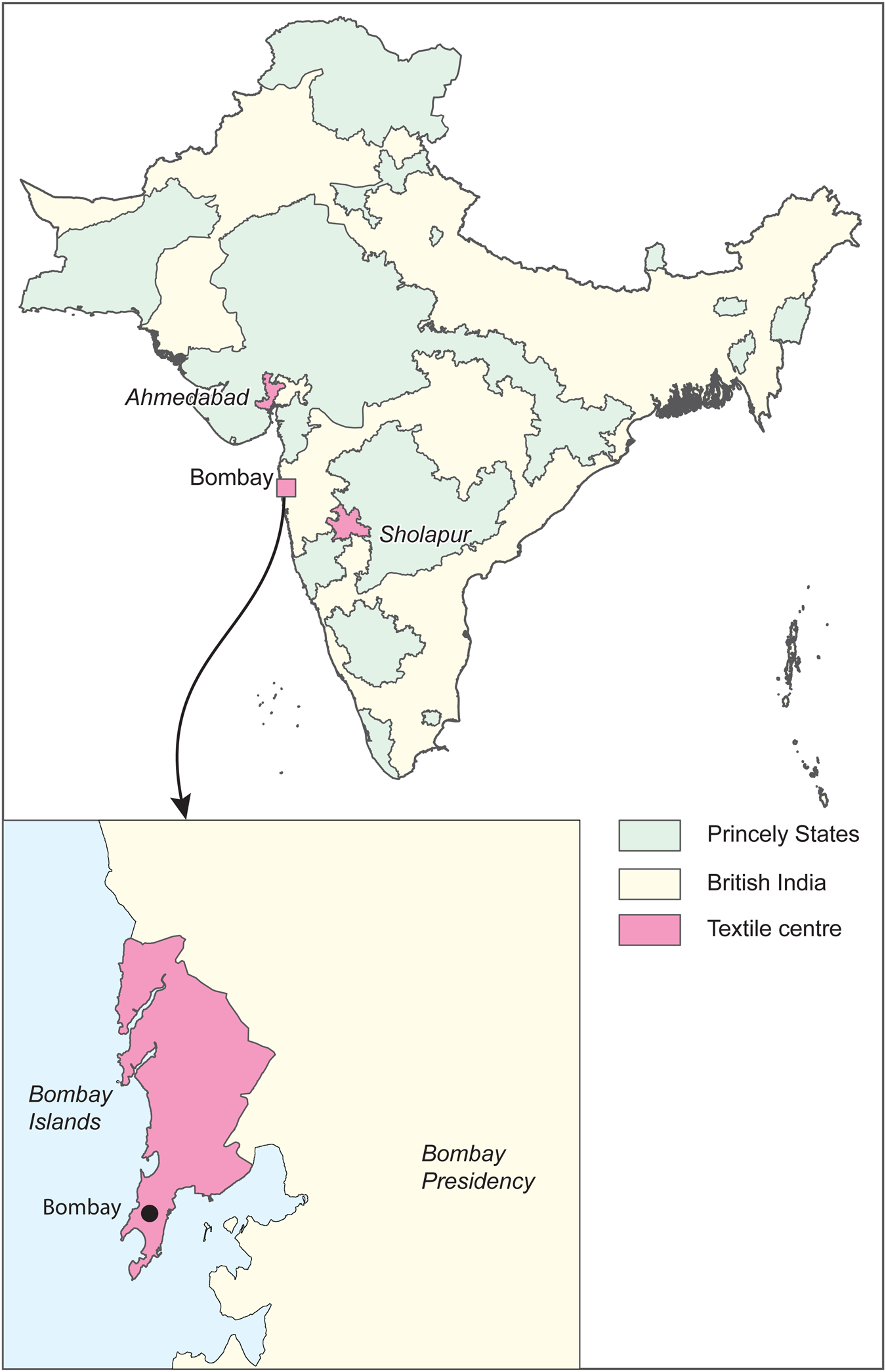
The first textile mills in India began operations in the late 1850s, primarily concentrated in Bombay City and its surrounding islands (hereafter referred to collectively as Bombay), a relatively small geographical area (see Figure 1). By 1880, Bombay accounted for 70 per cent of all industrial looms and 85 per cent of all spindles in India.Footnote 14
Map depicting the three most important industrial textile centres in India, c. 1920.
© Cartographic Studio.
Between 1890 and the onset of World War I, Bombay remained India's leading textile centre, although the industry faced considerable turbulence during this period. Bombay mills predominantly used short-staple cotton sourced from within India, limiting their ability to produce finer yarns or piece goods, which were primarily imported from Lancashire in Britain. This reliance on imports was further reinforced by the colonial administration through the imposition of excise duties on internal Indian trade, which favoured British manufacturers. Consequently, Indian factories focused on producing coarser yarns for domestic hand-weaving, targeting the lower market segments.Footnote 15 For exports, Bombay mills relied heavily on Chinese demand, particularly for coarse factory-made yarns, which was subject to major fluctuations. In response to these challenges, Bombay mills significantly increased their weaving capacity in the early 1900s, anticipating greater prospects in India's sizeable domestic market for coarser cloth.Footnote 16
After this period of relatively steady growth, the Bombay textile industry entered a protracted decline during the interwar years. This downturn was partly driven by diminishing prospects in global markets. The share of textiles in world trade fell sharply, from approximately thirty-four per cent in 1913 to twenty-two per cent in 1937. This decline was particularly sharp after 1929 due to rising competition from industrially produced textiles in emerging Global South economies, increased tariff protection, and Japan's incursion into Global South markets.Footnote 17 As a result, external demand for textiles produced in Bombay mills plummeted, particularly for yarn exports to China. Yarn exports, which had constituted around 50 per cent of Bombay's total production in 1881–1890, dropped to twenty-three per cent in 1911–1920 and further to a mere three per cent in the 1930s and 1940s. Similarly, Indian exports of piece goods and fabrics to traditional markets in East Africa and West Asia faced growing competition from Japanese products, leading to a decline from about eight per cent in 1901–1910 to five per cent in 1931–1940.Footnote 18
Compounding these external challenges, Bombay's textile industry also struggled to maintain its share in the domestic market. In the early twentieth century, new textile centres emerged, such as those in Tamil Nadu and Kanpur, which focused primarily on serving internal markets. These newer factories were often closer to their consumer base, the source of their raw materials, and benefited from comparatively lower labour costs.Footnote 19 Moreover, internal demand, especially for lower-quality textiles, was highly volatile. The majority of the Indian population relied on low-productivity subsistence agriculture and, increasingly, on the export of commercial crops.Footnote 20 Agricultural output in India had always been highly dependent on local weather and climate conditions, resulting in unpredictable and fluctuating yields.Footnote 21 However, this volatility worsened during the depression years when world market prices dropped and primary exports slumped.Footnote 22 Compared to textile producers like Britain and Japan, India's heavy reliance on the agricultural sector disproportionally affected its internal demand for textiles. The terms of trade for agricultural goods deteriorated significantly during this period,Footnote 23 further reducing consumer demand from the already volatile bulk of the population.
Business Strategies
Despite these external and internal constraints, the Indian share of the domestic fabric market had increased to over eighty per cent by the eve of World War II, indicating successful import substitution. Traditional explanations for this accomplishment emphasize the role of protective tariffs (and modifications to these tariffs after 1925) in enabling Indian enterprises to secure a sizeable portion of their internal market.Footnote 24 While tariffs did help prevent stark price discrepancies between domestically produced and imported textiles, Japanese goods continued to decline in price more sharply than Indian products.Footnote 25 This suggests that other factors were at play.
We argue that the specific business strategies adopted by Indian mill owners allowed them to navigate market fluctuations and capture an increasing share of the highly segmented Indian market for cloth. These strategies, which we elaborate on below, were broadly labour-intensive in nature. However, the resulting impact on labour productivity and labour unrest, in the context of competition with other producers who were rapidly improving their productivity, had adverse consequences for India's overall industrial development.
First, sales strategies played a vital role in addressing the market challenges faced by the Bombay textile industry. India's retail landscape was as segmented as its demand patterns, with the final point of sale often being large weekly, biweekly, or triweekly marts and fairs, or regular markets and bazaars connected through a network of retail shops.Footnote 26 Retail shops typically placed smaller orders for specific products and operated on lower profit margins.Footnote 27 To circulate intermediate products, many mills, including Tata and Sons, employed brokers or selling agencies, similar to those used by cloth-importing firms.Footnote 28 Additionally, Indian mills engaged in direct selling methods by using “subagents” in smaller towns to distribute intermediate goods to weavers.Footnote 29
The second strategy involved adjusting inputs, dictated by the constrained production capacity of Indian businesses, which heavily relied on short-staple cotton. This reliance on short-staple cotton impacted work organization and wage structures, particularly for spinning labour. As noted by Lars Sandberg, businesses sometimes offset, within certain limits, the higher cost of longer-staple cotton by increasing the quality or quantity of labour, using shorter-staple cotton on lower spindle speeds.Footnote 30 This approach often resulted in harder work for more workers, as was noted in a 1940 government report:
The majority of the single siders in Bombay today mind only one side not because they are incapable of minding or are unwilling to mind two sides but because the frames on which they work spin counts so coarse that double side working becomes impossible. By implication, the work of the average single sider in Bombay is not really much easier than that of a double sider.Footnote 31
Alternatively, some mill owners chose to maintain high spindle speeds despite the increased risk of yarn breakages, leading them to hire additional piecers to mend the threads.Footnote 32 This strategy was not unique to India; it had been used a century earlier by firms spinning coarse yarn in England, albeit with a loss of worker efficiency.Footnote 33 In India, these strategies made sense, given the constraints on cotton quality and the relative cheapness of labour.
Finally, output diversification was a key strategy to cater to the varied and fluctuating internal demand. Bombay mill owners addressed this by producing a wider variety of fabrics and expanding their operations to include bleaching, finishing, and dyeing. In an investigation of textile workers in India in the 1920s, Tom Shaw, a UK Member of Parliament and the secretary of the International Federation of Textile Workers, observed that “the classes of goods made, too, were a revelation […]. [T]he variety of yarns spun and cloths woven, dyed, and finished showed a range and variety which is probably not equalled by any individual European concern.”Footnote 34 This diversification strategy resembles what Charles Sabel and Jonathan Zeitlin call “flexible specialization”, a system that blends elements of craft and mass production using labour-intensive methods rather than special-purpose machines. A key component of this strategy was to depend on the skills of the workforce and implement piece-rate payment systems according to differentiated outputs.Footnote 35
This approach can be traced back to the eighteenth century when a Dutch visitor noted that, in India: “A job which one man would do in Holland […] passes through four men's hands before it is finished.”Footnote 36 He further observed that this fragmentation of skilled work was driven by two mutually reinforcing conditions: “minutely specialized hereditary skills built into the caste system” and the low wages of individual workers.Footnote 37 We argue that these principles of craft and artisanal practices – employing a highly skilled but fragmented and predominantly cheap labour force due to caste divisions – continued to shape industrial practices in Bombay mills.Footnote 38
Work Organization on the Shop Floor
Rajnarayan Chandavarkar suggests that “volatile” market conditions faced by Bombay mills, coupled with their flexible production strategies, necessitated a consistent and elastic supply of labour.Footnote 39 The organizational hierarchy within mills’ process departments was structured as follows: managers determined the overall production volume and type, including technical specifications; “masters” or supervisors oversaw the entire shop floor; and below them were head “jobbers” and their assistants – often referred to naikins, mukaddams, or foreman/woman.Footnote 40 These jobbers and supervisors frequently rose through the ranks from within the workforce and wielded a combination of economic, cultural, and political authority, sometimes rooted in traditional, custom-based power structures.Footnote 41 At the mill level, work organization under jobbers often exhibited elements of patron–client relationships, particularly in key process departments like weaving, where affiliations based on caste, community, and regional ties persisted.Footnote 42 Consequently, wage and effort bargaining – and thus wage levels and types – often varied across departments.
In each department, labourers worked in teams to produce a specified volume and type of output. Jobbers had the authority to determine team size, hire and fire workers, and oversee their training. Within flexible production regimes, this ability to adjust the workforce size and supervise workers according to production needs was crucial,Footnote 43 and mill owners relied heavily on jobbers to implement these strategies.Footnote 44 As Claudia Goldin notes, this type of work organization, which emphasizes team efforts and inside contracting, often relies more extensively on piece-rate wage systems.Footnote 45
It has been widely noted in reports and scholarly analyses that Indian mills employed relatively more workers for a given task compared to mills in other countries, a factor often cited as central to the industry's underperformance.Footnote 46 However, less attention has been paid to the fact that textile production in India was divided into many distinct operations – over 300 individual occupations, compared to roughly 135 in Britain and 70 in the United States.Footnote 47 Additionally, the labour-to-machine ratio in India was much higher than in Britain.Footnote 48 This led MP Tom Shaw to exclaim in 1927:
To put it bluntly, the fact of the matter is that human beings are too cheap in India. […] The textile mills are no exception. There again you find thousands of men doing, for very low wages, the work that much less numbers [sic] do in Europe for considerably higher wages.Footnote 49
Many of these were “substitute” or casual (badli) workers, forming part of the casual labour force of Bombay mills.Footnote 50 There were also subordinate workers who assisted the “principle operatives”, performing ancillary tasks as helpers. This casual workforce was integrated into the diffused and graded hierarchy of patronage characteristic of Indian society.Footnote 51 However, the line separating casual or temporary workers and the more permanent workforce was often blurred. Casual workers could sometimes transition into permanent roles, and conversely, permanent workers could easily lose their status.Footnote 52
Drawing on Craig Littler's work, we suggest that through “maximum work fragmentation” and “incentive payments”, both integral to the mills’ work organization, mill owners were able to further reduce the wage bill.Footnote 53 Payments varied based on differences in the quantity and quality of output and often included fines and bonuses, which served to intensify labour effort. While such practices were typical of most emerging textile industries globally, the persistence of this unstable system of payment in India is particularly noteworthy. There was no standardized wage rate across the Bombay industry, and wages could vary significantly between and within individual mills, even for workers performing the same job. We will explore these aspects in more detail in the subsequent sections.
The 1920s and 1930s were a period of significant upheaval for the Bombay cotton mills. The 1930s, in particular, were marked by economic depression, leading to the closure of several mills and a reduction in the number of operatives employed.Footnote 54 In response to the recommendations of the Indian Tariff Board's Cotton Textile Industry Inquiry of 1927, the mills implemented piecemeal rationalization measures aimed at alleviating the industry's depressed conditions.Footnote 55 These measures included the use of casual labour organized into teams and supervised by intermediaries, the extreme differentiation of tasks, and the strategic choice between time or piece rates. All of these strategies were designed to address specific challenges faced by Bombay mills during this turbulent period.
In the following section, we will focus on wage payment strategies, examining how occupational variability led to different payment methods and how these methods varied based on the nature of the task and the gender of the worker. Analysing piece-rate and time-rate systems provides a valuable lens through which to understand the structure and logic behind work organization, including gendered and class-based labour segmentation, as well as the changes that occurred over time.
Piece Rates and Time Rates: A Theoretical Perspective
The literature provides several explanations for why employers (or workers) might prefer piece rates over time wages. Traditional explanations span various economic and ideological perspectives, from Marxist critiques to neoliberal economic theories. From a Marxist viewpoint, piece rates are seen as a tool for further exploiting the labour force, including mechanisms of self-exploitation.Footnote 56 Karl Marx himself, in Capital, dedicates an entire chapter to piece wages, arguing:
Given piece-wage, it is naturally the personal interest of the labourer to strain his labour-power as intensely as possible; this enables the capitalist to raise more easily the normal degree of intensity of labour. It is moreover now the personal interest of the labourer to lengthen the working-day, since with it his daily or weekly wages rise.Footnote 57
More recent studies similarly contend that piece rates are exploitative because they ultimately “put the burden of proof of the worker's ability onto the worker, and the need for him/her to control his/her own input and hence output”.Footnote 58 Indeed, one can argue that with piece rates payments, specific risks faced by employers, such as competition or fluctuations in demand, are effectively passed on to the workers. This perspective contrasts with the more rational-choice explanations provided by economists, particularly those associated with the “New Economics of Personnel”. These scholars offer various reasons for the use of piece rates, but they commonly view them as a business strategy designed to address production inefficiencies or mitigate risks.
First, piece rates serve as a powerful incentive for workers to increase productivity, motivating them to produce as much as possible within a given timeframe.Footnote 59 However, this system can entail high monitoring costs, as the quality of the output needs to be controlled.Footnote 60
A second rationale for implementing piece-rate schemes arises in situations where the quality of the product is less critical. In such cases, paying workers by the piece can actually reduce monitoring costs, as the main focus shifts to maximizing output quantity. Conversely, when product quality matters more, employers may prefer to pay higher-skilled workers on a time-rate basis. This approach ensures that wages are only paid once the desired quality level has been achieved, meaning that supervision costs are primarily concerned with overseeing the input side of the production process.Footnote 61 Jan Lucassen and Gijs Kessler suggest that one way to reduce supervision costs related to quality control is by outsourcing the risks of inefficient coordination and cooperation among workers to a collective through subcontracting systems.Footnote 62
Third, in the context of a heterogeneous labour force with limited information on worker quality, piece rates can be used as a mechanism to identify and retain the most productive workers, while dismissing or penalizing the least productive ones.Footnote 63 Claudia Goldin has pointed out that this method of sorting is often gendered. She explains that in the United States around 1900, women were predominantly paid piece rates, whereas men more commonly received time wages. This disparity was particularly evident in the cotton goods manufacturing industry, where in 1890, 73.4 per cent of women were paid by the piece, compared to only 31.7 per cent of men.Footnote 64 The rationale behind this gender difference is tied to societal expectations of the time. Women's employment patterns were generally more intermittent and shorter in duration, largely due to the expectation that they would marry and withdraw from formal paid work. For men, employers could use deferred payment schemes – offering future time-rated salary increases based on good performance – as an incentive to maintain productivity and motivation and reduce shirking. However, because women were not expected to remain in the workforce long enough for deferred payment to be effective, piece rates were a more logical choice.Footnote 65 In our analysis of the Bombay cotton industry, we will explore whether this gender-based division of labour holds true in this particular context, especially considering that a significant portion of the male labour force in Indian mills also worked under casual or short-term conditions.Footnote 66
A classic issue with piece rates is that once workers become more productive and capable of earning higher daily or weekly wages, employers may seek to cut costs by reducing the rate per piece. This creates a tension, as workers naturally prefer fixed or “standard” piece rates over fluctuating ones. For employers, offering standard rates can also be advantageous, particularly during labour shortages, when competing firms might attempt to lure workers away with offers of better pay. Despite this, in the early stages of industrialization in Lancashire, many employers frequently reduced piece rates, especially when labour turnover was high. In the early 1800s, such actions often led to labour unrest and strikes, with employers reluctant to set fixed rates and workers resistant to reductions in their earnings.Footnote 67 Michael Huberman has argued that over the course of the nineteenth century, mule spinners of finer yarns had greater leverage to negotiate standard rates due to their lower risk of being replaced by unskilled labour, particularly women and children. This was also partly because of their high level of unionization. In contrast, spinners of coarse yarns, who typically worked on smaller mules or throstles (which women and children were more likely to be able to operate), faced a more immediate threat of substitution, making them more vulnerable to rate cuts.Footnote 68
In the early phases of industrialization in India, mill owners also frequently reduced piece rates. However, achieving a standard rate proved even more challenging in the Bombay industry than it did in Lancashire a century earlier. This difficulty arose partly from the lack of trust among mill owners, which hindered their ability to reach a collective agreement. Additionally, significant variations in the age of machinery, the scale of operations, and the quality of raw materials further complicated efforts to standardize rates. It was not until 1934 that a minimum wage schedule was introduced, following a series of strikes by workers protesting the continuous cuts to piece rates. That said, it is difficult to determine the extent to which employers fully adhered to this new minimum wage scheme, and full wage standardization for the entire cotton industry was only achieved in 1947.Footnote 69 More broadly, the 1920s and 1930s were marked by significant labour unrest in Bombay's textile industry. Despite ongoing attempts by mill owners to reduce wages, the frequent strikes during this period exerted upward pressure on wages in Bombay, especially when compared to the other Indian textile centres. Under these conditions, employers had strong incentives to maintain differentiated wage rates and rely on a flexible labour pool.
Wage Payments in the Bombay Mills
Our analysis of wage payments in the Bombay textile industry is based on six reports published by the Government of India's Bombay Labour Office (BLO) in the 1920s and 1930s, which contain both aggregate and detailed quantitative data and qualitative insights into payment practices. The first three reports, presenting data from 1921, 1923, and 1926, summarized the results of BLO inquiries into the wages and hours of labour in the cotton mill textile industry.Footnote 70 The primary objective of the 1921 report was to compare wage rates with those paid to workers before World War I, with an underlying motive to achieve standardization of wage payments across the Bombay Presidency – a goal that remained elusive for many years.Footnote 71 The other three reports we analysed include a wage and unemployment investigation and a census from 1934, detailing wage levels in 1933, and a 1937 report on conditions in the textile mills, which also includes wage data from that year.Footnote 72 Our focus is exclusively on data pertaining to Bombay (city and islands). Notably, the response rate from mill owners in the 1921 and 1923 reports was particularly high, while in later years, such as the 1926 report, researchers selected a sample of mills.Footnote 73
While self-reported wage information can be theoretically problematic – since employers might fear repercussions for reporting poor labour conditions – the reports took steps to ensure the anonymity of respondents. Only one responsible clerk in the BLO had access to the names of the respondents, and this individual was bound by the Official Secrets Act to keep all information confidential. This assurance of confidentiality likely reduced the incentives for mill owners to misreport data.Footnote 74 Although Morris D. Morris has critiqued these reports, particularly regarding the accuracy of the absenteeism data provided by employers, he and many other scholars have used the aggregated wage data from these sources without reservation.Footnote 75 While we rely on the general aggregates to identify broad trends across the 1920s and 1930s in the next subsection, the remainder of this article delves into a more detailed analysis of the reported wage data for each occupation we focus on. Any issues related to data reliability that arise will be addressed in the relevant subsections.
Before delving into our wage analyses, it is essential to outline some key characteristics of the workforce under scrutiny in terms of gender, age, and background. Unlike many other emerging textile industries, Indian factory-based textile production was heavily skewed towards male labour from its inception. Throughout the 1920s, women made up around twenty per cent of the workforce in Bombay mills, a figure that declined to fifteen per cent by 1937.Footnote 76 Moreover, there was a pronounced gendered division of labour, with women predominantly confined to winding and reeling departments – over eighty-five per cent of all women in textile factories worked in these occupations in 1921, a percentage that increased to nearly ninety per cent by the 1930s.Footnote 77 Although a few women occupied management-like roles, the majority worked in low-paid, low-status, and thus precarious positions.
Children also worked in Bombay factories, though their numbers were declining and their average age increasing due to stricter child labour legislation. Importantly, there was a difference in how male and female child workers were perceived. Male child workers were categorized as either “children” (aged nine to fourteen) or “big lads” (fourteen to eighteen), whereas all girls older than fourteen were considered “adult” due to the belief that “in India, maturity is reached earlier than in colder climates”.Footnote 78 Children, by definition, worked half-time and were usually paid time rates. Given their small and diminishing presence in the Bombay workforce, we have chosen to exclude them from our analysis. Beyond gender and age, it is also important to consider the distinction between the more permanent and the more casual segments of the flexible (male) workforce, often reinforced by class and caste differences, as previously discussed in this article.Footnote 79
General Trends in Wage Payments
In this section, we provide an overview of wage payment trends during the 1920s and 1930s, including distinctions based on gender and payment type. The wages mentioned in the reports represent average daily earnings for specific occupations, allowing us to compare earnings across piece-rate and time-rate schemes. While these earnings are averages across (often very large numbers) of workers within the same occupation – meaning that actual variation in earnings among operatives was likely greater than reflected in our aggregates – the data still reveal a wide spread of wage payments across similar occupations. Additionally, qualitative statements from the BLO reports highlight the significant work segmentation and fragmentation that characterized the industry.
For all years, earnings were reported as basic rates, including allowances (e.g. for food), but excluding fines, which were more variable and dependent on individual workers. However, several issues with the data immediately become apparent. For example, the report on 1933 data notes that “in some units, the wages shown might strictly said to be those of the machine and not of the man, because [they] might, in fact, have been earned by 2 or 3 men”.Footnote 80 This discrepancy arises because a worker could employ one or more casual labourers during periods of absence, paying them out of his or her own monthly earnings. This practice was particularly prevalent in weaving, as we will explore in the next subsection. All this means that our data may not tell us much about the standard of living of individual workers in the textile industry. However, since our focus is on wage payments as a business strategy, we address this issue in our article while fully acknowledging that such payment practices often negatively impacted workers, particularly the lowest ranked.
As Table 1 shows, the Indian textile industry during our study period was highly segmented by gender. Women were employed in a few specific departments of the production process, and over time, their share dropped and became even more concentrated in the winding and reeling of cotton yarn. Most other occupations were exclusively performed by men, although the relatively well-paid and male-dominated role of mule spinning declined sharply (see the subsection below on mule and ring spinning for exact figures). The much larger ring-spinning departments, where workers operated machines as siders or piecers, transitioned almost entirely to male labour during the 1930s, with an aggregated average proportion of eighty-five to ninety-five per cent over the period.Footnote 81 The table also reveals significant differences in payment types across all occupations, with only weaving (piece-rated) and doffing (time-rated) fully adhering to either wage system. The vast majority of ring spinners were paid time-rated wages, with the exception of a few male siders and piecers.
Gender and wage payment types in select occupations, Bombay, 1921–1937.
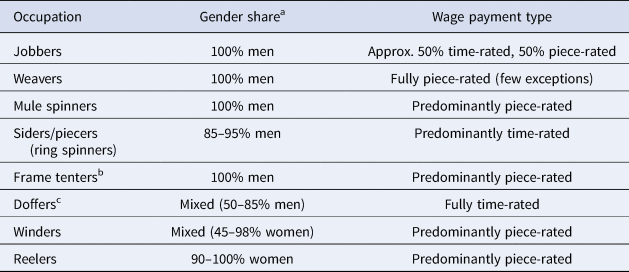
Notes: a Aggregated average percentages over the period. b Frame tenters: Workers responsible for finishing cloth. c Doffers: Workers who changes yarn bobbins.
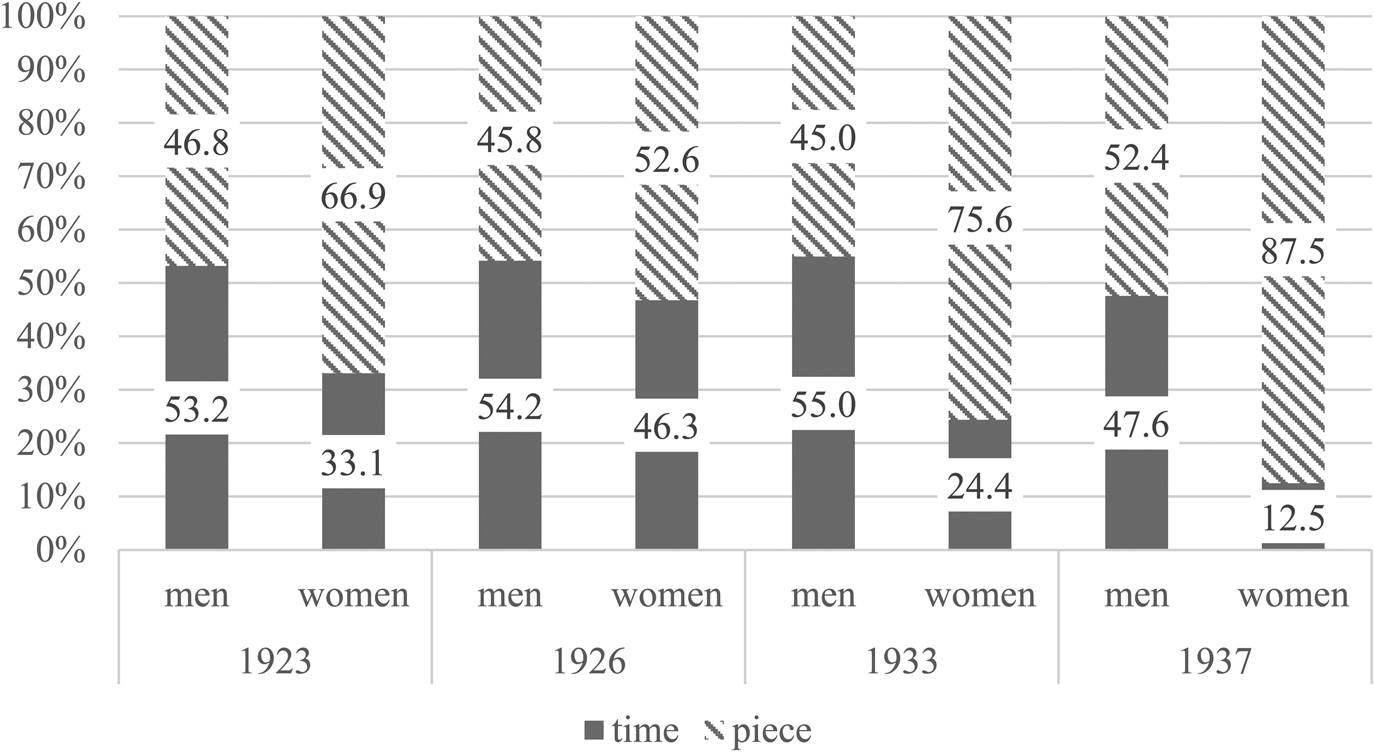
Figure 2 drills down further into the patterns of wage types for all occupations across gender. While piece rates were only slightly more common among women in the 1920s, they became even less so in the 1930s with the increasing masculinization of ring spinning and doffing, two of the few occupational areas that were well represented by women. Although the number of men earning piece rates also rose, the percentage increase was less pronounced and rose only in the 1930s, and nearly half continued to receive time-rated wages in 1937. In the subsections below, we will explore the possible rationale behind these varied payment structures for a few specific occupations, considering factors such as output and input quality, worker sorting (including gender-related aspects), and monitoring costs.
Time and piece rates by gender, Bombay, 1923–1937 (all occupations).
Regardless of whether workers were paid by time or piece rates, wage payments in the Indian textile industry were subject to complicated systems of fines and bonuses, much like in other textile industries globally. The actual pay rate was influenced by various factors, including the type of machinery used, the quality of cotton, and the fineness and quality of the finished product. However, unlike the more standardized practices found in the British textile industry, wage payment practices in Bombay were highly specific to individual mills. These practices also evolved over time into highly differentiated schemes in response to particular challenges faced by each mill.Footnote 82
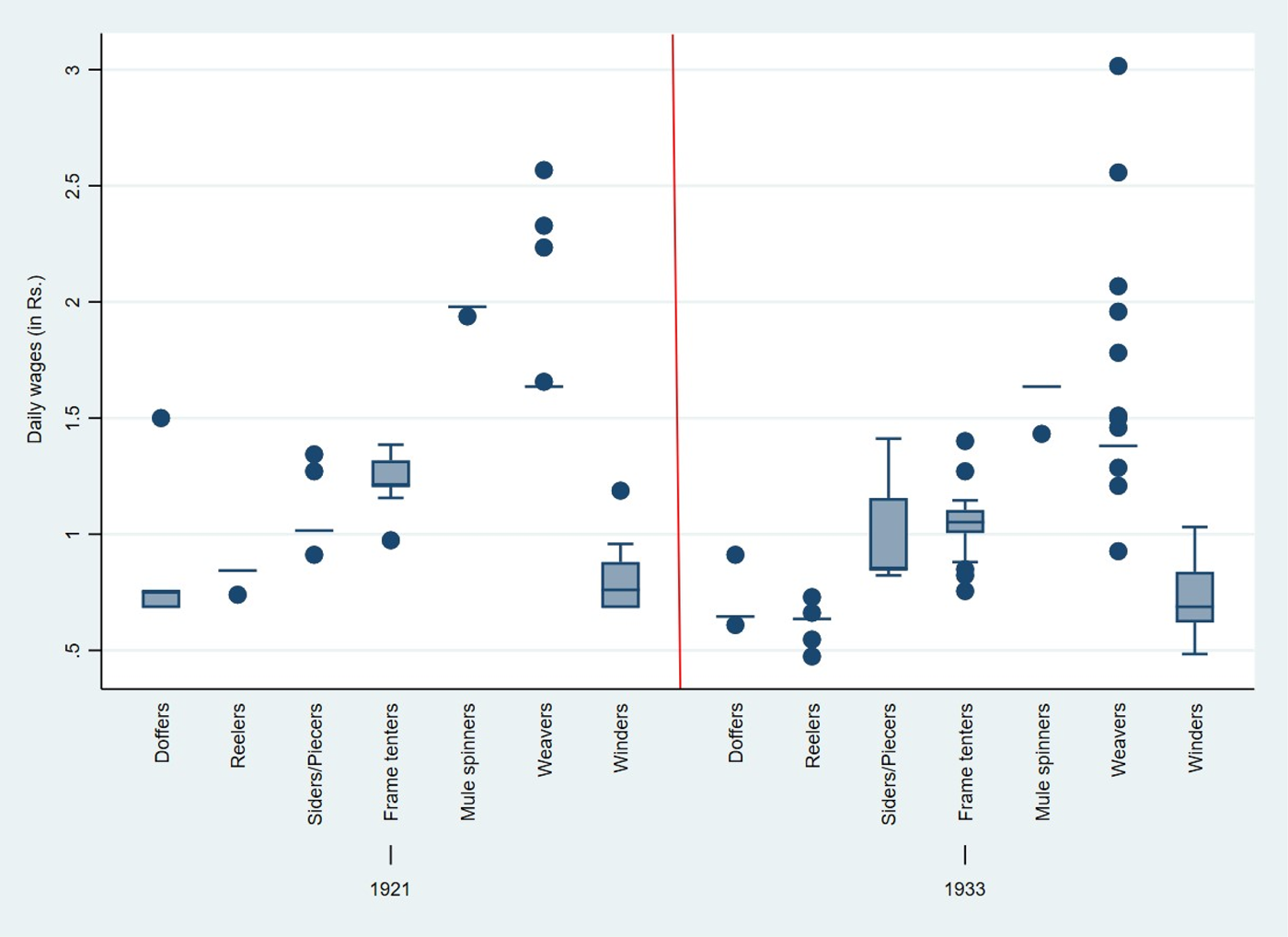
For this reason, there was significant variation in the daily earnings of operatives employed across different occupations. This is illustrated in Figure 3, which depicts the reported average daily earnings for selected occupations in 1921 and 1933. We can observe that average nominal wages slightly declined across all occupations during the period. Furthermore, wage variability increased over time. Mule spinners, on average across both years, earned the highest wages, though wage variability was typically low. Conversely, in the piece-rated weaving profession, there were significant outliers above the average in both years. Among doffers, winders, and reelers – the only occupations with substantial female participation – both men and women earned the lowest average wages, with relatively little wage variability.
Daily earnings for operatives (weighted) in select occupations, 1921 and 1933.Footnote 84
Carrot and Stick: Piece Rates and Quality Control among Weavers
Weavers constituted the largest group of process operatives in the Bombay mills, with more than 30,000 employed in 1921 and still more than 26,000 in 1937. Throughout the years under investigation, they made up between twenty and twenty-five per cent of the total workforce.Footnote 83 As noted earlier, the weaving sheds were exclusively staffed by male workers, a continuation of traditional artisanal production in the Indian subcontinent, where weaving had long been a male-dominated craft. This tradition persisted even with mechanization, bolstered by the employment of numerous traditional weavers and weaving castes from the Northern Provinces – particularly the julahas – who were well represented in the weaving sheds. Weavers were paid relatively high wages compared to other mill operations, a situation rooted in both historical and economic factors. Initially, higher wages were used to attract weavers to the Bombay mills in the early twentieth century. This approach capitalized on the skilled status these weavers held,Footnote 85 a status further reinforced by their ability to produce a wide variety of products tailored to the segmented Indian market – a demand that persisted throughout the late colonial period.
More than ninety-nine per cent of weavers were paid on a piece-rate basis, with two additional factors influencing their earnings: output incentives or bonuses (the “carrot”) and quality control measures or fines (the “stick”). These mechanisms were used to ensure a varied and skilled output while also reducing monitoring costs for mill owners. The variety of output measures was complex, driven by the need to adapt “the structure of rates to the requirements of the hundreds of varieties of cloth woven in the loom sheds”.Footnote 86 Wage rates for weaving could be determined based on specific piece goods or by measures of output, such as yardage or weight.Footnote 87 Additionally, wages could vary according to factors like “warp and weft counts, reed space and picks to the inch”. “Special allowances” were also applied in cases requiring specialized skills that enhanced the value of the output, such as weaving “designs with borders”.Footnote 88 Quality control was enforced through strict fines for faulty output, with the additional practice of selling defective cloth back to the weavers, deducting the cost from their wages.Footnote 89 In all likelihood, the responsibility for overseeing quality under these conditions fell to the jobber.Footnote 90
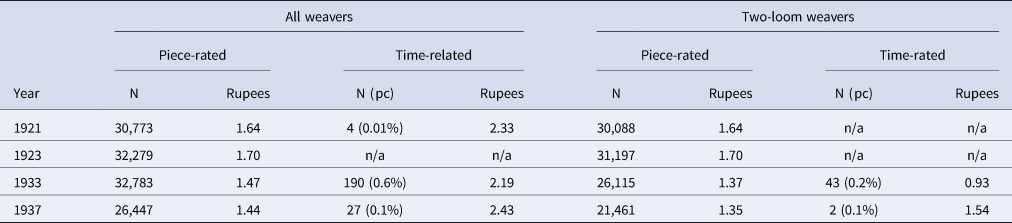
Table 2 presents data on the average daily earnings of all weavers and those capable of operating two looms (which was the majority of all weavers, accounting for around 80–90 per cent). In the 1920s, the average earnings of the two groupings were similar.Footnote 91 In the 1930s, however, we note increasing wage variability among all weavers (see Figure 4). Moreover, the small percentage of weavers who were paid time-rated wages generally earned significantly more than those on piece rates, with this disparity increasing over time (except time-rated two-loom weavers in 1933; see footnote 92). This divergence likely reflects the existence of incentive payments alongside time-rated wages for highly specialized workers, such as those operating automatic or jacquard looms, to ensure their retention and productivity.
Average daily earnings of weavers (all men), Bombay, 1921–1937.
Wage variability among weavers (all men), Bombay, 1921–1937.
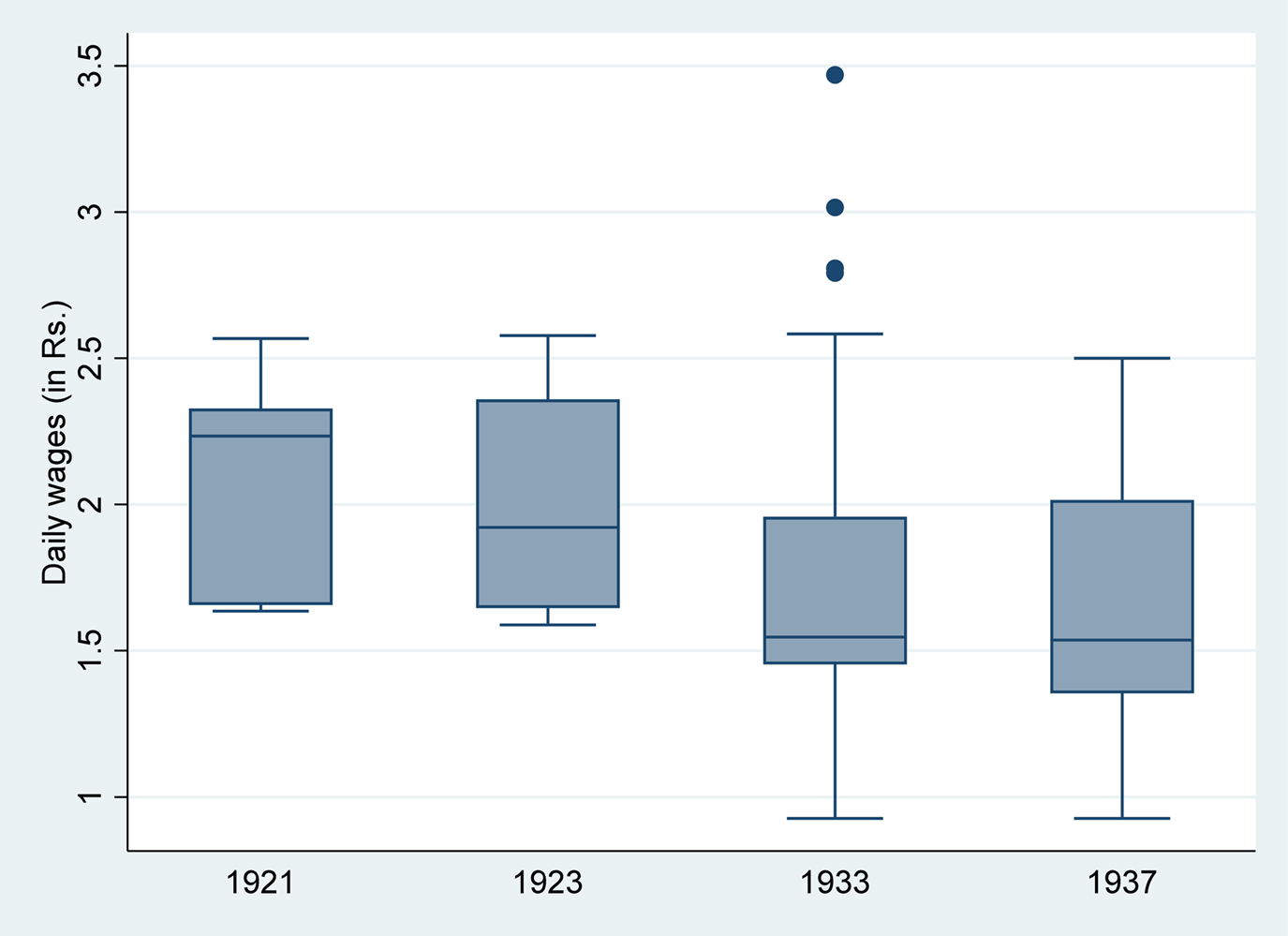
These trends indicate that segmentation within the weaving departments intensified over the 1920s and 1930s, both in terms of work assignments and payment structures. As the decade progressed, the variety of cloth produced in the mills increased significantly, driven by a strategy to capture a larger share of the domestic market. To accommodate this shift, weavers were increasingly paid differentiated wages, reflecting the varying quality of their output. Particularly among two-loom weavers, nominal earnings declined to approximately eighty-five per cent of their early 1920s levels. Some weavers were able to supplement their income with implicit bonuses by taking on additional looms beyond the standard two.Footnote 92 Additionally, during the early 1930s, it was observed that monthly payments to weavers registered on the company's muster roll were often divided among two or more casual workers who substituted for the registered weaver during absences.Footnote 93 This practice was tolerated by employers because it ensured continuous loom operation and allowed skill levels to be flexibly managed without incurring additional wage costs, as only the officially registered weaver was paid.
All in all, contrary to what some of the theoretical literature suggests, higher-quality production in the Bombay textile industry did not preclude the use of piece rates for weavers. Instead, piece wages were implemented precisely due to the heterogeneous composition of the weaving workforce. Within the context of a highly volatile internal market that demanded a wide and fluctuating range of fabric qualities, Bombay mill owners used piece rates as a tool to identify (or sort) and reward the most productive workers while penalizing less productive ones through fines and other quality control measures.
Piece and Time Rates among Mule and Ring Spinners
We noted earlier, in footnote 81, that spinning labour in Bombay's textile mills comprised two main categories: spinning on mule spinning machines and spinning on ring frames (siders and piecers). Compared to Lancashire or Japan, India was relatively late in transitioning from mule to ring spinning, presumably due to the challenges outlined in our introductory section. Evidence from the early twentieth century suggests that mule spinning in India was used predominantly for either high (over 26s) or very low counts of yarn (below 10s).Footnote 94 During economic downturns, mills even attempted to spin much higher yarn counts using coarser raw cotton.Footnote 95 Nevertheless, the significance of mule spinning diminished considerably during the period under investigation, with employment in mule spinning plummeting from 436 workers in 1921 to just 82 in 1937.Footnote 96 The remaining mule spinners likely catered to the fluctuating demand for both very coarse and finer yarns.
We have noted that mule spinning was an entirely male-dominated occupation (see Table 1). The majority of mule spinners – rising from seventy-eight to ninety-five per cent over the period – were compensated through piece rates, though, like weavers, a small fraction worked on time rates. Unlike weavers, however, where time-rated workers generally earned more (Table 2), the average daily earnings of time-rated mule spinners were comparable to, and often lower than, those of their piece-rated counterparts (see Table 3). This may suggest that, in the case of mule spinning, employers were more focused on the quantity of output rather than the quality when determining wages. As this form of spinning declined over time, both piece-rated and time-rated wages decreased between 1921 and 1937.
Average daily earnings for mule spinners (all men), Bombay, 1921–1937.

The high prevalence of piece rates in mule spinning also related to the specific organization of work. Each mule spinning machine was operated by a team or “gang” of seven men, which included one spinner, two engine piecers, and four side men or “creelers”. Piece-rate payments were distributed in two main ways. The first method involved a payment based on the total output: calculated per 100 lbs of yarn produced, with the earnings then distributed among the gang. In this system, the spinner earned about twice as much as the creeler, while the engine piecers earned more than the creeler but less than the spinner. The second payment method involved fixed wages for each role – spinners, piecers, and creelers – but still based on the gang's total output. For high-count yarns, which resulted in lower output, production was recalibrated into 10s yarn to determine wages.Footnote 97
This system of work organization has historical parallels with piece-rate payment methods in other parts of the world.Footnote 98 One significant advantage of this approach was the reduction of “supervision costs for management because the contractors had knowledge of the productivity of individual workers and were able to increase effort because of personal friendships and kin ties”.Footnote 99 While in most other departments of Bombay's textile mills, jobbers typically performed this supervisory role, mule spinning appears to have operated differently.
In ring spinning, siding or piecing was the most critical operation, with over 10,000 workers employed as siders or piecers in the Bombay mills during most years. Unlike other emerging textile industries like Japan, and earlier in Britain and the United States, Indian mills rarely employed women in the ring-spinning mills – at most 15 per cent of siders were female, and this percentage declined to just 5–6 per cent by the 1930s. Siders in Bombay were predominantly paid time-rated wages (see Table 1).
Work on the ring-spinning machines in Bombay was highly labour-intensive. Due to the poorer quality of inputs, many mill owners opted not to invest in better machines, which were unsuitable for most of the raw cotton blends used. Instead, they ran the machines at higher speeds, which increased the work intensity for operatives but boosted output per machine. However, these higher speeds also led to more frequent yarn breakage during spinning, limiting a sider or piecer to tending only one side of the machine, thereby necessitating more labour. The use of low-quality raw materials was closely monitored, and cotton mixing techniques in Indian mills were geared towards minimizing the cost of those raw materials.Footnote 100
Following Goldin's analysis, we argue that siders and piecers were predominantly paid time rates because their productivity was largely predetermined by the monitored quality of inputs and adjustments to machine speeds for higher output. Interestingly, as women's participation in this occupation declined over time, the wages of male and female operatives began to converge, further suggesting that productivity was predefined and did not rely on factors such as physical strength (see Table 4).
Average earnings for female and male siders/piecers, 1921–1937.
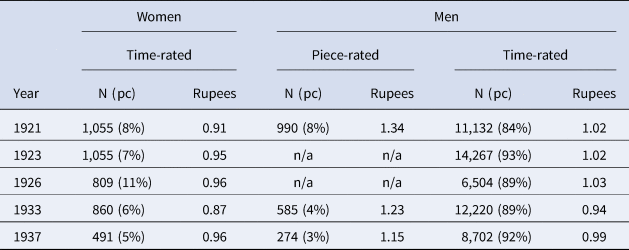
We saw earlier in Figure 3 that wage variability among siders and piecers had increased by 1933, as had frame tenters and, especially, weavers. This shift was linked to rationalization measures adopted by mills, which, mirroring the incentive payments to weavers we discussed in the previous subsection, used higher piece rates to differentiate payments among (male) siders and piecers. A small proportion of workers who managed more sides on a ring frame were paid higher wages through these piece rates. Despite the overall decline in the average wage for men and the equalization of wages between men and women, the latter were increasingly pushed out of this occupation due to these rationalization measures.
Reelers and Winders
Along with weaving and spinning, reeling and winding were the other most numerically significant occupations in the Bombay cotton mills, predominantly staffed by women – a trend that intensified over time. This subsection will demonstrate how the average earnings and payment systems in these occupations were directly influenced by the gendered composition of their workforce. Industrialists employed specific gender ideologies in setting wage rates and payment systems, rooted in assumptions about women's skills, their roles within the family, and their work capacity. The winding process, in particular, became increasingly feminized during the period under investigation: while women made up about half of all winders in 1921, by 1937, they accounted for over ninety per cent of the workforce. Reeling, on the other hand, was consistently and overwhelmingly staffed by women, comprising 90–98 per cent of the workforce.Footnote 101 Both winding and reeling were among the lowest-paid process occupations, along with doffers, as was illustrated in Figure 3, and these two jobs were largely piece-rated, with a small proportion of workers receiving time rates.
In yarn manufacturing, reeling and winding are backend processes that transform spun yarn into a usable form for subsequent stages.Footnote 102 As such, the output and work assignments in these departments were predetermined and not heavily reliant on the productivity of individual operatives. However, due to variations in output, it was useful for mills to maintain a surplus of workers who could be adjusted according to fluctuations in demand. To avoid an unpredictable and potentially higher wage bill caused by varying time investments from labourers, employers opted to pay piece rates. This system allowed them to flexibly manage their workforce without incurring additional costs for retaining surplus workers.
In the reeling departments, the BLO reports consistently noted a degree of underemployment, with the workforce exceeding the actual needs of employers. This overstaffing led to lower earnings for individual workers, as the available work was spread thin among too many employees. The 1940 report of the Textile Inquiry Committee noted:
The figures of actual earnings are not of much help in this connection, because the number of workers in these departments today is said to exceed greatly the needs of the departments. The actual average earnings of the individual worker do not, therefore, reflect the earnings for a full day's work.Footnote 103
This underemployment is particularly significant when considering that most women working in these mills were widows and sole breadwinners for their families. Unlike male migrant workers, who often had access to rural resources, these women lacked additional support and depended entirely on their mill earnings.Footnote 104 According to Goldin, women are often employed on piece rates due to their “discontinuous and abbreviated lifecycle”.Footnote 105 However, given that about 79 per cent of the women employed in Bombay mills were between the ages of twenty-six and fifty-five, their involvement was less discontinuous than assumed.Footnote 106 Nevertheless, employers had a vested interest in perpetuating the notion that women were supplementary wage earners with intermittent work patterns, which justified paying them lower wages. Despite efforts of women workers to resist lay-offs and pay cuts,Footnote 107 the BLO reports from the 1930s indicate that cutbacks were indeed implemented.Footnote 108 As Nirmala Banerjee notes, because these women relied on their small incomes to sustain their families, they were often compelled to continue working even at reduced wages.Footnote 109
Table 5 reveals that women's piece-rated wages were consistently higher than their time-rated wages, with the difference between these wage types fluctuating between eight and twenty-five per cent. In reeling departments, the lower time-rated payments were sometimes supplemented with a “dear food allowance”, while any additional earnings came from piece-rate payments.Footnote 110 However, since daily rates were calculated on a full-time basis, it is highly likely that, due to the persistent overstaffing in the reeling departments, women often had to share their earnings among multiple workers. One report highlighted the irony of this situation, noting that “the women prefer to have half a loaf rather than no bread”.Footnote 111 The few men employed in the reeling departments fared only marginally better.
Average daily earnings for female and male reelers, 1921–1933.

Note: No men were reported as reelers in Bombay City in 1921 (BLO, Report on an Enquiry, 1921, p. 15). For 1937, the BLO reports that 11,004 women and 127 men were employed as reelers in Bombay Presidency. However, no separate data on men's wages is listed, indicating no likely variation in the wages earned by men and women. See BLO, Report of the Textile Inquiry Committee, 1937, p. 28.
In the winding departments, the prevalence of piece-rated systems can be attributed to qualitative differences in output, such as grey, coloured, pirn, or universal winding, and the finesse of the yarn. Finer yarn involved a greater length of fibre per pound and hence was compensated with higher wages. However, differences in payments based on product variation only partially explain the use of piece rates in this department. We argue that mill owners utilized ideologies of gender-based skill differentials to maintain and even widen the wage disparity between male and female workers over time. Although men represented a declining proportion of the workforce in this department, they consistently earned more than women, regardless of the type of payment system. Mill managers justified this wage differential by claiming that male winders performed more skilled work.Footnote 112
Between the 1920s and 1930s, as we have noted previously, the composition of output shifted in favour of finer yarns, and simultaneously the work in this department was feminized. Despite these general shifts, which would indicate women performing skilled work in greater numbers, men consistently out-earned women, regardless of payment type (see Table 6). The gender wage gap even increased sharply for piece-rated work – from four per cent more for men in 1921 to fifty per cent more in 1937. As Samita Sen observes, while mills drew on “wider perceptions on gender, their own policies and strategies also served to modify, reinforce or even enhance gender hierarchies […]. [They] created new and different myths about skill and segmentation which served to reinscribe gender hierarchies on the workforce.”Footnote 113
Average daily earnings for female and male winders, 1921–1937.
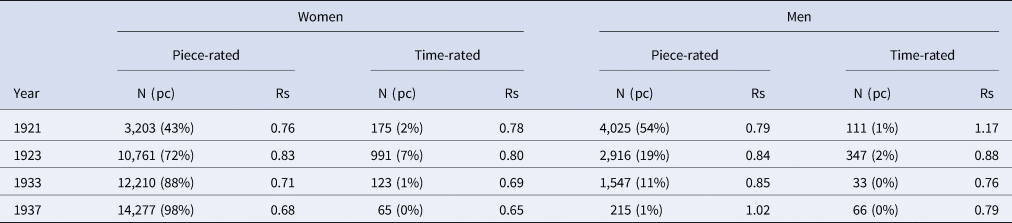
The feminization of the winding department in Bombay mills during the 1930s appears to have been a deliberate strategy in response to the economic downturn. Even as the tasks in this department became increasingly skilled, prevailing gender ideologies were leveraged to suppress wages and minimize costs. As previously discussed, women were driven out of ring spinning and other processes. This segmentation, alongside an overall decline in the winding and reeling departments, left them with fewer employment opportunities, thus compelling them to accept the lower wages.
Conclusion
This article has examined the business strategies employed by mill owners in the Bombay textile industry during the late colonial period, particularly how these strategies influenced work organization and wage structures. By analysing wage data from the interwar years, we have demonstrated how employers strategically manipulated payment methods in response to market fluctuations and the demands of a narrow yet diverse and growing domestic consumer base. Our analysis is framed within the context of recent theoretical discussions on differential pathways to industrial development, specifically the balance between labour- and capital-intensity, while also engaging with literature on the rationale behind the payment strategies adopted by firms.
Our findings indicate that the strategies adopted by Bombay mills were decidedly labour-intensive. The availability of cheap and flexible labour – both female and male – coupled with differentiated payment schemes, allowed mill owners to adjust production to meet highly variable market demands in terms of both quantity and quality. Given the high cost and limited availability of advanced machinery and high-quality inputs, reducing labour costs became the primary strategy for lowering the total costs of production. These strategies had varied impacts on wage levels and types, depending on occupation, gender, and social class.
As we have argued, women bore the brunt of the rationalization measures taken by Bombay mill owners as they sought to protect their profit margins. The overall number of women in the workforce declined further, with those remaining increasingly concentrated in the lowest-paid and shrinking departments of reeling and winding. This trend is particularly striking given that recommendations for improving labour efficiency were focused almost exclusively on the weaving and spinning departments, where men made up the majority of the workforce. In this context, women were treated as a surplus, expendable, and flexible labour force, with gender ideologies playing a crucial role in the implementation of these changes, as noted by Sen, Banerjee, and Radha Kumar.
Simultaneously, mills increasingly shifted towards piece-rated payment systems, a trend that was more pronounced for women than for men. The wage disparities between men and women across various departments like spinning, weaving, reeling, and winding reveal how piece and time rates were strategically employed to reduce wage costs amid fluctuating demand. Piece-rated payment schemes were particularly prevalent in sectors where output quality and variety were critical, such as in the weaving sheds and, to a lesser extent, in mule spinning. Combined with subcontracting, this payment method not only ensured the desired quality and quantity of output but also likely played an integral part in the shop-floor organization of Indian mills, reflecting continuities with the flexible and fragmentated nature of high-skilled artisanal textile production.
For workers, especially those higher up in the hierarchy, this approach to labour relations may have provided a sense of autonomy and insulation from employer control.Footnote 114 In response to the unpredictable and constrained demand in the subcontinent, piece rates offered greater flexibility in controlling output quantities. For weavers, the variability in output complicates broader assessments of the productivity of Indian operatives, as some scholars have argued. Instead, weaver's work resembled what Sabel and Zeitlin describe as “flexible production”, blended with elements of the craft system. However, unlike the flexible production described by these authors, which relies on multipurpose machines, this flexibility in Indian mills was achieved through artisanal labour on general-purpose machines. By paying workers piece rates, employers could match the most suitable worker to different types of cloth, leading to increasing wage variability in weaving.
In yarn winding, piece rates were similarly used to sort workers based on differential output. However, in this context, where skill was often attributed more to the worker than to the work itself, employers exploited the stereotype of women's presumed affinity for low-skilled work, as well as their assumed homemaking responsibilities, to maintain control over wage costs.
Time-rated payments were particularly important in areas where mills tightly controlled inputs, especially raw cotton, thereby reducing monitoring costs as output was relatively predetermined, as in the ring-spinning department. In this case, mill owners employed a strategy of adjusting machine speeds to ensure higher production. Since the increased speeds led to more breakages due to the low quality of raw cotton, this required more workers per machine without reducing their effort. Higher speeds kept output per machine high, even when each operative managed fewer machines (or sides in the case of ring frames). To overcome the limitations of the machinery, mills often relied on casual labour to meet fluctuating daily production demands. While this often meant recruiting more workers than necessary, it made sense given the acceptance of more frequent breakages. Cheap siders, paid on time rates, were tasked with the labour-intensive job of consistently mending the broken threads, ensuring production continued despite the challenges posed by inferior raw materials.
To conclude, the persistent flexibility and often supply of labour, which characterized the Indian textile industry, played a crucial role in shaping the strategies of Bombay mill owners as they responded to the fluctuating demands of an increasingly competitive Indian market. This labour dynamic, frequently criticized as “inefficient”, was integral to how mills navigated these challenges. In this sense, historian Morris D. Morris may have been right when he observed, “It is possible that the Bombay mills did not operate in a single labour market but in what, for transport or other reasons, constituted a series of quasi-independent labour markets.”Footnote 115 However, while this approach may have been profitable for individual mills, it ultimately resulted in stagnant productivity gains and had adverse effects on India's overall industrial development – issues that have been widely discussed in the historiography.
The labour-intensive strategies employed by Indian firms led to divergent outcomes in terms of industrial progress, challenging the notion of convergence often suggested in existing literature. Unlike in Japan, neither employers nor the British colonial state made significant investments in improving the conditions or quality of India's cheap and abundant labour force. Consequently, only a select group of workers – primarily male and often already possessing higher skills, such as weavers and jobbers – benefited from the wage payment system.
In considering global wage trends as indicators of productivity or living standards, it is essential to account for such class-based differences in payment methods, as well as the persistent gender disparities. These factors underscore the complex and uneven development trajectories within the Indian textile industry, highlighting the importance of nuanced analyses when comparing industrialization processes across different contexts.


 Open access

