


INTRODUCTION
For nearly 50 years, the dominant theoretical framework for explaining citizens’ decision to participate in politics has centered on the role that individual-level resources play in facilitating engagement in political activity. This “resource model” of political participation distinguishes between limited politically relevant resources such as money, time, and civic skills, which afford individuals the capacity to engage in politics, and psychological resources such as political attention, party strength, and group consciousness, which are seen as either intrinsically motivating or capable of conditioning mobilization efforts (Leighley Reference Leighley2001; Tate Reference Tate1991; Verba and Nie Reference Verba and Nie1972; Verba, Schlozman, and Brady Reference Verba, Schlozman and Brady1995). While researchers have found there to be a strong relationship between access to these participatory resources and political activism, the perennial difficulty of identifying the direction of the causal relationship between attitudes and political action in these largely observational studies has greatly complicated explanations of how psychological resources, in particular, might contribute to political engagement. Furthermore, to the extent that capacity-building resources and psychological resources each contribute to political engagement, whether they independently or jointly influence political action remains unclear.
In this article, we reassess the relevance of one of the most widely studied psychological predispositions to political engagement: racial group consciousness (RGC). Defined as a self-conscious awareness of one’s status as a member of a disadvantaged racial minority group, RGC is believed to inspire political engagement via an internalized concern for improving the status of one’s racial group. The concept came to prominence in the late twentieth century as an explanation for why Black Americans participated in certain forms of political behavior at higher rates than whites in similar economic situations (Verba and Nie Reference Verba and Nie1972). Today it is arguably the most commonly referenced explanation for the distinct political behavior of racial minorities in the United States (McClain et al. Reference McClain, Carew, Walton and Watts2009).
Despite its widespread acceptance among scholars of race and ethnic politics, empirical assessments of the RGC-to-political-participation link have been anything but consistent. In fact, even some of the originators of the modern RGC/political participation link have since questioned its continued importance as an explanation of racial minority political behavior, citing a lack of consistent evidence and their inability to replicate their original observations (Verba, Schlozman, and Brady Reference Verba, Schlozman and Brady1995). As such, a number of well-conceived studies have failed to find evidence of a relationship between RGC and the political activity of Black Americans (Collins and Block Reference Collins and Block2020; Leighley and Vedlitz Reference Leighley and Vedlitz1999; Wilcox and Gomez Reference Wilcox and Gomez1990).
In this article, we revisit the RGC explanation by clarifying the concept’s influence on the political behavior of Black Americans. We argue that the RGC/political participation relationship cannot be fully realized without (1) careful consideration of the relevance of the political activity to empowering the racial group or achieving some explicit racial group-based objective and (2) consideration of how capacity (time or money) to engage in costly political action conditions Black political participation. Through a series of observational tests and behavioral experiments, we find evidence to suggest that RGC may effectively motivate Black Americans into costly political action, but only when the individual possesses the requisite resources and when that behavior has some well-understood potential to benefit the racial group.
BACKGROUND
In the face of the mass protest movements around Black rights in the 1950s and 60s, followed by Black Americans’ steadfast engagement in electoral politics, and the more recent rise of Black protest activism around police violence, researchers have sought to identify what both enables and motivates members of racial minority groups to engage in individually costly political activism. From this, two often competing theoretical explanations of racial minority political behavior have emerged: one focuses on the role that limited resources such as time, money, and civic skills play in enabling political activity, and the other which centers on psychological dispositions related to racial identification, specifically RGC. While researchers of racial minority political behavior have treated each explanation as distinct, we contend that these explanations work together to facilitate the political engagement of racial minority group members.
Limited Participatory Assets
The time, money, and information required for many forms of political action can create significant barriers to political engagement for many resource-poor individuals. While discussing politics, posting political opinions on social media, or responding to a political survey are all relatively low-cost forms of political engagement, voting can be somewhat costlier in terms of information and time. Voting is still relatively cheap compared to other political activities, such as attending a protest or demonstration or donating to or working for a campaign or candidate. Resources, however, may attenuate some costs of participation. Education can greatly enhance access to activities that require information and skills such as contacting elected officials, while surplus income can directly affect an individual’s ability to offer financial support to campaigns or take time off work to volunteer.Footnote 1
Differences in political participation across racial minority groups have been attributed to the rather large resource inequalities that exist between these groups. In their study of racial differences in Black, Latino, and white political engagement, Verba et al. (Reference Verba, Schlozman, Brady and Nie1993) find that racial differences in participatory resources such as education, income, and civic skills explain many of the racial differences in participation. Leighley and Vedlitz (Reference Leighley and Vedlitz1999) build on this observation and find that for Black and Latino citizens, disparities in income and education relative to whites likely account for much of the participation differences across racial groups.
Racial Group Consciousness as a Psychological Resource
Simply possessing the capacity to participate in politics does not necessarily mean that individuals will choose to devote their limited resources toward achieving some political goal. In response to this realization, researchers have come to recognize the importance of psychological resources that motivate individuals to invest their limited resources into political activities that might bring about positive social change for either their own personal benefit or that of their society or social group. This reasoning led Sidney Verba and Norman Nie to propose RGC as an explanation for Black political participation in the 1960s. Verba and Nie (Reference Verba and Nie1972) noted that for many political activities, Black Americans out-participated similarly economically situated white Americans, suggesting that Black political engagement involved more than access to time, money, and education. In an effort to explain this unexpected observation, Verba and Nie (Reference Verba and Nie1972) suggested that perhaps in addition to these constrained participatory assets, Black Americans’ realization of their position as a disadvantaged racial group and their willingness to use politics to improve this position, or what we now call RGC, may be sufficient in and of itself to motivate engagement into some forms of political activity.Footnote 2 In the decades since Verba and Nie’s study, researchers have found that RGC and its various components exhibit strong relationships to the political attitudes, policy preferences, and participatory behavior of racial minorities (see Gay, Hochschild, and White [Reference Gay, Hochschild and White2016] and Sanchez and Vargas [Reference Sanchez and Vargas2016] for reviews).
Despite its widespread acceptance, RGC has not been without its critics. Gay, Hochschild, and White (Reference Gay, Hochschild and White2016) note the definitional differences in scholars’ use of racial identity measures, and how applicable these measures are to other racial, ethnic, gender, and class groups, and speculate about the identity to politics link. While the authors do find that many groups express some sense of linked fate, they do not find that linked fate is frequently associated with political views or political participation. Bobo and Gilliam (Reference Bobo and Gilliam1990) offer one of the most forceful critiques of the RGC explanation of Black political engagement. To them, Verba and Nie’s RGC theory fails as a general explanation of Black political participation because of its exclusive focus on Black behavior in the 1960s, a time when Black Americans were struggling for basic civil rights.
We note two important observations consistent with Bobo and Gilliam’s critique, that outside of the racialized context of the Civil Rights Movement there is mixed support for the RGC framework. First, several of the studies finding strong connections between RGC and Black political activity have centered on elections that also had heightened racial contexts such as the 1984 and 1988 presidential elections (Chong and Rogers Reference Chong and Rogers2005; Dawson Reference Dawson1995; McKenzie Reference McKenzie2004; Tate Reference Tate1994) and the 2008 and 2012 presidential elections (Austin, Middleton, and Yon Reference Austin, Middleton and Yon2012). Each of these elections featured viable Black presidential candidates and the analysis focused largely on explaining campaign activism in those elections. Second, several studies which found null RGC effects relied on data collected during election cycles or historical moments that did not have particularly heightened racial context (Collins and Block Reference Collins and Block2020; Gay Reference Gay2001; Leighley and Vedlitz Reference Leighley and Vedlitz1999; Verba, Schlozman, and Brady Reference Verba, Schlozman and Brady1995; Wilcox and Gomez Reference Wilcox and Gomez1990). In these election cycles, it was unclear from both the candidate and the context of the campaign whether participation in political activities would contribute to achieving a racial group goal. There remain, however, several notable exceptions to this pattern (Brown Reference Brown2014; Ellison and London Reference Ellison and London1992; Miller et al. Reference Miller, Gurin, Gurin and Malanchuk1981; Philpot, Shaw, and McGowen Reference Philpot, Shaw and McGowen2009; Tate Reference Tate1991). Several of these studies find a connection between RGC and political participation in election years that did not feature a viable Black candidate nor had a heightened racial context, which only serves to further highlight the many inconsistences within this literature.
In sum, while the RGC literature suggests that RGC should unconditionally motivate political action for Black Americans, two observations from our review of this research point to important limitations of the existing RGC framework. First, it appears that insufficient attention has been devoted to accounting for the relevance of political activity to achieving a clear racial group-based objective. This point suggests that the relevance of the political activity to the racial group should condition the effect that RGC might have on Black Americans’ participation decisions. Second, few if any studies of RGC consider the conditional relationship between RGC and limited participatory resources. Since access to participatory resources is necessary to engagement in most forms of costly political action, any effort to identify the effect that RGC has on political engagement must also account for both whether individuals possess the capacity to take part in political action and how access to resources themselves might structure the decision-making calculus of participation decisions among Black Americans. Below we integrate these ideas into the RGC framework and discuss how these theoretical and empirical adjustments improve the explanatory power of the theory.
RESOLVING INCONSISTENCIES: UPDATING THE RGC FRAMEWORK
The logic underlying RGC suggests that racial minorities high in RGC will be more likely to engage in politics because they see politics as a way of improving their group’s standing. We believe that many researchers who study RGC have overgeneralized the explanatory power of the concept by using it to explain Black engagement in political behaviors that have little relevance to the racial group, such as participation in a political campaign that has no direct benefit to the racial group. Even for activities that have downstream consequences for Black Americans, prior research has shown that the connection to the racial group must be made explicit for Black Americans to elicit racial thinking about an issue or prompt participation to remediate the issue (White Reference White2007). We argue that this use of RGC may explain some of the divergence in results from the original RGC observations. Indeed, many forms of political engagement have no obvious path to racial group empowerment. It follows, then, that for RGC to factor into Black political decision-making, engagement in political activity must have the potential to result in some benefit to the racial group. If the benefit to the racial group is unclear, then considerations about political engagement will fail to resonate with the individual’s RGC beliefs, resulting in little or no relationship between RGC and Black political participation.Footnote 3
Throughout this article we have also identified the capacity to participate as an essential precondition to political engagement. As noted earlier, political action can be costly to the individual in terms of time, money, and effort. Contributing time or money to a campaign requires time or money; without either, even the most determined individual cannot work for or contribute financially to a campaign. Thus, access to relevant participatory resources is a necessary condition for engagement.
While access to capacity-enabling participatory resources may be necessary for political engagement, it cannot independently give rise to political action. An individual must also possess a desire to take part in a political activity. RGC provides such motivation. Since RGC embodies a self-conscious awareness of racial inequality and a desire for racial group progress, as defined by this literature, then RGC plus access to capacity-enabling participatory resources would be sufficient to support Black political engagement when the political activity has the potential to benefit the racial group.Footnote 4 Without a clear path from costly political engagement to racial group empowerment, though, the desire to contribute to racial group progress will go unsatisfied. We expect that the lack of racial empowerment potential gives well-resourced Black Americans who are high in RGC reason to believe that their time and money would be best spent elsewhere.
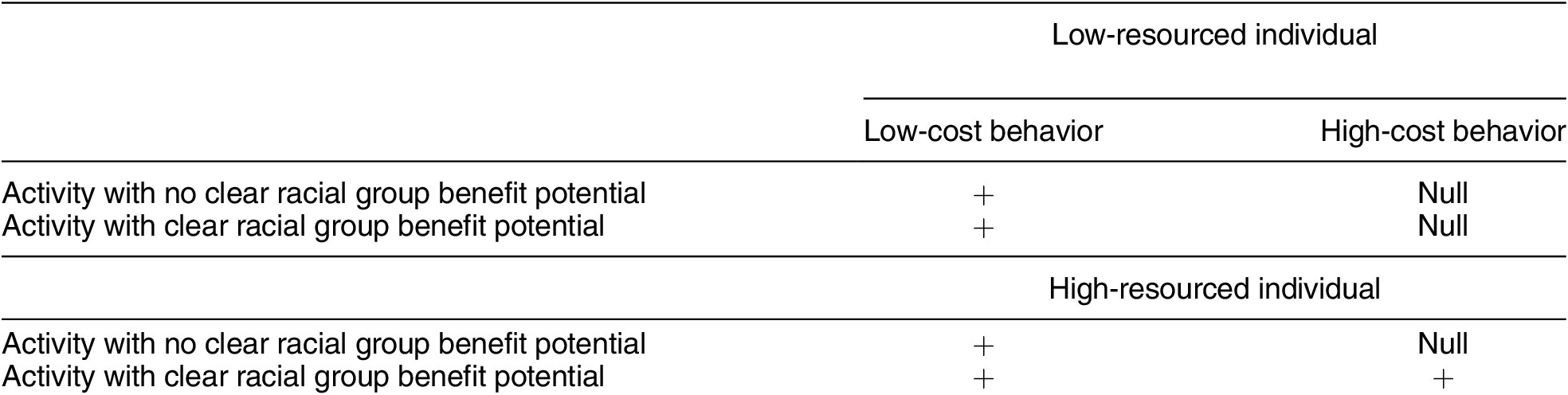
From this discussion we offer four conjectures about how RGC factors into the calculus of Black Americans’ choices to engage in political activism.Footnote 5 These expectations are summarized in Table 1. First, because RGC is a politicized identity, it should exhibit a positive relationship to low-cost political engagement irrespective of whether the political activity holds the potential for racial group benefit (rows 1–4, column 1 of Table 1). In other words, the act of being aware and willing to articulate one’s place within the American racial hierarchy and the political implications thereof is indicative of some nontrivial level of political engagement. This will almost certainly be correlated with, if not determinative of, engagement in other low-cost forms of political expression (see Verba, Schlozman, and Brady Reference Verba, Schlozman and Brady1995). Second, for more costly forms of political action, RGC will no longer be sufficient, on its own, to motivate political engagement. As the cost of political engagement increases, so too will the need for politically relevant resources which determine individual capacity to take part in politics. In other words, we do not expect low-resourced individuals who do not have the capacity to engage in politics to participate in high-cost political activities, regardless of the potential to benefit the racial group or their own RGC (rows 1 and 2, column 2 of Table 1). Third, once an individual has access to the necessary participatory resources, we argue that there must then be some clearly understood potential for a racial group-relevant benefit from that political activity to justify the expenditure of resources on political engagement. To state this another way, because RGC’s ability to motivate engagement in costly political activity is dependent on access to the necessary participatory resources, a clear potential for group empowerment will lead well-resourced, high-RGC Black Americans to see the benefits of political engagement as outweighing the potential satisfaction they would get from using resources for some alternative purpose (row 4, column 2 of Table 1). Finally, when in the absence of a clear path to racial group empowerment from costly political engagement, RGC beliefs will be less important to motivating political engagement as resource-rich Black Americans high in RGC will have difficulty seeing the payoff of investing resources into costly political engagement (row 3, column 2 of Table 1).
Expected Relationship between Racial Group Consciousness and Political Action by Costliness, Group Relevance and Individual Resources
RGC AND CAMPAIGN ACTIVITY
To understand how group relevance, costs, and resources interact with RGC to shape Black political behavior, we begin by examining the dynamics of Black American campaign activism in the presidential election years from 1984 to 2020. This period is illustrative for several reasons. These elections uniquely allow us the ability to examine how the relationship between RGC and campaign activism changes as a function of having either a nearly unanimously supported Black candidate on the ballot for president or vice president, as was the case in the 1984, 1988, 2008, and 2012 primary elections and the 2008, 2012, and 2020 general elections, or an election in which viable Black presidential or vice presidential candidates were absent, as was the case in 1992, 1996, 2004, and 2016.Footnote 6 Although we recognize that the 1984 and 1988 primary elections, 2008 and 2012 primary and general elections, and 2020 primary and general elections are different in both candidates and context, all featured viable Black presidential or vice presidential candidates. We treat the desire to elect and reelect the nation’s first Black president or vice president as a group-based objective because a great deal of literature in political science suggests that Black Americans generally desire racially descriptive representation from Democratic elected officials (Mansbridge Reference Mansbridge1999; Sinclair-Chapman and Price Reference Sinclair-Chapman and Price2008; Tate Reference Tate2004). This literature contends that Black voters’ preference for racially descriptive representation arises from their use of race as a shortcut for substantive representation of racial group interest. However, this literature also points out that Black voters are quite aware that not all Black candidates support what is commonly understood as Black collective interests (Harris Reference Harris2012). Black Americans use party to distinguish between those Black candidates whose views on race and politics more closely align with that of the average Black American (Democrats) and those whose views do not (Republicans) (White and Laird Reference White and Laird2020). Thus, for Black voters, the ideal representative is a Black Democrat.
Jesse Jackson, the second Black person to run for the Democratic primary in the post-Civil Rights era, was able to win five Democratic primaries/caucuses in 1984, and Barack Obama’s early win in the 2008 Iowa caucus and his better-than-expected showing in New Hampshire were important signals to Black voters that the candidates were credible contenders for the Democratic nomination and perhaps even the general election. While Kamala Harris’s presidential campaign never secured substantial Black support, the announcement of Harris as Joe Biden’s running mate during the 2020 general election transformed the Democratic ticket and led to overwhelming support from Black voters.Footnote 7 While many Black candidates ran for both the Democratic and the Republican presidential nominations during this time, only these candidates (Jackson, Obama, and Harris) were able to convince Black voters that they might have a legitimate chance of winning either the primary and/or general elections, and being elected as the first Black president and vice president.
Lastly, this period is also ideal because we have several high-quality election surveys with large Black samples: the National Black Election Studies of 1984, 1988, and 1996; the 1993 National Black Politics Study; and the collection of larger-than-normal Black samples in the 2004, 2008, 2012, 2016, and 2020 ANES (American National Election Studies 2004–2020; Dawson, Brown, and Jackson Reference Dawson, Brown and Jackson1998; Jackson Reference Jackson1993; Tate Reference Tate1998).Footnote 8 These data are important because they also have a broad range of RGC measures and self-reported campaign activism measures.
To assess the extent to which RGC might moderate the effect of racial relevance of a political activity on Black Americans’ decision to participate, we begin by examining how the relationship between RGC and a general measure of campaign activism might change when respondents see a widely accepted racial group benefit that would result from political activity. Here we consider the 1984 and 1988 Jackson campaigns, 2008 and 2012 Obama campaigns, and the 2020 Biden/Harris campaign as having clear group-based goals for Black Americans. We compare Black Americans’ primary and general election campaign engagement during these election cycles to their engagement in campaign years without Black candidates or any particularly viable Black candidates. Comparing Black political activity across these elections, we can get a sense of how having a clear group-based political goal interacts with RGC to motivate Black Americans into political action.
There are many different measures of RGC, each of which captures different dimensions of the concept. Originally, Verba and Nie (Reference Verba and Nie1972) assessed the number of mentions to race that Black respondents made in open-ended responses and used this as a measure of RGC. More recent work has gone to great lengths to capture the dimensionality of the RGC concept more accurately. This work has sought to capture this dimensionality with, among other things, indicators for assessments of group closeness (Leighley and Vedlitz Reference Leighley and Vedlitz1999), commitments to collective action (Chong and Rogers Reference Chong and Rogers2005), linked fate (Sanchez and Vargas Reference Sanchez and Vargas2016), and system blame and discrimination (Miller et al. Reference Miller, Gurin, Gurin and Malanchuk1981). Because of these debates about dimensionality, RGC operationalization is inconsistent. Some scholarship uses one or two items to capture the concept (Smith Reference Smith2014), others create a unidimensional, interactive composite scale of several RGC measures (Austin, Middleton, and Yon Reference Austin, Middleton and Yon2012), while a third approach assesses the additive, independent effects of each dimension separately with scales (or single measures) of the various dimensions (Chong and Rogers Reference Chong and Rogers2005). We expect that some of the over-time variability in the predictive ability of RGC likely results from the absence of a settled measurement approach to assess RGC. We choose to use a single-scale measure of RGC that includes all theoretically relevant RGC items from a given data source. By theoretically relevant, we refer to measures that are consistent with both the original conceptualization of RGC as a self-conscious awareness of membership in a disadvantaged racial minority group and the more expansive measures offered by more recent RGC research. While this is perhaps not the ideal measurement strategy, the benefit of this approach is that because most data sources have only a few RGC measures in common (because of the lack of consensus on measurement strategy), creating a scale of all measures within a given data source allows for some degree of reliability in measurement over time.Footnote 9 For example, if in year A, RGC items X, Y, and Z were measured, but in year B, only items V, W, and X were measured, we cannot directly compare the effects of items V and W with Y and Z across years and are only left with a single measure to compare because X is the only measure that is consistent across all years. However, if we assume that all are valid measures of RGC and we create a scale across all the given measures within that year, we can have not only a more reliable measure of RGC, as aggregating across multiple measures of the same concept improves reliability, but also a measure that is comparable across data sources and years (see Ansolabehere, Rodden and Snyder [Reference Ansolabehere, Rodden and Snyder2008] for more on this point). The codebook in the American Political Science Review Dataverse provides items and year of availability of survey measures across survey-years (Smith et al. Reference Smith, Clemons, Krishnamurthy, Mclaren and White2023).Footnote 10
We limit our focus here specifically to campaign activism because our objective is to assess the relationship between RGC and Black political participation conditional on a group-based goal. Ideally, we would analyze a broad range of political activities such as protesting and boycotting. However, given the general way that such activities are measured in most surveys, we cannot know if those actions are specifically intended to bring about some benefit for the racial group. To compensate, we examine a broad range of campaign activities, including voting, having a campaign sign/button/bumper sticker, asking someone to vote for a particular candidate, working for a campaign, and contributing money to a campaign, and we define the group-based goal as the election of a Black official.Footnote 11 Again, the expectation here is that Black Americans, particularly those high in RGC, have an interest in electing Black Democrats because they see Black Democrats as more likely to represent their racial group interest. In an effort to achieve this end, racially conscious Black citizens will thus devote more time, effort, and money to the campaigns of these Black Democrats.
RESULTS
To begin our analysis, we examine RGC as a predictor of generalized campaign activity in each presidential election year from 1984 to 2020. Campaign activism is measured as a proportion of the total number of activities the respondent reported engaging in during that election year.Footnote 12 We estimate simple OLS models predicting the relationship between the RGC scale and Black campaign activism within a given year and control for education, age, sex, income, religiosity, and political attention. The results, presented in Figure 1, are consistent with our expectation that RGC is more likely to be related to Black campaign activism in the election years that featured viable Black candidates. As we can see, RGC exhibits a significant positive relationship with Black campaign activism in each of the years that Jackson ran for the Democratic nomination (1984 and 1988), in both Obama years (2008 and 2012), and in 2020 when Harris ran as the vice presidential nominee. On average, although RGC is related to Black campaign activism in some years, the relationship between Black campaign activism is both substantively and significantly smaller in the non-Black candidate years (p = 0.01). In other words, in the absence of viable Black candidates or opportunities for engagement in political activities that benefit the racial group, RGC predicted only modest increases in Black campaign activity or simply has no statistically significant effect on Black campaign activity. However, when either Jackson, Obama, or Harris emerged as viable candidates for the presidency, RGC appeared to predict engagement in a broader range of campaign-related activities. This supports our expectation that RGC is positively related to political activity that is relevant to the racial group.
Relationship between Racial Group Consciousness and Campaign Activity among Black Respondents by Election Year
Note: Dark-colored estimates/confidence intervals represent years that feature a viable Black presidential or vice presidential candidate. More lightly shaded estimates/confidence intervals represent years that did not feature a viable Black candidate. Bars represent 95% confidence intervals. Campaign activity is measured by the proportion of activities measured in that year. This ranges from six activities in 1988 to eight activities in 2012 (see the codebook in the APSR Dataverse for list of variables by year; Smith et al. Reference Smith, Clemons, Krishnamurthy, Mclaren and White2023). Table A.1 in Appendix 1.1 of the Supplementary Material presents the tabular results to this figure.

MORE AND LESS COSTLY POLITICAL BEHAVIOR
Although we believe racial relevance is essential to RGC’s ability to motivate Black Americans into political activity, if the cost of engaging in political action is too great, even the most highly racially conscious Black Americans will have difficulty participating in politics that benefits the racial group. In this section we turn to assessing how the cost of engagement and availability of resources might condition the motivational effects of RGC under the different group relevance conditions discussed above. We do this first by assessing how the relationship between RGC and political engagement changes as we move from less costly to more costly political activities. We then assess how access to participatory resources conditions the relationship between RGC and political engagement for more costly forms of political engagement. We find that while RGC exhibits a consistently strong relationship with engagement in low-cost political behavior regardless of group relevance of the outcome, when the engagement becomes more costly, Black Americans who are high in RGC and who have the necessary participatory resources are more willing to assume these costs if the political activity has the potential to benefit the racial group.
To assess how the relationship between RGC and political participation changes as the activity becomes more costly, we examine differences in the relationship between RGC and turnout (low cost) and campaign contributions (high cost) across the Black candidate years (Jackson/Obama/Harris) and the non-Black candidate election years (non-Jackson/Obama/Harris).Footnote 13 These results are presented in Figure 2.Footnote 14 Again, if these results align with our expectations, then we should observe a stronger positive relationship between RGC and both turnout and contributing during the Black candidate years than in the non-Black candidate years. Additionally, this difference should be less pronounced for turnout than contributing because turnout is a low-cost political activity.
Predicted Probability of Racial Group Consciousness and Turnout/Campaign Contributions, Conditional on Relevance of Campaign
Note: Estimates show the predicted probability of turning out to vote (left) and contributing to a campaign (right), conditional on the relevance of the campaign to the racial group. Solid lines represent years where a Black candidate was not running for president/vice president, whereas dashed lines represent years where a Black candidate was running for president/vice president. The area around the lines represent 95% confidence intervals. Table A.2 in Appendix 1.1 of the Supplementary Material presents the tabular results to this figure.
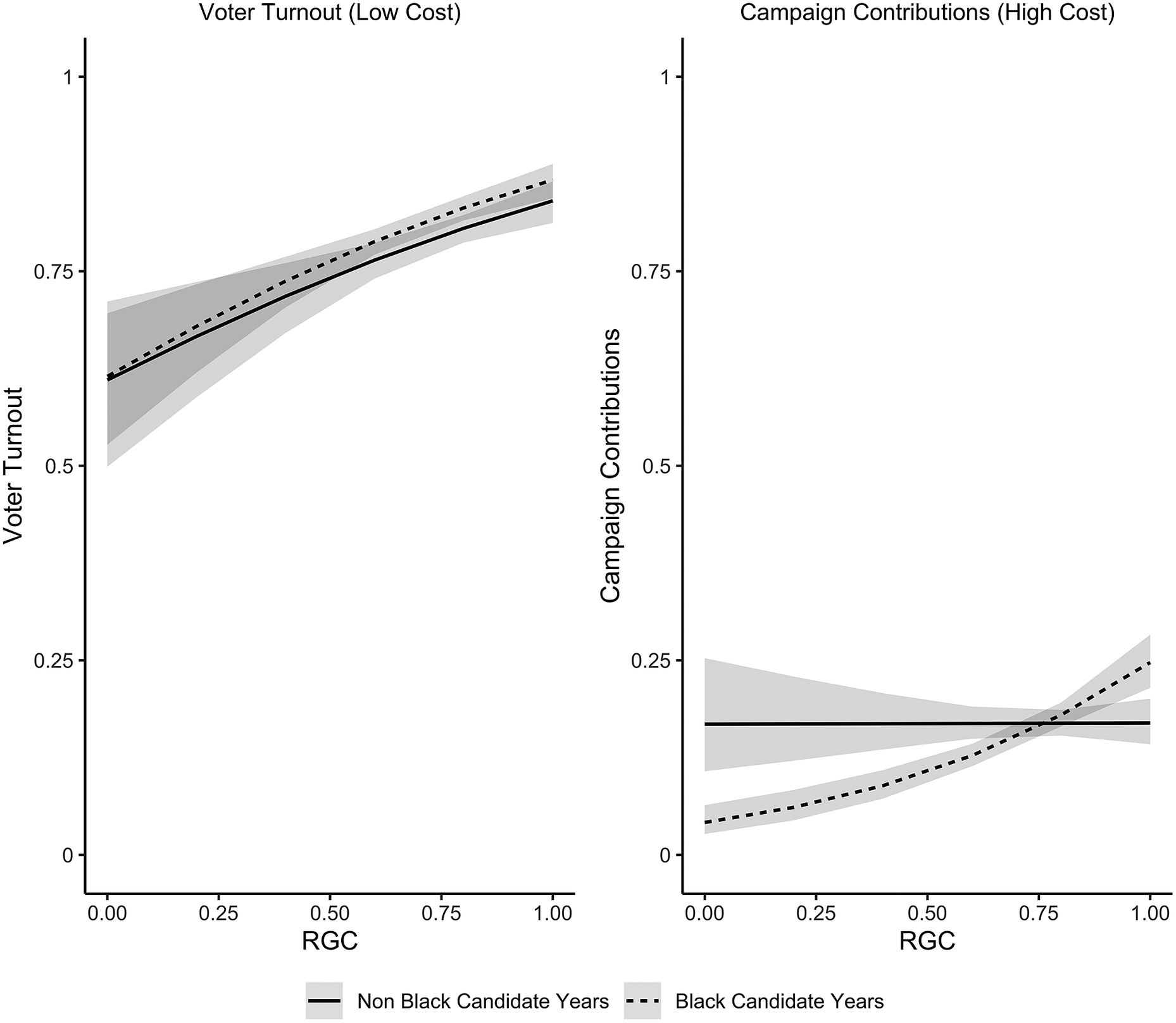
Several important takeaways emerge from this analysis. First, and not surprisingly, Black Americans were more likely to vote than contribute money to a campaign; this difference exists irrespective of RGC and racial relevance. This overall higher probability of turning out relative to contributing highlights the relative cost differential across these two activities. Second, RGC is positively related to turnout in both the non-Black candidate years and the Black candidate years. This is consistent with the conjecture that the political content of RGC is sufficient to motivate political action in low-cost behavior regardless of racial relevance. Third, RGC is only statistically significantly related to campaign contribution when Jackson/Obama/Harris ran, but not in the non-Jackson/Obama/Harris years. In the Jackson/Obama/Harris years, moving from low-RGC to high-RGC results in almost a 25% increase in the probability of Black Americans donating to a campaign. In the non-Jackson/Obama/Harris years, there exists no increase in the probability of donating as RGC increases. This confirms our expectation that as the cost associated with political participation increases, high-RGC Blacks are only willing to assume these costs when the behavior has some potential to benefit the racial group.
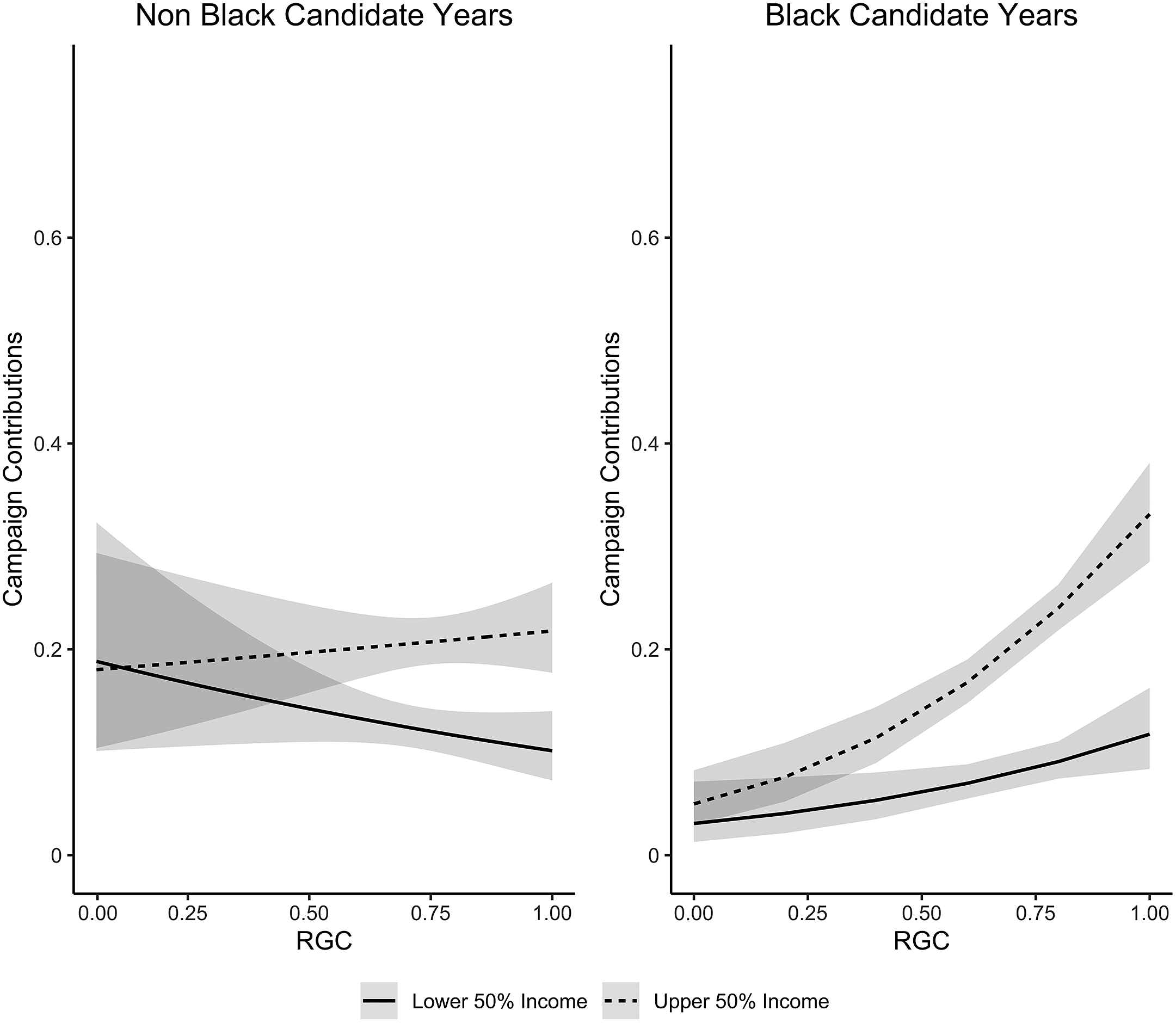
If the observations derived from Figure 2 are true, then we should also see that access to participatory resources will condition the relationship between RGC and political engagement when that behavior has some group-relevant benefit. To evaluate this expectation, we return to assessing the effects of RGC on campaign contributions (high-cost behavior). Here we model changes in the relationship between RGC and Black campaign contributions by interacting RGC with a categorical measure of family income.Footnote 15 We assess whether this relationship changes as we move from the non-Black candidate years to the Black candidate years. If our results align with our expectations, we should find that only high-resourced individuals who are high in RGC will engage in this high-cost political activity, and only when the political activity is relevant to the racial group (Black candidate years). On the other hand, in non-Black candidate years, we should not find that high-resourced individuals that identify with the racial group will contribute to these political campaigns.
Figure 3 shows that access to surplus income greatly enables engagement among high-RGC Black Americans, and the absence of this resource attenuates any potential motivational effects of RGC. In the Black candidate years, we see that going from low to high RGC among high-income Black Americans results in about a 25-percentage point increase in the probability of Black Americans donating to a campaign. Thus, it is those Black Americans who possess both the will (high RGC) and the capacity (high financial resources) to contribute to the cause of electing/reelecting a Black president or vice president who are most likely to make campaign contributions. While this relationship clearly highlights the conditional effect of income on how RGC relates to political behavior when a Black person is on the presidential ticket, it should be noted that the three-way interaction between RGC, income, and the presence of a Black candidate is not statistically significant.Footnote 16 This means that the conditional relationship between income and RGC on campaign contributions in the Black candidate years is not statistically distinguishable from that observed in the non-Black candidate years. There are many reasons this could be the case. We treat this as suggestive evidence of the effect of RGC on racial group relevance and capacity to participate. In the sections that follow we design a series of experimental tests that help us disentangle how the capacity to participate and the relevance of the political activity to the racial group condition the relationship between RGC and political participation.
Predicted Probability of Racial Group Consciousness and Campaign Contributions, Conditional on Income
Note: Estimates show the predicted probability of contributing to a campaign in non-Black candidate years (left) and Black candidate years (right), conditional on respondent income. Solid lines represent respondents in the lower 50% of the income category, whereas dashed lines represent respondents in the upper 50% of the income category. The area around the lines represents 95% confidence intervals. Table A.3 in Appendix 1.1 of the Supplementary Material presents the tabular results to this figure.
In summary, the results presented above show suggestive evidence that the relationship between RGC and political engagement is conditional on both the potential outcomes of political action for the racial group and the variation in the resources available to individual Black Americans. RGC motivates Black campaign participation decisions during the viable Black candidate elections more than it did during any of the elections which lacked viable Black presidential candidates. The desire among high-RGC Black Americans to elect a Black president or vice president is strongly related to their political participation. It leads them to engage in a broad range of campaign activism, suggesting the strong possibility of a causal connection between RGC and political activism. Furthermore, for more costly political activity, capacity appears to be a necessary condition for RGC to result in political action. RGC only predicts increased engagement in high-cost political activity among those Black Americans that already have the resources (in this case money) necessary for engagement and only when the activity benefits the group. These observations suggest that while RGC may work to remediate racial differences in political participation and motivate Black Americans into low-cost political activity, for costly political engagement, RGC seems to largely benefit well-resourced and privileged Black Americans.
AN EXPERIMENTAL APPROACH TO ASSESSING RGC
The conditions we outline above for understanding how RGC factors into Black political decision-making suggest that we need to distinguish behavior that has clear group-based outcomes from behavior that does not, and then observe the effect of RGC under conditions in which capacity to engage is equal across individuals. While the survey evidence offered above highlights the importance of these considerations, the challenges of using survey data to both accurately assess engagement in political activity and reliably sort out confounding factors limit our ability to identify the conditions under which RGC factors into Black decision-making. For example, it is well recognized that in surveys, citizens frequently overstate the degree to which they participate in politics (Hanmer, Banks, and White Reference Hanmer, Banks and White2014). Even the highest-quality surveys frequently overestimate turnout by as much as 15 percentage points (Enamorado and Imai Reference Enamorado and Imai2019). Some researchers suggest that overreporting may be even greater among racial minorities, particularly when the behavior involves some commonly understood group-based outcome (Stout and Martin Reference Stout and Martin2016). Furthermore, despite having observed a strong connection between RGC and political behavior among resource-rich Black Americans, resources are not randomly assigned and are often strongly related to a number of other factors including RGC (Chong and Rogers Reference Chong and Rogers2005; Dawson Reference Dawson1995; Laird Reference Laird2019), making disentangling the effects of SES from RGC nearly impossible in observational data.
To address these concerns, we designed a set of experiments that allow us the ability to directly observe the relationship between RGC and Black Americans’ engagement in costly political action that may produce group benefits. We also hold access to relevant participatory resources constant by randomizing the treatment such that the participants in all experimental groups should have the same average levels of income. This set of experiments gives Black respondents the opportunity to take part in actual political behavior with well-defined costs to the individual. These experimental designs seek to equalize the capacity to participate by providing subjects with surplus participatory resources, in terms of time and money, that they can then use to take part in the political activity. These experimental designs allow us to assess whether self-identified Black microtask workers choose to commit more time or use surplus money to support a Black political cause or support a race-neutral political cause, or simply choose to keep the money for themselves or dedicate their time to some other purpose. If RGC is a psychological resource that can motivate Black Americans into political action, then standardizing capacity and randomizing the racialized nature of the political cause should allow us the ability to observe the relationship between RGC and Black political engagement in a context largely unconfounded by access to relevant resources.
The two behavioral experiments assess the extent to which respondents will engage in costly political behavior for the racial group. All respondents in the survey self-identified as Black/African American. One experiment uses monetary donations to Black or nonracial organizations as the dependent variable, while the other assesses the time or number of questions Black respondents are willing to answer to help the organization meet its political goals. The monetary contribution/support experiment was fielded over the Lucid and MTurk online platforms in December 2019, and the time/effort contribution experiment was conducted on Lucid and MTurk in March and April 2020. Results from the monetary experiment pools the Lucid and MTurk survey data, but we provide an analysis separately by platform in Appendix 1.9 of the Supplementary Material. The monetary contribution experiment includes 580 Black respondents, whereas the effort contribution experiment includes 815 Black respondents.
Appendix 1.6 of the Supplementary Material provides descriptive statistics and balance checks for the treatment conditions of both experimental samples. Descriptive statistics show that nearly 70% of respondents in our sample are women and nearly three-quarters of the sample is composed of Democrats. This limited variation in respondent characteristics is not new. Coppock and McClellan (Reference Coppock and McClellan2019) find that respondents in convenience samples tend to be more female and Democratic than nationally representative samples. Even in probability samples like the ANES, Black women tend to be overrepresented within the Black sample. For example, 65% of Black respondents in the 2020 ANES are women and 60% of Black respondents in the 2016 ANES are women. The fact that nearly three-quarters of respondents in our sample are Democrats should also not be concerning given the overwhelming support of the Democratic Party among Black Americans, as discussed above. To account for this we perform the same analysis and reweight for gender in Appendix 1.12 of the Supplementary Material. Nonetheless, this information may concern some who suggest that data collected by convenience samples are not as generalizable as data from other survey companies that provide national probability samples (Krupnikov and Levine Reference Krupnikov and Levine2014). Recent work, however, finds that respondents from convenience samples respond in similar ways to other populations (Berinsky, Huber, and Lenz Reference Berinsky, Huber and Lenz2012). Moreover, as one of our central theoretical contributions compares RGC’s ability to motivate political action among the resource-poor and resource-rich, we can leverage the income- and time-maximizing incentives that govern online microtask workers such as those who take surveys. Because respondents in these types of convenience samples are incentivized by money, in the monetary contribution experiment, we give everyone in the study $10. This equalizes the ability of all respondents to give money to an organization since all respondents are given the same amount of money to donate. Similarly, in the time experiment, since microtask workers are incentivized to complete as many surveys as possible in the limited time during the day and all respondents are given the option to answer the same number of additional questions, the time commitment all respondents have is equalized so microtask workers can choose whether to use this time to give information to an organization or use it to complete another survey or some other tasks.
Study 1: Monetary Contribution/Support Experiment
In the first experiment we observe the effect of RGC on both low- and high-cost racial-group-specific and nonracial-group-specific political activity. Here we had Black microtask workers answer a set of questions measuring different dimensions of RGC along with questions assessing their demographic backgrounds. We then, in some cases immediately and in some cases days after,Footnote 17 had each respondent read information and view images taken from the website of an actual voter registration organization. Subjects were randomly assigned to see web content taken from either an organization whose mission was to increase Black voter registration or an organization whose mission was to increase general voter registration. For the Black voter registration organization, race was indicated explicitly in the text of the organization description and the photos associated with the organization. For an image of what these stimuli looked like to study participants, see Appendix 1.5 of the Supplementary Material.
Upon seeing this information, subjects were then asked how supportive they were of the organization’s mission. Support was assessed on a 0–10 scale with 10 being extremely supportive. We treat this measure as a measure of low-cost political engagement. Upon reading the website information and answering the supportiveness question, respondents were then told that they were going to be given $10 and that they could keep the money for themselves or donate some or part of it to the voter registration organization they just read about. We also assured the subjects that they had no obligation to contribute any of the money to the organization and that if they chose to keep any of the money, it would be credited to them directly as an MTurk bonus or as an Amazon gift card emailed to Lucid respondents within a week of completing the study. If they chose to give the money, we assured them that we would see to it that the money was given to the organization within a couple of weeks of completion of the study, and we followed through on this promise.
By giving Black online microtask workers a relatively large sum of money, $10 in addition to the small amount they are paid for their participation in the study, and asking them if they would like to contribute some or all of it to an actual voter registration organization, we are able to devise a measure of “actual” political engagement, and we are able to hold capacity to participate relatively constant across respondents. Additionally, the fact that these are microtask workers, working at relatively the same rate, further ensures a common understanding of what respondents are giving up when they contribute. This allows for an estimation of the effect of RGC that is relatively independent of resource inequities.
Given this design, we expect that if RGC is a resource for motivating support of Black political causes, the contributions to the Black organization will be greater among Black Americans high in RGC and that RGC will not factor into Black respondents giving to the race-neutral organization. We will assess this expectation by examining how the relationship between the RGC measure and Black political behavior changes as we move from low-cost (expression of support) to high-cost political behavior (monetary contributions) for a Black or race-neutral organization.
RESULTS
We begin our analysis by looking at the baseline levels of supportiveness and contributions across conditions as can be seen in Appendix 1.7 of the Supplementary Material. If RGC motivates Black Americans into self-sacrificing support for Black political causes then we might see both greater stated support for Black organizations and more willingness to contribute to these organizations, given that we have equalized capacity to contribute. Examining the baseline supportiveness and contribution levels across conditions we find that Black respondents were both more supportive and more likely to contribute to the Black voter registration organization than to the race-neutral voter registration organization. On the 0–10 support scale our Black participants expressed significant support for the Black voter registration organization, giving it a 7.45 out of 10. Black participants were also strongly supportive of the race-neutral organization (6.45), but not quite to the same extent as they were of the racial in-group organization. This suggests that although Blacks generally support the cause of voter registration, they are significantly more supportive of that cause when it specifically seeks to empower Black Americans. When it comes to making actual monetary contributions, the participants in our experiment were much less willing to express similar levels of support in dollars. The average contribution (from the $10 given to the respondent) to the Black voter organization was $3.54 and the average contribution to the race-neutral organization was only $2.71. About eighty cents more was contributed to the Black voter registration organization, and the difference across these organizations is statistically significant (p < 0.05). In sum, we find here that Black respondents in this study are more likely to both state their support of a Black political cause and financially contribute to that cause. These observations are, on the one hand, consistent with RGC research, which suggest a greater engagement with Black political causes. These results also highlight the disjuncture between the expressive measures of political engagement used in most surveys and actual political behavior.
Having demonstrated the baseline effect of our experiment we now turn to assessing how RGC might perform as a predictor of support and contribution, given our group relevance manipulation and our ability to hold the capacity to participate constant. As we did with the survey analysis, we created a single measure of RGC that broadly captures its many dimensions. The RGC scale includes 17 different measures of RGC and was validated by factor analysis.Footnote 18 Below we model this relationship by predicting low- and high-cost (support/contribution) political behavior with our RGC measure. If the results follow our predictions about the nature of RGC conditional on racial relevance and cost, then we should observe that RGC predicts support of both the Black organization and race-neutral organization. If, as we suggest however, RGC does play a role in motivating Black Americans into costly political behavior, then we should observe that as RGC increases, so too should contributing only when these activities have a clear path toward Black empowerment.
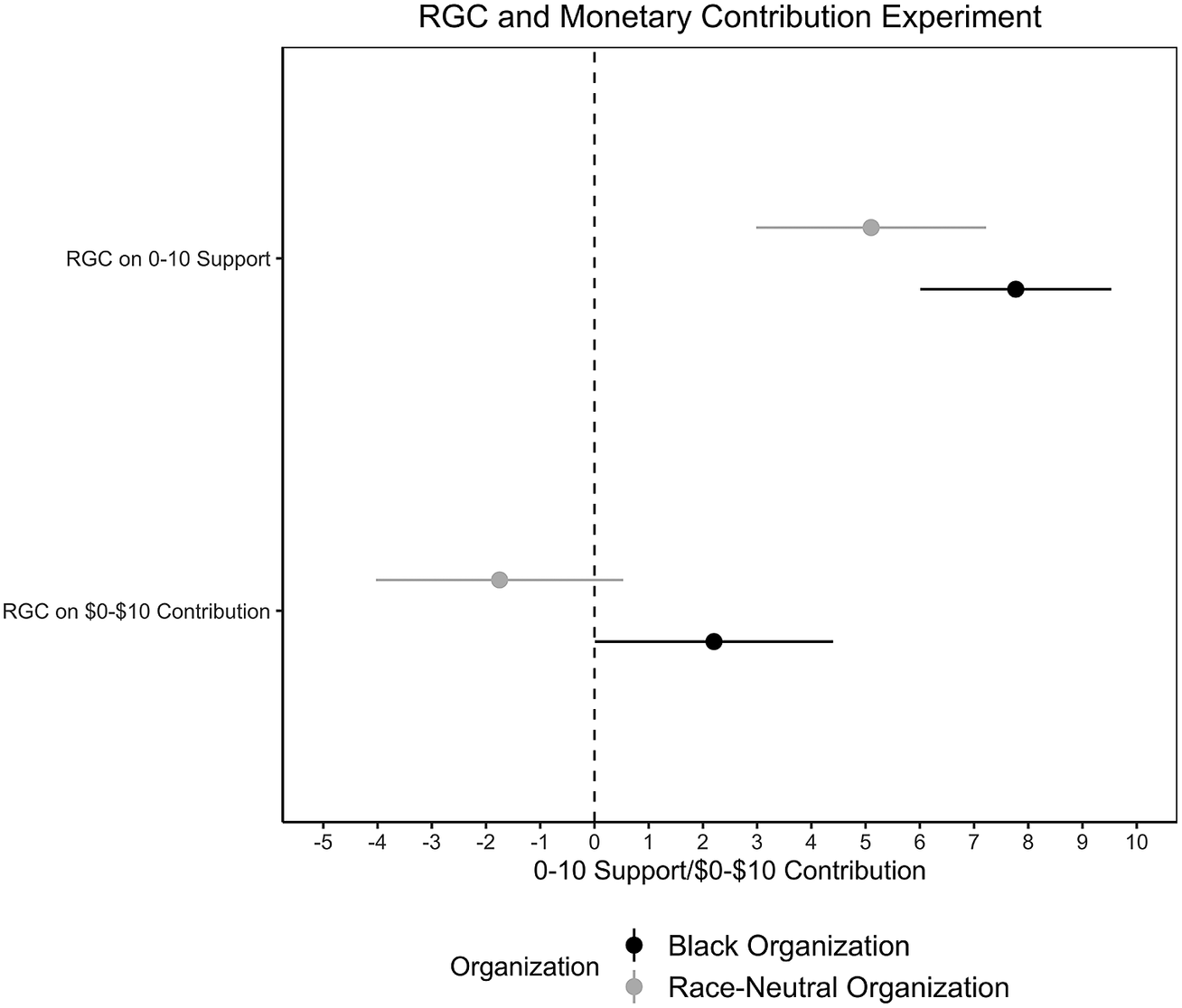
The results of this analysis are presented in Figure 4. As we can see, RGC predicts Black Americans’ engagement in low-cost political activity. The effect of RGC on stated support is roughly equal across both the race-neutral and the race-specific organizations. Moving from low to high RGC results in about a six-point increase on the 0–10 supportiveness scale, suggesting that RGC strongly motivates engagement in low-cost political activity. When we move to observing RGC’s relationship to costly political engagement, however, we see a significant decrease in the predictive power of the RGC measure. Importantly, RGC no longer predicts contributing to the race-neutral voter registration organization. In fact, the RGC measure demonstrates a negative but insignificant relationship with contributing to the race-neutral organization. In the Black voter registration organization condition, RGC exhibits a statistically significant (p < 0.05) positive relationship to contributing to the Black voter registration organization and, despite this relationship being weaker than organizational support, moving from low to high RGC nonetheless results in about a $2.50 increase in contributions to the Black organization. Regressions with an interaction between the experimental condition and RGC confirm that the coefficients in Figure 4 are significantly different from one another (p < 0.05; see Appendix 1.12 of the Supplementary Material). Lowess estimates of these relationships (see Appendix 1.10 of the Supplementary Material) confirm the robustness of these results and demonstrate both that this effect is driven by high-RGC Black Americans contributing more to the Black organization and that the RGC contribution effect differs significantly across organizational conditions (p < 0.05). In addition, these results are robust to controls for respondent income (see Appendix 1.12 of the Supplementary Material). These effects are also substantively large; respondents donated 25% of their possible compensation, and if voter mobilization organizations receive hundreds or even thousands of such contributions, willingness to contribute even $2.50 is meaningful.
Relationship between Racial Group Consciousness and Organizational Supportiveness and Organizational Contribution by Racial Empowerment Treatment
Note: Dark-colored estimates represent respondents randomized to see the Black organization. More lightly shaded estimates represent respondents randomized to see the race-neutral organization. The estimates at the top represent respondents’ stated support, whereas the estimates at the bottom represent respondents giving $0–$10. Bars represent 95% confidence intervals. The models include a control for survey platform. Table A.4 in Appendix 1.1 of the Supplementary Material presents the tabular results to this figure.
Study 2: Time/Effort Contribution Experiment
Next, we test our resource and racial relevance explanation of RGC by examining how RGC relates to Black Americans’ willingness to devote their time to a Black political cause by testing Black online microtask workers’ time commitments. Study participants had the option to devote their time to helping a Black or race-neutral political cause or to use it for their own purposes. To do this, respondents were randomly assigned to see the same descriptions of either the Black or the nonracial voter registration organizations from the previous study. As in the contribution study, they were then asked a question assessing their overall support for this organization. Unlike the previous study, participants here were told that organizations such as these are often seeking feedback from citizens for their outreach efforts and recruiting practices. They were then asked if they would be willing to answer a series of questions (10 in total) and provide feedback to help the organization. Participants were told that they were under no obligation to provide feedback and their compensation ($1.00) would be unaffected by the number of questions they responded to. Although the subjects were not told how many questions were included, they were reminded after each question that they could quit at any time by simply clicking a button labeled “Skip to the end of survey.”
By testing Black study participants’ time commitments, we were able to see if they were more likely to contribute more time to a political cause looking to empower Black Americans, or if they simply would decide that their time was better spent doing something else. We assessed the degree to which Black respondents provided feedback by counting the number of feedback questions out of 10 that the respondent chose to answer.
First, we assess the mean responses to the supportiveness questions and the mean number of feedback questions answered by each respondent across each condition (Appendix 1.7 of the Supplementary Material). As with the contribution experiment, Black participants expressed more support for the Black voter registration organization than for the race-neutral registration organization. Unlike the contribution experiment, however, Black subjects in this study were no more willing to devote their time to helping the Black voter registration organization than to helping the race-neutral voter registration organization. Black participants answered on average less than two (1.02) feedback questions when the feedback benefited a Black organization and 0.99 questions when the feedback was meant to benefit a race-neutral voter registration organization; the difference in number of questions answered across conditions is not statistically significant (p = 0.83).
Although we were unable to observe differences in the amount of time and effort Black Americans were willing to devote to helping a Black political organization versus a race-neutral political organization, RGC may still play a role in shaping respondents’ willingness to assist these organizations, particularly the Black voter registration organization. To see if this is the case, we estimated the relationship between RGC and both stated support for and willingness to give feedback to the Black or race-neutral organization. If the results follow our predictions, then we should observe that RGC predicts support for both the Black organization and the non-race-specific organization, but we should only observe an increase in the number of questions answered when RGC increases and when Black respondents are answering questions for the Black organization.
At first glance, the results of this analysis, presented in Figure 5, support the argument that RGC helps facilitate Black engagement in costly political action. The estimates presented in Figure 5 reveal a similar pattern to what we saw in the contribution study: (1) a strong relationship between supportiveness and RGC for both the Black and the race-neutral organizations, (2) a smaller but still statistically significant relationship between RGC and willingness to devote resources to the Black organization, and (3) a noticeably smaller and statistically insignificant relationship between feedback and RGC for the race-neutral organization.
Relationship between Racial Group Consciousness and Organizational Supportiveness and Organizational Feedback by Racial Empowerment Treatment
Note: Dark-colored estimates represent respondents randomized to see the Black organization. More lightly shaded estimates represent respondents randomized to see the race-neutral organization. The estimates at the top represent respondents who stated support, whereas the estimates at the bottom represent the number of questions respondents answered. Bars represent 95% confidence intervals. Table A.5 in Appendix 1.1 of the Supplementary Material presents the tabular results to this figure.
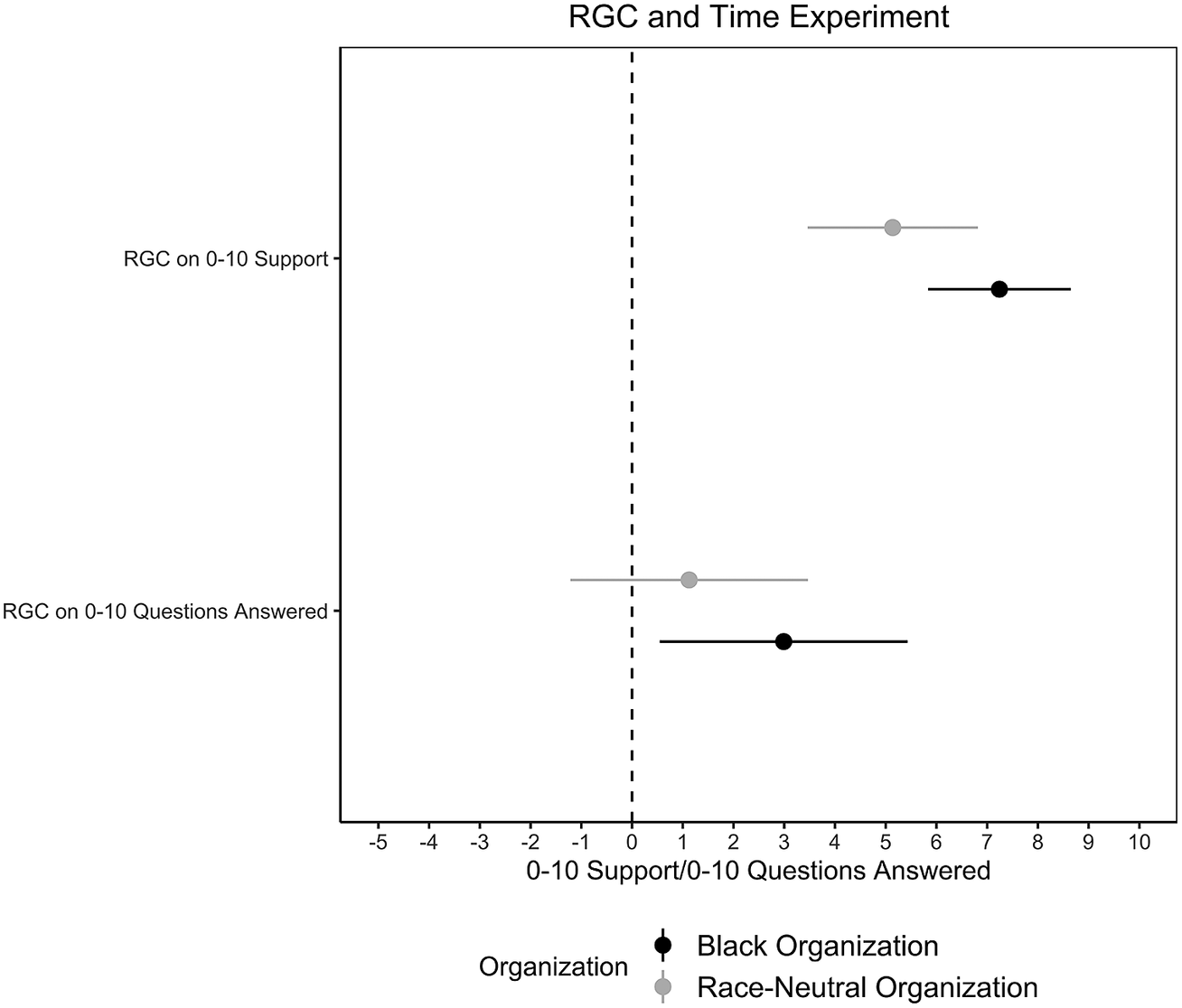
Upon closer examination, however, this result does not seem to be as robust as what we observed in the contribution study. Lowess estimates (see Appendix 1.10 of the Supplementary Material) suggest that much of the relationship between RGC and Black organizational feedback that we see in Figure 5 is driven by low-RGC Black Americans being particularly unwilling to provide feedback to the Black organization. High RGC Black Americans exhibit no differences in the number of questions answered across conditions. Similarly, regressions interacting the experimental condition with RGC do not find statistically significant differences between the effect of RGC in the Black organization condition and the effect of RGC in the race-neutral organization condition (see Appendix 1.12 of the Supplementary Material for full results).Footnote 19 One explanation for this may be that time is simply a more difficult resource to experimentally manipulate, at least relative to money. Our attempt to assess the respondents’ use of time may be complicated by the fact that the ultimate goal here may actually be money and respondents are likely valuing their time differently. Despite these challenges, the results of this experiment, at least as they relate to RGC, are somewhat consistent with what we observed in the monetary experiment and offer at least suggestive evidence that RGC may motivate greater political engagement. More work needs to be done to figure out how citizens weigh time, particularly relative to money, in their participation decisions.
CONCLUSION
When Verba and Nie published Participation in America in 1972, they likely did not anticipate that one of its most lasting contributions would be its observations related to Black political engagement and RGC. Despite being a seemingly secondary attempt to explain the unexpected observation that Black Americans participated at higher rates than their model would have predicted, Verba and Nie’s findings related to RGC would ultimately become the theoretical basis of some of the most influential work within behavioral REP research (Dawson Reference Dawson1995; Gurin, Hatchett, and Jackson Reference Gurin, Hatchett and Jackson1990; Miller et al. Reference Miller, Gurin, Gurin and Malanchuk1981). While scholarship provides mixed evidence about whether RGC explains Black political behavior, it and its related concepts are widely accepted as the dominant frameworks for understanding the political behavior of racial minorities in the United States.
Our goal in this article was to add clarity to the role of RGC in promoting group behavior. Here we used both survey and experimental data to assess our theoretically derived expectations that the effect of RGC on Black political activity is conditional on (1) the relevance of the political activity to achieving group-based empowerment and (2) individual capacity to assume the cost associated with engaging in the activity. Our observations generally support these claims, which have several important implications. First, while we observe the benefits of RGC for facilitating engagement in high-cost group-based political activity, these benefits are largely limited to those Black Americans with resources and remain largely out of reach of the resource-poor. This has important implications for observational research on RGC because failure to account for resources can potentially bias estimates of RGC. We believe that more work needs to be devoted to understanding exactly how resource inequalities impact Black political engagement across more or less costly political activities. For instance, Nuamah (Reference Nuamah2021) suggests that while resource-poor Blacks do participate in politics, the democratic responsiveness following their participation is lackluster, resulting in poor Black Americans becoming less likely to continually engage, and raising the question of what poor Black Americans gain from participation. So, while resource-poor Black Americans do engage in politics, questions persist about their motivation to do so (see Slaughter Reference Slaughter2021). Are they simply motivated by RGC into less costly forms of political engagement? Are there other motivational factors that inspire them into political action?
Here we have also offered a framework that potentially broadens the notion of Black political empowerment beyond descriptive representation, suggesting that notions of empowerment that stem simply from co-racial representation overlook the process that actually brought about that representation in the first place (Bobo and Gilliam Reference Bobo and Gilliam1990): the mobilization of RGC. To remediate racial inequalities, racially conscious Black Americans seek to empower the racial group. While that can mean many things, co-racial representation, particularly by co-racial Democrats, and support for political causes that directly impact Black communities remain the most obvious and salient means of achieving Black empowerment. Our framework clarifies the role of RGC by placing limits on its generalizability, helping scholars appreciate when RGC should and should not factor into Black political decision-making. Simply put, the evidence presented above suggests that RGC is a much better tool for explaining Black political behavior in which the ends of racial group empowerment are clear. This observation should help REP researchers better formulate hypotheses about when RGC is and is not an appropriate explanation of Black political engagement. Recent work, for example, shows how highly racially identified minorities who have had involuntary contact with state institutions are likely to use these interactions to mobilize participation (Garcia-Rios et al. Reference Garcia-Rios, Lavejardi, Kassra and Walker2021). Since many of these institutions, such as the criminal legal system, the child welfare system, or the housing authority are racially relevant institutions, it is no surprise, according to the theoretical framework outlined in this article, that those high in RGC should mobilize in response to contact with these institutions.
This framework also has the potential to explain political behavior among a wide variety of identity categories. For example, much work has been devoted to explaining political differences based on gender identities (Gurin Reference Gurin1985; McConnaughy Reference McConnaughy2007). Using the theoretical framework outlined in this article, political participation based on gender might be conditioned by cost, the potential for the benefit to the group, resources, or some other condition relevant to gender.
Lastly, we note inconsistencies in the measurement of RGC. Previous literature has attempted to solve these measurement issues but has come up short in offering a consistent measurement strategy. Sanchez and Vargas (Reference Sanchez and Vargas2016), for example, employ principal components analysis and exploratory factor analysis to test the validity of measures used to assess RGC. We do so as well in APSR Dataverse Appendix 1.12 to provide an initial understanding of the appropriate measurement strategy to approach RGC. However, we and others (McClain et al. Reference McClain, Carew, Walton and Watts2009) believe that offering a conceptual framework must come first before a measurement approach to assess whether the measurement strategy used to assess RGC adequately captures its theoretical underpinnings. For this reason, resolving these measurement issues is beyond the scope of this article, but we believe that more work needs to be devoted to developing both a valid and reliable measure of RGC. Ultimately the additional conceptual clarity that this article provides should help with the development of new or agreed-upon RGC measures for understanding the political engagement of racial minorities.
SUPPLEMENTARY MATERIAL
To view supplementary material for this article, please visit http://doi.org/10.1017/S0003055423000370.
DATA AVAILABILITY STATEMENT
Research documentation and/or data that support the findings of this study are openly available at the American Political Science Review Dataverse: https://doi.org/10.7910/DVN/IBNCWC.
ACKNOWLEDGMENTS
We are grateful for helpful comments received during presentations at the American Political Science Association annual conference, Southern Political Science Association, Minority Politics Online Seminar Series, Princeton University Politics Department, and the Michigan University Center for Political Studies. We are also grateful for helpful comments from Candis Watts Smith, Vincent Hutchings, Leanne C. Powner, Corrine McConnaughy, and the four anonymous reviewers.
CONFLICT OF INTEREST
The authors declare no ethical issues or conflicts of interest in this research.
ETHICAL STANDARDS
The authors declare the human subjects research in this article was reviewed and approved by Duke University and certificate numbers are provided in the text or the Supplementary Material. The authors affirm that this article adheres to the APSA’s Principles and Guidance on Human Subject Research.


 Open access


Comments
No Comments have been published for this article.