

Invoking national security to justify trade measures is a defining feature of contemporary US trade politics (Drezner Reference Drezner2024). For instance, in March 2025, President Donald Trump claimed that the decline in domestic automobile manufacturing “jeopardizes…national security” (Shalal and Lawder Reference Shalal and Lawder2025). Similarly, in 2023, Senator John Fetterman opposed the acquisition of US Steel by Japan’s Nippon Steel, declaring that “steel is always about security” (Oladipo Reference Oladipo2023). Echoing this broader trend, Jake Sullivan, National Security Advisor under President Joe Biden, observed that “the role of national security in trade and investment policy and strategy is rising everywhere” (Fleming, Sevastopulo, and Jones Reference Fleming, Sevastopulo and Jones2024).
Understanding why we observe this integration of national-security concerns into US trade discourse is important because how trade is discussed—that is, which frames are used—shapes the types of policies that emerge. As stated by Entman (Reference Entman1993, 51), frames can “define problems,” “diagnose causes,” “make moral judgments,” and “suggest remedies.” The security narrative on trade does all of this. For example, it can define import dependence as a problem. It then diagnoses free-trade policies as the cause of this problem and suggests protectionist policies as the remedy. Frames also point to which actors are best positioned to solve a problem. In that sense, a national-security narrative generally benefits the executive rather than the legislative branch because the former is better positioned to address problems of national security. Political narratives thus matter not only for the policies that emerge but also for political institutions and politics.
Although it is widely recognized that the rise of China and Russia’s invasion of Ukraine have heightened security-related anxieties, whether a political actor frames trade in security terms remains a strategic decision. Which political actors, then, are most likely to use a security framing in trade debates and why? We approached this question by focusing on institutional role (i.e., executive versus legislative actors) and partisan affiliation (i.e., Democrats versus Republicans). In terms of institutional role, we argue that executive actors are more likely than Members of Congress to frame trade policy in security terms. The executive branch’s broad and heterogeneous constituency makes a security narrative particularly attractive, and it also gains authority when issues are cast as matters of national security. In terms of partisanship, we expected Republican Members of Congress to be more likely than Democrats to use a national-security narrative on trade, with this difference largely disappearing at the executive level. This expectation reflects Republicans’ traditional ownership of security issues and the especially pronounced intraparty divisions over trade within the Republican Party since the 2010s.
To empirically test our expectations, we compiled a large corpus of political texts related to US trade policy, including speeches, press releases, and other public statements issued by both executive and legislative actors (Yavuz, Mateo, and Dür Reference Yavuz, Mateo and Dür2026). The empirical scope encompasses five presidential terms, from George W. Bush’s first term (2001–2005) through Joseph Biden’s administration (2021–2025). This design enabled us to disentangle the influence of partisan affiliation from the institutional incentives associated with holding executive versus legislative office. We used a large language model (LLM) to systematically code the framing of trade policy in these texts, identifying whether national security was invoked. The results only partly supported our argument: as expected, in Congress, we found that Republicans use the security narrative more than Democrats. Contrary to our expectations, however, we found that Members of Congress were more likely than executive actors to link trade to security.
This article contributes to the emerging yet still limited literature on elite trade discourse in US trade policy (Guisinger Reference Guisinger2017; Hopewell Reference Hopewell2021; Skonieczny Reference Skonieczny2018; Skonieczny and Sherel Reference Skonieczny and Sherel2024). Prior studies revealed that trade narratives are constructed and deployed strategically, and our findings reinforced this insight. In particular, the result that legislators are more likely than executive actors to frame trade in security terms suggests that this framing is used primarily as a tool to mobilize constituencies rather than as a direct response to objective national-security threats.
Our study also advances the broader literature on US trade politics. It complements recent research on the influence of economic actors (especially firms) that lobby policy makers (Dür and Invernizzi Reference Dür and Invernizzi2025; Osgood Reference Osgood2021; Zeng, Sebold, and Lu Reference Zeng, Sebold and Lu2020) by shifting the focus to the role of political elites. Their strong reliance on national-security rhetoric may entrench trade-policy choices: that is, once trade is framed as a matter of national security, reversing course risks being perceived as a sign of weakness. Aligned with an earlier generation of research (Bailey, Goldstein and Weingast Reference Bailey, Goldstein and Weingast1997; Karol Reference Karol2000; Shoch Reference Shoch2001), our findings also reaffirmed that both institutional position and party politics remain central to understanding the dynamics of US trade policy.
ARGUMENT
Both the executive branch and Congress play central roles in shaping US trade policy because authority over trade is fragmented institutionally across the two branches. The US Constitution assigns Congress the power to regulate foreign commerce (Claussen Reference Claussen2020; Irwin Reference Irwin2017) and the executive negotiates international treaties, including trade agreements. These efforts are directed by the president, but the Office of the United States Trade Representative and the US Department of Commerce also play key roles. Additionally, the US State Department contributes to trade policy, particularly in areas in which trade intersects with foreign policy.
Both executive and congressional actors, therefore, discuss trade policy. The frames they use in doing so may depend on both their institutional role and their partisan affiliation. Frames highlight particular aspects of an issue and thereby may influence a person’s attitude toward the issue (Entman Reference Entman1993). Our study is especially interested in the use of a security frame on trade, by which we mean interpreting or presenting trade issues through the lens of national security. Policy makers who adopt such a frame portray trade relationships, policies, and flows as matters that affect a country’s security, strategic autonomy, and geopolitical position.Footnote 1 Such a security frame can justify both protectionist and liberalizing policies. For example, increased imports from a specific country may be cast as creating vulnerabilities, but more trade also can be framed as fostering peaceful relations among countries.Footnote 2
Who, then, is most prone to use a national-security framing of trade and why? Starting with actors’ roles, we expected the executive branch to be more prone to frame trade in terms of security for two reasons. First, to win a majority in the Electoral College, presidential candidates must appeal to a broad, national electorate. As a result, the executive branch typically must pursue policies aligned with broad, nationwide interests. By contrast, Members of Congress are elected in smaller, more localized constituencies. Because security is a valence frame—meaning that most people agree on the need for security—actors with a broader constituency should find a security frame on trade more useful. A security framing thus allows the executive branch to sell different trade-policy measures to its large voter base, which has partly opposing interests on trade—for example, on the Republican side, currently export-oriented farmers and import-competing manufacturing workers in swing states. Because they are elected in smaller electoral districts, Members of Congress have a more homogeneous constituency and therefore have less need to justify their trade-policy positions through a national-security frame.
Who, then, is most prone to use a national-security framing of trade and why?
Second, when trade is linked to national security, the executive branch gains greater authority because the president bears primary constitutional responsibility for these matters. As stated by Kent and Mortenson (Reference Kent, Mortenson, Compton and Orren2018, 263), the US Constitution, together with ex ante statutory authorizations by Congress, “allow the President to take virtually any national-security action that seems needful.” Consequently, when trade policy becomes security policy, authority over trade policy moves from Congress to the executive branch. For instance, Section 232 of the Trade Expansion Act of 1962 empowers the president to unilaterally restrict imports that threaten national security without requiring congressional approval (Claussen Reference Claussen2020; Lincicome and Manak Reference Lincicome and Manak2021).
Both the Trump and Biden administrations made use of this provision. Lincicome and Manak (Reference Lincicome and Manak2021) referred to this use of Section 232 as “presidential power run amok.” In addition to Section 232, the International Emergency Economic Powers Act grants the president the authority to impose trade barriers in case of a threat to US national security. From this perspective, the executive branch has a stronger institutional incentive than Members of Congress to invoke a security framing. Overall, the two arguments lead to the following hypothesis:
H1: Executive branch actors are more likely than Members of Congress to frame trade in national-security terms.
An alternative explanation is that executives use national-security language to legitimize trade actions under the General Agreement on Tariffs and Trade (GATT) national-security exemption. However, the prominence of the security narrative in US trade discourse exceeds what this legal rationale alone would predict. Recent US administrations, moreover, repeatedly have pursued trade measures that openly contravene international trade rules, even without invoking national security. Legal cover under the GATT thus explains only a small part of the broader rise of national-security framing in US trade policy.
Partisan affiliation also may shape actors’ propensity to frame trade in security terms. For two reasons, we expected Republicans to do so more often than Democrats. First, Republicans traditionally are perceived as more competent on security than Democrats (Egan Reference Egan2013; Wright, Clifford and Simas Reference Wright, Clifford and Simas2022), whereas Democrats tend to own issues such as social welfare, healthcare, and labor rights. As a result, Republicans have greater incentives to emphasize security in trade debates, whereas Democrats should tend toward a framing of trade in terms of “progressive” issues, including labor rights, the environment, and corporate profits (Osgood and Ro Reference Osgood and Ro2022).
Second, intraparty divisions over trade should make a national-security framing particularly attractive to Republicans. In the 1990s and early 2000s, the Republican Party was clearly more supportive of free trade than the Democratic Party (Friedrichs Reference Friedrichs2022, 966). Nevertheless, the relative consensus on trade within the Republican Party fractured in the 2010s. Under Trump, the party sharply turned toward protectionism from 2017 onward. This shift partly reflects growing divisions within the business community over free trade. The so-called China shock caused economic harm to certain US manufacturing sectors (Autor, Dorn, and Hanson Reference Autor, Dorn and Hanson2016), prompting firms in those sectors to lobby for protectionist measures. For example, the Alliance for American Manufacturing, founded at the peak of the China shock in 2007, advocates for trade policies that protect domestic industries. These manufacturing firms traditionally formed part of the Republican electoral base. At the same time, other business actors that also lean Republican remained committed to free trade (Osgood Reference Osgood2021). Similar splits exist among voters, with some Rust Belt constituencies favoring protectionism (Jensen, Quinn, and Weymouth Reference Jensen, Quinn and Weymouth2017) and other voters supporting relatively free trade.
Faced with these heterogeneous pressures, Republican Members of Congress have a strong incentive to use a national-security frame when they are advocating for specific trade policies. Such framing allows them to defend trade restrictions without alienating pro-trade constituencies and trade liberalization without losing protectionist constituencies. In both directions, the security framing anchors trade policies in a widely accepted, noneconomic rationale. Consistent with this interpretation, the protectionist Alliance for American Manufacturing (2025) highlights the role of domestic manufacturing in safeguarding “America’s economic and national security.”
The Democratic Party is not uniformly pro–free trade either (Friedrichs Reference Friedrichs2022). Its labor-oriented and progressive wings tend to be skeptical of liberalization whereas centrist factions are more supportive (Osgood and Ro Reference Osgood and Ro2022, 5). Because of their close links to labor unions, however, Democrats who favor protectionism are more likely to invoke workers’ rights or other “progressive” frames than national security.
In summary, we expected Republicans in Congress to be more likely than Democrats to invoke a national-security narrative when they discuss trade. This partisan difference should disappear in the executive branch, where officeholders of either party can benefit from a security framing for the reasons outlined herein. We thus hypothesized:
H2a: Among Members of Congress, Republicans are more likely than Democrats to frame trade in national-security terms.
H2b: This partisan difference disappears in the executive branch.
RESEARCH DESIGN
This section presents the empirical strategy used to evaluate our hypotheses.
The Dependent Variable
We constructed a text corpus that encompassed the period from George W. Bush’s first term (2001–2005) to the Biden administration (2021–2025). This period was well suited for our analysis because it includes variation in partisan control of the executive branch, allowing a systematic comparison of how security narratives were used across different administrations and within Congress across members of the two political parties. Throughout the period covered, at least some actors linked trade to national security. George W. Bush’s 2001 International Trade Agenda, for instance, framed trade as promoting democracy abroad and, in turn, US national security (The White House 2001). Under Barack Obama, the Trans-Pacific Partnership was touted as a response to China’s rise (Slawotsky Reference Slawotsky2024). Trump argued that imports of aluminum and steel posed a threat to US national security, and the Biden administration imposed a 25% tariff on Chinese-made port cranes on similar grounds (Fleming, Sevastopulo, and Jones Reference Fleming, Sevastopulo and Jones2024).
Our dataset included a wide range of documents—speeches, press releases, and official statements—that captured how both executive and legislative actors publicly frame trade policy. Executive branch materials were from the official websites and archives of the Bush, Obama, Trump, and Biden administrations, including the White House briefing rooms, as well as from three key departments involved in trade and foreign policy: the Office of the United States Trade Representative, the US Department of Commerce, and the US Department of State. For the legislature, we included floor speeches and debates from both chambers of Congress, using data from the Congressional Record, the Congress.gov database, and Aroyehun et al. (Reference Aroyehun, Simchon, Carrella, Lasser, Lewandowsky and Garcia2025). Overall, our corpus contained 69,343 trade-related texts (see online appendix A for further details).
Our dataset included a wide range of documents—speeches, press releases, and official statements—that captured how both executive and legislative actors publicly frame trade policy.
To process and classify this large and heterogeneous corpus, we used an LLM through prompt engineering. Prior research revealed that LLMs can substitute for human coders in political-text classification (Chae and Davidson Reference Chae and Davidson2025; Heseltine and Clemm von Hohenberg Reference Heseltine and von Hohenberg2024; Mens and Gallego Reference Mens and Gallego2025; Törnberg Reference Törnberg2024). We used Llama-3.1-8B-instruct, an open-source model. Before applying the LLM, we divided texts into paragraphs because they provide more context than single sentences and avoid the performance loss reported for longer texts (Heseltine and Clemm von Hohenberg Reference Heseltine and von Hohenberg2024).
The model first identified paragraphs that reference trade policy. It then evaluated whether these paragraphs also reference national security. For this, we conceptualized national-security discourse on trade as falling into three categories: (1) explicit national-security references in a trade context; (2) links between trade and war or peace; and (3) links between trade and resilience or economic security. Manual coding of a significant number of paragraphs supported both the comprehensiveness and the empirical relevance of these categories. Dividing the security discourse into these more specific categories allowed us to provide the LLM clearer instructions and to investigate whether any single subnarrative drove our results. Our model achieved a high level of accuracy, with the trade-policy classification achieving an F1 score of 0.87 and the national-security category an F1 score of 0.88. (See online appendix B for details on the classification and validation process.)
We aggregated the LLM’s paragraph-level assessments to the text level, retaining only texts that referenced trade at least once. A text was coded as 1 if it contained at least one paragraph that linked trade and security and zero otherwise. Our main dependent variable, therefore, was a binary indicator of whether at least one trade-related paragraph in a text linked trade to national security, war or peace, or resilience/economic security. We also separately reported results for each of the three subnarratives. It is important to note that security was not necessarily the only frame present in a given text; however, analyzing co-occurring frames was beyond the scope of this article.
Predictors, Control Variables, and Estimation
To test our hypotheses, we ran multiple logistic regressions with standard errors clustered at the year level. For H1, the main predictor was the institutional position of the creator of the text (i.e., executive branch or Member of Congress). We controlled for the political party of the text creator to account for the confounding effect of partisanship, for the number of paragraphs in a text to ensure comparability across texts of different lengths, and for time trends using year fixed effects. As robustness checks, we (1) omitted the observations from Bush I to Obama II because the security narrative was less pronounced at that time; and (2) limited the sample to speeches, omitting all unspoken published texts to make the corpus of texts for the executive and the legislative branches more similar. We also ran models for each of the three subnarratives.
For H2a and H2b, we added an interaction between the institutional position and the political party to capture the effect of being a Republican Member of Congress. Because the year fixed effects would be almost perfectly collinear with the interaction term, we replaced them with a dummy variable that distinguished between the Bush and Obama presidencies, on the one hand, and the Trump and Biden presidencies on the other. In another model, we compared only the last year of an outgoing administration with the first year of the next to reduce the influence of time. Online appendix C includes the descriptive statistics of the variables used in the models, and online appendix E includes the estimated equations.
RESULTS
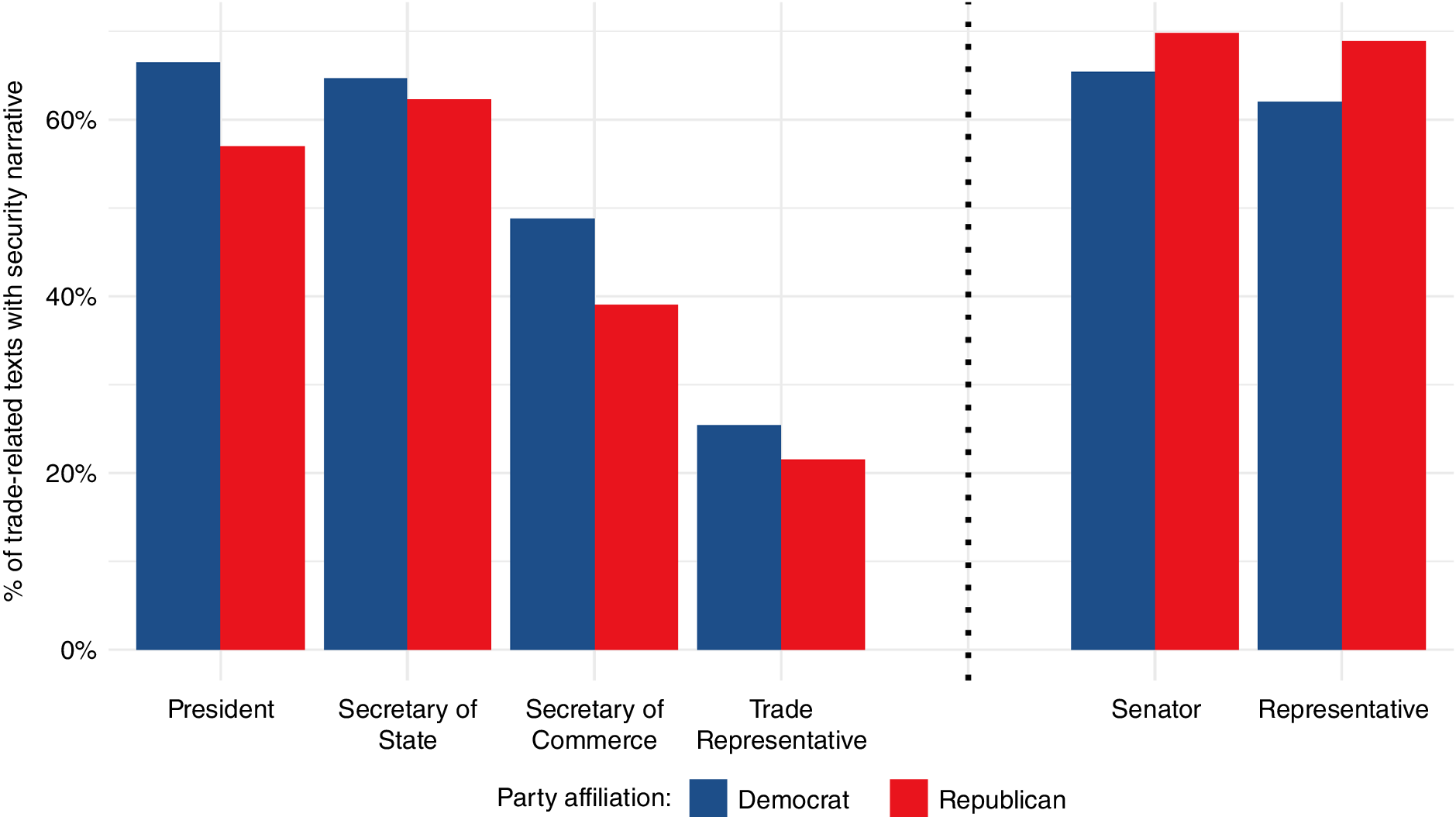
Descriptive evidence is presented in figure 1, which shows the mean use of the national-security narrative by actor and party affiliation. The evidence runs counter to H1. Members of Congress—both senators and representatives—were more likely to frame trade in national-security terms than the executive actors included in our study; however, the difference to the President and the Secretary of State was minor. With respect to partisanship, as expected in H2a, Republicans in Congress were more prone than Democrats to link trade and security. This was true for both the Senate and the House of Representatives. We did not find support for H2b, however. Rather than disappearing, the partisan difference was reversed in the executive branch: that is, across all executive actors, we found that Democrats were more prone than Republicans to use the national-security frame on trade. Online appendix figure D1 shows that these findings were driven mainly by the resilience and economic-security narrative. Economic security may be an attractive way for Democrats to securitize trade without adopting the hawkish rhetoric typically associated with the Republican Party.
Use of Security Narrative Across Actors

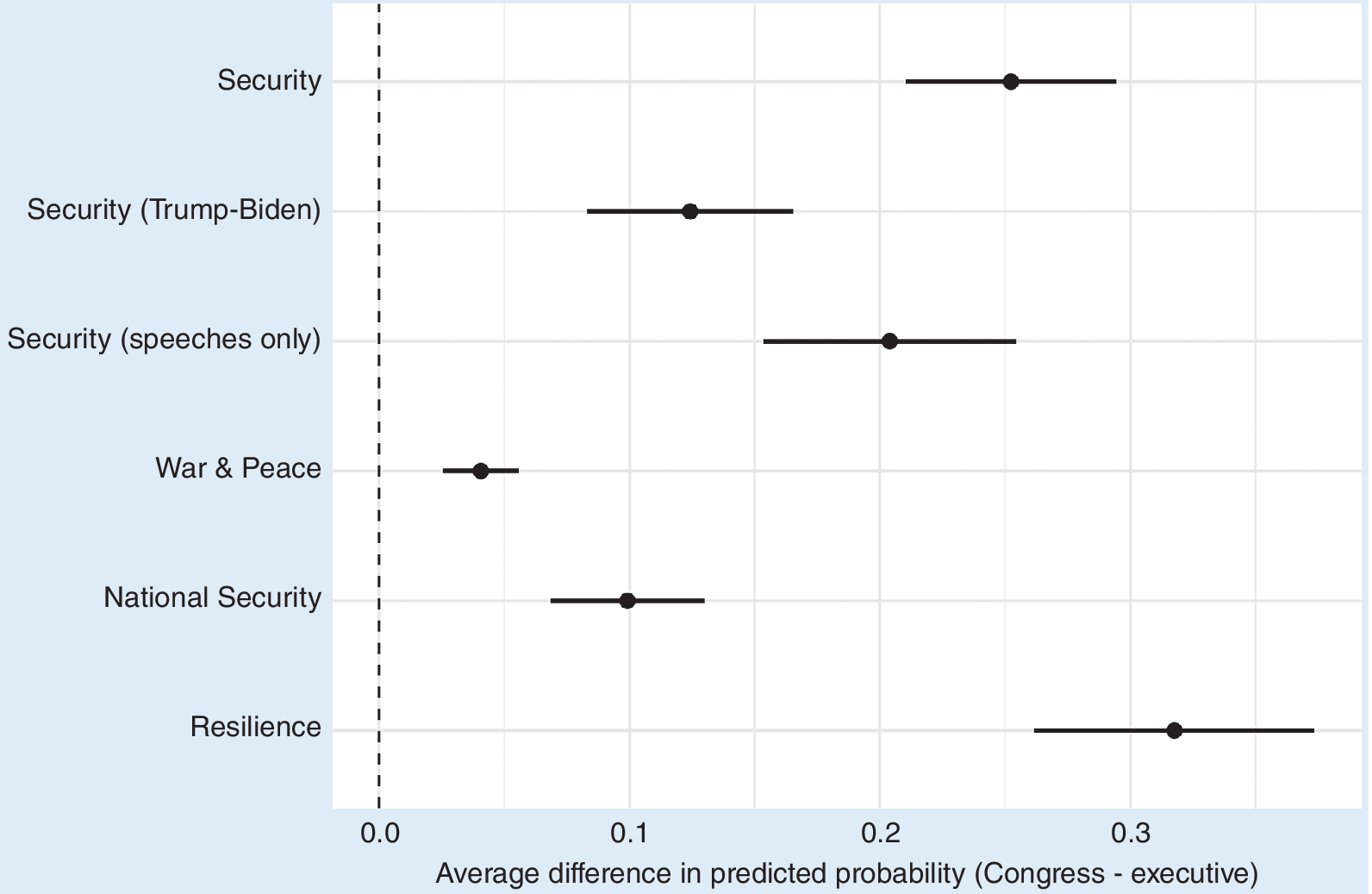
Regarding the regression models, figure 2 shows the average difference in the predicted probability of using a national-security narrative for Members of Congress and the executive branch to test H1. Figure 3 shows the average difference in predicted probability between Republicans and Democrats for both Congress and the executive branch to test H2a and H2b. Full regression tables for these models are in online appendix E.
Institutional Role and National-Security Narrative
The figure shows the differences in predicted probability of using a national-security frame between the legislative and the executive branches, calculated from logistic regression models. Full results are in online appendix E.

Interaction of Partisanship with Institutional Role
The figure shows the differences in predicted probability of using a national-security frame by partisan affiliation, for both the executive branch and Congress, calculated from logistic regression models. Full results are in online appendix E.

Aligned with the descriptive findings, figure 2 indicates that Members of Congress were more likely to use a national-security narrative compared to members of the executive branch. We found that Members of Congress had a 22-percentage-point higher probability of using a national-security narrative compared to members of the executive branch. This result was robust to different model specifications and held for all three subnarratives. Overall, the evidence presented in figure 2 ran counter to H1.
We found that Members of Congress had a 22-percentage-point higher probability of using a national-security narrative compared to members of the executive branch.
Figure 3 shows that across specifications, Republican Members of Congress were more likely than Democratic members to use a national-security narrative. In the baseline model, the predicted difference was approximately 5 percentage points. This pattern also held across the subtypes of security narratives but only weakly for references to war or peace. Overall, however, the evidence provided robust support for H2a.
For the executive branch, by contrast, the results were mixed, with estimated partisan differences varying markedly across models. In the baseline specification, there was no statistically significant difference between Democratic and Republican administrations, consistent with H2b. During the Trump–Biden period—and specifically for the resilience subnarrative—Democrats appeared even more likely to rely on a national-security frame. However, when we restricted the sample to the last and first years of presidencies from different parties, the estimated partisan effect changed direction. Given that the Biden administration followed the Trump administration, and that trade-related security concerns plausibly increased over time (with the COVID-19 pandemic as a potential driver), this result suggests that temporal dynamics may confound partisan comparisons in the executive branch. Analyses by subnarrative indicated that references to resilience drove executive branch differences. Taken together, these findings supported H2a for Congress but did not support H1 and only partially aligned with H2b.
As additional evidence, we examined whether our results were driven by (1) representatives from districts particularly exposed to the China shock (using data from Feigenbaum and Hall Reference Feigenbaum and Hall2015); or (2) Members of Congress serving on the Armed Services Committee. Our findings, however, were robust and held across all Members of Congress (see online appendix table E3).
CONCLUSION
In recent years, national-security considerations have been prominent in US trade discourse. This matters because the framing of trade influences which policy choices are perceived as legitimate and desirable. Geopolitical developments—most notably the rise of China and Russia’s war against Ukraine—provide a substantive backdrop to this integration of national security into trade debates. Yet, security also is a rhetorical resource that political elites can deploy strategically to justify preferred trade policies.
Our analysis focuses on this strategic use of the security frame. We theorize that the propensity to link trade to national security varies by institutional role and partisan affiliation. Drawing on a newly compiled corpus of trade-related statements by US political elites from 2001 to 2025, and using an LLM to identify framing patterns, we tested these expectations. Aligned with our expectations, Republicans in Congress were more likely than Democrats to adopt a national-security framing of trade. Contrary to expectations, however, Members of Congress invoked security concerns more frequently than executive actors when discussing trade. Moreover, among executive actors, Democrats were more likely than Republicans to securitize trade. Taken together, the results indicate that securitizing trade is not primarily an “executive” move; it is at least as much a legislative practice, and it is shaped by partisan incentives in different ways across institutions.
Three potential explanations for our unexpected finding concerning institutional roles stand out. First, reversing our initial argument, it may not be a large, heterogeneous constituency that makes a national-security framing appealing to political actors but rather a narrow, protectionist constituency. Specifically, Members of Congress who face protectionist pressures from their constituents may deploy a national-security framing not to primarily persuade their own voters but also to mobilize support among other political elites and their constituencies for their protectionist demands. Second, our dataset did not include certain forms of political communication, such as social media posts—particularly from President Trump—that may reveal different framing dynamics. Third, executive actors often address trade generically, whereas in Congress, debates tend to focus on specific trade measures (e.g., extensions of the Trade Promotion Authority). The national-security framing may work better in the more-specific debates.
Even without being able to fully resolve our unexpected findings, our results suggest that national-security arguments serve as an important and at least partly strategic tool for legitimizing certain trade measures. Understanding when and why political actors turn to national-security framing therefore can deepen explanations of contemporary US trade politics.
SUPPLEMENTARY MATERIAL
To view supplementary material for this article, please visit http://doi.org/10.1017/S1049096526102066.
ACKNOWLEDGMENTS
Funded by the European Union (ERC, GEOTRADE, 101140687). Views and opinions expressed are however those of the author(s) only and do not necessarily reflect those of the European Union or the European Research Council. Neither the European Union nor the granting authority can be held responsible for them.
DATA AVAILABILITY STATEMENT
Research documentation and data that support the findings of this study are openly available at the PS: Political Science & Politics Harvard Dataverse at https://doi.org/10.7910/DVN/CGUOWD.
CONFLICTS OF INTEREST
The authors declare that there are no ethical issues or conflicts of interest in this research.


 Open access

