


Introduction: The Schematic Year
Ancient states and societies used different kinds of time reckoning for various purposes. For example, in classical Athens the archontic lunar calendar was practiced alongside the schematic prytanic calendar, as recorded in numerous double dated documents.Footnote 1 Furthermore, documentation from Ancient Egypt attests to a dual calendrical system, whereby people paid their taxes according to the civil year of 360 days + 5 additional days, but festivals were celebrated in the temples according to a lunar calendar.Footnote 2 We should thus be open to various temporal systems functioning in each society.
Societies, ancient and modern alike, use schematic calendars, which find particular favor among clerks and administrators. Consider a case in which one needs to calculate the amount of grain required to feed a squad of one thousand slaves through a multi-year construction project, with a known quantity of grain per slave per day. This calculation would be rather difficult under a lunar calendar because one cannot tell in advance when an intercalation will take place, adding thirty days to one or more of the years.Footnote 3 The clerk will need to wait until the very last day of the month in order to know whether it has twenty-nine or thirty days. In addition, it cannot be taken for granted that kings sought to maintain the calendar’s correspondence to nature, because sometimes they would rather postpone the new moon by a day or so, thus postponing the payment of their debts.Footnote 4 Long-term calculations are nearly impossible under such a calendar regime. A schematic calendar, in contrast, avoids these problems by employing a fixed number of days or other fixed calendrical structures. A schematic year is useful not only for long-term calculations, but also when the need arises in literature or in science to express a date formula which could work for any given year, without pinpointing a concrete date based on a concrete astronomical observation.
While a schematic year may function as a calendar in the real world, it may also exist solely as an administrative construct. The Julian or Gregorian year is an example of the first kind, being schematic yet enacted in practice, a combination which won it enormous success. In contrast, some periods in ancient Mesopotamian history attest to the use of a schematic year which was divorced from the civil and religious calendar, as discussed below.
In the present article I highlight the use of schematic months and of a schematic 360-day year in Ancient Israel. I cite different kinds of evidence, both material and literary, whose understanding could greatly benefit if interpreted as using a schematic time reckoning. While not every piece of evidence cited here is entirely conclusive, the accumulation of evidence from various branches of biblical studies render the presence of a schematic calendar in ancient Israel plausible. In turn, I hope to show how this kind of schematic year was treated in later Second Temple times, when debates about the calendar took a more central place in the religious discourse. My suggestion has the potential to elucidate some famous cruxes, mainly the debate about the dates in the flood account (Genesis 7–8), as represented in the biblical versions.
In ancient Mesopotamia until the Old Babylonian period, the most wide-spread system in administrative use was a schematic year of 360 days, existing alongside the lunar calendar.Footnote 5 Many economic and calendrical documents from the third millennium BCE attest to the use of such a year, which functioned as the main framework for accounting: inventories, tax calculations, and long-term planning. The same number was used to express schematic time periods that did not involve long-term calculations, when no recourse to a concrete year was required. A few examples will help clarify the matter.
The tablet TCL 5, 5669 (AO 05669) is an administrative Ur III text from the reign of Shulgi (twenty-first century BCE) at the Sumerian city of Umma.Footnote 6 The author assigns groups of female slaves to various work sites across the city and its environs, calculating the amount of work-days assigned to each site and the ensuing requirements of food for various periods of time. The first section (I 1–5), for example, reads:
Thirty-six female laborers
from month “Harvest”
to month “Dumuzi,”
their labor: 12,960 days
are the debit
In this site thirty-six slaves will work for exactly one year (i.e., from month 1 to month 12 in the Umma calendar).Footnote 7 The scribe calculates the number of work days as 36 X (12 X 30) = 12,960. The number of 360 days is implied by the multiplication of twelve schematic months with thirty days each.
Early administrators were aware that 360 is not a valid number for any year in practice. They were also aware that intercalation may be required, and therefore created a schematic intercalation system, with an added, thirty-day long thirteenth month every third year.Footnote 8 Neither number—360 or 390 days—was applicable in reality to any civil-agricultural year. This kind of discrepancy between the schematic calendar and the year in practice is inevitable. Administrators expected the gap to occur and handled themselves with a margin of error accordingly.
A different usage of the schematic year can be seen in the document IM 80213, an ikribu prayer to the goddess Ninsianna by one Ur-Utu (lit. the dog [=servant] of Šamaš), a priest from Sippar-Amnānum (Der) of the Old Babylonian period.Footnote 9 Ur-Utu seeks the favorable face of his goddess as he asks her advice in divination. The petitioner presents a sacrifice, in whose liver the divine answer is sought:
O God! My Divine mistress Ninsianna
Accept this offering
Stand by my offering
And an omen of welfare and life
Set to Ur-Utu, your servant.
Concerning Ur-Utu, your servant, maintain your presence,
For the sake of the prayer hereby offered
From the twentieth day of Nisan
Until the twentieth day of Nisan of the coming year,
6 X 60 days, 6 X 60 nights….
Will Ur-Utu have or not have life and well-being?
Temporality played an important part in oracle queries. Each omen had a period of validity, adannu, which could not be exceeded.Footnote 10 This particular prayer, however, does not indicate the time of validity announced with the oracle, but rather the time frame requested by Ur-Utu before the sacrifice. The prayer and sacrifice were offered on the twentieth of the month, known as a sacred day for the cult of the sun god Šamaš.Footnote 11 Ur-Utu asks for wellness through the coming year, from the twentieth of this month to the same date next year, 360 days altogether. This number is expressed quite elegantly in the cuneiform script as 6 X 60 days.
Ur-Utu was not obliged to mention the number of days, and could have only indicated the same calendar date next year, whatever number of days would pass in reality until then. But the efficacy of the ritual required a round number of days. While the modern punctilious reader may ask what happened in reality, when the actual year in Sippar lasted 354 days, or maybe 384 days, this question is in effect futile. The round number 360 is good for the efficacy of the oracle query, but it would be qualified by concrete numbers as the year advances and calendar decisions are made known.
The use of the 360-day year for accounting and administration lasted until the Old Babylonian period. The same number was used in cuneiform literature for astronomical calculations even later, throughout the first millennium BCE. The 360-day year was the standard for traditional Babylonian astronomy, and did not disappear until much later, in Greek astrology.Footnote 12 Its use is expressed, for example, in a passage from the Babylonian “Diviner’s Manual,” known from copies in the library of Assurbanipal and elsewhere: “Twelve months per year; 360 its days. Hold in your hand the time of the start of the year. The disappearance of the moon, the ‘corrections’ of the dates of the (first) visibilities of the stars, the convergence of the beginning of the year with the Field…. ”Footnote 13
The scholars of Babylonian astronomy were of course aware that no year will last exactly 360 days in practice, but they still used the 360-day year due to its benefit as a convenient base for further calculations, like those of the shadow length, the visibility of the moon, the length of daylight, etc. Rules were set to address the discrepancy between the schematic year and the concrete manifestation of the lunisolar calendar, for example the so-called “intercalation schemes” in the astronomical compendium Mul.Apin.Footnote 14
The administrative use of the 360-day year in Mesopotamia ceased after the Old Babylonian period. The reason for this break is unknown and may be due to the development of accounting models that allowed for long-term calculations in the regular lunar calendar. In the following I do not claim that Judahite administrators continued the Babylonian tradition, which by then would have been obsolete. The Mesopotamian schematic year serves as an analogy to a similar—yet not identical—tradition, which arose in the early first millennium BCE among Judahite administrators.
Archeological Evidence for the 360-Day Year in Iron-Age Judah
I shall now examine in this light a series of material objects from Iron Age Judah, which give a good example for the everyday use of thirty-day months and of the schematic year by clerks and administrators. Admittedly, these items can be and have been explained as useful with other calendrical systems, but I believe that the schematic 360-day year better accounts for their material details.
In major sites from the period at the height of the monarchy, excavations yielded several portable calendars in the form of small, perforated bone plaques, with the holes arranged in numerical patterns. The find was surveyed and discussed by Nili Fox as part of her official publication of one such plaque found at ʿAroʿer.Footnote 15 The following discussion builds on Fox’s survey but suggests another possibility, unrecognized by her, for the kind of year reflected in the calendar plaques. Fox was not aware of the existence of a 360-day schematic year and hence did not consider it with regard to the calendar plaques.
The find includes nine plaques, found in major sites of Iron Age II Judah alongside other less prominent places: Lachish, Gezer, Tel el-Farʿah (south), Jerusalem, and ʿAroʿer in the Negev. These are central sites concentrated in the south of Judah, Jerusalem being the most northern site and Tel el-Farʿah (south) the most southern one, standing very close to areas of Egyptian rule. This Judean phenomenon is not attested, to the best of my knowledge, in other regions.Footnote 16
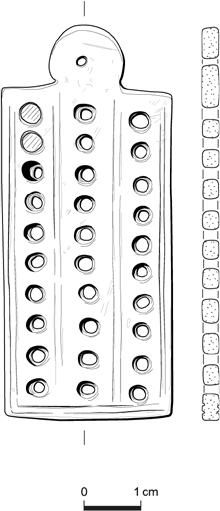
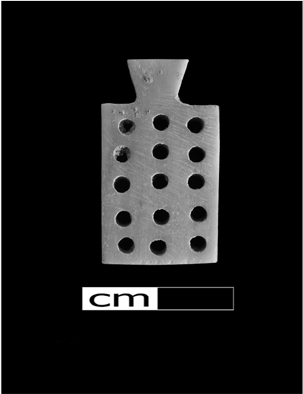
The holes drilled in these rectangular plaques are arranged in three lines of ten holes each, altogether thirty holes, with additional decorations separating the lines and adorning the edges of the plaque. The plaque was used by means of inserting pegs into the holes and advancing them along the days of the month and of the year, anticipating the later Greek habit of parapegmata. The Jerusalem plaque stands out as it contains three lines of only five holes each, altogether fifteen rather than thirty. The ʿAroʿer and Tel el-Farʿah (south) exemplars are adorned with a pronounced proto-Aeolic capital, the whole artefact resembling the shape of a column.
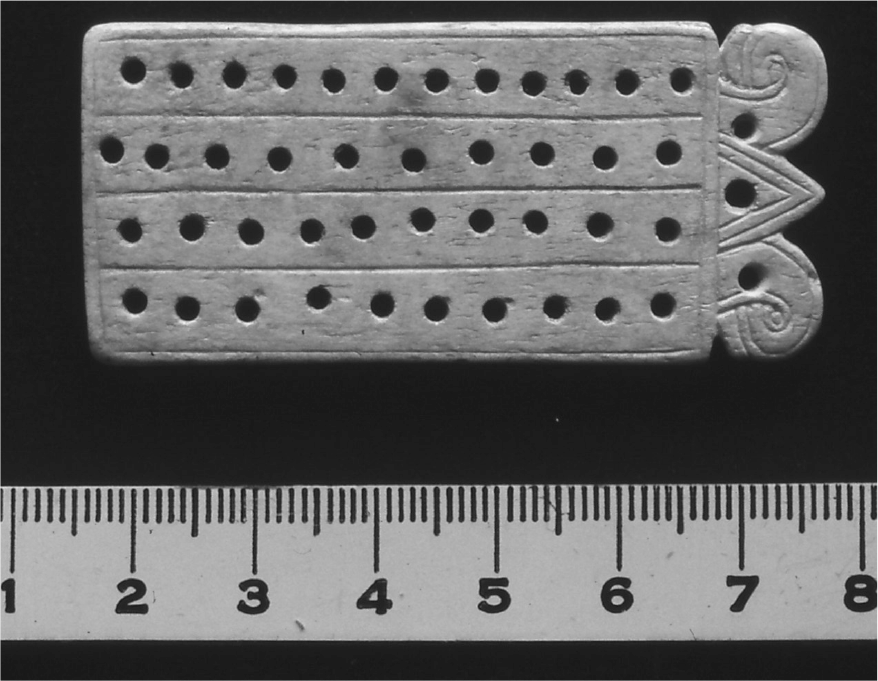
In addition to the peg holes, most plaques have one hole at the top, probably used for suspension. In contrast, the plaque from ʿAroʿer shows three holes rather than one at its top. The latter plaque is additionally unique in that it contains an additional vertical line of holes, this one numbering twelve holes. Altogether then, the ʿAroʿer plaque contains one line of twelve holes plus three lines of ten holes each, and in addition three holes at the top.
Already the first excavators, notably Flinders Petrie who exposed the item in Tel el-Farʿah, have suggested that these items served as small calendars with pegs inserted in the holes to mark the passage of every day. The item from ʿAroʿer seems to verify this insight, since it is in effect a representation of the entire year with twelve months of thirty days each.Footnote 17 The small size of these artefacts made them especially suitable for the private use of an administrator or clerk. Since the Jerusalem item was found in a pile of debris next to a large number of seals and bullae, an office environment seems reasonable.Footnote 18 The ʿAroʿer item, in contrast, was found in a tomb. It might be that the scribe’s personal items have been buried with him.
Being a trained expert in Egyptian archeology, Petrie suggested that the Farʿah item reflects the use of the Egyptian calendar of 12 X 30 days plus five additional days at the end of the year.Footnote 19 The months in the Egyptian calendar are indeed schematic, a fact which gave credence to his assumption. The discovery of the ʿAroʿer item lent further support to this hypothesis, since, as Fox has discerned, the three horizontal holes at the top of that plaque may represent the division of the Egyptian year into three seasons, with four months in each. The proximity of the find to the Egyptian region and the strong Egyptian cultural presence in Judean administration before the Assyrian conquest make this idea reasonable.Footnote 20
Fox ultimately remains unsure that the plaques reflect the Egyptian calendar because it is unclear to her how the tripartite seasonal division of the Egyptian year could be maintained in the Negev, far away from the inundation of the Nile.Footnote 21 This difficulty leads her to offer a different, even less compelling, Phoenician connection. The above-cited objection should not harm Fox’s case, however, because the Egyptian year was a wandering year, which had lost connection with the seasons. Since no intercalary days were added to the year, the gap of ca. 1/4 day between the length of the year and the true solar year accumulated to a serious degree of deviation.Footnote 22 It could have thus been maintained as an efficient administrative framework also outside the Egyptian environment.
Other objections, however, speak against the connection of the Judahite plaques with the Egyptian calendar. The ʿAroʿer item, with three holes at its top, is the only one of the nine plaques that shows the unit of three and the series of twelve monthly holes, while others really focus only on the thirty-day schematic month. Further, if the ʿAroʿer item constitutes such a close reproduction of the year as Fox assumes, the problem remains that the internal order of the four months in each season is not represented in it, and could not be counted accordingly. Finally, none of the plaques allows for marking the five additional days at the end of the year, a crucial component of the Egyptian year. The Egyptian calendar option can thus be dismissed, especially because, in view of the preceding discussion, we now have a rather reasonable candidate for representation in the plaques: an administrative schematic year of 12 X 30 days.
Admittedly, the schematic use of the plates cannot be conclusively proven, because they may have been used also in the framework of the lunar calendar. In the case of a twenty-nine day month, the clerk would leave the last hole of the month unused (or skip the twenty-ninth hole) and begin the next month.Footnote 23 Moreover, even if the plaques had been designed for use with the schematic calendar, they could be easily shifted for use under the lunar calendar. I see the plaque from ʿAroʿer (Fig. 4) as an attractive visual representation of the schematic year, with a column of twelve months and three columns of ten days each. This schematic interpretation will be buttressed with textual evidence below.
(left): Plaque from Lachish. Drawing by Naama Earon, following Olga Tufnell, Lachish III: The Iron Age (2 vols.; Oxford: Oxford University Press, 1953) 2:23 (plate 56).
(middle): Plaque from Tel el-Farʿah (south). © UCL Institute of Archeology.

(right): Plaque from the City of David. R. Reich and E. Shukron’s Excavations in the City of David; Photographer: Vladimir Naikhin.
Plaque from ʿAroʿer. Courtesy the Hebrew Union College.
The Jerusalem plaque (Fig. 3) attests to the same conclusion in its own unique way: instead of thirty holes it features fifteen holes, and was thus used twice in the course of a schematic month.Footnote 24 This twofold division of the schematic month brings to mind the placement of various festivals in the middle of the schematic month by priestly writers, as discussed in detail below.
How was the schematic administrative month divided? If we take the evidence of the calendar plaques seriously, it seems that the month was divided into three “decads,” i.e., units of ten days each.Footnote 25 The Jerusalem plaque may suggest a division into five-day “weeks.” Interestingly, a division of the month into three decads was the norm in Egyptian time reckoning and bookkeeping.Footnote 26 Given the considerable involvement of Egyptian methods in Judean administration, could it be that Judean scribes have also used decads as their basic division of the month?Footnote 27
Yet another surprising insight arises from the Judahite calendar plaques: these devices did not seem to have used the seven-day week as an administrative unit of time. The week and the Sabbath may have been significant for the sacred division of time, but they were surely not used for mundane time reckoning until a much later period in time.Footnote 28 In fact, the earliest attestation for the use of the week in administration and commerce comes from Aramaic ostraca from the early(?) first century BCE.Footnote 29
To conclude this section, there are good grounds for claiming that the plaques attest to a bureaucratic use of schematic months and years in Iron Age Judah. This is not to say that schematic years were practiced in religious or civic use. Rather, it means that clerks and administrators used them when carrying out long-term calculations or referring to generic dates. This possibility is buttressed below with literary evidence from the Hebrew Bible.
The 360-Day Year in the Hebrew Bible
Some indications of time in the Hebrew Bible were not oriented towards a practical calendar, be it lunar, lunisolar, or any other system, but rather indicated schematic time. Date formulas appear quite often in the Hebrew Bible, but their astronomical regulation is never specified, leaving modern scholars with the need to hunt for clues, sometimes even to speculate.Footnote 30 Given that many of the formulas do not relate to a concrete historical date but rather to general literary pronouncements, a schematic system would be rather useful. For example, the dates of the Israelite travel in the desert as given in the Priestly source obviously do not rely on a chronographic report from the time of Israel’s wanderings but were rather generated by later authors using these authors’ calendrical system. If this is so, some sort of schematic reckoning may be reasonably expected.
I suggest that many of the time indications in the Hebrew Bible functioned according to a schematic year, or more specifically, a year of 360 days constructed of schematic months of thirty days. This is not to say that civil or cultic calendars in ancient Israel functioned with this kind of month, but only that generic time formulas used them as a literary device. A short example from the Book of Esther will make the initial case:
The turn came for each girl to go in to King Ahasuerus, after being twelve months under the regulations for the women, since this was the regular period of their cosmetic treatment, six months with oil of myrrh and six months with perfumes and cosmetics for women. (Esth 2:12 [NRSV; italics mine])
The Book of Esther in general, and the details narrated in it in particular, show a strong hyperbolic nature, with a sense of exaggeration and a conspicuous note of parody. They cannot thus be considered historical in any concrete sense.Footnote 31 My claim here is certainly not historical, but rather the opposite: I suggest that the author of Esther used schematic time periods as part of the hyperbole. This is also the case in the period of 180 days in Esth 1:3, a period that amounts to six schematic months of thirty days each, or half of a year. Similar logic pertains also to the cosmetic narrative encountered in 2:12.
Why would each new wife be required to spend exactly twelve months in cosmetic treatment? While a variety of reasons may be suggested, I think that a calendrical interpretation will not be far-fetched, especially if it fits the general atmosphere of the accounts of the Achaemenid court. By calendrical interpretation, I do not mean to claim that the author provided concrete timing for the royal cosmetic office, but rather that a schematic image was conveyed, using schematic time periods. As part of the pompous (fictive) depiction of the Persian court, the author conceived that the king had 360 wives, one for every day of the schematic year; each new wife would be placed at the end of the queue, spending her first year at the harem in preparation for her royal rendezvous. Exactly the same image of a Persian harem is attested in Plutarch’s biography of King Artaxerxes:Footnote 32
This was the woman for whom Dareius asked, and he gave offence thereby to his father; for the Barbarian folk are terribly jealous in all that pertains to the pleasures of love, so that it is death for a man, not only to come up and touch one of the royal concubines, but even in journeying to go along past the wagons on which they are conveyed. And yet there was Atossa, whom the king passionately loved and had made his wife contrary to the law, and he kept three hundred and sixty concubines also, who were of surpassing beauty.
Although the number of wives is not attested in the Book of Esther as it is in Plutarch, I suggest connecting the two pieces of data, since both the Greek and the Hebrew authors employed the same kind of hyperbolic-fantastic or even parodic sense of the Persian kings and their pompous manners.Footnote 33 In reality, Achaemenid kings followed either the Old Persian lunar calendar or the Zoroastrian calendar of 365 days, with neither of them amounting to 360 days. Footnote 34 Nor did Plutarch intend to say that the king owned precisely one wife for each day of the Achaemenid year; it would therefore be irrelevant to ask how the harem handled the days in excess or in deficit of the number of 360. This exactly is the force of the schematic year, an ideal figure for hyperbolic literary accounts, which are not necessarily tied to any calendar year in practice.Footnote 35
Schematic years and months are also attested in earlier biblical texts. They should be sought in Pentateuchal festival calendars, i.e., lists of festivals prescribing dates for annual festivals.Footnote 36 Some festival lists do not mention dates at all (e.g., Exod 23:14–19), while others show so little concern with the calendrical apparatus that it remains impossible for modern scholars to know its characteristics. In the following I make use of the reasoning in an old article by John McKay which has not won much attention since its publication.Footnote 37
Consider the dates assigned for the festivals of Sukkot and Matzot in the priestly festival calendars of Leviticus 23 and Numbers 28. In other law codes of the Pentateuch (Exod 23:15–16; 34:18–22; Deut 15), these two festivals are only dated using a wide seasonal definition, with no particular date. However, in Leviticus 23 and Numbers 28 they are both dated to the fifteenth of the seventh and first months respectively, Matzot being preceded by Passover by one day.Footnote 38 What can be made of the night of the fifteenth, the date assigned to these festivals? McKay has noted, against the common assumption, that the night preceding the fifteenth of a lunar month hardly ever coincides with the full moon, which instead occurs more often on the thirteenth day of the month. This is because the lunar month does not begin with conjunction but rather with first visibility. The date of festivals, therefore, does not relate to the full moon, but rather to a schematic date, the fifteenth of the first or the seventh month. As McKay suggests at the end of his article, these dates bear closer relation to the solar cycle than they do to the lunar phases, the festivals constituting common schematic indications for the days of the equinox.Footnote 39 By way of analogy, Mesopotamian astronomical treatises relating to schematic months, such as table XIV of the series Enūma Anu Enlil, will record the full moon on the fifteenth day, and will place the equinox at the mid-month close to the New Year, either on the twelfth month of the year or on the first month.Footnote 40
Priestly writers thus fixed the dates of Matzot and Sukkot at the mid-month, relying on a schematic view of the thirty-day month. In reality, since the calendar practiced in Judah was a lunar one, the fifteenth of the month would only rarely coincide with the equinox as suggested by the scheme. This is a natural and expected discrepancy, which would occur in any type of lunar calendar. If properly regulated, the practiced calendar will retain reasonable proximity to the schematic dates of the equinox across the years.Footnote 41
The priestly authors must have followed one calendar or another in practice, but they did not feel the need to promote that particular calendar or to denigrate other calendrical systems.Footnote 42 While such neutrality would be unthinkable at the height of the Second Temple period, when calendar disagreements took a central place in the religious discourse, earlier biblical authors did not consider the calendar to be of crucial importance and treated it as a matter-of-fact technicality.Footnote 43 Priestly authors accordingly sought a way to indicate the middle of the month in a schematic way without addressing any particular calendrical situation. They had an exactly suitable mechanism for that purpose.
The use of schematic thirty-day months in the priestly festival calendars brings to mind an administrative-bureaucratic context, the author being a clerk or administrator who uses the language typical of that trade.Footnote 44 Such a tendency is amply attested in the priestly literature, with the affection for long lists, conspicuous professional terminology, accounts laden with detail, and an unquenchable thirst for numbers.Footnote 45
Outside the realm of the priestly literature, some later biblical authors used the 360-day framework when devising long-term calculations, just like their Mesopotamian predecessors. Thus, Gabriele Boccaccini has demonstrated how the numbers in Daniel 12:11–12 function according to that schematic mode of reckoning.Footnote 46 While the Book of Daniel was written at a period in which calendar debates did play an important part in the religious worldview, the simpler 360-day scheme was retained for the purpose of multi-year calculations.Footnote 47
The 360-day Year in the Flood Narrative
The dates in the flood account of Genesis 7–8 are bursting with scribal activity due to the universally accepted axiom that the flood lasted for one complete year (1 En. 106:15; Jub. 5–6; 4Q252 II, 1–3; 4Q254A III, 2; m. ʿArak. 10:3), a fact which prompted many Second Temple authors to anchor their calendar in the year of the flood.Footnote 48 Indeed, calendrical undertones were associated with the story of the flood already in pre-biblical literature from the Ancient Near East.Footnote 49 However, the Pentateuchal account never specified which kind of year was reflected in the flood narrative, leaving the debate as a battleground for various authors in later Second Temple times, when the calendar became a bone of contention. In contrast, in earlier times, i.e., when the flood story was written and edited, such a polemic was not pressing. Since the author or authors obviously did not have concrete archival information on the year of the flood in hoary antiquity, the entire plan of that year as presented in the priestly account of Genesis 7–8 was a schematic one, which was not meant to relate to any particular year nor to any particular astronomical phenomena. Rather, following an initial study by Fred Cryer, I believe that it reflects a schematic year of 360 days.Footnote 50
Two central calendrical markers in Gen 6–8 stand out when seeking to characterize the kind of year conceived in the narrative.Footnote 51 The first is the period of 150 days through which the water covered the land according to Gen 7:24; 8:3. This period was equivalent to five full consecutive months, as can be deduced from the date formulas in Gen 7:11 (seventeenth of month II) and 8:4 (seventeenth of month VII). Such a period of time, with five months equaling exactly 150 days, could not have existed in any of the calendars known or assumed in ancient Israel. A lunar calendar would have fixed at least some of these months as containing twenty-nine days only. Equally so, the sectarian 364-day year, which is sometimes assumed to have been practiced by biblical authors,Footnote 52 would have required at least one longer month of thirty-one days to occur within this stretch of five months. The story does not posit that the city council of Eridu, or Jerusalem, or anywhere else at the time of the flood, happened to decide on five round months! Rather, it uses schematic months, specifically in order to avoid the need to anchor the flood to any particular calendar practice. Given this period of 150 days, it is hard to deny that the author/editor of these verses in Genesis 6–8 used schematic thirty-day months, together constructing a schematic year of 360 days.
The second suggestive calendrical piece of data in the flood account are the date formulas anchoring it in the framework of one year. Two such frameworks appear in Genesis 7–8:Footnote 53 the first one assigns the flood to the confines of the six-hundredth year of Noah’s life, beginning and ending exactly at the borders of that year (Gen 7:6; 8:13); the second one assigns less round figures for the dates of the beginning of the flood year (Gen 7:11) and of its end (8:14). Here the textual versions differ:

Reading the data with an eye to schematic years, the situation seems clearest in the LXX version, where the flood lasted for exactly one year.Footnote 54 Notably, this version of Gen 7:11 corresponds to the other previously mentioned chronological system of the flood, dating it through exactly one complete year. In terms of the calendar conflict, this is also the most naïve version, because although the flood lasted one year, there is no way to tell from the text which kind of year measured its duration. This fact is exactly what makes the LXX reading attractive for the text critic, being devoid of any bias for any particular calendrical doctrine.Footnote 55 In historical-literary terms, the LXX version of 7:11 is preferable because it corresponds with the similar annual framework in 7:6 and 8:13. In contrast, the reading of MT and SP in 7:11 introduces an additional gap of ten days, which reflects a (not necessarily successful) attempt to favor one kind of year against the other. In contrast to the view of most commentators, who see the LXX reading as a later correction, I follow Gunkel in stating that the correction should be sought in MT.Footnote 56 This correction is a product of the later Second Temple period, and is thus the first in a chain of subsequent retellings and interpretations aimed to make the year of the flood correspond with “the right” kind of year: whether a lunar year (as propagated in MT and SP), a 364-day year (as in Jubilees and Qumran), or even a Julian year of 365 days (as propagated later by Ephrem). Footnote 57
The priestly account in Genesis had not originally striven to make a point about any length of any year, but rather used schematic time indications, in the spirit of other ANE flood accounts, as we know them now. Footnote 58 Explicit calendrical motivations did not arise before the calendar debates in the second, possibly third, century BCE. The various dates in MT, SP, Jubilees, and the Genesis Commentary 4Q252, are all scribal products, aimed to harness the flood narrative to a battle that it had never been meant to fight. Kister rightly states that all the various flood chronologies in Second Temple literature seem forced and detached from the original account, and thus cannot be taken as an organic continuation of the tradition.Footnote 59
Although the LXX is a Second Temple text in and of itself, in the present case it preserves an ancient reading, which reflects the original flood account based on a schematic year of 360 days.Footnote 60 The LXX reading is preferable because the indicated dates mark exactly one year without supplying any hinge on which to hang a preference for any particular year.Footnote 61 The MT-SP reading, which measures the length of the flood by one year plus eleven days (from II/17 until II/27 in the next year), is a sectarian reading: it aims to show that, while the flood indeed lasted for one complete solar circuit of 364/5 days, the calendar dates invoked in the narrative are not counted by that system but rather by the common lunar year of 354 days. The scribe who created this reading was following a lunar calendar.Footnote 62 MT and SP are thus interested parties in the calendar debate, while the reading in LXX is indifferent to it, hence also earlier.Footnote 63
Conclusion
In the present article, I put forward various arguments to support the claim that some ancient Judahite writers and administrators used a schematic calendar of 12 X 30 days. This calendar operated alongside the one in practice, and was used for long-term calculations and generic statements of time, both in administration and in law and literature. While not all of the evidence collected here is compelling on its own, I believe that altogether it creates a convincing picture. The analysis of the flood chronology, in contrast, will stand regardless of the validity of the archeological part of my argument.
As in other cultures of the Ancient Near East, Judah of the Iron Age had also known a schematic year as part of its administrative heritage. This year did not constitute “a calendar” in the narrow sense, because no civil or religious activities were dated on its basis. Rather, it was an administrative framework used by clerks and administrators for long-term calculations and routine office tasks. This system is attested by a number of carved bone plaques discovered in major Judahite sites of the Iron Age II, although admittedly the plaques may have also been used with a lunar calendar. Interestingly, these devices seem to divide the months, if at all, into units of five or ten days, without recourse to the seven-day week. This evidence agrees with later sources, showing that the week began to be used as an administrative (rather than cultic) unit only in late Second Temple times.
Another manifestation of the same schematic year appears in literary sources, mostly related to priestly writers. This is not surprising given the bureaucratic character of the priestly prose. The dating of Sukkot and Matzot to the middle of the month in Lev 23 and Num 28 seems to reflect a schematic placement of the equinoxes on the fifteenth of months I and VII. The use of a schematic year gives the best explanation known to me for the dates in the priestly account of the flood. Preferring the LXX reading of Gen 7:11 for the date of the flood’s beginning, I claimed that the original priestly story or stories sketched the year of the flood within the exact confines of one schematic year. The reading in MT and SP reflects an emendation, aiming to highlight the difference between the schematic year and the lunar year practiced at the time when the change was inserted. Scribal activity with regard to the dates in the flood account arose only in later Second Temple times, since calendar debates were not present, or at least not pressing, earlier.
The “discovery” of the 360-day year in ancient Israel answers some of the questions that had led scholars to posit the existence of a 364-day year in Iron Age Judah. With that hypothesis disproven, it is my hope that scholars will accept the exegetical benefits of the 360-day year and will further explore its implications for priestly literature and legislation.Footnote 64


 Open access

