

Introduction
Recessions have grown costlier for Australia and other modern developed economies, in part due to consistent government deficits years after the initial shock (Quiggin Reference Quiggin2014) and the degradation of human capital when people are structurally unemployed or exit the labour market (Cardona-Arenas Reference Cardona-Arenas2024). Further, research in the US suggests these recessions risk greater structural unemployment of workers due to perpetual changes in skills which businesses demand (Jaimovich and Siu Reference Jaimovich and Siu2020). The retirement of Baby Boomers has also commenced in recent years (Agarwal and Bishop Reference Agarwal and Bishop2022), emphasising the importance of employing the remaining workers to maintain output. These factors combined suggest the Australian Government could usefully apply skill development policies to improve productivity and reduce unemployment risks, thus constraining the cost of future recessions.
A relevant set of skills for this is soft skills. These comprise intrapersonal skills for improving not only one’s own productivity (Andreas Reference Andreas2018; Marin-Zapata et al Reference Marin-Zapata, Román-Calderón, Robledo-Ardila and Jaramillo-Serna2021; National Careers Service n.d.; Shakir Reference Shakir2009), as well as interpersonal skills that improve working with others in the workplace (Andreas Reference Andreas2018; Balcar Reference Balcar2016; Marin-Zapata et al Reference Marin-Zapata, Román-Calderón, Robledo-Ardila and Jaramillo-Serna2021; National Careers Service n.d.; Shakir Reference Shakir2009; Ubalde and Alarcón Reference Ubalde and Alarcón2020). This set of skills has been researched from wage (Deming Reference Deming2017; Stewart et al Reference Stewart, Yeom and Stewart2020; Ubalde and Alarcón Reference Ubalde and Alarcón2020) and productivity (Stewart et al Reference Stewart, Yeom and Stewart2020) perspectives, with statistically significant benefits for soft skills overall and some specific component skills, including verbal reasoning and creativity (Ubalde and Alarcón Reference Ubalde and Alarcón2020). Further, these skills are not only difficult to automate using modern and emerging technologies, including artificial intelligence (AI) (Robles Reference Robles2012; Whiting K, Reference Whiting2020), but are also associated with nonrepetitive tasks and jobs (Deming Reference Deming2017; Robles Reference Robles2012; Tamm Reference Tamm2018) that formed a growing share of employment during recent recessions internationally (Jaimovich and Siu Reference Jaimovich and Siu2020). These factors combined suggest soft skills can act as a pre-emptive hedge against technological disruption alongside the wage and productivity benefits. However, previous literature has limited investigation of whether soft skill endowments have a significant effect on reducing unemployment risk, in particular for Australian workers. Further, prior studies on the wage benefits of soft skills have found mixed results depending on the specific skills (Semtner et al Reference Semtner, Dzator and Nadolny2024; Ubalde and Alarcón Reference Ubalde and Alarcón2020), suggesting the worker benefits of some soft skills may be apparent in different labour metrics.
We test how these skills are associated with unemployment risk based on whether a worker changes the nature of their employment during economic downturns using Global Financial Crisis (GFC) data for Australia. The GFC resulted in one quarter of GDP decline in Australia (Reserve Bank of Australia n.d.), with future quarters of decline prevented by the Australian Federal Government’s stimulus packages (McDonald and Morling Reference McDonald and Morling2012; Waring and Lewer Reference Waring and Lewer2013), followed by the mining boom expanding trade with China (Foo and Salim Reference Foo and Salim2022; Waring and Lewer Reference Waring and Lewer2013); thus, the GFC was not a technical recession for Australia. However, there was still an increase in unemployment for specific groups (Junankar Reference Junankar2015) and the labour market overall (Mackey et al Reference Mackey, Coates and Sherrell2022), enabling its use as a negative economic shock for our research. We use the Household, Income and Labour Dynamics in Australia (HILDA) Survey to measure not only unemployment but also self-reported social capital, time management, and task repetitiveness before, during, and after the GFC. Underemployment and overskilling are also included as negative labour outcomes that businesses may implement instead of layoffs (McGuinness and Wooden Reference McGuinness and Wooden2009; Rones Reference Rones1981). These data are applied in random effects logit regressions to determine the likelihood of a worker entering one of these negative states based on soft skill endowments, overall skill endowments, and further relevant characteristics.
The remainder of this article is organised as follows. The literature review begins by discussing the operation of overall skills in the business cycle and relevant theories for persistent effects after negative shocks, followed by further details on soft skills and the conceptual model utilised. The data and variables used are discussed in the data section, followed by the method section explaining our econometric model. The results use the method and data to test the conceptual model. This article concludes with a summary and policy recommendations.
Literature review
Skills and the business cycle
We consider two elements for how skills affect unemployment risk during the business cycle. The first is the cyclical element, where skill demand and usage depend on the current state of the business cycle. This applies to most skills, while also demonstrating the initial shock that results in the second element. During downturns, businesses typically lay off staff who are either underskilled or low performers (Balleer and van Rens Reference Balleer and van Rens2013; Brunello and Wruuck Reference Brunello and Wruuck2021) or poorly matched workers (Brunello and Wruuck Reference Brunello and Wruuck2021; Liu et al Reference Liu, Salvanes and Sørensen2016). The former case further aligns with prior research that suggests high-skilled workers find temporary employment at a lower skill level, displacing those workers, resulting in a bumping down of workers overall (Mavromaras et al Reference Mavromaras, Sloane and Wei2015) or further increasing aggregate overskilling or skill underutilisation (McGuinness and Wooden Reference McGuinness and Wooden2009). Similarly, recruitment typically has increased skill requirements during economic downturns (Hershbein and Kahn Reference Hershbein and Kahn2018). Some businesses avoid layoffs via alternate means, including reducing employment hours or the wage rate (Rones Reference Rones1981), potentially muting cyclical unemployment.
The second element considered is the persistent element (Hershbein and Kahn Reference Hershbein and Kahn2018), where changes in skill demand and usage linger beyond the initial business cycle state. This forms the primary element of interest for our research due to the slow rebound for some types of employment seen internationally after recessions (Graetz and Michaels Reference Graetz and Michaels2017; Hershbein and Kahn Reference Hershbein and Kahn2018; Jaimovich and Siu Reference Jaimovich and Siu2020). Two relevant theories address how modern technology affects this distribution of employment type: skill-biased technological change (SBTC) and routine-biased technological change (RBTC). These occur when technological change affects the skills demanded by businesses and the tasks workers perform, such as when a recession creates creative destruction that changes the technologies utilised (Dachs et al Reference Dachs, Hud, Koehler and Peters2017; Jaimovich et al Reference Jaimovich, Zhang and Vincent2024; Lin and Huang Reference Lin and Huang2012). SBTC states that modern technologies benefit higher-skilled workers while substituting for lower-skilled workers (Balleer and van Rens Reference Balleer and van Rens2013; Bowlus et al Reference Bowlus, Lochner, Robinson and Suleymanoglu2023; Mellacher and Scheuer Reference Mellacher and Scheuer2021), thus linking with our research on the increased relevance of skills in employment. RBTC takes a different approach, where technology replaces highly routine jobs while encouraging employment in low-routine jobs (Frey and Osborne Reference Frey and Osborne2017; Hershbein and Kahn Reference Hershbein and Kahn2018; Jaimovich and Siu Reference Jaimovich and Siu2020). This theory explains the hollowing out of routine middle-class jobs while high-skill and low-skill jobs gain increased employment shares even during downturns (Frey and Osborne Reference Frey and Osborne2017; Hershbein and Kahn Reference Hershbein and Kahn2018; Jaimovich and Siu Reference Jaimovich and Siu2020). Hershbein and Kahn (Reference Hershbein and Kahn2018) further note differences in how routine jobs are removed: white-collar jobs are upskilled while blue-collar jobs are removed.
Australian occupations were transitioning from routine jobs to nonroutine jobs even prior to the GFC (Borland and Coelli Reference Borland and Coelli2024). However, nonroutine manual jobs were relatively steady as a proportion of Australian employment for over 10 years prior to the GFC, before growing in employment share after the GFC (Borland and Coelli Reference Borland and Coelli2024). Direct research into SBTC and RBTC in Australia has found mixed evidence (Coelli and Borland Reference Coelli and Borland2016), with much of this research only including data prior to the 21st century (Coelli and Borland Reference Coelli and Borland2016), much less before the GFC. Coelli and Borland (Reference Coelli and Borland2016) conducted a useful analysis for 1966–2011, finding SBTC was visible via changes to occupational shares of employment and RBTC was demonstrated through changes to tasks performed in jobs over this period. We address the gaps in SBTC and RBTC for modern-day Australia through the use of soft skills as a common factor. The definition of these skills and their linkage to SBTC and RBTC are discussed in the next subsection.
Soft skills and the conceptual model
As previously discussed, soft skills have a wide range of definitions in the literature, with interpersonal and intrapersonal skills as two main types of soft skills. These skills can be developed through a range of means, including the education system, the workplace, or general practice in the community (Andreas Reference Andreas2018; National Careers Service n.d.; Shakir Reference Shakir2009), enabling workers to develop or expand these skills to upskill to a new role, or for governments and businesses to promote soft skill development to address larger shortfalls. This is relevant when prior research has found these skills useful for outcomes at multiple levels: Stewart et al (Reference Stewart, Yeom and Stewart2020) found regions with higher concentrations of high soft skill occupations were more productive and had higher wages, particularly when alongside higher endowments of science, technology, engineering, and maths (STEM) skills. Deming (Reference Deming2017) found that workers have higher wages when their occupation utilises higher levels of social (interpersonal) and soft (intrapersonal) capabilities. In contrast, Ubalde and Alarcón (Reference Ubalde and Alarcón2020) found mixed evidence for the effect of specific soft skills on worker wages. They found that while verbal reasoning is associated with higher wages, interactive abilities have a negative association. The mixed results suggest some skills are penalised or are primarily used in occupations that do not reward them (Ubalde and Alarcón Reference Ubalde and Alarcón2020). Development of these skills in the wider community further allows people to utilise their social capital from social networks, while understanding social norms further improves their soft skills (Andreas Reference Andreas2018; National Careers Service n.d.). Some research also includes personality traits and emotional capabilities as soft skills, where endowments of particular traits are associated not only with higher wages (Collischon Reference Collischon2020) but also with increasing the likelihood of moving from unemployment to employment (Sansale et al Reference Sansale, DeLoach and Kurt2019). We exclude these components from our analysis for two reasons. First, they are not technically skills according to some definitions (Marin-Zapata et al Reference Marin-Zapata, Román-Calderón, Robledo-Ardila and Jaramillo-Serna2021), limiting the theoretical basis to include them. Second, they are inflexible for individuals as young as 15 to 18 years old (Cobb-Clark and Schurer Reference Cobb-Clark and Schurer2013; Roberts et al Reference Roberts, Caspi and Moffitt2001), making it difficult for governments, businesses, or individuals to address shortages in these competencies. By comparison, the soft skills we analyse can be developed within traditional education institutions and training courses (National Careers Service n.d.; Shakir Reference Shakir2009).
Growing use of soft skills in modern labour markets can stem from both SBTC and RBTC. The connection to SBTC is straightforward: soft skills are a subset of overall skill level measured for SBTC, and investigating the use of specific skills can develop a more detailed understanding of how SBTC operates. Soft skills connect with RBTC, as these skills are frequently applied in non-routine jobs (Deming Reference Deming2017; Robles Reference Robles2012; Tamm Reference Tamm2018), which have grown in employment share, particularly during recessions (Jaimovich and Siu Reference Jaimovich and Siu2020). An additional aspect that aligns with the above theories is the modern demand for these skills due to the difficulty of automating them (Robles Reference Robles2012; Whiting K, Reference Whiting2020). Even outside of recessions, the market share of routine jobs has declined locally (Borland and Coelli Reference Borland and Coelli2024) and globally due to general creative destruction processes (Jaimovich et al Reference Jaimovich, Zhang and Vincent2024), further highlighting the relevance of soft skills.
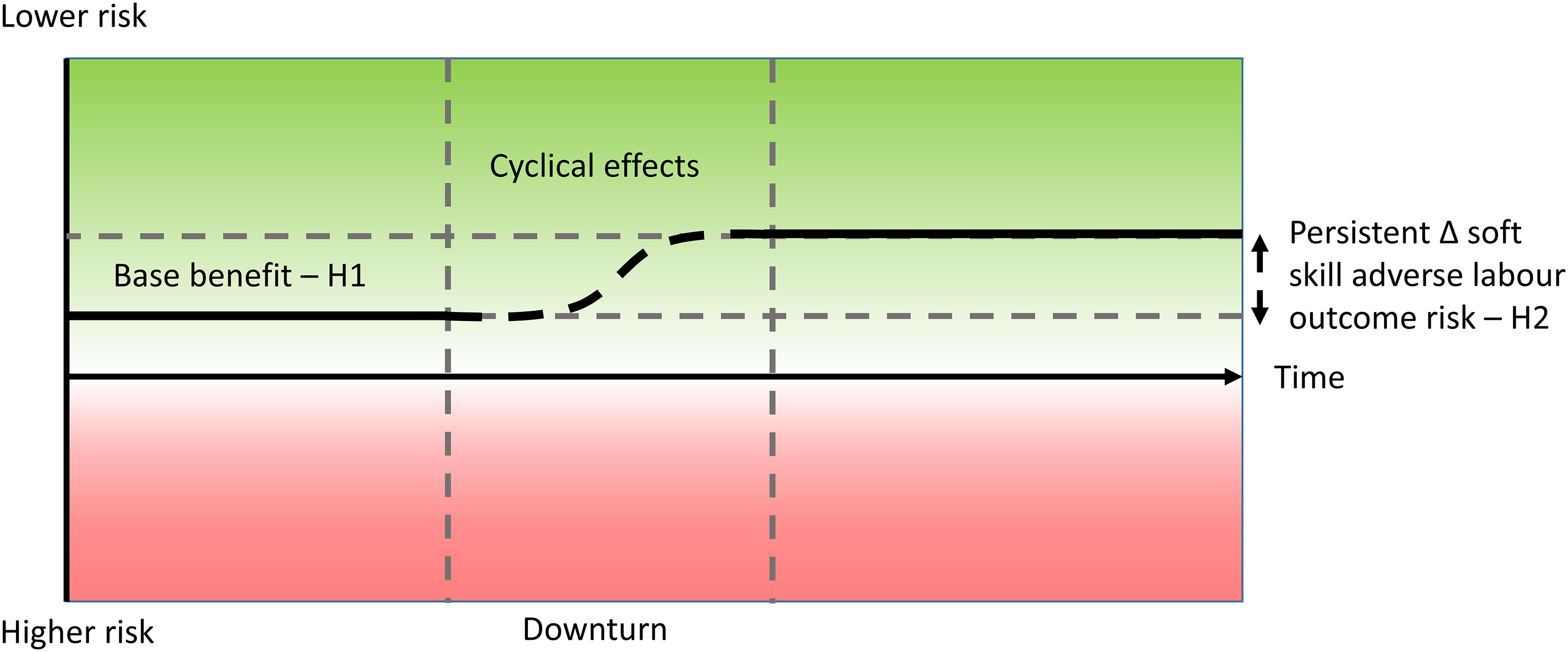
Our expected outcomes based on these theories are graphically represented in Figure 1, with two hypotheses. First, we expect soft skills to reduce the risk of unemployment and similar negative outcomes for the whole period, including prior to the GFC, due to their inherent value:
Theoretical expectations of soft skill effect on unemployment likelihood. Source: authors.

H1 Soft skills have a negative effect on unemployment, underemployment, and overskilling risk.
Second, we expect that soft skills will have additional value in the years following the GFC due to the persistent effect from this crisis, measured by moderating interactions with year effects as detailed in the next section:
H2 Soft skills have additional and persistent negative effects on unemployment, underemployment, and overskilling risk during and after economic contractions.
While there may be cyclical effects during the GFC, both soft skills and other skills are expected to follow the cyclical element discussed above, and thus not form a point of differentiation between these skill types. Further, the annual nature of these data and the lack of a technical recession make it difficult to separate these cyclical effects from the temporary effects after the crisis. However, the annual effects enable us to test H2 by measuring persistent effects from skills mismatch in the years following the crisis.
Data
This research uses the Household, Income and Labour Dynamics in Australia (HILDA) Survey data. This longitudinal survey began in 2001 with approximately 7000 households before expanding to 9600 households since 2011. These data are used to track individuals within households, beginning prior to the GFC through to after the GFC; further, they contain metrics for employment, quality of employment, and proxies for skill use to enable our analysis. We utilise the years 2005 to 2016, as this provides comparisons from prior to the GFC to after, with sufficient following years to investigate potential persistent effects from the GFC. In particular, the sample extending to 2016 includes the peak of the mining boom in 2012 and subsequent slowdown (Foo and Salim Reference Foo and Salim2022). We include labour market participants, regardless of current employment status, and marginally attached workers who may re-enter the labour market. One potential issue is the introduction of new individuals in the sample in 2011: as we are interested in the persistent effects of the GFC primarily observed after 2011, potential biases in these participants risk conflating a persistent shift after the GFC with a shift in the sample. We thus run a subset of models on two unbalanced panel data samples: the full sample of individuals, consisting of 67,243 observations of 14,290 people, and the filtered sample containing only those surveyed at least once prior to 2011, consisting of 49,584 observations of 8012 people. The remainder of this section discusses the variables used and estimation details, with the method section including the selection of the appropriate panel.
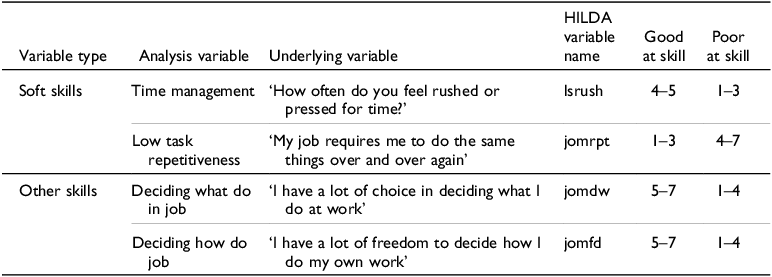
Due to the limited direct collection of endowed skills, we utilise proxies from prior research, including associated task usage and skill use in employment, to capture particular aspects of soft skills and overall skills. As several of the underlying measures are ordinal Likert variables, inclusion of all levels as categories would result in an excessively large number of permutations (Jeong and Lee Reference Jeong and Lee2016). We thus convert these scales to binary variables as per Table 1 (Semtner et al Reference Semtner, Dzator and Nadolny2024) or average components together to estimate a common underlying measure.
Likert to binary variable conversions
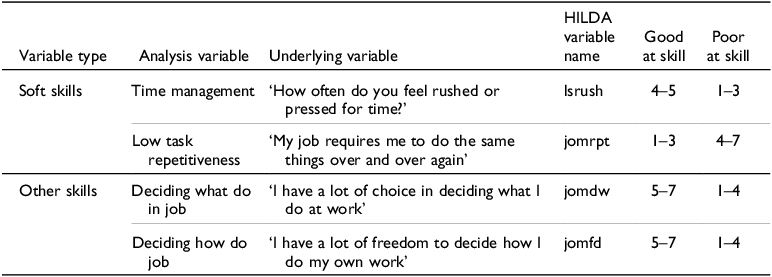
The underlying variable uses the HILDA variable description where direct HILDA terms are utilised.
For soft skills, three measures are used. The first measure is time management (Andreas Reference Andreas2018; National Careers Service n.d.; Pang et al Reference Pang, Wong, Leung and Coombes2019), where we use the HILDA measure for time pressure, ‘How often do you feel rushed or pressed for time?’ The second measure is low task repetitiveness as a measure of overall soft skills (Deming Reference Deming2017; Robles Reference Robles2012; Tamm Reference Tamm2018) using the measure ‘My job requires me to do the same things over and over again.’ The third measure is social capital, where we use six Likert scale variables for social interaction that enable management and development of soft skills (Andreas Reference Andreas2018; Jackson Reference Jackson2020; Rungo et al Reference Rungo, Sánchez-Santos and Pena-López2024): satisfaction with ‘feeling part of your local community’ (HILDA variable name: losatlc); satisfaction with ‘the neighbourhood in which you live’ (losatnl); ‘When I need someone to help me out, I can usually find someone’ (lssupsh); ‘I seem to have a lot of friends’ (lssuplf); ‘I enjoy the time I spend with the people who are important to me’ (lssuppi); and ‘When something’s on my mind, just talking with the people I know can make me feel better’ (lssuptp). Because soft skills developed and applied outside the workplace are also applied within the workplace (Andreas Reference Andreas2018; National Careers Service n.d.; Shakir Reference Shakir2009), these measures external to the workplace are relevant for a person’s interpersonal capabilities within the workplace. We test if these social capital components measure the same underlying item using Cronbach’s alpha. The result of 0.69 is close to the common threshold of 0.7 (Lance et al Reference Lance, Butts and Michels2006), and removal of any components negatively affects the alpha; thus, this collection is considered a relevant measure of underlying social capital. To combine these in a consistent manner over the two samples, we adjust each base scale to a standardised 0–100% (0–1) scale and then average these measures together.
We further include three measures of overall skills for both comparative purposes and completeness of model structure, as soft skills alone are insufficient for production (Cimatti Reference Cimatti2016). The first measure is the level of highest education level (hgage) as a readily observable measure of skill endowments from traditional education. We use three levels: school level, vocational level, and university level. The last two variables are overall skill intensity measures as per Fraser (Reference Fraser2008), consisting of the ability to decide what to do in the job and the ability to decide how to do the job. These measures all capture a broader range of skills compared to the soft skill measures that capture soft skills specifically.
For unemployment, we use the detailed employment state variable (esdtl). Employed individuals are full-time or part-time employed, and unemployed individuals are unemployed or marginally attached. However, this may be insufficient to capture negative labour market outcomes from the GFC. As a result, we develop two categorical variables that utilise a third imperfect match state between unemployment and good quality employment, with unemployment measured as above. The first intermediate category is underemployment: that is, fewer hours of employment than desired (Rones Reference Rones1981). We use the question ‘If you could choose the number of hours you work each week…would you prefer to work’ (jbhrcpr), with the answer ‘more hours than you do now’ treated as underemployment, and answers for fewer or the same hours treated as well-matched. The second intermediate category measure is whether the person feels overskilled for or underutilised in their job in alignment with bumping down (McGuinness and Wooden Reference McGuinness and Wooden2009). We use the Likert scale question ‘I use many of my skills and abilities in my current job’ (jomus), with a score of 5–7 treated as overskilling and 1–4 considered well-matched (Mavromaras et al Reference Mavromaras, Sloane and Wei2015). While there is potential endogeneity between these intermediate categories and employment-dependent skill terms, the underlying measures for highest education, time management, and social capital components are observed outside of employment and can be used for comparison. Further, as discussed in the next section, all skill variables are lagged to reduce endogeneity with all employment outcomes. We consider prior employment states using an autoregressive measure of the dependent variable for each model. To further distinguish cyclical or frictional unemployment from structural unemployment, a subset of specifications includes an independent variable for structurally unemployed participants who are marginally attached or unemployed for at least two consecutive years.
Some measures for the independent variables are only collected in the workplace and thus unmeasured for the unemployed, specifically the underlying measures for both job intensity variables and the task repetitiveness variable. Where a worker is employed in either the immediate prior or following year, we use these measured outcomes as proxies for that year of unemployment to further investigate the skills of workers entering and exiting employment. All other structurally unemployed workers are considered lacking these skills due to decay (Becker Reference Becker1994).
We include two business cycle variables: the regional unemployment rate and year categorical terms. The latter’s tracking of unemployment progression annually, prior to and after the crisis, enables investigation of persistent effects on recovery overall. We also apply interactions between all skill terms and the year categories to measure how the effect of skills on unemployment changes from prior to the recession through subsequent years. This enables detailed investigation of both the existence of persistent effects related to skills, and thus potential SBTC or RBTC and the duration of these effects.
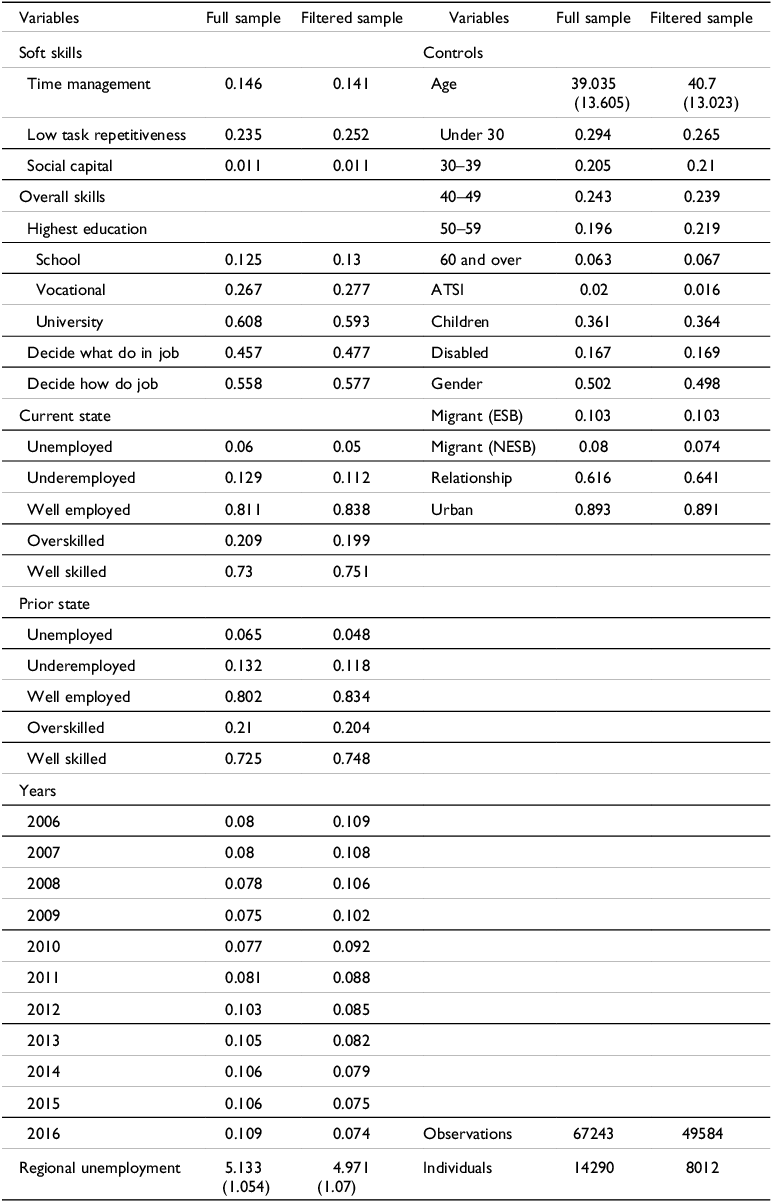
Finally, we include personal and workplace control variables. These include gender, age, disability, whether the person has children, whether the person is an immigrant from an English-speaking background (ESB) or not (NESB), whether the person is of Aboriginal or Torres Strait Islander (ATSI) heritage, whether the person is in a long-term relationship including marriage, whether the person lives in an urban geographic region, and first-level occupation and industry classifications. The occupation and industry classifications provide further information on specific sectors affected by the crisis and potential unmeasured worker characteristics. Each set of classifications is applied individually to minimise loss of parsimony. Structural unemployment is used as a type of classification in both sets, while frictionally or cyclically unemployed workers use their prior classification. Summary statistics for key variables for both samples are provided in Table 2 below.
Descriptive statistics
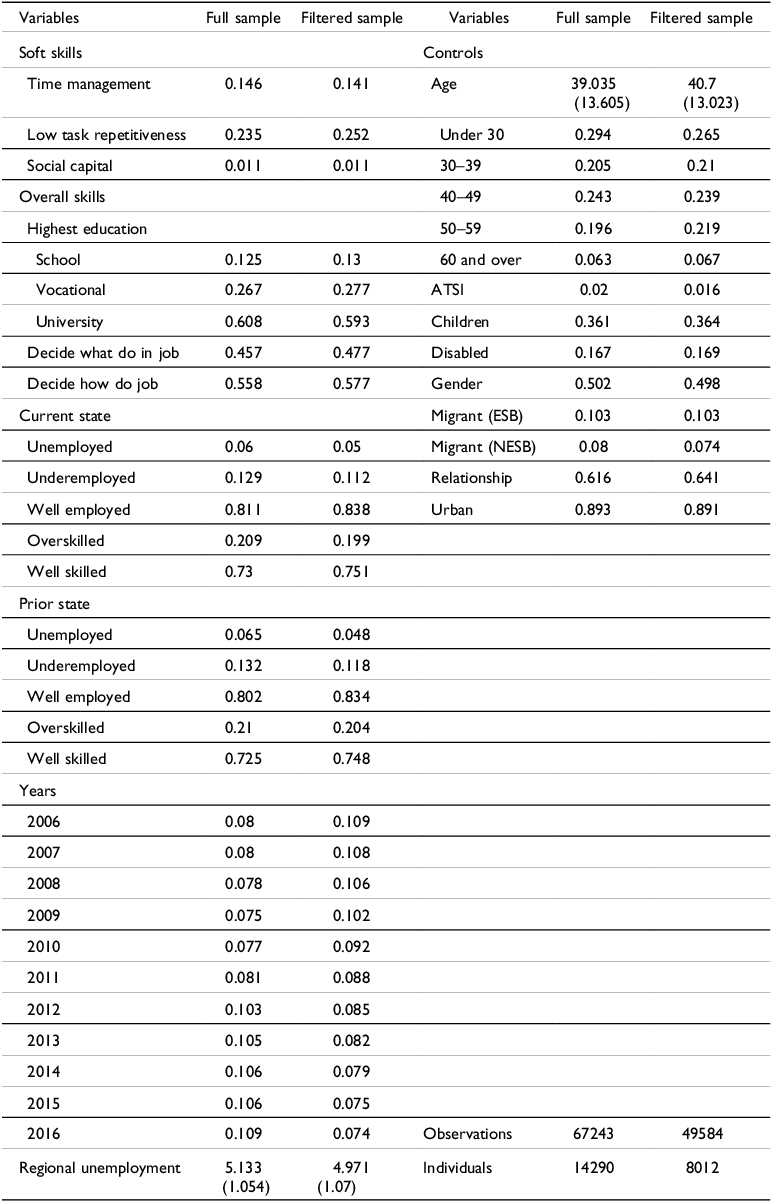
Select variables are reported due to space limitations. For binary variables, the measure is the proportion of the sample that is true for the variables. For categorical variables, the measure is the proportion of the sample that is of the particular level. For numerical variables, the measure takes the form of mean (standard deviation).
Source: HILDA dataset 2005–2016 and authors’ calculations.
Method
Our unemployment analysis uses panel data with a binary dependent variable. To align with our conceptual model, we apply a method based on Mavromaras et al (Reference Mavromaras, Sloane and Wei2015): a generalised linear mixed method (GLMM) model with a logit link and random marginal effects. To account for potential endogeneity within individuals annually, we apply Mundlak corrections to all time-variant terms (Bell and Jones Reference Bell and Jones2015; Mavromaras et al Reference Mavromaras, Sloane and Wei2015). This process begins with a fixed effect model as specified in Equation 1 below:
 $$\begin{align}y_{it}^*{\rm{\;}}={\rm{\;}}&{\beta _1}S{S_{it - 1}}{\rm{\;}} + {\rm{\;}}{\beta _2}O{S_{it - 1}}{\rm{\;}} + {\rm{\;}}{\beta _3}{y_{it - 1}} + {\rm{\;}}{\beta _4}t + {\beta _5}S{S_{it - 1}}{\rm{*}}t\; + {\rm{\;}}{\beta _6}O{S_{it - 1}}{\rm{*}}t \\&+ \;{\beta _7}{y_{it - 1}}{\rm{\;}} + {\rm{\;}}{\gamma _1}{X_{1it - 1}} + {\rm{\;}}{\gamma _1}{X_{2i}}{\rm{\;}} + {\rm{\;}}{\alpha _1}{\rm{\;}} + {\rm{\;}}{\alpha _{2i}}\; + {\rm{\;}}{u_{it}}\end{align}$$
where $y_{it}^*$
is the continuous latent form of the underlying
$y_{it}^*$
is the continuous latent form of the underlying ${y_{it}}$
dependent variable for unemployment,
${y_{it}}$
dependent variable for unemployment, $S{S_i}$
is the vector of soft skill measures,
$S{S_i}$
is the vector of soft skill measures, $O{S_i}$
is the vector of other skill measures,
$O{S_i}$
is the vector of other skill measures, $t$
is the time measured as the year,
$t$
is the time measured as the year, ${X_{1i}}$
is the vector of time-variant controls,
${X_{1i}}$
is the vector of time-variant controls, ${X_{2i}}$
is the vector of time-invariant controls, all
${X_{2i}}$
is the vector of time-invariant controls, all $\beta $
and
$\beta $
and $\gamma $
terms are the relevant vectors of estimated coefficients,
$\gamma $
terms are the relevant vectors of estimated coefficients, ${\alpha _1}$
is the overall constant,
${\alpha _1}$
is the overall constant, ${\alpha _{2i}}$
is the individual intercept, and
${\alpha _{2i}}$
is the individual intercept, and ${u_{it}}$
is the fixed effects error term. These are measured for individual
${u_{it}}$
is the fixed effects error term. These are measured for individual $i$
, with all time-variant independent terms lagged. This enables the model to better track how a worker’s capabilities affect their future performance in the labour market.
$i$
, with all time-variant independent terms lagged. This enables the model to better track how a worker’s capabilities affect their future performance in the labour market.
This model form has two issues: the time-invariant variables, in particular education, cannot be separated from the individual intercepts, and the standard fixed-effects model cannot be applied as-is to a logit link function due to the incidental parameter problem (Lancaster Reference Lancaster2000). We thus use the Mundlak corrections following Equation 2 to minimise the incidental parameter problem and to account for individual heterogeneity:
 $${\alpha _{2i}} = \;{\delta _1}{\overline {SS} _{it - 1}}{\rm{\;}} + {\rm{\;}}{\delta _2}{\overline {OS} _{it - 1}}\; + \;{\delta _3}{\bar X_{1it - 1}} + {\varepsilon _i}$$
and then substitute them into Equation 1, resulting in Equation 3:
 $$\begin{align}y_{it}^*{\rm{\;}} = {\rm{\;}}&{\beta _1}S{S_{it - 1}}{\rm{\;}} + {\rm{\;}}{\beta _2}O{S_{it - 1}}{\rm{\;}} + {\rm{\;}}{\beta _3}jo{b_{it - 1}} + {\rm{\;}}{\beta _4}t + {\beta _5}S{S_{it - 1}}{\rm{*}}t\; + {\rm{\;}}{\beta _6}O{S_{it - 1}}{\rm{*}}t\;{\rm{}} + {\rm{\;}}{\gamma _1}{X_{1it - 1}} \\&+ {\rm{\;}}{\gamma _1}{X_{2i}}{\rm{\;}} + {\rm{\;}}{\alpha _1}{\rm{\;}} + {\delta _1}{\overline {SS} _{it - 1}}{\rm{\;}} + {\rm{\;}}{\delta _2}{\overline {OS} _{it - 1}}\; + \;{\delta _3}{\bar X_{1it - 1}} + {\varepsilon _i}\; + {\rm{\;}}{u_{it}}\end{align}$$
Models with fewer parameters exclude the relevant parameters from Equation 3. This format removes the need for the individual intercepts for participants, resolving the concerns of the fixed-effect model. When interpreting the model, the main coefficients measure changes within individuals over time, while the Mundlak corrections measure differences between individuals over the whole time period. The Mundlak correction for age is excluded, as the age categories have minimal change within individuals over the time period. The Mundlak correction for regional unemployment is also excluded, as it negatively affects the ability for GLMM to fit the model.
Two adjustments to this method are required for the overskilling and underemployment analyses. First, the functional format for Equation 3 is adjusted so the link variable $y_{it}^*{\rm{\;}}$
has multiple thresholds to determine whether a worker is well-matched, unemployed, or in the intermediate category. Second, we use a cumulative link mixed model (CLMM) instead of GLMM.
$y_{it}^*{\rm{\;}}$
has multiple thresholds to determine whether a worker is well-matched, unemployed, or in the intermediate category. Second, we use a cumulative link mixed model (CLMM) instead of GLMM.
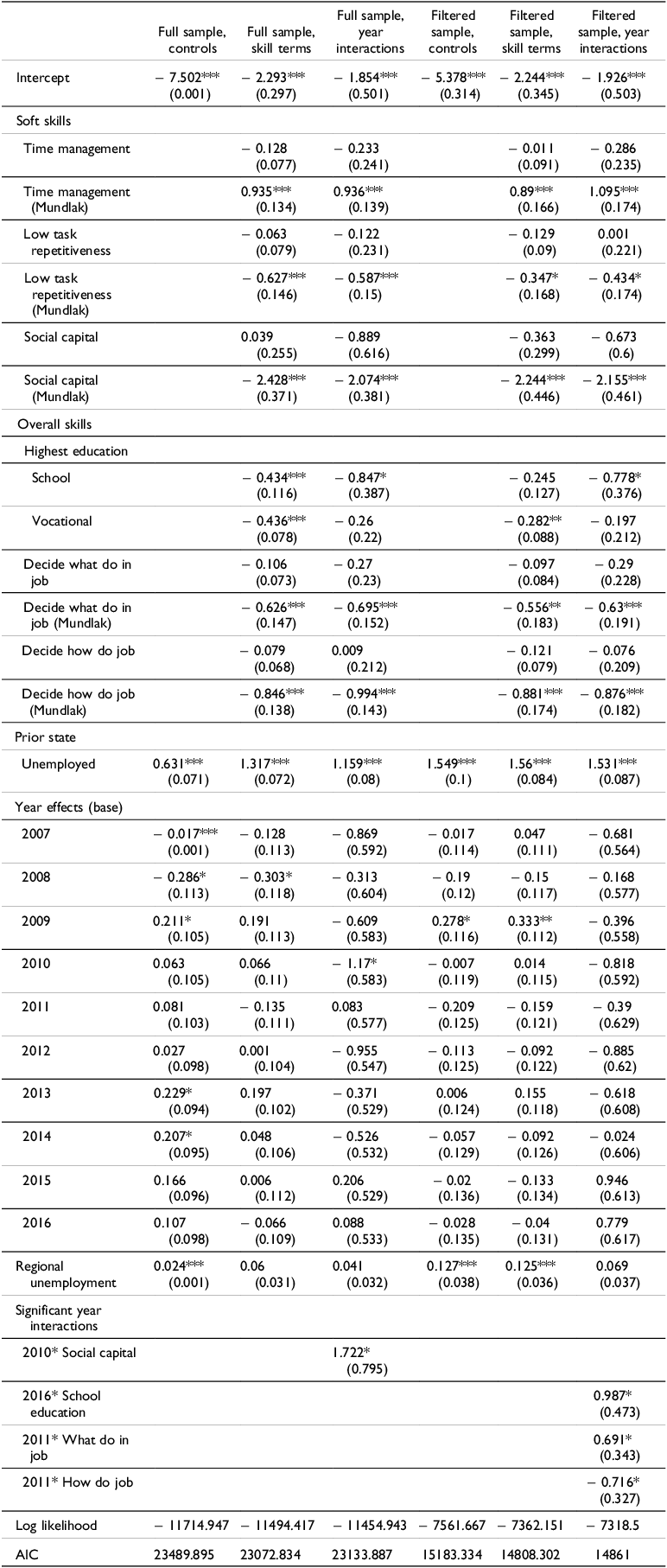
We do two stages of filtering on the unemployment method to determine a suitable sample and set of coefficients to answer our hypotheses. The first is on three sets of coefficients to determine whether the full or filtered sample works best: controls excluding skill terms, controls and skill terms, and all variables with year interactions. Relevant coefficients and statistics are included in Table 3, including significant year interaction terms. All relevant coefficients share signs, and only two variables have coefficients of notably different magnitudes between samples: the education levels and low task repetitiveness. Further, the Mundlak corrections for low task repetitiveness, social capital, and both skill intensity terms have coefficients aligning with H1, suggesting these terms are theoretically relevant. The filtered sample has both a lower Akaike Information Criterion (AIC) across all models and more year interactions of significance, with the former suggesting an improved model fit and the latter suggesting this sample provides results closer aligned with H2 in particular. As such, the filtered sample is most relevant for our analysis.
Unemployment random effects results – sample selection
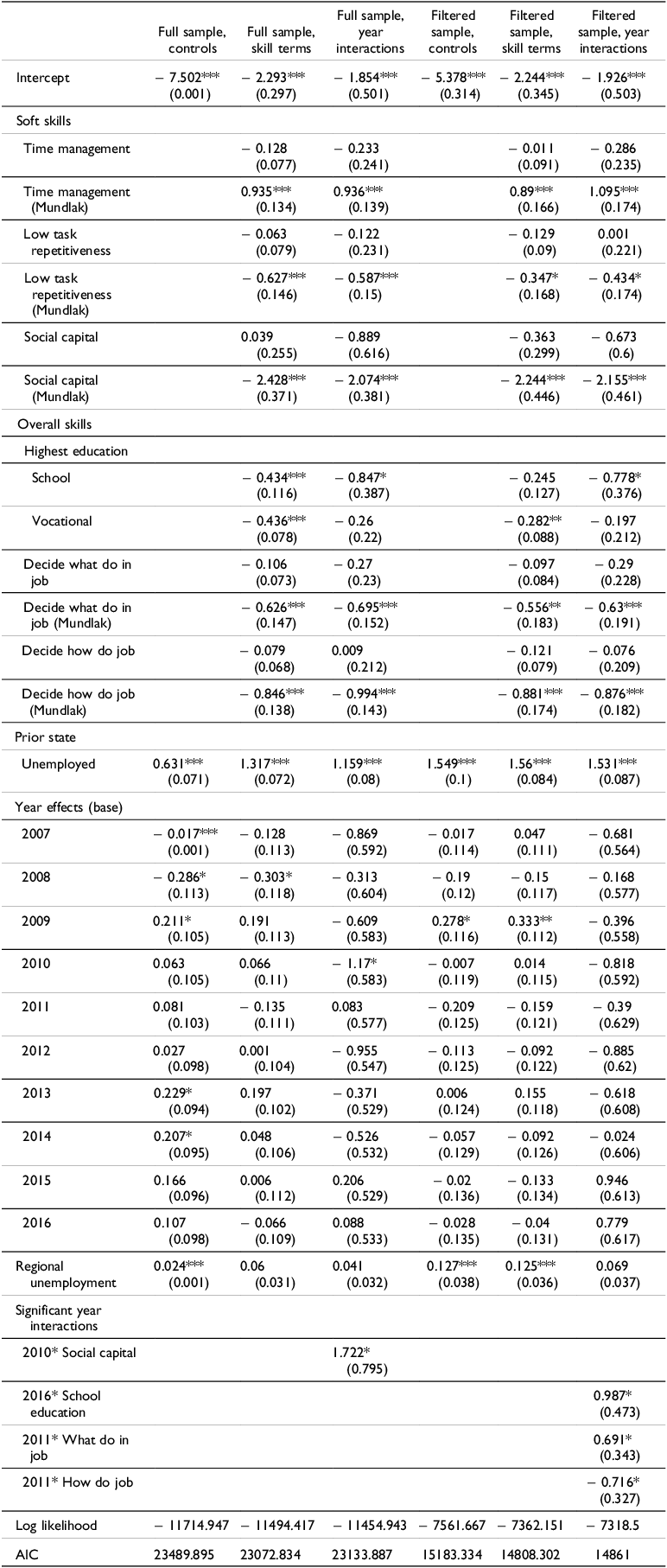
Significant year interactions and select coefficients are reported due to space limitations. *, **, *** Significant at 5%, 1%, and 0.1% levels, respectively.
Source: HILDA dataset 2005–2016 and authors’ calculations.
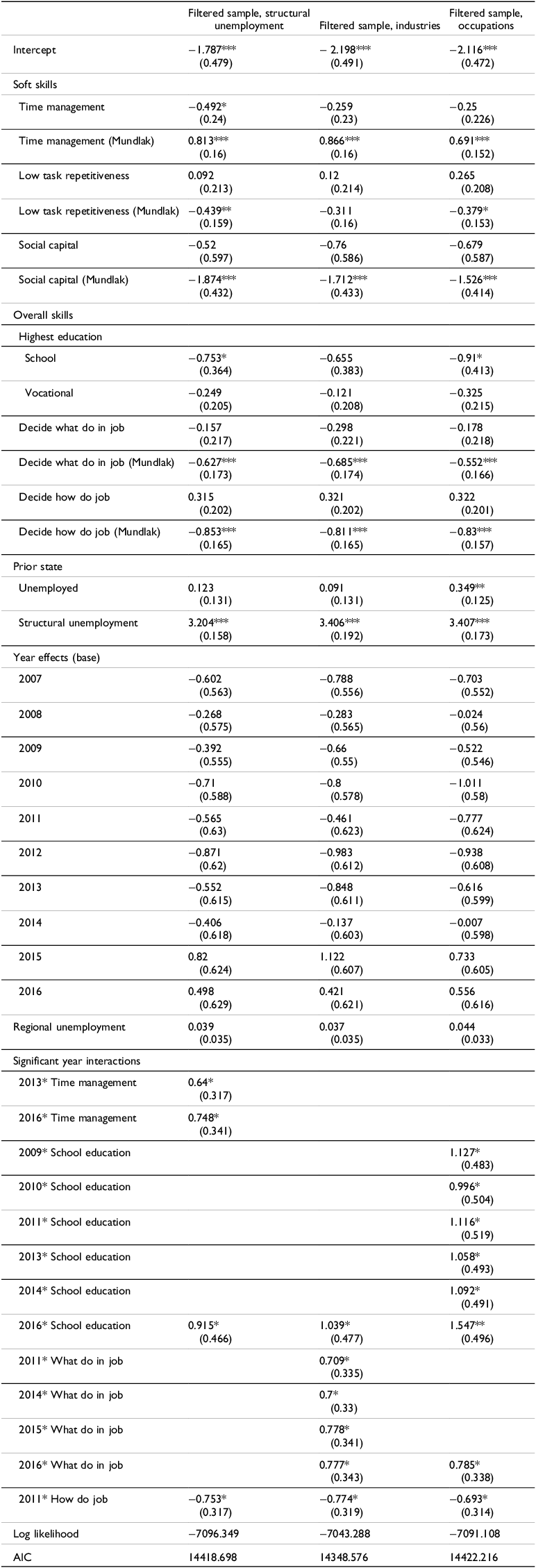
The second stage uses the filtered sample with year effects to determine which of three sets of employment controls works best to include with all other controls and skill terms: occupation classifications, industry classifications, or structural unemployment, with relevant coefficients and statistics included in Table 4. All AICs are smaller than the base model, with industry being the lowest, closely followed by structural unemployment. This suggests structural unemployment is a key component for the model, while industry classifications have further explanatory value. Meanwhile, the occupation model has a larger AIC than the structural model, while year interactions with school-level education are positive and significant for six of the eight years after the GFC, suggesting potential SBTC.
Unemployment random effects results – employment classification selection
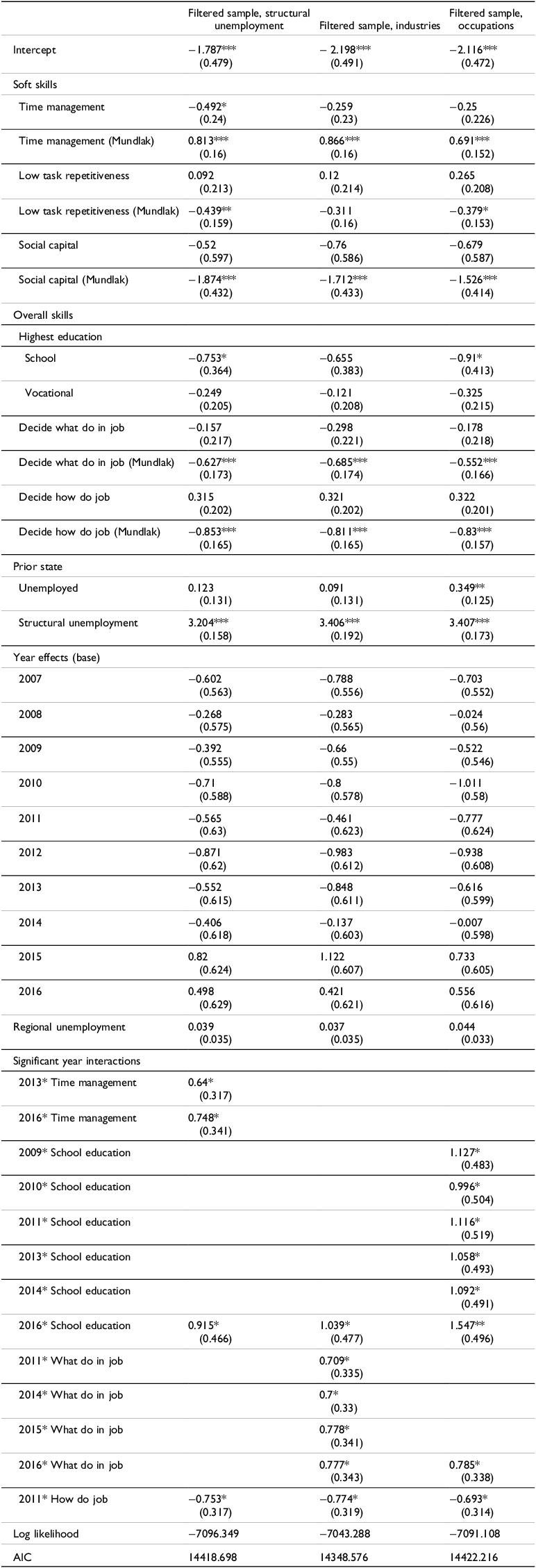
Significant year interactions and select coefficients are reported due to space limitations. Structural unemployment in the industry and occupation models is treated as an industry or occupation classification, respectively. *, **, *** Significant at 5%, 1%, and 0.1% levels, respectively.
Source: HILDA dataset 2005–2016 and authors’ calculations.
From both stages of testing, two sets of models are interpreted for these hypotheses and tested on all three dependent variables: a fully specified model with year interactions and industry classifications, and a parsimonious model with skill terms and structural unemployment without year interactions. The former model is of primary relevance as it answers both H1 and H2, while the latter provides further details for H1. All models use the filtered sample.
Results
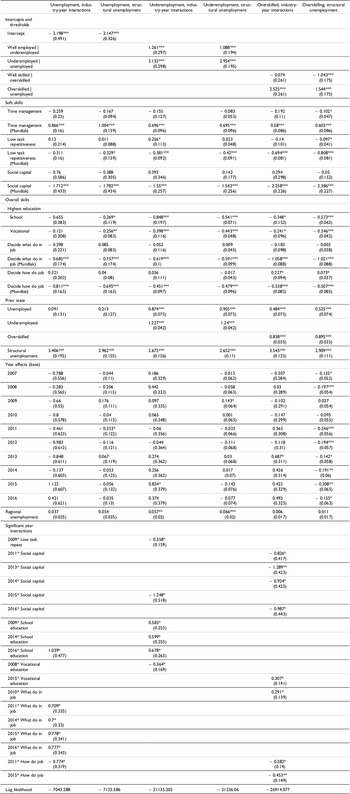
Relevant coefficients for all models are included in Table 5. Of the base skill variables, only the time-invariant education variables have significant coefficients in any of the models, while all the time-variant base skill variables have insignificant coefficients. Meanwhile, the Mundlak correction coefficients are significant at the 0.1% level for all skills excluding low task repetitiveness in unemployment specifications. These two results demonstrate that changes in skill levels do not affect an individual’s likelihood of changing employment state; instead, it is different endowments between workers, such as from training, that affect their risk of unemployment. The social capital Mundlak coefficient has the largest magnitude of all the skill terms while sharing the same 0–1 range, with the negative coefficient suggesting this component is associated with a lower risk of negative employment outcomes. As social capital and low task repetitiveness have significant and negative coefficients, it suggests soft skills overall are positively associated with improved employment outcomes, as expected from prior international research on other employment outcomes, including wages (Deming Reference Deming2017; Stewart et al Reference Stewart, Yeom and Stewart2020). However, time management has a significant and positive coefficient, suggesting these skills are not evenly rewarded and may even be penalised (Ubalde and Alarcón Reference Ubalde and Alarcón2020). The low task repetitiveness Mundlak coefficients align with prior findings that soft skills are associated with nonrepetitive jobs (Deming Reference Deming2017; Tamm Reference Tamm2018), although the significance of the coefficients varies from the 1% to 5% level for the unemployment models. This is low compared to the 0.1% significance level of the other soft skill coefficients, particularly when considering the high and growing proportion of nonroutine jobs in the Australian labour market (Borland and Coelli Reference Borland and Coelli2024). While low task repetitiveness has highly significant coefficients in the underemployment and overskilling specifications, and these coefficients have a consistently larger magnitude in the overskilling models, this may be due to endogeneity with the employment type. Time management and social capital form useful comparisons, as they are measured independent of the workplace. Time management Mundlak corrections have consistently smaller magnitudes compared to the unemployment models, suggesting both models minimise the negative effects of this term. Further, the overskilling model has consistently larger magnitudes and smaller errors for the social capital Mundlak corrections; thus, all soft skill measures are aligned, and endogeneity is unlikely. However, the social capital Mundlak corrections have smaller coefficients in the underemployment model, limiting this explanation. For overall skills beyond soft skills, results are again somewhat mixed: the task intensity measures are significant and negative across all models, aligning with prior literature on alternate skill categories, including cognitive and STEM skills (Deming Reference Deming2017; Stewart et al Reference Stewart, Yeom and Stewart2020). However, the highest education level measures have negative coefficients: as university-level education is the base level, this means lower levels of education are associated with lower unemployment risk, forming a mixed result. As the skill intensity variables measure the requirements of the job itself, compared to the education terms not measuring actual skill usage, these results in net favour overall skills being appropriately rewarded in the workplace. Overall, this forms moderate evidence in favour of H1, aligning with prior international research on the value of soft skills for other employment outcomes (Deming Reference Deming2017; Stewart et al Reference Stewart, Yeom and Stewart2020; Ubalde and Alarcón Reference Ubalde and Alarcón2020). However, the significant and positive coefficient for time management across all models does reinforce the mixed value of soft skills from some prior research (Semtner et al Reference Semtner, Dzator and Nadolny2024; Ubalde and Alarcón Reference Ubalde and Alarcón2020).
Unemployment, underemployment, and overskilling are binary and ordered random effects results
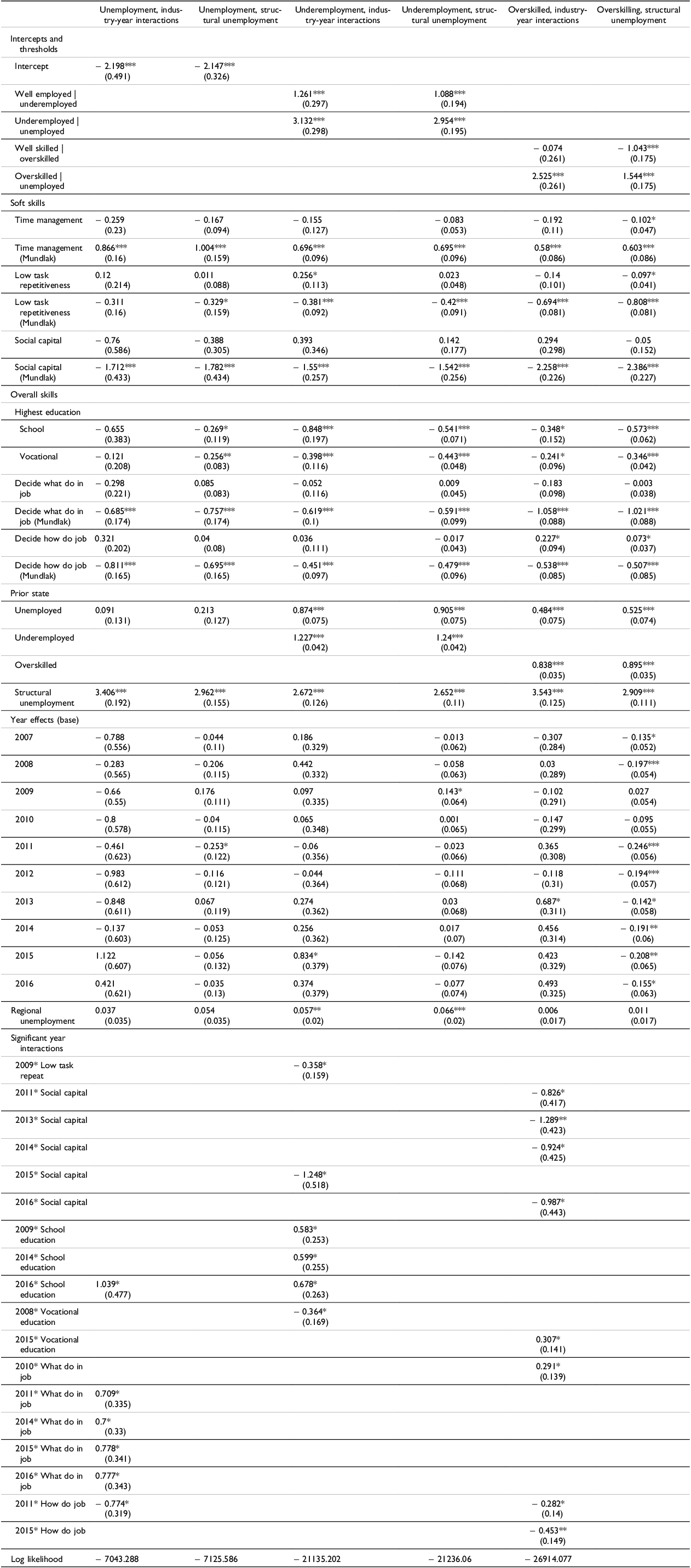
Significant year interactions and select coefficients are reported due to space limitations. Thresholds refers to the threshold to exceed to transition from the former state to the latter, taking a similar role to the intercept. Structural unemployment in the industry models is treated as an industry classification. *, **, *** Significant at 5%, 1%, and 0.1% levels, respectively.
Source: HILDA dataset 2005–2016 and authors’ calculations.
Year interactions have mixed effects through the models. The unemployment model has four significant interactions with deciding what to do in the job: three of these are after the peak of the mining boom, and all coefficients are positive, demonstrating a bias against skills after the mining boom. The underemployment model lacks a significant trend for any variable, suggesting SBTC and RBTC have limited relevance. However, the overskilling model has four significant-year interactions with social capital, all of which are negative, and three of which follow the mining boom. This further suggests the mining slowdown affected the usage of skills in the workplace, this time demonstrating SBTC and RBTC for reducing overskilling and unemployment risk. Overall, this demonstrates some evidence for H2, aligning in direction with prior research locally (Coelli and Borland Reference Coelli and Borland2016) and internationally (Hershbein and Kahn Reference Hershbein and Kahn2018; Jaimovich and Siu Reference Jaimovich and Siu2020). In particular, while the positive effect of this soft skill does align with RBTC, the lack of a similar trend for the low task repetitiveness measure itself suggests SBTC is the primary effect occurring.
Conclusion
The progress of technology has continued to affect skill demand and usage, particularly through skill and routine biases. These technologies further affect unemployment during and after economic downturns, slowing the labour recovery and increasing structural unemployment. One way Australian workers can prepare for these shocks is via soft skill development, as these skills are demanded by a broad range of employers and are difficult to automate. We test three soft skill measures of social capital, time management, and low task repetitiveness using the HILDA dataset on the years before, during, and after the GFC to determine if this shock resulted in a persistent change in the association between soft skills and reduced unemployment, underemployment, and overskilling risk.
The results show that specific soft skills reduce the risk of unemployment and other negative outcomes, supporting H1. This primarily comes from higher social capital via networks outside of the workplace, while low task repetitiveness has lower significance, and time management is associated with increased unemployment risk. The benefit of social capital is magnified when incorporating overskilling as an intermediate employment state, suggesting soft skills can also reduce the risk of being bumped down in employment match quality. Further, RBTC and in particular SBTC can be seen in the overskilling model for social capital after the GFC, forming some evidence for H2. An unexpected element of this was the trend starting after the 2012 mining boom’s peak, suggesting it was the slowdown in recovery that sparked this SBTC instead of the GFC itself.
This research makes multiple theoretical contributions. First, it confirms that soft skills and overall skills are not just rewarded in wages for those employed but also extend to achieving and maintaining good-quality employment. Second, there is evidence for SBTC and RBTC in the Australian economy; however, rather than occurring during or shortly after the GFC itself as initially theorised, these instead occur after the mining boom’s peak. This suggests the Australian Government’s stimulus measures and international trade with China supported the economy through the initial shock while delaying the SBTC and RBTC. Such a delayed effect risks dragging on the economy even multiple years into the recovery if businesses and workers are unprepared. Third, this research demonstrates the value of specific human capital. Beyond social capital’s larger magnitude, this value is particularly seen with the positive association that time management and university education have with unemployment risk. As data for the COVID pandemic emerge, further analysis on these aspects can shed additional light on soft skills in a different cyclical and technological context.
There are also practical contributions from this research. In particular, it demonstrates the importance of social networks beyond work and home for maintaining quality employment that can be developed through government support for specific education policies. To enable workers to maintain their social capital, seemingly unrelated policies may be considered, including physical ‘third places’ to promote in-person interactions beyond the immediate household and workplace (Pettersen et al Reference Pettersen, Nordbø, Skipstein and Ihlebæk2024) and employers supporting work-life balance, such as through enabling work from home. Further, while there was no apparent SBTC nor RBTC directly due to the GFC, the perpetual effects after the mining slowdown emphasise the importance of governments supporting businesses and workers through the transition out of recession in case of slowdowns in key economic drivers. This forms a potential lesson for the COVID pandemic recovery as well: governments need to retain consistent economic growth or otherwise risk increasing structural unemployment even after the main economic shock has passed.

 Open access

