




Introduction
‘Sociolinguistics’, say Coupland & Jaworski (Reference Coupland, Jaworski, Coupland and Jaworski2009:19), is ‘a broad and vibrant interdisciplinary project’. But interdisciplinarity can be complicated and take different forms. This article draws on the dialogue between a sociolinguist (Ben Rampton) and a memory studies scholar (Thomas Van de Putte) to explore its dynamics.
Memory studies (MS) focuses on the collective and personal remembering of high-profile and often traumatic events in cultural texts and institutional practices of commemoration, and it is already a significant point of reference in critical discourse analysis (CDA).Footnote 1 For the most part, however, CDA accounts of public remembering have centred on public displays and institutional discourses. Even though there is recognition that ‘everyday commemorative practices’ are ‘no less important’ (Milani & Richardson Reference Milani and Richardson2023:6–7), there has been relatively little ethnographic sociolinguistic work on the links between the events, objects, and narratives thematised in memory studies, on the one hand, and fairly low-key communicative activity, on the other (for exceptions, see e.g. Krzyżanowska Reference Krzyżanowska2023; Burnett, Ahmed, Matthews, Oliephant, & Walsh Reference Burnett, Ahmed, Matthews, Oliephant and Walsh2023; Pérez-Milans & Guo Reference Pérez-Milans and Guo2024). It is this gap that provides a starting point for the questions we address in this article: What is the scope for a sustainable interdisciplinary collaboration between MS and the ethnographic and interactional branches of sociolinguistics (EIS) where mundane communicative practice is a central concern? What forms could the collaboration take, and what are the complications?
We begin with broad-brush sketches of major theoretical and methodological interests in MS and EIS and identify quite substantial differences in ‘analytical culture’. One tradition leans towards respectful curation (MS), the other towards sceptical irreverence (EIS); while one attends hermeneutically to the afterlife of events in narratives, archives, and so on, the other captures the ongoing enactment of society across a plurality of genres in the factualities of recorded data. And while one handles material of considerable public interest (MS), often surrounded by legal and ritual discourses, the other tries hard to reveal the hitherto unrecognised consequentiality of what most people take for granted (EIS).
Nevertheless, there are potentially enduring cross-disciplinary connections in:
(a) MS's nascent interest in interscalar analysis which requires reaching into the details of ordinary talk, and in
(b) EIS’ growing interest in (in)securitization, which is a system of governance that sometimes turns memories of conflict into resources for political control and mobilisation.
But the connections achieved in these two areas follow different interdisciplinary logics:
(i) MS targets EIS for its distinctive methodological capacity to unpack the micro-dynamics of practice, and it uses EIS to open up a fundamental dimension in the production of social reality that it has recognised but lacked the tools to investigate empirically.
(ii) In contrast, EIS is interested in MS for its thematic focus on the commemoration of traumatic events but can treat it as only one among a number of other-disciplinary resources that are relevant in its efforts to understand the complex multi-dimensional problem of (in)securitisation as a powerful but specific system of rule.
These two approaches can be distinguished as ‘Mode 1’ and ‘Mode 2’ interdisciplinarities, and we illustrate them in two empirical projects that examine the benefits that MS and EIS bring each other—an MS study of remembering in Auschwitz/Oświęcim in Poland and EIS research on Greek-Cypriots learning Turkish in Cyprus. After that, we propose two-hour data sessions as a productive practical arena for strengthening interdisciplinary dialogue, optimizing the differences and accepting the uncertainties, tangents, and asymmetries that interdisciplinarity necessarily involves. We conclude with some comments on the wider significance of our discussion.
Memory studies
Memory studies’ main field of theorizing and empirical research is the collective and personal remembering of high-profile events of major significance in cultural texts and institutional practices of commemoration.
MS scholars are generally interested in the meanings of past events, not in the past as such—they study and interpret how the meaning attributed to events in the past changes or remains stable across time, situations, cultural, and political contexts. Focusing on the afterlife of events, discourses and narratives in monologic texts, testimonies, archives, and interviews are the most common source materials, and when these materials are not linguistic in nature—monuments, for example—they are often treated as texts that can be read and interpreted (e.g. Young Reference Young1993; Violi Reference Violi2017).
In the humanities and qualitative social sciences, memory studies scholars today tend to conceive of the pedigree of their field in three partly overlapping phases and intellectual waves (Erll Reference Erll2011). In the first phase, the ‘classical’ founding fathers wrote their texts on collective memory. Maurice Halbwachs, Aby Warburg, and Frederic Bartlett are considered to be the key authors. But in practice it is the Durkeimian tradition in which Halbwachs worked that is the most widely cited (Halbwachs Reference Halbwachs1925, Reference Halbwachs1950). Today, the general takeaway from Halbwachs for memory scholars is that our personal acts of remembering are informed by all kinds of social frameworks, which make memory inherently social and thus ‘collective’.
Phase two is the theoretical consolidation of the field in ‘schools’ and the boom in empirical research. The memory ‘boom’ (Winter Reference Winter2001) in the humanities and social sciences has been informed by an interest in cultural and collective trauma (Caruth Reference Caruth1996; La Capra Reference La Capra2001; Alexander Reference Alexander2012) in the 1980s and 1990s and the globalization of Holocaust memory in the same period (Levy & Sznaider Reference Levy and Sznaider2005; Kansteiner Reference Kansteiner2006). Two theoretical schools in memory studies are key to phase two. First, there is the historical and nation-focussed school inspired by the work of Pierre Nora (Reference Nora1997), where the main project has been to theorize and study a nation's material and immaterial ‘realms of memory’ (lieux de memoire), first in France and then elsewhere. Second, there is the German, more cosmopolitan and literary orientation inspired by Jan Assmann (Reference Assmann, Erll and Nunning2008, Reference Assmann2011) and Aleida Assmann (Reference Assmann1999). The Assmanns conceptualize collective memory as both communicative and cultural. Communicative memory is what has been directly experienced by members of groups and societies, and it usually lasts only a few decades after the events. Some of these events and meanings are then culturalized in a society's cultural memory. These memories, then, become durable and relatively stable, disconnected from direct experiences of the remembered events. This second phase in MS runs roughly from the 1980s until the early 2010s.
Phase three sees the Assmanns’ understanding of collective memory becoming dominant in memory studies in the humanities and being mobilized to study cases around the world. This third phase is more media-oriented, transcultural, cosmopolitan, and a good deal of theoretical innovation comes from literary and cultural studies, where new concepts emerge to study the mediation and movement of memory through time and between cultural contexts. Memory is now said to be travelling, multi-directional, transcultural, prosthetic, post-, and much more (Hirsch Reference Hirsch1997; Landsberg Reference Landsberg2004; Rothberg Reference Rothberg2009; Erll Reference Erll2011; Bond & Rapson Reference Bond and Rapson2014). Cultural and collective memories are never stable and fixed—they are the result of constant borrowing from other meanings and from resignification in ever-new contexts.
Recently, however, there have been calls for a new phase in MS. Memory studies ‘phase three’ is criticized for not being equipped to understand the most important issues today (climate change, most notably, Craps Crownshaw, Wenzel, Kennedy, Colebrook, & Nardizzi Reference Craps, Crownshaw, Wenzel, Kennedy, Colebrook and Nardizzi2018), for focusing too exclusively on events rather than processes (Wustenberg Reference Wustenberg and Kaplan2023), for being too Eurocentric (Adebayo Reference Adebayo2023; Mwambari Reference Mwambari2023), and for having exhausted its potential for theoretical innovation (Van de Putte Reference Van de Putte2024). In the field, there is growing interest in cross-disciplinary connections as a source of inspiration for the retheorisation of memory, and this comes with a broader call for interscalar (De Cesari & Rigney Reference De Cesari and Rigney2014; Keightley, Pickering, & Bisht Reference Keightley, Pickering, Bisht, Maurantonio and Park2019; Van de Putte Reference Van de Putte2022, Reference Van de Putte2024) and relational approaches (Gensburger Reference Gensburger2016; Erll Reference Erll2017; Jones Reference Jones2022), bringing scholars from different disciplines together to examine the same phenomena, taking each other's theories seriously.
This is where ethnographic and interactional sociolinguistics comes in. If MS wants to go multi- or interscalar, it will need to do more than interpret acts of remembering from cultural and/or institutional perspectives. In the attention that both the Halbwachsian and Assmannian traditions in MS give to official commemorative rituals and relatively stable, sacred memorial meanings in institutionalized texts, the view of the self is monolithic: people are seen as either internalizing and then reproducing one dominant narrative or resisting both processes as ‘activists’ (Van de Putte Reference Van de Putte2021). These theories do not recognise how dominant cultural meanings are forged through interactional practice, and how flexibly the remembering self can enact different and contradicting memory narratives in specific situations, both reproducing and resisting the dominant accounts without creating existential problems for the self.
So, at least in principle, EIS could offer MS a way of seeing how, for example, cultural meanings and political power take shape in quotidian interaction, or how the meanings of extraordinary events and processes are normalized. Investigating the micro-foundations of larger cultural memory meanings needn't require cultural memory scholars to give up on understanding the significant master narratives that assure continuity in societies (Jones & Van de Putte Reference Jones and Van de Putte2024). Rather, reaching out to EIS will allow us to better understand how (everyday) practices inform and subvert dominant and subordinate cultural memories and the social relations that they are connected to.
There is, though, always more to interdisciplinarity than just the logical next step in a programme of inquiry. Disciplines often differ in their dispositions, work habits, and senses of academic identity, and according to Sarah Gensburger, past-president of the Memory Studies Association,
[t]oday, if researchers from various disciplines tend to call for interdisciplinary practices, it is generally to assert the primacy of their own discipline for the more specific study of ‘memory’…. For contemporary memory studies, discipline-specific expertise on ‘memory’ hides behind an ‘interdisciplinary’ label and becomes a [form] of academic one-upmanship. (Reference Gensburger2016:407)
So, is MS destined for second place in its encounter with ethnographic and interactional sociolinguistics and, by the same token, is EIS inclined to one-upmanship? At this point we should turn to EIS: how obvious is the connection with MS, and what are the potentials for reciprocity and/or friction?
Ethnographic and interactional sociolinguistics
Dating back at least to Gumperz & Hymes (Reference Gumperz and Hymes1972), mundane communicative practice has been a central object of study in a significant number of the (very broadly) sociolinguistic schools and traditions: ethnography of communication, interactional sociolinguistics, conversation analysis, linguistic anthropology, variationist sociolinguistics, linguistic ethnography, nexus analysis, sociocultural linguistics, and so on. Many of these traditions are interested in the larger-scale social processes that concern researchers in disciplines like sociology, anthropology, cultural studies, and geography, but they approach them by looking very closely at recordings of everyday interaction among ordinary people, using ethnography to trace the interaction's links to the plurality of processes, systems, identities, and relationships that comprise its multi-layered ‘context’, influencing the encounter before, during, and after its occurrence (Rampton Reference Rampton2006:ch.10). Indeed, with practice itself standing as a central contemporary academic concern (Ortner Reference Ortner2006), EIS is often inclined ‘to reach out to other disciplines… conceiv[ing] of language no longer as the primary object of inquiry but as an instrument for gaining access to [the] complex social processes’ studied in other fields (Duranti Reference Duranti2003:332).
There is quite a bit of diversity in the models of society that EIS traditions work with, but Michel Foucault and Pierre Bourdieu have been very influential reference points for a long time,Footnote 2 and this points to an abiding interest in how linguistic practice (re)produces social inequality. So investigations of the inequalities of class, race, gender, sexuality, generation, and so forth take the ‘microscopic’ analysis of mundane talk as their baseline, and then scale up and down through the genres in play, the physical arrangements, the institutional roles, and so on, to look at how practices on the ground reproduce or interrupt longer/wider structural processes, often also engaging with highly influential ideologies and systems of governance like standardisation and marketisation. Moving from social systems to individuals, there is also a good deal of interest in mundane practical consciousness—‘communicative competence’, ‘habitus’—and how this shapes and takes shape in everyday conduct (even though heightened awareness also moves into focus when the everyday gets breached, resisted, and denaturalised from time to time).
The data with which sociolinguistics pursues these interests certainly do not exclude the narratives, interviews, media reports, and public discourses that feature prominently in memory studies, but they also extend far further, both in institutional siting and generic form, spanning (to name just a fraction) communities, schools, clinics, offices, social media, chats, jokes, lessons, lectures, consultations, committee meetings, and so on. Theories in these sociolinguistic traditions are usually developed through very close and repeated examinations of data, and although there is ongoing work refining/revising theoretical models themselves, theories are often technologised quite quickly as ‘tools’ and ‘analytical frameworks’. As such, it is their capacity to illuminate communicative practice that matters,Footnote 3 and there is usually an overarching commitment to holding theories and analysis accountable to the hearable facticity—to the ‘truth’—of audio/video-recorded data, where, crucially, the analyst's interpretations of meaning are themselves often constrained by the understandings displayed by other participants in the event being studied (see, for example, the next-turn proof procedure in CA or playback in interactional sociolinguistics).
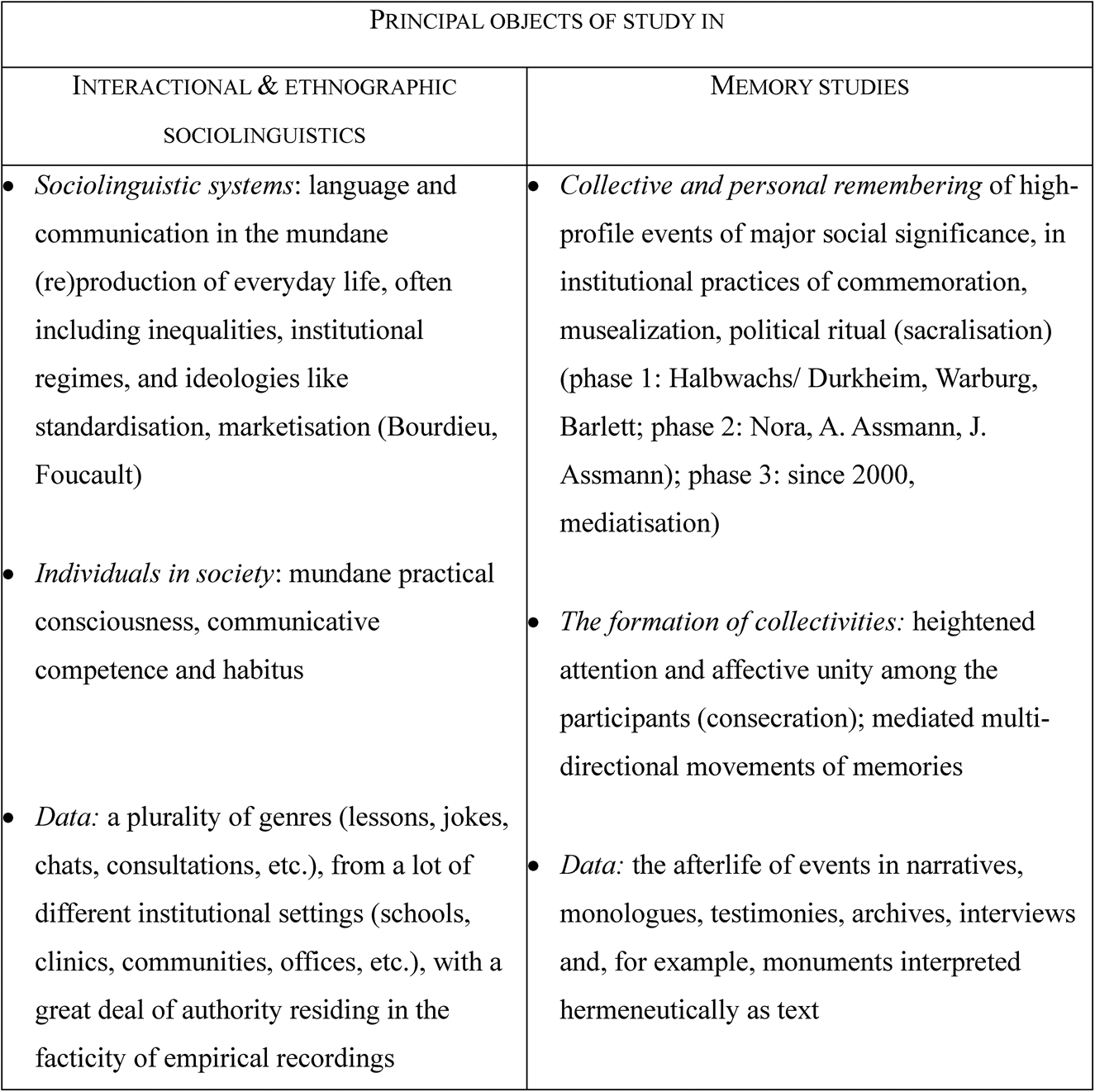
So, it sounds as if EIS would be open to dialogue with MS, but overall, its typical interests, sites, and procedures look rather different, as can be seen in Figure 1, which sets our broad-brush characterisations next to each other.
Principal objects of study.

Indeed, there are quite striking differences in how we have presented each of these fields. The description of MS narrates a line of development and a pedigree, while the account of EIS amalgamates different traditions to claim wider relevance to social science (in Coupland's (Reference Coupland1998:116) words, ‘restructuring how we represent the discipline to ourselves and others’ to ‘advance social theory’). These differences in self-presentation point to more general differences in epistemic demeanour, to which we now turn.
Different analytic dispositions?
As an undergraduate in the discipline, one of the first things you learn is that sociolinguistics does ‘myth-busting’, debunking prejudice about the inferiority of non-standard language; ethnographies of communication produce findings that confound mainstream assumptions about practices that look strange to outsiders; and conversation analysis is resolute in focusing on what initially looks trivial and mundane. These traditions all position themselves as social science, ambushing irrationality, deluded commonsense or indeed high-falutin’ theory through the application of systematic frameworks to empirical texts and recordings.
That said, ethnographic and interactional sociolinguists have a good deal of freedom to pick and choose what they want to study. Alongside the other-disciplinary reference points mentioned above, there is also often a lot of non-academic, professional, bureaucratic, educational, or journalistic discourse around the everyday practices that EIS researchers decide to focus on, and these non-academic discourses can also be important points of departure and reference throughout. The big challenge is to say something that is different but still relevant to the other discipline(s) you have been reading and/or to the commonsense prevailing in the particular institution(s) in focus. And with unspectacular practice at the centre of EIS analysis, you quite often find yourself asking: “Am I really just making a mountain out of a molehill?”, “Is this actually all just trivial pedantry?”, “So what? Why bother?”.
For memory studies, the picture looks different. Scholarly accounts on memory enter high-profile arenas that are already very well populated with narratives and discourse from sociopolitical actors as well as other disciplines, and a lot of different constituencies care about the representations that memory scholars study and produce. Indeed, scholars in MS are often heavily involved in co-shaping and enterpreneuring the cultural meanings and narratives they study: influential memory scholars are part of, for example, parliamentary commissions about the colonial past (e.g. Valerie Rosoux in Belgium), and advise the government on resignification of fascist heritage (e.g. Francisco Ferrandiz in Spain). The normative position in MS usually varies, depending on who the actors are that are doing the remembering: Nationalist interpretations of the Holocaust, or imperial nostalgia, are likely to be debunked (e.g. Craps Reference Craps2013; Grabowski Reference Grabowski2016), while liberal interpretations of the Holocaust, or the memories of marginalized communities, tend to be treated less sceptically and the researcher contributes to the sacralization of memory. So as a memory scholar, it is not the triviality of what you are studying that worries you—what you try to avoid is either transgressive desecration or public endorsement, depending on what you are examining.
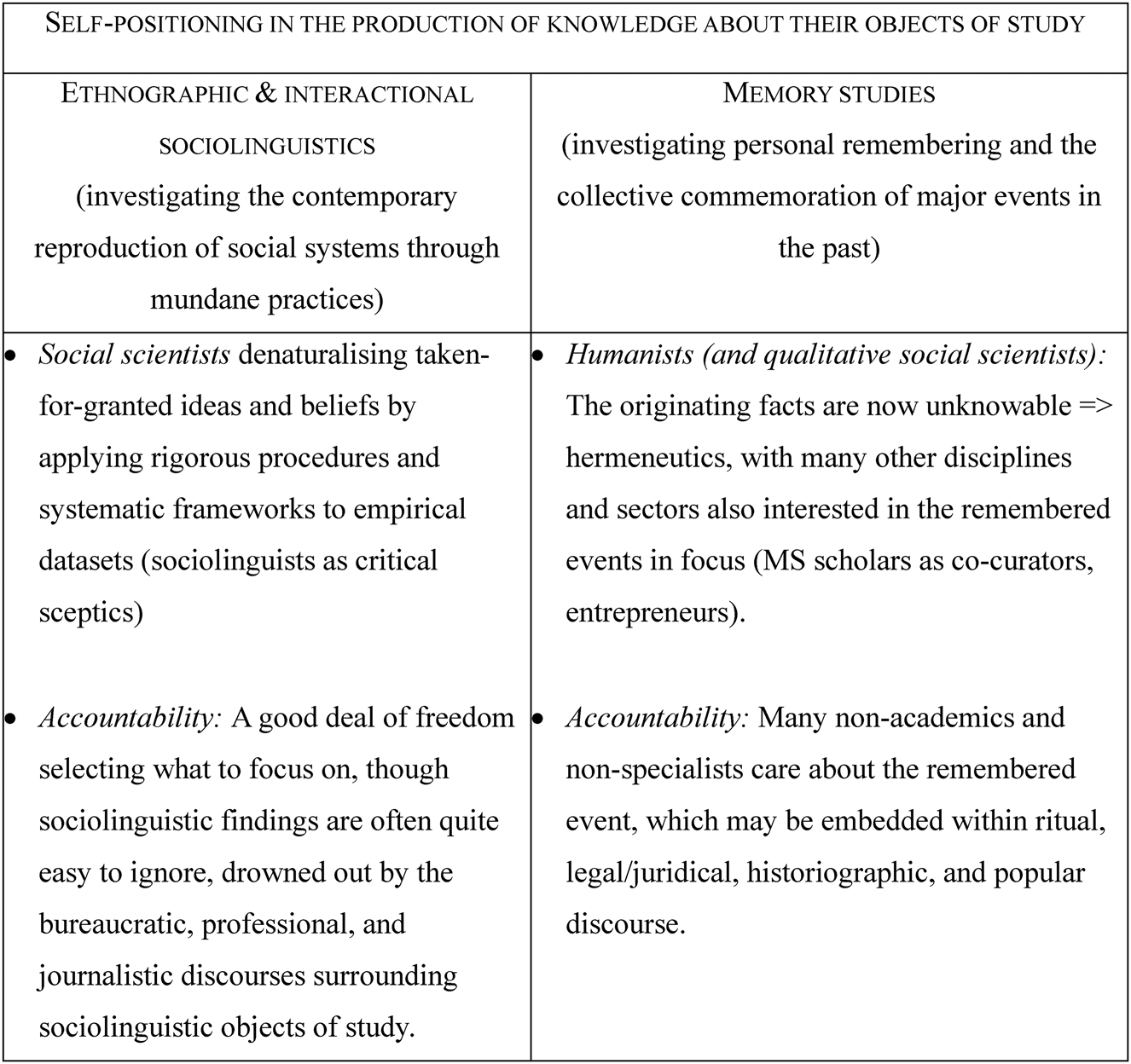
Thus, as well as differing in their thematic focus, it looks as though EIS and MS foster different analytical dispositions (Figure 2). On what grounds, then, is there any realistic hope of sustainable dialogue of lasting mutual benefit? A shared interest in high profile public texts and artefacts can account for the conversation between memory studies and CDA in particular projects, but what are the prospects for an enduring conversation that puts mundane everyday practice at its centre? This is a point where we need to recognise that a two-way interaction can accommodate different approaches to interdisciplinarity, sustaining the exchange despite the asymmetries that this involves. To summarise the differences that we illustrate in the next two sections.
• EIS can offer MS a set of frameworks and procedures to open up a fundamental dimension of social reality that MS has started to recognise ontologically but has hitherto failed to theorise because it has lacked the analytical tools;
• in the other direction, MS can contribute to EIS's understanding of a particular form of everyday governance—(in)securitisation—that has become increasingly salient in the contemporary world. To make sense of power dynamics that EIS has hitherto overlooked, MS becomes one among a number of strands in an already eclectic set of other-disciplinary resources that EIS draws on in this endeavour.
Self-positioning in knowledge production.

We use two case studies to demonstrate such an interdisciplinary crossfertilization, the first drawing on Thomas Van de Putte's work in MS and the second on Constadina Charalambous's work with Ben Rampton and Panayiota Charalambous in EIS.
Mode 1: Memory studies and the problem of interactional complexity
Memory studies’ trouble in making sense of the complexity of self-presentation in interaction was a problem for Van de Putte's analysis of data from his participant observation fieldwork among a group of friends living in the contemporary Polish town of Oświęcim/Auschwitz in Poland (Van de Putte Reference Van de Putte2021). But by drawing on concepts from Goffman-inspired sociology and interactional discourse analysis—positioning (Davies & Harré Reference Davies and Harré1990; Bamberg Reference Bamberg, Daiute and Lightfoot2003; Georgakopoulou Reference Georgakopoulou2007), narrative pre-construction (Labov Reference Labov2006), vicarious experience and the construction of epistemic authority (Sacks Reference Sacks, Maxwell Atkinson and Heritage1984; Norrick Reference Norrick2013, Reference Norrick2020)—he was able to write about his participants as skilled communicators able to switch between a ‘catalogue’ of different narratives.
Oświęcim's 40,000 inhabitants live so close to the Auschwitz-Birkenau former concentration camp that they are constantly navigating different sacred and profane meanings in their everyday lives. To illustrate the complex interactional practices that this involves, it is worth looking at a short strip of interaction that Van de Putte felt unable to make sense of before reaching out to EIS. The interaction comes about an hour into a two-hour twelve-minute interview in a living room belonging to Adam, a self-employed window repairer who is also a passionate collector of historical objects connected to Auschwitz/Oświęcim. He finds these objects during his work in old houses and exhibits them in his basement, turning the basement into a small private museum (Van de Putte Reference Van de Putte2021). Adam and Van de Putte have been discussing how he writes about the town's past on Facebook, looking at some printed screenshots that Van de Putte has brought to the interview. Van de Putte asks about the meaning of one of his Facebook posts and this requires Adam to locate his social media activity in a context that includes the dominant narrative about the Nazi German occupation of the town in various contexts.Footnote 4

The cultural memory narrative Adam tells at first is a peculiarly short one (line 2): “Germans, camp, they took over the city threw out Poles or and so forth.” The main actors in this story are “the Germans”, who took over the city and threw out the Poles, and the “Poles”, who were passive and were thrown out. Adam's mention of “the camp”, without explaining what that may mean, seems to be connected to the other two actions “the Germans” took (taking over the city, throwing out the Poles). Adam ends his story with “and so forth”. He does not elaborate, and Van de Putte also doesn't ask him to.
What is crucial here is that Adam does not explicitly mention Jews or other victim groups in the story. The role of Jews might have been assumed in the mentioning of “the camp” or in the “and so forth”,”but Adam does not thematise them explicitly. He only stresses the active role of the Germans and the passive role of the Poles. These choices largely reflect a dominant cultural narrative that is promoted by Catholic, Polish nationalist actors in the Polish public sphere (Zubrzycki Reference Zubrzycki, Vatan and Silberman2013, Reference Zubrzycki2016).
At the end of this part of the exchange in line 3, Adam wants to continue his story, but Van de Putte interrupts him (line 4), asking whether Adam really thinks that is what everyone knows. Adam had known Van de Putte as a friendly acquaintance during his period of ethnographic fieldwork and he is not used to Van de Putte in the role of interviewer, questioning his views. Because the critical question came so unexpectedly, Adam has to reposition both himself and Van de Putte, Van de Putte's expectations, and the norms governing their interaction. From a friendly in-group member during his ethnography, Van de Putte becomes repositioned as a critical interviewer. After the interruption, Adam realizes that a different cultural memory narrative than the one he has just performed is required. But it takes time for Adam to formulate that narrative.
To Van de Putte's question, he initially replies confidently, “I think that yes well because if they live here . . .” (line 5). However, then the conversational data suggest that Adam starts doubting his answer and is struggling to make up his mind. From lines 5 to 8, he takes about ten seconds to start a new story. During these ten seconds, the pace of his speech is slowing down, and at least three times Adam halts his own stream of thoughts. Adam seems to be struggling here to reestablish the epistemic authority and confidence that he performed before Van de Putte's critical interruption.
The second narrative (lines 8–13) is completely different from the first one. Now, it is not the Germans and Poles who are the central actors, but it is the Jewish past of the town that everybody is supposedly remembering. Adam explains that “the majority of people know that it was a Jewish small town as one could say” (line 8). He goes on to explain that about fifty percent of the inhabitants before the war were Jews. After having set the scene of Auschwitz/Oświęcim as a Jewish small town, he narrates the Second World War and the Holocaust. The Germans invaded, removed all of the Jews. Some of the Poles stayed on the outskirts of the town, but the Jews were forcefully removed “to the camps for the Holocaust and so forth” (line 13). Notice that not only Jews are new to the story. In this part of the story, some of the (Catholic) Poles also stayed in the town, while in the first narrative, they were “thrown out”. Now it is the Jews who occupy a passive role, not the Catholic Poles.
To sum up, Adam mobilizes different parts of his cultural toolkit (Swidler Reference Swidler1986) in this interaction. Initially, he offers the Polish nationalist narrative appropriate to an in-group member but then switches to the more liberal and international narrative required for a critical interviewer. For MS as such, the episode looks messy and confusing because it does not show a person who has internalized just one memory narrative, consistently either reproducing or resisting the hegemonic version. But EIS recognises the negotiations, stance nuancing and dissonance emerging in a plethora of encounters, and this helps to make the interaction intelligible, allowing us to see the discursive effort with which Adam manages the shift without disrupting the event.Footnote 5
Stepping back to consider the cross-disciplinary moves involved, we can say that this is a case of ‘Mode 1 interdisciplinarity’ (Economic & Social Research Council nd; Gibbons, Limoges, Nowotny, Schwartzman, Scott, & Trow Reference Gibbons, Limoges, Nowotny, Schwartzman, Scott and Trow1994; Rampton, Maybin, & Roberts Reference Rampton, Maybin and Roberts2014:6; Strathern Reference Strathern2000:285–86). In Mode 1 interdisciplinarity, focal problems are identified within a particular (sub)discipline, and there is cross-reference to another paradigm/line of research in order to get past a bottleneck that researchers have reached using only the concepts and methods available within their own disciplinary heartland. The rationale for cross-referencing other approaches and the parameters of what to include are set fairly clearly, and there is quite a well-defined sense of exactly what kinds of methodological borrowings and combinations are now in order.
This differs from interdisciplinarity in ‘Mode 2’. In Mode 2, it is the multi-dimensional complexity of ‘real-world’ issues of social, technical, or political significance that calls for collaboration between a multiplicity of disciplines and stakeholders, and it is important not to commit too quickly to a specification of the key methods and dimensions of analysis.
Mode 2 interdisciplinarity: EIS, MS (and other disciplines) at the nexus of (in)securitisation
Although they are absolutely not new in many parts of the world, over the last two decades discourses of security have become much more insistent in wealthy countries like the UK, western Europe, and the US, where ethnographic and interactional sociolinguistics first developed and now thrives. This entails a form of governance that has been called ‘securitisation’ in the study of international relations (IR), and in IR, securitisation has been described as the ‘practice of making “enemy” and “fear” the integrative, energetic principle of politics displacing the democratic principles of freedom and justice’ (Huysmans Reference Huysmans2014:3). It is a way of managing populations in which the normal laws and rules guiding citizens in contemporary liberal democracies no longer apply, and instead, people act as if there is a state of exception (or a state of siege) where there are existential threats and the strong possibility of violence and/or death.
IR has been a vital external reference point for sociolinguists seeking to engage with securitisation as a ‘real-world’ process, and the relevance to EISFootnote 6 has increased with growing critical IR interest in ‘details, local events, or precise and complex life stories’ (Bigo Reference Bigo, Maguire, Frois and Zurawski2014:190–91), looking at how ‘vernacular constructions, experiences and stories of (in)security have the potential to disrupt “official” accounts’ (Vaughan-Williams & Stevens Reference Vaughan-Williams and Stevens2015:42). The bracketed prefix (in-) is now often added to security to capture the fact that securitisation usually works in two or more directions— security to one person can be insecurity to another, and this can change with the situation, sometimes quite quickly—and this more interactive approach has been accompanied by increased interest in ethnography. EIS has tuned into these developments, and the ensuing exchange has also included some collaborative IR/EIS publications, projects, and training (e.g. Mc Cluskey & Charalambous Reference Mc Cluskey and Charalambous2022; Charalambous, Charalambous, & Rampton Reference Charalambous, Charalambous and Rampton2017; Rampton & Charalambous Reference Rampton and Charalambous2020; www.kcl.ac.uk/liep). But where and how does memory studies come in?
Collective memories and narratives of trauma or a glorious mythical past can feature very prominently as warrants for the political action needed to manage the existential threats conjured in discourses of securitisation (Jones & Van de Putte Reference Jones and Van de Putte2024). This is one very good reason for EIS to stay in touch with memory studies, and in order to illustrate a distinctively MS contribution to EIS in action, we should now turn to the research on Greek-Cypriot secondary school students in Cyprus learning Turkish, the language of the (former) enemy.
In 1974, Cyprus was de facto divided following violent conflict between Greek-Cypriots and Turkish-Cypriots, and after that, communication between the two parts was impossible for almost thirty years. But when the (mainly Greek-speaking) Republic of Cyprus signed the EU accession treaty in 2003, restrictions of movement across the buffer zone in Nicosia were partially lifted, and among other things, the Turkish language was introduced as an option in Greek-Cypriot secondary education for the first time, framed within a rhetoric of reconciliation. In 2006, there were 1,138 secondary students studying it for ninety minutes a week for two years, and in 2012, there were 873. But the task of teaching Turkish was very far from straightforward, because for a long time, Greek-Cypriot education has been a major site for collective remembering of the conflict and for the construction of Turkish otherness, emphasizing Greek-Cypriot victimhood and promoting a militant spirit of ‘I don't forget and I struggle’ (see Zembylas, Charalambous, & Charalambous Reference Zembylas, Charalambous and Charalambous2016).
Plainly, the memory of conflict loomed large in Cyprus (and still does), and to sharpen her sense of the complex and contested symbolic significance of language framed within a legacy like this, Charalambous (Reference Charalambous2019) turned to a branch of memory studies, critical heritage studies (CHS; Tunbridge & Ashworth Reference Tunbridge and Ashworth1996; Graham Reference Graham2002). She used this to consolidate her examination of shifts in the approach to teaching and learning Turkish over time, spotlighting variation and change across policy documents, curriculum texts, and interviews with students and ministry officials, also summarising earlier work on different styles of teaching Turkish (Charalambous et al. Reference Charalambous, Charalambous and Rampton2017). This scrutiny revealed an uneasy movement away from the government's initial goals of collective healing and reconciliation to a much more instrumental view of the language's potential professional and economic value to individuals. Concepts in CHS like ‘commodification’ and ‘erasure’ reinforced the account (see below), and parallels also emerged between these broad shifts in language ideology and the management of material heritage, including ‘the reconstruction of Ottoman hamams, mosques, tekkes, etc’ over the same period (Reference Charalambous2019:880; Constantinou & Hatay Reference Constantinou and Hatay2010:1614). Linking into a subfield of memory studies in this way, Charalambous’ (Reference Charalambous2019) article was able to enrich the theorisation of ‘heritage language’ in language education, ‘shift[ing] the focus from what is heritage to how heritage is managed and practiced, and to how it functions socially and politically… reveal[ing its] role in reconfiguring or sustaining a conflict-troubled past’ (2019:886); to ‘add… language to the CHS agenda (where it has not featured prominently)’ (2019:886); and to position Turkish more clearly within ‘post-conflict struggles… to create particular historical narratives or memories of the past as well as political visions for the future’ (Reference Charalambous2019:884).
But in the context of the current discussion, this sketch of an explicit connection drawn between memory studies and EIS research on learning Turkish isn't quite sufficient, because it leaves out the detailed analyses of interaction on which this 2019 paper was building. Prior to the paper's invocation of concepts in CHS and its references to different pedagogic styles, there had been a good deal of interactional analysis attending to ways in which the memory of conflict was actually negotiated in routine classroom activity, situating relatively mundane acts and sequences within a multi-layered plurality of larger, longer processes. It is worth illustrating a little of this, pointing to what a process like ‘erasure’ can actually look like in the ongoing conduct of classroom life.
In 2006–2007, Charalambous sat in on some of these secondary school Turkish classes, and in the thirty-two hours of Mr. Andreou's lessons that she observed, Mr. Andreou used the terms ‘Turks’ or ‘Turkish-Cypriots’ only four times. Instead of talking about Turkish-speaking people, he focused his lessons on the teaching of grammar and vocabulary, treating language as only a formal code, erasing its cultural settings and social connotations. Given a range of contextual data—the historical background, reports of being called ‘traitors’ by other students, interview accounts in which students spoke of a potentially conflicting motives for learning Turkish (military security, reconcilation, end of year grades)—it is tempting to interpret Mr. Andreou's non-reference to Turkish speakers, culture, and society as a deliberate attempt to hold off the ‘taught memories’ dominating the rest of the curriculum (Zembylas et al. Reference Zembylas, Charalambous and Charalambous2016). There are, though, plenty of precedents for this kind of exclusively form-focused language pedagogy, and without further evidence, it might just be that Mr Andreou was rather old-fashioned in his style of teaching. There was, however, one lesson described in Charalambous (Reference Charalambous2013) with sixteen- and seventeen -year-old beginners where Mr. Andreou was teaching personal pronouns, and this included the ‘politeness plural’. Here he explained that in Turkish, people always use the politeness plural when addressing someone older, and he went on to say that Turkish was a very polite language, with some phrases sounding even more polite than Greek. According to Charalambous’ fieldnotes,
(2) [t]he moment Mr A said that the Turkish language might sound better than Greek, the students, who until then had been quietly listening to his talk, started shouting. This was unusual for this class which was always well-behaved. Students started talking all together despite Mr A's repetition of ‘please’. Although it was not clear what they were saying, since they talked simultaneously, I could hear a student saying ‘but they are Turks’ and some others saying about Turkish players of ‘Survivor’ being impolite during the reality show. (Extract from fieldnotes, 07/11/06. Translated from Greek)
The lesson was also audio-recorded, and the detailed analysis in Charalambous Reference Charalambous2013 (also Rampton & Charalambous Reference Rampton and Charalambous2016) shows that Mr. Andreou lost control of the turn-taking; his calls for order were ignored; he was interrupted; his epistemic authority was challenged (‘how do you know’); and he was addressed in the non-polite singular. In his own speech, there were a lot of cut-off words, abandoned phrases, stretched vowels, hesitations and repairs, and, as well as the audible loss of fluency, he used more Greek-Cypriot dialect than usual. And then the interlude drew to a close and the class returned to business-as-usual, focusing on language, with the following sequence.

“They did an invasion” sounds as if Mr. Andreou is quoting a student's words, but Charalambous couldn't hear it, either in situ or on the recording. But either way, this is good evidence that yes, collective memory of the conflict was indeed an ‘absent presence’ shaping the way in which Turkish classes were conducted. The practical enactment of these classes (and this government policy more generally) required the routinisation of a culturally neutered pedagogy that held this memory at bay, but this was still precarious, and in interactional echoes of far larger scale processes of political reordering, classroom order and the teacher's composure were disrupted when students thought that the hegemonic narrative was being transgressed.
So, although the documents, artefacts, and interviews that memory studies attend to can provide an invaluable view of the broader environment in which activity unfolds, they can't tell us about the practical experience of everyday life in the situations they illuminate. For this, it is important to turn to the close-up interactional analysis focused on ‘the facticity of empirical recordings’ of the kind that EIS specialises in.
Returning to the dialogue between EIS and memory studies more generally, what can the particularities of this case tell us about the practical dynamics of interdisciplinarity itself? When borrowing happened the other way round and MS looked to EIS, the movement across disciplines looked elegantly targeted—MS drew on EIS to open up everyday practices of remembering and to extend multiscalar analysis into ‘lower level’ memory processes. Indeed, much the same happens when critical IR draws on EIS, and our accounts of interaction in Turkish lessons have proved especially resonant in work on ‘everyday peace-building’ in the IR subfield of peace and conflict studies (Mac Ginty Reference Mac Ginty2014; Charalambous, Charalambous, & Rampton Reference Charalambous, Charalambous and Rampton2021; see also https://www.everydaypeaceindicators.org/).Footnote 7 All this suggests that EIS is indeed a go-to resource for anyone getting interested in the empirical micro-dynamics of practice theory and social reality construction. In contrast, the cross-disciplinarity initiated in the Cyprus study looks much more unstreamlined, serendipitous, and eclectic: Critical IR's ethnographic interest in (in)securitisation strengthens the argument that Turkish classes are a potentially significant field site for an EIS concerned with systems of governance; notions of ‘everyday peace’ in peace and conflict studies chime with its interpretation of everyday classroom practice; and, then, via critical heritage studies, MS comes in to help illuminate shifts in the discourses about curriculum Turkish. This all looks rather untidy, but it is exactly how Mode 2 interdisciplinarity operates. Complex real-world issues call for collaboration with a multiplicity of disciplines/stakeholders that can't be pre-specificied and that only emerges over time.
So, if this discussion of the Oświęcim/Auschwitz and Cyprus projects is anything to go by, MS and EIS have things to learn from each other, but there are substantial differences in their movement through interdisciplinary space (and the ‘dispositional’ differences sketched in the section Different analytic dispositions introduce additional complexity). None of this need deter further engagement, but it is worth considering whether there are practical arenas to support the dialogue, allowing for flexible exploration of its possibilities. In the next section, questions about processes of interdisciplinary research and theorizing take precedence over the more substantial and empirical arguments that we have made in the last two sections. We argue that, yes, there is support to be found in data sessions focused on short strips of interaction, distilling the kinds of analytic and interdisciplinary dynamics that we have described into manageable two-hour encounters between scholars with different backgrounds.
Incubating interdisciplinarities in data sessions
In the data sessions we organise, one person—the ‘data-bringer’—shares a short excerpt of verbal data from the research project that they are working on with a small group of about fifteen people, and they spend two hours analysing it together. The data is usually a transcript and audio or video recordings of around three minutes of face-to-face or online interaction taken from naturally occurring talk, from interviews or focus groups. First, the data-bringer takes a few minutes to introduce the data and give a little context to the interaction it records. After listening/watching the recording together two or three times, individual data session participants take fifteen to twenty minutes to study the transcript on their own. After that, there's sixty to ninety minutes of group discussion of the data. Generally, the discussion starts off with provisional answers to questions such as ‘What is happening here?’, or ‘What is striking, interesting in this fragment?’, and rather than dictating the direction that the discussion takes, these questions allow for a range of observations and interpretations to emerge. Key to this part of the data session is that the data-bringer remains silent and does not intervene with the analytical ideas they themselves have formulated. It is only in the last ten to fifteen minutes that they are given the floor again to reflect on the group's discussion and to say whether it fits or contradicts their own analysis and/or generates new ideas.
The format of these data sessions is inspired by similar sessions conducted in conversation analysis (Ten Have Reference Ten Have2007:142). They are very much EIS ‘home turf’, and a prime site for training people from other disciplines who come to EIS with Mode 1 motives (Rampton et al. Reference Rampton, Maybin and Roberts2014:§3). But although the ‘facticity of recorded data’ is something to check back to throughout a session, interpretations usually go far beyond the structures and processes of interaction itself, and the openness to different interpretative logics allows scholars of interaction, memory, and other traditions to learn from each other. So, in our sessions, Van de Putte tends to start with a macro-cultural lens, bringing processes beyond the situation into his interpretation, grouping pieces of interaction together in master-narratives, while Rampton often urges him to ground theoretical ‘speculation’ in the data, and ‘point to the lines’. But this does not inhibit the discussion. There is often methodological reflection on, for example, the kinds of ethnographic evidence and context needed to consolidate what looks like a very speculative inference, and more generally, this process of data-cued discussion forces participants to explain the potential relevance of theoretical perspectives they are bringing to the table. These then get discussed by everyone else—scrutinized, tested on the data, and weighed up against other interpretations and theories—and this can mean that, without spending a lot of time in high-flown theoretical and methodological discussion, in only two hours you can work on many more theories than you could gather in a month of reading by yourself. In fact, data sessions also enact Mode 2 interdisciplinarity in miniature, drawing a plurality of inferences from the complex ‘real world’ problem-space constituted in a small piece of recorded data, assessing together the manner and extent to which the material provides evidence for the interpretive claims generated by a range of perspectives, theories and disciplines.
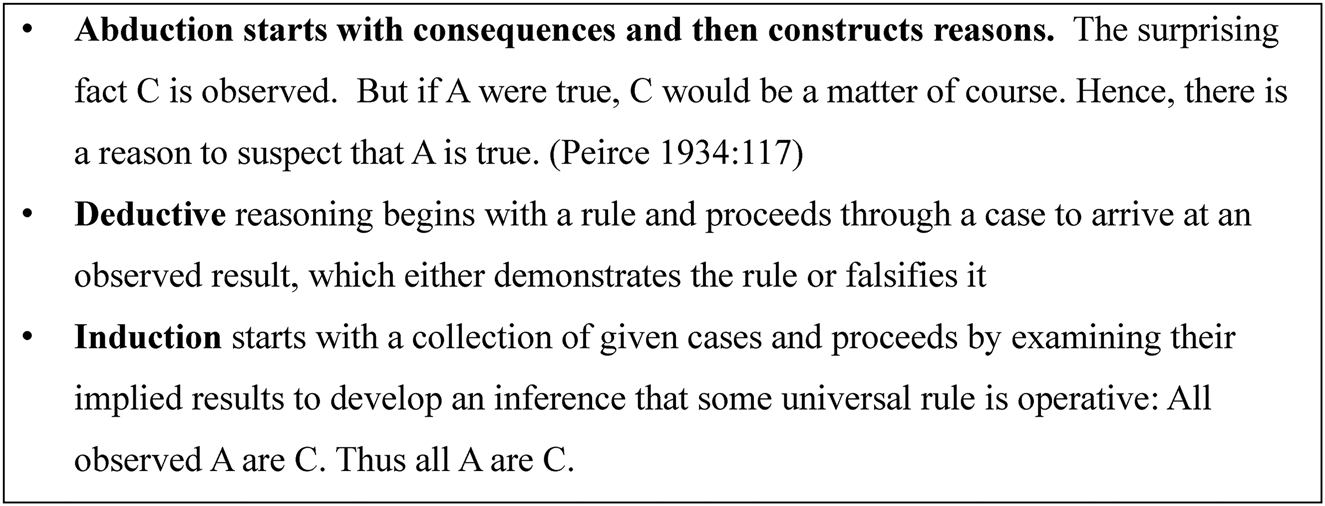
How then is new theory produced from such practical encounters in data sessions? Data sessions are fertile ground for abductive reasoning, theorizing, and imagining (Figure 3). Abduction ‘refers to a creative inferential process aimed at producing new hypotheses and theories based on surprising research evidence’ (Tavory & Timmermans Reference Tavory and Timmermans2014:5), and it leads the research ‘away from old to new theoretical insights’ (Timmermans & Tavory Reference Timmermans and Tavory2012:169). It is not a deductive logic—it does not seek to verify a theory in data—and it also is not inductive: it does not try to formulate a new theory ground-up from a comprehensive analysis of the dataset (such as in some forms of grounded theory).Footnote 8
Abduction, deduction, and induction compared.

Instead, an abductive analysis starts from the proposition that (i) empirical reality is complex and surprising, and that (ii) pre-established theories allow us certain creative insights and perspectives on data. The abductive ‘trick’ is to go constantly back and forth between empirical analysis and theorizing, adjusting, and innovating both analysis and theory whenever they do not match. To optimise abductive creativity, the epistemology also needs to be collaborative, constantly moving back and forth not only between observation and conjecture but also, as in data sessions, between each other's observations and conjectures.
Data sessions can also work very well with non-academic professionals and stakeholders (Rampton et al. Reference Rampton, Maybin and Roberts2014:§4; Rampton & Charalambous Reference Rampton and Charalambous2016:14–17; Heltai & Tarsoly Reference Heltai and Tarsoly2023:80–81) and, whoever the participants, they almost always lead to surprising insights (Van de Putte Reference Van de Putte2022). They are also rather a good way of getting past the kinds of suspicion pinpointed by Gensburger above, because affectively, it is often rather exhilarating as you experience the names, the words, and the small slices of life transcribed on paper starting to dance with purposes, projects, and problems interpellated in different lines of analysis. It is quite humbling as you come to understand how it is all much more complicated than you thought at first, but at the same time, there is almost a feeling of ‘communion’ in the collaborative experience of intensive sense-making focused on the piece of data you've all shared.
Data sessions, in sum, offer an experience of collaborative participation that optimises the differences it brings out, and in our own work, they have been indispensable as a site for continuing the dialogue between MS and EIS, turning the uncertainties, tangents, and asymmetries that this entails to good effect.Footnote 9
Conclusions
The dialogue between MS and EIS can run much further than the two empirical studies that we have described. Securitisation orients to the future in its efforts to control the present with fear and uncertainty while commemoration keeps the past active and influential in the present, and this all thickens the terrain that sociolinguistic analyses of (in)securitisation seek to understand, setting reverence next to suspicion, commemoration of the past alongside anxiety about the future. In memory studies, the dialogue with EIS opens up the theoretical and empirical opportunity for an action-oriented memory studies, adding an extra dimension to the analysis of interscalar processes in which people are seen as doing things with cultural and collective memory. Without the exposure to interactional sociolinguistics, Van de Putte would be spending his time describing the meanings of the past, whereas now he looks at how people attribute meaning to it, exploring when, where, how, why, by whom, and with what specific discursive devices past events get sacralized or profaned.Footnote 10 Of course, as remembering moves away from the elaborately stylised sites and occasions where events are ritually commemorated, it becomes harder to predict either the semiotic practices that evoke the images, beliefs, values, and expectations tied to major events in the past, or the strategies used to manage them. But as the Cyprus study shows, this does not mean that the memory of these events loses its power to influence everyday practice, and there is a lot of scope for further collaboration of MS/EIS in the multiscalar investigation of (in)securitisation.
But what of the ways in which MS and EIS have been presented to each other? In our interaction, memory studies has been figured as a field with a defining topic that lacks the methods needed to pursue its topic into the details of practice. EIS has been positioned as a methodology rather than a set of internally debated language topics (Coupland Reference Coupland1998; Duranti Reference Duranti2003:332), recruiting MS to a multi-disciplinary collection of resources that can help it to grasp one of the complex empirical processes in which it has recently developed an interest. How far, though, does our characterisation of MS ‘targetting’ EIS (Mode 1 interdisciplinarity) and EIS ‘collecting’ MS (Mode 2) carry beyond the particular cases we have discussed?
Of course, sociolinguistics does actually have topics of its own—language diversity, language ideology, situated language practice, and so on—and borrowing from other disciplines sometimes advances the analysis of heartland sociolinguistic topics like language policy and heritage languages. There are also tradition-specific topics, priorities, and arguments inside linguistic anthropology, inside conversation analysis, narrative analysis, and so forth. Even so, beyond these field-internal concerns, EIS has methodological expertise in the analysis of a ‘practice’, a fundamental dimension of the social process that many disciplines now feel they need to address, and this makes it a popular target of their Mode 1 intentions. ‘Ethnographic and interactional sociolinguistics’ is itself an aggregation strategically pitched at a level of generality that makes it more accessible to outsiders (Rampton et al. Reference Rampton, Maybin and Roberts2014:14); approaches from outside are openly welcomed in an undertaking like linguistic ethnography (Rampton Reference Rampton2023); and there are similarities here to CDA's experience as an important resource for disciplines interested in ‘discourse’. At the same time, that is not to say that EIS is (or will remain) a unique target of the Mode 1 designs of others. Indeed, even in memory studies, it is not just the interactional ‘bottleneck’ that is a problem—there are other issues calling for Mode 1 excursions into other fields. For example, MS theories assume that individuals ‘internalize’ cultural memory narratives during socialization, but there is no clear empirical evidence on how this ‘internalization’ works, and in the coming years, MS might reach out to research on cognition to address this (see e.g. Lizardo Reference Lizardo2021).
As Figure 4 illustrates, the interdisciplinary dialogue between ethnographic and interactional sociolinguistics and memory studies is complicated and inelegant, and of course there are a lot of other contingencies affecting the productivity of encounters like this. Nevertheless, there are cross-cutting paths and practical meeting points across the empirical terrain that—in different ways and to different degrees—we are engaged with. MS and EIS have a good deal to offer each other, but they are different in a range of ways—humanities/social science, meaning/structure-and-action, anxieties, public profiles, Mode 1/Mode 2. In this article, we have tried to map these differences to make it easier to locate the crucial complementarities, perhaps also providing some useful orientation for others looking, like us, towards ‘a new social science understanding’ (Wetherell Reference Wetherell2012) of big concepts like ‘memory’, ‘practice’, ‘language’, and ‘security’.
Interdisciplinary dynamics in the EIS/MS dialogue.



 Open access

