

Political parties are central actors in democracies and autocracies, both in contemporary and historical contexts. Historians and, increasingly, political scientists are turning to party archives to collect material on parties’ structures, actors, motives, and discourses (cf. Erlenbusch-Anderson Reference Erlenbusch-Anderson2024). Archival materials have grown in importance because of recent advances in the digital humanities and the lifting of embargos on documents from antidemocratic periods (Charnysh, Finkel, and Gehlbach Reference Charnysh, Finkel and Gehlbach2023; Eijnatten, Pieters, and Verheul Reference Eijnatten, Pieters and Verheul2013; Kim Reference Kim2022). Yet conducting party archival research is not straightforward. Party records differ from those of governmental institutions, such as parliaments, the executive, and courts, that have a mandate for record preservation. Parties are often not subject to archival laws (see, e.g., Archiefwet 1995; Arkivlag 1990; Bundesarchivgesetz 2017; Federal Records Act 1950; Public Records Act 1958). Instead, they follow their own motivations and internal rules for archiving material. As a result, party archiving practices often are shaped by individual initiatives and internal priorities, producing a highly heterogeneous landscape of party archives.
Previous works have reviewed party archives from a (country-)case perspective, in autocratic regimes, or predating the digital turn in the humanities (e.g., Buchstab Reference Buchstab1994; Reference Buchstab1995; Favretto Reference Favretto1997; Gangelmayer Reference Gangelmayer2011; Guerrieri Reference Guerrieri1998; Antonova and Drozdova Reference Antonova, Natalya V., Biggart, Gloveli and Yassour1998; Oldenhage Reference Oldenhage1995; Parga and Bárcena Reference Parga and Bárcena1997; Voerman Reference Voerman1991; Voerman et al. Reference Voerman, Keyzer, den Hollander and Druiven2002). Building on and extending this work, this article is an introductory guide to party archival research both generally and for specific cases: its aim is to help researchers doing comparative party archival research in democracies.
…its aim is to help researchers doing comparative party archival research in democracies.
We first demonstrate the different but also changing motivations behind party archives over time by distinguishing between different types of party archives: personal, organizational, and scholarly. They reflect the evolution of parties in contemporary democracies from private entities to democratic institutions, including recent regressions (cf. Katz and Mair Reference Katz and Mair1995; Mudde Reference Mudde2013; Ziblatt Reference Ziblatt2017). Because scholars cannot choose from multiple archives for the same party, we then identify common obstacles—location, content, searchability, and usage—arising in comparative archival work and link them to the type of archives. We show that these obstacles’ severity is often connected to the type of archive, with personal and scholarly archives marking the extremes. To facilitate comparative party archival research, we offer possible solutions to each problem, including a checklist (for more practical advice on archival research, see Kim Reference Kim2022). We suggest that reflections about the history of the archive and the functional purpose of the material at the time it was created can help researchers establish comparability across heterogenous primary sources.
TYPES OF PARTY ARCHIVES AND THE MOTIVATION TO ESTABLISH THEM
The three main types of party archives—personal, organizational, and scholarly— differ mainly in origin, scope, and accessibility: personal archives are created by individuals or families and focus on a single actor; organizational archives are created by parties and cover the whole organization; scholarly archives, often tied to research institutions or government / national archives, usually span multiple parties or themes. Table A1 in the supplemental appendix provides an overview of political parties and their archives in North America and Europe.
Personal Archives
Personal archives—the archives of individuals—constitute the oldest form of party archives. Keeping a record of correspondence and other documents was customary for important political figures, who often held high political office. Personal archives of party leaders of low socioeconomic status are rare but do exist for those who attained important party positions. The correspondence of early social democrats is a good example. The letters of nineteenth-century party leader Wilhelm Liebknecht have been published as source collections (Liebknecht Reference Liebknecht and Eckert1973). These collections, known as “papers,” initially were often kept by the families (Čtvrtník Reference Čtvrtník2022). With the growing interest in parties, many were integrated into organizational and scholarly archives. Prominent examples are the presidential libraries of former US presidents or the Chamberlain Family papers of the nineteenth-century British liberal politician Joseph Chamberlain (see table A1).
The primary motivation behind personal collections is practical—to document personal and political activities: this practice is rooted in historical idiosyncrasies when party leaders had extensive written correspondence. The social democrat August Bebel even developed a letter diary for his correspondence as secretary of the Federation of German Workers’ Associations, a predecessor organization to the Social Democratic Party in Germany (Bebel Reference Bebel and Fischer1994). Personal collections also gave legitimacy to the political project of individuals. Maintaining a personal archive was a tradition for established political families. For political newcomers, it was also a way to signal to themselves and future generations that their work was so meaningful that recordkeeping was necessary and useful. In this sense, personal archives were motivated by self-aggrandizement, legacy building, and the desire to ensure a place in the historical record.
Personal collections may first seem too narrow for party research because of their personal nature. But in at least three ways, they offer insights into aspects of party history that are often omitted from other party archives, especially for the nineteenth century. First, short-lived and historical parties often did not have the motivation or resources to establish a formal archive and can only be studied in personal archives. For instance, the long-forgotten General Electoral Association (1868) has been identified as the first party organization in the Netherlands, yet its history is only preserved in the personal archive of prominent politicians like Jan Heemskerk Azn (1818–97), which was donated to the National Archive in 1971 (De Jong Reference De Jong, Voerman and Lucardie2000). Second, because of their personal origin, personal archives shed light on the contribution of invisible actors and circumstantial events that contributed to party development. For example, we know that women like Beatrice Webb left a “paper trail” that is essential to understanding the development of party organizations such as the British Labour Party (Hoekstra Reference Hoekstra, te Velde and Janse2017). Third and relatedly, personal collections also provide unique insights through personal correspondence into relationships with other organizations or stakeholders. For example, the earlier mentioned letter diary of August Bebel provides valuable information about the wider network of Social Democrats that eventually led to the foundation of a new party. The role of the broader community of the party is often absent from other archives.
Organizational Archives
Organizational archives are directly established, maintained, and often also (co-)financed by the party organization. For instance, the archives of almost all German parties belong to this category (see table A1). These archives contain multiple types of sources that cover many aspects over long periods of time: minutes of boards, conferences, and parliamentary groups; newspapers; material for electoral campaigns; and the like. Today, they often also include the personal collections of important party leaders (Förster et al. Reference Förster, Kruke, Grothe, Borchard, Höpfinger and Winkler2022) and thus trace the next evolutionary stage in parties’ development as organizations in democracies.
Two German cases are particularly instructive. Probably the very first party archive was founded by German social democrats who were among the first and most successful to establish a formal membership party of national importance (Heyer Reference Heyer2022). As early as 1867, the idea of an archive was discussed at the annual meeting of the General German Workers’ Association, the predecessor of today’s Social Democratic Party. Three clear motives were brought forward: first, organizational continuity because all materials “that relate to the association could be of importance for the future” (Bungert Reference Bungert2002, 13) were to be preserved; second, internal accountability and ideational continuity because the archive was to “create and maintain an inventory of all documents currently in the possession of the President” (13), and it was to be hidden in a central location to protect it from “the claws of the police” in the period of state repression (20); and third, training because the holdings were to enable “comrades” to “do studies” (Anonymous 1878, 1). Very similar arguments can be found about 100 years later when the German Christian Democratic Union (CDU) established its archive. The party argued for the “necessity” of a party archive, based on three primary reasons (Krone Reference Krone1973): (1) “The Federal Republic’s view of history must not be determined solely by materials and their evaluation by other parties”; (2) “The [Christian Democratic] Union is committed to maintaining its history and traditions in order to maintain its self-esteem”; (3) “There is no shortage of researchers, especially among the younger generation, who would like to work on topics relating to the history of the CDU and its effectiveness.” These two accounts place both great importance on building a library for reference that not only ensures ideational and organizational continuity but also serves educative purposes.Footnote 1
The establishment of other party archives belonging to this organizational type likely followed similar motivations and perhaps increasingly so the educative one. One indication for their educational function is that many have become part of national archival structures, such as the archives for most of the Swedish parties or the Welsh Political Archive (Jenkins Reference Jenkins1993).
At the same time, an opposing trend has also emerged. Since around 2005, some parties have begun maintaining a nonpublic variant of the organizational archive: digital materials stored on servers inaccessible to the public. This approach is now a common way to archive born-digital content. Often, it supplements the traditional organizational archive, but in some cases—especially among newer far-right parties—it replaces it entirely, reflecting trends in democratic backsliding. These internal archives store nonpublic or inactive materials for potential future use. Although born-digital records are often rich in content and highly valuable for social science research, their inaccessibility in many cases means that this potential remains largely untapped.
Scholarly Archives
Scholarly archives are very typical of the postwar development of party history and are often associated with a set of parties or party family (see table A1). Examples include the Miller Center at the University of Virginia, the Hoover Institution at Stanford University, the Conservative Party Archive (CPA) that is deposited at the Bodleian Library at Oxford University, and the many governmental and national archives.
Scholarly archives are often embedded in university infrastructures and initially only facilitated the preservation of the collection for the purpose of research. However, after World War II, many scholarly archives also subscribed to an even larger purpose reflective of parties’ and party systems’ increasing institutional and stabilizing role in modern democracies (Casal Bértoa Reference Casal Bértoa2017): the preservation of sources that tell the history of democracy (Archiv der Sozialen Demokratie 1978).
The International Institute of Social History in Amsterdam (IISG) is a prime example of the dual function of scholarly archives. The ISSG, which houses one of the most important and comprehensive archives of social democracy, was founded for research purposes by N. W. Posthumus in 1934. As a professor of social and economic history, Posthumus was committed to building a collection for research into the workers’ movement. At the same time, he defined the mission of the institute as supporting social democracy. The institute was to have a “a purely scientific character,” as Posthumus wrote in a letter to his financial supporters (Sanders Reference Sanders2019, 131). The purpose of the research, however, was to provide “spiritual strength and conviction” for the social democratic movement (131). Thus, among the first collections acquired by Posthumus were those of left-wing immigrants trying to escape from the Nazis, collected, for example, from the historical archive of the German SPD, also known as the Marx-Engel archive (Benz Reference Benz1973). Today, the IISG holds the historical archives of several social democratic party organizations, and new acquisitions focus on social movements and on labor relations in general.Footnote 2
More recently, the main purpose of scholarly archives has been the support of academic research, often to enable comparisons across time, party families, and countries. This is particularly true of scholarly archives that house the collections of several parties. The best (because of its scope) example of this known to us is the Documentation Center for Dutch Political Parties (DNPP) at the University of Groningen. Founded in 1973, it holds recent primary sources on party history across the ideological spectrum in the Netherlands. The collection was built not just to preserve records but also to ensure their accessibility. Originally, the center aimed to maximize access to personal and party archives, but its current mission also includes research, scholarly guidance, and publication.
In some cases, party records are maintained within state archives that also serve the research purposes of scholarly archives, sometimes with a more explicit public history function; examples include the Library of Congress and the Presidential Libraries of the National Archives in the United States and the German Federal Archives (Bundesarchiv).
Many of the historical scholarly collections began as personal or organizational archives, suggesting an evolution of party archives and the increasing importance and recognition given them by researchers. As our examples document, the rationale for creating scholarly archives was and is that an independent organization would facilitate better preservation of historical collections and increase accessibility. Scholarly archives’ mission may therefore be summarized as providing public access, long-term preservation, and research support, whether they are located in universities, government agencies, or nonprofit historical institutions. This does not mean, however, that such archives can operate independently of individual and party support. After all, individuals and parties are the original creators of the primary sources and tend to have considerable leeway in determining which sources are maintained and submitted to scholarly archives.
Scholarly archives’ mission may therefore be summarized as providing public access, long-term preservation, and research support, whether they are located in universities, government agencies, or nonprofit historical institutions.
THREE COMMON OBSTACLES WHEN DOING COMPARATIVE PARTY ARCHIVAL RESEARCH AND THEIR POSSIBLE SOLUTIONS
Based on our experience, the main obstacles in comparative party archival research are location, content, and search and usage: each is significant on its own and even more so when combined. In this section, we link these obstacles to the types of archives, because these obstacles’ severity often depends on the type of archive.
Location
Archival material on individual political parties is not always concentrated in only one location. Based on our experience, this material can be spread across different (types of) archives, depending on the period it relates to, as is the case for many of the parties in Sweden. But the archival landscape can also be multilayered when party material is also stored at regional or local archives. This is especially true of historical parties and those with local and regional relevance. For instance, the library of the nineteenth-century German social democrat Wilhem Bracke is available in the municipal library of Braunschweig.
The multilayered location of party archives may lead to difficulties in finding material, especially because the location of material may not follow the same pattern, even for parties within the same country. Perhaps more importantly, however, this difficulty can pose a serious scientific problem, because the failure to locate relevant material can result in systematic biases or even blind spots in party researchers’ findings (see, e.g., Lee Reference Lee2022). We estimate such risks to be higher when party archives are less institutionalized (of the personal rather than the scholarly type) and less publicly accessible (i.e., internal archives). Our best advice to minimize the risk of such biases and to facilitate comparability across cases is to seek contact with archivists. In addition, we hope that table A1 provides a good starting point for some parties.
Content
Absent national legislation, the holdings on different parties differ. The German political foundations—the hosts of parties’ organizational archives—provide a detailed list of the classification of their records (Förster et al. Reference Förster, Kruke, Grothe, Borchard, Höpfinger and Winkler2022, 4–7): documents from different internal party committees, records from different groups (parliamentary, European, predecessors or related organizations, political foundations), personal documents, media archives, and library collections. Although this list seems comprehensive, we urge researchers not to assume that all party archives (even within Germany) will hold material for all periods. Based on our and others’ experiences (e.g., Favretto Reference Favretto1997; Voerman Reference Voerman1991), party archives are more heterogeneous than that. Researchers attribute gaps in archival holdings to survival (missing or destroyed material), transfer (asymmetries in what is being archived caused by differences in power or interests), source (asymmetries in who produces material), and digitization biases (what is being digitized; Kim Reference Kim2022, 2; Prescott Reference Prescott, Prescott and Wiggins2023).
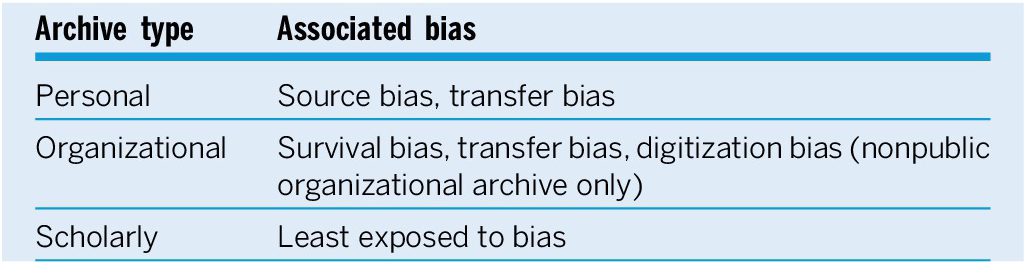
Each of these potential biases may also increase in significance when dealing with the different types of archives outlined earlier (table 1). For example, source and transfer biases are more likely to occur in personal archives. Those in power are often acutely aware of their power, document it, and transfer such recordings to personal archives. Consequently, ordinary party members and, in general, actors without formal party functions are less likely to appear in personal archives unless they have a personal connection to the archive’s subject. This may lead to transfer and source biases.
Linking Party Archives to Different Biases

Table 1 Long description
The table consists of two columns titled Archive type and Associated bias.
Row 1: Personal archive type is linked to Source bias and transfer bias.
Row 2: Organizational archive type is linked to Survival bias, transfer bias, and digitization bias, specifically for nonpublic organizational archives.
Row 3: Scholarly archive type is described as being the least exposed to bias.
Digitization bias and survival bias may play a larger role for nonpublic organizational archives. Although digital records do not take up much space nor require a lot of archiving time, not all events, decisions, meetings, and the like, are recorded digitally. Even if they are initially digitized, they can be easily deleted. This may lead to a larger bias in what types of material are available in nonpublic organizational archives. Organizational archives may suffer from survival and transfer bias due to two reasons: first, their establishment is based on self-interested reasons, and they operated during times of immense political pressure.
Finally, because of scholarly archives’ intrinsic mission to serve research, they are likely to be least exposed to any of the four types of biases. But even these archives’ holdings may differ substantially, depending on what researchers are seeking. For example, in some of our research on British political parties, the BBC had more comprehensive recordkeeping for the 1990s and early 2000s than some of the scholarly archives.
Absent fixes to correct for these biases or the multiple archives per party, researchers are best advised to be aware of the varying degrees of risks that different archives pose to facilitate comparative research. One way to establish comparability is to look for functionally equivalent documents. These are documents that may be filed differently (because of differences in party organizations or, more so, archive types), produced by different party subunits, or at different times—yet they serve the same purpose intraorganizationally.
In addition, researchers should constantly ask themselves which (types of) documents might be missing from the party archives and be cautious in their comparative interpretations and assessments (Møller Reference Møller2022). For certain types of material—for example, personal documents or records of internal meetings or bodies—and for certain types of archives (personal or organizational), biases may be larger, complicating comparability across cases. Gaps in the archival material are likely to be more common in older archives.
Based on our work with archives, we recommend studying the history of the archive and the way it is structured. This sharpens the researcher’s understanding of potential limitations and may reveal new data in unexpected places. Discovering new data that lead to new research questions, unforeseen conclusions, or both is the exciting part of the archival experience and should be embraced with an open mind. Historians also use careful language when discussing archival sources (Møller Reference Møller2022). In our experience, the comparative element of a project may even be helpful here to identify blind spots.
Search and Usage
Trips to the archive can be very time-consuming and financially costly. It is therefore important for researchers to know beforehand exactly what an archive has to offer and to plan accordingly. Unfortunately, the extent of online search engines and usage rules differ widely by party archive. Still, we recommend extensive familiarization with the archive in advance and carefully exploring its catalog by using the search functions creatively; for instance, by focusing not only on organizational units but also on actors, dates, and locations. This will create an understanding of the catalog structure and can avoid missing relevant material. It is advisable to look at the files that are in the same subcategory in the archive structure. Sometimes this can reveal useful material that was stored under a seemingly irrelevant title.
Although (digital) nonpublic organizational archives eliminate the need for in-person visits, they also do not offer any search engines for researchers. Researchers are fully dependent on a party employee to select and share individual files, which may lead to a larger source bias. As one example, the German far-right Alternative for Germany party was only able to share fully anonymized party congress documents from their server but not other documents for one of our research projects—even though this was not a problem for about 20 other parties in Europe. In contrast, scholarly archives—located on the other side of the spectrum—typically offer very good online search engines, such as the IIGS in Amsterdam, the DNPP in Groningen, or most of the archives for the British parties.
Still, the quality of information about the precise content of individual boxes or folders may differ, just as may the size of the collections and consequently the time required to work through them. With several A4 folders fitting into an A4 box 10–12 cm deep, it may take between 10 minutes and several hours to work through a single box, depending on what one is looking for and how easily the material can be read (e.g., handwritten vs. typed or material in foreign languages). Additionally, because archives often restrict the number of boxes given out and the times to request new ones, the needed archival time may differ substantially by project and archive.
Because of the involved costs (both time and money) of archival work, it is therefore always advisable to seek contact with the responsible archivists beforehand. They are in the best position to help you navigate the archive. Yet we found that even archivists were surprised by their own holdings. Our best advice is, therefore—if time and money allow—to allot an extra day to search the archive more independently and as a safety measure. Note also that, on arrival at the archive, it usually takes a couple of hours to set up the working station and be given access to the material.
This leads us to the related obstacle of usage or access of archival work. Usage and access options differ greatly by archive (see also Charnysh, Finkel, and Gehlbach Reference Charnysh, Finkel and Gehlbach2023), limiting comparative studies. Some archival material, especially from internal meetings or personal documents, are not freely accessible because they are embargoed (often for 30 years). Sometimes exceptions can be granted for research purposes by the party before you enter the archive. Additional restrictions may apply to what or how researchers may copy / digitize material (Charnysh, Finkel, and Gehlbach Reference Charnysh, Finkel and Gehlbach2023). Some archives are equipped with their own free-of-charge scanners (e.g., IISG) and no restrictions on copying. Other archives may allow researchers to bring their own cameras or hand scanners. Several apps work well in conjunction with the high standards of today’s phone cameras (e.g., FastScanner). At times—and not always advertised on the archive’s website—the archive may offer to digitize or even OCR documents for researchers for a fee or allow an external digitization company to do that. This is a less time-consuming approach and promises higher quality when the material a researcher wants to access is sufficiently delineated. The worst case is when several restrictions apply and no work-around is possible. This obviously puts the researcher in a very difficult position, requiring prioritization. Good planning is imperative to limit the negative impact arising from restrictions.
DISCUSSION
Party archives vary widely in origin, scope, and access, reflecting the parties’ development over time. These differences complicate how material is found, covered, and used, making thoughtful planning essential at each stage: location, content, and access (5).
The different types of archives not only shape the process of data collection but also have implications for their analysis. Given the challenges described earlier, comparability of primary sources about political parties is not a natural outcome but must be constructed. Material tends to differ in content, arrangement, and access. This problem arises for comparisons not only between parties and countries but also over time. To overcome this problem, we try to pay close attention to the history of the collection to understand the original reasons for its creation and the functional role a particular document played at the time. In appendix B, we include a checklist to help researchers construct the comparability of party archival material. Once comparability has been established, it can be of great advantage for highlighting the specifics of a collection, identifying gaps in the material or the presence of certain materials rather than others.
SUPPLEMENTARY MATERIAL
To view supplementary material for this article, please visit http://doi.org/10.1017/S1049096526101887.
ACKNOWLEDGMENTS
We thank Fabio Angiolillo, Johannes Lindvall, and Rozemarijn van Dijk for their comments and suggestions on previous versions of this article. We are also appreciative to Elin Alfredsson Malmros, Christien Smits, Ana Andrade Good God, and Fabio Angiolillo for their help in compiling information for table A1. Finally, we are grateful for the helpful and constructive feedback from the anonymous reviewers and the editor. Heyer acknowledges funding from the Statesman Thorbecke Fund, Royal Netherlands Academy of Arts & Sciences. Kölln acknowledges funding from the Swedish Research Council (grant number 2025-01563) and the European Union’s Horizon Europe research and innovation programme under grant agreement No 101041316 (INTRAPARTY). Views and opinions expressed are however those of the authors only and do not necessarily reflect those of the European Union or the European Research Council. Neither the European Union nor the granting authority can be held responsible for them.
CONFLICTS OF INTEREST
The authors declare no ethical issues or conflicts of interest in this research.


 Open access

