Introduction
The “Muslim World” is everywhere in international relations (IR) discourse, and yet nowhere conceptually defined with clear boundaries and often conflated with Islam as a faith, Muslims as a global population, the ummah as an ethical-religious community, and Islamism as an ideology. Deeply politicized, it is invoked to describe the targets of global counterterrorism, the beneficiaries of humanitarian aid, or the imagined interlocutors of interfaith dialogue. Despite its ambiguity – or perhaps because of it – the term persists. What does it mean to speak of the Muslim World in IR? What does the term name, and what does it obscure? Rather than treating the Muslim World as a self-evident category, this Element examines it as a discursive construct whose meaning and function have evolved alongside shifting global power relations and political agendas. It is written primarily for scholars of IR and global politics and aims to advance conceptual clarity and theoretical precision in how the “Muslim World” has been understood, mobilized, and contested within the discipline.
The Muslim World has proven a durable and versatile category in global politics. It circulates in diplomatic initiatives, academic texts, and civilizational imaginaries. In IR scholarship, the term may denote Islamic civilization, Muslim-majority states, or some pan-Islamic international actors. It has been referred to at various times as an imagined religious community (ummah), a cultural sphere extending from Morocco to Indonesia as well as the diaspora communities, a Cold War geostrategic bloc, and more recently, a discursive terrain of grievance, solidarity, and threat.
This persistence of the term the Muslim World lies in its ideological, instrumental utility more than its conceptual clarity. It functions as a political shorthand, one shaped by centuries of interaction between Muslim societies and Western powers. Aware of its own analytical limitations, we also use the term “West” (or Europe, the Western world) rather loosely. We do not intend to supplant one parochialism with another. Nevertheless, we also recognize that the West remains a salient and defended civilizational marker in contemporary discourse across both the European right and left. Few question the coherence or validity of this geopolitical imaginary, even though much like the Muslim World, its boundaries and meanings are historically constructed and politically contested.
A central aim of this Element is to critically examine how the idea of the Muslim World has evolved across different historical and political contexts since colonialism. By studying these contexts, we show how global power structures shape the meanings, boundaries, and political salience of the Muslim World, while simultaneously revealing the tensions and contestations that emerge as Muslim actors engage with, resist, and reinterpret these constructions.
Before the late nineteenth and early twentieth centuries, Muslims did not generally imagine themselves as members of a singular, bounded geopolitical entity analogous to what is today called the “Muslim World.” Collective belonging was instead articulated through multiple, overlapping frameworks: the ummah as a moral–religious community; dār al-Islām as a juridical category; dynastic and imperial orders such as the Umayyad, Ottoman, Safavid, or Mughal empires; and local affiliations grounded in city, region, school of law, or patronage networks. These forms of belonging were plural and layered rather than hierarchical or unified into a single global political subject, and they did not presume a shared geopolitical destiny across Muslim societies.
The modern usage of the term “Muslim World” can be traced to the late nineteenth century, when European imperial discourses and Muslim reformist movements simultaneously began invoking it in response to shifting global power relations (Aydin, Reference Aydin2017). For colonial administrators, it marked a space to be governed and managed; for Muslim intellectuals and activists, it offered a frame for solidarity, reform, or revival. This shared discursive terrain, shaped by asymmetrical encounters, entangled histories, and mutual perceptions, continues to influence how the Muslim World is imagined in IR today.
To fully understand the Muslim World in IR, we contend that scholars must treat it not as a fixed entity but as an intersubjectively constructed political world whose meaning depends not on observed referents alone but on in what context it is invoked, by whom, and to what ends. The term gains coherence through discursive practices: through acts of naming, boundary-making, and narrative construction. This understanding allows us to move beyond essentialist readings and instead analyze the Muslim World as a product of historical discourse, institutional sedimentation, and geopolitical contestation. It also invites a more critical engagement with how the term has been mobilized to serve divergent political projects.
This Element identifies several dimensions that lend the concept a degree of coherence: shared religious traditions and references; a repertoire of historical and political discourses; common sites of grievance and aspiration; transnational networks and movements; institutional collaborations; and competing claims to legitimacy over the imagined geopolitical world. Together, these dimensions provide a nuanced lens for examining how the divergent meanings of the Muslim World are constructed, invoked, and negotiated by both internal and external actors. Here, internal actors refer to those who identify with, or are identified as belonging to, this world. External actors, by contrast, are those who construct its boundaries from the outside through their representations of, and engagements with, the actors and institutions they perceive as constituting the Muslim World.
This framework carries significant implications for IR theory. First, in line with postcolonial and global IR scholarship (e.g., Acharya and Buzan, Reference Acharya and Buzan2007; Acharya, Reference Acharya2014), it challenges the ontological assumptions underlying approaches that conceptualize the Muslim World as a cohesive civilization or a monolithic actor in global politics. Second, it foregrounds the diversity of Muslim agency not only in relation to the West but also within the internal debates over identity, legitimacy, and order by emphasizing the fluid, contested, and relational nature of the Muslim World.
In methodological terms, our framework is grounded in critical discourse analysis, in particular, Foucauldian and post-structural approaches. We focus on how hierarchies of knowledge and power reproduce global asymmetries and sustain civilizational binaries such as “the West” and “the Muslim World.” From Foucauldian genealogy, we adopt the premise that discourse and power are co-constitutive: categories such as civilization, modernity, and political order emerge within historically specific regimes of knowledge rather than existing as neutral descriptors. In this sense, the conceptual lexicon that characterizes contemporary global politics – terms such as “the West,” “the Orient,” “the Third World,” “the Global South,” and “the Middle East” – can be understood as artifacts of a particular regime of knowledge production. These categories embody relations of power and hierarchies of epistemology.
From post-structuralism, we take the position that meaning is contingent and relational constituted through language, representation, and processes of inclusion and exclusion rather than derived from fixed cultural or material referents. This analytical orientation enables us to conceptualize the Muslim World not as an objective or taken-for-granted entity, but as a discursive construct that both reflects and shapes the political representation of Muslim collective identities. Too often, meanings ascribed to the Muslim World, particularly by Western political actors, reduce complex, multidimensional Muslim identities to singular, politicized forms of “Muslimness.” By interrogating these dynamics, we aim to open space for critical introspection and for greater responsibility in the production of knowledge in IR.
Empirically, we draw on a broad corpus of primary and secondary texts. Our primary materials include foundational Islamic sources (the Qur’an and major Hadith collections), influential travelogues such as Ibn Battuta’s Rihla and Evliya Çelebi’s Seyahatname, and classical philosophical and sociological works like al-Farabi’s Al-Madina al-Fadila and Ibn Khaldun’s Muqaddimah. We also examine the writings of modern reformers and intellectuals, including Jamal al-Din al-Afghani, Muhammad Abduh, and Muhammad Iqbal, whose works articulated diverse imaginaries of the Muslim World as a locus of anticolonial solidarity, moral renewal, and global humanism. These thinkers conceptualized the Muslim World in ways that diverge sharply from hegemonic portrayals in IR. Rather than depicting it as a passive colonial victim or an anti–status quo/hostile “Other,” they reimagined it as a moral, political domain through which alternatives to the declining capitalist international order and solutions to the broader crises of modern humanity could be envisioned. Their intellectual legacy continues to shape the contours of modern Islamic thought and what it means to uphold Islamic civilizational values in a globalized world. Additionally, to capture external constructions of the Muslim World, we engage with colonial and orientalist archives. Finally, we utilize complementary materials, including political speeches, policy documents, and contemporary media discourses. This multilayered corpus allows us to trace how both Muslim and non-Muslim actors have imagined, articulated, and contested the Muslim World across different historical, intellectual, and geopolitical contexts.
Thinking about the intellectual responsibility in the production of knowledge, we acknowledge that research is inseparable from one’s institutional and intellectual location. Our perspectives are informed by Islamic intellectual traditions and by experiences rooted in Muslim-majority societies, as well as by our training and professional lives within Western academic institutions. Our engagement is also shaped by personal ties to the communities and ideas under discussion, which make the topic not only intellectually compelling but also intimately meaningful. Still, we do not view this positionality – as Middle Eastern scholars writing from within U.S. academia – as a source of privileged authority. Rather, it grounds our deep care for the subject and our commitment to theoretical rigor, empirical evidence, and participation in an ongoing scholarly conversation in which our work is one voice among many.
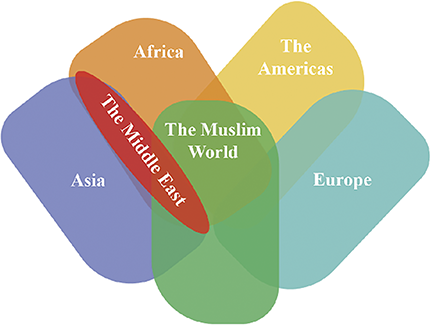
This Element is organized into four sections. The first sets the stage to contribute to more critical, pluralist, and historically grounded conceptions of the Muslim World in IR theory. It argues that the Muslim World is not a fixed or objective entity, but a discursive construct shaped by shifting power relations, political agendas, and epistemic frameworks. We reconstruct the Muslim World by grounding it in ideational, sociological, and institutional foundations of solidarity. As illustrated in Figure 1, we conceptualize the Muslim World not as a set of spatially bounded geographical zones, but as a transnational public sphere that inhabits and intersects multiple civilizational, political, and discursive domains. It is constituted by the modern political, institutional, and discursive spaces in which claims about Muslim identity, solidarity, authority, and difference are articulated, contested, and circulated across borders.
The Muslim World as a transnational public sphere
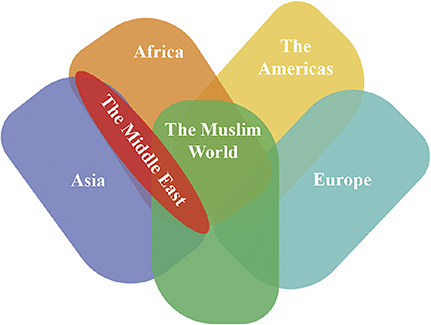
Figure 1 Long description
The conceptual diagram of the Muslim World as a transnational public sphere. Four overlapping shapes represent Africa, Asia, Europe, and the Americas. Their intersection forms a central space labeled The Muslim World, illustrating how Muslim identities, practices, and political imaginaries cut across geographic regions rather than being confined to a single territory. The intersection area of the shapes labeled Asia and Africa, and Asia and the Muslim World is together labeled the Middle East.
Relatedly, we treat the concept of ummah as indispensable for understanding claims of Muslim unity, but not as a shortcut for defining the Muslim World (see Section 4). Ummah refers to a moral–ethical horizon: a normative ideal of communal belonging grounded in shared faith, obligation, and solidarity. The “Muslim World,” by contrast, designates the modern political, institutional, and discursive spaces in which diverse Muslim-majority societies and states are imagined to constitute a unified political authority or a singular geopolitical subject. Such representations often obscure the empirically observed variation in political interests, levels of cooperation, and institutional capacity across these spaces, as well as the profound political, cultural, and historical diversity that characterizes them.
The second section examines how the Muslim World has been deployed by different IR theories. It identifies how approaches ranging from the English School to Constructivism, Historical IR, and Civilizational IR have engaged with the Muslim World, often reinforcing essentialism or substituting cultural markers for analytical depth. Even many critical and decolonial approaches have inadvertently reproduced fixed and homogenous conceptions of the Muslim World. While IR has long relied on civilizational tropes to make sense of global difference, it has failed to develop the theoretical tools necessary to grasp the Muslim World as a contested and dynamic political domain. The section also examines how recent strands of Islamic IR and Global IR offer promising openings for rethinking the Muslim World, but often stop short of critically engaging with the internal heterogeneity, asymmetrical power relations, and discursive struggles that characterize it.
The third section turns to Western political and cultural discourses, tracing how the idea of the Muslim World has been constructed and mobilized in three pivotal historical moments: British–German rivalry over the Ottoman call for jihad during World War I; French representations during and after the Algerian War; and U.S. attempts to frame counterterrorism and democracy promotion as civilizational encounters. Across these moments, the Muslim World has been persistently portrayed either as a threat or as a constituency to be managed or co-opted, while its internal diversity and political complexity have been consistently ignored. Adopting a critical approach, this section contends that these reductive representations have served ideological, imperial, and strategic purposes. Therefore, it calls for a shift from geopolitical simplifications to a discourse grounded in historical, political, and sociological specificity and complexity.
Finally, the fourth section explores how the idea of the Muslim World took shape through successive attempts to translate the moral horizon of the ummah into political form under conditions of empire, nationalism, and global hierarchy. It engages classical juridical categories such as dār al-Islām, alongside the emergence of pan-Islamism as a modern political project grounded in the notion of the ummah. Turning to contemporary world politics, the section analyzes the Organization of Islamic Cooperation (OIC) as an institutional effort to embody aspirations for Muslim unity, while also highlighting the structural limitations of state-centric approaches to representing the Muslim World. The cases discussed in Sections 3 and 4 are selected through a crucial case design, focusing on the most influential moments and sites through which the concept of the Muslim World has been constructed, mobilized, and operationalized by both external and internal actors.
1 Defining the Muslim World
International relations as a discipline is steeped in terms that are widely used but suffer from imprecision. The “Muslim World” is one such term. Marshall Hodgson famously warned against “taking terminology from the street” (Reference Hodgson1974, p. 45), highlighting how terms like Islamic, jihad, and ummah, now ubiquitous in media and scholarship, lack the scholarly rigor needed for analytical clarity. The same applies to the “Muslim World,” which continues to circulate in IR discourse. Scholars and policymakers have used the term to refer variously to states within the Middle East, majority Muslim populations, the OIC, regions historically shaped by Islam, or even the global Muslim population.
Despite its imprecision, or maybe because of it, the term has persisted. Cemil Aydin (Reference Aydin2017) provides a compelling intellectual history, tracing the emergence of the “Muslim World” as a modern construct born out of colonial categorization, racial hierarchies, and civilizational binaries. European empires played a pivotal role in shaping the narrative of the Muslim World as a monolithic civilization distinct from and antagonistic to “the West.” This framework found intellectual expression in Samuel Huntington’s “Clash of Civilizations” (1996), which cast the Muslim World as the West’s civilizational adversary. This dichotomy remains potent in shaping global perceptions and policies.
As we detail in Section 2, the term endures in part due to four interrelated tendencies: (1) Orientalism and Eurocentrism: These perspectives frame Muslim societies as a homogeneous bloc defined primarily by religion. (2) Global Power Structures: The term supports narratives positioning Muslim societies as threats to Western security. (3) Institutional Inertia: The convenience of using familiar shorthand outweighs the push for conceptual precision. (4) Critical Appropriation: Even scholars aiming to critique Western dominance inadvertently replicate reductionist frameworks. These tendencies have real-world implications. On the one hand, the term’s polyvalence has fueled the securitization and racialization of Muslims; on the other, it has opened space for Muslim actors and activists to redefine their place in global politics.
Because of its entanglements with colonial history and its essentialist underpinnings, the term Muslim World remains deeply contested. Some scholars, most notably Aydin (Reference Aydin2017), have called for abandoning the term altogether. While we take these critiques seriously, we contend that the concept is not irredeemable. The Muslim World constitutes a discursive infrastructure, a repertoire of meanings, symbols, and imaginaries and functions as a collective identity marker comparable, in form if not necessarily in substance, to categories such as the “Jewish World,” “Christian World,” or “West.” Yet its construction, manifestations, scope, and degree of cohesion vary considerably. Rather than discarding the term, this Element undertakes its critical reconstruction through a historically grounded, pluralistic, and context-sensitive framework. By anchoring the concept in shared political, cultural, religious, and institutional dynamics, we aim to preserve its analytical utility for scholars of IR while resisting the reductionism of spatial or civilizational determinism.
We conceptualize the Muslim World as a transnational public sphere constituted through shared religious, cultural, and normative frameworks, yet continuously reshaped by competing state interests, historical divergences, and shifting geopolitical alignments. This sphere is animated, on one hand, by unifying forces such as religious principles, collective historical memories, political discourses, transnational networks, and institutional linkages. On the other hand, it is marked by profound internal diversity rooted in distinct political, social, and cultural dynamics that intersect with broader historical trajectories and global conditions, often shared with non-Muslim communities. These intersecting and overlapping forces generate multiple, context-specific expressions of Muslim identity and politics, rendering the Muslim World a dynamic and contested field of interaction.
Rather than doctrinal uniformity or political unity, collective identity in the Muslim World rests on shared references to Islamic texts, traditions, and historical narratives. These shared references provide a common symbolic and moral vocabulary through which social and political actors across diverse Muslim-inhabited contexts articulate worldviews (Weltanschauung), ethical commitments, and collective purpose. We therefore conceptualize the Muslim World as a space of referential coherence rather than homogeneity. Such coherence privileges process over outcome, more like jazz, where performers improvise around a common theme, than classical music, where fidelity to a written score defines the performance. This conception not only helps us understand the diverse ways Muslim identities are expressed and lived in the modern world but also offers a comparative lens for thinking about unity and plurality in other civilizational contexts, including the Western, African, Chinese, and Buddhist worlds.
The idea of referential coherence can be compared to theories of constitutional interpretation, particularly the constructivist coherence model grounded in reflective equilibrium (Rawls, Reference Rawls1971; Fallon, Reference Fallon1987). Just as constitutional scholars integrate diverse modes of argument textual, historical, structural, doctrinal, and ethical into a coherent interpretive outcome (Bobbitt, Reference Bobbitt1982), some actors across the Muslim world draw on scripture, prophetic traditions, ethical norms, collective memory, and institutional practices to sustain tradition and reproduce a sense of collective identity (Asad, Reference Asad2003; Mahmood, Reference Mahmood2005; Salvatore, Reference Salvatore2007). While no single referent governs all contexts, coherence emerges through a process of mutual adjustment and interpretive negotiation, in which these references converge on or at least do not fundamentally contradict a broadly shared understanding of Islamic identity.
To further situate our approach centered on referential coherence across transnational public spaces, we contrast it with two dominant analytical frameworks used to conceptualize the Muslim World: essentialist and instrumentalist, which we examine through case studies in Sections 3 and 4. Essentialist perspectives, as exemplified by the “clash of civilizations” thesis (Huntington, Reference Huntington1996) and reflected in some neorealist and post-9/11 discourses, portray the Muslim world as a monolithic and static entity. By contrast, instrumentalist views reduce the Muslim world to a strategic resource mobilized by internal or external actors to advance geopolitical, security, or regime-preservation agendas. Both essentialist and instrumentalist uses of the concept obscure the internal diversity, historical fluidity, and normative pluralism that characterize the Muslim world. Instead, we propose a constructivist framework based on shared referential repertoire: the idea that the Muslim world is constituted through shared symbolic, discursive, and normative referents rather than uniformity in social, political, and cultural domains. These shared referents foster a sense of collective subjecthood and produce global/transnational Muslim public spaces. In doing so, they stimulate coherence, cooperation, and connection in the absence of political unity.
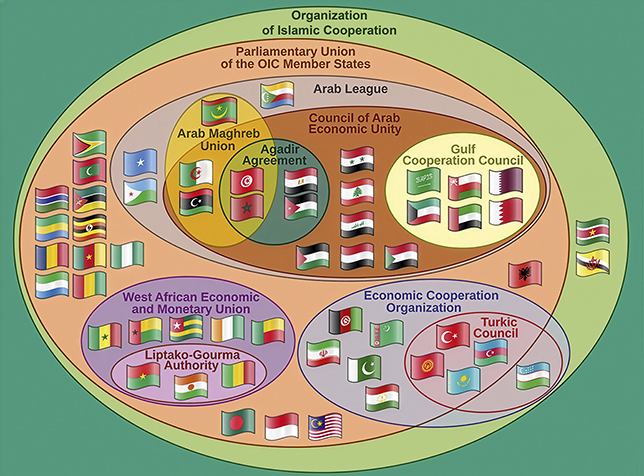
This section conceptualizes the Muslim World along three intersecting axes: ideational, sociological, and institutional. The ideational axis captures the symbolic, normative, and affective foundations that generate a sense of referential coherence, a form of collective orientation as outlined in the preceding discussion. The sociological axis focuses on the social networks, movements, and transnational linkages through which Muslim actors, communities, and publics interact across national boundaries. The institutional axis examines intergovernmental organizations that claim, explicitly or implicitly, to represent the Muslim World or some parts of it, most notably the OIC and the Parliamentary Union of the OIC Member States, as well as other organizations composed primarily of Muslim-majority states, including the Arab League, the West African Economic and Monetary Union, the Organization of Turkic States (Turkic Council), the Gulf Cooperation Council, and the Economic Cooperation Organization. Figure 2 visualizes the overlapping and intersecting nature of these institutional structures. Building on this tripartite framework, the section then analyzes the Muslim World across seven substantive dimensions: (1) theology and ritual; (2) ethics and everyday practice; (3) transnational networks; (4) globalization and media; (5) collective historical memory; (6) institutional collaboration; and (7) responses to crisis. Taken together, these dimensions produce a referential coherence that structures the Muslim World as a transnational public sphere.
International Institutions of the Muslim World
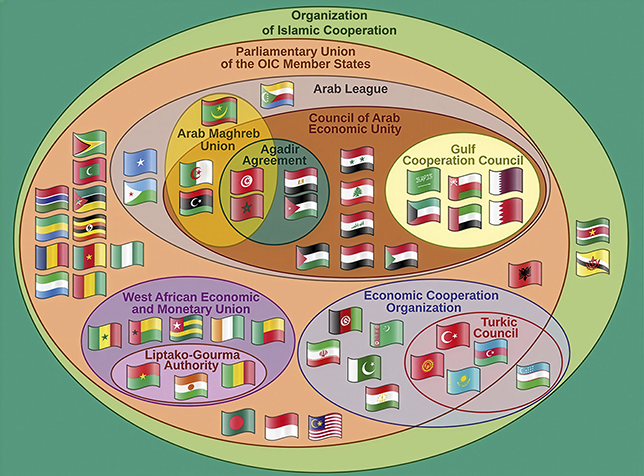
Figure 2 Long description
The infographic presents a schematic map of international institutions associated with the Muslim World. At the center is the Organization of Islamic Cooperation (OIC), surrounded by overlapping regional and subregional bodies such as the Parliamentary Union of the OIC Member States, Arab League, Council of Arab Economic Unity, Agadir Agreement, Gulf Cooperation Council, Economic Cooperation Organization, Turkic Council, Arab Maghreb Union, and West African Economic and Monetary Union with Liptako-Gourma Authority. Member states are represented by national flags distributed across these institutional groupings, illustrating overlapping memberships and the fragmented, multi-layered institutional landscape through which claims of Muslim unity are articulated.
The main alternative way of conceptualizing the Muslim World is through a spatial or zonal logic, which divides Muslim-majority societies into internally differentiated regions, often labeled as Arab, Persian or Shia, South Asian, Turkic-Ottoman, Southeast Asian, Sub-Saharan African, and diasporic, each associated with particular historical experiences, institutional structures, or intellectual traditions. We argue that while such classifications are sometimes used heuristically to signal internal diversity, they are analytically limited and potentially misleading. Zonal approaches tend to reify geography, naturalize regional boundaries, and risk reproducing the very essentialism they seek to avoid by mapping religious life onto ethnic, national, or civilizational containers. Moreover, they invite infinite subdivision into ever-smaller “subzones” without clarifying how or why the Muslim World itself emerges as a meaningful political and epistemic category in IR. We adopt a pluriversal approach, recognizing that multiple worlds, multiple epistemes, ethical orientations, and lived realities exist within and across “zones.” These zones intersect, overlap, and diverge in ways that defy neat spatialization.
A zones-based logic also diverts attention from the core dynamics that give the Muslim World its global salience: the overlapping, competing, and historically contingent civilizational categories through which Muslim societies are positioned within global narratives and structures of power. For example, Muslims in Asia are simultaneously situated within Asian, postcolonial, Global South, and Islamic imaginaries; Muslims in Africa are embedded in African, diasporic, and Islamic discursive fields; and Muslim communities in Europe and the Americas are constituted through processes of racialization, securitization, migration, and contestation within “Western” political orders. Islam, in this sense, does not neatly correspond to a single spatial or regional logic. The central analytical question is therefore not how to subdivide the Muslim World geographically, but why and under what conditions “the Muslim World” is privileged over other available categories such as Asia, Africa, the Global South, or postcolonial society as a dominant framework for interpreting political events, security concerns, or global order.
This privileging is politically produced rather than spatially given. The emergence of the Muslim World as a salient collective category cannot be separated from processes of imperial decline, colonial governance, and decolonization; from Cold War alignments and moments of South–South solidarity, including the Bandung Conference; and from the longer arc of Europe’s symbolic and material exclusion of Muslims, stretching from Ottoman dissolution through colonial restructuring to the late twentieth-century violence of the Bosnian genocide. These historical processes help explain why the Muslim World continues to be invoked as a civilizational framework even when alternative analytical lenses would appear equally plausible or empirically grounded. For this reason, rather than advancing a zones-based typology, this Element places greater emphasis on referential coherence, overlapping worldmaking narratives, and the political and historical conditions under which the Muslim World is produced and mobilized as a category in global politics. By conceptualizing the Muslim World along three intersecting axes – ideational, sociological, and institutional – we advance a framework that foregrounds its dynamic, pluralistic, and historically contingent nature.
1.1 Unity across the Muslim World: Ideational, Sociological, and Institutional Foundations of Solidarity
Despite the vast ethnic, linguistic, and cultural diversity of Muslim communities worldwide, a persistent and evolving aspiration for unity has shaped Muslim thought, practice, and politics from Islam’s emergence in the seventh century to the present. This aspiration was initially grounded in the Qur’anic concept of the ummah, envisioned as a single faith community. Over time, the idea of the ummah has been reimagined and reappropriated in response to shifting theological, ethical, political, and geopolitical conditions (Orwin, Reference Orwin2017). Although sectarian divisions, colonial legacies, and the rise of the modern nation-state have fragmented Muslim solidarity, Muslims across different regions have continuously drawn upon shared rituals, ethical frameworks, historical memories, institutional structures, and transnational networks to foster a shared sense of identity. Regardless of how it is framed, the concept of the ummah, to the extent that it presupposes a form of political authority, historically embodied in the Caliph in Sunni traditions and the Imam in Shia traditions, has always contained an inherently political dimension. While its influence has waxed and waned across centuries, the ummah remains a powerful referent in Muslim political consciousness and collective imagination (Sheikh, Reference Sheikh2016; Piscatori and Saikal, Reference Piscatori and Saikal2019).
Classical Muslim thinkers and travelers conceptualized what later came to be labeled the “Muslim World” not as a bounded civilizational bloc or a unified political entity, but as a plural and interconnected moral, social, and intellectual space constituted through mobility, the circulation of knowledge, and shared ethical frameworks. Ibn Battuta’s Rihla, for example, portrayed an expansive and heterogeneous network of cities, courts, and communities stretching from North Africa to South and Southeast Asia. These spaces were connected less through centralized political authority than through shared legal traditions, religious practices, and institutionalized norms of hospitality, scholarship, and trade. Ibn Battuta’s account foregrounded variation in customs, governance, and social organization, depicting a world sustained by relational familiarity rather than uniformity. Evliya Çelebi’s Seyahatname similarly represented the Muslim World as a layered and multicultural imperial space, particularly within and beyond the Ottoman realm, where Muslims, Christians, and Jews coexisted within overlapping political, linguistic, and cultural orders. Rather than advancing a monolithic vision of Islamic civilization, Evliya Çelebi emphasized local particularities, historical contingency, and everyday social plurality.
In a more explicitly philosophical register, al-Fārābī’s al-Madīna al-Fāḍila articulated a universalist conception of political and ethical order grounded in reason and virtue, situating Islamic principles within a cosmopolitan framework that resists civilizational closure and territorially bounded understandings of Muslim identity. Ibn Khaldun, in turn, approached Muslim polities in the Muqaddima as historically contingent formations shaped by material conditions, power relations, and social solidarities (ʿasabiyya), rather than as components of an imagined, transhistorical political whole. For Ibn Khaldun, ʿasabiyya was neither given nor static; its rise and decline structured the emergence, consolidation, and eventual decay of states, empires, and civilizations. In this sense, premodern Muslim thinkers conceptualized the “Muslim World” as a relational, dynamic, and internally diverse social space, rather than as a fixed or homogeneous civilizational entity.
Nevertheless, in the modern era, marked by the rise of the nation-state model, we have witnessed the emergence of new forms of global Muslim consciousness and political mobilization. These developments are not merely reactive or localized but often reflect a shared sense of symbolic belonging that transcends national borders. Illustrative examples include widespread boycotts and protests in response to the Danish Muhammad cartoons (2005–2006), transnational activism around the Palestinian cause, global advocacy against Islamophobia, and initiatives promoting interreligious and civilizational dialogue. These developments are more than isolated political episodes; they point to the existence of a transnational Muslim public sphere. We identify seven interrelated dimensions that construct and sustain this transnational public sphere, making the “Muslim World” a meaningful and analytically useful category for the study of IR.
1.1.1 Theology and Ritual
Theological foundations and shared ritual practices constitute an important symbolic and normative substrate of Muslim collective identity. Islam’s core beliefs – the oneness of God (tawhid), the prophethood of Muhammad, and the Qur’an as divine revelation – provide a shared doctrinal vocabulary referenced by Muslims across regions and cultures (Esposito, Reference Esposito1998). Qur’anic categories such as kafir (disbeliever), mushrik (polytheist), and ahl al-kitab (People of the Book) emerge from these theological foundations. While such classifications carried formal legal implications under classical Muslim empires (Hallaq, Reference Hallaq2009b), in contemporary political contexts, they rarely function as juridical categories and instead operate primarily as social and symbolic boundary markers, shaping perceptions of belonging, moral responsibility, and religious legitimacy rather than grounding a political or legal order.
Muslim faith is enacted through ritual practices that synchronize Muslim life across time and space. The Five Pillars of Islam (profession of faith, ritual prayer, fasting, almsgiving, and pilgrimage) structure individual and communal rhythms of devotion worldwide. Daily prayers and the global observance of Ramadan generate recurring moments of simultaneity, while the annual ḥajj pilgrimage offers a powerful embodiment of transnational religious connectedness by gathering Muslims from diverse linguistic, ethnic, and national backgrounds in a single sacred space (Bianchi, Reference Bianchi2004). Weekly Friday congregational prayers and the collective observance of two eids (Eid al-Fitr and Eid al-Adha) further reinforce a lived sense of communal belonging by embedding religious practice within shared social time and space across Muslim societies.
These beliefs and rituals contribute to shared liturgical and experiential forms of identification that have shaped Muslim societies and, at times, political orders. At the same time, we recognize that shared theology or ritual observance does not automatically translate into a unified geopolitical or civilizational entity. Other religious traditions, most notably Buddhism, exhibit substantial ethical commonality, ritual coordination, and translocal networks of belief and practice, yet have not produced a bounded political or civilizational “world” in international politics.
What distinguishes the Muslim case is not theology or ritual per se, but the extent to which religious references have been historically integrated into structures of political authority and governance. Across different periods, debates over scripture, religious interpretation, and the organization of communal life have been closely entangled with state power and institutional rule – from early Muslim empires such as the Umayyads and Abbasids, to the Ottoman Empire and its millet system, and into modern configurations such as Turkey’s Diyanet (Directorate of Religious Affairs) and Egypt’s al-Azhar, which continue to exercise religious authority while remaining embedded within the state’s institutional structure. These durable linkages between religious authority and governance have sustained the political relevance of theological and ritual frameworks well beyond the realm of private belief. In the final analysis, theology and ritual practices provide the symbolic grammar through which claims about collective Muslim identity are articulated, but they attain civilizational or political salience only when activated, regulated, and interpreted by political authorities.
1.1.2 Ethics, Norms, and Aesthetics
Unity among Muslims can also emerge through shared ethical practices (akhlaq and adab) and lived forms of piety (iḥsan). These practices generate ethical and affective resonances across Muslim communities by orienting conduct, self-understanding, and moral judgment in recognizable ways. As Saba Mahmood’s study of women in Egypt’s Islamic revival movement illustrates, ethical self-formation in Islam often takes place through embodied disciplines and practices of moral cultivation, such as the deliberate development of virtues like modesty, patience, humility, and care for others that situate individuals within a broader Islamic moral tradition (Mahmood, Reference Mahmood2005).
A similar ethical orientation is reflected in the widespread emphasis on khayr, doing good for the sake of God, which encompasses quiet, routine acts of charity, care, and service such as supporting neighbors, feeding the poor, volunteering at mosques, or donating anonymously. These practices recur across vastly different social and political contexts, contributing to a shared moral grammar through which Muslims can recognize familiar forms of piety beyond their immediate communities.
Comparable dynamics are visible in the transregional circulation of Sufi ethical and devotional practices. Disciplined spiritual exercises such as dhikr (remembrance of God), initiation under a spiritual guide, and participation in devotional networks foster ethical self-transformation while historically connecting Muslims across imperial, linguistic, and geographic boundaries. These networks produced layered forms of belonging anchored in experience and ethical discipline rather than territory or nationality. Such shared ethical repertoires generate resonance and spiritual affinity while accommodating significant doctrinal and cultural diversity.
Everyday embodied practices further contribute to this ethical intelligibility. Dietary norms (ḥalāl restrictions and the avoidance of pork and alcohol), fasting practices, and bodily disciplines related to modesty or self-regulation function as widely recognizable markers of Muslim ethical life. These practices foster a sense of familiarity and mutual intelligibility across contexts.
Muslim aesthetics provide another powerful register of referential coherence. Calligraphy, geometric design, architecture, and the circulation of Qur’anic Arabic phrases in everyday speech (e.g., inshaAllah, alḥamdulillāh, Allahuakbar) embed religious virtues into lived environments across regions. As Seyyed Hossein Nasr observes, Islamic art is not merely decorative but reflects metaphysical principles oriented around divine unity (tawhid), harmony, and transcendence (Nasr, Reference Nasr1997). Monumental structures such as the Dome of the Rock in Jerusalem, the Alhambra in Granada, or the Taj Mahal in Agra exemplify how architecture can encode shared cosmological and ethical imaginaries through geometry, inscription, light, and space (Nasr, Reference Nasr2010).
1.1.3 Transnational Networks: Scholars, Sufis, and Activists
One important source of unity in the Muslim World has been the persistence of transnational networks through which Islamic knowledge, practice, and political meaning are articulated across borders. These include scholarly lineages, Sufi brotherhoods, and modern religious and political movements. At the same time, Muslims participate extensively in a wide range of other transnational networks, including feminist, socialist, professional, artistic, and digital communities. What distinguishes religiously inspired or Islamically inflected networks is not their exclusivity, but their particular capacity and proclivity to articulate claims about collective identity, moral authority, and belonging. In this sense, they function as privileged sites for negotiating what it means to belong to an Islamic moral, legal, or political tradition across diverse social and political contexts.
1.1.3.1 Scholarly Networks
Religious scholars (ulama) have historically functioned as custodians and interpreters of Islamic legal and theological knowledge, sustaining shared interpretive traditions across time and space. Jurisprudential schools such as Hanafi, Maliki, Shafi’i, Hanbali, and Ja’fari jurisprudence, as well as reformist, revivalist, and Salafi currents, provide recognizable frameworks that travel across linguistic and national boundaries. Institutions such as al-Azhar University, Deobandi madrasas, seminaries in Qum, al-Mustafa International University, the Islamic University of Madinah, the International Union of Muslim Scholars (IUMS), and more recently, institutions like Zaytuna College in the United States, function as epistemic hubs. Historically sustained through travel, pilgrimage, textual circulation, and chains of ijazah (scholarly certification) and today increasingly through digital platforms, these scholarly circuits standardize vocabularies of religious reasoning and establish hermeneutics for orthodoxy and dissent (Zaman, Reference Zaman2002). Their significance lies in their ability to anchor debates about authority, authenticity, and normativity within the transnational Muslim public sphere.
1.1.3.2 Sufi Brotherhoods
Sufi orders (turuq) such as the Naqshbandiyya, Qadiriyya, Chishtiyya, Tijaniyya, and Muridiyya have historically connected Muslims across imperial, linguistic, and cultural frontiers through shared devotional practices, spiritual lineages, and ethical disciplines. Organized around personal mentorship, ritual practices such as dhikr, and reverence for spiritual exemplars, these networks generate forms of affiliation that are experiential and affective rather than territorial or national. As Mandaville (Reference Mandaville2001) notes, Sufi networks exemplify how transnational religious belonging can be cultivated through lived practice of spiritual discipline and purification rather than doctrinal uniformity or political unity.
1.1.3.3 Political and Religious Activism
In the modern period, transnational Islamic solidarities have also been articulated through activist movements such as the Muslim Brotherhood, Jamaat-e-Islami, Gulen Movement, and Tablighi Jamaat, as well as through more informal advocacy and mobilization networks. These movements differ significantly in ideology, organizational structure, and political strategy, ranging from moral reform and daʿwa to electoral participation and, at the extreme end, militant violence. Groups such as al-Qaeda or ISIS represent radicalized and highly exclusionary attempts to propagate Islamic transnationalism. Taken together, these scholarly, spiritual, and activist networks supply interpretive frameworks through which notions of obligation, solidarity, and grievance are expressed across Muslim transnational spaces and beyond.
1.1.4 Historical Memory and Political Narrative
A powerful source of unity within the Muslim World lies in shared historical memory and political narratives that structure collective understandings of triumph, trauma, and resilience. Through selective remembrance, narration, and reinterpretation, historical experiences shape how Muslims understand their collective past, locate themselves within contemporary political contexts, and imagine alternative futures (Hodgson, Reference Hodgson1974; Ahmed, Reference Ahmed2007; Ansary, Reference Ansary2009).
Foundational episodes in early Islamic history such as the Prophet Muhammad’s leadership, the hijrah to Medina, the Constitution of Medina as a formative political compact, the Treaty of Hudaybiya, and the first civil war (fitna) over authority remain central reference points through which debates over legitimacy, unity, and political order are articulated across sectarian and regional contexts (Haider, Reference Haider2014). Although interpreted differently within Sunni and Shia traditions, these episodes continue to shape Muslim moral reasoning, conceptions of justice, and competing visions of political authority.
As previously discussed, patterns of premodern Muslim mobility facilitated the circulation and transmission of these shared historical memories across space. Travel narratives such as Ibn Battuta’s Riḥla and Evliya Çelebi’s Seyahatname depict a vast yet recognizable Islamic ecumene in which legal norms, ritual practices, and forms of scholarly authority remained broadly intelligible across North Africa, the Middle East, Central Asia, and South Asia. These accounts illustrate that transregional Muslim consciousness long predates the modern nation-state, even though it was never anchored in political unity.
At the same time, collective traumas have been equally formative. The Crusades, Mongol invasions, and centuries of European colonial domination are frequently narrated as shared experiences affecting Muslim societies as a whole (Hillenbrand, Reference Hillenbrand1999). As with other modern civilizational categories such as “Asia,” “Africa,” or the “Global South,” the emergence of the Muslim World as a political imaginary cannot be therefore understood apart from the experience of imperial subjugation and racialization vis-à-vis Europe. In this sense, the idea of the Muslim World parallels other non-Western worlds whose meanings draw on shared experiences of exclusion, hierarchy, and subjugation within a Western-dominated global order.
1.1.5 Globalization and Media
Globalization has profoundly transformed the ways in which Muslims relate to one another across borders. Contemporary media ecosystems, including digital platforms, satellite television, social media, and mobile communication, have enabled new forms of transnational Muslim consciousness. Olivier Roy characterizes this transformation as the deterritorialization of Islam, or the Muslim World, a process experienced particularly strongly among Muslim diaspora communities in Europe and North America (2004).
In diasporic contexts, religious identity is increasingly constructed through simultaneous engagement with the receiving society’s identity discourses and global Islamic conversations. Online sermons, transnational fatwa platforms, social media influencers, and digital religious communities have become integral to Muslims’ everyday religious experiences. As Roy emphasizes, this form of “global Islam” privileges abstract, universalist interpretations that circulate transnationally and are often detached from historically embedded legal schools, cultural practices, or local religious authorities.
Complementing this perspective, Armando Salvatore highlights the role of media in facilitating the emergence of a transnational communicative space in which diverse Muslim actors debate questions of justice, authority, identity, reform, and global responsibility. We conceptualize this communicative domain as a key mechanism through which discourses about the Muslim World are articulated and contested. Satellite television networks such as Al Jazeera, religious programming produced in the Gulf, Turkey, Iran, and South Asia, as well as influential online platforms, have expanded the circulation of particular narratives and moral vocabularies beyond national audiences. These media infrastructures expose Muslims in the Middle East, Southeast Asia, Africa, Europe, and the Americas to similar ethical frameworks and symbolic repertoires.
At the same time, globalization and media do not operate solely as forces of cohesion; they also generate fragmentation, polarization, and contestation. Digital media, in particular, facilitate forms of online sectarianism and intensified competition over religious authority, often exacerbating ideological and doctrinal divides. Global media environments are further structured by asymmetric power relations that mirror broader political and economic hierarchies. Islamophobic narratives, securitized representations of Muslims, and the disproportionate visibility of extremist violence within global news cycles impose external frames through which Muslimness is defined and interpreted. These representational dynamics also shape Muslim self-understandings and public discourse, frequently producing apologetic narratives, defensive identity formations, and efforts to challenge dominant representational regimes. In this sense, media function as key sites of contemporary world-making: while they often reproduce hegemonic constructions of the Muslim World, they also – albeit unevenly – open space for pluralistic, critical, and counter-hegemonic interpretations.
1.1.6 Institutional Collaborations
The OIC institutionalized the idea of the Muslim World through diplomatic coordination among Muslim-majority states. Today, with fifty-seven member states, it presents itself as “the collective voice of the Muslim World” (Kayaoglu, Reference Kayaoglu2015). The organization provides a regular forum for summits, foreign ministers’ meetings, and coordinated positions in international organizations, most visibly through bloc voting at the United Nations on issues such as Palestinian statehood, Islamophobia, and religious discrimination. Affiliated bodies such as the Islamic Development Bank (IsDB) further extend this institutional landscape into development finance, humanitarian assistance, and infrastructure investment. In Section 4, we offer a detailed discussion on the OIC’s historical trajectory and the political challenges that have shaped its development.
Beyond the OIC, Muslim-majority cooperation is structured through a dense but fragmented ecosystem of regional and function-based organizations that do not claim to represent the Muslim World as a whole, yet are composed almost exclusively of Muslim-majority states. Organizations such as the Arab League, the Gulf Cooperation Council (GCC), the Organization of Turkic States (formerly the Turkic Council), the Economic Cooperation Organization (ECO), and the West African Economic and Monetary Union (WAEMU) structure cooperation around shared linguistic, geographic, economic, or historical affinities among subsets of Muslim-majority countries. While their mandates range from economic integration and security coordination to cultural cooperation, these institutions generate important linkages among Muslim-majority countries.
1.1.7 Collective Grievances and the Politics of Solidarity
Events such as the Arab–Israeli conflict, the Bosnian genocide, the anti-Muslim pogroms in Gujarat, the repression of Uyghurs in Xinjiang, and discriminatory policies targeting Muslim diasporic communities have repeatedly functioned as emotional and political catalysts across the Muslim World. These crises activate what might be described as a shared moral and political consciousness, mobilizing networks for protests, humanitarian relief, international advocacy, and collective prayer. Among these episodes, the Palestinian struggle holds singular symbolic weight, representing a history of anticolonial resistance simultaneously, the enduring dispossession of a Muslim population, and a paradigmatic case of Muslim vulnerability under global power asymmetries. Crises in Kashmir, Xinjiang, Bosnia, and elsewhere similarly reverberate across Muslim societies, generating affective bonds of empathy and moral obligation that transcend national, sectarian, and cultural boundaries. In these contexts, collective action emerges less from formal institutional mandates than from a shared sense of collective identity in which harm inflicted on one part of the global Muslim community is experienced as a wound borne by all.
Responses by the broader international community to these crises have been uneven, selective, and deeply conditioned by geopolitical interests. In Bosnia, the delayed and hesitant intervention of Western powers in the face of ethnic cleansing was widely interpreted across the Muslim World as a sign of indifference toward Muslim suffering. Likewise, international efforts to address the Palestinian question have long been constrained by great-power politics, with United Nations resolutions condemning occupation and settlement expansion often lacking meaningful enforcement. Global reactions to the repression of Muslims in Kashmir or Xinjiang have similarly remained limited or largely symbolic, shaped less by universal human rights norms than by strategic alliances and economic dependencies. These patterned asymmetries contribute to a widespread perception among Muslim publics that international institutions and major powers apply moral and legal principles inconsistently, particularly when Muslim communities are the primary victims of violence, exclusion, or systemic rights violations.
Public opinion in many Muslim-majority societies mobilizes rapidly in response to perceived injustices, generating mass demonstrations, consumer boycotts, charitable campaigns, and sustained expressions of solidarity. States likewise often issue forceful diplomatic statements or coordinate resolutions through the OIC. Such responses, however, are routinely constrained by geopolitical rivalries, domestic political considerations, and dependence on external patrons. These tensions become especially visible during major international crises. The Abraham Accords, for instance, involved the UAE, Bahrain, and subsequently other Arab governments normalizing relations with Israel, while others opposed such normalization. Similarly, although civil society networks across the Muslim World vocally condemned China’s mass detention and cultural repression of Uyghur Muslims, several Muslim-majority states, including the UAE, Saudi Arabia, and Pakistan, remained silent or offered diplomatic support for China, citing economic partnerships, strategic alliances, and norms of noninterference.
The global rise of Islamophobia, particularly in the aftermath of the September 11 attacks, has generated a shared sense of vulnerability across Muslim communities worldwide. In many Western contexts, Muslims have increasingly been subjected to surveillance regimes, travel restrictions, hate crimes, and normalized suspicion in public life. More broadly, the discourse of the “Global War on Terror” has been mobilized by both authoritarian and democratic governments to legitimize coercive policies targeting Muslim populations. These developments have contributed to the racialization of diverse Muslim identities, transforming “Muslimness” into an ascribed, quasi-racial category frequently constructed as inherently foreign, threatening, or predisposed to violence. This racialization not only shapes how Muslims are governed and policed in Western societies, but also informs modes of governance in non-Western contexts, often under the banner of counterterrorism and security.
1.2 Diversity within the Muslim World
Islam as a faith and Muslims as a global community have always encompassed profound diversity across time, geography, language, and political experience. Plurality is the historical norm within Muslim societies, and any attempt to conceptualize “the Muslim World” must begin by reckoning with this internal heterogeneity. Shahab Ahmed’s What Is Islam? (2016) provides one of the clearest formulations of this point, demonstrating how the Islamic tradition historically flourished through a wide range of philosophical, legal, mystical, poetic, and vernacular practices that coexisted without the imposition of doctrinal uniformity. Thomas Bauer (Reference Bauer2021) extends this insight by showing that premodern Islamic cultures cultivated a “culture of ambiguity,” a civilizational ethos that embraced interpretive openness. Marshall Hodgson’s (Reference Hodgson1974) notion of “Islamicate” civilizations likewise highlights that Islam’s expansion across Afro-Eurasia did not produce a single Islam but a constellation of overlapping, locally grounded expressions of it.
This recognition of deep historical plurality reveals the analytical limitations of contemporary efforts to divide the Muslim world into spatial “zones” such as Arab, Persian/Shia, South Asian, Turkic-Ottoman, Southeast Asian, Sub-Saharan African, or diasporic. Although such classifications may offer descriptive shorthand, they risk reifying geography, naturalizing boundaries that were historically fluid, and obscuring the remarkable diversity that characterizes these spaces. As Talal Asad (Reference Asad1986, Reference Asad2003) and Samira Haj (Reference Haj2009) caution, attempts to map religious life onto discrete cultural or territorial containers often reproduce the epistemic habits of colonial governance, which sought to classify, order, and manage Muslim populations by assigning them to fixed “types.” Zonal frameworks represent a softer version of this classificatory impulse.
Take the so-called “Arab Zone,” a category that flattens immense linguistic, ethnic, and doctrinal variation across North Africa, the Levant, and the Arabian Peninsula. Not only do Arab societies contain Sunni, Shia, Ibadi, Sufi, and secular traditions and diverse ethnic communities, but they also exhibit divergent relationships between religion and state. To group these cases under a single regional heading obscures more than it reveals. A similar problem appears in classifications such as the “Persian” or “Shia Zone,” which collapse diverse communities, Iranians, Iraqis, Lebanese, Bahrainis, Hazaras, and others into an imagined doctrinal unit. Shiism itself encompasses Twelver, Ismaili, Zaidi, and localized traditions with distinct theological and political trajectories. Within Iran alone, religious orientations range from quietist clerics to activist jurists, philosophical mystics, and scholarly circles influenced by Western social theory. Moreover, Shia idioms of martyrdom and resistance, especially the Karbala narrative, have traveled far beyond any putative “Shia space.” As scholars such as Hamid Dabashi (Reference Dabashi2011) and Narges Bajoghli (Reference Bajoghli2019) show, these idioms increasingly circulate across Sunni and Shia movements alike; Hamas’s selective adoption of Karbala symbolism is only one example of how Islamic repertoires travel vertically and horizontally across sectarian and ethnic boundaries.
The same analytical difficulties arise in discussions of Sub-Saharan African, South Asian, Turkic, or Southeast Asian “zones.” West African Islamic traditions shaped by Sufi brotherhoods, oral pedagogy, and local moral economies, cannot be meaningfully collapsed into a single regional type, especially given the coexistence of powerful Sufi, reformist, Salafi, feminist, and youth movements. South Asia, home to almost one-third of the world’s Muslims, is even more internally heterogeneous. Scholars like Barbara Metcalf (Reference Metcalf1982), Francis Robinson (Reference Robinson2000), and Muhammad Qasim Zaman (Reference Zaman2018) document the extraordinary range of Islamic movements emerging from the region: the Deobandis, Barelwis, Ahl-e Hadith, and Jamaat-e-Islami represent only a fraction of the intellectual and political diversity shaped by colonial rule, linguistic traditions, caste dynamics, and post-partition nationalism. No meaningful account of this region can be reduced to a single “South Asian Islam.”
Similar oversimplifications appear in discussions of the “Turkic” or “Ottoman” sphere (Yavuz, Reference Yavuz2004). Turkey alone contains divergent religious landscapes, including Sufi orders, Alevism, Sunni revivalism, Salafism, Kurdish Islamic movements, and secular constituencies. Central Asian societies follow yet another trajectory, where Islam reemerged after Soviet repression as a primarily cultural identity. Grouping Turkey, the Balkans, and Central Asia under a single “Turkic zone” obscures these sharply divergent histories.
Southeast Asia likewise defies categorical enclosure. Scholars such as Robert Hefner (Reference Hefner2000) and Azyumardi Azra (Reference Azra2004) show that Islam in Indonesia, Malaysia, and the broader Malay world evolved through centuries of engagement with Hindu-Buddhist cosmologies, Sufi networks, and trade routes. While often celebrated as pluralist or syncretic, Southeast Asian Islam today also contains powerful Salafi movements, reformist organizations, and contestations over gender, minority rights, and the role of Islamic law.
Diaspora Muslims in Europe and North America disrupt zonal logic even more forcefully. Their religious expressions interact with the entanglement of migration, racialization, secular governance, Islamophobia, and digital media. As scholars like Nilüfer Göle (Reference Göle2015), Junaid Rana (Reference Rana2011), and Su’ad Abdul Khabeer (Reference Khabeer2016) show, diaspora Islam generates new vocabularies of belonging, dignity, and justice that circulate globally, transforming Islamic thought in ways that no zone-based framework can accurately capture.
More importantly, zonal logics fail to explain why, in global politics, the category of the Muslim World routinely supersedes identities such as Asian, African, Turkic, or postcolonial. A more analytically productive approach is to view Muslim identities as embedded within overlapping and interpenetrating civilizational and geopolitical imaginaries. Muslims in Asia belong simultaneously to Asian, Islamic, Indian Ocean, and Global South worlds; Muslims in Africa inhabit African, postcolonial, and Islamic discursive fields; Muslims in Europe occupy a historically fraught space shaped by long-standing exclusion from al-Andalus to the Bosnian genocide and contemporary racialization. Diasporic Muslims navigate multiple identity regimes at once, from race and immigration status to global Islamic referents.
In this light, the key question is not how to subdivide the Muslim world but how and why the Muslim World becomes a salient frame for interpreting political events, crises, or global order. Its significance is inseparable from colonial and racialized modernity (Said, Reference Said1978; Mamdani, Reference Mamdani2004), the reproduction of “the West” as a coherent cultural and political unit, the politics of security and migration, and the discursive structures through which contemporary power hierarchies are maintained. The Muslim World, in short, is not a spatial category but a transnational public sphere whose coherence derives not from geographic contiguity but from a shared repertoire of symbols, narratives, and discursive practices. The seven forces discussed generate a degree referential coherence that allows Muslims across different social and political contexts to imagine themselves as part of a broader community.
1.3 Conclusion
The forces driving Muslim unity are neither fixed nor uniform; they emerge from an evolving interplay of theological, cultural, and political influences. From the earliest centuries of Islam, shared rituals, common legal vocabularies, networks of scholarship and trade, and the circulation of Sufi orders created enduring forms of connection and homophily across vast geographies. These dynamics sustained a highly mobile and intellectually interconnected Islamic ecumene in which figures like Ibn Battuta and Evliya Çelebi could traverse Afro-Eurasia and record striking patterns of cohesion in law, spirituality, and ethics despite regional differences.
The colonial encounter and its aftermath introduced new vectors of both unity and division. European imperialism did not merely redraw borders; it restructured authority, reshaped religious institutions, and generated new vocabularies of civilizational belonging through which Muslims came to understand themselves and were understood by others. Anticolonial movements, Pan-Islamic solidarities, and later postcolonial institutions infused the concept of the Muslim World with renewed political significance and aspiration. In the contemporary era, geopolitical realignments, racialized representations of Islam, and digital mobilization continue to reshape how Muslims imagine unity and negotiate internal difference.
At the same time, diversity remains a constitutive element of Islam’s global presence, not a deviation from it. It is embedded in jurisprudence, theology, Sufi traditions, philosophical inquiry, artistic expression, and local devotional practices. It also arises from the plurality of sociopolitical contexts in which Muslims live from the Indian Ocean world to the Sahel, from Southeast Asia to the Balkans, and across diasporic communities in Europe and the Americas. Globalization, digital media, and migration have further diversified the ways Islam is lived and narrated, generating new vocabularies of belonging and new modes of imagining a global Muslim community.
Crucially, this diversity cannot be captured through spatial “zone” models that divide the Muslim World into regional and cultural blocs. Such classifications reify geography, obscure internal complexity, and inadvertently echo the essentialist logic that colonialism helped produce about Muslims and their identities. They conflate religion with ethnicity or nationhood, naturalize historically fluid boundaries, and overlook the circulation of ideas, symbols, and grievances across sectarian, ethnic, and regional lines.
Muslims inhabit overlapping and intersecting civilizational and geopolitical imaginaries. Muslims in Asia simultaneously belong to Asian, Indian Ocean, Global South, and Islamic worlds. Muslims in Africa participate in African, postcolonial, and Islamic discursive fields. Muslims in Europe and North America navigate racial, migratory, and secular-liberal regimes while drawing on transnational Islamic repertoires. In each context, the Muslim World functions as a discursive arena sustained by shared referents, symbolic grammars, and moral vocabularies that allow Muslims to recognize themselves and to be recognized by others.
In our framework, unity and diversity are not antithetical but mutually constitutive. Together, they structure the porous, dynamic, and historically contingent transnational public sphere we conceptualize as the Muslim World. Grasping Islam’s political and social role in global affairs thus requires attention to both the referential coherence that sustains transnational forms of Muslim identification and the irreducible plurality of Muslim life across time and space. The Muslim World, in this sense, emerges not as a fixed geographical unit but as an evolving discursive category produced through historical and political processes.
2 The Muslim World in IR Theory: From Problem to Possibility
In IR, the “Muslim World” is often used as shorthand for a civilizational bloc or geopolitical “other,” but this essentialist framing obscures diversity and complexity, and reinforces binaries between Islam and the West. The first section offered a compelling alternative to essentialist framings. Rather than rejecting the term outright, it examined its historical formation, discursive functions, and normative assumptions. Drawing on intellectual histories and interdisciplinary scholarship, the section reframed the Muslim World not as a fixed civilizational entity but as a transnational public sphere sustained by referential coherence to diverse social, ethical, and historical processes. It also highlighted the plurality of Muslim experiences and the heterogeneity of Muslim political thought and institutions. This reconceptualization offers a path for IR scholars to transcend static, culturalist paradigms and embrace a more dynamic, historically grounded, and pluralist understanding of the Muslim World and its varied expressions of political agency.
This section further justifies the need for an alternative conceptual framework by examining how the English School, Historical IR, Civilizational IR, and Islamic IR have adapted and reproduced essentialist conceptions of the Muslim World. We argue that our reconceptualization offers a more analytically precise and normatively inclusive framework, one that both deconstructs reductionist uses of the term and indicates new directions in conceptualizing political worlds (i.e., worlding) and Global IR.
2.1 Rethinking the Muslim World in English School International Relations
The English School of International Relations, with its foundational concern for the “expansion of international society,” has engaged issues related to Islam and Muslim societies, and some of its foundational theorists have deployed the term Muslim World in ways that reinforce Eurocentric assumptions and civilizational hierarchies (Bull and Watson, Reference Bull and Watson1984). Rather than conceptualizing Muslim-majority societies as co-constitutors of international society, the English School tends to portray them, as well as other non-Western societies, as late entrants, recipients of norms forged in Europe, and often as cultural or normative “others” (Linklater and Suganami, Reference Linklater and Suganami2006; Keene, Reference Keene2002; Hobson, Reference Hobson2012). This framing is most evident in early English School scholars as represented in the canonical volume The Expansion of International Society (1984), where Islam and Muslim societies are routinely cast as exceptional, resistant, or subordinate to Western-derived international norms (Bozeman, Reference Bozeman, Bull and Watson1984). In such treatments, the Muslim World is neither given definitional clarity nor recognized for its internal diversity; instead, it appears as a convenient shorthand for a residual non-Western entity, vaguely unified, largely reactive, and almost always in tension with the normative evolution of international society.
Reus-Smit distinguishes between culturalist and pluralist strands of the English School, the former viewing the culture of international society as exclusionary and the latter emphasizing institutions and practices that include all states regardless of culture (2018). The culturalist strand, in particular, has often been exclusionary toward Islam and Muslims. One of the most striking examples of this tendency is found in Adda Bozeman’s contribution to the aforementioned volume. Following a culturalist perspective, Bozeman’s portrayal of the Muslim World is starkly Orientalist, presenting it as an undifferentiated bloc defined by religiosity, resistance to modern legal frameworks, and authoritarian inclinations. She employs terms such as “Islamic societies,” “Islamic states,” and “Muslim World” interchangeably and without definitional rigor, allowing these entities to float as essentialized categories positioned against a rational, secular, and united West (Bozeman, Reference Bozeman, Bull and Watson1984). While her views are extreme, they reflect a broader pattern in the English School: a failure to interrogate its own conceptual foundations when engaging with non-Western societies (Hobson, Reference Hobson2012). Even pluralist contributions within the English School, when it comes to Islam and Muslims, such as those of Piscatori, who acknowledges diversity within Islam and cautions against monolithic representations, resort to vague generalizations like “Islamic backlash” or “Islamic order,” without specifying their political contexts (1984).
Equally problematic is the English School’s narrow historical and geographical scope in treating the Muslim World. Muslim engagement with international society is typically reduced to the nineteenth-century Ottoman Empire’s diplomatic encounters with European powers (Bull and Watson, Reference Bull and Watson1984). This reflects the problematic Eurocentric assumption that international society expanded beyond Christendom and Europe only with the Ottoman Empire’s admission under the “Public Law of Europe” in the 1856 Treaty of Paris ending the Crimean War (Gong, Reference Gong1984; Naff, Reference Naff, Bull and Watson1984; Kayaoglu, Reference Kayaoglu2010; Wigen, Reference Wigen2014). This myopia marginalizes centuries of Islamic political thought, diplomatic practice, and legal theorizing that predate or parallel European developments (Hodgson, Reference Hodgson1974; Hobson, Reference Hobson2004). What was historically important, the internal order of Muslim societies, their relations with Europe, and their place in European politics, is often overlooked.
This limited focus continues in the post-Ottoman period, as the English School’s geographical emphasis remains heavily centered on the Middle East and North Africa (MENA), neglecting the rich political and intellectual contributions of Muslim communities in South, Southeast, and Central Asia, Western and Sub-Saharan Africa, and diaspora communities in Europe and North America. As a result, the Muslim World is not studied as a transhistorical and transregional phenomenon with its own institutional, normative, and epistemic trajectories. Instead, it is treated as a problem space, either to be integrated into or managed by the Western-led international society (Mandaville, Reference Mandaville2001; Aydin, Reference Aydin2017). This selective engagement not only distorts the empirical complexity of Muslim societies but also sustains a civilizational narrative in which the West is the dominant subject, and the Muslim World is the object. This Element’s more dynamic and nuanced definition of the Muslim World offers a powerful corrective to the English School’s conceptual and empirical shortcomings. It interrogates the term itself, acknowledging its colonial genealogy and the risks of perpetuating essentialist framings.
The British Empire played a central role in constructing a racialized understanding of the Muslim World, often viewing it through the lens of its colonial possessions, especially India and its Muslim populations (Aydin, Reference Aydin2017). Recognizing the colonial origins of the term would help English School scholars see the Muslim World as a transnational public sphere shaped by shared religious, cultural, and historical frameworks while remaining internally diverse. This perspective resonates with other critics of the English School, most notably Edward Keene (Reference Keene2002), who argues that international society historically pursued two distinct goals: fostering toleration within Europe while imposing “civilization” beyond it, most visibly through colonialism.
We pay particular attention to historicizing the emergence and evolution of coherence and discourses of unity in the Muslim World, from early Islamic diplomacy, trade networks, and shared legal-ethical vocabularies to modern institutions such as the OIC and contemporary transnational activist movements. By incorporating theological traditions, ethical practices, artistic expressions, and transnational networks of scholars, Sufi orders, and political movements into our conception of the Muslim World, we offer a more nuanced and textured account of how this world has historically been constructed and contested.
The English School assesses Muslim societies’ inclusion into the international society based on their conformity to Western diplomatic and legal norms. In contrast, we redefine participation in international society by shifting the focus away from state recognition or adherence to (international) legal frameworks toward broader modes of normative and institutional contribution. We consider how Muslim actors have shaped global politics through their own traditions of justice, solidarity, and governance. We discuss concepts such as the ethical imperative to act against injustice and the activism of transnational institutions like the OIC in response to mass violations of Muslim rights not as deviations from Enlightenment humanism, but as expressions of a corrective global humanism. In this sense, the moral claims and political mobilizations emerging from the Muslim World expand, rather than oppose or jettison the global repertoire of humanistic thought. This pluralist and post-Westphalian perspective challenges the culturalist positions of the English School. But they align with pluralist perspectives of the English School reflected in Robert Jackson’s idea of a pluralist “global covenant,” international society should be reenvisioned through an inclusive framework that respects human rights while upholding human equality and universality of human rights (2000).
If the English School seeks to understand the normative foundations and historical expansion of international society, it must move beyond its narrow Eurocentric and state-centric paradigm. We argue that our conception of the Muslim World allows for a rethinking of the English School’s basic assumptions about what constitutes international society, who participates in it, and how that participation is recognized and theorized. We highlight the need for a shift from viewing Muslim societies through the lens of integration or resistance, to engaging with them as equal epistemic partners in shaping global order. Such a shift would not only correct historical omissions but also enhance the English School’s capacity to account for global pluralism in the twenty-first century.
2.2 Reimagining Civilizations in World Politics
Civilizational approaches to international relations (Civ-IR) emerged as responses to the limitations of state-centrism and Eurocentrism in mainstream IR theory. By emphasizing historical depth, cultural continuity, and civilizational plurality, Civ-IR scholars aimed to recenter non-Western traditions and offer more inclusive accounts of global order (Katzenstein, Reference Katzenstein2010; Acharya, Reference Acharya2014). Yet in practice, Civ-IR has occasionally reproduced the very essentialisms and hierarchies it has sought to challenge, especially in its treatment of Islam and the “Muslim World.” Rather than engaging Muslim-majority societies as internally diverse and politically dynamic parts of the global community, it has reduced Islam to an immutable civilizational core, defined by premodern values, resistance to liberal norms, and inherent opposition to the West, mirroring the Orientalist assumptions found in English School scholarship.
This essentialism is most clearly exemplified in Samuel Huntington’s Clash of Civilizations thesis, which, despite widespread critique, continues to cast a long shadow over Civ-IR. In Huntington’s framework, Islam is not merely a religion or way of life. It is predominantly a civilizational adversary, inherently predisposed to conflict with the liberal West (Huntington, Reference Huntington1996). Even as the field expanded its analytical horizons, it did so alongside what Phillips and Reus-Smit identify as enduring “civilizational and racial conceits,” with many IR scholars continuing to rely on static and essentialized conceptions of culture (2020, p. 5).
A growing number of Civ-IR scholars have rejected Huntington’s overt antagonism and worked to move away from a homogenized conception of the Muslim World. More nuanced contributions, such as those by Peter Katzenstein, acknowledge “Civilizations exist in the plural.” They coexist with each other within one civilization of modernity, or what we often call today a global world. Civilizations are plural. Their internal pluralism results from multiple traditions and “vigorous debates and disagreements” (Katzenstein, Reference Katzenstein2010, p. 1). Similarly, contributors to Phillips and Reus-Smit take “heterogenous cultural context as given” (2020, p. 7). Thus, they avoid treating Islam as a coherent civilizational bloc unified by essential values. These pluralist framings of Islam do not privilege cultural continuity over political change and uniformity over pluralism. As a result, unlike other works, they do not invoke an understanding of the Muslim World as a civilizational subject awaiting modernization or assimilation into the international order (Lawrence, Reference Lawrence and Katzenstein2009). As Bettiza (Reference Bettiza2020) has argued, the “Muslim World” does not merely describe a geopolitical reality, but it helps construct one. Similarly, Reus-Smit states, “the West and Islam are not natural forms; they are constituted and sustained by language and practice.” In fact, culture should not be treated as a singular essence but as a field of diverse and shifting discourses and that “these discourses are inherently political” (2018, p. 41).
When IR theorists invoke the Muslim World as an antagonistic civilizational unit, the term becomes a shorthand for racialized assumptions of threat, backwardness, and normative deficiency. Even critical voices, such as Fred Dallmayr, who call for civilizational dialogue rarely escape this logic (2002). While they celebrate cultural coexistence, they often fail to interrogate the political struggles, historical ruptures, and ideological debates that have shaped Muslim societies. As a result, the Muslim World continues to be treated as a static object of analysis rather than a source of dynamic political thought, ethical imagination, or epistemic contribution in its own right.
Our conceptual framework instead conceptualizes the Muslim World as a historically contingent and intersubjectively constructed transnational public sphere. Throughout this Element, we trace how the category emerged through colonial classification, was reshaped by imperial governance, and was subsequently reappropriated through diverse forms of Muslim intellectual, political, and activist mobilization. Like other civilizational identities, its meanings are not fixed but continuously reconfigured through shifting power relations and historical transformations (Metcalf, Reference Metcalf1982; Safi, Reference 81Safi2006).
Other civilizational categories, such as “the West,” are also discursive constructions. Varouxakis (Reference Varouxakis2016) shows that “the West” emerged in the nineteenth century as a distinctly political and ideological project, forged in the context of Anglo-American debates about progress, liberalism, and empire. Far from denoting an ancient cultural unity, the term gained salience as policymakers and intellectuals sought to differentiate a self-styled modern, rational, and liberal West from its imagined civilizational “others,” primarily the Russian Empire. Bonnett (Reference Bonnett2004) further argues that by the late nineteenth and early twentieth centuries, “the West” had become a global racialized identity category, increasingly intertwined with notions of whiteness, modernity, and civilizational superiority. These analyses resonate with our argument that the “Muslim World,” like “the West,” cannot be treated as a timeless or self-evident entity; rather, it must be understood as a discursive construction shaped by shifting power relations, colonial classifications, and modern political mobilizations.
Our framework may also help Civ-IR move beyond its frequent conflation of culture with civilization. In the case of the Muslim World, this tendency appears most clearly in the elevation of a particular Arabic cultural repertoire as representative of an imagined, monolithic Islamic civilization. This logic is unmistakable in Huntington’s (Reference Huntington1996) depiction of Islam as a culturally homogeneous and civilizationally antagonistic bloc, but it also appears in more scholarly treatments such as those of Bassam Tibi (Reference Tibi2001, 2012), who treats “Islamic civilization” as a singular cultural formation anchored in Arab-Islamic heritage. Emanuel Adler too refers to Muslim World in generic terms, while his discussion focuses almost exclusively on European Muslims. In describing “European civilization’s relations with the Muslim world,” Adler ultimately suggests that Muslims must Europeanize if they wish to achieve a sense of belonging.
“The key question in the minds of 500 million Europeans, and of Muslims now living in Europe (close to 20 million) or elsewhere, is whether this latest phase of interactions between European civilization and the Muslim world will result in the Europeanization of Muslims or the Islamization of Europeans. The unwillingness of some European Muslims to abandon Sharia or Islamic law and jihad, along with Islamic terrorism, proselytizing non-Muslims, social and economic polarization in Europe and creation of a Muslim underclass, which engenders a heavy dose of crime, and Turkey’s bid to join the European Union, which would augment the number of Muslim European citizens to roughly 90 million, raise the question whether the Muslim world, with which Europe interacts, is, or should be, part of ‘us,’ ‘them,’ or none of these.” (2010, p. 84)
This argument essentializes both “Europe” and “the Muslim world” as internally uniform and mutually opposing civilizational blocs. However, what is often portrayed as a timeless “civilizational essence” is in fact produced through lived, localized, and historically situated forms of life (Hodgson, Reference Hodgson1974; Mandaville, Reference Mandaville2001). Shifting the analytical focus from static, externally ascribed civilizational values to the political agency of Muslims and to the agency of Western publics and institutions as they navigate integration debates, migration governance, and encounters with civilizational difference, offers a more nuanced account of how civilizational boundaries are negotiated in practice, and when, if at all, they become salient in processes of conflict or cooperation. Our approach, therefore, encourages IR scholars to ask normatively richer questions. Rather than asking how one “civilization” fits into a predetermined global mosaic, the more pressing inquiry becomes how members of a given civilization, across diverse geographies and historical contexts, contest, reinterpret, and reimagine their political world in relation to other political worlds and how these imaginations contribute to either solidaristic or antagonistic relations. In this sense, we do not reject Civ-IR’s interest in longue durée patterns; rather, we argue that such patterns must be engaged with methodological reflexivity, historical specificity, and analytical rigor.
Civilizational approaches to international relations also often overemphasize conflict and hostile relations between civilizations at the expense of recognizing the long-standing processes of civilizational exchange and mutual influence. All civilizations have been both producers and recipients of external cultural, philosophical, and political currents. The absorption of Greek philosophical thought into Islamic intellectual traditions, the subsequent transmission of Muslim scientific, medical, and legal scholarship into medieval and early modern Europe, and their impact on the making of the European Renaissance, are only some examples of intercivilizational circulation (Saliba, Reference Saliba2011).
Classical Muslim polities such as al-Andalus, Mughal India, and the Ottoman Balkans further complicate binary models that juxtapose “Islamic” against “Western” and “Asian” civilizations. These empires institutionalized legal/civilizational pluralism, cultivated pragmatic modes of coexistence, and generated hybrid forms of governance and cultural production. As Zarakol (Reference Zarakol, Phillips and Reus-Smit2020) emphasizes, the Ottoman Empire in particular exemplifies an adaptive and flexible approach to managing religious and cultural heterogeneity, one that defies easy civilizational categorization. These examples illustrate how civilizations emerge and evolve through patterns of borrowing, entanglement, and hybridity rather than through fixed, self-contained essences. We argue, therefore, that Civilizational IR must take these dynamics seriously. A framework attentive to mutual influence and co-constitution provides a more analytically rigorous and historically grounded account of how civilizations form, interact, transform, and at times disappear.
2.3 Beyond the Inertia: Reconceptualizing the “Muslim World” in Historical International Relations
Historical approaches to IR, particularly those that seek to incorporate non-Western political orders, have made important strides toward globalizing the discipline. Yet despite these aspirations, Historical IR also frequently replicates many of the conceptual limitations found in the discussed IR paradigms in its treatment of the “Muslim World.” For example, some historical IR scholars such as Barry Buzan and Amitav Acharya, while critical of Eurocentrism, continue to invoke the Muslim World as a macro-historical unit without sufficiently interrogating its conceptual underpinnings (Acharya and Buzan, Reference Acharya and Buzan2007). This usage, often grounded in mid twentieth-century frameworks such as Majid Khadduri’s interpretation of Islamic international law, reproduces a vision of Islam as a unitary historical actor governed by a fixed legal and political logic (Khadduri, Reference Khadduri1955; Aydin, Reference Aydin2017). Such a vision overlooks the internal diversity of Muslim polities and overstresses unity, continuity, and religious determinism, often at the expense of historical specificity and interpretive nuance (Hodgson, Reference Hodgson1974; March, Reference March2019).
Like other IR approaches, one key problem with Historical IR’s use of the Muslim World is its tendency to reduce vastly different historical experiences, legal traditions, and political ideologies into a single, coherent unit. For example, Spruyt (Reference Spruyt2020) aggregates the Ottomans, Safavids, and Mughals into an “Islamic international society” structured by Sharia, with little attention to doctrinal divergences, intercommunal pluralism, or local adaptations of Islamic governance. Similarly, Buzan and Acharya draw heavily on Khadduri’s Cold War-era framing of Islamic law as divided into domains of Islam, war, and truce despite longstanding critiques from historians of Islamic law that highlight the ideological, legal, and political complexity of premodern Muslim societies (Hallaq, Reference Hallaq2009a). These frameworks persist not only because they are familiar, but because they offer heuristic comfort for comparative analysis. Yet, this comfort often comes at the cost of analytical precision and historical depth by privileging imperial, statist, and juridical logics.
Compare this with Ayşe Zarakol’s discussion of cultural and religious diversity in the Ottoman Empire. By defining the empire as a syncretic Islamic empire, she illustrates how “cultural syncretism was built into the empire’s DNA” (2020, p. 53). The term Sharia does not appear even once in her discussion, as she notes “the Muslim and non-Muslim divide, while always present in a legal sense in the empire, may not have always been the most politically salient cultural demarcation as far as the state was concerned” (2020, p. 51). Zarakol highlights the profound heterogeneity and hybridity within the empire’s social and political fabric, showing how rulers established complex and shifting relations with the ulamā, heterodox Muslim communities, and non-Muslim populations depending on pressures of centralization, external relations, and ideological currents of the time. All of these make it impossible to reduce the empire’s governance to a single framework or explanation.
Zarakol demonstrates that Historical IR’s engagement with Islam and the Muslim World would benefit from greater attention to alternative Muslim political imaginaries such as Sufi networks, ulama-led resistance movements, and the enduring conception of the Muslim World as a non-statist, transnational community. Additional examples of such imaginaries can also be found across different historical and regional contexts. For instance, Sufi orders like the Sanūssiyya resisted colonial incursions in North Africa while maintaining spiritual-political authority across regional boundaries. Ulamā-led movements, such as the Mahdist uprising in Sudan and the Deobandi network in India, emphasized divine law and religious scholarship over the logic of the modern nation-state.
The aspirations of unity among the global Muslim communities continue to inspire cross-border solidarities and political mobilizations, from the Khilafat Movement of the early twentieth century to the global humanitarian work of organizations like Islamic Relief. None of these fit neatly within Westphalian state-centric paradigms. Shia political imaginaries similarly challenge statist assumptions. The Iranian Revolution and Hizbollah have prioritized religious authority and transnational Shia solidarity over territorial sovereignty (Dabashi, Reference Dabashi2006; Norton, Reference Norton2007). Even earlier, the Safavid Empire fostered lasting clerical networks that linked Iran, Iraq, and South Asia, shaping a transregional Shia identity grounded in the authority of the ulama (Arjomand, Reference Arjomand1984). Likewise, the spread of Islam through trade and Sufi orders in Southeast Asia, West Africa, and Central Asia generated decentralized politics anchored in spiritual leadership rather than solely state institutions (DeWeese, Reference DeWeese1994; Azra, Reference Azra2004; Robinson, Reference Robinson2004). These examples illustrate how ulamā and Sufi shaykhs have functioned as epistemic communities sustaining alternative social and political orders across Muslim societies. As conceptualized by Haas (Reference Haas1992), epistemic communities help explain the transnational coordination of governance and authority, yet their counterparts within the Muslim World remain largely overlooked and undertheorized.
While Historical IR scholars often gesture toward postcolonial and non-Western critiques, they frequently fall back on inherited conceptual frames such as “Sharia state” that carry Orientalist essentialist logics. These terms risk conveying an illusion of historical accuracy while reinforcing a political imaginary centered on empire, legal formalism, and static representations of Islam. The result is a historiography that marginalizes different voices and flattens the complexity of Islamic political thought into a narrow repertoire of legal doctrines or civilizational archetypes. Similarly, even when scholars acknowledge the limitations of the term “Muslim World,” they often retain it for heuristic comfort, avoiding deeper engagement with the plurality of Islamic political traditions and experiences (Safi, Reference 81Safi2006; Aydin, Reference Aydin2017). What is needed, then, is not simply a call for “more Islam” in IR, but a critical reconceptualization of how Muslim societies, their histories, interactions, institutions, and collective identities are framed and positioned within the hegemonic international order.
This is where our approach to defining the Muslim World offers critical value. Rather than accepting the Muslim World as a given civilizational or geopolitical category, we interrogate its historical construction and contemporary uses. Building on the insights of Cemil Aydin and related scholarship, we argue that the “Muslim World” is not an ancient or self-evident reality but a modern political concept that emerged under specific historical and geopolitical conditions. This does not negate the long-standing presence of transnational Muslim consciousness and notions of collective identity (i.e., the ummah); rather, it distinguishes those enduring religious imaginaries from the modern geopolitical category of the Muslim World. This category emerged out of colonial classifications, global racial hierarchies, and Muslim intellectual responses to Western imperialism (Aydin, Reference Aydin2017). Because of the central role imperialism played in shaping both the category and the institutions of the Muslim World, historical IR must prioritize imperial and colonial histories as foundational to the Western international order.
As scholars like Robert Vitalis have shown, the discipline of IR itself was forged in the crucible of racial thought and imperial management, making the study of empire and race indispensable to a truly historical IR (2015). The term can only retain analytical utility if it is rigorously historicized, pluralized, and critically deconstructed. This approach challenges Historical IR to abandon static civilizational schemes and to recognize Muslim political subjectivity as historically contingent and internally contested. The historicity of the concept invites a critical inquiry into who defines the Muslim World, by what means, for what purposes, and to what effect.
Crucially, our reconceptualization may help Historical IR disentangle the category of the Muslim World from its imperial and juridical overdeterminations. Rather than treating it as a fixed civilizational container, we conceptualize the Muslim World as an intersubjective and discursive construction anchored in referential coherence and manifested through a transnational public sphere. This public sphere is continuously shaped by solidarity, contestation, and reimagination. Such a reframing enables IR scholars to engage with the diversity of Muslim political thought ranging from caliphal universalism to postcolonial nationalism, from Islamist movements to feminist reinterpretations of Islamic law without reducing these expressions to deviations from an imagined civilizational norm (March, Reference March2019). This approach also views the ummah not as a relic of medieval theology but as a contemporary form of collective identity, one that continues to shape the very possibility of a Muslim World that transcends ethnicity, nationality, and territorial boundaries. By incorporating this post-Westphalian conception of community, Historical IR can move beyond the inertia of inherited categories and develop more accurate, pluralistic, and historically grounded accounts of Islamic political agency.
2.4 The Muslim World in Islamic IR
Islamic International Relations (Islamic IR) emerged as a strand of non-Western IR aiming to decenter Eurocentric paradigms and foreground Islamic intellectual traditions, values, and political experiences. Yet in doing so, it has occasionally reproduced the very binaries and essentialisms it set out to dismantle. A recurring issue in Islamic IR is the uncritical use of the term Muslim World. While meant to assert collective agency and offer an ethical alternative, this reification can lead to an inverted form of Orientalism: Islam is no longer the object of Western exceptionalism, but the subject of self-imposed authenticity, framed in opposition to the West (Said, Reference Said1978; Pasha, Reference Pasha, Tickner and Wæver2011). In its eagerness to construct an “Islamic” IR paradigm, early Islamic IR scholarship frequently drew on universalist claims derived from classical jurisprudence or modern political Islamism. Concepts such as Dār al-Islām, ummah, and Sharia were often invoked as fixed categories rather than as historically situated and evolving ideas (Tadjbakhsh, Reference Tadjbakhsh, Acharya and Buzan2009; Nuruzzaman, Reference Zaman2018; Bakir, Reference Bakir2023).
The reliance on such essentialist framings has been especially visible in Islamic IR’s state-centric applications. Scholars have often pointed to the foreign policies of Muslim-majority states such as Turkey under the AKP or Malaysia under Mahathir as examples of “authentic” Islamic internationalism (Ali, Reference Ali and Pasha2016; Arnakim, Reference Arnakim and Pasha2016). In these accounts, the rhetorical appeals these governments make to Islam or Muslim solidarity are treated as direct reflections of Islamic values, positioning such states as speaking on behalf of the Muslim World. Critics within and beyond Islamic IR have pushed back against this state-centric vision. Scholars such as Bilgin (Reference Bilgin2008) and Pasha (Reference Pasha, Tickner and Wæver2011) argue that Islamic IR’s attempts to “resist” Western paradigms often end up reproducing their underlying logics, mirroring the sovereignty-centered binary frameworks of mainstream IR rather than decentering them. As a result, Islamic IR risks collapsing the plurality of Muslim political agency into the actions of a few states and reifying the very binary categories it seeks to challenge.
Furthermore, Islamic IR’s frequent focus on classical political theology, metaphysics, and legal tradition has limited its ability to address the lived realities of contemporary Muslim societies, including diasporic identity formation, transnational media ecosystems, Islamophobia and racialization, as well as secular, feminist, and post-Islamist movements. These empirical dynamics complicate any effort to derive an “Islamic” IR directly from jurisprudential or metaphysical principles and reveal the need for conceptual frameworks that reflect the plural, contested, and evolving nature of Muslim political life. Although scholars such as Pasha and Mandaville have proposed alternatives ranging from “Islamic cultural zones” to hybrid and decentered Muslim identities, such approaches remain underutilized in the broader literature.
Our framework, grounded in ideational, sociological, and institutional sources of coherence among Muslim-majority societies, negates the notion of a culturally or politically uniform Muslim World and instead foregrounds pluralism, hybridity, and historical variation. It brings into view a wide range of actors and institutions that Islamic IR has tended to overlook, including transnational networks and movements. Transnational activist networks such as the Muslim Brotherhood helped articulate a cross-border Islamist agenda during and after the Arab Spring (Lynch, Reference Lynch2013; Çakır, Reference Çakır2016). Sufi orders such as the Tijaniyya and Qadiriyya in West Africa exert influence not only through spiritual authority but also through forms of social organization and electoral mobilization (Levtzion and Pouwels, Reference Levtzion and Pouwels2000). Educational and religious institutions like Egypt’s al-Azhar operate as contested arenas where state power, scholarly authority, and transnational Islamic influences intersect (Springborg, Reference Springborg2014). Diasporic Muslim communities in France, Germany, and elsewhere mobilize around civic rights, Islamophobia, and racial justice, generating new vocabularies of political belonging that are central to contemporary Muslim politics (Cesari, Reference Cesari2004). Media platforms such as Al Jazeera Arabic further reshape the communicative landscape by amplifying dissenting Islamic voices and circulating political repertoires across the region (Seib, Reference Seib2005).
These actors operate in highly diverse political and historical contexts, yet they often draw on the referential coherence that circulates across transnational Muslim spaces. By invoking shared Islamic symbols, histories, and imaginaries, they frame their agendas and construct claims to authority in ways that resonate beyond their immediate locales (Roy, Reference Roy2011). Internal ruptures within Islamic political movements further reveal the heterogeneity of approaches to Islamic politics and social life. The rupture between Turkey’s AKP and the Hizmet (Gülen) movement, for example, was not merely a struggle for state power; it also reflected deeper contestations over what constitutes legitimate Islamic politics and who possesses the authority to articulate it (Yavuz, Reference Yavuz2016). Such conflicts show that Islamic political imaginaries are neither uniform nor consensual. Rather, they are dynamic fields of negotiation, competition, and reinterpretation in which multiple actors assert competing visions of Islam’s role in public life.
Recognizing this plurality requires that Islamic IR avoid treating classical thinkers such as al-Mawardi, Ibn Khaldun, or contemporary thinkers such as Yusuf al-Qaradawi as timeless authorities whose works can be effortlessly translated into public life. Their insights remain valuable, but only when situated within the historical contexts that produced them and the subsequent traditions of interpretation that reshaped their meanings. Our approach, therefore, opens a pathway for theoretical innovation in Islamic IR: not by abandoning Islamic sources, but by placing them in dynamic conversation with the political, social, and intellectual forces shaping the contemporary Muslim World and the global community. In doing so, we align Islamic IR with broader decolonial and Global IR agendas and offer a methodologically plural, historically grounded, and politically reflexive framework.
2.5 Conclusion
Together, our critiques of the English School, Civilizational IR, Historical IR, and Islamic IR reveal a common pattern: the persistent reproduction of conceptual categories that flatten, essentialize, or instrumentalize the Muslim World. Although these approaches diverge in their intellectual lineages and normative aspirations, whether universalizing Western norms, retrieving global pasts, or reclaiming Islamic traditions in a reactionary mode, they frequently converge in treating the Muslim World either as a derivative object or as a singular, unified civilizational subject. The English School, for example, casts Muslim societies as late arrivals to international society; Historical IR often collapses diverse Islamic polities into doctrinally rigid templates; and Islamic IR risks inverting Orientalist hierarchies by reifying authenticity and sidelining plurality. Across these literatures, the term “Muslim World” is deployed uncritically, functioning more as a vessel for geopolitical, civilizational, or theological projection than as a historically grounded or analytically rigorous concept.
This Element advances an alternative. Rather than treating the Muslim World as a fixed civilizational bloc, we conceptualize it as a dynamic, contested, and political field constituted through overlapping theological, cultural, social, and institutional processes. Drawing on critical historians, postcolonial theorists, and Global IR scholarship, we interrogate the colonial, racial, and intellectual genealogies through which the category “Muslim World” has been constructed, legitimized, and mobilized in both Western and Islamic thought. Our approach foregrounds the internal diversity and interpretive plurality of Muslim societies, emphasizing transnational networks, everyday ethical practices, and non-state actors, including diasporic movements, networks of scholars, Sufi orders, and educational institutions whose roles are often ignored in mainstream IR and Islamic IR alike. Rather than positing a counter-civilization or a reactive tradition, we highlight the multiplicity of Muslim political subjectivities formed at the intersection of local histories and global structures of power.
Ultimately, this reconceptualization pushes against the epistemological boundaries of IR theory itself. If the aim of Global IR is to provincialize Western categories and pluralize the discipline, then scholars must move beyond inherited civilizational typologies, whether Eurocentric, imperial, or theologically absolutist, and engage Muslim societies as co-constitutive actors in global politics. Doing so requires more than additive inclusion; it demands epistemic humility, conceptual innovation, intellectual curiosity, and systematic historicization of the very categories through which political agency is imagined. By shifting the analytical lens from static civilizational abstractions to dynamic, plural, and contested fields of meaning and practice, this Element not only reframes the Muslim World but also expands the theoretical possibilities of IR for the twenty-first century.
3 Imagining the Muslim World: Western Discourses from Imperial Jihad to Post-9/11 Engagement
In this section, we shift from interdisciplinary scholarly debates to the representations of the Muslim World in foreign policy, international politics, and media discourses. Drawing on policy documents, diplomatic archives, and cultural narratives, we examine how the idea of the Muslim World has been constructed and mobilized in several pivotal historical moments: British–German rivalry over the Ottoman call for jihad during World War I; French representations during and after the Algerian War; and U.S. attempts to frame counterterrorism and democracy promotion as civilizational encounters. Across these arenas, a recurring pattern emerges: the portrayal of the Muslim World as a singular, coherent, and agentic entity, whether as a threat to be managed, a region to be stabilized, or a collective audience to be addressed. What remains largely absent in these representations is the engagement with the profound internal diversity, political agency, and contestation that characterize Muslim-majority societies.
3.1 Imperial Entanglements: Britain and Germany over the Ottoman Jihad in World War I
When the Ottoman Empire officially entered World War I on the side of the Central Powers, Sultan Mehmed V (r. 1909–1918) issued an imperial proclamation of jihad on November 14, 1914. Drafted under the Empire’s highest ranking religious authority, the Sheikh ul-Islam, and endorsed by prominent Ottoman jurists, the fatwa called on Muslims, especially those living under British, French, and Russian rule, to rise against the Entente powers. The text appealed to a transnational religious community of all Muslims “to rise and fight against the enemies of Islam” (Lüdke, Reference Lüdke2005, p. 127). This discursive construction of the Muslim world as both a spiritual and geopolitical entity intended to reaffirm the Ottoman Empire’s moral and religious authority while mobilizing solidarity against the Allied powers (Lüdke, Reference Lüdke2005; Zürcher, Reference Zürcher and Zürcher2015).
German wartime strategy placed exceptional weight on the political utility of pan-Islam and the symbolic authority of the Ottoman caliphate. German leaders openly articulated these ambitions: Kaiser Wilhelm II hoped to provoke “the whole Mohammedan world” into a broad and destabilizing revolt, while Chief of the General Staff Helmuth von Moltke imagined that the war might trigger an “awakening of the fanaticism of Islam” capable of undermining the Allied powers from within (Aydın, Reference Aydin2017, p. 115). German planning documents, including Oppenheim’s 1914 pamphlet on pan-Islamic strategy, treated Muslim loyalties as a manipulable geopolitical resource (von Oppenheim, Reference Von Oppenheim1914). These statements and documents reveal how Berlin viewed and treated the “Muslim World” as an undifferentiated geopolitical field, whose loyalties could be activated through a single religious appeal, despite the fact that it encompassed highly diverse Muslim populations and polities with distinct historical trajectories and patterns of both cooperation and conflict (Oppenheim, 1914; Landau, Reference Landau1992).
Figures such as Max von Oppenheim and the German Intelligence Bureau for the East invested heavily in propaganda campaigns, Arabic- and Persian-language publications, and diplomatic missions designed to transform the caliph’s religious authority into an instrument of imperial strategy (Lüdke, Reference Lüdke2005; Aksakal, Reference Aksakal and Zürcher2016). German statesmen imagined a vast revolutionary cascade across India, Egypt, North Africa, and the Caucasus. Ottoman actors, however, did not simply absorb or reproduce these German expectations. While Istanbul shared Berlin’s interest in mobilizing pan-Islamic sentiment, Ottoman leaders approached both the idea of a global jihad and the broader notion of a unified Muslim World with far greater caution, shaped by their own strategic priorities, concerns over internal fragmentation, and the existential pressures confronting a beleaguered empire (Zürcher, Reference Zürcher2010; Aksakal, Reference Aksakal and Zürcher2016).
As the existing scholarship shows, the Committee of Union and Progress understood the symbolic utility of the caliphate but also recognized the practical limits of its reach, particularly across regions where the Ottomans had little influence or in territories where Muslims lived under British, French, or Russian rule (Lüdke, Reference Lüdke2005; Aksakal, Reference Aksakal2011). For the Sublime Porte’s officials, the jihad declaration was first and foremost a tool to consolidate internal loyalty, reinforce the legitimacy of the caliph-sultan, and rally their own Muslim subjects, Arabs, Turks, Kurds, and others, for a defensive war of imperial survival. Ottoman leaders strategically employed the language of universal jihad while remaining acutely aware that neither sectarian diversity nor the political fragmentation of Muslim societies could be overcome by proclamation alone. This more restrained vision contrasted sharply with German fantasies of a sweeping Muslim uprising.
Nevertheless, the British reaction to the Ottoman jihad proclamation was one of immediate alarm, particularly within the India Office, the War Office, and the Foreign Office. Officials feared that the fatwa might trigger unrest among the nearly 100 million Muslims living under British rule in India, Egypt, Sudan, and Nigeria (Slight, Reference Slight, Johnson and Kitchen2019). These anxieties were institutionalized through wartime policy correspondence and intelligence reporting. Records from the India Office and Foreign Office document sustained concern that the proclamation could circulate through sermons, religious networks, and print media, prompting the expansion of surveillance over mosques, madrassas, Muslim newspapers, and religious leaders across the empire (India Office Records; Foreign Office correspondence; Ansari, Reference Ansari2004). The jihad declaration thus became a focal point of wartime colonial anxiety, amplifying long-standing fears of religiously driven rebellion and reinforcing orientalist assumptions that Muslim political behavior was uniquely susceptible to manipulation through faith. In this sense, British responses reveal less about the actual transimperial reach of Ottoman authority than about the power of imperial knowledge-production in constructing the idea of a unified and dangerous Muslim World.
British officials interpreted the jihad not simply as a wartime religious decree or military tactic but as confirmation of a deeper, structural suspicion that Muslims worldwide were bound together by a loyalty to the caliph that could supersede local, ethnic, or national identities. This view of the Muslim World as a transimperial political bloc had long informed imperial governance and security thinking. As Slight, drawing on India Office and Foreign Office records, shows colonial officials in India, Egypt, and beyond consistently exaggerated the spiritual reach and political efficacy of Ottoman caliphal authority. In this respect, British assumptions closely paralleled German ones. Both empires operated on exaggerated conceptions of Muslim unity and loyalty to the Ottoman caliphate that were far removed from empirical political realities and practical limits.
The British response was particularly ironic given its earlier willingness to instrumentalize the symbolic authority of the Ottoman caliphate for imperial governance. In the decades following the 1857 Indian Rebellion, British administrators selectively acknowledged the caliph’s religious standing as a means of cultivating loyalty among Indian Muslims and counterbalancing Hindu-majority mobilization (Anderson, Reference Anderson1996). With the outbreak of the First World War, however, this same caliphal authority, previously treated as a stabilizing resource of imperial rule, was recast as a geopolitical threat. Sultan Mehmed V, once a useful interlocutor in imperial religious diplomacy, was now a figure mobilizing a transimperial anticolonial uprising, an anxiety further heightened by the demographic size and military significance of Britain’s Muslim colonial subjects.
Nevertheless, the limited efficacy of the Ottoman jihad proclamation exposed the constraints and internal fractures of the imagined Muslim World. While certain groups responded positively, most notably small numbers of volunteers from Central Asia, anticolonial activists in India and Egypt, and isolated episodes such as the 1915 Singapore Mutiny and sporadic frontier mobilization in Afghanistan, large segments of Muslim populations remained indifferent and ambivalent (Reinkowski, Reference Reinkowski and Zürcher2010; Motadel, Reference Motadel2014; Aydın, Reference Aydin2017). Shia communities, who did not recognize Ottoman caliphal authority, largely disregarded the fatwa. In British India, reformist and nationalist Muslim movements weighed religious solidarities against political pragmatism, frequently opting for accommodation rather than confrontation with colonial rule (Metcalf, Reference Metcalf1982; Reinkowski, Reference Reinkowski and Zürcher2010).
In some cases, Muslims even aligned with Britain rather than the Ottomans, reflecting the emergence of Arab political self-assertion that reshaped how Ottoman claims to caliphal authority were received. While the 1914 call for jihad projected Istanbul’s ambition to mobilize Muslims globally, many Arab thinkers and leaders were already articulating a political horizon rooted in cultural revival, self-determination, and Islamic legitimacy independent of Ottoman sovereignty. The Arab Revolt – materially supported by Britain – drew on deeper transformations associated with the Nahda and the rise of modern Arab nationalism, in which intellectuals linked Arab identity, Islamic reform, and visions of political autonomy (Dawisha, Reference Dawisha2003).
British wartime strategy exploited these intra-Muslim grievances, encouraging Sharif Hussein of Mecca to claim custodianship over the holy sites and present himself as a potential leader of an Arab–Islamic polity – but this did not create Arab agency so much as intersect with longstanding aspirations to reclaim moral and political authority in the Arabian Peninsula (Aydin, Reference Aydin2017). The outcome was not simply the weakening of the Ottoman–German pan-Islamic axis, but a fracture within Islamic political geography itself: multiple Muslim actors could now claim the right to speak for Islam, from Arab nationalist circles to religious movements in the Hijaz and Najd, generating a long-term struggle over who defines Islamic legitimacy and political community, shaped by European intervention (Gerges, Reference Gerges2025). Rather than a unified Muslim response to the war, this period reveals a shifting and contested landscape in which rival projects of Muslim unity – and competing visions of what the Muslim World meant – began to crystallize.
In the end, the Ottoman call for global jihad elicited responses that were limited, uneven, and highly context-dependent. Nevertheless, dominant representations of the Muslim World that emerged in the aftermath of the call overlooked the diversity and complexity of Muslim political preferences and helped entrench a conception of the Muslim World as a coherent and legible geopolitical bloc – a framing that persisted well beyond the conflict and continued to shape both colonial and postcolonial modes of governance.
3.2 Decolonization and the Muslim World: Algeria, the Third World, and Global Solidarity
The Algerian War of Independence (1954–1962) stands as a pivotal episode in the global history of decolonization and the contested politics of Islamic identity. Although French policymakers rarely invoked the idea of the Muslim World explicitly, the war continually activated themes that positioned Islam as a civilizational category, an ethnoreligious marker, and a geopolitical force. France’s efforts to retain Algeria as part of the metropole produced not only a violent military conflict but also an ideological struggle in which Islam became a central terrain. The French state interpreted Algerian “Muslims” through colonial racial hierarchies and civilizational framings that marked Islam as tribal, backward, or incompatible with republican assimilation. In doing so, France indirectly reproduced the notion, already visible in European responses to the 1914 Ottoman declaration of jihad, of the Muslim World as a monolithic and oppositional civilization (Hajjat and Mohammed, Reference Hajjat and Mohammed2013; Shepard, Reference Shepard2013).
To justify its counterinsurgency campaign, the French state repackaged the nineteenth-century trope of the “civilizing mission” with a postwar republican vocabulary of modernization and emancipation (Shepard, Reference Shepard2006). Islam was cast not merely as a religion but as a sociopolitical phenomenon that obstructed progress, particularly in matters of gender relations, family law, and tribal authority. French authorities portrayed Algerian society as immobilized by Islamic patriarchy, while the army launched elaborate propaganda efforts to “liberate” Algerian women from the veil (MacMaster, Reference MacMaster2009; Perego, Reference Perego2015). Unveiling ceremonies, staged photo-ops, and psychological warfare campaigns portrayed the French military as an agent of women’s emancipation, deploying the narrative of the oppressed Muslim woman to delegitimize Algerian nationalism. This gendered Orientalism operationalized Islam as the core obstacle to both republican integration and colonial control.
A central paradox of French rule in Algeria was that it simultaneously essentialized Muslim identity while professing a commitment to emancipation. Through the regime of statut personnel, the colonial state transformed “Muslim” into a fixed ethno-religious category that marked Algerians as juridically distinct from the French body politic; access to full citizenship required the renunciation of Islamic personal law, a disavowal of Muslim identity (Vince, Reference Vince2010; Shepard, Reference Shepard2013). Islam was thus positioned as incompatible with republican norms of laïcité, individualism, and gender equality (MacMaster, Reference MacMaster, Qureshi and Sells2003). By defining Muslimness as an immutable civilizational essence rather than a religious affiliation and by positioning it as antithetical to French culture and republican ideals, the French state effectively produced the very ethno-religious “Muslim identity” it claimed could not be reconciled with Western norms. This political ontology – similar to earlier European anxieties, evident during the First World War, that overlooked the diversity of Muslim political agency and preferences – retained the logic of undifferentiation and homogenization while shifting its object, this time recasting Muslim societies as inherently patriarchal, autocratic, and backward, despite immense variation across individuals and societies in gender norms, political behavior, and levels of prosperity.
Situated within this political context, the FLN (Front de Libération Nationale) – a nationalist rather than Islamist movement – strategically deployed Islamic vocabularies such as ummah, shahada (martyrdom), and jihad to mobilize rural constituencies, legitimize sacrifice, and confer moral authority on its struggle (Evans and Phillips, Reference Evans and Phillips2007). A 1956 FLN tract explicitly framed the war of liberation as both national and Islamic, signaling that Islamic language functioned not as an alternative to nationalism but as a resource that could translate anticolonial revolt into a moral–religious register recognizable across Algerian society.
Western powers, however, interpreted these developments through a securitized Cold War lens that collapsed ideological distinctions. The FLN was alternately portrayed as communist, Islamist, or irrationally nationalist – its political program rendered unintelligible except as a threat (Getachew, Reference Getachew2019). French military and administrative archives, as shown by Shepard, MacMaster, and Evans, reveal a persistent tendency to treat any invocation of Islamic vocabulary not as strategic or symbolic, but as evidence of religious fanaticism or pan-Islamic conspiracy. As violence escalated and urban campaigns intensified, French authorities increasingly abandoned distinctions among reformists, nationalists, communists, and religious actors, treating Algerians – and Islam more broadly – as uniformly hostile and civilizationally incompatible with the French republican order (Stora, Reference Stora2004; Shepard, Reference Shepard2006).
Yet this homogenizing discourse coexisted with a colonial governance strategy built on fragmentation. French administrators drew on the Code de l’Indigénat, cultivated Sufi orders, and deliberately elevated Amazigh identity and customary law to counter Arab-Islamic nationalism and fracture potential solidarities (Lorcin, Reference Lorcin1995; Shepard, Reference Shepard2006). This dual logic – racialized essentialism in metropolitan discourse coupled with divide-and-rule in colonial practice – illustrates how the idea of a coherent Muslim “bloc” was less a sociological reality than a strategic imaginary produced through empire. Algerian independence thus mobilized “Muslim” solidarity not because Algerians were naturally united, but because colonial rule made unity itself a counter-hegemonic project that had to be constructed against a backdrop of imposed division.
The war ultimately marked a turning point in French racial and religious governance. Algerians in France increasingly came to be policed as a “Muslim problem,” as associations between Islam, violence, and antistate resistance became embedded in security, policing, and migration regimes (MacMaster, Reference MacMaster, Qureshi and Sells2003; Stora, Reference Stora2004). This shift helped consolidate a French political imaginary in which the Muslim World – though rarely explicitly named – functioned as a homogeneous and threatening adversary, despite the ideological and geopolitical diversity of Muslim-majority societies, which ranged from pro-Western monarchies to socialist republics and nonaligned states throughout the Cold War.
During the Algerian War, Muslim-majority states in fact adopted divergent and often conflicting positions toward the FLN. Egypt under Gamal Abdel Nasser, along with other Arab nationalist regimes such as Syria and Iraq, provided diplomatic, military, and rhetorical support, framing the Algerian struggle as part of a broader Arab and anti-imperial project. By contrast, Morocco and Tunisia, both newly independent and wary of antagonizing France, initially pursued more cautious and ambivalent policies, prioritizing state consolidation over revolutionary solidarity. Saudi Arabia’s support remained largely rhetorical and shaped by monarchical and anti-socialist concerns, while Pakistan expressed sympathy in international forums without substantial material involvement. These divergent responses demonstrate that the Muslim World did not act as a cohesive political actor. Instead, reactions to the Algerian War were uneven and fragmented, mirroring Muslim responses to the Ottoman proclamation of jihad during the First World War.
Even within Algeria, political unity proved limited. The Kabyle Berber population resisted Arabization and centralization; rival nationalist movements such as the MNA (Mouvement National Algérien) challenged FLN dominance; and religious actors ranged from reformist ulama affiliated with the Association of Algerian Muslim Ulama to local religious authorities who remained politically disengaged or openly hostile to revolutionary violence. Muslim solidarity both within Algeria and across the Muslim World was therefore uneven, contested, and contingent. The Algerian case, much like the episode surrounding the Ottoman proclamation of jihad, illustrates how the Muslim World has been strategically and discursively (re)produced as a political category through the violent encounters of empire, nationalism, and decolonization.
3.3 The United States and the Making of a Global “Muslim World”
The United States did not inherit the idea of the Muslim World; rather, it gradually assembled the conceptual architecture that made such a world appear as a cohesive front within Cold War geopolitics. In the second half of the twentieth century, the United States emerged as the principal Western power involved in reconstructing and reinforcing this category. During the early Cold War, however, U.S. policymakers did not yet treat Islam as a distinct ideological domain. The Truman and Eisenhower administrations approached Muslim-majority states such as Iran, Turkey, and Pakistan primarily as peripheral allies within a broader strategy of containment, valuing them as geographic buffers against Soviet expansion in the Middle East, South Asia, and the eastern Mediterranean (Rubin, Reference Rubin2004; McGlinchey, Reference McGlinchey2011). At this stage, geography rather than religion served as the primary organizing principle. Even so, this early geopolitical mapping already collapsed significant political and social diversity, linking otherwise disparate states not on the basis of shared histories, institutions, or beliefs, but because they fulfilled a common strategic function. In retrospect, this logic planted the seeds for a later conceptual shift: these countries could be imagined collectively not for who they were, but for what they could do in service of U.S. geopolitical objectives.
By the mid-1950s, American officials began to identify Islam itself as a potential ideological resource. In 1957, President Dwight Eisenhower described Islam as a “spiritual force” capable of countering Marxist materialism in the Middle East (Jamal, Reference Jamal2012). U.S. institutions such as the CIA and the United States Information Agency (USIA) funded Islamic congresses, cultural programs, and select religious leaders as part of broader psychological operations designed to shape ideological competition in Muslim-majority societies (Nasr, Reference Nasr2001). In this framing, Islam was not approached as a complex or internally varied tradition, but as a cohesive civilizational force that could be leveraged for strategic effect. The early Cold War thus marked a conceptual transition from treating Muslim-majority states as a geographic ring to imagining Islam as a transnational ideological force. This functionalist outlook, characteristic of Cold War Orientalism, made it increasingly plausible to perceive disparate Muslim populations as aligned within a single geopolitical front (Kayaoglu, Reference Kayaoglu2026).
This conceptual shift was sharpened during the Arab Cold War of the 1950s and 1960s, when U.S. policymakers confronted the ideological rivalry between Egypt’s Gamal Abdel Nasser and Saudi Arabia’s King Faisal. Nasser’s pan-Arabism – socialist, republican, and explicitly anti-imperialist – threatened to align large parts of the Arab world with Soviet influence. In response, the United States increasingly viewed Faisal as a more reliable ideological counterweight: a conservative monarch who cast himself not merely as the ruler of Saudi Arabia but as a defender of Islam against atheistic communism and secular Arab nationalism. Faisal championed pan-Islamism on multiple fronts: strategically, by positioning Islamic solidarity as an alternative to Nasserist Arab nationalism; ideologically, by promoting Muslim unity grounded in Saudi religious orthodoxy; and institutionally, by supporting the creation of organizations such as the Muslim World League (MWL, referred to as Rabita) and the OIC, as discussed in Section 4.
Washington’s support for Faisal was driven less by theological affinity than by strategic utility. By backing Saudi Arabia as the “leader” of the Muslim world, U.S. policy helped recast regional political competition as an intra-civilizational divide, Arab socialism versus Islamic conservatism, and implied that Islam, embodied in Faisal’s leadership, formed a coherent front aligned with Western interests (Gerges, Reference Gerges2025, pp. 123–129). The deepening of the U.S.–Saudi partnership in this period, cemented through security guarantees, arms sales, and economic cooperation, further entrenched the notion that Saudi Arabia could speak for, guide, or stabilize a broader Muslim constituency. In practice, this meant that the United States treated Saudi Arabia not simply as a bilateral ally, but as a proxy custodian of an imagined Muslim World, an actor capable of countering Nasserism on behalf of a larger political world.
This move reflected a broader pattern. Academic and policy discourse increasingly portrayed Islam as a civilizational bloc historically opposed to Christendom, yet now needing to be positioned within the emerging the U.S.-dominated international order. Foundational figures such as Majid Khadduri and Bernard Lewis provided influential but contrasting templates for this imagination. For Khadduri, Islam could be reconciled with the norms of the Westphalian international system and incorporated – however unevenly – into the U.S.-centric post–World War II international order. Lewis, by contrast, framed Islam as a permanent civilizational Other, whose perceived grievances and anti-Western impulses made it a potential ideological ally of Soviet communism. Despite their differences, both frameworks reduced the diversity, complexity, and historical richness of Muslim societies to a singular civilizational identity. In doing so, they offered policymakers a simplified, strategic, and epistemological construct of the Muslim World – a world easily mapped onto Cold War bipolarity and available for deployment in American geopolitical projects (Kayaoglu, Reference Kayaoglu2026).
The 1979 Iranian Revolution recalibrated the emerging American logic of a homogenous Muslim World. The overthrow of the Shah, a central U.S. ally, and the establishment of a theocratic regime under Ayatollah Khomeini introduced a new political vocabulary in which Islam appeared not as a partner against communism but as a revolutionary force hostile to Western interests. The ensuing hostage crisis dramatized this shift and generated deep anxiety in Washington. Yet even in this moment of rupture, U.S. policymakers continued to interpret developments through the same Cold War Orientalist framework that had taken shape in previous decades: Islam, now politically mobilized, still appeared as a unified ideological bloc – only its polarity had flipped. The subsequent rise of diverse Islamic movements in the 1980s, from Hizbollah and Hamas to the Afghan mujahedeen, reinforced this tendency. Although these groups differed profoundly in theology, politics, and strategic vision, U.S. officials increasingly read them through a reductive binary lens that divided actors into those aligned with American interests and those opposed to them – a strategic habit later crystallized in Mamdani’s (Reference Mamdani2004) critique of U.S. security discourse as categorizing Muslim actors into “Good Muslims” and “Bad Muslims.” This binary logic did not reflect the internal pluralism of Muslim societies so much as it reaffirmed an American tendency to position Muslim actors according to their relationship to U.S. geopolitical aims (Gerges, Reference Gerges1999; Kepel, Reference Kepel2002).
The 1990–1991 Gulf War reinforced and globalized this dual logic. President George H. W. Bush cast Saddam Hussein not only as a threat to Western security but as an aggressor against “the Muslim world itself,” praising Saudi Arabia, Egypt, and other Muslim-majority allies as responsible partners in a just cause (Little, Reference Little2008). This framing reproduced the orientalist habit of imagining a Muslim World whose interests could be identified and defended, if necessary, paternalistically by the United States. It positioned certain Muslim actors as guardians of the regional order while depicting others as rogue forces corrupting or endangering that imagined world and community. In effect, Washington assumed the authority to designate which states represented the Muslim World and which threatened it, reinforcing the notion that such a world existed as a single, cohesive entity whose legitimacy and boundaries could be defined through U.S. geopolitical priorities.
The attacks of September 11, 2001, marked a decisive turning point in how the United States conceptualized and operationalized the Muslim World. President George W. Bush initially cautioned against equating Islam with terrorism, declaring “Islam is peace” on September 17, 2001. Yet this early gesture quickly gave way to a civilizational narrative underpinning the Global War on Terror, which framed the conflict as a global struggle between “freedom” and “terror” (Bacevich, Reference Bacevich2005; Jackson, Reference Jackson2005). In this discursive environment, the terms “Muslim World” and “Greater Middle East” re-entered U.S. policy vocabulary with renewed force, now applied to an expansive geography stretching from Morocco to Malaysia. Little attention was paid to sectarian, ethnic, or political diversity. Instead, Muslims appeared as a single, global constituency whose “hearts and minds” needed to be influenced through military intervention, soft power, and public diplomacy (Dabashi, Reference Dabashi2009).
The War on Terror thus globalized and securitized the global Muslim community, extending counterterrorism operations far beyond al-Qaeda to encompass a wide range of groups and movements across Africa, Central Asia, and Southeast Asia – a spatial expansion scholars have described as mapping Muslims into new global “geographies of enmity” (Gregory, Reference Gregory2004). U.S. policies such as the Patriot Act intensified surveillance, detention, and immigration scrutiny in ways that disproportionately targeted Muslim communities, reflecting what Kundnani (Reference Kundnani2014) identifies as the securitization of Islam through counterterrorism policy. These practices also contributed to the racialization of Muslim identity, whereby Islam – nominally a religion – was treated as a quasi-racial category marked by phenotype, dress, names, or presumed cultural background (Selod and Embrick, Reference Selod and Embrick2013). Domestically in the United States, Arab and Muslim Americans experienced heightened policing, profiling, and social suspicion, further cementing the idea of Muslims as a population inherently subject to risk assessment (Cainkar, Reference Cainkar2009). Facilities such as Guantánamo Bay institutionalized this logic by detaining hundreds of Muslim men outside the ordinary legal system, reinforcing the perception of Muslims as a transnational high-risk population. Similar patterns unfolded in Europe, where new counterterrorism laws, border controls, and policing practices targeted Muslims as a potential threat. Through these intersecting policies, “Muslim” increasingly functioned as a transnational, racialized security category, treated as inherently high-risk irrespective of local context, political affiliation, or actual connection to violence.
The Obama administration sought to reset how the United States related to Muslims globally, and the 2009 Cairo speech was its most visible effort. Speaking from Cairo – home to Al-Azhar, long treated in Western policy circles as a civilizational center of Islam – Obama declared that “Islam has always been a part of America’s story,” citing Morocco’s early recognition of the United States and Jefferson’s Qur’an (Obama, Reference Obama2009). This was meant to normalize Islam within the American political discourse and signal a break from the sharp antagonism of the Bush years. Yet the choice of Cairo also reflected old assumptions: that the Arab Middle East is the heart of a presumed global Muslim community, even though most of the world’s Muslims live in Asia (Pew Research Center, Reference Center2009). The setting reinforced a familiar map in which the Muslim World is anchored in Arab space, even as Obama tried to broaden the relationship.
Obama’s outreach soon took institutional form. The administration created new offices, such as the Special Representative to Muslim Communities, and launched initiatives under the banner of “Engagement with the Global Muslim Community.” These efforts treated Muslims as a distinct, worldwide constituency that required specialized diplomatic and cultural attention (Mandaville, Reference Mandaville2014). Part of this was an attempt to counter the climate of fear, securitization, and Islamophobia that had grown after 9/11 (Cesari, Reference Cesari2013; Kundnani, Reference Kundnani2014). But in defining Muslims as a single global audience for U.S. engagement, the administration also reproduced the very category it hoped to soften. It is assumed that Muslims, despite wide differences of language, sect, and politics, constitute a unified political community that could be addressed collectively.
This tension produced what Gerges (Reference Gerges2012) calls Obama’s “inclusive geopolitics:” a vision that welcomed Islam as part of America’s story while still treating Muslims abroad as a global counterpart. In Cairo, Obama stressed shared principles of dignity, justice, and tolerance and framed U.S.–Muslim relations as a partnership based on respect (Obama, Reference Obama2009). Yet the idea that one speech in Cairo could speak to “Muslims around the world” kept alive the fiction of a single Muslim World. As Marc Lynch (Reference Lynch and Lloyd2009) notes, U.S. presidential rhetoric often imagines a single Muslim audience even while acknowledging internal diversity. Obama softened the civilizational boundaries of the War on Terror, but he did not undo the broader framework that made “the Muslim world” a usable foreign policy category. His civilizational language rested on – and partly obscured – a racialized security landscape produced by post-9/11 laws and practices.
Despite its conciliatory tone, the Cairo speech also affirmed a long-standing U.S. role in defining legitimate and illegitimate Muslim actors. Obama stressed that the United States was “not at war with Islam” but with “violent extremists,” adding that these extremists had “killed more Muslims than anyone else” (Obama, Reference Obama2009). This positioned the United States as a judge of what counts as authentic or acceptable Islam. In practice, it echoed “good Muslims” are moderate and cooperative versus “bad Muslims” are extremists or resisters divide (Mamdani, Reference Mamdani2004). Even as Obama tried to humanize Muslims globally, his speech still rested on the assumption that the United States could classify, guide, and help police Muslim political life. The tone was more respectful than in the Bush era, yet the basic hierarchy remained. Obama’s project thus did not replace the idea of the Muslim world; it recast and rebranded the Muslim World – less confrontational, but it is still up to the United States how to understand and organize its relationship with it.
The Trump administration stripped away the inclusive language of the Obama era and amplified an exclusionary logic that cast the Muslim world not as a partner or audience but as a global threat. Executive Order 13769 – the “Muslim Ban” – barred entry to the United States for citizens of multiple Muslim-majority states. Although officially framed as a security precaution, the order grew directly out of Trump’s campaign pledge for a “total and complete shutdown of Muslims entering the United States.” Scholars have shown how this policy codified the racialization of Muslims by transforming religious identity into a legal marker of danger and exclusion (Beydoun, Reference Beydoun2018; Aziz, Reference Aziz2021). Rather than a rupture, the Ban intensified long-standing tendencies to treat Muslims as an undifferentiated global collectivity. Under Trump, this imagined unity no longer called for diplomatic outreach; it justified containment and exclusion. The Muslim world ceased to be a diplomatic subject and instead became a securitized perimeter.
Domestically, Trump’s rhetoric and policies deepened the racialized suspicion that had developed after 9/11. Muslims inside the United States were framed as potential radicals, cultural outsiders, or agents of an “illiberal” ideology. Countering Violent Extremism programs disproportionately targeted Muslim communities, and political discourse invoked fears of “Sharia law,” “no-go zones,” and disloyalty. These narratives reinforced what scholars describe as the structural racialization of Muslim identity, in which Muslims are treated as an internal out-group whose belonging is uncertain and contingent (Cainkar, Reference Cainkar2009; Selod and Embrick, Reference Selod and Embrick2013; Beydoun, Reference Beydoun2018). Trump’s domestic politics thus recast “the Muslim world” as both external and internal: a global danger located abroad and a demographic threat whose presence inside the American population required heightened policing and surveillance.
Transnationally, Trump extended this securitizing logic by casting Muslim immigration to Europe as a civilizational threat to the West. He repeatedly warned that Muslim refugees and migrants were “changing Europe forever,” echoing – and legitimizing – far-right narratives across Europe that portray Muslims as a demographic and cultural “fifth column” undermining Western cohesion. His administration lent moral and political support to right-wing parties such as France’s National Rally, Italy’s League, and Hungary’s Fidesz, all of which centered on anti-Muslim and anti-immigrant platforms (Mudde, 2019; Mondon and Winter, 2020). This moved U.S. policy into a broader civilizational register in which defending “the West” meant resisting Muslim mobility and presence, whether across borders or within Western cities (Kundnani, Reference Kundnani2014; Cesari, Reference Cesari2021). At the same time, Trump strengthened ties with authoritarian Muslim-majority allies – including Saudi Arabia, Egypt, and the UAE – revealing a stark contrast: Muslim regimes aligned with U.S. geopolitical aims were embraced, while Muslim populations were treated as destabilizing forces. In this framework, the Muslim world became a transnational security problem that threatened Western civilization from both outside and within.
In sum, U.S. engagement – from early Cold War containment to the War on Terror, from Cairo outreach to the Muslim Ban – did not uncover a preexisting Muslim World; it helped produce one. Across shifting registers of partnership and suspicion, inclusion and exclusion, the United States consistently treated Muslims as a coherent geopolitical bloc whose internal diversity mattered less than its strategic utility. Cold War Orientalism first cast Islam as a civilizational force that could be mobilized against communism; the War on Terror then reconfigured Muslims into a globalized security category subject to racialized forms of surveillance, policing, and counter-radicalization. These frameworks differed in tone and purpose, but they shared a foundational assumption: that the Muslim World is a singular, actionable entity whose boundaries and meaning can be defined, managed, and stabilized by U.S. power.
More than any other external actor, the United States has been the central force shaping how the Muslim World is imagined in contemporary international politics. Through alliances, cultural diplomacy, development programs, and security practices, the United States embedded this category into the institutional scaffolding of the post–World War II international order. Whether imagined as a partner in Cold War ideological struggles, a public to be addressed through soft power, or a global threat requiring militarized intervention, the Muslim world functioned less as a diverse sociological reality than as a strategic abstraction. This continuity reveals the underlying structure of U.S. foreign policy: a civilizational and increasingly racialized security logic that outlasts partisan shifts and policy styles. What changes is not the existence of the Muslim world as a policy category, but the repertoire of strategies through which the United States engages, courts, disciplines, or excludes the actors placed within it.
3.4 Conclusion
Across the three episodes examined in this section – Germany’s and Britain’s mobilization and containment of the Ottoman jihad during World War I, France’s instrumentalization and suppression of Islam during the Algerian War of Independence, and the United States’ Cold War–to–War on Terror construction of a global “Muslim world” – a shared pattern emerges: Western powers did not simply encounter Muslim actors; they helped produce the very categories through which Islam and the Muslim World were understood and governed. Whether as a potential weapon of imperial warfare, a population to be disciplined within a colonial order, or a unified civilizational sphere requiring diplomatic outreach or security intervention, the Muslim World was repeatedly framed as a coherent political object. These frames bore little resemblance to the lived diversity of Muslim societies, but they endured because they served geopolitical priorities, allowing outside powers to map complex communities onto manageable geopolitical abstractions.
The section also shows how these abstractions evolved over the past century. Imperial and colonial powers relied on religious authority, legal engineering, and coercive governance to shape the meanings of the Muslim World and Muslim identities. The United States later scaled this logic upward, globalizing it through Cold War Orientalism, counterterrorism practices, and racialized security discourses that cast Muslims as a global constituency – at times a partner, at times a threat, always a subject of management. Despite changes in policy style, regime type, and ideological justification, the underlying continuity is striking: Islam becomes legible to Western states when it is rendered into a singular political category, one capable of being mobilized, contained, or reformed. The disruptions – anticolonial resistance, pan-Islamist projects, or shifts from inclusionary rhetoric to exclusionary policies – do not dislodge the category; they reaffirm the structural power that created it.
Taken together, these histories reveal that the modern idea of the Muslim world owes more to a century of external political projects than to any inherent civilizational trajectory toward unity. It is a discursive construct shaped by imperial rivalries, colonial governance, and U.S. global hegemony. Recognizing this genealogy does not mean denying the forms of solidarity that many Muslims themselves articulate; rather, it clarifies the political conditions under which certain visions of Muslim collectivity have been elevated while others have been suppressed. Moving beyond the inherited frameworks of threat, bloc, or civilization requires attending to the multiplicity of Muslim experiences and to the varied historical and political struggles that shape them. Only by unsettling the strategic abstractions that dominate policy discourse can we begin to imagine forms of analysis – and forms of engagement – that do not reduce the Muslim World to a single geopolitical object.
4 The “Muslim World” in Muslim Intellectual and Political Discourses
The concept of the “Muslim World” occupies a central yet contested place in modern Muslim intellectual and political discourse. While the term has colonial genealogies and emerged within nineteenth-century global hierarchies of empire and civilization, over the last two centuries, Muslim thinkers, jurists, reformers, and political leaders have actively mobilized it to resist domination, assert global solidarity, and challenge secular and ethnic forms of nationalism. From late Ottoman debates over the caliphate to contemporary movements confronting imperialism, authoritarianism, and Islamophobia, the idea of a Muslim World has functioned both as a rallying cry and as a framework of collective identity. At the same time, it has also been deployed for narrower political purposes, raising persistent questions about its meaning and authority: Who speaks for the Muslim World? What defines its boundaries – religion, geography, law, or political power? And should it be understood primarily as an imagined moral community or as an empirical political reality?
This section traces how Muslim intellectuals and political actors have envisioned, contested, and reworked the idea of the Muslim World from within Islamic traditions and modern political contexts. It advances two closely related claims. Using this intellectual history, we show that the Muslim World is a modern political imaginary that has taken shape through internal debates about ethics, authority, law, and collective responsibility under conditions of imperialism, nationalism, and global inequality. Further, we argue many modern invocations of the Muslim World derive their power – and their ambiguity – from a recurrent conflation of distinct registers: the ethical language of Muslim unity, the legal vocabulary of territorial order, and the strategic imperatives of political mobilization. This conflation has enabled powerful claims of solidarity while also generating enduring tensions over representation, inclusion, and authority.
To develop this argument, the section examines several interconnected domains through which the Muslim World has been imagined and enacted. It begins with the concept of the ummah, tracing its Qur’anic origins and classical interpretations as a moral community grounded in shared faith and ethical obligation rather than a political unit. It then turns to Islamic legal geography, particularly the categories of dar al-Islam and dar al-harb, showing how these juristic mechanisms were historically flexible and context-sensitive, yet later misappropriated as rigid civilizational boundaries. The section next analyzes pan-Islamism as a modern political project that sought to translate ethical solidarity into collective agency, from nineteenth-century reformist thought to twentieth-century state and movement-based mobilizations. Finally, it examines the institutionalization of Muslim unity through the OIC, highlighting both its symbolic significance and its structural limits as a state-centered representation of a global religious community.
Taken together, these domains reveal how religious, legal, political, and institutional vocabularies intersect in shaping contemporary understandings of the Muslim World. Rather than treating these elements as expressions of a single coherent project, the section emphasizes their partial overlaps, internal tensions, and shifting configurations. In doing so, it challenges approaches that reduce the Muslim World to a civilizational bloc defined in opposition to the West, as well as those that romanticize the Muslim World as a naturally unified political actor. Instead, the section argues that the Muslim World is best understood as a dynamic, transnational public sphere in which ethical commitments, political projects, and institutional practices interact – sometimes reinforcing one another, sometimes colliding – under evolving historical and global conditions. This perspective allows us to see the Muslim World not as a fixed entity, but as an ongoing and contested field of collective meaning, solidarity, and representation.
4.1 ummah and the Muslim World: Moral Community and Modern Political Imaginary
The concept of the ummah is the closest and most influential discursive neighbor of the modern idea of the “Muslim World,” yet the two are neither synonymous nor historically equivalent. Whereas the Muslim World is a relatively modern concept shaped by the languages of geopolitics, empire, and civilizational ordering, ummah originated as a Qur’anic and prophetic term referring to a community bound by shared belief, responsibility, and moral accountability before God (Rahman, Reference Rahman1982; Hallaq, Reference Hallaq2013). The word and appears sixty-four times in the Qur’an with varied meanings, including a moral–religious community (Q 3:110), a witness before humanity (Q 2:143), and even nonhuman collectives (Q 6:38). Its earliest historical expression was also capacious: the Constitution of Medina makes clear, Muslims, Jews, and allied tribes were defined as “one ummah to the exclusion of others,” illustrating that the term denoted a community of shared obligation rather than an exclusively confessional or territorial category. In this sense, ummah marked a shift from tribal lineage as the basis of belonging to a framework in which inclusion was enacted through ethical duties and social responsibility (Watt, Reference Watt1956; Hamidullah, Reference Hamidullah1986).
In its earliest usages, then, ummah referred not to a bounded geopolitical unit but to a relational moral community oriented toward justice, ethical conduct, and collective flourishing. By contrast, the modern category of the Muslim World typically implies a mapped and bordered space – defined by states, populations, and civilizational horizons. The modern idea of the Muslim World emerges when the ethical vocabulary of ummah is translated into political and institutional claims about representation, sovereignty, and collective voice. This shift from moral community to political category helps explain both the appeal and the conceptual instability of the Muslim World in modern discourse.
This distinction matters because much contemporary rhetoric collapses the two, invoking “the ummah” as if it were a coherent geopolitical actor capable of speaking with one voice, demanding uniform loyalty, and sustaining a single political project. Historically, however, the ummah was understood as both unifying and plural, combining a shared ethical horizon with profound diversity in law, theology, language, practice, and political authority (Hallaq, Reference Hallaq2013). As discussed in Section 3, even Ottoman imperial fatwas often addressed “each Muslim” individually, reinforcing personal moral responsibility rather than presuming a corporate political subject. Unlike political concepts grounded in command, jurisdiction, or coercion, ummah operated – and largely continues to operate – through moral address. It names a horizon of obligation that binds believers, not a sovereign entity that governs them. That distinction is crucial as we trace how later projects – from pan-Islamism to the OIC – attempt to turn the ethical grammar of ummah into a political architecture capable of acting on the global stage.
Classical Muslim scholars did not treat the ummah as a unified polity, let alone a geographical bloc. Even under empires, Muslim political orders were multiple and overlapping, with authority dispersed among rulers, jurists, scholars, Sufi networks, and local communities. The ethical grammar of ummah thus functioned less as a blueprint for a single state than as a framework of belonging and obligation – one that made solidarity across distance imaginable while accommodating differences in governance, custom, and interpretation (Rahman, Reference Rahman1982; Hallaq, Reference Hallaq2013). In this respect, ummah differs analytically from what Marshall Hodgson termed Islamdom: a historical and sociological category referring to the institutions, social spaces, and power relations of Muslim rule rather than a moral or theological community (Hodgson, Reference Hodgson1974). Collapsing ummah, Islamdom, and the Muslim World into a single analytical register produces conceptually incoherent but politically potent claims of civilizational unity.
In the modern period, ummah increasingly became politicized under the pressures of colonial domination, the collapse of empire, and the rise of the nation-state. These transformations encouraged more abstract and global representations of Muslim unity, often detached from localized forms of authority and practice. For reformist thinkers and anticolonial movements, ummah language offered a powerful counter-imaginary to imperial hierarchies and ethnic nationalism, framing Muslims as a global community entitled to dignity, autonomy, and political voice (Aydin, Reference Aydin2017). Importantly, this shift was not merely reactive: Muslim intellectuals and political actors actively reinterpreted ummah as a political horizon, drawing on Islamic ethical traditions to imagine new forms of collective agency. This helps explain the prominence of ummah in pan-Islamist discourse and its later institutionalization in state-led projects such as the OIC. Yet this politicization also introduced a persistent conceptual risk: ummah increasingly came to be treated as a singular political agent, with the plurality of Muslim experiences subordinated to claims of unity.
Earlier scholarly approaches often reinforced this slippage. Religio-political readings such as Majid Khadduri’s interpreted Islamic concepts, including ummah, through the lenses of sovereignty, territorial order, and international law, implicitly recasting ethical community as political jurisdiction (Khadduri, Reference Khadduri1966). Developed within a Cold War epistemic context, this approach rendered Islamic moral vocabularies legible to IR theory by translating them into statist and civilizational categories. By contrast, more recent scholarship has emphasized the ethical and plural foundations of ummah, foregrounding moral responsibility over sovereignty and resisting the reduction of Islamic concepts to geopolitical blueprints (Rahman, Reference Rahman1982; Hallaq, Reference Hallaq2013; Sheikh, Reference Sheikh2016).
The dangers of conflation are especially visible in two modern appropriations. First, authoritarian states frequently invoke ummah discourse to claim leadership in the Muslim World, translating moral solidarity into regime legitimacy while suppressing internal dissent and alternative voices (Aydin, Reference Aydin2017). Second, militant movements deploy ummah language to override ethical and political constraints, reframing solidaristic ideals as obligations to support their cause, transforming moral obligation into a mandate for violence (Euben, Reference Euben1999; Roy, Reference Roy2004). While these appropriations differ profoundly in form and scale, they share a discursive logic that converts ethical belonging into political closure and overlooks the intra-Muslim differences that inform identity and political representation.
For these reasons, this section treats ummah as indispensable for understanding Muslim unity, but not as a shortcut for defining the Muslim World. Ummah names the moral horizon that gives many claims of Muslim collectivity their discursive force; “Muslim World,” by contrast, designates the modern political, institutional, and discursive spaces in which such claims are articulated, contested, and circulated. This distinction also clarifies contemporary formulations – such as references by Barack Obama to “Muslims around the world” – which invoke moral recognition and shared experience without presuming a unified political authority or singular geopolitical subject (see Section 3). Keeping ummah and the Muslim World analytically distinct allows us to avoid two common errors: reducing Muslim unity to geopolitics alone or romanticizing the ummah as an inherently unitary actor in international politics. Nonetheless, ummah discourse makes clear how ethical solidarity becomes entangled with political representation, and why debates over voice, boundary, and legitimacy remain unavoidable in articulations of a global Muslim community.
4.2 Dar al-Islam and the Muslim World: Classical Legalism and Modern Misreadings
Classical Islamic jurisprudence also developed a legal geography that divided the world into domains such as dar al-Islam (the abode of Islam) and dar al-harb (the abode of war). In early juristic usage, dar al-Islam referred to territories under Muslim rule where Islamic law prevailed, and Muslims could practice their faith freely, while dar al-harb denoted lands outside Islamic sovereignty, often associated with political hostility. These categories emerged in a premodern context in which political authority, religious identity, and warfare were closely intertwined, and they functioned as pragmatic tools for regulating relations between Muslim polities and external powers. Like other confessional legal traditions of the period, Islamic law employed territorial distinctions to address questions of jurisdiction, security, and obligation rather than to articulate a timeless theory of global order.
At the same time, this legal geography was never as rigid or binary as later representations suggest. As Muslim rule expanded across diverse political and social settings, jurists elaborated intermediate categories such as dar al-ahd (abode of treaty) and dar al-sulh or dar al-hudna (abode of truce) to facilitate diplomacy, peaceful coexistence, and commercial relations with non-Muslim polities (El Fadl, Reference El Fadl2004). In regions such as India, East Africa, and China – where Muslims lived under non-Muslim rulers – jurists debated whether political sovereignty or the actual conditions of safety and religious freedom should determine a territory’s legal status (Eaton, Reference Eaton1993). Many, particularly within the Hanafi and Maliki schools, argued that security (aman) and freedom of worship were sufficient to exclude a land from dar al-harb, emphasizing lived conditions over confessional rule as the decisive criterion (Hamidullah, Reference Hamidullah1961; Emon, Reference Emon2012).
These debates reveal a deeper ethical tension within Islamic legal thought: were the protections afforded by Sharia limited primarily to members of the Muslim polity, or did they extend more broadly to humanity as such? Some jurists tied full legal standing to political membership, granting non-Muslims protection through differentiated statuses such as dhimmi or temporary safe-conduct (Hallaq, Reference Hallaq2009a). Others articulated a more expansive moral vision, arguing that the Sharia’s commitment to justice and mercy entailed inviolable rights – such as the sanctity of life and property – for all humans, regardless of religious affiliation (Emon, Reference Emon2012). This ethical pluralism complicates any effort to read Islamic legal geography as a doctrine of fixed binary categories.
Earlier modern interpretations, however, often flattened this complexity. Religio-political readings such as Majid Khadduri’s influential account of “classical” Islamic international law recast dar al-Islam and dar al-harb as jurisdictional expressions of sovereignty rather than as context-sensitive juristic tools (Khadduri, Reference Khadduri1966). Within IR scholarship, the persistence of a monolithic and civilizational reading of these categories owes much to this Khaddurian framing, which rendered Islamic legal concepts legible to Cold War bipolarity and Western discourse on Islam while sidelining juristic debate, ethical restraint, and historical contingency (Kayaoglu, Reference Kayaoglu2026).
By the nineteenth century, these juristic discussions acquired renewed political significance as Muslim polities confronted European imperial expansion and the rise of the nation-state. Ottoman reformers during the Tanzimat era sought to redefine political belonging in civic rather than confessional terms, proclaiming legal equality among Muslim and non-Muslim subjects and dismantling classical hierarchies of religious status (Davison, Reference Davison1998; Hanioğlu, Reference Hanioğlu2008). These reforms reimagined dar al-Islam not as a confessional order guarding Muslim privilege, but as a multi-religious political community grounded in shared citizenship. Although uneven and contested, this shift underscores the adaptability of Islamic legal and political thought in response to changing ethical ideals and global conditions.
Despite this historical flexibility, the binary language of dar al-Islam and dar al-harb has proven remarkably resilient as a symbol in modern ideological discourse. In the late twentieth and early twenty-first centuries, militant movements such as al-Qaeda and ISIS revived these terms in highly decontextualized form, recasting the contemporary world as a site of perpetual conflict between Islam and its imagined others (Euben, Reference Euben1999; Roy, Reference Roy2004). In doing so, they transformed a situational and ethically constrained juristic framework into a totalizing worldview that erased distinctions between combatants and civilians and disregarded longstanding principles that treat peace as the default condition and limit armed struggle to cases of aggression (Hamidullah, Reference Hamidullah1961; El Fadl, Reference El Fadl2004).
At the same time, this binary has circulated widely in contemporary geopolitical discourse – often outside Muslim scholarly or legal contexts – as evidence that Muslims divide the world into opposing camps of believers and enemies, and therefore approach relations with the West as inherently conflictual. In this usage, dar al-Islam and dar al-harb function less as Islamic legal categories than as markers of civilizational anxiety. They tell us more about modern fears and ideological projects than about Islamic law itself. The persistence of this framing reflects not continuity with classical jurisprudence, but the selective elevation of its most schematic elements into a narrative of perpetual civilizational war.
Seen in this light, the relationship between legal geography and the modern idea of the Muslim World becomes clearer. The Muslim World emerges when the ethical language of ummah and the legal language of territorial division are collapsed into a single, totalizing geopolitical imaginary. This collapse characterizes much – but not all – modern Islamic political and intellectual discourse, particularly when appeals to moral solidarity are fused with claims about territory, sovereignty, and collective defense. It is even more pronounced in external, especially Western, usages of the term Muslim World, where it often operates as a securitized category implicitly mapped onto a globalized version of dar al-Islam and set in opposition to a presumed non-Muslim or Western world.
Recovering the historical complexity of dar al-Islam and dar al-harb thus clarifies a central argument of this section: Islamic traditions of global order have never mandated a rigid division of humanity into permanent camps of friends and enemies. Classical jurists recognized multiple conditions of peace, coexistence, and shared humanity, even while working within a world of confessional empires. Modern invocations of fixed binaries – whether by militant actors or by external geopolitical discourse – represent not faithful inheritances of Islamic law, but anachronistic and ideological simplifications that obscure its ethical depth.
In sum, the classical binary of dar al-Islam and dar al-harb was a product of its era – a framework suited to a world of competing empires and confessional polities. Over time, Muslim scholars and communities adapted and complicated that framework, recognizing plural conditions of peace, legal coexistence, and shared humanity. Reviving an essentialized binary today is not only anachronistic but analytically misleading. Retaining the moral impulse behind Muslim solidarity does not require reproducing a logic of permanent division. Instead, it invites a reconceptualization of the Muslim World as a plural, evolving space shaped by ethical commitments, historical experience, and political contestation – an understanding that prepares the ground for examining modern projects of pan-Islamism and institutional cooperation across borders.
4.3 Pan-Islamism and the Genesis of the “Muslim World” as a Political Idea
If the nineteenth century marked a period of profound crisis for Muslim societies – shaped by European imperial expansion, the erosion of long-standing empires, and the global spread of nationalism – it was also a moment of significant political and intellectual innovation. Under these conditions, pan-Islamism emerged as a modern political project: an effort to translate the ethical solidarity of the ummah into a form of collective political agency capable of resisting domination and restoring dignity. In this sense, pan-Islamism represents a decisive step in the formation of the “Muslim World” as a political idea – no longer merely a moral community or a legal-civilizational space, but a putative actor in global politics (Landau, Reference Landau1992).
Pan-Islamism did not arise spontaneously, nor did it simply revive premodern institutions. Rather, it took shape through the convergence of several developments: the spread of nationalist ideologies among Muslims; expanding awareness of Muslim societies beyond local and imperial horizons; shared grievances against European domination; and the influence of contemporary “pan-ideas,” such as pan-Slavism, pan-Arabism, and pan-Turkism. Together, these forces encouraged Muslim elites to articulate a form of religious nationalism – distinct from ethnic nationalism – that could unite Muslims across linguistic, ethnic, and territorial divides (Landau, Reference Landau1992; Mishra, Reference Mishra2013). The ummah thus became the normative foundation of a political vision that imagined Muslims as a global community with shared interests and a common fate.
From the outset, pan-Islamism took two broad forms, reflecting different strategies for reconciling Muslim unity with modern political realities. A traditionalist form, most closely associated with the Ottoman sultan Abdülhamid II (r. 1876–1909), centered pan-Islamism on the institution of the caliphate. Abdülhamid invoked his caliphal title to assert universal leadership over Muslims and to mobilize their loyalty both within and beyond the Ottoman Empire – a claim given constitutional expression in the 1876 Ottoman constitution, which identified the sultan as caliph and charged him with protecting Islam (Kanun-u Esasi, 1876). Domestically, this strategy aimed to counter rising nationalist and ethnic movements among Muslim subjects; internationally, it sought to compensate for Ottoman decline by projecting influence over Muslims living under European rule (Landau, Reference Landau1992; Özcan, Reference Özcan1997). This version of pan-Islamism located authority in a historical institution and a specific political center – Istanbul – and imagined Muslim unity as hierarchically organized and symbolically anchored in the caliphate.
Alongside this approach, a modernist form of pan-Islamism emerged that was less tied to inherited institutions and more attuned to the realities of the nation-state system. Its most influential early proponent was Jamal al-Din al-Afghani (1838–1897), whose itinerant activism and writings articulated a vision of Muslim solidarity grounded in resistance to imperialism, internal reform, and intellectual renewal. Afghani appealed across sectarian and ethnic lines, arguing that Islam was compatible with reason, science, and modern political life, and that only unity could enable Muslims to confront European domination. Unlike caliph-centered traditionalism, Afghani envisioned pan-Islamism as a loosely organized, transnational project – one that could coexist with emerging national identities while orienting them toward a broader Islamic horizon (Landau, Reference Landau1992; Mishra, Reference Mishra2013).
This modernist strand was further developed by figures such as Muhammad Abduh (1849–1905), Rashid Rida (1865–1935), and Muhammad Iqbal (1877–1938). While differing in emphasis, these thinkers shared a conviction that Islam retained political relevance in the modern world and that Muslim unity required reinterpretation rather than restoration of the past. Abduh emphasized educational and legal reform, advocating renewed ijtihad and cautioning against premature political mobilization. Rida, by contrast, increasingly argued for reviving some form of caliphal authority or pan-Islamic coordination to represent Muslims collectively, while acknowledging the constraints imposed by modern politics (Enayat, Reference Enayat1982; Mandaville, Reference Mandaville2007). Iqbal pushed the argument further by questioning whether the caliphate itself could be reimagined in democratic terms, suggesting that the ethical spirit of Muslim unity might be realized through collective self-governance rather than a single ruler (Iqbal Reference Iqbal1930/Reference Iqbal2013). Together, these interventions deepened pan-Islamism’s intellectual foundations and detached it from a simple restorationist project.
The abolition of the Ottoman Caliphate in 1924 marked a critical rupture. Although the caliphate had long functioned more as a symbolic reference point than a centralized authority, its disappearance accentuated the collapse of premodern political imaginaries. It also revealed the limits of caliphal appeals: the Ottoman call for jihad during World War I failed to mobilize most Muslims under Allied rule, even as some Russian and Indian Muslims supported Ottoman and later Turkish resistance (Özcan, Reference Özcan1997). In the aftermath, debates intensified over whether the caliphate was a religious necessity or a historically contingent institution, as illustrated by disagreements between figures such as Rashid Rida and Ali Abd al-Raziq (Mandaville, Reference Mandaville2007). More broadly, the postwar settlement entrenched a Westphalian order across much of the Muslim world, reinforcing national borders and demanding exclusive political loyalty – conditions fundamentally at odds with pan-Islamic aspirations.
In the interwar and postwar periods, pan-Islamism increasingly shifted from calls for restoration to experiments in coordination and organization. Muslim intellectuals, diplomats, and political leaders convened a series of transnational conferences (mu’tamars) between 1926 and 1964 to debate strategies for cooperation and collective representation (Kramer, Reference Kramer1986). Although initiatives such as the Muslim World Congress (1949) were often ineffective, they sustained the idea that Muslims constituted a global political community in need of institutional expression (Ihsanoglu, Reference İhsanoğlu2010). It was in this context that the language of the Muslim World gained traction as a way of naming not only ethical solidarity, but also a shared political predicament and a potential collective voice.
By the latter half of the twentieth century, pan-Islamism diversified further, taking state-centered, movement-based, and militant forms. Some states deployed pan-Islamic rhetoric to bolster international standing or counter rival ideologies; transnational Islamist movements sought to Islamize society within national frameworks while maintaining cross-border solidarities; and militant groups radicalized pan-Islamist language into an uncompromising call for immediate struggle and territorial reordering. These divergent trajectories underscore both the appeal and the instability of pan-Islamism: while it powerfully articulated Muslim unity, it could not overcome enduring divisions rooted in sectarianism, nationalism, and state interests (Landau, Reference Landau1992; Mandaville, Reference Mandaville2007).
This account overlaps substantially with Aydin’s influential argument that the Muslim World is a modern political idea forged in response to imperial domination and global inequality rather than an ancient civilizational entity (Aydin, Reference Aydin2017). Where our analysis extends this claim is in its emphasis on Muslim political agency and intellectual inheritance. Pan-Islamism was not solely a reactive discourse shaped by Western power; it also represented an effort by Muslim intellectuals and leaders to reappropriate and rearticulate an indigenous political imaginary of unity, drawing on the ethical concept of ummah and selectively engaging inherited notions of political order. For figures such as al-Afghani, pan-Islamism was a genuine intellectual project rooted in a diagnosis of Muslim societies’ political, economic, and intellectual decline. By contrast, Abdülhamid II’s deployment of pan-Islamism was more explicitly instrumental, operating as a pragmatic strategy to shore up imperial survival and international leverage. Attending to this distinction clarifies that the “Muslim World” emerged not only as an externally conditioned category of global politics, but also as a contested political imaginary shaped through internal debates about ethics, authority, reform, and collective responsibility.
Seen in light of the preceding sections, pan-Islamism represents neither a simple continuation of the ummah nor a revival of classical legal geography. Rather, it is a modern political response to the inadequacy of older ethical and legal frameworks under conditions of empire, nationalism, and global inequality. Pan-Islamism gives political form to the ethical claims of the ummah while abandoning the territorial logic of dar al-Islam and dar al-harb. In doing so, it helps bring the “Muslim World” into being as a political idea – one that aspires to collective agency yet remains structurally fragmented and contested. This tension between aspiration and fragmentation helps explain why pan-Islamism increasingly turned toward institutional solutions in the post-1960s period, culminating in the creation of the OIC (Khan, Reference Khan2001; Ihsanoglu, Reference İhsanoğlu2010).
4.4 Institutionalizing the “Muslim World”: The OIC and the Limits of Collective Voice
If pan-Islamism sought to imagine Muslim unity beyond the constraints of imperial domination and emerging nation-states, the creation of the OIC in 1969 attempted to institutionalize that unity within the modern state system. The OIC remains the most durable effort to give the idea of the Muslim World organizational form in international politics. Its origins, structure, and practice therefore offer a revealing window into what the Muslim World means – not only as a concept, but also as an aspiration and as an empirical political reality.
The institutional turn toward the OIC was shaped decisively by Saudi Arabia’s King Faisal, whose leadership combined genuine ideological commitment to Islamic solidarity with Cold War geopolitical calculation. Faisal’s pan-Islamism emerged in direct competition with the secular, republican, and revolutionary pan-Arab nationalism championed by Egypt’s Gamal Abdel Nasser in the “Arab Cold War” (Kerr, Reference Kerr1965). Whereas Nasser’s project sought to unify Arabs through language, anti-imperialism, and socialism, Faisal advanced Islamic solidarity as a broader and more conservative alternative – one that could appeal to non-Arab Muslim societies, counter leftist ideologies, and coexist with Saudi Arabia’s strategic alliance with the United States (Landau, Reference Landau1992; Mandaville, Reference Mandaville2014). In this setting, Muslim unity operated not only as a religious idealism but also as a diplomatic resource.
The regional and symbolic conditions for institutionalizing this vision crystallized after the 1967 Arab–Israeli War, which damaged Nasser’s prestige and exposed the limits of pan-Arabism as a mobilizing framework. The Israeli occupation of East Jerusalem, followed by the 1969 arson attack on the al-Aqsa Mosque, fused religious symbolism with geopolitical grievance. Together, these developments produced a rare moment of convergence across Muslim societies and enabled Faisal to frame Islamic unity as both a moral imperative and a political necessity.
The Rabat Summit of 1969, convened in response, marked the first time twenty-five Muslim-majority states formally assembled under the explicit aim of safeguarding Muslim holy sites, supporting the Palestinian people, and promoting solidarity among Muslim nations – while claiming to represent the Muslim World on the global stage. In a broader sense, the summit positioned the organization as successor to earlier pan-Islamic aspirations: rather than a caliphate or Islamic super-state, the ummah would find representation through a UN-like intergovernmental body coordinating cooperation among sovereign states sharing Islamic heritage. The OIC thus emerged as a state-centered embodiment of Muslim unity and later evolved into a more formalized institution – renamed the OIC – with a revised charter, logo, and mandate adopted in 2008 (Kayaoglu, Reference Kayaoglu2015).
Over time, the OIC sought to give institutional expression to Muslim solidarity through a network of affiliated bodies. The IsDB, established in 1975, promoted economic cooperation and development financing; the Islamic Educational, Scientific and Cultural Organization (ISESCO), founded in 1982 and later renamed ICESCO, aimed to foster cultural and intellectual exchange rooted in Islamic heritage; and other standing committees and subsidiary organs addressed areas ranging from Islamic finance and food security to media coordination and human rights (Kayaoglu, Reference Kayaoglu2015). This institutional web signaled an ambition to show that the Muslim World could organize itself across economic, social, cultural, and scientific domains rather than merely issue declarations. Yet it also revealed the limits of institutionalizing solidarity: ethical commitments associated with Muslim unity become actionable only when translated into state-centered, technocratic, and consensus-driven frameworks – embedding, rather than resolving, the tension between moral aspiration and political authority.
From the outset, the OIC’s symbolism was potent: a body that, at least in theory, transcended Arab/non-Arab, African/Asian, and Sunni/Shia divides under a shared banner of faith. But the same founding moment also exposed how unity is shaped by power politics and state interests. The Rabat Conference revealed this tension when India – home to one of the world’s largest Muslim populations – was initially invited and sent a delegation led by Indian Muslim representatives, only to be excluded after Pakistan’s protest. The episode foreshadowed a defining feature of the organization: despite its rhetoric of representing the ummah, the OIC would be an association of states, not of Muslims as such. As a result, large Muslim populations in non-member states such as India, China, Russia, and Ethiopia remain structurally outside its institutional boundaries, while rivalries among member states – including Saudi–Iran competition and shifting Arab, Asian, and African blocs – recur as organizing tensions. The Muslim World, as institutionalized by the OIC, is thus drawn by sovereignty and interstate recognition rather than by religious demography alone (Kayaoglu, Reference Kayaoglu2015).
This state-centric structure has defined both the possibilities and limits of the OIC ever since. By accepting the nation-state as the basic unit of political life, the organization translated Islamic solidarity into the language of diplomacy – summits, resolutions, development banks, and coordinating bodies. Cooperation has been most feasible in technical and developmental domains, where shared interests can be routinized through institutions. Yet the OIC’s reliance on consensus and its lack of enforcement mechanisms ensures that unity remains largely symbolic: it generates visibility and coordination but rarely binding collective action (Mandaville, Reference Mandaville2007; Kayaoglu, Reference Kayaoglu2015).
The OIC’s self-description as the “collective voice of the Muslim World” captures this ambivalence. On issues that generate broad agreement – most notably Palestine, the protection of holy sites, and condemnations of Islamophobia – it can function as a platform for moral affirmation and diplomatic signaling. The 2005–2006 Danish cartoon crisis illustrates this role: the OIC coordinated protests and pursued UN action on “defamation of religions,” channeling popular outrage into official diplomacy. Yet when crises implicate divergent interests among member states, the collective voice fragments quickly. Civil wars, sectarian rivalries, and competition among major Muslim powers repeatedly expose the limits of consensus-based unity – failures best understood not as moral shortcomings but as predictable outcomes of an institution embedded in sovereignty, non-interference, and regime survival.
The OIC’s human-rights agenda makes the same tension especially visible. The Cairo Declaration on Human Rights in Islam (1990) affirmed human dignity while subordinating rights to Islamic law as interpreted by states. In response to criticism, the OIC later revised this framework through a new OIC Human Rights Declaration, moving its language closer to the UDHR by softening explicit sharia-based formulations – though substantive differences remain, especially on religious freedom, gender equality, and family law (Kayaoglu, Reference Kayaoglu2021). The creation and mandate of the Independent Permanent Human Rights Commission (IPHRC) further extend the organization’s normative ambition, including claims to defend Muslim minorities beyond member states (Petersen and Kayaoglu, Reference Petersen and Kayaoglu2019). Yet this is precisely where the OIC’s institutional logic becomes strained: an intergovernmental organization anchored in sovereignty and noninterference cannot consistently champion individual rights “for Muslims everywhere” without colliding with the very principles – state consent, regime autonomy, and political nonintervention – on which it rests.
In doing so, the OIC implicitly draws on the moral language of ummah as discussed earlier, even as its authority remains anchored in state membership. The result is a conflated vision of the Muslim World: a state-centric institution that advances transnational moral and political claims exceeding its legal and political capacities. Once again, ethical language is preserved and adapted but filtered through the constraints of state power and political authority.
Taken together, the OIC can be seen as an attempt to embody the Muslim World in contemporary politics. As a concept, the Muslim World gains coherence and visibility through institutionalization, but at the cost of moral inclusivity and representational reach at times. As an aspiration, it mobilizes genuine sentiments of solidarity while remaining deeply entangled with strategic calculation and rivalry. As an empirical reality, it manifests in partial, uneven, and often symbolic forms that reflect the divisions of Muslim societies rather than overcoming them. The OIC neither fulfills pan-Islamist ambitions nor renders them obsolete; it structures the Muslim World as a political imaginary that is real enough to organize institutions, yet too diverse and contested to function as a unified political subject (Mandaville, Reference Mandaville2007; Kayaoglu, Reference Kayaoglu2015).
The significance of the OIC therefore lies less in what it achieves than in what it reveals: Muslim unity can be institutionalized, but only in mediated and limited ways. The Muslim World persists not as a single polity or sovereign actor, but as a layered field of ethical commitments, political projects, and institutional experiments – shaped by the enduring tension between solidarity and pluralism that runs through modern Muslim political thought.
More than any other set of issues, the Palestinian struggle for self-determination, the status of Jerusalem and its holy sites, and the rise of global Islamophobia continue to sustain the imaginative and political appeal of the Muslim World. Precisely because these concerns typically do not generate the same kind of intra-member conflict as civil wars or regional rivalries, they occupy a permanent place on the OIC’s agenda. They resonate across diverse Muslim societies as shared narratives of dispossession, dignity, and moral injury, and they help collapse geography, history, and ethics into a common horizon of obligation. Even when the OIC cannot translate these shared concerns into effective collective action, their persistent invocation helps explain why the idea of the Muslim World endures: not as a coherent political subject, but as an affective and normative imaginary through which Muslims interpret injustice, articulate solidarity, and imagine a shared global future.
4.5 Conclusion
This section has traced how the Muslim World emerged as a modern political imaginary formed at the intersection of ethical solidarity, legal reasoning, political mobilization, and institutional representation. Rather than originating as a timeless civilizational unit or a fixed geopolitical entity, the Muslim World took shape through successive attempts to translate the moral horizon of the ummah into political form under conditions of empire, nationalism, and global hierarchy.
At its ethical core, Muslim unity has long been articulated through the concept of the ummah, which names a community grounded in shared responsibility, justice, and moral obligation rather than sovereignty or territorial rule. Classical Islamic legal traditions, often invoked to support civilizational binaries, were in fact more flexible and context-sensitive, recognizing multiple conditions of coexistence, treaty, and shared humanity. It was only in the modern period – under the pressures of imperial domination and the collapse of older political orders – that these ethical and legal vocabularies were increasingly reworked into claims of absolutist collective political agency.
Pan-Islamism marked a decisive moment in this transformation. It reimagined Muslim solidarity as a basis for political action across borders, producing the idea of the Muslim World as a potential actor in international politics. Yet pan-Islamism was never a singular or stable project. It encompassed instrumental deployments by states, reformist intellectual efforts to diagnose and remedy Muslim decline, and more radical movements that collapsed ethical belonging into coercive mobilization. These divergent trajectories revealed both the appeal and the fragility of imagining the Muslim World as a coherent political subject.
The institutionalization of Muslim cooperation through intergovernmental bodies such as the OIC represented the most sustained effort to give this political imaginary organizational form. By translating Islamic solidarity into the language of diplomacy, development, and multilateral coordination, such institutions made Muslim unity visible on the global stage. At the same time, their state-centric design narrowed representation to sovereign membership, excluding large Muslim populations and constraining ethical claims within the logics of noninterference and regime survival. Moral language drawn from Islamic tradition thus persisted but filtered through the priorities and limitations of state power.
What emerges from this history is a recurring pattern. The Muslim World gains coherence and visibility when ethical, legal, and political registers are collapsed into a single frame, but this very conflation generates exclusion, fragmentation, and contestation. As a concept, the Muslim World acquires meaning through institutionalization; as an aspiration, it mobilizes genuine sentiments of solidarity; as an empirical reality, it remains partial, uneven, and symbolic. It is real enough to organize institutions and shape global discourse, yet too diverse and contested to function as a unified political subject.
The significance of the Muslim World, then, lies less in its capacity to act as a single actor than in its enduring role as a moral and political horizon. Issues such as Palestine, Jerusalem, and global Islamophobia continue to sustain their imaginative appeal because they resonate with shared experiences of dispossession, dignity, and vulnerability across diverse Muslim societies. Even when institutional efforts fall short of effective collective action, the persistence of these concerns reveals why the Muslim World endures – not as a monolith, but as an affective and normative imaginary through which Muslims interpret injustice, articulate solidarity, and negotiate belonging in an increasingly polarized global order.
Conclusion
Rethinking the concept of the Muslim World through the analytical lens of referential coherence reveals its fundamentally constructed and contingent character, an insight equally applicable to other expansive civilizational categories such as the “West” or the “Third World.” Rather than treating these entities as fixed, coherent, or monolithic, our approach foregrounds their continual production and reproduction through language, power relations, and selective historical narratives that draw and redraw their boundaries and meanings. By deconstructing these categories, scholars working in civilizational IR and Global IR can move beyond essentialist frameworks toward more nuanced accounts of how such concepts operate in global politics as fluid, hybrid, and contested discursive constructs shaped by diverse local, regional, and transnational experiences. This perspective enables more pluralistic, dynamic, and relational analyses of civilizations, political worlds, and their interactions on the world stage.
To use such complex and contested categories, IR must engage more deeply with the Islamic Studies. This field offers critical insights into theological debates, historical continuities and ruptures, cultural hybridity, and the lived socio-political experiences of Muslim societies. It explores internal pluralism, evolving identities, and normative tensions within the broadly construed Muslim World. Such engagement not only strengthens IR’s theoretical sophistication but also expands its empirical scope by centering voices and experiences long marginalized within the discipline. In doing so, IR can become more historically grounded, context-sensitive, and capable of capturing the diversity and complexity of Muslim societies and their global entanglements.
Looking ahead, as the U.S.-centric international order gives way to an increasingly multipolar and fragmented global landscape, the category of the Muslim World may retain analytical relevance, provided it is critically reexamined rather than uncritically presumed. Rather than being a shorthand for a unified civilizational bloc, the term can function as a heuristic for analyzing how Muslim-majority societies engage with, contest, and shape emerging global orders, from new geopolitical alignments to alternative conceptions of political community, legitimacy, and governance. The rearticulation of Islamic political subjectivities, the rise of regional powers with Islamic reference points, and the persistence of transnational solidarities grounded in shared ethical and cultural imaginaries all point to Islam’s continuing salience in global politics. Understood in this way, a critically reconceptualized Muslim World offers a valuable lens for examining plural and competing futures in an era of normative uncertainty.
In the post-liberal world order, the Muslim World may once again emerge as a potent political idiom. Much as pan-Islamic discourse was mobilized against late nineteenth-century imperialism and as Cold War geopolitics fostered new forms of Muslim alignment, contemporary transformations create opportunities for Muslim actors to rearticulate solidarity in more ethical, inclusive, and pluralistic terms. At the same time, this category remains vulnerable to instrumentalization by states seeking geopolitical advantage, regime consolidation, or ideological legitimation.
Just as Muslim actors invoke the Muslim World to create solidarity or derive power and legitimacy, Western discourses have played a central role in its external construction. In the late nineteenth century, British imperial governance actively produced the idea of a unified Muslim World to manage Muslim populations across empire. During the Cold War, U.S. foreign policy alternately framed the Muslim World as a strategic buffer against communism, a resource-rich periphery, or a zone of instability. In the post–9/11 era, Islamophobic securitization, Trump’s “Muslim ban,” and Obama’s Reference Obama2009 Cairo speech illustrate how Western leaders have continued to position Muslims as threats, partners, or constituencies within shifting global imaginaries. These external constructions not only reproduce hierarchical distinctions between “the West” and its others but also sustain the Muslim World’s salience as a political and civilizational category. In an increasingly polarized global order, such discursive practices may intensify either securitizing the Muslim World or framing it as a site of dialogue and inclusion.
The critical task, therefore, is not to abandon the term Muslim World, but to examine how it is produced, by whom, and for what purposes. For scholars, treating the Muslim World as a discursive and relational construct rather than a civilizational essence enables more historically grounded and analytically rigorous accounts of global politics. For policymakers and publics, recognizing its constructed nature can temper both securitizing impulses that portray Muslims as perpetual threats and romanticized assumptions of unity that obscure internal diversity, contestation, and the practical challenges of meaningful collaboration. Ultimately, rethinking the Muslim World entails rethinking how civilizations and political worlds themselves are approached in IR – not as timeless or homogeneous entities, but as dynamic, contested imaginaries whose meanings shape hierarchies, solidarities, and the possibilities for more pluralistic global futures.
Series Editors
Tanja A. Börzel
Freie Universität Berlin
Tanja A. Börzel is professor of political science and holds the Chair for European Integration at the Otto-Suhr-Institute for Political Science, Freie Universität Berlin. She is the director of the Cluster of Excellence “Contestations of the Liberal Script”. Her research focus and teaching experience lie in the field of European Integration, Governance, and Diffusion. She investigates the contestation of liberal norms, such as academic freedom, within democratic societies. Her most recent research focuses on democratic resilience and its sources. Her most important publications include “Effective Governance Under Anarchy. Institutions, Legitimacy, and Social Trust in Areas of Limited Statehood,” with Thomas Risse (Cambridge University Press 2021), “Why Noncompliance. The Politics of Law in the European Union” (Cornell University Press 2021), “The Liberal Script at the Beginning of the 21st Century. Conceptions, Components, and Tensions”, co-edited with Johannes Gerschewski, and Michael Zürn (Oxford University Press), and “Polarization and Deep Contestations: The Liberal Script in the United States”, co-edited with Thomas Risse, Stephanie Anderson, and Jean Garrison (Oxford University Press).
Jeffrey T. Checkel
European University Institute
Jeffrey T. Checkel is Professor and Chair in International Politics, European University Institute. Checkel’s research interests include international relations theory (domestic-international linkages, international institutions, governance); philosophies of social science; conflict studies (civil war); identity politics; and qualitative methods (theory-practice-ethics of processual methods; bridging positivist-interpretive techniques). He is the author of four books from Cambridge, including European Identity (co-edited with Peter J. Katzenstein, 2009); Transnational Dynamics of Civil War (edited, 2013); and Process Tracing: From Metaphor to Analytic Tool (co-edited with Andrew Bennett, 2015).
Edward D. Mansfield
University of Pennsylvania
Edward D. Mansfield is the Hum Rosen Professor of Political Science and Director of the Christopher H. Browne Center for International Politics at the University of Pennsylvania. His research focuses on international political economy, international institutions, and international security. He is the author of Power, Trade, and War (Princeton University Press, 1994), Electing to Fight: Why Emerging Democracies Go to War (with Jack Snyder) (MIT Press, 2005), Votes, Vetoes, and the Political Economy of International Trade Agreements (with Helen V. Milner) (Princeton University Press, 2012), and The Political Economy of International Trade (World Scientific, 2015). He is also the editor of sixteen books and journal special issues, and has published articles in the American Political Science Review, British Journal of Political Science, Comparative Political Studies, International Organization, International Security, International Studies Quarterly, Journal of Conflict Resolution, Journal of Politics, Proceedings of the National Academy of Sciences, and World Politics. Mansfield is an elected member of the American Academy of Arts and Science and received the 2000 Karl W. Deutsch Award in International Relations and Peace Research.
Stefanie Walter
University of Zurich
Stefanie Walter is Full Professor for International Relations and Political Economy at the Department of Political Science at the University of Zurich. She received her PhD in Political Science from ETH Zurich for a dissertation on the political economy of currency crises. Before joining the University of Zurich, she was a Fritz-Thyssen-Fellow at the Weatherhead Center for International Affairs at Harvard University and Junior Professor for International and Comparative Political Economy at the University of Heidelberg. Her research examines distributional conflicts, political preferences and policymaking related to globalization, European integration, financial crises, and international cooperation. Current projects examine the backlash against globalization, perceptions of the Global South, and the politics of international non-cooperation. Her work has been published in journals such as the Annual Review of Political Science, American Journal of Political Science, Comparative Political Studies, International Studies Quarterly and International Organization. She is the author of “Financial Crises and the Politics of Macroeconomic Adjustments” (2013, Cambridge University Press) and co-author of “The Politics of Bad Options” (2020, Oxford University Press).
Editorial Team
International Relations Theory
Jeffrey T. Checkel, European University Institute, Florence
International Political Economy
Edward D. Mansfield, University of Pennsylvania
Stefanie Walter, University of Zurich
International Organisations
Tanja A. Börzel, Freie Universität BerlinJon C. W. Pevehouse, University of Wisconsin–Madison
About the Series
The Cambridge Elements Series in International Relations publishes original research on key topics in the field. It focuses on international politics broadly defined, including international security and civil conflicts, international political economy, international organizations, Global IR, and international relations theory. Our objective is to publish cutting edge research that engages crucial topics in each of these areas; the series is open to any theoretical or methodological approach.