

Introduction
The US has a written Constitution that is generally venerated by its citizens and their politicians. Regardless, since 1789 there have been significant changes in the constitutional order not associated with formal amendments to the document. For example, during the 1930s Franklin Roosevelt’s ‘New Deal’ was associated with transformative legislation – initially rebuffed by the Supreme Court – that, with minor changes, became accepted as constitutional (Ackerman, Reference Ackerman1998, ch. 10).
US President Donald Trump seems to be pursuing a similar strategy to changing constitutional boundaries in the US (though we have yet to know the ultimate outcomes). As just two examples, he has claimed authority to revoke birthright citizenship and to impose extensive tariff reforms without Congressional approval. These are issues that, if resolved in favor of the executive, will represent meaningful changes to the US constitutional order.
Generally, formal Constitutional design is only one avenue for constitutional change. However, Constitutional design is the avenue via which policymakers and scholars have the most direct input. Virtually every country has a written Constitution.Footnote 1 Substantial amounts of time and other resources are put into drafting, debating, and ratifying these documents.Footnote 2 What is the relationship between the use of Constitutional design versus other avenues?
As an illustrative example of why the question above may be an important one, consider historical versus contemporary experiences with the US Constitution and its Article V procedures for amendment. Article V has not been successfully employed to propose and ratify a Constitutional amendment since 1971.Footnote 3 As such, many scholars of constitutional law argue that the US Constitution is the most difficult in the world to amend (Albert, Reference Albert2022). Yet there were 11 successful amendments between 1909 and 1971 (about one every five and a half years).Footnote 4 It is unclear, then, that the complete drought of Article V usage over the past half century is due alone to its procedural burdens. It may instead be linked to the occurrence of constitutional change via other avenues.
Other avenues for constitutional change include relevant norms and conventions. Constitutional change can also occur via judicial review. Furthermore, executive orders and so-called ‘super-statutes’ (passed through ordinary legislative processes) can invite new interpretations of a constitutional order (Eskridge and Ferejohn, Reference Eskridge and Ferejohn2001).Footnote 5
In this article I propose a framework within which to consider how the use of certain avenues for constitutional change relates to the use of other avenues. This is based on a theory of constitutional change rooted in the transaction costs approach (Coase, Reference Coase1937, Reference Coase1960; Demsetz, Reference Demsetz1967; North, Reference North1990). Changes in a constitutional order will occur whenever (a) the benefits to creating new bundles of political property rights exceed the associated costs and/or (b) the same is true regarding the exchange of existing bundles. The creation and/or exchange of political property rights will be considered in terms of the relative transaction costs associated with certain avenues.
The costs referred to above are indeed transaction costs. Allen (Reference Allen2015) defines transaction costs as ‘the costs of establishing and maintaining property rights’ (p. 382; italics in the original). In the context of constitutional change, the relevant property rights are political property rights (Salter and Young, Reference Salter and Young2019, Reference Salter and Young2023; Salter, Reference Salter2015). A property right is a claim to making choices regarding a resource.Footnote 6 Such choices typically concern the use, exclusion, and/or transfer of the resource. A political property right is just that, but one associated specifically with political authority and the returns to governance decisions. With constitutional change, then, the costs of establishing new political property rights, or exchanging existing ones, are indeed transaction costs in the sense defined by Allen.
This also fits comfortably with Berggren and Karlson’s (Reference Berggren and Karlson2003) more applied definition of transaction costs (those of contact, contract, and control) as well as that of Cooter and Ulen (Reference Cooter and Ulen2016) (search, negotiation, and enforcement).Footnote 7 Using the latter terminology, agents wishing to affect constitution change must seek others in a position to provide certain rights (through relinquishing their own political property rights or having others do so), negotiate the terms of the exchange, and make all parties involved believe that a certain level of enforcement will be subsequent. (In the case of formal Constitutional change, for example, certain agents must seek out coalitions of citizens and political agents, negotiate a de jure proposal, and convince all involved that the exchange is mutually beneficial and enforceable moving forward.)Footnote 8
To be clear, existing political property rights – and property rights generally – are not necessarily (and, indeed, rarely) perfectly defined nor enforced in terms of use, exclusion, and transfer. This will also be true regarding any new political property rights that emerge via constitutional exchange. Such prior and subsequent imperfections are certainly contemplated by parties to those exchanges. Based on such knowledge and expectations, it remains true that constitutional exchanges involve transaction costs.
Transaction costs are associated with all avenues for constitutional change. For example, there are resources expended on lobbyists and attorneys who aim to influence judicial review; there are also resources expended on organizing forums and participants to propose, debate, and ratify Constitutional amendments. Also, while we tend to think of norms as ‘exogenously’ evolving, individuals and organizations can expend resources in trying to change them.Footnote 9
When constitutional change occurs, it will occur via the lowest-cost avenue. In this (and only this) sense such change will be efficient. However, only in a zero-transaction-cost world would it not matter whether a change occurs through Constitutional design or some other avenue (Coase, Reference Coase1960).Footnote 10 Furthermore, in the zero-transaction cost case the outcome will be first-best by one avenue or another (Leeson, Reference Leeson2020). But in all real-world cases, the transactions costs associated with any avenue for constitutional change are positive and often large. Complicating the matter, the costs of different avenues will be contingent on one another.
This article is related to other works that have employed a transaction costs approach to understanding specific constitutional choices and episodes of constitutional change. For example, Buchanan and Tullock’s (Reference Buchanan and Tullock1962) theoretical framework considers choices of specific decision rules versus alternatives (e.g., majority rule versus more inclusive standards) in terms of a cost-minimization problem. For another, Elkins et al. (Reference Elkins, Ginsburg and Melton2009, ch. 4) highlight the importance of asymmetric/incomplete information in the costs of renegotiating constitutional bargains. Regarding constitutional change specifically, Voigt (Reference Voigt1999a, Reference Voigt1999b, ch. 7) models constitutional change as a game between the judiciary and other branches of government, the former and latter both facing constraints and associated marginal costs. The present work builds off of these contributions but hopefully presents a more comprehensive approach.
Marginal analysis of when constitutional changes occur and via which avenue(s) versus others has been lacking. The Voigt (Reference Voigt1999a, Reference Voigt1999b) contributions mentioned above are exceptions. However, the marginal analysis in the present paper goes further, confronting the endogeneity associated with the relative costs of certain avenues vis-à-vis others.
This article is organized as follows. In section 2, I develop the concept of a constitutional order. In relation to that concept, the part that a (‘Big C’) Constitution can play in such an order is discussed in section 3. In section 4, various avenues for constitutional change are identified and discussed. With the preliminaries in hand, a transaction cost theory of constitutional change is elaborated on in section 5. Based on that theory, an analysis of Constitutional design vis-à-vis other avenues is laid out in section 6, with a particular emphasis on the case of Article V of the US Constitution. Concluding remarks are found in section 7.
What is a ‘Constitutional order?’
A society’s constitutional order is a self-enforcing set of constraints and prescriptions that are imposed on governance providers, as well as the individuals being governed. A constitutional order defines (i) the structures through which governance is provided, (ii) the ends towards which governance is aimed, and (iii) what governance providers can and cannot do in pursuing those ends.Footnote 11
Economists typically focus on the constraints (e.g., in the US Constitution: ‘Congress shall make no law respecting an establishment of religion […]’). However, prescriptions are also an important part of any constitutional order (e.g., ‘free legal aid’ and a ‘living wage’ are ‘directive principles of state policy’ in India’s Constitution).Footnote 12 And even in the absence of a formal Constitution, there are norms that compel governance providers positively towards certain actions.
Economists also tend to focus on elements of a constitutional order that directly affect governance providers. However, elements that affect the governed are also important. For example, a constitutional order determines how the governed select their governance providers and, subsequently, remove them from power. Societies with formal Constitutions provide explicit structures along these lines.Footnote 13 However, norms and conventions also play a role. A complete picture of the ‘rules of the game’ within which governance providers operate necessarily includes the constitutional powers of the governed to install and remove them.
Importantly, note that this section begins by defining a constitution as a self-enforcing set of constraints and prescriptions. However, enforcement is always imperfect. (This is true regardless of whether we are considering self- or third party-based enforcement.) As such, whether a certain Constitutional provision, or a certain norm, or a certain court opinion (etc.) is an effective part of a society’s constitutional order is not a black-or-white issue. (Any relevant constitutional constraint or prescription may be more or less binding on governance providers and/or the governed.) On the margins, then, degrees of enforcement must be considered.
And those enforcement margins will represent possibilities for constitutional change. For example, the precise meaning of any Constitutional provision is always open to interpretation, and, as such, enforcement is always contestable (Seidman, Reference Seidman2012; Young, Reference Young2023, ch. 3). This provides opportunities for interested agents to encourage enforcement according to their preferred interpretation vis-à-vis those of others. For example, the US constitutional order was fundamentally changed by Franklin Roosevelt’s ‘New Deal’ reforms. This involved a spate of initial legislation followed by Supreme Court rejections; then subsequent legislative efforts (combined with a ‘court-packing’ threat by FDR) that were then embraced by the Court with its well-known ‘switch in time’ (Ackerman, Reference Ackerman1991, Reference Ackerman1998). The new judicial interpretations embodied new understandings of the constitutional order that were subsequently embraced in the public psyche and practice.
The above example illustrates how there are various margins – alone or in combination – via which constitutional change may occur and/or be actively pursued. This foreshadows the discussion that begins in section 4 below and culminates in the transaction cost theory of constitutional change elaborated on in section 5. However, the implications of the discussion and theory for (‘Big C’) Constitutional design and change will be of particular interest. As such, in the next section I begin with a discussion of Constitutions and why such ‘parchment barriers’ can be important.Footnote 14
What part can a ‘Big C’ constitution play?
A written Constitution is only one part of any constitutional order. And the importance of a Constitution for any specific society varies. Countries like New Zealand and the UK do not have a single document labeled ‘Constitution’. Other countries might as well not have one since their Constitutions have little to no teeth (Law and Versteeg, Reference Law and Versteeg2013). Alternatively, the US Constitution has undeniably been relevant, and compliance with Constitutional provisions is quite high in many other countries (Gutmann et al., Reference Gutmann, Metelska-Szaniawska and Voigt2024).
While their importance varies, Constitutions are of particular interest to social scientists. As we know from above, countries across the globe generally have Constitutions and significant resources are devoted to their drafting and ratification, as well as their amendment ex post. Furthermore, unlike relevant norms and conventions, the drafting, ratification, and amendment of Constitutions are matters regarding which concrete, actionable prescriptions can be made.
As such, the question of why a written Constitution can matter at all is nontrivial. Why might a mere parchment barrier constrain governance provision?
The most compelling arguments involve coordination. Written Constitutions can serve as focal points around which citizens and their political agents coordinate (Hadfield and Weingast, Reference Hadfield, Weingast, Galliani and Sened2014; Hardin, Reference Hardin, Grofman and Wittman1989; Ordeshook, Reference Ordeshook1992; Weingast, Reference Weingast1997; Reference Weingast2005; Young, Reference Young2019; Reference Young2022):
Conventions and norms are shared beliefs; but an individual will always have some uncertainty as to the extent to which those beliefs are shared with others. A de jure constitution puts those beliefs out in the open; it allows individuals to coordinate their expectations regarding behaviors by political agents that are unacceptable (Young, Reference Young2019: 285).
When Constitutions codify provisions that are consistent with existing conventions and norms, it makes their enforcement cheaper. To wit, a Constitution can emphasize the shared in shared beliefs.
Furthermore, Constitutions can put forth in writing elements for ‘consideration.’ These elements may be marginal – expanding on existing conventions/norms – that guide citizens and their political agents to new coordination equilibrium. They may also be elements that lead citizens and political agents back towards previously existing conventions/norms (and a prior coordination equilibrium). As an example of the latter, US citizens – by both popular vote and the electoral college – embraced Franklin Roosevelt running for a third presidential term in the aftermath of the Great Depression and facing the prospect of WWII. (And this carried over to a fourth term as well.) But George Washington’s precedent of two terms was still adjacent to existing norms. The Twenty-Second Amendment (Congressional approval 1947; ratified by the states 1951) was then able to push the constitutional order back towards Washington’s precedent, and it has been binding for the nearly seventy-five years since.Footnote 15
Avenues for constitutional change
But changes in Constitutional design are only one avenue through which, more generally, the constitutional order of a society may change. There are various avenues via which such change can occur: e.g., (1) Constitutional design; (2) changes in norms; (3) judicial review; and (4) executive orders. The above are not exhaustive but do fairly list the avenues which have received the most scholarly attention.
These various avenues lay on a spectrum in terms of formality (codification). Constitutional design (1) is purely formal with the explicit end of impacting the constitutional order. Alternatively, changes in norms (2) are clearly informal. But then there is the realm of mixes between the formal and informal. Judicial review (3) is formal to the extent that it is codified in court opinions, but it is also based on an interpretation of the Constitutional text (and that interpretation may be more or less within the ‘four corners’ of that text). Similarly, executive orders (4) are formal but then rely on acquiescence or pushback from the courts, which, again, falls back on interpretation.
Regardless, all of the above avenues are substitutes for one another. Moreover, the costs associated with one avenue vis-à-vis another are interrelated. In particular, all else equal, when one avenue is used more often over time, the relative cost of that avenue decreases. Of course, to be taken seriously, the above claims must be supported by a theory of constitutional change.
A transaction cost theory of constitutional change
Demsetz (Reference Demsetz1967) argued that, in the case of a particular resource, property rights will be established once the net benefits to doing so become positive. In the absence of property rights, coordinating on the use of a mutually beneficial resource is frustrated because externalities are ubiquitous. When established, property rights define which costs will be internalized by which individuals (Coase, Reference Coase1960). Property rights, then, mitigate the frustrations by leading individuals to internalize the costs of specific actions. But that mitigation comes at the (transaction) costs associated with establishing those property rights.
Demsetz (Reference Demsetz1967, p. 350) succinctly expresses the key to thinking about the emergence of and/or change in property rights structures:
If the main allocative function of property rights is the internalization of beneficial and harmful effects, then the emergence of property rights can be understood best by their association with the emergence of new or differential beneficial and harmful effects (p. 350).
As an illustrative example, Demsetz considers property rights in land amongst the indigenous peoples of the (present-day) Quebec region in the seventeenth century. He argues that property rights in land arose because the arrival of Europeans drove up the value of beaver pelts. Prior to that, there were not clear property rights associated with hunting grounds. This was efficient because the costs of establishing such rights were large relative to the benefits of internalization. But as beaver pelts rose in value relative to those costs, that was when property rights in land emerged.
The above is a case where benefits rose relative to costs of establishing property rights. However, the cost side of the equation also matters. For example, consider extraterrestrial resources. The planet Jupiter has 95 moons. At least some of those moons have, with high probability, valuable resources; yet no property rights have emerged associated with them.Footnote 16 Today, the costs of establishing property rights for any of those moons are prohibitive. But this may not always be so. Technologies relevant to space travel and homeostasis may significantly advance, as may financial markets that effectively provide for (very!) long-term options, etc. In a distant future, meaningful property rights over one or more of Jupiter’s moons may very well be efficient.Footnote 17
Demsetz’s approach has been subsequently applied to the realm of political property rights (North, Reference North1990). Here I apply it to questions of a constitutional order and changes in it. Constitutional change involves the establishment or exchange of political property rights. This will occur when the benefits of exchange or establishment exceed the associated costs. (Moving forward, I will refer to those simply as the transaction costs for ease of exposition.)
When considering property rights generally, they can be established and exchanged in various ways. For example, they can be codified in formal contracts. Alternatively, they can be set with a handshake and be a stable equilibrium based on repeated interactions. They can also be determined by long-standing tradition in use patterns. Regarding political property rights specifically, there are also various avenues through which they can be established or exchanged.
Efficient constitutional change will occur when there is some avenue via which there are positive net benefits to the change. Holding the benefits constant, there may only be one avenue for which the transaction costs are lower. This avenue would, of course, be efficient. However, there may be multiple avenues associated with positive net benefits. In that case, the one with the lowest transaction costs will be the efficient avenue. Efficient constitutional change will be contingent on the relative transaction costs associated with different possible avenues.
To be clear, efficient does not mean first best, socially optimal, or such. In particular, the relative transaction costs are expected to be a function of power asymmetries between different actors (e.g., Epstein and Knight, Reference Epstein and Knight2004; Knight, Reference Knight1992). Which avenue for constitutional change is the lowest cost will be dependent on those power asymmetries, which are a legacy of (fortunate or unfortunate) historical events. An implication of this is that political elites will often be in a position of facing lower transaction costs. One way to indeed characterize political elites is that they are individuals who face low political transaction costs (Holcombe, Reference Holcombe2018a, Reference Holcombe2018b). When political elites (or certain groups of them) have an interest in certain constitutional change, they are in a better position to affect it. When they succeed, the change is efficient but not necessarily ‘good’ for the citizenry generally.Footnote 18
Alternatively, constitutional change can be good (by some standard) for a citizenry. For example, Article V of the US Constitution places substantial burdens on amendments that involve popularly elected assemblies (e.g., two thirds of elected House of Representative members and elected Senators to propose; three fourths of elected state legislatures). This helps to ensure that any amendment is indirectly (through the assemblies) approved of by a supermajority of the nation’s citizens; as well as majorities of states’ citizens in a supermajority of states. Amendments will then hopefully be consistent with a generality norm (Buchanan and Congleton, Reference Buchanan and Congleton2003 [Reference Buchanan and Congleton1998]; Congleton, Reference Congleton, Rowley and Schneider2004).Footnote 19 As a potentially more general example, public participation in Constitution-making has become increasingly prevalent since the 1970s (Blount, Reference Blount, Ginsburg and Dixon2011; Choudhry and Tushnet, Reference Choudhry and Tushnet2020; Elkins and Hudson, Reference Elkins, Hudson, Landau and Lerner2019; Widner, Reference Widner2008). Public participation offers opportunities for Constitutional design to align with citizens’ interests generally.Footnote 20
While efficient constitutional change may or may not be socially desirable, identifying the lowest cost avenue as efficient is not merely tautological. As elaborated on below, a positive analysis of how the efficient avenue can be self-reinforcing is important for considering whether (by some standard) desirable avenues will or will not be utilized for constitutional change.
As discussed above, the possible avenues include formal Constitutional design, judicial review, executive orders, and changes in norms and conventions.Footnote 21 All of these avenues have associated transaction costs. For example, in the case of Constitutional design, the transaction costs will be a function of the relevant amendment rule (Article V in the case of the US Constitution). Along with that amendment rule, the transaction costs will also be a function of the size of the citizenry, available transportation and communication technologies, and the citizenry’s familiarity with employing the amendment rule.
Complicating the matter, the relative transaction costs of a particular avenue are a function of the use or disuse of other avenues. There are at least three effects through which the frequency of an avenue’s use can directly affect the transaction costs associated with using it. First, there can be learning-by-doing effects. An avenue can become easier for political agents and/or citizens to navigate as it is more frequently used. In the case of a formal Constitution, a citizenry’s familiarity with employing the amendment rule was mentioned above. For example, employing Article V of the US Constitution requires political agents and activists with savvy in drafting amendments and organizing necessary voting blocs in the Congress and state legislatures. (Alternatively, after more than a half century of Article V’s disuse, political agents and citizens lack lived experience in employing it).Footnote 22
Second, more frequent use of a given avenue can have legitimacy effects that decrease the transaction costs associated with it. For example, if constitutional change occurs via judicial review with sufficient frequency for a sufficiently long time, citizens may embrace (or at least acquiesce to) that avenue as legitimate. Perceived as such, constitutional changes via judicial review become more effective focal solutions, promoting self-enforcement (Bologna Pavlik and Young Reference Bologna Pavlik and Young2026).
While learning-by-doing and legitimacy effects decrease the transaction costs associated with a given avenue, more frequent use of an avenue may also (third) have backlash effects that raise the associated transaction costs. This may be the case when ‘too’ frequent use results in political fatigue, leading people to call further use into question.Footnote 23 For example, during the Progressive Era there was backlash against the high frequency of formal amendments to the US Constitution (see section 6 below). As another example, before 2014 the US Supreme Court generally had a public approval rating above 60%; subsequently, that approval rating has decreased markedly to around 40% today. In accounting for this, one can point to two decades of the Court frequently revisiting and overturning prior precedent (Dodson, Reference Dodson2025).Footnote 24
Each of the above effects is likely to be more or less important given the specific avenue being considered. Learning-by-doing effects are likely to be particularly important regarding formal Constitutional amendment. In that case, the collective action problems involve very large numbers of actors, even within the subgroups involved in proposal and ratification (e.g., in the US case with Article V, the two chambers of Congress and the state legislatures). Experience in navigating those processes is likely important. Alternatively, legitimacy effects may be particularly important for an unelected judiciary, the authority of which relies on its broad acceptance by the citizenry. For the same reason, backlash effects may be particularly important for a judiciary; they may also be particularly important for an executive branch that pushes constitutional boundaries.
The above three effects are all ways that frequency of use can directly affect the transaction costs associated with an avenue for constitutional change. There are also indirect substitution effects that should be noted. Different avenues for constitutional change are (imperfect) substitutes for one another. When one avenue is employed more frequently, ceteris paribus, its substitutes may be employed less frequently.Footnote 25 If this is the case, then the effect of the one avenue’s more frequent use decreases the frequency of other avenues being used, which can lead (through the effects described above) to changes in the transaction costs associated with those other avenues.
Figure 1 provides a schematic that illustrates the above-described effects and how they create endogeneity in the relative transaction costs – and frequency of use – for the case of two avenues for constitutional change (‘A’ and ‘B’). Applied to any empirical case, Figure 1 makes it clear that the researcher faces and an identification problem. For episodes of constitutional change, this will involve careful (and compelling) interpretations of events and trends. Notwithstanding this challenge, the theory provides a framework to guide and organize such interpretations.
Relationships between relative transaction costs and frequency of use for two avenues for constitutional change.
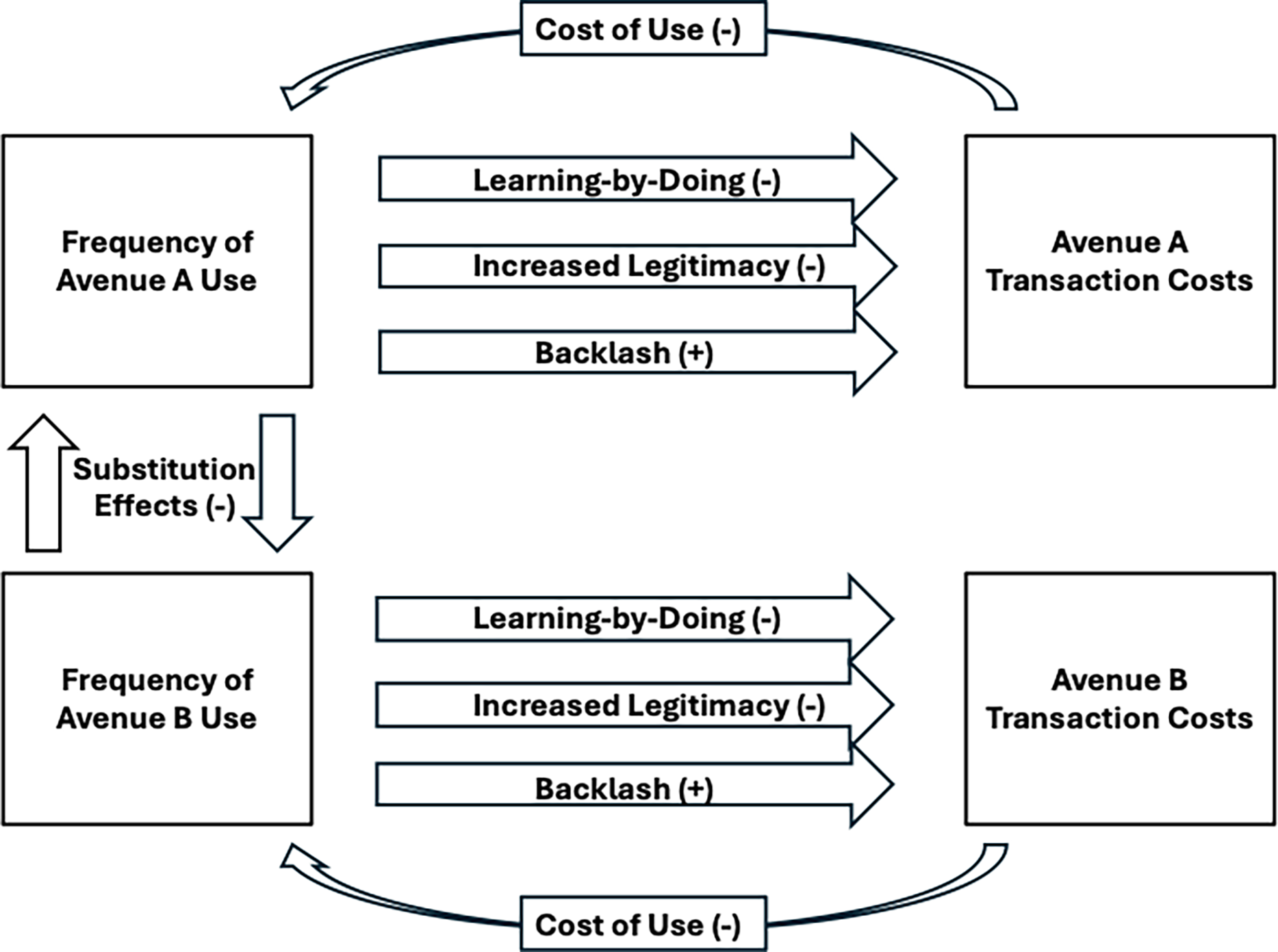
Figure 1. Long description
A diagram of the relationships between relative transaction costs and frequency of use for two avenues for constitutional change. The diagram features two main sections, each representing a different avenue for constitutional change, labeled Avenue A and Avenue B. Each section includes boxes and arrows indicating various factors and their effects. For Avenue A, the frequency of use affects learning-by-doing, increased legitimacy, and backlash, which in turn influence Avenue A transaction costs. Similarly, for Avenue B, the frequency of use affects learning-by-doing, increased legitimacy, and backlash, influencing Avenue B transaction costs. The cost of use is shown to affect both avenues. Substitution effects are indicated between the frequency of use of Avenue A and Avenue B.
Implications for constitutional design
The theory outlined above has implications for all avenues for constitutional change, individually and in relation to one another. However, in this section I focus the discussion on Constitutional design. Furthermore, I anchor the discussion to the empirical case of Article V of the US Constitution. Why?
Scholars have debated the extent to which entrenchment of Constitutional provisions is desirable. Entrenchment refers to the extent to which veto players and supermajority requirements make a Constitution difficult to amend (relative to passing ordinary legislation). Some scholars emphasize that Constitutional entrenchment is key to preventing special interest capture via self-serving amendments (Aghion and Bolton, Reference Aghion and Bolton2003; Buchanan and Tullock, Reference Buchanan and Tullock1962; Ginsburg and Posner, Reference Ginsburg and Posner2010; Persson et al., Reference Persson, Roland and Tabellini1997). From this perspective, entrenchment helps to ensure that Constitutional change satisfies a generality norm (Buchanan and Congleton, Reference Buchanan and Congleton2003 [1998]; Congleton, Reference Congleton, Rowley and Schneider2004). Others have emphasized the role that entrenchment plays in making credible commitments to good governance over time (Elster Reference Elster1979; Schelling, Reference Schelling1984).
Alternatively, many political philosophers and scholars of constitutional law claim that entrenchment thwarts democracy and the will of the people (Colón-Riós, Reference Colón-Riós2012; Dahl, Reference Dahl2001; Levinson, Reference Levinson2006; Seidman, Reference Seidman2012), particularly when unelected judges are the Constitutional interpreters who determine what the people can and cannot do through ordinary politics (Ackerman, Reference Ackerman1998; Bickel, Reference Bickel1962; Ely, Reference Ely1980).Footnote 26 Consistent with these concerns – and perversely contrary to arguments cited in the paragraph above – Schwartzberg (Reference Schwartzberg2013) argues that elites can use entrenchment to shield their special interests from popular will. Also, Versteeg and Zackin (Reference Versteeg and Zackin2016) argue that detailed, unentrenched Constitutions allow for ‘ongoing constitutional micromanagement’ (p. 658) that is desirable in the face of socioeconomic change.Footnote 27
An implication of the theory presented in section 5 above is that thinking about entrenchment in Constitutional design cannot be separated from consideration of the use of other avenues for constitutional change, along with the effects on relative transaction costs across avenues. For example, the choice to replace one Constitution with another that is more difficult to amend may be based on the perceived desirability of a more stable constitutional order. An unintended consequence of greater entrenchment may be to accelerate constitutional change via other avenues. That substitution of alternative avenues for Constitutional design can be associated with self-reinforcing changes in the relative transaction costs.
Alternatively, consider the claim that Article V creates an almost insurmountable barrier to amending the US Constitution (e.g., Ackerman, Reference Ackerman1991, Reference Ackerman1998; Levinson, Reference Levinson2006; Tushnet, Reference Tushnet2010). Article V requires two-thirds supermajorities in both the House of Representatives and Senate to propose an amendment, then a three-fourth supermajority of state legislatures to ratify it.Footnote 28 However, there were 11 formal changes to the text between 1909 and 1971. The last two of these were proposed and ratified while the US had its current total of 50 states. Also, in both cases ratification quickly followed proposal.Footnote 29 The disuse of Article V for more than a half century since is therefore not clearly attributable to its (unchanged) procedural rules.
It is also interesting to note that the US Constitution was amended 4 times from 1913 to 1920. (Note that during the time there were 48 states, almost the current total.) This occurred within the atmosphere of social and political activism that gave the Progressive Era its name. As Albert (Reference Albert2022, p. 2009) observes: ‘The rapid succession of successful amendments caused observers to wonder whether the hyper-amendability of the Constitution risked making it as easily amendable as an ordinary statute.’ Based on such sentiments, an amendment was actually introduced in Congress (though never ultimately proposed to the states) to increase the difficulty of the Article V procedures. (Article V apparently makes the US Constitution unamendable or hyper-amendable depending on the time period one considers.)
Why otherwise the post-1971 amendment drought then?Footnote 30 Papers by Albert (Reference Albert2022) and Jackson (Reference Jackson2015) provide important insights. Jackson (Reference Jackson2015, p. 576) emphasizes the ‘self-reinforcing character such claims [of] the near impossibility of amendment’ along with ‘normative arguments that the Constitution’s text should not be ‘tinkered’ with [along with] habits of constitutional ‘veneration.’ ‘In contrast, she argues that ‘US constitution culture accommodates a considerable amount of constitutional change through adjudication [judicial review] before the Supreme Court’ (p. 582). Consistent with this, Albert (Reference Albert2022, p. 2011) suggests that the ‘conventional path to conventional change may therefore have been rerouted from Article V to other avenues, including courts[,] legislatures where lawmakers can enact constitution-like super-statutes and the White House where executives can share and reshape the practices and norms underlying the Constitution’.Footnote 31
The transaction cost theory of constitutional change provides a framework within which to systematically elaborate and expand upon these insights. If constitutional change is ‘rerouted’ from Constitutional design to other avenues, this is because (i) the transaction costs of Constitutional design increased relative to those of one or more other avenues; (ii) alternatively, the transaction costs of one or more other avenues decreased relative to those of Constitutional design. Furthermore, we explain why such a ‘rerouting’ can be ‘self-reinforcing’ in terms of relative transaction costs in relation to how frequently some avenues are used relative to others.
This has implications for how we study constitutional history. Constitutional change occurs via the lowest-cost avenue, and, all else equal, that reinforces differences in the relative costs of different avenues. As such, if we observe regular use of a particular avenue over a meaningful period, then a subsequent period of disuse, the theory suggests we look for a shock to relative costs. (The longer the prior period of regular use, all else equal, the larger the necessary shock.)
In the US case, this shifts attention away from the procedures of Article V (which have been constant and in effect since 1789) and towards the transaction costs of other avenues or informal (non-Article V) determinants of the transaction costs associated with Constitutional design. (Judicial review is an example of the former; the emergence (or strengthening) of an aversion to ‘tinkering’ with the Constitution’s text is an example of the latter.) With this in mind, a researcher may want to ask if changes in attitudes about political activism and reform generally may have lowered the transaction costs of Constitutional reform specifically during the Progressive Era. Alternatively, a researcher may want to study if the Warren Court (1953 to 1969) reshaped the citizenry’s expectations regarding judicial review and, therefore, the transaction costs of that avenue.
The two examples above are only illustrative. While each of the implied hypotheses is plausible (or at least not clearly implausible), I make no claim regarding the empirical support for either. Rather, they are specific examples of a sort of research that the theory generally points towards. To the best of my knowledge, that sort of research is lacking in the relevant literature.
Concluding remarks
How does a constitutional order change over time? What are the implications of such a change? Furthermore, how do answers to these questions inform de jure (‘Big-C’) Constitutional design?
In any society there are various avenues via which constitutional change can occur. We have lacked an overall theory of constitutional change that accounts for various avenues and their interrelations. In this paper I have attempted to remedy this by providing a transaction cost theory of constitutional change.
Transaction costs are the costs of establishing and maintaining property rights (Allen, Reference Allen2015). Demsetz (Reference Demsetz1967) advanced economic theory significantly by developing a theory of how property emerges that is based on transaction costs. Scholars such as Buchanan (Reference Buchanan1973) and North (Reference North1990) demonstrated that a transaction cost approach can also be fruitfully applied to political economy analyses. The theory presented above is a logical extension of these contributions to the constitutional level.
According to the theory presented above, constitutional changes will occur whenever (a) the benefits to creating new bundles of political property rights exceed the costs of creating them and/or (b) the same is true regarding the exchange of existing bundles of those rights. When it is efficient for constitutional change to occur, it will occur via the lowest-cost avenue. Furthermore, the relative transaction costs are a function of the relative usage of different avenues. Specifically, avenues that are used more frequently become relatively cheaper.
The theory has important implications for real-world Constitutional design. For example, increased entrenchment of Constitutional provisions may, all else equal, be desirable for promoting generality and credible governance commitments. However, it may also increase the relative transaction costs of formal amendments, leading interested agents to substitute alternative avenues for constitutional change (e.g., executive orders). Conversely, when the degree of entrenchment is constant, accounting for changes in the frequency of formal amendment requires understanding why the transaction costs of alternative avenues changed.
When constitutional change occurs, it is efficient in the sense that all of a society’s agents are optimizing given the benefits and costs – including transaction costs –they face (Leeson, Reference Leeson2020). However, efficiency does not necessarily imply desirable outcomes for a society. The relevant transaction costs will be different for different political coalitions (formal and informal) (Koppl, Reference Koppl2025). And those relative transaction costs will be a function of the power asymmetries between those different coalitions, many of which will be based on historical accidents and/or episodes of coercion (Epstein and Knight, Reference Epstein and Knight2004; Knight, Reference Knight1992). Efficiency does not dictate policy prescriptions; however, insights from a transaction cost theory of constitutional change may inform beneficial prescriptions for a society.
Consider the case of the US Constitution and Article V (discussed in section 6 above). Jackson (Reference Jackson2015) emphasizes citizens’ beliefs that the Constitution should be ‘venerated’ and not ‘tinkered’ with can be self-reinforcing over time. This is consistent with the transaction cost theory: as such beliefs develop, the relative transaction costs for Constitutional design increase. (And as that avenue is used less, that effect on the relative transaction costs can itself be self-reinforcing.) Given such beliefs, the rerouting of constitutional change to different avenues is efficient.
But efficiency simply implies optimization based on, among other things, available information. Better information can, therefore, lead to a different but better efficient outcome (Leeson, Reference Leeson2020). Citizens’ beliefs do not emerge exogenously; they are shaped in part by scholars, pundits, and other influencers. If there are good reasons to believe that more reliance on Article V (and less on other avenues such as judicial review) can potentially better US governance, then scholarly arguments can directly and indirectly (through, well, influencing the influencers) work to reshape citizens’ beliefs through improving their information set.
It is beyond the scope of this paper to argue that more reliance on Article V is desirable or not. And that is not the point. However, given a particular position on the matter, the transaction cost theory of constitutional change provides a framework for understanding US history vis-à-vis that position. The same is true in regard to matters of Constitutional design generally, hopefully promoting some better parchment.
Acknowledgments
I thank the students from my Spring 2025 PhD ‘Economics of Regulation Class’ for workshopping an earlier version of this paper and providing me with valuable insights that have (to my best) been subsequently incorporated.

 Open access

