





Introduction
Harsh parenting (HP) includes coercive behaviors and negative emotional expressions that parents direct toward their children that are psychologically, and sometimes physically reactive, intrusive, and punitive. Most previous research has focused on the effects of HP on children’s maladjustment (e.g., Perez-Gramaje et al., Reference Perez-Gramaje, Garcia, Reyes, Serra and Garcia2019; Pinquart, Reference Pinquart2017; Wang, Reference Wang2019). However, it is essential to acknowledge that socialization processes between parents and children are bidirectional and include child behavioral influences on parenting (Yan et al., Reference Yan, Ansari and Peng2021) as well as parent influences on children. This perspective emphasizes that bidirectional effects between parent and child develop over time, such that the child’s behavior problems increase the parents’ use of harsher and more coercive discipline, which in turn escalates subsequent child behavior problems (Mackenzie et al., Reference MacKenzie, Nicklas, Brooks-Gunn and Waldfogel2015; Pinquart, Reference Pinquart2017; Yan et al., Reference Yan, Ansari and Peng2021).
Importantly, bidirectional patterns between parents and children operate in broader individual and household contexts which significantly impact parenting behavior and child maladjustment (Coldwell et al., Reference Coldwell, Pike and Dunn2006; Hong et al., Reference Hong, McCormick, Deater-Deckard, Calkins and Bell2021; Hong et al, Reference Hong, Bertrand, Deater-Deckard, Smith and Bell2024). However, little is known about how distinct aspects of child self-regulation (e.g., effortful control and executive function) and household regulation (e.g., routines, predictability) strengthen or weaken negative longitudinal and bidirectional relations between HP and child externalizing behavior problems (EXT). The present study aims to fill these gaps by utilizing various perspectives (i.e., mother, father, and child) and utilizing cross-lagged panel analyses to explore multiple distinct moderators such as task-based child regulation (i.e., executive function, EF), surveyed child regulation (i.e., effortful control, EC), and surveyed household regulation (i.e., household chaos) on longitudinal bidirectional links between child EXT and HP during the developmental transition into adolescence from 9 to 14 years of age.
Bidirectionality
Patterson’s coercion theory (Patterson, Reference Patterson1982, Reference Patterson, Dishion and Snyder2016) emphasizes the active role of children in shaping their parents’ harsh and punitive parenting, emphasizing continuous bidirectional exchanges in the parent-child relationship. This theory posits that children who frequently display behavioral and emotional problems are more likely to elicit increases in HP from their caregivers over time, reinforcing the growth of the child’s externalizing behaviors (EXT; aggressive and nonaggressive conduct problems). In the literature exploring bidirectionality between parents and children, empirical evidence regarding child-driven versus parent-driven effects has been somewhat inconsistent; some studies have found primarily parent-driven effects (e.g., Coley et al., Reference Coley, Kull and Carrano2014; Serbin et al., Reference Serbin, Kingdon, Ruttle and Stack2015), others have found primarily child-driven effects (e.g., Burke et al., Reference Burke, Pardini and Loeber2008; Choe et al., Reference Choe, Olson and Sameroff2013), and still others have found bidirectional parent and child effects (Bauer et al., Reference Bauer, Fairchild, Halligan, Hammerton, Murray, Santos, Munhoz, Barros, Barros and Matijasevich2021; Baydar & Akcinar, Reference Baydar and Akcinar2018; Te Brinke et al., Reference Te Brinke, Deković, Stoltz and Cillessen2017; Mackenzie et al., Reference MacKenzie, Nicklas, Brooks-Gunn and Waldfogel2015; for meta-analysis, Yan et al., Reference Yan, Ansari and Peng2021).
Research designs and analytic methods can influence the replicability and generalizability of evidence in bidirectionality research. To comprehensively understand bidirectional mechanisms, researchers need to employ rigorous study designs and analytic methods (Bornstein et al., Reference Bornstein, Putnick and Suwalsky2018; Paschall & Mastergeorge, Reference Paschall and Mastergeorge2016). Cross-sectional and single-reporter study designs lack the capability to adequately examine bidirectional associations between parenting behaviors and child behavior problems (Singer & Willett, Reference Singer and Willett2003). Studies relying on a single reporter, such as mother reports for both parent and child behaviors (e.g., Prinzie et al., Reference Prinzie, Onghena and Hellinckx2006; Taylor et al., Reference Taylor, Manganello, Lee and Rice2010) are subject to reporter bias, highlighting the necessity of multiple informants or assessment methods (e.g., surveys, tasks). Utilizing at least two informants or methods helps mitigate the impact of informant and method bias on results and can provide additional insight into the links between HP and child behavior problems (Arseneault et al., Reference Arseneault, Moffitt, Caspi, Taylor, Rijsdijk, Jaffee, Ablow and Measelle2003; Mackenbach et al., Reference Mackenbach, Ringoot, Van Der Ende, Verhulst, Jaddoe, Hofman and Tiemeier2014).
Specifically, much of the existing research has focused on mothers, often overlooking the crucial role fathers play in parenting. Family systems theory suggests that families function as interconnected units where fathers, mothers, and children engage in interrelated relationships and behaviors (Burchinal et al., Reference Burchinal, Howes, Pianta, Bryant, Early, Clifford and Barbarin2008; McLoyd, Reference McLoyd1990). Within this framework, children’s development is influenced by both parents, not just mothers, highlighting the significant and irreplaceable role fathers play in child development (Gershoff, Reference Gershoff2002). Therefore, it is important to investigate the distinct effects of paternal and maternal harsh discipline on child’s EXT (Wang et al., Reference Wang, Fu and Wang2021). Additionally, meta-analyses (Hou et al., Reference Hou, Benner, Kim, Chen, Spitz, Shi and Beretvas2019; Korelitz and Garber, Reference Korelitz and Garber2016) of studies using retrospective parenting reports have shown that discrepancies between adolescents’ and parents’ perceptions of parenting are quite common. Specifically, the agreement between parent and adolescent reports of various parenting behaviors is typically low, with only modest correlations between the two perspectives. Generally, parents perceive their own parenting behavior as more supportive and less negative compared to adolescents’ perceptions (Hou et al., Reference Hou, Benner, Kim, Chen, Spitz, Shi and Beretvas2019; Korelitz and Garber, Reference Korelitz and Garber2016).
Additionally, discrepancies in perceptions of child EXT among mothers, fathers, and children are well-documented. Research shows that adolescents often rate their own behaviors more intensely than their parents do (Stanger and Lewis, Reference Stanger and Lewis1993). Parental reports of behavior problems are only moderately correlated with children’s self-reports (Achenbach et al., Reference Achenbach, McConaughy and Howell1987; Duhig et al., Reference Duhig, Renk, Epstein and Phares2000), and they may reflect varying antecedents and can differentially predict later outcomes. For instance, larger discrepancies between parent and child reports are associated with higher levels of EXT (Ohannessian, Reference Ohannessian2012; e.g., Stanger et al., Reference Stanger, NlcConaughy and Achenbach1992). These findings underscore the value of each informant’s unique, potentially complementary perspective in enriching the overall understanding of the bidirectional relationship between HP and child EXT. We hypothesize that relationships between parenting and child EXT will vary by informant, revealing informant-specific dynamics that could otherwise remain obscured. Recognizing these unique viewpoints helps reduce potential biases (Ohannessian, Reference Ohannessian2012) and allows for a more comprehensive and ecologically valid understanding of the complex associations between parenting and child behavior over time.
Longitudinal study designs are also necessary to understand the bidirectional mechanism between parents and children. Cross-lagged path analyses involving more than two measurement time points, or latent growth modeling with three or more time points, enable testing sequences of changes over time and the estimation of temporal directional effects between child and parent behaviors across time (Kline, Reference Kline, Hancock and Mueller2013; Little et al., Reference Little, Preacher, Selig and Card2007; Serbin et al., Reference Serbin, Kingdon, Ruttle and Stack2015). This approach enables researchers to capture changes and trends over time, offering a dynamic view that a single measurement cannot provide (Anderson, Reference Anderson and Liamputtong2019; White & Arzi, Reference White and Arzi2005). Repeated measurements across multiple waves enhance the accuracy of the data by reducing random error and providing a clearer picture of developmental patterns and potential causal relationships (Hesser, Reference Hesser2015). Previous studies have applied longitudinal methods to examine bidirectional relations between HP and child EXT. For example, Baydar & Akcinar (Reference Baydar and Akcinar2018) found that maternal harsh discipline predicted increases in child aggression from ages 3 to 7 using a five-wave design, while Bauer et al. (Reference Bauer, Fairchild, Halligan, Hammerton, Murray, Santos, Munhoz, Barros, Barros and Matijasevich2021) observed bidirectional effects between HP and child conduct problems over two waves at ages 6 and 11. Similarly, Combs-Ronto et al. (Reference Combs-Ronto, Olson, Lunkenheimer and Sameroff2009) and Hipwell et al., (2008) identified bidirectional relations across two and six waves, respectively. Wang and Liu (Reference Wang and Liu2018), in a 5-year longitudinal study with 6- to 9-year-old children, found both parent-driven and child-driven effects. Together, these studies provide evidence for bidirectional relations between HP and EXT during childhood.
Despite these findings, existing studies show inconsistencies, with some reporting unidirectional effects. Fletcher & Johnston (Reference Fletcher and Johnston2016), for instance, conducted a two-wave longitudinal study with 8-10 year olds and found that higher levels of child EXT predicted an increase in parental punitive discipline (child-driven effects), with no evidence for the reverse direction. Serbin et al. (Reference Serbin, Kingdon, Ruttle and Stack2015) observed only parent-driven effects in a three-wave longitudinal study, where physical punishment at age 7 predicted higher EXT at age 10, but no child effects.
Conversely, Besemer et al. (Reference Besemer, Loeber, Hinshaw and Pardini2016) conducted a longitudinal study in which children were assessed every six months over 4 years and found no evidence of either parent or child effects in the bidirectional associations between EXT and physical punishment in a sample of first-grade boys. Similarly, Shaffer et al. (Reference Shaffer, Lindhiem, Kolko and Trentacosta2013) conducted a longitudinal intervention study over a 3-year period with six assessments — pre-intervention, post-intervention, and follow-ups at 6, 12, 24, and 36-months — in a sample of children aged 6 to 11. They reported strong temporal stability in both corporal punishment and child EXT but found limited evidence of bidirectional effects between these variables.
Although many longitudinal studies have examined the bidirectional relationship between HP and child EXT, findings remain inconsistent, with some studies failing to find bidirectional associations. These discrepancies may be due to variations in informants, study design, and analytic methods. For instance, some studies rely on a single reporter, typically the mother, for both parent and child behaviors, which can introduce reporter bias and affect the accuracy of observed bidirectional effects. Additionally, the frequency of assessments varies across studies, with data collected every six months in some cases, and annually or biennially in others, potentially impacting the detection of nuanced changes over time. Studies with only two time points may also miss complex, dynamic patterns in the bidirectional relationships between HP and EXT. To address these gaps, our study uniquely incorporates multiple informants (i.e., mother, father, and child) and three waves of data, allowing us to reduce reporter bias and capture more comprehensive, dynamic interactions over time.
Prior cross-sectional and longitudinal studies have generally overlooked the developmental transition into adolescence, which occurs around ages 10 to 12 years. This transition is a key developmental period (Brenning et al., Reference Brenning, Soenens, Braet and Bal2012) marked by significant physical, psychological, and social change (Kapur, Reference Kapur2015; Simmons, Reference Simmons2017). This phase brings increased independence, entry into puberty, and evolving social relationships (Gorrese & Ruggieri, Reference Gorrese and Ruggieri2012; Schulz et al., Reference Schulz, Nelemans, Hadiwijaya, Klimstra, Crocetti, Branje and Meeus2023), all of which can intensify the challenges of managing EXT. During this transition, time spent with parents typically decreases, while time devoted to social interactions with peers, romantic partners, and social groups increases (Allen, Reference Allen, Cassidy and Shaver2008; Schulz et al., Reference Schulz, Nelemans, Hadiwijaya, Klimstra, Crocetti, Branje and Meeus2023). Despite these shifts, parents continue to play an integral role in shaping behavioral outcomes, making it essential to examine how parenting practices, such as HP, interact with child self-regulation and household regulation to influence EXT. By focusing on the transitional stage into adolescence—a period marked by developmental shifts in autonomy and peer relationships—we aim to clarify how bidirectional associations between HP and EXT may differ from those in earlier childhood. This approach allows us to investigate potential variations in HP and EXT patterns during a critical developmental transition, providing a more detailed understanding of how these interactions may evolve and potentially intensify as children mature.
In summary, although research examining bidirectional relations between HP and child EXT has utilized longitudinal designs, most studies in this area have relied on data from one or two informants (e.g., Akcinar and Bayar, Reference Akcinar and Baydar2016; Bauer et al, Reference Bauer, Fairchild, Halligan, Hammerton, Murray, Santos, Munhoz, Barros, Barros and Matijasevich2021; Baydar & Akcinar, Reference Baydar and Akcinar2018). To our knowledge, no other studies have examined the relations between HP and EXT from the perspectives of all three informants in the family: mother, father, and child. Additionally, there is limited research examining bidirectional relations between HP and EXT, particularly across the critical developmental transition from late childhood to early adolescence. To address these concerns and gaps in prior research, the present study utilizes multiple perspectives from all three family reporters (i.e., mother, father, and child) and longitudinal data including three time points to examine potential bidirectional relations between changes in HP and child EXT during the transition from childhood (9 years) to adolescence (14 years). The first hypothesis is that there is a longitudinal pattern of bidirectional relations between HP and child EXT, such that harsher parenting increases later child EXT and vice versa, across the transition to adolescence.
Regulation as moderator of bidirectional effects
The bidirectional links between parent and child effects operate in broader individual and household contexts which influence parenting behavior and children’s maladjustment (Coldwell et al., Reference Coldwell, Pike and Dunn2006; Hong et al., Reference Hong, McCormick, Deater-Deckard, Calkins and Bell2021; Hong et al, Reference Hong, Bertrand, Deater-Deckard, Smith and Bell2024). Different aspects of child regulation and household regulation may operate in distinct ways depending on the child’s level of emotional and cognitive regulation capacity as well as the degree of household disorganization and unpredictability, potentially playing critical roles in shaping these bidirectional effects. However, little is known about the ways that distinct aspects of child self-regulation (e.g., executive function, effortful control) and household regulation (e.g., presence of routines and predictability) modulate bidirectional parent-child effects. It may be that at higher or lower levels of regulation, the bidirectional links between HP and EXT are stronger or weaker.
Child self-regulation
Self-regulation is a multifaceted construct that encompasses various components (Blair & Raver, Reference Blair and Raver2012; McClelland et al., Reference McClelland, Cameron, Duncan, Bowles, Acock, Miao and Pratt2014) and operates across multiple functional levels including physiological, social-emotional, cognitive, and behavioral domains. Broadly defined, self-regulation is the capacity to intentionally plan and, when necessary, adjust one’s behavior to achieve adaptive outcomes (Barkley, Reference Barkley, Vohs and Baumeister2011; Gross & Thompson, Reference Gross, Thompson and Gross2007).
Successful self-regulation requires the coordination of numerous processes across these different functional levels, and children’s ability to utilize, integrate, and manage these processes is essential for their adaptive development and overall well-being (McClelland et al., Reference McClelland, Cameron, Duncan, Bowles, Acock, Miao and Pratt2014; Montroy et al., Reference Montroy, Bowles, Skibbe, McClelland and Morrison2016).
Effortful control and executive function are two fundamental components of self-regulation, and they have been identified as modestly correlated yet conceptually and empirically distinct aspects of self-regulation (Hong et al., Reference Hong, Bertrand, Deater-Deckard, Smith and Bell2024; Kälin & Roebers, Reference Kälin and Roebers2021). Both form the focus of the present study. Effortful control is a temperament-based component of self-regulation, representing a higher-order cognitive system (Posner & Rothbart, Reference Posner and Rothbart2000) that includes the sub-dimensions of inhibitory control, attentional focusing, and attentional shifting (Eisenberg et al., Reference Eisenberg, Cumberland, Spinrad, Fabes, Shepard, Reiser, Murphy, Losoya and Guthrie2001). It plays a key role in the regulation of emotions and behaviors and reflects the role of attention in inhibiting reactive dominant responses (i.e., prepotent response inhibition) in order to perform subdominant responses that are more aligned with immediate and long-term goals (Atherton et al., Reference Atherton, Lawson and Robins2020).
Executive function encompasses neurocognitive skills that regulate cognitive processing and are fundamental to self-regulation, as they support the ability to adaptively control thoughts, emotions, and behaviors (Roebers, Reference Roebers2017). Executive function is commonly assessed through behavioral tasks and is involved in initiating task changes, guiding behavioral control, coordinating thoughts and actions, and planning and solving goal-directed problems. In most theories and measurement models, executive function includes three primary domains: updating or working memory, inhibitory control, and cognitive flexibility/shifting or attentional control (Best & Miller, Reference Best and Miller2010; Yang et al., Reference Yang, Shields, Zhang, Wu, Chen and Romer2022), each critical for self-regulation in distinct ways.
Working memory, defined as the capacity to store and manipulate information needed to complete tasks, is essential for maintaining relevant information needed to complete tasks, update plans, and integrate new information (Friedman & Miyake, Reference Friedman and Miyake2017; Garon et al., Reference Garon, Bryson and Smith2008). This ability to manage and apply relevant information is fundamental to self-regulation, as it enables individuals to hold goals in mind, manage distractions, and respond flexibly to changes in the environment (Friedman et al., Reference Friedman, Miyake, Corley, Young, Defries and Hewitt2006). Cognitive flexibility, or shifting describes the ability to adjust tasks, attention, and strategies, supporting adaptability in changing contexts (Miyake & Friedman, Reference Miyake and Friedman2012). This capacity for mental flexibility is central to self-regulation, as it allows individuals to modify their perspectives, strategies, or actions when facing new demands or obstacles (Garon et al., Reference Garon, Bryson and Smith2008). Inhibitory control involves suppressing automatic responses, allowing individuals to resist distractions from irrelevant internal (thoughts, emotions) and external (environmental stimuli) sources, thereby focusing on actions aligned with their goals (Diamond, 2013, 2014; Miyake & Friedman, Reference Miyake and Friedman2012; Wiebe et al., Reference Wiebe, Sheffield and Espy2012). Together, these components of EF – working memory, cognitive flexibility, and inhibitory control – contribute to self-regulation by supporting sustained goal orientation, adaptive behavioral responses, and the ability to adjust actions in real time.
Executive function and effortful control are recognized as top-down processes involved in regulating behavior, emotions, and cognition; however, they are not identical to self-regulation (Blair, Reference Blair, Baumeister and Vohs2016; Nigg, Reference Nigg2017). Executive function, typically assessed through task-based measures includes cognitive processes, whereas effortful control, typically measured through questionnaires, reflects temperament-based capacities for managing attention and impulses to achieve goal-directed behaviors. While attentional and inhibitory control contribute to the observed overlap between these constructs, each brings unique elements to the self-regulation framework (Kim-Spoon et al., Reference Kim-Spoon, Deater-Deckard, Calkins, King-Casas and Bell2019). Both indicators are expected to moderate the effects of challenging situations on child outcomes, yet they operate through different mechanisms: effortful control captures the capacity to manage behavioral and emotional responses in emotionally salient contexts, involving more reflexive responses to stimuli (Eisenberg et al., Reference Eisenberg, Smith, Spinrad, Vohs and Baumeister2011), whereas executive function is more tightly linked to cognitive processing regulation, supporting adaptive responses in complex, goal-oriented tasks (Roebers, Reference Roebers2017).
By modeling these constructs separately, our study aims to investigate potential differences in their moderating effects and to examine whether effortful control and executive function influence behavioral functioning in distinct ways. This approach recognizes that each may uniquely buffer against environmental risks or stressors (deMaat et al., Reference deMaat, Schuurmans, Jongerling, Metcalf, Lucassen, Franken, Prinzie and Jansen2022; Eisenberg & Zhou, Reference Eisenberg, Zhou, Griffin, McCardle and Freund2016; Hong et al., Reference Hong, Bertrand, Deater-Deckard, Smith and Bell2024). Few studies have incorporated both indicators within the same framework; however, one study demonstrated the distinct roles of executive function and effortful control in the relationship between HP and EXT, revealing differential effects (Hong et al., Reference Hong, Bertrand, Deater-Deckard, Smith and Bell2024). Specifically, executive function was found to buffer the pathway from early child EXT through HP to alter later child EXT, while effortful control surprisingly exhibited a risk-enhancing effect in predicting HP (Hong et al., Reference Hong, Bertrand, Deater-Deckard, Smith and Bell2024). These findings underscore the need for a nuanced analysis of effortful control and executive function as moderators, suggesting that each may uniquely influence developmental outcomes depending on the context. Previous literature has consistently demonstrated direct associations between lower self-regulation and higher levels of EXT and other aspects of psychopathology. Children with lower effortful control or executive function are more likely to exhibit EXT (Fosco et al., Reference Fosco, Caruthers and Dishion2012; Nigg, Reference Nigg2017; Olson et al., Reference Olson, Tardif, Miller, Felt, Grabell, Kessler, Wang, Karasawa and Hirabayashi2011; Quistberg & Mueller, Reference Quistberg and Mueller2020; Wang et al., Reference Wang, Chassin, Eisenberg and Spinrad2015; Zucker et al., Reference Zucker, Heitzeg and Nigg2011). The direct association between indicators of self-regulation and EXT tends to strengthen as children get older (Horne et al., Reference Horne, Henshall and Golden2020; Reynolds et al., Reference Reynolds, Basso, Miller, Whiteside and Combs2019).
However, is there evidence that child self-regulation moderates the bidirectional link (a child and parent effect) between child EXT and HP? There is very little research on this, but preliminary evidence and theoretical frameworks suggest that child self-regulation may moderate some aspects of these bidirectional processes. According to the diathesis-stress model, children with lower effortful control may be more vulnerable to the negative effects of harsher, less sensitive parenting (Monroe & Simons, Reference Monroe and Simons1991). This model proposes that children’s temperament moderates the relationship between their environmental experiences and adjustment outcomes, with lower effortful control increasing vulnerability to negative parenting (Lengua et al., Reference Lengua, Bush, Long, Kovacs and Trancik2008; Morris et al., Reference Morris, Silk, Steinberg, Sessa, Avenevoli and Essex2002). Similarly, children with better executive function skills may be more adept at regulating and managing their thoughts and behaviors in the face of stressors (Belsky et al., Reference Belsky, Hsieh and Crnic1998; Hogye et al., Reference Hogye, Jansen, Lucassen and Keizer2022; Hong et al., Reference Hong, Bertrand, Deater-Deckard, Smith and Bell2024; Horn et al., Reference Horn, Roos, Beauchamp, Flannery and Fisher2018).
Turning to the link between HP and child EXT specifically, children’s effortful control may moderate this parent effect, whereby the child’s high effortful control buffers (i.e., weakens) the effects of HP on the child’s subsequent EXT (Lee et al., Reference Lee, Chang and Olson2022; Morris et al., Reference Morris, Silk, Steinberg, Sessa, Avenevoli and Essex2002; Xu et al., Reference Xu, Zhang and Farver2009). However, not all studies have found a significant moderating effect of effortful control (Gartstein & Fogot, 2003; Hong, Reference Hong2021; Zubizarreta et al., Reference Zubizarreta, Calvete and Hankin2019). Turning to whether child effortful control moderates the child effect (whereby EXT predicts HP), prior research is sparse. One study found a significant moderating effect of child effortful control only for the child effect of EXT predicting HP (Hong et al., Reference Hong, Bertrand, Deater-Deckard, Smith and Bell2024). Surprisingly, they found that higher levels of child effortful control were risk enhancing; there was a stronger link between EXT and HP — opposite to the anticipated buffering effect and of some prior findings regarding the parent effect linking HP and subsequent child EXT.
Even fewer studies have examined executive function as a potential moderator of bidirectional effects (a parent and child effect) in the link between HP and child EXT. One study investigated the moderating role of child executive function in the indirect path from 6-year EXT → 7.5 year HP → 9-year EXT (Hong et al, Reference Hong, Bertrand, Deater-Deckard, Smith and Bell2024). Child executive function at 9 years acted as a buffer in this bidirectional process, with strong executive function weakening longitudinal indirect path. Another study found that children polyvictimized by parents (e.g., multiple types of maltreatment) and having lower executive function showed more severe EXT symptoms, but no such association between victimization and EXT was found at higher levels of executive function (Horn et al., Reference Horn, Roos, Beauchamp, Flannery and Fisher2018).
What are some potential explanations for the buffering or risk-enhancing effects of child self-regulation? When examining how child self-regulation moderates the impact of HP on EXT (a “parent effect”), children who have better regulation (i.e., higher effortful control and executive function) tend to be more effective in using coping strategies when dealing with stress (such as stress arising from exposure to HP). They are also better at regulating their negative emotions and behaviors appropriately when faced with environmental stressors (Eisenberg et al., Reference Eisenberg, Zhou, Spinrad, Valiente, Fabes and Liew2005; Hong, Reference Hong2021; Karreman et al., Reference Karreman, van Tuijl, van Aken and Deković2009). In contrast, children with poor regulation are less likely to deal with environmental demands effectively, potentially exacerbating negative outcomes in stressful contexts. Regarding the moderating role of child self-regulation on the “child effect” (EXT → HP), children with poor regulation and high levels of EXT may evoke more parenting stress relative to their better regulated peers. The increased parenting stress can lead to even more frequent and intense harsh reactions from parents in the face of challenging child EXT behavior (Perry et al., Reference Perry, Mackler, Calkins and Keane2014). The resulting harsher parenting can further intensify the child’s EXT, creating a reinforcing cycle over time. EXT is typically associated with lower self-regulation on average, but the magnitude of this association is not substantial; there is ample variability in self-regulatory capacities even among children with higher EXT. Some children with externalizing tendencies exhibit strengths in specific self-regulation skills, which may act as either a buffer or an amplifier of the effects of HP (Hong et al., Reference Hong, Bertrand, Deater-Deckard, Smith and Bell2024). This variability highlights the importance of examining self-regulation as a potential moderator. By examining child self-regulation for both the child effects and parent effects, we aim to understand how individual differences in self-regulatory capacities shape the dynamic interplay between HP and EXT over time. This approach aligns with findings that emphasize the critical role of regulatory skills in the developmental trajectory of EXT, despite variability in these skills across individuals (Kuhn et al., Reference Kuhn, Ahles, Aldrich, Wielgus and Mezulis2018).
Thus, child self-regulation may play a critical role, as it supports children in managing frustration, anger, and fear in the presence of HP. Also, children with better regulation may reduce parenting stress, which in turn can lead to less harsh reactions from parents. As a buffering mechanism, higher levels of child self-regulation might weaken the bidirectional links between harsher parenting and child problem behavior. More specifically, we propose that child self-regulation moderates the impact of HP on EXT (parent effect) and EXT on HP (child effect). However, there are major gaps in the literature regarding whether and how distinct aspects of child regulation (executive function and effortful control) moderate parent and child effects. By examining multiple indicators of self-regulation as moderators of both types of effects, we aim to provide a more comprehensive understanding of how self-regulation can buffer or exacerbate the development of both HP and child EXT over time. The second hypothesis is that there is a stronger bidirectional relation (both parent and child effects) between HP and child EXT among children with poorer regulation (i.e., lower parent-reported EC and task-based EF), but a weaker bidirectional link among children with better regulation skills.
Household regulation
The bidirectional links between HP and child maladjustment operate in household contexts that vary widely in their level of calmness and predictability. Household chaos, characterized by disorganization, unpredictability, and instability, reflects low levels of household regulation (Evans & Wachs, Reference Evans and Wachs2010). The present study examined the potential moderating effect of household chaos. Homes characterized by crowding, noise, and a lack of routines are more often emotionally and physiologically distressing to children and parents alike. Higher household chaos is associated with more child behavior problems as well as harsher parenting (Marsh et al., Reference Marsh, Dobson and Maddison2020). Chronic household chaos contributes to stress at emotional, behavioral, and physiological levels, which impairs the behavioral and emotional regulatory capacities of both parents and children (Andrews et al., Reference Andrews, Dunn, Prime, Duku, Atkinson, Tiwari and Gonzalez2021; Marsh et al., Reference Marsh, Dobson and Maddison2020) and may exacerbate negative interactions. Also, unpredictability and overstimulation in chaotic homes may interfere with children’s ability to regulate their attention and arousal (Evans & Wachs, Reference Evans and Wachs2010; Marsh et al., Reference Marsh, Dobson and Maddison2020), particularly in adverse environments, such as those involving HP. Overstimulation may also disrupt children’s attentional and executive control systems, hindering their ability to process and interpret information, and ultimately impeding their behavioral and emotional regulation capacities (Andrews et al., Reference Andrews, Dunn, Prime, Duku, Atkinson, Tiwari and Gonzalez2021; Berry et al., Reference Berry, Blair, Willoughby, Garrett-Peters, Vernon-Feagans and Mills-Koonce2016).
One interpretation of the connections between household chaos, parenting, and children’s EXT is that high levels of distractions and unpredictability in chaotic households influence the relationships between parenting behaviors and children’s outcomes. Furthermore, previous studies have found that household chaos moderates the effect of parenting on children’s adjustment, such that the link between negative parenting behaviors and children’s problem behaviors is strongest in households with higher levels of chaos (Chen et al., Reference Chen, Deater-Deckard and Bell2014; Coldwell et al., Reference Coldwell, Pike and Dunn2006). However, a contradictory finding from one study suggested that the child effect of EXT on subsequent HP was stronger in households with lower levels of chaos and weaker in higher levels of chaos (Hong, Reference Hong2023). It is important to note that the significant moderation effect of chaos in this study was observed for the child-driven effect (EXT → HP) —an effect that was not tested by Coldwell et al or other previous studies. This suggests that the bidirectional relationship between HP and children’s EXT may differ at varying levels of household chaos. Like child regulation, chaos as an indicator of household regulation, may moderate bidirectional relations between HP and child EXT because chaotic environments tax parents’ and children’s capacities to regulate their behaviors and emotions (Andrews et al., Reference Andrews, Dunn, Prime, Duku, Atkinson, Tiwari and Gonzalez2021; Deater-Deckard et al., Reference Deater-Deckard, Wang, Chen and Bell2012; Hong et al., Reference Hong, McCormick, Deater-Deckard, Calkins and Bell2021). The present study examined the role of household chaos as a moderator of longitudinal bidirectional relations between HP and child EXT. The third hypothesis is that there is a stronger bidirectional relation between HP and EXT in higher chaos households but a weaker bidirectional relation in lower chaos households.
The present study
The present study examined the bidirectional relation between parents’ use of HP and children’s EXT during the transition from late childhood to early adolescence (i.e., 9 to 14 years on average). In addition, the potential moderating roles of multiple distinct aspects of child self-regulation and household chaos that may strengthen or weaken these longitudinal bidirectional relations between HP and child EXT were investigated. We hypothesized that bidirectional links between HP and EXT would emerge over time such that harsher parenting will predict greater later child EXT and vice versa (hypothesis 1), and that higher levels of child regulation (hypothesis 2) and lower household chaos (hypothesis 3) would reduce the strength of those bidirectional links. Specifically, the bidirectional relationship would be weaker among children with better regulation skills and in lower chaos households, but stronger among children with poorer regulation skills and in higher chaos households. The study is unique in its examination of the moderating effects of multiple facets of child self-regulation (effortful control and executive function) and household chaos in a longitudinal design, incorporating reports from multiple informants, across the transition from late childhood to early adolescence.
Method
Participants
The participants in the current study were in the United States subsample of the larger longitudinal study of nine countries, Parenting Across Cultures (PAC; see http://parentingacrosscultures.org for more details). Participants were recruited through letters sent home from schools serving a socioeconomically diverse population in Durham, North Carolina. To ensure socioeconomic and economic diversity, families were sampled from two private and fifteen public schools across the city, and from high- to low-income households in proportions representative of the community from which adolescents were sampled. The current study analyzed data from when the children were 9.09 years old on average (wave 1), 11.12 years (wave 3), and 13.95 years (wave 5) in a longitudinal design. Parenting variables were not measured at wave 4; therefore, we utilized data from waves 1, 3, and 5 to ensure consistent measurement of all needed variables across the study period.
The sample (listed in order of proportion of the total sample) included 97 Hispanic or Latino, 103 Black or African American, and 111 White or European American families. Regarding sample sizes, this included 300, 273, and 255 mothers at child ages 9, 11, and 14 respectively, and 147, 183, and 160 fathers at the same child ages. For child-reported mother parenting, the sample sizes were 306, 269, and 254 children, and for child-reported father parenting, the samples included 258, 234, and 203 children at the same ages (9, 11, and 14 years respectively). We examined mean differences among subgroups with missing data at ages 11 or 14. Results indicated no significant differences in maternal or paternal perceptions of HP across groups. However, differences emerged in children’s perceptions of HP. Specifically, children with missing data at either age 11 or 14 reported higher levels of child perceptions of maternal HP at age 9 (M = 1.62, SD = .46; M = 1.57, SD = .44 respectively) compared to those with complete data (M = 1.42, SD = .43). Children with missing data at age 14 reported lower levels of child perceptions of paternal HP at age 11 (M = 1.13, SD = .12) than children with complete data at ages 11 and 14 (M = 1.21, SD = .23). For EXT, no significant difference was found in maternal perception of child EXT. However, among children missing data at age 14, paternal perceptions of child EXT at age 11 (M = 5.30, SD = 4.48) were lower compared to those with complete data at ages 11 and 14 (M = 7.78, SD = 5.95). Similarly, children missing data at age 14 reported lower self-perceived EXT at age 11 (M = 5.55, SD = 4.40) than those with complete data at ages 11 and 14 (M = 8.22, SD = 6.76). No statistically significant differences were observed for other variables (e.g., chaos, executive function, effortful control, parental education levels). Both parents participated in 49%, 69%, and 62% of the families at ages 9, 11, and 14, respectively. We used full information maximum likelihood estimation for handling missing data, resulting in a total sample size of 311 families. Of these, 50.4% of children were female and 49.6% were male.
At wave 1, 76% of the mothers were cohabitating or married, 12% were separated or divorced, and the remaining 9% were single mothers who had not married the father or were widowed. On average, both mothers and fathers had approximately 14 years of education. The mean household income was $41,000. Household incomes were categorized as follows: about 40% of the participants reported an income below $29,000, about 30% reported an income between $30,000 and $60,000, and about 30% reported an income of $61,000 or above.
Procedure
Parents provided informed consent, and children signed statements of assent. The interviews and other procedures were approved by Duke University Institutional Review Board (IRB, protocol number 2032). Family members completed questionnaires independently. One or both parents and the child completed interviews, and the child completed behavioral tasks of cognitive control. The sessions were completed in the participants’ homes or at another convenient location. Parents were given modest compensation for their participation, and children were given small gifts after each visit.
Measures
Harsh parenting (HP)
Parents and children completed the Discipline interview (Lansford et al., Reference Lansford, Chang, Dodge, Malone, Oburu, Palmérus, Bacchini, Pastorelli, Bombi, Zelli, Tapanya, Chaudhary, Deater-Deckard, Manke and Quinn2005) which evaluated the parents’ use of specific discipline strategies (e.g., spanking, shaming, taking away privileges). The interview was conducted either orally or through an online questionnaire. The frequency of use of each discipline strategy was indicated on a 5-point scale (1 = never, 5 = almost every day). This questionnaire includes 18 items. We used the three subscales of verbal discipline (e.g., yelling), shame discipline (e.g. threatening), and physical discipline (e.g., spanking) (n = 13, α = .68 to .87).
Parents and children completed the Parental Acceptance-Rejection/Control Questionnaire-Short Form (Rohner, Reference Rohner2005), which measures the frequency of various parental behaviors on a 4-point Likert scale (1 = never or almost never, 2 = once a month, 3 = once a week, or 4 = every day). Parents indicated how well certain statements described the way they treated their child (e.g., I punish my child severely when I am angry), and the child rated items for each parent (e.g., my father/mother seems to dislike me). Parental hostility-aggression and rejection (n = 10, α = .84 to .89) were used for the current study because they capture dimensions of parental behavior associated with coercive behaviors and negative emotional expression. Additionally, these subscales align conceptually with verbal scolding, shaming, and physical discipline items from the Discipline questionnaires used in our study.
To compute the most reliable score for HP that would also have optimal external validity, we conducted principal components analyses using verbal, shame, and physical discipline, parental hostility-aggression, and rejection scale indicators. For maternal HP, depending on the wave the first component explained 50 ∼ 60% of the variance and had loadings from .40 to .87 for maternal perception, and 65 ∼ 71% of the variance and had loadings from .77 to .87 for child’s perception of maternal parenting. For paternal HP, the first component explained 52 ∼ 56% of the variance and had loadings from .52 to .90 for paternal perception, and 59 ∼ 74% of the variance and had loadings from .68 to .90 for child’s perception of paternal parenting. We standardized the indicators, averaged them, and standardized the average again to compute an overall HP z-score (so that higher scores represented harsher parenting).
Child externalizing behaviors (EXT)
Mothers, fathers, and youth completed the Child Behavior Checklist (CBCL; Achenbach, Reference Achenbach1991), a widely used and validated instrument that measures the extent to which the child displayed particular behaviors or emotions in the last six months. We created a composite score for EXT by aggregating relevant items, providing a comprehensive measure of EXT in children. The Externalizing Syndrome subscale included 30 to 33 items (depending on whether it is the youth or parent reports) pertaining to aggressive and delinquent behaviors (e.g., lying, bullying, vandalism, tantrums, disobedience, and physical violence), and they were measured on a 3-point scale (0 = not true, 1 = somewhat or sometimes true, 2 = very true or often true). Items were summed to create the Externalizing Syndrome score (α = .84 to .88). In our sample, 7.8% to 8.1% of children (depending on the ages) met the criteria for subclinical EXT (t > = 65). A smaller proportion of these children, 4.3% to 5.5% of all children in the sample (depending on the ages), met the criteria for clinical EXT (t > = 70).
Household chaos
At the age 14 visit, mothers, fathers, and youth completed the short version of the Chaos, Hubbub, and Order Scale (Matheny et al., Reference Matheny, Wachs, Ludwig and Phillips1995), which assesses the level of noise, lack of routines, clutter, and crowding in the household (e.g., ‘It’s a real zoo in our home’, ‘The atmosphere in our home is calm’ (reverse coded), and ‘You can’t hear yourself think in our home’). The short version included six items on a 5-point Likert-type scale (1 = definitely untrue, 5 = definitely true), and they were averaged to create an overall score (α = .61 to .67).
Adolescents’ effortful control
Mothers reported their child’s effortful control on the Early Adolescent Temperament Questionnaire-R (ATQ; Ellis & Rothbart, Reference Ellis and Rothbart2001) at the age 12 visit. The ATQ Effortful Control factor represents individual differences in activation, attentional, and inhibitory control. The items were rated on a 5-point scale ranging from 1 (almost always untrue) to 5 (almost always true) and were averaged to create the effortful control score (n = 11, α = .63). Sample items include “He/she has a hard time waiting his/her turn to speak when excited,” “Opens presents before s/he is supposed to,” and “He/she is more likely to do something s/he shouldn’t do the more s/he tries to stop her/himself.” We acknowledge that effortful control measured at age 12 years was used to predict HP and child EXT at age 11. Effortful control is a trait-like dimension that exhibits substantial stability over time (Eisenberg et al., Reference Eisenberg, Spinrad and Eggum2010). Despite being measured at age 12 years, effortful control scores at that age likely reflect the effortful control score at age 11 years, allowing us to infer its influence on behavior across the whole longitudinal design period. In longitudinal research, it is feasible to use the most proximal available measure when exact temporal alignment is not possible (Kochanska & Knaack, Reference Kochanska and Knaack2003; Raver et al., Reference Raver, Blair and Willoughby2013). We do not think that this one-year temporal discrepancy undermines our capacity to accurately estimate the associations we examined.
Executive function skills
At the 11-year visit, children completed several behavioral tasks that captured executive function.
Stroop task
Children completed a computerized version of the classic Stroop color-word task. On each trial, the child was presented with either a color word (e.g., “blue”) or a neutral/noncolor word (e.g., “math”) and instructed to identify the color of the word (ignoring its semantic meaning) by pressing a corresponding key as quickly as possible. All color-word trials are incongruent, such that the color or the word does not match its semantic meaning (e.g., the word “blue” displayed in yellow). Children completed two 48-trial experimental blocks. The first block included an equal mix of neutral and incongruent trials (50/50), and the second block included a greater number of neutral than incongruent trials (75/25). The order in which these blocks were presented was random across participants. The ability to maintain an abstract goal (respond with the font color) and inhibit an inclination to respond to the word’s meaning is a key to success in this task. The variable of interest is the proportion of correct responses during the greater number of neutral than incongruent trials (more likely to cause interference because the incongruent trials are less frequent).
Digit span task
Children’s working memory was evaluated using a backward digit span task (Wechsler, Reference Wechsler1974). Children were presented with a series of digits (12 sequences) and instructed to repeat the sequence backward. The sequence began with 2 digits and increased to 7 digits. The variable of interest is the highest number of digits correctly recalled backward.
Tower of London
Children completed a computerized version of the Tower of London task (Shallice, Reference Shallice1982), which was used to generate a measure of impulse control (Steinberg et al., Reference Steinberg, Albert, Cauffman, Banich, Graham and Woolard2008). The task assessed children’s capacity to inhibit actions before a plan is fully formed. Children were presented with pictures of two sets of different-colored balls distributed across three empty rods. One of the three rods could hold three balls, another two balls, and the last one ball. The first picture depicted the starting position of the three balls, and the second showed the goal position (where the three balls should be located at the end). The child had to move the balls from the starting position and between the rods to reach the goal position using as few moves as necessary. There were five sets of four problems, beginning with four balls that could be solved in a minimum of three moves. Difficulty progressed with subsequent problems requiring a minimum of four, five, six, and seven moves. The variable used for this analysis is the number of perfectly solved trials with only the minimum required moves.
We conducted principal components analyses using the Stroop (i.e., percent accuracy), digit span task (i.e., highest span), and Tower of London (i.e., number of perfectly solved trials). The first component explained 41% of the variance and had loadings from .53 to .77. We standardized the Stroop percent accuracy, the digit span, and Tower of London score, averaged them, and then standardized the average again to compute an overall child executive function composite z-score (so that higher scores represented higher executive function capacity).
Covariates
Gender differences in EXT may arise because poor parenting practices can differentially affect girls and boys (Pitzer et al., Reference Pitzer, Esser, Schmidt and Laucht2009). Research shows that boys tend to display higher levels of EXT compared to girls (Leadbeater et al., Reference Leadbeater, Kuperminc, Blatt and Hertzog1999; Wang et al., Reference Wang, Fu and Wang2021). Additionally, higher levels of parental education are linked to less HP practices (Berthelon et al., Reference Berthelon, Contreras, Kruger and Palma2020). Therefore, we statistically controlled for the child’s gender (coded as boy = 1, girl = 2) and the average years of education of both parents.
Data analysis
We used SPSS version 25 (IBM Corporation) to compute descriptive statistics and bivariate Pearson correlations (see Tables 1–3). To test hypothesis 1, we conducted cross-lagged panel analyses (Curran, Reference Curran2000) using Mplus version 8. This approach is well-suited to capture between-person variance and dynamics, allowing us to examine how HP and EXT statistically predict each other over time. Specifically, we examined longitudinal relations between HP and EXT at three waves based on mothers’, fathers’, and children’s reports of HP and EXT separately. The model included autoregressive effects (e.g., child EXT at wave 1 predicting child EXT at a subsequent wave), concurrent covariances (e.g., the links between child EXT and HP within each wave), and bidirectional cross-lagged paths (e.g., child EXT at wave 1 predicting HP at the next wave and vice versa) (See Figure 1). That is, the path model estimated cross-lagged pathways between two constructs, while also controlling for contemporaneous associations between constructs and the stability of each construct over time. This approach allowed for a comprehensive examination of the dynamic interplay between HP and EXT across the three waves.
Diagram of cross-lagged panel model. Notes. HP = harsh parenting; EXT = externalizing behaviors. The dotted border represents testing of moderation effects.

Correlations and descriptive statistics: maternal perceptions

Note. Gender = child gender (1 = male; 2 = female); Educ = parental education; EF = executive function; EC = effortful control; HP = harsh parenting; Ext = externalizing behavior; 9 = age 9; 11 = age 11; 14 = age 14.
Correlations and descriptive statistics: paternal perceptions

Note. Gender = child gender (1 = male; 2 = female); Educ = parental education; EF = executive function; EC = effortful control; HP = harsh parenting; Ext = externalizing behaviors; 9 = age 9; 11 = age 11; 14 = age 14.
Correlations and descriptive statistics: child perceptions

Note. Gender = child gender (1 = male; 2 = female); Educ = parental education; EF = executive function; EC = effortful control; HP = harsh parenting; Ext = externalizing behaviors; m = child’’s perception of maternal parenting; f = child’’s perception of paternal parenting; 9 = age 9; 11 = age 11; 14 = age 14 * p < .05. ** p < .01. ***p < .001.
To test hypotheses 2 and 3, we standardized all predictors and included a moderating variable (i.e., effortful control, executive function, or chaos) and its relevant interaction term in each cross-lagged panel equation using Mplus version 8. Significance testing was performed using 95% bias-corrected confidence intervals (CIs, 10,000 bootstrap samples). Three sets of cross-lagged panel moderation equations were estimated for each informant (i.e., mother, father, child): one cross-lagged panel analysis including effortful control as a moderator, a second cross-lagged panel analysis including executive function as a moderator, and a third cross-lagged panel analysis including household chaos as a moderator. We first ran each equation with covariates included (i.e., parental education; child gender), then dropped nonsignificant covariates, re-estimated the equation, and interpreted the equation with only significant covariates included.
Results
Preliminary analyses
Descriptive statistics and correlations for study variables are shown in Tables 1–3. All variables showed some skewness, but most approximated a normal distribution spanning the entire range of each scale. Bivariate correlations between study variables showed that in general there was covariation between higher HP, higher EXT, and lower child effortful control. Child effortful control and child executive function were positively correlated. Cross-informant correlations of child EXT and HP are shown in Supplemental Tables 1 and 2.
Direct effects
The regression coefficients for the bidirectional model between HP and EXT from each informant are shown in Table 4.
Unstandardized regression coefficients for bidirectional predictions of harsh parenting and child externalizing problems

Note. N = 307. Statistical sig.; statistical significance (p value). All results were computed by Mplus. HP = harsh parenting; EXT = externalizing behaviors; HPs are standardized variables; 9 = age 9; 11 = age 11; 14 = age 14. Covariates are not included in the table. * p < .05, ** p < .01 (all two-tailed tests).
Maternal self-reported parenting
Maternal perception of HP and child EXT showed significant stability over time and significant concurrent covariances within each time point. EXT at age 9 did not predict subsequent HP at age 11, and EXT at age 11 did not predict subsequent HP at age 14. HP at age 9 did not predict subsequent EXT at age 11, but higher HP at age 11 predicted higher subsequent HP at age 14.
Child’s perception of maternal parenting
Children’s perceptions of HP and their own EXT all showed significant stability over time and significant concurrent covariances at each time point. EXT at age 9 did not predict subsequent HP at age 11, but higher EXT at age 11 predicted higher subsequent HP at age 14. Also, HP at age 9 did not predict subsequent EXT at age 11, and HP at age 11 did not predict subsequent EXT at age 14. Paternal education was a significant covariate; having fewer years of education was associated with more HP at age 9 (B = −.03, p = .028).
Paternal self-reported parenting
Paternal perceptions of HP and child EXT all showed significant stability over time and significant concurrent covariances at each time point. Higher EXT at age 9 predicted higher subsequent HP at age 11, and higher EXT at age 11 predicted subsequent higher HP at age 14. However, HP at age 9 did not predict subsequent EXT at age 11, and HP at age 11 did not predict subsequent EXT at age 14. Gender was a significant covariate; boys had higher levels of EXT at age 9 (B = −2.51, p = .008).
Children’s perceptions of paternal parenting
Children’s perceptions of HP and their own EXT all showed significant stability over time and significant concurrent covariances within each time point. Higher HP at age 9 predicted subsequent higher EXT at age 11, but HP at age 11 did not predict subsequent EXT at age 14. Higher EXT at age 9 predicted subsequent higher HP at age 11, but EXT at age 11 did not predict subsequent HP at age 14. Paternal education was a significant covariate; fewer years of education predicted paternal harsher parenting at age 11.
Effortful control as a moderator
Results obtained from moderated cross-lagged panel analysis using child effortful control as a moderator are shown in Tables 5−7. Cross-lagged effects varied as a function of child effortful control. For maternal parenting, the pathway from EXT at age 11 to HP at age 14 was only significant for children high in effortful control (Path 4 in Figure 1), while the pathway from HP at age 11 to EXT at age 14 was only significant for low and mean levels of child effortful control (Path 3 in Figure 1). For paternal parenting, the pathway from EXT at age 9 to HP at age 11 was only significant for high or mean levels of child effortful control (Path 2 in Figure 1). For children’s perception of paternal parenting, the pathway from EXT at age 11 to HP at age 14 was only significant for children low in effortful control (Path 4 in Figure 1). The pathway from HP at age 9 to EXT at age 11 was significant for mean or high levels of child effortful control (Path 1 in Figure 1). The test of child perception of maternal parenting showed no evidence of a significant moderated cross-lagged effect.
Unstandardized regression coefficients for the moderating effects of effortful control

Note. N = 309. Statistical sig.; statistical significance (p value). All results were computed by Mplus. HP = harsh parenting; EXT = externalizing behaviors; EC = effortful control; 9 = age 9; 11 = age 11; 12 = age 12; 14 = age 14. HPs are standardized variables. Covariates are not included in the table. * p < .05, ** p < .01 (all two-tailed tests).
Simple slopes of Externalizing problems predicting harsh parenting (EXT → HP) at different levels of effortful control

Simple slopes of harsh parenting predicting externalizing problems (HP → EXT) at different levels of effortful control

Executive function as a moderator
Results obtained from moderated cross-lagged panel analysis using child executive function as a moderator are shown in Table 8. The test of child executive function as a moderator showed no evidence of significant moderated cross-lagged effects in any model.
Unstandardized regression coefficients for the moderating effects of executive function

Note. N = 309. Statistical sig.; statistical significance (p value). All results were computed by Mplus. HP = harsh parenting; EXT = externalizing behaviors; EF = executive function; 9 = age 9; 11 = age 11; 14 = age 14. HPs are standardized variables. Covariates are not included in the table. * p < .05, ** p < .01 (all two-tailed tests).
Household chaos as a moderator
Results obtained from moderated cross-lagged panel analysis using household chaos as a moderator are shown in Tables 9 and 10. For both maternal and paternal parenting, the results indicated that the cross-lagged effects varied as a function of household regulation in the pathway from EXT at age 9 to HP at age 11 (Path 2 in Figure 1). Specifically, the pathway from EXT at age 9 to HP at age 11 was only significant for low or mean levels of chaotic homes, but not significant for high levels of chaotic homes. The test of child perception of household chaos as a moderator showed no evidence of significant moderated cross-lagged effects.
Unstandardized regression coefficients for the moderating effects of chaos

Note. N = 309. Statistical sig.; statistical significance (p value). All results were computed by Mplus. HP = harsh parenting; EXT = externalizing behaviors; 9 = age 9; 11 = age 11; 14 = age 14. HPs are standardized variables. Covariates are not included in the table. * p < .05, ** p < .01 (all two-tailed tests).
Simple slopes of externalizing problems predicting harsh parenting (EXT → HP) at different levels of chaos

Discussion
The present study examined whether parents’ use of HP and children’s EXT are bidirectionally related over the course of children’s development from late childhood to early adolescence (i.e., 9 to 14 years on average). In addition, this study investigated the potential moderating roles of distinct aspects of child regulation and household regulation that may strengthen or weaken longitudinal bidirectional relations between HP and child EXT. We hypothesized bidirectional links between HP and EXT over time (hypothesis 1) and that higher levels of child regulation (hypothesis 2) and lower household chaos (hypothesis 3) would reduce the strength of these bidirectional links. This is the first study to examine the moderating effects of multiple distinct facets of child self-regulation (effortful control and executive function) and household chaos, in a longitudinal study design, utilizing multiple informants’ perceptions, from late childhood to early adolescence. At the same time, this study addressed several gaps in the literature (i.e., few studies examining the transition to adolescence, including household regulation, and including fathers’ perceptions).
HP and EXT showed significant stability over time, and there was significant concurrent covariation between them at each wave for all informants. Regarding the first hypothesis, we found a “parent effect” for maternal reports of their own parenting but a “child effect” for children’s reports of maternal parenting. For fathers’ parenting, there was evidence of a child effect (fathers’ perceptions) or bidirectional effects (children’s perceptions). Thus, findings were mixed depending on informant—yet overall, there was clear evidence that children’s EXT contributed to variation in HP over time. This finding is consistent with Patterson’s coercion theory, which highlights the significant role children play in influencing their parent’s harsh and punitive parenting behaviors, emphasizing the ongoing bidirectional interactions in the parent-child relationship. Children who exhibit high levels of EXT are more likely to provoke increased HP from their caregivers, and this dynamic, in turn, reinforces the escalation of the child’s EXT. Previous studies have also stressed the important role of children in shaping their parents’ behaviors (Bell, Reference Bell1979; Loulis & Kuczynski, Reference Loulis and Kuczynski1997; Patterson, Reference Patterson, Dishion and Snyder2016). For instance, Yan and colleagues (2021) conducted a meta-analysis to examine child effects in the relation between parental functioning (e.g., psychological distress, harsh/intrusive parenting, and poor parent–child relationships) and child EXT. They found evidence of child effects in eliciting changes in parenting practices over time. There was a significant association between child EXT and parents’ subsequent functioning, even after adjusting for the stability in parents’ functioning over time. They also found that the effect sizes of child-driven effects were not statistically different from those of parent-driven effects. Our findings underscore the importance of examining both parental and child-driven effects to understand the active role of children in shaping their parents’ behavior, as well as the continuous bidirectional exchanges in the relationship between parent and child.
The observed differences based on informant type can be attributed to several factors. Parents and children may have different perspectives and subjective experiences, leading to variations in their reports. For example, parents might underreport their own HP due to social desirability biases or lack of awareness, while children might provide more accurate reports of their experiences (De Los Reyes & Kazdin, Reference De Los Reyes and Kazdin2005; Richters, Reference Richters1992). Incorporating multiple informants allows for a more holistic view of family interactions and dynamics. By integrating perspectives from both parents and children, we gain a better understanding of the complex nature of family systems and how these relationships evolve over time. This approach helps to address the limitations of relying on single-informant data and provides a more robust foundation for studying the bidirectional relationships between HP and EXT.
Next, turning to the second hypothesis, we examined whether child self-regulation operated as a moderator of bidirectional links. For child effortful control, some cross-lagged paths were moderated, but the patterns of moderating effects were mixed. For maternal perceptions of their own parenting, the pathway from EXT at age 11 to HP at age 14 (child effect; Path 4 in Figure 1) was only significant for children higher in effortful control, but the pathway from HP at age 11 to EXT at age 14 (parent effect; Path 3 in Figure 1) was only significant for children lower in effortful control. For paternal perceptions of their own parenting, the pathway from EXT at age 9 to HP at age 11 (child effect; Path 2 in Figure 1) was only significant for children higher in effortful control.
Thus, based on parents’ perceptions, our findings regarding the moderating effects of effortful control in parent effects of HP on subsequent EXT (HP → EXT) accorded with prior research and theoretical frameworks. Children with higher levels of effortful control exhibit lower vulnerability and possess greater intrinsic regulatory capacities, which may buffer against the negative impacts of HP, thereby reducing the risk of developing EXT (Lengua et al., Reference Lengua, Bush, Long, Kovacs and Trancik2008; Monroe & Simons, Reference Monroe and Simons1991; Morris et al., Reference Morris, Silk, Steinberg, Sessa, Avenevoli and Essex2002). Empirical studies support this notion, suggesting that children with higher effortful control may be buffered against any potential effects of HP on their subsequent EXT (e.g., Lengua et al., Reference Lengua, Bush, Long, Kovacs and Trancik2008; Morris et al., Reference Morris, Silk, Steinberg, Sessa, Avenevoli and Essex2002; Xu et al., Reference Xu, Zhang and Farver2009).
Regarding the child effects, based on maternal perceptions of their own parenting and child EXT, the moderating effects of effortful control for child effects (EXT → HP) indicated that the negative association between EXT and HP was significant for children with higher effortful control. This indicates that children who exhibit higher levels of EXT receive less HP from their mothers only if they are higher in effortful control. This finding is contrary to our hypothesis, which predicted that higher effortful control would buffer the positive association between EXT and HP. Based on paternal perceptions of their own parenting and child EXT, the moderating effects of effortful control for child effects (EXT → HP) were the opposite of what we expected—higher effortful control exacerbated the child effects, resulting in higher EXT predicting subsequent harsher parenting. That is, higher effortful control functioned as a risk enhancer rather than a buffer (i.e., a strengthening of the child effect of higher EXT predicting subsequent harsher parenting). In a recent longitudinal study of children from 6- to 9-years of age, Hong et al. (Reference Hong, Bertrand, Deater-Deckard, Smith and Bell2024) found a similar pattern (though only for maternal perceptions). One potential explanation is that fathers respond more harshly when they perceive their child to be higher in both EXT problems and yet also highly regulated. Perhaps because parents expect their child to be better behaved when they perceive that child to be well-regulated, the impact of conduct problems on harsh parental reactions (i.e., a child effect over time) is amplified (Hong et al., Reference Hong, Bertrand, Deater-Deckard, Smith and Bell2024). However, it is important to note that for this particular equation, we examined paternal perception of their own parenting and child EXT, relying on the maternal perceptions of child effortful control (because we did not have child reports of their own effortful control). The inclusion of mixed informants in this equation might have contributed to the unexpected results. If child effortful control had been assessed through paternal or child self-perception, the outcome might have been different. Given that findings were not consistent between mothers and fathers, it will be important to evaluate any future studies examining child effortful control as a moderator of child effects, to determine if similar patterns emerge or if this pattern only appears based on fathers’ versus mothers’ accounts.
For children’s perceptions regarding effortful control as a moderator, results were also mixed and contrary to what was observed for parents’ perceptions. For children’s perceptions of paternal (but not maternal) parenting and their own EXT, the expected buffering effect of higher effortful control on the child effect from EXT at age 11 to HP at age 14 (EXT → HP; Path 4 in Figure 1) was found. By contrast, an unexpected pattern emerged regarding child effortful control as a moderator of the parent effect (HP → EXT). The pathway from HP at age 9 to EXT at age 11 (parent effect; Path 1 in Figure 1) was significant only at average or higher levels of child effortful control, meaning that child effortful control amplified rather than buffered the paternal parent effect on subsequent EXT. This finding is the opposite of what was expected and lacks a current theoretical or hypothetical basis for interpretation. However, in this specific analysis and as with the previous model, we relied on children’s perceptions of paternal parenting and their own EXT, while using maternal perceptions of child effortful control; this mixture of informants could be contributing to this unexpected finding. Given the divergent findings regarding the moderating effect of effortful control in parent and child effects, future research should investigate the role of child effortful control in the bidirectional relationship between HP and EXT based on the distinct perspectives of mothers, fathers, and children themselves, as well as through task-based assessments of effortful control.
Regarding child executive function as a moderator, the cross-lagged paths were not moderated by child executive function in any models. To our knowledge, no existing literature has explored the moderating role of child executive function in longitudinal and bidirectional relations between HP and child EXT. However, Hong et al. (Reference Hong, Bertrand, Deater-Deckard, Smith and Bell2024) employed a partial longitudinal design to investigate the moderating role of child executive function on the indirect path from age 6 EXT → to age 7.5 HP → to age 9 child EXT. Their findings suggested that child executive function at 9 years functioned as a buffer in this bidirectional link, weakening the strength of the paths at high levels of child executive function. However, in the current bidirectional cross-lagged study design examining longitudinal data from 9 to 14 years, child executive function did not function as a moderator of child or parent effects linking HP and EXT. The discrepancy in results between Hong et al. (Reference Hong, Bertrand, Deater-Deckard, Smith and Bell2024) and the current study could be due to differences in the sample characteristics, the child ages, or the specific tasks used.
Regarding the third hypothesis, we examined whether household chaos operated as a moderator of bidirectional links. Some cross-lagged paths were moderated by chaos. For maternal and paternal perceptions of their own parenting (but not children’s perceptions), the pathway from EXT at age 9 years to HP at age 11 years (i.e., a child effect; Path 2 in Figure 1) was significant for low and average levels of chaos only. This finding contradicted our expectations—that the link between HP behavior and children’s functioning would be stronger in more chaotic household contexts, because such contexts would enhance the deleterious effects of bidirectional relations between EXT and HP. The unexpected finding—that links between EXT and HP were only at lower levels of chaos was also reported in a study that examined the moderating role of household chaos in the link between child EXT and HP from 6 years to 9 years (Hong, Reference Hong2023). In that study, the child effect of EXT on subsequent HP was stronger at lower levels of chaos and weaker at higher levels of chaos. Taken together, this prior result and the current finding seem to indicate that child effects connecting EXT and HP may be subsumed or overridden at higher levels of household chaos. Alternatively, parents in more regulated household environments may be more attuned to children’s EXT, potentially responding with increased HP to manage these behaviors.
This unexpected finding contrasts with Coldwell et al. Reference Coldwell, Pike and Dunn(2006) who reported a stronger link between negative parenting and children’s problem behavior at higher levels of chaos, but the current study and Coldwell et al., have noteworthy differences. Coldwell et al., employed a cross-sectional design, included younger children, and investigated parent effects only. The present study sampled older children and adolescents, was longitudinal, and tested moderation of parent and child effects. The significant moderation effect of chaos in the current study was only found for a child effect — an effect that was not tested by Coldwell et al.
Overall, the present study revealed mixed evidence regarding the hypothesized moderating roles of child and household regulation on child and parent effects. We found consistency across mothers’ and fathers’ perceptions with regard to household regulation moderator effects. In contrast, we found distinct and unexpected moderation of child effortful control when examining mothers, fathers, and child perceptions. These differences underscore the importance of considering parental and child perspectives when examining the dynamics of family processes.
The variety of findings across child ages could reflect a developmental pattern regarding how regulation capacities influence family processes. Alternatively, the mixed significant direct, indirect, and moderation effects (as well as null results) could suggest that child and household regulation do not function systematically as moderators of well-established bidirectional links between HP and EXT. Future research will be elucidating. Few prior studies have explored the moderating effects of child and household regulation with both child and parent effects. Although the current findings regarding moderation effects were mixed, future researchers might focus on moderating effects of child and household regulation to investigate their potential importance in influencing each cross-lagged path across time, at distinct stages of development, and from different informants’ perspectives (Hentges et al., Reference Hentges, Graham, Plamondon, Tough and Madigan2021; Singer & Willett, Reference Singer and Willett2003).
Caveats and conclusions
The present study has limitations that should be considered. First, the single measurement of child effortful control, executive function, and household chaos at different time points hindered a comprehensive longitudinal examination of potential changes in these moderators on bidirectional links between HP and child EXT. Second, we had only maternal reports of child effortful control; we would have benefitted from incorporating multiple informants to minimize the informant sources of variance. Third, the executive function tasks were “cold” tasks (i.e., not involving strongly primed emotional states), but it may be that “hot” executive function tasks are more relevant to child EXT and how it develops (e.g., Dolan & Lennox, Reference Dolan and Lennox2013). Fourth, even though the cross-lagged panel model is commonly used for examining bidirectional relations between two constructs, it has limitations in disentangling within- and between-person changes, potentially producing biased estimates of bidirectional effects (Lucas, Reference Lucas2023; Shi et al., Reference Shi, Butner, Kilshaw, Munion, Deboeck, Oh and Berg2022). Fifth, our study focused on HP, which includes only a part of the broader spectrum of parenting behaviors. For example, positive parenting practices are also crucial for understanding the comprehensive dynamics of how parenting influences child self-regulation. Including various parenting behaviors including but not limited to positive parenting would offer a more comprehensive understanding of the bidirectional influences between parenting and child EXT. Sixth, the parent-child pairs in the current study were biologically related, which meant we were not able to utilize a behavioral genetic design to differentiate variance due to genetic and nongenetic factors.
These limitations aside, the current study contributes to knowledge about bidirectional relations between parenting and child development in late childhood to early adolescence. Its main strengths were the use of a longitudinal design and multiple informants and methods. Overall, child effects were most significant compared to the number of significant parent effects or bidirectional effects over time. Some aspects of child regulation and household regulation proved to be significant moderators, providing initial evidence that may fuel future research on the role of regulation in bidirectional links between parenting and child behavioral and emotional adjustment. The present study adds impetus for considering child self-regulation and household chaos as critical features influencing the bidirectional link between parenting and child functioning. It also emphasizes their potential as additional useful targets for prevention and intervention efforts when seeking to reduce HP and child EXT.
Supplementary material
The supplementary material for this article can be found at https://doi.org/10.1017/S0954579425000057.
Data availability statement
The data and data analysis programing code used in the current study are available from the corresponding author upon reasonable request.
Acknowledgements
We gratefully acknowledge the families who participated in this study and the research assistants who helped collect data.
Funding statement
This research was funded by the Eunice Kennedy Shriver National Institute of Child Health and Human Development grant RO1-HD054805. The contents of this manuscript are solely the responsibility of the authors and do not necessarily represent official views of the NICHD or the National Institutes of Health. The interviews and other procedures were approved by Duke University Institutional Review Board (IRB, protocol number 2032).
Competing interests
The authors have no conflicts of interest to disclose.
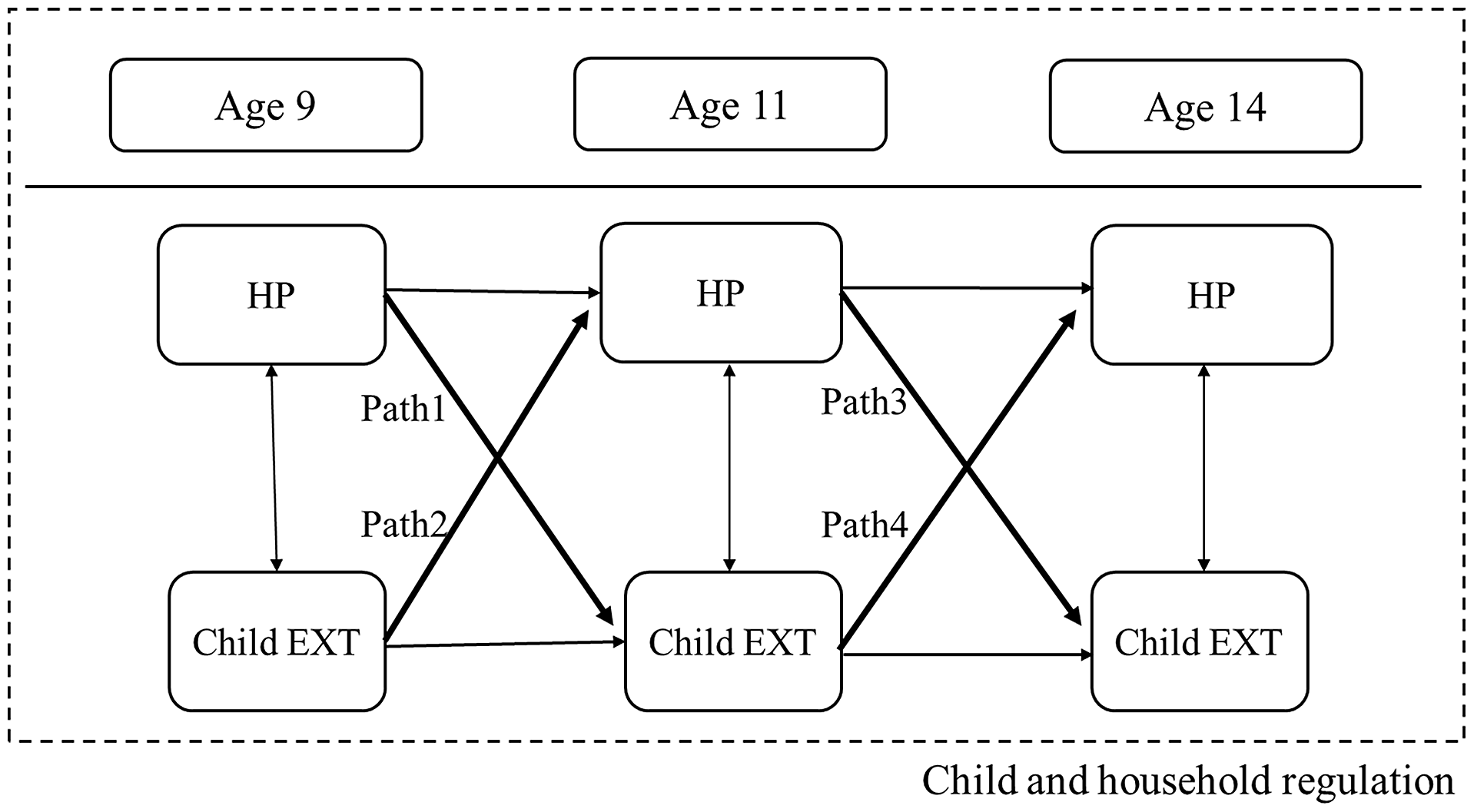
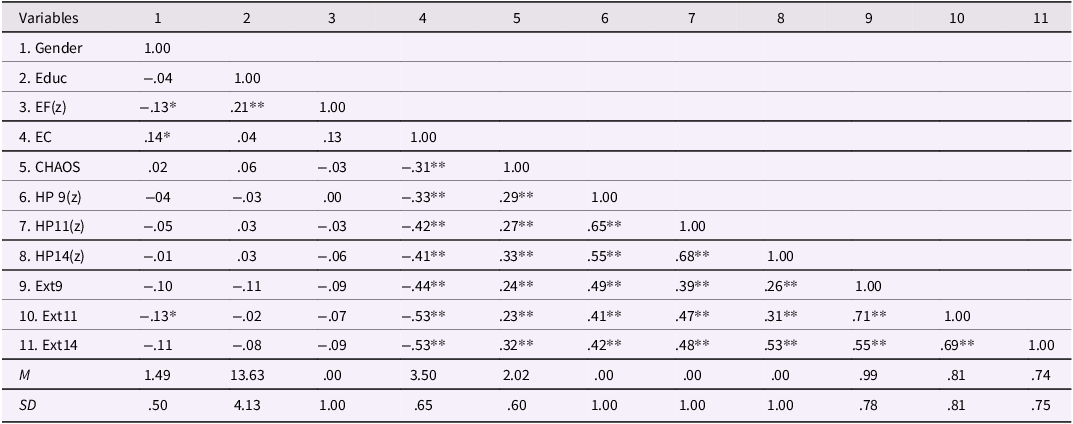
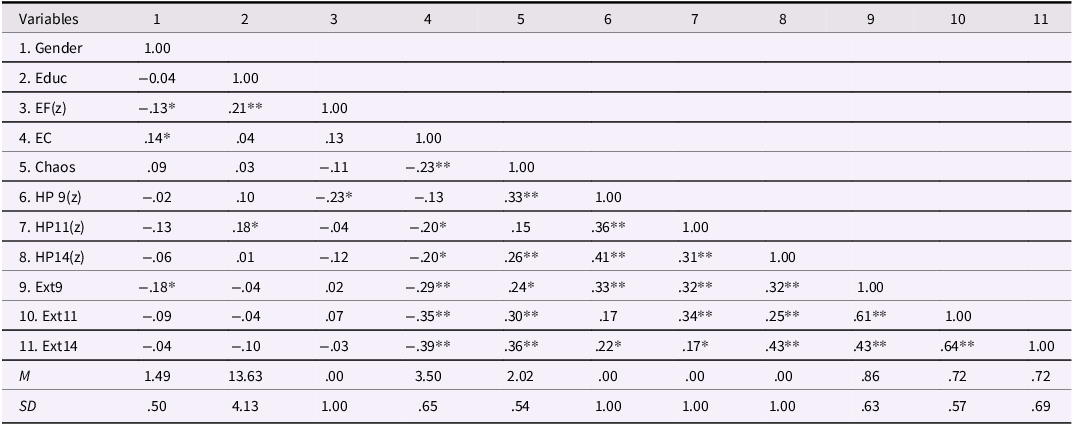
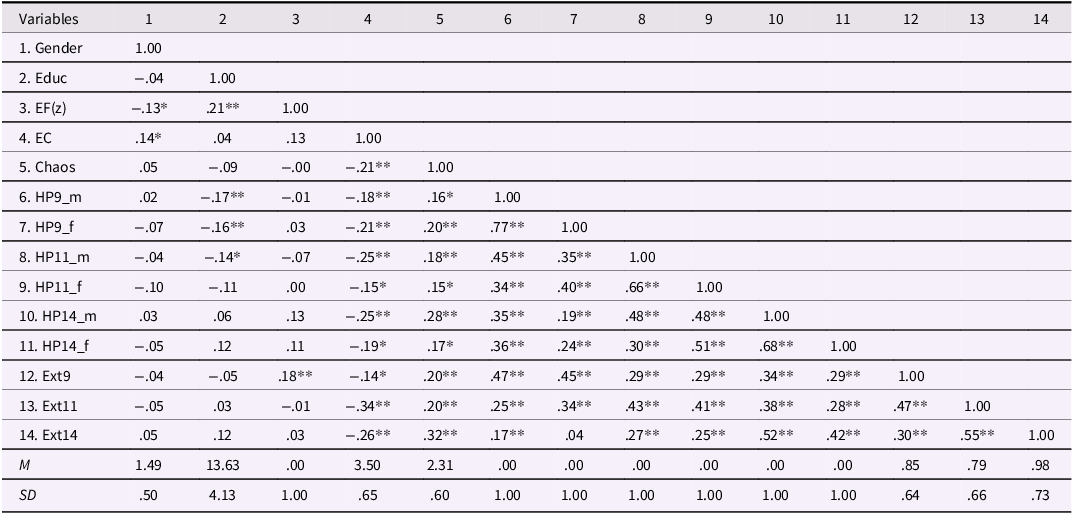
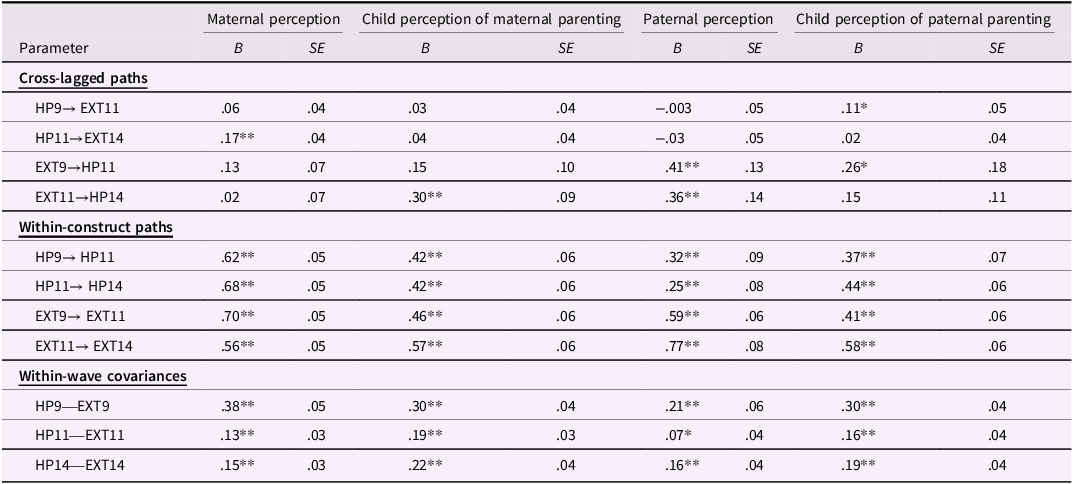
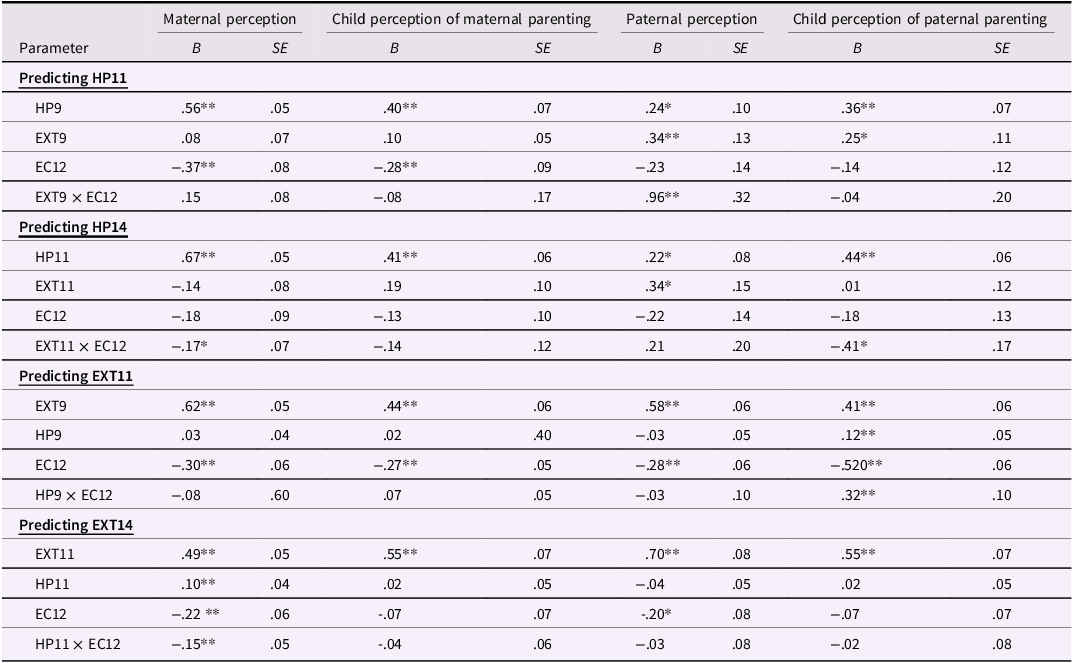
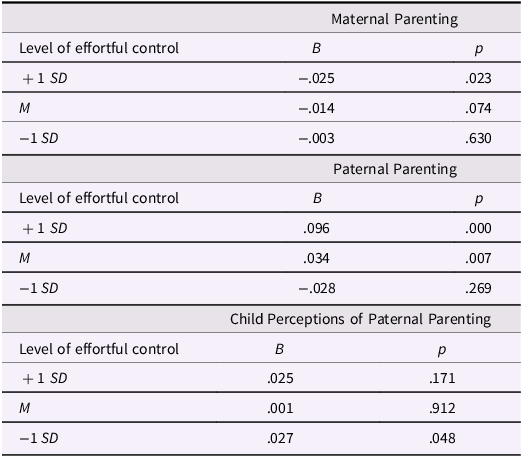
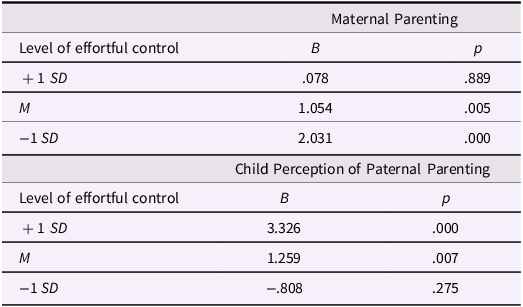
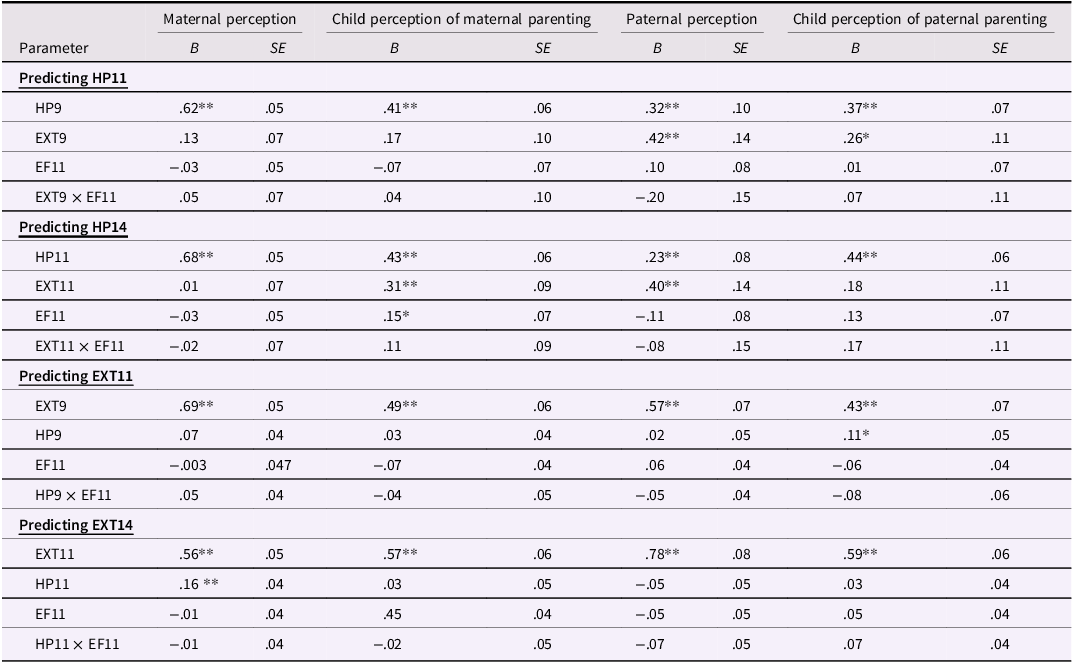
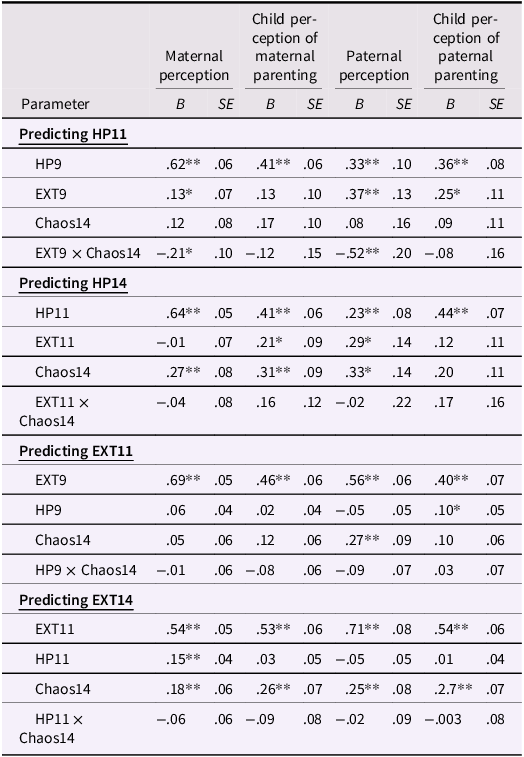
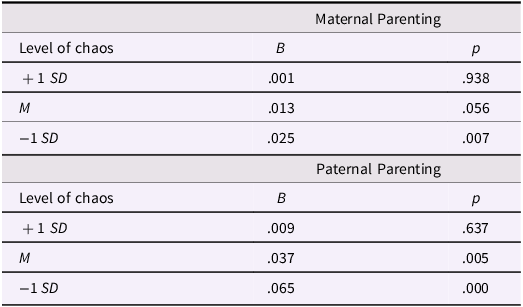


 Open access

