




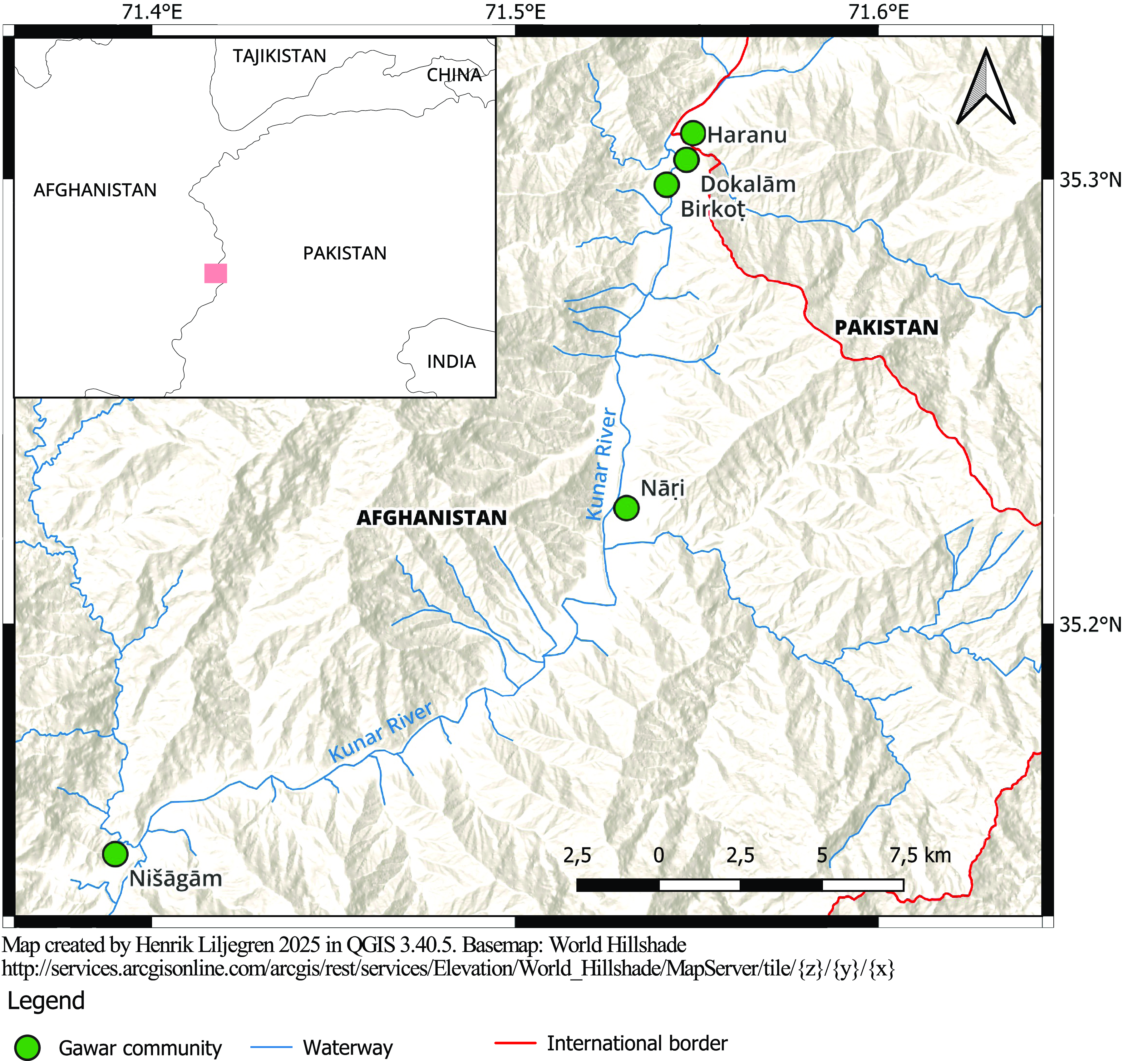
Gawarbati (ISO 639-3: gwt; Glottocode: gawa2147) is an underdescribed Indo-Aryan language spoken along the Kunar River, in the southern part of Lower Chitral District of Pakistan’s Khyber Pakhtunkhwa Province as well as in adjacent areas across the border in Nari (Naray) and Ghaziabad Districts of Afghanistan’s Kunar Province (see Figure 1). As for the number of speakers, only rough estimations can be given. On the Pakistani side of the border, where credible information is somewhat easier to obtain, local residents estimate it to be 4,000 speakers (Fazal Akbar, pc in 2022), based on the number of known Gawarbati speaking houses and an average number of household members. On the Afghan side of the border, the number appears to range between 15,000 and 20,000, based on recent cross-border contacts with local residents (Fazal Akbar, pc in 2022). This would amount to a total of 19,000–24,000 speakers of Gawarbati. A few small linguistic enclaves situated further down the Kunar Valley in Afghanistan are closely related to Gawarbati: Shumashti (Morgenstierne Reference Morgenstierne1945: 241), Ningalami (Morgenstierne Reference Morgenstierne1950: 58) and Grangali (Grjunberg Reference Grjunberg1971). Both Shumashti and Ningalami were at the verge of extinction already at the time of Morgenstierne’s field studies in the first half of the twentieth century, whereas Grangali is still spoken in three villages in the Digal Valley, according to a recent report (Robert Tegethoff and Sviatoslav Kaverin, pc in 2021).
Map showing the main locations where Gawarbati is spoken.

Most, if not all, speakers of Gawarbati are multilingual, a situation which is neither new nor unique, if comparing this language community with the many surrounding ones of a similar size and history. In Pakistan, present-day Gawarbati speakers are to a varying degree able to use Pashto, Khowar, and Urdu, and in Afghanistan, Pashto and Dari are used. Historically, the speaker community has most likely had frequent interaction with several of the surrounding language communities, including the eastern-most Nuristani languages, the other Indo-Aryan languages of the Kunar Valley as well as with the Kohistani varieties further to the east (Morgenstierne Reference Morgenstierne1950: 7). While there are undoubtedly many layers of linguistic influences that have formed Gawarbati, the Pashtuns (i.e., the speakers of Pashto, an East Iranian language) are responsible for donating a considerable amount of lexical material, and for indirectly influencing and enriching the phoneme inventory of Gawarbati, especially in the passage of the last century. Pashto functions as a language of wider communication on both sides of the border, and in Afghanistan it is also the language of local administration, literature and education (Rzehak Reference Rzehak2013: 27). Pashto naturally remains the second language of most adult speakers throughout the language area, although on the Pakistani side, Urdu is gradually encroaching on Pashto as the most significant carrier of cultural and linguistic innovation and as the main medium of instruction and literacy (Decker Reference Decker1992: 160).
The speech described here is primarily that of Arandu (Haranu in Gawarbati) in Pakistan, home to the second author, Abdullah Soan, himself a speaker of Gawarbati. However, some comparisons are also made with varieties on the Afghan side of the border. For the purpose of the present analysis, five speakers were recorded: AS, FA, NU, AG and FH. The first three are male speakers of the Arandu (Pakistan) variety, born in 1972, 1984 and 1987, respectively, and AG and FH are male speakers of the Nari (Afghanistan) variety of the language, born in 1993 and 1994, respectively. The orthography used in the sample text is the one initially developed by Mullah Adina Shah, from the 1960s onward, and subsequently revised by a group of community language activists in Arandu (Pakistan) in the mid-2010s.
Consonants

The Gawarbati consonant inventory with its 34 phonemes (and three “xenophones”, see below) is in most respects typical of Indo-Aryan languages spoken in the Hindu Kush region. It displays a three-way denti-alveolar vs. apical postalveolar (retroflex) vs. laminal postalveolar (alveolopalatal) contrast within its coronal affricate and fricative sets, and a two-way dental vs. apical postalveolar contrast within its coronal plosive set (Bashir Reference Bashir, Cardona and Jain2003: 822; Liljegren Reference Liljegren2017: 116–119).Footnote 1 The same contrasts are also found across various linguistic phyla within the same region, including Iranian, Nuristani, and the language isolate Burushaski (Arsenault Reference Arsenault2017: 16; Liljegren Reference Liljegren2020: 219–220). Another trait characterizing Gawarbati, as well as a number of languages in the surrounding region, is its three-way laryngeal contrast in stops (voiceless unaspirated, voiceless aspirated, and voiced unaspirated). The erstwhile aspirated voiceless bilabial plosive has developed into /f/, a development in progress already a century ago, as noted by Morgenstierne (Reference Morgenstierne1950: 8), leaving the bilabial sub-set with a present-day contrast in voicing only. The contrast between the two laterals represents a language-internal diachronic development of /l/ < l, dr, gr, and /ɬ/ < tr, kr (Morgenstierne Reference Morgenstierne1950: 12), with parallels in GawriFootnote 2 (Baart Reference Baart1997: 25–29), another Indo-Aryan language spoken in a non-adjacent area further to the east, as well as in some eastern Pashai varieties (Morgenstierne Reference Morgenstierne1967: 20; Lamuwal & Baker Reference Lamuwal and Baker2013: 243–244) and in Sauji (Buddruss Reference Buddruss1967: 24–25; Liljegren Reference Liljegren2009: 31); the latter are Indo-Aryan languages spoken further downstream in the Kunar Valley.
Sounds given within parentheses are restricted to relatively recent loanwords, /q/ to loans of Perso-Arabic origin, and /x/ and /ɣ/, largely to loans of Pashto origin. Of these, /x/ is well-established in Gawarbati, occurring in many everyday vocabulary items. The other two consonants are less frequent. According to unverified reports, some speakers merge them with well-established phonemes (e.g., producing /ɣ/ as [ɡ]), while others (including the speakers consulted for this study) keep them distinct. Thus, they may be treated as xenophones (Lindström & Eklund Reference Lindström and Eklund2000). A few other sounds represented in the table occur infrequently, and some appear to be partly neutralized.

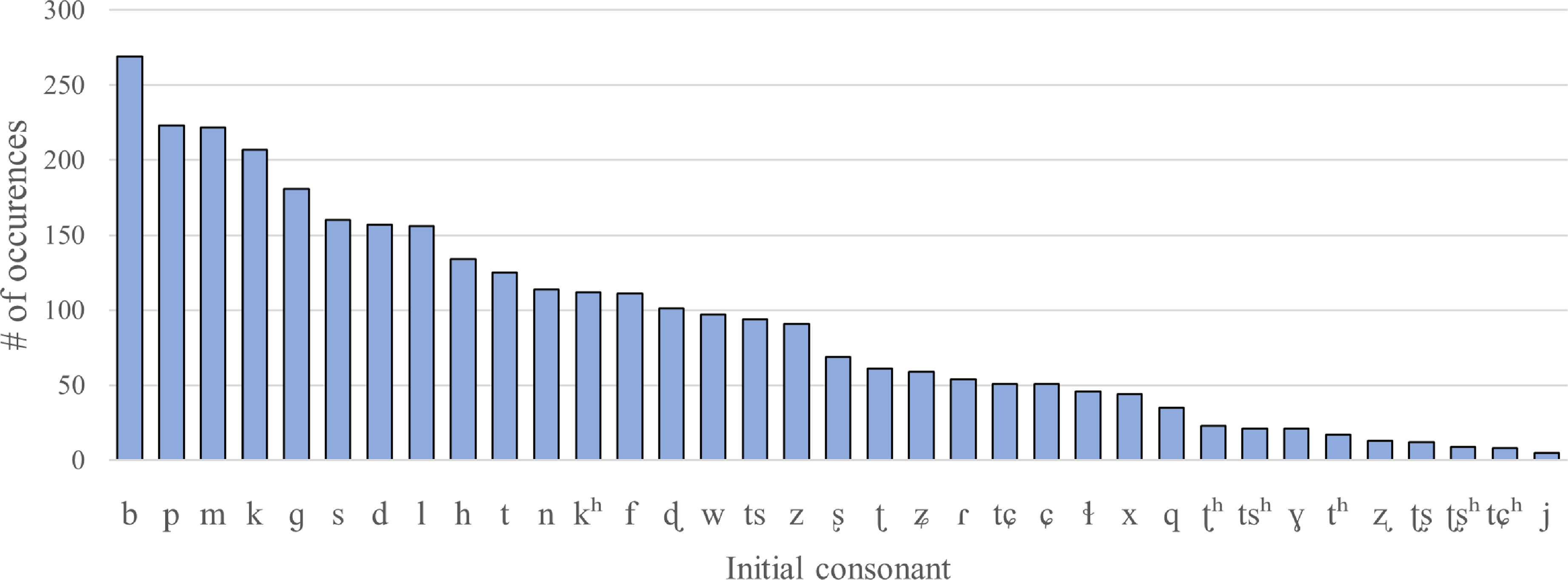
Most of the consonants occur word-initially, intervocalically as well as word-finally (as can be seen in the consonant table). Contrasts in aspiration, however, are neutralized word-finally. Therefore, no examples are shown in the table of aspirated plosives or affricates in final position. Voiced consonants occur word-finally, but much less prevalently as compared to their voiceless counterparts, and there is a tendency for them to be devoiced, partly or completely, particularly in utterance-final position. In the case of the overall rare consonant /ʐ/, there are no word-final occurrences at all in our material. The voiced alveolopalatal fricative /ʑ/ seems to occur intervocalically and word-finally almost exclusively in relatively recent loans, whereas it occurs frequently in inherited vocabulary in word-initial position. All six aspirated consonants (/tʰ/, /ʈʰ/, /kʰ/, /ʦʰ/, /ʈʂʰ/, /ʨʰ/) occur less frequently than their unaspirated counterparts, even in word-initial position (see Figure 2).
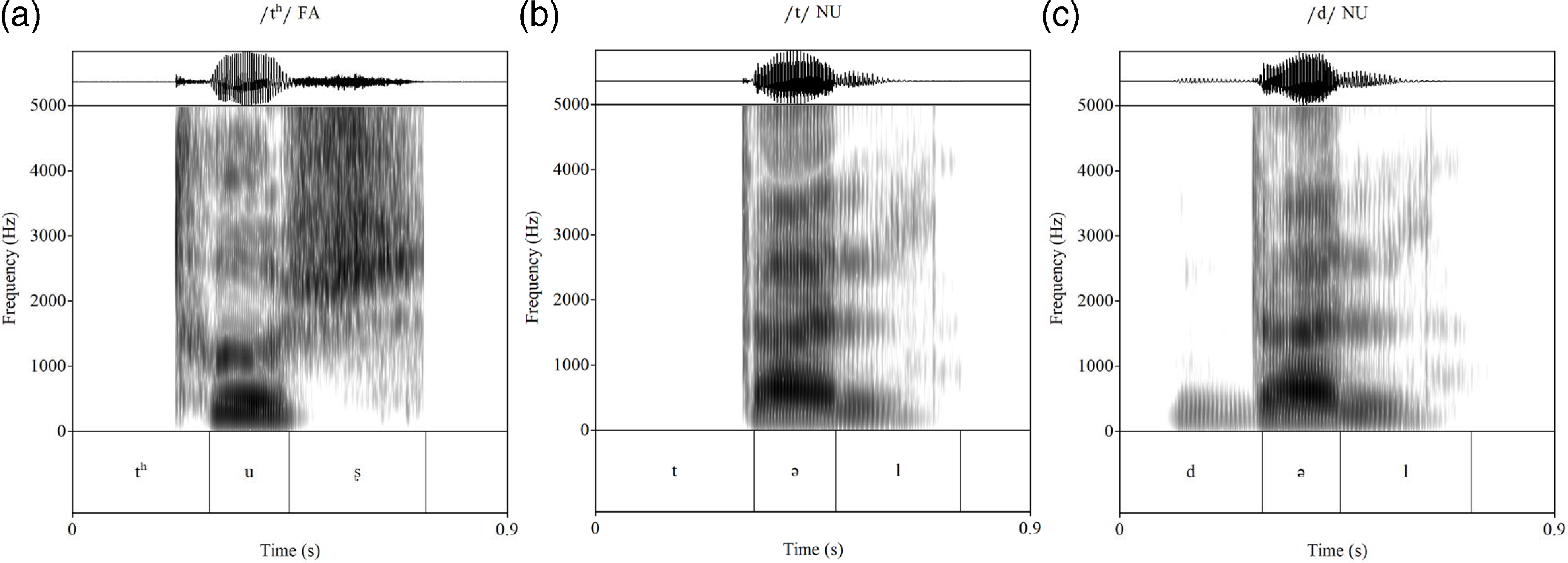
Our acoustic data indicate a significant phonetic difference between the three laryngeal consonant categories in Gawarbati, as illustrated in the spectrograms in Figure 3, showing words with an initial aspirated voiceless, unaspirated voiceless and voiced dental plosive, respectively.
Consonants occurring word-initially. The chart displays the number of lexical items in a 3,000-item Gawarbati wordlist that have the particular consonant in word-initial position.

Waveforms and spectrograms of (a) the word /tʰuʂ/ ‘hay’, produced by speaker FA (101-hay-GWT-PH-FA-220-i-4.wav), (b) the word /təl/ ‘ceiling’, produced by speaker NU (102-ceiling-GWT-PH-NU-241-i-3.wav) and (c) the word /dəl/ ‘bean’, produced by speaker NU (103-bean-GWT-PH-NU-245-i-3.wav).

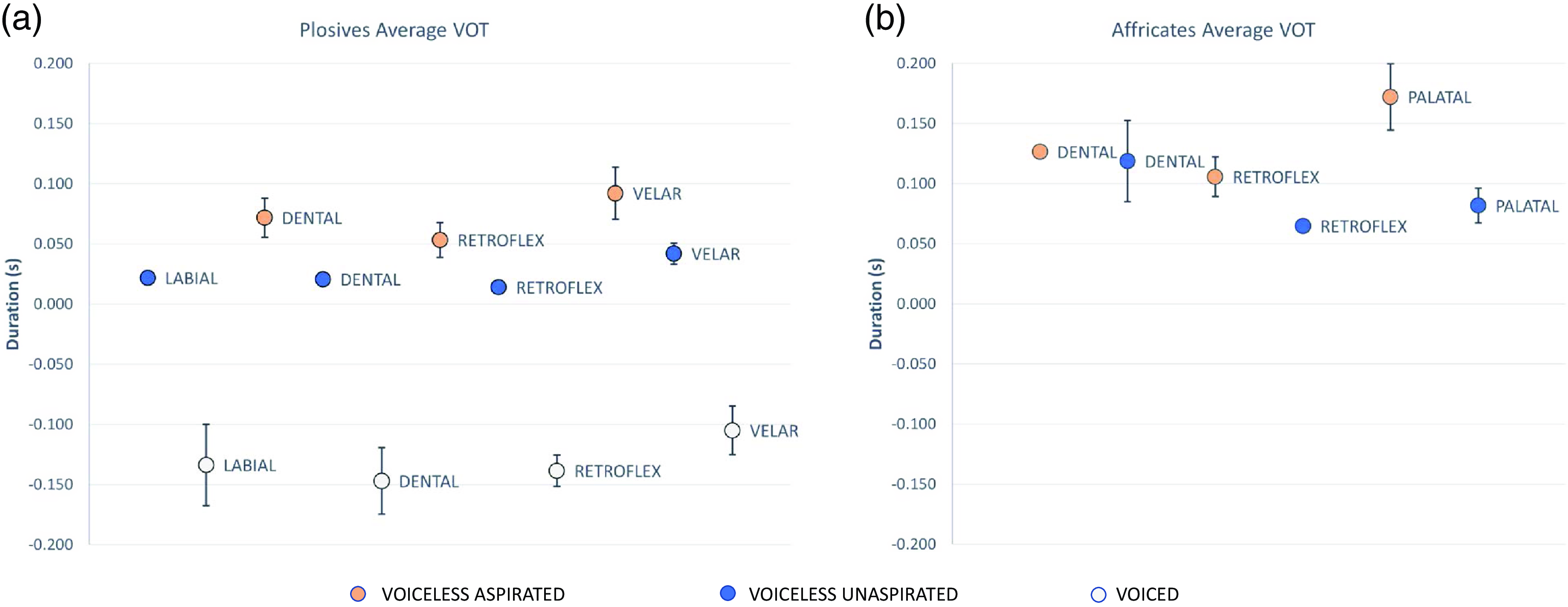
Average VOT, including standard deviation, for initial plosives (in (a)) and affricates (in b)) by place of articulation and laryngeal features, based on a total of 152 tokens from three speakers (AS, FA, NU).

Voice onset times (VOT) for the three plosives that make a three-way contrast differ consistently across the places of articulation, as can be seen in Figure 4. Average VOT is 72 ms for the aspirated voiceless, 25 ms for the unaspirated voiceless, and -131 ms for the voiced category, indicating that Gawarbati aspirated voiceless plosives are realized with a long-lag VOT, whereas the unaspirated voiceless ones typically are realized with a short-lag VOT, and the voiced plosives are clearly pre-voiced, normally with voicing sustained throughout the closure, followed by a short release (average duration 17 ms). This is an observation in line with that of other languages in the Hindu Kush region with the same type of contrast (Hussain Reference Hussain2018). The corresponding average VOT for the three aspirated and unaspirated affricates is 135 ms and 88 ms, respectively. The results for the dental and retroflex affricates should, however, be interpreted with caution, as there are comparatively few items exemplifying those sounds.
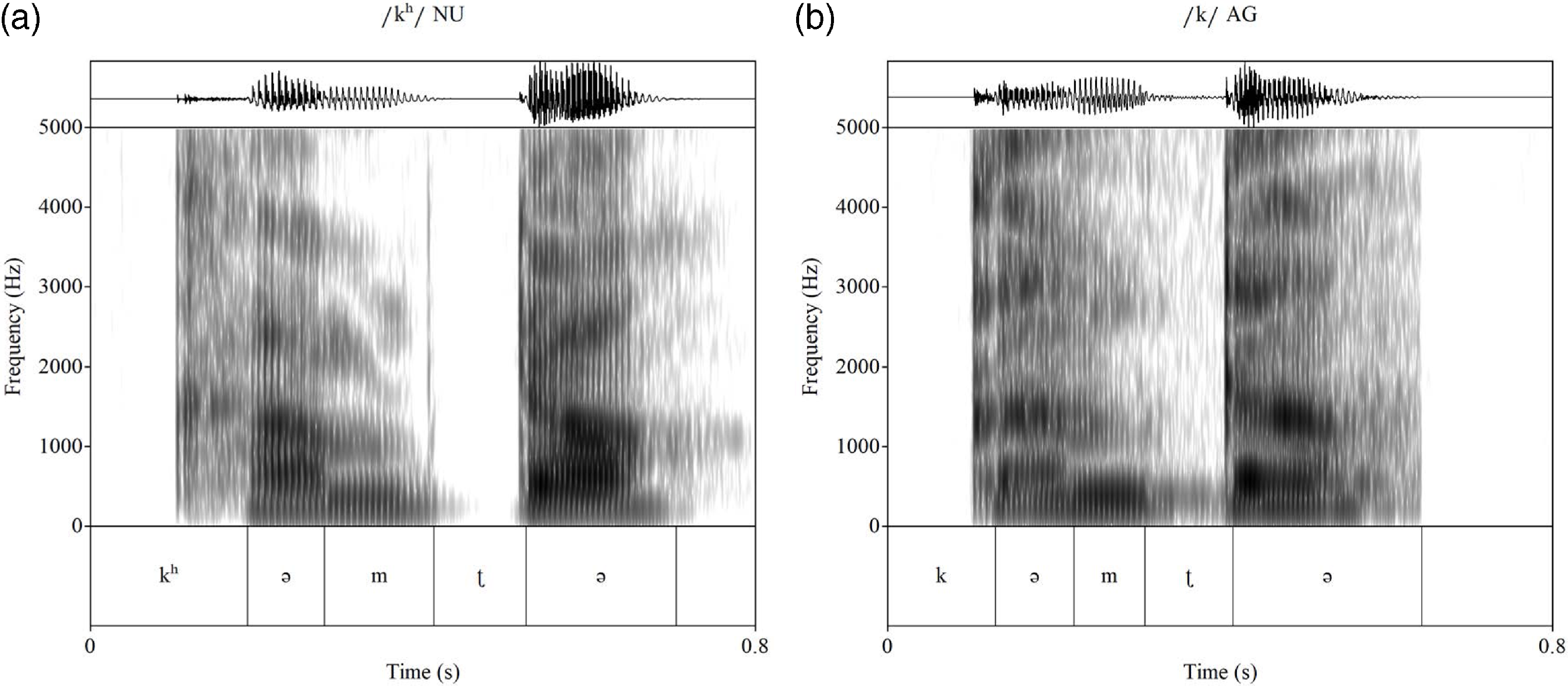
While the data set collected with speakers of Afghan varieties is insufficient for making detailed measurements, recordings of corresponding lexical items with speakers from Nari indicate that aspiration contrasts are completely missing, or else have been radically reduced, in that variety. This can be seen when comparing the two spectrograms in Figure 5.
Waveforms and spectrograms of (a) the word [kʰəmʈə] ‘ear’ produced by a Pakistani Gawarbati speaker, NU (104-ear-GWT-PHN-NU-024-i-3.wav), and (b) of the word [kəmʈə] ‘ear’ produced by an Afghan Gawarbati speaker, AG (105-ear-GWT-PHN-AG-024-i-2.wav).

Some further examples of aspirated sounds in the variety spoken in Arandu, Pakistan corresponding to unaspirated sounds in the variety spoken in Nari, Afghanistan are: [t̪ʰʊʂ] (Pk.) – [t̪ʊʂ] (Af.) ‘hay’; [mʊˈʈʰə] (Pk.) – [mʊˈʈə] (Af.) ‘tree’; [ʊt̪ʰəˈlə] (Pk.) – [ʊt̪əˈlə] (Af.) ‘high’. It should be noted that lexical items with an /f/ reflecting an earlier voiceless aspirated bilabial plosive, typically are realized as fricatives in the variety in Pakistan, whereas at least some of the corresponding items are realized as voiceless unaspirated bilabial plosives in Afghanistan: e.g., [fəˈʈə] (Pk.) – [pəˈʈə] (Af.) ‘leaf’. Although needing further research, it is deemed likely that all corresponding unaspirated and aspirated sounds, regardless of position in the word, have been completely neutralized, i.e., fused into one unaspirated phoneme, in the variety in Afghanistan (t < tʰ, t), cf. [t̪ʰʊʂ] (Pk.) – [t̪ʊʂ] (Af.) ‘hay’ with [t̪ʊ] (Pk.) – [t̪ʊ] (Af.) ‘you (sg)’. The preliminary measurements of a small comparative sample representing both varieties (70 tokens, including the same lexical items in each variety), show that all voiceless plosives and affricates in the Afghan variety are entirely within the range of the short-lag VOTs of the unaspirated sounds in the Pakistani variety, while the voiced sounds show consistent negative VOT values of the same magnitude across the two varieties.
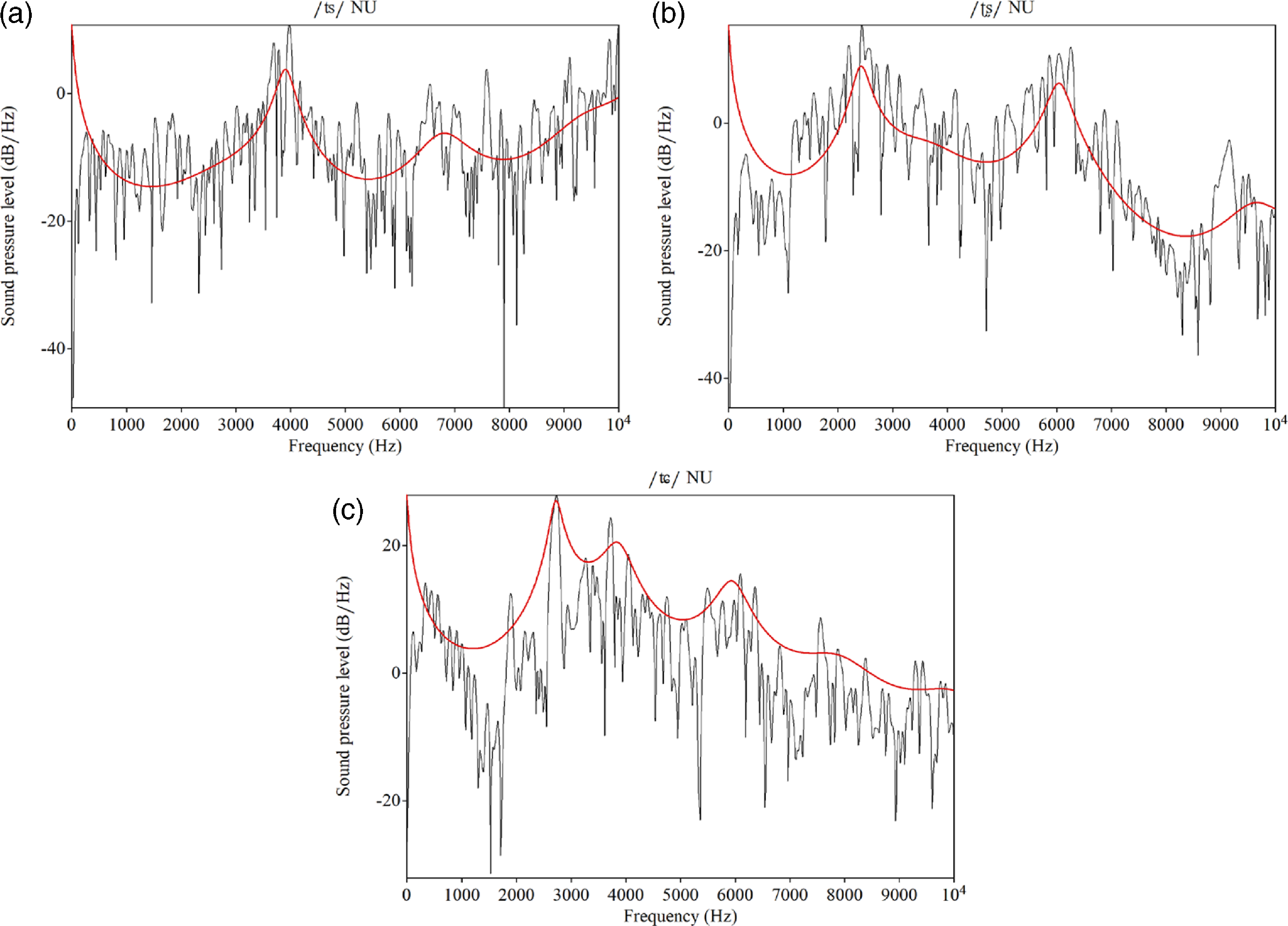
The place contrast between denti-alveoloar, retroflex and alveolopalatal affricates corresponds to distinct noise spectra. The spectral shapes of sample tokens of these three voiceless affricates are displayed in Figure 6. The denti-alveolar affricate is characterized by its high intensity of noise at higher frequencies, with a centre of gravity (COG) between 9,000 and 10,000 Hz, while the retroflex and alveolopalatal affricates have a high intensity of noise at considerably lower frequencies. The COG of the retroflex affricates is around 4,000 Hz, and the COG of the alveolopalatal between 3,000 and 4,000 Hz, the former with two clearly discerneable peaks.
Spectra made with a 25 ms window at the intensity peak of the frication phase of (a) the affricate /ʦ/ in /ʦoʈ/ ‘worm’, (b) the affricate /ʈʂ/ in /ʈʂoik/ ‘rooster’s crest’ and (c) the affricate /ʨ/ in /ʨəʂʈə/ ‘tray’. Single tokens produced by speaker NU. Black curve corresponds to a Fast Fourir Transform (FFT) analysis and red to a Linear Prediction Coefficient (LPC) analysis.

Just like in a number of other Indo-Aryan languages in the region (Zoller Reference Zoller2005: 34; Liljegren & Khan Reference Liljegren and Ali Khan2017: 222; Liljegren & Haider Reference Liljegren and Haider2009: 383; Perder Reference Perder2013: 29; Radloff Reference Radloff1999: 30), there is an allophonic relationship between voiced affricate and voiced fricative realizations of the three phonemes here symbolized as /z/, /ʐ/, /ʑ/ (the last of them more often than the other two pronounced as an affricate [d͡ʑ]). In most positions, the two allophones in each place of articulation vary freely, either in the speech of one and the same speaker or between speakers (or location). While the phonetic realization [ɖ͡ʐ] is, at least tentatively, allotted a distinct graphemic representation in the local orthography, this pronunciation appears to be non-variant only after a nasal, as in /ənʐə/ [əɳˈɖ͡ʐʌ] ‘strawberry’.
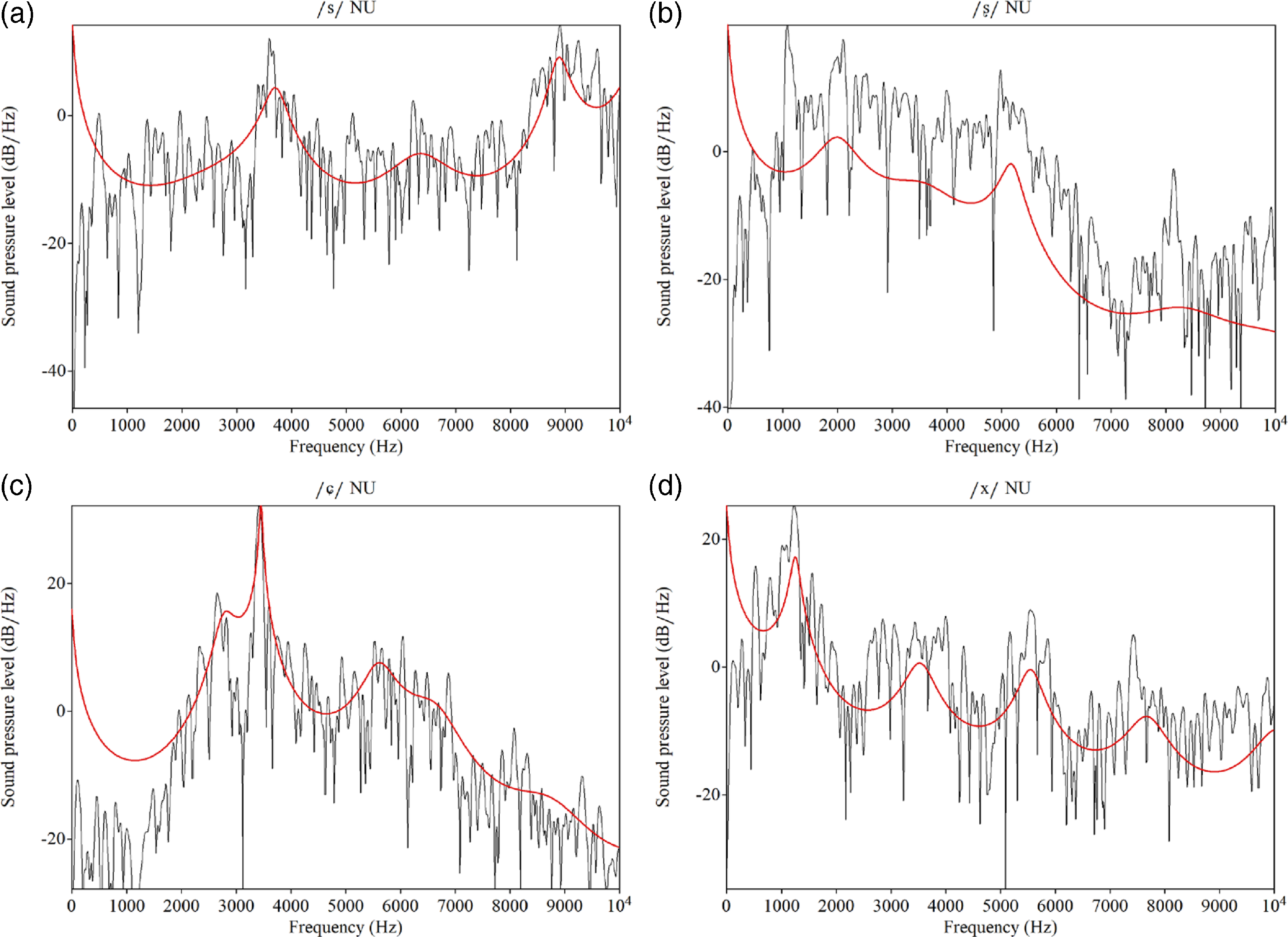
Like the three affricates, the fricatives produced at the same places of articulation, are characterized by distinct spectral shapes, much reminiscent of the former. Fricative spectra of the three voiceless fricatives, /s/, /ʂ/ and /ɕ/, along with that of the “borrowed” velar fricative /x/, are exemplified in Figure 7. Like its affricate counterpart, the denti-alveolar fricative /s/ shows a high-frequency concentration of energy, with a COG between 8,000 and 9,000 Hz, while the COG of the retroflex is between 2,000 and 3,000 Hz and between 3,000 and 4,000 for the alveolopalatal one. The latter also shows a constant drop in energy from around 6,000 Hz. The glottal fricative /h/ occurs intervocalically in loan words only, and never word-finally.
Spectra made with a 25 ms window at the intensity peak of (a) the fricative /s/ in /sum/ ‘soil’, (b) the fricative /ʂ/ in /ʂul/ ‘labour pains’, (c) the fricative /ɕ/ in /ɕɐl/ ‘jackal’, and (d) the fricative /x/ in /xɐɾ/ ‘city’. Single tokens produced by speaker NU. Black curve corresponds to FFT and red to LPC.

The retroflex sounds /ɽ/ and /ɳ/ do not occur word-initially, and further research is needed to determine to what extent these two sounds fully contrast intervocalically. In the few examples we have in our data, at least one possible realization of intervocalic /ɳ/ appears to be as a nasalized retroflex flap, as in /ʨəɳə/ [ʨəɽ̃ə] ‘chisel’, an observation identical to that made in the neighbouring Nuristani language Katë (Halfmann Reference Halfmann2022: 51). /ɽ/ and /ɖ/ appear to be, at least partly, neutralized in intervocalic position, variously realized as [ɖ] or [ɽ] (the latter being the more common allophone in our data), and a relatively infrequent word-final [ɳ] appears to alternate with the cluster [ɳɖ], as in [lɐːwəɳ] ∼ [lɐːwəɳɖ] ‘broth’, thus suggesting an alternative interpretation of [ɳ] as an allophone of /n/ occurring with a following retroflex consonant.
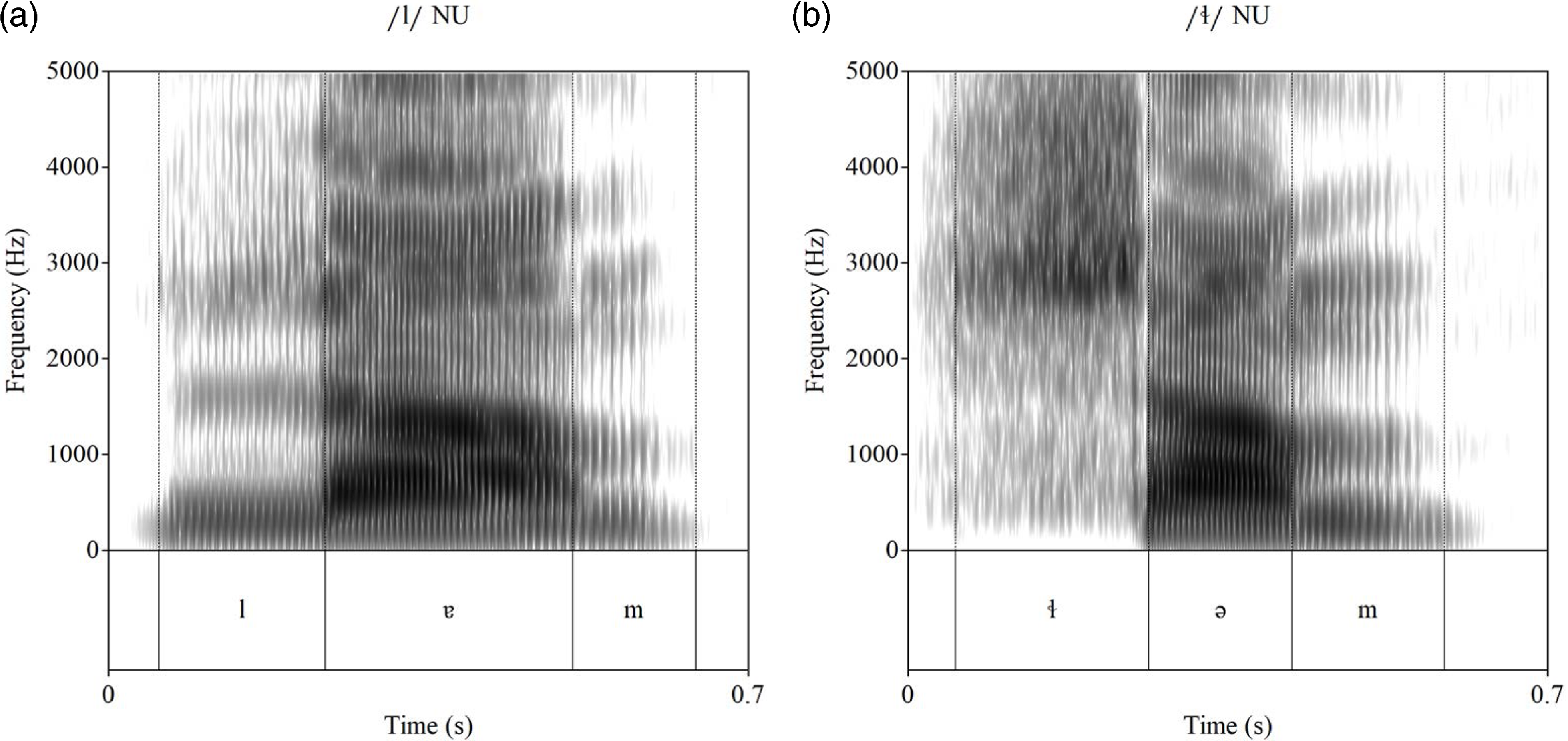
As mentioned above, Gawarbati has two lateral consonants. While we have chosen to represent them as /l/ and /ɬ/, respectively, i.e., as a lateral approximant and a lateral fricative, a larger-scale acoustic investigation would need to be carried out in order to make any more definite claims about their characteristic features and significant allophonic variation. An alternative interpretation would be to consider them as primarily contrasting in voicing. Both consonants occur word-initially, intervocalically as well as word-finally, and it is quite possible to find minimal or near-minimal pairs. The spectrograms and pitch curves for the near-minimal pair /lɐm/ ‘village’ and /ɬəm/ ‘work’ are displayed in Figure 8.
Spectrograms of (a) the word /lɐm/ ‘village’ produced by speaker NU (127-village-GWT-PHN-NU-092-i-4.wav), and (b) the word /ɬəm/ ‘work’ produced by speaker NU (128-work-GWT-PH-NU-111-i-3.wav).

The approximant /w/ has a relatively wide articulatory range, including labiodental [ʋ] as well as bilabial [w] realizations, the latter more typical of intervocalic and word-final occurrences. In addition to lexically determined occurrences of the approximants /w/ and /j/, these sounds may be inserted epenthetically at syllable boundaries, to separate two vowels, e.g., /ʐuəʈ/ [ʐuˈwəʈ] ‘yoke of oxen’ and /ʈʂoik/ [ʈʂoˈjik] ‘rooster’s crest’. Their occurrences word-finally are also subject to interpretation as to their phonemic identity as a consonant vis-à-vis as a vowel.
Both /j/ and /h/ occur word-initially in what appear to be idiosyncratic (and possibly idiolectally determined) alternations between the presence and the absence of an initial consonant in the production of certain lexical items: /el/ ∼ /jel/ ∼ /hel/ ‘night’; /eʈʂɐn/ ∼ /heʈʂɐn/ ‘story’.
Consonant clusters
The only unambiguous onset cluster in Gawarbati consists of /b/ followed by /l/, as in /bledi/ ‘cousin’.Footnote 4 It occurs in a limited number of words, most of them with a root for ‘brother’. A cluster consisting of /p/ followed by /l/, as reported by Morgenstierne (Reference Morgenstierne1950: 8), appears to have been reduced (pl > p) in all modern-day varieties, e.g., /pəl/ ‘light’ (transcribed by Morgenstierne as /plal/ or /plɔl/ (1950: 46)). Clusters with a nasal followed by a plosive, a fricative or an affricate occur intervocalically: /ɐndə/ ‘meat’, /kʰəmʈə/ ‘ear’, /ənʐə/ ‘strawberry’, /ɡonʦə/ ‘moustache’. In the same position, we also find e.g., /l/ + /b/, as in /əlbenə/ ‘cloud’, /l/ + /ʈʂ/, as in /pulʈʂə/ ‘a kind of cheese’, /ʂ/ + /ʈ/, as in /muʂʈi/ ‘bread’, /t/ + /ɾ/, as in /ətɾɐn/ ‘inner’, as well as a number of other clusters in relatively recent loans from e.g., Urdu.
There are two types of coda clusters, one that consists of /ʂ/ followed by /ʈ/, as in /əʂʈ/ ‘eight’, or /s/ followed by /t/, as in /həst/ ‘hand’, and another that consists of a homorganic nasal followed by a plosive, an affricate or a fricative: /hind/ ‘roof’, /pənʦ/ ‘five’, /ɬəwəɳʂ/ ‘thirteen’.
Vowels
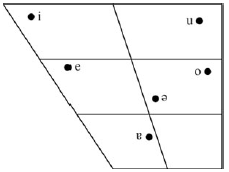
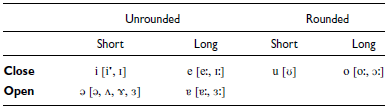
Gawarbati has six contrastive vowels, as indicated in the chart. The placements of these vowels are approximate, and represent target articulations of each vowel, particularly as they are realized in stressed syllables.

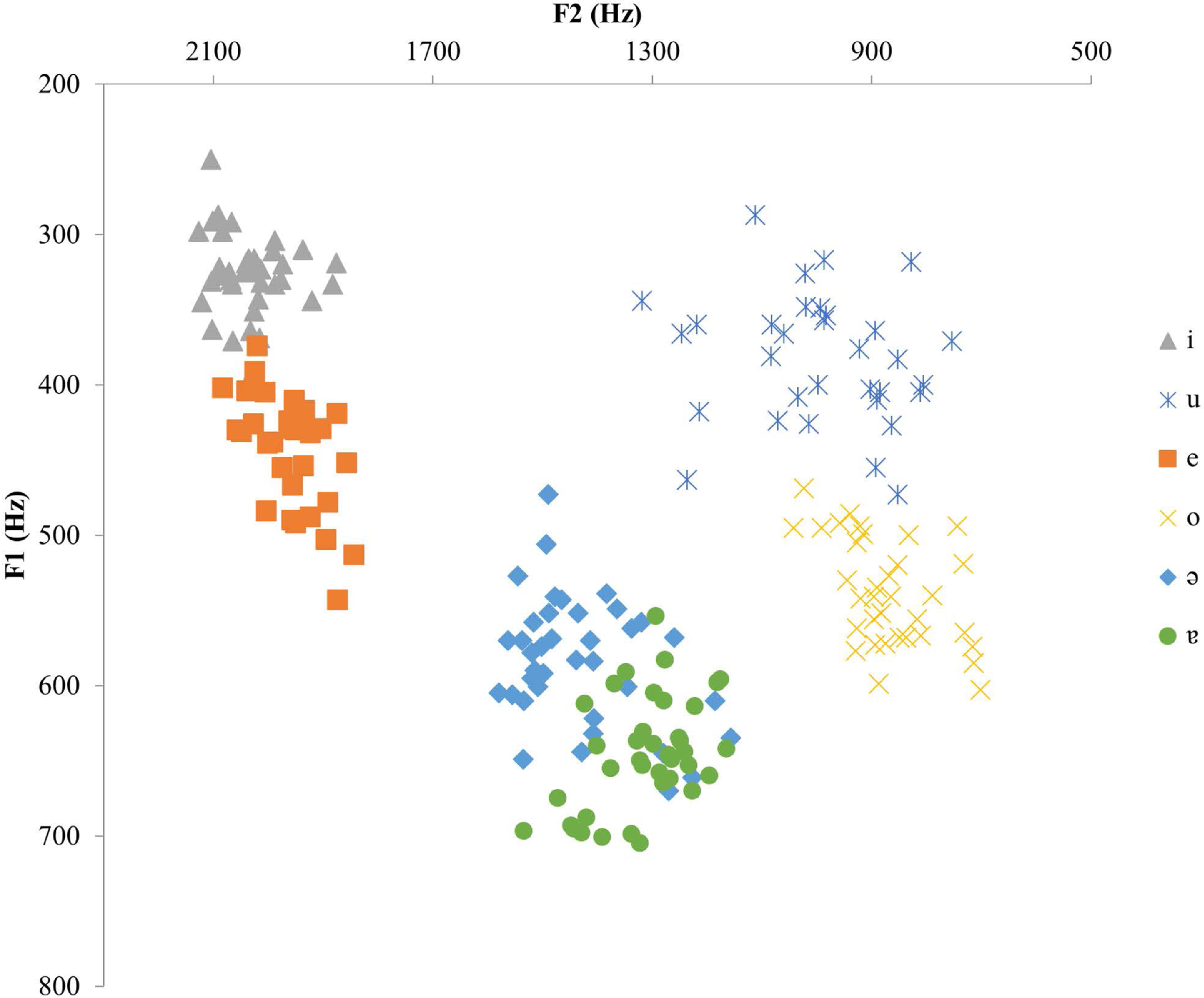
These placements are in their turn based on the plotting of F1 and F2 values of vowels occurring in closed stressed syllables in 211 tokens, produced by one male speaker (NU) from Arandu (see Figure 9).
F1/F2 plots based on 211 tokens representing each vowel realized in a stressed closed syllable (_C#).

The tokens were produced in a constant sentence frame by a single speaker (NU), in which the target item occurs non-finally /əsɐ̃ ki tɐɾə ʥəmet/ ‘this is called star’ (lit. ‘to this they say star’). Gawarbati vowels are primarily distinguished qualitatively, in vertical tongue position (close vs. open) and lip rounding (rounded vs. unrounded), but are further differentiated by durational differences, as illustrated schematically in Table 1.
Distinguishing properties of Gawarbati vowels, with commonly occurring allophones.

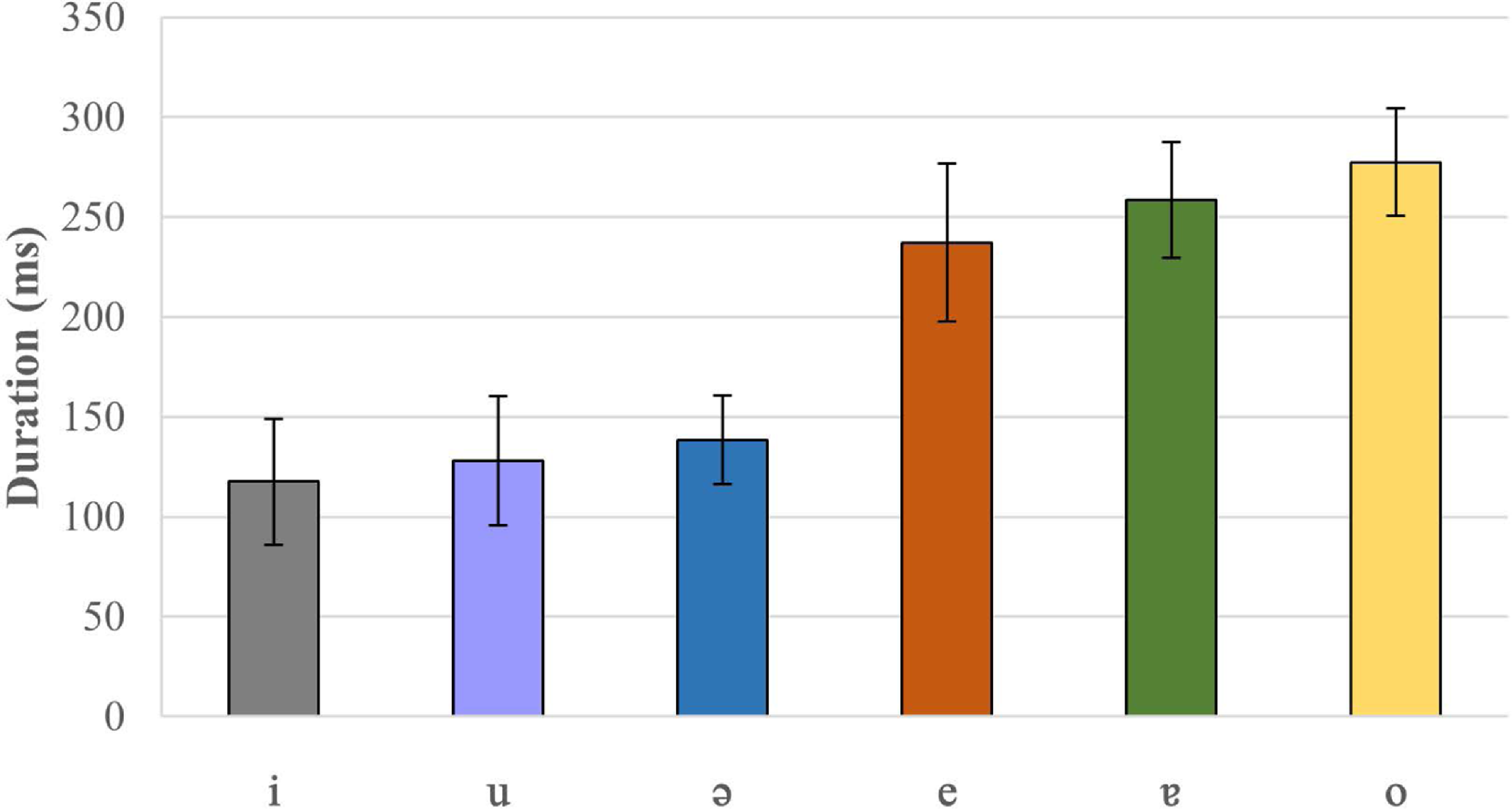
The significance of duration when contrasting the two series (/i/, /u/, /ə/ vs. /e/, /ɐ/, /o/) is illustrated in Figure 10, measuring the duration of the vocalic segment in monosyllabic words. Duration is particularly crucial in the differentiation between /ə/ and /ɐ/, two vowels that overlap to a larger extent in their realizations when measuring F1 and F2 than any of the other four vowels. The vowel /ə/ is a short central unrounded vowel, often realized as mid-open [ɜ] in closed syllables, while the allophone occurring in final open syllables is relatively open or centralized, and tends to be characterized by a relative backness ([ʌ] or [ɤ]). The vowel /ɐ/ is a long central unrounded vowel, typically realized as [ɐː] or [ɜː]. The vowel /i/ a close front unrounded vowel, typically realized as a short, slighly centralized [ɪ], and only rarely approaching a cardinal vowel [i] pronunciation. The vowel /e/ is a close-mid unrounded vowel, typically realized as a long [eː], but some of its allophones, especially in open syllables, approach an [ɪː] realization, but it is almost invariably longer in duration than qualitatively similar allophones of /i/. The vowel /u/ is a close back or central-to-back- rounded vowel, typically realized as a short centralized [ʊ]. The vowel /o/ is a close-mid to open-mid back rounded vowel, typically realized as a long [oː] or [ɔː].
Vowel duration in closed syllables, 111 monosyllabic tokens (including standard deviation).

While the six vowels are clearly contrasting in closed stressed syllables, as evidenced by the aforementioned formant plotting and the duration measurements, there are some indications (among others, non-consistent representation by first-language transcribers) that /e/ and /i/ may be neutralized in some environments, e.g., in unstressed positions and in open final syllables. Possibly the same may be true of /u/ and /o/. This will have to be followed up in future studies, requiring larger amounts of controlled data, with multiple speakers.
Nasalized realizations of vowels occur, but their distribution appears to be restricted to word-final position and with the low central vowel, /ɐ̃/, occurring invariably as such in only a few morphemes. While these words are high-frequency items, such as the pronoun /ɐ̃/ ‘I’ and the dative forms of nouns and pronouns, e.g., /əsɐ̃/ ‘(to) this’ (as part of the carrier phrase in /əsɐ~ suɾi ʥəmet/ ‘this is called sun’ (lit. ‘to this they say sun’), there is little evidence of minimal contrasts between any nasalized vowels and their oral counterparts.
Stress and its acoustic correlates
Stress is only partly contrastive in Gawarbati. The most frequent stress pattern is one with main stress on the final syllable. This is also the only stress pattern found as far as uninflected nouns are concerned. It is, however, possible to find minimal pairs exemplifying stress contrasts if we compare words across inflectional paradigms, such as the following:

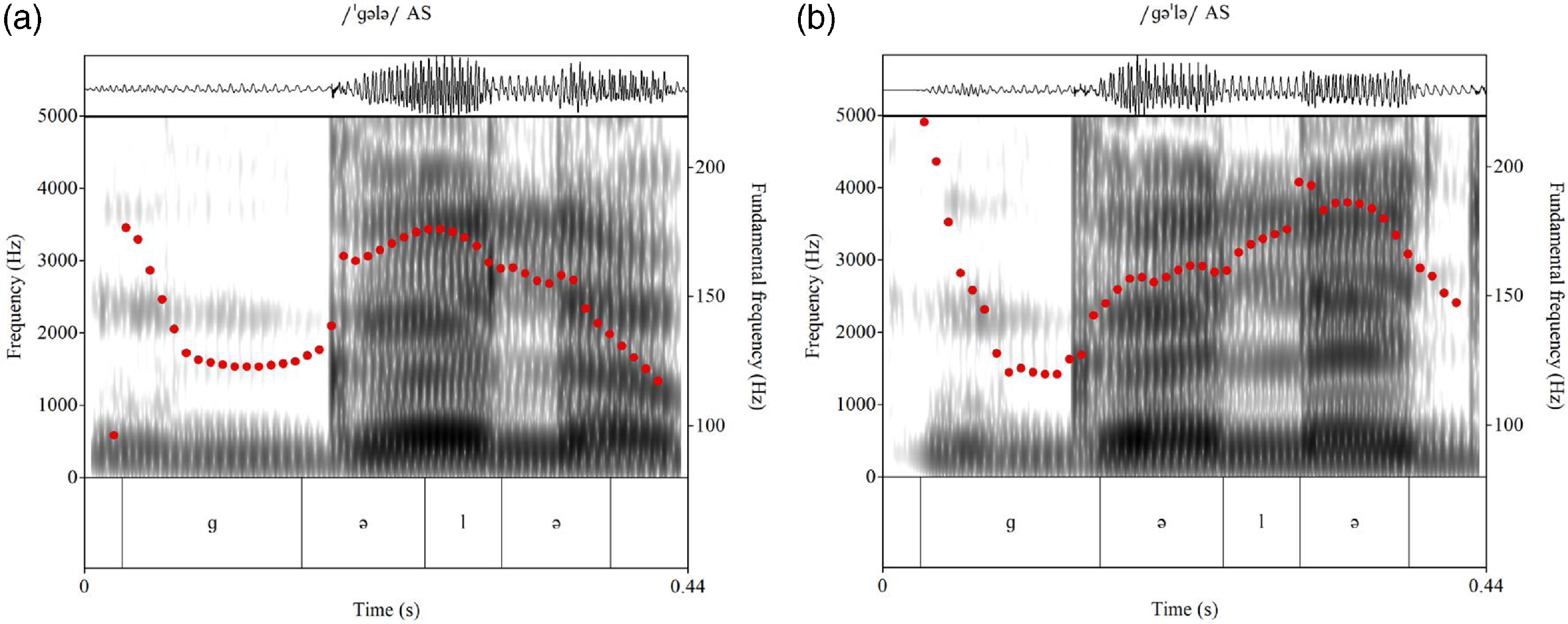
The disyllabic item /ˈɡələ/ ‘into the valley’ is a case-inflected form of the noun /ɡəl/ ‘valley’. In the inflected form of the word, stress remains on the root, i.e., on its first syllable. This contrasts with the item /ɡəˈlə/ ‘hill’, a non-inflected disyllabic noun, with its “default” stress on its final, in this case second, syllable. Similarly, the item /ˈdəntə/ ‘in the tooth’ contrasts with /dənˈtə/ ‘ridge’, as does /ˈmɐlə/ ‘herd; property obl’ (occurring as first word in /ˈmɐlə mɐˈlə ɐˈnə/ ‘bring the herd down below’) with /mɐˈlə/ ‘down below’ (occurring as the second word in /ˈmɐlə mɐˈlə ɐˈnə/ ‘bring the herd down below’).
From the waveform, pitch curve and spectrogram to the left in Figure 11, a higher fundamental frequency, a slightly longer duration, as well as a higher intensity associated with the vowel of the first – and stressed – syllable of /ˈɡələ/ ‘into the valley’, is clearly visible. From the representation to the right in Figure 11, we can discern a significantly higher fundamental frequency associated with the second vowel of /ɡəˈlə/ ‘hill’ as compared to that of the first vowel.
Waveforms and spectrograms of (a) the word /ˈɡələ/ ‘into the valley’ in the utterance ‘I go into the valley’, produced by speaker AS, with f0 represented by red speckles (166-into-valley-GWT-PH-AS-302-o-3.wav), and (b) the word /ɡəˈlə/ ‘hill’ in the utterance ‘this is called hill’, produced by speaker AS, with f0 represented by red speckles (167-hill-GWT-PH-AS-303-f-3.wav).

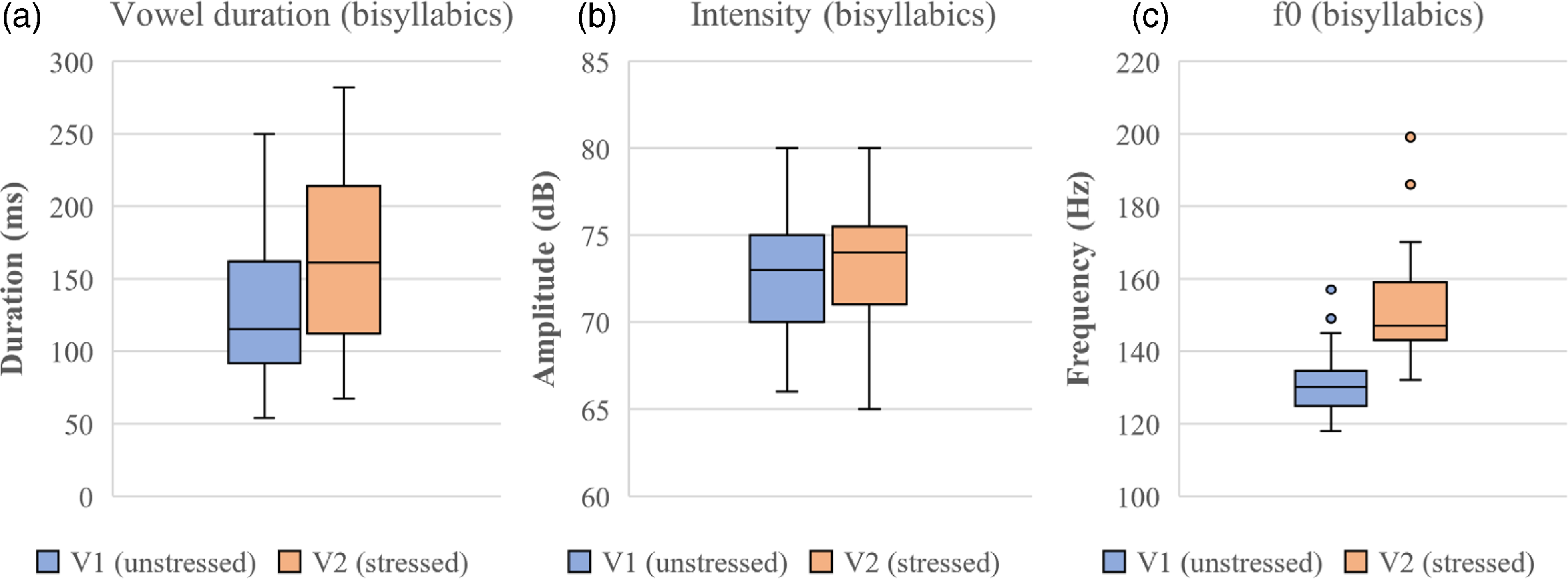
When investigating a larger number of polysyllabic words, the most obvious acoustic correlates of stress appear to be higher relative pitch (F0) and, to a somewhat lesser degree, longer duration associated with the syllable nucleus as compared to unstressed syllables, whereas differences in intensity are of no direct significance as far as stress is concerned. Fifty-three disyllabic items, all with the structure (C)VCV, and all with final-syllable stress, pronounced by one speaker (NU) in the middle of a constant sentence frame, were measured for duration, intensity and fundamental frequency, as shown in Figure 12. Similar, but much more preliminary measurements of a smaller number of three-syllabic nouns, showed the same tendencies, whereas systematic measurements of non-final stressed syllables vis-à-vis final non-stressed syllables have not been carried out within the present investigation.
(a) Vowel duration (ms), (b) intensity (dB) and (c) fundamental frequency (Hz) of vowels (V1=first (unstressed) vowel; V2=second (stressed) vowel) in 53 disyllabic items, produced by speaker NU.

Broad transcription and glossing of recorded passage


Abbreviations

Narrow transcription of recorded passage
ˈʔɜ̃n̪t̪əɾ ˌhɐːd̪ɪˈmə̃n̪ | ˈʔɐ̃ːŋ kʰəkəˈɽiː | sʊˈɾɪˑ ˈʔɐ̃ːŋ kʰəkəˌɽiˑˈd͡ʑəj ǁ ˈt̪ɐ̃ːn̪ʊ̃ˌmə̃n̪ zɪˈl̪ɐːd̪ kẽˈmɐ̃ːm boːt̪ ǁ ʔɜt̪əˈjə̃ mə̃n̪zɪˑˈ | jɔwɐ̃ˑɳˈʈɪ ɡə̃ɳˈɖəj ɐ̃ˑn̪ˈt͡si | mɐ̃ːˈn̪ʊʂ ˈfə̃n̪t̪eː ˈʔɐːjʌ ǁ d̪ʊmĩ̃ˈmẽː d͡ʑɔˈwõːn̪ | zeː ˈkəɾkɪ̃ˑn̪ ɐ̃səˈn̪ɪ̃ ɡə̃ɳˈɖejʌ pʊˈɾeˑ kʰɐˑwəˈwõːmbə | seː ˈt̪ɜkɽə ˈt̪ʰɪʋə ǁ ˈʔɜ̃n̪t̪əɾ ˌhɐːd̪ɪˈmə̃n̪ ˈzoːɾɪ ˌt͡ɕəl̪ɪˈke bʊj | zoːɾ mɐ̃ːˈn̪ʊ̃ʂə̃n̪ĩ̃ zoːɾ ˌhɐˑd̪ɪˈmə̃n̪ə̃n̪ĩ̃ | kɜˈt̪ə ˌhɐːd̪ɪ̃ˈmə̃n̪ zoːɾ ˈkiːbəː | ʔɜˈt̪ə mɐ̃ːˈn̪ʊ̃ʂ ɡə̃ɳˈɖəjeˑ peːˈl̪ɐ̃ˑn̪ d̪ɪˑ ǁ ʔɐːˈχɛˑɾə ˌhɐːd̪ɪˈmə̃n̪ ʋʊɖ ʋʊiˑ ǁ ˈt̪ɪ̃n̪ːə̃ ˌkʰəkəˈɽiː t̪ɜˈpiˑ sʊˈɾĩ n̪eːˈsiː | ˌpɜl̪əˈkike bʊj ǁ mɐ̃ːˈn̪ʊ̃ˌʂeː d̪ɜˈd̪ʊbɪˌɬiː | ɡə̃ɳˈɖejʌ kʰɐˑˈjɪ ˈfɐːɾkɪ ˌd̪ɜ̃ŋɡəˈwʊs ǁ ˈt̪ɪ̃n̪ːə̃ ˈʔɜ̃n̪t̪əɾ ˌhɐːd̪ɪ̃ˈmə̃n̪ẽˑ d͡ʑɔˈwʊzːeˑ | sʊˈɾɪˑ ˌmõːpeˈn̪ə̃ l̪əw ˌkʰəkəˈɽiː t̪ʰɪˈn̪ĩ
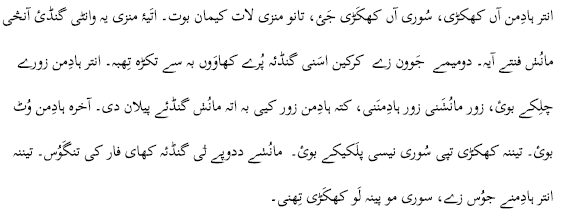
Orthographic version
Acknowledgements
This work is part of the project Gawarbati: Documenting a vulnerable linguistic community in the Hindu Kush, supported by the Swedish Research Council (2020-01500). Thanks go to Fazal Hadi, Forum for Language Initiatives, Islamabad, and D.W. Baig, Studio ONE, Islamabad, for their kind assistance in connection with recording the Pakistani Gawarbati speakers. We are also grateful to Anastasia Panova, to the journal editors and to the two anonymous reviewers for their insightful comments and suggestions which helped us improve the overall quality and readability of this text.

 Open access

