




In October 1970, an East African named Enoch Olinga stepped into a smoky bar in Harlem, New York, to watch Dizzy Gillespie, a popular African American jazz musician, perform. A cosmopolitan globetrotter, Olinga spoke six languages.Footnote 1 For over a decade, he had traveled worldwide, working for the Baha’i Faith, a new global religion that began in early nineteenth century Iran and grew in Africa, the United States, Latin America, and the South Pacific in the mid-to-late twentieth century. A prominent leader in the faith, Olinga traveled to these regions to increase Baha’i membership, spreading its teachings of racial unity and equality; his efforts were particularly appealing in communities of color that faced ongoing struggles for civil rights and political independence. Olinga was a popular figure; magazines such as Ebony heralded his 1970 stop in the US with feature articles.Footnote 2 He would soon continue to Latin America and the South Pacific, where he would meet with Indigenous peoples of Guatemala, Papua New Guinea, and Fiji.Footnote 3 But first, he wanted to hear the energetic rhythms of one of the world’s best jazz trumpeters.
Gillespie had become Baha’i just two years earlier. This religion appealed to both Gillespie and Olinga partly because of its insistence on racial equality and cultural tolerance. Olinga was a charismatic person whose affable nature made him a striking figure as he forged relationships with diverse people of color, such as Gillespie. Describing their encounter, Gillespie would later recall, “Olinga was so majestic. The people stood up and applauded for him and didn’t even know who he was.” Gillespie dedicated “Brother King,” a song he had written for Martin Luther King, Jr., to Olinga that evening. They embraced at the night’s end, and Olinga expressed his wish “to see ‘Dizzy’ soon in Africa.” The two men remained close and later met in Kenya in 1973, where Olinga “encouraged [Gillespie’s] search for his African roots.”Footnote 4
This work explores Enoch Olinga as an example of someone who enjoyed connections with global minorities across national boundaries and whose associations to Africa played an important role in spreading the Baha’i Faith in the mid-twentieth century. Olinga occupied the second most powerful position in the Baha’i Faith, also known as the Baha’i Cause or movement by its adherents, and helped lead its early expansion in the Global South during the 1950s–1970s.Footnote 5 Drawing inspiration from Adom Getachew’s work on how African intellectuals aspired to overhaul not only their own nations but the entire global community, Olinga’s efforts can be seen as a form of transformative emotional world-making as he highlighted the ability of people of color to shape their own fates through cultivating a sense of global unity.Footnote 6 In so doing, he envisioned a more equitable postwar world, invoking emotions to facilitate his contacts. For Olinga, the Baha’i Faith was the vehicle for his connections, but his personal traits and charisma also helped him win converts.
I argue that Olinga’s Black/African identities, ethnicity, and charismatic personality shaped his imagining of a politicized indigeneity to establish particular connections with different peoples of color. His envisioning of what I am calling a “globalized indigeneity” allowed him to specifically bond with people of African descent and Indigenous backgrounds when he traveled the world. Olinga viewed the lives and history of Black and Indigenous people as linked to Africa because of a shared African ancestry and a common Indigenous heritage that prioritized connections to the land and nature, both physical and spiritual. He thus considered African heritage as open to all individuals of color, including all Indigenous peoples.
Although the Baha’i Cause integrates Islamic beliefs, its Iranian founders differentiated it from Islam and other religions by emphasizing world peace, gender equality, and the interconnectedness of major world religions.Footnote 7 Iranian Baha’is left Muslim-dominated Iran and brought the religion to the Ottoman Empire, Europe, Africa, and the US in the late nineteenth century. The global antiracist movements of the mid-twentieth century, such as the US civil rights movement and anticolonial struggles, framed Olinga’s varied encounters. Baha’i leaders reacted to these movements because they believed the religion could unite people in the face of oppressive regimes and international conflicts. Hence, in the early 1950s, Baha’i leaders worked with communities in the UK and the US to expand the faith by sending “pioneers” to new areas, distinguishing themselves from traditional missionaries.Footnote 8
Despite health and visa issues, early pioneers greatly contributed to the Baha’i movement’s peak growth between the 1950s and 1970s due to its expansionist campaigns. There were perhaps a million followers by 1968, many from the Global South.Footnote 9 It was one among the new religious organizations in Africa that fought against European rule during decolonization.Footnote 10 Many, like Olinga, were attracted to the Baha’i Cause because it aligned with the ideal of an antiracist, postcolonial society held by people of African descent. The religion’s popularity came from its beliefs in racial and gender equality, religious and cultural tolerance, and world peace.Footnote 11 While Baha’is used the term “pioneer” to distinguish themselves from Christian missionaries and to mark their presence in new territories, it also reflected the pioneering efforts of Baha’is like Olinga to broker racial boundaries and fuse racial and cultural unity in their world-making endeavors.
Shoghi Effendi, the Baha’i Faith leader from 1921 until his death in 1957, believed that people of African descent might better facilitate the religion’s expansion in Black and Indigenous communities.Footnote 12 Baha’i administrators thus sent Black pioneers and leaders like Olinga to visit and support emerging Baha’i communities in Africa and beyond. Olinga primarily visited areas with significantly Black and Indigenous populations, where such people were often fascinated with his race, authority, and international prominence. While drawing on his Baha’i beliefs during such encounters, Olinga also developed new political modes—identifying appealing to emotions and cultivating shared Indigenous connections with followers as effective ways to strengthen and grow the religion.
Archival textual materials and oral interviews elucidate Olinga’s personal background, his perspectives on the cultural unity and solidarity of people of African descent globally, and the emotive strategies he employed to promote unity. As a transnational historical study, this work uses several kinds of research methods in different spatial and temporal contexts. To retrace Olinga’s international journeys, I conducted archival research at the Baha’i House of Worship in Illinois, United States, and the National Baha’i Center in Yaoundé, Cameroon, and extensively used online archives maintained by the Baha’i administration. For example, I examined key historical data from Baháʼí News, published between 1924 and 1990.Footnote 13 Additionally, I used handwritten letters from the 1950s and 1960s, oral interviews, biographies, memoirs, television interviews, documentaries, death memorial websites, and digital archives created by both Baha’is and non-Baha’is, many documenting their interactions with Olinga.
Given the general lack of historiography on Africans and the Baha’i movement, I also engage with different historiographical approaches, such as those focused on emotions. Few scholarly works on transnational history—the study of the circulations of ideas and people across national boundaries—emphasize the emotional or affective aspects of connections, despite evidence showing that emotive manners have played a significant role in shaping history.Footnote 14 I align with Monique Scheer’s definition that emotional practices involve the self—body and mind—along with language, artifacts, the environment, and other people.Footnote 15 While emotive practices have been shown to impact change, since “many individuals and institutions used them strategically to attain particular goals and shaped their behavior accordingly,” studies of emotions tend to overlook histories of the Global South.Footnote 16 As Jan Plamper contends, it “is overwhelmingly a European and North American history.”Footnote 17 My work adds to such conversations by foregrounding how Olinga’s African identity, Indigenous sensibilities, and affable nature enabled him to foster unique emotional and relational ties with people of African descent and Indigenous backgrounds. Olinga imagined a politicized globalized indigeneity, wherein the lives and histories of minoritized individuals were linked to Africa through shared ancestry and Indigenous land-based sensibilities.
I draw from the burgeoning and important body of work focusing on people of color and their transnational emotional experiences, such as Tiffany Florvil’s 2020 research. Florvil illustrated that, through their personal relationships with Black American figures like Audre Lorde and others, Black German women formed an “affective community” that enabled them to create a space where their emotions could be expressed, acknowledged, and valued within the Black diasporic community.Footnote 18 Similarly, Olinga’s Blackness and Iteso ethnicity endowed him with Indigenous sensibilities that helped him emotionally bond with others globally; he served as a binding agent that allowed Africans and others to feel a part of a broader cultural and racial whole. Physical actions such as singing in Swahili, storytelling, and physical embraces, buttressed Olinga’s emotional practices, as did his invocations of family and kin to evoke particular emotions among Black and Indigenous communities. These emotional practices fostered a surrogate kinship bond formed by common African heritage and a shared Indigenous background.
In centering a Ugandan man’s focus on Africa as the linchpin of his diverse global connections, I complicate preexisting narratives of Black internationalist actors, ideas, and actions. Scholarship on Black internationalist activities have typically centered on global political consciousness, intellectualism, and solidarity-driven activism by people of African descent striving to challenge racial oppression; historical scholarship has mainly focused on the activities of those in the diaspora, particularly in the twentieth century.Footnote 19 Monique Bedasse argues that there has been a tendency in Black transnational histories to overly disconnect Blackness from Africa to correct previous historical biases. She asserts, “We must also think beyond analytical frameworks that center the US and claim internationalism only in terms of how Americans interact with Black people in other places.” Bedasse urges us to pay more attention to how Africans themselves have shaped Black internationalism.Footnote 20 By reversing the Black internationalist gaze and focusing on an East African man’s interactions with racially marginalized peoples worldwide, I aim to contribute to understandings of how Africans have leveraged their Black experiences to collaborate with global minorities to foster unity both continentally and internationally.
Olinga was by no means the only internationalist at work in the mid-twentieth century but he stood out from the crowd—in large part because he managed to bridge the divide between cultures and use his status as an African to form genuine bonds with marginalized groups.Footnote 21 His Iteso ethnic heritage helped facilitate these processes, forming a key part of his Black identity, Africanness, and Indigenous identity. Scholars note that many Indigenous people share similar experiences, such as being the original inhabitants of land that would later be colonized, living in communities with their own distinct culture separate from the dominant one, and having a deep emotional connection to the land and the territory it encompasses.Footnote 22 Gloria Emeagwali and George Dei contend that African indigeneity, especially in rural areas, remains tied to the land and nature despite colonization and globalization. They explain, “Land has been a source of Indigenous identity for Africans, in that through associations with the land, local cultures, spiritualities, politics, economics, and the relations of society to Nature are defined.”Footnote 23 As a self-identified Iteso, Olinga leveraged his indigeneity to unite diverse people of color—Indigenous peoples and people of African descent alike—by emphasizing shared ties to land, both physical and spiritual.
Olinga’s emphasis on racial unity based on shared African heritage and indigeneity also had a major influence on his racial politics. By emphasizing their common racial and cultural heritage as well as more general ideas of a politicized kinship, Olinga aimed to inspire unity among Black and Brown people worldwide. By focusing on Olinga’s emotional practices in his varied connections, I thus invert the more common diasporic gaze, which focuses on a linear trajectory between Africa and the US and Europe, illustrating how men like Olinga grounded their connections with others in the Global South to Africa.Footnote 24
Emerging Prominence and a Charismatic Approach
Olinga started his extensive travels and connections in East Africa, where his capacity to interact with different people and across cultural divides highlighted his pioneering role in the early development of the Baha’i community in Africa. Despite having its origins in Egypt in the 1890s, the Baha’i Faith thrived in Uganda, where Olinga hailed from. Born in 1926 to Christian converts, Olinga was from the village of Tilling, located in the Teso region of eastern Uganda. His Iteso ethnicity, which is one of Uganda’s biggest ethnic groupings, and his father’s work as a catechist and teacher for the Anglican Mission both had an impact in his upbringing. Olinga was a devoted Christian who had a high school degree and spoke six languages fluently. He finished his basic and secondary school in Teso before enrolling in Makerere University in Kampala. However, his education was cut short by the Second World War. Olinga first got the travel bug when he was drafted into the British colonial regiment in 1941 as a translator, first in Kenya and then in Myanmar, India, and Sri Lanka. He married upon his return to Uganda and authored several books in Ateso, his native language. He also received formal education in economics and secured a role as a translator for the colonial Department of Education.Footnote 25
However, in 1951, Olinga was dismissed because of his heavy drinking, a loss that plunged him into depression and put him on the brink of divorce. His life changed when he became the third Ugandan to convert to the Baha’i Cause in April 1952. In a classic story of religious redemption, Ali and Violette Nakhjavani, an Iranian Baha’i couple living in Kampala who were among the first Baha’i pioneers in Africa, converted him and convinced him to give up drinking. Ali later recalled that Olinga asked many questions about the religion and read every Baha’i book he could find.Footnote 26
While we cannot fully understand all the reasons why Olinga converted to the Baha’i Faith, it is clear that he was similar to his nineteenth- and twentieth-century Christian counterparts in that he genuinely believed in his newfound faith and found fulfillment in it. His experiences also show that the religion was as an upward social mobility pathway, providing opportunities for leadership, education, and economic benefits.Footnote 27 For example, Baha’i leaders supported converts’ establishment of transnational businesses, leading to their increased social and economic power.Footnote 28 Ali Nakhjavani attested in an oral interview that because Baha’i “was a growing faith…not a static religion like others,” Olinga liked that Africans had the opportunity to take on leadership roles.Footnote 29 Oral and archival evidence indicate that Africans did play active roles in the administration and management of emergent Baha’i communities locally and nationally.Footnote 30 For example, they served as pioneers, translators of Baha’i texts, and instructors for youth classes focusing on the Baha’i Faith as well as on literacy.Footnote 31
Upon his conversion, both Olinga’s childhood friends and the Nakhjavanis observed a “remarkable transformation” in him.Footnote 32 According to Ali, prior to his conversion, Olinga described himself as “very timid and weak-willed,” but after he became Baha’i, he was “a lion-hearted champion of the cause.”Footnote 33 Here, it appears, are signs of the charisma and the ability to emotionally appeal to people that would propel Olinga’s stature and visibility in the Baha’i movement. His early successful conversion efforts extended to colleague and friend Peter Mutabazi, who put down the bottle and became Baha’i and to Olinga’s wife, Eunice, who reported that she converted because of his “remarkable transformation.”Footnote 34
Indeed, Olinga’s early conversion efforts were instrumental in expanding the religion in Africa and showcased his ability to draw from his growing prominence in the Baha’i Faith and upbringing in missionary schools to adapt Baha’i teachings to local contexts. While sources are silent about his exact teaching method, we do know that in July and August 1952, he introduced the Baha’i movement in the Teso region’s villages. Although his early conversion work was slow-going with locals wanting to see the “white man” who had converted Olinga (Ali did come and teach there), Olinga ultimately converted hundreds of people from this region, including his parents, family members, and friends. Olinga seems not to have overemphasized that new Baha'i converts quickly sever ties with their former Christian congregations, reflecting global Baha’i policies that supported adapting outreach methods to local African cultural contexts.Footnote 35 Although his specific teachings in Teso are not well documented, Olinga’s reputation and his status as a “child” of the community, together with his flexible approach to how converts embraced the Baha’i Faith—a religion with no clergy structure—played a crucial role in the rapid growth of the religion in the region, which valued community ties and informal leadership structures typical of acephalous societies.Footnote 36
Due to Olinga’s Christian background and his deep understanding of his home region’s cultural context, including beliefs related to egalitarianism, he successfully spread the Baha’i Faith in his hometown. Witnesses say his teachings reflected a broad and general message centered around principles of unity and oneness rather than specific Baha’i teachings that might conflict with longstanding customs in Teso. Consequently, Olinga’s teachings struck a chord with the local Teso community because they found things in them that matched their own ideals and customs, such as gender equality in property ownership and succession. He was able to attract followers by focusing on universal ideas like the unity of religions and the oneness of humanity. His dexterous teaching—veering away from focusing on contentious teachings—laid the groundwork for his later successful conversion efforts in the British Cameroons.Footnote 37
Olinga’s success in converting hundreds of Teso people to the Baha’i Cause in 1952 inspired Baha’i leadership to make more ambitious plans for spreading the religion’s message across Africa. A seven-year campaign, from 1956 to 1963, aimed to extend the religion beyond US borders. In his February 1953 telegram cable to the Baha’i community in Kampala, Effendi identified Cameroon, among others, as one of the countries where pioneers should settle.Footnote 38 Three new Ugandan Baha’is eagerly volunteered, including Olinga, partly because he wanted to explore a distant part of Africa (a biographer speculated that Olinga also welcomed the brief separation from his wife since their marriage was once again strained).
In August 1953, three Ugandans, all recent converts to the Baha’i Cause, set out in a Peugeot station wagon on a mission trip across Africa along with two Iranian Baha’is. They aimed to spread their faith through long-term trips, echoing the long-standing practice of Western Christian and African-born predecessors in colonial Africa, where such journeys were historically undertaken to propagate religion. Baha’i pioneers differed from their Christian missionary counterparts in that they more often traveled farther across Africa and through different imperial boundaries. As the racially diverse pioneers moved from East Africa to West and Central Africa in late 1953, they departed the Peugeot station wagon at various points along the way: one of the Ugandans stayed in the Republic of Congo, the second in the Central African Republic; the third, twenty-seven-year-old Olinga, continued to Cameroon.Footnote 39
The trip in the Peugeot was Olinga’s first official pioneering appointment. Pioneers were not paid and were supposed to find employment in their assigned posts. Therefore, he could not bring his family, though Iranian Baha’is in Uganda agreed to support them in his absence. Olinga’s 1953 voyage to Cameroon was not easy. For instance, at the end of their journey in Gabon, their car broke down. Olinga had to march for help but fell ill with malaria and dysentery, making him question why he had left Uganda. He later confessed to the Nakhjavanis that he had wondered, “You fool, what are you doing here?” Eventually, he and the Nakhjavanis arrived in the middle of an October night in Victoria, a bustling coastal town in the British Cameroons. At this point, Olinga was named “Knight of Baha’u’llah” by Effendi for opening a new territory for the religion. Olinga remained in Cameroon for a decade, building “the largest Baha’i communities in West Africa.”Footnote 40
Olinga faced various challenges in spreading his newfound faith, including conflicts with local Christian missionaries and unhappiness in his marriage, which led to divorce in the early 1960s.Footnote 41 Pushing through obstacles, Olinga utilized his Iteso ethnicity and emerging prominence within his religion to promote unity among members of the Banyang ethnicity, who made up a significant portion of new converts by 1958, and others from Christian backgrounds. Simon Peter Ongodia’s research suggests that the Iteso ethnic community, like many ethnic groups in Africa, highly values music, dancing, and oral storytelling. Such practices were not just for entertainment; in his study, Ongodia highlights how oral storytelling performances help address social, cultural, and political issues in Iteso communities in Uganda and Kenya and unite community members.Footnote 42 Olinga would draw on such practices in his work in Cameroon.
Early Cameroonian converts mentioned in their memoirs that Olinga engaged in “merry-making gatherings,” like storytelling sessions and shared meals among the Banyang people. David Tanyi, one of Olinga’s first converts, recalled that he and his wife, Esther, were “interested to meet an East African.” He remembers Esther was especially pleased that Olinga “did not discriminate against our food” and “ate happily with us.” Their first dinner conversation sparked a lifelong friendship, leading them to house Olinga long-term, with both eventually converting. Such shared connections over food and conversation fostered community, helping them see Olinga as a fellow African brother and not as a Black American, as locals initially believed; his indigeneity accordingly played a key role in these processes and their conversions. Evidence indicates that Olinga called upon Christian outlooks in a bid to explain the Baha’i Faith and establish an even stronger relation between religions.Footnote 43 Olinga, therefore, carried out his unique vision of unity and community ties in Cameroon, fusing his African background with Christian doctrine to engage with potential converts more deeply, eliciting favorable feelings and furthering his cause.
While stationed in Cameroon, Olinga became a paramount leader among the Baha’i faithful worldwide. In 1957, he became the first African to be appointed “Hand of the Cause of God,” one of the highest positions of authority in the religion. At this point, Olinga started to travel globally, focusing on Africa, Latin America, and the South Pacific.Footnote 44 His stature in the faith grew as Olinga became a wealthy, powerful, and influential “Big Man” after his pioneering work in Cameroon ended in 1963.Footnote 45 Upon returning to Uganda, he displayed his new status through the construction of a family home and increased involvement in the Teso community.Footnote 46 Olinga also achieved financial success in business, solidifying his social standing in an area where bigmanship had risen during colonial rule in the Teso region.Footnote 47
Olinga’s privileged status brought positive developments for his Ugandan Iteso community. His daughter Grace recalls that his increasing wealth allowed him to fund the education of many children. In her sister Joyce’s 2003 documentary, Grace avowed their father “educated…many hundreds of children,” and “they call[ed] him Papa Olinga.”Footnote 48 Although the Big Man idea is frequently associated with negativity, Olinga’s contribution to providing for his extended family and educating kids shows its advantages. Olinga strengthened his bigmanship within the Baha’i community by acting as a surrogate father figure, caring for the Teso region’s youth. His successful conversion efforts in Teso contributed to Uganda becoming the center of the Baha’i Faith in Africa, with the continent’s only Baha’i temple beginning construction in 1958.Footnote 49 So while his work expanded the Baha’i movement in Uganda, it also increased his and his community’s wealth and visibility.
Likewise, Olinga’s personality played a part in his successful religious conversion efforts and his role in his Iteso community. His larger-than-life charisma, affable nature, and public-speaking ability extended the power of his Big Man status just as they must have helped his pioneering efforts. Ruhiyyih Khanum, Effendi’s wife, remembers that he had “the ‘presence’ of a big chief, who is both a father-figure and rules. He was sincerely kind, loving and interested in other people and they felt this—high and low alike—and responded. That big, spontaneous laugh was also there.”Footnote 50 As sociologist Max Weber explains, charismatic individuals like Olinga possess unique traits, or “exceptional powers,” which lead others to treat them as leaders.Footnote 51 Khanum’s statement suggests that people paid attention and responded to Olinga’s jovial comportment, which helped him in his efforts to expand the faith.
It is unknowable to what extent Olinga’s emotional performances were strategies to spread religion or reflections of his warm, extroverted nature. Oral sources, which must be used critically, depict a clear image of Olinga’s jovial demeanor. During interviews in Ghana, I visited a woman whose husband chauffeured Olinga during his visits. Like many I spoke with—her eyes wide and smiling— “Auntie Bea” fondly remembered Olinga’s ever-present smile and booming laughter. She encouraged me to “snap” a picture of his smiling photo, which she displayed in her living room. So, I did, captivated, staring at it for minutes.Footnote 52 In the photo (see Fig. 1, below), Olinga smiles broadly, appearing cheerful. I sensed what others might have felt meeting him—friendly and approachable, his warmth and affability frozen in time through the camera lens. His gaze was directed to the side, perhaps toward others nearby, indicating concern. I sensed his generosity and understood why people were drawn to him and curious about the Baha’i Faith. To me, this photo seemed to capture Olinga’s spirit reaching out into the world. By the Ghanaian women’s account, his expressions of joy and positivity helped him connect across cultural boundaries, attracting people to him and the Baha’i movement.
Olinga’s photo in Beatrice Asare’s home. Source: Photograph by author.

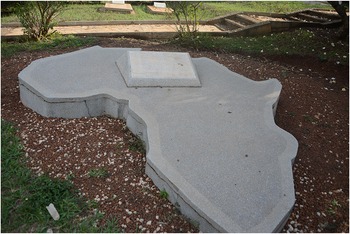
Olinga’s tombstone.

Olinga’s ability to mobilize emotion in his encounters is not unlike that of his African-descended counterparts elsewhere who employed charisma to lead movements seeking an antiracist world or to combat imperialist and colonial ambitions. These include Nigerian Uthman dan Fodio and various leaders of African-initiated churches in the early 1900s, such as Congolese Simon Kimbangu and Liberian William Wadé Harris, charismatic leaders who attracted large followings in their endeavors to Africanize religious outlooks and expand African political and religious authority.Footnote 53 As others pointed out, charisma is not an “individual quality”: it requires the followers to legitimize this quality or power in a leader.Footnote 54 Olinga’s structural position as a Big Man in his Iteso community helped him nurture his charisma and authority in ways that he could employ elsewhere to help him expand the Baha’i movement. His influential status resonated far beyond his local community due to his esteemed role as Hand of the Cause of God and his frequent travels on behalf of his religion. Olinga wielded his charisma on flights to North America and Central America, drives through South America, explorations in large cities, treks along the Andes mountains, voyages across the South Pacific Ocean, and meanderings between the vibrant islands.Footnote 55
“I Knew that He Was a Tribal Person and that I’m a Tribal Person”
Olinga’s feelings of affinity with Indigenous peoples were strong, and he visited numerous Indigenous communities from the 1950s to the 1970s, forging cultural unity and envisaging a global indigeneity. For instance, he took part in cultural rituals during his visit to Saskatchewan, Canada, in 1970.Footnote 56 In 1977, he addressed 1,300 people representing 17 Indigenous American groups at a Baha’i conference in Bahia, Brazil, about “the glorious future of the indigenous people in the Faith.” He singled out “the Bush Negro peoples of Surinam,” descendants of slavery’s escapees who are now known as the Saramaka.Footnote 57 While other Baha’i leaders also highlighted the importance of Indigenous communities in the religion, it seems that Olinga dreamed of connections with Indigenous peoples and communities long before he met them.Footnote 58 His daughter Grace shared that Olinga “had the Pacific in his heart,” explaining that “He felt close to the Māori people though he hadn’t met them…because they were the indigenous people of this country.”Footnote 59 Sources suggest his Iteso ethnicity thus facilitated the spread of the Baha’i movement well beyond the Iteso community, helping him bond with other Indigenous people worldwide.
It is also possible that the enduring legacy of the Indian Ocean slave trade in East Africa shaped how Olinga related to Indigenous and Afro-descendant people in the Americas, Asia, and the Pacific. Between the tenth and nineteenth centuries, Africans were captured and traded across the Indian Ocean to destinations such as the Middle East, Indian Ocean islands, and South Asia. Research shows that oral accounts of forced displacement of people along caravan trails in eastern Africa have been passed from generation to generation.Footnote 60 The lasting impact of the Indian Ocean slave trade still influences the relations of African descendants worldwide.Footnote 61 Olinga likely heard stories of the caravan slave trade in his youth, especially because, in the precolonial period, Iteso society participated in the caravan routes that carried people through the territory.Footnote 62 He is thus an example of someone who used this common heritage to connect with diverse Indigenous and Afro-descended communities globally; his travels created a “mirror” for other colonized or marginalized peoples, producing shared empathy that allowed them to feel seen and valued within the faith.
Olinga’s language skills, experiences with different African ethnic groups, and his commitment to the oneness of all people as well as indigeneity were all cemented by his role in the Baha’i Faith and his communication style. Cameroonian Baha’i Richard Ojong Ashu, of Keaka ethnicity and a “traditional herbal doctor” known for “ancient indigenous natural remedies,” underlined Olinga’s respect for Indigenous values in a 1984 Baha’i News report. The report noted that Western pioneers must understand that missionaries historically discouraged local African culture—medicine, music, dance—and that modern education, while valuable, is not inherently superior. Ashu observed that “this attitude of appreciation for traditional culture was an important factor in understanding Mr. Olinga’s outstanding teaching success.”Footnote 63 Olinga connected with Africans like Ashu and the Tanyis, by following local Cameroonian practices such as taking part in communal events like sharing meals. Although he did not explicitly say that Africans were Indigenous, he did see himself as “tribal,” showing that he thought of himself as part of a broader group with shared Indigenous traits. Firaydun Mithaq, an Iranian Baha’i who traveled with Olinga in Laos in 1971, said that meeting “Hmong hill tribal people” brought Olinga “greatest happiness,” attributing this to his own “Teso trib[al]” heritage, suggesting “that may be the reason as to why he was interested in seeing the other tribal believers.”Footnote 64 By embracing his Indigenous identity, Olinga emphasized a shared cultural heritage and a global sense of indigeneity, expanding the notion across different Indigenous groups, and centering Africa in his vision of universal interconnectedness.
Evidence suggests that emotive practices helped Olinga build communal bonds. He engaged with communal practices common to many African ethnic groups—shared meals, storytelling, gifting items (like an African shirt he gifted Dizzy Gillespie in Kenya in 1973), singing in his native languages, visiting sacred spaces, and participating in cultural rituals with Indigenous peoples, along with physical affection, such as embraces.Footnote 65 His Iteso heritage and religious beliefs shaped these practices. For example, during his nine-day visit to New Zealand in 1958, Olinga was excited to visit the marae, a sacred Maori assembly ground in Ngaruawahia, where he learned he was the first African to cross it.Footnote 66 He also met Maori leaders. Baháʼí News recounts “a tearful, and heart-moving scene” in which Olinga gifted a “recording of the Baháʼí Faith in the Maori language” to the Maori king. Upon his departure, the National Spiritual Assembly of the Baha’is of New Zealand reported that those who met Olinga had learned “the true meaning of love, humility, and devotion. They have learned of the power of positive thinking and have enjoyed laughter. But above all this, they have seen what it means to be a Baha’i.”Footnote 67 As Baháʼí News documented, emotive practices shaped Olinga’s efforts to foster community: by exhibiting a cheerful demeanor, he made Maori community members feel seen and part of a larger religious community. Additionally, by participating in Maori ritualistic collective activities, he visually modeled the ideal disposition of a Baha’i seeking unity and community among diverse Baha’i members. These practices had tangible effects. Moved by his encounter with Olinga, Ephraim Te Paa became the first Maori elder to adopt the faith, fostering its growth among the Maori.Footnote 68
After New Zealand, Olinga visited Samoa and again partook in local cultural ceremonies. Baháʼí News reported that thirty Baha’is came by bus to greet him, the First Hand of the Cause they had met, and the “first African brother.” He met them “lovingly,” and they “returned his love” by placing many leis “of beautiful fragrant blossoms” on his shoulders. Soon after Olinga “convey[ed] the love and greetings of the revered Hands of the Cause in the Holy Land [Haifa, Israel] and the friends in all the countries he had visited.”Footnote 69 Olinga used friendship to tie local people to a larger global community, one that was not dominantly white, stressing closeness that transcended racial boundaries.
The Baháʼí News article described Olinga being “made ceremoniously welcome in a fale (Samoan house), beautifully decorated for the occasion, by the chiefs of [three] villages, Baháʼí and non- Baháʼí.” It describes Samoan’s “speeches of welcome” and Olinga’s reply of a “short talk…on the unity of mankind and religion. This was followed by the king’s kava ceremony, which is the highest honor that can be offered in Samoan custom. Olinga was then presented with a kava root, and another was presented by the Baháʼís, to be taken to the Holy Land.” The report repeatedly references the warm welcome Olinga received from believers and nonbelievers, including a description of Samoan children gathering around a ceremony in his honor “as if drawn by a magnet.” The morning that he departed, “friends in the villages were gathered at the roadside along his route for one last farewell and the placing of the fragrant flowered leis upon his shoulders,” fostering physical affection. According to the report, “[t]he friends said it was as if the hearts were singing” and that Olinga’s visit had deepened their devotion to the Baha’i Faith.Footnote 70
Examining the collective emotional performances during Olinga’s encounters in South Pacific nations illustrates how he endeavored to make people feel more attached to the Baha’i Faith, inspiring converts like Te Paa and strengthening commitment by the faithful. I concur with Ilaria Scaglia, who conceptualizes emotions as more than “mere ‘imagined’ cultural constructs,” rather emphasizing “an ‘interactional’ approach to emotions” that underscores “the importance of social interactions in defining what people feel.”Footnote 71 Olinga’s time in New Zealand and Samoa show how people used cultural rituals and group farewells to show mutual love and affection for one another, such as participating in rituals and ceremonies to openly express their acceptance of one another. Olinga partook in such communication methods, suggesting a cultural affinity in interactions among nonwhite peoples. Baháʼí News described the collective emotional actions, cueing us to how varied actors felt in these encounters, such as claims of individuals in New Zealand learning and feeling the meaning of “love, humility, and devotion,” and how those in Samoa “returned his love” with leis.
Phil Lucas, a Native American who met Olinga in the late 1960s in the US, offers additional evidence that Indigenous individuals responded to Olinga’s attempts to foster connection through physical touch with fellow feeling. They recognized in him someone who valued, empathized with, and respected the longstanding religious beliefs of minority communities, and who communicated that respect through physical contact. “I knew that he was a tribal person and that I’m a tribal person and I knew that he would know things that could benefit me knowing…. I wanted a validation of our traditional religious beliefs that they were from the creator, that they were in truth.”Footnote 72 Lucas described Olinga entering something like a trance state and that the two men touched foreheads, standing together “for a long time.”Footnote 73 Lucas recollects as much about how Olinga behaved as he does about what he said. Olinga’s relationship with Lucas, therefore, appears to stem from a mutual appreciation for and respect of local cultural traditions. Olinga’s comprehension and acceptance of Iteso beliefs may have contributed to this bond by enabling him to relate to people who had a deep respect for their own cultural heritage. The trance and forehead touching helped Lucas form an intimate emotional bond that might not have been achievable through other means of connection.
The meeting between Lucas and Olinga also demonstrates that it was partly how Olinga made others feel that fostered rich emotional encounters. This echoes Florvil’s research, demonstrating that through their personal relationships with Lorde and others, Black German women formed an “affective community” that allowed them to express their emotions and have them valued.Footnote 74 Similarly, individuals like Olinga played crucial roles in nurturing emotional bonds among people of color globally. Specifically, he imbued feelings of belonging among a broader Baha’i community as he aimed to unite diverse people. The connections Olinga saw among Indigenous groups, rooted in common cultural heritage, facilitated his bond with them and their integration into the broader Baha’i movement.
The “Ancestors Have Come from Tanganyika in Africa”
As seen in his visits to New Zealand and Samoa in 1958, the Baha’i organization and its leaders frequently highlighted Olinga’s messages of amity and unity in formal interviews and in their publications such as Baháʼí News, particularly during his travels in the Americas and the South Pacific. For instance, Hooper Dunbar recollected in a 2013 interview that Olinga’s skin color, African identity, and enthusiasm brought him much attention. Dunbar, a white American and high-ranking Baha’i administrator, accompanied Olinga for three months during his travels in South America in the 1970s from cities to mountain vistas. Dunbar remembered Olinga’s amiable temperament that conveyed acceptance of local peoples and cultures, fostering unity and camaraderie. Upon arrival in Quinindé, Ecuador, a town composed of a mixed, Afro-Ecuadorian population, “[Olinga] was walking along the street and he was so happy… he was waving to people that are sitting on their porches, just gesturing like you would if you were a King,” Dunbar reminisced. “The people kept asking me, ‘Is he a King? Is he an African King? Who is he?’… by the time we walked maybe half a mile, [there were] 200 people with Mr. Olinga, walking down the street, having no idea who he is, but just so thrilled that he’s there.” By contrast, Dunbar said, humorously, “I go places, and nothing happens.”Footnote 75
Hooper’s portrayal of Olinga as exotic and novel fits into a common trend of Western Baha’is of presenting him in a romanticized way. White Baha’is like Dunbar tended to highlight Olinga’s race, suggesting how, for them, Olinga was a symbol of racial diversity and aligned with Baha’i goals of expansion. Baháʼí News meticulously documented Olinga’s and other racially diverse figures’ interactions with diverse Baha’i communities, suggesting a premeditated staging in these visits. As a Black man, Olinga’s prominent status within the Baha’i movement likely contributed to the religion’s goal of expanding membership among people of color who might better connect to him than with his white counterparts. Baha’i administrators likely saw Olinga as an embodiment of the religion’s mission of promoting diversity, including in positions of power. While many Baha’i administrators clearly respected Olinga, their praise of him was sometimes tinged with paternalism and perhaps a touch of envy, as he was able to bond with nonwhite communities in ways that were perhaps more challenging for them.
But Olinga was not simply a puppet of the Baha’i administration; he also facilitated his own distinct connections with the broader public by drawing on his ties with Africa and shared Blackness and indigeneity during his global tours. For example, Black American Baha’i Dalenhart Warren shared that when she attended Olinga’s 1970 talk in Florida, “what he said was to all the people who live close to the land and who are of color, be strong, be real, and keep up your hope.”Footnote 76 That Warren remembered these words decades later suggests that she felt a connection with Olinga and that his race could help Black people like her bond with him. Further, his talk underscored how his understanding of indigeneity focused on valuing ties to the land, both physically and spiritually. In doing so, he appeared to equate Blackness with an inherent indigeneity in the same way that he associated African identities with indigeneity. Thus, Olinga expanded the many points of connections that Black Americans such as Warren might have with him—through Black identity and indigeneity.
Olinga’s presence continued to stoke sentiments of racial unity and belonging during his Americas tour in the 1970s. Frank and Patricia Paccassi, white American Baha’i pioneers in the Caribbean, remembered that during Olinga’s visit to Barbados in August 1970, in “the night meeting, it was even more crowded than usual. The word had spread, a Black man is going to talk tonight!”Footnote 77 Similarly, Bahá’í News noted that many people of color welcomed Olinga upon his 1971 arrival to Guatemala, including an Afro-Guatemalan woman who “put her arm by his and her voice vibrating with emotion said, almost shouting, ‘Look, his skin is the same color as mine!’”Footnote 78 She communicated her emotional attachment through excitement and physical touch, comparing her skin color to Olinga’s, delighted and excited to see evident racial similarity. Diverse Black people, including her, discovered a way to foster a sense of racial pride, unity, and global Black belonging by interacting with individuals like Olinga, whose Blackness linked him to a larger Black community through the Baha’i Faith.
Throughout his travels in the Americas, Olinga maintained his autonomy by sometimes setting aside efforts to foster unity based on Blackness and instead leveraging his ties to Africa to strengthen relationships—for example, by educating Baha’is about Africa’s cultures and languages. In 1970s Baton Rouge, Louisiana, Olinga sang a song in Swahili, which he dedicated to the religion’s founder.Footnote 79 He explained that the selected song was just one of many Swahili songs sung in Kampala, accentuating his Ugandan and African roots rather than his Iteso ethnicity. Further, singing in Swahili allowed Olinga to express his personal connection to the Baha’i Faith in a native language, providing education about Africa’s significance within the religion and highlighting his own African identity. The racially diverse audience was given the song lyrics so to be able to sing along with Olinga, thus promoting a sense of togetherness and shared emotion. By collectively singing, they likely fostered harmony and association with their African brethren across the Atlantic Ocean through song.Footnote 80
Olinga’s identities continued to shape his racial politics during travels, reinforcing his emphasis on unity based on shared African heritage. During a 1970 visit to Porto Alegre, Brazil, for instance, he met local Black athletes and observed that most were “of African origin,” declaring— “We are all flowers of the same garden.”Footnote 81 Olinga therefore strived to invoke unity among global minorities by highlighting their shared racial and cultural backgrounds and broader notions of a politicized kinship that often centered on shared African heritage.
In Fiji, in 1971, Olinga continued to express sentiments of connections beyond Blackness, focusing on African belonging in his conversations with local people who believed their ancestors hailed from then Tanganyika (Tanzania). Olinga “assured them that in Africa the people knew this also, and he had come to convey their love and greetings and hoped that they would one day return to visit their homelands.” Leaders responded positively to his words, with a travel companion remembering that “in the shops and in the streets, people could not resist speaking to him… this distinguished, loving, friendly man from Africa, a member of the Baháʼí Faith.”Footnote 82 By creating these kinds of emotional connections, Fijians might feel like they were “returning” to the “ancestral homeland”—a larger African community—when joining the Baha’i Faith.
Olinga consequently helped stoke feelings of belonging within the Fijian community he encountered. Florvil’s work offers an analytical foundation for understanding the making of diasporic communities across networks and borders. The affective community that Black German women formed through their communications with Lorde was forged across great distances via letter-writing and shaped by the community they built from their diverse experiences of Blackness within Germany. Additionally, Lorde’s poetry fostered emotional expression, enabling them to relate their personal experiences to broader Black struggles against various forms of oppression, thereby emotionally empowering them to claim dignity within Afro-Diasporic German communities.Footnote 83 In recognizing the African ancestral heritage of Fijians, Olinga aimed to link them to a global African diasporic community as well as to Africa itself, with the Baha’i Faith promoting this emotional connection. As his visit to Fiji suggests, such associations could be deeply emotional, further tying people to the Baha’i movement.
Olinga’s visit to Fiji highlights the complexities of the African diaspora, both real and imagined. His transnational history complicates narratives about the diaspora and who is part of the African diaspora, a question Kim Butler observed in 2010 had arisen since “the [African] diaspora became increasingly understood as a historic subject.”Footnote 84 While archaeological evidence supports a longstanding oral tradition about the African origins of Fijians, assessments of the African diaspora often exclude them. In his work on Bermudian environmental activist Pauulu Kamarakafego’s engagement with Black Indigenous struggles for decolonization in Oceania, such as in Fiji, Quito Swan argued for the importance of the “emerging subfield of Black Pacifics [which] interrogates the black world’s engagement with Oceania, Asia, and the Pacific coast of the Americas.”Footnote 85 By insisting that Africans recognized Fijian connections with Africa, Olinga legitimized these historical associations within that broader Black Pacific framework.Footnote 86 He also drew on these links to help make Baha’i appealing to Indigenous peoples and those of African descent, using emotional practices to beseech a homecoming, a return to Africa. Fijians had gained independence from British rule a year prior to Olinga’s visit.Footnote 87 His visit, along with his emotional approach, helped make connections with Fijians by emphasizing their shared African heritage, contrasting to the relationships influenced by Western colonialism.
Olinga’s interactions in Fiji signal that he viewed Africa as the origin of the diaspora, using religion to create connections across borders and forge emotional ties to the continent. He encouraged his followers to reestablish bonds with Africa, whether in body or spirit. Bonding with these assorted communities helped him incorporate them into his vision of a more interconnected global African community with Africa at its core. Hence, the closeness that Olinga fostered through varied emotive actions helped people feel accepted. Olinga extended these theoretical connections to a more literal sense when he encouraged those he encountered to visit Africa, as he would personally do when his international travels decreased in the late 1970s, and he spent more time in his homeland of Uganda.
“A Man of Africa”
This article has spotlighted marginalized and invisible connections and stories, including new dynamics of Black internationalist experiences in the mid-twentieth century. Unpacking Olinga’s journeys shows how Black individuals positioned themselves as global leaders of racial harmony and human unity, engaging in Black internationalist thought in diverse ways, much like their African diasporic counterparts in the twentieth century.Footnote 88 Within the Baha’i movement, Olinga expressed ideas about striving for global harmony and racial unity, with Africa serving as the linchpin. His Iteso background inspired him to foster communal bonds and racial unity among people of color.Footnote 89 Specifically, he envisioned a global indigeneity, envisioning the lives and histories of persons of African descent and Indigenous peoples as being interconnected through Africa. Observing the role a nonwestern person played in promoting global indigeneity highlights that Olinga could bond with nonwhite cultures in ways that his white Baha’i counterparts could not. In other words, through his Iteso heritage and Black identity, which distanced him from associations with Western imperialism, Olinga connected with different cultures in more equitable ways.
By retracing Olinga’s footpaths globally, we can see how emotional performances shaped his racial politics and assisted his cultural connections with diverse minoritized communities. Through varied emotional practices, he sought to include such individuals in a broader African community. In doing so, he used the spiritual message of the Baha’i Faith to enable unity between nonwhite peoples, in turn shaping Baha’i perspectives about racial harmony globally. A contemporary poem in tribute to his life by a Black American Baha’i couple who met Olinga when pioneering in Uganda in the 1960s, terming him “A Man of Africa,” reminds us that his charisma facilitated global understandings of and connections to the continent. The couple calls Olinga “A bon vivant” who “exud[ed] love wherever he was” and “travelled to countries throughout the world.”Footnote 90 Indeed, Olinga’s magnetism and other emotional practices demonstrate that he promoted a positive image of Africa and its people and advocated for racial and cultural unity and humanity’s oneness.
Yet, the poem’s title, “A Man of Africa,” also symbolizes Enoch Olinga’s complex blend of African/Black identity. He embraced a more expansive vision of unity and indigeneity that cut across boundaries in addition to representing his own ethnic group as an Etesot. In the early 1950s, Olinga’s contribution to the Baha’i Faith brought spiritual development and a new degree of aspiration to the Baha’i world by uniting cultures and bridging connections with different African communities. In Uganda and Cameroon, he converted hundreds of Iteso people because of his ability to bind them to the Baha’i Cause and its teachings. This surge of African Baha’is was the turning point in the spread of the religion, emphasizing the interconnectedness of widely diverse cultures and religious belief systems in Africa.
Olinga tragically died shortly after returning to Kampala, Uganda, in the late 1970s. Uganda was in political turmoil as Idi Amin’s brutal rule collapsed—civil strife, economic ruin, and mutinies culminated in the Uganda-Tanzania War and Amin’s fall in April 1979. Throughout this period, Amin banned religious organizations like the Baptist Mission and the Baha’i Faith in 1977. Olinga capitalized on his paternal role among Baha’is to unite and give morale and reassurance to Kampala’s Baha’is. Despite his devotion to Baha’i principles and avoidance of partisan politics, Olinga sent a letter which he personally “delivered to the President’s office,” reminding Amin about the past of the Baha’i Faith and its reputation, but to no avail.Footnote 91
In Amin’s final year amid civil war and turmoil, his regime and other groups, targeted wealthy individuals from diverse backgrounds. Amin, for instance, had Anglican Archbishop Janani Luwum arrested in 1977; he died mysteriously soon after. Olinga—at that point a successful businessman and influential Baha’i figure—also became “a target for subversive elements.”Footnote 92 A 1986 biography described him as “a well-known, capable, prosperous business man, with relatives and friends in high positions.”Footnote 93 During Amin’s fall, Olinga and his family faced threats. In March 1979, one of his sons “was kidnapped by soldiers and disappeared for a week.”Footnote 94 In the same month, Olinga was in a car accident with soldiers who rammed his car off the road and “robbed [him] of a large amount of cash.”Footnote 95
After Amin’s ouster, Uganda remained chaotic. Alicia Decker notes that when Amin’s regime fell on April 11, 1979, “The looting of Kampala began.” She details, “throngs… took to the streets… grabbing virtually everything that they could seize.… the following morning, the looting was completely out of control,” as mobs ransacked homes, shops, and offices. Decker adds that Amin’s immediate predecessors were unable “to quell the violence and discontent ravaging the nation.”Footnote 96 In this setting, Olinga’s life ended tragically when armed soldiers arrived at his home on the evening of September and shot him, his wife, and three children dead.Footnote 97 The exact reasons for Olinga’s death are unclear, but his high profile as a Baha’i figure with political contacts and his wealth may have contributed to his premature death.
Yet, despite his untimely death, memories of Olinga’s warm smile and friendly nature and how he made them feel seen and valued lingered on in the contemporary recollections of many Baha’i and non-Baha’i who crossed paths with him during his global travels. Olinga’s legacy is perhaps best visually and symbolically represented by his tombstone at the Baha’i temple in Kampala. Grand and majestic, this stone is intricately carved in the shape of Africa, a fitting tribute to his love for the continent that, at the end of the day, Olinga, “A Man of Africa,” called home.
Acknowledgements
I wish to thank the JAH editors and the anonymous reviewers for their valuable comments and insights. I also thank Marissa J. Moorman, Emily Callaci, Benjamin N. Lawrance, James H. Sweet, Judith Van Allen, Ilaria Scaglia, Anthony A. Lee, and Holly Hanson for their helpful feedback on early drafts of this work. Finally, I am grateful to the participants of the 5th Rocky Mountain Workshop on African History for their detailed feedback on later drafts, particularly Leslie Hadfield, Daren Ray, and David Bresnahan.


 Open access

