

Introduction
In the last three decades, the gender and politics (GAP) literature has grown in size and become metaphysically and methodologically diverse (Childs and Krook Reference Childs and Krook2006; Kantola and Lombardo Reference Kantola and Lombardo2017; Krook and Squires Reference Krook and Squires2006; Stauffer and O’Brien Reference Stauffer and O’Brien2018; Tripp and Hughes Reference Tripp and Hughes2018). This diversity is evident in the feminist study of institutions, an approach known as feminist institutionalism (FI). The approach focuses on how formal rules, informal norms, and/or gendered discourses about appropriate behaviors and roles help to perpetuate gender inequalities. The success of FI approaches lies in their ability to accommodate the plurality of assumptions and approaches that characterize the GAP literature (Kenny Reference Kenny2014; Lowndes Reference Lowndes2020; Mackay, Kenny, and Chappell Reference Mackay, Kenny and Chappell2010). Consequently, the FI literature is teeming with various definitions of institutions (Bacchi and Rönnblom Reference Bacchi and Rönnblom2014; Driscoll and Krook Reference Driscoll and Krook2012; Grahn Reference Grahn2024; Kulawik Reference Kulawik2009; Mackay, Kenny, and Chappell Reference Mackay, Kenny and Chappell2010) and offers a multitude of research strategies.
Ethnography is often argued to be a promising tool for GAP and FI scholarship (Chappell and Waylen Reference Chappell and Waylen2013; Galea et al. Reference Galea, Powell, Loosemore and Chappell2020; Kenny Reference Kenny2014; Miller Reference Miller2021a; Smrek Reference Smrek2022a). Ethnography enables an in-depth study of institutions through sustained immersion in local contexts, allowing the researcher to capture myriad subtle expressions of institutional power, both discursive and behavioral (Chappell and Galea Reference Chappell, Galea and Waylen2017; Chappell and Waylen Reference Chappell and Waylen2013; Crewe Reference Crewe2014; Gains Reference Gains2011; Grahn Reference Grahn2024; Kenny Reference Kenny2014; Miller Reference Miller2021b). We argue that this immersive component, which comprises both direct observation of human behavior and study of ideas surrounding this behavior, is what particularly distinguishes ethnography from other methods of data generation and analysis (Geddes Reference Geddes2018; Geddes and Miller Reference Geddes and Miller2024). Immersion allows the ethnographer to conduct multiple rounds of data generation and theory building, enabling them to create nuanced models of institutions. It is important to highlight from the onset that immersion is not necessarily a time-consuming endeavor, as the literature is teeming with examples of how the process of immersion can be accelerated (Chappell and Galea Reference Chappell, Galea and Waylen2017; Grahn Reference Grahn2024; Günel and Watanabe Reference Günel and Watanabe2024).
Despite its promises, the methodological training for ethnography in political science departments has traditionally been, and remains, thin (Kubik Reference Kubik and Schatz2009; Wedeen Reference Wedeen2010). This is surprising, since ethnography is a resource-intensive methodologyFootnote 1 and should therefore be designed carefully. As two scholars who have used ethnography in FI research, we set out to showcase the many promises of ethnography for FI theory building. The goal is to demonstrate the adaptability of the ethnographic methodology for a broad range of questions FI scholars are interested in posing, regardless of metaphysical convictions. By doing this, we hope to encourage more feminist scholars to reach out for ethnography in their applied work and to contribute to its development.
The article is structured into five sections. First, we revisit the metaphysical and methodological diversity within FI, setting out theoretical premises to guide our arguments. Second, we define ethnography and outline its current relationship with FI inquiry. Third, we outline concrete practices along four components: theory building, data collection, analysis, and positionality, using realist and interpretivist versions of ethnography, respectively. We show nuances and overlaps and present a menu of best practices. Fourth, we draw on insights from our ethnographic research to illustrate our arguments with a partly fictional example. Finally, we conclude by revisiting the possibilities and outstanding pitfalls of ethnography for FI scholars, as we see them.
Reviewing Metaphysical Diversity at the Heart of FI
The FI perspective has been a site of theoretical achievements, integrating insights from earlier strands of new institutional theory, including sociological (Chappell Reference Chappell2006; Chappell and Waylen Reference Chappell and Waylen2013), rational choice (Bjarnegård and Zetterberg Reference Bjarnegård and Zetterberg2019; Smrek Reference Smrek2022b; Zetterberg Reference Zetterberg2008), historical (Kenny Reference Kenny2013; Waylen Reference Waylen2014), as well as discursive new institutionalism (NI) (Erikson Reference Erikson2017; Freidenvall Reference Freidenvall2021; Miller Reference Miller2021a). This naturally leads to the expansion of the perspective’s metaphysical (Bacchi and Rönnblom Reference Bacchi and Rönnblom2014; Grahn Reference Grahn2024; Kulawik Reference Kulawik2009; Mackay, Kenny, and Chappell Reference Mackay, Kenny and Chappell2010; Miller Reference Miller2021b) and methodological diversity.
FI scholars hold varied views on the definition of gendered institutions, the nature of their interplay with human agency, and the drivers of institutional change. While the metaphysical underpinnings of the different definitions of (gendered) institutions are not always spelled out, previous studies offer an overview of the existing plurality (Bacchi and Rönnblom Reference Bacchi and Rönnblom2014; Childs and Krook Reference Childs and Krook2006; Grahn Reference Grahn2024; Miller Reference Miller2021b; Tripp and Hughes Reference Tripp and Hughes2018). Two broad ontological positions are found in the existing FI literature: realism and constructivism. It should be highlighted that this categorization is far from absolute and conceals profound heterogeneities. However, we argue that an analysis of the key propositions in the existing FI texts combined with FI scholars’ own critiques of existing FI approaches justifies this crude division (Chappell and Waylen Reference Chappell and Waylen2013; Grahn Reference Grahn2024; Kulawik Reference Kulawik2009). We follow the same approach when categorizing a sample of FI inquiries in this article.
While only a few FI scholars explicitly identify as ontological realists, much of the existing FI literature is, at least implicitly, shaped by realist ontological assumptions (Bjarnegård and Zetterberg Reference Bjarnegård and Zetterberg2019; Franceschet and Piscopo Reference Franceschet and Piscopo2008; Gains and Lowndes Reference Gains and Lowndes2014; Smrek Reference Smrek2020, 2022a). This perspective views institutions — whether they manifest as formal rules, informal norms, socially shared conventions, or social stereotypes — as tangible entities that constrain and/or enable human practices (Driscoll and Krook Reference Driscoll and Krook2012; Gains and Lowndes Reference Gains and Lowndes2014; Grahn Reference Grahn2024). Because human accounts of institutions are often outdated or partial, and because human knowledge of institutions can vary significantly, FI researchers must find ways of adjudicating between competing accounts of institutions — formal and informal — in order to find the “real” ones (Grahn Reference Grahn2024; Lowndes Reference Lowndes2020).
There are different views about the nature of institutions within the constructivist perspective. Some posit that institutions are sedimented discourses that become so well-entrenched within a context that they are perceived as tangible constraints by social actors (Erikson Reference Erikson2017; Freidenvall Reference Freidenvall2021; Kulawik Reference Kulawik2009). Others see institutions as abstracted aggregations of meanings comprised of a plethora of dissenting voices (Miller Reference Miller2021a). Constructivist FI scholars will often study agential contestations over meaning and resources that underpin these struggles (Bacchi and Rönnblom Reference Bacchi and Rönnblom2014; Berthet and Kantola Reference Berthet and Kantola2021; Erikson Reference Erikson2017; Schmidt Reference Schmidt2008). Post-structuralist scholars, who share some ontological stances with constructivists, are often interested in mapping out marginalized voices that challenge the sedimented ones within a context (Miller Reference Miller2021b).
Reflecting this diversity, the FI literature incorporates a wide range of epistemological approaches, from positivism (Bjarnegård and Zetterberg Reference Bjarnegård and Zetterberg2019; Smrek Reference Smrek2022b; Verge and Claveria Reference Verge and Claveria2018; Zetterberg Reference Zetterberg2008), to different forms of relativism, including critical realism (Erikson Reference Erikson2017; Freidenvall Reference Freidenvall2021; Miller Reference Miller2021a; Smrek Reference Smrek2022a). However, a gap exists in explicitly bridging the diverse assumptions about gender and gendered institutions with methodologies favored by FI scholars. This article addresses this gap by demonstrating how the use of the ethnographic methodology might be used to shed light on a wide range of questions feminist scholars might be interested in asking.
We illustrate that the implementation of the ethnographic methodology will significantly vary depending on whether we view gendered institutions as real constraints independent of social actors, or as ideas with varying degrees of embeddedness. In a similar vein, we demonstrate that the application of the ethnographic methodology by scholars who believe in the possibility of empirically testing competing truth claims about gendered institutions are markedly different from those used by researchers aiming to delineate the subtle, localized and often affective contestations surrounding entrenched institutional truths.
We also note that as FI literature begins to incorporate core elements of intersectional analysis into empirical work, the metaphysical claims of both FI and various intersectional approaches should be integrated into ethnographic research designs. Due to the complexity of this undertaking, we are unable to provide intersectionality the focused attention it deserves in this article (for relevant insights, see Christoffersen and Siow Reference Christoffersen and Siow2024; Esposito and Evans-Winters Reference Esposito and Evans-Winters2022; Windsong Reference Windsong2018). In the next section, we examine the prevailing literature on ethnography from realist and interpretivist perspectives and review a sample of FI literature that employs the method.
Ethnography and Feminist Institutionalism
Regardless of their definition of institutions, FI scholars generally agree that uncovering the institutional sources of gender inequalities necessitates complex empirical approaches that capture multiple footprints of institutional power (Bjarnegård and Kenny Reference Bjarnegård and Kenny2016; Kenny Reference Kenny2014; Lowndes Reference Lowndes2020; Waylen Reference Waylen2017). To identify and categorize these footprints as comprehensibly as possible, a degree of immersion into the studied setting is desirable (Alina-Pisano Reference Alina-Pisano and Schatz2009; Chappell and Galea Reference Chappell, Galea and Waylen2017). It is therefore not surprising that ethnographyFootnote 2 — a methodology that emphasizes the merits of immersion — is promoted as one the effective approaches to generating knowledge about gendered institutions (Chappell and Waylen Reference Chappell and Waylen2013, 608; Kenny Reference Kenny2014).
Ethnography’s appeal lies in its promise to reveal local institutional worlds of actors (Alina-Pisano Reference Alina-Pisano and Schatz2009; Crewe Reference Crewe2014; Kubik Reference Kubik and Schatz2009; de Volo and Schatz Reference de Volo and Schatz2004; Wedeen Reference Wedeen2010). A key characteristic of ethnography is its immersive nature, where researchers engage with the context they study, either in person or remotely, to conduct their inquiry. Contrary to common beliefs, this process does not necessitate long, uninterrupted stays in the research setting (Chappell and Galea Reference Chappell, Galea and Waylen2017). Some ethnographies are conducted by scholars with intimate knowledge of the context they study (e.g., at-home ethnography (Gottwald, Sowa, and Staples Reference Gottwald, Sowa and Staples2018) or even autoethnography (Mackay Reference Mackay2021)). Other projects rely on researcher teams consisting of both insiders and outsiders (Chappell and Galea Reference Chappell, Galea and Waylen2017, 75), though the insider-outsider positionality is always a continuum. Furthermore, immersion into an alien context does not necessarily have to be time-consuming if it is nested within a broader cultural context that the researcher is familiar with (Smrek Reference Smrek2022a). However, it is important to note that the time immersion requires depends not only on the researcher’s positionality, but also on their approach to theory building. A purely inductive ethnographer may take longer than their colleagues, as they lack a well-specified theoretical framework to “guide” their inquiry (Wedeen Reference Wedeen2010).
Ethnographic immersion provides valuable opportunities for building trust and facilitates the study of various expressions of institutional power through direct observation and interaction with social actors. These expressions can be pieced together to develop theoretical models of institutions (Alina-Pisano Reference Alina-Pisano and Schatz2009; Chappell and Galea Reference Chappell, Galea and Waylen2017; Decoteau Reference Decoteau2017; Rees and Gatenby Reference Rees, Gatenby, Edwards, O’Mahoney and Vincent2014) or meanings (Wedeen Reference Wedeen2010) that gender social activities within the studied setting. Though being primarily associated with interpretivist approaches to social inquiry in the past few decades, the ethnographic methodology is used by a broad church of scholars with various inclinations (Jerolmack and Khan Reference Jerolmack and Khan2017; Kubik Reference Kubik and Schatz2009; Rees and Gatenby Reference Rees, Gatenby, Edwards, O’Mahoney and Vincent2014; Smrek Reference Smrek2022a).
To simplify things and streamline our argument, we distinguish between two major strands of ethnography as they are described in the literature: realist ethnography and ethnography rooted in anti-foundationalist and relativist principles (Alina-Pisano Reference Alina-Pisano and Schatz2009; Kubik Reference Kubik and Schatz2009; Wedeen Reference Wedeen2010). The former is used by (critical) realist scholars, who believe in the existence of a social reality that is, at least partly, independent of the observer, as a tool to source and adjudicate between competing explanations of this reality (Alina-Pisano Reference Alina-Pisano and Schatz2009; Decoteau Reference Decoteau2017; Rees and Gatenby Reference Rees, Gatenby, Edwards, O’Mahoney and Vincent2014). The latter is used by interpretivist scholars who are interested in rich, contextualized, competing constructions of reality, the power relations reinforced, and their effects. While both critical realist and interpretivist examples of ethnography can be found within the FI literature (Childs Reference Childs2025; Gains Reference Gains2011; Galea et al. Reference Galea, Powell, Loosemore and Chappell2020; Miller Reference Miller2021a, Reference Miller2023; Smrek Reference Smrek2022a), ethnographic FI inquiries are few and far between. In this section, we examine a small sample of ethnographic contributions to the FI literature. The goal is to highlight the diverse ways FI engages with ethnography, rather than to provide an exhaustive review of FI ethnographies.
As Gains (Reference Gains2011) notes, the choice to ground ethnography in an interpretivist metaphysical foundation is made, not given (Bevir and Blakely Reference Bevir and Blakely2018, 88). Indeed, ethnography has been used in both realist-oriented and interpretivist FI inquiries. Natalie Galea and colleagues employ ethnography to uncover gendered institutions in the Australian construction industry (Chappell and Galea Reference Chappell, Galea and Waylen2017; Galea et al. Reference Galea, Powell, Loosemore and Chappell2020). Galea et al. (Reference Galea, Powell, Loosemore and Chappell2020) encounter multiple gendered prescriptions and rules that shape the recruitment, retention, and career progression of women within this industry. Termed “rapid ethnography,” their approach zooms in on grimaces, gestures, or utterances through which informal gendered norms are enforced. These subtle actions are used as gateways into the institutional worlds of social actors who produce them. By asking local actors about these actions when they unfold, Galea’s team is able to rapidly construct and refine theories about gendered institutions that are at play in the studied arenas. By replicating the process in several similar arenas, the team boost the generalizability potential of their findings. Smrek (Reference Smrek2022a) employs ethnography to explain why gendered patterns of behavior emerge in political parties governed by seemingly gender-neutral formal rules. Smrek combines direct observations of legislator behavior with a large corpus of discursive material, including interviews and various written accounts of rules that he comes across at the research site. He then employs an abductive research design that allows him to rapidly test competing explanations of the observed gendered behaviors. Finally, Chappell (Reference Chappell, Wadds, Apoifis, Schmeidl and Spurway2020, 129) notes how she finds “an observation and shadowing approach very useful for identifying which rules are at work when, and how they coincide and collide to produce gendered outcomes.”
Turning to the more interpretivist-oriented ethnographic FI inquiries, Miller utilizes parliamentary ethnography to learn about deeply-entrenched ideas that are constitutive of gendered rules and performance of gender in the UK House of Commons (Reference Miller2021b), and gendered contestations over meanings within political groups in the European Parliament (Reference Miller, Ahrens, Elomäki and Kantola2022). In the UK House of Commons, Miller maps out the sedimented and contested meanings around concepts like career cycle, organizational citizenship, and public service that place gendered actors in different structural positions and shape gender inequalities in the parliamentary arena. In both cases, Miller utilizes an iterative inductive approach to create contextualized models of meanings that gender social interactions and behaviors in the parliamentary arena, relying on a large corpus of co-generated empirical material. Furthermore, in examining her role as a feminist academic and a feminist critical actor, Childs (Reference Childs2024) reflects on the persuasive strategies she employed to navigate conflicting perspectives on which reforms were deemed possible or permissible within the House of Commons. She describes how she continuously reframed her agenda for re-gendering the organization, highlighting ethnography’s potential not only as a tool for identifying gendered discourses, but also for driving institutional change.
Despite a recent increase in ethnographic investigations that employ the FI perspective, the methodology remains relatively uncommon in the FI literature, at least in the sense that FI scholars are explicit about having used the method. Furthermore, due to the diverse metaphysical underpinnings of FI, the empirical applications of the methodology vary considerably. For example, Chappell and Galea (Reference Chappell, Galea and Waylen2017) and Galea et al. (Reference Galea, Powell, Loosemore and Chappell2020) utilize ethnography as a tool for generating general theories about gendered institutions, whose validity is evaluated with the help of rapid empirical testing in new contexts (Alina-Pisano Reference Alina-Pisano and Schatz2009). Miller (Reference Miller2021a) identifies reflexive voices that question the “realness” of established institutional truths. We believe that this variety of uses demonstrates the vast potential of the ethnographic methodology as a tool to answering different questions about the institutional underpinnings of gendered practices. By showing how different approaches to ethnography can be used in different modes of FI inquiry, we hope to encourage FI scholars to use and engage with this adaptive method.
Two Ethnographic Approaches for Conducting FI Research
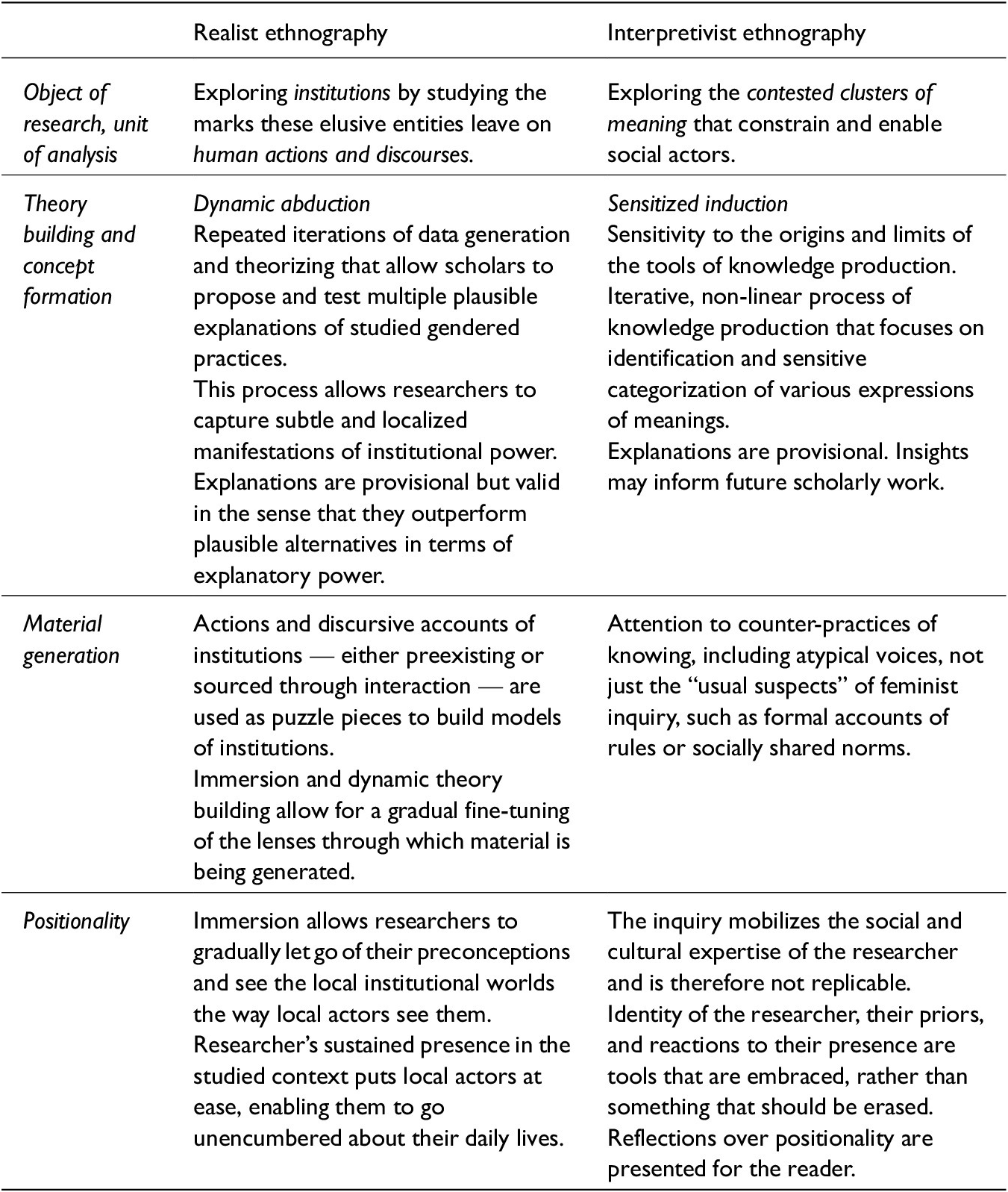
One of the main goals of this article is to demonstrate how differently minded FI scholars can go about using ethnography — and what questions and tasks they might ask of it. In this section, we present two different kinds of ethnography, each speaking to different metaphysical traditions of FI research. What the two ethnographies have in common is their reliance on immersion and (some form of) abduction (Alina-Pisano Reference Alina-Pisano and Schatz2009; Boswell et al. Reference Boswell, Corbett, Dommett, Jennings, Flinders, Rhodes and Wood2019; Decoteau Reference Decoteau2017; Kubik Reference Kubik and Schatz2009; Zilber Reference Zilber2020). However, while the realist ethnographer uses immersion and abduction to generate and test theoretical models of real institutions (Grahn Reference Grahn2024; Hoddy Reference Hoddy2019; Rees and Gatenby Reference Rees, Gatenby, Edwards, O’Mahoney and Vincent2014), its interpretive counterpart utilizes these approaches to map out and categorize the heterogeneous meanings and discursive tensions that constitute gendered practices (Miller Reference Miller2021b). Both approaches to the methodology are ideally placed to generate valid and contextualized knowledge about the sources of studied gendered practices, which can be used by feminist scholars to promote gender equality. We present our approaches along four dimensions: (1) the object and unit and analysis of inquiry; (2) relationship with theory building; (3) material generation; and (4) positionality. The central tenets of our argument are summarized in the summary table.
FI and ethnographic approaches
Realist Ethnography and FI: Nailing Down the Gender Bias
Realist ethnography is a methodology for FI scholars who see gendered institutions as real entities and strive to generate knowledge that accurately captures their essence and powers, while recognizing the role of social actors in reproducing and resisting these powers (Gains and Lowndes Reference Gains and Lowndes2014; Grahn Reference Grahn2024; Lowndes Reference Lowndes2020; Verge and Claveria Reference Verge and Claveria2018; Zetterberg Reference Zetterberg2008).
Building Models of Real Institutions
Scholars who adhere to a realist ontology tend to see institutions as real entities and thus, natural objects of analysis. While institutions are indeed real, they are characterized by a partially invisible, localized nature, and a propensity for both slow and sudden transformations (Archer Reference Archer2003; Archer and Elder-Vass Reference Archer and Elder-Vass2012; Decoteau Reference Decoteau2017; Fleetwood Reference Fleetwood2008; Grahn Reference Grahn2024). These features complicate the process of learning about institutions.
One of the significant challenges in researching institutions lies in their partly invisible nature (Decoteau Reference Decoteau2017; Fleetwood Reference Fleetwood2008). We cannot observe institutions themselves because they are outside of our sensory experience. What we can observe are the footprints of these entities within the empirical realm (Grahn Reference Grahn2024). Constitutions, laws, regulations, norms, and practices are few among many elements of social reality that contain glimpses of institutional powers that brought them into being. While it might be tempting to use these manifestations of institutional power as puzzle pieces to build models of real institutions, this process is not as straightforward as it might appear at first glance.
First, most social practices are governed by a range of institutions with different levels of generality. Some institutions transcend country borders, other are extremely context-specific. The partial context-specificity of institutions increases the risk that researchers attribute the studied practice to a wrong set of institutions. Second, institutions are prone to both sudden and incremental transformations as a result of human action (Waylen Reference Waylen2014). Researchers might struggle to identify whether they are capturing institutions or actors who challenge the existing institutional setup through their actions. Third, incomplete or outdated ideas about institutions can mislead scholars. Formal accounts of institutions might be outdated or merely a window-dressing (Bjarnegård and Zetterberg Reference Bjarnegård and Zetterberg2019). Human ideas about institutions that researchers are able to source might be colored by social desirability bias or insufficient knowledge (Smrek Reference Smrek2022a).
To capture real institutions, scholars must consult the various footprints these entities leave on human discourses and behaviors, while making sure that these footprints are not too distorted by external factors, such as scholars’ own conceptions of reality or social desirability bias. This invites a theory building process that allows scholars to gradually see social reality through the eyes of actors who inhabit this reality. Realist ethnography, with its emphasis on contextual immersion, is a particularly useful methodology for facilitating this process (Alina-Pisano Reference Alina-Pisano and Schatz2009; Decoteau Reference Decoteau2017; Rees and Gatenby Reference Rees, Gatenby, Edwards, O’Mahoney and Vincent2014; Sharpe Reference Sharpe2018).
Dynamic Abduction as a Tool of Theory Building
The process of generating valid and empirically corroborated models of real institutions is ideally abductive. Abduction facilitates an iterative process of crafting plausible accounts of the studied gendered practice and adjudicating between these explanations through the means of empirical testing (Danermark, Ekström, and Karlsson Reference Danermark, Ekström and Karlsson2019; Decoteau Reference Decoteau2017). This approach to institutionalist theory building has a number of benefits. First, the ability to generate empirical data in multiple iterations allows researchers to gradually fine-tune the conceptual lenses through which the material is being generated. By letting the conceptual lenses through which material is being generated evolve over time, scholars are well-positioned to capture manifestations of institutional power of which they had no prior conception. Second, abduction allows for repeated rounds of theorizing (Danermark, Ekström, and Karlsson Reference Danermark, Ekström and Karlsson2019; Decoteau Reference Decoteau2017). When the available empirical material is thin or rudimentary, several plausible explanations will be consistent with it. Abduction allows for several rounds of theory (re-)building — or retroduction, to be conducted, each round returning fewer and more nuanced theories of the studied phenomenon. This process is repeated until only a single explanation remains that outperforms the other plausible explanations in terms of explanatory power.
Realist ethnography allows feminist scholars to implement an abductive logic of inquiry in a particularly dynamic form. To generate the initial corpus of empirical material, a relevant conceptual framework is needed (Bjarnegård Reference Bjarnegård2018; Gains and Lowndes Reference Gains and Lowndes2014; Helmke and Levitsky Reference Helmke, Levitsky, Helmke and Levitsky2006; van Dijk Reference van Dijk2023). One of the common goals of FI-informed inquiries is to explain gendered practices that manifest themselves in contexts where formal accounts of institutions appear gender-neutral (Chappell and Galea Reference Chappell, Galea and Waylen2017; Mackay, Kenny, and Chappell Reference Mackay, Kenny and Chappell2010). An overview of these scripts, which are often readily available to researchers, provides an ideal initial lens for data generation, allowing them to rapidly identify gendered events that require explanation.
In the first round of theorizing, a number of tentative explanations, each consistent with the available material, are proposed by the researcher (Decoteau Reference Decoteau2017; Zachariadis, Scott, and Barrett Reference Zachariadis, Scott and Barrett2013). For instance, gendered speechmaking patterns in a parliament have multiple potential explanations, including party gatekeeping practices, disparities in available resources, gendered differences in competence or ambition, or a lack of an inclusive and respectful debating culture. All these explanations deserve careful consideration. More data — either of behavioral or discursive nature — is needed to allow the researcher to adjudicate between and refine these explanations. The tentative explanations serve as new analytical frames through which more empirical material is generated. This iterative process allows the researcher to gradually eliminate competing explanations, while fine-tuning the one explanation that most reliably accounts for the studied social practice. The process is repeated until new rounds of data generation no longer yield new analytical insights (Decoteau Reference Decoteau2017; Rees and Gatenby Reference Rees, Gatenby, Edwards, O’Mahoney and Vincent2014).
The knowledge generated through this process takes the form of a theoretical model that often includes multiple institutions with varying levels of idiosyncrasy. This model is considered valid because it outperforms plausible alternatives in accounting for the entire body of generated material. Due to the partly idiosyncratic nature of social causality, the model is unlikely to be fully applicable to other social contexts. Nevertheless, the ethnographer is well-positioned to identify which aspects of the model are context-specific and which ones might have broader applicability.
Material Generation
Institutional powers leave traces — or footprints — in our world, ranging from acts, practices, and rituals, to laws, directives, scripts, symbols, utterances, or other forms of agential discourse (Fleetwood Reference Fleetwood2008). Ethnographic immersion allows the researcher to recognize, correctly interpret, and explain various expressions of institutional power (Chappell and Galea Reference Chappell, Galea and Waylen2017; Pachirat Reference Pachirat2017). On the one hand, immersion enables direct observations of human actions within the studied social setting. The more trust the researcher garners from the observed actors, the more likely they are to engage in their daily activities undisturbed, and the more likely the researcher is to identify significant social events that need explaining (Alina-Pisano Reference Alina-Pisano and Schatz2009). Furthermore, the more immersed the researcher is in the studied context, the better are their preconditions for discovering previously unencountered manifestations of institutional power, such as informal rules in use (Lowndes Reference Lowndes2020). The researcher uses this new material to triangulate and refine their earlier interpretations (Chappell and Galea Reference Chappell, Galea and Waylen2017; Smrek Reference Smrek2022a). The researcher’s ability to place social actors in their respective structural roles and adjudicate between competing agential explanations of the same events/phenomena increases as a result.
Positionality
An important concern among critical realists is the potential impact of the researcher’s priors, biases, and presence on the quality of the generated data, and the knowledge inferred from it (Alina-Pisano Reference Alina-Pisano and Schatz2009; Pachirat Reference Pachirat2017). The ethnographic methodology exacerbates this concern due to its emphasis on on-site learning and conceptual adaptability. However, we argue that ethnography equips the researcher with effective tools for assessing and mitigating the influence of their priors and presence on the data quality. Firstly, the prolonged interaction with social actors who inhabit the studied settings provides numerous opportunities for trust building and repeated interactions (Alina-Pisano Reference Alina-Pisano and Schatz2009; Rees and Gatenby Reference Rees, Gatenby, Edwards, O’Mahoney and Vincent2014). Through this extended engagement, the ethnographer can compare the material generated at different points in time and evaluate the extent to which they have been able to counteract the biases associated with their presence in the research setting (Archer Reference Archer2003). This reflective process allows the researcher to actively address and mitigate the impact of their biases on the data (Alvesson Reference Alvesson2009). Secondly, ethnography demands that the researcher strives to perceive the studied context through the eyes of the social actors who inhabit it (Gottwald, Sowa, and Staples Reference Gottwald, Sowa and Staples2018). By adopting this perspective-taking approach, the researcher challenges their preconceived notions and assumptions. As they immerse themselves in the context, the researcher is likely to encounter institutions previously unknown to them. This discovery serves as compelling evidence of the researcher’s ability to set aside their priors and engage in a knowledge production process that aligns more closely with the perspectives of the social actors involved. Finally, a third strategy is to balance the composition of the research team before entering the field. For example, Chappell and Galea’s team (Reference Chappell, Galea and Waylen2017, 75) was comprised of both men and women “in recognition that as gendered actors ourselves, [their] involvement may impact on the field and our interpretation of data.” This made an important difference, as male researchers were exposed to conversations about sex and pornography, whilst these topics were not raised in conversations with female researchers.
Interpretivist Ethnography: Mapping out Gendering Meanings
Interpretivist ethnography, as a framework, can refer to methodological approaches used by scholars with varying onto-epistemological commitments, who are reflexive about how gender and institutions are constructed through discourse (Erikson Reference Erikson2017; Kantola and Lombardo Reference Kantola and Lombardo2017; Kulawik Reference Kulawik2009). Overall, but not exhaustively, FI scholars who opt for ethnographic approaches may lean towards varieties of (de)construction, post-deconstruction, and intersectional approaches to understanding gendered institutions.
Analyzing Institutions as Differentially Patterned Meanings
Meanings — far from being mere epiphenomena — are central to feminist institutional analysis (Krook and Mackay Reference Krook and Mackay2010, 191–92). Meaning is “the economy of signs and symbols in terms of which humans construct, inhabit, and experience their social lives” (Wedeen Reference Wedeen2009, 81–2).Footnote 3 As outlined in section two, meaning-centered FI scholars of different stripes conceptualize institutions as institutionalized discourses (Erikson, Reference Erikson2017), or as sedimented clusters of meanings (Miller Reference Miller2021a) that constitute gendered practices. Adopting this view allows FI scholars to consider not only the discursive content of rules, practices, and norms as the object of analysis, but also the (inter)subjective struggles and claims over them (Berthet and Kantola Reference Berthet and Kantola2021; Erikson Reference Erikson2017; Miller Reference Miller2021b), the “work” that discourses do, and their unintended consequences (Erikson Reference Erikson2017).
Meanings, their formal and informal locations, their underlying assumptions, and the conflicts between them are central to the focus of interpretivist-oriented FI scholars. FI researchers might, for instance, investigate the degree of institutionalization of a particular meaning. There is an analytical distinction between discourse analysis and institutional analysis (Kantola Reference Kantola2006, 38). Erikson (Reference Erikson2017, 41) outlines the threshold conditions for what constitutes an institution — when a frame, or cluster of meanings, begins to regulate actors’ behavior and impose sanctions. A frame is considered a formal institution if it is written or codified, and informal if it remains uncodified. Erikson (Reference Erikson2017, 42) also offers a four-step approach to operationalizing institutionalization.
A key challenge lies in analyzing institutions as both subjective and intersubjective entities. Erikson (Reference Erikson2017, 41) contends that micro-level subjective frames lack the intersubjective status of an institution. However, an FI scholar might also explore how gendered actors come to understand themselves, each other, and their agency (cf. Bacchi and Rönnblom Reference Bacchi and Rönnblom2014; Miller Reference Miller2021a). Although actors’ subjective frames may not achieve formal recognition, or be publicly articulated, they can still be widespread, meaningful, and influential.
The normative implications of FI inquiry and the tasks posed to ethnographic analysis are crucial. The aim may be to understand, deconstruct, or change institutions. However, calls to evaluate the plausibility, power, and consequences of different discourses are fraught with challenges. Additionally, the notion of institutional fragility can be unsettling for those impacted by these institutions daily. Once institutionalized clusters of ideas are identified, FI researchers can investigate the strategies available to actors for changing or resisting these ideas, or for promoting new ones (Erikson Reference Erikson2017, 34; Schwartz-Shea and Yanow Reference Schwartz-Shea and Yanow2012, 84–9). This is where ethnography’s strength in conducting intersectional analysis becomes especially significant (Montoya Reference Montoya, Disch and Hawkesworth2016, 380). An ethnographer is ideally placed to explore soft spots in discourses, or where they don’t gain traction.
Sensitized Induction as a Means of Highlighting Ambiguities
While a realist ethnographer tends to adopt a specific conceptual framework aiming for exactitude, their interpretivist counterpart is reflexive about the risk of making theoretical impositions on local meanings in the process of concept formation (Schwartz-Shea and Yanow Reference Schwartz-Shea and Yanow2012). Interpretivist FI need not shy away from abductive inquiry — essentially, an ongoing dialogue between theory and lived experience (Schwartz-Shea and Yanow Reference Schwartz-Shea and Yanow2012, 26–36; Wedeen Reference Wedeen2010). Abduction offers a way for researchers to refine the abstractions developed through ethnographic work. In fact, for pragmatic reasons, interpretivist ethnographers often enter research settings with preliminary conceptual frameworks that guide and focus their inquiries.
However, many interpretivists are highly cautious of reification, essentialism, and linguistic instrumentalism in concept formation, leading them to lean toward the inductive end of the deductive-inductive continuum. Immersing themselves in the setting, researchers develop resonant questions in collaboration with local informants, co-generating material that captures the variety of emic — or local — meanings constituting the phenomenon under investigation. As a result, an interpretivist FI researcher may be inclined to use participants’ own phrases as codes to reflect their lived experiences and perspectives. This analytical approach is often guided by the understanding that key categories in research — such as gender, race, or rules — vary across time and political contexts. While many systems of meaning are resilient, their relevance to actors cannot be assumed without question.
Epistemologically, induction is rarely undertaken with fresh eyes, but rather with the aid of provisional “sensitizing concepts” (Blumer Reference Blumer1954, 8) or “sensitive” concepts (Bevir and Blakely Reference Bevir and Blakely2018, 65). Blumer (Reference Blumer1954) distinguishes “definitive” concepts from “sensitizing concepts” — including “institution” within the latter — arguing that researchers who avoid definitive concepts do not lack scientific sophistication but aim to allow local meanings to emerge. From an FI perspective, fixed, objective expressions of gendered institutions risk constraining the researcher’s perspective. Institutions, according to Blumer (Reference Blumer1954, 9), are revealed through exposition, which necessitates careful ethnographic representation.
During the data generation process, the interpretivist ethnographer abstracts and synthesizes material into analytical constructs of meaning. While each meaning is ontologically distinct, there are often significant commonalities due to the intersubjective nature of meanings. The process of abstraction involves summarizing these commonalities while also adapting the constructs to reflect the ambiguities present in the material (Miller Reference Miller2021b). These theoretical constructs are not intended to lead one closer to an absolute “truth,” as this is neither feasible nor epistemologically possible (Schwartz-Shea and Yanow Reference Schwartz-Shea and Yanow2012). Instead, they serve as provisional analytical simplifications that enable the researcher to systematize the multitude of meanings shaping the phenomenon under investigation. This process must be approached with caution to avoid obscuring critical ambiguities and conflicts over meanings. Often, the researcher may find that meanings initially grouped into a single category are better represented by two distinct categories, making documentation of coding decisions essential. Similarly, the iterative process of co-generating data may help the researcher identify conflicts over meanings that were previously assumed to be consensual.
FI analysis benefits from the iterative process of meaning-making that ethnographic methodology facilitates. Constructivists can take advantage of repeated rounds of data generation to abstract dominant clusters of meanings, or “institutionalized meanings” (Erikson Reference Erikson2017; Freidenvall Reference Freidenvall2021). Studying silences, ambivalences, or what remains unproblematized can also be accomplished through secondary literature analysis (Erikson Reference Erikson2017, 40), or by engaging with marginalized voices within the institutional setting (Miller Reference Miller2021a). Highlighting ambiguities in interpretive data is crucial for several reasons. First, interpretivists, sensitive to critiques of essentialism, underscore the multiplicity of meanings. Second, ambiguities provide an epistemological break from accepted frameworks, which is significant for Foucauldian feminists, who acknowledge that all researchers operate within epistemes. Third, meanings are saturated with power and subject to contestation, negotiation, and domestication. Thus, meanings that resist domestication hold analytical value in exploring agency.
Material Generation
Whilst realists operate with more fixed forms of expression of institutions, the interpretivist ethnographer may seek to generate material on the qualitative enactments of institutions in a political setting. Sharing similarities with realism, interpretivists may explore patterns of rules, practices, and norms utterances, or other forms of agential discourse as bearers of meaning. Of interest are also symbolic systems of meaning, such vernacular language, visual images, and physical artifacts. Because “ethnography is one particularly good way of grasping a discourse’s observable effects” (Wedeen Reference Wedeen2009, 82), spending time in the setting can be advantageous to generating discursive data on the “work” performed by discourses and their unintended consequences.
Interpretivists recognize that the meanings underlying social practices are inherently context-specific and often so deeply ingrained that they function almost subconsciously (Erikson Reference Erikson2017; Freidenvall and Krook Reference Freidenvall, Krook, Krook and Mackay2011). These meanings can manifest in both patterned and fragmentary ways within the research setting. Methodologically, this implies that generating material involves varying degrees of direct participation. Ethnographic techniques, such as shadowing and interviews, are employed to access both – verbal material, such as personal narratives and spontaneous reflections — and non-verbal material, such as time use and dress. These procedures bring the researcher closer to individuals and their localized understandings of themselves, others, and the surrounding context (Wedeen Reference Wedeen2009, 86). The epistemic principle of saturation poses methodological challenges for interpretivist ethnographers, who often encounter new meanings in each narrative. The risk here is that the ethnographer becomes infinitely responsive to their data. As a result, the decision to cease data collection is frequently governed by the logistics of the project rather than the identification of all relevant meanings.
Positionality
Since ethnographic material is co-generated, meanings are subject to change as they are continuously (re)constructed through social interactions. When a researcher asks about an act or symbol familiar to the informant, the question itself may impose a new perspective on that act or symbol, influencing the informant’s interpretation and response. In turn, the researcher interprets the informant’s answer, creating a dynamic shaped by the initial question. As a result, the material generated cannot fully preserve the original meanings, but instead reflects a negotiated institutional reality between the researcher and their informants.
Interpretivists recognize the influence of their identity, preconceived notions, and values in the co-generation of empirical material, viewing this as an inevitable and often productive aspect of the epistemological process. Rather than adopting a detached “fly-on-the-wall” stance, shadowing from multiple positionalities and embodiments can offer epistemological advantages, such as uncovering the gendered micropolitics of a research setting (Mikkonen and Miller Reference Mikkonen and Miller2024). Brown (Reference Brown2012, 29) embraced her embodiment as a research tool, “willingly” allowing legislators “to map their stereotypes onto me in order to gain access to their world.” Reflexivity does not necessarily require the researcher to incorporate their personal “I” into the analysis, even if some feminist scholars do employ confessional accounts. There are various ways to practice reflexivity, such as disciplinary questioning (Wedeen Reference Wedeen2010, 264). In sum, interpretivist FI scholars using ethnography can engage with reflexivity around positionality in diverse and multifaceted ways.
Bringing the Approaches Together: A Worked Example
Having laid the groundwork for the two ethnographic approaches, we now draw on insights from our own ethnographic work to imagine how realist- and interpretivist-oriented FI scholars can leverage ethnography’s strengths to study gendered institutions. Our ethnographic studies have brought us to various parliamentary arenas, where we explored the institutional roots of gendered resource allocation that sustain inequalities among political actors (Miller Reference Miller2021a, Reference Miller2023; Smrek Reference Smrek2022a). Drawing on our experiences, we present a partially fictional example, loosely based on our findings, to illustrate our methodological arguments.
Access to media exposure, such as participation in television and radio debates, or presenting party policy proposals at press conferences, is one of the politically meriting resources that are distributed along gender lines (Kruikemeier, Gattermann, and Vliegenthart Reference Kruikemeier, Gattermann and Vliegenthart2018; Miller Reference Miller2021a, 150–1; Smrek Reference Smrek2022b). Ethnography is an excellent methodology for gaining a deeper understanding of the institutional origins of the gendered allocation of media exposure.
An ethnographer immerses themselves in contexts where ideas about media exposure are discussed, or where gatekeeping is practiced. They employ various tools to generate rich empirical material. For example, they leverage their preexisting knowledge of political parties to gain access to official party media strategies and analyses of media coverage (Smrek Reference Smrek2022a). They obtain reports that track developments in the number of communications (“comms”) managers, unofficial party records of access to media training, and internal guides for media interaction. Additionally, they conduct interviews and, when possible, shadow members of parliament (MPs) and comms managers, and “hang out” in environments where appraisals take place (Miller Reference Miller2021a).
A realist ethnographer does all this to capture the real institutions that underpin gendered allocation of media exposure. The challenge, however, is that this practice has many plausible institutional explanations (Grahn Reference Grahn2024). For example, actors guarding access to media training and exposure may have internalized social norms suggesting that politics is an arena unsuitable for women, or more context-specific norms that perceive men as more naturally suited to promoting key party issues (Smrek Reference Smrek2022a). Alternatively, gendered media exposure might be influenced in part by the greater availability of men MPs during evening hours, a result of persistent inequalities in child-rearing responsibilities. All these explanations are plausible, and it is up to a realist ethnographer to “nail down the bias” by constructing a theory that captures the specific institutional setup that gives rise to the practice under study as accurately as possible (Grahn Reference Grahn2024).
Thanks to dynamic abduction, a realist ethnographer can dynamically generate rich empirical material of both behavioral and discursive nature and use it for theory development and testing (Grahn Reference Grahn2024). They learn about the structural positions of local actors, which allows them to adjudicate between competing explanations of the same event. For example, seeing a woman MP failing to secure party support for an idea she wishes to promote in the media creates an opportunity to solicit valuable discursive material from those involved in the event. While the MP herself expresses self-doubt and inability to “package” her ideas in a way that the comms managers would find interesting, the managers mention the incompatibility between the MPs issue portfolio and the party’s main issue profiling (Smrek Reference Smrek2022a).
The comms managers have a clear mandate to promote those ideas that can further the party’s primary issue profiling. However, it is only the party’s men MPs who are entrusted issue portfolios that match this profiling. The party’s women MPs face an uphill battle, which they seldom can win. Dynamic abduction helps to show that the party leader’s internalized belief that women are not well-suited for key institutional portfolios leads to the unequal distribution of expert roles among MPs. This, in turn, results in men receiving more media exposure than women.
In this sense, the work of a realist ethnographer is similar to that of a detective. Just as a detective must consider multiple theories in the absence of direct evidence to solve a crime, a realist ethnographer explores various explanations for the social phenomena under investigation.
An interpretivist ethnographer seeks to capture how dominant ideas about media performance have a gendered constitution, interacting with discourses about gender and gender roles, how they are recognized by coalitions of actors, and eventually become institutionalized (Miller Reference Miller2021a, Reference Miller2021b).
The gendered composition of discourses is situated. Parliamentary researchers responsible for policy criticized a woman MP of color for a “car crash interview,” claiming she was “not on top of her figures,” thereby invoking norms of rapid recall competence. Despite her success in her policy area, the MP is perceived as incompetent. Meanwhile, party office workers criticize the MP for a lack of “message discipline,” appealing to norms of partisanship. A special adviser to the party praises a man MP for “demolishing the opposition” during a radio interview, invoking the norm of “scoring” political points. Mainstream journalists criticize another MP, a woman of color, for using terms like Islamophobia and racism in an interview, framing her as out of touch with “ordinary” public opinion. Across these groups, a common theme is the belief that broadcast media opportunities are a limited resource for the party, and that “good” media performance is non-negotiable.
The interpretivist ethnographer often encounters ambiguities (Miller Reference Miller2023). Some women, despite lacking corresponding policy successes, are promoted in traditional broadcast media, and celebrated as “good media performers.” Understanding the context is essential for exploring these nuances and distinguishing oppressive institutionalized truths from marginalized voices that contest them. While the ideas constituting an “institution” are many, they must be abstracted into a coherent concept. This process can be “painful,” as a realist scholar might see abstraction as a way to approach “the truth,” whereas an interpretivist ethnographer understands that categorizing similar meanings can obscure other “truths” (Miller Reference Miller2021b).
Arbitrating between different discourses is challenging, as each makes sense to the actors involved and guides their actions. One interpretivist ethnographer might seek to determine which discourse — whether about competence, message discipline, or alignment with “ordinary” public opinion — is the most dominant and influential. Another might conclude that being a “good media performer” is an unavoidable discourse. Regardless of who is elected as an MP, or who works for one, they will inevitably encounter this discourse, making it an “institution.” However, it is crucial to expose that this institution has a gendered and racialized constitution. It is shaped by masculinizing ideas about competence, winning, discipline, and partisanship, as well as racialized notions of alignment with an imagined “ordinary” public.
An interpretive ethnographer also investigates the impact of this discursive institution. Televised clips and memes circulate on social media and are shared among staffers, with noticeable effects. One MPs team observes a decline in the office’s once-confident atmosphere, whilst another MP has withdrawn from the public eye, as the abuse has begun to take a physical toll on them.
Positionality plays a crucial role in sensitized induction (Miller Reference Miller2023). An interpretivist ethnographer actively seeks feedback to support, challenge, or refine their assumptions. The material they gather is always provisional, shaped by their own preconceptions as well as the ideas of the actors they study, which are further influenced by their interactions with the ethnographer. For example, when men emphasize the importance of competence during lunch, they may assume the researcher, given their occupation, will be sympathetic to their views. Similarly, women MPs are often more open in sharing grievances about the masculinized construction of political competence when speaking with a female researcher. While a realist ethnographer might aim to eliminate this “noise” from the data, an interpretivist embraces the futility of such an effort.
In this way, the interpretivist ethnographer acts as a bricoleur, using whatever materials are available to build something new. Immersed in a complex and contingent setting, they offer provisional yet rich analyses. However, the strengths of a bricoleur can also be their weaknesses. They may find themselves “floundering in the concrete, trapped halfway between percepts and concepts, bound by historical contingencies and cultural constraints, full of human complexity” (Dumont Reference Dumont1985, 31).
Using Ethnography to Conduct FI Research: Promises and Pitfalls
A case has been presented in this article for ethnography as a valuable methodology for FI scholars interested in gendered institutions and their role in perpetuating gendered practices. However, like any other approach to understanding the social world, the ethnographic methodology has both strengths and limitations (Boswell et al. Reference Boswell, Corbett, Dommett, Jennings, Flinders, Rhodes and Wood2019; Geddes and Miller Reference Geddes and Miller2024; Kubik Reference Kubik and Schatz2009; Miller Reference Miller2023). These strengths and limitations differ through the type of ethnographic approach taken: insider/outsider/autoethnographic. In this final section, we will reflect on the promises and potential pitfalls of employing the ethnographic methodology in conjunction with FI inquiry.
Promises: A Multimodal and Highly Adaptive Methodology
One of the undeniable strengths of both realist and interpretivist ethnography lies in their multimodal nature. Within the broad umbrella of “ethnography,” there exists a multitude of procedures for material collection and evidence gathering. These include direct observation, shadowing, interviewing, generation of texts, and artifact collection.
For example, descriptive statistics can be employed to determine whether observed gendered actions constitute a broader behavioral pattern (Smrek Reference Smrek2022a). Shadowing can reveal crucial instances of norm enforcement or symbols that unveil subtle dynamics of exclusionary power (Chappell and Galea Reference Chappell, Galea and Waylen2017; Mikkonen and Miller Reference Mikkonen and Miller2024; Miller Reference Miller, Ahrens, Elomäki and Kantola2022). Shadowing can be especially insightful as it often enables more natural observations of human behavior — such as time use and mobility within elite research settings — even when security restrictions are in place (Smrek Reference Smrek2022a). Interviews can be conducted within a context of high trust, which the ethnographic methodology often fosters, allowing realist ethnographers to elicit more authentic accounts of local ideas (Smrek Reference Smrek2022a). Interpretivist ethnographers might use ethnographic interviews to explore contestations and uncover overlooked meanings. Additionally, qualitative content analysis (Chappell and Galea Reference Chappell, Galea and Waylen2017; Smrek Reference Smrek2022a), frame analysis (Erikson Reference Erikson2017), or discourse analysis (Miller Reference Miller2023) can establish the prevalence of specific narratives/frames and reveal the power relations that sustain them.
Another strength of ethnography lies in its adaptability. Although this article relies on two ideal types of ethnography to make a point, it is important to recognize that the ethnographic methodology is characterized by improvisation and serendipity (Kubik Reference Kubik and Schatz2009). Ethnography empowers researchers to respond flexibly and creatively to epistemological challenges encountered in the research setting. Rather than seeking standardization, this article should be seen as a set of guidelines enabling FI scholars with different metaphysical inclinations to navigate this adaptive method.
Due to its distinctive features, ethnography can effectively address numerous feminist inquiries of interest to feminist scholars. FI scholars, in particular, often aim to study gendered practices manifesting in various organizational settings, such as political parties (Evans and Kenny Reference Evans and Kenny2020), parliaments (Kantola and Waylen Reference Kantola and Waylen2024; Miller Reference Miller2021a; Smrek Reference Smrek2022a), ministries, public agencies, as well as power-laden social settings like schools, universities, social movements, NGOs, and non-political workplaces (Galea et al. Reference Galea, Powell, Loosemore and Chappell2020), among others. Ethnography is particularly suitable for making sense of gendered practices that deviate from the logic embodied in existing formal accounts of rules (Chappell and Waylen Reference Chappell and Waylen2013). The multi-procedural character of this methodology allows researchers to observe and analyze subtle yet potentially significant expressions of institutional power, such as a frown, a nod of agreement or disagreement, or even graffiti hidden on the underside of an office desk. This material provides unparalleled insights into the elusive institutional realms inhabited by social actors.
Pitfalls: Explanations and Understandings at Any Cost?
Ethnography can be demanding in terms of resources, especially if the outsider researcher plunges into a completely unfamiliar context and must learn about even the most fundamental rules that govern the context from scratch. In such cases, the practice of immersion may require sustained temporal engagement in the field (Alvesson Reference Alvesson2009; Bucerius Reference Bucerius2013; Schwartz-Shea and Yanow Reference Schwartz-Shea and Yanow2012). At best, this can mean sacrificing free time, comfort, and privacy. For example, Smrek (Reference Smrek2022a) joined after-work drinks, attended a Christmas market outing, and even participated in an auction of old party property to establish and maintain trusting relationships with the actors he shadowed. At worst, this not only incurs financial costs but can also be entirely inaccessible to certain groups of scholars, such as caregivers or researchers with disabilities (Schwartz-Shea and Yanow Reference Schwartz-Shea and Yanow2012, 118). As a result, initiatives like patchwork ethnography have emerged to highlight how ethnographers navigate fieldwork amidst intersecting professional and personal responsibilities (Günel and Watanabe Reference Günel and Watanabe2024).
The methodology also places demands on the researcher’s ability to discern subtle expressions of opposition in situations of apparent unanimity, which can be potentially costly. In outsider ethnographies, researchers unfamiliar with the language or cultural background of the studied setting may need to rely on interpreters and local facilitators to meet the methodology’s stringent requirements for immersion. While choosing a familiar context can mitigate some of these costs, it is important to acknowledge that feminist researchers may find this methodology simply too expensive to employ in many cases (see Hay Reference Hay2016 for a similar argument about process tracing).
Ethnography also requires the researcher to secure access to the setting they intend to study, which can present a significant challenge (Alvesson Reference Alvesson2009; Bucerius Reference Bucerius2013; Gottwald, Sowa, and Staples Reference Gottwald, Sowa and Staples2018). Power-laden social contexts often have high barriers to entry. In some instances, these barriers may be insurmountable due to security concerns, limited time or space, or other factors. Even when nominal access is granted, local actors may still refuse to cooperate with the researcher, particularly in settings where participants engage in socially inappropriate or illegal activities (Alina-Pisano Reference Alina-Pisano and Schatz2009). Offering free labor, such as working as an assistant to a member of parliament — as seen in the work of Smrek (Reference Smrek2022a) and Miller (Reference Miller2021b) — can be a productive way to gain access to certain political contexts. Interpretivist ethnographers may also value the practical knowledge gained through this political work. For realist ethnographers, the dual role of researcher and assistant may be seen as an asset, providing access that would otherwise be unavailable. However, this form of access also repositions the feminist researcher as an active participant rather than a passive observer (Bucerius Reference Bucerius2013). Additionally, offering free labor is not a feasible option for everyone.
The ethnographic methodology is associated with ethical challenges that should not be compromised for the sake of metaphysical completeness (Gains Reference Gains2011). As the researcher often becomes deeply entwined in the lives, fears, and aspirations of those being studied, there is an increased risk of harm and/or betrayal (Stacey Reference Stacey1988). Researchers may unintentionally ask questions or offer reflections that lead individuals to reevaluate their social roles and behaviors through a new, critical lens. These reflections can result in personal suffering, conflicts, or unintended yet lasting institutional changes. In feminist research, there is the added risk of reactivating or intensifying opposition to gender equality initiatives. Furthermore, documenting ethnographic inquiry can disproportionately expose informants to vulnerability compared to other research methods. Researchers must also navigate a growing set of ethical regulations, including finding ways to obtain and continually renew informed consent from informants without jeopardizing their ability to blend into the research setting. Managing potential dropouts of key informants during and after data generation is another crucial consideration. Adhering to ethical research norms is essential for safeguarding the well-being of participants and maintaining the legitimacy of the academic enterprise. Those choosing the ethnographic methodology must carefully assess and mitigate the potential impact their presence may have on the lives and well-being of the individuals whose institutional worlds are under scrutiny.
Conclusion
Ethnography is often touted as an ideal methodology for studying gendered institutions and their role in sustaining gendered social practices (Chappell and Waylen Reference Chappell and Waylen2013; Kenny Reference Kenny2014). Despite this call, there remains a relative scarcity of ethnographic FI approaches to studying gendered institutions. Those examples that exist differ significantly, reflecting the metaphysical diversity that underpins them and FI research, more broadly.
Instead of categorizing FI ethnographic research as “good” or “bad,” this article highlights the potential contributions of various ethnographic approaches to FI analysis by exploring contrasting perspectives. We hope this article fosters curiosity among FI scholars about the future development of FI and ethnography. Future development of FI ethnographic research could center more around the possibilities and constraints for intersectional analysis, building on work of feminist scholars who do not opt for a FI perspective (Brown Reference Brown2012), and using ethnography with feminist action research.
Feminist approaches to studying gender inequalities are complex, often encompassing multi-procedural approaches and multiple data sources (Bjarnegård Reference Bjarnegård2013; Freidenvall Reference Freidenvall2021; Gains and Lowndes Reference Gains and Lowndes2014; Kenny Reference Kenny2013, Reference Kenny2014). This article has demonstrated that the complexity of these approaches is often necessitated by the elusive nature of gendered institutions (Bacchi and Rönnblom Reference Bacchi and Rönnblom2014; Kenny Reference Kenny2014; Kulawik Reference Kulawik2009; Mackay, Kenny, and Chappell Reference Mackay, Kenny and Chappell2010). Whether seen as real entities or clusters of intersubjective meanings, the process of generating knowledge about gendered institutions — or institutions made gendered — requires an iterative approach which takes into account multiple empirical expressions of institutional power (Miller Reference Miller2021b; Rees and Gatenby Reference Rees, Gatenby, Edwards, O’Mahoney and Vincent2014). All this to maximize the likelihood that the knowledge produced by the feminist inquiry is valid and sufficiently contextualized.
The primary objective of the article is theory-building and methodological in nature. The two ethnographies, whose core components are summarized in the table above, are potent tools for revealing the sources of gender bias at the core of political organizations. The immersive component, in particular, allows researchers to identify multiple expressions of institutional power, including those that are context-specific. By forging relationships of trust with social actors who inhabit the studied arena, the researcher might be able to gradually let go of — or problematize — their preconceived notions and see the local expressions of institutional power in the same way the “locals” see them (Gains Reference Gains2011; Gottwald, Sowa, and Staples Reference Gottwald, Sowa and Staples2018). Furthermore, the researcher might be able to explore scripts, symbols, and materials that are unavailable to an outsider or a short-term visitor. The rich material generated with the help of immersion can be used to build and gradually refine theoretical models of real institutions or analytical categories of meanings that constitute the gendered phenomenon under investigation.
Ethnography, in other words, is a methodology — rather than a method — that allows feminist researchers to combine multiple suitable procedures of data generation and data analysis, including shadowing, participant observation, interviews, focus groups, life histories, archival work, as well as multiple analytical approaches to the analysis of content. While resource-intensive, we contend that ethnography is a methodology that edges closer toward producing holistic institutional analyses (cf. Wedeen Reference Wedeen2009). We hope that this article will assist feminist institutionalist scholars, regardless of their metaphysical leanings, in harnessing the full potential of the ethnographic method.
Acknowledgments
Michal Grahn gratefully acknowledges the generous support through the following grants from the Swedish Research Council: 2022-01716 and 2022-05227. Cherry M. Miller expresses gratitude for the generous support through the following grant from the Research Council of Finland: 1355313.
Author contribution
The authors are listed in alphabetical order and have contributed equally to the design and execution of this article.
Competing interest
The authors have no competing interests.


 Open access

