

Introduction
Migration flows between countries are well-documented. In particular, it is well-established that most international migrants leave home bound for rich nations. In major destination countries, the number of foreign-born migrants is growing, reaching 12.5% of the total population in the USA, 11.2% in Germany, 10.5% in France, and 8.2% in the UK (Grogger and Hanson, Reference Grogger and Hanson2011). Another well-established and striking feature of international labour flows is that highly educated individuals are more likely to move abroad (Docquier and Marfouk, Reference Docquier, Marfouk, O¨zden and Schiff2006). More generally, a vast literature has discussed the determinants of high-skilled migration coming from developing economies (Docquier and Rapoport, Reference Docquier, Rapoport, Bhagwati and Hanson2008). Although high-skilled migration between rich countries represents a minor share among international migration flows, it is no longer a phenomenon related solely to the migration patterns among developing countries but has become a rather common feature in the developed world (Chen et al., Reference Chen, Wong and Law2024). In France, for instance, according to the French Ministry of Foreign Affairs, ‘the total French population abroad is estimated to be around 2.5 million’.Footnote 1 However, French emigration has slowed down since the COVID-19 crisis, and figures from the French Museum of Immigration History highlight that such a trend has been continuously rising since the beginning of the 21st century.Footnote 2 Nonetheless, the driver of migration flows among rich OECD countries has not been discussed thus far. This is the aim of this paper. It will address why high-skilled workers emigrate from their country of origin, although the latter displays a high level of economic development. The decision to migrate depends on the migrant’s current situation in his home country and the knowledge he has about the conditions in the host countries. He knows with certainty his current situation, such as whether he is unemployed, how much his earnings are, what the quality of his professional environment is and its ability to provide a successful career, the quality of his housing, etc. However, he does not know with certainty what he could expect from the future if he stays in his country. On the contrary, he can find out about his potential lifestyle and career prospects in other countries and evaluate what he would gain by leaving. The certainty of the present and, reciprocally, the uncertainty of the future in his home country can explain why the push factors of emigration tend to play a prominent role. In developed countries, push factors relate to the fiscal environment, social status, income inequality (Roy, Reference Roy1951; Liebig and Sousa-Poza, Reference Liebig and Sousa-Poza2004; Stark, Reference Stark2006), the level of poverty, unemployment, job opportunities (Hoppe and Fujishiro, Reference Hoppe and Fujishiro2015; Baizán and González-Ferrer, 2016), relative poverty (Stark et al., Reference Stark, Micevska and Mycielski2009), corruption (Ariu and Squicciarini, Reference Ariu and Squicciarini2013), foreign direct investment (FDI) outflows (Gheasi et al., Reference Gheasi, Nijkamp and Rietveldn2013), and economic development (Cooray and Schneider, Reference Cooray and Schneider2016). Migrants leave because they are dissatisfied with their lives (Nikolova and Graham, Reference Nikolova and Graham2015) and do not get the social status they feel they deserve in their home country. They fail to realize their career goals. Frustration and dissatisfaction often push them to leave. Growing social and economic inequalities and, consequently, unfulfilled life aspirations trigger the migration intentions of millions of people around the world (Esipova et al., Reference Esipova, Pugliese and Ray2018). Whereas push factors focus on dissatisfaction with one’s life, pull factors deal with the desire for improvement and better opportunities. Both at the national and individual levels, there is the attraction of high salaries (Grogger and Hanson, Reference Grogger and Hanson2011), better living conditions (Curran and Rivero-Fuentes, Reference Curran and Rivero-Fuentes2003), the existence of a large diaspora (Beine et al., Reference Beine, Docquier and Özden2011), the distance to the home country, and networks (Massey and Basem, Reference Massey and Basem1992).
This paper aims to posit the idea that one of the reasons for the decision to migrate from a wealthy country depends on the nature of income inequalities that prevails in the country of origin. Our reasoning is grounded on two strands of the literature that have identified the important drivers of emigration, namely, the level of income inequality in the home country and the low quality of institutions. First, there exists a strand of literature that tends to support a positive relationship between income inequality at home and workers’ emigration. In these studies, the feeling of relative deprivation is the main driver of migration. Not only is a person’s own absolute income relevant in the decision to migrate, but what matters is the relative income to others (Leibig and Sousa-Poza, Reference Liebig and Sousa-Poza2004; Stark, Reference Stark2006). Workers migrate to improve their relative position with respect to others in their ‘reference group’. However, this literature has produced mixed results. Second, the factors of dissatisfaction decrease with economic freedom. This could serve to explain why migration is lower in countries exhibiting strong economic freedom. In the US (Ashby, Reference Ashby2007) and OECD countries (Ashby, Reference Ashby2010), individuals migrate to regions where economic freedoms are relatively well-established and much better enforced. In the same view, a low level of institutions’ quality incentivizes high-skilled workers to leave their country of origin (Meierrieks and Renner, Reference Meierrieks and Renner2017).
Bringing attention to the role played by the nature of income inequality when studying high-skilled worker emigration is a natural consequence of the two strands of literature’s results, as discussed above. In a rent-seeking society (Tullock, Reference Tullock1967; Krueger, Reference Krueger1974), the wealthy are those who have access to rent. On the other hand, those deprived of such rent and privilege have incentives to leave. Rent can be defined as a windfall gain obtained by influencing the decision of others, rather than through productive activities, through a free-market process (Hillman, Reference Hillman2009, p. 84). Free-market principles put everyone in a state of rivalry. Each person’s income is continually threatened by the services offered by others. On the contrary, in a society where one can become wealthier through redistribution or market protection, one can live as a parasite. Control of State power provides the opportunity to live as a parasite. The rule of law is, under these conditions, an instrument used to create a domain that not even the State is allowed to trespass. Therefore, personal enrichment is driven by the institutional context. The latter contributes either to protecting the profits of producers or to allowing everyone to live at the expense of others. In other words, institutions, as the rules of the social game, direct individuals towards rent-seeking activities or towards profit-seeking activities. Hence, in a society where free-market institutions are well-defined and respected, income inequality is the natural consequence of the competition process among entrepreneurial projects. Indeed, this inequality serves to demonstrate the rewards of risk-taking behaviours and works as an incentive for productive profit-seeking activities. According to Mueller (Reference Mueller2013), ‘inequality is an inevitable product of capitalist activity, and expanding equality of opportunity only increases it—because some individuals and communities are simply better able than others to exploit the opportunities for development and advancement that capitalism affords’ (Mueller, Reference Mueller2013, p. 30). This inequality is a signal that institutions secure the unequal income distribution of each member of the society engaged in productive profit-seeking activities (Lippman et al., Reference Lippman, Davis and Aldrich2005). In such an institutional framework, inequalities are intrinsically productive. Free-market institutions would promote what we call ‘productive inequalities’. By contrast, rent-seeking societies hosting the phenomenon of rent capture generate unproductive inequalities. As a result, we argue that, under these conditions, the institutional design of a given country determines the nature of income inequality and, ultimately, the reasons that push workers to leave or stay in their country of origin. If income inequalities at home constitute a push factor for high-skilled workers’ decisions to emigrate, it is not because of the existence of income inequalities in absolute terms, nor is it because of the relative value of their income to that of their reference groups. Rather, it is due to the existence of unproductive inequalities in the country in which they live. On the contrary, the prevalence of productive inequalities at home incentivizes the highly skilled to stay in their country.
To test our hypothesis, we first rely on a conditional variable to capture the nature of income inequalities. Since there are no indicators that directly measure the share of inequalities resulting from rent-seeking and those driven by profit-seeking, we construct an indicator called institutions’ productivity (IP) (Facchini et al., Reference Facchini, Jaeck and Kratou2024). The latter assesses the predominance of institutions that fuel profit-seeking behaviours over those incentivizing rent-seeking behaviours. Hence, when income inequalities are conditioned by highly productive institutions, income inequalities are predominantly productive. Symmetrically, unproductive inequalities occur in the context of unproductive institutions where rent-seeking behaviours dominate. Second, our empirical analysis is based on panel data covering 30 OECD countries for the period from 1990 to 2010. In so doing, we explore two distinct econometric techniques. First, we use the ordinary least squares (OLS), and second, we use the system-GMM (Generalized Method of Moments) estimation to tackle the endogeneity issue. The measurement error related to our dependent variable and the reverse causality are the two main reasons for the existence of endogeneity in the context of this study. Our results show that when income inequalities are conditioned by institutional quality, they are negatively associated with high-skilled migration. Such a relation highlights the nature of inequalities and their effect on high-skilled migration. The prevalence of profit-seeking-oriented institutions over rent-seeking institutions generates a dominance of productive inequalities over unproductive ones. In other words, there is a negative relationship between productive inequalities in the country of origin and high-skilled migration. Conversely, our analysis suggests that when institutional quality deteriorates (i.e. when rent-seeking institutions dominate the institutional landscape), unproductive inequalities prevail, fuelling high-skilled migration. Thus, high-income OECD countries exhibiting the characteristics of egalitarian rent-seeking societies favour the emigration of their highly skilled population. Several robustness checks confirm our findings.
The article is organized as follows. The Literature review section reviews the literature and discusses the theoretical channel of our analysis. The Data description section describes the data used in our empirical model as well as our variables. The Estimation methodology section presents the estimation methodology. The Empirical results section discusses the main empirical results in line with our theoretical development. The Conclusion section provides concluding remarks.
Literature review
Several explanations have been proposed to account for migrants’ decisions. The uneven distribution of wealth, well-being, resources, and opportunities between and within countries has long been touted as a driver of international migration, with much research dedicated to understanding this relationship (Carling, Reference Carling2024). Although the effect of income inequality has been widely analysed (among the many other push factors of emigration), the impact of the intrinsic nature of income inequality when the latter is conditioned by the quality of home institutions has not been considered thus far. And yet, accounting for the conceptual relation between the quality of institutions at home and the nature of income inequality provides insightful theoretical developments to address the drivers of emigration. In this section, we first review the literature on the impact of income inequalities at home and emigration (see the ‘Inequalities in the home country and emigration’ section), followed by a brief discussion of the seminal contributions on the relationship between the quality of formal institutions and emigration (see the ‘Quality of institutions and emigration’ section). Based upon these discussions, we introduce our hypothesis, namely, that high-skilled emigration is determined by the nature of income inequality at home rather than its absolute level (see the ‘Nature of inequalities and high-skilled emigration’ section).
Inequalities in the home country and emigration
Growing social and economic inequalities have triggered the migration intentions of millions of people around the world (Esipova et al., Reference Esipova, Pugliese and Ray2018). Mihi-Ramírez et al. (Reference Mihi-Ramírez, Kumpikaitė-Valiūnienė and Cuenca-García2017) find a positive effect of income inequality in the home country on net migration among the rich countries of the EU 28, but no effect whatsoever among the poor countries of the EU 28. Unsurprisingly, the literature discussing the effect of income inequality in the home country and emigration represents a significant segment of the literature on the push factors of emigration.Footnote 3 Originally, the new economics of labour migration have argued that feelings of relative deprivation are a major driver of migration, acknowledging that not only is a person’s own (absolute) income relevant in the decision to migrate, but so is the relative income of others (Stark and Taylor, Reference Stark and Taylor1991). This implies that people may migrate not only to increase their income in absolute terms but, more generally, to improve their relative position with respect to others in their ‘reference group’. Consequently, it has been argued that migration propensities are positively associated with inequality in the origin societies. Then, relative deprivation in sending communities increases emigration tendencies (Stark and Taylor, Reference Stark and Taylor1991; Flippen, Reference Flippen2013; Hyll and Schneider, Reference Hyll and Schneider2014; Kafle et al., Reference Kafle, Benefica and Winters2020). For instance, based on individual migration data, Hyll and Schneider (Reference Hyll and Schneider2014) show a positive association between relative deprivation and migration between East and West Germany after the fall of the Berlin Wall. Similarly, in the context of sub-Saharan Africa, Kafle et al. (Reference Kafle, Benefica and Winters2020) confirms the relative deprivation hypothesis. Indeed, this literature suggests that countries that experience a higher level of inequality or relative deprivation are more likely to experience significant emigration flows. In line with these contributions, Leibig and Sousa-Poza (Reference Liebig and Sousa-Poza2004) have evidenced a positive relation between high income inequality at home and high-skilled workers’ intentions to migrate abroad. Interestingly, this result would suggest that high income inequality would not restrict economic opportunities per se but rather high-skilled workers’ abilities to fully realize their career goals, thus creating the intention to migrate.
Nonetheless, there are several studies that do not observe a significant positive relation between income inequalities at home and emigration. Agbola and Acupan (Reference Agbola and Acupan2010) have investigated the impact of economic, demographic, and political factors on the size of emigration from the Philippines and do not find evidence that income inequality affects the migration decisions of its population. Based on average data from the 1990s for a large set of developed and developing countries, Czaika (Reference Czaika2013) distinguishes two types of relative deprivation that are the result of either intra-group or inter-group comparisons. Personal relative deprivation refers to one’s own position in relation to other members within the same social group. On the other hand, collective relative deprivation relates to the status of people’s own ethnic group compared to other ethnic groups in a society. Hence, within-group and between-group inequality creates feelings of relative deprivation and, as a consequence, discontent and frustration, but also aspirations for individual or collective change. He argues that emigration (i.e. the exit option) is a consequence of personal relative deprivation, whereas people who feel strongly about collective relative deprivation are likely to choose non-migration (i.e. voice). He shows that people of all skill levels (and thus, potentially all income levels) emigrate more from countries with relatively high vertical intra-group inequality. This type of inequality is supposed to generate aspirations for personal change and advancement, for which migration is a viable option. On the other hand, people migrate less from countries with relatively high horizontal inter-group inequality.
Quality of institutions and emigration
It is widely accepted that free countries are more attractive than unfree countries (Ashby, 2007; Reference Ashby2010; Cooray and Schneider, Reference Cooray and Schneider2016; Meierrieks and Renner, Reference Meierrieks and Renner2017; Aziz et al., Reference Aziz, Chowdhury and Cooray2022; Powell et al., Reference Powell and Cardoso2025).Footnote 4 Aziz et al. (Reference Aziz, Chowdhury and Cooray2022) capture the effects of institutions’ quality in the context of bilateral migration among OECD countries over the period from 1996 to 2016. They conclude that the quality of institutions has a significant effect on the volume of bilateral migration among OECD countries. Contrary to Ashby (Reference Ashby2007, Reference Ashby2010), they find that political institutions have a larger effect than economic institutions.
Cooray and Schneider (Reference Cooray and Schneider2016) examine the relationship between corruption and emigration. Their data cover information for 20 OECD destination countries by country of origin for the years ranging from 1980 to 2010 in five-year intervals. Their results suggest that as corruption increases, the emigration rate of high-skilled migrants also increases. Meierrieks and Renner (Reference Meierrieks and Renner2017) use panel data for migration from 91 developing and emerging (non-OECD) countries to the 20 most attractive (OECD) destination countries for the 1980–2010 period. Similar to Cooray and Schneider (Reference Cooray and Schneider2016), they find that a lack of economic freedom is an important driver of migration. However, their results are only relevant for high-skilled workers, and it is of particular significance to those dimensions of economic freedom safeguarding economic security (e.g., secure property rights). The highly skilled are more responsive to the incentives that economic freedom entails compared to low-skilled workers. Their results suggest that countries that protect the expected benefits of investment in education and human capital incentivize young talents to stay in the country of origin. Recently, using machine learning techniques and analysing data from 130 countries, Qiang et al. (Reference Qiang, Lian and Zhang2023) find that corruption is the primary driver of high-skilled emigration, supporting Cooray and Schneider’s (Reference Cooray and Schneider2016) findings. Interestingly, related literature has provided insightful results on the relation between income inequality, social mobility, and economic freedom. A free-market society has a positive effect on social mobility through the channel of economic growth. On the other hand, income inequality has a negative effect on social mobility, but economic freedom has a stronger positive effect. Hence, although liberal societies are more unequal, they are perhaps more favourable to social mobility in the longer term than rent-seeking ones (Callais and Geloso, Reference Callais and Geloso2023). Free-market societies offer more potential for social mobility (Dean and Geloso, Reference Dean and Geloso2022; Callais and Geloso, Reference Callais and Geloso2023) and higher absolute income. However, they are slightly more unequal (Callais and Young, Reference Callais and Young2023).
Nature of inequalities and high-skilled emigration
The discussion of these two lines of research fuels two important reflections. First, if the literature on the effects of income inequalities at home has produced mixed results, it is perhaps because it has focused on the level of income inequality and has neglected the nature of these inequalities (Facchini, Reference Facchini2007; Geloso et al., Reference Geloso and Horwitz2017; Facchini et al., Reference Facchini, Jaeck and Kratou2024). Indeed, it is impossible to compare inequalities in a feudal regime where the lord enriches himself through taxes and inequalities in a capitalist regime where property rights are well enforced, and everyone consumes according to their income. Similarly, it is impossible to compare inequalities in an economic regime where the government distributes rights to housing, health, education, and justice without productive compensation. The individual can access a high level of consumption without productive effort. The extreme case would be a society where 90% of the population obtains its rights from 10% of the population. The granted rights are no longer associated with the productive activity of each member of society. Hence, the productive versus unproductive nature of inequalities depends on the characteristics of the institutions that govern the allocation of resources. A rent economy is an economy that distributes rights without productive compensation. On the contrary, a free-market economy has its roots in the Say law: An individual cannot produce more than the market value driven by his own production activity. His consumption level depends on his ability to satisfy his fellow members of society through market exchange. As a result, one can easily approach the nature of income inequalities by analysing the characteristics and the quality of institutions of a given country. An institutional framework that protects and enforces private property rights, as well as the returns on a privately owned business, is a framework that generates productive inequalities. Inequalities are the ‘by-product of capitalism’ (Mueller, Reference Mueller2013) and the effects of an entrepreneur’s productive activity. The opposite is also true. When the institutional setting generalizes the allocation of rights that are not backed by productive activities, a rent-seeking society emerges. In such a society, the well-being and the social status of wealthy citizens are dependent on the power they hold over the income of others (Epstein et al., Reference Epstein, Hillman and Ursprung1999). Thus, the intrinsic nature of income inequality is directly conditioned by the quality of institutions. Second, the above statement implies that despite the prominent role played by the quality of institutions to explain high-skilled emigration (exit), the conceptual relation between the quality of institutions at home and the nature of income inequality needs to be considered. A rent-seeking society fuels what could be described as unproductive inequalities since they result from a transfer of wealth already being produced and/or from regulations that protect the rent-seeker from market competition. On the other hand, well-established institutions of a free-market economy such as the protection of property rights and the rule of law would give rise to productive inequalities. It follows that a highly skilled worker would favour living in a country that secures the return on his investment in human capital. Such a preference for countries with high-quality institutions is more prominent for high-skilled workers than for low-skilled workers since the latter have much lower expectations on their financial return to skills. Hence, when income inequalities are intrinsically productive in the home country, high-skilled workers would have incentives to stay in the country of origin.
On the other hand, in rent-seeking societies characterized by a prevalence of unproductive inequalities, high-skilled emigration can be explained by mainly four reasons: (1) the number of opportunities driven by rents is low, (2) the probability of becoming a successful rent-seeker is low, (3) potential rent earnings are lower than in a free-market economy, and (4) the feeling of dissatisfaction and injustice associated with the inability to capture a high share of the rent is elevated. First, high-skilled workers migrate because rent-seeking societies create a world where economic opportunities are finite and driven by rents. In a rent-seeking economy, market entry is blocked and is conditioned by government approval. The government has the power to block outsiders, thus protecting the rents of insiders (Chaudhry and Garner, Reference Chaudhry and Garner2007). A rent-seeking society offers fewer economic opportunities in absolute terms compared to what a pure free-market economy could offer. Hence, rent rationing generates a sentiment of frustration that fuels emigration. Second, the rising number of high-skilled workers with career expectations creates a mismatch between the supply of rent and the demand for rent, leading to a rising rent price. The price of rent is lower for insiders (the existing rent-seekers) than it is for outsiders. Indeed, rent-seeking involves navigating complex institutional frameworks, including legal and regulatory systems. Outsiders may lack the necessary knowledge or social capital to overcome political entry barriers (Facchini, Reference Facchini2024). On the other hand, insiders have typically well-established networks and relationships within the political and bureaucratic system, which provide them with preferential access to information and rent-seeking opportunities. Outsiders, lacking these connections, face higher barriers to entry. Bribes, lobbying efforts, and other political investments may be too prohibitive for them. Hence, they rationally refuse to invest in political behaviour and prefer the exit solution. Finally, insiders have developed trust and reciprocity among various political actors. By contrast, outsiders may struggle to build such necessary trust. As a result, facing a low probability of grabbing a portion of the available rent, the high-skilled workers among the outsiders tend to migrate abroad. Third, high-skilled workers tend to migrate because potential earnings driven by rent-seeking activities are lower than those driven by profit-seeking activities. Indeed, rent-seeking economies are far less prosperous than free-market economies since rent-seeking activities are negative-sum games (Tullock, Reference Tullock1967; Hillman, Reference Hillman2009, p. 85). Profit-seeking societies tend to allocate resources more efficiently because entrepreneurs compete to innovate and satisfy consumer demand. Competition drives productivity and economic growth, leading to higher overall profits. Individuals become wealthy because they save and invest, develop their alertness to economic opportunities, and take risks (Kirzner, Reference Kirzner1973). The wealthy are productive entrepreneurs. The latter invest their resources if formal institutions limit the possibilities of free riding and reward private efforts in the marketplace. In contrast, rent-seeking societies often exhibit unproductive activities, such as lobbying or bribery. In profit-seeking societies, entrepreneurs invest in research and development, new technology, and human capital (Baumol, Reference Baumol1990), whereas in rent-seeking societies, resources are diverted to securing rents through political connections, thus reducing the productive forces of the economy. In addition, weak institutions in rent-seeking societies undermine the security of property rights, reducing the incentives for productive investment. As a result, a relatively lower return to human capital investment in rent-seeking societies compared to those in free-market societies fuels high-skilled workers’ frustration and disappointment, leading them to migrate. Fourth, in rent-seeking societies, all individuals who do not control the state are losers: ‘The State is a social institution, forced by victorious group of men on a defeated group, with the sole purpose of regulating the dominion of the victorious group over the vanquished, and securing itself against revolt from within and attacks from abroad’ (Oppenheimer, Reference Oppenheimer1914). Hence, a feeling of dissatisfaction and injustice among the highly skilled arises as they are excluded from the rent. If they manage to belong to the group of the rent-seeking beneficiaries, they stay, but if they fail, they leave.
Considering these developments, one can draw the conclusion that in free-market societies, the dominance of profit-seeking behaviours fuels productive inequalities. By contrast, rent-seeking societies generate unproductive inequalities since rent-seeking behaviours are the norm. Such a link between the quality of institutions and the associated nature of income inequalities is a natural consequence of high-skilled workers’ decision to emigrate. This leads us to formulate the hypotheses below that are going to be empirically tested in the next sections:
Hypothesis 1: When profit-seeking institutions dominate the institutional setting in the country of origin, the productive nature of inequalities reduces high-skilled emigration.
Hypothesis 2: When rent-seeking institutions dominate the institutional setting in the country of origin, the unproductive nature of inequalities fuels high-skilled emigration.
Corollary: A marginal improvement in the productive nature of inequalities in the country of origin tends to reduce high-skilled emigration.
Data description
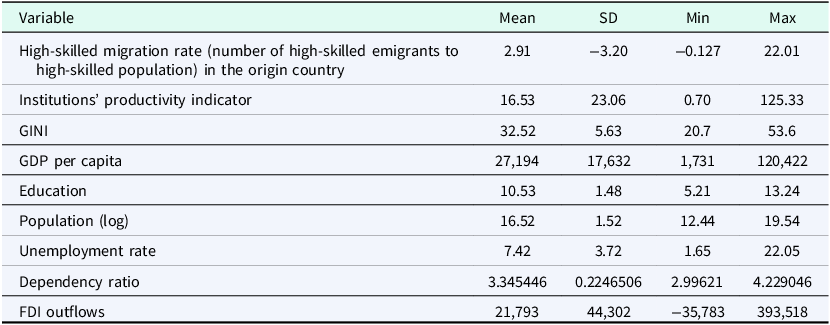
To study the relationship between the nature of income inequality at home and emigration, we use panel data for migration from 30 OECD home countries to the 20 most attractive (OECD) destination countries for the period from 1990 to 2010.Footnote 5 The results of descriptive statistics are shown in Table 1 for all the variables in our model and reveal a high level of variability.
Descriptive statistics of variables

Source: Authors’ own work.
FDI = foreign direct investment.
Dependent variable
The data on migration are drawn from the IAB Brain Drain Dataset, published by the German Institute for Employment Research (IAB) and described in more detail in Brücker et al. (Reference Brücker, Capuano and Marfouk2013).
This dataset provides country-level data on international migration from the aforementioned 30 home countries to 20 OECD destination countries: Australia, Austria, Canada, Chile, Denmark, Finland, France, Germany, Greece, Ireland, Luxembourg, the Netherlands, New Zealand, Norway, Portugal, Spain, Sweden, Switzerland, the UK, and the USA.
The data cover the total number of foreign-born individuals aged 25 years and older by gender, educational level, and country of origin. From this dataset, we build our dependent variable, the high-skilled migration rate, by summing the number of migrants that reached tertiary education level, originating from each of the 30 OECD countries and migrating to the 20 destination OECD countries, over the sum of total high-skilled workers (population that reached tertiary education level) in the migrant’ home country originating from each of the 30 OECD countries. Hence, among the total high-skilled workers, our ratio captures the share of high-skilled migrants (going to the 20 destination countries) to the number of skilled population at home. To explain further, Brücker et al. (Reference Brücker, Capuano and Marfouk2013) classify education level into three groups (primary, secondary, and tertiary) to match low, medium, and high-skilled migrants, respectively. We consider the tertiary group to be high-skilled. We are interested in high-skilled emigration, given that we expect the nature of income inequality primarily impacts this type of migration.
Main explanatory variable
Our variable on the nature of income inequality in the home countries of migration is the Gini indicator, which is conditioned by an institutional quality variable. The reliance of such an interaction term requires further explanation. First, the Gini indicator, which measures income inequality, is the most typical indicator used in panel data studies (such as Tung and Nang Thang, Reference Tung and Thang2023) and the most published for a range of countries. The variables were counted from 0% to 100%, where 0% indicates an equal sharing of income among all households and 100% indicates holding of all income by one household. The variable is provided by the World Bank data and the World Development Indicators (WDI, 2010). Second, capturing and measuring the nature of inequalities remains a challenge. Although the Gini indicator is widely used to measure inequalities, it fails to account for their intrinsic nature and to distinguish between inequalities driven by rent-seeking behaviours and those driven by profit-seeking behaviours. Two equal Gini values are not comparable because the components of the inequalities are not the same.
Our first step is thus to build an indicator of institutional quality that measures the prevalence of profit-seeking oriented institutions over rent-seeking oriented institutions, and conversely. Indeed, within a country, distinct types of institutions coexist. There are profit-seeking institutions that promote free contracts and voluntary exchange and rent-seeking institutions that promote favouritism, distribution of privileges, and impede economic competition. Thus, there is a need to construct an indicator that accounts for the coexistence between the personal enrichment by profit-seeking behaviours and that by rent-seeking behaviours (Zywicki, Reference Zywicki2015). In such a task, we rely on sub-indicators of the Fraser Institute Economic Freedom (EF) index (Gwartney et al., Reference Gwartney, Lawson and Hall2021), which is, according to de Haan et al. (Reference de Haan, Lundström and Sturm2006, p. 182), ‘both reliable and useful’. More importantly, we are interested in the institutional components of the EF index that are essential for our analysis. For instance, according to Aisen and Veiga (Reference Aisen and Veiga2013) and de Haan and Sturm (Reference de Haan and Sturm2022), Area 2: ‘legal structure and security of property rights’ captures the institutional quality dimension of the index and measures the security of property rights as well as the strength of the legal system. Failure of a country’s legal system to provide for the security of property rights, the enforcement of contracts, and the mutually agreeable settlement of disputes will undermine the operation of a market exchange system. The sub-component 2B, Protection of Property Rights, captures the essential driver of economic freedom and the efficient operation of markets, namely, the security of property rights, protected by the rule of law. Freedom to exchange is weakened if individuals do not have secure rights to property, including the fruits of their labour. To measure rent-seeking behaviours or the collusion between economic and political elites, several indicators are available in the literature. Although the concept of rent-seeking may be accurate, its measurement remains problematic (Del Rosal, Reference Del Rosal2011, p. 300). Interestingly, the business regulation subcomponents of Area 5 ‘business regulation’ of the EF index identify the extent to which regulatory restraints and bureaucratic procedures limit competition and the operation of markets. The sub-component 5Civ, ‘Rigorous and Impartial Public Administration’, can thus be a good proxy for rent-seeking behaviours since it captures the extent to which laws and regulations may be subject to interest groups’ influence and government favours. Hence, based on the sub-indicators of the Fraser Institute EF index discussed above, we construct the below indicator of IP.Footnote 6 The latter allows for the assessment of the predominance of institutions of profit-seeking behaviours over those of rent-seeking behaviours in a given country. Indeed, Baumol’s (Reference Baumol1990) seminal contribution highlights that profit-seeking societies host entrepreneurs seeking to invest in research and development and human capital, whereas in rent-seeking societies, resources are diverted to securing rents through political connections, thus reducing the productive forces of the economy. Since then, the related literature has evidenced a link between good institutions characterized by secured property rights, a fair and balanced judicial system, contract enforcement, and the development of productive activities through entrepreneurship (Sobel, Reference Sobel2008). Following this line of research, our IP indicator provides an innovative approach to capture further Baumol’s intuition. The IP indicator is thus constructed as follows:
 $$IP = {{{Protection\,of\,Property\,Rights}} \over {{10 -Rigorous\,and\,Impartial\,Public\,Administration}}}$$
The Protection of Property Rights indicator from Area 2 of the EF index shows that a high score implies a high-quality level of profit-seeking institutions. Similarly, the Rigorous and Impartial Public Administration indicator from Area 5 of the EF index shows that a high score implies a low level of rent-seeking institutions in the country’s institutional setting.Footnote 7 Further, to measure the overall improvement of institutional quality within a single figure, we introduce the term [10- Rigorous and Impartial Public Administration] in our indicator’s denominator. As a result, when the score of IP increases, it captures an improvement in the productivity of institutions. Such an improvement may either come from an increase in the value of the numerator (i.e. improvement of Protection of Property Rights) or from a reduction of the value of the denominator (i.e. reduction of [10- Rigorous and Impartial Public Administration]) of the IP indicator.Footnote 8
The second step of our variable construction is to build the interaction term (IP times Gini) that allows us to approximate the nature of inequalities. The underlying logic is that when income inequality is conditioned by institutions’ quality, the nature of inequality itself changes. For instance, in countries where profit-seeking institutions dominate the institutional setting (a high IP score), income inequality is intrinsically productive. Conversely, in countries where rent-seeking institutions dominate (a low IP score), income inequality is predominantly unproductive. Hence, in line with our hypothesis, one would expect that in countries where profit-seeking institutions dominate (i.e. high IP score), the predominance of productive inequalities would reduce high-skilled migration. In such countries, the dominance of inequalities driven by productive efforts is interpreted by high-skilled workers as a signal to make a profit by engaging in the market process. They know that if they provide hard work, they will get the entire return without being forced to share their benefits through a redistribution policy. There will be a perfect match between their economic activity on the marketplace and what they receive. Since productive efforts are perceived to be rewarded, high-skilled workers would opt for the no-exit option and choose to stay in the country of origin. On the other hand, in countries where rent-seeking institutions dominate (i.e. low IP score), the predominance of unproductive inequalities would boost high-skilled migration. In such countries, unproductive inequalities prevail, and high-skilled workers may be unwilling to share their profits with the rentier/elite class of their country, thus deciding to migrate. In other words, the nature of inequalities at home is an important driver of the migration of high-skilled workers.
Control variables
The literature on the determination of migration reveals that there are different drivers and motivations for the migration of high-skilled workers. We control for a set of socio-economic and demographic factors in the home countries of migration. In detail, we consider the effects of population size, economic development, education, unemployment rate, FDI outflows, and past migration. Data on population size come from the OECD Statistics. We expect population size to be negatively related to emigration. The negative correlation between population size and migration is well-established in the literature in this field (Chen et al., Reference Chen, Wong and Law2024). Smaller states have limited internal migration opportunities and incentivize migration (Meierrieks and Renner, Reference Meierrieks and Renner2017). To control for economic development, per capita income (World Development Indicators) ought to constitute a proxy for poor macroeconomic conditions, where poorer conditions encourage migration (Cooray and Schneider, Reference Cooray and Schneider2016). A higher per capita income reduces the incentive for individuals with high educational attainment to emigrate, while it increases the ability of those with low and medium levels of educational attainment to emigrate. Then we control for a country’s level of education and expect a positive relationship between migration and education at the country level (Grogger and Hanson, Reference Grogger and Hanson2011; Meierrieks and Renner, Reference Meierrieks and Renner2017) and for high-skilled emigration to decrease with economic development. Education is measured by years of schooling, with data being drawn from Barro and Lee (Reference Barro and Lee2013).
In addition, we control for the unemployment rate because unemployment is a push factor for high-skilled migrants (Geis et al., Reference Geis, Uebelmesser and Werding2013; Cooray and Schneider, Reference Cooray and Schneider2016). The data are drawn from the OECD Statistics. The individuals migrate due to economic opportunities at the destination and/or lack thereof at the origin to maximize expected income (or utility). We expect the unemployment rate in the home country to be positively associated with high-skilled migration. We control for FDI outflows. The data are drawn from the OECD Statistics. FDI outflows in the country of origin increase job and earnings opportunities for high-skilled workers in the destination country, and thereby emigration (Gheasi et al., Reference Gheasi, Nijkamp and Rietveldn2013). We thus expect a positive relation between FDI outflows in the home country and high-skilled migration. We control for the lagged level of high-skilled migration. Past migration in the country of origin is expected to be positively related to current migration. Earlier migrants in a specific destination country belong to a network and could thus facilitate access to information and fuel further migration (Belot and Ederveen, Reference Belot and Ederveen2012). Networks and social ties explain alternative migration forms and patterns (Bertoli and Ruyssen, Reference Bertoli and Ruyssen2018). Finally, when controlling for the dependency ratio, the literature has documented the importance of the home country’s demographic features (such as age dependency) on migration decisions (Zaiceva et al., Reference Zaiceva, Zimmermann, Piggott and Woodland2016; Pradhan and Narayanan, Reference Pradhan and Narayanan2020). The latter reported a significant positive effect of the dependency ratio on migration intensity in India.
Estimation methodology
To address the effect of the nature of inequalities and other controls on the migration of high-skilled workers, we estimate the following equation:
 $$High\_Skill\_Migratio{n_{it}} = {\rm{\alpha }} + {\beta _1}Gin{i_{it}} + {\rm{\;}}{\beta _{2\;}}IP{\;_{it}} + {\rm{}}{\beta _3}IP{\;_{it}}\,{\rm{*\;}}Gin{i_{it}} + {\beta _{4\;}}{{\rm{{\rm X}}}_{it}} + {\rm{\;}}{{\rm{\mu }}_i} + {\sigma _t} + {\varepsilon _{\;\;}}$$
High_Skill_Migration denotes the high-skilled migration rate, which is explained by the nature of income inequality, measured by the interaction term $IP{\;_{it}}\,{\rm{*\;}}Gin{i_{it}}$
. This variable analyses the effect of income inequalities when they are conditioned by the institutional quality measured by the IP indicator.
$IP{\;_{it}}\,{\rm{*\;}}Gin{i_{it}}$
. This variable analyses the effect of income inequalities when they are conditioned by the institutional quality measured by the IP indicator. ${\beta _1}$
is the coefficient associated with the Gini and reflects the effect of inequality on high-skilled migration when only IP is zero or at the lowest level (Brambor et al., Reference Brambor, Clark and Golder2006, p. 72).
${\beta _1}$
is the coefficient associated with the Gini and reflects the effect of inequality on high-skilled migration when only IP is zero or at the lowest level (Brambor et al., Reference Brambor, Clark and Golder2006, p. 72). ${\beta _{2}}$
captures the effect of IP on high-skilled migration when only Gini is zero or at lowest level. These two coefficients do not serve to capture the average effect of inequality and that of IP on high-skilled migration, as is the case in a linear-additive regression model. This is because, in multiplicative interaction models, the interpretation of the constitutive elements of interaction terms is no longer an average nor an unconditional effect. Therefore, following Brambor et al. (Reference Brambor, Clark and Golder2006), we are interested in discussing the sign of the marginal effect of income inequality on high-skilled migration, namely,
${\beta _{2}}$
captures the effect of IP on high-skilled migration when only Gini is zero or at lowest level. These two coefficients do not serve to capture the average effect of inequality and that of IP on high-skilled migration, as is the case in a linear-additive regression model. This is because, in multiplicative interaction models, the interpretation of the constitutive elements of interaction terms is no longer an average nor an unconditional effect. Therefore, following Brambor et al. (Reference Brambor, Clark and Golder2006), we are interested in discussing the sign of the marginal effect of income inequality on high-skilled migration, namely, ${{{{\partial\,}High\_Skill\_Migration}}\over{{{\partial\,} Gini}}} = \;{\beta _1} + {\beta _3}\;I{P_{it}}$
. In addition, we discuss the marginal effect of an improvement in the IP indicator on the marginal effect of income inequality on high-skilled migration, namely,
${{{{\partial\,}High\_Skill\_Migration}}\over{{{\partial\,} Gini}}} = \;{\beta _1} + {\beta _3}\;I{P_{it}}$
. In addition, we discuss the marginal effect of an improvement in the IP indicator on the marginal effect of income inequality on high-skilled migration, namely,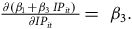 ${{{{\partial\,} ({\beta _1} + {\beta _3}\;I{P_{it}})\;}}\over{{{\partial\,} I{P_{it}}}}} = \;{\beta _3}.$
According to our theoretical framework,
${{{{\partial\,} ({\beta _1} + {\beta _3}\;I{P_{it}})\;}}\over{{{\partial\,} I{P_{it}}}}} = \;{\beta _3}.$
According to our theoretical framework, ${\beta _{3}}$
is supposed to be negative and significant. X is a vector of socio-economic and demographic control variables, as discussed above, for country i at time t.
${\beta _{3}}$
is supposed to be negative and significant. X is a vector of socio-economic and demographic control variables, as discussed above, for country i at time t. ${\rm{\;}}{{\rm{\mu }}_i}{\rm{\;and\;}}{\sigma _t}\;$
are country and period fixed effects. Ɛ is the error term.
${\rm{\;}}{{\rm{\mu }}_i}{\rm{\;and\;}}{\sigma _t}\;$
are country and period fixed effects. Ɛ is the error term.
To estimate equation (1), we use panel data covering the period from 1990 to 2010 and 30 OECD countries. The main benefit of estimating a panel model is that it allows for the control of unobservable, country-specific variables whose omission may generate biased estimated coefficients in a pure cross-sectional regression. To test our hypothesis, we rely on two econometric techniques. We first use the OLS, and second, we use the system-GMM estimation from Arellano and Bond (Reference Arellano and Bond1991), Arellano and Bover (Reference Arellano and Bover1995), and Blundell and Bond (Reference Blundell and Bond1998) to tackle the endogeneity issue. There is a possible reverse causality between the migration of the high-skilled workers and the institutional characteristics in the home country of the migrant. This is because, on one side, ‘migrants remain connected in some way to the home state and are looking to change the dissatisfied status quo with the support of friends and families’ (Kratou and Yogo, Reference Kratou and Yogo2023). In our case, the status quo is the quality of institutions measured by the IP variable. From the other, as expressed by Meierrieks and Renner (Reference Meierrieks and Renner2017): ‘norms and ideas in the destination countries may be transferred to the source countries, for example, return migration and the creation of business and trade networks’. In both cases, high-skilled migration could potentially influence the institutions’ quality in the home country. The advantage of using system-GMM estimation is to cope with the endogeneity issue, which is not only related to the variable of interest ( $IP{_{it}}{\rm\,{*\;}}Gin{i_{it}}$
) but also with some other controls in our model. The level of income per capita, the education attainment, the population, the history of migration, the unemployment rate, and the FDI outflows could be potentially endogenous. For instance, not only could a higher number of years of schooling be an incentive for the migration of high-skilled workers, but a ‘high return on education’ of skilled migrants compared to their counterparts at home could be an incentive to invest in education (Beine et al., Reference Beine, Docquier and Rapoport2008). The system-GMM estimator explores only internal variables of the model as instruments. More precisely, the technique uses lagged levels and lagged first differences as appropriate instruments for our endogenous variables. In the case of our estimation, we use the second lag of the dependent variable (i.e. the migration rate of the highly skilled) and the first lag of the control endogenous variables in both (i.e. levels and first differences). To check the validity of the results, two tests are used: the serial correlation test (AR 2) (in which the null hypothesis is that the errors exhibit no second-order serial correlation). We further report the P-values of the standard Hansen test of overidentifying restrictions (in which the null hypothesis is that the instrumental variables are exogenous and not correlated with the residual).
$IP{_{it}}{\rm\,{*\;}}Gin{i_{it}}$
) but also with some other controls in our model. The level of income per capita, the education attainment, the population, the history of migration, the unemployment rate, and the FDI outflows could be potentially endogenous. For instance, not only could a higher number of years of schooling be an incentive for the migration of high-skilled workers, but a ‘high return on education’ of skilled migrants compared to their counterparts at home could be an incentive to invest in education (Beine et al., Reference Beine, Docquier and Rapoport2008). The system-GMM estimator explores only internal variables of the model as instruments. More precisely, the technique uses lagged levels and lagged first differences as appropriate instruments for our endogenous variables. In the case of our estimation, we use the second lag of the dependent variable (i.e. the migration rate of the highly skilled) and the first lag of the control endogenous variables in both (i.e. levels and first differences). To check the validity of the results, two tests are used: the serial correlation test (AR 2) (in which the null hypothesis is that the errors exhibit no second-order serial correlation). We further report the P-values of the standard Hansen test of overidentifying restrictions (in which the null hypothesis is that the instrumental variables are exogenous and not correlated with the residual).
Empirical results
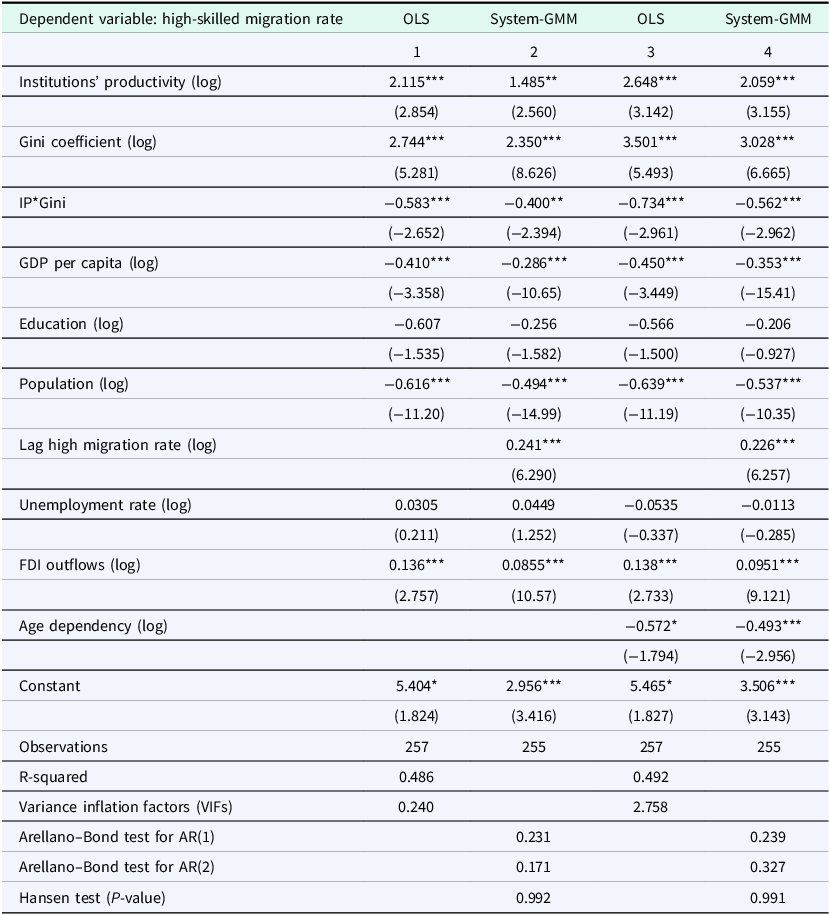
The empirical results regarding the effect of the nature of inequalities on high-skilled migration are reported in Table 2.
High-skilled migration and institutional productivity

OLS = ordinary least squares; GMM = Generalized Method of Moments; FDI = foreign direct investment. Robust standard errors in parentheses, ***, **, and * are 1%, 5%, and 10% significance levels, respectively. VIFs calculate the variance inflation factors for the independent variables specified in a linear regression model and capture the degree of multicollinearity among the model variables.
Following previous econometric studies, we refer to Brambor et al.’s (Reference Brambor, Clark and Golder2006) methodology on interaction models, and we emphasize the main variable of interest in the results’ interpretation, which is ${\beta _3}$
, the coefficient associated with the interaction variable IP
${\beta _3}$
, the coefficient associated with the interaction variable IP ${^\ast}$
Gini. We first discuss the sign of the marginal effect of income inequality on high-skilled migration, namely,
${^\ast}$
Gini. We first discuss the sign of the marginal effect of income inequality on high-skilled migration, namely, ${{{{\partial\,} High\_Skill\_Migration}}\over{{{\partial\,} Gini}}} = \;{\beta _1} + {\beta _3}\;I{P_{it}}$
.
${{{{\partial\,} High\_Skill\_Migration}}\over{{{\partial\,} Gini}}} = \;{\beta _1} + {\beta _3}\;I{P_{it}}$
.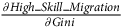 ${{{\partial\,} High\_Skill\_Migration}}\over{{{\partial\,} Gini}}\;$
is equal to 0 for IP = −
${{{\partial\,} High\_Skill\_Migration}}\over{{{\partial\,} Gini}}\;$
is equal to 0 for IP = − ${{{\beta _1}}}\over{{{\beta _3}}}$
, positive for IP < −
${{{\beta _1}}}\over{{{\beta _3}}}$
, positive for IP < − ${{{\beta _1}}}\over{{{\beta _3}}}$
and negative for IP > −
${{{\beta _1}}}\over{{{\beta _3}}}$
and negative for IP > − ${{{\beta _1}}}\over{{{\beta _3}}}$
. According to our theoretical framework, we assume that
${{{\beta _1}}}\over{{{\beta _3}}}$
. According to our theoretical framework, we assume that $ - {{{\beta _1}}}\over{{{\beta _3}}}$
corresponds to the value of IP for which profit-seeking institutions balance rent-seeking ones in the institutional setting, and as a result, income inequality has no effect on high-skilled emigration for this threshold value. On the other hand, for a given IP value lower than this threshold value, the predominance of rent-seeking institutions over profit-seeking ones generates a prevalence of unproductive inequalities that positively affects high-skilled workers’ emigration. Similarly, for a given IP value higher than this threshold value, the predominance of profit-seeking institutions over rent-seeking ones generates a prevalence of productive inequalities that negatively affects high-skilled workers’ emigration. In other words, the sign of the income inequality and high-skilled emigration relationship is thus dependent on the nature of income inequality.
$ - {{{\beta _1}}}\over{{{\beta _3}}}$
corresponds to the value of IP for which profit-seeking institutions balance rent-seeking ones in the institutional setting, and as a result, income inequality has no effect on high-skilled emigration for this threshold value. On the other hand, for a given IP value lower than this threshold value, the predominance of rent-seeking institutions over profit-seeking ones generates a prevalence of unproductive inequalities that positively affects high-skilled workers’ emigration. Similarly, for a given IP value higher than this threshold value, the predominance of profit-seeking institutions over rent-seeking ones generates a prevalence of productive inequalities that negatively affects high-skilled workers’ emigration. In other words, the sign of the income inequality and high-skilled emigration relationship is thus dependent on the nature of income inequality.
Figure 1
Footnote
9
indicates how the marginal effect of income inequality on high-skilled migration changes with the IP value. Any particular point on this line is ${{{{\partial\,} High\_Skill\_Migration}}\over{{{\partial\,} Gini}}} = \;{\beta _1} + {\beta _3}\;I{P_{it}}$
. It is easy to see that for a lower value of IP below the threshold value 4.7, income inequality has a positive effect on high-skilled migration. For an IP value above the threshold value, income inequality has a negative effect on high-skilled migration.
${{{{\partial\,} High\_Skill\_Migration}}\over{{{\partial\,} Gini}}} = \;{\beta _1} + {\beta _3}\;I{P_{it}}$
. It is easy to see that for a lower value of IP below the threshold value 4.7, income inequality has a positive effect on high-skilled migration. For an IP value above the threshold value, income inequality has a negative effect on high-skilled migration.
Marginal effect of income inequality on high-skilled migration.

Furthermore, the marginal effect of an improvement in the IP indicator on the marginal effect of income inequality on high-skilled migration is given by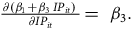 ${{{{\partial\,} ({\beta _1} + {\beta _3}\;I{P_{it}})\;}}\over{{{\partial\,} I{P_{it}}}}} = \;{\beta _3}.$
Irrespective of the econometric technique that we use here,
${{{{\partial\,} ({\beta _1} + {\beta _3}\;I{P_{it}})\;}}\over{{{\partial\,} I{P_{it}}}}} = \;{\beta _3}.$
Irrespective of the econometric technique that we use here, ${\beta _3}$
is negative when evaluated at median IP (Table 2). This negative sign indicates that a marginal improvement in the IP indicator will impact the effect of income inequality on high-skilled emigration as follows. When
${\beta _3}$
is negative when evaluated at median IP (Table 2). This negative sign indicates that a marginal improvement in the IP indicator will impact the effect of income inequality on high-skilled emigration as follows. When ${{{\partial\,}{ High\_Skill\_Migration}}\over{{\partial\,}{ Gini}}} \gt 0$
, namely, for IP < −
${{{\partial\,}{ High\_Skill\_Migration}}\over{{\partial\,}{ Gini}}} \gt 0$
, namely, for IP < − ${{{\beta _1}}}\over{{{\beta _3}}}$
, a marginal increase in IP by 1% reduces (ceteris paribus) the rise of high-skilled emigration driven by a marginal increase in income inequality by 0.6% (OLS) and 0.4% (system-GMM), respectively. In that case, income inequalities become less unproductive at the margin, leading to a smaller positive effect on emigration. This result corroborates Hypothesis 2 and its corollary. By analogy, when
${{{\beta _1}}}\over{{{\beta _3}}}$
, a marginal increase in IP by 1% reduces (ceteris paribus) the rise of high-skilled emigration driven by a marginal increase in income inequality by 0.6% (OLS) and 0.4% (system-GMM), respectively. In that case, income inequalities become less unproductive at the margin, leading to a smaller positive effect on emigration. This result corroborates Hypothesis 2 and its corollary. By analogy, when ${{{\partial\,}{ High\_Skill\_Migration}}\over{{\partial\,}{ Gini}}} \gt 0$
, namely, for IP < −
${{{\partial\,}{ High\_Skill\_Migration}}\over{{\partial\,}{ Gini}}} \gt 0$
, namely, for IP < − ${{{\beta _1}}}\over{{{\beta _3}}}$
, a marginal increase in IP by 1% increases (ceteris paribus) the fall of high-skilled emigration driven by a marginal increase in income inequality by 0.6% (OLS) and 0.4% (system-GMM), respectively. In that case, income inequalities become more productive at the margin, leading to a larger negative effect on emigration. This result corroborates Hypothesis 1 and its corollary. Interestingly, our findings help provide an alternative explanation of Liebig and Sousa-Poza’s (Reference Liebig and Sousa-Poza2004) seminal result, which shows a positive relationship between a high level of inequality captured by the Gini indicator and high-skilled workers’ intention to migrate abroad. Our conceptual framework would suggest that such a positive relationship may be due to the predominance of unproductive inequalities in an institutional context characterized by a dominance of rent-seeking institutions. Further, our data show that 10 out of 30 countries are below the mean of our sample (i.e. a value of IP equal to 16.53). These countries are Iceland, Ireland, Greece, the Czech Rep., Greece, Korea, Mexico, Poland, Slovakia, and Turkey.
${{{\beta _1}}}\over{{{\beta _3}}}$
, a marginal increase in IP by 1% increases (ceteris paribus) the fall of high-skilled emigration driven by a marginal increase in income inequality by 0.6% (OLS) and 0.4% (system-GMM), respectively. In that case, income inequalities become more productive at the margin, leading to a larger negative effect on emigration. This result corroborates Hypothesis 1 and its corollary. Interestingly, our findings help provide an alternative explanation of Liebig and Sousa-Poza’s (Reference Liebig and Sousa-Poza2004) seminal result, which shows a positive relationship between a high level of inequality captured by the Gini indicator and high-skilled workers’ intention to migrate abroad. Our conceptual framework would suggest that such a positive relationship may be due to the predominance of unproductive inequalities in an institutional context characterized by a dominance of rent-seeking institutions. Further, our data show that 10 out of 30 countries are below the mean of our sample (i.e. a value of IP equal to 16.53). These countries are Iceland, Ireland, Greece, the Czech Rep., Greece, Korea, Mexico, Poland, Slovakia, and Turkey.
Results of our control variables are provided as follows:
-
1) Income per capita. The results show that the coefficient is negative and statistically significant at the level of 1% for both techniques (the OLS and the system-GMM). This suggests that countries with high income levels provide less incentives to migrate. These results are in line with those of the existing literature that suggests that high-skilled workers tend to stay in their country of origin as income per capita improves (Cooray and Schneider, Reference Cooray and Schneider2016).
-
2) Education. The coefficient related to education is positive and slightly significant at the level of 10% (system-GMM). A high number of years of schooling is positively associated with the migration of the high-skilled. This result is in line with the literature prediction.
-
3) Population. The coefficient related to population is negative and weakly significant at the level of 10% (OLS). This finding aligns with the literature. As Meierrieks and Renner (Reference Meierrieks and Renner2017) claim, ‘small country size limits the possibilities of internal migration’.
-
4) Past migration. The coefficient associated with past migration reveals a positive and strongly significant sign in both regressions (OLS and system-GMM). Past migration is positively correlated with current ones. This robust finding is in line with the literature, which evidenced that networks and social ties are determinants of migration forms and patterns (Bertoli and Ruyssen, Reference Bertoli and Ruyssen2018).
-
5) Unemployment. The coefficient related to unemployment is positive and statistically significant at the level of 1% in both regressions. This finding supports the literature and especially corroborates Cooray and Schneider (Reference Cooray and Schneider2016), which shows that the unemployment rate is a push factor for high-skilled emigration.
-
6) FDI. The coefficient related to outward FDI is positive and statistically significant at 10% and 5%, respectively. This result confirms those of Gheasi et al. (Reference Gheasi, Nijkamp and Rietveldn2013).
-
7) Dependency rate. The coefficient related to this variable reveals that a 10% increase in the dependency ratio leads to a reduction in the migration of the high-skilled by 49% (system-GMM) to 57% (OLS) Table 2, columns 3 and 4). A possible interpretation is that high-skilled workers with family dependents are less inclined to emigrate for education and culturally related reasons. We further conduct several robustness checks by substituting our IP variable with institutional quality indicators with a larger scope of analysis, such as those driven by the Worldwide Governance Indicators (WGI) database of the World Bank, as well as the indicator of EF from the Fraser Institute EF index (Gwartney et al., Reference Gwartney, Lawson and Hall2021). The results confirm our main findings.Footnote 10
Conclusion
Although extensive literature had already discussed the determinants of high-skilled migration from developing to developed countries, namely, the ‘brain drain’ phenomenon, this paper has boldly investigated an underdeveloped research question, namely, regarding the drivers of migration flows among OECD countries. It has addressed why high-skilled workers emigrate from their country of origin, although the latter displays a high level of economic development. The vast literature on the home country driver of high-skilled emigration has identified the level of income inequality as an important push factor, although the literature has shown mixed results. In this paper, we have focused on this particular strand of the literature and have challenged its main results by arguing that the nature of income inequality matters most rather than its absolute level. More specifically, by considering the link between institutions’ quality, the nature of income inequality, and its effect on high-skilled migration, we have provided an explanation for the mixed results displayed by the literature. Within our conceptual framework, inequalities in the home country give incentive to migrate only when they are intrinsically unproductive. This phenomenon occurs when rent-seeking institutions dominate the institutional landscape. Similarly, productive inequalities driven by the dominance of profit-seeking oriented institutions reduce the emigration of the highly skilled. Since the nature of income inequality is conditioned by the institutional framework, our contribution is fully in line with the seminal literature that discusses the effect of institutional quality on emigration. However, our results go further by considering that the nature of income inequality itself is the main migration driver rather than formal institutions. It follows that the greater the income inequality driven by rent-seeking institutions, the more likely highly skilled workers are to leave their home country. This result offers a new strategy for countries facing high-skilled worker emigration. Not only must they attract skilled workers, but most importantly, they should discourage them from migrating abroad. To encourage them to stay at home, the solution is perhaps to reduce the inequalities induced by rent-seeking behaviours, the latter being driven by the low quality of institutions. Rent-seeking behaviours sustain unproductive inequalities that drive skilled workers away from their country of origin. Hence, in line with Meierrieks and Renner’s (Reference Meierrieks and Renner2017) conclusions, any public policy that reduces this form of rent-seeking behaviours and favours economic freedom would reduce unproductive activities and ultimately discourage high-skilled emigration.
The implications of our study are particularly relevant in the context of a proposed wealth tax on billionaires. Indeed, the Zucman tax, a minimum wealth tax of 2% targeting the globe’s billionaires, would not only encourage billionaires to leave their country of origin to avoid paying the tax, but most importantly, it would incentivize potential successful entrepreneurs to migrate abroad as well. Indeed, where such a tax would slightly increase the amount of available rents since tax revenues are spread over many taxpayers, it would also considerably reduce potential earning opportunities for future entrepreneurs.
Further research could extend the paper in many directions. First, a more sophisticated analysis based on multilateral migration flows would consider the relative nature of inequality between home and potential destination countries. Indeed, at first glance, our result contradicts the results of the seminal self-selection theory of skilled migration, which argues that high inequalities in the country of origin incentivize low-skilled workers to emigrate rather than high-skilled workers. The latter tend to emigrate when income inequality is relatively higher in the destination country. But on further examination, the self-selection theory of skilled migration could also be applicable to address the effect of the relative nature of income inequality between origin and destination countries. Highly skilled migrants would have incentives to leave countries where unproductive inequalities prevail and migrate towards countries exhibiting productive inequalities. Accounting for such income inequality’s productivity gap would produce fruitful results. In addition, migrating towards countries with productive inequalities would improve social mobility (Corak, Reference Corak2013). It would be interesting to analyse the effect on high-skilled workers of the widening of income inequalities and on social mobility in the destination country. Second, our empirical analysis could be extended to yield additional relevant insights by integrating the least developed countries, where larger institutional differences may be observed, as compared with our sample that includes only OECD countries.
Third, considering current geopolitical shifts, particularly military conflicts and wars in Europe and around the world, it would be beneficial to expand this research by considering the impact of these events on migration processes. Special attention could be given to how armed conflicts and political instability in certain regions affect both the nature of inequality and the patterns of high-skilled migration. This would help in understanding new challenges faced by countries suffering from brain drain in the context of modern wars and political destabilization.
Acknowledgements
We would like to thank the participants of the European Public Choice Society conference held in Vienna in April 2024 and the participants of the research seminar at the American University of Sharjah held in May 2024 for their valuable comments and suggestions on an earlier draft of this paper. Furthermore, we are particularly grateful for the valuable comments and suggestions of eight anonymous reviewers.


 Open access

