


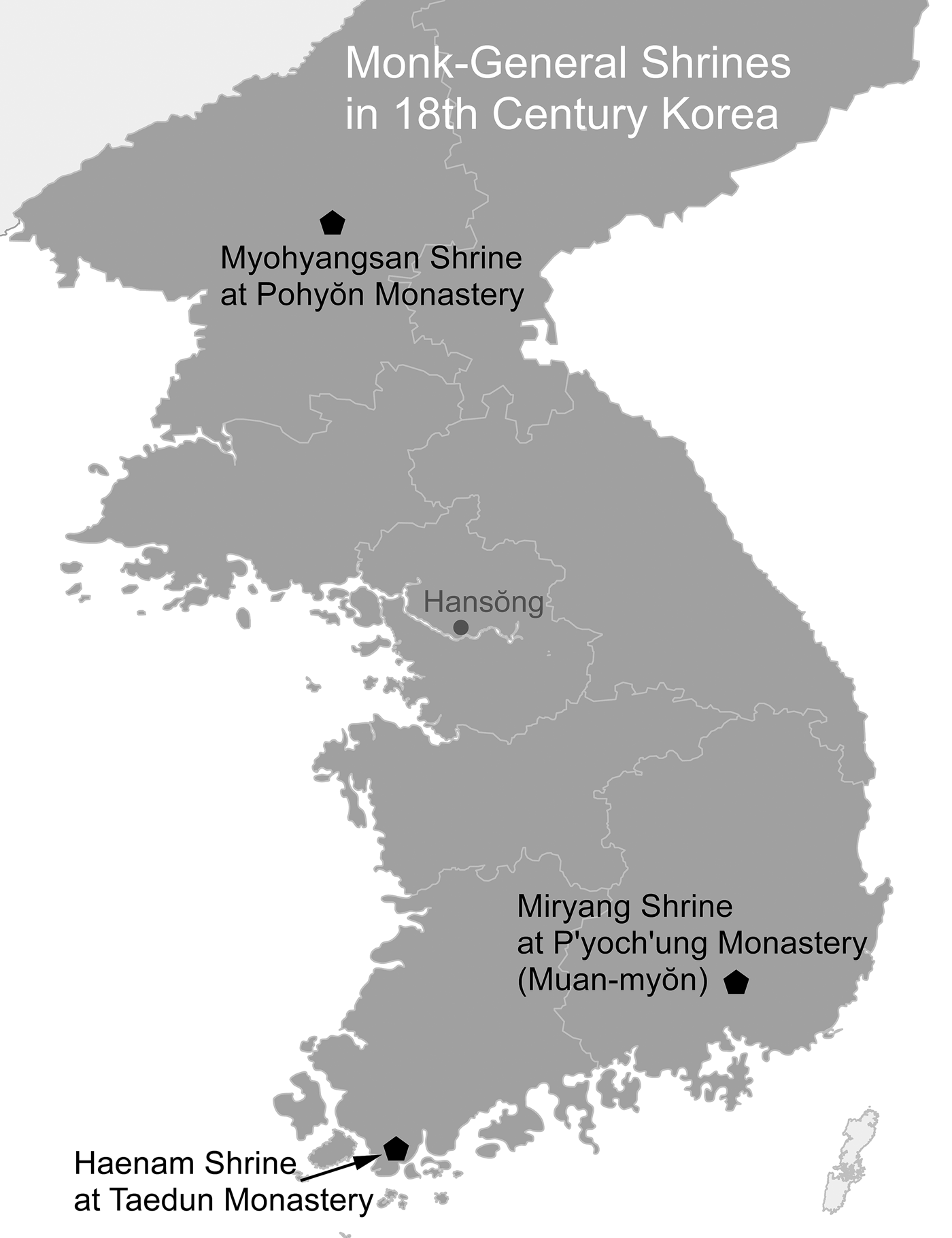
Contrary to the popular misconception that Buddhism is a universally peaceful religion, monasteries in East Asia have a long history of employing warriors and arming monastic workers to protect their monasteries and land from foreign and domestic invaders (Adolphson Reference Adolphson2007, 21–26; Vermeersch Reference Vermeersch2008, 179). During the Chosŏn period (1392–1910), monastic fighters were deployed against Japanese pirates and Hideyoshi's soldiers in the Imjin War (Imjin waeran 壬辰倭亂, 1592–98) (Myŏngjong sillok 18:42a, 1555/05/19; Sŏnjo sillok 26:25b, 1592/07/01).Footnote 1 This article examines how government officials, elite women, and Buddhist monks cultivated political agency by supporting the construction of three shrines dedicated to monk-generals and martyrs who participated and/or died in the Imjin War (see figure 1). It offers a new perspective on intersocietal networks, combining methodologies from the fields of Buddhist studies, sociology, and art history by looking at textual sources as well as evidence from visual and performative culture.
Location of monk-general shrines in eighteenth-century Korea. Map created by Maya Stiller and Robert Mihalik.
The three monk-general shrines are excellent examples of how the late Chosŏn-period elite (that is, members of sajok 士族 families) strategically used shrines dedicated to loyal subjects as repositories of social, cultural, and moral capital, and converted them into political capital.Footnote 2 In examining this transformation, the study conceptualizes political capital as a distinct form of capital that derives from various types of capital, that is, forms of power, and is used to influence policy formations and realize outcomes. Based on an extended interpretation of Pierre Bourdieu's “interconvertibility” theory, this article shows that different types of capital—including but not limited to cultural capital (primarily education), social capital (contacts and networks), and moral capital (shared norms and values)—constituted the pool of resources used for establishing political capital.Footnote 3
The conversion of diverse forms of capital into political capital through shrine construction was a method of exercising power in premodern Korea.Footnote 4 Government officials from the capital Hansŏng (present-day Seoul) supported shrines in the provinces to gain political capital by promoting their notion of loyalty through advertising their own loyal conduct. They sought to admonish scholar-officials and the common population via a combination of written, visual, and performative examples of loyalty similar to the performances at local Confucian schools and in community compacts. Central government officials used shrine inscriptions for the act of shaming, which I define as a persuasive device of Confucian rhetoric, in which one party admonishes the other to behave morally.
The right to accumulate political capital was not accorded to the central government officials exclusively. While evidence of female engagement is rare due to the preponderance of male-centered primary sources, there exists one stele inscription at the Haenam shrine that reveals that at least four women attempted to obtain political capital by supporting the construction of the shrine. These women were privileged members of the royal house who utilized the same shame tactics as the male elite did. Additionally, Miryang shrine-related sources reveal that central government officials, local scholars, and Buddhist monks cooperated in building and maintaining the shrine. Therefore, I use the idea of political capital as an analytical concept that reflects the fluidity of and exchange between the royal court in the capital and local communities in the provinces, and that can also help us understand how the literate elite, regardless of gender, asserted their voices in Chosŏn society.
Jahyun Kim-Haboush and Martina Deuchler (Reference Haboush and Deuchler1999, 3) have shown that in the context of Confucian communities in late Chosŏn period Korea, one cannot define the scholarly community as a unified monolithic group. This article expands upon this argument by advocating a nuanced understanding of the attitudes that Confucian officials maintained about proponents of Buddhist practice. The monk-general shrines were essentially Confucian shrines, and therefore Confucian scholar-officials did not hesitate to support them since they belonged to the countrywide network of state-sponsored loyalty-promoting shrines. However, a monk-general shrine was different from a typical loyalty shrine since the venerated subject and the people maintaining the shrine were Buddhist monks. Moreover, in some cases government officials who supported the monk-general shrines also supported entirely Buddhist projects, which indicates a tolerant attitude towards Buddhist monks and their activities. Therefore, we should avoid binary thinking and instead consider different facets of the relationship between “Confucians” and “Buddhists” on the religious, cultural, social, economic, and political levels. This article focuses primarily on the social and political aspects of this relationship.
Monks successfully collaborated with Confucian officials, who did not unilaterally pursue a confining and restrictive anti-Buddhist system, as previously argued by scholars such as Hwansoo Ilmee Kim (Reference Kim2012, 27) and Nam-lin Hur (Reference Hur2011, 15), but instead extended a greater degree of agency to the monks. As will be discussed later in this article, the support for Buddhist monks and their projects was a tradition that for some elite scholars spanned several generations. Social tensions and economic exploitation notwithstanding, there are numerous instances of beneficial cooperation between Buddhist institutions and state authorities to commemorate eminent monks. The patronage of three monk-general shrines discussed in this article evidences such cooperation.Footnote 5
Throughout this article, the term “monk-general shrine” will refer to a specific type of loyalty shrine. There is no Korean-language equivalent for this term. I created it to differentiate the shrines according to the type of people who were enshrined in them, thereby distinguishing these shrines from other types of loyalty shrines. In the primary sources, two of the shrines are called P'yoch'ungsa 表忠祠 (Model of Loyalty Shrine), which is a general term for buildings that enshrined meritorious vassals (primarily Confucian scholars), and one is called Such'ungsa 酬忠祠 (Reward for Loyalty Shrine).Footnote 6
The Perception of Monk-Generals after the Imjin War
During the Hideyoshi invasions (1592–98) of Chosŏn Korea, a number of eminent Buddhist monks organized monastic armies. Four of these monks were later commemorated in monk-general shrines through active promotion by their dharma descendants: the eminent monk Hyujŏng (1520–1604) and his disciples Yujŏng (1544–1610), Yŏnggyu (?–1592), and Ch’ŏyŏng (d.u.) (see table 1 for sinographs).Footnote 7 Hyujŏng (1520–1604), one of the most prominent Korean Buddhist monks of the Chosŏn period and generally considered the grandfather of the modern Korean Buddhist Chogye Order, was in charge of deploying monastic troops following an order of King Sŏnjo 宣祖 (1552–1608, r. 1567–1608).Footnote 8 Hyujŏng and his disciples recruited non-ordained monastics by promising potential candidates an ordination license, which granted legitimate social status as a monk (Sŏnjo sillok 39:44a, 06/29/1593; 40:45a, 07/20/1593). Motivated by the promise of social recognition and their loyalty to the king and state (Yi Ch’ŏl-hŏn Reference Ch’ŏl-hŏn2013, 159), monastic troops fought bravely in battles throughout the peninsula, and many monk-soldiers such as Yŏnggyu died fighting.
Shortly after the Imjin War, elite scholars began to build Model of Loyalty shrines for the commemoration of meritorious government officials, while the royal court published provincial gazetteers and moral primers, in which they highlighted meritorious acts during the war by officials and chaste women (Kim Kang-sik Reference Kang-sik2014, 155–59).Footnote 9 Images of Hyujŏng and Yujŏng were likely produced soon after the end of the war but were only used in Buddhist commemorative rituals.Footnote 10 The military contributions of these monk leaders were yet to be publicly acknowledged.
Nearly two hundred years after the Imjin War, Confucian scholars constructed shrines for meritorious monks to commemorate their efforts during and after the war. These shrines represent compelling visual evidence of the close relationship and interaction between “Confucians” and “Buddhists.” For example, local scholars in Miryang initiated the first construction of a shrine for monk-general Yujŏng. The fact that Yujŏng had been an erudite monk-scholar, who came from a local yangban family and was well-versed in the Confucian classics, likely facilitated the Miryang scholars’ decision to petition for a shrine to commemorate Yujŏng. Buddhist monks assisted with fundraising for the construction of the shrine. Through such joint efforts, a (Confucian) Model of Loyalty shrine was built in 1714 at Yŏngch'wisan in Miryang to commemorate Yujŏng (Cho Yŏng-nok Reference Yŏng-nok and Saŏphoe2000, 511; Yi Ch’ŏl-hŏn Reference Ch’ŏl-hŏn2013, 166).
Royally chartered monk-general shrines in eighteenth-century Korea.
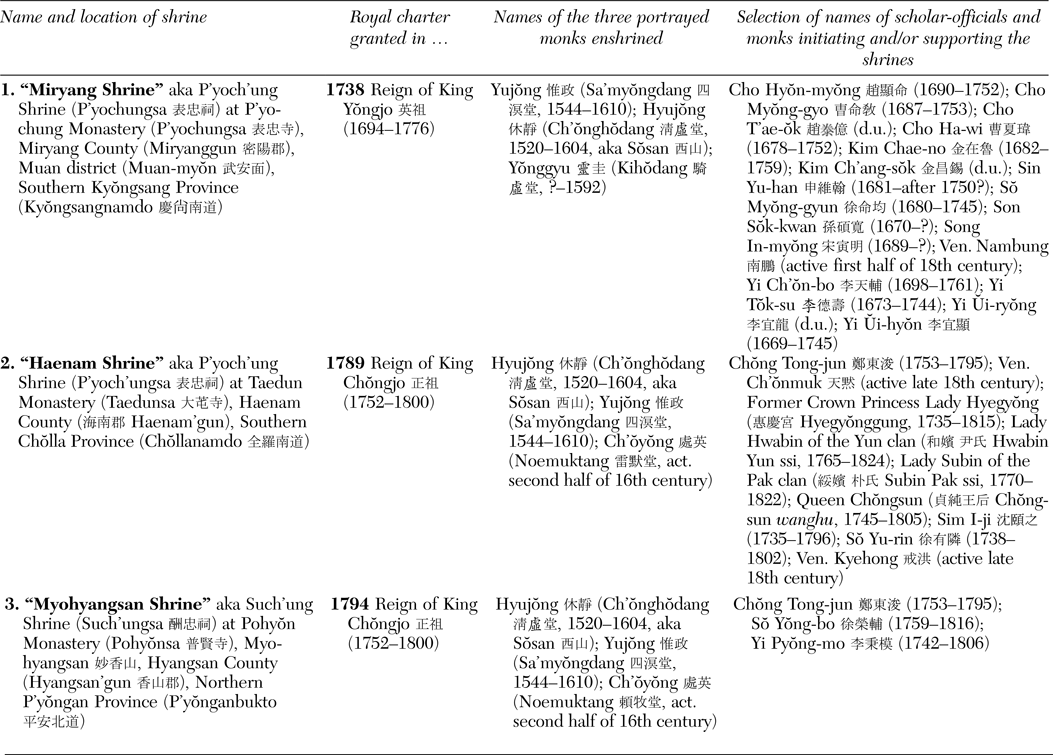
While Confucian scholars succeeded in constructing the Miryang shrine, Buddhist monks were successful in soliciting royal recognition and support for the commemoration of monk army leaders. Kings Yŏngjo and Chŏngjo granted royal charters (saaek 賜額) to three monk-general shrines, each of which housed a portrait painting of Yujŏng and his teacher Hyujŏng, and a portrait of one of Yujŏng's dharma brothers. The shrines were incorporated into a countrywide system of shrines primarily commemorating the heroic deeds of dutiful officials, filial sons, and chaste women. This finding relates to my main argument that central elites supported remote shrines in order to advance their political agency insofar as Buddhist monks similarly sought to enhance their political agency within the Buddhist community by promoting their dharma masters as virtuous warriors.
The first shrine granted a royal charter was the P'yoch'ung Shrine in Miryang in Kyŏngsang Province in 1738, followed by the P'yoch'ung Shrine at Taedun Monastery in Haenam in Chŏlla Province in 1788, and the Such'ung Shrine at Pohyŏn Monastery at Myohyangsan in P'yŏngan Province in 1794 (see figure 1 and table 1). Throughout this article, I simply refer to the shrines according to their respective locations of Miryang, Haenam, and Myohyangsan, to avoid confusion between the P'yoch'ung Shrine in Miryang and the P'yoch'ung Shrine in Haenam.
Moral Education through Visual Markers and Performances
Information obtained from material and performative sources provides a complementary layer of understanding, which corroborates the written material that evidences support of monk-general shrines by elite members of society. Therefore, before discussing the writings by the lettered people, I will analyze the shrines’ spatial setting and ritual performances as they reveal hitherto unexamined manifestations of agency.Footnote 11
Carvers, who have not yet received adequate consideration in contemporary scholarship, were important conduits connecting center and periphery by disseminating messages of loyalty from the central elite to the local population. For example, Miryang's P'yoch'ungsa sajŏk pi 表忠祠事蹟碑 (Stele commemorating the record of events at P'yoch'ungsa) lists the names of artisans under the title “engravers” (kigwŏl 剞劂) who carved the stele inscription in 1742. The stone for the stele had been cut from a mining site in Kyŏngsan and transported to Miryang, where carvers conveyed the central elites’ political message to the locale by transferring the ink-written characters into the stone of the stele.
For the illiterate, the steles were visual markers that provided a moral education through visual experience instead of written accounts. Once completed, commemorative steles augmented the social status of the enshrined monk-generals and promoted awareness of the historical link between the community and the meritorious monks, thereby strengthening community pride.Footnote 12 Since a stele was usually built adjacent to shrines commemorating meritorious individuals, even illiterate observers could have deduced from the visual and spatial context that the stele inscription commemorated the enshrined individuals. After being displayed publicly through local artisans’ carvings, commemorative texts written by capital elites influenced the locals’ visual experience in their community. Therefore, stele inscription writers and composers residing in the capital shaped the locals’ perception of visual representations in ways not yet considered by contemporary scholarship.
Monk-generals were celebrated folk heroes whose depicted physiques conveyed vigor and determination and were aimed at eliciting the locals’ admiration. The locals identified with the depicted monks who had either been born in and/or defended their hometown. Consequently, the portraits, located inside the shrine and accessible during rituals, and the steles, always accessible since they were located at the exterior of the shrine, strengthened the bonds for a collective local identity and became pilgrimage attractions that drew not only the elite but also the commoner population.
Each spring and autumn, performative events provided moral education through physical action for illiterate lay devotees. Although illiterate laypeople were not directly involved in performing offerings, they did observe the ritual performance, bowed to portraits of venerated masters, and ate the food offerings during the ritual's communal meal (Tongguk Taehakkyo 2014, 497–511; Yŏngdang ch'ugwŏn , late nineteenth century, 1a). By engaging with the monk-generals’ portraits performatively and consuming the offerings, participants experienced viscerally intimate encounters with the enshrined monks and assimilated the government's expectations of modeling their actions according to Confucian ideas of integrity and honor.
Commemoration rituals also emphasized the erudite monks' will to socially distinguish themselves from lower-ranked monks and the illiterate commoner population due to the ritual's ideological background. To commemorate the monk-generals and their deeds, Buddhist monks utilized a ritual structure concordant with neo-Confucian rituals such as the ritual on the ancestors' death day (kiilche 忌日祭) recorded in Zhu Xi's 朱熹 (1130–1200) Karye 家禮 (Family rituals), and adapted the ritual to the Buddhist setting by modifying ritual officiates and ritual food. The ritual typically included the welcoming of the spirits, the descending of the spirits, the three libation offerings, and the ushering out of the spirits. However, the people performing the ritual were not Confucian officials, but instead Buddhist monks.Footnote 13 Ceremonial offerings also differed: vegetables replaced fish and meat, and liquor was replaced by tea (Yi Ch’ŏl-hŏn Reference Ch’ŏl-hŏn2016, 198, 203–4).
Commemoration rituals for monk-generals not only provided the officiating Buddhist monks with the opportunity to reconnect with their dharma ancestors cum monk-generals, but also helped them promote themselves as paragons of Confucian virtue and erudition. By correctly performing a Confucian ritual, eminent monks displayed their cultural sophistication and thereby accrued social prestige, which differentiated them from lower-ranked, less-educated monks and illiterate lay devotees. Similarly, mid-Chosŏn period community compact (hyangyak 鄕約) performances emphasized status differences between local elites and commoners in a village (cf. Deuchler Reference Deuchler, Elman, Duncan and Ooms2002, 294).
Buddhist monks performed a Confucian ritual to advance the political agency of their institution, which shows that monks were more than passive recipients of Confucian rhetoric. By inviting renowned Buddhist masters from throughout the peninsula to serve in the ritual, loyalty shrine leaders at Miryang and Haenam garnered social capital through ritual participation, consequently accumulating political capital by strengthening their supra-regional ties within the Buddhist community and their monasteries' prominence in the Buddhist world.
Participation rosters indicate that eminent monks often accumulated social prestige by performing a particular Confucian ritual associated with social elite practice. For their first ritual performance commemorating monk-generals, eminent monks were customarily assigned to positions such as ritual director, manager, or overseer. Years after their first assignment, they were occasionally reappointed to different, similarly prestigious posts (Yi Ch’ŏl-hŏn Reference Ch’ŏl-hŏn2016, 198, 210). Invitees were, for example, renowned Avataṃsaka lecturers such as Ch'ejŏng 體淨 (Hoamdang 虎巖堂, 1687–1748) and Yuil 有一 (Yŏndamdang 蓮潭堂, 1720–99) from Taedun Monastery in Haenam, and eminent Buddhist masters from the provinces of Kyŏngsang, Chŏlla, and P'yŏngan (Kim Chong-min, Yi Ch’ŏl-hŏn, and Cho Kyu-hwan Reference Chong-min, Ch’ŏl-hŏn and Kyu-hwan2014, 397–405, 512–41; Tongguk Taehakkyo 2014, 323–494).
Buddhist monks also had their own agency when creating a specific altar configuration at their monk-general shrines. The existing portraits of the Miryang shrine are representative of monk-general portraits and thus are similar to portraits in Haenam and Myohyangsan. Therefore, I will use them as an example of the iconography and composition of monk-general portraits hung above the altar of a monk-general shrine (see figure 2). The portraits of Hyujŏng and Kihŏ are later copies of originals that were actually painted in 1773, while Yujŏng's portrait originates from the early eighteenth century (Yi Ŭn-hŭi Reference Ŭn-hŭi and Nan-yŏng2007, 177–81). All three monks are seated on a high-backed chair before a structured background, holding fly-whisks in their hands. Features such as the bold, thick outlines of their garments, the chairs, and the two-tiered background; the use of bright red, green, and blue colors; as well as the solid-colored garment lined with ornamental patterns reveal the application of a schematic model pattern. The monks’ facial features, with their soft ink lines and finely executed details, stand in stark contrast with the simplistic outline of the garments and background. As is often the case in East Asian portrait painting, several painters were involved in the creation process, which explains the painterly difference in quality between the background and the facial features.
Interior of Miryang shrine with eighteenth-century portrait paintings of Yujŏng (center), Hyujŏng (right), and Yŏnggyu (left), P'yohun Monastery, Miryang County, Southern Kyŏngsang Province, South Korea. Photo by Kim Jongmin.

The Miryang shrine's paintings are “typical” examples of late Chosŏn period Korean monk portraits, which frequently lack distinguishing facial features and iconographic attributes. Portraits were created formulaically, as seen in the portraits of Miryang shrine. Yŏnggyu is looking towards the left, Hyujŏng towards the right, but apart from the directional orientation, the facial features, layout, and execution of both paintings are quite similar. The painters deviated slightly from the formula by varying the colors of the garment cloth on the chair-back and the colors of the robes. The traits appear monotonous because the painters intended to depersonalize the portraits of eminent monks, not because artists lacked the skills as has been argued in previous scholarship (Cho Sunmie Reference Sunmie1983, 397), but because only when the monks were depicted as idealized, that is, dehumanized figures could these paintings qualify as ritual objects in the Buddhist context (Stiller Reference Stiller2012, 125).
Portraits of Yujŏng are easily distinguishable, as they are the only Korean monk portraits depicting a long-bearded monk. Painters consulted written sources such as Yujŏng's collected writings or collections of miscellaneous stories (yadam 野譚) and incorporated the referenced physical features into their portraits of Yujŏng (Pulchŏn Kanhaeng Wiwŏnhoe Reference Wiwŏnhoe1987, 8:46; Yu Reference Mong-in2006, 2:52–53). Moreover, depictions of the fearsome Chinese general Guan Yu 關羽 (d. 220 CE), who had been venerated throughout the peninsula since the late sixteenth century, perhaps inspired painters to give Yujŏng's portraits a fierce appearance.
The arrangement and positioning of the portraits illustrate the crucial role of the monk-generals as visual markers of local identity. Similar to the practice of commemorating meritorious Confucian scholars at the location where they had served and/or died, each shrine memorialized a special array of monk-generals that reflected the local population's inclination towards revering army leaders who had defended their locale against invaders. The shrine's regional location determined which monk portrait was placed in the center of the shrine. In contrast to Miryang, the hometown of Yujŏng, where Yujŏng's portrait was enshrined in the center, the monks of the shrines in Haenam and Myohyangsan placed the portrait of Hyujŏng, Yujŏng's teacher, in the center to demonstrate their direct dharma descent from Hyujŏng (see figures 3 and 4).
Interior of Myohyangsan shrine with late eighteenth- and early nineteenth-century portrait paintings of Hyujŏng (center), Yujŏng (right), and Ch’ŏyŏng (left), Pohyŏn Monastery, Myohyangsan, Hyangsan County, Northern P'yŏngan Province, North Korea. Photo by Maya Stiller.

Interior of Haenam shrine with late nineteenth-century portrait paintings (copies of earlier paintings) of Hyujŏng (center), Yujŏng (right), and Ch’ŏyŏng (left), Taedun Monastery (modern Taehŭng Monastery), Haenam County, Southern Chŏlla Province, South Korea. Photo by Maya Stiller.

The identity change of Yujŏng's junior dharma brothers Yŏnggyu and Ch’ŏyŏng further evidences local preferences. Regional affiliation impacted which one of the two was commemorated in the monk-general shrines. In order to enhance the dharma lineage of Yujŏng by visually marking sacrificial acts of Buddhist monks during wartimes, Yŏnggyu's portrait painting was added to the Miryang shrine in 1739. Yŏnggyu hailed from Kyeryongsan in Ch'ungch’ŏng Province and was killed in the battle of Kŭmsan in 1592, while Ch’ŏyŏng was active in the Honam region, that is, Chŏlla Province, and the area around present-day Seoul. His army joined the troops led by Kwangju magistrate and Chŏlla Province's army commander Kwŏn Yul 權慄 (1537–99). The monks in charge of the monk-general shrines at Haenam and Myohyangsan, who claimed direct dharma transmission from Hyujŏng's teacher, enshrined Ch’ŏyŏng's portrait, hoping that enshrining a local war hero from Chŏlla Province would enhance their dharma lineage and increase their political capital in the Buddhist community (see figures 3 and 4).
Members of the central elite were likely unaware of the fact that Buddhist monks accrued political capital and social prestige by engaging in the above-mentioned shrine activities. Furthermore, the aforementioned promotion of loyalty among the illiterate population through nontextual markers seems to have also been a minor concern. As the following sections will show, men and women in the capital were primarily concerned with advertising their own loyalty to the throne so as to modify their contemporaries’ moral conduct through shame. In so doing, the central elite successfully turned their social, cultural, and moral capital into a resource for their political capital.
Elite Support for the Miryang Shrine
In 1714–15, Confucian scholars built the Miryang shrine based on the aforementioned traditional concept of loyalty shrines. Receiving permission to construct the shrine involved local scholars and central government officials. Proudly arguing that Yujŏng, a native of their hometown, was a model of loyalty, licensiate Cho Ha-wi 曹夏瑋 (d.u.), Son Sŏk-kwan 孫碩寬 (1670–?), scholar in training Yi Ŭi-ryong 李宜龍 (d.u.), and other local scholars petitioned the local government office for funds to construct the shrine (Miryang 1784, 1b, 16a). Miryang magistrate Kim Ch'ang-sŏk 金昌錫 (1652–1720) forwarded the request to the provincial governor's office, and eventually the royal court approved construction of a Model of Loyalty Shrine at the location where Yujŏng had once built a retreat for himself, not far from his ancestors’ tombs (Chang Reference Chang2000, 150–51; Yi Tŏk-su and Sŏ Myŏng-gyun Reference Tŏk-su and Myŏng-gyun1742, 6a–7a).
While local scholar-officials initiated the shrine's construction, Buddhist monks helped with fundraising and the abbot of the Miryang shrine was essential to the shrine's survival. After petitioning the royal court for nearly twenty years, Buddhist monks and Confucian scholar-officials collectively succeeded in obtaining the full privileges of a royal charter. In 1738, the king bestowed a royal charter to the shrine after its abbot Nambung 南鵬 (d.u.), together with several hundred people from the entire country, submitted a petition to repair the shrine and resume the rituals (Miryang 1784, 2a). King Yŏngjo also granted the petition of Right State Councilor Song In-myŏng 宋寅明 (1689–1746), who pleaded for the shrine to receive 5 kyŏl of land to defray the costs of repairing the shrine (Yŏngjo sillok 47:9b, 1738/02/29).
Nambung expanded his dharma lineage's political capital by promoting the Miryang shrine's authority in several ways. As a dharma descendant of Yujŏng and abbot of the Miryang shrine, Nambung used his political leverage to solicit writings from prominent scholar-officials. He also garnered financial support for printing the works of Yujŏng, which required substantial resources. After the shrine received a royal charter in 1738, Nambung traveled the country soliciting poems from high-ranking officials to gather a compilation of poems praising Yujŏng's deeds entitled P'yoch'ungsa cheyŏng 表忠祠題詠 (Poems composed about P'yoch'ungsa, 1738). Nambung also published Yujŏng's Imjin War diary, which was edited by renowned poet and writer Sin Yu-han 申維翰 (1681–after 1750?) and to which Chief State Councilor Kim Chae-no 金在魯 (1682–1759) ascribed the title Punch'ung sŏnanrok 奮忠紓難錄 (Records of exerting virtue and settling difficulties, 1739) (Yi Ch’ŏl-hŏn Reference Ch’ŏl-hŏn2013, 153). Most importantly, Nambung received royal permission to extend the shrine buildings and added two additional monk portraits, those of Yujŏng's renowned teacher Hyujŏng and Yujŏng's dharma brother Yŏnggyu, a local war hero. By including two renowned figures, Nambung not only increased the shrine's political caché in the Buddhist community but also garnered continuing state support.
The two steles that Nambung erected at the Miryang shrine in 1742, P'yoch'ungsa sajŏk pi 表忠祠事蹟碑 (Stele commemorating the record of events at P'yoch'ungsa) and Songun taesa pi 松雲大師碑 (Stele commemorating great master Songun), are important evidence for the central argument of this article, since their inscriptions reveal intersocietal networks and collaboration between central and local officials as well as local monks. A commemoration stele was an effective medium for symbolizing the successful completion of a project while also communicating the names of its supporters and workers directly involved in the realization of the project.Footnote 14 The inscriptions list the names of high-ranking state councilors as well as a number of provincial middle- and low-ranked government officials who either brought Nambung's petition to the regional magistrate's, governor's, and king's attention or implemented the royal orders. The lists begin with the highest-ranking names of Chief State Councilor Kim Chae-no 金在魯 (1682–1759), Second State Councilor Song In-myŏng 宋寅明 (1689–1746), and Third State Councilor Cho Hyŏn-myŏng 趙顯命 (1690–1752), followed by the names of ministers, governors, local magistrates, local scholars without a post, soldiers of the local Defense Command, and officials from the Board of Rites, which in the late Chosŏn period exercised authority over the saṃgha. The stele inscriptions also enumerate the names of artisan-monks and high-ranking monks overseeing the project. Clearly arranged in descending order from the highest social rank to the lowest, these lists not only mirror the social hierarchy of eighteenth-century Chosŏn, but also reveal that the successful realization of a project required a functioning intersocietal and interregional network consisting of government-officials and Buddhist monks residing in various regions of the peninsula.
Confucian scholar-officials supported Nambung's projects for a variety of reasons. Government officials such as State Councilor Yi Ŭi-hyŏn 李宜顯 (1669–1745) were impressed by Yujŏng's virtuous deeds during and after the Imjin War. Yi wrote nearly twenty inscriptions commemorating meritorious vassals, among them the inscription for Miryang's Songun taesa pi 松雲大師碑 (Stele for great master Songun, dated 1742) dedicated to Hyujŏng. In this inscription, he wrote:
I dislike composing texts for Buddhists. Whenever they come and request one, I decline. It is only because this master's deeds are remarkable. Such an exemplar is difficult to reject due to obligation. Therefore, I wrote this inscription for him. (Cho Tong-wŏn Reference Tong-wŏn1979–88, 4:145; my translation)
The passage opens with a slight anti-Buddhist statement, which frequently appears in scholarly writings of the time. Contemporary scholars tend to interpret this style of writing literally. However, I believe it reflects a normative writing style rather than actual conviction. It was a rhetorical artifice intended to deflect criticism from ideological conservatives, and was used to emphasize Yi's respect for Yujŏng's patriotic deeds. The attitude expressed in his writings represents a compelling example for the need to broaden our understanding of this rhetoric and how politics around it functioned.
Miryang shrine patron Yi Ch'ŏn-bo's 李天輔 (1698–1761) support for Buddhist monasteries was a family tradition. His contributions reveal that writing encomia for eminent monks had become a long-cherished tradition in sajok families.Footnote 15 Yi contributed a short P'yoch'ungsagi 表忠祠記 (History of the P'yoch'ung Shrine) to Nambung's publication project of Yujŏng's writings (Pulchŏn Kanhaeng Wiwŏnhoe Reference Wiwŏnhoe1987, 8:110). His motivation to support the Miryang shrine was predicated by the same reasons that inspired him to write encomia for other eminent monks, wherein he boasts that members of his family had been writing encomia for monks for more than four generations. For example, in the inscription for Unmun Monastery's stele dedicated to the eminent monk Sŏlsong 雪松 (1676–1750) (Unmunsa Sŏlsong taesa pi 雲門寺雪松大師碑, 1754), Yi wrote:
In the past, Yi Chŏng-gu, my ancestor in the fifth generation, wrote a stele inscription for Ven. Hyujŏng; Yi Myŏng-han, my great-grandfather, wrote one for Ven. Ŏn'gi; Yi Tan-sang, my great-grandfather's brother, wrote one for Ven. Ŭisim; and my granduncle Yi Hŭi-jo wrote one for Ven. Sŏlche. It is four generations from Hyujŏng to Sŏlche. The fact that their inscriptions were written by four generations of my family is very strange.… I do not like writing burial stūpa inscriptions, but with Ven. Sŏlsong, we have had five generations of friendship, so how can I decline? (Cho Tong-wŏn Reference Tong-wŏn1979–88, 3:201; my translation)
This excerpt again reinforces my argument that elite scholars normatively wrote anti-Buddhist statements in public records. However, the fact that Yi's family had reportedly supported stele inscriptions for Buddhist monks over several generations reveals a need to investigate the nuances of the relationship between scholar-officials and Buddhist monks in the late Chosŏn period.
Another scholar who contributed to Nambung's projects was Yi Tŏk-su 李德壽 (1673–1744), who occupied high-ranking government positions at the office of the Inspector-General as well as at the ministries of Punishments and Personnel. His contributions to Buddhist monasteries reveal a significant explanation for the support of Buddhist projects that is central to the theme of this article. Disenchanted by the immoral behavior of high-ranking scholar-officials, Yi admired the loyalty of Buddhist monks. In the Puramsa sajŏk pi 佛岩寺事蹟碑 (Stele commemorating the history of Puram Monastery, 1731), Yi criticizes his contemporaries for ridiculing Buddhist monks while they themselves expediently pursue profit and gain. Impressed by the virtuous behavior of the Buddhist monks, he felt obliged to write an inscription for Puram Monastery (Yi Tǒk-su Reference Tŏk-su1997, 239). I believe Yi's motivation to write an inscription for Miryang's second stele recording the history of the P'yoch'ung Shrine (P'yoch'ungsa sajŏk pi 表忠祠事蹟碑, 1742) was predicated by similar factors.Footnote 16 For both inscriptions, Yi collaborated with his friend and renowned calligrapher Cho Myŏng-gyo 曺命敎 (1687–1753). While holding the prestigious position of headmaster of the Royal Academy, Cho was dismissed from office in 1741 due to a quarrel at court about punishing young scholars for their misconduct. However, Cho was reappointed shortly thereafter as Third Minister in the Ministry of Personnel (Yŏngjo sillok 54:34a, 1741/10/30; 55:6a, 1742/01/25). The inscription for Miryang was written around the time when he personally experienced court factionalism, and this experience might have inspired his support for meritorious monks like Yujŏng who were perceived as exemplars of integrity and honor. Using the politics of shame, Yi and Cho accused scholar-officials belonging to the social elite of being less virtuous and honorable than Buddhist monks who belonged to the lowest ranks of society. In so doing, they attempted to gain political capital by exposing flaws in the elite's governance. We will see similar examples in the case of the Haenam and Myohyangsan shrine patrons.
Central government officials used loyalty shrines not only to instill and inspire appropriate moral behavior but also to express and confirm their social status, similar to practices in early and medieval China, where the practice of writing stele inscriptions was part of the self-perception as erudite scholars who wanted to be seen as morally or culturally qualified to participate in public life. In a similar way, the Chosŏn Korean elite's texts revealed the purported public opinion about monk-generals. However, in contrast to a modern democratic society, Chosŏn Korean public opinion was shaped predominantly by the elite, as they were the producers and the audience of such inscriptions, which conveniently served the elite's agenda of self-promotion (Harrist Reference Harrist2008, 63).
Support for the Miryang shrine benefited all associated parties. Miryang shrine monks benefited financially after the shrine gained (and in 1783 regained) official recognition. The monks were exempt from corvée labor and were granted tracts of arable land to defray the costs of the rituals. Central government officials displayed their elite status in society by contributing to Nambung's projects, which allowed them to gain political caché by shaming their peers to act honorably.
However, while the cultural elite's message reached illiterate parts of the population as well as literate monks via visual and performative means, the elite's primary motivation for the support of local shrines was to shame their peers employed in central and provincial government offices. The elite also aimed at displaying their loyalty by supporting local projects.Footnote 17 In the following section, I will demonstrate that lettered people had similar intentions for supporting the shrines in Haenam and Myohyangsan.
Elite Support for the Shrines in Haenam and Myohyangsan
King Chŏngjo 正祖 (1752–1800, r. 1776–1800) supported shrines commemorating meritorious vassals, since he considered them effective promotional tools for solidifying loyalty among his retainers of all factions. Chŏngjo promoted the ideological discourse of loyalty to augment royal authority and appease questions of legitimacy, since he was the son of Crown Prince Sado who had been executed by Chŏngjo's grandfather (Kim Sun Joo Reference Joo2013, 139). Dharma descendants of Hyujŏng and Yujŏng competently used the favorable political climate under King Chŏngjo to promote their dharma ancestors and monk-generals as distinguished loyal subjects to the throne.
The first monk-general shrine King Chŏngjo granted royal favors was the Haenam shrine. For more than twenty years, Miryang officials and monks filed numerous petitions for their Yujŏng shrine to receive government support from King Yŏngjo. By comparison, Haenam's and also Myohyangsan's petition were granted within a mere one to three years, indicating that King Chŏngjo was more receptive to the monks’ request than King Yŏngjo because it allowed him to expand his political agenda.
In supporting monk-general shrines, King Chŏngjo and his retainers primarily sought to denounce disloyal behavior among government officials and local scholars in the provinces. They used the shrines in Haenam and Myohyangsan as a tool in shame politics in much the same way as the aforementioned officials who supported the Miryang shrine did in the early eighteenth century. The primary focus on loyalty to the king is a distinct development in epitaph inscriptions from the era of King Chŏngjo's reign, when factionalism at court grew more intense. By commemorating Imjin War martyrs such as monks and civil officials, the king and high-ranking officials advertised the importance of loyalty in politics. Three out of five scholars who supported the monk-general shrines in the 1780s and 1790s also supported other commemorative steles for loyal vassals, claiming that they intended to engender ideas of loyalty and patriotism among the local population. However, their support for the new shrines in Haenam and Myohyangsan was unanimously motivated by the desire to spread such ideas among their literate contemporaries who would encounter steles with commemorative inscriptions during their travels, and who would also read encomia in literary collections of renowned scholars and eminent Buddhist monks.
In 1788, the Haenam monks Ch’ŏnmuk 天黙, Kyehong 戒洪, and others were invited to participate in the Miryang shrine's commemoration ritual. Upon viewing the shrine setting with the portrait painting of Yujŏng in the center, they became aware of the fact that the Miryang shrine was dedicated primarily to Yujŏng, who was junior to Hyujŏng. Claiming that senior monk Hyujŏng's monastic army had existed prior to Yujŏng's, the Haenam monks traveled to the capital and waited for the royal carriage to pass by to submit a petition for the construction of a shrine for Hyujŏng.Footnote 18 Sŏ Yu-rin 徐有隣 (1738–1802), who at this point in time was Minister of Taxation, supported the case, whereupon King Chŏngjo granted a royal charter to Haenam (Chŏngjo sillok 26:1a, 1788/07/05; Han'gukhak Munhŏn Yŏn'guso Reference Yŏn'guso1980, 249).
Employing the tactics of shame politics like Yi Tŏk-su 李德壽 (1673–1744) at Miryang several decades earlier, Haenam stele writer Sŏ Yu-rin 徐有隣 (1738–1802) promoted the monk Hyujŏng as a paragon of loyalty, integrity, and responsibility. In the following passage from the stele inscription, Sŏ admonishes his peers against being derelict in performing their duties as officials:
Now there is someone with a distinguished character among those who shave their heads and wear monks’ clothes, who could improve the morale of the masses when the king encountered hardship, and who carried arms to protect the altar of land and grain. Although such [conduct] cannot be called Confucian conduct, one could say that he understood the Confucians. When receiving an allowance, he did not avoid the hardship that accompanied it. As for those government-officials who receive a stipend of more than 100 sŏk, all of them live on their official allowances. One has a stipend because one has an office. One has an office because one has responsibilities. Whether the responsibility is large or small, it is appropriate for one not to avoid it. (Cho Tong-wŏn Reference Tong-wŏn1979–88, 1:147; my translation)
This excerpt vividly illustrates the lettered people's tactics of shame politics. Sŏ reveals the social diversity of the target audience by implying that meritorious monks like Hyujŏng raise the morale of the common population. However, he clearly emphasizes the function of Hyujŏng as a role model for government officials. Sŏ used Hyujŏng to exemplify a vassal who dutifully fulfilled his responsibility, a demeanor that in Sŏ’s opinion his peers should emulate.
Sŏ Yu-rin pursued the ideal of a responsible and loyal vassal while facing harsh factionalism, of which both he and Chŏng Tong-jun (the calligrapher of the Haenam stele) subsequently became victims. After King Chŏngjo's death in 1800, Sŏ was exiled to Kyŏnghŭng in northeastern Hamgyŏng Province and died in exile. Chŏng was forced to commit suicide after impeachment by Kwŏn Yu 權裕 (1745–1804) of the Andong Kwŏn clan. As indicated by their reverence for exemplars of morality, Chŏng and Sŏ strongly believed in living with integrity. They themselves were so unwaveringly loyal to King Chŏngjo that their loyalties ultimately led to their own deaths. The cases of Sŏ Yu-rin and Chŏng Tong-jun reveal that in late eighteenth-century Korea, political capital did not always protect government officials from becoming victims of factional strife.
Like the Miryang shrine scenario, monks of the Haenam shrine celebrated having been granted the royal charter by erecting memorial steles to which prominent central government officials contributed.Footnote 19 Notwithstanding the fact that stele texts were primarily written by and for male elites who were proficient in literary Chinese, the Haenam stele showcases yet another example of agency by revealing a wide range of female supporters, including a crown princess, a queen, royal consorts, court ladies, and central and rural elite women. One of the most renowned women supporting the Haenam shrine was a former crown princess, Lady Hyegyŏng (Hyegyŏnggung 惠慶宮, 1735–1815), whom the stele text lists as a supporter along with an archrival of her family, Queen Chŏngsun (Chŏngsun wanghu 貞純王后, 1745–1805), second wife of the late King Yŏngjo, as well as King Chŏngjo's consorts Lady Subin of the Pak clan (Subin Pak ssi 綏嬪 朴氏, 1770–1822) and Lady Hwabin of the Yun clan (Hwabin Yun ssi 和嬪 尹氏, 1765–1824) and a dozen court ladies. These women supported the shrine to express their personal and/or family's loyalty to the king. For example, Lady Hyegyŏng supported the shrine to demonstrate the loyalty of her family, the P'ungsan Hong, in defense of her father, Hong Pong-han 洪鳳漢 (1713–78) and his younger brother, Hong In-han 洪麟漢 (1722–76), who had been suspected of disloyalty to King Chŏngjo and had been executed in 1776 (Haboush Reference Haboush, Haboush and Deuchler1999, 3).
The listing of prominent donors associated with the palace proves just how important the Haenam stele project was for raising the political caché of female royal court members. In contrast to the popular narrative that the number of female donors for Buddhist projects increased in the Chosŏn period because Buddhism had purportedly become a religion for the base (i.e., women and lower social strata), the large number of female supporters hailing from the capital not only defies such bias but also reveals Chosŏn Korean elite women's political agency. For women of the royal court, having one's name carved on a commemorative stele of a famous monk-general was a sign of privilege rather than disadvantage, showcasing greater agency and political involvement of women than most historians realize.
By bestowing royal favors to the shrine in Haenam, King Chŏngjo, perhaps unwittingly, legitimized a dharma lineage's proposed lineal descent, thereby affording the Haenam monks political capital in the wake of the late Chosŏn period Buddhist community's rising factionalism. During the late Chosŏn period, the P'yŏnyang tradition, which dates back to Hyujŏng's disciple Ŏn'gi 彦機 (P'yŏnyangdang 鞭羊堂, 1581–1644) became the predominant dharma lineage in Korea. It was first active in the northern regions of the peninsula, but from the eighteenth century on it spread towards the south and in this way became influential throughout the country. The development at Taedun Monastery in Haenam reflects this southward movement, as this monastery became a stronghold of the P'yŏnyang tradition in the late Chosŏn period (Kim Yong-t'ae Reference Yong-t'ae2007, 275). Monks belonging to this lineage fabricated accounts purporting that Hyujŏng had stayed at Taedun Monastery and bestowed his robe and bowl to them as a sign of dharma transmission (273). However, Hyujŏng had been primarily active in the northern regions of Korea, and it is therefore unlikely that he actually visited the southernmost tip of the peninsula where Haenam is located.
In an effort to promote the credibility of the aforementioned fabricated account and raise their temple's prestige, the Haenam monks built a royally chartered shrine and commemorative steles featuring the names of distinguished sponsors. The monks benefited from the shrine's royal charter because it enhanced the monastery's reputation as a stronghold of Hyujŏng's lineage. As direct dharma descendants of Hyujŏng, the monks of Taedun Monastery belonged to the same dharma lineage as the monks at Myohyangsan's Pohyŏn Monastery, where a monk-general shrine was constructed a few years after Haenam.
The Such'ung Shrine 酬忠祠 at Myohyangsan's Pohyŏn Monastery, the home monastery of Yujŏng's teacher Hyujŏng, was the second shrine to receive official recognition during King Chŏngjo's reign. In 1793, Yi Pyŏng-mo 李秉模 (1742–1806), then governor of P'yŏngan Province who rose to the prominent position of Right State Councilor in 1794, traveled to Myohyangsan on an inspection tour where he witnessed the construction of a new shrine for Hyujŏng. He submitted a petition for official recognition of the shrine, which was immediately granted by the king in the spring of 1794 (Chŏngjo sillok 39:41b, 1794/03/16; Chōsen sōtokufu Reference sōtokufu1919, 1240). Similar to the shrines in Miryang and Haenam, the official recognition afforded benefits for the temple, such as rice fields as compensation for the costs of the biannual commemorative rituals. The royal court also commanded the local government office to send ritual utensils for the biannual performance of the rituals. While Yi Pyŏng-mo received a personal order by King Chŏngjo to compose the inscription for the commemorative stele, renowned calligrapher Sŏ Yŏng-bo 徐榮輔 (1759–1816) wrote the inscription and thereby followed the family tradition of supporting Buddhist temples. He is a relative of Sŏ Myŏng-gyun 徐命均 (1680–1745), who supported Buddhist projects such as those in Miryang in the 1740s, and Sŏ Yu-rin 徐有隣 (1738–1802), who wrote Haenam's commemoration stele inscription in 1791.
By supporting the construction of monk-general shrines, King Chŏngjo and his retainers Sŏ Yu-rin, Chŏng Tong-jun, and Yi Pyŏng-mo as well as female members of the royal court promoted virtuous and loyal behavior to increase their political capital. The monk-general shrines served as a political device to admonish government officials residing in the capital and the provinces to adhere to ascribed moral standards. King Chŏngjo's support also enabled Buddhist monks of the P'yŏnyang dharma lineage, who had initiated the construction of monk-general shrines in Haenam and Myohyangsan, to increase the prestige and visibility of their monasteries.
Conclusion
By exposing the political motives of shrine supporters and shrine construction initiators, the research presented in this article exposed an intricate relationship between male (and in some cases female) members of the central elite and shrine institutions located in outlying regions of the Korean peninsula. Members of the central elite believed that Buddhist monk-generals who loyally defended the country against invaders were morally superior to the elite contemporaries whom they perceived as either corrupt or derelict in their official duties. They attempted to convert their social, cultural, and moral capital into political capital by using the shrines to publicly declare themselves as defenders of loyalty to the throne, thereby shaming their contemporaries into rectifying their moral conduct. Yi Tŏk-su, for example, tried to gain political capital by exposing flaws in the elite's governance, while Sŏ Yu-rin and Chŏng Tong-jun initially benefited from the political capital they had garnered for themselves but eventually lost due to factional disputes. For elite women such as Lady Hyegyŏng or Queen Chŏngsun, support for the construction of a monk-general shrine was an attempt to raise their political caché at the royal court, which indicates greater agency and political involvement of women than most historians acknowledge.
A multidisciplinary analysis of monk-general shrines also revealed that Buddhist monks acted more independently than is commonly believed in the scholarship. Expanding on the moral capital of their dharma ancestors, shrine leaders succeeded in strengthening the political influence of their shrine and dharma lineage by gaining recognition from the royal court, and by inviting eminent Buddhist monks from throughout the peninsula to lead the commemoration rituals.
By introducing previously unexamined sources of visual and performative communication between central bureaucrats and the local population, this article also demonstrated that experiential and visual components are necessary to better understand premodern history, culture, and religions. This finding builds upon contemporary scholarship, which privileges written text over other forms of evidence. While literary sources were primarily written by scholarly elites for an audience of their peers, visual markers in carved or painted form, as well as observation of and participation in performative acts, provided a morally enriching experience for all members of society.
Acknowledgments
I am grateful to the members of the KU Faculty Writing Group—Katie Batza, Jessica Gerschultz, and Therese Thonus—and the anonymous reviewers at JAS for their insightful comments. I would also like to thank Robert Buswell and Sun Joo Kim for reading earlier versions of this paper and providing valuable comments. Any fault or error in this piece remains my own. Field research for this article was generously supported by the University of Kansas New Faculty General Research Fund and the Gerda Henkel Foundation.



