




1. Introduction
In Standard German, as in English and in most German dialects, predicative adjectives are not inflected. However, the inflection of predicative adjectives is a distinguishing feature of Highest Alemannic dialects, which are spoken in southern fringes of German-speaking Switzerland. As in Romance languages, adjectives in predicative position can agree with the subject in number and gender in these dialects. Previous research suggests a decline in the occurrence of these inflected forms over the last century. Little is known, though, about extralinguistic factors that could be shaping this change, such as speakers’ geographical and social mobilities, language biographies, and attitudes toward different varieties of German. The present study seeks to bridge this gap and to contribute to a better understanding of both intra- and extralinguistic influences on morphosyntactic variation and change. Section 1 of this paper introduces predicative agreement in the Swiss context, its historical origins, and its documentation in twentieth century linguistic atlases; previous research is also discussed, and our research hypotheses are presented. The methods of the present study are described in Section 2. Results are reported in Section 3 and discussed in Section 4, and conclusions are offered in Section 5.
The linguistic situation in German-speaking Switzerland can be characterized as a special form of diglossia (see Ferguson, Reference Ferguson1959), with Standard German used predominantly in written and formal contexts and the various dialects used mainly, but not exclusively, in spoken and less formal contexts. Contrary to other diglossic situations, Swiss German dialects are highly prestigious, and they play a crucial role in identity construction (see for example Berthele, Reference Berthele and Christen2004; Haas, Reference Haas and Christen2004; Siebenhaar & Wyler, Reference Siebenhaar and Wyler1997). The Highest Alemannic dialects investigated in this paper are particularly strong linguistic identity markers since they contain many peculiarities emergent from their geographical situation. Their rather isolated location in the mountains has contributed to the preservation of various features of Old High German that have vanished in other German-speaking areas. In addition, they are surrounded by Romance languages; i.e., they have been in close contact with French-, Italian-, and Rhaeto-Romance-speaking communities for centuries. The inflection of predicative adjectives is one feature by which Highest Alemannic dialects can be distinguished from other German varieties and which exemplifies a potential influence from Romance languages (see Table 1).
Predicative adjective agreement in English, Standard German, High Alemannic, Highest Alemannic, and French

The phenomenon most prominently occurs in, but is not restricted to, constructions with adjectives used predicatively with the auxiliary sii ‘to be.’ This paper focuses on the following constructions in which marked congruence forms may occur:

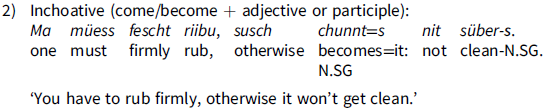
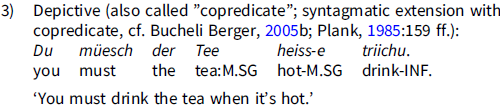

Henceforth, these phenomena are referred to as “predicative adjective agreement” (PAA).
Relating to the historical development of PAA in Highest Alemannic, previous literature suggests two important factors. First, PAA forms were already present as an optional feature in Old High German, making it an archaic artifact within Highest Alemannic (see, for example, Behaghel, Reference Behaghel1923; Braune, Reference Braune1987:219ff., Hotzenköcherle, Reference Hotzenköcherle, Karg-Gasterstädt and Erben1956:226). As Fleischer (Reference Fleischer2007) suggests, however, this explanation might not be plausible on its own. In a distribution analysis, he finds an inflection rate of 28% in documents before 850 AD compared to 9% roughly 150 years later and 45% in contemporary Highest Alemannic dialects (Fleischer, Reference Fleischer2007:211ff.). Under the archaism theory alone, today’s dialects would appear to be even more archaic than late Old High German. Instead, it is argued that contact with Romance languages surrounding the Highest Alemannic area has played a crucial role in the intensification of inflected forms (see also Krier, Reference Krier1990:799; Moulton, Reference Moulton1941; Szadrowsky, Reference Szadrowsky1936; Zinsli, Reference Zinsli1968).
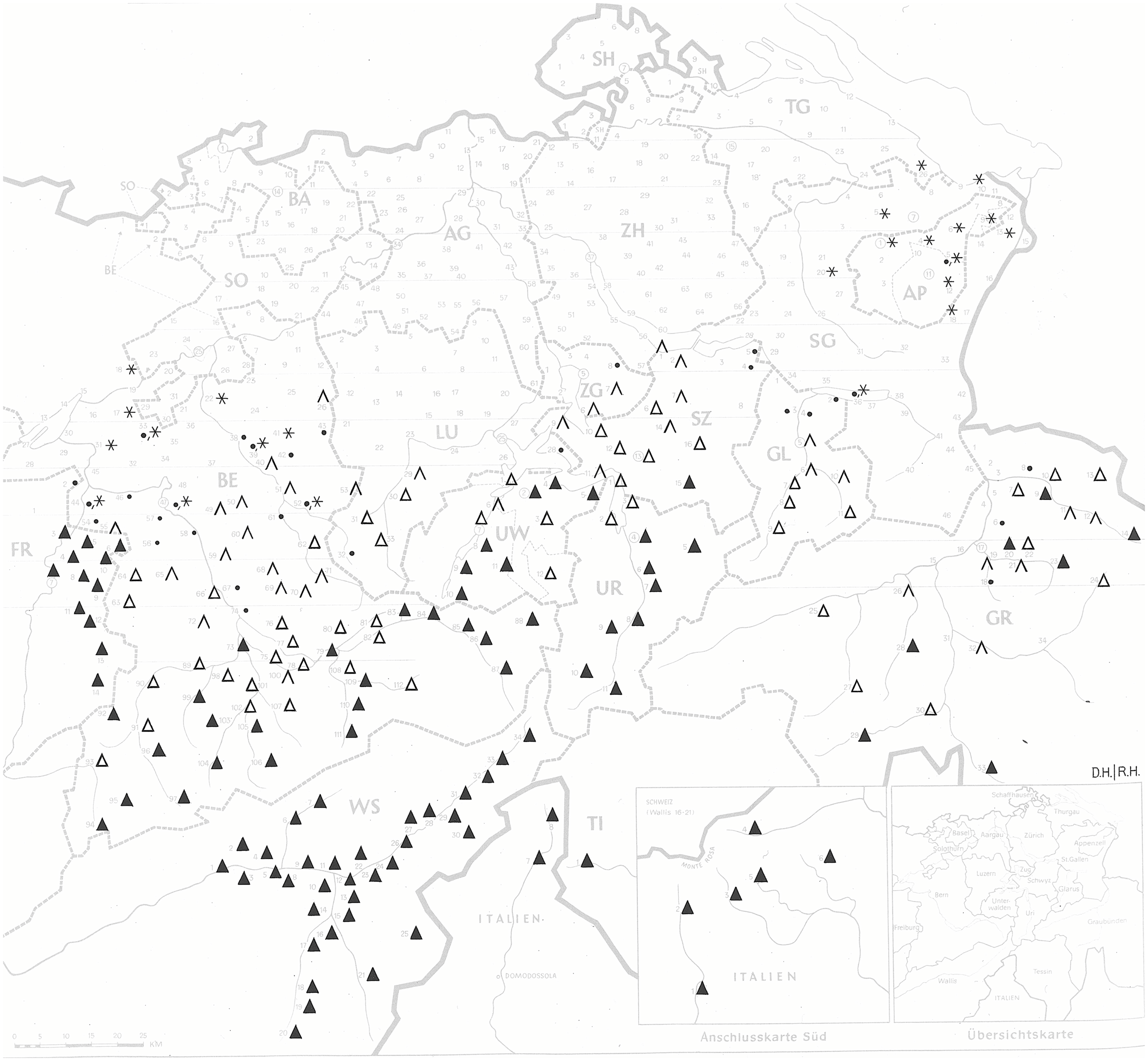
PAA has been documented in various linguistic atlases over the course of the twentieth century (e.g., Deutscher Sprachatlas, map 98, cf., Wrede, Mitzka & Martin, Reference Wrede, Mitzka and Martin1927–1956; Vorarlberger Sprachatlas, map V 201, cf., Gabriel, Reference Gabriel2006:469). The current study specifically focuses on the material gathered in the Sprachatlas der deutschen Schweiz (henceforth SDS; Hotzenköcherle & Baumgartner, 1962–1997), which reflects the situation in the middle of the twentieth century. Operating in a traditional dialectological framework, within each of its sample localities the SDS chose two to three NORMs (and occasionally female NORFs) and interviewed them in their homes. Concerning PAA, twenty-two items were elicited and mapped according to the number of inflected forms produced by the speakers. Map 1 indicates that most inflected forms occurred in regions in the south and southwest. Regions at the northern and eastern fringes of the Highest Alemannic area were transition zones with fewer inflected forms, and speakers in northern Switzerland did not inflect at all.
SDS III, map 256 (see Hotzenköcherle & Baumgartner, Reference Hotzenköcherle and Baumgartner1975). Inflection of predicative adjectives in Swiss German around 1950. ▲ = 11-22/22 instances inflected, △ = 5-10/22 instances inflected, ⋀ = 1-4/22 instances inflected, ∘ = inflected forms produced in spontaneous speech only, ∗ = generalized inflected forms only.
In terms of current areal distribution, recent studies suggest an overall decline in inflected forms. Real-time changes have been documented in localities in the west (see Egger, Reference Egger1993:38), in the south (see Fuchs, Reference Fuchs1993:77), and at the eastern border of Switzerland (see Banzer, Reference Banzer1993:91). However, these studies have been restricted by their limited number of localities and small sample sizes. The most recent large-scale documentation of PAA can be found in the SADS (Syntaktischer Atlas der Deutschen Schweiz; see Bucheli & Glaser, Reference Bucheli, Glaser, Barbiers, Cornips and van der Kleij2002; Glaser, Reference Glaser2021; Glaser & Bart, Reference Glaser, Bart, Kehrein, Lameli and Rabanus2015;), which reports on data collected between 2000 and 2002. The SADS differed methodologically from the historical approach in that participants of all age groups and with a variety of social backgrounds were included. Furthermore, speakers were not interviewed in person but via written questionnaires. As it aimed to complement historical data with investigations of new phenomena rather than to retrace change, the SADS included only one item concerning predicative adjectives in the narrow sense (instead, the focus was placed on related phenomena such as resultative and depictive constructions; see Bucheli Berger & Glaser, Reference Bucheli Berger and Glaser2004; Bucheli Berger, Reference Bucheli Berger2005a, Reference Bucheli Berger, Himmelmann and Schultze-Berndt2005b). The SADS results indicate that the inflection of predicative adjectives was still strongly present in the southernmost Highest Alemannic areas around the turn of the millennium, with fewer instances documented in the west and in the transition zones of the Bernese Alps, Central Switzerland, and the Grisons (see also Bucheli Berger, Reference Bucheli Berger2005a, Reference Bucheli Berger, Himmelmann and Schultze-Berndt2005b).
Previous research has provided insights into the intralinguistic factors affecting the use of PAA. Historically, inflection rarely occurred in plurals (Fleischer, Reference Fleischer2007; see also Banzer, Reference Banzer1993; Egger, Reference Egger1993) and practically never occurred in comparatives or superlatives, or in expressions lacking overt subjects (Fuchs, Reference Fuchs1993; Hodler, Reference Hodler1969). On the semantic level, the uninflected form is preferred when an adjective is used figuratively, or, in some regions, when referring to a person (Henzen, Reference Walter1927; see also Fleischer, Reference Fleischer2007:217f.). Inflected forms are more likely to be used when the adjective in question is a typical dialectal expression rather than a loan word (e.g., Egger, Reference Egger1993; Fuchs, Reference Fuchs1993; Henzen, Reference Walter1927; Hodler, Reference Hodler1969). Concerning morphophonemic variation, it has been previously suggested that adjectives ending in -ig, -er, or in a vowel are less likely to be inflected (Fleischer, Reference Fleischer2007; Henzen, Reference Walter1927; Hodler, Reference Hodler1969). Fleischer (Reference Fleischer2007:220) furthermore concludes that morphologically (and phonologically) “more complex” adjectives are less likely to be inflected than monomorphemic, monosyllabic adjectives.
Extralinguistic factors explaining the gradual disappearance of inflected forms have received less attention. In her study in the Canton of Fribourg, situated at the western border of the Highest Alemannic region, Egger (Reference Egger1993:38f) has suggested an effect of social class. While younger speakers in her study generally produced less inflected forms, a post hoc analysis revealed that the fewest inflected forms, and thus the most progressive linguistic behavior, was found among middle-aged speakers of a lower social status. Egger relates this finding to Labov’s (Reference Labov and Bright1966) discussion of hypercorrection and suggests that the formal setting of her interviews might have influenced this result (see Labov Reference Labov1970, Reference Labov1972). The rather conservative behavior of the young upper class, in turn, is explained by these speakers’ high language awareness combined with a positive attitude toward their dialect. The role of attitudinal factors relating to PAA among young speakers is also discussed by Fuchs (Reference Fuchs1993) with regard to her participants in a small village in the Canton of Valais in the south. She found evidence that speakers with higher inflection rates were both more aware of their language use and prouder of their own dialect, constructing a distinct local dialect identity. A growing body of research in other contexts has also highlighted the role of identity construction in contributing to dialect preservation or change (see, for example, Beaman, Reference Beaman, Ziegler, Edler and Oberdorfer2020; Beaman & Tomaschek, Reference Beaman and Tomaschek2021; Becker, Reference Becker2009; Bowie, Reference Bowie, Llamas and Watt2010).
Due to the proximity of Highest Alemannic to both (noninflecting) Alemannic dialects and (inflecting) Romance languages, factors relating to mobility and language contact may affect the patterning of PAA. Mobility, a crucial factor in language variation and change (Blommaert, Reference Blommaert and Coupland2016; Britain, Reference Britain, Schreier and Hundt2012, Reference Britain, Chamber and Schilling2013, Reference Britain and Coupland2016; Johnstone, Reference Johnstone and Mesthrie2011), can be understood not only from a geographical perspective (for example, in gravity models, e.g., Trudgill, Reference Trudgill1974, Reference Trudgill1983), but also in light of its social dimensions (see Britain, Reference Britain, Schreier and Hundt2012, Reference Britain and Coupland2016). The Alpine area of German-speaking Switzerland was long isolated by both topographical and societalFootnote 1 barriers until twentieth-century transport and economic advancements made the most remote regions of the Alps more easily accessible (see BFS, 2021; Hezel, Reference Hezel2020). Increased mobility, in turn, fostered greater contact between speakers of various Alemannic dialects. Bucheli Berger and Glaser (Reference Bucheli Berger and Glaser2004:194, see also Bucheli Berger, Reference Bucheli Berger, Himmelmann and Schultze-Berndt2005b:148) argue that recent dialect contact has led to morphosyntactic leveling in the case of the formerly well-preserved PAA. A recent longitudinal study with Swabian speakers by Beaman (Reference Beaman, Ziegler, Edler and Oberdorfer2020; see also Beaman & Tomaschek, Reference Beaman and Tomaschek2021) gives support to this claim, indicating that mobility combined with linguistic identity may significantly contribute to dialect leveling (see also Auer, Reference Auer, Boberg, Nerbonne and Watt2018). At the same time, empirical evidence on how PAA is affected by mobility within German-speaking Switzerland remains thin. Only two of the above-mentioned studies included this factor; however, it was solely based on short-term mobility, and no significant effects were found (i.e., commuting distance to work; see Banzer, Reference Banzer1993:92; Egger, Reference Egger1993:37).
Due to the close proximity of the neighboring Romance communities, a contact-based, multilingual perspective on PAA in Highest Alemannic is important. Based on the traditional psycholinguistic definition (Weinreich, Reference Weinreich1953), vital insights can be drawn from research on linguistic transfer.Footnote 2 Similarities and differences between languages in a multilingual repertoire can influence the use of the respective languages on all linguistic levels (see Jarvis & Pavlenko, Reference Jarvis and Pavlenko2008:61ff; Ringbom, Reference Ringbom2007:54ff.). While research in this field has mostly focused on phonological and lexical transfer, a growing body of research leaves no more doubts on the transferability of morphosyntactic phenomena, whether from an L1 to an L2 or vice versa (for an overview, see Jarvis & Pavlenko, Reference Jarvis and Pavlenko2008:92ff.; see also Trudgill, Reference Trudgill2011; or Maitz & Németh, Reference Maitz and Németh2014, for contact-induced influences on linguistic complexity of the languages involved). Although its influence has been discussed from a historical perspective (see Fleischer, Reference Fleischer2007), empirical research on more recent variation and change in PAA has taken a rather German-centered, monolingual perspective, failing to account for multilingual practices or contact-induced influences beyond German-speaking Switzerland.
The present study seeks to bridge these research gaps by investigating the distribution of PAA in time and space on a large scale, focusing on the various individual and social factors shaping PAA in Swiss German. Data analysis is led by the following research questions and hypotheses:
-
(1) How are inflected predicative adjectives spatially distributed today compared to 1950 historical data from the SDS?
-
H1) According to previous findings, an overall decline in inflected predicative adjectives is hypothesized. Most inflected forms are expected to occur in the western and southern fringes of the Highest Alemannic dialect area.
-
-
(2) Which social factors contribute to the occurrence of inflected predicative adjectives?
-
H2.1) Tighter social networks and lower geographical mobility are expected to be associated with more inflected forms.
-
H2.2) Competence in and use of Romance languages are expected to encourage the inflection of predicative adjectives.
-
H2.3) Positive attitudes toward one’s own dialect and/or negative attitudes toward Standard German are expected to increase the inflection of predicative adjectives.
-
H2.4) Speakers with higher education and/or communicatively-oriented professions are expected to use fewer inflected forms.
-
2. Methods
2.1 Design
In order to investigate change in PAA in Swiss German, historical data from the SDS (see Map 1, Section 1 above) are compared to contemporary data collected in the project Swiss German Dialects Across Time and Space (SDATS; www.sdats.ch, Leemann et al., Reference Leemann, Péter Jeszenszky, Messerli and Studerus2020a).
The overarching goal of SDATS is to investigate language variation and change in German-speaking Switzerland over the past seventy years. The project elicits more than three hundred phonetic, lexical, and morphosyntactic items, two hundred of which can be directly compared to the historical records in the SDS (Hotzenköcherle & Baumgartner, 1962–1997). The methodology of SDATS deviates from the SDS in that a representative subset of the original SDS localities is revisited (125 out of 573; see Jeszenszky, Steiner, & Leemann, Reference Jeszenszky, Steiner and Leemann2021), and the number of speakers per locality is simultaneously increased from two to three NORMs/NORFs to eight speakers (four older and four younger speakers, two male and two female speakers each). Besides the linguistic variables, extensive metadata is collected in order to investigate individual and social dimensions of the identified patterns. Fieldwork started in February 2020 and needed to be switched from in-person interviews to virtual data collection due to the outbreak of COVID-19 (Leemann et al., Reference Leemann, Péter Jeszenszky, Messerli and Studerus2020a).
2.2 Participants
The current study includes 192 young adults from the SDATS localities within the traditional PAA area, that is, from localities in which at least one inflected predicative adjective is documented in the SDS (see Map 2).
Localities of origin of the 192 speakers (the medium sized points in Bosco Gurin and Linthal indicate that two instead of four speakers participated in these localities).
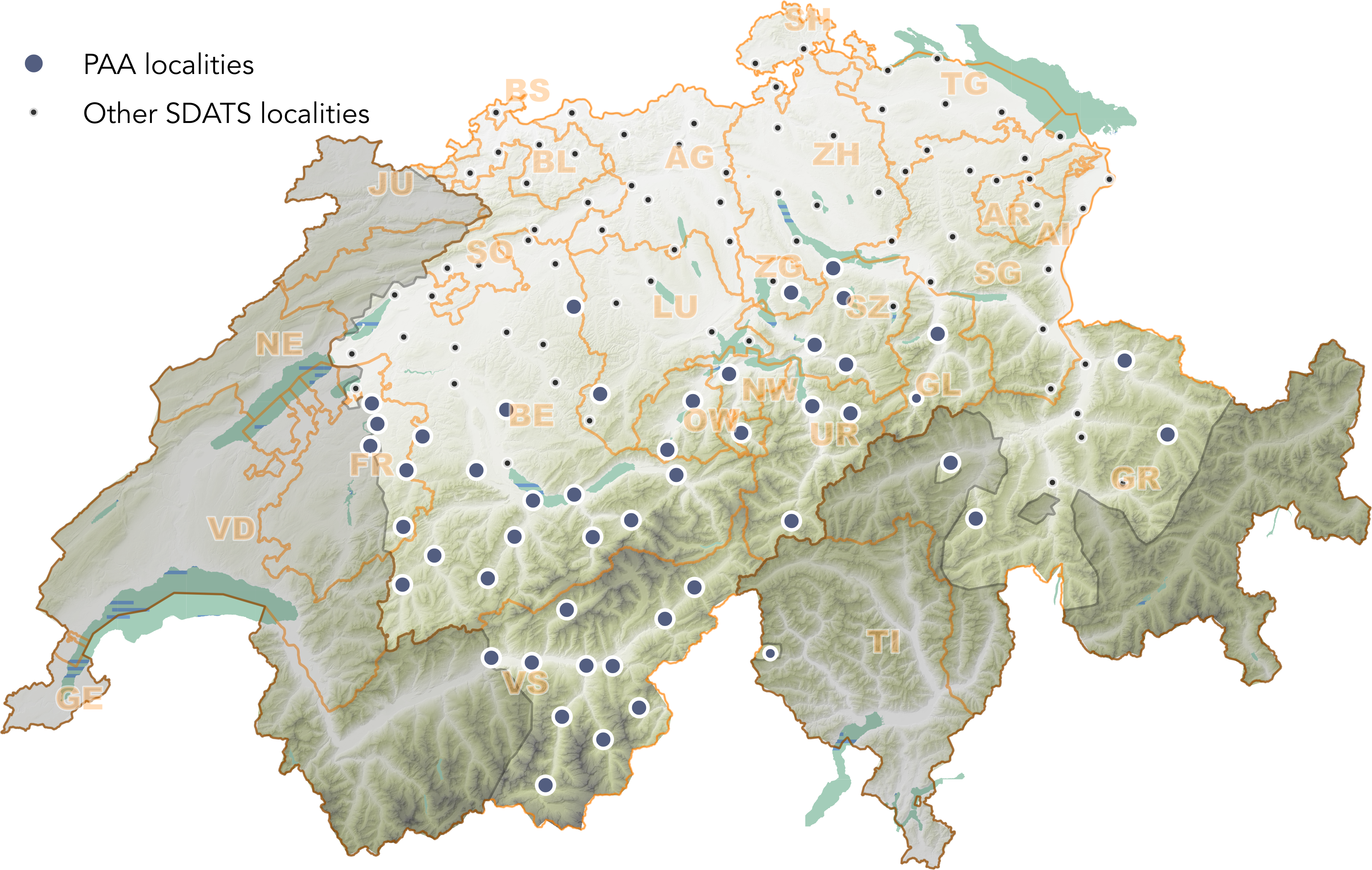
We aimed to sample four speakers, two male and two female, per locality. This criterion was met in 47 out of 49 localities (in Linthal [GL] and Bosco Gurin [TI], only two out of four speakers could be recruited). The participants were 19-39 years old (median 26) and grew up and lived in their respective locality for most of their lives, with rather low long-term mobility. Swiss German is their first and main language, and at least one of their parents grew up in the same region. The sample contains 83 speakers with secondary education and 109 speakers with tertiary education, with daily travel times ranging between zero and 128 minutes (median 18 minutes, mean 25 minutes). Furthermore, our participants reflect today’s multilingual reality: most speakers reported competence in languages other than German, with one or more Romance languages spoken by 80 participants on a regular basis.
2.3 Material
Predicative adjectives were elicited through a total of 19 sentence completion and translation items. To ensure comparability, as many items as possible were re-elicited from the SDS. To cover the broad range of contexts discussed in the literature, items varied across phonetic, lexical, syntactic, and semantic criteria. A complete list of the SDATS items on PAA can be consulted in Table 2.
SDATS items eliciting PAA

Metadata collected on the speakers’ backgrounds included responses to an online questionnaire on basic demographic information (age, gender, education, and occupation) as well as detailed mobility profiles, language biographies, and language attitudes (see Section 2.4 for information on the operationalization of these variables).
2.4 Procedures
2.4.1 Elicitation
For each item, participants were presented with an expression in Standard German and asked to complete a phrase and/or translate it spontaneously into their local dialect (see Figure 1; Leemann et al., Reference Leemann, Péter Jeszenszky, Messerli and Studerus2020a, Reference Leemann, Péter Jeszenszky, Studerus and Messerli2020b). In order to divert attention away from PAA, lexical aspects were usually focused, and in completion tasks, unmarked forms in Standard German were not given. The 19 items eliciting PAA (Table 2) were mixed in with other variables as part of the entire dialect interview and, thus, were not presented in immediate succession. Participants completed the online metadata questionnaire after the dialect interview. For their participation in the SDATS project, participants were compensated with CHF 100, and written consent was obtained prior to the interview.
Elicitation of PAA in SDATS. Items consist of a context (e.g. ‘What do you say when you are sick and you lost your voice?’), instructions (e.g. ‘Complete and translate’), and a pre-structured utterance (e.g. “I am ___.”).

2.4.2 Preparation of historical and contemporary data
In order to allow for numerical comparison between the historical and contemporary data, raw elicitation transcripts from the 22 SDS items with PAA environments were recoded (1 = adjective inflected; 0 = not inflected),Footnote 3 and the total relative frequencies of inflected forms were calculated for each locality of interest (see Analysis Report, Section 1.2, for further details). Accordingly, the 19 SDATS items were coded for inflection (1 = inflected; 0 = not inflected) in the same manner. Basic metadata variables (e.g., age, gender, etc.) were directly drawn from the online questionnaire. More complex variables were transformed or factorized based on the raw questionnaire data. Speakers’ education levels (secondary vs. tertiary) were categorized according to their current statuses (i.e., speakers who completed a secondary degree and were currently studying in tertiary education were categorized as tertiary). Occupations were divided into communicative (e.g., service occupations) versus manual or technical professions (e.g., industrial workers), as applied by similar studies (e.g., Christen et al., Reference Christen, Bucheli, Guntern, Schiesser, Kehrein, Lameli and Rabanus2015; Schiesser, Reference Schiesser2019). Long-term dialect mobility was calculated based on the total number of noninflecting, German-speaking localities that a participant had lived in, weighted according to the duration of each stay. Everyday mobility was measured as a function of aggregated weekly travel time to places of work and study. As for social networks, participants were asked to state the three people from their private and professional networks, respectively, with whom they interact most frequently, and to indicate which dialect or language they speak with each other. Based on this information, we coded how many of these contacts speak a noninflecting German dialect. Calculations of Romance language use and competence were drawn from speakers’ language biographies: a score was assigned based on the aggregated reported competence levels in Romance languages spoken by the participants during a typical week. With regard to affective factors, raw questionnaire data contained speakers’ agreements with statements on a 7-point Likert scale. The raw data was subjected to an exploratory factor analysis, yielding the following four factors: personal dialect use (five items), dialect identity (five items), perceived dialect change (six items), and attitudes toward Standard German (three items).
All datasets, codebooks, and analysis reports can be downloaded from osf.io (https://osf.io/yvsjh/).
2.5 Statistics
Statistical analyses were performed in R (R Core Team, 2020). Relating to the first research question, real-time change in PAA was analyzed by contrasting the 1950 versus 2020 data on the locality level. Descriptive analyses were first performed, and the data were mapped in QGIS (QGIS Development Team, 2021). To assess the statistical significance of change patterns in the 49 localities, linear regression modeling was performed.
Relating to the second research question concerning the various influences on PAA within individual speakers, the contemporary SDATS data were subjected to logistic mixed-effects modeling using the package lme4 (Bates et al., Reference Bates, Maechler, Bolker and Walker2015). In order to facilitate the interpretation of the regression coefficients and potential interactions, all predictors were z-standardized. To test for collinearity issues, variance inflation factors (VIFs) were computed in the package car (Fox & Weisberg, Reference Fox and Weisberg2019). As all VIFs were close to one, no collinearity issues were expected.Footnote 4 Between-item variation was accounted for by allowing random intercepts per item. Table 3 displays all factors entered to the model along with structural information.
Influences on PAA. Dependent variable and fixed and random effects

3. Results
The following results are presented according to the research questions and hypotheses outlined in Section 1. In Section 3.1, real-time change in PAA is documented alongside a more detailed presentation of variation between and within localities. In Section 3.2, we focus on the various factors affecting PAA within speakers in the 2020 data.
3.1 Real-time change in PAA
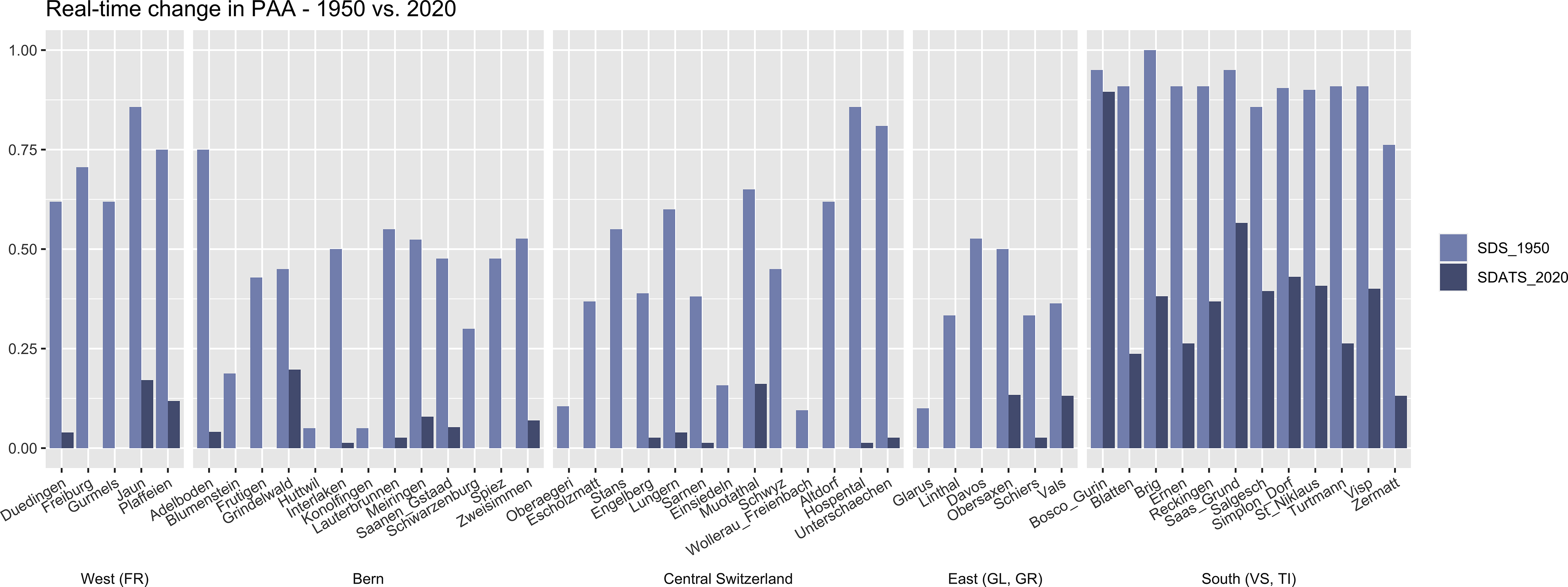
Our results reveal a clear decline in inflected predicative adjectives over the past century. Figure 2 compares the 1950 SDS data to current inflection rates on the basis of the average proportion of inflected predicative adjectives per locality. Map 3 shows the spatial distribution of historical and current inflection rates.
Mean inflection rates in the SDS (1950) vs. SDATS (2020).
Spatial distribution of proportions of historical and contemporary inflection. Background colors refer to 1950 data, dots in front to 2020 data. The darker the shade, the higher the proportion of inflection.
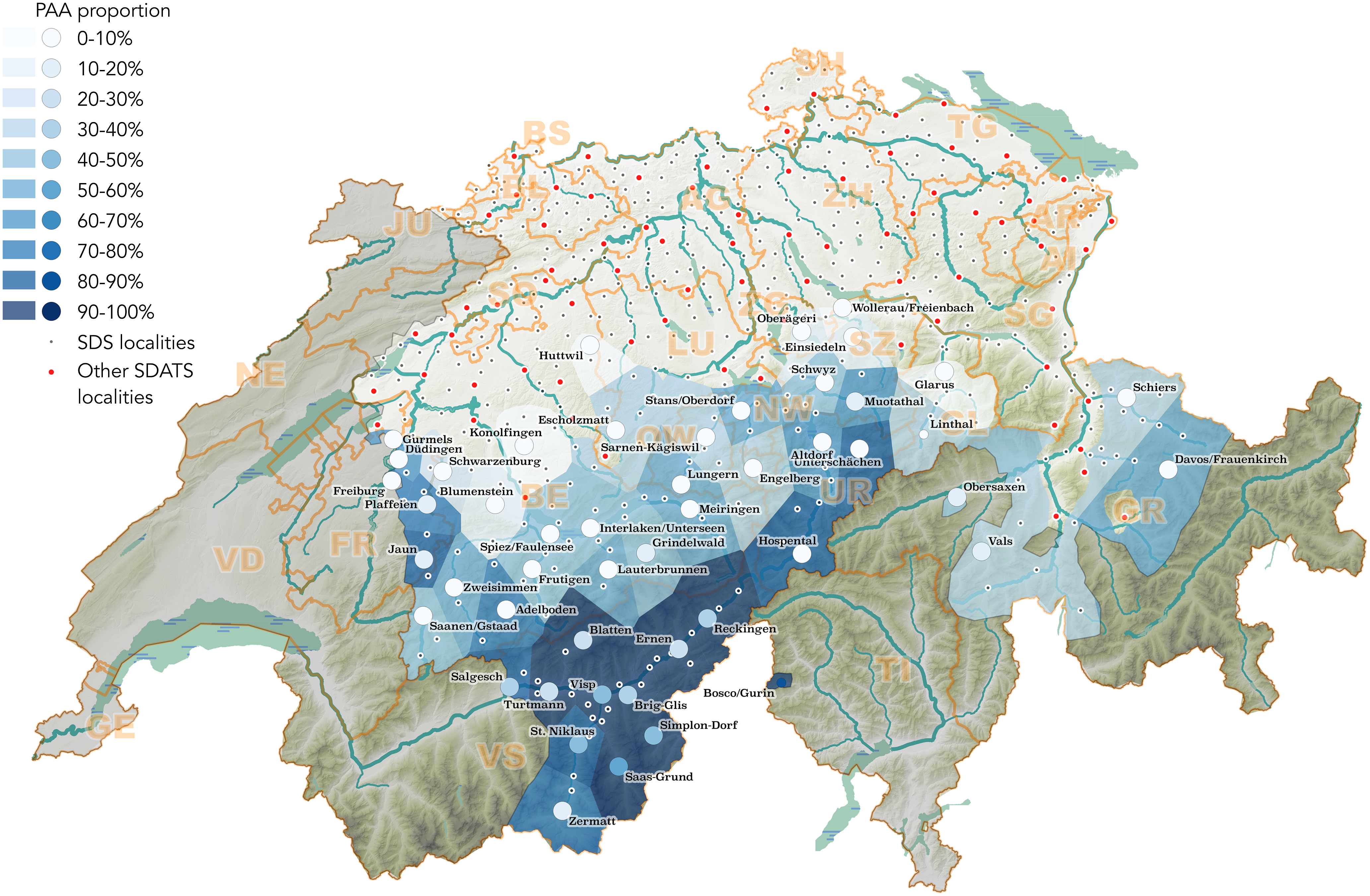
As can be deduced from Figure 2 and Map 3, PAA has declined in all 49 localities. Most remaining inflected forms are found in the southernmost regions. Bosco Gurin stands out, with a current inflection rate only slightly below the historical one (95% versus 90%, that is, −5%). Declines are more pronounced in the Valais, ranging between −38% and −63%. At the same time, PAA is still stronger in these localities compared to the rest of the Highest Alemannic area. Current mean proportions of inflection in the Valais range from 13–57%, as opposed to 0–20% in all other regions. Few or no instances of inflected forms were observed in localities in Fribourg, Bern, and Central Switzerland. In this area, Grindelwald and Muotathal somewhat stand out from their surroundings with a comparably higher amount of PAA: while, on average, 20% of predicative adjectives were inflected in Grindelwald, proportions in other Bernese localities ranged from 0–8%. In Muotathal, 16% were inflected compared to 0–4% in other localities in Central Switzerland. In the southeastern canton of Grisons, the historical data suggested substantial between-locality variation, and, as in all other regions, inflected predicative adjectives have declined. Some inflected forms seem to remain in the Walser localities Obersaxen and Vals (13%), while PAA has almost completely vanished in localities at the eastern national border (i.e., 4% in Schiers and 0% in Davos).
As described in Section 2.5, a linear model was built in order to statistically test the relationship between PAA in 1950 and real-time change observed in each locality. Results indicated a significant effect for PAA rate 1950 on the amount of change (−0.54, SE = 0.07, p < 0.001; see Analysis Report, Section 2.2), suggesting that, while PAA has declined overall, localities that started out with the highest amount of PAA have undergone a steeper decline than localities where inflection rates were already historically lower. With regard to contemporary within-locality variation, Table 4 displays the proportions of inflection usage across the four speakers in each SDATS locality.
Proportion of inflected predicative adjectives by speaker within each SDATS locality

Table 4 reveals that in some localities, proportions of inflected predicative adjectives vary only slightly across speakers, while in other localities, these proportions show substantial individual divergence. In Bern, for example, most localities exhibit very low variation. The highest within-locality spread between speakers’ PAA rates can be found in Grindelwald, where one speaker did not inflect at all, while three others ranged from 21–32%. In Meiringen, Saanen, and Zweisimmen, some individuals produced higher proportions, while their local peers produced (practically) no inflected forms. A similar picture emerges in Fribourg, where two speakers from Jaun and Plaffeien stand out with considerably higher inflection rates compared to their peers (42% versus 0–16%). In Central Switzerland, inflected predicative adjectives were only rarely recorded in one or two speakers per locality except for in Muotathal, where three out of four speakers produced inflected forms (0.05–32%). In the eastern localities, PAA forms were documented for three out of four speakers in Obersaxen (inflecting 16–21% of predicative adjectives), two out of four speakers in Vals (11% and 42%), and a single speaker in Schiers (11%). The largest spread is apparent in the southern region; whereas both speakers from Bosco Gurin consistently inflected almost all predicative adjectives (86% and 93%), within the canton of Valais, individual inflection rates range from 0–89%.
3.2 Factors affecting PAA
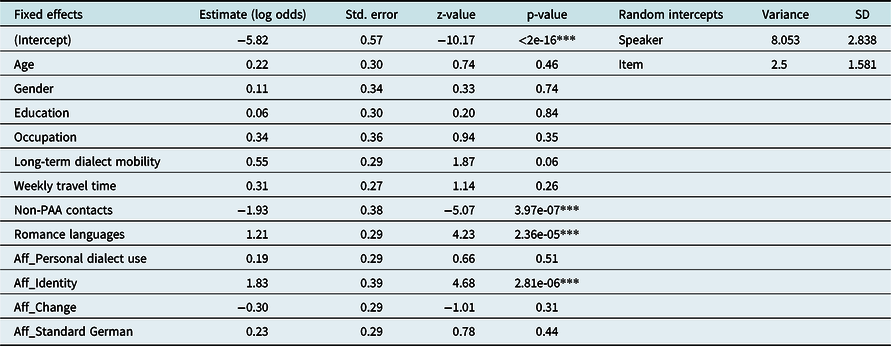
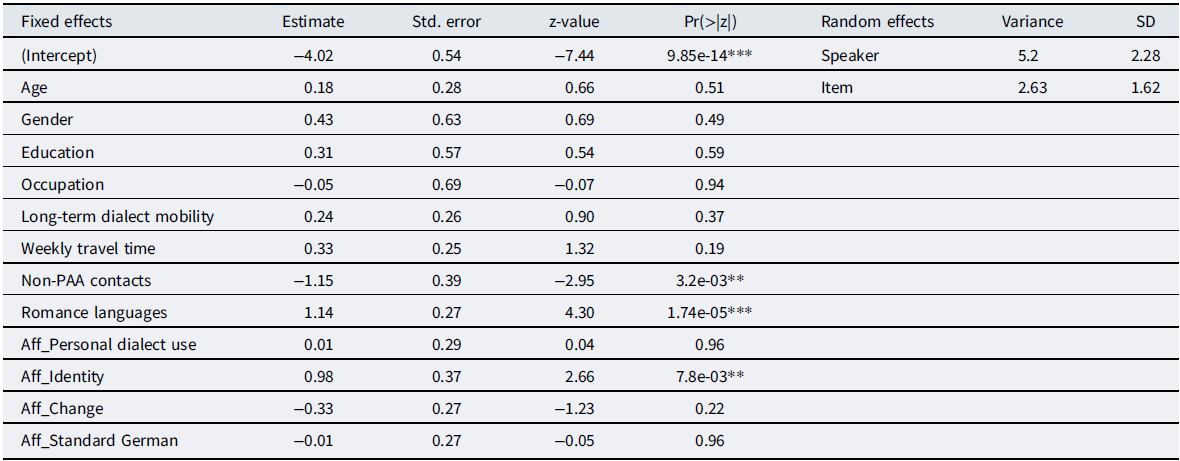
As presented in the previous section, the current data is subject to substantial variation across localities and speakers. In what follows, results of a more detailed analysis of potential factors affecting variation in PAA are presented. Results of the statistical analyses are reported in Table 5 and Figure 3.
Coefficients of logistic mixed-effects model; fixed and random effects
Effect plots for Romance languages, non-PAA contacts, dialect identity, and long-term dialect mobility.

As all fixed effects are centered and standardized, estimates (in log odds) are comparable across all predictors. The model reveals three main predictors influencing PAA within individuals. A higher number of close contacts to Swiss German speakers from outside the traditional PAA area (i.e., people who are not expected to inflect predicative adjectives) significantly predicts lower usage of PAA (−1.93, SE = 0.38, z = −5.07, p<0.001). In contrast, an individual’s higher use of and competence in at least one Romance language predicts a significantly higher usage of PAA in their Swiss German (1.21, SE = 0.29, z = 4.23, p < 0.001). A significant positive effect of local dialect identity is also obtained: the prouder speakers are of their own dialect, and the more critical they feel toward language change in Swiss German, the higher their chances of inflection (1.83, SE = 0.39, z = 4.68, p<0.001). A positive effect slightly not reaching the p = 0.05 level is obtained for dialectal long-term mobility, indicating a trend toward higher chances of inflection for individuals who have lived in more German-speaking places outside the Highest Alemannic area (0.55, SE = 0.29, z = 1.86, p = 0.06).
Effects of age, gender, educational background, weekly travel time, and three affective factors (personal dialect use and accommodation, perception of language change, and attitudes toward Standard German) did not reach statistical significance (Table 5). Interactions between social networks, the use of Romance languages, and dialectal long-term mobility were tested but did not reach significance and were not retained in the final model.
Models including the speakers’ places of origin as a fixed effect did not converge. However, regional effects are obviously at play when considering the variation across localities reported in Section 3.1. To account for the potential influence of geographical origin, the model presented above was rerun on two subsamples, the former retaining speakers from cantons where inflected forms were observed in the current data (n = 170), the latter retaining speakers from localities with inflected forms (n = 110). The results changed only marginally, with effects weakening slightly in the two subsamples. The model outputs are reported in the Appendix.
Table 5 also shows the standard deviations of the random effects, that is, between-subject (SD = 2.84) and between-item variation (SD = 1.58). Figure 4 displays a comparison of all items based on the absolute frequencies of inflected forms.
Between-item variation.

Clear trends are evident for constructions with animals as controllers combined with the adjective “wild” (pa01, pa02, and, to a lesser extent, pa03), which were inflected most frequently. More variation can be observed among constructions with inanimate subjects (pa04–11) and constructions in which the controller refers to a person (pa12–19). There is a higher number of inflected forms in first-person singular (pa12, pa13) compared to the second-person singular (pa14, pa15) and third-person singular (pa16–19). No trends according to word frequency could be identified (see also Analysis Report, Section 5.2.3).
4. Discussion
4.1 Real-time change in PAA (RQ1)
With regard to the first research question, our data demonstrate an overall decline in inflected predicative adjectives, confirming trends previously documented in the cantons of Fribourg (Egger, Reference Egger1993) and Valais (Fuchs, Reference Fuchs1993) as well as recent findings from the SADS (Bucheli Berger & Glaser, Reference Bucheli Berger and Glaser2004; Bucheli Berger, Reference Bucheli Berger2005a, Reference Bucheli Berger, Himmelmann and Schultze-Berndt2005b), covering the whole of German-speaking Switzerland. A closer examination of patterns in specific localities offers interesting insights. Firstly, the situation in Bosco Gurin is peculiar. This village is a small linguistic enclave with about thirty remaining speakers of Swiss German, representing a prototypical example of a high-density, closed network in which linguistic norms are preserved over time (see Milroy & Milroy, Reference Milroy and Milroy1985). At the same time, these speakers are surrounded by the Italian-speaking community and thus embedded in a diglossic situation (according to Fishman, Reference Fishman1980; also Berthele, Reference Berthele and Christen2004), with Italian used for formal purposes and Swiss German used as an informal language among family and friends (for a detailed report on the linguistic situation in Bosco Gurin, see Bachmann & Glaser, Reference Bachmann and Glaser2019). The strength of PAA appears to be bolstered here by the nature of residents’ social networks and bilingualism: tight networks with few contacts to the rest of German-speaking Switzerland, combined with integration into the Italian-speaking community, may have led to the high preservation of PAA among these speakers. This result mirrors what is observed in other similar contexts, such as Lippi-Green’s (Reference Lippi-Green1989) finding that, in a small village in western Austria, speakers with tighter networks were less likely to produce innovative forms.
Corroborating previous findings (see Bucheli Berger, Reference Bucheli Berger2005a, Reference Bucheli Berger, Himmelmann and Schultze-Berndt2005b; Bucheli Berger & Glaser, Reference Bucheli Berger and Glaser2004; Fuchs, Reference Fuchs1993), the southernmost part of the Highest Alemannic area still emerges as the core inflecting area, whereas there has been a precipitous decline in PAA in localities in Fribourg, the Bernese Alps, and Central Switzerland.
Based on the observed patterns of between- and within-locality variation, we suggest that the localities investigated here exemplify three types of variation and/or stages of change in PAA: stable usage, declining usage, and completed loss. Bosco Gurin is the only representative of the first type, a stable system where PAA has been consistently preserved. Within localities of the second type, in the Valais and a few rural localities in neighboring cantons, there are substantial between-speaker differences in inflection rates, indicating that the feature is subject to an ongoing change. Most localities in the northern half of the traditional PAA area belong to the third type, in which the loss of the feature has (almost) been completed, as indicated by speakers consistently producing few to no inflected forms.
4.2 Factors affecting PAA (RQ2)
The current study paints a complex picture of how mobility affects the inflection of predicative adjectives. Our data lend empirical support to theories that predict dialect contact to lead to leveling, as shown by the decline in PAA (see Beaman, Reference Beaman, Ziegler, Edler and Oberdorfer2020; Bucheli Berger, Reference Bucheli Berger, Himmelmann and Schultze-Berndt2005b; Bucheli Berger & Glaser, Reference Bucheli Berger and Glaser2004). The significant effect obtained for number of non-PAA Swiss German contacts indicates that, as speakers’ networks outside the Highest Alemannic area grow, their use of inflected predicative adjectives declines. Regarding geographical mobility, however, the results seem somewhat puzzling. On the one hand, everyday mobility was not a significant predictor, corroborating previous findings (Banzer, Reference Banzer1993 and Egger, Reference Egger1993). On the other hand, contrary to expectations, long-term mobility was positively associated with PAA (although slightly below the level of statistical significance). A post hoc analysis revealed that this result was influenced notably by a certain outlier: one speaker from the canton of Valais both exhibited a particularly high inflection rate (72%) and was extremely mobile (had the second-highest score in our sample in terms of long-term dialect mobility). An examination of the speaker’s background revealed that the high mobility was associated with her profession as a performer and that strong ties to her origins had been maintained through time. After having removed this speaker from the sample, the effect of long-term dialect mobility weakened considerably (effect in total sample: 0.55, SE = 0.29, z = 1.86, p = 0.06/versus outlier removed: 0.36, SE = 0.32, z = 1.12, p = 0.26; see model output in Analysis Report, Section 4). In sum, our results are in line with theoretical discussions, suggesting that social networks may be more important than geographical mobility (Britain, Reference Britain, Schreier and Hundt2012, Reference Britain and Coupland2016) where PAA is concerned.
Although their influence has been argued for from a historical perspective (see Fleischer, Reference Fleischer2007:233 or Krier, Reference Krier1990:799), the role of Romance languages with regard to PAA has not been addressed empirically before. Our results strongly support contact-induced influences in the current data, which are already reflected spatially: generally, more inflected forms were found in regions bordering on Romance-speaking territories, compared to the middle zone, which is completely surrounded by German-speaking areas. This lends support to previous studies that report higher rates of PAA in localities at language borders (Egger, Reference Egger1993; Fuchs, Reference Fuchs1993), as opposed to those surrounded by German-speaking communities (Banzer, Reference Banzer1993). This spatial effect is substantiated in our model (Section 3.2 above), which suggests a considerable positive influence of Romance language usage and competence on PAA among Swiss German speakers. The fact that this factor is the most robust predictor when subsampling only the core PAA area (Model 3 in the Appendix) lends further support to the claim that the effect is not merely areal in nature. Even within the core PAA localities bordering on Romance territories, speakers who use Romance languages regularly are more likely to inflect predicative adjectives in Swiss German. Hence, at this point in time, even though PAA forms are decreasing overall, the external influence of languages with regular inflection of predicative adjectives is contributing to their maintenance in dialects with optional inflection. More broadly, our data provide empirical evidence for structural morphological transfer in the multilingual mind (see Jarvis & Pavlenko, Reference Jarvis and Pavlenko2008:61ff.), suggesting a reinforcement of inflection morphology transferred from an L2 into the L1.
Of the four affective factors tested in the current study, dialect identity was the only one found to significantly affect PAA. Speakers with a stronger dialect identity used more inflected forms. This factor was calculated based on questionnaire items that asked speakers how proud they were to be (recognized as) a local dialect speaker and how much they worried about the local community losing distinct dialect features. Mirroring the findings of Fuchs (Reference Fuchs1993), our data suggest that speakers’ pride in their own dialects positively influences the maintenance of PAA. Our results are in line with studies in other contexts, which have found that the construction of place identity can manifest in phonological and morphological features and can contribute to change on both the individual and community levels (Beaman, Reference Beaman, Ziegler, Edler and Oberdorfer2020; Becker, Reference Becker2009).
The negligible effects obtained for educational background and occupation in the current data contradict findings from Egger (Reference Egger1993) regarding the influence of social class on PAA. Instead, our results support the general assumption that German-speaking Switzerland lacks robust variation according to professional and educational background.
4.3 Intralinguistic Influences
As the present study focuses on extralinguistic effects, and items were maximally varied across morphosyntactic, lexical, and semantic criteria to ensure comparability to the SDS, conclusions on intralinguistic influences are limited. Nevertheless, various interesting patterns emerged in our data.
As shown in Figure 4, inflected forms most often occurred in constructions with animals as controllers and with the adjective “wild.” In general, PAA was also comparatively strong in the SDS materials that involved animals, suggesting a crucial role for agent-related semantic properties (see Analysis Report, Section 5.1). Potential word frequency effects for the adjective in question were ruled out in a post hoc analysis (see Analysis Report, Section 5.2.3). As pa01 (“the billy goat is wild”) and pa02 (“the dog is wild”) were inflected more frequently than pa03 (“the cat is wild”), one might assume that this could be related to grammatical gender (male > female). However, a sequence effect could be more plausible in this case: pa03 was the first item of this construction type that appeared in the SDATS elicitation, so speakers’ awareness of PAA may have risen in the second and third item of the same type.
Constructions containing a human controller were inflected more frequently than the existing literature led us to expect (Henzen, Reference Walter1927). In the case of pa12 (“because of the short night I am tired now”), speakers might have been influenced typographically by the disyllabic standard variant müde ‘tired’ ending with a vowel, whereas the unmarked form in Swiss German müed/mied is monosyllabic.
In the case of pa13 (“I am hoarse”), the high PAA rate might be related to the fact that speakers often provided more typical dialectal expressions for this item (such as heisram(-ig) or chischterig as opposed to the more standard-like heiser). This corroborates theoretical assumptions and previous findings (Egger, Reference Egger1993; Fuchs, Reference Fuchs1993; Henzen, Reference Walter1927; Hodler, Reference Hodler1969) and was detected in other instances in our data as well. One example is particularly representative for this phenomenon:

In this case, the speaker provided two juxtaposed translation equivalents to the standard variant sauber. Whereas the first, typical Valais German variant flet is inflected, the second variant suiber stays unmarked. A further factor may have to do with the word formation, as adjectives ending in -er have been found to show less inflected forms compared to monosyllabic adjectives (see also broader discussion in Fleischer, Reference Fleischer2007:220).
Lastly, constructions in second-person singular were almost never inflected in our data. Compared to inflection rates in the first and third persons, this seems somewhat surprising. An explanation may be found in the way items were presented. As speakers were not provided with information on gender for sentences in second-person singular, they might have preferred the unmarked form instead of assuming a gender and inflecting accordingly.
4.4 Limitations
The results discussed above are subject to some limitations, the first of which is related to the elicitation paradigm. SDATS data collection covered a broad range of items and aimed to create a corpus that can be compared optimally with the historical data. However, our elicitation methods differed from the SDS with regard to modality: whereas items were presented orally by the interviewer in the SDS, the large majority of interviews for SDATS had to be conducted via videoconferencing from afar (Leemann et al., Reference Leemann, Péter Jeszenszky, Messerli and Studerus2020a), and participants were presented with written prompts. Furthermore, change in real time might be slightly overestimated. In the SDS, answers from two to three speakers per locality were added up, and inflected forms were suggested by the interviewers in certain cases (values reported in the SDS might overestimate the actual proportion of inflected predicative adjectives). In contrast, the SDATS project elicited spontaneous completions or translations without any further suggestions to the participant. In addition, the fact that the SDS recruited NORMs/NORFs, while the current study focuses on young adults, has to be kept in mind when interpreting these insights into real-time change in PAA.
Another limitation concerns the operationalization of mobility in the current paper. According to our research question, long-term mobility was measured by number and duration of stays outside the traditional PAA area, and short-term mobility was based on a holistic measurement of overall weekly travel time. A more comprehensive mobility index, considering actual travel destinations and the linguistic distances between these destinations and speakers’ places of origin, could provide further insights into how mobility affects variation and change in PAA (Jeszenszky et al., Reference Jeszenszky, Steiner and Leemannunder review).
Furthermore, the assessment of language competence and use in the present study is limited due to the self-evaluation by the participants. In order to gain more insights into the transfer effect from Romance languages on Swiss German presented in this study, a tightly controlled experiment involving a detailed assessment of language competence and dominance would provide additional insights in future studies.
Finally, the current study focused on manipulated items rather than spontaneous speech data. In order to gain further insights into the actual distribution of inflected versus uninflected forms, a closer examination of spontaneous speech could certainly be helpful. In addition, comparing the results of perception tasks (such as grammaticality judgments) to actual speech production could provide further evidence as to how aware participants are of PAA and how this relates to their language attitudes.
5. Conclusion
The aims of the current paper were two-fold. On the one hand, we aimed to trace real-time change in the well-known but declining morphosyntactic feature of PAA in Swiss German. On the other hand, we aimed to better understand the factors shaping its distribution. As expected based on previous research, we observed an overall decline in inflected predicative adjectives over the past seven decades. A more complex picture arose when examining variation within localities and speakers as well as the influence of individual and social factors on the use of PAA. We showed that speakers are influenced by close contacts in their social networks, with more closed networks leading to higher rates of producing this morphosyntactic feature and, thus, to a more conservative speech behavior. Furthermore, the current study demonstrates that a multilingual perspective can contribute substantially to the interpretation of linguistic patterns in dialects spoken at a language’s geographical margins. We find that PAA in Swiss German is reinforced by competence in and regular use of one or more Romance languages. From a psycholinguistic view, this result demonstrates crosslinguistic influence on the morphosyntactic level by showing that a feature that is optional in one language may be enhanced by using languages in which it is regular. Due to the restrictions discussed in the previous section, future studies are needed to examine this effect in more detail. Finally, our results add further evidence of the impact of language attitudes and identities on speech behavior. Future studies could build on these findings by probing speakers’ degrees of awareness regarding PAA and how this intertwines with affective factors.
Acknowledgments
This study was funded by the Swiss National Science Foundation. We thank Melanie Studerus, Jan Messerli, Linus Oberholzer, Jonathan Blum, Lara Grunder, Michelle Käch, Corinne Lanthemann, Laura Müller, Viviane Stebler, Janka Szücs, Manuela Troxler, and Jessica Wagner for their help with data collection and Thomas Kettig for useful comments and edits on earlier versions of this manuscript.
Competing interests
The authors declare none.
Appendix
Areal Effects
Model 2 – Subsample PAA Cantons (n = 170)

Model 3 – Subsample PAA Localities (n = 110)


 Open access

